Tag: Tarjei Bo

  • Fak Gets What He Came For in Last Race of IBU World Champs; Bailey 13th, Burke 14th

    Fak Gets What He Came For in Last Race of IBU World Champs; Bailey 13th, Burke 14th

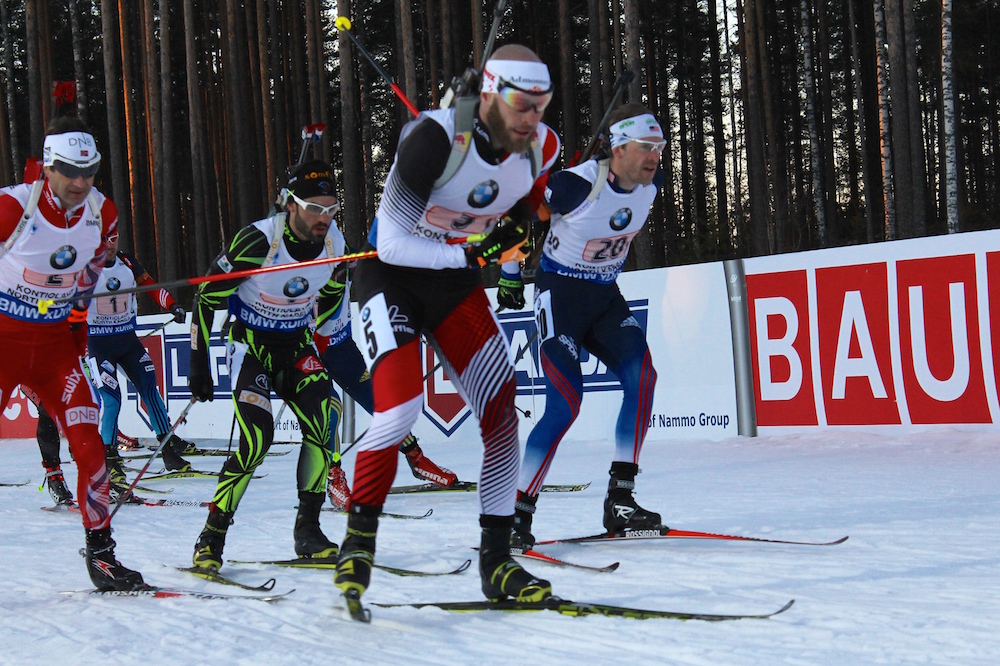
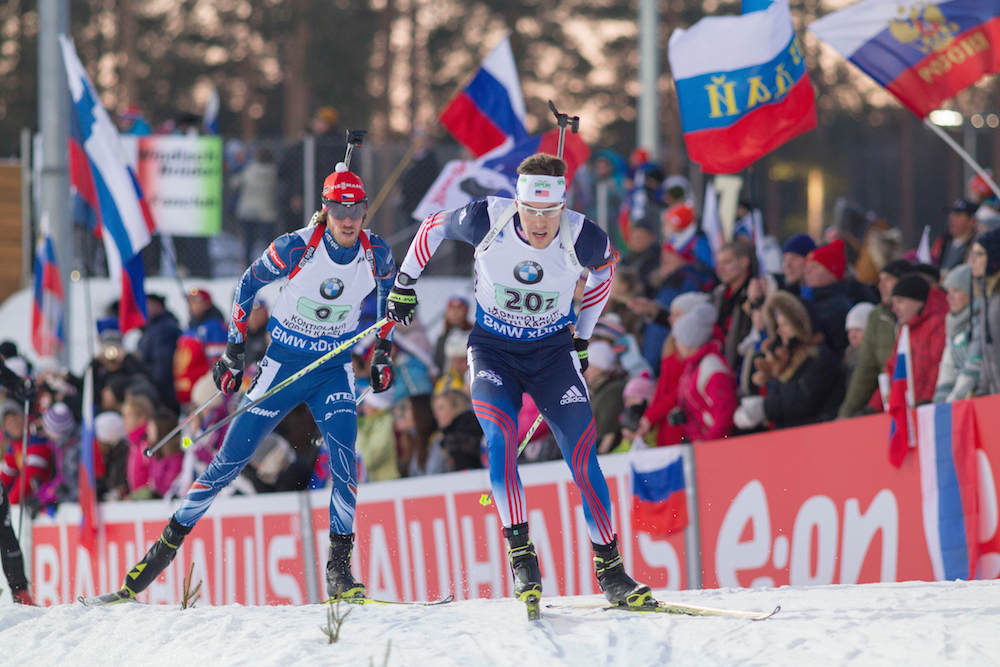
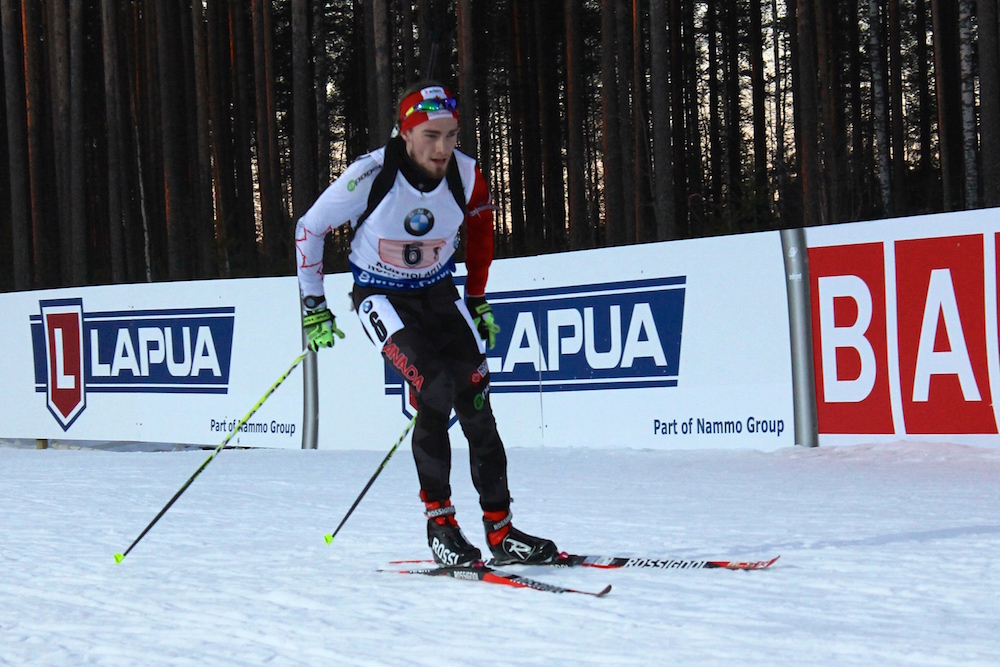
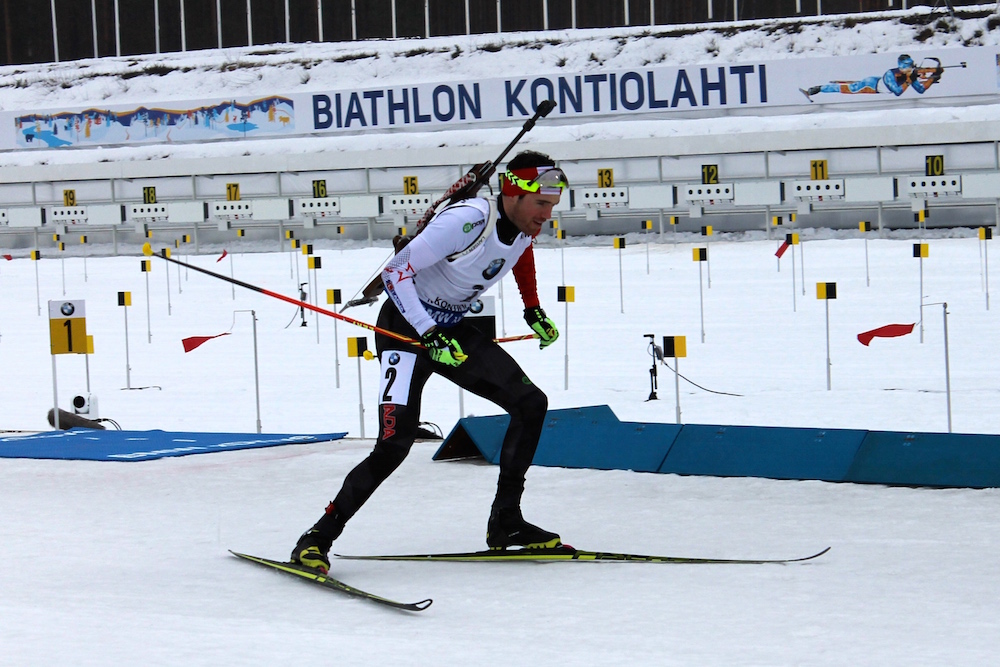
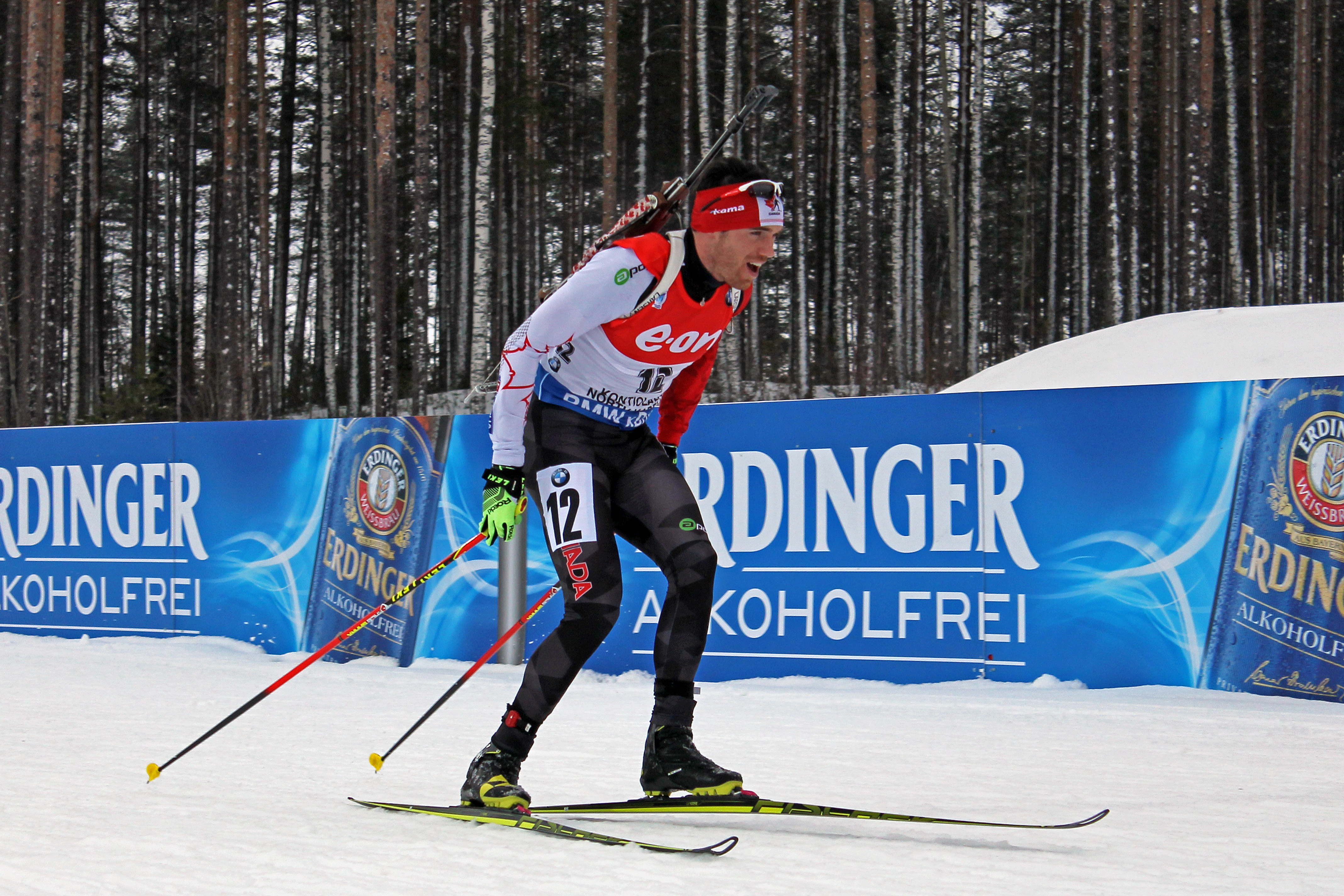
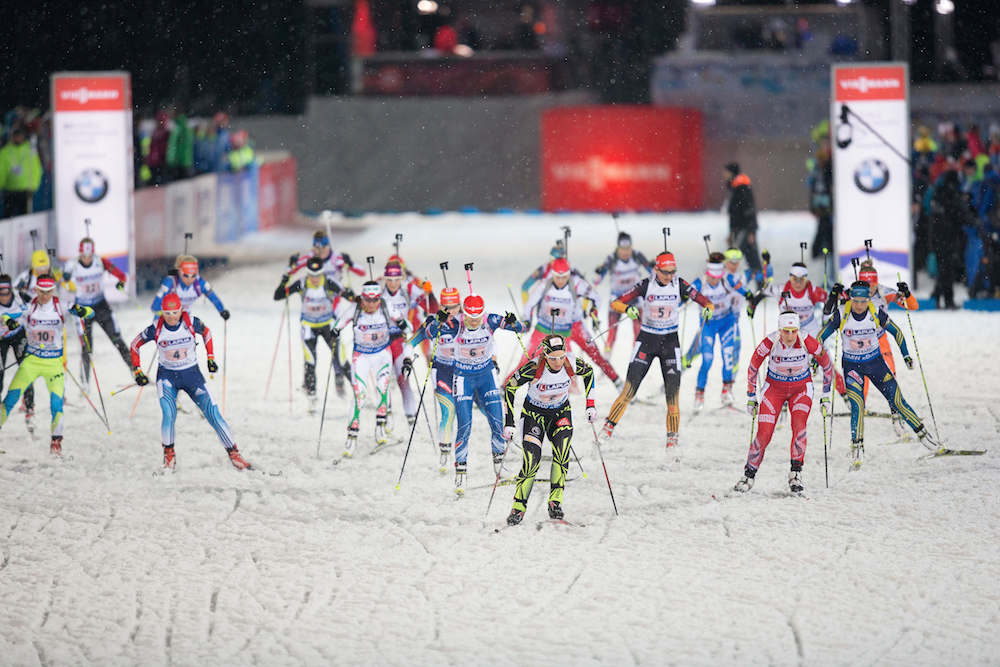
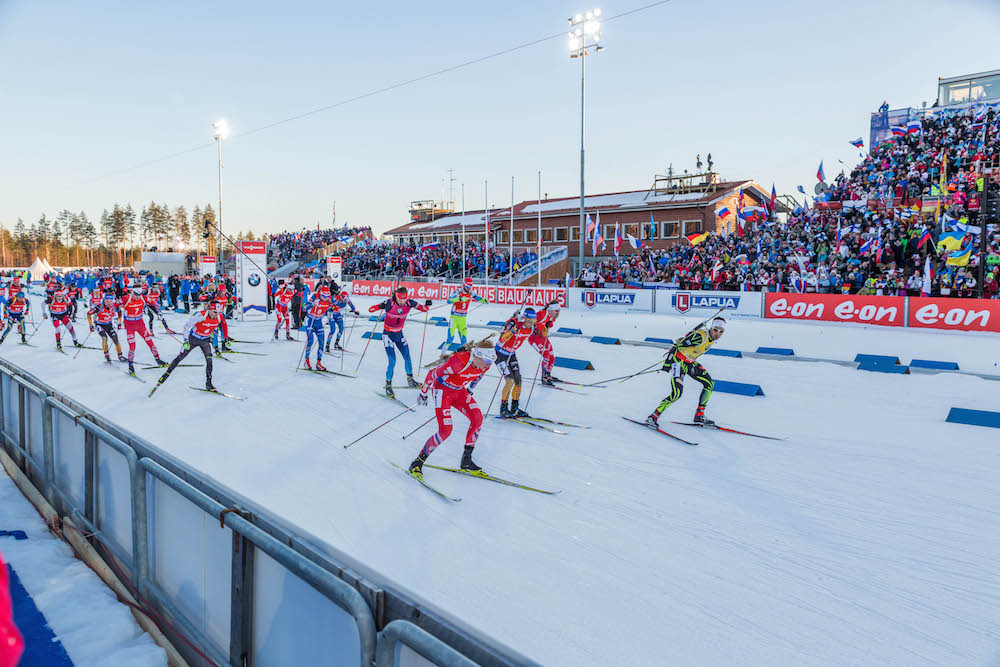
    Start of the men's 15 k mass start on Sunday at IBU World Championships in Kontiolahti, Finland, with Martin Fourcade (r) and Norway's Johannes Thingnes Bø (l) leading and Canada's Nathan Smith (l) near the front. Smith went on to miss two on the first shooting stage and one in the third stage to finish 23rd overall. (Photo: Kontiolahden Urheilijat/Kari Kuninkaanniemi)
    Start of the men’s 15 k mass start on Sunday at IBU World Championships in Kontiolahti, Finland, with Martin Fourcade (r) and Norway’s Johannes Thingnes Bø (l) leading and Canada’s Nathan Smith (behind Bø in red and white) near the front. Smith went on to miss two on the first shooting stage and one in the third stage to finish 23rd overall. (Photo: Kontiolahden Urheilijat/Kari Kuninkaanniemi)

    KONTIOLAHTI, Finland — All four North American men in Sunday’s 15-kilometer mass start had moments from 2015 IBU World Championships they could hold onto, high points of the last week and a half they could drum up and replay in their minds.

    Some were fresher than others. For American Lowell Bailey, it was cleaning every stage after a single miss on his first prone of the mass start, leading a chase group behind the leaders then tagging on to the main pack and finishing 35 seconds behind the winner in 13th — his best result of these World Championships.

    For his teammate, Tim Burke, who finished 10.6 seconds behind him in 14th, it was racing hard on his second lap to catch the leaders, then hanging in and beating out Norway’s Emil Hegle Svendsen, who racked up two silver medals over the last week, in a photo finish. It was also Burke’s best result of the 2015 championships.

    Canada’s Brendan Green experienced the sensations of skiing fifth on his second-to-last lap of the mass start after cleaning all three stages leading up to that point. While he fell behind over the next 2.5 k and missed one of his shots in the final standing for 19-for-20 shooting, that kind of shooting was still something he could be proud of. He also tallied his third 21st place in four individual races at worlds, and he placed 16th in the pursuit.

    And his teammate, Nathan Smith had the physical evidence of a silver medal to remind him what he accomplished eight days earlier.

    “It would be nice to have another race close to that level,” the 29-year-old Smith said after placing 23rd in the mass start with three penalties, two of which came in the first prone. He finished 1:19.4 behind Slovenia’s Jakov Fak, who won in 36:24.9.

    On March 7, Smith became the first Canadian male biathlete to medal at World Championships. The next day, he placed 13th in the pursuit, and on Thursday, finished 44th in the 20 k individual. On Saturday, he hit all 10 of his targets as the second leg of the men’s relay to lift the Canadians from 22nd to 10th. They ended up 19th.

    “I’d say my relay was close to that level, but I’m still pretty happy with how world champs went,” Smith said. “Before this, my best race ever at world champs was [43rd in 2012] so all my races have been better than that.”
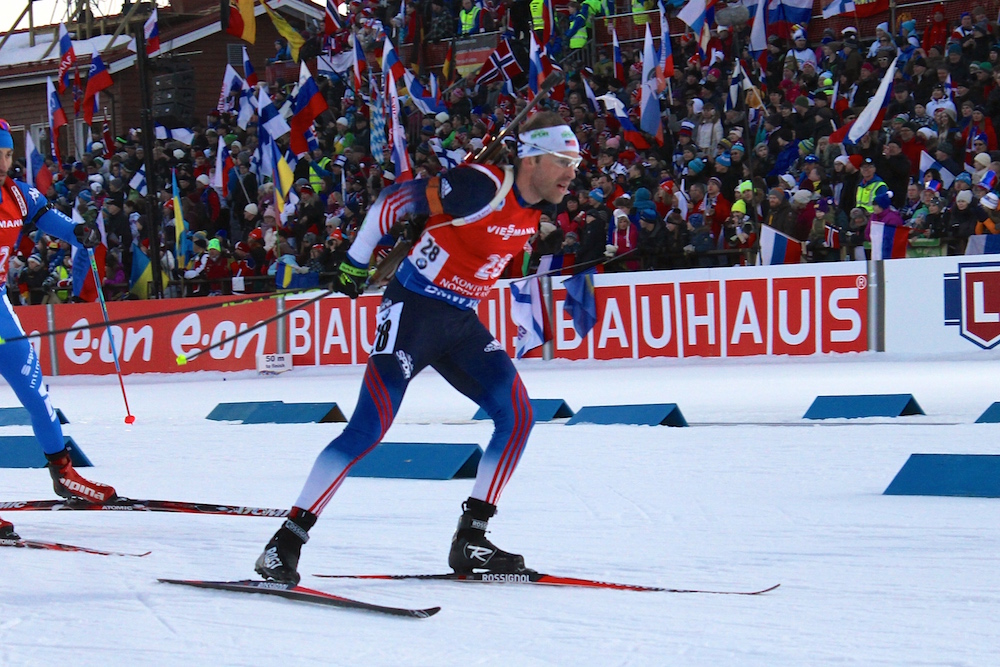
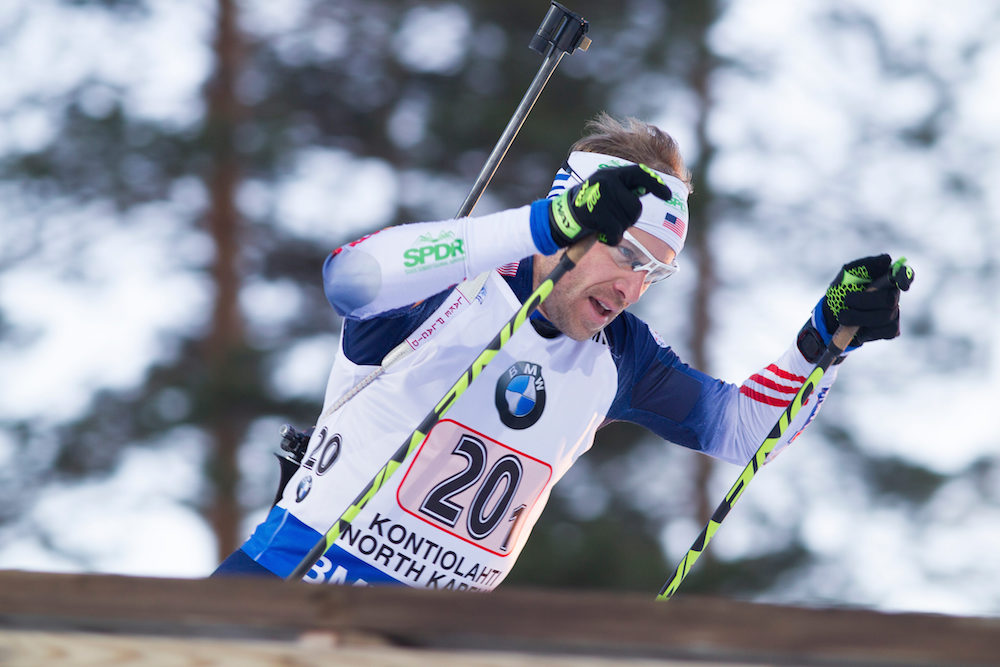
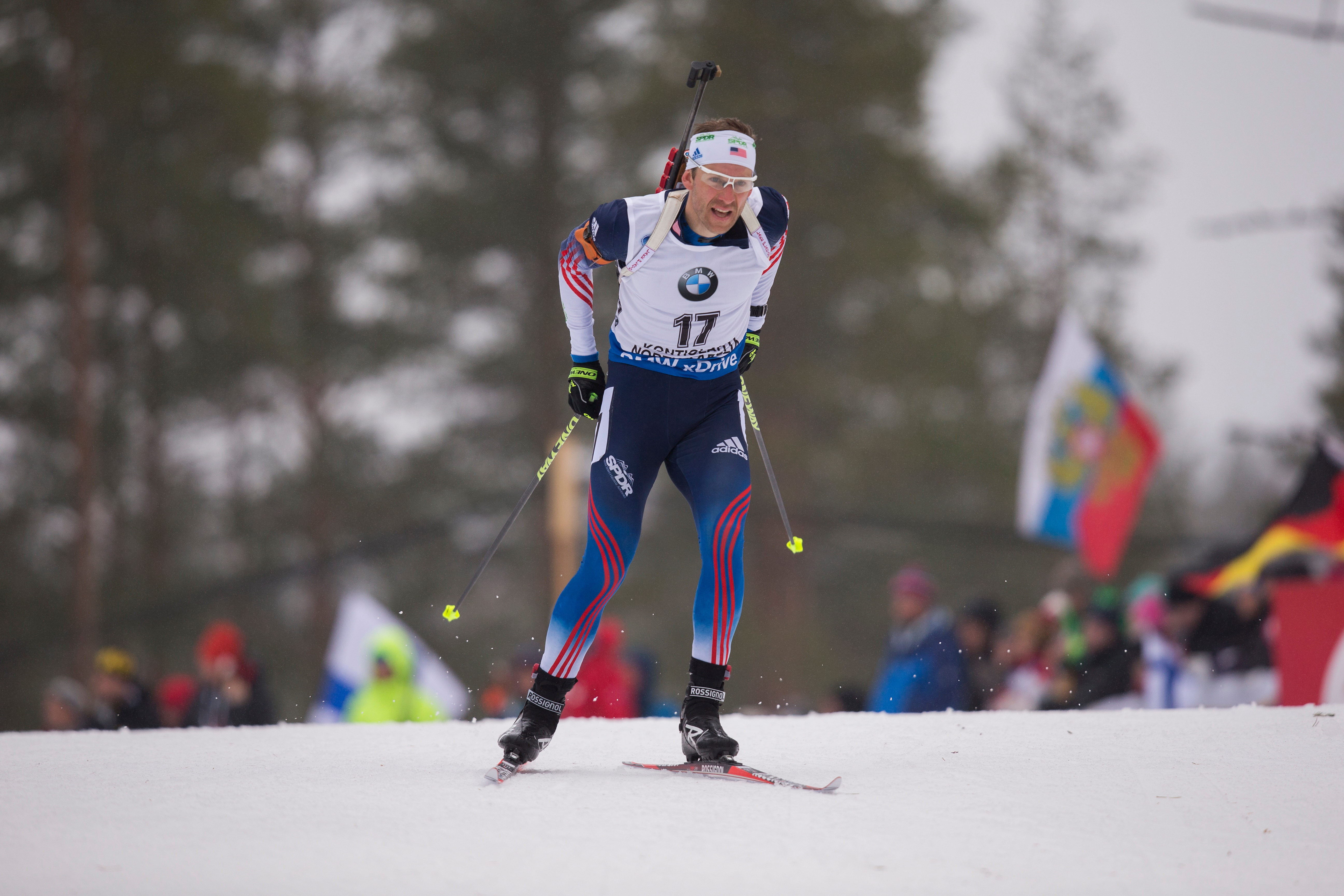
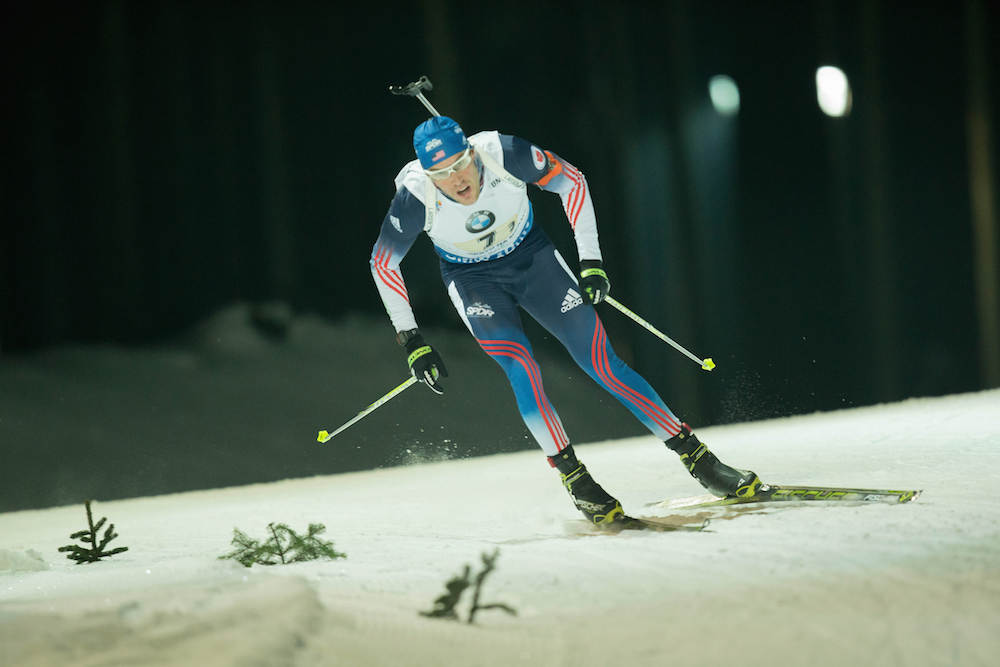
    Lowell Bailey (US Biathlon) en route to 13th in the men's 15 k mass start for his best result of the 2015 IBU World Championships in Kontiolahti, Finland.
    Lowell Bailey (US Biathlon) en route to 13th in the men’s 15 k mass start for his best result of the 2015 IBU World Championships in Kontiolahti, Finland.

    Bailey put himself in contention for what looked like a possible top 10 heading into his last lap on Sunday. After a single prone penalty put him back in 23rd, 26.4 seconds out of the lead, he rose to 11th after the last shooting without another miss all race.

    “I was happy with my mental game today,” Bailey said. “I was able to stay with it and even in the last standing, while I was shooting, it was just, ‘I’m here, I’m shooting and I’m trying to do what I know how to do. The race is whatever it’ll be.’ ”

    After the first prone, Bailey, Burke and Smith all slipped outside the top 20 with at least one miss (Smith had two). The top 20 men out of that stage cleaned, including Green in 16th.

    “It’s a tough way to start off a mass start because that group of clean guys leaves and you’re left kind of at the back of the pack,” Bailey explained. “I just tried to regroup. I knew that it’s only one penalty, it’s a four-stage race, so I really just tried to … pace myself and stay in it so I had a little bit left on the last loop, which was good to have.”

    Within 25 seconds of Norwegian race leader Ole Einar Bjørndalen heading into the last lap, Bailey initially dropped to 13th when Russia’s Evgeniy Garanichev and Svendsen passed him. He passed Svendsen back after the steepest climb and nearly caught Sweden’s Fredrik Lindström, finishing 0.3 seconds behind him in 13th.

    “I’m happy, top 15 at world champs, it’s where I wanted to be,” Bailey, 33, said after his ninth World Championships. “This week’s been kind of up and down. I’m happy with my shooting and the relays [with eighth place in the mixed relay] were solid. Overall, there was no fireworks, but it was a solid week for me, especially considering where I came from. I wasn’t even in the points [at the World Cup] in Oslo. I was sick for the other World Cup before that.”

    Burke, also 33 and in his ninth World Championships, was pleased with his second individual top 15 and third top 20 over the past eight days in Kontiolahti.

    He explained he had to reset after Saturday’s relay, in which he used four spares and skied two penalty loops on the third leg to drop from eighth to 15th.
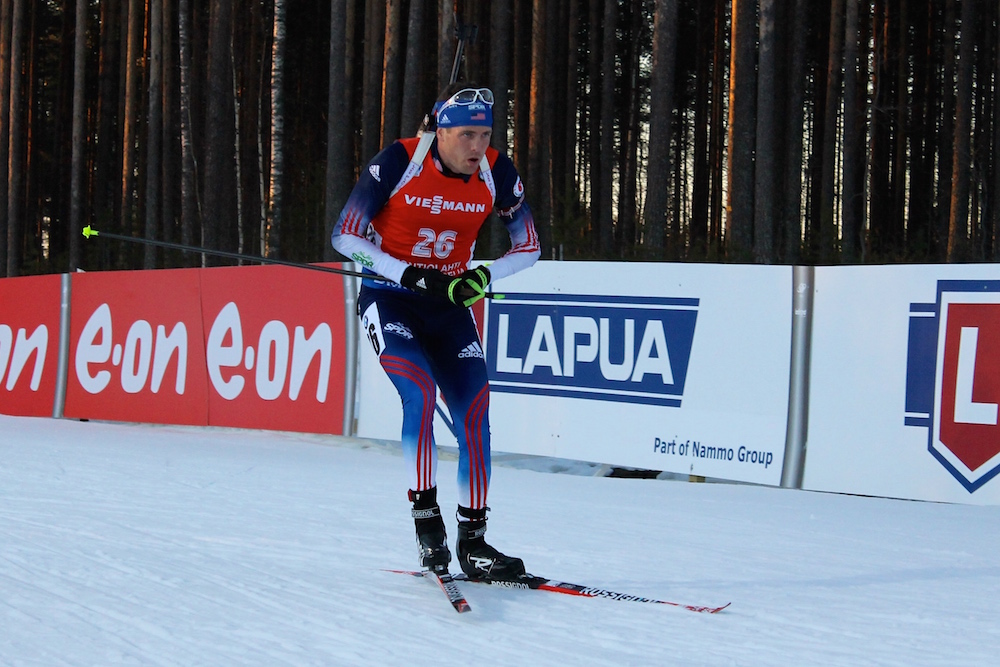
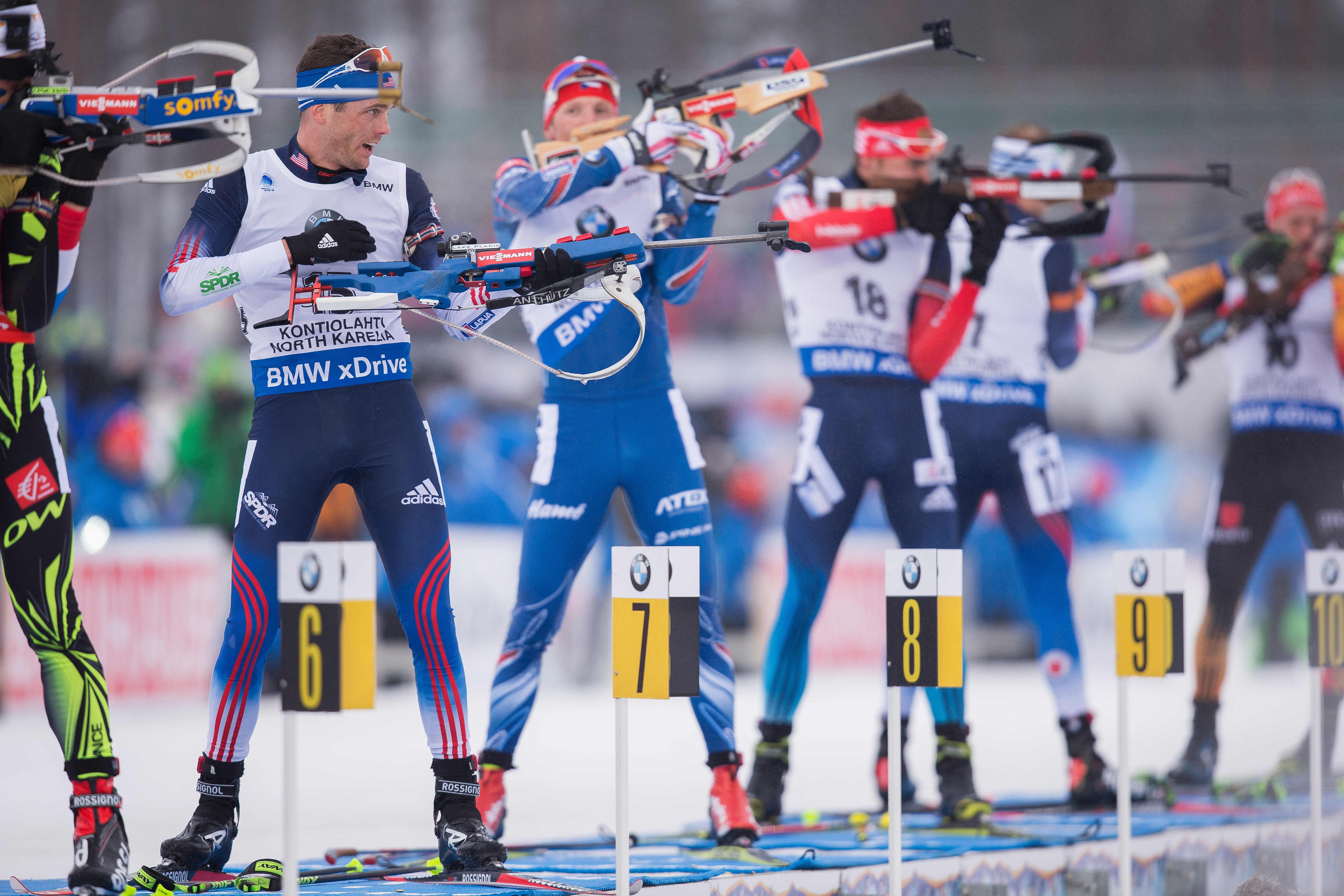
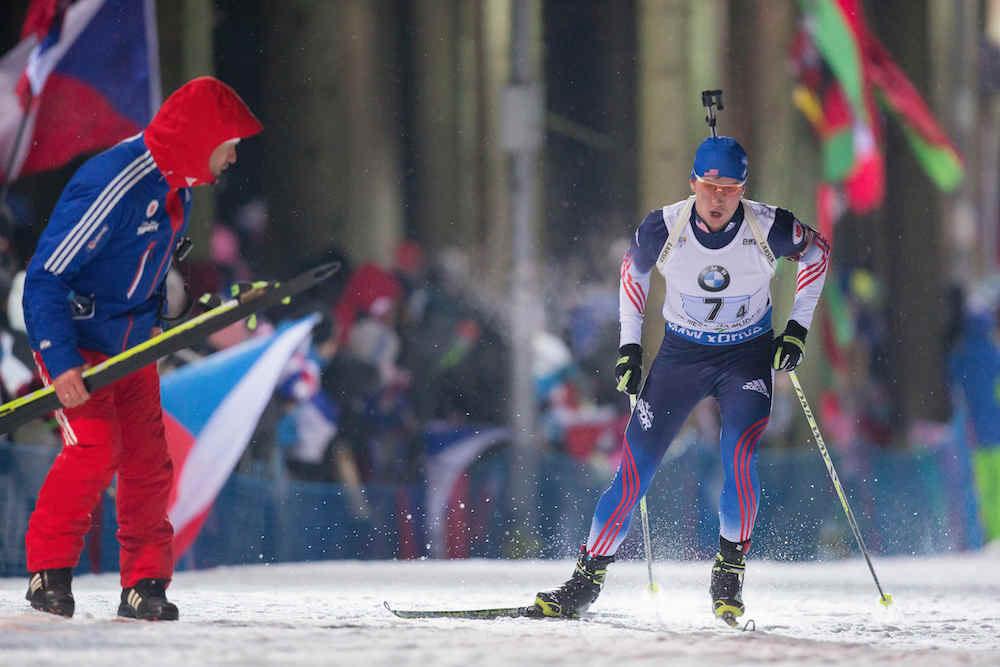
    Tim Burke (US Biathlon) approaches the range during the men's 15 k mass start on the last day of 2015 IBU World Championships in Kontiolahti, Finland. He went on to place 14th for his best result of the championships.
    Tim Burke (US Biathlon) approaches the range during the men’s 15 k mass start on the last day of 2015 IBU World Championships in Kontiolahti, Finland. He went on to place 14th for his best result of the championships.

    “It was tough to regroup after that,” Burke said. “I felt bad for the other guys because they did a great job, but I just wanted to refocus and try to have a solid race here today.”

    Before the mass start, he decided he was going to take his time shooting and go back to the basics.

    “I knew I was going to give away time on the shooting range, but I didn’t care,” Burke said. “Just try to go for each shot, one shot to the next. I felt a lot more comfortable doing that, and that combined with really good skiing today, I was very happy with how I felt. I was able to attack a lot.”

    After an early prone penalty put him back in 26th, 32.1 seconds out of first, Burke pushed hard on his second lap to catch the 24-man lead pack and came into the range within 13 seconds of Norway’s Johannes Thingnes Bø up front.

    “I just went out aggressive on the loop and halfway through, I realized that front group was taking it easy,” Burke recalled. “I saw I had an opportunity to catch back up, and any time you can do that, you have to do it.

    “I definitely burned some matches on that second loop catching up,” he added. “Luckily, I shot clean in the second prone so I was able to get back in the group and take a breather for a loop.”

    While taking it easy within the lead pack doesn’t usually happen, but Burke explained this race was unique.

    “It was pretty crazy, the front group was just not going fast,” he said. “No one wanted to lead. There were 20 guys that came into the last shooting. I’ve never seen that.”

    Out of the final stage, Bjørndalen emerged 1.6 seconds ahead in first, having cleaned all four stages. Fellow Norwegian Tarjei Bø cleaned the last shooting to head out in second, and Ondrej Moravec of the Czech Republic left the range in third, 3.4 seconds back. Also with a clean final standing, Fak was the fourth man to join that group, 4.1 seconds after Bjørndalen.

    While the frontrunners battled for three podium spots, there was a 10-second gap to Germany’s Simon Schempp, who cleaned the last stage to move into fifth. France’s Simon Fourcade, Svendsen and Garanichev each missed one to fall back in the standings, from second to sixth for Fourcade, and 12th and 13th for Svendsen and Garanichev, respectively.

    That’s where Bailey found himself in 11th, and Burke was 37.5 seconds back in 17th after two more penalties, one on each standing stage. Burke skied the sixth-fastest course time overall to finish 14th, just ahead of Svendsen in 15th and one-tenth of a second ahead of Germany’s Benedikt Doll in 16th.

    “Overall, solid,” Burke said of his World Championships. “It’s better than what I’ve done so far this year so I have to be happy with that, but it’s not what I’m here for. It’s not what I think I’m capable of, but it’s a step in the right direction.”
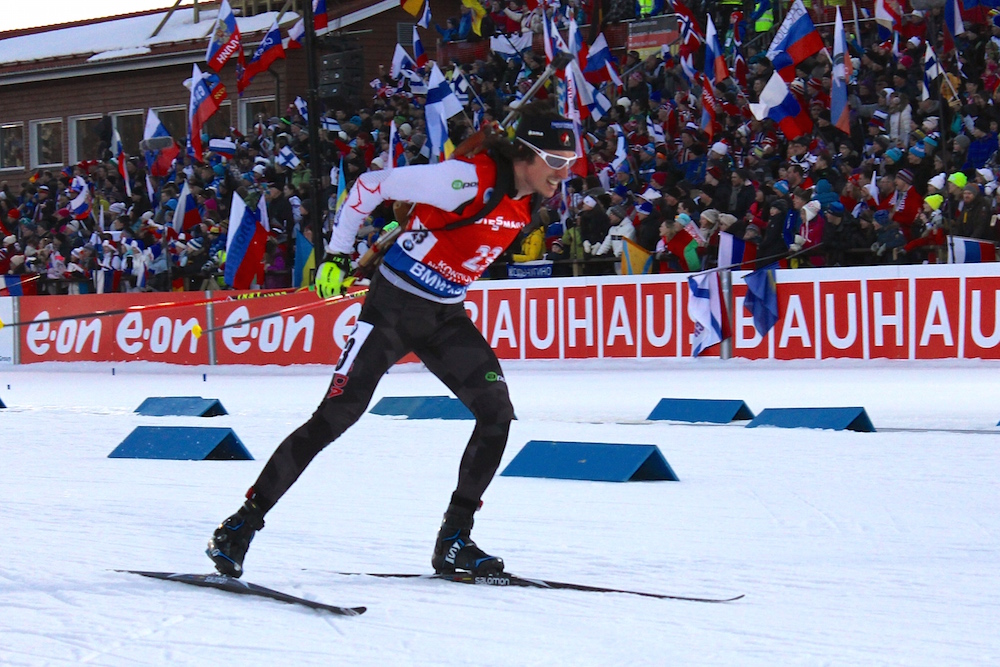
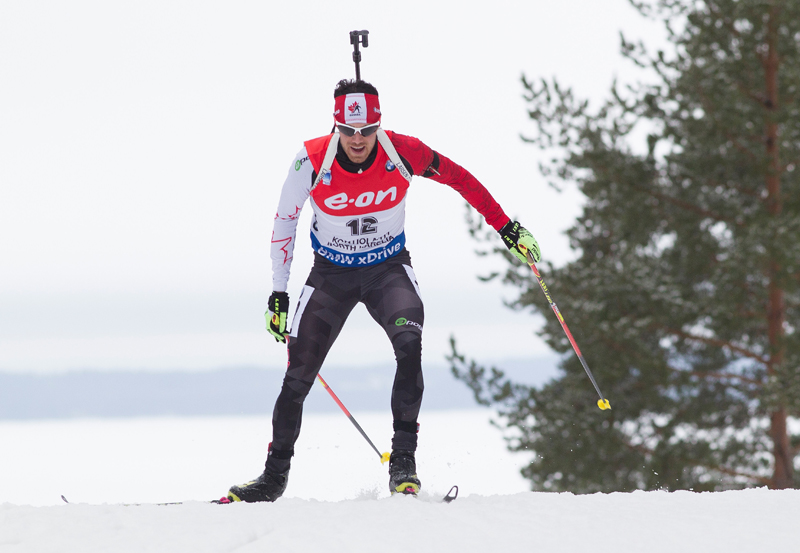
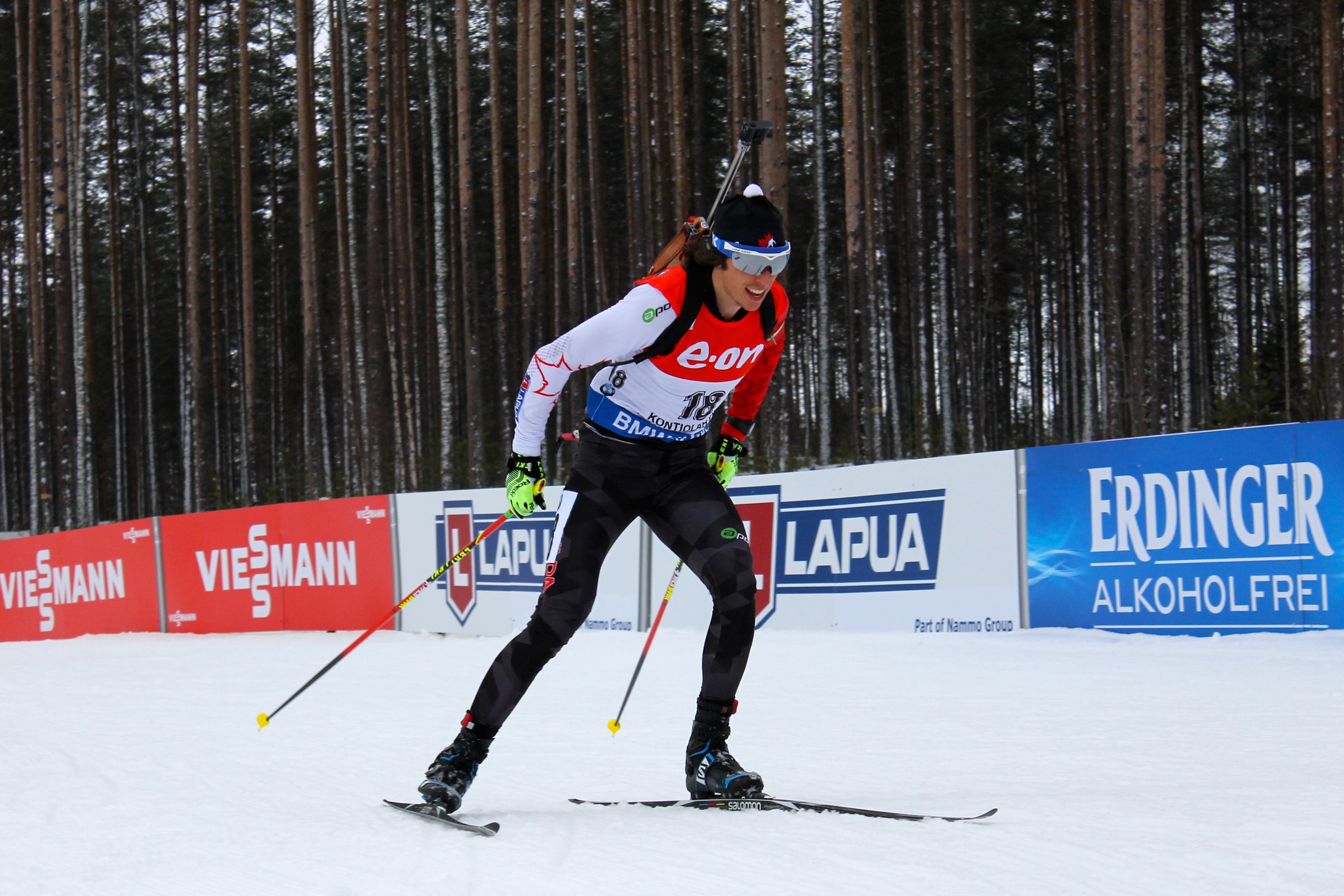
    Brendan Green (Biathlon Canada) racing the men's 15 k mass start on the last day of 2015 IBU World Championships in Kontiolahti, Finland. While he skied up to fifth with clean shooting through the first three stages, he ended up 19th with a miss on the last stage and placed 21st.
    Brendan Green (Biathlon Canada) racing the men’s 15 k mass start on the last day of 2015 IBU World Championships in Kontiolahti, Finland. While he skied up to fifth with clean shooting through the first three stages, he ended up 19th with a miss on the last stage and placed 21st.

    With three flawless shooting stages, Green started his penultimate lap in fifth, 13.6 seconds behind Simon Fourcade, the leader at the time, and 6.4 seconds behind Moravec in fourth.

    “That was pretty fun,” Green said of the race overall. “It was unreal how tight it was. I don’t think I’ve ever been in a mass start quite like that. It was fun to be in the mix. The skiing still isn’t quite there, but the saving grace was being in the pack of guys. I think that enabled me to dig a bit deeper and hurt a bit more.”

    While skiing alone in fifth, the 28-year-old Canadian said the pace picked up considerably on that lap, which he expected. On the climb known as the “wall,” Green was 16 seconds back in 13th, just ahead of Burke.

    “Lower down on the course I got caught by a group,” Green said. “I was able to kind of stay with them, but it was so tight. There was a big group of guys and I don’t think anything was really decided until that last standing.”

    There, he missed one and dropped to 19th, 43.5 seconds out of the lead. Green finished 21st, 1:08.3 after the winner.

    “I gave it my best today and it was working out pretty good until the last standing,” he said. “I have to be happy with the shooting today. It was a good race and it’s more experience under my belt for the future.

    “All in all for the championships, I’m pretty happy with how I did,” Green added. “I wish my preparation could’ve been better and more as planned, but that’s the way it goes sometimes.”

    Leading into the championships, Green had to rehab a back injury and spent some time away from skiing.

    “Hopefully next year my form is a little better and I can keep the same shooting and improve upon these results,” he said.
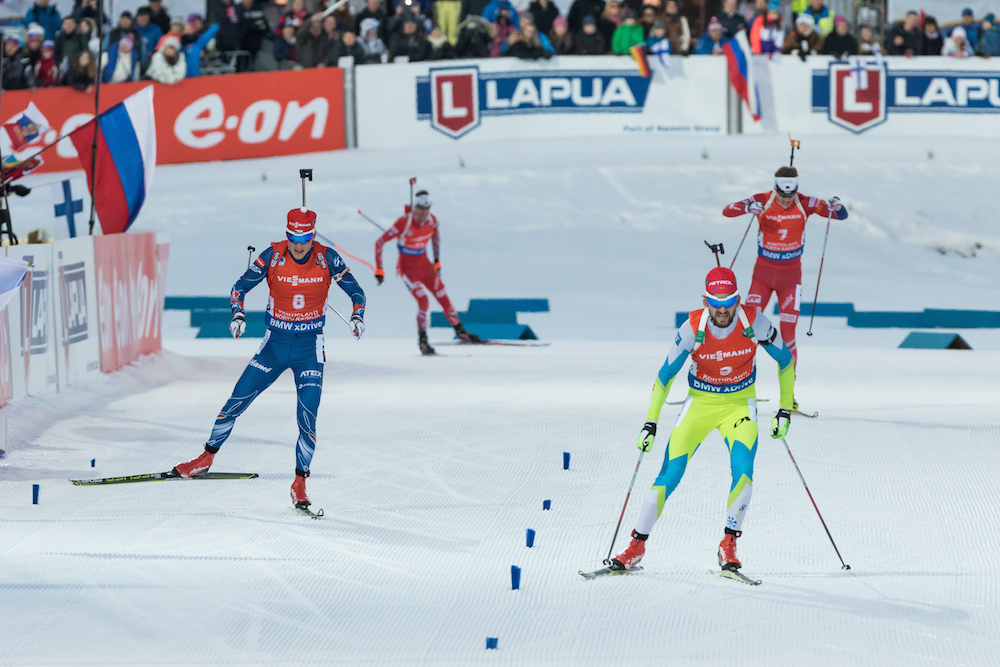
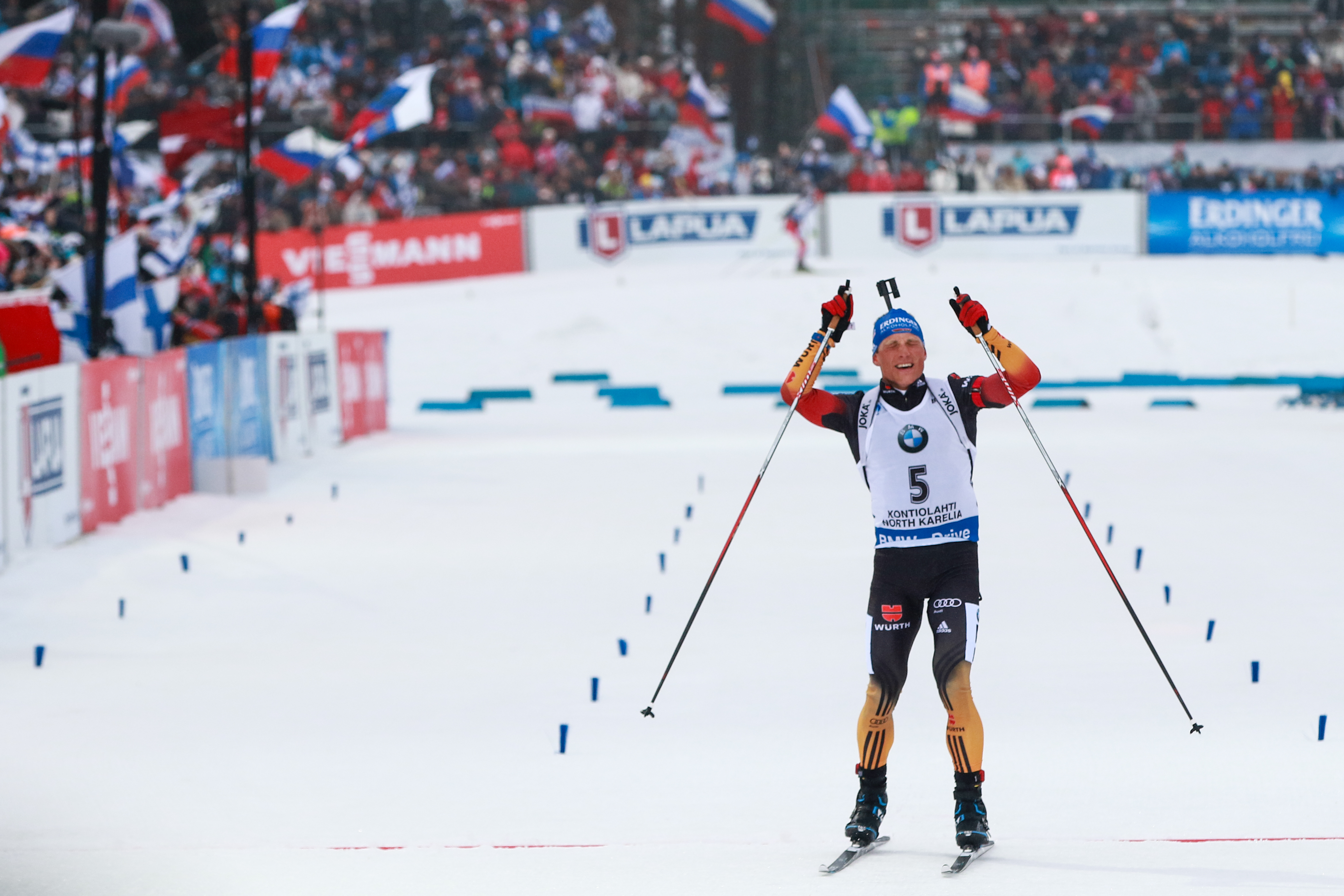
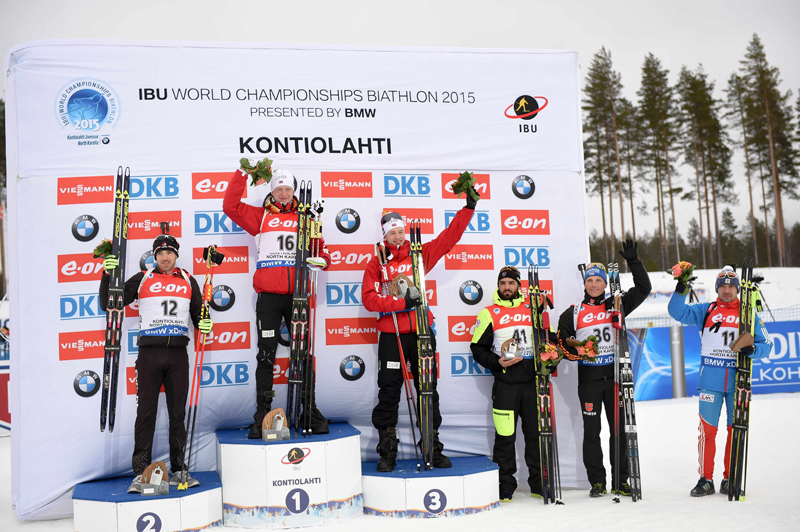
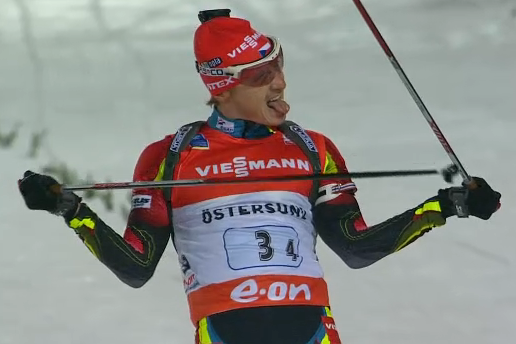
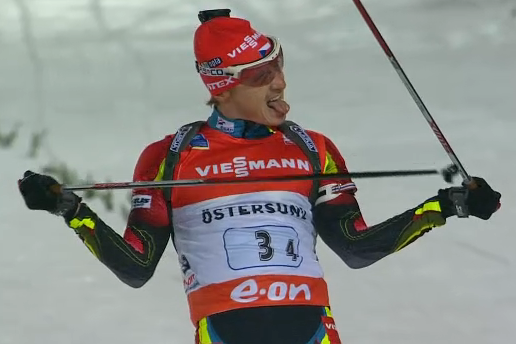
    Slovenia's Jakov Fak (r) attacked on the last lap and held off Ondrej Moravec of the Czech Republic (l), in second, and Norway's Tarjei Bø (back r), in third, as well as Norway's Ole Einar Bjørndalen (back l), in fourth, to win the men's 15 k mass start on the last day of 2015 IBU World Championships in Kontiolahti, Finland. (Photo: Kontiolahden Urheilijat/Risto Kuittinen)
    Slovenia’s Jakov Fak (r) attacked on the last lap and held off Ondrej Moravec of the Czech Republic (l), in second, and Norway’s Tarjei Bø (back r), in third, as well as Norway’s Ole Einar Bjørndalen (back l), in fourth, to win the men’s 15 k mass start on the last day of 2015 IBU World Championships in Kontiolahti, Finland. (Photo: Kontiolahden Urheilijat/Risto Kuittinen)

    Fak Finally Gets His

    As predicted, the race came down to the final shooting, and really, the last lap, where Fak took control. Without wasting much time, the Slovenian made a point to get in front of Moravec and the Norwegians, and by the top of the wall, he had successfully gapped Bjørndalen and Tarjei Bø.

    “After the shooting, I saw that Ole Einar was in front of me,” Bø recalled in a press conference. “I turned around and saw these two guys [Moravec and Fak] and I knew the medals would be delivered out to three of the four. I was trying to go for the gold medal. Jakov increased the speed in the second last of the uphills. I tried to follow him and I did it almost as good as I was planning to, but in the last hill, he and Ondrej were too strong for me and Ole … there was no energy left.”

    Moravec held on, but barely.

    “I know how fast he is,” the Czech said of Fak, whom he has trained with for several summers. “He take a little bit advantage on the last uphill, so I say, ‘OK, you win,’ but I believe that I can take some medal in the end.”

    The two sprinted toward the finish together, and Fak outlasted Moravec by a 1 second for his first medal of the week and second World Championships title.

    “It was a very hard World Championships for me,” Fak explained in the conference. “When you look at the competition schedule before the World Championships, you see a lot of races, then when you are not satisfied with your competitions, you have less and less chance every day.

    “Today was the last day,” he continued. “When I was standing on the start, I saw all the medal winners before me. I was the first with the number without the medal and I wanted to get it so much.”

    He earned it ahead of not only Moravec, but also Bø, who medaled in five out of six races at 2015 worlds (excluding the 20 k individual). Bø finished 3.7 seconds back in third for his fourth bronze of the week. He also earned silver with the men’s relay on Friday.
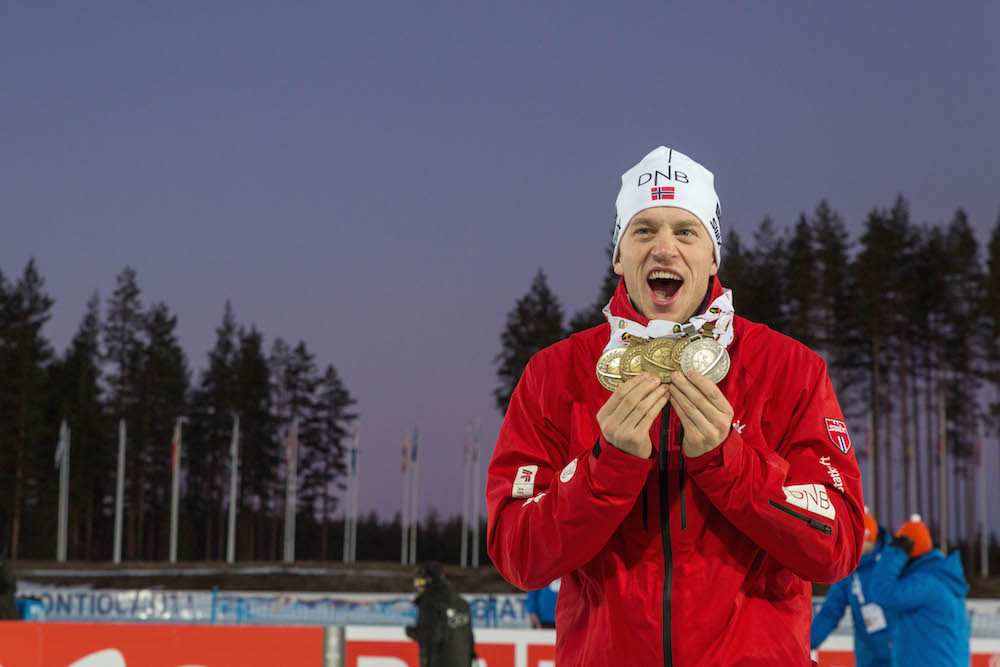
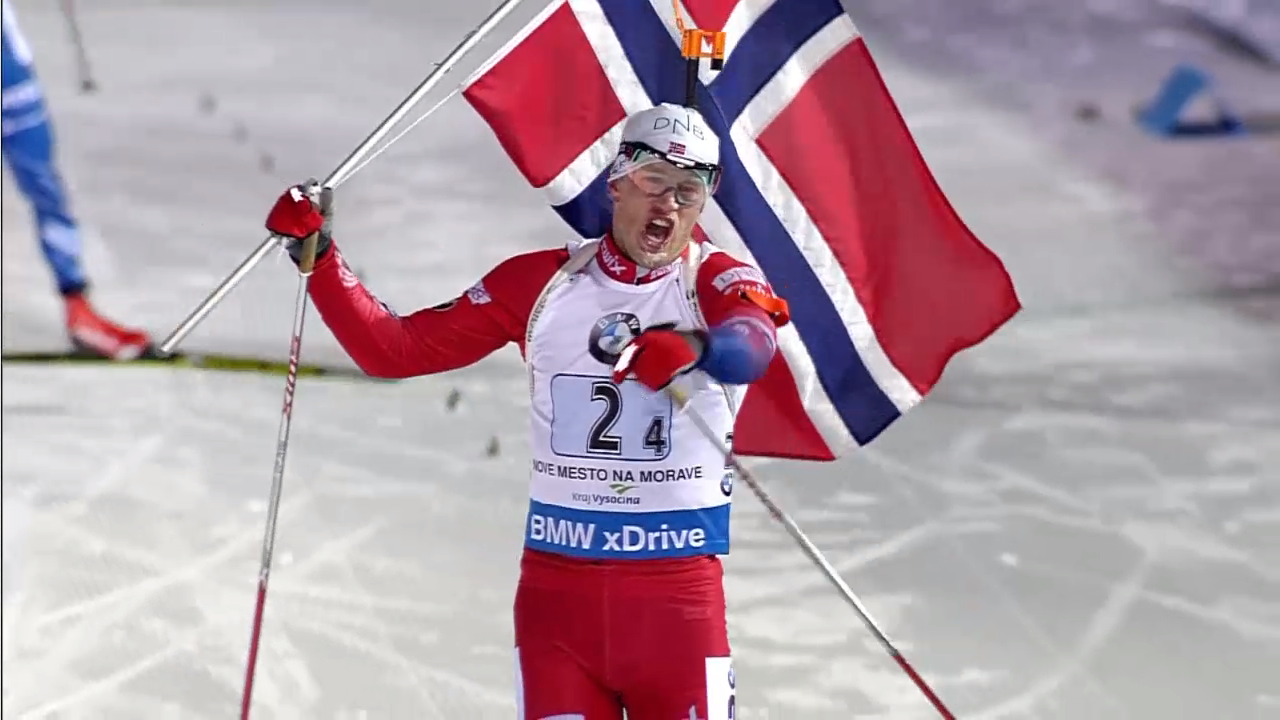
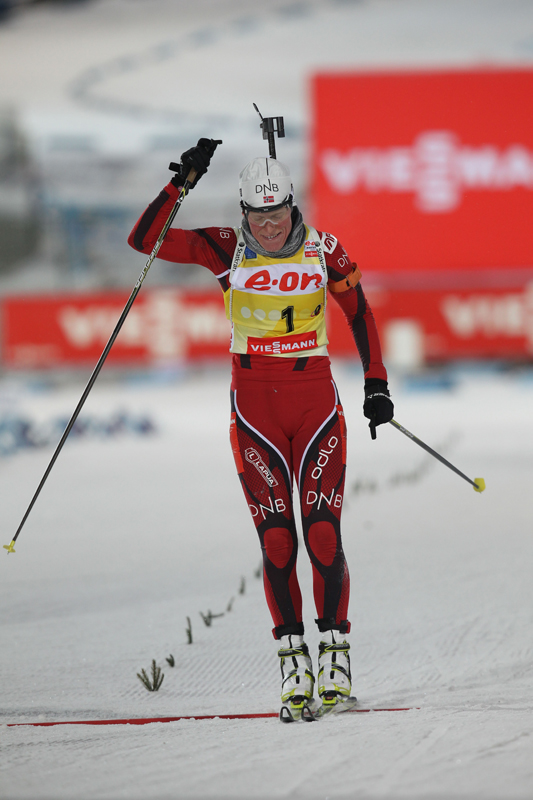
    Norway's Tarjei Bø with his five medals from 2015 IBU World Championships in Kontiolahti, Finland. He took bronze on Sunday in the men's 15 k mass start, the final race. (Photo: Kontiolahden Urheilijat/Kari Kuninkaanniemi)
    Norway’s Tarjei Bø with his five medals from 2015 IBU World Championships in Kontiolahti, Finland. He took bronze on Sunday in the men’s 15 k mass start, the final race. (Photo: Kontiolahden Urheilijat/Kari Kuninkaanniemi)

    “In both Khanty-Mansiysk and Nove Mesto [World Championships], I took individual gold medal. I like that color better,” said Bø, a four-time world champion between 2011 and 2013. “But still with five medals, even if it’s not a gold medal, I’m so happy. It was a strange winter and even here, I’m not skiing as good as I’m hoping to do, but my shooting has been incredible.”

    Fak, Moravec and Bø all shot 19-for-20, with Fak missing one in the third stage, Moravec missing one in the first prone, and Bø missing one in the third stage as well. Bjørndalen cleaned and ended up fourth, 10.2 seconds after Fak and 6.5 seconds off the podium.

    Results

  • Deutschland Does It Again, Racks Up Second-Straight Relay Gold at IBU World Champs

    Deutschland Does It Again, Racks Up Second-Straight Relay Gold at IBU World Champs

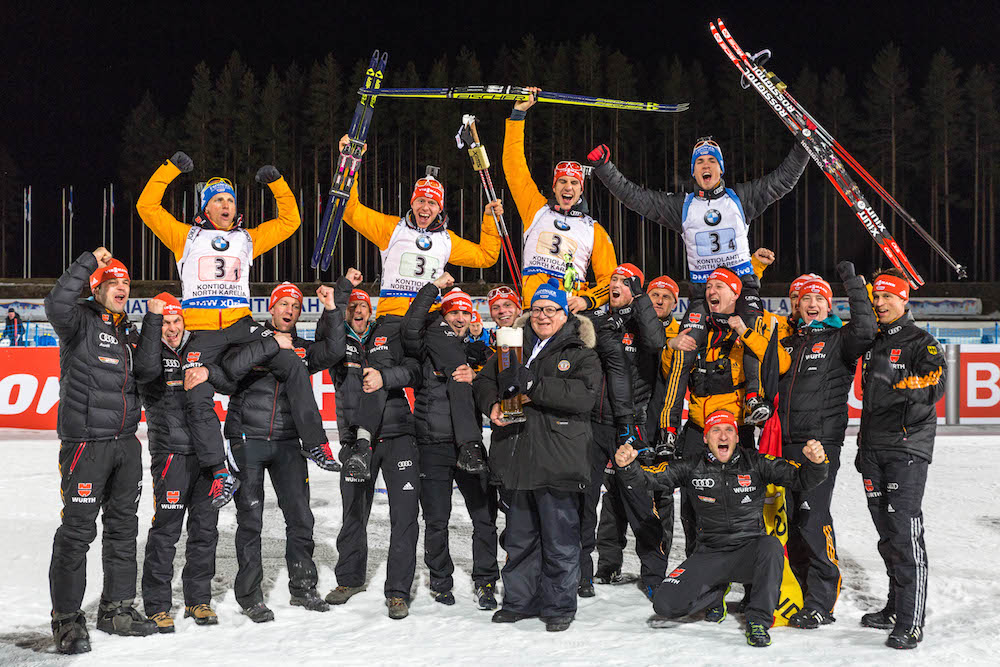
    A happy German team celebrates its second win in two days of relays at 2015 IBU World Championships in Kontiolahti, Finland, with the men's 4 x 7.5 k victory on Saturday. From left to right: Erik Lesser, Daniel Böhm, Arnd Peiffer, and Simon Schempp. (Photo: Kontiolahden Urheilijat/Kari Kuninkaanniemi)
    A happy German team celebrates its second win in two days of relays at 2015 IBU World Championships in Kontiolahti, Finland, with the men’s 4 x 7.5 k victory on Saturday. Above, from left to right: Erik Lesser, Daniel Böhm, Arnd Peiffer, and Simon Schempp. (Photo: Kontiolahden Urheilijat/Kari Kuninkaanniemi)

    KONTIOLAHTI, Finland — After more than a week of waiting, Simon Schempp could finally enjoy  the 2015 IBU World Championships in Kontiolahti, specifically the last two hundred meters of the men’s 4 x 7.5-kilometer relay and everything that came after that.

    Schempp, 27, had been given the task of anchoring the German team on Saturday, and after two races in which he failed to medal (including his 77th place in the sprint), it seemed like a tall order.

    But Schempp spent much of this season ranked second overall in the IBU World Cup, so he simply needed to restore his confidence back to its pre-World Championships level. He did so in Thursday’s 20 k individual, placing eighth.

    “I caught the self confidence for today and was prepared for this relay,” he explained in press conference after Saturday’s relay.

    Germany's Simon Schempp soaks up his team's victory after anchoring the men's relay to gold on Saturday at 2015 IBU World Championships in Kontiolahti, Finland. (Photo: Kontiolahden Urheilijat/Risto Kuittinen)
    Germany’s Simon Schempp soaks up his team’s victory after anchoring the men’s relay to gold on Saturday at 2015 IBU World Championships in Kontiolahti, Finland. (Photo: Kontiolahden Urheilijat/Risto Kuittinen)

    Things were better then — he had secured a 15.4-second victory for his team, matching the gold the German women won in the 4 x 6 k relay the day before.

    His teammate Arnd Pfeiffer shot a perfect 10-for-10 on the third leg to tag him in first at the final exchange, 15.3 seconds ahead of Norway. Schempp proceeded to clean prone without any need for spares then used a single spare in standing to leave the range for the last time 15 seconds ahead of Emil Hegle Svendsen in second.

    Svendsen also shot clean on his first stage and used a spare in standing to neither make up nor lose ground to Schempp, which he tried to change on the last lap. Meanwhile, French anchor Martin Fourcade went from fifth (behind the Czech Republic and Slovenia) to fourth on his first lap and used one spare to emerge from prone in third, 41.6 seconds out of first and 28.3 seconds from second.

    The next time and final time around, Fourcade rattled off five quick shots to clean standing with the second-fastest range time. He remained in third, but within 25.6 seconds of Schempp and 10.6 of Svendsen.

    Considering that, Svendsen had to think about defending silver and pressing for gold simultaneously on his last 2.5 k loop.

    “I just tried to ski fast and didn’t look much behind,” Svendsen said in the press conference. “I tried to catch Simon, but had no chance.”

    After being cheered on by his teammates while leaving the range, Schempp extended his gap to 19 seconds a kilometer into the final lap, then 20.9 seconds less than a kilometer later.

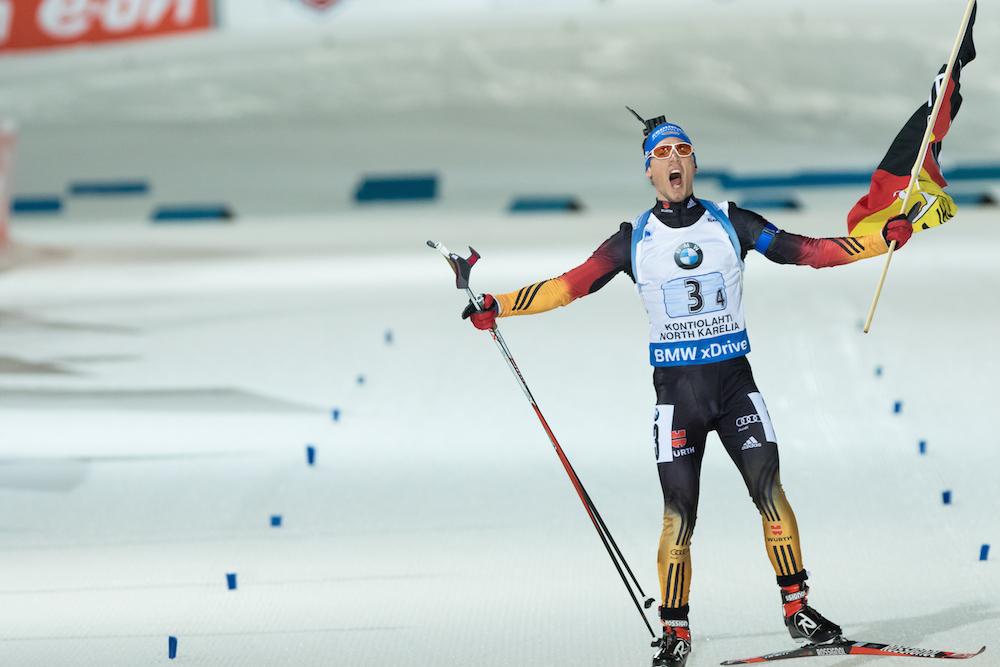
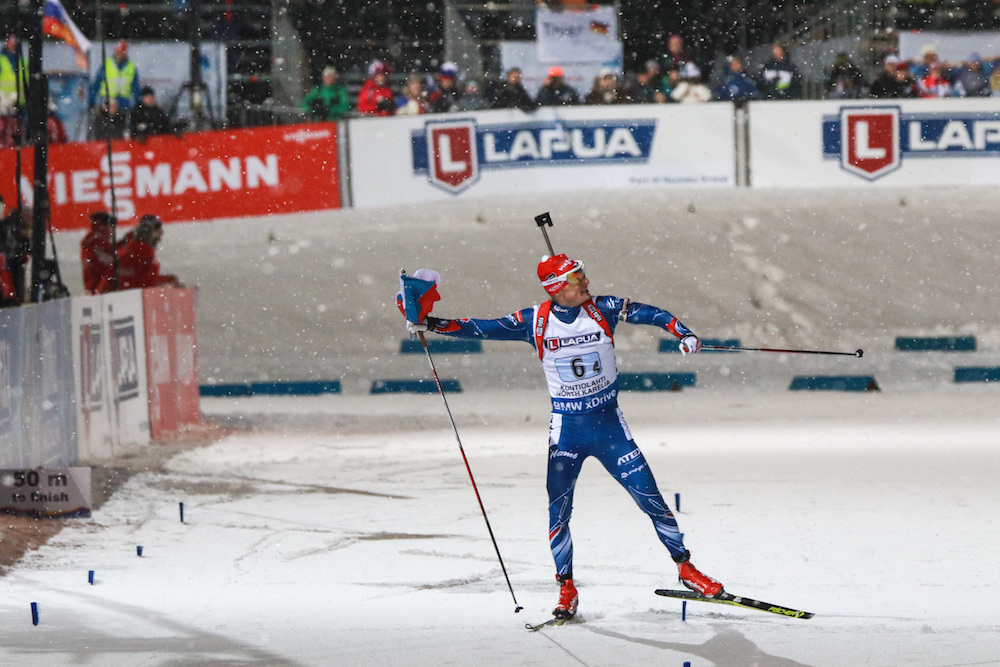
    He finished 15.4 seconds ahead of Svendsen, taking the time to enjoy the finishing stretch while carrying the German flag.

    “Only the last two-hundred meters I could enjoy because before, I gave all I have,” Schempp said. “I’m really happy and proud to be a part of this team.”

    The Germans achieved gold with first and second skiers, Erik Lesser, who won the pursuit last Sunday, and Daniel Böhm, who opened the championships in sixth with the mixed relay.

    Lesser hit all 10 of his targets without any problems to hand off in third, 6.4 seconds behind Norway’s Ole Einar Bjørndalen, who also cleaned to take the lead, and France’s Simon Fourcade, who cleaned as well to trail in second.

    “I think all the team was determined to get a medal today,” Simon Fourcade said in the conference. In the last week, he placed fourth in both the sprint and 20 k individual.

    “I know the relay is not only about me; I wanted to do my best on the first leg to give the best position to [my teammates],” he added.

    During the second leg, Norway dropped to fifth with three standing spares from Tarjei Bø. Jean-Guillaume Béatrix used one spare in each stage to bring France into first by the second exchange, 0.7 seconds ahead of Italy and 3.1 seconds ahead of Böhm — who used two standing spares to keep Germany in third.

    “Today, I felt a lot of tension in our team. Everybody wanted to have this victory,” Böhm recalled. “Watching the two others after me was harder than skiing.”

    “I felt a lot of tension in our team. Everybody wanted to have this victory. Watching the two others after me was harder than skiing.” — Daniel Böhm, Germany’s second leg on its gold-medal winning relay

    Just over a year ago, the German men took silver in the 2014 Olympic relay behind Russia. They had the same team and same order.

    “I was very nervous today, even more nervous before the individual races,” Peiffer said.

    Johannes Thingnes Bø of Norway leads Germany's Arnd Peiffer up and over the wall during the third leg of the men's 4 x 7.5 k relay at 2015 IBU World Championships in Kontiolahti, Finland. Germany went on to win gold and Norway took silver ahead of France. (Photo: Kontiolahden Urheilijat/Janina Joutsen)
    Johannes Thingnes Bø of Norway leads Germany’s Arnd Peiffer up and over the wall during the third leg of the men’s 4 x 7.5 k relay at 2015 IBU World Championships in Kontiolahti, Finland. Germany went on to win gold and Norway took silver ahead of France. (Photo: Kontiolahden Urheilijat/Janina Joutsen)

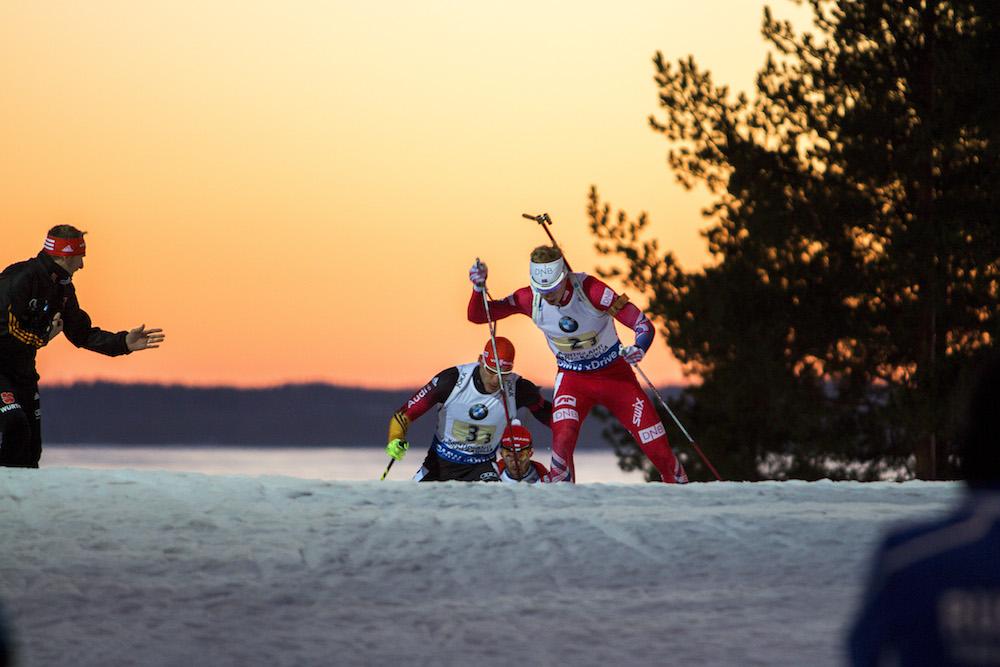
    He took the lead with a flawless prone, leaving the range 2 seconds ahead of Norway’s Johannes Thingnes Bø, who also cleaned. Bø passed him early in the lap and the two skied together into the range for standing. There, Peiffer cleaned again and Bø used a spare, which made the difference.

    “I knew that I was together with Johannes and it was going to be a hard last lap so I tried to save some energy and tried to [have a] good standing shooting,” Peiffer explained.

    He left the range 13.3 seconds ahead of Bø, and the Czech Republic’s Michal Slesinger moved into second during that last lap of the third leg, coming within 14 seconds of Peiffer. Bø passed Slesinger back before the exchange, and the Czech tagged in third — one tenth of a second behind Norway.

    With Ondrej Moravec skiing the last leg, the Czech Republic slipped to fourth with his three prone spares. Russia’s Anton Shipulin and Austria’s Dominik Landertinger both hit every standing target without any slipups to overtake Moravec before the final lap. The Czech fell to sixth, where he would end up at the finish, behind Russia in fourth and Austria in fifth.

    While Germany won in 1:13.49.5 and Norway was 15.4 seconds back in second, Fourcade pushed hard on the last lap aim for silver, but came up 18.2 seconds short in third.

    “I was really happy to conclude what the team did,” Fourcade said in the conference. “Jean-Guillaume and Simon [Fourcade] were perfect on the track and on the shooting range. I think we had a bit more pressure, but we are really satisfied with this third place.”

    Bailey Surges for Early Lead

    American Lowell Bailey thrust himself into the spotlight as the first skier for the U.S., taking the lead 1.8 k in and holding it as he and the 27-team field approached the range for the first time.

    Lowell Bailey (US Biathlon) led early as the first leg in the men's 4 x 7.5 k relay at 2015 IBU World Championships and ultimately handed off in seventh. The U.S. ended up 14th with two penalties and 11 spares in Kontiolahti, Finland. (Photo: USBA/NordicFocus)
    Lowell Bailey (US Biathlon) led early as the first leg in the men’s 4 x 7.5 k relay at 2015 IBU World Championships and ultimately handed off in seventh. The U.S. ended up 14th with two penalties and 11 spares in Kontiolahti, Finland. (Photo: USBA/NordicFocus)

    Perhaps even more impressive was the fact that Bailey started near the back of the pack in the seventh of nine rows.

    While the start was congested from his vantage point, Bailey explained he was able to use his fast skis and an eye for an opening before the first descent to move toward the front. By the first uphill, he found himself around fourth.

    “Then I got to the front, and I think [Austria’s Daniel] Mesotitsch was trying to slow things down,” Bailey said. “On the wall, I just figured there’s no real advantage in this range to go in third or fourth. Normally it can be, but in this range, being in first is fine.

    “I was just going my own pace and I wasn’t sure where that would end up, but I figured there can’t be any harm in going to the front and staying up there,” he added. “No one wanted to pass and that was fine with me.”

    During that prone stage, Bailey cleaned without any spares and left the range in sixth, 3.6 seconds out of first. The following lap, he pushed the pace once again on the “wall,” the course’s biggest climb, to move into second behind Mesotitsch.

    American Lowell Bailey (r) enters the range with race leaders Daniel Mesotitsch of Austria (second from r), France's Simon Fourcade (second from l), and Norway's Ole Einar Bjørndalen (l) for the first time in the men's 4 x 7.5 k relay at 2015 IBU World Championships in Kontiolahti, Finland.
    American Lowell Bailey (r) enters the range for prone with race leaders Daniel Mesotitsch of Austria (second from r), France’s Simon Fourcade (second from l), and Norway’s Ole Einar Bjørndalen (l) during the men’s 4 x 7.5 k relay at 2015 IBU World Championships in Kontiolahti, Finland.

    Bailey entered the standing stage with the leaders, where he used two spares to clean standing and slipped to ninth, nearly 23 seconds out of first. He went on hand off to teammate Leif Nordgren in seventh, 30.3 seconds back.

    “I lost contact with that lead group, but all in all, I was pretty happy with it,” Bailey said of his race. “Using two extras, that’s an extra 20 seconds, but what we want to do today is, if we all can perform at our normal capacity, then I think we can have a solid result. It’s not like all four of us have to shoot the moon. We all have to have good, solid days.”

    On a good day, the U.S. would finish with less than eight spares, he said. Even better would be if they ended up with six.

    “It’s not like all four of us have to shoot the moon. We all have to have good, solid days.” — Lowell Bailey (US Biathlon)

    Despite Nordgren keeping the team in contention, using one spare in each round and tagging Tim Burke in eighth at the second exchange, the Americans ended up with more extras and penalties than they’d hoped.

    Burke used one spare in prone then all three in standing before skiing two penalty laps. When Nordgren tagged him in eighth, Burke had been 34.7 seconds out of first. By the time he handed off to anchor Sean Doherty, the U.S. was 2:22 back in 15th.

    Leif Nordgren (US Biathlon) skiing the second leg for the U.S. men's relay team at 2015 IBU World Championships in Kontiolahti, Finland. After receiving the tag from Lowell Bailey in seventh, Nordgren handed off in eighth. (Photo: USBA/NordicFocus)
    Leif Nordgren (US Biathlon) leads Jaroslav Soukup (Czech Republic) while skiing the second leg for the U.S. men’s relay team at 2015 IBU World Championships in Kontiolahti, Finland. After receiving the tag from Lowell Bailey in seventh, Nordgren handed off to Tim Burke in eighth. (Photo: USBA/NordicFocus)

    “Standing, I bobbled the spare a little bit … it was probably an extra second or two,” Nordgren explained of his second leg. “I came back again with one extra and pushed as hard as I could the last loop. In the relay, you just have to do what you can, and hopefully it comes together [for] all four of us.”

    Doherty used all three spares during prone, but escaped without a penalty to hold onto 15th. In standing, he hit every target without any extras to move into 14th.

    He finished 14th, 3:31.6 behind Germany and 6.5 seconds after Finland in 13th. In all, the Americans had two penalties and 11 spares.

    “I stared pretty hard and I paid for it in prone,” Doherty said. “I had a good skiing day today and course is in good shape, so it was fun, but it was tough to be out of the mix a little bit.”

    Earlier this season, Doherty, 19, skied the second leg on the U.S. men’s relay, which placed eighth at the World Cup in Antholz, Italy. Before that, he was the third leg on the team that placed 16th at the 2014 Olympics.

    In terms of what it felt like to anchor his first World Championships relay, Doherty said he didn’t read too much into the start order.

    “It’s a compliment in a way if they think I’m mature enough as an athlete to handle that role well,” he said. “It wasn’t the same pressure as if we were fighting for the medals, but still, I’m not gonna want to miss.”

    Christian Gow Gets Up Front, Smith Shoots 10-for-10

    Starting Saturday’s race off for Canada, Christian Gow started in the second row in bib 6 and moved into fifth by 1.8 k. Following Bailey, he entered prone in the lead pack, around seventh.

    Christian Gow (Biathlon Canada) approaches the range for his standing stage during the men's 7.5 k relay at 2015 IBU World Championships in Kontiolahti, Finland.
    Christian Gow (Biathlon Canada) approaches the range for his standing stage during the men’s 7.5 k relay at 2015 IBU World Championships in Kontiolahti, Finland.

    “I thought quite a bit about the start of this race and just the way the course flows,” Gow, 21, explained.

    He wanted to avoid the accordion stop-and-go effect of being near the back before short pitches and any crashes on a particularly icy downhill corner.

    “I knew I wanted to be right with the top guys,” Gow said. “I knew that was totally possible. I had a blast on that first loop. … It felt so easy to just stay right at the front. That’s an amazing feeling. I know it doesn’t mean much, per say, but to be able to ski with some of my idols and just feel so relaxed, like really feel like I belong in that group, the relays are for sure my favorite for that. It’s such a great experience and so much fun.”

    In prone, he used two spares to drop to 24th, 27.5 seconds out of first. He moved back into 23rd heading into the range for standing, before using another extra there and heading into his last lap in 22nd.

    “I’m really happy with what I did skiing,” Gow said. “I finally felt strong on skis, but my shooting wasn’t quite there. I think I was pretty nervous coming in just so far up. I don’t think I was quite as settled as I should have been.”

    Gow tagged teammate Nathan Smith in 22nd, 1:20 back. Smith proceeded to shoot a perfect 10-for-10 with the fastest shooting and fourth-fastest course times of the second leg to bring the Canadians to 10th.

    “It was actually a really good race for me, my second best race here,” said Smith, who earned silver in the sprint last weekend. “I skied pretty relaxed. It was pretty icy, though, so my shins were hurting by the last lap. If I can do a race like today again tomorrow [in the mass start], it will be a really good result.”

    In terms of team goals, he said their “middle goal” was a top eight, “really good would have been top six.” At the last World Cup relay in Oslo, Norway, the Canadian men placed fifth with the same lineup. They were seventh at the Olympics with Jean-Phillipe Le Guellec, Scott Perras, Brendan Green, and Smith as the anchor.

    “It’s so fast right now that if you have a few spares, it puts you way back, more than normal,” Smith explained of Saturday’s boilerplate conditions.

    After he tagged Scott Gow in 10th, 44.8 seconds behind the leaders, Gow used all three spares and had two penalty loops in prone to fall to 19th, 2:11.1 out of first.

    “The whole race wasn’t very good,” Scott Gow said. “I felt good going into today, but I was gassed the whole time and then prone was really bad, I have no idea what happened there.”

    In standing, he used two more spares but remained in 19th, 3 minutes back, before tagging Green in the same position, 3:48.5 behind.

    “[I] was so far back that they only thing I could try to do was to ski hard and try to make up as much time as possible. It couldn’t get any worse so it was worth just going for it,” Scott said.

    “We came in fifth in Oslo, we’ve had sixth places, top tens before, so I think the expectation was if everyone pulled their own weight and put in little bit extra in the range, that we could walk away with a top eight and maybe another fifth place would be great,” he added. “It’s a little disappointing to not even be close.”

    Receiving the tag 40 seconds behind Sweden, which was 18th, Green said he raced hard for a couple laps to see if he could catch its anchor, Ted Armgren, but he was too far ahead.

    Green cleaned prone and used one standing spare to maintain 19th and avoid being lapped, which happened to Poland in 20th as well as seven other teams behind them.

    “On the last loop, the techs told me I had a cushion so I was able to relax and kind of coast it home,” Green said after finishing 19th, 5:03.4 behind Germany.

    In all, the Canadians had two penalties and nine spares.

    “Today definitely didn’t turn out the way were hoping, but the guys tried their best,” Green said. “It happens from time to time. It’s always unfortunate when it’s at World Championships, but you’ve got to roll with the punches, I guess.”

    He said his solid-shooting streak was a good indicator for Sunday’s mass start, which he qualified for along with Smith for Canada, and Burke and Bailey for the U.S.

    “I’m definitely a little tired. Tomorrow will be the sixth race [here], but I’m definitely excited at the opportunity,” Green said. “Mass starts are always a lot of fun and pretty tense, so looking forward to it.”

    Results

    Sunday’s mass start: Women’s 12.5 k start list | Men’s 15 k start list

  • Lesser Finds Perfection in IBU World Champs Pursuit; Smith Leads North Americans in 13th

    Lesser Finds Perfection in IBU World Champs Pursuit; Smith Leads North Americans in 13th

    Erik Lesser of Germany celebrates his win in the 12.5 k pursuit at the 2015 IBU World Championships in Kontiolahti, Finland. (Photo: Kontiolahden Urheilijat / Jarno Artika)
    Erik Lesser of Germany celebrates his win in the 12.5 k pursuit at the 2015 IBU World Championships in Kontiolahti, Finland. (Photo: Kontiolahden Urheilijat / Jarno Artika)

    KONTIOLAHTI, Finland – It was only a matter of time before Erik Lesser climbed to the top of the podium. The German biathlete was close in the past past – in 2014 he earned two Olympic silvers in the individual and relay events and has frequented the IBU World Cup podium four previous times.

    Lesser will no longer lack gold in his trophy case after Sunday’s 12.5 k pursuit at the 2015 IBU World Championships where he skied and shot to a time of 30:47.9. He was joined on the podium by Anton Shipulin of Russia, who finished 17.0 seconds back. Tarjei Bø placed third, 18.7 seconds behind.

    The day began with Tarjei Bø’s brother Johannes Bø in bib 1. The Norwegian had a 12 second advantage over second place starter, Canada’s Nathan Smith, after winning Saturday’s 10 k sprint. Just behind them was Tarjei Bø, who began the race 25 seconds behind his brother.

    The three biathletes skied the 2.5 k course alone for the first lap and entered the stadium hoping to clean the first prone stage and hold their time advantage. Johannes Bø and Smith both missed two to take them out of the lead, while Tarjei Bø cleaned to remain in the running.

    Erik Lesser of Germany (5) was the only biathlete in Sunday's 12.5 k pursuit to clean all four shooting stages. His win was the first of his career. (Photo: Kontiolahden Urheilijat / Jarno Artika)
    Erik Lesser of Germany (5) was the only biathlete in Sunday’s 12.5 k pursuit to clean all four shooting stages. His win was the first of his career. (Photo: Kontiolahden Urheilijat / Jarno Artika)

    Tarjei Bø wasn’t the first skier to exit the stadium, however. Instead it was Simon Fourcade of France followed by Lesser. The Frenchman and the German started in bibs 4 and 5, and each began 30 seconds back from the leader. They overcame the deficit with quick shooting and strong skiing in the first loop.

    Joining them to create a lead pack was Simon Fourcade’s brother and IBU World Cup overall leader Martin Fourcade, who shot clean in his first prone to make contact. Trailing him was Tarjei Bø. After the second stage of prone, however, the group dropped Martin Fourcade after the French biathlete missed one.

    Lesser created a large lead over the rest of the field after cleaning in the first standing stage. Both Tarjei Bø and Simon Fourcade missed one to give the German a 22 second lead.

    Once Lesser cleaned the final stage of shooting and became the only competitor to clean all stages, it was clear he had secured the win. As he entered the stadium he crossed his arms above his head to make a X, paying tribute to his region of Saxony. After the race, he said that the day was his first “perfect” day since racing on the IBU Cup circuit.

    “In the World Cup it was my first perfect race,” he told reporters. “I did some perfect race in the IBU cup before… It was my first perfect race and especially at the World Champs, it’s really amazing.”

    The German explained that he knew there was a potential for a podium going into Sunday’s sprint, but that due to the nature of the sport nothing was guaranteed.

    “I know that I’m in good shape and I can work really good in the shooting range and also in the track, but I think nobody has really feeling for the victory because in biathlon anything can happen,” he explained. “Biathlon has it’s own rules and today it was a good day for me.”

    Tarjei Bø of Nroway celebrates his third bronze medal of the 2015 IBU World Championships in Kontiolahti, Finland. (Photo: Kontiolahden Urheilijat / Jarno Artika)
    Tarjei Bø of Nroway celebrates his third bronze medal of the 2015 IBU World Championships in Kontiolahti, Finland. (Photo: Kontiolahden Urheilijat / Jarno Artika)

    The remaining podium positions weren’t as clear-cut as the German’s victory. Russian Anton Shipulin had risen from 18th position to third before the final shooting, and when second-ranked Tarjei Bø missed one shot, he exited the range within seconds of the Norwegian. The two skied together in the last lap until the final half-kilometer, where Shipulin maneuvered around Bø. Unable to respond, Bø trailed Shipulin across the line as the two finished second and third.

    Although Shipulin started with bib 18 and 1:03 behind the first starter, he explained that he believed a podium was possible in the pursuit.

    “Actually I thought about it before the race that I could fight today,” he said to the press. “Here in Kontiolahti the conditions are very hard but after the second shooting I saw that the competition was very close.”

    As the top-ranked Russian at World Championships, Shipulin was the favorite of the many Russians in attendance in Kontiolahti. Despite his huge fan base, he said that he felt little pressure to medal. Shipulin’s silver is the first medal for Russia at the 2015 IBU World Championships.

    “There was not a lot of pressure,” he said. “I know there were a lot of people who were expecting medals for our team. The relay is our favorite race, and we hope to get more medals in the future.”

    Tarjei Bø’s bronze medal is his third of the Championships after he finished third in both the mixed relay and the 10 k sprint.

    “[This is] far more than I expected,” the Norwegian said. “I’m full of confidence of course. My shooting has never been better. Today was tough to mobilize the energy to shoot good. I had to do a really good job to shoot the targets.”

    Canada's Nathan Smith leaves the range for the first time in Sunday's 12.5 k pursuit at the 2015 IBU World Championships in Kontiolahti, Finland.
    Canada’s Nathan Smith leaves the range for the first time in Sunday’s 12.5 k pursuit at the 2015 IBU World Championships in Kontiolahti, Finland.

    Smith Leads North Americans in 13th

    Although Smith started in second position, the two misses in his first shooting stage brought him down to 13th and over 30 seconds from the leaders. He fluctuated in the teens for the rest of the race as he missed one shot in each of the three subsequent stages.

    “My shooting was a little off today. It was tough shooting and it was a little bit worse than it needed to be,” he said in a post race interview.

    Smith explained that after his first two misses he still believed he could contend with the race’s leaders. However, with the subsequent misses in standing he said the race became a fight to maintain his position.

    “I knew if I could shoot well in the rest of the race it could turn out really well, but I just did the best I could and then fought hard on the last lap to maintain my position,” he said.

    Given his historic podium just a day earlier, Smith explained that he would have been happy with any result in the pursuit, and that he was especially pleased with 13th. “I thought to myself that I could have the worst race today and end up 60th, and it wouldn’t really matter,” he said. My biggest goal was yesterday. 13th was still a really good result so I’m happy with that.

    According to the 29-year-old, the podium and its responsibilities, whether they be with the media or the awards ceremony, took a toll on his energy and provided valuable lessons for the future.

    “It’s just a learning experience,” he explained. “Yesterday with all the media stuff and the prize ceremony, that was pretty taxing energy-wise and a distraction too obviously.  Those guys are used to doing that practically every weekend so they can calm down right after.”

    “I didn’t sleep very well last night,” he added, citing the continued excitement over his silver medal. “I probably slept like five hours so I was a little groggy this morning.”

    Not far behind Smith was fellow Canadian Brendan Green, who advanced from 21st position to 16th after three rounds of clean shooting and one miss in his final standing stage. In the last loop Green could see Smith ahead of him and worked to keep his teammate in sight. Although he couldn’t catch Smith, he passed Jaroslav Soukup of the Czech Republic to gain a position, but was ultimately overcome by Dominik Landertinger of Austria before the finish.

    Green said he was pleased with the pursuit despite the steady drizzle of rain that fell on competitors throughout the entire day. He explained that his shooting was near the best of the season.

    “I’m really pumped with the shooting today. It was again really challenging conditions with the wind but I was able to handle that really well and able to execute what was a very good race on the range. It was one of the better ones of the season,” he said.

    U.S. biathlete TIm Burke prepares to shoot in the 12.5 k pursuit at the 2015 IBU World Championships in Kontiolahti, Finland. he finished 20th on the day. (Photo: USBA/Nordic Focus)
    U.S. biathlete TIm Burke prepares to shoot in the 12.5 k pursuit at the 2015 IBU World Championships in Kontiolahti, Finland. he finished 20th on the day. (Photo: USBA/NordicFocus)

    The first American finisher in the 12.5 k pursuit was Tim Burke, who placed 20th. Burke began in bib 15 and shot clean in both prone stages to rise to sixth after the second shooting. He held the position throughout the third loop, but fell to 10th after missing two in the first stage of standing. He missed another two in the second stage to fall to 22nd, but passed two skiers in the last lap to earn his eventual position.

    Burke entered Sunday’s pursuit with an aggressive mentality. He knew that to get into his goal of the top five he would need to take some risks. While the risks didn’t land him in the desired position, Burke said he didn’t regret his strategy.

    “It was super windy, but I took every risk today. Both standings, I just went for it, really fast shooting. I didn’t care about getting a 10th place, I wanted a top five or it didn’t matter, so that’s what I went for,” he said in an interview. “It didn’t work out but I felt really good on the skis today. Definitely an improvement from the sprint so I’m looking forward to the next race.”

    Prior to the 2014/2015 season, Burke was a usual in the top 20 and often cracked the top 10. This year, however, the American has struggled to reach his top form in shooting. According to Burke, Sunday’s pursuit was a step in the right direction.

    “I feel like I’ve been in great shape all year and I feel like I still have that here. Just coming here and trying to gain my confidence again in the shooting again, I definitely lost that in the middle of the season. I’m feeling better now and it’s biathlon, anything can happen,” he said.

    American Lowell Bailey skiing to 36th in Sunday's 12.5 k pursuit. (Photo: USBA/NordicFocus)
    American Lowell Bailey skiing to 36th in Sunday’s 12.5 k pursuit. (Photo: USBA/NordicFocus)

    Much like Burke, teammate Lowell Bailey started his race with two clean prone stages. After the second shooting he was in 11th, but in the third round he missed four shots to bring the biathlete down to 35th place. He missed one more in the last shooting stage to ultimately finish 36th.

    “I just got a little unlucky in the third stage and it was really windy but I figured I could hit more than one. It was over after that,” he said. “After that I just tried to stay in my own zone and ski my own race and try to salvage something out of it.”

    In 45th was U.S. biathlete Sean Doherty, who overcame 10 positions after starting in bib 55. The decorated junior biathlete said that he began the race with the aim of improving his standing. He accomplished his goal after missing only three shots and cleaning the first standing stage.

    “I was hoping to just shoot pretty well and move up a bunch,” he said. “We had good skis today and I just wanted to go for it. There’s a lot more room to move up than there is to move back on a day like today.”

    In 51st was teammate Leif Nordgren who said that his result from the prior day’s sprint weighed heavily on the biathlete during the pursuit. Despite what he described as decent skiing, Nordgren said that he struggled in shooting. The American had a total of six misses.

    “Today I’m still actually really bummed about yesterday’s race,” he said. “As much as I tried not to think about it over the night and think about this race, I still brought that into today which is not what you want to do in biathlon. This race today is a lot easier to forget so I think it will be easy to bounce back.”

    Scott Gow of Canada finished one spot behind Nordgren in 52nd. Gow said he was hoping for more in the pursuit but was happy to be racing in Finland.

    “This is my first pursuit this year so I think that was a little bit of a disadvantage for me,” he said. “I’m happy I was here. I’m happy to have raced. It wasn’t a total meltdown so I’m ready to go onto the next one.”

    Results

  • Smith Soars into Canadian History with World Champs Silver, Breaks Up Bø Brothers in Sprint

    Smith Soars into Canadian History with World Champs Silver, Breaks Up Bø Brothers in Sprint

    Nathan Smith (l) on the 2015 IBU World Championships 10 k sprint podium on Saturday with Norwegian brothers Johannes Thingnes Bø (c) and Tarjei Bø (r) in Kontiolahti, Finland. Smith placed second for Canada's first-ever men's podium at World Championships.
    Nathan Smith (l) on the 2015 IBU World Championships 10 k sprint podium on Saturday with Norwegian brothers Johannes Thingnes Bø (c) and Tarjei Bø (r) in Kontiolahti, Finland. Smith placed second for Canada’s first-ever men’s podium at World Championships.

    KONTIOLAHTI, Finland — As Norwegian brothers Johannes Thingnes Bø and Tarjei Bø prodded and joked with each other on the podium of the men’s 10-kilometer sprint at IBU World Championships on Saturday, Nathan Smith simply grinned from the second-highest step on the podium.

    Finally, after the first round of many congratulations to come, it was starting to set in for the 29-year-old Canadian.

    Smith had just done something no other Canadian male had done before: he medaled at World Championships. Not only did he place in the top three, he finished squarely in second, 12.1 seconds behind winner Johannes Thingnes Bø, and 13.2 seconds ahead of Bø’s older brother Tarjei for silver.

    “When Johannes was 16, 17 years old he started winning Junior World Championships and he was following my steps all the time,” Tarjei, 28, reminisced in a post-race press conference. “We talked about this a lot during the summertime when we were at home training together. We love to compete and we love to fight each other, but still we are the team against the rest of the world so today is a big day for us.

    “We beat the world almost — it was only Nathan who came between us so congrats to him,” he added with a laugh.

    Everyone laughed.

    Nathan Smith (Biathlon Canada) racing to Canada's first men's medal at IBU World Championships on Saturday in the 10 k sprint in Kontiolahti, Finland. Smith achieved silver for his first career podium at the World-Cup level. (Photo: Fischer/NordicFocus)
    Nathan Smith (Biathlon Canada) racing to Canada’s first men’s medal at IBU World Championships on Saturday in the 10 k sprint in Kontiolahti, Finland. Smith achieved silver for his first career podium at the World-Cup level. (Photo: Fischer/NordicFocus)

    Then there was Smith, a regular top-10 contender on the World Cup for the last two seasons, but unlike the Bøs, someone who had never tasted the podium before. Going into World Championships, his personal best was fifth in the pursuit on Nove Mesto, Czech Republic, just under a month ago.

    “It’s overwhelming,” Smith said of the attention he received Saturday as soon as the results were final. “I knew I could have some good races, but you never really believe it until you do it. It’s hard to explain, it feels great though.”

    All that came after shooting slump in January, when Smith placed 78th in an IBU World Cup sprint in Antholz, Italy.

    “I took some time away from my rifle and then I came back into Nove Mesto and Oslo and my shooting was right up there again so I had a lot of confidence with my shooting,” he said after hitting nine of 10 targets on a windy range in Kontiolahti on Saturday.

    “My skiing’s been pretty consistent all year. I haven’t had too many days where I’m dying out there, so I knew if I had an average day and nine or 10 here with the wind, that it could be really good.”

    Yet after starting 12th and taking the lead at the finish by 30 second, Smith wasn’t exactly sure what “really good” would amount to. He was bumped down one place by 21-year-old Johannes Thingnes in bib 16, but after that, no one came close.

    Based on World Championships rules for “unusual weather conditions,” the grouping system that determined starting order was altered for Saturday to allow nations with competitors ranked in the top 50 on the World Cup to enter “any draw group they choose.”

    Naturally, with a salted course for the just-above-freezing temperatures and the forecast for snow later in the day, the top men decided to go first. And out of 127 competitors, Smith was close enough to the front that it worked out for him as planned.

    Nathan Smith (Biathlon Canada) racing to Canada's first men's medal at IBU World Championships on Saturday in the 10 k sprint in Kontiolahti, Finland. Smith achieved silver for his first career podium at the World-Cup level.
    Nathan Smith approaching the range at the IBU World Championships 10 k sprint on Saturday in Kontiolahti, Finland. Smith went on to place second for a historic silver for the Canadian men’s program.

    With a headwind coming into his first shooting, he took note of the gusts from his right side and clicked a couple to the right. After hitting his first three prone shots, Smith felt the wind pick up even more, so he shaded, which led to perfect 5-for-5 shooting.

    “I got a little lucky for my last hit,” Smith recalled.

    That put him in second after prone, and he went on to ski the sixth-fastest second lap (out of three). In his second-and-final stage, Smith missed one, which was a success considering two men in the entire field finished the race with perfect 10-for-10 shooting (Tarjei being one of them).

    “I tried so hard in standing; I didn’t just whip though it and throw some shots away,” Smith said.

    However, he posted the sixth-fastest range time in standing to finish the race as the fourth fastest on the range overall. On skis, he was seventh fastest overall on course.

    “I worked really hard on the skis,” he added.

    “We beat the world almost — it was only Nathan who came between us.” — Tarjei Bø, Norway’s sprint bronze medalist

    “Before the race, Nathan knew that this course suited him,” Canadian national team coach Roddy Ward explained. “He doesn’t like gradual climbs, but the steeper climbs he feels comfortable with — offset. There’s quite a lot of that here. So he was pretty confident out there and he definitely looked like he had really good fitness.”

    Ward was out on course for most of the race while Canadian head coach Matthias Ahrens was in the range. But before he ventured out, he caught a glimpse of Smith whipping through the stadium.

    “I watched Nathan go around and I thought to myself, ‘Nathan’s gonna be a hero back home after this race,’ ” Ward predicted. “And then I said, ‘Don’t jinx it!’ and then I said, ‘I can’t  jinx it.’ I was pretty confident. He knew he was in good shape, too. I think he had pretty good confidence, but hey, he’s on the podium for the first time ever in a World Championships so of course it’s a bit of a surprise.”

    Like many who have followed Smith’s progression, from breaking out at the 2014 Olympics with three top-15 results in Sochi, Russia, Ahrens knew it was a long time coming.

    “With his good shooting and efficient shooting — shooting usually very fast — and then given that he had really good ski speed today, he was already looking quite solid, quite early,” Ahrens reflected. “[He has] the shooting efficiency, he shoots accurate, but also very fast. He’s always on the top five in the World Cup in that particular category when you analyze the race. His skiing has improved over the last three years and he’s now at a point, if everything comes together, then he can be on the podium.”

    The men's 10 k sprint podium at 2015 IBU World Championships in Kontiolahti, Finland. From left to right: Silver medalist Nathan Smith (Canada), gold medalist Johannes Thingnes Bø (Norway), bronze medalist Tarjei Bø (Norway), Simon Fourcade (France) in fourth, Erik Lesser (Germany) in fifth, and Evgeniy Garanichev (Russia) in sixth. (Photo: Fischer/NordicFocus)
    The men’s 10 k sprint podium at 2015 IBU World Championships in Kontiolahti, Finland. From left to right: Silver medalist Nathan Smith (Canada), gold medalist Johannes Thingnes Bø (Norway), bronze medalist Tarjei Bø (Norway), Simon Fourcade (France) in fourth, Erik Lesser (Germany) in fifth, and Evgeniy Garanichev (Russia) in sixth. (Photo: Fischer/NordicFocus)

    So the snowflakes fell at the right time and right place for Smith, who made history for Biathlon Canada. Previously, no man had medaled at World Championships, and Smith followed up on the success of former teammate Jean-Philippe Le Guellec, who won a World Cup sprint in 2012 in Östersund, Sweden, and retired after last season.

    Retired biathlete Myriam Bédard holds the Canadian women’s and overall record with two golds from the 1994 Lillehammer Olympics and another from 1993 World Championships.

    “I think how things started for our team was having Jean-Philippe Le Guellec leading our young men to success in the way that he actually was the first one on the podium, winning a World Cup, and that gave them confidence that really they all could do it,” Ahrens said. “That made a big mental breakthrough to our team, to the men, in many ways. The confidence, being able to do it in racing, but also what it takes in training to get there.

    “It shows the younger athletes what is possible when they put the work in, when they put the belief in,” he added.

    The silver medal was also huge in terms of future funding for Biathlon Canada. On the heels of Cross Country Canada’s Alex Harvey racking up silver and bronze at the FIS Nordic World Ski Championships last month in Falun, Sweden, biathlon essentially had to bring home some hardware as well to ensure an adequate budget from Own The Podium — Canada’s governmental branch of sport funding — for next season.

    “This is important for our funding because we are just actually judged by medals at World Championships or Olympic Games,” Ahrens explained. “Therefore it’s a very important step in the right direction.”

    “It shows the younger athletes what is possible when they put the work in, when they put the belief in.” — Biathlon Canada Head Coach Matthias Ahrens on Nathan Smith’s silver-medal performance

    To his own surprise, Smith reached that marker in the first individual race of 2015 World Championships. Going into Saturday’s race, he later explained he would have been happy with a top eight. Three years ago, he wasn’t sure how much longer he’d last as a professional biathlete.

    “Going into the Olympics last year, I was thinking it was going to be my last year,” Smith explained. “I was like, I’m going to do whatever I can to get to the Olympics.”

    Two summers ago, he made some significant tweaks to his training and preparation. He targeted his weaknesses and honed in on them, like uphill rollerskiing. He made his own rifle stock, which he currently uses, and started doing things he had never done before, such as dry firing.

    “We always say that North Americans in general are late developers compared to the Europeans,” he observed. “We’re, like, five years behind them in development. I think it just takes a bit longer when we’re isolated in Canada.”

    As of Saturday, Canada’s on the map. Smith went head to head with top skiers like Russia’s Evgeniy Garanichev, who started 11th and led after a clean prone, as well as Johannes Thingnes, and was fast enough to hold off Tarjei, who posted two perfect stages.

    Like Smith, Johannes Thingnes had one standing miss, and started 16th to come through each checkpoint with the consistently fastest times. At the end of the day, the Norwegian had the fastest course time as well.

    “It was maximum of what we could expect today, two brothers on the podium for the first time and also my first [World Championships] gold medal in my first [individual] start,” Johannes Thingnes said in the press conference. “So it could not have been better.”

    After the press conference, Smith said he hadn’t talked to his parents yet — they were on a bike trip in Argentina.

    “Usually they wake up really early in the morning to watch [my races], but I don’t think they have reliable internet there so we’ll see when they find out,” he said casually. “I’ll send them an email.”

    Three Canadian Men Make Pursuit

    Also for Canada, Brendan Green placed 21st (+1:14.3) with a single standing penalty and Scott Gow was 50th (+2:06.2) with one prone miss and one standing miss, to qualify for the pursuit. The youngest man on the team, Christian Gow finished 73rd (+3:11) in his World Championships debut. After starting 109th, he faced some of the toughest, slowest conditions of the men’s race and came away with three penalties — one in prone and two in standing.

    Canada's Brendan Green on his way to 21st in Saturday's 10 k sprint at IBU World Championships in Kontiolahti, Finland. He'll start Sunday's pursuit 1:14 behind the race leader.
    Canada’s Brendan Green on his way to 21st in Saturday’s 10 k sprint at IBU World Championships in Kontiolahti, Finland. He’ll start Sunday’s pursuit 1:14 behind the race leader.

    “I just figured that if I felt decent on the skis and I knew I’d have to have some good shooting, probably at least eight, maybe nine out of 10, and I thought that was really possible,” Christian explained. “But the wind was a bit tricky and I think I gave away a shot prone. Standing was just tough. I felt really unsettled. Every time I lined up on the target, the wind seemed to push me away.”

    On his way to the starting line, Christian realized that Smith had all but secured second.

    “I couldn’t even believe it,” he said. “We know as a team we’re quite strong, and Nathan and Brendan especially have been really really close to the top. … I think sometimes they underestimate themselves a little bit … I knew they could hit the podium with the right race. When I started, that’s when I realized he was going to hold that because that’s when all the threats were coming in [and] his time was better than theirs. That was awesome.”

    “I saw [Nathan] clean prone and I saw him leading standing with one miss,” said older brother, Scott Gow, 24, who started 55th. “I thought, ‘Oh, maybe he’ll do well.’ He stayed up there. It was motivating to try and go out there and put in a good ski race and aiming to shoot as well or as better than him. It was more motivating to see him do so well.”

    Personally, Scott said he had hoped for a top 30.

    “That’s my personal goal at every race,” he said. “Today, with the wind the way it was I figured 80 percent, 90 percent shooting would [be enough], and I made the low end of that. The skiing suffered a little on the last lap. I was just kind of tanked.”

    Not long after Smith started, Green took to the course and ended up tying Belgium’s Michael Roesch for 21st.

    “I’m a little bit disappointed and I was hoping for better skiing,” Green said. “With the shooting I had on a day like today, I would expect a better result. It wasn’t a disaster, it was just the skiing wasn’t quite there. I’m not sure why that is. I’m set up well for the pursuit.”

    In Sunday’s 12.5 k pursuit, Green will start alongside Roesch, 1:14 behind Johannes Thingnes, while Smith will head out 12 seconds after the race leader in second.

    “Obviously in a pursuit, I’m going to have an advantage over everyone except Johannes, so that’s an advantage,” Smith said in the press conference. “But there’s so many guys breathing down our necks that I’ll have to fight really hard to maintain it.”

    “Everything is possible,” said Tarjei, who will start 25 seconds behind his brother. “Two races now, two medals [for Norway], and same with my brother, so I have to win tomorrow to catch up with him. No chance.”

    “It’s kind of funny,” Smith said of being sandwiched between the Bø brothers. “I do feel a little left out, but I’m happy for them.”

    Results

  • Moravec Anchors Czech Republic to IBU World Championships Gold in Mushy Mixed Relay

    Moravec Anchors Czech Republic to IBU World Championships Gold in Mushy Mixed Relay

    Ondrej Moravec celebrates a sizable win for the Czech Republic in Thursday's mixed relay at 2015 IBU World Championships in Kontiolahti, Finland.  (Photo: Kontiolahden Urheilijat/Jarno Artika)
    Ondrej Moravec celebrates a sizable win for the Czech Republic in Thursday’s mixed relay at 2015 IBU World Championships in Kontiolahti, Finland. (Photo: Kontiolahden Urheilijat/Jarno Artika)

    KONTIOLAHTI, Finland — At least one team finished with big smiles at the end of Thursday’s epically slow-and-slushy 2 x 6 + 2 x 7 kilometer mixed relay on the first day of the 2015 International Biathlon Union (IBU) World Championships in eastern Finland.

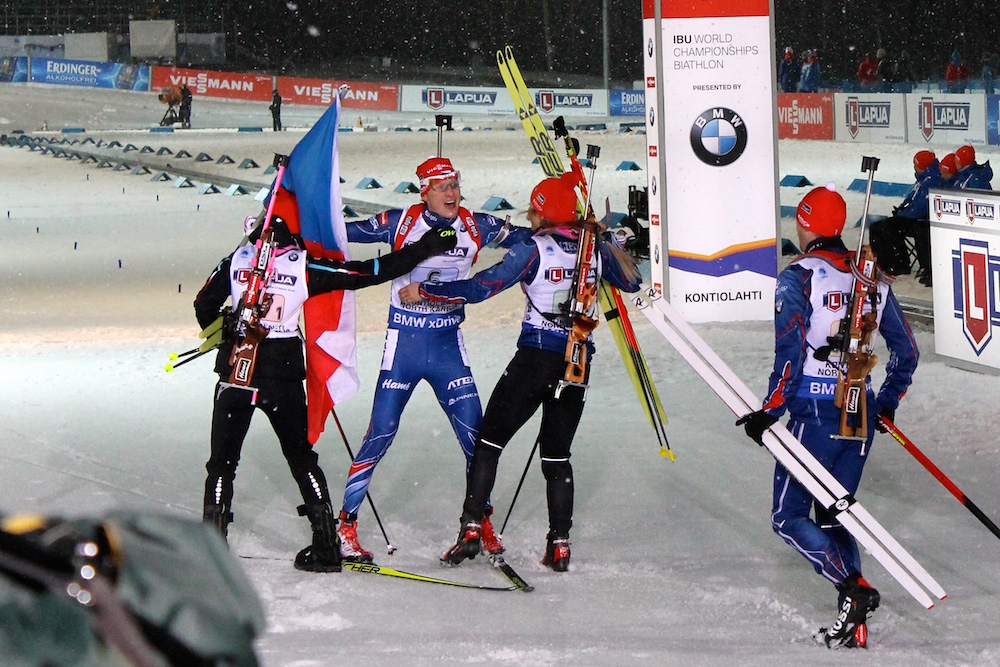
    Ondrej Moravec anchored the Czech Republic to gold, and with plenty of time to play with before doing so, he grabbed his nation’s flag from a stadium spectator to carry across the line.

    Ondrej Moravec celebrates a sizable win for the Czech Republic in Thursday's mixed relay at 2015 IBU World Championships in Kontiolahti, Finland.  (Photo: Kontiolahden Urheilijat/Jarno Artika)
    Ondrej Moravec celebrates at the finish after anchoring the Czech Republic to gold in Thursday’s mixed relay at 2015 IBU World Championships in Kontiolahti, Finland. (Photo: Kontiolahden Urheilijat/Jarno Artika)

    Picking up one leg and pumping his free arm in the air, Moravec flashed a huge grin at the 4,500-person crowd and was greeted by three happy teammates in the finishing pen. Like the rest of the 26-team field, they had been through a lot in the last 1:20.27.2 hours, but what counted was that they handled the conditions better than any other team and came out on top.

    Veronika Vitkova, Gabriela Soukalova, Michal Slesinger, and Moravec combined for a penalty-free effort, using a total of eight spares en route to the win. They finished 20.2 seconds ahead of France, which used eight spares as well. The defending Olympic mixed-relay champions, Norway finished third, 27.7 seconds back with three spares and a penalty loop.

    While the Czech Republic, which notched silver from the mixed relay at the 2014 Sochi Olympics, consistently skied in the top three, its team mostly had the task of chasing down Belarus, which got out to an 20-second lead with second-leg Darya Domracheva.

    Domracheva had come back from getting tagged in fifth, 19.4 seconds behind Vitkova as the first-leg leader. After trailing Japan’s Fuyuko Suzuki for most of her three 2 k laps, Vitkova pushed ahead of her before the exchange to give Soukalova a 2.1-second lead.

    And while Soukalova was put in a prime position, after Vitkova used two spares on each round but cleaned to keep them at the front of the pack, she was nervous.

    “I was afraid of the race before the start because I really don’t like these conditions,” Soukalova said in a post-race press conference about the at-least-ankle-deep snow in above-freezing temperatures. “It was really hard, but I tried to go [in] with a clear mind and just enjoy the race.”

    Finland's Kaisa Mäkäräinen racing from 11th to second as the second leg of the mixed relay at 2015 IBU World Championships in Kontiolahti, Finland. Her team went on to place ninth. (Photo: Kontiolahden Urheilijat/Jarno Artika)
    Finland’s Kaisa Mäkäräinen racing from 11th to second as the second leg of the mixed relay at 2015 IBU World Championships in Kontiolahti, Finland. Her team went on to place ninth. (Photo: Kontiolahden Urheilijat/Jarno Artika)

    She ended up cleaning both her stages and tagging Slesingr in third, 25.7 seconds after Domracheva and 5.7 seconds behind Finland’s Kaisa Mäkäräinen, who cleaned to bring her team from 11th (after Mari Laukkanen’s first leg) to second.

    “You could see in the end of the race, one kilometer before the finish, I was completely exhausted,” Soukalova said. “So I really appreciate the good job of the rest of the team.”

    After the second exchange, Slesingr brought the Czechs to second with a clean prone and two standing spares. He followed Vladimir Chepelin of Belarus out of the range for the second time, about 25 seconds back, after Chepelin used three standing spares.

    With one 2.5 k lap to go, Slesingr closed the gap to 11.7 seconds and tagged Moravec in second. Norway handed off in third, 45 seconds back, after Johannes Thingnes Bø lifted the team from sixth to third with clean shooting.

    From there, Moravec proceeded to stalk Belarusian anchor Yuryi Liadov, who used one spare in prone. On the second lap, Moravec passed Liadov and led him into the range for the last time.

    While Liadov missed three more standing to leave the range for the last time in fourth, 25.7 seconds out of first, Moravec (who used one spare in each bout) remained in control heading into the final lap, leading France’s Martin Fourcade in second by 18.2 seconds. Fourcade cleaned both stages to bring France from fourth to second by the last stage, and he ended up skiing the fastest anchor leg to come within 15 seconds of Moravec by 6.1 k.

    But with 1.4 k to go, the Czech anchor solidified the victory with the second-fastest course time on the last leg, 7 seconds slower than Fourcade.

    “I was so surprised the Belarusian guy was a long time ahead of the race,” Moravec told the IBU media after the race. “I think it was also pretty good result for them, but I believe for myself that I can beat him and I did it and I was so happy.”

    Anais Bescond of France (center, in black) leads the first leg out of the start in Thursday's mixed relay at IBU World Championships in Kontiolahti, Finland. (Photo: Biathlon Canada/NordicFocus)
    Anais Bescond of France (center, in black) leads the first leg out of the start in Thursday’s mixed relay at IBU World Championships in Kontiolahti, Finland. (Photo: Biathlon Canada/NordicFocus)

    Belarus finished fourth, 31 seconds out of first and 4.3 seconds off the podium.
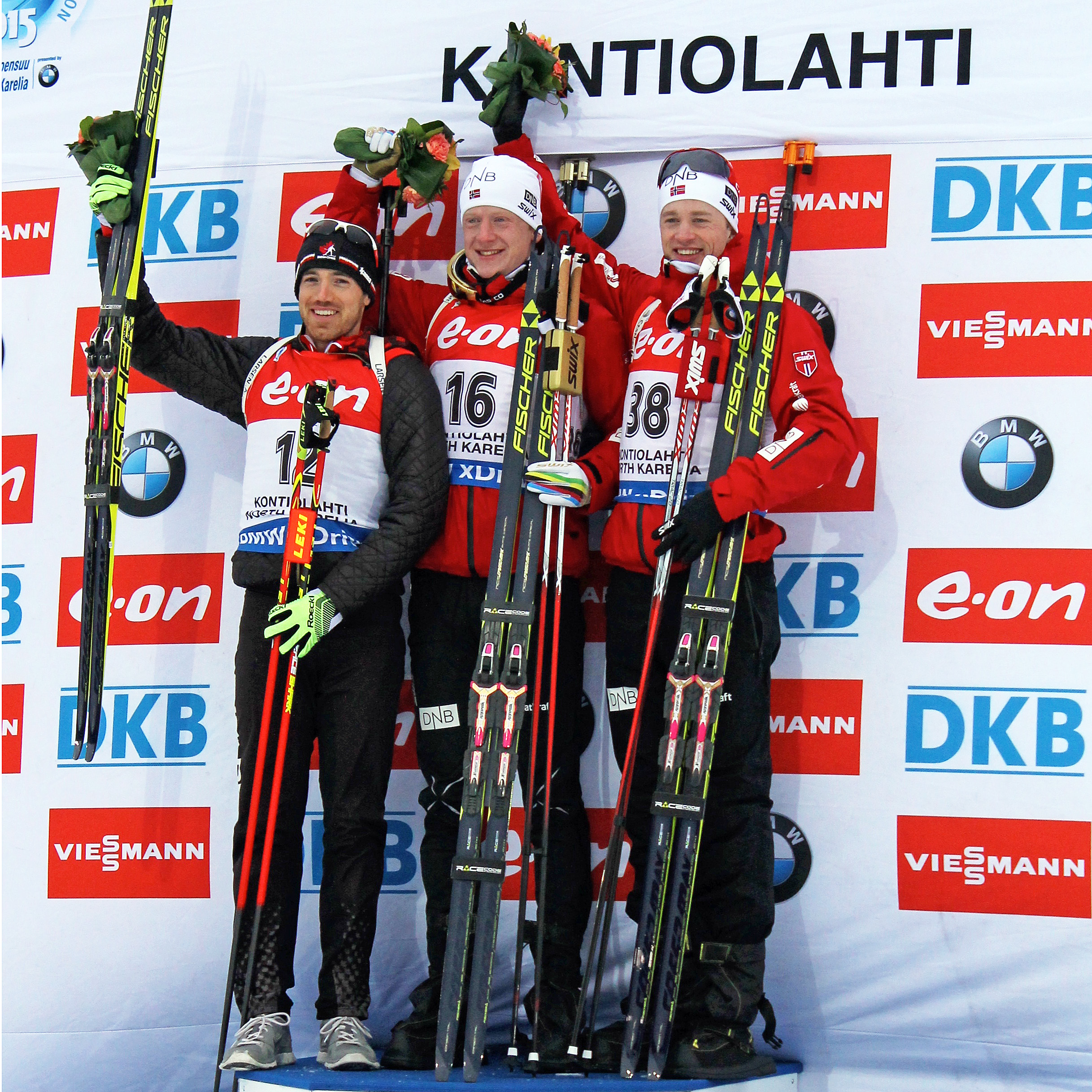
    “I think it was a pretty good race for everybody on the team,” Moravec said in the press conference. “It was perfect.”

    After Anais Bescond’s first leg, in which she used four spares (one prone and three standing), France rose from 12th to fourth with Marie Dorin Habert, who cleaned prone and used one standing spare. She also skied the third-fastest second leg after Mäkäräinen and Domracheva, respectively.

    “I’m very happy with this medal and I hope next year we could change medals with the Czechs,” Habert said in the conference. “We have to work hard for it, but it’s a very nice day for the French team, too.”

    Jean-Guillaume Béatrix kept France in fourth with a clean first stage and used three spares standing, coming into the final exchange 1:10.5 out of the lead and 25.6 seconds after third.

    “It’s like running in the sand here,” Beatrix recalled. “I’m happy that in the end we can be on the podium because it was unbelievably hard.”

    “It’s like running in the sand here. … It was unbelievably hard.” — Jean-Guillaume Béatrix (France)

    Fourcade clawed back more than 15 seconds within his first two kilometers and proceeded to shoot a perfect 10-for-10 to keep his team ahead of Norway for silver.

    The 2 x 6 + 2 x 7.5 k mixed relay at 2015 IBU World Championships in Kontiolahti, Finland, with the Czech Republic gold medalists (c), France (l) in second, and Norway (r) in third. (Photo: Kontiolahden Urheilijat/Jarno Artika)
    The 2 x 6 + 2 x 7.5 k mixed relay at 2015 IBU World Championships in Kontiolahti, Finland, with the Czech Republic gold medalists (c), France (l) in second, and Norway (r) in third. (Photo: Kontiolahden Urheilijat/Jarno Artika)

    “I have no thoughts about missing the team relay,” Fourcade said when asked whether he considered skipping the coed event to prepare for other races at World Championships. “It was important to me and important to team France so I’m really happy I did [it] and really happy we catch some medals.”

    While Norway’s Fanny Well-Strand Horn cleaned both her stages to tag off in sixth, Tiril Eckhoff used all three spares in standing and skied a penalty loop. Yet she still managed to keep Norway in sixth, 1:32.4 out of first.

    “It always sucks to get the penalty, but I just have to go and hope for the guys to take medal and they did so that was really good,” Eckhoff said.

    The team’s third leg, Johannes Thingnes Bø noted how fast their skis were despite the conditions.

    “The most [important] part of my race was the good skis today — they were really fast and also our shooting today was really strong,” the 21-year-old Bø said. “We had just one shooting that was bad. We are happy to get a medal.”

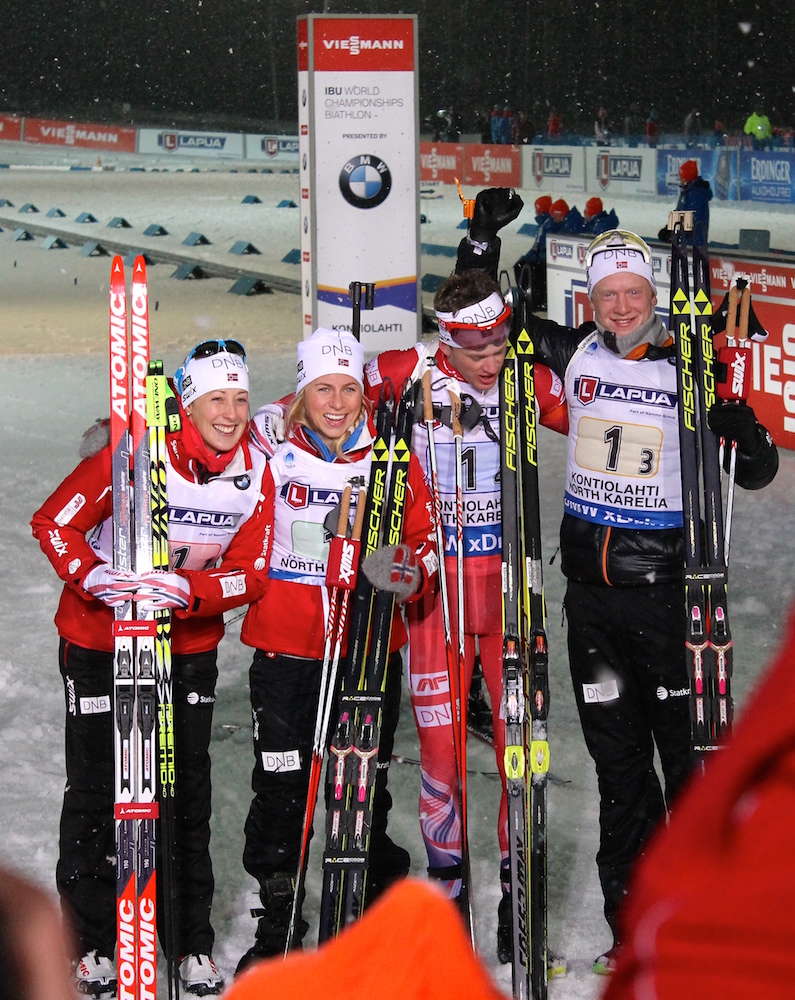
    The Norwegian mixed relay team, with Fanny Well-Strand Horn, Tiril Eckhoff, Tarjei Bø, and Johannes Thingnes Bø after earning bronze at 2015 IBU World Championships in Kontiolahti, Finland.
    The Norwegian mixed-relay team, (from left to right) with Fanny Well-Strand Horn, Tiril Eckhoff, Tarjei Bø, and Johannes Thingnes Bø, after earning bronze at 2015 IBU World Championships in Kontiolahti, Finland.

    His older brother, Tarjei Bø, who anchored the team to third, cleaned as well.

    “We are always happy with the medal. Of course, we’re going for the gold medal each relay … but still bronze is good,” Tarjei, 26, said. “It’s a big difference with bronze medal and fourth place. I think as a group, we’re happy.”

    And at the end of the day, the Belarus team — at least Domracheva — wasn’t bummed, either.

    “This is the best place for a few years for us in mixed relay,” she told the IBU. “From start to start, we have better and better results. Fourth place is really close to the podium, and I’m glad with my own race and it was not easy conditions today. We saw for our guys also some really strong competitors, and it was a good biathlon fight.”

    Also in the top 10, Austria placed fifth (+1:00.3) with three total spares, Germany was sixth (+1:22.8) with six spares, Italy finished seventh (+1:24.7) with 10 spares, and the U.S. tied its best World Championships mixed-relay result in eighth (+1:46.6) with one penalty and eight spares. Finland ended up ninth (+1:59.5) with eighth spares and Russia was 10th (+2:00.2) with just two spares.

    Ukraine finished 11th (+2:10.3) ahead of Canada in 12th (+2:27.9). The Canadians tied their nation’s mixed-relay best at World Championships in 12th (a year after placing 11th at the Olympics) with a total of four spares. After leading the first two laps of the race, Japan placed 21st out of 26 teams.

    Results

     The Czech Republic mixed relay team celebrates with anchor Ondrej Moravec (second from l) at the finish after winning Thursday's race by 20.2 seconds over France at 2015 IBU World Championships in Kontiolahti, Finland.

    The Czech Republic mixed relay team celebrates with anchor Ondrej Moravec (second from l) at the finish after winning Thursday’s race by 20.2 seconds over France at 2015 IBU World Championships in Kontiolahti, Finland.
  • Nordgren’s Solid Shooting Lifts U.S. in Mixed Relay; Doherty Anchors Team to Seventh

    Nordgren’s Solid Shooting Lifts U.S. in Mixed Relay; Doherty Anchors Team to Seventh

    Leif Nordgren (US Biathlon) raced the third leg of Friday's IBU World Cup mixed relay to put his team in fourth heading into the final exchange in Nove Mesto, Czech Republic. The U.S. ended up seventh. (Photo: USBA/NordicFocus)
    Leif Nordgren (US Biathlon) raced the third leg of Friday’s IBU World Cup mixed relay to put his team in fourth heading into the final exchange in Nove Mesto, Czech Republic. The U.S. ended up seventh. (Photo: USBA/NordicFocus)

    Note: This article has been updated to include comments from U.S. anchor Sean Doherty.

    Friday’s mixed relay had to have been one of Leif Nordgren’s best races of all time. Just last week, the 25-year-old US Biathlon A-teamer skied up from 51st to 19th in the men’s 12.5-kilometer pursuit at IBU Open European Championships in Otepää, Estonia, but US Biathlon Chief of Sport Bernd Eisenbichler didn’t see that race in person.

    What he did witness was one of Nordgren’s most memorable performances in the mass start at 2011 World Championships in Khanty-Mansiysk, Russia, in which he placed 17th with three misses. And that rivaled what he did on Friday as the third of four legs in the 2 x 6 + 2 x 7.5 k mixed relay.

    Nordgren brought the U.S. from 10th to fourth before the final exchange with clean prone shooting and a single standing miss. He used his spare to clean that stage and left the range for the last time in fourth, about a minute and a half behind the three race leaders (Norway, Ukraine and the Czech Republic).

    “You have to give a really big compliment to Leif today; he had world-class shooting today,” Eisenbichler said on the phone after Friday’s race, the second of two mixed relays (with Annelies Cook and Tim Burke placing ninth for the U.S. in the single mixed relay).

    “I never saw him in as good running shape as 2011 at World Championships … For sure, this was his best performance, and from 2011 to now, that’s four years so that’s really encouraging,” he added. “I’m extremely happy with where he is right now and I think he’s still going up to [2015] World Championships.”

    Sean Doherty hung in fifth for most of Friday's mixed relay at the IBU World Cup in Nove Mesto, Czech Republic, before finishing seventh. (Photo: USBA/NordicFocus)
    American Sean Doherty hung in fifth for most of Friday’s mixed relay at the IBU World Cup in Nove Mesto, Czech Republic, before finishing seventh. (Photo: USBA/NordicFocus)

    Building on the foundation teammates Susan Dunklee and Hannah Dreissigacker laid as the first and second legs, respectively, of the Americans’ mixed relay on Friday, Nordgren tagged Sean Doherty in fourth.

    The 19-year-old Doherty anchored them to seventh, 2:23.8 behind the Norwegian winners (Fanny Welle-Strand Horn, Tiril Eckhoff, Johannes Thingnes Bø, and Tarjei Bø) and 0.2 seconds behind Germany in sixth.

    “We were only two-tenths of a second out of the flower ceremony today, which is an exciting accomplishment, and it also makes us very hungry for more,” Dunklee wrote in an email. “Everyone skied very well today, and the guys did some fantastic work with the shooting.”

    Dunklee used a total of four spares (two on each stage) to put the team in fourth after the first leg. She handed off to Dreissigacker, who used five spares (three prone and two standing) to tag Nordgren in 10th. Nordgren used just one spare, and Doherty used one in prone and two more in standing to finish seventh with a team total of 13 spares.

    “I was really happy with the race today for my part,” Nordgren wrote in an email after posting the fifth-fastest course time and fifth-fastest range time on the third leg. “This whole year I’ve struggled to put both good shooting and good skiing together on the same day. Today I did just that, so I think I can be happy that things seem to moving in the right direction as we approach [World Championships] in Finland.”

    Dunklee raced the fastest time of all 22 starters, leaving the range in 17th after her first shooting and improving to 10th before her last lap. By the time she got to Dreissigacker, Dunklee was up to fourth.

    “I always expect Susan to crush it and pass people like crazy and tag off near the front,” Dreissigacker wrote in an email. “That’s normal for her. But she really outdid herself with the passing today! I had to laugh when I saw how much she’d moved up by the time I’d made my way over to the exchange zone. I was psyched!”

    “I used more spares than I would have liked and channeled the frustration from the range into speed on the ski track,” Dunklee explained. “At the start of the second loop, I forgot entirely about pacing for a couple minutes and focused solely on regaining contact with the main pack.  Then my body reminded me that that wasn’t a sustainable pace.”

    She spent her last loop trying to ski “smarter” and save energy for the last climb. Leaving the range, she caught Switzerland’s Elisa Gasparin then slingshot by her before the last uphill.

    Dreissigacker reflected that her first lap skiing in the top four felt fast, “but I wasn’t really feeling too much…so I was able to go harder than I maybe should have,” she wrote.

    She seized the chance to ski behind France’s Marie Dorin Habert on her first lap, then slipped to seventh after her first shooting.

    “I think that the wind was a bit variable on the first stage, but mostly I just wasn’t super well-settled,” Dreissigacker wrote. “I’ve been having a bit of a prone-shooting slump for the last few days, so I’m hoping to improve on that.”

    Feeling the fatigue start to set in on her last two laps, Dreissigacker reminded herself how much she liked the course and “kept fighting.”

    “In standing, I felt good through the first 5 shots, but had one close miss and then I got shaky shooting spares,” she wrote. “I accidentally fired one spare way too early when I wasn’t even on target, so I was just happy to hit that last one!”

    Pushing to stay with Russia’s Ekaterina Shimulova on the last lap, Dreissigacker wasn’t able to do so and tagged Nordgren in 10th, 13 seconds behind Shimulova in eighth and 11.6 seconds back from Italy’s Federica Sanfilippo in ninth.

    “I wanted to stay with [Shimulova] and catch up to the pack ahead so that Leif would have a good pack to ski with,” Dreissigacker wrote. “Luckily he had an awesome day and managed to catch the pack all by himself. The rest of the team did so well and it was really fun to watch the rest of the race and cheer as I cooled down.

    “It was such an exciting finish!” she added. “Sean did awesome…and in a year or two, if not way sooner, he’ll be winning those photo-finishes.”

    For Nordgren, fast skis helped, he explained, as he caught the group ahead of him on the first loop.

    “I felt totally in control the first two loops, and I was able to push hard the last loop also,” he explained.

    Nordgren added that by the end of last week, he could already feel like his shooting was starting to come around. He felt similarly about his ski shape: “I had glimpses of good shape in Antholz, but with an additional 3 races in Estonia I think it really forced that good shape to come back a little quicker,” he wrote.

    “I really like that tracks here in Nove Mesto, I think they suit me perfectly, combine that with the near perfect snow conditions that we’ve had all week, and it just makes it really nice skiing,” Nordgren added. “As a team we all decided last night that we’d like to finish ahead of our bib number (7). So it was really close today, everyone from the team put in a really good effort, but sometimes it comes down to a few cm!!”

    Doherty hung in fifth for most of his race before France’s Martin Fourcade and Germany’s Benedikt Doll passed him before the finish. The youngest member of the U.S. team, Doherty pushed to stay with them, but finished 2.3 and 0.2 seconds back, respectively.

    “Funny thing, from where the warm up track is here in Nove Mesto you are a little bit out of the action, so I did not really know how well Leif was doing until I got into the start pen,” Doherty wrote in an email. “I was excited to be in such a good position, it is a great challenge and I am feeling good on the skis so I was excited to go against the other top athletes.

    “Really I just tried to keep a good pace,” he added. “For standing I was trying to focus on the good things that I had been working on in training. It did not work out as well as it could have but that is biathlon and it was still a good fight to the line. … I am very happy with my personal performance, I am feeling stronger and stronger on the skis. As for the team overall it is great. It is nice to have everyone at full health and it is a good sign that our program is improving as a whole.”

    At the end of the day, Eisenbichler was pleased, especially with both the team’s single mixed relay and four-person mixed relay finishing in ninth and seventh, respectively.

    “Top 10 is really something we should always reach for,” he said. “It was really, really tight, especially in the mixed relay.”

    An exhausted Tarjei Bø (2) celebrates his win for Norway in the 2 x 6 + 2 x 7.5 k mixed relay on Friday at the IBU World Cup in Nove Mesto, Czech Republic. He held off Ondrej Moravec of the Czech Republic by four seconds.
    Tarjei Bø  celebrates his win for Norway in the 2 x 6 + 2 x 7.5 k mixed relay on Friday at the IBU World Cup in Nove Mesto, Czech Republic. He held off Ondrej Moravec (l) of the Czech Republic by four seconds.

    Norway won the four-person relay in 1:12:49.2 with six spares, holding the Czech Republic (with Veronika Vitkova, Gabriela Soukalova, Michal Slesingr, and Ondrej Moravec) by 4.1 seconds. The Czechs used five spares, and Ukraine (Iryna Varvynets, Valj Semerenko, Dmytro Pidruchnyi, and Sergey Semenov) held tough for third (+1:21.3) with one penalty (from Semenov on his prone stage) and seven spares.

    “Moravec is one of the fastest standing shooters, so today I wanted to show Moravec that I am the fastest,” Norway’s anchor, Tarjei Bø, told the IBU.

    Using just one spare in prone and cleaning standing, he took the lead by 13.9 seconds with one lap remaining. Moravec, who used one spare on his last stage, closed on him in the final kilometers to come within four seconds of Bø, who had enough time to grab a large Norwegian flag before the finish.

    Czech Ondrej Moravec mocks Russia's Alexey Volkov's finish-line celebration after Moravec finished second in Friday's mixed relay. Earlier that afternoon, Volkov anchored Russia to the single mixed relay win.
    Czech Ondrej Moravec mocks Russian Alexey Volkov’s finish-line celebration after Moravec finished second in Friday’s mixed relay. Earlier that afternoon, Volkov anchored Russia to the single-mixed-relay win.

    “I think we can be really happy with second,” Slesingr told the IBU. “[Ondrej and I] spent a little more time in standing … Before the race we would have been happy with second so there is no disappointment … We were able to give something back to all of the fans who came here … we can feel their support that has made biathlon almost the number one sport in Czech Republic.”

    Russia placed fourth, France was fifth and Germany was sixth.

    Canadians 14th

    Canada skied in the top 15 throughout the race with Audrey Vaillancourt, Rosanna Crawford, Nathan Smith, and Brendan Green ultimately placing 14th (+5:12.3).

    “Overall I think the team had a rough day, we all seemed to have problems with our standing shooting,” Vaillancourt wrote in an email.

    After her first mass-start experience on the World Cup, she cleaned the first shooting, but used three spares in standing to tag Crawford 1:28.4 back in 14th.

    “I had a good start, but on the second hill a girl stepped on my pole and it fell off my hand. I had to go backwards to get it back and therefore lost the pack,” Vaillancourt explained. “Then I tried to catch up, but couldn’t do it before the first shooting.

    “Skiing felt good, but I had a hard time making up for the time I had lost,” she added. “It might have affected my standing shooting. I wanted to get in, clean, and leave as fast as I could, but it didn’t work out so well. Instead I ended up using 3 spares.”

    Her skiing felt better than in past weeks, she added, after her team spent a week of training “on lots of real snow” in Mittenwald, Germany.

    Crawford explained she was starting to feel like her “old self” as well on Friday, after she skied the 10th-fastest course time of the second-leg skiers. She used two spares on her first stage, and then used three more and had a penalty loop after standing.

    “I wanted to catch the pack of three just in front of me so I could have someone to ski with. That worked but then I lost what ever I had gained with poor shooting,” she wrote.

    Crawford handed to Smith in 15th, 2:30 back.

    “I was a bit surprised by the analysis. I thought I skied better than it looks on paper,” she wrote. “But hopefully this will just have gotten all the gears running again and tomorrow [the sprint] will be better. It’s a really hard 2.5km course. One of the tougher ones on [World Cup] I’d say. So good technique and proper pacing will be important. But it’s also only 3 loops so you have to be sharp!”

    Smith cleaned prone to bring Canada up to 13th, but used two spares in standing and dropped one spot on the last lap to 14th. Green kept them there, with a clean first stage but had three spares and one penalty on his last shooting. He finished 14th, more than a minute and 10 seconds behind Italy in 13th.

    “We had little hiccups starting with Audrey loosing a pole and loosing contact to the group, Rosanna having a penalty loop, Brendan having a penalty loop, Nathan not being able to stay with [Austria’s Julian] Eberhard when he was passed,” Biathlon Canada Head Coach Matthias Ahrens wrote in an email. “Anyhow I believe we could be where the US team was today whom I congratulate for a great race by all members.”

    “I think we’re disappointed. But are looking forward to the weekend,” Crawford wrote.

    Results

    Tarjei Bø receives the Norwegian flag from an excited fan as he cruises down the finishing stretch to celebrate his win for Norway in the 2 x 6 + 2 x 7.5 k mixed relay on Friday at the IBU World Cup in Nove Mesto, Czech Republic.
    Tarjei Bø (l) receives the Norwegian flag from an excited fan as he cruises down the finishing stretch to celebrate his win for Norway in the 2 x 6 + 2 x 7.5 k mixed relay on Friday at the IBU World Cup in Nove Mesto, Czech Republic.
  • In Second-Ever Mass Start, Smith Clinches Ninth; Shipulin Causes Late Trip to Win in Pokljuka

    In Second-Ever Mass Start, Smith Clinches Ninth; Shipulin Causes Late Trip to Win in Pokljuka

    Nathan Smith of Canada finished 13th in the first Olympic race of his career.
    Nathan Smith (Biathlon Canada) racing to 13th in the first Olympic race of his career, the 10 k sprint in last season in Sochi, Russia.

    This wasn’t Nathan Smith’s first time in a mass-start rodeo. The 28-year-old Canadian biathlete, who turns 29 on Christmas, had raced a 15-kilometer mass start in his first Olympics last winter. That was his first one — and he crashed out of it in a downhill pileup in the first 500 meters.

    Sunday was going to be different — at least he’d know what to expect. Starting in the last of 10 rows in bib 30 out of 30 racers, Smith knew he was at a disadvantage from the get-go and tried not to stress over it on the first lap.

    Not long into the final IBU World Cup race in Pokljuka, Slovenia (the last one of the circuit’s first trimester), Smith watched as a few competitors crashed in front of him. Fortunately, he saw the chaos coming and had enough time to move around them.

    “I knew that if would take really strong skiing to maintain position because these are the 30 fastest in the world,” Smith reflected in an email on Monday.

    Russia's Anton Shipulin celebrates his IBU World Cup mass-start victory on Sunday in Pokljuka, Slovenia, which he won by 1.2 seconds over France's Martin Fourcade (back). (Photo: IBU/Rene Miko)
    Russia’s Anton Shipulin celebrates his IBU World Cup mass-start victory on Sunday in Pokljuka, Slovenia, which he won by 1.2 seconds over France’s Martin Fourcade (back). (Photo: IBU/Rene Miko)

    Meanwhile, two of the top men in the overall World Cup, Norway’s Emil Hegle Svendsen in bib 1 and France’s Martin Fourcade in bib 2, set the pace out of the start. The third-ranked man in the World Cup at the time, Russia’s Anton Shipulin went with them. All three started in the first row.

    Another Russian, Timofey Lapshin, who start in bib 29 near Smith, lost a ski on that first lap. By 2.2 k, Shipulin was leading a three-man train with Fourcade and Svendsen, and American Lowell Bailey was up to 11th, four seconds behind them. His US Biathlon teammate Tim Burke was another three seconds back in 17th, and Smith trailed by 11 seconds in 24th.

    By the first shooting stage, all 30 racers lined up in their designated lanes, and Smith headed to the farthest mat from the exit — all the way off to the left. Then he missed his first shot.

    “I’m not sure why I missed the first shot, but I had to be super, super careful after that,” he wrote.

    It worked, he added, as he knocked down the next four targets — and went on to hit 18 straight on Sunday. Smith left the range in 20th, 33.7 seconds behind Shipulin, who cleaned, followed by Austria’s Dominik Landertinger 1.9 seconds back in second, Fourcade 3.5 seconds behind in third, and another Austrian, Simon Eder 4.8 seconds back in fourth.

    The top 13 men after the first prone all cleaned, leaving Svendsen, who missed one, 21.7 seconds back in 14th.

    The two other North Americans in the race, Bailey missed one and Burke had two penalties to put them in 26 and 28th, respectively, 46 and 54 seconds behind.

    On the next lap, Fourcade took the lead, ahead of Landertinger, Shipulin, France’s Jean Guillaume Beatrix, who left the range in fifth, and Eder.

    By the time the second prone rolled around, a large group of about 10 men entered the range together. Landertinger cleaned quickly, Shipulin matched him, as did Eder, Fourcade, and Beatrix. All five left the range within 1.6 seconds of one another.

    Smith hit every target to move to 13th, 34 seconds behind.

    “Shooting was excellent after that [first stage],” he reflected. “After the second prone I knew it was gonna be a great race.”

    Bailey and Burke both cleaned to improve to 21st and 24th, respectively, both about a minute out from the lead.

    Shipulin led Fourcade, Landertinger, Beatrix, and Eder through 8.2 k, then Fourcade took charge after the third stage. He quickly cleaned his standing shots, and Beatrix, Shipulin, and Sweden’s Fredrik Lindström, who had been hovering in the top 10 with perfect shooting, did as well. Eder had one penalty, Bulgaria’s Krasimir Anev jumped to sixth with clean shooting, and Smith found himself in seventh with another flawless stage.

    “I had to reset once in the first standing but other than that there were no problems until the last few shots of the race,” Smith wrote.

    The wind picked up for the men’s afternoon race, after a mostly calm-and-bluebird week in Pokljuka. It was still sunny, with more of a headwind coming at the athletes as they shot into the range.

    Bailey also cleaned his second-straight stage to move to 19th (+1:07), and Burke had one miss to drop to 25th (+1:31).

    Beatrix led around 10.6 k into the penultimate lap, with Shipulin and Fourcade right on his heels. Lindström fell 20 seconds off the pace, followed by Eder, and Smith was another nine seconds back — up to sixth, and just ahead of Anev and Ondrej Moravec of the Czech Republic.

    Shipulin (3) leads Frenchmen Fourcade (l) and Beatrix (r) around 11.2 k during Sunday's 15 k mass start in Pokljuka, Slovenia.
    Shipulin (3) leads Frenchmen Fourcade (l) and Beatrix (r) around 11.2 k during Sunday’s 15 k mass start in Pokljuka, Slovenia.

    Shipulin took his turn leading at 11.2 k, followed by Beatrix and Fourcade, while Lindstroem and Eder hung together in fourth and fifth, about 13 seconds ahead of Smith.

    Shipulin led into the range for the last time, where his first miss of the day put him 8.1 seconds back in fifth behind Eder, who cleaned, and Fourcade, who missed one but shot quickly to stay within three seconds of Eder.

    Lindström finished the stage out with 20-for-20 shooting, the only man to do so, to leave the range in third, 7.2 back, and Beatrix missed one to head out fourth (+8.0), just ahead of Shipulin.

    Smith missed his final shot to drop to 11th, but left the penalty loop feeling like he had a lot left to give — 37 seconds out at the time. Less than three seconds ahead of him, Germany’s Andreas Birnbacher in eighth, France’s Quentin Fillon Maillet in ninth and Russia’s Dmitry Malyshko in 10th were within reach.

    “I really struggled to hold it together and those last three [stages],” Smith explained. “I almost felt dizzy trying to aim and concentrate from the pressure. That shot cost me a position where I could’ve been fighting in the lead pack for a medal.

    “I almost felt dizzy trying to aim and concentrate from the pressure.” — Nathan Smith (Biathlon Canada), after placing ninth in Pokljuka mass start

    “I held back behind a couple guys and waited to attack at the top of the second last climb,” Smith added. “I made a good gap on them and almost shook [Slovenia’s Jakov] Fak [who left the range in 12th], but he surged again on the next hill and got in front of me.”

    At the front of the race, French teammates Beatrix and Fourcade led side by side up a hill, and attacked together to try to drop Shipulin, Eder, and Lindström — and perhaps each other. Beatrix picked up the pace again with about a kilometer to go, and Fourcade went with him, as did Shipulin trailing off the back of the breakaway.

    Beatrix fell, apparently tripped up by Shipulin, and the Russian pounced on the opportunity to get ahead, attacking up and over the last rise to drop the field, soaring down into the stadium well ahead of Fourcade, as well as Eder and Lindström, who also passed Beatrix.

    “I would like to apologize to Jean Guillaume; sometimes these things happen in sports, but I did not mean anything and did not do it on purpose,” Shipulin told the IBU media after the race.

    Fourcade backed him up. “I think this is a part of the game,” he said. “I am 100-percent sure that Anton did not do it consciously. It kept me from battling Anton on the final stretch, but I have only to blame myself for not winning today; I missed one shot on the shooting range.”

    Shipulin took the victory in 35:16.8, while Fourcade finished 1.2 seconds back in second, and Eder outsprinted Lindström in a photo finish for third (+1.4). Beatrix took fifth (+4.8).

    “I am the guy who benefitted from the ‘wheel-banging’ in the last loop,” Eder said. “I might have been fourth! This is biathlon; I did not give up and you can see what happened!”

    Norway’s Tarjei Bø placed sixth with a single penalty on his third stage, Moravec took seventh with one miss on his second prone, and Fak edged Smith by 0.6 seconds for eighth (+29.8).

    Canada's Nathan Smith racing to ninth in Saturday's IBU World Cup 10 k sprint in Östersund, Sweden. Photo: Fischer/NordicFocus.
    Canada’s Nathan Smith racing to ninth in the IBU World Cup 10 k sprint in Östersund, Sweden, earlier this season. (Photo: Fischer/NordicFocus)

    For Smith, ninth stood as his second-best World Cup result (after tallying two eighth-place finishes in a sprint and pursuit last season) in his second-ever mass start. After finishing 30.4 seconds behind the winner, he posted the third-fastest shooting time, seventh-ranked range time and eighth-fastest course time.

    “Mass starts are a lot different than pursuits. It’s nice to get one under my belt now and I hope to do a few more this season, too,” Smith reflected. “I’m very happy with yesterday’s race and it’s a perfect way to cap off a strong trimester. It gives me extra motivation to rest up and train over the Christmas break.”

    Just a few weeks ago, Smith placed ninth in the sprint at the World Cup opener in Östersund, Sweden, and 16th in the pursuit there, after skiing in the top three.

    “I’m happy with the season so far. A bit disappointed that I missed a few medal opportunities due to last standing misses,” Smith wrote. “Skiing hasn’t been on average quite as good as last year yet, but it has been more consistent. My two best skis so far though are definitely at least as good as anything I did last year. Prone has been amazing, but standing needs to come up just a little and then I will be where I want to be.”

    He’ll spend his holidays mostly in Vernon, British Columbia, with his girlfriend, Emma Lunder, and her family. After that, Smith planned to head to Canmore for a week, then back to Oberhof, Germany.

    Lowell Bailey (US Biathlon) racing to 21st with two penalties in the 15 k mass start on the last day of IBU World Cup racing in Pokljuka, Slovenia. (Photo: USBA/NordicFocus)
    Lowell Bailey (US Biathlon) racing to 21st with two penalties in the 15 k mass start on the last day of IBU World Cup racing in Pokljuka, Slovenia. (Photo: USBA/NordicFocus)

    In the final shooting stage of Sunday’s race, Bailey had another penalty and Burke missed three to drop to 22nd (+1:25.7) and 28th (+2:29.8), respectively. Bailey held his position to finish 22nd with two penalties, 1:34.6 behind Shipulin, while Burke moved up one spot to 27th (+2:32.3) with six misses.

    “I was actually pretty satisfied with most of my race today,” Bailey said in a US Biathlon press release. “I felt better on the ski course and the shooting was pretty decent. The only issue was early on in the first prone stage. I had some trouble with my rifle and probably lost an extra 25 seconds getting that figured out. This made it pretty hard to recover and catch the rest of the pack. Other than that, I’m satisfied with the race and looking forward to the Christmas break.”

    Fourcade regained the World Cup lead, and Shipulin moved up to second, 25 points back and just one point ahead of Svendsen — who finished 17th with four penalties on Sunday — in third overall.

    Results

    (Stay tuned for women’s mass-start report)

  • Blink Festival Concludes with Mass Starts and Sprints; Bailey and Burke Deliver for U.S.

    Blink Festival Concludes with Mass Starts and Sprints; Bailey and Burke Deliver for U.S.

    Lowell Bailey (r) pushes himself across the finish line in Friday's biathlon 6.3 k mass start as part of the 2014 Blink Festival. Bailey finished second behind Emil Hegle Svedson (l) of Norway. (Photo: Skifestivalen Blink/Facebook)
    U.S. Biathlon’s Lowell Bailey (l) pushes himself across the finish line in Friday’s biathlon 6.3 k mass start as part of the 2014 Blink Festival. Bailey finished second to Emil Hegle Svedsen (r) of Norway. (Photo: Skifestivalen Blink/Facebook)

    When Lowell Bailey raced in the 2014 Blink Festival 7-kilometer hill climb just days after arriving in Norway, he was jolted by a “shock to the system,” he wrote in an email.

    Apparently the shock was what he needed to deliver a top-notch performance, as the U.S. biathlete finished second in the biathlon mass start the next day in the city of Sandnes.

    The road to the podium wasn’t an easy one. To participate in the mass start, competitors who were not already pre-qualified needed to place in the top six in the qualification round. The round consisted of five laps of 800 meters with prone shooting following the second lap and standing following the fourth.

    In a tough field, Bailey and U.S. teammate Tim Burke claimed the last two spots in the mass start by taking fifth and sixth.

    Once in the mass start, Bailey knew he had to focus on his shooting if he wanted to have any hopes of placing on the podium.

    “I told myself before the race that I was going to race my own race and try not to get caught up in the hurried shooting situations that always happen in this type of race,” Bailey wrote.

    Throughout the race, which consisted of nine laps on a 700-meter loop, and two prone and two standing stages, Bailey often took longer to shoot but maintained contact with the lead group.

    When he exited the final shooting he was the last of the four competitors he had arrived with to leave the mats.

    However, his fellow competitors had rushed through their shots and had penalty loops to compete. Bailey had shot perfectly and left the range with a five-second lead over Norway’s Emil Hegle Svedsen.

    Svedsen ultimately caught the American in the final stretches of the race, overcoming him by just 0.7 seconds.

    Bailey was followed by Norwegian Tarjei Bø, who finished 12.9 seconds behind Svedsen.

    Burke finished eighth in the mass start, 1:09.9 back.

    Katja Visnar (SLO) celebrates her victory in the women's 10 k mass start in the 2014 Blink Festival. (Photo: Skifestivalen Blink/Facebook)
    Slovenia’s Katja Visnar celebrates her victory in the women’s 10 k mass start in the 2014 Blink Festival. (Photo: Skifestivalen Blink/Facebook)

    In the women’s 6.3 k mass start Fanny Wele-Strand Horn of Norway was victorious with a time of 14:10.8. She was followed by Kaisa Makarainen of Finland and Marine Bolliet of France in second and third.

    American Susan Dunklee finished in eighth, 41.8 seconds behind Horn. Dunklee was one of five athletes who had pre-qualified for the mass start, but struggled with her shooting in the final.

    “Unfortunately I missed a lot of prone targets early in the final and despite passing a few people on skis, I never regained contact with the main pack,” Dunklee wrote in an email.

    The cross-country mass start races that took place later that day consisted of women’s 10 k and a men’s 15 k.

    In the men’s race, Teodor Peterson of Sweden claimed victory for the second day in a row on the rollerski course that consisted of 18 laps around an 800-meter loop. The sprint specialist finished with a time of 28:07.3. He was followed by Norwegian Øystein Pettersen in second and Cyril Gaillard in third.

    The men’s field was incredibly close with the top-23 finishers crossing the line within ten seconds of Peterson.

    Canadian Devon Kershaw was one such finisher. He placed seventh, just 3.7 seconds behind the Swede and 1.4 seconds off the podium.
    In an email, Kershaw explained that the curvy course and the 30 aggressive racers that populated it made for conditions he was not used to, but he was happy with how the day ended.

    “I was out of position near the end and with all the curves there was nothing I could do,” Kershaw wrote. “It was a fun evening though!”

    In the women’s 10 mass start, another sprint-specialist took the win. Slovena’s Katja Visnar finished with a time of 20:36.0. She was followed by German sprinter Denise Herrmann in second and Norway’s Ingvild Flugstad Østberg in third.

    American Liz Stephen finished 18th. In an email, she declared the race a success in that there were no major crashes.

    “It was good for my head in that I need to be less nervous about skiing in a pack close to other skiers, and after today snow seems like it should be no problem at all,” she wrote.

    Tim Burke (l) stands on the podium of the men's biathlon sprint Saturday at the 2014 Blink Festival. Burke finished third, completing a successful weekend for the Americans in attendance at the festival. (Photo: Skifestivalen Blink/Facebook)
    Tim Burke (r) stands on the podium of the men’s biathlon sprint Saturday at the 2014 Blink Festival. Burke finished third, completing a successful weekend for the Americans in attendance at the festival. (Photo: Skifestivalen Blink/Facebook)

    Sprint Day

    U.S. biathletes also shined in the final day of the Blink Festival with Burke and Bailey claiming third and sixth, respectively, in the biathlon sprint.

    Burke finished 8.7 seconds behind race winner Johannes Thingness Bø of Norway, who won the final in 12:25.8. Second place went to fellow Norwegian Marius Hol who crossed the line 7.4 seconds behind Bø.

    After struggling with his shooting in the mass start competition, Burke was pleased to have a strong result.
    “This was a good confirmation for me that I am headed in the right direction for the winter season,” he wrote.
    It was the first time the 32-year-old American had ever competed in heats for a biathlon race, which he found both unique and challenging.
    “I would say the shooting in this type of race is actually harder than a normal biathlon race because you are basically sprinting all out for 1 k before each shooting stage,” he wrote.

    Bailey finished sixth, 22.7 seconds behind the winner.

    In the women’s biathlon sprint, Dunklee placed sixth in her semifinal and did not advance to the final. The women’s biathlon final was won by was won by Bolliet, who was followed by French teammates Enora Latuilliere and Anais Chevalier in second and third, respectively.

    In the cross-country sprints, Norway’s Marit Bjørgen topped the women’s final. She edged teammate Maiken Caspersen Falla for the win by just 0.1 seconds. Visnar placed third, 1.1 seconds behind Bjørgen.

    Stephen was unable to advance from the quarterfinals.

    Sondre Turvoll Fossli of Norway won the men’s final in 3:08.1. He was followed by another Norwegian Martin Hammer in second and Sweden’s Peterson in third.

    2014 Blink Festival Results

    Friday’s mass starts: Men’s biathlon | women’s biathlon | men’s cross-country | women’s cross-country

    Saturday’s sprints: Men’s biathlon | women’s biathlon | men’s cross-country | women’s cross-country 

  • Together Again: Fourcade, Svendsen, and Bø Pack the Podium in Hochfilzen Pursuit

    Together Again: Fourcade, Svendsen, and Bø Pack the Podium in Hochfilzen Pursuit

    Martin Fourcade pumps up the crowd as he coasts towards the finish line in another victory.
    Martin Fourcade pumps up the crowd as he coasts towards the finish line in another victory.

    HOCHFILZEN, Austria – Give Martin Fourcade an opening, and he’ll slam the door on you.

    The best biathlete in the world last year, the French star was hampered in Friday’s sprint when a mid-race snowstorm put most of the field at a huge disadvantage against the earliest starters. Despite clean shooting, he placed second behind Norway’s Lars Berger, who had two penalties but a low bib number. At the time he seemed unconcerned, and said he was simply happy for Lars Berger, a veteran in need of a boost.

    Fourcade showed in today’s 12.5 k World Cup pursuit why second place in the sprint was just fine with him. As soon as Berger faltered, missing shots in the first standing stage, Fourcade took off. He then cleaned his final targets and skated off to victory.

    “My plan was to catch the lead and then do kind of training, to do what I have trained to do,” Fourcade said.

    He was patient through the early stages of the race, stealing a second here or there from Berger but never putting himself under as he tried to make it to the front. By the time Berger came in for the first standing stage, Fourcade was just behind him and the pair had a slight gap to the rest of the field.

    Fourcade missed one shot, but Berger missed two – and so did some of the other racers who were in pursuit, like Berger’s teammates Tarjei Bø and Ole Einar Bjørndalen. Even after skiing a penalty loop, Fourcade was out in front. He had a 12-second lead on Simon Schempp of Germany, which he extended slightly on the next loop. But Schempp was caught by a fast-moving train of Norwegians Emil Hegle Svendsen, Bø, and Berger, along with Christoph Sumann of Austria.

    Norwegian red made up three-fifths of the chase group in the late stages of today's pursuit.
    Norwegian red made up three-fifths of the chase group in the late stages of today’s pursuit.

    The group, a sea of red suits, was popular – maybe more so than Fourcade. As Bjørndalen skated by every new group of spectators out on the course, he was greeted by chants of his name: “Ole! Ole! Ole!”

    Although he has made mistakes late in the game at other points so far this season, Fourcade was cool and collected as he knocked down his last set of targets.

    “The guys close to me showed me in every way that I have to be really strong to hope to win,” he said. “I did it today, but since my shape wasn’t wonderful I had to shoot clean. On my last shooting I was really thinking to just shoot clean because I didn’t want to fight with Emil and Tarjei on the last loop.”

    Fourcade cruised around the final loop, before raising his arms in victory as he neared the finish line. After crossing it, he took a bow. It was a familiar sight: this is Fourcade’s 27th World Cup victory, a remarkable tally for a 25-year-old.

    While Fourcade was secure in his victory, the real fight was unfolding behind him. Berger, usually not the most reliable on the range, missed another three shots in the final standing stage and fell from contention. That left the group of chasers to to fight it out amongst themselves. Schempp also collected a penalty, but Svendsen, Sumann, and Bø all cleaned – in that oder.

    Svendsen shot out of the stadium like a rocket, quickly extending his four-second lead on Sumann. Last year’s World Cup runner-up and double World Champion, he continued to hammer around the final loop and coasted across the finish line eight seconds behind Fourcade.

    It was a relief for the Norwegian, who did not have a good start to the season in Östersund, Sweden, last week.

    Fourcade and Svendsen shared a hug at the finish line.
    Fourcade and Svendsen shared a hug at the finish line.

    “Sometimes you’re not in the zone that you want to be in,” Svendsen said of the season’s start. “Last week the whole team was not at our normal level. This is sometimes the way it is without any logical explanation, that you are just not very good. Things go up and down and we cannot always plan when we are in shape. I am happy to be back.”

    Sumann was the great hope for the home Austrian team, which had not yet had a podium in the weekend of racing. They had come close: Sumann was fifth in the sprint, and the men’s relay team was in third going into the final leg when veteran Simon Eder was simply unable to ski fast enough on the final loop to hang on to the podium.

    Unfortunately for the home team, it was a repeat performance by Sumann today.

    “In fact was pretty confident to take him,” Bø said. “Of couse, you never know with Sumi, but when I saw the results from the last competitions I knew he was not in his best shape. So I was confident about that.”

    Sumann dropped through the rankings, and ended up finishing seventh; he lost 20 seconds over the final 2.5 kilometers.

    “I was was more concerned with the guys behind, that they would catch me,” Bø said.

    But he hung on for third, just barely, despite a fiery last lap by Evgeniy Ustyugov of Russia (who finished fourth after moving all the way up from 17th) and Bjørndalen. That made a very familiar podium: Fourcade won the last two World Cup Total Scores, Bø the one before that, and Svendsen the one before that.

    This year, Fourcade is out to an early lead after winning twice in Östersund. Today’s victory makes him three for four in individual races this season. And his lead will only grow: Svendsen and Bø will sit out next weekend’s races in Annancy Le Grand-Bornand, France. It is the first time the World Cup will visit the venue.

    “I have done some good advertising in France the last few weeks,” Fourcade said of finally getting to race on home turf. “I am sad because these guys on the podium with me today will not be there, and I think the French fans will miss that a lot.”

    Bø showed mixed feelings about missing out on the French races.

    “I would love to keep completing because I am in good shape, but it is not about the yellow bib for me this season,” he said, referring to the Total Score. “Of course we love to compete, but this year for me, it is all about the Olympic Games. And it’s at some 1500 or 1600 meters. For us maybe the preparations are a little different than for Martin who was born in the mountains and lives there in France. So maybe we need to prepare a little differently to be ready.”

    The Norwegians will visit Seiser Alm, a high-altitude training site in Italy, in order to prepare better for Sochi. Fourcade may seem unstoppable now, but they believe that training at elevation will give them a chance to beat the Frenchman when the Olympics roll around.

    “I have just decided to put in a couple of weeks of training,” Svendsen said. “It’s important with the Olympics to be well prepared. I wanted to do this this year, not to compete too much before Christmas and have some extra training.”

    Results

    Martin Fourcade of France (center) won the men's 12.5 k pursuit today, followed by Emil Hegle Svendsen (left) and Tarjei Bø of Norway.
    Martin Fourcade of France (center) won the men’s 12.5 k pursuit today, followed by Emil Hegle Svendsen (left) and Tarjei Bø of Norway. Smile, Martin! You’re in red and yellow!
  • Czechs Win Ostersund Mixed Relay; Fourcade’s Meltdown Costs France More Than the Victory

    Czechs Win Ostersund Mixed Relay; Fourcade’s Meltdown Costs France More Than the Victory

    Ondrej Moravec of the Czech Republic celebrating as he crossed the finish line in Ostersund. His team of Veronika Vitkova, Gabriela Soukalova, and Zdenek Vitek won the opening World Cup mixed relay.
    Ondrej Moravec of the Czech Republic celebrating as he crossed the finish line in Ostersund. His team of Veronika Vitkova, Gabriela Soukalova, and Zdenek Vitek won the opening World Cup mixed relay.

    For ten of the twelve laps of today’s IBU World Cup mixed relay in Östersund, Sweden, it seemed inconceivable that anyone other than France would be on the top of the podium at the end of the day. In blustery conditions – the wind was both strong, and unpredictable – most of the field struggled to hit targets, using spare round after spare round and still hitting the penalty loop multiple times.

    France, though, made those look like amateur problems – at least for a while. Starting at the first shooting stage, where Marie Laure Brunet cleaned but went out ahead of the several other teams to do so, the French took over. By the second stage, she was the only woman still clean without resorting to spare rounds, and took a ten-second lead out on course.

    In a relief for France, Brunet just extended that lead. She cut last season short after overtraining rendered her a shell of the athlete who won a bronze medal at the Vancouver Olympics. Always a strong shooter, today’s relay provided an early indication that Brunet’s ski legs are back and better than ever.

    She tagged off to Marie Dorin Habert, who used a spare round in prone and then none in standing, and further extended the lead to 50 seconds, showing why she finished last season ranked fourth in the world.

    Simon Desthieux took over from there. He was a question mark – never one of the team’s top two men in the past, Desthieux is just two years out of the junior circuit and has little relay experience compared to his teammates. But he had acquitted himself well in the opening pre-season races in Sjusjøen, Norway. That earned him a spot on the relay, and he looked like a pro, like Habert using just one spare round in total. He looked fluid and relaxed out on course, and betrayed none of the intense pressure he must have been feeling. Another relief – maybe even a revelation – for France.

    By the time Desthieux finished, he had almost a minute of time on the second-place Czech Republic. Martin Fourcade, a World Champion four times over, took the tag. He used a spare in prone, but maintained his gap. Then in standing, which Fourcade entered with a lead now greater than a minute and a half, things took a turn for the wild.

    Martin Fourcade: what's going on?
    Martin Fourcade: what’s going on?

    Fourcade missed the first shot, then the second, then the third. Then he missed the fourth. He hit the fifth and began using his spares, hitting one of the remaining targets. But, apparently overcome by frustration, he only used tow of his allotted three spare rounds before heading out for three times around the penalty loop.

    When he exited, Ondrej Moravec of the Czech Republic had already gone into the lead and Tarjei Bø of Norway was ten seconds back. Fourcade tucked in behind him. Two of the fastest skiers on the circuit, it seemed like finally, at the last minute, the race might turn into a drag race, a toss-up of which of the three teams would get the win.

    But for those who had noticed that Fourcade only used two spares, the story had a different narrative. That’s an offense which merits a two-minute penalty. That’s to discourage athletes from deciding to skip the spare rounds when they don’t think they can hit a shot; it would be an unfair advantage to head to the penalty loop early compared to teams which try to shoot, but miss. So by the time Fourcade crossed the finish line – in third, behind Bø, who had not managed to catch Moravec – his time was highlighted in red. A few minutes later, the penalty was added and France dropped off the podium.
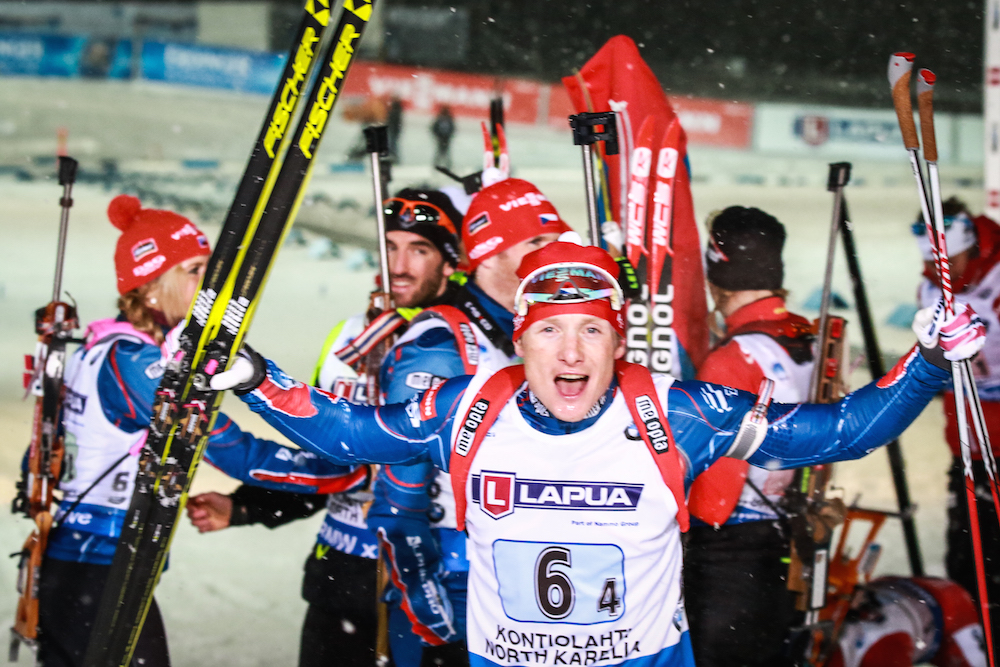
    It was a major frustration for France, which was let down by arguably their most famous team member. But Fourcade has not been off to a great start this season. He struggled in the opening sprint in Sjusjøen, where Desthieux was the top Frenchman instead, and dropped out of the mass start there.

    Today’s debacle added insult to injury. If Fourcade had used all three spares, France would still be on the podium (fourth place Ukraine crossed the finish line a minute after Fourcade and Bø). And if he had hit a target with that spare round, they might even have won – he probably would have exited the penalty loop as Moravec passed by, if not before.

    Or maybe France wouldn’t have won. While it’s easy to say that the Czechs won because of Fourcade’s mistakes, the team had been persistently sitting in second for as long as France was in first. And on the last lap, Moravec showed an impressive reserve of speed; even though Bø was trying to drop Fourcade, he couldn’t gain a single second on the Czech, who had the fastest split time of the entire field over that last loop. If he’d had to battle it out with Fourcade, who knows what might have happened.

    “I saw Martin had three penalties,” Moravec said in the post-race press conference. “When I shot the conditions were good…I had ten seconds lead when I left the stadium so I tried to push the first uphill to gain some time. By the last hill, the coaches told me I had 15 seconds. About 500 meters from the finish I knew I would win.”

    As it was, Moravec celebrated in style as he crossed the finish line, pumping his arms and sticking out his tongue. His teammates ran up to him and overwhelmed him in hugs.

    It was a great day for the Czech team, which earned bronze in the last mixed relay, on home ground at 2013 World Championships. In a race that spread out quickly as team after team hit the penalty loop – eleven teams, almost half the field, was lapped in the windy conditions – only the Czechs and Ukrainians avoided the loop. The Czech team did so with eight spare rounds to Ukraine’s twelve. Even in better conditions, that would have represented solid shooting, but today it was remarkable.

    “It was one of the most difficult starts of my life,” said second-leg skier Gabriela Soukalova.

    It was the first win for the Czechs in the history of the discipline, which appeared on the World Cup for the first time in the early 2000’s. It has since been added to the World Championships schedule and will make its Olympic debut in Sochi. The event was heralded to bring diversity – small teams supposedly have a better chance to win with just two men and two women than they do in a four-person relay of a single sex – but this is one of the first times that a nation outside of the favorites has taken top prize (Sweden, debatably also in this group, had a run of good results in this event a few years ago).

    With France’s penalty, Ukraine was bumped on to the podium; Italy, who had lost a sprint finish with Ukraine, moved up to fourth. France was demoted to fifth, while Russia was far back in sixth (+3:03, three penalty loops and 13 spare rounds).

    At least a few people didn’t have hard feelings.

    “Despite a bad time, I watched a great team!” Fourcade’s brother, Simon, who usually holds the relay position that Desthieux took, tweeted after the race. “Next relay will not be the same! Congrats CZE!”

    “The season is launched,” Brunet tweeted. “It was a lot of fun on the tracks and behind the rifle. And about the result, it will be good when it has to be!”

    report on American and Canadian teams

    Results

  • Biathlon Preview, Part I: The Big Four

    Biathlon Preview, Part I: The Big Four

    Let's look forward to more exciting finishes like this one from last season in Ostersund, Sweden, where Martin Fourcade (FRA) played cat and mouse with Andreas Birnbacher (GER) in the last lap of biathlon's 12.5 k pursuit before beating him to the line. Photo: Fischer/Nordic Focus.
    Let’s look forward to more exciting finishes like this one from last season in Ostersund, Sweden, where Martin Fourcade (FRA) played cat and mouse with Andreas Birnbacher (GER) in the last lap of biathlon’s 12.5 k pursuit before beating him to the line. Photo: Fischer/Nordic Focus.

    The IBU World Cup biathlon season kicks off on Sunday with a mixed relay in Östersund, Sweden. With everybody gearing up to have their best performances at the Olympics, it’s set to be an exciting season – and there are other unusual aspects, too. For instance Annency, France, will make its World Cup debut as the third venue the circuit travels to.

    What about the racers? Here’s our breakdown of what to expect from the top four teams, listed in order of their combined men’s and women’s World Cup scores from last season. Stay tuned in the next few days for the rest of the teams.

    Norway

    At last year’s World Championships in Nove Mesto, the Norwegians won the mixed relay by 20 seconds, and it was no great surprise. Tora Berger was in the overall leader’s jersey for almost the entire season and took the title by a landslide; Emil Hegle Svendsen was in the fight for the men’s title all the way down to the wire, wearing the leader’s bib at times and ultimately finishing second. Both appear to be in good form already this year. Svendsen won a test race in Sjusjøen this weekend over a stacked field, and Berger had some shooting trouble but is certain to straighten that out before the season gets too far underway. She’s plenty fast.

    Tora Berger of Norway medaled - gold or silver - in every race of last year's World Championships, and dominated the World Cup Total Score. Photo: Fischer/NordicFocus.
    Tora Berger of Norway medaled – gold or silver – in every race of last year’s World Championships, and dominated the World Cup Total Score. Photo: Fischer/NordicFocus.

    On the men’s side, Norway looks even better than last year. Tarjei Bø, the 2011 overall World Cup winner, is back in good shape and was setting the pace in Sjusjøen; he struggled last year after missing a large chunk of the training season with illness, but managed a World Championship gold all the same. Ole Einar Bjørndalen didn’t always impress last year, but he also looks to be in better form, having won one of the Sjusjøen races and placed second in the other. The question is whether the 39-year-old can keep it together for a whole season all the way to the Olympics, but if anyone can do it, he can.

    This year the national team went with a decision to favor youth over experience. It seems to have paid off: Vetle Sjåstad Christiansen was second in this weekend’s mass start, while World Junior Champion Johannes Thingnes Bø was seventh in both races in his first year as a senior. The move came at the expense of Lars Berger and Alexander Os, veterans who were left off the team and had to train on their own. But they seem to have weathered the storm; the pair were invited to Font Romeu, France, this fall by the Fourcade brothers. Berger was third in the Sjusjøen mass start and Os sixth in the sprint. They will both likely see World Cup starts as well.

    On the women’s side, Synnøve Solemdal had a breakout year, winning her first World Cup race. But she had an up-and-down season, which may be partly attributed to her asthma; she says that she has now worked a lot on breathing techniques which help. Ann Kristin Flatland, a former World Cup winner, made her return partway through the season after having a baby, and is in good form again. Fanny Welle-Strand Horn broke into the top 10 for the first time and Elise Ringen and Hilde Fenne also provided support.

    Russia

    The Russian men edged Norway in the Nation’s Cup score with a variety of athletes who could hit the podium at any time. Anton Shipulin and Dmitry Malyshko each won two races, while Evgeniy Garanichev and Evgeniy Ustyugov were each twice second. Nobody can beat that depth in the men’s field, and yet Russia struggled when it counted: World Championships.

    Anton Shipulin was Russia's best performer at 2013 World Championships.
    Anton Shipulin was Russia’s best performer at 2013 World Championships.

    This past season, Shipulin was second in the mass start and third in the pursuit. Hardly bad results, but Russia expects medals, preferably gold, and preferably a lot of them. The pressure on the team for the home Games will be unbelievable. RBU Vice President for Elite Sport Viktor Maigurov told biathlonworld.com, “The Olympic Games is the competition, where only athletes with the best psychological resistance to stress and pressure, win. It will be twice as difficult for our biathletes to cope with this pressure, as these will be our Home Games.”

    The men’s team, like Norway, has a few tricks up its sleeve to make it better than last year. Ivan Tcherezov, seven-time World Cup winner and one of the senior leaders of the team, is finally back in shape after a horrendous accident that resulted in a broken leg. And Alexander Loginov, a World Junior Champion, is coming into the senior field. He had a successful World Cup debut last season, placing fifth in the sprint and third in the pursuit in Oslo.

    On the women’s side, it’s a familiar set of faces expected to be at the top. The Russian women’s team has been slipping a bit in the last years, with Olga Vilukhina and Olga Zaitseva leading the team in the Total Score in 12th and 13th. But each is more than capable to magical races and ended up on the podium several times last season. Zaitseva was practically guaranteed a medal in the World Championships pursuit, but was knocked down when Ann Kristin Flatland fell on the final lap.

    Germany

    Andrea Henkel en route to a podium finish last season in Ostersund. Photo: Fischer/NordicFocus.
    Andrea Henkel en route to a podium finish last season in Ostersund. Photo: Fischer/NordicFocus.

    Germany used to be the powerhouse of biathlon, and they can be again. But the team does not display the depth it once did: after veteran Andrea Henkel, who landed third in the Total Score, the next German was Miriam Gössner in ninth; the women nevertheless finished second behind Norway in the Nations Cup. On the men’s side, Andreas Birnbacher led the team in fifth and Erik Lesser was 16th, for fourth place overall in the Nations Cup.

    For the men, Birnbacher confirmed his status from the previous year as one of the most focused and dangerous men in the field, winning twice and collecting a few more podiums. Lesser picked up his first two podium finishes; can he build on that this year? The biggest disappointment of the team was probably Arnd Peiffer, who lost his mojo after several excellent seasons. He seemed to be off to a good start in Sjusjøen, however, so maybe things are coming back together. Florian Graf and Simon Schempp provide relay help.

    Henkel already seems on track for another excellent season, sweeping the Sjusjøen test races; she told FasterSkier in an interview this fall that she’s ready for her fourth and final Olympics. Gössner, meanwhile, has a tough road ahead. After her breakout season where she won three races (and also narrowly missed out on a medal at cross-country World Championships), she crashed her bike in Norway this spring and cracked three lumbar vertebrae. Franziska Hildebrand will replace her in the opening mixed relay. Germany also has high hopes for skiing Olympic gold medalist Evi Sachenbacher-Stehle and World Junior Champion Laura Dahlmeier, both of whom made their World Cup debuts last season with top-ten results.

    France

    When you think of France, you of course think of Martin Fourcade, who won the overall World Cup title last year over Emil Hegle Svendsen. Fourcade had nary a misstep the whole year; he was always in the fight, even if he didn’t win. It began to be unthinkable that he would lose, but he was eventually deprived on the biggest stage: World Championships. Unlike in 2012, where he swept the individual events, Fourcade won only the individual. Norwegians won the other three races. Fourcade has also been off to a tough start this year, bombing out of the Sjusjøen races.

    Marie Dorin Habert of France competing at 2013 World Championships in Nove Mesto, Czech Republic.
    Marie Dorin Habert of France competing at 2013 World Championships in Nove Mesto, Czech Republic.

    He seems certain to bounce back, and his supporting cast, while overshadowed, is impressive. After all, France was second in the men’s relay at World Championships. Martin’s brother Simon Fourcade and teammate Alexis Boeuf also had individual podiums, while Jean Guillaume Beatrix was six times in the top ten. Fourcade told biathlonworld.com that he thought Beatrix and Simon Desthieux had improved the most this year; Desthieux made the case for himself with third- and sixth-place finishes in Sjusjøen.

    The French women don’t get a lot of press, but that’s not fair. Marie Dorin Habert, the sprint bronze medalist from the 2010 Olympics, had three podiums and was one of the most consistent performers throughout the season; though she never won, she was always in the mix and finished fourth in the total score. Anais Bescond landed 17th in the total score, and Sophie Boilley and Marine Bolliet also had some good results. Marie Laure Brunet, who was bronze in the pursuit in Vancouver and once led the team, had a tough year and stopped her season short due to overtraining. She wrote a gut-wrenching blog post about how hard the decision was and her struggles to come back to top speed; hopefully she’s there now.


  • Focused Henkel Shoots Her Way to Second Sjusjøen Win; Clean Sweep for Norway in Men’s Mass Start

    Focused Henkel Shoots Her Way to Second Sjusjøen Win; Clean Sweep for Norway in Men’s Mass Start

    Andrea Henkel (GER) at 2013 World Championships, where she took silver in the 15 k individual.
    Andrea Henkel (GER) at 2013 World Championships, where she took silver in the 15 k individual.


    Today’s biathlon mass starts in Sjusjøen, Norway, were just a warm-up before the real season begins – but they had many trappings of a World Cup race.

    Live television coverage? Check. High-profile coporate sponsors? Check. Throngs of fans lining the trails, eating their picnic lunches and shouting “Heja Tora” for World Champion Tora Berger? Check, check, check. Pine boughs were laid on top of snow that had been shaped into benches around the course, and smoke drifted away from campfires next to tents. No matter what time of year it is, in Norway it’s time to watch a ski race.

    Teams even showed off their new uniforms, with Ukraine and Germany strutting redesigned Adidas duds and France a much-improved version of the OneWay suits. Austria, meanwhile, added some black to their traditional red-and-white getups. Let the games begin!

    Women’s 12.5 k Mass Start

    The races may have been lacking a few of the sport’s top competitors, but spectators were still treated to a classic showdown between two of biathlon’s greats: Berger, who won the World Cup total score last season, and Andrea Henkel, who was third last season and had previously won it in 2007.

    The race started out looking more like a team time trial. After the first shooting stage, only Anais Bescond of France could break into the top seven – the rest were all Norwegians, surging in a pack around her. Berger and teammates Ann Kristin Flatland and Hilde Fenne were able to break away for a small lead by the time they hit the second shooting stage. There, only Berger was clean.

    Meanwhile, Henkel had accrued a penalty in the first stage, and worked hard to battle her way back into the top ten. She cleaned in the second stage and was able to move into second place, albeit 27 seconds behind Berger. Over the course of the next two and a half kilometers, Norway’s Elise Ringen worked her way up to Henkel and the two entered the range together for standing.

    Berger had put a little bit more time on the chasers, but her luck began to turn. On her second shot, she split her bullet – part went into the wood surrounding the target, and a shard hit the target itself. The mechanical arm tipped slowly back…. and then righted itself, the half of a bullet not enough to knock it down completely. Berger headed for the penalty loop.

    Henkel cleaned and set off 13 seconds behind her. But honestly, she told Norwegian broadcaster NRK, she wasn’t expecting to ever regain the lead.

    “I actually thought the race was over,” Henkel admitted. “Tora is usually such a strong standing shooter. I thought I would be alone for the rest of the race, but I really focused because I still didn’t want to be on the penalty loop.”

    Berger put a few more seconds on her rival before they arrived at the final shooting. Then, the unexpected: Berger missed two shots.

    “I was very surprised when she missed two,” Henkel said. “I was just trying to be very concentrated. I didn’t feel so good today, so I really didn’t want to go to the penalty loop.”

    The focus paid off and Henkel sailed out onto the course while Berger was still stuck in the penalty loop. Valj Semerenko of Ukraine also cleaned, and hit the trails second, nine seconds behind the German. Berger left with a 26-second gap to close if she wanted the win – which she did, after a disastrous prone stage knocked her down to sixth in yesterday’s sprint.

    Henkel used her remaining energy to push hard over the first half of the loop, extending her lead on Semerenko. Berger seemed to be closing, but never quite made it. An exhausted Henkel crossed the line in first, pumping her fist. She had given up the time she gained earlier in the lap and Semerenko was again nine seconds behind; Berger was this close to gaining a spot, coasting across the line two seconds behind the Ukrainian.

    “It was too many penalties for me,” Berger told NRK. “I started out well, but I’m still getting used to racing again. I got upset at the penalties and didn’t do exactly as I should [after that]. I’m going to harp on the shooting from now on. Now I have something specific to work on for next week.”

    It was the second win of the weekend for Henkel, who dominated Saturday’s sprint with a 27-second victory over Marie Dorin Habert of France, who was fourth today.

    “I have trained for a few years to get into this kind of shape!” Henkel laughed when the NRK interviewer asked her how she was so fit early in the season. “But actually I didn’t feel as good today as I did yesterday… I hope I am feeling better for the Olympics, but if I still win there then it doesn’t matter!”

    Extras: In the women’s “B” race, Megan Heinicke of Canada was fifth, 1:38 behind Olympic bronze medalist Marie Laure Brunet of France.

    Men’s 15 k Mass Start

    The men’s race was a bloodbath, if you weren’t Norwegian. Heck, even if you were. It was vicious from the start, with fast-moving pack skiing that claimed Germany’s Erik Lesser in an early crash. And last year’s World Cup winner and World Champion Martin Fourcade was having a bad race and dropped out in the fourth lap; television cameras followed him as he walked through the woods back to the stadium.
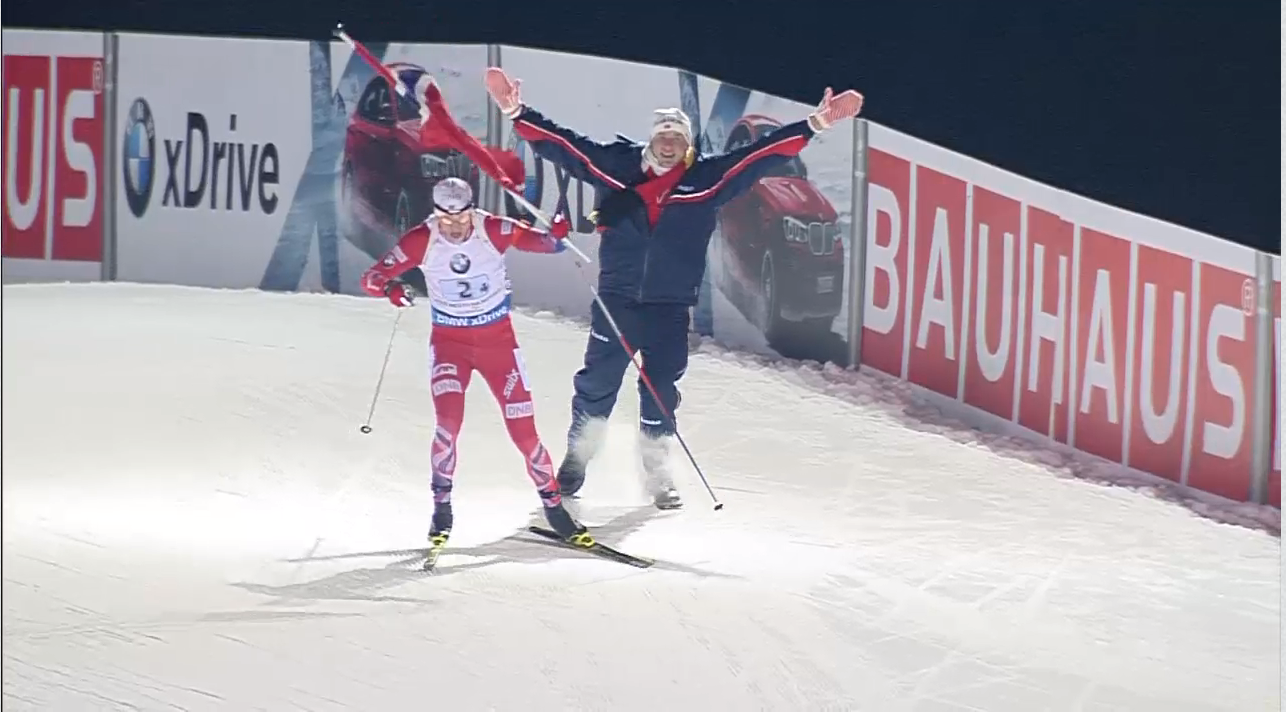
    (“A bit disappointed about today’s feeling on the track!” he had tweeted after placing fifth in Saturday’s sprint. “Tomorrow race will give me more informations.” What did he learn?)

    Many of the pre-race favorites accumulated a penalty in the first prone stage, but Norway’s Lars Helge Birkeland took the lead and kept is almost all the way through the next lap. He was eventually passed by teammates Tarjei Bø and Emil Hegle Svendsen, who skied onto the range together with Carl Johan Bergman, a Swede who lives just a five minute drive from Sjusjøen in nearby Mesnali. Despite a different suit, these trails are as much his home turf as anyone’s.

    Bø seemed to take control of the race, as one of five men who cleaned the stage. He skied with Svendsen, two Austrians, and Arnd Peiffer of Germany for the entire next lap, then went out in front again after the first standing shooting. Again, there were many penalties. He skied the next lap with Andriy Deryzemlya of Ukraine and Julian Eberhard of Austria, while the chase pack moved within striking distance. Bø was frequently at the front of his groups, pushing the pace and setting the narrative.

    But despite seeming so confident, Bø lost control at the last minute, missing two shots in the last stage. The first two racers to clean were veteran Norwegian Ole Einar Bjørndalen, who had gradually worked his way up after two prone penalties, and young teammate Vetle Sjåstad Christiansen. 39-year-old Bjørndalen took the lead, until Christiansen passed him on an uphill. The Norwegian coaching staff looked on, amused, at the jumbotron in the stadium. A kilometer later, Bjørndalen attacked and left Christiansen in the dust, skiing easily to the win.

    Bjørndalen, who was second behind Svendsen in Saturday’s sprint, was glad to report that he felt stronger than just one day before. After this weekend, criticism that he’s too old for a heroic result at what will be his sixth Olympics seem moot.

    “Today I had completely different energy,” he told NRK. “Because of my penalties I had to push very hard to take the lead. It was a long way, but on the trails here it is possible. So I could push hard the whole way and was able to respond to pressure.”

    The battle for third place was even more exciting. Peiffer, Svendsen, and Bø’s younger brother Johannes Thingnes Bø had left the range together, but their group did not stay together long. Other racers dragging themselves towards the front, eager to prove their worth before the opening World Cup races next weekend.

    It was Lars Berger, the Olympic veteran who was not nominated to the national team for this season, who came charging through the fastest. Despite four penalties to Svendsen’s three – Bjørndalen and Christiansen each had two – he pulled Svendsen with him as the pair left Peiffer behind. They made it within two seconds of Christiansen, but could not overtake him. The two Norwegians battled it out in the finishing stretch but Svendsen eventually conceded, and Berger took the mini-victory for third.
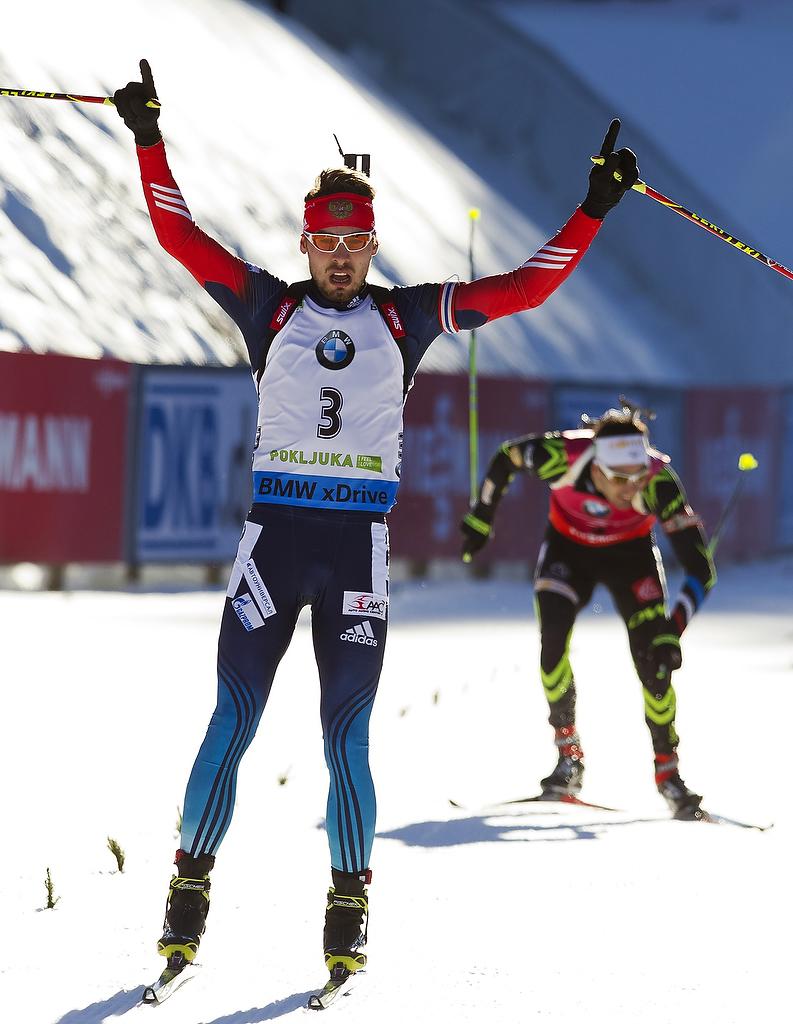
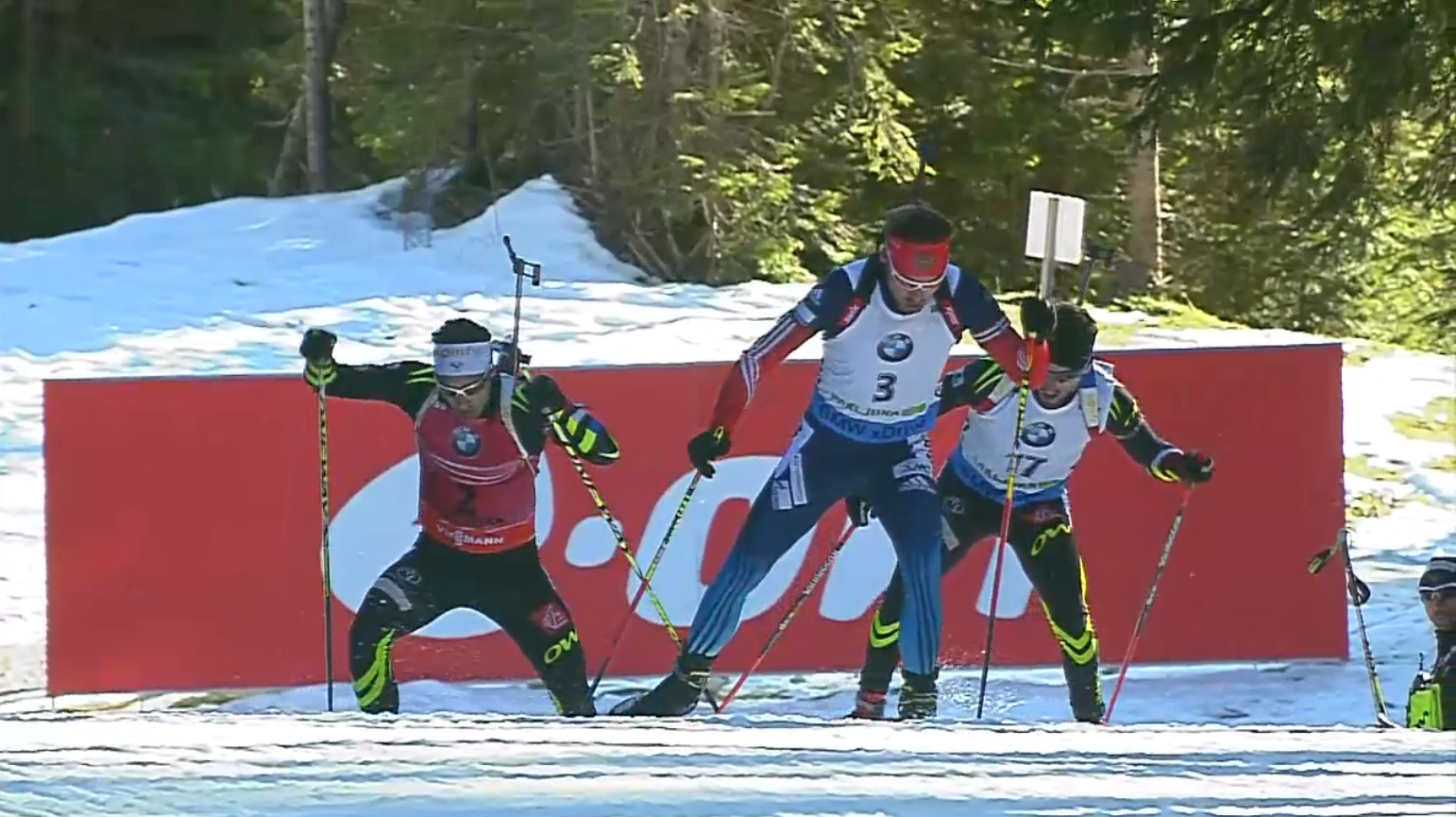
    In all, Norway took nine of the top 12 spots. Peiffer was relegated to fifth, and Simon Desthieux was again the top Frenchman, snagging sixth after placing third in the sprint on Saturday.

    Results

  • Weekly Roundup: World Championships, Oslo, Vasaloppet

    Weekly Roundup: World Championships, Oslo, Vasaloppet

    Podium after the women's 30 k classic: Bjørgen smiles after besting Justyna Kowalczyk and Therese Johaug.
    Podium after the women’s 30 k classic: Bjørgen smiles after besting Justyna Kowalczyk and Therese Johaug.

    Things got down to business in Val di Fiemme for the second week of World Championships, with only the classic races still on the schedule: interval start, relay, and marathon. Norway’s Therese Johaug and Petter Northug picked up titles in the 10 / 15 k freestyle races, while Ivan Babikov of Canada and Liz Stephen of the U.S. were fourth and fifth. Norway also swept the relays, unsurprisingly; the U.S. women had a history fourth-place finish. In the 30 k, Marit Bjorgen won yet another World Championship, but said this one was particularly meaningful (and Justyna Kowalczyk is probably particularly devastated to lose it). Finally, the Championships capped off with what has been called the greatest 50 k ever by Johan Olsson of Sweden, who broke away early and managed to ski alone for 35 k to the win.

    Nordic combined racers were also still duking it out in Val di Fiemme, with a few unsurprising winners: Eric Frenzel continued his string of pre-Championships World Cup successes and won the individual large hill competition, while Jason Lamy Chappuis of France anchored the winning team sprint. For the U.S., there were no more fireworks like the bronze medal in the relay, but instead a collection of solid performances that left the team wanting just a little more. Billy Demong and Taylor Fletcher finished 15th and 17th in the large hill, then combined for sixth place in the team sprint, undone by a poor morning on the jumping hill.

    IBU World Cup biathlon racing kicked off in Oslo with good omens for the Norwegian team: Tarjei Bø and Tora Berger won the opening sprints. While Berger continued her tear, sweeping th pursuit and mass start as well, two non-Norwegians got to meet King Harald V after their victories on Saturday and Sunday: World Cup leader Martin Fourcade  of France after the pursuit and Czech Republic’s Ondrej Moravec, who got his first career win in the mass start. After a disappointing sprint for the entire American team, Tim Burke skied to fourth in the mass start.

    In Nove Mesto, Czech Republic, a group of American skiers made it clear that they could cut it against the Europeans. Kate Fizgerald (APU) won on both tightly-contested days of racing, first tying with a Czech skier for the win in the 3.3 k prologue, then outsprinting Sophie Caldwell  (SMST2) for victory in the 10 k classic pursuit. Rosie Brennan also hit the podium, placing third in the pursuit to give the Americans the sweep. American men were paced by Paddy Caldwell (SMS), fresh off a trip to Norwegian junior nationals, who placed fourth in the prologue and ninth in the pursuit; Stratton teammate Eric Packer finished tenth and twentieth.

    While the World Championship marathon was technically held in Val di Fiemme on Sunday, another big-deal, long-distance race was taking place in Sweden: the Vasaloppet, one of the biggest marathons in the world and at 90 kilometers also one of the longest. In a battle of the titans Jorgen Aukland outdueled fellow former champions Daniel Tynell, Anders Aukland, and Jorgen Brink for the win; in the women’s race it was Norway’s Laila Kveli who skied to a large and surprising victory. While few Americans contested the race Canada had a strong presence, considering the distance from home, with Brian McKeever placing 45th and Andrea Dupont 11th.

    Finally, on the home front, a couple more marathons were taking place. The 30 k Great Race from Tahoe to Truckee, a ripping mostly-downhill affair, was won by CXC’s Brian Gregg ahead of Far West Farm Team’s Spencer Eusden and Truckee’s Marcus Nash. Fellow Truckee resident Katerina Nash bested Farm Team’s Beth Taylor for the women’s win. In Maine, Harvard skier Akeo Maiseld-Carucci bested John Dixon of Colby over 50 kilometers while Robyn Anderson outsprinted VTXC teammate Lea Davison for the women’s win, nearly eight minutes ahead of the rest of the women’s field.

    We also posted a video interview with newly-crowned World Champions Kikkan Randall and Jessie Diggins, and considered how to research interval training in the latest edition of our “This Month in Journals” series.


    FIS Cross Country World Championships, Val di Fiemme, Italy | results

    Tuesday women’s 10 k freestyle: report | Liz Stephen | U.S. & Canada | Biathletes | Photos

    Wednesday men’s 15 k freestyle: report | U.S. & Canada | Photos

    Thursday women’s 4 x 5 k relay: report | U.S. & Canada | Photos

    Friday men’s 4 x 10 k relay: report | U.S. & Canada | Photos

    Saturday women’s 30 k classic: report | U.S. | Photos

    Sunday men’s 50 k classic: report | U.S. & Canada | Photos

    FIS Nordic Combined World Championships, Val di Fiemme, Italy

    Thursday large hill competition: blog post | results

    Saturday team sprint competition: blog post | results

    IBU World Cup, Oslo, Norway

    Thursday & Friday 7.5 / 10 k sprints: blog post | men’s & women’s results

    Saturday 10 / 12.5 k pursuits: men’s & women’s reports | men’s & women’s results

    Sunday 12.5 / 15 k mass starts: men’s & women’s reports | men’s & women’s results

    Slavic Cup, Nove Mesto na Morave, Czech Republic:

    Saturday 3.3 / 4 k prologue: blog post | men’s and women’s results

    Sunday 10 / 15 k classic pursuits: blog post | men’s and women’s results

    Vasaloppet, Salen-Mora, Sweden

    blog post  | results

    The Great Race, Tahoe to Truckee, California

    results

    Rangeley Lakes Loppet, Rangeley, Maine

    results