Tag: Tarjei Boe

  • USA Fifth in World Championship Relay

    USA Fifth in World Championship Relay

    FasterSkier’s Coverage of the Biathlon World Championships is made possible through the generous support of the Craftsbury Outdoor Center: New England’s finest snowmaking, world class race venues and touring trails, healthy food in abundance, comfortable accommodations at Craftsbury:  Sports, Sustainability, Stewardship.
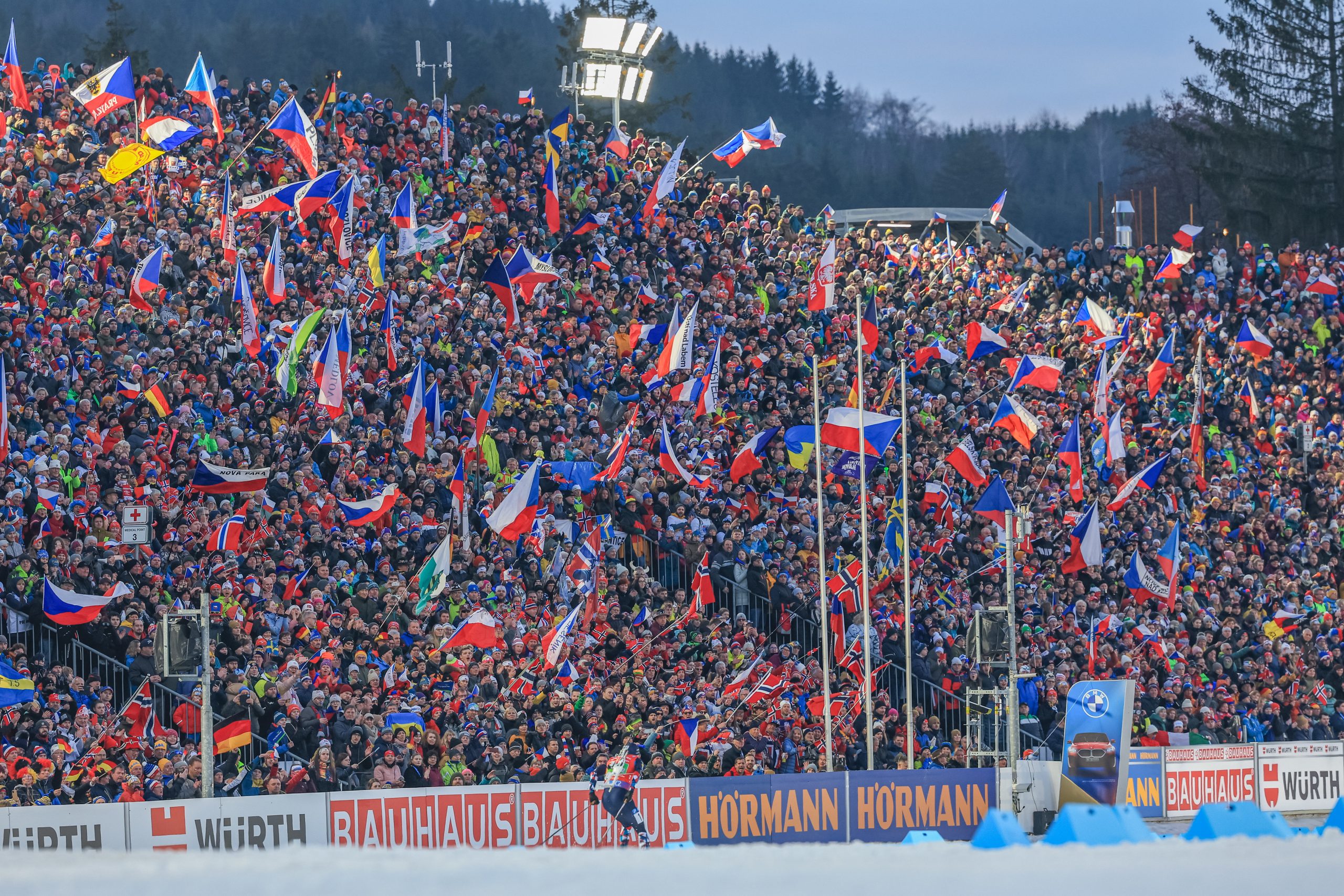
     

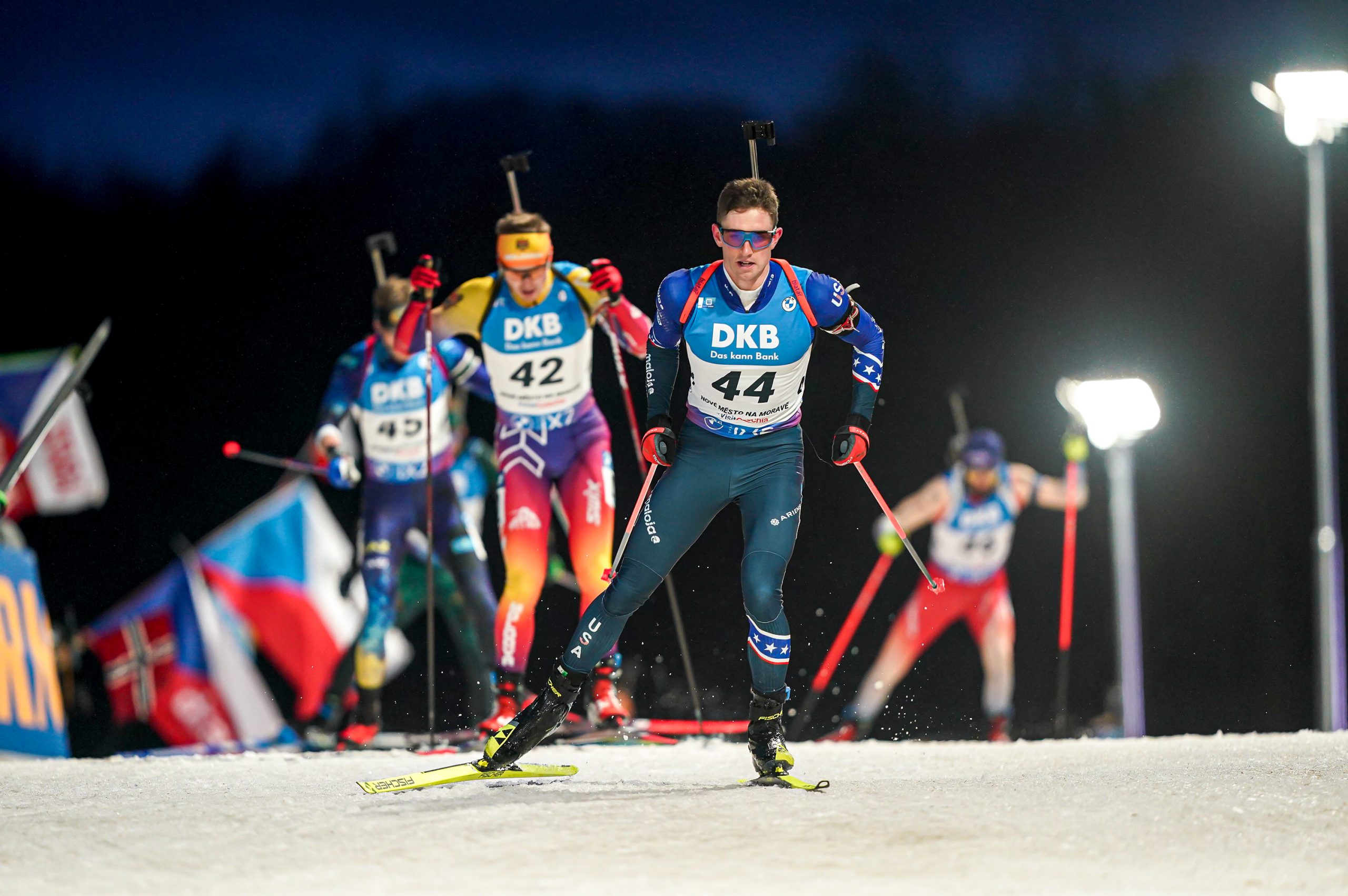
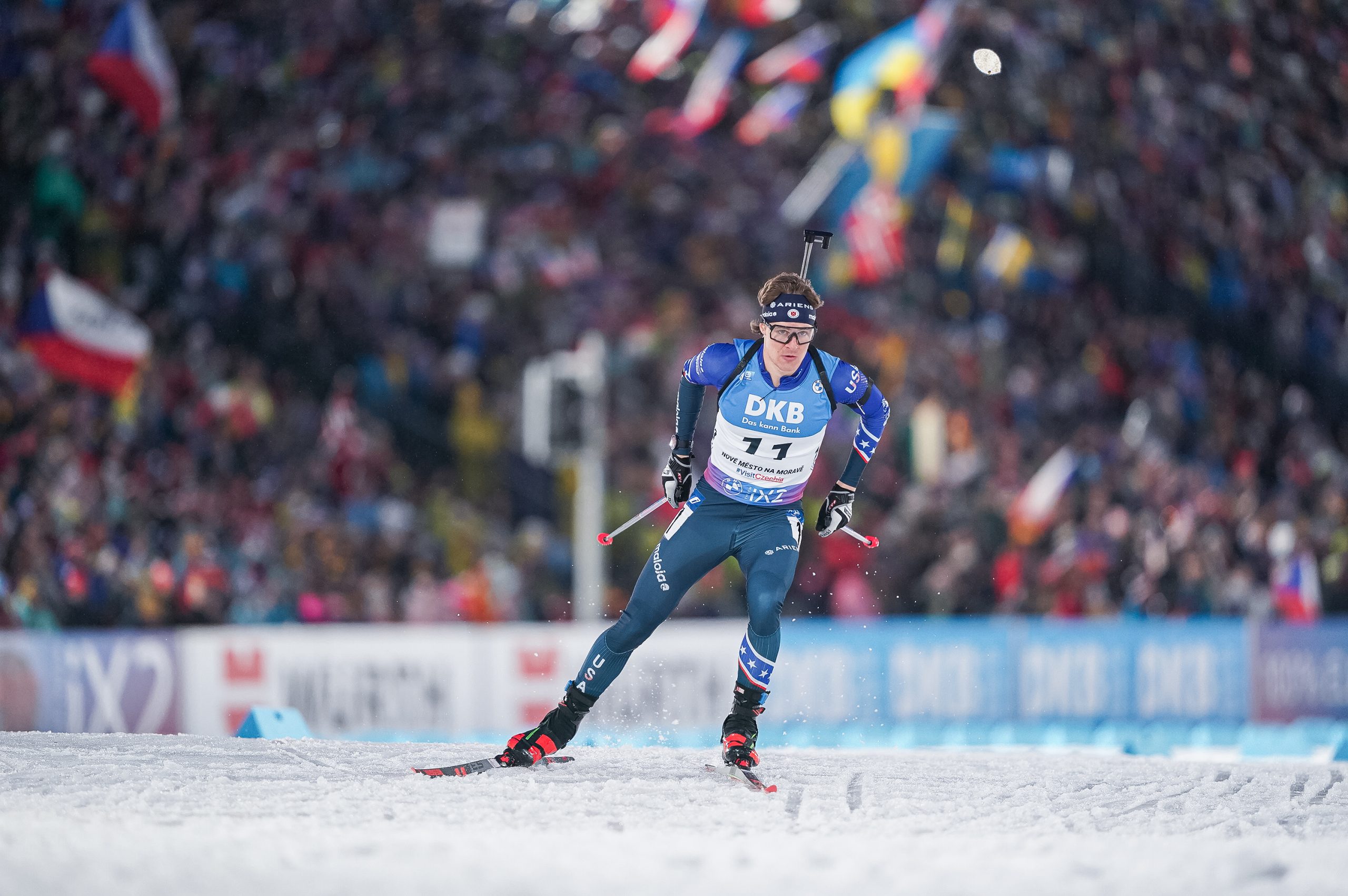
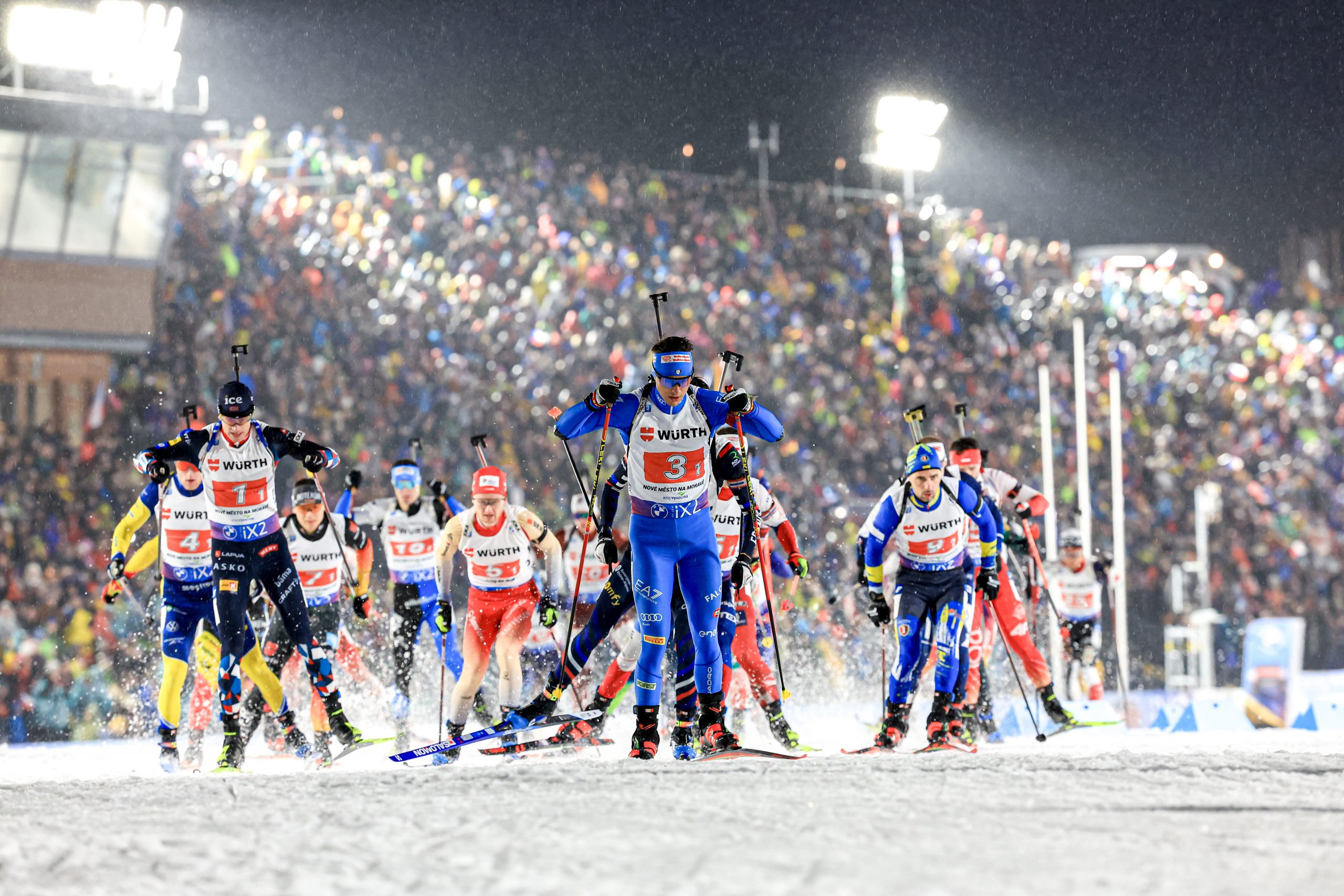
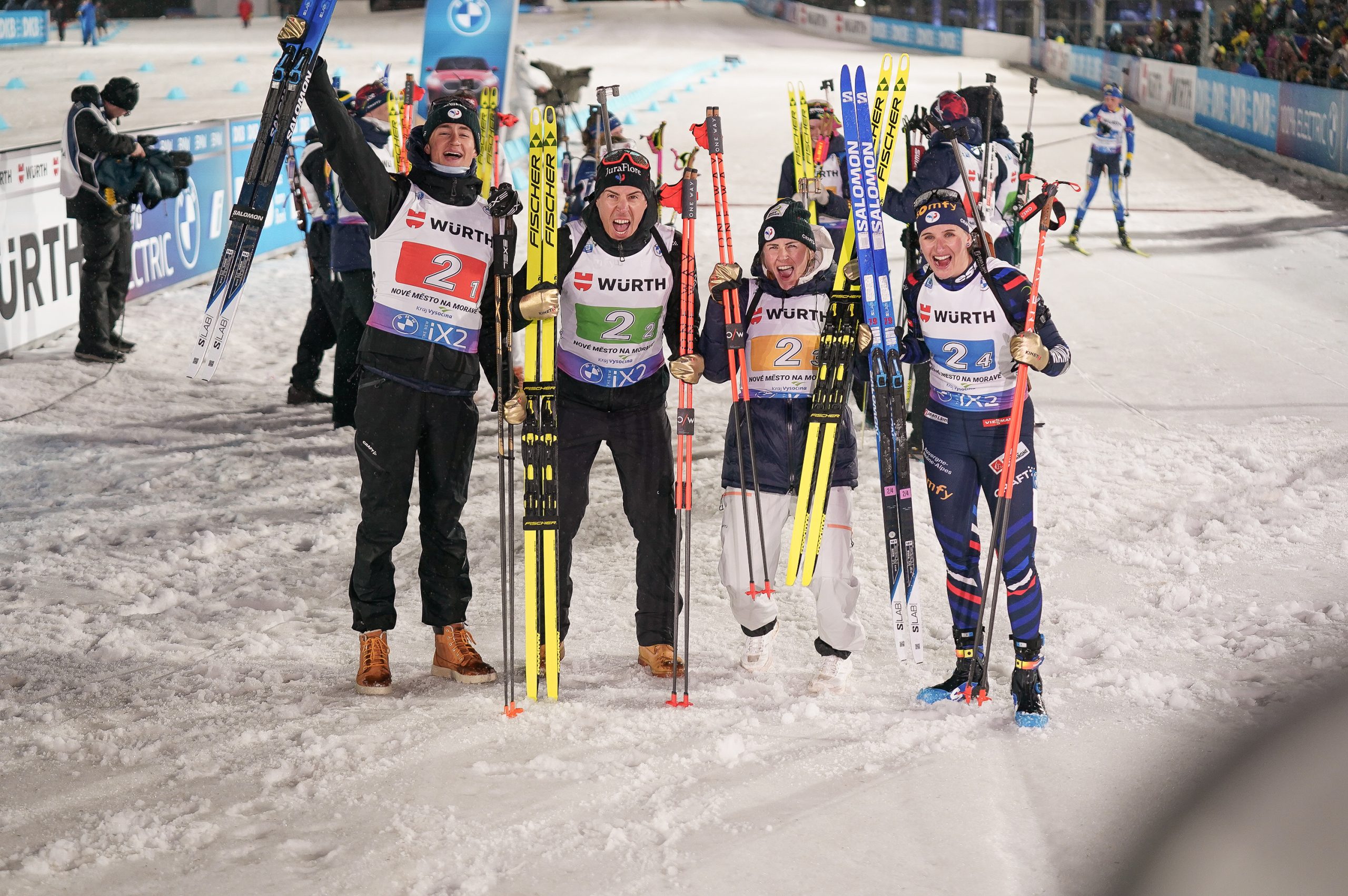
    On the second-to-last day of 2024 World Championships, USA reached a historic fifth-place finish among 24 nations in the Men’s Relay under the lights at the Vysocina Arena in Nove Mesto na Morave, Czech Republic. (Photo: NordicFocus)

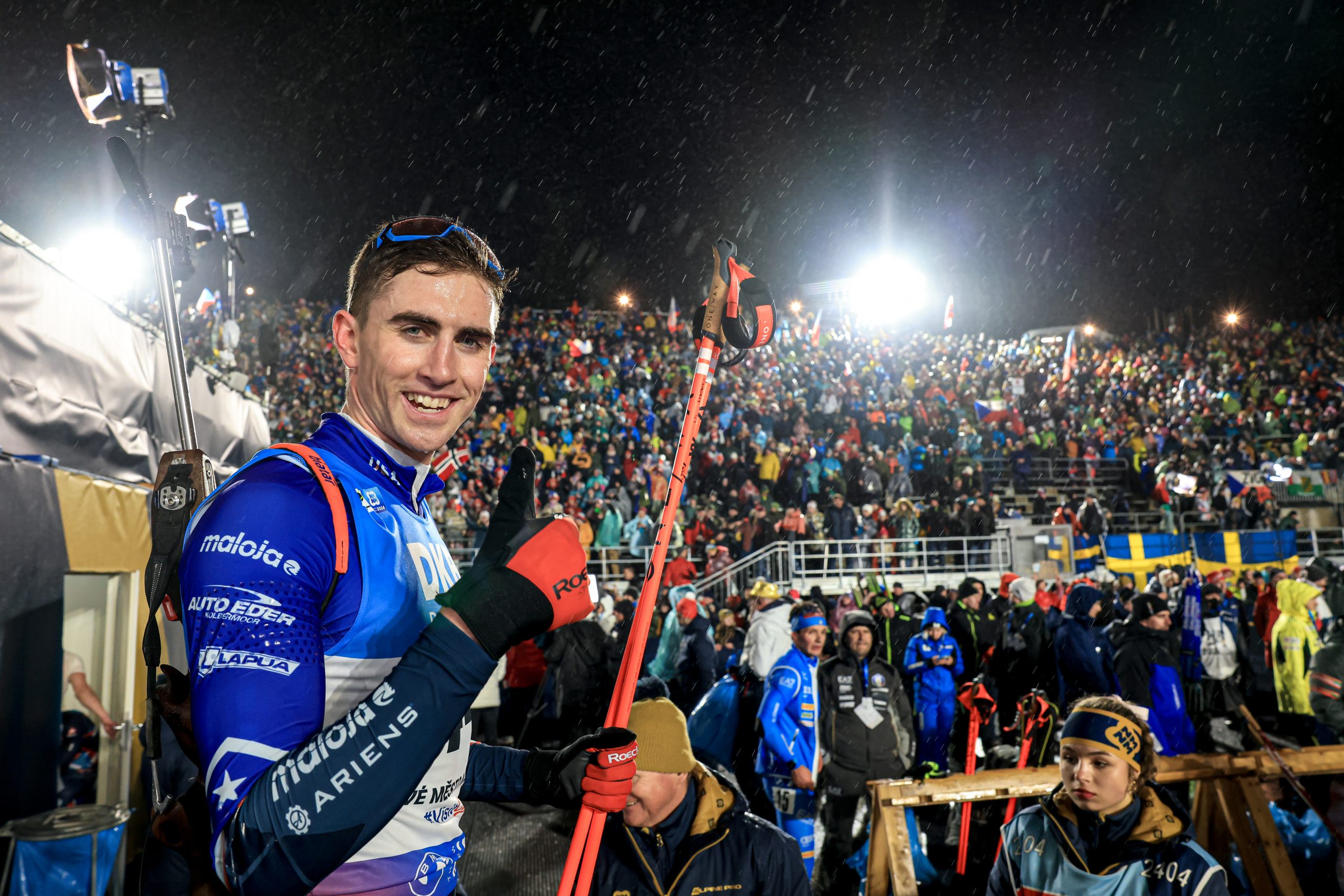
    On Saturday in Nove Mesto na Morave, Czech Republic, the American quartet of Vincent Bonacci, Sean Doherty, Campbell Wright, and Jake Brown made history for US Biathlon, finishing fifth among 24 nations: the team’s best-ever World Championship or Olympic Men’s Relay result. After more than an hour and 15 minutes of racing, the team finished just 1:22 behind the winners from Sweden. Norway out-sprinted France for the silver, and Germany was fourth.
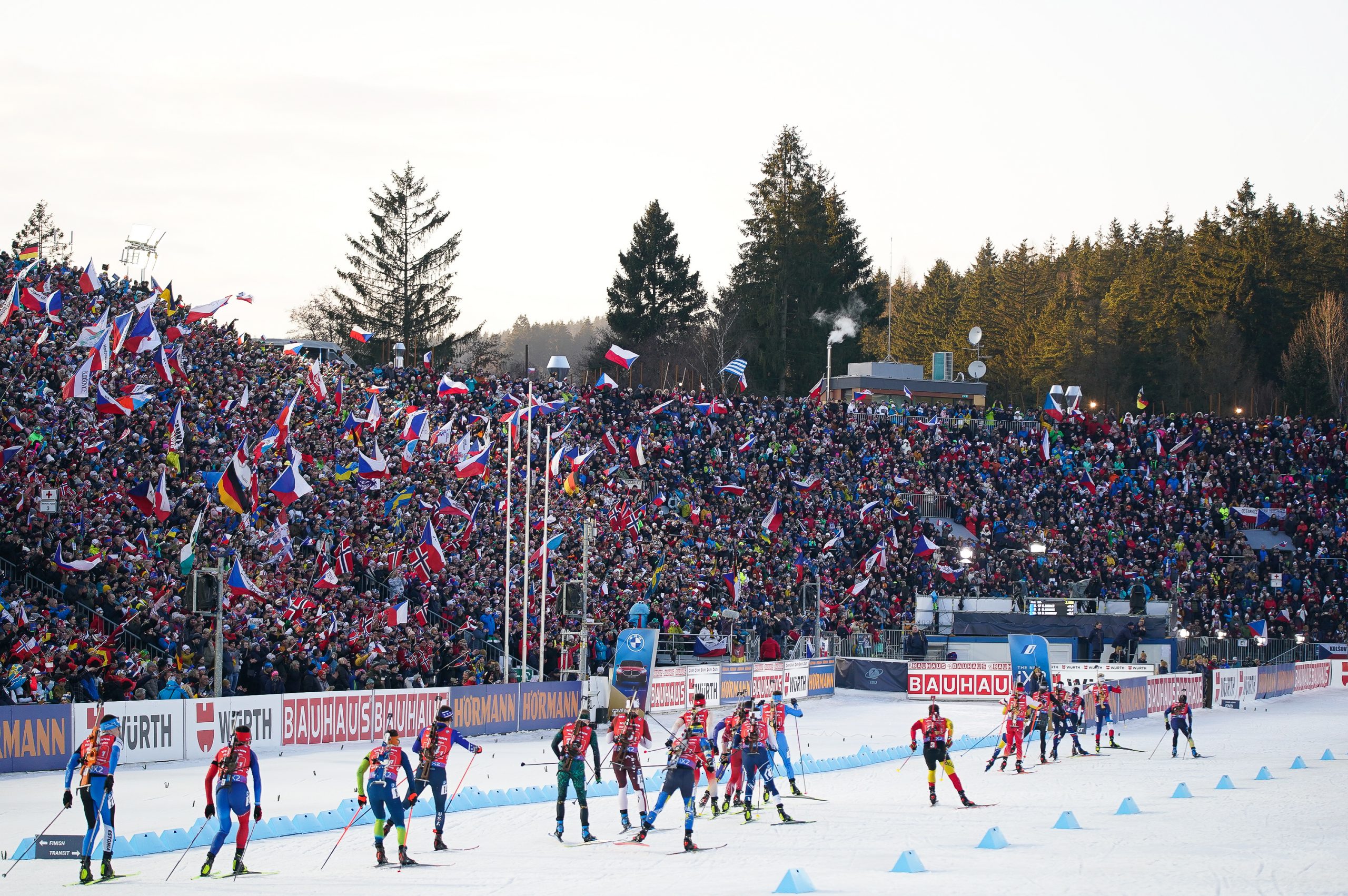
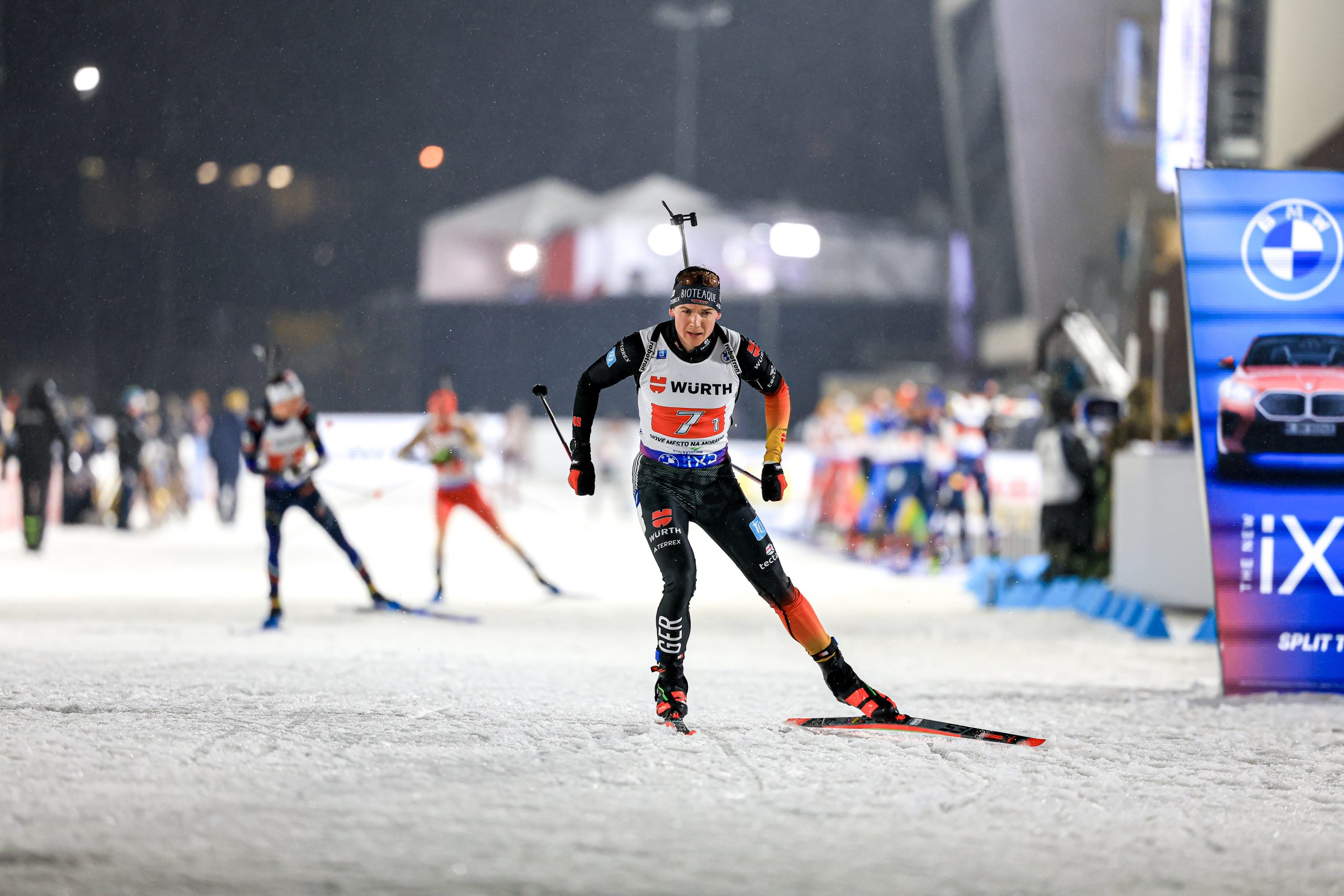
    Vincent Bonacci led off for the US in the 2024 World Championship Men’s Relay. (Photo: NordicFocus)

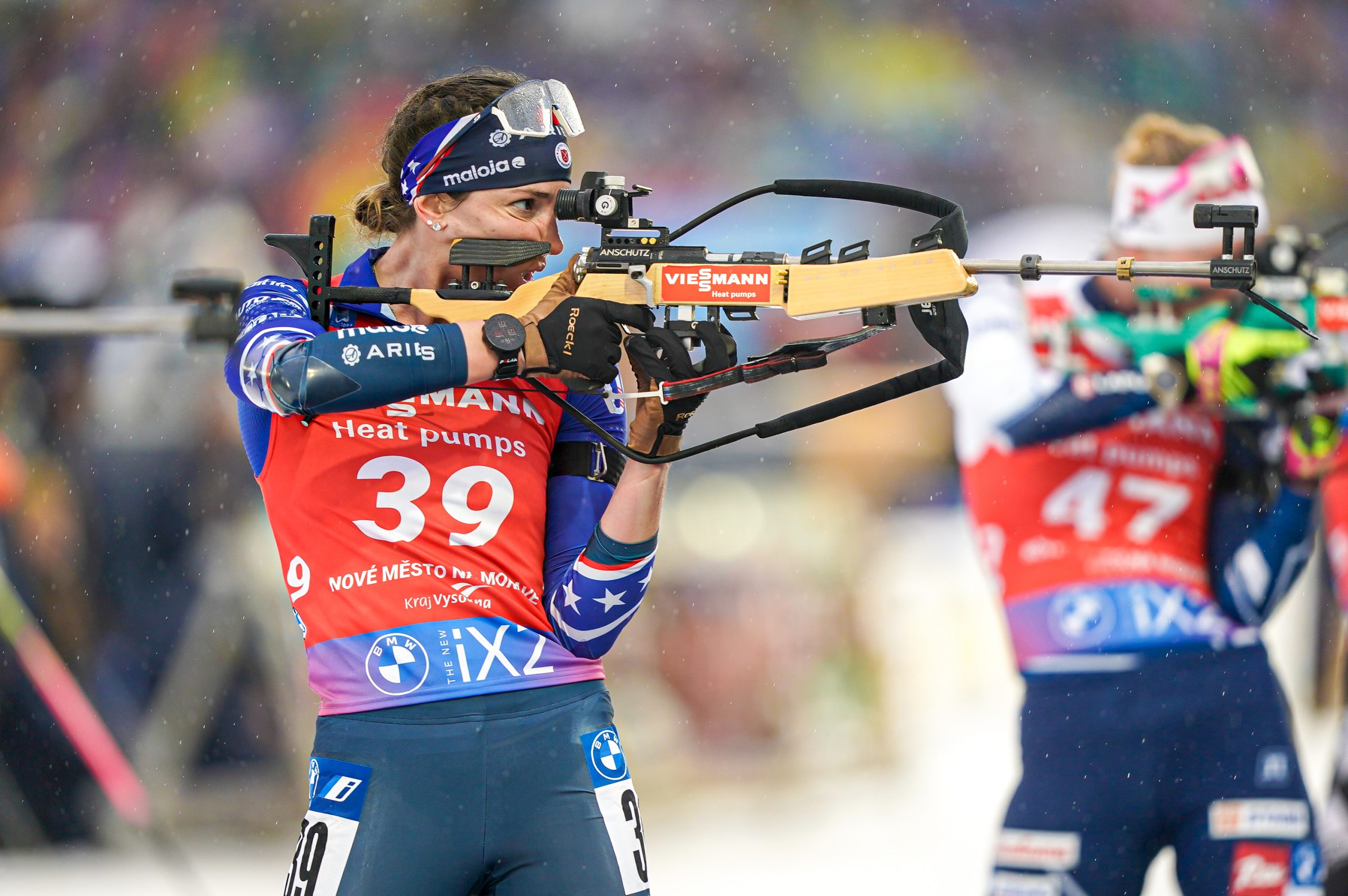
    The first leg was full of surprises. Estonia, Czechia and Kazakhstan led at the first exchange. France and Norway tagged in eighth and 12th after going into the penalty loop. For the US, Bonacci needed two spare rounds in prone but then cleared all five of his standing targets and tagged just ahead of Norway in 11th, 43 seconds out of the lead. Bonacci did his World Cup debut last season and has been steadily improving his results as he builds his ski speed. In late January he became one of the last two athletes named to this year’s World Championship roster after he took sixth at the European Championships with 20/20 shooting in the 20 k Individual. His reliable shooting earned him relay starts here in Nove Mesto, and he rose to the challenge of the World stage, scrambling with success in both the Mixed Relay and the Men’s Relay.
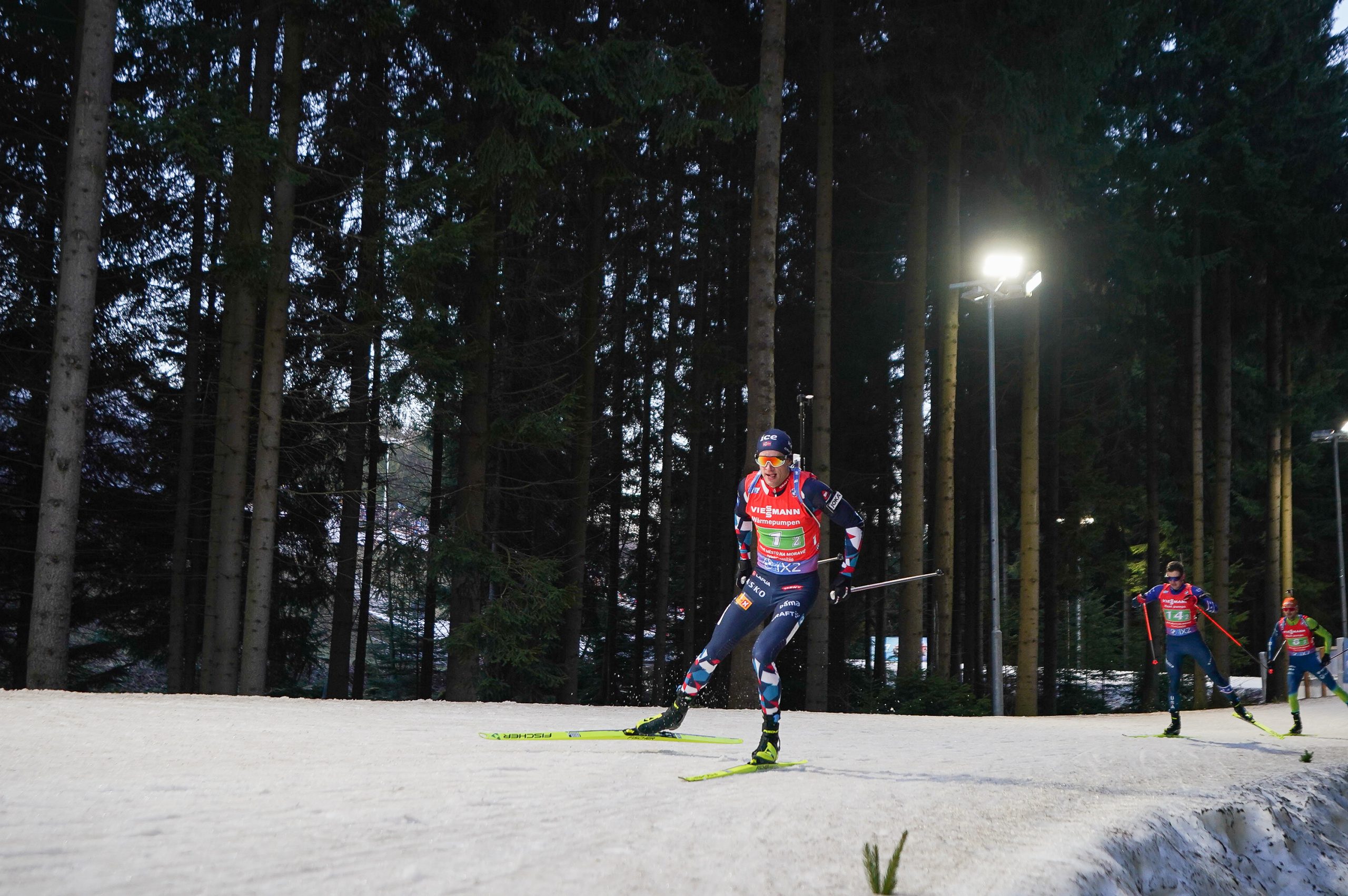
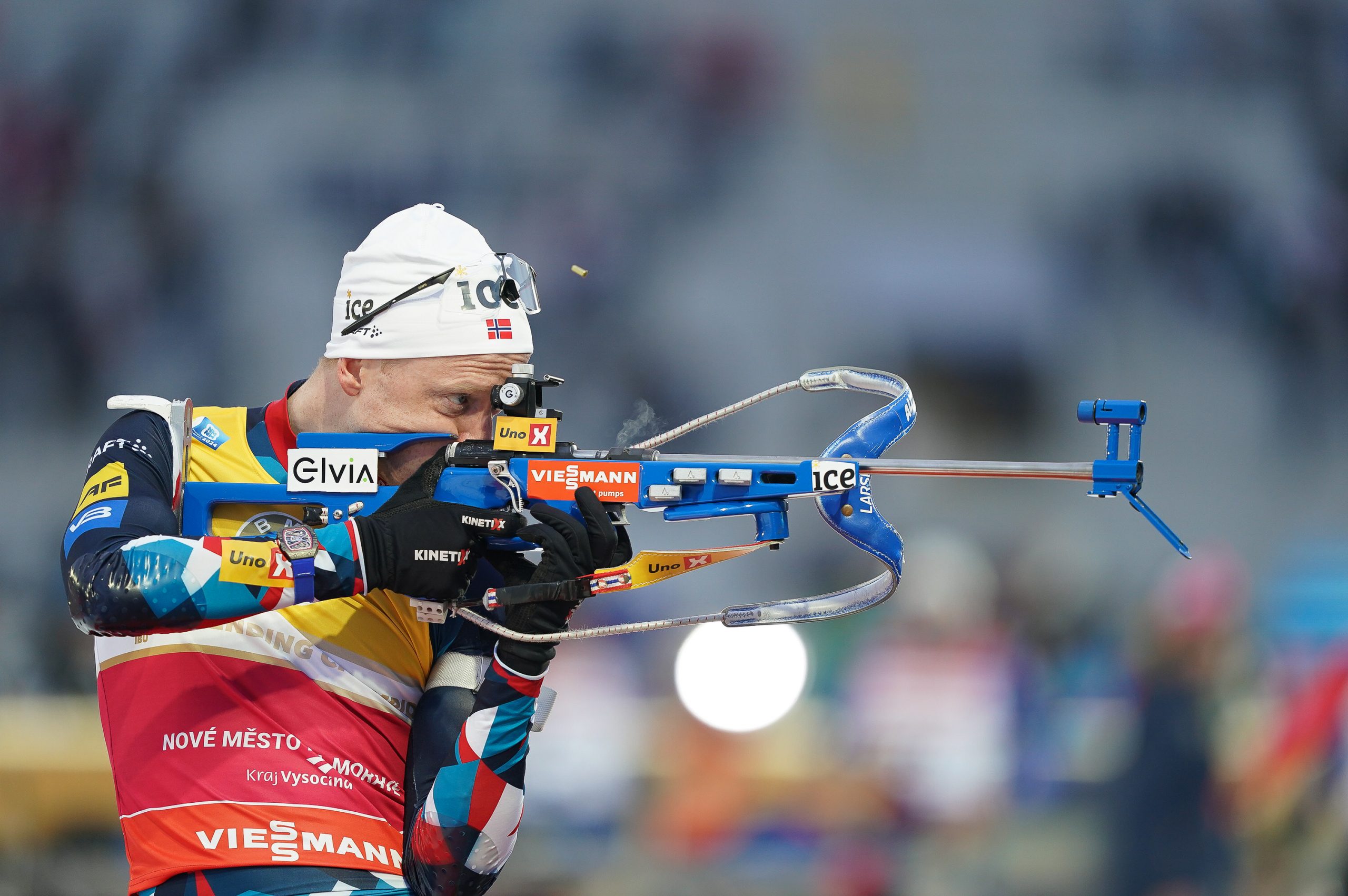
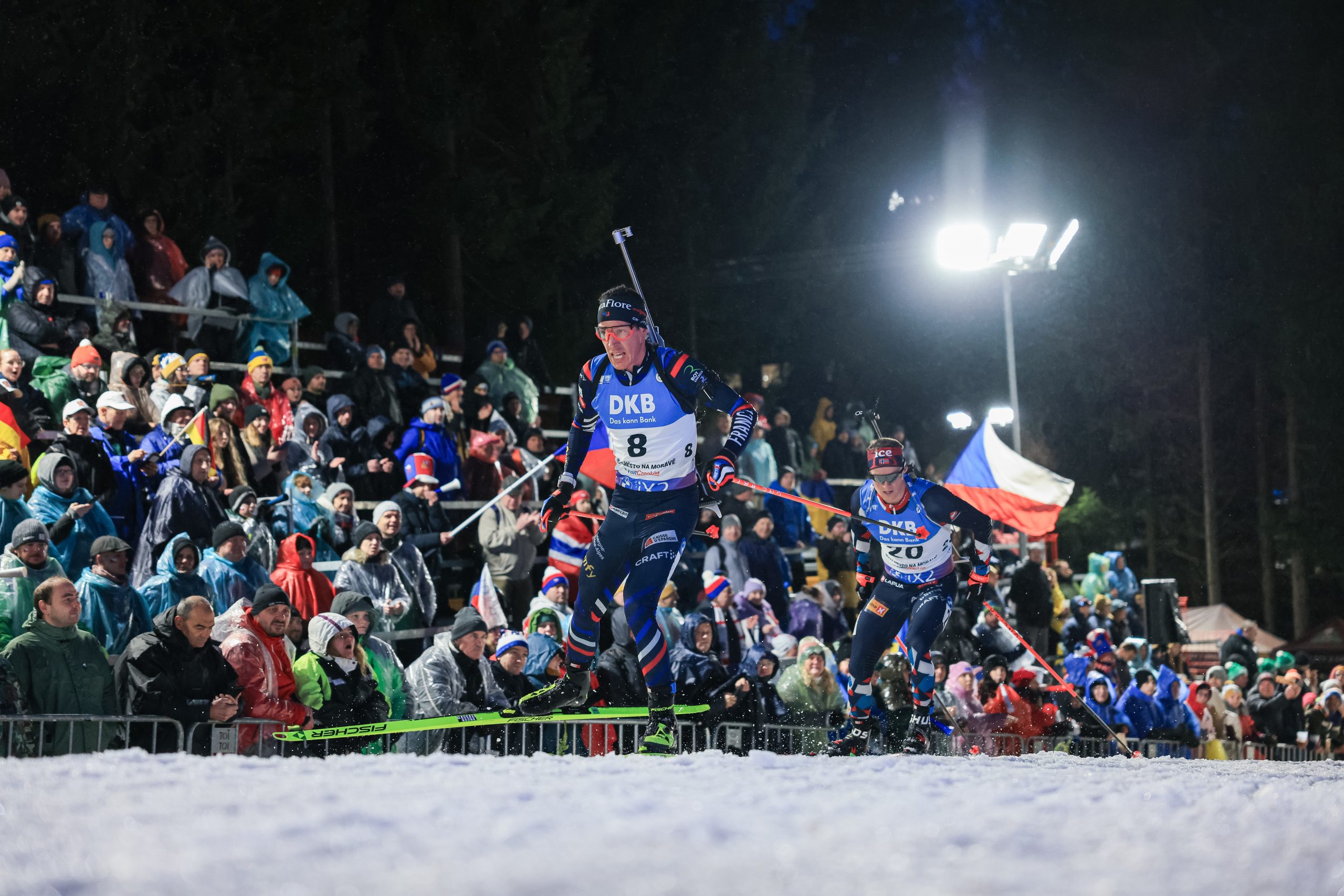
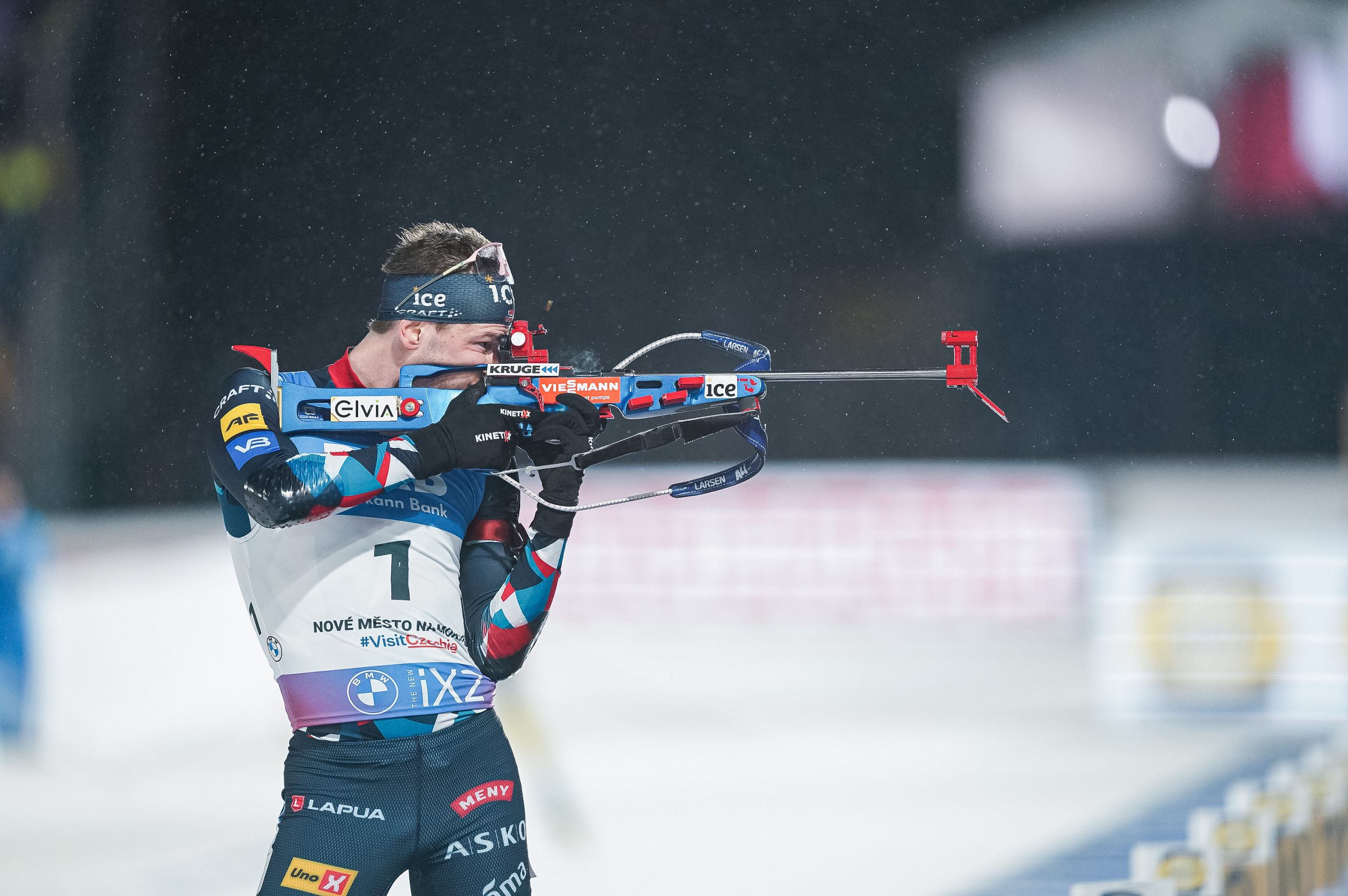
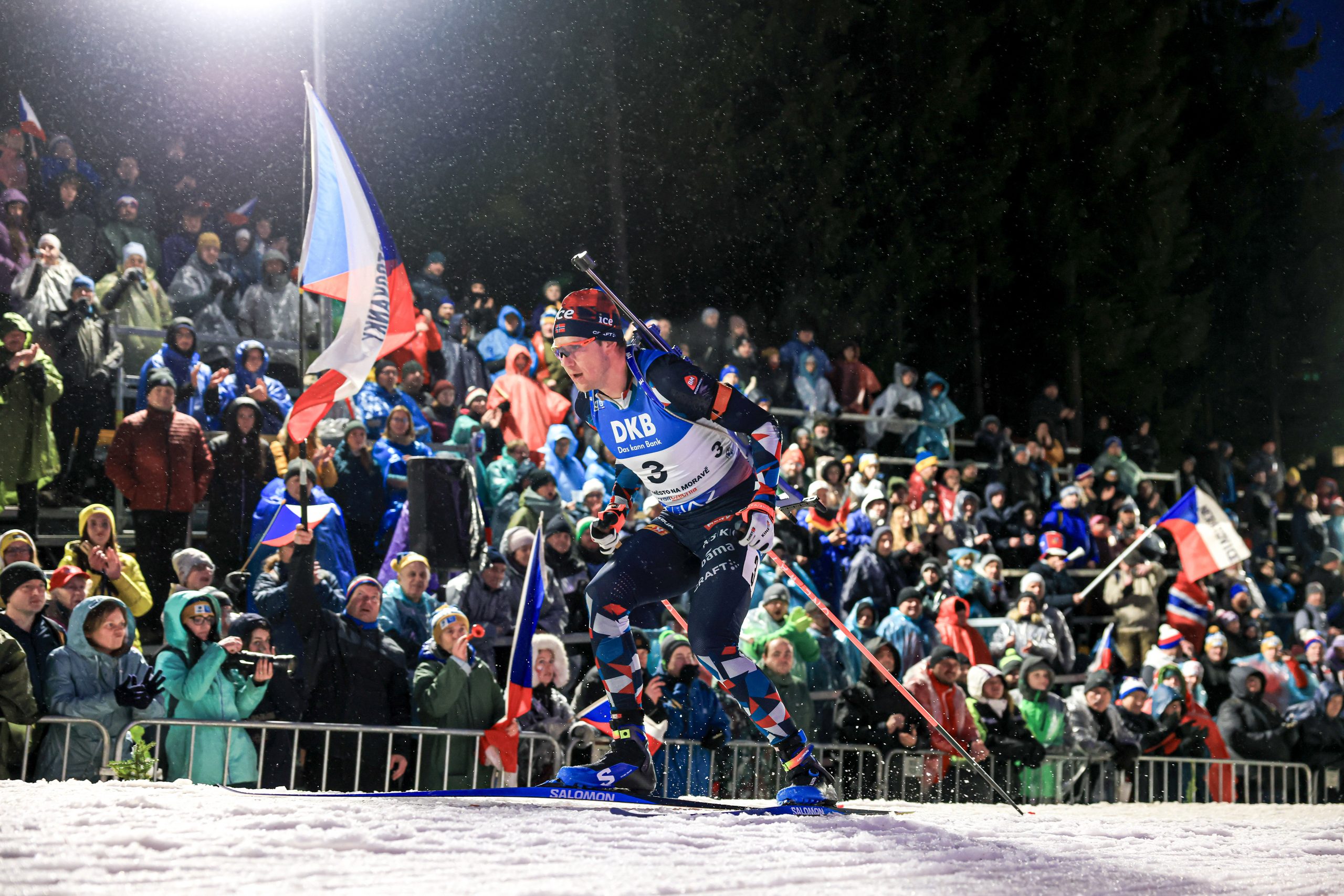
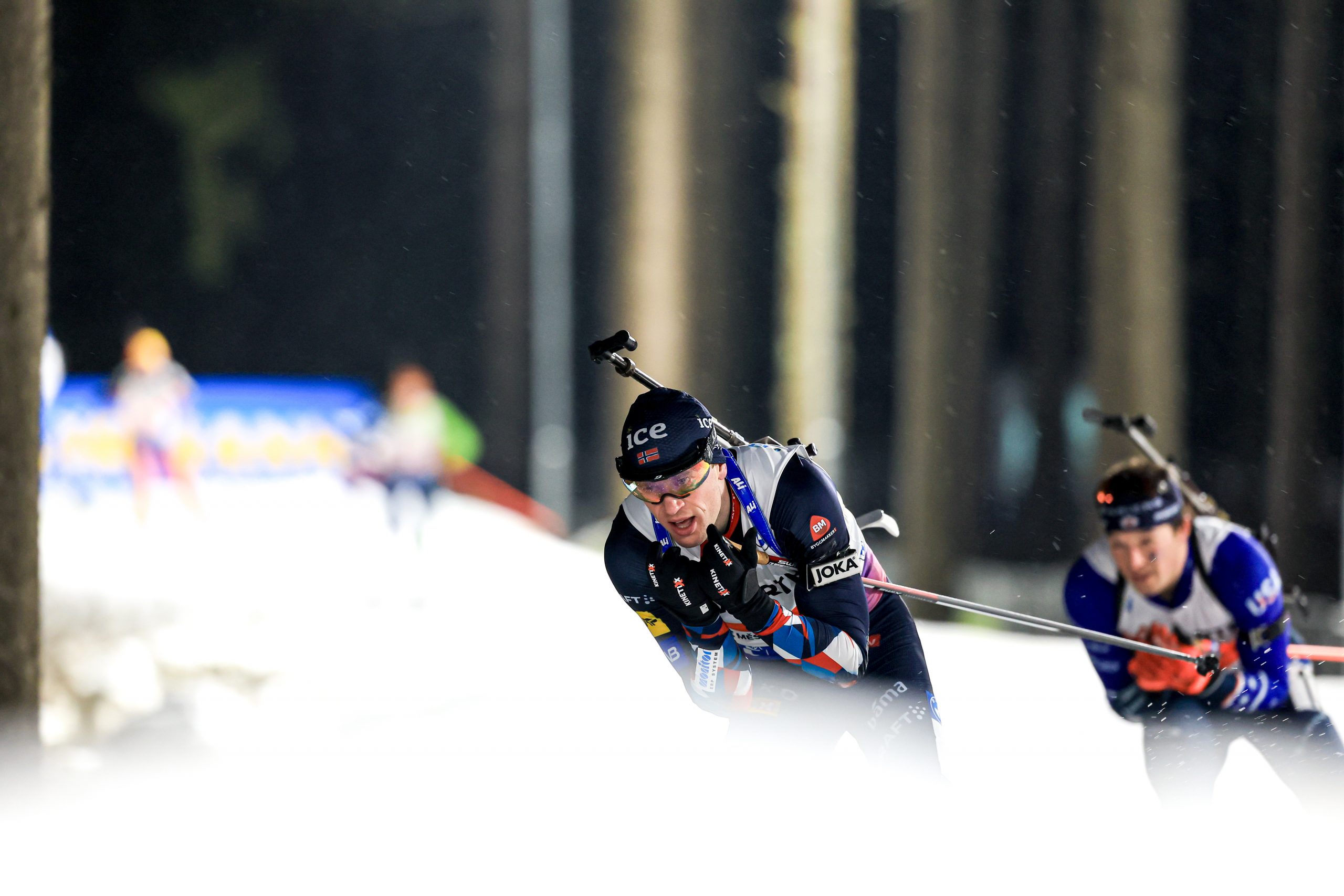
    Tarjei Boe (NOR) set a grueling pace on the second leg but Sean Doherty was able to catch a ride on the first loop. (Photo: NordicFocus)

    Doherty caught a draft from Tarjei Boe (NOR) on the first loop of the second leg. Germany briefly took the lead but then went into the penalty loop, and just as France was making a comeback from their penalty loop on the first leg, they went back in twice more. This opened the door for Boe, who out-skied the field by 30 seconds, to bring Norway all the way from 12th to first at the half-way point. Doherty cleaned his prone targets but needed all three spares in standing. Thanks to the changes at the front of the race, he only lost about 13 seconds on the leg, tagging Campbell Wright in 10th place in a tightly packed field, still within one minute of the lead.
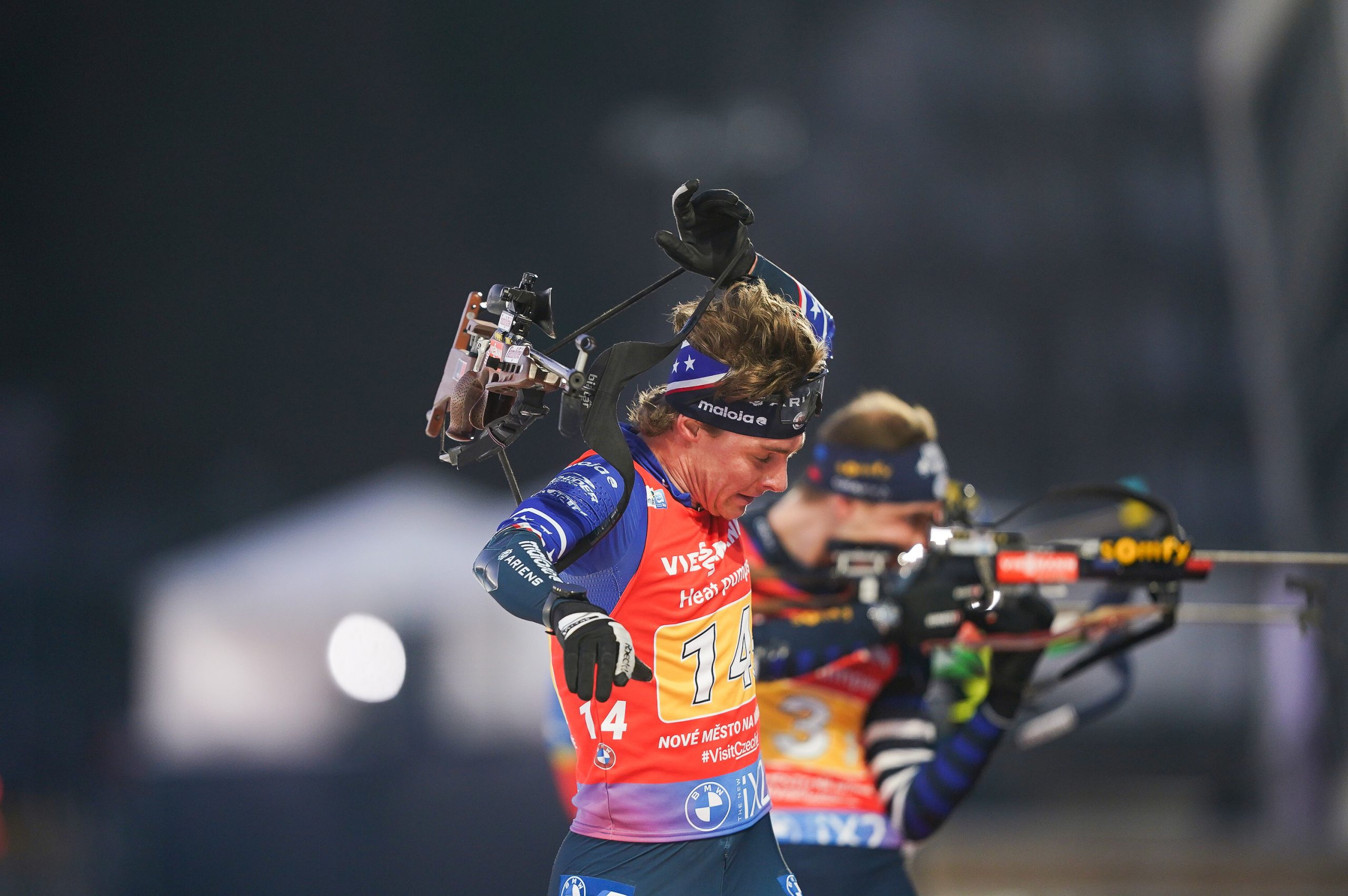
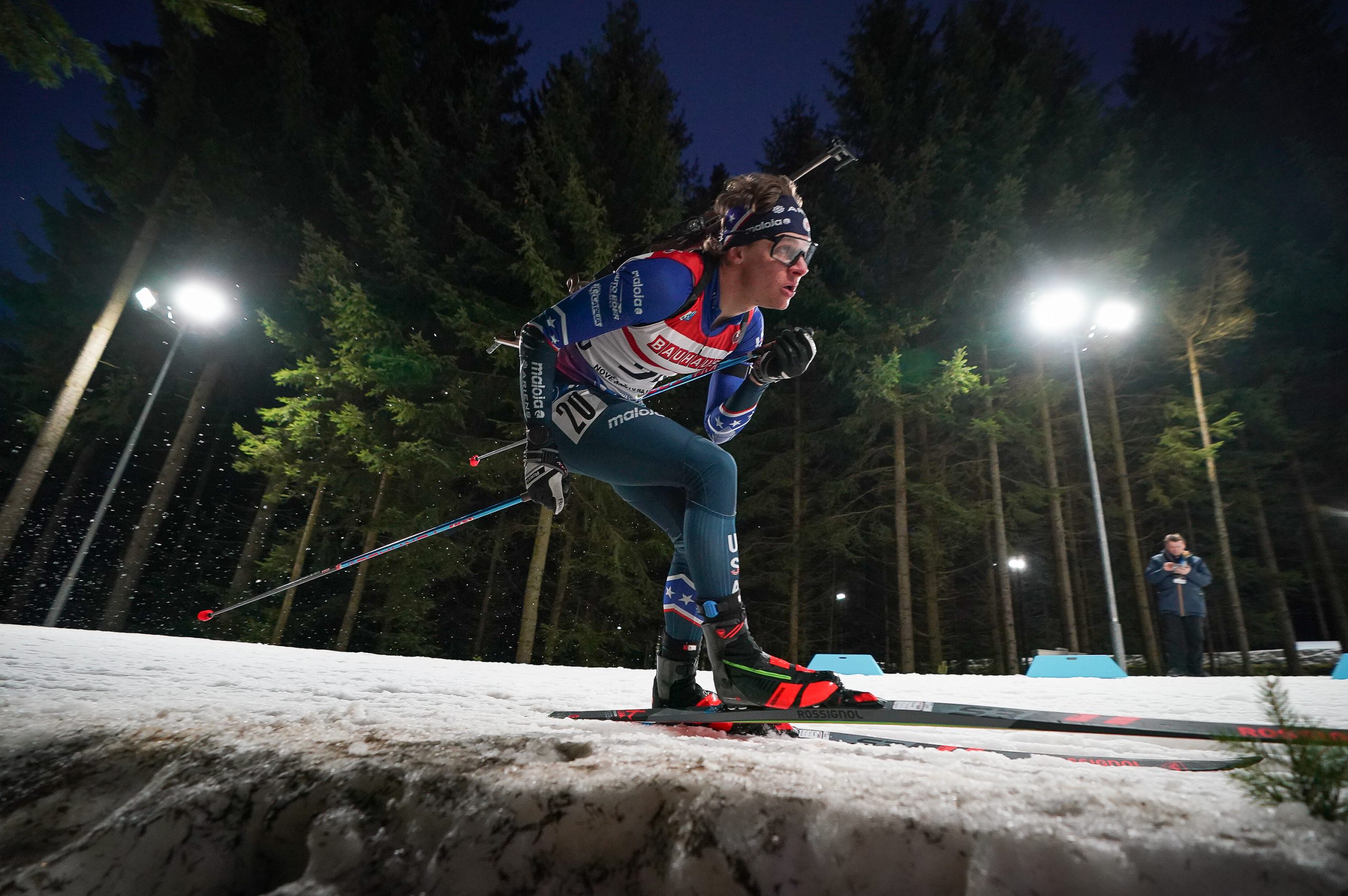
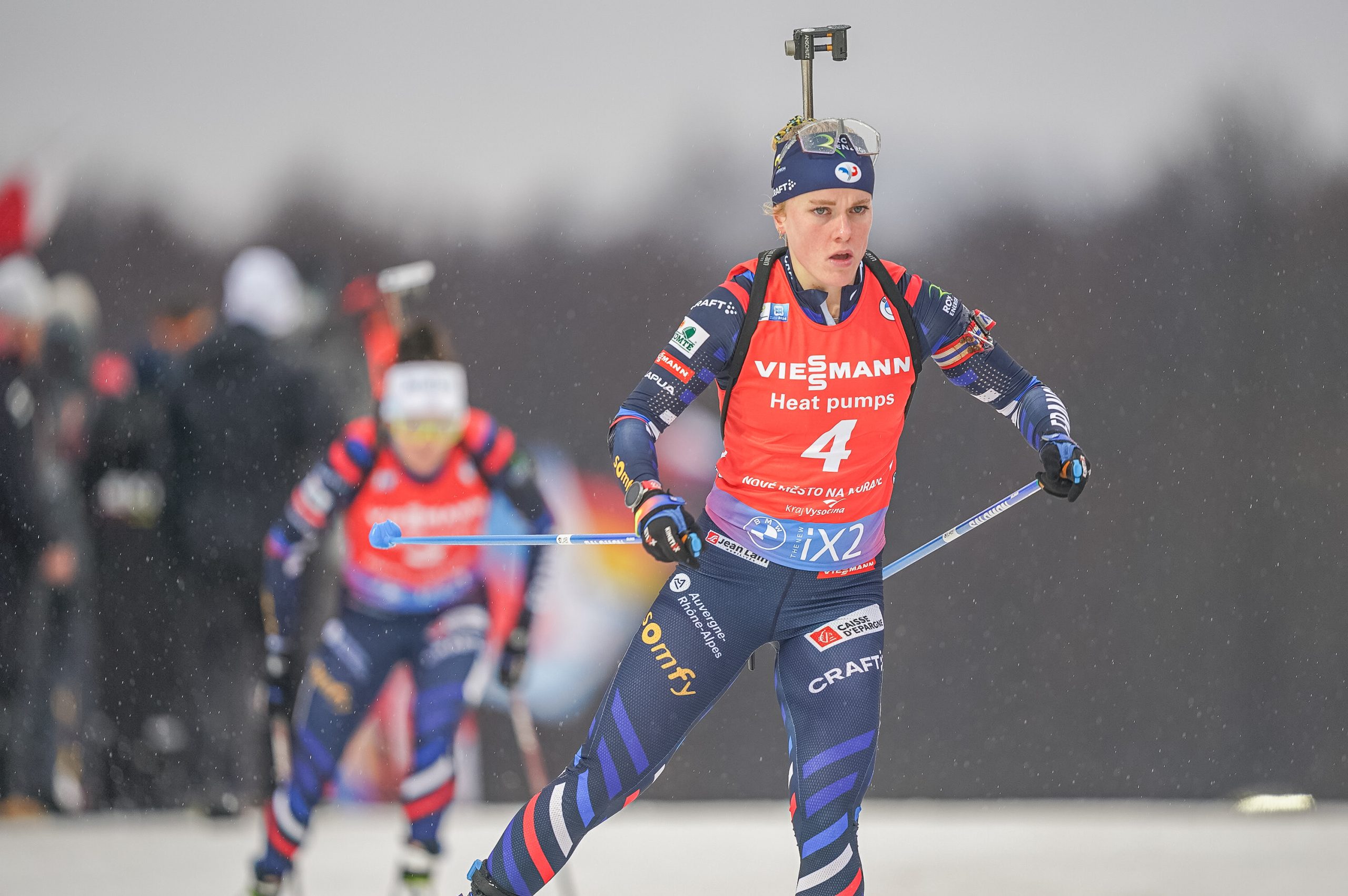
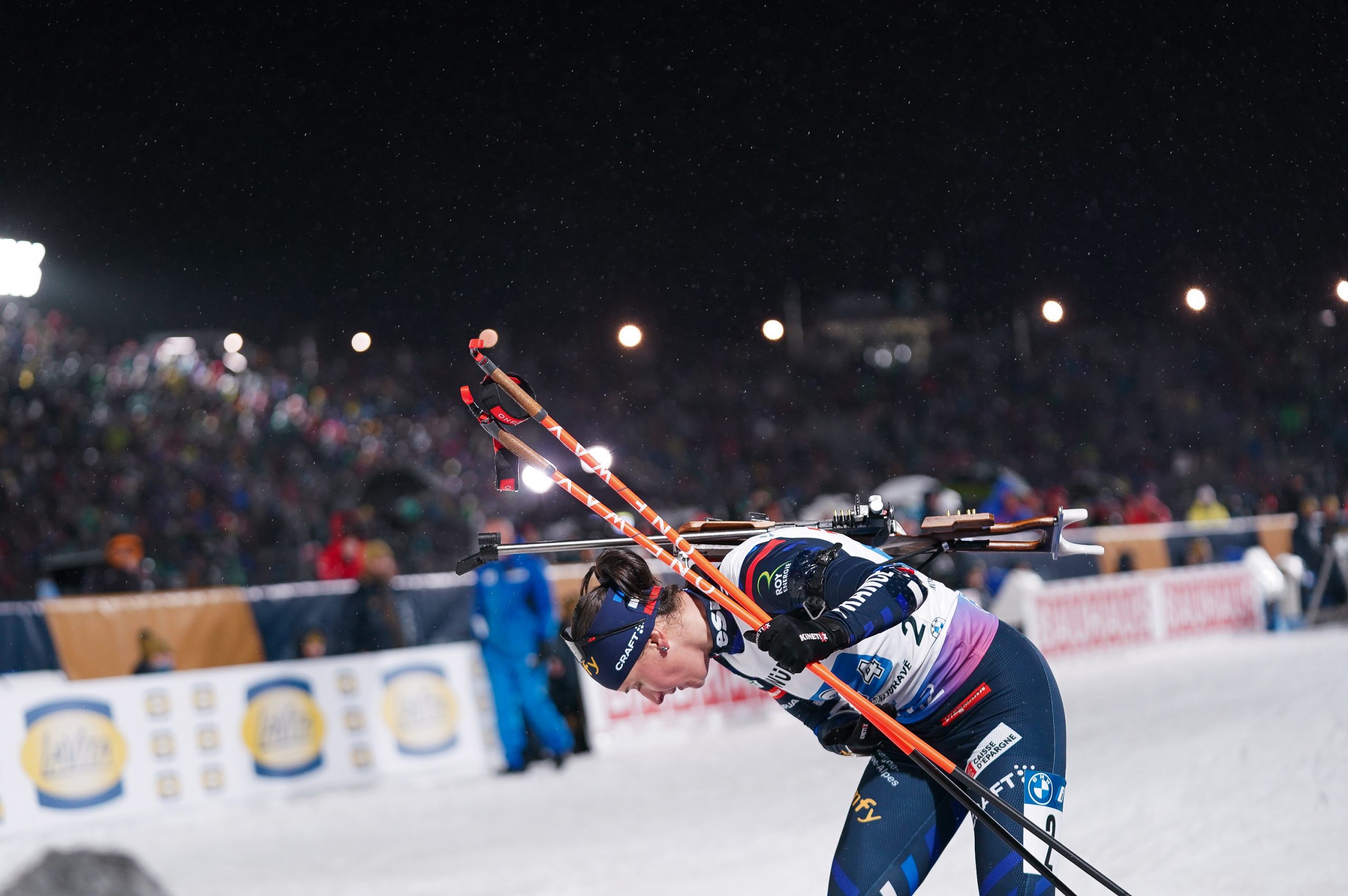
    Campbell Wright throws his rifle on his back after a successful standing bout. He skied the fourth-ranked course time and used just one spare to bring the US from 10th up to sixth on leg three of the Men’s Relay. (Photo: NordicFocus)

    Wright continued his streak of outstanding performances, using just one spare and skiing the fourth-best course time on the third leg to bring the team all the way up to sixth. He tagged Jake Brown for the anchor leg just 12 seconds out of third place. In the last men’s relay before World’s, Brown suffered on the shooting range, incurring two penalty loops in prone, but on Saturday he hit all five prone targets with no spares. He arrived at the shooting range for the final bout in fifth place, and used two spares to hold his position.

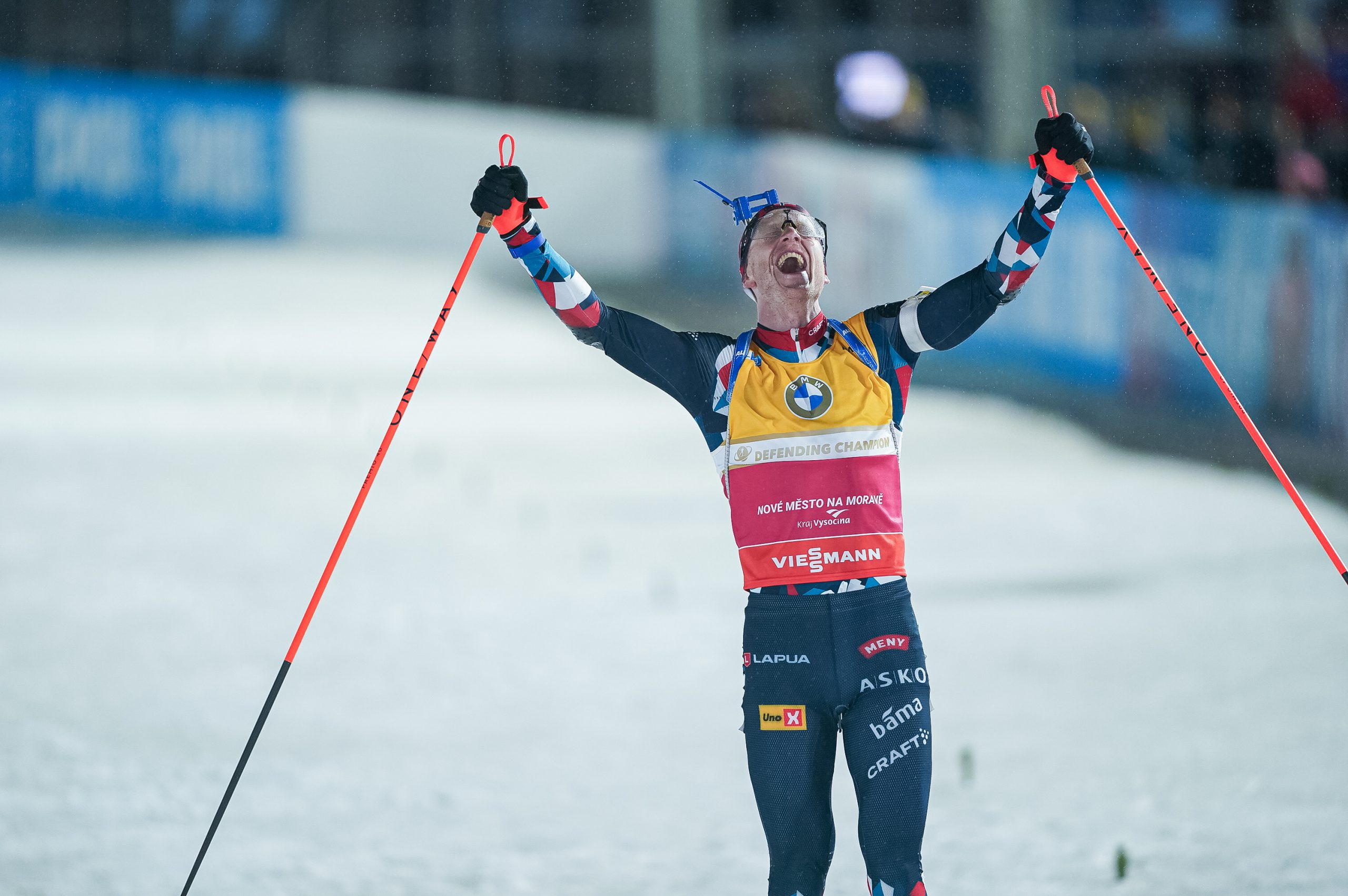
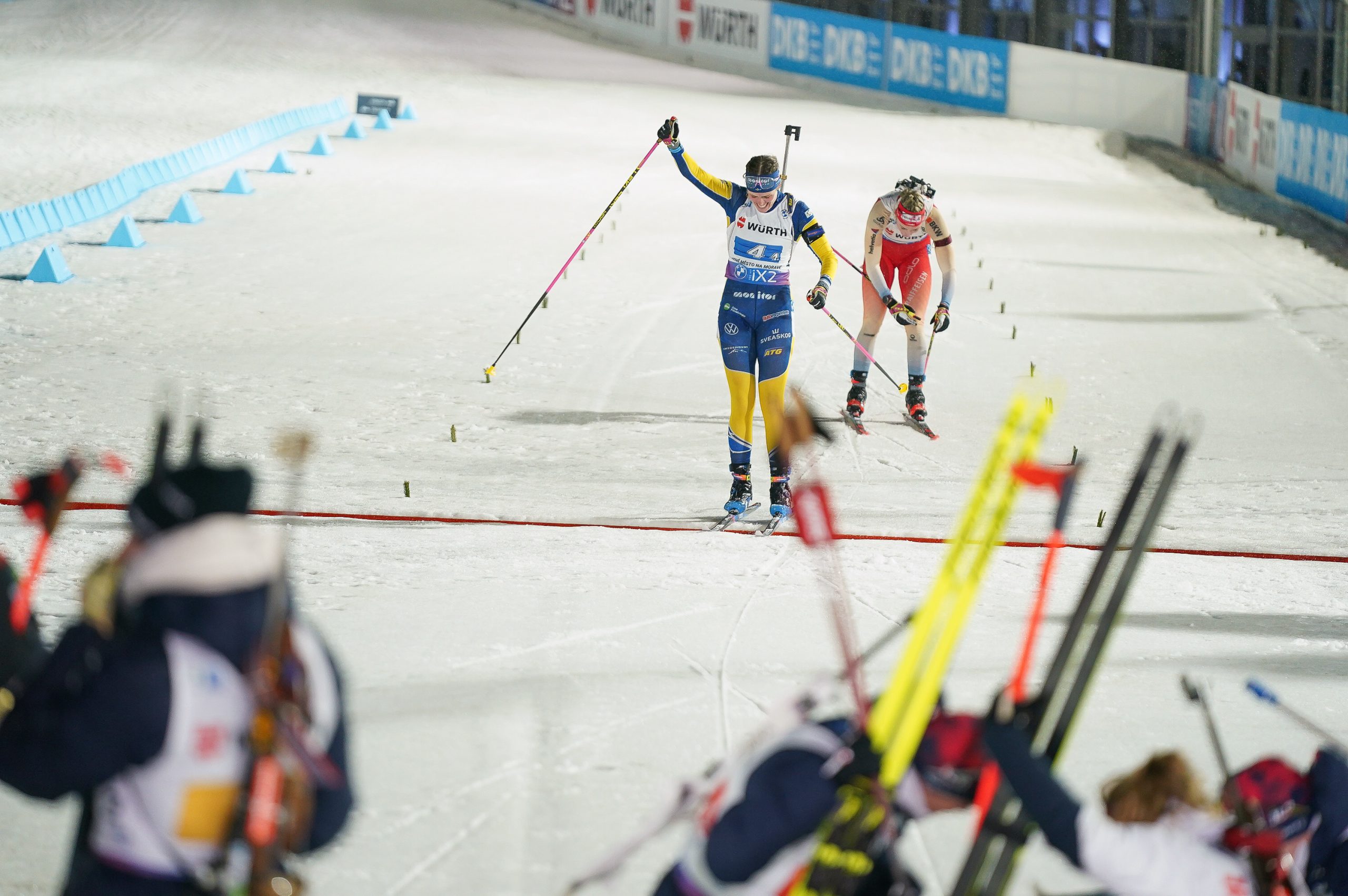
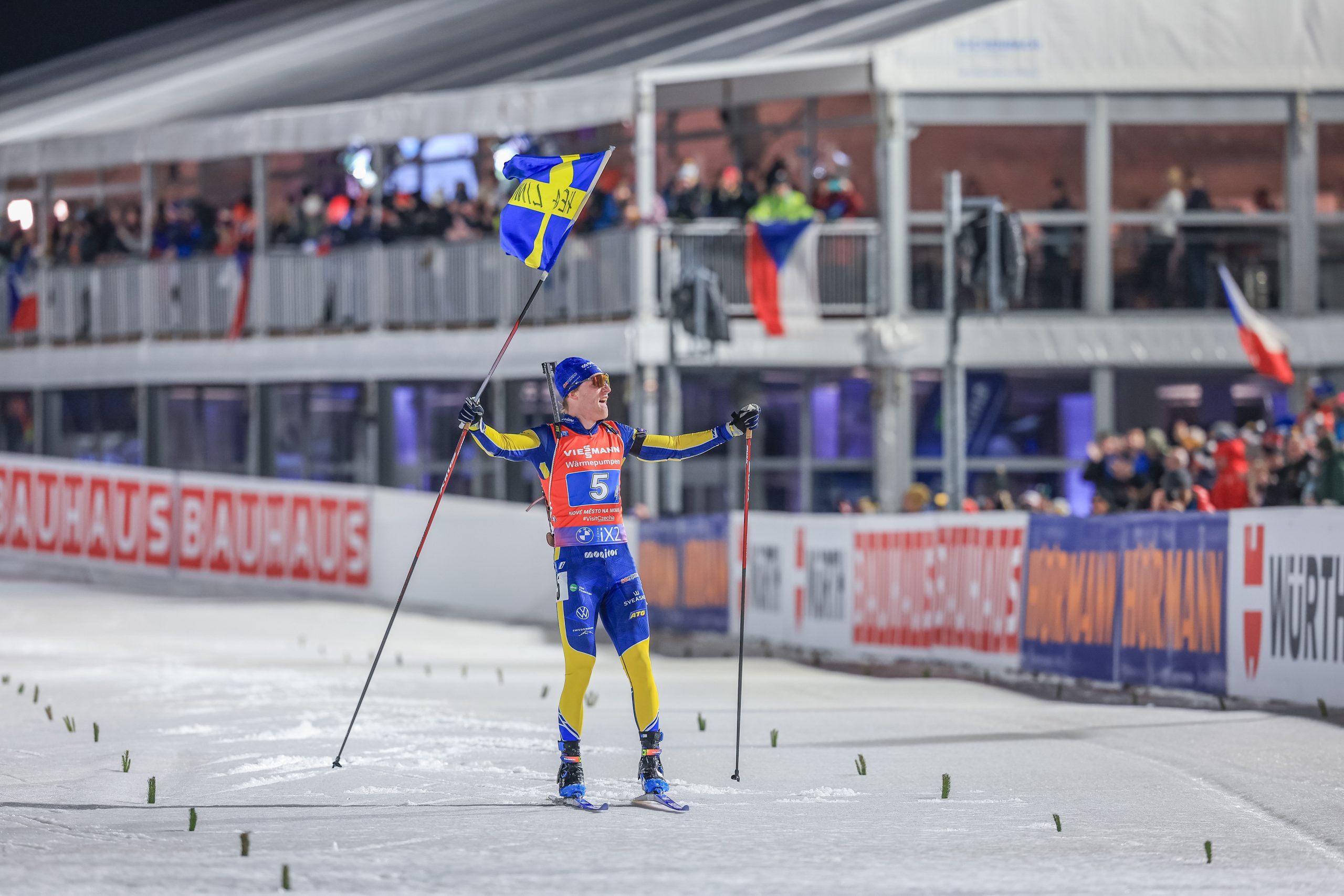
    Shooting on lane one, Norway’s Vetle Christiansen experienced a biathlon nightmare, missing all but two of his eight bullets, incurring three penalty loops and throwing away a huge one-minute lead! Sebastian Samuelsson of Sweden capitalized on his Norwegian rival’s misfortune, shooting fast and clean. He skied to the finish with enough time to glide in waving the Swedish flag, celebrating Sweden’s first gold medal of the Championships. Behind Samuelsson, France’s Quentin Fillon Maillet used just one spare and left the range as Christiansen was exiting the penalty loop. Ultimately Christiansen hunted down the Frenchman and claimed an anticlimactic silver for Norway.

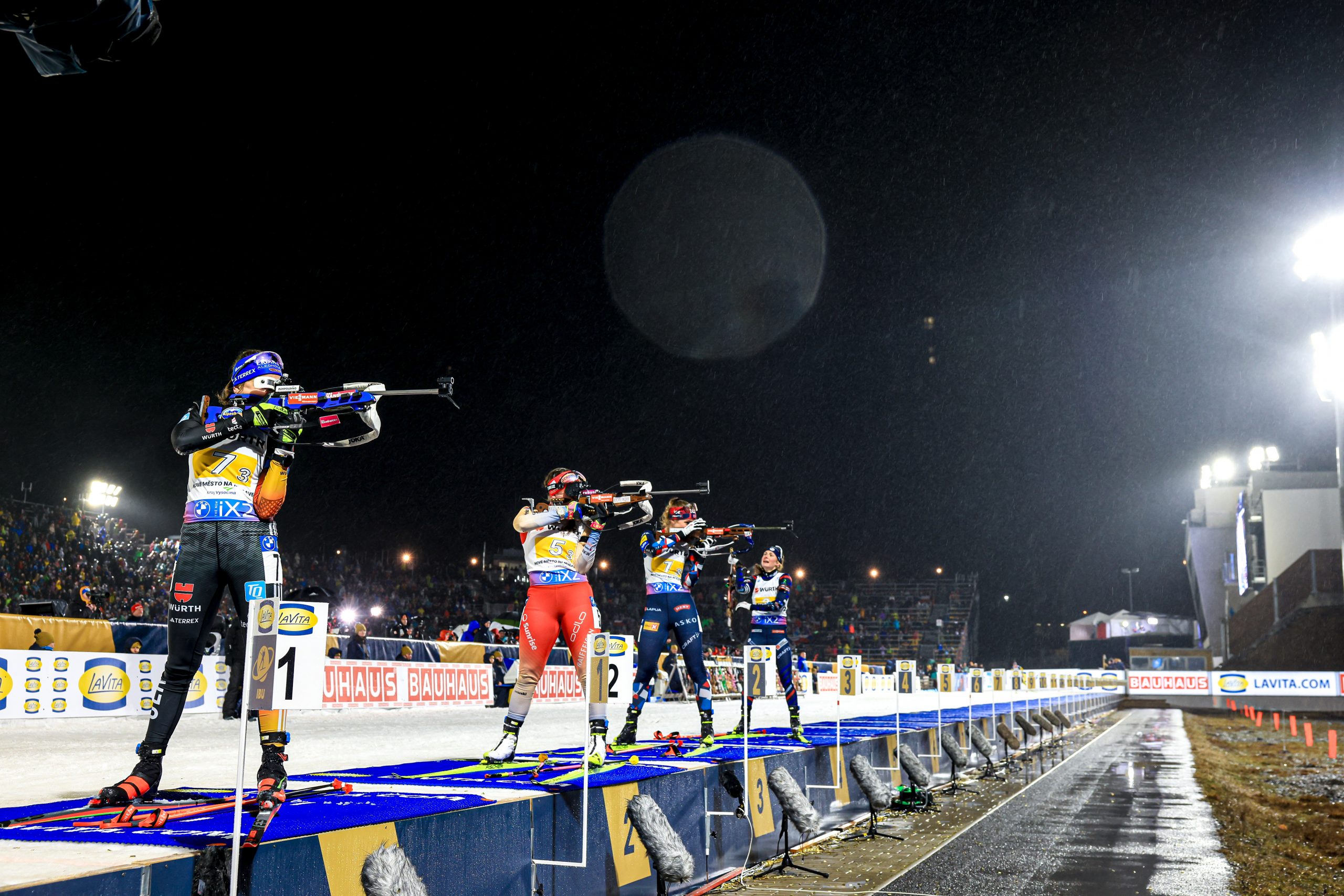
    Jake Brown tuned out the distraction of a stadium full of screaming Czech fans as he shot head-to-head against the Czech Republic in the final shooting stage of the Men’s Relay. (Photo: NordicFocus).

    After second-ranked Germany arrived at the finish line visibly disappointed in fourth, Brown arrived visibly thrilled in fifth. Since longtime US Biathlon stars Tim Burke and Lowell Bailey retired in 2018, the men’s team has been in a rebuilding phase, developing young athletes as well as experienced cross-country skiers like Brown. They have had three head coaches in five years, but throughout that period Brown has been a steadying force and has played a key role in building a positive and united men’s team culture. While 31-year-old Brown has not indicated any plan to retire, he summed up the importance of this result for his own career and for the team, saying, “Now I can retire in peace.” R.I.P.!

    Full Results Men’s 4×7.5 k Relay

    Estonia finished a historic fourth in the Women’s Relay, anchored by former MSU Bobcat and Craftsbury Green Racing Project training parter Johanna Talihaerm (left) . (Photo: NordicFocus)

    Earlier in the day, the French women won their first-ever World Championship relay, followed by Sweden and Germany. Estonia shocked the biathlon world with a historic fourth-place finish, anchored by former Montana State bobcat and Craftsbury Green Racing Project training parter, Johanna Talihaerm. Norway absolutely melted down, finishing tenth, followed by the Italian defending champions in 11th. To the 30,000 fans on-site plus millions watching on TV, the race offered biathlon drama at its best: equal parts miracle and collapse. The US was unfortunately in the latter category on Saturday, getting lapped and finishing 21st.

    Full Results Women’s 4×6 k Relay

    Next Up

    The last day of racing at 2024 Biathlon World Championships will feature the premier Mass Start events, in which the 30 top-ranked athletes compete head-to-head over four shooting stages. Campbell Wright and Sean Doherty will represent the US starting at 10:30 eastern time.

    Sunday 18 Feb Women’s 12.5 k Mass Start 08:15 eastern time
    Sunday 18 Feb Men’s 15 k Mass Start 10:30 eastern time
    Watch Live

    Sebastian Samuelsson skied in with the Swedish flag, celebrating the country’s first gold medal of the Championships. (Photo: NordicFocus)
  • Men’s 20 k Individual Boe-dium, Wright and Doherty Top 25

    Men’s 20 k Individual Boe-dium, Wright and Doherty Top 25

    FasterSkier’s Coverage of the Biathlon World Championships is made possible through the generous support of the Craftsbury Outdoor Center: New England’s finest snowmaking, world class race venues and touring trails, healthy food in abundance, comfortable accommodations at Craftsbury:  Sports, Sustainability, Stewardship.


    Johannes Thingnes Boe (NOR) defended his 2023 World Championships title in the 20 k Individual at 2024 World Championships. (Photo: NordicFocus)

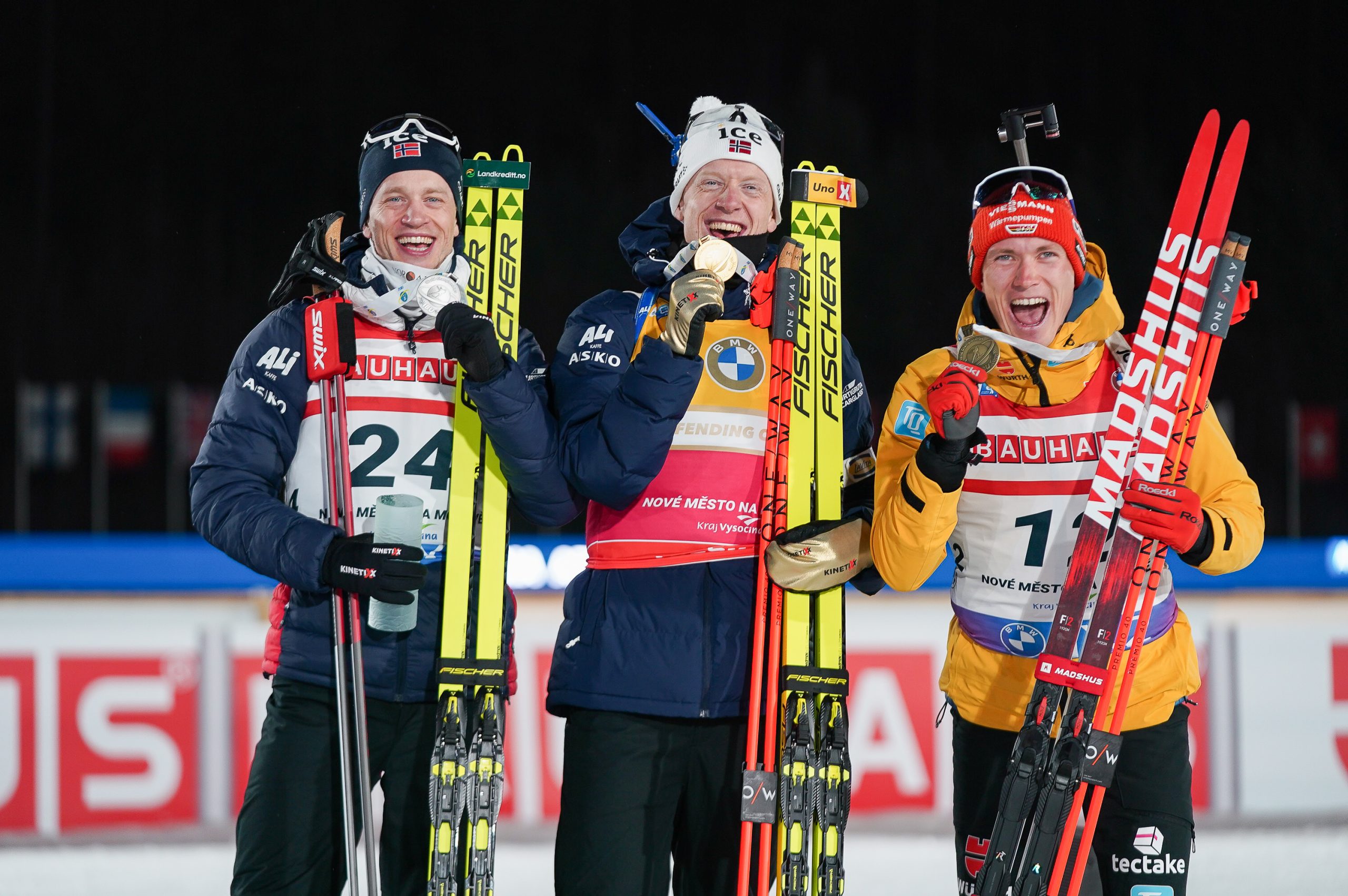
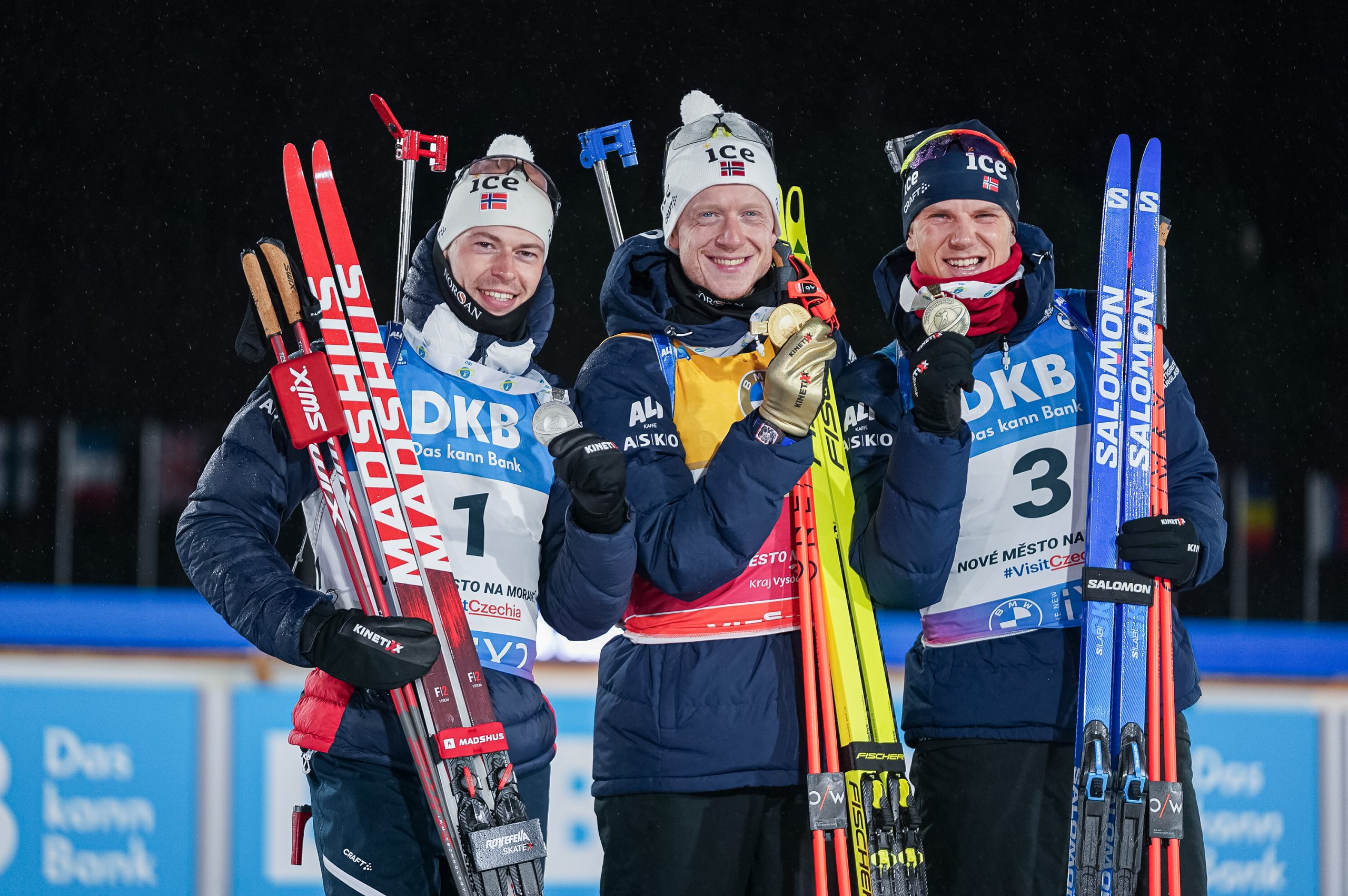
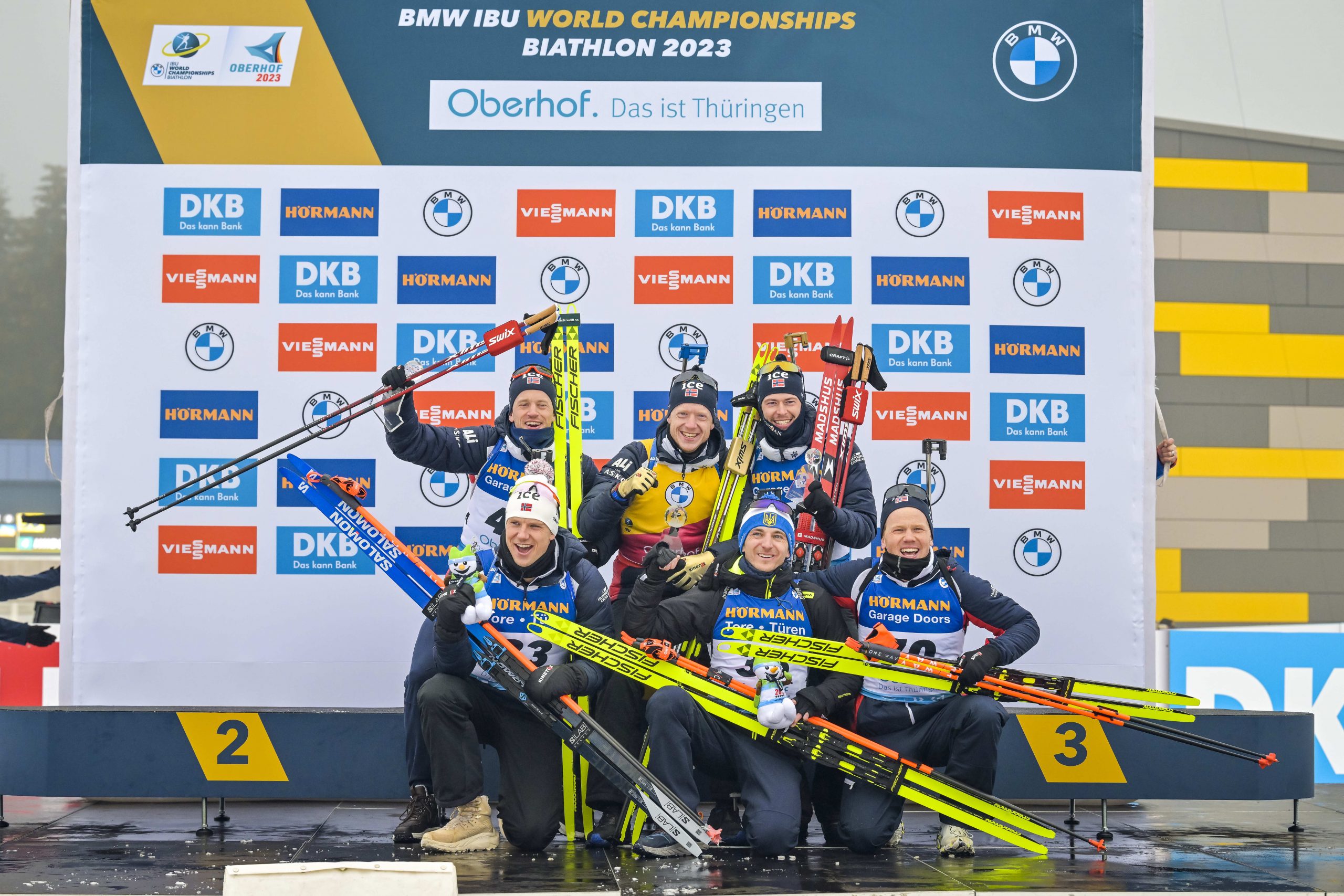
    The 20 k Individual is the longest race in biathlon, and with a one-minute time penalty per miss, so much can happen over the course of one competition. When defending champion Johannes Thinges Boe (NOR) missed one shot on the first stage, it looked like someone else might have a chance at the gold. But he swiftly dispelled any doubt, hitting the 15/15 remaining targets and out-skiing the field by a ridiculous 50-second margin to claim his 9th individual World Championships medal—just two medals shy of the record shared by greats Ole Einar Bjorndalen (NOR) and Martin Fourcade (FRA). Boe’s older brother, 35-year-old Tarjei, who won this event at the 2011 World Championships, skied the second-fastest time of the day and hit 19/20 to claim silver and give biathlon fans another “Boedium” to celebrate. In third, the German men’s team finally made an appearance on the podium thanks to Benedikt Doll’s 19/20 performance.

    Quentin Fillon Maillet (FRA) overcame three prone misses to finish sixth.

    The Individual stretches out over a couple of hours and each loop can seem like its own race. On Wednesday afternoon in Nove Mesto na Morave, Czech Republic, bib number 1 of 100 starters, France’s Quentin Fillon-Maillet, missed two targets right away on the first stage, incurring two minutes of time penalty and leaving the range in 73rd place with 16 kilometers still left to be skied. But he kept fighting for every second on course, hit 14/15 of the remaining targets, an moved all the way up to sixth place, earning himself a bouquet in the flower ceremony (and 7,000 Euros). Fillon-Maillet’s teammate Emilien Jacquelin finished fifth with one miss, and Andrejs Rastorgujevs of Latvia was fourth, also with two misses.

    Campbell Wright (USA) skied the 14th fastest course time to take 20th despite three misses. (Photo: NordicFocus)

    From the US, 21-year-old Campbell Wright matched his career-best 14th-ranked ski time from the Sprint to finish 20th despite three misses. The 2023 Junior World Champion was was pleasantly surprised by his own ski speed. “When you’re fit and have 40th ski time or fit and have 14th ski time, it feels the same,” said Wright, referring to past seasons when he also felt fit, but couldn’t yet keep up with the top senior-level athletes. Now, even though Wright is still one of the youngest athletes in the field, he is skiing with the best. With his finishes of 11th, 12th, and 20th so far at the World Championships, he has qualified for Sunday’s Mass Start featuring the top 30 athletes. Wright has done one other Mass Start, back in 2022 when he was just 19 years old. “I feel like I won’t just get blown out the back on the first loop,” said Wright. “I’m a lot more in the fight.” Wright is humble and just starting to come to terms with his own capabilities, but for everyone watching it is clear that he is very solidly “in the fight.”

    Sean Doherty (USA) skiing his way to 23rd in the 20 k Individual. (Photo: NordicFocus)

    Sean Doherty (USA) finished just behind Wright in 23rd, with two misses. “I’m happy with it,” he said. “I was in the right state of mind for an Individual, to really be in it and give myself a chance.” Since starting the Championships with a 44th in the Sprint, Doherty has been exceptional, moving up 18 places in the Pursuit to 26th, and then posting his season-best result in the Individual. Thanks to these two top-25 results, Doherty will join Wright in the Mass Start.

    Also for the US, Jake Brown was 50th and Vincent Bonacci was 75th, both with four misses.

    Full Results 

    Up Next:

    Thursday 15 Feb 12:00pm (noon, Eastern Time) Single-Mixed Relay

    Watch Live

    Tarjei Boe (NOR) and younger brother Johannes Boe (l-r) giving biathlon fans what they want: a Boedium! Benedikt Doll came through for Team Germany to take the bronze. (Photo: NordicFocus)
  • Julia Simon and J.T. Boe Defend Pursuit Titles; Wright 12th for USA

    Julia Simon and J.T. Boe Defend Pursuit Titles; Wright 12th for USA

    FasterSkier’s Coverage of the Biathlon World Championships is made possible through the generous support of the Craftsbury Outdoor Center: New England’s finest snowmaking, world class race venues and touring trails, healthy food in abundance, comfortable accommodations at Craftsbury:  Sports, Sustainability, Stewardship.


    After finishing second in Saturday’s Sprint, Johannes Thingnes Boe (NOR) moved up into first in Sunday’s Pursuit, defending his 2023 title .

    On a rainy Sunday afternoon in Nove Mesto na Morave, Czech Republic, 30,000 fans packed the Vysocina Arena for the women’s and men’s Pursuit competitions of the 2024 Biathlon World Championships. The weather has been dismal for the first five days of the event, meaning a lot of soggy boots, sink laundry, and rifle cleaning for the athletes, and long, cold, days for team staff and event organizers. But it has not dampened the spirits of the biathlon fans who continue to make the atmosphere bright.

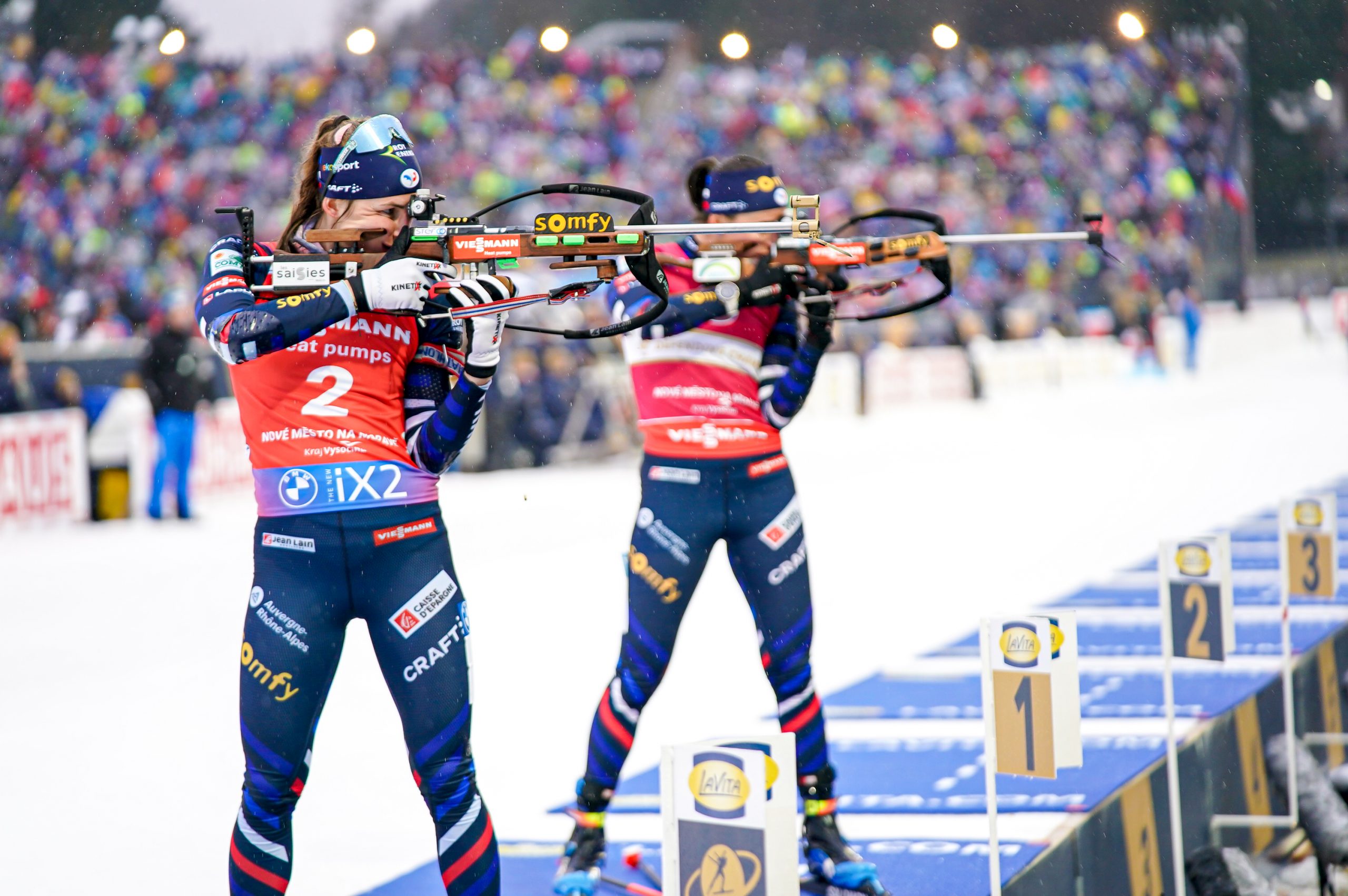
    French teammates Justine Braisaz-Bouchet (foreground) and Julia Simon shoot head-to-head in the Pursuit. (Photo: NordicFocus)
    Women’s 10 k Pursuit

    Simon defends world title, Vittozzi moves up from seventh to silver, and Braisaz-Bouchet keeps her podium streak alive.

    In the women’s Pursuit, Julia Simon of France defended her 2023 World Championship Pursuit title as well as her Sprint victory from Friday. Last year, Simon started the Pursuit wearing bib 10 and overcame a deficit of more than one minute to take the gold, but today’s defense of Friday’s Sprint gold was also impressive. Only four women in the past ten years have won both the Sprint and Pursuit at the World Championships or Olympics: Marie Dorin-Habert (FRA) in 2015, Laura Dahlmeier (GER) in 2018, Tiril Eckhoff (NOR) in 2021, and Marte Olsbu-Roeiseland (NOR) in 2022.

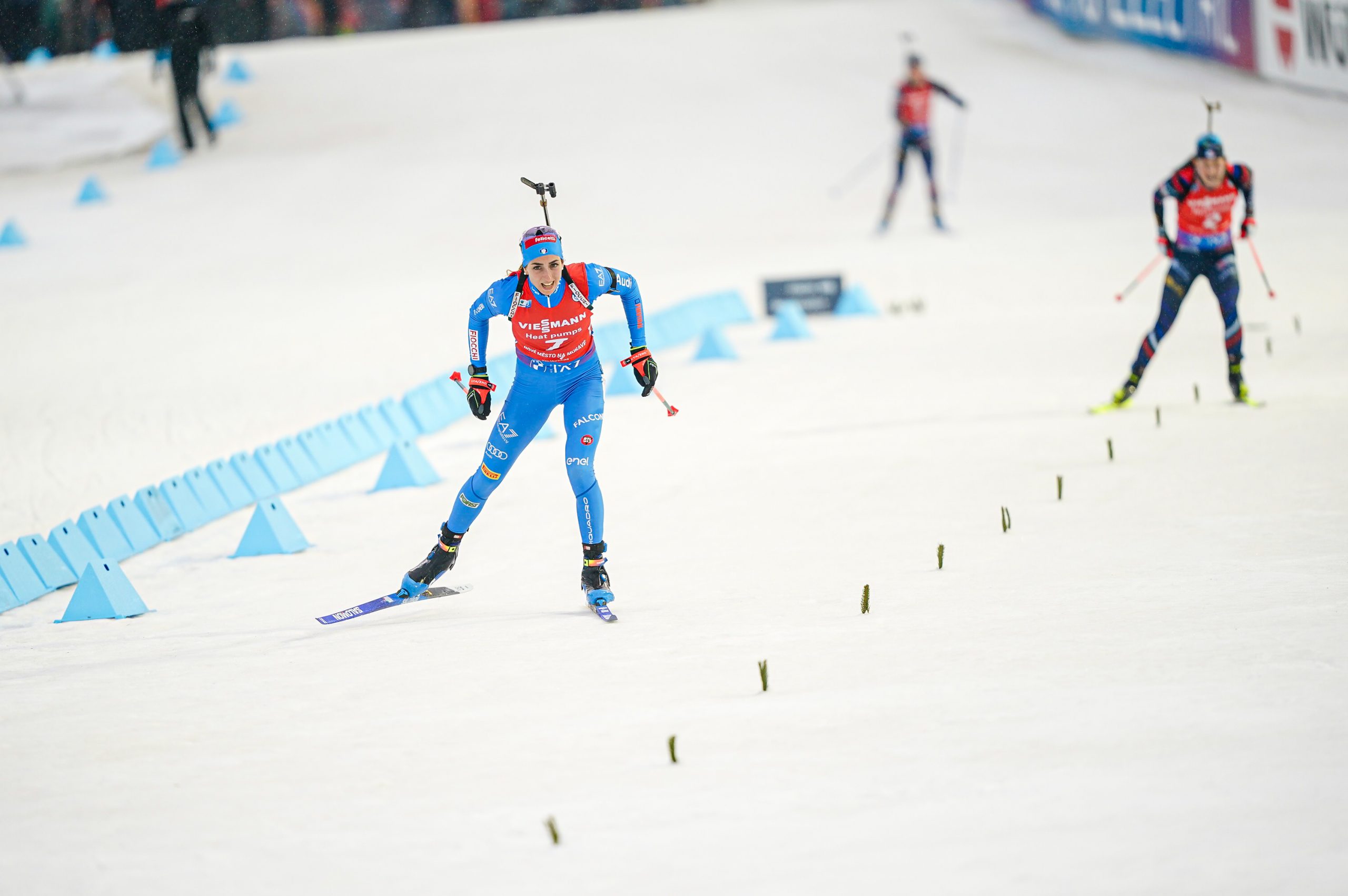
    Lisa Vittozzi (ITA) fights to the finish line, moving up from seventh to silver ahead of bib 2 Justine Braisaz-Bouchet (FRA). (Photo: NordicFocus)

    Simon started with a negligible five second advantage over teammate Justine Braisaz-Bouchet, who is the fastest skier in the field but a slower and less-accurate shooter than Simon. A gap of nearly 40 seconds separated those two leaders from the third starter, Lou Jeanmonnot (FRA), but then six women all started within about 30 seconds. Simon and Braisaz-Bouchet matched one another’s shooting (0,1) on the first two stages to hold their lead over the chasers. But then on the third stage, Simon cleaned while Braisaz Bouchet missed two, opening the door for bib 7, Italy’s Lisa Vittozzi, to move into second with her 15/15 shooting through stage three of the race.

    Sophie Chauveau (FRA) finished fourth in the Sprint and Pursuit. (Photo: NordicFocus)

    In the final stage, Simon closed with the same perfect shooting we’ve now seen in three of three races at World Championships, nailing all five targets in 21.5 seconds—somewhat tame for Simon but still the fastest in the 60-person field. Behind her, Vittozzi missed her only shot of the day, creating an opening for Braisaz-Bouchet and bib 4, Sophie Chauveau. But luckily for Vittozzi, both of them missed one as well. Chauveau left the range a few seconds ahead of Braisaz-Bouchet, and for a moment it looked like the 24-year old might take her first World Championship medal after finishing a bittersweet fourth in the Sprint. But Braisaz-Bouchet out-skied Chauveau on the final lap to take the bronze, leaving Chauveau in fourth again. To put things in perspective, Chauveau won her first medal (a bronze) in January of this year, and her two fourth places so far at World’s are her next-best results.

    Deedra Irwin was the top American in the Pursuit, finishing 46th with four misses. (Photo: NordicFocus)

    From the US, Deedra Irwin started in bib 39 and fell back to place 46 with four misses. Tara Geraghty-Moats started in bib 58 but was lapped after the second shooting in her first-ever Pursuit.

    Women’s 10 k Pursuit FULL RESULTS


    Sturla Holm Laegreid’s (NOR) clean standing shooting earned him the silver medal in the Pursuit. (Photo: NordicFocus)
    Men’s 12.5 k Pursuit

    J.T. Boe shuffles the sprint podium to defend World title while the USA’s Wright and Doherty finish 12th and 26th.

    In the men’s 12.5 k Pursuit, the Norwegian podium sweep from Saturday’s Sprint grew to a monstrous top-five sweep. Johannes Thingnes Boe (NOR) overcame three prone misses with flawless standing shooting to win his eighth individual World title—his 34th World Championship medal. (If you include Olympic results, Sunday’s victory was Boe’s 11th title and 42nd medal.) After winning Saturday’s Sprint with his signature perfect shooting, Sturla Holm Laegreid (NOR) uncharacteristically missed two in the first stage of the Pursuit but then hit the rest of his targets to fight back for the silver medal. Vetle Christiansen (NOR) led the race early on when he cleared all his prone targets and J.T. Boe and Laegreid both missed. But then two misses on his final stage set him back. He left the range a few seconds ahead of Laegreid but was caught in the final lap.

    Vetle Sjaastad Christiansen (NOR) finished third in both the Sprint and Pursuit. (Photo: NordicFocus)

    The fight for the top-six flowers was marked by some surprising shooting melt-downs. Having hit all his targets through the third stage, Tarjei Boe came into the final shoot tied for second with his younger brother Johannes, just nine seconds behind race leader Christiansen and a full 30 seconds ahead of the chasing group. But he missed a heart-wrenching four out of five targets and fell to fifth. Meanwhile, his teammate Johannes Dale moved up into fourth by clearing his final five, recovering from a messy three misses on the third stage. Behind Dale and T. Boe, Sebastian Samuelsson (SWE) kept his wits about him and shot 17/20 to complete the flower ceremony in sixth.

    Campbell Wright (USA) was the top American in the Pursuit finishing 12th with two misses. (Photo: NordicFocus)

    For the US, Campbell Wright in bib 11 missed one shot each in the prone stages but then cleared all 10/10 standing targets, finishing 12th. His 11th-place finish in the Sprint was a personal-best and this 12th place ties his previous personal-best. With these two results, Wright is almost guaranteed a start spot in next weekend’s 30-person Mass Start featuring the top 30 athletes of the Championships.

    Sean Doherty (USA) happy in the finish area after moving up 18 places from 44th to 26th. (Photo: NordicFocus)

    Sean Doherty was one of the biggest climbers of the day, moving from 44th to 26th with just a single miss in the first standing stage. Jake Brown started 38th and finished 37th with four misses, skiing the fastest of the three Americans in the race, 1:11 off the pace set by J.T. Boe.

    Men’s 12.5 k Pursuit FULL RESULTS

    Up Next

    Tuesday 13 Feb 11:10 Women’s 15 k Individual
    Wednesday 14 Feb 11:20 Men’s 20 k Individual

    Watch Live

    Sturla Holm Laegreid, Johannes Thingnes Boe, and Vetle Sjaastad Christiansen, (l-r) shuffled their podium sweep from Saturday’s Sprint in Sunday’s Pursuit. (Photo: NordicFocus)
  • France Snags Mixed Relay Gold Ahead of Norway at Biathlon World Championships

    France Snags Mixed Relay Gold Ahead of Norway at Biathlon World Championships

    FasterSkier’s Coverage of the Biathlon World Championships is made possible through the generous support of the Craftsbury Outdoor Center: New England’s finest snowmaking, world class race venues and touring trails, healthy food in abundance, comfortable accommodations at Craftsbury:  Sports, Sustainability, Stewardship.


    The start of the Mixed Relay at the 2024 Biathlon World Championships in Nove Mesto na Morave, Czech Republic. (Photo: NordicFocus)

    In the opening race of the 2024 Biathlon World Championships, France overcame heavy favorite Norway to take gold in the 4×6 k Mixed Relay. It was a tightly contested race with 25 nations on the start line and only 40 seconds separating the top five teams at the third exchange. On the final leg, Norway and Sweden overtook Switzerland to capture silver and bronze. The Swiss ended up a mere 1.2 seconds off the podium in fourth—their best finish ever in a World Championships Mixed Relay. Steady freezing rain did not stop 30,000 biathlon-crazed fans from packing the Vysocina Arena in Nove Mesto na Morave, Czech Republic, making for an electric atmosphere on opening night.

    Germany led early in the Mixed Relay thanks to exceptional shooting by Justus Strelow and Phillip Nawrath. (Photo: NordicFocus)

    The unofficial “ice breaker” of World Championships, the Mixed Relay tends to be chaotic and full of surprises, and today’s race was no exception. Ranked sixth going into the race, the home Czech team met disaster on the very first visit to the shooting range when Michal Krcmar incurred a penalty loop and found himself in second to last, a full minute behind the leaders. Krcmar exchanged in 21st, two minutes back. Third-ranked Italy fared even worse: Didier Bionaz incurred two penalty loops in his standing shoot and tagged off in 23rd. Meanwhile, 19th-ranked Kazakhstan and 17th-ranked United States tagged in fifth and sixth, thanks to world-class performances from Alexandr Mukhin (KAZ) and Vincent Bonacci (USA).

    Tarjei Boe (NOR) is followed by Vincent Bonacci (USA) in the first leg of the Mixed Relay. (Photo: NordicFocus)

    The big surprise on the second leg was that Norway did not come through on top. Norwegian brothers Tarjei and Johannes Boe—ranked third and first in the men’s World Cup overall standings—are such a powerhouse combination that they were all but guaranteed to deliver a Norwegian lead at the half-way point; however, they both lost time on the range that they were unable to recover on skis. Germans Justus Strelow and Phillip Nawrath combined to put 48 seconds into the Norwegians just in shooting time. At the halfway point, Germany led, with France eight seconds back and Norway another twenty behind. The US and Canada tagged in ninth and tenth, just 15 seconds outside the top six.

    Franziska Preuss (GER) fell from first to fifth after incurring a penalty loop in her standing shoot in the Mixed Relay. (Photo: NordicFocus)

    Anyone who bet on the Norwegians for gold would have felt uneasy going into the third leg, with the German and especially the French women’s teams both very strong on paper. But it was a rollercoaster for all. France’s Justine Braisaz-Bouchet went into the penalty loop in prone and dropped to fifth place, giving Franziska Preuss of Germany a 39-second advantage. Then their fortunes switched in standing when Preuss went into the penalty loop! Braisaz used a single spare and out-skied the field in leg three by a whopping 33 seconds, making an enormous comeback for France and tagging in first. At the third exchange, only eight seconds separated the top three teams, with Switzerland moving up into second and Norway hanging in third. After a quiet first half, Sweden’s Hanna Oeberg brought her team within striking distance on the third leg, tagging her younger sister Elvira in fourth, just 14 seconds off the podium. Germany fell to fifth. Both the USA and Canada held in the top ten.

    Sweden’s Elvira Oeberg out-skied Switzerland’s Amy Baserga to take bronze in the Mixed Relay. (Photo NordicFocus)

    In the final leg, Julia Simon left no room for any contest, blazing down all her targets, taking a bow, and then skiing to the finish with a comfortable 45-second lead for France. Switzerland’s Amy Baserga performed flawlessly under pressure, shooting ten out of ten, but was overtaken on her first loop by the World Cup overall leader Ingrid Tandrevold of Norway and then on the last loop by Elvira Oeberg, who captured the bronze for Sweden by just one second.

    Julia Simon (FRA) takes a bow on the shooting range after clinching gold for France with her flawless final shoot. (Photo: NordicFocus)

    The US stayed in the top ten until the very last loop when the Italians came clawing their way back from the dead and pushed the US down into 11th. Canada finished 13th, just in front of the Czech Republic.

    Next up is the women’s 7.5 k Sprint on Friday, February 9th.

    Full Results

    The winning team from France from left to right: Eric Perrot, Quentin Fillon-Maillet, Justine Braisaz, and Julia Simon. (Photo: NordicFocus)
  • Biathlon World Championships: Norwegian Men Sweep Sprint Podium

    Biathlon World Championships: Norwegian Men Sweep Sprint Podium

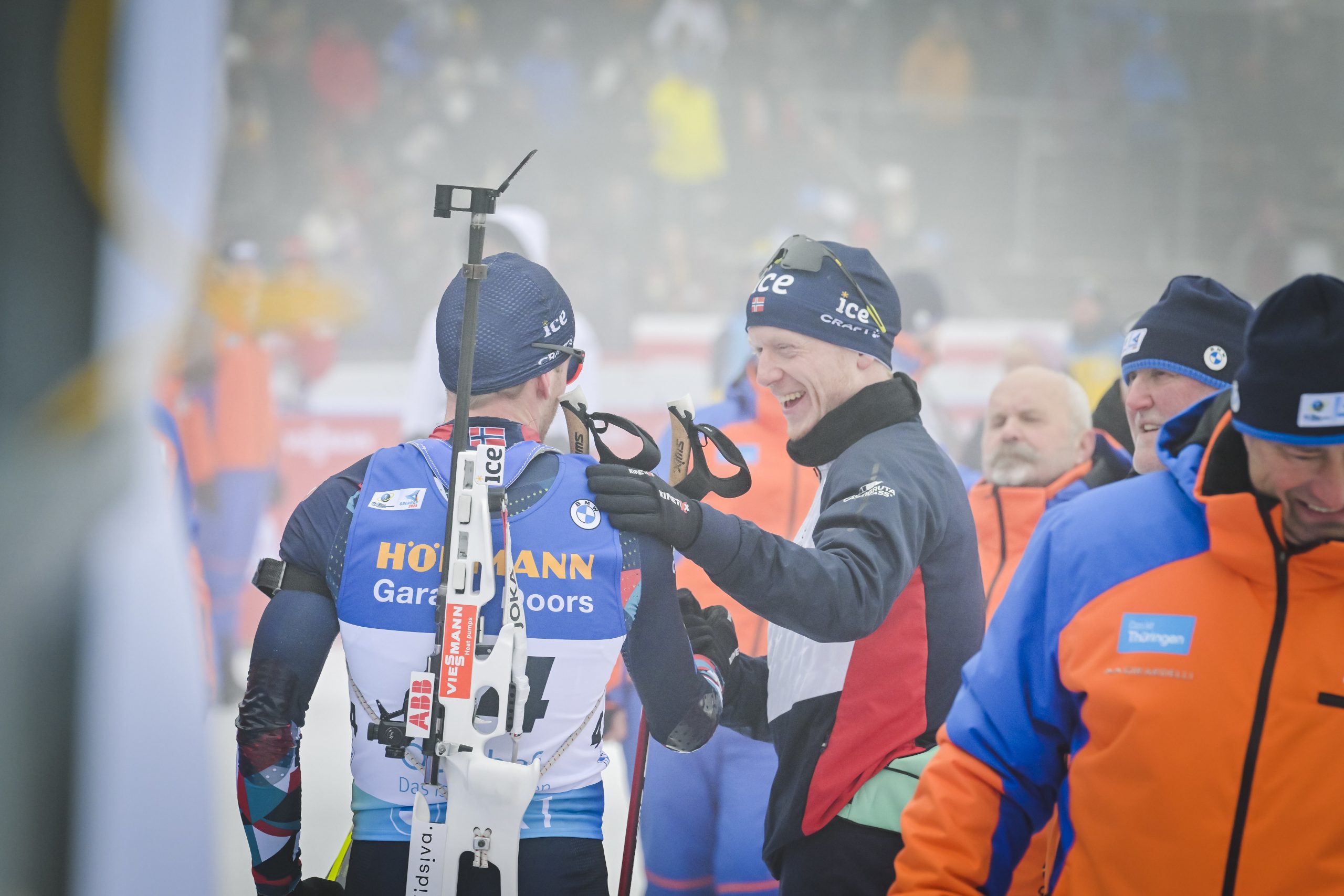
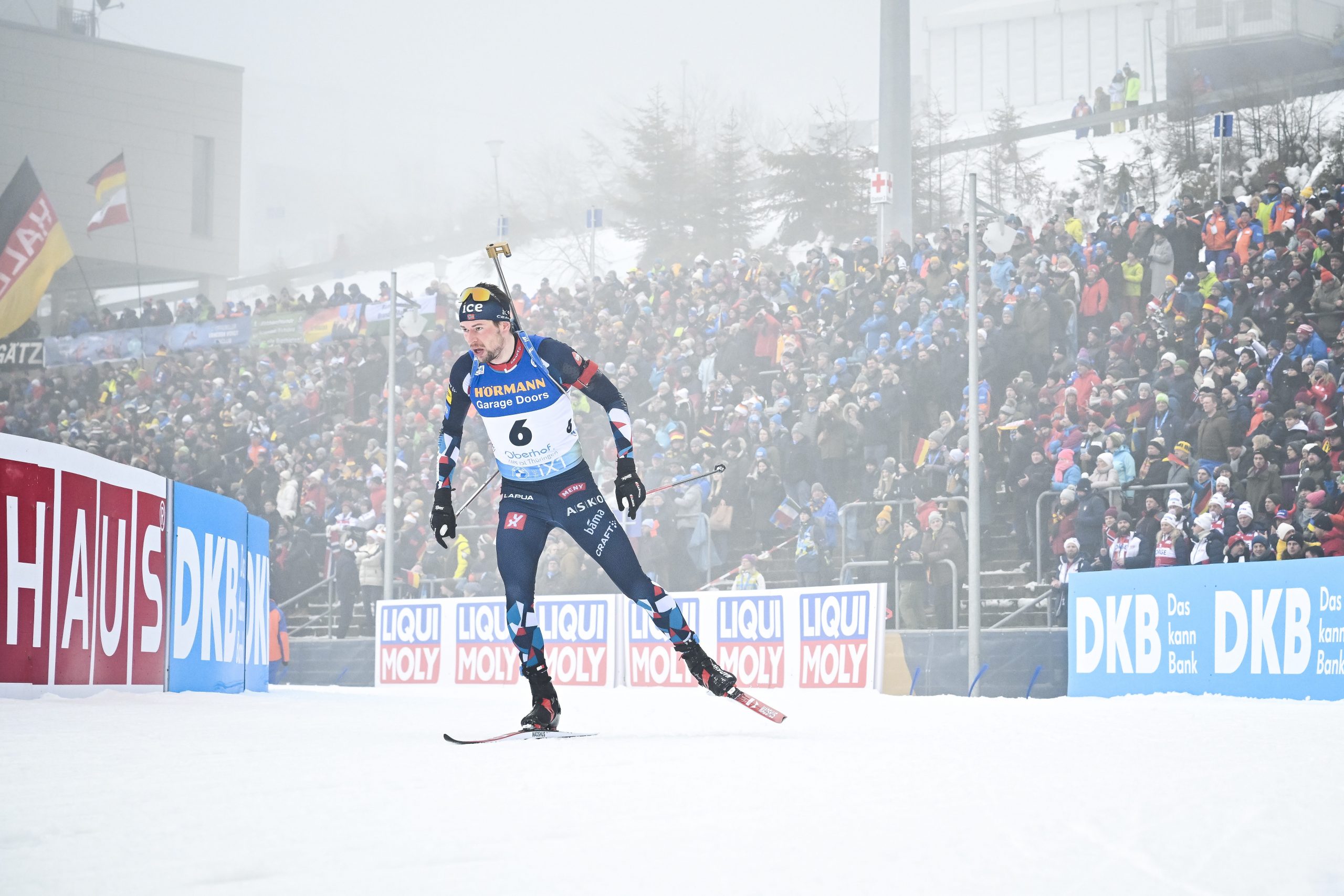
    Johannes Thingnes Boe (NOR) congratulates his brother, Tarjei Boe (NOR) who finished beside him on the podium at the IBU World Championships Men’s Sprint in Oberhof. (Photo: Reichert/NordicFocus)

    One man has won all five 10 k Sprint competitions so far this season, so even with 112 starters in today’s BMW IBU World Championship Sprint, there was no doubt about the favorite. Johannes Thignes Boe of Norway has been untouchable on skis since November, regularly out-skiing his nearest competitor by over 30 seconds. The 150m penalty loop in biathlon usually takes athletes about 23 seconds, so Boe can afford to miss once and still win. Today he missed once in prone—the target barely visible at 50m through dense fog—but cleaned standing with no hesitation in just 21 seconds. With a 36-second second margin to the next-fastest skier, Boe defended his Olympic title and become the 2023 World Champion. This sets him up for another likely victory in tomorrow’s Pursuit competition, but with four shooting stages, anything can happen.

    Johannes Thingnes Boe (NOR) started and finished in bib number 1 at the IBU World Championships Sprint in Oberhof, Germany. (Photo: NordicFocus)

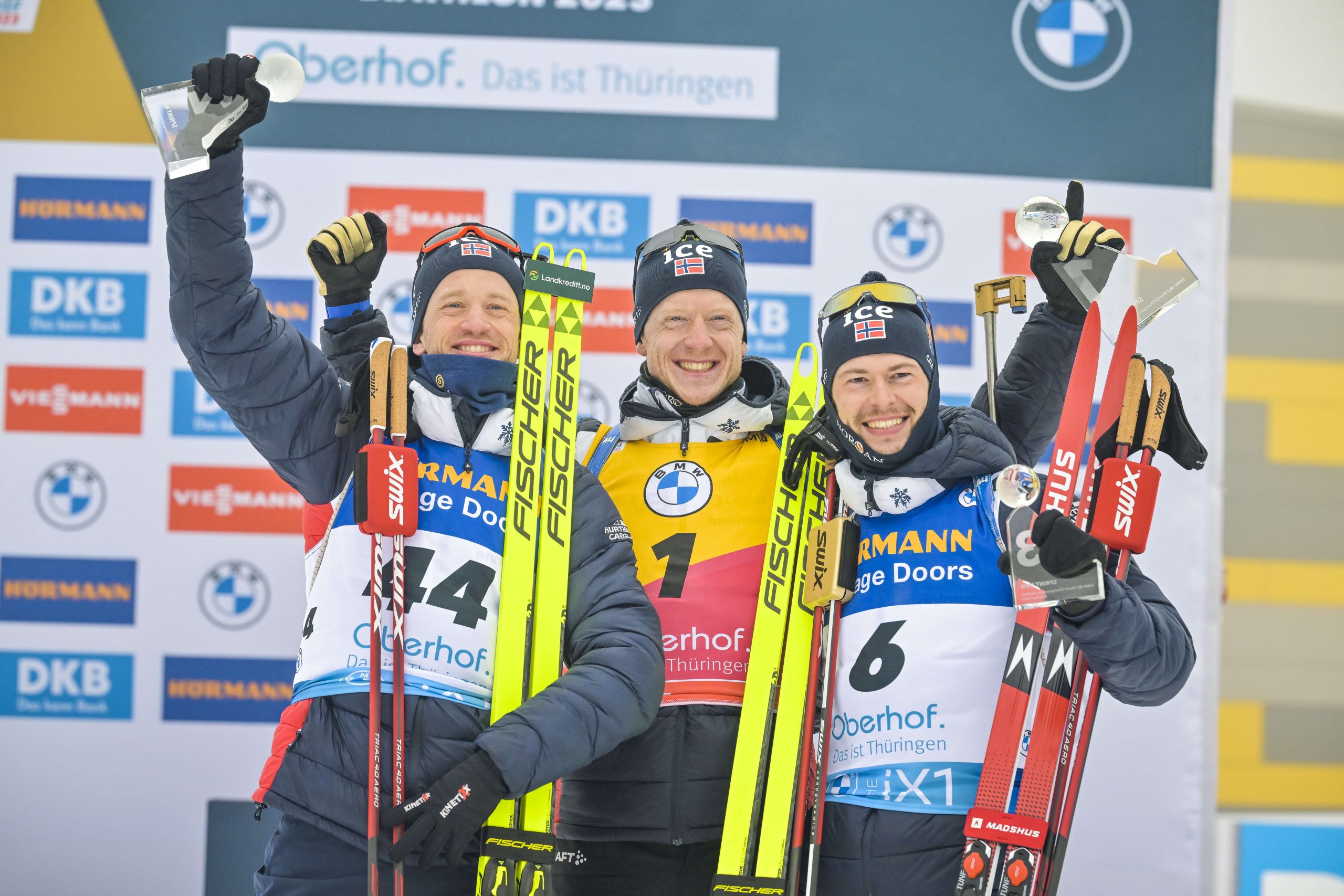
    Sharing the podium with the unbeatable Boe were two teammates: his older brother, Tarjei Boe, shot the perfect score to complete the family sweep for the second time this winter, and Sturla Holm Laegreid missed just one in standing to capture the bronze. Laegreid is ranked second behind J. Boe in the Overall standings and has been on the podium in all but three competitions this season, so he was very much the silver medal favorite, but T. Boe is the fifth-ranked Norwegian (and 8th in the World Cup Overall standings), so the so-called “Boedium” was a pleasant surprise for the brothers.

    Tarjei Boe (NOR), Johannes Thingnes Boe (NOR), Sturla Holm Laegreid (NOR) (l-r) on the podium of the IBU World Championships Sprint in Oberhof, Germany. (Photo: NordicFocus)

    The Norwegian men make it look easy to land on the podium even with nine out of ten hits, but it’s not. Only four people on the whole men’s World Cup circuit have a shooting average of 90%. Laegreid is one of them. The Boe brothers are among the top 15 athletes with an 88% hit rate. Add the expectation of victory, and their performances become even more impressive.

    Sturla Holm Laegreid (NOR) racing to third place in the IBU World Championships Sprint in Oberhof, Germany. (Photo: NordicFocus)

    With Johannes Dale in fourth and Vetle Christiansen in sixth, the Norwegians almost pulled off a full sweep of the Flower Ceremony, but one athlete managed to upset the total domination. Dmytro Pidruchnyi of Ukraine shot clean and skied the 15th course time to take fifth. He had only raced twice this season—once in November and once just last week, with a knee operation in between—before coming to the World Championships. Pidruchnyi has a history of performing his best at championships; he was the World Champion in the Pursuit in 2019. Today’s fifth place was his top result since then. This victory will certainly mean a lot to him, his team, and the people of Ukraine as they suffer from war at home.

    Flower Ceremony finishers in the IBU World Championships Sprint in Oberhof, Germany. Front L-R: Vetle Sjaastad Christiansen (NOR), Dmytro Pidruchnyi (UKR), Johannes Dale (NOR), Back: L-R: Tarjei Boe (NOR), Johannes Thingnes Boe (NOR), Sturla Holm Laegreid (NOR). (Photo: NordicFocus)

    Andrejs Rastorgujevs of Latvia shot 10/10 to finish 7th, Johannes Keuhn of the home German team finished 8th for his best result of the season, and two French athletes, Quentin Fillon Maillet and Antonin Guigonnat, rounded out the top ten. Sebastian Samuelsson of Sweden finished in 11th with two penalties. Both he and Fillion Maillet will be podium threats in the Pursuit even starting around 1:10 back.

    Paul Schommer (USA) zeroes his rifle before the Sprint competition at the IBU World Championships, in Oberhof, Germany. (Photo: NordicFocus)

    Today was a tough day for the North Americans, with the exception of Paul Schommer (USA) who qualified for the Pursuit in 31st with one penalty each in prone and standing. Paul’s 31st-ranked course time was his best in a Sprint this season. “That prone miss was definitely one of those things where I thought, okay, I should have taken another second, but the standing felt good,” Schommer said of his shooting. As in yesterday’s Women’s Sprint, drafting on the long, windy straightaway into the range was critical. With that in mind, Schommer went out of his comfort zone on the second lap to stay with another athlete. “I may have pushed a little too hard before standing, but I made up so much time by staying with him.” It’s easy in biathlon to play the “what if” game, and Schommer recognized that he would have cracked the top 20 with one less miss, but he said, “tomorrow I’m going for the money!” The top 30 finishers in biathlon World Cups and World Championships earn prize money.

    Maxime Germain (USA) in the finish of his first senior-level World Championship race. Oberhof (GER). (Photo, NordicFocus).

    Twenty-one-year-old Maxime Germain (USA) finished just outside of the Pursuit qualification in 65th with three penalties. Both Sean Doherty (USA) and 22-year-old Vincent Bonacci (USA) cleaned prone but then uncharacteristically missed four in standing. They finished 80th and 98th.

    For Canada, Adam Runnalls was the team’s top finisher in 82nd with five misses. Trevor Kiers was 86th with three, Christian Gow was 92nd with four, and Logan Pletz was 94th with four. This was certainly not the day that either North American team had hoped for. Those not racing in tomorrow’s Pursuit will shift their focus now to next week’s 20km Individual competition.

    IBU World Championships Men’s Sprint RESULTS

    Next Up:
    Women’s Pursuit on Sunday at 7:25AM Eastern Time
    Men’s Pursuit on Sunday at 9:30AM Eastern Time

    Watch Live Here

  • Norwegian Biathletes Already Talk Boycott of Canmore and Maine World Cups

    Norwegian Biathletes Already Talk Boycott of Canmore and Maine World Cups

    Tarjei Bø racing in Presque Isle, Maine, in February 2011. Finishing fourth and sixth in individual races there helped him claim the first overall World Cup title of his career, but this season he's not excited to go back.
    Tarjei Bø racing in Presque Isle, Maine, in February 2011. Finishing fourth and sixth in individual races there helped him claim the first overall World Cup title of his career, but this season he’s not excited to go back.

    With seven months to go until the IBU World Cup arrives in Canmore, Alberta, and then travels to Presque Isle, Maine, international biathlon stars are already considering whether to skip the events.

    “I wish the races were in Europe,” Norway’s Emil Hegle Svendsen told broadcaster NRK.

    Roughly every five years, the World Cup travels to North America. The last time was in 2011, when the tour stopped in Presque Isle and nearby Fort Kent. At those races, most of the top stars vying for the overall World Cup title attended, but many of the others in the top 20 or 30 skipped the races. Field sizes were considerably smaller than for other World Cups.

    The Norwegians’ main concern seems to be that the North American period of racing falls directly before World Championships, and they would rather prepare at home: Oslo is hosting the 2016 edition. At the very least, they would like to be in the right time zone.

    “I hate that it’s set up like this,” Tarjei Bø, the most successful male athlete at the 2015 World Championships in Kontiolahti, Finland, told NRK.

    “This is a headache for us all,” agreed his coach, Egil Gjelland.

    But Max Cobb, the head of the IBU’s Technical Committee, which sets the World Cup Schedule, said in an interview that the committee had carefully considered whether there would be enough time for athletes to adjust back to being in Europe and prepare for the Oslo Championships.

    After all, it’s not like athletes will fly directly to Oslo after Maine and start racing the next day.

    “We looked at trying to maximize the amount of time between the North American World Cups and the World Championships,” Cobb said on Tuesday. “I think there’s two and a half weeks there, and that was a reasonable amount of time for preparation. If it had been a week less than that, then there would be a lot of teams considering not attending, or not sending their best athletes.”

    In addition, he suggested that teams might even maximize that time by managing their rosters. For instance, the weekend competitions in Presque Isle are relays; teams could race their “B” squads in the relays, and send their “A” teams back to Norway or another home training base.

    The first competition of World Championships is always a mixed relay, raced by only two men and two women from each country. That provides the rest of the athletes with even more time to train, adjust, and prepare.

    “We felt like it was important to put Canmore first, so that teams could decide when to arrive in North America based on jetlag and altitude training and those kinds of things,” Cobb said of the scheduling decisions. “And Calgary being an international air hub, that they could choose exactly when they wanted to arrive with lots of direct flights from Europe. Do that, and then come back to Presque Isle two hours closer to Europe, and fly home from there.”

    IBU President Anders Besseberg, himself a Norwegian, also wasn’t pleased with the threat of a boycott by the top Norwegians.

    “The US and Canada have many good athletes who have to travel to Europe to compete here, and then I think it gets a little petty if one boycotts the races over there, so to speak,” he told NRK. “I think it is stupid if Norway does not compete with some of their best athletes.”

    Cobb was slightly surprised to hear the criticism coming from the Norwegians, since he believed he had adequately addressed the situation with team staff when the schedule was set.

    “I had some discussions with a couple of Norwegian coaches around the World Championships this year, and it sounded like they were reassured once they realized that there was in fact two and a half weeks,” he explained.

    Still, the Norwegian men’s team made it clear that World Championship medals were the most important thing to them, and they’d consider staying at home in Europe for well over a month in preparation if that’s what it took.

    “It is not often the United States has a World Cup, and then when you put it right before the World Championships it goes without saying that not everyone is going to go over there,” Johannes Thingnes Bø concluded.

  • The King Is Back: Ageless Bjoerndalen Wins Sprint, Equals Daehlie Mark

    The King Is Back: Ageless Bjoerndalen Wins Sprint, Equals Daehlie Mark

    Norwegian biathlete Ole Einar Bjoerndalen skiing to the win in Saturday's 10 k pursuit at the Sochi Olympics.
    Norwegian biathlete Ole Einar Bjoerndalen skiing to the win in Saturday’s 10 k pursuit at the Sochi Olympics.

    FasterSkier’s coverage is made possible through the generous support of Rudy Project

    SOCHI, Russia — When Norwegian biathlete Ole Einar Bjoerndalen won his first Olympic medal, Google didn’t exist.

    That was in 1998, when Bjoerndalen won gold in the sprint in Nagano, Japan.

    Sixteen years later, Bjoerndalen, now 40, won again in the same event at the 2014 games in Sochi, Russia on Saturday — earning his seventh career gold and 12th Olympic medal, besting competitors half his age over 10 kilometers of skiing and two rounds of shooting.

    Bjoerndalen’s result tied the record for the most career medals in the Winter Olympics, a mark that had been held by the Norwegian cross-country skier Bjoern Daehlie, who Bjoerndalen describes as “one of the biggest stars in Norway, and one of the biggest stars, total.”

    But there’s no doubt that Bjoerndalen belongs in that same category — and his result Saturday only solidified that standing.

    He won the race despite notching a penalty, edging out two men who ended up below him on the podium despite shooting clean — Austrian Dominik Landertinger and the Czech Republic’s Jaroslav Soukup, who trailed by 1.3 and 5.7 seconds, respectively.

    Of the 87 men in the race, Bjoerndalen was the third fastest on his skis — behind only the French star Martin Fourcade and Russia’s Anton Shipulin, each of whom also had one penalty.

    But what put Bjoerndalen atop of the podium was the combination of speed on skis with speed on the range: the Norwegian took his 10 shots in just 45 seconds. That was quicker than all but three other men, none of whom were as fast as Bjoerndalen on the course.

    “They don’t call him the king for no reason,” said Leif Nordgren, an American biathlete who finished 45th, nearly two minutes behind Bjoerndalen.

    Admiration for Bjoerndalen poured in from all sides — from teammates and competitors alike.

    “He’s been my big idol since I was 10 years old, starting with this sport,” said Norway’s Tarjei Boe.

    “He can step up to the plate and do it,” said American biathlete Lowell Bailey. “It’s pretty amazing.”

    “If there’s one guy outside of our four that I wanted to see win, it was him,” said Canadian Scott Perras, looking more than a little bit starry eyed. “Forty years old, and what an inspiration.”

    Perras recalled how the Canadians had held a pre-Olympic camp at the ski area in northern Italy where Bjoerndalen was training alone — where Perras said the Norwegian had asked workers to specially groom a meadow to prepare him for the courses in Sochi.

    “Once the normal uphill ended, they added another section,” Perras said. “You’d just see him do his loop, go back up the hill, do his loop. So it’s no wonder.”

    On Saturday, Bjoerndalen said he was worried his speed was beginning to falter in the later part of the race.

    “But in the last uphill, I had some power in my legs,” he said.

    His last Olympics, in 2010, had been moderately successful, as he earned a silver medal in the individual 20 k race, and a gold in the relay.

    In the intervening years, however, he’d struggled with illness, as well as some of the inevitable aches and pains that come with aging: he blamed a back injury in 2011 on an attempt to cut down a tree that went awry.

    (“I thought I could do it,” he said at the time. “But I got injured and lost several weeks.”)

    What kept him going?

    “Life is too short to give up,” Bjoerndalen said in a press conference after the race. “My motivation was never a problem, so I could keep on and do my training every day — and that was most important to why I am here today.”

    This season will be Bjoerndalen’s last. But before it’s over, he’ll likely have several chances to break Daehlie’s record of 12 Olympic medals.

    As of last week, he had not been promised a position on Norway’s relay team, which should win a medal barring a catastrophic collapse. But Bjoerndalen’s result Saturday should dramatically improve his chances of earning a spot, and he’ll start Monday’s pursuit in the lead.

    In the mean time, his performance in the sprint will serve as something for his competitors to aspire to, according to Perras, the Canadian.

    “Just to see him train, how focused and dedicated he was,” Perras said, referring to his time watching Bjoerndalen at the Italian ski area. “He’s just really pushing the sport, still.”

    –Alex Matthews and Chelsea Little contributed reporting.

  • Late to Start the Season, Bø Claims Meaningful Gold in IBU World Championships

    Tarjei Bø had every intention to come back stronger than ever. The 2010/2011 Biathlon World Cup winner remained positive through his bout with Chlamydia pneumoniae, an infection that can lead to pneumonia and affect the heart, last summer.

    Rid of the virus in October, the 24-year-old spent the next few months recovering and frequently reassuring Norwegian media he’d be back. He wouldn’t start racing until January, but he still had his sights set on World Championships in Nové Město na Moravě, Czech Republic.

    That goal became a reality early in this year’s International Biathlon Union (IBU) World Championships last week, when Bø helped the Norwegians capture gold in the opening mixed relay. On Saturday, he repeated the feat in the men’s relay with Ole Einar Bjørndalen, Henrik L’Abée-Lund and Emil Hegle Svendsen, yet it was Sunday’s 15-kilometer mass-start victory that brought Bø to tears.

    “After everything that’s happened, it’s amazing that I can do it,” he told NRK after shooting clean and finishing first for his second individual World Championships title in 36:15.8.

    “I deserve it more than others, in terms of what I’ve been through,” he said, according to a translation. “The cry of joy summed up a troublesome year .. This is insane. It means everything.”

    After making all 20 targets for the first time in a World Cup race, Bø said he was nearly brought to tears his last time in the range.

    “I thought it was going to be a sh*t bad season, but suddenly it’s become the best I’ve had, almost,” he said with a laugh.

    Bø outlasted a competitive and closely bunched field of 13 men heading into the final standing. There, he cleaned at rapid speed and shot out of the stadium. Svendsen, Sweden’s Bjørn Ferry, Erik Lesser of Germany, Ondrej Moravec of the Czech Republic and Russia’s Anton Shipulin followed him out, while France’s World Cup lead Martin Fourcade fell out of contention with a penalty and into 10th.

    Meanwhile, Bø continued to attack, pulling away from Svendsen and Shipulin and sealing the deal on the final hill. Svendsen and Shipulin duked it out for second, where the Russian clocked the fastest last lap of the 30-person field for the silver. For Shipulin, it redeemed his third-place finish in last Sunday’s pursuit, after he lost time on the last lap. A medalist in every race he started, Svendsen simply had nothing left.

    “I chased what I had today, but I had so little energy that I had no chance to win,” Svendsen told NRK. “It’s amazing that [Bø] can do it. Absolutely fantastic.”

    “The pursuit was a lesson,” Shipulin said in a press conference. “This week, I thought a lot about the mistake in the pursuit. I tried not to make that again today.”

    Shipulin missed just one shot on the second prone for his second medal in Nové Město. Svendsen racked up a grand total of four gold and Sunday’s bronze.

    Early in the mass start, L’Abée-Lund led the after the first prone. Fourteen men shot clean and left the stadium within 11 seconds of one another. Slovenia’s Jakov Fak trailed L’Abée-Lund and Shipulin hovered in the top three.

    Through the first standing, Bø and a handful of others cleaned again, including Moravec, Austria’s Dominick Landertinger, Ferry and Andreas Birnbacher. Bø led out of the stadium with Birnbacher, and Fourcade tagged on close behind.

    American Lowell Bailey remained in podium hunt after making all his targets through three stages. Only Bø and Ferry had cleaned every stage as well, and were two men who finished with perfect shooting.

    Heading into the final stage, Fourcade in first had a 1.6-second lead on Bailey in second. Bailey missed two targets and dropped to 14th, improving to 13th by the finish, 1:09.4 behind Bø.

    “More than ever, I realize that at this level, a podium result requires perfection,” Bailey told U.S. Biathlon. “That’s what I’ve strived for in training and that’s what I will continue to strive for looking forward to the final three World Cups and beyond.

    “I felt great today. My skis were great, I felt good physically, and I was relaxed and confident in the range,” he added. “Of course I would like to have cleaned that last stage, but other than that, I had the race I wanted to have.”

    Canadian Jean-Philippe LeGuellec cleaned the first two stages, missed one on the third and two on the final standing to finish 22nd, a career-best in the event at World Championships.

    “The race went decently well. I managed some good shooting, but then, so did the entire field,” said LeGuellec after the race. “Skiing was not as great. I had enough juice to ski the whole race pretty much. All in all, it was a great effort.”

    The third North American in the selective mass start, Tim Burke of the U.S. placed 30th after crashing on the first loop.

    According to the U.S. Biathlon press release, two athletes fell in front of him on a fast downhill corner. Burke skied into one of them, then off the course and into a ditch. He struggled with snow-stuffed rifle in the first two stages, picking up a total of five penalties before cleaning the last two.

    “I was really motivated for this race today and I thought I definitely had a chance to fight for another podium,” Burke said. “Unfortunately, I was involved in a bad crash on the first loop where I ended up off of the course. During the crash I rolled on my rifle and it ended up totally jamming with snow. From that point, my race was essentially over as it took me a few minutes to get the rifle functioning once I got in the range. I was pretty disappointed to end World Champs like this but that’s the way biathlon goes sometimes.”

    Results

  • Biathlete Tarjei Boe Ponders Racing Tour de Ski

    Tarjei Boe racing in northern Maine in February.

    Norwegian star biathlete Tarjei Boe got a slow start to the new season, but business is booming.

    “I expect to join the team (at Furteventura, in the Canary Islands) in a few days. I was planning to race the Skarverennet, but I got sick,” Boe told the Norwegian newspaper NTB.

    The 22-year-old won almost everything he entered last season. Now he’s feeling the pressure. The offers are raining down on Boe.

    “There are a lot of offers to consider. Everything from TV appearances, attending various sports events and companies that want me to show up. It’s important to be selective and not run yourself ragged in all this,” Boe explained.

    These days, Boe is busy renegotiation his equipment deals and sponsorship contracts. His next training year starts in the middle of May, and Boe admits that he is interested in racing cross-country as well as biathlon.

    “My interest in cross-country is no less now than it was this winter. I’d like to measure my speed with the top cross-country skiers again. But the upcoming season is a tricky one. Usually the cross-country skiers aren’t hitting their peak performance until mid-season, but this year, the Tour de Ski is the main focus, and everyone will try to peak earlier. So maybe I’ll have to figure out a way to hit sort of a ‘pre-peak’ early in the season, and then have my main peak for the biathlon World Championships later in the winter,” Boe told NTB.

    Last season, several of the Norwegian biathletes were considered for the Norwegian national team to the 2011 World Championships on home turf in Oslo.

    The Norwegian cross-country national team was considering these options so seriously that there was a detailed plan for chartering a jet, to fly Boe’s national biathlon teammate Emil Hegle Svendsen from Oslo to Siberia immediately after the relay in Oslo, should he be named to the cross-country relay team.

    However, at the last minute, the Norwegian cross-country team filled the relay team with all cross-country skiers. But qualifying for the team remains a goal for Boe heading into the 2011-12 season.

    “I will use the prospect of racing cross-country as a motivational factor in my training leading up to the season,” Boe said.

    From NTB/HegnarOnline.no, May 3, 2011. Translation by Inge Scheve

  • Northug to Chase Bjoergen in Season Wrap Event

    Skarverennet, a 38K skate race starting at Finse and finishing at Ustaoset in Norway, typically attracts some of the biggest stars from both the biathlon and cross-country World Cup circuits, and this year is no different. The fields in both the men’s and the women’s race are deep and competitive. What is new this year, is that the race will be run as a pursuit, where the women will get a head start on the men, and the first racer to cross the finish line wins the overall title. How big of a lead the women will get, will be determined by the race directors and the jury, and will be announced the Friday before the race, which is scheduled for April 30.

    With the new pursuit format, Petter Northug (NOR) will race against Marit Bjoergen (NOR) and her World Cup competitors, as well as the top men in the world. And biathlete Emil Hegle Svendsen (NOR), who was dropped from the Norwegian national team for the World Championship relay in Oslo, will have a legitimate opportunity to prove that he is indeed faster than the top cross-country skiers. The first man or woman to finish wins the prize money of 100,000 Norwegian Kroner (roughly $18,000) and the use of a Subaru (model of choice) for a year.

    The start list in the elite wave indicates that the racers are excited about the new format. Over the past few years, Skarverennet has gained the position as the unofficial season end event, which draws both biathletes and cross-country skiers at the World Cup level. Defending champion Curdin Perl (SUI) will be challenged by current World Champion Northug and several of the top biathletes including Tarjei Boe (NOR) – this season’s break-through wonder boy, and overall Biathlon World Cup winner

    Frode Andresen (NOR), who has won Skarverennet several times but didn’t qualify for the World Chamipionships this year, could be another serious contender among the men.  The event organizers are also excited to see what the home town favorite Pål Golberg, 20, from Hallingdal (NOR) can offer after a strong season finish including a World Cup podium. Vincent Vittoz (FRA), Michael Rösch (GER), Anders Söddergren (SWE) and Daniel Richardsson (SWE) are among other big names on the start list.

    For the women, most of the top World Cup racers are confirmed for Skarverennet: Marit Bjoergen (NOR), Therese Johaug (NOR), Justyna Kowalczyk (POL), Petra Maidic (SLO), Kristin Størmer Steira (NOR), Charlotte Kalla (SWE) and Astrid Urenholt Jakobsen (NOR) are all in for the fight. The top female biathlete is Manuela Henkel (GER).

    Startlist for the elite wave:

    Bib No
    Name DOB Club
    1 Petter Northug Jr 1986 Strindheim
    2 Tord Asle Gjerdalen 1983 Holeværingen
    3 Martin Johnsrud Sundby 1983 Røa IL
    4 Sjur Røthe 1988 Voss IL/Team Manpower
    5 Petter Eliassen 1986 Byåsen
    6 Odd-Bjørn Hjelmeset 1971 Fjellhug/Vereide-Hyen
    7 Tarjei 1988 Stryn
    8 Maurice Manificat 1986 Frankrike
    9 Jean Marc Gaillard 1980 Frankrike
    10 Vincent Vittoz 1975 Frankrike
    11 Petter Soleng Skinstad 1989 Gjøvik
    12 Thomas Northug 1990 Team Northug
    13 Simen Østensen 1984 Fossum
    14 Pål Golberg 1990 gol il
    15 Kristian Tettlie Rennemo 1984 leksvika
    16 Finn Hågen Krogh 1990 tverrelvdalen il
    17 Snorri Einarsson 1986 tromsø
    18 Anders Sødergren 1977 Sverige
    19 Frode Andresen 1973 Hønefoss Skiklubb
    20 Ronny Hafsås 1985 Stårheim
    21 Daniel Richardsson 1983 Sverige
    22 Erik Kurland Olsen 1987 IL/ROS/Team Manpower
    23 Chris Jespersen 1983 Byåsen IL/Team Manpower
    24 Morten Eilifsen 1984 Henning IL/Team Manpower
    25 Roger Aa Djupvik 1981 Fjellhug-Vareide-Hyen IL/Team Manpower
    26 Stein Vidar Thun 1981 Klæbu IL/Team Manpower
    27 Ole Marius Bach 1988 Byåsen IL/Team Manpower
    1300 Michael Rösch 1983 Tyskland
    1292 Curdin Perl 1984 Sveits
    Bib No.
    Name DOB Club
    1 Therese Johaug 1988 Tynset IF
    2 Marit Bjørgen 1980 Rognes IL
    3 Maiken Caspersen Falla 1990 Gjerdrum IL
    4 Astrid Urenholdt Jakobsen 1987 Heming IL
    5 Kristin Størmer Steira 1981 Forsøk IL
    6 Ingvild Flugstad Østberg 1990 Gjøvik Skiklubb
    7 Marte Kristoffersen 1990 MVS/IL Varden
    8 Celine Brun Lie 1988 Njård
    9 Charlotte Kalla 1987 Sverige
    10 Petra Maidic 1979 Slovenia
    11 Justyna Kowalczyk 1983 Polen
    12 Heidi Wang 1991 IL Driv
    15 Ragnhild Haga 1991 Heming IL
    151 Kari Øyre Slind 1991 Oppdal
    16 Barbro Kvåle 1992 Brandbu IF
    17 Hilde Lauvhaug 1989 Skrautvål IL
    18 Tuva Toftdahl Staver 1990 Heming IL
    154 Astrid Øyre Slind 1988 Oppdal
    19 Kari Vikhagen Gjeitnes 1985 Henning Skilag
    331 Manuela Henkel 1974 Tyskland

    Additionally, the race is a citizen event open to skiers of all ambitions. The event is capped at 12.220, and filled up just an hour after the general online registration opened on October 1, 2010.

    (From Strafferunden.no, Skarverennet.no, March 28, 2011.)

    Event web site here.

  • Norway Wins World Championships Relay, But Not Without Adversity

    Norway Wins World Championships Relay, But Not Without Adversity

    Boe celebrating the win as his teammates look on.

    Today’s World Championships relay in Khanty-Mansiysk, Russia, was somewhat unusual, with a large number of spare rounds, quite a few penalty loops, and a small spread between teams at the finish .

    What wasn’t unusual? Norway finished on top, defending their Olympic gold from last year.

    Things got off to an inauspicious start, with at least three crashes and one broken pole in the first kilometer of racing. Lowell Bailey of the U.S. was among the casualties, breaking a pole on his second loop.

    But even amdist this chaos, Norway established their place at the front of the pack. After cleaning both shooting stages with no spare rounds, biathlon legend Ole Einar Bjorndalen handed off with a fifteen-second lead, en route to the twentieth Olympic or World Championship gold medal of his career.

    “It was easy,” Bjorndalen told NRK News. “I did what I had planned to do, and then the maximum on the last lap.”

    Norway’s second skier, Alexander Os, had never won gold before. And it showed, when he missed three shots in the standing shooting stage. Even after he had used all of his spare rounds, he left one target standing and headed to the penalty loop.

    He soon proved, however, that while he may be the least-decorated member of the Norwegian team, he’s no slouch on the trails. Despite losing the lead while he was stuck in the penalty loop, he attacked on the last lap and managed to be the first skier to the handoff, followed closely by Andreas Birnbacher of Germany and Evgeny Ustyugov of Russia, who had faced fewer tribulations on the range.

    (Os holds an active FIS license; in 2008 he finished 6th in the 15 k skate at Norwegian nationals, ahead of the likes of Lars Berger, John Kristian Dahl, Tor Arne Hetland, and Petter Eliassen.)

    Perhaps the biggest surprise at the handoff was that the unheralded Latvian team was in fourth place, just nine seconds back after two legs. The second and third racers weren’t even wearing matching suits.

    In the third leg, Maxim Maksimov of Russia was one of the best shooters, using only a single spare round over two stages. He shot quickly, too, and was often the first skier out of the range. But he couldn’t keep up on the trails, and was periodically passed by Emil Hegle Svendsen of Norway and Arnd Pfeiffer of Germany. Despite shooting better than his competitors, Maksimov had lost almost thirty seconds by the next handoff.

    At this point in the race, the time spread was pretty normal for a World Cup relay. And it was no surprise that the Norwegian and German teams were in the lead; those countries are the titans of biathlon. Nor was it surprising that Russia was rounding out the podium. Somewhere in the stands, someone might have yawned.

    Tarjei Boe of Norway started off strong, leaving little room for any changes. After the prone shooting stage, he had a thirty-second lead

    But there was a brief hiccup in the Norwegians’ plans for domination. In the standing stage, Boe left one target standing after emptying his normal magazine. No sweat, the crowd thought: that’s what the three spares are for. He missed the next shot, using his first spare. Then he missed again. His last spare went wild, missing by a mile, and Boe headed off to the penalty loop.

    What?

    “I’m pretty bad at shooting when I know I’ve won,” Boe explained to NRK News. “I went out there on the trail and figured out that I would survive a penalty loop, but it was still a little embarrassing.”

    His errors – surprising, coming from the World Cup overall leader – meant that the race could come back together again. The Norwegian still skied to the win, but it was by a much smaller margin than seemed likely. Despite stopping to pick up a flag in the stadium, he finished with a thirteen-second lead.

    Given the uncharacteristically large shooting errors by both Os and Boe, Norway felt nothing but relief after crossing the finish line first.

    “It was a really interesting relay,” Bjorndalen said in the understatement of the day. “We have a very good team, but anything can happen. We started really good just like in Vancouver. We now have a good man in Alex that replaced Halvard Hanevold. We won today, but it was a difficult effort.”

    Not as difficult as for some other teams: leaving the last shooting stage, Ivan Tcherezov of Russia and Sergui Sednev of Ukraine were in a dead heat. They both appeared to be hammering their way around the loop, trying to gain an advantage for the silver medal.

    But Sednev was clearly afraid of Tcherezov’s speed, at one point turning around to look into his competitor’s eyes. And then, just as expected, Tcherezov went, leaving the Ukrainian in the dust. By the finish he had put fifteen seconds between himself and his foe, and the silver medal went to the host country.

    An exhausted Sednev said in a press conference that he had done everything possible to beat the Russian.

    “I just tried to shoot and ski my best today,” he explained. “But on the last loop, I was hoping I could catch Ivan, but he was much stronger and I fell back. Still I am very happy to have this medal.”

    Meanwhile, Tcherezov said that the crowd had buoyed him to second place.

    “The… fans helped us a great deal to achieve this medal. But they also made it very hard, because it was a great, great responsibility and I did not want to fail in front of these people.”

  • Bø Wins His First World Championship in Khanty-Mansiysk Individual; U.S. Youngster Nordgren Continues Hot Streak

    Bø Wins His First World Championship in Khanty-Mansiysk Individual; U.S. Youngster Nordgren Continues Hot Streak

    Maximov, Bo, and Sumann on the podium. Photo: nordicfocus.com courtesy of USBA.

    In biathlon, the individual format is often described as a shooter’s race. With a minute of added time penalizing each missed shot, the consequences for a single mistake while shooting are even higher than in any other format. There are many great biathletes – World Cup winners and even World Champions – who have never won an individual race.

    In Khanty-Mansiysk, Russia, on Tuesday, young Norwegian Tarjei Bø proved that while the individual is a shooter’s race, it’s also a skier’s race. With one penalty and the third-fastest ski time of the day, he picked up a 40-second victory and the first World Championship gold that he can claim wholly as his own.

    Bø is part of a strong Norwegian team, perhaps the strongest in years. While teammates Ole Einar Bjorndalen and Emil Hegle Svendsen were favorites coming into this season, and Lars Berger was, as always, a threat to win if he could just put together a good shooting race, Bø was at 22 years of age the wild card.

    But although all three of his famous teammates have won World Cups this year, Bø outdid them by winning four and wearing the overall yellow leader’s bib for almost the entire season.

    (You can read Nat Herz’s interview with Bø to find out how he’s done it.)

    In Khanty-Mansiysk, his first World Championships, he anchored the winning Norwegian mixed relay team and picked up bronze medals in both the sprint and pursuit. Finally, on Tuesday, he won gold on his own.

    “To win in the relay with your friends is very special, but this first individual Gold medal in the World Championships has a more special feeling,” he told IBU News. “I was happy to win the relay but when I win alone it is more emotional; a special moment for me.”

    Bø made things look easy, but in reality they were not.

    “I had steel control over the shooting, and tried to keep a steady pace and keep quiet,” he told NRK News. “Today I was the boss of myself.”

    He elaborated on his shooting in a press conference after the race.

    “My plan was not shoot so fast today,” Bø said. “But on that last shooting, I was very nervous. So I decided that I had to shoot fast so I did not have to think too much. Suddenly the shooting was over and I had five hits; it was a fantastic feeling. It might have looked perfect, but it was not so perfect in my head. I had a bit of luck I think.”

    It was an emotional day for the young racer, who cried upon learning that he had won. In the end, he was satisfied.

    “I have heard that you aren’t properly a man until you have won a 20 k,” he told NRK. “Now I have.”

    Maxim Maksimov finished second, collecting the first Russian medal of the Championships. He edged out Christoph Sumann of Austria by just five seconds.

    Sumann, who at 35 years old was picking up his fourth World Championships medal, just like Bø, said that he felt like an old man.

    “I was in my first World Championships when you were in primary school,” he told the Norwegian in the press conference.

    Nordgren (L) spent a lot of time racing with Lars Berger (NOR), who is a World Champion in cross-country skiing. Photo: nordicfocus.com courtesty of USBA.

    For the U.S., too, the team would not have guessed at the beginning of the season that it would be led by a youngster at this World Championships. But just as in Saturday’s sprint, 21-year-old Leif Nordgren (who was featured earlier this year in our Pros of Tomorrow series) was the top American finisher, and he again had a career-best finish. This time, he placed 21st thanks to a single penalty.

    “Last night’s race went really well for me,” Nordgren told FasterSkier in an e-mail. “I was a little surprised actually how well it went. I don’t think I could be any happier.”

    When asked how he achieved his stellar result, Nordren said it was just basic biathlon.

    “There wasn’t really much to it,” he said. “I got a nice ride skiing behind Lars Berger for the first couple of loops, and that really set up a good pacing for me for the rest of the race.  The individual is a shooting race though, so I wasn’t really concerned about how fast or slow I was skiing, I just wanted to make it around the loop each time, hit all my targets, and go full gas on the last loop.

    “It worked out pretty well I’d say- I missed my first shot on the last stage, kind of a bummer but that’s biathlon, and the last loop I pushed as hard as I could.”

    He was followed by veteran Tim Burke in 30th place. Burke has had a tough season- today’s race was merely “okay”.

    “My shooting was better than it has been, but it was still not good enough for a top result,” he told FasterSkier. “The individual is so heavily weighted towards shooting that you really can’t afford to miss more than one shot. Of course, I am not satisfied with a 30th place. I know I am capable of much more so this has been quite frustrating for me.”

    Lowell Bailey and Jay Hakkinen struggled on the range, missing six shots each and finishing 78th and 80th.

    Hakkinen had been one of the best-ranked shooters on the World Cup up until this week.

    “I think that might be past tense now,” he said in an e-mail. “I almost missed more today than I have all season, but that is biathlon.”

    For Nordgren, his career-best result had some extra bonuses, too.

    “21st is a really good result for me, but perhaps the coolest thing is that I’m now qualified for the mass start race on Saturday,” he said. “Only 30 men make it into the mass start, the top 15 from the overall World Cup, and the next best 15 from the Championships.”

    It will be Nordgren’s first mass start at the senior level, since he didn’t qualify for any of the World Cup mass starts this year.

    Burke racing earlier this week. Photo: nordicfocus.com courtesy of USBA.

    Unfortunately for the U.S. team, though, the mass start situation has been disappointing as well, thanks to an error on the part of the IBU.

    “After the race yesterday the IBU put out the list for the Mass Start,” Burke explained. “On the list I was the last qualifier in 30th place. This was a huge relief to me and I was so excited to get another opportunity. I felt like my ski speed was very competitive and my shooting was finally getting back on track. It seemed like the first time this season that I was going to finally get a break. Our entire staff was thrilled and we were all cheering in the wax cabin when the list was posted after the race.”

    But it was not to be.

    “I was informed this morning that the IBU had made a mistake and I was actually number 31,” Burke said. “It’s hard for me to believe that a ‘professional organization’ could make a mistake like this at World Championships. This was absolutely devastating to me.”

    While he was clearly suffering, Burke was still able to look on the bright side and say some kind words about his teammate.

    “At least Leif will get to race the mass start and I am very happy for him,” Burke told FasterSkier. “He has worked really hard all year and he has definitely proven himself here this week. I am very impressed by his composure on the range in his first year on the World Cup and at his first World Championships. He has been one of the best shooters here in Russia during some very challenging conditions.

    “I expect that we will see great things from him in the future.”

    Full results

  • Norway Won That Other World Championships Relay Today, Also

    The eyes of the ski world may have been focused on Oslo today, where the Norwegian women ran away with the win in the 4 x 5 k relay, but the biathlon world is focused on Khanty-Mansiysk, Russia, where World Championships kicked off today with a mixed relay.

    And while the result was the same – Norway on top by a solid margin – the route to victory was a lot more challenging for Norway’s biathletes. Tora Berger scrambled and predictably came into the tag zone in the lead. But Magdalena Neuner turned the tables on the favored Norwegians, and after two clean shooting stages, the Germans were in the lead. Meanwhile, Ann Kristin Flatland of Norway used two spare rounds and worked herself into a twenty-second hole.

    When the men took over, both Arnd Pfeiffer of Germany and Ole Einar Bjorndalen of Norway used three spare rounds, and the gap remained almost the same. The legendary Bjorndalen is a hero in his country, but was unable to do a hero’s work today.

    “I had some problems with sickness in January, and had to take some days off,” he explained to IBU News. “I stayed at home the whole time after that and had some very good training. I think that was a good strategy for me… Today was a very good race for me.”

    While he wasn’t able to overtake Pfeiffer, he did all that was needed: he gave anchor leg Tarjei Boe a gap small enough to close.

    The 22-year-old Boe, who wears the yellow overall World Cup leader’s bib, was set up for a battle with German veteran Michael Greis. But Greis did him a favor by using two spare rounds in the first shooting stage, while Boe cleaned. Because he had to load the spare rounds, Greis took 14 more seconds to shoot than Boe, and most of the catching up came with no effort to the Norwegian. Coming out of the range, Boe had a 14-second lead, which he extended through the second shooting stage and all the way to the finish.

    While the Norwegians were favored simply by the fact that all four of their racers had won World Cup races this year, they haven’t always been strong in mixed relays in the past.

    “It was very important for us to win today,” Bjorndalen said. “We have had problems in the mixed relay before with good teams. So it was good to be ahead of teams that have had success in this competition like Sweden and Germany.”

    The French team of Marie Laure Brunet, Marie Dorin, Alexis Boeuf, and Martin Fourcade finished third, thanks to Fourcade’s clean shooting and second-fastest anchor leg ski time. The team was fifth at the last tag, passing Sweden and Finland en route to the podium.

    Boeuf was particularly enthusiastic about his team’s finish.

    “This is my first medal,” he said. “And it is cool.”

    The Americans finished 13th, in a performance that had plenty of positives but more than enough frustrations as well.

    “The mixed relay was, well, mixed for me,” said leadoff skier Sara Studebaker. “I felt great skiing and had a really solid leg in that regard, but the shooting was tricky.”

    Studebaker used five spare rounds to put the team in 15th place.

    “The wind on this range can really come and go and often comes from behind which can trick you into thinking there is less wind then there actually is,” she said. “After my first five shots in prone I took a couple clicks and that made all the difference in hitting my three spare rounds. But with so many spare rounds, it’s tough to really be in it.”

    Laura Spector skied next, and used four spare rounds. She dropped the team to 17th place.

    But luckily, the men were able to come to salvage the day for the Americans. Jay Hakkinen used a single spare round to move the team up to 16th, and then Leif Nordgren went on a tear, passing three teams despite using four spare rounds. He had the fourth-fastest second loop and the eighth-fastest finishing loop of all the anchor skiers.

    “I had a pretty good race today, not great, but not bad,” he said of his effort. “The skiing felt really good so I was happy with that part. We knew from the beginning World Champs was late this year, so that was kind of our plan for me to be skiing fastest now. I’m definitely excited for the next couple of races. Anything can happen in biathlon, so if I can put together a good day on the range and on the tracks, who knows what can happen!”

    Some of Nordgren’s strongest performances this year have come in relays.

    “I’m not really sure why they’ve been the best this year,” Nordgren said. “I really like the head to head races that you get in a relay. I think I just perform a little better when I’m under that pressure direct from others. Most of my races this year have been either sprints or individuals, and the only real pressure there to do well is from myself.”

    While the result was a large improvement on the Americans’ 18th-place mixed relay at the 2009 World Championships in Pyeong Change, South Korea, Studebaker said that the team was still disappointed.

    “I think we were hoping things would have gone a bit better,” she said. “Jay and Lief both had excellent legs, and perhaps with a few less spares from Laura and I we could have been top-ten.”

    Head coach Per Nilsson agreed.

    “We are okay with the result for the mixed relay,” he said. “We finished right in the middle of the field, which is pretty much where we are ranked also. The shooting was okay, it’s always a little windy here and in general everybody used a little more extra rounds. The best team had 0+7 and we had 0+14, so also here we were in the middle of the field. So we can look forward to the next races. We are aiming for better biathlon performances when you both shoot and ski well, which also will bring better results.”

    Regardless of the finish, the mixed relay was a good way to start the Championships. Both Studebaker and Nordgren are skiing in their first senior World Championships.

    “It was a great way to get into race mode again,” Studebaker said. “This is my first World Championships, and coming off some great results in the U.S. World Cups I was a little nervous. It was nice for me to have today’s race to kick the nerves out a bit and relax. I feel like this was perfect preparation for me for the sprint race on Saturday.”

    And Nilsson pointed out that it was good for the service team to have a practice run, too.

    “The snow is a little different here than in other places,” he said. “We have [developed a lot of grinds] through our stonegrinding project with Muck Bauer in Schlessing, Germany. And through the hard work from our technicians Nicola Cantoni, Petr Garabik and Christian Sieler, we have make sure that all the different waxes are tested for these conditions.”

    Full results

  • With a Little Luck, Bailey Career Best Ninth in Fort K. Mass Start; Fourcade Wins

    Lowell Bailey racing in Italy, earlier this year. Photo: nordicfocus.com courtesy of USBA.

    Lowell Bailey (USA) was so sure that he wouldn’t be racing in Sunday’s mass start in Fort Kent that he told his family to go home.

    His sister still stuck around. But when Bailey did luck into a start, skiing and shooting his way to a career-best ninth place, his mother wasn’t around to see it—she was driving back to New York.

    “I owe my mom a little bit of an apology, I guess,” he said in a press conference afterwards.

    Only 30 athletes get to compete in the mass start: the top-25 ranked on the World Cup circuit, and five wild cards based on their results from earlier in the weekend.

    Bailey’s chances to contest the race had plummeted to next to nil after Saturday’s pursuit, when he took himself out of contention by forgetting two of his clips.

    But with the World Championships approaching in early March, an unusually large number of competitors skipped out on Sunday’s race due to illness and injury, giving Bailey the last of the 25 ranked spots.

    Bailey had shown up at the venue ready to go, but he didn’t find out he’d gotten lucky until an hour-and-a-half before the start, thanks to some teams that were late turning in their entries. He said he thought his coaches were joking when they informed him he’d be on the line.

    “I waited until Bernd [Eisenbichler, U.S. Biathlon’s High Performance Director] showed up with the actual bib in his hand, and then, I knew I was actually racing today,” he said.

    The race didn’t start out auspiciously—Bailey was one of just 11 of the 30 starters to miss a shot in the first stage. That put him back into 26th, but he said it didn’t bother him—he proceeded to reel of hits on 14 of his next 15 targets.

    “It doesn’t matter how you get 18 hits,” he said. “You miss your first two targets and hit the rest—I’ve seen it…I’ve been there enough to know that you’re not out of it, by any means, if you have a bad stage at the beginning. It almost takes a little bit of the pressure off.”

    After a miss in his third shooting stage, Bailey came into the range for the last time in 18th place. It took him just 20 seconds to fire off five more hits—tied for the best time of anyone in the men’s field. That kicked him all the way up to eighth.

    “Anything can happen in that last standing,” he said. “If you can clean that stage, crazy things happen.”

    But with Norway’s Emil Hegle Svendsen just four seconds behind, and others in the mix, Bailey’s work wasn’t done. While he couldn’t quite hold off Svendsen on the last loop, he did manage to keep Ukraine’s Serguei Sednev and Germany’s Daniel Boehm at bay, before collapsing in a heap at the finish.

    “I knew that was top 10,” he said. “I left everything out there.”

    After the dejection of the day before, Bailey’s result on Sunday was a catharsis—not just for him, but for the entire U.S. team. Coaches and administrators were already high-fiving after Bailey’s last shooting stage; Eisenbichler greeted him at the line with a huge bear hug.

    With two misses, Bailey was just 38 seconds off the winning time—that of Frenchman Martin Fourcade. Since penalty loops take some 23 seconds apiece, that puts him in striking distance for medals at the upcoming World Championships in Russia, in early March, according to U.S. Head Coach Per Nilsson.

    “He can be all the way up there—he has that capacity,” Nilsson said. “He skied with the best; he almost followed

    France's Martin Fourcade (red bib) on Sunday in Fort Kent. Photo, flyingpointroad.com

    the best guy in the world, Svendsen, on the last loop there.”

    But if Bailey does have the potential to crack the podium in Russia, that’s not his mindset going in, Nilsson said. In the past, Nilsson said, a focus on results has been a “weakness” for Bailey, but not so any more.

    “He’s getting better and better,” Nilsson said. “He has no pressure—he has a really good approach to how he goes into the races.”

    Fourcade Finally Gets His Win

    In two races World Cup races in Fort Kent, Martin Fourcade (FRA) had been fourth and second. In Sunday’s mass start, he finally got the win he’s been waiting for, passing Poland’s Tomasz Sikora on the final lap.

    With two penalties total, Fourcade was third after the final shooting stage, skiing with Germany’s Andreas Birnbacher. Sikora was up ahead, having cleaned all four stages.

    Fourcade put in a move after course’s big climb to catch Sikora, leaving him with clear snow in front of him. But he said that he had no idea he was leading the race.

    “I didn’t know that [Sikora] was first,” Fourcade said. “When I caught him, my coach told me, ‘now you have to move—you’re first!’ I had no idea, before.’”

    Sikora stuck to Fourcade for a bit, but he couldn’t quite match the pace—he trailed in for second, three seconds behind. Norway’s Tarjei Boe was third, another second-and-a-half back.

    Boe’s teammate Emil Hegle Svendsen was in contention heading into the final shooting stage, but he couldn’t hold it together, missing two targets. His coaches didn’t have much to say, but in the press conference, Boe said he had talked to Svendsen, who wasn’t pleased.

    “He’s a very good biathlete but he knows that he has this weakness on this last shooting,” Boe said. “I think he wanted to prove to himself that he could manage to shoot clean. He’s a top athlete, so when he has two mistakes, he’s very angry…I can understand—he had a chance to win.”

    Link to full results.

  • In Pursuit, Svendsen Gives Fort Kent Faithful What They Came For

    Norway's Emil Hegle Svendsen outlunging France's Martin Fourcade. Photo, flyingpointroad.com

    A real crowd finally showed up on Saturday in Fort Kent, for the first time in three days of World Cup racing.

    They got exactly what they came for in the men’s 12.5 k pursuit: an exhilarating, back-and-forth battle culminating in a finishing sprint that was decided by inches—leaving fans and athletes alike unsure of who was the victor.

    Five minutes after he lunged with Frenchman Martin Fourcade, Norwegian Emil Hegle Svendsen finally learned that he was the first across the line, collecting his second win in as many days. Svendsen’s teammate Tarjei Boe was third, but it wasn’t close—he was more than a minute back.

    With temperatures emerging from their single-digit doldrums, the Fort Kent faithful showed up in force on Saturday. They packed the single stand of bleachers here, lined the trail as it wound through the stadium, and exhorted the athletes with flags and horns.

    The thrilling battle on the final lap between Svendsen and Fourcade seemed like it wasn’t to be, though.

    Svendsen leading Fourcade. Photo, flyingpointroad.com

    The two men started just 10 seconds apart, and after two laps, they were together. Boe and Michal Slesingr (CZE) were also in the mix from the gun, but took penalties early on to fall out of contention.

    On the third of four shooting stages, Svendsen cleaned, while Fourcade had one miss. The way the Norwegian was skiing and shooting, with no penalties up to that point, it seemed like the race was over.

    But Svendsen missed one on his last stage, and Fourcade cleaned, and they left the stadium essentially dead even for one final lap.

    “I saw, just when I finished the penalty loop there, that Martin was clean, and I just thought, ‘oh, no, this is going to be tough,’” Svendsen said.

    Fourcade closed the five-meter gap on the huge climb at the start of the course, and the pair settled in for the last of their five 2.5-kilometer loops.

    Both men are decent sprinters, so the pace was fairly slow for the first part of the loop. Svendsen made one attempt to shake Fourcade on the last part of the course, but couldn’t do it.

    Fourcade came even with Svendsen around the final corner headed into Fort Kent’s downhill homestretch, and the two entered the finish lanes side by side. It was a flailing sprint, starting in a tuck skate and ending with a couple of scrambling V2 strides; Svendsen described the finish as “crazy.”

    “You just have to control your legs and your arms, so that you don’t just put one pole in front of your ski and go headfirst there,” he said. “I was sure he was ahead of me, at some point, but over the last meters, I think I was

    Svendsen on the range. Photo, flyingpointroad.com

    stronger, and I managed to pull it off.”

    Svendsen threw his left leg, Fourcade his right, and the difference was no more than a few centimeters.

    After Saturday’s win, Svendsen will have the opportunity to go for his third straight victory in Sunday’s mass start.—a trifecta he has never accomplished in a World Cup weekend.

    Fourcade, meanwhile, came out on the other side of the second for the second time in three days. In Thursday’s sprint, he was fourth, just four-tenths of a second behind Boe.

    As for Saturday’s pursuit, Fourcade said there wasn’t much he could have done differently. The only place he could have made a move was on the major climb at the start of the last loop, he said, and on that hill, he was still closing the small gap to Svendsen.

    “For me, it was impossible to attack before the finish,” he told FasterSkier.

    Fourcade will get another crack on Sunday, but he said he was more focused on the upcoming World Championships, which begin in early March in Russia.

    “I hope to make the same scenario with Emil, but to beat him,” he said.

    With his third place finish, Boe held onto the yellow jersey of overall World Cup leader.

    The two straight wins by the second-placed Svendsen have closed his deficit, which now stands at 63 points—but not by much. Since Boe was third on both Saturday and in Thursday’s sprint, Svendsen only managed to take back 12 points each of those days.

    “I’m trying to win this jersey by going in every competition,” Boe said in the press conference. “Right now, it looks like Emil is in charge, but I still have some points.”

  • Svendsen Sensational in World Cup Return in Fort Kent

    Svendsen Sensational in World Cup Return in Fort Kent

    Norway's Emil Hegle Svendsen on his way to victory on Thursday.

    For Emil Hegle Svendsen, it was admittedly a bit of a gamble to fly to the U.S. from his home country of Norway, for a single weekend of racing.

    “It’s always a risk,” he said.

    But after his first of three World Cup races in Fort Kent, the trip has already paid off, thanks to the $15,000 Svendsen will collect for his win in Thursday’s 10 k sprint.

    A candidate to represent Norway in the relay at the 2011 world cross-country championships in Oslo in March, Svendsen’s skiing continued to build the case that he should be selected for the team’s third leg, over Tord-Asle Gjerdalen and Sjur Roethe.

    Svendsen was the fastest skier on course on Thursday, and despite one penalty over two shooting stages, he topped two others who managed to shoot clean: second-placed Michal Slesingr (CZE), and third-placed Tarjei Boe (NOR), the overall World Cup leader.

    “I definitely feel like I should be the one racing [in Oslo],” Svendsen told FasterSkier. “I think I will do the best job.”

    Svendsen had skipped the World Cup in Presque Isle last week, opting instead to stay at home and make up some training that he’d lost when he was sick over Christmas.

    He flew to the U.S. alone, arriving in Presque Isle from Boston on Sunday on “the smallest airplane I’ve ever seen.”

    With the trans-Atlantic travel, there’s always a risk for jetlag and illness, but Svendsen said that he needed the racing—and according to his shooting coach Joar Himle, the trip went “very well.”

    In Fort Kent, Svendsen was greeted by cold temperatures, but he said that he didn’t mind. In fact, he said, it may

    The fans in Fort Kent weren't numerous, but they were fervent, lining a few sections in the stadium.

    have helped, given his strong results in Oestersund, Sweden in similarly frigid conditions.

    “Good Norwegian weather,” he said.

    The thermometer read three degrees Fahrenheit at the start of the race, making for some squeaky, slow snow on a beautiful, still, crystal-clear day. Athletes raced in multiple buffs, with some wearing physio tape on their faces and ears to ward off frostbite.

    The race was very tight at the top, with Svendsen, Schlesingr, Boe, and Martin Fourcade (FRA) all finishing in a 10-second window.

    After their two bouts of shooting, Svendsen and Boe were still deadlocked at the top of the 3.3-kilometer loop’s massive opening climb. But Svendsen is known for his strength on transitions and rolling terrain, and his teammate couldn’t hang on the relatively tame remainder of the course.

    “The last two kilometers are pretty flat, and I knew I needed to have a pretty big lead for the last kilometer,” Boe said. “I tried on the first hill—I took him there, but the rest of the track, he was too strong.”

    Svendsen wasn’t sure how he would fare coming into this weekend’s races, but he said he had been feeling “pretty good—so I knew I had a fair chance.”

    Himle, on the other hand, said he expected the caliber of performance that Svendsen turned in.

    “We have to be there,” he said. “He is on that level.”

    Svendsen will race twice more in Fort Kent before returning to Norway, for the lead-up to Oslo. Whether or not he’ll start at the cross-country World Championships is up to the coaches; Svendsen said that the call will be made after the men’s pursuit on February 27th. The races in Fort Kent will be a factor, he said, as well as his overall fitness.

    If Svendsen indeed gets a start in Oslo on March 4, he said that the event will be, in some ways, more important than biathlon’s own World Championships, which come later in March, in Russia.

    “For a Norwegian, with cross-country in your own country, World Championships—it’s the biggest,” he said. “We have world championships in biathlon every year, so I think the cross-country would be something special if I get to race.”

    Svendsen certainly looked worthy on Thursday—as Boe put it, “he’s very focused, and full of energy.” That’s in contrast to Boe himself, who at 22 years old is in search of the overall World Cup title, in the same season in which he won his first race.

    “It’s a hard thing to go so many races,” he said. “I feel a bit tired now. It’s only two more races to go, and then I can go back to training.”

  • Rugged Racing on Tap for Fort Kent World Cup

    Rugged Racing on Tap for Fort Kent World Cup

    A view of the stadium in Fort Kent.

    Cold snow, Spartan living, and one wicked long, wicked steep hill—welcome to Fort Kent.

    “Reminds me of Russia,” said Norwegian biathlete Tarjei Boe, the leader of the men’s overall World Cup standings.

    After a week in the relative metropolis of Presque Isle, the biathlon World Cup circuit has now moved to the small town of Fort Kent, in Maine’s northern-most reaches, for three more races.

    Both women and men will race a sprint, a pursuit, and a mass start competition over the next four days, before all the athletes return to their respective homes to prepare for the 2011 World Championships in Khanty-Mansiysk, Russia, in early March.

    After the races in Presque Isle last week went off in moderate temperatures on modest courses, athletes are gearing up for bigger challenges in Fort Kent.

    Foremost among them is a massive, minute-long climb on the sprint course, just a few hundred meters out of the start. Steep, with two pitches, the hill is so big that some teams asked a trail to be groomed around it, so that athletes could stay at an easy pace while training.

    The section is new since 2004, the last time World Cup races were held in Fort Kent; according to U.S. Biathlon CEO Max Cobb, the pitch was constructed as a response to feedback from teams.

    “They said…it doesn’t really feel like there’s a test,” he said. “Now, there’s a test.”

    Just how tough is the climb? Simon Fourcade, the French star, told FasterSkier that he thinks the pitch is “one of the hardest hills on the World Cup.”

    The rest of the course is more like last week’s in Presque Isle—winding, with technical downhills and rolling terrain, hemmed in closely by trees.

    “It’s really hard to see where you are on the track,” Fourcade said.

    Logically, all those trees seem like they should shelter Fort Kent’s shooting range, which is nestled a bit farther and deeper into the surrounding terrain than the one in Presque Isle, where a stiff breeze plagued athletes last week. But according to Benjamin Weger, a Swiss biathlete, Fort Kent is similarly challenging.

    “For shooting, it’s a bit difficult, because of the wind,” he said. “It comes hard, and then easier.”

    The cold may also be a factor. After falling below zero Fahrenheit on Tuesday night, temperatures on Wednesday barely broke into double digits, and the predicted high for Thursday is nine degrees—with wind chill down to 10 below. The cutoff for racing is negative four Fahrenheit, so it’s unlikely any events will be cancelled, but it’s certainly possible for them to become unpleasant.

    In town, many of the athletes are living in dormitories on the campus of the University of Maine.

    Originally, the World Cup was scheduled to fall during vacation, but a shift in the schedule by the International Biathlon Union earlier this year left organizers scrambling to come up with lodging. Some coaches and service staff are actually living in area houses that have been rented for the week.

    “It’s very challenging to find enough accommodations here—that remains the crux move for hosting events in Fort Kent,” Cobb said.

    Weger, who’s staying at the University, said that housing in Europe is typically “a bit better,” but that things in Fort Kent are “not bad.” As Fourcade put it, “it’s different, too, between Germany and Norway.”

    “Of course it’s a different ambience, here,” Fourcade said. “It’s normal—it’s not the same country.”

    Who’s here? Well, in addition to Boe and Fourcade, a number of other top competitors have made the trip up to Fort Kent since last week, juicing up a relatively anemic men’s field from the races in Presque Isle.

    Norwegian Emil Hegle Svendsen, with three wins on the year already, has flown in, along with German Michael Greis, and Austrians Simon Eder and Christoph Sumann. American Tim Burke will be back in action as well, after missing last weekend’s races due to illness.

    The women’s field was stronger in Presque Isle, and it shouldn’t be much different here. (Start lists weren’t yet available for the first women’s race, on Friday, so it’s still tough to say, exactly.)

    The action kicks off at 11:30 a.m. on Thursday, with the men’s sprint. Watch it live on biathlonworld.com, or check FasterSkier throughout the day for updates and reports.

  • Peiffer Takes Presque Isle Sprint; Bailey Leads Americans in 25th

    Peiffer Takes Presque Isle Sprint; Bailey Leads Americans in 25th

    Fans at the men's 10 k pursuit race in Presque Isle, the first World Cup on American soil in seven years.

    It’s not the Super Bowl yet, but there was no lack of enthusiasm from fans greeting World Cup biathlon’s return to northern Maine.

    Hundreds of spectators turned out to the Nordic Heritage Center on Friday morning to watch Germany’s Arnd Peiffer win the men’s 10 k sprint in Presque Isle, the first elite-level international race on American soil in seven years.

    Peiffer, a burly 23-year-old, shot clean to top France’s Martin Fourcade and Russia’s Ivan Tcherezov, on a chilly day that still felt cozy, despite the temperature.

    With hundreds of schoolchildren, teachers, and parents packing bleachers overlooking the stadium—and a penalty loop that circumnavigated the Heritage Center’s main lodge—Presque Isle’s residents got an intimate look at a sport that rarely travels to this side of the Atlantic.

    Organizers estimated that 3,000 spectators took in the races on Friday; FasterSkier tallied roughly 1,000 in the stadium.

    Regardless, there were dozens waving flags, wearing hats emblazoned with stars-and-stripes, and even brandishing signs they’d made for adopted international athletes and countries. Local schools bused in entire classrooms to watch.

    Elaine Millett, a special ed teacher from the nearby town of Ashland, was sent to the races as a substitute at the last minute, when one of her co-workers called in sick.

    “It was like winning the lottery,” she said.

    American Lowell Bailey leaving the range.

    The American faithful were rewarded with a solid, if unsensational performance by their men’s team.

    Gearing back up after some volume training in his home of Lake Placid, Lowell Bailey led the U.S. in Friday’s race in 25th place, with one penalty, 1:50 behind Peiffer. Jay Hakkinen was next, in 27th, as Jeremy Teela and Leif Nordgren also placed in the top-60, meaning that four Americans qualified to race in Sunday’s pursuit.

    Bailey said that he struggled with cold, slow snow on the 3.3-kilometer loop used in the sprint—a grinding course with the typically relentless, undulating terrain favored by trail designer John Morton, who laid out the system here.

    “There’s not a lot of recovery on this course. There’s no real steep hills, but that being said, there’s just a lot of climbing, and all the recovery is this really quick, turny stuff. It’s difficult, for sure…I think I underestimated it,” Bailey said, adding that he also “could feel the last couple weeks of training, today.”

    With just 72 men’s starters, the competition in Presque Isle wasn’t quite as fierce as it normally is on the World Cup circuit; the last World Cup sprint in Italy in January had 95.

    Some athletes simply elected not to make the trip across the Atlantic, while others are competing in the Asian Winter Games in Kazakhstan. Norwegian star Emil Hegle Svendsen is taking some time for training, before competing in the cross-country World Championships in a month; he’ll fly into Fort Kent for next week’s races. The participation of his teammate, legendary Ole Einar Bjoerndalen, is still pending.

    Make no mistake, though—there were still plenty of big guns, including World Cup overall leader Tarjei Boe of Norway. Boe cleaned his first stage, in prone, but then took a penalty in standing to remove himself from contention, ending up fourth. Afterwards, he told FasterSkier that his skis weren’t great—and that his fitness wasn’t at its best, either. Indeed, both Peiffer and Fourcade were faster out on course.

    “The shape is okay, but not in my top,” Boe said. “It’s a lot of competitions during the winter—I’m going for the yellow jersey…and

    Tarjei Boe leaving the range.

    I have to do every race to win it. I just have to continue to make good results. This is not a bad day, but of course I want to win.”

    Peiffer shot clean to take his first race since last January, finishing 16 seconds up on Fourcade.

    After a heavy racing schedule over the past few weeks, German team doctor Jan Wuestenfeld told FasterSkier that the country’s biathletes were not anticipating great results in the U.S.

    “The whole team was, like, finding their way again,” he said.

    Wuestenfeld said that the atmosphere in Presque Isle was “much more relaxed” than typical World Cups, which also likely helped.

    With the win, Peiffer will lead out Sunday’s pursuit, which is based on the results from Friday’s sprint. Just four other men start within a minute of the German, though with four shooting stages, there will undoubtedly be some new faces mixing into the top five.

    First, though, racing in Presque Isle continues on Saturday, with a mixed relay consisting of two men and two women. The Americans will start Hakkinen, Teela, Sarah Studebaker, and Haley Johnson.

    Link to full results.

    A look at the stadium in Presque Isle.
  • Aroostook County Preview: Athletes to Watch at the Biathlon World Cup in Maine

    Aroostook County Preview: Athletes to Watch at the Biathlon World Cup in Maine

    Tora Berger (NOR) racing at the Vancouver Olympics. Berger has won the last four World Cup races.

    On Friday morning at 9:30 a.m., the United States will hold its first World Cup race since 2004.

    The IBU World Cup circuit will be making stops in Presque Isle, Maine, this weekend, and then in nearby Fort Kent next weekend. While it might take almost as long to get to “The County” from the U.S. as from anywhere else, the races should be spectacular. If you can’t make it to Maine, the event will be broadcast live by Eurovision and the International Biathlon Union, and can be watched online on the IBU website (click the “BiathlonWorld TV” link).

    Either way, there’s no reason not to skip off work a little early on Friday afternoon and watch the best biathletes in the world race around in our own time zone. Here’s a brief guide to what to watch.
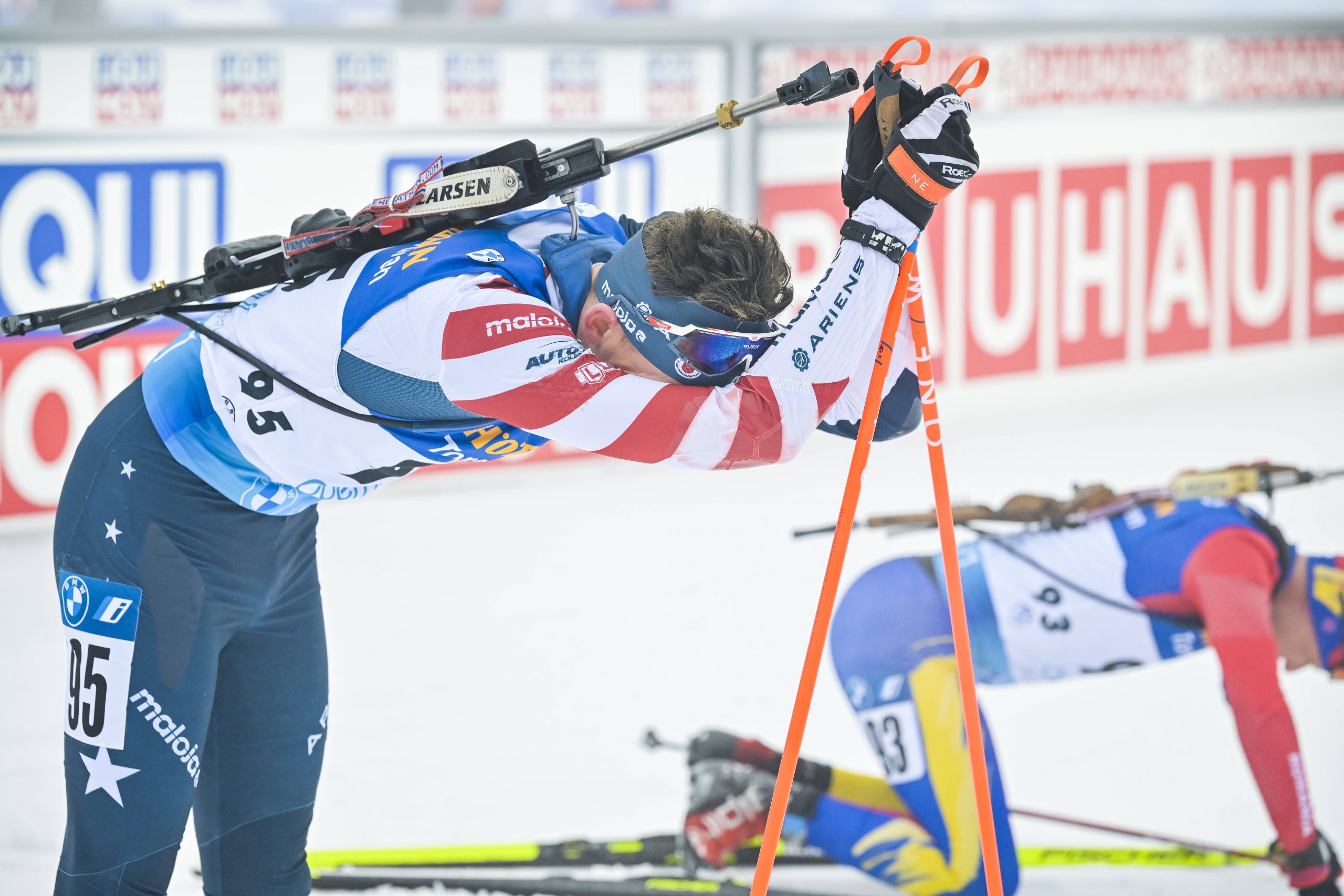
    Emil Svendsen (NOR) on the range in Vancouver.

    1. World Cup Overall Leaders – and Contenders

    One of the biggest questions of the next two weekend is whether the current overall World Cup leaders can hang onto their yellow bibs. 22-year-old Tarjei Boe of Norway leads his teammate Emil Hegle Svendsen by just six points going into this batch of races. Boe has worn the yellow bib since mid-December, but hasn’t won a World Cup since the first weekend in January. To keep his lead in the standings, he will have to beat Svendsen consistently – no small feat, considering that Svendsen has three victories to his name already this season, bringing his career total to 19, and was recently added to the Norwegian team to cross-country World Championships. He’s fast.

    On the women’s side, Kaisa Makarainen of Finland has worn the yellow bib since the very first weekend of World Cup competition in Oestersund, Sweden. But the only two victories of her career came that weekend, and since then she’s been less impressive. Her lead over Helena Ekholm of Sweden has dwindled to just 14 points, and Germany’s Andrea Henkel is making a charge at the title as well. Ekholm, the 2008/2009 overall World Cup winner, has two victories so far this season. Henkel has none, but she’s been on the podium more consistently than almost any other woman, and could finally win a race at any point.

    Jeremy Teela (USA) and Ole Einar Bjorndalen (NOR) in Vancouver.

    2. The Norwegian Men

    It’s impressive enough that Norway has both of the top contenders for the overall World Cup on their team. But Boe and Svendsen certainly aren’t the only Norwegian men who could win in Presque Isle and Fort Kent. No less than four of the team’s biathletes have collected victories on the World Cup circuit this year: Boe, Svendsen, Lars Berger, and of course, 37-year-old living legend, 92-time World Cup winner, and six-time Olympic gold medalist Ole Einar Bjorndalen. The team didn’t appear to be in top form at the last few World Cups in the Alps, but people, including Swedish Olympic gold medalist Bjorn Ferry, hypothesized that they were suffering from the effects of altitude. Back close to sea level, any one of the four could win again.

    3. Tora Berger

    While the Norwegian men had lackluster results in the Alps, their teammate Tora Berger (Lars’ sister) did not. She won two races in Ruhpolding, Germany, and then another two in Antholz, Italy, and appears poised to make a late-season run through the rankings. Berger’s ski speed is so fast that it sometimes straight-up demoralizes the competition. FasterSkier hopes that there isn’t a third Berger sibling, who would undoubtedly suffer from incredibly low self-esteem.

    4. The Russians

    In the first period of World Cup racing, the Russians were completely uninspiring. But then, gradually, they reappeared in the spotlight. In Antholz, the women raced to a dominating victory in the relay. After that effort anchor leg Olga Zaitseva, who has won one World Cup on her own this season, told IBU News that “We are back.” Anton Shipulin was also on the podium twice in Antholz, and seems to be rounding into form. It would be surprising for the Russians not to be skiing fast, considering that they are hosting World Championships in a few short weeks and will without a doubt be at their best in front of the home crowds.

    Bjorn Ferry (SWE) en route to a gold medal performance at the Vancouver Olympics.

    5. Bjorn Ferry

    Ferry is one of the most boisterous media personalities in the biathlon world: he has a great sense of humor and strong opinions. At one point, the 6′ 4″ Swede suggested that dopers should get the death penalty. He also has a wife who is a seven-time world champion arm wrestler, a cookbook entitled “Ferry Food,” and a website called “Ferry Tales.” But as entertaining as all of these quirks are (FasterSkier enjoyed interviewing him in Muonio, Finland earlier this season), it’s Ferry’s skiing and shooting that gets him the most attention. He picked up his first Olympic gold medal in Vancouver and has two wins so far this season. He will probably anchor the mixed relay in Preque Isle; Sweden won the mixed relay at 2007 World Championships with a potentially identical team, and are always dangerous in that event.

    6. Martin Fourcade

    With three second-place finishes in Ruhpolding, Germany, and then a thrilling, dominating, flag-waving mass start victory in Antholz a week later, Fourcade is on the rise. There aren’t many people who scare Ferry, but earlier this season he said that the French would be the team to watch. Lately, it looks like he might be right. This season, Fourcade, who sits fourth in the overall World Cup rankings, is eclipsing Olympic champion Vincent Jay. It’s no small task, but if Fourcade is still as fired-up as he was in Italy, he’ll be outshadowing everyone else on the circuit as well.

    Magdalena Neuner (GER) races to Olympic gold in Vancouver.

    7. Magdalena Neuner

    At just 23 years of age, Magdalena Neuner of Germany already has twenty World Cup victories. So far this season, she only has one – but she’s also contributed to a victorious German relay team that is on the rebound after the retirement of three stars: Martina Beck, Simone Hauswald, and Kati Wilhelm. Neuner has more up her sleeve and will undoubtedly have a few good races before the season is over.

    8. Lowell Bailey and the U.S. Men: the Veterans and the Skinny Fast Young Kid

    Lowell Bailey has been on a tear recently, notching a career-best 12th-place finish in Antholz and tagging off after the first leg of the relay in an astonishing second place. While last year it was the Tim Burke show, this year is turning out to be all about Bailey. But behind him are a veteran squad including Burke, three-time Olympian Jeremy Teela, and four-time Olympian Jay Hakkinen. And then there’s Leif Nordgren, the only young blood on the team. Nordgren shot clean to finish in the top 40 of the first World Cup race of the season, and has contributed several excellent relay legs, including one in Antholz which left the team in fifth place after two skiers. While Bailey is turning the team into a bit of a one-man show, it’s also good to see a diverse group of athletes able to contribute; the Antholz relay was the best U.S. result in two years.

    Laura Spector racing to 19th place in the World Cup sprint in Oberhof. Photo: nordicfocus.com courtesy of USBA.

    9. Laura Spector and the U.S. Women

    Expectations haven’t exactly been high for the U.S. women lately, and neither has funding: while the men’s team spent weeks in Europe this summer, training just as the European teams do, the women were stuck in Lake Placid. They have a smaller World Cup quota because of a lack of success in recent years and haven’t always been able to even field a full relay team. But out of all of this have come some exceptional performances. Laura Spector has led the way with top-30 and even a top-20 result, as well as qualifying for two mass start races; the last time a U.S. woman skied in a mass start, which only allows for 30 athletes, was six years ago. Sara Studebaker has finished in the top 30 as well, and Haley Johnson, the latest addition to the World Cup team, is keeping up with the others just fine.

    10. Brendan Green and the Canadians

    If Tim Burke was the hero of American biathlon last year, then Jean-Phillipe Leguellec was the Canadian equivalent. He finished sixth, 11th, and 13th in races at the Vancouver Olympics, prompting him to tattoo the Olympic rings on his leg. But this year, Brendan Green is stealing his spotlight. The pair have each had excellent finishes, and made history when both competed in a mass start earlier this season; it was the first time that Canada had put two athletes in a mass start. Canada will be fielding a full team, so look for them in the somewhat-unconventional red suits.
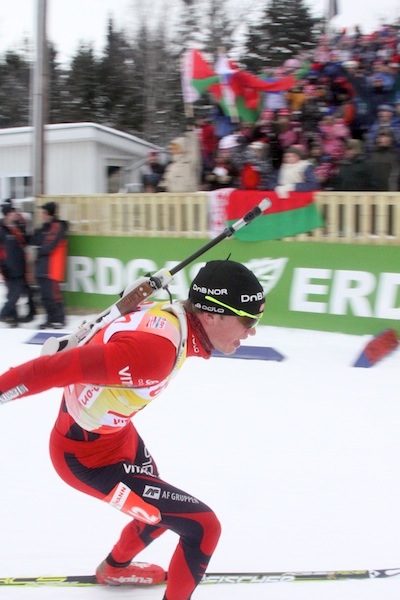
  • How Many Norwegians? With Perfect Shooting, Berger Makes It Four

    So far this season, three Norwegian men have dominated the World Cup biathlon circuit, taking wins when it suits them and not always playing nicely together. 22-year-old Tarjei Boe currently sits atop the overall World Cup rankings, followed closely by teammate Emil Hegle Svendsen. Veteran Ole Einar Bjorndalen, who has won 92 World Cups in his career but only one this year, is third, giving the Norwegians a clean sweep of the standings halfway through the season.

    But it was none of those men who stood atop the podium in Rupholding, Germany on Friday. Instead, their teammate Lars Berger – who is almost always overshadowed by not only his male teammates but also his more successful sister, Tora – who won the 10 k sprint.

    Berger’s skiing has never held him back. In fact, he is currently the only athlete who has won relay gold in both biathlon and nordic skiing World Championships, and won the 15 k at 2007 Nordic World Championships in Sapporo as well.

    For Berger, shooting is what makes or breaks a day, and on Friday he shot clean for just the third time in his career. The last two instances were in Vancouver in 2009 and in Hochfilzen, Austria in 2008. And in both cases, he won.

    “It is too bad that it does not happen so often,” he told IBU News. “You know I am not that good! It takes some luck. But when it happens it is quite a dream day for me.”
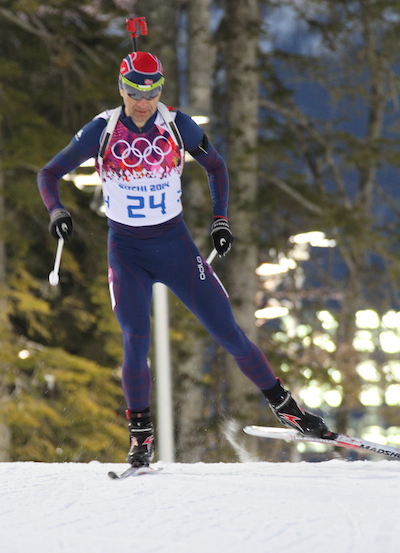
    Berger skied to a 21-second victory over Martin Fourcade of France, who also shot clean, as did third-place finisher Ivan Tcherezov of Russia, just two more seconds behind. The soft snow made tough going for weaker skiers, but Berger was able to shine, owning the fastest course time of the day.

    “We train a lot in tough conditions back home,” he told IBU News. “Today was difficult but not impossible [conditions]. The most important thing today was not to stress too much on the skis, but to flow over the snow and do good skiing so you can go fast.”

    While Berger had a “dream day”, the North Americans did not. They were led by Marc-Andre Bedard of Canada, who finished 44th with clean shooting. A recent addition to the World Cup squad, Bedard was a surprise leader of the Canadian team, which had three men score World Cup points and two men qualify for the mass start last weekend.

    Bedard didn’t have as easy of a time on the snow as Berger did, but was positive about his shooting.

    “It feels awesome to finally get a good shooting race,” he told FasterSkier. “But starting in the last seed is is not so cool, especially in warm weather- the trails get softer and deeper every time someone passes! The skiing was really tough today but I managed to get my shooting on.

    “I’m happy to race the third pursuit of my career,” he continued. “I want to break my bad luck in pursuits and get a big one! I’ll get the day off to prepare for Sunday and I want it!”

    For a time on Friday it looked like he might be lonely in the pursuit. After two shooting stages, Bedard and Brendan Green were the only Canadians in the top 60, and Lowell Bailey was the only American.

    But in the 3.3 k before the finish, U.S. biathletes Tim Burke and Jeremy Teela made up time and finished 56th and 58th – just inside the cutoff for Sunday’s pursuit race. Green finished 48th and Bailey 50th.

    While packing the 40s and 50s isn’t the position the men were hoping to be in, they have the opportunity to move up quite a few places in the pursuit, since all are capable of much stronger results.

    Full results