From the FasterSkier archive — posts syndicated from athletes’ and coaches’ own blogs between 2004 and 2012, kept online as published. Current coverage is at fasterskier.com.
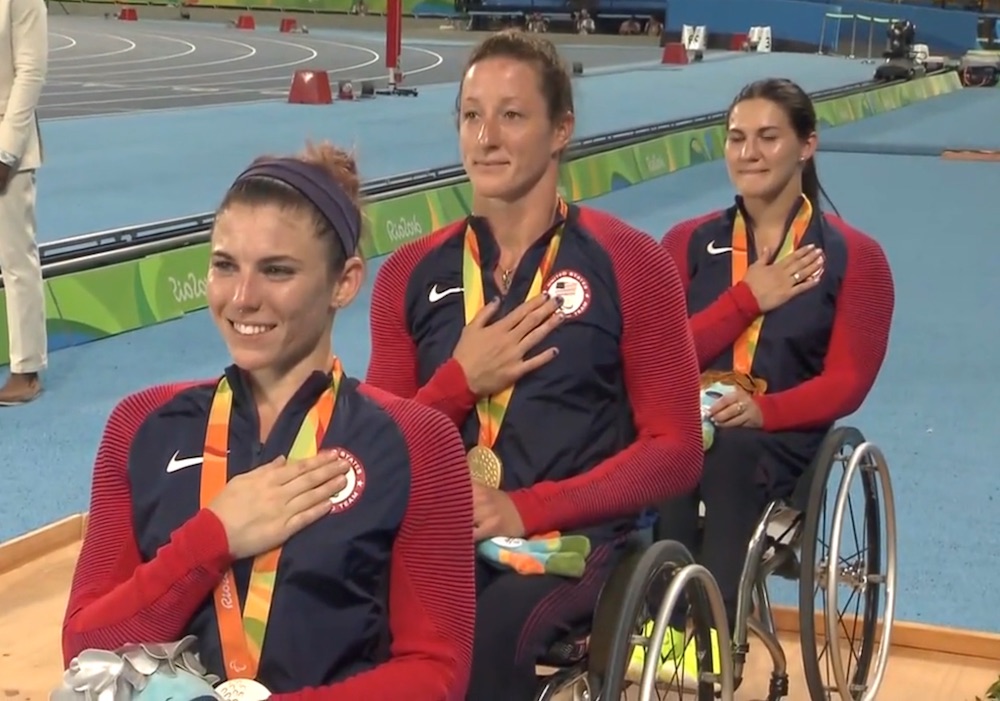
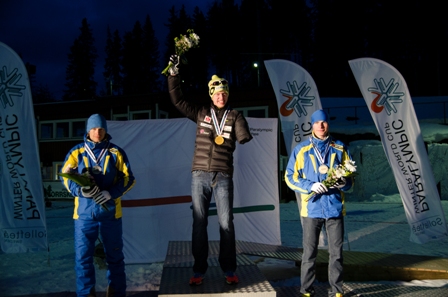
Tatyana McFadden (c) led a U.S. sweep of the women’s 1500-meter T53/54 podium in wheelchair track racing at the 2016 Summer Paralympics on Wednesday in Rio de Janeiro, Brazil. Less than two-tenths of a second behind her, Amanda McGrory (l) and Chelsea McClammer (r) placed second and third, respectively. (Photo: U.S. Paralympics Highlights from Rio Day 6 video)
Note: This article has been updated to include results from Thursday’s road cycling and evening track races, as well as Tatyana McFadden’s selection as recipient of the Whang Youn Dai Achievement Award.
On Tuesday and Wednesday in Rio de Janeiro, Brazil, two Paralympians who also dabble in skiing racked up medals at the Paralympic Games — with Tatyana McFadden winning the women’s 1500 T53/54 track event and Alicia Brelsford Dana placing second in the road-cycling time trial.
McFadden, 27, of Clarksville, Md., rocketed to her third medal in three races in Rio, leading what the U.S. Olympic Committee (USOC) dubbed a “Mc-sweep” in her event, ahead of fellow Americans Amanda McGrory (+0.11) and Chelsea McClammer (+0.17). It was the first U.S. track-and-field podium sweep at these Games, and McFadden led from the start to capture a Paralympic record of 3:22.50.
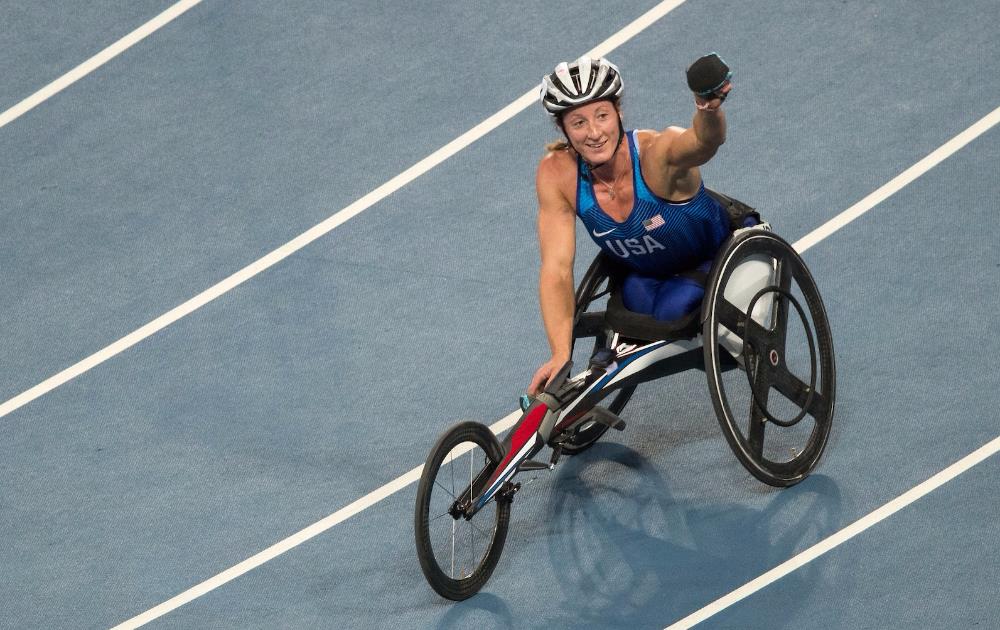
Tatyana McFadden celebrates winning the women’s T54 5000m final at the Olympic Stadium at the Paralympics in Rio de Janeiro, Brazil. (Photo: Simon Bruty for OIS/IOC)
This marks her 13th Paralympic medal in track and field. She also has a silver in sit-skiing at the 2014 Winter Games.
“It’s amazing,” McFadden said, according to a USOC press release. “It’s the first time, I think, in history or in a long, long time since we’ve gotten an American sweep in the 1500 and it happens to be the girls, so it’s really cool.”
“We went into this morning with a pretty good plan and decided we were going to go for it,” McGrory said. “We raced together, we raced smart and we pulled it off.”
(Update: Two days after her latest gold, McFadden was selected to receive another honorary gold medal as one of two recipients of the Whang Youn Dai Achievement Award. According to a International Paralympic Committee (IPC) press release, an independent panel of judges comprised of IPC Governing Board members selected the winners on Thursday — McFadden and Syria’s Ibrahim Al Hussein, a swimmer who is competing independently in Rio. They will each receive a pure gold medal, weighing 75 grams, at the Closing Ceremony.
The panel chose McFadden and Hussein for best exemplifying “the spirit of the Paralympic Games and the Paralympic values.” Seventeen participating countries nominated 21 athletes, and the IPC narrowed the list down to six athletes. McFadden was the only North American among the six finalists.)
On Thursday night, the “Mc-trio” (as the USOC called them) of McFadden, McClammer and McGrory — teammates at the University of Illinois Urbana-Champaign — swept the podium again in the women’s 5000-meter T53/54. McFadden made her move on the final lap to notch her third gold in four individual races in Rio, winning in 11:54:07. McClammer edged McGrory by one-hundredth of a second for silver (+0.26) and McGrory took bronze (+0.27).
“We train together, so we work really, really well together,” McFadden said, according to a USOC press release. “There’s no one I want more on the podium than my teammates. I think the whole world was looking at us and we were looking at them and we said ‘hey, we’re going to work together’. We’re stronger that way and it definitely showed today.”
Two hours later, McFadden and McClammer raced the 4×400 T53/54 relay with McFadden’s younger sister Hannah McFadden and Cheri Madsen. They crossed the line second behind the People’s Republic of China, which smashed the world record of 3:40.66 with a time of 3:32.11. However, according to the final results, the Americans were disqualified (along with Turkey) and relegated to fourth (while Turkey was listed as third). Australia, which had a season-best time of 3:46.63, took silver, and according to the results, no bronze was awarded.
On Wednesday, the seventh day of the Paralympics and first day of road cycling, Dana, of Putney, Vt., notched silver in the H1-2-3 time trial with a time of 33:57.48, less than 13 seconds behind the winner, Karen Darke of Great Britain.
Four years ago at the Paralympics in London, Dana, now 47, placed fifth in the same event. At 2015 World Championships, she took silver in both the time trial and road race. In 2014, she was a world champion in the time trial.
In all, the U.S. cycling team racked up nine medals on Wednesday (one gold, five silver and three bronze). Oksana Masters finished fifth in the women’s H4-5 time trial with a time of 33:49.7, about 47 seconds off the podium and 2:14.24 behind the winner, Dorothee Vieth of Germany.
On her official Facebook page, Masters, 27, of Louisville, Ky., also a silver medalist in Sochi and a bronze medalist in doubles rowing at the 2012 London Paralympics, summed up her race on Wednesday: “I Finished 5th today in my combined H4-5 category for the TT. Just like skiing I like courses that have climbs in it. Today was the opposite. Flat as a pancake course with high winds which favors bigger people. I gave it everything I had, plus some blood and it was not enough to bring home a medal for team USA. Tomorrow is a new Day and another chance to race and leave everything on the course. It is a Road Race which will be a mass start. I am feeling hopeful for this race. It is my favorite event. I Can’t wait to throw it down tomorrow. I will be racing around noon rio time tomorrow.”
On Thursday, Masters placed fourth in the women’s H5 road race. She is one of two Americans at the Games who has competed in the last three Paralympics in three different sports.
Germany’s Andrea Eskau — a skier and Winter Paralympic medalist in both biathlon and cross-country in Sochi — won the event in 1:37:07. She finished 2 seconds ahead of the Netherlands’ Laura De Vaan and Jennette Jansen, who placed second and third, respectively. Masters was listed with the same time just 2 seconds back in fourth.
“I’m bummed I finished fourth today and came up a little short, but I’m super happy because I feel like I’ve learned so much from this race alone,” Masters said, according to a USOC press release. “I am just so shocked that I am even here competing in my third Paralympic Games in a row.”
Dana also placed fourth in Thursday in the women’s H1-2-3 road race. With a time of 1:16:01, she was 3 seconds off the podium and 5 seconds behind German winner Christiane Reppe (1:15:56). South Korea’s Do-Yeon Lee finished second and Italy’s Francesca Porcellato was third.
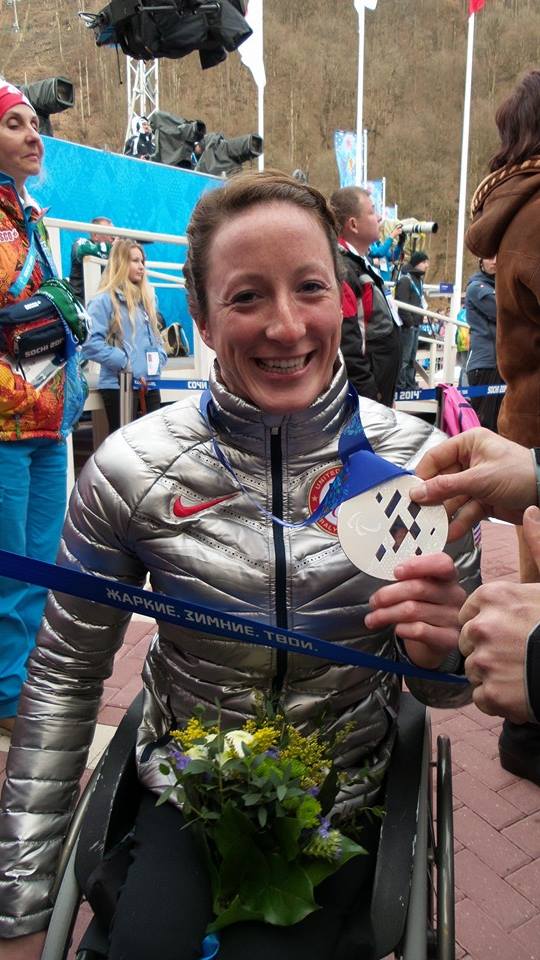
U.S. Paralympian Tatyana McFadden with her 2014 sprint silver medal at her first winter games in Sochi, Russia. McFadden is competing in her fifth Paralympics this month in Rio de Janeiro, Brazil. (Photo: BethAnn Chamberlain/U.S. Paralympics Nordic)
In the first three days of the 2016 Summer Paralympic Games in Rio de Janeiro, Brazil, Tatyana McFadden, a seasoned wheelchair racer with 11 Paralympic medals to her name coming into the Games, took silver and gold in her first two races.
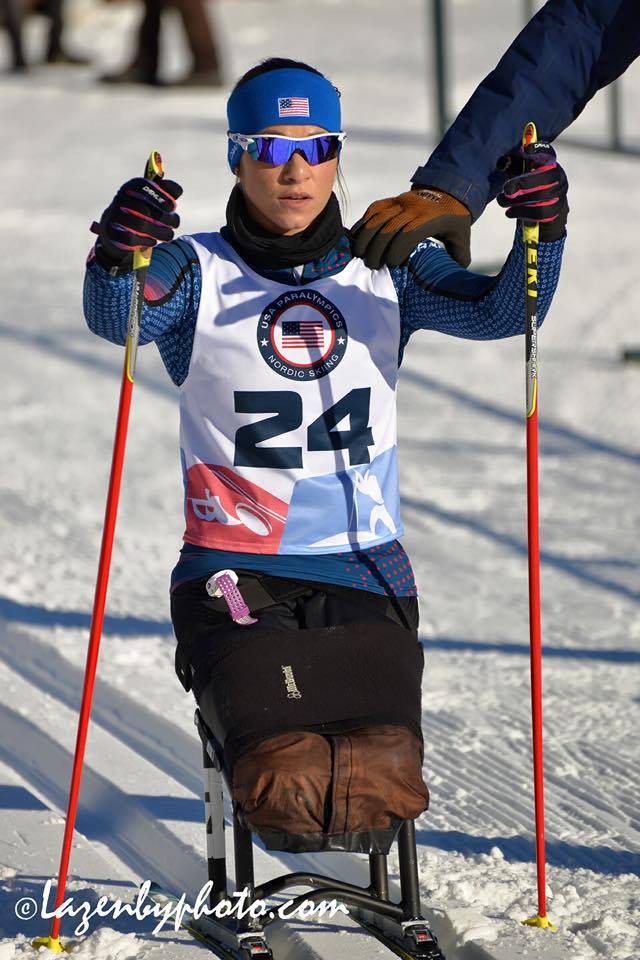
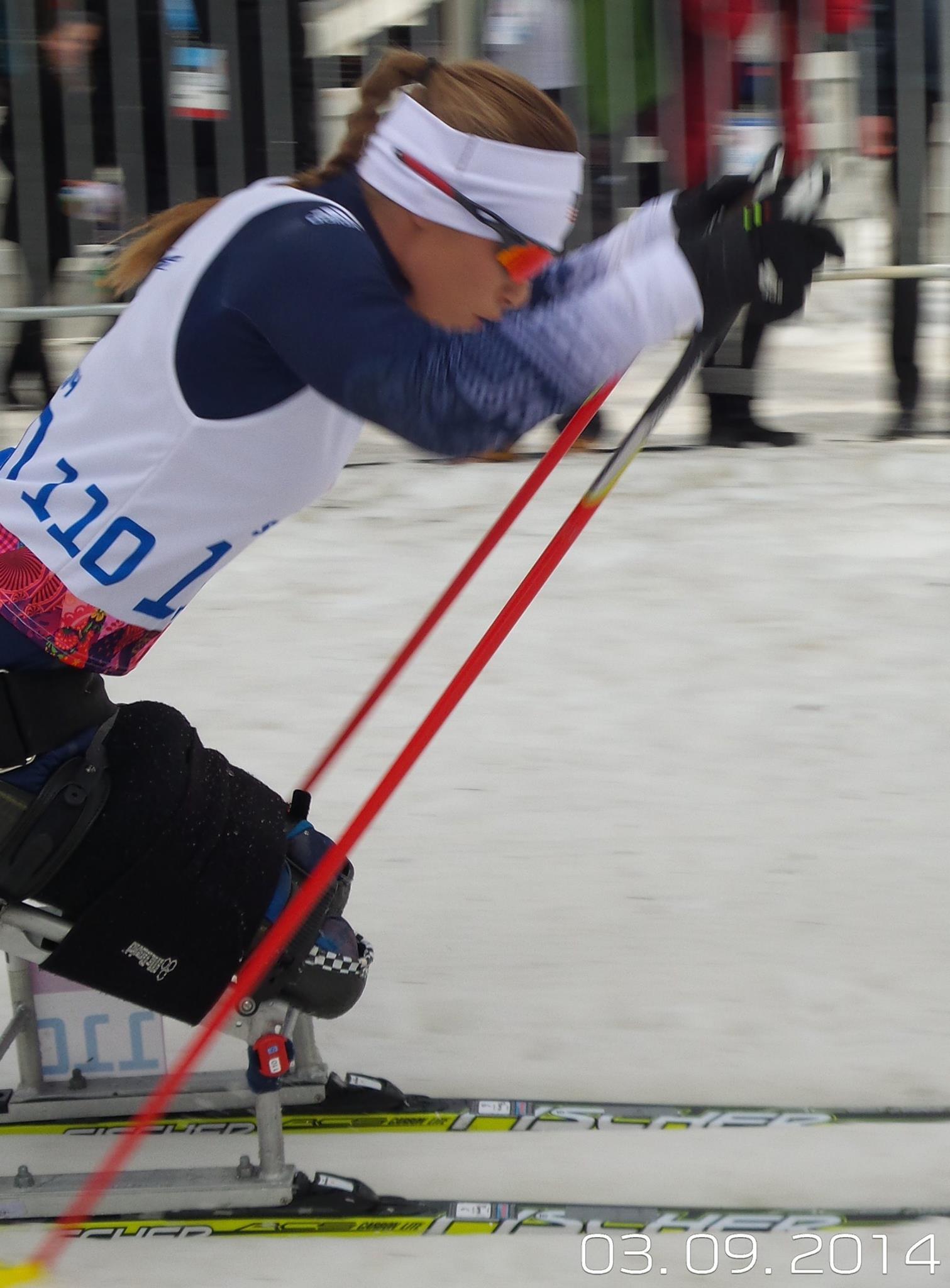
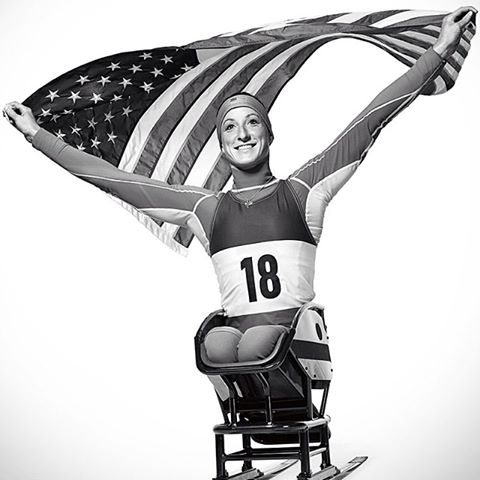
McFadden, 27, of Clarksville, Md., has competed in four Summer Paralympics and a Winter Paralympics in 2014 in Russia — her birthplace. She was born with spina bifida and adopted around age 6, then moved to Maryland, where she developed strength and discovered her athleticism in swimming, gymnastics, wheelchair basketball, sled hockey, and track and field. Sit-skiing came later while she was studying at the University of Illinois, and shortly after taking up the sport, McFadden earned silver in the 2014 Paralympics sprint in Sochi.
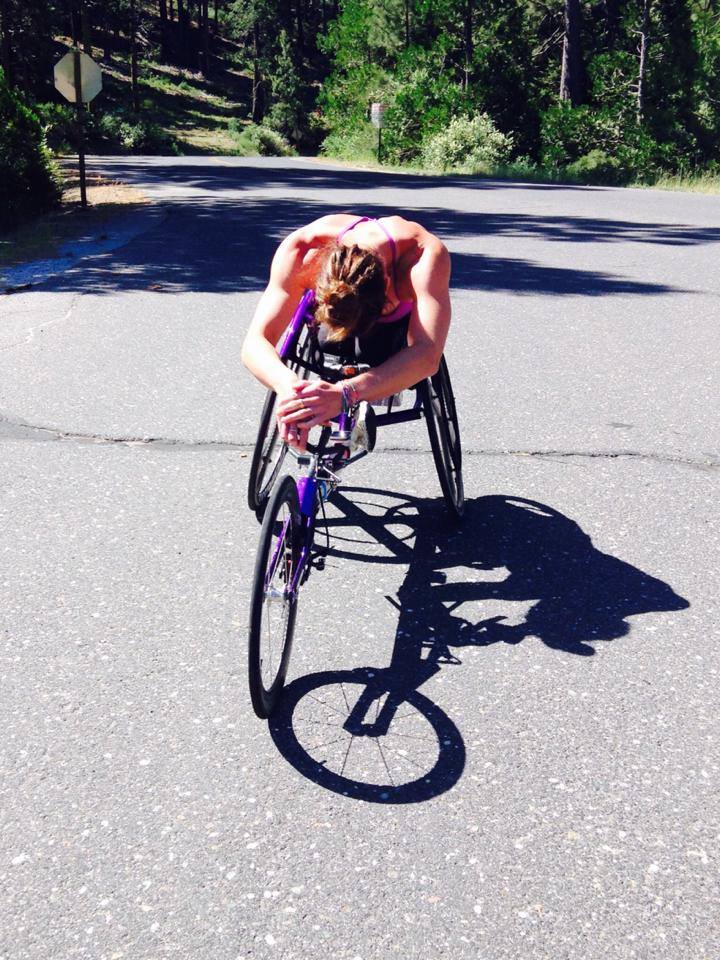
Tatyana McFadden training in July 2014 for U.S. nationals in wheelchair racing, her summer sport, of which she’s a three-time Paralympic and 10-time World Championship gold medalist in track and field. (Photo: U.S. Paralympics Nordic/Facebook)
This past Friday, Sept. 9, on the opening day of the Rio Paralympics, McFadden captured the first medal of the Games for U.S. women’s track and field. The world-record holder in the women’s 100 T54 event, McFadden placed second, 0.13 seconds behind the defending Paralympic and world champion, Wenjun Liu of China, who won in 16.0.
McFadden’s younger sister, 20-year-old Hannah McFadden, placed fourth (+0.34) while a third American, Cheri Becerra-Madsen, coming off a 16-year Paralympic hiatus, was fifth (+0.4). According to a U.S. Olympic Committee (USOC) press release, McFadden entered Rio aiming for seven gold medals to add to her collection of three from London 2012.
She would have to wait for her first one.
“To get the first medal for the U.S. women is amazing,” McFadden said in a USOC press release on Friday. “This is one of my hardest events. I’ve really had a rollercoaster ride with the 100 meters. In Beijing, I got sixth; In London, I got third and today I got silver. I’m really quite happy and am just looking forward to my next event.”
On Sunday, Sept. 11, she defended her Paralympic title in the women’s 400 T54, winning in 53.30 seconds. Becerra-Madsen joined her on the podium in second (+1.2).
Fifteen years after the Sept. 11 tragedies, McFadden dedicated her win to the victims, families and first responders of that day.
“Today I won with my heart,” she told the USOC. “I ran for America. It’s September 11 so I ran for the folks back at home; thoughts and prayers for those affected. I honor my country today with a gold medal.”
Several summer/winter cross-over Paralympians are competing in these Games. Oksana Masters, one of two U.S. Paralympians in their third Paralympic sport, is competing in road cycling, which begins on Wednesday.
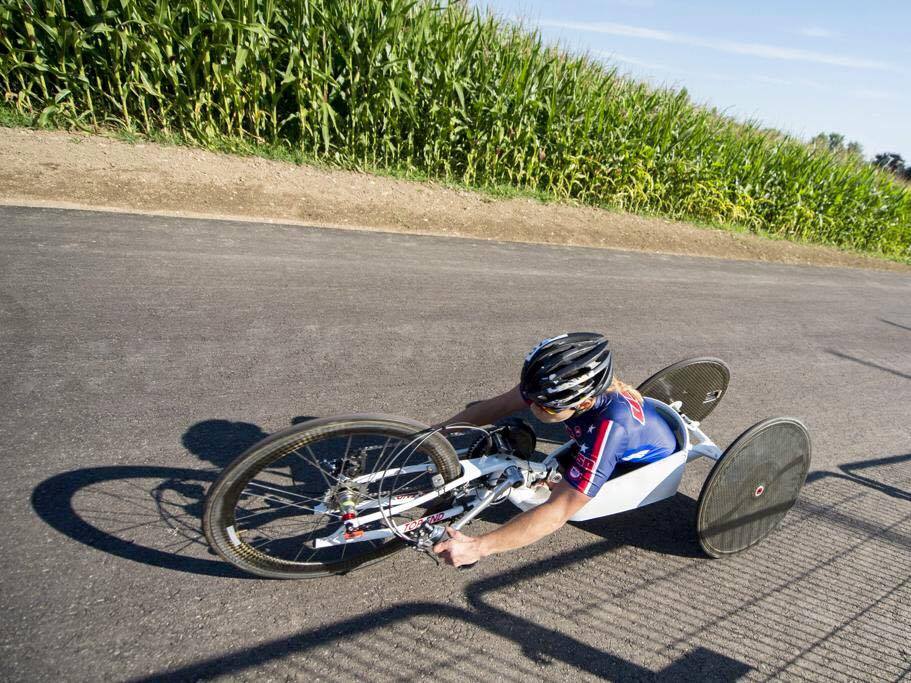
Multi-sport Paralympic athlete Oksana Masters training for handcycling in anticipation of the Rio 2016 Summer Paralympics, which will be held in September. (Photo: Oksana Masters/Facebook)
Not many individuals have the opportunity to represent the U.S. at the Olympics. Even fewer have had the opportunity to do so three times. And fewer still in three different sports. By the closing ceremony of this year’s 2016 Summer Paralympics in Rio de Janerio, which kick off Sept. 7, U.S. Paralympic rower-turned-skier-turned-cyclist Oksana Masters will have accomplished all of the above and potentially podium in all three sports.
The road to Rio for Masters, however, was not like the smooth paved streets she now occasionally finds herself cycling on as she preps for the 2016 Paralympic games. Born in Ukraine with birth defects believed to have been caused by Chernobyl, Masters spent the first 7 1/2 years of her life in several orphanages before being adopted by Gay Masters, an American speech pathologist. At the time of her adoption, Masters was severely underweight. Gay brought the malnourished child back to the U.S. and moved to Louisville, Ky., when Masters was a teenager, according to the Associated Press.
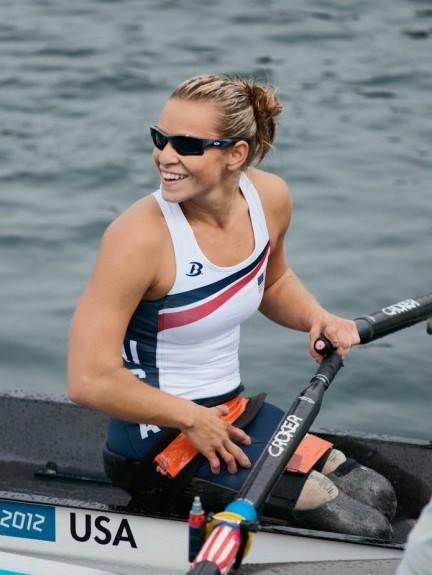
Oksana Masters rowed to a bronze medal along with Rob Jones (not shown) at the 2012 London Summer Paralympic games. (Photo: Oksana Masters/Facebook)
In the years that followed, Masters didn’t just adapt, she thrived. She began competing seriously in rowing and in 2012, qualified for the London Summer Paralympics, where she and her U.S. teammate Rob Jones took bronze in the trunk-and-arms mixed double sculls. That same year she was featured in ESPN The Magazine’s Body Issue. Also in 2012, she was also approached by one of the coaches for the U.S. Paralympic Nordic Ski team.
While rowing had been a part of her life for 11 years, due to issues with her back, Masters decided to trade in her oars for skis in 2013. She took up sit skiing, and the 2014 Winter Games in Sochi, Russia, became her new focus.
By the end of the 2013/2014 ski season, Masters not only qualified for Sochi in cross-country skiing and biathlon, she came away with two medals: silver in the 12-kilometer cross-country and bronze in the 5 k cross-country sit-ski events. There in Sochi, the notion of cycling first crossed her mind.
“One of our teammates for the U.S., she was a sit skier, her summer sport was hand cycling and she really liked the tradeoff [between skiing and cycling],” Masters, now 27, explained in a recent phone interview from Champagne, Ill. “I originally would be doing rowing, but my body is not able to do that motion right now and I wanted to maintain a fitness level and she spoke really highly of [cycling].”
By the end of the winter, Masters decided to give cycling a try. With only a couple months of training under her belt, she qualified for the 2014 UCI Para-cycling Road World Championship team and raced to fourth place in both the road race and time trial. After another successful ski season, she spent all of last summer cycling and once again qualified for the 2015 UCI Para-cycling Road World Championships and took bronze in the H5 road race. Eventually, what began as just a way of staying in shape for skiing became her third Paralympic sport.
“One of the things I was lacking in skiing was race tactics and how to race,” Masters said. “Rowing didn’t have any of that because you’re in your own lane and you can just put your head down and hammer home. Skiing, there’s a lot more to it than going hard. So cycling was kind of like a way to stay in shape in the summer and learn more about racing. Then it just somehow led into going to Rio.”
Oksana Masters competing at 2016 U.S. Paralympic Nordic nationals in Craftsbury, Vt. (Photo: John Lazenby/Lazenbyphoto.com)
Nowadays, Masters trains for cycling in Champagne, Ill., as well as Colorado Springs, Colo., with her coach, Mike Creed, a U.S. Paralympic cycling coach, at the Colorado Olympic Training Center.
“I’m really excited to be cycling and to see what cycling can bring out for my skiing as well,” she said. “With this heat, I also cannot wait for winter.”
To prepare for skiing, Masters will work with U.S. Paralympic Nordic Head Coach Eileen Carey. Though the triple-sport Paralympian has spent most of her summer focusing on cycling, she said she’s excited to get back to skiing.
“The biggest challenge in athletes competing in multiple sports at a high level is being able to balance the calendar and making sure that they are able to have the opportunities they need to achieve their goals in both sports,” Carey wrote in an email to FasterSkier. “Based on what their individual goals are, we make big efforts to accommodate their schedules in other sports in a way that allows them to maximize their time on snow.”
According to Carey, for sit-skiers such as Masters and Tatyana McFadden and Aaron Pike (both also competing in Rio in wheelchair track and field), competing at a high level in multiple sports is a good thing.
“I think for sit skiers especially, doing two sports can work to their advantage,” she wrote. “There are so many possibilities of overuse injuries when you are using primarily your upper body. Doing a sport that uses a different motion can provide variety that I think is really important for both sports. We have seen Tatyana McFadden and Aaron Pike, who both compete in wheelchair racing, achieve personal bests in races just weeks after winter when they were doing no specific training in their racing chairs. There are certainly challenges in balancing two sports, but we see it as a competitive advantage and structure our program in that way.”
“Skiing, there’s a lot more to it than going hard, so cycling was kind of a way to stay in shape in the summer and learn more about racing. Then it just somehow led into going to Rio.” — Oksana Masters, 27, three-time U.S. Paralympian
After trials in June and early July in Charlotte, N.C., Masters was one of 18 athletes named to the U.S. Cycling Team for Rio. Team qualification involved a time trial in which both upright cyclists and handcyclists competed against each other — Masters a part of the handcycling group. With the time trial behind her, her goals for the Games are unfettered by the pressure to podium.
“I just want to finish with the pack,” she said. “I would love to bring home a medal and I totally believe that I can I would just be happy if I finished with the pack though. I’m not going to put the pressure of going for the gold right now.”
For Masters, it’s not so much the medal, but the opportunity to once again represent the U.S., this time in another new sport.
“I haven’t even had time to focus on what I’m looking forward to, just not getting my butt kicked,” Masters said. “It’s going to be a good challenge and I’m really looking forward to being able to represent the U.S. Paralympic team and to be able to represent it in more than one sport. I feel very, very, very humbled and thankful to have that opportunity and I’m really excited to show the versatility of any athlete.”
Sochi Winter Paralympian Oksana Masters qualified for the 2016 Summer Paralympics in cycling early last month. This will be her third consecutive Paralympics (she rowed in London in 2012, raced biathlon and nordic in Sochi in 2014, and will hand cycle in Rio next month.) (Photo: Oksana Masters/Facebook)
From left to right: Dan Cnossen, Omar Bermejo and Oksana Masters are three members of the U.S. team who will be competing at the IPC Nordic Skiing World Championships in Cable, Wis., with races starting on Saturday. (Photo: U.S. Paralympics)
Note: This article has been updated to include the most recent information on the 2015 IPC Nordic Skiing World Championships according to an IPC Nordic Skiing press release.
This past fall, FasterSkier spoke with Yuriy Gusev, head of the Cable 2015 organizing committee and executive director of Central Cross Country (CXC), about the ongoing preparations to host the upcoming International Paralympic Committee (IPC) Nordic Skiing World Championships in Cable, Wis. It seemed like a long ways off at the time, and now it’s here: being held for the third time in the U.S., for the first time in a decade.
With Cable and the Telemark primed for the event, which includes 135 athletes from 15 countries from Jan. 23-Feb. 1, we had an opportunity to check in with U.S. Paralympics Nordic High Performance Coach Eileen Carey to see how the U.S. team was preparing. The U.S. roster was announced Jan. 9 and includes nine returners (out of 16) from last year’s Paralympics team at the Sochi Winter Games. All but one of them are sit skiers; Omar Bermejo is the lone standing athlete.
U.S. 2015 IPC Nordic World Championships Team:
Men
– Omar Bermejo (Marine Corps/Grand Rapids, Mich.)
– Lt. Cmdr. Dan Cnossen (Navy/Topeka, Kan.)
– Sean Halsted (Air Force/Rathdrum, Wash.)
– Augusto Perez (East Syracuse, N.Y.)
– Aaron Pike (Park Rapids, Minn.)
– Bryan Price (Army/Belton, Mo.)
– Andy Soule (Army/Pearland, Texas)
Women
– Oksana Masters (Louisville, Ky.)
– Tatyana McFadden (Clarksville, Md.)
The two members of the women’s team found repeated success in Sochi, with Oksana Masters and Tatyana McFadden taking home three combined medals.
Masters became the first female U.S. cross-country skier to win a Paralympic medal in 20 years at the Games, initially earning silver in the 12-kilometer sitting event. She also won bronze in the 5 k cross-country. This season, Masters racked up three medals at the World Cup opener in Finland, winning gold in the 1 k cross-country sprint, and silver in the biathlon 6 k as well as the 5 k cross-country.
In Sochi, McFadden notched silver in the women’s 1 k cross-country sprint, and in the time since, she has continued her domination of the road-marathon circuit. After the ski season ended, McFadden won four world-caliber marathons in Boston, London, Chicago and New York City. It was the second-straight year that McFadden achieved the marathon grand slam in wheelchair racing.
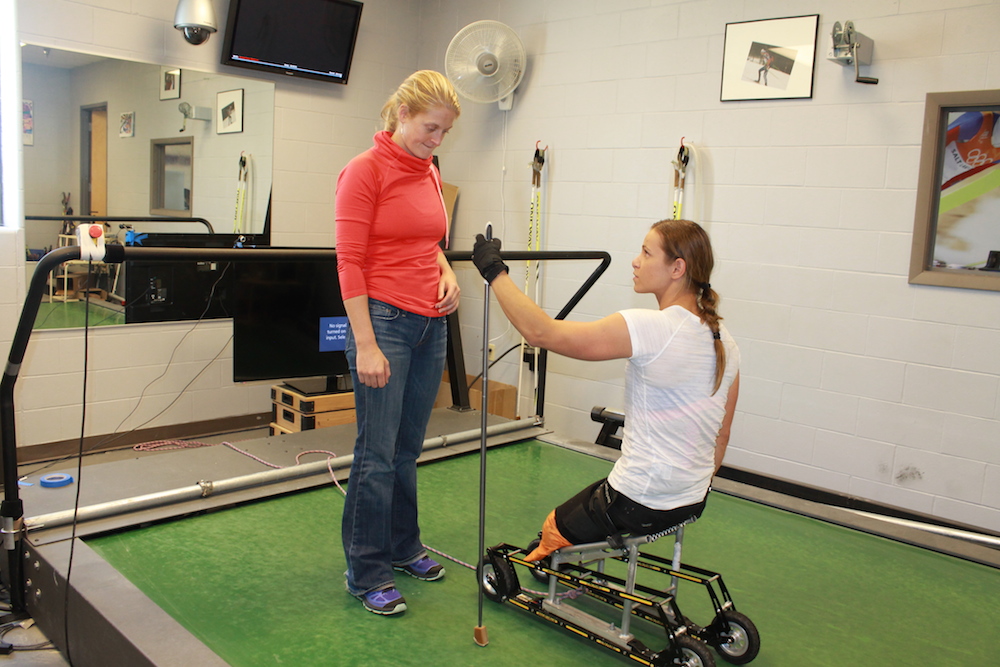
U.S. Paralympics Nordic skier Oksana Masters (r) talks to coach Eileen Carey before her first time on a treadmill on Sept. 16 at the Olympic Training Center on Sept. 16 in Lake Placid, N.Y.
Masters and McFadden missed U.S. nationals because of injury and ilnees, respectively.
“Earlier in the season, Masters had a minor back injury and McFadden had the flu and were forced to miss the last World Cup event and the US Nationals,” Carey explained. “Both are back healthy and will be in the field in Cable.”
On the men’s side, Andy Soule leads a strong men’s team heading into World Championships. A veteran sit skier, Soule is a bronze Paralympic medalist from the 2010 Games in Vancouver, British Columbia, where he shot an unprecedented perfect 50-for-50 in all three biathlon races. In Sochi, Soule finished in the top five in every event he competed in and placed fourth twice (in the 7.5 k biathlon and 15 k biathlon).
He split the number of U.S. sit-ski titles won at this year’s nationals with teammate Lt. Dan Cnossen (both men won two races at Soldier Hollow in Midway, Utah). Cnossen won the men’s sitting short and sprint cross-country races, while he finished as the runner-up to Soule in the long distance cross-country and biathlon sprint races.
Eileen Carey: We had a strong opening to our season at the December World Cup races in Finland with a small group of athletes. We followed that with a great U.S. Nationals that brought together our top athletes with developing skiers and biathletes. Those two events showed both the high performance capacity and development focus of our program, both of which are critical to our long-term success.
FS:What is the atmosphere of the team leading to these World Championships on U.S. soil?
EC: Our athletes are becoming students of skiing and biathlon and driving the process of what and how they want to learn. This has created a great atmosphere for our whole program and has energized both athletes and staff. We are excited to take that energy to an event like World Champs, especially being at home. The Cable organizing committee has always been so welcoming and excited to have us and that gives us a great boost as a team.
FS: What are your goals and expectations for this years team?
EC: Our team philosophy is based on the concept that athletes are their own best coaches. Their training and racing has been focused on the idea that there are no “right” ways to do anything. As a result, this season they have gotten really creative and analytical about figuring out what works for them and exploring many different solutions. Our intentions are that bi-products of this exploration are improvements in skill, self-awareness as an athlete, and eventually performance. Our goals and expectations as a program are that our athletes will keep pushing those boundaries and continuing to think of different and perhaps better ways to train and race. Through this continual evolution, I think great performances will follow.
FS: What are your thoughts on this years course? How does this course compare to 2013?
EC: The courses in Cable will be a combination of courses we have skied there in the past, and some new features that will improve the experience for the athletes. We have spent some workouts focused on some of the terrain and technical features we will see there, so I think everyone is excited to be on the snow in Cable and test out what we have been working on.
FS: What events will the team participate in?
EC: We will have athletes competing each race day, with most competing in a combination of biathlon and cross-country races. Eight of our 9 athletes are sit skiers. Omar Bermejo is our only standing skier to make the team and this will be the first time this season that we will all be together, so we are looking forward to being a full team.
“We have a great team of athletes who have taken a very professional approach to training and building upon last season, ”Carey said in a U.S. Paralympics press release. “We are thrilled to get another chance to test out some of our training and racing strategies, ultimately focused on improving in each race. Having the opportunity to do that on home snow is a great bonus for us.”
The opening ceremony will kick off Friday, Jan. 23 and the championships run through Feb. 1.
All seven days of the championships, which includes 38 events between cross-country and biathlon, will be streamed live at Cable2015.com and USParalympics.org from Jan. 24 to Feb. 1.
Saturday, Jan. 24
Biathlon Sprint – Penalty Loop
Sitting: Men 7.5km (3 x 2.5 km) / Women 6.0 km (3 x 2.0 km)
Standing: Men 7.5km (3 x 2.5 km) / Women 6.0 km (3 x 2.0 km)
Visually Impaired: Men 7.5km (3 x 2.5 km) / Women 6.0 km (3 x 2.0 km)
Sunday, Jan. 25
Cross Country Long – Free
Sitting: Men 15 km (5 x 3.0 km) / Women 12 km (4 x 3.0 km)
Standing: Men 20 km (5 x 4.0 km) / Women 15 km (5 x 3.0 km)
Visually Impaired: Men 20 km (5 x 4.0 km) / Women 15 km (5 x 3.0 km)
Tuesday, Jan. 27
Biathlon Middle Distance – Penalty Loop
Sitting: Men 12.5 km (5 x 2.5 km) / Women 10 km (5 x 2.0 km)
Standing: Men 12.5 km (5 x 2.5 km) / Women 10 km (5 x 2.0 km)
Visually Impaired: Men 12.5 km (5 x 2.5 km) / Women 10 km (5 x 2.0 km)
Wednesday, Jan. 28
Cross Country Sprint – Classic
Sitting: Men/Women 0.8 km
Standing: Men/Women 1.2 km
Visually Impaired: Men/Women 1.2 km
Friday, Jan. 30
Biathlon Individual Distance
Sitting: Men 15 km (5 x 3.0 km) / Women 12.5 km (5 x 2.5 km)
Standing: Men 15 km (5 x 3.0 km) / Women 12.5 km (5 x 2.5 km)
Visually Impaired: Men 15 km (5 x 3.0 km) / Women 12.5 km (5 x 2.5 km)
Saturday, Jan. 31
Cross Country Relay – CL/Free/CL/Free
Open: 10 km (4 x 2.5 km)
Mixed: 10 km (4 x 2.5 km)
Sunday, Feb. 1
Cross Country Middle Distance – Classic
Sitting: Men 10 km (4 x 2.5 km) / Women 5 km (2 x 2.5 km)
Standing: Men 10 km (4 x 2.5 km) / Women 5 km (2 x 2.5 km)
Visually Impaired: Men 10 km (4 x 2.5 km) / Women 5 km (2 x 2.5 km)
For updates throughout IPC World Championships, follow FasterSkier’s Para Nordic blog.
Oksana Masters (r) during a rollerski in Edebäck, Sweden, near the Torsby ski tunnel, where three U.S. Paralympic Nordic skiers trained with two coaches for a week in September. (Photo: U.S. Paralympics Nordic/Facebook)
The second day of the 2014 Winter Paralympics in Sochi, Russia, Oksana Masters — a bronze-medal rower from Louisville, Ky. — broke the ice and a 20-year barrier for the U.S. Paralympics Nordic Program.
Three medals left U.S. Paralympics High-Performance Director John Farra a lot to be excited about, especially after the team took home one medal from the Paralympics four years earlier in Vancouver, British Columbia. He wasn’t at the helm then, when Andy Soule won bronze and six athletes represented the U.S. at the 2010 Paralympics.
But less than three years after he started with the program in the summer of 2011, Farra helped it more than double in size. The U.S. brought 16 nordic-and-biathlon skiers to Sochi and grew from five full-time athletes in 2011 to six national-team members (including Masters as its first A-teamer) and nine development-team athletes.
Tatyana McFadden while training in July for U.S. nationals in her summer sport, wheelchair racing, of which she’s a three-time Paralympic and 10-time World Championship gold medalist in track and field. (Photo: U.S. Paralympics Nordic/Facebook)
Out of the 16 in Russia, two of them won three medals, yes, but Farra also likes to point out all of their fourth-, fifth- and sixth-place finishes as well.
“[Those are] maybe a better sign of the health of our program,” he said on the phone from his office in Park City, Utah, last week. “I was prepared for the possibility that we might win [no medals]. I wasn’t worried, but I will say there was some sense of relief, but more importantly, it was just fun.”
Take Soule, for instance, who finished in the top five of all but one of his six races in Sochi. A biathlete as well as a cross-country sit-skier, the team veteran shot perfectly at the Games — hitting all his targets in three races.
Those kinds of performances, paired with a few medals (which Farra says they “stole”), better define the strength of their program, he said. And when his bosses in the U.S. Olympic Committee (USOC) Paralympics division decided on his team’s budget for this 2014/2015 season, Farra believed they took that into consideration.
“Our numbers went up in terms of participants and our performance,” he said, adding that they also increased the size of their full-time staff. “I think we’re in a really good place. … I didn’t get what I requested in terms of my high-performance request, but we’re getting enough to do the job, for sure. We’re getting really supported by the USOC, and we’re earning the support that we get because we’re running a really high-level program.”
U.S. Paralympics oversees five winter sports: nordic, alpine, snowboarding, sled hockey and wheelchair curling. Every four years, Farra explained that it’s essential for U.S. Paralympics’ summer sports (like cycling, swimming, and track and field) to cut back and support them in the months leading up to the Winter Games. They do so with the understanding that now, two years before the Summer Paralympics in Rio de Janeiro, Brazil, the winter sports will do the same.
“We’re spending less this year and appropriately so based on that design,” Farra said. “I think that’s fine.”
He pointed out that more than half of the available medals at the Winter Paralympics come from cross-country or biathlon events.
“[U.S. Paralympics] needs nordic to be successful,” he said. “Is it pressure? You bet it’s pressure because it doesn’t happen without us, but that’s the whole idea.”
Last year, his program was allowed to overspend to a certain degree, Farra explained, and the budget he has to work with this season — while down from last season — is still higher than it was three years ago.
“There were some elite strategies that I identified to my boss that I felt were really important going into Sochi and my boss allowed me to do what I needed to do,” he said.
That included their Fast Skis program in collaboration with U.S. Biathlon.
“I honestly feel that we had the fastest skis in Sochi of any team in the Paralympics because of that partnership, because we shared information,” Farra said. “We bought into that process and for two years we tested it. That’s the piece that we have and we’re going to keep that going, but now, what else can we do?”
“[U.S. Paralympics] needs nordic to be successful. Is it pressure? You bet it’s pressure because it doesn’t happen without us, but that’s the whole idea.” — John Farra, U.S. Paralympics Nordic high-performance director and coach
Standing in the hallway of the Olympic Training Center during a camp two weeks ago in Lake Placid, N.Y., Farra pointed to a five-year-old, steel-frame sit ski. That need to be three pounds lighter by switching to carbon fiber, and so did the frames of every sit skier on his team, he said. To dial in that equipment perfectly before the 2018 Paralympics in Pyeongchang, South Korea, they’ll likely have to test several versions years before. So they need to start now.
“Medals are good, but they’re not critical; I think they’re going to be more critical in Pyeongchang,” Farra said of building on his team’s established success.
He told his bosses this was going to be a process. “[I said], ‘I don’t want to get fired if we don’t win medals in Sochi,” he reflected with a laugh. “They said, no, no, we understand.”
Rethinking staff structure
While in Russia, Farra spent some time like he did when he started the job three years ago, asking questions and gathering ideas. He got talking to USA Bobsled and Skeleton and was inspired by the federation’s creativity when it came to reviewing staff. Each year, they surveyed their athletes and employees to get an honest sense of how everyone felt about the team, its structure and staffing, etc., and looked at the results collectively to make changes.
U.S. Paralympics Nordic director and coach John Farra (l) briefs Oksana Masters before her first-ever time on a treadmill at the Olympic Training Center on Sept. 16 in Lake Placid, N.Y. See the video and read more here.
He jotted the idea down at the breakfast table one morning in Sochi and vowed to try it in the spring. Then he wondered, did his team need a clearly defined director, head coach, assistants and/or development coaches? Or were there other ways to go about assigning responsibilities?
When he met with the USOC at the end of the season, he asked how other teams under its umbrella structured their respective teams from a staffing perspective.
“I was really shocked at how many sports did it in a unique way, and it validated my instincts that there’s not just one design,” Farra said.
In the spring, he went back to USA Bobsled’s idea and created a staff review using SurveyMonkey, a free-online polling tool. He encouraged his athletes and coworkers to participate, not withholding any criticism nor fearing repercussions for sharing their thoughts. He’d be the only one reading the results, and he invited criticism of himself as well.
“It really drew out some interesting responses where we found some flashes of our brilliance, but we have some flaws in our design,” Farra said.
The good news was the results were in line with what he had already been thinking.
Before this spring, Farra was the U.S. Paralympics Nordic’s lone full-timer. Three development coaches, Eileen Carey, BethAnn Chamberlain and Rob Rosser, worked with the team as U.S. Biathlon employees. Head coach James Upham worked as an independent contractor.
Farra said he sat down with that core crew this spring and shared the overall takeaways from the survey. Mostly he asked if they were willing to be part of a collaborative and different-looking staff structure: with a director/coach, who splits his time between administrative and instructive duties, plus several multifaceted coaches, who work with developing as well as elite athletes.
“While we need to win medals, we’re more of a development organization,” he said. “We’re still not there in terms of having all kinds of high-performance athletes that we need to care for. … Everybody needs to be a development coach, including a director.”
He challenged his own job, asking whether the team’s dollars were being wisely spent on a director who mostly sits at a desk. That wasn’t smart, he reasoned, so he needed to get more involved with day-to-day coaching, building sit skis and helping athletes learn to navigate corners. He would do so with Carey, also a high-performance coach, and Chamberlain and Rosser, all of which are now full-time team employees. But they no longer needed a head coach.
Upham had been a head coach for a long time, Farra pointed out, and if he had wanted to stay, the program would have had to consider if they could afford his pay scale. Salaries and budgets aside, Farra explained that it was more about a coaching style he had to sell his staff, and those that were interested stuck around. Upham left to become an assistant coach at Bates College.
“It was not a relaxing spring, but I think in the end the people that signed up for being a part of this collaborative coaching style are 100-percent onboard,” Farra said. “… Collaboratively we’re all responsible for our overall success. I’m psyched for James that he found something that’s going to work for him and I think he’d say the same for us.
“There was really no drama,” he added. “… I definitely can’t afford to hire lots of full-time coaches, but it wasn’t about money, it was more about being able to take the blinders off and sort of say, OK, can we do this in a different way?”
U.S. Paralympics Nordic held its annual weeklong training camp in Lake Placid, N.Y., earlier this month. Eleven athletes attended, plus five coaches and three to four support staff. (Photo: U.S. Paralympics Nordic/Facebook)
Throughout the last several months, Chamberlain, now in her second season with the team, and Rosser have been primarily working with developing athletes — both biathletes and cross-country skiers. While Farra and Carey are mostly responsible for the high-performance athletes (a.k.a. national-team members), the four coaches trade off when it comes to training camps based on their geographic proximity to those venues.
“It makes no sense to fly BethAnn and Rob to Utah to work with a couple newbies,” Farra said, considering he lives there.
At the same time, he needed to skip the October national-team camp in Oberhof, Germany, to take care of paperwork and meetings. Carey and Rosser will fly overseas with the team, while Chamberlain works on military and non-military recruiting stateside. The team includes several part-time contractors, including physiologist Jason Kask — brought on to help lead the training-plan process for the next Olympic cycle.
“We have regular meetings and go over the hundreds of responsibilities that exist with developing a high-performance and a development program,” Farra explained. “You get one chance every four years to build something that’s going to be successful.”
IPC World Champs in Cable
This winter, the world-famous host of the American Birkebeiner and back-to-back International Paralympic Committee (IPC) World Cups: Cable, Wis., will host the IPC Nordic Skiing World Championships from Jan. 22-Feb. 1.
That’s an exciting prospect for U.S. as the home team, with Farra largely crediting its success in the last three years to being able to bring numerous developing athletes to the Cable World Cups in 2012 and 2013.
At the last World Championships in 2013, the U.S. had four athletes and three coaches in Solleftea, Sweden.
“It was just so cost prohibitive,” Farra explained. “Every time you bring more athletes you need to bring a lot more staff. We expect [Cable] to be a decent size team, similar to what we saw in Sochi and hopefully some new faces so it’s a really good opportunity.”
The qualifying standards are still more selective than a World Cup, which will keep the team size around 16 or so, plus a couple guides, he predicted. It’s also cheaper than traveling overseas, but “not an inexpensive proposition,” he explained, when you consider the cost of food and lodging, plus participation fees.
But would having more athletes compete boost their chances?
“I’m not worried about medals,” Farra said. “I feel the support from the USOC and U.S. Paralympics. I don’t feel that we need to cash in a bunch of medals in Cable to get support for Pyeongchang. That would be icing on the cake but … we’re not worried about that, we’re worried about doing a great job.”
Former U.S. Para-nordic head coach James Upham (l) and High Performance Director John Farra at the IPC World Cup in Canmore in December.
For James Upham, becoming an assistant coach at Bates College this fall will be a big change.
“I have only recently realized this, but I have always run my own show,” the until-recently Head Coach for U.S. Para-Nordic told FasterSkier. “Either as a head coach or a lone wolf running a lean, emerging program with minimal assistance. It will be an adjustment for me.”
But on the other hand, it’s also coming home. Upham grew up in Wilton, Maine, and attended Mount Blue High School. En route to becoming a junior national champion in biathlon, his own training was firmly grounded in The Pine Tree State.
“I’m really happy to be living in Maine!” he exclaimed.
And so, after restructuring and the post-Sochi financial dip hit the Paralympic team hard (the Head Coach position was eliminated: “It came as a complete surprise and I was left emotionally devastated”) Upham found himself looking for a job and was thrilled to find one at Bates.
“I have always wanted to experience the Eastern Carnival scene and this was a great opportunity that came up,” he wrote in an e-mail. “Becky Woods, the head coach, has been a friend since Bill Koch League racing days and I have some family connections to the College that make it feel comforting and supportive right away. The immediate challenge for me is that we can’t start working with the athletes until October, which is driving me nuts! I want to get going!”
Upham coached Oksana Masters (second from l) two two Olympic medals this February. She became the most successful female nordic skier in U.S. Paralympic history. Photo U.S. Paralympics Nordic.
Bates is a Division III school, but sent one woman (Hallie Grossman, now a senior) and one man (Jordan Buetow, now graduated) to NCAA Championships last season. Their skiers have also often found success and junior and senior national championships, and the storied program also produced Olympians in Nancy Ingersoll Fiddler, Justin Freeman, and Haley Johnson.
Upham said that he has already talked with Woods enough to tell that they agree on training philosophy, which will make the pair a strong team.
“She has handed off some duties for me to manage, but for the most part, I think we will coach as a team and help support each other,” he wrote. “40 years of combined coaching experience should produce some success if harnessed properly. I am also a student of the game, so I am going to pick her brain every chance I get just like I do with all my other coaching friends.”
Upham has a rich history of Nordic experience to draw on as he heads back into the college scene. He attended Northern Michigan University in the early 1990’s, then went on to coach the development program for the U.S. Biathlon Association in the 2000’s.
Upham has always felt that college skiing sets athletes up for potential international success, and that’s an attitude that he will definitely be bringing to Bates.
Susan Dunklee’s 12th-place finish in the mass start at the Sochi Olympics was the best ever by a U.S. biathlete. Dunklee graduated from Dartmouth College having never tried biathlon – but joined Upham’s program in Lake Placid, and the rest is history.
“I would like to help all the Eastern skiers get better,” he wrote. “Can some of them one day be internationally competitive? YES. That has been proven. I will do my best to help.”
Coaching the Paralympic team was a huge learning opportunity, Upham explained.
“What I learned from the Paralympic side is that racing on an Olympic level course with limited use of your legs or arms or torso or vision is REALLY hard!” he wrote. “Training works. Finding the right dosage is the key. I learned a lot about how much athletes can handle.”
The litany of challenges faced by his athletes was extensive – and in many cases goes well beyond what an able-bodied skier can imagine.
“Imagine getting 40 medical bills- In one day,” he listed, as an example. “Imagine racing a World Cup a week after finishing radiation treatments… Imagine after multiple surgeries your bladder is now the size of a teacup… Imagine nearly every piece of your essential equipment needing to be customized and tinkered with constantly… Imagine being 20k out on a sitski training day and your pole breaks. How do you get back?”
College skiers certainly have an easier road, but Upham believes that a lot of what he learned from his last group of athletes is extremely applicable.
“Every day with the Paralympic team was a lesson in overcoming obstacles,” he wrote. “[It’s] all the same obstacles nordic athletes face everywhere: motivation, fatigue, finances, snow conditions, equipment, team dynamics, travel, time management, jetlag, etc., just exaggerated.”
As he settles down in Maine – Upham just got engaged to his fiancée, Jill, and the two spent the summer painting a new house – the new college assistant is looking forward to bringing that same problem-solving attitude to a new role.
“I have learned that life is going to throw you some obstacles,” he said. “Get busy. You can get through them.”
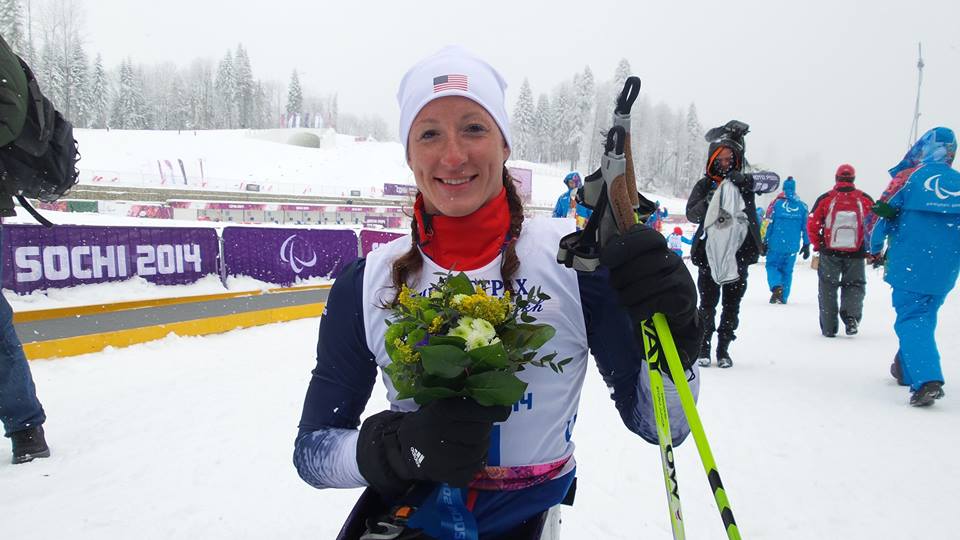
Tatyana McFadden with her sprint silver medal in Sochi. Photo BethAnn Chamberlain/U.S. Paralympics Nordic.
Oksana Masters with her bronze medal following the women’s 5 k sit-ski race, the last day of the Sochi Paralympics. (Photo Kevin Bittenbender: U.S. Paralympics Nordic)
KRASNAYA POLYANA, Russia – The U.S. Paralympic Nordic skiing team closed out the 2014 Paralympic Winter Games in Sochi in exciting fashion today as Oksana Masters (Louisville, Ky.) won bronze in the women’s 5-kilometer sit ski cross-country race at the Laura Cross-Country Ski and Biathlon Stadium.
Oksana Masters on the course of the women’s 5 k race. (Photo: Greg Rawlings/U.S. Paralympics Nordic)
Masters finished the race in 17:04.8 just behind Germany’s Andrea Eskau who won with a time of 16:08.6 and Ukraine’s Lyudmyla Pavlenko who was second with a time of 16:27.0.
It was the second medal for Masters and the third overall for the American squad. Masters won a silver medal in the 12km cross-country race earlier in the Games.
Today’s performance was the perfect end to the Games for Masters.
“I am in complete shock and amazement,” said Masters. “It has been an amazing first Paralympic Winter Games.”
The race featured 23 competitors so it was difficult to know exactly where the racers stood until the finish. This made the race particularly challenging for the competitors.
“It just goes to show that when you are out here in the middle of a race and you work hard enough and put your heart into it that you’re going to make anything you want happen,” noted Masters. “I sure as heck was fighting for every square inch of this course, so I am so lucky.”
The race also featured Tatyana McFadden (Clarksville, Md.), the only other American to medal in Nordic skiing at the Games. McFadden also raced well, finishing in seventh place with a time of 17:27.8.
For McFadden, who finished in the top 10 of each of her races here in Sochi, it was a fitting end to a great Games.
Tatyana McFadden with her sprint silver medal from earlier in the week. (Photo: BethAnn Chamberlain/U.S. Paralympics Nordic)
“It’s been a great experience and a great ride. I did really well my first Paralympic Winter Games, it’s been quite an experience,” said McFadden.
Today was a very busy day for the American squad as the team had 14 of its 16 athletes in competition today.
In the first race of the day Marine Corps veteran Omar Bermejo (Grand Rapids, Mich.) and John Oman (Barron, Wis.) finished up their first Paralympic Winter Games by finishing 29th and 32nd, respectively, in the 10km free standing cross-country race.
The American team also had two competitors in the second event of the day, the men’s 10km visually impaired cross-country race. Jake Adicoff (Sun Valley, Idaho) and his guide Reid Pletcher (Ketchum, Idaho) finished seventh with a time of 25:43.0. Navy veteran Kevin Burton (Boulder, Colo.) and his guide David Chamberlain (Wilton, Maine) finished in 15th place with a time of 28:25.8.
In the final race of the day, the men’s 10km sit cross-country race, six Americans competed.
Army veteran Andy Soule (San Antonio, Texas) once again was the top finisher for the U.S. placing ninth overall with a time of 32:56.1. He was followed closely by Lt Cmdr Dan Cnossen (Topeka, Kan.) who was 10th with a time of 33:02.0. Aaron Pike (Park Rapids, Minn.) was 14th with a time of 34:00.0. Retired Airman Sean Halsted (Spokane, Wash.) finished 16th and Army veteran Jeremy Wagner (Nanakuli, Hawaii) and Marine Corps veteran Travis Dodson (Deming, N.M.) were 22nd and 23rd, respectively.
Today’s events wrapped up a very successful Paralympic Winter Games for the U.S. Nordic skiing team. After sending six athletes to the Vancouver Winter Paralympics in 2010 and winning one medal, the program made huge strides in these Games. The team was comprised of 16 athletes, including eight current or former military members and the team won three medals.
On the women’s side, both Masters (Louisville, Ky.) and McFadden (Clarksville, Md.) found success in their first Winter Paralympic Games after already establishing themselves as elite level athletes in summer sports and shortly after taking up the sport of Nordic skiing.
Masters, who won a bronze medal in the 2012 London Paralympics in rowing, struck first for Team USA in Sochi. A day after finishing fourth in the 6km sitting biathlon and narrowly missing the podium, Masters executed a nearly flawless race in the 12km cross-country race to claim second place with a time of 39:16.0. Masters’ silver medal was the first U.S. women’s Paralympic medal in cross-country skiing in 20 years.
Fellow sit skier McFadden, who, like Masters, has only been competing in Nordic skiing for a year, continually displayed her athleticism throughout the Games. On March 12, McFadden broke through, winning a silver medal in the 1km cross country sprint in a time of 2:45.7, just 0.1 behind Norway’s Mariann Marthinsen who won gold in what was the most exciting race of the Games. For McFadden it marked the11th Paralympic medal of her career but her first ever Paralympic Winter Games medal. McFadden also has 10 Paralympic medals in track & field.
The men were led by Soule throughout these Games, who consistently found himself near the top of the leaderboard in every event he competed in. Soule recorded top five finishes in all but one of the six events he competed in in Sochi. In biathlon, Soule raced incredibly well and backed it up on the shooting range by going a perfect 50-for-50 across three races.
U.S. silver medalist Tatyana McFadden (l) and Norway’s gold medalist Mariann Marthinsen after the women’s 1 k sprint race. (Photo: Greg Rawlings/U.S. Paralympics Nordic)
In a phone interview from Sochi just before the opening of 2014 Paralympic Winter Games, Tatyana McFadden told FasterSkier, “The sprint is my favorite, I love to sprint in track and I love to sprint on skis.”
On Wednesday, the marathon-racing queen’s love of sprinting transformed to silver.
In the women’s 1-kilometer sit-ski sprint final at the Laura Cross Country Center in Krasnaya Polyana, Russia, McFadden finished second overall, just one-tenth of a second behind Norway’s gold-medal winer Mariann Marthinsen.
Second out of the start behind Germany’s Andrea Eskau, McFadden surged to first when Eskau fell. The American Winter Paralympics rookie led the race until the finish line where she was edged out by Marthinsen.
“I could not go easy, I needed to go hard from the start,” McFadden told the U.S. Olympic Committee. “I knew that they were coming and I could feel them down my neck.”
American Oksana Masters (second from l) with her silver medal from the 12 k sit-ski competition, the first of the 2014 Sochi Paralympics. In her second race on Wednesday, the 1 k sprint, she placed fourth, one second away from bronze. (Photo: U.S. Paralympics Nordic)
McFadden’s teammate, who also picked up the sport last season, Oksana Masters finished fourth, one second away from bronze.
Masters was in third until the final straightaway, where Russia’s Marta Zaynullia passed her for bronze. Eskau was disqualified due to an illegal lane change.
McFadden, 24, of Clarksville, Md., became the second U.S. women to win a Paralympic medal in cross county skiing in last 20 years. The first was Masters, who won bronze in the women’s 12 k distance race on Sunday.
After picking up skiing just over a year ago, McFadden advanced to the finals on Wednesday by placing fourth in the qualifier and second to Marthinsen in the semifinal. Masters was third in the qualifier round and second in her semi.
At age 6, McFadden was adopted from St. Petersburg, Russia, by American Deborah McFadden. Her birth mother, whom Tatyana recently met, has been in attendance at the Games to watch her compete.
Oksana Masters’ silver medal in the 12 k distance event at the 2014 Sochi Paralympics. (Photo: U.S. Paralympics Nordic)
McFadden told FasterSkier before the Games that having both her moms there with her in Sochi “has definitely been a dream of mine … Just having my whole family in the stands is going to be a huge fulfillment so I’m going to take that energy and put it into my skiing.”
Describing McFadden’s rise from a skiing newcomer to Winter Paralympic medalist, U.S. Paralympics Nordic High Performance Director John Farra wrote in an email, “It was definitely a like cramming for a final exam … like fitting in 4 years of college education into one semester, but we started with an athlete with RAW physical talent, power and strength and willingness to work.”
McFadden is a 10-time world champion and three-time Paralympic gold medalist in track racing. She’s competed at three Summer Paralympics and became the first person to win all four major marathons (Boston, London, Chicago, and New York) in a single season. In the 12 k distance event on Saturday, she placed fifth in her first Winter Paralympics race.
“It was definitely a like cramming for a final exam … but we started with an athlete with RAW physical talent, power and strength and willingness to work.” — U.S. High Performance Director John Farra on Tatyana McFadden
“We kept her on snow as much as possible from the start of the season until Sochi … and today it all came together for her,” Farra explained.
A packed cross country stadium at the 2014 Winter Paralympic Games sprint races. (Photo U.S. Paralympics Nordic)
In the men’s sprint final Andy Soule placed fifth and Dan Cnossen took sixth. Sochi roommates, Soule and Cnossen were 6.4 and 8.3 seconds back from bronze, respectively.
“My performances here have been very good for me, every race has been one of the very best of my career,” wrote Soule, who won bronze in biathlon at the 2010 Paralympics.
Soule’s best race, the distance biathlon, will be held Friday March 14th. “I feel very confident about the final biathlon event. The long distance biathlon is a very good event for me.” Soule noted.
Cnossen, a newcomer to the Paralympic Games, described his races in an e-mail, ” [In the semi final] I came around that first sharp right turn wide … then drafted off two Russians and came in third. In the final, I stumbled at the start … and was never able to reel in the other competitors.”
U.S. Paralympics silver medalist Tatyana McFadden with her first medal of the Winter Games in Sochi, Russia, on Wednesday after placing second in the 1 k sit-ski sprint. (Photo: John Farra/U.S. Paralympics Nordic)
U.S. Winter Paralympics rookie Oksana Masters on her way to a silver medal in the women’s 12 k sit-ski race at the 2014 Paralympic Games in Sochi, Russia. (Photo: U.S. Paralympics Nordic Program)
Oksana Masters won silver in the women’s sit-ski 12-kilometer cross-country race on Sunday, the second day of competition at the 2014 Paralympics in Sochi, Russia.
The medal ends a 20-year-medal drought for U.S. women’s Paralympic cross-country skiing. According to a U.S. Paralympics press release, Michelle Drolet last claimed a medal for the U.S. in cross-country, taking bronze in the women’s visually impaired 5 k freestyle at the 1994 Lillehammer Paralympics. No woman has ever won silver — until Masters, a 24-year-old Ukrainian-born American Paralympic rower (originally) from Louisville, Kentucky. At the 2012 London Summer Paralympics, she earned the first U.S. medal in trunk-and-arms mixed double scull.
In a press release, Masters credited her rowing background for her early success in skiing after picking up the snow sport last season.
“I really have to thank my training from rowing because it prepared me well for skiing,” she said. “I am so happy right now.”
Masters narrowly missed the podium on Saturday in her first Paralympic competition, placing fourth in the women’s 6 k biathlon race.
“[Today was] a fabulous day for us again!” said U.S. Paralympics Nordic High Performance Director John Farra.
Wheelchair racing champion Tatyana McFadden, in her Winter Paralympic debut, placed fifth in Sunday’s sit-ski race. Her previous best at this distance was ninth at the International Paralympic Committee (IPC) World Cup in Oberstdorf, Germany, earlier this season.
In an interview with FasterSkier before the race McFadden said she found the 12 k distance to be the hardest. “It takes takes more technique and technique plays in where you put your power in the snow,” she said. “I’m still learning and different snow conditions and the conditions are constantly changing.”
McFadden had difficulty with cornering in her distance race, falling three times. On her Facebook page, McFadden wrote, “Came in 5th place for my first winter games race in the 12k. Not too bad for falling 3x…need to get better at the turns. Exhausted but happy.”
Farra said McFadden’s technique was especially smooth on Sunday. “Great technique on the trails today,” he said. “A few crashes, but she is learning everyday … great day for her!”
Andy Soule following his fifth place finish in the men’s 15 K 12 race at 2014 Winter Paralympic Games in Sochi. (Photo U.S. Paralympics Nordic Program)
In the men’s 15 k distance race, Andy Soule placed fifth and Sean Halsted finished ninth for the U.S.
“Andy is a pro,” Farra said. “He knew what he needed to do … he has stuck with his plan and seems to be on his best form … maybe ever.
“It appears that some of our athletes are hitting their stride — peaking if you will — at the right moment, and that was always the plan,” he added. “I am happy to see it. Hoping we will see a few of the others hitting theirs before we leave Sochi.”
Returning 2010 Paralympic bronze medalist Andy Soule racing at the 2014 US national championships. (Photo Victor Henderson)
At the 2014 Winter Paralympics from March 7 to 16 in Sochi, Russia, nordic skiing and biathlon will account for more that half of the available medals.
How will the United States fare in the medal chase?
Downplaying expectations in an interview with FasterSkier, John Farra, the high-performance director of U.S. Paralympics Nordic, didn’t rule out a surprise or two from his team.
“While we are not expected to win any medals … we are spending a lot of time and effort to find that extra half percent or 1 percent that gets [our athletes] into the top three to steal a medal from the Russians or the Ukrainians.”
The Russians, in particular, have been dominant in World Cup sit-ski competitions this season. In December in Canmore, Alberta, both the Russian and U.S. teams showed up in full force to prepare for Sochi.
The Russians won most of the medals available and swept several podiums, while the U.S. men missed out on the podium.
“They [the Russians] really came to ready to race,” Farra said.
Sights on Biathlon
For the men’s team, biathlon looks to be a place where the U.S. program has an opportunity for success. At the Vancouver 2010 Winter Games, Army veteran Andy Soule earned the United States’ first-ever Olympic or Paralympic medal in biathlon, finishing third.
Soule returns to this year’s team and told FasterSkier, “I’m probably better on the longer races, the biathlon long course (15 Kilometer) is my best race, not because of the skiing, but because the shooting penalty is considerably larger for that event.”
Regarding the technical aspect of biathlon, Soule said, “I’m definitely working on a being more aggressive. I’ve been a decent shooter for some time and I’m working on cutting down on my range times.”
U.S. Paralympics Biathlon coach Rob Rosser said the team has a good chance to score an upset in biathlon.
“In cross-country skiing, it can takes years to develop and significantly change your level of fitness,” Rosser said. “That’s why biathlon is so interesting as a sport, so many things can happen with the shooting that the outcomes are much less predictable.”
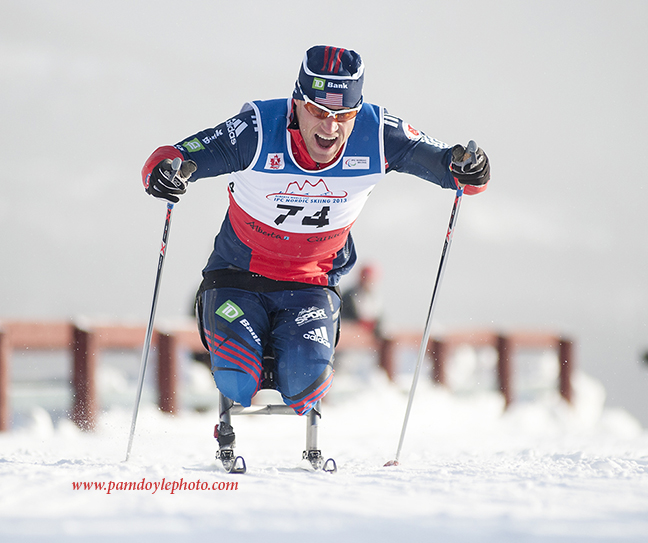
Dan Cnossen racing at the 2013 IPC World Cup in Canmore, Canada, in December. (Photo: Pam Doyle)
A leading member of the team after just a few seasons in the sport, Lt. Dan Cnossen edged Soule at U.S. nationals in January, beating Soule by 2.8 seconds in the 7.5 k race, after Soule missed a shot on his final round in the range.
Cnossen will be competing at his first Paralympics this month.
This year Cnossen has focused on upping his game in biathlon.
“I’ve made some changes in my training for the biathlon,” Cnossen said at the beginning of the season. “I had some troubles with my rifle that we’ve ironed out, so I think you’ll see some improved hit rates.”
At nationals, the sit-ski sprint lived up to it’s reputation where anything can happen. A relative newcomer, Jeremy Wagner became a national champion with his first national title, topping 2010 Paralympian Sean Halsted.
U.S. Women’s Prospects
The U.S. women’s team makes up four of the 18 athletes on the team, but they have delivered the most impressive results and generated the most media buzz this Olympic year.
Oksana Masters is the top U.S. contender for a medal based on her World Cup results this season.
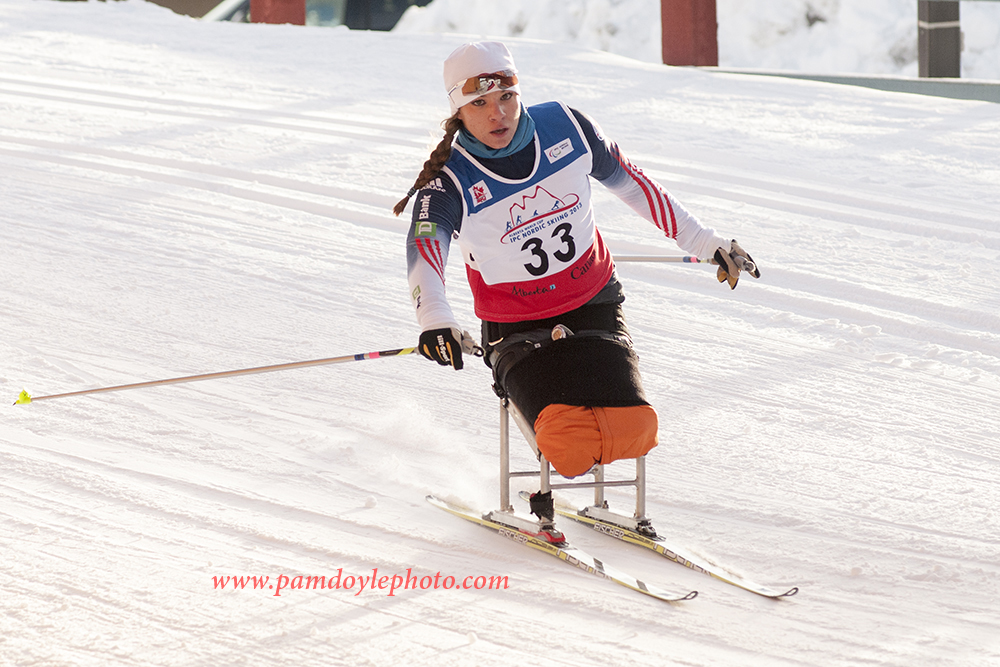
Oksana Masters racing in the IPC World Cup Canmore sprint race. (Photo: Pam Doyle)
Recruited to skiing based on her background as a bronze-medal winning Paralympic rower, Masters has shown remarkable adeptness at learning a sport she first tried two years ago.
“She’s fearless, so she ended up crashing a lot early on because she just wanted to go fast,” Farra explained. “She didn’t know how to control the [sit-ski] to be able to turn it left or right to avoid the tree, and often times she’d connect with the tree or crash and break a pole.”
He laughed.
“She was a bit of a … well, you know, it was pretty funny actually in some ways. As long as she wasn’t getting hurt it was fun to watch.”
In an email to FasterSkier, Masters cited her inexperience with skiing and her surprise at her success. About her Canmore medal, she said, “I knew that just about every other woman skier out there had years of experience on me and I am still a newbie. I went into the the race with the mind set of I’m not going to be top 5 but I wanted to try my darn hardest to make it in the top 10.”
As for her first World Cup podium: “I didn’t know instantly that I got third. I was shocked and thought it was a mistake at first.”
So is she getting more comfortable and does she believe she can compete with the best in the world? Farra thought so.
“I think it is fair to say she is starting to believe it, yes. She is so competitive and really was pumped to get on the podium in Oberstdorf. She has really refined her technique to a very smooth, powerful and efficient motion. … She will get there.”
Masters has garnered national media attention since her appearance in the 2012 London Paralympic Games. Her life story as a Ukrainian orphan adopted by her U.S. mother has been featured in various media forms, including Sports Illustrated and Southwest Airlines’ in-flight magazine.
She was named one of the “11 hottest paralympic athletes” by MSN “Now.” She was named one of ten U.S. athletes to watch by The Guardian.
Apple featured her in a video, “Making a difference: one app at a time”, where she demonstrated how she uses an iOS app to control her prosthetic legs and put on high heeled shoes.
Perhaps most famously, Masters posed nude for ESPN’s 2012 “Bodies We Want” issue.
Tatyana McFadden racing at US nationals Soldier Hollow. (Photo: Victor Henderson)
As the U.S. heads for Sochi, world-class wheelchair racing champion and summer Paralympic cross-over athlete, Tatyana McFadden is another woman to watch. McFadden and Kikkan Randall were featured together in BP television ads during NBC’s coverage of the Winter Olympic Games.
Apart from her celebrity status as the most decorated U.S. athlete going to Sochi, McFadden is candid about her newness to skiing.
“For track, since I’ve been to other races and other Paralympics … I know what to expect between events and the transitions and about getting on the bus and off the bus and into the venue and what its going to feel like,” McFadden said. “For Sochi, I don’t know any of that. I have no idea because everything is so new for me.”
McFadden’s ski results have steadily improved as she gains experience. She has cracked the top 10 three times in IPC world cup competition this season, finishing ninth in the 12 k and tenth in the sprint at Oberstdorf. She placed seventh in the sprint at Canmore, narrowly missing the six-woman final round.
McFadden and her London 2012 Paralympic teammate Jessica Long are both Russian orphans who were adopted and brought to the United States by American families. Both have been outspoken against Russia president Vladimir Putin’s 2012 law banning adoption of Russian children by U.S. citizens.
McFadden said she was excited to return to Russia for the Sochi Paralympics.
“It’s part of my culture, it’s part of who I am, and that will never be apart from me,” she said. “But I’m going to be going and competing for the United States of America.”
COLORADO SPRINGS – U.S. Paralympics, a division of the United States Olympic Committee, announced Wednesday that 16 Nordic skiing athletes and two guides have been nominated to the 2014 U.S. Paralympic Team to compete in biathlon and cross-country skiing at the 2014 Paralympic Winter Games in Sochi, Russia, March 7-16. The nominations are subject to approval of the USOC.
After sending six athletes to the Vancouver 2010 Paralympic Winter Games, Team USA’s Nordic roster will nearly triple in size with 12 men, four women and two guides for visually impaired athletes.
“We are thrilled to bring such a large team of athletes and professional staff to Sochi,” said John Farra, high performance director for U.S. Paralympics Nordic skiing. “We have made a concerted effort to introduce more athletes to the sports of cross-country skiing and biathlon over the past two-and-a-half seasons, and this growth is a sign of our success in keeping many of them excited about our Nordic sports and working toward becoming internationally competitive.
“In addition to building the numbers with new developing athletes, we have also focused many resources to help our top athletes get close to hitting the podium. Great focus was given towards equipment design for sit skiers, race ski selection and preparation in partnership with the U.S. Biathlon Association, and access to the best training camps and competitions around the world.”
2014 U.S. Paralympic Nordic Team Nominees: (Subject to USOC approval)
Omar Bermejo (Grand Rapids, Mich.)
Kevin Burton (Boulder, Colo.)
Lt. Cmdr. Dan Cnossen (Topeka, Kan.)
Travis Dodson (Deming, N.M.)
Sean Halsted (Spokane, Wash.)
John Oman (Rice Lake, Wis.)
Augusto Perez (East Syracuse, N.Y.)
Aaron Pike (Park Rapids, Minn.)
Bryan Price (Belton, Mo.)
Andy Soule (San Antonio, Texas)
Jeremy Wagner (Nanakuli, Hawaii)
Guides
David Chamberlain (Wilton, Maine)
Reid Pletcher (Ketchum, Idaho)
Three athletes return from the Vancouver 2010 Paralympic Winter Games, including Andy Soule (San Antonio, Texas) who won the first-ever U.S. medal in the Olympic or Paralympic Winter Games in the biathlon with his bronze in the men’s 2.4-kilometer race. Soule will be joined by his 2010 teammates Sean Halsted (Spokane, Wash.) and Monica Bascio (Evergreen, Colo.).
Bascio boasts the most Winter Games experience, with Sochi marking her third Winter Games and fourth Games overall. Having just recently retired from cycling, Bascio is one of three athletes who medaled at the London 2012 Paralympic Games. Other cross-over athletes include Tatyana McFadden (Clarksville, Md.) and Oksana Masters (Louisville, Ky.). McFadden is a 10-time Paralympic medalist in track and field, while Masters partnered with Rob Jones to become the first Americans to win a Paralympic rowing medal in the trunk and arms mixed double sculls event with their third place finish.
More than half of the athletes nominated to the men’s team are military veterans: Omar Bermejo (Marines/Grand Rapids, Mich.), Kevin Burton (Navy/Boulder, Colo.), Travis Dodson (Marines/Deming, N.M.), Halsted (Air Force/Spokane, Wash.), Bryan Price (Army/ Belton, Mo.), Soule (Army) and Jeremy Wagner (Army Reserves/Nanakuli, Hawaii). Lieutenant Commander Dan Cnossen (Topeka, Kan.) is the only active duty member of the team as he currently serves with the United States Navy.
Competition for Nordic skiing will take place March 8-16 with March 13 scheduled as an off-day. Nordic skiing includes both biathlon and cross-country skiing, both of which have three events contested at the Games, in addition to two cross-country relays.
The majority of the U.S. Paralympic Nordic Skiing Team will compete in both sports. A list of events entered by each athlete will be available in February.
The USOC and NBC Olympics have partnered to provide an unprecedented level of coverage to the Paralympic Winter Games. NBC and NBC Sports Network will combine to air 50 hours of television, starting on March 7 with the Opening Ceremony. It will be followed by daily coverage of all five Paralympic sports in the Sochi program, before the Games’ Closing Ceremony is broadcast on March 16. In addition to the unprecedented U.S. television coverage, the USOC and streaming sponsors BMW, BP, Citi, Liberty Mutual Insurance, Procter & Gamble and The Hartford will provide live online coverage at TeamUSA.org.
U.S. Paralympic Team nominees for alpine skiing, biathlon, cross-country skiing, sled hockey, snowboarding and wheelchair curling will be finalized by the USOC no later than Feb. 21, the deadline to submit Sochi 2014 Paralympic Winter Games delegation rosters to the International Paralympic Committee. Selection procedures and dates can be found at TeamUSA.org/ParalympicGames/.
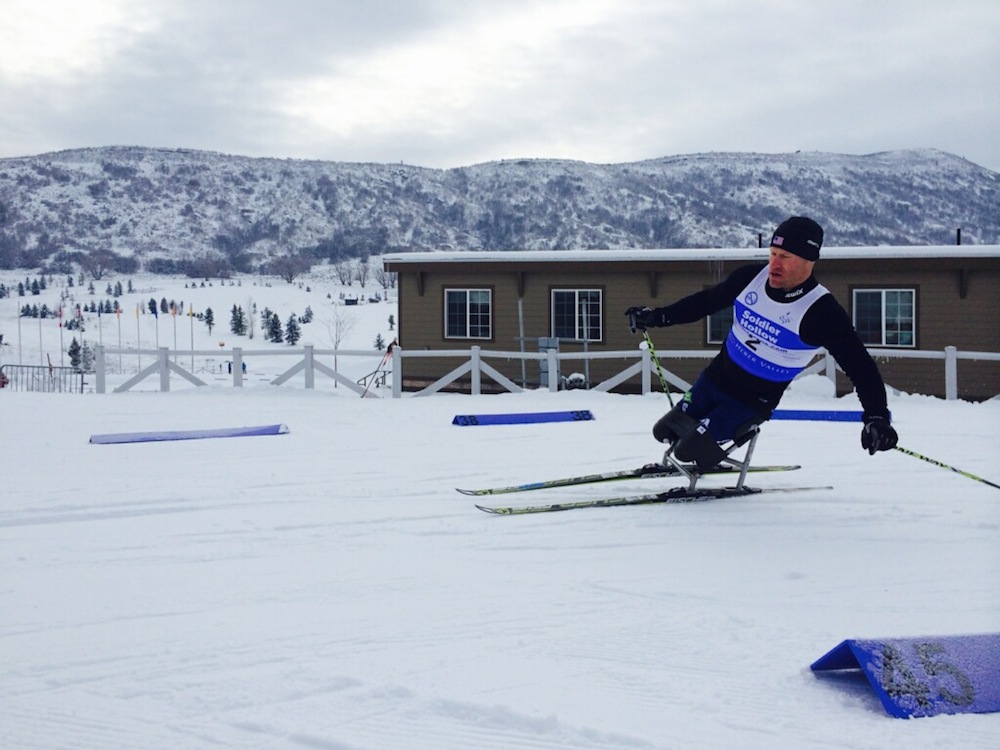
Lt. Dan Cnossen (U.S. Paralympics) out of the start in Tuesday’s 10 k sit-ski at 2014 U.S. Paralympics Nordic Skiing Nationals at Soldier Hollow in Midway, Utah. He won by 18.2 seconds in 32:21.9.
FasterSkier’s coverage of the 2014 U.S. Cross Country Championships is brought to you through the generous support of The Memory Clinic in Bennington, Vt.
MIDWAY, Utah — Rounding Soldier Hollow’s 2.5-kilometer sit-ski course on Tuesday, Oksana Masters and Lt. Dan Cnossen muscled through methodically, powerfully.
Even with two victories apiece behind them from earlier in the week at U.S. Paralympics Nordic Skiing Nationals, these two had business to tend to: take care of some optimal conditions in Utah, then get ready for the Jan. 16-19 World Cup in Oberstdorf, Germany.
Sochi was undoubtedly on their minds, with the 2014 Winter Paralympics exactly 60 days away from Tuesday’s 5- and 10-kilometer sit-ski races, but neither Masters or Cnossen were getting ahead of themselves.
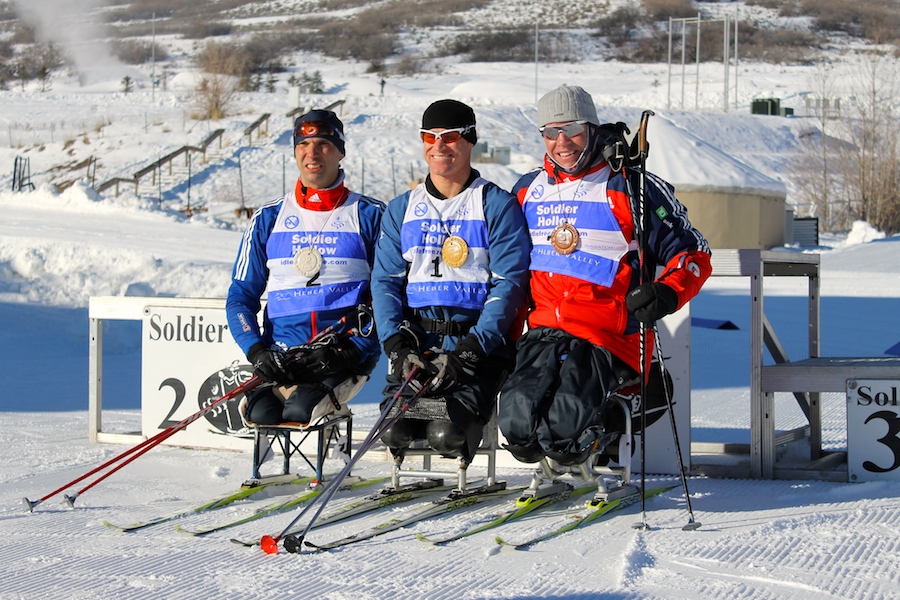
Men’s 10 k sit-ski podium at 2014 U.S. Paralympics Nordic Nationals on Tuesday, with winner Dan Cnosson (c), who won three out of four events this week, Andy Soule (l) in second, and Sean Halsted (r) in third.
“I’m just gonna focus on the next step which is the World Cup right now and then being named to the team hopefully, and go from there,” said Cnossen, 33, after winning his third out of four races at nationals in 32:21.9 minutes, 18.2 seconds ahead of U.S. Paralympics teammate Andy Soule (Army) in second.
A Navy SEAL who lost his legs in an explosion in Afghanistan in 2009, Cnossen is one of the team’s frontrunners in the leadup to Sochi, yet he was looking forward to seeing how he fares on internationally before turning his focus toward what would be his first Paralympics.
Last year, he won silver in the first race of the International Paralympic Committee (IPC) Nordic Skiing World Cup in Cable, Wis., in the 10 k. At the IPC World Cup in Canmore, Alberta, from Dec. 9-16, Cnossen notched a couple top 10s and put himself 11th in the Cross-Country World Cup standings. As of Dec. 15, he was 14th on the Biathlon World Cup list.
In Soldier Hollow from Jan. 2-6, Cnossen opened with a victory in the 7.5 k biathlon race, then went on to win the 15 k distance race, place fourth in the sprint, and ultimately finish with a 10 k title.
“Had some good races; the courses were awesome,” Cnossen said. “They’re really similar to what we’ll be experiencing in Sochi, definitely the altitude is.”
While the temperature was a little cooler than what’s expected in Sochi, with the men and women racing on a just-above-freezing morning on Tuesday, Cnossen said the slower snow worked to his favor.
Oksana Masters (U.S. Paralympics) en route to winning Tuesday’s 5 k sit-ski at 2014 U.S. Paralympics Nordic Skiing Nationals at Soldier Hollow in Midway, Utah.
A Paralympic bronze medalist in rowing, Masters, 24, raced to her third championship of the week as well, winning the women’s 5 k in 18:13.2, about 2 1/2 minutes faster than Monica Bascio in second.
In Canmore, Masters opened with a bronze in the World Cup 5 k and placed fourth in the sprint. She finished the series ranking fourth in the Cross-Country World Cup and eighth in biathlon.
“Hopefully it continues,” Masters said on Tuesday. “Last year I kind of had an injury going into it starting out and also lack of on-snow experience. I was on snow for a total of two days before going out here last year to nationals … I think I was just trying to hammer it too hard instead of try to slow down and learn the technique to it.”
With her rib injury healed and breathing easier at some 5,500 feet above sea level, Masters was looking forward to returning to Germany after training in the Oberhof ski tunnel in October.
“I love the competitiveness; I really like the fact that it’s something that I can grow myself as an athlete and I can broaden that spectrum of my athleticism,” the U.S. Development Team skier said. “The team camaraderie is really cool. Everyone, the girls, the guys, have their unique personalities and it wouldn’t be the same team without one person.”
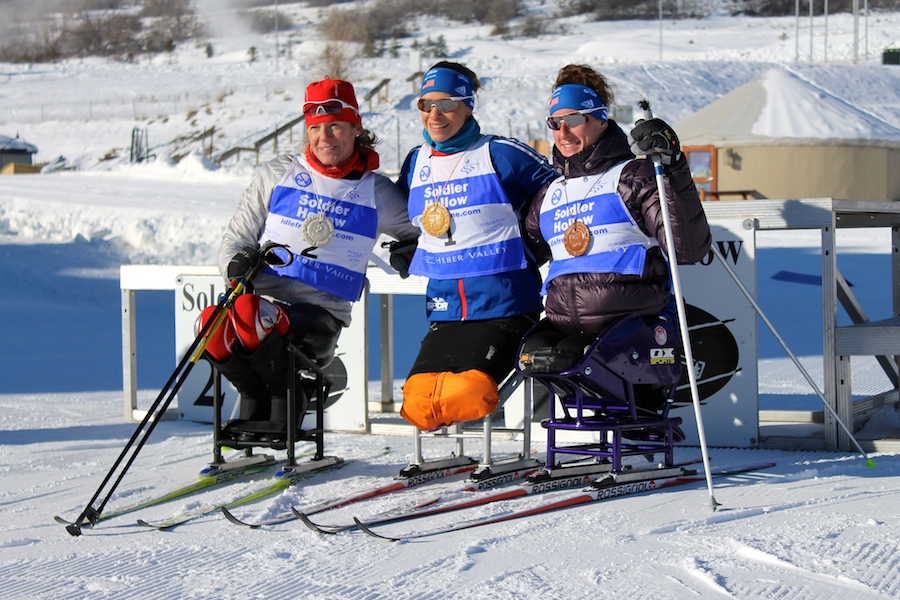
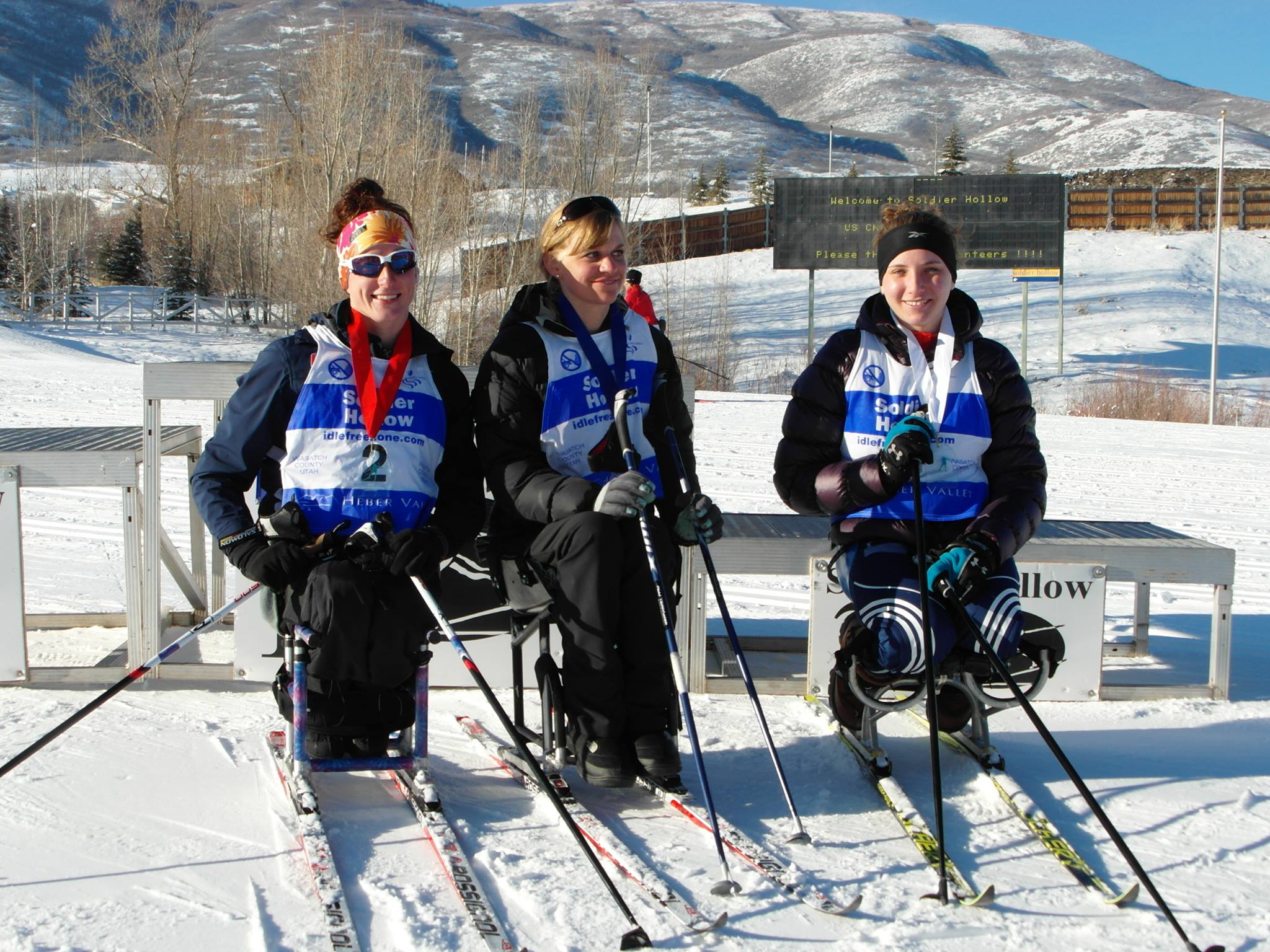
Women’s 5 k sit-ski podium at 2014 U.S. Paralympics Nordic Nationals, with winner Oksana Masters (c), who won three of four events this week, Monica Bascio (l) in second, and Tatyana McFadden (r) in third.
As for the transition from rowing, Masters said the pulling motion is similar, but the winter weather had been a tough adjustment.
“I think it helped to come from a sport background where it was an endurance sport also along with strength,” she said. “My biggest challenge from rowing would be the variety of an 800-meter sprint to a 12 1/2 k or 10 k, so I have to build that up.”
As for her Winter Paralympics aspirations, Masters said set on not giving up.
“I’m a perfectionist, and I strive to be the best I can in whatever I do,” she said. “I’m not going to start something and just stop it.”
The men’s 10 k runner-up, Soule called this year’s nationals “a good race experience.”
“Nationals always is a good little prep period before going over to compete World Cup,” he said.
Sean Halsted (Navy) placed third after miscounting his laps and coming into the finish one loop too soon. He had to turn around and head backward down the finishing straight to get to the lap lane, ultimately finishing 50 seconds behind Soule.
“I didn’t realize we were on the course that we were on I thought we were going three laps of 3 k,” Halsted said with a laugh.
Either way, the national-team member said nationals were a good tuneup before they resume international racing.
“It’s all about prep trying to get that race experience in,” Halsted said. “It’s not just, ‘Hey you might be first or second,’ well, you don’t hold on to that. … You use that to motivate you for when you’re going on the international [scene].”
In the women’s race, Tatyana McFadden placed third, about 45 seconds after Bascio, and Beth Requist was fourth.
Tatyana McFadden competing at one of her first international cross-country ski races at the 2013 IPC World Cup in Cable, Wis.(Photo: James Netz)
Tatyana McFadden is coming off an impressive couple of years.
Winning the New York City Marathon last month, the 24-year-old University of Illinois student became the first person to win the Chicago, Boston, London and New York City marathons – the elusive Grand Slam – in a single year. In July, McFadden became the first athlete to win six gold medals at the International Paralympic Committee (IPC) Athletics World Championships in Lyon, France. No stranger to elite competition, the three-time Paralympian holds 10 medals in wheelchair racing, three of them gold from the 2012 London Paralympic Games.
Tatyana McFadden at the 2013 U.S. Adaptive National Championships at Soldier Hollow in Midway, Utah, where McFadden won the sit-ski sprint. (Courtesy photo)
Now with her track and marathon seasons over for the year and with the 2014 Winter Paralympics in Sochi, Russia, on the horizon, McFadden is days away from beginning her second season as a nordic skier at the IPC World Cup in Canmore, Alberta, starting Dec. 9.
John Farra, the U.S. Paralympics Nordic high-performance director, tells the story of how McFadden came to his sport.
“About a year and a half ago I got a text message at midnight from the [U.S. Paralympics] alpine director [Kevin Jardine] saying, ‘Hey, I’m at the ESPYs and Tatyana McFadden wants to be a nordic skier!’ ” Farra said.
According to the Chicago Tribune, Jardine reportedly told her, “Are you kidding me? No one wants to do nordic. Do you know how hard that is?”
“I guess you don’t understand anything about me,” McFadden replied.
“She contacted me and said ‘How can I get into the skiing thing?’ ” Farra explained. “So she comes to the national championships and won the sprint race and was very competitive in the others. I said, ‘You should come to the World Cup in Cable, Wisconsin. There may be time for you to make the Paralympic Games.’ So she did and she made the national team in just one race. She’s just so frickin’ strong.”
In a phone interview last week, McFadden described her busy upcoming month, which starts this week in Canmore.
“I’ll be there a few days before and I’ll do a competition, then I literally fly back [to Illinois], take a final, graduate, move out, then I head home for Christmas,” she said.
Majoring in human development and family studies, she will give the graduation speech to her class.
Born in St. Petersburg, Russia, with spina bifida, a birth defect that paralyzed her from the waist down, McFadden spent her first six years in an orphanage walking on her hands. A disabilities commissioner for the US Health Department, Deborah McFadden visited the orphanage and adopted Tatyana before raising her in Baltimore. Since then, Tatyana has been an activist on several fronts, advocating against a 2012 Russian law prohibiting Americans from adopting Russian children. She was also behind the Maryland Athletics Equity for Students with Disabilities Act, which was passed in 2010.
McFadden racing at the 2013 IPC Athletics World Championships in Lyon, France, where she won an unprecedented six gold medals. (Courtesy photo)
For now, she’s focused on getting back to Russia, this time as a Winter Paralympian. To manage the transition from wheelchair racing to skiing, McFadden said she’s been spending a lot of time in the gym on the SkiErg and doing interval training.
One of her biggest challenges has been learning how to handle the cold. McFadden experienced some issues with frostbite while training, but her enthusiasm toward the sport has made up for the hardships. Nicknamed “The Beast,” it’s no surprise when McFadden says, “I love to train really hard.”
She is also excited to get on snow in her new sit-ski. At last season’s U.S. Adaptive Ski Championships at Soldier Hollow in Midway, Utah, McFadden won the sit-ski sprint in a borrowed, ill-fitting sled.
“[The ski] was too big for me,” she said. “I’m a size 10 1/2 and I was riding in a size 14; it was way too big. I was sitting too high which really threw off my balance. I didn’t have control going down the hill too well and I really wanted to be shorter.”
Her new sit ski is designed to put her in a more-forward position, similar to her racing wheelchair. McFadden said it feels “a lot more natural and transitions well from wheelchair racing. … [It’s] literally just the bucket and it’s an absolutely beautiful, beautiful bucket. It’s extremely light and it’s purple, my favorite color. I’m really excited to take it out again.”
Starting in Canmore, McFadden will have plenty of opportunity to get used to her new setup. At the end of the month, she’ll head to Utah for her second nordic nationals in early January, once again at Soldier Hollow. Then she’ll head to Germany for the IPC World Cup in Oberstdorf from Jan. 16-19, and after that, Winter Park, Colo., for more altitude training.
Tatayan McFadden shows off her new sit ski in a promotional photo from her sponsor BP. (Photo: BP Team USA/Facebook)
“As soon as I graduate I’ll be on snow all the way up to Sochi,” McFadden said.
According to Farra, working with her on snow will the give the U.S. Paralympics Nordic coaches a chance to help her improve her technique.
“She’s so strong and unbelievably fit,” Farra said. “So she’s got the most important part of being a nordic skier down, and you can’t fake that.”
McFadden has no illusions about the challenges ahead of her. “I am really new to skiing,” she said. “My goals are, first of all, to make the team and head over. Then I’ll take it event by event. My goal [in Sochi] is to make the finals.”
As for her podium potential, Farra said, “We really don’t know. She’s fired up about it. She’ll have a day or two to train in Canmore before the races and she’ll spend the rest of the winter skiing with us trying to get ready for Sochi to see what she can do there.”
While Farra can’t predict McFadden’s performance in her new sport, he knows what kind of attention she can bring to the developing sport.
“When the Games are on, you are going to see Kikkan Randall skiing in a BP commercial and you’re going to see Tatyana McFadden skiing in a sit-ski on these commercials that are run all the time throughout the winter,” he said. In partnership with the U.S. Olympic Committee, NBC has committed to 50 hours of coverage for the 2014 Paralympics.
Thinking about her first Winter Paralympics, McFadden isn’t sure what to expect.
Tatayan McFadden shows off her new sit ski in a promotional photo from her sponsor BP. (Photo: BP Team USA/Facebook)
“For track, since I’ve been to other races and other Paralympics… I know what to expect between events and the transitions and about getting on the bus and off the bus and into the venue and what its going to feel like,” she said. “For Sochi, I don’t know any of that. I have no idea because everything is so new for me. I have to just be relaxed and go with the transitions and then when it comes time for me to put my skis on the snow, I have to remember everything I’ve learned … and ski as fast as I can and hopefully make people proud.”
Among the new experiences awaiting McFadden is biathlon racing. Due to a relatively small pool of athletes, adaptive skiers are encouraged to compete in both nordic and biathlon races. Brand new to skiing at nationals last year, she didn’t race biathlon. “I told John [Farra] that I wanted to focus on skiing,” McFadden said.
However, she did get introduced to the sport and practiced a bit on the shooting range. Despite some archery experience, McFadden said she never shot a gun before trying biathlon last January.
“It’s going to be a lot of fun,” she said. “I’ll shoot the targets as best I can, and if I miss them all, I know what it feels like to do a lot of laps. In track, doing [laps] is just a normal day for me. I’m not really too concerned about it. What is really different about biathlon is that I’m not used to stopping in a race. I’m used to going hard from start to finish and not having to slow down and take a deep breath and try to hit the targets.”
When asked what it will mean to her to return to Russia, she said she’s “really excited.”
“It’s part of my culture, it’s part of who I am, and that will never be apart from me,” she added. “But I’m going to be going and competing for the United States of America.”
Comparing her two “home” nations, she says the Russians are behind the times when it comes to accepting people with disabilities.
“[In the U.S.], you can get jobs and you can live a normal life,” she said. “That’s not really the case for Russia. Some places are not accessible, in America places have to be accessible. Just seeing athletes come in and seeing how strong the athletes are and seeing them compete. I think its going to be really good for them.”
Now a U.S. Paralympics National Team member, Tatyana McFadden (l) after placing second in the women’s 5 k at 2013 U.S. Adaptive Championships last January. Beth Requist (c) won it in 25:13.9, and Kristy Vaughn (U.S. Paralympics Development Team) was third (+2:34.4).
Canadian Para-Nordic World Cup skiers Colette Bourgonje and Brian McKeever are FasterSkier’s Adaptive Skiers of the Year. (Photos: James Netz/CCC & Gerry Furseth)
Brian McKeever is one of those guys that seem to keep getting better with time. At 33, Canada’s Para-Nordic World Cup visually impaired skier once again dominated the International Paralympic Committee (IPC) World Cup scene last season, winning every IPC cross-country event he participated in.
With guide Erik Carleton, McKeever tallied two golds at 2013 World Championships in Solleftea, Sweden, and two more at World Cup Finals in Sochi, Russia.
“I don’t think the guides get nearly as much recognition as they should,” McKeever told Cross Country Canada in February. “It is tough being the guide because you are out front and not skiing your own race. … When I need him to hold off he has to, and when I need him to increase the pace he needs to do that as well.”
McKeever (r) and guide Erik Carleton celebrate their 2011 World Championships gold. (Photo: IPC)
Childhood friends from Calgary, the duo didn’t waste any time getting from their last World Cup Finals race in Sochi to Whistler, British Columbia. There, McKeever captured his first national title in the 10-kilometer freestyle on March 24, just four days after racing in Russia.
“You never really know how you are going to feel after getting off the plane from Russia,” McKeever told FasterSkier after arriving two days earlier. “First national championship win in my career, I am really happy about that.”
To start the season, both McKeever and Carleton individually qualified for the able-bodied World Cup races in Canmore, Alberta. They decided to skip the opening IPC World Cups to compete in Canmore, where McKeever notched a career-best 38th in the skiathlon in mid-December.
In February, the 10-time Paralympic medalist double poled the entire Canadian Birkebeiner 55 k classic in Edmonton, Alberta, and won by nearly three minutes. Carleton, 35, placed second.
McKeever took on the Vasaloppet 90 k classic in early March for the second-straight year, finishing 45th overall – a vast improvement from 83rd in 2012.
Another 10-time Paralympic medalist, Canada’s veteran sit-skier Colette Bourgonje, 51, isn’t showing signs of slowing down before the 2014 Winter Games (which will be her seventh Paralympics). In January, she raced to silver and bronze at the IPC World Cup in Cable, Wis., and went on to place eighth at World Championships and sixth at World Cup Finals. Bourgonje landed fifth overall in the IPC World Cup.
Honorable Mention:
Canadian Para-Nordic World Cup member Mark Arendz (c) tops the podium for the first time at 2013 IPC Biathlon World Championships in Solleftea, Sweden. (Photo: CCC)
Further proving the depth of Canada’s Para-Nordic team, 22-year-old Mark Arendz won his first IPC Biathlon World Championships gold in February in the 7.5 k sprint. Also in Solleftea, Arendz claimed bronze in the 12.5 and 15 k distance races and finished eighth overall in the World Cup.
After trying out sit skiing for the first time at U.S. Nationals in January, Tatyana McFadden went on to represent the U.S. at the IPC World Cup in Cable, where she finished right behind Bourgonje in two races in fourth and fifth, respectively. Her results were hardly a surprise; the 24-year-old University of Illinois student has 10 Paralympic medals in wheelchair racing and at least six marathon titles (including one in Boston and other in London this month). Despite a late start, she ranked 14th in the overall World Cup.
Dan Cnossen (U.S. Paralympics) leading the men’s 15 k sit ski at U.S. Adaptive Championships on Saturday at Soldier Hollow in Midway, Utah.
FasterSkier’s coverage of the 2013 US Cross Country Championships is brought to you through the generous support of The Memory Clinic in Bennington, Vt.
MIDWAY, Utah – They couldn’t have finished much more than 20 minutes earlier, yet there they were – Lt. Dan Cnossen and Oksana Masters – ready to duke it out at Soldier Hollow. The two lined up at one end of a set of tracks in the stadium, poles high and waiting for the go-ahead from their coach.
The more seasoned of the two, Cnossen, a U.S. Navy SEAL, double poled alongside Masters, a Ukranian-born rower who recently won bronze for the U.S. at the London Paralympics. The 23-year-old from Louisville, Ky., started skiing seven days ago.
Dan Cnossen (c), Oksana Masters (second from r) and Tatyana McFadden talk to their coaches, including U.S. Paralympics high-performance director John Farra (front) after their distance races at U.S. nationals on Saturday in Soldier Hollow.
Yet after her first race – in which she placed fourth in the women’s 9 k sit ski at U.S. Adaptive Championships on Saturday – Masters wanted more. She wanted to learn some technique.
The men’s 15 k champion who picked up the sport two years ago, Cnossen took it upon himself to help her, and so the two did pickups to determine inefficiencies in her double pole. With a similar injury after losing use of their legs, Cnossen – originally from Topeka, Kan. – could relate.
“We’ve got some really talented new athletes that have barely been on snow so if I can give them advice and help build the team then that’s the least I can do,” said Cnossen, one of six U.S. Paralympics Nordic team members.
Fresh off a trip to Vuokatti, Finland, where he notched fifth and ninth at the opening International Paralympic Committee (IPC) World Cups, Cnossen defended his distance title on Saturday (he won the abbreviated 12.5 k course at nationals last year in Rumford, Maine).
“I’ve been working hard, but so has everybody else,” Cnossen said after rounding the five-lap course fastest in 45:43.4.
Teammate Andy Soule (Army) was 2:20.9 back in second. The two were the lone national team members sent to Finland.
Cnossen said it was advantageous to race competitive international skiers early in the season, before nationals. It was even better to get out of the darkness in Finland and into the Utah sun. Saturday’s race was pushed back from its original 8:30 a.m. start to 2 p.m. Saturday to allow temperatures to warm up. By Saturday afternoon, it was comfortably in the 20s.
Dan Cnossen (Navy) goes out hard from the start of the 15 k sit ski at U.S. Adaptive Championships in Soldier Hollow on Saturday.
Cnossen said he was simply grateful to put on a bib and race, and went out hard from the start.
“I think I went a little too hard the first lap because the second lap I thought, ‘Oh man, I have four more to go,’ ” he said. “But I held on and then the fifth lap, I always have energy because I have a good kick normally. I prefer to go out a little on the aggressive side and be in the race and not lose time. I think it’s easier to be in the race and stay in the race then be out of the race and get back into it.”
Pushing from start to finish and skiing outside the tracks at times in the warming snow, Cnossen sealed another victory, which he was happy about. But he still didn’t consider himself a veteran. It was hard to with Olympians Soule and Sean Halsted (Air Force), who finished third (+3:01.6), on the team.
“Mainly, I’m just doing what I’m told and really it’s the coaches who are getting me where I am and where I will be a year from now,” he said. “Who knows? It’s exciting because I can just see progress. I don’t know where I’ll be in a year, but I’m sure it’ll be better than I am now.”
***
In the women’s race, one of those rookies Cnossen was referring to, Beth Requist won her first national title, completing the 9 k course in 39:53.7. After dabbling in the sport last season, she began training with Cnossen and Jeremy Wagner more seriously this year in her hometown of Winter Park, Colo. There, she participated in her first race a few weeks ago, a 6.8 k.
Beth Requist of Winter Park, Colo., en route to winning the women’s 9 k sit ski at U.S. Adaptive Championships in Soldier Hollow on Saturday.
Even though that was shorter, Requist said it felt similar with bigger hills some 4,000 feet higher in elevation than Soldier Hollow (which rises to nearly 6,000 feet above sea level). But Saturday’s race was still pretty technical with a corner at the bottom of the course.
“I fell a couple times, which was kind of a bummer, but I got back up,” Requist said with a laugh. “I was trying to catch the girls [Tatyana McFadden and Kristy Vaughn] and then I fell [on the first lap] and tried to catch them again. Then I caught up and passed them and then I fell and they passed me and then I caught back up again.”
A former flight attendant who suffered a severe back injury while cliff jumping in 2009, Requist humbly accepted her national-championship medallion and smiled broadly after the podium ceremony.
“I love [skiing],” she said. “All the hard work I’ve done is starting to pay off. I still have a lot of work to do, just keep at it.”
McFadden, a 10-time Paralympic medalist in track events and Chicago Marathon winner, finished second in her first ski race, 1:28.9 behind Requist. Like Masters, she picked up the sport a couple of weeks ago at an introductory clinic in Breckenridge, Colo. From there, she decided to come to nationals.
“It’s hard, but fun,” the 23-year-old McFadden said. Born in Russia, she spent the first six years of her life in St. Petersburg before being adopted and moving to the U.S. Now a full-time student at the University of Illinois, she’s not sure how the on-snow training will be, but she’s hoping to use skiing for cross training and hopefully make the 2014 Sochi Olympics.
Ten-time Paralympic medalist (in track events), Tatyana McFadden leads Kristy Vaughn of the U.S. development team back up to the stadium during the 9 k sit ski at U.S. Adaptive Championships on Saturday. McFadden ultimately placed second in her first race and Vaughn was third.
“The first race is always good to get out of the way,” McFadden said. “You kind of get the feel how your body’s gonna do on the course and where you’re gonna fall and how to get back up and make all the mistakes in your first race. … We’ll see where it goes and how I do, but everyone’s been really supportive. All the coaches have been supportive and the teammates so it makes it a lot of fun.”
Masters, who finished behind Kristy Vaughn of the U.S. development team in third, felt similarly.
“I like the intensity and the toughness [nordic skiing] has and the competitiveness,” Masters said. “My expectations coming in here were to take not an hour or an hour max, so I did it in under and hour, which is good. I didn’t really have much expectations because this is my first race, just to go out there and finish.”
U.S. Paralympics Nordic High Performance Director John Farra beamed when he spoke about the successful day and national event on the whole. The 2013 edition featured more adaptive racers than ever before and for the first time, several international skiers, including a few from Canada, China and Mongolia.
“I’m absolutely thrilled to have 22 sit skiers all come together,” Farra said Saturday.
He was particularly excited about the recent interest of competitive female athletes.
“It’s been a long time in the making for us to have a really big group of athletes,” he said. “I think most of these women on the podium today really should be in Cable [for the IPC World Cup Jan 12-20]. “They’re already at a World Cup capacity. They just need to learn how to do technique and take corners and do all the technical parts of the sport. That’s the hardest part. Time will pass. Five, six days of skiing? I mean, come on.”
Alfredo “Freddy” De Los Santos working hard on two broken skis. Despite snapping them on the second of five laps, he finished the 15 k race at U.S. adaptive nationals at Soldier Hollow on Saturday.
A highlight of Saturday’s race for all but the man directly involved was Alfredo De Los Santos’s impressive finish after breaking both his skis two laps in. He had crashed on the big downhill, gone into a ditch and compressed both skis, snapping them in front of the binding. Fara said he was OK and resolved to finish the race.
“When he said to me he wanted to finish, I thought he meant the lap,” Farra said. “So I went to grab some skis that maybe might fit his sled.”
Aware of De Los Santos’s old binding system (U.S. Paralympics recently converted their athletes’ sit skis to one standard system), Farra grabbed four pairs of skis that could potentially work from the wax room. None of them worked with his bindings.
“Everybody’s standardized now except Freddy, who hasn’t been with us all year so he hadn’t had the chance to have it switched,” Farra explained. “I saw four pair in there that had two bindings, but they were either too short or too long, all of them. It’s one thing they have two bindings but then they have different [lengths].
“It’s the worst part of our sport when I came in is just that nobody, there was no standardization,” he explained. “So we not only design them so that they’re interchangeable and everybody’s on them, but the coaches boot can actually fit on the ski, and up to this point, the system would not allow that.”