From the FasterSkier archive — posts syndicated from athletes’ and coaches’ own blogs between 2004 and 2012, kept online as published. Current coverage is at fasterskier.com.
PARK CITY, UTAH (January 19, 2022) — USA Nordic Sport announced today its nominations for the U.S. Olympic Nordic Combined Team that will represent Team USA at the Olympic Winter Games Beijing 2022. Nominations are to be confirmed by the United States Olympic & Paralympic Committee when it formally announces the U.S. Olympic Team.
Athletes to Watch
The team will be headlined by three-time Olympian Taylor Fletcher, who looks for his first Olympic podium. Fletcher’s top finishes at the Olympics include a sixth-place finish in the Team Large Hill/4x5km competition at the Sochi Games in 2014, along with a 20th place finish in the Large Hill/10km Individual competition and a 33rd place finish in the Normal Hill/10km in Sochi. Fletcher will be joined by Ben Loomis, a one-time Olympian who will also be looking for his first Olympic podium. At the Pyeongchang Olympics in 2018, Loomis carded a 10th place finish in the Team Large Hill/4x5km competition, 40th in the Large Hill/10km Individual competition and 41st in the Normal Hill/10km Individual competition.
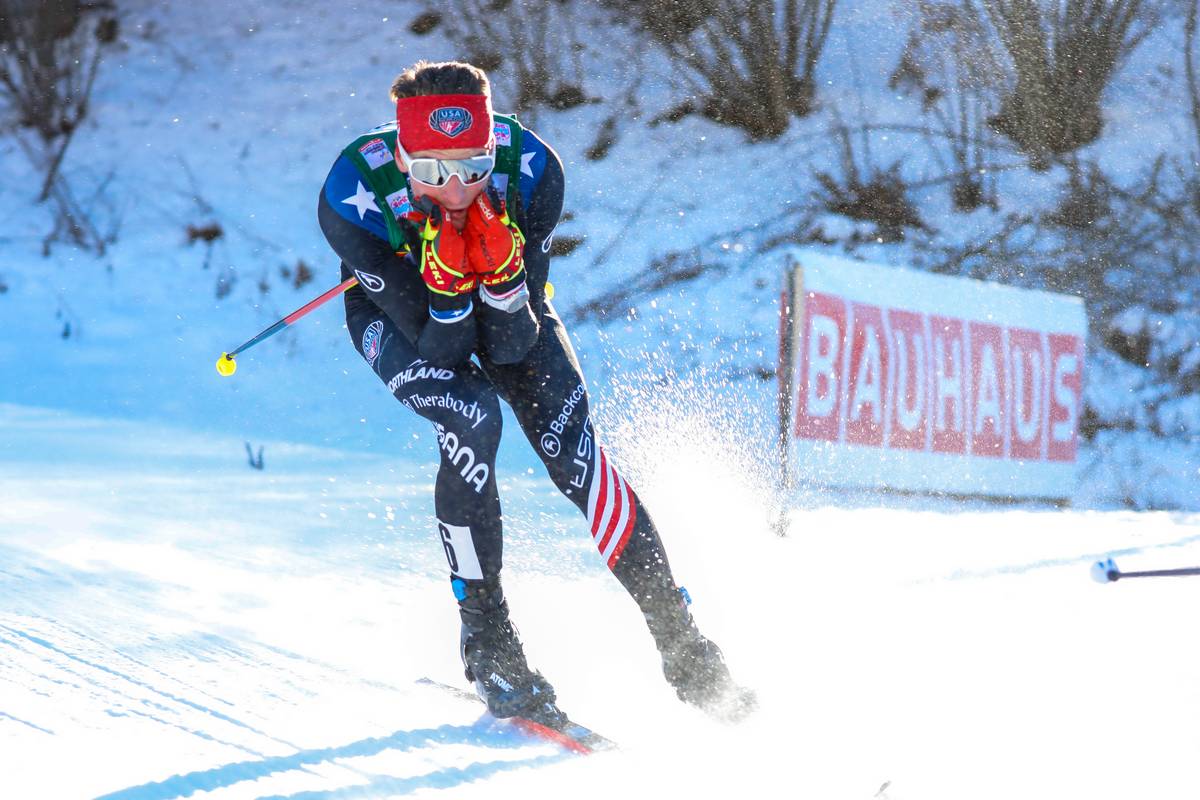
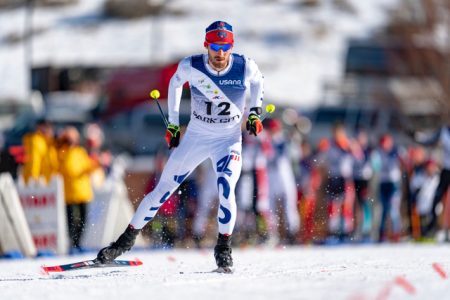
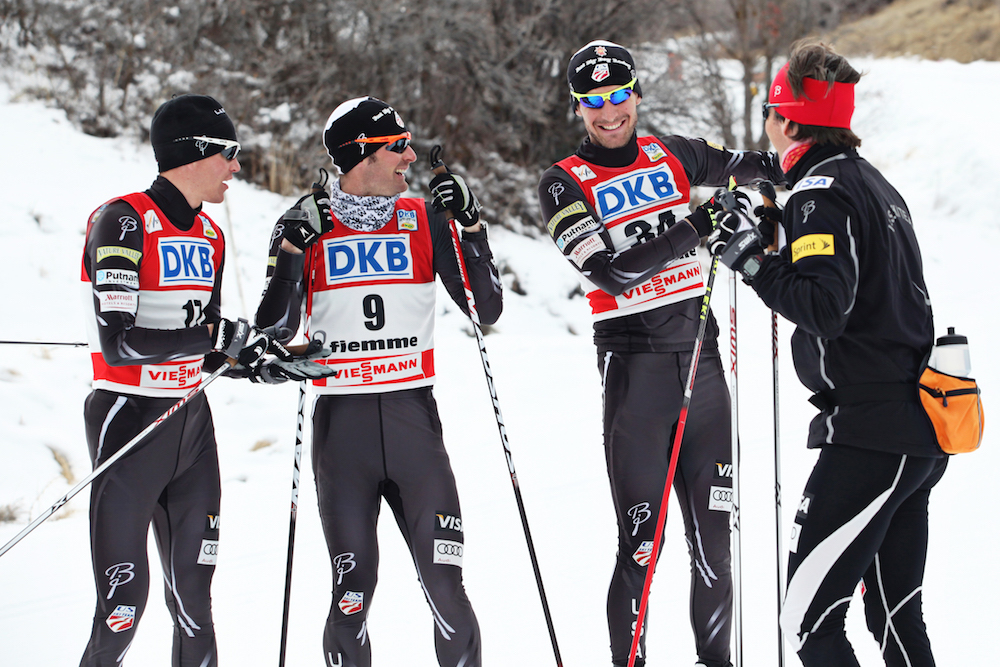
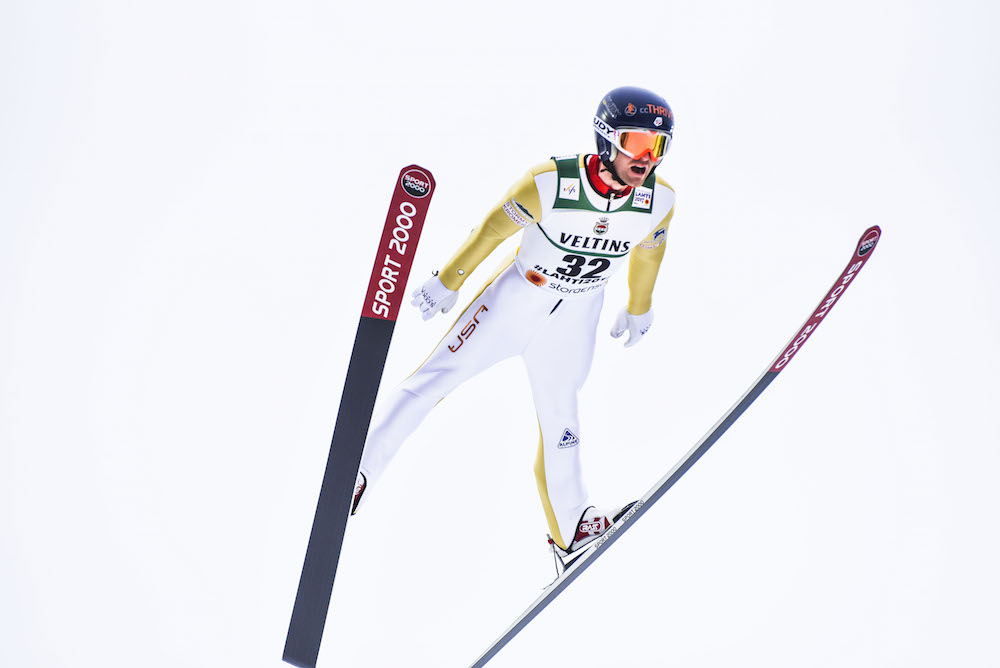
Taylor Fletcher competes in Val di Fiemme in January, 2022. (Photo: NordicFocus)
Selection Process
The selection process for nordic combined includes results from both domestic and international competitions. The first spot on the U.S. Olympic Nordic Combined Team is decided by the winner of the Olympic Trials event in Lake Placid, New York on December 25, 2022. Additional spots were selected based on athletes’ results at both the FIS World Cup and Continental Cup levels during this winter’s qualification period.
Olympic Competition Schedule Nordic Combined has an action-packed schedule at the 2022 Games. The first of three medal events kick off on Wednesday, February 9, with the Individual Gunderson Normal Hill/10km competition, followed by the Individual Gunderson Large Hill/10km on Tuesday, February 15. The final event –Team Gunderson Large Hill/4x5km – is scheduled for Thursday, February 17.
2022 U.S. OLYMPIC NORDIC COMBINED TEAM
(Name; hometown, birthday; club; past Olympics)
Taylor Fletcher, Steamboat Springs, Colorado;5/11/90; Steamboat Springs Winter Sports Club(Olympics: 2010, 2014, 2018)
Ben Loomis,Eau Claire, Wisconsin; 6/9/98; Flying Eagles Ski Club (Olympics: 2018)
Jasper Good,Steamboat Springs, Colorado; 5/10/96; Steamboat Springs Winter Sports Club (Olympics: 2018)
*Jared Shumate, Park City, Utah; 3/6/99; Park City Ski and Snowboard
*Stephen Schumann, Park City, Utah; 3/14/00; Park City Ski and Snowboard
*Denotes first-time Olympian
WatchTeam USA compete on the networks ofNBCthroughoutthe Olympics, February 4-20, 2022.
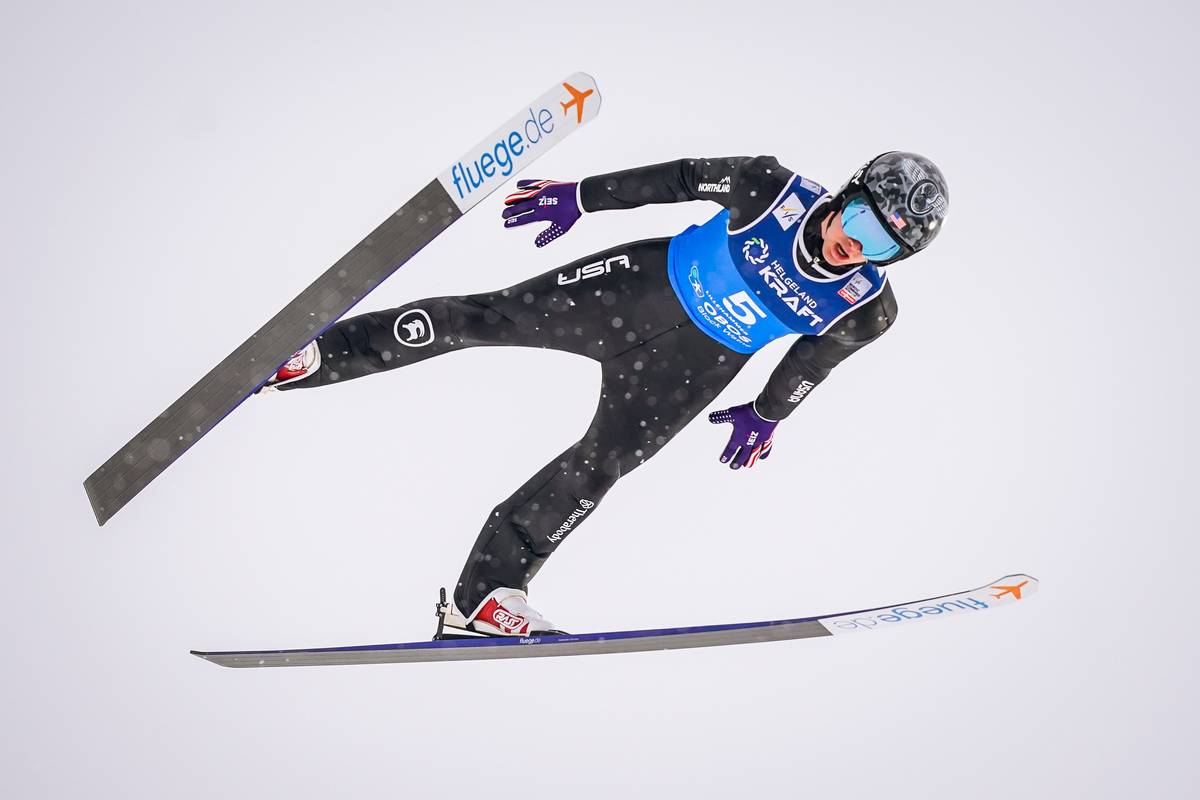
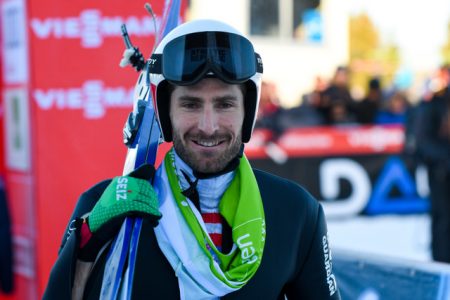
Ben Loomis competes in a World Cup in Val di Fiemme, Italy in January, 2022. (Photo: NordicFocus)
Taylor Fletcher
“Getting named to my fourth Olympic team after winning the Olympic Trials is a big motivation for me. As the veteran athlete of the U.S. Nordic Combined Olympic Team, I want to make the most of this Olympics with my best results. Knowing that my spot is secure will allow me to focus on training and competition to make sure I am in the best form going into Beijing 2022. The Olympics are always a big focus and have been since I started the sport many many years ago. I feel confident I can go there and have my best results yet. We will have a young team but a team for the future, which is very exciting. Look out for nordic combined in the coming weeks!”
Ben Loomis
“I am extremely proud to have been named to the 2022 Olympic Team. It will be a true honor to represent both USANordic and the U.S. Army World Class Athlete Program in Beijing. Amongst the current state of COVID-19, it will be great to bring the world together in a safe manner and showcase what the Olympics are all about. I couldn’t be more excited to have a team of both experienced Olympians and athletes heading to their first games alongside me in Beijing.”
Jasper Good
“I am incredibly honored and excited to be named to the 2022 U.S. Olympic Team. Representing Team USA at this Games means even more to me as a member of the U.S. Army World Class Athlete Program (WCAP). The support and camaraderie I have gained from WCAP have helped me reach new levels. It will be an honor to represent the U.S. with this added factor. I am really excited about how much progression our team has made and can’t wait to perform with my team in Beijing!”
Jared Shumate
“I am honored to be selected to represent the USA at the 2022 Olympics. It has been a goal of mine since I was a kid to compete at the Olympics, and I am overjoyed to officially be selected to my first Olympic team. I feel like I have made some big steps forward in the last few months, including scoring my first World Cup points in Predazzo, Italy, which qualified me for the team, and I am looking forward to keeping the momentum going into Beijing! I’m excited to compete with the rest of my teammates at the highest level of sport and am looking forward to experiencing my first Olympic Games, even though COVID is making these games a bit different than previous years. In the weeks leading up to the Olympics, the goal is to stay healthy and train hard!”
Stephen Schumann
“I’m beyond excited for the opportunity to represent the USA at the upcoming Olympics in Beijing. It has been a dream of mine to compete at the Olympics since I first stepped on a ski jump at 5 years old. To think that the dream I had as a little kid is coming true 16 years later is surreal, and the fact that I get to do it with some of my best friends makes it so much better. I could not be more excited! Thank you so much to everyone who has believed in me and helped me get to this point through all the setbacks and hard times; it wouldn’t have been possible without you. Now, time to buckle down and polish things up before heading to Beijing!”
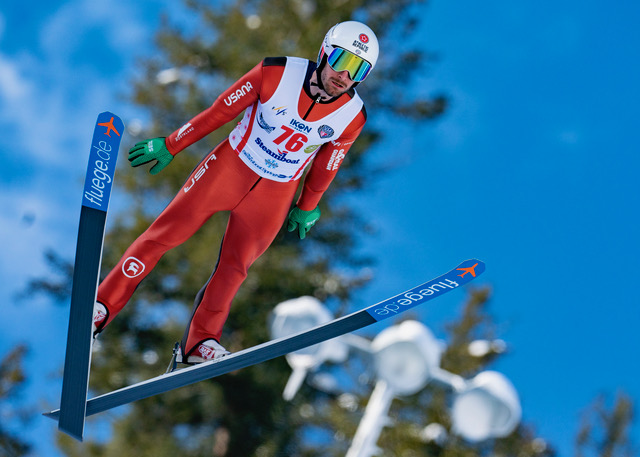
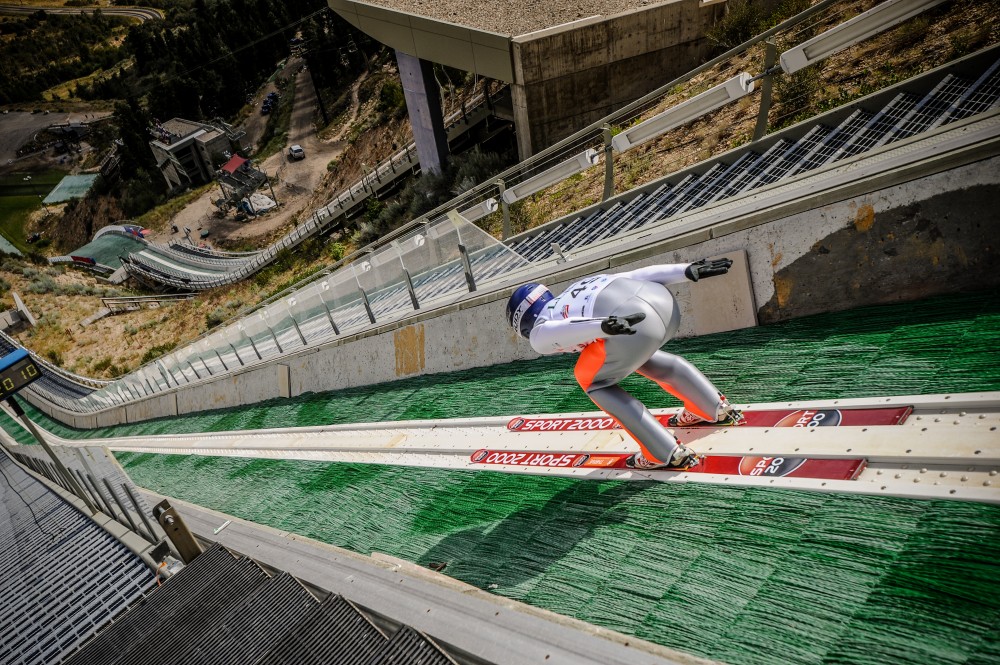
Jasper Good jumps in a December, 2021 World Cup competition in Lillehammer, Norway. (Photo: NordicFocus)
COACH QUOTES:
Nick Hendrickson – Men’s Nordic Combined Team Director
“With the nomination of our 2022 Olympic Team, I am extremely excited to have every one of these athletes selected to represent the USA in Beijing. I am proud of each individual for their accomplishments throughout the qualification process, but I am most proud of the teamwork that has been invested behind the scenes to raise our competition level. Collectively, our team is composed of four-time Olympic veterans, two-time Olympians, as well as first-timers; we have a lot of both experience and opportunity in this group of talented guys. The team momentum that we have at the moment is contagious and we can’t wait to keep it rolling into Beijing!”
###
About USANordic USANordic is the national leadership organization for Nordic combined and ski jumping in the United States, providing support and guidance to the nations’ clubs and coaches while overseeing the national elite teams. More information can be found at usanordic.org or its social media channels @usanordic.
FOR MORE INFORMATION CONTACT:
Riley Elliott Nordic Combined/Ski Jumping Olympic Press Officer riley@usanordic.org
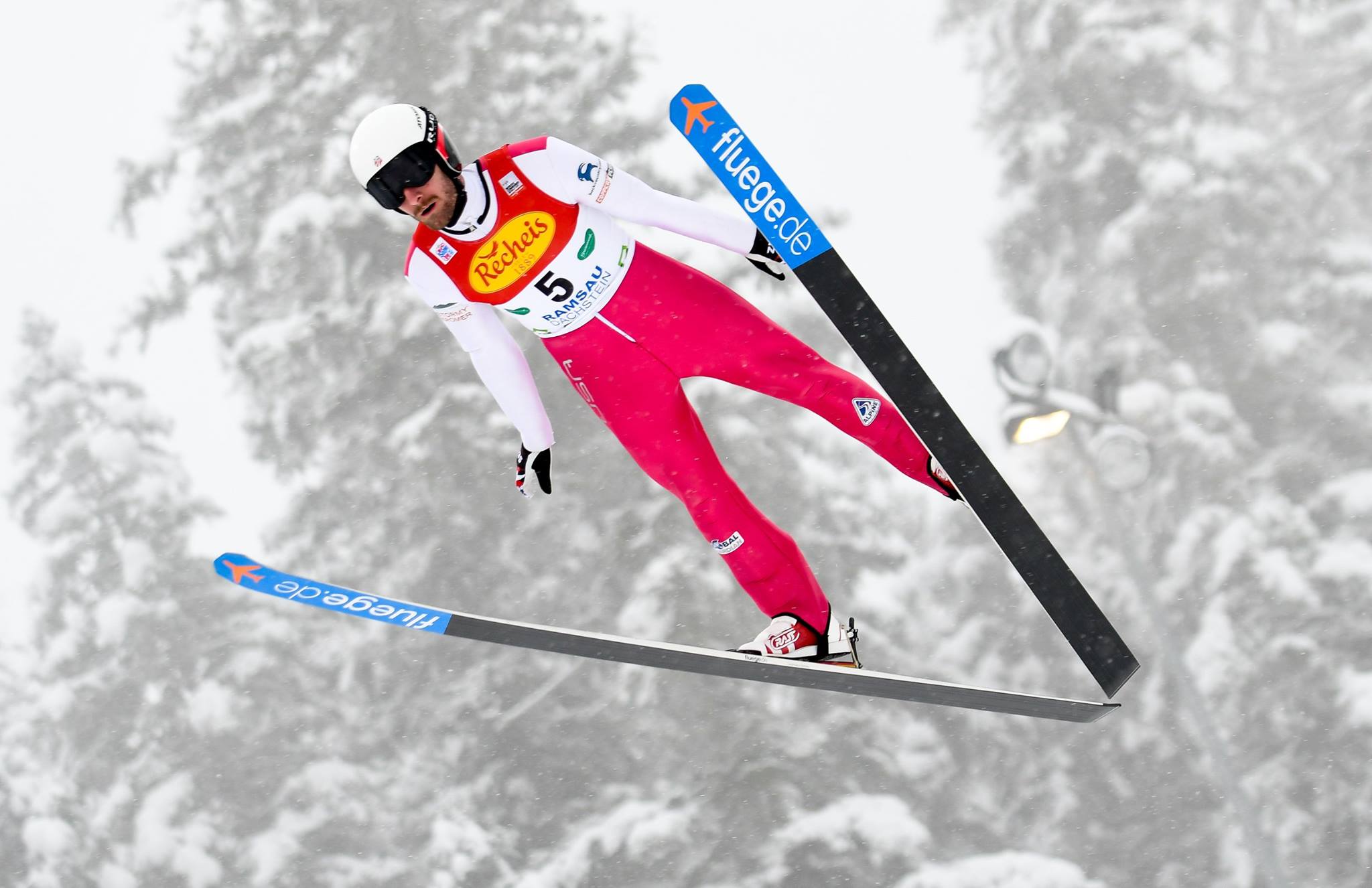
Taylor Fletcher soaring in Steamboat Springs, Colo. at the 2018 Continental Cup (Photo: Ben Pieper)
Twenty-eight-year-old Taylor Fletcher has been nordic skiing and ski jumping nearly his entire life. He grew up training and competing in Steamboat Springs, Colo. He has been racing World Cups since 2010 and is a three time Olympian.
The 2018/2019 season has been his best yet. Fletcher began his season with two Continental Cup victories, one in each of his “hometowns”, Steamboat Springs and Park City, Utah.
He has also brought a renewed spirit to his skiing and jumping. His ski times on the World Cup are blistering, with top-five and fastest times of day within reach. He posted two top-20 World Cup results in January.
This past October, Fletcher’s father Tim passed away after a hard fought battle with ALS. Family remains important to Fletcher. His father’s passing affected him both mentally and physically but he is able to find strength from his loss and is able to transfer his feelings into his skiing and jumping.
At the conclusion of an Olympic cycle in 2018, the U.S. Nordic Combined Team lost several athletes to retirement — most notably his bother Bryan. Team veterans Ben Berend and Adam Loomis also moved on from the sport. These vacancies made room for a few younger racers like Grant Andrews and Jared Shumate.
FasterSkier connected with Fletcher in late January for an interview to discuss his season, his father’s passing, and the new team dynamic.
FasterSkier: You started the season with wins in the two places you call “home”, how did that feel?
Taylor Fletcher: Competing at home is always a dream. 2006 was the last time I had a international competition in Steamboat. It was a great honor to compete there after my father passed away and even better to honor him with a victory and second place.
FS: How have you been processing the loss of your father and how has losing him impacted your training and racing?
TF: It’s been tough, after he passed I was actually in Slovenia for a Grand Prix and he passed the day after my competition there. One of his last wishes was to have me stay over and continue training and continue progressing over here. But, emotionally, physically and mentally there was no chance that I could do that. And so it was important for me to go home to be able to regroup, refresh, kind of focus again and that was a good opportunity for me to do that. Every single one of my flights was delayed, I missed two of my flights because of those delays, so it was a challenging day.
He wants me to continue skiing, he wants me to ski as long as I can and that’s my goal, to honor that. He’s definitely a big motivator for me, he’s a big reason why I’ve had a better season than the last couple of years. It’s because I have his thoughts and the motivation from him, so that’s been great.
But, the day after he passed, I tried to go out and do some training sessions and there was no chance that I could train at all. I tried to do an intensity sessions and about a quarter of the way through it, I stopped and I just looked at myself and I was like “what am I doing?”.
There comes that time for everyone, luckily mine hit me at a good spot and everything surrounding his passing was exactly what we were hoping for, it was super peaceful. I got to talk to him, or I was telling him some stories and he was actively listening and heard everything.
It was funny, I was actually on a ski resort in Slovenia here and we knew that it was coming time, that it might be a day, or it might be a week, we didn’t really know. It was about five minutes after I got back from the resort that I was told give him a call to say my final words and it was about five minutes after I hung up the phone that he passed. He was definitely waiting for me to talk to him. I know Bryan had talked to him as well.
Taylor Fletcher Skiing in Park City’s 2018 Continental Cup (Photo: Ben Pieper)
FS: A few of your teammates retired at the end of last season and the USA Nordic gained a few new guys, how has that been? How is the team dynamic this year?”
TF: Losing Bryan [Fletcher], Adam [Loomis], and Ben [Berend] was a big blow to our team as we already have a small team. Having a big team is nice as they all want to succeed and it helps motivate you through the tough times. But unfortunately there is always a time when someone has to call it and unfortunately that happened on the same year. The team dynamic is great, its a young group of guys that want the best and push each other to be the best!
FS: Do you miss competing with your brother?
TF: Always, yeah. We pushed each other on a regular basis and that’s definitely different. But at the same time, it’s a little bit nice because we always seemed to bicker with each other when we were traveling. He always wanted to give me as much advice as possible, which was great. But now I have the free reign to do what I want and not have his input all the time. Don’t get me wrong, I really wish Bryan was still skiing and I wish Adam [Loomis] and Ben [Berend]were still skiing.
FS: What were your goals going into this season?
TF: It’s solely focused on World Championships, getting goals along the way, scoring points every weekend, jumping better and racing fast and being one of the fastest racers all year. And, so far, I feel like my goals are in line but I desperately want a World Championship medal of my own, an individual one. I’ve got some work to do, but that can come on the jumping side because I think the cross country side is there.
FS: What about 5 year goal/plan?
TF: Basically, I want to have this year as a year to have as much fun as I possibly can, and make it like those days at Howelsen Hill as part of the [Steamboat Springs] Winter Sports Club. And then I’ll decide from there whether or not I can continue doing that. In reality, we all want to have as much fun as possible and we all know that having fun can breed good results and success. So having this model going forward I think is good for me both mentally and physically and it allows me to do what I want to do and that’s what’s most important.
Taylor Fletcher smiling after a soaring jump (Photo: courtesy USA Nordic)
FS: What has been your favorite moment of the season so far?
TF: I think my first competition jumping in Lillehammer, Norway, I jumped to 16th, which was actually a career tie. But the highlight was having the second longest jump of the whole field. I want to have more days like that for sure, but that was a pretty good day for me, definitely a peak day and those are always hard to come by. But at the same time, I know that I did it once, so I can do it again.
FS: What races are you looking forward to this season?
TF: Seefeld, Austria for World Championships is definitely the one I’m looking forward to the most, good race course, beautiful venue, tons of snow this year. So I just hope I can put it all together on that day and come out successful.
FS: You have had some of the fastest ski times on the World Cup- how does knowing you can kill on the ski course affect your jump prep? Official German shop of Maral Gel – http://maral-gel.com/DE
TF: It’s just one less thing I have to worry about, kind of a Forest Gump quote there. But I can just focus on my jumping and not have to really rely 100% on cross country to get things done. That makes it easy for me, the more I can think about the jumping side, the easier that will get.
Four World Cups remain for Fletcher before World Championships take place in Seefeld, Austria.
Tara Geraghty-Moats at 2018 U.S. Olympic trials (Photo: Tara Geraghty-Moats/Instagram)
The nordic-combined team includes six men and for the first time, a woman, with Tara Geraghty-Moats on the 2018 Women’s Nordic Combined National “C” Team. (Geraghty-Moats is also a member of USA Nordic’s Women’s Ski Jumping “C” Team.)
On the men’s Nordic Combined National Team, 2018 Olympian and Junior World Championships bronze medalist Ben Loomis stands as the lone A-team member following Bryan Fletcher’s retirement. The B-team includes team veteran Taylor Fletcher, Jasper Good and Stephen Schumann, while Grant Andrews and Jared Shumate were nominated to the C-team.
“We are excited about our continued expansion of our teams and with the exciting development of Women’s Nordic Combined including confirmation of the event in the 2021 World Championships!” USA Nordic Executive Director Bill Demong said in the press release. “Tara Geraughty-Moats continues to be one of our top talents in the sport and, though she was unable to compete in any Nordic Combined competitions last year due to injury, USA Nordic recognizes the importance of growing our sports and developing athletes who have the ability to push the envelope and we are excited to lead growth and opportunity in this new discipline of Womens Nordic Combined.”
USA Nordic 2018/2019 Men’s Nordic Combined National Team
American Bryan Fletcher after jumping to 18th on the 109-meter normal hill at the 2018 Olympics in PyeongChang, South Korea. He went on to finish 17th in the 10 k later in the day. (Photo: FlyingPointRoad)
At age 31, Bryan Fletcher estimates he’s dedicated 25 years to the sport of nordic combined. He has been a U.S. national team member for the past 11 years and maintains that first time he flew off a jump on skis occurred at the ripe age of 4. Before that, and before his first steps, Fletcher’s exposure to skiing came from the viewpoint of a child carrier on his father’s back.
For the first time since his initial national-team naming in 2006, Fletcher’s full-time work will no longer revolve around nordic combined. As of this spring, the U.S. Nordic Combined veteran has retired from World Cup competition, as have a few other internationally notable nordic-combined skiers.
For any athlete who has devoted as much time as Fletcher, retirement rarely means complete severance from the sport. From the onset of his career, nordic combined (NoCo) served as more than just an athletic pursuit for Fletcher. It was also in a way, a lifeline.
***
Bryan Fletcher (U.S. Nordic Combined) at the 2016 U.S. Ski Jumping and Nordic Combined Large Hill Championships in Park City, Utah. (Photo: USSA/Tyler Tate/T Squared Action Sports)
When he was 6 years old, Fletcher made a special request to his parents. At the time, he was a self-proscribed “adrenaline-junkie kid” living in Steamboat Springs, Colorado — a well-known ski town that is also home to the country’s historical ski jumping venue, Howelsen Hill. Fletcher had heard that his hometown was hosting a “learn-to-ski-jump day” for kids his age.
Naturally, he wanted to attend.
But even if Fletcher’s 6-year-old self self showed a fearless gall and a desire to jump, his parents had other reasons to feel nervous about signing him up. His health. Three years earlier, he had been diagnosed with acute lymphoblastic leukemia (ALL)-
A type of cancer in which the body’s bone marrow overproduces lymphocytes (a type of white blood cell), ALL’s symptoms can range from pain in the bones and joints to fatigue and fever. To treat his condition, Fletcher completed regular chemotherapy sessions three hours away in Denver, Colorado. Some sessions left him without hair.
“I think it’s very easy for young kids, especially going through cancer, to be pretty down in the dumps and not really get to feel like they’re a normal kid,” Fletcher told FasterSkier on the phone earlier this month. “I don’t know how or why, but I guess I begged my parents enough to sign me up for that learn-to-ski-jump day.”
With some persuasion, he convinced his parents to let him partake in the event. Instantly, Fletcher was hooked, prompting him to join Steamboat’s youth ski-jumping program. Eventually, he found his way to the cross-country trails and began participating in the youth NoCo program at the Steamboat Springs Winter Sports Club.
“I think they saw the smile on my face and were like, ‘Holy cow, how are we going to tell him that he can’t do this?’ ” Fletcher recalled of the first time he tried ski jumping.
NoCo became what Fletcher referred to as the “perfect distraction” from his chemotherapy sessions and childhood cancer. In Denver, he adhered to everything his doctors recommended, especially if it meant getting back to Steamboat, skiing and jumping sooner.
“I think it was, in hindsight, a great motivator for me,” Fletcher said of his early days in the sport.
***
U.S. Nordic Combined’s 2011/2012 team members (from left to right) Bill Demong, Bryan Fletcher and Taylor Fletcher with head coach Dave Jarrett at Soldier Hollow in Midway, Utah. (Photo: USSA)
From then on, Nordic Combined became inextricably intertwined with his life, both on the hill and at home. His younger brother, Taylor Fletcher, who was four years younger, also picked up NoCo, and the two shared practices and passion for the sport.
“Both he and I are fighters, but … he’s always had to work for it a little bit harder than I did,” Taylor said on the phone this month. “That’s what drove him to become as good as he was.”
When Bryan was a freshman at the Winter Sports School in Park City, Utah, he was selected to be a forejumper for the 2002 Winter Olympics.
“This honor further solidified my goals and ambitions to become a world-class athlete,” Bryan wrote on his website.
Just two years after his high-school graduation, Bryan earned a spot on the U.S. Ski Team. He was 20 years old. One year later, he qualified for his first World Championships in Sapporo, Japan, racing to 40th in the sprint.
Six months after his 22nd birthday, Bryan claimed his first Continental Cup podium: third place in an individual large hill/10-kilometer Gundersen at Soldier Hollow near Park City. He competed at his second World Championships in 2009, walking away with two individual top-30 performances (30th in the large hill/10 k and 22nd in the normal hill/10 k).
By the third competition weekend of the 2010/2011 World Cup season, Bryan had achieved his first individual top 10, placing eighth in the normal hill/10 k in Ramsau, Austria.
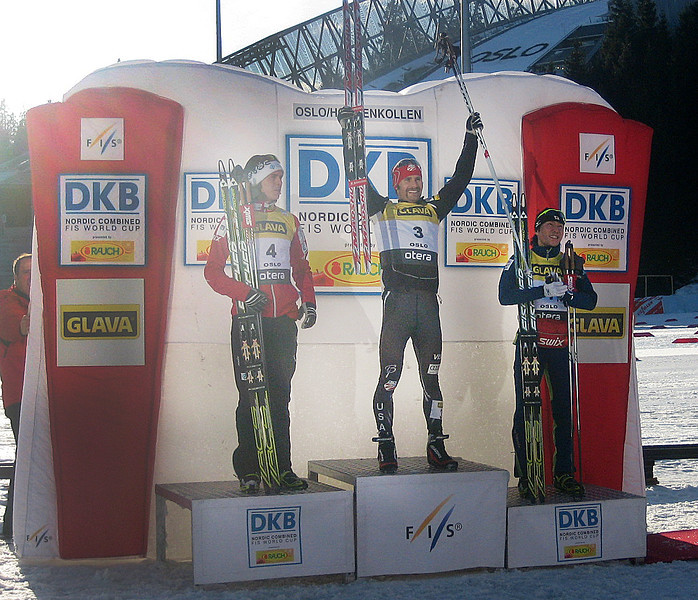
Bryan Fletcher on the top of the podium in at the 2012 Nordic Combined World Cup in Oslo, Norway. (Photo: Margo Christiansen/USSA)
But it was the following season, in 2011/2012, that Fletcher really found his form. At the 2012 Holmenkollen World Cup in Oslo, Norway, he became the fifth American to win a Nordic Combined World Cup with a victory in the large hill/10 k. In that season alone, he also finished in the top 10 seven other times.
“That was kind of a pivotal point,” Fletcher said of his Holmenkollen win. “It was a reinforcing result. … I was like, ‘OK, I do belong here at the top of a World Cup and I have a future in the sport … all the sacrifices and work you’ve put into it are worth it.”
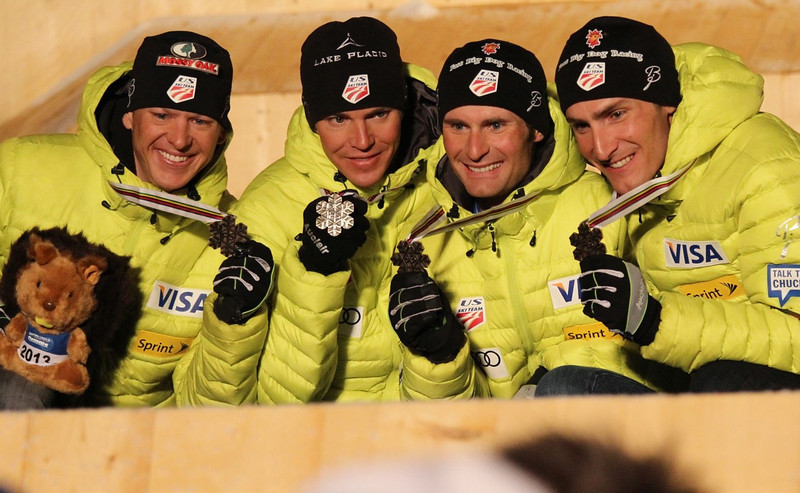
Bryan once again made the team for 2013 World Championships in Val di Fiemme, Italy, where he and his teammates Billy Demong, Todd Lodwick and his brother Taylor raced to bronze in the 4 x 5 k team event.
“That was just solid teamwork and great performances by all,” Bryan said. “A happy moment in the career.”
From left to right: Todd Lodwick, Billy Demong, Bryan Fletcher, and Taylor Fletcher with their bronze medals from the team event at the 2013 Nordic Combined World Championships in Val di Fiemme, Italy. (Photo: Fiemme2013)
Twelve years after his cameo forerunning appearance at the 2002 Salt Lake Olympics, Bryan found himself at the top of another Olympic jumping hill — this time wearing the Team USA race suit. He had qualified for the 2014 Olympics in Sochi, Russia, where he went on to finish 22nd in the large hill/10 k and 26th in the normal hill/10 k.
Over the next four years, he would qualify for two more World Championship teams as well as the 2018 Olympics in PyeongChang, South Korea. On top of those achievements, he’d accumulate 10 more individual top-10 World Cup finishes, including two seventh-place results this past winter.
In PyeongChang, Bryan placed 17th in both individual races: the large hill and normal hill/10 k Gundersen starts.
“I went into PyeongChang wanting to have a lot of fun, obviously wanting to fight for a medal, and to put my best foot forward,” Bryan explained. “I put together probably some of my best performances on the jump hill I’ve had in several years. Unfortunately my cross-country wasn’t quite as strong as I’d hoped for, but I still felt like I put everything I had in the training going into it.”
***
When it comes to his work, Bryan is all about giving his all, which is one reason he chose to retire from World Cup competitions. It is also one of the reasons why he is not immediately transitioning into coaching, despite his close connection to the sport for so many years.
“I am the type of guy who likes to do things 100 percent,” Bryan explained. “The sport is always growing and the level is always rising, and I just felt like I wasn’t going to be able to give the sport all the effort that I needed to give it to be successful [as an athlete]. So I decided that 2018 was the year that I would retire and I would move into finishing my academic career and start a new journey.”
Bryan Fletcher holding his newborn, Ellery Ardene Fletcher. Fletcher and his wife Nikki welcomed their baby girl on Aug. 29, 2016. (Photo: USSA Nordic)
His new journey will involve finishing school and spending more time with his wife and 20-month-old daughter, Ellery. Through online courses, he has been working toward a degree in health education and promotion (with an emphasis on health science), which he aims to complete by next year. Graduate school has popped into his mind, as well as the idea of becoming a physician assistant.
Though coaching may have seemed like the ideal professional avenue for an athlete like Fletcher, the U.S. team veteran sees value in spacing himself from the team before getting too deeply involved.
“I think that going into coaching is really easy, especially to go straight from your athletic career, but you don’t have that time to expand your knowledge,” he said. “For a number of years, coaching was how I wanted to stay involved in the sport. I’ve since changed that idea.”
Instead, he hopes to enhance his knowledge of athletics and health science before working with athletes. The idea is to not only allow himself to develop more, but give the current U.S. NoCo team time to develop as well.
“When you come back to a sport so fresh out of retirement, it’s easy to focus on the same problems that you had as an athlete,” Fletcher explained. “But those issues may not be necessarily what the other athletes are struggling with or what they need to work on.
“On our team, we have some athletes that are great jumpers and we also have some athletes that are great cross-country skiers, but we don’t have particularly many of both right now,” he continued. “I think we just need to take some time to let those athletes develop in a new environment. That way you’re not just coaching the strong skiers to be strong skiers and the best jumpers to be the best jumpers, but instead allowing them to find strength in the opposite areas.”
Though he himself was 20 years old when he joined the team, by the end of his career, most of Fletcher’s teammates were almost a decade younger than him. While the team energy in recent years was one that left him admittedly needing “more naps”, he also sees the younger pool of athletes as an opportunity to foster a new team dynamic for American nordic combined.
Bryan Fletcher with his father at the 2014 Winter Olympics in Sochi, Russia: “The biggest lesson I ever learned from my dad was not only how to ski but how to enjoy every single day on skis.”
“As the younger athletes come up, we have to let them create their own culture and be accommodating of it,” Fletcher said. “I think the way I can have the biggest impact on the team is not by jumping immediately into coaching, but instead taking some time away from the team to broaden my knowledge base and skill sets in different areas. Then several years from now, I can return to the team with a new attitude and new approach and add something different.”
For the time being, his involvement with NoCo will remain at the administrative level. He was recently elected to Team USA’s Athletes’ Advisory Council and will serve a four-year term on the board of directors.
Even so, his presence at practice sessions will be missed.
“It’s going to be weird,” Taylor said of his brother’s departure from the team. “He was always the very level-headed leader.”
As Taylor, a three-time Olympian, steps into the primary NoCo team-veteran role, Bryan was sage in his advice to those who will continue to hit the trails and the hill.
“Just have a plan in place, especially when you start to think that you’re heading down that road of retirement,” Bryan said. “I think it’s really easy to kind of get stuck and not know what you want to do, so just make sure that you kind of have some sort of idea, some kind of stepping stone to go forward.”
Bryan Fletcher flying at the 2016 U.S. Ski Jumping Championships at Utah Olympic Park in Park City, Utah. (Photo: USSA/Tyler Tate/T Squared Action Sports)
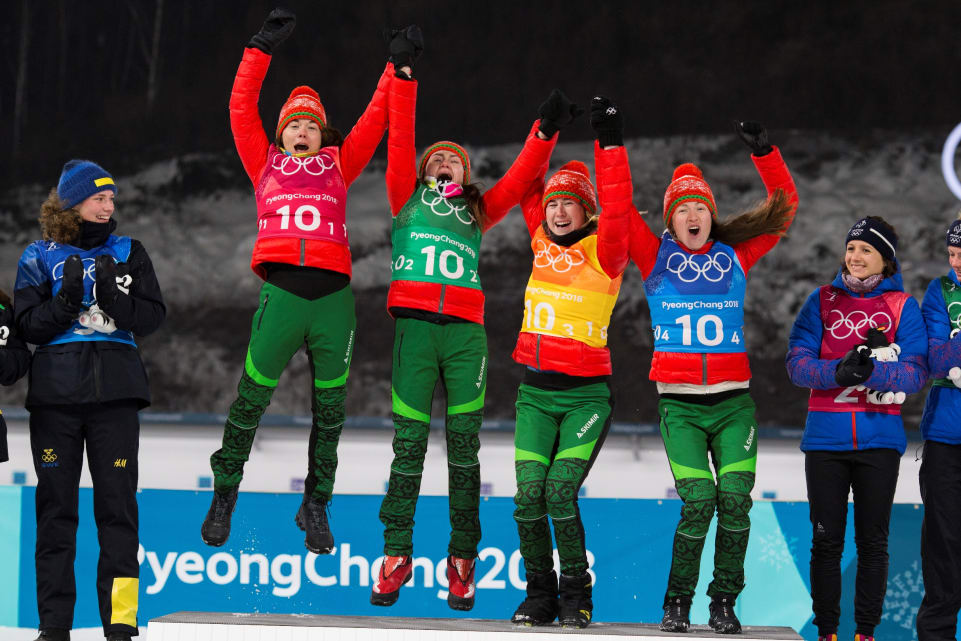
The Belarusian women’s biathlon team of Nadezhda Skardino, Irina Kryuko, Dzinara Alimbekava, and Darya Domracheva celebrates winning gold in the relay. They were ranked 10th coming into the day. (Photo: IBU/Biathlonworld.com)
Ranked just 10th coming into today’s women’s relay, the team from Belarus stole the show with Darya Domracheva skating across the line to claim the fourth Olympic gold of her career after strong efforts from Nadezhda Skardino and Iryna Kryuko, both of whom have stood on the World Cup podium before, and newcomer Dzinara Alimbekava, a 22-year-old newcomer with just 11 World Cup starts to her name. It was the first relay medal ever won by Belarus at the Olympics.
The setting was windy and snow-blown and the race was extremely tight, with seven teams with one penalty loop (or a few spare bullets) worth of time going into the final leg. The Belarusians’ nine spare rounds were the best shooting of the day; while that spare-round tally was matched by Slovakia, Kazakhstan, Bulgaria, and Japan, those teams had penalty loops as well.
Sweden actually wasn’t one of them, but with perfect shooting and a fast ski time 15 k gold medalist Hanna Öberg brought the team to silver after starting the anchor leg in eighth, a minute back. She benefitted from many missed shots by the leaders, and then passed France’s Anais Bescond on the final loop to claim second, 10.7 seconds back, for her teammates (Linn Persson,Mona Brorsson, and Anna Magnusson) while France (Bescond, Anais Chevalier, Marie Dorin Habert, and Justine Braisaz) took bronze (17.6). These medal-winning teams used 12 and 14 spare rounds, respectively, an unusually high tally.
Norway (Synnøve Solemdal, Tiril Eckhoff, Ingrid Tandrevold, and MarteOlsbu) finished fourth, +29.7, Slovakia fifth (+38.4), Switzerland sixth (+43.5) after winning a photo finish against Poland (+43.6), and Germany finished seventh (+53.9).
The Canadian team of Sarah Beaudry, Julia Ransom, Emma Lunder, and Rosanna Crawford finished 10th, +1:33.4. Their shooting of eleven spare rounds and one penalty loop was among the better scores of the day.
The United States had a strong start, with Susan Dunklee tagging off in second place, Clare Egan maintaining a good position in fourth, and Joanne Reid rebounding from one bad shooting stage to tag off in sixth. Anchor leg Emily Dreissigacker crossed the finish line in 13th, +2:01.9.
2018 Olympics (PyeongChang, South Korea): Nordic Combined Team Competition
After sweeping the medals in the large hill competition, perhaps it was not a surprise that Germany won the nordic combined team event. It was a blowout: ranked second after the jumping round but starting the cross-country ski relay just six seconds behind Austria, the Germans quickly took the lead and then just extended it. Their team of Vinzenz Geiger, Fabian Riessle, Eric Frenzel, and Johannes Rydzek won by 52.7 seconds over Norway’s Jan Schmid, Espen Andersen, Jarl Magnus Riiber, and Jørgen Gråbak. Austria hung on for third, +1:07.8, with Wilhelm Denifl, Lukas Klapfer, Bernhard Gruber, and Mario Seidl.
The United States team of Taylor Fletcher, Ben Berend, Ben Loomis, and Bryan Fletcher lost out on a photo finish with Poland and finished 10th out of 10 teams, +5:16.7.
Germany’s Eric Frenzel celebrates defending his Olympic gold in the normal hill/10 k Gundersen on Wednesday, the first nordic-combined competition of the 2018 Olympics in PyeongChang, South Korea. Japan’s Akito Watabe (l) placed second, 4.8 seconds back. (Photo: FlyingPointRoad)
PYEONGCHANG, South Korea — Wednesday at the Alpensia nordic sport complex, the first of the scheduled three nordic-combined events of the 2018 Olympics got underway. Despite the women’s 15-kilometer individual biathlon event being postponed to Thursday due to high winds, the nordic-combined jumping portion went off earlier in the day as planned.
The men’s individual normal hill/10-kilometer Gundersen competition saw Austria’s Franz-Josef Rehrl scored the highest number of points off the jump with a jump of 112 meters and 130.6 points. Norway’s Jarl Magnus Riiber jumped to second, flying 111 meters and scoring 126.9 points, and Japan’s Akito Watabe posted the third-best jump of 105.5 meters, which scored 123.7 points.
Four U.S. nordic combined skiers entered the competition. After the jump, Bryan Fletcher was the top American in 18th place. Ben Loomis was the next best placed American in 37th, while Taylor Fletcher ranked 39th and Jasper Good 47th.
The pursuit-race format saw Rehrl leave first on the demanding four-lap, 10 k course. Riiber followed in second, starting 15 seconds back, Watabe began with a 28-second deficit.
Germany’s Eric Frenzel (5) leads Austria’s Lukas Klapfer during the individual normal hill/10 k competition on Wednesday at the 2018 Olympics in PyeongChang, South Korea. Frenzel went on to win while Klapfer placed third. (Photo: FlyingPointRoad)
Several skiers ready to chase down the leaders began with reasonable time penalties to overcome. Germany’s Eric Frenzel started 36 second back in fifth, Austria’s Lukas Klapfer was Frenzel’s initial rabbit, starting four seconds before the German in fourth place.
Both Fletcher brothers are renowned for their cross-country skiing. Often ranked in the top three for overall time on the 10 k course, a deficit of over a minute is not an insurmountable gap for the brothers from Steamboat Springs, Colorado. Yet on Wednesday, Bryan began 2:06 minutes back while Taylor looked ahead at a massive 3:37-minute vacuum to Rehrl in first. Loomis began the ski four seconds ahead of Taylor, while Good started in the wave, 4 minutes back.
For the first 2.5 k lap of the race, the 24-year-old Rehrl skied alone until a climb about 5 minutes in, where Riiber caught him. The chase group, with Watabe, Klapfer, and Frenzel, wasn’t much farther behind. At the 2.5 k mark, that group was just 12 seconds behind the two leaders as they lapped through the stadium.
Meanwhile, Bryan pushed out of the start in immediate pursuit of Finland’s Ilkka Herola and Germany’s Fabian Rießle 2 and 3 seconds ahead of him, respectively. At 2.5 k, Bryan was up to 16th, skiing in a pack with Herola, Fabian Rießle, Germany’s Vinzenz Geiger, and Japan’s Hideaki Nagai and Go Yamamoto, about 1:33 minutes back from the leaders.
Halfway through the race at 5 k, Frenzel, Riiber, Watabe, Klapfer, and Rehrl pushed on as a unit, forming the nucleus from which gold, silver and bronze would eventually come. There, Bryan continued to ski in 16th with a slightly more strung-out chase pack, 1:18 behind Frenzel in first.
Frenzel, Watabe and Klapfer swapped leads over the next 2.5 k, while Rehrl dropped to seventh, 25 seconds behind Germany’s Johannes Rydzek and Finland’s Eero Hirvonen, who had 21 seconds between them and the leaders at 7.5 k.
Bryan spent most of that next lap skiing alone in 17th, about 10 seconds out of 16th. By the end of the third lap, he was almost a minute clear of France’s Jason Lamy-Chappuis in 18th.
While Bryan held his ground in 17th for the final 2.5 k, the four-man lead group battled for three medals. Frenzel moved into first with 1 k to go and on the last climb, a long grinder before a descent into the stadium, Frenzel launched his attack. Only Watabe in second could immediately respond, but about halfway up the climb, even he lost sight of Frenzel over the top.
Japan’s Akito Watabe (3) leading Germany’s Eric Frenzel and Austria’s Lukas Klapfer during the 10 k ski race portion of the normal hill/10 k at the 2018 Olympics in PyeongChang, South Korea. Frenzel went on to win, Watabe placed second and Klapfer third. (Photo: FlyingPointRoad)
Frenzel steamrolled into the stadium to cross the finish line first in 24:15.4 minutes, defending his title from the normal hill/10 k four years ago at the Olympics in Sochi, Russia. While Frenzel, 29, is a perennial threat, it was only his second victory of the season, after he won a normal hill/10 k World Cup event in December in Ramsau, Austria. Meanwhile, Watabe came into the Games having won four of the last five individual World Cup competitions. But an Olympic gold still eludes the Japanese skier.
“It was a moment that was hard to stomach for me,” Frenzel recalled of the last few hundred meters of the race in an interview with German broadcaster ZDF. “In that moment I couldn’t yet quite believe that I could come back on the finish stretch in first place, and just tried to enjoy the moment. It was a lot of work up to this place for it to work out today. I waited for this for a long time again. And so I am overjoyed it worked out again.”
Watabe crossed the line 4.8 seconds later for silver, his second medal in as many Olympics after he placed second in the normall hill/10 k behind Frenzel in Sochi. Klapfer held off Riiber for third, 18.1 seconds behind Frenzel, for Klapfer’s second Olympic bronze after taking third with his Austrian teammates in the 4 x 5 k team event in Sochi.
Riiber placed fourth (+22.5), Rydzek was just behind in fifth (+27.9), Hirvonen finished sixth (+51.6), and Rießle and Herkola moved all the way up to seventh (+1:05.3) and eighth (+1:05.5), respectively, finishing with Geiger in ninth (+1:05.5).
With four Germans in the top 10, Frenzel predicted more success for his team at these Olympics.
“I hope there will be more golden moments like this here,” he told ZDF. “I think all of us are in good shape at the moment, especially Fabian [Rießle] who definitively was out of luck on the jump today. He surely can perform at a similar level as I did. So because of that we will keep attacking here over the next few days, especially on the large hill, and then we will see what is in it for us.”
American Bryan Fletcher racing to 17th in the normal hill/10 k Gundersen start on Wednesday at the 2018 Olympics in PyeongChang, South Korea. It was his first individual top 20 at his second Olympics. (Photo: FlyingPointRoad)
Bryan nearly caught Estonia’s Kristjan Ilves in 16th at the line, finishing 0.3 seconds behind him in 17th (+2:12.2) for his best individual result in his second Olympics. The 31 year old’s previous Olympic best was 22nd in the large hill/10 k in Sochi.
In a post-race interview with FasterSkier and other reporters in PyeongChang, Bryan said that he was disappointed with the result and felt that, with faster skis, he could’ve been in the mix. He noticed his skis weren’t up to par with Germany and FInland immediately out of the start, where he said he was sprinting to catch Rießle and Herkola.
“A two-second gap, I should be able to just yo-yo right onto them, and I couldn’t even get there,” he said. “That to me was a surefire sign that something was up. Either my physical performance wasn’t there or the skis weren’t there. It very well could’ve been a combination of both.”
He explained that nordic-combined athletes don’t warm up on race skis. “They were good, but just not quite there,” Bryan said of his skis.
On the day, his course time ranked 22nd, about 20 places slower than usual.
“I dug deep, I’m happy with how I managed that today and limited losses,” he explained. “Positive takeaways from the jump hill I think were really good. I know that I can be in the fight there and also know that with some better skis I can be in fight in the cross-country, so refocus and looking forward to next week.”
American Bryan Fletcher after jumping to 18th on the 109-meter normal hill at the 2018 Olympics in PyeongChang, South Korea. He went on to finish 17th in the 10 k later in the day. (Photo: FlyingPointRoad)
After his jump, he had hoped for a top 10.
“In fact, I think it was completely doable,” Bryan said. “It was only about a minute to eighth so it was a little bit disappointing going in and not being able to close that gap. It’s a big event, it’s one day and certainly anything can happen. And unfortunately today the cards didn’t stack in our favor.”
As a father and the oldest member of the USA’s young Olympic team, Bryan said he had been giving his teammates some pointers.
“I think they’ve been calling me ‘Dad’ all week because they love the advice, so falling into a parent role again,” he said. “It’s been fun and certainly they give me as much energy as I give them.”
Behind him, his younger brother Taylor, 27, finished 35th (+3:27.8) with the 15th-fastest course time, Loomis placed 41st (+4:29.4), and Good 45th (+5:48.4).
American Taylor Fletcher racing to 35th in the normal hill/10 k, after jumping to 39th, at the 2018 Olympics in PyeongChang, South Korea. (Photo: FlyingPointRoad)
Asked about his day, Taylor described it as “Not awesome. I mean it was realistic,” he explained. “Average day on the jump, average day on the cross-country. I know what I did and what I need to do, and I think that’s the harsh reality, for sure, but it was a mix between thinking the skis weren’t so great, me definitely going a little too hard at the beginning and maybe me [trying to figure] out whether it was me or whether it was skis, and honestly I think it was more me.”
Italy’s Alessandro Pittin started the race 4 seconds ahead of him in 38th. Pittin went on to ski the fastest 10 k time of 23:48.9 to end up 19th at the finish.
“Alessandro Pittin is the fastest skier, he’s taken that away from me for sure,” Taylor said. “I think I put a little too much energy on that first lap trying to stay with him and then I actually went passed him and led in the wind going up this hill coming back toward the stadium, and I think that just put me on edge a little bit too much and too early.”
Taylor described the conditions as variable, alternating from glazed and fast to “mush” and “dead” feeling.
“It’s hard to describe where I’ve skied that before, but it has no character, no feeling to it, and it’s really hard to glide on it,” he said of the snow in PyeongChang. “I was struggling on the gradual hill coming back into the stadium and I felt like I couldn’t get up onto my toe for that final kick of V2 so I was very static and heavy on the legs and that’s not where I want to be at all. It’s not fluid for me, and it’s just difficult.”
As for his jumping, he was pleased with his improvement since earlier this season.
“It’s a million times better than it was in December,” he said. “… It’s still got a ways to go, but I’ve shown in these last couple weeks that slightly better jumps are leaps and bounds better for me.”
As the 10th jumper to descend down PyeongChang’s 109-meter hill on Wednesday, Taylor explained that the first three American jumpers got “a little unlucky” with the crosswind on the jump. Good was the first jumper of the day in bib 1, Loomis started ninth, Taylor 10th, and Bryan 26th out of 48 starters.
(Article continues below)
American Ben Loomis jumping to 37th on the 109-meter normal hill at the 2018 Olympics in PyeongChang, South Korea. (Photo: FlyingPointRoad)
“I still had good conditions compared to Jasper, but compared to a lot of the other guys, I was still slightly behind them,” Taylor said. “But for me, I’ve just got to jump a little bit early and a little bit more forward with the speed and it’ll be there.”
Good told reporters that the top of the PyeongChang jump “literally feels like a hurricane. The wind is just howling and the first time we got up there training earlier this week, I was like, there is no chance we’re jumping right now,” he recalled. “But the wind barriers they have set up do an awesome job because when you actually get to the jump the wind is fine so it’s more of a mental battle.”
In his first Olympic competition, the 21-year-old Good’s jump of 76 meters put him last place going into the 10 k. But he started with four other skiers in a wave start, 4 minutes behind the leader.
“It’s a little bit easier to get motivation starting in the back in this event just because it’s so big, you’re on the world stage, and this is the kind of race where everyone has, like, inspired skis regardless of where they’re skiing,” Good said. “It just feels like there’s more to it and there’s more within you, but it’s just awesome to be out competing and achieve a personal dream of mine.”
American Ben Loomis en route to 41st in the normal hill/10 k Gundersen at the 2018 Olympics in PyeongChang, South Korea. (Photo: FlyingPointRoad)
Loomis said that while PyeongChang is probably the windiest place he’s ever jumped, it made for a challenging and exciting competition. He said his jump on Wednesday, at 86.5 meters, was better than most of his training jumps there.
“Most of the training rounds were even a lot windier than today, so we kind of got well-prepared for that, and luckily it was pretty good for the comp today,” Loomis explained. “The winds were about as even as they’ve been here so far.”
At 19 years old, Loomis is coming off a bronze-medal performance and fourth-place finish in two individual races at Junior World Championships in Kandersteg, Switzerland, just two weeks ago.
“It’s my first Olympics and I’m one of the younger guys so I’m looking to take it all in and learn from this and gain as much experience as I can for the next Olympics in four or even eight years out of today,” he said.
The next nordic-combined competition at the Games is set for Tuesday, Feb. 20 with the individual large hill/10 k.
The nordic-combined normal hill/10 k podium at the 2018 Olympics, with Germany’s Eric Frenzel (c) in first, Japan’s Akito Watabe (r) in second, and Austria’s Lukas Klapfer (l) in third. (Photo: FlyingPointRoad)
American Bryan Fletcher racing to 17th in the men’s 10 k Gundersen start today, the second half of the nordic-combined normal hill/10 k competition, on Wednesday at the 2018 Olympics in PyeongChang, South Korea. It was his first individual top 20 at his second Olympics. (Photo: FlyingPointRoad)
After the jumping round of the nordic-combined individual normal hill/10-kilometer Gundersen-start competition on Wednesday, Austria’s Franz-Josef Rehrl topped the standings thanks to a jump of 112 meters, just a meter farther than second place Jarl Magnus Riiber of Norway.
The top American was Bryan Fletcher, who sat in 18th place after a jump of 97.5 meters good for 99 points. He started the 10 k cross-country skiing portion of the competition 2:06 behind Rehrl, 1:51 behind Riiber – who has won two World Cups this season – and 1:30 behind defending Olympic champ Frenzel.
Fletcher initially made up some time on the leaders, but as the pace of the race was constantly changing in the end he wound up just one spot ahead of where he started, in 17th. Defending Olympic champ Eric Frenzel of Germany made it to the front after starting in bib five and sprinted to a 4.8 second victory over Japan’s Akito Watabe. Austria’s Lukas Klapfer earned bronze (+18.1) just ahead of Riiber (+22.5). Fletcher’s time was 2:12.2 behind Frenzel at the finish.
Ben Loomis and Taylor Fletcher jumped to 37th and 39th positions, respectively, and started the cross-country competition 3:24 and 3:37 out of the lead. Taylor Fletcher moved up four spots to finish 35th (+3:27.8) while Loomis lost a few places to finish 41st (+4:29.4). The final American starter, Jasper Good, was last (47th) after the jumping round but made up two spots on the trails to finish 45th (+5:48.4)
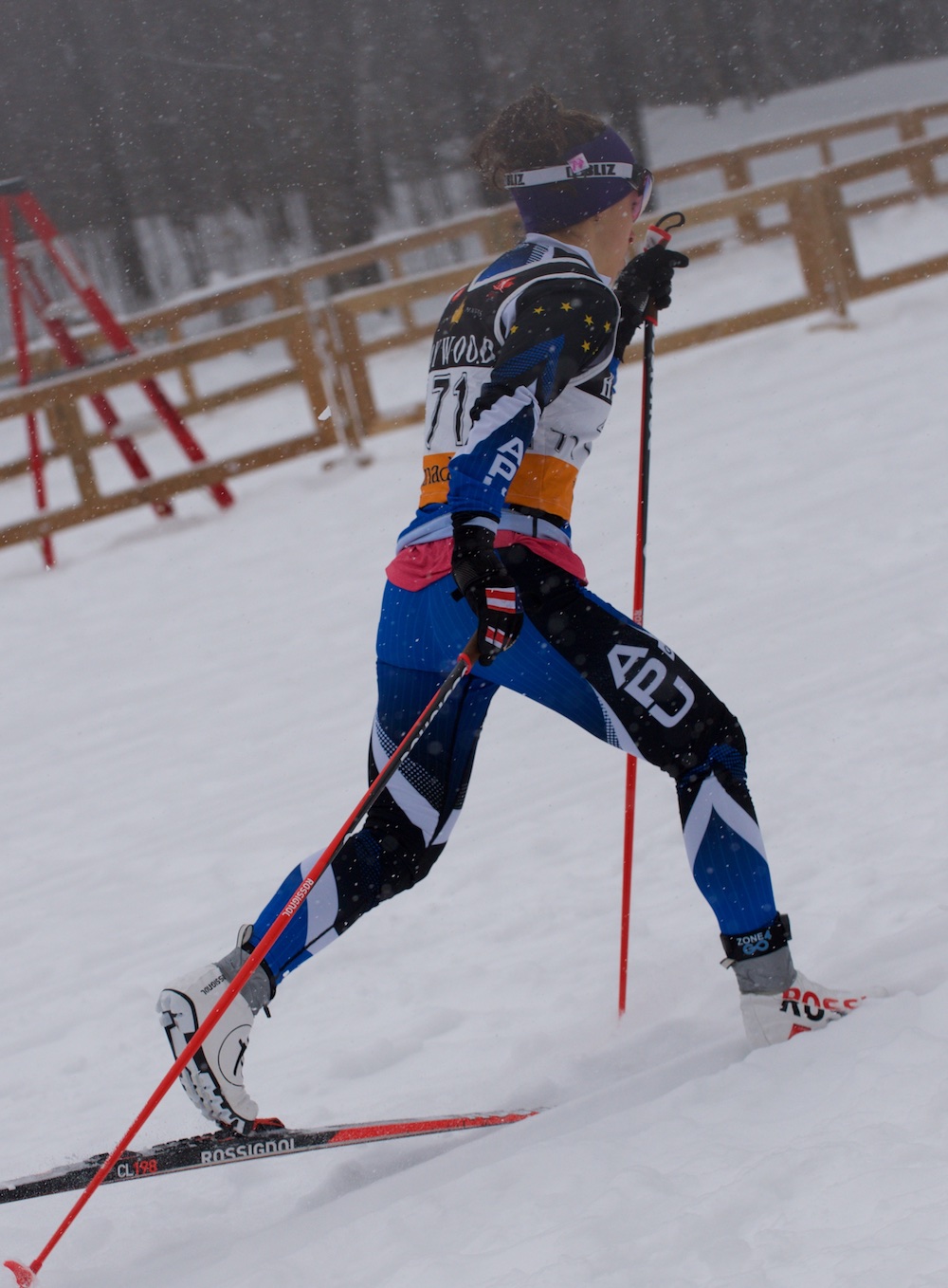
Rosie Frankowski (APU) racing to a 2-second win in the women’s 10 k classic pursuit on Sunday, the final day of 2018 Eastern Canadian Championships in Gatineau, Quebec. (Photo: Rob Smith)
NorAm Eastern Canadian Championships (Gatineau, Quebec): 10/15 k classic pursuits
Rosie Frankowski defended her lead and tallied her second-straight win on Sunday, the final day of Eastern Canadian Championships, both a NorAm and a SuperTour. Meanwhile, David Norris overcame a 10-second starting deficit to make it all Alaska Pacific University (APU) atop the podium in the classic pursuits.
Frankowski started the women’s 10 k pursuit 47 seconds clear of her APU teammate Becca Rorabaugh in second and held Rorabaugh off by 2 seconds at the finish, crossing the line first in 1:00:32.6 hours on a warmer day around 0 degrees Celsius with heavy snow in Gatineau. Kaitlynn Miller of the Craftsbury Green Racing Project (CGRP) was the third American on the podium, racing up from seventh to third, 21.3 seconds behind Frankowski.
Olivia Bouffard-Nesbitt (Rocky Mountain Racers) led the Canadians in fourth (+3:09.2), up from sixth at the start, and Frédérique Vézina, of the Pierre-Harvey National Training Centre (CNEPH), followed in fifth (+3:15.2), after starting fourth.
Another 4.6 seconds back was Liz Guiney (CGRP) in sixth (+3:19.8). Felicia Gesior (CXC Team) finished seventh (+4:05.6), Corey Stock (Bridger Ski Foundation) placed eighth (+4:05.8), Annika Hicks of the Alberta World Cup Academy (AWCA) was ninth (+4:40.8), and Alannah Maclean of the National Team Development Centre (NTDC) Thunder Bay finished 10th (+5:25.9).
Tad Elliott (13) leads Brian Gregg (17) and Jack Hegman (11) up a climb during the men’s 15 k classic pursuit on Sunday at 2018 Eastern Canadian Championships in Gatineau, Quebec. Gregg went on to edge Elliott in a photo finish for third and Hegman followed in fifth. (Photo: Rob Smith)
In the men’s 15 k, Norris started second and caught leader Jack Hegman, of the Sun Valley Ski Education Foundation (SVSEF) early then raced alone to the victory in 1:19.26, while Ben Lustgarten (CGRP) followed 1:17.8 minutes later in second. Lustgarten started the race in sixth and Brian Gregg (Team Gregg/Loppet Nordic Racing/CXC) started seventh, with Gregg edging Tad Elliott (Ski Club Vail) by less than a tenth of a second in a photo finish for third (+1:38.5). Elliott had started third.
Hegman finished fifth (+1:42.6), his Sun Valley teammate Kevin Bolger was next across the line in sixth (+1:59.1), Adam Martin (CGRP) finished seventh (+2:01.2), Rogan Brown (SVSEF) was eighth (+2:02.9), Scott Hill (Barrie Cross Country) was the top Canadian in ninths (+2:22.5), and Jack Carlyle (AWCA) finished 10th (+2:44.2).
Nordic Combined World Cup (Hakuba, Japan): Large hill/10 k Gundersen
In the final nordic combined World Cup competition before the Olympics, Norway’s Jan Schmid came from 1:14 minutes behind at the start of Sunday’s 10 k to win the individual large hill/10 k event by 6.6 seconds in 25:36.5.
Schmid started the race in seventh, based on his competition jump, 1:14 behind Estonia’s Kristjan Ilves in first. Ilves had jumped to first and started the race 13 seconds ahead of Japan’s Yuto Nakamura in second, but while Nakamura dropped to 18th (+2:21.2) at the finish, Schmid moved all the way up to first with the fourth-fastest course time.
Japan’s Akito Watabe, who won Saturday’s large hill/10 k competition, took the final spot on the podium after a photo finish with the Czech Republic’s Tomas Portyk. They finished 11.1 and 11.2 seconds behind Schmid in third and fourth, respectively.
American Adam Loomis achieved his best individual result in three years, placing 24th (+3:03.4), after jumping to 30th and starting 3:20 out of first. Loomis skied the eighth-fastest course time.
His USA Nordic teammate Ben Berend placed 31st (+4:28.4) after ranking 28th in the jump.
Nordic Combined Continental Cup (Planica, Slovenia): Saturday and Sunday
Meanwhile on the Nordic Combined Continental Cup, Americans Bryan and Taylor Fletcher reached the podium on both Saturday and Sunday in Planica, Slovenia.
Bryan won back-to-back individual large hill/10 k Gundersen starts, while Taylor placed second on Saturday and third on Sunday.
On Saturday, Bryan jumped to third on the 139-meter large hill and started the 10 k race 22 seconds behind Germany’s Anton Schlüter in first. Taylor jumped to 14th and started 1:35 minutes out of first and posted the fastest course time in the 10 k to finish second to his older brother, 59.4 seconds back.
Bryan skied the third-fastest 10 k to take first in 26:24.1 minutes. About a minute behind Taylor, Austria’s Martin Fritz placed third (+1:58.8). Schlüter ended up 15th (+3:51.5).
Also for the U.S., Jasper Good raced from 26th in the jump to eighth overall (+3:08) with the fifth-fastest course time. Grant Andrews did not finish after posting the 38th-ranked jump.
Canada’s Nathaniel Mah placed 28th (+5:41.5) after starting 27th based on his jump.
On Sunday, Fritz jumped to first and finished between the Fletcher brothers in second place, 39.7 seconds behind Bryan, who repeated in first.
Bryan had jumped to second and started the 10 k just 9 seconds back. He skied the fourth-fastest course time en route to the win in 25:01.6.
Taylor’s jump put him in 15th and 1:40 back at the start of Sunday’s race, and he passed 12 competitors to claim third (+1:25.0) with the second-fastest course time.
Good finished 17th (+3:12), up from 23rd in the jump, with the ninth-fastest 10 k time, and Andrews placed 22nd (+3:38.2), up from 24th.
Mah finished 34th (+5:38.7) after jumping to 21st.
The podium for Day 2 of the Seefeld Triple Nordic Combined World Cup, with Japan’s Akito Watabe in first (c), Germany’s Vinzenz Geiger (l) in second and Norway’s Jarl Magnus Riiber (r) in third. (Photo: FIS Nordic Combined/Twitter)
FIS Nordic Combined World Cup (Seefeld, Austria): Normal hill/10 k
Two of the same men from Friday repeated on the podium on Day 2 of the Seefeld Triple Nordic Combined World Cup, with Japan’s Akito Watabe notching his second-straight win on Saturday.
Norway’s Jarl Magnus Riiber, who finished second on Friday, placed third in Saturday’s individual normal hill/10 k Gundersen, while Germany’s Vinzenz Geiger placed second, more than a minute behind Watabe.
Watabe jumped to first and started the 10 k with a 25-second head start on Riiber in second. Geiger started seventh, 1:45 minutes back, and rose to second at the finish, 1:05.5 behind Watabe (who won in 23:28.5) and 3.4 seconds ahead of Riiber in third (+1:08.9).
For the second day in a row, Norway’s Jan Schmid narrowly missed the podium in fourth (+1:14.1), up from fifth after the jump.
Taylor Fletcher was the lone American competing on Day 2, and he ended up 31st, up 10 places after jumping to 41st. Fletcher started the 10 k race 4:44 out of first then finished 3:52.9 behind Watabe.
The Seefeld Triple concludes Sunday with the individual normal hill/15 k Gundersen.
American Sophie Caldwell (l) and Switzerland’s Laurien van der Graaff (r) tied for first on Saturday in the women’s 1.1 k freestyle sprint final at the World Cup in Seefeld, Austria, while Norway’s Maiken Caspersen Falla placed third. (Screenshot: ARD broadcast)
FIS Cross Country World Cup (Seefeld, Austria): Freestyle sprints
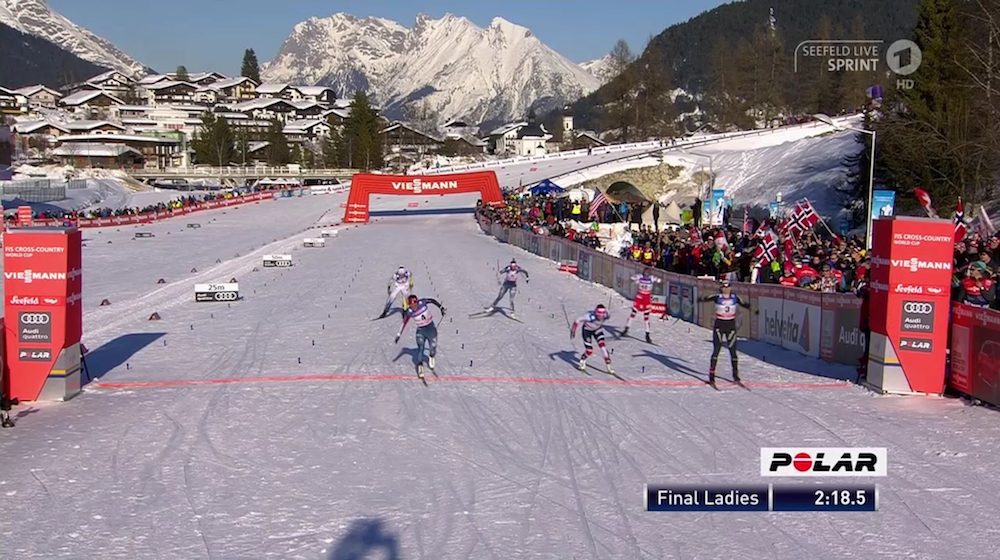
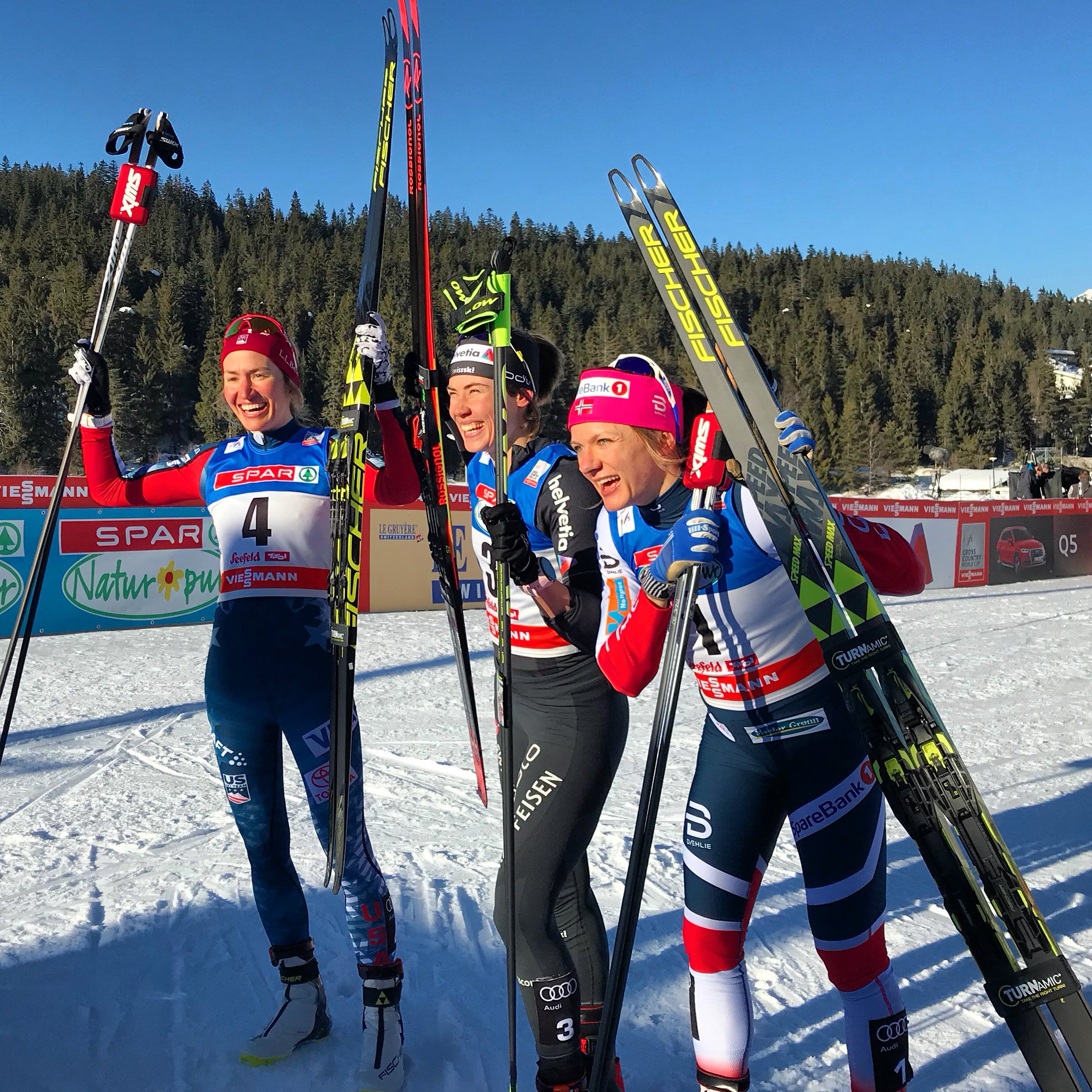
It doesn’t get any closer than that. On Saturday, American Sophie Caldwell and Switzerland’s Laurien van der Graaff tied for first in the women’s 1.1-kilometer freestyle sprint final at the World Cup in Seefeld, Austria. They both finished within one-hundredth of a second of each other to take the victory — the last sprint before the Olympics — in 2:18.65 minutes.
Norway’s Maiken Caspersen Falla finished 0.21 seconds later for third place.
The women’s freestyle sprint podium at Saturday’s World Cup in Seefeld, Austria, with American Sophie Caldwell (l) and Switzerland’s Laurien van der Graaff (c) tying for first and Norway’s Maiken Caspersen Falla (r) placing third. (Photo: FIS Cross Country/Twitter)
“I broke my pole in the semifinal, then I got really tired,” van der Graaff said in a post-race interview with the International Ski Federation (FIS). “But I still believed I can be with Maiken and Sophie, and that I could catch them in the final was just great.”
Norway and the U.S. both had two in the final, with Kathrine Rolsted Harsem of Norway placing fourth (+1.34), Sweden’s Linn Sömskar finishing fifth (+1.83) and American Sadie Bjornsen taking sixth (+2.26).
Falla had raced to first in the qualifying round with a time of 2:21.44, Italy’s Greta Laurent qualified second (+1.43), van der Graaff third (+1.66), Caldwell fourth (+1.84), and Bjornsen fifth (+2.01).
Van der Graaff then won her quarterfinal and placed third in the first semifinal, 0.77 second behind Caldwell, who won it. Falla was second in that semifinal (+0.16) and van der Graaff advanced as a lucky loser.
Caldwell and Falla went head to head in every heat, with Falla winning their first quarterfinal by 0.08 seconds over Caldwell in second.
Bjornsen won her quarterfinal and finished second to Harsem in the second semifinal.
A third American, Kikkan Randall also qualified for the heats, placing 18th in the qualifier then finishing third in her quarterfinal (1.33 seconds behind Sömskar in first) to end up 14th overall.
Canada’s Dahria Beatty placed 30th in the qualifier to nab the last spot in the rounds, then finished fourth in her quarterfinal (1.65 seconds behind Laurent in first) for 20th overall.
For the U.S., Ida Sargent missed qualifying by about half a second in 37th (+8.20), Rosie Brennan finished 42nd (+9.86) and Caitlin Patterson was 52nd (+13.0).
Also for Canada, Emily Nishikawa finished 51st (+12.68) and Cendrine Browne was 54th (+13.34).
The men’s 1.4 k freestyle sprint podium at the World Cup in Seefeld, Austria, with Norway’s Johannes Høsflot Klæbo (c) in first, France’s Lucas Chanavat (l) in second and Sweden’s Calle Halfvarsson (r) in third. (Photo: FIS Cross Country/ Twitter)
The men raced 1.4 k, with Norway’s Johannes Høsflot Klæbo qualifying first in 2:46.89 then winning his quarterfinal and semifinal before putting the hammer down for one last time in the final, finishing first in 3:02.66.
France’s Lucas Chanavat placed second in the final, 0.48 seconds back, after qualifying sixth, winning his quarterfinal and placing second in the first semifinal (0.33 seconds behind Klæbo). Sweden’s Calle Halfvarsson took the third spot on the podium after finishing 0.97 seconds after Klæbo. Halfvarsson had previously qualified seventh, taken second in his quarterfinal and advanced as a lucky loser in third in the first semifinal (0.52 seconds behind Klæbo).
Italy’s Federico Pellegrino missed the podium in fourth (+1.06), Russia’s Gleb Retivykh placed fifth (+1.17), and Norway’s Emil Iversen was sixth (+5.57).
Canada’s Alex Harvey and American Simi Hamilton both made it to the semifinals, where they finished fourth and fifth, respectively, and did not advance to the finals. Harvey had qualified for the rounds in 22nd and won his quarterfinal, then raced in the second semifinal, where he finished fourth, 0.47 seconds behind Iversen in first. That put Harvey eighth overall on the day.
Hamilton clocked the fifth-fastest qualifying time, 6.46 seconds back from Klæbo’s top time. The U.S. Ski Team member then placed second to Pellegrino in his quarterfinal and was fifth in the first semifinal, 2.61 seconds behind Klæbo. Overall, Hamilton placed ninth.
Also for the U.S., Erik Bjornsen finished 37th in the qualifier, 0.89 seconds out of the top 30 and 11.99 second out of first, Logan Hanneman was 39th (+12.52), Andy Newell 42nd (+12.90), Reese Hanneman 65th (+17.91), and Ben Lustgarten 76th (+21.88).
Canada’s Len Valjas placed 40th (+12.72), Julien Locke 43rd (+13.31), Knute Johnsgaard 51st (+14.74), Bob Thompson 58th (+16.55), Graeme Killick 61st (+17.28), and Devon Kershaw 70th (+19.53).
France’s 22-year-old Chloé Chevalier racing to her second win and third podium of the week in as many individual races at 2018 IBU Open European Championships on Saturday in Ridnaun, Italy. (Photo: IBU/Biathlonworld)
IBU Open European Championships (Ridnaun-Val Ridanna, Italy): Men’s and women’s pursuits
France’s Chloé Chevalier picked up her second win and third podium of the week at the International Biathlon Union (IBU) Open European Championships on Saturday in Ridnaun, Italy, winning the women’s 10 k pursuit, while Russia’s Alexander Loginov rose to the top step of the podium in the men’s 12.5 k pursuit on Saturday.
Chevalier started the women’s pursuit in second, 13 seconds behind Ukraine’s Iryna Varvynets (who won Friday’s sprint and thus started first), and shot clean to take the lead after the third stage — where Varvynets missed one. Chevalier went on to clean the final stage for perfect 20-for-20 shooting and crossed the line first in 29:25.4. Varvynets finished second, 11.0 seconds back after missing a single target in the first standing (0+0+1+0), and France had two on the podium with Julia Simon in third (+43.2). Simon also shot 19-for-20, with her miss coming in the second prone stage (0+1+0+0).
“Three medals in three races is definitely more than I had expected,” Chevalier, 22, told the event’s organizers on Saturday. “Today I saw that Iryna shoots faster than I, and so I really gave my all in the track. Even if it might not look like it, after the many races in the last few days I am noticing that I am getting more and more tired.”
American Chloe Levins rose from 59th at the start to 42nd at the finish (+4:11.8), with three clean stages and two misses in the first standing (0+0+2+0). She had the 28th-fastest overall range time and 30th-ranked shooting time.
In the men’s pursuit, Loginov started first as Friday’s sprint winner Latvia’s Andrejs Rastorgujevs did not start. Loginov held the lead throughout the race despite two misses — one in the first stage and another in the last stage (1+0+0+1) — and secured the win in 32:22.1. Bulgaria’s Krasimir Anev started second, 19 seconds after Loginov, and held his place as well, shooting clean and finishing second, 27.6 second back.
“I am really happy here in Ridanna and the results reflect that,” Loginov, 25, told organizers. “Not to start in the individual event on Wednesday was the right decision because the last few days had been very demanding with six races in eight days. I am cross with my two errors in the shooting range, but very happy with my performance in the track.”
Russia had two on the podium with Evgeniy Garanichev in third (+1:10.7) after Garanichev started in bib 19 and overcame three penalties (1+0+2+0) with the fastest overall course time.
Canada’s Macx Davies started 27th and finished 35th (+4:33.9) with five misses (3+0+2+0), while American Alex Howe rose from 53rd at the start to 43rd (+5:53.5) with five penalties (2+2+1+0).
The 2018 Open European Championships conclude with the single mixed relay and mixed relay on Sunday. American Susan Dunklee and Lowell Bailey are on the start list for the single mixed relay, Canada’s Carsen Campbell and Sarah Beaudry. For the mixed relay, the U.S. has entered Levins, Maddie Phaneuf, Paul Schommer, and Alex Howe.
The jumping portion of the Nordic Combined World Cup Seefeld Triple on Friday in Seefeld, Austria. (Photo: Garrott Kuzzy / LumiExperiences.com)
Nordic Combined World Cup (Seefeld, Austria): Individual normal hill/5 k
On the first of the three-day Seefeld Triple Nordic Combined World Cup, Japan’s Akito Watabe took the win and Taylor Fletcher was the top American in 28th in the individual normal hill/5-kilometer Gundersen on Friday.
Japan’s Akito Watabe heading out of the gate second in the 5 k Gundersen on Friday at the Seefeld Triple Nordic Combined World Cup in Seefeld, Austria. Watabe went on to win the race by half a second. (Photo: Garrott Kuzzy / LumiExperiences.com)
Watabe put himself in second in the jump portion and started the 5 k ski race 21 seconds behind Norway’s Jarl Magnus Riiber in first. Watabe caught Riiber and beat him at the finish line, taking the win in 11:22.3 minutes, while Riiber followed 0.5 seconds back in second place. Germany’s Fabien Rießle followed in third, 32.4 seconds out of first, after starting the 5 k in sixth and 1:03 minutes back.
Norway’s Jan Schmid jumped to third and ended up fourth (+37.8). Watabe’s brother, Yoshito Watabe placed fifth (+47.2), losing one place in the ski race after jumping to fourth.
Two Americans competed, with Fletcher jumping to 30th and ending the day in 28th, and Jasper Good finishing 52nd (+3:45.6) after jumping to 49th. Both are headed to the 2018 Olympics next month in PyeongChang, South Korea.
Taylor Fletcher (USA Nordic) starting the 5 k Gundersen on Friday at the Seefeld Triple Nordic Combined World Cup in Seefeld, Austria. He started in 30th and finished 28th. (Photo: Garrott Kuzzy / LumiExperiences.com)
***
U.S. SuperTour (Craftsbury, Vermont): Classic sprints
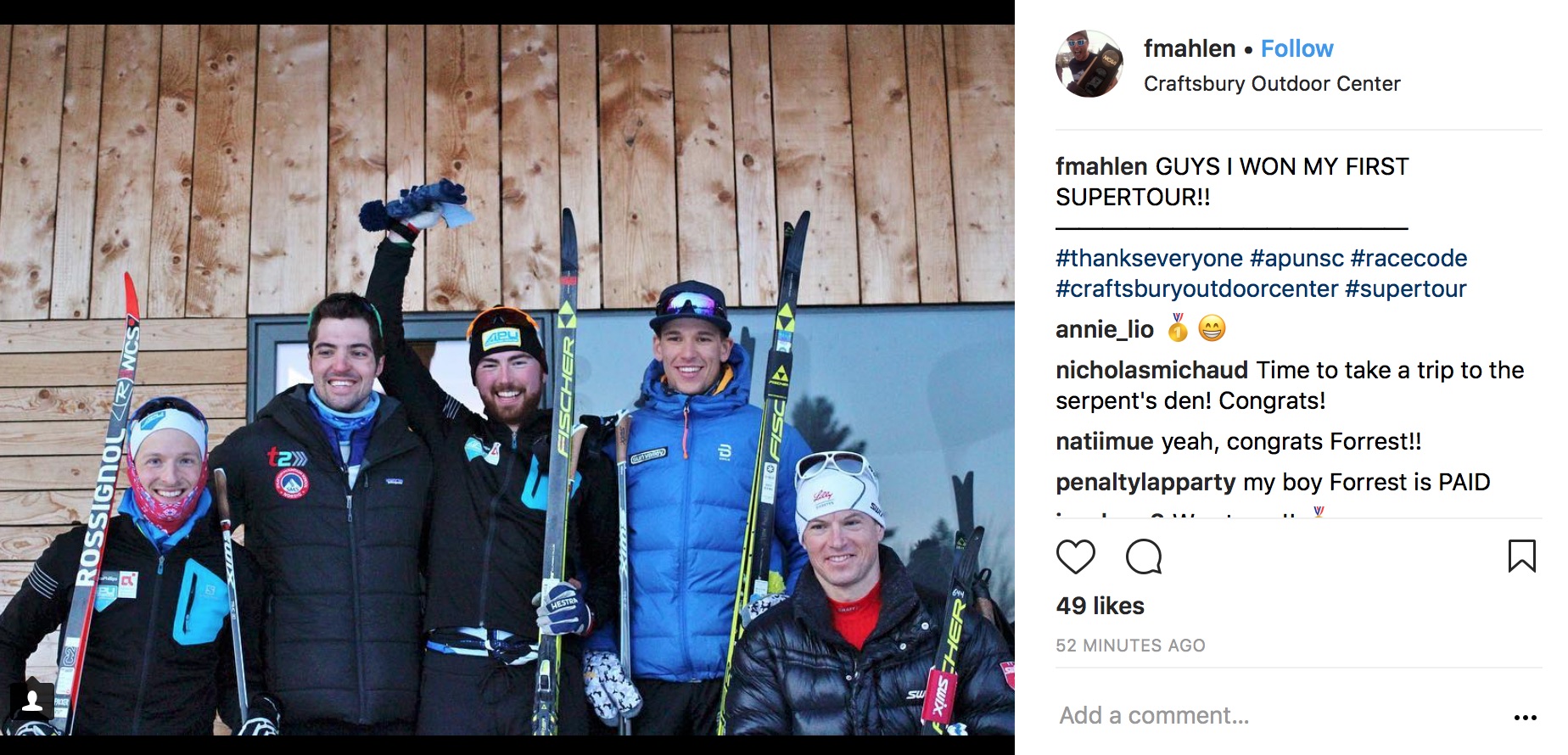
Forrest Mahlen (APU) celebrates his first time atop the SuperTour podium on Friday after winning the men’s 1.4 k classic sprint final in Craftsbury, Vermont. (Photo: Forrest Mahlen/Instagram)
Kaitlynn Miller and Forrest Mahlen won their respective classic-sprint finals at Friday’s SuperTour in Craftsbury, Vermont.
The 1.4-kilometer classic sprint kicked off a three-day race weekend at the Craftsbury Outdoor Center. On Saturday, the Craftsbury Marathon will be held (not a SuperTour event), followed by 5/10 k freestyle SuperTour races on Sunday.
Miller, of the Craftsbury Green Racing Project, started Friday by winning the women’s qualifier. She went on to win both her quarterfinal and semifinal before topping the final as well in 3:40.9 minutes. Also on Friday, it was formally announced that Miller was named to the U.S. Cross-Country Ski Team’s Olympic squad, which will compete in PyeongChang, South Korea, Feb. 10-25.
Kelsey Phinney, of the Sun Valley Ski Education Foundation (SVSEF), placed second in the women’s final, 0.63 seconds back, and Felicia Geisor (CXC Team) was third (+1.67). Erika Flowers, of the Stratton Mountain School (SMS) T2 Team placed fourth (+3.2), Canada’s Olivia Bouffard-Nesbitt (Rocky Mountain Racers) — fresh off NorAm Western Canadian Championships last weekend in Alberta — finished fifth (+5.46), and Alaska Pacific University (APU) skier Rosie Frankowski (who also made the U.S. Olympic team) placed sixth (+6.27).
On the men’s side, APU’s 24-year-old Mahlen qualified fifth, then won his quarterfinal and semifinal before taking the final for his first-career SuperTour win in 3:06.81. Ben Saxton (SMST2) initially won the qualifier and won his quarterfinal as well before placing second to Mahlen in the first semifinal. Saxton ended up 0.55 seconds back in second place in the final, just three-hundredths of a second ahead of Kevin Bolger (SVSEF) in third place (+0.58). Another half second back, Kris Freeman followed in fourth, just 1.09 out of first, Eric Packer (APU) was fifth (+1.39) and Canada’s Andy Shields (Lappe Nordic), who also competed at Western Canadian Championships last weekend) sixth (+8.99).
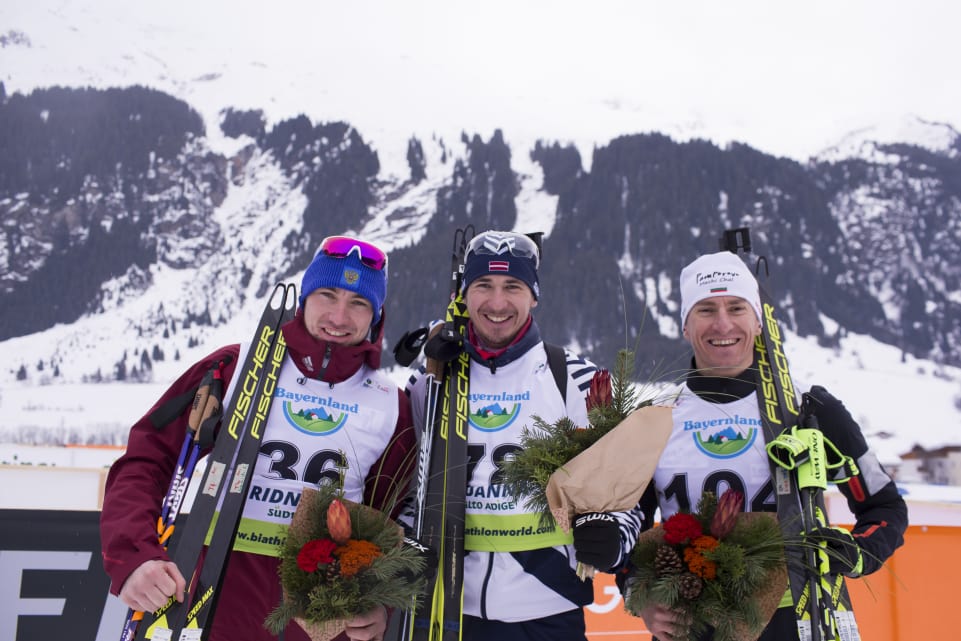
The men’s 10 k sprint podium at IBU Open European Championships, with Latvia’s Andrejs Rastorgujevs (c) in first, Russia’s Alexander Loginov (l) in second, and Bulgaria’s Krasimir Anev (r) in third. (Photo: IBU/Biathlonworld)
IBU Open European Championships (Ridnaun-Val Ridanna, Italy): Men’s and women’s sprints
Canada’s Macx Davies led the North Americans on Friday on Day 2 of the International Biathlon Union (IBU) Open European Championships in Ridnaun, Italy, placing 27th in the men’s 10-kilometer sprint with 9-for-10 shooting (1+0). Davies finished 1:32.3 minutes behind Latvia’s Andrejs Rastorgujevs, who took the win in 24:03.0 with a single penalty as well (0+1).
Russia’s Alexander Loginov placed second, 5.5 seconds back, with one penalty (1+0), and Bulgaria’s Krasimir Anev shot clean to finish third (+24.5).
“At the [last] World Cup in Anterselva [Italy], I have had a difficult time in the shooting range, and so I spent a lot of time in the last few days working on my shooting,” Rastorgujevs told the IBU after. “Today it was clear that all this hard work paid off. It is also a great motivator for Olympic gold.”
For Davies, who’s also headed to the Olympics next month, the result tied his best individual result this season after he placed 27th in an IBU Cup sprint earlier this month in Osrblie, Slovakia.
Canada entered four in the men’s race, with Carsen Campbell finishing 75th (+2:34.6) with one miss (0+1), Aidan Miller placing 91st (+3:18.2) with three penalties (1+2), and Matt Hudec finishing 119th (+4:31.6) with four misses (1+3).
Five American men raced, with Alex Howe finishing 53rd (+2:15.1) with one penalty (1+0), Jake Brown 84th (+3:02.0) with four misses (1+3), Jakob Ellingson 85th (+3:07.0) with one miss (1+0), Max Durtschi 111th (+3:50.1) with four misses (3+1), and Paul Schommer 114th (+3:59.8) with four penalties (2+2) as well.
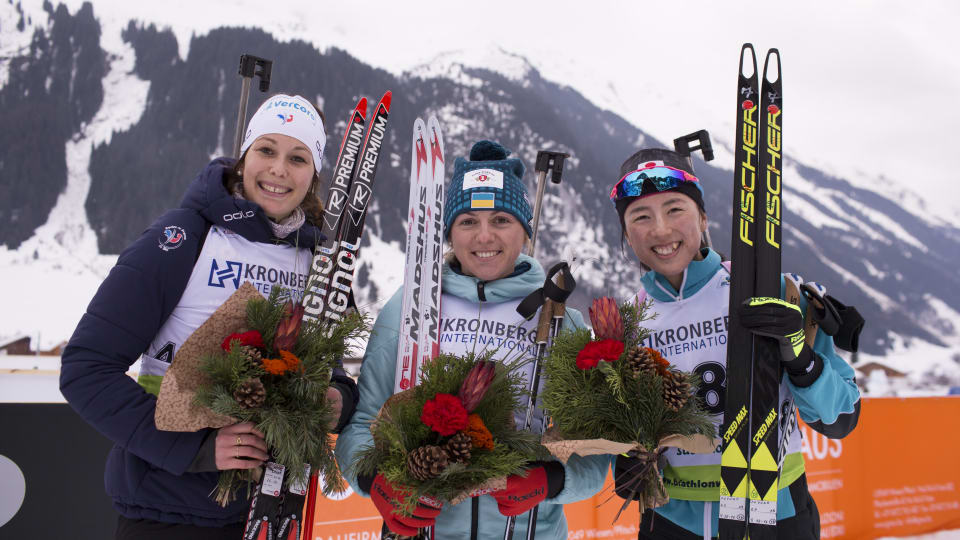
The women’s 7.5 k sprint podium at IBU Open European Championships in Ridnaun, Italy, with Ukraine’s Iryna Varvynets (c) in first, France’s Chloé Chevalier (l) in second, and Japan’s Fuyuko Tachizaki (r) in third. (Photo: IBU/Biathlonworld)
In the women’s 7.5 k sprint that followed, Chloe Levins of the U.S. was the top North American in 59th, 2:01 behind the winner Iryna Varvynets of Ukraine. Varvynets shot clean and posted the fastest finishing time of 20:54.1, 12.5 seconds faster than France’s Chloé Chevalier, Wednesday’s 15 k champion who had one miss (0+1) on Friday and ended up second. Japan’s Fuyuko Tachizaki reached the podium in third (+15.5) and was one of four women in the top five that shot clean (only Chevalier did not).
“After the individual competition on Wednesday, I was not at all happy with my shooting,” said Varvynets, who placed fifth in the 15 k. “Today I therefore concentrated especially hard in the shooting range. It was my luck that not many finished without errors, otherwise it would probably not have been enough for the victory.”
“Two races, two medals — it could not have gone better for me,” Chevalier said. “In the standing shooting I missed the first disc and got a little nervous, but thankfully, there were no further errors.”
Tachizaki called the bronze medal a “big dream come true”.
“The focus of my season had been the Olympics and I ‘only’ took part in Ridanna as part of the preparations, but with this result I have exceeded everything I have achieved so far,” she said. “At the end of the race I did not only fight hard in the track, I was already dreaming of a medal. Now I’m in seventh heaven.”
Levins had one miss in each stage (1+1), as did fellow American Maddie Phaneuf, who finished 63rd (+2:19.0) with two penalties. Clare Egan followed in 70th (+2:34.2) with four misses (3+1), Deedra Irwin was 85th (+3:38.1) with four penalties (1+3) as well, and Jennie Bender 97th (+5:52.8) with six misses (3+3).
Two Canadians started the race, with Sarah Beaudry finishing 76th (+3:02.9) with four misses (1+3). Erin Yungblut did not finish.
Open European Championships continue Saturday with the men’s and women’s pursuits. The top 60 from the sprint qualify, which, for the North Americans, means Davies, Howe, and Levins.
The championships end Sunday with single mixed and mixed relays.
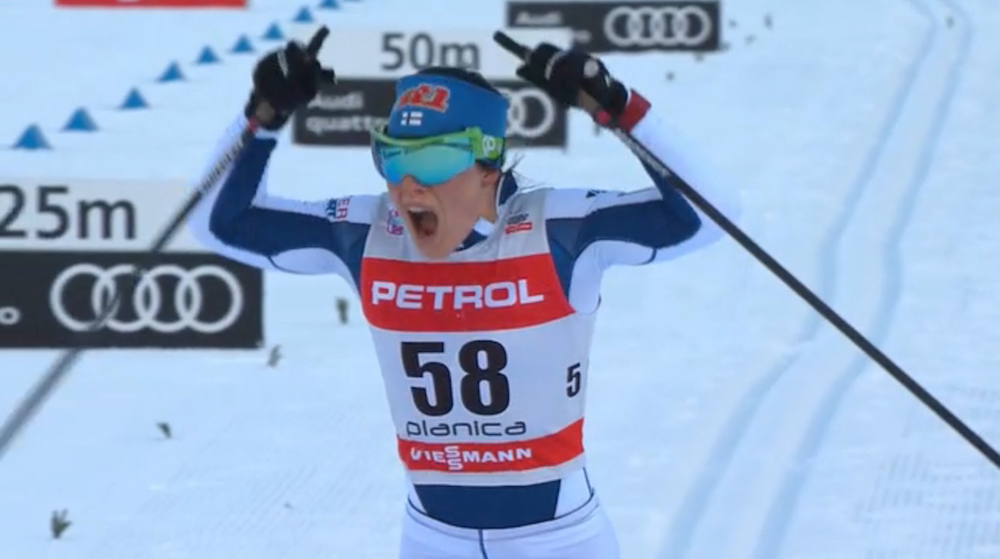
Finland’s Krista Pärmäkoski after winning her first non-stage World Cup on Sunday in the women’s 10 k classic in Planica, Slovenia. She bested Sweden’s Charlotte Kalla’s time by 3.6 seconds. (Screenshot: ARD broadcast)
FIS Cross Country World Cup (Planica, Slovenia): 10/15 k classic
Just when it looked like one of those Charlotte-Kalla days, Finland’s Krista Pärmäkoski swooped in and topped the Swede’s time by 3.6 seconds in the women’s 10-kilometer classic individual start on Sunday for her first-career outright World Cup win.
Outright meaning non-stage; Pärmäkoski has two World Cup wins to her name for setting the fastest time of day in 2016 pursuit races.
But Sunday’s 10 k in Slovenia saw her rising to the challenge and besting Charlotte Kalla’s time of 27:12.3, which was at least 39 seconds faster than the first 57 starters. Kalla had started 32nd and beat the previous top time set by Swedish U23 skier Ebba Andersson (bib 28) by 48.6 seconds.
Austria’s Teresa Stadlober started later in bib 56 and clocked the second-fastest time to Kalla, 39 seconds back.
But it was Pärmäkoski in bib 58 who beat them all. Even Norway’s Heidi Weng, who started 60th, couldn’t come close, as she finished 33.5 seconds off Pärmäkoski’s winning time for third place. That put Stadlober in fourth and Andersson in fifth at the end of the day.
Finland’s Kerttu Niskanen placed sixth (+49.4), Norway’s Kari Øyre Slind took seventh (+49.5), Poland’s Justyna Kowalczyk (who’s more of a marathon skier these days) placed eighth (+1:02.1), Norway’s Kathrine Rolsted Harsem (who placed second in Saturday’s classic sprint) finished ninth (+1:03.2), and American Jessie Diggins was 10th (+1:05.4).
Another American, Caitlin Patterson, of the Craftsbury Green Racing Project (CGRP), broke through with her second-best individual World Cup result in 20th (+1:45.2). (Last year, she finished seventh in the pre-Olympic PyeongChang World Cup 15 k skiathlon in a notably small field.)
Kikkan Randall (U.S. Ski Team) followed in 23rd (+1:50.4), and her teammates Sophie Caldwell placed 31st (+2:17.2), Liz Stephen 35th (+2:34.9), and Ida Sargent 37th (+2:37.5).
For the second-straight weekend, no Canadian women competed.
The World Cup men’s 15 k classic podium on Sunday in Planica, Slovenia, with Kazakhstan’s Alexey Poltoranin (c) in first, Norway’s Johannes Høsflot Klæbo (l) in second, and Sweden’s Calle Halfvarsson (r) in third. (Photo: FIS Cross Country/Twitter)
In the men’s 15 k classic, Kazakhstan’s Alexey Poltoranin tallied his second win of the season and first in a race against Norway’s Johannes Høsflot Klæbo on Sunday, winning by 13.2 seconds over Klæbo in 36:54.7.
Poltoranin, 30, started 44th and a minute behind the 21-year-old Klæbo. When Klæbo finished, he bumped Russia’s Ivan Kirillov, also 21, out of the leader’s chair by 43.3 seconds. Then Poltoranin finished 13.2 seconds faster, but Klæbo held onto second when Sweden’s 60th starter, Calle Halfvarsson, finished third (+42.8). It was Halfvarsson’s second podium of the season after placing third in the classic sprint at the November World Cup opener in Kuusamo, Finland. In Saturday’s classic sprint in Slovenia, Halfvarsson qualified second but crashed out of the quarterfinals to finish the day in 30th overall.
Norway’s Emil Iversen started 66th and ended up fourth (+54.7) and Kirillov scored his first World Cup top 10 in fifth (+56.5). Russia had four in the top 10 with Stanislav Volzhentsev in sixth (+57.8), Andrey Larkov in eighth (+1:02.2) and Andrey Sobakarev in ninth (+1:03.4). Norway’s Mattis Stenshagen finished seventh (+1:00.8) and Finland’s Iivo Niskanen took 10th (+1:10.1).
Scott Patterson (U.S. Ski Team) was the top North American in 43rd (+2:56.2), Ben Lustgarten (Craftsbury Green Racing Project) finished 46th (+3:04.9) and Tyler Kornfield (Alaska Pacific University) was 57th (+4:03.7). Andy Newell did not finish.
Canada’s Devon Kershaw returned to the circuit and placed 44th (+2:57.1), Bob Thompson (NTDC Thunder Bay) was 64th (+5:05.0), and Dominique Moncion-Groulx (Alberta World Cup Academy) was 70th (+6:11.7).
Russia’s Stefaniya Nadymova outsprinting Japan’s Ayane Miyazaki at the finish for the win at the inaugural women’s Nordic Combined Continental Cup competition on Saturday in Rena, Norway. (Photo: FIS/Romina Eggert)
FIS Nordic Combined Continental Cup (Rena, Norway): First-ever women’s competitions
Fourteen women, including American Gabriella Armstrong, made history this weekend by competing in the first women’s Nordic Combined Continental Cup in Rena, Norway (after the scheduled opener in Jan. 6-7 in Otepää, Estonia, was canceled), with back-to-back days of individual large hill/5-kilometer Gundersen start races.
On Saturday, Russia’s Stefaniya Nadymova took the win in 16:26.9, just 0.6 seconds ahead of Japan’s Ayane Miyazki in second. Germany’s Jenny Nowak joined them on the podium in third, 16.6 seconds out of first. Armstrong finished 12th (+6:24).
Nadymova, 23, had kicked off the event by jumping to first in the provisional round, which was used for the jumping results, and began the 5 k with a 10-second head start on Nowak in second place. Miyazaki jumped to third and started 14 seconds back. Armstrong jumped to 14th and started 4:08 out of first.
On Sunday, 15-year-old Miyazaki took the win in 16:23.2, swapping places with Nadymova, who finished second, 11.7 seconds back. Nowak, also 15, repeated in third, but finished over a minute and 21 seconds back out of first.
Miyazaki had jumped to first place earlier in the day and started the 5 k with a 20-second cushion to Nadymova in second. Nowak jumped to third and started 1:08 minutes back.
Armstrong, 19, of the New York Ski Education Foundation, jumped to 11th and finished 11th, 4:26.1 after Miyazaki.
Several U.S. Nordic Combined men also competed in Rena, with Taylor Fletcher placing fourth in Saturday’s individual large hill/10 k, 2.7 seconds behind Austria’s Thomas Joebstl in first. Fletcher had skied up from 25th and 2:17 back after the jump with the second-fastest course time.
Also for the U.S., Adam Loomis placed 33rd (+2:30.7) after jumping to 45th with the 12th-fastest course time. Grant Andrews finished 41st (+3:28.7), and Jared Schumate 43rd (+4:10.1).
Fletcher reached the podium in Sunday’s individual large hill/10 k in third behind two Austrians. After jumping to 19th, he skied the fourth-fastest course time to finish third, 3.7 seconds behind Dominik Terzer in first and 2.7 seconds behind Martin Fritz in second.
Loomis improved to 29th (+1:40.9), up from 35th in the jump, and Andrews finished 37th (+2:36.4) and Shumate 40th (+2:57.9).
The men’s large hill/4 x 5 k team event podium on Sunday at the Nordic Combined World Cup in Chaux-Neuve, France, with Norway (c) in first, Germany (l) in second, and Finland (r) in third. (Photo: FIS/NordicFocus)
FIS Nordic Combined World Cup (Chaux-Neuve, France): Saturday & Sunday
Four American men competed at the Nordic Combined World Cup this weekend in Chaux-Neuve, France, with three of them racing in Saturday’s individual large hill/10 k Gundersen and all four racing Sunday’s large hill/4 x 5 k team event.
Norway’s Jan Schmid was the big winner this weekend, racking up an individual win on Saturday and a team victory on Sunday. He won Saturday’s competition after jumping to fourth and starting 27 seconds behind jump leader Akito Watabe of Japan. Schmid worked his way up to first in the 10 k with the third-fastest course time, crossing the line 1.4 seconds ahead of Watabe in 23:32.7.
Watabe finished second and Finland’s Ilkka Herola placed third (+21.5), just ahead of Austria’s Lukas Klapfer in fourth (+21.8).
Ben Loomis led USA Nordic in 37th (+2:49), after jumping to 37th, Stephen Schumann finished 45th (+5:17.0) and Ben Berend 46th (+5:22.2).
On Sunday, Schmid teamed up with Espen Andersen, Jarl Magnus Riiber and Jørgen Graabak to win the 4 x 5 k team event in 47:22.5 by 13.1 seconds. Germany followed in second, with Eric Frenzel, Fabian Rießle, Johannes Rydzek, and Vinzenz Geiger, and Finland placed third (+20.5) with Leevi Mutru, Arttu Maekiaho, Herola, and Eero Hirvonen.
Norway had led after the jump and started the relay 1:03 minutes ahead of Finland in second. France jumped to third and ended up fourth (+47.4), after being passed by Germany, which had started the relay in fourth.
Japan placed fifth (+2:50.9), Italy sixth (+3:59.9), Austria seventh (+4:06.8), Poland eighth (+5:22.1), Estonia ninth (+5:52.1), Russia 10th (+6:41.2), and the U.S. (with Schumann, Loomis, Berend, and Jasper Good) 11th (+6:52.4).
Western Canadian Championships (Red Deer, Alberta): Relays
Nine men’s teams and six women’s squads contested the open relays on the last day of the NorAm Western Canadian Championships on Sunday in Red Deer, with Ontario’s Team “O” (Scott Hill, Michael Somppi and Andy Shields) winning the men’s 3 x 5 k and Alberta 1 (Annika Hicks, Emma Camicioli and Zina Kocher) winning the women’s 3 x 5 k.
For Shields and Hicks, it was their second win of the weekend after they won their respective classic mass starts on Saturday.
Team “O” posted a 19.9-second win over B.C. Storm (Remi Drolet, Tallon Noble and Greg Kilroy), finishing first in 36:22.6. Alberta 5.1 (Sebastien Boehmler-Dandurand, Sam Hendry and Russell Kennedy) placed third (+52.3).
In the women’s relay, Alberta 1 beat out B.C. Fast, Furious & Freakin’ Awesome (Katie Weaver, Michaela McLean and Kaia Andal) by 2 minutes and 37.8 seconds, winning in 43:17.2. Alberta had two teams on the podium with the Kit Kats (Ember Large, Molly Jane Strum, and Sara McLean) in third (+4:25.8).
Bryan Fletcher (USA Nordic) jumping at the Nordic Combined World Cup last Sunday, Dec. 17, in Ramsau, Austria. After jumping to 45th in the provisional round on Friday (Sunday’s competition round was cancelled midway through), he skied the third-fastest time in Sunday’s 10 k to finish 14th overall. (Photo: Romina Eggert/USA Nordic Facebook)
On Dec. 30, the nordic-combined community will gather in Park City for the U.S. Olympic Team Trials, a one-and-done event which will dole out an Olympic berth for the race winner. As they have for much of their professional-sport careers, brothers Bryan and Tyler Fletcher are eying the same prize.
Bryan Fletcher was ranked 34th on the World Cup last season. His best individual results during the 2016/2017 World Cup calendar were an 11th and 18th place.
This past weekend in Ramsau, Austria, Bryan, the older of the Fletcher brothers, came through with a seventh place on Saturday, Dec. 16, for his best individual result in nearly two years.
“The opportunity was there,” Bryan, 31, said on the phone from Utah this week. He explained that the jumping hill in Ramsau is smaller than the hill used for the opening weekend in Ruka, Finland.
“Ramsau is one of those hills where everybody tends to jump a little bit closer. That was the first thing that was really helpful there,” he said. “The second thing was definitely that I jumped on a little bit higher level than the previous weekends. … I was able to put together a little bit better jumps and on a more consistent basis. As a result I was able to put myself in the fight in the race.”
Bryan jumped to 28th, yet scored 110.5 points, while the best jumper, Taihei Kato of Japan, scored 125.9 points — not a massive gap when considering the Fletchers’ skiing speed. That 15.4-point differential put Bryan 1:02 minutes behind Kato at the start of the 10 k Gundersen. When in position after a solid jump, both of the Fletchers can close out a top 20 or a top 10 in the ski.
But moving through a field of World Cup skiers — Bryan moved up 21 spots in Saturday’s race — is part-art and part-sufferfest.
Bryan Fletcher (USA Nordic) notched seventh in the Nordic Combined World Cup this weekend in Ramsau, Austria, for his best result since January 2016. (Photo: USA Nordic/Facebook)
“More these days, the old-school laws of track don’t really apply for us,” Bryan said about passing skiers during the ski portion. “Especially in nordic combined where every place is so crucial and those points are so valuable people don’t want to move over. They know if they move over for you that opens a hole for potentially five to 10 skiers that are in that train to get by.”
Ramsau’s course remains a link to the past with skinny trails placing a premium on high-risk, high-reward aggressive skiing. Moving to the front when a gap opens or sitting in and sucking a draft can make or break a result.
“That opportunity pays itself off in the end, that is exactly what happened to me,” Bryan said of his high-octane skiing and thread-the-needle gap finding. “There were several times coming over the top of a hill where I really could have taken the opportunity to tuck into the group and get some rest, but I knew I was going to be log-jammed later down on the course. I would take the risk and get to the front of the group and that would get me a clean opportunity to get up the next hill or through the choke point unscathed. There were definitely times where I was going up the hill and it was two skiers wide and I was stuck and sitting behind everybody and you just have to wait for a hole to open up and just be patient and take that rest as it comes. Of course, when it opens you just have to go and don’t look back and move on up.”
Germany’s Eric Frenzel started the 10 k race in third and took the win in 24:17.8, while Bryan finished 32.6 seconds back in seventh after skiing the second-fastest time of the day.
On Sunday, another German, Fabian Rießle, stood on top of the podium after jumping to ninth and rising to first in the 10 k, finishing in 26:12.5. The weather conditions were unsettled for Sunday’s jump competition, yet both Fletcher brothers posted solid results on the hill before the competition round was halted and ultimately cancelled. As a result, competition results did not count, and jumps from Friday’s provisional round were used instead to determine time back for the ski.
Bryan began the ski 1:30 minute back with the 45th-ranked provisional jump, while Taylor bagan the ski 2:53 minutes back after jumping to 58th, just ahead of teammate Adam Loomis in 59th.
Taylor Fletcher (USA Nordic) jumping at the Dec. 17 World Cup in Ramsau, Austria. After ranking 58th in the provisional jump on Friday, he picked off 24 places to finish 34th in the 10 k on Sunday. (Photo: Romina Eggert/USA Nordic Facebook)
Fast skiing by the Fletchers was once again on display on Sunday. Bryan raced up to 14th (+43.7) with the third-fastest time of the day while Taylor improved a whopping 24 positions to finish 34th (+2:01.6) with the second-fastest time of the day. Loomis moved up seven places to place 52nd (+4:38.6) out of 55 finishers.
“Those major ski efforts begin in May, with the intensity over the summer — that all gets you to a place where you are able to sustain efforts like that,” Taylor Fletcher said on the phone. “I love pushing myself. Every year when we do a VO2max I am excited about it. Because I want to go until I absolutely cannot go. It is the same with racing. Our races should be slightly faster than our threshold-plus intervals that we do. We have done a good job with that. And this past weekend it was snowing and I love racing when it is dumping snow. You have to be a strong skier for sure.”
When the jumping round was cancelled on Sunday, Taylor had to refocus as the jump that wouldn’t count for his ski seeding would have positioned him for a top-20 strike. Instead, his preliminary jump from Friday put him at the back of the field.
“My position drastically changed over the course of the 30 minutes that they decided to cancel the competition round,” Taylor Fletcher explained. “I wanted to try to get points no matter what. I went as hard as I possibly could for the entire race. There was not a spot where I could really settle and say I could have made up 20 seconds there and finished in the points. It’s hard to go through the field like that. When you are racing from 58th to try to get into the top 30, you are passing 28 guys, and Ramsau is a very narrow course … maybe if I could get around them quicker, then maybe they would have blown up earlier and fallen back even more. It takes a little bit of strategy and a lot of nerve and a lot of commitment to be able to push through and catch those guys and pass them and drop them.”
American Taylor Fletcher (60) racing to 36th last March after starting 51st in the individual large hill/10 k Gundersen race at 2017 World Championships in Lahti, Finland. (Photo: John Lazenby/Lazenbyphoto.com)
Let’s put this out there as it’s no mystery to any fan of the sport or any World Cup nordic-combined athlete: having a Fletcher chasing from behind can be a gamble if you don’t gun it. As the Olympic trials approach both Bryan and Taylor know their ski shape is good.
However, when asked to summarize his World Cup Period 1, Taylor was straight to the point.
“Pretty bad to be honest,” Taylor said. “Looking back after the summer and all the work, I was confident I could get off to a decent start in points and fight for points. I wasn’t worried about qualifications or anything but I was definitely bummed when I found myself struggling pretty badly with the jumping. But that being said, it was only one aspect. I mean everything else was good. Cross-country is obviously solid. My strength and power and speed in terms of the jumping is there, it’s just more mental — the mental approach I was taking to the jumping. I was trying to be almost be too perfect and trying to really get these good jumps in and really focus so much on certain aspects of the jump, I was forgetting about the whole bigger picture in a sense.”
In the short term, Taylor is focused on winning the lone competition at Olympic trials on Dec. 30 and improving his results in the new year.
“My goal right now is to win on the 30th, win the Olympic trials here and that way I can completely forget about a qualification spot and I can go out there and focus on my training and focus on the individual competitions,” Taylor said. “And then move forward and focus on the next step as we get towards the Olympics. Honestly, I think I am all right. … And hopefully the team can also step up and we can guarantee that we have four spots on the Olympic team so we can have a team event, hope for sure that we have four so we can represent the U.S. at the Olympics.”
Bryan, along with the entire who’s who in U.S. NoCo, will be honing for the shoe-in Olympic spot on the 30th. According to USA Nordic’s selection document, after the lone spot is secured at the trials, any remaining spots can be nominated using discretion with the potential for Olympic success as the guiding principle. In total, the U.S. is allotted a maximum of four spots for the PyeongChang Games. If discretion does not fill the quota, then the first step on the selection hierarchy are top-10 results from the World Cup between Nov. 15, 2017 and Jan. 22, 2018.
Currently, only Bryan meets that standard thanks to his seventh place in Ramsau.
“I think I have made the objective criteria to go, but nothing is set in stone until the qualification ends or Olympic trials are won,” Bryan said. “That will be the first guaranteed spot on the team; Olympic trials. There are a lot of eyeballs on that. A lot of guys on the team are going to be vying for that spot.”
Bryan Fletcher (USA Nordic) jumping to 45th in the Nordic Combined World Cup on Sunday in Ramsau, Austria. In the 10 k that followed, he skied the third-fastest time to finish 14th overall. (Photo: Romina Eggert/USA Nordic Facebook)
NorAm mini tour (Rossland, B.C.): 10/15 k freestyle pursuits
Team Gregg ended the Rossland NorAm mini tour with another double win, with American Caitlin Gregg and her husband Brian Gregg winning the 10- and 15-kilometer freestyle pursuits, respectively, at the Black Jack Ski Club trails.
The women’s 10 k freestyle pursuit podium at the NorAm in Rossland, B.C., with American Caitlin Gregg (c) in first, and Canadians Zina Kocher (l) and Andrea Dupont (r), in second and third, respectively. (Photo: Cross Country Canada)
Caitlin capped the long weekend with her third-straight win, a 48.28-second victory over former Canadian biathlete Zina Kocher (Foothills Nordic). Caitlin started first and was first across the finish in 29:02.86, while Kocher started ninth and rose to second place for her second-consecutive podium (after placing third in Saturday’s skate sprint). Andrea Dupont (Rocky Mountain Racers) started fourth and finished third (+1:58.35) for her second-straight podium as well (she was second in the skate sprint behind Gregg).
Lisle Compton of the National Team Development Centre (NTDC) Thunder Bay and Canadian National Junior Team finished fourth overall (+2:07.03), Frederique Vezina of the Pierre-Harvey National Training Centre (CNEPH) was fifth (+2:16.10), and Annika Hicks of the Alberta World Cup Academy (AWCA) sixth (+2:16.51). Laura Leclair (CNEPH) placed seventh, Kaia Andal (Caledonia Nordic) was the top junior in eighth overall, Jaqueline Mourao (Brazil Ski Team) ninth, and Sophie Carrier-Laforte (Skinouk) 10th.
Brian, who won the Rossland men’s 10 k classic on Friday, also started Sunday’s 15 k freestyle pursuit first and finished in that position in 38:43.93. Andy Shields (Lappe Nordic) raced to second overall, 7.65 seconds back, after starting fourth, and Jack Carlyle (AWCA) reached the podium in third (+8.75) after starting 10th.
Evan Palmer-Charrette (NTDC Thunder Bay) ended the weekend in fourth (+17.68), Philippe Boucher (CNEPH) was fifth (+19.02), Brian McKeever (Canadian Para-Nordic Ski Team) sixth (+22.16), Michael Somppi (AWCA) seventh (+34.62), Alexis Dumas (CNEPH) eighth (+52.78), Bob Thompson (NTDC Thunder Bay) ninth (+54.76), and Julien Locke (Black Jack/Canadian U25 Team) 10th (+1:04.46).
FIS Nordic Combined World Cup (Ramsau, Austria): Saturday & Sunday individual competitions
Bryan Fletcher (USA Nordic) notched seventh in the Nordic Combined World Cup this weekend in Ramsau, Austria, for his best result since January 2016. (Photo: USA Nordic/Facebook)
After a bye week, the Nordic Combined World Cup resumed in Ramsau am Dachstein, Austria, with back-to-back individual normal hill/10-kilometer Gundersen starts on Saturday and Sunday.
On Saturday, American Bryan Fletcher posted his best individual result in nearly two years in seventh place, 32.6 seconds behind German winner Eric Frenzel.
Saturday’s individual competition on Ramsau’s 98-meter hill started out with Japan’s Taihei Kato going farthest in the jump portion, the Czech Republic’s Tomas Portyk jumping to second, and Frenzel jumping to third. Fletcher tied Japan’s Yoshito Watabe for 28th and the two started the 10 k race 1:02 minutes back accordingly.
While Frenzel picked off two places to finish first in 24:05.8 minutes, Fletcher moved up 21 spots to seventh place with the second-fastest course time of 23:48.4.
Germany had two on the podium with Fabian Rießle just 0.7 seconds back in second place, and Norway’s Jan Schmid finished third, 8.1 seconds behind Frenzel.
On Sunday, Rießle climbed to the top step on the podium, winning the weekend’s second normal hill/10 k in 26:12.5.
Norway’s Jørgen Graabak led after the jump portion, yet ultimately finished sixth, 9.8 seconds behind Rießle.
Rießle jumped to ninth and started 18 seconds out of first, then took the win on the four-lap course by just 0.3 seconds over Italy’s Alessandro Pittin. The Italian notched second place after starting 36th based on his jump and racing the fastest 10 k time in 25:00.8.
Finland’s Eero Hirvonen finished third (+1.5) after starting 10th, and Schmid was another 2 seconds back in fourth (+3.5) after jumping to seventh. Frenzel did not start.
Three Americans qualified for Sunday’s competition. Fletcher jumped to 45th and started 1:30 back, yet rose to 14th (+43.7) with the third-fastest course time. His younger brother Taylor Fletcher skied the second-fastest course time to finish 34th (+2:01.6), up 24 places after jumping to 58th. Adam Loomis finished 52nd (+4:38.6) after jumping to 59th.
The U.S. Nordic Combined team is headed back to the states to prepare for U.S. Olympic trials later this month, according to the USA Nordic Facebook page.
FIS Cross Country World Cup (Toblach, Italy): 10/15 k classic pursuits
Norway’s Johannes Høsflot Klæbo after winning the men’s 15 k classic pursuit for his seventh World Cup win of the season on Sunday in Toblach, Italy. With win No. 7, he has the most wins before the new year in FIS Cross Country World Cup history. (Photo: FIS Cross Country/Twitter)
If you thought Johannes Høsflot Klæbo was out, think again. After placing 10th in the men’s 15-kilometer freestyle on Saturday in Toblach, the 21-year-old Norwegian raced to his seventh victory of the season in the men’s 15 k pursuit on Sunday.
In doing so, Klæbo broke the record for the most World Cup wins before the New Year: he’s tallied seven in the last eight races he’s contested.
On Sunday, he started 10th, 36 seconds behind his Norwegian teammate Simen Hegstad Krüger, who won the 15 k freestyle and started first. Klæbo had worked his way up to third by 11.4 k, and at the finish, he edged Russia’s Sergey Ustiugov by 1.9 seconds for the win in 33:31.1 minutes.
Ustiugov, who started fifth, claimed second, and Kazakhstan’s Alexey Poltoranin rose from 14th to third place (+4.5), ahead of Russia’s Alexander Bessmertnykh in fourth (+9.7), Finland’s Matti Heikkinen in fifth (+9.8), France’s Maurice Manificat in sixth (+10.7), Norway’s Hans Christer Holund in seventh (+11.1), Switzerland’s Dario Cologna in eighth (+11.8), Canada’s Alex Harvey in ninth (+16.3), and Krüger in 10th (+24.0). Norway’s defending Overall and Distance World Cup champion, Martin Johnsrud Sundby placed 11th (+34.4) after starting 20th based on his result on Saturday.
Erik Bjornsen once again led the U.S. men, racing from 29th at the start to 26th (+1:43.1). Scott Patterson improved from 42nd to 39th (+2:37.2), Paddy Caldwell moved up from 52nd to 44th (+2:57.7), and Noah Hoffman slipped to 49th (+3:01.7) after starting 40th.
Canada’s Devon Kershaw moved up five places to 33rd (+2:02.8), Graeme Killick finished 50th (+3:42.0), Russell Kennedy 66th (+5:05.8), and Knute Johnsgaard moved up six places to finish 76th (+6:20.8).
The all-Norwegian women’s 10 k classic pursuit podium on Sunday at the World Cup in Toblach, Italy, with Marit Bjørgen (c) in first, Ingvild Flugstad Østberg (l) in second and Heidi Weng (r) in third. (Photo: FIS Cross Country/Twitter)
In the women’s 10 k classic pursuit earlier in the day in Toblach, Norway’s Marit Bjørgen overcame a 22-second starting deficit to take the win by just 0.3 seconds over her teammates Ingvild Flugstad Østberg in second. It was an all-Norwegian podium with Heidi Weng in third (+0.8).
Bjørgen started fifth, 22 seconds behind Swedish race leader Charlotte Kalla, based on their results in Saturday’s 10 k freestyle individual start. By the 6.4 k checkpoint, Bjørgen led a pack of four other Norwegians and Kalla — all within 1.4 seconds of first. At 8.5 k, Bjørgen led Østberg in second and Weng in third, while another Norwegian Astrid Uhrenholdt Jacobsen skied another eight seconds back with teammate Ragnhild Haga in fourth and fifth, respectively. By that point, Kalla was skiing alone, another 11.7 seconds in sixth, while American Jessie Diggins led a group 25 seconds behind Kalla in sixth.
Ultimately, Bjørgen finished first in 25:19.3 and formed an all-Norwegian podium with Østberg and Weng, Jacobsen placed fourth, 21.5 seconds out of first and 20.7 seconds behind Weng in third.
Haga was fifth (+31.8), Kalla sixth (+41.9), Diggins seventh (+53.7), Russia’s Natalia Nepryaeva eighth (+54.2), American Sadie Bjornsen ninth (+55.2), and Austria’s Teresa Stadlober 10th (+55.6) in a photo finish with Finland’s Kerttu Niskanen, who placed 11th (+55.6).
For the U.S. Ski Team, Diggins and Bjornsen retained their starting positions of seventh and ninth, respectively, while Rosie Brennan started 19th and finished 25th (+2:14.6). Chelsea Holmes (Alaska Pacific University) finished 39th (+3:03.8) and Liz Stephen (USST) finished 48th (+4:05.2).
France’s Justine Braisaz won her first International Biathlon Union (IBU) World Cup race of the season on Sunday at home in Annecy, France, topping the women’s 12.5 k mass start by 11.2 seconds in 37:19.4.
While Braisaz shot 19-for-20 (0+0+1+0), Iryna Kryuko of Belarus cleaned the four-stage race for second place, her first World Cup podium. Germany’s Laura Dahlmeier, who won Saturday’s 10 k pursuit, placed third (+19.9) with two penalties (0+1+0+1).
Two North Americans qualified for the selective mass start, with Susan Dunklee (US Biathlon) racing to 20th (+1:16.3) with three misses (1+0+1+1), and Emma Lunder (Biathlon Canada) placing 28th (+2:21.4) with a single penalty (1+0+0+0).
In the men’s 15 k mass start that followed, France’s Martin Fourcade finally got the win he was looking for, shooting clean and beating his main rival Johannes Thingnes Bø of Norway by 3.9 seconds. Fourcade crossed the finish line first in 36:30.3, Bø settled for second after skiing two early penalty loops (2+0+0+0) and Germany’s Erik Lesser tallied his second podium in Annecy (after placing third in the sprint) in third place again (+6.2) with clean shooting.
Two Americans and a Canadian qualified for the mass start, with US Biathlon’s Lowell Bailey leading them in 23rd (+2:22.4) with three penalties, Sean Doherty following in 24th (+2:52.5) with four misses, and Biathlon Canada’s Scott Gow finishing 26th (+4:05.4) with five penalties.
OPA Cup (St. Ulrich, Austria): 10/15 k freestyle pursuits
On the final day of Alpen Cup (a.k.a. OPA Cup) racing in St. Ulrich, Ida Sargent of the U.S. Ski Team (USST) scored her third-straight top five with a fifth place in the women’s 10 k freestyle mass start. She previously placed third in the skate sprint and 5 k classic on Friday and Saturday.
Germany’s Julia Belger won the women’s mass start on Sunday in 28:33.6, while Saturday’s 5 k winner, Elena Soboleva of Russia placed second (+0.7). Russia had two on the podium with Mariya Istomina in third (+6.4). Germany’s Elisabeth Schicho finished fourth (+15.8), just ahead of Sargent in fifth (+15.9).
Germany’s Antonia Fräbel placed sixth (+17.1), followed by American Sophie Caldwell in seventh (+17.9). The USST had three in the top 10 with Julia Kern in 10th (+41.9), out of 60 finishers.
In the men’s 15 k freestyle mass start, Beda Klee of Switzerland took the win in 37:14.6, 2.4 seconds ahead of Germany’s Thomas Bing in second. Six-time Olympian Sergey Dolidovich of Belarus reached the podium in third (+4.5).
The U.S. had two men in the race, with Simi Hamilton finishing 14th, 16 seconds out of first, and Andy Newell finishing 71st (+2:25.2) out of 118.
U.S. Nordic Combined’s Bryan Fletcher (40) on his way to 15th place in Tschagguns, Austria, during the International Ski Federation’s (FIS) Summer Grand Prix 2017. (Photo: FIS Nordic Combined)
Summer flying in at the FIS Nordic Combined Summer Grand Prix 2017 in Tschagguns, Austria. (Photo: FIS Nordic Combined)
On Aug. 23, Tschagguns, Austria, hosted an individual normal hill/10-kilometer Gundersen start. Germany’s Fabian Rießle, after jumping to eighth place, won the event in 23:09.9 minutes. Austria’s Mario Seidl started first based on his jump but finished the 10 k just 0.3 seconds behind Rießle in second. Finland’s Ilkka Herola jumped to seventh and moved up four spots to round out the podium in third (+0.8).
The U.S. entered four skiers. Bryan Fletcher jumped to 40th and proceeded to ski the sixth-fastest time of day, enough to move himself up to 15th overall (+17.9). It was his best individual result of the series after placing 20th in Oberwiesenthal.
“Feels good to be racing again!” Fletcher wrote on Instagram after the race. “Lots of work to do before winter! But 15th place is closer than last week.”
Ben Berend finished the day in Tschagguns in 34th (+59.1), Taylor Fletcher 41st (+1:12.8), and Jasper Good in 58th (+3:02.7).
The Grand Prix took a day off and moved to Oberstdorf, Germany, for two days of jumping and skiing from Aug. 25-26. Day 1 featured an individual large hill/10 k Gundersen, where Germany’s Eric Frenzel, who barely missed the podium in Tschagguns in fourth place, took the win. Frenzel had previously jumped to first and later held off his contenders (with the sixth-fastest ski time) to cross the line in first in 25:27, more than 30 seconds clear of anyone else. German teammate Johannes Rydzek followed in second place (+34.5) just ahead of Austria’s Seidl in third (+36.0).
Taylor Fletcher was the top American in 25th (+2:33.5). He jumped to 44th place, but skied the fourth-fastest time of the day to move up the results list during the ski race. Bryan Fletcher jumped to 40th, skied the 12th-fastest ski time, and ended the day in 28th (+2:49.7). Berend finished 40th overall (+4:13.6), and Good 45th (+4:48.5).
During the second day of summer competition in Oberstdorf, Seidl took first place for his third podium of the week. He won the individual large hill/10 k Gundersen in 26:26.3. Seidl is proving a solid jumper — gaining enough time after to the jump to make up for his less-than top-10 ski speed. On this day, Seidl jumped to first place but skied the 26th-fastest ski time. Germany’s Rießle was second overall (+22.5), and Frenzel third (+22.7).
U.S. Nordic Combined Team skier Adam Loomis was the only American that raced the 10 k. He placed 28th overall (+2:51.8) after starting the race in 42nd and posting the 14th-fastest ski time. Taylor Fletcher and Berend were disqualified in the jump portion, and Bryan Fletcher jumped to 38th but did not start the 10 k.
On Instagram, Taylor Fletcher explained that he was the current red-bib leader for fastest overall skier.
“Part one of grand prix is done and dusted. It was a good test of where I am and where I could be with more consistent jumps,” he wrote. “The final day was good until my disqualification which was in my opinion was crap. I got disqualified for a guideline to a rule which almost every skier would be if they were tested. For the future we will fix the issue and continue fighting.”
Taylor Fletcher’s disqualification occurred on Aug. 18 in Oberweisenthal, Germany during a provisional competition round (PCR). Beyond the top-tier competition, the Summer Grand Prix offers the opportunity for athletes to test equipment and experience how new rules are enforced. One of the key rules has to do with suit permeability.
“I got DQ’d in the first PCR because my suit didn’t pass enough air,” Fetcher wrote in an email. “I wasn’t trying to cheat, but actually it was very warm and I was sweating pretty bad so a thin layer of moisture was on my suits which caused it to blow less air. The next day I passed it without doing anything to my suit.”
The perameters for suit fit have strict tolerances. Fletcher explained that the suits are allowed to be +3cm everywhere possible, but not over the set limit. Fletcher’s detailed account of why he was disqualified signifies the importance of attending the Summer Grand Prix series.
“I was disqualified because my shoulder/armpit was too big,” Fletcher explained. “We have never been tested there and I don’t think really anyone has. As long as the suit feels like it fits in the armpit, we feel that it is good. After the jump on the last day, I was selected for equipment control, I was sure I was good as I made some alterations to my suit the previous night to fix the places that were big (inside thigh). When I got to control I passed my crotch measurement and thought that was it. Then he started to measure my shoulder and armpit and I was shocked because I had never been tested there. He had me hold this triangle apperatus between my arm and hip then measured around that spot. He disqualified me for that spot being too big (20cm to big). There isn’t much I can do after he says you are out, I could file a protest, but that is just silly as these are summer comps and don’t count towards anything. My coaches went and talked with the equipment controller and he told them what is up and how to fix it, but continued to say that it is more of a guideline rather than a rule. We were angry, I was angry as I hate not racing but rather than wasting energy, I just packed my bags and got the hell out of dodge.”
A skier flying during the FIS Nordic Combined Summer Grand Prix 2017 in Oberwiesenthal, Germany. (Photo: FIS)
Green grass, plastic jumping surfaces, big jumps, sunshine, rollerskis and no snow means one thing. It’s August in Europe and it’s time for the International Ski Federation (FIS) Nordic Combined Summer Grand Prix 2017.
Last weekend Aug. 19-20, Oberwiesenthal, Germany hosted a two-day Grand Prix event.
Day 1 featured a two-person team event with the requisite jump and 2 x 7.5-kilometer cross-country race to determine the winners.
Czech Republic’s first team (Czech Republic I), comprised of Tomas Portyk and Dvorak Miroslav, won the team competition in 28:52.9 after starting fourth, 11 seconds behind first. Germany I’s Fabian Rießle and Eric Frenzel raced to second (+0.3), and Germany II’s Jakob Lange and Vinzenz Geiger placed third (+11.2).
The U.S. had two teams entered. Bryan Fletcher and Taylor Fletcher (U.S. II) placed 12th (+2:37.0) while Jasper Good and Ben Berend (U.S. I) finished 14th (+3:03.5).
Day 2 of racing was an individual normal hill/10 k Gundersen start.
Austria’s Mario Seidl claimed the win in 25:18.5 after jumping to first and starting the 10 k four seconds ahead of Japan’s Akito Watabe in second. Germany’s Frenzel raced from ninth to second (+10.5), after starting 46 seconds after Seidle. Rießle finished third (+12.3), up from fifth in the jump, while Watabe narrowly missed the podium in fourth (+14.2).
Bryan Fletcher (29) during this weekend’s Summer Grand Prix in Oberwiesenthal, Germany. He finished in 20th in Sunday’s individual normal hill/10 k event. (Photo: FIS)
Four U.S. skiers competed on Sunday, and Taylor Fletcher led them at the end of the day in 11th (+1:17.6) after jumping to 33rd and starting 2:01 minutes behind Watabe. Bryan Fletcher finished 20th, Berend 33rd, and Good 34th.
In an Instagram post, Taylor Fletcher described his first individual race of the series.
“First individual race in the books. I had a decent jump in a hard competition,” he wrote. “I started 33rd and ended up finishing 11th. I had a lot more to give but I thought I had another lap (I wish we did) before the coach said this was the last lap. Now @USAnordic is on the way to the next leg ready for another crack at it!!”
The Summer Grand Prix continues Aug. 23 with another normal hill/10 k in Tschagguns, Austria, and concludes in Oberstdorf, Germany, with back-to-back large hill/10 k competitions Aug 25-26.
American Ben Berend after jumping to 22nd in the nordic-combined individual/normal hill competition at 2017 FIS Nordic World Ski Championships in Lahti, Finland. He went on to place 41st in the 10 k to end the day on Feb. 24.
Three years ago, U.S. Ski and Snowboard (formerly known as the U.S. Ski and Snowboard Association, or USSA) officially dropped nordic combined from its funding rolls. It was a potentially big blow and flat-liner moment for a program coming off one the most successful runs in U.S. nordic sports history. As recently as 2013, the foursome of Todd Lodwick, Billy Demong, Bryan Fletcher, and Taylor Fletcher earned bronze in the team event at World Championships in Val di Fiemme, Italy.
Now, under the umbrella of USA Nordic, and two World Championships and nearly two Olympics removed from that seismic restructuring, American ski jumping and nordic combined are way beyond life-support mode.
Koby Vargas (Park City Nordic Ski Club) jumping at 2016 U.S. nationals in Park City, Utah. (Courtesy photo)
“What we see, and we see this across sport and the larger picture of health, is that we have less young athletes participating in sports these days,” said Jed Hinkley, sport development director for USA Nordic. “It’s not unique to any specific sport — it is across the board. There are some exceptions to that and I would say ski jumping and nordic combined are an exception to that.”
Hinkley has been on the job since last summer. He’s seen his mission morph from grasping member clubs’ capacity, infrastructure, and financials to determining how to attract athletes and retain them.
“I know our numbers are heading in a positive direction, but we still do see a fairly big drop off as athletes enter their teen years,” he said. “I would say that my role has shifted a little bit to be more athlete development around the U20 level — to try to keep athletes in the sport longer.”
According to Hinkley, ski jumping is experiencing a resurgence in the U.S. In 2014, USA Nordic began organizing a regional jumping competition, the US Cup Junior Series. Three of the four regions tracked by USA Nordic — Central, West and Alaska — experienced significant growth in participation. The only outlier was the East, which canceled its end-of-season jump competition due to severe weather. Hinkley believes that cancellation skewed the data downward.
Data collected for the series tracks boys and girls ages U10 (under 10) to U16. Between 2016 and 2017, the Central region increased participation 49 percent, the West percent, and Alaska 192 percent.
From a global perspective, the U.S. appears to be on a path to fostering a legitimate nordic-sport pipeline. Hinkley admits his data collection methodology relied in part on the “brother of a friend of a brother’s mechanic model,” but his information appears promising.
“To the best of my knowledge, Norway and Germany are one and two for numbers in ski jumping and nordic combined,” Hinkley said. “From what we can figure out, it appears that the U.S. is the third-largest ski jumping and nordic combined nation in the world. There is one country that I don’t have numbers for that could outrank us, that being Poland, because they have such a huge love for ski jumping. It appears our numbers are higher than Slovenia, Austria and Japan, which are all part of the jumping and nordic-combined powerhouses.”
Jumping and nordic combined are resource-intensive sports — they both require what can be costly jumping infrastructure. Two regions have taken different approaches to ski jumping viability.
In Anchorage, Alaska, two women spearheaded a regional revival. As part of the Nordic Skiing Association of Anchorage (NSAA), Karen Compton and Vivienne Murray, along with a core group of volunteers, now respond to daily emails, shuttle athletes, and supply and maintain loaner equipment in an effort to expose young athletes to jumping.
“When we started there were only three other boys jumping and a burned-out coach who quit shortly thereafter,” Compton said on the phone from Anchorage. “There just wasn’t anyone involved in the program, and I ran around a got some friends have their kids come and try it out because it’s only fun if your friends are doing it along with you. Vivian was one of the friends I asked. Her kids liked it and at the end of the season, which was just a few months, we talked about it and we decided the two of us would take it on and resurrect the program.”
The Karl Eid Ski Jumping Complex in Anchorage, Alaska, which completed a retrofit in 2016. The three jumps pictured are now modernized with summertime jumping available to the athletes. (Photo: NSAA)
In 2012, Compton and Murray began co-chairing a grant-writing and fundraising campaign. By 2016 they had raised enough funds to rehabilitate the jumps at Anchorage’s Karl Eid Ski Jumping Complex. The complex now boasts a modernized 10-20 meter combined jump, and 40-meter and 65-meter jumps, respectively. Under NSAA, Team AK Ski Jumping/Nordic Combined has upwards of 70 kids jumping each winter.
Perhaps more importantly to developing higher-level jumpers, the modernization efforts allowed NSAA to plasticize the jumps’ in-runs to facilitate summertime jumping.
“[Anchorage] has been a good model to recruit, maintain, and make the sport fun,” Hinkley said. “They do a lot of social stuff outside of the jump hill, and organization-wise they are creating a welcoming environment and a professional organization. … I think what they are doing really well is they are a part of NSAA, which is all of cross-country skiing in Anchorage. They work collaboratively with the cross-country side and they are all in it together. I think in a lot of places, historically, there has been a divide between ski-jumping clubs and cross-country clubs, whereas in Anchorage there is an awesome collaboration.”
Anchorage came to the table with jumps in place. The Midwest boasts two from-the-ground-up success stories.
Red Wing, Minn., is developing a new Olympic-size jump on land owned by the Prairie Island Indian Community. “It’ll be a state-of-the-art facility with potentially cross-country trails at the base. And they want to do things like World Cups, FIS Cups, Grand Prix,” Hinkley said.
On a smaller but no-less-significant scale, a dedicated group in Cameron, Wis., built a 7-meter snow jump. That group collaborated with the well-established Flying Eagles Ski Club, a nationally recognized ski jumping club in Eau Claire, Wis.
The Pipeline
How bright is the future when it comes to international potential? On the U.S. men’s ski jumping side, four athletes were recently named to the its national team. Sixteen-year-old Kevin Bickner, who began jumping in Illinois but now lives in Park City, Utah, is the only A-team member. Bickner jumped to a 15th place on the World Cup this past March in Vikersund, Norway. In doing so, he jumped 244.5 meters, which was an American distance record, according to a USA Nordic press release.
Rounding out the men’s jumping team are three B-team members: Casey Larson (18), Michael Glasder (28) and William Rhoads (22). At last year’s Junior World Ski Championships, Larson placed eighth in the individual normal-hill competition.
“With men’s jumping, we have seen quite a phenomenal turnaround,” said USA Nordic Executive Director Billy Demong. “In participation for both women’s and men U14 levels, but for the national team, we have some guys who are really good. In fact, Kevin Bickner has had the best results in over a decade. And cumulatively the team scored more points last year than over the previous twelve years combined. They also had the best team-event finish since 1985, so there’s a solid group of four athletes.”
Demong also noted that keeping U20 skiers involved with the sport remains a priority. For scoring criteria as it relates to national-team selection, USA Nordic begins scoring at the more competitive (larger field size) Continental Cup competitions. He explained that success at the Continental Cup indicates a positive trajectory. The C-team is organized as a U24 program, essentially allowing older athletes an incentive to invest and remain in the sport. The C-team is comprised of two skiers, Nicholas Mattoon (22) and AJ Brown (22).
“We give our athletes a little more time to develop,” Demong said. “I think that’s partially why we are seeing the change. We are providing resources and opportunities for a greater group of athletes and at a higher level than it has been.”
This season, the U.S. Nordic Combined team will be led by A-team returners and brothers Bryan Fletcher (31) and Taylor Fletcher (27).
Last winter, the nordic-combined team was bottom heavy on the age-and-experience spectrum, with the Fletcher brothers being obvious outliers. U.S. Nordic Combined lacked the World Cup quota spots to expose several young skiers to that level of competition beyond domestic races and Junior World Championships .
U.S. NoCo’s Stephen Schumann (28) passing on the outside, en route to 10th in the normal hill/10 k at 2017 Nordic Junior World Championships at Soldier Hollow in Midway, Utah. (Photo: U.S. Ski Team/Steven Earl)
“One of the hopes is that we are able to start increasing the quota on the World Cup as well as the Continental Cup,” Demong said. “Last year, we had five different individuals score a top 10 on the Continental Cup, I believe. That’s unusual to have that much depth at that level. And what we need now is for some of those guys to transition into the World Cup.”
Adam Loomis (25), Ben Berend (21), Ben Loomis (19), Jasper Good (21) and Stephen Schumann (17) comprise the Nordic Combined B-team. Grant Andrews (19) is the sole C-team member.
The fleet of skiers following the Fletchers have time on their side in terms of World Championship and Olympic cycles, yet their recent junior-level results maintain the team’s emerging optimism. At the most recent Junior World Championships at home in Park City and Midway, Utah, U.S. Nordic Combined tallied two top-10 performances. Schumann placed 10th in the 10-kilometer Gundersen, and Ben Loomis finished ninth in the 5 k.
“There is a big group behind Schumann and Ben Loomis,” Demong explained. “I think in one of the qualifying events in Park City, there were six or seven of them that all finished within a minute, so pretty good size crew for a little sport.”
This April, USA Nordic formalized its efforts to keep promising athletes in an organized pipeline. Demong said it expanded its junior-national teams for both ski jumping and nordic-combined to include top athletes in the U16 to U20 range. USA Nordic also has national-development camps planned for this summer.
“I think it is a very nice transition from the Junior National team to National Team the way we have built it out, because we set our own criteria for the teams we fund,” Demong said. “Ideologically we are trying to give the U20’s a reason to continue competing and skiing in the critical 18-, 19-, 20-year-old ages and that this is something really worth investing in.”
U.S. Nordic Combined’s 2011/2012 team members (from left to right) Billy Demong, Bryan Fletcher and Taylor Fletcher with head coach Dave Jarrett at Soldier Hollow in Midway, Utah. (Photo: USSA)
Listed at the bottom of a U.S. Ski & Snowboard Association (USSA) press release announcing U.S. Nordic Combined Head Coach Dave Jarrett’s retirement are his coaching highlights. It’s a long list defined by two things: Olympic and World Championship medals and longevity. Jarrett will forever be linked with the iconic names of U.S. nordic combined, including Billy Demong, Johnny Spillane and Todd Lodwick. His coaching legacy rewinds back to the 2002/2003 World Cup season.
Before that, as a nordic-combined athlete, Jarrett was a member of the U.S. Ski Team from 1992-1996 and is a two-time Olympian. He’s a lifer. And for lifers, separation from what they have always known remains difficult.
“I have been doing it a long time both as an athlete and and a coach,” Jarrett, 46, told FasterSkier on the phone. “It is now of those things where all of sudden it hits you, like, you are tired. You’re not able to go give everything and do everything. And certainly, it’s hard to justify a lot of time on the road. Missing family things, but also on the athletic side you are not able to give to the athletes everything that you need to give.”
Until 2014, USSA managed the U.S. Nordic Combined Team. The team is now run by USA Nordic, yet Jarrett’s position has remained under USSA’s umbrella — they continued to pay his salary. With the 2014 split, Jarrett’s responsibilities grew as he took on both coaching duties as well as some of the logistics of running a team.
Dave Jarrett, head coach of U.S. Nordic Combined, during the 2013/2014 season. (Photo: USSA)
“Honestly, it’s amazing he lasted as long as he did,” U.S. Nordic Combined A-team member Bryan Fletcher said on the phone from his home in Park City, Utah. “He’s definitely a trooper, for sure. It was pretty intense because he was still employed by USSA and still had bosses there, but he also had bosses on USAN and had obligations on both sides of the coin. That combined with continuing his education research for coaching stuff, it adds up quick. And then doing all the travel logistics for not only World Cup but for World Cup and B-team and then having to be there in person, it was insane.”
Taylor Fletcher, another longtime U.S. Nordic Combined athlete and Bryan’s younger brother, also noted the stress on Jarrett.
“He had definitely been challenged … he had to go from a full-time coach to a full-time coach and a team manager,” Taylor explained on the phone. “He was in charge of doing a lot of the fundraising, and all the aspects to keep our sport alive in the U.S. And that really took a toll on him and that was definitely difficult on all of us. But also, I think it put way more weight on his shoulders than he really needed.”
Diminishing funds correlates to increased non-coaching responsibilities for coaches, less on-snow time and more connecting the non-competitive dots for athletes. Jarrett weathered that type of job description metamorphosis. Ski coaching at the elite international level is an all-encompassing life, and he lived it for 15 years.
“For me and my wife, we got married while I was still an athlete and so this is a lifestyle, the only lifestyle we have ever really ever known,” Jarrett said. “Both of my children were born in 2002 and 2004. Again this is a lifestyle that’s all they have ever known.”
Demong, USA Nordic’s executive director for the last year, has spent nearly his entire international-skiing career under Jarrett’s wing. The two became teammates back during the 1996/1997 season when Demong bumped up to national-team status.
“DJ had a good understanding of physiology, so he and I bonded over that in the beginning,” Demong said. “Especially given the fact at the time we had a really good team culture developing but we didn’t have the physiological expertise in our training programs and that sort frustrated both us. So we sort of found a commonality there right out of the gate.”
After completing his competitive career, Jarrett went on to earn a degree in exercise physiology and kinesiology from the University of Colorado. He was able to bring his education into play as he joined the coaching ranks.
The U.S. Nordic Combined team takes a break at the top of the Col de la Madeleine during a 2009 training camp in nearby Courchevel, France. From left to right: Bill Demong, Johnny Spillane, coach Dave Jarrett, and Todd Lodwick (Photo: USSA)
“When he came back to coaching it was really a breath of fresh air,” Demong said about Jarrett’s academic and nordic-sports knowledge. “We had built this great culture and were all working really hard, but we still didn’t have the plan training-wise that I felt we needed.
“Going back to my high-school running days, we peaked when we wanted to peak for states and federations, and when we were doing our nordic training I felt like we were sort of doing what other nordic-combined skiers did, which was get up, ski, or get up, go jump, have lunch, go ski, go home,” he continued. “And DJ brought a ton of new ideas and concepts that he had learned in school as well as from networking with other sports. DJ really helped pioneer a lot of things on the physiological side and take our team from good culture, talented hard working athletes, to champions.”
Jarrett plans to open a strength and agility center in Heber, Utah, where he lives with his wife and children, the youngest of which will be entering eighth grade; his oldest will be a freshman in high school. As with any change, he said he looked forward to what the opportunity might bring and remaining close to his family. Yet looking back, Jarrett said he’d miss the small daily aspects of the sporting life.
“It’s the everyday victory I’ll miss,” Jarrett said. “I’m psyched to see the work that the athletes are putting in. The work that the coaching staff are putting in to see those everyday victories — those personal best, in testing, first time getting Continental Cup points, or first time getting World Cup points, or a World Cup podium. You can say the hardware is why you do it for sure, but I will miss is the everyday camaraderie and training.”
U.S. NoCo Moving Forward
Demong said the program remains stable heading into an Olympic season; Jarrett had been discussing a transition for the past several seasons.
“It had been something that has been on my radar for awhile and DJ certainly communicated early enough for me to to start planning, and quite honestly, we do have a good safety net,” he said.
U.S. Nordic Combined Assistant Coach Martin Bayer will step into the role of head coach. Bayer hails from the Czech Republic and began coaching domestically in the U.S. in 2000. He is currently based in Planica, Slovenia.
Demong said Bayer is entering this position with the institutional knowledge to make the coaching change seamless.
“Martin has worked his way up through the club system to the development team coach,” he said. “He has basically coached everybody onto the national team with the exception of Bryan, who is just a little bit older. So he has already a great relationship with all the athletes that are on the team. He knows all the athletes in the pipeline. … He knows the environment and he is familiar with how we operate, and there is a level of trust both from my end and with the athletes.”
Nick Huber will remain the program’s head ski-jumping coach. On the cross-country side of the sport, former U.S. national-team biathlete Jeremy Teela is advising the team. “He has agreed to come in and help us with domestic cross-country coaching and plan writing,” Demong said.
Jon Schafer, who had been U.S. Nordic Combined’s high-performance director for the last year, has also stepped down.
“Jon is a great and a good friend and very very exceptional high-level strategic thinker,” Demong said. “I think our organization is not at the point right now where we can take advantage of his talents and capacities fully, and quite honestly, we just need more boots on the ground. At this point, we are not going to fill that position. He has, however, written us a very detailed plan that we will be using as a road map going forward. It is a living document. For us, it is like everything from recruitment to medals and everything in between as it relates to coaches, education, and national-training centers.”
A business executive, Schafer brought management experience to USA Nordic, and on the sporting side, he was previously an elite-level rower and coach.
“My decision to step down was a very difficult one and one that I most certainly did not take lightly,” Shafer wrote in an email. “I loved working with the athletes and even after my departure, I am still very concerned about their success. It can be very difficult working in an environment of highly constrained resources, in particular with almost no support from USSA.
“Every position or idea simply cannot be funded and every shot has to be a kill,” he continued. “People are going to disagree about the best ways to spend highly limited funds and the tighter the budget, the harder it is to balance all of the different agendas. The organization has a lot of operational needs and the executive director and a few members of the board felt it was more important to have staff selling t-shirts, writing newsletters, marketing copy and other very ‘boots on the ground’ tasks, than a High Performance Director setting strategy and working with coaches and athletes at a higher level. I disagreed with this approach and since they couldn’t afford both, I tendered my resignation. I think this move is good for everyone, as the overall organizational dynamic proved to be a bit too bruising and tumultuous for an honest, easy-going, soft-spoken Midwest boy like me. I want to be very clear here too — my departure was a smooth and respectful one on both sides and I wish them nothing but the best.”
Always the jokester, Schafer (FasterSkier’s gear-review guru) added, “One big upside of this change for me too, is I now anticipate having much more time to write about how long you can wear your underwear without washing it. And perhaps teaching my Great Dane to finally respond to his name.”
The U.S. Nordic Combined team will meet in early May for an all-team camp, which will include all staff and any athlete with a chance of qualifying for the Olympics.
“It’s really going to be focused on learning more about ourselves, learning more about each other, learning how to communicate better and be tougher,” Demong said of the camp.
Bryan Fletcher (U.S. Nordic Combined) jumping to 31st on the large hill at 2017 Nordic Combined World Championships in Lahti, Finland. He later finished the day in 31st in the 10 k Gundersen to lead his team. (Photo: John Lazenby/Lazenbyphoto.com)
At the season-ending Nordic Combined World Cup weekend in Schonach, Germany, American Bryan Fletcher tallied his second-best result of the season: 11th in the individual large hill/10-kilometer Gundersen start on Saturday, March 18. He did so by posting one of his best jumps of the year, which interestingly tied his jumping result at his season-best World Cup in December in Lillehammer, Norway.
In Lillehammer, Fletcher jumped to 22nd with a 129-meter leap, also on the large hill, and went on to place ninth in the 10 k. On Saturday in Schonach, the 30-year-old U.S. Nordic Combined veteran jumped to 22nd with a distance of 98 meters, and skied the eighth-fastest 10 k to move up to 11th.
American Bryan Fletcher leading Japan’s Yoshito Watabe early in the men’s 10 k Gundersen start in the first nordic-combined competition of 2017 Nordic World Championships in Lahti, Finland. Fletcher went on to place 14th and Yoshito Watabe 44th. (Photo: John Lazenby/Lazenbyphoto.com)
“Jumping was starting to come around at the end of the season a bit more,” Fletcher wrote in an email on Tuesday. “It was still inconsistent but I have learned a lot about myself as a competitor this season especially in regards to my technical skills and abilities. Towards the end of the year I was able to start applying some of the things I have learned about myself to my jumping and the results were slowly starting to improve.
“Obviously the level is very high in the sport right now and so even small mistakes mean you are out of contention,” he added. “So it’s very hard to confidently make changes during the season with so much at stake. But given my rather up and down season I decided this was the season I had to start to shake up my routine to either find a new, better, or more consistent level or to simply confirm that the way I am doing things is still the be path to be on. Schonach on Saturday was only a small change but obviously had a big impact on my results.”
Fletcher started the 10 k race 53 seconds behind Japan’s Yoshito Watabe, who led after jumping. Fletcher explained the race was seven laps on a difficult 1.5 k course, which would typically play to his strengths, but he’s been struggling with his shape since World Championships three weeks ago.
“The legs and body were not responding the way I would have liked. So I was pretty unsure going into the race of how I would hold up,” he wrote. “I went out slow and tried to work into the race a bit saving energy for the last laps which almost paid off big. I was able to make contact with the lead group and be there for the winning move, but I was unable to go with the sprint. I felt like I skied a smart race and my overall performance but I would have been much happier if I could have hung on for a top 10 result.”
Germany’s Eric Frenzel, who started seventh based on his jump and started 15 seconds behind Watabe, raced to first with the 10th-fastest time. He finished in 28:14 minutes, 3.4 seconds ahead of Austria’s Wilhelm Denifl in second and 7.1 seconds ahead of his German teammate Johannes Rydzek in third. Denifl had started second, 9 seconds back, and held his position, while Rydzek improved from ninth in the jump. Watabe slipped to 17th (+1:02.5).
Fletcher, who finished 32.8 seconds out of first and 4.5 seconds out of 10th, led two Americans on Saturday, with 17-year-old Stephen Schumann placing 42nd.
The Nordic Combined World Cup podium on March 19, the last World Cup of the season, in Schonach, Germany, with Germany’s Eric Frenzel (c) in first, France’s Francois Braud (l) in second, and Japan’s Akito Watabe (r) in third. (Photo: FIS Nordic Combined/Twitter)
On Sunday in Schonach, none of the Americans completed the Day 2 large hill/10 k competition. Ben Berend jumped to 36th, but did not start the race.
Meanwhile, Frenzel completed his weekend sweep and claimed his fifth-straight Overall World Cup title with a 7.7-second win over France’s Francois Braud. Japan’s Akito Watabe rounded out the podium in third, 11.2 seconds behind Frenzel.
Overall, Frenzel ended the season with 1,734 points, Rydzek placed second in the overall standings with 1,609, and Akito Watabe completed the podium in third with 1,086.
The leader after Sunday’s jump, Germany’s Tobias Simon, did not finish the 10 k. Frenzel started the race in eighth, 57 seconds out of first, and posted the 11th-fastest ski time for his third-straight win after topping the large hill/10 k last Wednesday, March 15, at the World Cup in Trondheim, Norway. There, Fletcher led three Americans in 35th. His brother Taylor Fletcher placed 39th and Berend finished 48th.
At the previous World Cup on March 11 in Oslo, Norway, Frenzel placed second, just 0.4 seconds behind Akito Watabe in another large hill/10 k. Bryan Fletcher finished 43rd and Schumann 49th.
“This season was one of the hardest I have had,” Fletcher wrote. “I came into the season ready to go and in really good shape for both XC and jumping. I think my mistake was I was too eager to get the season underway. I had trouble maintaining that fitness and body composition and ultimately had to reset over the holidays and rebuild in order to prepare for World Championships.”
American Bryan Fletcher (16) after finishing 14th in the normal hill/10 k Gundersen start, the first nordic-combined competition of 2017 Nordic World Championships in Lahti, Finland. He had been in the hunt for a medal but crashed on the final corner coming into the stadium. Behind him, Austria’s David Pommer finished 16th. (Photo: John Lazenby/Lazenbyphoto.com)
At World Championships, Fletcher led his team in 14th in the opening individual competition: the large hill/10 k. He had been in podium contention until crashing on the last corner, about 200 hundred meters before the finish. That day, he jumped to 16th. Looking back on his season, Fletcher considered that event a season highlight.
“I wanted to be a contender in that event and I was,” he wrote. “I have replayed that race a few times in my head and I think a few different moves in the final lap and I could have been fully in the fight for the medal. Also Lillehammer was a strong race, also I was happy with my performance in Schonach on Saturday after two disappointing comps the week before.”
After being sick for a couple weeks in January and feeling like he peaked a week too early for World Championships, Fletcher, who has been competing at the World Cup level since 2009, is already thinking about next season.
“No rest for the wicked haha,” he wrote. “I have already started my training plan for next season with specific areas in both XC and Jumping that I want to improve upon. Specifically I need to improve my finish sprints and in jumping I need to improve my in run balance and position.”
“I am really motivated for next year and my body is feeling good,” he continued. “The past two seasons I planned to tone things down a bit in my training, so that I could build up a bit stronger for Pyeongchang. In the past I have always had a performance build for the 3 years prior to the olympics but have come into the Olympic season a bit flat. My goal was to disrupt that cycle to increase performance next season.”
While Fletcher was his team’s most consistent member this season, he explained that jumping overall has been a bit of a struggle amongst his teammates.
“Our team found a really high level at the end of the summer, however, a 5 week break without jumping due to weather before the season disrupted our progress,” he wrote. “Also our guys changed a lot this summer technically. It takes time to build a high level of jumping and I expect us to continue our progress on what we learned this season to improve those adaptations. I have no doubt we will be on a higher level next year.”
For now, Fletcher, a new dad, is enjoying some downtime with his wife and 7-month-old daughter Ellery.
“It does feel amazing to be home with the family!” he wrote. “… [Ellery] had been sleeping on my chest for about the last 30 minutes and to be honest it was awesome to forget about everything else and just enjoy the moment.”
The men’s 10 k sprint podium at Friday’s IBU World Cup in PyeongChang, South Korea, with Austria’s Julian Eberhard (c) in first, American Lowell Bailey (l) in second, and France’s Martin Fourcade (r) in third. (Photo: IBU)
IBU World Cup (PyeongChang, South Korea): Men’s 10 k sprint
US Biathlon’s Lowell Bailey kept his clean-shooting streak alive with another one of his personal best results on Friday, racing to second in the men’s 10-kilometer sprint at the International Biathlon Union (IBU) World Cup in PyeongChang, South Korea.
Bailey started 81st and hit all 10 targets in the two-stage race to cross the finish line in first, 4.7 seconds ahead of France’s Martin Fourcade, who locked up the 2016/2017 overall World Cup title with an eventual third-place finish on Friday.
An even later starter in bib 90, Austria’s Julian Eberhard rocketed to his third-career World Cup victory (and second win this season), cleaning both stages and topping Bailey’s time by 40.7 seconds. That bumped Bailey to second place and Fourcade to third, for Bailey’s second World Cup podium this season (including his win in the 20 k individual at IBU World Championships).
In the last five non-relay races, including four at World Championships, Bailey has not placed outside the top six. And in all of those races, he’s only had one miss.
Bailey is up to ninth in the World Cup Total Score standings. Fourcade ran away with the season-long title in first, now that he’s 360 points ahead of Russia’s Anton Shipulin in second.
While Eberhard and Bailey shot clean on Friday, Fourcade missed two — one on each stage (1+1) — but made up for it with the fastest course time. Eberhard had the second-fastest course time and fastest shooting time of the 102-man field.
Austria nearly had two on the podium with Dominik Landertinger finishing fourth (+48.1), 2.7 seconds out of third, with clean shooting.
Three Canadians finished in the top 60 to qualify for Saturday’s pursuit, with Scott Gow in 27th (+1:40.3) with two penalties (1+1), Brendan Green following in 28th (+1:42.1) with one miss (0+1) for his first individual top 30 of the season, and Christian Gow in 56th (+2.33.6) with two prone penalties (2+0). Nathan Smith finished 88th (+3:32.5) with two standing misses (0+2) in his first World Cup race since early December, and Macx Davies finished 98th (+4:20.2) with four penalties (3+1).
For the U.S., Leif Nordgren placed 37th (+2:03.7) with two misses (1+1) to qualify for the pursuit, along with Bailey. Sean Doherty was 80th (+3:13.3) with two penalties (1+1) and Paul Schommer 101st (+4:38.1) with five misses (3+2).
FIS Nordic World Championships (Lahti, Finland): Nordic Combined 2 x 7.5 k team sprint
The nordic combined 2 x 7.5 k team sprint podium on Friday at 2017 Nordic World Championships in Lahti, Finland, with Germany’s Johannes Rydzek and Eric Frenzel in first (c), Norway’s Magnus Moan and Magnus Krog in second (l) and Japan’s Yoshito and Akito Watabe in third (r). (Photo: FIS Nordic Combined/Twitter)
[UPDATED] Johannes Rydzek and Team Germany completed the World Championships sweep on Friday, with Rydzek teaming up with Eric Frenzel to win the final nordic-combined competition of 2017 Nordic World Championships in Lahti, Finland: the 2 x 7.5-kilometer team sprint.
Rydzek won all four NoCo competitions over the past week, including two individual events and two team events.
On Friday, he and Frenzel, the defending World Cup champion, jumped to second and started the 2 x 7.5 k cross-country race 16 seconds behind France’s Maxime Laheurte and François Braud, who jumped to first. The Frenchmen both posted jumps of 125 meters for a total of 264.2 points. Frenzel and Rydzek, meanwhile, scored 256.1 points after jumps of 125.5 and 122 meters.
The Germans pulled off a 1-second win over Norway, finishing in 28:45.8 minutes, while Norway’s Magnus Moan and Magnus Krog claimed silver after starting the ski race in fourth, 24 seconds behind France. Together, the Norwegians posted the fastest course time, and Moan skied the fastest 7.5 k (13:53).
“It’s still unbelievable,” Rydzek told German broadcaster ARD. “The race today was so suspenseful again, down to the last curve with the lapped athlete [Russia]. I knew that I am very fast on the homestretch, and had explicitly looked at that section before the race. Eric did a great job today, and despite all circumstances pointing against us we managed to do it again today. Just cool to be back on the top of the podium with Eric.”
Just a couple hundred meters before the finish, Rydzek used the moment when they approached the lapped Russian athlete to slingshot between him and Krog and gained a decisive edge.
“I was scared of that situation with the lapped athlete, because that was really close,” Frenzel told ARD. “I thought, ‘What is he doing out there?’ But in the end you can rely on Johannes to solve that like a world champion, that was top.
“We knew ahead of time that Lahti suits us well, that we can be good here if the conditions work out,” he added. “So we are very happy to be able to go home with so many medals.”
Japan took the final spot on the podium after brothers Yoshito and Akito Watabe jumped to third, started 18 seconds after France, and held their position to finish for third place, 10.2 seconds after Germany.
Austria’s Wilhelm Denifl and Bernhard Gruber missed bronze by half a second in fourth (+10.7) after starting in fifth, and France ended up fifth (+11.5).
Nearly a minute later, Italy placed sixth (+1:10.6) and Finland seventh (+1:10.7). The Czech Republic followed in eighth (+1:26.4), and the U.S. was ninth (+1:48.1) with Bryan and Taylor Fletcher after starting 12th and 2:08 out of first. The Fletcher brothers recorded the second-fastest course time out of 14 teams.
“Taylor did a good job stepping up in competition and it gave me motivation to step up as well,” Bryan said, according to a U.S. Ski Team press release. “Unfortunately I wanted it a little too much and didn’t have the jump I am capable of.
“The races went well but we were just too far back,” he continued. “We had the second fastest time as a team overall, which is solid and continually shows our strength on that side of the sport.”
FIS Nordic World Championships (Lahti, Finland): Men’s 4 x 10 k relay
The men’s 4 x 10 k relay podium at 2017 Nordic World Championships, with Norway (c) in first, Russia (l) in second, and Sweden (r) in third. (Photo: FIS Cross-Country/Twitter)
The men’s 4 x 10-kilometer relay as the last team event of 2017 Nordic World Championships came down to a two-way battle for gold between none other than Norway and Russia on Friday in Lahti, Finland,
The two teams skied in either first or second throughout the four-leg race, with Russia’s Andrey Larkov tagging Alexander Bessmertnykh 2.9 seconds ahead of Norway’s first leg Didrik Tønseth, then Bessmertnykh coming through the second exchange just half a second ahead of Norway’s Niklas Dyrhaug.
Behind them, Finland skied alone in third place at the race’s halfway point, but was ultimately swallowed by the chase pack on the third leg.
On that third leg, Norway’s Martin Johnsrud Sundby worked hard to drop Russia’s Alexey Chervotkin, and eventually did so, coming through the final exchange 17.7 seconds ahead. That gave Norway’s anchor Finn Hågen Krogh just enough of a gap on Russia’s Sergey Ustiugov, and he was able to hold off Ustiugov by 4.6 seconds at the finish to give Norway the gold in 1:37:20.1 hours.
Russia claimed silver and Sweden outlasted Switzerland for bronze after Calle Halfvarsson attacked in the final kilometer to drop Finland’s Matti Heikkinen and Germany’s Lucas Bögl. Halfvarsson finished 2:31.8 minutes out of first, and just 0.2 seconds ahead of Switzerland’s Curdin Perl for third place for Sweden (which included teammates Daniel Rickardsson, Johan Olsson and Marcus Hellner).
Switzerland was fourth (+2:32) with Jason Rueesch, Jonas Baumann, Dario Cologna and Perl, Finland fifth (+2:42.4) with Sami Jauhojärvi, Niskanen, Lari Lehtonen, and Heikkinen, and Germany sixth (+2:42.8) with Thomas Bing, Jonas Dobler, Florian Notz, and Bögl.
France finished seventh (+3:52), Italy eighth (+5:29.8), Kazakhstan ninth (+5:30.6), and the U.S. 10th (+5:31.3). The U.S. team (Kyle Bratrud, Erik Bjornsen, Tad Elliott, Simi Hamilton) skied in 11th for most of the race before Hamilton moved them up to 10th with the sixth-fastest anchor leg.
Canada (Graeme Killick, Devon Kershaw, Alex Harvey, Len Valjas) ended up 12th after being lapped on the last leg. In 14th at the first exchange, Kershaw moved them up to 13th, then Harvey put them in 12th with one leg to go.
Finland’s Iivo Niskanen (c) celebrates his World Championship title as Norwegians Martin Johnsrud Sundby (l) and Niklas Dryhaug hoist him up on Wednesday after the men’s 15-kilometer classic race at the 2017 Nordic World Ski Championships in Lahti, Finland. (Photo FIS Cross-Country/Twitter)
FIS Nordic World Championships (Lahti, Finland): Men’s 15 k classic
After narrowly missing the victory in Sunday’s classic team sprint, Finland’s Iivo Niskanen got his gold, winning Wednesday’s men’s 15-kilometer individual classic start race at the 2017 Nordic World Ski Championships on Wednesday in Lahti, Finland. Niskanen covered the course in a time of 36:44.0, besting Norway’s Martin Johnsrud Sundby by 17.9 seconds.
Starting in bib 64, Niskanen didn’t take long to ski in the top spot, posting the fastest time from the 4.7 k mark until he finished. He held off Sundby, as well as Norwegian Niklas Dyrhaug, who started a minute behind Niskanen in bib 66 and ultimately finished in third (+31.3).
Missing the podium by 10.5 seconds was Russia’s Alexander Bessmertnykh in fourth, 41.8 seconds behind Niskanen’s winning time. Placing fifth (+53.2) was Didrik Tønseth of Norway. Russia’s Andrey Larkov took sixth (+53.2), while kazakhstan’s Alexey Poltoranin placed seventh (+1:06.3). The second Finn to finish in the top ten was Sami Jauhojaervi in eighth (+1:09.7). Ninth (+1:10.6) went to the former 2015 World Champion, Johan Olsson of Sweden, and his Swedish teammate, Calle Halfvarsson rounded out the top ten in tenth (+1:15.0).
Erik Bjornsen led the U.S. men, placing 18th (+1:56.7) after starting in bib 26. The second American to finish was Kyle Bratrud in 33rd (+3:11.5) followed by Andy Newell in 50th (+4:21.7) and Ben Lustgarten in 55th (+4:56.9).
Devon Kershaw led the Canadians, placing 35th (+3:24.8). Knute Johnsgaard was the next Canadian, finishing 56th (+5:00.7), followed by Jesse Cockney in 65th (+6:20.7).
The women’s 4 x 5 k relay takes place Thursday. The U.S. is slated to start (in no particular order): Jessie Diggins, Kikkan Randall, Liz Stephen, and Sadie Bjornsen.
FIS Nordic World Championships (Lahti, Finland): Nordic Combined large hill/10 k
Bryan Fletcher (U.S. Nordic Combined) jumping to 31st on the large hill in Lahti, Finland. He later finished the day in 31st in the 10 k Gundersen to lead his team. (Photo: John Lazenby/Lazenbyphoto.com)
Germany’s Johannes Rydzek racked up win #3 in as many nordic-combined competitions at the 2017 Nordic World Championships in Lahti, Finland, winning the individual large hill/10-kilometer Gundersen start on Wednesday.
The last individual competition of the championships began with Austria’s Mario Seidl jumping the farthest at 132.0 meters and earning 137.3 points. His Austrian teammate, Wilhelm Denifl finished second in the jumping portion, earning 125.7 points. Japan’s Akito Watabe was third for the jumping, with 123.8 points.
Competitors returned later in the day for the 10 k cross-country portion, with Rydzek racing to first after starting a minute back in fifth. Rydzek won the 10 k event in a time of 26:41.6. Just 4.8 seconds later, Watabe captured silver after starting 54 seconds back. The bronze medal went to France’s François Braud, who also started 54 seconds back and finished 13 seconds off Rydzek’s time.
Four U.S. Nordic Combined Team skiers contested the event. Bryan Fletcher led the Americans finishing 31st (+3:58.3), after jumping to 31st and starting 2:39 back. His brother, Taylor Fletcher was the second American to finish the cross-country portion, racing to 36th (+4:55.6) after jumping to 51st and starting 4:26 back.
Ben Berend (U.S. Nordic Combined) jumping to 21st to lead the U.S. on the large-hill jumping portion of Wednesday’s competition at 2017 Nordic World Championships in Lahti, Finland. (Photo: John Lazenby/Lazenbyphoto.com)
Ben Berend jumped the farthest for the Americans in 21st, and raced to 40th (+5:08.6) after starting 1:55 back.
The 21-year-old explained during an interview with FasterSkier that he sees his recent success in jumping as a result of not overthinking his efforts on the hill.
“Basically, I’ve just turned my mind off,” Berend said. “I didn’t take training yesterday, I’ve just been kind of not jumping as much as I usually do, and like when I’m at home I’m not thinking about ski jumping, I just kind of go up and do it and it’s working right now, and so I’m not going to change any of that. I’m just having fun, it’s been a blast.”
Adam Loomis finished the day in 44th (+5:47.9) after jumping to 45th and starting 3:29 back.
Canada’s Nathaniel Mah jumped to 52nd and finished the day in 52nd.
The U.S. Nordic Combined’s Bryan Fletcher (31) chasing Italy’s Alessandro Pittin on Wednesday in the individual large hill/10 k at the 2017 Nordic World Championships in Lahti, Finland. Fletcher finished 31st and Pittin placed 20th. (Photo: John Lazenby/Lazenbyphoto.com)