Tag: TDS

  • Tour De Ski Opens With Spills and Thrills in Val Müstair; Diggins 2nd, Brennan 4th

    Tour De Ski Opens With Spills and Thrills in Val Müstair; Diggins 2nd, Brennan 4th


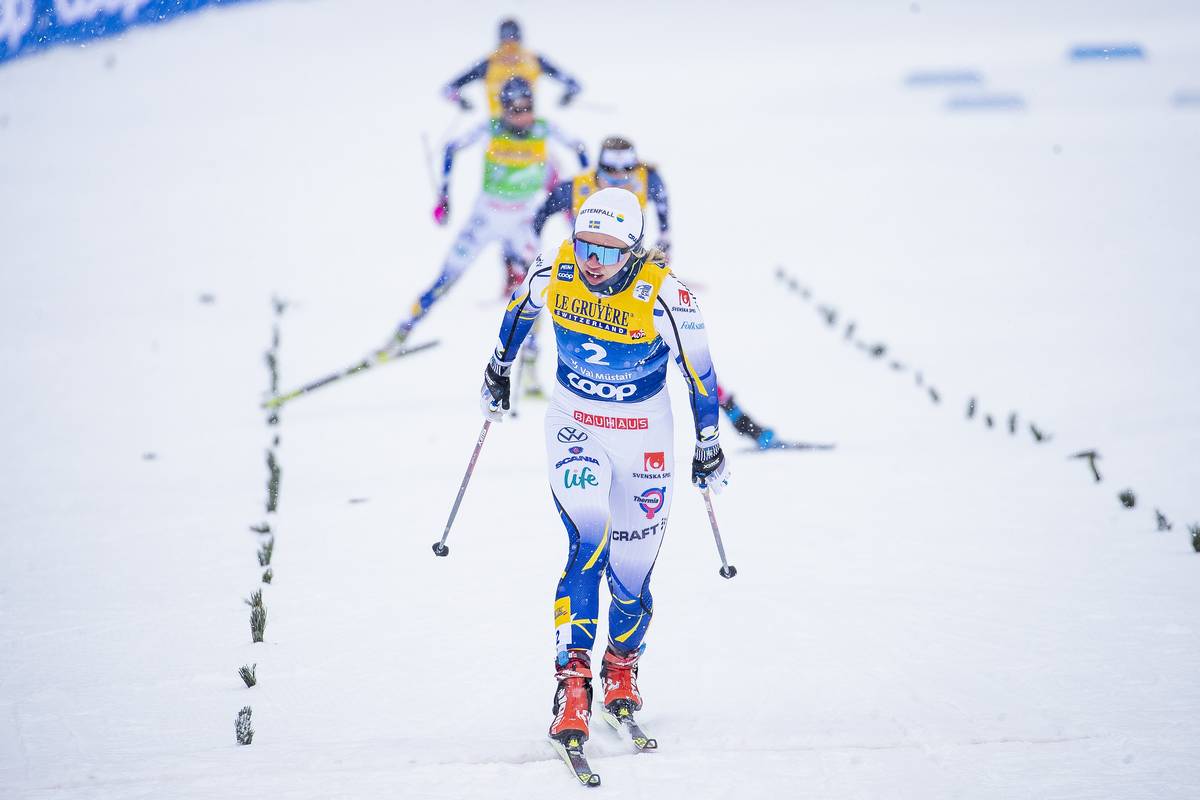
    Sweden’s Linn Svahn winning the first stage of the 2021 TdS in Val Müstair, Switzerland. (Photo: NordicFocus)

    This World Cup coverage is made possible through the generous support of Marty and Kathy Hall and their A Hall Mark of Excellence Award. To learn more about A Hall Mark of Excellence Award or to learn how you can support FasterSkier’s coverage please contact info@fasterskier.com.

    Out with 2020, in with 2021. Here in the world of multicolored lycra and skinny skis, we are kicking off the new year with the opening of the Tour de Ski on the sprint track of Val Müstair, Switzerland. As snow fell lightly but steadily, the usually remarkable mountain backdrop was veiled, narrowing our focus to the athletes as they embark on the grueling eight stages over ten days that is the TdS.  

    The two-lap 1.4-kilometer sprint course in the alpen valley featured two punchy climbs per lap leading down into fast and tight S-turns. Small rollers after these turns kept the skiers on their toes as they charged around the course.   

    Though the Norwegian athletes remain absent from the World Cup and TdS, the Swedish women are back in full force. They made their sprint prowess known in the qualifier, with 26-year-old Maja Dahlqvist setting the fastest time by nearly three seconds in 3:30.86. Seven members of their squad qualified for the heats, with an additional three in the top 10: Linn Svahn in 2nd, Moa Lundgren 4th, and Frida Karlsson in 8th. Though Karlsson is normally known for her distance racing (in particular besting Norway’s dominant Theresa Johaug at last year’s Holmenkollen 30 k), her possession of the green U23 Overall World Cup leader bib evidenced that she was not to be dismissed as a contender for the stage. 
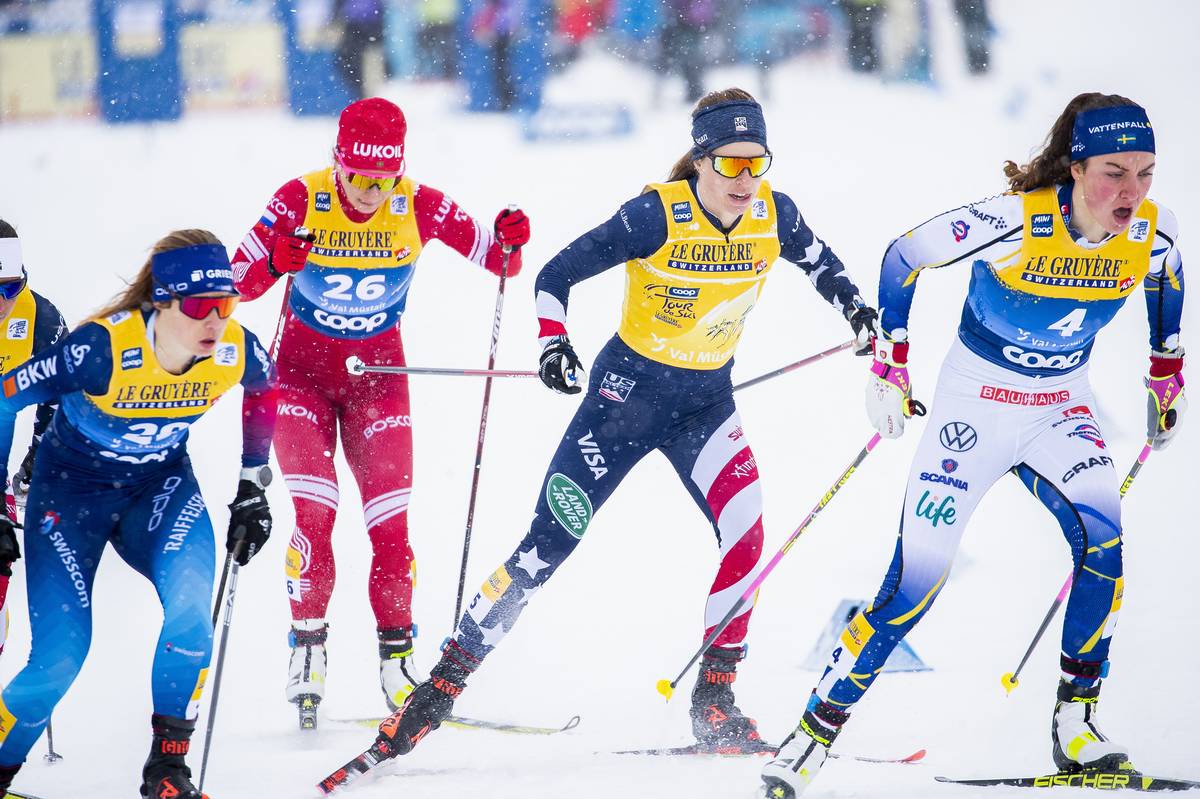
    Rosie Brennan (yellow bib) locked onto Sweden’s Moa Lundgren (bib 4). (Photo: NordicFocus)

    Wearing the yellow Overall World Cup leader bib, Rosie Brennan was the top American qualifier in 5th (+4.38), followed by Hailey Swirbul in 13th (+8.65), Jessie Diggins in 14th (+8.96), Sophie Caldwell Hamilton in 16th (+9.77), and Julia Kern in 25th (+12.61).

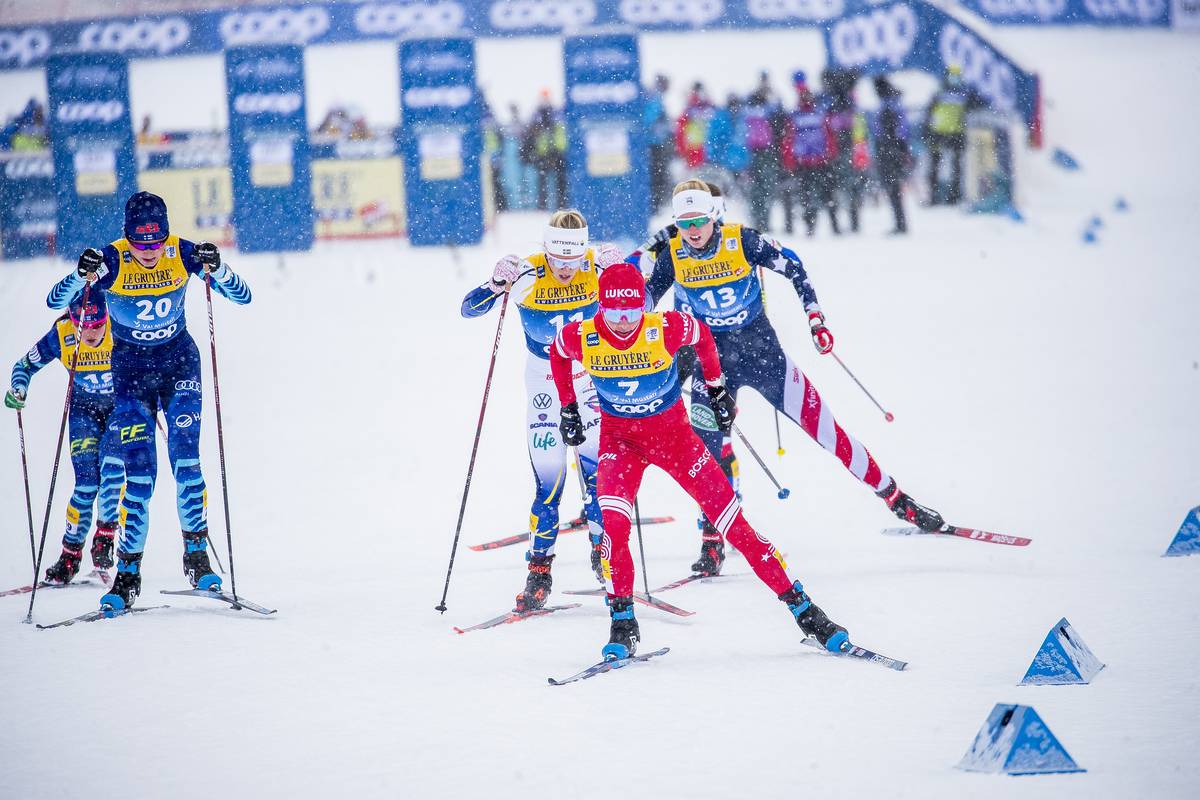
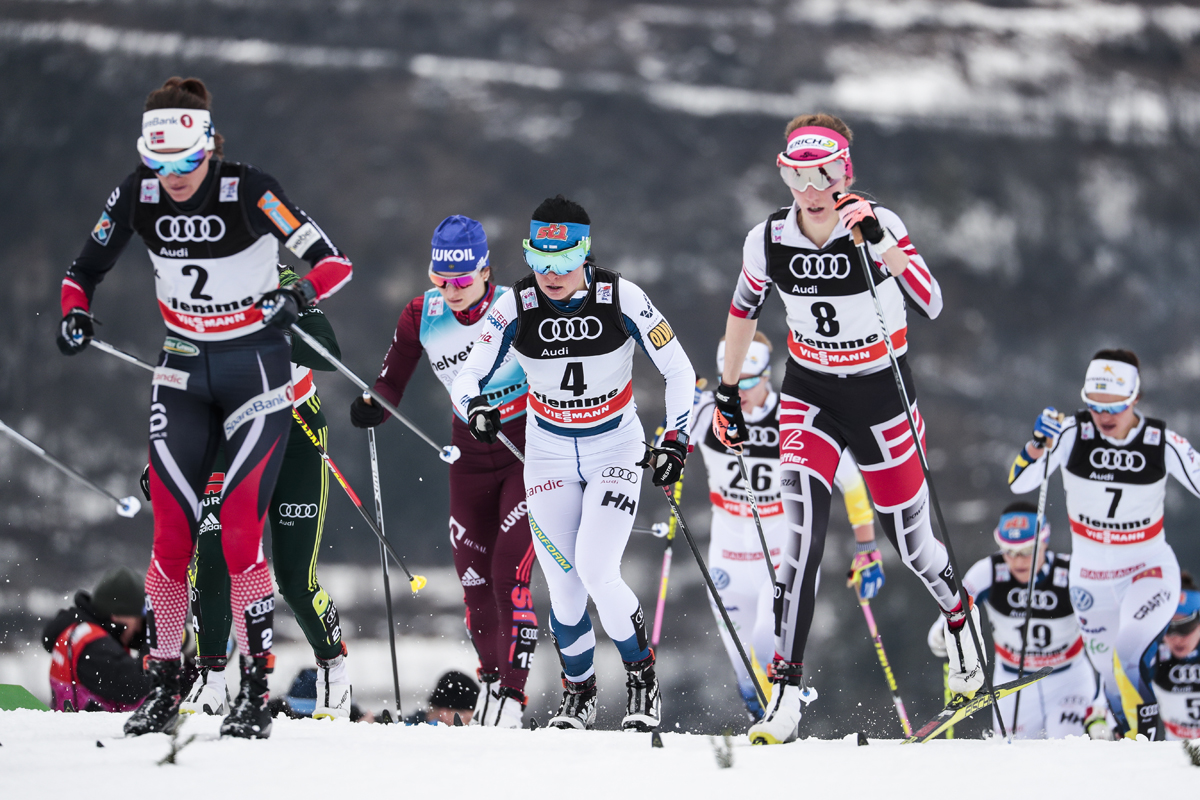
    Brennan raced in a stacked first heat of the quarterfinals, racing against two of the top Swedes, Dahlqvist and Lundgren, in addition to Russia’s Natalia Nepyaeva, teammate Kern, and Switzerland’s Laurien van der Graaff. Brennan stayed near the front and in position to advance from the get-go, but couldn’t break from the lead group of four. She finished in a three-way photo finish with Nepyraeva and Lundgren, taking third but snagging a lucky loser spot allowing the threesome to all advance into the semis.  

    Jessie Diggins finding her form in Val Müstair, Switzerland where she placed second overall in the TdS stage 1 sprint. (Photo: NordicFocus)

    Also advancing from the quarters from the fifth heat, Diggins held a position near the front throughout her heat, showing with her lightning-fast tempo that she intended to advance. She pushed Karlsson and Italy’s Greta Laurent break from the remainder of the group. In the second lap, Diggins had the fastest V1 cadence on the climbs and stayed smooth in the descents, priming herself for good positioning in the final sprint to win the quarter. 

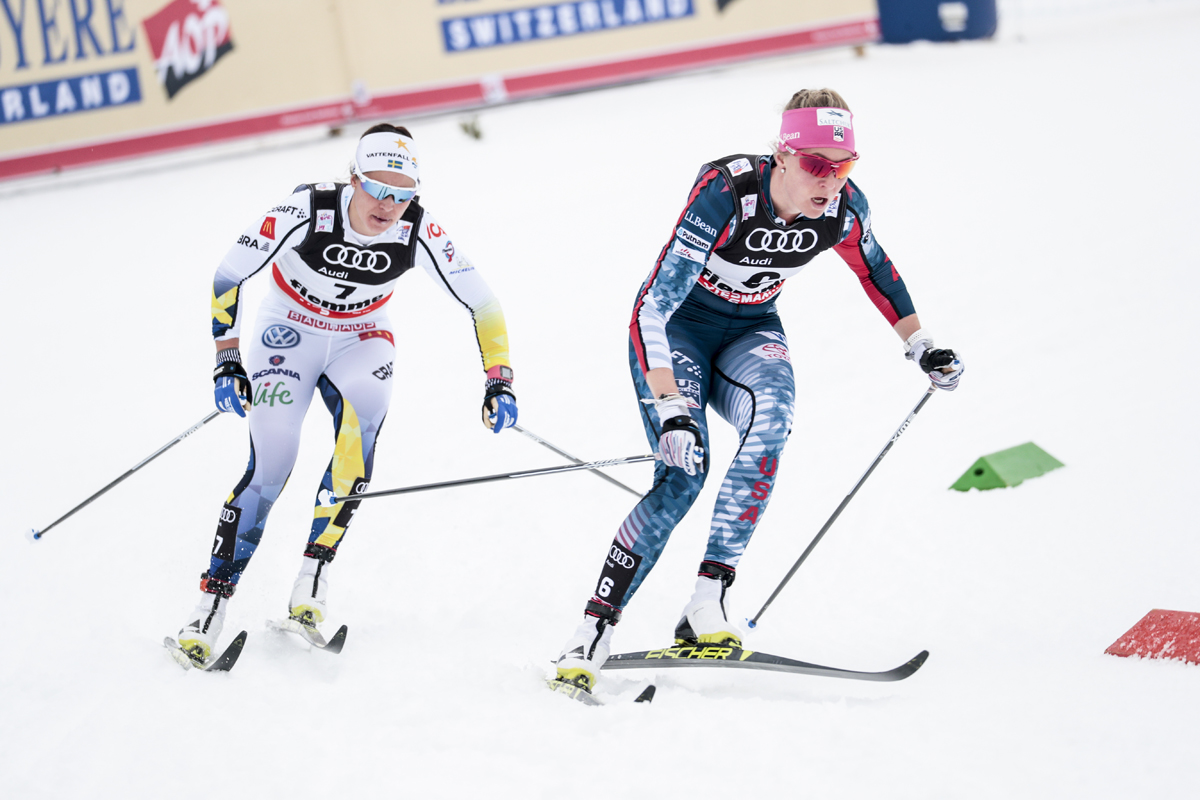
    Ending their day after the quarters, Caldwell Hamilton marked Swedes Svahn and Emma Ribom. In her usual calm, cool, collected manner, she skied smoothly through the S-turn and tucked in comfortably on Ribom’s tails. Despite great position coming into the final lanes, Caldwell Hamilton could not quite overtake Ribom and finished centimeters behind for third in the heat. Swirbul stayed close to the leaders but was unable to fight for the top two and ultimately ended the heat in third also. Neither heat was fast enough to obtain a lucky loser spot. 
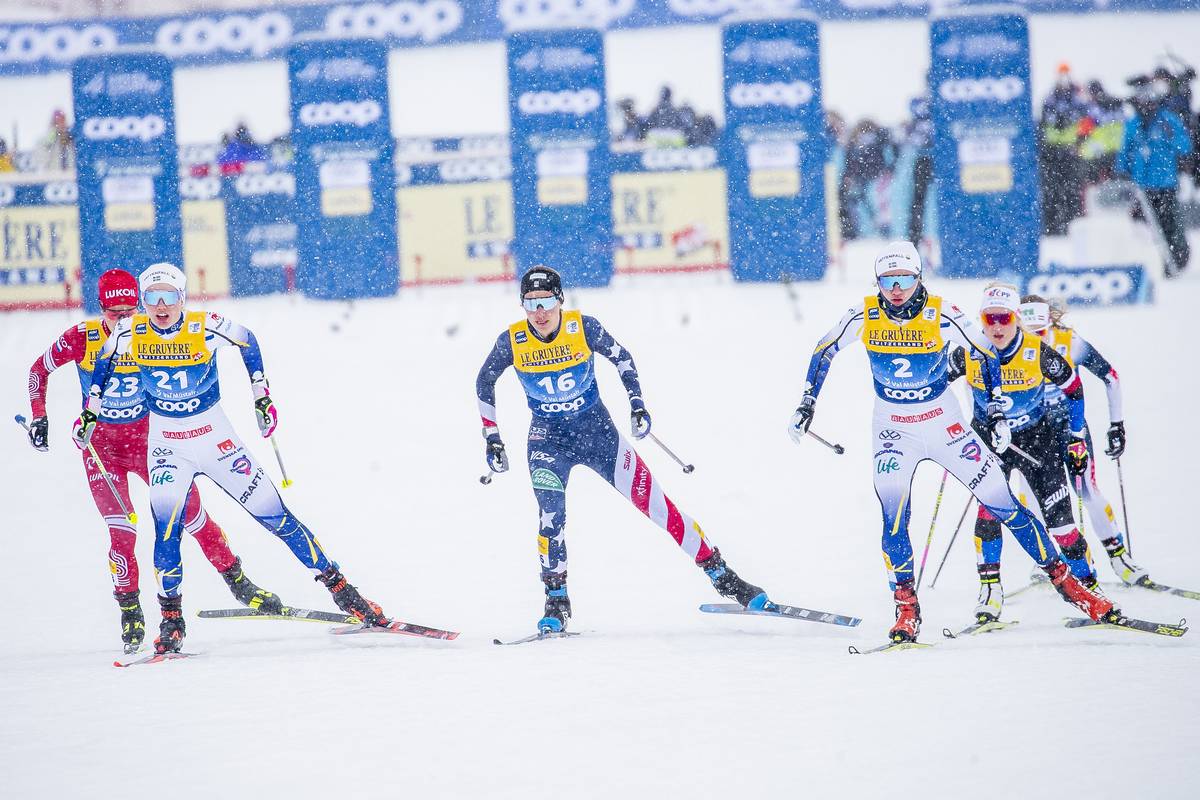
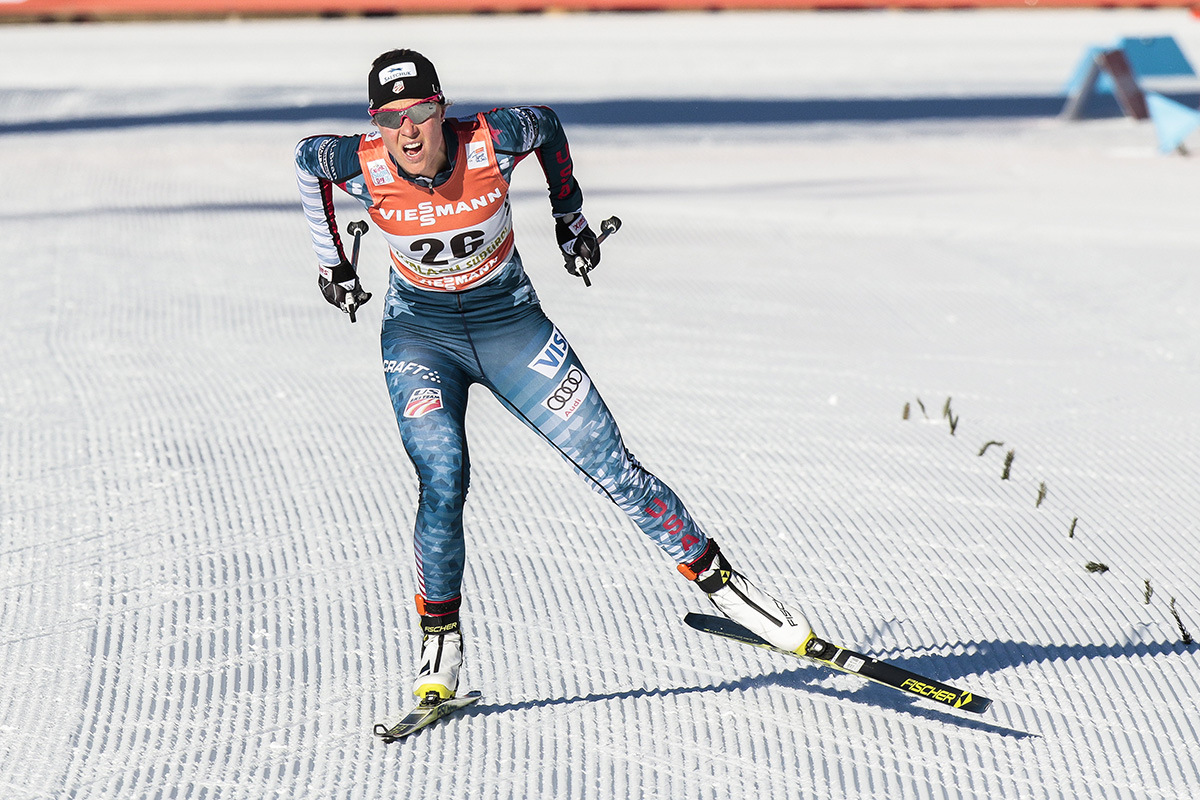
    Sophie Caldwell (bib 16) qualified in 16th and placed 16th overall in Friday’s skate sprint. (Photo: NordicFocus)
    Hailey Swirbul, here in bib 13 during stage 1 of the 2021 Tour de Ski, placed 15th overall. (Photo: NordicFocus)

    On to the semifinals. Racing on home soil in the tight first heat, Nadine Fähndrich (SUI) edged out her opponents for the win in a three-way photo finish with Slovenia’s Anamarija Lampic and Sweden’s Dahlqvist. Considering Lampic and Fähndrich both finished in the top four of the last two freestyle sprints in Davos and Dresden, this result serves as a testament to the depth of the sprint field in those venues despite the lack of Swedes, Finns, and Norwegians. 

    Brennan and Diggins took off in the second heat, marking Swedes Svahn and Karlsson who held the front in the first lap. In the second lap, Brennan upped the tempo on the climbs, while Diggins pushed over the top and worked the downhill, free skating out of the rollers and putting herself into position to charge down the lanes ahead of Karlsson to hold onto the second position and a secure advance to the final. 

    Frida Karlsson (SWE), Jessie Diggins (USA), Greta Laurent (ITA), (l-r) during stage 1 of the 2021 TdS. (Photo: NordicFocus)

    Fighting for millimeters, Karlsson and Brennan were just behind in third and fourth. Both squeaked through as lucky losers, but only just as Brennan’s time was a mere 0.1 seconds faster than the next fastest time. 

    The pace stayed hot and the pack stayed tight in the first lap of the final. Diggins and Brennan stayed in the mix near the middle of the pack and in contention for the podium. 

    As the racers rounded the bend into the second lap, Svahn began firing on all cylinders, taking off at the front with Lampic and Fähndrich marking her from a couple ski lengths back. Just when the top-3 positions seemed locked up, Lampic and Fähndrich brushed skis in the downhill S-turn causing Fähndrich to crash, losing sight of the podium. Svahn continued to hammer, flying down the final stretch to take the win with Lampic nearly a second behind her. 

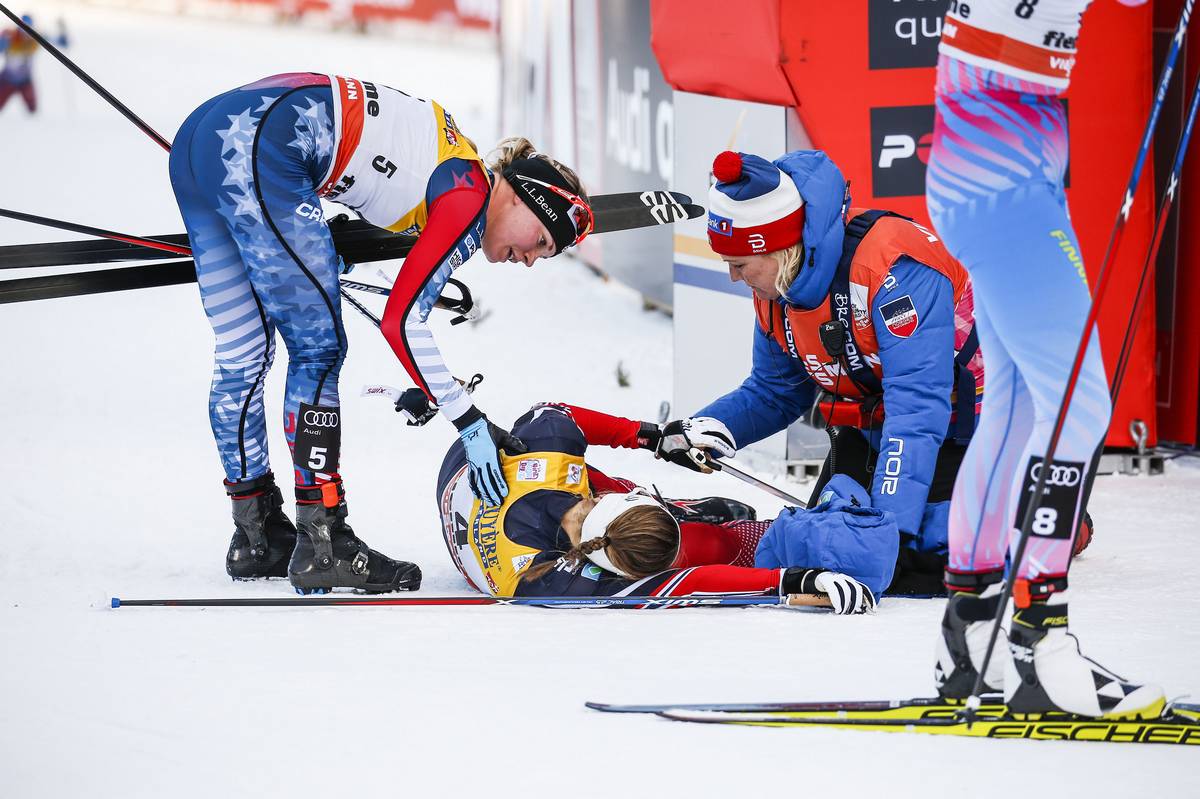
    Seizing the opportunity, Diggins nimbly dodged around the downed Fähndrich, hopping over her pole and hitting the gas to drop a chasing Karlsson and snag third. 
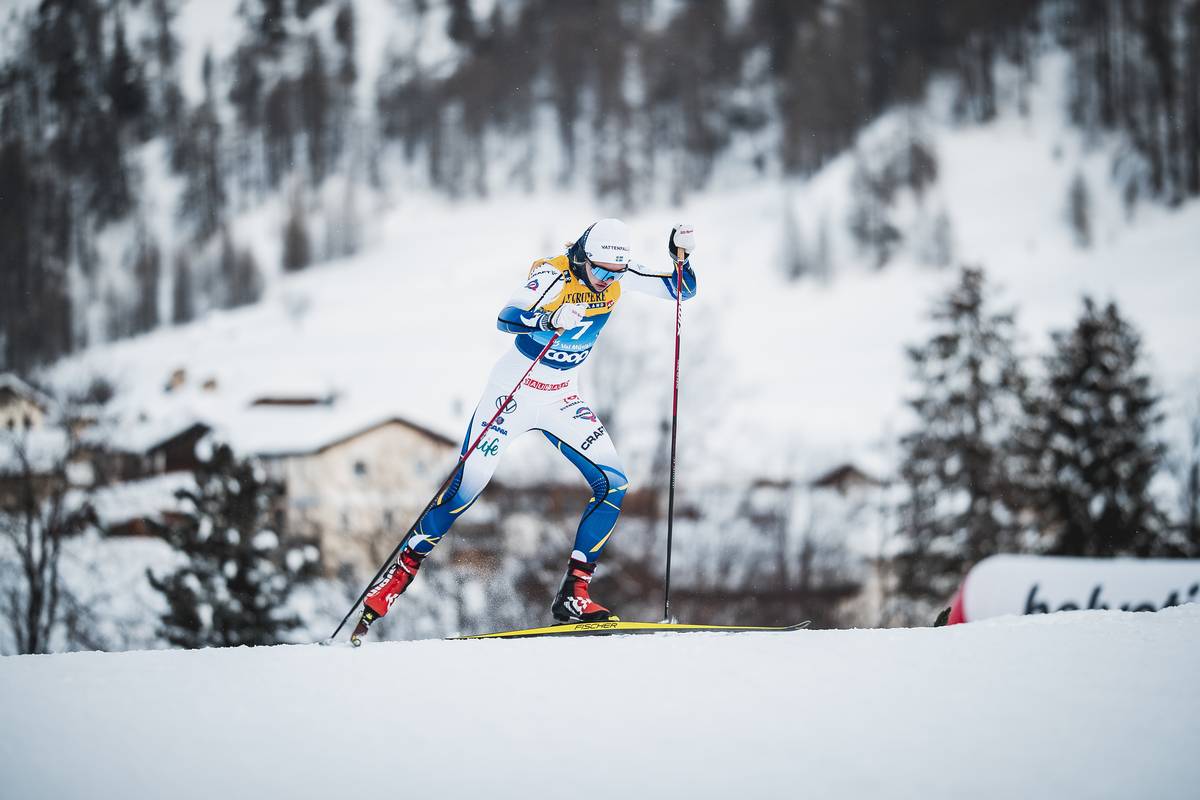
    Linn Svahn during qualification in Val Müstair, Switzerland. (Photo: NordicFocus)

    “I didn’t know how I’d feel in high altitude,” Svahn told FIS after the race. (Val Müstair sits above 4000 ft.)  “I tried to take the first lap to get into my own zone and technique, then I tried to push all I had in the last uphill since the other girls were going really strong beside me.”

    FIS also asked about Svahn’s goals for the tour ahead. 

    “I try to focus on each race, and now I’ll just focus on getting my legs working again after these tracks,” Svahn said with a tired laugh.

    After a lengthy review, during which Diggins demonstrated the importance of staying on top of nutrition during the arduous tour by refueling with a bowl of pasta on the sidelines, Lampic was deemed to have interfered and was disqualified. This moved Diggins into the second position on the podium, with Karlsson stepping into third.  

    “Today was a fun way to start 2021,” wrote Diggins in a post-race email to FasterSkier. “But I think it’s important for me to say that I’m equally as proud of my all-out effort and our team today as I am when I’m not on the podium! It was just another day of giving it my absolute best effort, but the patience and trust in the training plan that Cork and I set down together has been paying off and my race form is coming into sharper focus now.”

    Jessie Diggins finishing second overall on Friday’s stage 1 sprint. (Photo: NordicFocus)

    So far this season, Diggins had a near miss at the podium with a 4th place at the individual sprint in Dresden and was unable to advance from the quarterfinals in Davos after getting boxed out on a curve just before the final straightaway. Today marks her first podium of the season in sprint or distance.

    “The final was exciting, for sure,” she wrote. “I fell behind a bit on the steep climb, and was working my way down the downhill sections with as much speed as I could when I saw Nadine go down and slide around the corner in front of me. I didn’t want to hit her (or break her equipment, or my own) so I jumped over her pole while rounding the corner! In sprinting you can get lucky or be the recipient of incredibly bad luck, and today the luck definitely came my way (and I’m grateful for it).

    “It was so exciting to have Team USA be 1/3 of the women’s final,” concluded Diggins. “And for myself, it was exciting to be out there having fun, not putting pressure on myself but still skiing with confidence and enjoying the banked turns and rollers all at the same time.”

    With the disqualification, Brennan moved into fourth position. Though historically stronger in distance, Brennan has shown her potential as an all-arounder this season with back-to-back sprint and distance wins in Davos and a fifth-place overall standing in the opening mini-tour in Ruka

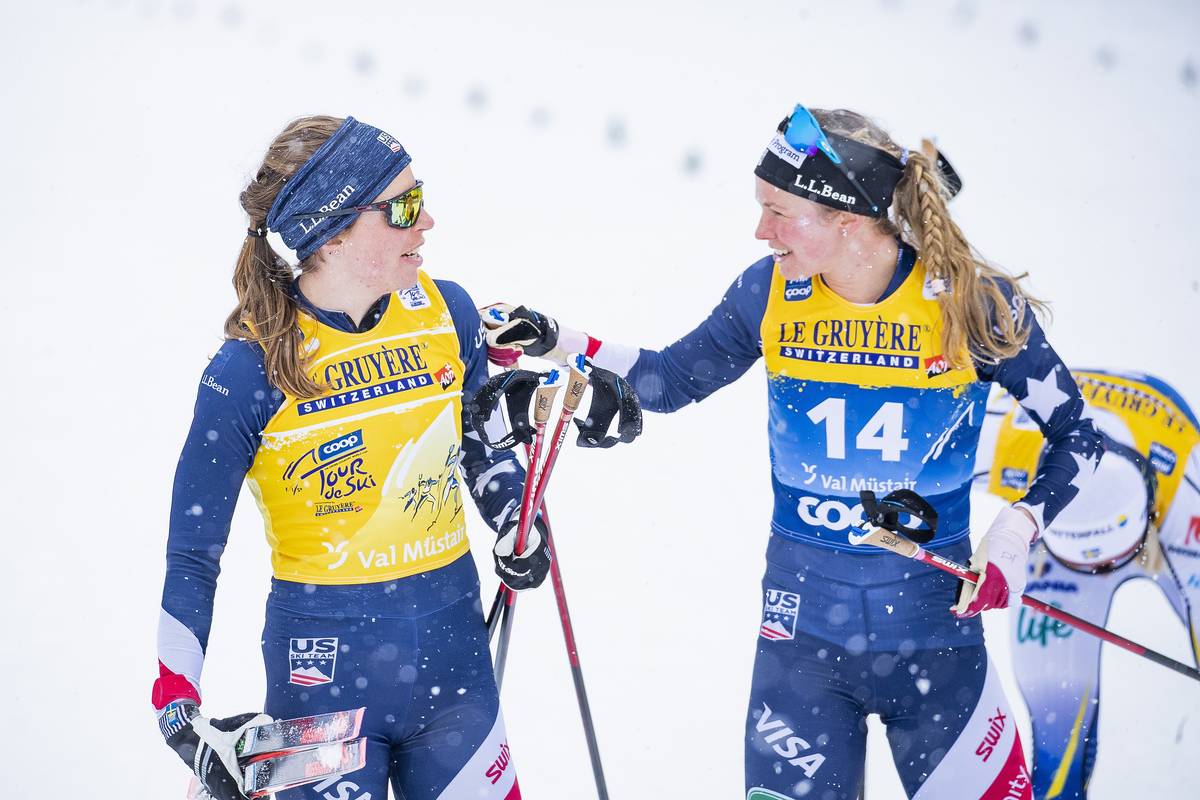
    Rosie Brennan (l) and Jessie Diggins in Val Müstair, Switzerland after the first stage of the TdS. (Photo: NordicFocus)

    “It was a surreal day to be starting the Tour de Ski with the yellow bib,” Brennan wrote in a post-race email to multiple news outlets. “My one goal was to fight with what I had and I felt I did that well so I am proud of my effort out there today. I still have to remind myself just how far my sprinting has come and not change my expectations so quickly. This was only my second final ever and I am just so excited by the gains I’ve made.

    “This might be the hardest sprint course I have ever raced,” Brennan continued. “It’s long, at altitude, and had some slow snow out there today. With that in mind, I tried to keep things under control, but also use my strengths. I had a near miss in the quarterfinal and was really happy about my quick acceleration in the finish after getting stopped up. I worked hard in the semi to keep the pace high to ensure our heat would have lucky losers which I then benefited from. However, I was pretty beat by the time we got to the final. I tried to open up on the second lap, but there wasn’t much there. I stayed out of trouble and for that was rewarded another two places. That’s a sprint race for you…That was a tough start to the Tour so the focus will now be on recovery to get ready for tomorrow and all the races to come. It’s also very cool to note that we had our 4th different girl on the podium in just 4 weeks of racing. Our team is really working hard to get through this tough season together and support one another as we navigate the world.”

    Outside the top 30, Katharine Ogden finished 49th in the qualifier (+20.07), followed by Caitlin Patterson in 57th (+22.25). 

    Results: Qualifier | Final

  • Pre-Tour de Ski Brief

    Pre-Tour de Ski Brief

    The Tour de Ski (TdS) is well into its teenage years. This year’s edition, the 14th, features three locales and the following races with a few minor new twists to excite this seasonal highlight of cross-country World Cup racing. 

    Lenzerheide, Switzerland (stages 1-2) Dec. 28, 29

    • Stage 1: 10/15 k freestyle mass start. A mass start initiates the TdS this year, that’s new. It replaces the timeworn prologue.
    • Stage 2: Skate sprint

    Toblach, Italy (Stages 3-4) Dec. 31, Jan. 1

    • Stage 3: 10/15 k individual start skate
    • Stage 4: 10/15 k classic pursuit (the pursuit start position is based on the Dec. 31st skate race, not overall time).

    Val di Fiemme, Italy (Stages 5-7) Jan. 3, 4, 5

    • Stage 5: 10/15 k mass start classic
    • Stage 6: Classic sprint
    • Stage 7: Final climb – mass start skate. The mass start on the Alpe Cermis is a new format. 

    Overall (time based) Standings

    The TdS is relatively basic when it comes to determining the winner: it’s the skier with the shortest elapsed time over seven stages. In TdS edition’s past, traditionally that was the first athlete across the finish line atop the Cermis, as that has traditionally been a pursuit start format. This year, with a mass start on the final climb, it’s possible for the stage winner and the overall TdS champion to be different skiers.

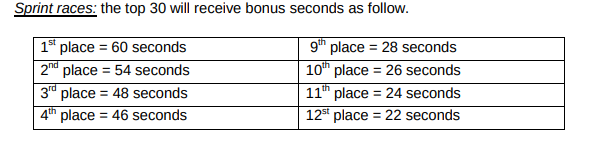
    If you are drilling down on an athlete’s overall time and their corresponding overall TdS rank, here’s how time bonuses come into play. “Bonus” seconds are on offer during the sprint and mass start stages (excluding the final climb). Bonus seconds are subtracted from an athlete’s race day time, and then the overall time — a cumulative time for stages raced — is calculated.

    Sprints offer time bonuses for 1-30th place. 

    For mass starts, bonus seconds are up for grabs at intermediate points. Only the top-10 skiers through an intermediate point receive a time bonus. They receive 15, 12, 10, 8, 6, 5, 4, 3, 2 and 1 seconds, respectively.

    Points Competition

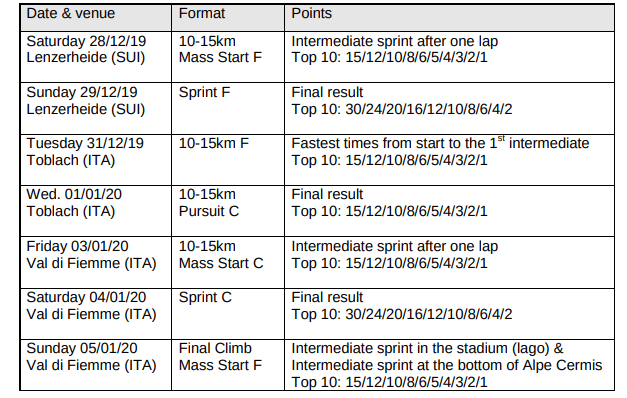
    Within the TdS, there is also a points competition. Less prestigious than the overall? Yes. But the points incentivize spicier racing as the top-three in the overall points standings receive a money prize. Below is a table detailing how and when points are acquired. 

    Just to be clear, these TdS points are different than World Cup points. World Cup points will be awarded after each stage and after the overall standings are finalized. World Cup points are used to determine the sprint, distance, and overall World Cup rankings. 

  • 2018/2019 Tour de Ski Preview (Updated)

    2018/2019 Tour de Ski Preview (Updated)

    The start of the men’s 15 k classic mass start at Stage 6 of the 2018 Tour de Ski on Saturday in Val di Fiemme, Italy, with (front row, left to right) Canada’s Alex Harvey, Russia’s Sergey Ustiugov, Kazakhstan’s Alexey Poltoranin, Norway’s Martin Johnsrud Sundby, and Switzerland’s Dario Cologna. (Photo: Salomon/NordicFocus)

    Beginning this Saturday in Toblach, Italy with a freestyle sprint is the 13th edition of the Tour de Ski (TdS). According to the International Ski Federation (FIS), over the course of seven stages the men will race 80.918 kilometers, the women 60.67 k. 

    The TdS has become both a staple and a spectacle of the annual World Cup calendar. With a jam-packed series of races primacy is placed on both the ability to recover well and wither less as the TdS transpires.

    Prognostication can be tricky in a long-form template like the TdS. So much can go astray during seven races not to mention the travel and dicey germ-avoidance. 

    Last season’s winner on the women’s side, Heidi Weng of Norway, sits 18th overall in the World Cup standings (14th in distance). She has four top-20’s in the four distance events she’s contested with her best result an eighth in Lillehammer’s 10 k skate. Although featuring two sprints in the first three stages, the TdS remains a distance skier’s paradise.

    Weng has skied solidly on the World Cup, but she has yet to show the form that made her a TdS overall winner in 2017 and 2018. Norway has won the last five iterations of the TdS: Marit Bjørgen won once in 2014/2015, Therese Johaug twice (2013/2014, 2015/2016), and Weng the last two years.

    Austria’s Teresa Stadlober leads Norway’s Heidi Weng (2) and Ingvild Flugstad Østberg, American Jessie Diggins (3) and others around a downhill corner during the women’s 10 k classic mass start at Stage 6 of the 2018 Tour de Ski in Val di Fiemme, Italy. (Photo: Fischer/NordicFocus)


    If Norway is to keep the streak alive, Ingvild Flugstad Østberg, last year’s TdS runner up, could be the heir apparent. She currently ranks second in the World Cup overall and 15th on the sprint list.

    Johaug, having returned from an 18 month doping ban, has been on a distance race tear. She has won all five World Cup distance events this season. Johaug, however, will not be lining up for the TdS.

    Only five different women have earned distance podiums this season — Johaug, Østberg, Sweden’s Charlotte Kalla and Ebba Andersson, and Finland’s Krista Pärmäkoski. Along with Johaug, Kalla and Andersson are skipping the TdS. (Andersson sits third overall on the World Cup, Kalla fifth.) With the TdS missing three of the five top ranked World Cup distance skiers, daily stages and the overall podium are up for grabs.   

    Last season’s third overall finisher, Jessie Diggins of the U.S. Ski Team (USST), often cites the TdS as a point in the season when her form trends towards podium performances. She sits eighth in the current distance standings and could very well have a stout TdS. 

    Russia’s Natalia Belorukova and Yulia Nepryaeva look strong as does Sadie Bjornsen (USST), and Austria’s Teresa Stadlober.

    With less than predictable distance stage podiums for the women, it may simply come down to a drag race on the Alpe Cermis final climb Jan. 6.

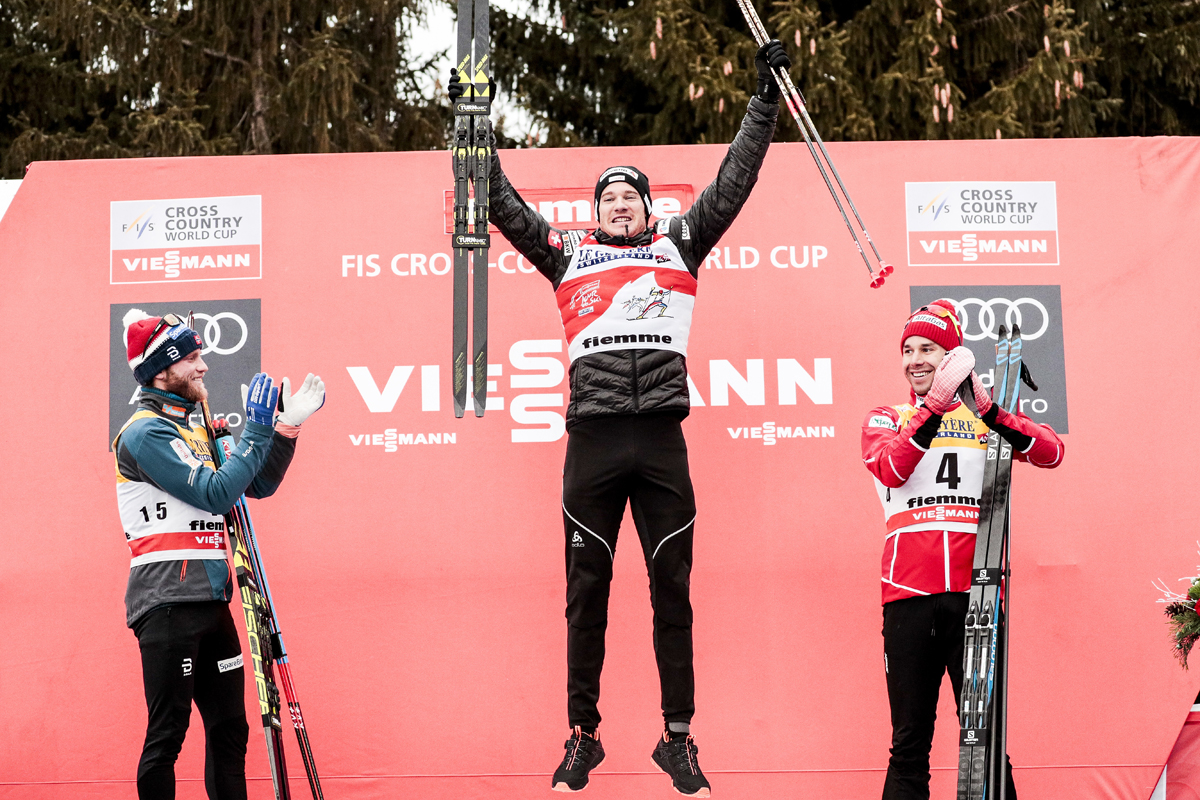
    Switzerland’s Dario Cologna (c) celebrates his fourth Tour de Ski overall title. He was joined by Norway’s Martin Johnsrud Sundby (l) and Canada’s Alex Harvey (r) on the podium in second and third, respectively. (Photo: Fischer/NordicFocus)


    The men’s scene is also open to interpretation. Last season’s TdS winner, Switzerland’s Dario Cologna, was in fact a surprise victor. Prior to Cologna’s stage two win in last year’s TdS, it had been nearly three years since the four time TdS overall winner had won a World Cup. Cologna sits 21st overall on the World Cup currently. Given last year’s resurgence, anything is possible for the Swiss skier.

    Then there’s Martin Johnsrud Sundby form Norway. He finished on the TdS podium the last three years. At thirty-four-years-old, Sundby is ranked first on the distance list, with a second, a third, and a fourth place in distance races this season.

    Sundby won the TdS on two occasions – in 2013/2014 and in 2016. His 2015 win was stripped after he tested positive for excessive levels of Salbutamol. He placed second in the past two Tours.

    In a field rife with talent, Sundby’s ability to race and rebound and race and rebound will be tested. Sjur Røthe, Emil Iversen, and Didrik Tønseth— all from Norway— look in form. And there’s Norway’s Johannes Høsflot Klæbo. The winner of last season’s overall World Cup has had flashes of his past explosive self. He could be a TdS protagonist.

    The men’s field is notably tight. Along with the Norwegians, several Russians could pop a podium, a stage win, and the overall. Russia comes with a loaded team ready to exploit. Alexander Bolshunov leads the overall World Cup – he’ll turn twenty two on Dec. 31st. He’s backed by teammates Evgeniy Belov, Andrey Melnichenko, and Denis Spitsov. 

    Canada’s Alex Harvey placed third overall last year and he looked stronger as the TdS progressed.

    The Stages

    Stage 1:  Dec. 29, skate sprint in Toblach, Italy.

    Stage 2: Dec. 30, 10 k/15 k skate in Toblach, Italy.

    Stage 3: Jan. 1, skate sprint in Val Müstair, Switzerland.

    Stage 4: Jan. 2, 10 k/15 k classic mass start in Oberstdorf, Germany.

    Stage 5: Jan. 3, 10 k/15 k skate pursuit in Oberstdorf, Germany.

    Stage 6: Jan. 5th, 10 k/15 k classic mass start in Val di Fiemme, Italy.

    Stage 7: Jan 6th, 9 k final climb skate pursuit in Val di Fiemme, Italy.

    Teams

    United States

    Women: Sophie Caldwell, Sadie Bjornsen, Jessie Diggins.

    Men: Ben Lustgarten, Simi Hamilton, Erik Bjornsen, Kevin Bolger.

    U.S. Ski Team Head Coach Chris Grover noted in a text that Caldwell, Hamilton, and Bolger will likely cease the TdS after the stage three sprint. Additionally, this is a small team for the U.S. at the TdS. Several athletes turned down TdS nominations including Scott Patterson (USST), Andy Newell (SMS T2/Salomon), Kyle Bratrud (SMS T2), Rosie Brennan (APU), Rosie Frankowski (APU), Caitlin Patterson (CGRP), and Julia Kern (SMS T2). These skiers plan on racing U.S. Nationals this January in Craftsbury, Vermont.

    Canada

    Women: Emily Nishikawa, Dahria Beatty

    Men: Alex Harvey, Lenny Valjas, Bob Thompson

    Norway

    Women: Ingvild Flugstad Østberg, Maiken Caspersen Falla, Astrid Uhrenholdt Jacobsen, Kari Øyre Slind, Kathrine Rolsted Harsem, Heidi Weng, Lotta Udnes Weng, Tiril Udnes Weng Mari Eide, Anna Svendsen

    Men: Martin Johnsrud Sundby, Hans Christer Holund, Emil Iversen, Didrik Tønseth, Simen Hegstad, Krüger, Sjur Røthe, Johannes Høsflot Klæbo, Martin Løwstrøm Nyenget, Eirik Brandsdal, Finn Hågen Krogh

    Russia

    Women: Yulia Belorukova, Lidia Durkina, Anna Zherebyateva, Mariya Istomina, Natalia Nepryaeva, Anna Nechaevskaya, Anastasia Sedova, Elena Soboleva

    Men: Evgeniy Belov, Alexander Bolshunov, Maxim Vylegzhanin, Andrey Larkov, Andrey Melnichenko,  Gleb Retivykh, Andrey Sobakarev, Denis Spitsov, Sergey Ustiugov

    Sweden

    Women: Mia Eriksson, Ida Ingemarsdotter, Moa Molander Kristiansen, Stina Nilsson, Maria Nordström, Linn Sömskar, Lisa Vinsa

    Men: Calle Halfvarsson, Simon Lageson, Teodor Peterson, Daniel Rickardsson, Oskar Svensson, Viktor Thorn, Karl Johan Westberg

    Finland

    Women: Mari Eder, Anne Kyllönen, Laura Mononen, Krista Pärmäkoski, Susanna Saapunki

    Men: Ristomatti Hakola, Matti Heikkinen, Lauri Vuorinen

    Italy

    Women: Elisa Brocard, Anna Comarella, Ilaria Debertolis, Caterina Ganz, Greta Laurent, Sara Pellegrini, Lucia Scardoni

    Men: Francesco de Fabiani, Stefano Gardener, Enrico Nizzo, Dietmar Noeckler, Federico Pellegrino, Maicol Rastelli, Giandomenico Salvadori

    Switzerland

    Women: Nathalie von Siebenthal, Laurien van der Graaff, Nadine Fähndrich

    Men: Dario Cologna, and Jovian Hediger, Jonas Baumann, Livio Bieler, Roman Furger, Käser Erwanm, Beda Klee, Toni Livers, Jason Rüesch, Schaad Roman

    Austria

    Women: Therese Stadlober

    Germany

    Women: Julia Belger, Victoria Carl, Pia Fink, Laura Gimmler, Katharina Hennig, Sandra Ringwald, Elisabeth Schicho, Anne Winkler

    Men: Thomas Bing, Lucas Bögl, Janosch Brugger, Jonas Dobler, Sebastian Eisenlauer, Andreas Katz, Valentin Mättig, Florian Notz, Max Olex, Thomas Wick

    France

    Women: Anouk Faivre Picon, Delphine Claudel, Laura Chamiot-Maitral

    Men: Maurice Manificat, Lucas Chanavat, Adrien Backscheider, Jean-Marc Gaillard, Baptiste Gros, Renaud Jay, Richard Jouve, Jules Lapierre, Clement Parisse

    FasterSkier will update team start lists as we gather more information.

    antibiotics

  • Weng Wins Stage 6; Diggins 4th, Bjornsen 10th in Classic Mass Start

    Weng Wins Stage 6; Diggins 4th, Bjornsen 10th in Classic Mass Start

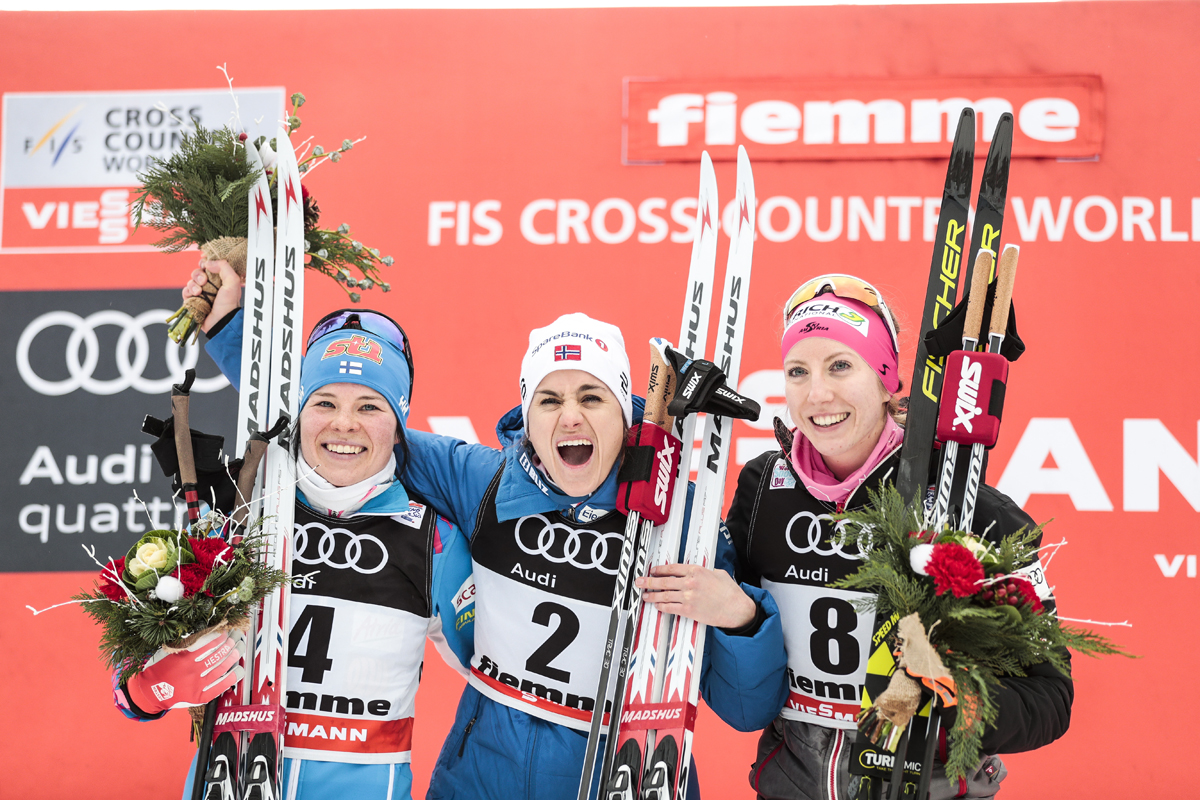
    The 2018 Tour de Ski Stage 6 women’s 10 k classic mass start podium with Norway’s Heidi Weng (c) in first, Finland’s Krista Parmakoski (l) in second and Austria’s Teresa Stadlober (r) in third in Val di Fiemme, Italy. (Photo: Fischer/NordicFocus)

    After the Tour de Ski’s previous dance with earth, wind and rain and the subsequent cancellation of the Stage 4 classic sprint followed by a congested Stage 5 mass start in Oberstdorf, Germany, all seemed to return to a sense of normalcy on Saturday.

    The women contested Stage 6 of the Tour de Ski (TdS), a 10-kilometer classic mass start, in the iconic Val di Fiemme, Italy. The women skied a 2.5 k climb-and-descend-centric course four times to the thrills of bell-ringing fans and the mountain gods, who, for the time being, allotted a weather reprieve after Central Europe’s rumble with funky atmospheric pressure gradients.

    In what amounted as a critical race to shake out the standings before Sunday’s final Stage 7 climb up Alpe Cermis, with 10 k to go and then 10 k down, Norway’s Heidi Weng rolled the dice and won.

    Austria’s Teresa Stadlober leads Norway’s Heidi Weng (2) and Ingvild Flugstad Østberg, American Jessie Diggins (3) and others around a downhill corner during the women’s 10 k classic mass start at Stage 6 of the 2018 Tour de Ski in Val di Fiemme, Italy. (Photo: Fischer/NordicFocus)

    “It was a great race,” Weng said after the race, according to an International Ski Federation (FIS) press release. “I felt very good. I like Val di Fiemme very much. Every time I compete here I have had a good one. It will be a hard race tomorrow.”

    Weng, last season’s TdS winner, crossed the line firs on Saturday in 29:07.9. It was her first individual World Cup win since her victory atop Alpe Cermis in last year’s final Tour stage. Finland’s Krista Pärmäkoski finished 7.6 seconds back in second place, Austria’s Teresa Stadlober was another second back in third place (+8.6), and American Jessie Diggins put herself in the mix in fourth (+23.6). The Tour leader coming into Saturday’s race, Norwegian Ingvild Flugstad Østberg, who at times looked like she could dominate the pace, faded to fifth (+35.2).

    Also for the U.S. women’s team, Sadie Bjornsen finished 10th place (+1:11.3), Liz Stephen 24th (+2:18) and Rosie Brennan 30th (+2:47.2).

    With a single stage to go, and a doozy at that (the 9 k freestyle hill climb pursuit up Alpe Cermis), Saturday’s stage was all about minimizing losses for some and making gains for others. As the Tour’s defending champion, Weng proved not only does she have TdS stamina, she has the gumption to kill on the final stage’s climb. Last year, Weng began the hill climb in second overall, 20 seconds behind Sweden’s Stina Nilsson. But more importantly in that 2017 race, Weng started 1:04 minutes ahead of Østberg in fourth. Nine k and 425 meters of climbing later, Weng took the win — she gained time on Østberg, who placed fourth overall (+2:04.3). Not that last year’s dynamics dictate how this year’s TdS will play out, but it remains a data set.

    Norway’s Heidi Weng chases her teammate Ingvild Flugstad Østberg (not shown), followed by Austria’s Teresa Stadlober (8), Finland’s Krista Parmakoski, Russia’s Natalia Nepryaeva, Sweden’s Evelina Settlin (26) and Anna Haag (7), among others, early in the women’s 10 k classic mass start at Stage 6 of the 2018 Tour de Ski in Val di Fiemme, Italy. (Photo: Fischer/NordicFocus)

    Weng began Saturday’s stage in second overall and 57 seconds behind TdS leader Østberg. Weng endures as the lanky yet seemingly ideal pairing of power-to-weight climbing ratio. Østberg, who is enjoying a resurgence this year after a lull by her standards last season, prevails as a powerful force to Weng’s lithe climbing. Yet after winning the first three Tour distance stages, underestimating the 2017/2018 version of Østberg on Alpe Cermis might prove too risky.

    Saturday’s 10 k seemed like a poker match up to the second pass through the stadium at 5 k. The top-14 skiers were strung out in a line — 8.8 seconds separating Bjornsen in 14th to Østberg in first. For a moment, maybe it was an Østberg bluff, but she and Weng took a brief pull up front on a climb that appeared to unsettle the group of five that had formed and consisted of the Norwegian duo plus Diggins, Pärmäkoski and Stadlober.

    It turns out Østberg’s moves were a bluff revealing she was dealt a weak hand: by 8.6 k Østberg was 19 seconds behind Weng. By then, Weng had played her full house and had gapped Pärmäkoski and Stadlober in second and third place respectively, by 10 seconds. Diggins skied in fourth, 16.5 seconds behind Weng.

    From then on, Weng soloed for the win.  

    Heading into Sunday’s final stage, the formidable climb up Alpe Cermis, Østberg still leads the Tour with a tiny 1.8-second gap on Weng.

    With Weng’s history on the climb, it appears to be her Tour to lose. If Weng wins the hill-climb pursuit, she’ll be the only skier besides Poland’s Justyna Kowalczyk to win successive Tours. Kowalczyk won four straight TdS’s from 2010 to 2013.

    Jessie Diggins (U.S. SKi Team) after placing fourth in the women’s 10 k classic mass start at Stage 6 of the 2018 Tour de Ski in Val di Fiemme, Italy. (Photo: Salomon/NordicFocus)

    U.S. standout Diggins had entered the stage in third overall, 1:56.7 behind. For much of Saturday’s race, she was a catalyst, either setting tempo up front, gliding away on the downhills or sitting in and letting the Norwegians know she was right there.

    Weng’s mark on the race, which was embellished with her make-or-break climbing speed near 7.5 k, redlined several top skiers. At the 7.5 k checkpoint, Diggins was 8.2 seconds back. It looked initially as if it were more of an unmatchable Weng pace than a moment when Diggins would lose more time and fall from the Pärmäkoski-and-Stadlober pairing. Diggins came through 7.5 k in line with the Finn and Austrian.

    Weng kept charging, Pärmäkoski and Stadlober kept their losses in check, and Diggins lost more time in the closing kilometers. The American was 19.8 seconds back at 9 k, and 23.6 behind as she crossed the finish line.

    “In today’s race I tried to stay near the front and out of trouble,” Diggins wrote in an email to FasterSkier. “With my luck I just wanted to avoid crashes or broken poles! I faded slightly in that last lap and couldn’t go with Krista and Teresa but it was so fun to see exactly where the podium was since it’s mass start and see where I can improve a little bit for the next time. Always learning and taking notes!”

    Diggins dropped one place in the overall standings and currently sits in fourth (+1:43.1). Pärmäkoski is third overall (+1:33.5) and Stadlober fifth (+2:29.9).

    “In the overall tour, I’m really happy with my placing,” Diggins added. “To be starting 10 seconds behind Krista is awesome and I’ve been racing better than any other year, for sure. It’s fun to feel strong in sprint and distance, classic and skate, and my goal for years has been to become a true all-rounder. It’s fun to finally be getting there!”

    Diggins, known for her uncanny race tenacity, understands the final stage is daunting.

    “Unfortunately, I’m not a natural-born climber, but I know how to suffer, I know how to be a fighter, and I’m going to go give that climb everything I’ve got left,” Diggins explained about her approach to the hill climb. “And in the end, that’s all you can do! My internal mantra is most likely something like ‘just keep swimming….just keep swimming…’, Finding Nemo style. Because you have to see the humor in climbing that beast!”

    Sadie Bjornsen (U.S. Ski Team) leads Sweden’s Stina Nilsson (l) on a downhill during the women’s 10 k classic mass start at Stage 6 of the 2018 Tour de Ski in Val di Fiemme, Italy. (Photo: Fischer/NordicFocus)

    Bjornsen began the day sixth overall (+2:47.0) and finished in 10th. Bjornsen will begin Stage 7 ranked eighth, 3:33.1 minutes behind TdS leader Østberg.

    “Today was another one of those days that left me wanting a bit more,” Bjornsen emailed to several media outlets. “After falling in the last race, I was determined to make up some time that I had lost in my overall tour position. I have been feeling really great on my classic skis, and felt like I had some power left in my legs this morning, so my goal was to just go with the leaders as long as possible. Unfortunately, I had a bit of a tough start, and made some tactical errors that left me pretty far back in the pack on the first lap. Then, once I was finally finding position again, I got trampled over, and fell. Once again, I fought my way back to the front after getting stuck behind some traffic, but just burned a few too many jets getting yo-yo’d around today.

    “At this stage in the tour, when things go great, you can convince yourself you are invincible,” Bjornsen continued. “When you get rattled a bit, it takes an extra amount of mental power to fight back to where you want, and I think that is what got me today. My race today still puts me in a place to fight for top 10 in the overall, which is super exciting. Considering the swings of this TDS, I am thrilled to be fighting for top 10. I have never done that in a Tour event, so it is a good goal for me when I am pushing myself up that mountain tomorrow with every last bit of energy I have!”

    TdS vet Liz Stephen again scored World Cup points on Saturday. In four distance races in this TdS, she has been in the top 30 three times. Admittedly, Stephen understood it was a small World Cup field.

    “Well, it’s much easier to get 24th in a race when there are only 32 starters,” Stephen said on the phone Saturday. “But today was definitely, it was maybe the fastest pace I’ve ever seen in a World Cup. Either that, or my brain was just moving really slowly, and my body, but I was just really having trouble keeping the pace those girls were setting, so, it was a really hard day for me. I had to dig pretty deep. … I certainly, I was just on the ropes the whole time. Just felt like I was sprinting for 10 k. So, that was a little bit of a tough one today, but I love the courses and I just really happy to be feeling more like myself racing again during this Tour.”

    But the bread and butter of Stephen’s gravity defying climbing ability is the Tour’s final hill climb. In 2013 she notched the second fastest time of day up Alpe Cermis. In 2014, she was seventh overall in the TdS and third fastest on the final stage. She was third fastest again in 2016 and second fastest in 2017.

    Her expectations for Sunday are once again high.

    “I look forward to tomorrow,” she said of the final climb. “I mean, it’s one of the hardest things that you can go do, but it’s also something I’ve always enjoyed because it’s — you just go up the hill. … You just kind of grind it out. I’m certainly hoping to take some people off tomorrow and I definitely look forward to the day, for sure. I think it will be even potentially more special to this year because I have some really good friends here watching from Vermont, and I think that will be really cool to have them out, watching this race for the first time.”

    Stephen reflected that the early part of her season was not to her liking.

    “I’ve definitely struggled at the beginning of this year, and I think probably it’s a combination of the getting older factor and trying to figure out how much recovery is needed, and how much intensity is needed, and what volume is needed,” the 30-year-old Vermont native said. “It is really different. I’m not the 24-year-old athlete that could recover and go bop around all day and then go race and have it be great. I’m certainly feeling something, and I think probably aging is probably it. I definitely struggled especially this fall on Period 1 … I never felt like myself racing. And so, I think just to feel even a little bit of a glimmer of what I want to feel like later in this season and just again in my career, it definitely is much easier now to kind of get my brain around. I haven’t lost it all. It still is there.”

    With picking off skiers on her way up Alpe Cermis, Stephen aspires for that podium reserved for the time-of-day mountain goats.

    “I would certainly kind of probably chuck it out there that I’d love to be top two,” she stated. “I think Heidi will be tough to beat out there tomorrow. Especially with the win on her shoulders, as well. But, I would be really happy with a top three tomorrow. And I’m certainly just really looking forward to trying to ski the best I can ski.”

    The Tour de Ski concludes Sunday with Stage 7 in Val di Fiemme.

    Results: Women’s Stage 6 | Tour de Ski Standings after Stage 6

    — Harald Zimmer and Andrea Potyondy-Smoth contributed 
  • Sadie Bjornsen’s ‘Dream Day’ with First Distance Podium; Østberg Puts Her Stamp on Stage 2

    Sadie Bjornsen’s ‘Dream Day’ with First Distance Podium; Østberg Puts Her Stamp on Stage 2

    The women’s 10 k classic podium at Stage 2 of the 2018 Tour de Ski, with Norway’s Ingvild Flugstad Østberg (c) in first and Heidi Weng (l) in second, and American Sadie Bjornsen (r) in third in Lenzerheide, Switzerland. (Photo: FIS Cross Country/Twitter)

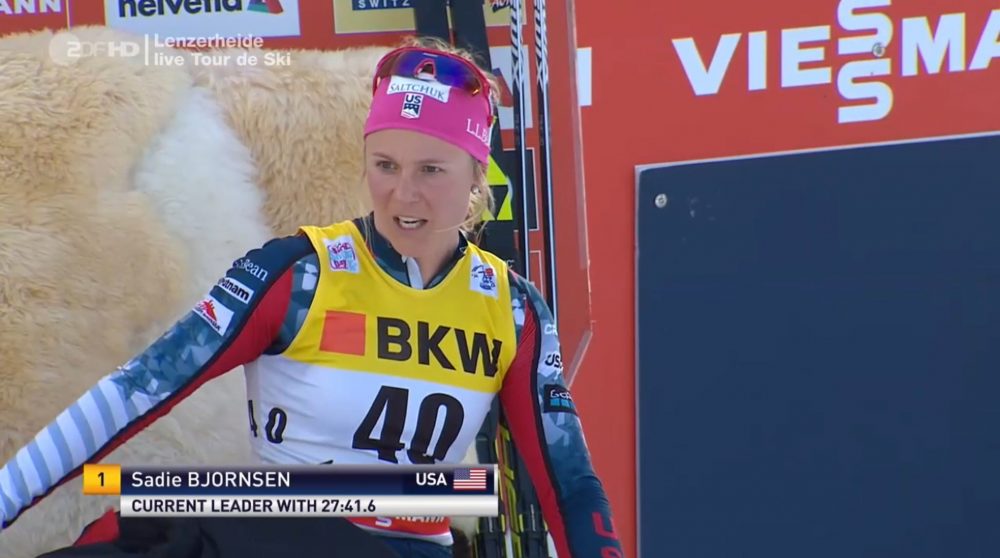
    By the time Sadie Bjornsen sat down in the fur-lined leader’s chair on Sunday, the sunlight that had been shining brightly over sections of the women’s 10-kilometer classic course — blocked by trees and creating shade and temperature drops in some spots — was fading. Just an hour remained before sunset in Lenzerheide, Switzerland, and as she unclipped her bindings and walked out of the finishing pen, the current leader seat belonged to her.

    With racers starting in 30-second interval increments and the final starter, Anastasia Kirillova of Belarus, having pushed past the start wand as Bjornsen strode past the halfway point, the 28-year-old American’s time of 27:41.6 would have to withstand 25 skiers — 23 to stay on the podium — if she were to retain her chilly, yet coveted chair.

    That would mean staving off the likes of Norwegian powerhouses, Heidi Weng and Ingvild Flugstad Østberg, Finland’s Krista Pärmäkoski, as well as Saturday’s skate-sprint winner, Laurien van der Graaff of Switzerland, all of whom started behind Bjornsen.

    The U.S. Ski Team (USST) seven-year veteran had already held off Finland’s Kerttu Niskanen and Laura Mononen, Norwegians Astrid Uhrenholdt Jacobsen and Kathrine Rolsted Harsem, Sweden’s Anna Haag, well as her own USST teammate, Jessie Diggins, who sat in fifth at the time off Bjornsen’s finish.

    “I had no doubt that Sadie would crush it – she’s such a classic skiing machine and I couldn’t be prouder of her! She’s on fire!” Diggins, who started six bibs ahead of Bjornsen, wrote in an email.

    As each racer finished, Bjornsen remained in the lead, the fog of her breath a reminder of the days falling temps and approaching hours of solar siesta.

    Sadie Bjornsen sitting in the leader’s chair while waiting for the women’s 10 k classic Stage 2 of the 2018 Tour de Ski to finish. Bjornsen went on to finish third behind Norway’s Ingvild Flugstad Østberg in first and Heidi Weng in second (Screenshot: ZDF broadcast)

    Live footage of skiers still on course, broadcasted on the large screen at the stadium’s epicenter kept her on guard. Two in particular were posing a challenge. Weng, who had started 14 bibs behind Bjornsen, was pacing on par with the American by the 3.5 k mark. Østberg, who departed the starting gate two bibs behind Weng, had put 14.7 seconds into Bjornsen by the time she was one-fifth of the way through the race.

    By the halfway point, Weng had upped her tempo, and created a 13-second gap on Bjornsen’s time; at the same mark, Østberg had close to 22 seconds on the American.

    When Bjornsen finished, Weng’s lead was still cushioned by close to eight seconds.

    “I did not feel I was skiing fast but when I got the split times I heard I was gaining time on the other girls,” Weng said, according to an International Ski Federation (FIS) press release.

    By the time Weng finished she had a 16.5-second lead over Bjornsen, moving the American into second place. However, Weng’s time in the chair was no more insular than Bjornsen’s. With two-thirds of the race complete, Østberg had 23 seconds on Weng and almost 40 seconds on Bjornsen.

    With that kind of a lead, the final 2 k were Østberg’s to win and it appeared only a self-induced mistake would prevent her from taking it all. Perfection ruled the Norwegian’s skis. Østberg covered the final fifth of the race with precise certitude; as if she and the Lenzerheide course were confiding old friends (In fact, they were. In 2016 she won her first non-sprint distance World Cup in Lenzerheide during that season’s Tour de Ski (TdS)).

    By the time Østberg finished, she had 25.7 seconds on Weng and 42.2 seconds on Bjornsen, claiming the win in a time of 26:59.4. Her first-place finish in Sunday’s 10 k, combined with her ninth place in Saturday’s sprint, puts her first in the overall TdS standings as racers head into Monday’s Stage 3 freestyle pursuit.  

    “I knew it was going to be a tough race in these conditions. My goal this season has been to get better each weekend. My shape is very good right now,” Østberg said, according to FIS. “Tomorrow I will be chased and it is going to be a tough race.”

    Bumped into third place, Bjornsen earned her first distance podium of the season and second-career stage World Cup individual podium on Sunday (she’s landed on the podium two other times this year, the classic sprint in Lillehammer and the classic sprint in Kuusamo).

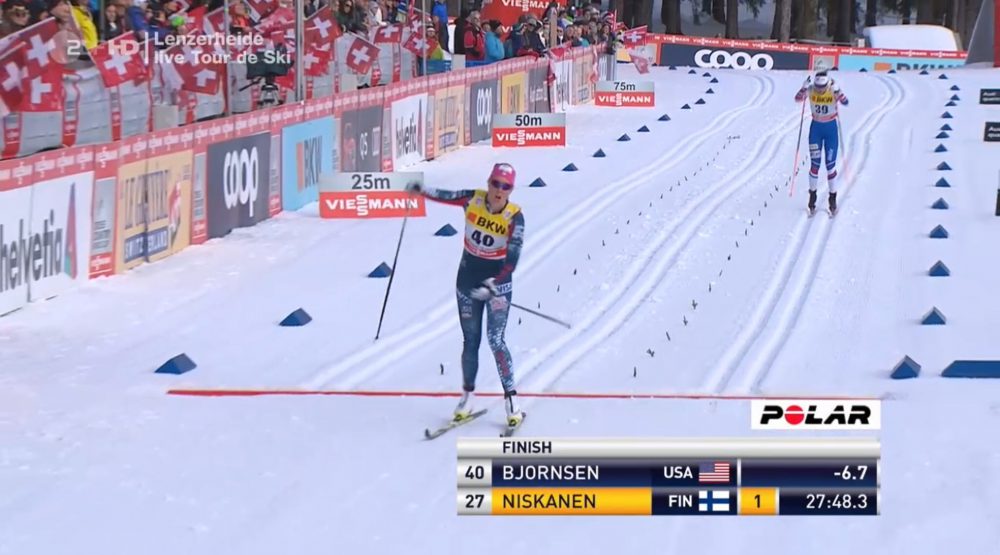
    American Sadie Bjornsen finishing the 2018 Tour de Ski Stage 2 women’s 10 k classic in first in Lenzerheide, Switzerland. She ultimately placed third behind two Norwegians, Ingvild Flugstad Østberg and Heidi Weng. (Screenshot: ZDF broadcast)

    “Wow. What a dream day.” Bjornsen wrote in an email to media outlets. “A distance classic podium has been a dream of mine since I first started racing World Cup, so it was so fun to achieve that dream goal of mine today.”

    “I had an awesome talk with my wax tech, JP, right before the start of the race, where he told me the most important thing that day was to trust what I do well, and never give up.. so I went with it,” Bjornsen continued. “I thought I was having a really tough race, and then I got my first split at 7.5k when Matt told me I was in second place and could win the race today. Suddenly, I had a fire lit under my butt, and I just gave every last bit for the last 2.5k. It was kinda fun not knowing what was happening, because it felt like a true surprise!”

    Bjornsen finished yesterday’s sprint in 14th and with Sunday’s finish is now ranked fourth in the overall, just one place behind her teammate Diggins, who finished Sunday’s 10 k classic in seventh place (+1:04.4).

    American Jessie Diggins during the women’s 10 k classic Stage 2 of the 2018 Tour de Ski in Lenzerheide, Switzerland.
    (Screenshot: ZDF broadcast)

    “For me, I was really proud of how I held it together out there,” Diggins wrote in an email. “This is not my kind of condition and it was really hard to find kick out there – I felt like I was running, herringboning and bounding up the hills! But just a few years ago a day like today would have wrecked my overall tour time and now I’m able to hold my technique together and keep it flexible as conditions change, so I’m really happy about that!”

    “Looking forward to tomorrow skate distance!” she added. “I’m starting in a little bit of no-mans land…but I love the chase and I’ll just put my head down and hammer!”

    Rounding out the top 10 on Sunday was Niskanen in fourth (+48.9), Haag in fifth (+52.6), Germany’s Nicole Fessel in sixth (+58.2), Switzerland’s Nathalie von Siebenthal in eighth (+1:08.3), Germany’s Stefanie Böhler in ninth (+1:08.8) and Slovenia’s Anamarija Lampic in 10th (+1:10.9).

    Also scoring in the points for the U.S. on Sunday was Sophie Caldwell in 21st (+1:40.6),  Liz Stephen in 28th (+2:04.8) and Ida Sargent in 30th (+2:06.7).

    Caldwell placed third in Saturday’s sprint and is now ranked seventh in the overall tour standings heading into Monday’s pursuit.

    “My body felt surprisingly good after yesterday! When I woke up I was definitely a little tired, but my body felt good racing.” Caldwell wrote in an email. “The conditions were extremely tricky today, and our service team did an awesome job of making us the best skis possible.”

    Though many sections on course were glazed over and the downhills iced over, Caldwell indicated the challenge was one she embraced.

    “I enjoy tricky conditions like this where you really have to work to make the kick work because I think making skis kick is one of my strengths,” Caldwell wrote. “The downhills were icy and sketchy, so wax would inevitably wear off some, but I tried to really pace the first lap and be in control so I felt like I still had something to give on the second lap. I was really excited to see I ended up in the points! And of course seeing Sadie on the podium again put a huge smile on my face.

    “Being in seventh in the tour right now is beyond any expectations I had,” she added. “10 km skates are generally the toughest discipline for me, but I will do my best and be running for dear life from everyone chasing me!”

    After two stages out of seven in the TdS, Sargent ranks 30th and Stephen 37th.

    Despite battling illness prior to the tour and feeling it worsen during Saturday’s sprint, Sargent started Sunday’s 10 k and was pleasantly surprised to see that her finish was within the points.

    “I actually wasn’t sure if I was even going to race today but warmed up and decided to go for it. It felt really hard and I felt like I was struggling a lot so I have to admit I was very happily surprised to hear I was 30th,” Sargent wrote in an email. “I think this is the first time I have scored distance points at altitude. I’m looking forward to another race here tomorrow and then a day off and I have my fingers crossed that my body continues to come back around.”

    Another USST member, Rosie Brennan skied to 38th (+2:20.5) on Sunday, putting her in 33rd overall.

    The seventh USST member, Kikkan Randall did not start and withdrew from the Tour after experiencing pain in her left foot following the races in Davos three weeks ago,

    “[I] have been trying to rehab the foot since with alternative training.  Yesterday showed me I am making some progress with my foot and I didn’t want to set myself back with a classic race today.  Classic seems to aggravate the injury more.,” Randall wrote in an email. “It was a tough decision but the Olympics are my big goal and I still have time to get my foot healthy if I am smart over the next couple weeks.  I am looking forward to sharpening for the sprints in Dresden in two weeks.”

    “Awesome to see the team take another podium today!” Randall added. “I’m so proud of our girls!”

    In both Stage 1 and Stage 2, the U.S. has had five women in the top 30 and one on the podium. Four of the U.S.’s six starters for Monday’s skate pursuit will start in the top 30.

    “It’s really motivating to have had two really strong days as a team,” Caldwell wrote. “I think the fact that we have a handful of people who could be on the podium or in the top ten on any given day says a lot about how strong our team is right now. I think we do a really good job of lifting each other up and pushing each other and it’s cool that there are so many people leading the team in so many ways.”

    Results | Tour Standings (after Stage 2) | Stage 3 pursuit start list

  • U.S. Tour de Ski Selections Explained: Q & A with Grover

    U.S. Tour de Ski Selections Explained: Q & A with Grover

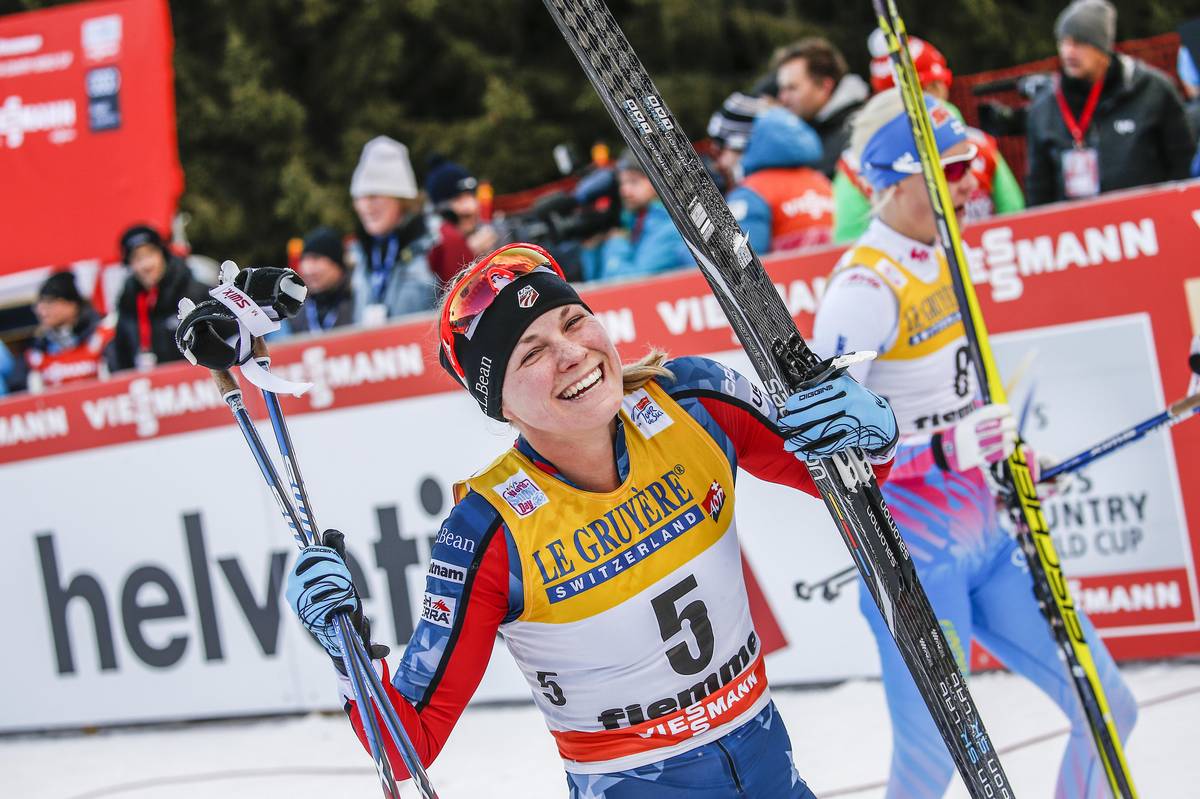
    Jessie Diggins (U.S. Ski Team) smiles after finishing the 2017 Tour de Ski in fifth place after the final climb in Val di Fiemme, Italy. (Photo: Salomon/NordicFocus)

    Last Thursday, U.S. Ski & Snowboard sent out a press release detailing the U.S. contingent for the upcoming Tour de Ski which begins this Saturday, Dec. 30, with a freestyle sprint in Lenzerheide, Switzerland.

    In non-Olympic and non-World Championships years, the Tour de Ski (TdS) stands as the highlight for many all-around World Cup athletes and fans. This year’s U.S. team for the TdS includes four men and seven women, all current members of the U.S. Ski Team (USST): Sadie Bjornsen, Rosie Brennan, Sophie Caldwell, Jessie Diggins, Kikkan Randall, Ida Sargent, Liz Stephen, Erik Bjornsen, Paddy Caldwell, Simi Hamilton, and Andy Newell. (Here’s a list of some TdS teams from other nations.)

    Sadie Bjornsen (U.S. Ski Team) racing to her first career World Cup podium last season at Stage 5 of the 2017 Tour de Ski in Toblach, Italy. She placed third in the 5 k freestyle on Jan. 6, 2017. (Photo: Fischer/Nordic Focus)

    In an Olympic year, a seven-stage tour over nine days may not fit into every top skier’s race plan. A long tour event might tweak the body in ways that make peaking for the Olympics in mid-February untenable. While for others, the grind of the TdS offers an opportunity to ski into top-shape race fitness.

    Here in the U.S., TdS starts have become a topic for discussion due to the small fields finishing last year’s edition of the tour — which was a World Championships year. The argument goes that in smaller fields, it’s easier to score valuable World Cup points by finishing in the top 30 of a given race. For example, in last season’s TdS, 31 women and 40 men completed the final stage. The year before — a non-championship or Olympic year — 43 women and 52 men finished that final climb atop the Alpe Cermis in Val di Fiemme, Italy.

    For both World Championship and Olympic selection criteria, results in specific World Cup races and/or rankings on the distance and sprint World Cup lists can determine if a skier meets the USST’s objective qualifying criteria. In other words, if a U.S. skier on the World Cup does not lock up an Olympic spot during Period 1, their Olympic qualification may be determined by points scored during the TdS. It goes without saying that while the USST members at the TdS solidify their Olympic nominations, many other domestic-based skiers vying for Olympic-team nods will be racing at the upcoming U.S. Cross Country Championships in Anchorage, Alaska, which start next week.

    Here’s a link to the current U.S. Ski & Snowboard 2017/2018 Cross Country World Cup Team Selection Criteria (Updated 11/10/17)

    FasterSkier emailed U.S. Ski Team Head Coach Chris Grover on Dec. 23 with the following questions regarding the selection of this year’s TdS team:

    FasterSkier: Starting with those that aren’t racing: Was Scott Patterson offered a spot that he decided not to take? What are his plans over the next few weeks?

    Chris Grover: As you may recall, we added some guidelines to the 2018 World Cup Selection criteria this fall prior to the start of the season in order to better define to the community how we would utilize discretion picks to World Cup, including the Tour de Ski.  The guidelines are:

    Athletes who have not met the General Criteria may be selected to the team via discretion if they satisfy any of the following:

    •         Outstanding competition results from the 2016/2017 or 2017/2018 seasons, including as a member of a team event, indicating a potential for Olympic success.
    •         Recent positive direction or trend of competition results indicating a potential for Olympic or World Championship success.
    •         Indication of medal potential in future Olympic or World Championship competition (such as international age group results and age rankings) that would be materially enhanced by selection to the team.

    We did offer Scott a Tour de Ski start.  He is a young athlete on his first season of World Cup and we would like to see him build his experience on the Tour.  The discretionary pick would have utilized the third bullet point above.  Scott chose to return to Anchorage for Nationals because he felt his chances of qualifying for the PyeongChang Team were better there.  Scott is currently training in Bozeman and will head to Anchorage next week.

    FS: Was Chelsea Holmes offered a spot on the tour roster? If not, what were some of the reasons or considerations taken into account for that decision?

    CG: Chelsea was not offered a TdS start, as much as we would have liked to see her start there.  She did not meet any of the above guidelines, so it was important for us to adhere to the guidelines and have her compete in Anchorage against the SuperTour field for the additional PyeongChang selections.

    FS: Was Noah Hoffman offered a spot? If not, what were some of the reasons or considerations taken into account?

    CG: Noah was not offered a TdS start.  Same rationale as Chelsea.

    U.S. Ski Team Head Coach Chris Grover speaking with Sadie Bjornsen in Quebec City, where she went on to place eight in the freestyle sprint at Stage 3 of the 2016 Ski Tour Canada. (Photo: FlyingPointRoad.com/NNF)

    FS: Of the 11 athletes racing the TDS, which plan to complete the tour in its entirety? And for the sprinters that don’t plan to do the whole tour, what stages do they plan to complete?

    CG: Jessie, Sadie, Liz, Rosie and Paddy are targeting the entire Tour.  Andy, Simi, Sophie, and Ida will either stop after Stage 4 or Stage 5, and then rest and begin preparing for Dresden.  Erik will probably decide during the Tour how far he will go and may stop after stage 5 to also prepare for Dresden.  Kikkan had originally planned on only racing the first 3 stages in Lenzerheide, but her plans may be evolving.

    FS: This summer you mentioned that the standard for scoring points in the TdS would not be as “easy” this year as in past years because you anticipated that “this year you’re going to have much better numbers of athletes that are actually finishing the Tour.” Do you still believe this?

    CG: Yes.  Last spring, we expanded the start quotas for the Tour de Ski.  Now the top-20 women and top-20 men in the Sprint World Cup are additional quota spots for the Tours.  This means that the nations don’t have to wrestle with a decision about whether to take one of their best all-around or distance skiers to the Tour versus a sprint athlete currently ranked in the top-20 who may be fighting for a top year-end ranking in the sprint World Cup.  They can take them both.  Last year’s Tour only included one sprint; this Tour has two sprints.  The pure sprinters may still drop-out after the second sprint, but their respective countries may have brought additional distance skiers that are planning on skiing the entire Tour.  When it comes to total numbers of athletes left standing at the end of the Tour, the x-factor is always illness, and whether athletes and Teams have managed to stay healthy.  Occasionally a bad cold or flu will circulate through the TdS field and it’s not uncommon to see an entire Team contract the virus.  These health scenarios are impossible to predict.

    FS: You also mentioned that it is “an easier path for an athlete to make the Olympic team” via podium finishes at U.S. nationals than by surviving to the end of an attrition-ravaged TdS. In light of the numerous top athletes who have said they will be opting out of this year’s pre-Olympics TdS, do you still believe this?

    CG: Yes.  I still believe that there is more opportunity for USA athletes that are skiing fast competing against a domestic field at US Nationals that doesn’t include the USA TdS athletes, then there is fighting to stay healthy and score points at the Tour itself.  However, both paths require an athlete to be skiing fast, which is clearly the goal of the selection process.

    FS: For those athletes who are doing the TdS, how do you see that fitting into their season-long preparation and goals, either for the Olympics or otherwise?

    CG: Those athletes that are targeting the entire Tour generally see the Tour as a way to build peak race fitness.  When followed by adequate rest, these athletes have looked to the Tour to sharpen race fitness and help them prepare for a major Championships in February.  For the very best athletes the Tour has also been a place for stand-out results, podiums, and gathering critical World Cup points for those hunting for top season-end Overall, Distance, or Sprint rankings.  

    FS: Do you foresee a time when the TdS is no longer held during Olympic years?

    CG: That’s doubtful.  The Tour de Ski is by far the most popular Cross Country TV spectator and fan event of the season for the FIS.  It is only rivaled by the Olympics and World Championships.  As long as there is massive fan interest, and a lot of prize money and World Cup points on the line, the athletes and the teams will be there.

  • TDS Stages 5, 6, 7: Toblach/Val di Fiemme Quotes

    TDS Stages 5, 6, 7: Toblach/Val di Fiemme Quotes

    American Jessie Diggins (l) checks on Norway's Ingvild Flugstad Østberg at the finish of the final climb up Alpe Cermis on Sunday. Østberg finished fourth and Diggins was fifth to end the 2017 Tour de Ski. (Photo: Salomon/Nordic Focus)
    American Jessie Diggins (l) checks on Norway’s Ingvild Flugstad Østberg at the finish of the final climb up Alpe Cermis on Sunday. Østberg finished fourth and Diggins was fifth to end the 2017 Tour de Ski. (Photo: Salomon/Nordic Focus)

    That’s a wrap, folks! With the 11th Tour de Ski coming to an end on Sunday with the infamous Alpe Cermis final climb in Val di Fiemme, we wanted to share some of the athlete and coach comments that didn’t make it into the race reports. Below are quotes from the last three stages of the Tour, all in Italy.

    ***

    Stage 5 (Toblach, Italy): 5/10 k freestyle

    Women’s report | Men’s report

    On pre-race feelings:

    “I think nerves were a little higher, but not a lot higher. It was more just a feeling of belief and confidence: I’ve done it before, I can do it again type-thing. I was telling myself this was my course. This course was basically built for all of the things that I love to do, I think it’s very fun. I love it when it’s cold out, I loved everything about the day, and I was just letting that excitement and the joy of the sport kind of fill me up. I was pretty pumped, standing on the start time.”

    Jessie Diggins (U.S. Ski Team), after winning the women’s race that day

    “I felt really tired yesterday and this morning on my run, but when I got on skis for the warm up today I felt like a different person! Lots of energy and feelings of fresh legs, which I was really excited about! I am always really excited for these last stages of the tour in Val di fiemme, as they are my favorite race courses on the circuit and the more racing we get to do the happier I am.”

    Liz Stephen (U.S. Ski Team)

    On race goals:

    “There’s always going to be a level of disappointment if you don’t perform to the level you know that you’re capable of. I knew I was capable of winning, so if I hadn’t [won], maybe I would have been disappointed. But it’s the same as if I finish in a 30 k classic below where I think I can, and that’s obviously not winning, I’d be disappointed with myself. If I knew I had more, and I didn’t give it, that’s when I’m disappointed. But if I go out there, and I give a race everything that I had, and I know that I held nothing back, then I’m not disappointed. All you can do is your best, I mean it’s mathematically impossible to give more than 100 percent, it’s all that you’ve got.”

    — Diggins

    “My goal was just to go out and lay down a hard final effort to finish off my tour. I have been strong at 5km skate races in the past and I was optimistic that I could have a strong performance today.”

    Kikkan Randall (U.S. Ski Team)

    On American Sadie Bjornsen (who finished a career-best third):

    “Sadie definitely flew under people’s radar, she really didn’t do the damage that she did until the final stretch of the race. Kind of in the last 1.6 k. She really surprised people. Incredibly fast.”

    Matt Whitcomb (U.S. Ski Team Women’s Coach)

    On the weirdness of the Toblach course:

    “Of course I was hoping to at least ski into the points. I have struggled at this venue for distance racing over my career for some reason which I can’t quite put my finger on, and today was no exception. There are no steep hills but the working sections are long and I guess that’s probably what kills me – especially in skating. Anyway, I wanted a little more than this today but the body feels good and it was a good wake up after the rest day if nothing else ahead of tomorrow.”

    Devon Kershaw (Canadian World Cup Team)

    On interval-start racing:

    “I skied a bit with [Norway’s Niklas] Dyrhaug on the first lap — but that didn’t turn out to be a good idea since he wasn’t having one. Alex caught me with about two kilometers to go, so I tucked in behind him for the last descents — which obviously helped — but with how I felt today I would have needed a proper ride to achieve anything. Of course I hoped that Alex would have a beast day and that if I could stay with that pace it could slot me in nicely — but Alex, while solid, wasn’t strong enough for me to get a good result gifted. I struggled to find that rhythm and speed today alone and while I felt fine — without finding that power (which for whatever reason eluded me today) you are bleeding time on such a gradual course.”

    — Kershaw

    On making the most of things:

    “I’m still pretty happy with where I am, where I’m standing at the end of the day. But it was just not a great race. I kind of saved it, I guess. It was not great, but I limited the losses.”

    Alex Harvey (Canadian World Cup Team)

    On deciding between the Tour or returning home for U.S. nationals in an effort to qualify for World Championships:

    “I guess I thought about it a little bit, but I really wanted to do the Tour, and I felt like if I was skiing the way I thought I should, I would be able to get the points I needed during the Tour, and then it wouldn’t be a problem. Especially after having a good result in France, I felt really encouraged then, so I didn’t really question my decision to stay, at that point. I was sick for the whole time over Christmas, and only skiing a few times. Obviously the Tour has not gone the way I hoped, or the way I left off in France, so I think I had a really hard time killing this cold for good, and it’s like taken it’s toll on my body. I just hope that every day I get further away from that illness, the better I’ll start to feel and hopefully come back to the kind of results like today and the results I had in France, and more where I think I should be.”

    Rosie Brennan (U.S. Ski Team), after placing 23rd

    On recovery:

    “Last year [after winning this race], I was so thrilled, there was so much going on, there was a press conference, doping control, traveling, and I remember feeling so tired the next day. And this year, I’m just learning how to handle it a little better, in terms of just managing my energy. I think that’s helped a lot. We had a little less to deal with today, in terms of press things, I think was able to manage my energy. So I’m hoping for a solid day tomorrow.”

    — Diggins

    On going on a World Cup tour with a baby:

    “It’s definitely been a little more challenging to travel the tour with a baby along but now I can’t imagine doing it any other way. We’ve tried to be respectful of the team and the rest for the other athletes, so we’ve been driving our own van and eating at a separate table. Breck has been a really good baby and after some sleep training over Christmas, he’s sleeping through the night and taking naps during the day. The support of my parents and Jeff’s parents have been invaluable and the team is also helping a lot too. It requires traveling with a lot more stuff and I can’t always follow the exact routine I’m used to but it’s surprisingly manageable and so wonderful to have such an amazing new part to my life. The baby rooms provided by the organizers have also been really helpful. I’m excited to stay in Toblach for the next week and a half and just get to enjoy some down time with Breck and recover.”

    — Randall, who has a nearly 9-month-old infant

    ***

    Stage 6 (Val di Fiemme, Italy): 10/15 k classic mass starts

    Women’s report | Men’s report

    On how the body’s feeling through six races in eight days:

    “Felt good, yeah. Felt good in the morning, went for a jog. Felt good in the warmup, and early during the race. But then I just, I don’t know, couldn’t lay down a good race. So that was bad.”

    — Harvey

    On day-to-day strategy:

    “I’m not like stressing about the final climb on Stage 2, and on Stage 3 I’m not going, ‘Oh, I’m here in the overall, and I need this and that.’ It’s just, go out every day and ski as hard as you can, ski each race as well as you can, and then, you know, if you get every step, eventually you’re climbing up, right? … I know that’s my strength, is I can dig really deep and I can deal with a lot of pain, and I can grind it out.”

    — Diggins

    On pack skiing and sketchy corners:

    “Stuff happens in a race, and that’s why we practice for the unexpected. Practice agility, and our downhill skills, because you need ’em.”

    — Diggins

    On finishing in the top 30 for World Cup points:

    “Even getting one point – I never complain when I’m in the points. And definitely moved up in the Tour to 30th, although it’s really tight in there with several of us. But, you know, tomorrow suits my strengths super well, and I’m looking forward to that. Definitely feel like it was another good step forward from where I was at the beginning of the Tour and for much of Period 1.”

    Noah Hoffman (U.S. Ski Team), 30th in the 15 k classic mass start

    On staying focused late in the Tour:

    “I think it becomes easier, you have so much clearer motivation. I mean, a regular World Cup, if you’re skiing, you know, 45th place in a mass start and a minute behind the top 30, like, that’s a challenging place to stay motivated. Because the difference between 40th place and 50th place is not very big. So in terms of getting yourself to fight for those places, it’s more challenging. … It’s quadruple points at the end of the Tour, so time is very important today.”

    — Hoffman

    On the second-to-last stage:

    “A top 20 is always a top 20, but I was hoping for a bit more energetic feeling out there. Maybe my body knows what’s about to happen to it tomorrow.”

    — Stephen

    ***

    Stage 7 (Alpe Cermis/Val di Fiemme, Italy): 9 k freestyle pursuit climb

    Women’s report | Men’s report

    On entering the last stage:

    “At the moment I am feeling like a zombie. I’m really really tired. I think it will all sink in tomorrow, but as of right now I am ready for a break.”

    — Diggins

    “It’s just knowing that that’s it. Sometimes you can eke out more energy to get up the climb.”

    — Brennan

    On racing up an alpine mountain:

    “I realize why we do it and it’s the real show and it’s a fitting end to a grueling week, but I absolutely hate monkey skating up an alpine ski hill. I have never been good at and even when I was fourth and seventh in Tour de Ski overall, I have had vicious times up it.”

    — Kershaw

    On being in the wave start, or not:

    “Last year I had quite a good race up the hill and I was 19th [for time of day]. I was in the waves so that really helped, being packed in a group all the way down to the first 5 k. Today, [Sweden’s] Daniel Richardsson and I tried to work together but we were both just so shitty, and when you know you have two bad bodies trying to do something for the first 5 k, you are just bleeding time, and when you get to the hill you already lost a minute in that section. Then climbing the hill, we weren’t that much better so it was too bad because the Tour had some bright spots for me and but it was a really forgettable day today. One you have to throw over your shoulder and just keep telling yourself that you were better earlier.”

    — Kershaw

    I kind of treat this as a time trial anyway. Usually I do start in the wave, but this year it was nice not to. I did have a Swedish skier on my tail for the flat part and I was hoping to be able to take turns and work together, but she was maybe not feeling the necessity to pull. But that was fine. I just kind of wanted to go fast along the flat, as fast as I could. And I think Hedi put quite bit of time into us, or into me, on the flat. So I have to work on that a little bit, too.”

    — Stephen

    “I don’t know. I’ve only ever done it in the wave, so I don’t really know what it’s like otherwise, but it’s probably a toss up.”

    — Brennan

    On pacing the flats before the climb:

    “It’s such a different kind of skiing. I always feel like you can probably push it a little on the flats without having too much impact on your climb. It’s just narrow, and gradual terrain the whole time, so it’s a different kind of skiing.”

    — Brennan

    I have always kind of pushed as hard as I can on the flat, because as hard as I can push on a flat is still not going to blow me up. It’s not where I can really hit my groove and be able to really put damage into people — I never feel like I have blown myself up even if I have a time trial on a flat course. I just can’t get to that mark yet with my technique. So yeah, I go as hard as I can on that flat part while trying to stay relaxed, because the less relaxed I am on flats the slower I go. I have to find that happy balance. I felt like I skied the flat as well as I could today, and then was just psyched to turn the corner and go up.”

    — Stephen

    On final placement in the Tour:

    “I am happy to be in the top 15 because I didn’t think that was really a possibility for this tour when I looked at the standings last night so that was good… I am never going to be disappointed with a top 15, but also, it’s hard to come from knowing that I can be top five in this tour. So you always kind of want to get back to your best result and then try to beat that. 15th was not what I was hoping for this year, but at the same time, I am not disappointed with it.”

    — Stephen

    On the team:

    “Our team lost a few people for sure due to illness, but it’s always so nice to celebrate with not only with the team that finished to the top fo the hill but also the wax staff and the coaching staff. This is such a taxing event for them and they are on it all the time. And their moods are always good. I don’t know how they do it — even when they are sick they still have a happy mood on. So that is so key for our performance. A huge thank you needs to go out them for all their work and their spirits.”

    — Stephen

    On teammates:

    “Jessie and I are in a room together, and we have kept the same roommates the entire tour to minimize how many germs are being spread around. Sadie’s being quarantined, for sure. It’s heartbreaking, with her having such a good tour, but I think her [Toblach 5 k] result is still so fresh, that helps with having to make the tough decision to drop. The tour is so grueling, and I think you have to decide for yourself: how does my energy feel right now, and is this digging a hole that I can’t get out of? I think that it”s really mature and smart to think about the rest of the season now.”

    — Stephen

    “I am so proud of Jessie. To get fifth this year and have her best climb ever, and she told me she thinks she had her best classic race she ever had yesterday, it’s really fun to watch her mature as an athlete and be skiing so well. She is a force, as we all knew she would be. It’s really fun to see it all working out for her for sure. And Rosie in the top 30. And we have our fingers crossed here cheering for Noah on the climb — we are hoping he gets a top 20 on the day.” [Note: Hoffman’s time was 15th-fastest up the climb.]