From the FasterSkier archive — posts syndicated from athletes’ and coaches’ own blogs between 2004 and 2012, kept online as published. Current coverage is at fasterskier.com.

Tag: team dynamics

  • Jessie Diggins: Health and Happiness in the Season Ahead

    Jessie Diggins: Health and Happiness in the Season Ahead

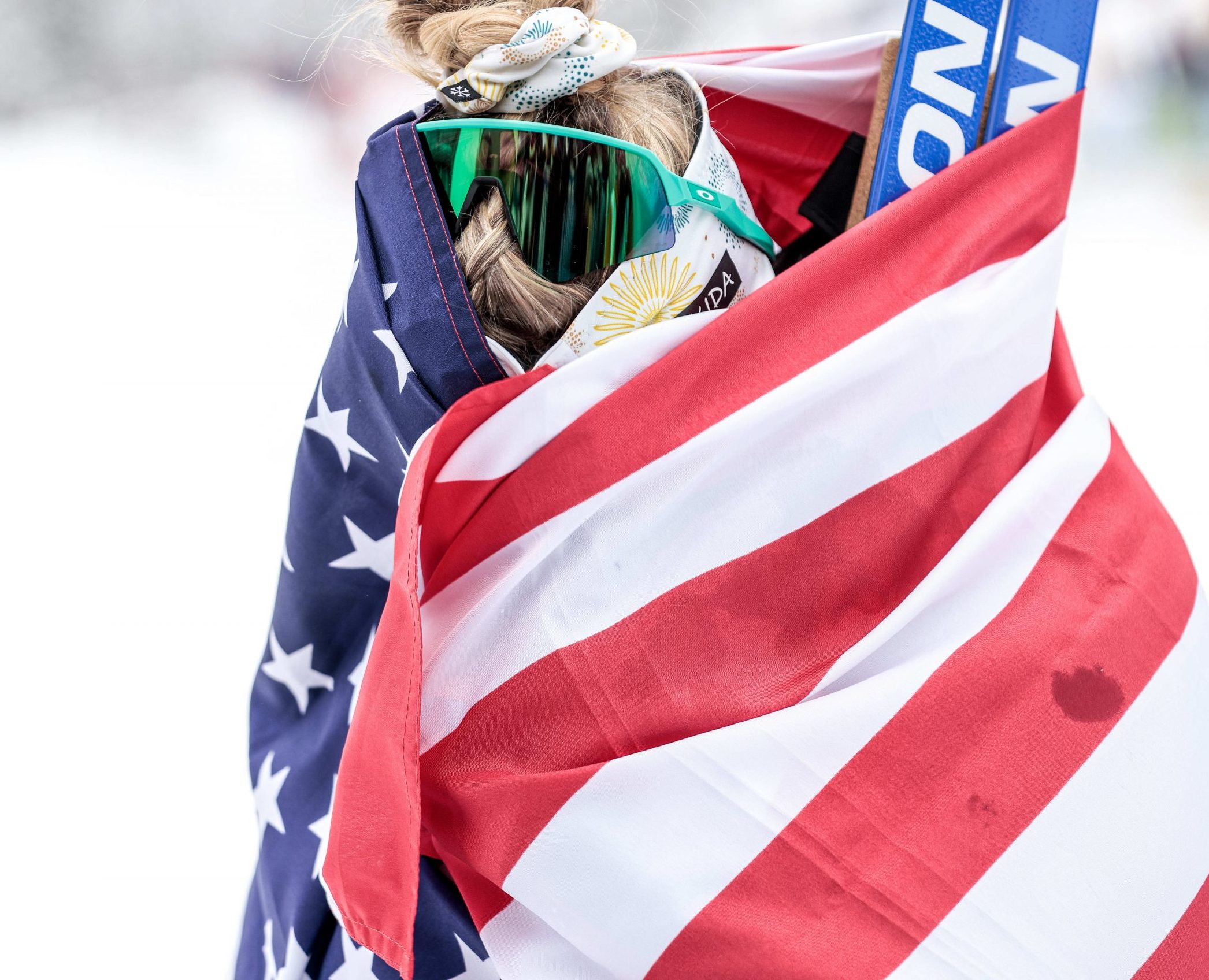
    A private moment of joy and elation at the 2023 FIS World Championships. Jessie Diggins represents family, friends, fans, her team, and her country. As one who so often finds herself in the glow of the media spotlight, she also works to represent her own strengths and weaknesses, aspirations and vulnerabilities. (Photo: Modica/NordicFocus)

    11/17/2023—Ruka, Finland

    For American fans of cross-country skiing, Jessie Diggins is definitely the voice of our sport. Following a 2023 season that saw her crowned World Champion in 10k—and finishing second overall in the season-long FIS World Cup—she returned to training and preparing for the season to come; but things didn’t go exactly as planned. Recently, Diggins sat down for a scheduled media interview to discuss her relapse into an eating disorder from which she’d been in recovery for many years. Pressure, expectation, image, aspiration: all can combine to test the mental health of even the strongest among us. Jessie Diggins discusses it all willingly and openly.

    “I’m going to assume that a lot of the questions will be around my mental health,” she began. “Mental health is physical health; so, eating disorders are not a behavioral choice. It’s mental health . . . and it’s important that we can talk about mental health . . . I want athletes to feel they can talk about this with their coaches the way that I’ve been able to talk to my coaches.”

    “We’re all human, and we’re all doing the best we can, every single day. So, this season, I’m focusing on just doing my best . . . taking it one day at a time, one race at a time.”

    Jessie Diggins is an advocate, and an example, and a mentor in discussions regarding mental health, especially when it comes to those individuals and athletes who experience eating disorders. Her place in this discussion received additional attention over the summer when she issued a statement in which she described her own relapse. This recent press conference allowed her to address her recent experiences, and her goals and expectations for the season to come.

    “I have this opportunity right now to talk about things that are really important to me . . . continuing to race lets me do that . . . It is fun—and I still like racing—but I’m also racing for some other reasons, too. “

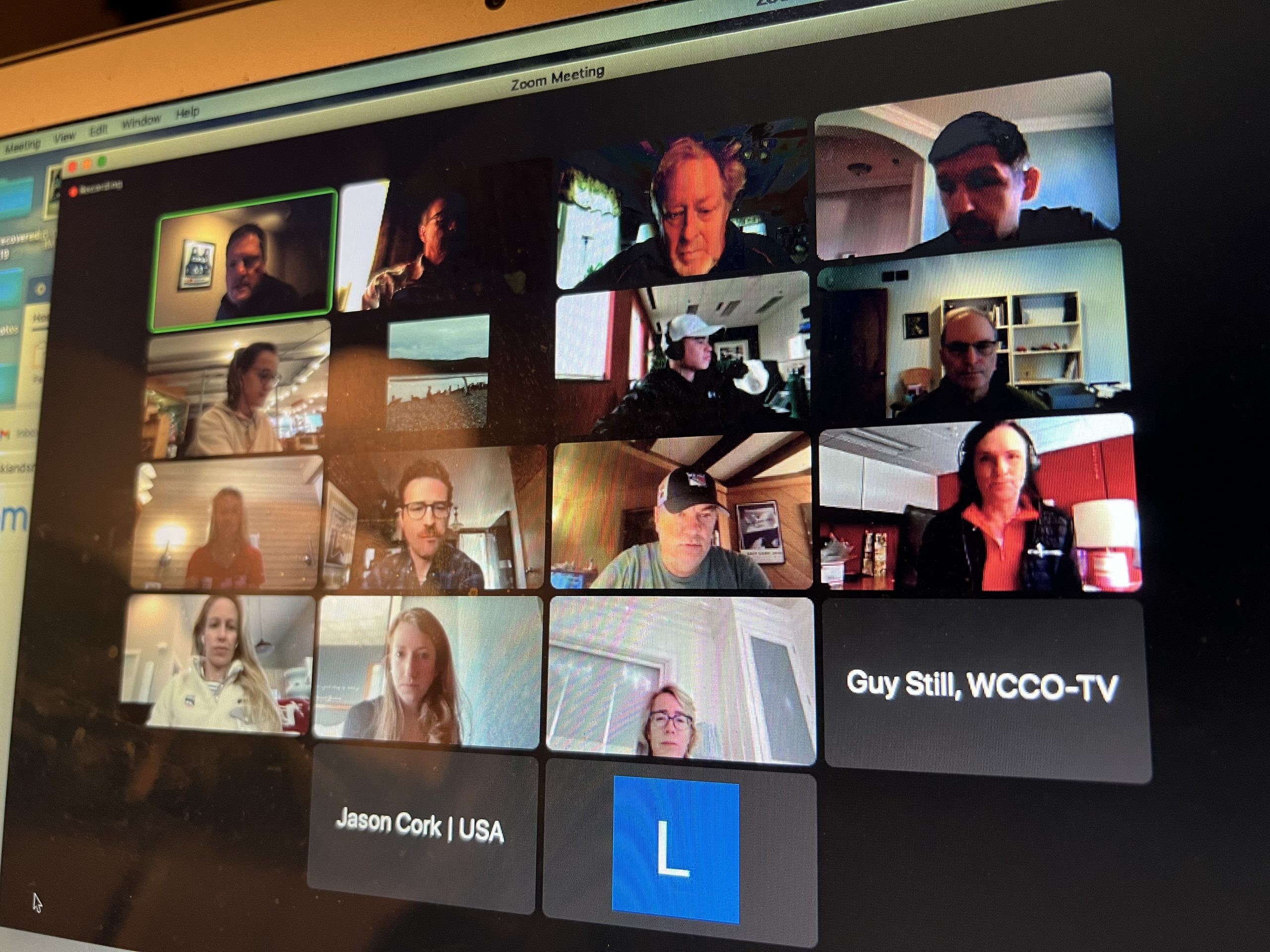
    The view of Jessie Diggins’ recent online press conference. Typical of the wonderful interview that she typically offers, Diggins answered questions on a variety of topics from mental health and athletic legacy to Taylor Swift and biodegradable glitter. (Photo: FasterSkier)

    Among other topics addressed in her hour-long press conference, Diggins addressed the high-profile nature of her position in the sport—and her own level of vulnerability that followed her recent disclosures—especially when it comes to expectations and hopes for 2024’s upcoming FIS World Cup events in Minneapolis.

    “Sometimes, getting everything you ever wanted comes with unexpected pressures . . . Maybe a home World Cup comes with extra pressure and expectation. I’ve also struggled with that. I wouldn’t want to disappoint people, or let them down . . . I want to give everyone everything that they’re hoping for. I want to high five every single person because we worked so hard to make this happen . . . and I know that I can’t. So, I just have to find a way to say ‘I’m doing the best I can.’ And that’s going to have to be enough.”

    As she approaches her 12th season on the World Cup circuit, it’s interesting to consider what continues to keep Jessie Diggins motivated.

    “I’ve done a lot that I wanted to do in sport,” she said.”I feel like I’m not done [with] my potential in the sport. I feel like I’m still growing and learning . . . When you really get down to the bottom of the well, you learn some things about yourself . . . and how you react. When you’re in that place—in that pain cave—that’s pretty cool. I think I’m just not done learning about myself yet.”

    In concluding the press event, Diggins commented—as she often does—on the importance of her teammates, their attitudes, their energy:

    “Everyone wants to be here,” she said. “It’s not just a job, it’s not just a hobby. It’s this burning passion—to be a part of this team, and to represent the country, and to just ski race FAST! . . . It’s my dream job—it really is. I love being part of this team . . . Results are one thing; but being a good person, that’s what you’re going to look back on and remember. And this is a team of really good people . . . That’s something that makes me really really proud.”

    As for the glitter (which, just for the record, is biodegradable), Jessie wants to remind herself that“this is supposed to be fun!”

    Energy, courage, passion, and compassion: Jessie Diggins leads the Stifel U.S. Ski Team into the 2023-2024 World Cup season. (Photo: Thibaut/NordicFocus)
  • Jessie Diggins Looks Ahead

    Jessie Diggins Looks Ahead

    American cross country skiers continue to climb the international ladder, and any number of them are likely to find their names in the headlines this winter, but it’s Jessie Diggins who continues to be the skier, the competitor, and the leader through which this team is recognized. It’s a distinction she’s earned time and time again.

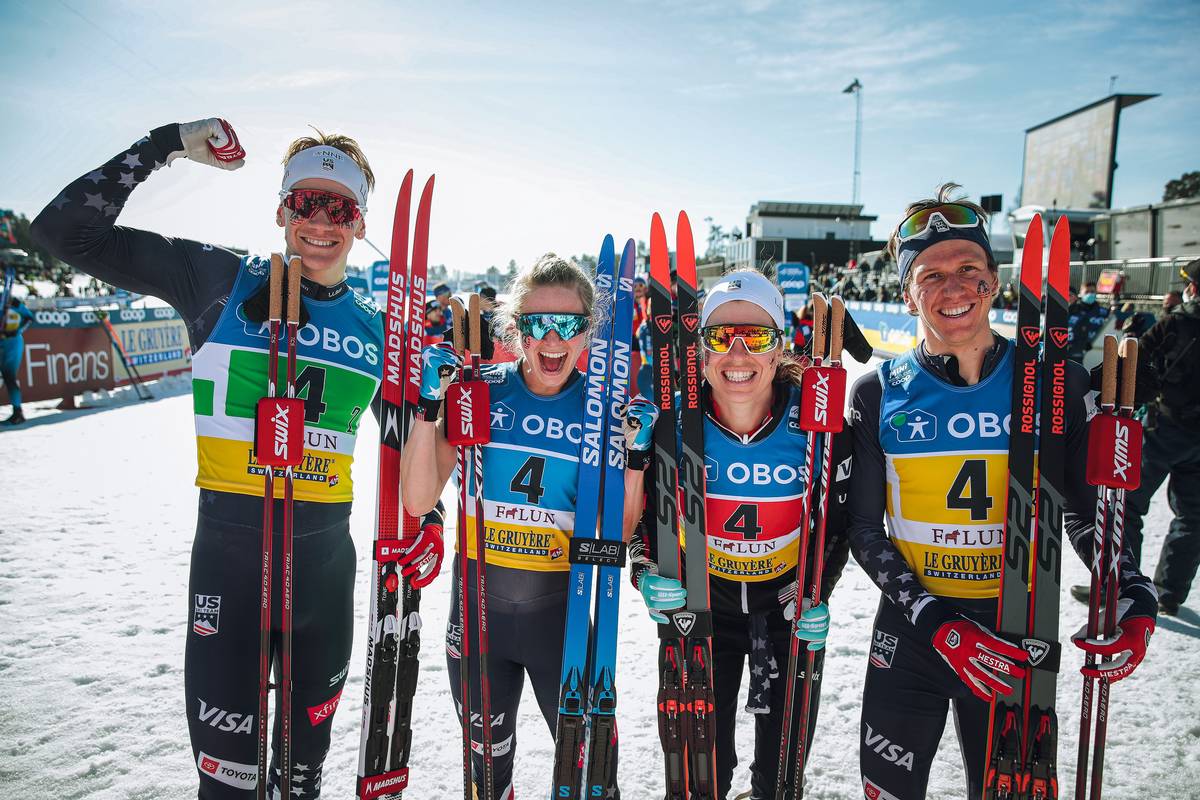
    For Jessie Diggins, team is family. From left to right, Zak Ketterson, Jessie Diggins, Rosie Brennan, and Scott Patterson. (Photo: NordicFocus)

    On the morning of November 21, Jessie (who is in Ruka, Finland in preparation for the season’s first World Cup weekend) joined a virtual group of ski-media reporters and sport representatives for a discussion of the upcoming season. Three FasterSkier staff writers—Ben Theyerl, Ken Roth, and John Teaford—were on the media call, hearing the many questions and answers. In typical Jessie-style, it was an event filled with smiles, laughs, and optimism. This article offers highlights of the wide-ranging conversation:


    Ben Theyerl

    FasterSkier staff writer, Ben Theyerl, paid particular attention to Diggins’ responses concerning team dynamics and equal distance policies (for male and female race distances):

    Skiing and Racing

    Diggins was asked to reflect on what is coming up immediately on her calendar—the Ruka World Cup this weekend—and on her long-term future in the Olympics, World Cup, and beyond. As always, Diggins remained team-focused in her answers. Regarding this weekend’s Ruka World Cup, she noted that she finds it helpful to channel the energy of younger teammates: “When you see someone making their first start, it brings back the energy and excitement of your first World Cup.”

    Ruka will also mark an athletic first for Diggins: the arrival of equal distance racing means that she will race a 20 k World Cup race for the first time in her career. She is looking even farther down the road to a particular race made possible by new equal distance policies: the Holmenkollen 50 k. “I’ve been looking forward my whole life to racing the actual 50 k. I’ve raced that distance a couple of times . . . and they’ve never had to have an ambulance waiting like they used to think [women] needed . . . I think it’s total crap that women never got to race this iconic distance. I’m very grateful for FIS making this change.” Diggins added that the messaging of switching to equal distances was also critical. “The message that it sends to young women is that you’re totally capable of doing anything that you want to if you train hard and work hard.”

    “The message that it sends to young women is that you’re totally capable of doing anything that you want to if you train hard and work hard.”

    Diggins was also candid about how the conclusion of the 2022 Olympic cycle has led to a more relaxed feeling this season. “[The Olympics] was the most type of pressure I have felt in my career. I feel a bunch of relief now, and can keep skiing knowing if I retire tomorrow I can be more than satisfied with what I have done in my career . . . I’m still here because I love what I do. I love my team. I think this is super fun.  I’m not racing because I have to prove anything, and I think that keeps a lot of the pressure off.”

    In the upcoming season, Diggins is anticipating the World Championships in Planica, Slovenia next March. She also admitted to being excited to be “Chasing the Crystal Globe” for the World Cup overall. In particular, she noted that the World Championships would offer the chance for the US Team to build off their recent successes in Team Relays. “I love Team Relays, and we have been really close in the past couple of [World Championships]. I feel like now is the time for us to take the next step.”

    American Racing

    Of additional interest to American skiing fans had been Diggins’ role in securing a North American World Cup placed within the 2020 FIS calendar (to have been held in Diggins’ home state of Minnesota at Theodore Wirth Park in Minneapolis). Though Covid restrictions ultimately caused that race to be cancelled, there has been a provisional joint bid from the Loppet Foundation and American Birkebeiner Ski Foundation to stage 2023-24 World Cup events at Wirth Park, and Cable, Wisconsin. On the prospect of a Minnesotan World Cup Diggins said that “I remember the first time I went to a World Cup, and I think about how unique and inspiring it is. [Wirth Park] is an ideal venue to grow the sport. It is in the middle of the city, which would bring a diverse set of fans from outside skiing, with the prospect that they can all be right next to the athletes . . . That energy [is] electric . . . and I want everyone to experience that.”


    Ken Roth

    FasterSkier staff writer, Ken Roth, concentrated on message’s communicated in Jessie’s responses pertaining to team culture and fan support:

    Team Culture

    Diggins noted that she came directly from high school to professional racing, and that the sense of being “a team” was very similar to what she experienced in high school. “I was fortunate that when I came onto the [national] team we were all invested with this idea that we would support and help each other.”

    “I was fortunate that when I came onto the [national] team we were all invested with this idea that we would support and help each other.”

    When asked for her impression of her own teammates’ prospects this season, she replied, “They look really good. They’re really thoughtful in technique, analyzing video, it’s not just more more more.” She has high hopes for her teammates and pointed out how hard she, herself, has been pushed by Julia Kern in recent intervals.

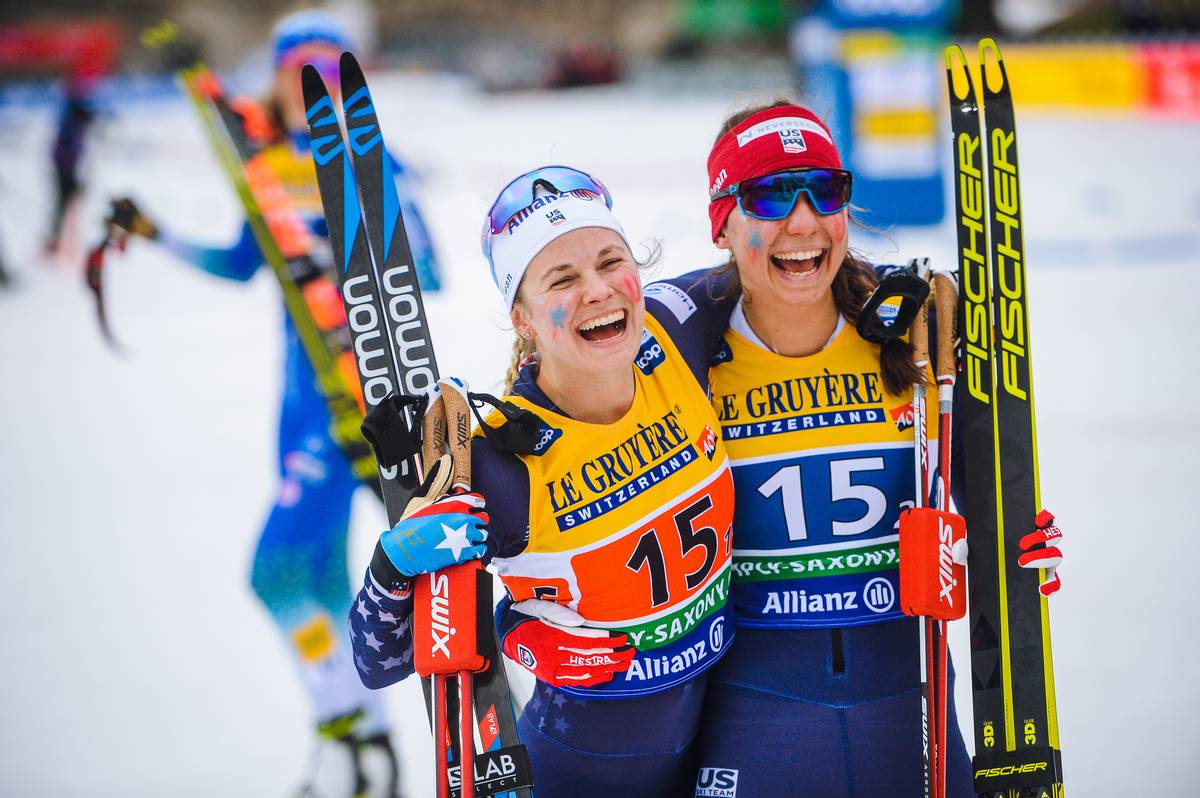
    Jessie Diggins and Julia Kern take second in the team sprint in Dresden, GER in December 2021. (Photo: NordicFocus)

    Training Changes and Adaptations 

    She noted that the biggest change to her training plan is focusing on technique and maximizing on-snow time (including her choice to spend three weeks on snow in Australia this autumn). “Pure fitness can be gained just as easily on roller skis, but you can really only improve certain [technical aspects] on snow.” She noted that in order to avoid plateauing, her training hours creep up slightly every year, giving her “room to grow.” She also credited her training plan as devised and supervised by her coach Jason Cork: “the brains behind the operation.”

    Fan Support

    Diggins smiled broadly when she recalled being invited to a fan’s wedding; she seemed to have been genuinely touched by that gesture. She also mentioned that she had been contacted by a woman who is in recovery at the Emily Program and how moved she was by that person’s journey. Diggins is definitely a fan favorite; she also seems devoted to returning that affection. Looking down the road several years, she said “I love what I do, so here I am, still doing it.”


    John Teaford

    FasterSkier editor and staff writer, John Teaford, heard Diggins expressing opinions and hopes extending well beyond her presence as a star in the sport of cross country skiing.

    Advocacy in Skiing, and Beyond

    Diggins has proven to be a powerful champion of numerous social and environmental issues ranging from awareness of eating disorders to climate change legislation. Her answers to the questions she fielded on these issues were especially thoughtful. She spoke of her meetings with lawmakers on Capitol Hill regarding her work with Protect Our Winters (POW).  “I had a really great trip to the Capital with Gus Schumacher.  I used the story of my food poisoning in the Olympic 30k (in which she won silver) to show that just because something’s hard doesn’t mean it’s not worthwhile. It was an uplifting visit.”

    “Just because something’s hard doesn’t mean it’s not worthwhile.”


    With regard to climate change—and the potential for activism and social consciousness to inspire beneficial policies—she said, “I am really hopeful . . . It is a man-made problem, and we are the ones who need to fix it. This isn’t an issue that we should feel the need to take sides on.”

    Jessie’s Athletic Future

    When asked about long-term plans to go back to the Olympics, she again attribute her motivation to her team, and her teammates. “This is a group that supports each other . . . a really safe space,” she said. “I feel a lot of love and support; that makes it easy to be here. Without [this great team chemistry] I probably would’ve been done a long time ago . . . If I’m healthy and uninjured, I’m definitely planning to do the 2026 Olympics.”

    All in all, the video conference was 45 minutes of pure Jessie Diggins: candid, generous, passionate.

    Jessie Diggins previewed her upcoming season on a media Zoom call on Nov 21, 2022.


  • This Month in Journals: Team Dynamics in Individual Sports, How to Prescribe Intervals

    This Month in Journals: Team Dynamics in Individual Sports, How to Prescribe Intervals

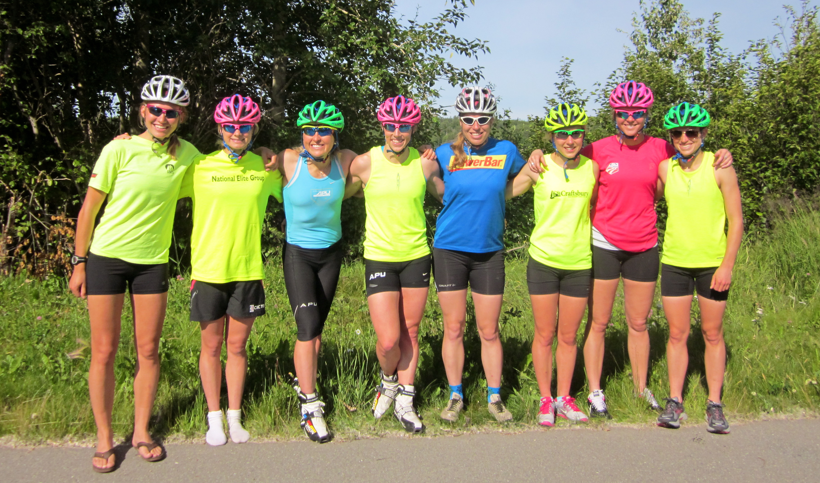
    Team spirit has been widely touted as one of the keys to the U.S. women's recent success. Photo: Matt Whitcomb.
    Team spirit has been widely touted as one of the keys to the U.S. women’s recent success. (Photo: Matt Whitcomb)

    Welcome back to This Month in Journals, where we review the latest exercise and sports science and pull out some research that might be of interest to skiers.

    Αssumptions and research are changing the way that psychologists and coaches think about team dynamics in individual sports.

    It has long been known that team cohesion, leadership and cooperation are important for success in team sports, like soccer or basketball, but far less research has been done on whether these same concepts are important in solo sports, like running and skiing. In fact, one classical theory holds that team cohesion can even be detrimental because it destroys competitive rivalries between teammates that might spur them to better performance.

    But recently, these ideas have been challenged. Beginning in the 1990s, researchers showed that even when teammates in an individual sport don’t have to cooperate on a task during competition to reach their goals, cohesion is positively associated with performance to the same extent that it is in those other team sports, like basketball.

    Blair Evans and Mark Eys of Wilfrid Laurier University and Svenja Wolf of the German Sport University Cologne furthered this work this month, publishing a paper in the Journal of Applied Sport Psychology based on interviews with six distance runners, six cross-country skiers, a mountain biker and a wrestler. All the athletes were Canadian and had several years of experience at the Olympic or World Junior Championships level.

    In terms of performance, there was little doubt that a good team atmosphere made these individual athletes more competitive. A middle-distance runner told the researchers that when she was training on her own, her race times were typically slower than during periods where she had training partners.

    Being able to use teammates as a measuring stick was also frequently cited as a benefit. Athletes talked about times when a teammate was having a good race, and they tried hard to follow because they knew they could keep up during practice every day. Even if they couldn’t achieve the same result that day, teammates’ success often boosted their confidence because they knew they had been doing the same training so a similar result might be possible.

    Finally, the social aspect of a team and the support it provides are extremely important to individual athletes. Despite all of the athletes’ strong drive for competitive success, they almost unanimously cited the group or team as a main reason to compete and to stay in sport. Many discussed how teammates became their closest friends, and that these friendships are maintained even after one or several of the members quit the sport.

    This was particularly important in adolescence, in terms of determining what path an athlete might take, but also at the senior level, where several participants described moving teams or locations or even traveling internationally to be part of a more friendly training group. Group was also important for maintaining motivation when injured and ensuring a comeback to competition.

    And what about that old theory that being friends with your teammates killed any competitive instinct that you might have against them? Athletes were divided on this one – or, more accurately, had experienced groups moving in both directions. In some teams, cohesion bred a healthy sort of competition that facilitated success.

    In other situations, teammates actively sought to avoid competition against one another because they thought it would be detrimental to their relationships. The researchers found that jealousy, for example, was definitely relevant to group dynamics and performance. This isn’t unique to individual sports: once again, it underscores that team dynamics, good or bad, have just as big an effect on running and skiing as they do on soccer or football, and the effects are “context-dependent.”

    Moving from psychology to physiology, a team from the University of Cape Town, South Africa, thought about how to prescribe interval training.

    The most common approaches used by coaches are to give instructions on the effort level based on a percent of VO2Max, or a percent of maximal heart rate.

    But different athletes respond differently to effort; for instance the same percentage of maximal heart rate may produce a different amount of lactate in one athlete than another, leading more quickly to exhaustion. Is there an easy way around this, or do instructions have to be specific to each individual athlete?

    Writing in the journal Sports Medicine, Theresa Mann, Robert Patrick Lamberts and Michael Ian Lambert describe that a more uniform way to prescribe workouts would be as a percentage of aerobic threshold or anaerobic threshold. These thresholds can be determined in physiological tests, and should provide a good “anchor” at which all athletes respond in the same way.

    This has many benefits: “less variation in time to exhaustion during constant-intensity exercise, a more homogenous exercise stimulus at the molecular level, and less individual variation in the adaptive responses following a training program,” the authors write.

    But for many low- and mid-level athletes, this approach might not be possible as repeated testing is needed to accurately pinpoint thresholds, and not every team has a physiology lab available to them. The authors suggest that using regular lactate testing during a non-laboratory workout can be used as verification, since below the anaerobic threshold, for instance, lactate production should be no different than baseline. If a coach prescribes a workout below the threshold assumed from, say, one laboratory test, but the athlete is still producing high lactate, then the threshold is probably wrong.

    And speaking of how to prescribe intervals, what terrain is best?

    Many times, athletes are instructed to do their interval training going uphill, to make sure that the work is very hard. A South Dakota team of Derek Ferley, Roy Osborn, and Matthew Vukovitch wondered if that was really ideal. They recruited 32 distance runners and compared the effects of uphill interval training to that of level-ground workouts.

    Strangely, though, they prescribed the two groups completely different workouts. Twice a week, the hill-running group would complete 10 or more 30-second sprints at a steep grade; they also did several normal long runs. The flat group did the same long runs, but their intervals were longer and fewer in number, with runners completing just four to six intervals.

    The authors concluded in the Journal of Strength and Conditioning Research that hill-running had great merit as a training plan, because it changed some metabolic processes for the better. However, they also pointed out that the flat-training group had greater improvements in time-to-exhaustion, so maybe coaches are overprescribing hill workouts. As a result, they advocate that level-ground workouts that are fit to an individual’s own physiological parameters will create the biggest gains.

    It’s difficult to see how they directly tested the effects of hills themselves, considering that athletes did different workouts. But the last conclusion, whether on hills or on the flats, seems like common sense that can be followed no matter what.