From the FasterSkier archive — posts syndicated from athletes’ and coaches’ own blogs between 2004 and 2012, kept online as published. Current coverage is at fasterskier.com.
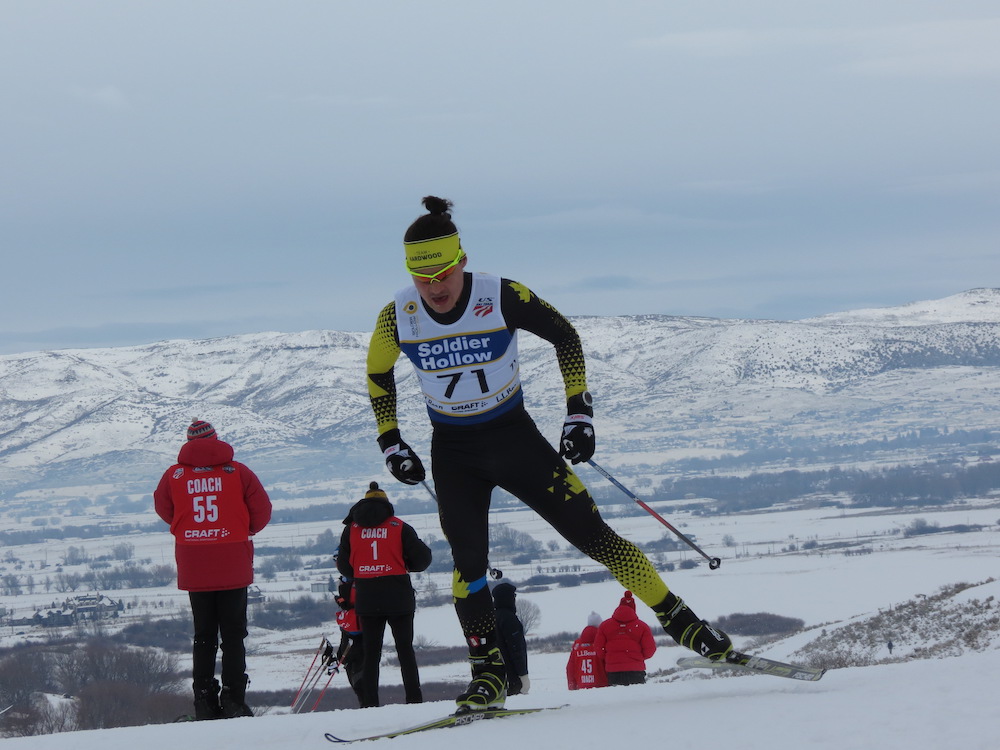
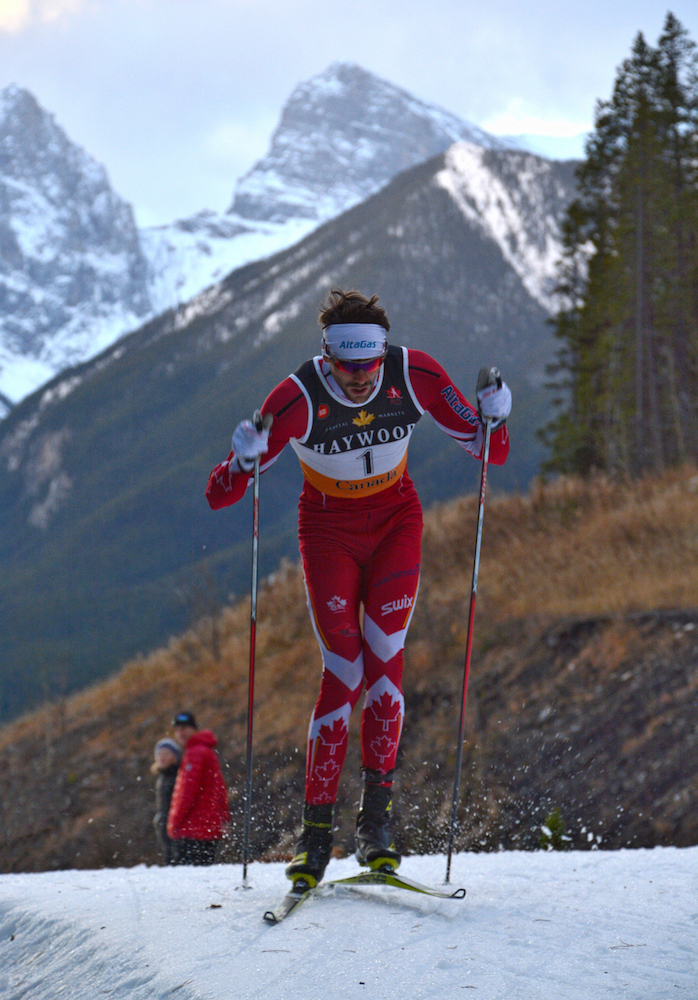
Canada’s Ryan Jackson (Team Hardwood) racing to 31st in the men’s 20 k skiathlon on Friday at 2017 Junior World Championships at Soldier Hollow in Midway, Utah. (Photo: FlyingPointRoad.com)
In an effort to showcase the North Americans competing at this week’s International Ski Federation (FIS) 2017 USANA Nordic Junior World Championships and U23 Cross Country World Championships at Soldier Hollow in Midway, Utah, we asked those qualifying athletes several questions about themselves — actually, we had them fill in the blanks. Here we have 19-year-old Ryan Jackson, of Team Hardwood, who’s representing Canada at his second Junior Worlds.
On Friday, Jackson raced to 31st in his first race of the week, the men’s 20 k skiathlon.
***
“My full name is Ryan Jackson, but you can call me Rj. I was born in Barrie, Ontario, raised in Midhurst, Ontario, and one thing you should know about my hometown is that I used to live there.
I started cross-country skiing when I was pretty young, thanks to mom & dad. I currently train in Oro-Medonte, Ontario, with Team Hardwood.
If I’m not skiing, you might find me mossing in the doghole with Joe. If I had to pick a favorite book, it would be any colouring book.
Ryan Jackson (Team Hardwood) racing in the 15 k freestyle at 2017 U.S. nationals last month at Soldier Hollow in Midway, Utah. (Courtesy photo)
One of the things I’m most excited about for Junior Worlds at Soldier Hollow is racing. One race I’m especially targeting there is the 20 k skiathlon.
The best advice anyone ever gave me about skiing or racing was ‘go faster’. One of the best race memories I have is winning Eastern Canadian Championships for the first time.
If I could meet one World Cup skier, it would be Lenny [Valjas].
If I don’t end up being a professional skier, I’ll probably be a ski bum.
I’m missing too many days of school to be here, and my teachers are probably thinking, ‘Who is Ryan Jackson?‘
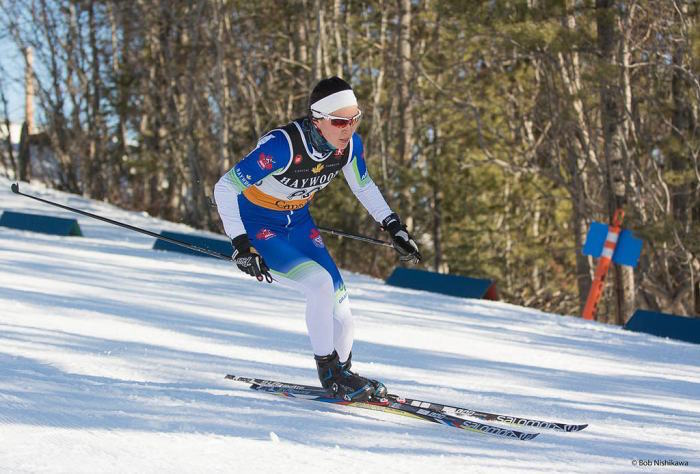
Jenn Jackson (Team Hardwood/Lappe Nordic) racing at 2016 Canadian nationals in Whitehorse, Yukon. (Photo: Bob Nishikawa)
In an effort to showcase the North Americans competing at next week’s International Ski Federation (FIS) 2017 USANA Nordic Junior World Championships and U23 Cross Country World Championships at Soldier Hollow in Midway, Utah, we asked those qualifying athletes several questions about themselves — actually, we had them fill in the blanks. Here we have 21-year-old Jenn Jackson, of Team Hardwood and Lappe Nordic, who’s representing Canada at her second U23 World Championships.
***
“My full name is Jennifer Jackson, but you can call me Jenn. I was born in Toronto, raised in Midhurst, [Ontario], and one thing you should know about my hometown is I don’t live there anymore.
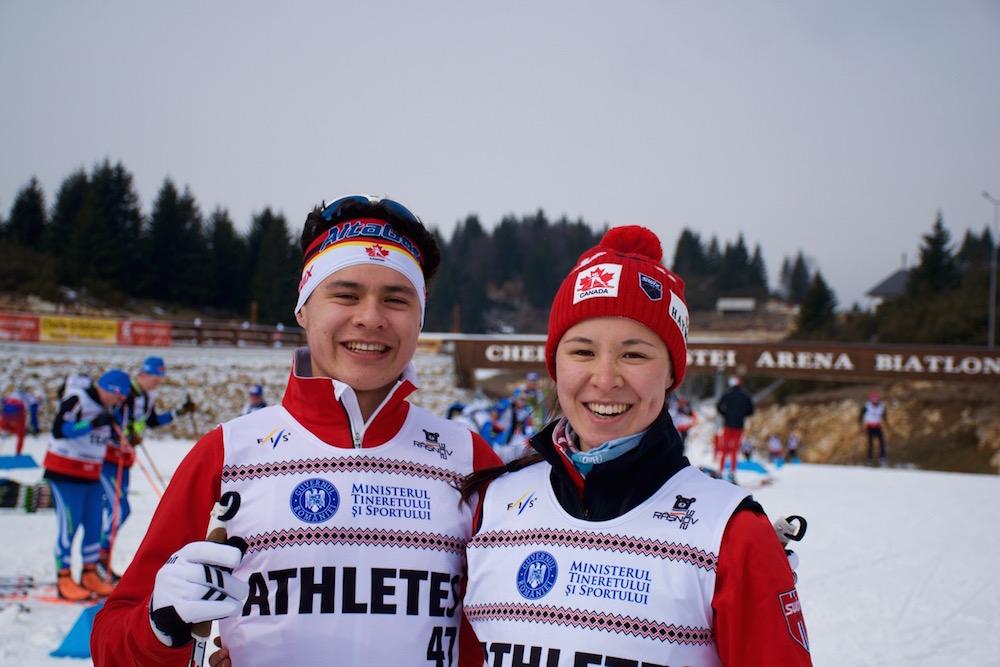
Jenn Jackson (r) and her brother Ryan Jackson at 2016 Junior/U23 World Championships in Rasnov, Romania. Both qualified to represent Canada again at this year’s Junior/U23 World Championships in Midway, Utah. (Courtesy photo)
I started cross-country skiing when I was pretty young, thanks to my parents. I currently train in Oro Medonte, [Ontario], over the summer and Thunder Bay during the school year, primarily on my own, but I race for Team Hardwood and Lappe Nordic.
If I’m not skiing, you might find me at school. If I had to pick a favourite book, it would be: I couldn’t pick a favourite book, but I am currently reading ‘Antifragile: Things That Gain From Disorder’ and Jens Voigt’s book ‘Shut Up, Legs!’
One of the things I’m most excited about for U23/Junior Worlds at Soldier Hollow is the tacos. One race I’m especially targeting there is probably the sprint.
The best advice anyone ever gave me about skiing or racing was that sometimes you just need to put your head down, close your eyes, hold your breath, and hammer. Maybe not the best advice in a practical sense… but the essence of it is gold.
Some of the best race memories I have are probably the string of comeback races at the end of 2015 after breaking my leg early season.
If I could meet one World Cup skier, it would be Masako Ishida.
If I don’t end up being a professional skier, I’ll probably be an amateur skier with a regular job.
I’m missing too many days of school to be here, and my professors are probably thinking, ‘Engineering is hard even when you attend lectures, why are you doing this to yourself.’
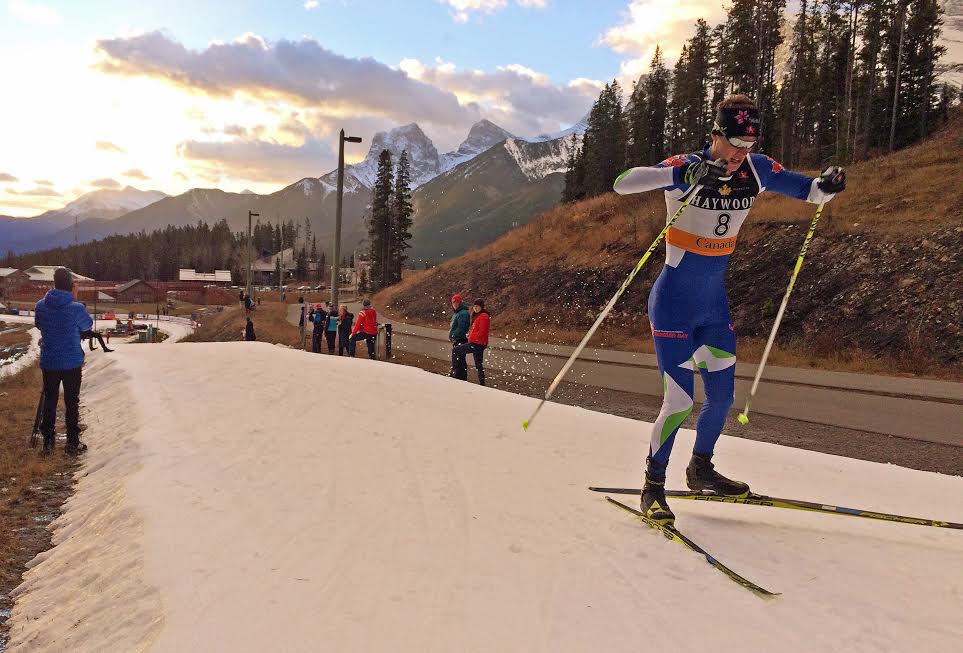
Bob Thompson (NDC Thunder Bay) sprinting to second in Thursday’s skate-sprint qualifier at Frozen Thunder in Canmore, Alberta. The performance earned him the final spot on Canada’s World Cup team for Period 1. (Photo: Drew Goldsack)
Qualification-only sprint races can be a little dull. Four minutes of pain and done. Describing the action? Even more dull.
But for Bob Thompson of the Thunder Bay National Development Centre (NDC), Thursday’s freestyle sprint qualifier in Canmore, Alberta, was one he’ll hold in his mind for a long time. For him, a 25 year old who skied his first World Cup races at home at the Ski Tour Canada last March, placing second in the Frozen Thunder skate-sprint qualifier meant a trip to Europe for his first overseas World Cups.
On Thursday, the final day of racing on Canmore’s early season snow, affectionately known as Frozen Thunder, Len Valjas (who hails from the same club as Thompson, Team Hardwood in Ontario) won the men’s qualifier in 3:25.23. Thompson’s time was just six-hundredths of a second slower, but enough to get him the final men’s quota spot for World Cup Period 1.
Len Valjas (Canadian World Cup A-team) sprinting to the victory in the skate sprint qualifier at Frozen Thunder on Thursday in Canmore, Alberta. (Photo: Glen Crawford Production Services)
Valjas, a World Cup A-team member, was preselected for Period 1.
Jess Cockney, of the World Cup B-team, won Tuesday’s classic sprint qualifier to lock down the first of two selections, an achievement that was officially announced at 9 a.m. Thursday, 30 seconds before Valjas attacked the course wearing bib 1.
Two other favorites for the final World Cup spot, Julien Locke (Black Jack/NST U-25 Team) and Simon Lapointe of the Pierre-Harvey Training Centre (CNEPH) placed third and fourth, 0.22 and 1.29 seconds back, respectively. Graeme Killick, belying his distance-specialist persona, finished fifth.
“The race today was great,” Thompson wrote in an email shortly after the race. “I told [my coach] Timo [Puiras] at the finish I was happy with how I performed and followed the plan and either way I wasn’t going to say I didn’t race my best.
“I wanted to keep things controlled,” Thompson wrote of his race plan. “It’s important to keep the speed high on both laps and especially finishing the second half of the lap fast as it is mostly flat and rolling. Being able to really go the second time up the climb was what I was planning for. … Being out there and able to do that was great.”
Like many of the sprinters seeking one of two remaining men’s World Cup spots, Thompson made this week a training target.
“Timo and I had the plan made to be fast for these races since very early in the year,” he wrote. “Not much was changed other than the last few weeks of prep, dropping some volume and moving into more of a sprint intensity focused block.”
Cross Country Canada (CCC) High Performance Director Tom Holland, a member of the selection committee and chief of competition for these races, studied the race closely.
“Watching this morning, I wouldn’t call it tactics,” Holland said on the phone. “But the way people can ski corners, probably made the difference between who was the winner and who was second.”
To put that in context, the difference between first and third was 0.22 seconds, or 1.5 metres at an average speed of 25 kilometers per hour. It wouldn’t take much of a difference to gain or lose that five feet.
Last spring, CCC and a group of coaches decided on the using the sprint qualifiers to fill out the team for World Cup Period 1.
“The results show … that there’s five or six guys here that are reasonably close,” Holland said of the level of competition in Canada.
Of those top skiers, CCC wanted to determine “who could do a qualifier fast for the World Cup and try to match it up with some of the courses they’ll be skiing in November and December.”
The course held up fairly well for the men, despite the warm weather, with all the selection favourites starting within a five-minute period.
Rosanna Crawford (Biathlon Canada) blasting the first climb of the two-lap course at the Frozen Thunder skate-sprint qualifier on Thursday. She won by 3 seconds. (Photo: Glen Crawford Production Services)
“The track had broken down and was soft where the guys had skied,” women’s second-place finisher Olivia Bouffard-Nesbitt wrote in an email. “But there were a few sections of fast, firm snow to be found near the edges of the trail.”
The women started after all 34 men had completed two laps.
Biathlon Canada’s Rosanna Crawford won the women’s qualifier in 3:58.20, followed by Bouffard-Nesbitt, 3.02 seconds behind, and Caitlin Gregg (Team Gregg/Madshus) in third (+4.5).
“Conditions were a little bit mixed with some harder, almost icy sections and then some really soft, deep and slushy sections,” Gregg wrote of the course. “The conditions were the same for everyone so I don’t think it affected the results. I did speak to some other athletes afterwards who agreed that the conditions were tricky to master and really good practice!”
“It was a fun race, super quick!” Crawford wrote in an email. “The Frozen Thunder loop is interesting, there’s always a hill and then a break, so you are able to push harder than on a normal race course I would say.”
Four women were preselected to fill Canada’s women’s quota of three plus Continental Cup winner Dahria Beatty for World Cup Period 1: Emily Nishikawa (World Cup B-team), and U-25 Team members Beatty, Cendrine Browne and Maya MacIssac-Jones.
On the men’s side, Canada’s quota is six plus Continental Cup winner Andy Shields. For the first period of the World Cup, it will field an eight-person team of Thompson and Cockney, and preselected athletes Alex Harvey, Devon Kershaw, Valjas, Killick, Knute Johnsgaard, and Shields.
Note: The information regarding Canada’s World Cup team quota has been updated to reflect that four women total can start for Canada in Period 1.
Annika Hicks rocking the new AWCA suit to fourth in the women’s skate sprint qualifier at Frozen Thunder on Thursday. (Photo: Glen Crawford Production Services)
FasterSkier is seeking photos from the 2016 races at Frozen Thunder. Please email submissions with caption and credit info to info@fasterskier.com.
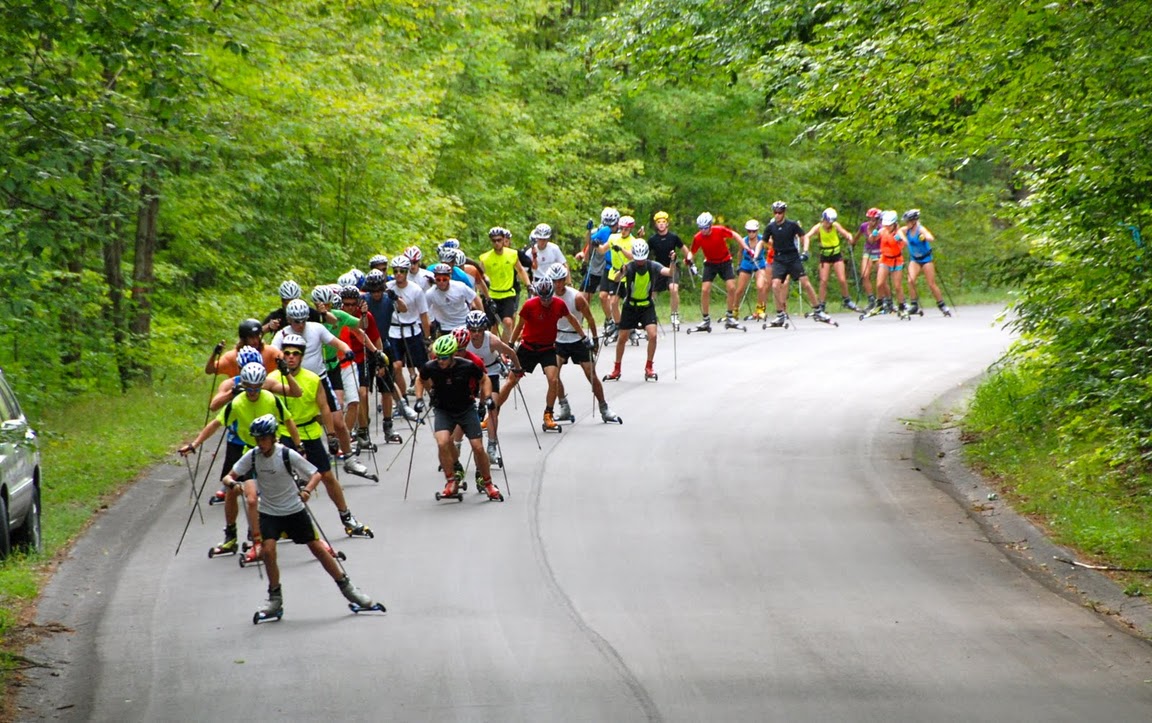
Team Hardwood juniors playing rollerski hockey in October in Ontario. (Photo: Ron Howden)
This week’s workout comes from Team Hardwood, a development cross-country ski program near Barrie, Ontario. Head coach Ron Howden explains that the game of hockey, as natural to most Canadians as breathing, helps young or novice rollerskiers become more comfortable with skiing on pavement. His team plays street hockey on occasion, often on a quiet subdivision street.
***
“This is a slightly unusual workout but great for juniors and novice rollerskiers,” Howden writes. “In Canada we are born with hockey sticks in our hands.
“When I was thinking of a way to get kids comfortable on rollerskis I thought, why not use something that is familiar and introduce something new (rollerskiing) so that the kids would focus on the puck and play rather than the possibility of falling? Some of the kids in the video [below] are novices, they have been on rollerskis about two or three times and move a lot more freely when they are in a comfortable setting. The older ones (the girl in pink) can use the game to learn tactics and comfort in packs for mass starts. The boy at the end of the video who scores has been on rollerskis 3 times, once we put a hockey stick in his hands he was so much more comfortable.
If you have an older group that is more comfortable you can progress to lacrosse and maybe American football (without the tackling).
This was a fun workout to do now and then that the kids (young and old – I played, too) will enjoy.”
The Workout
10 – 15 min warmup with agility drills without poles on rollerskis
40 – 50 min of hockey
Head-to-head skills competition with carrying the puck around a course
Materials
Hockey sticks
Plastic puck (I would use this rather than a tennis ball)
Sidewalk chalk (we did not use nets and pylons so that we had nothing to trip over)
Rollerskis, helmets, possibly knee and elbow pads
The rink can be any size but stopping on rollerskis is a bit tougher so you will want to give room for run out. It is best if you stick to five athletes per team and no goalie. Use chalk for marking the goals so that there are no obstacles and keep them small so that it is challenging to get the puck in. About an hour of play-time is a good goal, and make sure there is water handy so that you can keep everyone hydrated.”
Team Hardwood is a race program that runs out of the rolling hills of Oro Medonte. The programs range from a junior race program to an elite team that has members on the Junior National team and provincial programs. Our goal is develop athletes from the time an athlete begins racing at the local level to when they are ready to compete on the international stage.
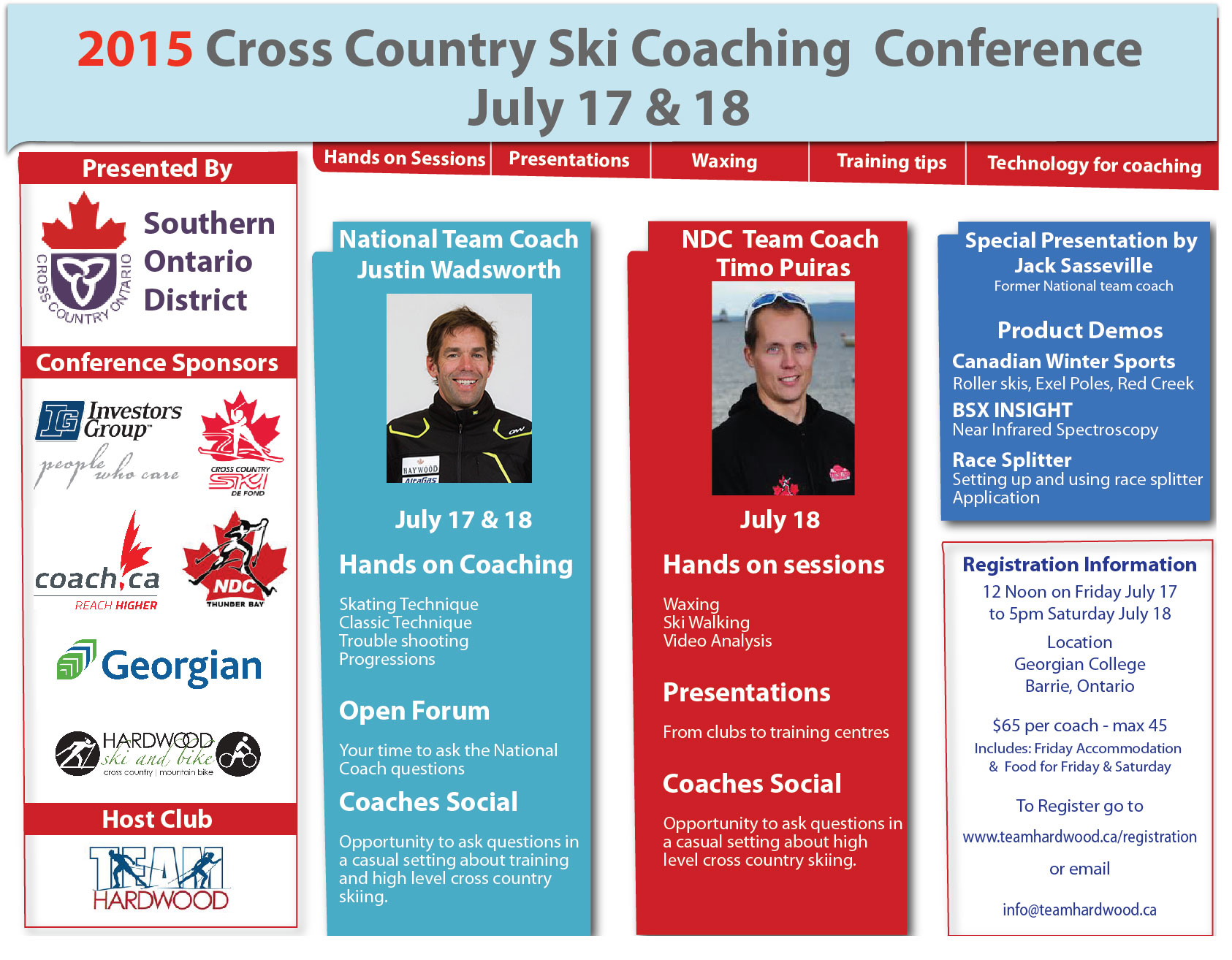
(May 19, 2015) — The Southern Ontario District (SOD) of Cross Country Ontario and Team Hardwood are pleased to announce that a Coaching Development Conference will be held at Georgian College in Barrie, ON from July 17-18, 2015.
The conference will feature two days of interactive sessions with Justin Wadsworth, Head Coach, Canadian National Ski Team, and Timo Puiras, Head Coach, National Development Centre, Thunder Bay. Wadsworth and Puiras will lead a variety of learning and development sessions on skate and classic ski technique, trouble-shooting, athlete progression, waxing, using video analysis when working with athletes and more. Equally as valuable will be the opportunity for coaches of all levels to ask questions, share information and learn from each other during both formal presentations and open forums. A Coaches’ Social is also planned.
The conference will also feature demonstrations and presentations from a variety of suppliers, including Canadian Winter Sports, BSX Insight and Race Splitter, allowing coaches to learn about the latest products and technology available. Former NST Coach Jack Sasseville is also a presenter.
Coaches from across Canada and beyond are invited to participate. Thanks to the support of Cross Country Ontario and the Coaches Association of Ontario, registration for this conference is offered for just $65.00 per coach, which includes participation in all sessions, Friday night accommodation at Georgian College and all meals on Friday and Saturday.
“This is an awesome opportunity for coaches to get together and learn from the best coaches in the country and from each other,” says Ron Howden, Team Hardwood Head Coach and Technical Director, and conference organizer. “We’re grateful to Cross Country Ontario, the Coaching Association of Canada and Georgian College for making this affordable so as many coaches as possible can attend.”
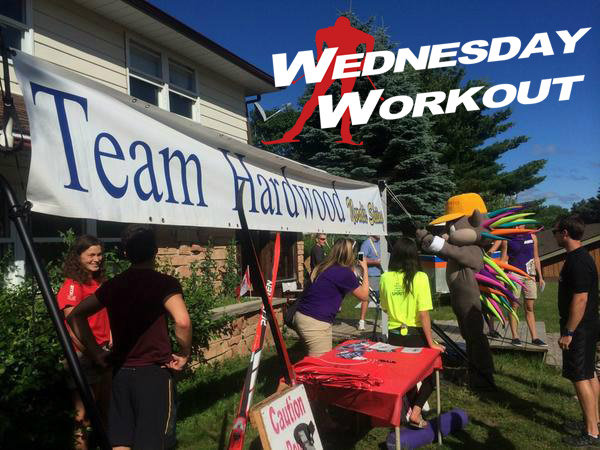
Team Hardwood’s info night with mascot Pachi trying the Ski Erg in July. (Photo: Team Hardwood/Twitter)
This week’s strength workout comes from Team Hardwood Head Coach and Technical Director Ron Howden. Based in Barrie, Ontario, Hardwood consists of “45 national-level skiers to high school and elementary skiers who all have a passion for the sport,” Howden writes. Submit your own workouts to info@fasterskier.com with the subject line: ‘Wednesday Workout’.
***
Team Hardwood demo video
This is a Power Endurance and intensity workout combined; the athletes love to do this workout as a group as it really challenges them. We have designed this to build on the previous strength and Zone 3 intensity workout we have done through the summer. Athletes have all said after a couple of weeks, they feel more powerful and learn to pace themselves and work through pain in their upper body and legs. The goal of the workout is to get them ready for more specific strength when the snow arrives.
Start: with a 20-minute warmup: 10 minutes on the Ski Erg and a 10-minute run. Then 10 minutes of dynamic stretches.
Once warmed up and good to go: Do 2-4 sets of the following depending on the athletes’ age and development:
– 3 minutes on the Ski Erg at Zone 3 (as shown in video above)
During the 3 minutes on the Ski Erg, you want to look at the average watts and encourage athletes to pull the max possible in 3 minutes without sacrificing technique and to maintain that for 4 sets. In the beginning they will pull hard for 1 set then tail off, as they get better the will learn how to pace themselves to pull hard for 3 minutes.
We put mirrors in front and to the sides of the Ski Erg, it helps them ski with good technique and focus on the pacing and not on the digital display.
When they are doing legs we use weight vests rather the dumbbells.
It’s a great workout and the first time will take a bit to recover from, but after one or two workouts they will feel tired at the time but will be ready for training the next day.
About Team Hardwood: With its base at Hardwood Ski and Bike north of Toronto, Team Hardwood is one of Ontario’s most successful developmental cross country ski racing clubs. Its athletes regularly progress to Canada’s national development centres and university teams. It includes current NST member Lenny Valjas and several top Junior and National Talent Squad skiers on its roster for the 2014-2015 season.
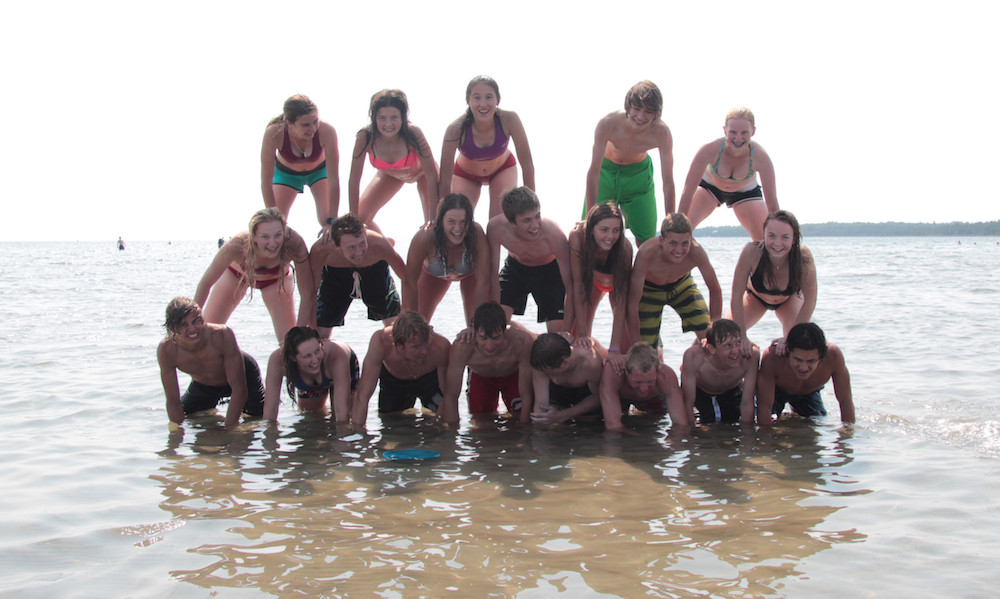
The Team Hardwood nordic team at the beach during their summer junior camp at Tobermory, about 300 kilometres northwest of Toronto in southern Ontario. (Photo: Ron Howden)
Southern Ontario’s Bruce Peninsula hosts perfect summer training camp
(August 14, 2014) — When Team Hardwood Head Coach Ron Howden chose Tobermory as the site of his August training camp, he knew the area – renowned for its rugged beauty and crystal clear waters – would offer plenty of scenic trails and quiet roads for training. It turned out that the location was just the start of everything good. With great food, welcoming hosts, sunny skies and 20 enthusiastic skiers, the camp turned out to be, well, pretty much perfect.
Pulling a trailer loaded with luggage, training gear and no fewer than eight coolers of homemade food, the group rolled into Tobermory on Thursday afternoon. While coaches and chaperones found their rooms, athletes set up tents on the spacious, tree-lined grounds of the motel. Comfort was important, especially so for the National Talent Squad athlete who brought along a futon to squeeze inside the tent he shared with a teammate.
A quiet loop of road nearby served as the site of the first rollerski workout and was followed by a BBQ dinner and a bonfire under the stars.
Some Team Hardwood juniors at the beach in Tobermory. (Photo: Ron Howden)
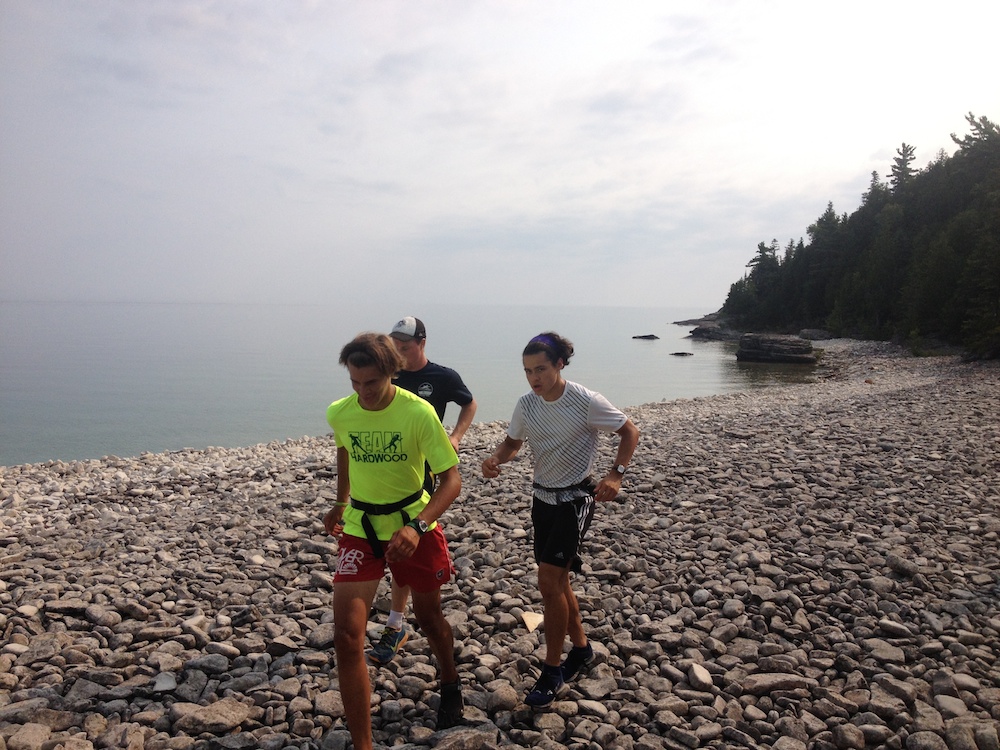
On Friday, the team hit the Bruce Trail, with athletes completing varying distances of running and/or ski-walking, depending on age and personal training plans. The rocky trail wound its way along the edge of Georgian Bay and each group finished at the Little Cove cobble beach for the first swim of the camp.
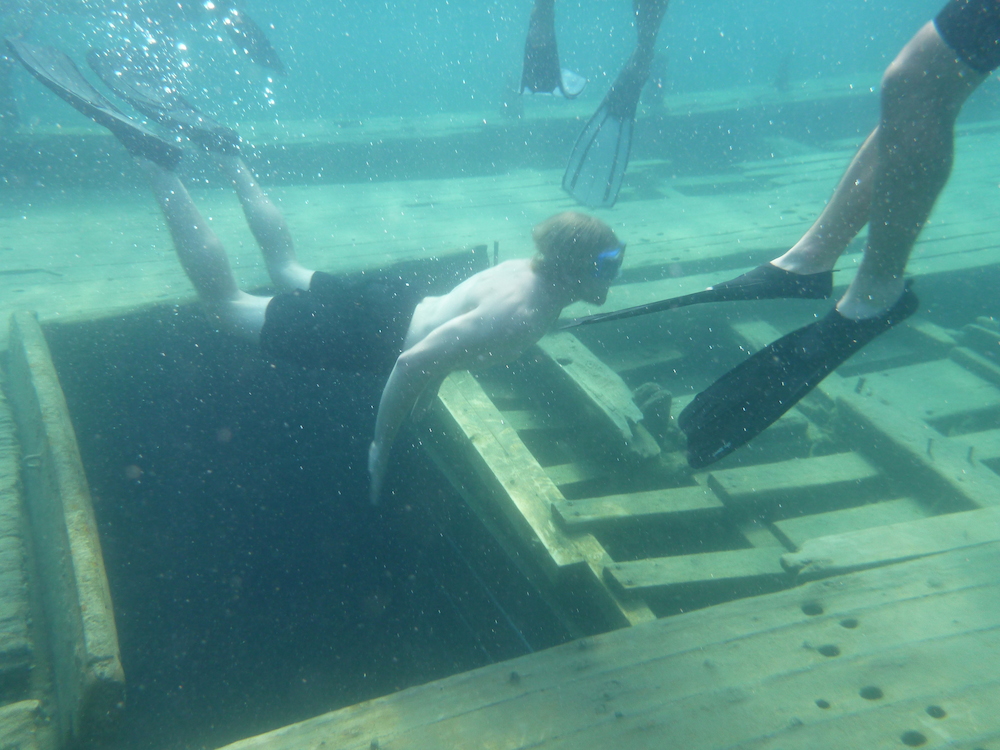
After lunch and a rest, the group donned fins and masks and explored the shipwrecks on the floor of the peaceful inlet of Big Tug Harbour. In the clear, calm water under the late-day sun, the scene below was hauntingly beautiful; it was almost two hours later before athletes, coaches and chaperones reluctantly got out of the water and headed back for dinner.
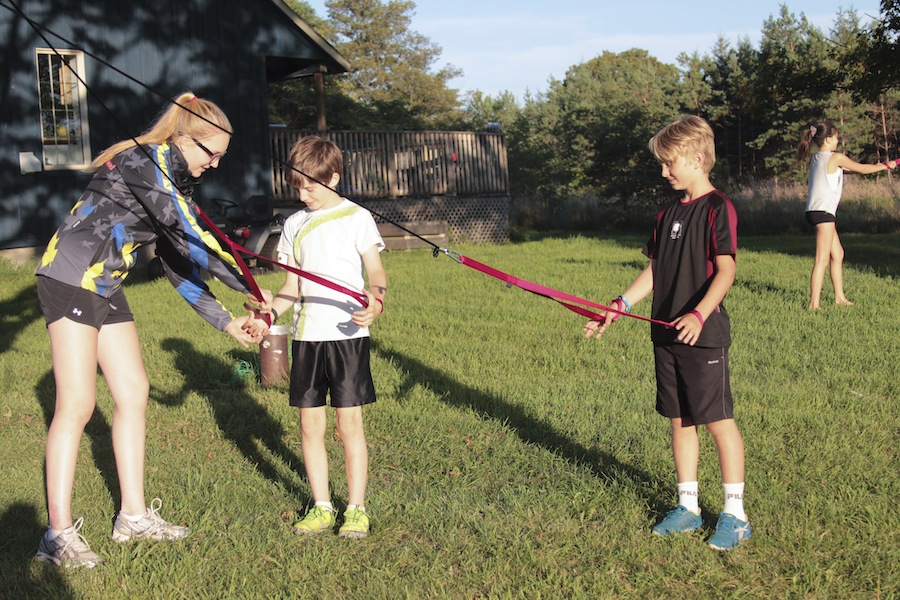
Saturday was an early start. The athletes headed to the Visitor Centre of the Bruce Peninsula National Park and Fathom Five National Marine Park where coaches Ron Howden and Andrew Kerr led them through a power workout. Groups of athletes repeatedly scaled the 112 steps of the fire tower three-and-four at a time, while others used ropes and various pieces of training equipment among the trees and rocks. By the time the tourist crowds started to arrive, the workout had concluded. Before leaving the area, the group toured the interpretive exhibits of the Visitor Centre. Reports of a less-than-pleasant odour during the visit to the centre cannot be confirmed.
Team Hardwood explores shipwrecks in Big Tug Harbour. (Photo: Heather F. Wilson)
In the afternoon, the group headed to Singing Sands Beach – part of the national park on the Lake Huron side. The huge, sandy beach was perfect for swimming or just splashing around. After a couple of hours, it was back to the motel and a roller ski technique session led by the senior athletes. After dinner, if one looked closely with a flashlight, the athletes and coaches could be seen running and playing games among the tents and campfire for several hours.
No trip to Tobermory is complete without visiting the Grotto. On Sunday, the coaches chose a route for the morning’s hike/run so it concluded there, allowing the group to swim and explore the deep waters of Georgian Bay and the huge rock formations of the Grotto.
The camp ended with good-byes and recollections of what made the camp so perfect – the location, the weather, the hospitality, and a mix of enthusiastic but easy-going athletes, coaches and helpers that together created a fun, rewarding weekend of training and team bonding.
Congratulations to Hardwood coach Ron Howden for pulling it all together, assisted by Hardwood coach Andrew Kerr. As athletes loaded into the vans for the return trip, Ron could be seen at the front desk making reservations for next summer’s camp.
***
Patricia MacDonell was a trip chaperone. She hopes her recently honed skill of driving a loaded 12 passenger van from Toronto to Tobermory while following Coach Howden gives her an edge on the competition expected for the role next year.
About Team Hardwood: With its base at Hardwood Ski and Bike north of Toronto, Team Hardwood is one of Ontario’s most successful developmental cross country ski racing clubs. Its athletes regularly progress to Canada’s national development centres and university teams. It includes current NST member Lenny Valjas and several top Junior and National Talent Squad skiers on its roster for the 2014-2015 season
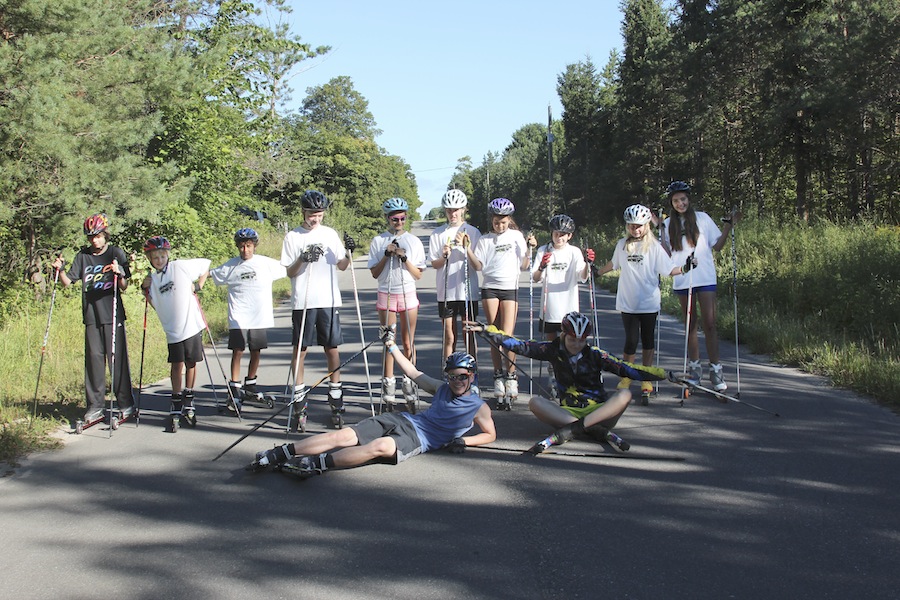
The 2013 Team Hardwood Midget Camp crew. “A HUGE thanks to CCC for the amazing t-shirts they sent us!” (Courtesy photo)
Note: The following is a report on the recent Team Hardwood Midget Camp in southern Ontario written by volunteer Heather F. Wilson and submitted by Team Hardwood’s board of directors. Have a training-camp recap of your own? Send yours with high-quality photos to alex@fasterskier.com.
Our Athletes Are Made In The Summer
A Volunteer’s Report on the Team Hardwood Midget Camp | By Heather F. Wilson
BARRIE, Ontario — Somewhere behind the athlete you have become are those hours as a little kid when you picked up a pair of skis, fell in love with the sport, and never once looked back. As a camp, our main goal for the past weekend was to get as many young kids as possible to fall in love with cross country skiing. With a total of 8 midget-aged athletes, 4 volunteers from Team Hardwood’s senior racing team and our Head Coach Ron Howden, I think we did just that.
The two days started off with all the midgets meeting on Friday at Hardwood Ski and Bike. Everyone was enthusiastic and ready to get going. Half the campers had been on roller-skis before, and the other half had not. They were all super excited to get out on the roads to try the skis out.
What we found worked for us was to divide the athletes up so that the Juniors who had never been on rollerskis each got to do 1 on 1 work with the volunteer helpers, while Ron was able to take the more experienced athletes out to work on specific ski technique.
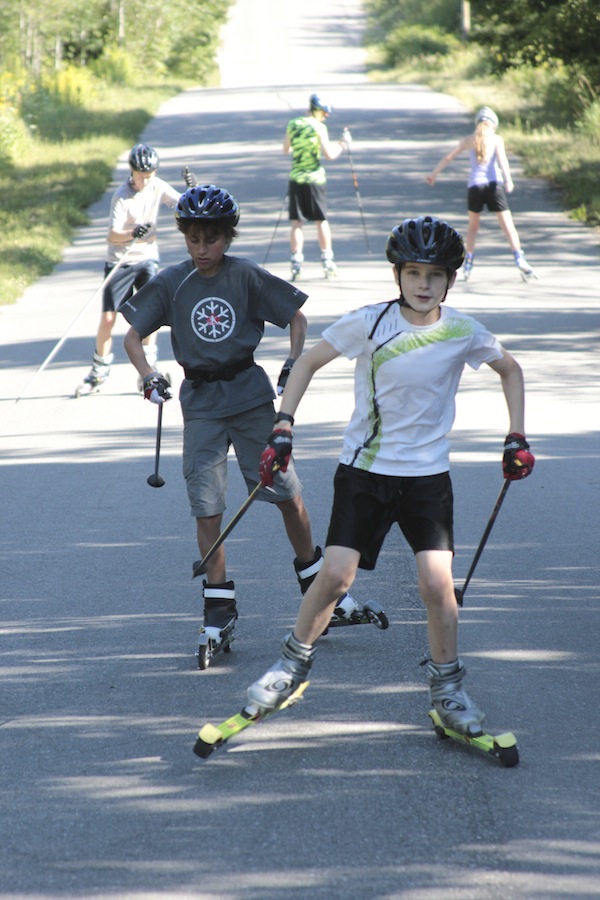
Athletes in action at the 2013 Team Hardwood Midget Camp
It seemed that after 90 min of rollerskiing the kids were even more excited and energetic than before. Nobody could stop talking about how much fun it had been to rollerski and from a volunteer perspective, this was really great to hear. It let me know that they were all enjoying cross country skiing so far.
The great thing about midget-aged athletes is that their energy never seems to go down. So even after 90 minutes of rollerskiing, they were still wired up and ready to go. We continued our day of training with a few running games including manhunt, capture the flag, cops and robbers, and a few others. This was great because it didn’t give the kids any chance to sit down and rest.
As all the athletes were staying together, we were able to have dinner as a group and swap stories of what had happened earlier while rollerskiing. A few of the athletes who had never even been cross country skiing before, let alone roller-skiing, could not contain their excitement at how much they had improved within the 90minutes. All everyone could talk about was how much they looked forward to trying it again. I think I speak for myself, the other volunteers, and Ron when I say it’s great to see young athletes so enthusiastic about rollerskiing and cross country skiing in general.
After dinner it was on to the next workout of the camp. While we were eating, Ron set up a 4-station ski specific circuit. We had a core station, a double polling station, a polling station to work on diagonal stride arms, and finally a balance station because everyone knows how important balance is in cross country skiing. This station was particularly fun for the kids because we had set up a rope going from one tree to another about a foot off the ground and the kids had to balance on it while trying to push their partner off. I think this was a favourite for all of them because they really seemed to enjoy it. I don’t think any of the athletes were expecting to be doing anything like this but they all picked it up perfectly. We rotated the kids through these stations numerous times.
Now, everyone knows training is important, but having fun is equally important. So there was no better way to finish off the workout than with a good campfire, smores and a movie before heading to bed. It was a perfect way to wind down from all the excitement of the day and just take a of couple hours to chill. Well, almost chill…. we may have delayed bedtime to try a little mattress surfing down the stairs. But really, I think missing 20 minutes of sleep is totally worth it if you’re going to replace it with mattress surfing.
Team Hardwood Midget Camp 2013
For the Juniors, Saturday morning couldn’t come soon enough. They started off the morning extremely energetic at 8am ready to go for a run. We took everyone for a short and slow run and then did a bit of stretching with them before breakfast.
The original plan for Saturday morning was to do some ski striding work, but after Friday’s successful rollerski everyone was begging Ron to let them ski instead. Saturday’s ski was similar to Friday’s where each volunteer worked one-on-one with an athlete for about 90minutes while Ron worked with the skiers who were comfortable on their skis.
For younger skiers, it’s important to have them training and exercising without their even realizing it. I am pretty sure this is what Ron had in mind when he took all of us over to “Tree Top Trekking” at Horseshoe Valley for the last 3 hours of camp. It is a super fun way to spend an afternoon, everyone loves it, and it gets their strength and balance working as they hang on to the ropes and try to cross the thin wires between trees.
I had a blast helping at this camp and I know my fellow teammates did as well. The kids learned so much and they all came away from the camp with smiles on their faces, which is the most important part. I can’t wait to see everyone in the fall and at the next midget camp. Hopefully, the next time they will all bring their friends and it can be even bigger and better!
About Team Hardwood:
With its base at Hardwood Ski and Bike north of Toronto, Team Hardwood is one of Ontario’s most successful developmental cross country ski racing clubs. Its athletes regularly progress to Canada’s national development centres and university teams. It includes current NST member Lenny Valjas and several top Junior skiers on its roster for the 2013-2014 season.
The entire camp in a stretching session (Photo: Graham Longford)
Over 115 athletes, 30 coaches, the full National Development Center Thunder Bay (NDC T-Bay) roster, and Canadian National Ski Team (CNST) World Cup team member Len Valjas. Does this sound like any ski camp you’ve been to this year? Unless you’re in Norway, chances are it sounds more like a skiing fantasy rather than reality.
Yet Ontario’s Team Hardwood, a club just outside of Orillia, Ontario, attracted the massive numbers in a training camp at the end of August.
According to Mark Doble, head coach of Team Hardwood, the club based at Hardwood Ski & Bike and the camp organizer, the total came to 149: 31 coaches, 15 mentor athletes, and 103 junior athletes.
Last year he and Team Hardwood hosted a similar camp. It featured some major star power: American star Kikkan Randall as well as Canadian National Ski Team member Perianne Jones attended, creating a focus for female skiers. Also, then up-and-comers Len Valjas and Graeme Killick were present with Eric de Nys, CNST Development Team coach.
As a result, the turnout was good, as there were over 60 registrants present to take advantage of the high quality athletes and coaches.
But Doble was floored by the response this year. “I was shocked,” he said in an interview with FasterSkier.
He did make a few changes to the camp that he hoped would draw in a few more skiers.
“Going in, we were planning on having great coaches, as well as older athletes to look up to – a couple of different perspectives.”
Doble also attributes the rapid rise in camp participation to simple word-of-mouth.
“The success of last year’s camp, and that we have good rollerskiing got around,” he said.
For Doble, the biggest goal of the camp was to make sure each workout was done at the best possible quality.
“We tried to do everything we could to encourage that,” he said, “We spent a lot of time developing the actual workouts as well as looking at the camp in its entirety to make sure it fit well together.”
The camp had a wide variety of activities, covering all aspects of training: a strength and agility session, several long Zone-1 workouts with technique stations, a Level-4 intensity set, a sprint tactics session led by Len Valjas (CNST) and Harry Seaton (NDC T-Bay), and finally, a cross-country race on the last day. The evenings were jam-packed as well, featuring presentations by the NDC athletes, NDC Head Coach Eric Bailey, and Valjas.
Team Hardwood Coach Mark Doble (foreground) goes over a few last minute details before the mens' start. (Photo: Graham Longford)
With a camp this size, there are always going to be challenges. In particular, Doble felt that the strength and weights components were important to cover, but difficult with a large group.
“We couldn’t just go lift weights in a gym,” he said, “So we had to find another way to make that portion accessible.”
Instead, he opted to engage a local strength training expert, Brock Tadashore, who did a series of body weight and functional strength exercises with the group, and then had a short question and answer session dealing with some of the most common injuries skiers experience.
Rollerskiing also posed a unique challenge. While Hardwood Ski & Bike is a well-equipped facility, it is a major mountain biking destination in the summer, and as such, has no paved rollerski trails as are found at some large ski centers in North America.
Instead, Doble had to find a stretch of road that was close enough to avoid having to drive massive amounts of athletes, yet with a light enough traffic load that it would be safe.
He opted for a 15 k stretch of mostly deserted country road, one which the local club uses regularly. He managed to find a spot with enough terrain variety for quality intervals, and distance as well.
“The primary goal was to get in a quality workout, but safely,” said Doble.
“The section of road we used has very little traffic, and Hardwood has a good rapport with the locals, who understand and are familiar with people rollerskiing.”
Doble was also clear that when the registrations came pouring in, several volunteers stepped up to help him out.
“Without them [the volunteers] it would be impossible for this to go,” he said.
While Doble had some challenges with organising the large group, he wasn’t the only coach present.
Around 20 coaches from various clubs around the provinces helped Doble corral athletes, and assisted with camp activities.
Doble had a well-qualified collection of coaches to draw upon. Eric Bailey, head coach of the National Development Center Thunder Bay (NDC T-Bay,) his assistant coach Timo Puiras, Cross Country Canada (CCC) Eastern Coaching Coordinator Lisa Patterson and Ontario Ski Team coach Pavlina Sudrich.
In addition to a junior training camp, some 15 mostly senior athletes including the entire NDC Thunder Bay participated as ‘athlete mentors’, where they lead smaller groups of junior athletes, and gave the younger skiers a chance to observe and ask questions of athletes at the next level of development.
The idea of using older athletes as mentors for juniors is not a new one, but Doble had the advantage of having a large number of skiers, as well as some athletes familiar with the area and the system.
“It’s kind of cool actually doing the workouts with the other athletes, instead of just talking to them and then going to do our own training,” Erin Tribe said.
Part of the group rollerskis up a hill close to Hardwood Ski & Bike (Photo: Graham Longford)
Tribe, a third-year veteran of NDC T-Bay and former Team Hardwood athlete herself was enthusiastic about the camp.
“This is the biggest camp I’ve ever been to!” Tribe said. “I just try to set a good example, and a lot of them are enthusiastic if you’re able to point something out.
“Especially if you’re able to say ‘You’re working on something I’m still working on,’ it’s great for them to hear.”
For Tribe, who has been an athlete in Ontario her whole career, she has seen the evolution of the camp experience personally.
“I think one of the biggest things is the number of coaches,” she said.
“When we’re out there in our small groups of 10 or 20, now there are five coaches around to help out and give tips. As much as were developing athletes at these camps, we’re developing coaches.”
While Tribe gets a kick out of seeing athletes develop, she personally feels the camps add value to her training season.
“I just get really excited all over again,” she said. “I know that I love the sport, and I love training … here there’s so much energy that it’s almost easy to do an 18 hour week followed by an 18 hour week. It makes things easier with all these people around.”
And for Tribe, getting to train with more girls is a bonus, as NDC T-Bay has just three.
“Any age, any level, I’m down,” she said.
“It’s really awesome to see these numbers,” said Jordan Cascagnette, also a former Team Hardwood athlete who has spent the last two years at the Alberta World Cup Academy before joining NDC T-Bay this season.
“It’s been crazy; when I was here as a member of Team Hardwood I did this camp every year, and there were always 20 or maybe 30 athletes at most.”
As for the mentorship experience, Cascagnette thought it was a positive. “It’s cool to be on the other side of the fence,” he said.
“I remember being at these camps when the guys from Thunder Bay would come and train, and I was always a timid guy, so I would just hang back and watch.”
“I think having that role model is great – last year in Canmore when I got the chance to ski with Devon (Kershaw) it was great. Being able to train with someone who is at the level you want to beat is really helpful.”
For the NDC athletes, the timing was good – they were just finishing up a tough block of training in Southern Ontario during the week of the camp, and were able to still get in some quality training.
While the camp was primarily for young athletes, coaches also had a chance for professional development. The club coaches engaged in a coaching development seminar, organized by Pavlina Sudrich.
Sudrich and Doble set up the schedule so that during athlete rest and nap times in the afternoon, the coaches were able to get a little classroom and discussion time.
Featuring seminars on overtraining, yearly training plan construction, and functional movement screening, coaches were able to get a little education. As well, Sudrich organized a mentor-mentee system among coaches at the camp, giving those with less experience a chance to learn.
In terms of the overall success of the camp, Doble viewed the explosion of numbers as a positive development for skiing in the region, and across Canada as a whole.
“I think the trend we’re seeing in Ontario isn’t exclusive to Ontario,” he said, “The quality seems to be getting better and better every year.”
And Doble is already thinking about plans for next year – he hopes another large camp will be hosted in the province again.
“It’s important for our club, and it’s the highlight of the year,” said Doble. “It’s good for clubs to host other clubs.”
Len Valjas (L) and Harry Seaton (R) of NDC T-Bay talk about sprint tactics (Photo: Graham Longford)