Tag: team relay

  • US Squad Uses Team Relay to Re-Charge as Norway Takes Top 2 Spots

    US Squad Uses Team Relay to Re-Charge as Norway Takes Top 2 Spots

    A_Hall_Mark_of_Excellence_Award-logo-300.png (300×244)This World Cup coverage is made possible through the generous support of Marty and Kathy Hall and A Hall Mark of Excellence Award.  To learn more about A Hall Mark of Excellence Award, or to learn how you can support FasterSkier’s coverage, please contact info@fasterskier.com.
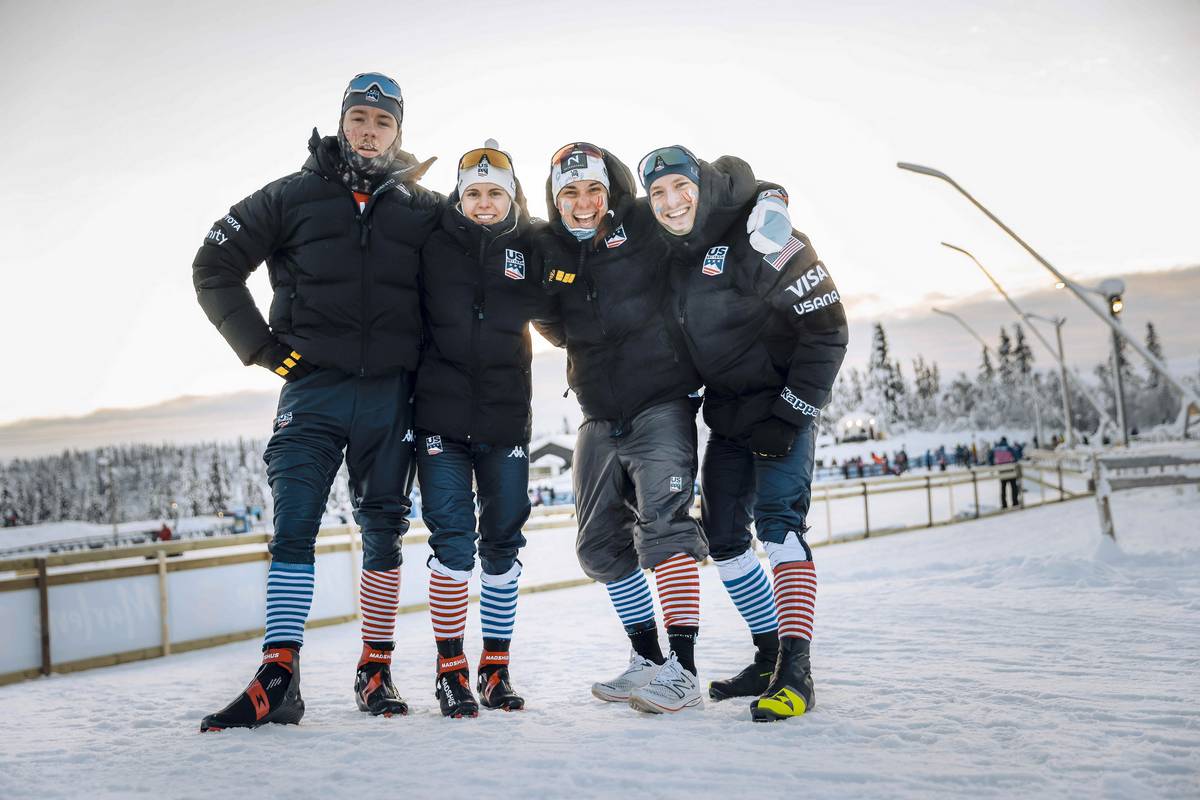
    USA I Relay Team before the start Sunday. (L-R) Ben Ogden, Sophia Laukli, Julia Kern, and Hunter Wonders. (Photo: Nordic Focus)

    In the third week of World Cup racing, the defining question seemed to be not who would be first to the finish line, but who was missing from the starting line.

    In the Friday’s sprints, Johannes Hoesflot Klaebo’s (illness) and Federico Pellegrino (fatigue) were both absent. That change to the startlist saw a chaotic and tense affair translate to new, and newfound, highs for Italy’s Simone Mocellini and Sweden’s Calle Halfvarsson. On Saturday, Iivo Niskanen’s absence from the 10 k classic field created an opening (after five long years) for Andrew Musgrave’s (GBR) return to the podium. 

    In Sunday’s Team Relay, though the notable absences were in the American lineup…

    US Team Makes Tough Decision on Relay Lineup

    US Ski Team Head Coach, Matt Whitcomb delivered the news to FasterSkier that Jessie Diggins and Rosie Brennan would not start in Sunday’s relays, undoing the female half of last season’s 4 x 5 k – winning US relay team that won at World Cup Finals. Both Diggins and Brennan have been vocal about team events like the relay being their favorite part of racing on the World Cup, and the event has been a point of emphasis in previous World Cup seasons. 

    “It feels weird to say I support this as a coach,” said Whitcomb on the decision to take Diggins and Brennan out of a team event. “But we’ve now been doing this long enough to know that an athlete just cannot sustain the full schedule of [the World Cup]. There are traps that are set for them along the way, and this relay just is one of them. It falls at a time when they really need to rest.” 

    For Brennan, the absence was primarily a matter of health, with Whitcomb adding, “We were lucky to get two good days of racing after she was sick in Lillehammer. We feel like we might be getting ahead of ourselves if we try to put a third together.”

    For Diggins, the stress of having started all eight World Cup races so far this season—combined with the new World Cup scoring system—preceded the decision not to race today. “One of the interesting dynamics of the new World Cup scoring this year is that there are no individual points scored for relays, like there has been in the past,” said Whitcomb. “When it comes to chasing the Overall [World Cup Title] (something Diggins identified as a goal in preseason talks with the media) the relay doesn’t add to the pile.” 

    In place of Diggins and Brennan, the announced teams for the US turned towards the young generation of skiers who have accompanied the veteran stars of US skiing the past few seasons. The US announced two relay teams Sunday morning:

    USA I: Classic Leg 1 – Julia Kern, Classic Leg 2 – Hunter Wonders, Skate Leg 1 – Sophia Laukli, Skate Leg 2 – Ben Ogden.

    USA II: Classic Leg 1 – Alayna Sonnesyn, Classic Leg 2 – Zak Ketterson, Skate Leg 1 – Novie McCabe, Skate Leg 2 – Gus Schumacher.

    Once teams were announced, however, the theme of rest came back into play. At the end of a third consecutive three-day weekend of racing in Period I, the unique demands on the US Ski Team—traveling continents to compete against nation’s with plenty of skiers to reinforce their World Cup squads close at hand—precipitated the decision to scratch USA II, and see the US start only its USA I team.

    The USA I team that did race looked forward to a 4 x 5 k format that has been pioneered at Junior World Championships the past few seasons. US anchor Ben Ogden said to FasterSkier that the 5 k “makes for an interesting race because it’s short enough where if you’re feeling good you can hang with skiers much better than you. I think for the US team this new format is really exciting because on the right day we can be right there with the top dogs even if we are not all fighting for the podium every other day.”

    Still, there was some trepidation in the US camp about choosing to strategically re-charge on the day. “[Emotionally] this is tough, because we’ve built our program around [team events like today],” said Whitcomb. “[Team events] are an important metric that speak beyond just who is getting on the podium or in the top 30. It’s a sign of a healthy [national] program when you do well in a [team] event” said Whitcomb.

    The Race

    By the metric of team success, all signs still point toward cross country skiing being alive and well in Norway, but the finishing order that Norwegian coaches might have envisioned was not the way the script played out on the rolling 2.5 k course (on which each athlete skied two laps): Norway II would finish first on the day, followed by Norway I and Sweden I. 

    The first leg of the Team Relay rolls out Sunday in Beitostolen. (Photo: Nordic Focus).

    Moments of clarity eluded today’s race—a push by one skier over one hill, an uptick of tempo by another as they exited the stadium—but those efforts regularly vanished like frozen crystals in the cold Beitostolen air. In the final lap of the final leg, however, a push by Simen Hegstad Krueger finally turned into something real. As the course ticked up, Krueger pushed away from a pack including Norway I teammate, Emil Iversen, and Sweden’s Calle Halfvarrsson. Over each successive hill, Krueger’s gap on the Swedish-Norwegian pair behind him grew until it was insurmountable. Krueger skated across the finish line for Norway—Norway II to be precise—as Iversen and Halfvarsson battled to the line behind him. Iversen won that battle for Norway too, earning second place. Sweden took third.
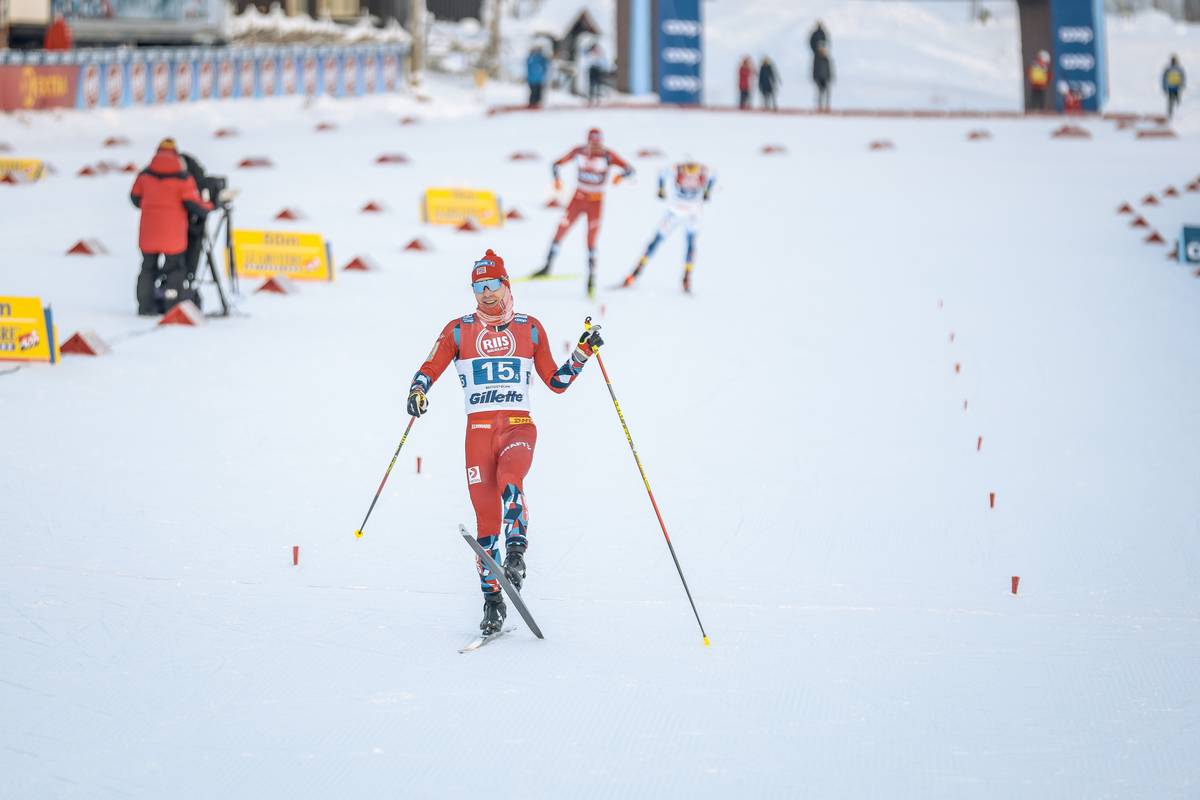
    Simen Hegsted Krueger (NOR) crosses the finish line in 1st place for Norway II. (Photo: Nordic Focus).

    In a clip to FIS media after the race, Norway II skier Mikael Gunnulfsen summed up the result eloquently: “I guess the second team got to the finish line first.” 

    During a weekend when some Norwegians expressed concern over not meeting the lofty standards of Norwegian skiing on their home turf, the final day saw a result in which Norway II beat Norway I, and the whole country came away with a win. If team relay events are indeed a sign of a national program’s health, then the Norwegians depart Beitostolen secure in the knowledge that their national program still sets the bar in cross-country skiing.

    But that conclusion was not clear for large swaths of the race leading to it. In the early going, it was Finland which dictated the dynamic of the pack. Johanna Matintalo (FIN I) kept things controlled alongside Anne Kjersti Kalvaa (NOR I) as the first classic leg wound around the Beitostolen course for lap one. Julia Kern was tucked in the pack for USA I, skiing relaxed even as Matintalo pushed the pace heading up the A-climb. By the time skiers came into the first exchange, Matintalo and Kalvaa had opened a slight gap of around five seconds for Finland and Norway, with the chase group having strung out to two distinct packs. The chase group that came into the stadium first was led by Sweden I, while the second contained Kern at around 12 seconds back. Kern handed off to Wonders for USA I.

    Wonders quickly closed the gap as a chase group formed behind Martin Loewstroem Nyenget (NOR I) and Pertuu Hyvarinen (FIN I), who remained off the front. Nyenget looked to increase the pace, but in each little window, Hyvarinen was able to bring his ski tips right back to the Norwegian’s tails. William Poromaa for Sweden I took charge of the chase group headed into the leg’s second lap, right as Nygenet started to stride away from Hyvarinen on the A-climb. Hyvarinen was soon swallowed up by the chase group, but Nygenet faded too. The result: after much Classic sound and fury, the relay field was back together as it headed into the second exchange for the skate portion of the race. Wonders skied a strong leg to cap his weekend, having held 10th place in the pack for USA I.
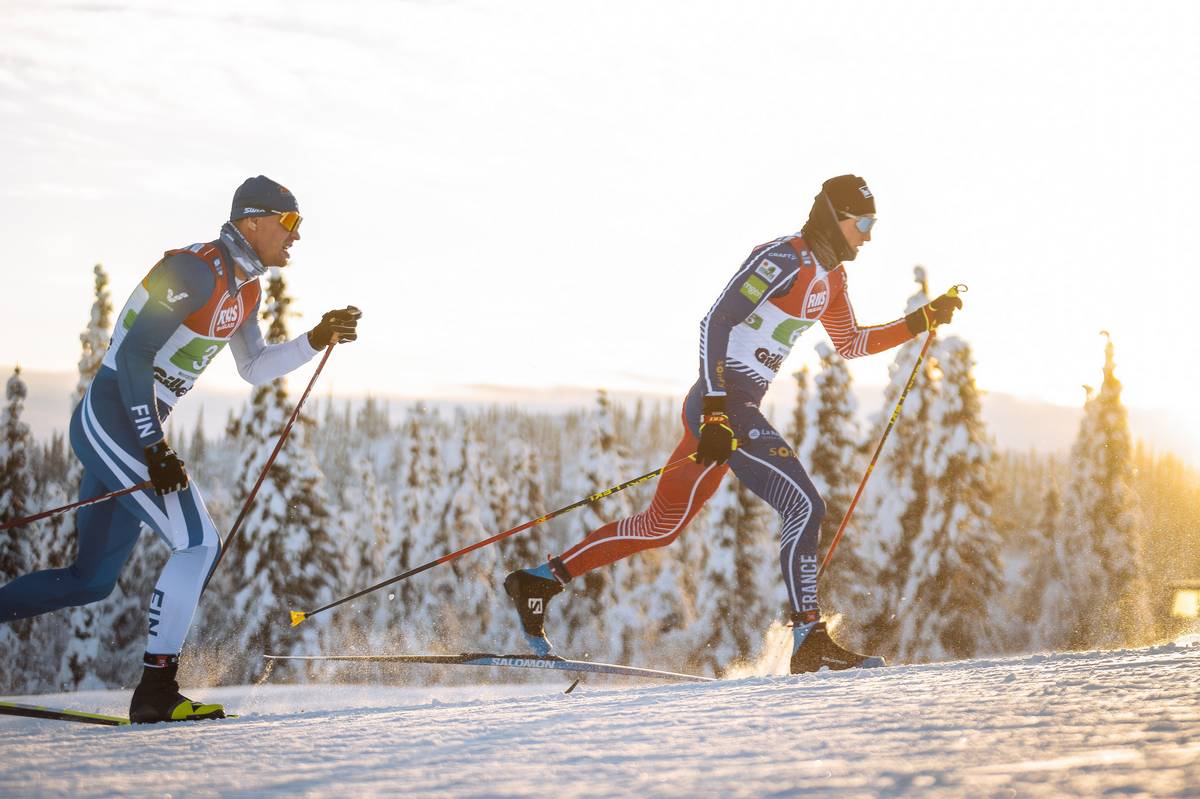
    Perttu Hyvarinen (FIN) and Theo Schely (FRA) late in the 2nd leg on Sunday, chasing Norway I’s Martin Lowestroem Nyenget. (Photo: Nordic Focus).

    The race continued into the first skate leg, with moves instigated by Sweden I skier Frida Karlsson, who moved to the front of the pack as the course turned upwards, driving an increased pace which slowly diminished the field’s size. Soon, there was a definitive lead group: Karlsson alongside Heidi Weng for Norway I, Silje Theodorsen for Norway II, and Flora Dolci for France I. As they entered the second 2.5 k loop of the leg, Karlsson eased up. In that instant, one skier from the chase group—Finland I’s Kertuu Niskanen—skated to join up with the leaders, in a moment that knowledgable onlookers might have met with a confused “Who put a Niskanen on the skate leg?” Even so, Niskanen’s strong move seemed to validate that decision, her technical prowess and experience showing through no matter what kind of skis she attached to her boots.
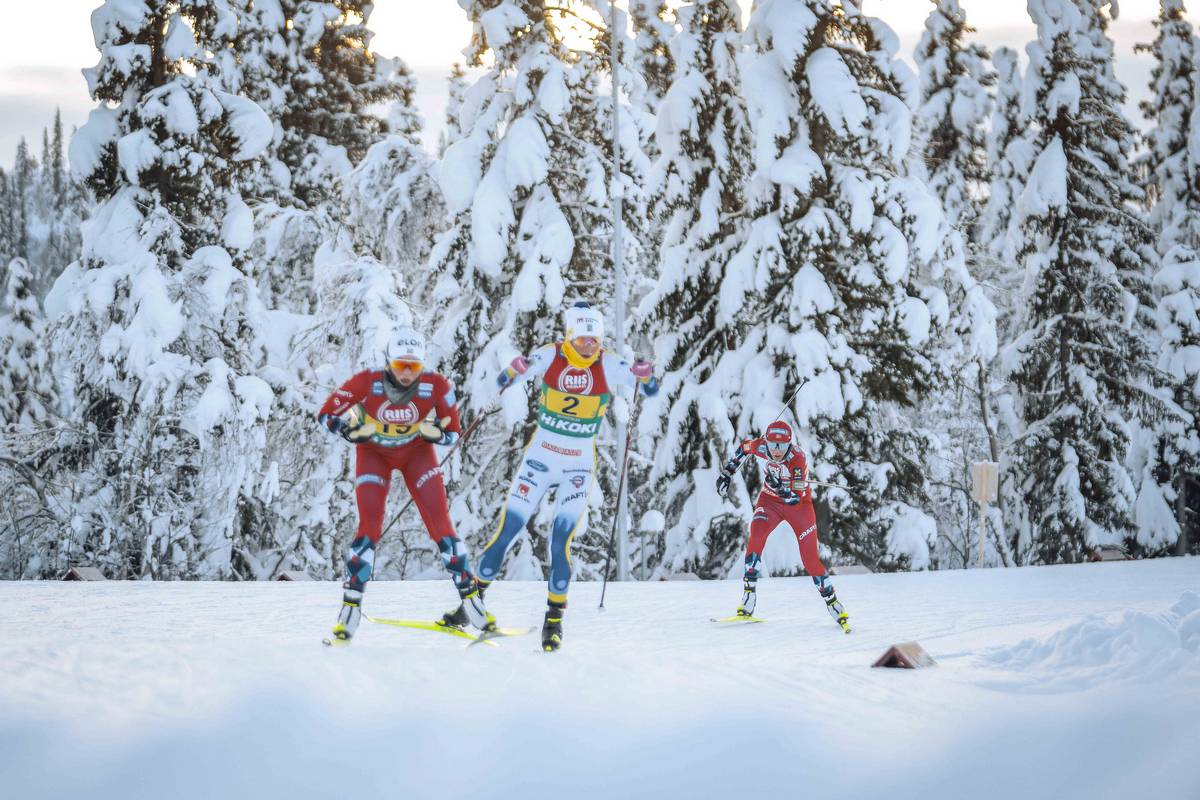
    Frida Karlsson (SWE) skied a commanding leg for Sweden I which saw the field break open. Norway I and Norway II follow. (Photo: Nordic Focus).

    Karlsson slowly turned the pace up through the second lap, and France I’s Dolci eventually faltered, leaving Sweden I, Norway I, Norway II, and Finland I in the race for the podium entering the final exchange. Sophia Laukli kept the US in 10th through her skate leg, minimizing the gap to the leaders to 43 seconds as other teams saw it blow wide open.

    Skating in the anchor leg, Finland’s Joni Maki finally broke, and Halfvarsson for Sweden I, Iversen for Norway I, and Krueger for Norway II skied together for a lap. Little jaunts and jukes from all three lead back to stalemate until, on the final lap, one jaunt turned into a jolt, and Krueger pulled away. The field filled in behind, with the Norwegians adding an extra team on the podium, seemingly for emphasis. USA I finished 10th on the day with Ogden skiing the anchor leg. 
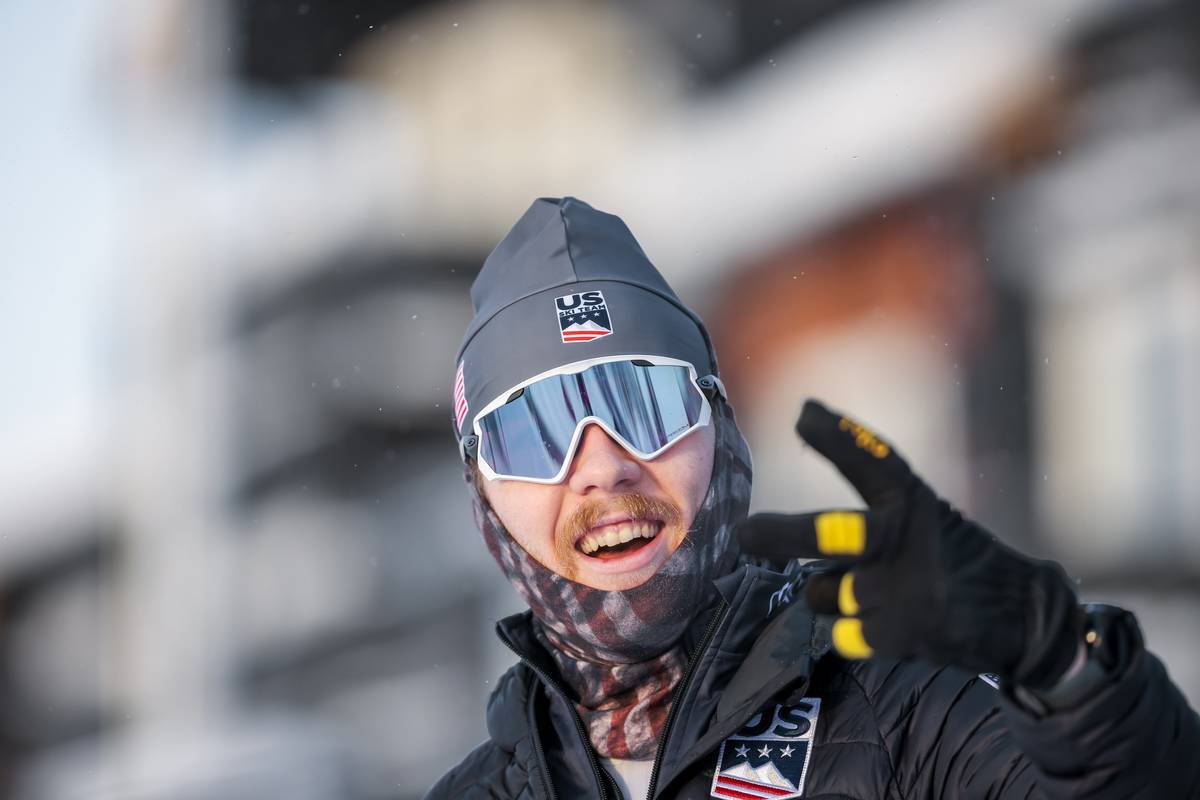
    Ben Ogden (USA) after finishing his leg of the relay race Sunday. The US finished in 10th place. (Photo: Nordic Focus).
    Pushing Forward, and Up, to Davos

    The World Cup circuit’s frantic hop around the Scandinavian peninsula in the past three weeks now gives way towards the Alps as teams travel to Davos, Switzerland. In the run-up to those events, eyes and ears will turn toward news of who will be racing there, including the potential return of Johannes Hoesflot Klaebo, Iivo Niskanen, and Federico Pellegrino. Davos will feature a skate sprint and 20 k individual start skate race.

    Ben Ogden says that the US camp is coming off today feeling “excited and motivated headed to Davos,” adding that personally he “needs a few more restful days, but I’m excited for the sprint and to get back to the land of the sun!”

    The team will be bolstered by the return of Diggins and Brennan, and with Matt Whitcomb saying Davos is a chance to, “end period I with some high notes. [Diggins and Brennan] both have a great shot to be on the podium in both races next week, so we want to be as prepared as we can for that.”

    With the snow-draped trees and soft light present on course—and no World Cup points up for grabs—Sunday’s World Cup mixed relay was a relaxed affair centered around ski racing for the sake of ski racing. Even on its highest level, ski racing remains joyful and keen, like the edge that sharpens itself for the work yet to come. 

    Full Results

    The sun sets on a weekend of racing in Beitostolen, Norway. (Photo: Nordic Focus).
  • Sunday Rundown: Lillehammer, Östersund & West Yellowstone (Updated x6)

    Sunday Rundown: Lillehammer, Östersund & West Yellowstone (Updated x6)

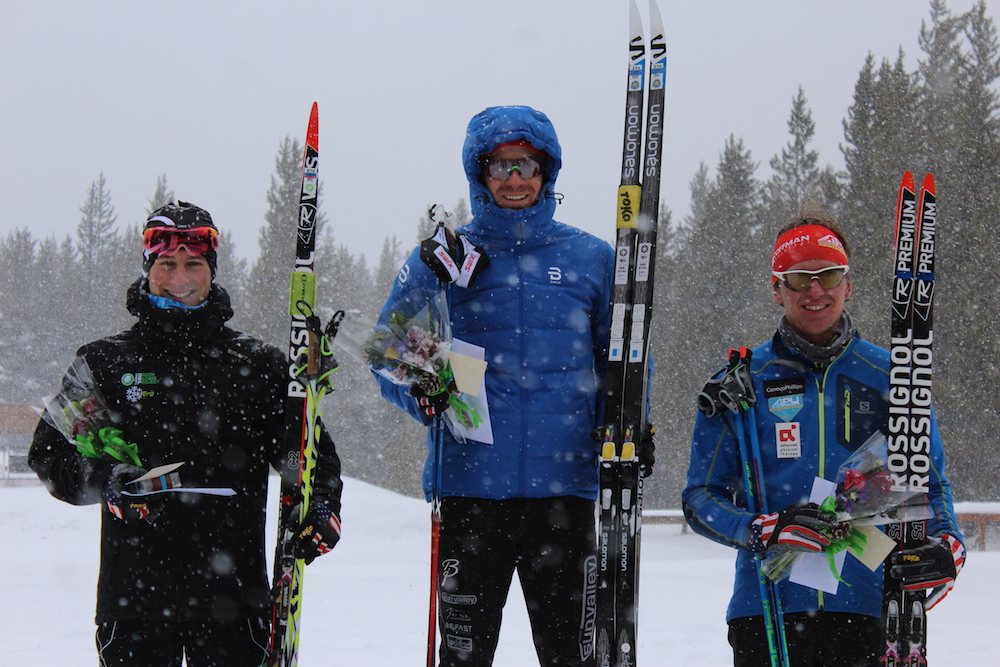
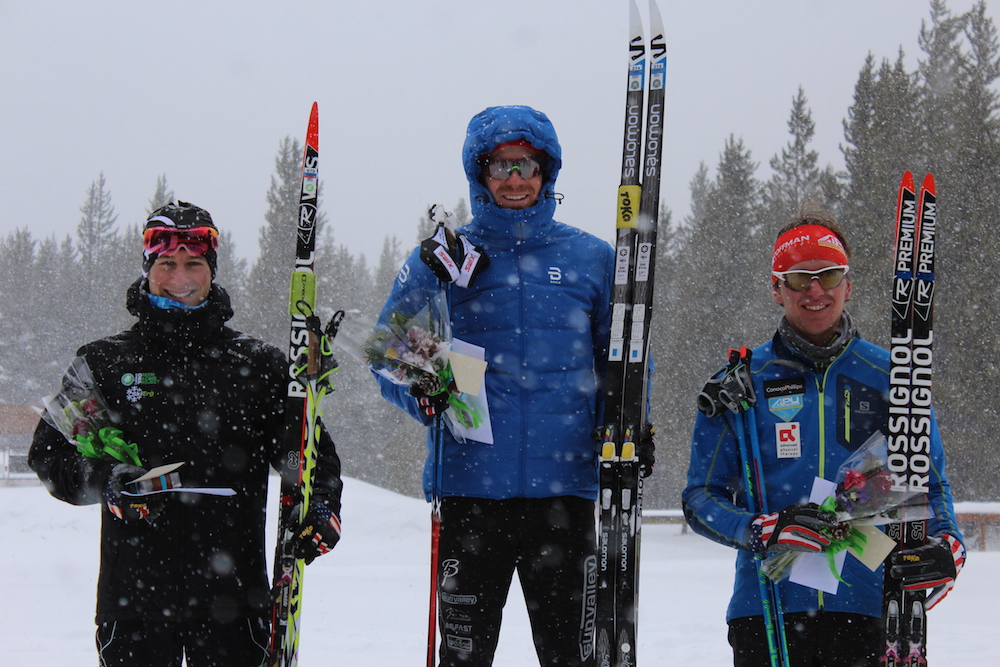
    Matt Gelso (SVSEF) topping the SuperTour podium for the second-straight day on Sunday in West Yellowstone, Mont. Joining him on Sunday's 15 k classic podium: CGRP's Ben Lustgarten (l) in second and APU's Scott Patterson (r) in third.
    Matt Gelso (SVSEF) topping the SuperTour podium for the second-straight day in West Yellowstone, Mont. Joining him on Sunday’s 15 k classic podium: CGRP’s Ben Lustgarten (l) in second and APU’s Scott Patterson (r) in third.

    Welcome to The Rundown, your quick primer of need-to-know information about the day’s racing. We’ll be updating this digest as the day goes on with additional results, photos and quotes. The Rundown is NOT a race report; stay tuned for complete race reports later today with interviews from the day’s top racers.

    (Note: This Rundown has been updated to include comments from U.S. Nordic Combined’s Bryan Fletcher, who placed ninth on Sunday at the World Cup in Lillehammer, Norway.)

    ***

    U.S. SuperTour opener in West Yellowstone: 10/15 k classic

    Matt Gelso made the case that he can win any discipline and format when it comes to cross-country skiing, topping the SuperTour podium for the second-straight day of the circuit’s opening weekend in West Yellowstone, Mont. Gelso, of the Sun Valley Ski Education Foundation (SVSEF) Gold Team, won the men’s 15-kilometer classic individual start in 42:57. He finished 32.2 seconds ahead of Ben Lustgarten of the Craftsbury Green Racing Project (CGRP) in second, and Scott Patterson, of Alaska Pacific University (APU), clocked in 1:16.8 back in third.

    In the women’s 10 k classic, Liz Guiney (CGRP) tallied the distance victory in 33:52.8. Katharine Ogden, of the Stratton Mountain School (SMS) and U.S. Ski Team D-team, finished 7.7 seconds back in second place, while Craftsbury put two on the podium with Kaitlynn Miller in third (+28.4).

    Results

    Nordic Combined World Cup in Lillehammer: Two individual comps and a relay

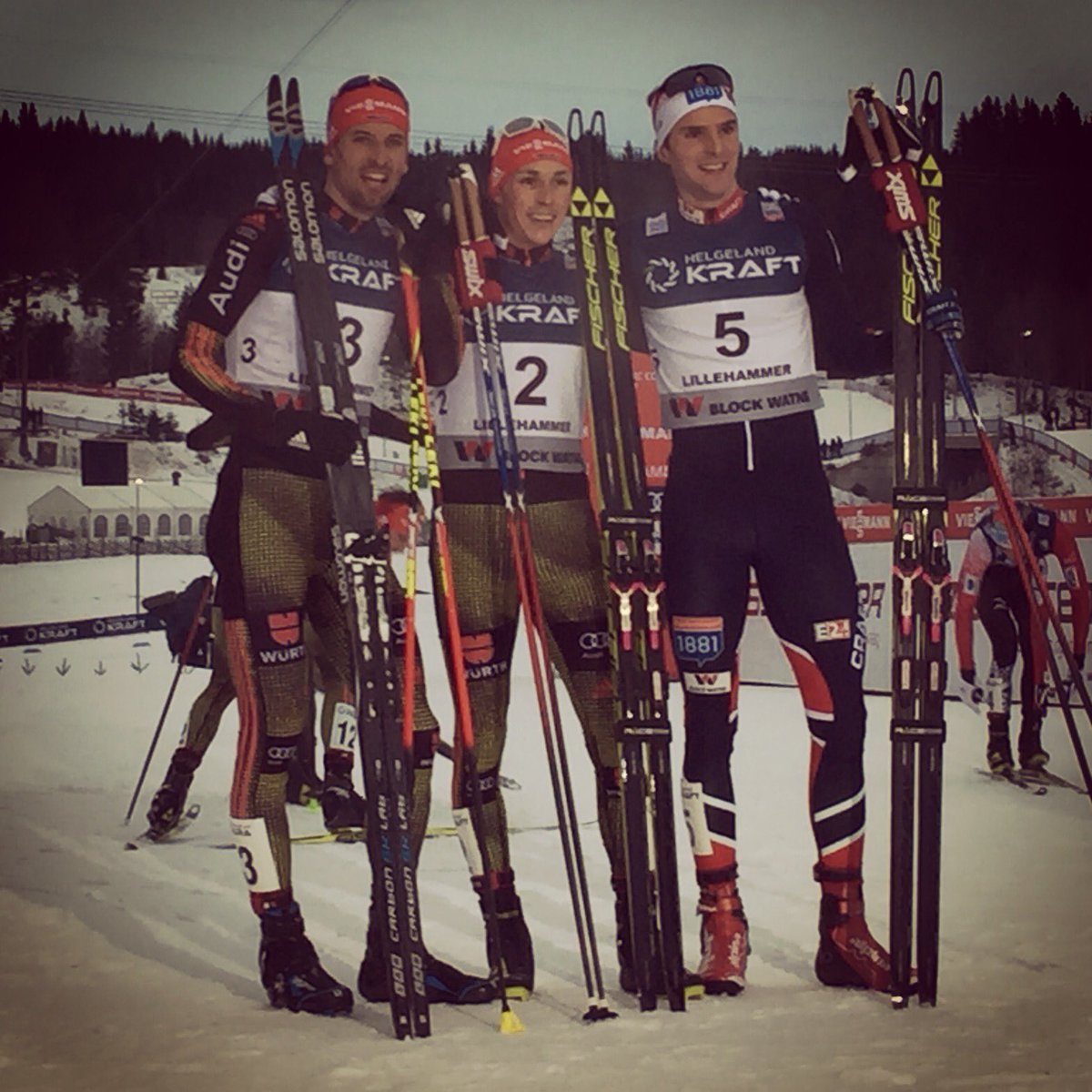
    German winner Eric Frenzel (c) with teammate Björn Kircheisen (l) in second and Norway's Jørgen Graabak (r) in third on Day 3 of the Nordic Combined World Cup in Lillehammer, Norway. (Photo: FIS Nordic Combined/Twitter)
    German winner Eric Frenzel (c) with teammate Björn Kircheisen (l) in second and Norway’s Jørgen Graabak (r) in third on Day 3 of the Nordic Combined World Cup in Lillehammer, Norway. (Photo: FIS Nordic Combined/Twitter)

    [UPDATE) Twenty-second in the jump. Ninth at the finish. That’s a bit more like it for U.S. Nordic Combined’s Bryan Fletcher. The American jumped to 22nd on Sunday on the large hill in Lillehammer, Norway, then raced to ninth in the 10 k Gundersen start cross-country race. He finished 1:22 minutes behind race winner Eric Frenzel, who notched his second-straight individual victory and third win (including Friday’s team event) of the Nordic Combined World Cup’s long weekend in 25:13.6.

    “Going into the race on Sunday I was confident that with a good race I could move up quite well,” Fletcher wrote in an email. “So I just set out to ski my own race and right from the start I was moving up. Top 10 was the goal and I was happy to accomplish that.”

    Germany went 1-2 with Björn Kircheisen in second (+10.8) and Jørgen Graabak of Norway finished third (+23.4) on Day 3 in Lillehammer. Fletcher’s younger brother Taylor Fletcher placed 26th (+2:21.1), moving way up from 48th in the jump (with the fastest overall course time). Also for the U.S., Ben Berend placed 49th (+4:30), and Ben Loomis was 52nd (+5:16).

    The Nordic Combined World Cup is turning out to be all about Germany (most) all of the time, with Frenzel and Johannes Rydzek at the forefront, after Rydzek won both opening World Cup competitions last weekend.

    On Friday, the German teammates started off the three-day series with a victory in the first 4 x 5 k team event of the season. They teamed up with Kircheisen and Fabian Riessle for first, beating Norway by 31.5 seconds with a winning time of 49:34.9.

    Norway’s squad, with Mikko Kokslien, Espen Andersen, Håvard Klemetsen, and Graabak, finished second without anyone else in sight. Austria took third (+1:23.7) with David Pommer, Mario Seidl, Wilhelm Denifl, and Phillipp Orter.

    Finland placed fourth, Japan was fifth, France sixth, the Czech Republic seventh, Italy eighth, and the U.S. ninth (+4:19.1), ahead of Russia in 10th.

    The order for the U.S. team was Bryan Fletcher, Berend, Loomis, and Taylor Fletcher. They rose as high as sixth during Bryan’s first leg, but dropped to eighth and finally ninth.

    On Saturday, in the individual normal hill/10 k competition, Frenzel overtook Rydzek for the win in 24:35. Rydzek started the day by winning the jump, and Frenzel ranked fourth heading into the 10 k Gundersen start. Frenzel overcame a 24-second deficit at the start to pass Rydzek and beat him by 15 seconds at the finish. Germany ended up sweeping the podium with Riessle in third (+25.8), after Riessle improved from 11th at the start with the second-fastest course time.

    Also on Saturday, Taylor Fletcher led the Americans in 26th (+1:51.2) after jumping to 44th and starting 2:02 minutes back from Rydzek. Fletcher skied the ninth-fastest course time.

    Bryan improved from 43rd at the start to 32nd (+2:32.9), Loomis ended up 43rd (+5:02.6) and Berend 44th (+5:33.4).

    “Going into this weekend I was feeling good and had some solid jumps in training so I knew that I was capable of a decent performance,” Bryan wrote on Sunday. “However, I struggle to put all the pieces together through the weekend. The team event was a good performance on my part and it was fun to ski with our young guys too. In Saturday’s event, I was close but had a rather unusual race in which I just couldn’t get going and fell off the pace quickly. Sunday however it all came together with a decent jump and race to finish 9th. This is more indicative of my true level at the moment so I was happy to finally fall into form.


    “This is definitely a result that I was hoping for in this period,” he continued. “I would like to finish in the top 10 consistently this year and it was a bit of a shaky start but I am starting to find the rhythm now. I hope to continue this momentum in Ramsau.”

    Results: Friday’s relaySaturday’s normal hill/10 k | Sunday’s large hill/10 k

    ***

    IBU World Cup in Östersund: 10/12.5 k pursuits

    Men’s report | Women’s report

    Lowell Bailey came oh-so-close to fourth place on Sunday. Just two fewer misses and he could’ve been in the hunt, but that’s how biathlon goes.

    US Biathlon’s top man so far this season, Bailey started 13th in the IBU World Cup 12.5 k pursuit on Sunday in Östersund, Sweden, and by the first prone stage, he was up to seventh with clean shooting. Two-and-a-half kilometers later, he was back in the range and shooting without a miss again. Bailey headed out on his third loop in fourth, and more or less held that position through the third shooting — cleaning yet again in standing.

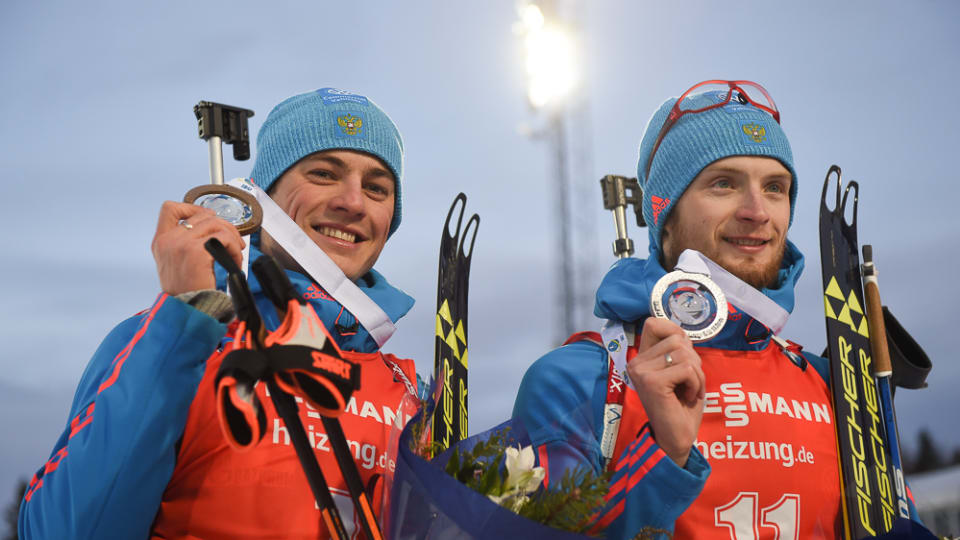
    Russia went 1-2 in the men's 15 k pursuit on Sunday at the IBU World Cup in Ostersund, Sweden, with Anton Babikov (l) winning his first World Cup and Maxim Tsvetkov (r) placing second. (Photo: IBU)
    Russia went 1-2 in the men’s 15 k pursuit on Sunday at the IBU World Cup in Ostersund, Sweden, with Anton Babikov (l) winning his first World Cup and Maxim Tsvetkov (r) placing second. (Photo: IBU)

    But two misses on the final standing dropped him to ninth, and on the final loop, Bailey slipped six spots to 15th at the finish. With two penalties (0+0+0+2), Bailey finished 1:21.8 behind the winner, Russia’s Anton Babikov, who hit 19-of-20 targets en route to his first World Cup victory and podium. Russia took second place as well with Maxim Tsvetkov shooting clean (0+0+0+0) and finishing 10.5 seconds behind his teammate, and France’s Martin Fourcade pushed through four penalties (2+0+0+2) to place third (+15.2).

    Fourcade started the day in first, after winning Saturday’s sprint, and lost the lead on the final stage, with two misses sending him to the penalty lap. On that last shooting, Babikov (the seventh starter) took control, and Tsvetkov (who started 11th) moved up from skiing in third for most of the race to second place.

    Also for the U.S., Tim Burke placed 35th (+2:39.2) after starting 29th, with four penalties (0+1+2+1).

    Canada’s Scott Gow finished 47th (+3:34.8) with three misses (0+0+2+1), Brendan Green was 50th (+3:45.5) wit five misses (1+3+0+1), and Macx Davies 51st (+3:54.6) with four penalties (0+0+2+2).

    Gabriela Koukalová of the Czech Republic with her first-place prize after winning Sunday's 10 k pursuit at the IBU World Cup in Ostersund, Sweden. (Photo: IBU)
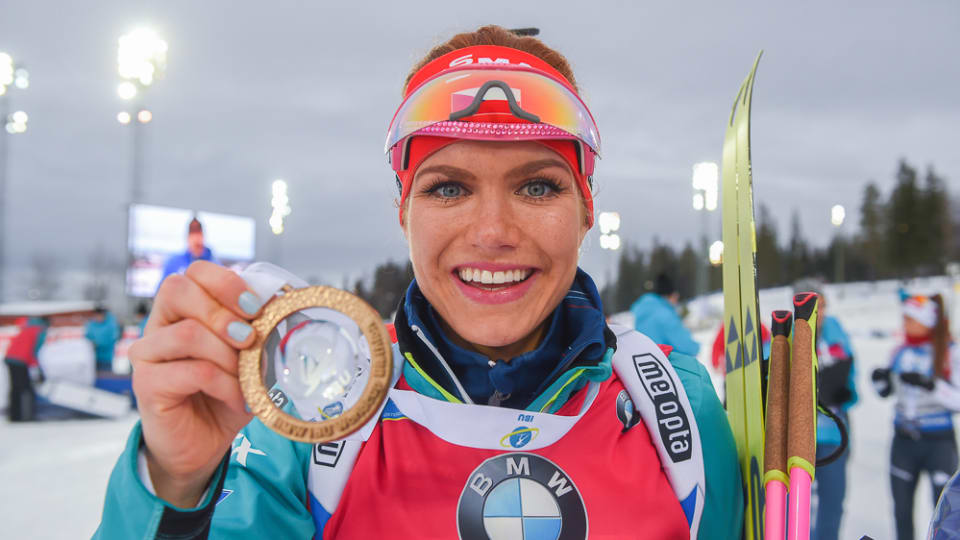
    Gabriela Koukalová of the Czech Republic with her first-place prize after winning Sunday’s 10 k pursuit at the IBU World Cup in Ostersund, Sweden. (Photo: IBU)

    In the women’s race, Gabriela Koukalová (formerly Soukalova, you’ll get used to it, we promise), took her third-place finish in Saturday’s sprint and catapulted herself into first on Sunday in the 10 k pursuit. Koukalova shot 19-for-20, missing just one on the first standing (0+0+1+0) to cross the finish line first, 8.4 seconds ahead of Germany’s Laura Dahlmeier.

    While Koukalova, of the Czech Republic, took the win in 31:43.3, Dahlmeier placed second (after starting fourth) with two penalties (0+1+1+0). Italy’s Dorothea Wierer improved from 19th to third (+21.4) at the finish, with perfect shooting (0+0+0+0).

    Switzerland’s Lena Häcki also cleaned for fourth (+36.3), after starting 12th.

    The first out of the gate (the winner of Saturday’s sprint), France’s Marie Dorin Habert dropped to seventh, more than a minute and 15 seconds back, with six penalties (2+1+2+1).

    American Susan Dunklee moved up to 22nd (+2:55.7) after starting 27th, despite five penalties (2+2+0+1).

    Also for US Biathlon, Clare Egan improved to 30th (+3:35.4), up from 44th, with three misses (0+0+1+2).

    Joanne Reid (US Biathlon) finished 47th (+4:59.6) with four misses (1+1+1+1), and Canada’s Julia Ransom finished 58th (+6:36.8) with eight misses (2+0+4+2).

    Results: MenWomen 

    ***

    FIS Cross-Country World Cup in Lillehammer: 10/15 k classic pursuits

    Women’s report | Men’s report 

    Martin Johnsrud Sundby is the man to beat once again after winning the men’s 15-kilometer classic pursuit on Sunday in Lillehammer, Norway. The Norwegian started seventh and overcame a 50-second deficit to Sweden’s Calle Halfvarsson, the leader going into the final day of the mini tour. Halfvarsson dropped to fifth, while Sundby rose to first and brought another Norwegian Johannes Høsflot Klæbo to the top with him. Klæbo started sixth, 3 seconds ahead of Sundby, and placed second, 2.3 seconds behind him. Finland’s Matti Heikkinen took the final spot on the podium in third (+2.7), by 0.9 seconds over Norway’s Emil Iversen in fourth. Halfvarsson was 6.3 seconds back in fifth, his Swedish teammate Marcus Hellner sixth (+6.8), Norway’s Pål Golberg and Finn Hågen Krogh seventh (+9.9) and eighth (+15.0), respectively, and Canada’s Alex Harvey ninth (+16.2), ahead of Finland’s Iivo Niskanen in 10th (+52.0)

    Canada had two in the points with Devon Kershaw rising from 43rd to 27th (+2:08.5). Len Valjas placed 48th (+3.44), Graeme Killick was 53rd (+3:53.9), Knute Johnsgaard 72nd (+6:20.3), Bob Thompson 81st (+8:16.3), Andy Shields 83rd (+9:57.3).

    For the U.S., Noah Hoffman rose to 36th (+2:39.5) after starting 48th, Erik Bjornsen finished 57th (+4:33.3), and Eric Packer finished out his first overseas mini tour in 68th (+5:45.1).

    Heidi Weng (c) held onto her lead to win the Lillehammer mini-tour by 16.1 seconds over Norwegian teammate Ingvild Flugstad Østberg (l). Finland's Krista Parmakoski was third after losing a shot at second thanks to a crash. (Photo: FIS Cross Country/Twitter)
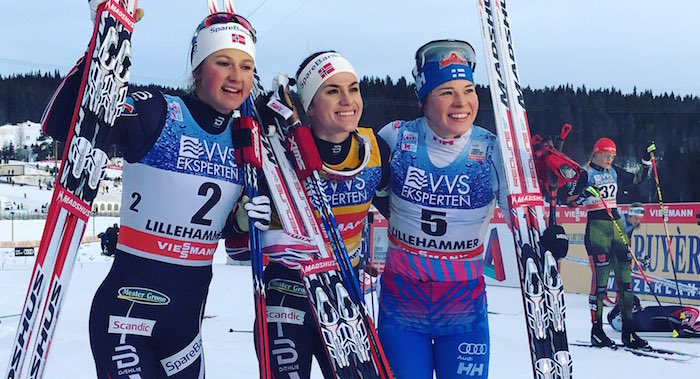
    Heidi Weng (c) held onto her lead to win the Lillehammer mini-tour by 16.1 seconds over Norwegian teammate Ingvild Flugstad Østberg (l). Finland’s Krista Parmakoski was third after losing a shot at second thanks to a crash. (Photo: FIS Cross Country/Twitter)

    Heidi Weng of Norway started the 10 k pursuit in first place, and that’s where she finished it, 16.1 seconds ahead of teammate Ingvild Flugstad Østberg. Finland’s Krista Parmakoski rounded out the podium in third, after skiing up from a fifth place starting position and passing Østberg near the end of the race but then crashing on a downhill and losing valuable seconds. Nevertheless her effort gave Parmakoski the fastest ski time of the day.

    Jessie Diggins, who started the race in third position after winning yesterday’s 5 k skate, made an early bid to ski with Østberg but ultimately lost ground, ending eighth, +1:39.4.

    Instead it was Marit Bjørgen who took fourth, +57.5. Stina Nilsson of Sweden was one of the biggest movers of the day, skiing from 27th at the start all the way up to fifth, +1:26.1.

    Following Diggins, Sadie Bjornsen finished 11th, +1:51.2. The American had started in a pack of skiers and stayed there for most of the race. Liz Stephen was 38th (+3:31.8), and Rosie Brennan and Caitlin Patterson 41st (+3:50.2) and 42nd (+3:56.8). Ida Sargent rounded out the U.S. results in 57th (+5:39.7).

    Emily Nishikawa led the Canadians in 46th (+4:08.5), with Cendrine Browne and Dahria Beatty 52nd (+4:41.5) and 59th (+6:08.2).

    Results: Women | Men

  • Best of Times for Canadians, But Merely Solid Day for U.S.

    Best of Times for Canadians, But Merely Solid Day for U.S.

    The U.S.'s Kikkan Randall in the team sprint on Wednesday.

    The Canadian men might have won gold in today’s World Championship team sprint, but they weren’t the only ones walking away from Holmenkollen Stadium in Oslo with smiles on their faces. Another Canadian team was excited about its results, too: Canadians Perianne Jones and Dasha Gaiazova, who finished sixth in the women’s final.

    Canada's Dasha Gaiazova.

    After the semifinal, in which the pair was forced to ski mostly alone after Slovenia, Norway, and Sweden went off the front, Jones was relieved to have some company in the final. The race split into two packs, with the Canadians battling Germany, Japan, Russia, and the U.S. for the entirety of the six-lap race.

    “The top five teams were in a league of their own,” said Jones. “The rest of us were battling it out there for sixth. I think Dasha and I both saved a little bit extra for the last lap, which helped us both, and so we just squeaked in there for sixth.”

    The result matched the Canadians’ finish at the 2009 World Championships in Liberec, Czech Republic. In that race, Jones was paired with the more-experienced Sara Renner, who had won a silver medal in the team sprint at the 2006 Olympics. Renner has since retired, and this time around, Jones was paired with Gaiazova.

    “I’m happy with it, and I think Dasha is too,” Jones said. “We skied a pretty good race. We matched our sixth place from Liberec- there’s not much else we could have done. I think we’re both pretty dead at this point.”

    While Canadian head coach Justin Wadsworth got a lot of attention thanks to his men’s finishes, he was just as proud

    Perianne Jones in action.

    of his women.

    “Today was a great day for our whole team because the women were 6th, and skied an unbelievable race for themselves,” Wadsworth told FasterSkier. “They dug in there, especially on the last lap- Perianne, Dasha, to ski like that, it’s almost as good- not almost as good as a win, but I think they’re really happy with today. And I’m really happy for them because that was a tough choice to leave Chandra out of the race. I’m just really happy that they rose to the occasion, and sixth place is something they can really be proud of here.”

    They were joined in the final by the American women, who placed an impressive third in their semifinal thanks to a

    Sadie Bjornsen chasing a German.

    strong kick by Kikkan Randall. She received the tag from Sadie Bjornsen in fourth place, but skied a strong last lap to pass Germany and secure an automatic spot in the finals.

    “I felt like I had good even energy throughout both the semifinal and the final,” Randall said. “So that was good for me.”

    In the final, Bjornsen, who has never skied a team sprint at the international level and hasn’t skied one at all in the last three years, tagged off in tenth after the first lap.

    Randall was able to move the team up to seventh, a spot that pair maintained until Bjornsen’s final lap, when she dropped back to tenth. In the end, Randall could only do so much, and it took all the energy she could muster to pass Russia and ski the team into ninth place, 56 seconds behind the winning Swedish team.

    “I had a little chasing to do,” Randall said. “It was a tantalizing gap. I was just close enough where I thought I could make it up.”

    Randall said that she discovered that on one part of the course, the double-poling was faster out of the tracks. She then tried the same strategy in the stadium, but her move didn’t have the same effect.

    “That was a bad tactical move on my part, because then Russia and Japan came by me again. Then I got stuck. I didn’t

    Andy Newell leading a train of skiers.

    have an open track to go up that hill. I knew I was going to have something in the finish, but I lost track of [the Canadians]. So that was too bad.”

    As for the U.S. men, they too dipped deep into their reserves in the semifinal; the team of Torin Koos and Andy Newell finished fifth behind Russia, Norway, Kazakhstan, and France, and were the last team to make the finals as lucky losers.

    Newell said that the effort of securing a spot in the finals left him wiped.

    “The final, it was tough for me,” he told FasterSkier. “I felt okay for one lap, but I was really struggling. I pushed real hard in that semifinal, and I had a hard time recovering. I was puking about ten minutes before the start [of the final]. I felt a lot better after I did that, but then the energy just faded. I was having an incredible time finding kick… the skis I

    Torin Koos.

    skied on in the semifinal, I couldn’t get them to kick in the final, which was probably partly because I was tired. So I was struggling with the kick and struggling with the body.”

    The first few laps of the men’s final went out at a relatively subdued pace, and both Koos and Newell were able to stay with the pack. But by the middle of the third lap, Koos was falling off the pace, and by the finish, Newell was 50 seconds behind the winning Canadian team and more than 20 behind the ninth-place Italians.

    Koos, too, was drained after the first race, and asking his body to repeat the experience all over again less than 90 minutes later was asking for trouble.

    “I was feeling super great in the semifinal and then the second half, I was still right in it, but I got done and it was just- I have to come back and do it again?” he said.

    While both skiers were disappointed with the tenth-place finish, Koos said that he had done “pretty close to what I could do.” Two weeks ago, he tore his labrum; the shoulder injury was a setback, which was not ideal coming into the Championships.

    Newell was more blunt.

    “We should get into the finals no problem- that’s where we belong,” he said. “I wish we could have had a little better show there.”

    Full results: men / women

    -Nathaniel Herz contributed reporting