From the FasterSkier archive — posts syndicated from athletes’ and coaches’ own blogs between 2004 and 2012, kept online as published. Current coverage is at fasterskier.com.
The International Ski and Snowboard Federation (FIS) unveiled its proposed 2026/2027 cross-country skiing World Cup calendar this week at the FIS Spring Meetings in Portorož, Slovenia.
The schedule — first shared publicly through FIS social media and still pending FIS Council approval — builds the season around the 2027 World Championships in Falun, Sweden, with three pre-Christmas stops, a nine-race Tour de Ski, a stretch of three weekends between the Tour and Worlds, and a Scandinavian closing kick that ends with the Finals in Ulricehamn.
For North American fans, the calendar is once again entirely European, with no scheduled stops in Canada or the United States.
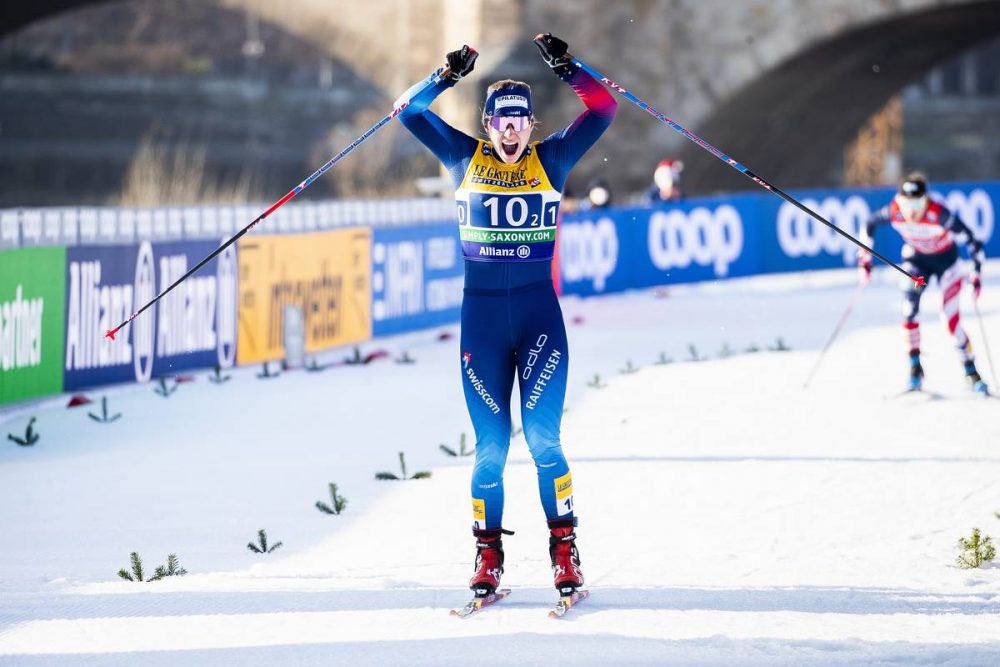
Frida Karlsson (SWE) poses with Mr. and Mrs. Claus following the 10k Classic to start last season in Ruka (FIN). (Photo: Modica/NordicFocus)
Pre-Holiday: Ruka, Trondheim, Davos
The season opens where it almost always does — in Ruka, Finland, where the World Cup begins November 27. From there, the circuit moves to Trondheim, host of the 2025 World Championships, before the pre-Christmas block closes in Davos, Switzerland, with a team sprint.
November 27-29, 2026: Ruka, Finland
27/11: 10km Interval Start Classic
28/11: Sprint Classic
29/11: 20km Mass Start Freestyle
December 1-3, 2026: Trondheim, Norway
01/12: 10km Interval Start Classic
02/12: Sprint Freestyle
03/12: 20km Skiathlon
December 11-13, 2026: Davos, Switzerland
11/12: 5km Heat Mass Start Freestyle
12/12: Sprint Freestyle
13/12: Team Sprint Freestyle
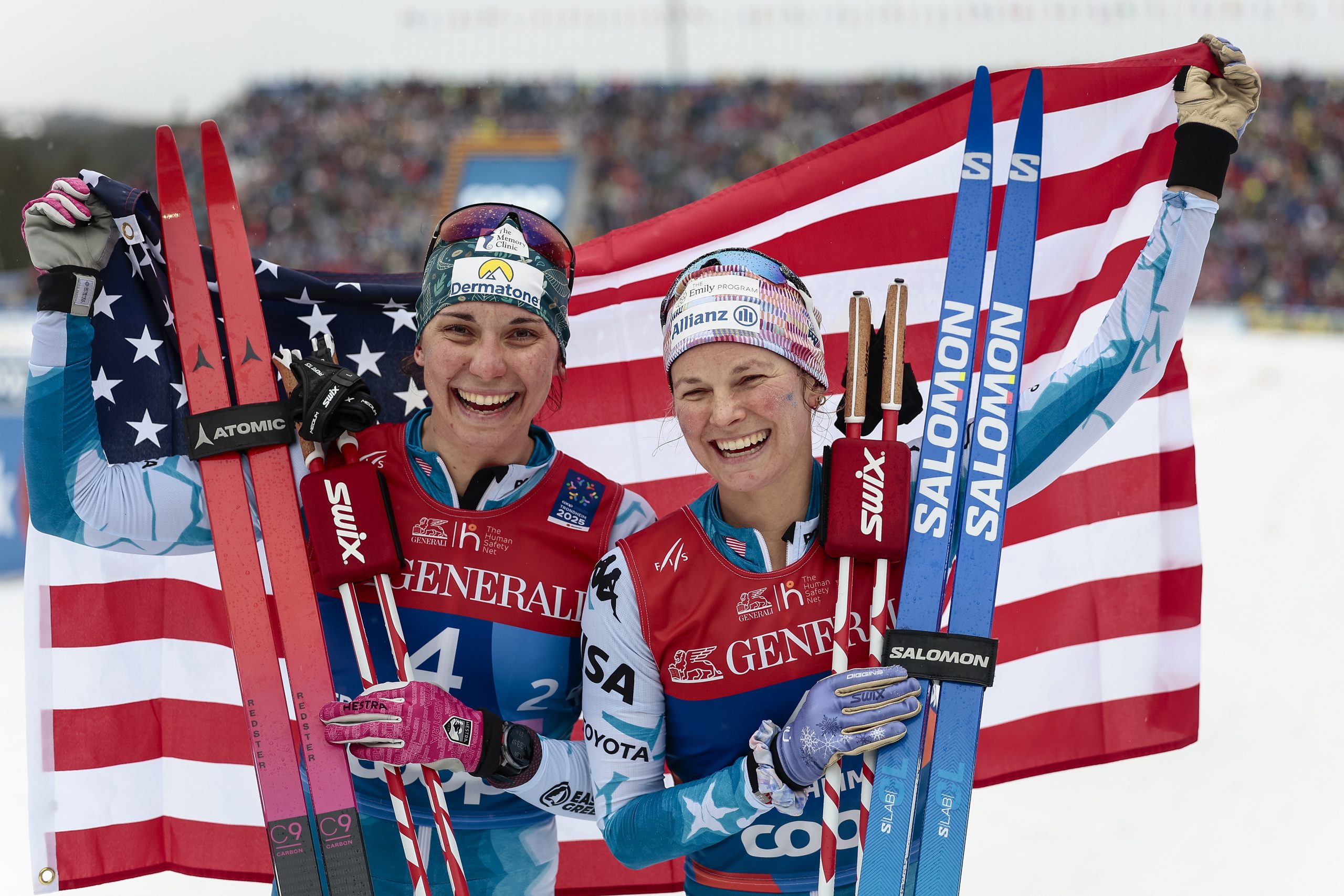
With Jessie Diggins (USA) now retired, there will be a new FIS Overall Crystal Globe and Tour de Ski champion next season (Photo: Vanzetta/NordicFocus)
Tour de Ski 2026/2027
The Tour de Ski returns to a three-country format, opening in Les Rousses, France, on New Year’s Day, moving to Oberstdorf, Germany, and finishing with three races in Val di Fiemme, Italy — capped, as ever, by the Final Climb up Alpe Cermis.
January 1-3, 2027: Les Rousses, France
01/01: Sprint Classic
02/01: 20km Mass Start Classic
03/01: 15km Pursuit Freestyle
January 5-6, 2027: Oberstdorf, Germany
05/01: 15km Mass Start Classic
06/01: 5km Heat Mass Start Freestyle
January 8-10, 2027: Val di Fiemme, Italy
08/01: 15km Skiathlon
09/01: Sprint Freestyle
10/01: Final Climb
Gus Schumacher (USA) and the rest of the US team will hope to continue their success in Toblach (ITA). (Photo: Modica/NordicFocus)
After the Tour, Before Worlds: Engadin, Toblach, Lahti
Three weekends bridge the Tour de Ski and the World Championships. Engadin opens its weekend with a mixed relay — a format the FIS has been working into more World Cup weekends — and Lahti closes the pre-Worlds stretch with its classic 20km skiathlon and 10km interval start.
January 22-24, 2027: Engadin, Switzerland
22/01: Mixed Relay
23/01: Sprint Freestyle
24/01: 20km Mass Start Freestyle
January 29-31, 2027: Toblach, Italy
29/01: 10km Interval Start Freestyle
30/01: Sprint Freestyle
31/01: 20km Mass Start Classic
February 12-14, 2027: Lahti, Finland
12/02: Sprint Classic
13/02: 20km Skiathlon
14/02: 10km Interval Start Classic
Kendall Kramer (USA) had a breakout World Cup Skiathlon in Falun (SWE) last season. (Photo: Authamayou/NordicFocus)
2027 FIS Nordic World Ski Championships: Falun, Sweden
The 2027 FIS Nordic World Ski Championships run from February 22 through March 7 in Falun, Sweden, with all title formats on the program. Falun last hosted Worlds in 2015.
Final Period: Oslo, Drammen, Ulricehamn
The closing stretch is a Scandinavian one. Oslo’s Holmenkollen weekend features back-to-back 50km mass start classic races on March 13 and 14 — long a fixture of the late-season calendar — before a one-day sprint stop in Drammen and the World Cup Finals in Ulricehamn, Sweden.
March 13-14, 2027: Oslo, Norway
13/03: 50km Mass Start Classic
14/03: 50km Mass Start Classic
March 16, 2027: Drammen, Norway
16/03: Sprint Classic
March 19-21, 2027: Ulricehamn, Sweden (World Cup Finals)
19/03: 10km Interval Start Freestyle
20/03: Sprint Freestyle
21/03: 20km Mass Start Classic
The calendar remains subject to FIS Council approval.
The highs were high and the lows were low in the Olympic team sprint in Italy, with the Ogden-Schumacher men’s team claiming silver and the Diggins-Kern women’s pair finishing out of the medals. Devon and Nat break the whole thing down.
We’ll be back after Saturday’s men’s 50 k. Reach us at devon[at]fasterskier.com and nat[at]fasterskier.com. We’re really grateful for all the support during the Olympics — thanks for notes and encouragement.
A reminder: This is a homegrown podcast done by two guys working long hours and late nights. We’re also paying real money to be here in Italy. If you can, support the show and FasterSkier’s ongoing coverage with a voluntary membership. We’re also offering a bonus during the Olympics: a WhatsApp group with notes on Nat’s experiences in Italy, the food he’s eating, interview transcripts and more.
Send nat[at]northernjournal[dot]com a confirmation of your voluntary membership and the number he should use for WhatsApp and we’ll get you signed up. You can also Venmo him directly at @nat-herz if a membership isn’t for you. We’re suggesting a minimum of $10, but we also won’t turn anyone away who wants to join because of an inability to pay.
Help Support Our Olympic Coverage!
FasterSkier will have our own Nat Herz on the ground at the Olympics, which, to be honest, is a very big financial lift for us. If you value the thoughtful work and access FasterSkier provides at championships like this one, please consider becoming a Voluntary Subscriber. Your support directly fuels the work we do to cover the people, places, and moments that make our sport special.
This article was made possible through the generous support of our voluntary subscribers who have helped us put our Nat Herz on the ground reporting at the Olympics. If you value coverage like this, please support FasterSkier with a voluntary subscription.
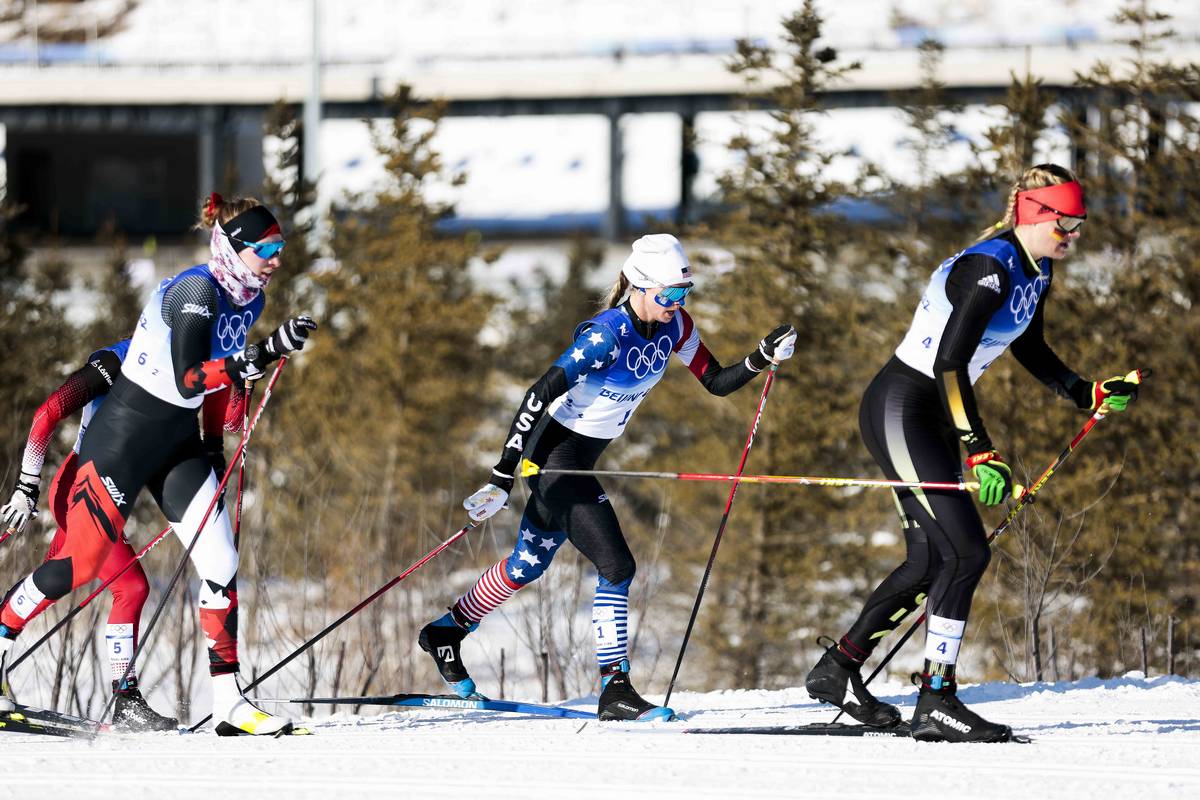
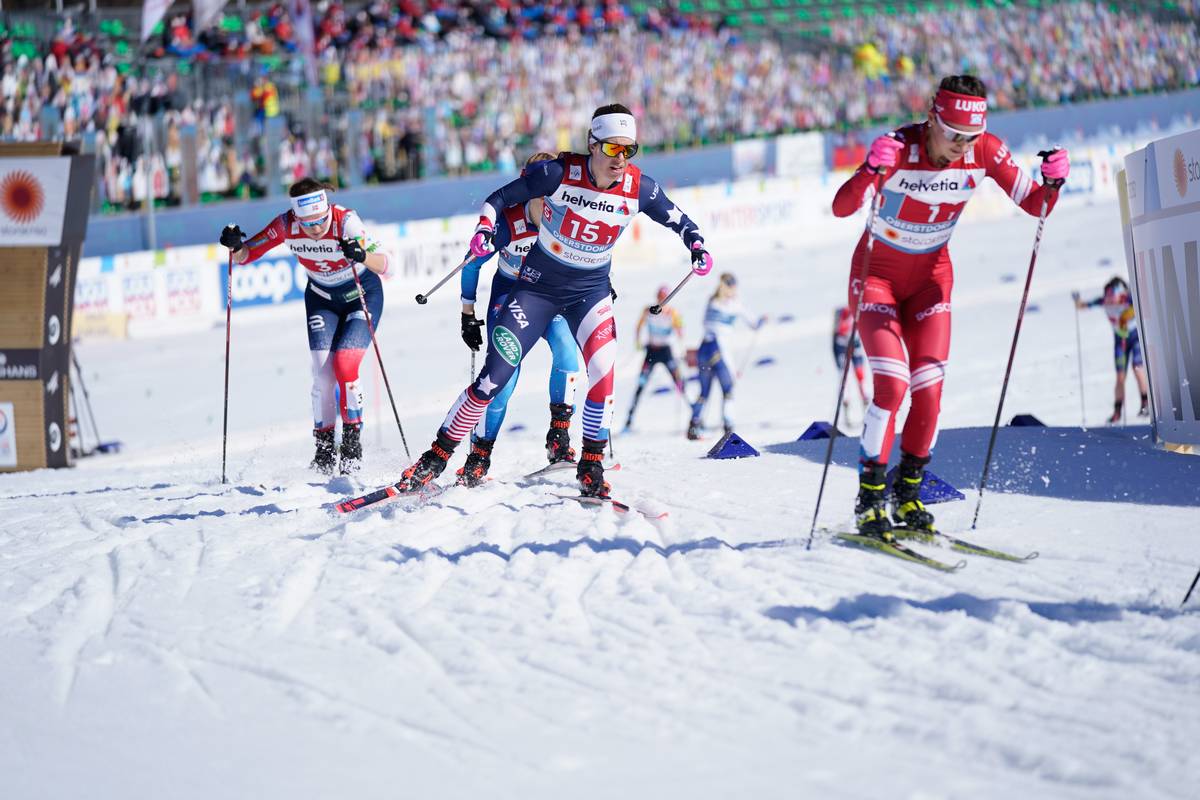
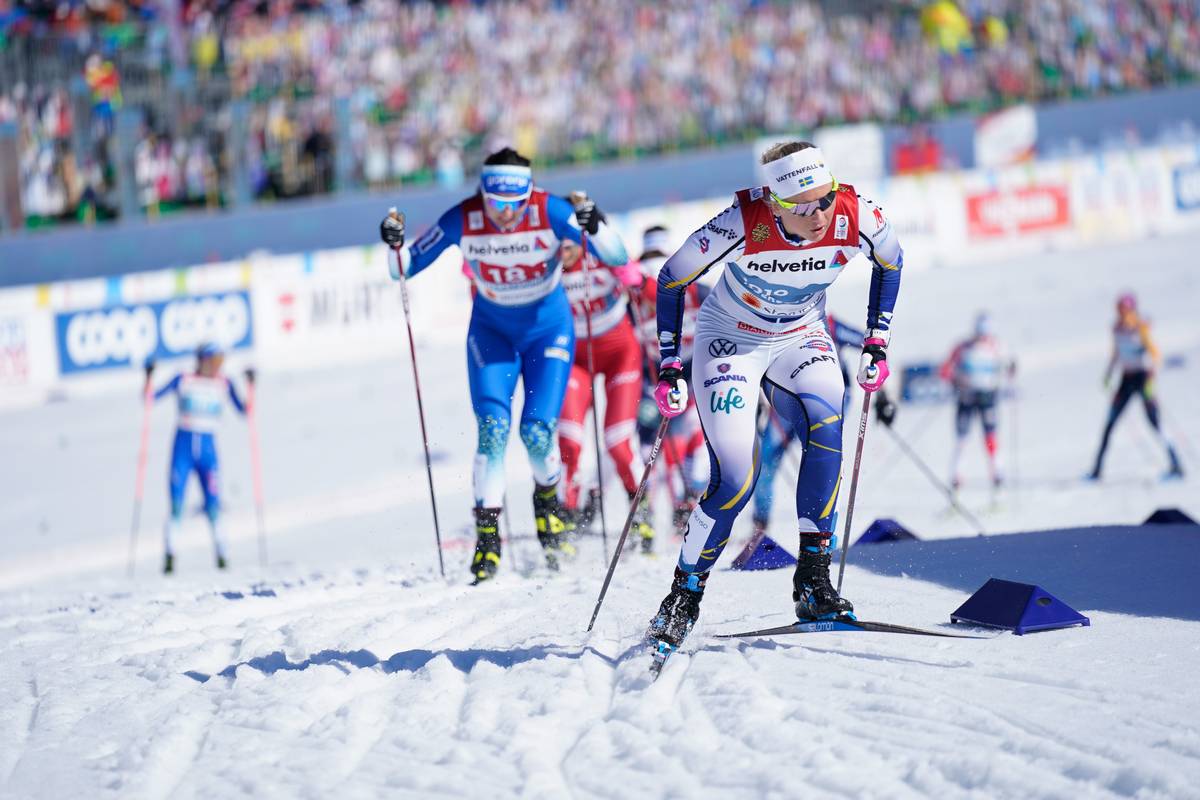
Jonna Sundling (SWE) follows Jessie Diggins (USA) during the Olympic Women’s Team Sprint in Tesero, Italy. (Photo: Vanzetta/NordicFocus)
PREDAZZO, ITALY — Eight years ago, on a different continent, the words “Here Comes Diggins!” by Chad Salmela vaulted American cross-country skiing into a new era. On Wednesday in Val di Fiemme, the event that changed everything for the United States returned to the Olympic stage.
The Women’s Freestyle Team Sprint has long been one of the Americans’ signature races. In the PyeongChang 2018 Winter Olympics, Kikkan Randall and Jessie Diggins delivered the nation’s first Olympic gold medal in cross-country skiing. Last March in Trondheim, Diggins and Julia Kern claimed World Championship silver.
On Wednesday, Diggins started the race in the first leg, handing off to Kern for the anchor leg, as they had in their previous medal run. They hoped for one more shared championship moment.
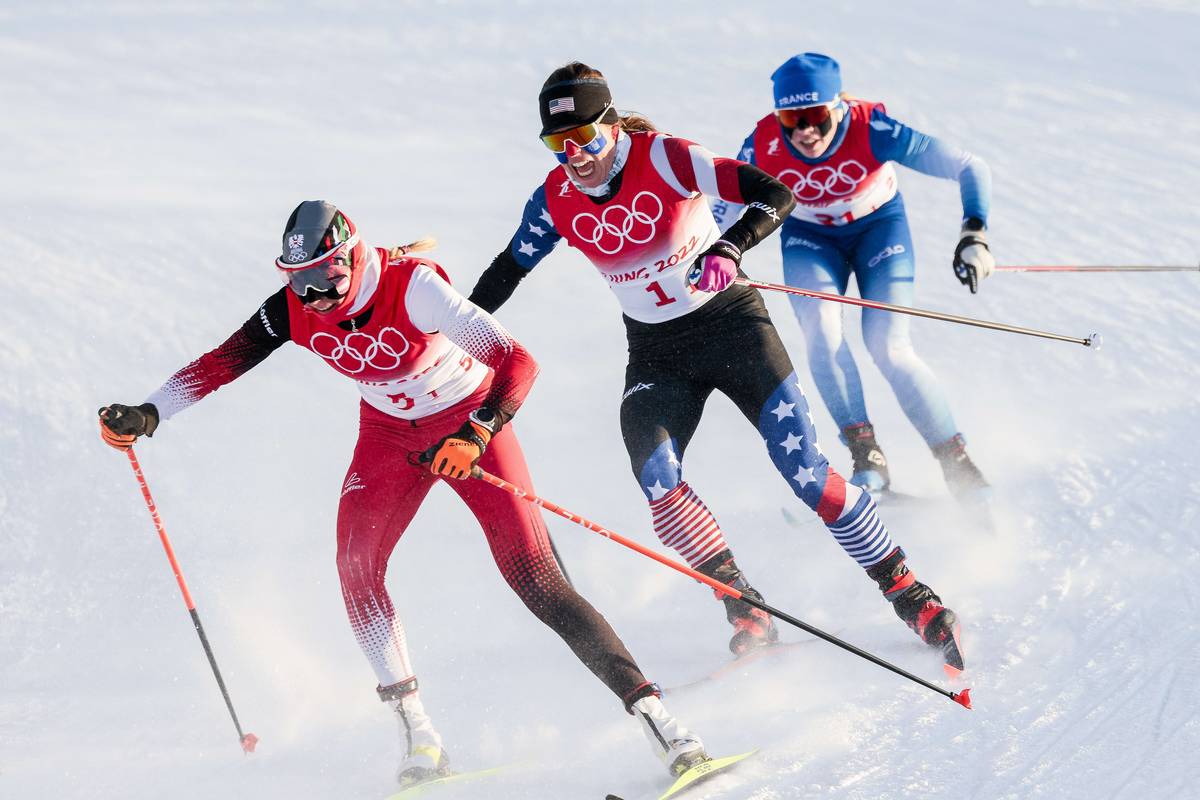
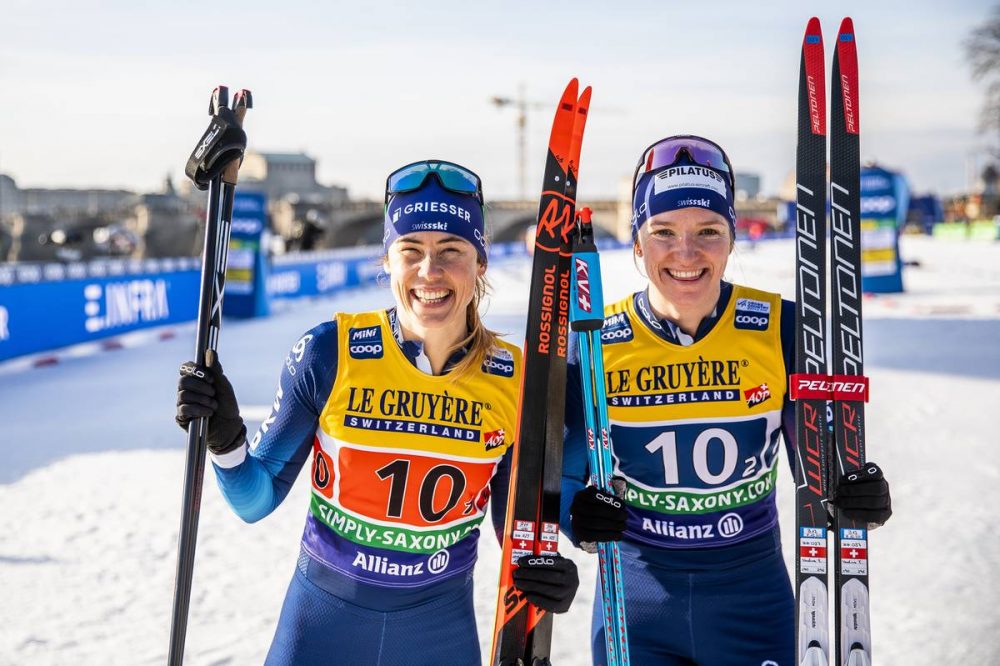
It was not to be. The Americans finished fifth, in a race that required not just fitness but flawless execution. Sweden’s Jonna Sundling and Maja Dahlqvist took gold. Switzerland’s Nadja Kaelin and Nadine Faehndrich secured silver. Germany’s Laura Gimmler and Coletta Rydzek won bronze after a late-race crash by Finland opened the door in the final turn.
For the Americans, the margin was not dramatic. But close, at this level, does not bring home a medal.
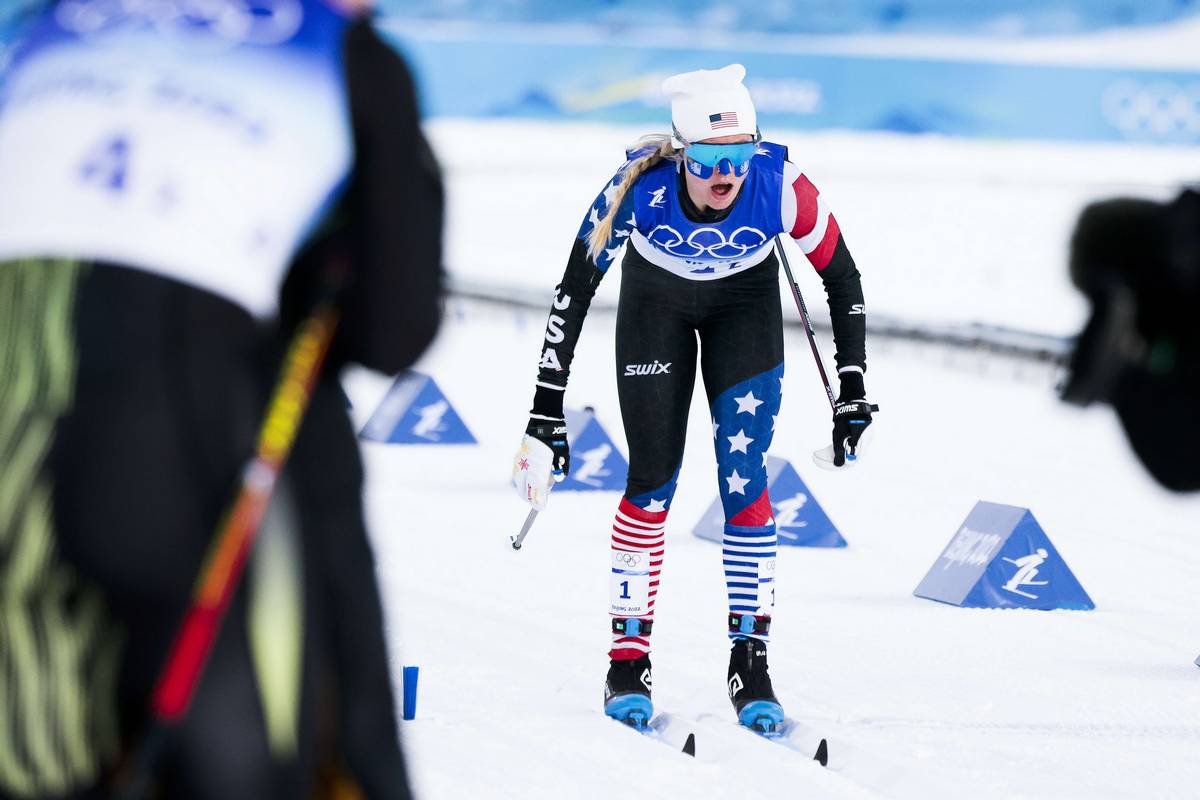
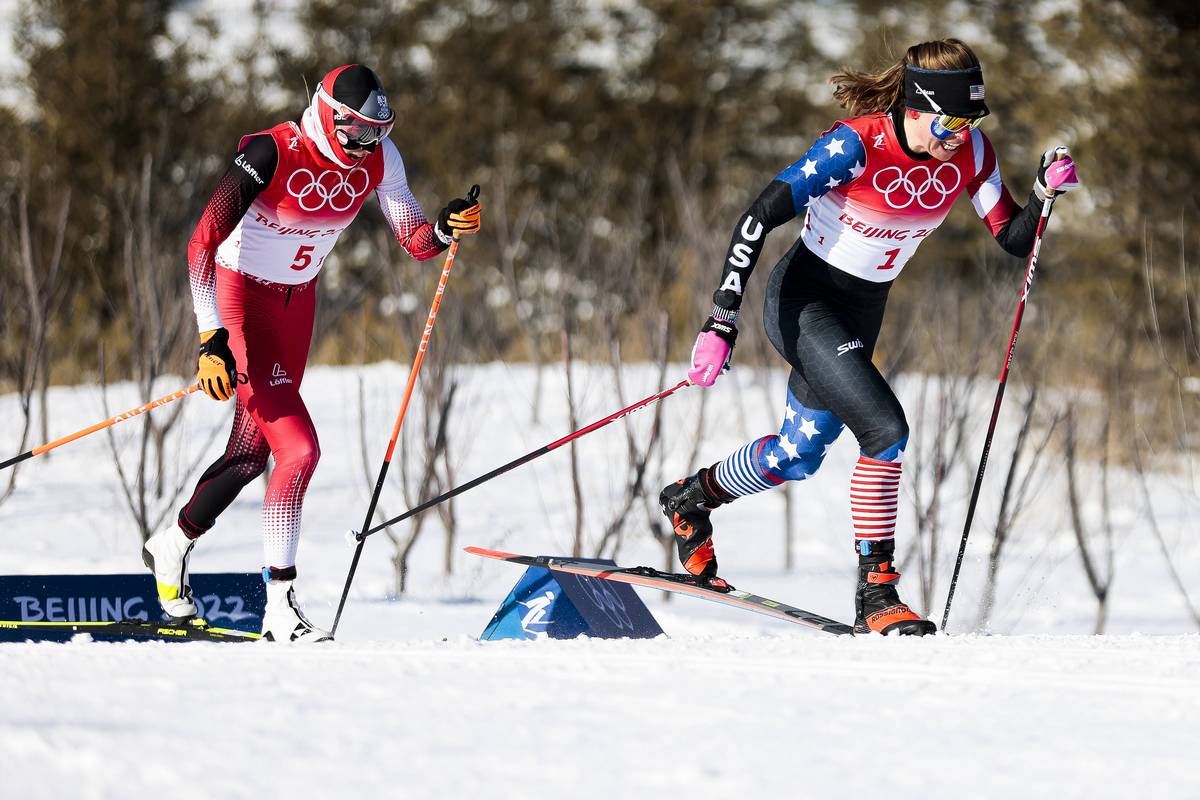
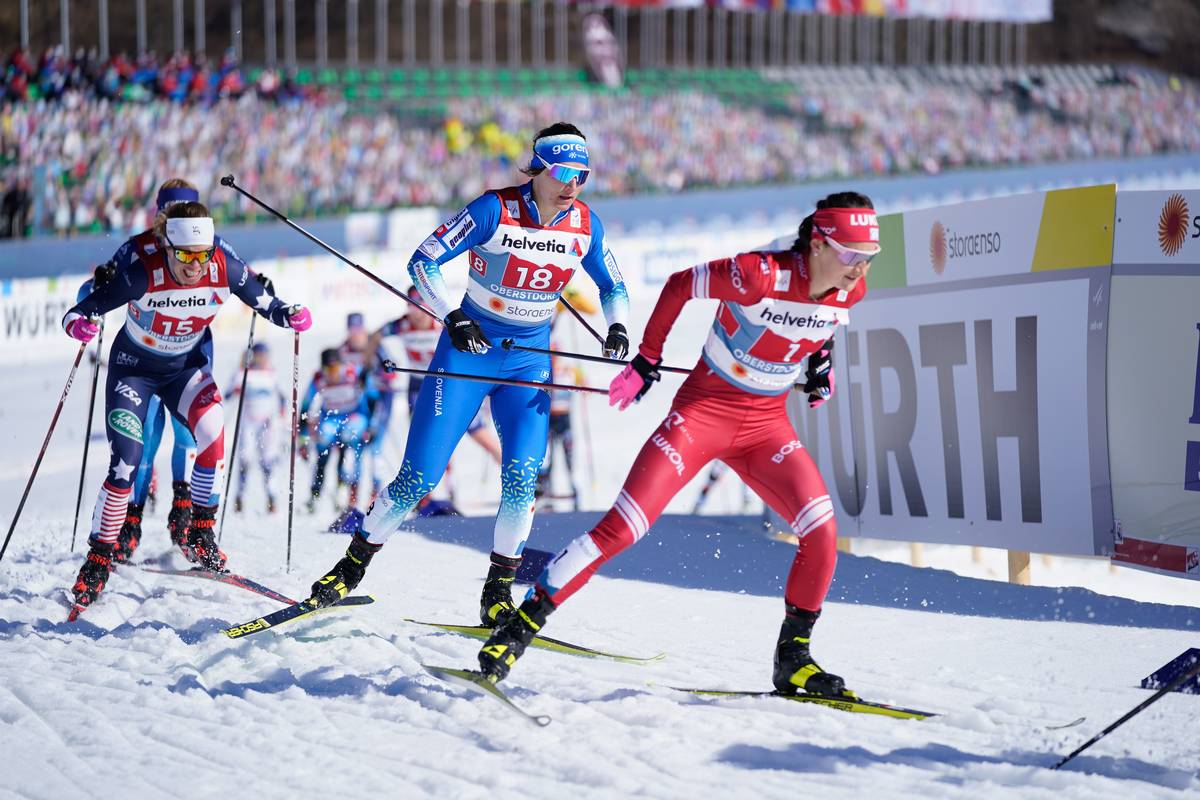
Jessie Diggins (USA) and Jonna Sundling (SWE), (l-r) come through the stadium during the Olympic Women’s Team Sprint. (Photo: Vanzetta/NordicFocus)
“Honestly, left it all out there.”
The Team Sprint is one of the sport’s most punishing formats. Two skiers qualify individually; their times are combined to determine which 15 nations reach the final. In that final, the athletes alternate laps — three each — on a course that offers no reprieve.
Often, one skier brings distance strength, and the other sprint speed. For the United States, Diggins and Kern blur those categories. Both are capable of driving pace. Both can finish.
From the gun, Diggins did what she has done throughout her career: she went to the front.
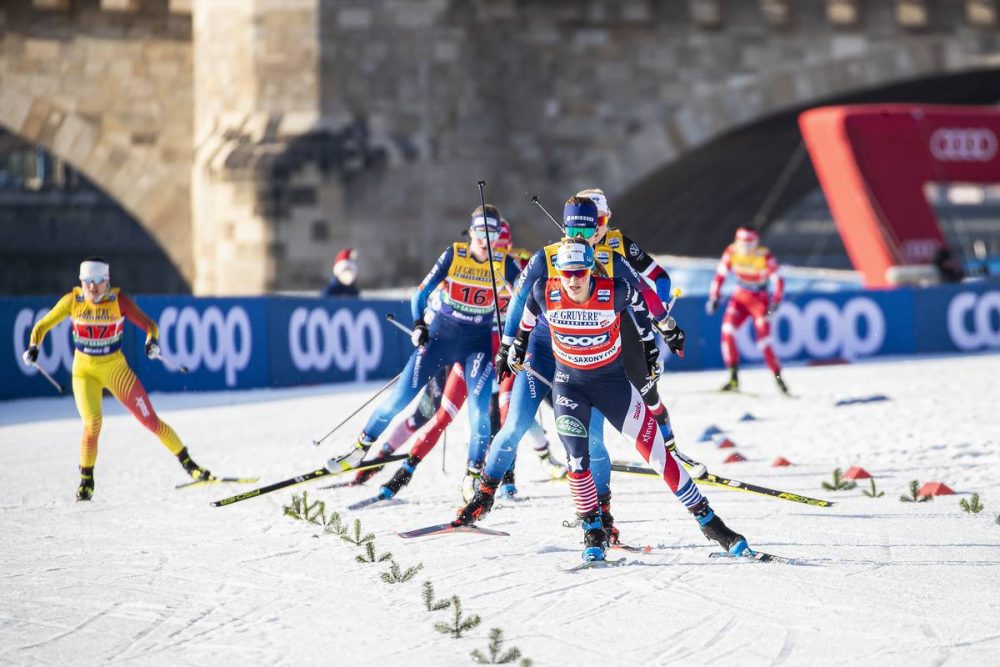
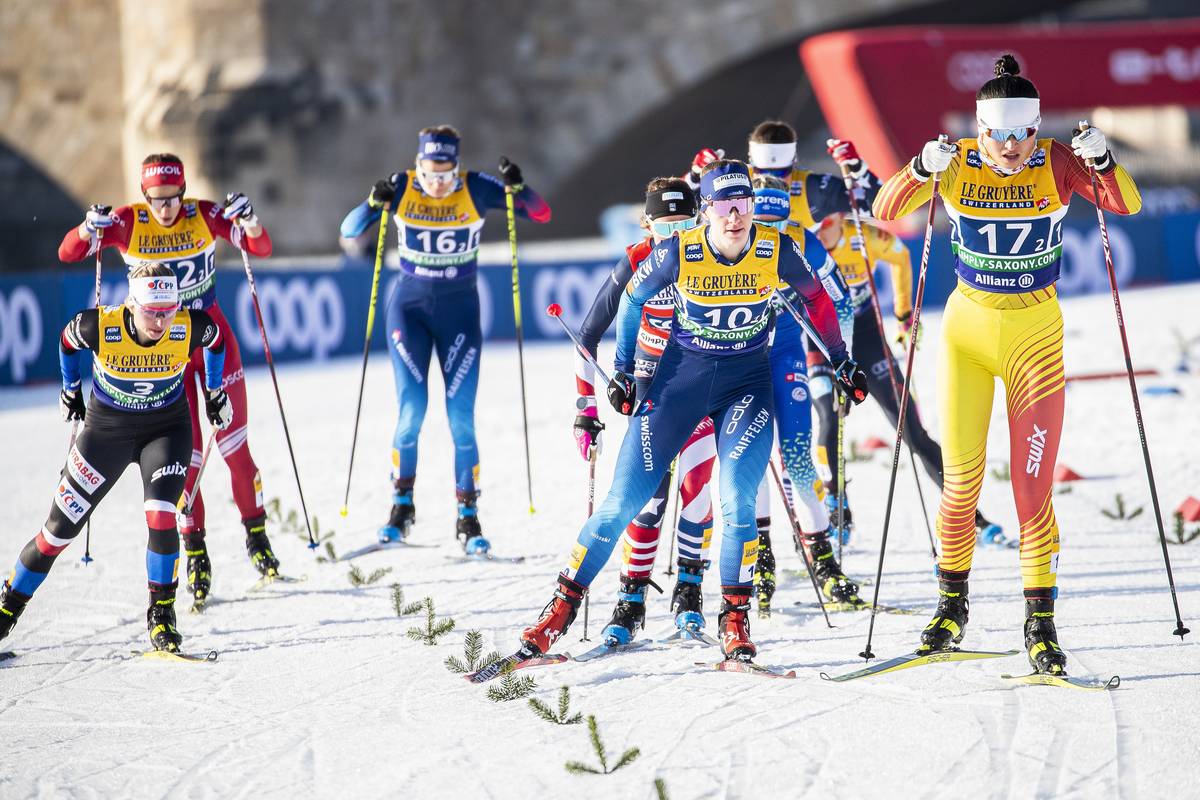
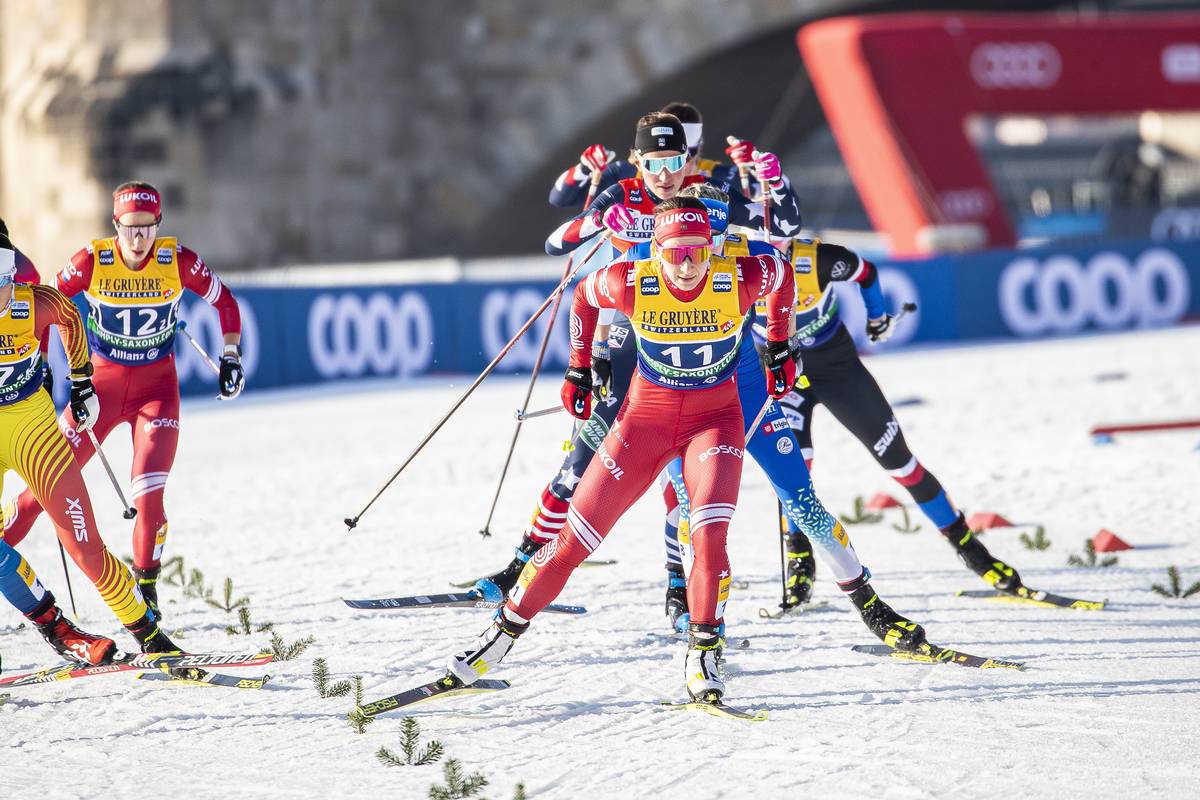
She and Sundling stretched the field immediately, driving into the Zorzi Climb, the race’s defining ascent. The early order — Sweden, the United States, Norway, Canada — hinted at the nations prepared to dictate terms.
Jonna Sundling (SWE) stretches her lead. (Photo: Vanzetta/NordicFocus)
When Sundling surged later in the race, Diggins expected it.
“I knew she was probably going to do that,” Diggins said afterward. “And I was like, just do the best that you can do. You know, like, you can’t control anything except your effort and your heart. And I was like, skiing out of my body, and I just did everything that I could, and I’m proud of that.”
That theme — control what you can — carried through her reflections.
“Honestly, I almost passed out like four different times,” she said. Then, clarifying: “No, from going that hard, no regrets. Honestly, left it all out there. I feel like we did everything we could, and that is the only thing you can control at the end of the day.”
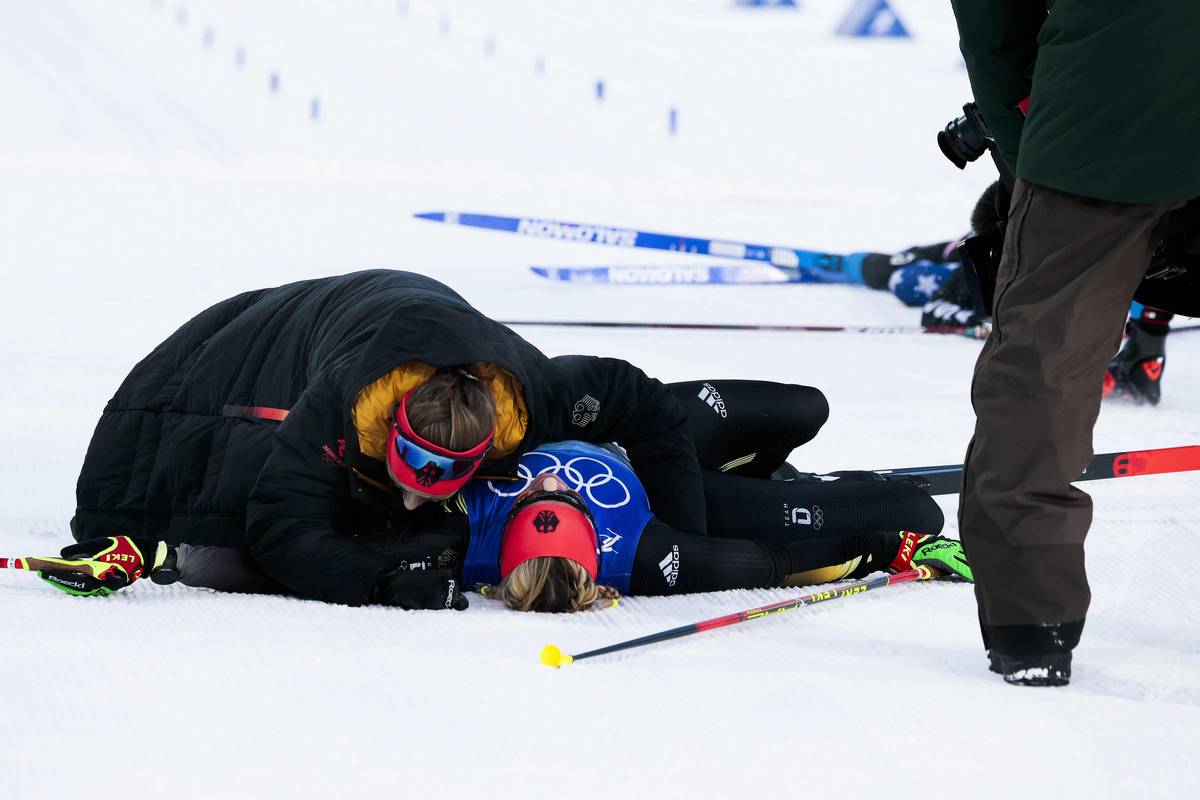
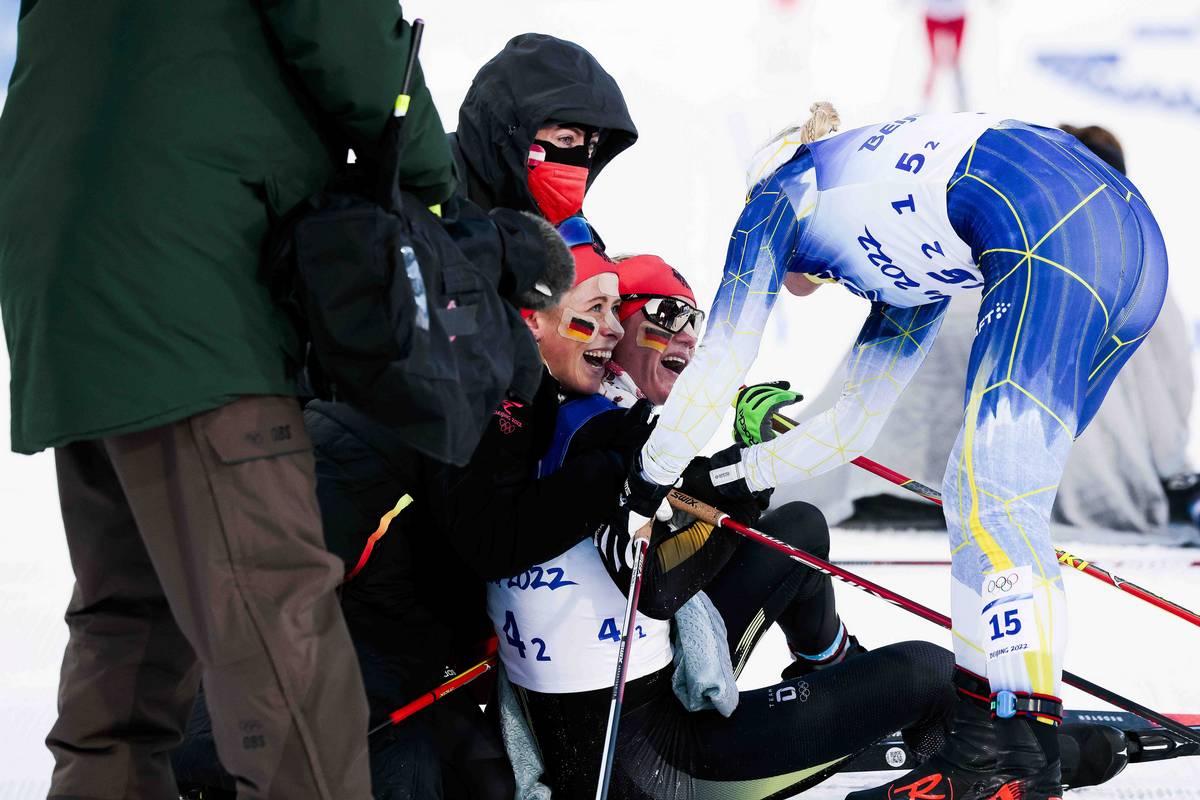
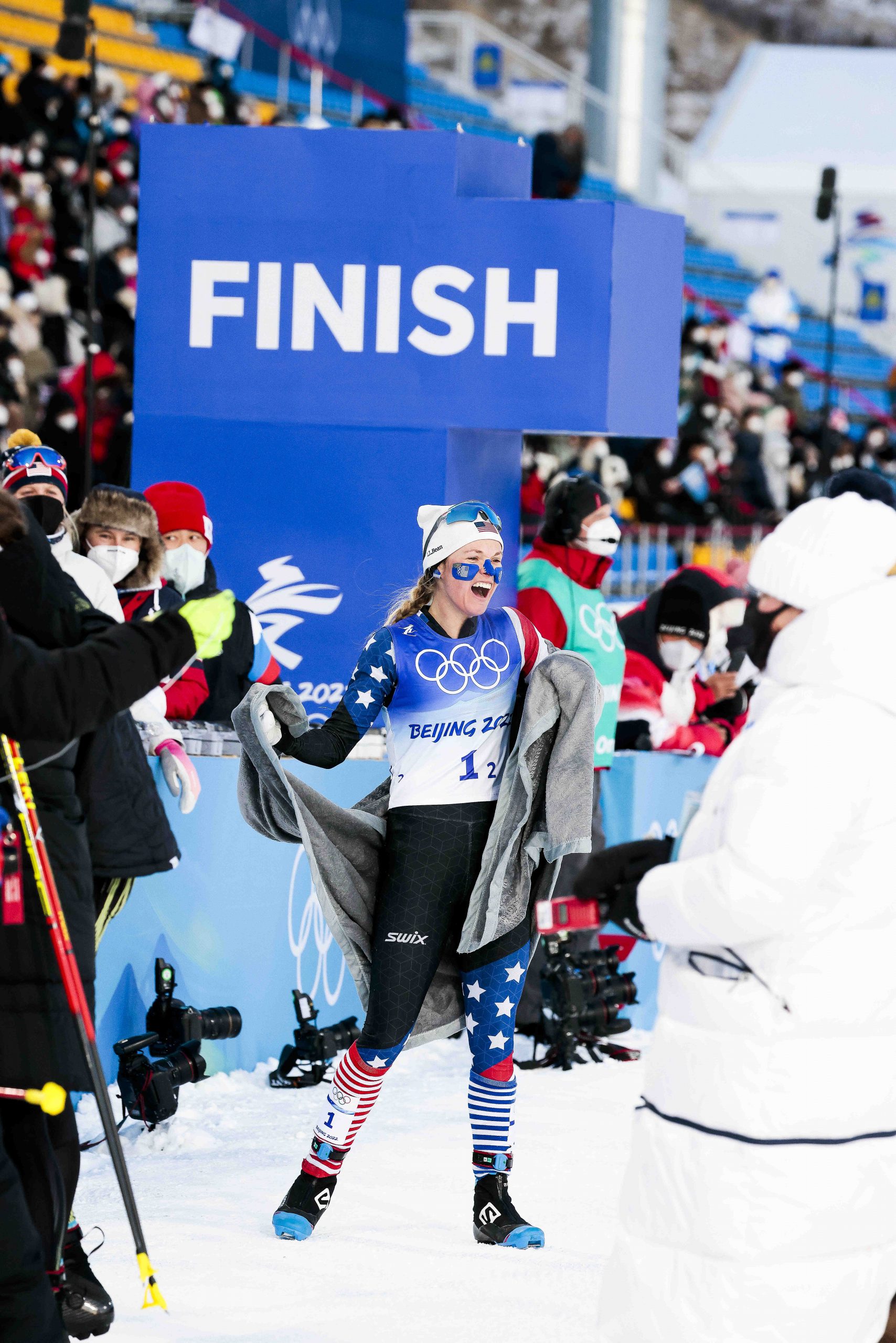
Julia Kern (USA) and Jessie Diggins (USA), (l-r) gather in the finish area after the race, Diggins racing in the US team’s relay socks for the final time. (Photo: Barbieri/NordicFocus)
One final lap with ‘Relay Socks’
By the last exchange, Sweden had carved out daylight. Switzerland began clawing into Finland’s hold on silver. Behind them, Germany, Norway, the United States, and Finland battled for bronze.
On the final descent, Finland’s anchor, Jasmin Kahara, lost her balance in the sweeping right-hand turn and fell, sliding out on her stomach. Germany and Norway slipped past in their tucks. Kern, just meters behind, fought to the line, but the podium had narrowed to two.
Coletta Rydzek (GER) brings home the bronze medal for Germany with Norway’s Julie Bjervig Drivenes just off camera. (Photo: Vanzetta/NordicFocus)
As they drove for the line side by side, aerodynamically no-pole skating with everything they had, it was clear this was going to be close. Germany claimed bronze while Norway left empty-handed in fourth. Just behind, Kern brought the United States to the finish in fifth.
For Diggins, the moment carried a different weight. It was, by her admission, her last Olympic relay leg.
“I love racing with this girl. I’m so, so proud of her,” she said of Kern. “And, yeah, it’s emotional to feel like I’m never gonna pull on those relay socks again.”
When asked whether there was a sense of handing the event forward, she reflected on the arc of her career — from her first team sprint world title in 2013 to the growth of youth programs back home.
“It’s just really cool to be part of the evolution of American skiing,” she said.
Julia Kern (USA) and Nadine Faehndrich (SUI), (l-r) find their lines around a tricky corner. (Photo: Vanzetta/NordicFocus)
Whitcomb knows they can win
For Head Coach Matt Whitcomb, the analysis was candid and clear-eyed.
“Yeah, it was a good race,” Whitcomb said. “Of course, this is an event that we know we can win, and we didn’t today.”
In a format this tight, small imperfections are decisive.
“For even a bronze medal to happen, both legs have to be firing exquisitely,” he said. “We swung as hard as we could. We did our best. We were prepared to win today, and we just didn’t.”
Of Kern’s anchor leg, Whitcomb offered both empathy and affirmation.
“Julia is an incredible performer, and one thing you can always trust from her is that you’re gonna get her absolute best,” he said. “We saw it on the final climb. I was happy with how she climbed. Just didn’t quite have the entire thing today, and that’s okay.”
Jessie Diggins tags Julia Kern (USA), while Jonna Sundling tags Maja Dahlqvist (SWE), (l-r) in the exchange zone between laps. (Photo: Vanzetta/NordicFocus)
Diggins in the best fitness of her life
Diggins has raced these Games managing injury concerns, including rib pain after a fall in the opening Skiathlon. But when asked whether her fitness was lacking, she pushed back.
“I feel like I’ve come into this with the best fitness in my life,” she said. “And that’s one of the only things I could control.”
There is comfort, perhaps, in that certainty — in knowing preparation was not the missing piece.
“I was skiing out of my body,” she said. “And I just did everything that I could.”
In Olympic-level team sprinting, that is sometimes enough. On Wednesday, it was not quite.
But the American women did what Diggins described as the only thing you can in cross-country skiing: you have to leave it all on the course without regret.
FasterSkier will have our own Nat Herz on the ground at the Olympics, which, to be honest, is a very big financial lift for us. If you value the thoughtful work and access FasterSkier provides at championships like this one, please consider becoming a Voluntary Subscriber. Your support directly fuels the work we do to cover the people, places, and moments that make our sport special.
Somewhere over the Atlantic, on a red-eye to another winter in Europe, Ben Ogden opens his laptop and stares at a grid of digital joinery. Tiny posts, miniature knee braces, angled mortises — a small timber-frame sauna, scaled down to the dimensions of an airline tray table. He sketches in precise strokes, clicking through angles and offsets, rotating the model the way he rotates race courses in his head: looking for structure, looking for flow.
“I learned CAD in college,” he says. “Something that I hope to use in a future career post-skiing. It feels good to keep those skills up.” For the past several winters, Ogden has leaned into his engineering degree, which he earned at the University of Vermont. When you talk to him outside of training and racing, you realize this engineering mind was not learned at UVM; it is deeply ingrained in who he is, who he has always been. On planes, in wax truck corners, in small Scandinavian hotel rooms, he opens the software that once helped him model truss systems for class projects. Now, it helps him breathe.
“It kind of gives me a good outlet,” he says. “It’s exactly like you say — the projects in the summertime are fun, and you learn a lot, but ultimately for me the biggest reason to do them is that it gives me this outlet from skiing… gives me a break from everything that’s going on.”
This winter’s project is ambitious in a miniature way: a timber-framed sauna built from small hand-cut pieces, a practice run for a full-sized dream he can’t yet afford the time or money to tackle. In his travel bag, he carries a book — The Art of Japanese Joinery — the same way another skier might carry a novel. “I’m gonna use my CAD software and sort of build all the little pieces,” he says. “Then I’ll have a little plan for what joints get cut where.”
The sauna will be small. The intention behind it is anything but.
Like many New Englanders, Ben Ogden has made it a tradition to conclude his season every spring at Cochran’s Nordic Cross at Cochran’s Ski Are in Richmond, Vermont. (Photo: Courtesy Photo)
Vermont Roots, Wide Horizons
Ogden left for Finland on November 17 — a date marked not with dread, but with a kind of vibrating readiness. “I’m super pumped,” he says. “This season has come with more anticipation than any other.” Partly because it’s the Olympic year, but also because he feels “a little bit better equipped” each season, even as he accepts that no amount of planning can smooth the chaos of a World Cup winter.
“There’s guaranteed curveballs and sicknesses and highs and lows,” he says. “You can only manipulate that so much… at a certain point, you just have to get going.”
He arrived in Europe later than many teammates. While some seek early-snow training blocks, Ogden stays in Vermont — a deliberate choice, not an oversight. “I decided not to change that this year,” he says. “It’s important for me to be home, and the season is very long. I didn’t really want to elongate that by going to Europe or finding snow pre-Finland.”
That choice means his first days on snow in Ruka can feel awkward, but the tradeoff is worth it. It’s also an expression of who he is. Ogden’s identity is tied to Vermont in ways both obvious and subtle — in his work ethic, his self-sufficiency, and the ease with which he moves between elite training sessions and OD runs with college teams.
He feels tugs of longing, at times, when he thinks of the powerhouse men’s group training year-round with Alaska Pacific University. But the pang is mild, not consuming. “I do,” he admits, “feel a little bit” of FOMO. But he has “recognized the importance for me to just kind of live my own life, be a little bit removed from the intense, Nordie vibe all the time.”
Staying rooted means staying whole. It also means arriving each winter hungry for the team environment, not burnt out from it.
It is unusual for a top U.S. skier to build a World Cup foundation outside of a mega-group or a Western training hub. But Ogden sees the value in his separateness. “I kind of took pride in the fact that I was a little bit different,” he says. “Came from a different group and was able to mesh right in when we did come together.”
This, too, is its own kind of engineering: building stability into a system that demands constant travel, constant performance, constant uncertainty.
The Body as a Machine, the Mind as a Circuit
When Ogden talks about training, he toggles easily between the physical and the psychological — but if asked which is more important, he leans toward the mind.
“I think… ski training is a combination of physical and mental adaptations,” he says. “It can be fun to think of things as mental adaptations. I like to, because the power of the mind is just so huge.”
In the fall, he transitions into higher-intensity workouts earlier than he did in college, where the NCAA season starts late and dictates the timeline. “It’s just really good,” he says, “because I find that coming to Ruka and getting into the race season… I’ve had to remind myself what it feels like to go hard for that long.”
That reminder is primarily mental. Hard workouts aren’t just about generating lactate or cardiovascular strain; they’re about rehearsing discomfort.
“You have to learn how to push yourself,” he says. “You have to learn how to go hard, and you have to learn how to pace for a 10k… that, to me, feels like a mental battle.”
This is where his internal monologue — the one few athletes talk about, but all experience — becomes central to his craft.
His best sessions come when he stops listening to the noise inside his body — the burning legs, the heavy breathing — and instead directs his mind outward. “My best races… come when I’m not dwelling on ‘my legs hurt’ or ‘I’m breathing really hard,’” he says. “I’ll be thinking: ‘All right, the top of the hill is right there. I’m gonna push hard until there, and after that I’ll figure it out.’”
But the ideal and the real don’t always align. Not every October time trial feels like a breakthrough. Sometimes he finishes intervals worried that the heaviness in his legs signals doom for the season ahead.
“You sort of forget that you’re still training hard otherwise,” he says. “You don’t have respect for the fact that you’re just tired… it wasn’t a day you wanted to be in peak form, so you’re not.”
In those moments, doubt tries to multiply. It’s a habit of the mind he has learned to anticipate. And anticipation is power.
“When it happens, you can say, ‘Remember, I knew this was gonna happen,’” he says. “Every time, I’ve been happier if I don’t allow it to take over.”
Landmarks on the Course, Checkpoints in the Head
Ogden’s most vivid explanation of mental strategy comes when discussing something humble and universal: a hill in a cross-country running race.
If you tell him two high school runners are nervous about a big climb at the two-mile mark. His response is instant and intuitive — as if he’s revisiting a dozen races at once.
“I would set goals on the course,” he says. “Each goal would have a physical location attached to it.” A tree. A signpost. A bend in the trail. Something visible and near.
He creates segments rather than distances—dividing the race into digestible tasks rather than one looming ascent. “You can really make a hill feel like nothing,” he says, “because you’re like, ‘Okay, I know I can do it if I check these boxes.’”
He gives the example of a 14-minute climb he does in Vermont, a personal benchmark of suffering. The first five to eight minutes are brutally hard. “All you’re thinking about is, ‘Oh my God… this isn’t even the first half.’” But with preparation — knowing where a micro-rest appears, where the next pitch starts, where the end is “in striking distance” — the pain becomes structured. Predictable. Contained.
The same approach guides his 10ks. In the first 5k, he aims to crest hills “breathing, but able to ski crisp.” In the second half, he allows himself to reach the edge — “gassed to the point where I can’t ski with as good of technique” — but only once it’s time.
This is pacing, not as restraint, but as architecture.
The Gus Workout
If the sauna project is the mental escape hatch, then the “Gus Workout” is Ogden’s sharpening stone — a ritual he returns to every year to feel strong again.
“It’s a workout I randomly did in college before a Junior Worlds event with Gus [Schumacher],” he says. The structure is beautifully nerdy and deeply painful:
Six minutes of 20 seconds on / 40 seconds off
Another six minutes of the same
Three minutes of 1 minute on / 1 minute off
All layered on top of an L3 warmup and a progressive L4 effort
Sometimes he does two sets of the 6-minute blocks. The effect is both physiological and emotional.
“It’s an awesome, total sharpening workout,” he says. “It gets you moving at high speed without being a huge cost… By the time you’re done, it’s a pretty hard L4 workout.”
But the real value is how it makes him feel.
“It has often mentally made me feel really good. I think it makes me feel strong… confident.”
He’s done it before “every major championship and before every season since 2017.”
Ben Ogden poses with his UVM coach, Patrick Weaver and his children. (Photo: Courtesy Photo)
Coaching the Machine
Ogden works closely with both longtime mentor Patrick Weaver and newer SMS T2 coach Colin Rodgers, each offering different inputs into the system.
Weaver provides the long arc — the accumulated wisdom of years together, the memory of what has always worked. “Having Patrick involved… is really nice for me mentally,” Ogden says. “We’ve had so many good years together.”
Rodgers provides the in-person structure: “Colin is kind of coming in as the day-to-day,” Ogden says. “He’s the one at practice.” They build training plans collaboratively, with Ogden adjusting based on feel, Weaver offering feedback from afar, and Colin guiding technique and lactate testing.
It’s a three-person engineering team working on a single, complex machine.
Paal Golberg (NOR), Iver Tildheim Andersen (NOR) and Ben Ogden (USA), (l-r) share the World Cup podium after a 10K in Les Rousses (FRA). (Photo: Modica/NordicFocus)
The Long Game: From Sprinter to All-Arounder
Ogden first burst onto the circuit as a sprinter, but his distance results have steadily climbed. He attributes that evolution to two things: years of accumulation and a physiological quirk he had to learn to manage.
“I’m capable of generating tremendous lactate,” he says. “If I went out right now and sprinted for 90 seconds, my lactate could easily be in the 20s.”
That makes him a powerful sprinter — and a volatile distance racer. Early in his career, he went out too hard too often. The memory that stays with him is the 2020 Junior Worlds 10k, when he led early and paid dearly late. “I just pushed so freaking hard,” he says. “I think I was winning the race by… 10 seconds. And then at the end, I just lost so much time.”
Learning patience, he says, has been “huge.” Now, he races distance events with far more control — waiting, building, resisting the temptation to detonate early.
Every year, he gets better at it, not by magic, but with patience and discipline.
Kevin Bolger, Ben Ogden, JC Schoonmaker, and Zak Ketterson, (l-r) teamed up for the FIS World Championships relay in Trondheim (NOR) last season. (Photo: Modica/NordicFocus)
The Olympic Year and the Team Sprint Dream
His biggest goal this year is clear: “An Olympic medal for sure.” He’s unafraid to say it out loud. It’s a reach, he says, but not an impossible one — especially in the team events.
“I’ve had a big asterisk on the team sprint,” he says. “I really want to be on that team, and I really want to just dream big for that event.”
He spent the summer training specifically for it — brutal intervals on the Lake Placid roller-ski track, demanding repeats in Park City. The process goals between now and February are equally mental and physical: “Coming at those two team sprints before the Olympics mentally prepared and ready to execute at a high level.”
Team sprinting is a balancing act. “There’s always this balance of exerting energy… staying at the front, staying out of trouble… and saving energy, staying in the pack,” he says. Believing he can do both — that duality — is the mindset he’s chasing.
Friends, family and fans will be surrounding Ben Ogden with all the Vermont vibes in Lake Placid later this season for the World Cup Final. (Photo: Courtesy Photo)
The Lake Placid Homecoming
After the Olympics, he returns to something nearly as meaningful: a World Cup in Lake Placid, practically down the road from home.
“I’m so fired up for that,” he says. Friends from UVM plan to come — people who helped him survive the missed classes, late assignments, and months of absences that came with racing the World Cup while still in school.
“I always joke with them… they helped in my success as much as anybody,” he says. “They helped me by sending notes, helping with homework.” The Lake Placid races are his chance to show them the world he kept disappearing into.
He’s excited for Vermonters — new fans, old friends, teachers, kids from ski programs — to see a World Cup in person. “Everybody who ever goes to a World Cup has a good time,” he says. “Even if they’re not huge ski fans.”
The people who buoyed him will finally see the thing he disappears into all winter.
Ben Ogden (and his SMST2 teammates) always make time to give back to Vermont’s local communities. (Photo: Courtesy Photo)
Legacy: What He Wants to Build
Ask Ogden how he wants to look back on his career decades from now, and the answer arrives with unmistakable clarity.
“More than results,” he says, “I want to be remembered as something that was positive for the ski community.”
He talks about the junior camps, the youth programs, the OD runs with college teams, andthe way he feels energized by the enthusiasm of younger skiers. He talks about his “little side quest” of collecting T-shirts from New England ski programs: “Every one represents a skiing community I’ve reached out to or been part of in some capacity.”
He lights up when discussing a recent run with the St. Michael’s College team. “It was raining and miserable, and we just had a great time,” he says. “That is so inspiring to me.”
He wants to help more people get out the door. He wants skiing to feel accessible, exciting, and normal.
And, like all good stories, this one has a lineage. His late father, a beloved figure in Vermont skiing, built communities the same way Ogden now does — with enthusiasm, generosity, and the kind of spirit that makes kids believe in themselves.
“There’s nobody I’ve ever wanted to be like more than him,” he says. “He just made kids fired up. And I feel like I can do the same.”
The Ogden children (Charlotte, Katharine, and Ben (l-r)) pose with their father, John. (Photo: Courtesy Photo)
The Blueprint Ahead
By the time January arrives, the first pieces of the miniature timber-frame sauna will be designed, and the digital modeling will start to look recognizable, even to those of us without an engineering degree.
His book on Japanese joinery tucked among race suits and heart-rate straps — a reminder that even in the chaos of a World Cup season, he is building something.
A structure.
A mindset.
A legacy.
He is engineering a career that is not only about skiing fast, but about making more people love the sport he grew up in.
He is designing a life that holds both ambition and community.
Both suffering and joy.
Both structure and imagination.
He is building — in every sense of the word — something that will last.
Love Stories Like This? Help Keep Them Coming.
Feature interviews like this one take time, access, and care to produce. If you value thoughtful storytelling and independent ski journalism, please consider becoming a Voluntary Subscriber. Your support directly fuels the work we do to cover the people, places, and moments that make our sport special.
FasterSkier’s coverage of this week’s FIS World Championships stands as a proud tribute to an icon of American Skiing, Marty Hall who has generously supported our coverage of international cross country ski events. To learn more about Marty and Kathy Hall’s A Hall Mark of Excellence Award, please contact info@fasterskier.com. We’ll miss you, Marty.
Julia Kern (USA) and Jessie Diggins (USA) claimed a brilliantly orchestrated silver medal in the World Championship Team Sprint in Trondheim, Norway. (Photo: Modica/NordicFocus)
Jessie Diggins (USA) always races with every ounce of her heart. Put her on some fast skis, and she can rival anyone in the field. Julia Kern (USA) orchestrated a terrific fifth place finish in the opening event of these World Championships (the Freestyle Sprint), and she’s shown great endurance and pack-racing acumen in recent mass start events. If Team USA’s ski technicians figure out the base prep for this Classic event, then Diggins and Kern really could have a chance in the Team Sprint. Granted, no one is likely to challenge Team Sweden (Jonna Sundling and Maja Dahlqvist), but silver and bronze medals could be up for grabs among numerous nations: Norway, Finland, Germany, Switzerland, and the USA.
There was one funny tactical circumstance that had the potential to re-shuffle the deck regarding the likely dominance of Team Sweden: they had chosen to have Sundling lead off, with Dahlqvist skiing the anchor leg. Dahlqvist has a habit of racing from behind; if she were to get tangled in traffic—or if some other team got away early—her partner, Sundling, could find it difficult to make up the difference. Team Norway elected to have its fastest Classic sprinter (Skistad) ski the final leg. If Dahlqvist is not well ahead of Skistad in the finishing leg, the Norwegian might just get past her . . . if Skistad has any gas left in the tank after three 1.3 kilometer laps, that is.
Not to be denied, pre-race favorites Maja Dahlqvist (SWE) and Jonna Sundling (SWE) delivered a dominant Team Sprint World Championship for Sweden. (Photo: Modica/NordicFocus)
Team Sprint
This is not the same Team Sprint format made famous by Kikkan Randall and Jessie Diggins’ Olympic Gold in 2018. Back then, “qualifying” was a full length relay effort, followed by a full-length Sprint Relay final. It was particularly exhausting—hardly a suitable event for most pure sprinters—a circumstance that may have given the edge to an all ’round skier like Diggins in the final leg where she was matched up against Sprint specialist, Stina Nilsson of Sweden. At these World Championships, each team member races a 1.3 k individual qualifying distance. Then the Team Sprint progresses as a 15-team final round (wherein each teammate skis three 1.3k loops). This newer format wouldn’t create nearly the levels of exhaustion for which the old format was responsible, giving “sprinters” a slightly better chance of holding off the all ’rounders.
But some skiers have it all: in the 20 k Skiathlon staged earlier this week, one of the contenders who appeared strongest was Sundling (the eventual bronze medalist). Had she not taken took herself out of contention by tumbling on a sharp turn at the end of the penultimate lap, she might even have found herself the winner. As she demonstrated in winning the Freestyle Sprint at these World Championships, Sundling is the fastest sprinter in the field. She may also be one of the strongest endurance skiers. That’ll be tough to beat.
Jonna Sundling (SWE) is just the fastest. No other skier at these championships can match the speed she creates. (Photo: Modica/NordicFocus)
Not unexpectedly, Sundling just broke things apart right from the start. Only Diggins was able to stay close to her, and Sweden and USA entered the exchange zone first. Weng brought Norway through the exchange in fifth, perhaps biding her time, perhaps having been dropped by the pyrotechnics at the front of the race. Either way, the gap was left for Skistad to close.
By the end of the second leg, a lead group had established itself well ahead of the rest of the field: Sweden, Norway, USA, Finland, and Switzerland. Dahqvist’s pace allowed them to regroup, and they entered the stadium together for the exchange led by the rocket-fast skis of Skistad.
The pattern was set: Sundling would punish the skiers in the lead leg, Skistad would glide up on the anchor leg. Diggins would chase Sundling, while most of the damage was being done to Norway’s Lotta Udnes Weng who struggled visibly in the chase. At the end of Sundling’s leg, Norway was already ten seconds behind.
Kristine Stavaas Skistad (NOR) was never able to push her team into contention. Team Norway would finish a disappointing seventh. (Photo: Modica/NordicFocus)
The pure sprinter, Skistad, did not make up any time on the leg led by Dahlqvist, and Norway began to fade from contention with two legs remaining. Kern and Joensu managed to edge closer to Dahlqvist, so the head of the field was reduced to three at the halfway mark.
Diggins had maintained contact with Sundling, and Kern took the hand- only five seconds behind Dahlqvist, and a slim one second ahead of Joensu. With Switzerland having dropped back, and Norway no longer visible in the rearview mirror, it would be a one lap race for the medals.
Dahlqvist held steady at the front, so the race was really between Kern and Joensu for silver. On the course’s second uphill, Kern held her form, slowly upping the pace, beginning to gap Joensu who struggled to create effective kick. After so long a sprint effort, it doesn’t take much for the fast-twitch muscles of sprint-athletes to flood with lactate. A couple of bad slips, a couple of awkward recoveries, and it looked like Joensu was finished.
Kern continued to make up time on Dahlqvist in the final lap, but the lead that Sundling had provided earlier was simply too great to overcome. Team Sweden coasted across the line for the win, their dominance truly established. Kern finished close behind, Team USA’s silver medal improving upon the World Championship bronze they earned two years ago in Planica.
I feel like this is a massive victory for the team,” said Diggins.” Everything just came together today, which is really really special.”
“It was a hard fight from the beginning,” said Kern. “That was out strategy: make it hard for everyone else!”
Joensu had given all she could, and was caught in the finishing meters by the Swiss veteran, Faehndrich. Bronze for Switzerland, only disappointment for Finland. Norway finished a distant seventh in front of a near-silent crowd. In the distance could be heard the harsh-toned keyboard-tappings of notoriously unforgiving Norwegian ski ski-reporters.
Of her World Championship silver medal performance, Kern said, “It’s everything. We both love team events, not just fighting for yourself but for each other and for our whole team.”
2025 World Championship Women’s Team Sprint RESULTS
Two years ago in Planica, Slovenia, Team USA’s Jessie Diggins and Julia Kern claimed bronze in the World Championship Team Sprint, In Trondheim in 2025, they improved that to silver. (Photo: Modica/NordicFocus)
FasterSkier’s coverage of this week’s FIS World Championships stands as a proud tribute to an icon of American Skiing, Marty Hall who has generously supported our coverage of international cross country ski events. To learn more about Marty and Kathy Hall’s A Hall Mark of Excellence Award, please contact info@fasterskier.com. We’ll miss you, Marty.
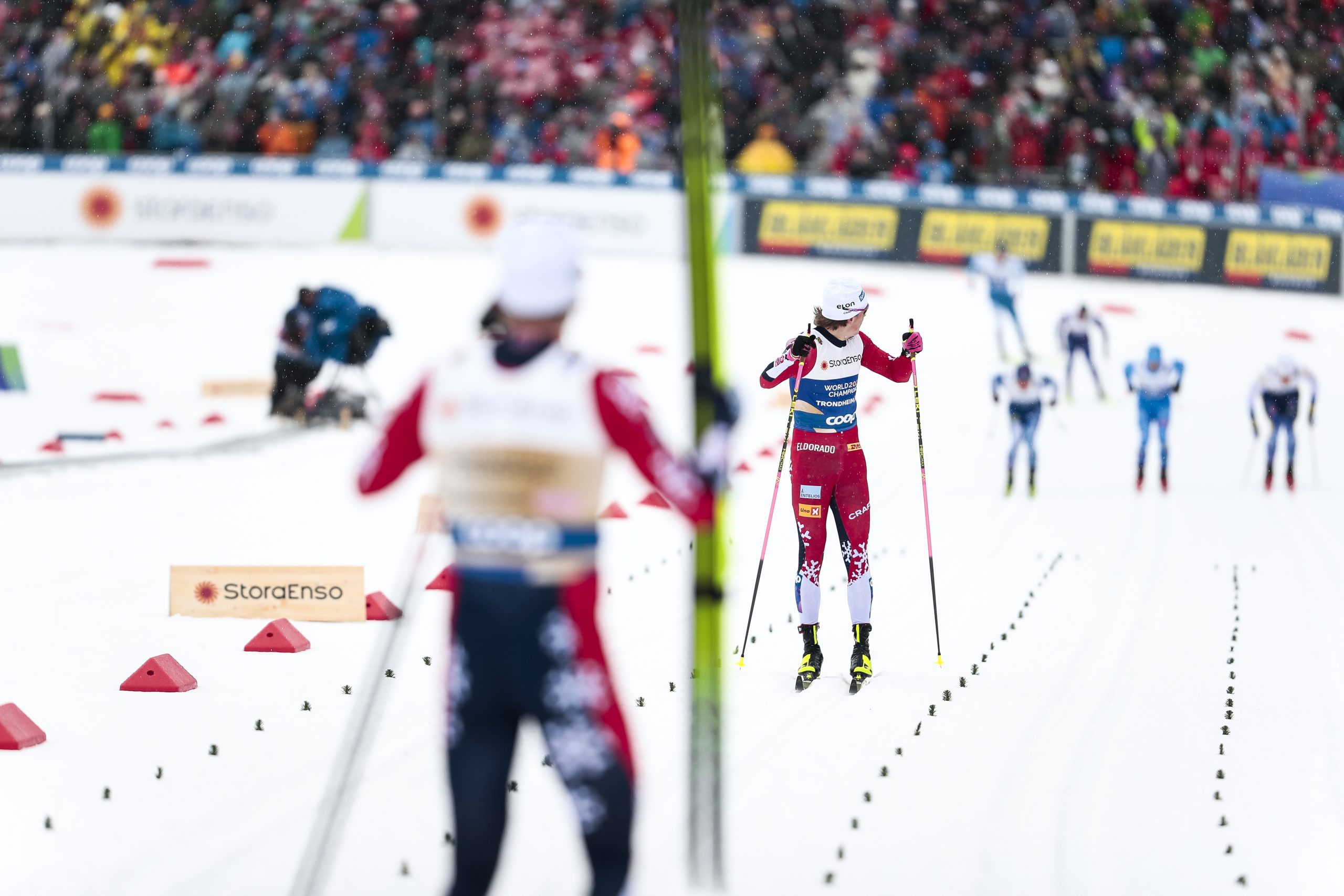
Erik Valnes (NOR) awaits the arrival of his teammate, Johannes Hoesflot Klaebo (NOR) at the finish line of their dominant Team Sprint victory at the World Championships in Trondheim , Norway. (Photo: Modica/NordicFocus)
Norway made it look too easy. Klaebo claimed his fourth gold in as many races, and an entire ski-nation breathed a collective sigh of relief. There wasn’t really all that much celebrating taking place after a race in which anything other than an easy win would’ve been an utter surprise.
For context, when asked in pre-race interviews what his team’s “plan” was, Switzerland’s Janik Riebli almost laughed. “Go as fast as possible from start to finish,” he grinned. That’s the situation for all but the few elite teams. The Norway’s of the world may have a plan going into the race, a strategy they hope to follow. The rest of the world just tries to hang on.
While the Women’s Team Sprint may have involved some position-jockeying and creative pacing strategies, the plan in the Men’s Team Sprint was never in doubt. When your team has a finisher like Klaebo, you just figure out how to deliver him to the vicinity of the finish line, and let him do the rest. Erik Valnes (Klaebo’s teammate) is a truly great sprinter, but his assignment was really just to avoid screwing up. If some other team in the field could find a chink in Valnes’ armor, then there might be a chance for an upset. But any team attempting that strategy could well find themselves blowing up mid-race, and crawling across the finish line with nothing.
Gus Schumacher (USA) has delivered the best performances among American men this week in Trondheim. Put this guy on some fast skis, and he’s definitely capable of standing on the podium at these World Championships. (Photo: Modica/NordicFocus)
It hasn’t been the brightest showing for Team USA at these World Championships. But, the most important competitions in cross country skiing (Olympics, World Championships, etc.) are typically dominated by established ski nations (Norway, Sweden, Russia). The USA still trails pretty far behind those perennial ski-contenders. On the other hand, Gus Schumacher (USA) notched a 9th place and a 13th place in races thus far in these championships. It looks like he could’ve done even better if he had fast skis to race on. If Team USA’s tech team could put Schumacher on a pair of fast skis, then he and his teammate, JC Schoonmaker, could have a chance to shake things up.
Even choosing the USA’s sprint duo may have proven to be a bit of a challenge. This season, the top American Sprinter in World Cup races has often been Ben Ogden (who is also an entirely capable Distance racer), but he hasn’t looked especially sharp in the days leading up to this event. That leaves Schumacher and Schoonmaker to carry the flag in the Team Sprint. It’s an interesting choice to utilize Schumacher in this event, since he’s a possible medal contender in the 50 k Freestyle to be contested in a few days. It will be interesting to see if coaches also choose to place Schumacher in tomorrow’s Team Relay where Team USA is likely to be far removed from medal contention. Schumacher’s participation in that relay could burn all of his matches before he ever gets to the 50 k starting line.
Johannes Hoesflot Klaebo (NOR) and Erik Valnes (NOR) delivered a pitch-perfect performance in the Team Sprint. (Photo: Modica/NordicFocus)
Team Sprint
Klaebo was expected to treat the Team Sprint as just another victory lap. His partner—silver medalist from the 10 k Classic, Erik Valnes—is responsible for keeping Norway in contention, delivering a position to Klaebo for him to outsprint all the other contenders. The early pace made it appear that none of the other teams were willing to take risks. Finland and France marked Valnes’ pace. Everyone else bided their time in a crowded, but calm, pack.
In the exchange zone at the end of Leg 1, the set up was almost comical: Klaebo stood out front awaiting the tag from Valnes, with all the other nations giving Norway a protected halo of space around Klaebo. The rest of the countries were congested into a crowded knot of poles and skis, but no one wanted to be the one who tripped up Norway’s Favorite Son . . . not in front of 30,000 home town fans.
Johannes Hoesflot Klaebo (NOR) occupied a protective halo in the exchange zone as he was tagged by teammate, Erik Valnes (NOR). With 30,000 protective Norwegian fans in attendance, no one wanted to interfere with this guy. (Photo Modica/NordicFocus)
Klaebo had little reason to push the pace in his first leg where he was marked calmly by Richard Jouve (FRA). The field stretched out a bit, but it seemed to be more a result of some skiers struggling with kick wax than the result of pace-making at the front. Enjoying another exchange zone halo of safety, Klaebo tagged Valnes at the front of a loose 12-man pack.
Valnes threw in extra skate strokes (presumably within the rules) over the top of the first hill, creating additional space between himself and Ristomatti Hakkola (FIN). Jules Chappaz (FRA) took over the lead of the chase group as they entered the exchange zone again, some four seconds behind Norway. Shumacher brought Team USA through the exchange in fourth place, still in contention alongside Italy, Finland, and Sweden. Schoonmaker would have his hands full with the likes of Federico Pellegrino (ITA), Edvin Anger (SWE), and Richard Jouve (FRA), but Schoonmaker showed himself to be a cagey racer, short-stepping to set his kick wax on the uphills while other contenders slipped.
Valnes began his last leg with an enormous gap on the field. Team Norway had only to stay on its feet in order to claim gold. Behind them, the rest of the skiing world prepared to duke it out for silver and bronze. Schumacher held his position among Oskar Svensson (SWE), Davide Graz (ITA), Chappaz, and Hakkola. Hakkola accelerated up the final hill to give Finland sole possession of second. They maintained that slim gap into the exchange as Schumacher and Chappaz dueled for third. Svensson faltered in the final meters, leaving Anger with an unfortunate deficit to make up.
Schoonmaker described the final exchange: “I saw Gus coming around the corner in third, and I just got super nervous.” The race for the medals was about to begin. Vuorinen was 1.3 kilometers from a silver medal. He’d give it all he could. Pellegrino, Jouve, and Schoonmaker would settle any remaining questions in their race to the line. And everyone (except the roaring Norwegian fans) seemed to have forgotten about Klaebo, calmly kicking and gliding somewhere far off the front.
As the race topped the final hill, suddenly the medal possibilities were re-shuffled. Pellegrino caught Vuorinen, and Anger charged up from nowhere to put Team Sweden into the medal fight. Schoonmaker and Jouve began to fade.
“I was feeling good and relaxed,” recalled Schoonmaker, “then maybe it was me starting to feel weak, or those other guys starting to feel strong. They just had another gear that I couldn’t really find. I was proud to be in the fight for the medal, but it’s bittersweet to be so close.”
Sweden’s Edvin Anger (r) lunges past Federico Pellegrino (ITA) to claim bronze at the World Championship Team Sprint in Trondheim. (Photo: Modica/NordicFocus)
Pellegrino had misjudged the line on the finishing righthand bend earlier in this world Championship week. In this Team Sprint finish, he blew it again—diving to the inside, catching an edge that rocked him back on his heels, and exiting wide after losing his speed. Pellegrino’s error allowed Hakkola back into the sprint, but it was Anger who dismantled them all in the finishing straight, charging forward to claim silver ahead of Hakkola and Pellegrino.
“In the final sprint we know that my strength isn’t equal with either Lauri or Anger,” said Pellegrino. “I tried until the end, and I came out on the wrong side of Anger. He won the classic sprint this year and showed yesterday that he is really strong.”
“But what is important is that Italy today—also in the women’s race—was truly at the top and it was beautiful,” Pellegrino continued. “I’ve been telling these guys for years that if we can maintain the speed and endurance that we have, we can compete in all races, on all courses, and all types of snow, and I’m happy that in this World Championship so far we are demonstrating this.”
For Team Norway, it was a win that the whole skiing world expected. For Klaebo, it was perhaps the least taxing way to win a fourth gold medal on his way to who knows how many? Norway will hope for a repeat performance in the Team relay tomorrow in the hope that a relatively easy relay win will set Klaebo up for an even more historic win in the 50 k. Lost of racing still to come.
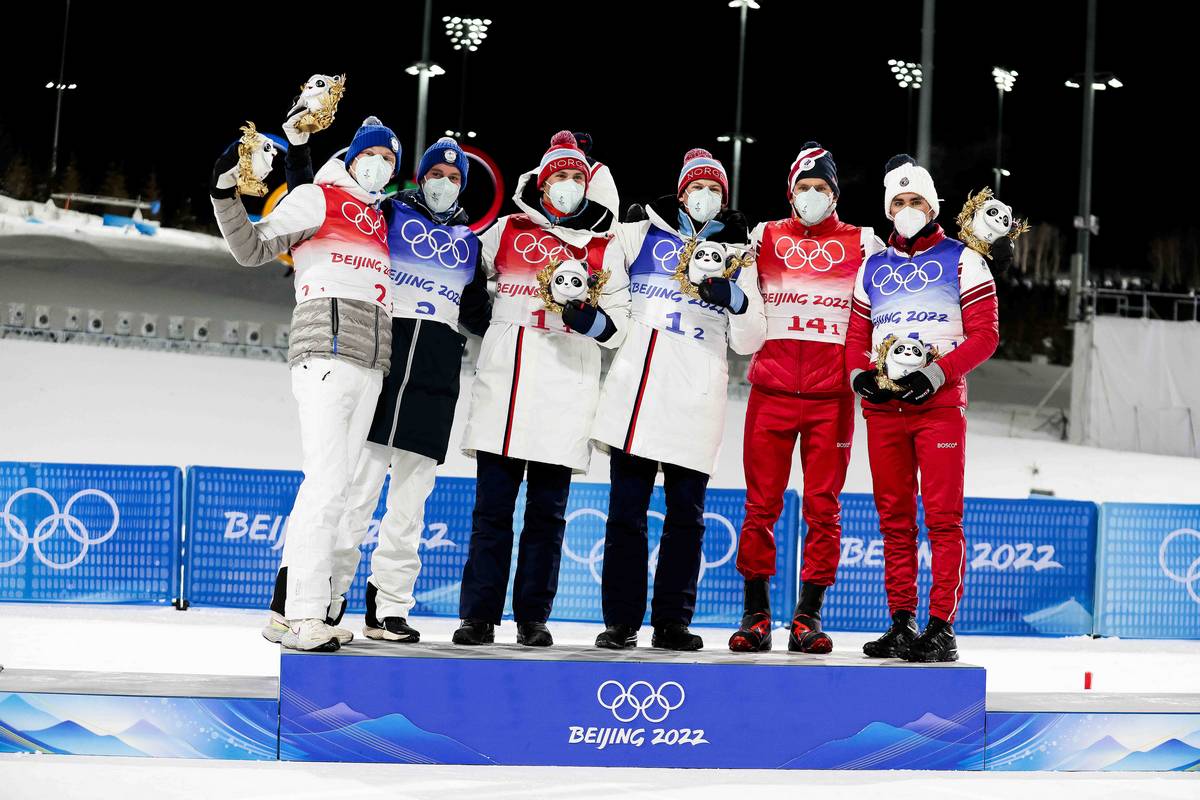
Ristomatti Hakola (FIN), Lauri Vuorinen (FIN), Erik Valnes (NOR), Johannes Hoesflot Klaebo (NOR), Oskar Svensson (SWE), Edvin Anger (SWE), (l-r) on the podium of the Team Sprint from the 2025 World Championships in Trondheim, Norway. (Photo: Modica/NordicFocus)
This coverage is made possible through the generous support of Marty and Kathy Hall and A Hall Mark of Excellence Award. To learn more about A Hall Mark of Excellence Award, or to learn how you can support FasterSkier’s coverage, please contact info@fasterskier.com.
Friday night in Davos: A fast course, fireballs, and a remarkably flexible field for the Men’s Team Sprint Finals.
After qualifying, the evening’s would-be winner was uncharacteristically unclear, with four nations represented in the top five qualifying times. Ben Ogden (USA I) started his second weekend of sprinting in pole position, having put a full 1.67 seconds on the individual favorite, Johannes Høsflot Klæbo (Norway 1). Edvin Anger (Sweden 1) qualified third; teammates and host-nation heroes Valerio Grond and Riebli Janik (Switzerland 1) were fourth and fifth, respectively. The Swiss duo’s combined times put Switzerland 1 at the front of the starting gate; USA 1 started in second position (with Zanden McMullen qualifying 26th), followed by Norway 1 (J.H. Klæbo and Paal Golberg) in third. USA 2 (J.C. Schoonmaker and Kevin Bolger, qualifying ninth and 24th) started the race in eighth, putting both American teams in the final. Further down the starting list, although hardly out of contention, were Sweden 1 (E. Anger and Johan Haggstroem) in fourth; and France 1 (Jules Chappaz and Richard Jouve) and France 2 (Remi Bourdin and Renaud Jay) in fifth.
Ben Ogden (USA 1), top qualifier in the Men’s Team Sprint. (Photo: Modica/NordicFocus)
Breathless after qualifying, Ogden panted a comment to FIS, expressing high hopes for the final ahead. “Last week was a good start but a bad finish. Today I’m turning it around: A good start and a good finish!” His race strategy was simple: “Ski fast in the first lap. Ski fast in the second lap. And then ski really fast in the third lap.” As for conditions, Ogden echoed the sentiment expressed across numerous athletes’ social media posts in the previous days, stating that the team is “Happy to be racing in beautiful Switzerland.” With thorough snow coverage, superb grooming, and no shortage of pyrotechnics (athletes were expressly warned to swing wide of the flamethrowers on the final corner), things appeared favorable for left-field performances: Notably absent from the grid were more Norwegians and Swedes (each nation qualified only a single team each); the French are benching Chanavat until tomorrow, and if the Germans or the Finns (other than Lauri Vuorinen, third in Ruka) have a solid Sprint team they haven’t bothered to tell anyone yet.
Switzerland 1: Courageous Performances from the Crowd Favorites
For optimistic viewers, the race was an exercise in suspending disbelief. Far from the self-assured Swedish dominance in the Women’s Team Sprint, the lead of the Men’s pack was repeatedly contested over the course of twelve laps, with a hard-out-of-the-gate start from Janik Riebli putting the Switzerland 1 at the forefront of the evening’s action. Norway’s Paal Golberg made an early challenge descending into the first exchange, but Valerio Grond fended off a few probing jump-skates from Klæbo to reclaim the lead on Lap 3. By Lap 4, the key contests of the evening had already been sketched: the Swiss Men were determined to fight for the front of the pack; the Norwegians wanted–and frequently got–control of the race, and Frederico Pelligrino, returned from a weekend of rest, was practically Klæbo’s shadow each time the two ascended the course’s singular climb–a blue specter locked as closely as possible behind the Norwegian’s white hat.
To more cynical fans, however, the outcome–which always seemed to favor Norway I, despite Golberg’s lackluster qualifying lap (he was 19th, over six seconds behind Ogden)–was clear by the start of Lap 6. Despite repeated challenges, an unflappable Klæbo danced over the hill-crest and around the slick downhill corner as the mass of Men around him appeared lunging (and occasionally stumbling) by comparison. Elia Barp (ITA I)–the young gun to “Daddy Chico’s” elder statesman–had maneuvered the Italians into second; Schoonmaker handed off to Kevin Bolger in third, with Ogden tagging McMullen in sixth, so there was still ample fighting ahead for podium finishes, but Golberg was pulling his weight and keeping the race where Klæbo needed it to be (which, realistically, was anywhere within ten seconds of the lead).
This was not to say that there weren’t a few fireworks in store. Beginning in Lap 8, Valerio Grond saw the writing on the wall and attempted to unnerve the Norwegians with a huge surge over the climb; he managed to open a ski-length against Klæbo and handed off to Riebli, who held onto first position through Lap 9. Golberg moved to reel in the Swiss, but his fatigue was becoming evident on the Lap 10 climb as Riebli initiated a furious jump-skate; dropping his shoulder, the Norwegian was losing turnover and power, but managed to stay in second through the final exchange. Elia Barp handed off to Pellegrino hot on Golberg’s heels, and the Frenchmen occupied fourth and fifth, just ahead of USA 1 and 2.
Swinging in to slice across the apex of the first corner, Pellegrino led into the penultimate climb; Grond marked him on the inside, while Klæbo moved to the far left shoulder of the course to challenge the Italian. Appearing to stumble–perhaps catching a ski on Grond–over the crest, Pellegrino descended in third; now it was Grond to the front, with Klæbo adhered to his tails in second. Rounding the downhill corner, nine skiers jockeyed for prime positioning into the long, wide, and flat straightaway into the final lap, but Klæbo could smell the Gruyere (or perhaps the singed spandex) and unfurled himself into a fluid, ground-eating V2. Ben Ogden observed that, although today was an important exercise in “energy management,” this section was undoubtedly “the deciding point of today’s race.” Grond was pumping like mad, but by the base of the last climb, Klæbo had four ski-lengths on the field, and offered his competitors no slipstream on the descent.
With Grond and Pellegrino battling for the podium, and two Frenchmen, Bolger, and Ogden battling for fifth and sixth, the Swedes finally decided to start racing: Edwin Anger, largely absent from the evening’s excitement, leapt up the hill and into second. With a glance over his shoulder, Klæbo powered around the final corner and opened his arms in victory across the line, while the three men behind him–Anger, Grond, and Pellegrino–roared down the finishing stretch. With meters to go, Grond stepped to the outside to clinch second for the Swiss, and Pellegrino–appearing to cross the line in third–ultimately took fourth thanks to a tremendous lunge from Anger, who snuck his toe 0.02 seconds ahead of the Italian’s. France 1’s Richard Jouve was fifth; Ogden for USA 1 and Bolger for USA 2 were sixth and seventh.
Grond secures second place for Switzerland 1, ahead of Edvin Anger (SWE, not pictured) and Frederico Pellegrino (ITA, left), and in front of a raucous home crowd. (Photo: Modica/NordicFocus)
Golberg & Klæbo Steady to the Podium; More Sprinting Ahead
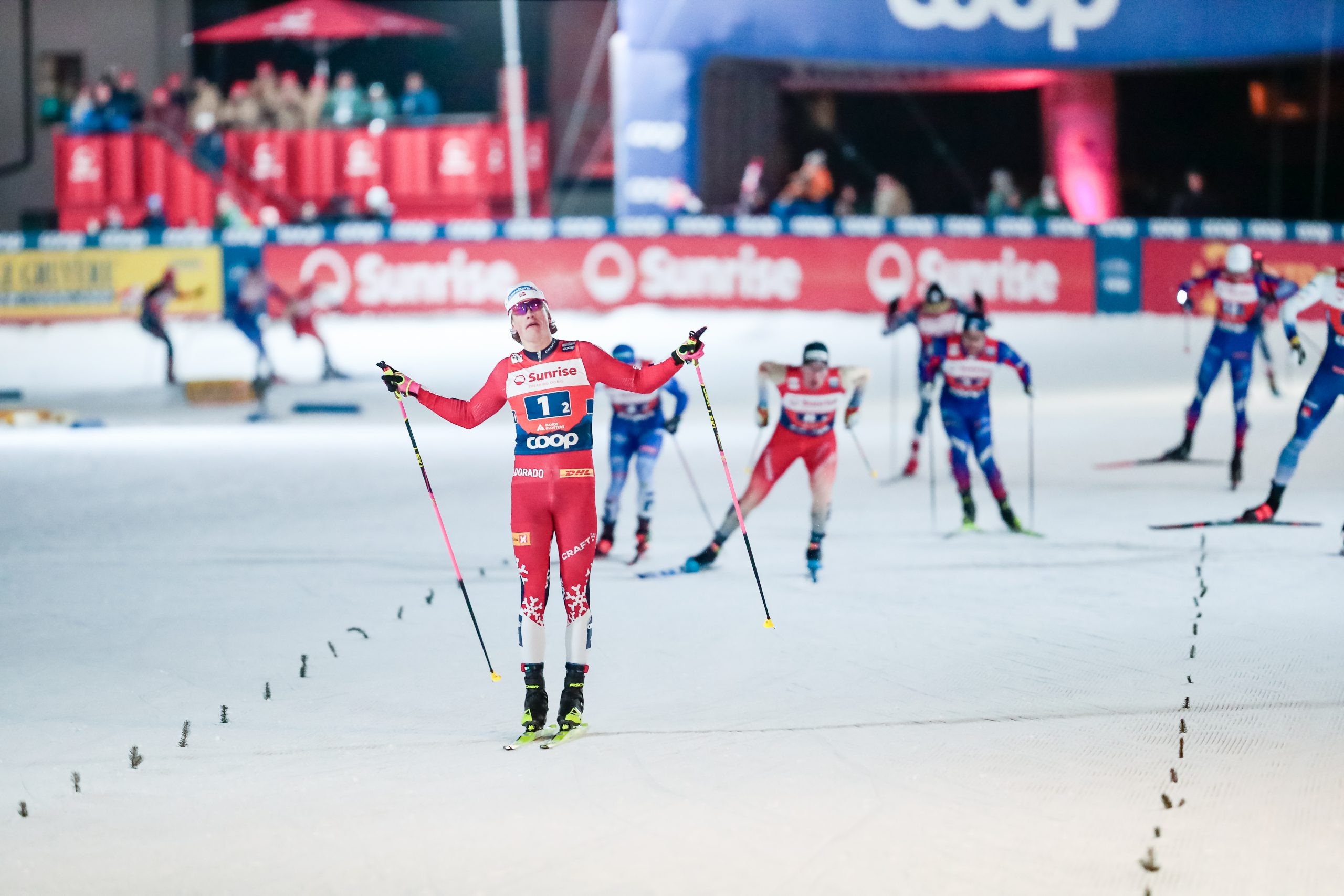
In retrospect, today was Paal Golberg’s race to lose, and the Norwegian showed no intention of doing so. In his post-race interview, Golberg noted he has historically struggled in Davos (his previous personal best was an eighth-place Sprint finish in December, 2011), and was gratified to secure tonight’s podium with Klæbo. For his part, the Norwegian anchor was gracious as always (well, at least since 2018), complimenting the venue and the night-racing format, and modestly stating that he will “come back tomorrow, and try to compete one more time, and see how it goes.” Today marked Klæbo’s 93rd World Cup victory; Saturday could well be his 94th.
Johannes Hoesflot Klaebo (NOR) crosses the line in the Men’s Team Sprint, his 93rd World Cup victory. (Photo: Modica/NordicFocus)
The Swiss Men appeared ecstatic to secure a podium in front of a home crowd, and Pellegrino–doubtless disappointed–will certainly have another bite at the cheese tomorrow. While the Americans may have had their sights set on a more competitive finish, both Men’s teams finishing in the top eight is a marked improvement from their performance in the single Team Sprint of 2023-24 (Lahti, where no Americans made the final) and from 2022-23 (when USA 1 was 12th in Livigno). Reached for comment, Ben Ogden admitted that he “wanted to better in the actual race and not just the pointless pre-race race.” While frustrated, he feels the American Men “learned a lot and were very close to [their] goals, so [they] are not disappointed.”
Kevin Bolger wrote that it’s “always fun battling between [USA] Team 1 and 2. We joke that at the end of the day, that’s the most important team to beat.” Bolger and J.C. Schoonmaker, ahead of USA 1 for most of the race, “wanted to stay in front and keep out of trouble,” and enjoyed being in the mix with Ogden and McMullen alongside them. While tomorrow will be a “tight turnaround” for the USA sprinters, the “only thing to do is eat, sleep, and try to be horizontal.” Today, “pretty much from the start of Lap 2 the throttle went down,” so there will be no shortage of lactate to flush out over the course of Saturday afternoon as the athletes head to another round of night sprinting.
The US Men are now in sixth in the Nations Cup, 20 points behind Germany.
This World Cup coverage is made possible through the generous support of Marty and Kathy Hall and A Hall Mark of Excellence Award. To learn more about A Hall Mark of Excellence Award, or to learn how you can support FasterSkier’s coverage, please contact info@fasterskier.com.
World Cup Finals began under overcast Finnish skies Friday, as the circuit looks to settle the questions of a long season over the next three days. Who was—and who wasn’t—racing in Friday’s non-World Cup point scoring event provided evidence that the Crystal Globes remain at the forefront of concerns this weekend.
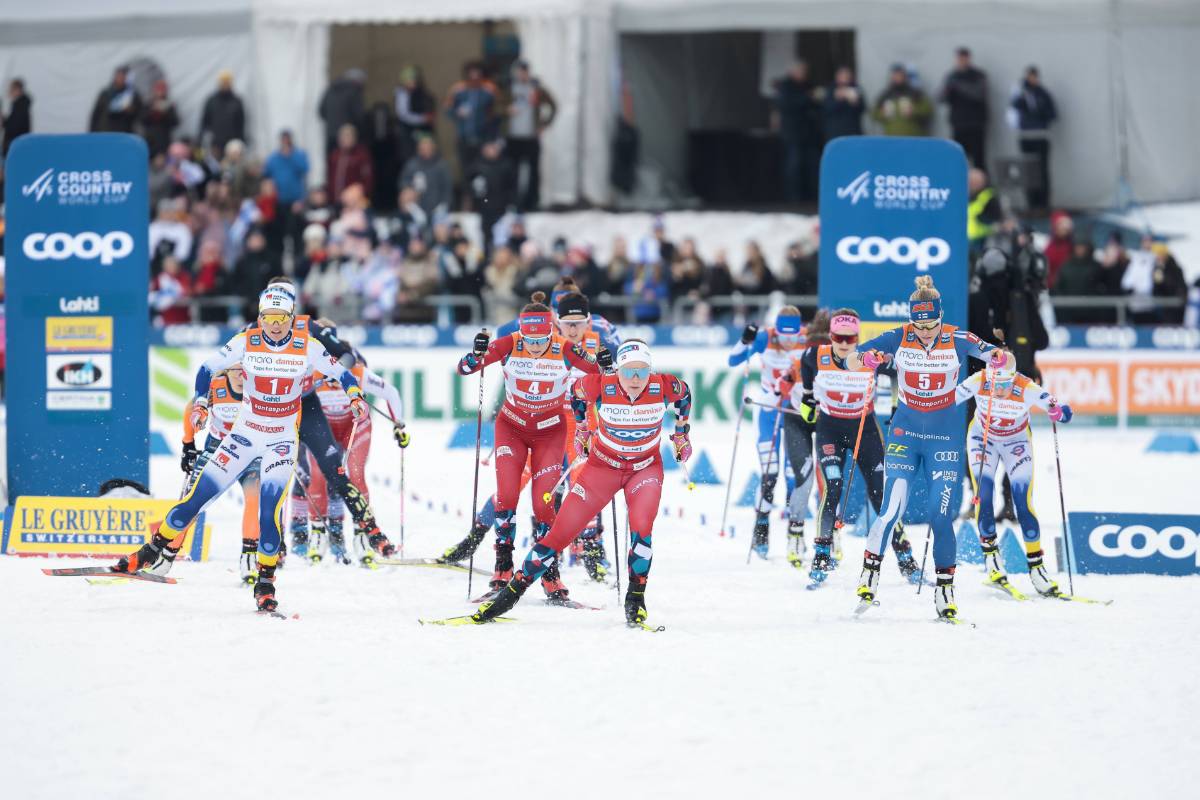
The women’s Team Sprint as it began on Friday. Notable absences from top Crystal Globe contenders shaped the field Friday as World Cup Finals began in Lahti. (Photo: NordicFocus)
With the Women’s Overall, Distance, and Sprint World Cup classifications all still undecided going into this weekend, Friday’s Team Sprint was absent any women standing within the top five of any of the World Cup classifications. The most notable absences drew attention straight to the top of the World Cup standings: Jessie Diggins (USA) sits second in both the Overall and Distance classifications, with 110 points separating her from Overall leader Tiril Udnes Weng (NOR), and just 22 points between her and Distance leader Kertuu Niskanen (FIN) ahead of Sunday’s 20 k classic. The gap is also 22 points in the Sprint classification between leader Nadine Faehndrich (SUI) and second place Maja Dahlqvist (SWE). The cascade of absences beyond the top two further revealed the closeness of the Women’s field. With points standings tight and the stakes for gaining an additional place or keeping one high, skiers like Rosie Brennan (USA), four points ahead of Heidi Weng (NOR) for fourth Overall, were absent. Julia Kern (USA) joined that list too, looking to hold onto a top five in the Sprint classification that she holds onto by just eight points over Laura Gimmler (GER).
The Men’s Team Sprint field, meanwhile, was much more complete. Johannes Hoesflot Klaebo (NOR) holds an insurmountable 421 point lead over second place Paal Golberg (NOR) in the Overall. The same is true in the Sprint, where Klaebo holds a 254 point gap over Lucas Chavanat (FRA). The only Men’s Classification still technically unsettled is the Distance, where Paal Golberg’s 112 point lead on Klaebo would technically be passable if Klaebo were to win Sunday, win intermediate bonuses, and not have Golberg score any points (which appears unlikely). Further down the Men’s field, the majority of points gaps are larger, which played into Federico Pellegrino (ITA), Lucas Chanavat (FRA), Edvin Anger (SWE), and Richard Jouve (FRA) all being present in the field today. There were other who sat out this team event: notably, Ben Ogden (USA) who is pursuing the best American Men’s World Cup Overall finish since Bill Koch in the 1980s, sitting less than 20 points behind Calle Halfvarsson in seventh Overall.
Women’s Team Sprint
For all the absences from the Women’s field Friday, the defending World Champions in the Team Sprint—the Sweden I team of Emma Ribom and Jonna Sundling—still made it to the start line. Sweden I made it a good race, and a creative one too. “We wanted to have fun, to make it a more tactical race,” Sundling said to FIS media after the race was over.
Jonna Sundling made a clean finishing move to bring Sweden I—reigning World Champions—the win in Lahti, Finland. (Photo: NordicFocus)
As to how that plan played out, Ribom and Sundling took turns dutifully marking the Norway I team of Julie Myhre and Anne Kjersti Kalvaa at the front of the race. When they reached the final climb on the Lahti course, Sundling simply hop-skated away to victory. It was a crisper, cleaner, version of the tactic that she had used in Planica to win the Team Sprint World Championship, and of the one she made in Drammen to win Falun’s 4 x 5 k Mixed Relay for Sweden last weekend.
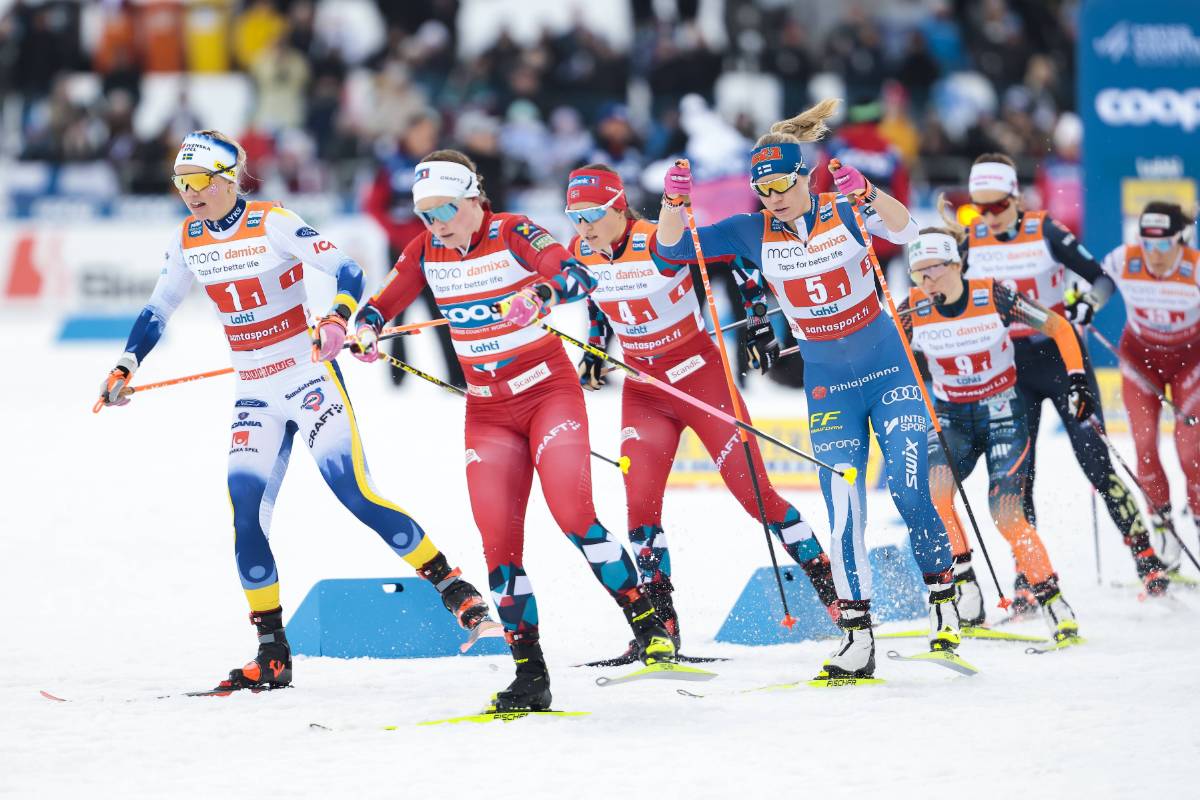
Behind Sundling’s move, late-race heroics were making for a thrilling finish. The lead pack through most of the race had included the Sweden I team alongside Norway I and the Finland I team of Jasmi Joensuu and Jasmin Kahara. A move from Joensuu in her last leg had created a clean break for the trio of teams; through most of the last lap, Kahara looked like she would hold the separation between her and the chase group. When Sundling went, Anne Kjersti Kalvaa (NOR) was able to stick with her just long enough to win Norway I second place. Behind her, though, two German teams had started to chase down Kahara. As the Finn entered the stadium, Coletta Rydzek for Germany I and Sofie Krehl for Germany II were skiing in tandem, and skiing their way back up to the Finn. The race for third went to the line. Three lunges produced a result that saw Rydzek come across the finish in third place, while Finland I took fourth in a photo finish over fifth place Germany II.
Men’s Team Sprint
The Norwegian World Championship Team may have lacked Paal Golberg on Friday, but Erik Valnes would prove to serve as a worthy replacement to pair with Johannes Hoesflot Klaebo for Norway I. With the Italian World Championship runner-up team of Francesco De Fabiani and Federico Pellegrino also present, the Men’s race held promise for a close front-of-pack race, mixed with a field hungry to challenge the prevailing order among Team Sprint powers.
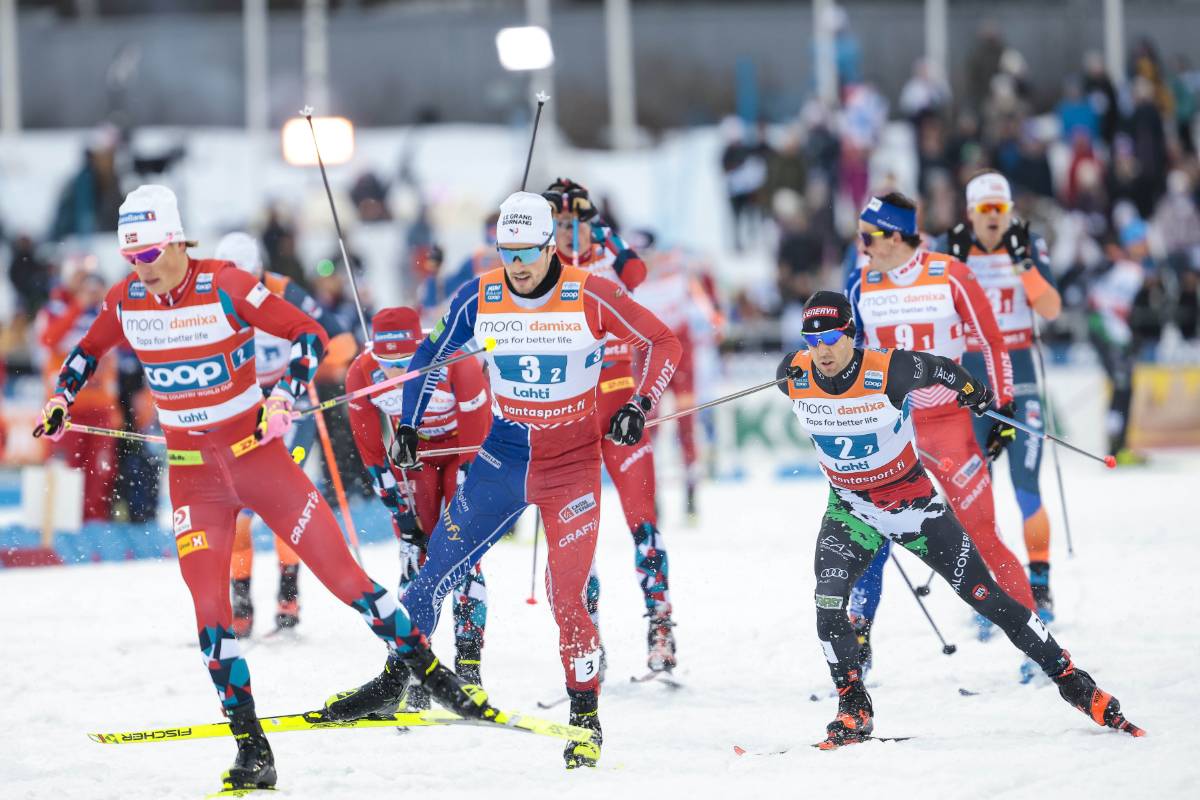
The men’s field remained tight until Johannes Hoesflot Klaebo moved to bring Norway I the win with Italy I in tow. (Photo: NordicFocus)
That dynamic was on display through each of the early laps, as Federico Pellegrino and Johannes Hoesflot Klaebo danced around each other in the early part of the course, and a whole pack of teams filed in to try and keep with the two. In the final lap, Pellegrino looked for an opportunity to entice Klaebo into a long-burning attack; it’s no secret that leaving a sprint finish meant facing Klaebo’s finishing kick that none were likely to match. Klaebo, though, responded as he has throughout the season to this tactic, ticking his pace up just enough to keep the pack close, and then forcing the pack back to stasis. Four challenging teams made it to the last climb: Sweden I with Edvin Anger, Norway II with Sindre Bjoernestad Skar, France II with Richard Jouve, and Germany with Jan Stoelben. Then, Klaebo went, and Pellegrino followed. The pair had a gap into the stadium, and the prevailing order of the Team Sprint had held. Klaebo crossed the line to win for Norway I, Pellegrino crossed to take runner-up for Italy I, and Skar won a two-way sprint over Anger to take Norway II to third.
Americans, Mix, Match, and Push Team Event
Two American teams qualified for the Team Sprint finals. The USA I team for the Women featured the World Cup relay debut of Sammy Smith, who has qualified for heats in successive sprints in Drammen and Falun. Smith paired with Hailey Swirbul, who has become a relay mainstay for the US. “[I love] the energy of team events,” Swirbul said after last week’s Falun relay. “It really emphasizes how ski racing involves much more than only an individual to make a great day happen.”
Sammy Smith and Hailey Swirbul pushed all the way through Friday’s Team Sprint, landing the young USA I lineup in 11th place. (Photo: NordicFocus)
Smith and Swirbul traded off skiing well within the relay pack early in Friday’s race. As the pack strung out through lap three, Smith slipped to 15th place as she handed to Swirbul for lap four. By the end, the pair had made a resurgent push to finish 11th place on the day, delivering an auspicious effort for the young Americans in a team event.
“I really enjoyed getting to race with Sammy, and be in a more low pressure team event situation,” said Hailey Swirbul post-race. “It was a really cool way to build experience for Sammy and myself, and she skied really well today.”
The pairing of Zak Ketterson and JC Schoonmaker held in the tight men’s race through their first couple of exchanges, before pace increases at the front led to a falling off. The pair pushed on to take 13th place on the day.
“Zak and I were pretty excited to just be able to ski with the pack and make decisions on the fly,” said Schoonmaker in post-race comments. “That’s some of the most fun you can have in ski racing. I definitely wish I could have hung in the main pack longer than I did because Zak was skiing super well, but we did what we could.”
Schoonmaker added that this year’s team events have come with added joy for the men’s team. “It’s been really cool to get to race with some different guys this winter,” he said. “We have a strong men’s team right now so being partnered with any of those guys is an honor.”
Sprint Classification Settled Tomorrow
World Cup Finals continues tomorrow in Lahti, as a classic sprint is set to decide the winner of the Nadine Faehndrich-Maja Dahlqvist Sprint Crystal Globe race in the Women’s field. On the Men’s side, a final act is being planned for the dominant Sprint campaign of Johannes Hoesflot Klaebo.
Meanwhile, Jessie Diggins (USA) will begin her final, two-day push to reel back the Overall Crystal Globe, looking to best Tiril Udnes Weng NOR) with her finish tomorrow and net valuable World Cup points.
This World Cup coverage is made possible through the generous support of Marty and Kathy Hall and A Hall Mark of Excellence Award. To learn more about A Hall Mark of Excellence Award, or to learn how you can support FasterSkier’s coverage, please contact info@fasterskier.com.
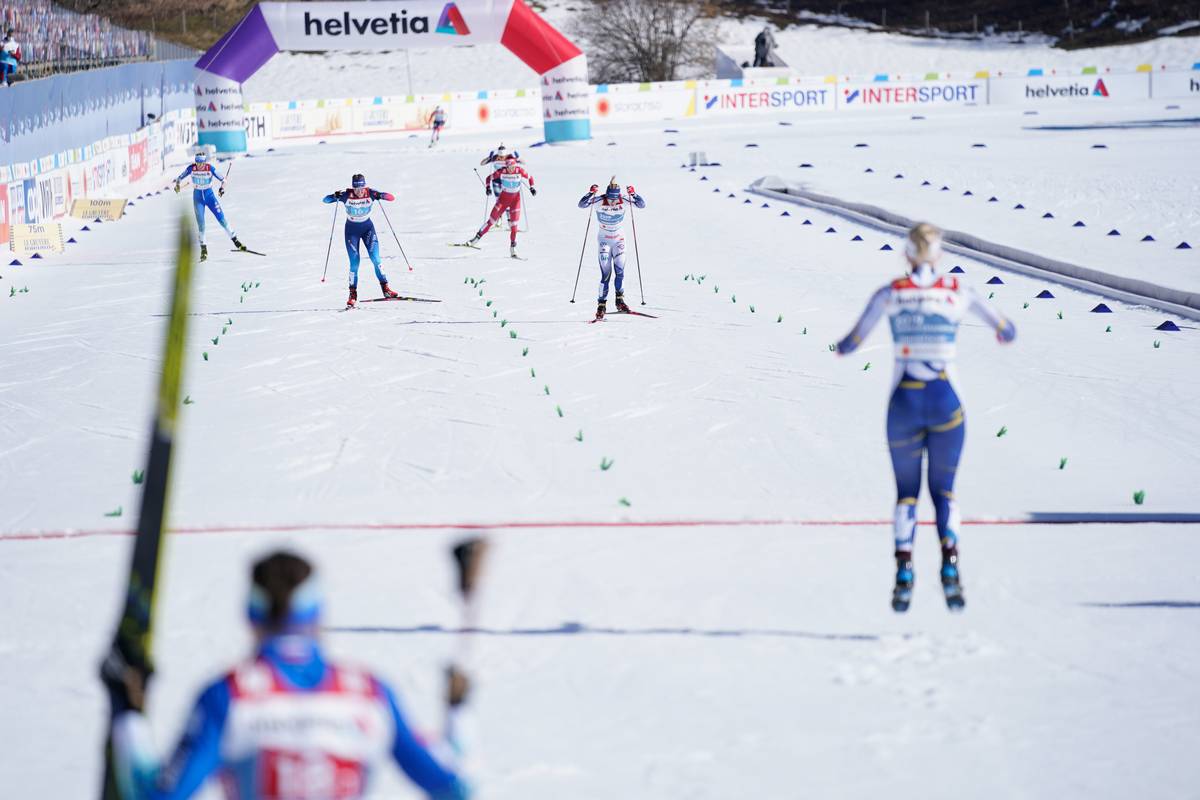
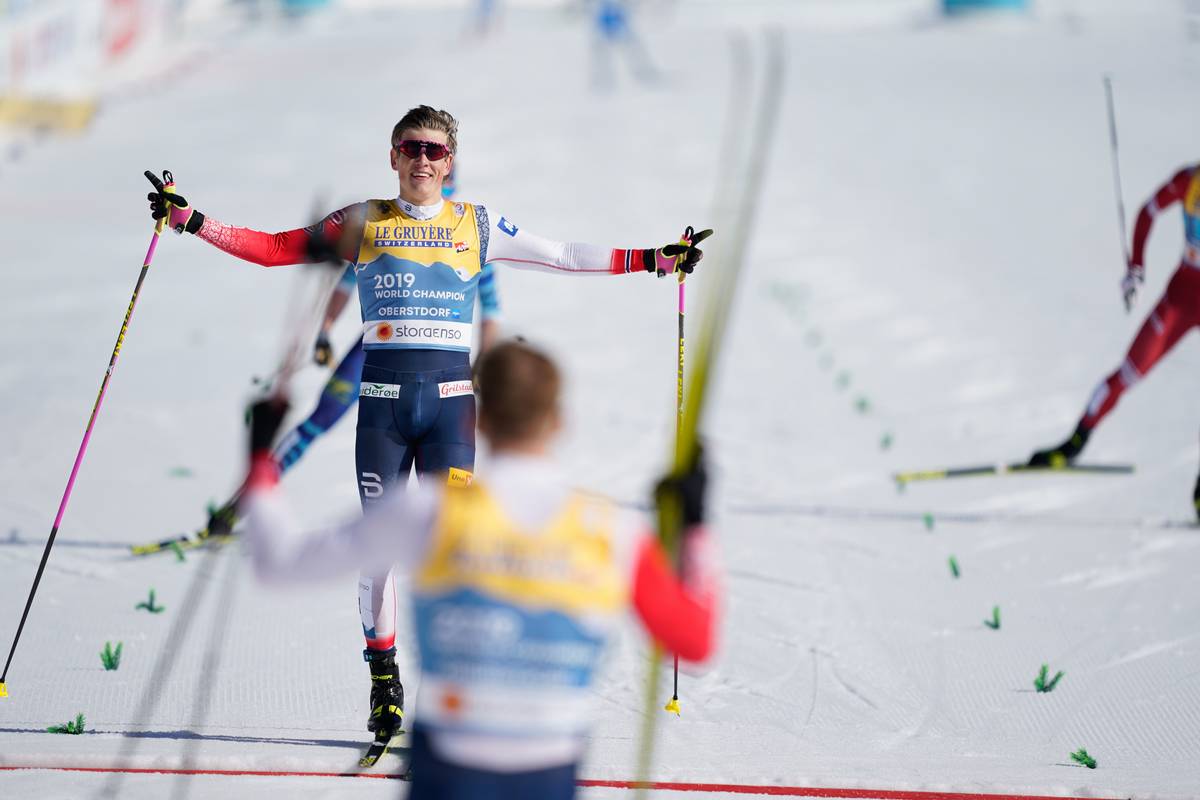
Johannes Hoesflot Klaebo (NOR) approaches the finish line ahead of Italy’s Federico Pellegrino. (Photo: Modica/NordicFocus)
Three races: three medals. Johannes Hoesflot Klaebo (NOR) pursues the history that is available to him, but the history he pursues is likely to be marked with an Asterisk. He is one of the few skiers scheduled to compete in every event at these World Championships, and he is expected to medal in every event. Even so, Klaebo, himself, reminded reporters that Saturday’s silver medal in the 30 k Skiathlon was his first World Championship distance medal. He hasn’t always enjoyed this sort of dominance. And while many of the very finest skiers are here in Planica, many of the very finest are not. If Russian skiers were at these World Championships, Klaebo might still be collecting medals, but the racing would be quite different. As it is, the Russians languish at home, their exclusion from these championships (and from theWorld Cup tour) coming as a result of their government’s invasion of Ukraine. The championships go on without them, leaving predictable foregone conclusions: Norway the team to beat, Norway the favorite for victory, Norway on the podium, Norway with the gold. These are the World Championships of Cross Country Skiing . . . and Norway is the team to watch.
Antoine Cyr (CAN), and Graham Ritchie (CAN) celebrate their fourth place finish in the Team Sprint at the FIS Cross Country World championships in Planica, Slovenia. (Photo: Modica/NordicFocus)
Team Norway—Klaebo and compatriot Paal Golberg—did not disappoint in the Team Sprint, holding off second place Federico Pellegrino and Francesco de Fabiani of Italy, and third place Renaud Jay and Richard Jouve of France. Among North American teams, Canada was truly remarkable with Antoine Cyr and Graham Ritchie finishing fourth, while Ben Ogden and JC Schoonmaker of the United States finished tenth.
Men’s Team Sprint
Having watched the success of Julia Kern (USA) and Jessie Diggins (USA) in the earlier Women’s Team Sprint, it came as no surprise to see Schoonmaker following the example that had earned bronze for his teammates. Schoonmaker moved early to take the first position into the long rolling downhill at the beginning of the Planica course. Golberg and Jay were quick to counter the move, and Golberg went to the front of the pack on the climb with Jay in tow. Schoonmaker held third through the climb, but Golberg’s arrival at the front had subdued the field. Whereas the women’s race had gone full bore from the gun, the men’s race settled into a slightly more tactical affair. Schoonmaker handed off to Ogden in fifth place, with the pack tightly bunched.
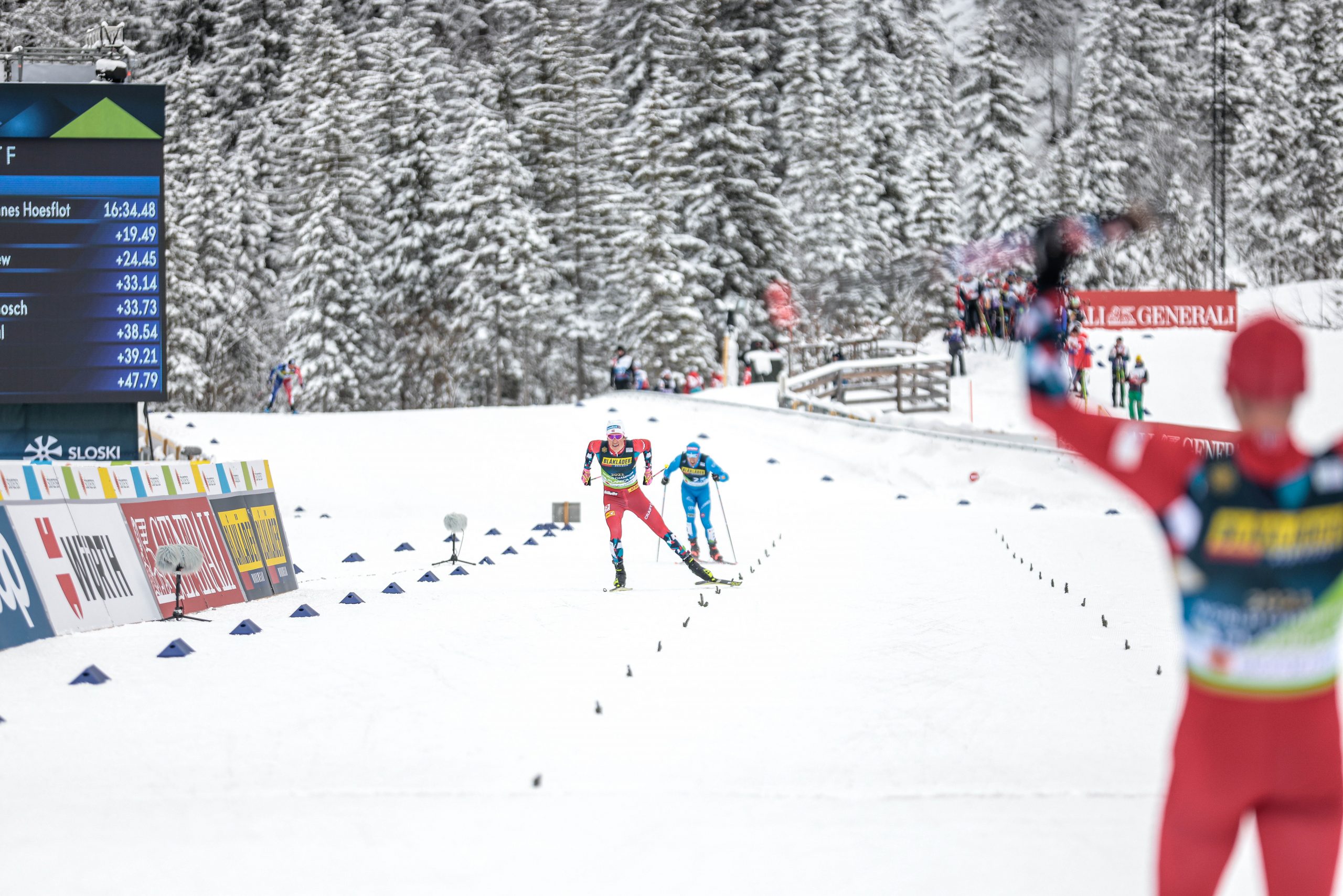
For the next four exchanges, the Americans did their best to hang on, while the stars did battle at the front. Various accelerations, small attacks, defensive coverages, and tactical speedings and slowings led to the three fastest teams—Norway, Italy, France—pulling away from the field (pursued doggedly by Sweden and Canada). In the end, Pellegrino tried to impress his will on Klaebo in the final leg, but the Norwegian was simply too strong, too fast, too resilient. Into the final hill, Klaebo ignited the hint of promise that had been there all along, skiing away from Pellegrino in a final sprint.
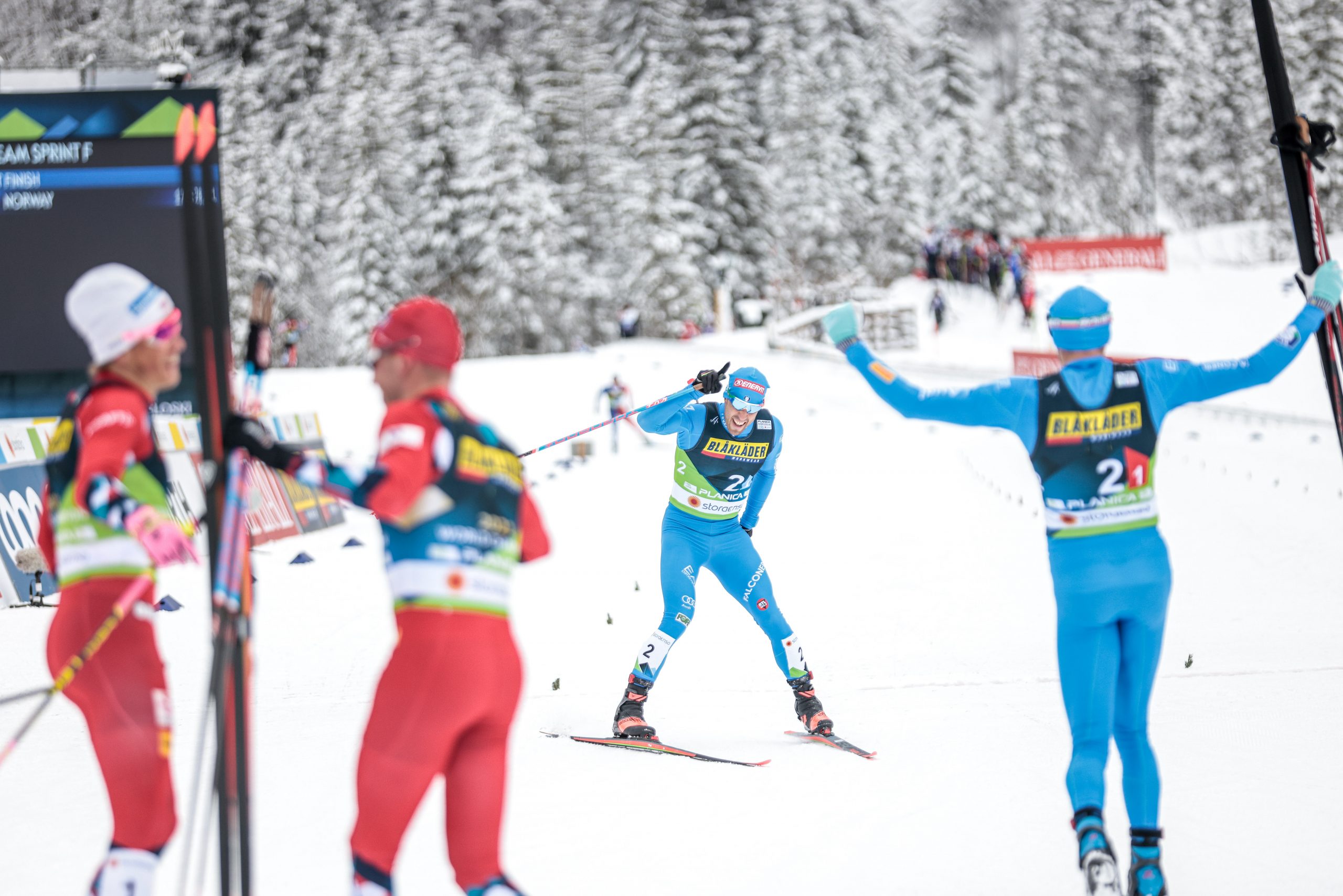
Federico Pellegrino (ITA) skis into the embrace of his teammate, Francesco de Fabiani, earning silver in the World Championships Team Sprint. (Photo: Modica/NordicFocus)
Pellegrino’s move on the final climb had landed the Italians second on the podium in definitive fashion. France was third, while Canada—on the back of a strong final closing move from Graham Ritchie—moved into fourth place on the day just ahead of Sweden. The United States moved down to 10th to finish inside the top ten.
While much had been expected of Norway, it was Canada that exceeded expectations:
“This was team sprint together, and we’ve set up a game plan that’s worked for us in the past,” said Ritchie. “We decided to not change anything today and see if we could knock off another position and it worked out for us.”
“We have a good plan,” said Cyr. “Normally, I go in the first leg and move through the pack to get Ritchie in a good position so we push in the last lap. Today it really worked. Being out of the medal again is hard, but we will get there one day . . . It makes you feel like in a couple more years, we will get there.”
Ritchie summed up the experience of the Canadians: “I had one guy to reel in on the last leg, and it was a good one. I had the whole lap to try and catch him, and was confident that I could . . . Seeing Jouve over the last bump gave me the motivation. We can see [the podium], it’s right there.”
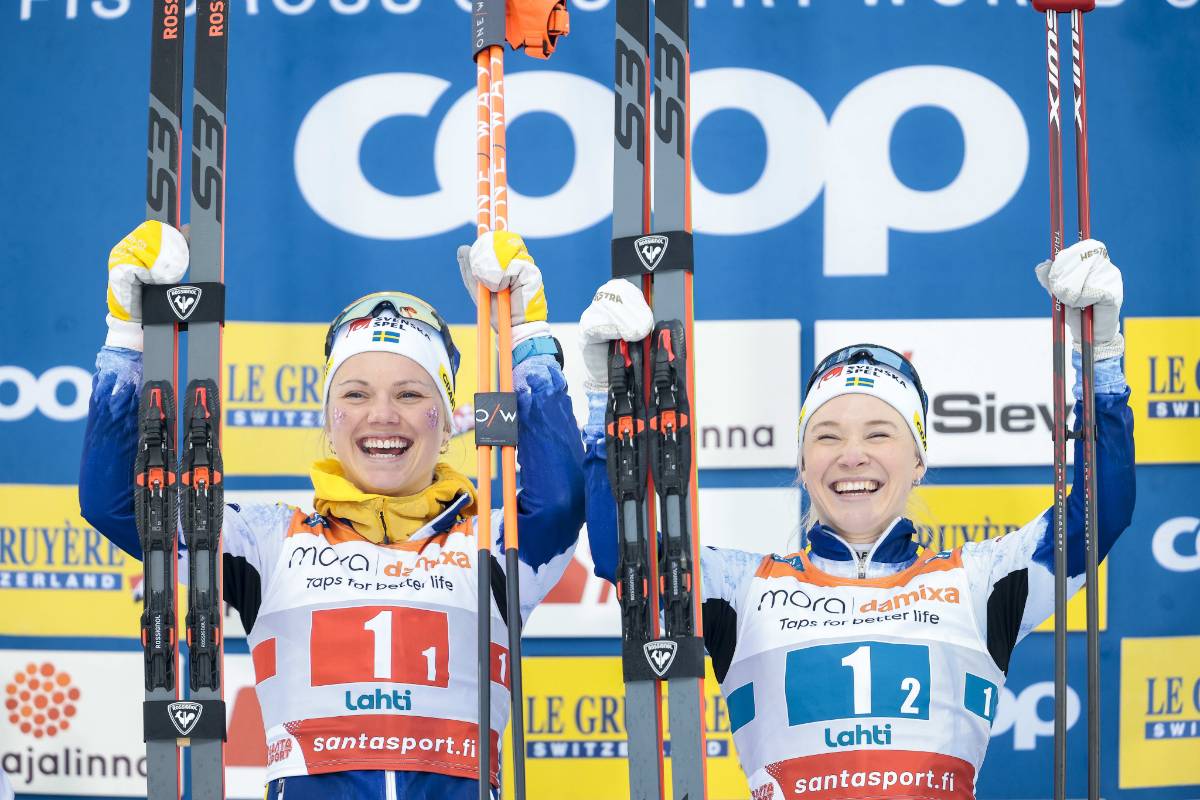
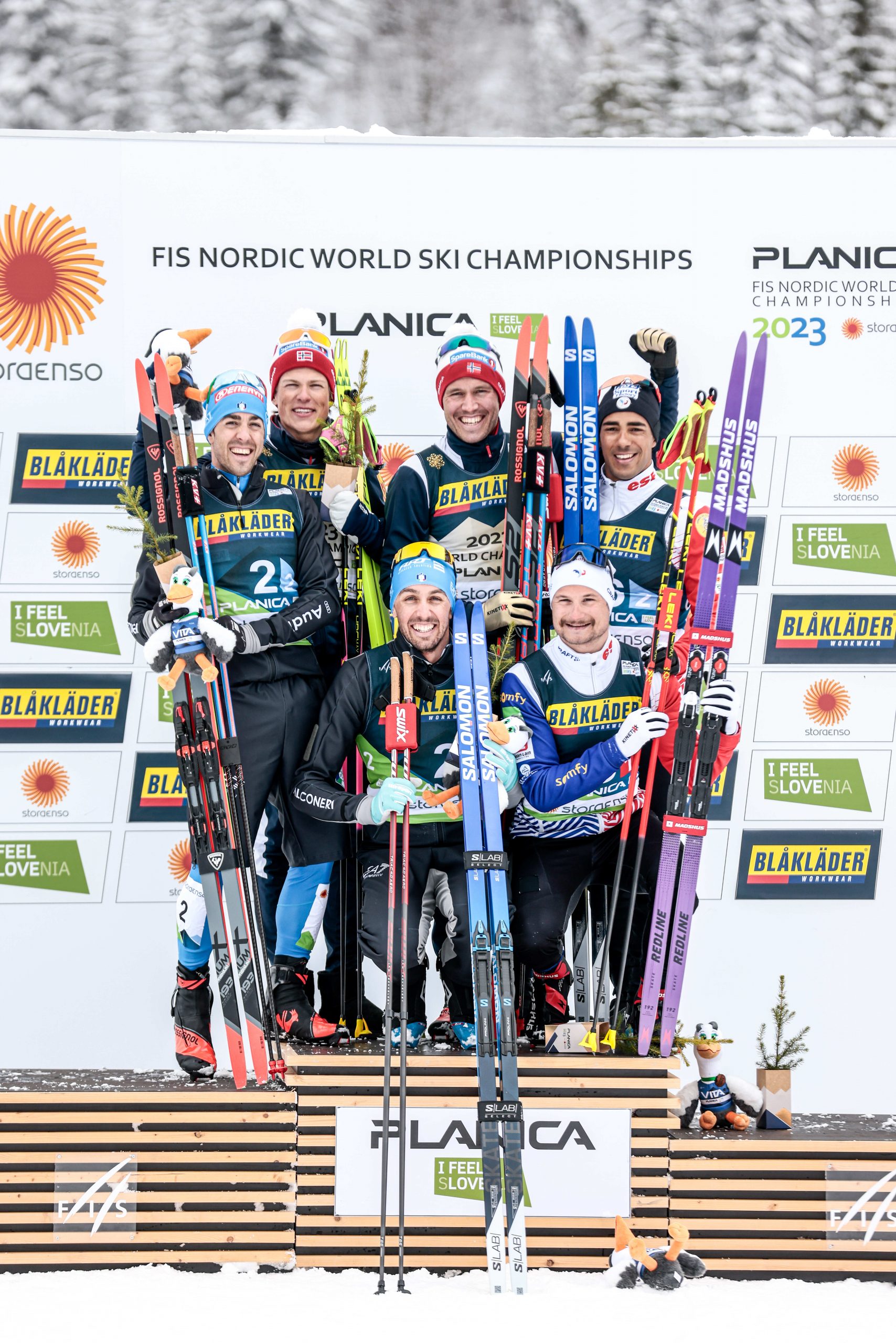
Federico Pellegrino (ITA), Francesco De Fabiani (ITA), Johannes Hoesflot Klaebo (NOR), Paal Golberg (NOR), Richard Jouve (FRA), Renaud Jay (FRA), the Team Sprint podium at the FIS Cross Country World Championships in Planica, Slovenia. (Photo: Modica/NordicFocus
This World Cup coverage is made possible through the generous support of Marty and Kathy Hall and A Hall Mark of Excellence Award. To learn more about A Hall Mark of Excellence Award, or to learn how you can support FasterSkier’s coverage, please contact info@fasterskier.com.
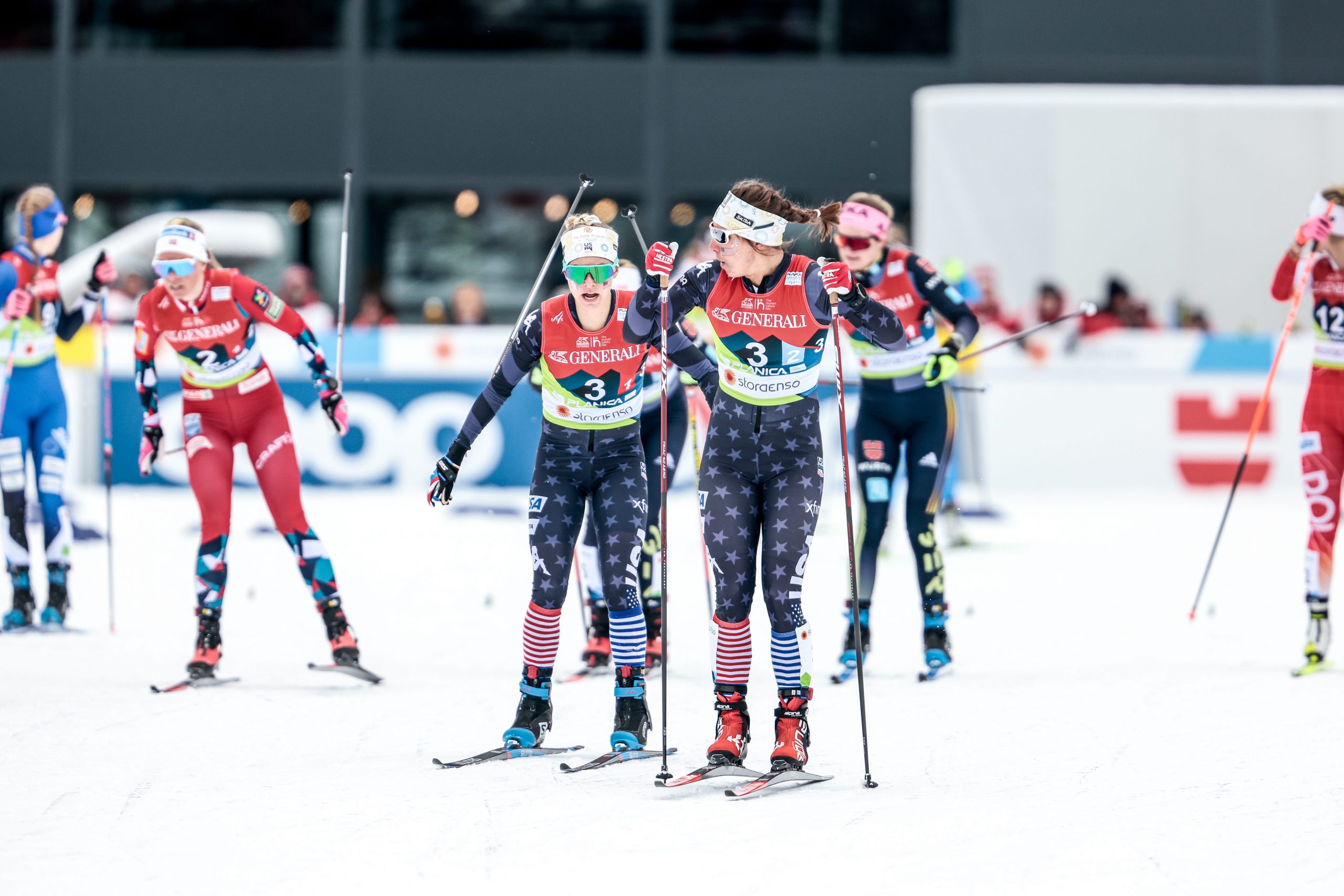
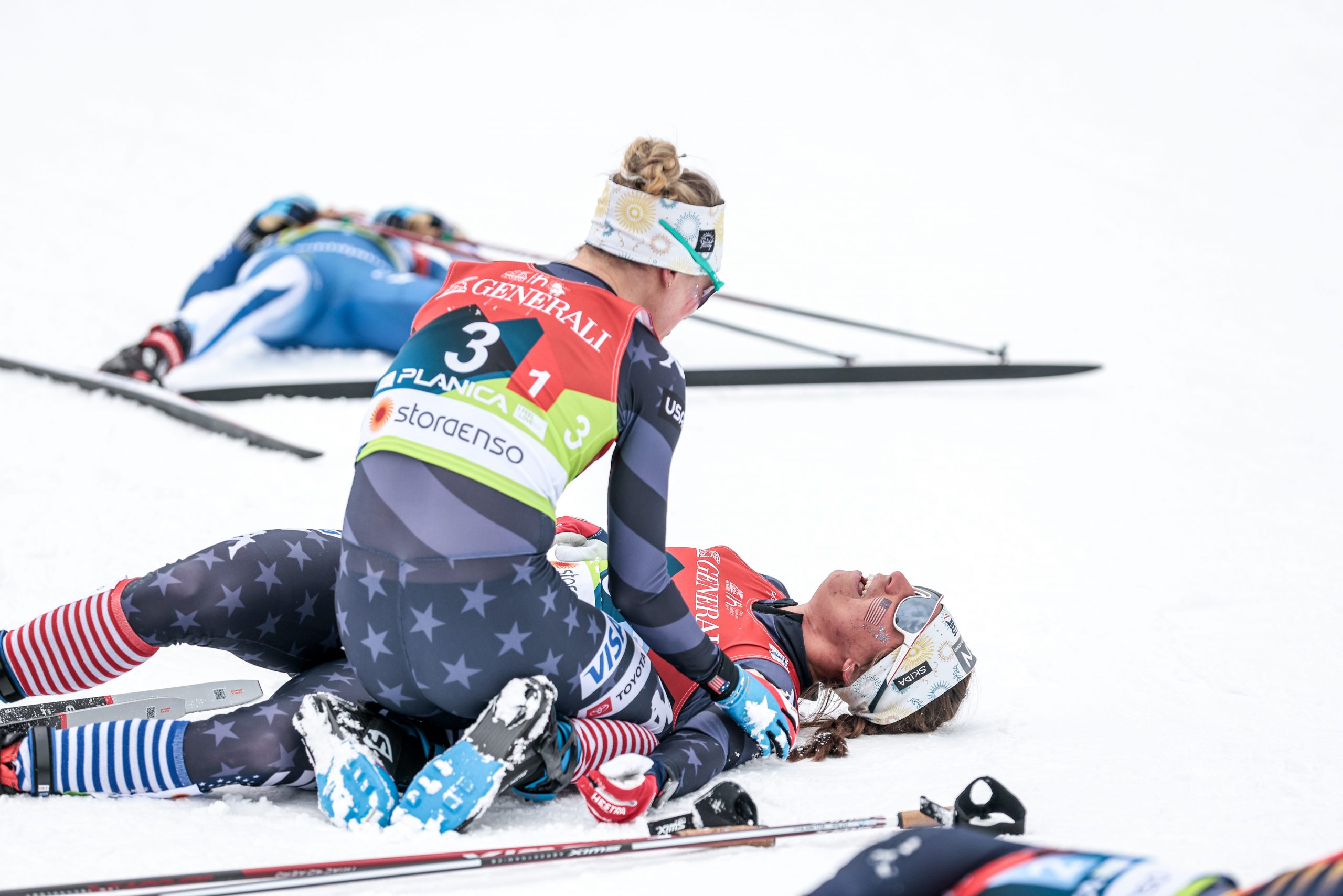
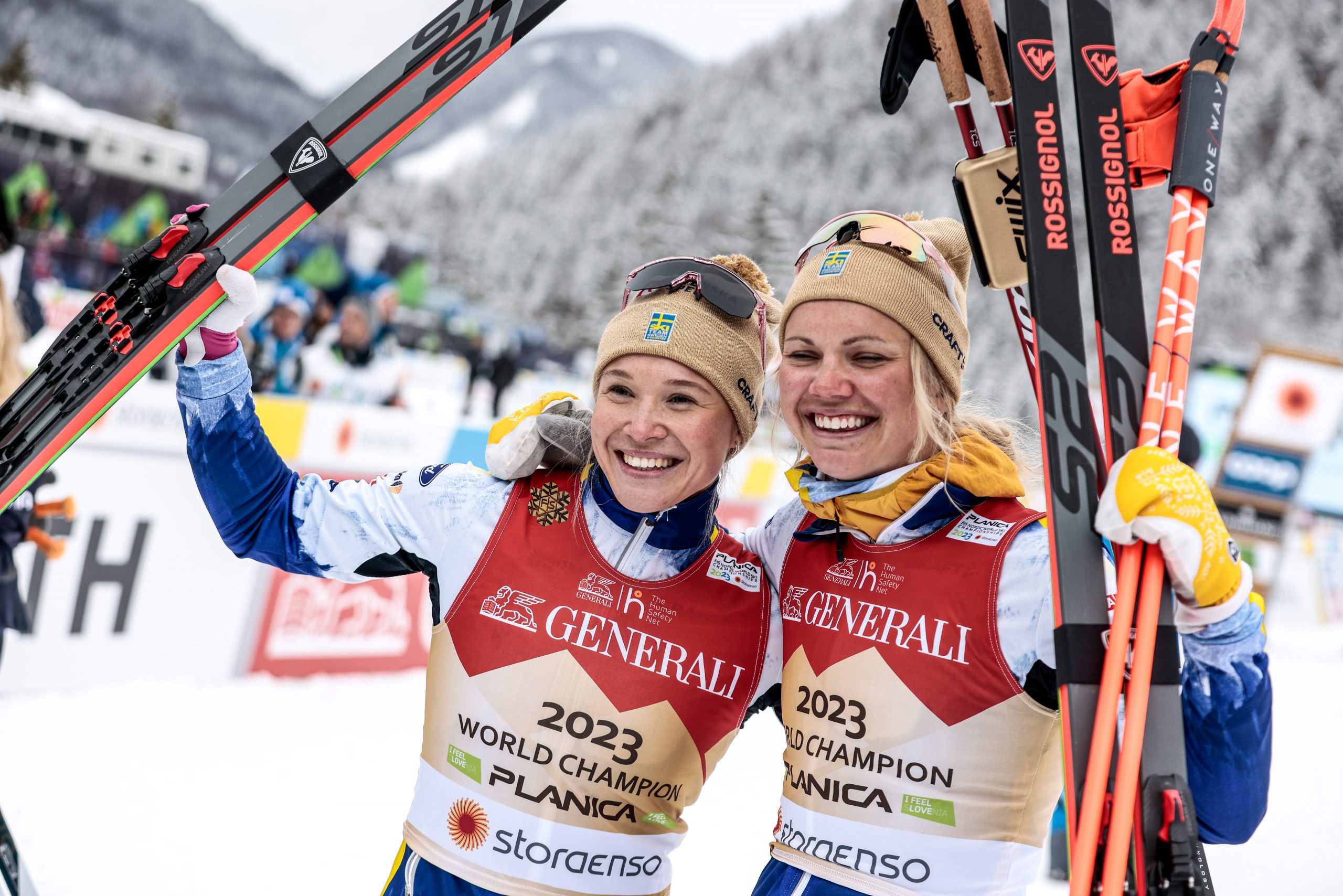
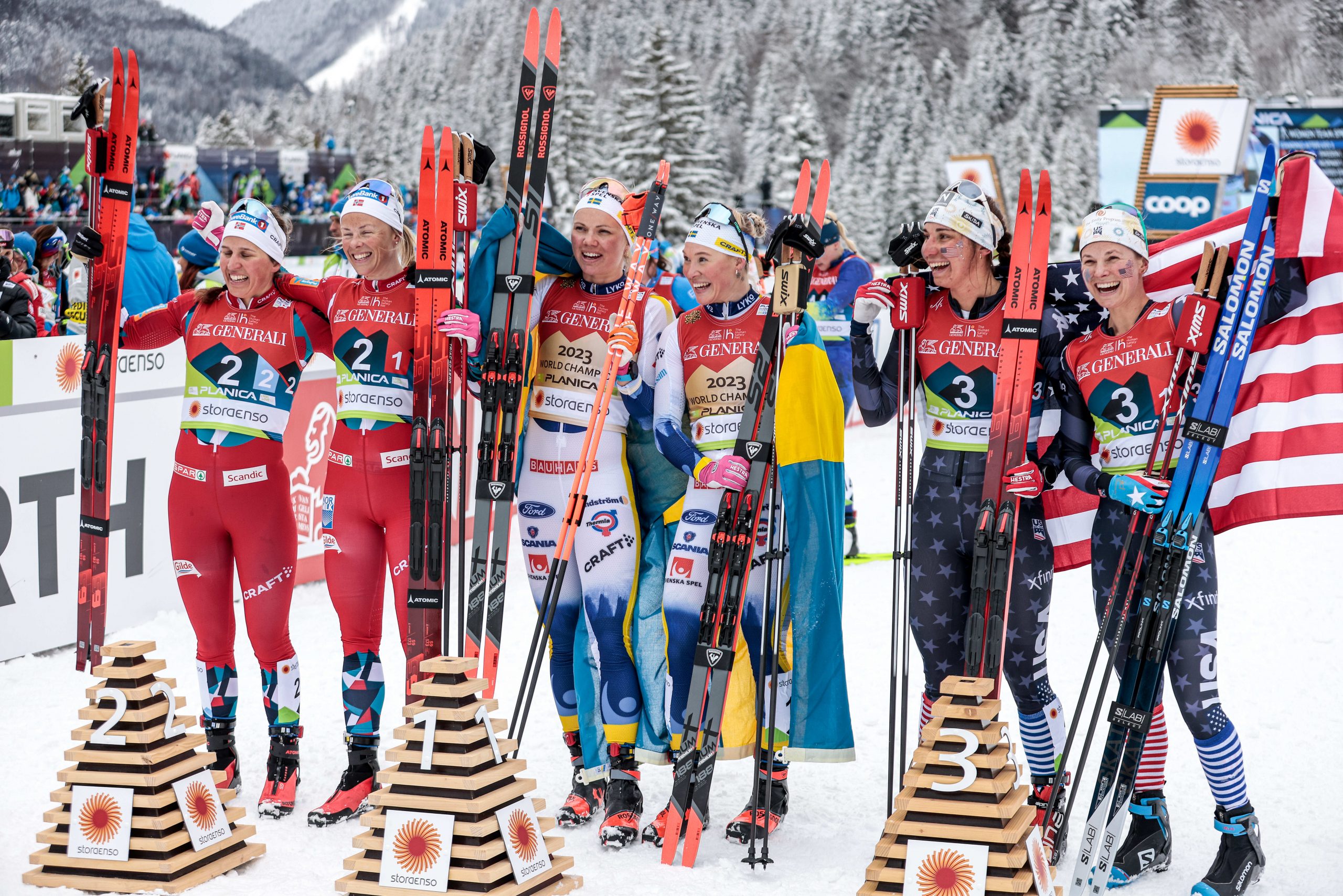
Five years on from the milestone of Olympic gold—and ten years on from the milestone of World Championship gold—the event was the same for US skiing; the Team Sprint. Socks adorned with stars and stripes and glittered faces led the race the whole day, as Jessie Diggins and Julia Kern traded leg after leg racing at the head of the women’s field. By the time Kern took her last turn around the Planica course, there was a pack of three teams, and no doubt which one had driven the race to that point. The medal places just had to be decided among the United States of America, Sweden, and Norway. In the end, the newly crowned sprint World Champion, Jonna Sundling, made the move for Sweden to win, and Tiril Udnes Weng held on for second, but the excitement would not be diminished. Jessie Diggins waited at the finish line as Julia Kern skied into her arms, bronze for the United States of America, and the first medal of these World Championships and Julia Kern’s career.
Julia Kern (USA) and Jessie Diggins (USA) share an emotional celebration after taking bronze in the Team Sprint. (Photo: NordicFocus)
For the US, the pieces were all there, they had just moved around. Kikkan Randall—the other fixture of the Team Sprint’s triumphs of the past decade—was up in the commentary booth this time. Chad Salmela was alongside her, as ready as ever to play muse for the US Skiing community’s unadulterated excitement. Most notably though, Jessie Diggins was on the line at the beginning of the race. A surprise given her pre-World Championships assessment that “Anchoring relays is kind of my bread-and-butter.” But Diggins had also made her admiration of Julia Kern a central part of her assessment of the team events at this year’s World Championships, “Julia Kern has an incredible skill set that makes her a really good anchor,” Diggins said. “She’s got the fitness, the distance chops, the raw speed, tactics and confidence.”
Jessie Diggins (USA) comforts her Team Sprint teammate Julia Kern (USA) after their bronze medal effort. Diggins’ faith in Kern’s ability to finish was rewarded with a medal performance. (Photo: NordicFocus)
With that vote of confidence, the line-up for today’s American relay team was set. Diggins took the first leg, just as she had early in her career when paired up with Randall (the lineup that won in Val di Fiemme in 2013). Behind her in the anchor leg was the young American who had first sprinted to a World Cup sprint podium in Planica 2018, and in 2022-23, has spent the year building a steady and strong presence at the front of the World Cup sprint field. US Ski Team Head Coach Matt Whitcomb said on the decision in post-race comments that “If we switched [the lineup] around, we felt like it wouldn’t have used Jessie’s capacities or Julia’s capacities fully.” That lent to a US strategy to, as Julia Kern would put it in post-race comments to FasterSkier, “Win a medal the hard way,” stretching out the field out from the beginning to leave a small sprint pack for the medals at the end. For Matt Whitcomb, that led to the evaluation that “both [Jessie] and [Julia] have somewhat comparable finishing kicks. Jessie has a slightly more developed distance capacity. We felt that could be used on the first leg to really stretch things out, and then at times decide to push and others conserve a little bit throughout the race.”
And so, the American duo qualified first place on the day, went off the line in the Final that way, and didn’t relent until the very end.
Julia Kern (USA) living up to the confidence her team had put in her by skiing a medal winning anchor leg. (Photo: NordicFocus)
Women’s Team Sprint Final
The most candid and eloquent assessment of the Women’s relay Final would come from the source; Julia Kern’s mother. Talking to FasterSkier’s Nat Herz, she offered that for the US, “Either you chill behind [Norway and Sweden] and take a risk that you’re only going to get fourth or fifth with Germany and Finland there the whole time, or you say, ‘I’m going to the podium’ and push all three laps.’” She added a mantra too, “If you [choose] to push, you have to push the whole time.”
Jessie Diggins (USA) and Julia Kern (USA) successfully navigate the tricky exchange area in the team sprint. (Photo: NordicFocus)
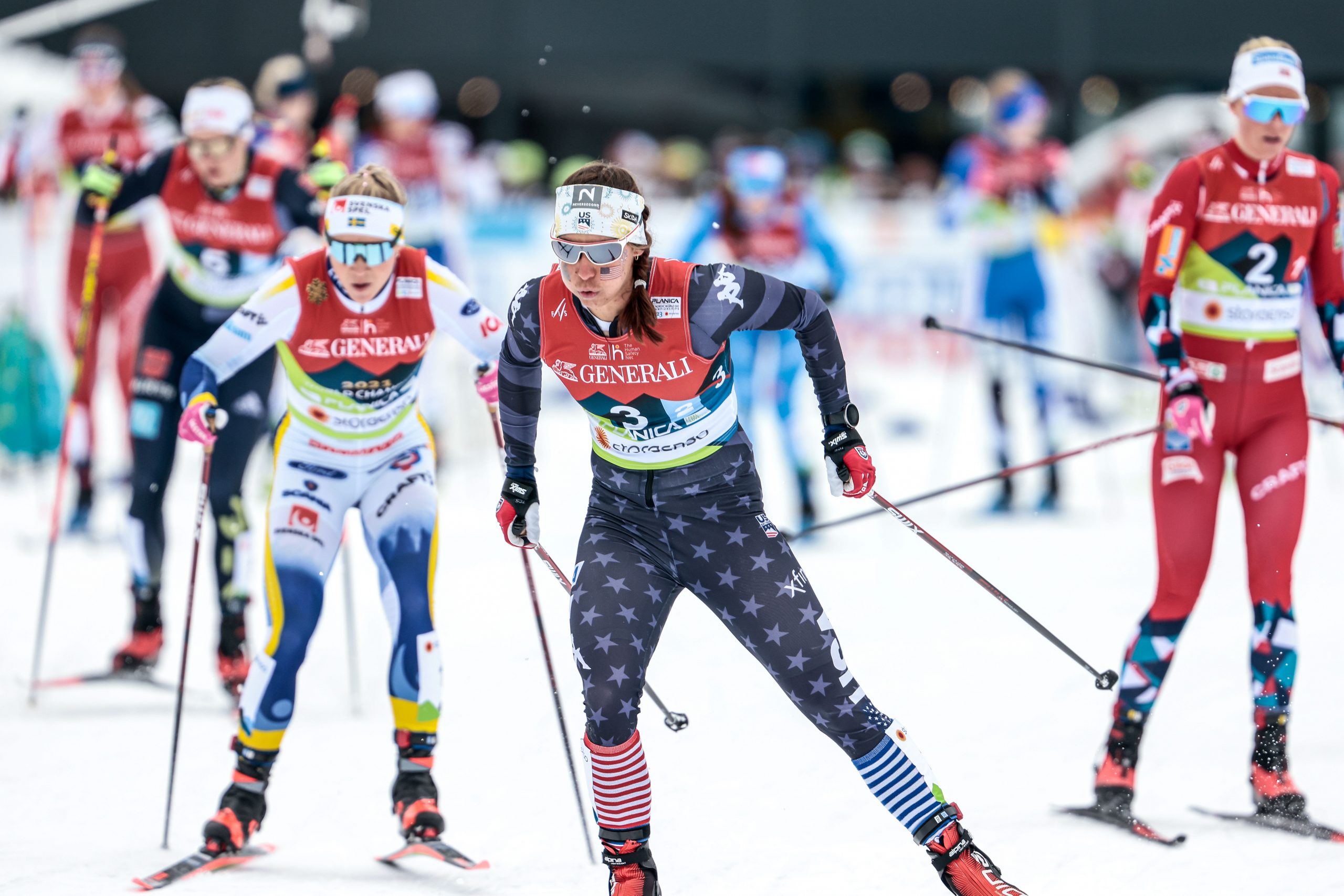
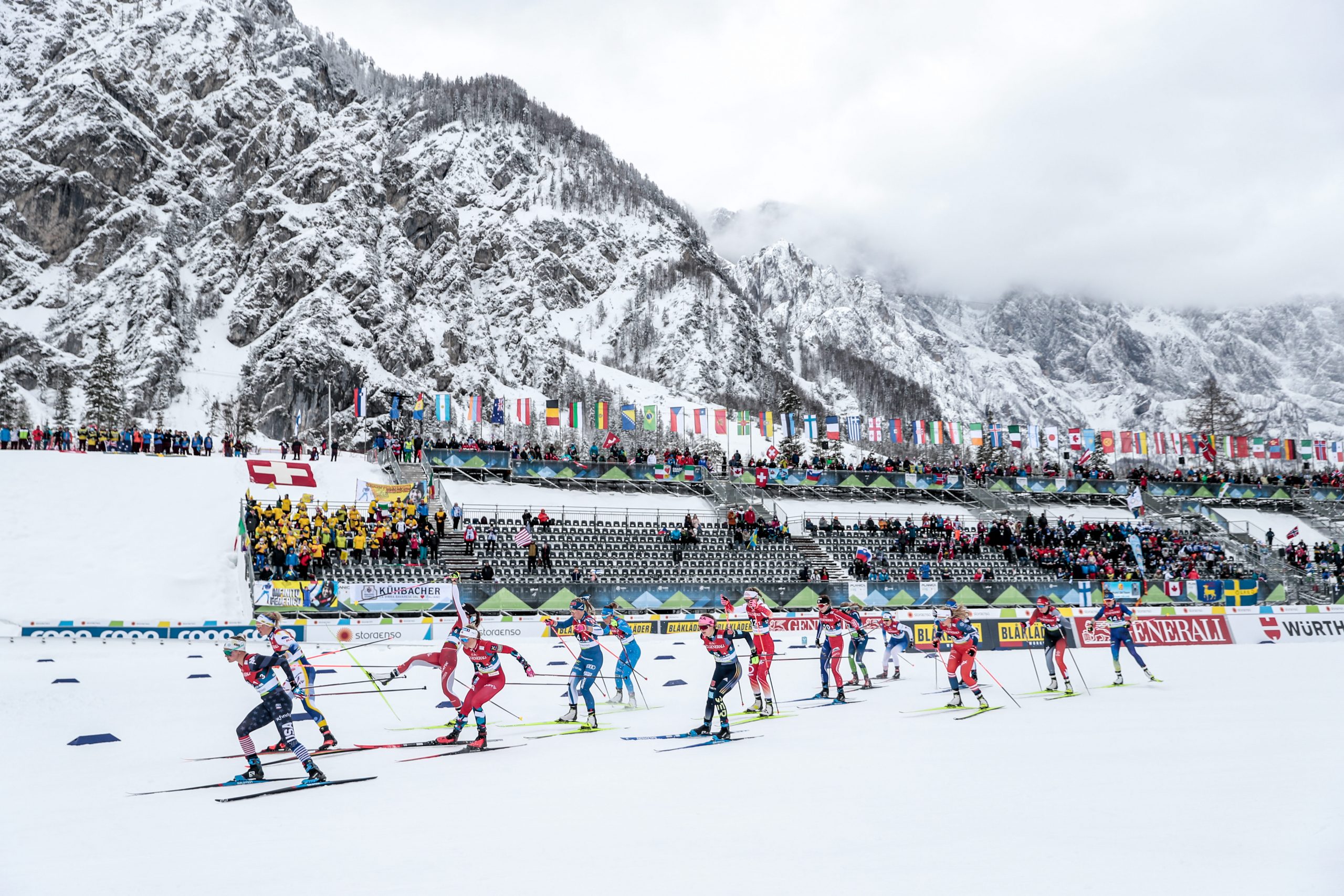
That was precisely what Jessie Diggins chose to do, launching out of the start-line into her trademark free skate as the field wound around the rolling descent at the beginning of the course. That course was a modified version of last Thursday’s individual sprint to include a relay zone, including the long-winding climb through the middle, with a long rolling section afterwards into the Planica stadium. To the spectator’s eye then, the race was spent looking for subtle signs of strength through the main climb. Who kept the V2 tempo high? Who was launching their V1 into full power mode? Through much of the race, that simply meant looking at the front. Diggins held a high-tempo V2 through all her legs that, even when challenged by Norway’s Anne Kjersti Kalvaa in her final leg, still kept the American at the front of the race.
Jessie Diggins (USA), pushed the pace the whole way to try and break up the field. (Photo: NordicFocus)
By that point, the race had long separated into a pack of five teams, with the Americans leading, Norway and Sweden taking turns marking behind in second and third, and Germany and Finland the same in fourth and fifth. The move from Kalvaa and the response from Diggins though, saw the pair take more speed into the long downhill after the climb their final time around, and it proved to be where the definitive gap of the day opened up. Emma Ribom was able to use her sprinting chops to put in a burst and make the race three team’s strong, but the Americans’ push had pushed Finland and Germany out of the race.
The final lap then was just to decide which medals would go where. Tiril Udnes Weng started the move on the lower reaches of the final main climb, which set Kern and Sundling into high gear too. Kern faded ever-so-slightly, what US Coach Matt Whitcomb would describe in post-race comments as “the side effect” of the US strategy, “Sweden and Norway get to follow up behind for five out of six laps.” As they rolled into the finishing stretch, Sundling passed Weng with the powerful finishing speed that won her a World Championship last Thursday, and Weng skied in to put Norway in second. Julia Kern continued to push all the way through, and as she approached, the energy from Diggins started to become a palpable thing, dancing and running to meet her younger teammates arms. For Diggins, it was the fourth time she had stepped onto a World Championships or Olympics Team Sprint podium, and this time, she was welcoming not just a younger teammate, but one that came from a generation that had directly looked up to her through all those previous wins.
That was a significance not lost on Julia Kern, who said in post-race comments that, “it was incredible to watch Jessie and Kikkan over the years when I was growing up, and to step into these shoes is truly special. It speaks to how they paved the way for the whole US team.”
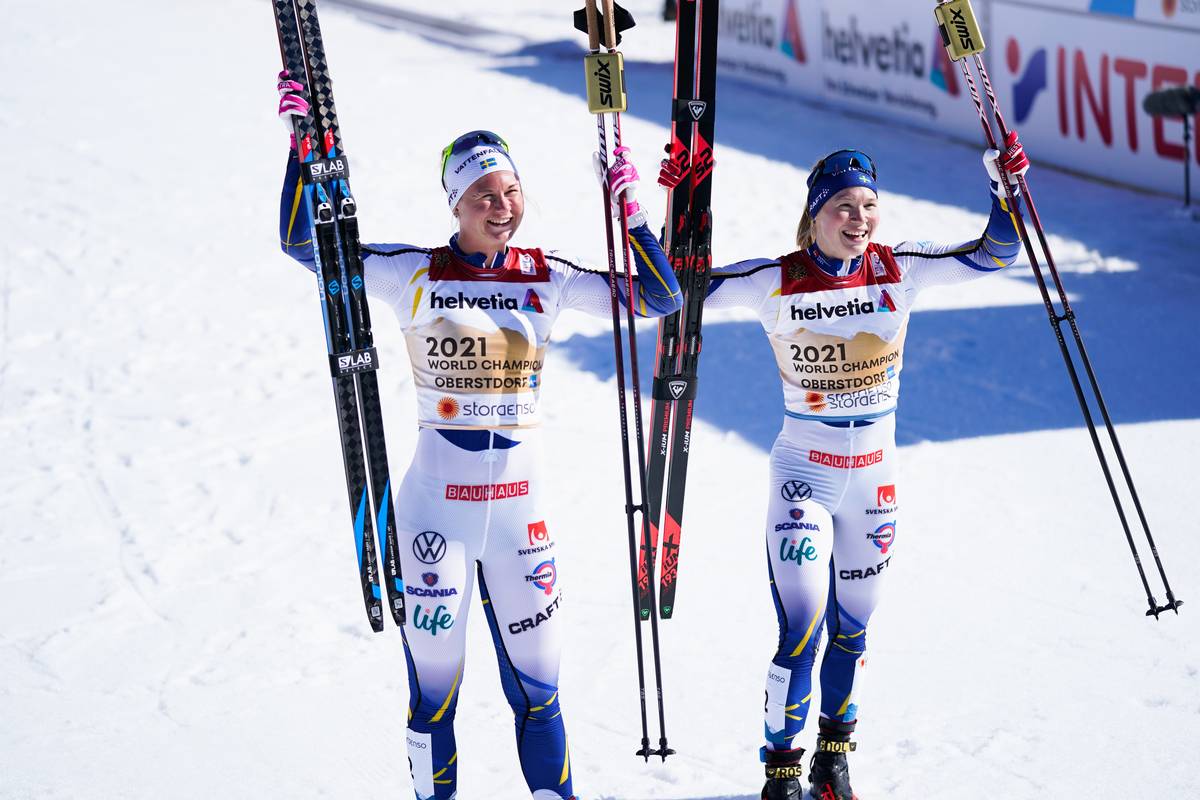
Jonna Sundling (SWE) and Emma Ribom (SWE) were able to find a little extra something to take gold in the World Championship Team Sprint. (Photo: Nordic Focus)
Throughout the US camp was the feeling that this bronze meant the continuation of all the positive developments in US skiing over the past decade and a half. For Jessie Diggins, today’s medal was a proof of concept for the team-centered focus she has helped pioneer, saying in post-race comments that “[The team sprint] a team sport within a team sport. It takes people who are on the road with us all the time, the [doctors and physios] who volunteer their time to come over and take care of us, this is a full team effort, and that’s what makes a team medal special.”
Matt Whitcomb, meanwhile, opted for extended metaphor, “[our Team Sprint] is like a multiple years long relay; Kikkan handing it off to Jessie, Jessie handing it off to Julia now, and maybe Julia hands it off to the next [skier] eventually.”
And as for the significance, Jessie Diggins continued to bring it all back home, “I hope the kids back at home see that you can do this; you can compete clean, support each other, train hard, and get it done. I hope they’ll see that.”
All smiles for teams Norway, Sweden, and USA after medal winning performances. (Photo: NordicFocus)
Julia Kern (USA) and Rosie Brennan (USA) celebrate after a third place finish in Sunday’s Team Sprint. (Photo: Nordic Focus)
The high alpine valley containing Livigno, Italy is as beautiful and sublime as any place on Earth, seemingly heaven-sent to feature the high drama of the FIS Cross Country World Cup; for the first time, Livigno was hosting World Cup races this weekend.
That idyllic scene made Sunday’s Team Sprint all the stranger, since so many of the usual players and storylines were absent from the World Cup. As FasterSkier reported on yesterday’s Sprint, many factors affected the participation in Livigno: the staging of Norwegian National Championships, athletes taking planned breaks in their racing schedules, untimely illnesses, Livigno’s daunting elevation (Livigno sits at an elevation of 6000ft), and upcoming World Championships in Planica, Slovenia. Johannes Hoesflot Klaebo (NOR) had packed his bags and returned to Norway after his victory in Saturday’s individual Sprints. Jessie Diggins (USA) was taking a break from racing to refine her training. The field of U23 athletes had largely abandoned the World Cup in preparation for U23 World Championships in Whistler starting next week.
What was left in Livigno then? Well, the mountains towered, the sun shone down without a cloud in the sky, the snow was good, and the Italian fans were ready. It was, in other words, still a perfect scene for a ski race, and so those who had stayed on the World Cup—along with a few who were making their first appearances in it—gathered for a Skate Team Sprint in which partners skied three legs apiece on a 1.2 k loop around the valley floor.
The Alpine valley of Livigno, Italy hosted its first World Cup this weekend. (Photo: NordicFocus)
Women’s Race
In a weekend marked by a lull in the World Cup, there was one glaring irony: the front of the women’s field was marked by top skiers trying to re-establish themselves in the World Cup standings. For all their dominance, it has been a difficult year for the Swedish women’s team. A shoulder injury has kept Linn Svahn out for much of the season, and persistent illnesses have struck Jonna Sundling andEmma Ribom early in the World Cup season. In Livigno, the Swedes were looking for an opportunity to return to high-level competition. In selecting their teams, the Swedes split the Beijing Olympic Team Sprint Silver Medal duo of Maja Dahlqvist and Jonna Sundling, and paired both with new partners. Dahlqvist joined up with Linn Svahn to form Sweden II, and Sundling joined with Emma Ribom to form Sweden I.
Jonna Sundling (SWE) heads out from the exchange after the tag from Emma Ribom (SWE). (Photo: NordicFocus)
There was little to separate the field on the relatively flat Livigno course; through most of the race, the field remained largely intact. Out of the third exchange (entering the fourth lap) the Swedish pair of Dahlqvist and Sundling started to up the tempo on their persistent V2. Only two teams followed: Germany and the United States. The United States I team was represented in the move by Julia Kern, who paired up with Rosie Brennan to form a strong unit for the US. The USA II team of Lauren Jortberg and Alayna Sonnesyn were also in the final today, but had not quite bridged the gap to the front pack. Germany was represented by the pairing of Sofie Krehl and Laura Gimmler.
The pack of four teams—Sweden I, Sweden II, Germany I, and United States I—held through the fifth lap. The move to win was made by Maja Dahlqvist on the only true feature of the course—a short, steep, pitch where she unleashed a powerful V1 that led her to the win over Sundling who sprinted to second place for Sweden I. Behind the pair of Swedish sprinters, Kern had affected the same high-tempo attack for third, and beat out the German anchor skier, Gimmler.
American women celebrate after United States I—Rosie Brennan and Julia Kern—finished third in Sunday’s Team Sprint. (Photo: NordicFocus)
Men’s Race
The unusual scenes of this World Cup brought some welcome novelty, especially for American ski fans, in the Men’s race. A pair of American men even younger than the skiers who are now becoming the familiar faces on the US Ski Team made their World Cup debut in the Individual Sprint yesterday, and paired with more experienced teammates in comprising the Team Sprint duos today. That included Adam Witkowski—a native of upstate New York now skiing for Michigan Tech—who paired with Logan Diekmann to form the United States II team. The team rosters also included Will Koch—the Vermonter and University of Colorado Buffalo—skiing with veteran Kevin Bolger on United States I. United States I advanced to the Final.
Adam Witkowski (USA) made his first World Cup starts in Livigno this weekend. Witkowski and Logan Diekmann (USA) combined to form USA II in the Team Sprint. (Photo: NordicFocus)
Focus on who might win the Men’s race was firmly turned towards those teams hailing from the surrounding Alps. The Italians, on home soil, fielded the strong team of Francesco De Fabiani and anchor Federico Pellegrino. The French, too, fielded reigning Sprint champion Richard Jouve in the anchor leg, paired with Renaud Jay.
The men’s field remained tightly woven and tense throughout the course of the six lap race. Skiers looked for a track to gain a place, or test out a high-tempo attack. It wasn’t really until the last leg—the anchor’s anchor leg—that Richard Jouve and Federico Pellegrino moved on the only sharp incline on course and made it a sprint. Jouve gained a slight advantage in doing so, and it was enough to seal the win for France, as Pellegrino brought Italy to a second place finish on the day. Behind the battle for first and second, it was Valerio Grond (SUI) who escaped the pack to earn the bronze with his partner, Janik Riebli (Saturday’s Individual Sprint bronze medallist).
Richard Jouve (FRA) brings home the win with teammate Renaud Jay (FRA). The French head towards a race on home soil in Les Rousses next weekend. (Photo: NordicFocus)
The pairing of Koch and Bolger for the United States finished in 12th place on the day, but just 20 seconds off the leaders. The combination of the experienced Bolger alongside the younger Koch underscored the range and depth that the American program has fostered over the past decade. Koch’s first start on the World Cup extends the scope of that accomplishment across time too, as he joins Novie McCabe in being the second generation of his family to have skied on the World Cup for the United States.
Will Koch (USA) teamed with Kevin Bolger (USA) in Sunday’s Team Sprint. (Photo: NordicFocus)
On to Les Rousses
With familiar pieces of the World Cup scattered to the winds during this weekend in Livigno, perhaps the biggest story going forward is just who might be on the start line next weekend when the World Cup travels from Italy to France. The French will finally be able to host a World Cup in Les Rousses after Covid restrictions and insufficient snow coverage forced cancellation two years ago. It’s a reminder that the World Cup is subject to the whims of life, weather, sickness, and all else. There’s never absolute certainty, which only heightens the experience when the sun is shining, the snow is plentiful, and the best athletes in the world converge to ski race for ski racing’s sake.
The Italians celebrate a successful World Cup weekend in Livigno, Italy. (Photo: NordicFocus).
Wednesday’s Olympic team sprint offered another thrilling set of races at the venue in Zhangjiakou — we’re back to break down an epic performance by the German women, a critic-silencing race from Norway in the men’s event and a U.S. women’s result that left a medal just out of reach.
Thanks to everyone for sending in questions and feedback — we’re trying to keep our heads above water on the homestretch here, but you can be sure Devon will still have plenty to say post-Games. In the meantime, you can get us at devon@fasterskier.com and nat@fasterskier.com.
Katharina Hennig and Victoria Carl win gold for Germany in the classic team sprint. (Photo: NordicFocus)
This World Cup coverage is made possible through the generous support of Marty and Kathy Hall and the A Hall Mark of Excellence Award. To learn more about A Hall Mark of Excellence Award or to learn how you can support FasterSkier’s coverage please contact info@fasterskier.com.
The team sprint: two skiers racing three laps each at roughly 1.5-kilometers a piece with a long climb thrown into the middle of the course and temperatures in the single digits Fahrenheit. It boils a sport that already requires both power and endurance down to its essence.
Riding the high of their silver medal in the women’s 4 x 5 k relay, the duo from Germany, Katharina Hennig and Victoria Carl, won a thrilling sprint finish to decide the medals, collecting gold in a time of 22:09.85. To take the stop spot, the anchor, Carl, out-sprinted the Swedish individual freestyle sprint gold medalist, Jonna Sundling, in the final meters to win by just 0.17 seconds, while the Russian Olympic Committee’s Natalia Nepryaeva crossed just behind in third (+0.71).
Sweden, Germany and Russia share the women’s classic team sprint podium. (Photo: NordicFocus)
After holding strong in medal contention throughout the first five of six laps, the American pair of Rosie Brennan and Jessie Diggins lost contact with the leaders in the final leg, crossing the line fifth (+12.93) behind Finland in fourth (+3.86).
Now, let’s take a step back.
There is, perhaps, no reminder needed that USA won the team sprint in 2018; Kikkan Randall and Jessie Diggins collected the first Olympic medal for the United States in cross country skiing – a gold, no less – since Bill Koch took silver in the 30 k classic in 1976. However, the team sprint in PyeongChang was raced freestyle, whereas today’s team sprint would be held in classic.
“I’m not trying to compare today to four years ago,” said Diggins in the mixed zone after the race. “It’s a different course, different altitude, different technique, like literally nothing is the same and, and that’s okay. I think today, I was going out there and skiing for Rosie and skiing as hard as I could and as best I could… but I’m really proud of this race and proud of giving it our best fight.”
Rosie Brennan helps the Americans finish second in the first team sprint semifinal, automatically advancing to the final. (Photo: NordicFocus)
We have to look back eight years for a classic team sprint at the Olympic Winter Games, to the 2014 Games in Sochi. Norway took the gold that day in dominant fashion ahead of Finland and Sweden, who were stretched behind by roughly ten seconds a piece. Only one of the six women on the podium returned to the Games in 2022, again making the team sprint roster: Finland’s Kerttu Niskanen. The American pairing of Sophie Caldwell (now Hamilton) and Kikkan Randall were sixth in Sochi, +35.06 back on the Norwegian winners.
In the intermediate FIS World Championships, the Americans finished fifth both years, racing Brennan and Sadie Bjornsen (now Maubet) in the freestyle competition in Oberstdorf, Germany in 2021, and pairing Bjornsen with Diggins for the classic team sprint in Seefeld, Austria in 2019. In Oberstdorf, the Americans missed the podium by roughly 2.2 seconds, finishing 2.8 seconds behind the winning team from Sweden. In 2021, they missed the podium by an equivalent margin, this time finishing 5.8 seconds back in the overall standings, again to Sweden. It’s a mark of consistency and depth across techniques for the American women.
Yulia Stupak (ROC), Kerttu Niskanen (FIN), and Katerina Janatova (CZE) lead the way early in the women’s classic team sprint semifinal. (Photo: NordicFocus)
To make the team sprint final, each team must finish in the top-two of semifinal A or B, or be within the next six fastest times from either heat. The U.S. was second to Germany (+4.03) in Semifinal A, while the ROC won the second semi in a close finish with Finland in second (+0.35) and Sweden third (+1.0). Austria and Switzerland also advanced from the first semi, with Sweden, Norway, France, and Poland filling the remaining spots from semifinal B.
With bursts of frozen mist released from their mouths, the athletes took to the course for the final round, with Yulia Stupak (ROC), Maja Dahlqvist (SWE), Kerttu Niskanen (FIN), Tiril Udnes Weng (NOR), and Katharina Hennig (GER) racing with Brennan at the front of the pack.
With a hooded parka draped over her, face tape obscuring her normally glittery cheekbones, and heated socks inside her boots, Diggins waited in the exchange for the tag. She would be facing Natalia Nepryaeva (ROC), Jonna Sundling (SWE), Krista Pärmäkoski (FIN), Maiken Caspersen Falla (NOR), and Victoria Carl (GER) in the even-numbered legs.
Racing comfortably near the front with skis that looked competitive for both kick and glide, Brennan tagged Diggins +1.1 second back on Finland in fourth, well within the lead group. In what would become a pattern for her first two legs, Diggins quickly moved to the front to control the race and ensure a fast pace, perhaps risking accumulating her own fatigue while also taking the sting out of the legs of the individual sprint gold and silver medalists of Sweden, who had also won the World Championship gold in 2021.
Diggins races at the front of the lead pack during the classic team sprint final. (Photo: NordicFocus)
Diggins tagged Brennan virtually even with Sweden and Finland after her first lap, a position Brennan was able to hold through her second leg. Near the bottom of the long, grinding climb to the high point of the course, Norway’s Weng wobbled slightly, placing her pole in front of Dahlqvist’s ski to catch her balance. Weng’s pole snapped, leaving her running up the sidelines of the climb with one pole, detaching her strap to grab another from a coach who stood along the fenceline. This lost Norway several seconds, which they were unable to regain in subsequent legs, leaving the team out of podium contention.
On the odd legs, Niskanen of Finland consistently controlled the race at the front, putting the powerful stride that earned her a silver medal in the 10 k last week on display as she led up the climb in each round. She tagged her teammate Pärmäkoski in the lead at the halfway mark, with Germany, the ROC, and USA within a second back.
Kerttu Niskanen (FIN) sets the pace in the first lap of the women’s classic team sprint final. (Photo: NordicFocus)
Diggins again charged to the front, her hands and legs pumping metronomically as she drove her skis up the climb. Diggins crested the hill in front, with Sundling and Pärmäkoski on her tails heading into the descent. A gap had opened to Germany and the ROC, but these teams had lightning fast glide and were able to regain contact in the descent.
At 6 k, with four of six legs complete, it was Sweden and Finland in the lead at the exchange, with Brennan receiving a tag 2.5 seconds back. Niskanen again set the pace at the front, still looking strong as she pushed the pace up the A-climb, with Dahlqvist matching pace behind. In a critical moment where loss of contact might have meant accepting a podium was not in the cards on the day, Brennan accelerated up the climb, steadily closing the gap to the Swede ahead of her.
Rosie Brennan (USA) awaits her turn during the women’s team sprint. (Photo: NordicFocus)
An aerial shot showed Brennan upping her tempo as she brought the U.S. back in contact with the leaders, bringing Hennig and Stupak along with her. All five women dropped into a tuck as they headed downhill together, rounding the sweeping right-hand bend and sprinting up a final climb before the last exchange. Throwing her hands up the hill in a run, Brennan challenged Sweden’s Dahlqvist on the final uphill, double poling around a left-hand bend into the exchange in third behind Germany and Finland.
In the last lap, Diggins went hunting. With Pärmäkoski and Carl leading the charge up the climb, Diggins would need to work the hill. Striding powerfully, Diggins did everything she could to keep her team in contact with the leaders, but it was not enough on the day. Doublepoling across the false flat before the descent, it was Pärmäkoski leading Carl, Nepryaeva, and Sundling.
The leaders were four abreast coming around the final bend, with Pärmäkoski and Sundling pushed into the outer two lanes, leaving them at a deficit as they headed up the final climb to the stadium.
Cresting the rise, Carl looked to be falling off the pace, while Nepryaeva and Sundling pulled to the front, the Swede leading around the final left-hand corner into the finish.
But Germany wasn’t done yet. Carl moved up along the outside of the bend, challenging Sundling as they headed into the finish lanes. Doublepoling powerfully, Carl began to slowly pull ahead of Sweden, with the ROC dropping back a few meters behind.
Coming to the line to decide the medals, it was Victoria Carl (GER), Natalia Nepryaeva (ROC), and Jonna Sundling (SWE) (l-r). (Photo: NordicFocus)
In a surprise upset of the Swedish favorites, Carl took it to the line, holding off Sundling as she crossed the line in 22:09.85, welcomed by her ecstatically screaming partner Hennig. Sundling was just 0.17 seconds back for silver, with Nepryaeva unopposed for bronze on their tails (+0.71).
Victoria Carl (GER) celebrates gold in the women’s team sprint while Natalia Nepryaeva brings the ROC across the line in third.(Photo: NordicFocus)VIctoria Carl takes gold in the classic team sprint, while partner Katharina Hennig awaits in disbelief. (Photo: NordicFocus)
After falling off the leaders in the final climb, Pärmäkoski brought Finland to the line in fourth (+3.86) with Diggins holding strong after a gap to cross fifth (+12.93).
“It means a lot for us,” Hennig told the media after her race. “Also the silver medal in relay and today the gold medal in team sprint. It means a lot and we are very thankful for the whole team. It’s very important for cross-country in Germany.”
Excitement was high at the finish of the women’s team sprint, as Victoria Carl narrowly took the win for Germany, racing with partner Katharina Hennig. (Photo: NordicFocus)Katharina Hennig hugs her exhausted teammate Victoria Carl at the finish of the women’s classic team sprint. (Photo: NordicFocus)
Though she was the key player in the final lap, Carl was not originally on the start list. She was substituted for Katherine Sauerbrey, who had skied the first leg of the women’s relay on Saturday. German coach Peter Schlickenreider, who celebrated his 52nd birthday today, explained in the mixed zone that Saurbrey had made a “great decision” to let the team know that she was feeling fatigued and as though she may be getting sick.
From there, the calculus became: “Okay, you have a silver medal, you did a good race [in the relay], and we have prepared Victoria Carl, so she’s ready,” Schlickenreider explained. “So then let’s do the safe thing.”
He added that Germany had raced an athlete, Nicole Fessel, in the team sprint during the 2018 Games who was feeling sick, which proved to be a significant mistake as Fessel struggled with her health for the following three months, before ultimately ending her career. The coaches had vowed never to make this error again.
Jonna Sundling (SWE) congratulates Victoria Carl and Katharina Hennig on Germany’s gold medal in the classic team sprint. (Photo: NordicFocus)
On the performance of the German skis, which have allowed the team to excel throughout the Games, Schlickenreider explained that waxing has been a focus for the team over the last quadrennial.
“We worked really hard the last four years to get this good team. And I think that’s the main thing, that everybody’s working together so that the athlete and ski technicians were communicating quite well.”
Jessie Diggins (USA) comes to the line in fifth in the women’s team sprint. (Photo: NordicFocus)
After winning gold in the event, it’s easy to look at a fifth place finish as a disappointment for the American team. But observing the last five seasons, it remains a testament to the consistent strength of the American women’s program, the depth of the field racing at this level, and the fact that ultimately, an Olympic medal is viewed among the highest accomplishments an athlete can achieve purely because it requires the fortuitous coming together of infinitely many pieces to do so.
Both Brennan and Diggins stated with confidence that they were happy with their performances today, highlighting advances made in classic racing throughout the Games.
“I felt really good about my skiing today,” Brennan said. “I think it was one of my better classic races this week, so I’m really happy to put it together by the end of the Olympics. And I did what I could to stay in contact to give Jessie her best shot. And I’m happy with that.”
Rosie Brennan (USA) strides up the A-climb in the women’s team sprint semifinal. (Photo: NordicFocus)
“I’m really proud of how we skied,” Diggins affirmed. “It was so cool seeing Rosie just crushing, and I went as hard as I could. And there’s no doubt in my mind that I could not have possibly tried harder. I finished with zero sugars left and was dizzy and sick. And I’m currently wearing all the clothes of Team USA… I think we had great skis, or at least I definitely had the kick that I needed. I felt like, technically, this was some of my best classic skiing. And yeah, I’m just really proud of giving it our all because that’s all you can do.”
Jessie Diggins anchored the women’s classic team sprint to fifth. (Photo: NordicFocus)
In NBC’s broadcast, team sprint gold medalist turned analyst Kikkan Randall explained that the Americans knew that competitive skis would be a requirement to allow Brennan and Diggins to fight for a medal today.
Both athletes expressed that their skis were up to the task, particularly for A-climb, which is roughly 400 meters in length (a quarter mile) with nearly 100 feet of elevation gain. Ascending this three times each in the final, optimizing kick could be essential.
“I have to have enough kick, or else I really struggle,” Diggins explained. “So I definitely asked for an extra bump. In hindsight, maybe I shouldn’t have but also, that’s on me. And I know that that’s what I need. I need to be able to get up the hill. And that was my biggest priority. And so I think having not enough kick would have made me lose more time.”
Jessie Diggins (USA) marks Victoria Carl (GER) during the women’s team sprint semifinal. (Photo: NordicFocus)
Both athletes confirmed that they would be racing the final event of the 2022 Olympic Winter Games on Sunday, the 30 k mass start freestyle, barring unforeseen changes. With one last opportunity to fight for medals, Brennan encapsulated the Americans’ outlook on the whirlwind of racing and Olympic hype.
“One thing that the US is really bad at is only caring about the Olympics,” Brennan said in the mixed zone. “But we’re racing and World Cups every weekend all winter long and World Championships on the [odd] years, so if you look at the results from all of those races, you know, this is in the ballpark. I wouldn’t say I had the world’s best races [here] and certainly not the world’s worst races. So it’s been a good experience and we will head straight back to the World Cup and keep fighting for more.”
Dahria Beatty (CAN) races in semifinal A during the women’s classic team sprint. (Photo: NordicFocus)
Racing for Canada, Katherine Stewart-Jones and Dahria Beatty took sixth in the first semifinal and did not advance. They ended the day in 12th overall.
This World Cup coverage is made possible through the generous support of Marty and Kathy Hall and the A Hall Mark of Excellence Award. To learn more about A Hall Mark of Excellence Award or to learn how you can support FasterSkier’s coverage please contact info@fasterskier.com.
The team sprint: it’s the youngest event on the Olympic program, having been contested only since the 2006 Torino Games. The event has since become a marquee event in the sport of cross country skiing.
Holding it up as a marquee event, of course, is easier to say coming from the United States. If you tuned into the NBC broadcast, you got the delight of hearing 2018 team sprint gold medalist Kikkan Randall analyze the race where she won the US’s only gold medal in cross country skiing, while her teammate from that race, Jessie Diggins, worked to repeat the Olympic medal feat.
Yes, the team sprint was that race, and we could all revel in that memory as it played out in Zhangjiakou, China on Wednesday.
Competitors surrounded by the colors of the sunset. (Photo: NordicFocus)
Beyond that, though, no other event exemplifies the nuances involved in modern skiing like the team sprint. This is an event that pairs the specialists with the even-more specialized, and has an err of a nordic nerd’s daydream to the team-selection possibilities that arise from doing so.
What if you lined up the two athletes who single-handedly changed a generation of skiers together under one flag? Well, they’d turn out to win gold in Pyeongchang 2018, like when Johannes Høsflot Klæbo and Martin Johnsrud Sundy were paired as team Norway. What if you repeated when Finland won gold in Sochi 2014, but this time Iivo Niskanen, who was then seemingly untouchable as a classic skier? Well, that one offers a bridge to what played out in Beijing 2022.
Of course, hypotheticals joined up with storylines that didn’t need to be posed as a question today too. For the US men, this was the crystallized moment where one generation was handed off to another. Call to mind the US Olympic team sprint team anytime in the last eight years and it was the steadfast duo of Simi Hamilton and Erik Bjornsen. These men, now retired, were sixth in the team sprint in both the 2014 Olympics in Sochi and the 2018 Games in PyeongChang. Then, this morning, it was Ben Ogden and JC Schoonmaker, both born in 2000.
The (frozen) fresh-faces of American skiing. Teammates Ben Ogden and JC Schoonmaker after completing the Team Sprint on Wednesday in Beijing. (Photo: Nat Hertz)
The two made up a pairing that was more pure-sprint oriented than most of the competitors that were most closely watched going into today. The strategy for a few of the top teams, in particular, the Russian Olympic Committee and Finland, seemed to be pairing their top-class distance skier with a sprinting specialist.
For the course in Beijing, it was a good strategy on paper. The 1.5-kilometer course, last seen in the individual sprint last week, had one tactical pressure point going into a downhill when it was raced as a single lap. When it was raced in a burst of three per skier with little rest in between, however, just how much the long, semi-gradual, uphills on this course made skiers work moved to the forefront. In the team sprint, having a skier who could stay with a sustained attack through multiple legs was an appealing prospect, especially when it was meant to set up for a punchy last climb that would no doubt give way to a mad dash for the finish.
For two teams, Norway and the Russian Olympic Committee (ROC), that mad dash had been setting up since the first World Cup of the season, when 22-year-old Alexander Terentev (ROC) out-dueled sprint superstar Johannes Høsflot Klæbo (NOR) to challenge the latter’s classic sprinting dominance.
Johannes Høsflot Klæbo (NOR) accelerates out of the exchange zone after receiving a tag from teammate Erik Valnes, followed by Alexander Bolshunov (ROC) on his way to tag teammate Alexander Terentev. (Photo: NordicFocus)
They would both ski the anchor legs on their teams. Klæbo was paired with fellow sprinter Erik Valnes to make team Norway, while Terentev was paired with 30 k skiathlon gold medalist Alexander Bolshunov to make team ROC. Finland joined the intrigue, sending out 15 k classic gold medalist Iivo Niskanen in the first leg paired with the World Cup’s perennial “oh, that’s right he’s a great sprinter too!” Joni Maki as an anchor.
As such, the teams in the final skied the first and second legs could roughly be divided into: leg 1 – the distance skiers and long-burn sprinters, and leg 2 – classic sprinting’s very best.
The US had qualified for the final as the second lucky loser, finishing a messy semi-final that saw Ben Ogden break a pole and recover to finish 6th place (+4.43 off of heat winners Italy’s mark of 20:06.99).
“It was a hard semi-final, ours was fast and everyone was pushing. [The pole break] was one of many places where we used more energy than we had to today.” said Ogden in post-race interview with FasterSkier in the mixed zone.
But as Ogden went out in the final, he seemed to settle in and leave the troubles of that semi-final behind. He looked comfortable in a pack that had settled on jockeying for position in the early part of the race, moving up to 4th place through the first exchange.
Ben Ogden (USA) strides early in the the team sprint. (Photo: NordicFocus)
The men’s field going out relatively slowly could be attributed to Norway’s Valnes. He seemed to comprehend that with his team as a pre-race favorite, the eyes of the pack were on the “What is that?” pattern of his suit. Valnes looked to lead the pack so-as only to try and lull it into complacency. It was a strategy that made sense, knowing he would be tagging off to the current fastest human on skis in a drag race, Klæbo.
Alexander Bolshunov, though, called Valnes out on his bluff, making sure to pick up the pace just enough so that the pack would have to work throughout its first leg.
So began the stalemate that would last for much of the early legs of the race. In the first exchange to the anchor-legs, Klæbo showed outward signs of his strength, and his desire to keep the pace right in the sweet spot where he could shoot around them in the end. JC Schoonmaker, meanwhile, remained placed right off the leaders, in the pack, moving through the course.
The second showing of leg 1, including Valnes, Bolshunov, Niskanen, and Ogden saw Bolshunov push on the initial climb out of the stadium. Valnes covered the move, before the pack came together in the final climb into the stadium. The pressure, and the speed, had increased. Ben Ogden, though, had kept up with the pack, and came through the half-way mark with the Americans in 7th place (+4.4).
Johannes Høsflot Klæbo (NOR), Richard Jouve (FRA), and Joni Maki (FIN) face off in the classic team sprint during the 2022 Olympic Winter Games. (Photo: NordicFocus)
In their second laps, a lead group that included Terentev, Klæbo, Maki, and Schoonmaker, the pack began to take shape. The decisive move didn’t come from any of those skier’s mentioned, though, but instead from a familiar agitator in sprint heats on the World Cup. Moving up from behind the leaders, France’s Richard Jouve powered to the front of the pack on the first uphill, but was quickly matched by both Terentev and Klæbo. The duo, as they approached the downhill, put in a burst of speed that hadn’t been seen on the course up to that point, and it was all it took for the pack to begin to thin.
This was the move that saw the young American team begin to lose contact with the lead group. Schoonmaker later said that “the downhills felt tighter and more aggressive than some other World Cup sprints.”
The Americans slipped to 9th place, and remained there for the rest of the day despite the early efforts of the duo to stay locked in and pushing all the way through.
JC Schoonmaker races the classic team sprint final during the 2022 Olympic Winter Games. (Photo: NordicFocus)
Meanwhile, at the front, the exchange to the final lap of the odd-leg skiers found Bolshunov once again putting in an attack on the uphill that led out of the stadium. The move indicated that the ROC had faith in the young Terentev as the anchor, but that chancing it with Klæbo still on deck was not the preferred option. Valnes took the ROC strategy off the table anyway, letting out a blistering counter-attack that showed his own strength and served to further separate the pack. When they came into the final climb into the stadium for the last exchange, it was just Norway, the ROC, and Finland who were in contention for the gold medal.
Finland, in fact, was the first to the exchange. That came courtesy of Niskanen, who evaded the front of the pack for much of his race. The 15 k classic champion unleashed his diagonal stride on his final climb of the day, with both efficiency and power that exemplify optimal technique.
The last lap, then, looked like a three-way pack of Finland, Norway, and the ROC, and, not far back and putting together an outstanding day, Canada (+9.7). The team of Graham Ritchie and Antoine Cyr had put in an unexpected and auspicious effort for the whole world to see.
Johannes Høsflot Klæbo (NOR) leads the way to the line, with Joni Maki (FIN) and Alexander Terentev (ROC) behind for second and third. (Photo: NordicFocus)
Still, the skiers to face off for medals remained; Joni Maki (FIN), Johannes Høsflot Klæbo (NOR), Alexander Terentev (ROC).
The front three remained tight throughout the final lap. The pace was fast, but not fast enough to shake the familiar feeling that we’d been here, on this 1.5 k course, before, and it was a stage for which one player was ready to take the lead role: Klæbo.
On the last hill, Klæbo went, and proved again that he was both a master of the art of sprint racing, and still indisputably its best practitioner. He, and Norway, would repeat as gold medalists in the team sprint in a time of 19:22.99.
Johannes Høsflot Klæbo celebrates team sprint gold with teammate Erik Valnes. (Photo: NordicFocus)
In comments to the press after, Klæbo said of repeating as a gold medalist, “I’m really proud, it’s special to do this together as a team. We won the team sprint in 2018, and doing it in a different way now, different style, with a different person, it’s special.”
Behind him, Joni Maki made a late effort to pull in front of Terentev and deliver Finland, and his teammate Iivo Niskanen, back to the medal ceremony that they last attended for the team sprint in 2014 by finishing second (+2.46). Terentev finished third (+4.29), ensuring that the ROC (or, for these purposes, the Olympic delegation formerly known as Russia) continued its streak of never having finished outside of the medals in the team sprint at an Olympic Games.
Graham Ritchie (CAN) double-poles toward the finish of the men’s team sprint. (Photo: NordicFocus)
Sweden pulled back to fourth place (+15.06), and the surprise of the day was the young Canadian team of Ritchie and Cyr, both 23 years old, finishing in fifth place (+22.31). The Americans held the gap to +1:05.08, and finished in ninth.
Ogden and Schoonmaker came away feeling optimistic on their first go-around at the Olympic team sprint, saying “It’s good. With some experience, we can be a lot better.”
Ben Ogden (USA) and James Clinton Schoonmaker (USA) at the finish of the team sprint. (Photo: NordicFocus)
“Some more training under our belts will be a big game changer for us,” Schoonmaker continued, “[because] we’ve done zero team sprints [like this] with 3 laps. This is our first time skiing a real team sprint.”
Through its pushes-and-pulls, posturing and performances, the team sprint again proved to be a thrilling highlight of skiing. And with it completed, and a pair of gutsy performances turned in, it is possible to turn a glint of our attention today towards what the two young North American teams will do four years from now in Cortina, Italy. Really, it is just too easy to go there already, and let the Olympic dreams run wild.
That of course though, would be premature. There’s as old-school a race as they come left in Beijing on Saturday, when the 50 k freestyle will be revived on the Olympic stage. The final men’s event promises to be as pleasant a distraction from future thoughts as there is in the world of skiing. So let’s enjoy.
Finland, Norway and the Russian Olympic Committee on the men’s team sprint podium. (Photo: NordicFocus)
Overcast skies mute the spectacular architecture along the River Elbe, which provides the backdrop for the sprint track in Dresden, Germany. (Photo: NordicFocus)
This World Cup coverage is made possible through the generous support of Marty and Kathy Hall and the A Hall Mark of Excellence Award. To learn more about A Hall Mark of Excellence Award or to learn how you can support FasterSkier’s coverage please contact info@fasterskier.com.
In the wake of the American women taking second to the Swedish powerhouse duo, and yesterday’s top two spots on the podium, Maja Dahlqvist and Jonna Sundling, the men’s team of JC Schoonmaker and Kevin Bolger lined up to race the freestyle team sprint final on the track in historic Dresden, Germany.
“Together again,” wrote Bolger in a post-race email. “We teamed up 3 years ago when JC came over for his first World Cup and didnt ski great then together, but being able to team up again and move to the final after a really solid semi was super rad today! He skied really well all weekend and I’m so impressed with how he’s looking, so it made today really fun!”
Six quick laps each, eleven exchanges total, on a flat and fast city 0.65-kilometer loop with minimal recovery means flooded legs and tight racing. Like a series of just-over one minute intervals with equal rest, athletes take a conservative start, accruing fatigue while minimizing the opportunity for crashes and broken equipment to decide the race, over fitness and tactics. As the number of remaining laps dwindles, the pace steadily builds, like a bottle rocket, until the critical point arrives in the last few laps and leaders explode off the front in an effort to take control of the outcome.
Kevin Bolger navigates a tight curve during the men’s team sprint in Dresden, Germany. (Photo: NordicFocus)
As expected from a lap that lasted just over a minute, the whole pack of ten teams stayed very tight through the halfway mark. The Norway II team of Thomas Larsen and Even Northug spent time at the front, putting in quick surges at the beginning of each leg to re-establish their position.
Tagging off after lap 6, the team tagged off with Great Britain on one side, and the Norway I team of Sindre Bjørnestad Skar and Håvard Solås Taugbøl, on the other. Still very much in the mix were the Russia I pairing of Alexander Bolshunov tagging Gleb Retivykh, Italy’s Francesco di Fabiani and Federico Pellegrino, and France’s Richard Jouve and Lucas Chanavat.
The leaders wait for a tag during the Dresden team sprint. (Photo: NordicFocus)
At the half, the Americans remained in contact near the back of the pack, as Bolger tagged Schoonmaker in 9th (+2.0).
Coming into lap 9, Bolshunov made a move to the front to take the reins for Russia I, with both Norway teams and Jouve quickly responding to his tempo, while Italy and Great Britain worked hard to maintain contact. This burst set the tone for the final three laps.
As Retivykh unsuccessfully attempted to drop Taugbøl and Northug in lap 10, the pack in pursuit began to stretch out. While all remained in contact with the leaders, Great Britain began to look out of the running for a win, with Italy and France remaining a podium-threat in fourth and fifth. The teams behind thinned rapidly.
Still tight at the Tag, Norway II, Italy, and Norway I (left to right) head out for another lap during the Dresden team sprint. (Photo: NordicFocus)
In Bolshunov’s final lap, he rocketed off the front, skiing powerfully through his legs with an aggressive forward lean, carrying momentum between each push. Whereas the early laps, rounding the tight curves looked careful and calculated, the men shot around the degrading bends, losing no speed as they pushed into the straightaways.
Tagging off for the final lap, Northug accelerated ahead of Retivykh, free skating powerfully off the first roller to regain the lead for Norway II. Feet quickly stepping around the first curve, Norway II looked in control with Norway I and Russia not ceding the win just yet. Italy and France remained on their tails, still in position for the podium.
Coming into the final curve hot, Taugbøl made an attempt to slingshot Norway I to the lead, but the tactic was thwarted by the closing speed and power of Northug. Standing up to pump his fist into the air, Northug coasted over the line for the win in 14:19.34, while Taugbøl narrowly edged out a hard-closing Retivykh to make it Norway II, Norway I (+0.42), then Russia I (0.62) for the podium.
Even Northug pumps his fist as he takes the win, while the second and third spots on the podium remain up for grabs behind him. (Photo: NordicFocus)
“It was amazing,” Northug told FIS at the finish. “We struggled a little bit in the semifinal, but in the final we did everything right. Thomas sent me out first on the final lap and that was the plan. It was good.”
Speaking to the experience of racing with Northug, Larsen spoke highly of his partner, and of putting the Norway II team ahead of Norway I on the podium.
“It’s fantastic, he’s an incredibly good skier,” Larsen said. “He hasn’t had so many chances in the World Cup so far, but now he shows with yesterday and last week, he shows that he is one of the best in the world. I think this was a dream team today, and it’s cool to be the underdogs and just take it home.”After a fast final leg by Pellegrino to keep his team in the mix for the top-three, Italy was next over the line, narrowly missing the podium in fourth (+0.78), with Chanavat bringing the French I team home in fifth (+1.21). Knowing he was no longer in position to snag top-three, Great Britain’s Andrew Young relaxed in the final stretch, coasting over the line in sixth (+3.84), followed by a sizable gap to the next racers.
The men’s podium of the team sprint in Dresden: The Norway II team of Thomas Larsen and Even Northug took the win ahead of Norway I, Sindre Bjørnestad Skar and Håvard Solås Taugbøl, and Russia I, Alexander Bolshunov and Gleb Retivykh. (Photo: NordicFocus)
After losing contact in the final laps, Schoonmaker brought the American team to the line in 9th (+11.36).
“Dresden is a really fun event,” Bolger said after the race. “I think it’s something a lot of us skiers on the a World Cup enjoy to mix things up!”
Bolger explained that he and Schoonmaker “just wanted to stay out of trouble — and try as best as we could to put ourselves into a position to where we could attack when we needed to… I was hoping for more of a tactical final but it seemed like Bolshunov had a different plan and really pushed the pace for my leg the whole time, which made it really hurt, but I think that makes it really fun and competitive!”
Providing insights into the team’s tactics and his experience during the final, Schoonmaker provided the following comment in a post-race email from the road.
“I would say our main strategy going into the final was to conserve energy while staying in the top half of the field so that we would be able to match any moves made later in the race,” Schoonmaker explained. “It seems everyone had the same plan in mind, though, so it was tough to make that work. We were a little too far back to make anything happen when the pace picked up in the second half of the race. In Dresden, it really seems to be all about being out front because passing is just hard on a short, narrow and turny course. It’s a super fun format with the short laps, but also very challenging!”
Racing in semifinal B, Luke Jager and Logan Hanneman skied to 10th (+10.96), with the Canadian duo of Russell Kennedy and Graham Ritchie not far behind in 12th (+14.91). Neither team advanced to the finals.
With champagne spraying, Even Northug and Thomas Larsen step off the top spot of the team sprint podium in Dresden. (Photo: NordicFocus)
Despite sitting out the weekend in Dresden, Norway’s Johannes Høsflot Klæbo currently leads both the World Cup overall and sprint standings. Klæbo is roughly 150 points ahead of Sergey Ustiugov (RUS) in the overall, and 60 points ahead of Taugbøl in sprinting.
Leading the American men, Schoonmaker sits in 11th place in the sprint standings with 112 World Cup points, and 20th in the overall. Schoonmaker is also the second ranked U23 skier, trailing Russia’s Alexander Terentev by 219 points.
Ben Ogden also ranks inside the top-30 in sprinting, sitting in 23rd with 46 points. Ogden is 4th on the U23 list, with Gus Schumacher 20 points behind in 7th. Luke Jager sits in 13th of the 21 athletes on the U23 list, with Zanden McMullen close behind in 16th. The future of American skiing is looking bright.
Face painted with stars and stripes, JC Schoonmaker leads the American men in the overall, sprint, and U23 World Cup standings. (Photo: NordicFocus)
After a holiday break, racing continues with the Tour de Ski, which kicks off in Lenzerheide, SUI on December 28th.
The women’s team sprint podium in Dresden: The Sweden I duo of Jonna Sundling and Maja Dahlqvist took the win ahead of USA’s Jessie Diggins and Julia Kern, with Slovenia’s Eva Urevc and Anamarija Lampic in third. (Photo: NordicFocus)
This World Cup coverage is made possible through the generous support of Marty and Kathy Hall and the A Hall Mark of Excellence Award. To learn more about A Hall Mark of Excellence Award or to learn how you can support FasterSkier’s coverage please contact info@fasterskier.com.
By Ryan Sederquist
Defending team sprint world champions Maja Dahlqvist and Jonna Sundling continued the Swedish women’s sprint dominance with a polished performance and confident victory Saturday morning in Dresden on day two of World Cup action in the German city.
“We just want to be in front because it’s a tight course,” Dahlqvist told a FIS reporter after the race. With athletes taking six turns each on the 644-meter course, which contains a maximum climb of 14 meters and a total height difference of just 4 meters, opportunities to pull away were low and the chances of crashing were high. In order to stay focused on their job, maintaining a lead was crucial for the dynamic duo.
Body to body being the name of the game, Maja Dahlqvist tags her teammate Jonna Sundling as the women set pace during the team sprint in Dresden. (Photo: NordicFocus)
“It’s difficult because [there are] people everywhere,” Sundling said when asked how she and Dahlqvist kept their calm in the bunched-up chaos. “The equipment – you want to keep it like it is – no broken poles and stuff. So, it’s difficult to focus on the right thing, but when you’re in the front, it’s easier.”
The Swedes did have some company at the front throughout the 11 exchanges. One of the early challenges came from the Jessie Diggins – Julia Kern pairing, who qualified with the top time out of semifinal B.
Kern explained post-race that staying near the leaders was part of their strategy heading into the team sprint.
“Jessie and I focused a lot on executing clean and fast tags, and tried to remain as far front in the pack as possible,” Kern said. “There is so much traffic and tangles that we wanted to avoid as much of that as possible. There was a strong headwind which made leading more costly, but it still is advantageous especially given how fast and firm the track was.”
Another surprise at the front was from Finland. The team of U23 athletes, Jasmi Joensuu and Jasmin Kahara, nabbed the final automatic qualifying spot in the first semifinal. Despite squeaking into the final, the young women made their presence known throughout the race, moving alongside Sundling and Dalqvist into second at the end of the tenth lap before ultimately finishing in fourth.
Jessie Diggins heads into what would be later become a dicy turn. (Photo: NordicFocus)
With Sundling leading off, Sweden set the pace through the first four laps, with different nations taking turns at their shoulder. Russia I took lap two, Norway II took lap three, and Slovenia, led by Anamarija Lampic, who was third in the individual yesterday, popped in on lap four. The Americans, who placed Diggins as their lead-off skier, patiently bided their time, content to sit in the tight grouping and stay on their skis. Unfortunately, a wrench was about to be thrown into that plan.
On lap five, Diggins moved into second place. Coming around the penultimate turn, she swung to the outside and was tangled up with Eva Urevc of Slovenia, who tumbled over the top of the 2018 Olympic gold medalist in the event. Diggins kept her cool, quickly rose to her feet, and skied hard to the next exchange. She tagged off to Kern 4.1 seconds back.
“I got back our places as quickly and efficiently as I could,” Diggins told FasterSkier after the race. She also noted that she is headed into Christmas break with a fresh set of bruises to go along with her podium cheese.
“I’m always proud of the ‘never give up attitude’ and I think it really paid off for us today. We didn’t panic, we just skied as smooth and smart and hard as we could.”
Julia Kern powers into her leg during the team sprint in Dresden. (Photo: NordicFocus)Julia Kern navigates fast curves on course in Dresden. (Photo: NordicFocus)
After the crash, Kern and Diggins kept their composure and gradually crawled back into contention. Kern explained post-race that Diggins had also crashed in the semifinal, which evidenced how they could rebound.
“I think the crashes actually lit the fire for Jessie and I,” Kern wrote in a text. “It got us ready to fight back. I had full confidence in Jessie that she would ski right back on to the group in the semifinal and that is exactly what she did. We remained very calm in the process which was key. So come the finals when it happened again, I just smiled a little since I wasn’t worried one bit and knew we would just do the same thing as the semi finals. I had confidence in how we were both skiing and feeling out there, and crashes are almost always a part of the game in Dresden.”
By the next exchange, Kern had already lopped off 1.8 seconds of the deficit. By lap eight, Diggins was just 1.5 seconds out of the lead, which still belonged to Sweden. Going into lap nine, all of the major contenders were back. Trailing Sweden were the upstart Finns (+0.3), the United States (+0.6), and Russia (+1.1). The only key player seemingly out of the running was Slovenia, who sat 4.7 seconds out of the lead.
On the final lap, Sundling, the 26-year old two-time World Championship gold medalist, rocketed from the exchange zone with a stern tempo. Diggins matched it, slipping behind the sprint specialist.
Jessie Diggins heads out after receiving a tag from Julia Kern. (Photo: NordicFocus)
At the final exchange, Diggins handed off to Kern 0.5 seconds from Sweden. Slovenia, with Lampic to close, was in fourth, a mere 1.9 seconds back.
In the final lap, Dahlqvist, who was a member of the pairings that won the team sprint World Championship title in 2019 and 2021, bided her time, happy to cruise through the first straightaway. After the first hairpin turn, she accelerated to a comfortable lead, leaving the competition in the wake of her strong V2-alternate strides.
Coming into the homestretch, Dahlqvist coasted across the line in first (15:45.81). Meanwhile, Kern was being challenged by Lampic, who had moved in front of Finland on the final bend. A great sprinter on the flats, Kern held off the three-time World Championship medalist, stretching her boot forward at the line for second (+1.11), with Lampic rounding out the podium to put Slovenia in third (+1.21).
The women’s team sprint podium in Dresden: The Sweden I duo of Jonna Sundling and Maja Dahlqvist took the win ahead of USA’s Jessie Diggins and Julia Kern, with Slovenia’s Eva Urevc and Anamarija Lampic in third. (Photo: NordicFocus)
We’ve seen Kern excel on fast and flat courses before, and asked whether 24-year-old identified this style of racing as a strength.
“I think flat courses have been more of an advantage for me the past, but I feel my fitness is better this year so I actually enjoy the hills too,” Kern explained. “But given my background growing up skiing at the Weston ski track [outside of Boston, MA] on a golf course growing up, skiing on a flat, turny, manmade snow course, I always feel right at home in Dresden.”
On approaching this style of racing, in comparison to typical World Cup courses with more climbing, Kern explained how she modifies her focus.
“I don’t necessarily change my technique on the flatter course, but focus on staying stable and trying to use my legs as much as possible. I played around with a few different technique cues during training this week since the hardest part on the salted, icy fast snow is generating speed without wobbling or rushing the motions.”
Jessie Diggins and Julia Kern rebounded after two crashes to take the second step of the podium in the women’s freestyle team sprint in Dresden. (Photo: NordicFocus)
Diggins, a veteran in the event, spoke highly of her partner’s efforts in Dresden.
“Wow – I’m so proud of Julia. She was confident and smooth,” said Diggins fondly. “It was a bit of a battlefield out there. You really had to fight for position and she did so with such grace and poise and power and speed. I’m really, really proud of her.”
Here’s the full audio clip from Diggins:
A second American contingent of Hailey Swirbul and Hannah Halvorsen skied to 8th (+2.74) in a tight Semifinal A, but did not advance into the final.
Hailey Swirbul (bib 9) comes in for the tag during the semifinal of Dresden’s team sprint. (Photo: NordicFocus)Hannah Halvorsen wrist-bumps Sweden’s Moa Lundgren after the semifinal round of Dresden’s team sprint. (Photo: NordicFocus)
As Period 1 draws to a close, we take a look at the current World Cup standings. Diggins now sits in fifth place in the overall standings, trailing teammate Rosie Brennan by nine points in fourth. Maja Dahlqvist is the overall leader with 464 points. Dahlqvist, who has won every sprint this season, also leads the sprint standings, more than doubling the points of second place Lampic from Slovenia. Diggins in the third-place position in sprinting heading into the Tour de Ski.
After period 1, Maja Dahlqvist leads both the overall and sprint World Cup standings. (Photo: NordicFocus)
In this Sunday, World Championship team sprint episode of the Devon Kershaw Show, we have a special guest from Québec , the actual Prince of Québec … Alex Harvey.
It has been ten short or long years since he and Kershaw won the classic team sprint at the 2011 Oslo World Championships. First off, before listening to the episode today…check out the videos posted below.
Devon Kershaw (l) and Alex Harvey celebrate their World Championships gold in 2011 in Oslo, Norway.
To set the scene, this win goes down at the Holmenkollen, the Shangri La of cross-country skiing. The Holmenkollen is hallowed ground.
Devon Kershaw leads his Canadian teammate Andy Shields during the 2018 Holmenkollen 50 k freestyle mass start on March 10 in Olso, Norway. (Photo: Fischer/NordicFocus)
Think dense fog rolling in from Oslo fjord – a hundred thousand fans lining the course and stomping in the stands – there to witness the Canadians overtake a Norwegian in the final straight to win the team sprint. Back then, Harvey and Kershaw were a decade younger but no less wise. But we’ll let them tell the story.
Harvey (C) powers to the line ahead of Ola Vigen Hattestad (L) and Alexander Panzhinskiy (R) for the 2011 World Champs win in Oslo.
For now, their win in Oslo is a good spine tingle for these times. They remind us of the gift of crowds and that anything can happen when the stars and maybe a little fog align.
Here are some solid videos to time-machine back and relive the scene:
Indeed, we do get to the 2021 World Championships too. Kershaw and Harvey chat about the sunny day’s racing in the freestyle team sprint won by Norway on the men’s side and Sweden for the women.
Thanks for listening.
The final moments of the World Championship team sprint in Oberstdorf, Germany. (Photo: NordicFocus)
Greeting teammate Erik Valnes at the finish, Johannes Høsflot Klæbo helps Norway to gold in the team sprint. As Klæbo’s bib makes apparent – this makes it back-to-back team sprint titles. (Photo: NordicFocus)
This World Championship coverage is made possible through the generous support of Marty and Kathy Hall and their A Hall Mark of Excellence Award. To learn more about A Hall Mark of Excellence Award or to learn how you can support FasterSkier’s coverage please contact info@fasterskier.com.
The firepower was evident on the start line. Norway, Russia, France, Italy, and six other teams paired for the team sprint Sunday at the 2021 Oberstdorf, Germany World Championships. Revving at the start for Norway were Erik Valnes and Johannes Høsflot Klæbo, with Alexander Bolshunov and Gleb Retivykh for Russia. Two teams in a freestyle team sprint with a seemingly endless list of scores to settle.
With a wide-angle view of the blue sky and mountainscape, the setting was dreamy if not trending on too warm for the start of the team sprint. At this level of racing with F1 engine fine-tuning and horsepower – the initial pacing and gamesmanship wasn’t exactly horse and buggyesque, but certainly not close to redline speed. The real jazz in this team sprint, which amounted to a total of 7.2 k of skate sprinting with each athlete racing three laps total, came around the 6:40 mark.
Erik Valnes (NOR), Alexander Bolshunov (RSF), (l-r) during the chess match portion of the World Championship team sprint. (Photo: NordicFocus)
Bolshunov and Valnes were rolling for their respective teams. Up the course’s decisive hill, Bolshunov hop-skated and V1’d to separate himself from Valnes, Francesco de Fabiana of Italy, France’s Lucas Chanavat, and Ristomatti Hakola of Finland. The shake-up from Bolshunov was enough to have what appeared to be everlasting relevance in this narrative. It turns out, the move almost stuck.
Gleb Retivykh (RSF), Johannes Høsflot Klæbo (NOR), (l-r) cresting a hill during the men’s team sprint final. (Photo: NordicFocus)
Retivykh, one of the planet’s best skate sprinters, pulsed away with a two-second lead at the third exchange over Norway. Italy (+2.5), France (+2.8), and Finland (+3.2) were close behind. As far as prescient strategies go, the burst of speed from Bolshunov and cushion of time gifted his partner seemed a lucid move on many levels. It kept the Russians out of traffic. And it kept hope alive for a Russian gold when the stars, and in fact, the entire universe was aligned in this truth: No skier besides maybe his partner, Valnes, currently door-slams a final climb and descent into a finishing straight like Klæbo.
There were more pulses of speed from Bolshunov on his final turn of the screw during his final lap. Camera angles and stopwatches aside, the Russians appeared ready to bite down on real gold rather than see their efforts stymied on the final lap in an effort for fool’s gold. Retivyk took a 4.3-second lead at 6 k into the last 1.2 k to finish the race. Klæbo had his target ahead in Retivyk, with Joni Mäki skating off 5.1 seconds back. France and Italy, at that point and time, barring a spill upfront, were no longer podium threats at +9.9 and +10.0 seconds behind, respectively.
The tag zone chaos. (Photo: NordicFocus)
At 13:00 into the race, on that last lap, Retivyk V2d 15 meters ahead of Klæbo and Mäki. At the base of the first rolling climb, with no evident uptick in effort, Klæbo (with Mäki in his draft) began to close in. On the long glide-out, Klæbo’s slick skinny skis did the work: Norway and Finland were locked onto Russia at 13:40.
At 14:08, despite the race officially not run its course, was over. Klæbo moved around Retivyk and put on a technical and profound display of high-turnover uphill precision. Around the left 180-degree corner atop the hill, Klæbo had 20 meters on Retivyk and Mäki.
Down the straight, with what looked like 40 and maybe 50 meters of real estate between himself and second and third place, Klæbo let up, soaked in the stoke, and won for Norway in 15:01.74. Finland was second (+1.68), and Russia third (+2.09).
Looking back at his chasers, Johannes Høsflot Klæbo skis the final meters toward gold in the team sprint. (Photo: NordicFocus)
With room to relax and take it in, Johannes Høsflot Klæbo anchors Norway’s gold medal team sprint. (Photo: NordicFocus)
“It means so much to me, yah, to be World Champions,” Valnes told FIS after the race. “It is an amazing feeling and it is amazing to be a team with Johannes. I am really happy, I have been nervous for this day.”
For Klæbo, this makes it back-to-back World Championship team sprint gold medals. He won in 2019 in Seefeld, Austria’s classic team sprint with Emil Iversen. The duo outpaced Bolshunov and Retivyk in that race too, when Russia placed second overall.
“It is amazing,” Klæbo told FIS. “I think it was also a tough semifinal today with really hard conditions and it was really high speed and then the sun started burning a little bit and the conditions got a little bit heavier so it was perfect for us. I felt really strong today and Valnes did a very good job there so it was an amazing feeling. Like I said, to be World Champions together is the best feeling.”
Klæbo is also the 2018 Olympic team sprint champion with Martin Johnsrud Sundby.
The men’s team sprint podium in Oberstdorf: Norway took home the victory ahead of Finland and Russia. (Photo: NordicFocus)
Canada was the lone North American team represented in the men’s final. Antoine Cyr and Graham Ritchie placed fourth in semifinal A, which was won by Norway in a tight finish – the top four teams were within 0.61 seconds. (Due to the warm weather in Oberstdorf, race officials changed the ruling yesterday to allow the top four teams in each semifinal to advance plus the two additional fastest teams overall. Before the rule change, the top two teams from each semi, and the next six fastest teams by time, considering both semis, were slated to advance.)
In the final, Canada, fueled by the two twenty-two-year-old skiers, crossed the line in a photo finish with Sweden to place seventh, 0.4 seconds behind Sweden and 17.06 seconds off Norway’s winning time.
“This race is good for both of us,” said Cyr to Nordiq Canada. “Graham has proven he is a good distance skier and is a wicked sprinter. I also enjoy being in the heats sprinting like today, so it is a good mix for us.”
Antoine Cyr (CAN), Jovian Hediger (SUI), Lucas Chanavat (FRA), (l-r) doing the men’s first team sprint semi-final. (Photo: NordicFocus)
“This is eye opening and very cool for us to have Canada right there in the mix,” said Ritchie, to Nordiq Canada. “It hasn’t sunk in yet really, but we have the confidence and thought we could do it. It is pretty cool.”
Graham Ritchie (CAN), locking on to Johannes Høsflot Klæbo (NOR), (l-r). (Photo: NordicFocus)
For the U.S., on a team representing two generations of cross-country skiing, Simi Hamilton and Gus Schumacher were eliminated in semi-final B and placed 14th overall. In their semi, Schumacher appeared to ski away on the fourth tag a fraction before being tagged by Hamilton. He snow-plowed as he sensed Hamilton had not reached him before the end of the tag zone. As he checked speed, Switzerland’s Jovian Hediger crashed into Schumacher. Schumacher righted himself and circled back to Hamilton for the tag.
The U.S. skied to seventh in that semi, 15.56 seconds off the pace of Italy’s winning time. This was Schumacher’s first World Championship appearance and by most accounts, the last team sprint for the veteran Hamilton.
Gus Schumacher (USA) racing in semi-final B of the men’s team sprint on Sunday. (Photo: NordicFocus)
Reflecting on the race, the twenty-year-old Schumacher noted that championships racing on the senior level was a growth opportunity. “I think we can chill out a little bit more in the sort of clustery-spots and rely more on good skiing,” Schumacher told the U.S. Ski Team after the race. “I think I was a little bit unsure of how good the skiing needed to be and put a lot of pressure on the tactics and the bumper-car aspect of it. But, I mean, we skied pretty well. But there was a bobble that cost it all.”
Asked what he would take away from the experience, Schumacher was matter-of-fact about the experience and moving forward. “I think just the way I approach most races and just be more relaxed and looking to enjoy it and whatever happens, happens, is a good approach to these races too even if they are not necessarily conducive to chill skiing.”
“It was amazing,” Schumacher added about teaming up with Hamilton. “I felt a lot of pressure because it is his last World Champs and his last team sprint. We knew that we had a lot of potential. I was really proud to have this start and give him my all. I think I did my best, but I made a mistake.”
Simi Hamilton (USA) racing in Sunday’s second semi during the team spring semis. (Photo: NordicFocus)
For his part, as Hamilton ruminated on the day, he was clear about honoring the big picture of team culture and putting the day’s events in perspective. Below are Hamilton’s comments as told to the U.S. Ski Team’s Tom Horrocks:
It is one of those days where going into it felt awesome. We were psyched, our training has been amazing not just Gus and I, the whole men’s team we are clicking in a way that I don’t think I have ever seen this men’s team click before.
All that contributes to just feeling really prepared and psyched for a race like this. And, we did everything we could, you know it is a team sprinting is, I would put sprinting in general, in its own category when it comes to chaos and things that can go wrong and things that can happen. Team sprinting has its own category in that level of chaos.
Especially championship events like this where there is in the men’s semis there are up to 20 teams or something like that. It is always chaos and you see really changing conditions, so the tag zone is getting slower, a corner is getting sloppier, and it just, yeah it was one of those things we mistimed our tag, it wasn’t Gus’s fault because the tag zone had been much faster, even the previous leg…so you get into this mindset of going when you think you should be going, but it is hard to adapt to the change, for how much slower it is.
I think he just went a little early, and we missed that tag at the very end of the zone, the jury is always going to see that, that you are going to miss the tag, so we decided that we wanted to just stop and get back in the zone and tag, that’s is when things kind of really took a turn for the worse.
But, it doesn’t change all that stuff leading up to today. You know, this probably being my last team sprint and last sprint effort ever, obviously I wanted to ski with Gus in the final and possibly win that elusive medal at World Champs. But you, know, I have been thinking about it for the last hour skiing out with Gus and it is like it is just as important for me to feel like what I did today to get onto this team and be able to race with Gus, that is going to contribute to him winning medals in the future with this group of guys coming up. To me, that is just as important as me potentially winning a medal. I am still so grateful and humbled to be a part of this team and be able to race with Gus and train with Gus and all the other guys, and so it doesn’t change how I felt about the day at all. We are both fit. We are still hungry and fortunately, I think we get a few more racing opportunities coming up this week so we are going to make the most of that and enjoy the sunshine.”
Dense pacsk skiing during the men’s second semifinal in Oberstdorf. (Photo: NordicFocus)
The scene from an exchange during the World Championship team sprint in Oberstdorf, Germany. (Photo: NordicFocus)
This World Championship coverage is made possible through the generous support of Marty and Kathy Hall and their A Hall Mark of Excellence Award. To learn more about A Hall Mark of Excellence Award or to learn how you can support FasterSkier’s coverage please contact info@fasterskier.com.
And now for something completely different. The skate team sprint.
Three roughly 1-kilometer loops each for 7.2 k total, relatively flat with just two brief upticks per lap, winding back and forth along the valley floor in Oberstdorf, Germany. Would the terrain be enough for one team to pull away from others or would it be an empty-the-tank last two laps, fighting for every centimeter?
From semifinal A, advanced the Swedish team of Maja Dahlqvist and Jonna Sundling, who won their heat by nearly two seconds ahead of the Russian Ski Federation (RSF), represented by Yulia Stupak and Natalia Nepryaeva, Norway, and Finland. Three teams finished within a second in Semifinal B, with Slovenia’s Eva Urevc and Anamarija Lampic edging out Rosie Brennan and Sadie Maubet Bjornsen for the U.S., and the Swiss Women, Laurien van der Graaff and Nadine Fähndrich. Germany and the Czech Republic also advanced from the second wave of semis.
Note that four teams advanced from each heat of the semifinals with the next two fastest times, a change from the usual top two teams plus six fastest times. This change was made based on the weather and conditions on the course.
Rosie Brennan marks Russia’s Yulia Stupak during the World Championship team sprint in Oberstdorf. (Photo: NordicFocus)
So far in this World Championship, Brennan had only raced the classic sprint qualifier and Maubet Bjornsen not at all, perhaps leaving them fresh for this competition. American voices could be heard shouting words of encouragement as the women toiled around the course as a large group through the first four exchanges. At the third exchange at 3.6 k, the US was sitting in fifth, 2.3 seconds behind Sweden in the lead and in contact.
Slowly, Sweden began to turn up the dial, building intensity. However, as the final laps took off, any ground Dahlqvist gained on her competitors was closed as they descended off the first roller and headed into the primary climb of the course. It was here that RSF’s Stupak began to challenge, duking it out with Dahlqvist but unable to pull away.
Sweden’s Dahlqvist leads the way in the World Championship team sprint in Oberstdorf, Germany. (Photo: NordicFocus)
After the final change, it was Sweden and RSF at the front, with a small gap to Norway, the U.S., and Switzerland with Slovenia a few meters back.
In the final lap, the tempo accelerated, poles whipped through the air, and any predictions of what might happen were laid wayside.
As Sundling tried to pull away, Fähndrich quickly closed the gap to the front, skiing at the Swede’s hip. Nepryaeva began to fall off the pace, and was being caught by Maubet Bjornsen and Lampic. Though Sundling and Fähndrich held ground at the front, the podium was within reach for each nation.
Rosie Brennan (USA) tails Eva Urevc (SLO) and Yulia Stupak (RSF) during the World Championship team sprint in Oberstdorf, Germany. (Photo: NordicFocus)
At the top of the intermediate climb and on the outside of the left-hand curve, Maubet Bjornsen ski was caught in a tangle, dropping her to her knee and stalling her momentum at an inopportune moment. The American rebounded quickly but was no longer able to fight for the top spots.
Making their way for the last time up the primary climb, Sweden and Switzerland, alone up-front, created a small gap to Nepryaeva. Meanwhile, Lampic of Slovenia was closing in and looking strong.
The final moments of the World Championship team sprint in Oberstdorf, Germany. (Photo: NordicFocus)
Sundling was first into the final lanes, with Fähndrich a ski length behind, matching but not able to overtake the Swede. The women soared to the finish with Sweden holding its ground for the win, Switzerland finishing just under a second behind for the silver medal.
Sweden’s Jonna Sundling and Maja Dahlqvist take home World Championship gold in the team sprint. (Photo: NordicFocus)
“It was so fun to race today,” Dahlqvist told FIS after the race. “But it was hard too, the conditions were a little warm. It was easier in the qualification.”
Sundling was asked whether she knew how close behind Fähndrich was in the final meters.
“I heard there was someone behind me, but I just had my focus on the finish line and to cross it first.”
Fighting for bronze, Lampic out-sprinted Nepyraeva to bring home a medal for Slovenia (+3.46), leaving RSF in fourth (+3.95).
The women’s podium at the World Championship team sprint in Oberstdorf. Sweden took the win ahead of Switzerland and Slovenia. (Photo: NordicFocus)
The women of Sweden have made their sprint prowess well known this season and were favored to win their third World Championship medal in this event, piggybacking on the 2019 World Championships in Seefeld, Austria. Dahlqvist led the team there too, with Stina Nilsson as the anchor. Both members of today’s Swedish team were coming off of strong results in the opening classic sprint, where Sundling collected a gold medal.
The winners, Sweden’s Maja Dahlqvist and Jonna Sundling, take in their team sprint victory in Oberstdorf. (Photo: NordicFocus)
However, a medal for Switzerland and Slovenia, while not unexpected, is perhaps a more novel result. The duo of Van der Graaff and Fähndrich won the team sprint in Dresden, Germany earlier this season, but this is the historic first Swiss medal in the event and the first women’s medal for Switzerland since 1987, a bronze earned by Evi Kratzer in the 5k classic.
Laurien Van Der Graaf (SUI) watches her teammate, Nadine Fähndrich, bring home a silver medal for their team. (Photo: NordicFocus)Laurien van der Graaff and Nadine Fähndrich take silver for Switzerland. (Photo: NordicFocus)
“We always said we want that medal,” Van der Graaff told the Swiss news outlet SRF. And now it’s there! No idea, the emotions are there. It’s incredible.”
Commenting on when they knew they could celebrate, Fähndrich replied, “I was only really sure when I crossed the line. She had tagged off to me in a great position, with only a little bit of a gap to [positions] one and two. Then I felt that those athletes around me tried a little to play tactical games, but I just thought no, I had to risk it because I felt good. I just knew ‘all out now’!”
Laurien van der Graaff and Nadine Fähndrich celebrate with their tech after earning a World Championship silver medal in the team sprint. (Photo: NordicFocus)
Despite the size of their team and country, the Slovenian team of Urevc and Lampic took 3rd in Dresden and won the most recent World Cup team sprint in Ulricehamn, Sweden. Slovenia also took silver in the 2019 Championships in Seefeld. Taking home her second medal of this Championship, 25-year-old Lampic also leads the overall World Cup sprint standings.
Eva Urevc and Anamarija Lampic of Slovenia bring home a World Championship bronze medal in the team sprint in Oberstdorf, Germany. (Photo: NordicFocus)Sadie Maubet Bjornsen helps the Americans to a 5th place finish at the World Championship team sprint. (Photo: NordicFocus)
Finishing alone, Maubet Bjornsen brought the American women home in fifth (+5.83), matching the team’s result in this event at the 2019 World Championships.
When asked if they were left wanting, Brennan gave an optimistic and grateful response:
“I’m actually really happy with it,” she said. “It’s been, quite literally, a career-long dream to do a team sprint with Sadie. She’s been a best friend and training partner for the entirety of my professional career, so I was just so happy and excited to even get this opportunity. I know that we are capable of more on any given day, but that’s ski racing — you go out there and you give it your all. Some days you win, some you don’t. But it was honestly a pretty special day for me.”
Rosie Brennan marks Russia’s Yulia Stupak during the World Championship team sprint in Oberstdorf. (Photo: NordicFocus)
Perhaps envisioning the hang-up in the last lap, Maubet Bjornsen discussed the degradation of the course between the semifinal and final. She explained that the tracks were fast, firm, and tactical in the final, becoming more dangerous as the transformed snow began to break down and accumulate on the surface. In these deeper conditions, Maubet Bjornsen explained that a skier must be aware of their equipment at all times to stay upright and powerful.
However, reflecting on their performance, she too focused on the positive, commenting on the years and hours the two have spent training and racing together throughout their careers, beginning as juniors.
Rosie Brennan and Sadie Maubet Bjornsen prepare for the World Championship team sprint in Oberstdorf, Germany. (Photo: Tom Horrocks/USST)
“I feel like we skied an awesome race,” Maubet Bjornsen said. “Unfortunately, I got stepped on the first uphill which took me out of the draft and I couldn’t quite find the gear to come back to [the group]. Which is a bummer because my skis were incredible and I feel like if I would have been with those girls over the top of the second climb it could have been a medal day, but like Rosie said, you can never count on that, but I think it’s pretty cool that my number one training buddy and me were in a fight for a medal. That’s pretty neat. If you would have asked us that at 14-years-old, beating on each other, we would have laughed at you. So I think if we brought our 14-year-old selves here, we’d be pretty darn proud.”
A trip down memory lane. (Photo: Instagram @sbjornsen)
Jessie Diggins leads the pack during the team sprint in Dresden, Germany. (Photo: NordicFocus)
This World Cup coverage is made possible through the generous support of Marty and Kathy Hall and their A Hall Mark of Excellence Award. To learn more about A Hall Mark of Excellence Award or to learn how you can support FasterSkier’s coverage please contact info@fasterskier.com.
Another lovely spring-like day in Dresden, Germany with vibrant green grass contrasting the ribbon of man-made snow along the Elbe River bank. On course in the women’s team sprint final, a ten-team affair became a relative runaway as it concluded.
For the uninitiated and new to the team sprint concept, two-athletes form a team, and they tag off to one another six times each. In other words, each athlete races a .65 k lap (one time around the Dresden course) and tags off to their partner. Each partner races six 0.65 k laps for a total of 7.8 k for the team. It is dizzying. And yes, it can seem like a blur of Lycra and skis and poles. Roller derby meets cross-country ski refinement is one way to describe it.
At the race’s midpoint, the racing blur was led by an upstart team from China, pulling the pack along in their yellow and red highlighted suits. Switzerland I, U.S. I, Slovenia, Russia I, and Germany I were separated by 2.8 seconds. Just enough time back for those in the rear to keep hope alive, and for viewers to see that no real breakaway and podium locks had been determined. We’ll call it semi-scrum in its organization.
Dinigeer Yilamujiang of China leads the women’s pack halfway through the team sprint in Dresden, Germany. (Photo: NordicFocus)
5.2 k into the race, at the eighth exchange, Russia I played their hand as they burned fuel upfront. The race became a four-team affair with Russia I setting the pace, and Switzerland I, Slovenia, and the U.S. racing in the slipstream. This trend continued with the U.S. falling off slightly at 6.5 k, 1.4 seconds back. Not much time, but in a team sprint event, when drafting and maintaining a lock on those in front are key, it can appear to be a mighty gap.
Russia I continued it’s work up front and the pattern was set on the final tag. With 0.7 k to go, the Russians were up 2.3 seconds on the Swiss, 2.5 seconds on Slovenia, and 2.6 seconds on the U.S.
Natalie Nepryaeva of Russia takes charge in the second half during the team sprint in Dresden, Germany. Caldwell Hamilton tucks in just behind. (Photo: NordicFocus)
In that final lap, Fähndrich for the Swiss, reeled in Russia’s Nepryaeva, who at the onset seemed uncatchable, seized control of the front and took the win in 16:38.34 minutes. Nepryaeva crossed 0.32 seconds back to secure second for Russia I. Lampic crossed 1.12 seconds back for Slovenia’s third place. Caldwell Hamilton, slightly off the pace, finished in fourth (+3.01) for U.S. I.
Switzerland’s Nadine Fähndrich celebrates bringing home a team sprint victory with partner Laurien Van Der Graaff. (Photo: NordicFocus)
“I felt very good and saw that Natalia [Nepryaeva] was already a bit tired and I could catch up a lot from behind. So I had a very good feeling, and was hoping and fighting to make it happen today,” said Fähndrich to Swiss broadcaster SRF about her team’s last loop.
Laurien Van Der Graaff and partner Nadine Fähndrich take the win for Switzerland in the team sprint in Dresden, Germany. (Photo: NordicFocus)
Van der Graaff, Fähndrich’s teammate, added, “I knew I had to send off Nadine in a good position. So I fought and suffered on my last leg, and talked to myself the whole time ‘come on, just a little bit more until I can tag off to her’. We already saw yesterday that she’s in great shape, she’s the strongest athlete at the moment. And I knew in the end she’d make it.”
The women’s podium of the team sprint in Dresden Germany. Switzerland’s Laurie Van Der Graaf and Nadine Fähndrich took the win with Russia’s Yulia Stupak and Natalia Nepryaeva in second, and Eva Urevc and Anamarija Lampic of Slovenia in third. (Photo: NordicFocus)
Sophie Caldwell Hamilton marks the leader around the bend during the team sprint in Dresden, Germany. (Photo: NordicFocus)
“We fought hard out there, and I am so proud of all our teams for giving it out best effort!” wrote Diggins in a post-race email. “Personally I struggled a bit with positioning on such a short and tactical loop, but I was proud of how I held my own in city sprinting on a course that challenged me in different ways! I thought we had great skis and it’s nice to feel that we’re working our way into better and better racing form.”
Both Caldwell Hamilton and Diggins were coming off of strong performances on the course in yesterday’s individual sprint event, finishing 2nd and 4th, respectively. Both seemed well matched for the flat and spicy course, with tight corners where the manmade snow crumbles to a dicey sugar.
Jessie Diggins in control over the rollers during the team sprint in Dresden, Germany. (Photo: NordicFocus)
“It was fast and furious out there today, as Dresden always is,” emailed Caldwell Hamilton. “I think Jessie and I both wanted to fight for a podium today and knew we were capable of it, but this race is a wild card and I think overall we skied quite well. For me personally, I always look back at these Dresden team sprints and wish I had skied more aggressively, but with so much carnage out there, you’re riding a fine line between aggressive and risky, so that sweet spot can be tricky to find. In hindsight, we can always find a small thing or two we would have done differently, but it’s still an effort I’m proud of and any time I get to team up with Jessie is an honor. Dresden hosted an exciting weekend as usual and now I’m looking forward to a little Christmas break in Seefeld!”
Jessie Diggins and Sophie Caldwell Hamilton celebrate a 4th place finish in the team sprint in Dresden, Germany. (Photo: NordicFocus)
Hannah Halvorsen and Julia Kern placed eighth in the final, 12.35 seconds off the winning time. The duop advanced to the final after placing fifth in the first semi-final. The top five teams from each semi advance to the finals.
Hannah Halvorsen faces off with Germany’s Laura Gimmler during the team sprint in Dresden, Germany. (Photo: NordicFocus)
A quick look to the overall standings as Period 1 draws to a close: Despite sitting out the city sprints in Dresden, Rosie Brennan is still in charge of the yellow bib with 377 points. Missing this World Cup stop was part of Brennan’s season plan. Russia’s Tatiana Sorina trails by 41 points in second (334 pts), followed by Norway’s Therese Johaug in third (301 pts).