From the FasterSkier archive — posts syndicated from athletes’ and coaches’ own blogs between 2004 and 2012, kept online as published. Current coverage is at fasterskier.com.
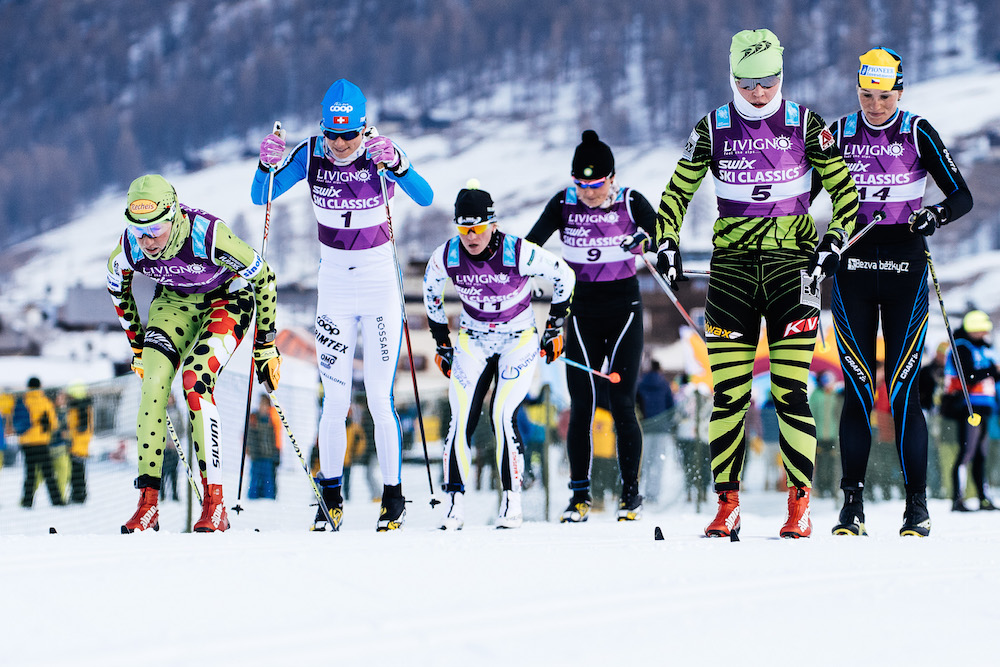
Last year’s Team Tempo Prologue in Livigno, Italy, which Team Coop (in bib 1) won. This year, the team prologue will again open the Ski Classics series in Livigno on Saturday, followed by the shortened La Sgambeda classic race on Sunday. (Photo: Visma Ski Classics)
The 2016 Ski Classics kicks off with a doubleheader in Italy on Saturday and Sunday, and the marathon regulars are chomping at the bit to get started with the long-distance race series.
The 15-kilometer Proteam Prologue in Livigno, Italy, on Saturday opens the show for the marathon series, now called the Visma Ski Classics (with a new title sponsor in place of Swix), which has been extended to nine venues this season.
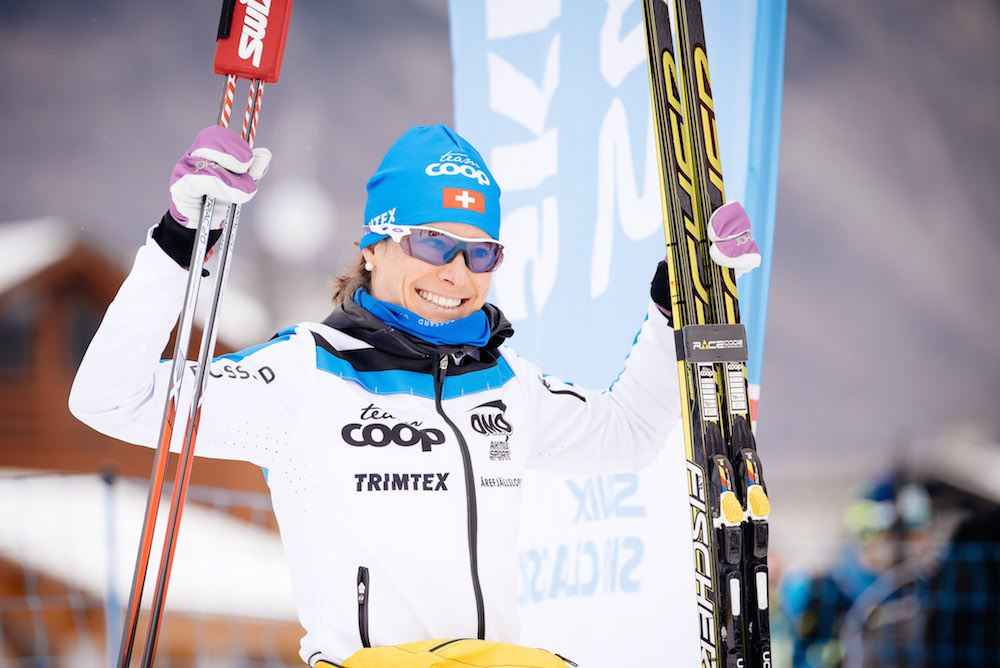
Seraina Boner of Team Coop (now called Team Exspirit) after winning the 2014 La Sgambeda in Italy last season. (Photo: Ski Classics)
On the women’s side, last season’s Ski Classics champion Katerina Smutna of the Czech Republic will be on the start line for the first races this weekend, but she will face plenty of competition. Team Exspirit’s Seraina Boner of Switzerland is eager to take back the overall title, which she has earned three times (2011, 2013 and 2014), beginning with La Sgambeda.
Poland’s World Cup star and the queen of the FIS Tour de Ski, Justyna Kowalczyk, will be doing several of the Ski Classics long-distance events this season with the Norwegian Team Santander headed by the Aukland brothers. And Britta Johansson Norgren of Sweden, who was on the podium at several of the Ski Classics events last season, is one to keep an eye on. Last season, she raced with the all women’s team Ski Pro Am, and this year she is a part of Sweden’s Lager 157 Ski Team, with teammates such as three-time Vasaloppet champion Jörgen Brink of Sweden.
Among the men, 2015 Ski Classics overall champion Petter Eliassen of Norway makes his season debut in Italy this weekend. He will have to fend off a large and deep field of competitors such as Norway’s 43-year-old marathon veteran Anders Aukland and his Santander teammates, including younger brother Jørgen Aukland, and former World Cup skiers Tord Asle Gjerdalen of Norway and Johan Olsson of Sweden.
Norwegian stayers such as Johan Kjölstad, Øystein Pettersen, Eldar Rønning, and John Kristian Dahl of Team United Bakeries, as well as Ski Classics veterans of Team Exspirit, including Daniel Richardsson, Anders Södergren and Jimmie Johnsson of Sweden and Norway’s Morten Eide Pedersen, will certainly do their best to make it a tough season opener from Day 1.
Two unique competitions in Livigno
The Prologue, in which the teams must field at least three racers to compete, was added last year, and is a team effort where the third person’s time determines the team result. The next day, on Sunday, the skiers embark on the first distance event, the now-24-kilometer classic technique La Sgambeda.
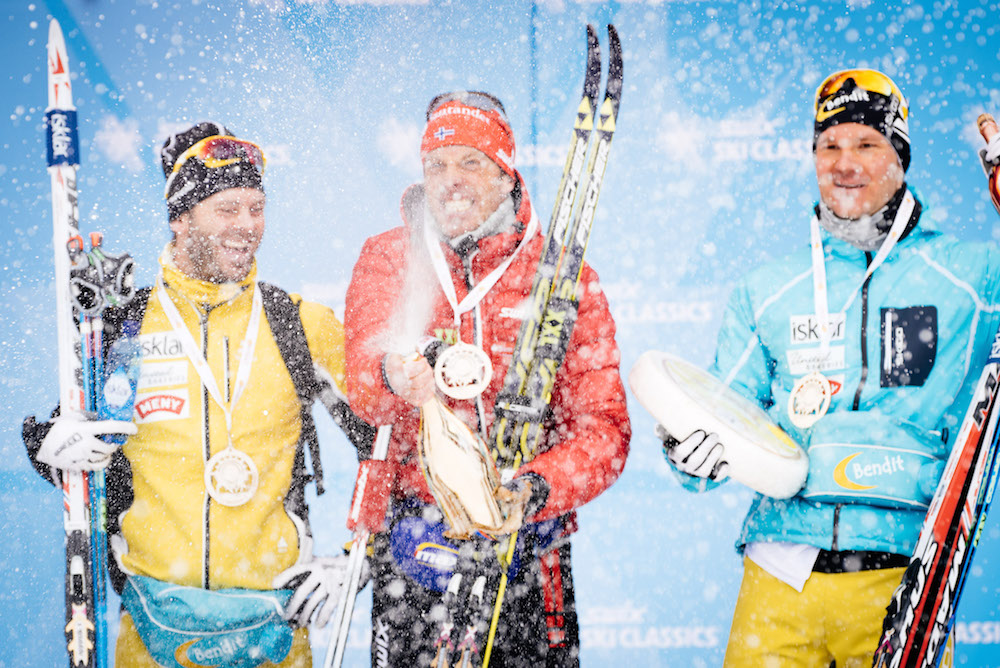
Team Santander’s Anders Aukland (c) after winning the 2014 La Sgambeda in Livigno, Italy. Johan Kjølstad (l) and Øystein Pettersen (r) both of Team United Bakeries, placed second and third, respectively. (Photo: Ski Classics)
Team Exspirit (previously known as Team Coop) won the prologue last year and is aiming to defend the title this year.
“We have had great preparations here in Livigno, skiing on the race course and acclimatizing to the high altitude,” team member Jimmie Johnsson said in a press release on Friday. “Of course, we’re aiming to defend our victory and we’re faster this season than ever before.”
Team Exspirit’s Seraina Boner won La Sgambeda last year after breaking away from the field on the hard climb at the turning point of the course. This year, the course is shortened to from 35 k to 24 k due to lack of snow and is also flatter. While Boner prefers more elevation gain, she was still optimistic before the race.
“The tougher course fits me better than the flatter one we have now,” she said. “But I will do my best, and I am really excited to finally start the long distance season together with my teammates.”
While the Team Prologue is only open to professional teams registered with the 2016 Ski Classics, La Sgambeda on Sunday is open to amateurs and pros alike.
Saturday’s Prologue will be held on the original course, but due to lack of snow in Livigno, the classic marathon on Sunday will be run on 6 k loops.
“Last season, seven of the nine Ski Classics events had to change their courses due to weather issues,” Ski Classics CEO David Nilsson in a press release earlier this week. “We can just cross our fingers that the political leaders at the environmental summit in Paris this week are able to make the right decision.”
For the 2016 season, there are 28 pro teams registered for the Ski Classics series.
After the season opener in Italy, the Ski Classics takes a break until the Jizerská Padesatka in Liberec, Czech Republic, on January 10, 2016. The race series concludes April 2 with Årefjällsloppet in Sweden as the season finale, as it has been for years. New this year is the Toblach/Dobbiaco Cortina, a 50 k classic race in Italy on Feb. 13.
Vasaloppet matters most
For Madshus racer John Kristian Dahl of Norway, who won the Vasaloppet two years ago, the 90 k race from Sälen to Mora in Sweden is the main goal for the 2016 season.
“It’s the longest and one of the oldest races in the circuit, and very special with the flats. That package makes it very unique, and difficult to win, too. In our world, it’s the championships in marathon skiing, and I’m happy that we have it every year,” Dahl said in an interview with Ski Classics earlier this fall.
Live streaming in English
In order for fans to follow the action live, Visma Ski Classics has launched the Live Streaming “Season Pass” available with English commentary on the app or the Tour Live Center at Visma skiclassics.com.
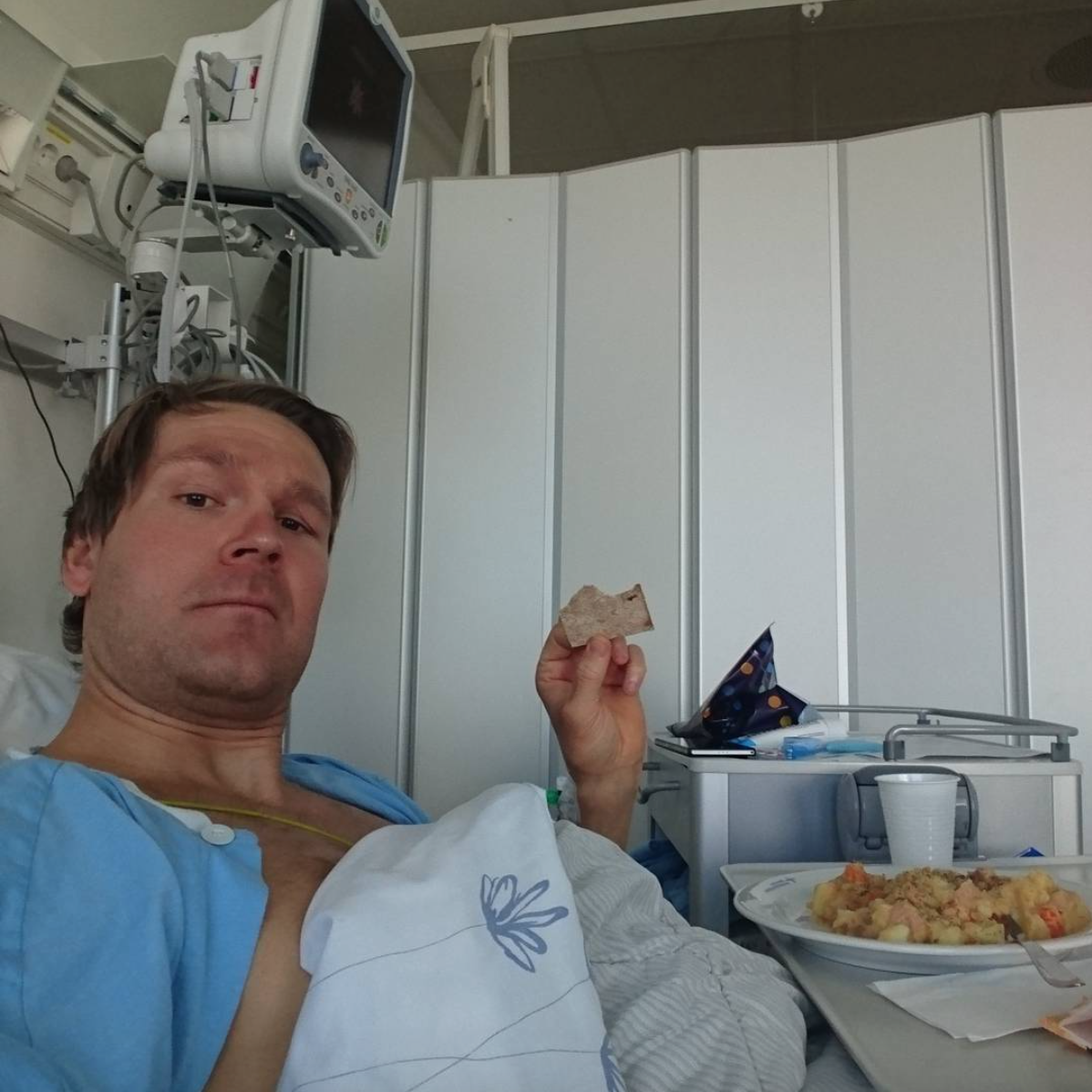
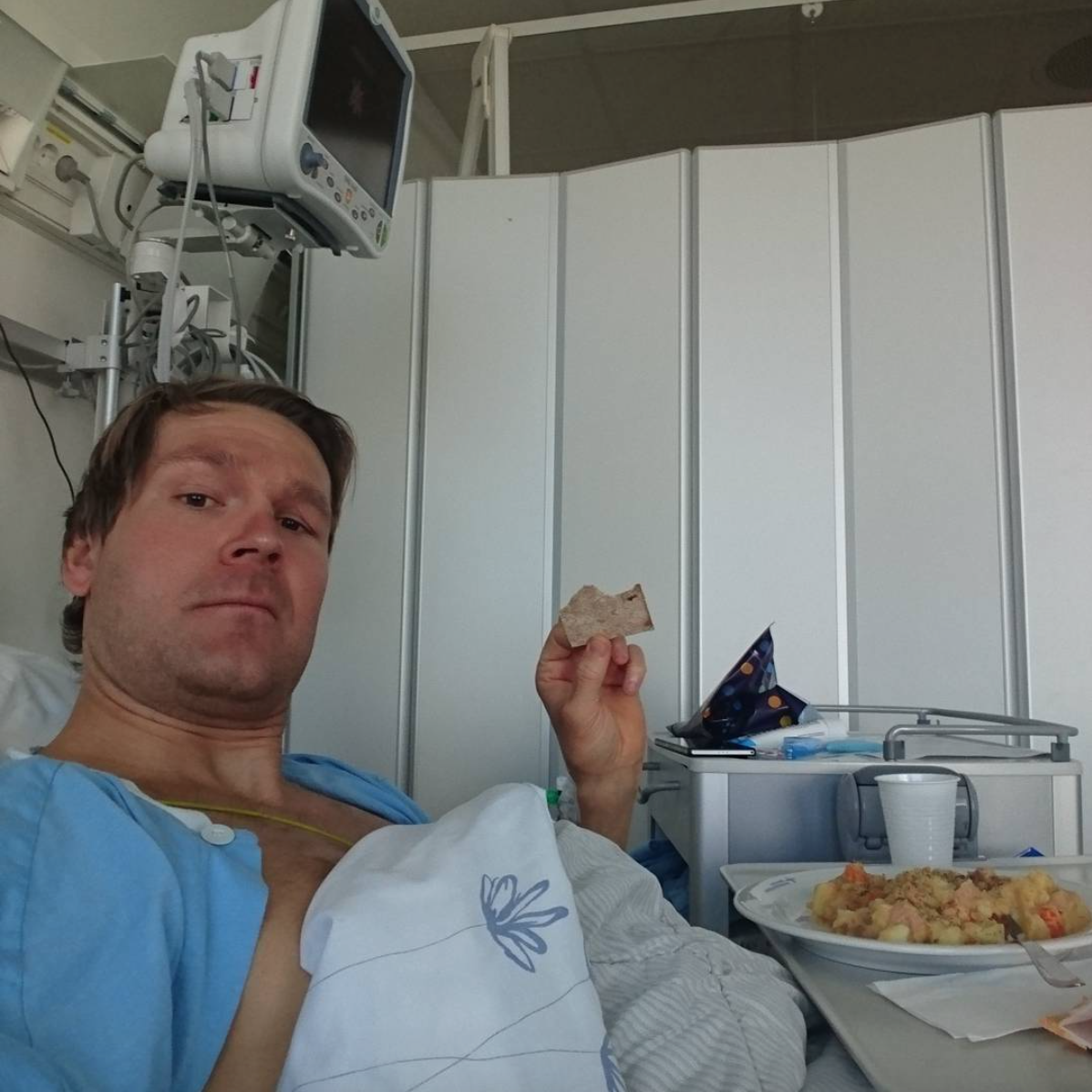
Norwegian sprinter-turned-distance skier Øystein Pettersen Instagramed a photo of himself in the Ahus hospital in Norway on Monday, showing his highlight of the day: stew and flatbread. (Photo: Øystein Pettersen/Instagram)
Øystein Pettersen went to the emergency room on Sunday night after feeling unbalanced following a training camp with Team United Bakeries. The 32-year-old Norwegian Olympian, nicknamed “The Sausage”, snapped a selfie of himself from the hospital bed and posted on Instagram, explaining that he had been admitted to Ahus outside Lillestrøm, Norway, with a low pulse and too much fluid retention.
“What’s wrong, we do not know, but since Friday the body has been out of balance,” Pettersen wrote, according to a rough translation.
Later on Monday, he joked in another post about his “absolute highlight” of the day: stew and flatbread. “Taking a bunch of tests and know not yet what is wrong,” he wrote.
He was in good spirits, he added, and was “delighted” that he had some time before his gastroscopy on Tuesday. He imagined the exam of his upper digestive track would reveal he ate stew.
Norway’s Øystein Pettersen in 2014. (Photo: FIS/NordicFocus)
“I will not be broken by an all-inclusive stay in the ER,” he added, quoting Norwegian celebrity Ramsey Suleiman, “ ‘If you are not living on the edge, you are taking up too much space.’ ”
According to Team United Bakeries manager Henrik Kvissel, Pettersen left camp in Mallorca, Spain, before the team (which returned to Norway on Monday), but not for any alarming reasons. His wife had been sick, Kvissel told Aftenposten, and while they were waiting on the results of his hospital tests, the manager speculated that the recent training load may have been too much for Pettersen.
“He is in good hands and we are all thinking of him,” Kvissel said.
Update: Pettersen Instagramed a photo of himself traveling home on Tuesday. “The body is still not in balance, but I am healthy,” he wrote. “Heart, kidneys, liver, blood, blood pressure, electrolytes and nutrients, all is well. Still have a lot of fluid [retention] and I must return to Ahus tomorrow for more tests. We believe that the body will [fix itself] through rest, good diet and through quality family 🙂
“When I can train again I do not know, the only thing I know is that I will use the time it takes,” he added. “In addition, I take lessons from the event, so that I can continue with cross-country skiing and development. For that I need a body that works…”
A 2010 Olympian who won gold with Petter Northug in the team sprint in Vancouver, Pettersen has traditionally been known as a sprinter. However, since joining the Team United Bakeries distance squad in the spring of 2014, he has become a favorite for certain marathons, including Sweden’s 90-kilometer Vasaloppet. He placed third in the 57 k Marcialonga in January, and fourth in last year’s Vasaloppet.
In late July, Pettersen and his wife, Ellen Sanbakken, announced the birth of their second child.
On Saturday, a day before he was hospitalized, he posted a photo on Instagram of him napping with his son.
“Our little baby can teach me a lot,” he wrote. “[For example] a baby sleeps when it is tired, no matter what time it is or what day it is. The body says it is tired so …. today I do the same…”
Øystein Pettersen with his son, who was born in July. (Photo: Øystein Pettersen/Instagram)
With six Olympic and nine World Championship medals, Norway's Thomas Alsgaard is one of the most successful cross-country skiers in history.
NEW YORK — After Norwegian ski legend and five-time gold medalist Thomas Alsgaard, 39, decided not to run the New York City Marathon, he met with FasterSkier’s Nat Herz on Saturday at a diner on Broadway.
He said his legs weren’t ready for the 26.2-mile grind, a decision he came to after trying to run for two hours in Central Park on Friday. After an 1 1/2 hours, he had to walk back.
On Sunday, Alsgaard said he would be cheering on his wife, Rønnaug Schei Alsgaard, and a coworker from NRK, the Norwegian national broadcaster.
Over a cup of coffee in Manhattan, Alsgaard talked about his last-minute decision not to race and his life as a T.V. commentator and manager for Team United Bakeries, a Norwegian distance ski squad.
FasterSkier: What’s going on with your legs?
Thomas Alsgaard: I’ve never, through my career, had any difficulties with my legs and I’ve run a lot … and never any problems. But now, after I quit in 2003, I haven’t run much, so this year I decided to try to run some races again because I liked it. I decided this spring to go for the New York marathon, so I started to run a lot this summer. I don’t know, being away from running too long, I guess, and then starting too hard, suddenly I got a lot of problems.
FS: What have you been doing outside of training while you’re here?
TA: Today, I’m around visiting some wine shops. I bought a lot of wine (laughs). So I’m going to eat some good food and try to see a lot of things, but all my friends are running, so they can’t walk all around all day. They have to rest and prepare, so it’s a little bit boring walking around by myself.
(His wife finished the marathon in 3:20:44 on Sunday; her goal was between 3:20-3:30).
FS: Has anyone recognized you?
TA: No (laughs). That’s actually nice.
FS: What are your race plans for skiing this year?
TA: I’m going to do some of the FIS marathon-cup races. I do run my own team still, so my main goal is to organize everything and make them fulfill their dreams, and then when I have time, I will take part myself.
Alsgaard in competition.
I do a lot of training, but I don’t train for the competitions anymore. I train because I like to feel in good shape, and then I take part in some competitions. If I have time to prepare and I feel strong, then maybe I can fight for victories, and if not, that’s fine.
I’m comfortable being number 20 or number 30. It took some years, but now I don’t bother. I’ll do the Vasaloppet and the Birkie. I will do the Norwegian championship, one race. I take part in the 15 k, and then I [commentate] the rest.
FS: Last year, you got fourth in the 15 k and then you went into the commentating booth, right?
TA: Yeah, they had us do the race and commentate the rest of the race. But the result was a little bit too good, so it became kind of comic. It was nice; it was cool.
FS: As the manager of Team United Bakeries, what exactly do you do?
TA: I have to get all the money. I do all the bookings: flight tickets, hotels. I try to do everything, so the other guys can just focus on training and preparing.
FS: Is it easier to get funding for your team because of who you are?
TA: For sure, that’s easier. That was also one of the reasons why I started a team, because I have some possibilities. Other racers with no names, they don’t have it. I wanted to do some races for myself, and I saw that I could use my name and build up a bigger team with more money and try to help other racers.
FS: Do you have some young racers?
TA: No (laughs), they are not very young. I think the young racers, the young talent, should go for the World Cup, or their goal should be the World Championship, Olympic Games. Then after some years, if they don’t succeed, they can start with the long-distance races, I think. That’s why most of the marathon-team racers today are 25, 26 and up to 40.
FS: How do you select your team members?
TA: Basically by my feeling in my stomach. If I think they have potential. I don’t care so much about the results they already have, but if I can see potential and I think that you can do a lot more, then I would like to use a lot of money on you. The head [mindset] is most important; training, technique, all those details, you can learn, but if you don’t have the right head, the right will, then it’s difficult.
I’ve done this since I was 3 years old, so I think I have some experience. I think it’s more important to just watch them, talk to them, see how they do things, try to get a feeling for how they think, their philosophy, things like that.
It’s the big picture. I just get a feeling that you can do a lot more with a little bit of help – then you get the chance. Sometimes, it works; sometimes, it’s impossible. Some racers just don’t get it or don’t do it.
FS: Do you do some coaching?
TA: Not like a regular coach. I’m just there, being with them, training together with them, trying to make some discussions, trying to make them think for themselves and get their own ideas. I don’t like to go to an athlete and say, ‘Listen, don’t do that, do this.’ I don’t believe in that. If you believe in what you’re doing, then it comes from your heart and you are very likely to succeed.
FS: You log all of your training online. Do people interact with that?
TA: I try to make a system where that’s not possible, because I don’t have time for all the questions. I just put out everything I do, every thought I have during training, and leave it to people from there.
But training diaries are extremely popular in Norway. Last year we had 600,000 people watching over the course of the year. I think 600,000 is crazy. Cross-country skiing in Norway and Sweden is so incredibly popular now.
We try to make a lot of articles on our home page, and videos. We write a lot about our training and what we’re doing, and we try to help people a lot.
FS: Would you consider coaching at another level, like with the national team?
TA:This question has been asked a lot of times, but, I don’t know. To become a coach for the national team, it’s even more traveling and more work than being an athlete. I would rather do a really serious comeback. But right now, I’m not willing to spend that much time. I like it the way it is now. I use some time on the sport and I really enjoy that, but I also want to do a lot of other things. I like to see my family
Alsgaard (second from right), with, from left, Oystein Pettersen, Kikkan Randall, and Ella Gjomle.
(laughs). The time is absolutely not right for that sort of work.
FS: But do you think you might try for a comeback, maybe in a few years?
TA: No, I think it’s perfect right now. I train when I want to train and I do what I like to do, and I take part in some races for fun.
FS: Do the Norwegian coaches, like Trond Nystad and Vidar Løfshus, come to you for advice?
TA: Not very often (laughs). [The coaches] should have, maybe, not only me, but they should have been more eager to talk to all the racers that have done well in the past, like Bjørn Dæhlie and Vegard Ulvan. There are a lot of good racers in Norway with good results, but it’s very rare that they contact them.
As a commentator, I stay in touch with both the racers and the trainers, so I do know a lot about what they’re doing. I think they’re doing a lot of good things. A lot of things from the ’90s have disappeared; I think the coaches now are a lot more in control.
In the ’90s we used to have the control of ourselves. It was the eight racers who discussed what to do in every training session, and our coaches were just looking over everything and making everything OK.
FS: Is it good that the coaches are in more control?
TA: It could be good; it could also be not so good, because the racers have a lot of experience themselves, and if they’re not used to thinking for themselves, a lot of good ideas may never see the light.
FS: In what area do you think Norway’s national team could improve?
TA: (Laughs). They do a lot of things very good, I think. But it’s always very important to be curious and always try to ask questions when you meet people, no matter if they have been good skiers or not. Ole Einar Bjørndalen is a very good example. He asks a lot of questions to everyone he meets every day, always curious, trying to pick up some details, trying to learn. That’s an area, I think, maybe they could work harder.
FS: Are you close with any of the athletes?
TA:Not very much. I meet them during some races that I commentate, and sometimes, when I’m training during the summer. Petter Northug will also be a guest on Team United Bakeries when he takes part in the
Petter Northug will work with Alsgaard's Team United Bakeries when he competes in marathon races this winter.
Vasaloppet and the Marcialonga. I worked that out with the national team.
FS: How would you compare yourself to Northug, personality-wise?
TA: It’s a different time, but of course, we have a lot of things in common, but we have a lot of things that are very different too. I think the main philosophy in training and in competition, preparing, is very similar. Our life outside is very different.
FS: Do you wish you could have raced against him when you were younger?
TA: I don’t know (laughs). Probably not. He’s very strong.
FS: Besides Northug and Marit Bjørgen, who do you think has the most potential on the Norwegian team?
TA: We have a lot of young talent in Norway, but which one of them will succeed is difficult to say. The only thing I do know is there will be another Marit Bjørgen and there will be another Petter Northug. After Pål Gunnar Mikkelsplass, everybody said, ‘Who could take over after him?’ and then Vegard Ulvang came, Bjørn Dæhlie came. After Bjørn Dæhlie, everybody said, ‘Who can take after him?’ There will always be new stars and new good racers.
FS: What do you think about the possibility of Norway hosting the 2022 Olympics?
TA:Of course, I would like to have the Olympics Games be back in Norway. You saw the last
Alsgaard racing to a gold medal in the Lillehammer Olympics in 1994.
championships in Norway — Lillehammer, Trondheim and Oslo — with all the enthusiasm, all the people, all the crowds. Norway and Sweden are the perfect places for cross-country skiing championships.
Why put it in, Pyeongchang [South Korea, the site of the 2018 Olympics] when nobody bothers? It’s stupid. Same thing in Thunder Bay, they put the [1995 World Championships] in Thunder Bay to try to make the sport popular there. I don’t think that really happened. I think it’s better to have the championship in places where the sports are popular. I have not met one person who is looking forward to Pyeongchang (laughs).
FS: But isn’t it good to have races in new places at least occasionally, to keep the sport growing?
TA: I haven’t seen that has happened. It doesn’t seem to work.
FS: But Canada does have some strong skiers, with Alex Harvey and Devon Kershaw.
TA: Not because of Thunder Bay, I think.
Canada has a very strong team now. What they did in Oslo was very good, very good for the sport and an extremely strong performance by Alex Harvey. He is one guy that could have the potential to be even faster than Northug.
FS: Was the news about Estonia’s Andrus Veerpalu being found guilty for doping disappointing?
TA: It’s very disappointing. I raced with him for many years, and I did know him a little bit. Not very close friends, but still, I think it’s a huge disappointment.
Still, I think the Finns were maybe worse; they were our very close friends. I don’t know, it’s a big betrayal.
FS: Do you think doping is less of a problem today than it was when you were racing?
TA:I think it’s much more fair now, much more clean now then it was in the ’90s and the ’80s. Although anti-doping has done a lot, it’s still very difficult to make it completely clean. But it is much better than it
Alsgaard says he thinks Alex Harvey has the potential to be faster than Petter Northug.
has ever been. All these doping cases are very sad, but it’s also kind of a good thing. It shows everybody that the system works and if you cheat, you are going to be caught and put out of the sport.
FS: How do you think FIS has done in making the sport television-friendly while still preserving tradition?
TA: I have a hard time seeing that the mass start is more exciting on T.V. than the individual start. If the production is good, it could be very, very exciting, but usually the production is bad and it’s impossible to follow the race. But if you have a very good production, individual start is the most exciting thing you can have.
FS: What needs to happen for the production to be better?
TA: I think NRK and the Swedish television made an excellent production for individual starts, so I would like to get back to that. Biathlon has one company that produces every race, so it shouldn’t be too hard. To commentate a 50 k mass start, it’s tough.
FS: I know–we have to write about it.
TA: There is at least a half an hour where nothing happens. For T.V. it’s half the work to film the mass start.
FS: So there are more cameras and more resources needed to film the individual starts, but could FIS make that happen?
TA: I think T.V. wants to use less money, and FIS follows. They could change it, but still they have to have television. Without television you can’t sell anything. My wish is to go back to individual start, but I know that will never happen.
OSLO, NORWAY – Oslo’s local ski organization Skiforeningen and Thomas Alsgaard’s new distance initiative Team United Bakeries dish up a 10K classic suffer fest with more than 1,200 feet elevation gain. Start is Sørkedalen, Oslo, finish at Tryvann.
Jörgen Brink Photo: Madshus AS
According to the start list, both Team United Bakeries and Team Xtra Personell are well represented in the elite wave. Both current Vasaloppet champion from Team United Bakeries, Jörgen Brink (SWE), and 2008 Vasaloppet champion Jørgen Aukland (NOR) from Team Xtra Personell are registered and ready to duke it out for bragging rights. Add 2008 and 2009 Vasaloppet champion Sandra Hansson (SWE) in the women’s race to the mix for a total of three Vasaloppet champions on the start line.
“We’re really excited to have this kind of a marathon field. We think this event has potential, and next year, we’re planning to have the finish in the new roller ski arena at Holmenkollen,” Ole Kristian Sørland of Skiforeningen says to the Norwegian web site birken.no.