From the FasterSkier archive — posts syndicated from athletes’ and coaches’ own blogs between 2004 and 2012, kept online as published. Current coverage is at fasterskier.com.
When reaching out to Sun Valley’s Annie Pokorny to learn more about her decision to become a technical delegate and her experience so far, it was also on the radar that Pokorny’s friend and former teammate Kelsey Phinney was also engaged in the process. As it turned out, Pokorny had been a leading influence in Phinney’s decision to become a TD herself.
Like Pokorny, Phinney is a 2016 graduate of Middlebury College, before continuing with her ski career, first with the SVSEF Gold Team and then the SMS T2 team until 2020. The 2019-2019 season was perhaps her peak year from a performance perspective; spending ample time in Europe racing World Cups, Phinney popped a top-20 during a skate sprint in Lahti, after having taken third at U.S. Nationals a month prior, behind Julia Kern and Hannah Halvorsen. At the end of the season, a crash during Spring Series left Phinney with a torn labrum in her shoulder, for which she underwent surgery later that year and rehabbed, before eventually stepping away from professional skiing.
Phinney is currently in her final semester of graduate school where she’d pursuing a Master’s Degree in Health Systems, Management, and Policy through the Colorado School of Public Health. She now lives in her hometown of Boulder, CO with her partner, fellow retired SMS T2 skier Kyle Bratrud.
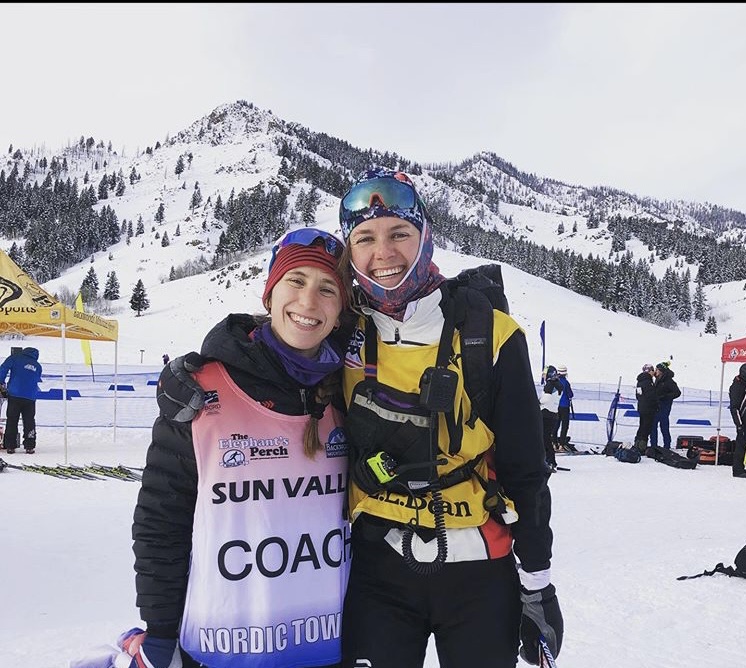
Kelsey Phinney and friend Annie Pokorny snap a picture at a 2019 SuperTour in Sun Valley, where Pokorny was working as a technical delegate and Phinney was assisting SMS T2 coach Pat O’Brien with waxing while rehabbing from shoulder surgery. (Courtesy photo)
FasterSkier (FS): When did you begin the process of becoming certified as a TD? What was your experience like with the certification process? Were you able to “fast-track” given your experience as an athlete and has your experience as a high level racer been an asset?
Kelsey Phinney (KP): I began the process of becoming a TD this past fall after a conversation with Annie Pokorny about ways to stay involved with the sport. My experience as a former racer has certainly been an asset. While I have learned much more about the specific rules than I knew when I was racing, I hope my ability to bring a racer’s perspective to decisions – like where to start and end turning zones in a classic race – helps make races safer and more fair.
FS: You mentioned Annie helped get you involved. Can you say more about what those conversations were like? What/who were some of the other factors/people that motivated you to become a TD?
KP: The primary reason I looked into becoming a TD was to give back to the sport within my current time constraints as a full-time graduate student. There is also a shortage of TDs in Colorado, which motivated me to follow through with the training and certification process following my conversation with Annie.
Since I’m currently living in Boulder, the races hosted in Colorado are all within driving distance for me. This year, I was the assistant TD at a junior race in Aspen the weekend after my fall semester wrapped up, as well as at a college race in Steamboat a couple of weeks ago.
FS: There is an overall need for TDs in the U.S., and while there are some noteworthy female TDs who have or will be jury members at the World Cup, World Championship, and Olympic level, there are few women in the role domestically. We ran an article about the need for TDs in 2017 and at the time, there were only 10 women listed in the U.S. Is this something that you considered prior to becoming a TD?
KP: To be honest, I didn’t think much about the lack of female representation of officials when I decided to work towards becoming a TD, but I do think representation matters and it is important to have diverse voices and perspectives included in the decision-making process. I’m happy to contribute to increased representation of women among the officials domestically. I think my racing experience and age are other important qualities I bring to the table.
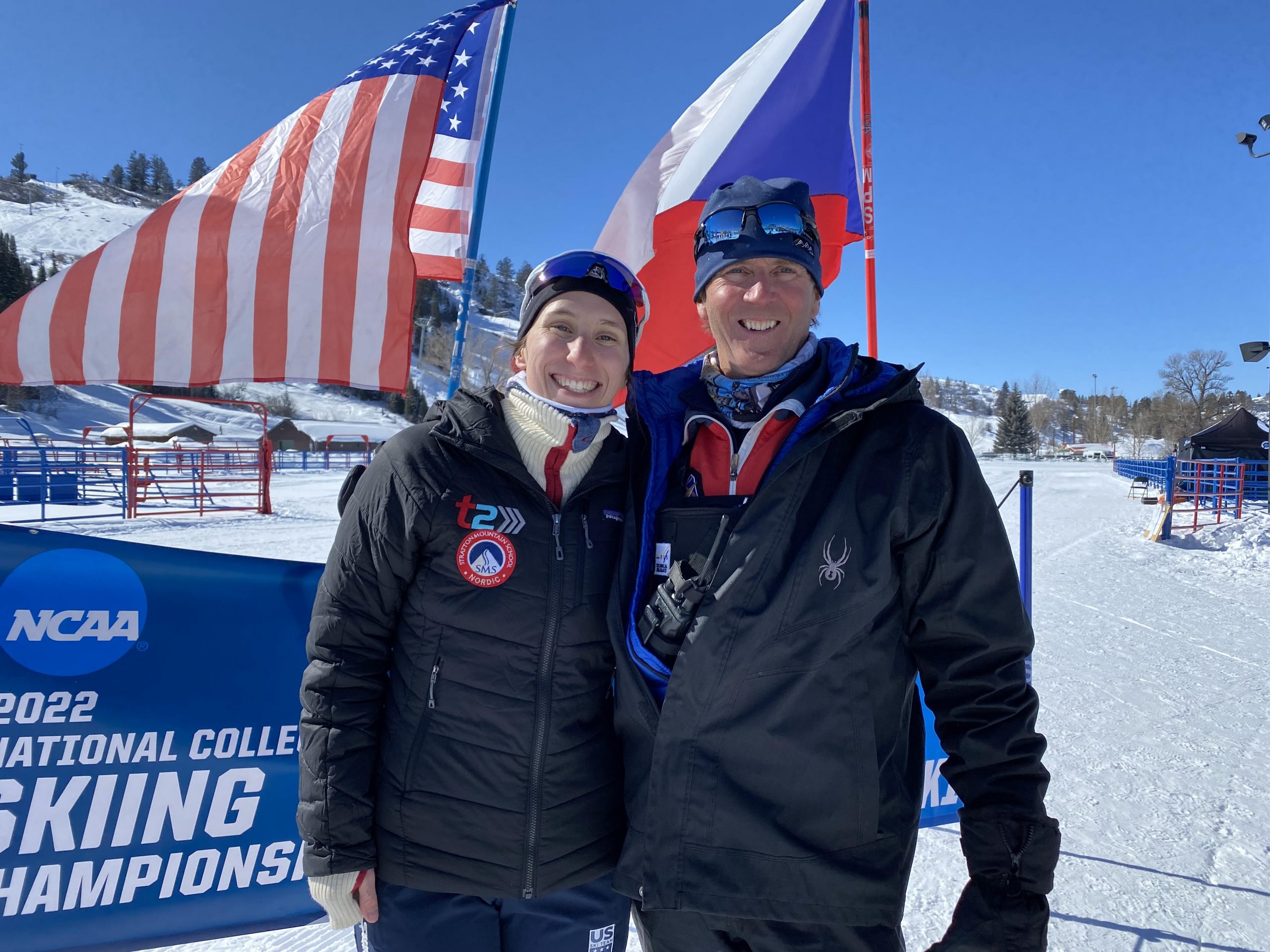
Kelsey Phinney and Al Pokorny (father of Annie) work as technical delegates at the RMISA Regionals race in Steamboat Springs, CO. (Courtesy photo)
Torin Koos (BSF/Rossignol) crossing the line in first in the A-final of the men’s classic sprint at 2012 U.S. nationals. While waiting to take to the podium, he found out his win was in question. (Photo: FlyingPointRoad)
At Norway’s 2015/2016 season-opening International Ski Federation (FIS) weekend, defending World Champion Martin Johnsrud Sundby was in for a surprise. The final starter to hit the deteriorating tracks in the 15-kilometer classic individual start, the Norwegian initially posted the fastest overall time, only to later be disqualified for a skating infraction.
A similar result greeted American sprint leader, Torin Koos in the closing competition of the 2012 U.S. Cross Country Championships in Rumford, Maine. After crossing the finish line first in the men’s classic sprint A-final, Koos was ultimately disqualified for what the jury deemed “an obstruction of competition“, switching lanes before completely clearing his competitor’s skis.
While being the athlete in either of the above situations is never easy, difficult too is the position of technical delegates (TD) who determine their outcomes. When should a skier be disqualified? How many skating steps counts as an infraction in a classic competition? How much should this vary for level of competition and competitor?
Whether a World Cup race or a junior club competition, TDs are as key an event element as the right race-day wax. But serving as a ski referee is not the only responsibility TDs hold.
When conditions are icy enough to send skiers rocketing into trees lining a race course, or the day’s temperatures forecast frostbite, canceling or delaying a competition is also a judgement call made by TDs.
Race courses are also on the list of TD’s concerns. Although the whereabouts of V-boards may not weigh heavily in the minds of athletes, the layout of a course can determine the outcome of a race for skiers, with the duty of setup falling partly on TDs.
As a resource, TDs serve another role. By advising and working with race organizers, TDs ensure those involved with a cross-country sporting event, from the groomer to the timers, are in compliance with USSA and FIS rules.
In the United States at present, however, few individuals are signing up for the job. The total estimated number of individuals who began training this fall to become a level one TD is 10. While few appear to be entering the TD pipeline, many of the current TDs in the U.S. are also rapidly approaching retirement.
“I don’t know what the average age of a TD [in the U.S.] is, but it’s certainly not a young person’s activity,” Scott Wilson, regional coordinator for the Midwest and chair of the U.S. Ski & Snowboard (USSA) TD assignment committee, said on the phone in early October.
Wilson, 70, who has been a TD and coach for the past 25 years, also indicated that not all those currently listed on the TD record remain active in their membership.
“There are 75 on our roster right now,” Wilson said. “But … because there are insurance issues and background checks … we’ll probably nick it down more to 65 [TDs] that are making some progress or staying current.”
As outlined by Wilson, there are three different levels of TDs, with one newly emerging level he refers to as “in-training”. Following the “in-training” level, each consecutive level is known as Level 1, Level 2 and Level 3 TD. For an individual to be considered a Level 1 in the U.S., they must attend a TD seminar (usually held in the fall with dates determined by regional coordinators).
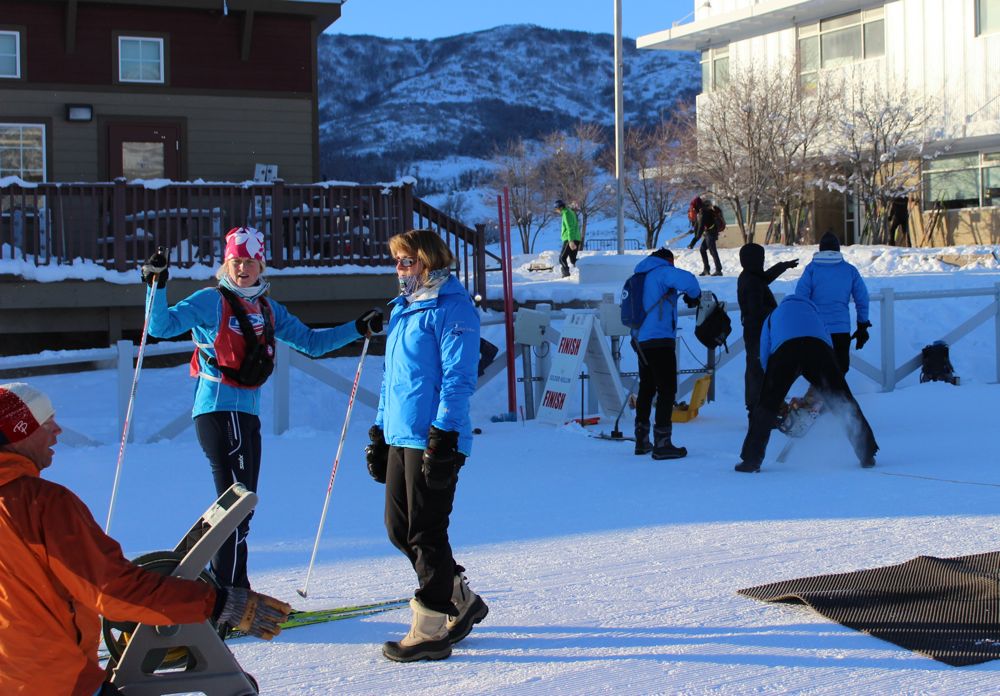
Technical delegate Eileen Carey (left) talking with race volunteers at an event at Soldier Hollow in Midway, Utah, in 2013.
Level 1 TDs are only permitted to run local club competitions, whereas a Level 2 can run a local or national event — such as a Continental Cup (e.g. SuperTour) — and a Level 3 may work anything from a World Cup competition to a small-scale ski race.
For this reason, following their initial seminar, many Level 1 TDs work for two years shadowing an experienced Level 2 or Level 3 TD.
After two years, a Level 1 TD may have accumulated enough experience to become a Level 2. Advancing from Level 1 to Level 2 requires an evaluation which takes place over the course of two competitions.
During the first competition, a Level 1 will serve as an assistant TD, primarily observing the more experienced TD. During the second competition, they are no longer an assistant, but placed in charge and monitored by the more experienced TD.
If the the Level 1 TD successfully becomes a Level 2, another two years of race experience are required before they can consider becoming a Level 3. A recommendation from the regional coordinator must also be put forth for a Level 2 to become a Level 3.
Furthermore, according to the FIS rulebook, an individual must be under the age of 50 in order to start training to become a Level 3 TD. To become a Level 3 TD also requires an examination as well as a presentation at a TD seminar. All said and done, becoming a TD particularly at the World Cup level, is not as simple as counting skate steps in a classic race.
“It’s a fairly big commitment, for most of which you don’t get reimbursed or paid,” Al Pokorny, the TD regional coordinator for Pacific Northwest Ski Association and Intermountain Division, said on the phone in late September. “So the only people who really can do that are people who are older and people who have money.”
At present, a TD’s training expenses, such as travel to and from required instructional seminars, are not covered. For American TDs in training, one seminar must be attended during the fall. A TD must then continue to attend seminars every two years — which rotate location between the U.S. and Canada — at every level in order to maintain their TD status.
With many required trainings, little compensation and a lofty time commitment, pulling TDs into the pipeline is a constant challenge. Pokorny, who has been a TD for almost 10 years, explained that’s a challenge that must be addressed, since having not just young TDs, but TDs who understand the sport from the inside, is beneficial.
“We have great TDs, but the ideal TD would be someone who is relatively young [and has been] involved in the sport at a high level,” Pokorny said. “One of our jobs as a TD is to go out and ski the course and to determine if the course is appropriate for the level of competition and so you kind of have to know what that means. The best way to know what that means is to have done it. So that’s the main reason someone who has been in the sport at a high level makes a good TD.”
Yet, recruiting individuals who have been in the sport at a high level and are fairly young, regardless of compensation is no easy task.
“Those people typically have young children, they’re just getting married. There’s a whole bunch of stuff going in their lives and the last thing they want to do is have to go back and be a TD,” Pokorny said.
Even after throwing in the compensation most TDs receive for events they help run, which amounts to $50-$100 dollars per day, along with travel or accommodation costs (usually but not always), the reimbursement still is not much more than what a high-school referee might earn while working a varsity football game.
Sally Jones, the regional coordinator for the Far West region, pointed out that for the amount of time put in compared to the payout, a TD may as well work for free.
“It’s challenging to find TD’s, whether male or female, because it’s quite a time commitment,” Jones, one of 10 women currently listed as a TD in the U.S., said on the phone in early October.
“It’s not a career, it’s a volunteer position,” she added.
So what drew many of these TDs into the job in the first place? Why spend hours upon hours shivering watching snowflakes and ski racers fly by? One of the most experienced FIS TDs, Al Serrano boiled it down to one word: community.
“You know, we’re a crazy community,” the 48-year-old Serrano said. “We’ve done some things to bring up the compensation a little [for TDs]. There is a requirement for a NRL or FIS race that the TD assistant get paid for their travel expenses and get paid for the day with rates up to what the FIS rate has been … roughly on par for $100 dollars a day. … But bottom line is you do [TD work] because you’re a part of the community and you want to stay involved with it.”
“… Bottom line is you do [TD work] because you’re a part of the community and you want to stay involved with it.”-– Al Serrano, FIS technical delegate on what keeps many TDs involved
Bruce Cranmer, head nordic coach at the University of Colorado-Boulder echoed the sentiment of Serrano and many other TDs FasterSkier spoke with.
“Some are trying to do it at a professional level,” Cranmer said on the phone. “Others are doing it more … to give back and help the sport.”
Perhaps if American TDs can recruit individuals with similar mindsets, the pool of TDs may not shrink so soon after all. Maybe if they can hook the right ones, they will safely replace those soon looking to retire.
“We need to do a better job of targeting people,” Serrano said of potential ways to encourage membership. “You know, going to the clubs and the teams and asking about their retiring athletes and people who might be willing to do it.”
***
The Steps to Become a TD in the U.S.
Outlined below are a few steps individuals can take to become a TD in the U.S. After completing the initial training, a TD has the opportunity to remain a Level 1 TD, or move up to Level 2, which allows them to work as the head TD at national-level events. A Level 2 TD who wishes to move up may continue training and become a Level 3 TD, permitting them to work as the head TD at FIS-sanctioned competitions.
– Step 1: Contact your local coordinator.The first step to becoming a TD is contacting the coordinator for your region. There are currently five regional coordinators: Justin Easter (East), Scott Wilson (Midwest), Al Pokorny (West), Sally Jones (Farwest), and Matt Pauli (Alaska region).
Many TDs also indicated that in order to replace the current cohort of TDs approaching retirement, TD coordinators and TDs need to communicate with local clubs and college programs to obtain contact information for individuals who may be interested in becoming, or are qualified to be, a TD.
“We need good candidates,” Serrano said. “We need to have local people so the travel distance [for TDs to competitions] isn’t so far.”
– Step 2: Attend the trainings.While most of the initial TD seminars take place in the fall, there in not an established date for training among all regions. Contacting regional coordinators for specific training times is crucial.
“The initial TD training is done through the regional coordinators, which varies from region to region,” Serrano said. “That’s one issue we’re trying to work on, is to standardize [TD trainings] a little bit.”
– Step 3: Spend time as an apprentice. Spending time shadowing various TDs at multiple levels of competitions provides a vast scope of the TD styles and ways to work an event.
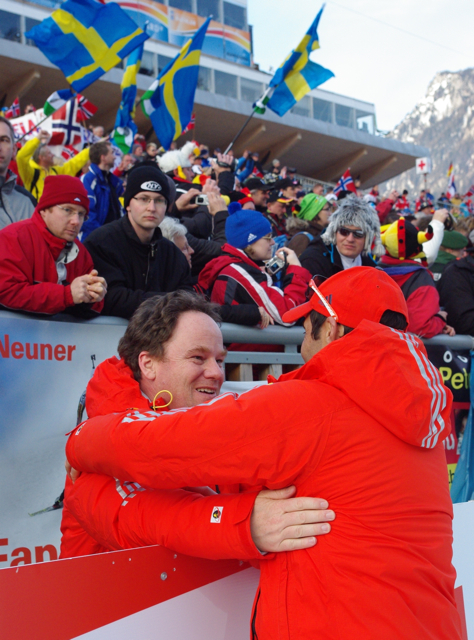
Max Cobb, who besides acting as CEO of USBA also chaired the International Biathlon Union’s Technical Committee, receives a hug from a fellow official after U.S. athlete Susan Dunklee placed fifth in the 2012 World Championships.
Today marks Max Cobb’s 25th year of work with the U.S. Biathlon Association (USBA) – an impressive tenure for anyone at any organization.
In that time, Cobb already has a lot of job descriptions. He is now the President and CEO of USBA, works closely with its fundraising foundation, acts as a Technical Delegate at multiple World Cups every year (including, last season, at the Olympics in Sochi, Russia), and headed the International Biathlon Union’s (IBU) Technical Committee for the last cycle.
Thanks to that last job, Cobb might be able to add the role “politician” to his list of titles.
Over the last year, Cobb and the rest of the Technical Committee developed a new comprehensive system of qualification for IBU events, encompassing qualifying points, Nations Cup scoring, quotas for major events, and a Wild Card system to supplement those quotas. In nearly every aspect of racing, scoring and qualification will change from the previous system.
Cobb and his team had to make the sell first to the IBU’s Executive Board, who sponsored the proposal at the IBU Congress held in Austria this weekend, and then at the Congress itself. And they delivered: every major proposal was passed, with votes of at least 45 of the 50 total national federations, Cobb told FasterSkier.
“With all the changes, we now have a really cohesive system that both is fair and supports teams moving up through the rankings if they are having good performances, but also really honors the performance of athletes from any nation regardless of where they are within the Nations Cup ranking,” Cobb said.
The changes added significant complexity to the IBU process. Previously, in order to qualify for the World Cup, athletes had to score one race on the second-tier IBU Cup circuit where they finished within a certain percentage of the winner’s time.
The new points system is similar to that employed by the International Ski Federation, in that there is both a race penalty based on the points of the top competitors, and an individual penalty based on the racer’s percent back from the winner. The two penalties are summed to determine an individual’s points for a given race.
The same system will be used throughout all levels of IBU competition, which has never been done before. This will allow competitors to develop a total points profile regardless of where they race, that reflects not just their own performance but the strength of the competition.
Cobb sees this as a particular boon to smaller, and less cash-flush, teams.
“It really leaves it up to a federation to decide, okay, are we going to deploy our team to the IBU Cup, where the level of our athletes is, really that will be the best development opportunities for them, or will we be able to have two teams, one on the IBU Cup and one on the World Cup?” he explained. “Under the previous system they really had to go to both. This allows them to choose.”
These nations might have previously had to stretch their budget to take advantage of particular weekends where there were more opportunity to score World Cup points – weekends with multiple individual competitions, for instance, rather than a sprint-pursuit-mass start weekend where two events were qualification-based.
The number of “wild card” entries at World Cups will increase from three to four per gender, and ten of these will also be available at World Championships under the new rules. In addition, the entries will be based on the athletes’ points, not their country’s Nations Cup score.
“We can allocate wild cards based on athletes’ performances,” Cobb said. “That didn’t really exist in the old system.”
And it might affect the way that countries try to qualify those athletes for major events.
“What we saw with the previous system was that it was really not a cohesive system and it really forced national federations to do some strategy things that didn’t make sense,” Cobb said. “In some cases it really put them in a place where they couldn’t look out for the best development process for their athletes. They had to chase points at various levels. That just didn’t make sense.”
In some ways, the system was a tough sell simply because it’s so much more complicated than the previous rules. Cobb said that he and the Technical Committee took a measured approach to explaining their proposal to the sport’s many stakeholders.
It started with a presentation he gave to the Executive Board in Sochi, and then continued from there. The Technical Committee began to explain the proposal to coaches on the World Cup and the IBU Cup at the end of the season, and then Assistant Race Director of the World Cup, Borut Nunar, ran models of how the points would look based on the previous season of results and presented again to the Executive Board in Oslo.
The final step was selling delegates at the Congress.
“We followed that up with more meetings at the Congress so that delegates to the Congress, who are frequently not coaches, could have an understanding too,” Cobb said. “And that was really productive. It gave people an informal setting in which to ask questions and kick things around and bring up their concerns, and go into detail about how it works.”
The new points system will go into effect this coming season, in order for athletes to develop a points profile, but qualification based on the new points will not go into effect until the 2015-2016 season.
Some changes will be more immediate, however, for instance the Nations Cup scoring on the World Cup and IBU Cup circuits.
In the new system proposed by Cobb and the Technical Committee, the points awarded for first through 80th place will remain the same, but fewer points will be awarded after 80th place. This, he said, will reward nations with one strong competitor more than the previous system had, and they will be more likely to gain a quota spot for that competitor.
Nations Cup points will be used to determine quotas in the 2015-2016 season, including a change that sees an in the number of athletes able to start in World Cups from the mid-level teams, as well as the addition of the Wild Cards.
World Championship qualification in particular will be affected by the new Nations Cup points: instead of four athletes per country gaining entry, lower-ranked teams will be able to enter only two or three athletes, again with the additional Wild Card spots going to up to two athletes per federation who do not have a quota.
The reason for the reduction in World Championship field size was not only to make the event more competitive and selective, but also to minimize past problems with course preparation and fairness. At several past Championships, snow conditions have changed significantly over the course of the race as over 150 racers start, 30 seconds at a time. Cobb himself has TD’ed several such events and dealt with the ensuing nightmares.
“That was really done to be able to have a World Championships that fits better for television, which is our major supporter in the sport, but also one where the size of the field is manageable,” Cobb explained. “Potentially with 50 members, there could have been 200 starters at a World Championships, and that is just unmanageable to be able to keep some element of fairness in the competition.”
Although the field size will be reduced, Cobb said he is confident that the athletes who deserve to be at World Championships will be entered.
“For the World Championships we have up to 10 wild cards available,” he said. “When we did our models, what we saw is that that really captured all the athletes who we felt were at an appropriate level to be entered there.”
All in all, Cobb said, all the complicated mathematical calculations will have a big reward – and he’s relieved that the biathlon world recognized it.
“I think that everybody saw that yes, it is more complex, but the complexity is being added in order to make it more accurate and a little more fair,” he explained. “And that the system really honors and respects the performance of the athletes. I think that’s why we saw overwhelming support. People voted in favor of a more fair, open, and sporting system. That was great to see – I was really gratified.”
The newly elected Technical Committee meets for the first time in October. Cobb was again voted onto it, and it remains to be seen whether the rest of the committee will re-select him as their Chair for another few years.