From the FasterSkier archive — posts syndicated from athletes’ and coaches’ own blogs between 2004 and 2012, kept online as published. Current coverage is at fasterskier.com.

Tag: technique work

  • Wednesday Workout: U.S. Ski Team ‘Coaching Technique’ 101

    Wednesday Workout: U.S. Ski Team ‘Coaching Technique’ 101

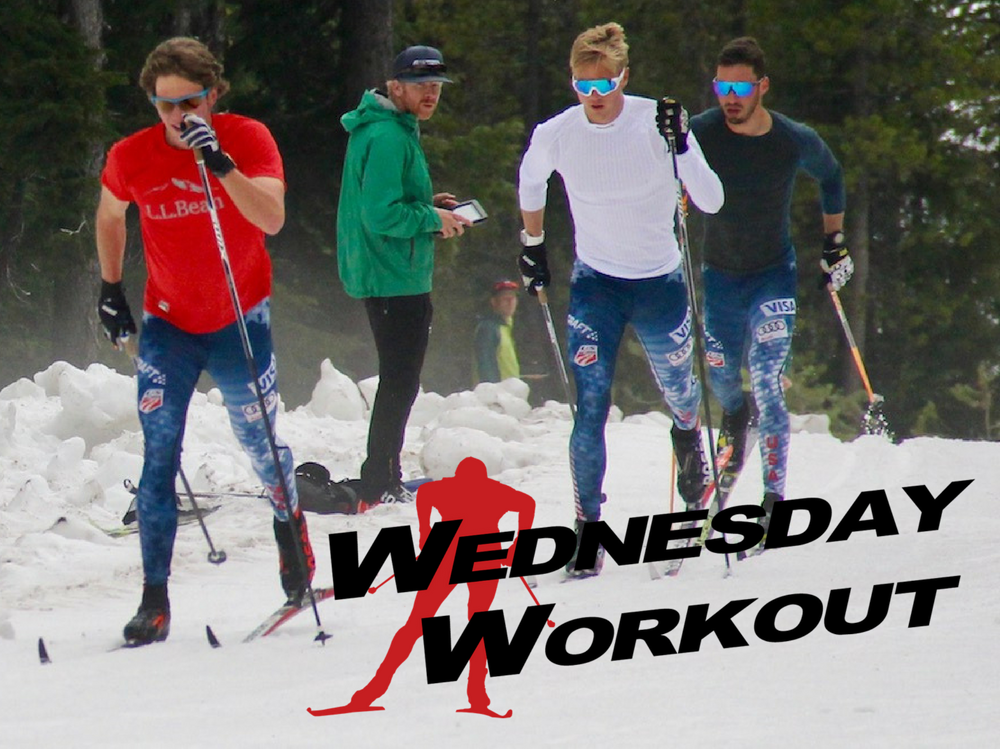
    U.S. Ski Team (USST) members (from left to right) Scott Patterson, Erik Bjornsen and Ian Torchia working on classic technique last month in Bend, Oregon, while Sun Valley Gold Team Coach Chris Mallory (second from l) and USST coach Matt Whitcomb look on. (Photo: Bryan Fish)

    The U.S. Ski Team (USST) wrapped up its latest spring training camp in Bend, Oregon, on June 1. One of the primary aspects of the annual camp is for the USST coaching staff to work on technique in a low-stress environment. The following workout was provided by U.S. women’s coach Matt Whitcomb. Here are the goods:

    ***

    Coaching Technique at a U.S. Ski Team Camp

    The workout: 2-3 hours at an easy distance pace, with running or herringbone technique focus

    Technique focus: Stable core/upper body in both running and herringbone technique

    “This technique session framework is something we’ve used for several years,” Whitcomb explained in an email. “What makes this session effective is that we prime the team with a video clip for visualization and instruction immediately before the workout, and use iPads and light coaching feedback during the session. After the session, some athletes like to review the clips again or receive them over email.  I use an app for iPad and iPhone called Coach’s Eye, which has a great slow-motion and frame-by-frame feature, and allows the user to email individual clips or export a bunch of clips to iMovie so a more-complete compilation of the session can be sent as a YouTube link.

    Framing the Session

    •  Two or three-minute workout description in a space with a TV or projector.  If it is longer, there is a good chance we’re over-caffeinated and over-coaching. Too much to focus on kills focus. We try hard to work only on one technique goal per athletes per session.  While many of us coaches agree it feels purposeful as a coach to do a daily knowledge dump before or during training, less is generally more. Coach slowly. Here’s a simple pre-workout description example:

    ‘After you’ve warmed up for a few minutes, we’d like those whose elbows are feeling good to double pole easy for 30 minutes while we wait for the snow to soften. Keep it easy on the climbs by pecking your way up. Work high and ski very short on the climbs for this double pole specific strength. Let’s have the men meet on Screamer 45 minutes after we get on snow, and the women 1:15 into the session. Today we’ll do some technique work on running, which is basically bounding on skis, usually without any glide. The video we’re about to show has a clip of Sadie running in Ruka, and Belorukova in the same clip doing a modified herringbone.  Watch for upper-body stability. The next clip will be Sundby doing herringbone at maximum speed. As fast as it is, notice again how his upper-body is stable and calm, almost still. In running on skis, a stable upper-body provides the platform under which the legs can do a lot of work. The last two clips feature Sadie again, and then Klæbo, both running but at a more casual pace. Question about the session before we play the video? If you want more video on the iPad after your session, just talk with a coach out there. Extra water, klister, and sunscreen will be at Yuppie Junction. Alright, let’s dial in the focus and channel this video.’

    • Watch two- to three-minute visualization video. Key to the visualization session is that everyone is quiet and bringing focus. Longer than three minutes tends to yield diminishing focus for many.  We customize short videos from the most recent World Cup season for most skiing and roller skiing sessions. If the goal of the session is to work on kick double pole, we’ll find that technique for both men and women from a race, but we try to feature different athletes and a wide-range of styles. We’re not looking only at the best. If you want to do this on your own, we like Adobe Premier Elements instead of iMovie because you’re not required to convert the entire race to MP4 prior to editing.  This saves time. Here are three examples:

    Double Poling: Kalla / Weng / Bolshunov / Golberg ’18

    Herringbone / Running Ruka ’18

    V2 Tonseth / Haga ’18

    (If you want the link to our database to see more video links, just fire me an email: matt.whitcomb@usskiandsnowboard.org)

    Coaching the Session

    When the men’s team shows up for the technique portion of the session, the coaches tell the athletes who will be working with whom and will suggest they do about eight to 10 passes of the 300-meter loop. As coaches, we try to stand near one another to use each other as resources, and to pay attention to which athlete is hearing what so we can avoid over-loading them later in the session. This way we can reinforce what they were already working on with another coach. We use colored cones in some way for most sessions to clarify loops or surge points. Ideally, each coach works with not more than two athletes at a time, and all coaches have an iPad or phone to replay video. We’ll show an athlete their footage every several passes but otherwise encourage them to keep moving, possibly shouting out a simple cue as they ski by. Because developing fitness is our top goal, we do very little standing around. Stopping to watch their video means watching a clip twice in regular speed, and once in slow motion. This takes 30 to 45 seconds total if you’re good with your iPad. Standing in the shade (or anywhere in New England or Alaska) helps to see the screen clearly.

    Our goal is not to have a team that skis alike. While we have themes to focus on for a particular session, we want them all to ski in their own unique way. If an athlete has a chronically tight back, they are going to compress differently than an athlete with more mobility. An athlete with valgus knees can’t simply align their joints to please our coaching eye. They should all ski with their own unique style, and this can be healthy to reinforce on a younger team to minimize unhealthy comparison.

    Our goal is not to have a team that skis alike. While we have themes to focus on for a particular session, we want them all to ski in their own unique way.
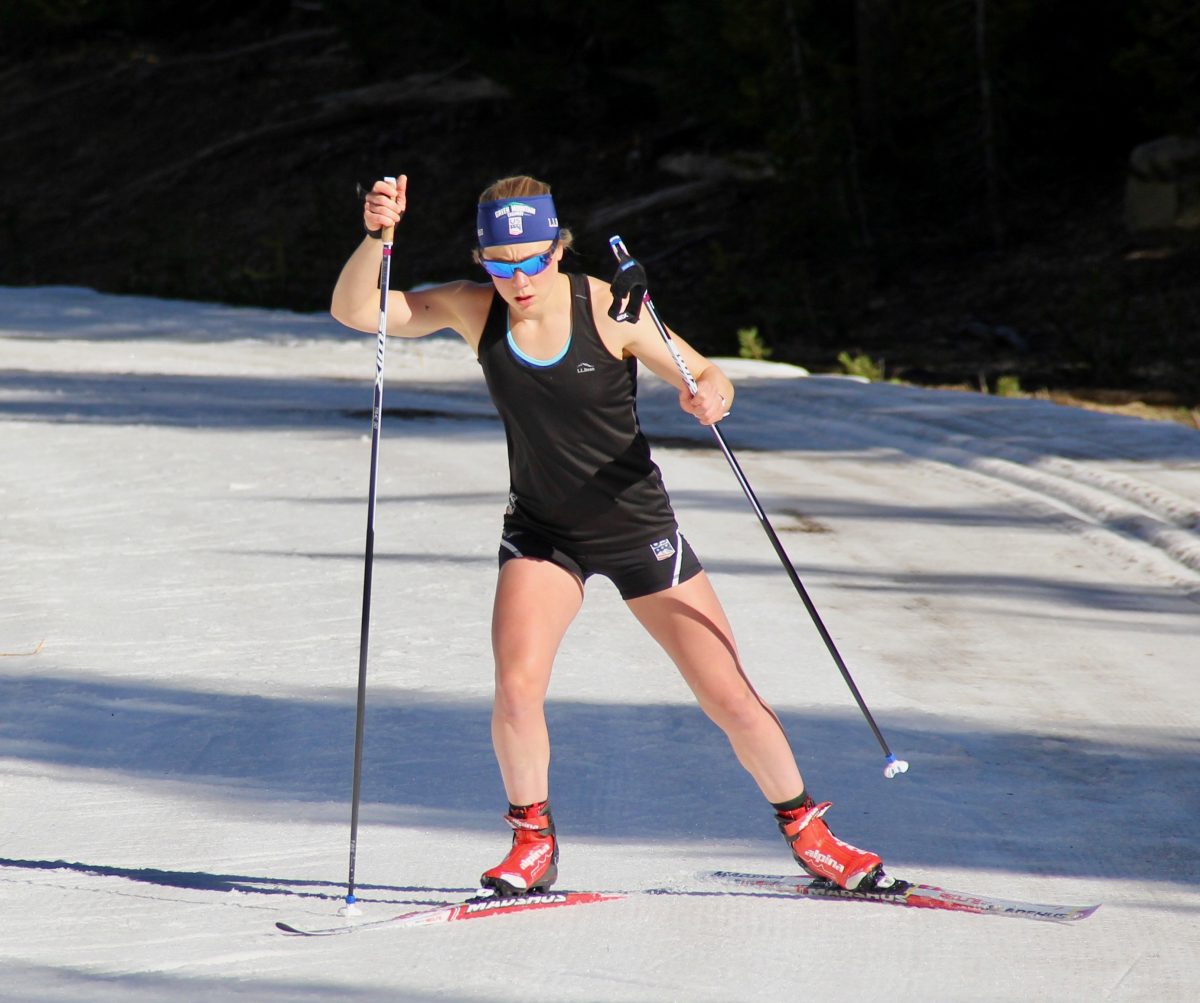
    U.S. Ski Team member Ida Sargent doing a single-pole V1 drill at the team’s recent on-snow camp in Bend, Oregon, last month. (Photo: Bryan Fish)

    A few ideas for early-season sessions

    • Take a close look at how the athletes are skiing in May. It’s often surprisingly relaxed and natural. How can it be so good after so little coaching? Is this because we tie them up with too much technique feedback throughout the season?  Since we’re always pointing out what they could be doing better, have them focus on something they’re doing well. If the technique session makes them ski tense and like a drill we used, it might not have been the right approach for that athlete on that day.
    • Encourage the athletes to give feedback on the technique adaptation they trying to make. Sometimes something suggested by a coach ends up not working, or just being wrong.  It’s not a lost session if you and the athlete learn something through the coaching mistake.
    • No-pole or one-pole skiing.  If an athlete’s striding needs work, we revert to old-school, no-pole skiing as a go-to. If the back gets sore or tight, alternate using right or left pole only. Good striding includes learning how to subconsciously use the feet so the kick strength or style can be tailored to the snow, pitch, and wax job of that specific moment.  Even if the athlete is struggling with kick and can hardly move forward without the poles, there isn’t much that does more for classic striding than really scrambling the athlete’s comfort zone, and then returning to two poles.
    • Prioritize quality movements over velocity and tempo in your early speeds sessions.  Consider adding tempo late in the session rather than first.
    • If we’re asking the athletes to ski at high intensity, we think it’s important to do a dynamic stretching or mobility routine right on the snow (take off skis and poles) as a part of their pre-intensity warm-up.  The idea is to prevent injury and produce higher quality intensity. A coach can start with a group warm-up, but eventually, each athlete individualizes the routine to fit their needs.
    • Everyone learns differently.  Know who you are coaching. Do they actually benefit from video, or is verbal instruction better for someone?  Perhaps the individual can make the best changes by following another skier. Mimicry can be very powerful.
    • Read your team. An athlete for whom the session flies by is probably focusing and spending more time in a flow state than someone that sees three hours as a dreadfully long ski.”
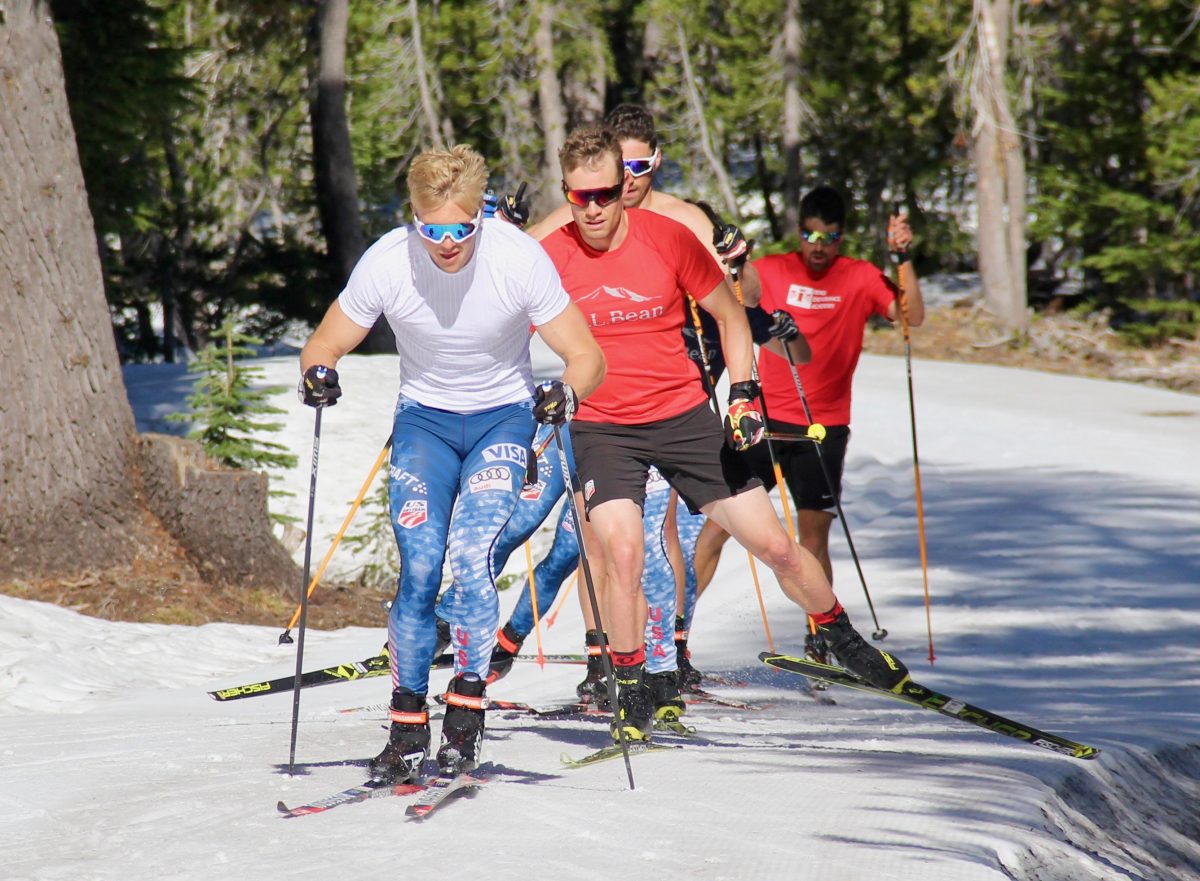
    Uptempo skiing at the U.S. Ski Team’s recent camp in Bend, Oregon. Erik Bjornsen leads, followed by Simi Hamilton, Ian Torchia, Scott Patterson, and Akeo Maifeld-Carucci. (Photo: Bryan Fish)
  • Back in Bend, U.S. Team Builds Volume, Analyzes Technique (Videos)

    Back in Bend, U.S. Team Builds Volume, Analyzes Technique (Videos)

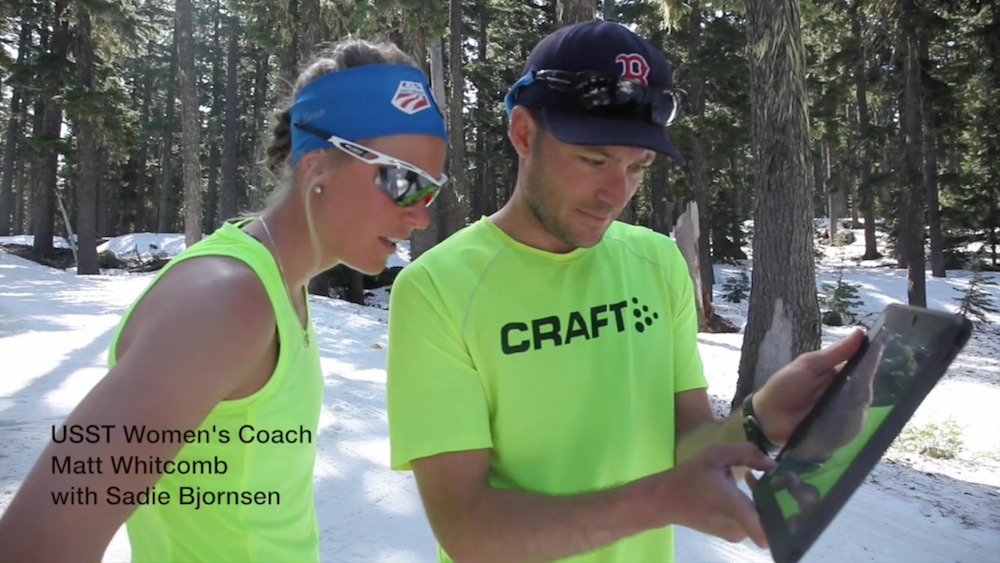
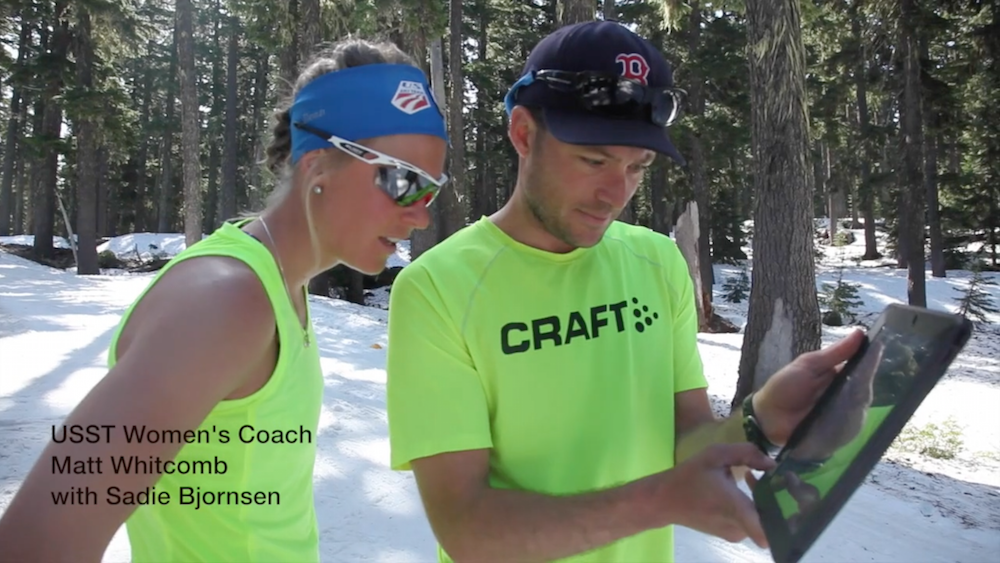
    U.S. Ski Team Women's Coach Matt Whitcomb (r) reviews video with Sadie Bjornsen on some climbing technique. (Video: https://vimeo.com/167372787)
    U.S. Ski Team Women’s Coach Matt Whitcomb (r) reviews video with Sadie Bjornsen on some climbing technique Wednesday at a training camp in Bend, Ore. (Click here for video)

    BEND, Ore. — On Wednesday, the U.S. Ski Team (USST) headed out to ski with some Bend springtime essentials: klister (they were classic skiing), shorts or tights, tank top, sunglasses and SPF 30.

    In Bend for an on-snow camp — the first of the 2016/2017 season — the USST is focused on high-volume training loads and an opportunity to fine-tune technique.

    As the team gathered in Mt. Bachelor’s nordic lodge, USST women’s coach Matt Whitcomb cued up a video for the team to view. For three minutes it was silence as the they observed World Cup footage of master cross-country technicians — no surprise that one skier highlighted was Norway’s Martin Johnsrud Sundby. On view and dissected by Whitcomb’s keen eye was the ugly-duckling of moving up steeps while classic skiing: the herringbone.

    After Whitcomb summarized what he saw as the key herringbone take-aways, the team hit the sun and snow.

    The men’s team was up first, cycling up and down a steep and sustained section of track. Whitcomb explained the portion of trail they had chosen for the technique session was reflective of some tricky trail sections in Falun, Sweden, where skiers must transition quickly from striding to herringboning and back to striding.

    Erik Bjornsen, fresh off a World Cup campaign where he showed improved results in the later half of the season, worked with head coach Chris Grover on the finer points of uphill efficiency. Equipped with iPads, the coaches were able to video each skier and provide real-time feedback.

    During the technique drill, Ian Torchia, the newly minted USST development team member and Northern Michigan University student-athlete, benefited from mirroring USST veteran Andy Newell’s refined classic skiing. After skiing behind Newell, Torchia spoke with USST Development Coach Bryan Fish, who offered concrete suggestions to tweak his skiing.

    As the men’s team skied off, the women trickled in and began their technique drills. USST A-team member Sadie Bjornsen worked closely with Whitcomb, focusing on driving her knee forward and to “bound” as she high-tempoed up the track.

    Bend Camp is historically a time for skiers and coaches to review logistics for the coming year and begin the process of waking the body up. It’s also at camps like this where the coaching staff can observe skiers early in the training season and provide advice as they head back to their home clubs to work with non-USST coaches.

    After wrapping up the session, FasterSkier caught up with Jessie Diggins and Newell. Diggins has turned a corner in terms of her sprint and distance skiing; she ranked eighth overall this season on the World Cup. Loving the day with the sun and snow, Diggins noted it’s good to be back in Bend.

    Newell, who only months ago mulled retirement or a reduced World Cup schedule, said he was rejuvenated and glad to be skiing in May and motivated for the grind ahead.

    The USST will remain in Bend for another week of on-snow training.

  • Wednesday Workout: Metronomes with Michigan Tech’s Alice Flanders

    Wednesday Workout: Metronomes with Michigan Tech’s Alice Flanders

    Sunrise on campus at Michigan Technological University in Houghton, Mich. (All photos: Alice Flanders)
    Sunrise on campus at Michigan Technological University in Houghton, Mich. (All photos: Alice Flanders/aliceflanders.wordpress.com)

    This week’s workout comes from Michigan Tech masters student and skier, Alice Flanders, also a satellite athlete with the Central Cross Country (CXC) Team. Flanders trains with the Michigan Tech team, and largely does workouts designed by head coach Joe Haggenmiller, while CXC Team coach Andy Keller oversees her training. Read her complete blog post here.

    Do you have a workout you’d like to share? Email info@fasterskier.com with the subject line: Wednesday Workout.

    ***

    I’m waiting in the starting pen, the 20-degree wind blowing gently across the stadium as the clock beeps the tell-tale tones of another racer starting. I chisel the chunks of snow out of the bottom of my boot and clip into my skis. I step up to the wand.

    “15 seconds”

    “Beep… Beep… Beep….Beeeeeeeep”

    I try to start but for some reason my feet just won’t move.

    “Beep… Beep… Beep…. Beeeeeeeep”

    “Thwap!”

    Early morning speeds during metronomes at Michigan Tech in Houghton, Mich.
    Early morning speeds during metronomes at Michigan Tech in Houghton, Mich.

    Groggily, I fumble through the sheets looking for my persistently beeping phone. It’s 5:52 am and my body feels like a sack of bricks.

    I roll over placing my index and middle finger on the underside of my wrist. 10 beats in 15 seconds, 40 BPM (beats per minute). Not a bad a.m. pulse, but that’s a little higher than normal. I’ll have to drink lots of water today and make sure I haven’t caught the back-to-school-plague that seems to have taken over the school.

    Stepping outside, the entire town seems dead. If it weren’t for the street lights, I’d be unlocking my bike by starlight. Occasionally I’ll pass by a group of ROTC students running in synchrony, but until arriving at the Student Development Center there’s no one in sight.  This morning we’ll be doing metronomes, a workout where we double pole around the track at different tempos to work on technique and speed.

    The Workout: Metronomes

    Total Time: 45-60 min

    Goal: Focus on high quality technique while using different tempos. Immediately apply this to sprints and starts.

    Warmup: About 10 minutes or 3 songs

    Workout:

    Set 1:  (with metronome playing over loudspeakers: listen to an actual metronome and match your pole plants to the beat)

    2:30 @ 50 BPM

    0:20 @ 60 BPM

    0:10 @ 80 BPM

    Repeat 3-5 times

    Set Break: Length = one song of your choice

    Set 2: 6-10 x 100-meter sprints

    Cool down: About 10 minutes

    This workout has a lot of benefits.

    • It teaches the athlete how to ski using varying tempos
    • By skiing around the track, it is much easier for coaches to work with athletes of different speeds and track progress throughout the session
    • Technique and tempo can be applied immediately during the 100m sprints
    • It’s good mass start practice due to the amount of passing that occurs
    • Pace lines will form and it’s fun to go fast in a group!
    • There are a lot of opportunities for younger skiers to ski with, watch and learn from older people on the team.
    • You get to listen to music
    • No Cars!

    But be careful, this is an intensity session and should be counted as such. Recovery in between the 80 BPM and sprints should be a priority.

    By 7:30 the sun is painting the sky hues of pink, purple and yellow. It’s not hard to realize how lucky we are to live in a place like this.

    Class time: Where recovery and learning come together (Photo: Alice Flanders)
    Class time: Where recovery and learning come together.

    In class, while other students are guzzling coffee trying not to nod off, I’ve got positive endorphins keeping me engaged. However, as the day continues I find myself gazing out the window as storm clouds congregate on the horizon. It’s supposed to rain tonight. Right now I keep my fingers crossed that the rain will go somewhere else, keeping our roads dry for practice this afternoon. In a few weeks these clouds will hold potential for snow. As my professor fills the board with equations, I daydream about how much snow we’d get if it were 15 degrees cooler.

    Excelling in any sport takes an extreme amount of commitment and self discipline. It takes over your thoughts, drives your decision making process and rules your schedule. Every moment of the day is carefully crafted to strengthen your body through nutrition, intensity, recovery or education. It’s an all encompassing full time job. Luckily, this job comes naturally when you have passion for the sport. It begs us to reach higher, to do one more pull-up, to push the limits of comfort and ultimately persevere. What are your goals this season?

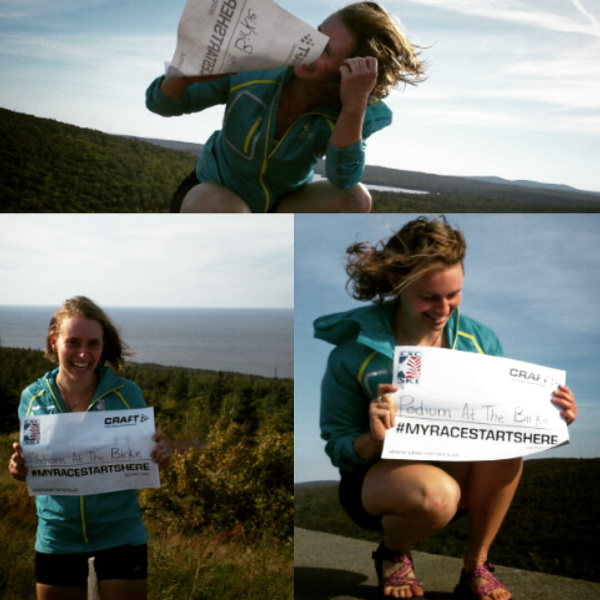
    Michigan Tech masters student and skier Alice Flanders setting goals. (Courtesy photo)
    Michigan Tech masters student and skier Alice Flanders setting goals, specifically to podium in the American Birkebeiner skate race, as photographed on Brockway Mountain in Copper Harbor, Mich. (Courtesy photo)