From the FasterSkier archive — posts syndicated from athletes’ and coaches’ own blogs between 2004 and 2012, kept online as published. Current coverage is at fasterskier.com.
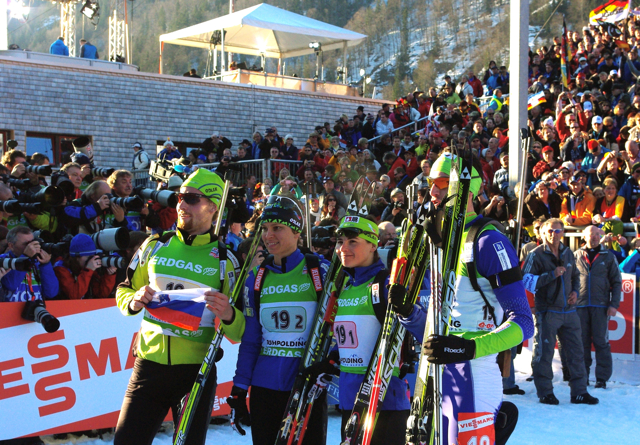
The Slovenian biathlon team of Klemen Bauer, Teja Gregorin, Andreja Mali, and Jakov Fak after winning silver in the 2012 World Championships mixed relay in Ruhpolding, Germany.
Slovenian biathlete Klemen Bauer has competed in nine World Championships and three Olympics, landing just one spot away from a medal in the sprint in Vancouver in 2010. He has a handful of top-10 World Cup finishes to call his own.
Bauer has also been a prominent voice for fair and ethical sport, speaking out in support of the anti-doping process and more recently participating in a campaign to eradicate sexual abuse from sport.
Bauer tweeted cryptically when the International Olympic Committee (IOC) announced that one athlete had been caught doping when samples from the 2010 Olympics were re-tested this year using up-to-date analytical methods. When it was announced that Gregorin was the athlete in question, he tweeted, “Sad, mad, & disappointed.”
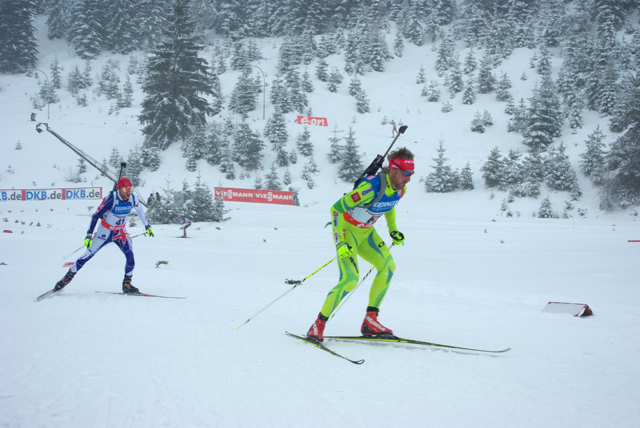
Klemen Bauer of Slovenia (right) racing at an IBU World Cup in Hochfilzen, Austria, in 2013.
In a press conference after the news was released, Gregorin said, “I sincerely apologize to all who have been affected my actions in any way.”
Among those affected are, obviously, Gregorin’s competitors, some of whom have voiced their own anger. But her teammates are also affected. Bauer, along with Andreja Mali and Jakov Fak, won mixed relay silver at 2012 World Championships. It remains to be seen whether that result will be invalidated.
Besides that, the Slovenian team’s reputation is affected.
“I feel bad for her other teammates, like Klemen, who has been at this for a long, long time, and it would seem that he will be the victim of speculation surrounding the case,” said U.S. veteran biathlete Lowell Bailey. “That’s just the natural tendency. ‘Well, if there’s one case, then how did she do it? Why did she do it? Who was helping her?’ All those questions come up.”
“Klemen is like a lot of other athletes – he is really a really hard-working, motivated, determined athlete,” U.S. veteran Lowell Bailey said in an interview last week. “He has always been a person that understands the seriousness of what it takes to be a career biathlete, but also understands that there’s a balance there. He has a son, Axel, and a family, and he has that personal balance that is important for a lot of the elder statesmen of the biathlon world. He’s a great guy and I have always enjoyed competing against him and with him.”
Bauer agreed to answer some questions about the Gregorin case and how it is affecting him and his team. The lightly edited interview is presented below, followed by more context from Bailey.
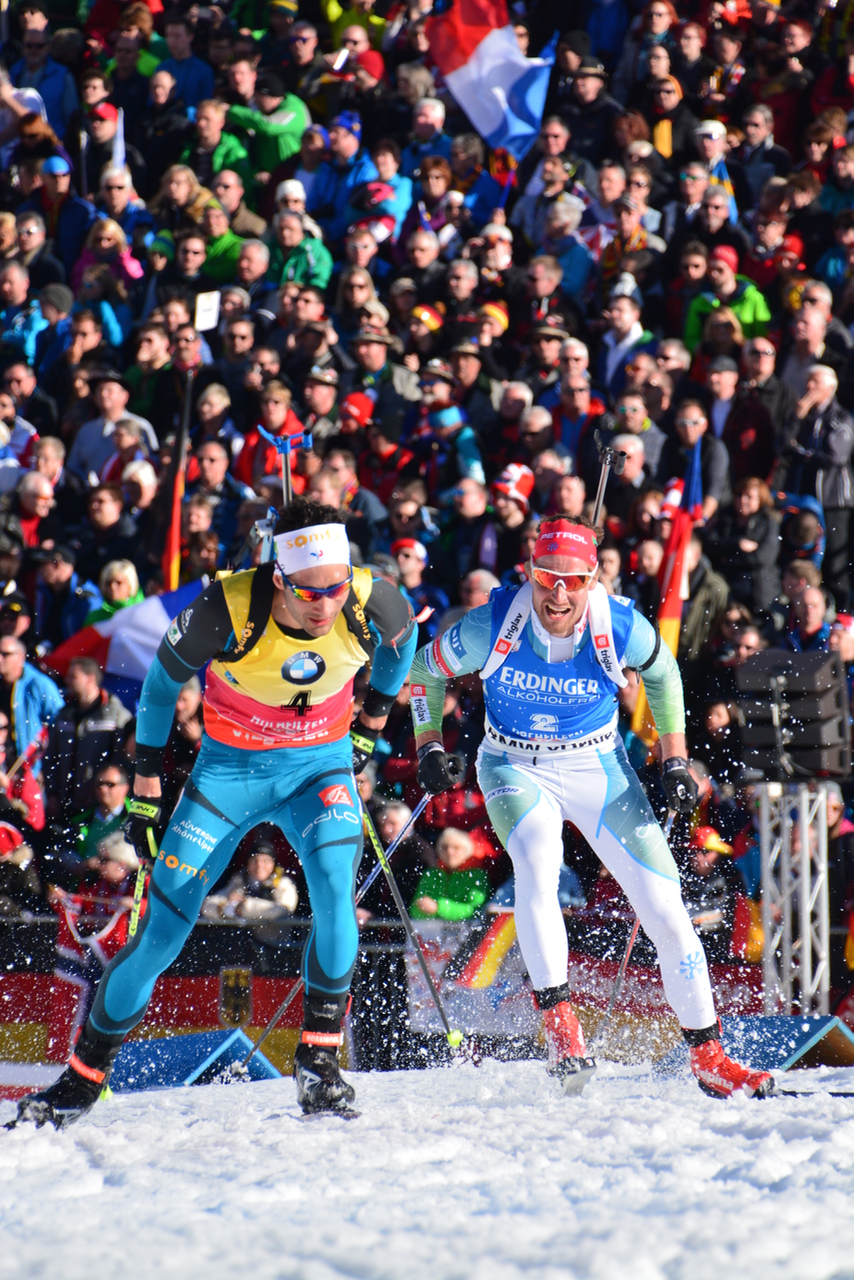
Klemen Bauer of Slovenia (right) chasing Martin Fourcade of France in the 20 k individual at 2017 IBU World Championships in Hochfilzen, Austria. (Photo: Glen Crawford)
FasterSkier: When did you hear about this case and what was your reaction? Were you with the team at the time, or did you have to process this all on your own?
Klemen Bauer: We (athletes) were informed a week before the public announcement. First reaction was shocking and frustrating. Then I was really mad and sad about it. I was on my own at the time. We were all back home.
FS:I guess you have known Teja for a long time.
KB: Yeah. I’ve known her since I was a little kid. She started in the same local club, training with her father. We were training mostly together (at training camps) for the past eight years.
FS:Would you have thought someone could do something like this with nobody else finding out?
KB: I think it’s an easy job to do it without anybody knowing it — as long as it’s a matter of an individual, which it was in Teja’s case.
FS:Do you think or do you worry that this violation by Teja will also affect your reputation? Slovenia’s reputation?
KB: Absolutely. That was actually one of my first biggest concerns. All the good stories we [Slovenian biathlon] have created in the past 8-10 years were destroyed in a moment. Well, hopefully it won’t be that cruel as I think — At this point I find it crucial to expose that it was an act of a single individual athlete. Me personally, I don’t like teams who were involved into doping scandals, so I can imagine the response of the athletes after this. But as I said, I really hope they will realize the rest of us are far away from what happened.
FS:Have you talked to any athletes from other teams/countries since the news came out?
KB: Not really.
FS:What about Teja, have you talked to her?
KB: Not at all. I have no intention to. I will wait for her to come in and explain (apologize).
FS:Has this affected your training for the upcoming season?
KB: It was hard to fall asleep first few couple of days after the news, but the training went well. Sometimes I even got an extra boost, when thinking about it – my anger came out.
FS:What about your attitude?
KB: In general after any doping scandal, my morale goes down. I would rather give up right away. But let’s say I still kind of believe in fair, clean sport (which is very naive), and probably that’s what still keeps me in sport. After recent events I’m even more determined to prove that a good result can be done in a fair, clean way.
FS:Is there anything else you would like to say about this situation, to fans of the sport for instance?
KB: I’d like to emphasize to have faith in our small team — most of other athletes are still young — and not to judge us by the act of one individual.
FS: Is this something you would have said in the past, when an individual from another team was caught?
KB: There are countries doing it [doping] on national level (supported by their government), and there are individuals. Of course a single act usually leads to suspicion of the whole rest of the team even if not so. I might be a little more careful about my judgment after this incident.
Bailey could sympathize with Bauer to some extent – the American had no idea that Gregorin had been doping, and he did not indicate that he’d ever had suspicions of the Slovenian team, who he called “always really friendly and open.”
It got more personal for Bailey when he pulled up that athletes’ petition during the interview and realized that Gregorin had signed it, adding her voice to demands for stronger anti-doping policies.
“That’s troubling to see from someone who had three positive tests – that, in my mind, represents knowingly committing an anti-doping rule violation,” he said. “To be quite honest, she was an athlete who I had a lot of respect for. She came from a smaller country in terms of biathlon and had some really impressive results. I always looked at her as an example of an athlete who was working hard within the rules. So it’s a feeling of betrayal to have something like this come out.”
Bailey emphasized that Gregorin deserves due process. When the case is over, competitors and fans may know more about how and why she decided to dope.
“I stand steadfastly behind every athlete having due process – there has been a lot of discussion about just treatment of alleged doping cases,” Bailey said. “I totally support that. I support due process and quick and fair and just proceedings. I hope that her case is treated that way. But it’s really sad. It’s really unfortunate to see that happen.”
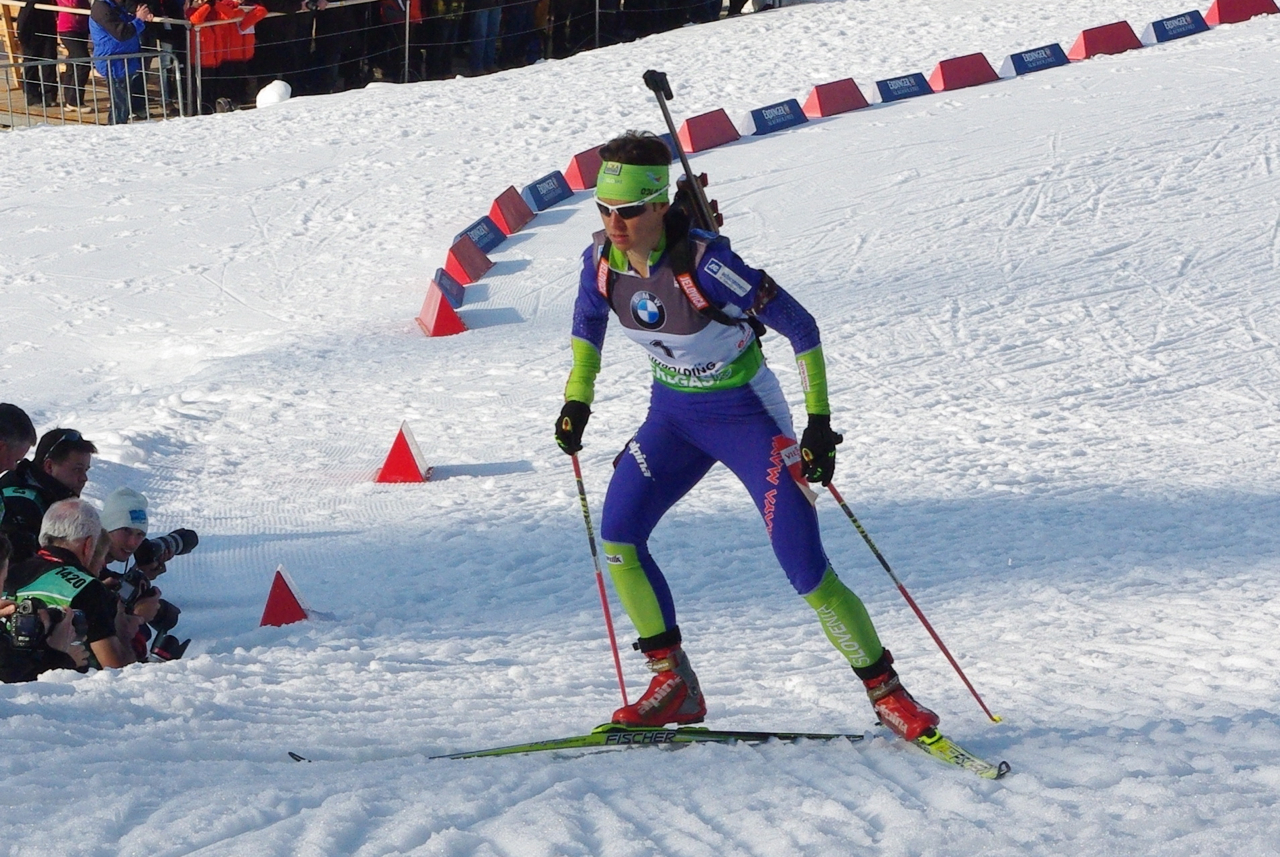
Teja Gregorin of Slovenia racing at 2012 World Championships in Ruhpolding, Germany.
The International Olympic Committee (IOC) recently finished re-testing stored urine samples from the 2010 Olympics in Vancouver, Canada. The goal was to use new analytical methods to detect substances which were not detectable back in 2010.
Of the more than 1,000 samples re-analyzed, only those belonging to a single athlete were found to be positive for prohibited substances, the IOC announced earlier this month.
That athlete is now revealed to be Slovenia’s Teja Gregorin, a biathlete who finished fifth in the mass start in Vancouver. Reportedly, three different samples belonging to Gregorin tested positive, all for Growth Hormone Releasing Factor-2 (GHRP-2), a growth hormone releasing peptide. Gregorin has been provisionally suspended by the International Biathlon Union while her case proceeds.
“I accept temporary suspension,” Gregorin said in a press conference organized by the Slovenian ski federation, according to a translation. “I will participate in the follow-up proceedings, but I ask for understanding because the World Anti-Doping Code prohibits public comments on ongoing cases. I sincerely apologize to all who have been affected my actions in any way.”
Gregorin read from a prepared statement and did not take questions from the press.
This entire class of substances were banned by the 2010 WADA Prohibited List in section S2, which bans “The following substances and their releasing factors” before listing growth hormones. This was later clarified; the 2017 Prohibited List explicitly lists GHRP’s, prohibiting “Growth Hormone (GH) and its releasing factors including… GH-Releasing Peptides (GHRPs), e.g. alexamorelin, GHRP-6, hexarelin, and pralmorelin (GHRP-2).”
GHRP’s are not the same as human growth hormone (hGH), a widely discussed treatment in professional sports and one for which Estonian cross-country skier Andrus Veerpalu tested positive.
Instead, these peptides spurs the body’s own production of growth hormone. As such, they improves health, recovery, the immune system, and anti-aging. GHRP-2 is a synthetic drug used to treat growth hormone deficiency. In a doping context, it is known to help maintain a lower level of body fat.
Gregorin finished ninth in both the sprint and pursuit in Vancouver.
Four years later in Sochi, she earned bronze in the pursuit at the 2014 Olympics with a determined and gutsy long sprint finish. She also placed fourth in the mass start there.
A team veteran, Gregorin also competed in the 2006 Olympics. She won silver in the 15 k individual at 2009 World Championships and later contributed to a silver-medal mixed relay effort for Slovenia at 2012 World Championships along with Andreja Mali, Klemen Bauer, and Jakov Fak.
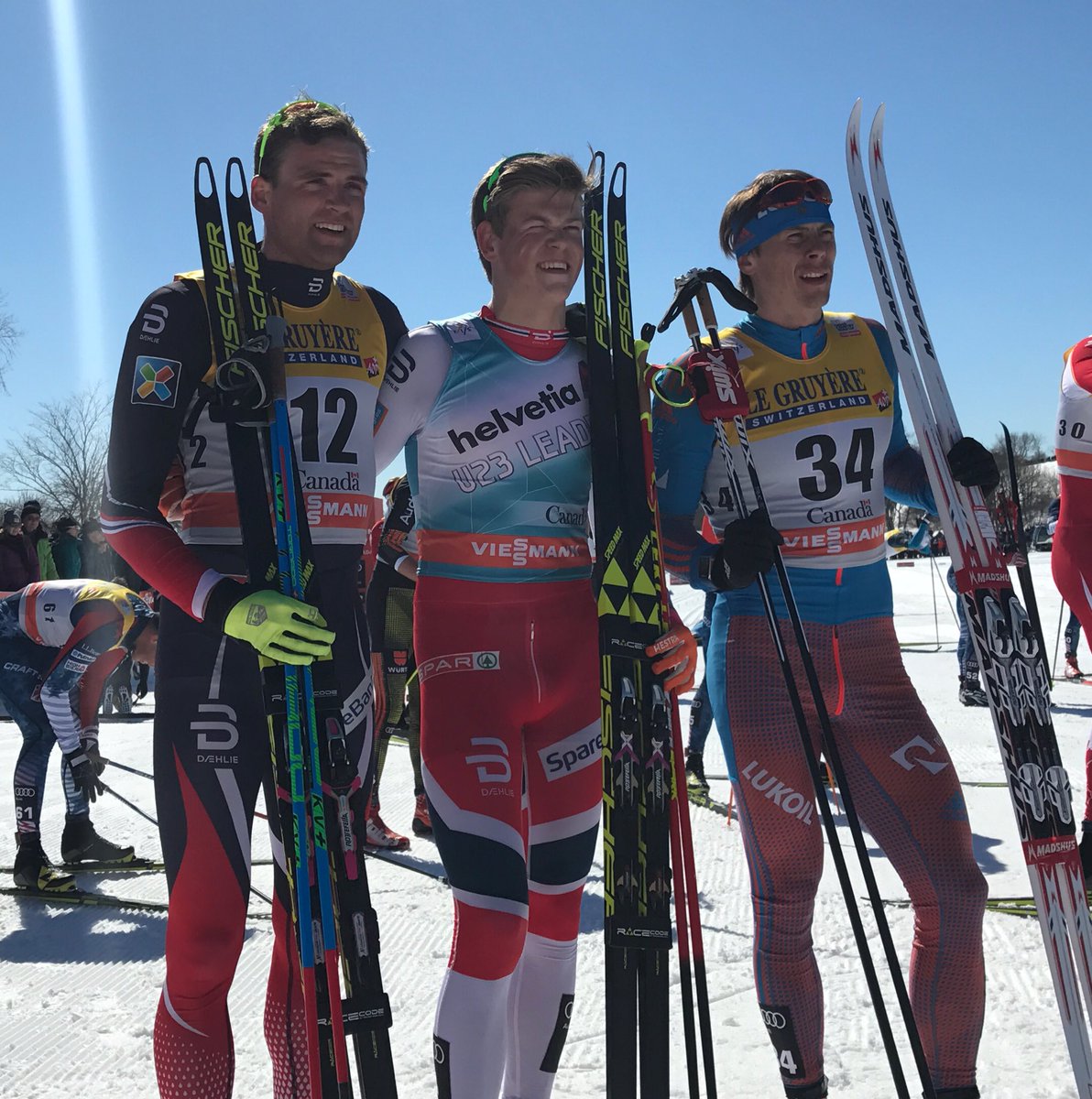
The men’s 15 k classic mass start podium on Saturday at World Cup Finals in Quebec City, with Norway’s Johannes Høsflot Klæbo (c) in first and Niklas Dyrhaug (l) in second, and Russia’s Alexander Bessmertnykh (r) in third. (Photo: FIS Cross-Country/Twitter)
FIS Cross-Country World Cup Finals (Quebec City): 10/15 k classic mass starts
During Saturday’s 15-kilometer classic mass start at World Cup Finals, Canada’s Alex Harvey was in it until the end. But so were Norway’s Johannes Høsflot Klæbo and Niklas Dyrhaug, and Russia’s Alexander Bessmertnykh, to name a few.
Sitting in second with a few hundred meters to go, Harvey was primed to make his move on Dyrhaug, who was leading at the time. But then came 20-year-old Klæbo, the season-long Sprint World Cup champion, who proved to have more left in the tank than anyone else and passed them both to lead into the finishing straight.
Klæbo took the victory — his first in a World Cup distance race — on a bluebird day under a beating sun in 35:23.7 minutes, 0.6 seconds ahead of Dyrhaug. Bessmertnykh followed another 0.2 seconds back in third (+0.8) just ahead of Harvey in fourth (+1.2).
Norway’s Sjur Røthe took fifth (+1.7), Switzerland’s Dario Cologna placed sixth (+1.9), and Norway’s Pål Golberg was seventh (+2.5), half a second ahead of another Norwegian Didrik Tønseth in eighth (+3.0). The top nine were within 3.7 seconds of first, with Russia’s Andrey Larkov in ninth.
Devon Kershaw was the second Canadian in the points on Saturday in 28th (+1:08.4), after breaking a pole and working his way back up from outside the top 60.
Erik Bjornsen led the U.S. men in 31st (+1:16.8), about a second ahead of Canada’s Graeme Killick in 32nd (+1:17.7).
Also for the U.S., Matt Gelso finished 37th, Andy Newell 45th, Scott Patterson 46th, Noah Hoffman 48th, Ben Lustgarten 49th, David Norris 50th, Simi Hamilton 54th, Paddy Caldwell 59th, Jack Hegman 62nd, Cole Morgan 64th, and Brian Gregg 69th.
For Canada, Bob Thompson finished 55th, Knute Johnsgaard 57th, Len Valjas 61st, Russell Kennedy 63rd, Evan Palmer-Charrette 65th, Andy Shields 66th, Jess Cockney 67th, Brian McKeever 68th, Joey Foster 70th, Gareth Williams 72nd, Ricardo Izquierdo-Bernier 74th, and Julien Locke 75th.
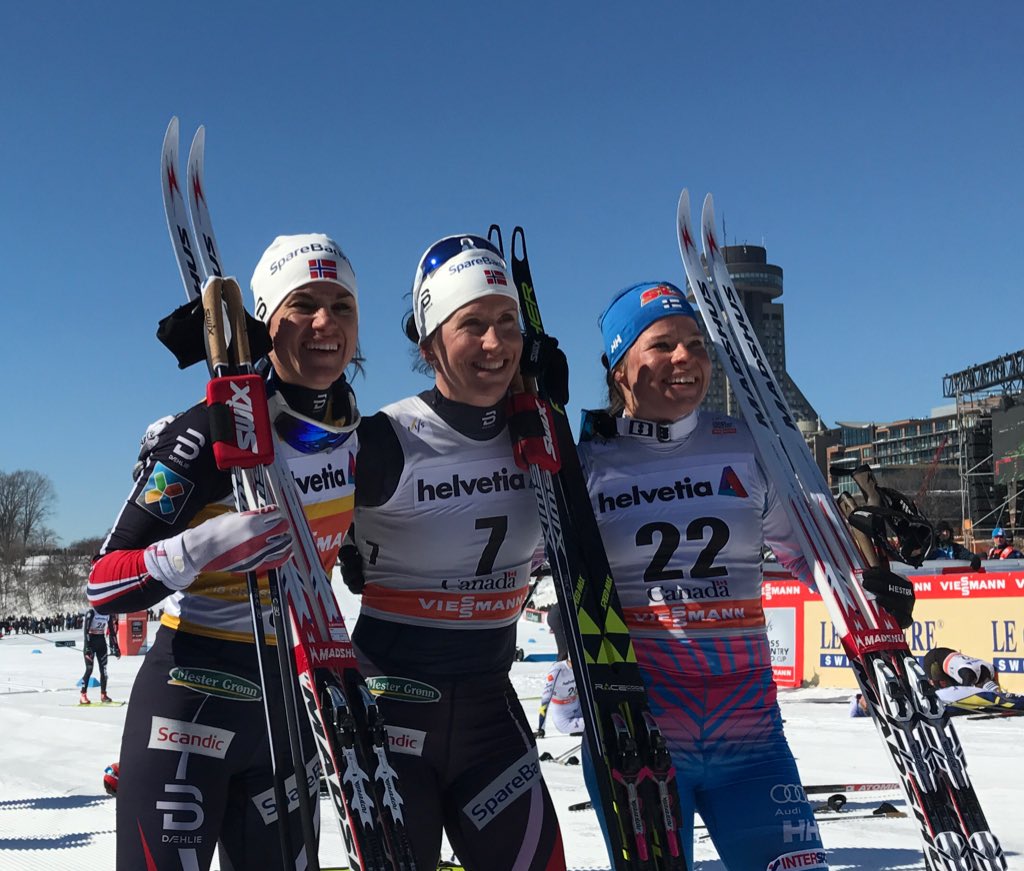
The women’s 10 k classic mass start podium on Saturday at World Cup Finals in Quebec City, with Norway’s Marit Bjørgen (c) in first, Norway’s Heidi Weng (l) in second and Finland’s Krista Parmakoski (r) in third. (Photo: FIS Cross-Country/Twitter)
In the women’s 10 k classic mass start earlier in the day, Norway’s Marit Bjørgen racked up her seventh victory of the season after leading a pack of two other Norwegians and Finland’s Krista Pärmäkoski and holding them off to the finish.
Bjørgen put a few meters into the foursome as she entered the finishing stretch and held her lead across the line in 24:23.6 minutes. Norway’s Heidi Weng finished 0.6 seconds back in second to lock up the Distance World Cup title, in addition to the Overall World Cup title she secured on Friday.
Pärmäkoski finished 2.9 seconds after Bjørgen in third, and Norway’s Ingvild Flugstad Østberg missed the podium in fourth (+7.8).
Behind them, Germany’s Nicole Fessel outlasted a large chase pack to place fifth (+18.6), just ahead of Sweden’s Charlotte Kalla in sixth (+19.9) and Anna Haag in seventh (+19.1).
Sadie Bjornsen of the U.S. Ski Team led the North American women in 15th (+29.9) after skiing at the back of that chase pack in the final stretches of the race. Also for the U.S., Jessie Diggins placed 27th (+1:06.9) and Sophie Caldwell 38th (+1:56.0).
Canada was led by Emily Nishikawa in 37th (+1:51.7). Behind her, Cendrine Browne finished 41st (+2:28.2), Dahria Beatty was 53rd, Annika Richardson 54th, Katherine Stewart-Jones 56th, Frederique Vezina 59th, Annika Hicks 60th, Sophie Carrier-Laforte 61st, Andrea Dupont 62nd, Katherine Weaver 63rd, Alannah MacLean 64th, Sadie White 66th, Lisle Compton 67th, Mia Serratore 68th, and Laura Leclair 69th.
For the U.S. Caitlin Patterson finished 44th, Liz Guiney 45th, Kaitlynn Miller 47th, Chelsea Holmes 48th, Rosie Brennan 50th, Julia Kern 52nd, Erika Flowers 55th, Becca Rorabaugh 57th, and Jennie Bender 58th.
One day left in the 2016/2017 World Cup season remains, with the women’s and men’s 10/15 k freestyle pursuits on Sunday in Quebec City.
World Cup Finals standings (Day 2 of 3): Men | Women
***
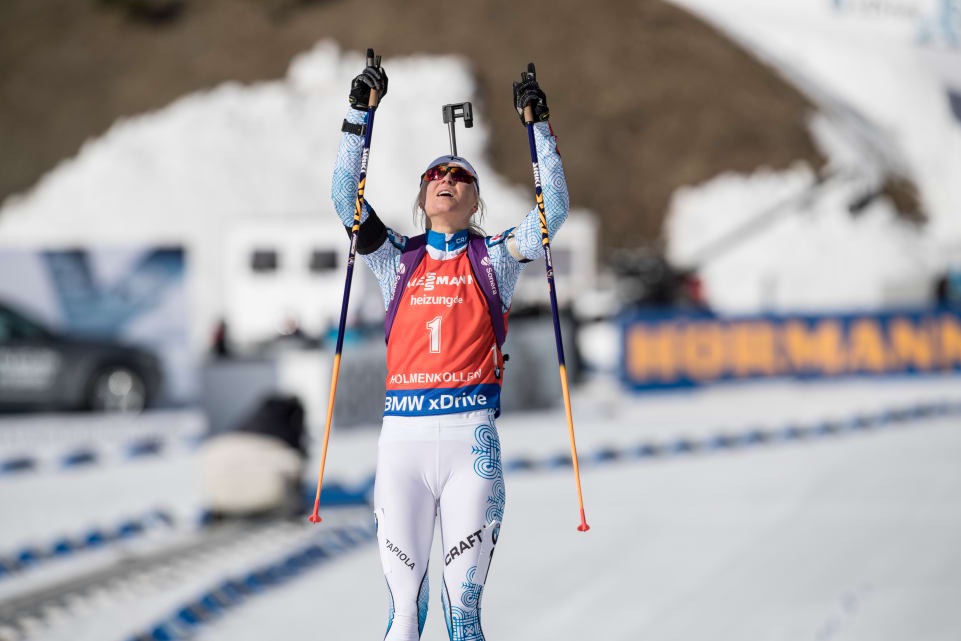
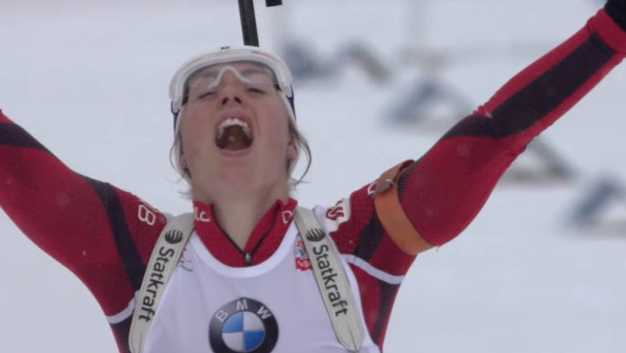
Finland’s Mari Laukkanen pointing to the sky in honor of her late shooting coach, after she won the women’s 10-kilometer pursuit on Saturday at the 2017 IBU World Cup in Oslo, Norway. (Photo: IBU)
IBU World Cup (Oslo, Norway): Women’s and men’s pursuits
Less than 24 hours after winning her first IBU World Cup on Friday in the women’s 7.5 k sprint, Finland’s Mari Laukkanen immediately capitalized on her ideal position with a start-to-finish victory in Saturday’s 10 k pursuit that was never in doubt, cleaning the first three shooting stages before incurring one penalty in her final standing shooting (0+0+0+1) to cross the line in a time of 29:33.3 minutes.
In addition to experiencing the most successful weekend of her biathlon career by far, it was an emotional day for the 29-year-old Finn due to a personal reason. Laukkanen spread her arms like wings skiing down the homestretch with a commanding lead, pointing repeatedly to the sky and a black ribbon she wore around her right upper arm, before kneeling in the snow in the finish for a few seconds. With those gestures, she reportedly wanted to commemorate her shooting coach Asko Nuutinen, who passed away Friday after suffering a heart attack during the World Cup in Kontiolahti, Finland, a week ago. He was 60 years old.
“It’s been a really emotional day for me. We have heard really really sad news that last night we lost our longtime shooting coach,” Laukkanen told reporters with a trembling voice in the press conference. “After this it was more or less only about working for him. Working as he has asked me to do for years and years. So I wasn’t thinking about losing or winning today, I was only thinking about him. And I feel really big pleasure that I was able to come to the finish like this, that I can own the victory for him.”
“I knew it will be difficult after the first victory in my career took me so long,” she added. “And to do it again immediately with good shooting. But as I said I didn’t think about winning or losing today, just doing my work.”
Finishing 26.5 seconds after her, the Czech Republic’s Gabriela Koukalová reached the finish, moving up from her fourth place starting position with a clean shooting performance (0+0+0+0).
“I wanted to miss all targets yesterday because I was so tired I didn’t even want to race,” Koukalová confided in the press conference. “It’s difficult to concentrate, three World Cups after the main goal of the season [the World Championships] is too much. Last year it was many times easier… I tried to catch her, but about one kilometer before the finish I saw her far away so I was happy I didn’t have to fight with anyone and was just enjoying the last meters.”
Despite four penalties (1+1+0+2), France’s Justine Braisaz defended the third place on the podium against a three-person chase group on the last loop (+1:01.4), falling back only one position after having finished the sprint in second.
“I did not expect such a good place today during the race,” Braisaz commented in the press conference. “Because in the last shooting I completely [failed]. I really wanted to have a clean shooting today, and I did not succeed. So I am happy and surprised, too.”
Her teammate Anais Bescond who had started the pursuit in third place fell back to 22nd position (+2:53.5) with seven penalties.
Slovenia’s Teja Gregorin finished fourth with one penalty (+1:08.2), Austria’s Lisa Theresa Hauser shot clean as the only athlete aside from Koukalova on her way to move up from 22nd to fifth place (+1:12.5), while Norway’s Marte Olsbu finished sixth like in the sprint despite three penalties (+1:15.9).
Unlike in Friday’s sprint race where Germany’s Laura Dahlmeier had still given up a seemingly commanding lead in the sprint World Cup discipline standings to Koukalova, she held onto her lead in the pursuit standings on Saturday, moving up from the 31st starting position to ninth place with a penalty in each of her standing shootings (0+0+1+1, +1:53.8). A 22nd place would have been sufficient to win the “small crystal globe” award in the pursuit. Laukkanen’s teammate Kaisa Mäkäräinen finished 8th with two penalties in the standing stages (+1:51.2), and thereby claimed the third place in the World Cup pursuit ranking.
“I knew that I didn’t need to have a perfect race today, just a good one, but that’s always easier said than done,” Dahlmeier told broadcaster ARD after the race. “I am incredibly happy that it worked out and that I could secure myself another small globe… It’s a bit of a weird feeling, standing at the start gate in the middle of the field and the clock ticks and ticks as one athlete after another skis out on the course. And you can only observe how far they have gone and have to wait and be patient, and not make a false start. But then the snow burns, then the chase begins!”
US Biathlon’s Susan Dunklee experienced an uncharacteristically problematic day on the shooting range and fell back to 37th place (+4:00.2), after starting seventh and less than a minute behind Laukkanen. Dunklee had three misses between two prone stages and seven more in her standing shootings (2+1+4+3) therefore having to ski more than an additional kilometer in the penalty lap.
“It is a testament to her fighting spirit that she notched the fourth-fastest ski time — one of her best ranks of the season — and never gave up despite suffering a biathlon blowout on the range,” teammate Clare Egan said of Dunklee, according to a US Biathlon press release. “Bad races happen to the best and Susan is no exception, but not everyone fights through till the end no matter what.”
Egan herself started the pursuit in 34th position and initally was able to make up ground, but then fell back slightly to 41st place (+4:13.9) with four penalties (0+2+0+2).
“I am satisfied with my race even though the result was not what I was hoping for, and that’s how I would summarize my entire season as well,” Egan said after the final race of her season. “I’ve made a good step forward but my competitors also work hard all summer and we seem to improve at a similar rate.”
Canada Biathlon’s Julia Ransom moved up to 47th place (+5:04.8) with three penalties (1+0+1+1), after starting in 52nd position.
[UPDATED] Later on Saturday in the last men’s 12.5 k pursuit of the season, the three best athletes of the season fought throughout the race exchanging in the lead, before they stood next to each other on the range for the final shooting to decide the winner.
Russia’s Anton Shipulin managed to shoot clean with his elaborate rifle stock in the design of a red dragon, proudly waving to the cameras as he left the arena while his two competitors had to ski into the penalty lap. France’s Martin Fourcade – who had already secured himself the overall World Cup Total Score title as well as the award for the pursuit discipline – was left to duke it out against Norway’s Johannes Thingnes Bø, the winner of Friday’s sprint.
On the last big climb before the Holmenkollen arena, Fourcade accelerated with a series of explosive jump-skate steps to decisively gap Bø. He even got fairly close to Shipulin on the finish stretch, who had slowed down a bit to grab a Russian flag before skiing over the line in a time of 32:11.9 minutes with one penalty (0+0+1+0), 5.7 seconds ahead of Fourcade who had incurred two penalties (1+0+0+1). While Fourcade shook hands with Shipulin, Bø came into the finish in third place, 21.6 seconds back and also with two penalties (1+0+0+1).
“It was a crazy race, but I am happy that I managed to finish first,” Shipulin said in the press conference through a translator. “Tough conditions on the shooting range, I had to really work to concentrate on my shooting. On the last loop I was all alone until I saw Martin chasing me, then I got a little bit scared but I managed to [keep him behind].”
It was Shipulin’s second win of the season, for which he credited his recently improved shooting performance.
“It was a really exciting competition with Johannes and Anton,” Fourcade agreed with his rival. “I expected to fight with them for the victory on the last loop, but then Anton was simply stronger in the last shooting. My strategy was to be focused on my technique and skills and not on the results, like I did too often in the past few weeks focusing on records and not the victory.”
Asked about his blazing attack on the final climb, Fourcade added: “Of course I train for that, but I think a lot of athletes do. I talked to Johannes, it was my revenge for the [2016] World Champs where he did exactly the same to me on the last uphill. But I know how it is, it can be different already tomorrow.”
“I am happy with a new podium of course,” Bø said in the press conference. “I was not at my best in the skiing today. But I still managed to shoot 18 out of 20. As Martin said it was [annoying] that we did not shoot zero [misses] and could not fight with Anton in the finish, but it was quite interesting and fun to stand there in the last shooting … I expected Martin’s attack the second he did it, but I had no energy to fight with him. That was quite strong.”
Sweden’s Fredrik Lindström placed fourth with no penalties (+44.7), and was the only man in the field who managed to shoot clean in all four stages.
“For the podium, I was never really close“, Lindström told the IBU in a post-race interview. “But it was a great day anyway. Four times zero [misses], and especially in the standing stages that makes you climb a lot in the standings. Super happy with my performance.”
US Biathlon’s Lowell Bailey, who had to start closer to the back of the field in 44th position, almost two minutes behind the leaders based on his sprint result, managed to move up 21 spots in the race despite three penalties (2+0+1+0).
“I’m happy with the race, considering it started out pretty rough with the first two misses,” Bailey told US Biathlon after placing 23rd (+2:23.3). “I just read the wind wrong and didn’t correct enough. After that, I tried to keep my head in the race and make the best of it. I was happy with my skiing and glad to clean the last stage; this brought me up nine spots and I was able to gain another in the last loop. Now, it’s just one race to go. I’m looking forward to tomorrow.”
Shooting quickly, Bailey recorded the ninth-ranked range time of the day and the ninth-fastest last loop.
His teammate Sean Doherty started 35th but fell back after having to ski six times through the penalty lap (1+3+1+1) to finish 46th (+4:05.6).
For Sunday’s mass starts as the final races of the 2016/2017 IBU World Cup season, the only qualified North American starters will be Dunklee (currently in 10th position in the World Cup Total Score standings) and Bailey (currently in eighth).
The women’s season award in the mass start discipline once more will be decided between Germany’s Dahlmeier and Czech Republic’s Koukalova, while Germany’s Simon Schempp will try to defend his narrow lead on Fourcade. But during Saturday’s final loop, the French star did consider saving energy for the final competition.
“No,” he simply quipped when asked about this in the press conference. “Of course the mass start is important tomorrow because it will decide about the [mass start] crystal globe. But I think today the pursuit was also really important, and you fight for victory and being one of the best athletes. You can’t be satisfied with only a third place when you can claim a second, and I think all athletes in my position would do the same.”
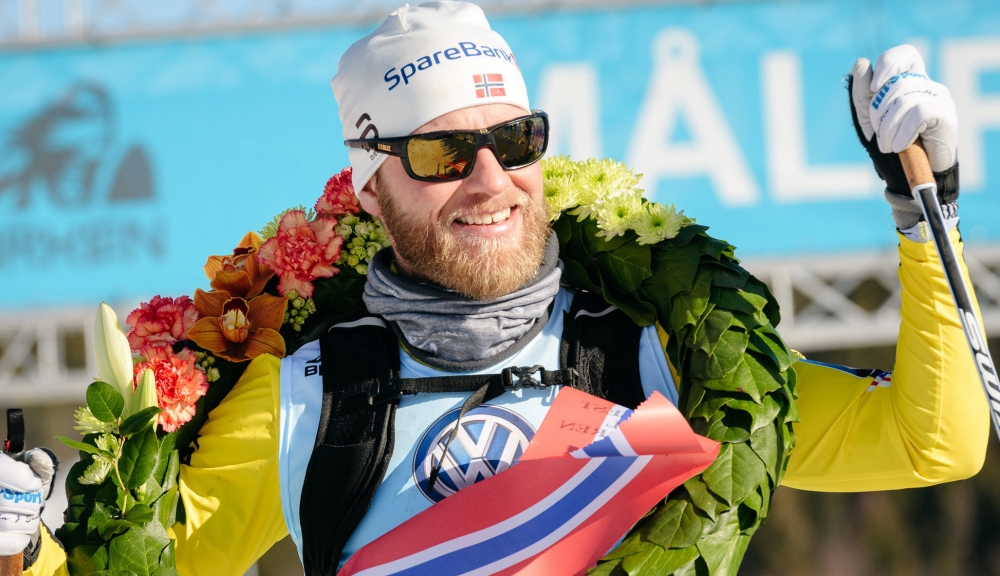
Norway’s Martin Johnsrud Sundby after winning the Norwegian 54 k classic Birkebeinerrennet, part of the Ski Classics series, on Saturday in Lillehammer, Norway. (Photo: Ski Classics)
54 k Birkebeinerrennet (Rena to Lillehammer, Norway): Part of the Ski Classics series
[UPDATED] Not even a snowmobile clipping him and sending him tumbling 20 k before the finish could keep Norway’s Martin Johnsrud Sundby from winning the Birkebeinerrennet on Saturday in Norway. Representing Team United Bakeries, Sundby set a high pace from the start and broke the group down to three by 9 k, with Petter Eliassen of Team LeasePlan and Simen Østensen of Team BN Bank sticking with him until about 30 k in the 54 k marathon.
With about 20 k to go, Sundby collided with a Ski Classics TV production crew snowmobile while trying to double pole in the snowmobile’s tracks. He was OK and went on to win by 48 seconds over Eliassen in second, and smiled about the incident after the finish.
“It came in with tremendous speed and mowed me down,” Sundby told NRK, according to a loose translation.
Ski Classics CEO David Nilsson told NRK he didn’t know exactly how that happened and emphasized that it was unacceptable.
“We always put safety first, but it is a difficult balancing act with the snowmobile at high speed to get TV pictures,” he said, according to a loose translation. “The skiers often ski in the [snowmobile] track and here it happened and somehow the driver missed it.”
While Sundby pulled out the win in 2:20:53.5 hours, Eliassen took second and Østensen followed another 3.5 seconds later for third place.
In the women’s race, Poland’s Justyna Kowalczyk (Team Santander) pulled out a 4 minute and 15 second win over Sweden’s Britta Johansson Norgren (Lager 157 Ski Team). Japan’s Masako Ishida (Team United Bakeries) was another 48.6 seconds back in third.
“I’m really happy to win this race,” Kowalczyk said, according to a Ski Classics press release. “Everything went well and the cheering on the course was amazing. I will do the rest of the races in Visma Ski Classics, but this victory was the most important for me. Of course, I want to win again in Årefjällsloppet like I did last year, but to win here in front of this audience means so much to me.”
Tord Asle Gjerdalen, who finished fourth in the men’s race, and Johansson Norgren continue to lead the overall Ski Classics standings with three races to go. The next stop is the Årefjällsloppet in Sweden on March 25.
“It was a great race and we kept a high tempo up all the way,” Sundby said, according to the press release. “I was able to use uphills for my advantage and get a gap. I had good skis, the conditions were perfect, and to win here was one of my goals for the season. I have the Norwegian Championships in two weeks, and I haven’t counted out the option of going to Finland for the Visma Ski Classics finale.”
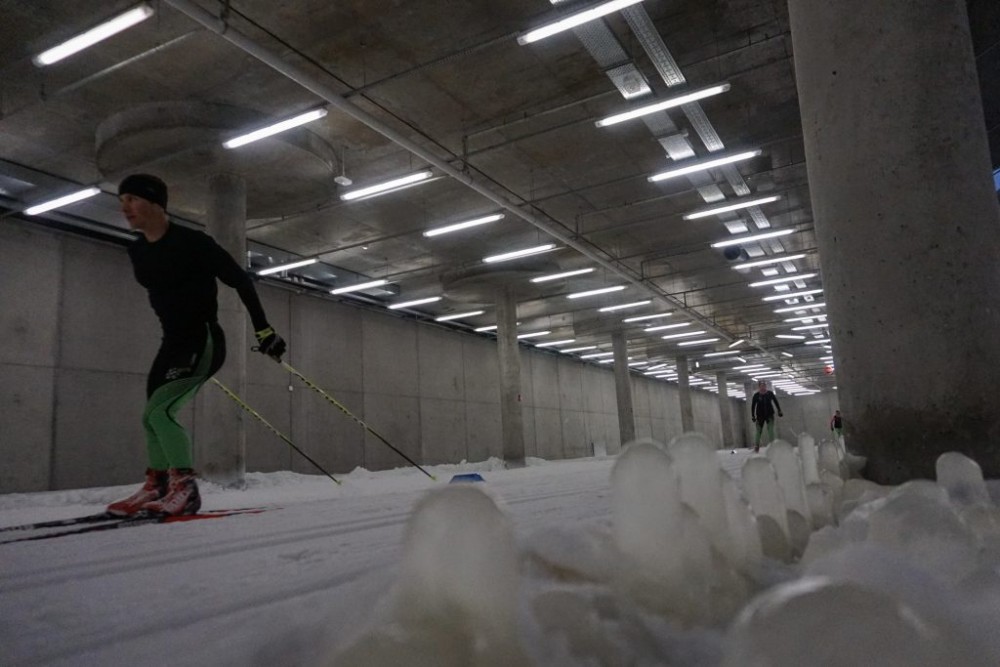
Craftsbury Green Racing Project’s Ben Lustgarten (l) training in the ski tunnel in Planica, Slovenia, earlier this month. (Photo: Caitlin Patterson/ CGRP blog)
Pay 9 Euros a day, get a 950-meter loop in return. If snow were to take on a monetary value, that’s how much the Planica Nordic Centre charges for a day pass in its snow tunnel, new to the city’s Olympic Sports Center since the spring. But to others, the opportunity to ski on snow at the tail end of summer is priceless, even if it is under the fluorescent lights and within the concrete walls of a three-level parking garage.
Among those “others” are the Craftsbury Green Racing Project (CGRP) elite cross-country skiers and biathletes, who spent Sept. 12 to Sept. 20 in Planica, Slovenia, training in the city’s ski tunnel. As a few explained, getting on snow at this time of year outweighs the occasional lassitude that comes from skiing two-plus hours on a less-than-1-kilometer loop.
“No matter what condition it is nordic skiers love their first time on snow of the season,” Ben Lustgarten, new to the CGRP cross-country team, wrote in an email. “We were able to do speeds, short level 4 intervals, some threshold, accelerations, and sprint simulation workouts. There was fair amount of terrain to do varying technique work and video analysis for the small amount of space.”
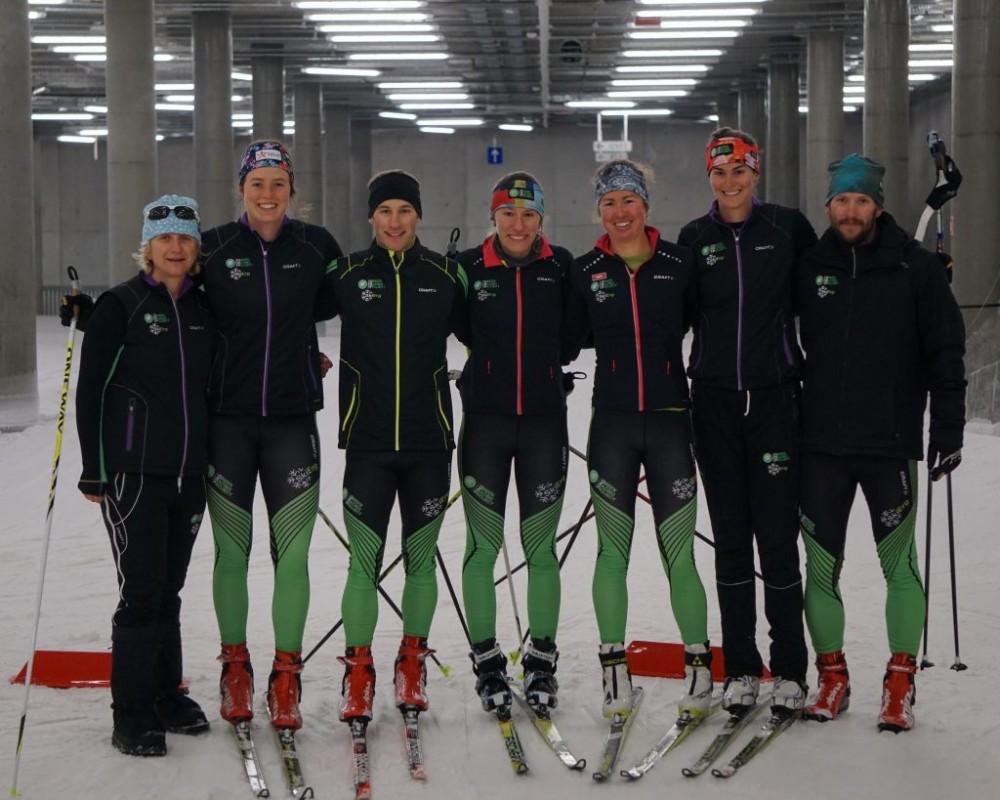
Left to right: Craftsbury GRP head coach Pepa Miloucheva along with athletes Heather Mooney, Ben Lustgarten, Kaitlynn Miller, Caitlin Patterson, Liz Guiney, and assistant coach Nick Brown in the ski tunnel in Planica, Slovenia, during a training camp this month. (Photo: Caitlin Patterson/CGRP blog)
Along with Lustgarten, who joined Craftsbury this year after spending the last two seasons with the Sun Valley Ski Education Foundation (SVSEF) Gold Team, nearly a dozen CGRP skiers made the trip, including Caitlin Patterson, Kaitlynn Miller, Liz Guiney, Heather Mooney, and Mary O’Connell, and biathletes Alex Howe, Ethan Dreissigacker, Mike Gibson, Emily Dreissigacker, and Hallie Grossman.
“The intensity and technique really helped to keep the tunnel from getting too boring, as there was always something to think about or work on, or at the very least a coach on hand videoing for later technique review,” Patterson wrote in an email. “It gave us an opportunity to practice being adaptable to snow conditions and terrain (ie corners); even if those particular features in the tunnel would be rarely seen on a race course, they were valuable in their extremes. I feel more prepared than ever to handle a course with tons of 90 and 180 degree corners, even though that’s unlikely to happen often.”
The athletes, along with Craftsbury’s head coach Pepa Miloucheva and assistant coaches and wax technicians Nick Brown and Sam Doherty, completed a weeklong training camp in Planica, taking full advantage of the three-level snow tunnel. The following week, the group headed to Schladming, Austria, for eight days of volume training on the Dachstein glacier, more than 9,800 feet above sea level. In Planica, nearly 7,500 feet lower, much of the team’s first week focused sharpening agility, coordination and speed.
“The tunnel is a perfect environment for working on both technique and speed, with enough transitions and tight turns to keep the skiing interesting,” Grossman wrote in an email.
“I feel more prepared than ever to handle a course with tons of 90 and 180 degree corners, even though that’s unlikely to happen often.” — Caitlin Patterson (CGRP) after training in the Slovenian ski tunnel
Grossman, who recently switched from cross-country to biathlon, explained that the biathletes’ intensity training slightly deviated from their original plan when they learned that Slovenian Summer Biathlon Nationals were being held in Pokljuka, Slovenia, about an hour away from Planica.
“The camp took a little turn when we found out about the rollerski races in Pokljuka, so what was going to be a primarily on-snow camp turned into a combination of skiing and rollerskiing,” Grossman wrote. “This allowed us to still focus on technique and shorter speed in the tunnel, while also getting the opportunity to race.”
The biathletes had originally planned to use the Pokljuka range for a few shooting sessions, but quickly decided to jump into the races when they discovered the competitions were taking place at the same location. Grossman competed in both races that weekend — the women’s 7.5 k sprint and 10 k mass start — as did her teammate Emily Dreissigacker.
“We actually didn’t even know Slovenian Nationals were happening until we tried to sign up to use the range and they told us we couldn’t because there were races,” Dreissigacker wrote.
Dreissigacker, who married Howe, her teammate, last month and spent a few weeks before the camp on a honeymoon with him in Italy, explained that the competitions elicited an opportunity to reconnect with racing, even within a small field.
“There wasn’t a ton of competition in the senior women’s category, four of us to be exact, but one of the Slovenians was Teja Gregorin who won bronze in the pursuit in Sochi, so it was pretty cool to be able to race against her,” Dreissigacker wrote. “For me it was also a good way to re-focus after the craziness of the wedding.”
“We actually didn’t even know Slovenian Nationals were happening until we tried to sign up to use the range and they told us we couldn’t because there were races.” — Emily Dreissigacker (CGRP) on racing at Slovenian Summer Biathlon Nationals
Dreissigacker finished third in the women’s 7.5 k race, with two standing misses, and Grossman placed fourth. In the mass start the next day, Dreissigacker once again reached the podium in third and Grossman repeated in fourth.
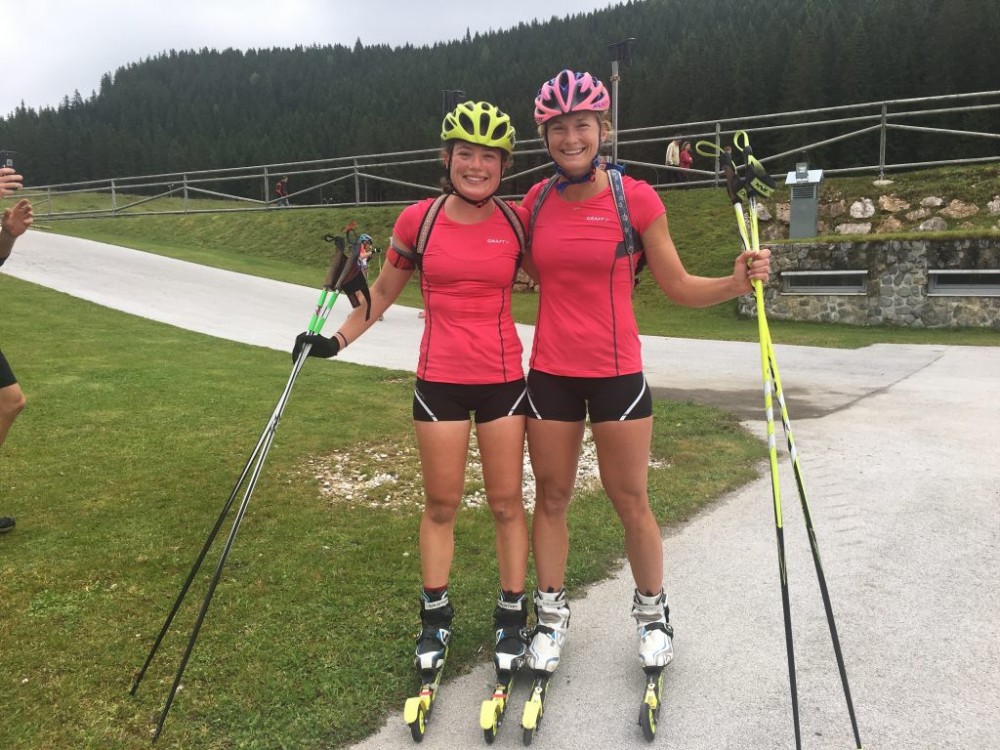
CGRP biathletes Hallie Grossman (l) and Emily Dreissigacker after the women’s 14 k mass start at Slovenian Summer Biathlon Nationals in Pokljuka, Slovenia, on Sept. 18. (Photo: Ethan Dreissigacker)
The men’s races included a 10 k sprint and 14 k mass start. In the sprint, Howe placed seventh, Ethan Dreissigacker was ninth and Gibson 13th. The next day, Ethan rocketed to third, Howe finished 10th and Gibson 14th.
“It was really fun to be able to jump into the Slovenian races!” Ethan wrote in an email. “While it did change up the plan a bit that first week, it think it was for the better, and I’m really glad we were able to compete. Biathlon races in the US are pretty few and far between, and many of them are also ‘trials’ of some kind. It’s super valuable to get in competitive racing experience outside of those trials races to get used to the pressure of competition without feeling like your season is on the line.”
Along with the CGRP athletes, the men’s field included the Slovenian national biathlon team and some non-national team skiers, as well as a few Bulgarian national-team members.
“The competition at these races was really pretty similar to that of the US rollerski nationals we had in August,” Ethan explained. “The big name in the men’s field was Jakov Fak who has an Olympic bronze, and a bunch of World Cup victories. Fak has is a very relaxed and efficient skier and it was awesome to get to ski behind him for a bit in the races.”
After Slovenian nationals, the Craftsbury crew ventured to Austria for a week of altitude training. The team planned to train through Wednesday and fly back to Vermont on Thursday this week.
“Both places are only 2 hrs apart, so was very convenient for a week long speed block in the tunnel and a week and a half volume block on the glacier all on snow,” Miloucheva wrote in an email. She explained that “some speed work followed by some good distance hrs on snow,” were the primary goals of the camp.
While it wasn’t the first time the CGRP spent a few weeks of fall training on snow, this year was the first split camp featuring the Slovenian snow tunnel.
“This is the third year in a row that the GRP has come over to Austria for an altitude camp on the Dachstein Glacier,” Ethan explained. “This year I was really excited about the split the camp between two locations, with two different focuses, and I think that has really helped make the most of the trip. Both locations have had some awesome resources for training, and beautiful scenery.”
Ben Lustgarten getting in a final day of classic kilometers in on the Dachstein glacier in Austria this month. (Photo: Caitlin Patterson)
Craftsbury skiers Ben Lustgarten (r) and Heather Mooney skiing on set tracks under clear skies while volume training on the Dachstein glacier in Austria this month. (Photo: Caitlin Patterson)
Craftsbury GRP biathletes Ethan Dreissigacker (l), Alex Howe (c) and Mike Gibson after the men’s 14 k mass start at Slovenian Summer Biathlon Nationals in Pokljuka, Slovenia, on Sunday, Sept. 18. (Photo: Ethan Dreissigacker blog)
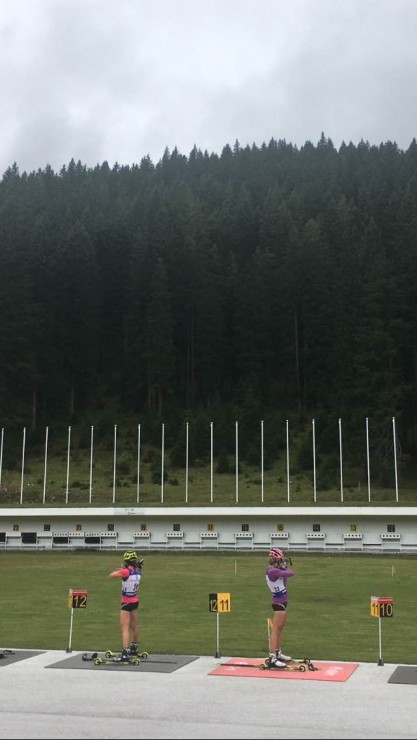
Craftsbury GRP biathletes Hallie Grossman (l) and Emily Dreissigacker during the women’s 10 k mass start at Slovenian Summer Biathlon Nationals in Pokljuka, Slovenia, on Sunday, Sept. 18. (Photo: Sam Doherty)
The men’s 14 k mass start at Slovenian Summer Biathlon Nationals in Pokljuka, Slovenia, on Sunday, Sept. 18. (Photo: Ethan Dreissigacker blog)
Part of the Slovenian ski tunnel’s 950-meter, snow-covered loop in late September. (Photo: Ben Lustgarten)
Craftsbury GRP’s Ben Lustgarten (r) and Caitlin Patterson get in some classic speeds while training in the Slovenian ski tunnel in Planica this month. (Photo: Sam Doherty)
Craftsbury’s Ben Lustgarten (r) and Alex Howe practice corning while training in the Slovenian ski tunnel in Planica this month. (Photo: Sam Doherty)
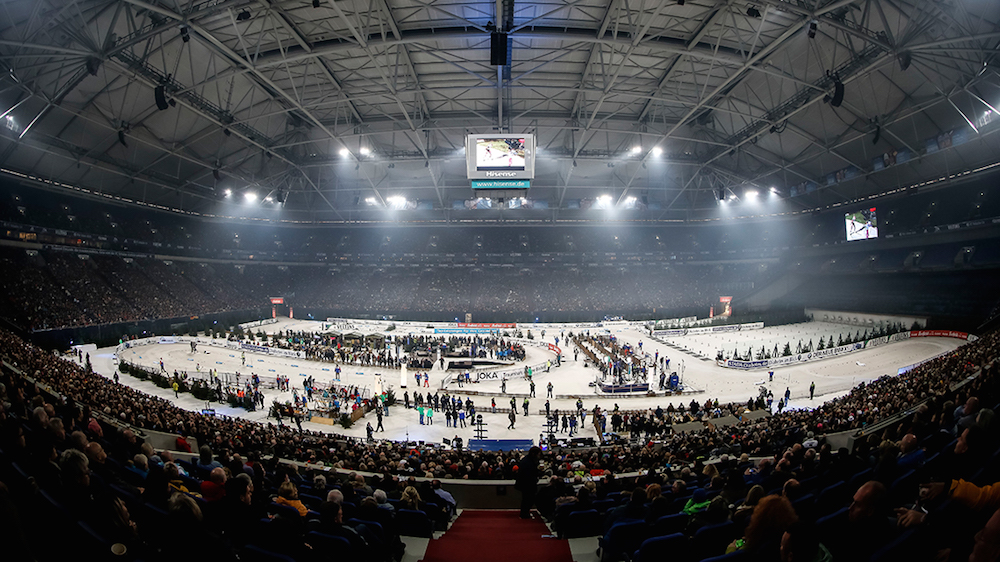
View of the indoor section of the ski track and the shooting range inside the arena at the Biathlon auf Schalke, or World Team Challenge, in Gelsenkirchen, Germany. (Photo: Biathlon-aufSchalke.de)
Biathletes competing in the international IBU World Cup tour are used to large crowds by now, with races often attended by 5,000 to 10,000 spectators per day. But the annual World Team Challenge, a two-person relay invitational in Gelsenkirchen, Germany, is on something of a different level. Athletes skied on artificial snow through a park around a huge soccer arena, before entering the pitch inside via a tunnel, and then shooting in front of nearly 41,000 raucous fans, with music blaring and the noise level amplified indoors many times.
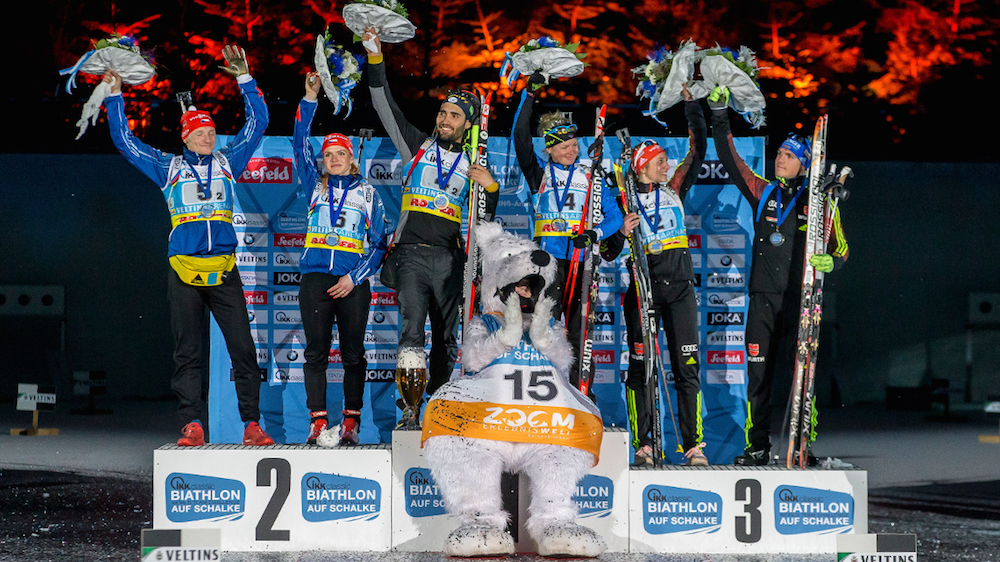
Two days ago on Monday, France’s Marie Dorin-Habert and her relay partner Martin Fourcade managed to perform the best among the 10 participating teams in this wild atmosphere, winning the final pursuit in 33:57.6 minutes (for about 12 kilometers of skiing, plus six penalty laps). The Czech Republic’s Gabriela Soukalová and Ondrej Moravec placed second, 12.6 seconds back (with three penalties), and third place went to local fan favorites, Germany’s Vanessa Hinz and Simon Schempp, 22.2 seconds behind with four penalties.
Fourcade already had two 2014 Olympic gold medals, six World Championships titles, and 46 World Cup wins in every discipline and just about every World Cup location. But he had yet to seize a victory in Gelsenkirchen’s arena and was eager to change that.
“It’s amazing, this is the only competition I did not win yet,” he explained in an interview with host TV broadcaster WDR after the race. “This morning I talked to Marie that it would be great to finally win it, and together we are a really strong team.”
The World Team Challenge relay race is held in a special format, with one woman and one man forming a team and exchanging repeatedly, each skiing a 1.3-kilometer loop and having to clean a shooting stage, or ski a short 75-meter penalty lap, before tagging off to their teammate. This mode of competition is fairly similar to biathlon’s new single mixed relay or the team sprint in cross-country.
Yet the location is vastly different, far away from any mountain range, in a flat region of Germany formerly known for its coal mines. And with the teams entering a darkened soccer stadium to a light show, a PA announcer, and loud music including the theme from “Pirates of the Caribbean,” the scene can be likened to the entrance introductions of NBA players or professional boxers.
The World Team Challenge, also known as “Biathlon auf Schalke” by the name of German first-league soccer team Schalke 04, which plays its home games in the domed Veltins Arena under a retractable roof and a large JumboTron-style video cube, was created to be a fun race event during the World Cup season’s holiday break.
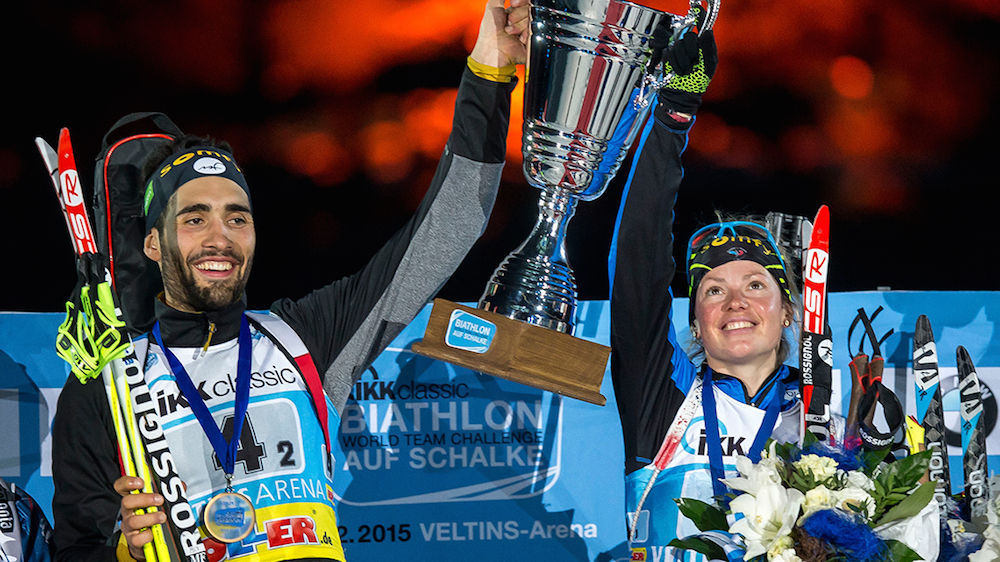
The 2015 World Team Challenge podium, with France’s Martin Fourcade and Marie Dorin-Habert (c) celebrating their victory, the Czech Republic’s Ondrej Moravec and Gabriela Soukalova in second place (left), and Germany’s Vanessa Hinz and Simon Schempp in third place (right). (Photo: Biathlon-aufSchalke.de)
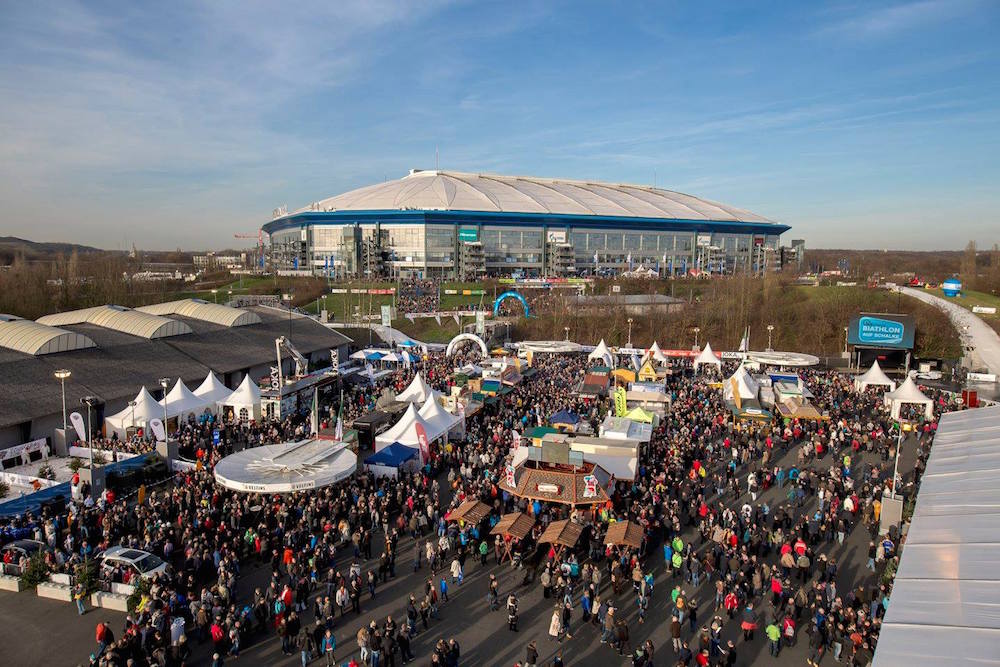
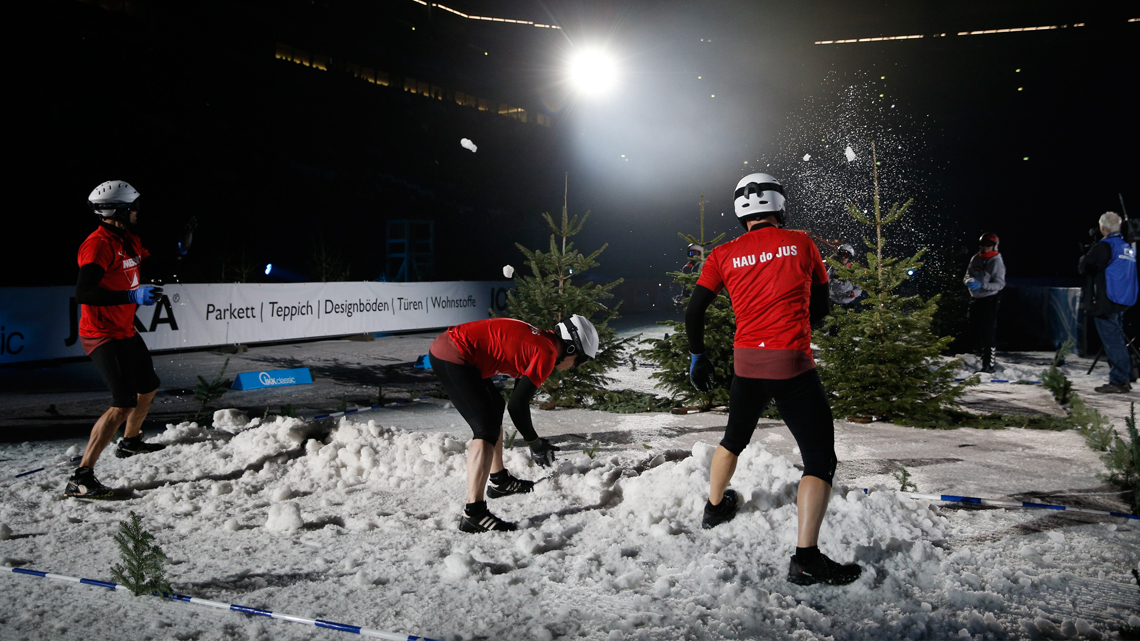
Even more so than a regular World Cup, the race is held in a huge party atmosphere. The outdoor portion of the track meanders through a so-called “winter village” Christmas market with food stands for the fans. An abundance of Christmas trees inside the arena form little forests to delineate the track and shooting range, and entertainment includes a “shootout” to determine the starting order, the “Snowball Fight World Championship” (however undisputed that title may be), multiple live pop music performances, and an indoor fireworks show.
Now in its 14th season, the World Team Challenge has become a fixed institution circled on the calendar for many biathletes during the holiday break, ever since the German duo Michael Greis and Martina Glagow (now Beck) won the inaugural event in 2002.
The athletes invited to the race, by and large, take it seriously each year and are impressed by the atmosphere.
“Oh, it’s huge. It’s amazing to ski in front of such an audience,” Germany’s Hinz told WDR. “It’s something very different, the pressure is a little higher because everything goes by so fast … I was just overwhelmed.”
For Hinz and Schempp, it was their first podium finish and first time participating. Hinz, a former cross-country skier who switched to biathlon two seasons ago, achieved her first major success as a member of Germany’s gold medal-winning women’s relay team at the 2015 World Championships. For the World Team Challenge, she hadn’t planned to compete until the night before, as she replaced Schempp’s original partner Laura Dahlmeier who was sidelined with an illness.
“I was completely nervous,” Hinz said, according to news agency SID. “The fans were crazy, a huge compliment to the audience.”
There are no World Cup points to win in the event, yet the stakes are still high. World Team Challenge organizers guaranteed prize money of at least €10,000 for all starting duos, and this year, the winners got €14,000 per person, as well as a newly introduced challenge cup trophy.
In the past, sometimes the winners also received a new car, but arguably that prize was harder to split between two people, plus a small crew of coaches and technicians. Overall, €156,000 ($170,000) in total prize money was awarded.
“The form of this competition, short rounds, fast shootings, I like that, it’s pretty cool, a spectacular show for the viewers,” Germany’s Erik Lesser said in an interview with WDR. Lesser was last year’s runner-up with teammate Franziska Hildebrand.
“In my opinion, this is an event to show people who normally don’t get to watch us what biathlon is all about, and I think we managed to do that today.”
New Track ‘On World Cup Level’
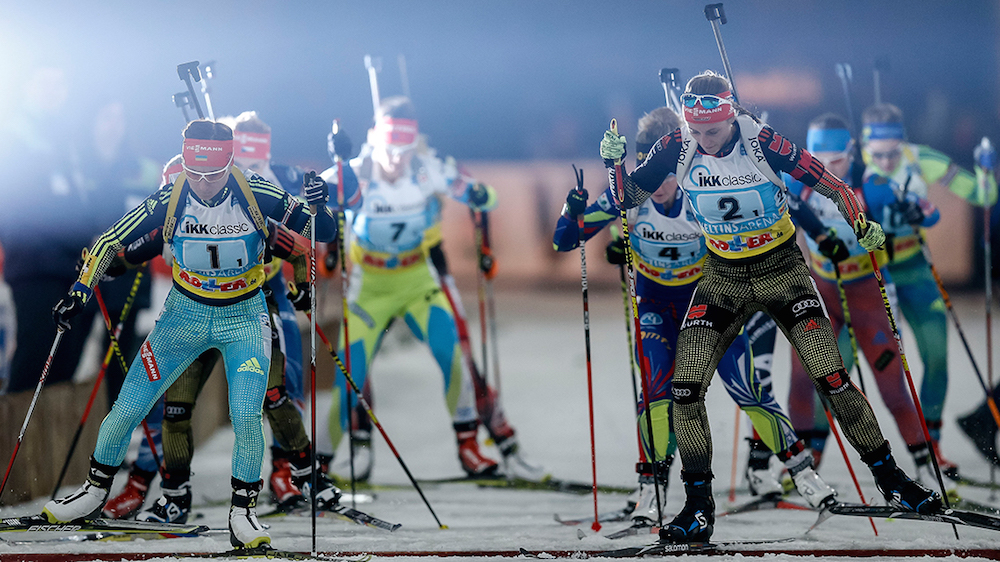
Ukraine’s Valj Semerenko (bib 1, left) and Germany’s Vanessa Hinz (bib 2, right) lead a group of athletes on the outside section of the ski track during the 2015 World Team Challenge in Gelsenkirchen, Germany. (Photo: Biathlon-aufSchalke.de)
For the 2015 edition, the Biathlon auf Schalke organizing committee, led by Herbert Fritzenwenger, an Olympic cross-country skier and biathlete who’s currently a color commentator for biathlon broadcasts on the German TV network ZDF, designed a new track through a park that incorporated multiple more difficult climbs and downhill sections on the part that is built outside the soccer arena.
In the past it was a rather flat loop, but this year it was supposed to more closely resemble what athletes would see “on the World Cup level,” as the organizers announced in a presentation before the race.
“It’s not exactly ‘The Wall’ of Ruhpolding or the ‘Birxsteig’ in Oberhof,” Fritzenwenger said, referencing two notoriously difficult climbs at the two World Cup locations in Germany. “But the athletes will feel that it is more difficult than in prior years.”
Using snow mostly coming from an artificial ski tunnel in a nearby city, every round was now almost 1300 meters long with 30 meters of vertical climb, which added up to about 300 meters for the men and 240 for the women for the whole day.
After some years where the organizers experimented with rifles using a laser aim, the athletes now use their own rifles with real ammunition on the 10-position range again, with bulletproof glass walls and an empty section behind it to protect the audience.
The increased difficulty of the course was evident during the races. Despite an indoor shooting range with no dreaded wind influence, most athletes produced more misses and thus had to skate more penalty laps than they normally would in a World Cup, also due to the fact that they were not allowed to use spare rounds.
The new track was also designed to be wider, offering more possibilities to pass each other and thereby make for more interesting race situations than in prior years.
“The athletes really enjoy it,” Fritzenwenger said in a pre-race press release.
Yet during the competition, it quickly became obvious that a sharp right hairpin turn coming out of a new downhill section was rather difficult. Many athletes not only had to use all their cornering skills to pass this section safely, but even had to resort to snowplowing to slow down and not crash into a fence, something especially the men rarely do during World Cup races. Those who didn’t reduce speed enough had to pay for it, with Russia’s Evgeniy Garanichev falling twice in the same spot, potentially costing his team a podium finish. Other athletes also made contact with the snow in this turn, including Germany’s Lesser and Slovenia’s Teja Gregorin.
“It was quite exhausting,” Hinz said in a post-race interview with WDR. “You can’t relax in the downhill sections because you have to focus so much. In the first rounds it’s still fine, but then it becomes increasingly difficult. It was really hard for me today, because those climbs were also pretty steep.
“We aren’t machines, everyone is giving their best, but for us, this is a regular competition,” she added. “We are trying to win, that’s why were are giving it all we have.”
(Photo: Facebook/Biathlon-aufSchalke.de)
(Photo: Facebook/Biathlon-aufSchalke.de)
(Photo: Biathlon-aufSchalke.de)
(Photo: Facebook/Biathlon-aufSchalke.de)
Two ‘Halftimes’: Mass Start and Pursuit
As in prior years, the field of 10 teams was indeed world class. It was not just comprised of athletes who are all active on the World Cup circuit, but several who are currently in the top 10 in the overall World Cup ranking for both women (1. Soukalová, 2. Dorin-Habert, 3. Hildebrand, 5. Wierer) and men (1. M. Fourcade, 3. Schempp, 8. Garanichev).
It was a long race day for the athletes, with a shootout (more on that later) followed by the main event split into two “halftimes” as the organizers called it, borrowing a term from soccer. At first, a nine-loop mass start (the women skied four loops; the men five) on the 1.3 k course, followed by a pursuit race of that length the same evening, after just a short intermission break. Thus the women had to ski about 10 k, while the men had to ski 13 k.
Prone and standing shootings interchanged, and because the loops were comparatively short and intense, shooting accuracy was even more important than in regular World Cup races. It turned into an up-and-down event, and almost all teams remained in contention for the podium for a long time.
While one athlete was out on the track, crews of wax technicians hurried to clean and prepare the skis of the athlete who was receiving a short pause, very similar to a cross-country team sprint.
“We are mostly using fluid spray-on wax, that is faster [to apply], and also because temperatures outside are about 8 degrees Celsius,” a technician for the two German teams explained, while simultaneously preparing skis during a brief in-race interview with WDR, before his athletes needed them back in the exchange zone.
After what the organizers called the “first half,” the mass-start part of the event, Russia with Ekaterina Yurlova and Garanichev was in the lead with a winning time of 33:47.6, ahead of defending champion Ukraine, with Valj Semerenko and Sergei Semenov 12.8 seconds back, and France 14.3 seconds back in third place. Germany’s Hinz and Schempp were 15.2 seconds out of first in fourth.
The “winter village” outside the arena at the 2015 Biathlon auf Schalke, or World Team Challenge, in Gelsenkirchen, Germany. (Photo: Facebook/Biathlon-aufSchalke.de)
But the organizers have come up with a clever way to make things more interesting for the viewers, and give all teams a fair chance and motivation until the end. They did so by reducing the deficit to the winner by halving each team’s time back, and making the maximum deficit 45 seconds. Thus Sweden and Italy, who had finished the mass start only in ninth and 10th, respectively, still had a chance to move up.
And the podium indeed would be flipped during the “second half” pursuit race.
The Czech Republic with overall women’s World Cup leader Soukalová and teammate Moravec had only finished in seventh, 53.1 seconds behind, but were able to make up a lot of ground in the pursuit, helped by the start rule and shooting only three more penalty laps.
With six rounds left in the pursuit, local favorites Schempp and Hinz briefly took the lead when Hinz managed to clean her targets, while Russia’s Yurlova and Ukraine’s Semerenko had to ski into the penalty loop, causing very excited standing ovations from the home crowd.
“One can only dream to come into the arena in first place, that roar and those masses of people were incredible,” Hinz told WDR.
“The atmosphere when we were in the lead was gigantic, this is something very unique,” added her partner Schempp.
However that excited feeling of being the leaders in front of their fans didn’t last very long. After Hinz missed a shot on the next stage, Dorin-Habert caught up with her again.
As they did repeatedly in the last World Cup weekend in Pokljuka, Slovenia, Schempp and Fourcade skied together for one loop after the exchange, but with three loops to go, Schempp caused another miss in a prone shooting stage while Fourcade cleaned his targets with amazing speed, and was able to create a small gap to Schempp, Moravec, Garanichev, and Ukraine’s Semenov.
“Of course he took a lot of risk in that last prone shooting, he finished very, very fast, but went out with a zero while I had one miss,” Fourcade’s opponent Schempp remembered in a post-race interview with WDR. “Then there was a gap, but nevertheless we can be very satisfied [with the third place], participating for the first time while they already had experience. And we indeed are!”
After Dorin-Habert had managed to keep the lead, Fourcade skied another fast round, jumping up the climbs to come into the final shooting in first place. He cleaned all his targets just before Moravec as the closest pursuer had even begun shooting. Fourcade knew he had beaten out his competitors, immediately turning and raising his right fist.
Moravec managed to clean his shooting stage, too, and defended the second place for the Czech team 12.6 seconds behind France, greeted in the finish by Soukalová.
It was a special event for Moravec not just because of the excellent result, but also because he is soon expecting the birth of his child sometime during the next week.
Schempp was able to still secure the third place for his team, cleaning his last standing shooting after coming into the range behind Austria’s Simon Eder, Garanichev and Semenov, and skiing to the finish 22.2 seconds back.
After coming in fourth place just 7.4 seconds behind the podium, Garanichev was a bit disappointed to have given up the Russian lead from the mass start with too many penalty laps and his two crashes on the track. But it was a hectic race also due to his personal life circumstances. Similar to the Czech Republic’s Moravec, he told reporters that he intended to board a plane back to Russia at 6 a.m. the next morning, hoping to be home in time for the birth of his child expected already for Jan. 1.
Ahead of the pack, Fourcade was able to ski a relaxed final round, repeatedly slowing down a bit to waive to the fans. Dorin-Habert waited for him behind the finish line to hug him immediately after he had crossed it, with the audience cheering for all remaining teams until they were in the finish, too.
“Maybe he has three legs, or three lungs, he is so strong,” a smiling Dorin-Habert joked after the race with WDR. “I don’t know how he does it, he is so fast. And if he is not in shape for once, he [still] shoots very well.”
It was France’s first victory in the event, after the same two athletes had achieved a second place in 2012, and four more podium finishes for other French athletes before.
“In 2012 I was in the lead with Marie Dorin here,” Fourcade recalled. “But then I fell on the last lap and hurt my shoulder. We only came in second, so I was very disappointed.”
This year everything worked out for the French team. “It was a wonderful competition,” Fourcade said. “My family, my friends are here. This is the best way to end 2015.”
French teammates Martin Fourcade and Marie Dorin-Habert hoist the new cup challenge trophy after winning the 2015 Biathlon World Team Challenge on Dec. 28. (Photo: Biathlon-aufSchalke.de)
Official Race Results: 2015 World Team Challenge
France (Marie Dorin-Habert, Martin Fourcade), 33.57.6
Czech Republic (Gabriela Soukalová, Ondrej Moravec), +12.6
Germany I (Vanessa Hinz, Simon Schemp), +22.2
Russia (Ekaterina Yurlova, Evgeniy Garanichev), +29.6
Ukraine (Valj Semerenko, Sergei Semenov), +31.7
Austria (Lisa Hauser, Simon Eder), +46.8
Germany II (Franziska Hildebrand, Erik Lesser), +1:46.8
Slovenia (Teja Gregorin, Jakov Fak), +1:57.6
Italy (Dorothea Wierer, Lukas Hofer), +2:27.1
Sweden (Emma Nilsson, Tobias Arwidson), +2:55.3
Notably Absent
No North American athletes participated in the World Team Challenge this year. In 2008 and 2009 Lanny Barnes and Jay Hakkinen represented the U.S. (placing ninth, then sixth for the best finish to date), in 2010 Tracy Barnes-Coliander and Tim Burke placed 10th, and in 2012 Susan Dunklee again with Burke finished 10th.
As for Biathlon Canada, no Canadian team has participated in the event to date.
It was unknown to the author whether North American teams had not been invited, or simply chose the longer rest over the holidays without additional travel and competition stress.
Norway, which usually has been a mainstay at this event, declined to send a team this year, citing a season preparation focus on the upcoming World Championships at home in Oslo.
Fun Pre-Race Events (i.e. The Shootout)
The 2015 Snowball Fight World Championships took place on Dec. 28 as part of the Biathlon auf Schalke in Gelsenkirchen, Germany. (Photo: Biathlon-aufSchalke.de)
Before the main event there also was a race among local junior teams called the “German Team Challenge,” with the duo Anna Weidel (age 19, perhaps best-known in the U.S. as a silver medalist in sprint and pursuit at the 2014 IBU Junior World Championships in Presque Isle, Maine) and Dominic Reiter (20) victorious.
Also before the two main races, Slovenia’s Gregorin won a lighthearted “shootout” event among all participating women and men, coming from behind after several other athletes missed their final shot and lost time having to reload spares manually. In this competition the athletes — while not wearing skis — were asked to hit 20 targets as fast as possible (five prone, five standing, five prone, and five standing), using as many spare rounds as necessary. Gregorin narrowly beat out Lesser, with Austria’s Eder in third, Fourcade in fourth, Ukraine’s Semereko in fifth, and Czech Republic’s Soukalova in sixth place. Gregorin had already won the women’s first round to move into the final of the best three women and three men.
As for the winners of the mentioned “2015 Snowball Fight World Championships” between 24 three-person teams? That honor went to the defending champions “Hau do Jus” from Wuppertal, Germany, narrowly beating out team “Snow Turtles” with 72 to 70 hits.
Nobody asked Fourcade and Dorin-Habert if they intend to also aim for this title next year.
Next World Cups
The regular IBU Biathlon World Cup season will resume on Jan. 7, with the next two World Cups both held in Ruhpolding, Germany, after the organizing committee in Oberhof, also Germany, had to cancel due to complete lack of snow in the region combined with too warm temperatures to produce artificial one.
“I’m happy that Ruhpolding has accepted the challenge and is doing everything to successfully host this World Cup,” Germany’s Schempp, who has made the town his home, described the difficult snow situation in an interview with German network ARD over the weekend. “It won’t be easy, but they are going all-out to make it happen. Two days ago I was training there, and right now it doesn’t look great with regards to the track, there is only about 1.2 or 1.3 kilometers. But with everything they do and it [the weather] supposed to become colder, I believe we’ll find really good conditions to race there in early January.
“Of course the situation is bitter for Oberhof,” he added.
Anastasiya Kuzmina (bib 7) at the start of today’s 12.5 k mass start, where she took her second victory of the weekend.
OSLO, Norway– Anastasiya Kuzmina of Slovakia had already had a pretty good weekend here at Holmenkollen. Yesterday, she picked up her first World Cup win of the season in the 10 k pursuit.
But when she exited the shooting range for the last time in today’s 12.5 k mass start and looked up ahead of her, she knew that things were about to get even better. Incredibly, there was not a single woman in front of her heading out onto the final two and a half kilometer loop: Olga Zaitseva of Russia. And Laura Dahlmeier of Germany was exiting the penalty loop to join Kuzmina.
“Just amazing,” was how Kuzmina described the realization that she was more or less guaranteed a second podium.
How incredible was it? With three penalties over the first two stages, Kuzmina had been in the low 20’s at the race’s halfway point. There had been several leaders during the competition: Norwegians Tiril Eckhoff and Tora Berger on the first loop, Zaitseva on the second, Dahlmeier on the third and fourth. Kuzmina had never been in the mix.
Kuzmina heading out of the stadium.
Seizing opportunity by the horns, the Slovakian double Olympic gold medalist set to work making her day better yet again. Skiing the second-fastest closing loop of the entire field, she passed Zaitseva and left Dahlmeier in the dust and took a 3.8-second win.
“Today I understand how important it is to make zero on the last shooting,” Kuzmina laughed in a post-race press conference.
Zaitseva and Dahlmeier could not keep their earlier speed and slipped further back in the field, finishing fifth and sixth. Instead it was Teje Gregorin of Slovenia who charged into second place, and Marie Dorin Habert of France who took third.
It was the first regular-season podium for Gregorin, who showed the same determination and finishin speed as she did in a bronze medal performance in the Olympic pursuit last month.
“I didn’t expect so good results this morning because I had a lot of problems with shooting this week,” she said. “Today was much better and I’m very happy to be in the top three.”
And it was also a comeback for Dorin Habert, who ruptured a ligament in her ankle jogging at the first World Cup in Östersund, Sweden, and did not compete again until the Olympics. Her next season won’t be much simpler: Dorin Habert, who came into this season as the top French woman, is pregnant and anticipated missing some to all of the 2014-2015 competition year.
“And now I have a baby on board now so it is a very strange season,” she said of this year. “For the next season, I think I can’t be there in December, and I hope to be there in January, February, March maybe if I can find my level. The priority will be the baby. To race, I will make more seasons after. But next season it will be more [relaxed].”
The World Cup overall title was also decided today. It was a fight between Berger and Kaisa Makarainen of Finland: if either won, they would take home the crystal globe. Otherwise it would depend on the spread between them.
Kaisa Makarainen (right) shooting her way to the World Cup overall title.
Once Berger lost the lead after the first shooting, her fortunes just kept taking downhill turns. After her first penalty, she was in 17th place but still leading Makarainen, whom she needed to beat my a margin of 10 World Cup points. With a clean second prone stage, Berger was up to seventh, still well ahead of Makarainen.
But then the Norwegian, whose fast and clean standing shooting has been one of the hallmarks of a long and storied career, missed three shots in a windy third stage. That dropped her far back. In the final stage, she missed another shot and could only climb from 19th up to 14th on the last loop. It wasn’t enough to beat Makarainen.
“With how I managed today, it was Kaisa who deserved to win the globe,” Berger told Norwegian broadcaster NRK after the competition. “I wanted a bit too much.”
It was the second overall title for Makarainen, who also won the Total Score in 2011. She had a rough start to the race, missing two shots and leaving the penalty loop in 27th. But the Finn said that she did not think it was nerves that had tripped her up.
“It was a really tough race today,” Makarainen said in a press conference. “A lot of pressure before and also during the race. I think I was not the only one with the pressure today.”
Makarainen cleaned the second stage, but then had a single penalty in each standing stage. Nevertheless she was able to climb up through the field, thanks to the fastest course time of the day – something she has made a habit of owning recently.
She said that she did not know how far ahead of Berger she was at almost any point during the race. In the final shooting, she knew Berger was somewhere behind her, but did not feel safe since Berger is capable of shooting so quickly.
Only in the very closing stages of the last loop, when she was up to seventh place, did she realize that it was enough to hold onto the Total Score.
“I had to fight my way back up,” Makarainen said in the press conference. “… Biathlon is really a tough sport, also the mental side. It’s not enough that you are in good physical shape and you can shoot well. In the races, for the top places the mental side is also very important. It’s not so easy to handle. But that’s why we train a lot in the summer time. And I have been in this circuit so many years that I think I have learned something, and I have been in a lot of situations.”
The day was also particularly significant as a number of top athletes are retiring. After competing in the last World Cup races of their careers, Berger and Ann Kristin Flatland – both individual World Cup winners and members of the World Champion relay team in 2013 – asked the Norwegian prime minister for jobs, joking that they could be secretaries of state, according to Aftenposten.
Flatland, who already has one child, finished one spot behind Berger in 15th. She actually let Berger pass her in hopes that the extra World Cup point would allow her to do better in the fight for the Total Score. The two were carried on the shoulders of their coaches as they made a farewell tour of the stadium.
Andrea Henkel, a German biathlete who first won Olympic gold in 2002 and has 22 career wins, is also retiring. After finishing 13th, Henkel and her three teammates in the mass start paused at the finish to savor flutes of champagne, while Henkel wore an improvised crown. Other former teammates such as Kati Wilhelm and Simone Hauswald, who joined her for many a relay in the 2000’s, showed up to help celebrate. German team staff wore short black wigs in Henkel’s signature hairstyle.
Russian star Olga Zaitseva, who led a portion of the mass start today but ended up fifth, had long planned to retire after this season. But she has since decided to keep competing through the 2018 Olympics and told Russian press that she feels like she is in the best shape of her life.
Rosanna Crawford and Zina Kocher finished eighth and 21st for Canada, and Susan Dunklee clocked in at 18th for the United States.
23-year-old Synnøve Solemdal of Norway could not have been happier to collect her first World Cup victory in Hochfilzen, Austria today.
After yesterday’s sprint race, where Synnøve Solemdal came so close to having her first World Cup podium but got bumped from third place by more famous Norwegian teammate Tora Berger, she made a prediction: that all she had to do was to ski a good pursuit race, and the podium would finally be hers.
Solemdal accomplished that and more in Hochfilzen, Austria, today, missing only a single shot out of twenty to stay in the running for the whole race before taking charge in the later stages and skiing to an easy 30-second victory.
“It’s crazy,” the 23-year-old told NRK, the Norwegian broadcaser. “Everyone was cheering ‘Synnøve’ all the way to the finish.”
In the first half of the race, it had been Kaisa Makarainen of Finland leading the way. Yesterday’s winner, Darya Domracheva of Belarus, missed two shots in the first prone stage and effectively took herself out of the race for the next several laps. Makarainen, the 2011 World Cup champion who placed second in the sprint, cleaned and left with a 13-second lead over Tora Berger. The fastest skier yesterday, Makarainen put time into the Norwegian, then cleaned her second stage to gain an even bigger advantage.
By the time Makarainen missed two shots in the first standing stage, nobody else was even shooting yet. But Solemdal was first to fire all her rounds, and she shot perfectly, smiling as she put her rifle on her back and left the range. She had a seven-second lead on Makarainen heading out onto the trails.
Makarainen quickly closed the gap, but was unable to pass Solemdal; they came into the final shooting stage together, turning the last five shots into a psychological battle. It was a fight that Solemdal won, cleaning yet another while Makarainen missed twice, shooting wide.
“My standing shooting was not so good,” Makarainen said in a press conference after the race. “My legs were shaking on the last stage. I never have this problem in training, but it was there today. I need to work on that.”
Meanwhile, a single miss, coming in the first stage, was Solemdal’s best ever in a World Cup.
“I have never hit more than 18 targets and today I hit 19,” she said. “The standing targets looked so big today! I don’t know what happened.”
As the next two racers, Domracheva and Marie Dorin Habert of France, each missed a shot, it seemed like Makarainen might have a chance to stay in second. But Berger, coming into the range late after collecting a penalty in each of the previous two stages, shot clean and left in second. Solemdal had a 45-second lead and would not be challenged on the final two-kilometer loop, but Berger, Domracheva, Makarainen, and Teja Gregorin of Slovenia all left within a few seconds of each other.
They formed a tight pack, and initially Domracheva moved to the front, trying to ski away from the rest. But Makarainen quickly hunted her down. The group came back together briefly before Berger put in an attack; only Makarainen was able to go with her. While the pair had initially only a small gap on the others, it widened as the meters ticked by. First one would push the pace, then the other.
Berger finally made an aggressive move on a sweeping downhill, 90-degree turn late in the course, passing Makarainen on the inside and carrying her momentum towards the finish line. Makarainen could almost regain contact, but as they skied through the final tunnel, Berger put in a furious burst with her trademark high tempo and left no doubt about whether the Finn could keep up. She couldn’t. Berger crossed the line in second, immediately congratulating Solemdal.
“This maybe was not the hardest competition of my life, but it was hard,” Berger said in the post-race press conference. “I tried to stay focused in the last loop and keep ahead of Kaisa.”
The sprint for fourth place ended with Gregorin charging to the line, past an exhausted, giving-up Domracheva who may have thought she had closed the door on the Slovenian.
Miriam Gossner of Germany passed Dorin Habert late in the loop to secure sixth, while Ekaterina Shumilova of Russia placed eighth for her first World Cup top-ten. Vita Semerenko of Ukraine placed ninth and Germany’s Nadine Horchler tenth.
But all attention was on Solemdal, who had raised her arms in victory as she coasted across the finish line, finally achieving not only her longstanding goal of a World Cup podium, but an even bigger goal – winning. She didn’t thank Berger after being knocked off the podium in the sprint, but today she gave credit to her mentor for helping her reach this level.
“Just watching Tora last week win three times was a great inspiration,” Solemdal said. “This summer, I trained very hard and watched Tora and tried to copy what she did.”
The other podium finishers congratulated the young racer as well; Berger must have been especially relieved, as it was the first time since 2005 that two Norwegian women finished in the top three. Finally, Berger has a teammate she can rely on.
“I am really happy for Synnøve,” Makarainen agreed. “I have known her for a long time and she deserves this win!”