The April 4 event pairs a live global broadcast with on-snow programming at Tahoe XC.
The inaugural Tahoe Nordic Expo will take place April 4, 2026, bringing together some of the most accomplished names in Nordic sport for a live, global virtual panel focused on the past season, the Olympic year, and the future of the sport.
Designed as a hybrid event, the Expo centers around a live virtual panel featuring Olympic, Paralympic, and World Cup athletes across multiple Nordic disciplines, including cross-country skiing, biathlon, Nordic combined, and telemark.
Julia Kern (USA) racing the World Cup cross-country mass start in Ruka (FIN). (Photo: Modica/NordicFocus)
The panel lineup includes:
Kikkan Randall, Olympic gold medalist and one of the most decorated U.S. cross-country skiers in history
Oksana Masters, 24-time Paralympic medalist in Nordic skiing and multiple sports
JC Schoonmaker, Tahoe native and two-time Olympian
Julia Kern, World Cup medalist and Olympian
Annika Malacinski, national champion and leading voice in women’s Nordic Combined
Jaz Taylor, multiple-time World Cup champion
The discussion will be moderated by Andy Newell, a four-time Olympian and prominent voice in the sport.
The 90-minute panel will serve as a live season recap, covering the 2025–26 World Cup circuit and the Milano Cortina Olympic and Paralympic Games, while offering audiences a rare opportunity to hear directly from athletes about training, competition, and the evolving culture of Nordic sport. Virtual attendees can submit questions in advance, while in-person participants will engage in a live Q&A.
Coach Andy Newell all smiles at the 2023 BMT. (Photo: BMT)
Founder Elyse Sara created the Expo to fill a gap in the Nordic landscape – one that emphasizes connection, storytelling, and access to athletes across disciplines and levels. The event brings together voices from across the global Nordic community, from Olympic medalists to emerging leaders shaping the future of the sport.
The event also includes a limited in-person component at Tahoe XC featuring clinics, demos, a laser biathlon relay, live viewing of the virtual panel, and other community events.
In addition to its focus on sport and storytelling, the Expo also supports inclusion in athletics. Ten percent of all proceeds will benefit Move United, a national leader in adaptive sports programming.
The Tahoe Nordic Expo aims to establish a new kind of gathering within the sport – one that reflects, connects, and looks ahead.
JC Schoonmaker (USA) onhis way to finish the individual sprint in 15th place at the World Championships in Trondheim (NOR) in 2025. (Photo: NordicFocus)
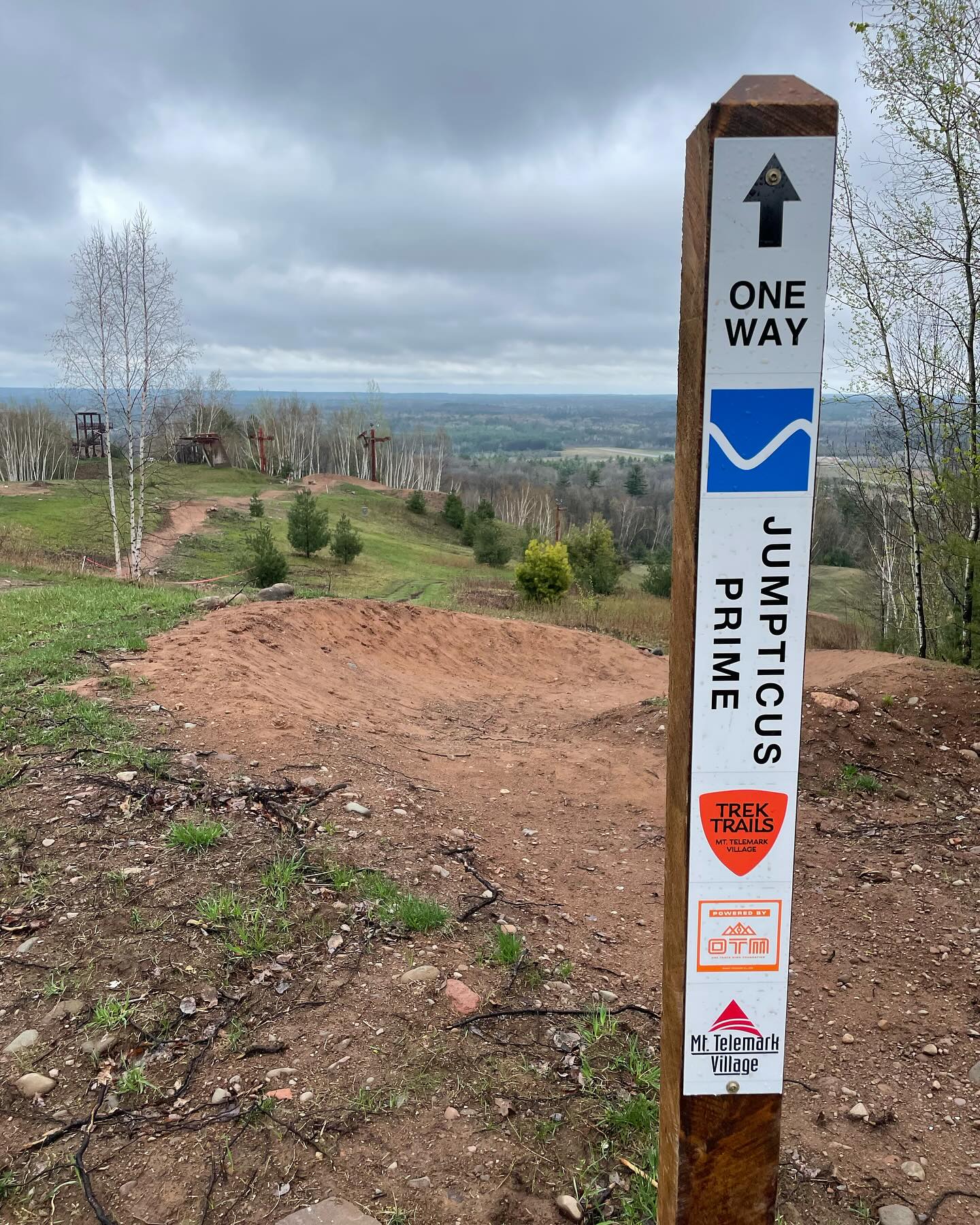
Atop one of the new Trek trails at Mt. Telemark, with the old lift towers from Telemark-past still visible. (Photo: American Birkebeiner Ski Foundation)
For the American Birkebeiner Ski Foundation (the Birkie) it’s been a long time coming.
The dedication ceremony held Saturday for the new projects that encompass the Mt. Telemark Village, the former site of the legendary Telemark Lodge, have been in the works for five years. All together, Mt. Telemark Village is “the biggest thing the American Birkebeiner has ever done.” Its $10.2 million dollar capital campaign, though, doesn’t capture what, for skiing, might just might be priceless. Up in the woods outside of Cable, Wisconsin, the Birkie has been busy figuring out how to commemorate a little glacial knoll that’s played an outsized role in the history of skiing while making it a vital place for more of that history to happen.
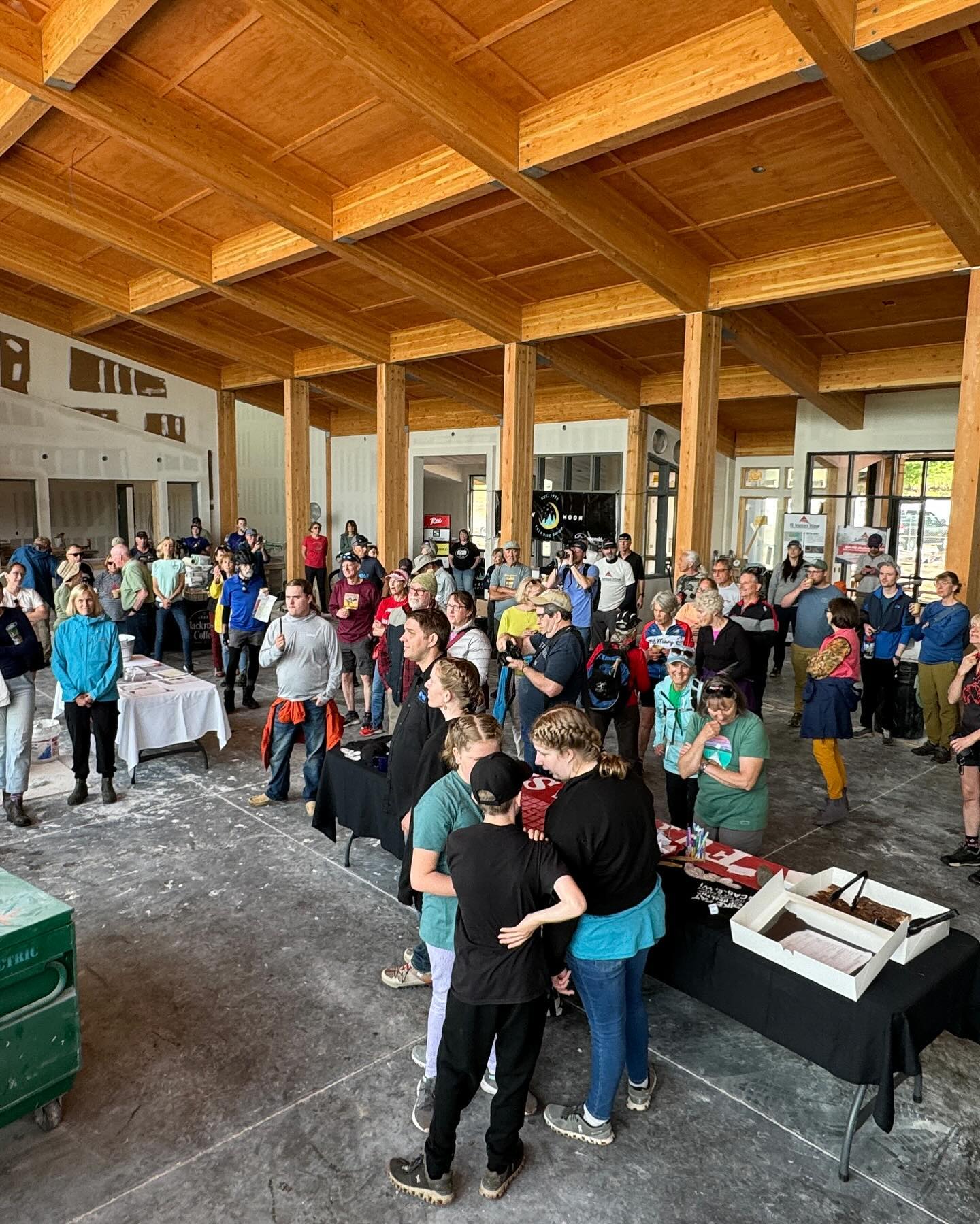
Inside the new Mt. Telemark Community Center, the Birkie community celebrates the dedication of new ski and bike trails. (Photo: American Birkebeiner Ski Foundation)
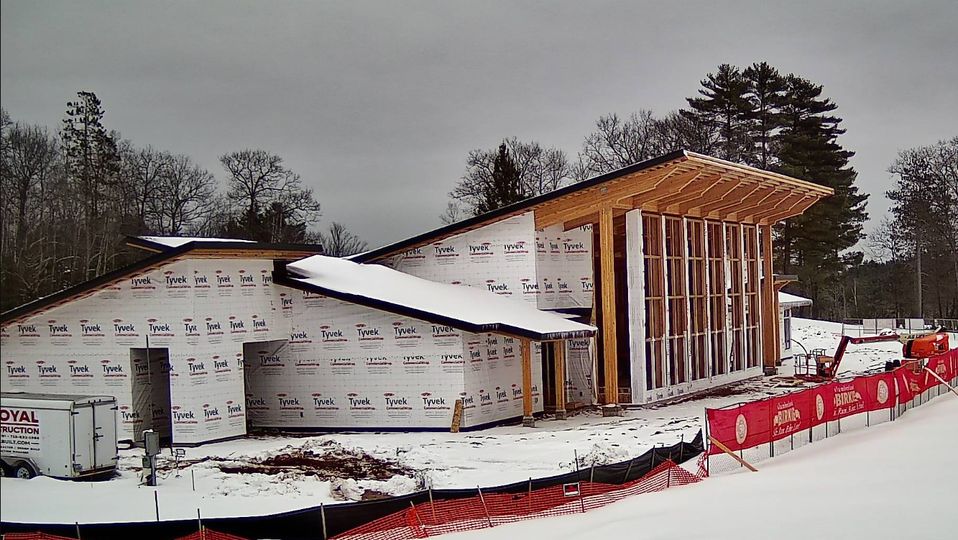
The dedication ceremony on Saturday featured two main draws that illustrate that delicate balance at the heart of Mt. Telemark Village. The first was the official dedication of the paved rollerski loop to George Hovland, a name linked to the deep past of skiing in North America. The second was the opening of a new mountain bike trail system sponsored by Wisconsin-based bicycle manufacturer, Trek, building on another of Telemark’s legacies as a key site in the development of the sport of mountain biking. In addition, the on-going, glass-plated construction of a new base lodge promised the realization of a vision that’s been in the works for the Birkie and Telemark the past five years.
Telemark and Tony Wise
Mt. Telemark Village, itself, is a re-birth of a long-lived Midwestern legend. Telemark was set up in 1947 by local entrepreneur Tony Wise. The downhill ski area made all it could of its ~300 ft of vertical descent set upon a glacial erratic. Wise, an ebullient character, seemed to derive inspiration from that terrain, making Telemark a cultural erratic, a place for Governors, Musicians, and Packers (the biggest celebrities on offer in Wisconsin) set in rural northern Wisconsin. He did so unrelentingly, building the giant 200-room Telemark Lodge that was too big for its own good. In the glory days, Telemark was a flame whose influence burned over thousands of miles of Northland. After bankruptcy in the 1980s, the embers of Telemark continued to glow primarily in the American Birkebeiner, Wise’s cross-country ski race from Telemark to Hayward that became the largest in North America.
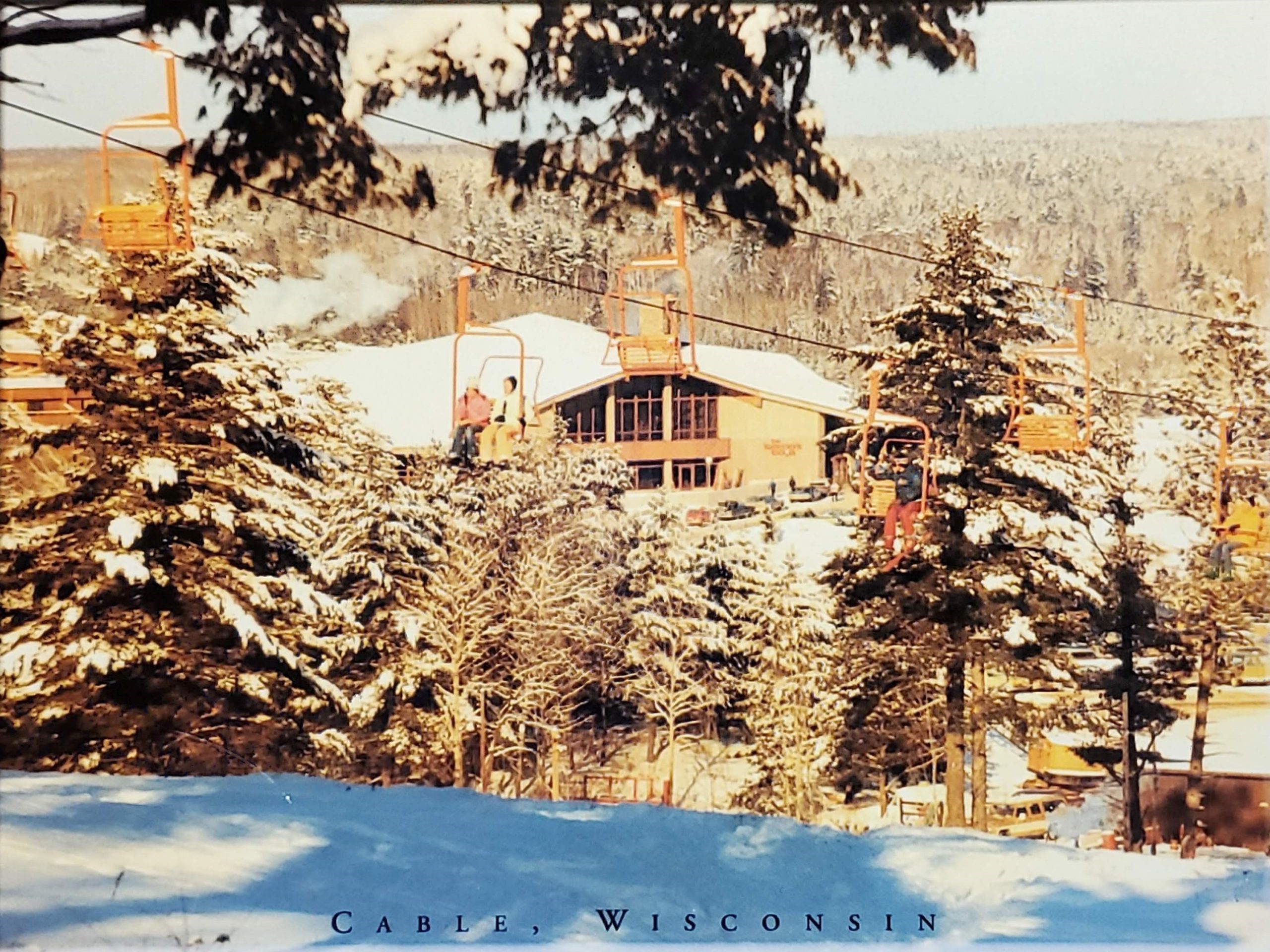
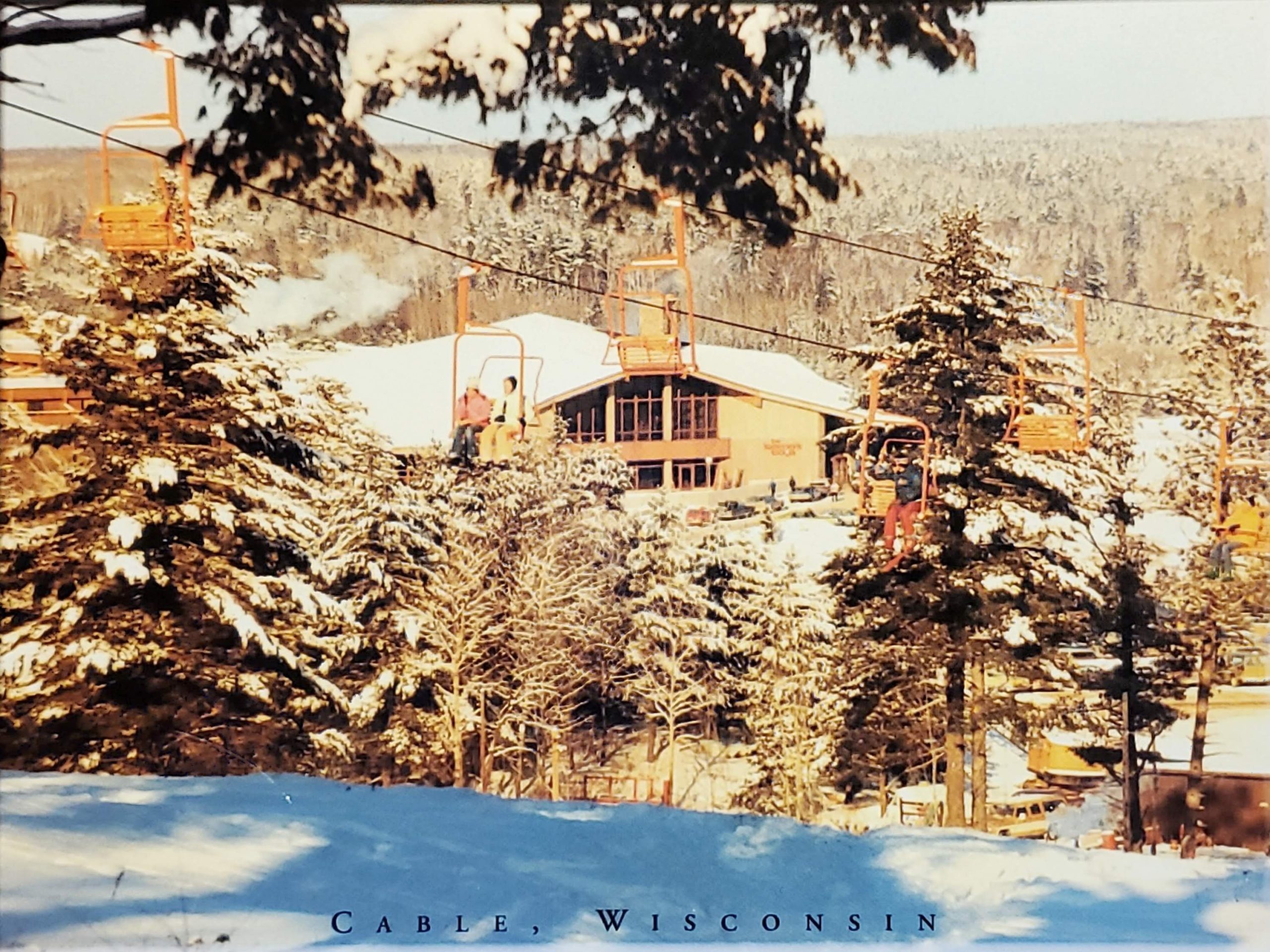
The Telemark Lodge as pictured from the top of Mt. Telemark in Cable, Wisconsin on a 1970s postcard. (Photo: Telemark Education Foundation).
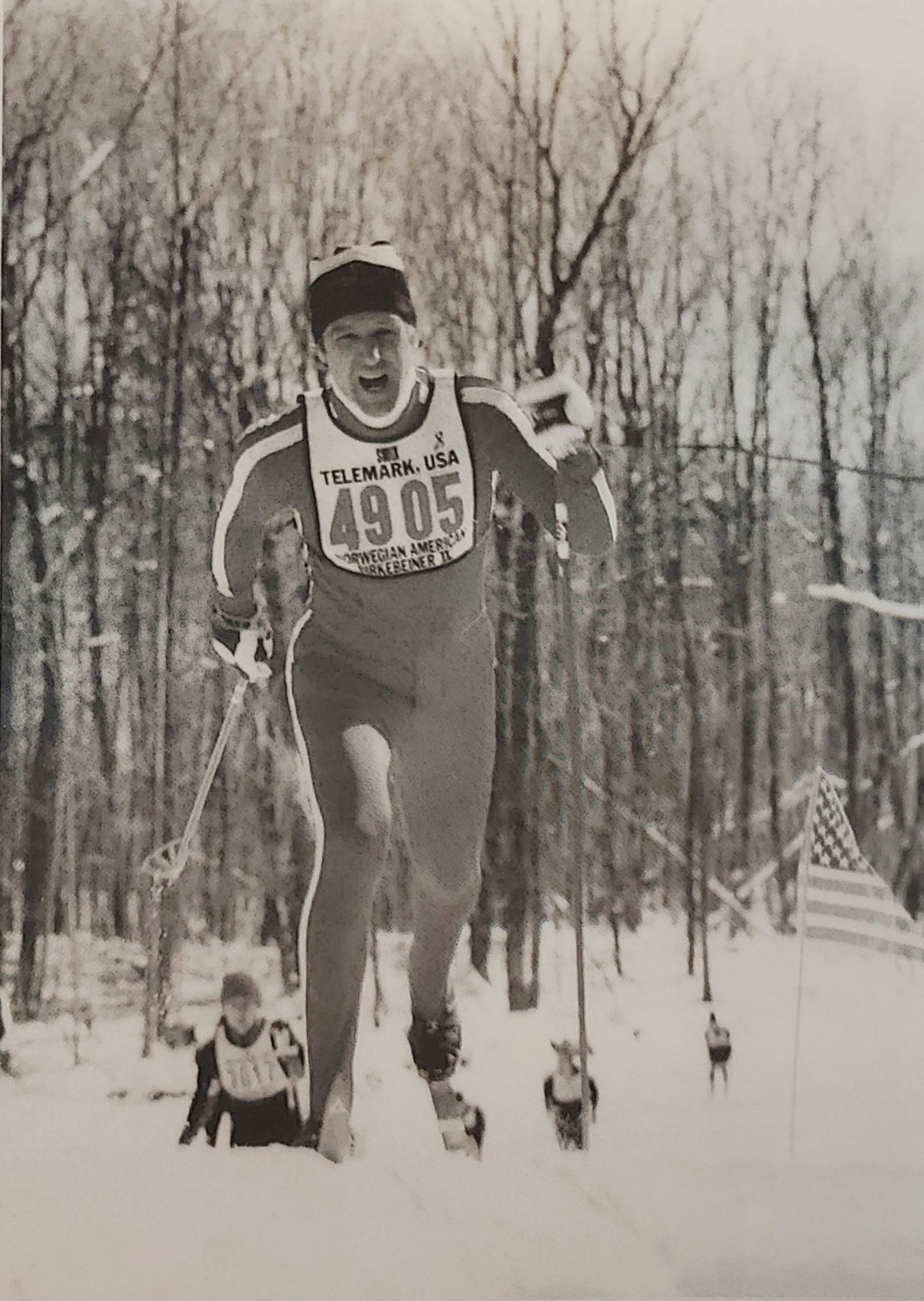
The Birkie was Telemark’s first foray into cross-country skiing, but the race’s momentum in the 1970s led to the resort playing an outsized role in the development of modern cross-country skiing in the United States, and beyond. The first World Cup race ever was held on a trail system laid out in 1978 by American skiing pioneers John Caldwell, coach Marty Hall, and Olympic medalist Bill Koch.
The legacy of Telemark limped along on its own legend for years following Tony Wise’s bankruptcy and surrender of the property in the 1980s. Numerous owners passed through. Central Cross Country Skiing (CXC) briefly made it a home for its Elite Team in the early 2010s, before Telemark closed for good in 2014. The Lodge sat abandoned for years.
In 2020, the Birkie started to piece together a new vision for the property: Mt. Telemark Village. The Lodge was demolished in 2021, the vision that has played out since is the Birkie’s community-oriented project to honor the whirlwind of history that emanated from the little patch of Wisconsin woods, and make it a site to take a central role, again.
George Hovland at the American Birkiebeiner in 1982. (Photo: Sawyer County Record Archive)
George Hovland Trail
Saturday’s dedication ceremony celebrated the success of the new Birkie venue linked by a number of trails to Telemark. It also linked the new venue to a giant of Midwestern skiing: George Hovland.
George Hovland’s name looms large in his hometown of Duluth, Minnesota, where the 1952 Olympian had a hand in founding nearly all present-day fixtures of Zenith City’s ski scene including Spirit Mountain, Snowflake Nordic Center, and the North Shore In-line marathon.
Hovland’s legacy as a ski pioneer in the wider-Midwest is being celebrated by the Birkie in dedicating its 5 k training loop. A friend of Tony Wise, Hovland competed in every Birkie from 1974 to 2012. In the years prior to his passing in 2021, Hovland was the vital link to a deep, essential past of Midwestern skiing. Hovland took to the sport of skiing as a boy in the 1940s when jumping was nordic’s premier discipline and Chester Bowl in Duluth was still populated by the Scandinavian immigrants who brought the sport to America. He skied his last kilometers after Minnesotan Jessie Diggins and Kikkan Randall combined to earn the first Olympic gold in US skiing history. The George Hovland Trail will play an active role in developing Midwestern ski racers this summer, with CXC hosting its Developmental Camps, and Team Birkie looking to utilize the resource.
“George was such an amazing man and an influence on our sport,” said Ben Popp, American Birkebeiner Ski Foundation Executive Director. “George loved training and this will forever be a medium to get people training and faster!”
Trek Trails Lay New Lines Down Mt. Telemark
Before snow fills the George Hovland Trail next winter, there will be plenty of treads on trails of another type: biking.
Telemark was the site of some early movement in the sport of mountain biking. As the sport first advanced beyond riding klunkers in the West in the early 1980s, one of the first flat-land homes it found was the Birkie trail at Telemark. The Chequamegon Fat Tire Festival, one of the oldest extant mountain bike races in the country, was dreamed up in 1983 with the proposition, “What if we did a bike race on the American Birkebeiner trail?”
While the Chequamegon was based out of the nearby Lakewoods Resort for most of its formative years, a trail system was quickly developed on the Telemark property, and eventually linked via the CAMBA trail system.For years, the Telemark portion of the CAMBA system stood out as a kind of staid testament to those early days of mountain biking as a sport. The trails cut through the woods between logging roads. In the days before slack frame geometry, 29 inch wheels, and full suspension made riding downhill more joy than hazard, the singletrack was laid out to get from point A to B more so than to get from feature to feature.
In more recent years, Mt. Telemark itself started to look ripe for the new-look crop of mountain bike trails that were being built around the Midwest at places like Spirit Mountain Duluth, MN, or Copper Harbor, MI.
When the Birkie took over the property in 2020, those in the Wisconsin biking community took notice. That included Trek, based in southern Wisconsin, which was willing to provide funding for the development of a trail system that utilized the whole of Mt. Telemark’s terrain and set it up to be a central host for mountain biking in the same way that Telemark had long served for skiing.
An additional grant from nonprofit group One Track Mind set the Trek Trails at Telemark in motion. Now in development, 16 additional miles of trail will eventually play host to training and racing for cross-country, enduro, and downhill racers alike.
The new Mt. Telemark Village Base Camp under construction last winter. (Photo: American Birkebeiner Ski Foundation)
Mt. Telemark Village Gets a Base Camp
What’s next? A successor for the old Telemark Lodge. While the Birkie gathered its community together on Saturday, the site of a new building under construction where the legendary lodge once stood seemed an apt harbinger.
The “Base Camp” Community Center still looks erratic against the fields and forests that surround it. But in terms of decadence, Telemark seems to have a matured sense of stature. The three-floor fireplace that once greeted visitors in the lobby of the old Lodge isn’t making a comeback. Emeril Legassi is unlikely to be in this version of Telemark’s kitchen (he was, in fact, in the old one).
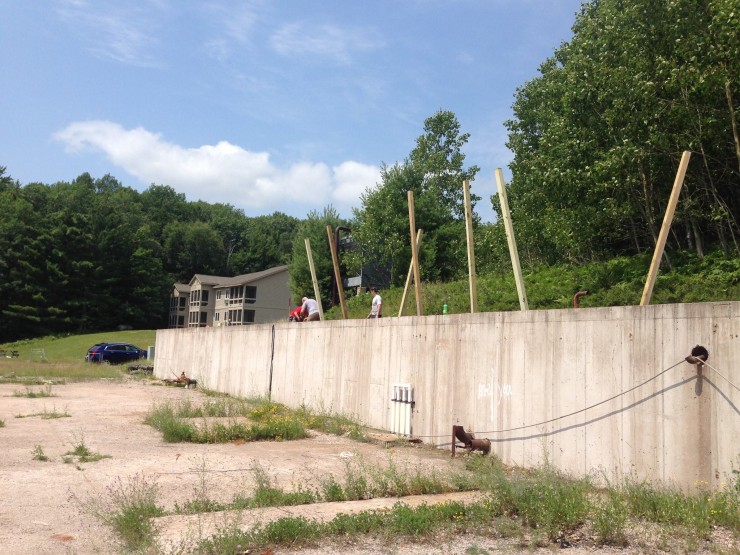
This new community center doesn’t include the giant concrete walls that are still visible on site from the old Lodge, but it seems to impart that this version of Telemark, after a half-decade of dreaming, is starting to be set.
American Birkebeiner VI in 1979. The “Birkie” will celebrate its 50th anniversary next February. (Photo: Telemark Education Foundation).
Tony Wise could see 10,000 years at once. The last ice age had sent a glacier down over Wisconsin, and then tore it back. In the process, the landscape and lilt of a place emerged. Deep-pocketed kettles, ridges, gentle and subtle rolling hills, all draped in the needly green of the pines. Gaze at it, and time didn’t seem like something that moved forward, but instead danced within the bounds of a whole epoch. A 400ft moraine that rose up from the Superior Upland outside of Cable, Wisconsin: the Ojibwe called it kawabaming—the place to look out from. Look out, and it kept going. Time stretched out and blurred, forward and back. Ten thousand years didn’t seem like much.
Wise was a local boy who had just returned from serving as a tank commander overseas during World War II. During his service in Europe, he’d found himself in the Bavarian Alps, where he’d been introduced to a way of moving across the Earth that filled the metaphysical space found on top of the local hill he now stood on. Skiing was an ancient way to front the winter, and a wholly new thrill in each and every turn. Hopes and histories were about to mix as Wise sought to purchase a piece of Wisconsin land to develop into a sking destination. Wise carved a number into one side of birch tree. Walt Kliszcz—a local railroad man who held the deed—carved a number into the other side. They met in the middle: $750.00. Wise renamed the hill Mt. Telemark, then built a ski hill, a lodge, a race, and a dream.
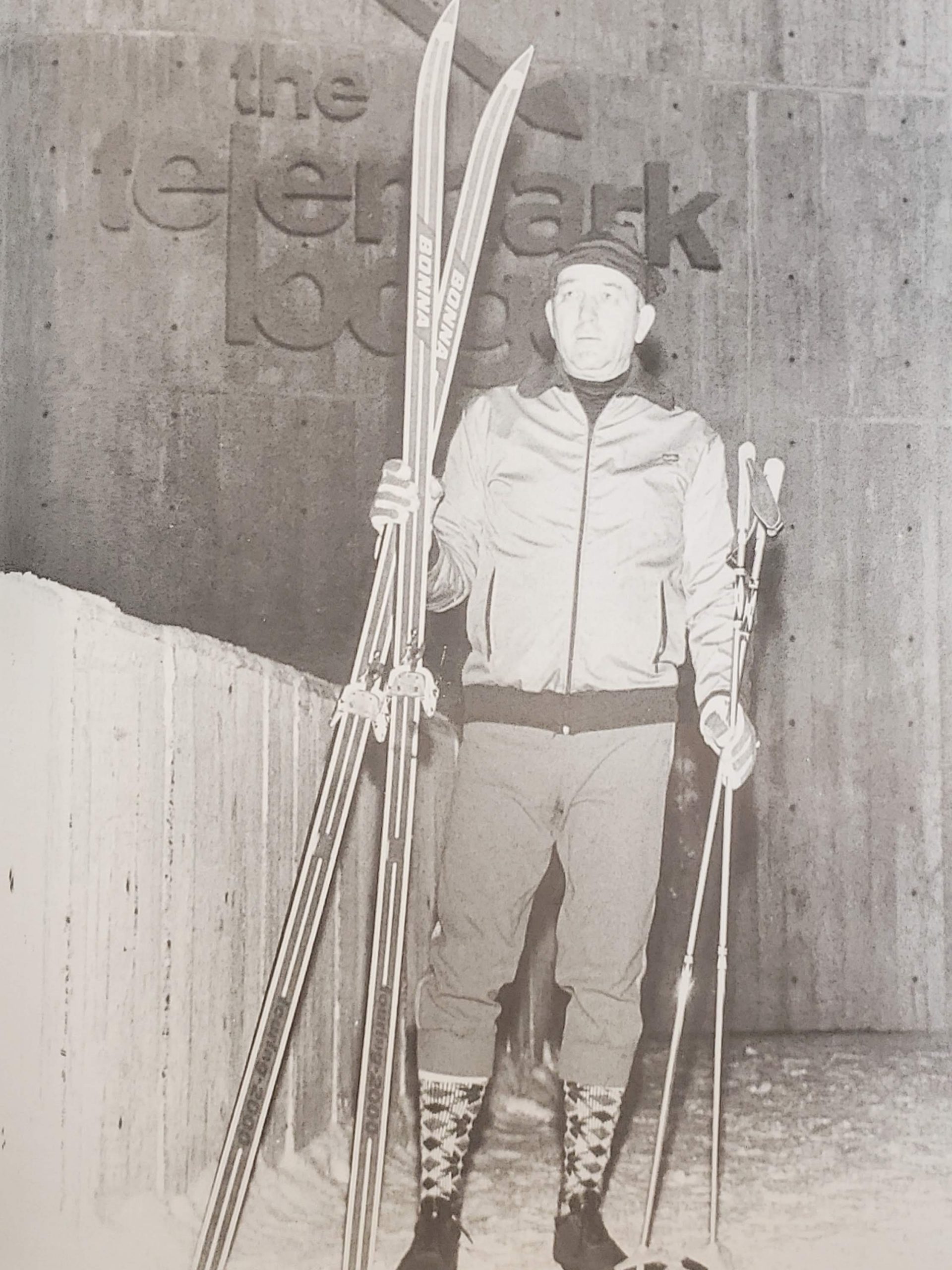
Tony Wise in 1972 outside of the old Telemark Lodge in Cable, Wisconsin. (Photo: Telemark Education Foundation).
Everything that successively unfurled was united by the understanding of time and place that Wise found at the top of Mt. Telemark. In transformation, there was always tradition. In 1973, when Wise set out to start a cross-country ski race, he simply adopted a Norwegian legend from 1206—the Birkebeiners—who saved the country by ushering the baby Prince Haakon to safety on skis. In its first year, the American Birkebeiner had 35 participants. In 2023, the “Birkie” was up to 13,000. In each ski stride over each glacial ridge and valley in the interim, the Birkie began to be interwound with the place Wise had set it in. The challenge was always there. Ski 50 kilometers. Like no other race out there though, people could find themselves having quickly done twenty or thirty Birkies over as many years. Soon, there were so many in that category they started a club for them all, the Birchleggers. It all added to the legend of Wise’s race, starting out there in the shadow of the place to look out from.
Which all leads to the big irony for the American Birkebeiner in 2023. For a race in a place that has staked itself on blurring the very concept of time to match the place it exists in, there is one span that is all anyone around the Birkie can talk about these days: 50 years. The American Birkebeiner is starting out on its 50th anniversary year.
Tony Wise himself now belongs to the realm of Paul Bunyan and the Birkebeiners—legends out there among the Northwoods. His careful balance of plotting out the new in the landscape is being heralded by a whole cadre of dedicated staff, volunteers, and skiers at the American Birkebeiner Ski Foundation (ABSF). At the helm is Ben Popp, ABSF Executive Director since 2013. He’s another homegrown local who has inherited Wise’s ebullient energy and community-focused spirit.
When FasterSkier caught up with Popp to talk all things Birkie, he put the passage of fifty years right back into Birkie terms. “It’s been on the horizon for fifty years,” he said. “And yet, it feels like it came up super-fast!” Which is to say that the Birkie remains comfortable dancing within multiple timelines. While shovels hit the ground in one place, the groundwork is being laid out for the race’s biggest milestone yet come February 2024.
Popp’s way of directing all that energy follows what he calls a “three-step filter: 1) what is the history behind what we want to do? 2) Does what we’re doing build on that history in a way that’s good for what we define as the “Birkie” community, and 3) Can we do it sustainably?” What that has yielded during the first ten years of Popp’s tenure is a bolstered Birkie Trail system, including a new start area, increased participation in the Birkie’s now year-round event schedule, and a larger staff, presence, and place for the Birkie in the Hayward, the Northwoods, and the ski community writ large.
The filter is starting to be reflexive in time. The two big projects ahead for the Birkie in its semicentennial include looking back and figuring out the right way to mark the occasion at next year’s American Birkebeiner event, while also transforming Mt. Telemark and the remnants of the former resort into a world-class ski facility.
The ski trail affectionately dubbed “Tele-henge,” the ABSF’s ski trail through the old lobby, and future site of Mt. Telemark Village. (Photo: ABSF)
Telemark Looks Out Again
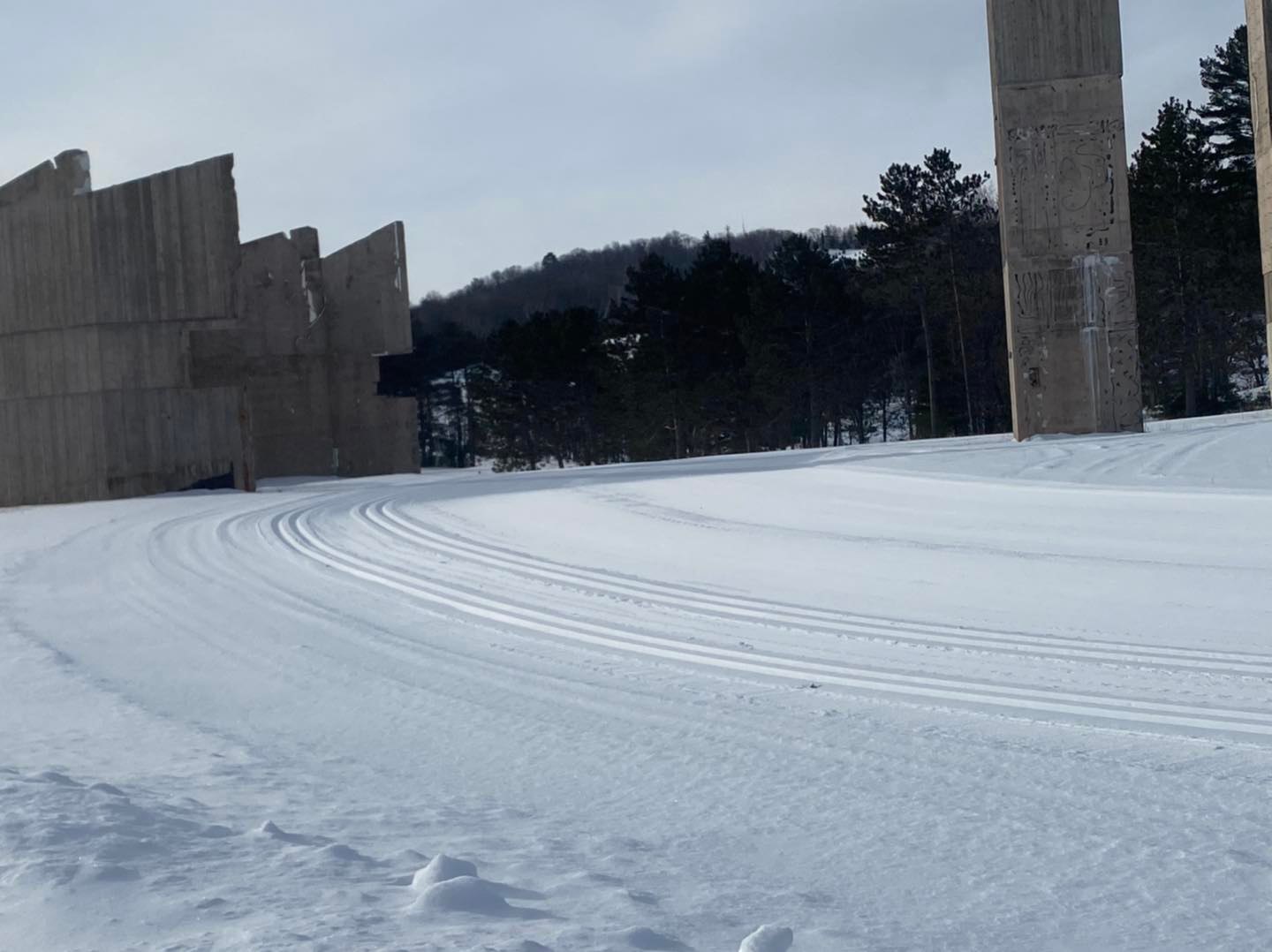
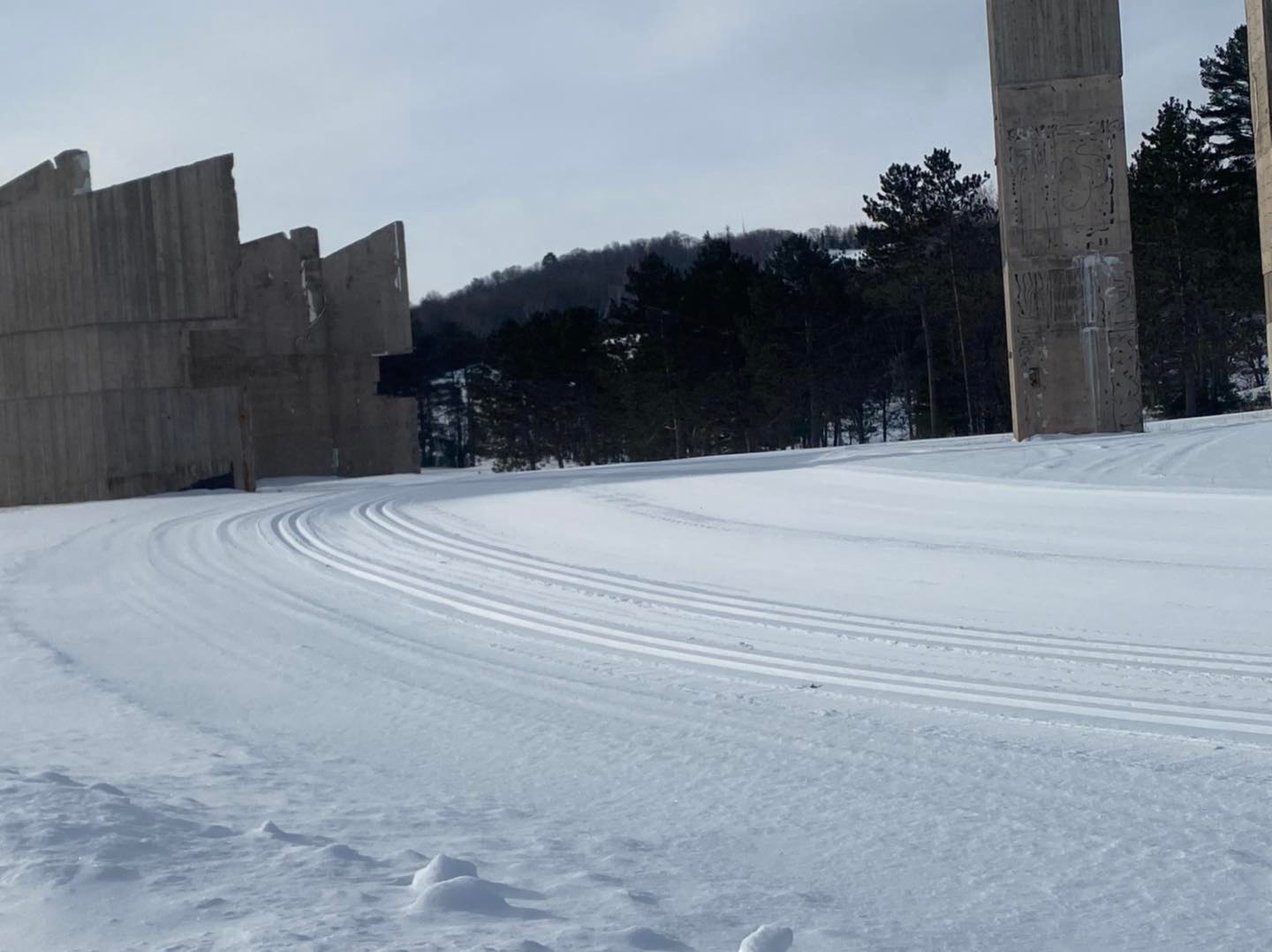
It was the “only place where the Lodge is bigger than the hill,” said Olympic gold medalist Alpine skier Billy Kidd at the opening of Tony Wise’s Telemark Lodge in 1970. With 400 rooms, the hotel offered more rooms than the ski hill outside had vertical feet. The Lodge was an outstretched behemoth that was demolished in 2021. All that now remains are towering old brutalist walls, deemed “Tele-henge” by the skiers down the hill at the new Birkie start line area. The meandering tale of how the Telemark Lodge got to Stonehenge status though, had left specters that still glowed with life. Mainly, the Birkebeiner, and the sport of cross-country skiing that it had helped build in the United States.
Which has got the Birkie Foundation dreaming big. After years of unstable ownership, the lodge was acquired by ABSF in 2018. Once the Lodge was condemned and demolished two years ago, the creative energies started to flow.
“For Telemark, there’ll be three big pieces: the ski trails, the mountain bike trails, and the Base Camp building” says Popp. A partnership with Wisconsin-based Trek Bicycles, along with a major grant from the One Track Mind Foundation promises to build an additional 17 miles of single-track mountain bike trail on top of the existing Chequamegon Area Mountain Bike Association (CAMBA) trail network over the next three to four years. Rock Solid Trail Contracting, the builders behind the renowned trails in Copper Harbor, Michigan, are on the job. “Four miles are already done, and by the end of this summer, we’ll have nine miles added on,” says Popp.
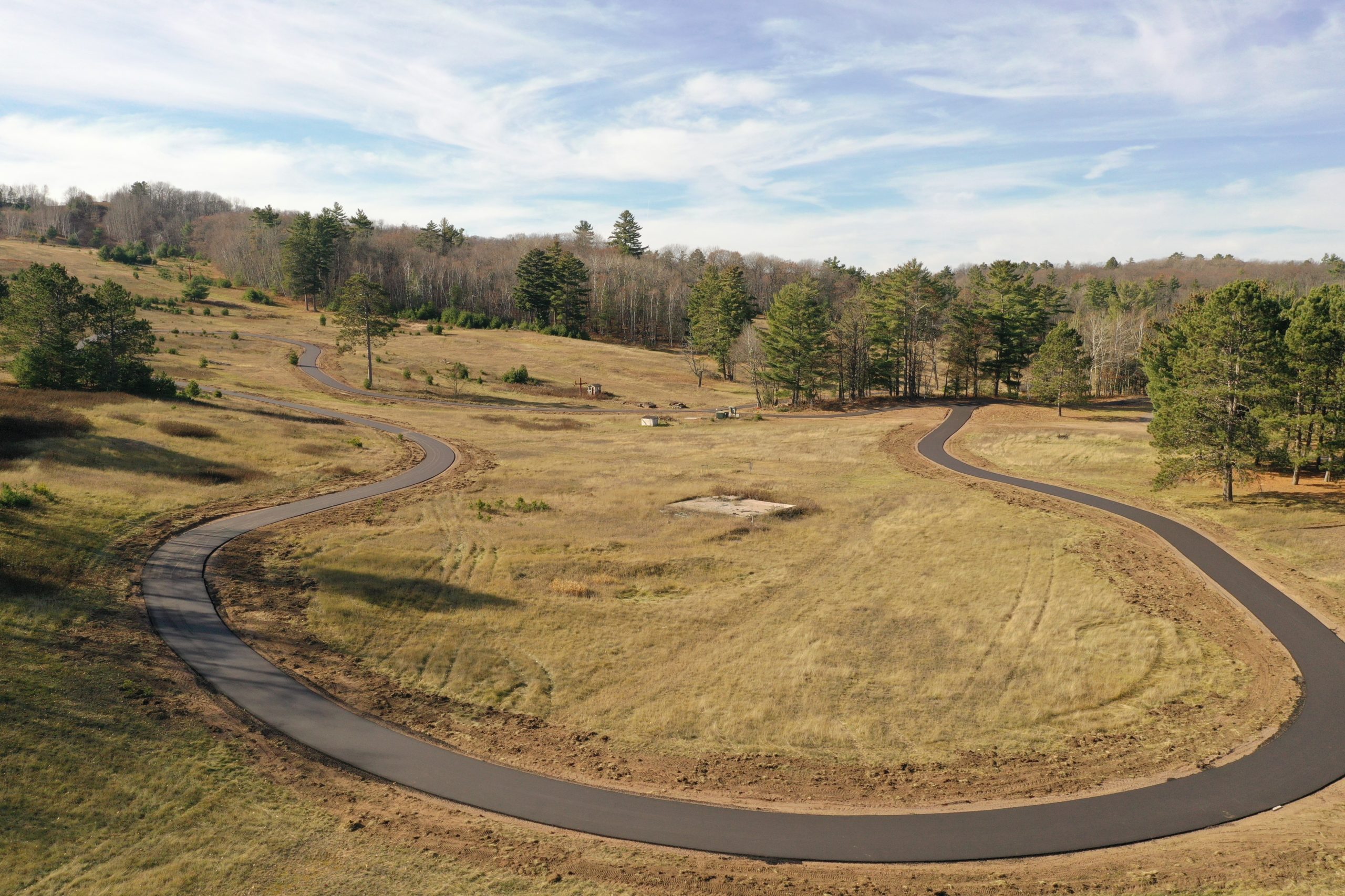
The new rollerski loop at the base of Mt. Telemark, outside of Cable, Wisconsin. (Photo: ABSF)
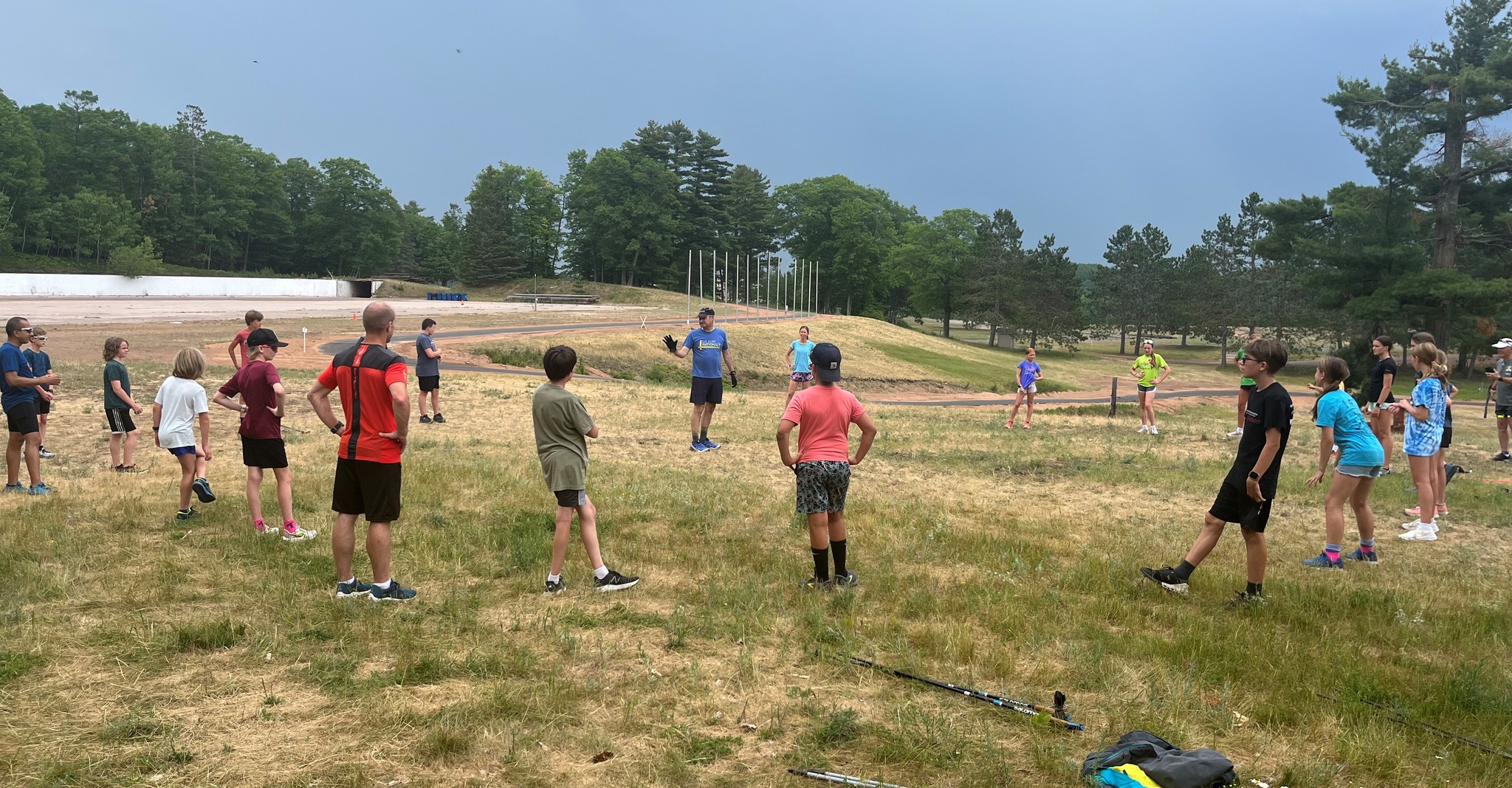
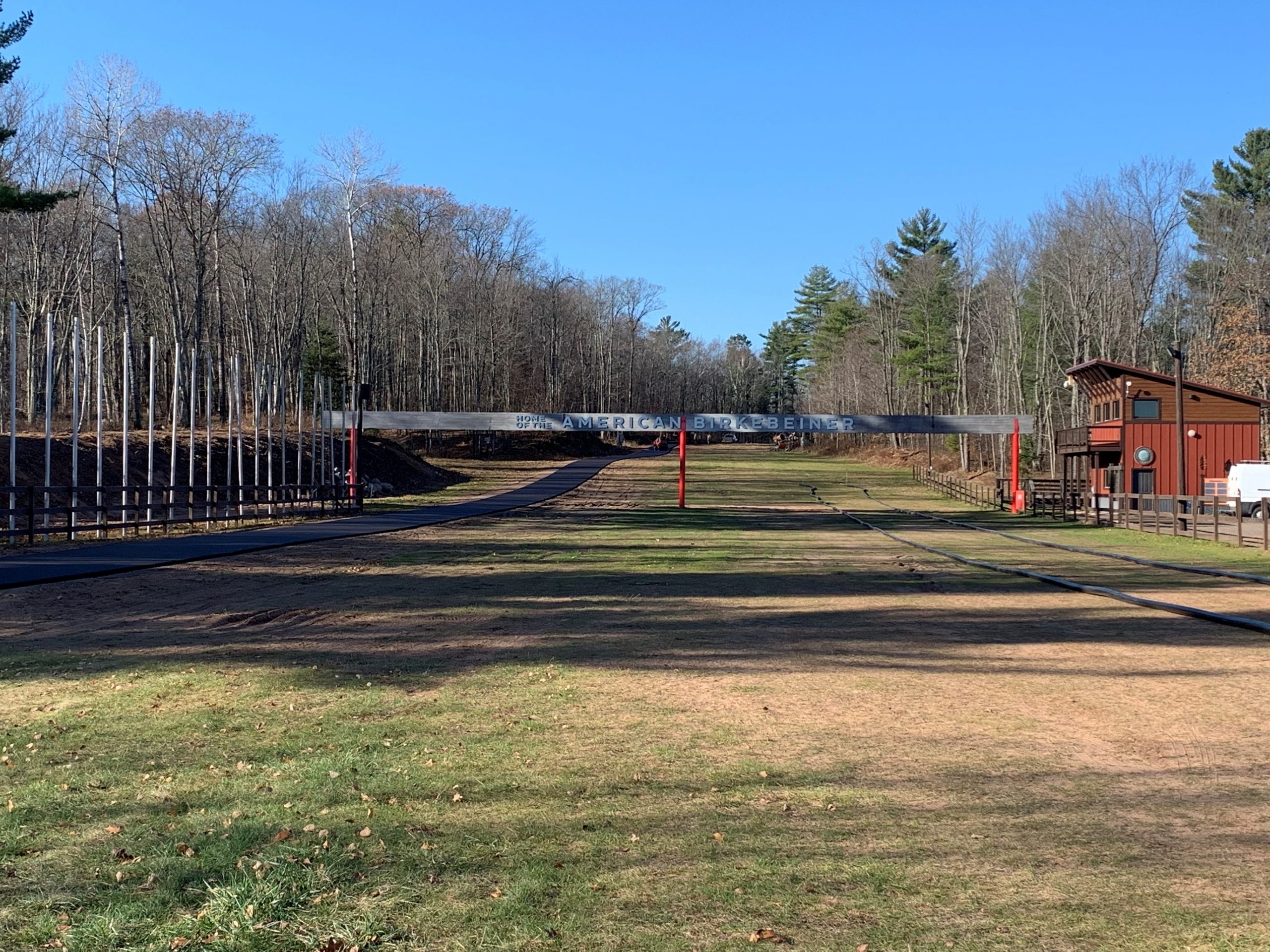
Over at the Birkie start-line, the pavement of a new 5-kilometer rollerski loop—the first of its kind in the Midwest—is “just now starting to cure,” says Popp. The loop is laid through the old remnants of the Telemark base area and is giving skiers from everywhere access to Birkie terrain year-round for the first time. The loop is slated to host Central Cross-Country Skiing’s (CXC) Regional Elite Group (REG) camp later this summer, and just hosted its first Igor Legacy U14 camp this summer. The trail also become a favorite multi-use trail. “We get some older folks just strolling out there,” said Popp. “Hard place for a walk!”
As for the winter ski trails themselves, the ABSF’s focus isn’t so much on building new trails, but rather restoration of trails. Down at the base of Mt. Telemark, in view of abandoned Alpine ski lift towers, are the cuts and juts of a trail designed by American ski pioneers Marty Hall, Sven Wiik, and John Caldwell. These trails once hosted the Gitchee Gami Games with fields that included not just the best American skiers of the era, Bill Koch, Martha Rockwell, Stan Dunklee, Tim Caldwell, but notable names from ski history like Oddvar Bra and Arto Koivisto. A contemporaneous Sports Illustrated article on the 1977 edition reported that it was part of a then “controversial series” put on by the International Ski Federation (FIS), what would become the World Cup. An aged wooden sign between two tall maples identifies these as “The Telemark World Cup Trails.” With some clearing and modifications for grooming, skiers will be able to take to them again. The World Cup trails have an outsized place in the purpose of the whole Telemark Village project. While not the most resource-intensive, the project drives, or rather, skis, to the heart of the sport the Birkie community ultimately comes together around, and also represents the unique dance of making, and re-making, the energy of Telemark and all it stood for.
The resource-intensive side is there though, in the form of the planned “Telemark Base Camp Building,” an estimated $3.5 million nordic center that will come fully equipped to welcome World Cup athletes and first-timers alike. “I think the heart of what Telemark represented could be captured by the idea that on a given afternoon back in the day, you might have Bill Koch and a kid who’d never heard of the sport an hour before in the same place, and we want to get back to that,” says Popp on the essence driving the Base Camp’s purpose.
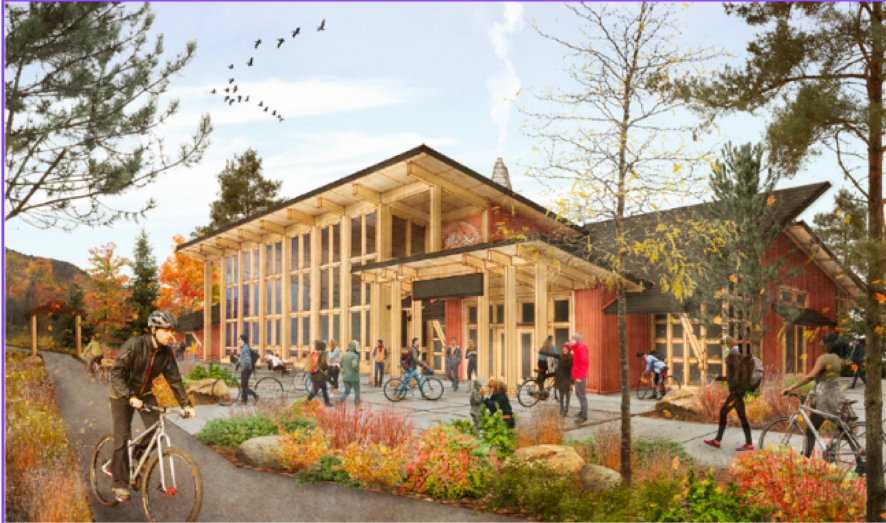
The Telemark Village Base Camp building is the next priority in the Birkie’s major restoration of the former Telemark Lodge site. (Photo: ABSF)
The plans call for a full-service nordic center—rentals, changing rooms, spaces for local business partners to sell coffee and food—while also acting as a jumping off point to experience the unique history of Telemark. Key to that is using the remnants of the Lodge to build a park-like plaza, where a collaborative project with the local Cable history museum will lay out Birkie history back to when Tony Wise carved his number into an old Birch tree.
The final piece of the project is up at the top of Mt. Telemark where an observation tower is being built out of recycled lift towers from Wise’s original alpine ski operation. The tower will act as a capstone on the Telemark project that Popp says tells Birkie they’re doing things right, “There’s a throughline in that project that really reiterates how there really is a rootedness in the values of honoring our history, and the history of this place. There were two people down in Spooner, Wisconsin who donated to make the tower possible, which included the naming rights, and they asked that it honor the original Ojibwe name of the area. So how do we make that happen? Well, the person to naturally ask is an Ojibwe Tribal Historian, and it just so happens that the only guy to do all fifty Birkie races, Ernie St. Germaine, is the preeminent Ojibwe historian.”
The former Telemark Lodge stadium hosts CXC’s U14 Igor Legacy Camp last weekend. (Photo: Ted Theyerl)
In other words, the drive of this version Telemark is to keep all that was contained in the old Telemark going. The ABSF capital campaign around it totals $10.5 million, with Popp saying, “we’re about half-way there on fundraising, and we feel like have about half of what we want to build done.” The purpose though, remains clear, “ultimately, that money isn’t ours. It’s an amalgamation of a whole lot of people and communities that value what the Birkie is. When you think about all 250,000 people that have completed the race since 1973, plus many more who touch our trails, or volunteer, or touch us in some other way, it’s a lot of angles that we want to make sure we’re covering in any single project. It’s pretty cool to have that presence, and to have that responsibility.”
“Celebrate in the Right Way” at the 50th Birkie
Just how expansive the Birkie community has become in 50 years makes for a big proposition come next February: “With the 50th, we really want to do justice to the countless people that have taken part in anything we have done over the past half century” says Popp, “The guiding question is what is a meaningful way to make sure that we represent what this thing, the Birkie, really means?”
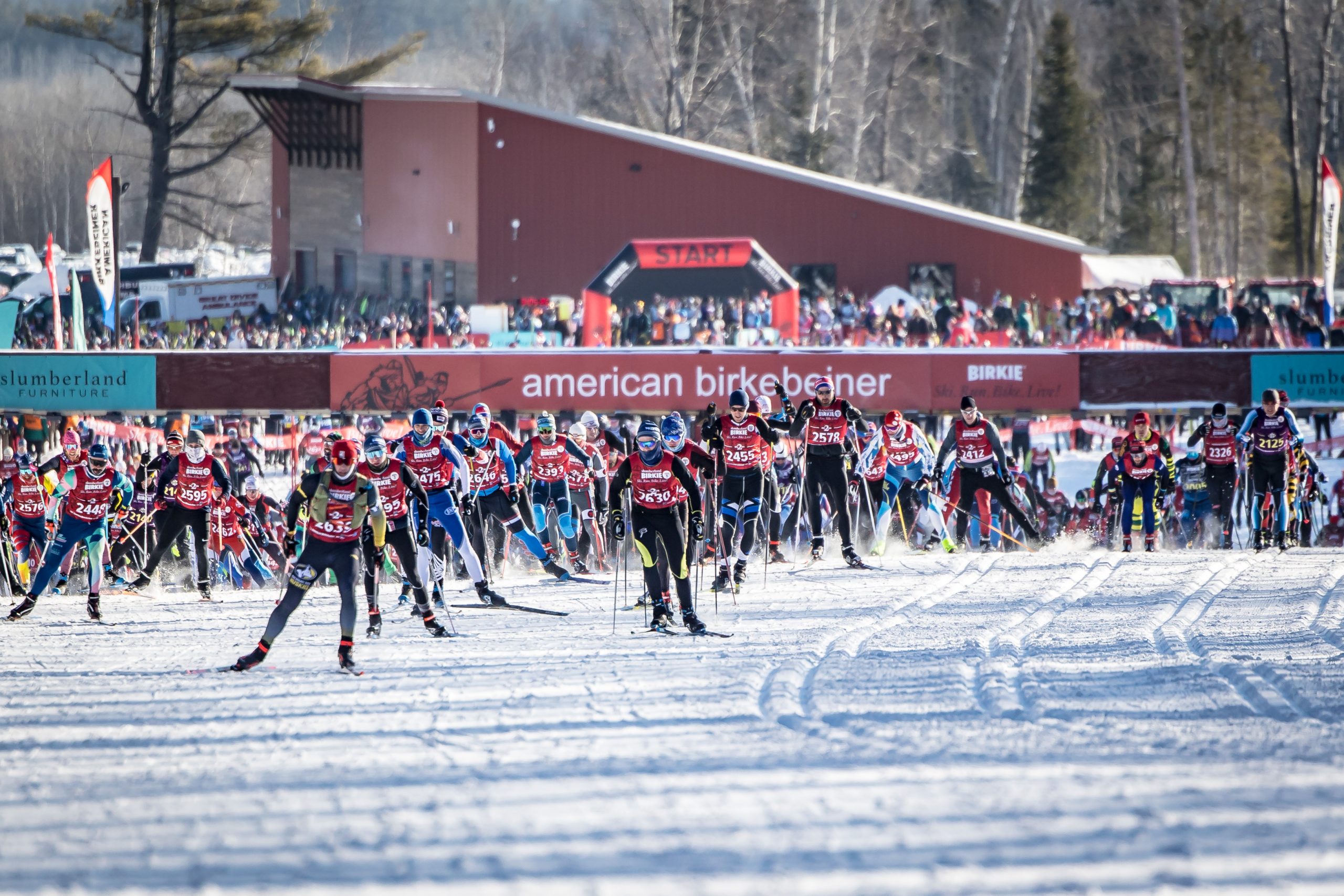
The Birkie start line area in Spring 2023. (Photo: ABSF)
For the Birkie Foundation, those preparations started well in advance of the coming anniversary year, and included, at least at first, a kind of disappointment. In keeping with the kind of full circle nature that the Birkie paints with time, plans were underway to make the 50th Birkie the first World Cup ski race in Cable since Wise’s Gitchi Gami Games in 1977. A joint bid was underway with the Loppet Foundation in Minneapolis, Minnesota to make the World Cup’s 2023 North American tour one that covered city style racing in the Twin Cities, paired with the US’ most prominent international ski event. “At some point though,” says Popp, “we had to make a decision that was best for the Birkie organization, and we decided we couldn’t take on that financial risk without it potentially leading to us not being able to do the community-oriented projects that are already underway.”
The Loppet’s World Cup bid was accepted, which means the World Cup will visit the Midwest Friday February 17th to Monday, February 19th, one week before the 50th running of the American Birkebeiner on Saturday, February 27th. “It’s going to create an unbelievable atmosphere within the Midwest,” says Popp, “for ten days, no matter how you engage with cross-country skiing, all roads will lead here.” The Loppet Foundation, on its part, has also alluded that while the official World Cup joint bid may have passed, the spirit of the World Cup’s return to the United States will be bonded to the celebration of the Birkie’s 50th anniversary.
If registrations are any indication, the roads leading to the Midwest will be busy come February. “The pace has been incredible, we’ve had Birkie start wave after wave fill so far,” says Popp. In planning out what those registrants will experience, there’s been an approach to plot out change carefully. After all, says Popp, “if what the Birkie is has gotten us to fifty years, we want to make sure that we’re not messing with it!” The overall approach to race planning then, is one that is looking to accentuate the best aspects of the Birkie, rather than change them wholesale.
While no official announcement is expected until August, Popp says that the Birkie has “secured some agreements to keep some of the best World Cup athletes in the Midwest to do the Birkie.” It’s a step taken to help honor the marked competitiveness that has been set the race apart in American skiing throughout its history. “We’ve had Bjorn Daehlie, Vegard Ulvang, and what I’m willing to bet is the majority of American Olympic cross-country skiers, do the race, and we want to build on that legacy next year,” says Popp.
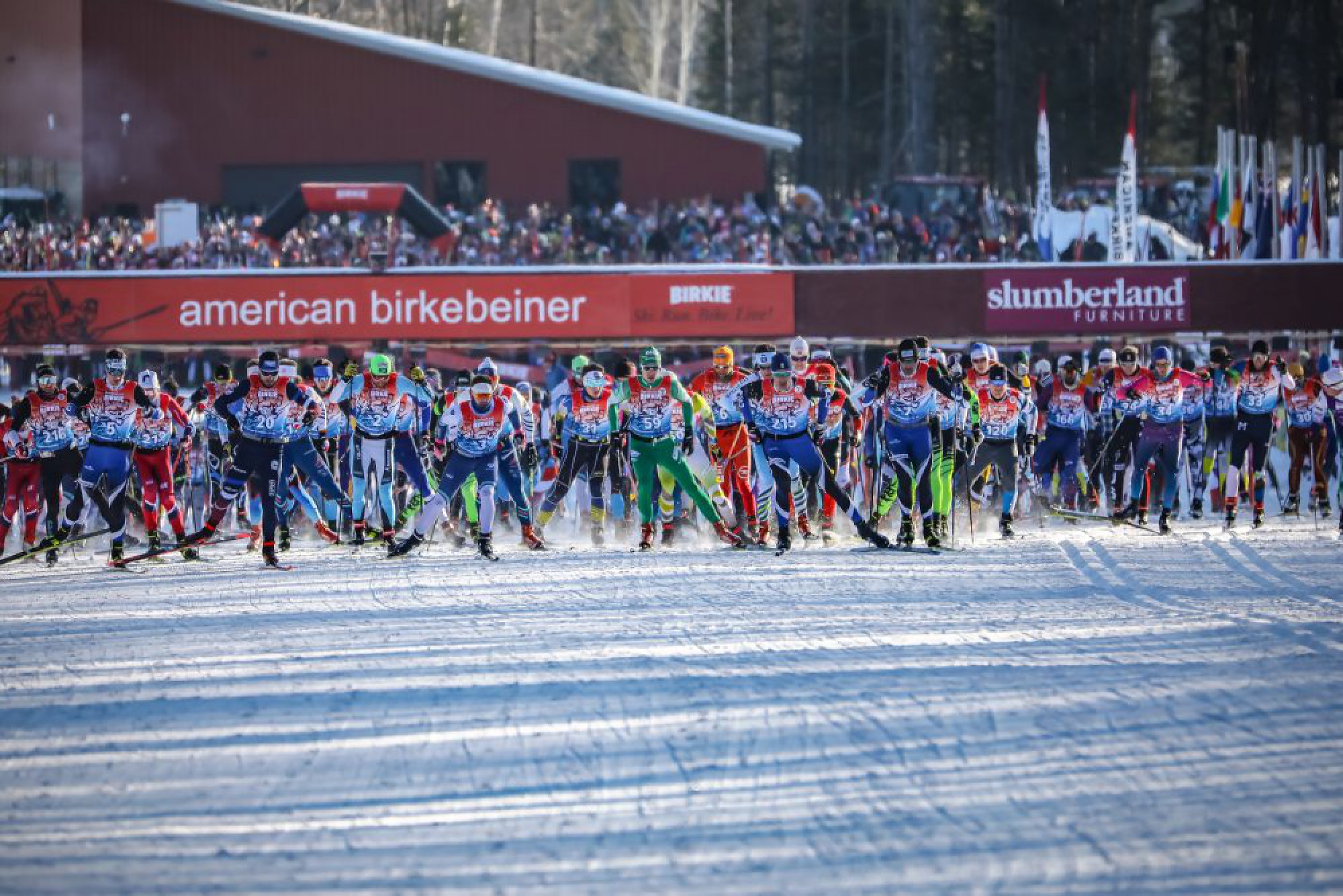
The Men’s elite field starts at the American Birkebeiner in 2023. (Photo: ABSF)
The Birkie is also looking to honor the kinds of characters and legends who have all added to the races lore. “One of the first groups we always go to plotting our next steps is the Birchleggers—those who have done 20+ races— because that really represents the beating heart of what we do” says Popp. In initial outreach, the Birchleggers returned a clear essence that the Birkie will key in on in the year approaching the 50th anniversary race. “What stuck out is that there was two paradoxical ideas which really play well together: they were saying, 1) My experience with the Birkie is unique to me, and that’s why I keep doing it, and 2) I want new people to be able to come to the race and form their own unique experience too.”
What does that look like in practice? Popp finds anecdotal evidence in the king of the Birchleggers, Ernie St. Germaine. The only active “Birkie founder,” one of the original 35 racers in 1973, St. Germaine plans on being the only skier to complete all 50 races come next February. St. Germaine has dutifully made the fifty-kilometer trek every February, but in recent years, has done so sans the crowded field on race day as part of the Birkie’s “open track” option. “It was something that fell into our laps with COVID, right?” says Popp, “but we realized was one way to allow some of our most dedicated skiers to continue being part of the race. Yes, most are going to want to be part of Saturday, but for some, the time, the space, and the camaraderie afforded doing so on the Wednesday before opens up a whole new way to engage.”
St. Germaine has continued on the spirit of inclusivity beyond just his racing as well. He has been a key part of the ABSF’s “Birkie One” initiative to “to reduce barriers and increase participation in skiing, running, and biking for marginalized groups in communities near and far.” An active member of the Ojibwe tribe, St. Germaine has helped bridge the Birkie with the local Anishinabeg people, including initiatives to restore trails on the Lac Courte Oreilles College campus outside of Hayward. The initiative has also helped the Birkie see where the existing infrastructure around the race, and the places people use to train for the race, can be more accessible. The paved rollerski loop at Telemark, for example, was officially designated mixed-use when it opened, to allow trail access to those who otherwise might not be able to access unpaved roads.
And finally, there are plans for the 50th Birkie to be a Birkie. For thousands to front the powerlines, then climb to the high point, flow through “OO,” over and with the terrain. For each individual to take on climbing “B**** Hill,” and over Fish Hatchery, and the Lake, and the International Bridge onto Main St., Hayward, Wisconsin, before swapping the thousands of stories that form in the ridges and creases of the land between.
It’s out there where the Birkie still dances within the bounds of some kind of glacial time, surrounded by glacial terrain. A new fixture of the place that Tony Wise once dreamed of among the tamaracks and pines. Over 50 years, the stories have multiplied, the time blurred and stretched, the particular feeling becoming something ever more complicated. Best not break its power into pieces. It’s all got coined under one tent, one community, this thing called the “Birkie.” Best to keep it there, and say what has been said on Main St. Hayward, Wisconsin at the end of February a thousand times before: “Can’t wait for next year!”
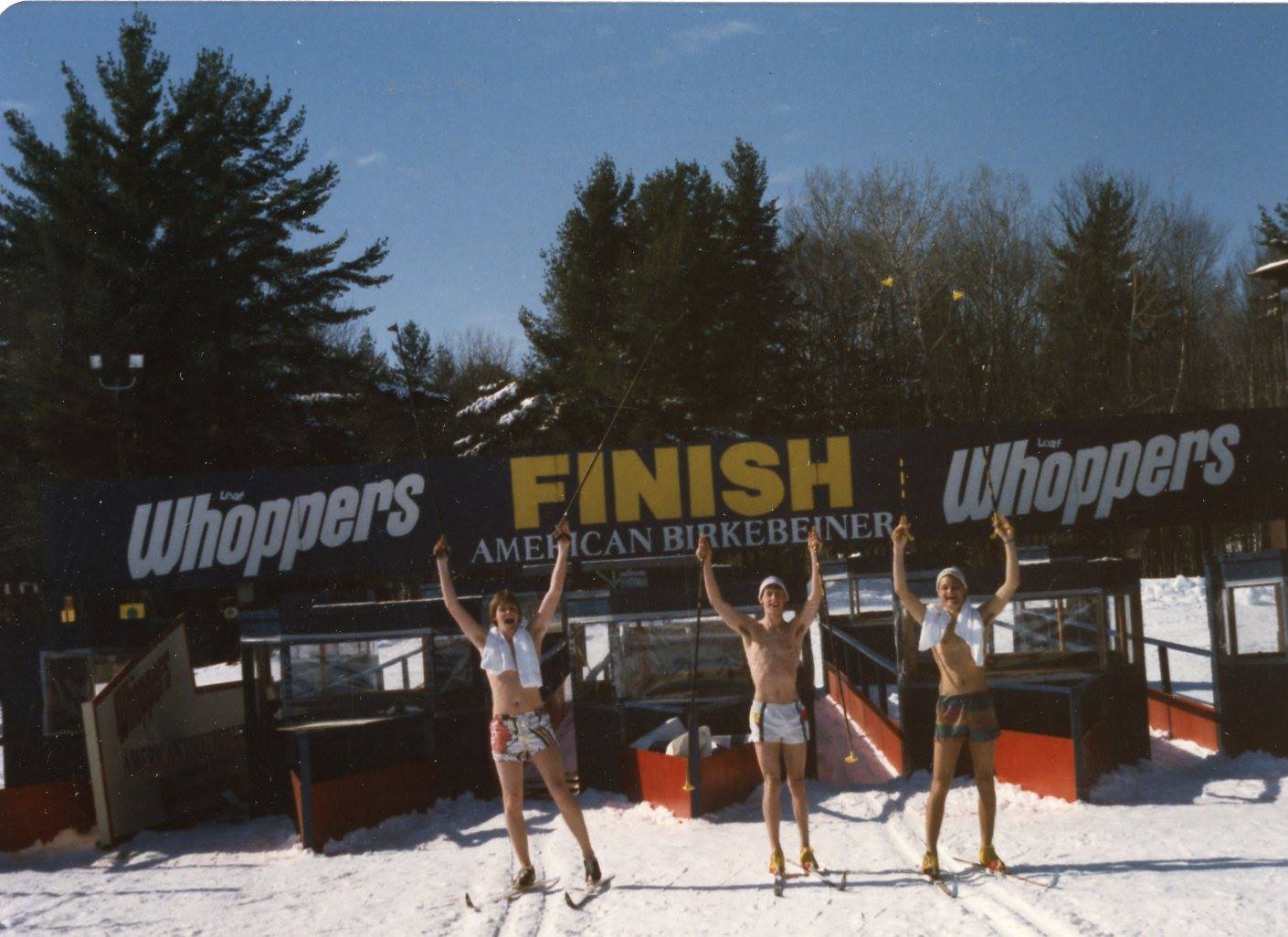
Birkie finishers celebrate in 1991. True to Birkie form, all three are still involved in the race in 2023. (Photo: Ted Theyerl)
A look at what’s ahead for the Birkebeiner, and its former home at the Telemark Lodge.
When I reached out to American Birkebeiner Ski Foundation (ABSF) Executive Director Ben Popp before Christmas to set-up an interview discussing the Birkie’s plans for the now-defunct Telemark Lodge property, he was already putting plans into action. An interview would have to wait until after the holidays, because that weekend ,the Birkie was hosting a SuperTour race which would serve as a test event for its start-line venue in a bid, along with the Loppet Foundation in Minneapolis, to host an FIS World Cup in 2024.
Bringing a World Cup to Cable, Wisconsin is ambitious, but then again, when Popp is involved with the Birkie, energy and momentum are not the barriers. It’s not a question of “if”, but “how big” the end project will be. Since starting with the Birkie in 2013, he has overseen the expansion of what was already America’s largest race into a year-round docket of endurance programs.
For Popp, that expansion has been done with a forward-looking vision that is deeply rooted in his own history. A son of Wisconsin’s Northwoods, he witnessed first-hand the outsized dreams of Birkie founder Tony Wise, who at the opening of the Telemark Lodge in 1971 invited US Olympic Gold Medalist in Alpine Skiing Billy Kidd, and found his reaction to be simply, “[Telemark] is the only place where the Lodge is bigger than the ski hill!”
Ben Popp, Executive Director of the ABSF. (Photo: ABSF)
For the original Telemark, that turned out to be both an intrepid mantra, and its ultimate failing. Which leads me back to why I initially reached out to Popp – discussing the Birkie’s purchase of the now-closed Lodge and its demolition last year, and the new plans to build a dedicated Nordic Center on the former site.
Our conversation, though, turned into something much more akin to sharing a round of Leinie’s at Seeley’s famous Sawmill Saloon. Which is to say, Wisconsin skier to Wisconsin skier, cheesehead to cheesehead, Ben to Ben, we covered a lot of ground. The result is a conversation that covers the idiosyncrasies of a very specific place in the skiing landscape – Wisconsin – but by doing so gestures towards contemporaneous issues in the development of our sport in the US from a multitude of perspectives, all wrapped up into one professional – Ben Popp.
The excerpts below touch on, among other things: how the Birkie views plans for new infrastructure as supporting their mission; how skiing organizations are planning a sustainable future for the sport; and how Wisconsin skiing can develop the next generation of elite skiers from its ranks.
(This interview has been edited for length and clarity.)
FasterSkier (Ben Theyerl): The Birkie Foundation (the Birkie) now owns the former site of the Telemark Lodge, can you bring us up to speed on what’s happened since you bought the old Lodge last year, and what the plans are for the future there?
Ben Popp (BP): In February 2021, we closed on the property. As part of that agreement, we had to commit to raising the money to remove the building. That turned out to be a challenge, because generally people don’t like to give money to tear things down – that’s not very exciting.
To make up the costs, we decided to sell 250-acres on the far-western edge of the Telemark Property that didn’t have any trails on it, and to try and conserve it into perpetuity. Landmark Conservancy bought that property; it’s now the Telemark Forest Preserve.
That brings us to now. The building is down. We just applied for a $7.5 million dollar grant with the federal government to build a Nordic Center (details here) which will be LEED Platinum certified. We’re also working on a huge solar-array with Dairyland Cooperative, which would help us offset [the carbon emissions] from our snow-making operation [at the Birkie start venue and Telemark].
That’s the the nuts-and-bolts that got us to where we are now, which is the idea that Telemark is vital to: one, the economic activity of this region, and two, for the Birkie to carry out our mission of having amazing experiences while getting people outside, we need a medium, and this is the place for it.
(Photo: Telemark Education Foundation)
FS: As a follow-up, what’s the timeline looking like for the Nordic Center?
BP: The timeline is tricky. We’ll hear back on the grant in June, which with the current construction market would make breaking-ground this year very hard. We have said though, that now is the time to start planning, so that’s what we are doing.
What we’ve already started implementing is additional snowmaking, so that we could successfully host the Super Tour in December (2021). What’s interesting about that is we’ve still only invested $400,000 into it, which, yes, is a lot of money, but in the world of snowmaking is nothing. [For example,]Battle Creek (in the Twin Cities) is going to be about $5.6 million dollars. I give a lot of kudos to our crew for [what they were able to do for the SuperTour], having 3.75 kilometers of trail open before December 10th, but the reality is that was such a heavy lift, and we’re going to have to invest another $1 million into our snowmaking system to make it sustainable and reliable.
FS:The Birkie has a lot of other projects outside of Telemark. How do you see Telemark intersecting with those?
BP: That’s one of the highest priorities for us. If we look at our mission: one, putting on great events; two, being stewards of the [Birkie] trail; and three, providing opportunities for people to be active outside. Getting Telemark ready for events is critical to part one and three. You could argue that this isn’t directly related to how you improve the Birkie Trail, [part 2 of our mission]. But by way of getting more people involved, it gives us the capacity to put resources into the Trail.
FS: There also seems to be more of a faith in the Birkie Foundation to get Telemark right than past attempts at reviving the property. How have you built trust in the local community and gotten them involved in what the Birkie is doing?
BP: I think there’s two parts to it.
One, doing what you say we are going to do. [In the past,] people saying “we’re going to rebuild Telemark!” and then never having it happen just made it worse and worse. For us, starting back in 2013-14 when we said we’re going to raise $750,000 and buy an area for a new Birkie start line and build a bridge over highway 63 at OO, we got reactions of “no way, no way” and then…we did it! I think little steps like that start to prove to the community that you’re worthy of trust.
Two, it’s being really involved in the community and being open to other nonprofits. That allows us to openly invest in the community. We donate over $50,000 to the [Hayward] schools and their initiatives. Instead of us looking at simply how we leverage the assets around the community, we look at how we can partner with them so it’s good for both parties. That example is very local in Cable/Hayward, but we also help with initiatives around Wisconsin/Minnesota that need help get projects off the ground.
Like as an example I was just brainstorming with Claire Wilson (Executive Director of the Loppet Foundation in Minneapolis, MN) – how cool would it be to do some kind of exchange program where we’re going to send kids from the Northwoods to go down and experience living in Minneapolis and skiing at Theodore Wirth, and vice versa, they send kids up here and we can house them at Telemark and they get to spend a week in the woods [and make them say] “wait, where’s the stoplights?!” Those would be opportunities that would be awesome.
The remnants of the Telemark Lodge lobby in winter 2022. The Birkie has started grooming trails on the Telemark Property from the adjoining Birkie startline just a half-kilometer away. (Photo: ABSF)
FS: You’ve also startedTeam Birkie (a pro-racing development team that launched this summer) that’s already had success getting skiers to the World Cup.
BP: Yeah, we want to bring in the elite athletes to train [in Cable], that’s whatTony Wise (Telemark, and Birkiebeiner founder) used to do. I mean the U.S. Ski Team – Marty Hall and Bill Koch – they were here! They designed our trails! We need to figure out how we get our elite athletes, our role models, to stay in the Midwest and train so that they can inspire our kids here. The next Jessie Diggins can, but shouldn’t have to go out and live elsewhere, which is how it currently stands with Midwestern skiers. But they can’t spend time here if we don’t have roller-ski loops, snowmaking, and the things that they need to get better at their profession.
[Your dad] (Ted Theyerl, former Wisconsin Nordic Ski League President) has a great way of putting it. Trying to teach skiing without reliable snow is like trying to teach basketball if the gym is there only once every other week.
Team Birkie’s Zak Ketterson takes command through the heats to win the classic sprint during last December’s Gitchi Gami Games – the Birkie’s SuperTour event. (Photo: American Birkebeiner Ski Foundation.)
FS: That part is something I look at with a lot of potential based on my experience at Telemark. I intersected with the brief period [around 2010] when CXC (Central Cross Country Skiing) was trying to use Telemark Lodge as a training center. I remember going into what used to be the nightclub at the Lodge, which they were using as our dining hall, and sitting down and Jessie Diggins was at the table, and it made us juniors go “Holy crap!” That’s so inspiring.
BP: You’re right that’s inspiring!
FS: In a similar way, I wanted to get your personal perspective on what Telemark has meant to you, and the community in the Northwoods, and how that drives your plans and the Birkie Foundation’s plans?
BP: I mean I grew up in northern Wisconsin and I remember as a kid going over to Telemark and being like, “Woah, where am I? This is incredible!” Telemark was just an incredible economic and cultural driver.
I think personally my motivation is that this project is going to create a ton of opportunity, and essentially extend the reach of the Birkie Foundation and what we do. I often use a statistic when we are out on the road. If you draw a circle 50 miles around Cable/Hayward, 90% of our revenue comes from outside of that circle. But we spend over 80% of our revenue within that 50-mile Hayward/Cable circle. The bigger the Birkie gets then, the more gets spent here in our community.
FS: And now, to me, the additions of the Super Tour and the World Cup build on that spirit of Tony Wise saying we can dream big, and we can do it in Cable, Wisconsin. I was wondering if you find inspiration in that spirit? What is your “wish list” as an Executive Director for the next 10 years for the Birkie Foundation?
BP: Tony is an inspiration, no doubt about it. TheWorld Cup is a great example. Is hosting in 2024 going to be a ton of work? It is going to be a ton of work. But to do it as a part of the 50th anniversary of the Birke, bringing it full circle to Tony having the first World Cup here back in1978, and his creation of the Worldloppet, well it will: one, shine a light on the sport that we love; and two, on the Midwest, where many times even from a ski standpoint people think you just fly over it.
Then we go, “How do we get to doing it?” Well, we’ll take it step-by-step.
Tony was really vested in making sure Telemark and the Birkie benefitted his community and had a primary focus on getting people outside and being active. While [Telemark] isn’t going to be a lodge with 200 rooms, it is going to be cut from the same cloth of getting people outside, skiing in the Nordic community, and being connected to the world at-large.
That [last part] was especially important to Tony – he was a tank commander in World War II for goodness sakes, and learned to love Scandinavia and Austria along the way – so for us there must be that worldly component of the Birkiebeiner. Being a WorldLoppet and us trying to bring a World Cup here in 2024.
That gives us comfort knowing that where we’re going, well, with the historical vision Tony had, it’s one and the same.
Rosie Frankowki races the classic sprint qualifier in Cable, WI during the Gitchi Gami Games. (Photo: American Birkebeiner Ski Foundation.)
FS: Final question: The Birkie and you have been a leader in sustainability in the sport over the past couple of years, how do you see clubs, organizations, and the sports headed towards a more sustainable future? Especially the shift to going fluoro-free in waxing so it’s sustainable for the environment, but still equitable so that the best skiers are rising to the top?
BP: That’s a great question. For the Birkie, the sustainability piece is at the forefront for everything we’re doing. It’s tough because we balance the environmental, actual sustainability of the sport – skiers getting into skiing and staying in skiing – and the financial. If we go 100% and do everything possible on the environmental front, which would be the ideal, then we’re not going to be able to be financially sustainable and therefore the sport isn’t here in the Northwoods in 5 years. It’s about how you marry those three things in an optimal amount.
At the Birkie, we want to remain at the forefront for years to come.
FS: What’s your dream in that respect?
BP: My ultimate dream often comes when I think about the World Cup.
How amazing would that be to line up Jessie Diggins next to Johannes Høsflot Klæbo, next to your dad, my mom, a kid from Minneapolis who didn’t know what skiing was two years ago, a kid from the Lac Courte Oreilles reservation, and on and on.
I like to think that Klæbo may be just as inspired by a kid out on skis for her first time as I might be sitting at home watching him on the start-line. When we all get to sit at the same table, we all get to inspire each other, and that’s what I’m working towards at the end of the day.
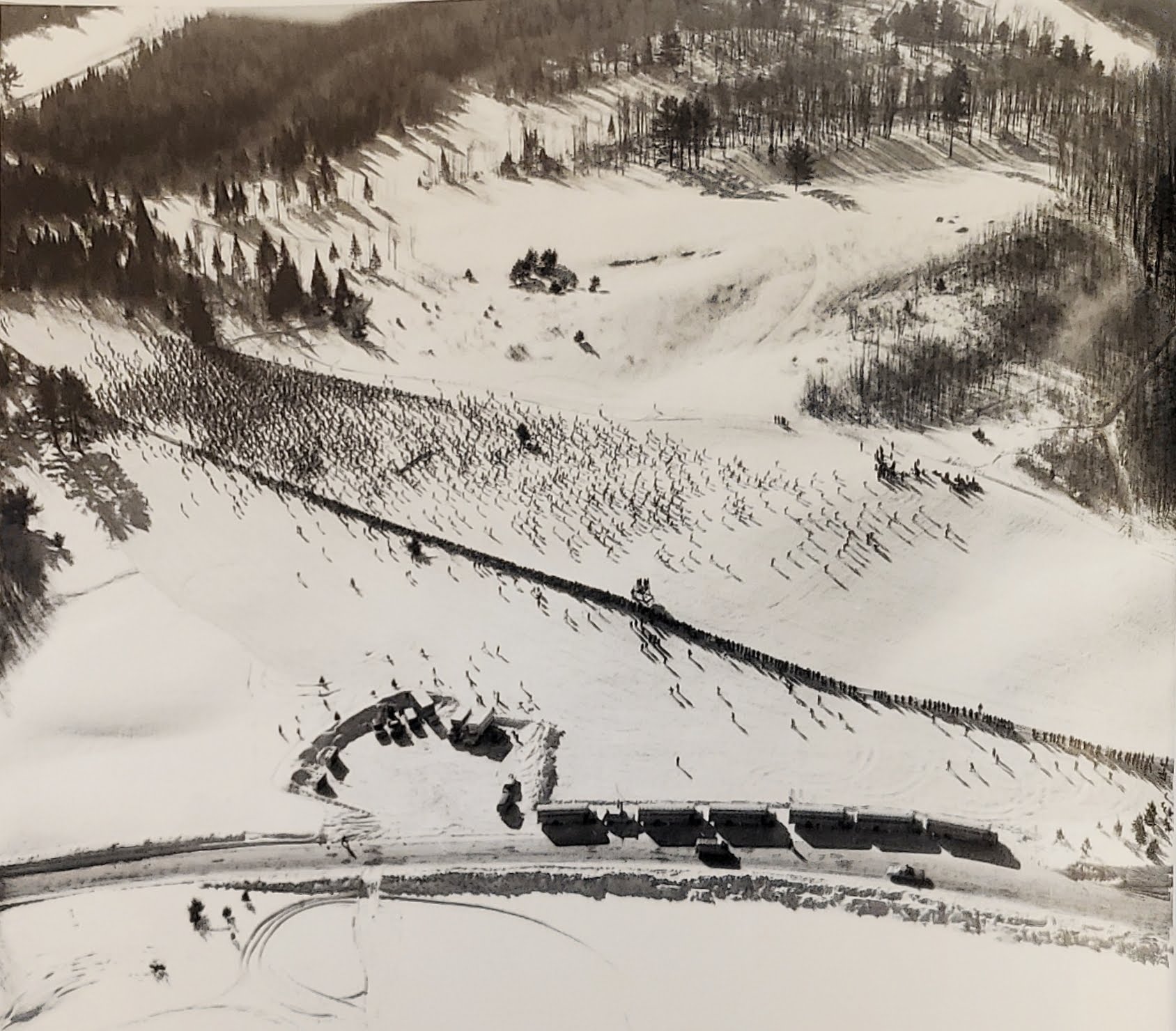
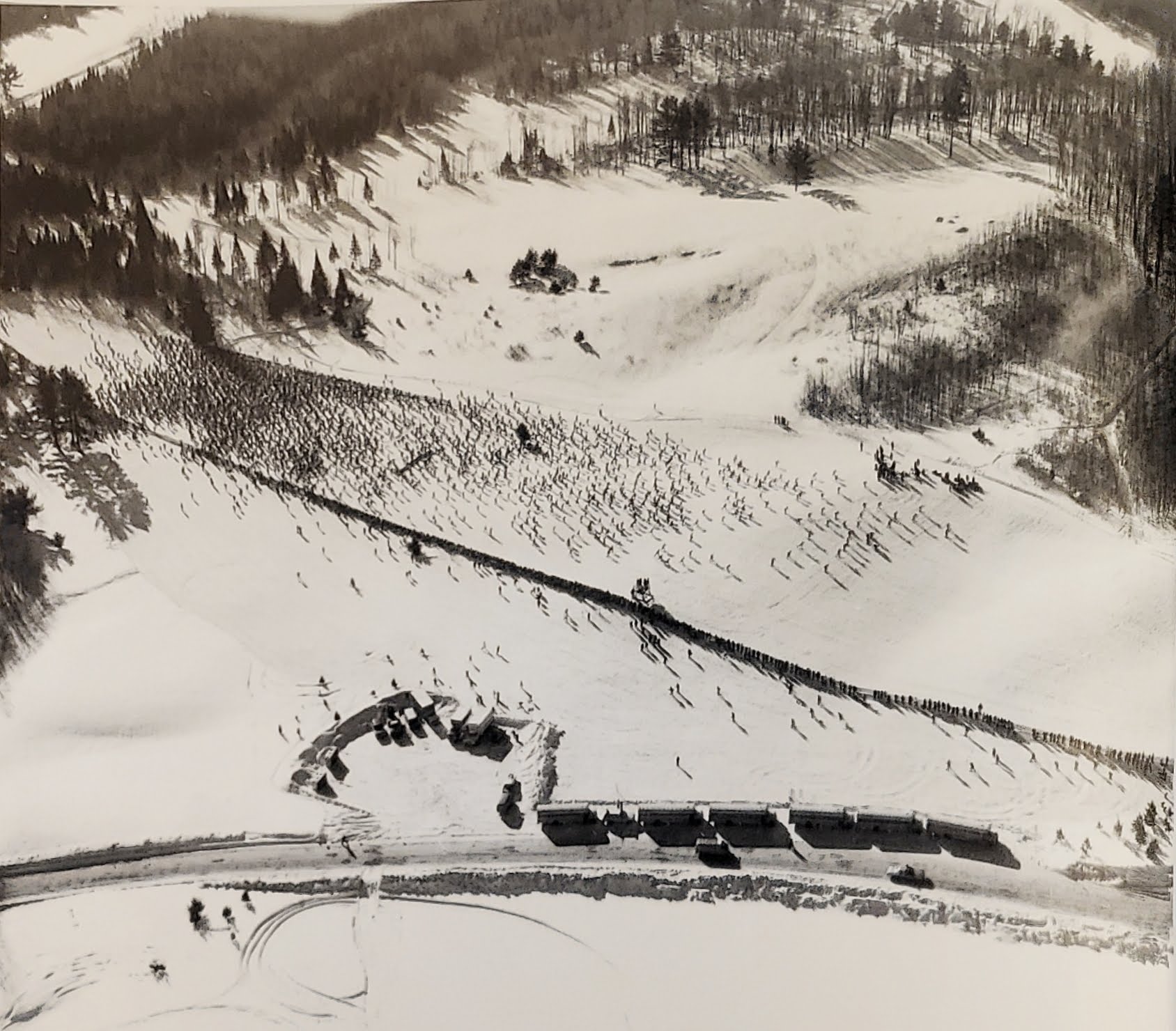
The American Birkiebeiner takes off towards Mt. Telemark in 1978. (Photo: Telemark Education Foundation)
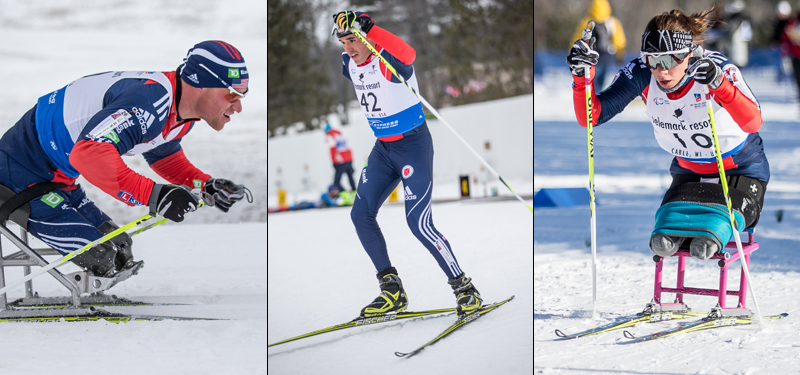
From left to right: Dan Cnossen, Omar Bermejo and Oksana Masters are three members of the U.S. team who will be competing at the IPC Nordic Skiing World Championships in Cable, Wis., with races starting on Saturday. (Photo: U.S. Paralympics)
Note: This article has been updated to include the most recent information on the 2015 IPC Nordic Skiing World Championships according to an IPC Nordic Skiing press release.
This past fall, FasterSkier spoke with Yuriy Gusev, head of the Cable 2015 organizing committee and executive director of Central Cross Country (CXC), about the ongoing preparations to host the upcoming International Paralympic Committee (IPC) Nordic Skiing World Championships in Cable, Wis. It seemed like a long ways off at the time, and now it’s here: being held for the third time in the U.S., for the first time in a decade.
With Cable and the Telemark primed for the event, which includes 135 athletes from 15 countries from Jan. 23-Feb. 1, we had an opportunity to check in with U.S. Paralympics Nordic High Performance Coach Eileen Carey to see how the U.S. team was preparing. The U.S. roster was announced Jan. 9 and includes nine returners (out of 16) from last year’s Paralympics team at the Sochi Winter Games. All but one of them are sit skiers; Omar Bermejo is the lone standing athlete.
U.S. 2015 IPC Nordic World Championships Team:
Men
– Omar Bermejo (Marine Corps/Grand Rapids, Mich.)
– Lt. Cmdr. Dan Cnossen (Navy/Topeka, Kan.)
– Sean Halsted (Air Force/Rathdrum, Wash.)
– Augusto Perez (East Syracuse, N.Y.)
– Aaron Pike (Park Rapids, Minn.)
– Bryan Price (Army/Belton, Mo.)
– Andy Soule (Army/Pearland, Texas)
Women
– Oksana Masters (Louisville, Ky.)
– Tatyana McFadden (Clarksville, Md.)
The two members of the women’s team found repeated success in Sochi, with Oksana Masters and Tatyana McFadden taking home three combined medals.
Masters became the first female U.S. cross-country skier to win a Paralympic medal in 20 years at the Games, initially earning silver in the 12-kilometer sitting event. She also won bronze in the 5 k cross-country. This season, Masters racked up three medals at the World Cup opener in Finland, winning gold in the 1 k cross-country sprint, and silver in the biathlon 6 k as well as the 5 k cross-country.
In Sochi, McFadden notched silver in the women’s 1 k cross-country sprint, and in the time since, she has continued her domination of the road-marathon circuit. After the ski season ended, McFadden won four world-caliber marathons in Boston, London, Chicago and New York City. It was the second-straight year that McFadden achieved the marathon grand slam in wheelchair racing.
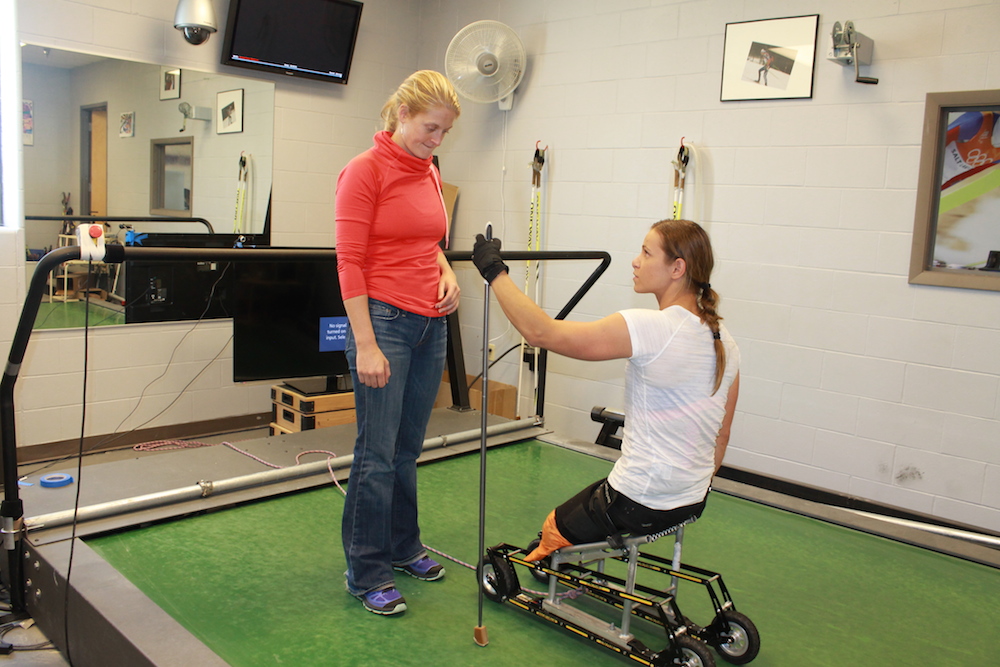
U.S. Paralympics Nordic skier Oksana Masters (r) talks to coach Eileen Carey before her first time on a treadmill on Sept. 16 at the Olympic Training Center on Sept. 16 in Lake Placid, N.Y.
Masters and McFadden missed U.S. nationals because of injury and ilnees, respectively.
“Earlier in the season, Masters had a minor back injury and McFadden had the flu and were forced to miss the last World Cup event and the US Nationals,” Carey explained. “Both are back healthy and will be in the field in Cable.”
On the men’s side, Andy Soule leads a strong men’s team heading into World Championships. A veteran sit skier, Soule is a bronze Paralympic medalist from the 2010 Games in Vancouver, British Columbia, where he shot an unprecedented perfect 50-for-50 in all three biathlon races. In Sochi, Soule finished in the top five in every event he competed in and placed fourth twice (in the 7.5 k biathlon and 15 k biathlon).
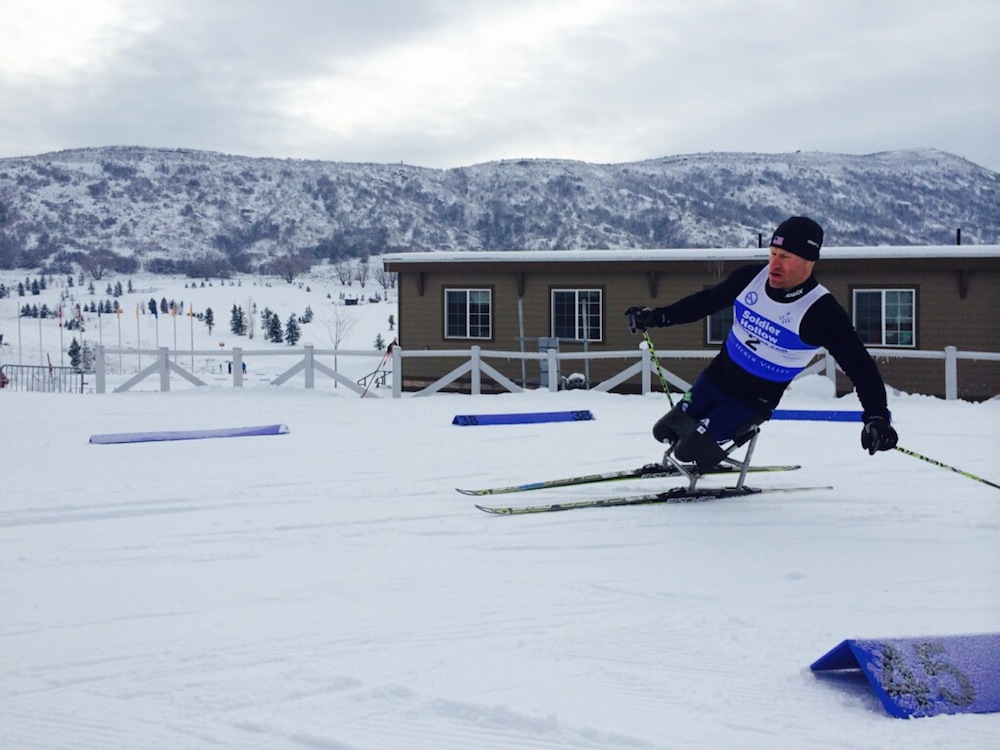
He split the number of U.S. sit-ski titles won at this year’s nationals with teammate Lt. Dan Cnossen (both men won two races at Soldier Hollow in Midway, Utah). Cnossen won the men’s sitting short and sprint cross-country races, while he finished as the runner-up to Soule in the long distance cross-country and biathlon sprint races.
Eileen Carey: We had a strong opening to our season at the December World Cup races in Finland with a small group of athletes. We followed that with a great U.S. Nationals that brought together our top athletes with developing skiers and biathletes. Those two events showed both the high performance capacity and development focus of our program, both of which are critical to our long-term success.
FS:What is the atmosphere of the team leading to these World Championships on U.S. soil?
EC: Our athletes are becoming students of skiing and biathlon and driving the process of what and how they want to learn. This has created a great atmosphere for our whole program and has energized both athletes and staff. We are excited to take that energy to an event like World Champs, especially being at home. The Cable organizing committee has always been so welcoming and excited to have us and that gives us a great boost as a team.
FS: What are your goals and expectations for this years team?
EC: Our team philosophy is based on the concept that athletes are their own best coaches. Their training and racing has been focused on the idea that there are no “right” ways to do anything. As a result, this season they have gotten really creative and analytical about figuring out what works for them and exploring many different solutions. Our intentions are that bi-products of this exploration are improvements in skill, self-awareness as an athlete, and eventually performance. Our goals and expectations as a program are that our athletes will keep pushing those boundaries and continuing to think of different and perhaps better ways to train and race. Through this continual evolution, I think great performances will follow.
FS: What are your thoughts on this years course? How does this course compare to 2013?
EC: The courses in Cable will be a combination of courses we have skied there in the past, and some new features that will improve the experience for the athletes. We have spent some workouts focused on some of the terrain and technical features we will see there, so I think everyone is excited to be on the snow in Cable and test out what we have been working on.
FS: What events will the team participate in?
EC: We will have athletes competing each race day, with most competing in a combination of biathlon and cross-country races. Eight of our 9 athletes are sit skiers. Omar Bermejo is our only standing skier to make the team and this will be the first time this season that we will all be together, so we are looking forward to being a full team.
“We have a great team of athletes who have taken a very professional approach to training and building upon last season, ”Carey said in a U.S. Paralympics press release. “We are thrilled to get another chance to test out some of our training and racing strategies, ultimately focused on improving in each race. Having the opportunity to do that on home snow is a great bonus for us.”
The opening ceremony will kick off Friday, Jan. 23 and the championships run through Feb. 1.
All seven days of the championships, which includes 38 events between cross-country and biathlon, will be streamed live at Cable2015.com and USParalympics.org from Jan. 24 to Feb. 1.
Saturday, Jan. 24
Biathlon Sprint – Penalty Loop
Sitting: Men 7.5km (3 x 2.5 km) / Women 6.0 km (3 x 2.0 km)
Standing: Men 7.5km (3 x 2.5 km) / Women 6.0 km (3 x 2.0 km)
Visually Impaired: Men 7.5km (3 x 2.5 km) / Women 6.0 km (3 x 2.0 km)
Sunday, Jan. 25
Cross Country Long – Free
Sitting: Men 15 km (5 x 3.0 km) / Women 12 km (4 x 3.0 km)
Standing: Men 20 km (5 x 4.0 km) / Women 15 km (5 x 3.0 km)
Visually Impaired: Men 20 km (5 x 4.0 km) / Women 15 km (5 x 3.0 km)
Tuesday, Jan. 27
Biathlon Middle Distance – Penalty Loop
Sitting: Men 12.5 km (5 x 2.5 km) / Women 10 km (5 x 2.0 km)
Standing: Men 12.5 km (5 x 2.5 km) / Women 10 km (5 x 2.0 km)
Visually Impaired: Men 12.5 km (5 x 2.5 km) / Women 10 km (5 x 2.0 km)
Wednesday, Jan. 28
Cross Country Sprint – Classic
Sitting: Men/Women 0.8 km
Standing: Men/Women 1.2 km
Visually Impaired: Men/Women 1.2 km
Friday, Jan. 30
Biathlon Individual Distance
Sitting: Men 15 km (5 x 3.0 km) / Women 12.5 km (5 x 2.5 km)
Standing: Men 15 km (5 x 3.0 km) / Women 12.5 km (5 x 2.5 km)
Visually Impaired: Men 15 km (5 x 3.0 km) / Women 12.5 km (5 x 2.5 km)
Saturday, Jan. 31
Cross Country Relay – CL/Free/CL/Free
Open: 10 km (4 x 2.5 km)
Mixed: 10 km (4 x 2.5 km)
Sunday, Feb. 1
Cross Country Middle Distance – Classic
Sitting: Men 10 km (4 x 2.5 km) / Women 5 km (2 x 2.5 km)
Standing: Men 10 km (4 x 2.5 km) / Women 5 km (2 x 2.5 km)
Visually Impaired: Men 10 km (4 x 2.5 km) / Women 5 km (2 x 2.5 km)
For updates throughout IPC World Championships, follow FasterSkier’s Para Nordic blog.
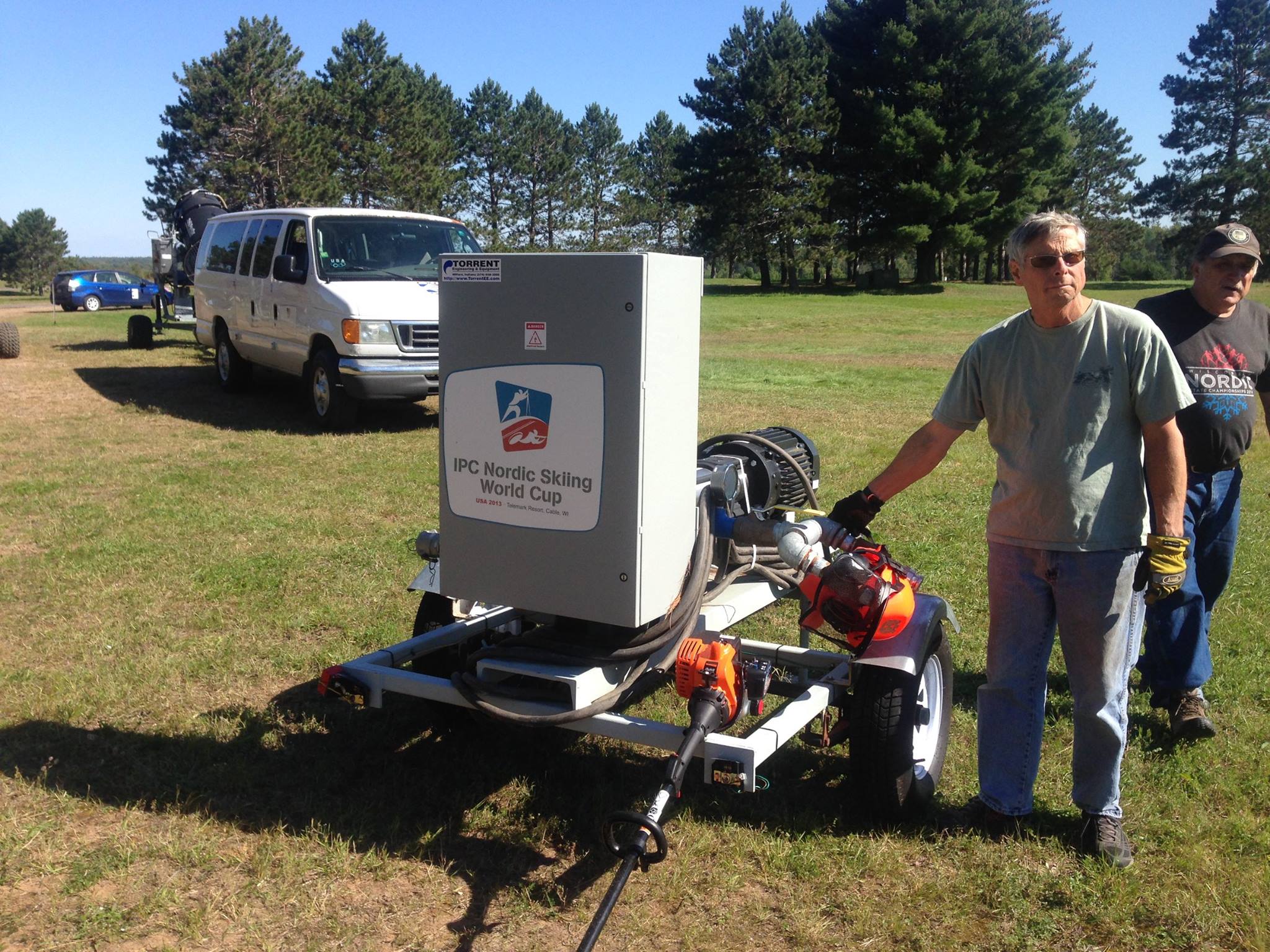
Volunteers get ready to test snowmaking equipment at Telemark trails in mid-September in Cable, Wis. The IPC Nordic Skiing World Championships will be held there Jan. 22-Feb. 1, 2015. (Photo: CXC Skiing/Facebook)
Northern Wisconsin, home of the Lumberjack World Championships and largest ski marathon in North America (a.k.a. the Birkie), is about to play host to the International Paralympic Committee (IPC) Nordic Skiing World Championships in January 2015.
For the first time in 10 years, IPC World Championships is returning to the U.S. since its last visit in 2005 in Fort Kent, Maine. And it’s coming to Cable, a town with fewer than 900 residents but with a history steeped in skiing since before 1947, when Tony Wise founded Telemark Resort.
The championships are expected to attract 150 of the world’s most competitive para-nordic athletes from 20 nations slightly less than a year after the Winter Paralympics in Sochi, Russia.
Central Cross Country (CXC) is heading up the organizing efforts, working with Telemark’s owners to revamp the trails used for the 2012 and 2013 IPC World Cups — two events that drew international attention to Cable.
“One of the coaches, I can’t remember what country, said we should host world championships because both those world cups were organized so well,” Yuriy Gusev, CXC’s executive director and the Cable 2015 organizing committee chairman, recalled in a phone interview.
Cable’s World Cup organizers first entertained the idea of hosting World Championships in 2012, then, after their second World Cup in 2013, they submitted an official bid that year.
When it comes to arranging an event of this caliber — with eight days of races between the opening ceremony on Jan. 22 and closing ceremony Feb. 1 — Gusev said it’ll be completely different from putting on a SuperTour or national championships.
For instance, in many domestic ski races, fewer than 100 athletes typically participate. While there will be slightly more at IPC World Championships, the level of competition will be significantly higher than even a World Cup, which often attracts development skiers. And teams that don’t usually fly across the pond for non-World Championships events, like Hungary and South Korea, will be in Wisconsin as well.
With more top-level skiers on course, Gusev said perfecting details — from appropriate hill grades for varying abilities, to the biathlon range — has been critical.
“It’s a lot more details than anyone would ever imagine,” he said.
One example: the hill that returns skiers back up to the stadium. As U.S. Paralympics Nordic Program director John Farra explained, it was so steep for sit skiers to ascend, especially those with little to no use of their core muscles, it wasn’t legal. And while it was used in the two previous Cable World Cups, something had to be done before World Championships.
With help from former CXC head coach Bill Pierce, Gusev led the task of taking some chunks out of the hillside, as well as widening, flattening and cleaning up edges alongside the Telemark trails. That includes a homologated 5-kilometer competition loop and 2 1/2 k sit-ski loops.
This past spring, Farra and his co-coach, Eileen Carey, an experienced technical delegate, visited Cable to check on the progress and pre-empt some of the questions they knew the IPC would ask during its site visit in June.
“I’m glad we did it, and I think [Gusev’s] organizers appreciated it,” Farra said. “His new stadium is going to work, and he’s doing some pretty significant trail work … Now [the hill] is an appropriate return to the stadium. He’s done some nice improvements.”
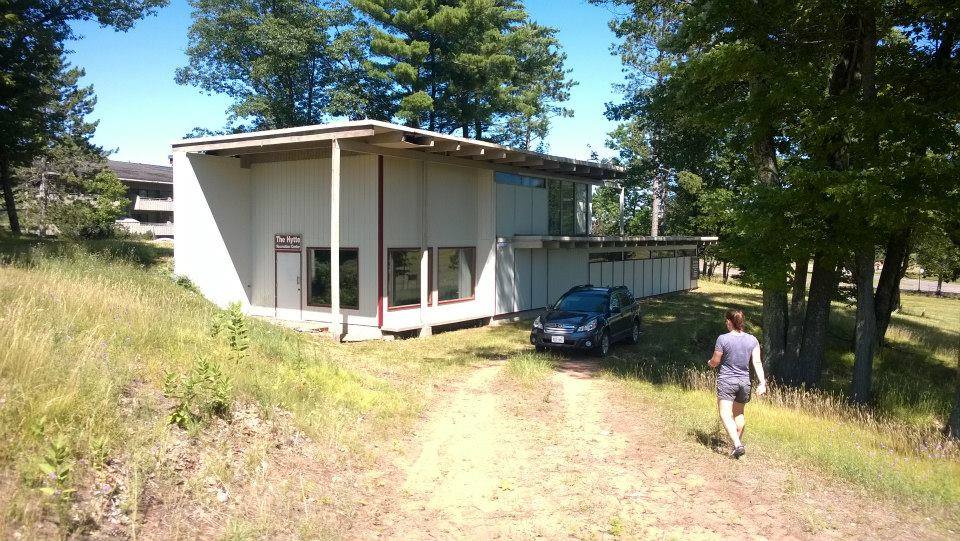
The Hytte Recreation Center at Telemark Trails is going through makeover to be ready for the 2015 IPC Nordic Skiing World Championships and other events this winter. (Photo: CXC/Facebook)
The stadium has been moved slightly to a higher point and is near one of the oldest buildings on the Telemark property, the three- to four-thousand-square-foot Hytte Recreation Center, which Telemark’s owners agreed to let CXC renovate.
According to Gusev, CXC updated and repainted it as an events/activity center. The owners also granted them use of the Telemark trail system.
The lodge itself remains closed, but as Gusev pointed out, “most of the venues anywhere don’t have lodging facilities at the start line.” Rather, Lakewoods Resort a 10-minute drive away will be the official accommodation and site of the closing ceremony.
“It’s not that easy to find a venue with a trail system and a biathlon range,” Gusev explained. “[We had] two world cups there and all the teams really enjoyed the trails and the layout.”
The opening ceremony will be held in downtown Cable in an open area between the grocery store and chamber of commerce.
In terms of spectators, Gusev said it was difficult to predict how many people would come watch the week-and-a-half championships. Regardless, he said his seven-person organizing committee was working hard to generate as much interest as possible in the months leading up to it.
He’s currently trying to lock down corporate sponsors to provide cash flow for hosting the event. The plan was to initially work with donation partners, then use the assistance of the IPC to attract international sponsors.
A few months ago, the organizing committee secured a grant from the state department of tourism as well as support from Bayfield County.
Depending on how fundraising goes, Cable 2015 could cost anywhere from an estimated $500,000 to $750,000 dollars, Gusev explained. While details and budgets will have to be finalized by November, he’s confident they’ll get there.
“If you look at the Paralympic Games in Sochi, twenty-five countries broadcasted and two billion watched it,” he said. “For the state [of Wisconsin] and the sponsors, it’s a pretty big event to be involved in and the media exposure will be huge.”
T.V. coverage will be a combination of small-scale broadcast and live streaming on the event website. Initially, Gusev said they considered a wide-reaching broadcast platform, but found the cost to be around $500,000 for a weekend of coverage. Alternatively, the live stream, which can be accessed anywhere online, will cost the organizers about $75,000, with equipment as the main expense, specifically a satellite truck.
At the same time, that option creates more work.
“If you have half a million and you have someone come in from New York to come do it, you don’t have to worry about it…,” Gusev said. “It’s actually more complex [to do the live stream].”
And in terms of snow, that’s partly why Cable got World Championships.
“In 2013, there was no snow anywhere and the little snow there was got melted by three inches of rain the day before the first official training day,” he said of the IPC World Cup that year. “All the races were on artificial snow so nobody could believe we pulled it off.”
Part of Gusev’s master plan is putting Telemark on the map as a venue that can hold consistently successful, big events. In 2016, Junior Nationals will be held on the same homologated trails in Cable.
“The standing course is [a] legitimate, hard, Sochi-like course to throw at the athletes,” Farra said. “[And Telemark has] similarly challenging courses for sit skiers.”
(Photo: CXC/Facebook)
The Hytte Recreation Center at Telemark Trails is going through makeover to be ready for the 2015 IPC Nordic Skiing World Championships and other events this winter. (Photo: CXC/Facebook)
(Photo: CXC/Facebook)
(Photo: CXC/Facebook)
(Photo: CXC/Facebook)
(Photo: CXC/Facebook)
CXC volunteers cleared the sit-ski finish of several loads of rocks and boulders with Avant Tecno USA on Sept. 30 before the IPC Nordic Skiing World Championships in January. Next task: seeding it and putting down mats. The same trail will be used this winter for the Midwest Junior National Qualifier, Wisconsin High School State Meet and 2016 Junior National Championships. (Photo: CXC/Facebook)
Clearing the Telemark trails for IPC Nordic Skiing World Championships in January 2015.
CXC teammates Jennie Bender and Nichole Bathe pose in front of Telemark Resort during a workout on Friday in Cable, Wis. While Bathe is new to the senior team, Bender is a seasoned veteran with multiple SuperTour wins and podiums at U.S. and Canadian nationals last season. (CXC photo)
Note: This is the fourth preview in a quick-and-dirty series on U.S. elite teams. We asked coaches to send their 2012/2013 rosters and tell us what’s new for the coming season. We will be publishing additional reports over the next few weeks. Teams are presented in no particular order.
Team: Central Cross Country, known as CXC Team
Coaches: Igor Badamshin (head coach), Andy Keller (assistant)
Karl Nygren, Doug DeBold and Eric Wolcott of the CXC Team during a workout at Telemark Resort on Friday in Cable, Wis. (CXC photo)
Roster: Karl Nygren, Brian Gregg, Doug Debold, Adam Martin, Eric Wolcott;
Jennie Bender, Caitlin Gregg, Nichole Bathe
Who’s new: Debold returns to the squad after placing third in classic sprint qualifier at 2012 U.S. nationals in Rumford, Maine, where he finished eighth overall. Bathe, 17, is moving up from CXC’s development ranks after being one of the leading Americans on the J1 Scando trip last season, placing eighth in a sprint in Estonia. Another 17-year-old former junior racer for CXC, Martin posted a 12th-place sprint finish on the J1 Scando trip.
Who’s missing: “We have several athletes that are not back on the team,” CXC Executive Director Yuriy Gusev wrote in an email. Among them are Jessie Diggins, who was recently promoted to the U.S. Ski Team’s A-team and decided to join the new Stratton Mountain School (SMS) Elite Team. Santi and Carolyn Ocariz rollerskied across the country and moved west to join XC Oregon, and Canadian Sara Hewitt also left CXC.
Former head coach Jason Cork also parted ways to accept the U.S. Ski Team men’s coach position. That followed the departure of CXC’s assistant coach Gus Kaeding, who is heading up the new SMS Elite Team.
Gusev wrote that CXC has been transitioning this spring, making Badamshin head coach after three years with the junior development team. Anticipating the departure of certain athletes, CXC made sure to support juniors like Bathe and Martin last year similar to how they worked with Diggins over the last two years.
Gusev added that they decreased the roster size to provide more athlete support, especially at international competitions.
“The most notable [skier] we’ll miss this year is Jessie Diggins,” Gusev wrote. “Athletes have to do what is the best for them and we 100% support their decision. We had similar situations in the past with Matt Liebsch and Tad Elliott. It’s about athletes and we need to support what is the best for their performance. We are proud that we played important role in getting those athletes where they are right now.”
Top results last season:
According to Gusev, CXC tallied:
Bender working out during a CXC training camp on Friday at Telemark Resort in Cable, Wis. (CXC photo)
• 80 top-three finishes in World Cup, US SuperTour and major marathon races
• 31 wins in US SuperTour and major marathon races
• 10 top-30 results in World Cup Races (by Jessie Diggins)
• 5 top-10 ranked skiers ranked in U.S.
• 5 skiers in the top-three of each gender in SuperTour final standings
• 4 national championship titles
• 3 skiers in the top three in the women’s freestyle sprint at US Nationals
• 2 top-10 World Cup results (Diggins)
• A silver medal in World Cup team sprint (Diggins with Alaska Pacific University’s Kikkan Randall)
Coach’s comment: After two summer training camps at Telemark Resort in Cable, Wis., Gusev complimented the team’s working atmosphere.
“There are few changes with training and workouts compared to the past, but the athletes are responding well to them and eager to try different ideas,” he wrote.
Monica Bascio (USA) at the Paralympic World Cup 2009 (Photo: Ian Lawless)
From January 29 to February 3, cross-country skiers and biathletes on the U.S. Paralympic Team will have the opportunity to compete in a World Cup on home turf. The U.S. Olympic Committee announced earlier in October that Telemark Resort in Cable, Wisconsin is set to host the biggest international nordic event the U.S. has seen since 2005, when the International Paralympic Committee (IPC) Biathlon and Cross-Country World Championships were held in Fort Kent, ME.
Central Cross Country (CXC) and the City of Lakes Nordic Ski Federation have partnered up with U.S. Paralympics, a division of the U.S. Olympic Committee (USOC), to host the event. While the USOC will be funding a the majority of the event, a $20,000 grant from the Wisconsin Department of Tourism helped make holding the races a reality for event organizers.
Wisconsin’s tourism department is excited about showcasing the home of the American Birkebeiner to a larger international audience. Between the six scheduled races — two biathlon and four cross-country — over 100 athletes from 15 countries are expected to compete.
John Farra, the USOC’s High Performance Director of Nordic Skiing, is simply happy the U.S. athletes will for once have the home course advantage.
“It’s a chance to get the Europeans out of their element over here, which is what our guys have to experience 90% of the time, able bodied or adapted,” he said.
In addition to the World Cup events in Cable, athletes are being invited to participate in the City of Lakes Loppet in Minneapolis, Minnesota following the final IPC races. Farra said one team has already confirmed their participation for the popular festival that typically attracts 10,000 competitors.
Sean Halsted, who has been on the U.S. adaptive cross-country squad since 2006, sees international racing exposure for developing athletes as one of the greatest benefits of a hosting a World Cup.
“We’re definitely excited more people can participate,” he said. “We’d like to have more development guys come overseas, but now they have a chance to get in a race.”
Two years out from the 2014 Paralympics in Sochi, Farra noted that getting developing athletes in world-class competition is especially important.
“For sure, I’m excited,” he said. “[It’s an] opportunity to encourage more athletes to participate that we normally can’t take to the a World Cup.”
For more details about the IPC World Cup, visit the official website.
Brian Gregg picked up two podium finishes in this weekend’s SuperTour in Telemark, WI. Racing for CXC, Gregg placed third in yesterday’s classic race and then outsprinted teammate Matt Liebsch for the win in today’s mass start skate race. Gregg took a break from packing his bags (flying to the Canmore World Cups) to give the scoop on today’s race.
Gregg and Liebsch skate away from the field in Telemark
How did the race play out – when did the field spread out and when did you and Liebsch separate from the lead pack?
Last year in this race, it was a big pack finish. I think the top 20 guys were all within 30 seconds. I was nervous about the liability of such a large group today and tried to go out hard. I made a move just before the 2km mark to try and break things up a bit. Matt and I had a small lead on the field and we made a quick pact to work together to get a gap. We rotated pulling for the next few minutes. Matt is really strong at V2 and I was thankful to have the draft in order to stay with him. Chris Cook caught up to us, but he had to work by himself to catch us while Matt and I were able to recover a bit in the draft. Matt and I continued to work together before starting to play cat and mouse in the final kilometers.
Were there any trip-ups during the race?
There were a few poles stepped on here and there, but I believe for the most part the race went pretty smooth for everyone.
How were course conditions?
Clear skies and cold temperatures made for a blue bird day of racing. The courses were hard packed with a bit of soft tilled snow on top. It doesn’t get much better than that.
Did this race weekend feel any different from other weekends?
I have been living and training in Hayward, WI the past four years so it was great to race in front of so many friends and supporters. Additionally I spend a fair amount of time running the trails and visualizing this race. It is always great to perform well at your ‘home’ SuperTour. CXC puts on the Telemark Super Tour and it was great to see such strong performances throughout the team. The men swept the podium in the classic race and the women swept the freestyle. How are you feeling right now about your racing and health and what is your upcoming schedule?
I am feeling great. I will take the next few days pretty easy in preparation for the 15km freestyle in Canmore. I have been focusing on that race all season. I have been racing a lot this season and will return to Hayward after Canmore for some solid training in preparation for the American Birkebiener and some March racing in Europe.
Team CXC dominated their home turf yesterday by taking 5 out of the 6 podium places in the 5/10km classic races of the Telemark SuperTour.
In the women’s 5km race Rebecca Dussault won by a commanding 31 seconds over teammate Maria Stuber, mimicking their 1-2 placements in both of last weekend’s SuperTour races in Minneapolis.
Third place went to Melissa Schwartz, who finished another 13 seconds behind Stuber, both previous teammates at NMU.
A current NMU skier, Laura Dewitt, took 4th, and UWGB skier Carolyn Freeman rounded out the top five.
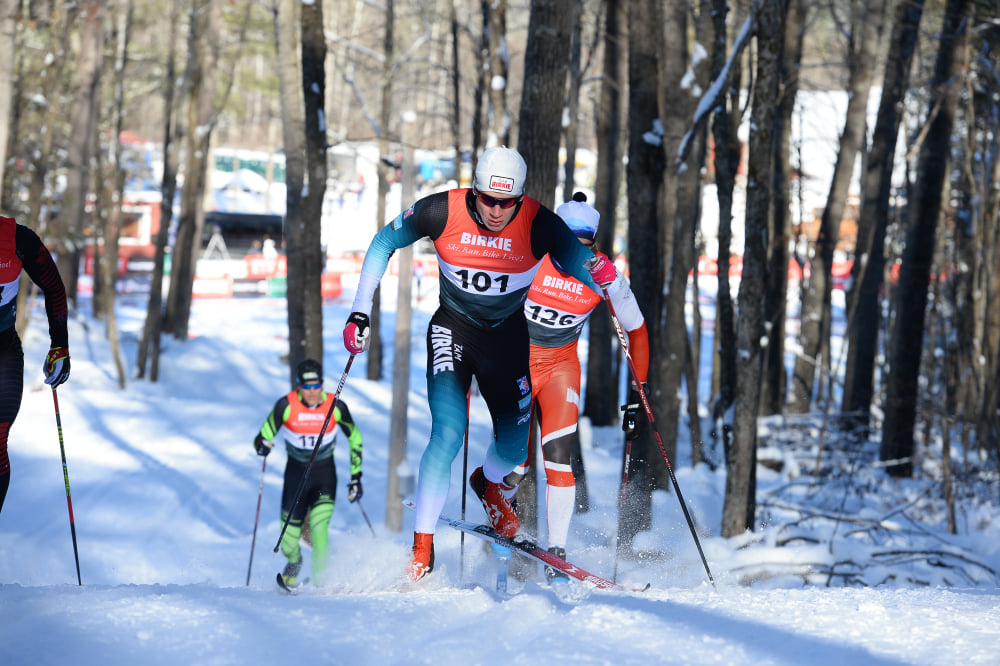
Kevin Bolger with a train of CXC racers at his heels (photo: CXC)
In the men’s 10km race, Bryan Cook, who had placed third in both of last weekend’s races, took the top of the podium this time, edging out CXC teammate Matt Liebsch by a slim 1.8 second margin. Liebsch, who won last weekend’s skate race, is usually a stronger skater.
“I felt like I had a chance to do very well but I was a little surprised to be battling for the win in a classic race,” said Liebsch. “I have worked very hard this past season on improving my classic skiing and I felt very good striding today.”
Brian Gregg, also skiing for CXC, finished in third place, 19 seconds off Cook’s pace.
Chris Cook (Steinbock Racing) placed fourth and Oskar Lund (MTU) was fifth.