
From the FasterSkier archive — posts syndicated from athletes’ and coaches’ own blogs between 2004 and 2012, kept online as published. Current coverage is at fasterskier.com.

Tag: Teodor Petersen

  • Svensson, Nilsson Delight Home Crowd in Gällivare Sprint; Beatty, Valjas Reach Heats

    Svensson, Nilsson Delight Home Crowd in Gällivare Sprint; Beatty, Valjas Reach Heats

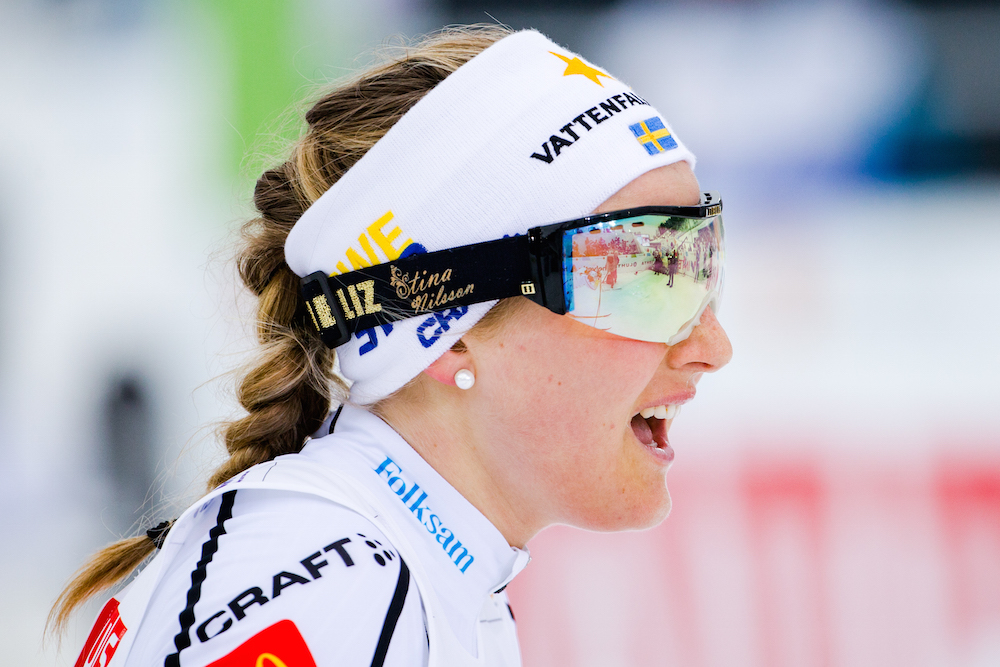
    Sweden’s Stina Nilsson at 2017 World Championships, after she finished 13th in the women’s 10 k classic on Feb. 28. On Sunday, she won her first sprint of the season at Sweden’s FIS season-opener in Gällivare.

    For the third and final day of International Ski Federation (FIS) racing in Gällivare, the home crowd would not be let down. Both the men’s and women’s 1-kilometer classic sprints were won by Swedes, one of whom has established herself as one of the world’s best sprinters, ending last season second in the 2016/2017 Sprint World Cup at the age of 23.

    Stina Nilsson, now 24 and entering her fifth year of racing on the World Cup, tallied her first win of the season in Sweden’s season-opening sprint on Sunday. So did Oskar Svensson, 22, who competed at his first World Championships last season.

    The day started with 1 k qualifiers, which Nilsson’s teammate Hanna Falk won in 3:58.86 minutes. Nilsson followed in second, 1.9 seconds back, and the two advanced through their quarterfinals and semifinals (with Nilsson winning both) before meeting head to head in the final. Also advancing to the final were Russia’s Natalia Matveeva (who won the other semifinal), Yulia Belorukova and Evgeniya Shapovalova, as well as Switzerland’s Nadine Fähndrich.  

    In the final, Nilsson held off two Russians for the overall win, finishing first in 3:53.75. Matveeva finished 1.89 seconds later for second place, while Belorukova claimed third (+3.16). Falk placed fourth (+5.50), followed by Shapovalova in fifth (+6.09) and Fähndrich in sixth (+6.58).

    Rounding out the top 10 were Sweden’s Ida Ingemarsdotter and Jonna Sundling in seventh and eighth, respectively, followed by Russia’s Elena Soboleva in ninth and Sweden’s Anna Haag in 10th.

    (Article continues below)

    https://www.instagram.com/p/Bbr9CpXFp6O/?hl=en&taken-by=stinanilssoons

    The lone North American woman in Sunday’s sprint, Dahria Beatty qualified for the heats in 28th, 17.29 seconds out of first. She went on to finish fifth in her quarterfinal, 9.94 seconds behind Haag, who won that heat. Overall, Beatty ended the day in 23rd. She also raced the 5 k freestyle to start the long weekend in Gällivare and placed 56th in that race.

    “There were parts of the course I felt I skied really well in my qualifier today and other parts that definitely need some work,” Beatty wrote in an email. “I was happy with how my striding and double pole felt and my body was moving a lot better today than on Friday in the 5k Skate. The snow was tricky today and I didn’t carry my speed very well through the transitions and up the double pitched herringbone/run section on the back of the course.”

    Beatty, a 23-year-old member of Canada’s World Cup Team, flew to Sweden with most of her team on Nov. 11 to get some time on European snow and compete in some early FIS races before the start of the World Cup.

    “I was really happy to be able to ski a heat and get that feeling of pushing head to head with others,” she continued. “It’s always good to see where you are losing time or keep up in the heats to figure out what needs to be worked on before the next weekend. I am hoping I can take what I learned today and make some improvements for the World Cup opener next weekend.”

    Kikkan Randall of the U.S. Ski Team raced Friday’s 5 k skate and Saturday’s 10 k classic, but opted out of Sunday’s classic sprint. Sixty-seven women contested Sunday’s sprint qualifier.  

    Svensson Tops Men’s Sprint

    Meanwhile, Svensson, a member of Sweden’s national A-team, topped a field of 114 in the men’s classic sprint. He started out by winning the qualifier by 0.76 seconds over Russia’s Anton Gafarov in 3:24.06. 

    In the first quarterfinal, Svensson placed second to Russia’s Andrey Parfenov, finishing 0.14 seconds behind him, and both advanced to the semifinals. There, Svensson won the first semifinal by just 0.01 seconds over fellow Swede Teodor Peterson. They advanced to the final, along with four Russians: Gafarov, Alexander Panzhinskiy, Nikita Kriukov, and Maxim Vylegzhanin.
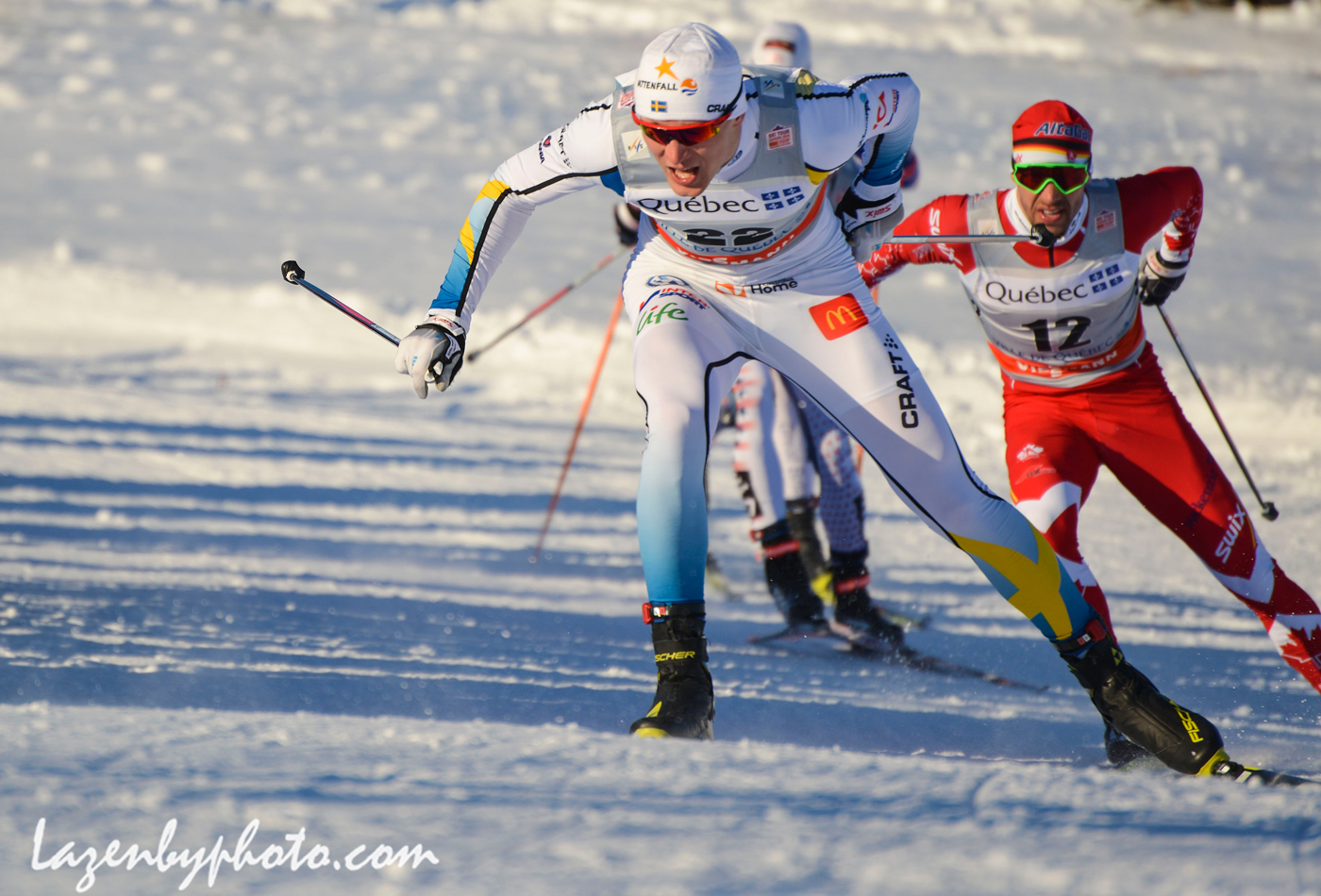
    Sweden’s Oskar Svensson leads Alex Harvey and others during their quarterfinal at the freestyle sprint at 2017 World Cup Finals in Quebec City last March.  (Photo: John Lazenby/Lazenbyphoto.com)

    In the finishing stretch of the final, Svensson and Peterson again lunged for the win, which Svensson took by 0.4 seconds in 3:21.63. Kriukov finished third, 2.12 seconds out of first, followed closely by Panzhinskiy in fourth (+2.18) and Vylegzhanin in fifth (+2.84). Gafarov ended the day in sixth (+22.99).

    Also in the top 10, Sweden’s Calle Halfvarsson placed seventh, Parfenov was eighth, Russia’s Alexey Vitsenko finished ninth and Sweden’s Johan Haeggström was 10th.

    Of the six Canadian men who raced on Sunday, World Cup Team member Len Valjas was the lone qualifier in 24th (+8.69). In the second quarterfinal, from which two lucky losers advanced to the semifinal, he finished sixth, 3.85 seconds behind the heat’s winner, Halfvarsson. That put Valjas 29th overall on the day.

    Julien Locke (Canadian U25 Team) raced to 39th in the qualifier, 12.32 seconds out of first and 2.36 seconds out of the top 30, for his best result of the weekend. He finished 72nd in the 10 k freestyle on Friday.

    “It was a long, twisty course with a fairly gentle profile with the exception of two very short, punchy steep sections,” Locke, who recently earned World Cup starts at Frozen Thunder trials, wrote in an email. “With all of the fresh snow the last couple days, the track was a soft on the corners and broken up on the climbs.

    “I felt that I skied well in the qualifier but was lacking tempo and glide speed on the climbs,” he continued. “The shape feels good and I was able to have a high output throughout the qualifier. I would have liked to race the heats as they would have been excellent race prep for the first World Cup on Friday.”

    Another Canadian, Knute Johnsgaard (World Cup Team) followed in 40th, 0.48 seconds behind Locke and 12.80 seconds out of first. Russell Kennedy, last year’s NorAm winner who trains in Canmore with Team R.A.D., raced to 43rd (+13.30). On Friday, he finished 48th in the 10 k skate.

    “It is always a bit hard with sprints, but the goal was to close really well,” Kennedy wrote in an email. “I felt strong and was much more happy with this sprint than my Frozen Thunder qualifier.”

    With firm tracks and good skis, Kennedy described his Gällivare qualifier as “super smooth.”

    “There was one pretty icy corner I thought it was kinda fun since there was a big berm you could ride but there were definitely some falls around that area,” he wrote.

    Not wanting to overburden his body before some of the other races he is targeting in the upcoming weeks, Kennedy opted out of Saturday’s 15 k classic.

    “I am trying to build my fitness a bit through these races so racing Friday was really good for my fitness and I took off Saturday to get some rest as I have a lot of races coming up that I want to perform well at,” he explained.

    Two other Canadians raced Sunday’s sprint qualifier, with Jess Cockney finishing in 48th (+14.05) and Jack Carlyle in 105th (+33.44).

    Results:

    Women: Qualifier | Final

    Men: Qualifier | Final

  • Petukhov Edges Swedes For Sprint Gold in Davos

    Petukhov Edges Swedes For Sprint Gold in Davos

    Alexey Petukhov (RUS) on his way to his first World Cup victory of the season. Photo: Fischer/Nordic Focus.

    Davos, Switzerland — The Russians are coming.

    On a beautiful blue-sky day in Davos, Switzerland, Russian sprint-specialist Alexey Petukhov picked up his first win of the season in the 1.5 k sprint freestyle World Cup.

    Petukhov skied clear of the competition, leaving Swedes Teodor Petersen and Emil Joensson scrambling for second and third, respectively.

    While Petter Northug (NOR) crushed the field by nearly a minute in the 30 k on Saturday and was considered by many to be the favorite in Sunday’s sprint, early in the day, it appeared an upset was in the making. After qualifying 20th, Nothug was placed in the first quarter-final, and barely managed to drag himself back into contention. He fired up his trade-mark finish stretch acceleration to nab second place in a close lunge with Denis Volotka (KAZ).

    The second quarter-final featured none other than Alexey Petukhov, the Russian who was dominant in Dusseldorf, as well as Canadian Len Valjas, who qualified in 14th, and strong early-season sprinter Teodor Petersen (SWE). On the very first lap the Russian made it clear that he didn’t want to be messed with, and attacked hard.

    Emil Joensson (SWE). Photo: Fischer/Nordic Focus.

    On the second lap, the congested 180-degree corner claimed its first victims of the day, as Valjas and Anders Gloeersen (NOR) collided, with both going down in a heap at a crucial point in the race. That opened the door for Petersen, who leapt into second place, advancing behind Petukhov, who cruised to a comfortable 1.8 second margin over the Swede.

    Emil Joensson made his much-anticipated debut in the third quarter-final of the day, and last years’ Sprint Cup winner appeared tentative in his first action, as the first lap was a slow pace.

    But then the tight turn swallowed another skier, as Finn Hagen Krogh (NOR) got tangled up with Italian Loris Frasnelli just as Joensson attacked the uphill. Only Nikolay Morilov of Russia was able to keep it close, finishing second and qualifying through to the semis.

    While every heat in Davos was jammed with fast men, the fourth quarter-final featured possibly the fastest six skiers, at least on paper.

    Home-town hero Dario Cologna (SUI) was joined by gigantic Swede Jesper Modin, David Hofer (ITA), and Canadian World Champion Alex Harvey.

    As would be expected given the calibre of the skiers, the heat was tight throughout. On the second lap, Cologna attacked on the uphill, but Harvey countered with a strong push over the top, gliding past the Swiss favorite on the downhill, while Hofer ate up the meters to leaders quickly. Harvey rounded the corner and headed for home well clear of the action, while Cologna withstood Hofer’s late challenge to secure second, to the delight of the crowd.

    Devon Kershaw on his way to 4th in Davos. Photo: Fischer/Nordic Focus.

    Meanwhile, in the final quarter of the day, North Americans faced off. Andy Newell (USA) had a blistering-fast 3rd-place qualifier, while Devon Kershaw (CAN) was at the other end of the spectrum, barely squeaking into the heats in 28th position. Paal Golberg (NOR), who notched a bronze medal in Dusseldorf last weekend, and young Italian Federico Pellegrino rounded out the group.

    After a terrifyingly slow start (if you’re a Canadian fan) Kershaw worked his way up the field behind Newell and Golberg, who were trading leads on the first lap.

    Golberg stretched out the field as they headed for lap two, and Pellegrino stayed with him, and the two stayed away from the others, finishing 1-2. Newell and Kershaw duked it out to the bitter end of the finishing straight in an epic battle that culminated with the Canadian winning the lunge to finish third ahead of Newell’s fourth.

    The distinction ended up being huge — Kershaw was awarded a lucky loser spot for his efforts, while Newell ended his day in 16th.

    The Canadian received some much needed-rest, as the first semi-final was packed with Russians Nikolay Morilov, Alexey Petukhov, and surprising Gleb Retyvkh, as well as Petersen and Northug.

    Petter Northug coming out of a corner. Photo: Fischer/Nordic Focus.

    In the initial stages, Petukhov again made it clear that he was leaving nothing to chance, getting to the front and controlling the pace before attacking with a big move heading into the second lap. Northug was languishing in sixth place at the back of the pack, but started to move up as the group attacked and then crested the hill. Running down to the finish, Northug charged again, eating up ground with his powerful hop-skate. However, after dispatching Volotka and Petersen, the Norwegian ran out of real estate, finishing third in a very close lunge with Morilov — but with a  good enough time to pick up one of the lucky loser spots.

    The second semi-final could easily have counted as a final on any given day on the World Cup. With Cologna, Harvey, Kershaw, Joensson, Golberg, and Pellegrino, and just two (potentially four) spots in the final on the line, it was clear that someone was going to go home disappointed.

    And in the first corner, the decision was made — Pellegrino and Harvey got tangled up rounding the bend, and while neither went down, it was enough to hold them back.

    While one Canadian struggled, the other shone. Kershaw hammered over the crest of the hill and glided to the front of the pack, and then put the hammer down as they headed into the second lap. Joensson responded, holding tight to Kershaw as they attacked the hill, and squeezed by the Team Sprint World Champion on his way to winning the heat. Kershaw finished second, placing him in the final for the first time this season, while Cologna finished 3rd — not good enough to put him through to the final.

    As the men lined up for the final, you could sense the disappointment in the stadium — with Cologna’s elimination in the semis, and Northug’s advancement via lucky loser, Norwegian fans sensed something spectacular was in the offing.

    And they were right, as Petukhov and  Morilov headed straight to the front following the gun, while Kershaw and his trademark slow start trundled out in sixth.

    Petukhov, triumphant. Photo: Fischer/Nordic Focus.

    By the end of the first lap, Petukhov was in the lead, and across the long straight the Russian hammered out a big gap, leaving two dozen meters back to his pursuers, Sweden’s Joensson and Petersen. But the bearded Russian faded as he headed to the home stretch, and it briefly appeared that the chasers might have a shot, but he held the lead to collect the gold.

    Behind him, Petersen and Joensson were caught in a tight battle for silver, in which Petersen emerged victorious, while Joensson had to settle for third. Kershaw finished fourth — his best placing on the World Cup this season — besting Northug, who tried desperately to close on the finishing straight.

    In his first race back on the World Cup after a serious leg injury, Joensson said he was worried about how the injury would affect his performance.

    “After my injury I was extremely nervous,” said Joensson in the post-race press conference. “I was very lucky to even be a little close today — I was extremely unsure of how I would respond.”

    Joensson said that for the last three months he had mostly trained with his girlfriend Anna Haag, a fellow World Cup skier on the Swedish team.

    “I have been beating her in training no problem,” he joked.

    For Petersen’s part, the young Swede was happy with his day, but surprised by the ferocity of Petukhov’s attack.

    “I didn’t expect the hard push he made,” Petersen said after the race. “I did what I could, but not strong enough.”

    Petersen also said he felt the course was tough, especially considering it was at altitude, and that he tried to ski as controlled as he could.

    “It was a great victory here,” said Petukhov after his decisive win. “I was glad that Petter was also in the final and that we could have a competition against each other.”

    Full results.

    Petersen, Petukhov and Joensson on the podium. Photo: Fischer/Nordic Focus.