From the FasterSkier archive — posts syndicated from athletes’ and coaches’ own blogs between 2004 and 2012, kept online as published. Current coverage is at fasterskier.com.
After winning Saturday’s qualifier in a time of 3:21.99, Klæbo went on to win both his quarter and semi. He eventually crossed the final first in a time of 3:20.05 to complete his sweep of the day’s rounds.
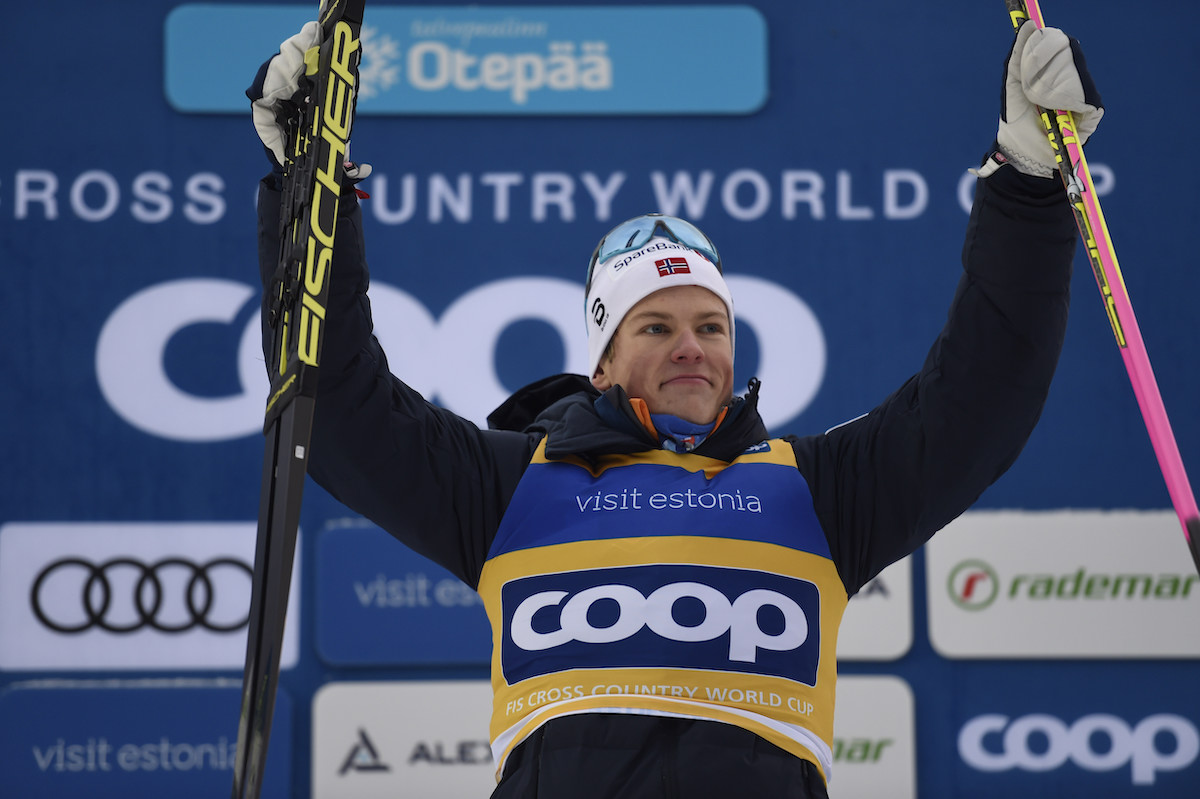
“It’s very cool to win here again,” Klæbo said during an interview with the International Ski Federation (FIS) after the race. “And I have a grandpa who is living here so that’s even better now, so I want to enjoy this.”
With the win, his 18th individual World Cup victory (12th in sprint), Klæbo could be on his way to his most winningest season yet. Last winter he departed the World Cup with 10 wins total. Thanks to a strong Tour de Ski and a few sprint races this year, Klæbo has already accumulated six individual victories in the 2018/2019 season.
The win this Saturday came in good company, as he raced the six man final with four other Norwegians: Pål Golberg, Eirik Brandsdal, Mattis Stenshagen and Erik Valnes. Alexander Bolshunov was the lone non-Norwegian to make the final.
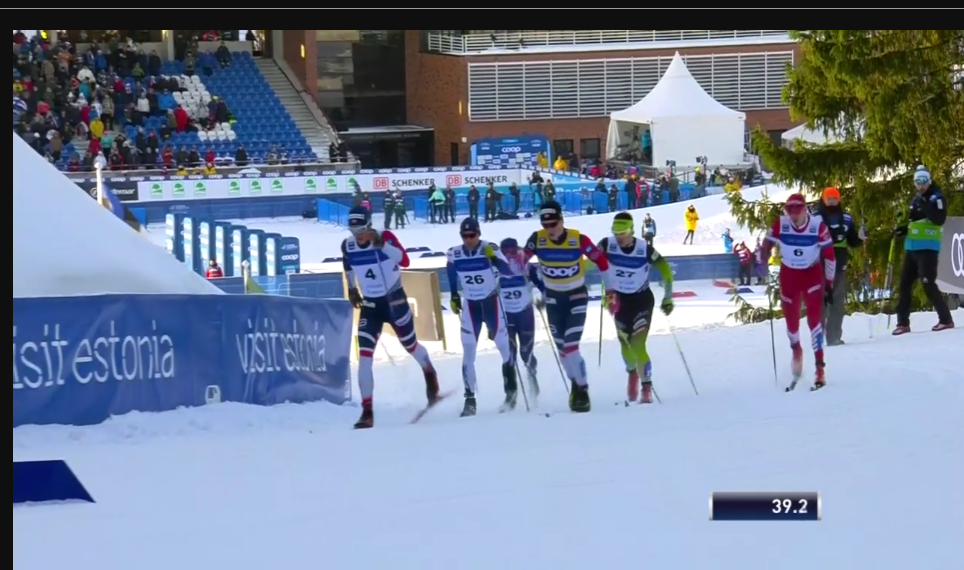
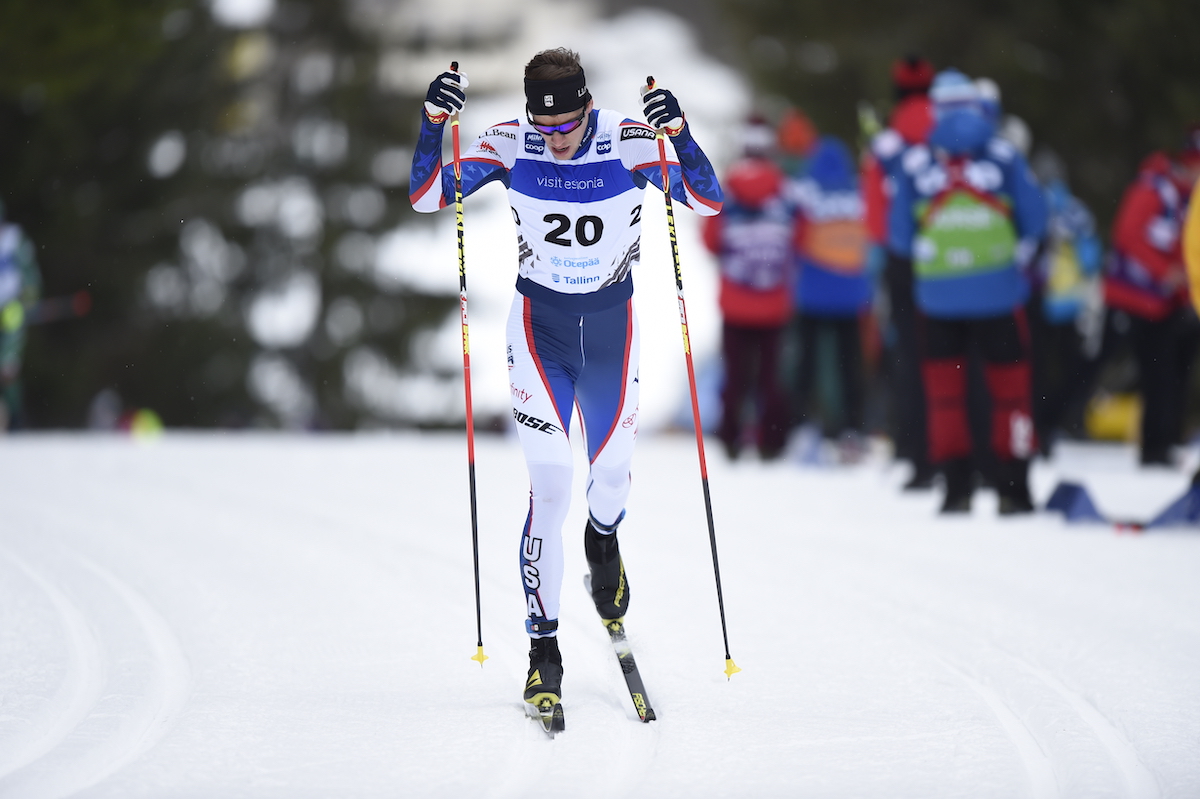
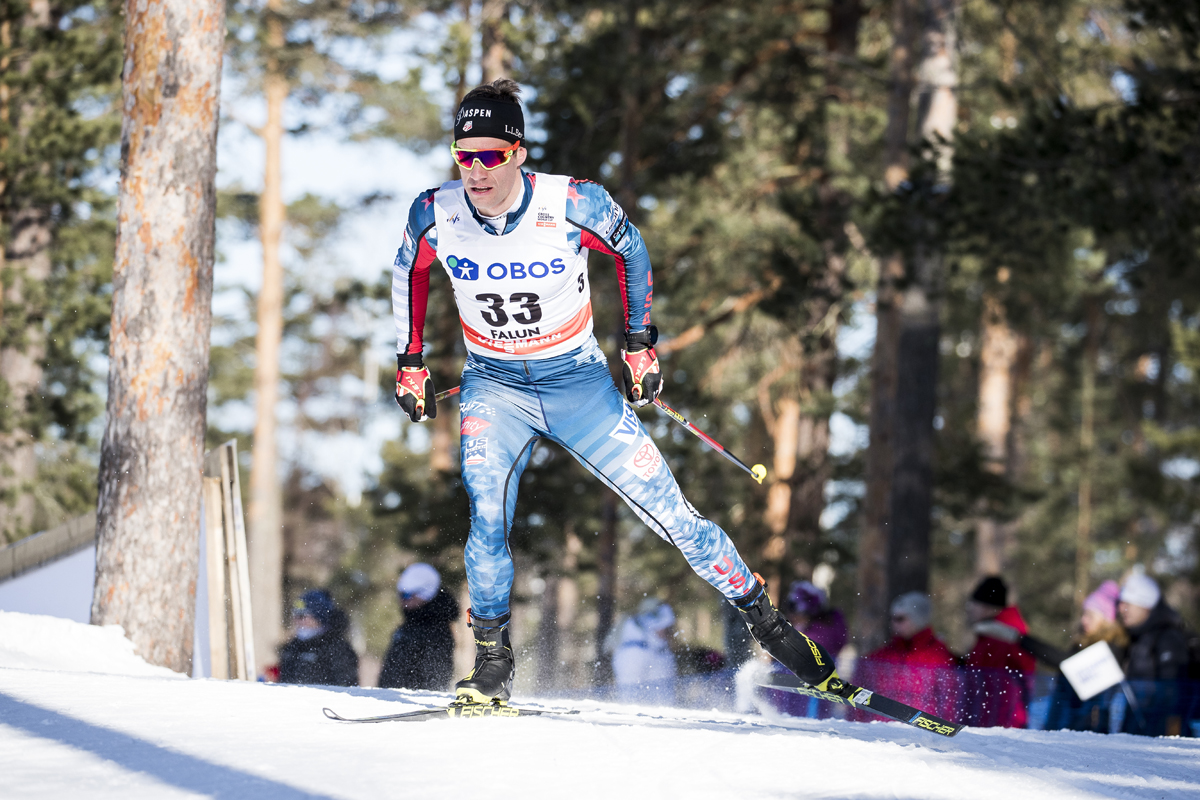
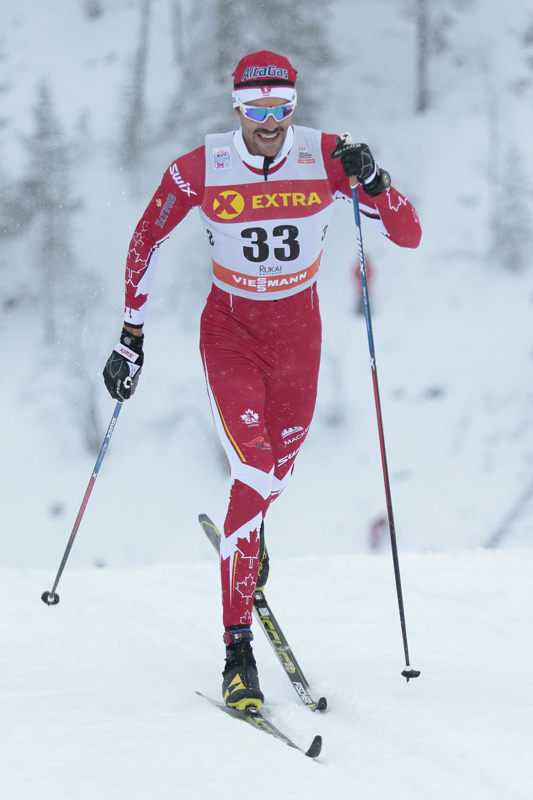
American Andy Newell (bib 26) racing the first quarterfinal of the the men’s 1.6-kilometer classic sprint final on Saturday in Otepää, Estonia. (Photo: NBC Gold screenshot)
Pitted against each other, Bolshunov appeared to be the only one in the final willing to challenge Klæbo. The two went head-to-head in the first major course climb, and by the following series of downhill S-turns, Bolshunov had positioned himself in the front. A brief double-pole section found Bolshunov and Klæbo side-by side once again, with Brandsdal and Stenshagen just behind.
As the six finalists geared up for the second major climb, a steep nearly vertical pitch that forced all racers to herringbone, Klæbo maneuvered to the outside right of Bolshunov. Using a quick, herringbone clip that almost made his skis look like a fish out of water, Klæbo passed Bolshunov by the top of the ascent.
After two double poles at the crest of the hill, Klæbo was tucked and descending back toward the stadium. His skis proved unmatchable by the Russian’s and by the bottom of the hill, he had put close to two meters on Bolshunov. Another meter behind Bolshunov was Golberg.
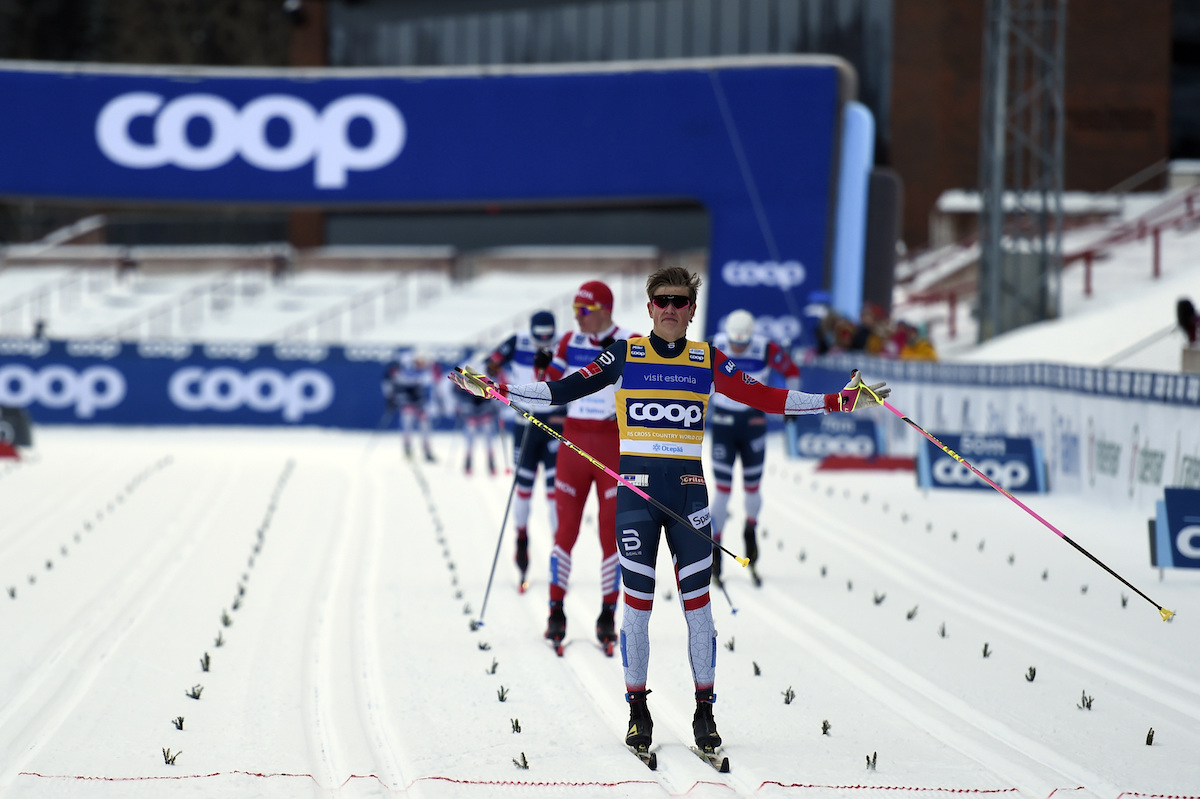
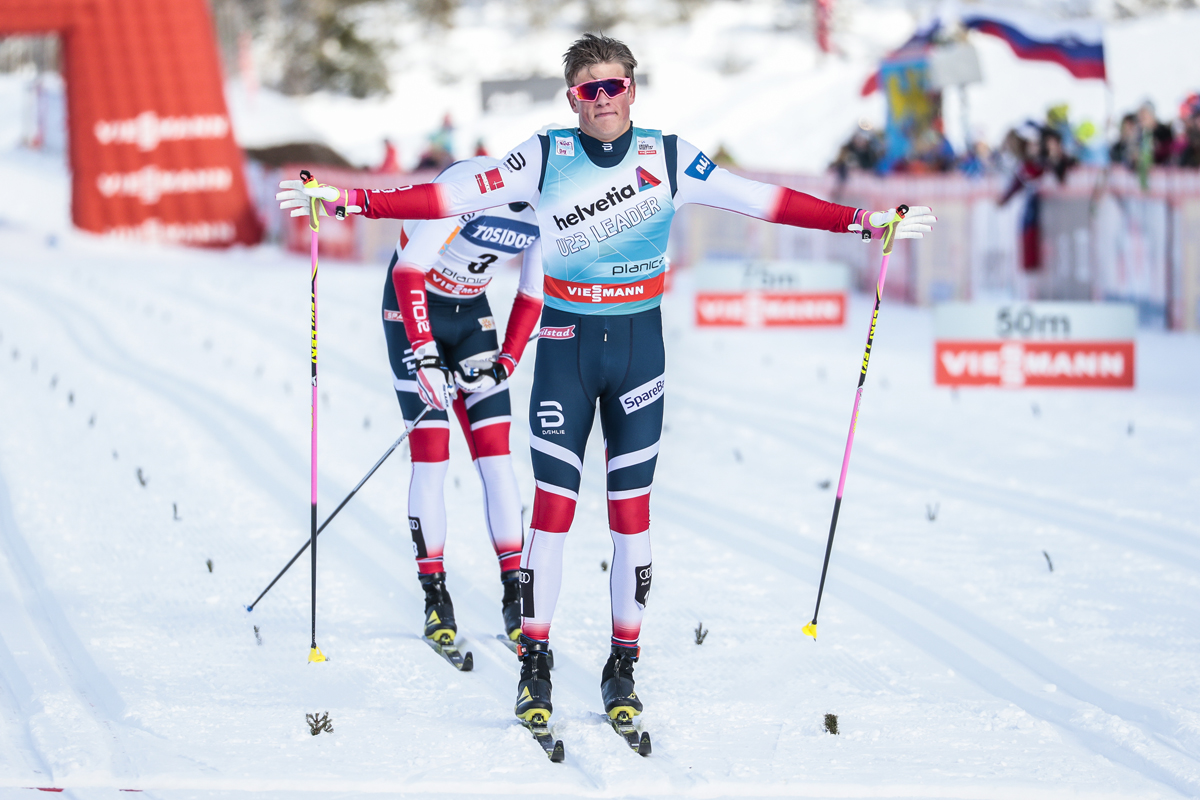
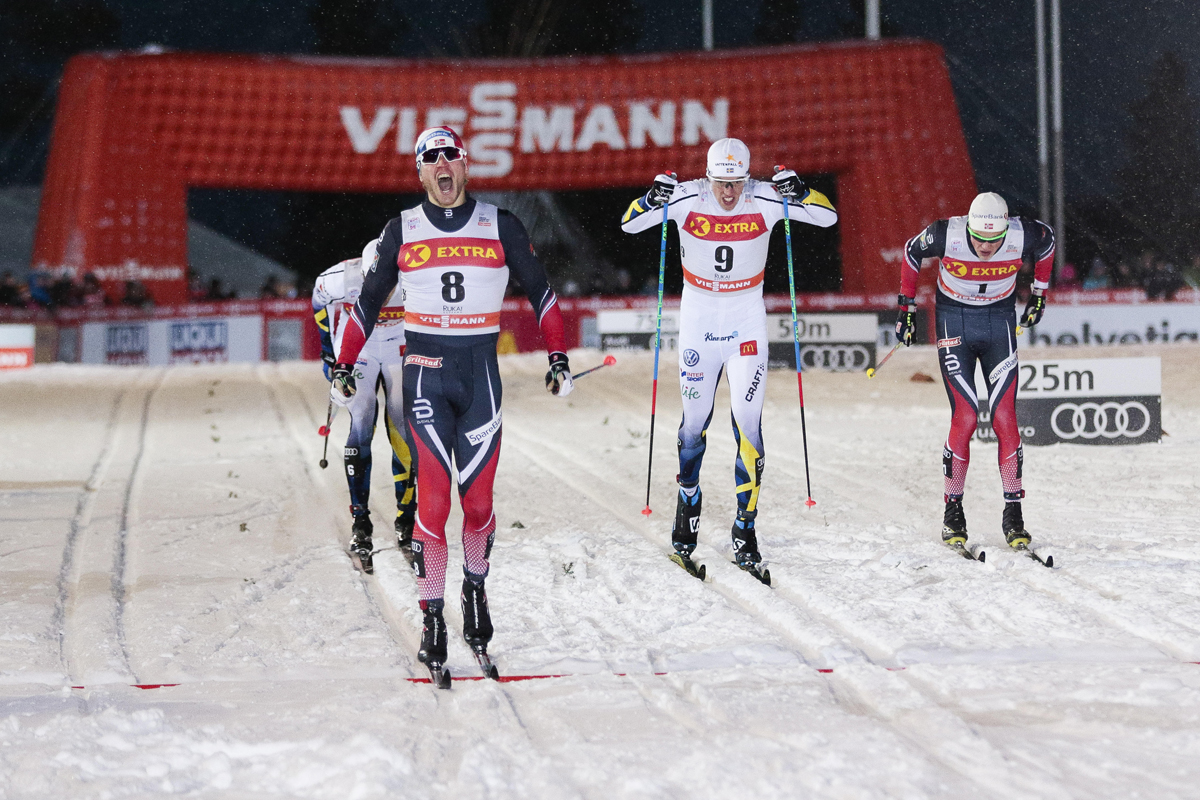
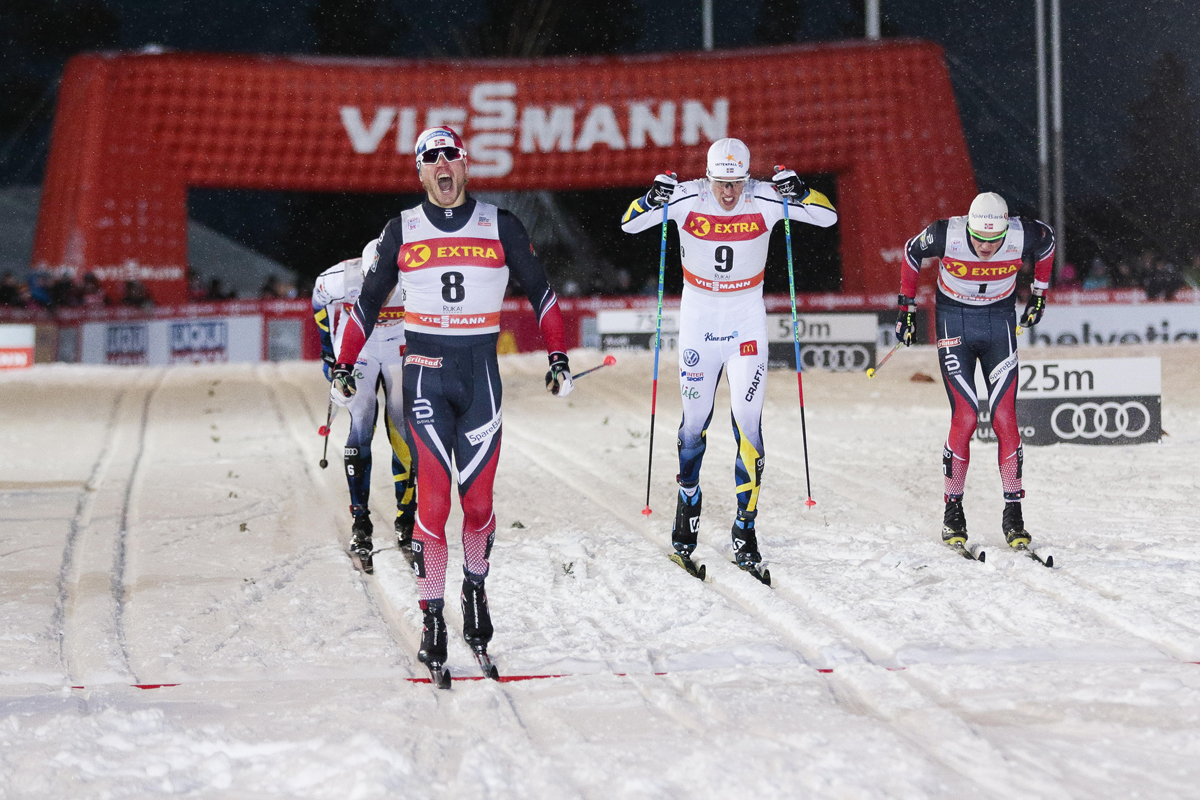
With no foreseeable challenge to the win, Klæbo double poled breezily to the finishing stretch and crossed first, arms outstretched in his signature celebratory gesture.
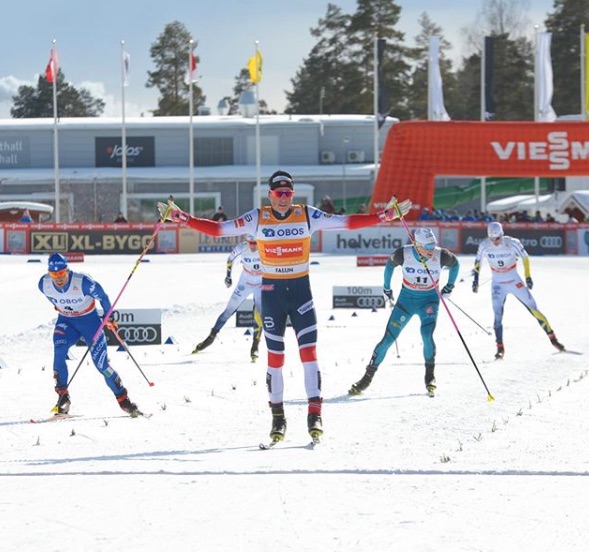
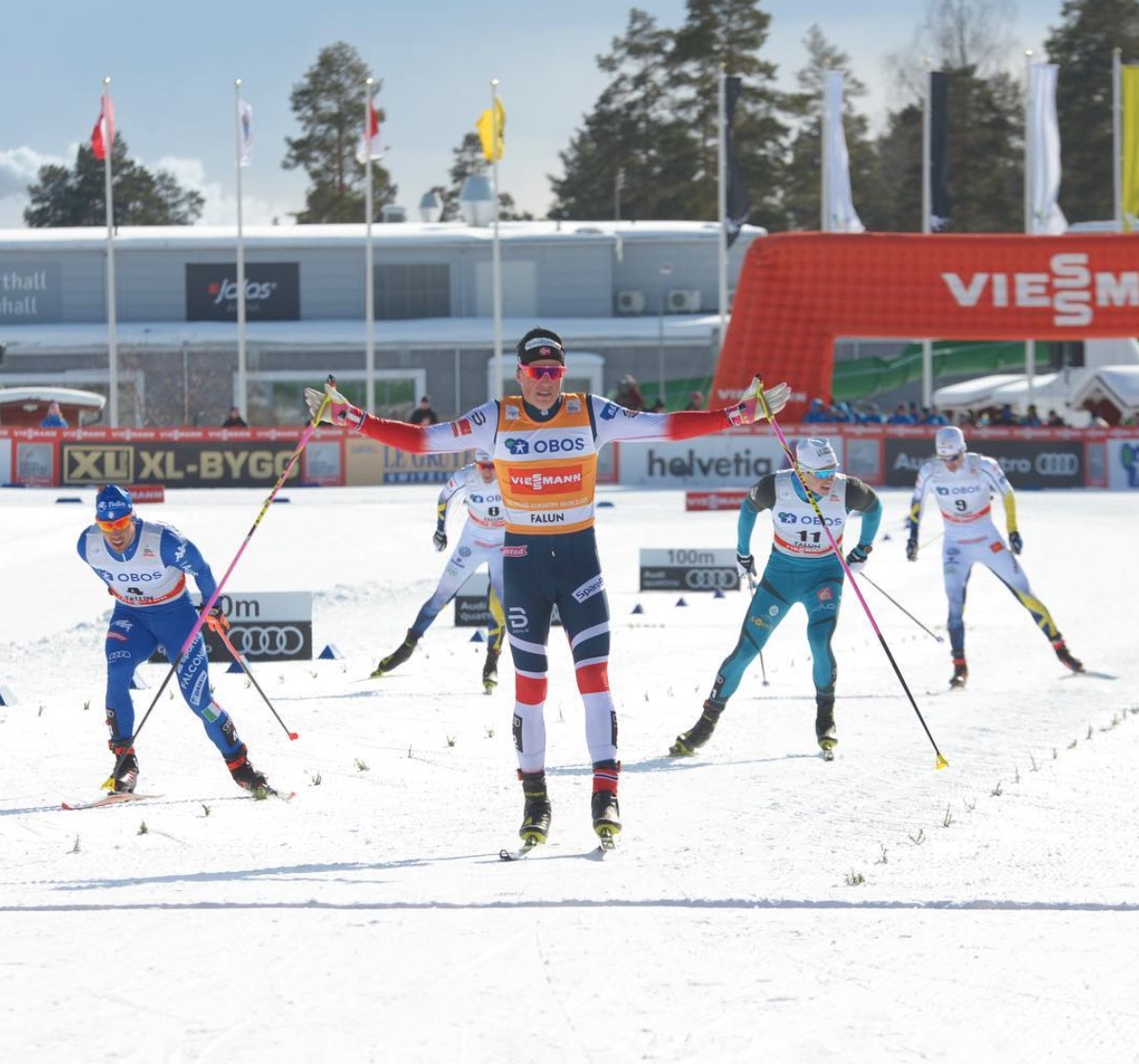
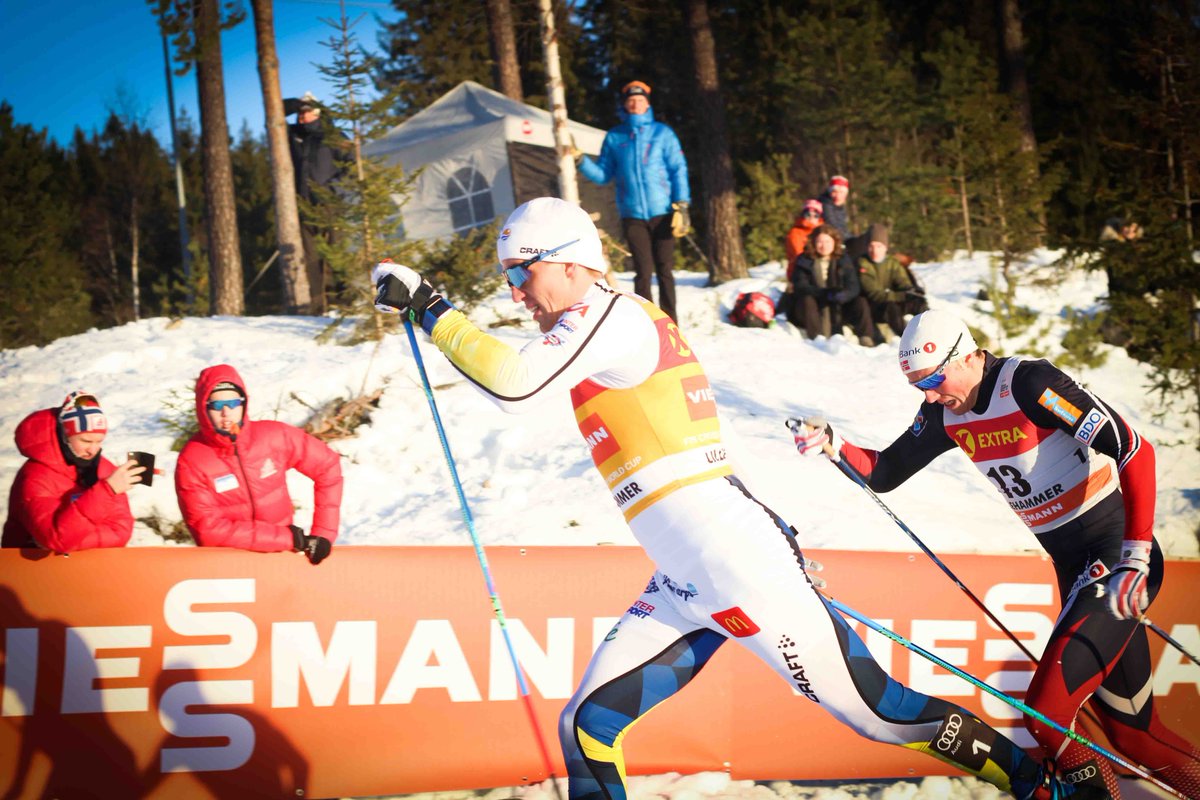
Norway’s Johannes Høsflot Klæbo (yellow bib) crossing first in the men’s 1.6-kilometer classic sprint final on Saturday in Otepää, Estonia. (Photo: Fischer/Nordic Focus)
Bolshunov crossed second (+1.51) for his seventh World Cup podium of the season.
In a lunge to the line, Golberg claimed third (+2.53) over Brandsdal in fourth (+2.57). Stenshagen crossed fifth (+7.69) and Valnes sixth (+11.99).
Rounding out the top ten was Norwegian Sindre Bjørnestad Skar in seventh, Sweden’s Viktor Thorn in eighth, Norway’s Sondre Turvoll Fossli in ninth and Italy’s Federico Pellegrino in tenth.
The U.S. had two men qualify, with Erik Bjornsen qualifying in 23rd (+8.20) and Andy Newell 26th (+8.75). Newell went on to race the first quarterfinal with Klæbo. Avoiding a crash from Russia’s Andrey Sobakarev in the herringbone hill, Newell crossed the quarterfinal in third to end the day in 15th overall.
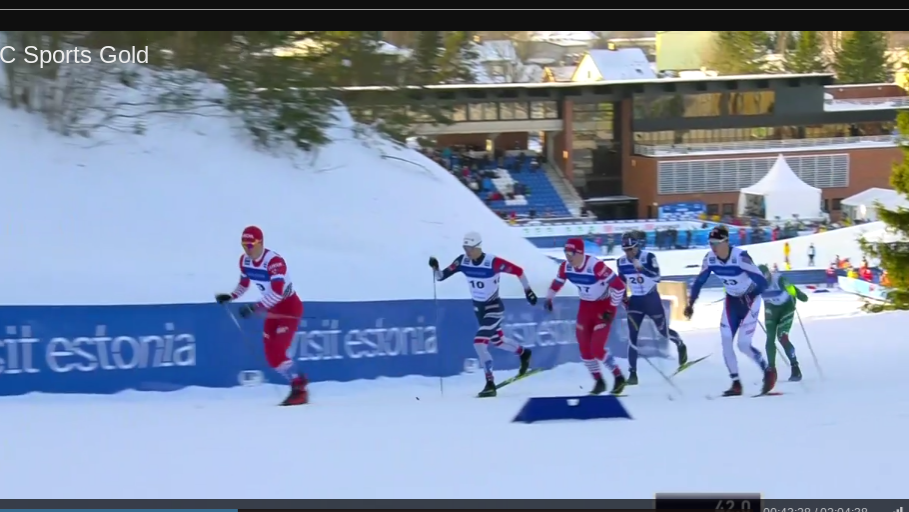
American Erik Bjornsen (bib 23) racing the first quarterfinal of the the men’s 1.6-kilometer classic sprint final on Saturday in Otepää, Estonia. (Photo: NBC Gold screenshot)
Bjornsen, who was slotted into the second quarterfinal, jockeyed for position throughout his heat, taking aggressive lines during the course’s sweeping S-turns to move from fifth to third. He dropped back once again in the herringbone hill and crossed his heat in fifth for 24th overall.
“I was happy to qualify well today,” Bjornsen wrote in an email. “This season hasn’t gone as well as I hoped but I think I can turn things around before world champs. Today was a step in the right direction. Positioning was quite important in the second half of the course. Unfortunately I wasn’t where I needed to be before the steep climb.”
The U.S. Ski Team’s Kevin Bolger during his qualifier on Saturday in in Otepää, Estonia. (Photo: Fischer/Nordic Focus)
Also racing for the U.S., American Kevin Bolger finished in 41st (+13.13) and Ben Saxton in 44th (+14.16). Len Valjas racing for Canada finished in 43rd (+13.61) and Bob Thompson, also for Canada, placed 51st (+15.96).
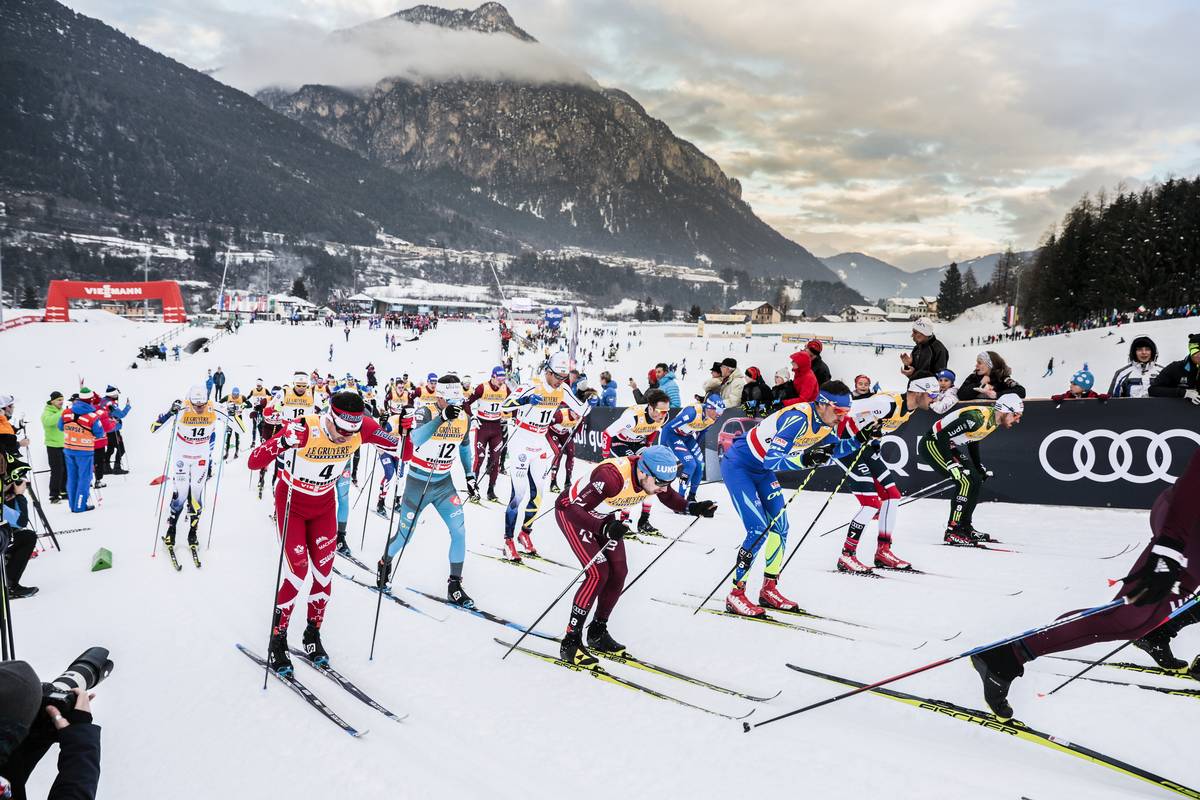
The start of the men’s 15 k classic mass start at Stage 6 of the 2018 Tour de Ski on Saturday in Val di Fiemme, Italy, with (front row, left to right) Canada’s Alex Harvey, Russia’s Sergey Ustiugov, Kazakhstan’s Alexey Poltoranin, Norway’s Martin Johnsrud Sundby, and Switzerland’s Dario Cologna. (Photo: Salomon/NordicFocus)
Beginning this Saturday in Toblach, Italy with a freestyle sprint is the 13th edition of the Tour de Ski (TdS). According to the International Ski Federation (FIS), over the course of seven stages the men will race 80.918 kilometers, the women 60.67 k.
The TdS has become both a staple and a spectacle of the annual World Cup calendar. With a jam-packed series of races primacy is placed on both the ability to recover well and wither less as the TdS transpires.
Prognostication can be tricky in a long-form template like the TdS. So much can go astray during seven races not to mention the travel and dicey germ-avoidance.
Last season’s winner on the women’s side, Heidi Weng of Norway, sits 18th overall in the World Cup standings (14th in distance). She has four top-20’s in the four distance events she’s contested with her best result an eighth in Lillehammer’s 10 k skate. Although featuring two sprints in the first three stages, the TdS remains a distance skier’s paradise.
Weng has skied solidly on the World Cup, but she has yet to show the form that made her a TdS overall winner in 2017 and 2018. Norway has won the last five iterations of the TdS: Marit Bjørgen won once in 2014/2015, Therese Johaug twice (2013/2014, 2015/2016), and Weng the last two years.
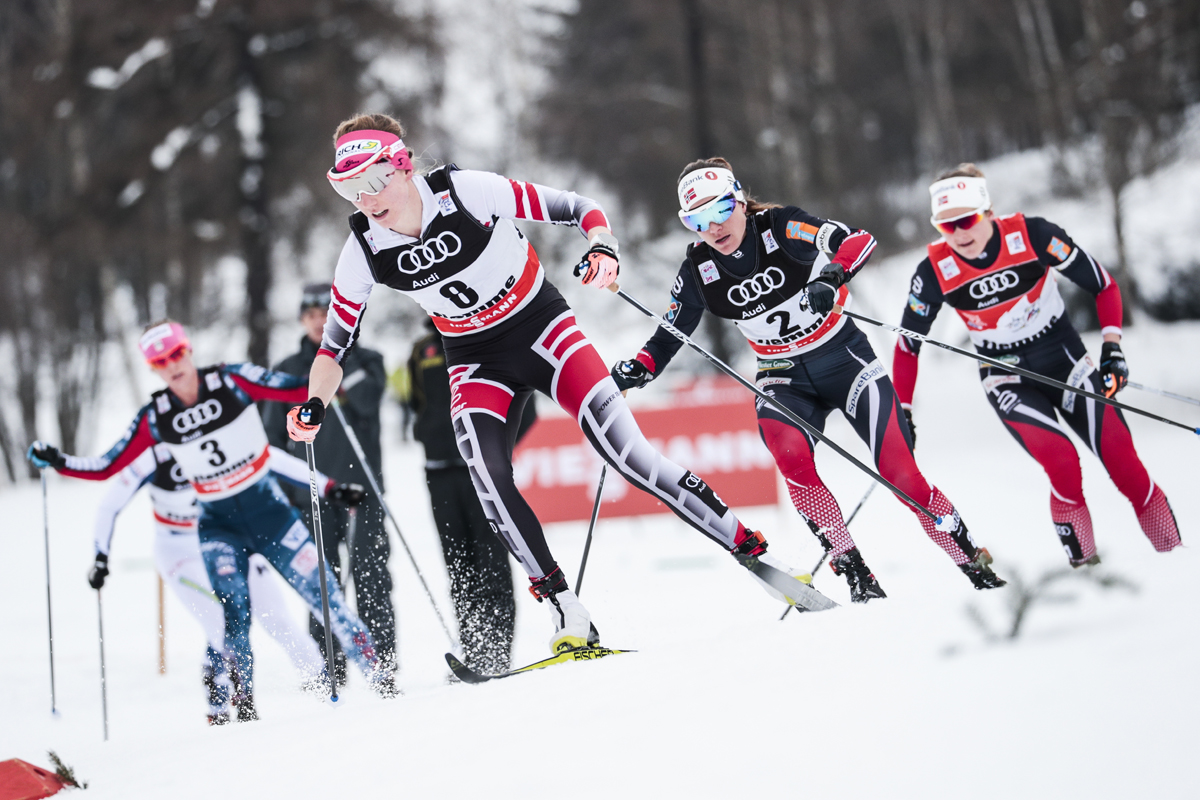
Austria’s Teresa Stadlober leads Norway’s Heidi Weng (2) and Ingvild Flugstad Østberg, American Jessie Diggins (3) and others around a downhill corner during the women’s 10 k classic mass start at Stage 6 of the 2018 Tour de Ski in Val di Fiemme, Italy. (Photo: Fischer/NordicFocus)
If Norway is to keep the streak alive, Ingvild Flugstad Østberg, last year’s TdS runner up, could be the heir apparent. She currently ranks second in the World Cup overall and 15th on the sprint list.
Johaug, having returned from an 18 month doping ban, has been on a distance race tear. She has won all five World Cup distance events this season. Johaug, however, will not be lining up for the TdS.
Only five different women have earned distance podiums this season — Johaug, Østberg, Sweden’s Charlotte Kalla and Ebba Andersson, and Finland’s Krista Pärmäkoski. Along with Johaug, Kalla and Andersson are skipping the TdS. (Andersson sits third overall on the World Cup, Kalla fifth.) With the TdS missing three of the five top ranked World Cup distance skiers, daily stages and the overall podium are up for grabs.
Last season’s third overall finisher, Jessie Diggins of the U.S. Ski Team (USST), often cites the TdS as a point in the season when her form trends towards podium performances. She sits eighth in the current distance standings and could very well have a stout TdS.
Russia’s Natalia Belorukova and Yulia Nepryaeva look strong as does Sadie Bjornsen (USST), and Austria’s Teresa Stadlober.
With less than predictable distance stage podiums for the women, it may simply come down to a drag race on the Alpe Cermis final climb Jan. 6.
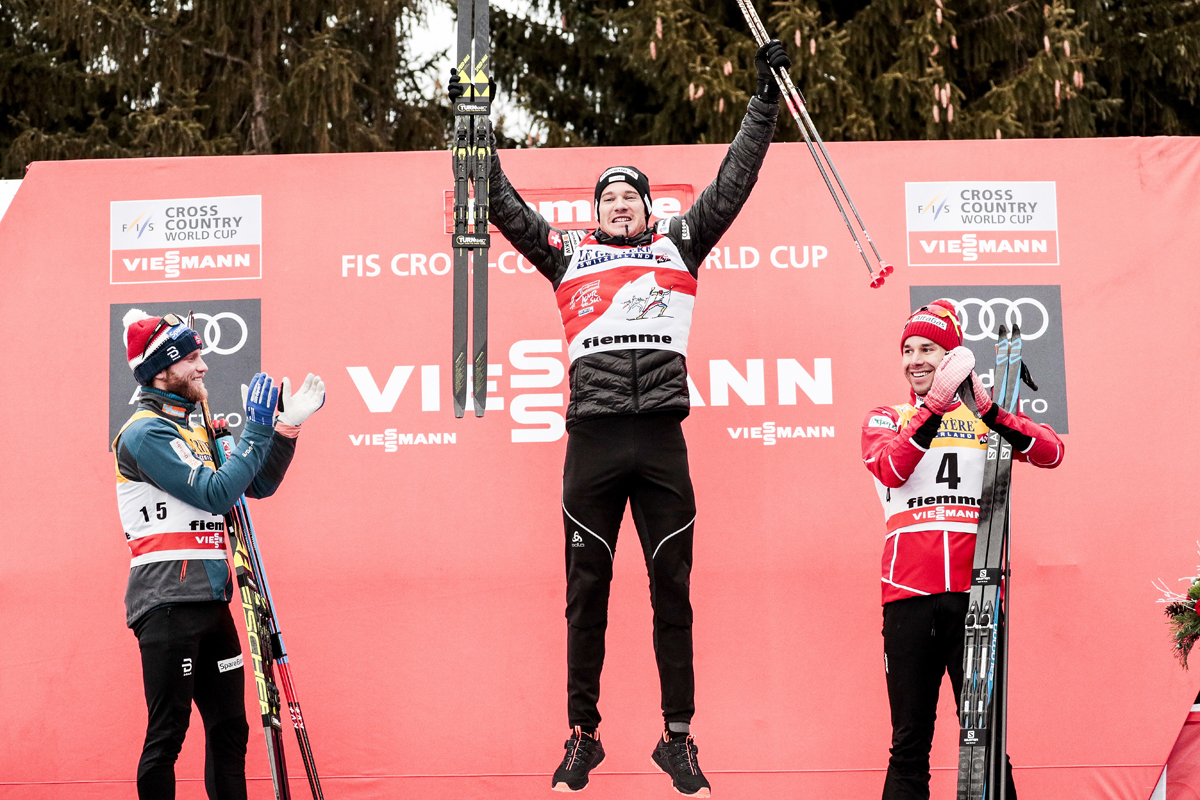
Switzerland’s Dario Cologna (c) celebrates his fourth Tour de Ski overall title. He was joined by Norway’s Martin Johnsrud Sundby (l) and Canada’s Alex Harvey (r) on the podium in second and third, respectively. (Photo: Fischer/NordicFocus)
The men’s scene is also open to interpretation. Last season’s TdS winner, Switzerland’s Dario Cologna, was in fact a surprise victor. Prior to Cologna’s stage two win in last year’s TdS, it had been nearly three years since the four time TdS overall winner had won a World Cup. Cologna sits 21st overall on the World Cup currently. Given last year’s resurgence, anything is possible for the Swiss skier.
Then there’s Martin Johnsrud Sundby form Norway. He finished on the TdS podium the last three years. At thirty-four-years-old, Sundby is ranked first on the distance list, with a second, a third, and a fourth place in distance races this season.
Sundby won the TdS on two occasions – in 2013/2014 and in 2016. His 2015 win was stripped after he tested positive for excessive levels of Salbutamol. He placed second in the past two Tours.
In a field rife with talent, Sundby’s ability to race and rebound and race and rebound will be tested. Sjur Røthe, Emil Iversen, and Didrik Tønseth— all from Norway— look in form. And there’s Norway’s Johannes Høsflot Klæbo. The winner of last season’s overall World Cup has had flashes of his past explosive self. He could be a TdS protagonist.
The men’s field is notably tight. Along with the Norwegians, several Russians could pop a podium, a stage win, and the overall. Russia comes with a loaded team ready to exploit. Alexander Bolshunov leads the overall World Cup – he’ll turn twenty two on Dec. 31st. He’s backed by teammates Evgeniy Belov, Andrey Melnichenko, and Denis Spitsov.
Canada’s Alex Harvey placed third overall last year and he looked stronger as the TdS progressed.
The Stages
Stage 1: Dec. 29, skate sprint in Toblach, Italy.
Stage 2: Dec. 30, 10 k/15 k skate in Toblach, Italy.
Stage 3: Jan. 1, skate sprint in Val Müstair, Switzerland.
Stage 4: Jan. 2, 10 k/15 k classic mass start in Oberstdorf, Germany.
Stage 5: Jan. 3, 10 k/15 k skate pursuit in Oberstdorf, Germany.
Stage 6: Jan. 5th, 10 k/15 k classic mass start in Val di Fiemme, Italy.
Stage 7: Jan 6th, 9 k final climb skate pursuit in Val di Fiemme, Italy.
Teams
United States
Women: Sophie Caldwell, Sadie Bjornsen, Jessie Diggins.
Men: Ben Lustgarten, Simi Hamilton, Erik Bjornsen, Kevin Bolger.
U.S. Ski Team Head Coach Chris Grover noted in a text that Caldwell, Hamilton, and Bolger will likely cease the TdS after the stage three sprint. Additionally, this is a small team for the U.S. at the TdS. Several athletes turned down TdS nominations including Scott Patterson (USST), Andy Newell (SMS T2/Salomon), Kyle Bratrud (SMS T2), Rosie Brennan (APU), Rosie Frankowski (APU), Caitlin Patterson (CGRP), and Julia Kern (SMS T2). These skiers plan on racing U.S. Nationals this January in Craftsbury, Vermont.
Canada
Women: Emily Nishikawa, Dahria Beatty
Men: Alex Harvey, Lenny Valjas, Bob Thompson
Norway
Women: Ingvild Flugstad Østberg, Maiken Caspersen Falla, Astrid Uhrenholdt Jacobsen, Kari Øyre Slind, Kathrine Rolsted Harsem, Heidi Weng, Lotta Udnes Weng, Tiril Udnes Weng Mari Eide, Anna Svendsen
Men: Martin Johnsrud Sundby, Hans Christer Holund, Emil Iversen, Didrik Tønseth, Simen Hegstad, Krüger, Sjur Røthe, Johannes Høsflot Klæbo, Martin Løwstrøm Nyenget, Eirik Brandsdal, Finn Hågen Krogh
Russia
Women: Yulia Belorukova, Lidia Durkina, Anna Zherebyateva, Mariya Istomina, Natalia Nepryaeva, Anna Nechaevskaya, Anastasia Sedova, Elena Soboleva
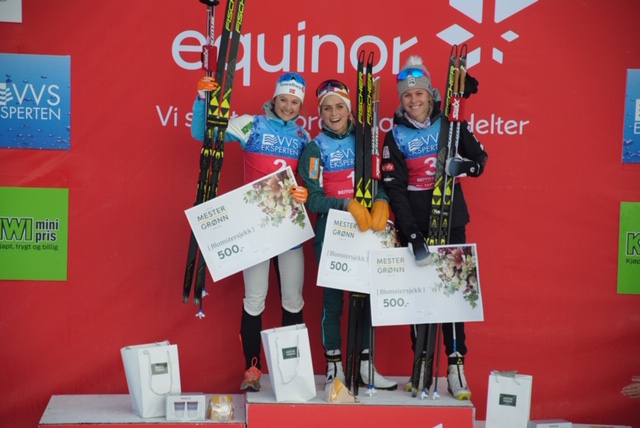
The women’s 10-kilometer podium at Sunday’s FIS cross-country in Beitostølen, Norway. L to R: Norway’s Ingvild Flugstad Østberg, Therese Johaug and American Sadie Bjornsen. (Photo: Aleks Tangen)
Welcome to The Rundown, your quick primer of need-to-know information about the day’s racing. We’ll be updating this digest as the day goes on with additional results, photos and quotes. The Rundown is NOT a race report; stay tuned for complete race reports later today with interviews from the day’s top racers.
***
FIS cross-country Beitostølen, Norway: 10 k/15 k freestyle
The FIS Beitostølen cross-country races came to a close on Sunday November, 18 with a men’s 15-kilometer freestyle race and a women’s 10 k skate.
Norwegian Sjur Røthe won the men’s 15 k, covering the course in a time of 33:45.7. Røthe’s Norwegianteammate Simen Hegstad Krüger, finished 11.1 seconds back in second place.
Taking third place on Sunday was another Norwegian, Martin Johnsrud Sundby. Sundby finished seven tenths of a second behind Krüger and 11.8 seconds back from Røthe.
Andrew Musgrave of Great Britain placed seventh on Sunday (+1:07.8) while his teammate, Andrew Young placed 11th (+1:11.8).
American and U.S. Ski Team (USST) member, Scott Patterson, placed 22nd (+1:45.2) just ahead of Canadian Russell Kennedy, who finished in 24th (+1:53.2). Canadians Maks Zechel and Brian McKeever placed 85th (+4:07.5) and 91st, respectively.
On the women’s side, Norway’sTherese Johaug won the 10 k event in a time of 24:21.5. Another Norwegian,Ingvild Flugstad Østberg, finished 26 seconds behind Johaug for second place. The USST’s Sadie Bjornsen placed third (+1:45.9).
Bjornsen was the only North American woman to enter the Beitostølen 10 k on Sunday.
FIS cross-country Bruksvallarna, Sweden: 1.4 k freestyle sprints
In Bruksvallarna, Sweden races convened for a men’s and women’s 1.4-kilometer freestyle sprint. Winning the women’s qualifier in a time of 2:55.84, was swedish skier, Hanna Falk. Falk went on the win the final event, finishing ahead of her Swedish teammates Maja Dahlqvist and Stina Nilsson in second and third respectively.
No North American women competed in the Bruksvallarna 1.4 k freestyle sprints on Sunday.
In the men’s 1.4 k sprint in Bruksvallarna, Victor Thorn of Sweden won the qualifier in a time of 2:53.19. The final, however, went to Sweden’s Teodor Peterson. Behind Peterson in the final for second place was Sweden’s Karl-Johan Westberg followed up by Thorn in third.
Norway’s Johannes Høsflot Klæbo calm and cool as he crosses the line for another sprint win. This time, he won the 1.4 k skate sprint in Falun, Sweden, the last sprint of the World Cup season. (Photo: Svenska Skidspelen/Instagram)
At 21 years old, Johannes Høsflot Klæbo of Norway had already locked up his second-consecutive Sprint World Cup Crystal Globe several weeks ago. A down-to-the-wire, season-ending finale for the sprint globe was out of the question. Klæbo has simply been that good. Out of 11 sprint races this season, Klæbo won the seven out of the nine sprints he contested. He placed second and third, respectively, in the other two. One word to describe it all: dominant.
Russia’s Alexander Bolshunov won Friday’s qualifier in 2:36.23. Klæbo placed second (+0.46). Clearly, the Norwegian’s form was still on after steamrolling since the opening World Cup weekend in Kuusamo, Finland, on Nov. 24.
Beyond settling for second in Friday’s qualifier, Klæbo won the first quarterfinal, the first semifinal and the final. In the final, as he faced off with Italy’s Federico Pellegrino, Sweden’s Oskar Svensson and Teodor Peterson, France’s Lucas Chanavat, and Finland’s Ristomatti Hakola, Klæbo’s tactics would initially appear timeworn but effective.
Here’s how the Norwegian’s earlier tactics played out and eventually caught the spellbound finalists off guard. In Klæbo’s quarterfinal, also featuring Pellegrino, the pack of six skiers kept tight until the course’s final V1 climb. At 1:40 into the race, American Simi Hamilton, who had qualified in 13th (+4.1), came around the pack, pushed over the top and led out the string of skiers. Klæbo sat in fifth place. At 2:02 minutes, Klæbo and the group closed on Hamilton. Pellegrino led around the top of the final corner heading into the finish straight, then it was Hamilton followed by Klæbo. Stepping around the corner, and gliding out, Pellegrino and Klæbo unleashed a fifth-gear free skate and separated themselves from Hamilton. Klæbo and Pellegrino finished first and second, respectively, and Hamilton third. That put Hamilton 14th overall on the day as his time was not fast enough to move on as a lucky loser.
Simi Hamilton (U.S. Ski Team) racing to 13th in the men’s freestyle sprint qualifier at 2018 World Cup Finals in Falun, Sweden. He went on to finish the day in 14th overall. (Photo: Fischer/NordicFocus)
“With Simi, we took an aggressive approach today,” U.S. Ski Team coach Matt Whitcomb told FasterSkier in person after. “We threw him in with Klæbo and Pellegrino in the quarters and thought that he could potentially beat one of those guys and advance, or potentially be a lucky loser.
“He just got too tactical over the top of the last hill, so the lucky losers came from heats down the road,” Whitcomb continued. “And, Simi, unfortunately, ended up going over the hill in first and almost was able to hold it off. It was really impressive that he was able to hang onto third, but not enough for today. When he gets tactical, it tends to not be your lucky loser heat.”
On to the semis. In the first semifinal, Klæbo again allowed others, primarily Bolshunov, to do the pacing work. Bolshunov shot off the start like a starved thoroughbred chasing its first meal. Knowing Klæbo can close, the Russian hammered with a high-turnover tempo no other skiers could match. Bolshunov couldn’t pull away, but he could control for much of the semifinal.
As much as Klæbo can hide, he stalked in the back. Again, on the small hill before the finish, while Bolshunov faded, the Norwegian went. Right on cue Klæbo nailed his finish, outdueling second-place skier Peterson (+0.21), third-place Pellegrino (+0.32), and Ristomatti in fourth (+0.59). Bolshunov finished fifth (+3.10).
Coming into the final, Pellegrino, Hakola, and Peterson had already been schooled in Klæbo’s Falun-sprint scheme during the semi. After watching Bolshunov burn up taking a flyer off the front, that race strategy seemed unwise. But allowing Klæbo to draft in the pack had also proved futile.
Study Klæbo all you want. There’s still much to learn.
Up and over the first indecisive climb during the final, Klæbo paced behind Sweden’s Svensson. Stepping around a corner and into the course’s second hill, only 48 seconds into the race, Klæbo sent it: hop-skate style.
Klæbo’s burst of speed scorched the skiers behind. Initially, the others were caught off guard and failing in their response. Cresting the course’s third hill, Klæbo kept up the furious pace. One minute and 50 seconds in, Klæbo had nearly a thirty-meter gap over a chasing Chanavat.
The win was never in doubt at this point. It was as if Klæbo wanted to include a new chapter in his young career’s book of dominance. On Friday, Klæbo proved he could win a sprint by accelerating with nearly a kilometer to go. There was no fade. There was no catching up from behind. (Klæbo did pull up before the line to celebrate as Pellegrino came flying toward the finish.)
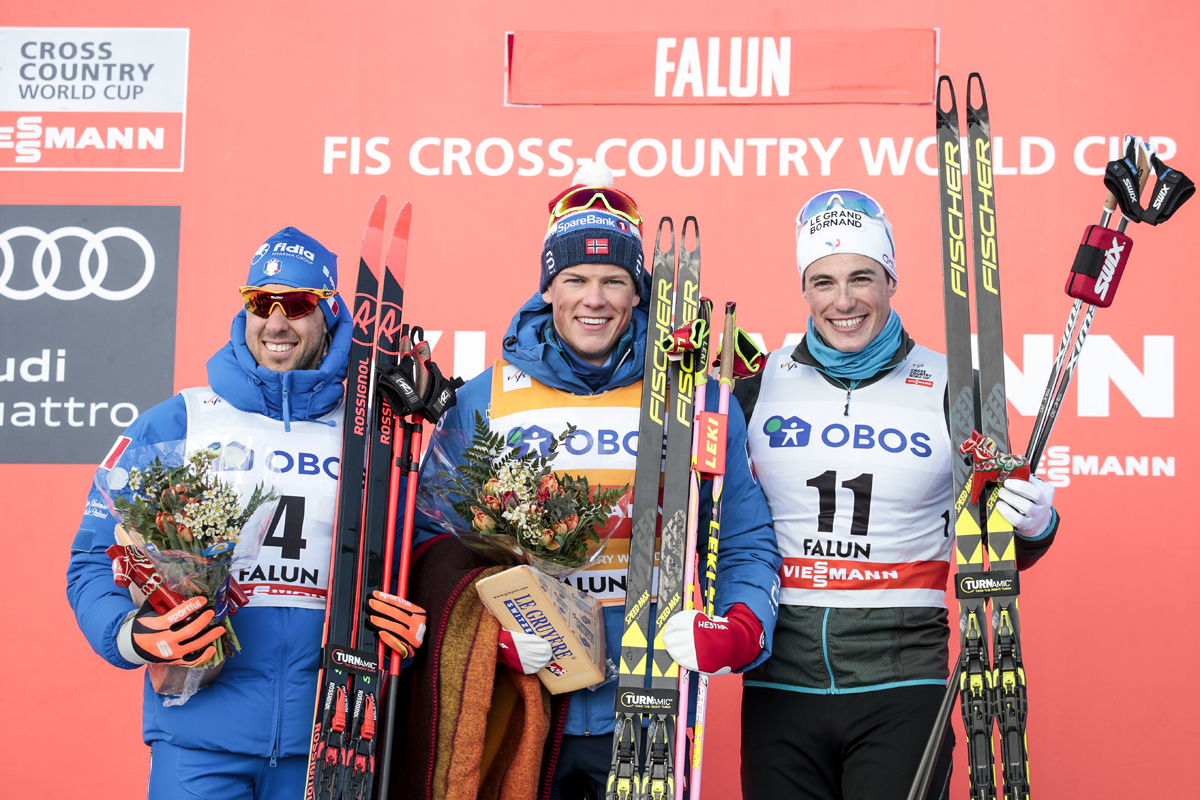
The men’s freestyle sprint podium at 2018 World Cup Finals in Falun, Sweden, with Norway’s Johannes Høsflot Klæbo (c) in first, Italy’s Federico Pellegrino (l) in second and France’s Lucas Chanavat (r) in third. (Photo: Fischer/NordicFocus)
Klæbo won the final in 2:37.03 minutes. Pellegrino was second (+0.39), Chanavat third (+1.76), Ristomatti fourth (+3.26), Svensson fifth (+3.88), Peterson sixth (+6.17). Klæbo earned 50 World Cup points for the win. Heading into the two final World Cup races of the season, a 15 k classic mass start on Saturday and a 15 k skate pursuit Sunday, Klæbo leads the Overall World Cup standings by 272 points over fellow Norwegian Martin Johnsrud Sundby. The winner of the entire weekend will get 200 World Cup points, so it’s safe to say Klæbo has that overall Crystal Globe locked up as well.
“I learned after Lahti that I needed to be away from Pellegrino if there was a long downhill with a fast finish so I attacked on the first climb today in the finals to make sure that I was far enough ahead before the finish,” Klæbo told the International Ski Federation (FIS) after the race. “It’s just been an incredible season with my second sprint globe and the Olympics. But I am focused on also taking home the overall crystal globe and will fight the next two days to make sure I get it.”
Bolger Reaches Quarterfinals
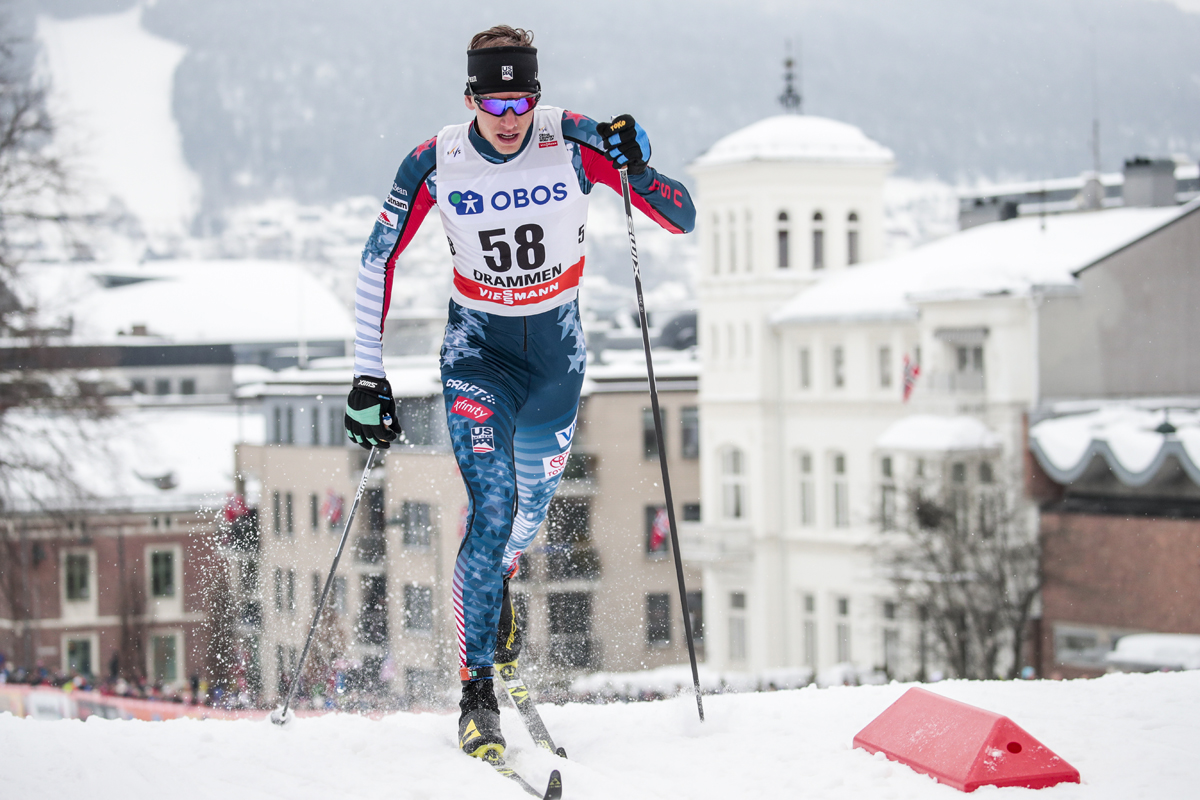
Kevin Bolger (Sun Valley Ski Education Foundation) racing to 50th in the men’s classic sprint qualifier at last week’s World Cup in Drammen, Norway. (Photo: Fischer/NordicFocus)
Along with Hamilton, Kevin Bolger was the only other North American to move onto the heats. In his third-career World Cup sprint, the Sun Valley based skier qualified in 29th and placed 30th overall after finishing sixth in his quarterfinal, 2.21 seconds behind Peterson in first.
In his World Cup debut two weeks ago, Bolger previously placed 11th overall in Lahti’s skate sprint. He went on to finish 50th in Drammen’s classic sprint. Bolger also skied to 52nd in last weekend’s Holmenkollen 50 k skate race.
“Qualifying, I was super excited,” Bolger, 24, told FasterSkier in Falun. “Obviously, it’s super early in these World Cups for me, so just qualifying is insane. Super fired up when that happened and just tried to kind of repeat what I did in Lahti, and didn’t work out, but I felt a little bit tired, maybe shaken out by the 50 k a little bit still, from Holmenkollen.”
Bolger is a recent graduate of the University of Utah and is in his first season as a professional skier. He skis with the Sun Valley Ski Education Foundation in Utah.
“I just came to Sun Valley this year so my coach Chris Mallory changed my tactics coming into sprints,” Bolger said about his early season work on qualifying. “I definitely, mentally and physically, been doing a lot of things differently. And just kind of going in with these World Cups, it’s a lot of pressure to do well. But at the same time, there are no expectations, really, so you just gotta go in with an open mind and hopefully, you don’t want to expect too much. So you just go in and do what you can.”
Whitcomb seemed as stoked as Bolger at his early World Cup success.
“Thrilling to see Bolger qualify in his second skate sprint,” Whitcomb said. “Being two-for-two in skate sprinting this year, in just a short tour with us and so fun to watch his excitement as a rookie, getting in there and mixing it up. I think it’s a unique course and it’s also the end of the long season for him as well, and just didn’t quite have the gear over the last hill, is what it looked like. But he by no means is getting blown out and it’s really exciting for the future.”
Also for the U.S., Erik Bjornsen missed qualifying by five-hundredths of a second in 31st, Andy Newell placed 43rd, Paddy Caldwell was 60th, David Norris 84th, and Scott Patterson 87th.
For Canada, Julien Locke placed 32nd, just 0.06 seconds out of qualifying, Alex Harvey was 34th, Devon Kershaw 74th, and Graeme Killick 81st.
Racing continues Saturday at World Cup Finals with a 15 k classic mass start for the men.
Sweden’s Hanna Falk (r) smiles as she wins the fourth World Cup race of her career and first race in Falun, Sweden, with a victory in the women’s freestyle sprint at 2018 World Cup Finals on Friday. Her teammate Jonna Sundling (l) placed second while Norway’s Marit Bjørgen finished third. (Photo: Svenska Skidspelen/Instagram)
FIS Cross Country World Cup Finals (Falun, Sweden): Freestyle sprints
In the last sprint of the season and the first race of the three-day World Cup Finals in Falun, Sweden’s Hanna Falk and Norway’s Johannes Høsflot Klæbo won their respective 1.4-kilometer freestyle sprint finals, while Norway’s Maiken Caspersen Falla and Klæbo claimed the season-long Sprint Crystal Globes and Sophie Caldwell of the U.S. placed third in the Sprint World Cup.
Falk started Friday by topping the women’s qualifier on home turf in 2:59.88 minutes, 1.65 seconds ahead of American Jessie Diggins, who qualifiedin second. Russia’s Natalia Nepryaeva qualified third (+2.73), while American Sadie Bjornsen raced to the fourth-fastest qualifying time (+2.96), ahead of Norway’s Marit Bjørgen in fifth (+3.72).
Falk then won the first quarterfinal and first semifinal before taking control and dusting the field in the women’s final. She essentially led the final from start to finish, but slowed her pace and the five women behind her as she ascended the last climb. As she reached the 180-degree turn at the top, Falk launched into high gear, leaving the rest of the field chasing. Bjørgen was closest to her in second, but still several meters back, as they descended down into the stadium, and Falk skated away from her pursuers for her fourth-career World Cup win (and first victory in Falun) in 3:08.25. Sweden’s 23-year-old Jonna Sundling came on strong in the finishing straight for her first World Cup podium in second (+0.53), Bjørgen took third, and Sweden had three in the top four with Anna Dyvik in fourth (+1.72).
Norway’s Silje Øyre Slind finished fifth (+4.3), andCaldwell, who had qualified for the heats in 16th then won her quarterfinal and advanced in third in the second semifinal, placed sixth overall (+6.99).
Four American women posted top-20 qualifying times, with Kikkan Randall advancing as well in 18th. Diggins placed seventh overall after finishing third in the first semifinal, 0.42 seconds behind Falk in first and just 0.08 seconds behind Sundling, who advanced to the final in second.
Bjornsen was ninth on the day after placing fifth in that semifinal, 0.85 seconds out of first. Randall finished 15th overall after placing third in her quarterfinal, 3.14 seconds behind Diggins, who won that heat.
Also for the U.S, Ida Sargent missed the top 30 needed to qualify in 36th, as did Rosie Brennan in 49th, Caitlin Patterson in 63rd, Liz Stephen in 66th, Kaitlynn Miller in 69th, and Rosie Frankowski in 75th.
Canada’s Emily Nishikawa placed 40th, Dahria Beatty was 48th, Cendrine Browne 60th, and Zina Kocher 71st.
Norway’s Johannes Høsflot Klæbo (yellow bib) celebrates his 11th World Cup victory of the season in the men’s freestyle sprint at 2018 World Cup Finals in Falun, Sweden, ahead of Italy’s Federico Pellegrino (l) in second and France’s Lucas Chanavat (11) in third. (Photo: Svenska Skidspelen/Instagram)
In the men’s race, Russia’s Alexander Bolshunov qualified first in 2:36.23, 0.46 seconds ahead of Klæbo in second. Klæbo then won the first quarterfinal, first semifinal, and you guessed it, the final as well, backing off before crossing the finish line for the last time in 2:37.03.
Italy’s Federico Pellegrino powered past France’s Lucas Chanavat in the finishing stretch of the final to claim second, 0.39 seconds behind Klæbo. Chanavat completed the podium in third (+1.76), Finland’s Ristomatti Hakola finished fourth (+3.26), and Sweden’s Oskar Svensson and Teodor Peterson placed fifth (+3.88) and sixth (+6.17), respectively.
Two American men qualified for the heats, with Simi Hamilton advancing in 13th and Kevin Bolger in 29th. Hamilton went on to place 14th on the day after finishing third in the first quarterfinal, 0.61 seconds behind Klæbo. In his second-career World Cup sprint, Bolger placed 30th overall after finishing sixth in his quarterfinal, 2.21 seconds behind Peterson in first.
In the overall Sprint World Cup, Klæbo took his second-straight title by a whopping 243 points over Pellegrino in second, while Falla won her third-straight Sprint Crystal Globe by 78 points over Sweden’s Stina Nilsson, who was out sick for Friday’s race. Nilsson joined her at the Sprint World Cup podium ceremony on Friday, as did Caldwell, who achieved her best overall sprint standing in third.
Falla placed eighth overall on the day after being eliminated in the semifinals (she finished fourth behind Falk, Sundling and Diggins, respectively).
For the U.S., Erik Bjornsen narrowly missed qualifying in 31st, Andy Newell placed 43rd, Paddy Caldwell was 60th, David Norris 84th, and Scott Patterson 87th.
For Canada, Julien Locke placed 32nd, Alex Harvey 34th, Devon Kershaw 74th, and Graeme Killick 81st.
Sweden’s Stina Nilsson (center) won gold in the classic sprint at the 2018 Olympics, with Norway’s Maiken Caspersen Falla (left) taking silver and Russia’s Yulia Belorukova bronze. (Photo: FlyingPointRoad)
After winning the sprint qualifier by 0.39 seconds over defending gold medalist Maiken Caspersen Falla and then besting the Norwegian by 0.03 seconds in her semifinal, Sweden’s Stina Nilsson captured Olympic gold in a dominating performance in the classic sprint final, ultimately besting Falla by 3.03 seconds.
Falla had to fight to even keep silver, as Olympic Athlete of Russia Yulia Belorukova pushed the pace on the final uphill and came close to outsprinting Falla in the finishing straight. However, the 23-year-old Russian couldn’t quite sneak past and settled for bronze, 0.34 seconds behind Falla.
Jessie Diggins of the United States after finishing sixth in the classic sprint in PyeongChang. (Photo: FlyingPointRoad)
Her teammate Natalia Nepryaeva finished fourth (+9.14 in the final), Sweden’s Hanna Falk fifth (+11.16), and the United States’ Jessie Diggins sixth (+11.23).
Diggins’s teammate Sophie Caldwell finished unlucky number eight, and based on time was the last woman not to make the final after finishing a close fourth behind Nilsson, Falla, and Falk in her semifinal. Both semifinal heats were fast, with one lucky loser coming from each, and Caldwell was 0.18 seconds off that time.
Also for the United States, Sadie Bjornsen finished third in her quarterfinal heat, 2.46 seconds behind Belorukova and also behind Norway’s Heidi Weng. That put her 14th on the day.
In the men’s final, it was a fight to the final uphill when 21-year-old Norwegian phenom Johannes Høsflot Klæbo ran away from the field over the top of the climb and sailed to the finish to become the youngest ever gold medalist in cross-country skiing at the Olympics. Alexander Bolshunov of Russia had matched Klæbo for most of the race but ran out of steam at the top, allowing Italy’s Federico Pellegrino to catch onto his tails before the downhill. While Klæbo widened his lead, Bolshunov and Pellegrino battled to the finish line and Pellegrino ultimately won in a photo finish, securing silver (+1.34) while Bolshunov took bronze (+1.36).
Johannes Høsflot Klæbo won the men’s Olympic sprint in dominating fashion while Federico Pellegrino just edged Alexander Bolshunov for silver. (Photo: FlyingPointRoad)
Norway’s Pål Golberg finished fourth (+3.81 in the final) and Sweden’s Oskar Svensson fifth (+7.73). Top qualifier Ristomatti Hakola of Finland didn’t have it in the final, finishing sixth (+20.72).
Canada’s Len Valjas finished third in his semifinal, but well off the pace (3.98 seconds behind Hakola) and did not advance as a lucky loser to the final. That put him seventh overall, Canada’s best result in two Olympic cycles.
Both American men, Erik Bjornsen and Simi Hamilton, were eliminated in the quarterfinals. Hamilton’s quarterfinal was marred by a crash involving nearly the entire group, and he ended up fourth with a slow time as a result, and landed 20th on the day. Bjornsen finished fifth in his heat, 1.63 seconds behind Klæbo in one of the tightest quarterfinals of the day, good for 25th overall.
Norway has now won both men’s gold medals in cross-country skiing, while Sweden has swept the women’s gold medals.
Sprint racing at the PyeongChang Olympics kicked off on Tuesday, with Sweden’s Stina Nilsson setting the pace in the women’s qualifier just 0.39 seconds ahead of defending Olympic champion Maiken Caspersen Falla of Norway.
The rest of the field couldn’t touch those two. Krista Parmakoski of Finland, the bronze medalist in the 30 k skiathlon, came closest, notching a time 3.56 seconds slower. Sweden’s Hanna Falk qualified fourth (+3.80), Slovenia’s KatjaVisnar fifth (+6.50), Olympic Athlete of Russia Natalia Nepryaeva sixth (+6.91), American Jessie Diggins seventh (+7.02), Sweden’s Ida Ingemarsdotter eighth (+7.32), American Sadie Bjornsen ninth (+7.38), and Norway’s Heidi Weng tenth (+7.54).
For the United States, Sophie Caldwell also qualified for the quarterfinals in 12th position (+8.32). Ida Sargent, who recently had surgery on her thumb, did not, notching the 33rd-best time of the day – 17.06 seconds off the pace and 1.78 seconds out of the heats.
For Canada, Emily Nishikawa led the team in 34th, 2.73 seconds out of quarterfinals. Dahria Beatty finished 42nd (+21.03) and Cendrine Browne 51st (+25.56).
CU student Petra Hyncicova of the Czech Republic finished 45th (+23.29). APU’s Jessica Yeaton, racing for Australia, finished 48th (+24.27), and Aussie teammate Casey Wright (University of Alaska Anchorage) 63rd (+41.06). Canada-based Mathilde Petitjean of Togo finished 59th (+37.19).
In the men’s sprint qualifier, Ristomatti Hakola of Finland turned heads by posting a time that last year’s Sprint Cup champion Johannes Høsflot Klæbo of Norway could not beat. The Norwegian posted a time 0.19 seconds slower than the Finn.
The men’s field was much closer than the women’s, with just 9.51 seconds separating the top 30 finishers who would move on to the quarterfinals. The third qualifier was young Olympic Athlete of Russia AlexanderBolshunov (+1.66), with Italy’s MaicolRastelli a surprise fourth-place finisher (+2.78). Sweden’s Teodor Peterson qualified fifth (+3.01), Olympic Athlete of Russia Alexander Panzhinsky sixth (+3.09), Sweden’s OskarSvensson and Viktor Thorn seventh (+3.48) and eighth (+3.65), and Italy’s FedericoPellegrino ninth +4.64. Calle Halfvarsson notched the tenth-best time (+4.73) and gave Sweden four qualifiers in the top ten, while Klæbo was the lone Norwegian in the top ten.
For the United States, Simi Hamilton and Erik Bjornsen made the quarterfinals, qualifying in 19th (+7.59) and 29th (+9.15) respectively. Bjornsen actually tied for 29th with France’s Richard Jouve, making him the last man to make the cut, so to speak. Canada’s Len Valjas will be the lone representative of his country in either the men’s or women’s heats after qualifying 26th (+8.57).
Alex Harvey just missed the quarterfinals in a tie for 32nd (+9.41), with Canadian teammate Jesse Cockney close behind in 35th (+10.00). Russell Kennedy rounded out the Canadian team in 54th (+14.83).
For the U.S., Andy Newell was also on the outside looking in, placing 37th in the qualifier (+10.82). So was Logan Hanneman in 42nd (+12.20).
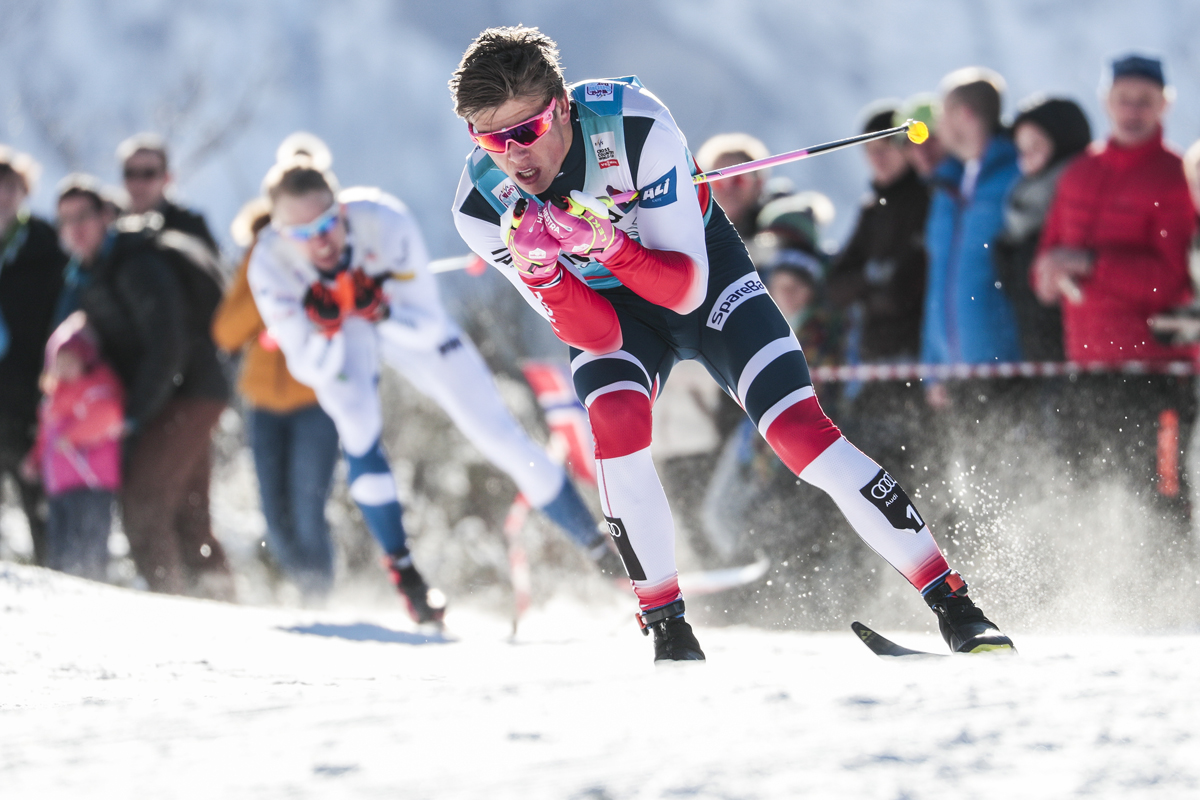
Norway’s Johannes Høsflot Klæbo en route to another World Cup win in the men’s classic sprint on Saturday in Planica, Slovenia. (Photo: Fischer/NordicFocus)
Sunny skies. Craggy Slovenian Alps. Fresh snow and firm classic tracks. The perfect backdrop for the coiffed hair and pink sunglasses. On Saturday in Planica, Slovenia, Norway’s Johannes Høsflot Klæbo again proved his form is on another level. Sometimes calm with tens of meters to spare, sometimes allowing others to draft momentarily on his ski tails, Klæbo won the World Cup men’s 1.6-kilometer classic sprint in 3:27.35 minutes.
In a final that featured three Norwegians, two Swedes and a Russian, Norway’s Emil Iversen placed second (+0.62) and Sweden’s Teodor Peterson third (+8.14). Yes, that’s a big gap to third place, and the gaps only bulged to the rest of the men in the final. Sweden’s Oskar Svensson finished fourth (+11.80), Norway’s Eirik Brandsdal fifth (+19.77), and Russia’s Gleb Retivykh sixth (+27.08).
Norway’s Johannes Høsflot Klæbo winning the men’s classic sprint final at the World Cup on Saturday in Planica, Slovenia, by 0.62 seconds over his teammate Emil Iversen. (Photo: Fischer/NordicFocus)
“I had a lot of fun out there today,” Klæbo said, according to an International Ski Federation (FIS) press release. “It was great to see so many people along the course and the stadium. I really liked the course with the long uphill sections.”
To say Klæbo is on a roll is an understatement. The 21 year old, in fact, seems to be skiing in total control and on a different level — his swing from top-end efforts to dialing it back for the “show” seems like a quid pro quo to keep competitors from discouragement. Not that another Klæbo win was ever in doubt, but great World Cups are sporting theater after all, and drama heightens the tension.
Klæbo was the first-place qualifier, rounding the 1.6 k course that featured two small climbs and a larger one lasting for nearly half a kilometer in 3:26.8 minutes. Dissecting some of Klæbo’s strategy from the qualification time splits, he skied the first 0.65 k of the course a full three full seconds faster than Sweden’s second-place qualifier, Calle Halfvarsson, who finished in 3:29.5. Klæbo then skied the next 1.59 k of course, which featured the major climb, with the second-fastest split. Halfvarsson skied that sector the fastest by only 0.3 seconds over Klæbo, who had the second-fastest split time on that section. The point is this: Klæbo won the qualifier in the first 0.65 k, and could then control his speed the remaining distance and still win the qualifier by 2.75 seconds.
Effortless? Not exactly. But at moments it appeared that way.
Klæbo skied in the first quarterfinal, which also featured American Andy Newell. Like in his qualifier, Klæbo torched his heat from the start. Off the front at around fifty seconds, Klæbo looked around and realized he’d broken away, then he appeared to literally let off the double-pole gas. Perhaps it was a small tease as Newell chased behind in second. On the long climb, Klæbo set tempo as the other places began to fall into order. On the descent, Klæbo streamed away as if on double secret wax. Twenty to thirty meters before the finish, he began taking his poles off. He won the heat by 1.55 seconds over Finland’s Iivo Niskanen in second place (+1.55). Germany’s Sebastian Eisenlauer followed in third (+2.34) and Newell fourth (+2.59) to miss advancing to the semifinals. Overall, Newell ended the day in 20th.
Klæbo’s semifinal again found him in total control. By the long climb, Klæbo was in his groove with teammate Iversen pegging his efforts to remain 5 then 10 meters back. But Iversen hung in, and by the final stretch, after Klæbo pulled up and chilled, Iversen took Klæbo at the line in what appeared to be a nonchalant gift.
(Article continues below)
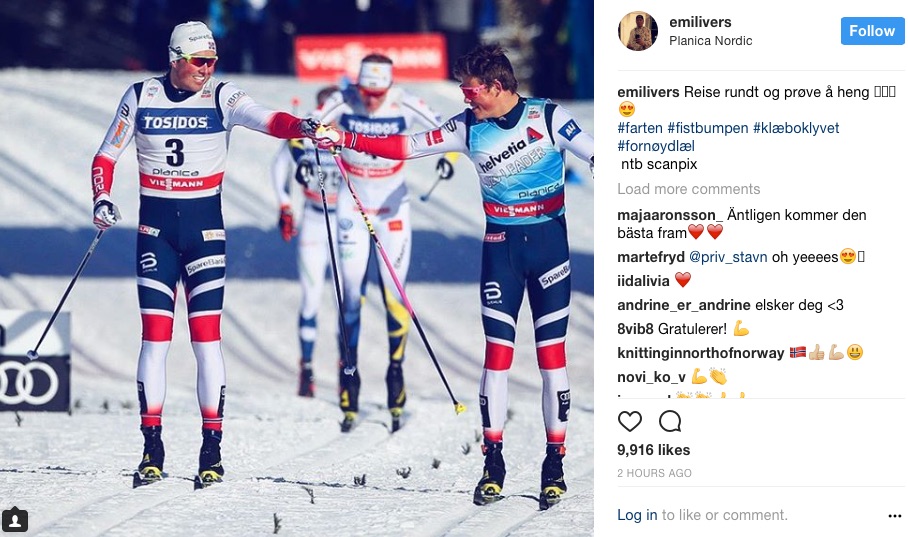
Norway’s Johannes Høsflot Klæbo (4) and teammate Emil Iversen knock knuckles as they cross the line in Planica, Slovenia, on Saturday in the men’s classic sprint. Klæbo won the race while Iversen placed second overall. (Photo: Emil Iversen/Instagram)
The final began with Klæbo storming into the major climb with such speed that for a moment he became unbalanced. But in an instant, Klæbo’s stride was back in form as he strung out Petersen, Iversen and Svensson. With a quick skate into another lane followed by a killer double pole, Klæbo was gone up and over the climb. Iversen also made his move late on the climb, but by then, Klæbo was away.
With a tidy bow across the line, it was curtains for Klæbo.
After Saturday’s sprint, Klæbo is positioned first in the World Cup overall standings, despite skipping the entire Tour de Ski. He’s started a total of 10 individual races and has won eight, including Saturday’s sprint. In the other two, he placed second in last weekend’s freestyle sprint in Dresden, Germany, and was 10th on Dec. 16 in a 15 k skate in Toblach, Italy. Klæbo has won all three classic sprints this season.
No real prognostication here, it is too early. Yet, Klæbo has won every classic sprint this season and the upcoming Olympic individual sprint next month in PyeongChang, South Korea, is classic technique.
Two U.S. Men in Top 20
For the U.S., Simi Hamilton qualified 16th and ended his day in 19th after finishing fourth in the fifth quarterfinal, 2.35 behind the winner, Pål Golberg of Norway.
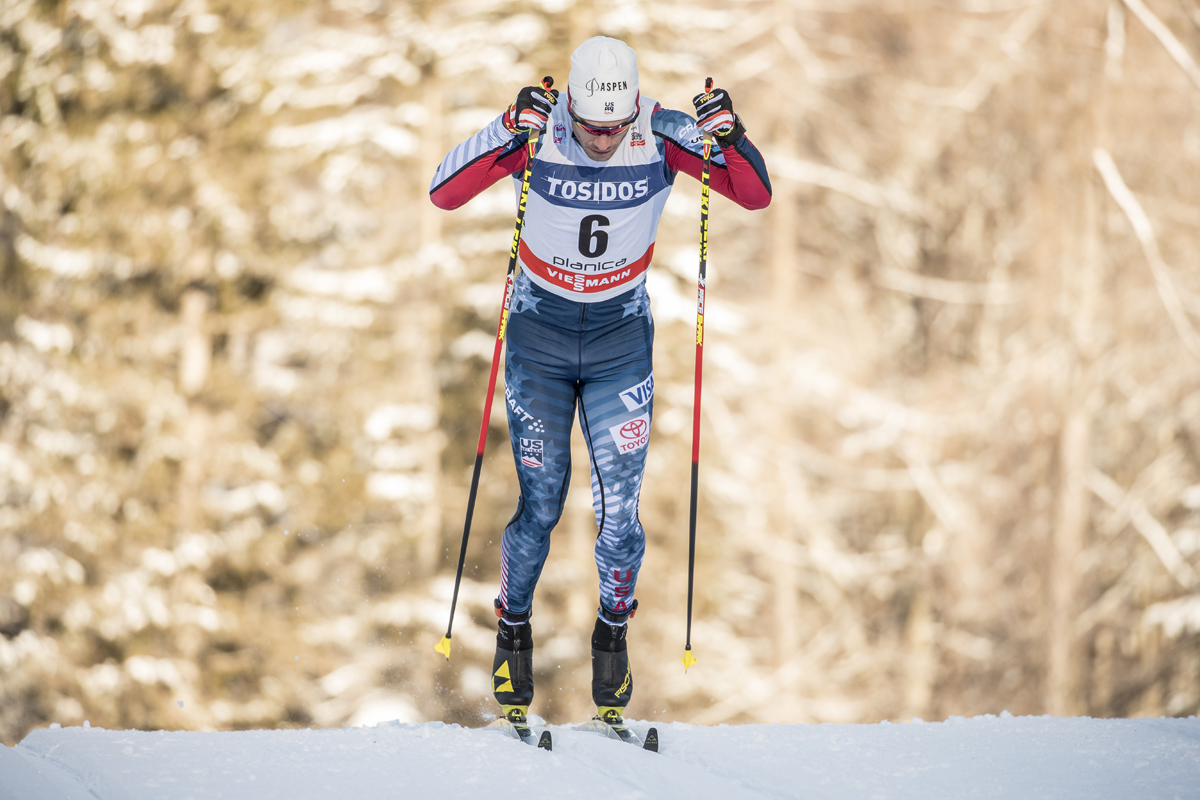
Simi Hamilton (U.S. Ski Team) racing to 16th in the men’s classic sprint qualifier on Saturday at the World Cup in Planica, Slovenia. He went on to finish the day in 19th overall. (Photo: Fischer/NordicFocus)
“I feel like a classic sprint is always up in the air for me how it’s going to go,” Hamilton told FasterSkier in person after the race. “Especially this season, the only other classic sprint I have done is in Ruka, and I was kind of getting really sick there, so I kind of had no idea how my body would respond.”
After skipping most of the Tour de Ski, leaving after the second stage on Jan. 1, Hamilton contested the sprints in Dresden last weekend and finished 10th in the individual skate sprint and eighth in the team sprint with Erik Bjornsen.
“I know that I am fit right now, and I have been feeling great so I kind of had that going into the day,” Hamilton said. “I had a really good interval workout here a couple days ago so it was awesome just to see the course and get a feel for doing that. I felt great in my qualifier, I felt like I stayed really relaxed. Sometimes I think classic sprinting, classic skiing in general, I have a tendency to get a little bit tight and I felt like in my qualifier I just stayed really loose the whole time, which kind of let me get pretty good glide on that really long gradual climb.
“In the quarter I just kind of focused on the same thing,” he continued. “Just started kind of conservatively so I had some energy for the long climb … I felt like I skied the climb really well, tried to make a move at the top, and when I was in third and then just needed to really pin it those last 200 meters, I just ran out a little bit of juice. But I think we were in a little slower heat anyways, so I wouldn’t have gone as a lucky loser, but it’s great … I love skiing heats obviously, and I think any day I can ski heats in a classic sprint with a pretty strong field, I think that is kind of a successful day for me.”
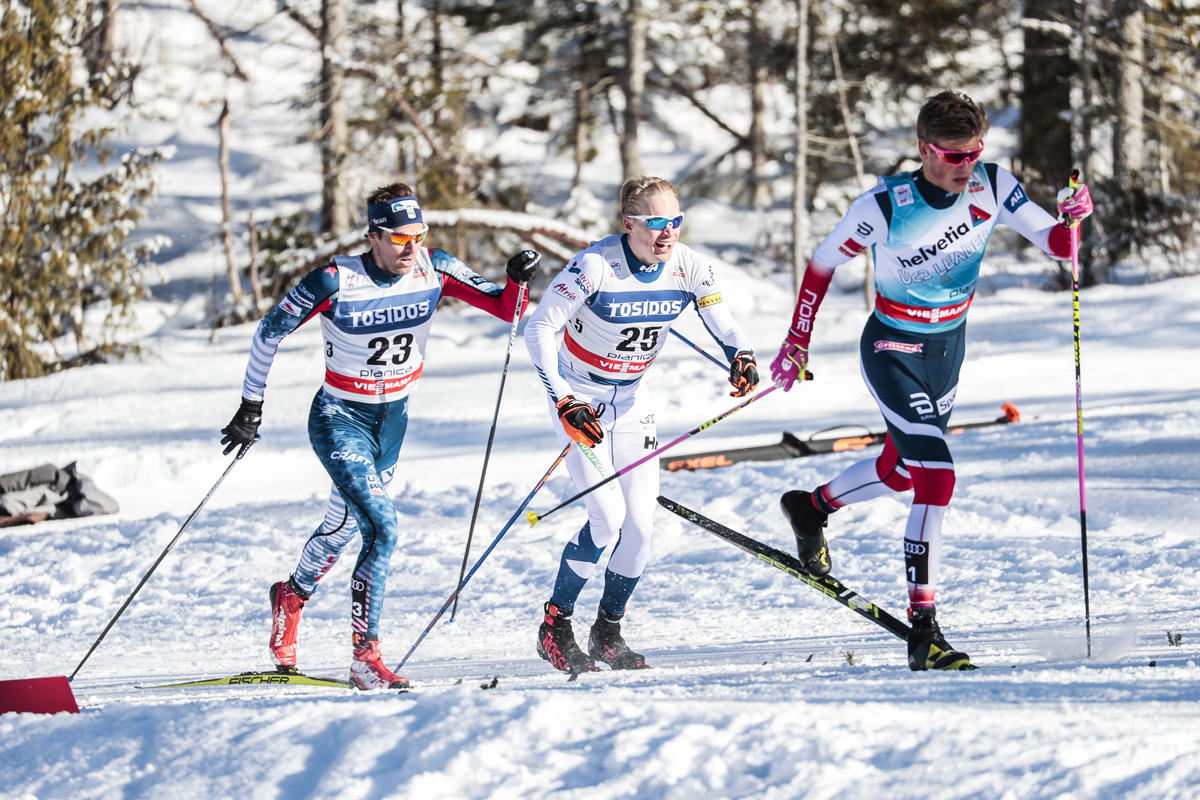
Norway’s Johannes Høsflot Klæbo leads Finland’s Iivo Niskanen (25) and American Andy Newell (23) in the first men’s quarterfinal of the World Cup classic sprint in Planica, Slovenia. Klæbo went on to win that heat, ahead of Niskanen in second and Newell in fourth. (Photo: Fischer/NordicFocus)
Newell, who qualified in 23rd and finished the day in 20th, wrote in an email that he had been hoping for more.
“It was beautiful classic conditions out there and pretty straightforward waxing which made for really fun skiing,” he wrote. “The course had a little bit of a different feel because it basically just had one really long climb from the low point to the high point and, of course, some fast icy corners to keep things interesting. Especially in qualification, I felt semi out of control and scrubbed some speed. The courses actually skied a bit better in the heats I thought once they had less traffic.”
Matched with Klæbo in his quarterfinal, Newell clearly knew he’d have a speedster to chase.
“In the heats, I again chose heat one with the same strategy I’ve been using — choose the first heat and shoot for a final/podium rather than a top 15 etc.,” Newell added. “Not sure if that’s the right call … hard to tell sometimes. I skied the majority of the heat on the tails of Klæbo until the top of the climb he and Niskanen got a small gap. In the end, it wasn’t fast enough.”
Like Hamilton, Newell left the Tour de Ski early (after Stage 3) and contested last weekend’s skate sprints in Dresden. Needless to say, Newell is focused on PyeongChang.
“Although this wasn’t the pre-Olympic result I was looking for I still have a few weeks to fine tune classic skiing and fitness and think about what I need to do to have a top performance in PyeongChang,” Newell reflected.
A large contingent of U.S. men competed, with the Alaska Pacific University (APU) duo of Logan Hanneman and Tyler Kornfield narrowly missing the heats, finishing 35th (+13.55) and 38th (+13.96), respectively, in the qualifier. Teammate Reese Hanneman finished 51st in the qualifier (+17.99) and Ben Lustgarten of the Craftsbury Green Racing Project placed 59th (+19.41).
For both Logan Hanneman and Kornfield, this was their first career World Cup starts. Hanneman is 24 and Kornfield is 26.
Kornfield is coming off a stellar U.S. nationals in Anchorage, Alaska, where he won the 30 k classic mass start, and placed third overall in both the classic and skate sprints. Kornfield is slowly adjusting to Europe and said his body still feels the effects of his national 30 k win.
“I have had a little time, but ever since the 30 k, I haven’t slept past five hours,” Kornfield said on Saturday. “I’ve just been trying to calm the heart rate. The first night before the classic sprint [in Anchorage], I went to bed at 3 AM. I was in bed at 11 or 12, just laying there. Just trying to process that. I know I can be better, I am just super amped to be here.”
“I qualified for my first World Cup in 2010, but I decided not to go,” Kornfield said. “And ever since I have been just regretting that. But I think in the end, I’ve been working so much harder for this and it feels so much better. The harder you work the more struggle you go through, it’s feels so good.”
In an email exchange, Kornfield elaborated on his World Cup invitation decline back in 2010.
“After doing well in the 2010 US Nationals in Anchorage, I qualified for the sprint in Canmore, the final World Cups before the Vancouver Olympics,” Kornfield explained. “I went into US Nationals with the sole focus of making my first World Juniors. I hadn’t expected to do so well in the sprints and because I was a Freshman at UAF, I also wanted to make NCAAs.”
As for his turned-down 2010 World Cup starts in Canmore, those are “would haves” and “could haves”.
“I regretted not going for a long time because as I got older, I realized just how hard World Cup starts are to get and you cannot take them for granted,” Kornfield wrote. “When you are young and you get your first real breakthrough, you have so much confidence and belief that you are going to take over the world. It has been eight years and every now and then, that belief begins to wane. Eventually, I started to wonder if I would ever get that opportunity again. This is probably the first year in the last six years that my old confidence is starting to come back. I am also older and wiser and I know that the shape I am in now will not last forever, so I need to capitalize on this moment.”
The four Canadians that raced last weekend in Dresden also competed in Planica, with Julien Locke (Canadian National U25 Team) leading the way in 62nd on Saturday (+21.26), Dominique Moncion-Groulx (Alberta World Cup Academy) 65th (+22.70), Bob Thompson (NTDC Thunder Bay) 66th (+24.48), and Antoine Briand (Pierre-Harvey National Training Centre) 70th (+27.20).
The men’s 6 x 1.2 k freestyle team sprint podium at Sunday’s World Cup in Dresden, Germany, with Italy’s Dietmar Nöckler and Federico Pellegrino in first (c), Sweden’s Emil Jönsson and Teodor Peterson in second (l) and Russia’s Andrey Krasnov and Gleb Retivykh in third (r). (Photo: Fischer/NordicFocus)
(Note: This article has been updated to include comments from Canada’s Bob Thompson.)
Federico Pellegrino’s winning move in the men’s 6 x 1.2-kilometer freestyle team sprint on Sunday wasn’t exactly the same as yesterday when the Italian attacked on the final climb of the individual skate sprint.
“Yesterday on the right side and today I tried on the left side and it was OK,” Pellegrino said in a post-race interview with the International Ski Federation (FIS).
By “OK,” Pellegrino meant perfect.
“Today everything was perfect, even the sun was super,” he said after winning his second race in as many days with team-sprint partner Dietmar Nöckler. “We can continue like this to the Olympics then catch the gold.”
A number of teams were looking to do exactly as the Italians did on Sunday on a tightly woven city sprint course in the heart of Dresden, Germany. This race marked the last team sprint before the Olympics, which starts in less than a month in PyeongChang, South Korea. The Olympic team sprint, set for Feb. 21, is also freestyle. Sunday was the first team sprint so far of the 2017/2018 season.
Pellegrino locked it up after Nöckler came through the last exchange in fifth, 2.6 seconds behind Sweden’s Emil Jönsson in first. On the final lap, Pellegrino chased Sweden’s Teodor Peterson and Switzerland’s Roman Schaad, before Pellegrino made his move past Schaad in first heading into the final rise before the stadium. The attack was just slightly before the one he executed to win Saturday’s skate sprint over Norway’s Johannes Høsflot Klæbo.
“I had to use it,” he said of the move.
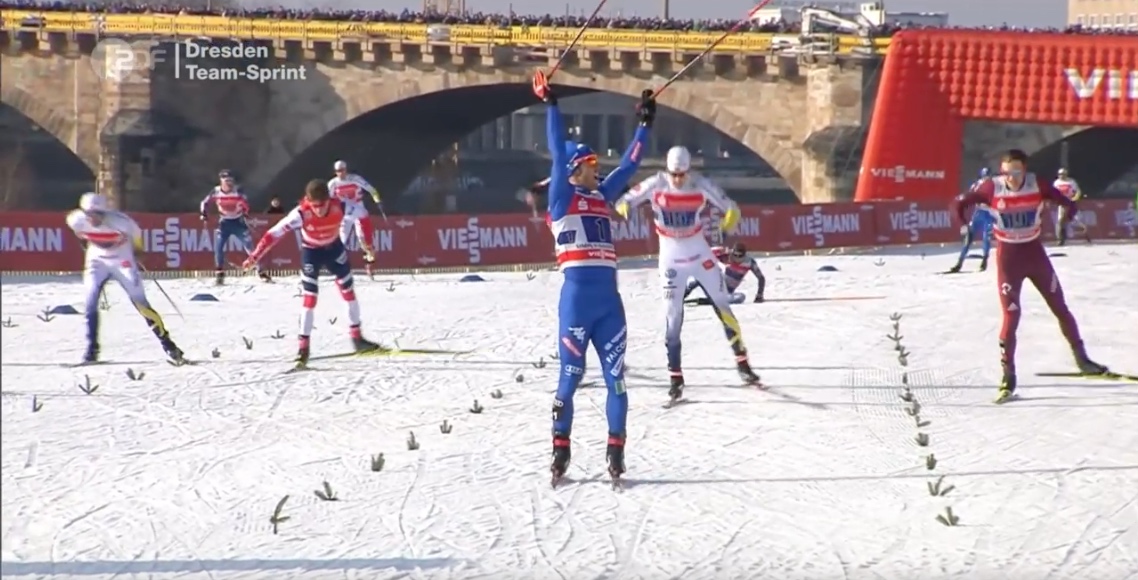
Federico Pellegrino (front) celebrates across the line as he anchors Italy to a freestyle team sprint victory for his second-straight win at the World Cup in Dresden, Germany. Behind him, Sweden I’s Teodor Peterson (second from r) and Russia’s Gleb Retivykh (r) battled for second, and Sweden II’s Karl-Johan Westberg (l) and Norway’s Johannes Høsflot Klæbo (second for r) jockey for third. American Simi Hamilton (on the ground) is seen trying to recover from a crash. (Screenshot: ZDF broadcast)
First over the top, Pellegrino pushed farther ahead of Peterson in second while Schaad, Russia’s Gleb Retivykh, Sweden II’s Karl-Johan Westberg, Klæbo, and American Simi Hamilton chased in third. Hamilton went down when he collided with Klæbo just before the finish line, but was able to get up and finish eighth, 14.28 seconds behind Italy in first.
Pellegrino sealed the deal in 12:18.31, and Peterson crossed 1.07 seconds back for Sweden I in second place. Russia’s first team, with Andrey Krasnov and Retivykh, placed third (+1.23), just ahead of Switzerland I (Jovian Hediger and Schaad) in fourth (+1.45), Norway I (Kasper Stadaas and Klæbo) in fifth (+1.93), and Sweden II (Johan Häggström and Westberg) in sixth (+1.94). Italy II (Stefan Zelger and Giacomo Gabrielli) placed seventh (+7.31) ahead of the U.S. (Erik Bjornsen and Hamilton) in eighth.
“When I arrived at the finish line, I could go slow and had some time to look to the people and say thank you for a great day,” Pellegrino told German TV broadcaster ZDF. “I had really good fun here in Germany!”
“He showed all the world that today he is the strongest athlete on the track,” Nöckler said while standing next to his teammate Pellegrino in a televised interview with FIS. “And today we were both on the podium so we’re really happy.”
Bjornsen, Hamilton in the Mix
The U.S. men were in contention to the finish, with Bjornsen putting them in third on the second-to-last leg. Norway’s Stadaas had been given a 1.3-second lead at the fourth exchange by his teammate Klæbo (who had previously made his way back into first after Stadaas tagged him in fifth). While Stadaas widened the gap for the first half of his last loop, Bjornsen led the chase, skiing several seconds behind him in second place.
In an in-person interview with FasterSkier, Bjornsen recalled being tentative in the semifinals, where he and Hamilton finished fourth but advanced as lucky losers with a fast-enough time.
“Going into the final, I was feeling good and I wanted to use my aerobic capacity,” Bjornsen said. “As soon as Simi handed off to me, I was kind of in the back end of that group and Norway had a good lead and I was like, I’m just gonna go for it.”
Hamilton had tagged him in eighth, 2.5 seconds behind Norway in first. About halfway through the next 1.2 k loop, Bjornsen had bridged the gap to Stadaas, but brought a large pack of racers with him.
“I went to the outside and was able to pass my group of like six or so, and I bridged up to Norway and tried to hit that corner pretty hard, then it kind of hit me,” Bjornsen said. “I was tired, that group had caught up to me and unfortunately I had pulled — some people jumped on the back of me, so then they kind of went by me, but I was able to hand off in third so I was happy with that. We were in the mix today.”
Sweden’s Jönsson took the lead over the last rise before the stadium, and Switzerland’s Hediger slotted into second, coming through the exchange 0.9 seconds after Jönsson. Bjornsen tagged third, 2 seconds back.
American Simi Hamilton (r) chasing Russia’s Gleb Retivykh (19) and one of two Swedish teams the second semifinal of the men’s 6 x 1.2 k freestyle team sprint at the World Cup in Dresden, Germany. (Photo: Fischer/NordicFocus)
From there, Hamilton kept himself in contention in the top five, hanging just behind Pellegrino and Peterson as the large group approached the finish. In the middle with several races on either side of him, Hamilton went down, hard, but stood back up again and finished eighth.
“My crash wasn’t too terrible, but I did break Klæbo’s pole with my face and got a bunch of carbon fiber splinters in my upper lip. So once I got that cleaned up I was okay,” Hamilton wrote in an email. “Whacked my head a bit too, but I’ll be fine.”
He explained that he and Bjornsen had made a game plan to “ski towards the front, stay out of crashes, and figure out how the semifinal was going to play out while racing,” he wrote. “I thought we both skied the semi well, although I think I could have been a bit more aggressive on my last lap and done more skiing that would have assured us a spot into the final. But it turned out okay.”
In the final, “Erik did an awesome job keeping us at the front and I just focused on doing the same for him,” Hamilton wrote. “He turned in a hell of a last leg, tagging me in 3rd for my last lap.”
Bjornsen was pleased with his last lap, but would have like to have been first through the final exchange.
“I wish I had a little higher speed that I could push past people quicker, but I find when I’m up against the best, my talent or whatever is to kind of press hard for a while,” Bjornsen said. “… So I just tried to send it hard for 45 seconds and it seemed to work out. I wish I could’ve handed off in first, but I’m happy to be in the mix there.”
On the final lap, Hamilton recalled “a decent sized gap up to first and second, I think mostly because those were the only two teams that had perfect tags on that last exchange,” he wrote.
Unsure whether to ski all out on his last of three 1.2 k efforts, while simultaneously pulling along competitors like Pellegrino and Klæbo, Hamilton focused on skiing fast, but not to his max.
“On the far end, Pellegrino went by me and by that point we were really close to making contact with the top two,” he wrote. “I thought we were totally in the hunt for a podium until somehow I lost a second on the plateau [after the last hill] with about 15 seconds of racing left. “I don’t know how I lost it, if it was just entirely my fault or if something happened like I got punched from my line, but I am pretty bummed about it because that was where I felt like I let the podium slip through our hands,” Hamilton continued. “Coming in to the finish lanes, I got tripped up with Klæbo and my skis got clipped as were skiing for the same lane. It wasn’t intentional and he’s a very clean racer, but it was definitely a bummer to not be able to sprint it out for 3rd, 4th, or 5th with those other guys.”
As for Norway, Klæbo told Germany’s ZDF he was out of the race at the start of that last lap: “After the last exchange it was too difficult, the gap was too large to the guys in front,” he said.
Overall, Hamilton concluded that it was a great and interesting weekend of racing at a new venue in Dresden.
“I think they could make some big improvements to the course with making it more technical, flowy, and wider, but I hope they continue to hold sprints here in the future,” he wrote.
Canada had two teams in the first semifinal of the men’s 6 x 1.2 k freestyle team sprint at the World Cup in Dresden, Germany, with Canada I’s Julien Locke (near) skiing just ahead of Canada II’s Dominique Moncion-Groulx, who caught an edge just ahead of Italy’s Federico Pellegrino (second from r) and American Ben Lustgarten (behind Pellegrino), over the top of a climb. (Photo: Fischer/NordicFocus)
While the Bjornsen and Hamilton as the U.S. Ski Team’s first team on Sunday were the lone North Americans to reach the men’s final, Canada came close with Bob Thompson and Julien Locke.
“The main points of our plan was make sure we stayed in the lead group and to take any easy opportunities to make up positions whenever we saw them,” Thompson, of the National Team Development Centre (NTDC) Thunder Bay, wrote in an email. “I started first as we were confident I could hang on to the pace and then after Julien’s excellent performance yesterday we felt he would have good speed to finish.”
The two ultimately finished seventh in the first team-sprint semifinal, just one place behind Great Britain’s James Clugnet and Andrew Young. The Brits advanced to the final as lucky losers in sixth, 1.85 seconds behind Norway’s Stadaas and Klæbo in first, becoming the first team from Great Britain to reach the final in a World Cup team sprint. (In the final, they finished behind the U.S. in ninth, 14.68 seconds out of first.)
After Thompson tagged Locke (Canadian National U25 Team/Black Jack Ski Club) in eighth in the last exchange of their semifinal, Locke picked off one place to finish seventh, 0.39 seconds behind Great Britain’s Young.
“The third leg just started going from the exchange and I was able to hang on to the back and then dodge around the French teams who both crashed,” Thompson explained. “So I was able to tag off to Julien solidly in the mix of the lead pack. Julien had a pole break on the small hill with just 200m to go and had to free skate in, so the .15 seconds from making the final hurts a bit.
“I’m happy with how we raced,” he continued. “We both stayed controlled and I think we had the pace well enough. I believe I skied it as well as I could have and being right up with those guys feels great.”
The Americans’ second team of Andy Newell and Ben Lustgarten crossed the line 0.57 seconds later for eighth place (+2.81) in that semifinal. Newell had put them in second place at the last exchange, just 0.11 seconds out of first.
“I felt good on my last leg and was able to make some moves and tag Ben in the lead going into the final lap,” Newell wrote in an email. “He skied really well to stay close to the leaders. If we were even less than a second faster I think we would have moved on as [lucky losers] instead of Sweden 2 and USA 1 from the next semi. So we were a bit unlucky there but it was a fun race.”
American Andy Newell (2) chasing Italy II’s Stefan Zelger (in blue) during the first semifinal of the men’s 6 x 1.2 k freestyle team sprint at the World Cup in Dresden, Germany. (Photo: Fischer/NordicFocus)
Previously, Newell had tagged Lustgarten in fourth at the first exchange, then Newell found himself back in 10th and almost 2 seconds back after his second leg.
“Ben and I tried to ski up toward the front half of the pack but had a small crash on our second tag,” Newell explained.
“The [second] handoff wasn’t clean but I got Newell just in time,” Lustgarten, of the Craftsbury Green Racing Project, recalled in an in-person interview with FasterSkier. “But there is so much happening and I obviously don’t have that much experience in this event, so it was just like a learning experience and trying to ski well. … On my last lap, Klæbo and Pellegrino went by and I am not really at that level yet so I didn’t really expect anything. I just tried to go as hard as I could.
“I haven’t done a team sprint in eight years maybe, so it was a whole new kind of experience,” Lustgarten explained. “And obviously all these guys are so fast and strong that it was just an insane event.”
Canada’s second team of Antoine Briand (Pierre-Harvey National Training Centre) and Dominique Moncion-Groulx (Alberta World Cup Academy) finished 13th in the first semifinal, 26.20 seconds out of first. Notably, Moncion-Groulx skied the fastest second leg of the race to bring them from 12th after the first exchange to sixth.
The World Cup has two more weekends of racing before the Olympics, with all-classic races next weekend in Planica, Slovenia (classic sprint and 10/15 k classic individual starts), followed by freestyle races in Seefeld, Austria, on Jan. 27-28 (skate sprints and 10/15 k freestyle mass starts).
Bjornsen said he was unsure whether he’d race next weekend in Planica, potentially opting for a training block before the Olympics instead.
“I still have to talk to [U.S .SKi Team Head Coach Chris] Grover about which races I’m going to start at the Olympics and so if it looks like I’ll have a full schedule at the Olympics then I’ll try to do a training block,” Bjornsen said.
Hamilton wrote that he was planning on racing the classic sprint in Planica, and was headed to Ramsau, Austria, with his teammates for a couple days of training first.
According to Thompson, the four Canadians that raced in Dresden were also on their way to Ramsau, Austria, where they’ll train until Tuesday and then continue on to Planica.
Kaisa Makarainen of Finland celebrates winning the women’s 12.5 k mass start in Ruhpolding, Germany, as Laura Dahlmeier (Germany) is second, Veronica Vitkova (Czech Republic) third, and Rosanna Crawford (Canada) fourth. (Photo: IBU/Biathlonworld)
IBU Biathlon World Cup (Ruhpolding, Germany): 12.5/15 k mass starts
Kaisa Makarainen of Finland took her first win of the season and will start next weekend with the overall World Cup leader’s bib after she outsprinted Germany’s Laura Dahlmeier by 0.8 seconds to claim the win in the 12.5 k mass start. In a tight race for third, Veronica Vitkova of the Czech Republic edged out Rosanna Crawford of Canada for the final spot on the podium; the pair crossed the line 4.6 and 5.2 seconds behind Makarainen. The podium finishers all had two penalties apiece while Crawford shot clean, repeating the 20-for-20 effort that netted her third place and her first-ever podium in the 15 k individual earlier this week. Germany’s Denise Herrmann was sixth, +16.7 seconds, despite four missed targets.
In the men’s 15 k mass start, Norway’s Johannes Thingnes Bø took a win over France’s Martin Fourcade as the pair continue their running battle this season. Bø had one penalty to Fourcade’s two, although that penalty came in the last shooting stage to make things interesting – Fourcade, whose penalties had come in the prior shooting stage, closed to within 4.5 seconds by the finish, but was unable to beat the Norwegian. Antonin Guigonnat, one of the newest members of the French World Cup team, shot 20-for-20 to claim third place and his second podium of the season. In an exciting race, the top nine men all finished within 15 seconds of one another. The sole U.S. entry, Tim Burke, was in the top 15 for much of the race before missing two shots in the final standing shooting stage and finishing 21st, +1:30.2
The women’s 6 x 1.2 k freestyle team sprint podium at Sunday’s World Cup in Dresden, Germany, with Sweden II’s Maja Dahlqvist and Ida Ingemarsdotter in first (c), Sweden I’s Hanna Falk and Stina Nilsson in second (l), and USA I’s Ida Sargent and Sophie Caldwell in third (r). (Photo: FIS Cross Country/Twitter)
FIS Cross Country World Cup (Dresden, Germany): 6 x 1.2 k freestyle team sprint
For the second-straight day in Dresden, Sophie Caldwell notched third place and was nearly second with U.S. teammate Ida Sargent on Sunday in the World Cup women’s 1.2-kilometer freestyle team sprint.
The race ended in a three-way fight for first, which Sweden II’s anchor Maja Dahlqvist took by 0.16 seconds over Sweden I’s Stina Nilsson. While the two lunged for the line, Caldwell came on strong to give them a run as well, finishing just 0.23 seconds back in third (after being in a photo finish for second).
Earlier in the day, Sargent and Caldwell had won the second semifinal to advance to the 10-team final. The U.S. Ski Team’s second team, Caitlin Patterson and Kikkan Randall, finished second in that heat, just 0.11 seconds back and advanced as well.
Sweden I won the first semifinal with Hanna Falk (Saturday’s individual skate-sprint winner) and Nilsson. Sweden II finished 0.17 back in second with Ida Ingemarsdotter and Dahlqvist.
In the final, Sweden II’s Ida Ingemarsdotter led through her first two legs before tagging Dahlqvist in third with one lap to go. Meanwhile, Sargent tagged Caldwell in fourth, 0.9 seconds back. On the final lap, with Switzerland, the two Swedish teams, and USA I’s Caldwell skiing together up front, they dropped Switzerland’s Laurien van der Graaff before the finish and went all out for first.
Dahlqvist took it for Sweden II in 13:33.4, Sweden I placed second and USA I third. The same duo of Caldwell and Sargent placed third in the pre-Olympic freestyle team sprint last year in PyeongChang, South Korea. There, Sargent also placed third in a classic sprint for her first World Cup podium. Sunday marked Caldwell’s fourth individual World Cup podium (sixth including team events).
USA II was up to sixth after Randall’s first leg, just 0.5 seconds out of first, and remained 1.8 seconds behind the leaders with two laps to go. On the second-to-last leg, Patterson tagged Randall in ninth, and Randall anchored them to eighth (+7.95).
Germany I finished fourth (+2.11) with Hanna Kolb and Sandra Ringwald, Slovenia was fifth (+4.46) with Alenka Cebasek and Vesna Fabjan, Germany II was sixth (+4.62) with Katharina Hennig and Elisabeth Schicho, and Switzerland seventh (+5.09) with Nadine Fähndrich and van der Graaff.
The men’s 6 x 1.2 k freestyle team sprint podium at Sunday’s World Cup in Dresden, Germany, with Italy’s Dietmar Nöckler and Federico Pellegrino in first (c), Sweden’s Emil Jönsson and Teodor Peterson in second (l) and Russia’s Andrey Krasnov and Gleb Retivykh in third (r). (Photo: FIS Cross Country/Twitter)
In the men’s race, Norway’s Johannes Høsflot Klæbo teamed up with Kasper Stadaas, and the two won their semifinal by 0.26 seconds over Italy’s Dietmar Nöckler and Saturday’s winnerFederico Pellegrino. The U.S. men’s first team of Erik Bjornsen and Simi Hamilton advanced to the final as the last lucky loser in the second semifinal, where they placed fourth, 0.85 seconds behind Russia I’s Andrey Krasnov and Gleb Retivykh in first. Sweden I (Emil Jönsson and Teodor Peterson) and Sweden II (Johan Häggström and Karl-Johan Westberg) also advanced in second and third in that heat.
In the final, which included Great Britain for the first time in team-sprint history (after James Clugnet and Andrew Young clinched the last lucky loser spot in the first semifinal in sixth place), Stadaas set a fast pace on the opening 1.2 k loop. He tagged Klæbo in first, 0.3 seconds ahead of Sweden I, while the U.S. hung in contention 0.9 seconds back in fifth.
Norway continued to lead until Stadaas’s second lap, where Russia’s Krasnov came through the third exchange first, 0.1 ahead of Switzerland’s Jovian Hediger in second. Stadaas tagged Klæbo in fourth, 0.5 seconds back, and Klæbo predictably recovered the lead on the next lap.
After he gave Stadaas a 1.3-second lead at the fourth exchange, Stadaas initially ran with it and extended it significantly. But he ran out of steam on the second half of his last loop and dropped to 10th (last place), 3.7 seconds out of first by the final exchange.
There, Jönsson tagged Peterson in first, 0.9 seconds ahead of Hediger in second. Bjornsen had brought the U.S. to third, 2 seconds back, after leading the chase group in second as they reeled in Stadaas.
On the final lap, Pellegrino came on strong in the last few hundred meters, just as he had done in Saturday’s individual sprint, to take the win for Italy in 12:18.3. Peterson anchored Sweden I to second place, 1 second back, and Russia’s Retivykh took third (+1.2), just ahead of Switzerland’s Roman Schaad in fourth (+1.4).
Hamilton suffered a nasty crash in the middle of the group just before the finish and crossed the line in eighth (+14.2).
Klæbo finished fifth for Norway (+1.9), with Sweden II in sixth (+1.9). Italy II (Stefan Zelger and Giacomo Gabrielli) followed in seventh (+7.3), Great Britain placed ninth (+14.6), and Switzerland II (Erwan Käser and Roman Furger) 10th (+20.9).
This is the last team sprint before a freestyle team sprint is contested at the 2018 PyeongChang Olympics.
Sweden’s Stina Nilsson celebrates the 10th World Cup victory in two seasons in the women’s 1.3 k freestyle sprint in Otepää, Estonia, in January. (Photo: Fischer/NordicFocus)
Welcome to World Cup Windup, where we check in with the top-10 teams from last year’s FIS Cross Country World Cup tour before the season starts with the Ruka Triple in Kuusamo, Finland, on Nov. 24.
SWEDEN
Overall in Nations Cup Last Year: Second
Women’s Ranking 2016-2017:Second
Men’s Ranking 2016-2017:Third
Who’s Back:
Stina Nilsson, second in the Sprint Cup and fourth in the World Cup overall; Hanna Falk, third in the Sprint Cup; Marcus Hellner, who finished sixth in the World Cup overall; Charlotte Kalla, ninth overall; Calle Halfvarsson, who won two World Cups; and Jens Burman and Jonna Sundling, the runner-up and fourth-ranked skiers in the for the World Cup U23 standings. Plus, 2014 Olympic team sprint bronze (soon-to-be-silver) medalists Emil Jönsson and Teodor Peterson, and Ida Ingemarsdotter, who teamed up with Nilsson for silver in the same event in 2014.
Who’s Missing:
Sweden’s Marcus Hellner – who had something of a comeback last season – leads Germany’s Florian Notz during the third leg of the men’s 4 x 10 k relay at 2017 World Championships in Lahti, Finland. Sweden ultimately placed third and Germany sixth. (Photo: John Lazenby)
Sweden’s wily and bold distance specialist, Johan Olsson. Olsson announced his retirement in April at age 37 after winning back-to-back World Championships 50 k titles in 2013 and 2015, and contributing to Swedish relay gold at the 2010 and 2014 Olympics. “I have spent 15 years trying to realize my sporting dreams,” he explained at the time. “Now I will be able to realize completely different dreams, and I will be able to be a much more present dad.”
Pre-Season Results:
The Swedish team had a sprint race in late October in Idre, on a course made to resemble the profile of the 2018 Olympic sprint course in PyeongChang, South Korea. Some athletes were away at an altitude training camp, but Hanna Falk dominated the women’s sprint over Maja Dahlqvist and Linn Sömskar. Calle Halfvarsson won the qualifier but fell in the final; instead, Teodor Peterson edged Oskar Andersson in a tight finish.
Other than that, most of the top athletes have not raced yet. National team member Emma Wikenwon a season-opening race in Bruksvallarna, Sweden, this past weekend. “It felt good! I chose to compete here today because I usually feel that it takes a couple races for me to get started,” she told Swedish media.
Recent Drama:
Calle Halvarsson racing last December, before he got sick and took a long break from the World Cup. (Photo: Fischer/NordicFocus.com)
Despite flashes of undeniable brilliance, Calle Halfvarsson’s career has been plagued by gaps in the race results because he has often been sick mid-season. This year he had an operation to fix his sinuses and hopes that it will allow him to race at the top of the field all season. “I hope I’ve found the solution,” he said. “I feel a difference. I have kept myself healthy.”
Stina Nilsson, the most successful Swede last season, talked about how she has dealt with the fame that has gathered around her in the last three years since her breakthrough on the World Cup. “The attention itself is not a driving force for me, and sometimes it can be tough to handle,” she said on the Swedish podcast Ur spår. “It’s a thing I have a bad conscience about: I don’t have the patience I want to, when people come up and want to talk cross-country skiing with me. As I breathe and live in my ski bubble for so many hours a day, I want to make some breathing holes — I have to be just human Stina, where I can focus only on myself.”
Sweden’s Charlotte Kalla racing to the win in the Lysebotn Opp, a 7.5-kilometer uphill climb, at the 2017 Blink Ski Festival on Thrusday in Lysbotn, Norway. (Photo: Axelar/Arild Aarnes)
Kalla, meanwhile, has decided to skip the Swedish national team’s pre-Olympic training camp in Sapporo, Japan, and prepare instead in Seiser Alm, Italy, at altitude. Who else will be there? Marit Bjørgen, who is in turn skipping the Norwegian team’s pre-Olympic camp. Kalla noted that the two have discussed that they will both be training in the same place and that they will undoubtedly run into each other on the trails. “I really hope we can help each other,” Kalla said.
But on to how to stay current on the Swedish team. As has been the case for quite some time, Sweden’s first couple of skiing Anna Haag (Instagram / Twitter) and Emil Jonssön (Instagram / Twitter) have among the best-curated social media presences out there. Haag in particular posts regularly and provides shots of her daily life, Swedish culture, herself with her husband, and the rest of the Swedish team.
And Marcus Hellner (Instagram) and Teodor Peterson (Instagram) both provide consistent looks inside their training, but also of their lives with their young children.
Norway’s Maiken Caspersen Falla celebrates across the line after edging out Russia’s Natalia Matveeva and her Norwegian teammate Ingvild Flugstad Østberg in the women’s cross-country sprint on Saturday at the 2017 Blink Skifestivalen in Sandnes, Norway. (Photo: Axelar/Ørjan Dalseth)
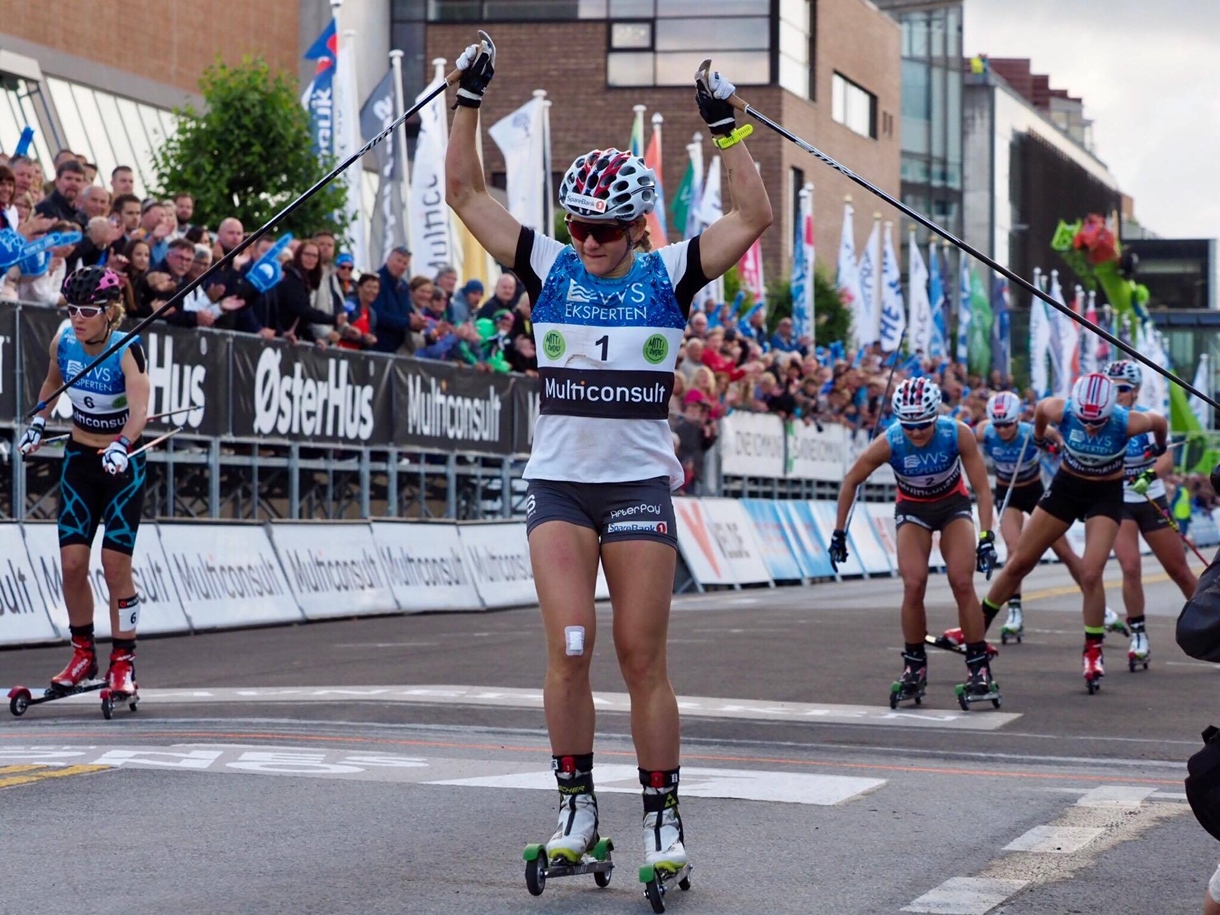
The fans in the well-filled stands of the 1-kilometer rollerski city course in Sandnes, Norway, had many reasons to cheer loudly on Saturday, as their local heroes claimed victories in all four sprint events that concluded the 2017 Blink Skifestivalen (Ski Festival).
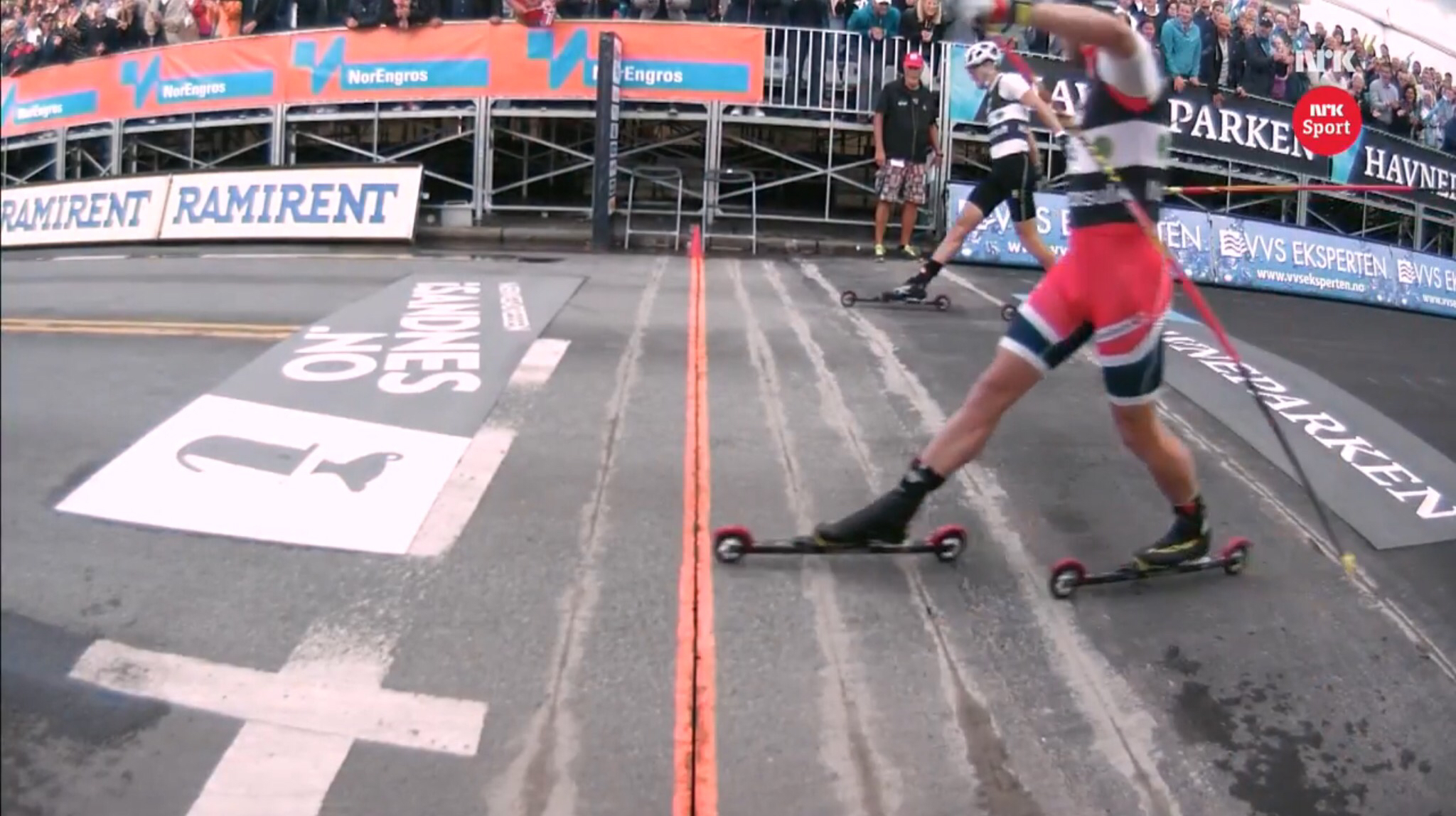
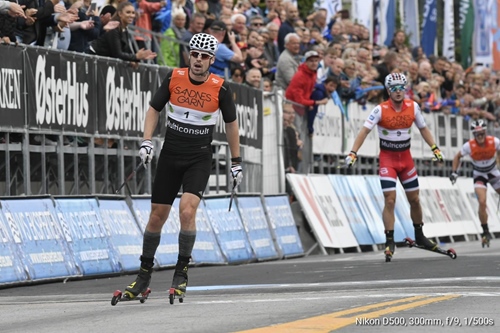
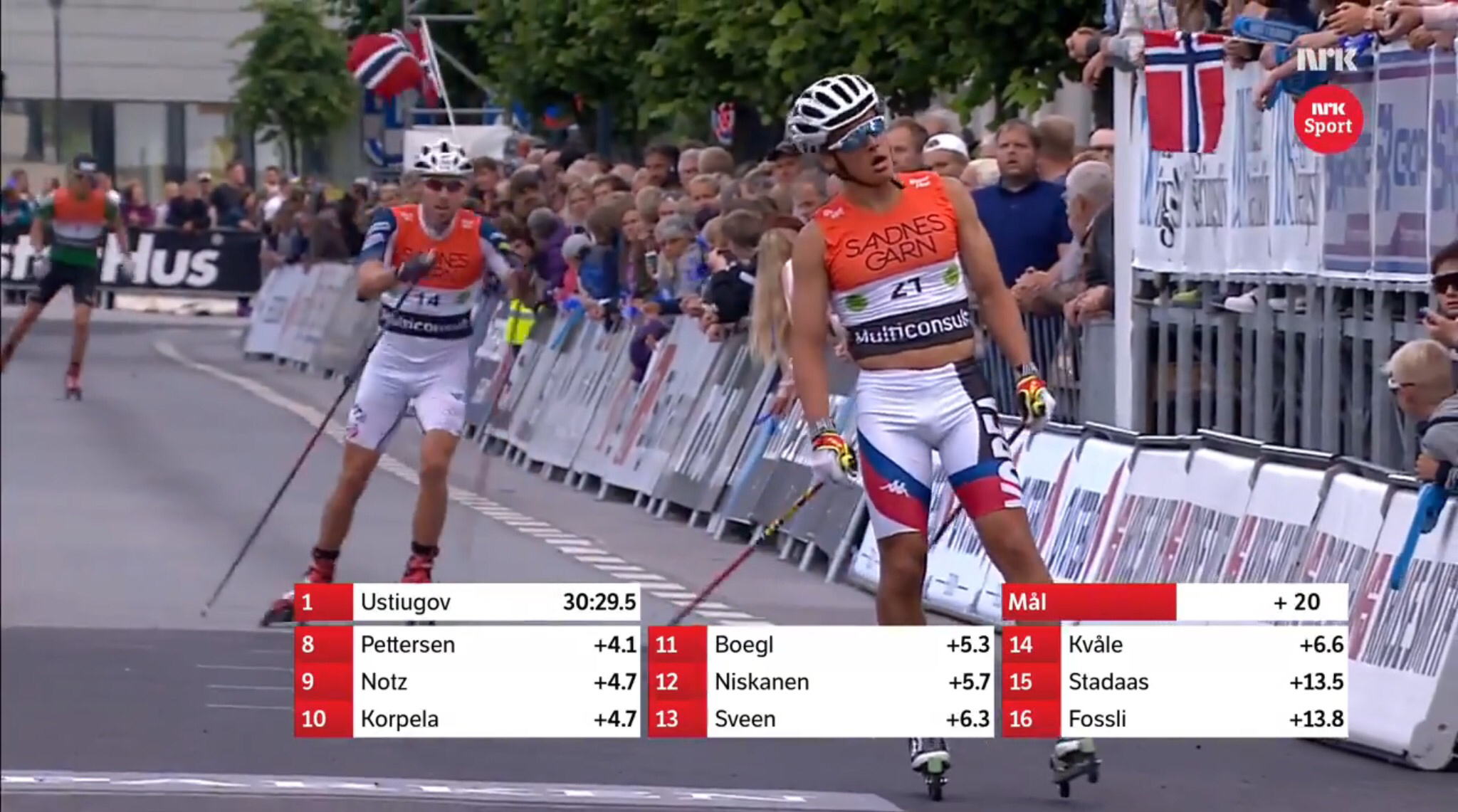
In the final race of the day, the men’s cross-country sprint was decided by the length of a rollerski, with Norway’s Sindre Bjørnestad Skar crossing first, just 0.1 seconds ahead of Sweden’s Teodor Peterson. Skar took the win with a time of 3:27.6 minutes after two laps around the flat course, which featured two short climbs over a ramp and a bridge. The third place on the podium went to Kasper Stadaas, also of Norway, 1.9 seconds out of first.
Norway’s Sindre Bjørnestad Skar (front) lunges across the line ahead of Sweden’s Teodor Peterson in the men’s cross-country sprint at the 2017 Blink Skivestivalen on Saturday in Sandnes, Norway. (Photo: NRK screenshot)
Second in Friday’s mass start, Skar advanced through the rounds on Saturday with narrow victories in his quarterfinal and semifinal as well. Last season, Skar won a World Cup at the freestyle sprint in Toblach, Italy, and achieved two other podiums. He raced to third in the sprint qualification at the World Championships in Lahti, Finland, and went on to finish 13th.
Andy Newell of the U.S. Ski Team (USST) was the lone North American starter of the day, and his run ended in the quarterfinal heats when he crossed the line in third, 1.1 seconds behind Norwegians Sondre Turvoll Fossli and 0.3 seconds behind Sivert Knotten. In an Instagram post, he mentioned breaking three poles in three races he competed in at this year’s Blink. He finished 16th in the 60 k classic and 18th in the 15 k freestyle mass start.
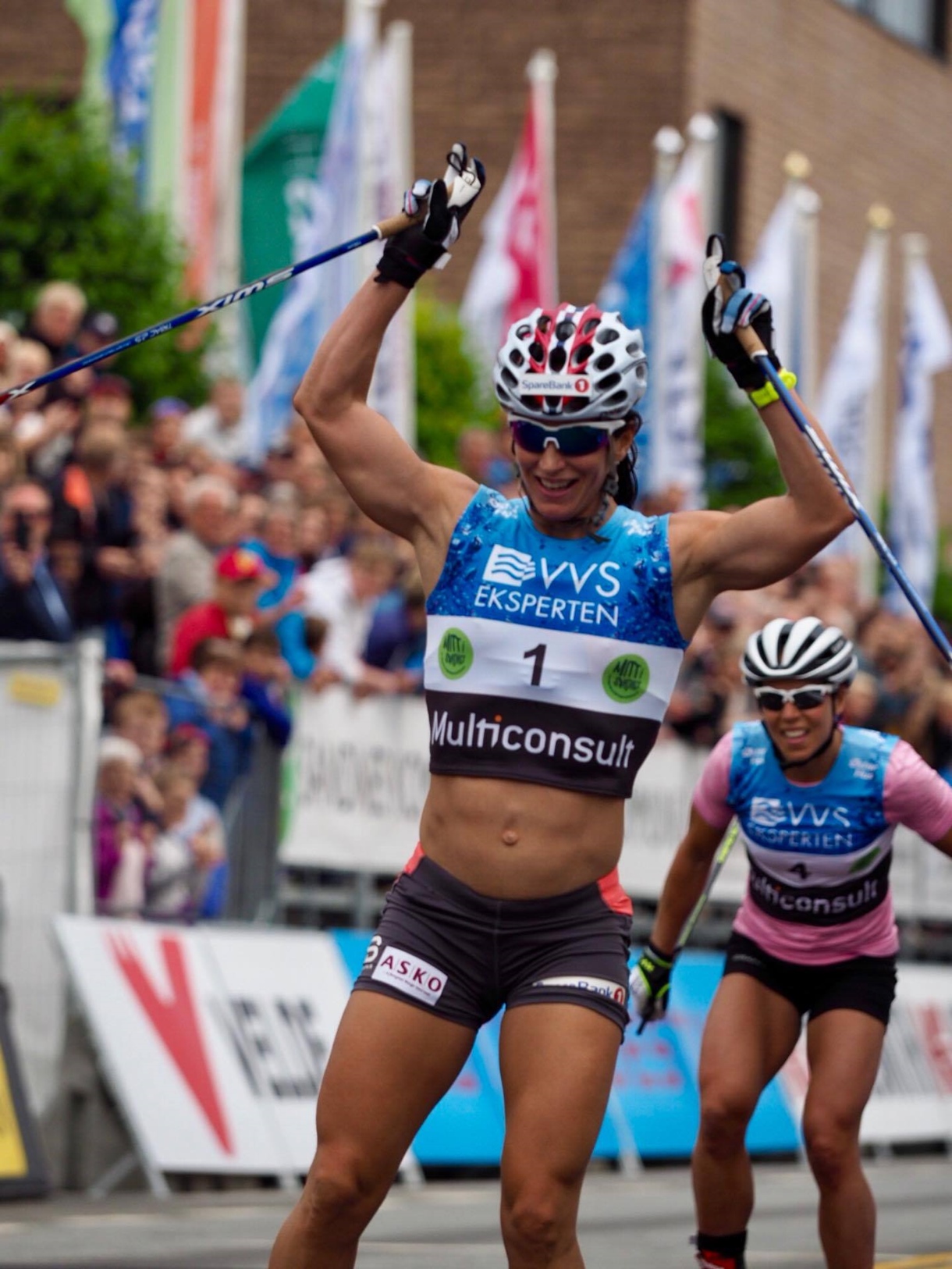
In the women’s cross-country sprint, a number of the last season’s top sprinters contended for the podium. Reigning Sprint World Cup champion Maiken Caspersen Falla emerged with the victory in the final with a time of 3:49.6 after keeping her challengers at bay in the long finishing straight. Russia’s Natalia Matveeva placed second (+0.8) and another Norwegian Ingvild Flugstad Østberg took third (+1.1).
Earlier in the day, Falla won her semifinal, after she advancing from her quarterfinal with a wildcard. Originally Falla had finished the heat more than 30 seconds back, following a spill from which she emerged with a slightly bloody right knee.
“Suddenly the asphalt was there,” Falla told Norwegian broadcaster NRK, according to a translation. “I am very happy that I was able to protect the face and head… I was really scared. I’m terrified.”
She explained that it had been a long time since her last crash on rollerskis, and that she likely had placed a pole on her own shoe. No other athlete was involved in the incident, and her semifinal heat started with seven athletes.
On Friday, Falla placed third in the women’s 10 k mass start after outlasting the group of skiers she was with in the finishing straight.
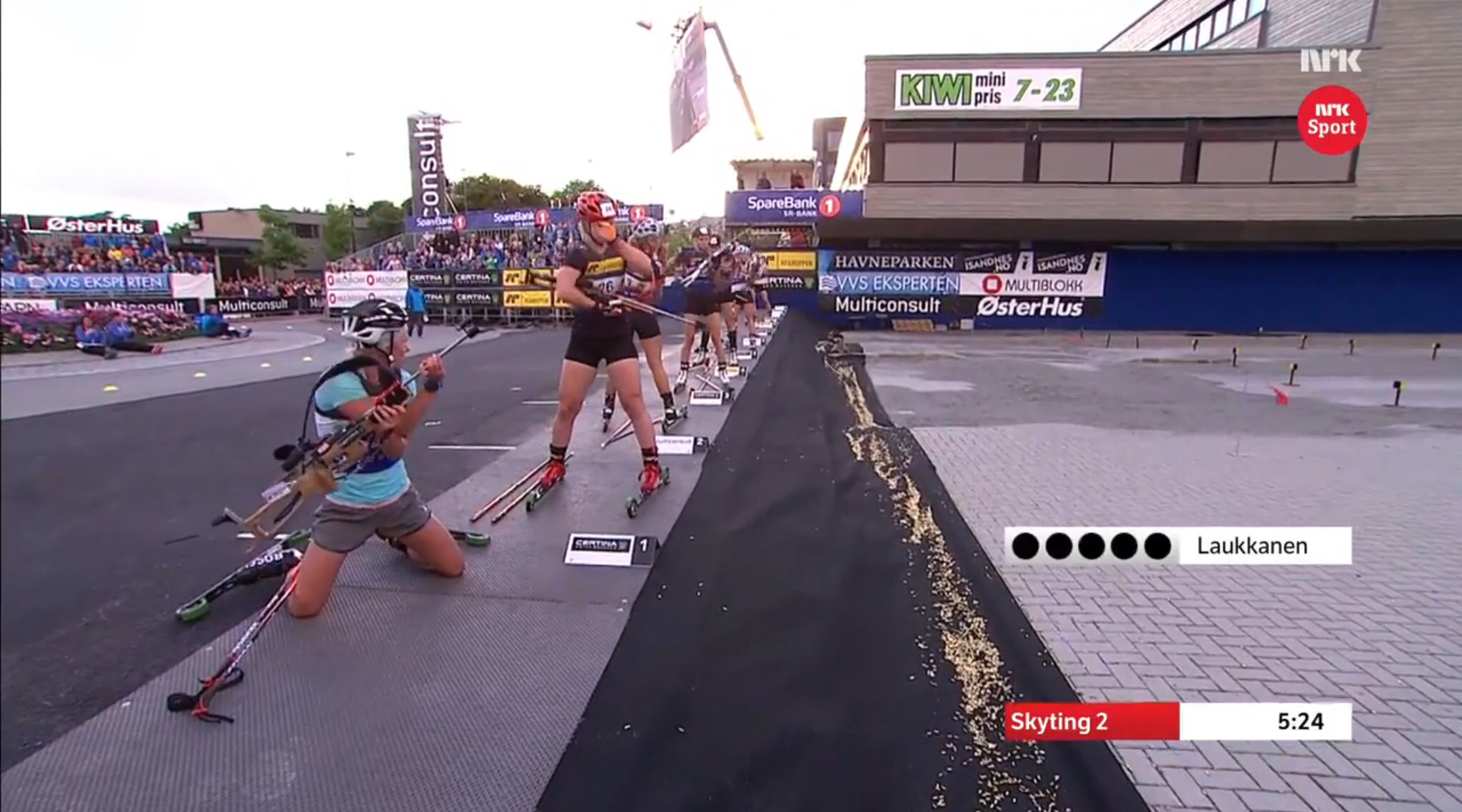
In the women’s biathlon sprint, French veteran Marie Dorin-Habert made a minor rookie mistake while leading when she knelt down on the shooting mat for another prone shooting, before realizing that all her competitors had correctly taken a standing-position stance. Maybe she had assumed that — like the men in Saturday’s sprint format — they also would have to shoot four times.
France’s Marie Dorin-Habert (l) erroneously kneels down to take the prone position in the second shooting stage of the women’s biathlon sprint at the 2017 Blink Skifestivalen on Saturday in Sandnes, Norway. In the lead until that point, she went on to finish third. (Photo: NRK screenshot)
She quickly stood back up, but after incurring a penalty she was overtaken by Sweden’s Hanna Öberg and Norway’s Marte Olsbu. On the final lap Olsbu managed to pass the Swede to claim the victory in a time of 7:57.3 minutes with two penalties, while Öberg finished second (+2.8, with two penalties) and Dorin-Habert third (+5.0, with one penalty) ahead of Sweden’s Emma Nilsson (+9.4, with two penalties).
Vetle Sjåstad Christiansen after winning the men’s biathlon sprint on the last day of the 2017 Blink Skifestivalen on Saturday in Sandnes, Norway. (Photo: Axelar/Ørjan Dalseth)
In the men’s biathlon sprint, racers skied four loops and shot in four stages. Coming into the final shooting stage, Norway’s Lars Helge Birkeland and Vetle Sjåstad Christiansen, along with France’s Simon Fourcade, had created a small gap to the rest of the field. While Birkeland and Christiansen hit all their targets, Fourcade had to ski one short penalty lap through a traffic roundabout. Turning sharp left into the finishing stretch, Christiansen overtook Birkeland and pushed hard until the line in a time of 12:09.6 with two penalties, while Birkeland finished 4.6 seconds back in seconds place (with one penalty). Fourcade held onto third place (+16.2, with three penalties) ahead of a chase group.
The excited fans also sang a little birthday tune for Norway’s Tarjei Bø — who turned 29 on Saturday — as he came into the finish in seventh place (+42.2) smiling and waving to the crowd.
No North American biathletes raced at this year’s Blink.
Russia’s Sergey Ustiugov (1) winning the men’s 15 k freestyle rollerski mass start on Friday at the 2017 Blink Ski Festival. Norway’s Sindre Bjørnestad Skar (r) finished 2.2 seconds back in second. (Photo: Axelar/Rolf Gunnar Strand)
In the men’s 15-kilometer freestyle rollerski mass start on the third day of the 2017 Blink Ski Festival in the coastal town of Sandnes in the southwest of Norway, U.S. Ski Team (USST) member Andy Newell constantly held a position in the first group, staying within a few seconds of the leaders. With two laps to go, he was in sixth place, less than two seconds back.
“I felt good about the race,” Newell reflected in an email to FasterSkier. “I was able to ski up in the top 10 or so throughout the race.”
U.S. Ski Team member Andy Newell (bib 14) finishing behind South Korea’s Magnus Kim in the men’s 15 k mass start on Friday at the 2017 Blink Skivestivalen in Sandnes, Norway. (Photo: NRK screenshot)
But as the field heard the bell ringing that signaled the final lap, Newell suddenly skied out of the lead group and rolled to the right side of the city course waving his arm.
“Just before the start of the last lap I tried to maneuver around a skier to try to get up into the top maybe 5 or 6 skiers and broke my pole on that guy,” Newell explained. “I only had to ski maybe 100 meters with one pole and got a spare but that was enough to lose a lot of places. I can’t feel too bad, there were a lot of broken poles out there, it was still really fun and exciting and a cool atmosphere.”
After Russia’s reigning Tour de Ski winner Sergey Ustiugov prevailed in a group sprint to finish first in a time of 30 minutes, 29.5 seconds, Newell finished the race in 18th place, 24.1 seconds later. Second place went to Norway’s Sindre Bjørnestad Skar (+2.2), while Sweden’s Teodor Peterson claimed third (+2.9).
Norway’s Marit Bjørgen winning Friday’s 10 k freestyle mass start at the 2017 Blink Ski Festival, just 0.6 seconds ahead of Sweden’s Charlotte Kalla (r) in second. (Photo: Axelar/Ørjan Dalseth)
In the women’s 10 k freestyle mass start race, Norway’s Marit Bjørgen took her first win of the series in 21:25.8, narrowly outsprinting Sweden’s Charlotte Kalla by 0.6 seconds (a day after Kalla won the famous Lysebotn Opp uphill race by a comfortable 40-second margin). The duo gapped the field about 15 minutes into Friday’s race, after Kalla had caught up to Bjørgen and then took her turn up front. Winning the finishing sprint out of a larger chase group, third place went to Bjørgen’s teammate and defending Sprint World Cup champion Maiken Caspersen Falla, 8.3 seconds out of first.
A day after finishing the Lysebotn hill climb in sixth place, USST distance skier Liz Stephen crossed the line on Friday in 25th (+1:29.2) on the flat city course with 1 k loops that suited sprinters, despite two short climbs over fairly steep ramps.
While the 2016 edition of the festival was marred by some dramatic crashes on those ramps, this time the course remained manageable in cloudy-but-dry conditions, with the field of elite Norwegian and international athletes cheered on by several hundred enthusiastic spectators in the finish area.
Biathlon
Also on Friday, the Blink spectators could watch a number of biathlon competitions, both for various junior age groups and the senior fields.
In a pre-race event dubbed “shooting duels” with the athletes still not on skis, the local fan-favorites prevailed. Norway’s Thekla Brun-Lie won the women’s competition, moving through a series of rounds and cleaning the final in 20 seconds, while her teammate Johannes Thingnes Bø was successful in the men’s shootout, cleaning all targets of the standing shooting stage in a blazing-fast 15.7 seconds for the best time of the day. In a “superfinal”, Bø beat Brun-Lie head-to-head, despite requiring spares and about twice as much time as in the men’s final.
Norway’s Thekla Brun-Lie (l) and Johannes Thingnes Bø competing head to head in the final round of a shooting competition at the 2017 Blink Skifestivalen in Sandnes, Norway. Both went on to win their respective mass start races later on Friday. (Photo: NRK screenshot)
Both skiers made use of their excellent shooting accuracy and speed to win their respective races that followed (no exact distance was given). In the second half of the women’s biathlon mass start, Brun-Lie managed to overtake the Russia’s Ekaterina Yurlova-Percht with two clean standing stages, claiming victory in a time of 13:51.5 with one penalty. The penalty loops required rollerskiing on a traffic roundabout next to the range.
Brun-Lie, 25, is the younger sister of Celine Brun-Lie (a former Norwegian cross-country team member) and a 2011 junior world champion.
France’s veteran skier Marie Dorin-Habert finished second (+8.5 with four penalties), while Brun-Lie’s teammate Marte Olsbu also passed Yurlova on the final lap to place third (+14.3 with three penalties) and Yurlova finished fourth (+18.2 with two penalties).
In the men’s biathlon mass start, Sweden’s Tobias Arwidson held the lead after the first two prone shootings, before Bø and teammate Emil Hegle Svendsen overtook him with two clean standing shootings. While both also hit every target in the final standing stage, Bø managed to do it faster once again, crossing the line first in a time of 17:57.8 with three penalties. Svendsen placed second (+12.3) despite cleaning all four stages, and Lars Helge Birkeland completed the Norwegian podium sweep in third (+21.2 with three penalties).
Unlike in prior years, no North American biathletes have made the trip to Sandnes, Norway, for Blink. The event concludes on Saturday with sprint races for both the cross-country skiers and biathletes.
Sweden’s Stina Nilsson celebrates her second-straight World Cup sprint victory on Saturday after winning the 1.4 k freestyle sprint at home in Falun, Sweden.
FIS Cross-Country World Cup (Falun, Sweden): Men’s & women’s freestyle sprints
[UPDATED] Kikkan Randall reached the final for the first time since March 2015 on Saturday in the women’s 1.4-kilometer freestyle sprint at the World Cup in Falun, Sweden. The American qualified 26th and went on to advance in second out of her quarterfinal and semifinal to reach the six-woman final, where she ended up fifth.
Sweden’s Stina Nilsson won the final by one-hundredth of a second over Norway’s Maiken Caspersen Falla, finishing in 3:00.24 minutes. Nilsson had started the day by qualifying in sixth, 2.52 seconds behind Norway’s Marit Bjørgen, who won the qualifier in 3:00.64. This is Nilsson’s second-straight World Cup sprint win after skipping the freestyle sprint in Toblach, Italy, following the Tour de Ski.
While Bjørgen went on to win her quarterfinal, she finished fifth in her semifinal to end up ninth on the day.
Norway had two on the women’s podium with Heidi Weng in third, 1.88 seconds behind Nilsson. Finland’s Krista Parmakoski placed fourth (+1.99), and Randall was fifth (+2.56) for her best result in two years (she took last season off to have a baby). Sweden’s Jonna Sundling reached the final as well and finished sixth (+8.02).
Five U.S. women qualified for the heats, with Jessie Diggins qualifying fifth and ultimately crashing in her semifinal, where she finished fifth. That put her 10th overall on the day. Sophie Caldwell qualified third and finished fourth in her quarterfinal for 16th on the day, Sadie Bjornsen qualified 17th and also finished fourth in her quarterfinal for 19th overall, and Ida Sargent made the top-30 qualifying cutoff in 30th, then placed fifth in her quarterfinal for 25th overall.
Bjørgen topped the freestyle sprint qualifier on Saturday morning, clocking the fastest time around the 1.4 k course by just 0.08 seconds over Hanna Falk of Sweden.Caldwell qualified third (+1.23),Digginsqualified fifth (+2.39),Bjornsen17th (+5.04),Randall26th (+6.64), andSargent 30th (+8.28). Rosie Brennan (U.S. Ski Team) missed the cut in 37th (+10.90) and Liz Guiney finished 56th (+32.87). The lone Canadian woman racing on Saturday, Cendrine Browne placed 46th (+14.02).
In the men’s 1.4 k freestyle sprint final, Italy’s Federico Pellegrino held off three Norwegians and two Swedes to win in 2:45.77. The defending Sprint World Cup champion qualified second and went on to win his quarterfinal and semifinal before taking the final by six-hundredths of a second.
Norway took the remaining spots on the podium with Emil Iversen in second (+0.06) and Sindre Bjørnestad Skar in third (+0.47). Sweden’s Oskar Svensson was three-hundredths of a second off the podium in fourth (+0.50). The fastest qualifier in 2:34.49, Norway’s Johannes Høsflot Klæbo reached the final and ultimately took fifth (+1.32), and Sweden’s Teodor Peterson placed sixth (+2.08).
Canada’s Len Valjas was the top North American in 10th. He qualified 20th, advanced in second from his quarterfinal and finished fifth in his semifinal.
American Andy Newell was 16th after qualifying in 25th and finishing third in his quarterfinal. U.S. teammate Simi Hamilton followed in 18th, after qualifying 13th and finishing fourth in his quarterfinal.
In the men’s qualifier, Klæbo was 1.05 seconds faster thanPellegrinoand another 0.02 seconds faster than Russia’s Sergey Ustiugov in third.
For the U.S., Hamiltonqualified 13th (+4.52) andNewell qualified 25th (+6.74). Erik Bjornsen placed 43rd (+9.30) and Matt Gelso 59th (+13.12).
Valjaswas the lone Canadian man to make the heats, qualifying 20th (+6.22). The only other starter, Alex Harvey, placed 46th (+9.71).
IBU Open European Championships (Duszniki-Zdrój, Poland): Men’s & women’s pursuits
The men’s pursuit podium at 2017 IBU Open European Championships on Saturday in Duszniki-Zdrój, Poland, with Russia’s Alexander Loginov (c) in first, Evgeniy Garanichev (l) in second, and Latvia’s Andrejs Rastorgujevs (r) in third. (Photo: IBU)
Russia’s Alexander Loginov racked up his second win of the 2017 International Biathlon Union (IBU) Open European Championships on Saturday in the mens’ 12.5-kilometer pursuit in Duszniki-Zdrój, Poland.
After starting second, 5 seconds behind Bulgaria’s Vladimir Iliev, who won Friday’s sprint, Loginov proceeded to clean three straight stages before missing one on his final standing to cross the line first in 31:46.2 minutes.
“It was not as easy as it seemed, because from the first loop Vladimir set a really good speed,” Loginov said, according to an IBU press release. “Today we had great sunny and windless weather again, so I managed to shoot well. Probably that is why it [looked] so easy.”
Russia took first and second place with Evgeniy Garanichev following 27.8 seconds later, after starting 17th (56 seconds out of first) and shooting 19-for-20 (0+0+1+0).
“After yesterday’s sprint, I managed to work well and to show good result in pursuit, so I’m sure glad to win the silver medal,” Garanichev said, according to the IBU.
Latvia’s Andrejs Rastorgujevs improved on his fourth place in the sprint to reach the pursuit podium in third (+59.5) despite four penalties (0+1+1+2).
“On the last loop I had the information about the guys who were behind me and in front of me,” Rastorgujevs said, according to the IBU. “I was just fighting and did all I could do to get to the podium.”
Bulgaria’s Krasimir Anev, who started third, slipped to fifth (+1:28.6) with two penalties (0+1+1+0), behind Russia’s third man in the top four, Alexey Volkov in fourth (+1:01.6). Iliev as the first starter ended up 11th (+1:41.7) with six penalties (2+2+0+2).
The two Americans who had qualified for the pursuit by placing in the top 60 of Friday’s sprint, Paul Schommer and Alex Howe improved to 48th (+5:07.1) and 51st (+5:42.3), respectively.
Schommer started 58th, just ahead of Howe in 59th, and missed five targets, all in his first two prone stages (3+2+0+0). Howe accumulated four penalties (1+2+1+0).
No Canadians qualified for the pursuit.
[UPDATED] In the women’s 10 k pursuit that followed, Russia’s Irina Starykh picked up her second win and third consecutive podium of the championships, with clean shooting en route to a 19.8-second victory in 30:04.4.
Starykh started third, 38 seconds behind Ukraine’s Juliya Dzhyma and 11 seconds after her Russian teammate Svetlana Sleptsova, respectively. Dzhima missed two on her last two standing stages (0+0+1+1) to slip to second, and Sleptsova dropped one place to third (+32.1) with one prone penalty (0+1+0+0).
Veronika Vítková of the Czech Republic improved from seventh to fourth (+47.8) with two penalties (0+1+1+0), and Russia’s Svetlana Mironova moved all the way up from 13th to fifth (+1:29.6) with three misses (0+1+1+1). Just 0.2 seconds behind her, Poland’s Monika Hojnisz improved from 16th at the start to sixth (+1:29.6) with one penalty (0+0+0+1).
No North Americans qualified for the pursuit.
Open European Championships conclude Sunday with the single mixed and mixed relay.
Calle Halfvarsson of Sweden en route to his first World Cup win in three years, with a victory in Friday’s classic sprint in Lillehammer, Norway. (Photo: Fischer/Nordic Focus)
Blue skies. The low, northern-latitude light basking Lillehammer, Norway’s storied tracks in a sublime wintery hue.
That was only the setting for Friday’s 1.5-kilometer men’s classic sprint, the first stage of a three-day mini tour. The bucolic dreaminess was jolted by snow spraying off the backs of skis as the men charged up and down the three-hilled Lillehammer course.
Sweden’s Calle Halfvarsson came to Lillehammer wearing the yellow bib as the overall World Cup leader. By race the race’s end, with sprinters coming in and out of sub-Arctic shadow, Halfvarsson took the sprint win in 3:31.83, securing his early season grip on yellow. It was the Swede’s second podium in the season’s early chapters. He placed second in the World Cup’s opening day classic sprint in Kuusamo, Finland, last Saturday.
“I felt strong in the prologue and in all the heats,” Halfvarsson said during the post-race press conference. “I decided to go out of the track on the last climb because I had a better grip there. I think I am headed in the right direction. We will see tomorrow how things are.”
Halfvarsson shared the podium with Norway’s Emil Iversen in second (+0.12), and Swedish teammate Teodor Peterson in third (+0.54).
Ninety-eight men began the mini tour, setting off one by one during Friday’s sprint qualifier. From that initial 98, the field was culled to 30 skiers in the heats, 12 in the semis, six in the finals. And then of course there was one.
Halfvarsson began the day the same place he finished it: he was the first qualifier in 3:28.44. He moved through the rounds placing second in quarterfinal two, and first in semifinal one where he edged Peterson by 0.10 seconds.
Peterson qualified fourth, nearly six seconds behind Halfvarsson. Peterson then finished second in both his quarter and semi to advance to the finals, eventually placing third. “I’m satisfied with it, third is better than fourth and I feel like I tried my best in the final 100 meters but it didn’t work, though I’m still satisfied with the performance,” Peterson said during the press conference.
Iverson’s route to the podium began with a slightly slower turn of pace; he qualified 13th in 3:37.39. Like Peterson, he, too, finished second in his quarter and semifinal. During the final, Iversen appeared to have been dropped by Halfvarsson’s fast skis, strong surge on the final uphill, and his double pole fury. A full 10 meters appeared to separate the skiers coming into the home stretch.
“I always hope for a win, but second place is a good way to start the mini tour in Lillehammer,” Iversen explained when asked about his result at the press conference. “Being the best Norwegian of the day means I did a good job. The final was really fast. I tried my best on the final uphill, but Calle gained some meters and it was enough for him to win.”
Whatever distance there was between the eventual winner and Iversen was quickly diminished. Slotted right behind Halfvarsson, in the same lane, Iversen charged — eventually skiing onto the Swede’s tails a few meters from the finish. Iversen’s lunge for second place was a snazzy move; he swerved out and around Halfvarsson.
Iversen was unable to better position himself for the finish by moving into the adjoining lane; by doing so he would have obstructed Peterson and risked obstructing him. The takeaway from Iversen’s burly finish should be a big warning shot to potential rivals: the young Norwegian can close seemingly insurmountable gaps with a frenzied finishing move.
Of note, Norway’s Pål Golberg moved through the rounds with ease. Qualifying third and winning out until the final, Golberg’s sixth-place finish was cemented as soon as the starter’s gun fired. He snapped a pole at the start and did not receive immediate assistance from a coach for a pole replacement.
Valjas, Harvey, Bjornsen Qualify
Canada’s Len Valjas racing in last weekend’s classic sprint at the opening World Cup in Kuusamo, Finland. He missed the heats after placing 54th in that qualifier, but raced to 19th in Friday’s classic sprint qualifier in Lillehammer, Norway, before finishing 13th on the day. (Photo: Fischer/NordicFocus)
Twelve North American men began the day’s race. Of those, only Canada’s Len Valjas, Alex Harvey, and U.S. Ski Team member Erik Bjornsen qualified for the sprint rounds.
Valjas placed 13th overall after qualifying 19th (+10.24).
Matching strides with eventual quarterfinal five winner Norwegian, Petter Northug, and last week’s 15 k classic winner in Kuusamo, Finland’s Livo Niskanen, Valjas initially looked posed to advance.
“I felt good warming up for the quarterfinal so yeah, I was hoping for a little bit more today,” Valjas told Cross Country Canada, according to a press release, after the race. “But I had a lot of fun out there. I was skiing in the front for most of [my quarterfinal]. I don’t know, I felt really good and just got kind of boxed in coming into the finishing straight, so I jumped between the tracks, and it was just not enough, I couldn’t, or I needed a little more room to pass one more guy.”
Valjas skied to third in his heat, only 0.19 seconds from advancing.
It wasn’t an either-or affair with the Canadians. With Valjas easily qualifying, perhaps some of the pressure was off Harvey. On the phone after the race, Harvey was relaxed. He finished 10th overall for his first top 10 of the season.
“The first thing I said to my tech after the quarterfinal was that this was mission accomplished today,” Harvey said. “I think there’s always a big break between 13th and 12th place for the bonus seconds.”
For the mini tour, the overall standings after Day 1 are determined by taking a skier’s qualifying time and subtracting a time bonuses associated with their finishing place in the sprint. Harvey sits in 12th heading into the second day of racing — he received 13 bonus seconds for placing 10th on the day.
Although satisfied, Harvey’s day could possibly have been even bigger. During his semifinal, just starting up the last of the course’s three hills, sprint winner Halfvarsson nearly skied over the tips of Harvey’s skis as he switched into the Canadian’s lane.
“I was in good position following [Russia’s Sergey] Ustiugov, and I kind of saw the way he skied in the quarterfinal, I knew he would attack over the last bump,” Harvey said of his strategy moments before the impending Halfvarsson lane switch. “I was able to sneak in right behind [Ustiugov], but then Calle, he kind of changed tracks … His tails were pretty much on my bindings, or just in front.”
Harvey had to pull up and lost his momentum.
In an instant a gap opened Harvey was unable to close. After the semi, the jury issued Halfvarsson a yellow card for the move. Audible over the television broadcast feed moments after crossing the line, was Halfvarsson’s apology to Harvey.
“It’s part of the game, it’s sprinting, it’s always tight, so there’s no hard feelings for me and Calle,” Harvey said of the incident.
Other Canadians contesting the race were Canadian World Cup Team member Devon Kershaw who placed 42nd, Knute Johnsgaard (U25 Team) 51st, Bob Thompson (NTDC Thunder Bay) 52nd, Graeme Killick (World Cup B-team) 71st, and Andy Shields (NTDC Thunder Bay) 90th.
On the American side, Bjornsen was the final skier squeaking into the rounds, qualifying 30th (+12.61).
His quarterfinal was stacked with Halfvarsson and Norway’s new sensation, Johannes Høsflot Klæbo: these two skiers ran away with the heat, crossing the line nearly eight seconds ahead of the next-best placed skier. Bjornsen placed sixth in the heat and finished 24th overall.
“I’m happy about the race and I’m happy about qualifying from the prologue, which I thought was good,” Bjornsen told FasterSkier in the mixed zone following his elimination. “I felt good through the race and I got some good double poling done”
According to International Ski Federation (FIS) records, this is the fourth time Bjornsen has qualified for sprint heats and his first ever in classic technique.
“That was really great, we were talking about the hashtag #bjornsenbookends,” U.S. Ski Team (USST) Women’s Coach Matt Whitcomb said over the phone. “It was the joke around our athlete cabin this afternoon between the rounds and the qualification. They were first and 30th so that was pretty neat.
“Erik has not qualified for too many sprints, but to qualify specifically in Lillehammer, in the lion’s den is quite impressive,” Whitcomb added.
Andy Newell (USST) placed 47th in the qualifier. Newell explained in an email that he’s on the mend after fighting an elbow infection and recent cold symptoms.
“I’m doing ok, but yes I have been fighting a cold for the past few days,” Newell wrote. “I took the last two days off completely from skiing but woke up this morning feeling ok so I made the decision to race. Despite not having any cold symptoms it was obvious that my strength and speed weren’t where they should be. It’s been a rough start to the season so far with the elbow infection before week 1 and then with cold this week. I’m not sure what the rest of the weekend will bring for me, but getting back to 100% will be the priority.”
For the men, the mini tour features a 10 k freestyle Saturday and concludes with a 15 k classic pursuit on Sunday.
Newell’s teammate Simi Hamilton (USST) followed him in 48th on the day.
“Definitely not the day I wanted out there,” Hamilton wrote in an email. “I’m pretty bummed with how I felt during the qualification, especially since I got my energy back after being sick for all of last week. But I think my body is coming around from illness and I’ve never historically raced super fast or felt great during the very beginning of the season. So I have confidence in knowing that I will feel better and better as the race year goes on.”
Hamilton did mention his skis were solid. But Hamilton’s response in the email had more to do with his respect for his U.S. skiing peers than dwelling on where he’d like to be.
“Although I didn’t walk away from the venue today with the race I had wanted to have, I was psyched to see our girls lay down some really fast qualifiers and was proud to watch them fighting with everything they had in the heats,” Hamilton wrote. “But I think the person I’m most proud of today is Erik [Bjornsen]. He’s one of the best classic skiers I know, and works incredibly hard day in and day out, and he deserved to score his first ever classic sprint points today. To be able to do that in Norway is especially noteworthy. It’s incredibly difficult to walk into the lion’s den here, no matter what the race, and I think this is a sign of things to come this season for Erik.”
Other Americans contesting the sprints were Alaska Pacific University (APU) skier Eric Packer in 76th and Noah Hoffman (USST) in 89th.
Sweden’s Calle Halfvarsson racing to his first World Cup win in three years, ahead of Norway’s Emil Iversen in Friday’s 1.6 k classic sprint in Lillehammer, Norway. (Photo: Nordic Lillehammer/Twitter)
Welcome to The Rundown, your quick primer of need-to-know information about the day’s racing. We’ll be updating this digest as the day goes on with additional results, photos and quotes. The Rundown is NOT a race report; stay tuned for complete race reports later today with interviews from the day’s top racers.
***
FIS Cross-Country World Cup in Lillehammer: Classic sprint
For the second time in her career, Sadie Bjornsen of the U.S. Ski Team (USST) won a World Cup sprint qualifier on Friday, Day 1 of the first mini tour of the season in Lillehammer, Norway.
After turning 27 last week and finishing 17th in both races at the Ruka World Cup in Finland, Bjornsen put down the fastest qualifying time in the women’s 1.3-kilometer classic sprint, by 0.29 seconds over Norway’s Maiken Caspersen Falla, who qualified in second.
Four U.S. women made the heats, with Jessie Diggins qualifying ninth (+1.75), Sophie Caldwell in 10th (+2.01), and Ida Sargent in 26th (+6.17).
In the men’s 1.6 k classic sprint, Calle Halfvarsson of Sweden topped the qualifier, clocking in 0.14 seconds faster than Norway’s Johannes Klæbo in second. Last weekend’s sprint winner, Pål Golberg qualified third (+2.07), and two Canadians, Len Valjas and Alex Harvey qualified for the heats in 19th (+10.24) and 23rd (+10.92), respectively. American Erik Bjornsen (USST) nabbed the final qualifying spot in 30th (+12.61).
In the heats, the women’s third-fastest qualifier (who was third in the first two races of the season), Heidi Weng of Norway won her quarterfinal and semifinal and finally, the final, by 0.48 seconds over her teammate, Falla. (It was Falla’s second runner-up finish in as many classic sprints this season.)
Sweden’s Hanna Falk placed third, 1.06 seconds after Weng, and Norway’s Ingvild Flugstad Østberg finished fourth (+2.99). The fourth Norwegian in the women’s final, Anna Svendsen placed fifth (+6.27), and an early leader in the race, Yulia Belorukova of Russia faded to sixth (+16.75).
Meanwhile, Diggins led the U.S. women in 14th overall after all four did not advance to the semifinals. Diggins finished third in her quarterfinal, just 0.22 seconds behind Belorukova and 0.14 behind runner-up Kathrine Rolsted Harsem of Norway, respectively.
Bjornsen finished in, you guessed it, 17th for the third-straight race after placing fourth in that same quarterfinal, 0.82 seconds behind Belorukova.
Caldwell was 21st on the day after placing fifth in her quarterfinal, 3 seconds behind Falla, who won that heat. Sargent finished 28th overall after placing sixth in the first quarterfinal, 8.24 seconds behind Finnish winner Krista Parmakoski.
In the men’s heats, Halfvarsson took it all the way to the final, winning his first World Cup race in three years (since a skate sprint win in Oberhof, Germany, in December 2013). There, he beat out Norway’s Emil Iversen by 0.12 seconds at the line, and Sweden had two on the podium with Teodor Peterson in third (+0.54). Finland’s Iivo Niskanen placed fourth (+4.01), Sweden’s Emil Jönsson finished 42 seconds back in fifth, and Golberg crossed the line nearly 2 minutes after Halfvarsson in sixth.
Harvey notched his first top 10 of the season in 10th overall, after placing fifth in his semifinal. (Notably, the same semifinal where Halfvarsson received a yellow card for obstruction, but was allowed to start the final. Norway’s Finn Hågen Krogh and Sondre Turvoll Fossli were relegated to 29th and 30th, respectively, for technique infractions in the heats.)
Then there was Valjas, who led his quarterfinal until late, where Norway’s Martin Johnsrud Sundby initially picked up the pace and Petter Northug came from behind to win the heat. Just 0.05 seconds back, Niskanen took second and Valjas just missed out on advancing to the semifinal in third (+0.19). Overall, Valjas placed 13th for his best World Cup result since the Canmore classic sprint last year at the Ski Tour Canada (STC), where he placed 11th.
Bjornsen finished 24th (his best World Cup result since finishing 20th in the Quebec skate sprint at the STC) after placing fifth in his quarterfinal, 3.69 seconds behind Klaebo, who won that heat.
Also for the U.S., Rosie Brennan narrowly missed the heats in 34th, last season’s U.S. SuperTour leader Caitlin Patterson (Craftsbury GRP) placed 68th, and USST distance skier Liz Stephen was 70th in her first World Cup of the season.
In the men’s race, Canada’s Devon Kershaw missed qualifying in 42nd, Knute Johnsgaard was 51st, Bob Thompson 52nd, Graeme Killick 71st, and Andy Shields 90th.
U.S. sprinters Andy Newell and Simi Hamilton finished 47th and 48th, respectively. Last season’s SuperTour leader Eric Packer (APU) placed 76th, and Noah Hoffman (USST) 89th.
Canada had three women in the distance race, with Emily Nishikawa finishing 62nd, Dahria Beatty 66th, and Cendrine Browne 67th
Norway’s Pål Golberg (8) celebrates his first classic sprint win in the first World Cup of the 2016/2017 season on Saturday after beating out Sweden’s Calle Halfvarsson (9), Norway’s Johannes Høsflot Klæbo (far right) and Sweden’s Teodor Peterson (behind), respectively, in Kuusamo, Finland. (Photo: Fischer/NordicFocus)
The two men who landed on the first and third steps of the podium in Saturday’s World Cup opener in Kuusamo, Finland, weren’t even slated to start as of a week ago. But 20-year-old Johannes Høsflot Klæbo’s breakthrough sprint result in Beitostølen, Norway, last weekend put him on the Norwegian national team’s radar, and Pål Golberg received a call on Wednesday that he could start in Petter Northug’s place. Northug chose to skip the opening World Cup weekend because his energy wasn’t where he wanted it to be.
“It’s just so competitive [this] time of year,” Canadian Alex Harvey observed in a post-race phone interview. “The Norwegians that were first and third [Golberg and Klæbo], they weren’t even supposed to race today, it’s just ’cause [Eirik] Brandsdal got sick and Northug decided not to come, so guys were racing for their season today. … Guys are racing just to be allowed to start next weekend, so I think guys from the big nations — Russia, Finland, Sweden, and Norway — they come in close to the best shape of the season here. I think one of the deepest fields we get is Kuusamo.”
In spite of the depth, Golberg and Klæbo rose to the top, with just Sweden’s Calle Halfvarsson coming between them in second place. In his second World Cup start (his other was a classic sprint last February), Klæbo, of Norway’s U23 Team, put down the fastest qualifying time on the 1.4-kilometer course in 2:50.7 minutes. Russia’s Alexander Panzhinskiy clocked in 0.81 seconds slower in second, and the next-fastest qualifier, Estonian Marko Kilp was 2.01 seconds off Klæbo’s time in third.
The men’s classic sprint podium in the first World Cup race of the season on Saturday in Kuusamo, Finland, with Norway’s Pål Golberg (c) in first, Sweden’s Calle Halfvarsson (l) in second, and Norway’s 20-year-old Johannes Klaebo (r) in third. (Photo: Fischer/NordicFocus)
Meanwhile, Golberg, a 26-year-old former Norwegian World Cup Team member, qualified eighth, 3.4 seconds back. From there, Klæbo in bib 1 rode his momentum all the way to the final, winning his quarterfinal and semifinal by charging to the front of the pack on the last of Ruka’s two sprint climbs: a grueling, 150-meter-long ascent into the stadium.
Golberg placed fourth in his quarterfinal, nipping Harvey by two-hundredths of a second for the final spot in the semifinals. That ended Harvey’s racing for the day and put the Canadian 25th overall.
“I knew it was a fast heat so I was hoping that fourth place would be lucky loser, so that’s what I was fighting for,” Harvey explained. “But in the end it was just not enough. But I never felt that I was totally out of it until I crossed the line and I knew I couldn’t come around Pål.”
While Harvey reflected that his skis may have had just a bit too much grip in the powdery conditions, Golberg had another chance in the semifinals. There, the Norwegian raced to second in another photo finish — this time with Klæbo.
“In the quarterfinals I had a pretty bad climb; I lost a few spots so I decided to stay more in the back in the semifinals and that worked out,” Golberg said in a post-race interview with FIS.
While Klæbo led his semifinal competitors into the last climb, Golberg pushed past Finland’s Ari Luusua to move into second by the top. In the last 250 or so meters of the race, which flattens out and curves left into the finish, Golberg chased down Klæbo and finished 0.02 seconds behind him. Both automatically advanced to the final, and considering theirs was the fastest of the two semifinals, so did Sweden’s Halfvarsson and Teodor Peterson in third (+0.42) and fourth (+1.17) in that heat.
In the final, Panzhinskiy — the lone Russian in the final (two Russians reached the women’s final) — set the pace out of the start while the two Swedes followed in second and third. Halfvarsson rode his faster skis on an early descent past Panzhinskiy, while Krogh lost contact with the group early.
With Panzhinskiy on one side of Halfvarsson and Klæbo on the other, the Russian and young Norwegian challenged the Swede up the first climb, but Halfvarsson kept his spot up front. Panzhinskiy drafted and passed him on the descent before the last climb, leading Klæbo, Halfvarsson and Golberg into the base of it, while Peterson stayed in contact in back. (Krogh was well out of camera range at this point.)
Halfvarsson pushed to move into first early in the climb while Golberg ran outside the track on the far left and seized the lead over the top. Peterson double poled behind Halfvarsson and Golberg raced away from the pack to secure the victory in 2:54.12. Halfvarsson stayed ahead of Klæbo and Peterson for second place (+0.75), while Klæbo, close on Halfvarsson’s heels, switched lanes with less than 100 meters to go to edge Peterson for third (+0.87). Peterson took fourth (+1.06), Panzhinskiy settled for fifth (+8.22), and Krogh came through the stadium casually, 1:12 minutes after Golberg in sixth.
According to Krogh’s hometown paper, Altaposten, he decided to save his energy for Sunday’s 15 k classic after failing to stay with the group early in the race. He stopped on the last hill to talk to coaches.
Canada’s Alex Harvey (r) congratulates Norwegian winner Pål Golberg at the finish of a 2014 World Cup freestyle sprint in December 2014. Harvey placed fifth in that race. (Photo: Fischer/NordicFocus)
At the finish, Golberg smiled as he patted Klæbo on the back. It was Klæbo’s first World Cup podium, and Golberg’s fourth career win.
“This means a lot to me,” Golberg told NRK after. “I know very well that I can ski fast, but it’s always nice to be able to remind others of that.
“It’s a bonus that I’m here,” he added. “I know that the members of the [national] team have first priority, and that makes even more to perform well.”
The win came a week after Golberg finished second to Klæbo by 0.5 seconds in a freestyle sprint FIS race in Beitostølen. On Saturday, Klæbo told NRK in a TV interview that he was very pleased with his second World Cup start. (He placed 15th in the Drammen classic sprint last season.)
“I didn’t chose the right tracks in the last hill and the end of the final, but I’m still happy about the third place,” Klæbo said.
It snowed Friday night and throughout the day on Saturday, making Ruka’s notoriously tough sprint course even more challenging. Harvey estimated there were three to five centimeters of fresh snow in the morning, and snow continued to fall into the afternoon. He said organizers didn’t groom after around midnight on Friday to avoid making the course even softer.
“These were quite difficult conditions with the new snow, but I had perfect skis,” Golberg told FIS. “Most important today was to have a good kick on the uphill. It is great to start the season with the win.”
Sweden’s Calle Halfvarsson racing to second in the first stage of the 2015 Tour de Ski, a 4.4 k freestyle prologue, in Obertsdorf, Germany. (Photo: Fischer/NordicFocus)
For Halfvarsson, it was his first podium in a classic sprint and first time back on the podium in an individual World Cup since the Tour de Ski two years ago.
“I am very happy,” the 27-year-old Halfvarsson said. “[The] finish was really hard today. Pål was very strong there. The crowd was great.”
Harvey, who narrowly made the top-30 qualifying cutoff in 28th said he was happy to make the heats. He called Kuusamo one of the hardest places to qualify because of the depth of the field. Last year at the same venue, he placed 47th in the classic-sprint opener.
“Just qualifying made the day a positive day already,” he said. “It was a really tricky day to find the right combination of glide and kick at the same time. In the qualifier, I went for an option with kind of slick skis, but fast, and I think the skis were really fast in qualification, but I went maybe a little too thin on the grip so I came out of the track a little earlier than I would’ve hoped for, but it was still good enough to just sneak in there.”
For his quarterfinal, in which he faced Golberg, Halfvarsson, Russia’s Anton Gafarov, Norway’s Sondre Turvoll Fossli, and Finland’s Sami Jauhojärvi, Harvey went for more grip.
“Knowing that it would come down to the last climb, the strategy was to go for a little more kick,” Harvey said, adding that he decided the night before to go on faster, slicker skis for the qualifier then switch to more grip for the heats. “I think I might’ve just overdid it a little bit, but the skis were still good. They were still fast.”
Finding himself around fifth place for most of his quarterfinal, Harvey stayed in contact with the four frontrunners until the base of the last big uphill. Despite being several strides behind the group, he caught up to Golberg by the top.
Canada’s Alex Harvey racing to ninth in the second stage of the 2016 Ski Tour Canada, the men’s 17.5 k classic mass start, in Montreal, Quebec. (Photo: John Lazenby/Lazenbyphoto.com)
“In the hill, I had the skis to make a move, but you need to be so quick up that hill and I’m better when there’s more of a gliding phase in each stride, and when it’s just running like that, I’m not as quick as some of the other guys so I kind of got stuck in fifth,” he said. “In the finish I was starting to come around Pål Golberg for lucky loser, it was a photo finish between us, but I knew he beat me before I saw the photo and in the end he ended up winning the day, and at the end of the day, I had the best two guys in my quarterfinal.”
All things considered, Harvey said he felt good. “I take a lot of positive out of the day but it was not perfect. I just have to be a bit stronger in the finish.”
The seventh-ranked man in the overall World Cup last season, Harvey was the lone North American qualify for the men’s sprint rounds on Saturday.
Andy Newell led the U.S. men in 40th, missing the top 30 by 0.48 seconds and finishing 7.74 seconds behind Klæbo. Another 0.07 seconds back, Newell’s teammate Erik Bjornsen placed 42nd (+7.81), and last year’s SuperTour winner Eric Packer finished 78th (+17.3) out of 94.
“It was unexpected for me not to make the top 30 today,” Newell wrote in an email. “I felt pretty decent, but then again have not done any maximal efforts in about two weeks because of my elbow infection so it was hard to tell. I think it was a combination of being a little flat and also dragging a little too much kick wax around the course.”
Andy Newell (U.S. Ski Team) on his way to 40th in the men’s classic-sprint qualifier in the first race of the 2016/2017 World Cup season on Saturday in Kuusamo, Finland. (Photo: Fischer/NordicFocus)
Saturday marked Newell’s first race of the season after having to sit out the Beitostølen opener with a bacterial infection.
“He healed up really quickly,” U.S. coach Matt Whitcomb said on the phone after Saturday’s race. “He’s been really smart in his preparation, he hasn’t been overreaching, and today I think he was a little bit flat. He wasn’t too far out; things were pretty tight. I think that’s as far as we have to look there. He’s been looking pretty good and I think it’s a matter of getting a race under his belt.”
Whitcomb said Newell would likely start Sunday’s 15 k classic, but Newell didn’t give a definitive answer.
“I will feel things out tomorrow and see how it goes,” Newell wrote. He was listed on Sunday’s start list.
Simi Hamilton did not start on Saturday, and Whitcomb said he’s trying to get over a small cold.
“[Not] a full-blown cold, but slightly elevated heart rate when he moves, and just general feelings of lower energy,” Whitcomb explained. “He was feeling quite a bit better yesterday so we had him do a short little race prep to test things out, about a half an hour of skiing, and it ended up sending him in the wrong direction, not dramatically but it gave us the information that we needed to say, ‘Hey, it’s not going to be smart to start today.’ ”
Len Valjas placed 54th for Canada, 11.28 seconds off of the top qualifying time, Devon Kershaw was 63rd on the day (+12.28), Knute Johnsgaard 69th (+13.46), Bob Thompson 80th (+17.64), and Jess Cockney 83rd (+19.52).
The Ruka stadium from above in Kuusamo, Finland. (Photo: Toko)
Welcome to The Rundown, your quick primer of need-to-know information about the day’s racing. We’ll be updating this digest as the day goes on with additional results, photos and quotes. The Rundown is NOT a race report; stay tuned for complete race reports later today with interviews from the day’s top racers.
***
West Yellowstone FIS Races: 5/10 k classic
Scott Patterson (APU) double poling to the win in the men’s 10 k classic FIS race on Saturday in West Yellowstone, Mont. (Photo: Ian Harvey/Toko)
Scott Patterson of Alaska Pacific University (APU) continued his winning streak on Saturday, topping the 10-kilometer classic FIS race at the Rendezvous Ski Trails in West Yellowstone, Mont. (In the two FIS races he’s competed in — the other being a 7.5 k freestyle last weekend in Fairbanks, Alaska — Patterson is undefeated.) He won Saturday’s classic race in 22:12.2 minutes, more than 20 seconds ahead of runner-up Matt Gelso, of the Sun Valley Ski Education Foundation (SVSEF), who placed second (+20.8). Ben Lustgarten, of the Craftsbury Green Racing Project (CGRP), improved on his fifth-place finish in Friday’s 10 k freestyle, reaching the podium in third (+23.4).
David Norris (APU) placed fourth (+30.0), Kevin Bolger (University of Utah) was fifth (+33.1), and Ben Saxton, of the Stratton Mountain School (SMS) T2 Team,was sixth (+38.9). Petter Reistad, of the University of Colorado-Boulder (CU), finished seventh (+45.7), Daniel Streinz (Mountain Endurance Sports) took eighth (+49.9), Friday’s winner Paddy Caldwell, of SMS, Dartmouth College and the U.S. Ski Team (USST), was ninth (+56.0), and Martin Mikkelsen (Utah) placed 10th (+1:00.8) out of 70 male finishers.
In the women’s 5 k classic, Craftsbury’s Liz Guiney took the win in 13:06, edging Utah freshman Merete Myrseth by just 0.3 seconds. Friday’s 5 k freestyle winner, Katharine Ogden (SMS/USST) reached the podium again in third (+11.1), Jesse Knori (CU) was fourth (+13.5), and Erika Flowers (SMST2) fifth (+18.2) on her 27th birthday.
Kaitlynn Miller (CGRP) took sixth (+21.8), Christina Rolandsen (CU) was seventh (+21.9), Petra Hyncicova (CU) eighth (+24.1), Guro Jordheim (Utah) ninth (+28.9), and Jennie Bender, of the Bridger Ski Foundation, 10th (+31.2), out of 74 female finishers.
While this weekend’s FIS races are over, West Yellowstone will host again next weekend, as Bozeman SuperTour organizers announced Friday afternoon that it was moving its races to West, its southern neighbor, because of a lack of snow. Next weekend’s SuperTour races will be the first of the season, featuring the originally planned freestyle sprints on Saturday, Dec. 3, and 10/15 classic races on Sunday, Dec. 4.
Katharine Ogden (SMS/USST) racing to third in the women’s 5 k classic FIS race on Sunday in West Yellowstone, Mont. (Photo: Ian Harvey/Toko)
Erika Flowers (SMST2) racing to fifth in the women’s 5 k classic FIS race on Saturday in West Yellowstone, Mont. (Photo: Ian Harvey/Toko)
Kaitlynn Miller (CGRP) racing to sixth in the women’s 5 k classic FIS race on Saturday in West Yellowstone, Mont. (Photo: Ian Harvey/Toko)
Deedra Irwin (SVSEF) racing to 11th in the women’s 5 k classic FIS race on Saturday in West Yellowstone, Mont. (Photo: Ian Harvey/Toko)
Anne Hart (SMST2) racing to 12th in the women’s 5 k classic FIS race on Saturday in West Yellowstone, Mont. (Photo: Ian Harvey/Toko)
Jessica Yeaton (APU) racing to 15th in the women’s 5 k classic FIS race on Saturday in West Yellowstone, Mont. (Photo: Ian Harvey/Toko)
Scott Patterson (APu) racing to first in the men’s 10 k classic FIS race on Saturday in West Yellowstone, Mont. (Photo: Ian Harvey/Toko)
Matt Gelso (SVSEF) racing to second in the men’s 10 k classic FIS race on Saturday in West Yellowstone, Mont. (Photo: Ian Harvey/Toko)
Matt Gelso (SVSEF) racing to second in the men’s 10 k classic FIS race on Saturday in West Yellowstone, Mont. (Photo: Ian Harvey/Toko)
Ben Lustgarten (CGRP) racing to third in the men’s 10 k classic FIS race on Saturday in West Yellowstone, Mont. (Photo: Ian Harvey/Toko)
Ben Lustgarten (CGRP) racing to third in the men’s 10 k classic FIS race on Saturday in West Yellowstone, Mont. (Photo: Ian Harvey/Toko)
David Norris (APU) leading Nick Power (157), of the Bridger Ski Foundation, during the men’s 10 k classic FIS race on Saturday in West Yellowstone, Mont. Norris placed fourth and Power was 19th. (Photo: Ian Harvey/Toko)
David Norris (APU) racing to fourth in the men’s 10 k classic FIS race on Saturday in West Yellowstone, Mont. (Photo: Ian Harvey/Toko)
Ben Saxton (SMST2) racing to sixth in the men’s 10 k classic FIS race on Saturday in West Yellowstone, Mont. (Photo: Ian Harvey/Toko)
Ben Saxton (SMST2) racing to sixth in the men’s 10 k classic FIS race on Saturday in West Yellowstone, Mont. (Photo: Ian Harvey/Toko)
Cole Morgan (SVSEF) racing to 12th in the men’s 10 k classic FIS race in late November in West Yellowstone, Mont. (Photo: Ian Harvey/Toko)
Welly Ramsey (Farmington Ski Club) racing to 23rd in the men’s 10 k classic FIS race on Saturday in West Yellowstone, Mont. (Photo: Ian Harvey/Toko)
Welly Ramsey (Farmington Ski Club) racing to 23rd in the men’s 10 k classic FIS race on Saturday in West Yellowstone, Mont. (Photo: Ian Harvey/Toko)
***
FIS Cross-Country World Cup in Ruka: Classic sprint:
Sweden’s Stina Nilsson (top and bottom center) won her first World Cup classic sprint on Saturday in the first race of the 2016/2017 World Cup season. Norway’s Maiken Caspersen Falla (bottom right) placed second and Heidi Weng (bottom left) was third. (Photo: FIS Cross Country Twitter)
Sweden’s Stina Nilsson and Norway’s Pål Golberg emerged as the big winners on Saturday in the first race of the 2016/2017 FIS Cross-Country World Cup season, winning the women’s and men’s 1.4-kilometer classic sprint finals, respectively, in Kuusamo, Finland.
After qualifying second, Nilsson won both her quarterfinal and semifinal before dethroning Norway’s Maiken Caspersen Falla in the final. Falla had not lost a World Cup classic sprint since February 2015 (two seasons ago in Östersund, Sweden). Falla won her quarterfinal and placed third in her semifinal, advancing to the final as a lucky loser with Finland’s Krista Parmakoski. There, Nilsson held off Falla by 0.17 seconds and won the final in 3:21.61. Heidi Weng was the second Norwegian on the podium in third (+0.69), finishing ahead of two Russians, Natalia Matveeva (4th, +3.18) and Yulia Belorukova (6th, +8.94) and Parmakoski (5th, +5.12).
“This is also my first victory in classic so I’m very, very happy,” Nilsson told FIS in an on-air, post-race interview.
Norway’s Pål Golberg (r) crossing the finish line a few ski lengths ahead of his competition in the men’s classic sprint final on Saturday at the World Cup opener in Kuusamo, Finland. Sweden’s Calle Halfvarsson placed second, and Norway’s Johannes Klæbo edged Sweden’s Teodor Peterson (l) for the final podium spot in third. (Photo: NRK screenshot)
In the men’s final, Golberg surged past his competitors on Ruka’s infamous final climb and held off Sweden’s Calle Halfvarsson by 0.75 seconds for the win. Golberg found out on Wednesday of this week that he had been tapped for the sprint, after fellow Norwegian Petter Northug opted out of this weekend.
“I knew my shape was good, but the skiers from the national team are good skiers so that’s why I wasn’t supposed to be here but Petter got sick so that’s why I’m here,” Golberg told FIS in a post-race interview. “In the quarterfinals, I had a pretty bad climb [on the final hill]. I lost a few spots so I decided to stay more in the back in the semifinals and that worked out.”
The men’s classic sprint podium in the first World Cup race of the season on Saturday in Kuusamo, Finland: Norway’s Pål Golberg (c) placed first, Sweden’s Calle Halfvarsson (l) was second, and Norway’s 20-year-old Johannes Klaebo (r) was third. (Photo: FIS Cross Country Twitter)
After placing fourth in his quarterfinal, Golberg advanced as a lucky loser. In the semifinals, he placed second to ensure his spot in the final. He won the final in 2:54.12, Halfvarsson was second (+0.75) and Norway’s 20-year-old JohannesKlæbo captured his first World Cup podium in his second-ever World Cup in third (+0.87). Sweden’s Teodor Peterson narrowly missed the podium in fourth (+1.06), Russia’s Alexander Panzhinskiy was fifth (+8.22), and Norway’s Finn Hågen Krogh finished more than a minute later in sixth (+1:12.58).
In her comeback season after having a baby last December, Norway’s Marit Bjørgen placed 10th after finishing fifth in her semifinal (she qualified in 10th and was second in her quarterfinal). Another top Norwegian, Ingvild Flugstad Østberg placed seventh on the day after placing third in the Bjørgen’s semifinal.
The top American, Sadie Bjornsen posted the seventh-fastest qualifying time then finished the day in 17th overall. She placed fourth in her quarterfinal. Also for the U.S. Ski Team, Sophie Caldwell placed 20th (after qualifying in 30th then placing fourth in her quarterfinal), Ida Sargent was 23rd (qualified 23rd and was fifth in her quarterfinal), and Jessie Diggins 26th (13th in the qualifier, sixth in her quarterfinal).
The lone North American man in the heats, Alex Harvey of Canada placed 25th overall after qualifying in 28th then placing fifth in his quarterfinal. The two men directly ahead of him in his quarterfinal, Russia’s Anton Gafarov and Golberg, placed third and fourth respectively, and advanced to the semifinals as lucky losers.
In the morning’s sprint qualifier, Parmakoski andKlæbo posted the top times.
Parmakoski notched a 1.14-second qualifying win, ahead of three Swedish sprinters.Nilssonand Ida Ingemarsdotter finished second and third, +1.14 and +2.40 respectively. Their teammate Hanna Falk qualified in fourth (+3.70) ahead of Justyna Kowalczyk of Poland (+3.93).Østbergwas the top Norwegian, qualifying in sixth (+4.05).
Sadie Bjornsenled the U.S. team by qualifying in seventh (+4.41). Three teammates joined her in the quarterfinals:Diggins(13th, +6.27),Sargent(23rd, +10.28), andCaldwell(30th, +11.84).
A fifth U.S. Ski Team (USST) member, Rosie Brennan missed the heats in 44th (+15.28), and in her return to the World Cup after a year of maternity leave, Kikkan Randall (USST) finished 52nd, tied with Craftsbury’s Caitlin Patterson (+19.75). For Canada, U25 Team skiers Dahria Beatty raced to 50th (+18.80), followed by Cendrine Browne in 62nd (+26.05).
Klæbo eked out a narrower victory in the qualifier, edging Russia’sPanzhinskyby just 0.81 seconds. Marko Kilp of Estonia qualified third, +2.01, followed by two Finns: Ari Luusua (+2.18) and Anssi Pentsinen (+2.22).Petersonof Sweden rounded out the top six (+2.31).
The lone North American qualifier wasHarveyin 28th (+6.94). His Canadian teammates were left out of the heats: Len Valjas 54th (+11.28), Devon Kershaw 63rd (+12.28), Knute Johnsgaard 69th (+13.46), Bob Thompson 80th (+17.64), Jesse Cockney 83rd (+19.52), and Andy Shields 91st (+25.07).
Simi Hamilton did not start for the U.S., and according to U.S. coach Matt Whitcomb, he is fighting a small cold. Andy Newell led the team in 40th (+7.74), shortly followed by Erik Bjornsen in 42nd (+7.81). SuperTour leader Eric Packer of Alaska Pacific University finished 78th (+17.30).
The World Cup continues Sunday with the 10/15 k classic individual starts in Ruka.
FIS Nordic Combined World Cup in Ruka: Individual Large Hill/10 k
In the first Nordic Combined World Cup competition of the season, also in Kuusamo, Akito Watabe of Japan won the jumping round with a total of 145 points. Johannes Rydzek of Germany jumped into second. After jumping Bryan Fletcher was sitting in 32nd place for the U.S. and Ben Berend in 38th. The Americans started the cross-country race 3:54 and 4:08 behind Watabe.
In the 10 k Gundersen start, Fletcher improved to 23rd and Berend did not start. Fletcher finished 4:06.5 behind the winner of the day, Rydzek, who won in 27:31.7. Germany took the top two spots on the podium with Eric Frenzel in second (+34.1). Frenzel skied the fastest course time in 26:52.8, moving up six spots after ranking eighth in the jump.
Norway’s Jørgen Graabak placed third (+45.6) and Watabe ultimately finished seventh (+1:23.5). The World Cup continues Sunday in Kuusamo with another large hill/10 k individual competition.
Andy Newell during Friday’s 1.4 k classic-sprint qualifier in Kuusamo, Finland, in which he advanced in 12th. Newell went on to make the final and placed fourth for his best World Cup result since 2013. (Photo: Fischer/NordicFocus)
The first time Andy Newell raced in Kuusamo, Finland, was 2006. He was 22, just shy of his 23rd birthday, and he placed 12th in the classic sprint there. What’s more impressive is that he qualified in second in that race.
A year later, he placed fourth in the same 1.2 k classic sprint.
Fast-forward eight years from his 2007 classic sprint there to Friday, when Newell, a longtime U.S. Ski Team member, placed fourth yet again in a slightly longer and even tougher 1.4 k classic sprint in Kuusamo.
The first race of the Ruka Triple, Friday’s classic sprint was the official start to the 2015/2016 World Cup season, and it marked Newell’s best World Cup result since February 2013 when he was fourth in a classic sprint in Davos, Switzerland.
“It was a long, hard day to get to the finals,” Newell said in a post-race phone interview. “I wanted to fight more for the podium, but to start off the season with a fourth is perfect because it keeps me wanting more.”
Three days shy of his 32nd birthday, Newell has a long history with the Ruka course. He’s raced there almost 20 times, and in recent years, he’s seen how the course — with a brutally steep and long final climb back up to the stadium — can chew up the best of the field.
He had a few tips for his U.S. Ski Team (USST) teammates on Thursday, which was Thanksgiving in the U.S. and the night before the season-opening sprint.
“He’s the guy, as coaches, we ask for advice,” said USST Women’s Coach Matt Whitcomb, who is leading the team in Finland. “In a team meeting last night, we were talking about strategy. … Newell always has a point or two that we as coaches don’t see that he remembers from the multiple finals he’d been in here in Kuusamo.”
Newell remembered emphasizing the importance of positioning for the final climb.
“It all comes down to the final hill and making sure you’re in a position to kind of charge up that,” he said. If you get stuck in traffic, like he ran into during his quarterfinal, he said it’s all over.
Fortunately for Newell, a slight misstep on that climb in his quarterfinal didn’t cost him. He had reached the heats by qualifying in 12th, 6.44 seconds behind qualifier winner Pål Golberg of Norway. Golberg was fastest around the one-lap course in 2:32.62 and another Norwegian, Sondre Turvoll Fossli was 0.43 seconds behind him in second. Fossli went on to win the final at the end of the day for his first World Cup victory.
Of the North American men, Newell and Canada’s Lenny Valjas advanced to the heats. Valjas was 8.32 seconds back in 22nd and went on to place fifth in his quarterfinal (behind Norway’s Petter Northug, Sweden’s Teodor Peterson, France’s Baptise Gros, and Germany’s Sebastien Eisenlauer, respectively) for 25th overall.
In his quarterfinal, Newell found himself fourth at the top of the climb and entered the finishing lanes in that position, then charged late to challenge Russia’s Alexey Petukhov for third. In a photo finish for third, Petukhov took it by 0.03 seconds, finishing 1.31 seconds behind the winner of their heat, Finland’s Matias Strandvall. Norway’s Eirik Brandsdal finished 0.21 seconds back in second.
And while fourth in most quarterfinals didn’t come close to cutting it, Newell ended up advancing to the semifinals with Petukhov — both lucky losers based on time. Their quarterfinal, the first of five, had been the fastest of the day. Newell knew that it would probably be one of the fastest; that’s why he picked it.
This year on the World Cup, qualifying athletes pick which quarterfinal they want to be in, based on the order in which they qualified. Newell chose the first quarterfinal to maximize his recovery time between heats.
“I chose that first heat was because that was going to be my best pass to the final,” he explained. “It tends to be stack up to be a competitive heat, but it tends to be a good heat for lucky losers. I knew that going into it, which is why we were pushing so hard to the finish.”
That late push showed him his training had already paid off: “For the first time in a few years I’m actually passing people in the finishing stretch,” Newell said. “That feels good to me. I have a lot of power in my double pole. I was psyched to come across the finish line strong, and when I do that I know I have a pretty good chance at a lucky loser time.”
Lucky loser is always a relief because it means that the day isn’t over for the two chosen athletes per round (quarterfinals and semifinals), but for Newell to advance that way twice on Friday? He wasn’t exactly surprised.
“I could tell it was fast just by the feeling of the pace,” he said of his first semifinal, which was five seconds faster than the second semi.
While Newell moved up into third at the top of an early climb after attacking around an outside corner, Sweden’s Emil Jönsson passed him on the long uphill and Newell was in fourth coming into the finish. With another last-ditch push toward the finish, he contested Jönsson for third, and in a photo finish, Newell came out 0.03 seconds ahead. Both ended up advancing as lucky losers to the final.
To get there, Newell had done something Whitcomb found particularly impressive: when his skis failed to grip on the long, icy climb, Newell jumped out of the tracks and ran up the right side of the trail — right through the coaches’ zone.
“The brilliant thing that I saw from Andy today was that he was boxed in a little bit, slipped twice, hopped out the tracks, and just burned up the side of the trail,” Whitcomb said. “That quick decision-making at the bottom of the hill is what allowed him to have a fast time. He didn’t waste any time getting bogged down behind another skier.”
Newell said that Northug ran up that hill out of the tracks on the right side “all day long.” And Northug ultimately placed third, just over a second ahead of Newell in the final.
“It’s like being in the Tour de France. They just kind of get out of your way and you just run right through them,” Newell said of skiing through the coaches’ zone, which he found to be firmer ground than between the tracks where poles chew up the snow. “That’s a tactic skiers have used here in the past.”
The right guy to chase
The all-Norwegian men’s podium at the Ruka Triple classic sprint, with winner Sondre Turvoll Fossli (c), Eirik Brandsdal (l) in second and Petter Northug in third. (Photo: Fischer/NordicFocus)
Opting for a little more kick beneath his skis after the semi, Newell didn’t have to run through the coaches during the final. Instead, he hung between third and fourth for most of the race then followed Fossli up the last hill.
“My strategy for the final was to either have my own lane going up the big climb or make sure I chose a lane behind somebody that was ready to run,” Newell said. “I didn’t want to get stuck behind anybody because I think going up the hill is one of my strengths.”
Fossli ended up being a great choice. A 22-year-old Norwegian sprinter who was selected to this race earlier this week (in place of Ola Vigen Hattestad who welcomed the birth of his first child with Slovenia’s Katja Visnar), Fossli charged up the last hill like he had something to prove and won the final by 1.03 seconds over Brandsdal.
A year ago, Brandsdal won the Kuusamo classic sprint, ahead of Northug in second and Fossli in third. That day was a big moment for Fossli, and this was even better.
“I’m here to stay in the top three now,” Fossli told NRK after Friday’s win, according to a translation. “You always have to go out to win, but you must have confidence and I have it now.”
After qualifying in second, Fossli advanced out of the quarterfinals in second behind Jönsson, and went on to win his semifinal by 1.17 seconds over Brandsdal. Newell placed third, 2.31 seconds back in that heat, and Jönsson was fourth.
“He has always been good,” Northug said of Fossli to NRK, according to a translation. “But he shows he has had progressed and is even stronger. He might have evolved and become even tougher.”
Northug was disappointed not to finish better than third in order to have more of a cushion over his teammate Martin Johnsrud Sundby in their quest for the overall Ruka-tour win. After qualifying in third, Sundby was third in his quarterfinal for 14th overall (after Golberg in 13th).
“It’s a little emotional,” Fossli said of his win. “There are many who are behind this win: family, friends and my girlfriend. Many who have been involved in this career.”
As Fossli successfully broke away from the pack up the final hill, Newell found he had room to roam.
“He left me with a pretty open lane to charge up the hill behind him,” Newell said. “If anything, I just lost a few steps going over the top, maybe that’s possibly what took me out of the podium placing.”
Coming around the final corner in fourth, Newell decided to tuck in behind Northug to mitigate the headwind in the finishing lanes. He had hoped the two of them could rein in Fossli and Brandsdal, but they were “way too fast in the finishing stretch for Northug and I,” he recalled.
While Northug finished 1.65 seconds behind Fossli, Newell was 1.11 seconds off the podium in fourth. Peterson took fifth, about a second after Newell, and Jönsson — who jumped out to an early lead after an aggressive start — finished sixth, 22 seconds after Fossli.
Commenting on Norway’s podium sweep, Peterson said it wasn’t a surprise.
“I had hoped that I could do a little more, but in the end of the hill, I did not really,” he told Aftonbladet. “I thought it seemed impossible to keep up. … Norway will be hard to beat this weekend, then we will certainly [in the future].”
“I think Kuusamo is one of the toughest sprints of the season so I know if I can have a shot at the podium here, I can have a shot at the podium any race this year,” Newell said. “I’ve worked really hard and had a lot of focus [this offseason] so now I’m just stoked to enjoy it and have a lot of fun this season. Hopefully having fun means getting on the podium a bunch.”
Last season, Newell’s best individual World Cup result was eighth in a skate sprint in Lahti, Finland. The season before that, he made the final in the skate sprint in Szklarska Poreba, Poland, and finished sixth.
As for how this sets him up for the rest of the Ruka mini tour, with 10 k freestyle on Saturday and 15 k classic pursuit on Sunday, Newell said Saturday — the first of two distance races this weekend — will be about “damage control.”
“Individual skate is always a hard event for me. Hopefully I stay in a reasonable position to fight for a good race on Sunday,” he said.
Norway’s Sondre Turvoll Fossli, 22, crosses the line first for his first World Cup victory in the first World Cup of the 2015/2016 season in Kuusamo, Finland. His teammates Eirik Brandsdal (second from r) and Petter Northug (third from r) placed second and third, and American Andy Newell (second from l) was fourth in the first of the three-day Ruka mini tour.
A quick glance of the men’s final results in Friday’s classic sprint — the season-opening World Cup in Kuusamo, Finland — reveal the same old story: a Norwegian podium sweep.
But look closer. At age 22, Sondre Turvoll Fossli won his first World Cup and American Andy Newell placed fourth for his best World Cup result since he finished fourth in a classic sprint three seasons ago in Davos, Switzerland.
While Fossli took charge and won the 1.4-kilometer sprint final in 2:33.07, ahead of fellow Norwegian World Cup sprinter Eirik Brandsdal in second (+1.03) and all-around skier Petter Northug in third (+1.65), Newell was 1.11 seconds off the podium in fourth.
The all-Norwegian men’s Ruka classic sprint podium on Friday in Kuusamo, Finland, with winner Sondre Turvoll Fossli (c), runner-up Eirik Brandsdal (l) and Petter Northug in third.
The 31-year-old U.S. Ski Team sprinter reached the final by the slimmest of margins as a lucky loser two times over. In a photo finish for third in his quarterfinal, Newell ended up 0.03 seconds behind Russia’s Alexey Petukhov. Yet both advanced to the semifinals based on time.
Then, in the first semifinal, against Fossli, Brandsdal, Sweden’s Emil Jönsson, Russia’s Nikita Kriukov, and Finland’s Matias Strandvall, Newell nipped Jönsson for third — another photo finish separated by 0.03 seconds. Both Newell and Jönsson advanced to the final as lucky losers behind Fossli and Brandsdal, who placed first and second in that heat.
In the final, Fossli pushed the pace early and initially led with Sweden’s Teodor Peterson. By the final hill — an infamously tough climb back up to the Ruka stadium — Fossli was in a league of his own, ahead of the field and charging for the win.
At the bottom of the climb, Newell followed Fossli in second with Brandsdal and Northug closing on him from behind. They passed him along the long ascent to the top, and Newell hung on for fourth, finishing about a second ahead of Peterson in fifth. Jönsson placed sixth, 22 seconds behind the winner.
“I think Kuusamo is one of the toughest sprints of the season,” Newell told FasterSkier in a phone interview after the race. “So I know if I can have a shot at the podium here I can have a shot at the podium any race this year, and I’m excited about that.”
After the finish, Fossli, who learned Monday that he would race the opening sprint in place of Ola Vigen Hattestad, gleamed over his first World Cup victory. Hattestad and his girlfriend, Slovenian skier Katja Višnar, welcomed the birth of their first child earlier this week, according to FIS.
“It was great, third last year and first place now,” Fossli told FIS after his stage win on Friday. At this same venue last year, he placed third in the Ruka classic sprint, behind Brandsdal and Northug, respectively. “I’m really happy and I hope I will stay there.”
Stay tuned for complete report, along with a recap of the U.S. women’s finishes, led by Ida Sargent in seventh.
Stina Nilsson celebrates at 2013 Junior World Championships in Liberec, Czech Republic. The Swede won gold in both the individual freestyle sprint and team relay in Liberec. (Photo: Liberec2013)
Stina Nilsson sent a pretty clear message Sunday: Charlotte Kalla isn’t the only Swede to watch out for this season. The three-time silver medalist at 2015 World Championships (in the classic sprint, freestyle team sprint and team relay), Nilsson, 22, prevented Kalla’s weekend sweep of the International Ski Federation (FIS) races in Bruksvallarna, Sweden, winning Sunday’s freestyle sprint ahead of Kalla in second.
“It was a good race and my tactics worked. I’m really pleased,” Nilsson told Sydsvenskan.se, according to a translation. “The best thing was that I had to make four good races and get used to the high speed.”
“I have become more durable and can withstand longer distances,” she explained.
Sweden’s Charlotte Kalla racing to gold in the 10 k freestyle individual start at 2015 World Championships in Falun, Sweden. This past weekend, she won the first two FIS races of the season in Bruksvallarna, Sweden, and placed second in Sunday’s skate sprint. (Photo: Fischer/NordicFocus)
While nobody likes to lose, Kalla, a 28-year-old 2015 world champion in the 10 k skate, was gracious after the race. She reached the final as a lucky loser after finishing fourth in her semifinal. Ida Ingemarsdotter fell short in the semis and did not advance.
The favorite to win, Falk moved to the front of the final around a long outside corner, but found herself fourth coming toward the finish. Nilsson entered the stadium first to win easily, while Kalla held off Falk by one-hundredth of a second, according to VG.
“I have competed three consecutive days in Bruksvallarna and to [finish with] a sprint race was important,” Kalla told Sydsvenskan. “I am super happy with second place in the final with so many talented skiers … [but] the races here did not have the same [level of competition] as the World Cup. Then, the heat will be on from the quarterfinals.”
Forty three women raced in Bruksvallarna on Sunday, hailing from five different countries (Sweden, Slovenia, Norway, Latvia, and Great Britain).
After qualifying in second, 0.93 seconds behind Sweden’s qualifier winner Linn Sömskar, Falk reached the podium. Behind her in the all-Swedish final, Jonna Sundling placed fourth, Maja Dahlqvist was fifth and Sömskar finished sixth.
In the men’s race, 22-year-old Norwegian Havard Solås Taugbøl upset the Swedes on their home turf, beating Karl-Johan Westberg, of Sweden’s Boraas ski club, by millimeters.
According to VG, coming into the homestretch, it appeared Westberg had won it ahead of Swedish national-team member Teodor Peterson. But Taugbøl knew differently: “It was me! It was me!” he shouted across the finish. And it was: he edged Westberg by nine-hundredths of a second. Peterson was third, 0.23 seconds back.
“It’s nice to get a win so early in the season,” Taugbøl told VG. “I’m not used to beating people like [Sweden’s Emil] Jönsson and Peterson and stuff.”
The qualifying winner, Simon Persson of Sweden placed fourth (+0.47), Jönsson finished fifth (+1.12), and 20-year-old Even Northug of Norway placed sixth (+7.06). Northug lost contact with the leaders early and entered the stadium after them, yet sixth was a big jump from his 15 k freestyle finish on Saturday, when he was 76th.
“I thought he was the best in classical, but he is also good in skating,” Taugbøl said of Even, Petter Northug’s youngest brother.
Northug’s other younger brother, Tomas Northug, 25, led his semifinal into the stadium, but soon found himself in third behind Jönsson and Persson. He ended up fifth and did not advance to the final, while Taugbøl narrowly made it through as a lucky loser in third in that heat.
Nearly 100 men competed in the sprint from seven different nations (including Slovakia, Italy, Australia, and Iceland).