From the FasterSkier archive — posts syndicated from athletes’ and coaches’ own blogs between 2004 and 2012, kept online as published. Current coverage is at fasterskier.com.
We’re done and dusted at the Olympics after a rockin’ women’s 50 k — the first-ever at the Games. Devon and Nat smash out a recap of the epic breakaway and the knock-down-drag-out battle for bronze.
We’ll be back next week. Reach us in the mean time at devon[at]fasterskier.com and nat[at]fasterskier.com. We’re really grateful for all the support during the Olympics — thanks for notes and encouragement.
A reminder: This is a homegrown podcast done by two guys working long hours and late nights. We’re also paying real money to be here in Italy. If you can, support the show and FasterSkier’s ongoing coverage with a voluntary membership.
Help Support Our Olympic Coverage!
FasterSkier will have our own Nat Herz on the ground at the Olympics, which, to be honest, is a very big financial lift for us. If you value the thoughtful work and access FasterSkier provides at championships like this one, please consider becoming a Voluntary Subscriber. Your support directly fuels the work we do to cover the people, places, and moments that make our sport special.
This article was made possible through the generous support of our voluntary subscribers who have helped put our Nat Herz on the ground at the Olympics. If you value coverage like this, please support FasterSkier with a voluntary subscription.
Joy at the end of a trying Olympiad: Ebba Andersson (SWE) celebrates her victory in the Olympic 50 k Classic. (Photo: Vanzetta/NordicFocus)
TESERO, ITALY — Two weeks of Olympic cross-country ski racing all comes down to this . . . fifty grueling kilometers of this, to be precise; a distance that women have raced only a few times on the World Cup and/or World Championship schedule, but a distance at which they are able to truly show their skills, their tenacity, and their ability as cross-country skiers.
These Olympics began with lofty expectations—in some cases, outrageously lofty—placed upon many skiers: Karlsson was seen as likely to win four golds: she started strong (winning gold in both the Skiathon and the 10 k Freestyle), but found herself benched by illness in the 50 k. Ebba Andersson was seen as a threat to topple her Swedish teammate, Karlsson, only to find herself toppled in a famously awkward and memorably catastrophic fall that cost Sweden the gold medal in the Team Relay. Jonna Sundling was billed as the best sprinter in the world (and was seen as likely to steal a medal in the Skiathlon, as well). Her moment in the Sprint spotlight was stolen by her own teammate, the rejuvenated Linn Svahn. And numerous mainstream reporters myopically favored Jessie Diggins to medal in all six events. After all, she’s the defending World Cup Overall Champion, right? And she’s currently leading the World Cup standings in both Overall and Distance, isn’t she? Reading those stats would seem to suggest that she’s the best skier in the world . . . and she may actually be that best skier, but the only skier who consistently lives up to such superlative headline predictions is the unmatchable Johannes Hoesflot Klaebo (who won all six of the men’s events here in the Olympic Winter Games of Milano-Cortina).
Jessie Diggins (USA) showed the sort of resilience and courage fans have come to expect, overcoming a disastrous ski exchange to race her way back into medal contention. (Photo: Barbieri/NordicFocus)
Diggins would fight through an unfortunate ski change, and endure a long struggle in returning to the group of bronze medal contenders, only to find herself gapped on the final uphill. Diggins would finish fifth behind fourth place, Kristin Austgulen Fosnaes. Ahead of them, Andersson would ski brilliantly and tirelessly to claim gold, well ahead of of Weng, and minutes clear of the third place performance from an elated Nadja Kaelin (SUI).
“If you had told me even a year ago, I’d be in the fight for a bronze medal in a 50k classic, I would not have believed you,” said Diggins. “It’s taken so much work from so many people for so many years to get here, and I’m just really proud of it.”
Among other Americans, Rosie Brennan would finish 16th. Hailey Swirbul would cross the line in her comeback Olympics to finish 20th while Kendall Kramer would finish 27th. Canadians would place all their finishers in the top 30: Jasmine Drolet 18th, Sonjaa Schmidt 26th, Katherine Stewart-Jones 28th, and Amelia Wells 29th.
Olympic 50 k: Heidi Weng (NOR), and Ebba Andersson (SWE), set the pace from the beginning. (Photo: Vanzetta/NordicFocus)
Women’s 50 k Classic
Pre-race intel reported that Sweden’s Frida Karlsson had taken ill, and was choosing not to race in today’s 50 k. Without Karlsson’s singular presence to push the pace (as she did during her dominant victory in last season’s World Championship 50 k in Trondheim), the race was left without a known direction or strategy. Like Karlsson, Sundling was a DNS, reducing the chances that the medals would be decided in flat-out sprints. Weng hoped to duel it out with Diggins and Andersson down the final kilometers.
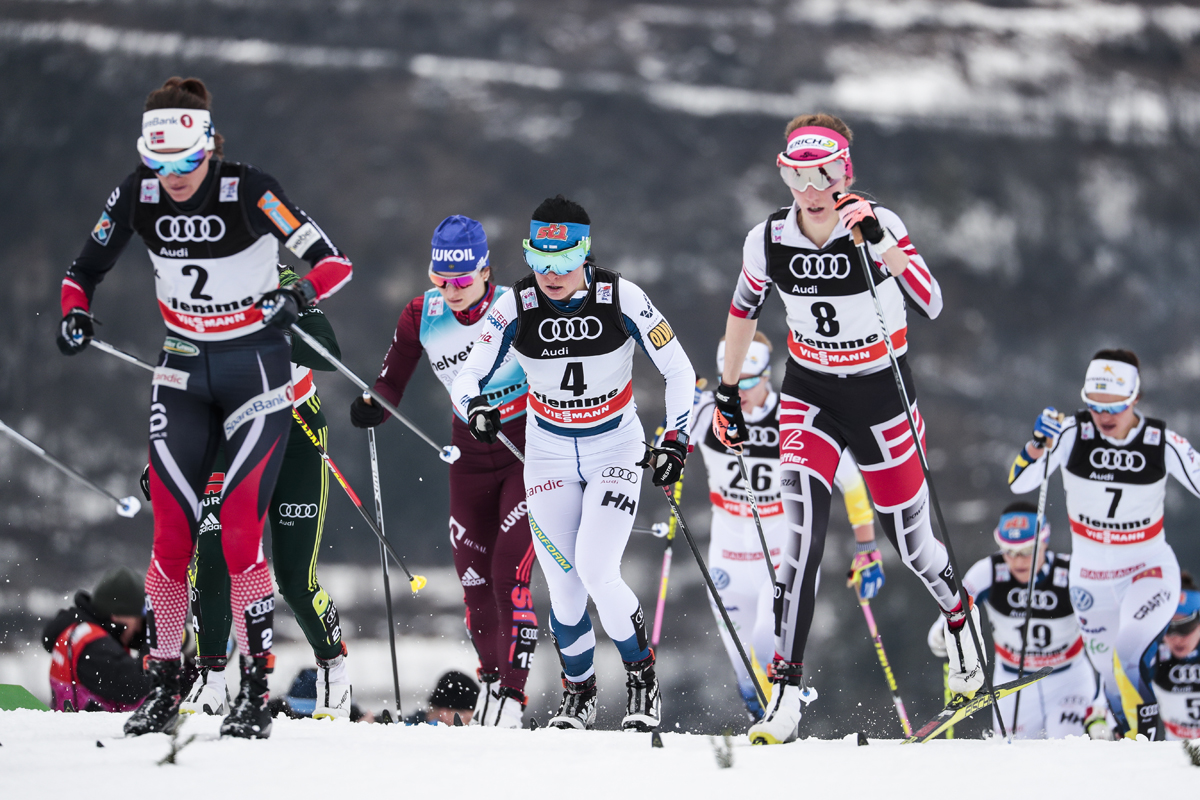
The Olympic 50 k is conducted in a mass start format, seven laps of 7+ kilometers/lap raced in the Classic technique. On an unseasonably warm day—40 degrees (Fahrenheit) and sunny skies—waxing and base prep were likely to play outsize roles in the results. Within the first three kilometers, a lead group of a dozen skiers—containing all the prime contenders—began to ease off the front. The early pace was made by Andersson, followed by Weng, Diggins, Teresa Stadlober (AUT), and Astrid Oeyre Slind (NOR). Val di Fiemme’s challenging hills quickly began whittling away at the lead group as Andersson continued driving the pace, stringing out Weng and Diggins in her wake. Slind inexplicably pulled up on a challenging climb, stalling other contenders behind her including Kerttu Niskanen (FIN), Johanna Matintalo (FIN), and Dariya Nepryaeva (AIN). Slind would drop out of the race only a few kilometers later, a frustrating result for a skier who had entered these Games with such high hopes..
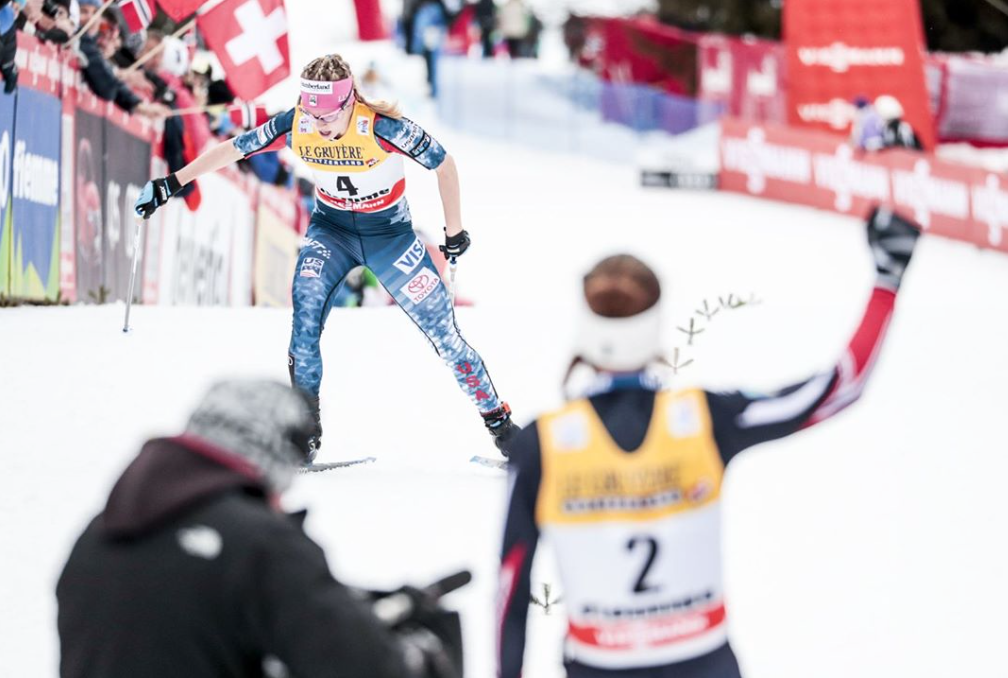
Jessie Diggins (USA) was an early animator in the Olympic 50 k. After a troublesome ski exchange, she’d come back to be part of the battle for the bronze medal (ultimately won by Switzerland’s Nadia Kaelin). (Photo: Barbieri/NordicFocus)
By 8.5 kilometers, a solid chase group would form involving Fosnaes, Niskanen, Matintalo, and Karoline Simpson-Larsen (NOR). At the front, the lead group had been reduced to three—Andersson, Weng, and Stadlober—as Diggins began to show the strain of he early pace. Even Stadlober had begun to wobble as the chasers continued to concentrate their pursuit.
Diggins was the first of the contenders to switch skis (at the 14.4 kilometer mark at the end of the Lap 2). She immediately regretted her decision as her klister-waxed skis tripped her dramatically on her way out of the exchange zone. Stumbling along the track—gasping and yelping audibly—Diggins lost considerable time, finding herself dropping to ninth place, 1:11 behind the leaders. Diggins would need to rely on her new skis working their way into the conditions, in the hope that they would ultimately provide an advantage. But even more time had been lost to the leaders who, themselves, had not shown any dissatisfaction with their own skis.
“I knew I had to switch early,” said Diggins. “I’m so glad I did. It was just a really gritty race. Literally every muscle in my body started cramping with three laps to go. So I can confidently say I could not possibly have tried harder or gotten more out of my body.”
“After that first pair of skis, she switched pretty early,” said US coach, Kristen Bourne. “But we also had a lot of confidence in that second pair . . . so we also had a lot of confidence giving her the the go-ahead to switch.”
The race settled into a few slow-developing stories:
Weng and Andersson were off the front, deciding gold between them.
Stadlober raced on alone in bronze medal position, but she found the gap behind her being eaten into by Niskanen and Fosnaes.
Diggins had fallen from contention, though her fortitude and pride were likely to prevent her from dropping out of her final Olympic event.
And then Diggins began coming back . . . maybe she began overhearing all of us commentators wondering if she might drop out of this race. That may be just the sort of motivation that Jessie Diggins needs. Diggins drove to the tails of Fosnaes and Niskanen. Together, they closed the gap to Stadlober who was pursuing better traction in the the snow outside the Classic tracks. While Diggins’ skis may have been a disaster in the first few meters after the exchange, it’s possible they were proving to have been a shrewd decision.
Andersson and Weng changed skis at the end of the fourth lap, where Andersson was pitched over her ski tips by her own sticky kick wax. At the end of lap four, Diggins had moved into bronze medal position as the chase group entered the stadium. Fosnaes was the only skier who opted to exchange skis. Stadlober, Kaelin, and Niskanen continued in pursuit of Diggins.
Soon after 30 kilometers, Andersson found her skis to be an advantage over Weng’s. By 34.2 kilometers, Andersson had opened a 20 second gap. She was still 45 minutes from the finish line, but Andersson was beginning to stretch her advantage.
Now in a group with Niskanen, Fosnaes, Kaelin, and Stadlober, Diggins may have sensed that her best chance to claim the bronze medal was not to be found in breaking away (thereby risking blowing up, herself) but to sit with this group in anticipation of a bunch sprint that would favor her own abilities. With two laps remaining, the chase group had decisions to make. Among those racers, only Diggins had already changed skis. Among this group, it was likely that someone would stop to make the change. If they did, they could find a late-race advantage, or they might find themselves giving up an advantage (in the time spent changing skis) that would be impossible to overcome. Kaelin, Stadober, and Niskanen all chose to change skis. Ultimately, all the chasing skiers would regroup, and immediately start considering their strategies. Diggins was the sprinter in the group; her advantage would be realized if the group came to the finish line together. Stadlober, Niskanen, Fosnaes—those are not sprinters—their only chance would be to drop Diggins and Kaelin before the finish line approached. Two laps to go . . .
And who the heck is Eliza Rucka-Michalek? The young Polish skier had been chasing all by herself for the last 40 kilometers. She finally connected with the chase group midway through he final lap, but would find that the efforts expendeded in reahing this group would be too costly to allow her to attack again. Rucka-Machalek would cross the line eighth.
The final kilometers were led out by Kaelin who was followed by an exhausted, but game, Fosnaes. Diggins shadowed them both, but the final climb would be excruciating for all. Kaelin had the best traction on the Zorzi climb; Fosnaes slipped a bit, as did Diggins who lost momentum when she stepped out of the tracks behind Fosnaes. Kaelin would maintain her advantage over the top of the climb, holding on for bronze, followed by Fosnaes and Diggins.
“I’m so grateful for our entire staff behind the scenes,” said Diggins. “They have been like, putting my body back together so that I could be out there today fighting. And I just, I wanted to do that for them. I wanted them to know like, ‘Hey, I am so grateful. Like, I’m gonna finish this. I’m gonna leave it all out there.’ And honestly, the most special thing was that I got to hug my mom on the side of the course before the race, and it’s just so cool to know that they were here for my last Olympics, and I got to end it on a beautiful day in a venue that I love so much. I’m just really proud of this last Olympics and really grateful and really happy, and I’m leaving here just full of joy and probably needing a new body.”
“I mean, we’re super proud of this team,” said Bourne. “And to walk away from this Olympics being like our most successful ever by having a variety of people—three different people—getting Olympic medals is, excuse my language, but #%&!@ insane! And I mean, man, we’re just super proud and stoked to keep the season going after a little bit of rest.”
Friends and rivals: Heidi Weng (NOR) and Ebba Andersson (SWE). (Photo: Vanzetta/NordicFocus)
Weng raced bravely and strategically in what may have been her final Olympics. She would claim silver, falling just short in her own quest for individual Olympic gold.
Andersson would continue extending her lead—20 seconds, 40, 60, 90—to claim a gold medal to go along with her three silvers earned at these Games. Here at the end of an Olympic campaign that found her hitting the deck again and again—including that spectacular somersault and subsequent one-ski scooter-pushing during the disastrous (though ultimately silver-medal-winning) Swedish relay—Andersson raced across 50 grueling kilometers to find glory at the finish line. Individual Olympic gold was finally hers, as well as respect and redemption after days of trials and tribulations.
FasterSkier will have our own Nat Herz on the ground at the Olympics, which, to be honest, is a very big financial lift for us. If you value the thoughtful work and access FasterSkier provides at championships like this one, please consider becoming a Voluntary Subscriber. Your support directly fuels the work we do to cover the people, places, and moments that make our sport special.
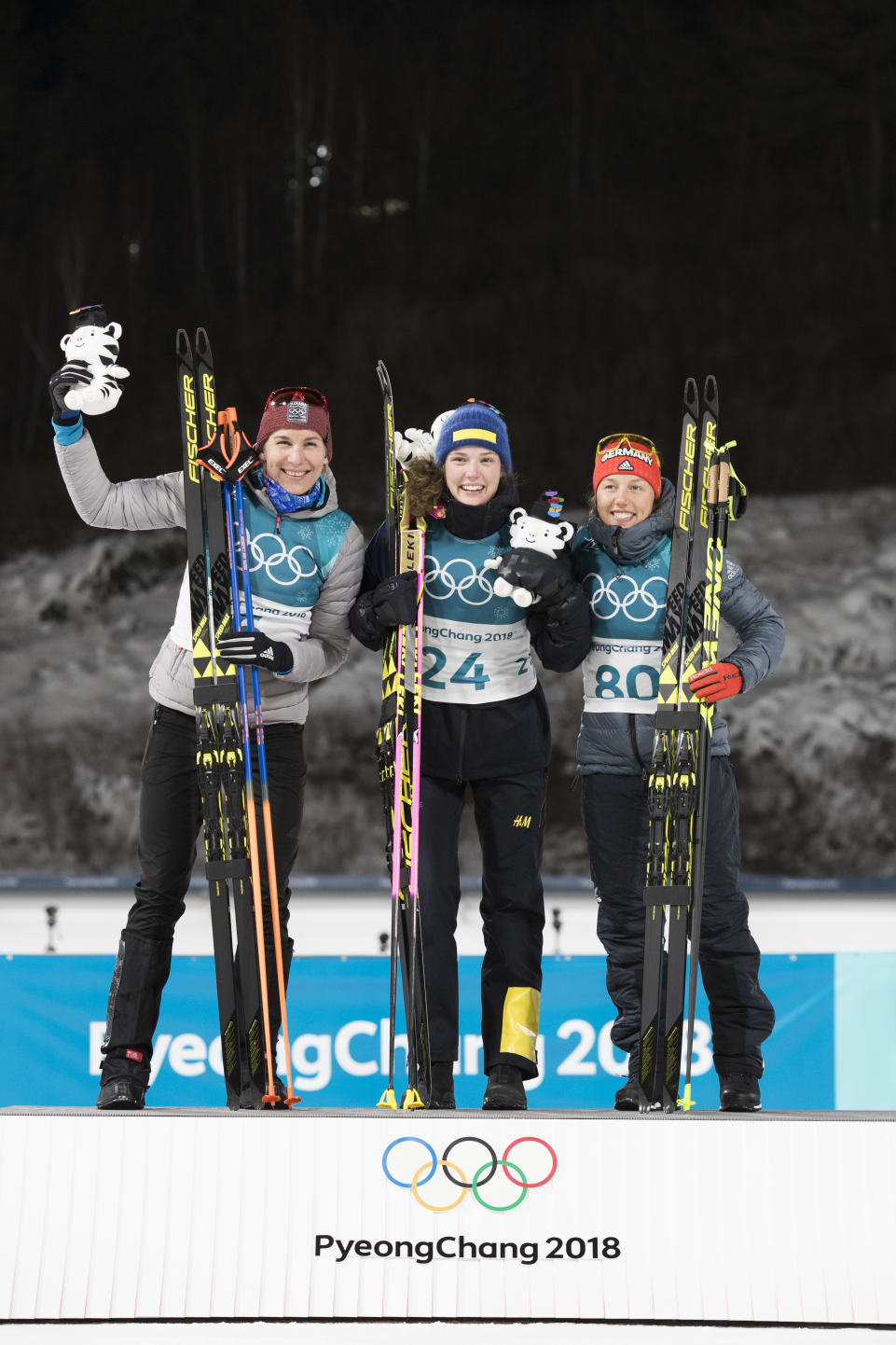
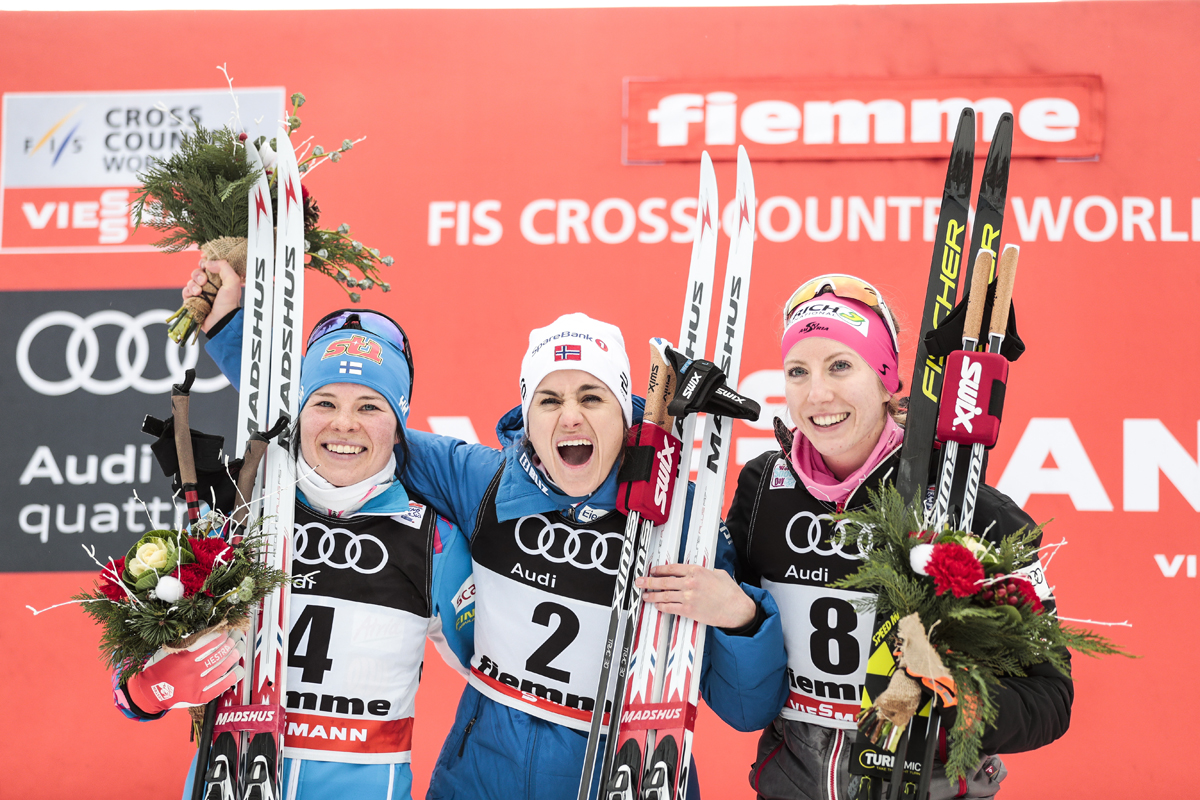
Heidi Weng (NOR), Ebba Andersson (SWE), Nadja Kaelin (SUI), on the podium of the Women’s 50 k Classic Mass start, the final cross-country event of the 2026 Olympic Winter Games in Milano-Cortina. (Photo: Barbieri/NordicFocus)
This coverage is made possible through the generous support of Marty and Kathy Hall and A Hall Mark of Excellence Award. To learn more about A Hall Mark of Excellence Award, or to learn how you can support FasterSkier’s coverage, please contact info@fasterskier.com.
Jessie Diggins (USA) claimed her third Tour de Ski overall victory in Val di Fiemme (ITA). (Photo: Vanzetta/NordicFocus)
The Tour de Ski does not end so much as it compresses. By the time the women turned onto the ribbon of snow climbing Alpe Cermis, the race had already been going on for a week—measured not only in kilometers and seconds, but in fatigue accumulated quietly overnight, in sore muscles, achy backs, and in confidence gained or lost one race at a time.
The final climb has a way of making those invisible things visible. It is steep enough to strip racing of pretense, long enough to punish impatience, and familiar enough that every skier arrives with memories—good ones, bad ones, and some they would rather forget. On Sunday afternoon in Val di Fiemme, the climb again became what it always is: less a finish line than a reckoning.
For Jessie Diggins, that reckoning ended in confirmation. Diggins finished second on the stage, protecting her margin with experience and restraint, and secured her third career Tour de Ski overall title. It was not the loudest way to win. It was, however, the truest.
Jessie Diggins (USA) paced the final climb perfectly to finish second on the day. (Photo: Modica/NordicFocus)
A Climb That Decides Everything
Stage 6 of the women’s Tour de Ski—10.0 kilometers, mass start, freestyle—began with the tension that always precedes Alpe Cermis. Some skiers arrived still dreaming of a stage victory. Others were guarding seconds earned days earlier. Still others were simply hoping to make it to the top without the climb turning overly cruel.
The early kilometers unfolded with relative calm. The pace was honest but controlled, the group compact as it flowed through the lower valley before turning uphill. On Alpe Cermis, there is no hiding, but there is strategy: when to let others go, when to follow, and—most importantly—when not to.
The decisive moves came as the gradient steepened and the field stretched into a long, thin line. Norway’s Karoline Simpson-Larsen skied with precision and patience, gradually asserting herself as the strongest on the day. She crested the final meters alone to win the stage in 37:05.3, earning the biggest single-day victory of her World Cup career.
Behind her, the race unfolded with quieter drama. Diggins, who entered the day with a commanding overall lead, skied with calculation. She resisted the temptation to respond immediately when others surged, choosing instead to manage the climb in segments. When the grade lessened and the gap narrowed late, she allowed herself to push hard enough to secure second place, but not so hard as to invite disaster.
Diggins crossed the line 8.8 seconds behind Simpson-Larsen, followed by Norway’s Heidi Weng in third at +14.4. The stage podium reflected the day’s effort, but it was Diggins’ second place that carried the most weight.
Jessie Diggins (USA), as always, left everything out on the course. (Photo: Modica/NordicFocus)
“Dying at the Right Moment”
Diggins’ approach to Alpe Cermis was shaped by experience—and memory.
“I was trying to be smart and safe in terms of the overall Tour,” she said afterward. “And then when I realized we were close enough, I thought, okay, now I can empty the tank. But I’ve paced it badly before where I blow up, and that last 600 meters is the slowest of your life.”
It is a detail only veterans tend to mention: not the steepest pitch, but the final few hundred meters, when legs that have already been pushed too far simply refuse to respond. Diggins has lived that mistake. On Sunday, she avoided it.
“I was trying to ski it smart and make sure I was dying at the right moment,” she said.
That restraint—so often invisible to spectators—was the difference between managing the Tour and risking it. The margin Diggins had built over five stages gave her room to think clearly. The climb rewarded that clarity.
Julia Kern (USA) and Jessie Diggins (USA) celebrate with US Cross-Country Ski Team coaches and staff, as well as US Alpine Ski Team athletes who came to support them at the end of the 2025/26 Tour de Ski. (Photo: Vanzetta/NordicFocus)
The Meaning of a Tour
In the mixed zone at the top, Diggins spoke not with relief so much as appreciation—for the work, the people, and the endurance the Tour demands.
“The Tour de Ski is one of the hardest things to win,” she said. “When you win the Olympics, it’s amazing—it’s really special. But that’s one race. The Tour is day after day after day. You have to put it together back-to-back, under cumulative pressure. That’s really hard. It’s hard on you, and it’s hard on the team.”
Her emphasis, repeatedly, returned to the collective effort. She spoke of team energy, of support staff, of consistency rather than dominance. It was a reminder that Tour victories are not seized in moments, but constructed patiently across an entire week.
Diggins finished the Tour with a total time of 2:11:26.1, winning the overall by more than two minutes over Austria’s Teresa Stadlober. It was not a victory defined by a single attack or a single stage, but by accumulation—time gained when others faltered, mistakes avoided when margins were thin.
Julia Kern (USA) makes her way up Alpe Cermis to finish 14th on the day. (Photo: Vanzetta/NordicFocus)
Kern’s Quiet Confirmation
For Julia Kern, Alpe Cermis offered something different: clarity.
Kern finished 14th on the stage, 2:01.0 back, after a Tour that reflected both progress and unfinished business. She described the climb as meeting—or exceeding—her expectations.
“Every year it’s a little different with who’s still left in the Tour,” Kern said. “But I’m taking away from today that my fitness is there. I just need to fine-tune some of the sprinting gears. That’s very trainable at this point in the season.”
Her assessment mirrored her results. Kern was consistently strong in the distance races throughout the Tour, finding rhythm and confidence as the days passed. The sprint stages, by contrast, left her frustrated.
“I was a bit bummed with my sprint days for sure, and hungry for more,” she said. “But at the same time, I had consistently good, strong distance races. Halfway through the Tour, I started to find my race legs again.”
It is a pattern Kern recognizes—slow starts, gradual momentum, strength revealed in longer efforts. In an Olympic season, that trajectory matters more than any single result.
Maja Dahlqvist (SWE) attacked at the end of the valley trail leading to the Alpe Cermis in Val di Fiemme (ITA) to secure her silver sprinters’ bib. (Photo: Vanzetta/NordicFocus)
The Bib Battles
Beyond the overall, the final climb also settled two secondary competitions that added layers of tension to the Tour’s closing act.
The climber’s bib—awarded for cumulative performance on the Tour’s toughest ascents—went to Teresa Stadlober, who accumulated 45 points across the week. Diggins finished second in the standings with 39, underscoring how consistently she handled the steepest terrain without ever needing to gamble on a single climb.
The sprint standings, marked by the silver bib, remained unsettled until the final stage, where one final set of bonus points was awarded at the beginning of Alpe Cermis. Sweden’s Maja Dahlqvist emerged with the title at 53 points, ahead of Switzerland’s Nadine Fähndrich and Sweden’s Johanna Hagström. Diggins finished fourth in the sprint competition—another reflection of her Tour: competitive everywhere, decisive where it mattered most.
Teresa Stadlober (AUT) fought hard to defend her climbers’ bib. (Photo: Vanzetta/NordicFocus)
Pain, Reconsidered
Late in the mixed zone, Diggins reflected on something more personal—how different this climb felt compared to recent years.
“The last two years I’ve been so injured that I was in so much pain outside of racing,” she said. “So for it to be only painful during the race was like, wow—that’s kind of nice.”
It was not a dramatic declaration, but it carried weight. The Tour de Ski magnifies everything: fatigue, doubt, confidence, pain. To arrive at Alpe Cermis feeling capable—rather than simply enduring—marked a shift.
She laughed when she added that she told herself, mid-Tour, that she would “never do this again.” Then she smiled at the familiar uncertainty that defines the race.
“You never know how you’re going to feel every day on a Tour,” she said. “And today I felt really good. One of the best I’ve ever felt on the final climb.”
Julia Kern (USA), Jessie Diggins (USA), (l-r) at the top of Alpe Cermis in Val di Fiemme (ITA). (Photo: Modica/NordicFocus)
The American Picture
For the U.S. women, the Tour ended with a sense of coherence. Diggins’ overall victory provided the headline, but Kern’s steady distance form pointed toward depth and durability within the team.
Kern’s immediate plans reflect that long view. She will return home to Richmond, Vermont, for two weeks—prioritizing recovery before resuming training on familiar snow.
“I did this last year, and it worked really well,” she said. “Just getting off World Cup, getting a lot of recovery the first week, being in my own bed.”
From there, she will rejoin training camps and racing with an eye toward sharpening for the Olympics. It is a plan built on patience rather than urgency—much like Diggins’ approach on Alpe Cermis.
Teresa Stadlober (AUT), Jessie Diggins (USA), Heidi Weng (NOR), (l-r) take the Tour de Ski overall podium. (Photo: Vanzetta/NordicFocus)
What the Climb Leaves Behind
When the last skier crested the climb and the finish corral emptied, Alpe Cermis returned to stillness. The Tour de Ski had done what it always does: clarified things.
It clarified that Jessie Diggins remains one of the sport’s great stage racers—capable not just of winning races, but of managing weeks. It clarified that Julia Kern’s fitness base is real and growing, even if some pieces still need refinement. And it clarified, once again, that the Tour is not about brilliance alone, but about survival, intelligence, and trust in process.
Diggins did not win the final stage. She did something harder. She won the Tour by knowing exactly when not to.
At the end of the longest climb of the week, that knowledge mattered most.
Feature stories like this one take time, access, and care to produce. If you value thoughtful storytelling and independent ski journalism, please consider becoming a Voluntary Subscriber. Your support directly fuels the work we do to cover the people, places, and moments that make our sport special.
Jessie Diggins (USA), Karoline Simpson Larsen (NOR), and Heidi Weng (NOR), (l-r) share the final climb podium at the top of Alpe Cermis in Val di Fiemme (ITA). (Photo: Vanzetta/NordicFocus)
This coverage is made possible through the generous support of Marty and Kathy Hall and A Hall Mark of Excellence Award. To learn more about A Hall Mark of Excellence Award, or to learn how you can support FasterSkier’s coverage, please contact info@fasterskier.com.
Jessie Diggins (USA) was once the best in the world at racing the 5 k distance. She still is . . . (Photo: -Vanzetta/NordicFocus)
At one point early in her career, Jessie Diggins (USA) had become the pre-eminent World Cup racer at the 5 k Freestyle. She was fast, she could endure bucket-loads of lactate, and she could suffer like nobody’s business: perfect for the demands of the 5 k. Today’s result makes it look like she’s probably still the best at this distance, though it’s a race that’s hardly ever contested anymore in international racing. Diggins probably had it in her mind that she could post a win—if her heat was strong, if their strategy was sound, if everyone did their job, and if her 5 k skills remained intact. In the end, it was the speed of Diggins’ heat—and the intensity with which she led it—that made the difference, as all the podium places were claimed by that heat. Diggins first, Ebba Ribom (SWE) second, Moa Ilar (SWE) third, Leonie Perry (FRA) fourth, and Alison Mackie (CAN) fifth.
Diggins is a gamer; it was no surprise to see her embracing this new race format even before racing had begun. “It was just five k,” Diggins remarked” . . . “You’re going to gain or lose ten seconds.” In typical Jessie Diggins fashion, her perspective on the day seemed to be It’s a ski race. Let’s all just have fun!
Inventing an Event . . .
It’s a race . . . they’re filling World Cup podiums and delivering World Cup points and awarding event prize money. The field would be taking it seriously, even though a majority of the racers probably didn’t know what to make of it.
A recent press release claimed that this 5 k Mass Start format was “introduced to boost excitement.” Well, if our sport is in such dire need of a boost in excitement, then we should try to do something about that. What other format innovations could boost excitement? Perhaps the notion of full-contact Nordic racing—pads, helmets, a penalty box, the occasional dropping of the gloves. Maybe we should consider adding “Sharks and Minnows” to the roster of Olympic, World Cup, and World Championship events? How about a jump? Some aerials? A little air-time? Recent Eastern Cup Sprint races (a Junior Nationals qualifying event) conducted at New Hampshire’s Holderness School included a jump at the top of a small downhill slope. A few of the best skiers hit the jump well, and looked good doing it. The majority of skiers looked shaky, apprehensive, terrified. And a predictable number of racers ended their day splayed at the bottom of the hill as their rivals sped up the trail. At least it made for good spectating—and I suppose that was the point. Imagine how much better it could have been if we’d incorporated a hoop of fire on the jump, as well?
“My plan is to survive the 5 k,” said Astrid Oeyre Slind (NOR) the winner of yesterday’s 10 k classic event. “I think that will be a fun, but maybe a little bit chaotic, race.”
Tour organizers seem to think that adding novelty events is just what Nordic skiing needs to be more exciting for its viewing audience. The 5 k Mass Start Heat also adds the benefit of potentially re-shuffling the deck so that lesser skiers get a chance to shine. Certainly that’s exciting for fans of those lesser skiers. But for the true contenders, that’s gotta be incredibly frustrating, especially when World Cup points and potential Olympic qualifications are on the line.
Katherine Sauerbrey (GER), Nadja Kaelin (SUI), and Helen Hoffmann (GER) lead the pack in Heat 1 of the 5 k Mass Start in Toblach. (Photo: Vanzetta/NordicFocus)
Heat 1—11:15.7
In pre-race start-lists, FIS described today’s event as taking place in four heats of 20 skiers per heat. The composition of those heats selected skiers from multiple seeded groups (a few fast skiers, a few middle skiers, a few skiers from the tail end of the field) to fill out the heats in a relatively fair fashion. Intermediate Sprint bonuses were offered for both the Sprinters and the Climbers. The rest would be settled on the race course. Somebody say 1, 2, 3, go . . .
Rydzek led out Heat 1, taking the Sprint points at a line across the trail atop Toblach’s arch-shaped building. Thereafter, Frida Karlsson and Moa Lundgren committed to setting the pace. But at the crucial point in Heat 1, the surprising attacks came from Switzerland’s Kaelin sisters (Nadija and Marina), and Germany’s Helen Hoffman and Katherine Sauerbrey. If the overall Tour contenders needed this to be a fast heat, then their decision to leave the pace-making to lesser-known Swiss and German skiers may not have been the most effective strategy.
Nadia Kaelin would hold on for the heat win in 11:15.7. Behind her, regular contenders struggled to remain in contention: Jasmi Joensuu (FIN) in 8th place, Frida Karlsson (SWE) 13th, Coletta Rydzek (GER) 16th, Johanna Hagstroem (SWE) 18th.
“We saw a lot of surprises in these competitions,” said on-air commentator, Chad Salmela. “A lot of names that we didn’t necessarily expect to see at the top of the order.” You can say that again, Chad . . .
Astrid Oeyre Slind (NOR) made as much pace as she could, leading Kristin Austgulen Fosnaes (NOR) and Julia Kern (USA), both of whom would finish the day in teh top ten. But Slind’s pace would prove no match for Diggins. (Photo: Vanzetta/NordicFocus. Every downloaded picture is fee-liable.
Heat 2—11:01.0
The second heat included contenders like Astrid Oeyre Slind (NOR), Maia Dahlqvist (SWE), Kertuu Niskanen (FIN), Kristin Austgulen Fosnaes (NOR), Heidi Weng (NOR), and Julia Kern (USA). After a little bit of early speed provided by the logical contenders, the pace making was taken over by Julie Pierrel (FRA) and Pia Fink (GER). Time was slipping away for the overall contenders trapped in the languid pace of Heat 2 as the Sprint bonus points line passed with the leaders trailing Heat 1 by three seconds. The contenders could try charging to the front to take over the pace, but such a lactate-ploouted effort might ruin them for days to come. Well, Slind ain’t scared of a little lactic aid; she stormed to the front at the halfway mark followed by Fosnaes, Weng, Fink, and Kern.
Kern’s potential in upcoming Olympic events rests solidly on her probable pairing with Diggins in the Team Sprint. Kern’s job in that event will be simple: don’t get dropped. If her performance in today’s Heat 2 is any indication, her current level of fitness is preparing her well for that challenge. She went to the front (a bit too early), but was overtaken at the finish line by Dahlqvist. They were followed by Slind, Fink, and Austgulen-Fosnaes. The finishing time was considerably faster than Heat 1, but they’d need to wait to see what times later heats would produce.
Eva Ingebrigtsen (NOR) kept the pace high in Heat 3. Diggins benefited from that pace, and launched forward to expand upon it. (Photo: Vanzetta/NordicFocus)
Heat 3—10:51.2
Diggins was joined in Heat 3 by the remaining Swedish contenders—Moa Ilar, Emma Ribom, and Ebba Andersson—though Diggins’ pre-race conversations with Norway’s Ingrid Bergene Aabrekk and Eva Ingebritsen made it seem like she’d be relying on other recruited allies to keep the pace high. Diggins could be seen talking up the strategy of the day—volunteering to start fast, but intending for others to come forward to cycle through at the front. Obviously, she was hoping the heat would be a fast one. The strategy may have been markedly different for Tour Sprint Leader, Kristine Stavaas Skistad, who was probably intending to sit at the back and stay out of trouble. Skistad may have been the wearer of the Sprint Leader’s jersey, but the likelihood of Skistad being the final winner of that distinction (awarded at the end of the Tour de Ski atop the Alpe Cermis) is extremely low. She just wanted to make it to the next Sprint stage where she hoped to claim another World Cup win.
True to her original intent, Diggins flew off the starting line. Diggins was racing her last-ever World Cup 5 k Mass Start Heat race in Toblach (in Diggins’ farewell season, everything identifies as a “last-ever”), but if Diggins was relying on someone else to help with the pace-making, she’d need to let someone else lead. The Swedes volunteered as Diggins settled back into the pack for a moment of precious recovery. It may be just that—her ability to recover—that makes Diggins such a threat in mass-start racing. The rest of the field would do well to remember that when mass-start races (the Skiathlon and the 50 k) are run during the Olympics of Milano-Cortina.
Canada celebrated the fifth place finish of Alison Mackie (CAN), just the sort of celebration FIS may have had in mind when they added the 5 k Mass Start Heat to the Tour de Ski schedule. (Photo: Modica/NordicFocus)
Just as she’d been instructed to do, Ingebritsen led through the Sprint bonus line. While Diggins’ start had been lightning fast, the pace of Heat 3 had begun fading by this point, no longer the fastest at the Sprint bonus. Ingebritsen had done the job that Diggins had proposed before the race. Now it was time for Diggins to take over again. She did so with authority, racing through the Climbers’ bonus points and flying down the descent toward the finish. Diggins was just magnificent today. She set the early pace, she set the pace in the middle of the heat, and she totally dropped everyone else on the final uphill to post a finishing time a full nine seconds faster than any other heat. She was followed across the line by Ribom, Ilar, and by tremendous efforts from Leonie Perry (FRA) in fourth and Alison Mackie (CAN) in fifth.
“I love it!” Diggins could be heard exclaiming to Ingebritsen in the finish area after the heat concluded. “You gotta do it, and you went for it. I love it!” Diggins’ strategy had worked . .. and it was nice that she also said “Thank you” to Ingebritsen.
At the tail end of Heat 3—a minute and a half behind the leaders—Skistad out-sprinted Aleksandra Kolodziej of Poland to avoid being the last one across the finish line.
Heat 4 would prove to be a slow heat. Any pace or progress Teresa Stadlober (AUT) needed she was forced to create on her own. (Photo: (Modica/NordicFocus)
Heat 4—11:13.6
Stadlober drew the short straw, and a starting position in a weak heat. Stadlober is no sprinter, but she has proven to be both cagey and capable as a racer in mass start events. Though she was joined in Heat 4 by Nadine Faehndrich (SUI), Julie Bjervig Drivenes (NOR), and Karoline Simpson-Larsen (NOR), none of them really appeared poised to pull Stadlober to a finishing time that could rival Diggins’ performance in Heat 3.
Drivenes led out the pace, followed by Faehndrich and Stadlober. But early checkpoints revealed that their efforts already placed them outside the top 20 compared to earlier heats. Gina del Rio (AND) led through the Sprint bonus, and continued on beyond the line. But del Rio’s pace was not what was needed for the contenders languishing in Heat 4 to make up time. Knowing her Olympic potential is on the line in every event, Simpson-Larsen went to the front. But her prospects were not bright: she was volunteering to race alone and un-assisted for the rest of the distance. Ultimately, Stadlober re-took the lead and powered across the finish line one second ahead of Simpson-Larsen. Imagine Stadlober’s disappointment when it was announced that all her work and all her effort resulted in her placing no better than 17th (22 seconds slower than the. winner)?
On-air commentator, Kikkan Randall remarked on the “intrigue” created by this format, one in which the finishing time is what matters, but in which each skier will either benefit from, or be victimized by, the pace of their heat. For any number of today’s participants, that seems to me to be less a source of intrigue, and more a source of consternation. Regardless, Diggins was without doubt the skier who was most able, most prepared, and most intentionally poised to capitalize on today’s circumstances. Ultimately, Diggins added 11 seconds to her Tour de Ski lead over Slind, a margin that now stands at 50 seconds. That could certainly prove significant when the course turns upward on the final climb up Alpe Cermis.
In the end, it appeared that Diggins and Slind were the only two contenders who understood how things could work today. They both drove the pace as hard as they could, they both proved their fitness and their mettle, and they finished with a distance between them that might not have been much different if today’s race had been conducted in interval start format. Other skiers jumped in and delivered great results, and that is truly wonderful for them, for their fans, and for the event organizers. Maybe old curmudgeons like me, too, will come to love this event in the future. Regardless, I’ll be betting on Jessie Diggins if ever this event is run again.
“It was fun to feel that excitement with other friends and countries on the World Cup,” Diggins recalled. “I think that was an unexpected delight of the format.”
Racing Continues—and the Alpe awaits
Tomorrow in the Tour de Ski will see the staging of the second odd event in a row—the 20 k Pursuit—a race that gives a head start to those who are already leading, and rewards them (with World Cup victories!) for winning a race in which they were given a head start. Don’t get me started . . .
Heat 3 takes it all: Emma Ribom (SWE), Jessie Diggins (USA), Moa Ilar (SWE) on the podium after the Tour de Ski 5 k Mass Start Heat. (Photo: Modica/NordicFocus)
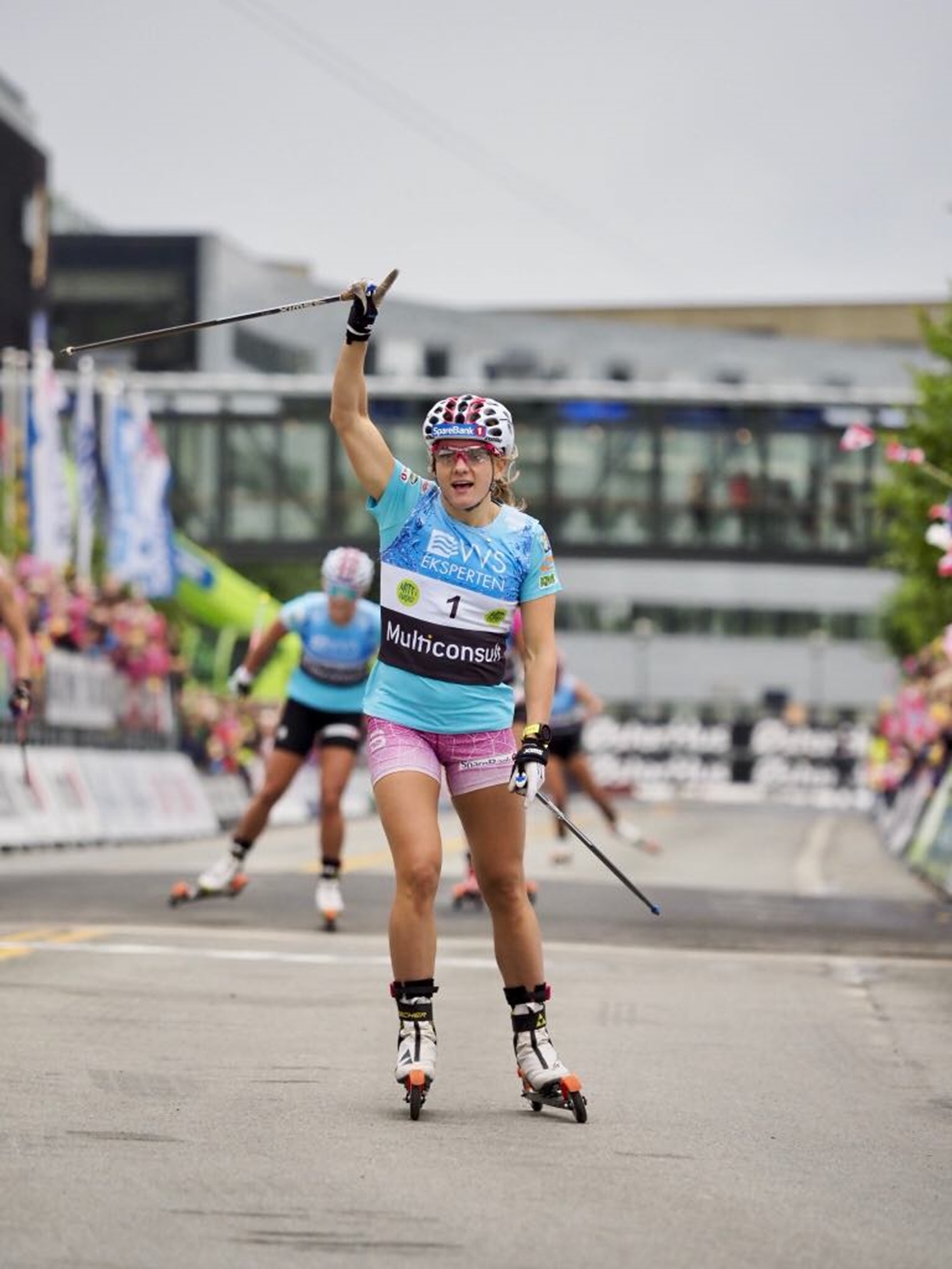
Norway’s Maiken Caspersen Falla (1) winning Saturday’s women’s cross-country sprint final on the last day of the 2018 Blink Ski Festival in Sandnes, Norway. (Photo: Blink Ski Festival/Axelar/Arild Aarnes)
The 2018 Blink Ski Festival continued in full force on Friday and Saturday, with cross-country and biathlon prologues, 10- and 15-kilometer cross-country races and biathlon mass starts all taking place on Friday, followed by sprints on Saturday.
Elite racing began in the afternoon with the men’s prologue (no prologue was held for the women), Norway’s Gjøran Holstad Tefre posted the fastest time of 3:12.21. Finishing 1.89 seconds back was another Norwegian, Aleksander Dyrberg Ek, and Great Britain’s Andrew Young claimed the prologue’s final podium spot, finishing 2.27 seconds off the winning time.
Also in the top 10 were Norway’s Morten Eide Pedersen in fourth (+4.7), Britain’s James Clugnet in fifth (+4.76), France’s Lucas Chanavat in sixth (+5.09), Norway’s Stian Grastveit in seventh (+5.70), France’s Renaud Jay in eighth (+5.75), and Norway’s Sindre Folkvord and Harald Østberg Amundsen in ninth (+6.00) and 10th (+6.03), respectively.
Canada’s Evan Palmer-Charrette finished 34th (+16.68), Scott Hill placed 39th (+19.37) and Bob Thompson was 40th (+19.54) out of 47 finishers.
After the elite men’s prologue, athletes geared up for a men’s and women’s biathlon prologues.
Norway’s Johannes Thingnes Bø took the men’s biathlon prologue win in a time of 10:30.2 after two misses (1+1). One second back, it was a tie for second place between another Norwegian, Lars Aasheim Svaland, who had one penalty (0+1), and France’s Antonin Guigonnat, with one miss as well (1+0).
Slovenia’s Anastasiya Kuzmina, who took one gold and two silver medals at the 2018 Olympics, won Friday’s women’s prologue with clean shooting and a time of 11:34.6. Just 0.6 seconds behind was Norway’s Emilie Ågheim Kalkenberg, who placed second with perfect 10-for-10 shooting as well. France’s Justine Braisaz claimed third, 10.7 seconds out of first, after missing two targets (0+2).
The next event on Friday’s program was the women’s 10 k cross-country mass start, which Norwegian sprint specialist Maiken Caspersen Falla won in 20:39.4. She bested fellow Norwegian Mari Eide by 1.9 seconds, and Sweden’s Charlotte Kalla and Norway’s Kari Øyre Slind followed in third (+3.9) and fourth (+3.9), respectively, with the same time.
Working their way into the top 10 were Russia’s Elena Soboleva in fifth (+4.9), Finland’s Krista Pärmäkoski in sixth (+5.0), Norway’s Ingvild Flugstad Østberg and Ragnhild Haga in seventh (+5.1) and eighth (+5.2), respectively, Austria’s Teresa Stadlober in ninth (+6.6), and Russia’s Natalia Matveeva in 10th (+8.7). Out of 31 women, Nichole Bathe, racing for Great Britain, finished in 23rd (+1:09).
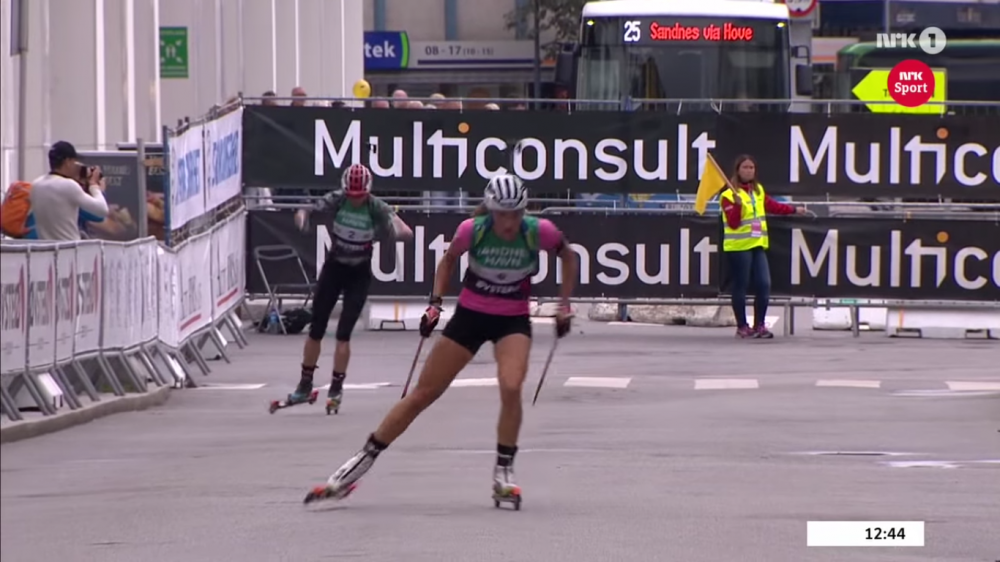
Sweden’s Hanna Öberg (front) racing to first in the women’s biathlon mass start on Friday the 2018 Blink Ski Festival in Sandnes, Norway. (Screenshot: NRK broadcast)
Friday’s program then moved on to the women’s biathlon mass start. Sweden’s Hanna Öberg won the event in a time of 13:19.4 despite three misses (0+1+2+0). Kuzmina finished second, crossing 2.1 seconds behind the Swede after a penalty in each stage (1+1+1+1). Third place went to another Swede, Mona Brorsson, who crossed 5.9 seconds after Öberg and shot four penalties (2+1+1+0).
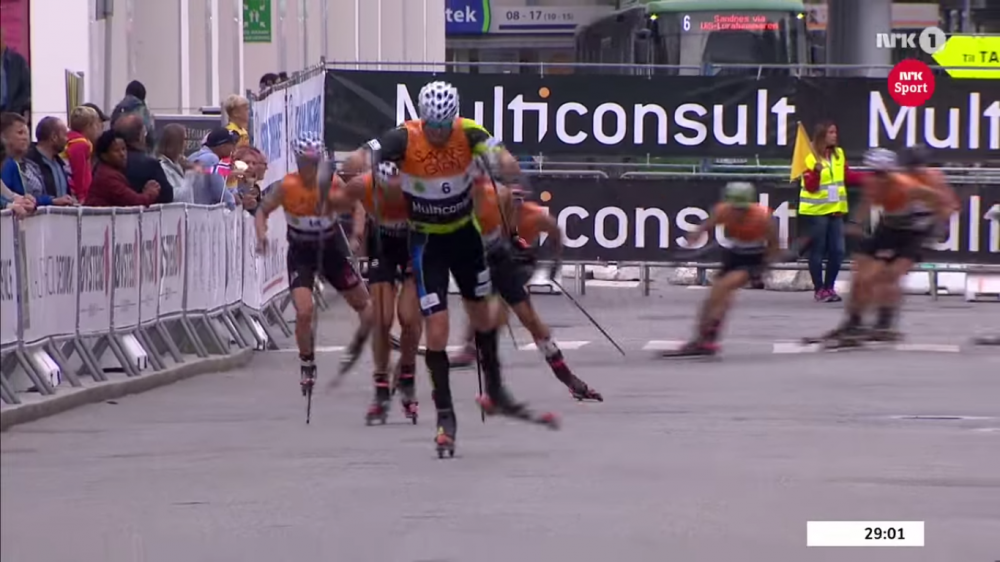
Norway’s Henrik L’abeé-Lund (r) winning the men’s biathlon mass start on Friday at the 2018 Blink rollerski festival, ahead of his teammate Johannes Thingnes Bø in second in Sandnes, Norway. (Screenshot: NRK broadcast)
Following the women’s biathlon race, the men’s biathlon mass start got underway. Norway’s Henrik L’abeé-Lund emerged as the winner, crossing the line in 17:21.3 after shooting four penalties (1+1+2+0). Exactly three seconds behind him was J.T. Bø in second place with two misses (1+0+1+0). Sealing the all-Norwegian podium was Vetle Sjåstad Christiansen, who missed six targets (1+1+2+2) and finished 12.1 seconds after L’abeé-Lund for third.
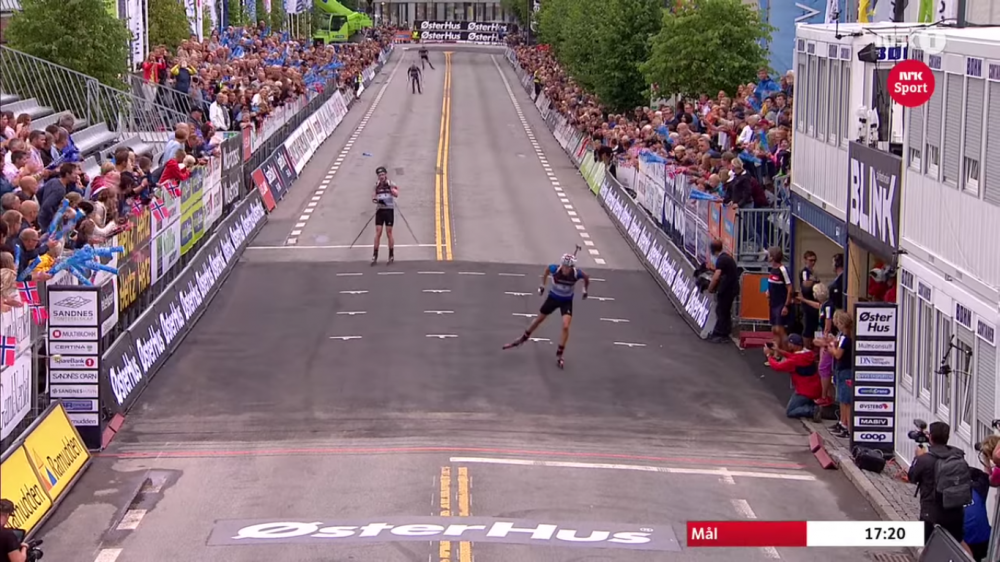
Russia’s Sergey Ustiugov leading the pack of the elite men’s 15-kilometer freestyle cross-country mass start on Friday at the 2018 Blink Ski Festival in Sandnes, Norway. (Screenshot: NRK broadcast)
Friday’s final race turned back to cross-country for the elite men’s 15 k freestyle mass start. Russian skier, Sergey Ustiugov, who was banned from competing at the 2018 Winter Olympics, won it in 29:26.0, 2.1 seconds ahead of Norway’s Aleksander Ek, (who had placed second in the prologue to start the day). Italy’s Federico Pellegrino was just another 0.6 seconds back in third (+2.7).
“I was a little nervous today because I won it last year and I wanted to repeat my success here again today,” Ustiugov told NRK through a translator. “It didn’t go easy, but I did manage to do what I wanted to do, and I would like to thank all my team, Markus [Cramer], and the rest of the team. That was great.”
The remaining top ten included Norway’s Vebjørn Turtveit in fourth (+2.9), Sindre Bjørnestad Skar in fifth (+3.9), Øystein Pettersen in sixth (+5.4), and Torstein Bu in seventh (+5.8). France’s Adrien Backscheider and Clement Parisse placed eighth (+5.9) and ninth (+6.2) respectively, followed by Norway’s Eirik Brandsdal in tenth (+6.2).
Racing for Canada, Alex Harvey finished 14th (+7.5).
Norway’s Maiken Caspersen Falla winning the women’s cross-country sprint on Saturday at the Blink Ski Festival in Sandnes, Norway. It was her second-straight victory after topping Friday’s 10 k freestyle mass start as well. (Screenshot: NRK broadcast)
Saturday marked the final day of the Blink rollerski festival and included cross-country and biathlon sprints. In the women’s cross-country final, Norway’s Falla picked up her second-straight win, ahead of Russia’s Matveeva in second (+1.6) and Sweden’s Ida Ingemarsdotter in third (+2.4). Norway’s Eide was just off the podium in fourth (+2.9), Norway’s Barbro Kvåle Trømborg placed fifth (+3.7), and another Norwegian, Linn Ravndal, finished 8 seconds back in sixth.
Falla’s won the final in 3:40.8 after topping her quarterfinal and semifinal as well.
The men’s cross-country racing began with a prologue, which Norway’s Vetle Christiansen won in 1:31.92, just three-hundredths of a second ahead of his fellow countryman, Ek. France’s Baptiste Noel placed third in the prologue, 1.76 seconds out of first.
Russia’s Gleb Retivykh (second from r) winning the men’s cross-country sprint final on Saturday at the Blink Ski Festival in Sandnes, Norway. (Screenshot: NRK broadcast)
In the heats later in the day, Russia’s Gleb Retivykh came out on top of the final, getting there by placing second in both his quarterfinal and semifinal, then winning the last round by 0.2 seconds over Pellegrino in a time of 3:15.5. Pellegrino had won his quarterfinal but advanced as a lucky loser in fourth out of the second semifinal. The 25-year-old Ek capped off his successful series with another podium, placing third in the final, just 0.3 seconds out of first.
In a post-race interview with NRK, Retivykh explained this was his first time at Blink.
“I am very happy,” he said in English. “Today is my first win at Blink, and [it was my] first time here.”
In a close final, Norway’s Gjøran Tefre and Brandsdal followed in fourth (+0.5) and fifth (+0.7), respectively, Italy’s Francesco De Fabiani was just behind in sixth (+0.8).
France’s Justine Braisaz celebrating across the line as she wins the women’s biathlon super sprint on the last day of 2018 Blink Ski Festival on Saturday in Sandnes, Norway. (Screenshot: NRK broadcast)
Biathletes were able to experience head-to-head sprint racing as well (a deviation from the typical biathlon World Cup sprint format, which is individual), in the women’s and men’s biathlon supersprints, which included one prone and one standing shooting stage per heat.
France’s Braisaz won the women’s final in 7:45.3. She had previously won her quarterfinal (which was a longer distance), then placed seventh in the first semifinal (same distance as final). Norway’s Marte Olsbu placed second in the final (+0.4), and Sweden’s Brorsson returned to the podium in third (+0.9).
“It was really close at the end, but I am very happy about the weekend here,” Braisaz told NRK on English after. “Everything is perfect, even though the weather is a little bit — how do you say — moody. But it’s OK. And I am really happy to be in Norway and I will make my stay longer after the festival weekend.”
Norway’s Vetle Sjåstad Christiansen winning the men’s biathlon supersprint on Saturday, the last day of the Blink Ski Festival, in Sandnes, Norway. (Screenshot: NRK broadcast)
In the men’s biathlon super sprint, Norway’s Christiansen dominated the day, winning his quarterfinal and semifinal before beating J.T.Bø by 2.2 seconds in the men’s final with a time of 12:01.8. France’s Guigonnat completed the podium in third, 8.5 seconds behind Christiansen.
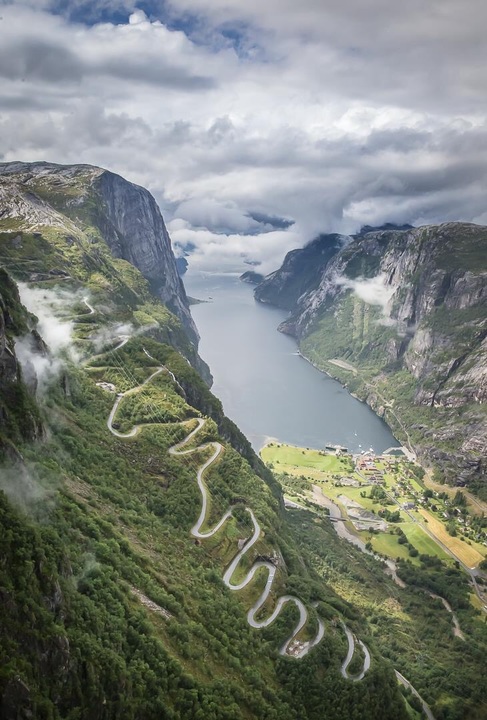
The 7.5-kilometer race course for the Lysebotn Opp, an annual hill climb at the Blink Ski Festival in Lysebotn, Norway. (Photo: Blink Ski Festival/Facebook)
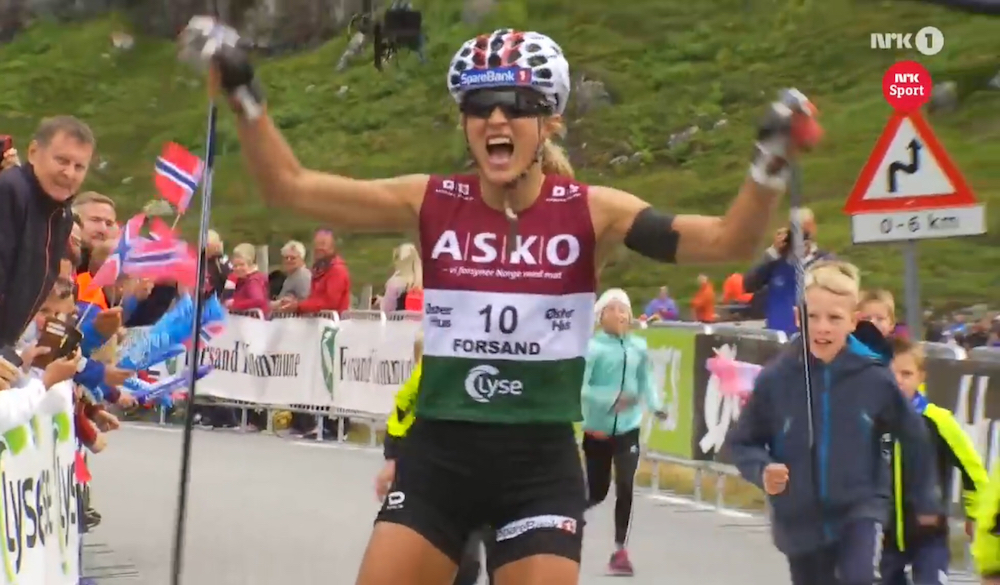
The Blink Ski Festival’s famed Lysebotn Opp hill climb returned on Thursday, and with it, a familiar name landed at the top of the results.
After serving an 18-month ban from ski racing and subsequently missing the 2018 Winter Olympics, Norway’s Therese Johaug is back.
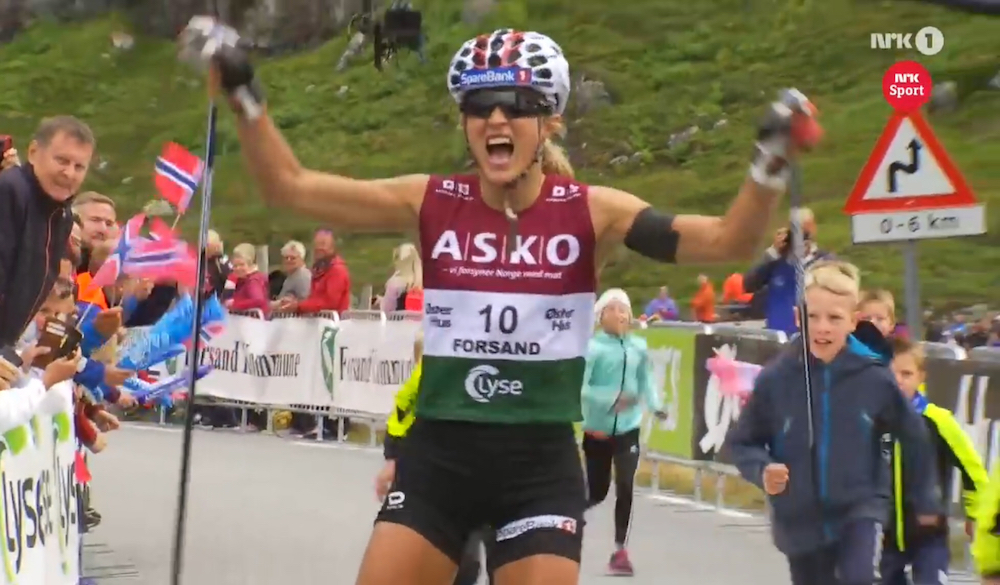
Norway’s Therese Johaug winning the 2018 Lysebotn Opp hill climb, part of the Blink rollerski festival, on Thursday. She finished in a record-setting 31:46.3 minutes, topping her previous course record of 32:36 from 2012. American Liz Stephen, who retired from skiing this past spring, holds the third-fastest time of 32:53.9. (Screenshot: NRK broadcast)
The 30-year-old Johaug won Thursday’s rollerski hill climb in a record time of 31 minutes, 46.3 seconds, while Sweden’s Charlotte Kalla finished 1:47.5 minutes back in second.
Kalla, 31, won last year’s Lysebotn Opp in 33:18.3, telling NRK at the time that “it’s been long since I’ve been in this good a shape in July.” Kalla’s 2017/2018 season went on to be one of her best. She racked up 10 individual wins, including a gold medal in the Olympic skiathlon.
If Kalla is using her the past year and half as a springboard for the upcoming season, Johaug might be considered the antithesis to the Swede. The year and half competition bar behind her, Johaug appears ready to move forward.
“If there’s one thing I’ve learned from all this, it’s that you should never rely on anyone, period,” Johaug told Newsinenglish.no. “It’s terrible, but that’s the way it is.”
Following Johaug and Kalla on Thursday, Sweden’s Ebba Andersson claimed the third spot on the podium, finishing 3.9 seconds behind her compatriot Kalla and 1:51.4 behind Johaug.
Norway’s Haga Ragnhild placed fourth (+2:21.6) and Ingvild Flugstad Østberg was fifth (+2:48.9), Austria’s Teresa Stadlober finished sixth (+3:05.7), Russia’s Yulia Belorukova seventh (+3:52.4), Norway’s Kari Øyre Slind eighth (+4:05.0), and Russia’s Elena Soboleva ninth (+4:14.1) and Yana Kirpichenko 10th (+4:26.2). Finland’s Krista Parmakoski finished exactly ten seconds outside the top ten in 11th (+4:36.2). Forty-seven women finished the senior women’s race.
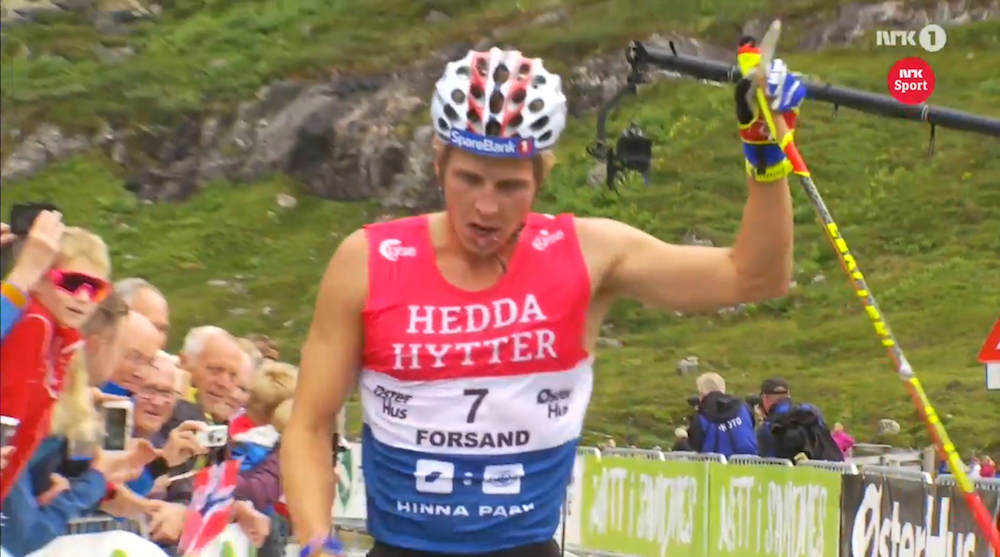
Norway’s Simen Hegstad Krüger winning the 2018 Lysebotn Opp hill climb, part of the Blink rollerski festival, on Thursday. (Screenshot: NRK broadcast)
In the senior men’s Lysebotn Opp that followed, two Norwegians battled up front, with reigning Olympic skiathlon champ Simen Hegstad Krüger ultimately winning the race for the first time in 27:53.2. Another national team member and 2018 Olympian (and last year’s Lysebotn Opp winner), Hans Christer Holund finished 3.9 seconds back for second place, and Norway swept the podium with Simen Andreas Sveen in third (+16.0).
Rounding out the top 10 were Norwegians Vebjørn Turtveit in fourth (+51.7), Martin Johnsrud Sundby in fifth (+52.6), France’s Clement Parisse in sixth (+1:12.4), Norway’s Henrik L’Abée-Lund in seventh (+1:21.1), France’s Adrien Backscheider in eighth (+1:24.7), Russia’s Artem Maltsev in ninth (+1:31.4) and Canada’s Alex Harvey in 10th (+2:02.1).
Past winners of the Lysebotn Opp rollerski hill climb in Lysebotn, Norway. Simen Hegstad Krüger’s winning time on Thursday was third fastest on record at 27:53.2. (Screenshot: NRK broadcast)
The pre-race scene at the 2018 World Cup in late January in Seefeld, Austria. The venue will host 2019 World Championships. (Photo: Garrott Kuzzy/LumiExperiences.com)
With the 2019 International Ski Federation (FIS) Nordic World Ski Championships the next major championship on the docket, Garrott Kuzzy, a 2010 U.S. Olympian who lives in Innsbruck, Austria, interviewed the chief of course for the 2019 World Championships in Seefeld, Austria. Via email, he asked Thomas Unterfrauner about preparing for the event, which will run from Feb. 20 to March 3.
***
Garrott Kuzzy:How is the atmosphere around Seefeld leading up to the 2019 World Championships?
Thomas Unterfrauner: The atmosphere is very interesting. The whole village of Seefeld is focused on the championships next winter. Everybody seems to have a role in preparing for it for it. We all know that this is a big opportunity for us to showcase the whole Olympiaregion Seefeld to the world.
Early in the men’s 15 k freestyle mass start at the 2018 World Cup in Seefeld, Austria, with Canada’s Alex Harvey (4), Switzerland’s Dario Cologna (6) and Norway’s Hans Christer Holund (2) skiing near the front of the pack. (Photo: Salomon/NordicFocus)
GK:In 2017, Seefeld hosted the OPA Cup finals. There was ankle-deep standing water in parts of the stadium. Big changes were made in the stadium and on the trails and it seems to have worked. What changes did you make?
TU: We reviewed the course in detail after the OPA Cup finals last spring. There were several challenging areas on the course, especially the water in the stadium. We worked with several specialists to analyze and make changes to the stadium and the course.
GK:What changes do you still plan to make before next winter?
TU: Our biggest change will be to make the stadium even wider. There are many things we need to fit into the stadium, such as start and finish lanes and a wide section of race course going between them, plus bleachers that we did not have for the World Cup this year. At this point, 90 percent of our work is complete. We are mostly making some finishing touches now.
GK:The courses for this year’s World Cup in Seefeld seemed to really appeal to the U.S. skiers, especially Sophie Caldwell and Jessie Diggins, who both won races. What did you learn about the course at the World Cup this winter?
TU: We learned many things from the World Cup this winter. We approach most events, such as National or OPA Cup level competitions, with athletes and teams in mind. With World Cups and World Championships, we have the additional considerations of television and marketing partners. Some of our new questions we consider are where to place sponsor banners, cameras and how to get power to them. Television and marketing partners work with us to make sure all of the additional hardware is in place.
GK:What was the general response from the athletes?
TU: The reaction to the courses was positive from all sides. Athletes and coaches both commented how easy it was to access the trails, wax trailers, and the start and finish areas from the course for warming-up, cooling-down and testing skis. The stadium is also close enough to Seefeld that teams can get to and from the skiing without having to take a bus. With our improved rollerski loop, there are many teams coming to Seefeld for their summer training, to spend more time getting comfortable with the course and the surroundings.
Left to right: Mikaela Sundbaum (assistant technical delegate), Annmari Viljanmaa (TD), Christian Krepper (chief of competition), and Thomas Unterfrauner (chief of course) at the 2018 World Cup in Seefeld, Austria. (Photo: Garrott Kuzzy / Lumi Experiences)
GK:How many spectators are you expecting for the 2019 World Championships?
TU: We are expecting around 15,000 spectators per day for the World Champs, around three times as many as we had for the World Cup races last winter.
GK:You were at the 2017 World Championships in Lahti, Finland. In your mind, what is the difference between a World Cup and the World Championships?
TU: The size of the event and the length of time are the biggest differences. There are more athletes, coaches, support staff, media and spectators, all of whom stay for up to two weeks or more. Everything down to how we dispose of trash has to be considered. That is to say, there is a lot of housekeeping to be done for a full two weeks–much longer than one World Cup weekend.
GK:Why should someone travel to ski in Seefeld? What makes Seefeld unique?
TU: Seefeld and the whole Olympia Region (Seefeld hosted the cross country events for the 1964 and 1976 Olympic Games) is made up of several different towns, valleys and trail networks, including Seefeld, Leutasch, Mösern, Scharnitz, Buchen and Reith. In total, there are over 200 kilometers of trails. We can offer skiers of all levels terrain that matches their wishes, whether that’s challenging World Cup trails through the woods or flat, relaxed terrain through open valleys. The quality of life here on the Seefeld Plateau is very high, with clean air, amazing nature, spectacular scenery and most importantly, good snow conditions.
GK:Finally, there are some big hopes for the U.S. team, coming off a gold-medal performances in Seefeld and PyeongChang. That said, there are also some skiers flying under the radar who could challenge for the victory. Teresa Stadlober will surely be aiming for a big performance in her home country. Therese Johaug has not competed in 2018, but will be back in 2019. There’s a rumor she was in Seefeld for a World Champs simulation training camp while the rest of her competition was at the Olympic Games. Do you have any predictions for next winter?
TU: Nope, I have no predictions. My aim is to offer fair and safe races for all athletes. Off the trail, we will have a host a huge celebration of cross country skiing. I would love to draw more attention to our sport, especially here in Austria. So, I suppose it would be pretty special if Austria won a medal 😉
GK:Finally, you work as an electrician in the summer. Are there any skills or attributes from your summer job that you put to use in the winter as chief of course?
TU: Yes, there are many parts, especially working under pressure and attention to detail. If an electrician makes a mistake, it can be very hard, or impossible, to go back and fix later. In the worst cases, the house could burn down. We use similar structures in preparing for big events, so that details are not overlooked and everything runs exactly as it should when you turn on the lights and welcome the world.
Garrott competed in the 2010 Olympic Games and raced several years with the US Ski Team and the CXC Team. He is founder of Lumi Experiences, offering cross-country ski vacations to Europe. Lumi Experiences is partnering with the National Nordic Foundation to offer trips to the 2019 World Championships in Seefeld.
Seefeld in Tirol, Austria, will host the 2019 Nordic World Championships. (Photo: Garrott Kuzzy/LumiExperiences.com)
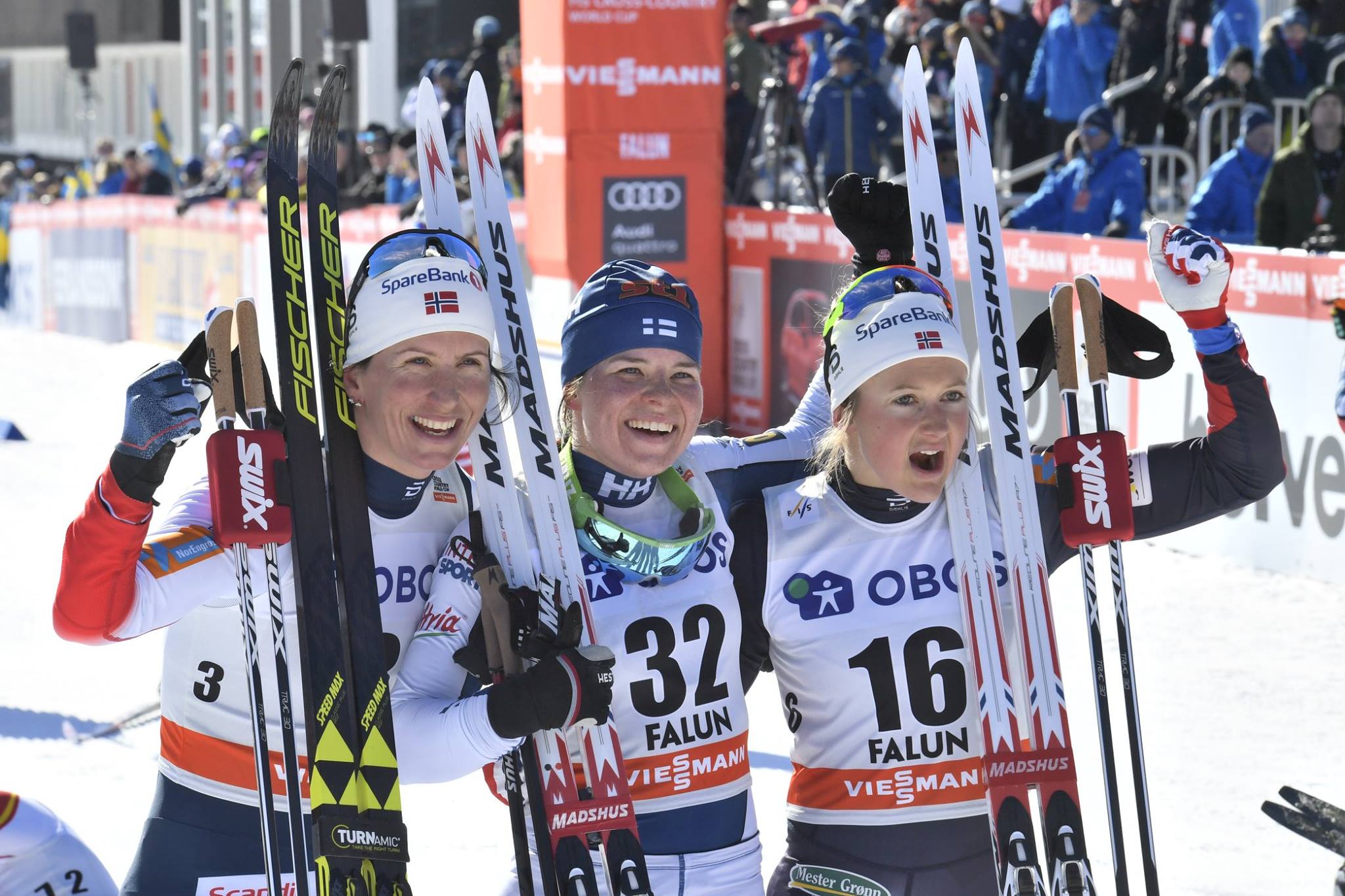
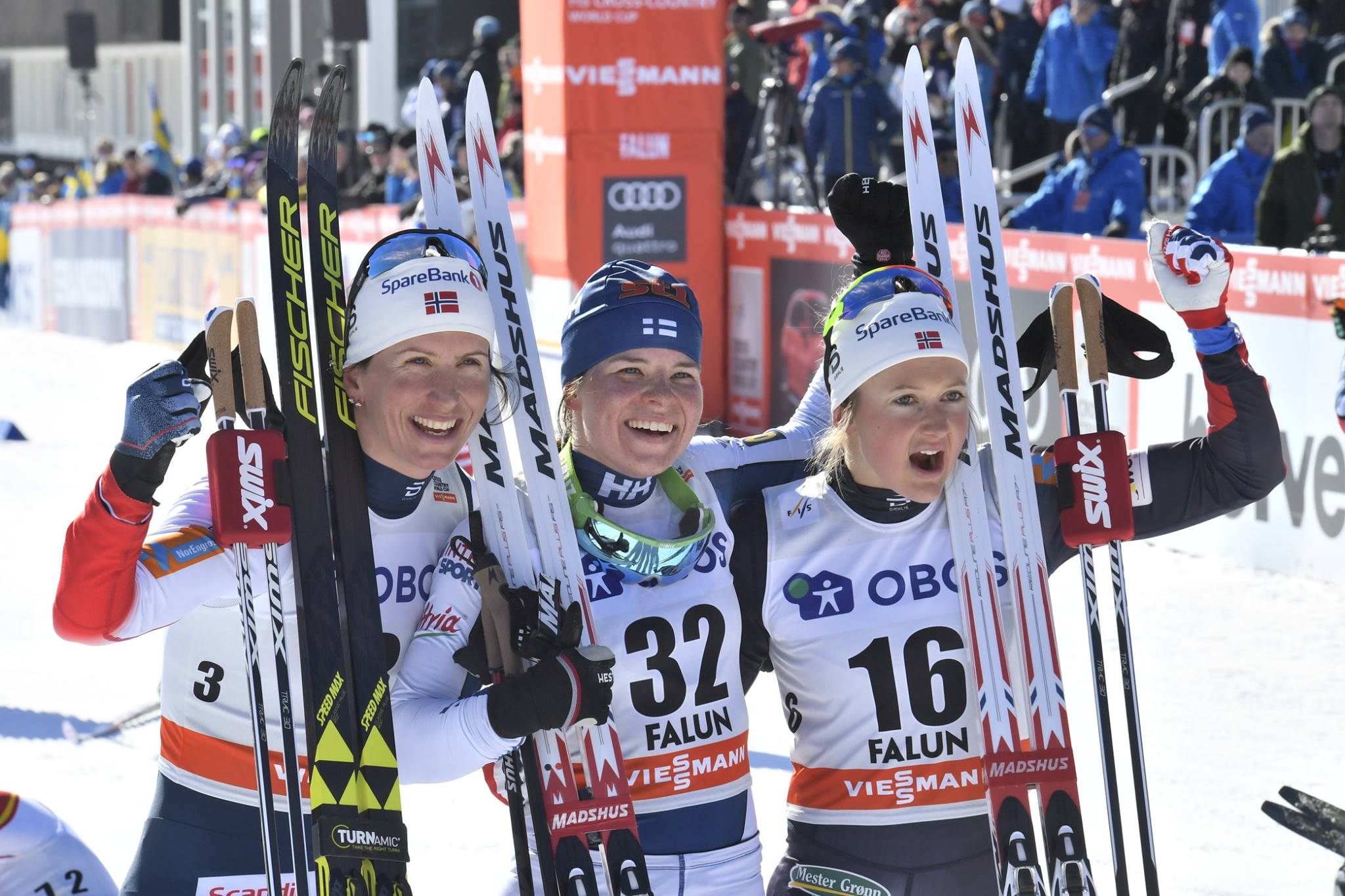
The women’s 10 k classic mass start podium at 2018 World Cup Finals in Falun, Sweden, with Finland’s Krista Pärmäkoski (c) in first, Norway’s Marit Bjørgen (l) in second and Ingvild Flugstad Østberg (r) in third. (Photo: FIS World Cup Svenska Skidspelen/Facebook)
FIS Cross Country World Cup Finals (Falun, Sweden): 10/15 k classic mass starts
Day 2 of World Cup Finals in Falun entailed 10- and 15-kilometer classic mass starts on Saturday, and in the first race of the day, Finland’s Krista Pärmäkoski pulled out a thrilling finishing-sprint victory over Norway’s Marit Bjørgen.
After American Jessie Diggins led early in the first 2.5 k loop, Bjørgen set the tone from the front for most of the race. With less than a kilometer to go, Norwegian powered up the final horseshoe-shaped climb in first, with Pärmäkoski and Bjørgen’s Norwegian teammate Ingvild Flugstad Østberg just behind her. The three had dropped the field while lapping through the stadium around the 7.5 k.
While Østberg fell off the pace on that final uphill, Bjørgen accelerated as she took a few quick strides over the top, gaining a few meters on Pärmäkoski as they headed into the descent. The finishing stretch is long in Falun, and Pärmäkoski was able to come on strong just before she and Bjørgen entered the final 100 meters before the finish. There, Pärmäkoski’s double-pole speed not only matched Bjørgen, but beat her, as Pärmäkoski passed her with several meters to go and took the win by 0.2 seconds in 26:00.5 minutes. It was Pärmäkoski’s second win of the season and fourth of her career (including time-of-day pursuit stage wins).
Just behind Pärmäkoski and Bjørgen, who congratulated each other immediately at the finish, Østberg finished 5.1 seconds back in third. Five women fought for fourth place, with Sweden’s Ebba Andersson taking it (+14.5) ahead of Japan’s Masako Ishida in fifth (+14.8), Sweden’s Charlotte Kalla in sixth (+15.2), Austria’s Teresa Stadlober in seventh (+15.4), and Diggins in eighth (+15.5).
Norway’s Astrid Uhrenholdt Jacobsen was the next finisher across the line in ninth (+24.8), then Finland’s Kerttu Niskanen in 10th (+26.2) and American Sadie Bjornsen in 11th (+26.3).
Canada’s Emily Nishikawa was the next North American in 36th (+1:31.1), and she led her teammates Cendrine Browne, who placed 50th (+2:05.7), Dahria Beatty in 61st (+2:46.6) and Zina Kocher in 69th (+6:12).
For the U.S., Sophie Caldwell finished 41st (+1:36.1), Rosie Frankowski 44th (+1:43.7), Caitlin Patterson 47th (+1:54.8), Ida Sargent 52nd (+2:10.2), Liz Stephen 54th (+2:20.0), Kikkan Randall 57th (+2:34.1), and Kaitlynn Miller 64th (+2:50.7). Rosie Brennan did not start.
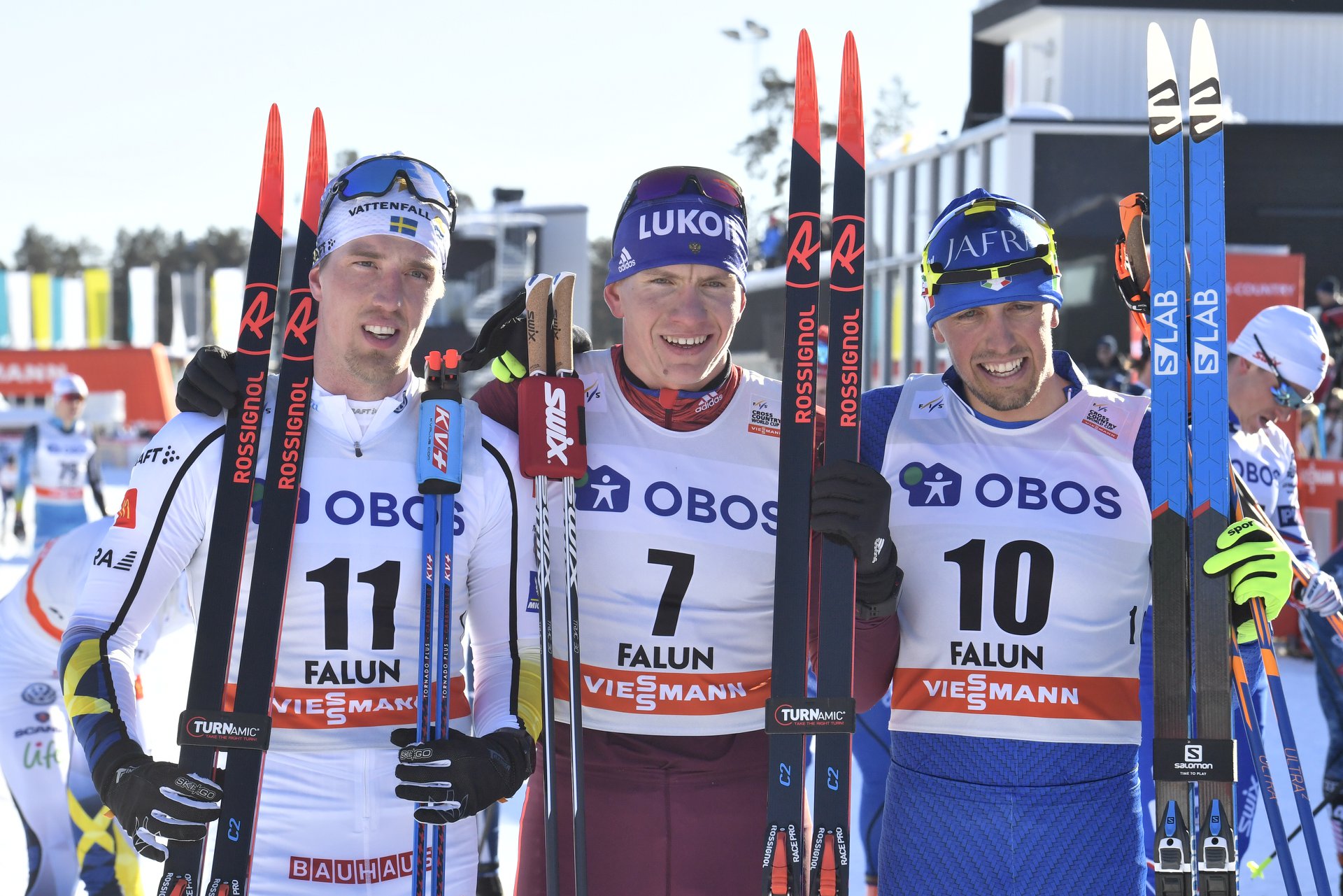
The men’s 15 k classic mass start podium at 2018 World Cup Finals in Falun, Sweden, with Russia’s Alexander Bolshunov (c) in first, Sweden’s Calle Halfvarsson (l) in second, and Italy’s Francesco de Fabiani (r) in third. (Photo: : FIS World Cup Svenska Skidspelen/Facebook)
In the men’s 15 k classic mass start on Saturday afternoon, Russia’s 21-year-old Alexander Bolshunov notched his first-career World Cup win after reaching the podium seven other times this season (placing third in six of those seven races).
Bolshunov hung in the pack and took the lead at the start of the final lap at 11.25 k, ahead of four of his Russian teammates, Alexey Chervotkin in second, Evgeniy Belov in third, Andrey Larkov in fourth, and Maxim Vylegzhanin in fifth. Behind them, Switzerland’s Dario Cologna skied just ahead of Norway’s Martin Johnsrud Sundby and Canada’s Alex Harvey, who were among 29 skiers within four seconds of first.
While Sweden’s Calle Halfvarsson led the final climb before the stadium, Bolshunov caught him on the downhill and out-double-poled him in the finishing stretch, taking first by 1.3 seconds in 36:59.8. Halfvarsson finished second and Italy’s Francesco de Fabiani scored his second World Cup podium of the season in third (+3.1).
Kazakhstan’s Alexey Poltoranin missed the podium by 0.6 seconds in fourth (+3.7), Chervotkin followed in fifth (+5.2), ahead of Cologna in sixth (+5.6) and Italy’s Federico Pellegrino in seventh (+5.6), after they finished together. Sundby and his Norwegian teammate Niklas Dyrhaug also crossed the line at the same time in eighth (+6.3) and ninth (+6.3), respectively, just 0.1 seconds ahead of another one of their teammates, Sjur Røthe, in 10th (+6.4).
Less than five seconds later, Harvey finished 20th (+10.7), ahead of Norway’s Johannes Høsflot Klæbo in 22nd (+13.6). Klæbo slipped out of contention on the third of four laps, as he dropped from fourth to 22nd in less than two kilometers.
Canada’s Devon Kershaw finished 26th (+14.6) for his fourth-straight race in the top 30 (including his 26th-place finish in the Olympic 50 k classic mass start), Graeme Killick placed 41st (+1:13) and Julien Locke was 81st (+3:29).
Erik Bjornsen was the top American man in 52nd (+1:47.1), Simi Hamilton finished 62nd (+2:06.4), Kevin Bolger was 69th (+2:27.1), David Norris 70th (+2:31.2), Scott Patterson 71st (+2:40.6), Paddy Caldwell 75th (+2:52.7), and Andy Newell 86th (+4:47).
World Cup Finals conclude with 10/15 k freestyle pursuits on Sunday.
France won the International Biathlon Union (IBU) World Cup women’s 4 x 6 k relay to start the day at Holmenkollen, ahead of Germany and Italy, while the Canadian women’s team (Sarah Beaudry, Julia Ransom, Emma Lunder, and Rosanna Crawford) placed 11th and the U.S. (Clare Egan, Susan Dunklee, Joanne Reid, and Emily Dreissigacker) came back from 21st to finish 15th.
In the men’s 12.5 k pursuit that followed, France’s Martin Fourcade won his 10th race at Holmenkollen, putting himself 49 points ahead of Norway’s Johannes Thingnes Bø with three individual races in Tyumen, Russia, remaining. US Biathlon’s Sean Doherty tied his second-best result this season in 17th and his teammate Lowell Bailey raced up to 28th with the 19th-fastest time of day. Leif Nordgren placed 40th and Tim Burke was 47th, while Canada’s Scott Gow finished 51st and Christian Gow was 54th.
The Holmenkollen women’s 30 k freestyle mass start podium on Sunday in Oslo, Norway, with Jessie Diggins (l) in second, and Norway’s Marit Bjørgen (c) in first and Ragnhild Haga (r) in third. (Photo: FIS Cross Country/Twitter)
FIS Cross Country World Cup (Oslo, Norway): Women’s 30 k freestyle mass start
Marit Bjørgen, the Norwegian queen of distance cross-country events, racked up another victory at Holmenkollen in the women’s 30-kilometer freestyle mass start on Sunday for her seventh win in the World Cup’s ultimate distance event at the famed Norwegian venue. (She had previously won in 2005, 2010, 2012, 2014, 2015 and 2017).
But she did so in not-so-typical fashion. Instead of breaking the field mid-race and skiing to a comfortable win, like she did in the last race of the 2018 Olympics in PyeongChang, South Korea (a 30 k classic mass start), Bjørgen came from behind to win Sunday’s Holmenkollen 30 k and wasn’t able to let off too much before finish. She didn’t take the lead until less than a kilometer to go and put just enough time into her competition to take the win in 1:18:12.4 hours, while American Jessie Diggins outlasted the chase group of three to place second (becoming the first American woman to reach the Holmenkollen podium), 3.6 seconds behind Bjørgen. Norway’s Ragnhild Haga edged Sweden’s Charlotte Kalla by 0.1 seconds for third place (+4.3), while Kalla settled for fourth (+4.4).
The rest of the field was strung out, with Norway’s Astrid Uhrenholdt Jacobsen finishing fourth (+11.5) and Ingvild Flugstad Østberg nearly another 1 1/2 minutes back in fifth (+1:39.5). Finland’s Krista Pärmäkoski placed seventh (+1:51.7), Germany’s Stefani Böhler notched eighth (+2:10.2), Austria’s Teresa Stadlober ninth (+2:10.2), and Sweden’s Ebba Andersson 10th (+2:11.9). Less than a second behind Sweden’s Ida Ingemarsdotter in 11th (+2:22.8) was American Sadie Bjornsen in 12th (+2:23.4).
In the Distance World Cup standings, Diggins gained some valuable points to keep herself in third, now 63 points ahead of Pärmäkoski in fourth. Heidi Weng, who finished 18th on Sunday, still leads the distance standings by 104 points and Østberg is second, 51 points ahead of Diggins.
In the Overall World Cup, Weng leads by 153 points over Østberg. Diggins is another 104 points back in third, 100 points ahead of Pärmäkoski in fourth. At World Cup Finals next week in Falun, Sweden, a total of 300 points is up for grabs for the winners (50 for freestyle sprint, 50 for classic individual start, and 200 for freestyle pursuit).
The U.S. had three in the top 20 and four in the points (top 30) in Sunday’s 30 k, with Kikkan Randall in 19th (+3:21.9) and Caitlin Patterson in 28th (+4:13.1). Rosie Frankowski (Alaska Pacific University) missed the top 30 by about 28 seconds in 31st (+4:45.4), Liz Stephen placed 51st (+10:01.7) and Kaitlynn Miller (Craftsbury Green Racing Project) finished 53rd (+16:05.0).
Cendrine Browne led four Canadian women in 36th (+6:16.1), Emily Nishikawa was 44th (+7:36.1), Zina Kocher (Foothills Nordic) finished 47th (+8:52.0), and Dahria Beatty placed 49th (+9:45.1).
Germany’s Vanessa Hinz celebrates her first IBU World Cup win and podium in the women’s 12.5 k mass start on Sunday in Kontiolahti, Finland. (Photo: IBU/Biathlonworld)
IBU World Cup (Kontiolahti, Finland): Men’s and women’s mass starts
(Note: This rundown has been updated to include comments from Lowell Bailey and Rosanna Crawford.)
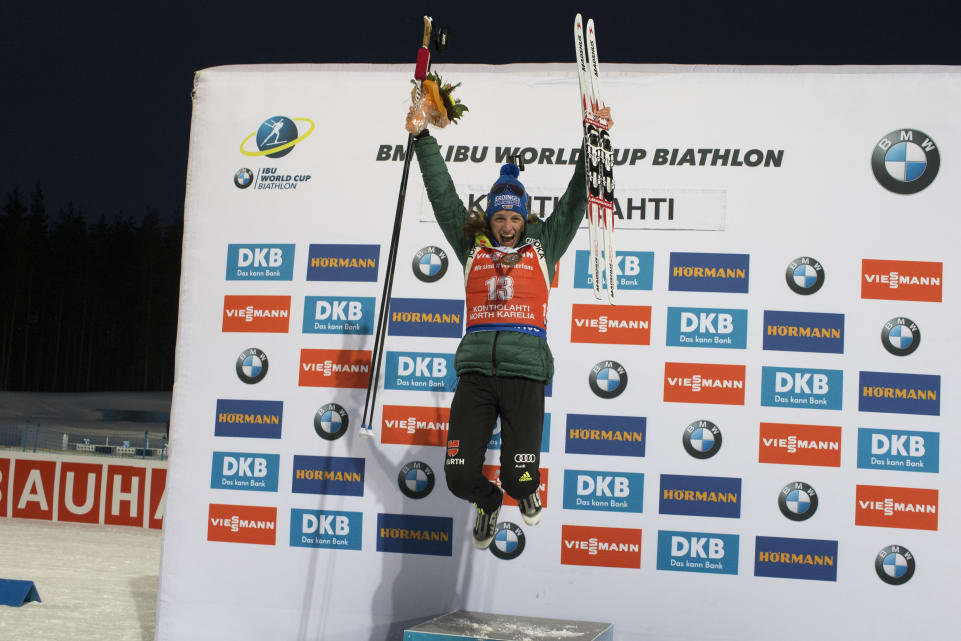
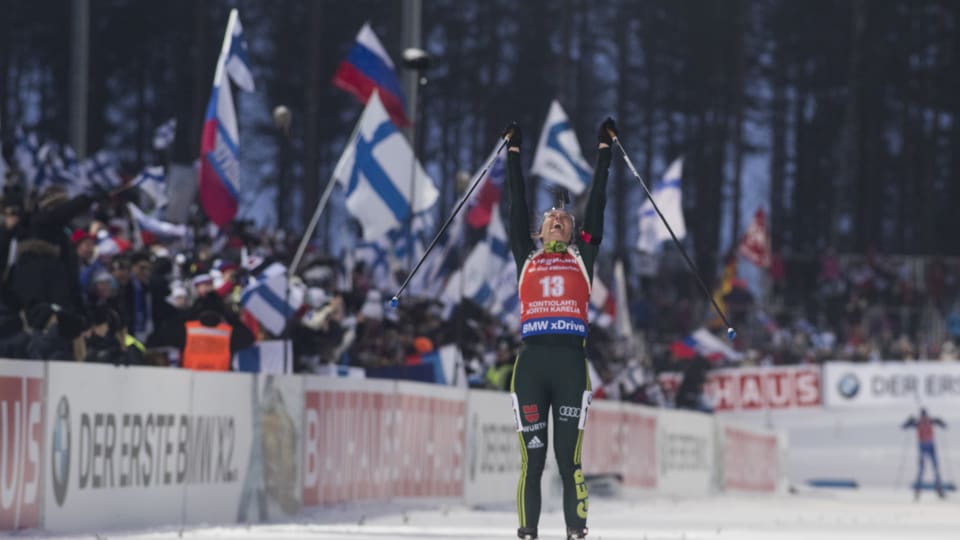
Germany’s Vanessa Hinz won her first International Biathlon Union (IBU) World Cup race (and achieved her first World Cup podium) and Austria’s Julian Eberhard won his first race of the season (and first mass start of his career) in the women’s 12.5 k and men’s 15 k mass starts on Sunday in Kontiolahti.
Germany’s Vanessa Hinz celebrates her first IBU World Cup win and podium in the women’s 12.5 k mass start on Sunday in Kontiolahti, Finland. (Photo: IBU/Biathlonworld)
Hinz shot an impressive 20-for-20 with the third-fastest range time and fifth-fastest shooting time to take the win in 35:47.9 minutes. Third after the first prone stage, she moved into second, then third after cleaning the next two stages. After knocking down her final five targets in the last standing, Hinz left the range almost 24 seconds ahead of France’s Anaïs Chevalier in second and 26 seconds ahead of Italy’s Lisa Vittozzi in third. Hinz stayed ahead of her challengers on the final loop, finishing 13.5 seconds clear of Vittozzi, who claimed second. Chevalier finished third, 16.8 seconds back, while Finland’s Kaisa Mäkäräinen was next across the line in fourth (+43.4) with a gap to Sweden’s Hanna Öberg in fifth (+1:02.1).
Vittozzi and Chevalier both cleaned the first three stages then had to ski a penalty lap after the last standing bout (0+0+0+1). Mäkäräinen missed three (1+0+1+1) yet skied the second-fastest course time on her home course, and Öberg missed two (0+0+2+0). The fastest course time of the day was clocked by Darya Domracheva of Belarus, who had to ski five penalty laps (0+1+1+3) and ended up 10th (+1:18.2).
“I always dreamed of shooting four times clean and today I did it,” Hinz, 25, said, according to an IBU press release. “I was so often close to the podium. I knew I could do it. Today, I said, ‘OK, let’s try it and if it works, it is OK … and if not there is another season waiting and other races.’ Now I am on top of the podium and it is crazy.”
Vittozzi, who placed fourth in the mass start at the 2018 Olympics, was glad to improve on a third-place finish in Friday’s sprint by placing second on Sunday.
“I have been third so many times and that was not satisfying for me,” Vittozzi said, one day after she won the mixed relay with her team in Kontiolahti. “Today I am very happy about my second place.”
For Chevalier, it was her first individual podium of the season and it came a day after she and Antonin Guigonnat won the single mixed relay. Chevalier, 25, was severely injured when she was hit by a car last spring, according to an IBU press release.
“I am very happy to be here today, because it was a very hard season,” she told the IBU. “I forgot how nice it is to be on the podium … I forgot that it was not easy, so I am very happy … I did my best on the last lap; [Vittozzi] was faster, but I am third and happy with that!”
Canada’s Rosanna Crawford shot 19-for-20 to place 13th (+1:25.9) with her only miss coming in the second prone stage (0+1+0+0). Her overall shooting and range times were 10th fastest of the 30-woman field, compared to her 26th-ranked ski time. Crawford had been in 11th after cleaning the final standing stage, then slipped two spots to finish 13th in her second mass start of the season.
“Since the skiing wasn’t feeling great today I made sure I was super focused in the range,” Crawford wrote in an email to FasterSkier. “I knew that was my only chance to get a good result today. My one prone miss was a bad trigger pull, but the rest were nice solid hits. I made sure to have a solid set up and then just trusted my rhythm and shooting.
“I knew that I wanted that top 15, so I just kept fighting and trying to stick with the women when they caught me,” she wrote of her last loop. “The last time up the wall I managed to stay close to [France’s] Anais Bescond, and hold off the two people behind me. Really happy to be in the top 15 again.”
Clare Egan was the lone American woman to qualify for Sunday’s mass start, and it was the second mass start of her career. She was on track for a top-15 result after missing just one target in the first three stages, but she had to ski three penalty laps on the last standing (0+1+0+3), which put her in 23rd by the finish (+2:05.6). Notably, she skied the 14th-fastest overall course time.
“I didn’t have quite the same energy level tonight as the last two days, but I still had the 14th rank course time and that means anything is possible in the race,” Egan wrote in an email to FasterSkier. “To put it in perspective, the winner of the race, Hinz, had the 13th rank, just 2 seconds faster than me. This is the first time I’ve felt totally comfortable skiing with the fastest women, and I certainly hope I can maintain this speed for one more week of World Cup racing.”
Egan was pleased with her 9-for-10 prone shooting and her clean standing stage (“which is the first time I’ve cleaned a standing stage in an individual race this entire year, believe it our not,” Egan wrote).
“But when I missed my second shot on the final stage, I let that throw me off my game, and really blew the rest of the stage,” she explained. “It’s so hard to keep 100% focus in every scenario, and I find it gets harder and harder towards the end of the race when I’m not necessarily the most lucid. I know that I have to work on so I have a goal to manage the final stage better next week and in the future.”
Her 23rd-place finish was one better than her previous World Cup mass start finish, which was 24th last season in Hochfilzen, Austria.
“In my only other mass start, which was last year at World Championships, I felt like an imposter,” Egan reflected. “Maybe because I was the first ‘reserve’ to get called up when one of the top women [did not start]. But this was totally different. I knew I deserved to be there today and was confident about competing with the other top women.”
“In my only other mass start, which was last year at World Championships, I felt like an imposter … This was totally different. I knew I deserved to be there today and was confident about competing with the other top women.” — Clare Egan (US Biathlon) on Sunday’s mass start
While the women raced Sunday night, the men’s 15 k mass start took place in the afternoon, when Eberhard passed the likes of France’s Martin Fourcade and Russia’s Anton Shipulin after a tangle late in the race to take the win.
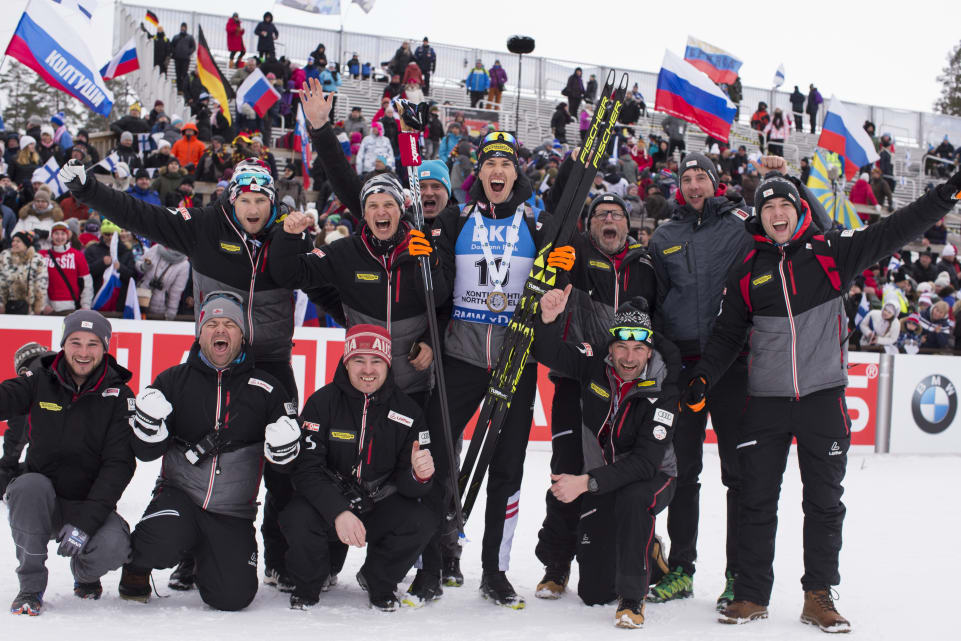
The Austrian team celebrating Julian Eberhard’s fourth career victory, his first this season and his first in a mass start on Sunday after the IBU World Cup men’s 15 k mass start in Kontiolahti, Finland. (Photo: IBU/Biathlonworld)
The Austrian had cleaned the first two prone stages to move into third by the race’s halfway point, behind Germany’s Benedikt Doll and Arnd Peiffer in first and second, respectively. Eberhard missed one in the next standing stage, yet left the range in second, 15 seconds behind Peiffer (who cleaned) in first, while Doll missed one as well to slip into third, 19 seconds back.
With two loops to go, Fourcade was coming back from two early prone penalties and found himself in fifth after a clean standing stage, less than a second behind Shipulin in fourth. On the next standing stage, Fourcade cleaned to take the lead and left the range about five seconds ahead of Shipulin (who also cleaned) in second.
Eberhard missed one yet remained in contention in third, 17 seconds behind Fourcade. On the last loop, Shipulin caught Fourcade before the course’s notorious climb known as “The Wall”, and Eberhard closed on the two frontrunners as they ascended it. Still several seconds behind over the top, he caught Shipulin on the bridge before the stadium, but the two tangled skis and Shipulin fell. Eberhard stayed upright and pulled even with Fourcade, passing him to take the win in 38:04.8. Fourcade finished second (+6.9) and Shipulin third (+19.3).
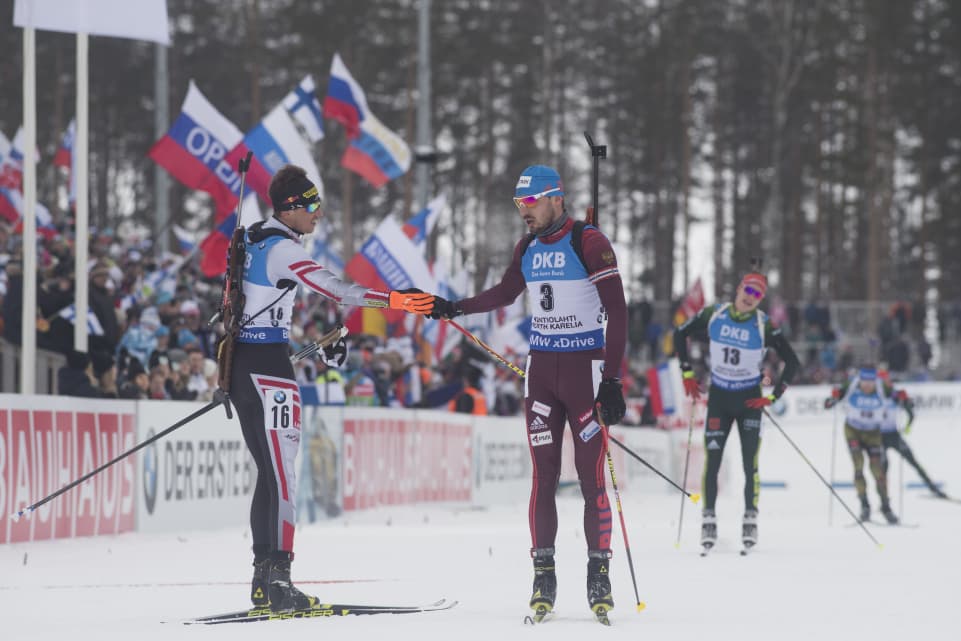
Austria’s Julian Eberhard (l) and Russia’s Anton Shipulin after the finish of the men’s 15 k mass start the IBU World Cup in Kontiolahti, Finland. Shipulin fell when his skis tangled with Eberhard’s. While Eberhard raced to the win, Shipulin placed third. (Photo: IBU/Biathlonworld)
“I wanted to be in a sprint with all three, but the bridge is too small for this,” Eberhard said, according to an IBU press release. “I came up the bridge with too much speed. Anton and I were in the same track and there was an accident. I apologized to Anton at the finish but he said these things can happen and it was OK with him.”
“I hold no grudge against Julian,” Shipulin told the IBU. “This can happen in sports and is all fair … I am in good shape and want to preserve this and perform my best in the last World Cups.”
Fourcade explained that illness caused him to sit out Thursday’s sprint, and he was only able to train three hours this week.
“It is really difficult to race in this situation without any feeling or training,” Fourcade told the IBU. “I did not know what to expect today but I am quite satisfied. I would have liked to win, but I used too much energy trying to come back in the early laps and had no energy when it was time to attack.”
Behind them, Doll picked off one place on the final loop to finish fourth (+21.9), passing his German teammate Erik Lesser, who finished fifth (+23.9). Peiffer followed in sixth (+27.1) as Germany had three in the top six.
American Lowell Bailey raced to 14th (+1:06.3) with two penalties, both of which came in the standing stages (0+0+1+1). Bailey had been fourth after cleaning the second prone, 16 seconds behind Doll in first, but slipped to 10th after missing one on the next bout. He had to ski another penalty lap on the last stage, and left the range in 14th.
Overall, Bailey posted the 10th-fastest shooting time, 15th-fastest range time and 18th-fastest course time.
“I finally felt like I was back in the spot that I ended last season,” Bailey wrote in an email when asked about his consistency. “I felt controlled and able to keep the pace with the top of the field throughout the race. It was nice to be back in the mix.
“Although I would have liked to see this ski speed a few weeks ago, better late than never!” he continued.
Next week’s World Cup in Oslo, Norway, will be his last of the season and his career.
“After nearly two decades of international racing, Oslo will be my final World Cup as a U.S. Biathlete,” Bailey wrote. “I’m sure it will be emotional but I hope to end my World Cup career on a high note!”
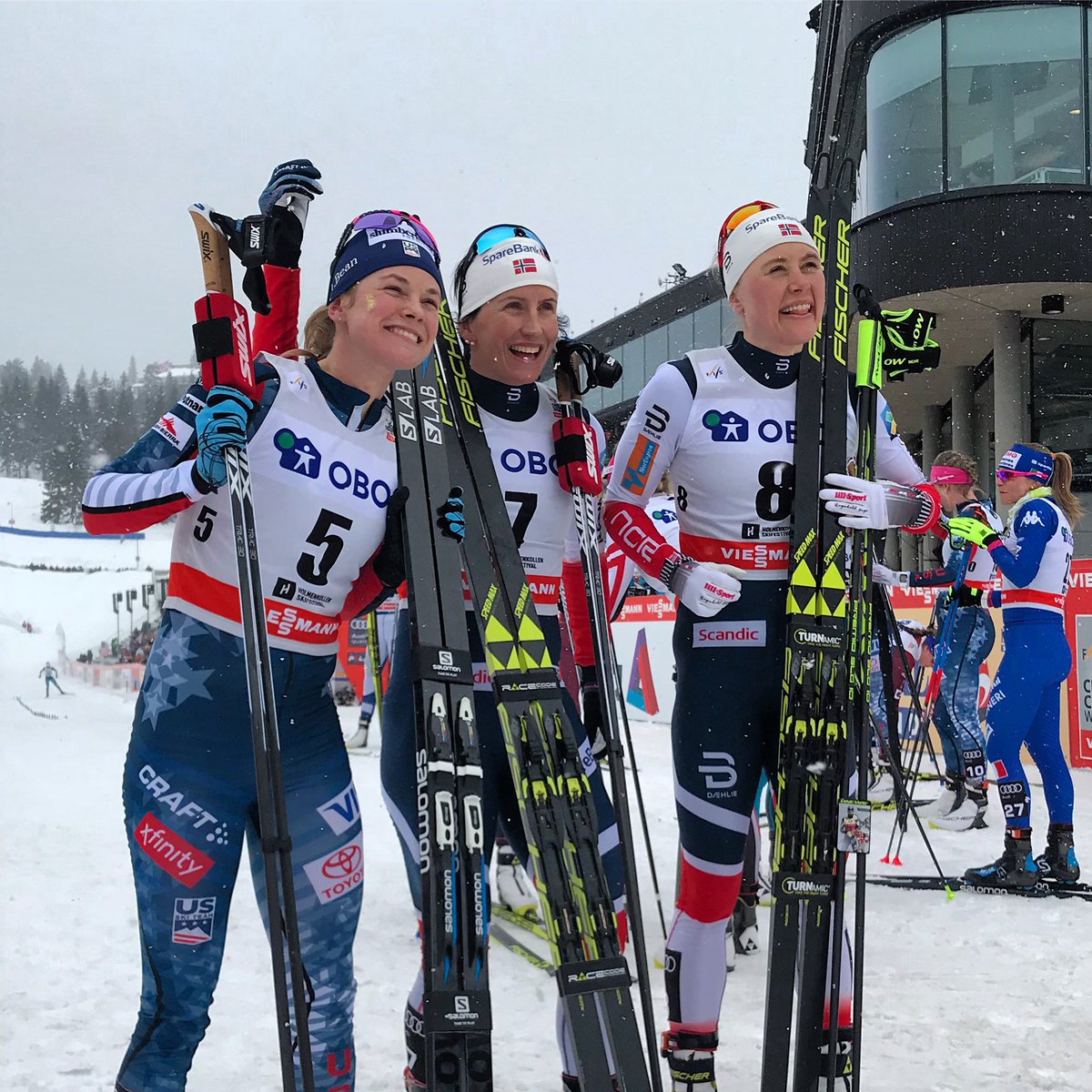
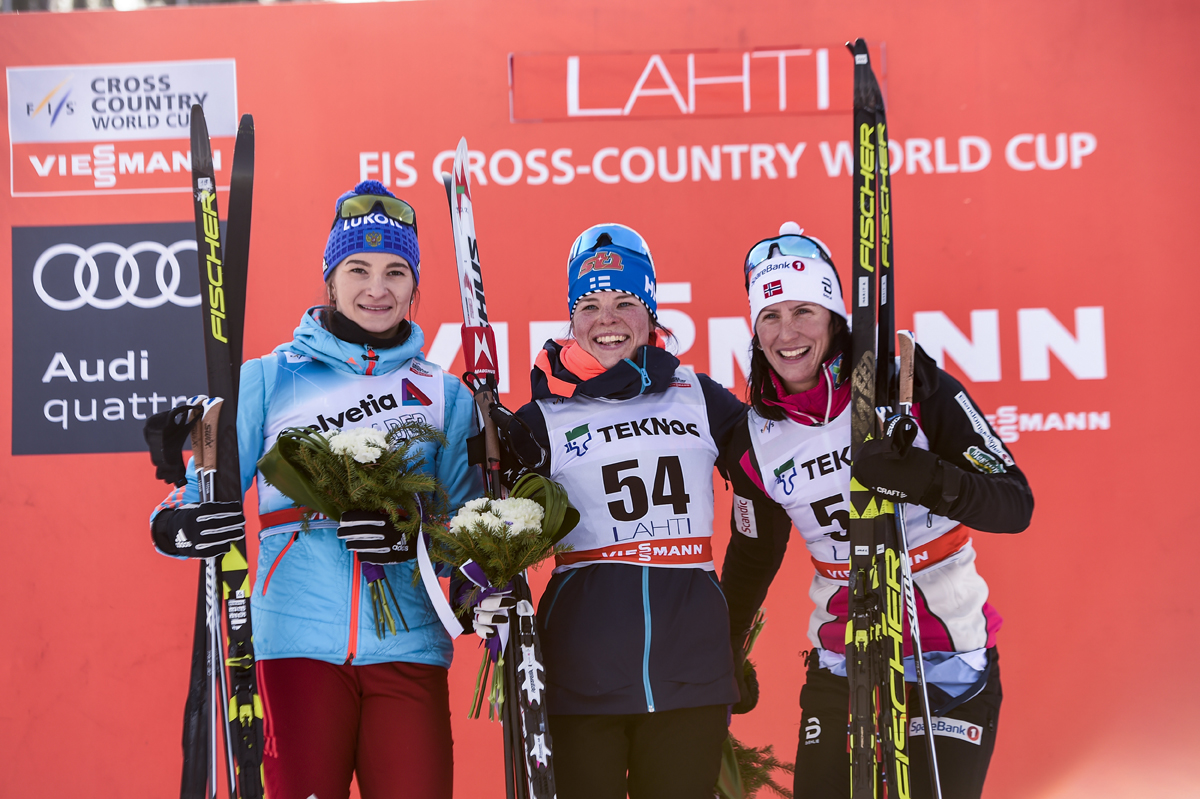
The women’s 10 k classic podium at Sunday’s World Cup in Lahti, Finland, with Finland’s Krista Pärmäkoski (c) in first, Russia’s Natalia Nepryaeva (l) in second and Norway’s Marit Bjørgen (r) in third. (Photo: Fischer/NordicFocus)
(Note: This article has been updated to include comments from American Caitlin Patterson.)
The 2018 Olympics were pretty successful for Finland, in terms of cross-country skiing: Iivo Niskanen won gold in the 50 k and Krista Pärmäkoski earned silver in the 30 k and bronze in the skiathlon and the 10 k skate.
After the Games finished, the FIS Cross Country World Cup moved to Finland, but on the first day of competition – skate sprints – the host nation was stymied.
Among the frustrated was Pärmäkoski, who was tangled up when Germany’s Victoria Carl fell in a quarterfinal heat. Carl was relegated to last for her skiing, but that didn’t lessen the sting of not advancing for Pärmäkoski, who had qualified with the third-best time in the women’s field.
Sunday brought a 10 k classic, a favorite discipline for her, however.
“Yesterday was kind of annoyed, so I wanted to show [what I could do] today,” Pärmäkoski told Finland’s YLE broadcaster, according to a translation.
She set out with a vengeance, eventually notching her second career World Cup victory with a 20.9-second win over Natalia Nepryaeva of Russia.
Finland’s Krista Pärmäkoski celebrates the second World Cup victory of her career, on home turf in Finland in the Lahti 10 k classic. (ARD screencap)
“When in good shape, feeling bad feels good,” Pärmäkoski said.
Third place went to Norway’s Marit Bjørgen, who skied an even race to finish +29.2. She was tenth after a kilometer and a half, seventh at 3.7 k, and fifth at 5 k, but managed to ski up and bump Finland’s Kerttu Niskanen off the podium by just 0.3 seconds, for her first 10 k classic podium since 2012.
“I think it was the finish that secured [the podium],” she told Norway’s VG news site, according to a translation. “I think it went smoothly, very strong on the uphills, and I’m happy with it. I’ll take this finish with me.”
“Marit is the best athlete of all time, so it feels good that the time has come for me to be able to beat her,” Pärmäkoski told YLE.
Fifth went to Norway’s Heidi Weng, who opened hard but lost ground on the second lap of the 5 k course and finished 43.3 seconds behind Pärmäkoski. Teresa Stadlober of Austria was sixth (+52.4), Sadie Bjornsen of the U.S. seventh (+57.6), and Ingvild Flugstad Østberg of Norway eighth (+59.0). Aino Kaisa Saarinen (+59.1) and Johanna Matintalo (+1:13.4) rounded out the top ten, giving Finland four finishers in the top ten.
It was Saarinen’s last time competing on home ground, as the 39-year-old former World Champion is ending her World Cup career after this season. She cried as she was handed a bouquet of flowers at the finish line.
“It was certainly the best race of the season,” she told YLE.
Bjornsen Seventh in Post-Olympics Rebound
Sadie Bjornsen (U.S. Ski Team) finishing seventh in the women’s 10 k classic at the World Cup in Lahti, Finland. (Photo: Fischer/NordicFocus)
Like Pärmäkoski, Bjornsen had left Saturday’s sprint feeling frustrated. She had qualified in fifth position but then couldn’t make the right move in the quarterfinals and failed to advance to the semifinals.
“Yesterday was really awesome because I could see that I finally had some good feelings in my legs and I got really excited to keep racing,” Bjornsen said in an interview after the 10 k. “So, today, I don’t know, I was just approaching it like I wonder what can happen, like, let’s just send it hard and see what happens.”
With cold temperatures making for firm tracks, Bjornsen attacked the course’s long climbs – the biggest of which has a 44-meter height differential.
“I definitely really love the Lahti courses here,” she said. “I think that there’s like a lot of really awesome climbing. It’s not like they’re necessarily running hills; there’s actually some glide involved with them, and so I think it’s just really cool classic skiing… Right away I could see that I had some good skis under my feet and I just had nothing in the way, so I just went. I tried to go really hard from the start.”
The effect was immediately noticeable.
“I always try to go out hard and sometimes it’s hard, and sometimes it’s not,” Bjornsen laughed. “There’s no change in what my perceived effort. I think when I have good races is when that going hard actually is going hard. It was funny, because Matt [Whitcomb, the U.S. Ski Team women’s coach] was cheering at 3 k, and he just yelled ‘you finally went out hard!’ and I actually smiled in the race and was like, ‘ok, this is awesome.’ Like, ‘this is fun,’ you know?”
Unlike Weng and Niskanen, who faltered at the end, Bjornsen skied a fairly consistent race. She was sixth at 3.5 k, eighth at 6.1 k, and seventh at the finish, 57.6 seconds behind Pärmäkoski’s time and 30.9 seconds off the podium.
“I maybe struggled a little bit right there in the middle where I needed to continue being strong,” Bjornsen said. “I think that’s where those top girls are really making some time. When I have had my best distance races, it’s when I really nail between 5 and 7.5 k and that is kind of a point that I’ve been working on this year. And, I think that I maybe stuttered a little bit during that time. So I guess, looking back, I feel like that’s where I have to make an improvement for the future–to be in that podium place.”
Caitlin Patterson (Craftsbury Green Racing Project) racing to 32nd in the women’s 10 k classic at the World Cup in Lahti, Finland. (Photo: Fischer/NordicFocus)
For the U.S., Caitlin Pattersonwas next, just missing the World Cup points in 32nd (+2:02.7).
“The end of the race was good, but the beginning was a little rough,” Patterson wrote in an email. “The course starts out going up one of the sunniest hills, and by the time I started the snow had transitioned on that hill away from the wax that we were using. I had a terrible time getting up the first long rolling climb, but luckily I was able to pull myself together and re-focus for the rest of the race, and the skis worked much better for the rest of the course. So I’m happy with my effort, that I kept pushing and didn’t let up after a bumpy start. I would have been happier with a more consistently strong race, since I did lose quite a bit of time at the beginning that I wasn’t able to make up for later.”
Patterson raced the first and last events of the Olympics, placing 34th in the 15 k skiathlon and 26th in the 30 k classic mass start.
“My two races in Korea were separated by 15 days, but I certainly kept busy with training,” she explained. “I did a time trial, at least 3 interval sessions, some strength workouts, and distance workouts. It’s best for me to stay active and keep the speed up, since I knew that would be the best way to hopefully feel good for the 30k as well as to stay strong for the rest of the season. Beyond training in Korea, I felt really busy with all the time spent taking buses to and from places, but I did get out to watch a Big Air competition one day, and visited the Coastal village area a different day, so a bit of sight-seeing.
“I’m feeling ready to race and still excited for each start even at this point in the season,” Patterson continued. “If there was another race tomorrow, I’d absolutely want to do it. I feel like it’s been a while since I’ve had a consistent string of races, so I need more back to back to clear the cobwebs out again, and to reaffirm that I still have good racing fitness which I know is true.”
Ida Sargentand Sophie Caldwellfinished 40th (+2:21.9) and 42nd (+2:24.2), respectively. Rosie Brennanfinished 48th (+3:02.1) and SuperTour leader Kaitlynn Millerplaced 51st (+3:09.1).
Liz Stephenof the U.S. Ski Team did not start due to illness.
Canada started two women: Emily Nishikawafinished 41st (+2:22.2) and Dahria Beatty44th (+2:40.7).
Krista Pärmäkoski of Finland (center) won her second straight 10 k classic, to the delight of the crowd in Lahti. Natalia Nepryaeva of Russia (left) finished second and Marit Bjørgen of Norway third. (Photo: FIS Cross Country/Twitter)
FIS Cross Country World Cup (Lahti, Finland): 10/15 k classic
Racing at home in Finland, Krista Pärmäkoski picked a good time to collect the second World Cup victory of her career, and again in a 10 k classic. Pärmäkoski’s first win came in the 10 k classic in Planica, Slovenia, earlier this season.
In second was Russia’s Natalia Nepryaeva, who picked up her first World Cup podium. The current U23 standings leader, Nepryaeva’s time was 20.9 seconds slower than Parmakoski. Both she and Marit Bjørgen of Norway, who finished third (+26.7), used a steady pace to reach the podium. At the 5 k split, Heidi Weng of Norway – wearing the yellow bib of the overall World Cup leader – was in second at the halfway point but faded to finish fifth (+43.3), and Kerttu Niskanen of Finland was in third place but she dropped to fourth by the finish, +27.0. Austria’s Teresa Stadlober finished sixth (+52.4).
Sadie Bjornsen placed seventh (+57.6) to lead the American team. Caitlin Patterson was next, just missing the World Cup points in 32nd (+2:02.7). Ida Sargent and Sophie Caldwell finished 40th (+2:21.9) and 42nd (+2:24.2), respectively. Rosie Brennan finished 48th (+3:02.1) and SuperTour leader Kaitlynn Miller placed 51st (+3:09.1).
Liz Stephen of the U.S. Ski Team did not start due to illness.
Canada started only two women: Emily Nishikawa finished 41st (+2:22.2) and Dahria Beatty 44th (+2:40.7).
The men’s 15 k classic podium at the World Cup in Lahti, Finland, with Kazakhstan’s Alexey Poltoranin (c) in first, Russia’s Alexander Bolshunov (l) in second and Finland’s Iivo Niskanen (r) in third. (Photo: FIS Cross Country/Twitter)
In the men’s race that followed, Alexey Poltoranin of Kazakhstan got some redemption after a major bonk in the Olympics 50 k last weekend, winning the 15 k classic individual start in Lahti.
Starting in the middle of the field in bib 44 (out of 71), Poltoranin paced it perfectly, skiing a steady race with some of the top split times and then turning it up another notch over the last several kilometers to take the win in 33:11.9 minutes. His biggest threat was Russia’s Alexander Bolshunov, who started 64th and clocked faster splits at every timing point throughout the three-lap race except the one that mattered most — the finish. There, Bolshunov came up 9.1 seconds short of Poltoranin’s time to place second, and Finland’s Iivo Niskanen — the Olympic 50 k champ — placed third, 20.9 seconds out of first.
Norway took fourth through seventh, with Emil Iversen in fourth (+28.8), Martin Johnsrud Sundby in fifth (+39.9), Niklas Dyrhaug in sixth (+50.1), and Johannes Høsflot Klæbo in seventh (+1:00.3). Russia’s Alexey Chervotkin placed eighth (+1:08.3), Germany’s Thomas Bing was ninth (+1:08.5) and Sweden’s Daniel Rickardsson finished 10th (+1:09.2).
Canada’s Devon Kershaw led the North Americans in 25th (+1:43.2), and Erik Bjornsen was the top American in 32nd (+2:06.6).
Four Canadian men raced, with Graeme Killick placing 39th (+2:22.9), Julien Locke 69th (+4:56.6) and Andy Shields 70th (+5:42.1).
The U.S. was represented by six men, with Noah Hoffman placing 40th (+2:24.0), Paddy Caldwell 45th (+2:40.5), Scott Patterson 50th (+2:58.7), Kevin Bolger 54th (+3:09.5), and David Norris 57th (+3:23.5).
The World Cup picks back up again this Wednesday with classic sprints in downtown Drammen, Norway.
Left to right: Finland’s Krista Pärmäkoski in second, Norway’s Marit Bjørgen in first and Sweden’s Stina Nilsson in third after the women’s 30-kilometer classic mass start at the 2018 PyeongChang Olympic Winter Games in South Korea. (Photo: Noah Hoffman)
PYEONGCHANG, South Korea — In the final stretch, the familiar Marit Bjørgen ceremony went down with no other skiers in sight and the Norwegian flag in her hand. The 37-year-old five time Olympian and mom is leaving these Games as the winningest Winter Olympian in history.
Prior to Bjørgen, Norwegian biathlete Ole Einar Bjørndalen was the most decorated Winter Olympian with 13 medals total. After earning a bronze in the Pyeongchang team sprint, Bjørgen surpassed Bjørndalen’s medal total by one. She added gold to her collection on Sunday after taking the win in the women’s 30-kilometer classic mass start. All told, Bjørgen now has 15 Olympic medals, eight of them gold.
Norway’s Marit Bjørgen on her way to gold during in women’s 30 k classic mass start, the last race of the 2018 Olympics in PyeongChang, South Korea. (Photo: Scott Patterson)
She claimed the win in the final race of the Olympics in 1:22:17.6 hours. Finland’s Krista Pärmäkoski claimed silver (+1:49.5) and Sweden’s Stina Nilsson earned bronze (+1:58.9).
Finishing just 1.5 seconds behind Nilsson and out of the medals ceremony was Norway’s Ingvild Flugstad Østberg in fourth (+2:00.4), Swednen’s Charlotte Kalla placed fifth (+2:57.2), ahead of Finland’s Kerttu Niskanen in sixth (+3:01.6).
American Jessie Diggins closed out her 2018 Winter Games in seventh (+3:37.2), while Norway’s Heidi Weng finished in eighth (+4:07.9). Austria’s Teresa Stadlober ended up ninth (+4:14.1), after skiing in second until a game-ending turn onto the wrong course, and Japan’s Masako Ishida claimed 10th (+4:20.8).
The 30 k classic is Bjørgen’s race. She’s masterfully dominant in the technique and peerless in the distance. In the post-race press conference, Bjørgen words about the women’s ultimate distance race were succinct.
“I think it’s easier to do a good 30 k when you are getting older,” Bjørgen said of her years of training load and its impact on distance preference. “You have lots of training behind you. I have ten years more training than Krista [Pärmäkoski], so then I think it’s a little bit different to do a 10 k than 30 k. I knew that this was my distance also. Today we can see.”
Here’s what we saw: A powerfully rhythmic Bjørgen pull away from an already diminished field. Her force of nature skiing began around 8 k, and by 11.25 k, barring any mishap, her 15th gold was secured.
“I wanted to try to be high speed from the beginning,” Bjørgen said. “I had perfect skis so I can do my technique very good, so I could relax on skis. After seven and a half kilometers, I looked behind me and see it was two, three girls behind me and I tried to push more. Also, after the longest downhill, I had five seconds. Then after one lap I had ten. I knew I had to speed up more, and I heard I had twenty and then thirty. Then I knew that this is my day. I have to ski well and then have all the speed ups. I had the good feeling in my body.”
Marit Bjørgen on the shoulders of her Norwegian teammates after winning the women’s 30 k classic mass start for her eighth-career Olympic gold medal in the last race of the 2018 Olympics in PyeongChang, South Korea. (Photo: Noah Hoffman)
Bjørgen made her Olympic debut at the Salt Lake Games in 2002. There, she won a single silver medal in the 4 x 5 k relay (with Bente Skari, Hilde Pedersen, and Anita Moen. She was 22 at the time). Bjørgen then went on to compete in the 2006 Torino Games, coming away once again with another silver — this time in the 10 k classic. Over the next three Olympics, Bjørgen amassed 13 more medals, eight of them in individual events.
Recognizing the relatively young talent around her on the podium (Pärmäkoski is 27 years old and Nilsson is 24), Bjørgen understood that as she steps down, others are primed to take her place.
“I had my best years from 30 to 37, and she is still not there so I think we will see lots of Krista in the future,” Bjørgen said.
While Bjørgen’s Olympic career is through, she left the door open for competing in the 2019 World Championships this time next year in Seefeld, Austria. Before departing PyeongChang, Bjørgen was in the Olympic limelight one last time as the Norwegian flag bearer in Sunday’s Closing Ceremony.
For more details on how Sunday’s 30 k transpired for silver and bronze, complete with quotes, check out our race rundown.
North Americans Led by Diggins in 7th
American Diggins has already proved a point in PyeongChang: the big stage is hers. She placed fifth in the 15 k skiathlon, fifth in the 10 k skate, sixth in the classic sprint, fifth in the 4 x 5 relay, and first in the team sprint. Bar none, she produced the most-consistent and high-placing run of results any U.S. cross-country skier to date.
American Jessie Diggins racing to seventh in the women’s 30 k classic mass start on Sunday at the 2018 Olympics in PyeongChang, South Korea. (Photo: Scott Patterson)
Coming into the stadium for the first time during Sunday’s 30 k classic, Diggins again was in the medal hunt. The American took a rare fall on the course’s hallmark technical downhill, setting her for a lung-burning chase back to the lead pack.
“Not everything went according to plan. I rolled my boot in the slush in a nice little crash and had to sprint for a while to get back to the pack,” Diggins told FasterSkier after.
She managed to regain her place at the front within the following lap at 7.5 k. Between 8.3 k and 11 k, a gap slowly opened up in front of Diggins that included Kalla, Niskanen, Pärmäkoski, and Stadlober.
“I spent the rest of the time in no man’s land chugging away,” she reflected. “I felt like I was just sprinting the entire time. I was proud of that. I didn’t give up. I didn’t say, ‘OK, I don’t have a chance to medal, I’ll just screw around out here.’ I really gave it everything I had, and I kept pushing myself.”
The second American on Sunday was Sadie Bjornsen ten places after Diggins in 17th (+6:32.6). Bjornsen said her race was a mixed bag of what she called “good and bad.”
American Sadie Bjornsen on her way to 17th in the women’s 30 k classic mass start at the 2018 PyeongChang Olympics in South Korea. (Photo: Noah Hoffman)
“I tried to stay with the group at the beginning and went on too slick of skis which just exploded myself,” Bjornsen reflected. “Took me a solid 7.5 k to get myself back to together. It was certainly very fun there the last 15 k. Nothing really felt good about it … But I definitely am really happy with the way that I finished that race and digging deep until the end. It was a fun 30 kilometers of suffer fest.”
Like her race, Bjornsen’s second Olympics was a bit of a rollercoaster with a top individual result of 14th in the classic sprint (she also placed 15th in the 10 k freestyle).
“A collection of feelings throughout the Games,” she said. “It was certainly really a bit of a heartbreak to not make the team sprint. Took a little bit of an emotional toll there for a few days. Then to have the medal, that definitely brought it back to nothing but positive vibes.
“It’s a great feeling to walk away with,” Bjornsen continued. “Who knows if I’m coming to the next [Olympics], but if I am coming to the next one, I definitely have some higher goals and some higher hopes. I certainly learned something here.”
Rosie Frankowski (l) leading her American teammate Caitlin Patterson during the women’s 30 k classic mass start on Sunday at the 2018 Olympics in PyeongChang, South Korea. In Frankowski’s first Olympic race, she placed 21st. (Photo: Scott Patterson)
Following Bjornsen’s finish, American Rosie Frankowski finished 21st (+8:53.8). The Minneapolis, Minnesota, native found out three days ago that she would be starting Sunday. Beaming with an ear-to-ear grin after Sunday’s mass start, the 26-year-old Frankowski exuded energy and effervescence after her first Olympic race.
“I was crazy. I didn’t expect, honestly, to feel that good and just keep jamming and going,” Frankowski reflected of her top-30 performance. “I told [my coach Erik] Flora that I was going to start easy, and he just nodded, because I say that every race and I never start easy.”
Frankowski skis for Anchorage’s Alaska Pacific University (APU) under the guidance of head coach Erik Flora. Flora was in PyeongChang as a U.S. coach and provided Frankowski with sage advice as she headed into her first world-caliber race (Frankowski has never competed at the World Cup or World Championships level).
“Honestly, Flora was like, ‘Win or lose, you’re racing in the Olympics,’ ” Frankowski reflected. “My one goal for the whole day was just to finish smiling. I honestly can’t tell you, when I came down that downhill on the last lap, it was so cool. That feeling, and when you’re hyped to have done a 30 k, and to know like you just raced in the Olympics and no matter what your result is, that’s just incredible. I can’t describe that feeling.”
American Caitlin Patterson on her way to 27th in the 30 k classic mass start at the 2018 Olympics in PyeongChang, South Korea. (Photo: Noah Hoffman)
American Caitlin Patterson placed 26th (+10:26).
“It was solid. 30k is such a long race,” Patterson said. “There are ups and there are downs. I guess I’m still processing it a little bit. I’m pleased with the effort that I put out there, I felt like I was working really hard, especially in the middle and second half. I was a little frustrated that all that hard work wasn’t really catching anybody. But overall it was good. It’s still really cool to race here.”
For Canada, Emily Nishikawa led the way in 30th (+12:14.1). She was followed by Cendrine Brown in 43rd (+19:06.3), as Anne-Marie Comeau did not finish.
“It was really tough out there today. I had first good two laps, and then I started feeling low on energy and it was getting harder to kick my skis,” Browne said. “But it was really important for me to keep going no matter what. I’m at the Olympics right now so it wasn’t even a question for me if I wanted to stop or not. I just wanted to keep going.”
The 30th place finish is Nishikawa’s best individual Olympic performance.
— Alex Kochon, Harald Zimmer and Gerry Furseth contributed
An emotional Marit Bjørgen after winning the last race of her Olympic career, the women’s 30 k classic mass start, on Sunday at the 2018 Olympics in PyeongChang, South Korea. (Photo: Noah Hoffman)
Marit Bjørgen approaches the line for her eighth-career Olympic gold (and 15th medal) with a win in the final race of the 2018 Olympics, the women’s 30 k classic mass start, on Sunday in PyeongChang, South Korea. (Photo: Noah Hoffman)
Marit Bjørgen went out with a bang. Skiing in presumably the final Olympics race of her illustrious career, the most-decorated Winter Olympian in history simply skied away from a strong field less than 10 kilometers into Sunday’s 30 kilometer classic mass start, earning the 15th Olympic medal of her career (and eighth gold) in dominant fashion.
From right to left: Norway’s Ingvild Flugstad Østberg leading Finland’s Kerttu Niskanen and Krista Pärmäkoski, Sweden’s Stina Nilsson, and Austria’s Teresa Stadlober (r), among others in the women’s 30 k classic mass start on the final day of the 2018 Olympics in PyeongChang, South Korea. (Photo: Noah Hoffman)
Behind her, Finland’s Krista Pärmäkoski (+1:49.5) and Sweden’s Stina Nilsson (+1:58.9) rounded out the podium, with Nilsson breaking away from Norway’s Ingvild Flugstad Østberg (+2:00.4) within the stadium to edge her out for third.
Fifth went to Charlotte Kalla of Sweden (+2:57.2), with Kerttu Niskanen of Finland sixth (+3:01.6). Jessie Diggins was seventh (+3:37.2), in an American performance that would have been lauded just a few years ago yet somehow represented her worst placing in all six races at these Olympics.
Heidi Weng of Norway (+4:07.9) in eighth, Teresa Stadlober of Austria (+4:14.1) in ninth, and Masako Ishida of Japan (+4:20.8) rounded out the rest of the top ten. Stadlober’s ninth-place finish was particularly poignant; she was holding steady in silver-medal position through 20 k, before taking a wrong turn at an ill-marked course intersection and losing well over a minute returning to the correct track.
Norway’s Marit Bjørgen (l) leading the pack during the women’s 30 k classic mass start at the 2018 Olympics in PyeongChang, South Korea. (Photo: Scott Patterson)
But let’s go back to Bjørgen. Given those time gaps by the finish – nearly two minutes clear of second and third – this was clearly Bjørgen’s day. The 37-year-old Norwegian mother started in bib number 8, and was all of 1.1 seconds off the lead by the first checkpoint, less than one kilometer into the race. But after that… Bjørgen led by 2.3 k, midway through the first of four 7.5-k laps. Bjørgen led at 5 k. Bjørgen led at 7.5 k. Bjørgen led at 8.4 k. And so on. It was not literally a wire-to-wire victory, but it was pretty darn close.
The race went from a mass start contest to a solo endeavor at roughly 9.5 kilometers in, midway through the second lap. Bjørgen simply surged ahead, and immediately opened up a small gap. By 9.8 k, the gap was 7 seconds. By 12.5 k, it was already up to 33 seconds. By 15 k, the advantage had swelled to 51 seconds. Bjørgen was putting nearly 10 seconds per kilometer on a chase group composed of Olympic medalists and World Championships podium finishers.
With all due respect to Iivo Niskanen, the hero of Saturday’s courageous breakaway in the men’s 50 k classic, Bjørgen’s performance never felt in doubt the way Niskanen’s did. Bjørgen didn’t have any company, for one, and she had a shorter distance to cover, for another (“only” 20 k of solo skiing off the front). But mostly, well, she is Marit Bjørgen, the most dominant cross-country skier of all time.
Bjørgen’s gap stretched to as great as 2:04 by the 27.5-k mark of the course. Finally, approaching the finish, she slowed slightly over the last few hundred meters, accepting a large Norwegian flag from a Viking helmet-clad fan and beaming as she carried it across the finish line. Her final time was 1:22:17.6. If they were the final 82 minutes of racing of a five-Olympics career, they were an exceptionally dominant 82 minutes.
Behind her, a four-woman chase pack formed: Pärmäkoski, Kalla, Niskanen, and Stadlober. As late as 20 k, Kalla was still in seventh, nearly two minutes back of Bjørgen and roughly 35 seconds back of Stadlober in second.
Soon after this, Stadlober took her wrong turn, skiing for some distance on the wrong course before having her error pointed out to her by a courseside coach or tech. She dropped from second to eighth within a kilometer.
Reportedly, Austrian coach Markus Gandler was out on the course and the first to inform her of her mistake, yelling, “You are wrong!” She realized her mistake and turned around.
“We were preparing the feed and noticed she didn’t come,” Gandler told Austrian broadcaster ORF, according to a translation. “I ran over but she didn’t hear me while skiing up. Only on the downhill I caught her.”
“I don’t know if I should laugh or cry,” Stadlober told ORF after, according to a translation. “I can’t explain it to myself. I have been here for three weeks and if by now I don’t know the loop then I don’t know … I noticed skiing up that something wasn’t right because there was no more staff. When I looked over I just thought: Sh*t!”
She said she had been feeling great up until that point and confident about her skis.
“I would have had the power, but had-I-would-I [what could have been] is too late now,” Stadlober said of missing out on her first Olympic medal. “That’s life. It’s just bitter it happened in such a race and on a day when everything would have fit together.”
Finland’s Krista Pärmäkoski celebrates her first individual silver medal which she claimed in the women’s 30 k classic mass start on Sunday at the 2018 Olympics in PyeongChang, South Korea. (Photo: Noah Hoffman)
By 21 k, Pärmäkoski had a 13-second gap over Niskanen in the race for second, and Kalla had moved up to sixth. By 25 k, it was still Pärmäkoski in second, but now Østberg and Nilsson skiing lockstep in the fight for third.
Pärmäkoski was never seriously threatened over the final lap, and crossed the finish line for silver.
“I think that this 30 k was [the] hardest 30 k race [ever] for me,” Pärmäkoski reflected in a post-race press conference. “Of course I heard that Nilsson and Østberg come behind me and I also heard that now it’s 11 seconds, and then 14 seconds. And after this big downhill I heard that it’s a little bit more, but because I know that they are good in sprint, I just hoped that they can’t catch me. This was a crazy, crazy Olympics for me. Before I came here I wanted to win one individual medal and now I won three medals, so I am really happy.”
In two Olympics, Pärmäkoski, 27, now has four medals — three of which came in PyeongChang (silver in the 30 k and bronze in the 15 k skiathlon and 10 k freestyle races).
Behind her, Østberg and Nilsson dueled for the final podium spot. But while Østberg was aware of it, Nilsson hadn’t heard about Stadlober’s wrong turn ahead of them.
Sweden’s Stina Nilsson (r) outlasts Norway’s Ingvild Flugstad Østberg (l) for bronze in the women’s 30 k classic mass start at the 2018 Olympics in PyeongChang, South Korea. (Photo: Noah Hoffman)
At the finish, Nilsson looked surprised when Bjørgen told her she had won the bronze. Bjørgen then went immediately over to console her teammate, Østberg, who finished fourth, 1.5 seconds behind Nilsson in third.
“I was quite sure that it was fourth. That I got the bronze was quite sick,” Nilsson told Norwegian broadcaster NRK, explaining that she thought the team staff was trying to give her false hope that a medal was within reach.
“I did not realize that Stadlober had gone wrong. I thought she had moved away,” Nilsson said.
But Østberg knew the bronze was between her and the Swede. “I definitely knew what I was fighting for. It’s amazing that she did not know, too,” Østberg told NRK.
Diggins would finish roughly 90 seconds later in seventh, 36 seconds behind sixth and 30 seconds ahead of eighth. The result was emblematic of her day, in which she had skied for much of the race entirely by herself.
Sadie Bjornsen was the next American, finishing in 17th (+6:32.6). The mid-teens result continued a trend at these Olympics; she was 14th in the classic sprint and 15th in the 10 k freestyle.
The third American on the day was Rosie Frankowski in 21st (+8:53.8). Forget first Olympic start for the 26-year-old Alaskan and Alaska Pacific University athlete (which it was), Frankowski has zero World Cup starts to her name. She was the second American in the 20 k classic at last month’s U.S. Nationals, though, behind Caitlin Patterson.
On Sunday Patterson was five spots behind in 26th (+10:26), after narrowly losing a sprint finish to Germany’s Victoria Carl.
For Canada, Emily Nishikawa led the way in 30th (+12:14.1). She was followed by Cendrine Brown in 43rd (+19:06.3), as Anne-Marie Comeau did not finish.
Also of note, Jessica Yeaton, who competes internationally for Australia but lives and trains in Anchorage with Alaska Pacific University, was 42nd (+18:37.2). And Petra Hyncicova, who skis in this country for the University of Colorado but races internationally for the Czech Republic, was 39th (+16:57.1).
The women’s 30 k classic mass start medalists at the 2018 Olympics Closing Ceremony, with Norway’s Marit Bjørgen (c) in first, Finland’s Krista Pärmäkoski (l) in second, and Sweden’s Stina Nilsson (r) in third in PyeongChang, South Korea. (Screenshot: ARD broadcast)
It was a disappointing opening to the Olympics for Johannes Thingnes Bø of Norway, who despite winning eight World Cup races this season started the Games with finishes of 31st and 21st in the sprint and pursuit. But on Thursday he showed why he was a medal favorite and won the 20 k individual race – only by 5.5 seconds, but that margin becomes impressive when you consider that he had two penalties, and thus two minutes of penalty time, while silver and bronze medalists Jakov Fak of Slovenia and Dominik Landertinger of Austria (+14.2) shot clean.
Johannes Thinges Bø celebrates with Norwegian team staff after winning Olympic gold in the 20 k individual despite two missed shots. (Photo: IBU/Biathlonworld.com)
Sweden’s Sebastian Samuelsson followed up a silver medal in the pursuit with fourth place in the individual, missing one shot and notching a time 29.1 seconds behind Bø. France’s Martin Fourcade, gold medalist in the pursuit, missed two shots like Bø but finished in fifth (+42.4). Switzerland’s Benjamin Weger placed sixth (+48.6) with one penalty.
It was a good day for Canada on the back of strong shooting: Scott Gow placed 14th (+2:02.5) with one penalty for a career-best result result; he had previously had two 16th-place finishes on the World Cup this season. With the same shooting, Brendan Green placed 22nd (+2:26.6). Christian Gow had two penalties to finish 26th (+2:57.2). Canada’s fourth man, Nathan Smith, missed five shots and placed 81st (+8:11.9).
For the United States, shooting was not as successful and Tim Burke led the way in 41st (+4:01.9) with four penalties. With one less penalty Sean Doherty was close behind in 44th (+4:21.8). Lowell Bailey placed 51st with four penalties (+4:53.0) and Leif Nordgren missed five shots to finish 66th (+6:27.3).
Sweden’s Hanna Oeberg (center) won gold in the biathlon women’s 15 k pursuit, followed by Slovakia’s Anastasiya Kuzmina (left) in silver and Germany’s Laura Dahlmeier in bronze. (Photo: IBU/Biathlonworld.com)
A few days after teammate Samuelson scored a career-best result to earn silver in the pursuit, Hanna Öberg of Sweden used perfect 20-for-20 shooting to capture gold in the women’s 15 k individual. The 22-year-old’s previous best results were fifth place in both Monday’s pursuit, and in a World Cup race last season.
She bested the two pre-race favorites: Anastasiya Kuzmina of Slovakia had two penalties but still managed a silver medal, her second of the games, finishing +24.7. And double gold medalist Laura Dahlmeier of Germany had one penalty and earned bronze (+41.2).
It was a good day for both of those teams as Franziska Preuss of Germany finished fourth, +59.0 with clean shooting, and Paulina Fialkova of Slovakia placed sixth (+1:02.3) with one missed shot. Poland’s Monika Hojnicz finished sixth (+1:54.8) with one missed shot as well.
The United States was led by Susan Dunklee in 19th, with two penalties (+3:26.3). Her teammate Joanne Reid finished 22nd (+3:34.1), her best-ever result in top-level international competition, with just one missed shot. Clare Egan finished 62nd (+6:53.6) and Emily Dreissigacker 67th (+7:09.2) with four penalties apiece.
For Canada, Rosanna Crawford led the way in 26th (+3:48.7) with two penalties and Sarah Beaudry was close behind in 29th (+3:58.4) with one missed shot. Emma Lunder finished 54th (+5:49.4) with three penalties and Julia Ransom was 74th (+8:31.4) with five missed shots.
Montana State University student Johanna Talihärm of Estonia finished 50th (+5:36.8) with three penalties.
Thursday afternoon saw more of the same for the women’s cross-country ski events at this year’s Winter Olympics: Scandinavia filling up the podium, with American Jessie Diggins tantalizingly close to that breakthrough American podium in fifth. This time it was Norwegian Ragnhild Haga in first in the 10 kilometer freestyle individual start, Charlotte Kalla of Sweden in second (+20.3), and Finland’s Krista Pärmäkoski and Norway’s Marit Bjørgen tied for third (+31.9).
The bronze is Bjørgen’s 12th lifetime Olympic medal, moving her into a tie with fellow Norwegian Bjørn Dæhlie for the most Olympic medals won by a cross-country skier. Countryman Ole Einar Bjørndalen, a biathlete, holds the overall Winter Olympics record with 13.
Diggins was 35.2 seconds back of Haga in fifth. She was in seventh place through 1.6 k, up to fifth at 5 k, up to third at 6.2 k, and still in third at the 8.4-k time checkpoint, 1.9 seconds up on Bjørgen and five seconds up on Pärmäkoski. But her form seemed to break down over the final uphill, and Diggins lost just enough time on Bjørgen and Pärmäkoski over the final 1.6 k to slip off the podium.
Between a 4.6-second deficit to third in Saturday’s skiathlon and a 3.3-second gap here, Diggins has now missed two bronze medals by a combined 7.9 seconds over 25 kilometers of racing.
Jessie Diggins pushing to the finish in the Olympic 10 k skate. The American finished fifth. (Photo: FlyingPointRoad)
Sixth place went to Swiss skier Nathalie von Siebenthal (+49.8), who slowed slightly after a fast start that saw her with the second-ranked time through 1.6 k. Ingvild Flugstad Østberg (+1:05.5), in seventh, was the third Norwegian in the top seven.
Olympic Athlete from Russia Anastasia Sedova (+1:07.3), Austrian Teresa Stadlober (+1:15.6), and Olympic Athlete from Russia Anna Nechaevskaya (+1:24.3) rounded out the top ten.
Sadie Bjornsen (+1:42.1) in 15th and Kikkan Randall (+1:49.9) in 16th were the next two Americans. Randall started relatively early with bib number 23, and was the leader in the clubhouse when she crossed the finish line. Liz Stephen (+2:35.4) was 30th.
For the Canadians, Emily Nishikawa (+2:41.) led the way in 32nd. Dahria Beatty (+2:48.4) was 37th, Cendrine Brown (+3:11.9) 43rd, and Anne-Marie Comeau (+4:10.8) 62nd.
Also of note, Australia’s Jessica Yeaton, who lives and trains in Anchorage with Alaska Pacific University, recorded an Olympics personal best finish of 41st (+3:09.1). University of Alaska Anchorage student Casey Wright, also competing for Australia, finished 81st (+6:55.8).
University of Colorado skier and NCAA champion Petra Hyncicova of the Czech Republic finished 60th (+4:09.4). University of New Hampshire alum Annika Taylor of Great Britain finished 75th (+5:52.4).
And Jaqueline Mourau of Brazil, who lives and trains in Quebec, was 74th (+5:49.8).
Sweden’s Charlotte Kalla winning gold in the first race of the 2018 Winter Olympics in PyeongChang, South Korea, the women’s 15 k skiathlon, on Saturday ahead of Norway’s Marit Bjørgen (behind, in red) and Finland’s Krista Parmakoski, respectively. (Photo: FlyingPointRoad)
PYEONGCHANG, South Korea — Hot from the start, the expected Olympic-opening pace in the women’s 15-kilometer skiathlon on Saturday was a blistering tease. With the U.S. Ski Team’s Jessie Diggins, Norway’s overall World Cup leader Heidi Weng and Sweden’s Charlotte Kalla striding three abreast on the opening climb, the tactics were clear: hang with chargers from the get-go. That’s the blistering part.
Much is at stake on the Olympic stage and making the cut with the skiers up front on Saturday’s skiathlon required high-rev, keep-in-contact speeds with just enough pedal off the gas to keep hopes alive. On a course built into a golf course that would seem to require golfers to be marathon-fit — the hills are for real — the attrition from the back was steady. Yet at 3.75 k into the classic leg, the race hadn’t been decisively shattered. There was still a semblance of an organized field of skiers. Twenty-four skiers ranging from Germany’s Victoria Carl in first to Finland’s Laura Mononen in 23rd, were separated by 4.3 seconds at 3.75 k. That part was the tease.
Germany’s Victoria Carl (front), followed by Sweden’s Charlotte Kalla and American Jessie Diggins, leading the women’s field on a downhill during Saturday’s 15 k skiathlon at the 2018 Winter Olympics in PyeongChang, South Korea. (Photo: FlyingPointRoad)
Although it may have appeared like it could have been any one of those skier’s race, that was only a mirage. Already the skiathlon champ from the 2010 and 2014 Olympics, Norway’s Marit Bjørgen, had moved into the front. Her control move wasn’t decisive, but it was a reminder to the young corps of racers in her midst that her final Games wasn’t a farewell tour.
Bjørgen skied in front, but the likes of two Swedes, Charlotte Kalla and Ebba Andersson, kept a checkmate-type watch on the venerable queen of international cross-country skiing. Also on Bjørgen’s flanks were teammates Weng and Ingvild Flugstad Østberg, Finland’s Krista Pärmäkoski, Switzerland’s Nathalie von Siebenthal, and Austria’s Teresa Stadlober. And right in there, for moments in contact, then out of contact, then right there again, was perhaps the most tenacious in the bunch, Diggins.
Weng was the first out of the ski exchange at 7.5 k followed in order by Østberg, Bjørgen, Kalla, Pärmäkoski, Andersson, Stadlober, Russia’s Natalia Nepryaeva, Diggins and von Siebenthal.
Jessie Diggins (standing, in blue) in the ski exchange while Norwegians Heidi Weng (r) and Ingvild Flugstad Østberg (second from r) prepare their departure at the halfway point of the women’s 15 k skiathlon on Saturday at the 2018 Olympics in PyeongChang, South Korea. (Photo: FlyingPointRoad)
Immediately after the exchange, a long grinder of a hill kicks up out of the stadium. And it was not as if Kalla played her full house of a hand at the start of the skate portion, but she certainly made it clear her fitness and motivation were no bluff.
From 9 k to 11.5 k, the race was all about gamesmanship. At moments, Kalla and Andresson appeared to be setting the pace in an attempt to prevent others from upping the tempo. The two Swedes slowed around 26:40 minutes, and allowed Bjørgen to take over the pace-making. Although Bjørgen’s limited World Cup run this year has shown a smidge of mortality — she’s won two of 10 World Cup races entered — one couldn’t help but think that Bjørgen would simply pull away after some herculean effort and dust the field.
Around 12 k into the race, roughly 32:40 minutes in, Kalla dug into a powerful V2 and sure enough gapped the lead group by five then ten meters. With 1.5 k to go, Kalla had a 9.6-second lead on Bjørgen in second. Bjørgen led the chase, with Andersson, Pärmäkoski, von Siebenthal and Diggins close behind her.
The women’s 15 k skiathlon medalists on Saturday at the opening race of the 2018 Olympics in PyeongChang, South Korea, with Sweden’s Charlotte Kalla (c) in first, Norway’s Marit Bjørgen (l) in second and Finland’s Krista Parmakoski (r) in third. (Photo: FlyingPointRoad)
“I knew that she was trying to attack in that area, so I was looking for her,” Bjørgen said of Kalla during a post-race press conference. “We had a downhill and then she attacked when we were down. I tried to follow her, but we were too many girls and I didn’t get her back like I wanted to. So she got some meters early in the attack, and then I knew that it was hard. I tried and pushed hard to attack her, but she was too strong.”
Kalla’s version of her winning move illustrates the singular focus with which she’s skied on the World Cup this season. The 30-year-old Swede has entered eight races, winning three and placing second twice.
“I didn’t know exactly where Marit was,” Kalla recalled in the press conference. “I knew that she was in the front somewhere, but I just tried to focus on my performance when I increased the speed and not what the others did. … Yes, there were thoughts about what are the others doing but I just tried to focus on my performance all the time and just look forward and I knew that I have been in pain many times during the summer.”
Kalla’s victory, however, never really seemed certain with Bjørgen chasing — as if the 37-year-old Norwegian could simply roll back the years and gobble up meter after meter until she clung to Kalla’s tails.
Only after Kalla had gone up and over the steep final climb and came bolting down a sweeping banked turn close to the stadium’s straightaway finish, was her win assured. With enough distance on the chasers, Kalla raised her arms in victory and scored gold.
Winning the skiathlon in 40:44.9 minutes, Kalla became the first Swedish women to have won three gold medals at the Olympics. The victory is her second in a non-relay event at the Games, with her last individual gold coming in the 10 k freestyle back in 2010 in Whistler, British Columbia. Her second gold came four years ago at the Olympics in Sochi, Russia, where she anchored Sweden’s 4 x 5 k relay team to the win.
Bjørgen pulled slightly ahead of Pärmäkoski and Andersson to place second, 7.8 seconds behind Kalla. Before the descent into the stadium, Pärmäkoski passed Andersson on the last climb stayed just ahead of her to the finish, toeing for bronze (+10.1), while Andersson, a 20-year-old first-time Olympian, placed fourth (+10.9). Diggins pushed for fifth (+14.7), which stands as the best Olympic finish by an American female cross-country skier.
Norway’s Marit Bjørgen (r) leads the pack through the stadium heading into the second lap of the skate portion in the women’s 15 k skiathlon at the 2018 Winter Olympics in PyeongChang, South Korea, while Sweden’s Charlotte Kalla (5) and Ebba Andersson (16) and Switzerland’s Nathalie von Siebenthal (10) follow. (Photo: FlyingPointRoad)
Bjørgen remarked at the press conference that her years racing at the sharp end of the World Cup has allowed her to fully understand how to peak for the big events.
“Since before Sochi, I was doing actually the same, competing before Christmas and then not competing so much before the Olympics,” she said of her established tapering plan. “I have been training and not doing the Tour de Ski, so that has been good for me, and I really wanted to do the same this year.”
One race into the Olympics, that recipe has worked. But Bjørgen knows, too, her time is divided with caring for a young child, and afterall, she is Marit, so a limited World Cup race schedule might not be such a big deal.
“Things are different for me now, to be a mom also it’s harder to do every race,” Bjørgen said. “And of course I am 37 years old … I think that’s not good for me to do every race. And also, I don’t need so many races to do a good race.”
So while it was an all-Scandinavian podium (or more accurately, all-Nordic nations podium) on Saturday, Diggins is knocking.
During the classic portion of the skiathlon, there were moments when it appeared the U.S. Ski Team (USST) member would pop just enough off the lead pack to acquiesce the ground lost. But that is not her style. She skied fierce.
Diggins (near) and Kalla racing during the women’s 15 k skiathlon at the 2018 Winter Olympics in PyeongChang, South Korea. (Photo: FlyingPointRoad)
The splits on the results sheet don’t indicate what was evident. Diggins willed herself to keep in the bronze-medal hunt. On the last hill before the finish, Diggins went for it. Whatever fumes were left gave the momentary appearance that just maybe she could close the gap to Pärmäkoski and even Bjørgen. To say the American skier came up short is to get it wrong. She has proven she’s in the Olympic medal hunt. This athlete came through.
“I am really psyched with today,” Diggins told FasterSkier after the race. “It was a really good race. It was not my best race, but in terms of skis, tactically, physically, mentally, that was a really really good race for me. I was just struggling with some cramps out there, like my triceps were twitching on me and I couldn’t quite feel my legs. And so when I was trying to go and make my move, I just … I was pushing so hard and my body wasn’t quite responding the way I was hoping it would.”
Diggins went on to explain that she’ll focus on her race hydration and fueling to temper the prospects of cramps.
A fifth place for Diggins in a gutsy performance was a confidence boost.
“Being seconds out of a medal is so exciting because I know it’s possible,” she added. “I have the belief, I have the confidence, and I have the love and support from home. And I definitely have the boards, oh my gosh, our techs did such a good job, my skis were so fast. So I am really happy with it.”
Canada’s 24-year-old Cendrine Browne, of Cross Country Canada’s National U25 Team, was the next best-placed North American, finishing in 33rd (+3:17.0). In her first Olympics, Browne explained that her pre-race nerves were settled after an anxious Olympic-qualifying series before the Games.
Cendrine Browne (Canadian U25 Team) racing to 33rd in her first Olympic race, the 15 k skiathlon at the 2018 Winter Olympics in PyeongChang, South Korea. (Photo: FlyingPointRoad)
“I was really calm actually, I was more stressed out for trials [in early January] before coming here because I really wanted to be here,” Browne said. “So now that I’m here, I just want to enjoy and race and do my best. I just want to finish every race and tell myself, yes, I did everything I could today.”
American Caitlin Patterson (also in her first Olympics) skied to 34th (+3:30.0). U.S. Ski Team member Kikkan Randall placed 40th (+4:02.3).
In her fifth Olympics, Randall explained after the race that she still felt those pre-race nerves.
“Just because you’ve done it more times doesn’t mean it gets any easier,” Randall, 35, explained. “I definitely was nervous. It helped to walk in the Opening Ceremony last night because that’s always such a highlight. I’ve been having a really good time with the girls.”
Randall knows the pulsing nature of race dynamics and that the scorching pace someone like Bjørgen, Kalla or Diggins can throw down isn’t insurmountable if it’s your day.
“I was definitely nervous coming into today just because I knew when I ski well and ski in the pack, I can have a really good performance,” Randall said. “But it’s always kind of a critical point out there when the pace is high and whether or not you can hang with it. So I wanted to try and be able to hang with that pace today and that was my goal. I did it for about 2 k and then I kind of fell apart. It’s just how it goes.”
Randall admitted she was surprised she didn’t have better sensations during the race after what she stated was a solid week of training.
Canadian World Cup Team member Emily Nishikawa finished 44th (+4:31.7), Canada’s Anne-Marie Comeau (a Laval University student at her first Olympics) finished 48th (+4:57.9), Australia’s Jessica Yeaton (who trains with Alaska Pacific University) was 50th (+4:59.9), Canada’s Dahria Beatty 52nd (+5:32.4), and American Rosie Brennan 58th (+6:51.1).
“It wasn’t a great day for me as I’ve been struggling with some illnesses the last month and it’s kind of just left me a little bit of an empty feeling,” Brennan told FasterSkier after the race. “I was hoping that it would have turned around by now but I wasn’t quite there so I’m happy to be here and happy to have finished my first Olympic race and I’m hoping I still have some time to turn things around in the coming weeks.”
The men’s 30 k skiathlon is the next cross-country event on the schedule in PyeongChang, set for Sunday at 1:15 a.m. Eastern Standard Time.
— Harald Zimmer, Alex Kochon and Aleks Tangen contributed
The finish of the women’s 15 k skiathlon, with (standing, from left to right) Sweden’s Charlotte Kalla, her teammate Ebba Andersson and Norway’s Marit Bjørgen looking on, while American Jessie Diggins (near) recovers on the ground with Austria’s Teresa Stadlober (4) and Switzerland’s Nathalie von Siebenthal after the first race of the 2018 Olympics in PyeongChang, South Korea. (Photo: FlyingPointRoad)
The start of the women’s 15 k skiathlon on Saturday, Day 1 of the 2018 Winter Olympics, with (front row, from left to right) Austria’s Teresa Stadlober, Norway’s Ingvild Flugstad Østberg, Norway’s Heidi Weng, American Jessie Diggins, and Sweden’s Charlotte Kalla leading out of the stadium in PyeongChang, South Korea. (Photo: FlyingPointRoad)
The 2018 Winter Games kicked off Saturday with the women’s 15-kilometer skiathlon, which saw Sweden’s Charlotte Kalla take her second-career individual Olympic gold (third including relays) and first individual gold in eight years. Not far behind her, American Jessie Diggins achieved the best Olympic result for an American woman in cross-country skiing.
After Kalla established herself as a leader early in the opening 7.5 k classic leg, the Swede spent much of the race working with her teammate Ebba Andersson to counter any type of attack from the Norwegians, specifically Marit Bjørgen.
On rock-solid classic conditions in PyeongChang, Bjørgen led the second half of the classic leg up until the ski exchange, where she entered the “pit stop” first, just ahead of Kalla in second. Norway’s Heidi Weng was in third at the time and swapped into her skate gear fastest, leaving the exchange about 28 seconds later in first. Her Norwegian teammate Ingvild Flugstad Østberg followed her in second and Bjørgen emerged in third, just ahead of Kalla in fourth.
Meanwhile, Diggins skied consistently in the top 10 and within about four seconds of the lead throughout the classic leg, entering the exchange in 13th and leaving in ninth, 5.4 seconds after Weng.
While Kalla took the lead early in that first skate lap, Switzerland’s Nathalie von Siebenthal made a move into first on a climb just before 9.75 k, while Bjørgen kept her close. Andersson continued to keep herself in the mix, skiing in third, just ahead of Kalla in fourth and Finland’s Krista Pärmäkoski in fifth. Diggins slotted behind two Norwegians, Østberg and Weng, while Austria’s Teresa Stadlober followed. At 9.75 k, 11 women were within 6 seconds of first.
Bjørgen reclaimed the lead shortly thereafter, but Kalla made her game-changing move on a climb about 34 minutes into the race, just before the 12.5 k checkpoint. There, the Swede had begun to gap the pack and was 5.5 seconds ahead of Bjørgen in second. Andersson remained in third, 5.9 seconds back, just ahead of von Siebenthal, Pärmäkoski, and Stadlober. Diggins in seventh pushed to keep herself in the chase group and was able to with about 2.5 to go.
One kilometer later, Kalla was nearly 10 seconds clear of Bjørgen, as well as Andersson and Pärmäkoski. The Finn moved ahead of Andersson on one of the last climbs to put herself in third as they headed down and back toward the stadium.
Sweden’s Charlotte Kalla celebrates her victory in the women’s 15 k skiathlon on Saturday at the 2018 Olympics in PyeongChang, South Korea, and her first individual Olympic gold medal in eight years. She beat Norway’s Marit Bjørgen (behind) by nearly eight seconds. (Photo: FlyingPointRoad)
All alone, Kalla skied to the win in 40:44.9 minutes, what Bjørgen distanced herself from third place and claimed second, 7.8 seconds later. Pärmäkoski took the bronze medal in third (+10.1), less than a second ahead of Andersson in fourth (+10.9). Kalla’s previous Olympic gold medals came individually in the 10 k freestyle at the 2010 Games in Whistler, British Columbia, and with her team in 2014 in the women’s 4 x 5 k relay in Sochi, Russia.
Diggins finished fifth (+14.7) for a new all-time best for a female American cross-country skier at the Olympics (after Sophie Caldwell placed sixth in the sprint at the 2014 Games), about three seconds ahead of von Siebenthal in sixth (+17.6). Stadlober placed seventh (+26.6), Russia’s Natalia Nepryaeva was eighth (+33.0), Weng was ninth (+40.7), Sweden’s Stina Nilsson 10th (+48.9), and Østberg 11th (+58.3).
In her first Olympics, Canada’s Cendrine Browne (Canadian U25 Team) led her team in 33rd (+3:17.0), ahead of American Caitlin Patterson (also in her first Olympics) in 34th (+3:30.0).
U.S. Ski Team member Kikkan Randall placed 40th (+4:02.3), Canadian World Cup Team member Emily Nishikawa finished 44th (
+4:31.7), Canada’s Anne-Marie Comeau was 48th (+4:57.9), Australia’s Jessica Yeaton (who trains with Alaska Pacific University) was 50th (+4:59.9), Canada’s Dahria Beatty 52nd (+5:32.4), and American Rosie Brennan 58th (+6:51.1).
The men’s 30 k skiathlon is the next cross-country event on the schedule in PyeongChang, set for Sunday at 1:15 a.m. Eastern Standard Time.
Germany’s Laura Dahlmeier racing to her first Olympic gold (and first Olympic medal) on Saturday in the women’s 7.5 k sprint, the first biathlon race of the 2018 Winter Olympics in PyeongChang, South Korea. (Photo: FlyingPointRoad)
2018 Winter Olympics (PyeongChang, South Korea): Biathlon women’s 7.5 k sprint
While most others struggled on the range in the first biathlon race of the 2018 Olympics, Germany’s Laura Dahlmeier held steady and shot clean, then posted the winning time in the women’s 7.5 k sprint on a windy Saturday evening in PyeongChang.
The 23rd starter (out of 87 finishers), Dahlmeier had to wait a long time for her gold medal to be confirmed, but she had done it, winning with a time of 21:06.2 minutes for her first Olympic medal. She has seven gold medals from World Championships but this was her first at her second Olympics. And on Saturday, she was one of just two women in the top 20 to hit all 10 targets in the two-stage race. Russia’s Tatiana Akimova was the other and she finished 20th.
The 24-year-old Dahlmeier bested the time of Norway’s Marte Olsbu, who started 11th and had a single miss in prone (1+0), by 24.2 seconds. Olsbu’s time was good enough for second, just ahead of the Czech Republic’s Veronika Vítková, who started right behind her in bib 12, in third place (+25.8). Vítková also had to ski one penalty lap after a standing miss (0+1). For Olsbu, 27, this is her first Olympics. For Vítková, 29, it was her first individual medal in three Olympic Games.
France’s Marie Dorin Habert missed the podium by 7.3 seconds in fourth (+33.1), after one prone penalty (1+0). Germany had two in the top five with Vanessa Hinz in fifth (+40.3) with one miss, Italy’s Lisa Vittozzi was sixth (+40.5) with one miss, Sweden’s Hanna Öberg seventh (+40.8) with one miss, Switzerland’s Irene Cadurisch eighth (+45.5) with one miss, Belarus’s Darya Domracheva ninth (+46.2) with two penalties, and France’s Justine Braisaz 10th (+47.9) with two penalties as well.
Julia Ransom (Biathlon Canada) racing to 40th in the women’s 7.5 k sprint at her Olympic debut in PyeongChang, South Korea. (Photo: FlyingPointRoad)
Canada’s Julia Ransom was the top North American in 40th (+2:08.8) with one standing penalty (0+1). Canada had all four women finish in the top 60 (thus qualifying for Monday’s pursuit) with Rosanna Crawford in 53rd (+2:23.0) with three misses (1+2), Emma Lunder in 54th (+2:24.2) with two standing misses (0+2), and Megan Tandy in 57th (+2:36.6) with a penalty in each stage (1+1).
One American finished in the top 60 to qualify for the pursuit: Emily Dreissigacker, in her first Olympics, in 51st (+2:21.0), after shooting 9-for-10 (0+1). Clare Egan just missed the cutoff in 61st (+2:45.4) with three misses (1+2), Susan Dunklee fell out of contention with five misses (1+4) to finish 66th (+3:06.9), and Joanne Reid finished 86th (+5:12.6) with seven penalties (+3:06.9).
Estonia’s Johanna Talihärm, a Montana State University student who lives in Bozeman, finished 22nd (+1:20.8) with one miss (0+1) for her best individual result at her second Olympics.
The men’s 10 k sprint takes place Sunday in PyeongChang at 6:15 a.m. EST.
Finland’s Krista Pärmäkoski after winning her first non-stage World Cup on Sunday in the women’s 10 k classic in Planica, Slovenia. She bested Sweden’s Charlotte Kalla’s time by 3.6 seconds. (Screenshot: ARD broadcast)
FIS Cross Country World Cup (Planica, Slovenia): 10/15 k classic
Just when it looked like one of those Charlotte-Kalla days, Finland’s Krista Pärmäkoski swooped in and topped the Swede’s time by 3.6 seconds in the women’s 10-kilometer classic individual start on Sunday for her first-career outright World Cup win.
Outright meaning non-stage; Pärmäkoski has two World Cup wins to her name for setting the fastest time of day in 2016 pursuit races.
But Sunday’s 10 k in Slovenia saw her rising to the challenge and besting Charlotte Kalla’s time of 27:12.3, which was at least 39 seconds faster than the first 57 starters. Kalla had started 32nd and beat the previous top time set by Swedish U23 skier Ebba Andersson (bib 28) by 48.6 seconds.
Austria’s Teresa Stadlober started later in bib 56 and clocked the second-fastest time to Kalla, 39 seconds back.
But it was Pärmäkoski in bib 58 who beat them all. Even Norway’s Heidi Weng, who started 60th, couldn’t come close, as she finished 33.5 seconds off Pärmäkoski’s winning time for third place. That put Stadlober in fourth and Andersson in fifth at the end of the day.
Finland’s Kerttu Niskanen placed sixth (+49.4), Norway’s Kari Øyre Slind took seventh (+49.5), Poland’s Justyna Kowalczyk (who’s more of a marathon skier these days) placed eighth (+1:02.1), Norway’s Kathrine Rolsted Harsem (who placed second in Saturday’s classic sprint) finished ninth (+1:03.2), and American Jessie Diggins was 10th (+1:05.4).
Another American, Caitlin Patterson, of the Craftsbury Green Racing Project (CGRP), broke through with her second-best individual World Cup result in 20th (+1:45.2). (Last year, she finished seventh in the pre-Olympic PyeongChang World Cup 15 k skiathlon in a notably small field.)
Kikkan Randall (U.S. Ski Team) followed in 23rd (+1:50.4), and her teammates Sophie Caldwell placed 31st (+2:17.2), Liz Stephen 35th (+2:34.9), and Ida Sargent 37th (+2:37.5).
For the second-straight weekend, no Canadian women competed.
The World Cup men’s 15 k classic podium on Sunday in Planica, Slovenia, with Kazakhstan’s Alexey Poltoranin (c) in first, Norway’s Johannes Høsflot Klæbo (l) in second, and Sweden’s Calle Halfvarsson (r) in third. (Photo: FIS Cross Country/Twitter)
In the men’s 15 k classic, Kazakhstan’s Alexey Poltoranin tallied his second win of the season and first in a race against Norway’s Johannes Høsflot Klæbo on Sunday, winning by 13.2 seconds over Klæbo in 36:54.7.
Poltoranin, 30, started 44th and a minute behind the 21-year-old Klæbo. When Klæbo finished, he bumped Russia’s Ivan Kirillov, also 21, out of the leader’s chair by 43.3 seconds. Then Poltoranin finished 13.2 seconds faster, but Klæbo held onto second when Sweden’s 60th starter, Calle Halfvarsson, finished third (+42.8). It was Halfvarsson’s second podium of the season after placing third in the classic sprint at the November World Cup opener in Kuusamo, Finland. In Saturday’s classic sprint in Slovenia, Halfvarsson qualified second but crashed out of the quarterfinals to finish the day in 30th overall.
Norway’s Emil Iversen started 66th and ended up fourth (+54.7) and Kirillov scored his first World Cup top 10 in fifth (+56.5). Russia had four in the top 10 with Stanislav Volzhentsev in sixth (+57.8), Andrey Larkov in eighth (+1:02.2) and Andrey Sobakarev in ninth (+1:03.4). Norway’s Mattis Stenshagen finished seventh (+1:00.8) and Finland’s Iivo Niskanen took 10th (+1:10.1).
Scott Patterson (U.S. Ski Team) was the top North American in 43rd (+2:56.2), Ben Lustgarten (Craftsbury Green Racing Project) finished 46th (+3:04.9) and Tyler Kornfield (Alaska Pacific University) was 57th (+4:03.7). Andy Newell did not finish.
Canada’s Devon Kershaw returned to the circuit and placed 44th (+2:57.1), Bob Thompson (NTDC Thunder Bay) was 64th (+5:05.0), and Dominique Moncion-Groulx (Alberta World Cup Academy) was 70th (+6:11.7).
Russia’s Stefaniya Nadymova outsprinting Japan’s Ayane Miyazaki at the finish for the win at the inaugural women’s Nordic Combined Continental Cup competition on Saturday in Rena, Norway. (Photo: FIS/Romina Eggert)
FIS Nordic Combined Continental Cup (Rena, Norway): First-ever women’s competitions
Fourteen women, including American Gabriella Armstrong, made history this weekend by competing in the first women’s Nordic Combined Continental Cup in Rena, Norway (after the scheduled opener in Jan. 6-7 in Otepää, Estonia, was canceled), with back-to-back days of individual large hill/5-kilometer Gundersen start races.
On Saturday, Russia’s Stefaniya Nadymova took the win in 16:26.9, just 0.6 seconds ahead of Japan’s Ayane Miyazki in second. Germany’s Jenny Nowak joined them on the podium in third, 16.6 seconds out of first. Armstrong finished 12th (+6:24).
Nadymova, 23, had kicked off the event by jumping to first in the provisional round, which was used for the jumping results, and began the 5 k with a 10-second head start on Nowak in second place. Miyazaki jumped to third and started 14 seconds back. Armstrong jumped to 14th and started 4:08 out of first.
On Sunday, 15-year-old Miyazaki took the win in 16:23.2, swapping places with Nadymova, who finished second, 11.7 seconds back. Nowak, also 15, repeated in third, but finished over a minute and 21 seconds back out of first.
Miyazaki had jumped to first place earlier in the day and started the 5 k with a 20-second cushion to Nadymova in second. Nowak jumped to third and started 1:08 minutes back.
Armstrong, 19, of the New York Ski Education Foundation, jumped to 11th and finished 11th, 4:26.1 after Miyazaki.
Several U.S. Nordic Combined men also competed in Rena, with Taylor Fletcher placing fourth in Saturday’s individual large hill/10 k, 2.7 seconds behind Austria’s Thomas Joebstl in first. Fletcher had skied up from 25th and 2:17 back after the jump with the second-fastest course time.
Also for the U.S., Adam Loomis placed 33rd (+2:30.7) after jumping to 45th with the 12th-fastest course time. Grant Andrews finished 41st (+3:28.7), and Jared Schumate 43rd (+4:10.1).
Fletcher reached the podium in Sunday’s individual large hill/10 k in third behind two Austrians. After jumping to 19th, he skied the fourth-fastest course time to finish third, 3.7 seconds behind Dominik Terzer in first and 2.7 seconds behind Martin Fritz in second.
Loomis improved to 29th (+1:40.9), up from 35th in the jump, and Andrews finished 37th (+2:36.4) and Shumate 40th (+2:57.9).
The men’s large hill/4 x 5 k team event podium on Sunday at the Nordic Combined World Cup in Chaux-Neuve, France, with Norway (c) in first, Germany (l) in second, and Finland (r) in third. (Photo: FIS/NordicFocus)
FIS Nordic Combined World Cup (Chaux-Neuve, France): Saturday & Sunday
Four American men competed at the Nordic Combined World Cup this weekend in Chaux-Neuve, France, with three of them racing in Saturday’s individual large hill/10 k Gundersen and all four racing Sunday’s large hill/4 x 5 k team event.
Norway’s Jan Schmid was the big winner this weekend, racking up an individual win on Saturday and a team victory on Sunday. He won Saturday’s competition after jumping to fourth and starting 27 seconds behind jump leader Akito Watabe of Japan. Schmid worked his way up to first in the 10 k with the third-fastest course time, crossing the line 1.4 seconds ahead of Watabe in 23:32.7.
Watabe finished second and Finland’s Ilkka Herola placed third (+21.5), just ahead of Austria’s Lukas Klapfer in fourth (+21.8).
Ben Loomis led USA Nordic in 37th (+2:49), after jumping to 37th, Stephen Schumann finished 45th (+5:17.0) and Ben Berend 46th (+5:22.2).
On Sunday, Schmid teamed up with Espen Andersen, Jarl Magnus Riiber and Jørgen Graabak to win the 4 x 5 k team event in 47:22.5 by 13.1 seconds. Germany followed in second, with Eric Frenzel, Fabian Rießle, Johannes Rydzek, and Vinzenz Geiger, and Finland placed third (+20.5) with Leevi Mutru, Arttu Maekiaho, Herola, and Eero Hirvonen.
Norway had led after the jump and started the relay 1:03 minutes ahead of Finland in second. France jumped to third and ended up fourth (+47.4), after being passed by Germany, which had started the relay in fourth.
Japan placed fifth (+2:50.9), Italy sixth (+3:59.9), Austria seventh (+4:06.8), Poland eighth (+5:22.1), Estonia ninth (+5:52.1), Russia 10th (+6:41.2), and the U.S. (with Schumann, Loomis, Berend, and Jasper Good) 11th (+6:52.4).
Western Canadian Championships (Red Deer, Alberta): Relays
Nine men’s teams and six women’s squads contested the open relays on the last day of the NorAm Western Canadian Championships on Sunday in Red Deer, with Ontario’s Team “O” (Scott Hill, Michael Somppi and Andy Shields) winning the men’s 3 x 5 k and Alberta 1 (Annika Hicks, Emma Camicioli and Zina Kocher) winning the women’s 3 x 5 k.
For Shields and Hicks, it was their second win of the weekend after they won their respective classic mass starts on Saturday.
Team “O” posted a 19.9-second win over B.C. Storm (Remi Drolet, Tallon Noble and Greg Kilroy), finishing first in 36:22.6. Alberta 5.1 (Sebastien Boehmler-Dandurand, Sam Hendry and Russell Kennedy) placed third (+52.3).
In the women’s relay, Alberta 1 beat out B.C. Fast, Furious & Freakin’ Awesome (Katie Weaver, Michaela McLean and Kaia Andal) by 2 minutes and 37.8 seconds, winning in 43:17.2. Alberta had two teams on the podium with the Kit Kats (Ember Large, Molly Jane Strum, and Sara McLean) in third (+4:25.8).
APU’s Tyler Kornfield (126) leads APU’s Eric Packer (118) and DU’s Eivind Romberg Kvaale (124) to the line in the men’s 30 k classic mass start at 2018 U.S. Cross Country Championships on Sunday in Anchorage, Alaska. Kornfield, Packer, and Kvaale finished first, second and third, respectively. Kris Freeman (10, second from left) was fourth overall and the third American.
U.S. Cross Country Championships (Anchorage, Alaska): 20/30 k classic mass starts
Sweden’s Hedda Bångman denied Caitlin Patterson of her first outright victory of the week at 2018 U.S. Cross Country Championships, but Patterson as the first American racked up her third-straight national title in the women’s 20-kilometer classic mass start at Kincaid Park on Sunday in Anchorage, Alaska.
The top-three Americans in the women’s 20 k classic mass start on Sunday at 2018 U.S. nationals in Anchorage, Alaska, with Caitlin Patterson (1) of the Craftsbury Green Racing Project (CGRP) in first, Rosie Frankowski of APU (l) in second, and Kaitlynn Miller (r) of CRGP in third.
Bångman, a 22-year-old freshman at the University of Colorado Boulder (CU), pulled off a 15.9-second win in the mass start, crossing the line in 1:00:55.3 hours. Patterson, of the Craftsbury Green Racing Project (CGRP), finished second, but was the top American in the event for the third time this week, and Rosie Frankowski, of Alaska Pacific University (APU), notched third (second American), 19.6 seconds back.
Rounding out the top 10 was Jessica Yeaton, who trains with APU and races for Australia, in fourth (+44.1), Kaitlynn Miller (CGRP) as the third American in fifth overall (+1:13.5), Alayna Sonnesyn of the University of Vermont (UVM) in sixth (+1:25.3), Chelsea Holmes (APU) in seventh (+1:55.4), Norwegian CU skiers Christina Rolandson and Anne Siri Lervik in eighth (+1:55.7) and ninth (+1:56.1), respectively, and Erika Flowers of the Stratton Mountain School (SMS) Elite Team in 10th (+2:14.6).
The men’s 30 k classic mass start was incredibly close, with APU’s Tyler Kornfield taking his first-ever distance national title (he was the 2012 classic sprint national champion) in 1:21:43.6. He edged his teammate Eric Packer by 0.7 seconds at the line, and Eivind Romberg Kvaale, a sophomore at the University of Denver (DU), finished 1 seconds back in third.
Kris Freeman (Caldwell Sport) was just off the overall podium in fourth (+1.6), but was the third American. Another DU skier, Dag Frode Trollebø, also from Norway, finished fifth (+2.0), and APU had three in the top six with David Norris in sixth (+2.5). Noah Hoffman (Ski & Snowboard Club Vail) finished seventh (+2.6), Scott Patterson (APU) eighth (+3.6), and Craftsbury’s Adam Martin and Ben Lustgarten followed in ninth (+14.7) and 10th (+14.9), respectively. With Brian Gregg (CXC/LNR/Team Gregg) in 11th (+16.1), the men’s top 11 were separated by less than 17 seconds.
IBU World Cup (Oberhof, Germany): Men’s and women’s relays
Racers on the range during the men’s 4 x 7.5 k relay on a foggy Sunday at the IBU World Cup in Oberhof, Germany. (Photo: IBU/Biathlonworld)
The Swedish men’s team and French women won the second relays of the International Biathlon Union (IBU) World Cup season on Sunday, with Sweden winning the men’s 4 x 7.5 k relay by 1:10.8 over Italy, and France besting Germany by 32.4 seconds.
Notably, most of the top teams didn’t start all of their “A” teamers.
In the men’s race, Sweden’s Martin Ponsiluoma, Jesper Nelin, Sebastian Samuelsson, and Fredrik Lindström combined for their first win together — and the first win for most of the members on the team.
“It is a dream when you are a kid to compete in a World Cup,” Samuelsson said, according to an IBU press release. “To have a win is really amazing!”
The Swedish women’s team also landed on the podium in third (+48.2).
“What a race by the whole team,” said Lindström, who also has one non-relay World Cup win (from 2012) to his name. “It could not be better.”
Conditions could not have been much more difficult for shooting on Sunday, with the fog that had descended early in the day for the women’s race worsening for the men’s race. When there wasn’t fog, there was wind.
Misses were common throughout the two races, and even with racers being able to use three spares per shooting stage to clean, there were a high number of penalty laps.
But the Swedish men kept their penalties to a minimum, with just one for the entire team and a total of nine spare rounds used among them. After Ponsiluoma came through the first exchange in sixth, Nelin skied them into third, Samuelsson picked off another place despite skiing a penalty after his standing stage to put them in second, and Lindström anchored them to first.
“The conditions today were so special. Somehow I felt not so nervous, I was calm and had luck on my side,” Lindström said at a post-race press conference about his nearly flawless shooting (0+0; 0+1).
“I have never [been first] before,” he added. “Not like this in a relay at least. That’s really fantastic.”
“I had to look up to see if I was aiming the right way,” Nelin said after cleaning prone (0+0) then using two spares to clean standing (0+2). “I had no idea where I was aiming, so it was really difficult. But I hit, and it was good. Maybe these conditions fit me and I should never see anything.”
Italy placed second with Thomas Bormolini, Lukas Hofer, Dominik Windisch, and Thierry Chenal combining for two penalties and 11 spares. Hofer had skied them up from eighth to second, and Windisch then took the lead on the third leg to put them in first at the final exchange, 1 minute ahead of Sweden. But Chenal slipped with the seventh-fastest last leg time and a penalty after standing.
“Being on the podium with the team is always a special feeling,” Hofer said at the press conference. “For Thierry, it’s the first year in the World Cup, and he does a really good job, not just today. I am really happy that he could close out this relay. Second place is like a win for us.”
Norway placed third (+2:04.6) with Vetle Sjåstad Christiansen, Henrik L’Abée-Lund, Lars Helge Birkeland, and Tarjei Bø. Together, they had three penalties (two from L’Abée-Lund and one from Birkeland) and 14 spares.
“I grew up on Holmenkollen so I practiced a lot there [in fog],” L’Abée-Lund said. “But today was really really hard, I didn’t see anything in prone. Standing was OK, but prone was really difficult.”
“It’s great to be on the podium,” Christiansen said. “Of course Norway always wants to win, but today we are very happy for our brothers in our neighbor-country Sweden.”
The Canadian men placed 10th (+6:23.1) out of 25 teams with Christian Gow, Scott Gow, Brendan Green, and Carsen Campbell having a combined six penalties and 20 spares. Three of those penalties came on Scott Gow’s second leg, two from Campbell’s anchor leg, and one on Christian Gow’s first leg.
After a penalty on his first prone stage (1+3), Christian cleaned standing with a spare (0+1) and tagged Scott in 11th, 53 seconds out of first. Scott then had two penalties in prone and three in standing, but managed to improve to eighth given how much everyone else was struggling with the shooting as well. Green kept them in eighth with two clean stages (0+2, 0+3), and Campbell, in his first World Cup relay, cleaned prone (0+2) but had two standing penalties (2+3) to put the team in 10th at the finish.
In an interview with German broadcaster ARD halfway through the race, Canadian coach Matthias Ahrens called the range conditions, which ranged from thick fog to unpredictable wind, “very hard to assess.”
“… To be honest, the good thing was that conditions were very bad,” he later added. “So regarding visibility, almost everyone was on the range at the same time [with the same irregular conditions]. They had to wait very long, and of course had bad conditions to shoot, but much of the field was there at the same time.”
The French women’s team, of Anais Bescond, Anais Chevalier, Celia Aymonier, and Justine Braisaz, celebrate their relay victory on Sunday at the IBU World Cup in Oberhof, Germany. (Photo: IBU/Biathlonworld)
In the women’s race, with better shooting visibility, France’s Anais Bescond, Anais Chevalier, Celia Aymonier, and Justine Braisaz took the win in 1:12.42.4, with one penalty and 10 spares. After Bescond put them in first through the first exchange, 6 seconds ahead of Italy in second, Chevalier had to ski a penalty loop after prone but cleaned standings (1+3, 0+0) and tagged off in second, 23 seconds behind Italy, now in first.
One loop later, France was back in first thanks to Aymonier, who cleaned with just two spares (0+0, 0+2), and they extended their lead from 0.8 seconds at the last exchange to 32 seconds at the finish with Braisaz, who shot 0+1, 0+3, and skied the fastest anchor leg.
“I know that it’s always good for Justine to start in the first position, so I really wanted to pass the relay to her in that,” Aymonier said in a press conference after.
“I was nervous, too,” Braisaz said. “That kind of shooting turned my mind upside down, actually. The crowd was very loud, and … I wasn’t very focused on what I did. It was a bit foggy, too, so that made it harder. But finally it was a French day, maybe.”
“In my mind the whole team is really strong, and really able to get the first place,” Bescond said. “After years and years and years behind Germany’s team we finally did it. So just Oberhof spirit I think.”
Germany placed second with Vanessa Hinz, Denise Herrmann, Franziska Preuss, and Maren Hammerschmidt. They combined for two penalties and 13 spares; with a penalty on Hinz’s first leg and one more on Hammerschmidt’s last shooting. After being tagged in 14th, Herrmann skied them into fourth, 40 seconds out of first, and Preuss elevated them to second, which Hammerschmidt held onto.
“I was struggling a little bit in the prone shooting,” Herrmann said. “But the skiing was good today, and also the standing [shooting]. I tried to go fast on the track and catch some girls.”
Sweden, with Linn Persson, Anna Magnusson, Elisabeth Högberg, and Mona Brorsson, avoided the penalty loop and used eight spares to reach the podium for the first time in six seasons. In sixth place at the first exchange, they slipped one place to seventh on the second leg, but Högberg raced them up to fourth with near-perfect shooting (0+0, 0+1) with one leg to go. Brorsson then anchored them to third with clean shooting (0+2, 0+1) and the third-fastest last leg.
“It’s just super nice for us! I am super happy,” Magnusson said. “We were very emotional at the finish.”
When Brorsson was asked if she believe she could fight for the podium, she responded, “Not really. But I said to Linn, ‘Maybe it is our day today. Please let it be our day today.’ ”
The Canadian women finished 14th (+6:37.5), out of 20 teams, with two penalties and 13 spares. Sarah Beaudry initially put them in 15th after shooting 0+1, 0+2, then Julia Ransom had a standing penalty (0+2, 1+3) to slip one place to 16th. Megan Tandy picked off three places with clean shooting (0+0, 0+2) and tagged Emma Lunder in 13th, and Lunder had a penalty in prone but cleaned standing (1+3, 0+0) to finish in 14th.
The men’s overall 2018 Tour de Ski podium atop Alpe Cermis after the final Stage 7 hill climb: with Switzerland’s Dario Cologna (c) in first, Norway’s Martin Johnsrud Sundby (l) in second and Canada’s Alex Harvey (r) in third. (Photo: FIS Cross Country/Twitter)
Dario Cologna of Switzerland added a fourth Tour de Ski (TdS) title to his list of accolades on Sunday, winning the 2018 edition of the race in dominant fashion, with a 1:26.5-minute win over Norway’s Martin Johnsrud Sundby. And Canada’s Alex Harvey scored his first TdS overall podium in third.
The 31-year-old Cologna started the 9-kilometer freestyle pursuit up Alpe Cermis 1:15 ahead of Kazakhstan’s Alexey Poltoranin in second. Russia’s Sergey Ustiugov, slated to start third, did not start due to a back injury. Thus Harvey was the third man off the start line, 1:23 behind Cologna.
(Sweden’s Marcus Hellner, 13th after Saturday’s Stage 6, also did not start the Tour’s final stage.)
Early on, Cologna started putting time into his competitors, extending his lead on Poltoranin to 1:20.5 and Harvey to 1:24 at 1.8 k.
By 4 k, however, Harvey had used his speedy skiing on the flatter portions of the race leading up to the climb to catch Poltoranin, and the two clocked through that checkpoint 1:19.4 behind Cologna. Behind them, Russia’s Alexander Bolshunov skied just ahead of Sundby, another 21 seconds and 22 seconds back, respectively, in fifth and sixth.
While Harvey clawed back a few more seconds on Cologna, he was still 1:17.8 back at 6.2 k, with Poltoranin just 0.7 seconds behind him in third.
Harvey remained in second until around 8.5 k; with just a half kilometer to go, Sundby had caught both Poltoranin and Harvey, passing them both. Sundby held that position and finished second, 1:26.5 behind Cologna, who won in 28:52.1.
Harvey stayed strong for third (+1:30.6) while Poltoranin dropped off the Canadian’s pace in the final half kilometer and finished fourth (+1:41.7). Norway’s Hans Christer Holund placed fifth (+2:17.8), Bolshunov lost a spot to finish sixth (+3:09.7), France’s Jean-Marc Gaillard finished seventh (+3:16.7), Sweden’s Daniel Rickardsson eighth (+3:20.8), and Russia’s Alexey Chervotkin and Andrey Larkov took ninth (+3:33.5) and 10th (+3:37.8), respectively.
France’s Maurice Manificat, known for his strength in freestyle hill climbs and pursuit races, rose from 14th to 11th (+3:45.7) with the second fastest time of day, 12.8 seconds slower than Sundby as the time of day winner in 28:36.4. Cologna’s time was fourth fastest (+15.7), behind Russian U23 skier Denis Spitsov in third (+14.3) (Spitsov started 20th and finished 13th). Holund’s time ranked fifth (+20.6) and Harvey’s time was sixth fastest (+23.6) of the 43 men that finished the race.
The lone American man to complete this year’s Tour, Paddy Caldwell (U.S. Ski Team) skied the 22nd fastest time of day for 38th overall (+11:54.8).
Heidi Weng (center) celebrates her second Tour de Ski victory, with teammate Ingvild Flugstad Østberg second and the U.S. Ski Team’s Jessie Diggins third. (Photo: FIS Cross Country/Twitter)
In the women’s hill climb that kicked off the day, Heidi Weng raced to her second consecutive TdS title. The Norwegian started the day within two seconds of teammate Ingvild Flugstad Østberg, and the two skied together for the flat section of the nine-kilometer stage of the competition. But when the climbing got steep on Alpe Cermis, Weng left her teammate behind and eventually racked up a 48.5-second win.
The battle for third was less predictable. Jessie Diggins of the United States started the day in fourth, but made up the ten seconds to third-place KristaPärmäkoski of Finland in the first few kilometers. The pair climbed together for a while before Diggins attacked. Pärmäkoski tired on the final sections of the Alpe Cermis and Diggins took the podium in definitive style, 2:23.2 behind Weng and 24 seconds ahead of Pärmäkoski. It’s the first overall Tour de Ski podium for Diggins or any American athlete.
Teresa Stadlober of Austria finished fifth (+3:09.4), Kerttu Niskanen of Finland sixth (+4:17.0), Russia’s Anastasia Sedova seventh (+4:49.6), and Switzerland’s Nathalie von Siebenthal eighth (+4:56.1).
Sadie Bjornsen started eighth and slipped one spot to finish ninth (+6:15.0), giving the U.S. two top-ten finishers in the Tour de Ski for the first time. Liz Stephen finished 16th (+8:25.8) and Rosie Brennan 24th (+10:59.6).
En route to her win, Weng notched the fastest time of the day on the 9 k stage. Stadlober’s time was second, Diggins third, Østberg fourth, and Stephen fifth.
32 women finished this year’s edition of the Tour de Ski.
Heidi Weng (center) and Ingvild Flugstad Østberg of Norway and Jessie Diggins (right) of the United States atop the Tour de Ski podium on the Alpe Cermis. Diggins became the first North American to ever stand on the overall Tour podium, and Alex Harvey of Canada matched her feat a few hours later. (Photo: Val di Fiemme World Cup/Instagram)
The question wasn’t whether – it was when. Defending Tour de Ski champion Heidi Weng started the day with a two-second deficit to Norwegian teammate Ingvild Flugstad Østberg. But as one of the best climbers in the World Cup field, it was fairly certain that at the top of the Alpe Cermis, Weng would be crowned the Tour winner again.
The move came after about six and a half kilometers of the nine-kilometer skate pursuit starting in Val di Fiemme, Italy. Weng passed Østberg and then just kept going up the grueling Alpe Cermis, where grades approach 30%.
“I like to go in this climb,” Weng said in an interview with the Val di Fiemme media team. “It was really tough this year. I tried to stay focused and go very fast in the uphill. So I tried to get some speed in the last two kilometers. I was very stiff but I stayed focused. I heard my family and my mom and dad [cheering], so that’s very helpful to go fast!”
Tour de Ski winner Heidi Weng of Norway attacking the climb. (Photo: Val di Fiemme World Cup/Instagram)
Even though she had a big gap on Østberg by the finish – 48.5 seconds – Weng was still pushing hard, and collapsed at the line.
Østberg, too, pushed to the finish, picking up the pace on her V2 as she skied towards her winning teammate.
“I am very pleased to secure second place,” she told Norway’s NRK broadcaster, according to a translation. “I tried to fight with Heidi at the bottom of the hill, but… she was stronger than me up there. She was the strongest today. I had a day yesterday that ruined me a bit.”
Like in her first Tour de Ski title in 2017, Weng had to face neither Marit Bjørgen nor Therese Johaug as the race series wore on. Johaug has won the Tour de Ski twice and is currently serving a doping ban; Bjørgen has won once and is sitting out this year’s Tour to prepare for the Olympics, as are Swedish stars Charlotte Kalla (who won the 2008 Tour de Ski) and Stina Nilsson.
Diggins Grabs Historic Third Place for U.S.
The question of the day hadn’t really been about who would win – it was about what would happen after Weng crossed the line. A minute and a half behind the Norwegian pair at the start, Finland’s Krista Parmakoski tried to hold off American Jessie Diggins.
Diggins made up the ten seconds to Parmakoski in the first few kilometers, and the two skied together for the middle section of the race course. Beginning the climb, Diggins was leading but Parmakoski stuck close on her ski tails.
“I caught Krista maybe a third of the way on the flats and we traded leads, working together to go faster,” Diggins wrote in an email. “I love skiing with Krista – she’s an incredible racer and so tough, and really awesome to ski with.”
Game face: Diggins charging up the Alpe Cermis to her first Tour de Ski podium. (ARD screenshot)
Diggins made a move though, around the seven kilometer mark, and Parmakoski initially kept the gap small but then faded back and back.
“Honestly, I didn’t have a big plan for an attack on the climb,” Diggins explained. “My strategy was just to keep the tempo high, keep my body upright and leaning into the climb, and just keep moving. But on the ‘flat’ sections where we were weaving around gates, I noticed I was starting to pull away just a little bit, so I would push extra hard each turn and just keep my tempo up, and that’s how I gradually pulled away.”
Part of the reason was that Parmakoski had a problem with her left leg, which was made worse by the V1 climbing up the steep hill.
By the top of the climb, Diggins had just over 24 seconds on the Finn. She had turned in one of her better final climb efforts – collecting the third-fastest “time of the day”, just 41.9 seconds slower than the time posted by Weng, who not only won the Tour de Ski but also demolished the field in the climb itself.
“To get the third fastest time on the hill climb was a huge surprise for me, for sure!” Diggins wrote. “I woke up feeling good, drank way too much coffee, and stuck to my plan of catching up to Krista on the flats. I had AMAZING skis, so a huge thanks to Salomon and our incredible wax staff!”
As she skied towards the finish line, clearly exhausted, Weng and Østberg cheered her on. She finished 2:32.3 behind Weng. Diggins collapsed at the finish and the two Norwegians ran over to her to offer their congratulations.
Heidi Weng cheers as Jessie Diggins skis for the finish line atop the Alpe Cermis. (Photo: Val di Fiemme World Cup/Instagram)
“It was so cool coming into the finish, with Heidi and Ingvild cheering for me!” she wrote. “I love having friends from around the world and those girls are such awesome ski racers but most importantly, they’re great people and it was really fun to chat with them after. I’m really psyched for them!”
It was the first time a non-European athlete, man or woman, has stood on the final Tour de Ski podium.
“I’m really, really happy,” Diggins told the Val di Fiemme media team after the podium ceremony. “It’s really good for the sport in our country because we need to show our younger skiers that yeah, it’s possible, you can be a cross-country skier in America, and you can podium. So I hope this is really inspiring for all the younger cross-country skiers back home.”
Parmakoski finished fourth, +2:57.7. And with the Tour de Ski concluded and its points divvied out, Diggins is now third in the overall World Cup standings, too. The conclusion of the Tour de Ski was also a major payday for her: she earned 1000 Swiss Francs ($1025) for having the third-best time of the day, 1300 Francs for being third in the Tour de Ski sprint standings, and 23,850 Francs for being third in the Tour itself.
Teresa Stadloberof Austria finished fifth (+3:09.4) in the Tour de Ski, notching the second-fastest time on the stage (41.3 seconds behind Weng’s split) in a valliant effort to catch Parmakoski in case she faltered any further.
Kerttu Niskanenof Finland was sixth (+4:17.0), Russia’s Anastasia Sedova seventh (+4:49.6), and Switzerland’s Nathalie Von Siebenthaleighth (+4:56.1).
Bjornsen Ninth as Four Americans Finish Tour
American Bjornsen had started eighth, and along with Von Siebethal – who started ninth – skied up to Sedova. That had actually been a plan between the American and the Swiss.
“One thing I learned that I learned on the third day of the Tour [was that] if you are going to catch someone in front of you, you kind of have to do that in the first kilometer because after that everyone is just going at a hot pace,” Bjornsen said in an interview. “So today I went to talk to Nathalie before the start. I told her that we needed to work together on the flat and just switch leads, that we could make time on the girls in front of us. I pretty much did the first kilometer at what felt like sprint pace, and I led that part because I knew that Nathalie would jump in after that.”
Despite being mismatched in size – Bjornsen is tall, Von Siebenthal diminutive – the pair worked well together to close the gap to Sedova.
“She glides so much,” Bjornsen said. “Despite being a small person, we ski pretty similar. On the flat section at the beginning it was awesome. We were both really pushing the pace… even at the bottom the V1 section [of the climb] before the wall, she was the perfect person to follow because she is gliding so much. It was really nice.”
But the Russian then dropped the two once they reached the climb, and Von Siebenthal was more successful at keeping Sedova in sight.
“[On the flats] I exchanged very well with Sadie in the lead, we caught up to [Sedova] quite fast,” Von Siebenthal told Switzerland’s SRF broadcaster, according to a translation. “But she could draft with us, and initially in the climb she was behind us but then attacked and I didn’t see her again… I couldn’t quite catch up to her again. There wasn’t any better result possible.”
Bjornsen, who has only done the final climb once before and skipped it last year due to illness, found the steepest part of the course to be an unwelcome jolt.
“When we hit the first wall, I couldn’t keep with those two girls, and so then I was kind of on my own the rest of the time and just pushing up the hill,” she explained. “I kind of forgot about how long the climb was. So I was in this weird place of not wanting to redline, but also trying to push myself… I knew there were some hard chargers coming for me from behind and I was definitely on the struggle bus.”
Bjornsen slipped one spot to finish ninth (+6:15.0), but still gave the U.S. two top-ten finishers in the Tour de Ski for the first time.
“This summer I made a goal to finish top 10 in the Tour, so it feels really good,” Bjornsen said. “It definitely was one of those Tour — I feel like I had more disappointing days than I had great days. But the great days were so great it kind of left a good taste in my mouth at the end.”
Liz Stephenfinished 16th (+8:25.8) and Rosie Brennan24th (+10:59.6). Stephen had the fifth-fastest time on the stage, and Brennan the 17th-fastest.
Like Bjornsen, Brennan said she had some frustrating days along the way.
“It has definitely not been the best Tour for me,” Brennan said in an interview. “I think I tried to put in a little more training over Christmas, and I think I just made myself a little flat for the Tour. Then it didn’t help with the number of crazy days we had – I had some crashes in there and just so many crazy things, it was hard to tell exactly where my fitness was. But having a good time up the hill it tells you that you’re pretty fit.”
While many dread the final climb, Brennan explained that she thinks it is a good way to cap off Tour racing.
“I really like the climb, especially when you are so tired,” she said. “I actually think it is easier to do the same thing over and over again. You don’t have to think about how to ski a section. It is literally just putting one foot in front of the other. So I knew that if I could get my energy back, than I felt like I could have a better day today.”
Brennan, who has now scored World Cup points in eight different races this season in both skate and classic, sprint and distance, is looking forward to regrouping and using that fitness as the season builds towards the Olympics.
“I feel like I had a really good first day and good day today, so I guess I just have to forget the middle part,” she said of the Tour.
32 women finished this year’s edition of the Tour de Ski.
The results have implications for the Americans in terms of Olympic qualification: Stephen is now ranked 35th in the World Cup distance standings, bringing her within U.S. Ski & Snowboard’s objective criteria for the 2018 Games in PyeongChang, South Korea.
The rest of the Tour finishers had been well within the top-50 distance or sprint World Cup ranking needed for selection before the Tour began, but Stephen had been yet to score any World Cup points until the Tour de Ski.
The 2018 Tour de Ski Stage 6 women’s 10 k classic mass start podium with Norway’s Heidi Weng (c) in first, Finland’s Krista Parmakoski (l) in second and Austria’s Teresa Stadlober (r) in third in Val di Fiemme, Italy. (Photo: Fischer/NordicFocus)
After the Tour de Ski’s previous dance with earth, wind and rain and the subsequent cancellation of the Stage 4 classic sprint followed by a congested Stage 5 mass start in Oberstdorf, Germany, all seemed to return to a sense of normalcy on Saturday.
The women contested Stage 6 of the Tour de Ski (TdS), a 10-kilometer classic mass start, in the iconic Val di Fiemme, Italy. The women skied a 2.5 k climb-and-descend-centric course four times to the thrills of bell-ringing fans and the mountain gods, who, for the time being, allotted a weather reprieve after Central Europe’s rumble with funky atmospheric pressure gradients.
In what amounted as a critical race to shake out the standings before Sunday’s final Stage 7 climb up Alpe Cermis, with 10 k to go and then 10 k down, Norway’s Heidi Weng rolled the dice and won.
Austria’s Teresa Stadlober leads Norway’s Heidi Weng (2) and Ingvild Flugstad Østberg, American Jessie Diggins (3) and others around a downhill corner during the women’s 10 k classic mass start at Stage 6 of the 2018 Tour de Ski in Val di Fiemme, Italy. (Photo: Fischer/NordicFocus)
“It was a great race,” Weng said after the race, according to an International Ski Federation (FIS) press release. “I felt very good. I like Val di Fiemme very much. Every time I compete here I have had a good one. It will be a hard race tomorrow.”
Weng, last season’s TdS winner, crossed the line firs on Saturday in 29:07.9. It was her first individual World Cup win since her victory atop Alpe Cermis in last year’s final Tour stage. Finland’s Krista Pärmäkoski finished 7.6 seconds back in second place, Austria’s Teresa Stadlober was another second back in third place (+8.6), and American Jessie Diggins put herself in the mix in fourth (+23.6). The Tour leader coming into Saturday’s race, Norwegian Ingvild Flugstad Østberg, who at times looked like she could dominate the pace, faded to fifth (+35.2).
Also for the U.S. women’s team, Sadie Bjornsen finished 10th place (+1:11.3), Liz Stephen 24th (+2:18) and Rosie Brennan 30th (+2:47.2).
With a single stage to go, and a doozy at that (the 9 k freestyle hill climb pursuit up Alpe Cermis), Saturday’s stage was all about minimizing losses for some and making gains for others. As the Tour’s defending champion, Weng proved not only does she have TdS stamina, she has the gumption to kill on the final stage’s climb. Last year, Weng began the hill climb in second overall, 20 seconds behind Sweden’s Stina Nilsson. But more importantly in that 2017 race, Weng started 1:04 minutes ahead of Østberg in fourth. Nine k and 425 meters of climbing later, Weng took the win — she gained time on Østberg, who placed fourth overall (+2:04.3). Not that last year’s dynamics dictate how this year’s TdS will play out, but it remains a data set.
Norway’s Heidi Weng chases her teammate Ingvild Flugstad Østberg (not shown), followed by Austria’s Teresa Stadlober (8), Finland’s Krista Parmakoski, Russia’s Natalia Nepryaeva, Sweden’s Evelina Settlin (26) and Anna Haag (7), among others, early in the women’s 10 k classic mass start at Stage 6 of the 2018 Tour de Ski in Val di Fiemme, Italy. (Photo: Fischer/NordicFocus)
Weng began Saturday’s stage in second overall and 57 seconds behind TdS leader Østberg. Weng endures as the lanky yet seemingly ideal pairing of power-to-weight climbing ratio. Østberg, who is enjoying a resurgence this year after a lull by her standards last season, prevails as a powerful force to Weng’s lithe climbing. Yet after winning the first three Tour distance stages, underestimating the 2017/2018 version of Østberg on Alpe Cermis might prove too risky.
Saturday’s 10 k seemed like a poker match up to the second pass through the stadium at 5 k. The top-14 skiers were strung out in a line — 8.8 seconds separating Bjornsen in 14th to Østberg in first. For a moment, maybe it was an Østberg bluff, but she and Weng took a brief pull up front on a climb that appeared to unsettle the group of five that had formed and consisted of the Norwegian duo plus Diggins, Pärmäkoski and Stadlober.
It turns out Østberg’s moves were a bluff revealing she was dealt a weak hand: by 8.6 k Østberg was 19 seconds behind Weng. By then, Weng had played her full house and had gapped Pärmäkoski and Stadlober in second and third place respectively, by 10 seconds. Diggins skied in fourth, 16.5 seconds behind Weng.
From then on, Weng soloed for the win.
Heading into Sunday’s final stage, the formidable climb up Alpe Cermis, Østberg still leads the Tour with a tiny 1.8-second gap on Weng.
With Weng’s history on the climb, it appears to be her Tour to lose. If Weng wins the hill-climb pursuit, she’ll be the only skier besides Poland’s Justyna Kowalczyk to win successive Tours. Kowalczyk won four straight TdS’s from 2010 to 2013.
Jessie Diggins (U.S. SKi Team) after placing fourth in the women’s 10 k classic mass start at Stage 6 of the 2018 Tour de Ski in Val di Fiemme, Italy. (Photo: Salomon/NordicFocus)
U.S. standout Diggins had entered the stage in third overall, 1:56.7 behind. For much of Saturday’s race, she was a catalyst, either setting tempo up front, gliding away on the downhills or sitting in and letting the Norwegians know she was right there.
Weng’s mark on the race, which was embellished with her make-or-break climbing speed near 7.5 k, redlined several top skiers. At the 7.5 k checkpoint, Diggins was 8.2 seconds back. It looked initially as if it were more of an unmatchable Weng pace than a moment when Diggins would lose more time and fall from the Pärmäkoski-and-Stadlober pairing. Diggins came through 7.5 k in line with the Finn and Austrian.
Weng kept charging, Pärmäkoski and Stadlober kept their losses in check, and Diggins lost more time in the closing kilometers. The American was 19.8 seconds back at 9 k, and 23.6 behind as she crossed the finish line.
“In today’s race I tried to stay near the front and out of trouble,” Diggins wrote in an email to FasterSkier. “With my luck I just wanted to avoid crashes or broken poles! I faded slightly in that last lap and couldn’t go with Krista and Teresa but it was so fun to see exactly where the podium was since it’s mass start and see where I can improve a little bit for the next time. Always learning and taking notes!”
Diggins dropped one place in the overall standings and currently sits in fourth (+1:43.1). Pärmäkoski is third overall (+1:33.5) and Stadlober fifth (+2:29.9).
“In the overall tour, I’m really happy with my placing,” Diggins added. “To be starting 10 seconds behind Krista is awesome and I’ve been racing better than any other year, for sure. It’s fun to feel strong in sprint and distance, classic and skate, and my goal for years has been to become a true all-rounder. It’s fun to finally be getting there!”
Diggins, known for her uncanny race tenacity, understands the final stage is daunting.
“Unfortunately, I’m not a natural-born climber, but I know how to suffer, I know how to be a fighter, and I’m going to go give that climb everything I’ve got left,” Diggins explained about her approach to the hill climb. “And in the end, that’s all you can do! My internal mantra is most likely something like ‘just keep swimming….just keep swimming…’, Finding Nemo style. Because you have to see the humor in climbing that beast!”
Sadie Bjornsen (U.S. Ski Team) leads Sweden’s Stina Nilsson (l) on a downhill during the women’s 10 k classic mass start at Stage 6 of the 2018 Tour de Ski in Val di Fiemme, Italy. (Photo: Fischer/NordicFocus)
Bjornsen began the day sixth overall (+2:47.0) and finished in 10th. Bjornsen will begin Stage 7 ranked eighth, 3:33.1 minutes behind TdS leader Østberg.
“Today was another one of those days that left me wanting a bit more,” Bjornsen emailed to several media outlets. “After falling in the last race, I was determined to make up some time that I had lost in my overall tour position. I have been feeling really great on my classic skis, and felt like I had some power left in my legs this morning, so my goal was to just go with the leaders as long as possible. Unfortunately, I had a bit of a tough start, and made some tactical errors that left me pretty far back in the pack on the first lap. Then, once I was finally finding position again, I got trampled over, and fell. Once again, I fought my way back to the front after getting stuck behind some traffic, but just burned a few too many jets getting yo-yo’d around today.
“At this stage in the tour, when things go great, you can convince yourself you are invincible,” Bjornsen continued. “When you get rattled a bit, it takes an extra amount of mental power to fight back to where you want, and I think that is what got me today. My race today still puts me in a place to fight for top 10 in the overall, which is super exciting. Considering the swings of this TDS, I am thrilled to be fighting for top 10. I have never done that in a Tour event, so it is a good goal for me when I am pushing myself up that mountain tomorrow with every last bit of energy I have!”
TdS vet Liz Stephen again scored World Cup points on Saturday. In four distance races in this TdS, she has been in the top 30 three times. Admittedly, Stephen understood it was a small World Cup field.
“Well, it’s much easier to get 24th in a race when there are only 32 starters,” Stephen said on the phone Saturday. “But today was definitely, it was maybe the fastest pace I’ve ever seen in a World Cup. Either that, or my brain was just moving really slowly, and my body, but I was just really having trouble keeping the pace those girls were setting, so, it was a really hard day for me. I had to dig pretty deep. … I certainly, I was just on the ropes the whole time. Just felt like I was sprinting for 10 k. So, that was a little bit of a tough one today, but I love the courses and I just really happy to be feeling more like myself racing again during this Tour.”
But the bread and butter of Stephen’s gravity defying climbing ability is the Tour’s final hill climb. In 2013 she notched the second fastest time of day up Alpe Cermis. In 2014, she was seventh overall in the TdS and third fastest on the final stage. She was third fastest again in 2016 and second fastest in 2017.
Her expectations for Sunday are once again high.
“I look forward to tomorrow,” she said of the final climb. “I mean, it’s one of the hardest things that you can go do, but it’s also something I’ve always enjoyed because it’s — you just go up the hill. … You just kind of grind it out. I’m certainly hoping to take some people off tomorrow and I definitely look forward to the day, for sure. I think it will be even potentially more special to this year because I have some really good friends here watching from Vermont, and I think that will be really cool to have them out, watching this race for the first time.”
Stephen reflected that the early part of her season was not to her liking.
“I’ve definitely struggled at the beginning of this year, and I think probably it’s a combination of the getting older factor and trying to figure out how much recovery is needed, and how much intensity is needed, and what volume is needed,” the 30-year-old Vermont native said. “It is really different. I’m not the 24-year-old athlete that could recover and go bop around all day and then go race and have it be great. I’m certainly feeling something, and I think probably aging is probably it. I definitely struggled especially this fall on Period 1 … I never felt like myself racing. And so, I think just to feel even a little bit of a glimmer of what I want to feel like later in this season and just again in my career, it definitely is much easier now to kind of get my brain around. I haven’t lost it all. It still is there.”
With picking off skiers on her way up Alpe Cermis, Stephen aspires for that podium reserved for the time-of-day mountain goats.
“I would certainly kind of probably chuck it out there that I’d love to be top two,” she stated. “I think Heidi will be tough to beat out there tomorrow. Especially with the win on her shoulders, as well. But, I would be really happy with a top three tomorrow. And I’m certainly just really looking forward to trying to ski the best I can ski.”
The Tour de Ski concludes Sunday with Stage 7 in Val di Fiemme.