From the FasterSkier archive — posts syndicated from athletes’ and coaches’ own blogs between 2004 and 2012, kept online as published. Current coverage is at fasterskier.com.

Tag: Teresa Stadlober

  • Saturday Rundown: Val di Fiemme Stage 6 and Oberhof Pursuits

    Saturday Rundown: Val di Fiemme Stage 6 and Oberhof Pursuits

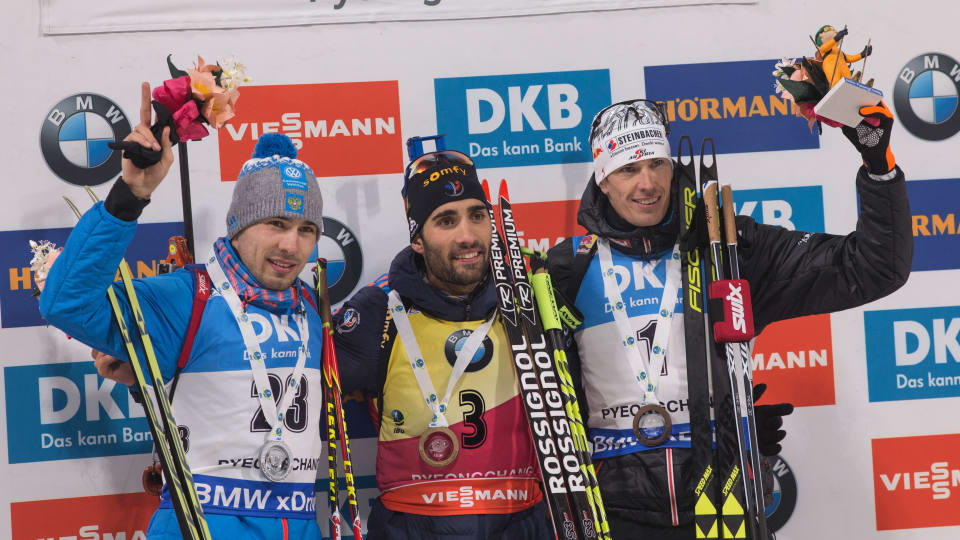
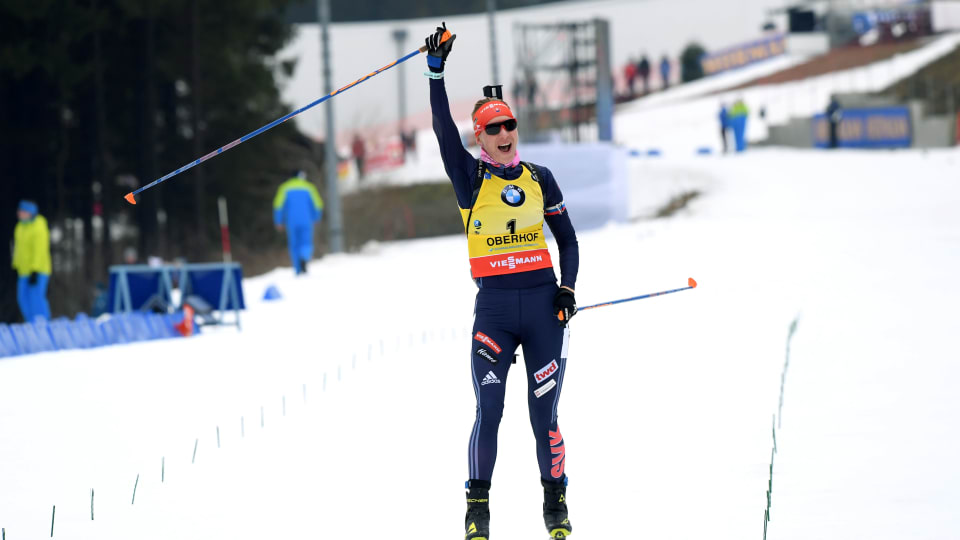
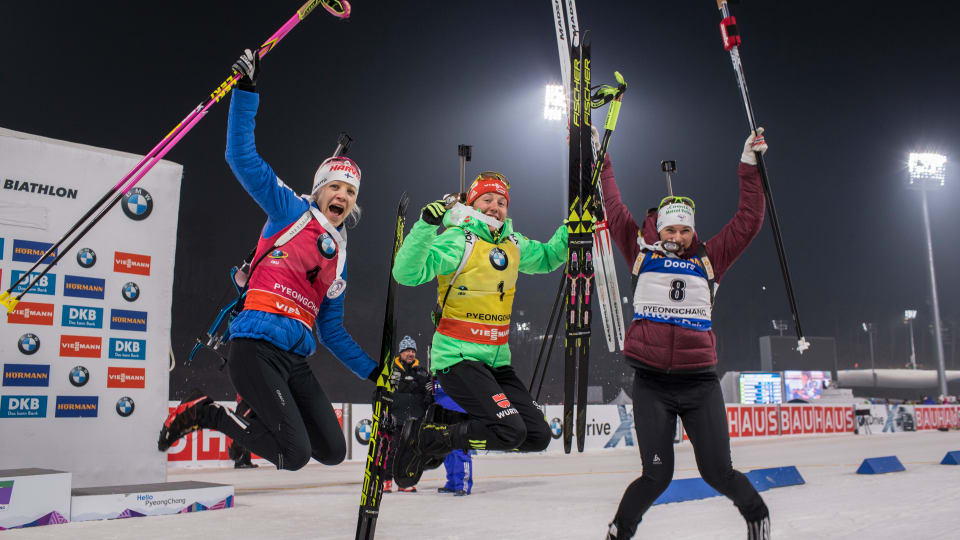
    Slovakia’s Anastasia Kuzmina celebrates her second-straight IBU World Cup win in Oberhof, Germany, on Saturday with a 1:04-minute victory in the women’s 10 k pursuit. It marked her fourth win of the 2017/2018 season. (Photo: IBU/Biathlonworld)

    IBU World Cup (Oberhof): Women’s and men’s pursuits

    Men’s report

    So far in 2018, Slovakia’s Anastasiya Kuzmina is undefeated after winning her second-straight race on Saturday at the International Biathlon Union (IBU) World Cup in Oberhof, Germany — this time by 1:04.4 minutes in the women’s 10-kilometer pursuit.

    After winning Thursday’s sprint, Kuzmina started 35 seconds clear of anyone else on Saturday, while Finland’s Kaisa Mäkäräinen headed out of the gate after her in second.

    Veronika Vitkova of the Czech Republic started another 5 seconds back in third, and Germany’s Franziska Hildebrand set out in fourth, 47 seconds after Kuzmina.

    Three Canadians finished in the top 60 of Thursday’s sprint to qualify for the pursuit, with Julia Ransom heading out ninth (+1:14), Sarah Beaudry starting 23rd (+1:39), and Megan Tandy starting 59th (+2:38).

    Throughout the four-stage race, it became more and more evident that no one was going to touch Kuzmina. She cleaned the first prone stage to leave the range 55.8 seconds clear of Hildebrand, who also cleaned to move into second. Makarainen dropped to fourth with a miss and Vitkova left the range in third (+1:08.5) after skiing a penalty lap as well.

    On the second prone stage, Kuzmina missed one target, but the penalty lap only cost her about 10 seconds; Hildebrand cleaned to keep herself in second place with three loops remaining.

    The first standing stage that followed saw Kuzmina miss another target and Hildebrand clean, yet 34.6 seconds still separated them. Kuzmina finally cleaned the last standing to extender her lead back up to a minute, while Hildebrand missed one to lose sight of the podium, slipping to fifth and 1:22.4 back at the start of the final loop.

    Italy’s Dorothea Wierer as the 16th starter steadily worked her way up to podium contention, cleaning all four stages with the third-fastest overall shooting time to put herself in second after the final standing, 1:00.2 behind Kuzmina. Ukraine’s Vita Semerenko raced up from 22nd to third with perfect 20-for-20 shooting as well, leaving the range 11 seconds after Wierer with one loop to go.

    On the final loop, Kuzmina skied the 22nd-fastest time on that loop (compared to Wierer’s 28th-fastest last-loop time) to put a few more seconds into Wierer as the eventual runner-up, winning in 30:49.5. On the day, Kuzmina’s overall course time was eighth fastest.

    “It was a very interesting race for me today,” Kuzmina told the IBU after. “My shape is very good now but I was worried if I could concentrate on the shooting … After the first shooting, I was relaxed and realized it was OK. I just gave the other girls two chances … I must apologize for my emotion [on the shooting range], but I was so happy and enjoyed the last loop.”

    Wierer finished 1:04.4 minutes later for second place, and Semerenko crossed the line in third, 1:10.2 out of first. Poland’s Weronika Nowakowska finished fourth (+1:17.1) after starting sixth, with clean shooting, and Mäkäräinen ended up fifth (+1:23.4) with three penalties (1+0+1+1) and the fourth-fastest overall course time. Belarusian Darya Domracheva followed in sixth (+1:28.8) after starting seventh and shooting 18-for-20 (0+0+1+1), and Germany’s Laura Dahlmeier finished seventh (+1:28.8), up from 13th with one late penalty (0+0+0+1).

    South Korea’s Anna Frolina placed eighth (+1:36.0, two penalties) for her best result since December 2012, France’s Justine Braisaz finished ninth (+1:37.0; three penalties), and another French skier Anais Bescond 10th (+1:37.1; one penalty). Hildebrand lost six places on the final loop to end up 11th (+1:38.7; one penalty).

    Overall, France’s Celia Aymonier skied the fastest course time of the day to rise from 28th to 15th (+2:08.7; three penalties).

    Ransom finished the day in 37th (+3:54.4) with three misses (1+0+0+2). She had been in 16th after her early miss in the first prone stage then hovered around the top 20 as she entered her final standing stage. There, she missed two to drop to 36th and she ultimately lost one more place to Finland’s Mari Laukkanen (who started the loop in 37th and passed Ransom, as well as four others, to finish 32nd).

    In her first World Cup pursuit of the season, Tandy improved to 43rd (+4:31.8) with a single miss (0+0+1+0). Overall, her range time was the 18th fastest and shooting time was 23rd fastest.

    Beaudry finished 51st (+5:36.6) with three misses (1+2+0+0), recovering one place from skiing in 52nd after the second shooting.

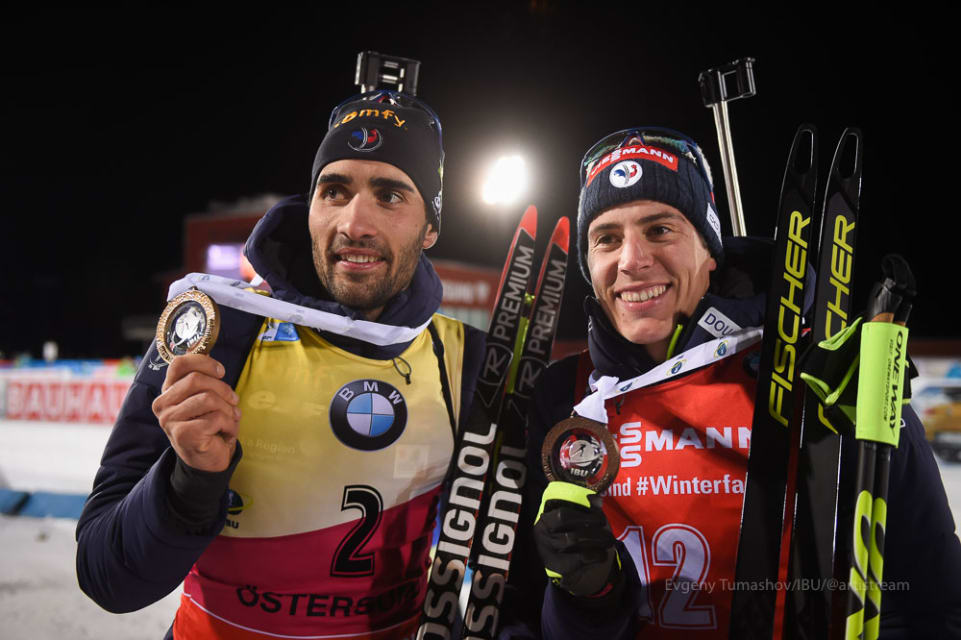
    In the men’s 12.5 k pursuit that followed, France’s Martin Fourcade held the lead from start to finish and held off Norway’s Johannes Thingnes Bø by 6.3 seconds for his second-straight win in Oberhof. Both of the Bø brothers reached the podium with older brother Tarjei Bø placing third, 30.9 seconds back.

    Fourcade as starter No. 1 had a single penalty on the first prone to keep himself ahead (1+0+0+0) and finish first in 32:23.6. Johannes Bø had three penalties (1+1+1+0) but still managed to rise from third at the start to second at the finish. Tarjei started fifth and shot clean to reach the podium.

    The fourth starter, American Tim Burke had three penalties (0+2+0+1) and ended up 14th (+1:43.7).

    Meanwhile, Canada’s Christian Gow rose from 36th to 21st (+2:19.2) to tie his career best (which also came in a pursuit this season) with 19-for-20 shooting (0+0+0+1). Scott Gow finished 50th (+4:45.0; six penalties), and Brendan Green placed 54th (+5:26.1; three penalties).

    (Full men’s report)

    The Oberhof IBU World Cup concludes Sunday with the men’s and women’s relays. Canada has entered Beaudry, Ransom, Tandy, and Emma Lunder in the women’s 4 x 6 k, and Christian Gow, Scott Gow, Brendan Green, and Carsen Campbell in the men’s 4 x 7.5 k. The U.S. does not have enough athletes at the Oberhof World Cup to field a team in either race.

    Results: Women | Men

    ***

    Tour de Ski Stage 6 (Val di Fiemme, Italy): 10/15 k classic mass starts
    Men’s report

    Women’s report

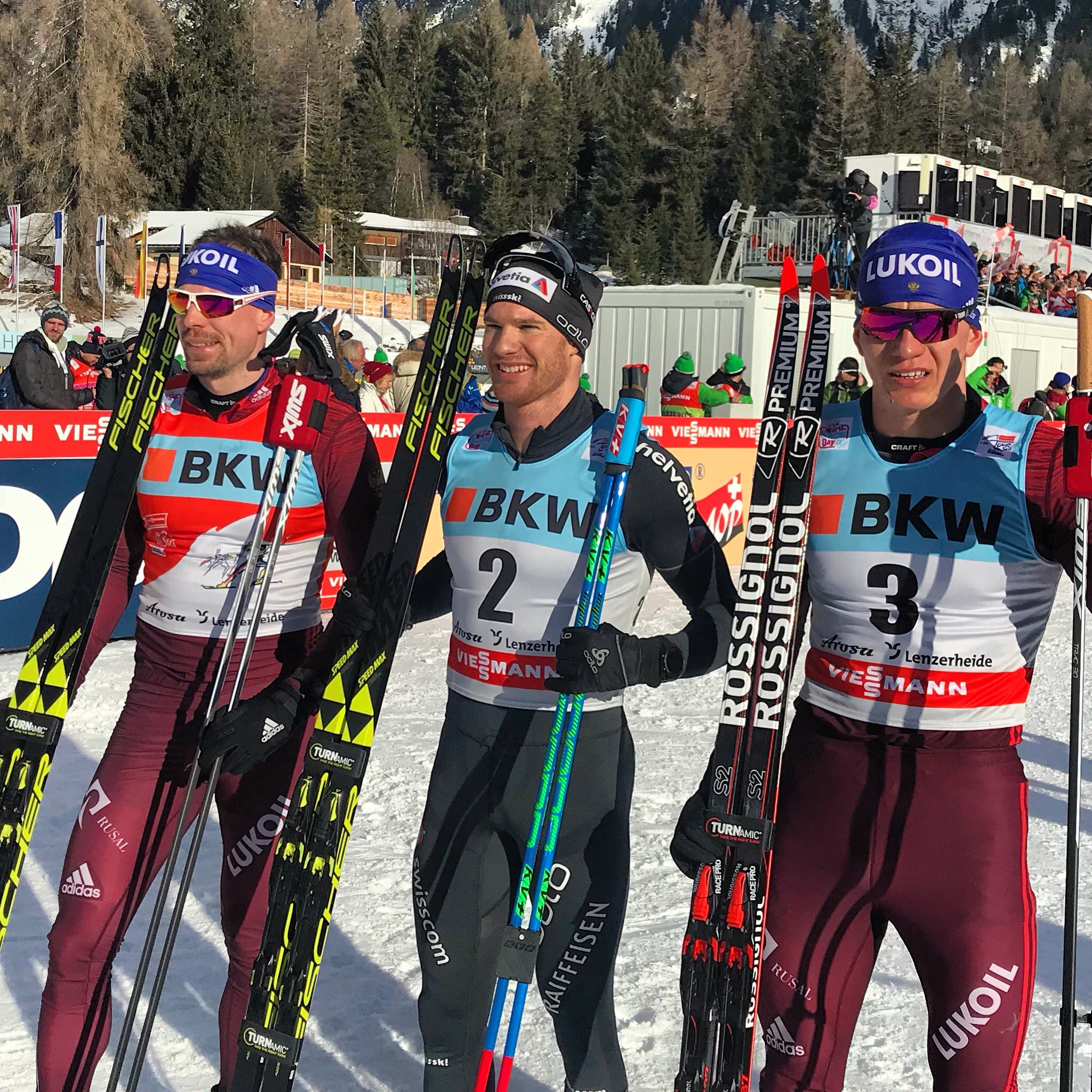
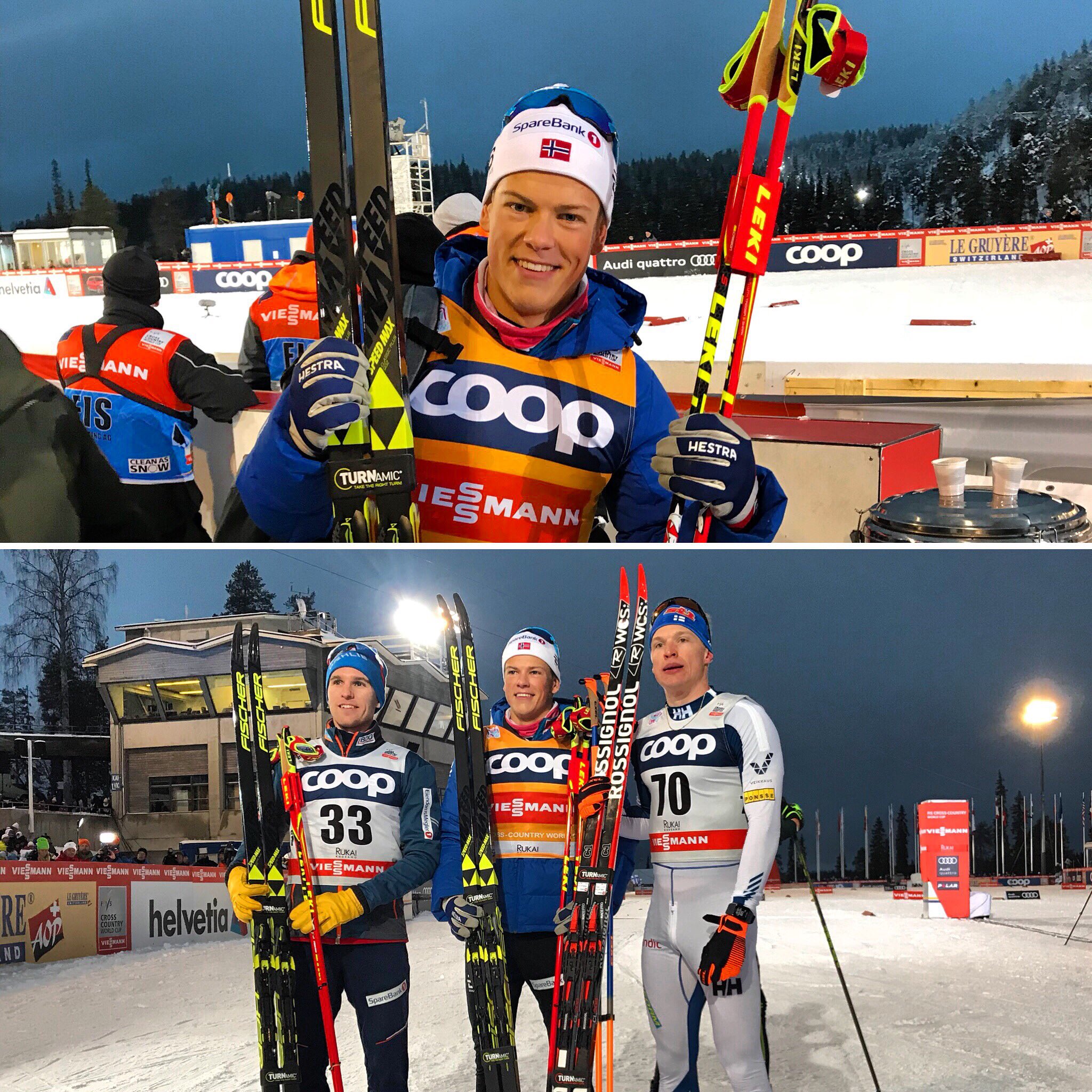
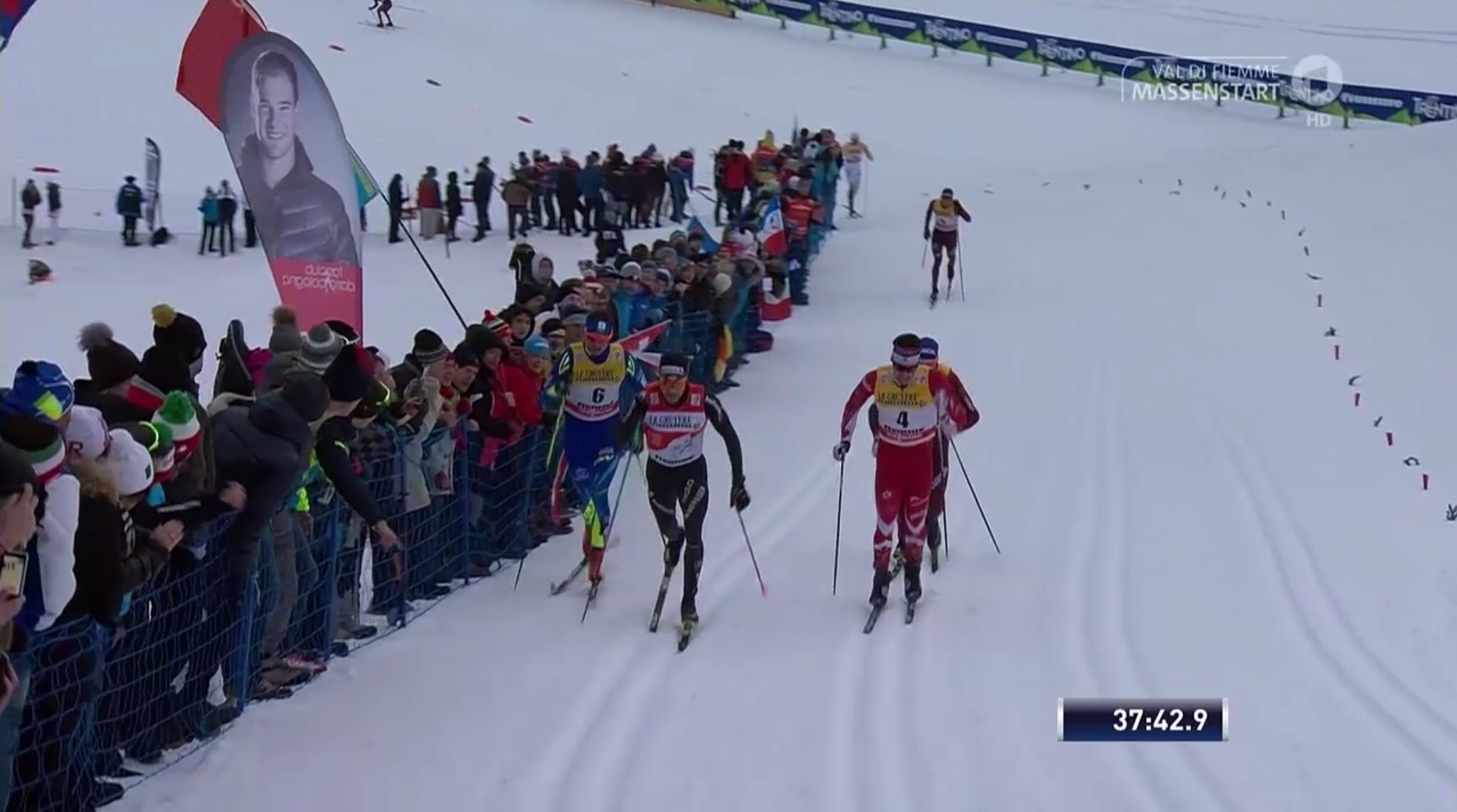
    Alexey Poltoranin (l), Dario Cologna (c), and Alex Harvey (4) charge up the last climb of Saturday’s 15 k mass start in Val di Fiemme, Italy. Poltoranin took the win, with Andrey Larkov (behind Harvey) placing second and Harvey third at Stage 6 of the 2018 Tour de Ski. (Screenshot: ARD broadcast)

    After a soggy and windy stay in Oberstdorf, Germany where the Stage 4 sprint was canceled and the Stage 5 freestyle mass stats were a cluster, the Tour de Ski (TdS) got back to a sense of normalcy in Val di Fiemme.

    Or did they? After dominating the first part of the men’s 15 k classic mass start and picking up valuable Tour bonus seconds, Russia’s Sergey Ustiugov faded, eventually finishing 14th, 42.8 seconds out of the win.

    Instead, Alexey Poltoranin of Kazakhstan made a big push to try to break for it about halfway through the race. Dario Cologna of Switzerland, the Tour de Ski leader coming into the day, followed, as did Canada’s Alex Harvey. The trio had a small gap of a few seconds consistently for several kilometers, before Russia’s Andrey Larkov caught up to them. Behind them, the field continued to fracture into chaos, claiming what would in past years have seemed unlikely victims like Norway’s Martin Johnsrud Sundby.

    After much posturing and pushing in the final kilometer, the lead pack of four came shooting into the downhill finish with Poltoranin claiming the win by 0.4 seconds over Larkov. Harvey finished third, +0.9, and Cologna fourth, +2.3. There was a bigger gap before Russia’s Alexander Bolshunov crossed the line in fifth, +15.0.

    That means that Poltoranin takes over second place in the Tour, while Ustiugov lost ground.

    The only American starter, Paddy Caldwell, finished 48th out of 52 finishers, +3:38.6.
    Results

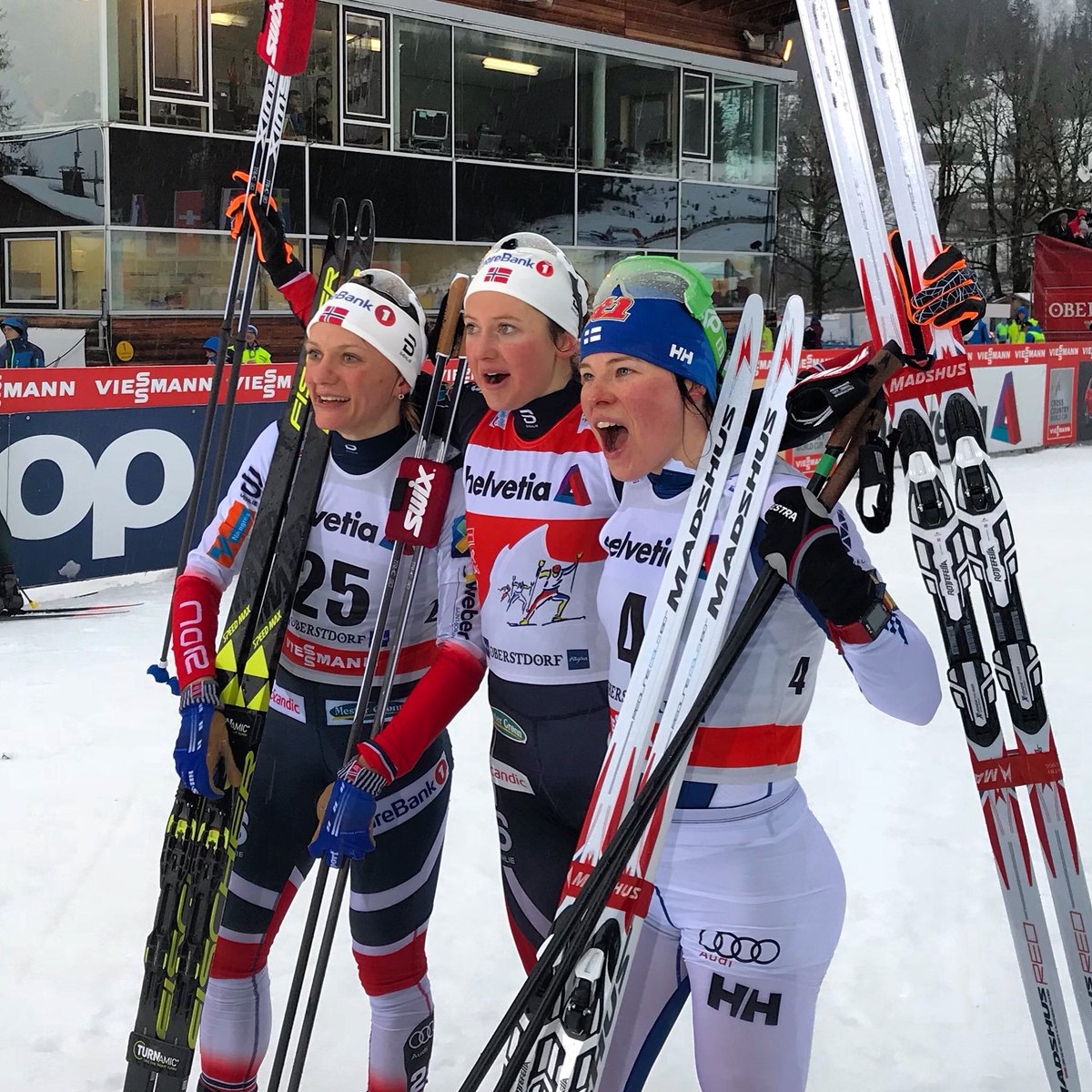
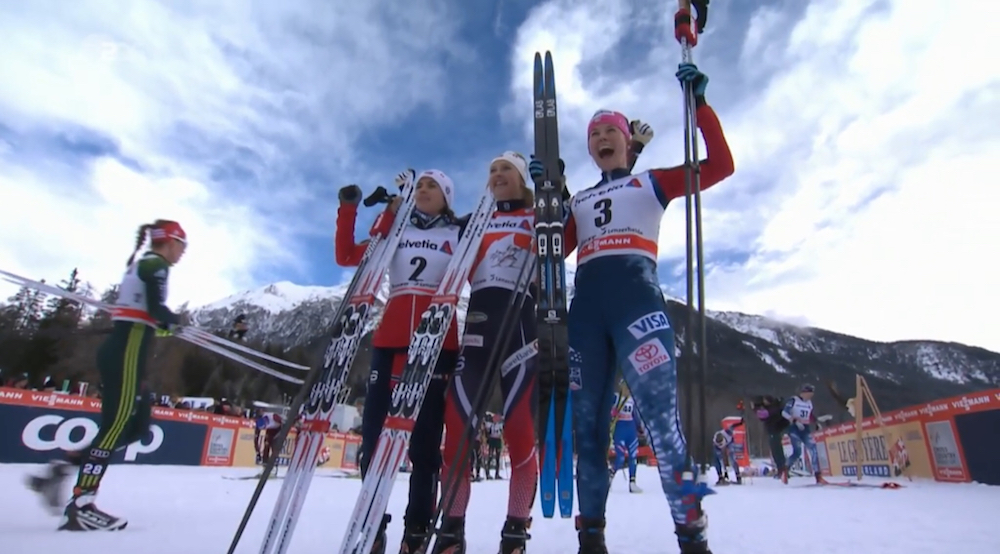
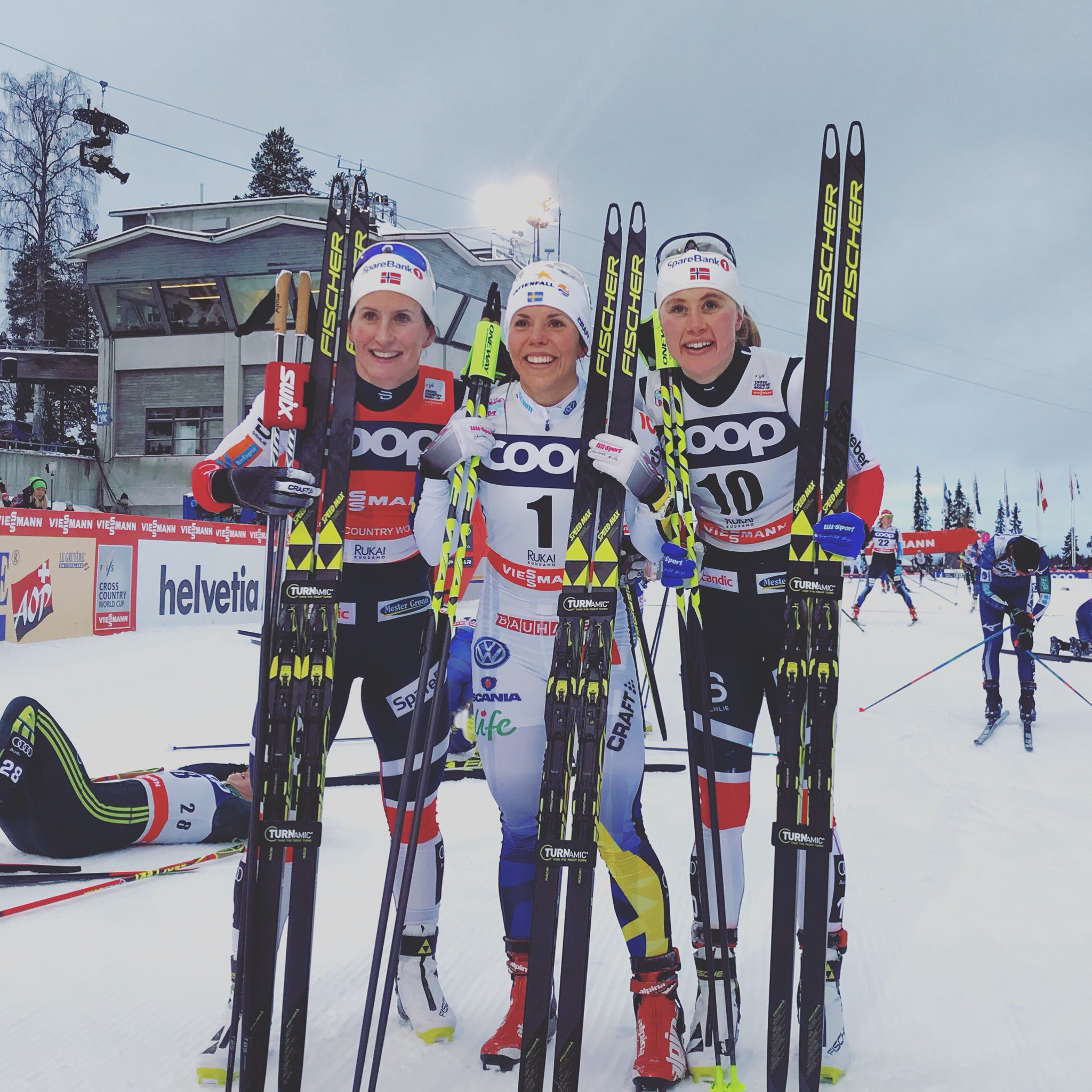
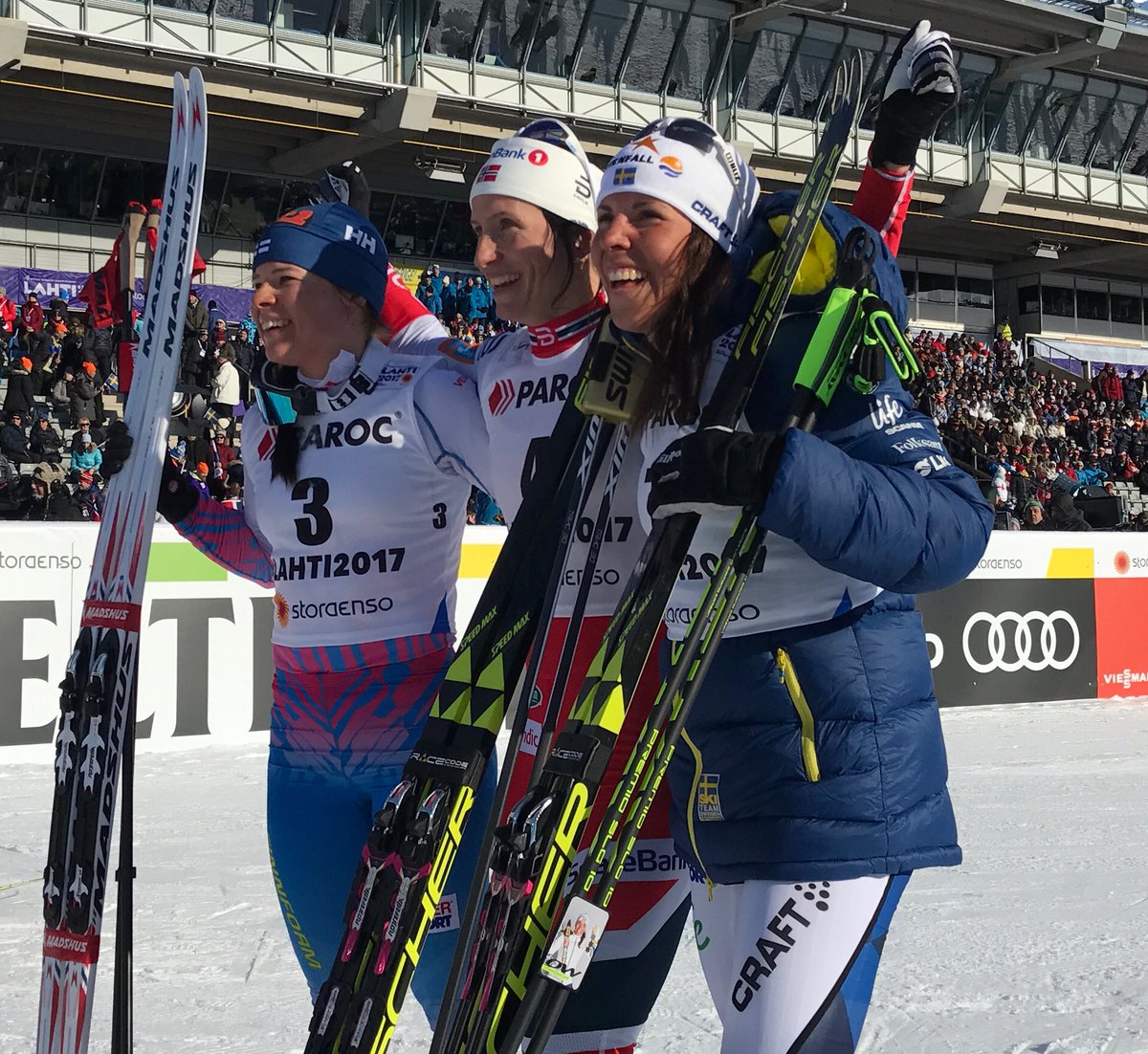
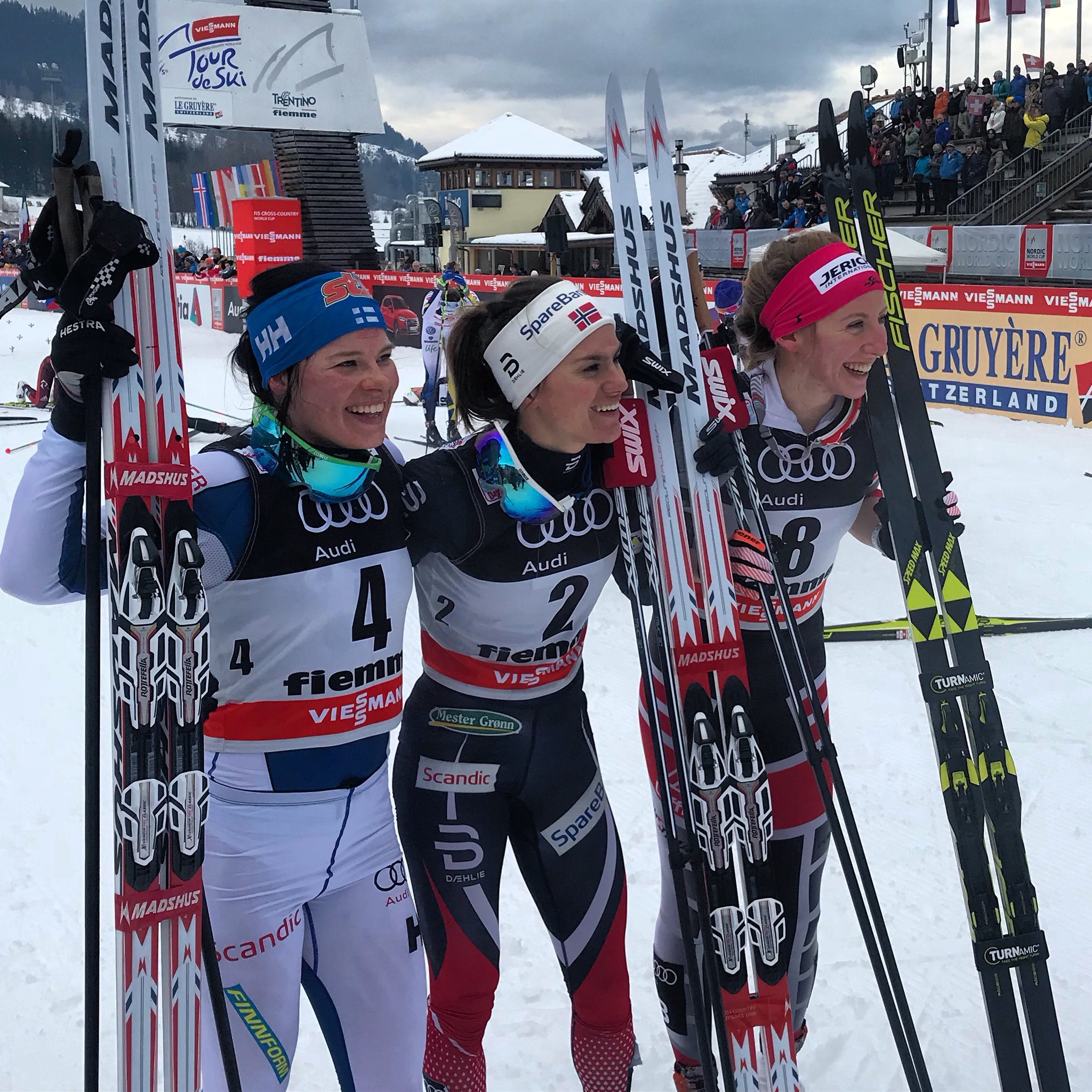
    The women’s 10 k classic mass start podium at Stage 6 of the 2018 Tour de Ski on Saturday in Val di Fiemme, Italy, with Norway’s Heidi Weng (c) in first, Finland’s Krista Parmakoski (l) in second and Austria’s Teresa Stadlober in third. (Photo: FIS Cross Country/Twitter)

    The women’s race went off as planned: no snafus, only burning lungs and muscles. At the start of Stage 6, Jessie Diggins was ranked third overall in the Tour (+1:56.7). Norway’s Ingvild Flugstad Østberg wore the red bib as the TdS leader, while teammate Heidi Weng was second overall (+57.0).

    As Saturday’s race transpired, Weng proved dominant. She won in 29:07.9. Finland’s Krista Parmakoski placed second (+7.6), and Austria’s Teresa Stadlober third (+8.6).

    Diggins skied a gutsy race to finish fourth (+23.6). Østberg, who at times looked like she could dominate the pace, faded to fifth (+35.2).

    U.S. skiers Sadie Bjornsen finished in 10th place (+1:11.3), Liz Stephen 24th (+2:18), and Rosie Brennan 30th (+2:47.2).

    Heading into tomorrow’s final stage, the formidable climb up the Alpe Cermis, Østberg leads the Tour with a tiny 1.8-second gap on Weng. Parmakoski is third overall (+1:33.5), Diggins fourth (+1:43.1), and Bjornsen eighth (+3:33.1).

    Results: Women’s Stage 6 |

  • Thursday Rundown: Iversen, Østberg Prevail in Jam-Packed Oberstdorf Mass Starts

    Thursday Rundown: Iversen, Østberg Prevail in Jam-Packed Oberstdorf Mass Starts

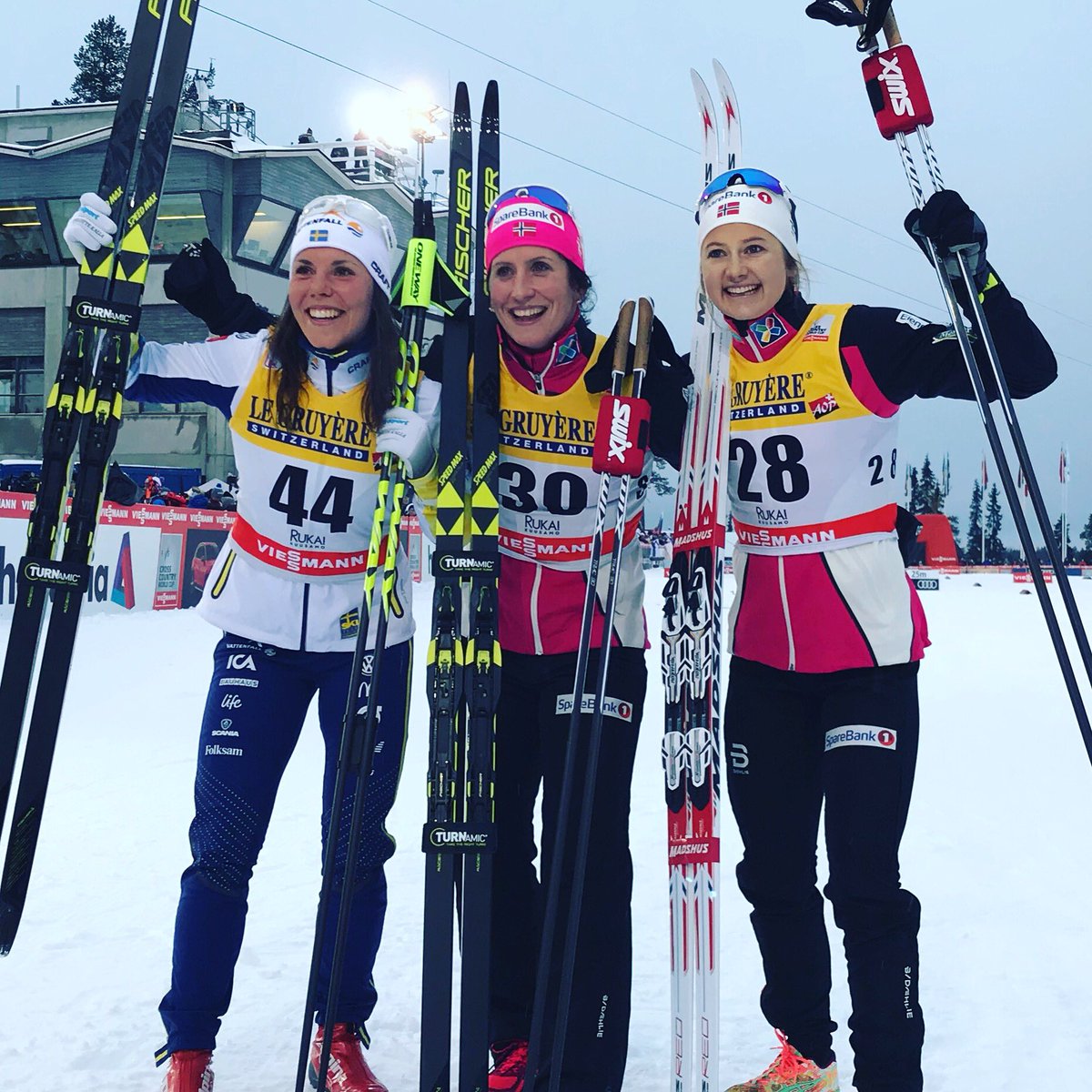
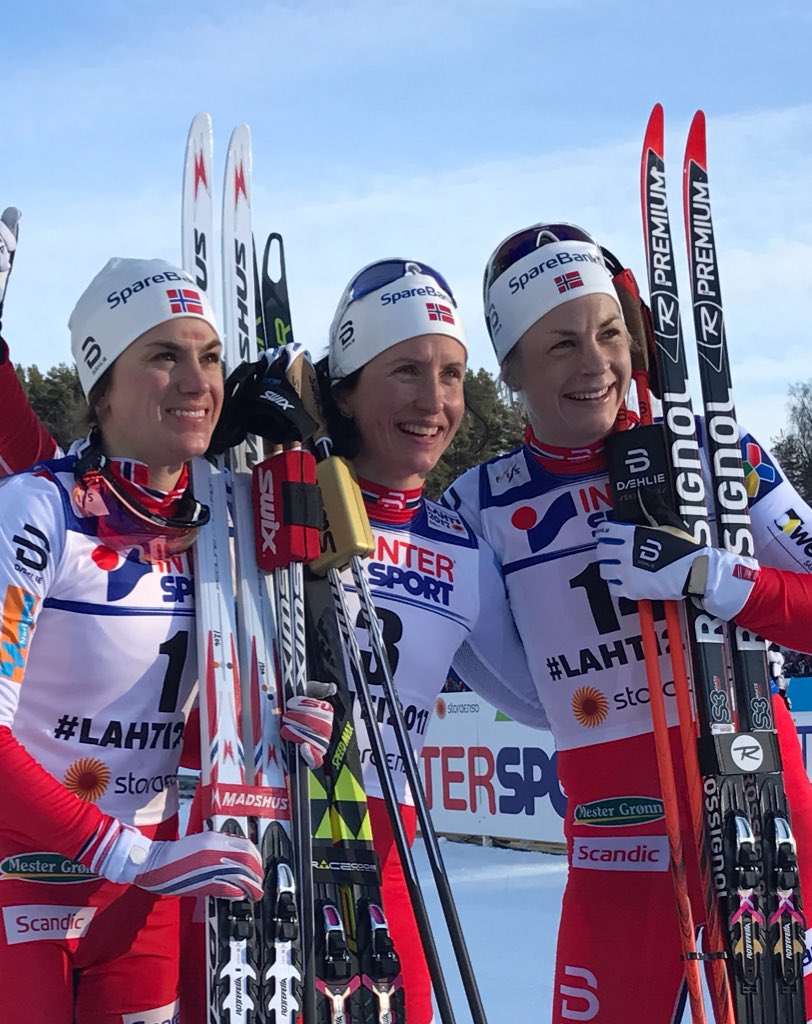
    The Tour de Ski Stage 5 women’s 10 k freestyle mass start podium on Thursday in Oberstdorf, Germany, with Norway’s Ingvild Flugstad Østberg (c) in first and Maiken Caspersen Falla (l) in second, and Finland’s Krista Pärmäkoski (r) in third. (Photo: FIS Cross Country/Twitter)

    Tour de Ski Stage 5 (Oberstdorf, Germany): 10/15 k freestyle mass starts

    Men’s report

    Women’s report

    In one of the more unconventional stages of the Tour de Ski — a rainy, seven-lap, 14.7-kilometer men’s freestyle mass start, and a five-lap, 10.5 k women’s mass start (both of which were adapted to a shorter course after damage from Wednesday’s storm) — two Norwegians outlasted a tightly packed group of competitors to the finish, with Emil Iversen winning the men’s race and Ingvild Flugstad Østberg capturing her third-straight win in the women’s race on Thursday in Oberstdorf, Germany.

    Iversen posted his first win of the season after hanging in the pack throughout the relatively flat race, with a maximum climb of 16 meters and total climb of 50 meters.

    In the finishing stretch, he outsprinted fellow Norwegian Sindre Bjørnestad Skar by 0.4 seconds for the win in 29:49.8 minutes. Italy’s Francesco De Fabiani reached the podium in third, just 0.9 seconds out of first. Switzerland’s Dario Cologna kept his overall Tour lead in fourth place (+3.7) and Canada’s Alex Harvey came out on top of a photo finish for fifth with Great Britain’s Andrew Musgrave taking sixth and Norway’s Finn Hågen Krogh seventh, all 4 seconds after Iversen.

    Norway’s Martin Johnsrud Sundby placed eighth (+4.2), Germany’s Thomas Bing ninth (+4.9) and France’s Maurice Manificat 10th (+5.2).

    Twenty-five skiers finished within 10 seconds of first, and 57 in the 67-man field ended up within 50 seconds of first.

    Overall, Cologna continues to lead the Tour standings with two stages to go: a 15 k classic mass start on Saturday and 9 k freestyle hill climb on Sunday, both in Val di Fiemme, Italy. He is 53 seconds ahead of Russia’s Sergey Ustiugov, who placed 28th on Thursday, and 1:07.6 ahead of Sundby in third. Harvey remains in fourth, now 1:23.1 behind and 3.5 seconds ahead of Russia’s Alexander Bolshunov (+1:26.7), who finished 40th on Thursday after falling several times.

    Erik Bjornsen led the U.S. men in 32nd (+11.7), Paddy Caldwell placed 39th (+15.5), and Andy Newell was 53rd (+43.2). Simi Hamilton did not start. Overall, Bjornsen is 20th in the Tour (+3:10.7), Caldwell 60th (+6:58.2) and Newell 65th (+9:37.1) out of 67, although this is expected to be Newell’s last stage of the Tour.

    https://twitter.com/FISCrossCountry/status/948902614900633600

    In the women’s race earlier in the day, Østberg secured a 1.9-second victory over her teammate, Maiken Caspersen Falla, a Norwegian sprint specialist. Østberg crossed the line first in 23:16.5 and Finland’s Krista Pärmäkoski joined the two Norwegians on the podium in third, 3.2 seconds out of first.

    Switzerland’s Nathalie von Siebenthal finished 4.1 seconds back in fourth for her best World Cup result, Sweden’s Maria Nordström was fifth (+4.4) to tie her career best, Germany’s Nicole Fessel sixth (+5.5), Austria’s Teresa Stadlober seventh (+5.8), Norway’s Anne Kjersti Kalvå eighth (+6.5) for her first World Cup top 10, Russia’s Anastasia Sedova ninth (+6.7), and Sweden’s Emma Wiken 10th (+7.1). Norway’s Heidi Weng was another 0.1 seconds back in 11th (+7.2), and for the first time this season, no U.S. Ski Team members finished in the top 20.

    Jessie Diggins placed 24th (+16.8), Sadie Bjornsen 26th (+20.8), Liz Stephen 28th (+24.5), and Rosie Brennan 36th (+52.7).

    “Today was definitely a very different course than most due to the storm and trees falling down over the usual course!” Diggins wrote in an email to FasterSkier. “It was icy and flat, which meant that the pack stayed really tight together as there were no big climbs to break it up.

    “Fortunately, I got into great position to sprint for the bonus seconds [on Lap 3],” she continued. “Unfortunately, 200 meters from the finish I hit ice and crashed hard into the boards, spinning around and losing quite a bit of time and places. But that happens sometimes in racing and I shook it off already!”

    Østberg now leads the Tour standings by 57 seconds over Weng while Diggins is nearly 2 minutes back in third (+1:56.7). Pärmäkoski follows in fourth (+2:09.1), Finland’s Kerttu Niskanen is up to fifth (+2:34), Fessel is sixth (+2:39.8), while Bjornsen slipped two places to seventh (+2:47.0). Stephen is 27th overall (+5:12.2) and Brennan 33rd (+5:50.6) out of 43 women.

    Ida Sargent and Sophie Caldwell did not start on Thursday and withdrew from the Tour to focus on the regular-season World Cup sprints next weekend in Dresden, Germany, which are also the focus for their U.S. teammates Kikkan Randall, Hamilton and Newell.

    Results:

    Men’s Stage 5 | Men’s Tour standings (through Stage 5)
    Women’s Stage 5 | Women’s Tour standings (through Stage 5)
  • ‘It Was Like Hell Today’: Østberg on Keeping the Red Bib; Diggins Up to 3rd in TdS Stage 3

    ‘It Was Like Hell Today’: Østberg on Keeping the Red Bib; Diggins Up to 3rd in TdS Stage 3

    The women’s 10 k freestyle podium at Stage 3 of the 2018 Tour de Ski on Monday in Lenzerheide, Switzerland, with Norway’s Ingvild Flugstad Østberg (c) in first and Heidi Weng (l) in second, and American Jessie Diggins (r) in third. (Photo: Salomon/NordicFocus)

    Not one of the last three days in Lenzerheide, Switzerland, were alike, with three different American women standing on the coveted podium and three vastly different conditions for the first three stages of the 2018 Tour de Ski.

    Technically, it wasn’t 2018 until today — with Jessie Diggins racing to third in the women’s 10-kilometer freestyle pursuit on Monday, the first day of the new year and her first podium of the season.

    She did so in soft, slow conditions with fresh snow coating Lenzerheide’s 3.75 k distance course — a stark contrast to Sunday’s fast-and-icy conditions that caused a few racers to fly off the course*. American Sadie Bjornsen stayed on her feet and raced to third for her first-career 10 k podium. Saturday’s skate sprint was a snowy one, which another U.S. Ski Team member Sophie Caldwell embraced and raced to second place, for her first individual World Cup podium in two years.

    Monday was a suffer-fest for everyone on course and a solo one for the first three skiers. Norway’s Ingvild Flugstad Østberg headed out of the gate first, after leading the Tour de Ski (TdS) standings with a win in Saturday’s 10 k classic. Her teammate Heidi Weng started second, 33 seconds back, and Diggins started 32 seconds after Weng (1:05 minutes behind Østberg) in third.

    With Bjornsen next in line, another 10 seconds back in fourth, and Russia’s Natalia Nepryaeva 2 seconds behind her in fifth, the race was for the podium was more or less a formality, barring anything unexpected for Østberg, Weng and Diggins. Sure, anyone of them could have unraveled, but it wasn’t likely. Regardless, each still had to gut out three long laps on their own, with Diggins eyeing Weng, Weng trying to close the gap to Østberg, and Østberg with only the open trail ahead of her.

    “It was like hell today,” the 27-year-old Østberg said after her second-straight win on Monday, according to an International Ski Federation (FIS) press release. “It was a very hard fight. I felt the snow was not fast. I was gaining seconds on Heidi and then losing them again.”

    Throughout the race, Østberg had a maximum gap of 36 seconds to Weng in second (at 1 k) and a minimum gap of 23 seconds (again to Weng at 5.6 k). She crossed the finish line first in 26:48.1 minutes, while Weng finished 27.8 seconds back in second and Diggins another 49.1 seconds later in third (+1:01.4).

    Weng, who is currently second in the overall Tour standings, 32.8 seconds behind Østberg in first with four stages to go, told FIS that the race was “very hard for everybody”, but she was pleased with her ability to ski hard on the uphills and flats. For most of the race, she looked like Weng was giving it everything she had — as was Diggins — and Weng ended up with the third-fastest time of day. Austria’s Teresa Stadlober posted the fastest 10 k time in 26:20.6, which put her in 12th at the finish after she started 29th. Weng was 22.5 seconds slower and Østberg 27.5 seconds off that time with the fourth-fastest time of day.

    In her third race in as many days, Østberg said she felt tired out of the start on Monday.

    “Already after one hundred meters, my legs were tired, but I fight, fight, fight all the way,” she told German broadcaster ZDF. “And I managed to reach the finish first, it was a great feeling.”

    This marked Østberg’s third win of the season — all of which have come in Switzerland (she won the Davos 10 k freestyle on Dec. 10). Four years ago, she won her first World Cup race in Lenzerheide in a freestyle sprint.

    “In Davos and here in Lenzerheide I had some of my best races, so Switzerland is a good place for me to race,” she told ZDF.

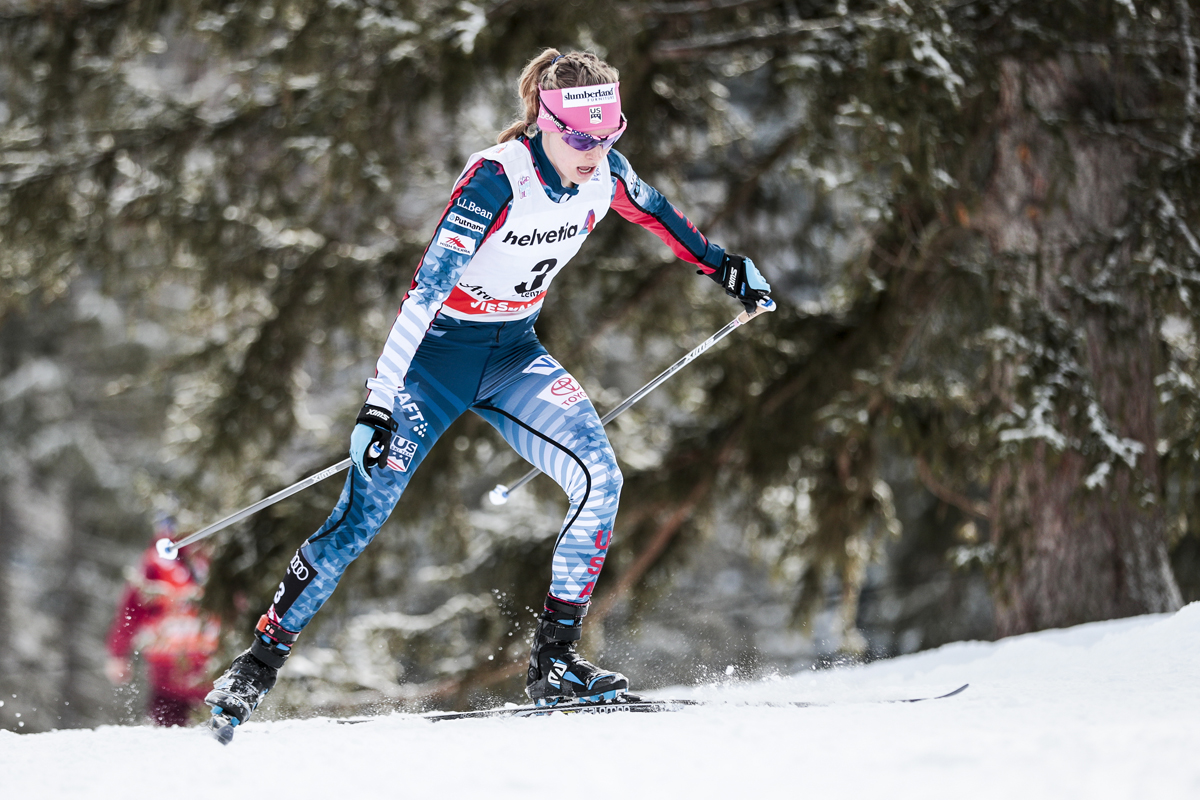
    Jessie Diggins (U.S. Ski Team) racing to third in the women’s 10 k freestyle pursuit at Stage 3 of the 2018 Tour de Ski in Lenzerheide, Switzerland. On the first day of the new year, it was her first podium of the season. (Photo: Salomon/NordicFocus)

    Then there was Diggins, who continued the U.S. Ski Team (USST) streak of landing on the podium over three consecutive days.

    “Today my plan was to go out hard and ski a gutsy race, and try to put some time into the girls behind me,” she wrote in an email to FasterSkier. “It’s sometimes hard to be skiing alone but I actually loved it because I could just put my head down, hammer, and do my thing!”

    Within the first kilometer, she had already put a few more seconds into Bjornsen in fourth place. Meanwhile, Bjornsen, 13 seconds behind Diggins, worked to shake off Nepryaeva.

    “Starting in 4th was a pretty exciting position, and even a bit terrifying,” Bjornsen wrote in a mass email to media outlets. “It was my goal to try to catch Jessie, and ski with her, but I knew I needed to get it done in the first kilometer, because she was going to be on a mission. I got darn close, but not quite close enough. I could tell right away I was going to be on a solo mission, and needed to really push hard to stay ahead of the group working together behind me.”

    The group she was referring to included Finland’s Kerttu Niskanen and Krista Pärmäkoski. Toward the end of the first lap at 3.3 k, they had distanced themselves from a nine-woman chase group led by Norway’s Astrid Uhrenholdt Jacobsen, of which Caldwell was a part of. After dropping Nepryaeva on the first lap, Bjornsen had the two Finns and the crew behind them to worry about.

    “I managed to stay ahead until literally the last downhill, and got passed by Krista, so lost one place, but I left the day pretty satisfied,” Bjornsen wrote after finishing fifth in a three-way battle with Pärmäkoski and Niskanen for fourth place. Pärmäkoski took it, passing Bjornsen in the last few hundred meters and leading her and Niskanen, respectively, into the finishing straight. Pärmäkoski crossed the line in fourth, 29 seconds after Diggins and 1:45.9 after Østberg, while Bjornsen was another 0.3 seconds back in fifth (+1:46.2) and Niskanen finished 0.4 seconds later in sixth (+1:46.6). Behind them, Jacobsen finished seventh (+1:59.9), Fessel eighth (+2:00.3), the Czech Republic’s Petra Novakova ninth (+2:01.0), and Germany’s Sandra Ringwald 10th (+2:11.3).

    Sadie Bjornsen (U.S. Ski Team) leading Russia’s U23 leader Natalia Nepryaeva (l) in the women’s 10 k freestyle pursuit at Stage 3 of the 2018 Tour de Ski in Lenzerheide, Switzerland. Bjornsen went on to finish fifth and Nepryaeva finished 17th. (Photo: Fischer/NordicFocus)

    “It required digging darn deep those last kilometers,” Bjornsen wrote. “I was feeling pretty good for the first lap, but started to really burn for the last two. I’m really looking forward to a day off, and then some classic sprinting! Sounds like it will be darn wet and rainy, but it will be fun.”

    Heading into the fourth stage of the TdS, Wednesday’s classic sprints in Oberstdorf, Germany, Diggins is third overall,1:26.9 minutes out of first, Parmakoski is up to fourth (+2:00.9; after starting Monday’s race in eighth), and Bjornsen is positioned in fifth (+2:01.2), just ahead of Niskanen in sixth (+2:01.6).

    “It’s really fun to be in podium position right now in the tour, but my plan as always is to just take it one day at a time and focus on each stage separately,” Diggins wrote. “If I can give my best effort each day, hopefully it all adds up well!

    “I was really proud of our wax tech team because the past two races have been extremely tricky waxing conditions with varying snow all over the course,” Diggins added. “It was hard to pick skis but my tech Cork was so calm and collected and got me through the pre-race testing!”

    Despite not planning to finish the Tour, Caldwell is sitting in a respectful 18th overall (+3:14.2) after finishing 18th in Monday’s race, 2:59.2 behind Østberg.

    “10km skates tend to be the hardest discipline for me, and although today wasn’t anything to write home about, it also wasn’t a disaster, so I was pretty happy with it!” Caldwell wrote.

    Sophie Caldwell (U.S. Ski Team) racing to 21st in the women’s 10 k classic on Sunday at Stage 2 of the 2018 Tour de Ski in Lenzerheide, Switzerland. On Monday, she finished 18th in the Stage 3 10 k skate pursuit. (Photo: Fischer/NordicFocus)

    She started seventh, 1:32 back, at the same time as Niskanen in bib 6. Parmakoski started 3 seconds behind them and the three immediately formed a group, with Caldwell leading the first kilometer.

    “For some reason out of the start Kerttu just pulled to the side and made me lead, which I thought was interesting since both she and Krista are much better distance skiers than I am,” Caldwell wrote in an email to FasterSkier. “But anyway, I was totally fine taking the lead, but I wasn’t going to push the pace leading, so I just skied a chill pace until they decided to take back over coming through the stadium. The chase pack caught us pretty quickly, which I was actually excited about because the Finns’ pace was a little too hot for me once they picked it up and the chase group was skiing a pace that felt quite comfortable for me for a lap or so.”

    With racers like Jacobsen and Germany’s Nicole Fessel leading the large chase pack for much of the race, Caldwell hung in the group for about 5 k in the middle of the race. But with one lap to go, she lost contact and found herself fighting for 18th.

    “The pace was definitely picked up at the beginning of the third lap and I started to get tired then, but I just tried to keep my skis gliding and focus on getting to the finish line,” she wrote. “It was cool for me because often I feel like those skate races are red lining it from the start for me, and today I felt in control for two laps and had a pretty fun time with it!

    “I’m really happy with how my tour has gone so far,” Caldwell continued. “I had one of my best sprints ever and one of my best distance races ever, so no complaints there! I feel healthy, fit, and happy and it’s given my confidence a good boost.”

    “The vibe is pretty amazing among our team right now,” Bjornsen wrote. “To have a podium every day of the Tour is pretty exciting! It’s fun to see things really come together for everyone. I think there is more to come!”

    Asked if this was in line with what the U.S. team was expecting for a start to the Tour, USST Head Coach Chris Grover said it surpassed expectations, but wasn’t unanticipated.

    “There was some opportunity in this field this year with [Sweden’s Charlotte] Kalla and Stina Nilsson not starting, with [Norway’s Marit] Bjørgen and Ragnhild Haga not starting, for example, so that left some opportunity for some of the other women to have some breakthrough results,” he said on the phone. “But at the same time, the women that have been on the podium from the U.S.A. the last three days have been on the podium this year or in past years and have been kind of knocking on the door of those results…

    “Overall it’s a better start to the Tour than we could’ve wished for,” he later added. “It’s been really exciting to see a podium from a different woman on the team each day. I think once we get to Oberstdorf there’s going to be fresh opportunities for all those women once again to reach the podium. I’m just hoping that right now that everybody can stay healthy, get some good rest, and really look forward to seeing what they can do in the next couple stages.”

    With four stages to go, the U.S. has six women in the Tour, with Liz Stephen improving to 31st on Monday (up from 37th at the start), Rosie Brennan maintaining her overall place in 33rd, and Ida Sargent in 55th (down from 31st at the start).

    “I was hoping to make up some more places and thought getting into the top 30 was doable. But last lap I lost a little steam and couldn’t keep up my pace,” Stephen wrote in an email to FasterSkier.

    En route to the 26th-fastest course time, Stephen picked off four places between 3.3 and 4.3 k.

    “The race started really fast, as usual for the World Cup, so I try to be patient and bank on people coming back to me, which they did after about a lap,” she wrote. “I was focused on making up time consistently around the whole course and not just killing myself on the uphills. However the second 1/2 of the course was a lot of climbing so I focused on those sections and tried to get in peoples drafts for the long downhill into the stadium.”

    Now in 31st overall, she is 4:22.7 out of first. Brennan is another 10 seconds back in 33rd (+4:32.9).

    “I am happy to have scored my first points of the year yesterday in a classic race on very icy, scary conditions, which is not my strong suit, and then again have a top 30 performance,” Stephen continued, referring to her 28th place in Sunday’s 10 k classic. “My year has certainly started slower than I wanted it to, but the Tour is always a good way for me to get a lot of racing in a short period of time and bring my fitness up. So, every day I focus on making a few more spots and look forward to Alp Cermis!”

    While Sargent is fighting illness and had initially planned to withdraw from the Tour after Stage 4 or 5 in Oberstdorf (to focus on the World Cup sprints after the Tour), Stephen and Brennan intended to finish it.

    “I know Ida is kind of feeling on edge … I know she was kind of a questionable start for yesterday’s classic race so we’ll see what happens with her going into Oberstdorf,” Grover said.

    He described Kikkan Randall’s foot injury as one that’s crept up over time that and doesn’t involve a stress fracture.

    “She is planning on starting in Dresden right now, both in the sprint and the team sprint so I think she’ll continue to be somewhat selective with the races she chooses,” he said of Randall resuming her season with the next regular-season World Cup races Jan. 13-14 in Dresden, Germany. “She may or may not go at all to Planica [Slovenia, Jan. 20-21], since those are two classic races, but she will for sure race in Seefeld [Austria, Jan. 27-28], where there’s two skate races. So right now her plan is, keep trying to make progress with the foot, get it healthy, be ready to race in Dresden, be ready to race in Seefeld, be ready to race at the Games.”

    — Harald Zimmer contributed

    Results: Women’s Stage 3 pursuit | Women’s Time of Day | Women’s TdS standings (through Stage 3) 

    ***

    *Switzerland’s Laurien van der Graaff, the Stage 1 skate-sprint winner, crashed out of contention in Saturday’s 10 k classic, and finished 35th to put herself 16th overall in the TdS heading into Stage 3. 

    “…I skied out into the deep snow, I had problems to brake at all and went straight ahead and unfortunately crashed and lost quite a few seconds there,” she told Swiss broadcaster SRF, according to a translation. “Otherwise I felt good. It was a special race, a bit more attention on me than usual, but it was cool, I am still happy about yesterday. Aside from my crash I enjoyed it. My nose is pretty banged up. … It really hurts.”

    https://instagram.com/p/BdX8iINDfeB/

  • Tour de Ski Rundown: Diggins 3rd; Harvey 4th; Østberg and Cologna Tally Win No. 2

    Tour de Ski Rundown: Diggins 3rd; Harvey 4th; Østberg and Cologna Tally Win No. 2

    The women’s freestyle pursuit podium at Stage 3 of the Tour de Ski, with Norway’s Ingvild Flugstad Østberg (c) in first and Heidi Weng (l) in second and American Jessie Diggins (r) in third on Monday in Lenzerheide, Switzerland. (Screenshot: ZDF broadcast)

    Tour de Ski Stage 3 (Lenzerheide, Switzerland): 10/15 freestyle pursuits

    Women’s report

    Men’s report

    In the first three stages of the Tour de Ski (TdS), three different American women have reached the podium. Jessie Diggins became the latest in Monday’s New Year’s Day 10-kilometer freestyle pursuit in Lenzerheide, Switzerland.

    Heading into Stage 3, the last one in Switzerland before the Tour moves to Oberstdorf, Germany, Diggins ranked third overall in the TdS. She started the pursuit in that place, 1:05 minutes after Tour leader Ingvild Flugstad Østberg of Norway. More than 30 seconds ahead of her, another Norwegian Heidi Weng headed out of the start in second place, 33 seconds after Østberg. And 10 seconds behind Diggins, her U.S. teammate Sadie Bjornsen started fourth, 1:15 out of first and just two seconds ahead of Russia’s Natalia Nepryaeva in fifth.

    The women’s race then became a demonstration of strength and grit as Østberg kept herself out of reach, leading by a comfortable margin at every checkpoint and securing her second-straight win in 26:48.1 minutes. Weng could see her, and Diggins could see Weng, but neither linked up, as Weng finished second, 27.8 seconds after Østberg, and Diggins held onto third (+1:16.9) for her first podium of the season.

    Behind Diggins, Finland’s Krista Pärmäkoski rose from eighth and 1:35 back at the start (starting behind her Finnish teammate Kerttu Niskanen in sixth and American Sophie Caldwell in eighth), to fourth at the finish, 1:45.9 out of first. Pärmäkoski outlasted Bjornsen by 0.3 seconds and Niskanen by 0.7 seconds at the finish to put herself in fourth overall in the Tour standings with four stages remaining, while Bjornsen placed fifth (+1:46.2) and Niskanen sixth (+1:46.6).

    Norway’s Astrid Uhrenholdt Jacobsen moved up from 15th at the start to seventh at the finish (+1:59.9) with the fifth-fastest time of day. Austria’s Teresa Stadlober won the time of day, covering the course in 26:20.6 and improving from 22nd to 11th.

    The U.S. had three finish in the top 20 with Caldwell placing 18th (+2:59.2) after skiing with a group of nine, led by Jacobsen and Switzerland’s Nathalie von Siebenthal, until the last of three laps. Caldwell fell off the pace around 7.5 k and skied the remainder of the lap alone to put herself 18th overall in the tour.

    Liz Stephen started 37th and moved up to 31st (+4:07.7) with the 26th-fastest time of day (1:27.2 behind Stadlober). Rosie Brennan started 33rd and finished in that position (+4:17.9), and Ida Sargent finished 55th (+6:09.2) after starting 31st. Sixty-one women remain in the tour with four stages to go.

    Cologna Takes Control

    The men’s 15 k freestyle pursuit podium at Stage 3 of the 2018 Tour de Ski on Monday, with Switzerland’s Dario Cologna (c) in first, and Russia’s Sergey Ustiugov (l) in second and Alexander Bolshunov (r) in third in Lenzerheide, Switzerland. (Photo: FIS Cross Country/Twitter)

    [UPDATED]

    One second wasn’t enough for Russia’s Sergey Ustiugov to keep Dario Cologna at bay on the Swiss skier’s home turf, as the two started the men’s 15 k freestyle pursuit in first and second, respectively, with just 1 second between them on Monday in Lenzerheide.

    Cologna took the lead after the first lap, around 3.7 k, and never relinquished as he scored his second-straight stage victory in Stage 3 of the Tour de Ski. Cologna previously won Sunday’s 15 k classic, but was second based on time back in the overall Tour standings to Ustiugov.

    Between 3.7 and 4.7 k, Cologna put about six seconds into the Russian and was more than 19 seconds ahead of him by the 5.8 k checkpoint. Ustiugov skied around 22 seconds back at 10 k, still 15 seconds clear of another Russian Alexander Bolshunov in third and 43 seconds ahead of another one of his teammates Alexey Chervotkin in fourth.

    Meanwhile, Canada’s Alex Harvey skied in fifth place with the six-man chase group Chervotkin was leading. Norway’s Martin Johnsrud Sundby took charge of that group by 13.3 k, while Harvey remained in fifth.

    At the finish, Cologna took the win by 17.6 seconds over Ustiugov, crossing the line in 34:56.6. Ustiugov placed second and Bolshunov third (+45.5), while Harvey charged hard for the podium and placed fourth (+46.8). The Canadian beat Kazakhstan’s Alexey Poltoranin by 0.3 seconds for fourth, while Poltoranin settled for fifth (+47.1), Sundby sixth (+48.1), Norway’s Hans Christer Holund seventh (+48.2), Chervotkin eighth (+49.9), Finland’s Iivo Niskanen ninth (+51.5), and Sweden’s Marcus Hellner 10th (+1:21.7).

    Cologna leads the Tour by 22.6 seconds over Ustiugov, Bolshunov is 55.5 seconds back in third, and Harvey 1:01.8 minutes back in fourth, just ahead of Poltoranin in fifth (+1:02.1), Sundby in sixth (+1:03.1) and Holund in seventh (+1:03.2).

    Erik Bjornsen is up to 22nd in the Tour standings with four stages to go, 2:35.7 out of first, after placing 22nd on Monday and finishing 2:20.7 behind Cologna. The U.S. Ski Team’s leading man started 25th and skied the 26th-fastest time of day.

    Can you guess who won the men’s time of day? France’s Maurice Manificat, who has a tendency to win these FIS points races, with a course time of 34:41.8. Manificat started 24th and skied up to 14th at the finish. Harvey’s time ranked fourth, 7.8 seconds slower than Manificat’s, while Holund was fifth fastest (+8.5) and Cologna sixth fastest (+13.2).

    Four American men raced the third stage of the Tour, with Simi Hamilton finishing 48th (up from 54th at the start), Paddy Caldwell finishing 68th (up from 74th), and Andy Newell finishing 74th (after starting 69th). Overall, Hamilton, a sprint-focused skier who hadn’t planned on racing the whole Tour, according to U.S. head coach Chris Grover, is 48th in the Tour, 4:28.9 out of first. Caldwell is 68th (+6:19.4), and another sprinter, Newell 74th (+8:30.6) out of 77 men remaining in the TdS.

    Racing resumes Wednesday in Oberstdorf with Stage 4 classic sprints.

    Results:

    Women’s Stage 3 pursuit | Women’s Time of Day | Women’s TdS standings (through Stage 3) 

    Men’s Stage 3 pursuit | Men’s Time of Day | Men’s TdS standings (through Stage 3)

  • Sunday Rundown: Ramsau, Toblach, Annecy, St. Ulrich, Rossland (Updated)

    Sunday Rundown: Ramsau, Toblach, Annecy, St. Ulrich, Rossland (Updated)

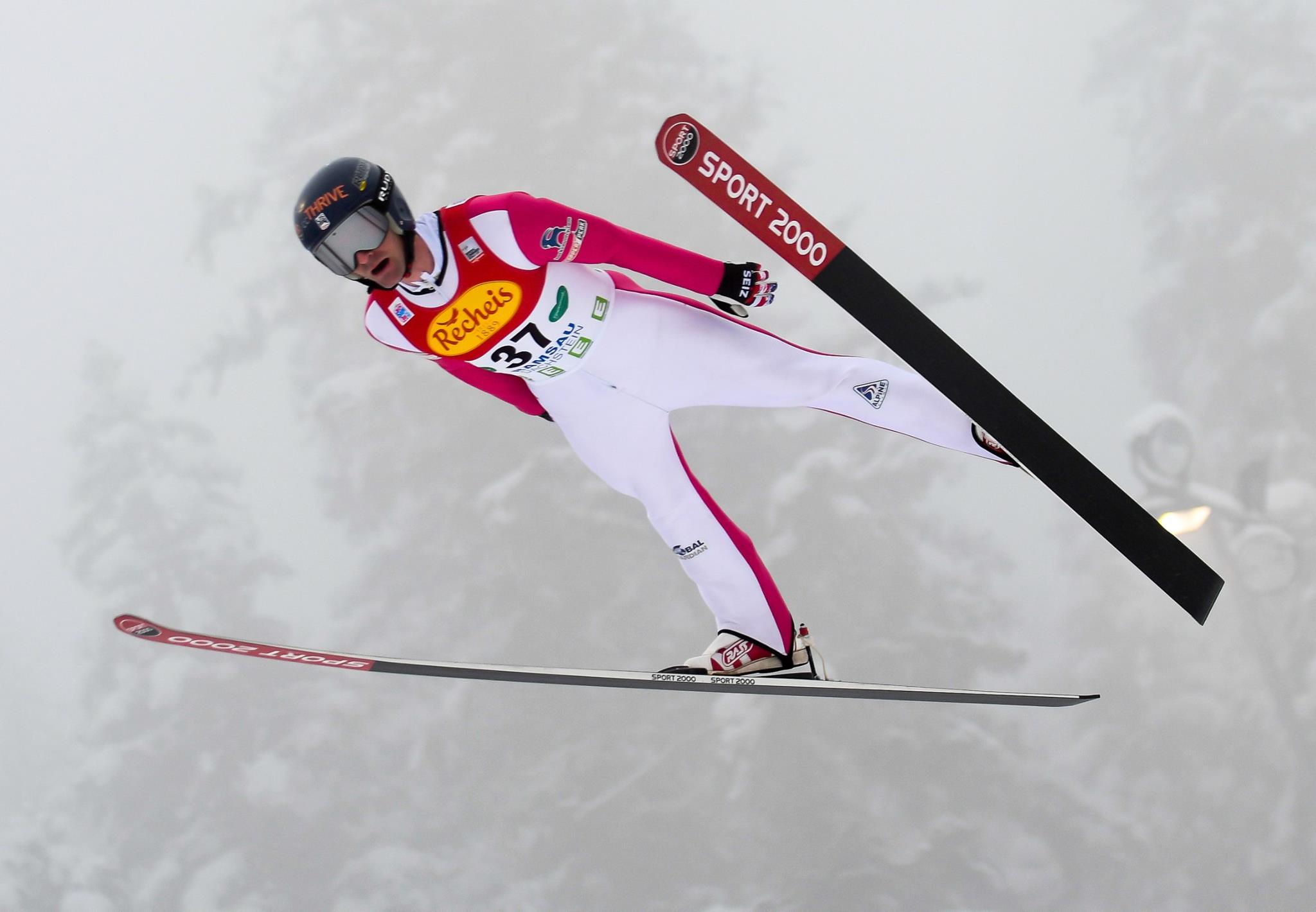
    Bryan Fletcher (USA Nordic) jumping to 45th in the Nordic Combined World Cup on Sunday in Ramsau, Austria. In the 10 k that followed, he skied the third-fastest time to finish 14th overall. (Photo: Romina Eggert/USA Nordic Facebook)

    NorAm mini tour (Rossland, B.C.): 10/15 k freestyle pursuits

    Team Gregg ended the Rossland NorAm mini tour with another double win, with American Caitlin Gregg and her husband Brian Gregg winning the 10- and 15-kilometer freestyle pursuits, respectively, at the Black Jack Ski Club trails.

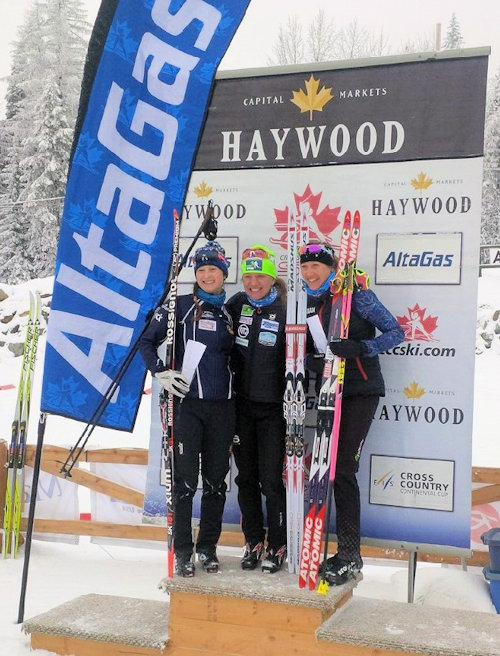
    The women’s 10 k freestyle pursuit podium at the NorAm in Rossland, B.C., with American Caitlin Gregg (c) in first, and Canadians Zina Kocher (l) and Andrea Dupont (r), in second and third, respectively. (Photo: Cross Country Canada)

    Caitlin capped the long weekend with her third-straight win, a 48.28-second victory over former Canadian biathlete Zina Kocher (Foothills Nordic). Caitlin started first and was first across the finish in 29:02.86, while Kocher started ninth and rose to second place for her second-consecutive podium (after placing third in Saturday’s skate sprint). Andrea Dupont (Rocky Mountain Racers) started fourth and finished third (+1:58.35) for her second-straight podium as well (she was second in the skate sprint behind Gregg).

    Lisle Compton of the National Team Development Centre (NTDC) Thunder Bay and Canadian National Junior Team finished fourth overall (+2:07.03), Frederique Vezina of the Pierre-Harvey National Training Centre (CNEPH) was fifth (+2:16.10), and Annika Hicks of the Alberta World Cup Academy (AWCA) sixth (+2:16.51). Laura Leclair (CNEPH) placed seventh, Kaia Andal (Caledonia Nordic) was the top junior in eighth overall, Jaqueline Mourao (Brazil Ski Team) ninth, and Sophie Carrier-Laforte (Skinouk) 10th.

    Brian, who won the Rossland men’s 10 k classic on Friday, also started Sunday’s 15 k freestyle pursuit first and finished in that position in 38:43.93. Andy Shields (Lappe Nordic) raced to second overall, 7.65 seconds back, after starting fourth, and Jack Carlyle (AWCA) reached the podium in third (+8.75) after starting 10th.

    Evan Palmer-Charrette (NTDC Thunder Bay) ended the weekend in fourth (+17.68), Philippe Boucher (CNEPH) was fifth (+19.02), Brian McKeever (Canadian Para-Nordic Ski Team) sixth (+22.16), Michael Somppi (AWCA) seventh (+34.62), Alexis Dumas (CNEPH) eighth (+52.78), Bob Thompson (NTDC Thunder Bay) ninth (+54.76), and Julien Locke (Black Jack/Canadian U25 Team) 10th (+1:04.46).

    Results

    ***

    FIS Nordic Combined World Cup (Ramsau, Austria): Saturday & Sunday individual competitions

    Bryan Fletcher (USA Nordic) notched seventh in the Nordic Combined World Cup this weekend in Ramsau, Austria, for his best result since January 2016. (Photo: USA Nordic/Facebook)

    After a bye week, the Nordic Combined World Cup resumed in Ramsau am Dachstein, Austria, with back-to-back individual normal hill/10-kilometer Gundersen starts on Saturday and Sunday.

    On Saturday, American Bryan Fletcher posted his best individual result in nearly two years in seventh place, 32.6 seconds behind German winner Eric Frenzel.

    Saturday’s individual competition on Ramsau’s 98-meter hill started out with Japan’s Taihei Kato going farthest in the jump portion, the Czech Republic’s Tomas Portyk jumping to second, and Frenzel jumping to third. Fletcher tied Japan’s Yoshito Watabe for 28th and the two started the 10 k race 1:02 minutes back accordingly.

    While Frenzel picked off two places to finish first in 24:05.8 minutes, Fletcher moved up 21 spots to seventh place with the second-fastest course time of 23:48.4.

    Germany had two on the podium with Fabian Rießle just 0.7 seconds back in second place, and Norway’s Jan Schmid finished third, 8.1 seconds behind Frenzel.

    On Sunday, Rießle climbed to the top step on the podium, winning the weekend’s second normal hill/10 k in 26:12.5.

    Norway’s Jørgen Graabak led after the jump portion, yet ultimately finished sixth, 9.8 seconds behind Rießle.

    Rießle jumped to ninth and started 18 seconds out of first, then took the win on the four-lap course by just 0.3 seconds over Italy’s Alessandro Pittin. The Italian notched second place after starting 36th based on his jump and racing the fastest 10 k time in 25:00.8.

    Finland’s Eero Hirvonen finished third (+1.5) after starting 10th, and Schmid was another 2 seconds back in fourth (+3.5) after jumping to seventh. Frenzel did not start.

    Three Americans qualified for Sunday’s competition. Fletcher jumped to 45th and started 1:30 back, yet rose to 14th (+43.7) with the third-fastest course time. His younger brother Taylor Fletcher skied the second-fastest course time to finish 34th (+2:01.6), up 24 places after jumping to 58th. Adam Loomis finished 52nd (+4:38.6) after jumping to 59th.

    The U.S. Nordic Combined team is headed back to the states to prepare for U.S. Olympic trials later this month, according to the USA Nordic Facebook page.

    Results: Saturday | Sunday

    ***

    FIS Cross Country World Cup (Toblach, Italy): 10/15 k classic pursuits

    Norway’s Johannes Høsflot Klæbo after winning the men’s 15 k classic pursuit for his seventh World Cup win of the season on Sunday in Toblach, Italy. With win No. 7, he has the most wins before the new year in FIS Cross Country World Cup history. (Photo: FIS Cross Country/Twitter)

    Women’s report

    Men’s report

    If you thought Johannes Høsflot Klæbo was out, think again. After placing 10th in the men’s 15-kilometer freestyle on Saturday in Toblach, the 21-year-old Norwegian raced to his seventh victory of the season in the men’s 15 k pursuit on Sunday.

    In doing so, Klæbo broke the record for the most World Cup wins before the New Year: he’s tallied seven in the last eight races he’s contested.

    On Sunday, he started 10th, 36 seconds behind his Norwegian teammate Simen Hegstad Krüger, who won the 15 k freestyle and started first. Klæbo had worked his way up to third by 11.4 k, and at the finish, he edged Russia’s Sergey Ustiugov by 1.9 seconds for the win in 33:31.1 minutes.

    Ustiugov, who started fifth, claimed second, and Kazakhstan’s Alexey Poltoranin rose from 14th to third place (+4.5), ahead of Russia’s Alexander Bessmertnykh in fourth (+9.7), Finland’s Matti Heikkinen in fifth (+9.8), France’s Maurice Manificat in sixth (+10.7), Norway’s Hans Christer Holund in seventh (+11.1), Switzerland’s Dario Cologna in eighth (+11.8), Canada’s Alex Harvey in ninth (+16.3), and Krüger in 10th (+24.0). Norway’s defending Overall and Distance World Cup champion, Martin Johnsrud Sundby placed 11th (+34.4) after starting 20th based on his result on Saturday.

    Erik Bjornsen once again led the U.S. men, racing from 29th at the start to 26th (+1:43.1). Scott Patterson improved from 42nd to 39th (+2:37.2), Paddy Caldwell moved up from 52nd to 44th (+2:57.7), and Noah Hoffman slipped to 49th (+3:01.7) after starting 40th.

    Canada’s Devon Kershaw moved up five places to 33rd (+2:02.8), Graeme Killick finished 50th (+3:42.0), Russell Kennedy 66th (+5:05.8), and Knute Johnsgaard moved up six places to finish 76th (+6:20.8).

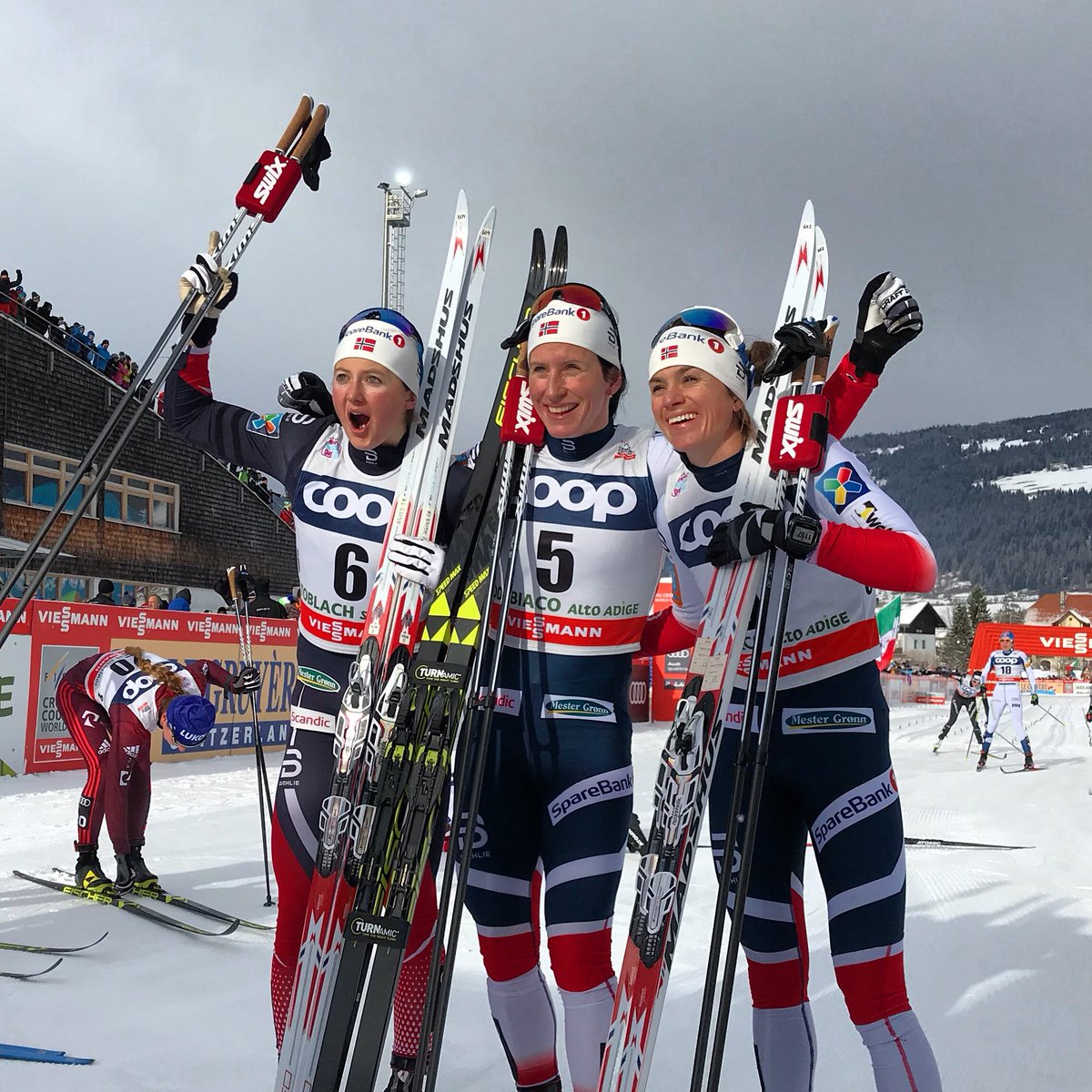
    The all-Norwegian women’s 10 k classic pursuit podium on Sunday at the World Cup in Toblach, Italy, with Marit Bjørgen (c) in first, Ingvild Flugstad Østberg (l) in second and Heidi Weng (r) in third. (Photo: FIS Cross Country/Twitter)

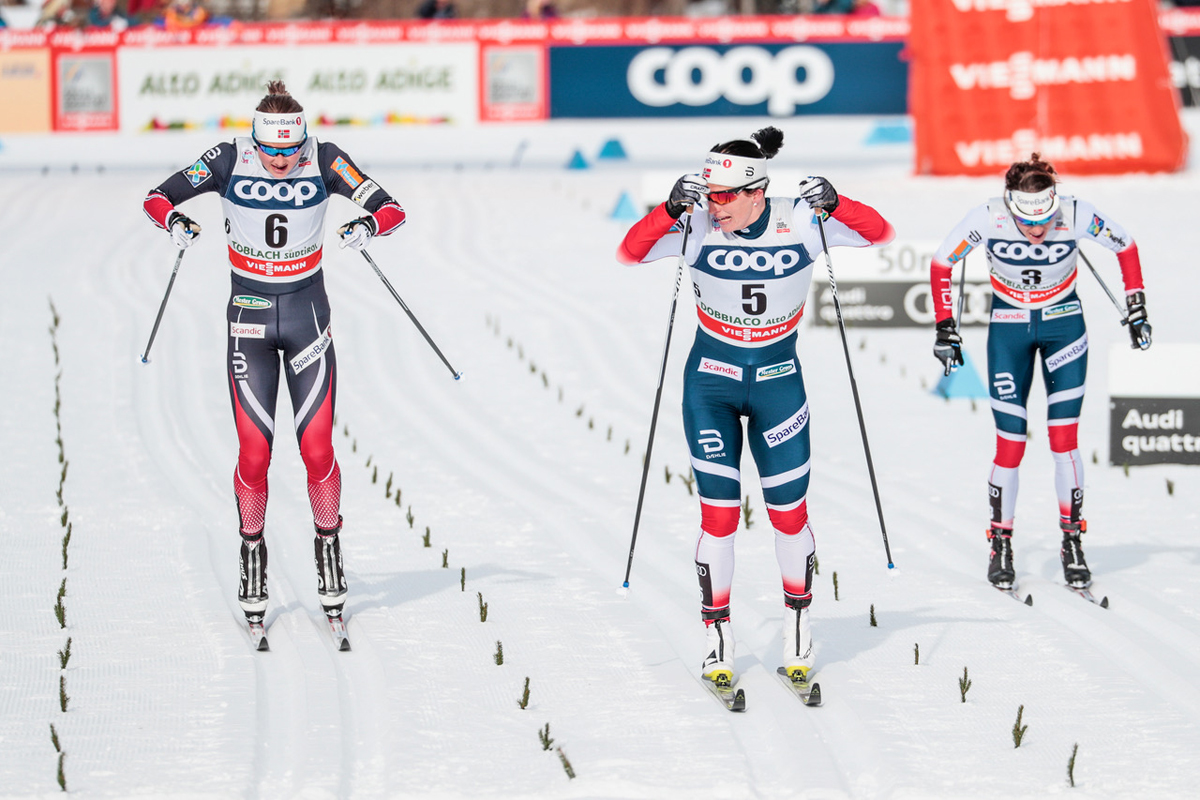
    In the women’s 10 k classic pursuit earlier in the day in Toblach, Norway’s Marit Bjørgen overcame a 22-second starting deficit to take the win by just 0.3 seconds over her teammates Ingvild Flugstad Østberg in second. It was an all-Norwegian podium with Heidi Weng in third (+0.8).

    Bjørgen started fifth, 22 seconds behind Swedish race leader Charlotte Kalla, based on their results in Saturday’s 10 k freestyle individual start. By the 6.4 k checkpoint, Bjørgen led a pack of four other Norwegians and Kalla — all within 1.4 seconds of first. At 8.5 k, Bjørgen led Østberg in second and Weng in third, while another Norwegian Astrid Uhrenholdt Jacobsen skied another eight seconds back with teammate Ragnhild Haga in fourth and fifth, respectively. By that point, Kalla was skiing alone, another 11.7 seconds in sixth, while American Jessie Diggins led a group 25 seconds behind Kalla in sixth.

    Ultimately, Bjørgen finished first in 25:19.3 and formed an all-Norwegian podium with Østberg and Weng, Jacobsen placed fourth, 21.5 seconds out of first and 20.7 seconds behind Weng in third.

    Haga was fifth (+31.8), Kalla sixth (+41.9), Diggins seventh (+53.7), Russia’s Natalia Nepryaeva eighth (+54.2), American Sadie Bjornsen ninth (+55.2), and Austria’s Teresa Stadlober 10th (+55.6) in a photo finish with Finland’s Kerttu Niskanen, who placed 11th (+55.6).

    For the U.S. Ski Team, Diggins and Bjornsen retained their starting positions of seventh and ninth, respectively, while Rosie Brennan started 19th and finished 25th (+2:14.6). Chelsea Holmes (Alaska Pacific University) finished 39th (+3:03.8) and Liz Stephen (USST) finished 48th (+4:05.2).

    Canada’s Emily Nishikawa placed 53rd (+4:14.5), Dahria Beatty finished 63rd (+5:44.7), Cendrine Browne 66th (+5:57.7), and Katherine Stewart-Jones 70th (+7:31.5).

    Results: Women | Men

    ***

    IBU World Cup (Annecy, France): Women’s and men’s mass starts

    Women’s report

    Men’s report

    France’s Justine Braisaz won her first International Biathlon Union (IBU) World Cup race of the season on Sunday at home in Annecy, France, topping the women’s 12.5 k mass start by 11.2 seconds in 37:19.4.

    While Braisaz shot 19-for-20 (0+0+1+0), Iryna Kryuko of Belarus cleaned the four-stage race for second place, her first World Cup podium. Germany’s Laura Dahlmeier, who won Saturday’s 10 k pursuit, placed third (+19.9) with two penalties (0+1+0+1).

    Two North Americans qualified for the selective mass start, with Susan Dunklee (US Biathlon) racing to 20th (+1:16.3) with three misses (1+0+1+1), and Emma Lunder (Biathlon Canada) placing 28th (+2:21.4) with a single penalty (1+0+0+0).

    In the men’s 15 k mass start that followed, France’s Martin Fourcade finally got the win he was looking for, shooting clean and beating his main rival Johannes Thingnes Bø of Norway by 3.9 seconds. Fourcade crossed the finish line first in 36:30.3, Bø settled for second after skiing two early penalty loops (2+0+0+0) and Germany’s Erik Lesser tallied his second podium in Annecy (after placing third in the sprint) in third place again (+6.2) with clean shooting.

    Two Americans and a Canadian qualified for the mass start, with US Biathlon’s Lowell Bailey leading them in 23rd (+2:22.4) with three penalties, Sean Doherty following in 24th (+2:52.5) with four misses, and Biathlon Canada’s Scott Gow finishing 26th (+4:05.4) with five penalties.

    Results: Women| Men

    ***

    OPA Cup (St. Ulrich, Austria): 10/15 k freestyle pursuits

    On the final day of Alpen Cup (a.k.a. OPA Cup) racing in St. Ulrich, Ida Sargent of the U.S. Ski Team (USST) scored her third-straight top five with a fifth place in the women’s 10 k freestyle mass start. She previously placed third in the skate sprint and 5 k classic on Friday and Saturday.

    Germany’s Julia Belger won the women’s mass start on Sunday in 28:33.6, while Saturday’s 5 k winner, Elena Soboleva of Russia placed second (+0.7). Russia had two on the podium with Mariya Istomina in third (+6.4). Germany’s Elisabeth Schicho finished fourth (+15.8), just ahead of Sargent in fifth (+15.9).

    Germany’s Antonia Fräbel placed sixth (+17.1), followed by American Sophie Caldwell in seventh (+17.9). The USST had three in the top 10 with Julia Kern in 10th (+41.9), out of 60 finishers.

    In the men’s 15 k freestyle mass start, Beda Klee of Switzerland took the win in 37:14.6, 2.4 seconds ahead of Germany’s Thomas Bing in second. Six-time Olympian Sergey Dolidovich of Belarus reached the podium in third (+4.5).

    The U.S. had two men in the race, with Simi Hamilton finishing 14th, 16 seconds out of first, and Andy Newell finishing 71st (+2:25.2) out of 118.

    Results: Women | Men

  • Bjørgen Back on Top in Toblach; Diggins, Bjornsen Repeat in Top 10

    Bjørgen Back on Top in Toblach; Diggins, Bjornsen Repeat in Top 10

    Norway’s Marit Bjørgen (5) winning the World Cup women’s 10 k classic pursuit for her second win of the season, ahead of fellow Norwegians Ingvild Flugstad Østberg (l) in second and Heidi Weng (r) in third. (Photo: Fischer/NordicFocus)

    No, this was no ordinary dream.

    If you woke Sunday to watch the women’s World Cup 10-kilomeer classic pursuit in Toblach, Italy, it was a bit of a nightmare if you were rooting for Sweden’s Charlotte Kalla wearing the yellow bib as the Overall World Cup leader.

    Kalla began the day with a five-second micro-cushion as the first skier out of the gate after her win in Saturday’s 10 k freestyle individual start in Toblach. Her coaches might have urged her to keep the tactics simple and warn her to not look back — just go and go and wait for the eventual catch.

    Five seconds behind at the start was Norway’s Ragnhild Haga, 13 seconds back Norway’s Heidi Weng, 18 seconds back Norway’s Astrid Uhrenholdt Jacobsen, 22 seconds back Norway’s Marit Bjørgen as the fifth starter, and sixth off the line and 25 seconds back, another Norwegian Ingvild Flugstad Østberg.

    A pretty basic sport fable playing out on a 2 x 5 k loop: the chased fox in Kalla and the win-starved Norwegian queen, Bjørgen, along with an all-star Norwegian lineup as the pursuers.

    Toblach’s pursuit was an anomaly on the World Cup. According to the International Ski Federation (FIS), of the last 31 pursuits on the World Cup, all were part of mini tours, typically three days long. March 2002 would have been the last time a non-tour pursuit was run with a 5 k pursuit in Falun, Sweden. And yes, as if 2002 doesn’t sound prehistoric when it comes to nordic sport, Bjørgen was hunting back then, too, and placed 26th in that race.

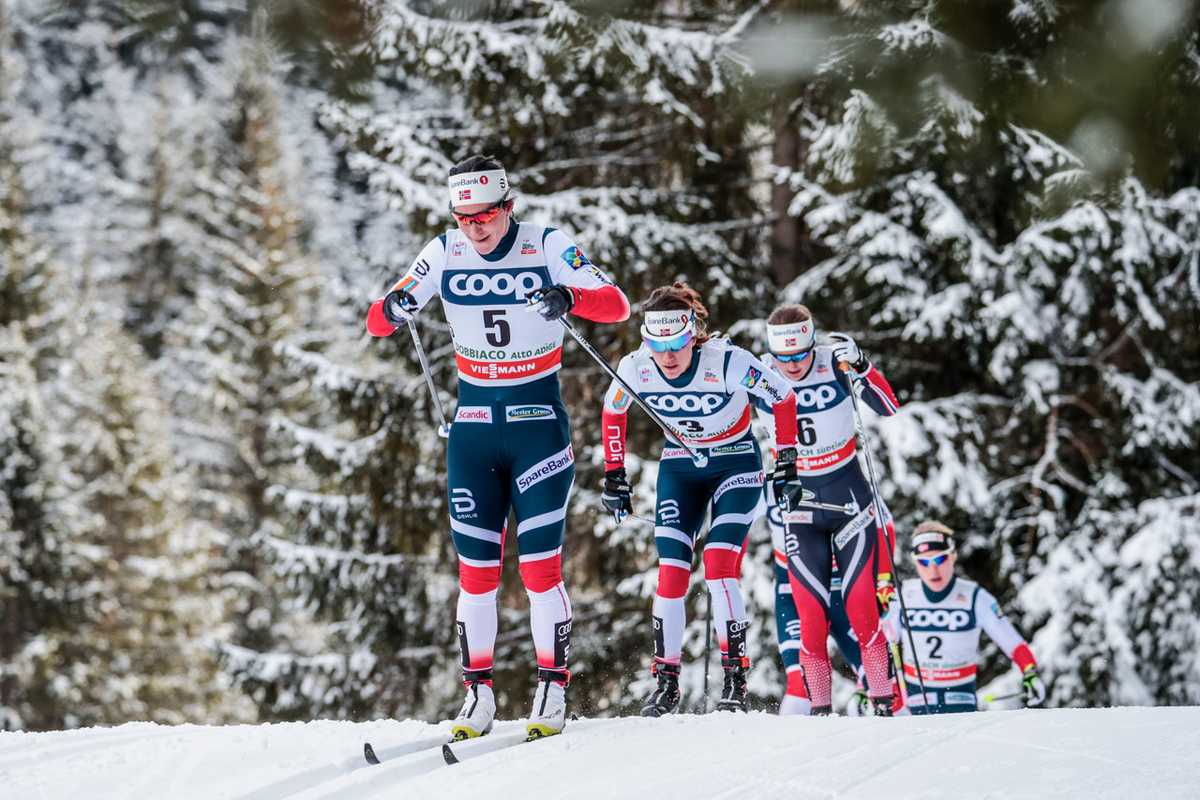
    Kalla kept her distance for a time. At 3.5 k, Bjørgen led the Norwegian chase group which strided 8.3 seconds behind. As the skiers pulled through on the undulating flats into the stadium and readied for the course’s two major climbs on Lap 2, it was no longer Kalla leading out.

    Marit Bjørgen leading her Norwegian teammates Heidi Weng (3), Ingvild Flugstad Østberg (6) and Ragnhild Haga (2), among others, during the World Cup women’s 10 k classic pursuit in Toblach, Italy. (Photo: Fischer/NordicFocus)

    The race soon resembled a high-tempo Norwegian-only threshold session. With the occasional lead swap, Bjørgen, Weng, Jacobsen, Østberg and Haga — the Norwegian train came through the 5 k checkpoint in that order — were as formidable pack as any to state that Norway was still queen of this Toblach hill.

    At 6.4 k, Kalla still matched the pace, but she could be seen sliding slightly back in the scrum of Norwegian suits. As Østberg led through at 7 k, Kalla began her modest fade: she was 6.2 seconds back.

    Bjørgen then took the throttle’s control and made it a three-skier race. At the 8.5 k mark, Bjørgen, Østberg and Weng separated themselves in a 1-2-3 break.

    Jacobsen was 9.5 seconds back, Haga 13.4, while Kalla must have been feeling the residue of her champion’s effort Saturday and skied 25 seconds behind.

    Although Weng and Østberg have had their days as sprint winners, Bjørgen charged down the final stretch for another World Cup win, finishing in 25:29.3 minutes. Østberg was three-tenths of a second behind in second and Weng 0.8 seconds back in third. Jacobsen skied to fourth (+21.5), Haga fifth (+31.8) and Kalla sixth (+41.9).

    “After my performance yesterday I was not quite sure where my shape was,” Bjørgen said, according to a FIS press release. “But my plan was to close the gap on Charlotte by the end of the first lap, which I did. It is great to win again and head to Christmas break with a victory. I will not compete until the Norwegian championships.”

    In skipping the Tour de Ski, which starts at the end of this month, Bjørgen will have nearly four weeks off until Norwegian nationals Jan. 11-14, 2018.

    Sunday was Bjørgen’s second World Cup win of the season. She also won the gritty no-kick 10 k classic during the season-opening World Cups — the Ruka Triple.

    As far as the Overall World Cup standings after the conclusion of race Period 1, Kalla still leads by 98 points over Østberg in second, while Weng remains in third, 104 points out of first. Bjørgen moved up to fourth, 117 points back.

    The USST Chase

    The U.S. Ski Team (USST) had two skiers in the top 10 on Saturday: Jessie Diggins placed seventh while Sadie Bjornsen was ninth. Diggins began the race 40 seconds after Kalla while Bjornsen left the start four seconds behind Diggins.

    With the front lead group well-established and working together to reel Kalla in, the Diggins-Bjornsen pack, which included Russia’s Natalia Nepryaeva, Austria’s Teresa Stadlober and Finland’s Kerttu Niskanen, had also taken form by the 2 k mark. At that point, the five-strong group was 46 seconds behind Kalla in first.

    U.S. Ski Team members Jessie Diggins (7) and Sadie Bjornsen (9) skiing with Austria’s Teresa Stadlober (11) during the World Cup women’s 10 k classic pursuit on Toblach, Italy. (Photo: Fischer/NordicFocus)

    The group of five worked together to ward off any challengers skiing up from behind. At times during the race, with the camera lenses pulled back and the wonders of lens optics, it appears Diggins and Bjornsen were right there and potentially able to bridge up to Bjørgen and the Norwegian cohort.

    By the race’s midpoint at 5 k, Nepryaeva pulled the group, 38 seconds behind the leaders. That time gap held as Diggins spearheaded the five skiers through the 7.1 k mark.

    When the Bjørgen-Østberg-Weng surge went down around 8.5 k, the time back to Diggins and Bjornsen inflated to approximately 50 seconds. Kalla was falling back off the leaders as well, yet remained 23 seconds ahead of Diggins and Bjornsen.

    “Initially I was trying to bridge up to Ingvild but she had an awesome and impressive race so when I realize we wouldn’t be able to bridge the gap, I was still skiing really hard but also preparing mentally for the final sprint-out. Which came as predicted – the final 2km felt like an all-out sprint!” Diggins emailed.

    The group trying to lock in seventh through 11th place came into the finishing stretch as if it were simply the fiery endpoint of a Toblach drag race.

    Channeling her double-pole sprinting chops, Diggins was the first of the group to the line placing seventh, 53.6 seconds behind Bjørgen in first.

    Nepryaeva skied to eighth (+54.2), Bjornsen ninth (+55.2), and Stadlober took 10th (+55.6) in a photo finish with Niskanen, who placed 11th (+55.6).

    “Pursuit races are pretty fun – I love being in the hunt!” Diggins wrote. “I had an awesome pack of girls to ski with and everyone took turns pulling at the front so we were moving along at a good pace. I just love that feeling when everyone is still racing each other, but also working hard and taking their turn so that the pack is ripping along the course! The race felt like it flew by.”

    The addition of the new USST waxing truck aside, Diggins made note that her skis have have been like an ace card.

    “Big shoutout to our techs for having given us great skis today,” she wrote. “That was really important on a course with so much glide but also some crucial climbs.”

    Diggins will spend the holidays in Seefeld, Austria, as she rest and preps for the Tour de Ski which begins on Dec. 30 in Lenzerheide, Switzerland. Diggins plans to complete the Tour.

    Bjornsen also conveyed that she’s pleased with the way the Toblach weekend unfolded.

    “Exciting, and wild day 2 of this weekend! It was a fun day of skiing, with a little different feeling than normal,” Bjornsen wrote in a mass email to media outlets. “It was kind of hard to feel strong and in control on that course, but I gave it my all, and was again happy with the finish. I can feel my brain needs some rest right now. Period 1 is an intense block, with a lot of travel, and a lot of excitement for me. I felt today that my mind and body were digging deep down for the final fumes in the tank… so I’m excited for some holiday time!”

    Rosie Brennan (USST) scored in World Cup points for the third-straight race after starting 19th and finishing 25th (+2:14.6).

    Starting 1:15 minutes back at the start, Brennan ventured out amidst what could have been called a controlled mass start. Three seconds ahead of her, Finland’s Laura Mononen started 18th, and only 16 seconds behind Brennan was the 32nd starter, Finland’s Aino-Kaisa Saarinen.

    “I was with that group for most of it,” Brennan said on the phone. “It started as a small group and people kept latching on — whether we were catching up to them or they were catching up to us. And it ended up as a pretty large group.”

    Brennan did cede time to the leaders over the course of the 10 k, but Period 1 has proved positive for her.

    Canada’s Dahria Beatty (67) and Katherine Stewart-Jones (73) racing to 63rd and 70th, respectively, in the World Cup women’s 10 k classic pursuit in Toblach, Italy. (Photo: Fischer/NordicFocus)

    “Towards the end I just got real tired and could not quite keep on the group,” Brennan said. “I was kind of dangling behind them down into the finish.”

    Brennan is currently ranked 24th in the Distance World Cup standings and 33rd in the overall standings.

    Also for the U.S., Chelsea Holmes (Alaska Pacific University) finished 39th (+3:03.8) and Liz Stephen (USST) finished 48th (+4:05.2).

    Canada’s Emily Nishikawa placed 53rd (+4:14.5), Dahria Beatty finished 63rd (+5:44.7), Cendrine Browne 66th (+5:57.7), and Katherine Stewart-Jones 70th (+7:31.5).

    Results | Overall World Cup standings 

  • Sunday Rundown: Lillehammer; Östersund; West Yellowstone (Updated)

    Sunday Rundown: Lillehammer; Östersund; West Yellowstone (Updated)

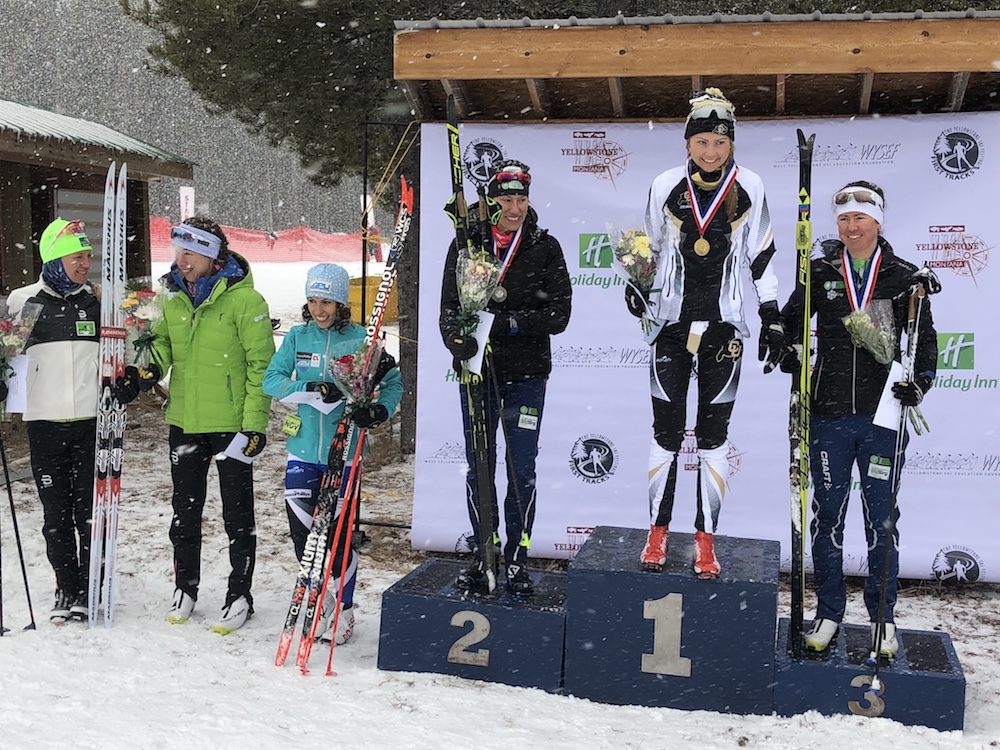
    The SuperTour women’s 10 k classic mass start podium on Sunday in West Yellowstone, Montana, with Hedda Bångman (second from r) of the University of Colorado Boulder in first, and Craftsbury’s Kaitlynn Miller (third from r) and Caitlin Patterson (r) in second and third, respectively. From left: Caitlin Gregg in sixth, Katharine Ogden in fifth and Rosie Frankowski in fourth were also recognized at the flower ceremony. (Photo: FBD)

    US SuperTour (West Yellowstone, Montana): 10/15 k classic mass starts

    The second day of SuperTour racing took place as originally planned at the Rendezvous Ski Trails in West Yellowstone, with 22-year-old Hedda Bångman, of the University of Colorado Boulder (CU), and 33-year-old Brian Gregg (Team Gregg) winning the women’s 10-kilometer and men’s 15 k classic mass starts, respectively, on Sunday.

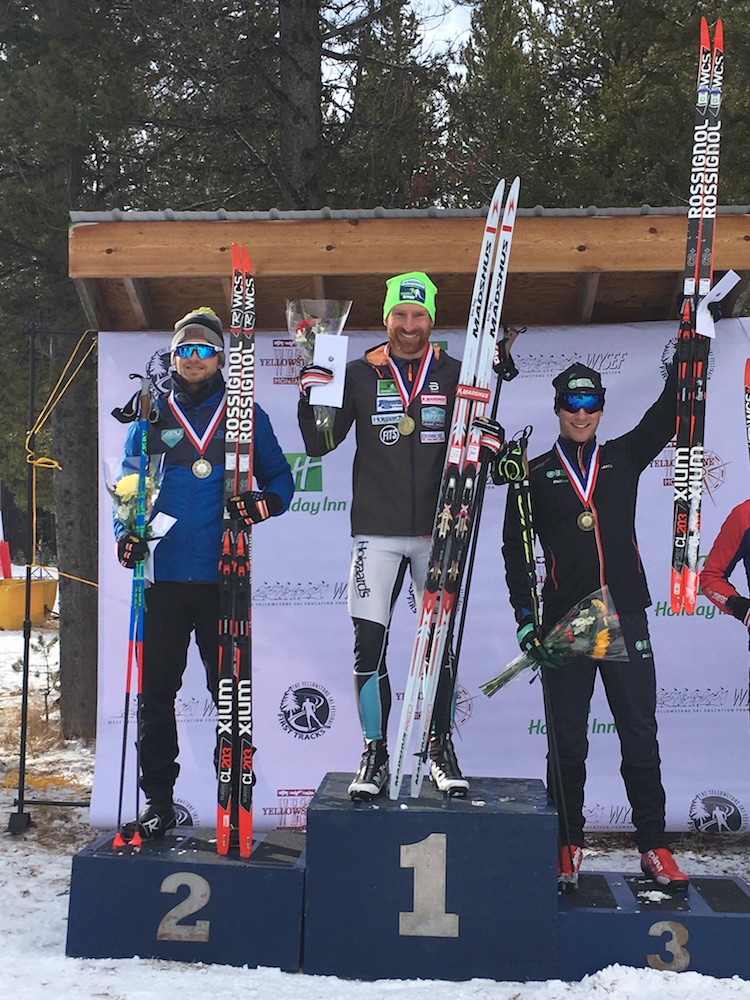
    The men’s 15 k classic mass start SuperTour podium on Sunday in West Yellowstone, Montana,with Brian Gregg (c) of Team Gregg in first, David Norris (l) of APU in second, and Ben Lustgarten (CGRP) in third. (Photo: FBD)

    Bångman, a Swedish freshman on the CU Ski Team, won the women’s race in 30:24.8, just ahead of two Craftsbury Green Racing Project (CGRP) skiers Kaitlynn Miller and Caitlin Patterson. While Miller placed second (+1.3) and Patterson was third (+3.4),

    Rosie Frankowski of Alaska Pacific University (APU) finished another 10 seconds later in fourth (+13.5), and Katharine Ogden of the Stratton Mountain School (SMS) was fifth (+17.2). Caitlin Gregg (Team Gregg) followed in sixth, Felicia Gesior (CXC Team) was seventh, Anne Siri Lervik (CU) eighth, Erika Flowers (SMS Elite Team) ninth, and Corey Stock of the Bridger Ski Foundation (BSF) 10th.

    In the men’s race, Brian Gregg pulled out a 1.9-second win over David Norris (APU), crossing the line first in 41:30.3. Ben Lustgarten (CGRP) reached the podium for the second-straight day (after placing second in Saturday’s skate sprint) in third (+4.6). Kyle Bratrud (CXC Team) finished fourth (+10.9) and Kris Freeman (Caldwell Sport) was fifth (+12.6). Tad Elliott (Ski & Snowboard Club Vail) followed in sixth, Eric Packer (APU) seventh, Ian Torchia (Northern Michigan University/U.S. Ski Team D-Team) eighth, Hunter Wonders (APU) ninth, and Martin Bergström (University of Utah Ski) 10th.

    Videos: Women’s finish | Men’s finish

    Results: Women | Men

    ***

    FIS Cross Country World Cup (Lillehammer, Norway): 15/30 k skiathlons

    Men’s report

    Women’s report

    Sweden’s Charlotte Kalla winning the women’s 15 k skiathlon on Sunday at the Lillehammer World Cup in Norway. (Photo: Henrik Hunnes)

    Sweden’s Charlotte Kalla pulled out another dominant distance performance on Week 2 of the World Cup, racing to a 19.7-second win in the women’s 15-kilometer skiathlon on Sunday, ahead of three Norwegians and American Jessie Diggins.

    Kalla led at the halfway point of the skiathlon when skiers transitioned from classic to skate, just ahead of Norway’s Heidi Weng in second. The two had broken away around 4 k into the classic leg and put more than 20 seconds into the rest of the field by the transition, when Diggins came through 21.6 seconds back in third, leading a large chase group with Finland’s Krista Parmakoski, Norway’s Marit Bjørgen, Austria’s Teresa Stadlober, Norway’s Kathrine Rolsted Harsem, Finland’s Kerttu Niskanen, Norway’s Ragnhild Haga, and Switzerland’s Nathalie von Siebenthal, respectively.

    While Kalla and Weng continued to trade the lead over the next 5 1/2 kilometers or so, by the 13.65 k marker, Kalla had dropped Weng, with 12 seconds between the two, while the chasers remained 29 seconds behind Kalla.

    Over the next 1.2 k, that time gap grew to 20 seconds and 46 seconds, respectively, and Kalla skied off to her second win of the season in 42:24.7 minutes.

    Weng placed second, 19.7 seconds back, and Haga claimed third (+43.6), after skiing alone for the last 4 k of the race. Bjørgen finished just ahead of Diggins for fourth (+54.3) and fifth (+57.0), respectively, and Stadlober was sixth (+1:04.9), Parmakoski seventh (+1:07.8), Norway’s Ingvild Flugstad Østberg eighth, Russia’s Natalia Nepryaeva ninth (+1:27.8), and Sadie Bjornsen 10th (+1:32.6).

    Four Americans finished scored points in the top 30, with Kikkan Randall placing 16th (+2:06.5) and Rosie Brennan 29th (+3:07.7). Liz Stephen finished 36th (+3:25.7), Chelsea Holmes was 38th (+3:39.6) and Ida Sargent 55th (+6:41.1).

    Cendrine Browne of the Canadian National U25 Team led Canada in 45th (+4:37.3), and Emily Nishikawa followed in 49th (+5:00.1). Katherine Stewart-Jones did not finish.

    Klæbo Outlasts Sundby; Harvey 6th

    A gassed Johannes Høsflot Klæbo (yellow bib) holding off fellow Norwegian Martin Johnsrud Sundby (r) for the win on Sunday in the men’s 30 k skiathlon at the Lillehammer World Cup in Norway. (Photo: Henrik Hunnes)

    In the men’s 30 k skiathlon that followed, Norway’s Johannes Høsflot Klæbo made it a five-peat, proving himself once again unbeatable, this time in the first multi-discipline distance race of the season.

    Klæbo outlasted [edit: rocketed past] teammate Martin Johnsrud Sundby to beat him by 1.3 seconds for his fifth-straight win in 1:16:47.1, and Norway swept the top four with Hans Christer Holund in third (+6.8) and Simen Hegstad Krüger in fourth (+10.9).

    France’s Maurice Manificat followed closely in fifth (+11.3) and Canada’s Alex Harvey was next in sixth (+13.1), ahead of Finland’s Iivo Niskanen in seventh (+16.2), and Russia’s Alexey Chervotkin, Sergey Ustiugov and Alexander Bolshunov in eighth (+37.7), ninth (+42.2) and 10th (+59.6), respectively.

    Klæbo skied patiently in the pack for essentially the entire race. For instance, at 11 k he sat back in 18th, just seven seconds from Canada’s Devon Kershaw in the lead.

    One kilometer later, Klæbo remained 5 seconds back in 13th while Kershaw was 8 seconds back in 16th.

    At the ski exchange at 15 k, Niskanen led Sundby and Italy’s Francesco de Fabiani and a total of 10 men within three seconds of first. Klæbo clocked through 5 seconds back in 13th, just ahead of Harvey in 14th (+5.3). Sixteen men remained within six seconds and striking distance of first. Kershaw in 18th had fallen off the pace and was 36 seconds back at the transition, just behind Russia’s Andrey Larkov.

    While Harvey continued to ski around third place during the first 5 kilometers of the skate leg, Klæbo worked his way closer to the front and led at 22.5 k. By then, the lead group had dwindled to six within two seconds of first. Harvey remained in fourth.

    Over the next 7.5 k, the lead changed several times, with Klæbo hovering near the tail end of the group. With about 200 meters to go, however, it was down to Sundby and Klæbo, with the former leading by 2 seconds (and Holund skiing seven seconds back in third). Klæbo ultimately had the most finishing kick to take the win by 1.3 seconds over Sundby, while Holund crossed 6.8 seconds later for third.

    Canada had two in the top 20 with Kershaw in 19th (+2:59.7). Last year’s NorAm winner Russell Kennedy (Team R.A.D.) placed 53rd (+7:30.7), and Canadian World Cup Team members Graeme Killick and Knute Johnsgaard finished 54th (+7:41.3) and 60th (+9:49), respectively.

    Two U.S. men landed in the points with Erik Bjornsen (U.S. Ski Team) in 20th (+2:59.9; just 0.2 seconds behind Kershaw) and Noah Hoffman in 28th (+3:37.8). Scott Patterson finished 36th (+4:56.1) and Paddy Caldwell was 56th (+7:43).

    Results: Women | Men

    ***

    IBU World Cup (Östersund, Sweden): Men’s and women’s pursuits

    Women’s report

    Men’s report

    France’s Martin Fourcade overcame an early penalty and his No. 2 starting position to take the men’s 12.5 k pursuit win on Sunday, 40.8 seconds clear of anyone with 19-for-20 shooting (1+0+0+0).

    Fourcade started 1 second behind Saturday’s sprint winner, Norway’s Tarjei Bø, and took control of the race after cleaning the second shooting stage. Bø missed one on the first prone stage then five more later in the race (1+0+3+2) to slip to 19th (+1:49.5) while Slovenia’s Jakov Fak raced up from 10th to second, 40.8 seconds behind Fourcade, with two penalties (1+0+0+1). Just behind him, France’s Quentin Fillon Maillet took third (+42.1) with identical shooting after Fillon Maillet started 12th and skied with Fak for most of the race.

    France’s Martin Fourcade (l) and Quentin Fillon Maillet after placing first and third, respectively, in the IBU World Cup men’s 12.5 k pursuit on Sunday in Lillehammer, Norway. (Photo: IBU/biathlonworld)

    None of the 58 finishers cleaned the four-stage race. American Lowell Bailey improved from 22nd to 17th (+1:40.2) with two misses (0+1+0+1). Canada’s Christian Gow achieved a career best in 21st (+2:04.6), up from starting 26th, after shooting 19-for-20 (0+0+1+0).

    Also for Canada, Nathan Smith slipped from 24th at the start to 42nd (+3:19.2, three penalties), Scott Gow finished 50th (+4:10.9; six penalties) after starting 16th, and Brendan Green placed 51st (+4:18.6; five penalties).

    One other American qualified in the sprint top 60 for the pursuit, with Tim Burke finishing 48th (+3:52.7; four misses).

    In the women’s 10 k pursuit earlier in the day, Germany’s Denise Herrmann tallied her second-straight win (and the second win of her IBU World Cup career). She started first and successfully held of France’s Justine Braisaz, who started 15 seconds behind her in second place, by 25.8 seconds. While Herrmann missed two on her third shooting (0+0+2+0), Braisaz was one of three women in the field to clean (0+0+0+0).

    Norway’s Marte Olsbu raced up from seventh to third place (+48.0) with two penalties (0+1+0+1).

    Canada’s Julia Ransom placed 23rd (+2:48.1), up from 29th at the start, with two misses (0+0+1+1). Two of her teammates also qualified for the pursuit, with Rosanna Crawford finishing 52nd (+5:25.1) with six penalties (0+3+1+2). In her first World Cup pursuit, Megan Bankes completed three shooting stages before being lapped (3+1+1).

    No American women qualified for the pursuit.

    With the conclusion of the first IBU World Cup in Östersund, the circuit moves to Hochfilzen, Austria, where racing kicks off again Friday, Dec. 8, with men’s and women’s sprints.

    Results: Men | Women

  • Sunday Rundown: Kalla, Klæbo Take Ruka Triple Crowns; Austria, Norway Top Biathlon Relays

    Sunday Rundown: Kalla, Klæbo Take Ruka Triple Crowns; Austria, Norway Top Biathlon Relays

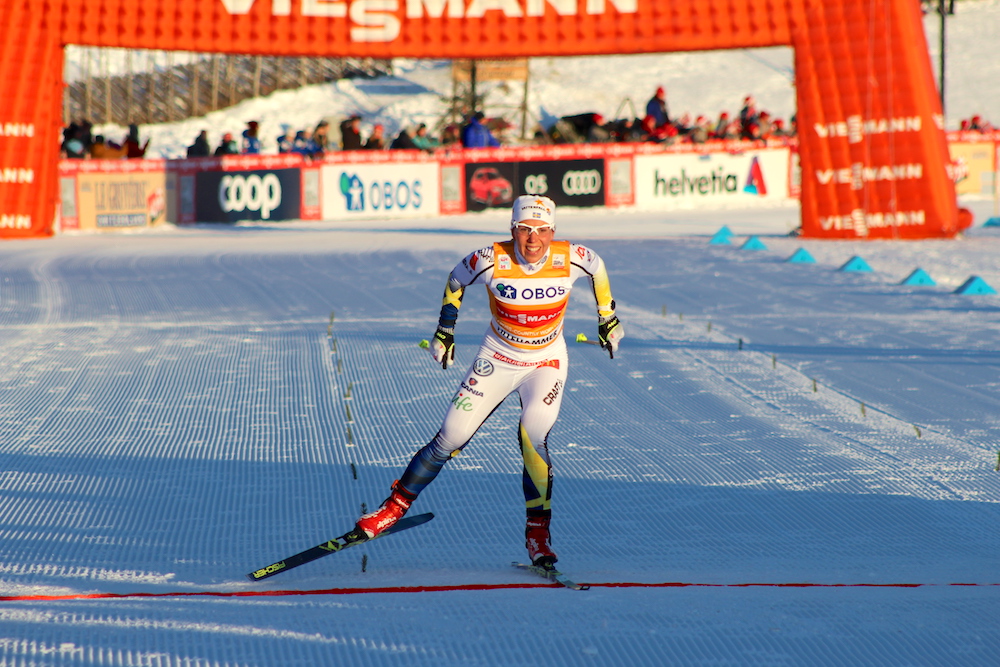
    Sweden’s Charlotte Kalla (c) after winning the 2017 Ruka Triple and her first World Cup race since 2015. She won Sunday’s World Cup 10 k freestyle pursuit by 9 seconds over Norway’s Marit Bjørgen (l) and was nearly 34 seconds ahead of Norway’s Ragnhild Haga (r), who placed third. (Photo: FIS Cross Country/Twitter)

    FIS Cross Country World Cup (Kuusamo, Finland): 10/15 k freestyle pursuit

    Women’s report

    Men’s report

    Sweden’s Charlotte Kalla took down the fiercest contender women’s cross-country skiing has ever seen, challenging Norway’s Marit Bjørgen on the final lap of the women’s 10-kilometer freestyle pursuit on Sunday then successfully holding her off to the finish.

    Kalla entered the final day of the three-day Ruka Triple mini tour with a 2-second lead on Bjørgen out of the pursuit start. Bjørgen quickly caught her and led for much of the four-lap race — until the last lap. The two skied alone, at least 30 seconds ahead of their nearest chasers, with three other Norwegians, Ragnhild Haga, Ingvild Flugstad Østberg and Heidi Weng leading Austria’s Teresa Stadlober and Sweden’s Stina Nilsson at 8.6 k.

    Before that marker, Kalla had already launched her attack and was 6 seconds ahead of Bjørgen with 1.4 k to go. The Swede continued to push the pace and extended her buffer to Bjørgen, entering the stadium alone and winning by 9.7 seconds. For Kalla, a 2015 World Champion in the 10 k freestyle, it was her first World Cup win since 2015.

    Bjørgen took second and Haga outlasted her teammates for third place (+33.9). Weng finished fourth (+38.0) and Østberg fifth (+40.2), then Stadlober in sixth (+41.0) and Nilsson in seventh (+46.7).  Russia’s Natalia Nepryaeva led in the next chase group for eighth place (+1:01.6), followed by Sweden’s Ida Ingemarsdotter in ninth (+1:10.1) and American Sadie Bjornsen in 10th (+1:18.0). Another U.S. Ski Team (USST) member Jessie Diggins was close behind in 12th (+1:35.7), about five seconds behind Norway’s Kathrine Rolsted Harsem in 11th (+1:30.3).

    The USST had four in the top 30, with Kikkan Randall rising from 48th at the start to 25th (+2:41.1) and Rosie Brennan improving from 34th to 28th (+2:43.2).

    While Haga’s time was the fastest of the day in 25:41.8 (compared to Kalla’s finishing time of 25:50.1, which was third-fastest of the day behind Weng in second), Randall’s time was eighth fastest, Diggins was 10th fastest and Bjornsen 11th fastest of 79 in the last women’s race of the opening World Cup weekend.

    Also for the U.S., Ida Sargent finished out the tour in 38th, Sophie Caldwell was 39th, Liz Stephen 56th, Chelsea Holmes 60th, and Julia Kern 73rd.

    Canada’s Emily Nishikawa placed 69th overall and Cendrine Browne moved up two places to finish 72nd, while Dahria Beatty was lapped.

    Klæbo Sweeps Opening Weekend

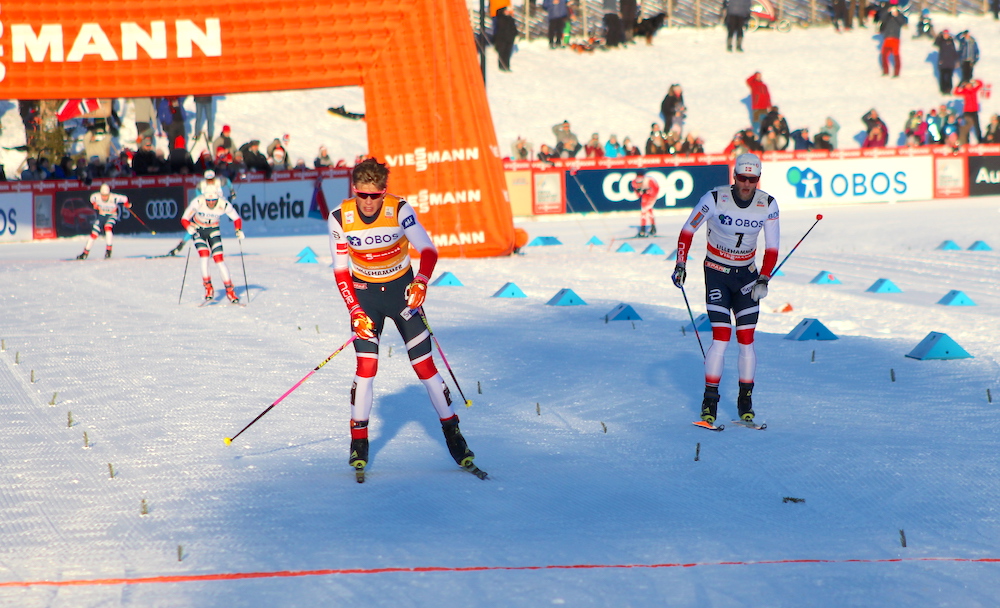
    The men’s 15 k freestyle pursuit podium on the last day of the Ruka Triple in Kuusamo, Finland, with Norway’s Johannes Høsflot Klæbo (c) in first, Norway’s Martin Johnsrud Sundby in second, and Russia’s Alexander Bolshunov in third. (Photo: FIS Cross Country/Twitter)

    In the men’s 15 k freestyle pursuit later in the day in Kuusamo, Johannes Høsflot Klæbo lost his 38-second buffer to the men’s field, but won the race after outlasting fellow Norwegian Martin Johnsrud Sundby, Russia’s Alexander Bolshunov and Canada’s Alex Harvey, respectively.

    While Klæbo started the pursuit 38 seconds ahead of Bolshunov in second place, Sundb  started 1:05 minutes back in 10th and Harvey was 1:23 behind in 12th.

    Klæbo remained 32 seconds ahead of Bolshunov at 5 k, at which point Sundby led a chase group in third, followed closely by Sweden’s Calle Halfvarsson, Norway’s Didrik Tønseth, Kazakhstan’s Alexey Poltoranin, Russia’s Evgeniy Belov, Norway’s Emil Iversen, Finland’s Iivo Niskanen, and Norway’s Pal Golberg, respectively.

    Harvey skied in the next group back with Sweden’s Marcus Hellner, Norway’s Hans Christer Holund, France’s Maurice Manificat, and Russia’s Alexey Chervotkin, all of which were in the top 15 at 5 k.

    Over the next 2.5 k, Bolshunov cut his distance to Klæbo to 20 seconds, and at 7.5 k, Sundby was skiing alone another five seconds back in third.

    Sundby caught Bolshunov and the two reeled in Klæbo over the next kilometer, catching him around 8.6 k, while 11 seconds back, Harvey led a chase group with Chervotkin, Niskanen, Holund, Poltoranin, and Manificat at 8.6 k.

    Harvey lapped through the stadium at 10 k right behind Bolshunov in first, while Tønseth followed in third and Klaebo in fourth. Sundby remained in seventh, less than 2 seconds back.

    At 12.5 k, 12 skiers remained in 2.6 seconds of the lead, but 1 k later, that number had dwindled to four within 3 seconds of first: Sundby, Harvey, Tønseth, and Klæbo. Bolshunov kept himself in contention just 3.8 seconds behind, and on the final climb, it became evident the race was between Klæbo, Sundby, Bolshunov, and Harvey. They finished in that order, with Harvey dropping off the pace in the finishing stretch.

    Klæbo took the win in 36:23.2, just 0.4 seconds ahead of Sundby in second, while Bolshunov took third, 1 second behind Klæbo. Harvey was another 0.6 seconds back in fourth, and the Canadian’s time stood up as the fifth fastest of the day, behind Manificat in first (34:50.9). Manificat tied Holund for placed eighth overall (+8.2), behind Chervotkin in fifth (+6.2), Niskanen in sixth (+7.2), and Tønseth in seventh (+8.1).

    Erik Bjornsen led the U.S. men overall in the tour in 26th (+1:43.6) for his third-straight race in the World Cup points. Also for the U.S. Ski Team, Paddy Caldwell raced to 19th for time of day (after starting 70th and finishing 51st in the pursuit).

    Canada’s Devon Kershaw also landed in the points for the second-consecutive day in 29th (+1:47.8).

    American Noah Hoffman finished the Ruka Triple in 39th (up from 45th at the start), Scott Patterson was 55th and Andy Newell 75th for the U.S.

    Canada’s Len Valjas placed 44th overall, Graeme Killick 68th, Knute Johnsgaard 81st, and Julien Locke 83rd.

    Results: 

    Women’s pursuit | Women’s time of day

    Men’s pursuit | Men’s time of day

    IBU Biathlon World Cup (Östersund, Sweden): Mixed & Single Mixed Relays

    Single mixed relay report

    Mixed relay report

    While France came in the favorites in the single mixed relay, starting a team of Martin Fourcade and Marie Dorin Habert, it was Austria who put on a master class and skied to a comfortable win today.

    Simon Eder tags off to Lisa Theresa Hauser for Austria during the single mixed relay World Cup in Ostersund, Sweden. The pair raced to a 16.5-second win. (Photo: IBU/biathlonworld)

    The Austrian duo of Lisa Theresa Hauser and Simon Eder used only two spare rounds over the course of 40 shots, the best shooting in the field by a wide margin. They led nearly the whole race and ended up with a 16.5-second victory over Germany’s Vanessa Hinz and Erik Lesser. The Germans used nine spare rounds to clean all their targets, but Lesser was aggressive on the skis and made up ground on the trails to finish 16.2 seconds clear of the rest of the field.

    There, drama ensued on the last loop. Kazakhstan’s Maxim Braun came through a crash caused by Italy’s Thomas Bormolini, who was skiing in third place on the penultimate downhill and also took out Ukraine’s Dmytro Pidruchnyi. That allowed Braun, along with teammate Galina Vishnevskaya, to just barely hold on to third place. Their shooting – with five spare rounds between them, the second-best in the field – allowed this, their best relay showing ever.

    Fourcade, who had left the range in seventh, came through the fray to put France into fourth, followed by Sweden (Linn Persson and Sebastian Samuelsson), then Ukraine (Pidruchnyi and Vita Semerenko) and Italy (Bormolini and Alexia Runggaldier).

    Both the U.S. team of Emily Dreissigacker and Leif Nordgren and the Canadian team of Rosanna Crawford and Christian Gow were lapped. Crawford was in second position more than halfway through the race when she fell on a downhill, losing a large amount of time and affecting the functioning of her rifle once she reached the shooting range.

    Results

    Later in the day, countries sent four-athlete teams out for regular mixed relays. Despite an imperfect start on the shooting range, the Norwegian team of Ingrid Tandrevold, Tiril Eckhoff, Johannes Thingnes Bø, and Emil Hegle Svendsen came away with a 5.3-second win over Italy’s Lisa Vitozzi, Dorothea Wierer, Dominik Windisch, and Lukas Hofer.

    The German team of Franziska Preuss, Maren Hammerschmidt, Benedikt Doll, and Arnd Peiffer was third, +6.4, and Slovakia close behind in fourth.

    Canada’s Emma Lunder, Julia Ransom, Scott Gow, and Brendan Green finished 15th, +3:28.0, and the U.S. team of Susan Dunklee, Clare Egan, Paul Schommer, and Sean Doherty 21st, +4:47.6.

    Results

  • Saturday Rundown: Bjørgen, Klæbo Dominate Ruka Day 2; Diggins 10th; Fletcher Gets 2nd Top 20

    Saturday Rundown: Bjørgen, Klæbo Dominate Ruka Day 2; Diggins 10th; Fletcher Gets 2nd Top 20

    The women’s 10 k classic podium at Day 2 of the World Cup opening Ruka Triple in Kuusamo, Finland, with Norwegian winner Marit Bjørgen (c), Swedish runner-up Charlotte Kalla (l), and Norway’s Ingvild Flugstad Østberg (r) in third. (Photo: FIS Cross Country/Twitter)

    FIS Cross Country World Cup (Kuusamo, Finland): 10/15 k classic

    Women’s report

    Men’s report

    On Day 2 of the Ruka Triple World Cup opener on Saturday, Norway’s Marit Bjørgen collected a 17-second victory in the women’s 10-kilometer classic individual start in Kuusamo, Finland.

    Bjørgen started 30th of nearly 90 women and was contested by one other: Sweden’s Charlotte Kalla in bib 44. Kalla clocked through the 3.1 and 6.2 k checkpoints faster than Bjørgen, but the Norwegian’s time stood up against Kalla’s at 8.1 k, where Bjørgen was 1 second faster. Over the last two kilometers, Bjørgen continued to gain speed toward the finish, crossing the line in 25:07.6 minutes. Kalla came within 17 seconds of her, which was good enough for second place and 0.8 seconds faster than another Norwegian, Ingvild Flugstad Østberg, who was bumped to third (+17.8).

    Norway had three in the top four with Heidi Weng in fourth (+34.0). Austria’s Teresa Stadlober put herself in the mix in fifth (+36.4), Norway’s Ragnhild Haga was sixth (+38.2), Russia’s Natalia Nepryaeva seventh (+42.8), Sweden’s Stina Nilsson eighth (+46.1), Russia’s Anastasia Sedova ninth (+53.4), and American Jessie Diggins 10th (+1:03.9).

    Also for the U.S. Ski Team, Ida Sargent placed 22nd (+1:21.9) and Sadie Bjornsen, who notched a career-best second in Friday’s classic sprint and led the women’s Ruka Triple standings after Day 1, finished 23rd (+1:23.4). Bjornsen is now 11th in the standings (46.5 seconds behind Kalla in first) with one more day of racing (women’s 10 k freestyle pursuit) remaining.

    Kalla is 2.6 seconds ahead of Bjørgen in the mini-tour standings, and Nilsson is third (+12.4) ahead of Østberg in fourth (+20.0).

    Nine American women raced on Saturday, with Rosie Brennan placing 33rd (+1:47.7), Sophie Caldwell (who was eighth in Friday’s sprint) following in 36th (+1:50.1), Kikkan Randall finishing 48th (2:14.5), Liz Stephen 58th (+2:26.3), Chelsea Holmes 64th (+2:50.0), and Julia Kern 74th (+3:19.2).

    Three Canadian women competed, with Emily Nishikawa placing 56th (+2:42.2), Cendrine Browne 76th (+3:23.6), and Dahria Beatty 84th (+3:53.5).

    Klæbo Doubles Up in Ruka

    Norway’s Johannes Høsflot Klæbo (top and bottom, center) won his second-straight race at the Ruka World Cup opener on Saturday in Kuusamo, Finland, with a 15-second victory in the men’s 15 k classic over fellow Norwegian Didrik Tønseth (bottom left). Finland’s Iivo Niskanen (bottom right) also reached the podium in third. (Photo: FIS Cross Country/Twitter)

    In the men’s 15 k classic that followed, Johannes Høsflot Klæbo rocketed to his second-straight win of the World Cup’s opening weekend in 33:38.8, which was 15.3 seconds clear of runner-up and fellow Norwegian Didrik Tønseth.

    Finland’s Iivo Niskanen started after Klæbo (bib 42) and Tønseth (bib 33) in bib 70 and pushed to contend with Klæbo, but came up 17.7 seconds short at the finish. Russia’s Alexander Bolshunov also emerged as a later contender, starting 66th (out of 115) and clocking the fastest times at 3.1 and 5 k. Bolshunov ended up 19.9 seconds behind Klæbo at the finish and ultimately settled for fourth.

    Kazakhstan’s Alexey Poltoranin placed fifth (+25.6) after being an early race leader in bib 12, and Russia’s Evgeniy Belov (another early starter in bib 10) followed sixth (+26.5). Norway’s Emil Iversen placed seventh (+30.2) and Martin Johnsrud Sundby was eighth (+30.7), Russia’s Alexey Chervotkin ninth (+31.2), and Sweden’s Calle Halfvarsson 10th (+34.4).

    Canada’s Alex Harvey placed 13th (+49.7), behind Norway’s Pål Golberg and Hans Christer Holund in 11th (+38.1) and 12th (+44.7), respectively.

    American Erik Bjornsen and Canadian Devon Kershaw tied for 26th (+1:15.2).

    Also for the U.S., Noah Hoffman was 43rd (+1:58.4), Andy Newell 59th (+2:29.6), Paddy Caldwell 72nd (+2:53.5), Scott Patterson 86th (+3:17.7), and Simi Hamilton 96th (+3:43.4).

    For Canada, Len Valjas finished 48th (+2:08.0), Graeme Killick 58th (+2:23.4), Knute Johnsgaard 87th (+3:19.8), Julien Locke 100th (+3:56.4), and Jess Cockney 109th (+5:20.7).

    Klæbo extended his lead in the Ruka Triple standings to 38.3 seconds over Bolshunov, who moved up to second place. Golberg is third (+44.1), Halfvarsson fourth (+47.8), and Niskanen fifth (+49.5) with Sunday’s 15 k freestyle pursuit remaining.

    Harvey is 12th in the standings (+1:22.8) and Bjornsen 23rd (+1:50.9) to lead the Canadian and American men, respectively.

    Results: 

    Women’s 10 k classic | Women’s Ruka Triple standings (Day 2)

    Men’s 15 k classic | Men’s Ruka Triple standings (Day 2)

    ***

    FIS Nordic Combined World Cup (Kuusamo, Finland): Individual large hill/10 k

    Also in Ruka, the second day of nordic-combined action started on the HS 142 large hill and ended with a 10 k Gundersen start, which Japan’s Akito Watabe won by 31.7 seconds over Finland’s Eero Hirvonen. Watabe jumped to first on the large hill with a total of 158.6 points, while Austria’s Wilhelm Denifl followed with 154.2 points in second, just ahead of France’s Maxime Laheurte with 154.2 points in third.

    The lone American to start the competition round for the second-straight day, Bryan Fletcher jumped to 31st. (His USA Nordic teammate Ben Berend just missed the top-50 cutoff in the qualification round in 52nd, while Taylor Fletcher was 65th in qualifying.)

    In the 10 k that followed on Saturday, Watabe started with a 16-second head start on Denifl and extended his lead to the finish, crossing first in 24:58.6. Hirvonen, who started ninth and 58 seconds back based on his jump, rose to second, while Germany’s Johannes Rydzek raced up from eighth to third (+32.8). Norway’s Jan Schmid placed fourth (+34.4) and France’s Antoine Gerard finished fifth (+36.5), Laheurte took sixth (+38.4), Norway’s Espen Andersen was seventh (+39.8), Austria’s Mario Seidl was eighth (+43.7), and Denifl ended up ninth (+55.7). Bryan Fletcher skied the fourth-fastest time to place 18th. Fletcher started 2:29 after Watabe and finished 1:45.8 behind him.

    On Friday, Fletcher placed 17th in the individual large hill/5 k Gundersen. In the first Nordic Combined World Cup competition of the season, Norway took first and second with Andersen holding off his teammate Schmid by 7.7 seconds for the win in 12:58.0. Watabe placed third, 11 seconds out of first, after jumping to third.

    Andersen’s jump ranked second on Friday and he started the two-lap 5 k four seconds behind Seidl, the jump leader. Seidl fell back three places to fourth at the finish (+15.4) while Schmid rose from sixth to second place with the third-fastest ski time.

    Denifl maintained his jumping position in fifth (+29.1) and Laheurte finished ninth — up from 12th in the jump. Fletcher jumped to 18th and improved one spot to 17th (+2:47.6) after starting 3:04 out of first.

    Day 3 of nordic combined’s long weekend in Ruka is another individual large hill/10 k Gundersen on Sunday.

    Results:

    Friday’s large hill/5 k | Saturday’s large hill/10 k

    https://www.instagram.com/p/Bb2Vo18leSe/?taken-by=usanordic

  • Manificat Wins Two Out of Three at Saariselkä FIS Weekend

    Manificat Wins Two Out of Three at Saariselkä FIS Weekend

    France’s Maurice Manificat racing in the men’s 15 k classic pursuit at the final stage of the 2017 Ski Tour Canada. (Photo: Peggy Hung)

    There were plenty of options this Friday, Saturday, and Sunday for cross-country skiers looking to get an International Ski Federation (FIS) race in before the official start of the World Cup season, now less than one week away. While some athletes headed to Beitostølen, Norway and others Gällivare, Sweden, about 120 made their way to Saariselkä, Finland.

    This included several French skiers, including Maurice Manificat, Jean-Marc Gaillard, Coraline Thomas Hugue, and Anouk Faivre Picon. Those who made the trek to Finland were greeted by high humidity and temperatures in the mid-teens Fahrenheit on Friday, as well as the softer solarlight distinct to Northern Scandinavia.

    “Polar sun wake up the day of competition in Saariselka. So much pleasure here” the 31-year-old Manificat captioned an Instagram photo of Saariselkä’s sunrise prior to Friday’s opening men’s 10-kilometer classic race.

    https://www.instagram.com/p/Bbl0V1LgbTt/

    The sun’s golden sunrise on Friday served as an auspicious omen for the remainder of Manificat’s morning, as well as his fellow Frenchmen. All three podium spots in that race went to France, with Manificat taking the win in a time of 26:11.9. His teammates Gaillard and Alexis Jeannerod finished second (+31.8)  and third (+44.7), respectively.

    Another French athlete, Clement Parisse finished in fourth (+48.2), while Bulgarian skier Veselin Tsinzov ended the French streak in fifth place (+50.6).

    In the women’s 5 k classic, Austrian Teresa Stadlober won in a time of 16:13.8, beating Poland’s Justyna Kowalczyk in second by 31.9 seconds.

    https://twitter.com/JuiceKowalczyk/status/931514327118512128

    Kazakhstan’s Anna Shevchenko edged Belarusian Polina Seronosova by one tenth of a second for third (+47.3) while Seronosova took fourth (+47.4). France’s Thomas Hugue rounded out the top five in fifth (+56.5).

    Results Day 1: Men’s 10 k Classic | Women’s 5 k Classic

    Day 2: Manificat and Kowalczyk Win Classic Sprints

    Another sunrise on Saturday brought with it 1 k classic sprints for both the men and women. Temperatures crept up into the mid-20s during the day, though humidity remained high, stabilizing around 90 to 95 percent. Stadlober won the qualifier in a time of  3:46.01, while France’s 21-year-old Delphine Claudel took second (+2.62). The third-fastest qualifier (+3.83) was Slovenia’s Anamarija Lampic.

    In the men’s qualifier, France once again raced to the top, this time with Lucas Chanavat leading the way in a time of 3:53.16. Finishing 0.12 seconds behind Chanavat was Belarus’s Aliaksandr Voranau in second. Mikhail Kuklin, also of Belarus, posted the third fastest qualifying time, 2.65 seconds behind Chanavat.

    By the time the men’s final rolled around, the sun had disappeared and the fluorescent glow from lights along the course were the main source of illumination through the hazy, humid air. In the final were Chanavat and Manificat, as well as their French teammate Richard Jouve, along with Voranau, Slovenia’s Miha Simenc and Kazakhstan’s Nikolay Chebotko.

    Manificat and Jouve pushed the pace from the start and the two Frenchmen led the group through to the finish, where they placed first and second, respectively. Rounding out the podium was Chanavat in third. Crossing in fourth was Simenc, followed by Voranau in fifth, and Chebotko in sixth.

    https://www.facebook.com/momomanificat/videos/844068439115782/

    In the women’s sprint final, Kowalczyk finished first, followed by Lampic in second and Stadlober in third. Belarusians Polina Kirillova and Anastasia Kirillova placed fourth and fifth, respectively, and Slovenia’s Alenka Cebasek finished sixth.

    Results: Women’s Classic Qualifier | Men’s Classic Qualifier | Women Classic Final | Men Classic Final

    Day 3: Thomas Hugue and Tsinzov Take 10/15 k

    Sunday saw the third and final day of FIS racing in Saariselkä, with men’s 15 k and a women’s 10 k freestyle individual starts.

    Thomas Hugue raced to a convincing win in the 10 k, with her time of 27:35.0 exactly 49 seconds ahead of the next-closest finisher: Shevchenko. Snagging the last podium spot was France’s Aurore Jean in third (+52.0).

    Missing the podium by 2 seconds was Kowalczyk in fourth (+54.0), while France’s Faivre Picon finished another 2 seconds back in fifth (+58.0).

    Rounding out the rest of the top 10 was Ukraine’s Kateryna Serdiuk in sixth (1:04.0), Cebasek in seventh (1:06.0), Kazakhstan’s Valeriya Tyuleneva in eighth (+1:13.0), Ukraine’s Maryna Antsybor in ninth (+1:14.0) and Claudel in 10th (+1:22.0).

    The men’s 15 k freestyle win went to Bulgaria’s Veselin Tsinzov, who won in a time of  36:13.0. The next five spots were taken by Belarus, with Yury Astapenka in second (+23.0), Sergei Dolidovich in third (+33.0), Mikhail Kuklin in fourth (+53.0), Michail Semenov in fifth (+57.0), and Voranau in sixth (+1:25.0). Breaking the streak was Kazakhstan’s Denis Volotka in seventh (+1:26.0), followed by Parisse in eighth (+1:36.0).

    Rounding out the top 10 was Aliaksandr Saladkou of Belarus in ninth (+1:45.0) and Sergey Cherepanov of Kazakhstan in 10th (+1:54.0).

    Results: Women 10 k Freestyle | Men 15 k Freestyle

  • Saturday Rundown: Lahti & PyeongChang (Updated x2)

    Saturday Rundown: Lahti & PyeongChang (Updated x2)

    The all-Norwegian women’s 30 k freestyle mass start podium at 2017 Nordic World Championships in Lahti, Finland, with Marit Bjørgen (c) in first, Heidi Weng (l) in second, and Astrid Uhrenholdt Jacobsen (r) in third. (Photo: FIS Cross-Country/Twitter)

    FIS Nordic World Championships (Lahti, Finland): Women’s 30 k freestyle mass start

    Marit Bjørgen made it a four-peat on Saturday with her fourth gold and third individual win over the last week at 2017 Nordic World Championships in Lahti, Finland. (She previously won the 15-kilometer skiathlon, 10 k classic, and 4 x 5 k relay.)

    The 36-year-old Norwegian closed out the championships with a 1.9-second victory in the women’s 30-kilometer freestyle mass start, finishing in 1:08:36.8 hours after setting the pace and leading a large group for much of the race. The group began to separate around 15 k, where it was down to 13 women with five seconds of first. At that point, Americans Jessie Diggins and Chelsea Holmes were within that lead pack.

    While Holmes started to fall off the pace around 16 k, Diggins stuck with the leaders to the very end, only until four Norwegians broke away to race for the medals over the final kilometer.

    With Bjørgen still charging hard up front, her teammates Heidi Weng, Astrid Uhrenholdt Jacobsen, and Ragnhild Haga followed, while Finland’s Krista Pärmäkoski trailed another second back in fifth and Diggins was one more second behind in sixth.

    Bjørgen led the downhill into the stadium and skied away from her teammates before the finishing stretch, leaving Weng and Jacobsen to duke it out for second place. Weng got it by less than one-hundredth of a second, Jacobsen took bronze (+1.9), and Haga completed the Norwegian top-four sweep in fourth (+7.4).

    Diggins passed Pärmäkoski and notched fifth (+10.4) for her career-best 30 k result. Pärmäkoski placed sixth (+11.3), Sweden’s Charlotte Kalla finished seventh (+13.9), Austria’s Teresa Stadlober was eighth (+15.5), Sweden’s Anna Haag ninth (+20.3), and Russia’s Yulia Tchekaleva 10th (+1:20.9) after edging Switzerland’s Nathalie von Siebenthal in a photo finish. Germany’s Stefanie Böhler placed 12th (+1:23.5) and Holmes finished 13th (+1:28.1) for her career best.

    U.S. Ski Team member Liz Stephen placed 25th (+3:09.4), 6.6 seconds ahead of Canada’s national U25 Team skier Cendrine Browne, who notched a career best 26th (+3:16) in her first World Championships.

    Holmes’s Alaska Pacific University (APU) teammate Jessica Yeaton, who races for Australia, finished 33rd (+4:32), Canada’s Dahria Beatty was 34th (+4:45.2), and American Caitlin Gregg 36th (+5:03.7).

    Great Britain’s Annika Taylor, a California native, placed 38th (+6:19.4). Canada’s Emily Nishikawa was 40th (+6:41.5) and Katherine Stewart-Jones 41st (+7:18.6), and Brazil’s Jaqueline Mourão, who trains in Quebec, was 46th (+13:44.6) out of 47 finishers.

    Results

    ***

    IBU World Cup (PyeongChang, South Korea): Women’s and men’s pursuits

    The women’s 10 k pursuit podium at the IBU World Cup in PyeongChang, South Korea, with Germany’s Laura Dahlmeier (c) in first, Finland’s Kaisa Mäkäräinen (l) in second, and France’s Anais Bescond (r) in third. (Photo: IBU)

    Coming off a fifth place in Thursday’s 7.5-kilometer sprint, Susan Dunklee held her position despite three penalties in the women’s 10 k pursuit on Saturday to finish fifth again at the International Biathlon Union (IBU) World Cup in PyeongChang, South Korea.

    Germany’s Laura Dahlmeier racked up her second-straight win in as many races in PyeongChang (and sixth-straight, counting World Championships), finishing in 27:58.0 minutes with clean shooting. She was just one of four women out of 58 finishers that hit all 20 targets in Saturday’s four-stage race.

    Finishing more than a minute later, Finland’s Kaisa Mäkäräinen placed second (+1:12.6) after starting fourth based on her sprint result. Mäkäräinen had two penalties, both in the first standing, but cleaned the other three stages (0+0+2+0). France’s Anais Bescond raced up from eighth at the start to third place (+1:18.9) at the finish, with a single penalty (0+0+1+0), while Norway’s Tiril Eckhoff missed her second-straight podium in fourth place (+1:32.0) after starting second but accumulating five penalties (1+2+1+1).

    Eckhoff edged Dunklee, of the U.S., by half a second as Dunklee placed fifth (+1:32.5) with three misses (1+1+0+1).

    Canada’s Rosanna Crawford rose from 30th to 19th (+2:49.1) for her best non-relay result of the season, with two penalties (1+1+0+0). Her teammate Megan Tandy also landed her first top 30 of 2016/2017 in 30th (+3:26.2) with two misses (1+0+1+0) after starting 39th. Also for Canada, Julia Ransom finished 44th (+4:18.4) after starting 41st and skiing four penalty loops (1+0+1+2).

    Also for the U.S., Clare Egan finished 36th (+3:41.9) with three clean stages but three misses in her first standing (0+0+3+0), after starting 33rd. Joanne Reid slipped from 35th at the start to 52nd (+4:53.4), with five penalties (1+1+0+3).

    The men’s 12.5 k pursuit podium on Saturday at the IBU World Cup in PyeongChang, South Korea, with France’s Martin Fourcade (c) in first, Russia’s Anton Shipulin (l) in second and Austria’s Julian Eberhard (r) in third. (Photo: IBU)

    [UPDATED] One day after locking up the overall World Cup title, Martin Fourcade was back at the top of the podium in the men’s 12.5 k pursuit in PyeongChang.

    Fourcade started third, after finishing third in Friday’s sprint, then shot clean to win in 31:24.2. Russia’s Anton Shipulin, who started 23rd, also shot 20-for-20 to race up to second place, 34.5 seconds behind Fourcade, with the fifth-fastest course time. In comparison, Fourcade’s course time was third fastest.

    Friday’s sprint winner, Julian Eberhard of Austria finished third (+36.7) after skiing three penalty loops (0+2+0+1). His teammate Simon Eder placed fourth (+1:03.2) after starting eighth and cleaning three stages before missing two on the last standing (0+0+0+2).

    Russia’s Evgeniy Garanichev improved from ninth at the start to fifth (+1:09.5) with two penalties as well (0+1+1+0). France’s Simon Desthieux was sixth (+1:13.5), Austria’s Dominik Landertinger seventh (+1:20.3), Germany’s Benedikt Doll eighth (+1:20.4) with the fastest course time after starting 20th.

    American Lowell Bailey was another 0.2 seconds back in ninth (+1:20.6), just ahead of Italy’s Lukas Hofer in 10th, who finished with the same time. Bailey previously tallied the third podium of his career on Friday, placing second in the sprint, but had two penalties on Saturday (1+0+1+0) to slip to ninth.

    Also for the U.S., Leif Nordgren improved to 28th (+2:28.9) after starting 37th and shooting 19-for-20 (0+0+0+1).

    Christian Gow shot clean to lead Canada in 32nd (+3:17.4), up from 56th at the start. His older brother Scott Gow slipped from 27th at the start to 43rd (+4:05.9) with five penalties (0+1+1+3), and Brendan Green followed in 44th (+4:09.8) with three penalties (2+1+0+0) after starting 28th.

    Results: Women | Men

  • Bow Before The Queen: Bjørgen, 15 Times a World Champ, Wins Skiathlon

    Bow Before The Queen: Bjørgen, 15 Times a World Champ, Wins Skiathlon

    Norway’s Marit Bjørgen leads Finland’s Krista Parmakoski during the women’s 15 k skiathlon on Saturday at 2017 Nordic World Championships in Lahti, Finland. Bjørgen ultimately won by 4.8 seconds over Parmakoski. (Photo: John Lazenby/Lazenbyphoto.com)

    LAHTI, Finland — Electric.

    With every jumbotron shot of Finland’s Krista Parmakoski or a glimpse of her powerful compact-frame as she lapped through the stadium, the hometown Finns were electric. White and blue flags waved. Like anywhere in the world when a brilliant athletic performance unfolds in the home country, the roars for Parmakoski were deafening.

    From the start, she emitted a big dose of hope for fans in Lahti during Saturday’s 15-kilometer skiathlon at the 2017 Nordic World Championships.

    The move that split the 50-starter field came early and was decisive thanks to Norway’s Marit Bjørgen. A 14-time world champion before the race, Bjørgen was often at the front of a four-woman group that defined the 7.5 k classic leg. In that front group, with each skier taking short pulls as the leader — were Sweden’s Charlotte Kalla, Norway’s Heidi Weng, and Parmakoski.

    Bjørgen was the force-setting tempo most often. But with almost every acceleration, Parmakoski would ski up beside the queen of skiing — buoyed by the cheers and the confidence the day could be hers.

    “I had really good skis, and of course there were so many spectators screaming my name,” Parmakoski said in the post-race press conference. “Everything was such a good feeling, and the uphills seemed smaller than yesterday, and everything feeling so easy today.”

    In the early rounds of this chess match, the strategy seemed simple: ski smoothly and cross the fingers about shadowing Bjørgen’s surges. The first stumble in that tactic came just 7 1/2 minutes in when speeding around a tight downhill corner, Kalla lost her footing and spilled. She righted herself and eventually returned to the group.

    After 7.5 k, the striding morphed to skating at the exchange. With the change in techniques, it would be hard to imagine a better sight to Finnish eyes: Parmakoski skated out the stadium in first after a dialed ski swap.

    Locked in and a few seconds back were Kalla and Weng. And if hope wasn’t already ratcheted up enough for the fans, Bjørgen fumbled her gear switch and followed in Parmakoski’s wake five seconds back.

    Bjørgen is a seasoned champ. A stumble securing a binding or securing a pole grip, a five-second loss — that amounts to nothing. Skating up the course’s first big climb, which happened to rear up just meters from the stadium, Bjørgen eventually latched back on.

    A single kilometer later at 8.8 k, Bjørgen and Parmakoski had gapped Kalla and Weng by ten seconds. Then it morphed to 15 seconds, then 30 seconds at 11.25 k. Only a foreshortened camera shot of Kalla and Weng skiing behind would make anybody think they weren’t a world away.

    Down to two.

    On the last 3.75 k lap, the games began. There were glances to one another. A slight dulling of the pace by Bjørgen, but no real bait taking on behalf of Parmakoski. The Finn understood full well who the trap setter was, admitting after the race that Bjørgen was an idol.

    “My tactic was that Marit could go first, and then I would be second position,” the 26-year-old Parmakoski said during the press conference.

    Bjørgen’s perception of the gamesmanship?  “I wanted to get back behind her, to relax a little bit, and she wanted to go ahead, so that was good for me,” the 36 year old explained of the dodge and parry. “She tried in the long uphills, and I felt that I could manage that good, so I had in my head that in the last kilometer I would try, and I had the feeling I might be a little bit better in the sprint. “

    Bow before the queen.

    The last hill before the technical descent into the stadium is where it went down. It was a simple illustration of why she’s a legend: Bjørgen went.

    “So I tried, and I was getting the few meters that I wanted, so I was feeling good,” Bjørgen said of her attack.

    Parmakoski was deferential after the fact. “On the last uphill [Bjørgen] was better and amazing.”

    After 15 k, two techniques, and 37:57.5 minutes, Bjørgen became historic, winning a 15th championship medal, besting Russia’s Elena Välbe, who holds 14 titles.

    Finland’s Krista Parmakoski skis to silver, her first World Championships medal, in the women’s 15 k skiathlon on Saturday at 2017 Nordic World Championships in Lahti, Finland. (Photo: John Lazenby/Lazenbyphoto.com)

    Only 4.8 seconds later, Parmakoski crossed the line, arms raised and indeed fulfilling that early onset of Finland’s burgeoning hope. “This is as good as winning for me, in front of home crowds,” Parmakoski remarked.

    Kalla had her own fight for bronze. She skied with Weng until 11.25 k. But eventually Kalla stretched Weng too thin — in less than a kilometer she shook the Norwegian who ceded 18.6 seconds in that distance. Kalla finished third (+32.0).

    Lurking behind Weng as she petered out was Switzerland’s Nathalie von Siebenthal. With less than four kilometers to go, von Siebenthal remained 21 seconds in back of Weng.

    “In skating, it was beautiful,” von Siebenthal told Swiss broadcaster SRF.

    After suffering a bit during the classic leg, the Swiss skier felt emboldened during the skate.

    Von Siebenthal explained that she asked Austrian skier Teresa Stadlober — who at the time she was racing with — if they were positioned in sixth or seventh.

    “She didn’t answer,” von Siebenthal said. “And then when we were skiing through the arena I saw on the screen that the fourth was just ahead, Kalla and Weng. And I thought, ‘Cool, we are sixth or seventh’. And then there still was the Russian, and I just thought, ‘Now I must not miss the diploma!’ “

    As Weng’s fade became a hemorrhage by the finishing stretch, she and von Siebenthal sprinted for fourth. The Swiss bested Weng, who placed fifth, by 0.1 seconds.

    Of the four U.S. skiers that started the women’s race, three placed in the top 30. Kikkan Randall skied to 17th (+2:09.2), and her fellow U.S. Ski Team member Liz Stephen 20th (+2:12.4) and Rosie Brennan 28th (+3:03.2). Jessie Diggins started in bib 5, but decided to pull herself from the race.

    “I went into it today ready to go, body feeling good,” Diggins told the U.S. Ski Team media.

    Early on in the classic leg, Diggins, coming off a sprint silver medal, struggled.

    “I didn’t ask for as much kick as I should have, I accept responsibility for it,” Diggins said. “But I was definitely struggling to make contact, maintain contact with the packs I needed to be with in order to individually have a good day. And when I realized that individually this wasn’t gonna be my day, I made the call to prioritize the team events later in this week … So I made the best call at the time, and I think it was thinking of the team, that’s what I need to do.“

    Diggins is slated to start Sunday’s team sprint and the women’s 4 x 5 k relay later next week.

    Kikkan Randall (U.S. Ski Team) racing to 17th place in the skiathlon at 2017 Nordic World Championships in Lahti, Finland. (Photo: John Lazenby/Lazenbyphoto.com)

    Also a medal winner on Thursday, Randall spoke of the frenzied pace off the line. “You know, women’s racing is always so crazy off the start,” Randall told FasterSkier. “So I just kind of  learned to accept and try go with the pace, and no matter what happens just keep up your head and ski one hill at a time.”

    Noting her skis carried speed on the classic leg, but faulting herself for not executing good kick, Randall looked forward to the skate portion after coming through the ski exchange in 23rd.

    “So I came into the transition in a pretty good place, and once I got on my skate skis I just feel so much more confident,” Randall added. “The energy was quite good, I probably should have attacked a little bit more on those last couple climbs. But I am pretty happy.“

    For Stephen, the skiathlon marked her first race at these world championships. “Definitely feels good to get one race out of the way, it’s kind of hard to sit around and wait,” Stephen said. “So I was ready to race.”

    During the interview, Stephen claimed she struggles with classic technique and as a result, skiathlons are often an unknown. “The pursuits are really hit or miss,” Stephen explained.

    On Saturday, she exited the exchange in 26th. And then she skied up.

    “That’s where my goal today was, the first lap of skating, trying to make a break,” Stephen said of the start of her skate leg. “Because it’s too late for me if I wait for the last lap. And I am somebody who, I think I may be in the minority in that, when I switch to skating I’m like ‘Thank God!’ and I think a lot of people struggle for the first k to get their legs underneath them. And so I try to take advantage of that, especially with a huge hill coming right out of the stadium.“

    In her second-career World Championships, Brennan kept it simple with her post-race comments. “Just not feeling the zing I wanted,” Brennan said.

    Canada’s national U25 Team member Cendrine Browne placed 35th (+4:15.5) in her World Championships debut.

    Canada’s Cendrine Browne during the skate portion of the women’s 15 k skiathlon at the 2017 Nordic World Championships in Lahti, Finland. She finished 35th in her first World Championships race. (Photo: John Lazenby/lazenbyphoto.com)

    Browne explained she was caught up in a crash moments after the start. “I was lucky enough to be able to go on the side, and not be part of the crash,” Browne said. “And afterward there was a big gap. And I was able to pass a lot of girls because of the crash. So I caught up to the group that was in front of me.”

    She passed through the exchange in 35th.

    “I also had a really great exchange, I came in the exchange lane with three girls and I came out the exchange zone first,” Browne said.

    She skied the 36th-fastest skate leg, yet was only twenty seconds off from a top-30 time.

    Browne along with Dahria Beatty will represent Canada in Sunday’s team sprint.

    Also for Canada, Emily Nishikawa (Canadian World Cup B-team) placed 38th (+4:29.3), Katherine Stewart-Jones (U25 Team) finished 40th (+4:38.1).

    Racing continues Sunday with the classic team sprint.

    Results

    — Jake Ellis, Harald Zimmer and Gabby Naranja contributed

    Norway’s Marit Bjørgen with her 1-year-old son Marius after she won her 15th World Championships gold on Saturday in the women’s 15 k skiathlon at Nordic World Championships in Lahti, Finland. (Photo: John Lazenby/Lazenbyphoto.com)
  • Saturday Rundown: Lahti and Osrblie (Updated x2)

    Saturday Rundown: Lahti and Osrblie (Updated x2)

    The women’s 15 k skiathlon podium at 2017 Nordic World Championships, with Norway’s Marit Bjørgen (c) in first, Finland’s Krista Parmakoski (l) in second, and Sweden’s Charlotte Kalla (r) in third on Saturday in Lahti, Finland. (Photo: FIS Cross-Country/Twitter)

    FIS Nordic World Championships (Lahti, Finland): 15/30 k skiathlons 

    This one’s for you, kid.

    Marit Bjørgen became the second relatively new mom to medal in the second race of 2017 Nordic World Championships on Saturday (after American Kikkan Randall earned bronze in Thursday’s freestyle sprint), racking up her 15th World Championships gold in women’s 15-kilometer skiathlon in Lahti, Finland. Bjørgen, a 36-year-old Norwegian team veteran, had her first child a little over a year ago.

    In her first full season back, she led Saturday’s 7.5 k classic + 7.5 k freestyle race at the halfway point, where she clicked into her skate skis half a second ahead of Finland’s Krista Parmakoski in second. Parmakoski followed her across the finish for silver, finishing 4.8 seconds off Bjørgen’s winning time of 37:57.5 minutes. For Parmakoski, it was her first individual medal at World Championships after having previously earned four in team events.

    Sweden’s Charlotte Kalla picked up her fourth-career World Championships medal in third place (+32.0), and Nathalie von Siebenthal placed fourth (+1:05) for the best result for a Swiss female cross-country skier since since Evi Kratzer earned bronze in 1987 in Oberstdorf, Germany.

    Von Siebenthal edged Norway’s Heidi Weng in a photo finish, with Weng finishing another tenth of a second back in fifth (+1:05.1). Right behind them, Austria’s Teresa Stadlober notched sixth (+1:05.4), Russia’s Yulia Tchekaleva seventh (+1:05.7), Norway’s Astrid Uhrenholdt Jacobsen eighth (+1:11.1), Russia’s Anastasia Sedova ninth (+1:15.3), and Japan’s Masako Ishida 10th (+1:21.8).

    Two Americans finished in the top 20 with Randall leading them in 17th (+2:09.2) and Liz Stephen placing 20th (+2:12.4). Rosie Brennan cracked the top 30 in 28th (+3:03.2) and Jessie Diggins did not finish.

    A World Championships rookie, Cendrine Browne led Canada in 35th (+4:15.5), followed by Emily Nishikawa in 38th (+4:29.3) and Katherine Stewart-Jones in 40th (+4:38.1).

    Annika Taylor, a 23-year-old California native who races for Great Britain, finished 41st (+4:49.7). She previously placed 38th in the freestyle sprint qualifier for her best result at her first World Championships.

    The men’s Nordic World Championships 30 k skiathlon podium, with Russia’s Sergey Ustiugov (c) in first, Norway’s Martin Johnsrud Sundby (l) in second and Finn Hågen Krogh (r) in third on Saturday in Lahti, Finland. (Photo: FIS Cross-Country/Twitter)

    The men’s 30 k skiathlon that followed boiled down to a two-way battle for first between none other than Russia’s Sergey Ustiugov and Norway’s Martin Johnsrud Sundby. The two traded off leading throughout much of the race and together gapped the field around the 20 k mark.

    Over the next 10 k, Ustiugov continued to drive the pace. On a pivotal climb less than two minutes before the finish, Sundby attacked, jump skating and seeming to put the hurt on Ustiugov. But that moment was over before it started when Sundby broke his pole against his ski tip and had to stop for a replacement.

    The 24-year-old Ustiugov skied away to the win, uncontested yet powering down the finishing stretch to claim his first World Championships gold in 1:09:16.7 hours. He had previously earned bronze with the Russian men’s relay in 2013.

    Sundby finished 6.7 seconds later, dropping his arms and head toward the ground as he did so. Norway’s Finn Hågen Krogh came out on top of a five-way fight for third, finishing fourth (+33.1), 31.8 seconds behind Ustiugov and 1.3 seconds ahead of his teammate Sjur Røthe. Krogh put himself in front and proved to have the most finishing kick, ahead of Røthe, Canada’s Alex Harvey (fifth, +33.3), Norway’s Didrik Tønseth (sixth, +33.5), and Sweden’s Marcus Hellner (seventh, +33.7). Russia’s Andrey Larkov fell off the group’s pace and placed eighth (+36.1), Finland’s Lari Lehtonen was ninth (+37.2), and Italy’s 24-year-old World Championships rookie Giandomenico Salvadori broke through in 10th (+37.3).

    Three Canadians started the race, with Graeme Killick finishing 47th (+6:23.5) and Knute Johnsgaard 55th (+8:40.2) out of 63.

    Tad Elliott was the top American man in 48th (+7:11.2), Kyle Bratrud (+7:16.5) placed 49th and Noah Hoffman 57th (+9:33.6). Ben Lustgarten did not start.

    Results: Women | Men

    ***

    IBU Youth/Junior World Championships (Osrblie, Slovakia): Junior sprints

    [UPDATED] Canada’s Megan Bankes and American Siena Ellingson landed in the top 20 of the junior women’s 7.5-kilometer sprint on Saturday at 2017 International Biathlon Union (IBU) Junior World Championships in Osrblie, Slovakia. Coming off a victory in Thursday’s 12.5 k individual, Bankes placed 13th and Ellingson achieved her best non-relay result in 18th at her fourth Youth/Junior Worlds.

    Italy’s Michela Carrara won the sprint in 20:57.8 minutes with clean shooting (0+0) and the second-fastest course time. Norway’s Ingrid Landmark Tandrevold skied the fastest but came up 15.2 seconds short of gold with one prone penalty (1+0), which put her in second place. France’s Myrtille Bègue reached the podium in third (+31.5) with perfect shooting (0+0), and Austria’s Simone Kupfner shot clean as well for fourth place (+40.8), 9.3 seconds out of third.

    Bankes was one of the first out of the gate in bib 4 and missed one on each stage (1+1) and skied the 14th-ranked course time. She ultimately finished 13th (+1:25.3) for her second-best result at her fourth Youth/Junior World Championships.

    Ellingson started 19th and cleaned prone before missing one in standing (0+1), to finish 18th (+1:38.7) with the 20th-ranked course time.

    Canada’s Nadia Moser scored her first top 40 of these championships in 31st (+2:16.4) with two misses (1+1), her teammate Emily Dickson finished 47th (+3:15.8) with one prone miss (1+0), and the second American racing, Nina Armstrong finished 65th (+6:11.5) with five penalties (2+3).

    Russia had two on the podium in Saturday’s junior men’s 10 k sprint at IBU Junior World Championships with Igor Malinovskii (c) in first and Kirill Streltsov (l) in second, sharing the podium with Kazakhstan’s Roman Yeremin (r) in third in Osrblie, Slovakia. (Photo: IBU)

    In the junior men’s 10 k sprint, Russia took the two top steps of the podium with Igor Malinovskii in first and Kirill Streltsov in second, after both cleaned the two-stage race.

    Malinovskii started later in the field in bib 60 (out of 86) and bested his teammate’s time by 12.2 seconds, finishing in 24:32.2 minutes. Streltsov, who had started 51st and led until that point, took silver and Kazakhstan’s Roman Yeremin notched bronze (+24.9). Despite two misses on his first prone stage (2+0), Yeremin was an early race leader after starting 10th. He bested the time of Belarus’s Anton Smolski, who started fifth, by just 0.2 seconds for third. Smolski settled for fourth, ahead of Germany’s David Zobel (who previously took silver in Thursday’s 15 k individual) in fifth (+38.2).

    Cody Johnson was the top American in 46th (+3:02.9), followed by Travis Cooper in 49th (+3:10.7), Cameron Christiansen in 80th (+5:32.4), and Peter Carroll in 82nd (+5:51.6).

    Pearce Hanna led the Canadian men in 47th (+3:04.1), ahead of Trevor Kiers in 48th (+3:06.6), Zachari Bolduc in 54th (+3:25.4), and Jules Burnotte in 55th (+3:31.2).

    Youth/Junior World Championships continue Sunday with the youth men’s and women’s pursuits.

    Results: Junior women | Junior men

  • The Johaug-Sundby Show: Norway’s Stars Post Sizable Skiathlon Wins

    The Johaug-Sundby Show: Norway’s Stars Post Sizable Skiathlon Wins

    An all-Norwegian men's podium at the World Cup 30 k skiathlon in Lillehammer, Norway, with winner Martin Johnsrud Sundby (c), Niklas Dyrhaug (l) in second and Hans Christer Holund (r) in third. (Photo: WorldCup Lillehammer/Twitter)
    An all-Norwegian men’s podium at the World Cup 30 k skiathlon in Lillehammer, Norway, with winner Martin Johnsrud Sundby (c), Niklas Dyrhaug (l) in second and Hans Christer Holund (r) in third. (Photo: WorldCup Lillehammer/Twitter)

    You know when the Norwegian fans are starting to get bored, it’s time for a changeup. That’s not to say Therese Johaug and Martin Johnsrud Sundby shouldn’t win race after race, but let’s at least see them do it against a more varied backdrop.

    Then maybe the spectators won’t turn their back on the action while the leader’s still out on the course and head out before the race is finished.

    Blame it on the lack of snow; it wasn’t the Lillehammer World Cup organizers’ fault. Racers in Saturday’s 15- and 30-kilometer skiathlons had to round the only 3.75 k loop with enough snow, leaving the men to do it eight times. That amounted to a lot of Sundby skiing in circles by himself.

    Johaug attacked off the front out on her own as well for two-thirds of the women’s race, dropping her Norwegian teammate and closest rival this season Heidi Weng between 5 and 6 k.

    For Johaug, it was her fourth-straight skiathlon victory. She’s also been on the podium in 10 of her last 11 World Cup or World Championships starts.

    “Today it was incredibly fun to go skiing,” said the 27-year-old Norwegian national team member, who previously battled with teammate Marit Bjørgen in past seasons. Bjørgen is out for the majority of this winter as she is expecting her first child this month.

    “I’m in very good shape,” Johaug said when asked if she was in the shape of her life. “It was simply a superb day.”

    The women's World Cup 15 k skiathlon podium in Lillehammer, Norway, with Norway's Therese Johaug (c) in first and Heidi Weng (l) in second, and Sweden's Charlotte Kalla (5) in third. (Photo: WorldCup Lillehammer/Twitter)
    The women’s World Cup 15 k skiathlon podium in Lillehammer, Norway, with Norway’s Therese Johaug (c) in first and Heidi Weng (l) in second, and Sweden’s Charlotte Kalla (5) in third. (Photo: WorldCup Lillehammer/Twitter)

    She won by almost a minute and a half, 1:29.3 to be exact, over Weng. The two skied together through 4.6 k, where Weng actually led Johaug. Meanwhile, Sweden’s Charlotte Kalla hung close in third, 2.5 seconds back. The three jumped out to an early lead and dropped the field just four minutes into the race. Johaug went on to win in 42:17 after breaking away on her own on the second of four laps.

    By 6 k, Johaug had gapped Weng by 15 seconds, and Kalla was almost 24 seconds back in third. Finland’s Kerttu Niskanen, Germany’s Nicole Fessel, Norway’s Maiken Caspersen Falla, and Austria’s Teresa Stadlober formed a chase pack, but by the ski change at 7.5 k, they were at least 45 seconds back from Johaug in fourth through seventh. Weng was 21 seconds behind at the transition, and Kalla was 29 seconds out of first.

    Less than 1 k into the skate leg, Johaug had extended her lead to 33 seconds over Weng and 43 over Kalla. With one lap to go, she was nearly a minute ahead of the field.

    “This is a course that fits me like a glove,” Johaug told NRK, according to a translation. “Is that what you say? It fits me amazingly well.”

    While Weng was able to outlast Kalla by 0.1 seconds at the finish, the Norwegian runner-up had hoped to stay with Johaug longer.

    “Therese Johaug has an extra gear that I don’t have quite yet,” Weng told NRK. “It’s a bit boring that Johaug is so superior…”

    “She goes on a completely different level than the rest of us,” Kalla told Dagens Nyheter, according to a translation. “She has a great motor and really gets it out on these [courses].

    “Johaug was the big favorite before the season, before they even knew how fast she can go.” Kalla added, explaining that Johaug’s pace wore her down during the initial classic leg. “But I have to hope that it will even itself out over the season and that there will be such large distances all the time.”

    While five different nations finished in the top 10 of the women’s race, with Fessel in fourth, Falla in fifth, the Czech Republic’s Petra Novakova in sixth, and Anne Kyllönen and Niskanen in seventh and eighth, respectively, the men’s race wasn’t so diverse.

    Sundby led a Norwegian sweep of the top four, with Niklas Dyrhaug, Hans Christer Holund, and Sjur Røthe respectively behind him. The 31-year-old Sundby, who actually won his first World Cup skiathlon (he was a three-time runner-up before Saturday), dropped the field almost as soon as he set out on the 7.5 k skate leg.

    The first into the ski change, he came out first, 1.5 seconds ahead of Dyrhaug. Two kilometers later, he was 13 seconds ahead of Holund in second and Dyrhaug in third. Sundby ended up skiing the remaining three laps alone and won in 1:19:22.9. Dyrhaug ultimately bested Holund for second place, finishing 44 seconds after Sundby and 2.9 seconds ahead of Holund.

    “I think this is my best race ever,” Sundby, the defending overall World Cup champion told NRK. “I could just go and go. I felt nothing could stop me.”

    With nothing between him and the finish except about 14 k to ski alone, Sundby skated to the win. He set a noticeably fast pace from the beginning, and led for the majority of the 30 k from start to finish.

    “It was really tough, from the first meters to the finish,” he told FIS. “With the help of Norwegian guys we managed to break away. I could just push all the way. … It was my plan to win as many World Cup points as possible before Christmas. This season, every weekend counts.”

    Second and third were personal bests for both Dyrhaug and Holund. For Holund, it was his first World Cup podium. Røthe was 1:13.5 back in fourth, and France’s Maurice Manificat broke up the Norwegian sweep in fifth (+1:18.2). Petter Northug Jr. rose from skiing in the top 20 for much of the classic leg to place sixth (+1:28.5), 0.7 seconds ahead of Norwegian up-and-comer Emil Iversen in seventh. Anders Gløersen was eighth for Norway, Russia’s Stanislav Volzhentsev ninth, and Canada’s Alex Harvey 10th.

    On an above-freezing day, classic wax can always be a big question. While it was 39-degrees Fahrenheit and overcast, U.S. head coach Chris Grover said most of the nations had the wax figured out.

    Norway is just that good.

    “Their men’s team is extremely strong and the Norwegian men and women’s team is the gold-standard team in the world,” Grover said in phone interview after the race. “These athletes are extremely fit right now because they have had to qualify for their World Cup squad over the past couple weeks, they have a home-course advantage, and they know how to wax for Lillehammer.  This race over the past couple years has been a challenge for any nation to compete with Norway…”

    Johaug and Sundby currently lead the women’s and men’s overall World Cup standings by more than 160 points (ahead of Sweden’s Stina Nilsson and Northug, respectively).

    Results: Women | Men

  • Stadlober Takes Gold, Russian Men Monopolize Junior Skiathlon Podium

    Stadlober Takes Gold, Russian Men Monopolize Junior Skiathlon Podium

    Theresa Stadlober (AUT) on her way to winning the women's 10 k skiathlon in Liberec, Czech Republic, on Friday. Photo: Liberec2013.
    Theresa Stadlober (AUT) on her way to winning the women’s Junior World Championships 10 k skiathlon in Liberec, Czech Republic, on Friday. Photo: Liberec2013.

    Teresa Stadlober (AUT) ignored the Russian script to take the junior women’s skiathlon (5 k classic/5 k skate) in a time of 27:13.0 in Liberec, Czech Republic. Stadlober kept a strong challenge by Nadezhda Shuniaeva (RUS) at bay to become Austria’s first junior world champion this week.

    Stadlober, 19, began the classic leg strongly by delivering the second fastest split, which she would later leverage to salvage a sluggish ski change and the surging Nadezhda (RUS), whose skate split bettered Stadlober’s by 21.8 seconds.

    Nevertheless, she showed her mettle and held on to surpass her silver medal in the 5 k freestyle.

    The junior women's skiathlon gets underway in Liberec. Photo: Liberec2013.
    The junior women’s skiathlon gets underway in Liberec. Photo: Liberec2013.

    “It is unreal, what has happened today,” Stadlober said. “After the silver medal I hoped to be in the top three. There were many good skiers out there today. I am just happy.”

    Success is in her bloodline. Stadlober is the daughter of Alois Stadlober, a relay world champion from Ramsau in 1999.

    Stadlober normally considers herself a classic specialist, commenting that “I thought I was better in classic but today I felt very good in the free technique.”

    Unsurprisingly, a duo of strong Russian athletes made up the rest of the podium.

    The Russian challenge began with the field-best classic split of Alisa Zhambalov (RUS), who narrowly edged out Stadlober’s (AUT) time by 1.2 seconds to take third overall.

    After Zhambalov’s strong leg, her teammate Shuniaeva (RUS) took over in spectacular fashion. Trailing Zhambalov by 31 seconds, Shuniaeva unleased a vicious skate leg, beating her teammate by 35.2 seconds but ultimately running out of track to overtake Stadlober.

    A bronze-medalist in Ezrum, Turkey last year, Shuniaeva was pleased, saying “Last year in Ezrum I was third in the skiathlon and I am happy I could improve my performance. I like the tracks in Liberec. It was a tough competition. I tried to follow Teresa in the last lap but she was too fast. I am happy for the silver medal.”

    In third, Zhambalov (RUS) finished in a time of 27:23.9, and was equally jubilant to be a medal-winner.

    “It is the biggest achievement so far in my career, my first individual medal. It feels great to be the third fastest in the world,” she said.

    Seventy-one participants started the competition on Friday and four dropped out, the victims of cold conditions and a brutal course.

    Slotting into fourth place behind Zhambalov (RUS) was another Russian woman, Anastasia Sedova, who managed the fastest ski exchange.

    Linn Eriksen (NOR) recovered from a 31st place in the 5 k freestyle earlier in the week to finish 5th, a remarkable turnaround.  Behind Linn was Julia Svan, daughter of Gunde Svan, who began the classic leg in a strong 3rd position before fading in the skate leg.

    Julia Belger (GER) was seventh, Stina Nilsson (SWE) 8th, Katharina Hennig (GER) 9th, and Jonna Sundling (SWE) 10th.

    Racing concludes Sunday with the relay competition.

    Results Junior Women’s Skiathlon


    Dmitry Rostovtsev (RUS) leading his teammates through the skate portion of the junior mens skiathlon. He led a Russian sweep of the podium on Friday at Junior World Championships. Photo: Liberec2013.
    Dmitry Rostovtsev (RUS) leading his teammates through the skate portion of the junior mens skiathlon. He led a Russian sweep of the podium on Friday at Junior World Championships. Photo: Liberec2013.

    Simen Hegstad Krueger (NOR) was two meters short of breaking the Russian podium hegemony. But try as he might, he couldn’t bridge that gap.

    The Russian dominance continued on Friday in the junior men’s skiathlon (10 k classic/10 k skate) in Liberec, Czech Republic.  Dmitry Rostovtsev (RUS) took the victory in a time of 47:40.2. It was Rostovtsev’s second gold medal of the championships.

    “It is amazing to win another gold medal,” he said.  “There were five of us skiing together. It was a tactical race in the free technique part. I tried to save some energy for the last.”

    Rostovtsev, victorious. Photo: Liberec2013.
    Rostovtsev, victorious. Photo: Liberec2013.

    That he did, taking a comfortable margin over his teammate Artem Maltsev (RUS) of 3.9 seconds. Alexey Chervotkin (RUS) claimed the bronze medal in a time of 47:45.4, outkicking the surging Kreuger.

    The Russians trio of Rostovtsev, Maltsev, and Chervotkin set a blistering pace from the gun, shredding the field down to a small group of five with Kreuger and Martin Weisheit (GER) hanging on.

    “In the classic part I gave a few meters to the leading Russians,” Krueger explain.  “But I was quickly up in the lead group for the skating leg.”

    Krueger claimed the fastest skate split of the field, but the energy he expended making contact with the Russians after the classic leg left him empty. When the remaining four skiers — three Russians and Krueger — hit the final hill before the finish, he had nothing left.

    “In the last long uphill on the last lap the Russian took a few meters out of me,” he said. “They (the Russians) were strong in the uphill. I wanted to close the gap but my body stiffened. In the finish it was all I could do to stay on my feet.”

    After Krueger faded, it left the Russians to battle it out themselves. Maltsev, the silver medal winner, did his best to overtake Rostovtsev, saying “I wanted to win today but Dimitry was stronger in the last lap.”

    Chervotkin, the bronze medalist, was simply happy with a podium.

    “(A) bronze medal at the Junior World Championships is (the) biggest success of my career so far. It feels great. It has given me extra motivation for the next training,” he said.

    Despite all the Russian success at these championships, they’re still hungry.

    “It is great to have my teammates on the podium,” Rostovtsev said.  “It is a great victory for Russia. We are looking forward to the relay and we want to win again.”

    Simen Krueger of Norway was fourth, and Martin Weisheit (GER) finished fifth, both losing contact with the blistering pace of the Russians in the final uphill. Magne Haga (NOR), had the fastest equipment change of the field but finished sixth.

    Antii Ojansivu (FIN) was seventh, Roman Tarasov (RUS) eighth, Clement Parisse ninth, and Moritz Madlener (GER) was tenth.

    Results Junior Men’s Skiathlon


  • Carl Rises to Gold in Junior Worlds 5 k; Russia’s Rostovtsev Wins 10 k in Liberec

    Carl Rises to Gold in Junior Worlds 5 k; Russia’s Rostovtsev Wins 10 k in Liberec

    The women's 5 k freestyle podium at Junior World Championships on Wednesday in Liberec, Czech Republic. German Victoria Carl (c) was first, Austria's Teresa Stadlober (l) was second and Russia's Anastasia Sedova took third.
    The women’s 5 k freestyle podium at Junior World Championships on Wednesday in Liberec, Czech Republic. German Victoria Carl (c) was first, Austria’s Teresa Stadlober (l) was second and Russia’s Anastasia Sedova took third. (Photo: Liberec2013)

    Germany’s Victoria Carl was happy with silver on Monday. Imagine how she felt Wednesday, on the second day of competition at the FIS Nordic Junior World Ski Championships in Liberec, Czech Republic, when she won the 5-kilometer freestyle individual start by 4.3 seconds.

    The 17-year-old had a tough time describing it.

    “I fulfilled my dreams and hopes with the silver medal in the sprint,” Carl said in a Liberec 2013 press release. She finished second in the preceding classic sprint final by 1.9 seconds to Swedish World Cup skier Stina Nilsson.

    “I cannot describe how happy I am about the gold medal today,” Carl continued. “I still cannot understand and I can’t fully comprehend what I have achieved. It is a great day for me.”

    After starting 72nd out of 76, Carl posted the fastest split at the halfway point on the two-lap course. Sweden’s Julia Svan, the daughter of four-time Olympic gold medallist cross-country skier Gunde Svan, was in the hunt through that point, starting 60th and holding the lead at 2.5 k. Svan ended up ninth, 22.3 seconds behind Carl, who won in 12:35.3.

    “I am happy with my position,” Svan said. “It is my first championship, and I also had some health problems last year and hardly competed at all. Dad was considering coming to Liberec, but I persuaded him to stay home.”

    Austria’s Teresa Stadlober captured second (+4.3) and Russia’s Anastasia Sedova was third (+11.4).

    “I did not expect to be on the podium today but I hoped for a good result,” said Stadlober, who turns 20 next week. She was fourth at the 2.5 k checkpoint.

    “I got the split times from the coaches almost each 200 meters,” Stadlober added. “It’s a great achievement for me. For the next competition I hope to be again in top three.”

    After winning gold in the 2012 Youth Olympic Games 5 k classic last year, Sedova, the sister of World Cup skier Peter Sedov, was pleased with third on Wednesday on what she considered a tough course. Temperatures were cold around -8.5 degrees Celsius (16 degrees Fahrenheit).

    “I started slower and was around 13th place after the first intermediate. In the second 2.5 km lap I speeded up and could go for a bronze medal,” Sedova said in the press release. “It feels great to be on the podium.”

    Russia had four in the top eight, with Natalia Nepryaeva in fifth trailing Slovenia’s Lea Einfalt, who was fourth. Jonna Sundling (SWE) was sixth, Nadezhda Shuniaeva (RUS) was seventh and Viktoriya Kalinina (RUS) took eighth. After Svan in ninth, Germany’s Julia Belger was 10th.

    Canadian Cendrine Brown of the Pierre-Harvey National Training Centre (CNEPH) in Quebec was 16.5 seconds out of the top 10 in 15th (+40.3).

    Junior World racing continues Friday with 10 and 20 k skiathlons.

    Women’s 5 k results

    ***

    The men's 10 k freestyle podium at Junior World Championships in Liberec, Czech Republic: Russia took first with Dmitry Rostovtsev (c) and second with Artem Maltsev (l) and German Martin Weisheit was third. (Photo: Liberec2013)
    The men’s 10 k freestyle podium at Junior World Championships in Liberec, Czech Republic: Russia took first with Dmitry Rostovtsev (c) and second with Artem Maltsev (l) and German Martin Weisheit was third. (Photo: Liberec2013)

    Russia dominated the junior men’s 10 k freestyle with 19-year-old Dmitry Rostovtsev beating teammate Artem Maltsev by 16.8 seconds. Rostovtsev competed the three-lap course in 23:32.5, 17.5 seconds ahead of Germany’s Martin Weisheit in third.

    Kazakhstan’s Sergey Malyshev raced to an early lead at 3.3 k, but fell to the fourth-fastest time after the second lap. He ended up sixth behind Simen Hegstad Kruger (NOR) in fourth and Roman Tarasov (RUS) in fifth.

    At 6.6 k, Rostovtsev, who started last, took over – already more than 13 seconds faster than his teammate, Maltsev, who had led up to that point.

    “I hoped to win today,” Rostovtsev said in the press release. At last year’s Junior Worlds in Erzurum, Turkey, his best individual result was fourth in the 20 k skiathlon.

    “I felt strong and could ski technically well. I got all the information about split times from my coaches and it helped me a lot to find a good rhythm. I followed my coaches advice to start easy and speed up the tempo in the second and third laps.”

    Maltsev, 19, who had the third-fastest time on the first lap and edged Weisheit by 0.8 seconds for silver, was happy with his performance.

    The men's 10 k individual freestyle finish at Junior World Championships in Liberec, Czech Republic. (Photo: Liberec2013)
    The men’s 10 k freestyle finish at Junior World Championships in Liberec, Czech Republic. Russian Dmitry Rostovtsev (98) won the individual start by 16.8 seconds over teammate Artem Maltsev. (Photo: Liberec2013)

    “I gave everything I had in the last 3.3 km,” Maltsev said. “I try to ski fast but I got tired towards the end. I felt very good during the whole competition. Of course I hoped for victory but I am happy with silver.”

    A gold medallist in the 7.5 k freestyle at the 2011 European Youth Winter Olympic Festival in Liberec, Weisheit in his second Junior Worlds was generally pleased with how things played out Wednesday.

    “I did not feel that good in the first lap but then I could find a good pace and ski for bronze medal,” the 19-year-old said. “I think I have laid down a good base for my future career. For the next competition, which will be skiathlon, I hope to be top 3 or 6. I am little bit weaker in the classic but if I stay with the group then everything is possible.”

    He was seventh in the event last year in Erzurum.

    Four Russians occupied the top seven on Wednesday, with Alexey Chervotkin in seventh. He was followed by two Norwegians in eighth and ninth, Magne Hagaa and Haavard Solaas Taugboel, respectively. Roman Schaad led Switzerland in 10th.

    Men’s 10 k results

    Junior Worlds 10 k skate champion Dmitry Rostovtsev (RUS) after the finish. (Photo: Liberec2013)
    Junior Worlds 10 k skate champion Dmitry Rostovtsev (RUS) after the finish. (Photo: Liberec2013)