From the FasterSkier archive — posts syndicated from athletes’ and coaches’ own blogs between 2004 and 2012, kept online as published. Current coverage is at fasterskier.com.

Tag: The Steadman Clinic

  • Opening Acts in PyeongChang: USST Press Conference and Catching Up with Sargent

    (From left to right) U.S. Ski Team members and 2018 Olympians Rosie Brennan, Kikkan Randall, Sadie Bjornsen, Jessie Diggins, Erik Bjornsen, and Ida Sargent posing after their intro press conference on 2-7-18. (Photo: Flyingpointroad.com)

    FasterSkier would like to thank Fischer Sport USA, Madshus USA, Concept2, Boulder Nordic Sport and Swix Sport US for their generous support, which made this coverage possible.

    ***

    PYEONGCHANG, South Korea — Sitting one-by-one across the stage dressed in what appeared to be the brightest of bright white tops, Kikkan Randall, Jessie Diggins, Rosie Brennan, Ida Sargent, and the Bjornsens (both Erik and Sadie) held court for the attending media Wednesday afternoon at PyeongChang’s mountain cluster media center. All athletes are members of the U.S. Ski Team (USST) and 2018 Olympians.  

    Randall, the seasoned vet, fielded a spectrum of questions centered around her role as the foundational piece of the U.S. women’s cross-country-ski juggernaut. It’s the Anchorage-based skier’s fifth Olympic Games.

    Back in 2002, when Nina Kemppel competed in her last of four Games for the U.S. cross-country ski team, Randall, as part of the same 2002 Salt Lake squad, was beginning her own five-Olympiad odyssey. Sixteen years later, Randall could reflect on being, at times, a lonely success story on the women’s side, to the present, when on the most recent World Cup weekend in Seefeld, Austria, two U.S. women scored wins: Sophie Caldwell in the freestyle sprint, Diggins in the 10 k mass start skate.

    Jessie Diggins and the media swarm during her intro press conference at the 2018 PyeongChang Olympic Games. (Photo: Flyingpointroad)

    As much as the press was there to see a champ like Randall, they also were captured by Diggins’s spunk and verve. Erik Bjornsen took it all in after stating in his intro that this was his first press conference. He proceeded to take out his smartphone and unabashedly capture a few panning video shots of the scrum of reporters there to learn more about the U.S. cross-country team poised to make history in South Korea.

    For those who follow the sport and in particular the U.S. women, much was said about the “team” and their devotion to it. But each athlete also spoke of their personal goals and ambitions.

    After the main press conference, when athletes took one-on-one questions, FasterSkier had an opportunity to check in with Brennan, Erik Bjornsen and Sargent.

    2018 is Brennan’s first Olympics, yet she arrives with a broad scope of World Cup experience to draw from. She scored two top-20’s in successive World Cup 10 k freestyle races in Davos, Switzerland and Toblach, Italy. She nailed a 15th place in the Tour de Ski’s opening skate sprint. It was a solid Period 1 on the World Cup for Brennan.

    Much has been written about the U.S. women’s collective prospects in the 4 x 5 k relay. That team, which could include more names than the four-member team is alloted, is still not set in stone.

    Asked if she would be approaching her first race opportunities as a demonstration to the coaches of her overall fitness, Brennan was anything but coy.
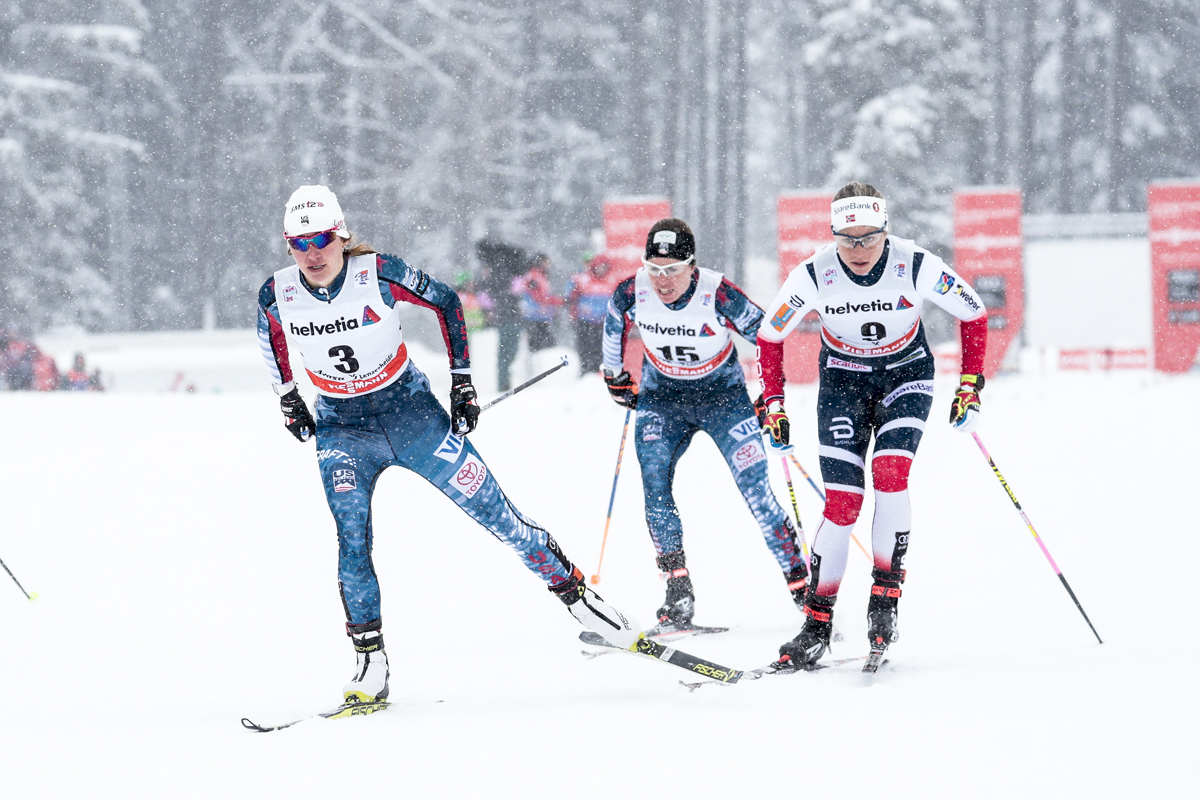
    Sophie Caldwell (3) leading her U.S. teammate Rosie Brennan (15) and Norway’s Astrid Uhrenholdt Jacobsen in the quarterfinal of the women’s freestyle sprint at Stage 1 of the 2018 Tour de Ski in Lenzerheide, Switzerland. (Photo: Fischer/NordicFocus)

    “I have been struggling the last few weeks since the TdS with my own racing,” the 29-year-old Brennan said. “And so at this point I am just hoping to had enough time to turn my form around and to race better myself. I obviously don’t want to be part of a relay team that I’m going to let down. So I want to be in my best shape before I even think about that. That is one of my goals and I hope I’ve had some time to turn my shape around. But I think at this point, I am looking for every opportunity to race that I can get to show that I have turned this around and that I am ready and then will start looking at that relay spot.”

    Most recently, Brennan struggled in Seefeld’s 10 k skate mass start, finishing 53rd. Brennan also after completed the Tour de Ski (TdS), which concluded Jan. 7. Understanding that maintain high level fitness on the World Cup is a challenge few master, Brennan said the TdS had sapped her energy.

    “Just a little more fatigue than I expected from the Tour despite the fact that we only had six and half races,” Brennan acknowledged. “There were a lot of weather events so everything was a little more energy intensive and a little hectic. I came in with a lot more training than I have in the past, I trained a little harder during Period 1 in hope to be sharp for the Olympics, and I think I didn’t respect that as much as should have and was a little tired afterwards. And also fighting a little illness and things like that. I am feeling a lot better now and I hope a little rest is all I needed.”

    For Erik Bjornsen, who is experiencing his second Olympics after racing three individual events and the 4 x 10 k relay in Sochi, these Games could become a stepping stone. In Seefeld, Bjornsen placed ninth in the 15 k mass start skate. If Bjornsen’s positive energy in the press conference was any indication, he might be trending into rarefied air on the men’s side.

    “I think I could have some good performances,” Bjornsen, 26, said. “I don’t have the pressure that everybody else does, but I do have have the potential to put in some really solid results.”

    (Left to right) USST members and 2018 Olympians Ida Sargent, Erik Bjornsen and Kikkan Randall during thier intro press conference on Wednesday at the PyeongChang Games. (Photo: Flyingpointroad)

    Last year at the Nordic World Championships in Lahti, Finland, he and teammate Simi Hamilton placed fifth in the team sprint. In PyeongChang, the course remains championship-tough, but athletes are more exposed to the elements as the tracks were built on a hilly golf course.

    “Of course, I’m really excited for the team sprint,” Bjornsen said. “And these courses, I’ve been out there once, it is a little early to say. It seems good. It is a golf course, but there are some big climbs, which I like. I like hard-work sections but there are also some flatter sections, which suits a big guy like myself. And then having wind, I was joking before, it should be good for the guys that are chasing.”

    Then let’s talk about tough and gritty. Topping the list would be Sargent. If you missed this, here’s the short version. Back on Jan. 27, prior to her start in Seefeld’s skate sprint qualifier, Sargent fell and broke her thumb.

    “It was a complete clean break,” Sargent, 30, stated. “Every pole plant was very painful. But actually, I felt like my brain was a bigger a detriment because it happened 15 minutes at most before the start and I knew that something was wrong. I was thinking the whole time, ‘This is bad, this is bad.’ I could feel the pain and was thinking that something very serious was going on.”

    On her literal whirlwind of treatment, Sargent flew to Vail, Colorado, for surgery on her thumb at The Steadman Clinic.

    “I had a plate inserted and seven screws securing this plate,” Sargent explained during a follow-up phone interview on Thursday. “So good hardware in there, and an amazing surgeon. My surgeon was very confident; he has done this before, and he knew that the plate was extremely secure so that he wasn’t at all concerned about it moving or not me not having  the stability. I think he ended up using a slightly larger plate just to make sure it was plenty secure.”

    The next morning, post-surgery, Sargent was cleared for active recovery to increase her mobility and bring down the swelling.

    “Two days later I was skiing, doing some one pole and some two pole,” Sargent added. It was incredible to me that they can take a clean break and fully stabilize it.”

    Sargent was clear when asked if there’s anything she cannot do.

    “Nope,” she said. “The only restriction is just personally managing the pain when I ski. The bone is not fused together yet, that eventually will happen. I also obviously have the trauma of having screws put into the bone and there is the swelling, but that has been going down. I have been working with Zuzanna Rodgers here in Korea. We have working on some exercises and some massage to reduce the swelling.”

    Ida Sargent (5) leads her semifinal heat and teammates Jessie Diggins (4) and Sophie Caldwell (9) around a corner at this season’s Davos World Cup. (Photo: Reese Brown / U.S. Ski & Snowboard)

    It is cold here in PyeongChang. It’s a dry cold, but when temps are slow to budge from the single digits and eventually warm to the low teens, cold is cold. Most people with surgical procedures requiring the insertion of metal plates claim cold temps can complicate their sensations. Here in Korea, that seems not to be a problem for Sargent.

    “I was talking with someone yesterday who has a plate in their hand as well, and they feel the cold,” Sargent said “I don’t think I feel it because I still have a fair amount of swelling on top of the plate at the moment. So I think that that is providing some increased insulation. That is the bonus of that maybe. I haven’t felt the cold from it.”

    Sargent stated she was scheduled to race next Tuesday’s classic sprint.

    “As long as I am feeling like my thumb is good to go and I feel confident in my ability to ski well with it, I’ll be racing that,” Sargent explained. “The sprint is on Tuesday, so I still have five days or something at this point That is the plan right now and putting the full focus on being recovered and ready for that day.”

    The 2018 PyeongChang Olympics begin Saturday with the women’s 15 k skiathlon.
  • Hoffman Checks in En Route to Denver, Blogs About Broken Fibula

    Hoffman Checks in En Route to Denver, Blogs About Broken Fibula

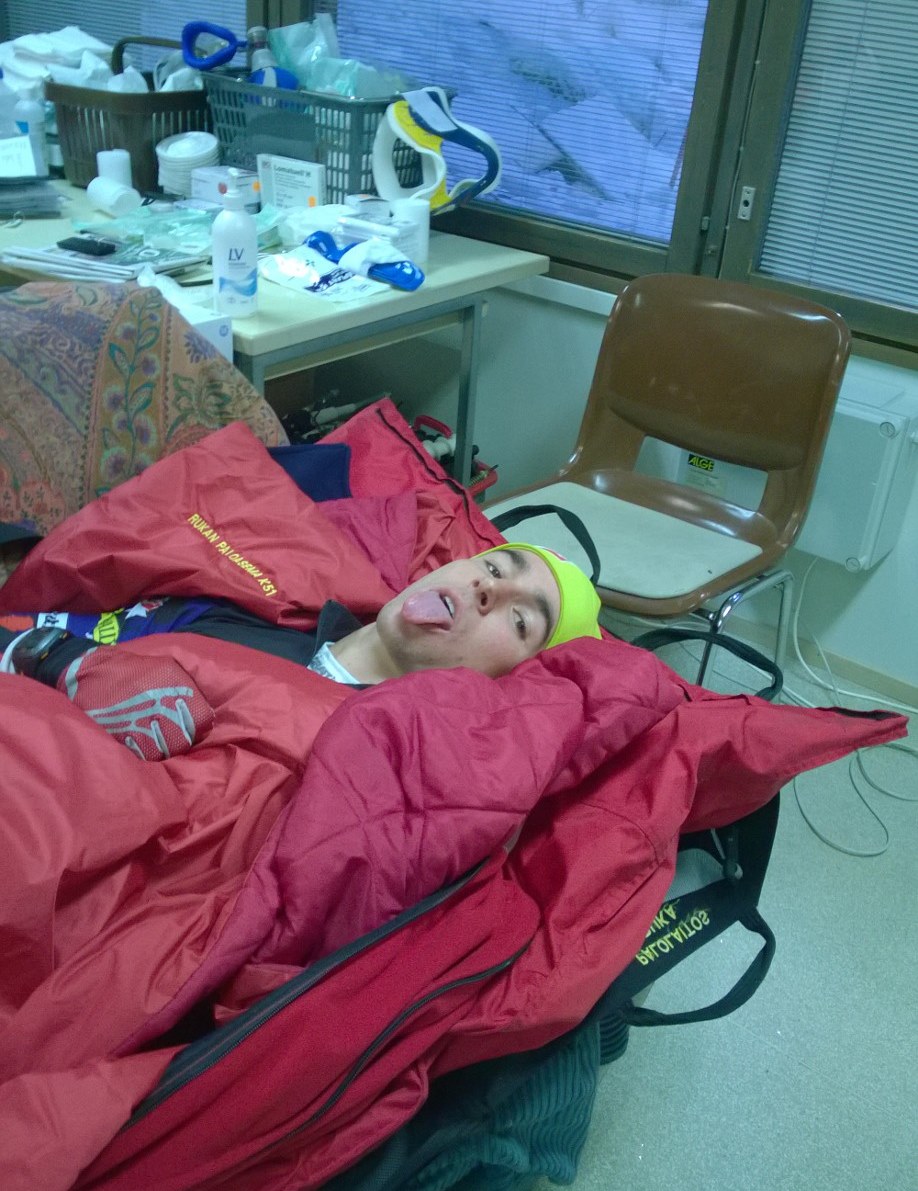
    Noah Hoffman at the Ruka clinic in Kuusamo, Finland, on Sunday after breaking his fibula in the 15 k classic. He and physical therapist Peter Dickinson had to wait in the clinic while waiting for an ambulance to take them to a nearby medical center for X-rays. "We were only going half a kilometer and I thought the ambulance was overkill," Hoffman wrote on his blog. (Photo: NoahHoffman.com)
    Noah Hoffman on Sunday at the Ruka clinic in Kuusamo, Finland, after breaking his fibula in the 15 k classic. He and physical therapist Peter Dickinson waited in the clinic for an ambulance to take them to a nearby medical center for X-rays. “We were only going half a kilometer and I thought the ambulance was overkill,” Hoffman wrote on his blog. (Photo: Peter Dickinson via NoahHoffman.com)

    Never fail, on Monday afternoon during a flight from Frankfurt to Denver, Noah Hoffman blogged. And not just any quick update, almost a whopping 2,000 words.

    The U.S. Ski Team’s top male distance skier emerged from a one-day online hiatus to explain exactly what happened Sunday in Kuusamo, Finland, where he fell hard with slightly less than 2 kilometers left and did not finish a World Cup race for the first time in his career.

    Hoffman explained he aimed to start the 15 k classic — the first distance race of the season — conservatively, and he settled after the first kilometer. Waiting patiently to get a ride, he saw his opportunity with Norway’s Pål Golberg, who went on to place ninth, after the first lap around 5 k. As Hoffman accelerated to catch him up the big climb and did so about halfway up, he found shortly after that the effort was too much, too soon.

    “For several kilometers I had to focus on being smooth and recovering. I lost a ton of time,” Hoffman wrote on his blog on Monday.

    At the end of the second lap, Finland’s eventual third-place finisher Sami Jauhojärvi caught Hoffman. He saw that as another opportunity and stayed with Jauhojärvi around the stadium and up the big climb, but “just like the lap before, the effort was too much for me. He dropped me and I was blown,” Hoffman wrote. “I was suffering for the rest of the race. I was not skiing fast. At the 13.1 kilometer split station, which was right before I crashed, I was in 52nd place, not where I want to be.”

    Hoffman went down on a sharp-righthand corner at the bottom of a fast downhill. He expected it to be icy and wasn’t intimidated by it and didn’t think it would be a problem. When he crashed on his third lap, no one was near him and he explained he wasn’t trying to be aggressive. If anything, he wondered if he should have tried to carry more speed through the turn.

    “I’m not sure exactly what happened. I slid on the ice, went into the snowy berm, lost control and slammed into the fence,” he wrote.

    What he thought was his right ski snapped in half as it hit the solid paper or plastic lining the bottom half of the fence. The top part was made of alpine netting. His other leg punched through the solid material and was tweaked with his left ski still in the fence. He kept sliding and injured his knee and ankle.

    “I knew almost immediately that I was hurt,” Hoffman recalled. “I got up and glided about a hundred meters down the trail. I needed to get out of the way of other racers and I needed to get to some people who could help me.

    “I couldn’t put any weight on my left leg,” he continued. “I knew I couldn’t finish the race, which is significant because I’ve never previously dropped out of a race. I’m bummed that I had to end that streak yesterday.”

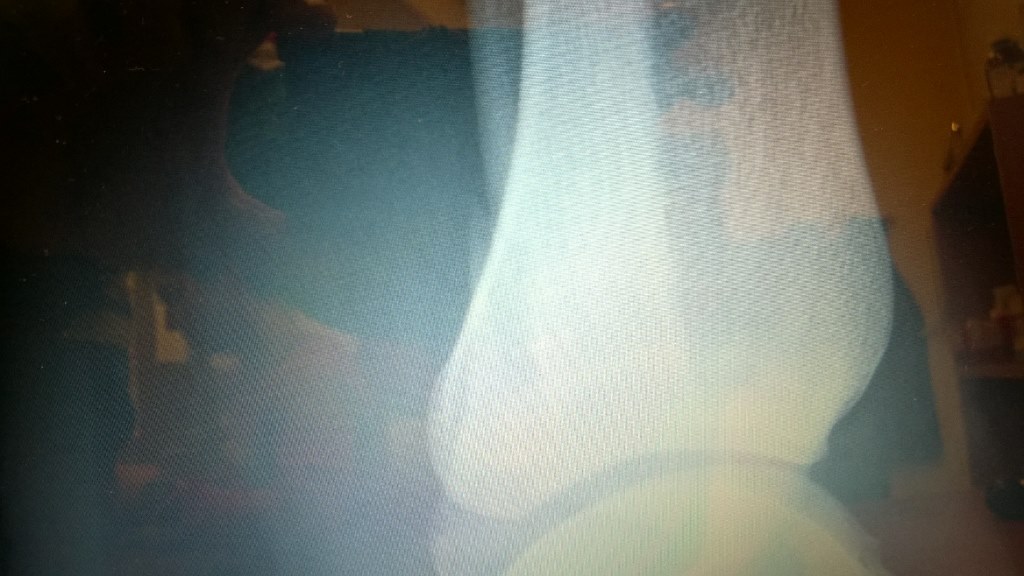
    A photo of Hoffman's X-ray taken by Peter Dickinson. "It didn’t turn out super well but you can see the fracture in the fibula behind the tibia, at least that’s what I’m told," Hoffman wrote on his blog. (Photo: Peter Dickinson via NoahHoffman.com)
    A photo of Hoffman’s X-ray taken by Peter Dickinson. “It didn’t turn out super well but you can see the fracture in the fibula behind the tibia, at least that’s what I’m told,” Hoffman wrote on his blog. (Photo: Peter Dickinson via NoahHoffman.com)

    Hoffman’s blog post was titled, “Broken Fibula,” and he included an X-ray taken at a medical center near Ruka venue, which showed a fracture in his fibula behind the tibia (shin bone), “at least that’s what I’m told,” he wrote.

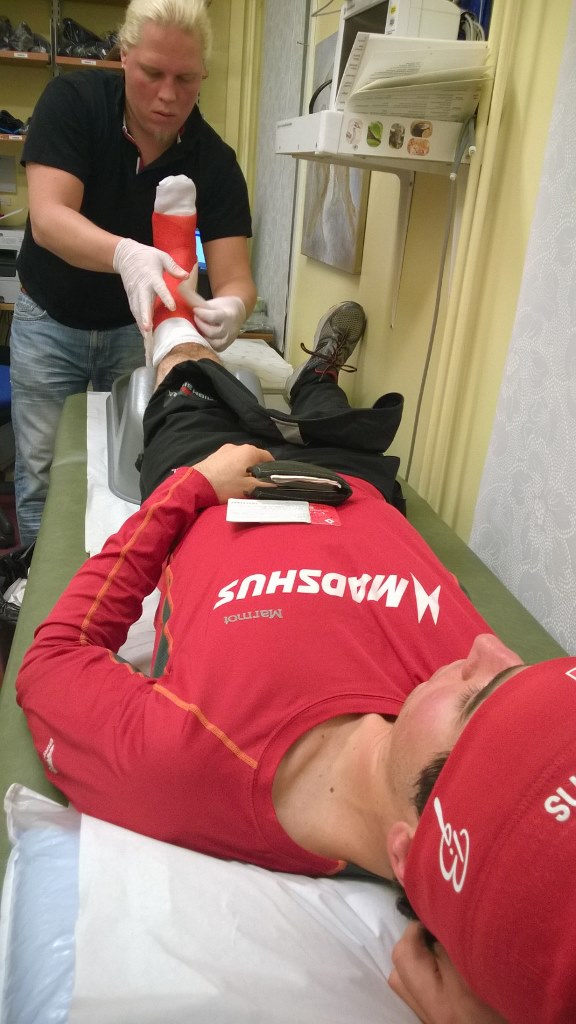
    “The plan then immediately became for me to get back to the U.S. as fast as possible,” he continued. “There wasn’t really any discussion about it, and I didn’t have any say in the matter. They put me in a hard cast for the travel.”

    Hoffman and the U.S. team’s physical therapist, Peter Dickinson, who accompanied him to the clinic, took a taxi 300 meters to their condo “because Pete wouldn’t let me crutch down the icy stairs and hill,” he explained.

    “Things happened really fast once I got back to the condo. I got on the phone with the U.S. Ski Team travel agent to try to re-book my ticket,” he wrote.

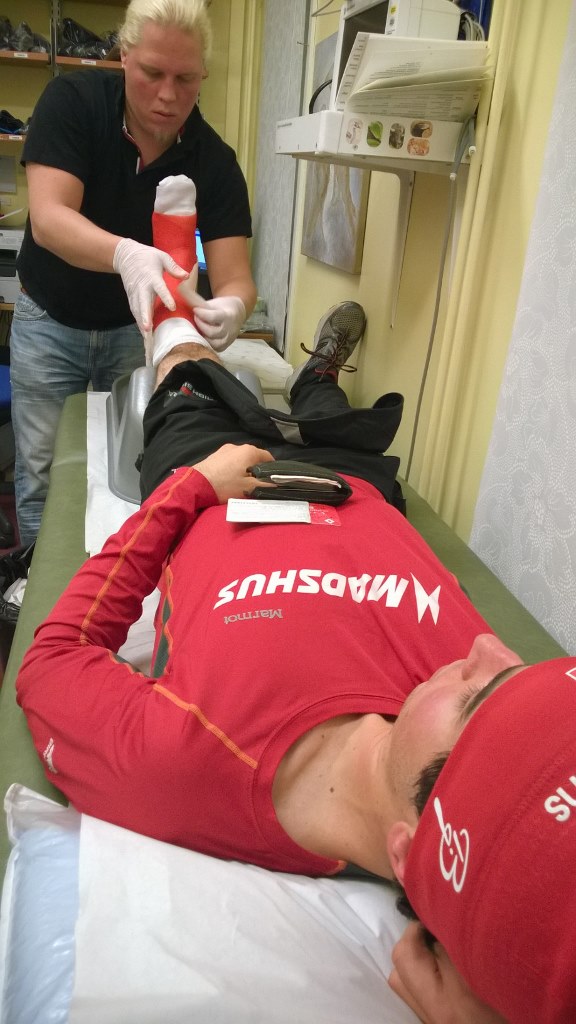
    Hoffman getting a hard cast on his left leg for travel. (Photo: NoahHoffman.com)
    Hoffman getting a hard cast on his left leg for travel. (Photo: NoahHoffman.com)

    His previously scheduled return was after the Tour de Ski in early January, departing from Munich and arriving in Hartford, Conn. Last night, he wanted to leave northern Finland for Denver on the earliest flight. Unable to re-book, he found the cheapest option was buying a new ticket for $1,000 dollars. But there weren’t any seats available in most of the airports near Kuusamo.

    “When we kept striking out I started doing some research on my own and amazingly found an award ticket option through United but on partner airlines out of Lulea, Sweden,” Hoffman wrote. “The only ticket available was in business class for 70,000 miles. Luckily I had that many miles available and it sounded better to me to spend them than paying $1,000, so I purchased it at 6 O’clock last night. The flight was at 6:20 this morning. Lulea is 5 hours from Kuusamo.”

    From there, two of the team’s wax techs JP Laurin and Oleg Ragilo drove him to Luleå. They were headed there anyway with a cargo van full of skis en route to Lillehammer before next weekend’s World Cup. Hoffman squeezed up front with them in the three-person bench seat.

    “Oleg and Jp were ready to depart before I even booked the flight and I hadn’t packed, eaten dinner or showered. Also, my leg was quite painful,” he wrote. “Luckily I have incredible teammates. They did everything for me. I took a washcloth bath while Simi and Ida packed my duffel bag and Liz made me four peanut butter and jelly sandwiches for dinner. I got out of the condo in less than 15 minutes.

    “As we took off on the long drive I had to make a ton of phone calls, organizing things at home. I talked to my coaches and parents, started the process of setting up doctor’s appointments and organized transport with [my girlfriend] Emilia for when I land in Denver,” he added. “The drive was long and monotonous on snow covered roads.”

    But they got to Luleå at midnight, 1 a.m. Kuusamo time. Hoffman wrote he slept fairly well despite keeping his leg elevated.

    “I made it to the airport without issue, although crutching while rolling a duffel is a challenge,” he wrote.

    At the airport, Scandinavian Airlines couldn’t find his ticket number. Hoffman spent a half hour on the phone with United sorting it out and almost missed his flight.

    “Since then the travel has gone very smoothly,” he added. “I’m ashamed to say I’ve been getting pushed around airports in a wheelchair.”

    Once airborne, he enjoyed business class and his first time with internet access in a trans-Atlantic flight.

    Hoffman is currently on blood thinners and Aspirin to reduce the risk of a blood clot. After flying into Denver, he was headed to Breckenridge, Colo., Monday evening and hoped to see a specialist at The Steadman Clinic in Vail on Tuesday.

    “Then I can start making plans for my recovery and my return to racing,” he wrote.

    “Because I haven’t posted anything, I didn’t know anybody knew about my crash yesterday,” Hoffman noted. “Apparently I was wrong. I just turned on my computer for the first time, and I’m overwhelmed by the number of get well messages. I feel incredibly lucky to have so much support! Thank you all.”