From the FasterSkier archive — posts syndicated from athletes’ and coaches’ own blogs between 2004 and 2012, kept online as published. Current coverage is at fasterskier.com.
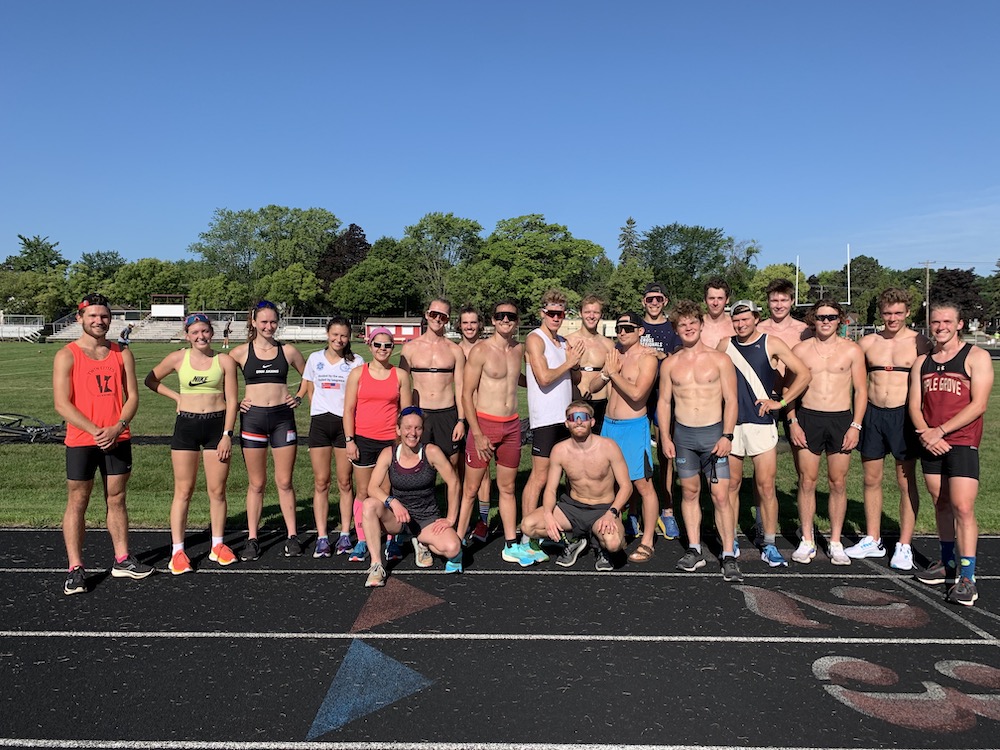
Team Birkie athletes, including summer collegiate athletes, at the track, summer 2021. (photo: courtesy Team Birkie)
Team name and location: Team Birkie; Minneapolis, Minnesota (also Hayward, Wisconsin)
Coach: Caitlin Gregg (co-coach), Leo Hipp (co-coach), Jeremy Hecker (technique coach and wax tech)
Current roster: For the men: Zak Ketterson, Christian Gostout, Andrew Millan, Tony Mathie, Brian Gregg; Women: Ingrid Thyr, Julie Ensrud, Jordan Schuster, Abbie Drach, Amanda Kautzer (focusing on biathlon)
What’s new: “Everything,” Gregg writes. While elite teams have existed in the Midwest in the past, Team Birkie is new this year. You can learn more about the program in this podcast with Gregg.
Who’s still on this team, or otherwise involved in American skiing, from when we did this in 2012: Since this is the inaugural year for the team, this question is not directly applicable; however, Caitlin Gregg and Brian Gregg remain recognizable names from our 2012 CXC preview. Nichole Bathe raced internationally for Great Britain as recently as last season.
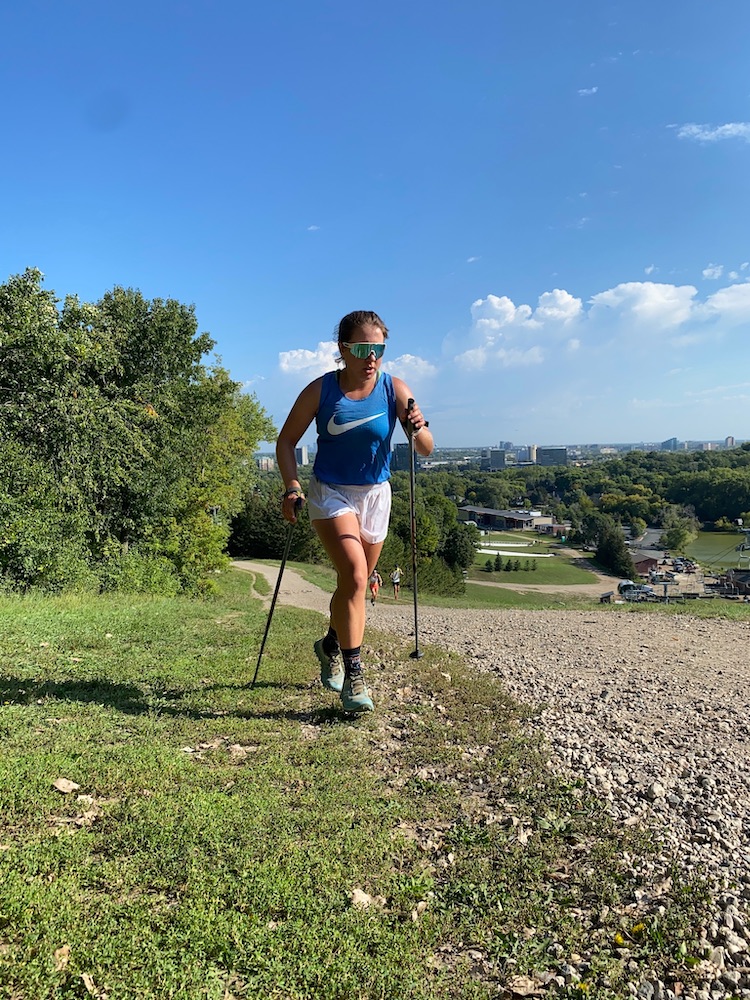
Ingrid Thyr bounding, summer 2021. (photo: courtesy Team Birkie)
Top results last season: While racing for different programs, Ketterson was 4th and 15th at NCAA Championships racing for NMU, including top American in the 20 k skate. Kautzer was 7th in Soldier Hollow in January against a RMISA field. Gostout was 13th in a January race in Soldier Hollow against a strong regional field. Drach was 8th in the skate Birkie. Among the coaching staff, Caitlin Gregg was third in the skate Birkie, marking the rare year in which she has entered the race but not won it.
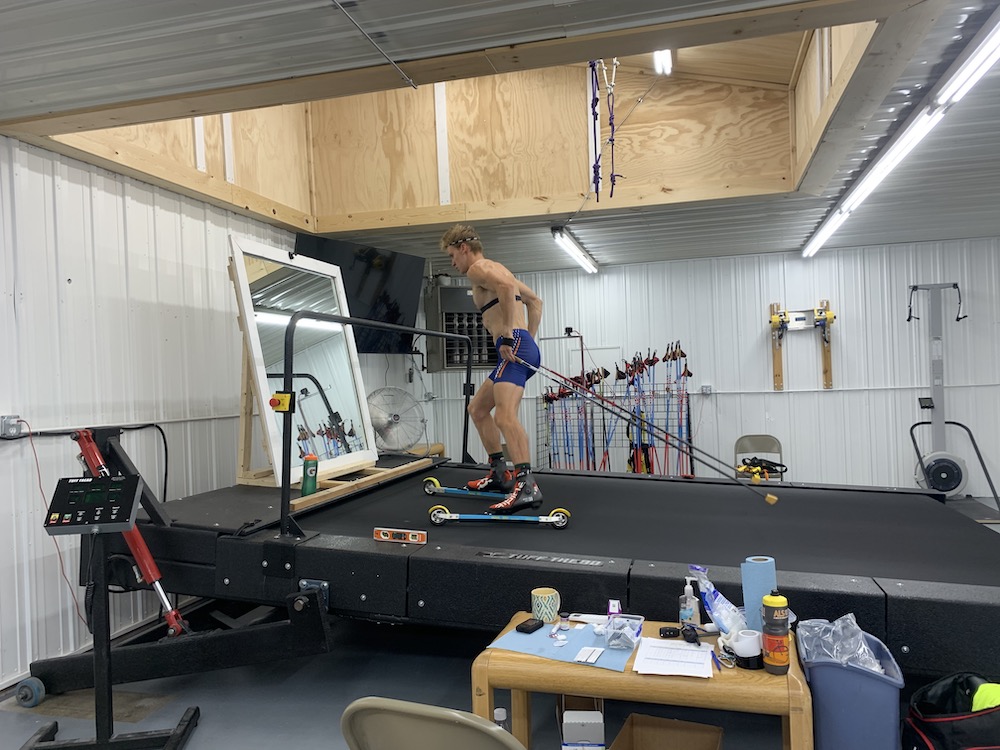
Zak Ketterson doing work on the rollerski treadmill. (photo: courtesy Team Birkie)
“We are a brand new team with lots of excitement for the upcoming season.
“Our summer was very productive with the addition of 17 college athletes who helped push our Team Birkie athletes and made our altitude camp in Bozeman very successful. With lots of strong runners during the summer we enjoyed pushing our fitness on foot and refining our technique on rollerskis.
“Early fall was spent in the Midwest increasing our paces on familiar courses and dialing in efforts and technique on the rollerski treadmill.
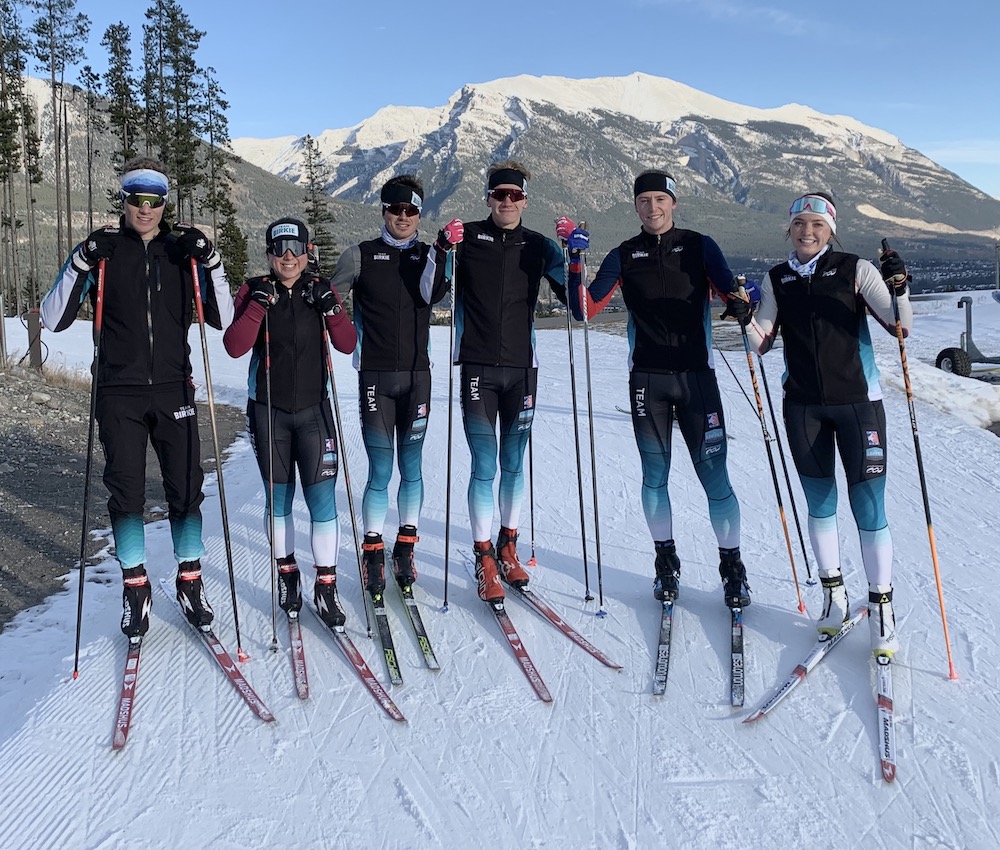
From left, Christian Gostout, Ingrid Thyr, Andrew Millan, Zak Ketterson, Tony Mathie, and Jordan Schuster, Frozen Thunder, Canmore, Alberta, fall 2021. (photo: courtesy Team Birkie)
“As we approach the first series of races this winter we are in a final three-week altitude block and back on snow in Canmore, Alberta.
“We look forward to starting the season close to home in Duluth and Cable and competing at U.S. Nationals at Soldier Hollow (one of my all time favorite venues).”
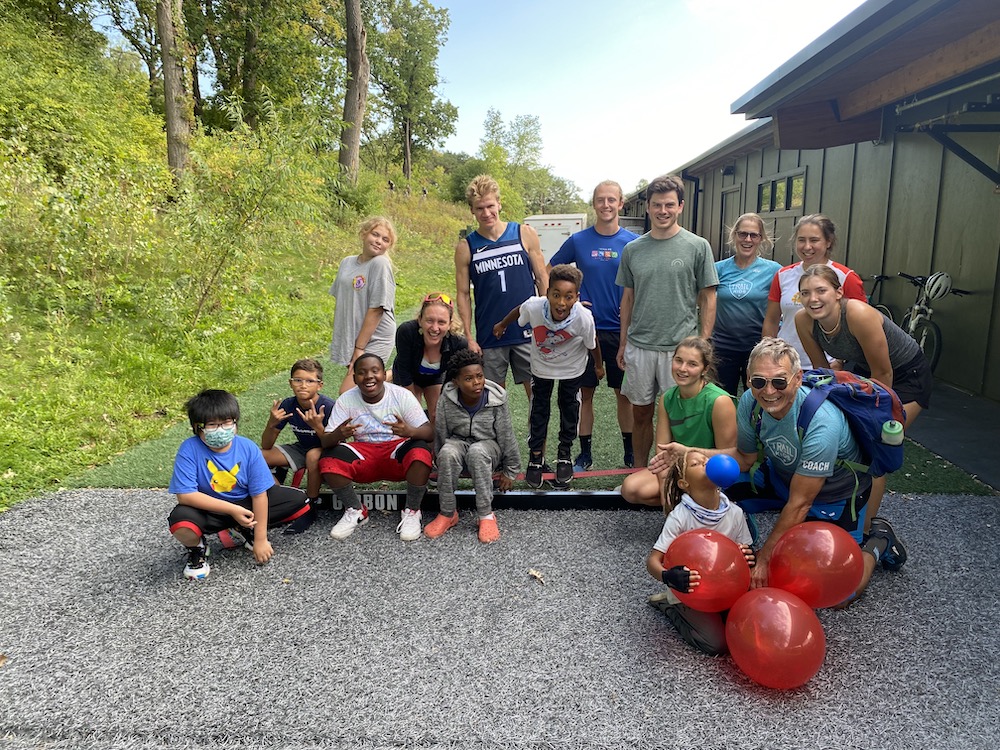
Caitlin Gregg (fifth from left) and some athletes with members of the Loppet Foundation’s Northside Adventure Team, Minneapolis, summer 2021. (photo: courtesy Team Birkie)
Caitlin Gregg (right), Jazir (left), and Heidi on the lawn. (Photo: Brian Gregg)
Since 2011, Brian and Caitlin Gregg have been residents of north Minneapolis. They added daughter Heidi to the mix a year and a half ago. They are close to Theodore Wirth Park, an urban magnet for cross-country skiing with amenities like snowmaking, homologated trails, and mountain biking in the non-snow months. The Loppet Foundation, a local non-profit, was poised to host the first World Cup in the U.S. since 2001 until concerns and regulations associated with Covid-19 caused the event to be canceled.
Minneapolis has enjoyed a reputation as an arts and culture hub. The city skews left in its politics and serves as a gateway for Midwest winter sports. That image was shattered in the wake of George Floyd’s killing last month.
Like many places, Minneapolis was a reminder of how many cityscapes have historically been racist by design. Since the early 1900s, Minneapolis has segregated with the assistance of racially restrictive deeds called racial covenants. In other words, specific properties included language in their deeds preventing people of color from acquiring them.
In 1917, according to an interactive map titled Mapping Prejudice, we see a single property near the west side of Wirth with a racial covenant. By 1919 blue blobs on the map indicating impacted properties were viral near that location. Then in 1923, another cluster began to propagate adjacent Wirth’s northeast edge. As the map’s timelapse rolls into the postwar year of 1946, those two racial covenant clusters balloon. They defined the area for years.
Double click the images below to enlarge. Theodore Wirth Park is situated in the center of the respective maps.
Where the Greggs reside specifically in north Minneapolis is an area of the city that is predominantly African American. “You mention it to someone that you live in north Minneapolis and it is known as the not as nice part of town which we never really understood,” said Caitlin Gregg.
As they looked for a home to buy in 2010 and 2011, their budget was small. So were their needs. One-bedroom. One-bath. They didn’t require more. And location, location, location was a bellwether. Brian, a 2014 Olympian, and Cailtin a 2010 Olympian, desired close to home skiing. Wirth Park was their place. At the time, Caitlin worked for a nearby Boys and Girls Club and loved the neighborhood.
“’That is a bad area, what are you doing?’” was the often-heard response when informing people of their housing find said Caitlin. “And some of these are friends of ours for a long time. I lived nearby and I felt like it was a great spot for what we were looking for. I was willing to find out what the neighborhood was like for myself.”
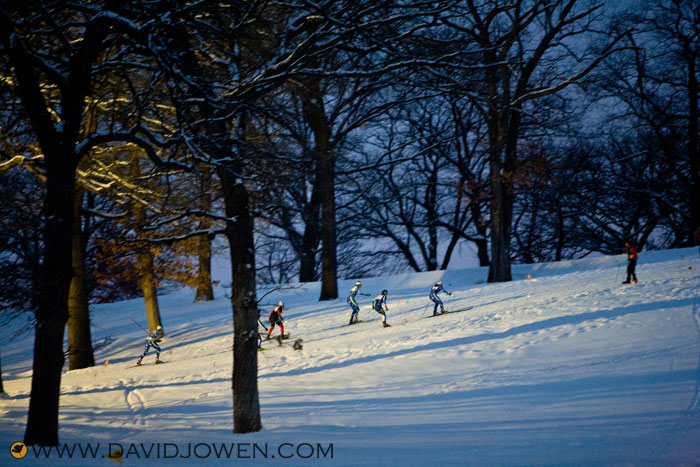
Nighttime racing under the lights at Wirth Park. (Photo: David J. Owen Photography.)
Both for Cailtin, who spent the first 10 years of growing up in a diverse section of Manhattan, and Brian, who grew up in the bucolic Methow Valley in Washington, living true to their values is a constant. “We definitely stand out here and I think it is an experience that everybody should have,” said Brian. “In the sense that to walk into a room and be completely different than everyone else. Imagine what it would be like for a person of color to come to a cross-country ski race?”
The Greggs have worked intimately with the Boys and Girls Clubs near rural Hayward and Minneapolis and the Parks and Rec. Department in north Minneapolis. They have also collaborated with the Loppet Foundation to make cross-country skiing, mountain biking, and running accessible to the underserved and underrepresented. Their journey helping others as professional skiers began when they became involved with In The Arena, an organization linking Olympic athletes with empowering youth.
Most training logs serve the purpose of cataloging training hours by specifying items like time in zone, average heart rate, activity, and on and on. We’ve yet to see one with a column accruing time and energy given back. This is not to say many athletes have not found their cause and their voice; be it climate change, literacy, or eating disorders. The good work is out there.
It is a question being asked over and over by many pursuing excellence in nordic sport: “How is my cross-country skiing and my success in cross-country skiing helping? What is [it helping]? And how is that making the world a better place?” posed Brian as he explored how he and Caitlin have attempted to answer that question. “You have an immediate connection with people and in particular kids,” was one grounded response Brian gave.
Living in a community with omnipresent reminders of systemic racism and exclusion, the Greggs have spent significant time ruminating on their value as athletes and why they may be important to communities.
Brian Gregg holds his three-week-old daughter, Heidi, during the flower ceremony after his second place finish at the 2019 Birkie. (Photo: Instagram @goteamgregg)
“One thing that athletics does is that it shows that setting goals and setting big goals, and setting goals that honestly may be the majority of people think are not possible,” Brian said. “You can inspire others to do the same, to define their next goals and best achievements as the ones that are not easy, and probably the majority of people thought you would fail at.”
Still, the constant stress of logging hours and resting adequately, and continuing the cycle, can be a deterrent to service and advocating for change. In the estimation of both Caitlin and Brian, however, their projects in north Minneapolis have made them better athletes.
“Whether or not we are better people I am not sure, but we are better athletes because of it, I think,” Caitlin said. “It gave us perspective and really realizing that we do love skiing and we do love pursuing our goals in skiing and we can do these things simultaneously. It does not have to be one or the other.”
Caitlin recalled the times she first worked with local youth, describing herself as wearing bright colored Lycra and goofy glasses, and some sort of ski hat. We know the look as the slowly evolving concept of cross-country cool as defined by those faster than us. Others know it as something sartorially disastrous.
“I thought, ‘oh my gosh is anybody going to want to listen to us or want to be part of something that we are going to do, we are just so different’? The most incredible thing that I have learned from working with the kids and the program that we aim to do is that it did not matter. That was a huge lesson for me,” Caitlin said. It really didn’t matter to them. The most important thing was that we were there and we were present. They could count on us. They could trust us, and we came again and again and again. And we cared about them and about what they were doing. And that was needed so much and it really gave me a lot of hope.”
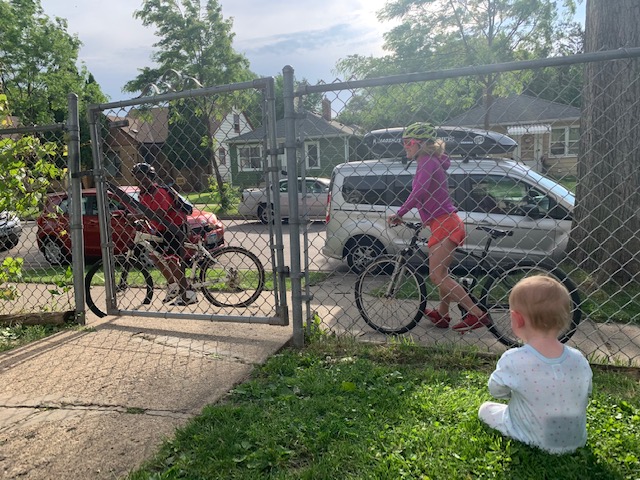
None of this is to say the Greggs were not rattled with the recent marches and palpable anger in Minneapolis. Caitlin said it was simply unpredictable. Like others, they were advised to wet their fences to prevent potential fires from spreading and crack their windows at night so as to keep auditory tabs on what was transpiring outdoors. One morning after one of the most tumultuous riots to date in the city, Caitlin woke before 7 AM to the sounds of a small commotion. She went to the window with some anxiety, and saw one of the local kids, Joshua (9), zipping back and forth on his bike. He had asked his reluctant and slightly older sister to watch him – that was the grumbling Caitlin had heard.
“It was one of those moments, as if ok this is cool and good things in the world are still happening and will continue,” said Caitlin.
Joshua had learned recently to ride a bike. As a shy kid, it took him too long to convey to the Greggs that he didn’t know how to ride, but wanted to learn. Caitlin and Brian are known in their neighborhood as go-tos when it comes to how to access play in the outdoors. The Greggs helped secure a bike, and they were one degree separated from being Joshua’s human training wheels. Another neighborhood local, Jazir, who still swings by the Greggs daily, became a mentor to Joshua.
Jazir came into the Gregg’s lives as a gregarious neighborhood kid. Like Joshua after him, the Greggs rallied to help Jazir find a bike. He was eventually connected with the Loppet Foundation’s mountain biking program and his trail riding love affair began. With Joshua’s new prowess on the bike as evidence, Jazir has paid it forward.
Brian says their street near Wirth Park reflects the best of Minneapolis; a spectrum of people from all walks of life in close proximity to an urban jewel in Wirth Park. Caitlin, a trained environmental and city planner, said the city’s master plan called for a light rail system to connect their neighborhood with downtown and amenities on the city’s periphery. The original vision for the light rail would have blocked local access to Wirth. Through her involvement in the neighborhood association, Caitlin advocated for a modified plan allowing for easier park access.
The 2019 Theodore Wirth Regional Park Management Plan Analysis states, “Theodore Wirth Park values the mental and physical well being of their community and visitors and supports this by creating a safe, beautiful and fun environment for all seasons.” We all know it – easy access to open space is vital.
Jazir and Heidi. (Photo: Brian and Caitlin Gregg)
Jazir helping a neighbor learn to ride. (Photo: Brian and Caitlin Gregg)
As the conversation with the Greggs waned, we didn’t touch on training or racing plans. I think we mentioned skiing once as Brian recalled a time deep in Wirth and deep in an interval session when a teenager he knew recognized him and called his name. It was an old neighbor named Quinn who was out skiing and had followed Brian’s 2014 Sochi quest. For the moment the Greggs are immersed in their full life and doing what they can to reflect and help their community.
There’s no doubt Minneapolis needs systemic change. If this moment is a tipping point, there’s optimism the city will be better off. It appears kids like Jazir and Joshua can keep Wirth local: the new light rail plan restores local entry points.
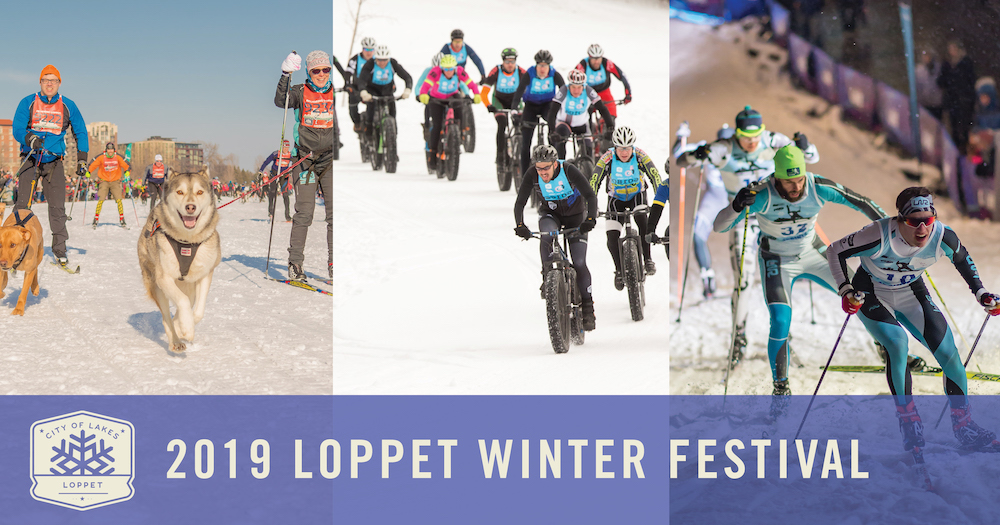
Minneapolis, MN — Big changes are coming to the annual City of Lakes Loppet Festival! Now in its 17th installment, the multi-day winter festival has become a Minneapolis staple for celebrating the wonder, adventure, and fun of the winter season in Minnesota.
Now with the completion of The Trailhead, the Loppet Foundation’s long-awaited headquarters, most of this year’s City of Lakes Loppet Winter Festival events will be centered in Theodore Wirth Regional Park on the border between North Minneapolis and Golden Valley. Over a decade in the making, The Trailhead building is the latest of upgrades to Wirth Park in partnership between the Loppet Foundation and Minneapolis Park and Recreation Board.
Reversing the Course
Beginning with the 2019 festival, all point-to-point events will begin on the Chain of Lakes in Uptown and finish at The Trailhead. “We have been waiting to do this for years,” says Isaac Kasper, the Loppet’s Chief of Course. “Starting on the lakes is perfect – it gives the skiers and bikers time to spread out before hitting the narrower and hillier trails in Wirth Park.”
Events like the Junior Loppet and Minne-Loppet will also be much improved for racers in this scenario. Rather than skiing on the flat and windy Bde Maka Ska, athletes will enjoy skiing on more varied and sheltered trails in Theodore Wirth Park – complete with snowmaking infrastructure that will guarantee a great event, no matter the weather.
The Big Tent and Vendor Village will also be relocating at The Trailhead – meaning that participants and spectators alike will be able to better enjoy all that the festival has to offer in a centralized location. “We are really looking forward to focusing all of the excitement of Loppet weekend at our new home in Wirth Park,” said the Loppet Foundation’s executive director, John Munger. “Between The Trailhead, our new and expanded snowmaking, and an exciting new course, we are expecting 2019 to be our biggest year ever!”
For more information, and to register for festival events, visit the Loppet Winter Festival website.
The Minneapolis Park Board & The Loppet Foundation celebrate the historic opening of The Trailhead building in Throdore Wirth Park. (Photo: Minneapolis Park and Recreation Board)
(Press release)
Minneapolis Park and Recreation Board, Loppet Foundation celebrate opening of The Trailhead in Theodore Wirth Regional Park
New facility will serve as a jumping off point for full slate of year-round, world-class outdoor recreation opportunities
On Tuesday, July 17, 2018, officials from the Loppet Foundation and Minneapolis Park and Recreation Board (MPRB) were joined by a crowd of supporters and Theodore Wirth Regional Park users for a ribbon-cutting ceremony that marked the official opening of The Trailhead.
The Trailhead is a new 14,000-square-foot building built with bird-safe glass and a variety of northern hardwoods representative of the forest in Wirth Park. It will serve as a year-round destination for outdoor adventurers from all walks of life.
“Through years of hard work, strategic thinking, and incredible community support, The Trailhead is finally coming to fruition and we couldn’t be happier,” said John Munger, executive director of the Loppet Foundation. “Having this infrastructure in place will give us exactly the boost needed to realize our vision of an ethnically and economically diverse community coming together around a shared passion for the outdoors.”
Building highlights include:
Large indoor gathering space with seating for 250 people
Outdoor patio looking out at multiuse natural trails and the winter tubing hill
The Trailhead is located at 1221 Theodore Wirth Parkway and is open daily 7 am-9 pm.
“The Trailhead will open countless opportunities for people of all ages, experience levels and backgrounds to enjoy Wirth Park and the natural beauty we’ve been gifted in Minneapolis,” said Mary Merrill, superintendent of the Minneapolis Park and Recreation Board. “It’s a great park with incredible trails and attractions, and now we’re thrilled to add this world-class facility.”
The Trailhead was included in the Theodore Wirth Regional Park Master Plan, which calls for an area devoted to lifetime outdoor activities like cross-country skiing, trail running, mountain biking and hiking. The Master Plan was approved by MPRB Commissioners on March 4, 2015 after a five-year public engagement process that included dozens of public meetings.
“Partnerships and volunteers are crucial to maintaining and improving our beloved parks system,” said Brad Bourn, president of the Minneapolis Park and Recreation Board. “We’re proud to partner with an organization like the Loppet Foundation, which has a phenomenal reputation and proven track record of making outdoor recreation experiences available to kids and people of color who have been traditionally excluded from the outdoors.”
The MPRB and the Loppet Foundation have worked together for years to provide maintenance and programming at Wirth Park. That successful relationship expanded as part of this project. The Loppet Foundation oversees snowmaking and mountain bike trail maintenance, while the MPRB remains in charge of golf operations and golf maintenance and programming, with the exception that the Loppet provides customer service staff inside The Trailhead.
“The exciting thing about The Trailhead is how it provides this amazing on-ramp for positive experiences in the out-of-doors,” said Anthony Taylor, Adventures Director of the Loppet Foundation. “Over the years, Loppet programming has been happening in parking lots, out of the backs of trucks and trailers, and we now have this safe space for adventure to live and flourish in North Minneapolis — and realize our ultimate goal of connecting everyone with an active, outdoor lifestyle.”
ABOUT THE LOPPET FOUNDATION
The Loppet Foundation is a 501(c)(3) nonprofit organization that creates a shared passion for year-round outdoor adventure in the Minneapolis area, focusing on underserved youth and families. Since 2002, the Loppet Foundation has worked to create high-quality public events, youth education, and outdoor recreation programs for the local community. Learn more at www.loppet.org.
ABOUT THE MINNEAPOLIS PARK AND RECREATION BOARD
The Minneapolis Park and Recreation Board is a nationally accredited, independent, semi-autonomous body responsible for the Minneapolis park system. With 180 parks, the Park Board provides opportunities for all people to gather at its 102 playgrounds, 77 pools and beaches, 126 miles of dual walking and biking paths, 49 recreation centers, 47 outdoor ice rinks, 12 gardens, seven golf courses, seven dog parks and hundreds of multipurpose sports fields and courts. Public water access is offered at 12 lakes, three creeks and more than 10 miles of Mississippi riverfront, and it’s expanding with the transformative RiverFirst plans. For details, visit www.minneapolisparks.org.
Scott “Bjorn” Cummings rollerskiing near his cabin in Cornell, Wisconsin, on the Old Abe State Trail, a 19.5-mile former railroad track, which is now a bike path. (Courtesy photo)
In March of 2016, we published an article penned by Scott “Bjorn” Cummings, a Postbaccalaureate student working towards his Academic Behavorial Strategist K-12 (ABS) Special Education License at the University of Minnesota Duluth (UMD), titled “Why Skiing? How a Sport Saved My Life“. He’s now teaching and even more in love with XC. Here is his update.
***
As the start of my sophomore year of teaching and summer winds down, I am starting to reflect on my thoughts on skiing. Some readers might recall my FasterSkier article written last year after the conclusion of ski season.
The 2017 ski season did not go well for many others and me as a lack of snow in the Upper Midwest shortened or canceled races. Almost every race I did was shortened, canceled, I had the flu, or my race season ended early when I severely contused my knee rollerskiing in late February.
Scott “Bjorn” Cummings at his favorite place on a Saturday morning, Hyland Park Lake Park Reserve Recreation Area in Bloomington, Minnesota, where there were 5 kilometers of manmade snow on excellent daily grooming. (Courtesy photo)
To access all of the “Big Three” nordic snowmaking loops, I had to fight rush-hour traffic after work to ski and fight traffic after the ski. That was a battle I didn’t have the energy for most days after teaching. Let alone it was my first year teaching, which drains most teachers.
The last Tuesday in February, there was hardly any snow around except for at the “Big Three” snowmaking areas in the Twin Cities. The major parks and their respective miles from my West St. Paul apartment are Elm Creek (33.8 miles), Theodore Wirth Regional Park (19.2 miles) and Hyland Lake Park Reserve (18 miles).
So I decided to rollerski the Morgan Regional Trail right along the Mississippi River and the mini icebergs. I was about to turn around after 10 k when I hit a rock and landed most of weight on the knee. I rollerskied back while the blood dripped down my leg.
The next day, a significant black-and-blue bruising that started at my knee cap and went all the way down to my ankle. I went to urgent care and the X-ray showed nothing was broken. I asked my doctor sheepishly if I could race the Great Pepsi Challenge up in Biwabik, Minnesota, that weekend. “Absolutely not.” And thus that ended my racing season.
Ouch! Sometimes, (roller) skiing hurts.
But I am fine with that because most reasons for a poor race were beyond my control. I did well in the races I did participate in. Nordic skiing teaches you how to carry yourself.
This is the year is different. For one, I am back teaching at the same position as last year and looking forward to the continuity. Our district is having a big start of the school year kickoff where a speaker will stress the importance of personal wellness, balancing life outside of the classroom and taking care of yourself. No doubt my life as a citizen racer will help.
Scott “Bjorn” Cummings on his first podium after racing the 2017 NorthShore Inline Marathon on Sept. 16 in Duluth, Minnesota. With what he described as average-speed Marwe rollerskis, he finished in less than three hours for fifth place in the 29-and-under age group (which became third place since the overall first and second place finishers were removed from his age-group podium). (Photo: Jenna Ruzich)
But this year is different. I joined a local nordic ski club in Endurance United. Since May, I have trained with them once a week. Also with this package comes a supportive and competitive group of nordic skiers who are led a by a highly technical coach. My technique on skate rollerskis has flourished. I am already excited for snow and its September.
This year is different. This is the year I will learn how to classic ski. Rather than try to fret about wax in what has been unseasonably warm winters, I will buy skin skis. Depending on how fast I pick up the technique, I might even do a race in classic.
But next year is the big one. Next year I will race the Norwegian Birkebeiner. Some might recall from last post that I previously skied in Norway — for one whole kilometer. Time to redeem myself. I have always wanted to ski in Europe but now after my journey into skiing, the goal is to race in Europe.
But to race in Europe, I will need to look fast. Since my skiing nickname is Bjorn, I need a Norwegian race suit and because I have outgrown, both personally and physically, my UMD Bulldog race suit.
Please vote in the comments below on which one you think will make me fastest!
I asked my students what they thought. The second Norwegian race suit (choice D) was the big winner!
About the author: Scott “Bjorn” Cummings is a Special Education Resource Teacher at a Twin Cities southeastern metro high school. He mainly teaches 10th grade and has 20 students for case management. When he is not in school or on the ski trail, he enjoys biking, reading, cast-iron cooking, cheering on the Minnesota Twins, the UMTC- Gopher football, the UMD-Bulldogs Men’s Hockey, and Minnesota United FC. He is always up for a good beer, non-hoppy, and a conversation at a brewery. He resides in Inver Grove Heights with his border terrier dog aptly named Babe Ruth. He can be reached at Cummings.scottr@gmail.com.
***
Do you have a personal skiing story you’d like to share? Email info@fasterskier.com or get in touch with one of our staff members.
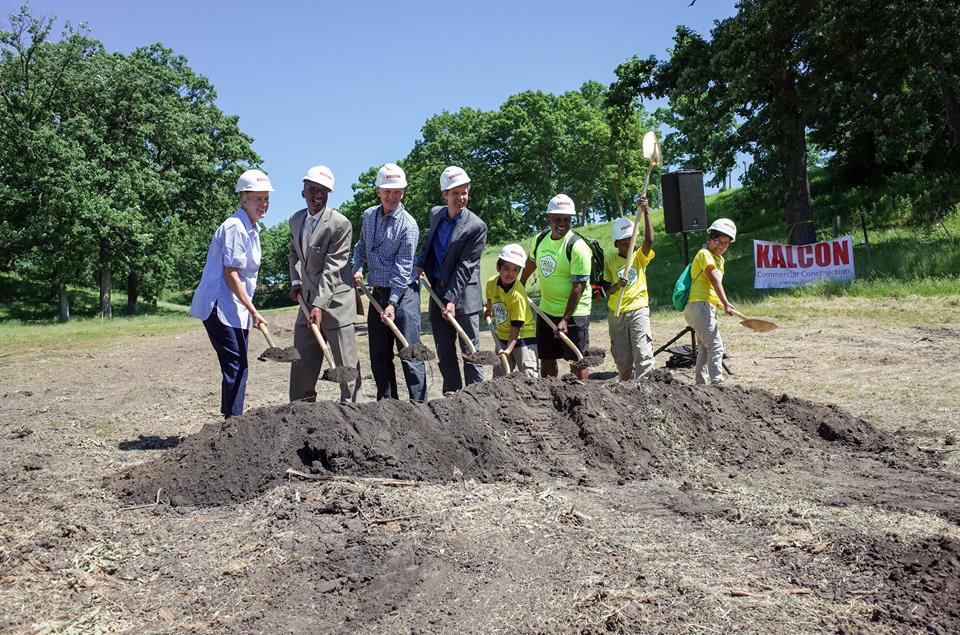
The Loppet Foundation’s official groundbreaking ceremony for “The Trailhead” at Theodore Wirth Park in Minneapolis, Minn., in June 2017. (Photo: Steve Kotvis)
After six years, the end is in sight: construction is underway for The Loppet Foundation’s Trailhead.
The Trailhead is an ambitious project to improve skiing infrastructure at Theodore Wirth Regional Park in Minneapolis, Minn. The year-round facility will feature a strength-and-conditioning area, a bike-and-ski rental shop, locker room, and food service. Outdoor amenities include a tubing hill and a snowboarding hill along with improvements to Wirth’s snowmaking system.
“It’s a project we’ve been working on a long time,” John Munger, the Loppet Foundation’s executive director, told FasterSkier on the phone in mid-May.
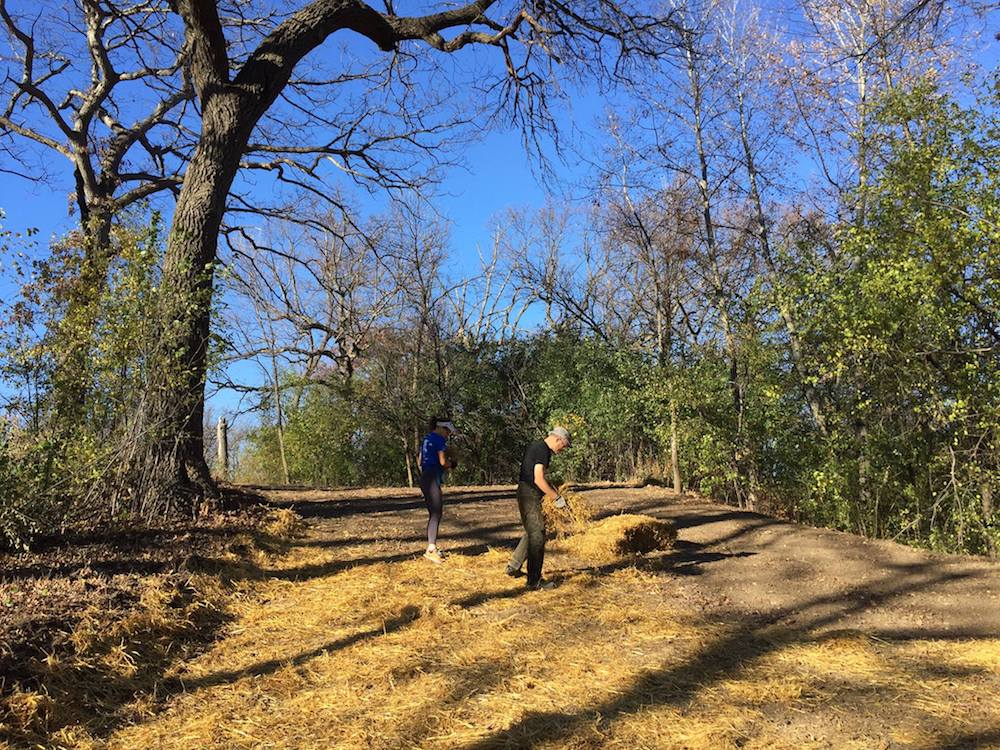
Last fall, volunteers worked on the new ski trails at Theodore Wirth Park in Minneapolis in preparation for The Loppet Foundation’s new Trailhead building. (Photo: The Loppet Foundation)
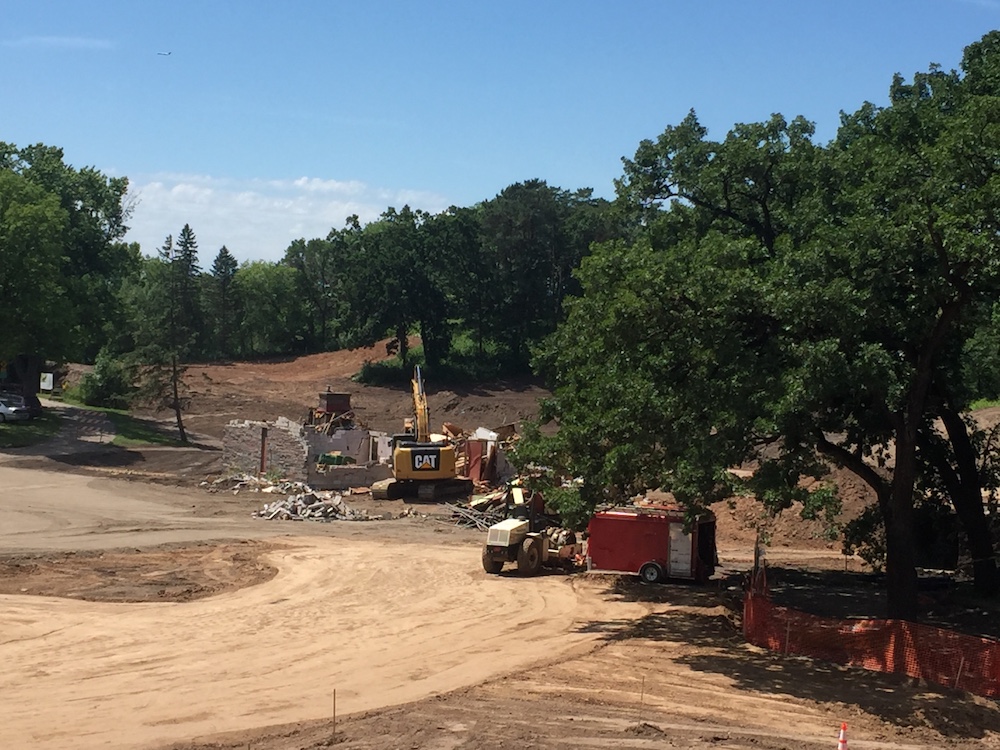
Earthmoving for The Trailhead officially began in early June, and Munger said the goal was to have the building ready by Jan. 15, 2018, just in time for the Masters World Cup Jan. 19-26 at Wirth Park. Winning the World Masters bid added urgency to the project, and it’s given The Loppet Foundation an eye for future major nordic competitions.
“We would like to bring in events like Junior Nationals, senior nationals and maybe even a World Cup,” Munger said.
Brian Gregg, a 2014 Olympian and one of the highest-profile athletes associated with the Loppet Foundation’s race program, Loppet Nordic Racing (LNR), lives next to Wirth Park with his wife Caitlin (LNR’s other top racer).
“We’re really excited about The Trailhead. It’s been a long time coming,” Gregg said in a recent phone interview for Truckee, Calif., where he was leading an LNR training camp with Caitlin. “The Loppet Foundation has really brought life back to the park. It’s really cool to see that grow.”
Originally from Washington state, Brian Gregg has lived in Minneapolis since 2011. Caitlin, a 2010 Olympian who was born in New York City and went to high school in Vermont, moved to the Twin Cities after graduating from Northern Michigan University in 2002.
“One big goal for us as elite athletes, our job isn’t just to go race for ourselves, it’s to represent our whole club,” Caitlin said of their commitment to LNR and their California volume camp with LNR collegiate skiers. “One thing we’ve learned, the best way to push yourself isn’t to bring athletes in from outside, it’s to bring the athletes around you up to your level. We’ve really taken that approach for a number of years, and now these kids can train with us. It’s awesome, I’m really excited.”
Growing with the times
Up until now, skiers at Wirth Park have used a 1920s-era building as a lodge. But that building can’t cope when some 600 to 800 hundred skiers and their coaches swoop in for a high school race. Golfers will continue to use the original building after the Trailhead is complete.
The entire project, dubbed The Trailhead Capital Campaign, is expected to cost $11.6 million dollars, of which $9.6 million is earmarked for the building and other physical improvements to Wirth’s skiing infrastructure (such as additional snowmaking equipment and trail improvements). The park currently has several International Ski Federation (FIS) homologated race loops, spanning from 5 kilometers to sprint-distance (roughly 1 k) long. In total, Wirth includes 23 k of trails, 7.5 k of which will have snowmaking for 2018.
Beyond the $9.6 million the Foundation is looking to raise (and is currently about $370,000 short of), another $2 million dollars was budgeted for programming (e.g. youth scholarships). Approximately $4.5 million of the total amount was to be raised privately, while the rest of the balance was expected to be covered by municipal, Hennepin County, state, and federal funding.
Trail maintenance at Wirth Park in Minneapolis, Minn. (Photo: The Loppet Foundation)
In May, Munger explained that the Foundation was in need of $250,000 to break ground. In just two weeks, it raised that amount.
“We had a cash crunch and needed that money in order to make it happen,” he said. “… It was very energizing and heartening to see the community step up like that.”
Was raising the money more or less difficult than expected?
“It’s hard to have expectations when you’ve never done something before,” Munger said.
While the project has been in the works for the last six or seven years, Munger characterized the Trailhead’s cost as a “moving target” as costs have increased over time. He described donations ranging from individuals and foundations contributing between $10,000 to $50,000, as well as many more modest grassroots donations. Munger credited the Pohlad Family Foundation with the single largest donation of $1 million dollars.
The Greggs have pushed for the cause, too.
“We’ve been actively involved [in fundraising] any time we’ve been home,” Caitlin said.
Earning trust
At 759 acres, Wirth is almost as big as New York City’s Central Park and serves a variety of constituencies. In addition to skiing, there are two golf courses, a disc golf course, mountain-bike trails and gardens. When master planning for the park began around 2010, the community didn’t know what to make of the Loppet Foundation’s ideas.
“The [Minneapolis Parks and Rec] Board was a reluctant partner for years,” Munger said. “They weren’t quite sure they wanted to trust a nonprofit or private to come in and do this kind of investment. They weren’t sure we would come through in the end.”
The golf community also wasn’t thrilled with the idea of a trail-development proposal to relocate three golf-course holes.
Now, “The park board is excited, we’re excited,” Munger explained. “That’s been the really dramatic piece. The whole community is excited about this now.”
He added that the park board has “always supported our mission, but I think it’s a matter of trust.”
To start, the Loppet Foundation did a thorough job of getting various municipal approvals. The Foundation’s gold-level club certification from U.S. Ski & Snowboard was an important endorsement. U.S. Ski & Snowboard has gold, silver and bronze level certifications for clubs that benchmark best practices in coaching, community outreach, and regular board meetings, among other criteria.
“Once we started to raise significant funds, [the park board] saw we were serious about this,” Munger said. “When we did the hard work with them of putting the agreements together, that was really significant. ‘This is an organization that does things right, that makes the park board look good to the world and helps deliver great services to the public through our partnership.’ So it’s been a long process, but that’s how we got there.”
“The public-private partnership between Minneapolis Parks and Rec Board and the Loppet Foundation is pretty unique,” Brian Gregg explained. “I think we’re one of the first public-private partnerships like that in the city.”
Racers at the City of Lakes Loppet in Theodore Wirth Park. (Photo: Steve Kotvis, f/go Photography)
The upcoming Masters World Cup won’t be Wirth’s first big event, but it does put Minneapolis on the international stage for cross-country skiing. Wirth hosted 2011 Junior Nationals and SuperTour races in 2010, 2011 and 2013. Brian won his first SuperTour there in 2010.
“A big part of the Loppet Foundation is reaching out to the community of north Minneapolis, which is where Wirth Park is located,” he explained. “It’s really great to see a lot of kids from north Minneapolis being able to take advantage of the Loppet programming.”
The programming includes youth scholarships for training camps and activities.
“I think that service side of the Loppet Foundation is one of the most incredible parts about the foundation,” Brian added.
Caitlin explained that the Foundation has started ski teams in middle schools across north Minneapolis by hiring coaches, acquiring equipment and finding ways to engage kids in healthy lifestyles.
“Brian and I are extremely proud,” Caitlin said. “… Our proudest moment is what the Foundation has done for the community at large.”
The Trailhead isn’t just for winter, either. In the summer, it will be a home base for mountain biking, trail running and orienteering.
“We’re heavily invested in skiing in the winter, but there’s outdoor activity throughout the year,” Munger explained.
One of Brian’s favorite Foundation programs is Adventure Kids, a series of weeklong summer day camps for kids ages 9 to 13. It was previously run with “popup tents and picnic tables,” he said, and if there was a thunderstorm, the kids took cover under a bridge. When the Trailhead opens, they’ll have a shelter.
“There really is no offseason for us,” Munger said.