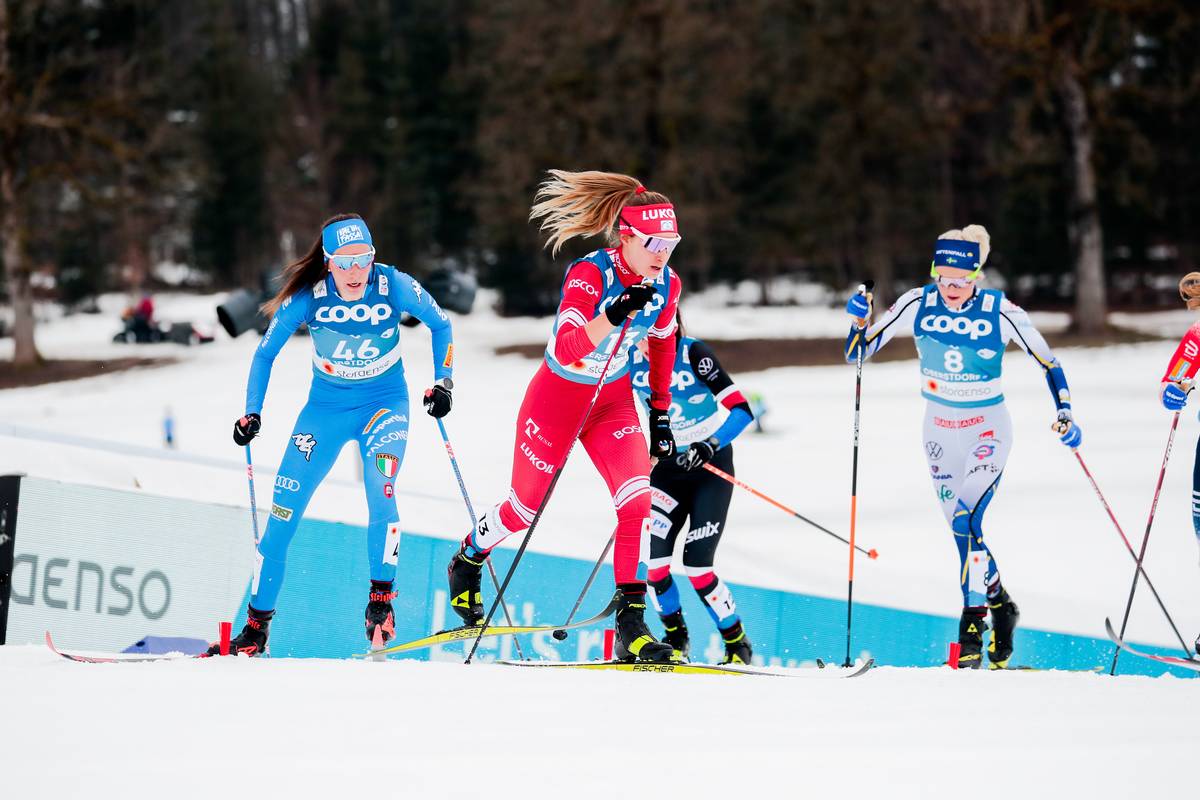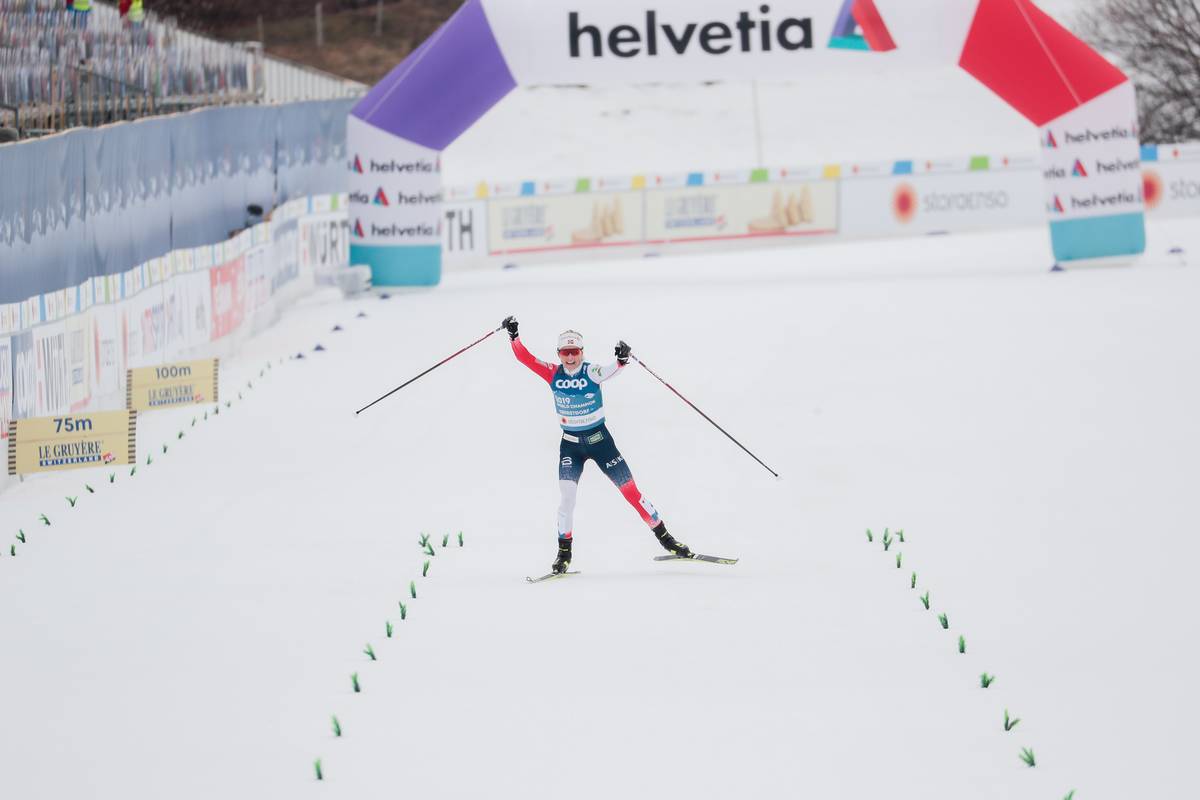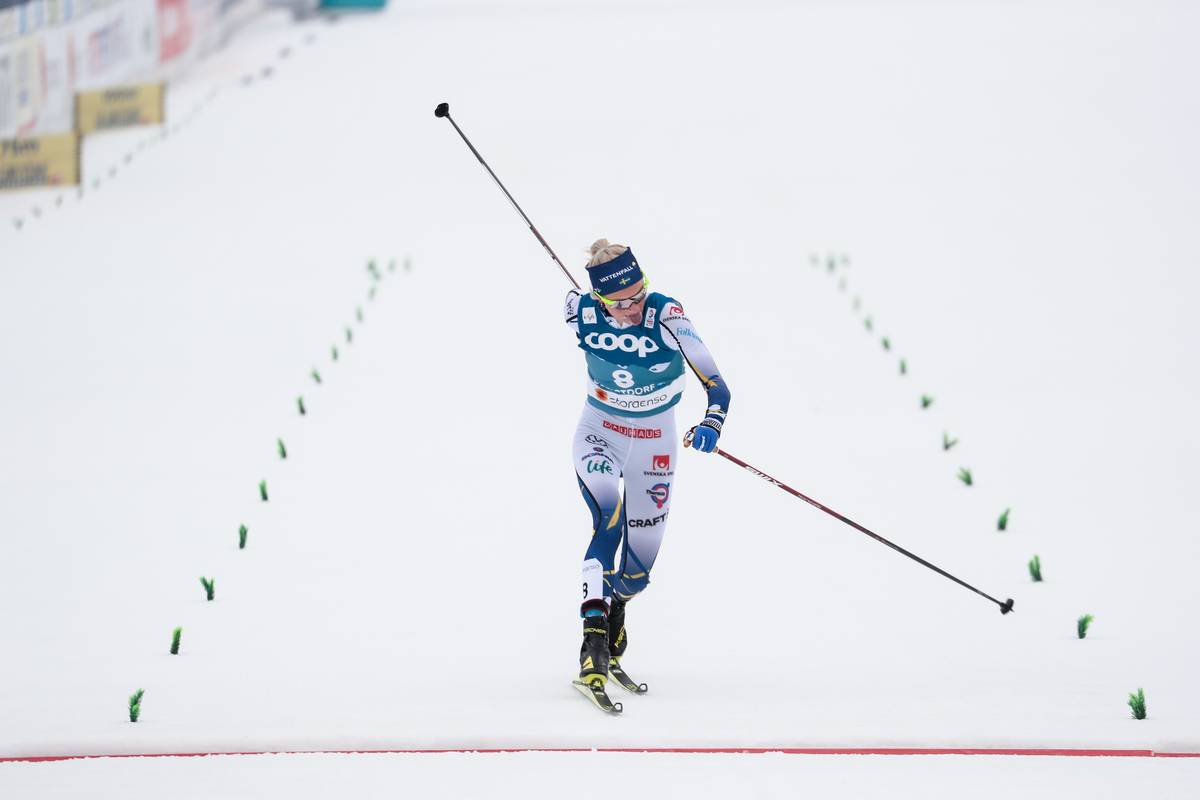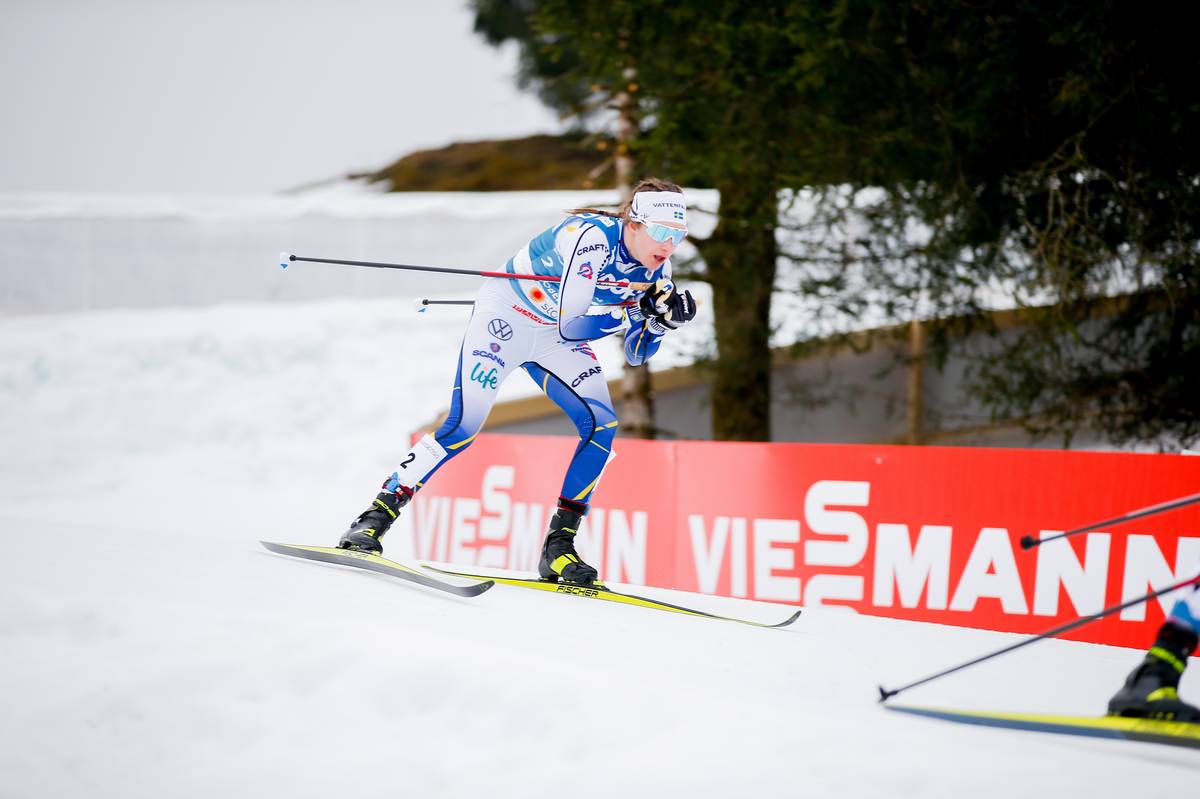
Tag: Theresa Johaug

  • Johaug Dominates 20-k Skiathlon. Diggins Fifth and Back on Overall Podium

    Johaug Dominates 20-k Skiathlon. Diggins Fifth and Back on Overall Podium

    This coverage is made possible through the generous support of Marty and Kathy Hall and A Hall Mark of Excellence Award. To learn more about A Hall Mark of Excellence Award, or to learn how you can support FasterSkier’s coverage, please contact info@fasterskier.com.
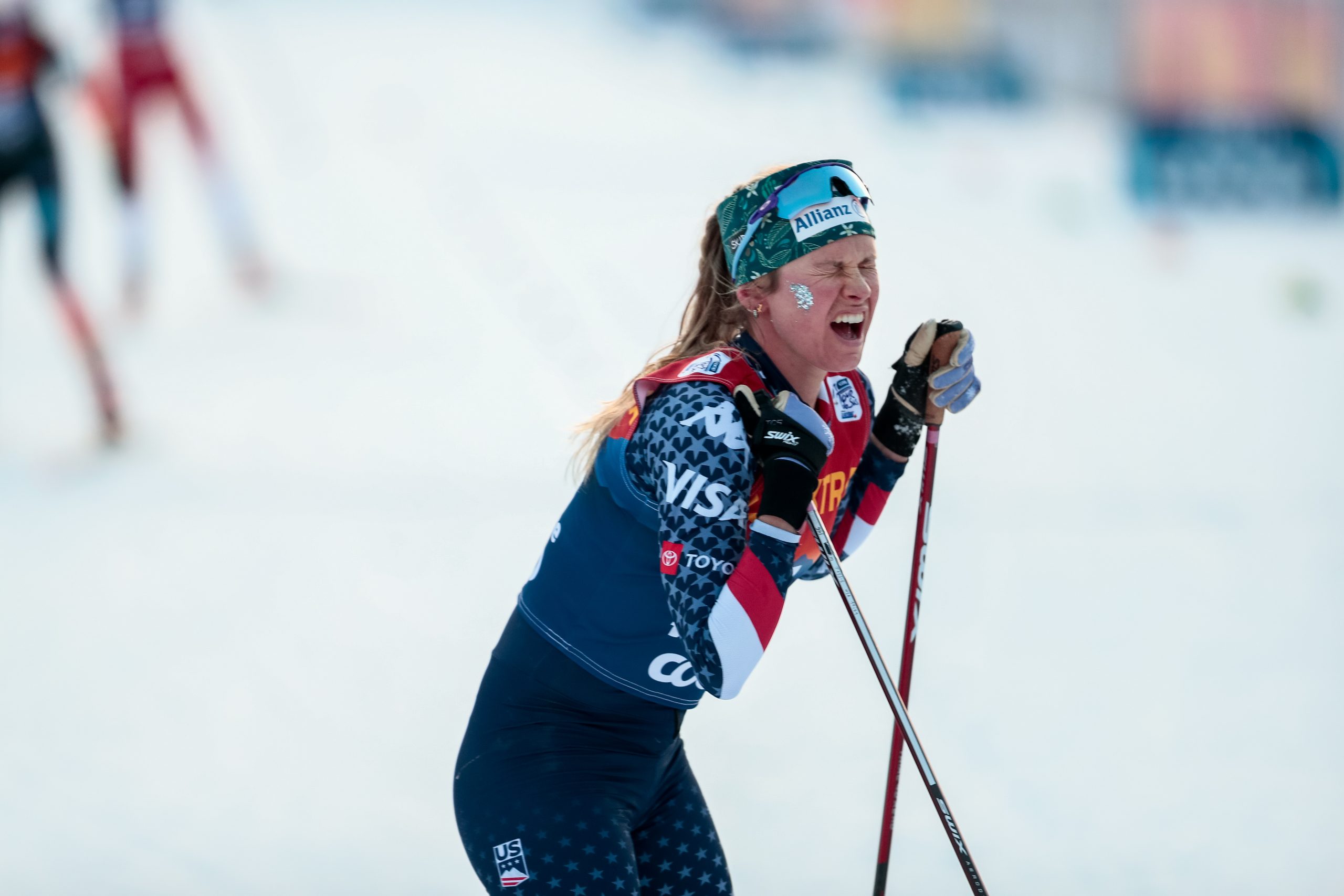
    Jessie Diggins (USA) was able to fight through painful plantar fasciitis to retake an Overall podium position. (Photo: NordicFocus)

    As we enter the second to last event in this year’s Tour de Ski—the 20 kilometer Skiathlon—there has been little movement at the top of the women’s Overall leader board. As the field continued to thin its ranks, yesterday’s Sprint results took on unusual outcomes which simply wouldn’t occur in a regular season World Cup Sprint. In a starting field with only 42 remaining skiers contesting the Sprints, there was an opportunity for more non-Sprinters to find their way into the heats to collect extra time bonuses. Qualifying for the Classic Sprint heats yesterday were Tour contenders Astrid Oeyre Slind (NOR) and Heidi Weng (NOR), with Weng taking a podium. The last time Heidi Weng took a podium in a non-Tour Sprint was in Otepaa, Estonia in 2017. That’s how dramatic the effects of a thinning race field are.

    The thinning of the Tour field continued today. The Tour began with 67 women contesting the first day of racing in Toblach. Today’s start list was down to 36 skiers, and before the race began another three skiers dropped out. If today’s race had been a Sprint, almost everyone would have qualified!

    Going into the race, Slind remained in first place ahead of Johaug but by only 8 seconds, and she was 29 seconds in front of Kerttu Niskanen (SWE). Jessie Diggins—who finished 14th in yesterday’s Classic Sprint— was in fourth place exactly one minute behind Slind and 31 seconds off the podium behind Niskanen. But as is often the case, looks are very deceiving because while Johaug sat in second place, she was really in a commanding position, as the final day of racing on Sunday will be in an event which she has described as being “perfect for her”—the climb up Alpe Cermis.

    For Diggins and the rest to have a real shot at the top of the podium, they would need to put a lot of time into Johaug today to build a substantial cushion before Sunday’s final. A more attainable task for Diggins would be to gain time on Niskanen, who has her own very strong history up Alpe Cermis.
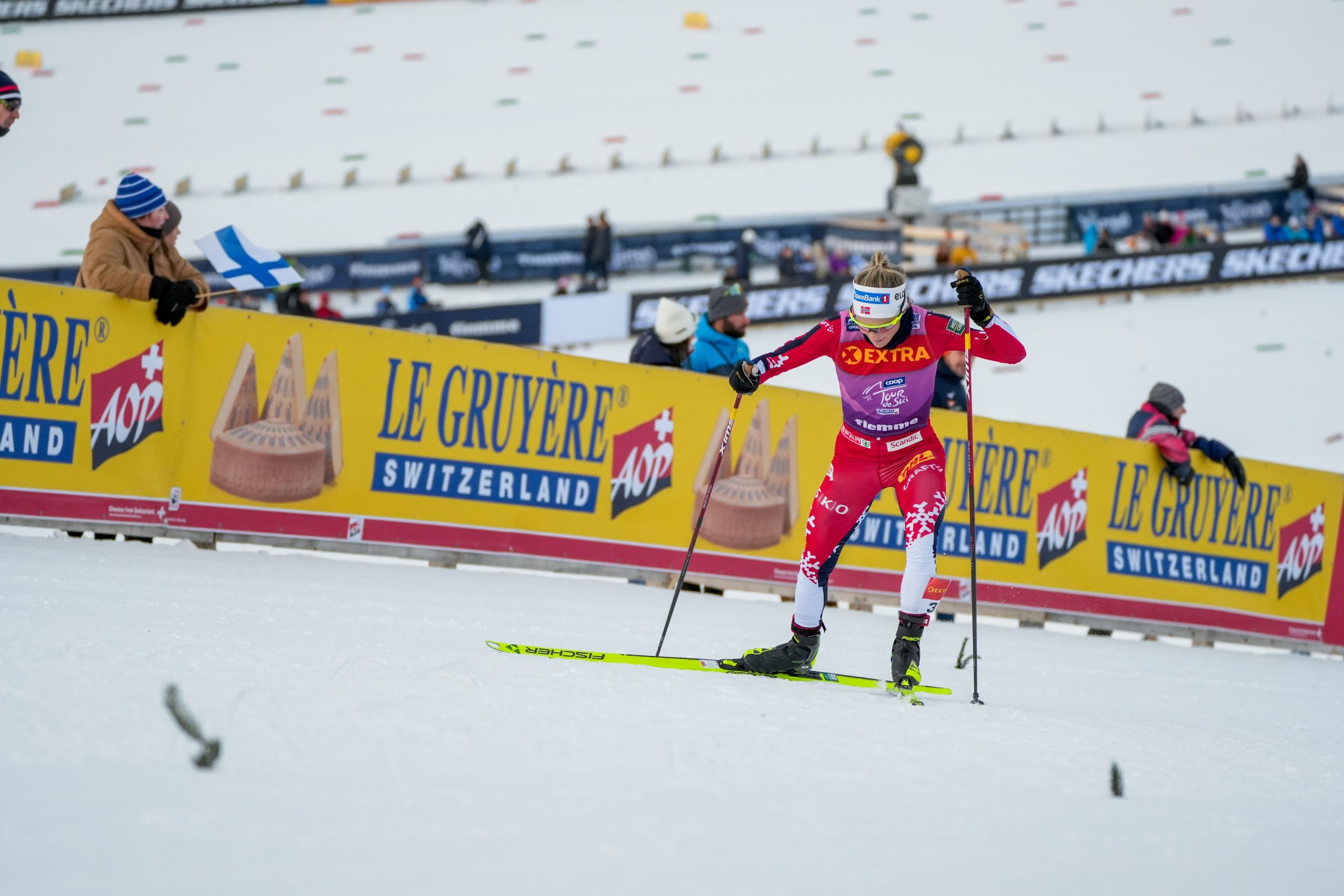
    Therese Johaug (NOR) stayed relaxed in the Classic portion and pushed hard up the hills in the Freestyle to grind down the pack. (Photo: NordicFocus)

    At the race’s end, no one had an answer for Johaug who took the win beating Teresa Stadlober (AUT) and Slind by over thirty seconds. Slind finished third in a dramatic photo finish with Stadlober. The win put Johaug comfortably into the lead by 22 seconds with tomorrow’s climb being the only thing standing between her and a Tour de Ski victory. “It was amazing,” Johaug said after the race. “I need some races in my body, I’m old! Oh my God, it was a tough race. Felt really good in the skating in the beginning, but it was tough in the end. I had to push myself all the way to the finish line. I’m looking forward to Monday and not having to be so nervous anymore.”

    It was revealed that Diggins has been dealing with plantar fasciitis which has been affecting her mostly on the Classic portions of races. But she was able to push through the pain today and do what she needed to reclaim an Overall podium position by finishing 1:11 ahead of Niskanen to put Diggins into third place Overall. “I feel lucky that I’m still racing with what’s happening with my foot right now,” Diggins observed. “It feels like a bonus just to be here. And, maybe sometimes that’s the attitude you need, I’ve got nothing to lose, I’m just going to go out there and go as hard as I can, and be grateful that it’s normal ski racing pain tomorrow, because I can skate. When I walk it’s like I’m practicing for when I’m 95 years old, but when I’m skiing, skating is ok.”

    Entering the last day, the math for Diggins is very simple. After today’s race she is in third place overall, 40 seconds ahead of Niskanen. If she beats Niskanen up Alpe Cermis, or stays within 39 seconds of her, she will secure a place on the podium. She is 1:25 behind Slind for second, and it is probably asking too much for her to make up that much time on the climb to advance in the standings.

    Julia Kern had a career best day of Distance skiing finishing seventh. She credited her achievement to her team. “Hats off hands down to the wax techs. Our team did an incredible job today. I had amazing kicking skis, bullet proof kick, and they were ripping fast both in Classic and in Skate. I was so stoked in the race, I had incredible skis and that’s always an extra confidence boost. It helps with skiing tactically, maybe conserving a little on the climb knowing you’ll catch people on the down hill. That was huge.” But not all the credit goes to the people who gave her fast skis. “I also just surprised myself this morning feeling really good, and I feel like the Tour is such a roller coaster, you never know what you’re going to get on any given day. My body was there, and my skis were there, and I just took advantage of the opportunity today.

    Sophia Laukli was the only other American finisher, she was 20th. Laukli won the final stage up Alpe Cermis last year, but that was without Johaug in the field. Tomorrow promises to be an exciting race to see if Johaug can hold off the American upstart up Alpe Cermis.

    The top Canadian finisher was Katherine Stewart-Jones in 15th, she was followed by Liliane Gagnon in 29th.

    The Women’s 20 Kilometer Skiathlon

    The women began the Skiathlon with the 10 kilometer Classic portion. Slind, Johaug and Nadine Faehndrich (SUI) went to the front of the race early with Niskanen and Jasmi Joensuu (FIN) right with them. Joensuu and Faehndrich were competing for the Sprint bib, so they surged to the front when the first Sprint bonus point was available at 3.3 kilometers. Faehndrich and Joensuu raced to the bonus line together with Faehndrich narrowly beating out Joensuu.

    After the Sprint bonus, the Overall leaders quickly re-established themselves at the front with Johaug and Slind setting the pace. Johaug revealed after the race that she had a specific strategy for the Classic portion. “In the Classic I tried to focus on technique and not push so much until the last lap.” The two Norwegians were joined by veteran Krista Parmakoski (FIN) and Teresa Stadlober (AUT). When the pack hit the 4.6 kilometer mark a bit of a breakaway had formed with Johaug, Slind, Parmakoski, Stadlober, and Ebba Andersson (SWE) forming a lead group.

    Diggins was now skiing in a chase group with Niskanen and H. Weng. It was somewhat surprising that Niskanen wasn’t in the lead group during the Classic portion of the race, but it was good news for Diggins who could now keep an eye on her podium competition.

    At 6.8 kilometers the lead group of five was still intact with Parmakoski now struggling to stay with them, but Diggins had now moved to the front of her chase group along with Niskanen and they were trying to bridge the gap.
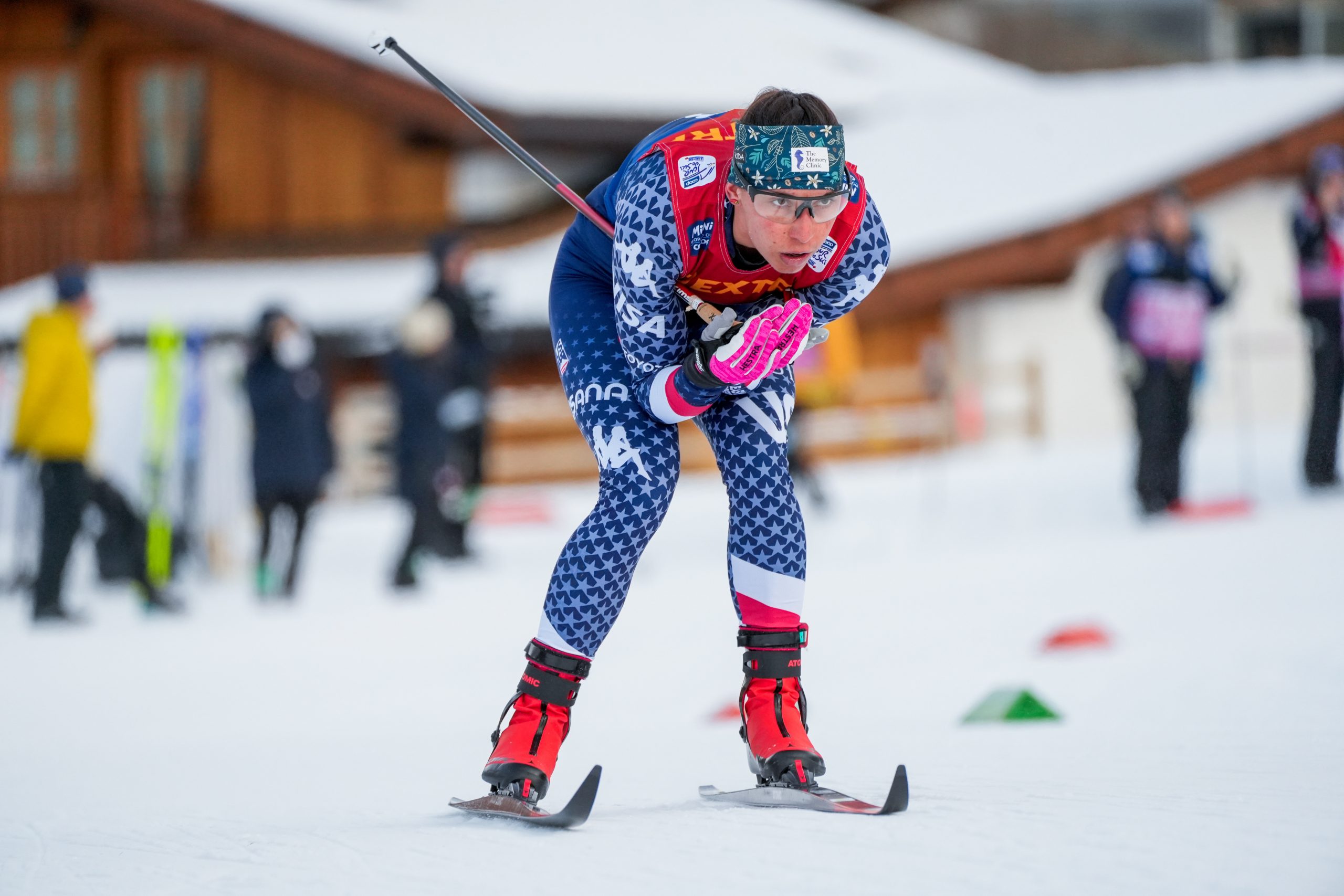
    Julia Kern (USA) had a career best Distance day. (Photo: NordicFocus)

    When the lead pack hit the eight kilometer mark Johaug continued to press the pace and dropped Parmakoski. The lead group was now down to Johaug, Andersson, Slind and Stadlober. Diggins had not been able to close the gap and now had drifted back over 28 seconds behind the leaders, but she was now skiing with her teammate Julia Kern. Kern’s presence in the top ten of the Classic portion of the race was a bit of a surprise, and she would continue to ski well the entire day.

    As the skiers entered the stadium for the ski exchange the lead group of four was still together 28 seconds ahead of Parmakoski with Diggins 34 seconds behind. After the ski exchange Diggins was 37 seconds back and faced the unenviable task of trying to gain ground on the lead group in the Freestyle portion of the race. But the good news for Diggins was that Niskanen was right in front of her, only four seconds ahead, and Diggins had her strongest portion of the race ahead of her, while Niskanen’s was behind her.

    But it was still Johaug setting the pace at the front trying to grind down the other three racers in her group. While Johaug was grinding, Diggins was closing on Niskanen and by the 11.2 kilometer mark she had managed to pass Niskanen who tried to hang onto Diggins’ coattails as Diggins passed her, but Niskanen didn’t have it in her.
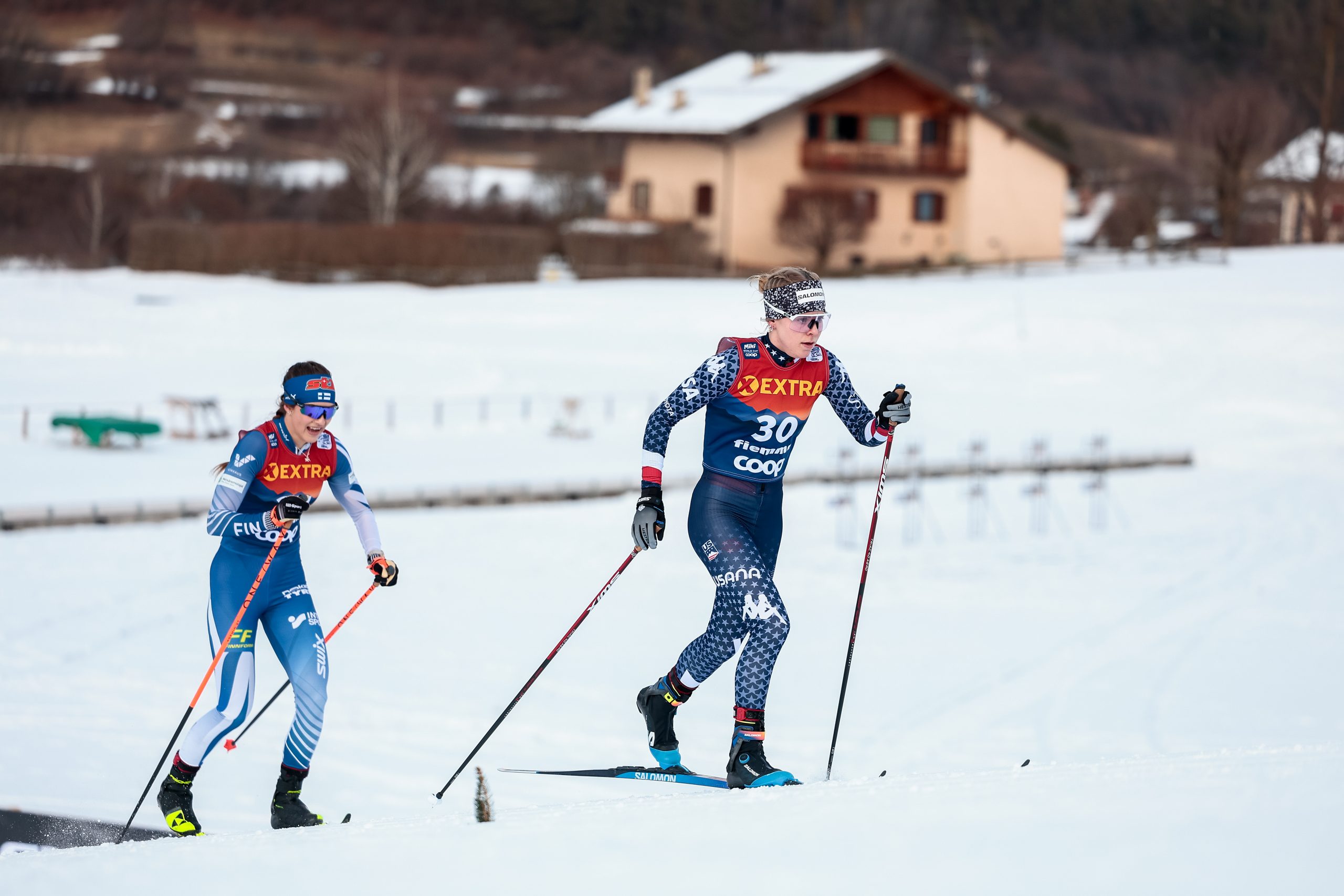
    Sophia Laukli (USA) finished 20th going into her specialty tomorrow, the climb up Alpe Cermis (Photo: NordicFocus)

    As the lead group hit the 12.6 kilometer mark, Johaug made a concerted effort to press the pace up the steep hills. Doubtlessly, she didn’t want the race to come down to a sprint finish, and she began to edge away from Andersson, Slind, and Stadlober, slowly but surely beginning to create a growing gap with each passing kilometer. Diggins was now 45 seconds back of the leader but had put nine seconds between herself and Niskanen and continued to stretch her lead.

    Johaug continued to pull away from her three chasers who didn’t appear to have an answer on the steep climbs, but were able to pull back a little time on the flat sections. Slind led the chasers, but no one could match Johaug up the hills and by the 14.6 kilometer mark Johaug had extended her lead to 13.9 seconds. It then appeared that Slind, Andersson, and Stadlober capitulated the race to Johaug and were now fighting for second. Meanwhile, Diggins was now skiing on her own having put 27 seconds on Niskanen but was 56 seconds behind the lead pack. However, if Diggins continued this pace, she would regain a podium spot at the end of the day. Diggins didn’t mind skiing on her own. “With all these down hills, I kind of preferred it. Because you never know what can happen, and I’m thinking the last thing I need on top of this foot injury is to crash. I actually appreciated having my own space.”
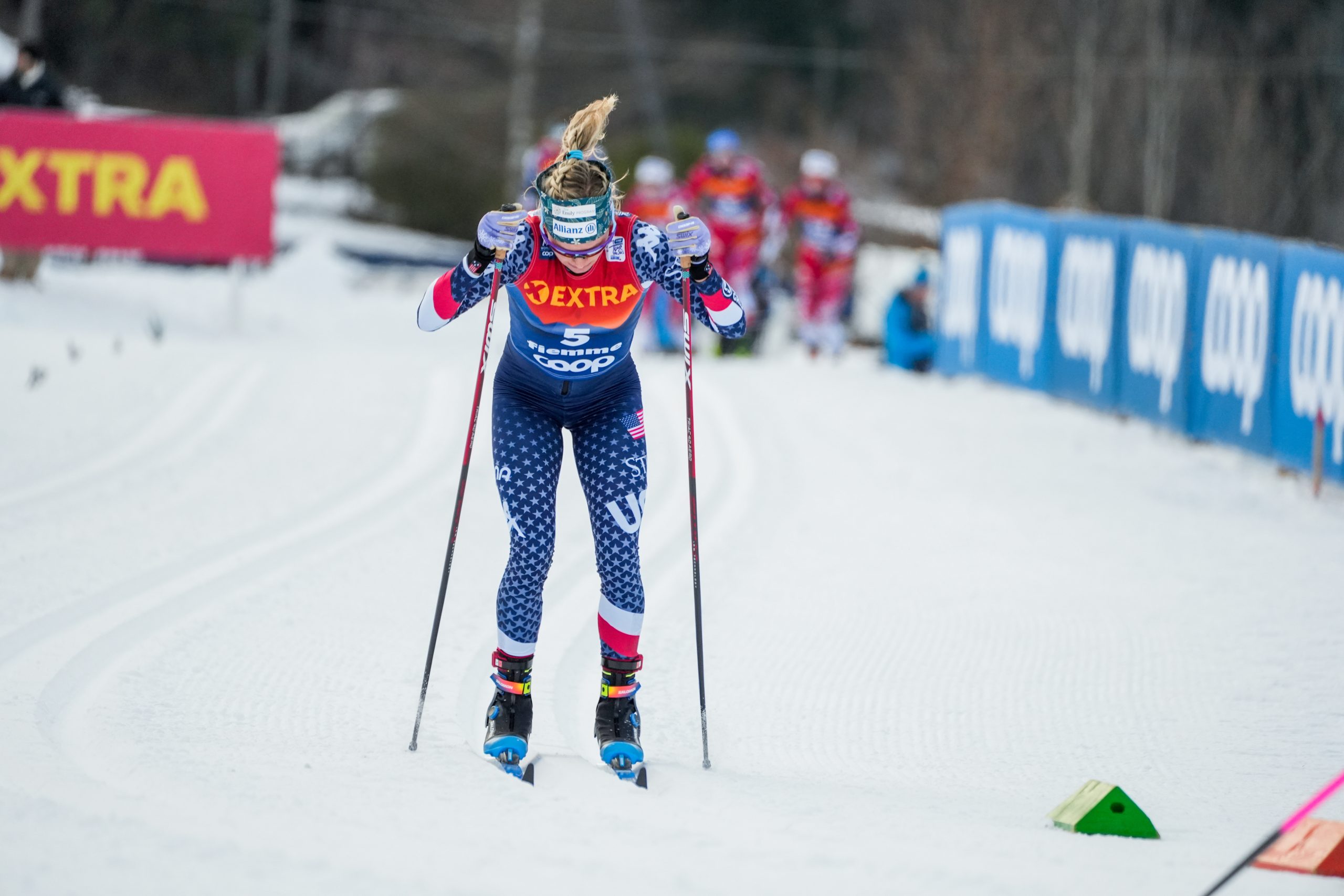
    Jessie Diggins (USA) did what she needed to today to regain an Overall podium spot. (Photo: NordicFocus)

    Johaug continued to grind, and at 18 kilometers the writing was on the wall as none of the chasers could mount any response. As long as Johaug could stay on her feet, she would take the day’s win and put herself into the Overall lead. The good news for Diggins was that as the race currently stood, she was back on the Overall podium having put 54 seconds into Niskanen so far and continued to pull away from the Finn.

    As Johaug approached the stadium her lead had swelled to over 30 seconds, while Andersson, Stadlober, and Slind still skied together. Stadlober lead the trio into the stadium and a hectic three way sprint to the finish line ensued resulting in a photo finish. Stadlober ended up edging out Slind by a toe length with Andersson finishing fourth and Diggins finishing fifth, 55 seconds behind the leader, but more importantly 1:11 ahead of Niskanen putting Diggins in a great position to find the podium after tomorrow’s race.

    Julia Kern finished seventh turning in a career best performance for a Distance race.

    The day’s results put Johaug into the Overall lead with the only remaining stage being one of her best, the climb up Alpe Cermis.
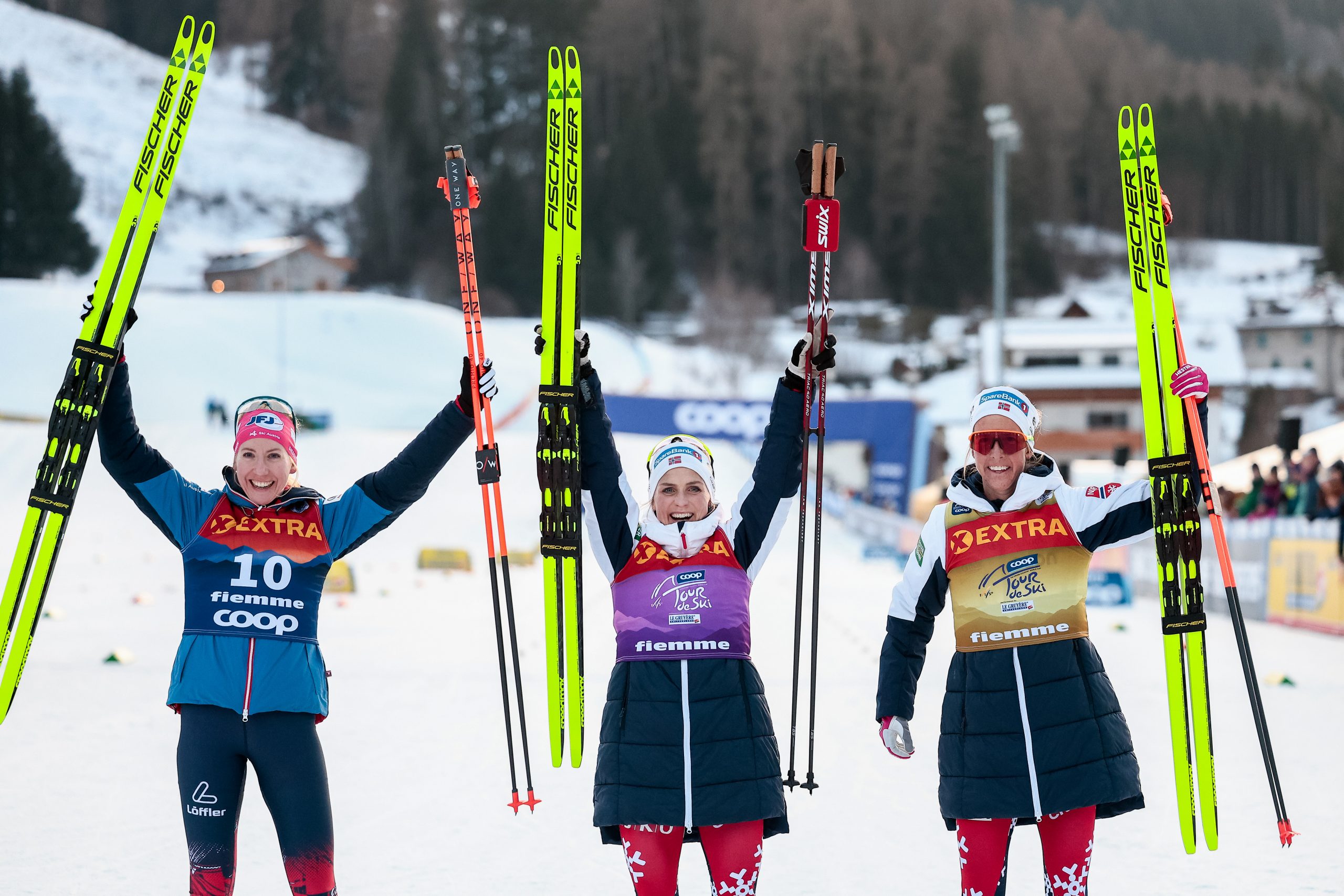
    Teresa Stadlober (AUT), Therese Johaug (NOR), Astrid Oeyre Slind (NOR), (l-r)

    Tour de Ski Women’s Skiathlon Results

    Tour de Ski Overall Standings


  • World Cup Season Opens in Ruka: Johaug Returns but Karlsson Flies

    World Cup Season Opens in Ruka: Johaug Returns but Karlsson Flies

    This coverage is made possible through the generous support of Marty and Kathy Hall and A Hall Mark of Excellence Award. To learn more about A Hall Mark of Excellence Award, or to learn how you can support FasterSkier’s coverage, please contact info@fasterskier.com.

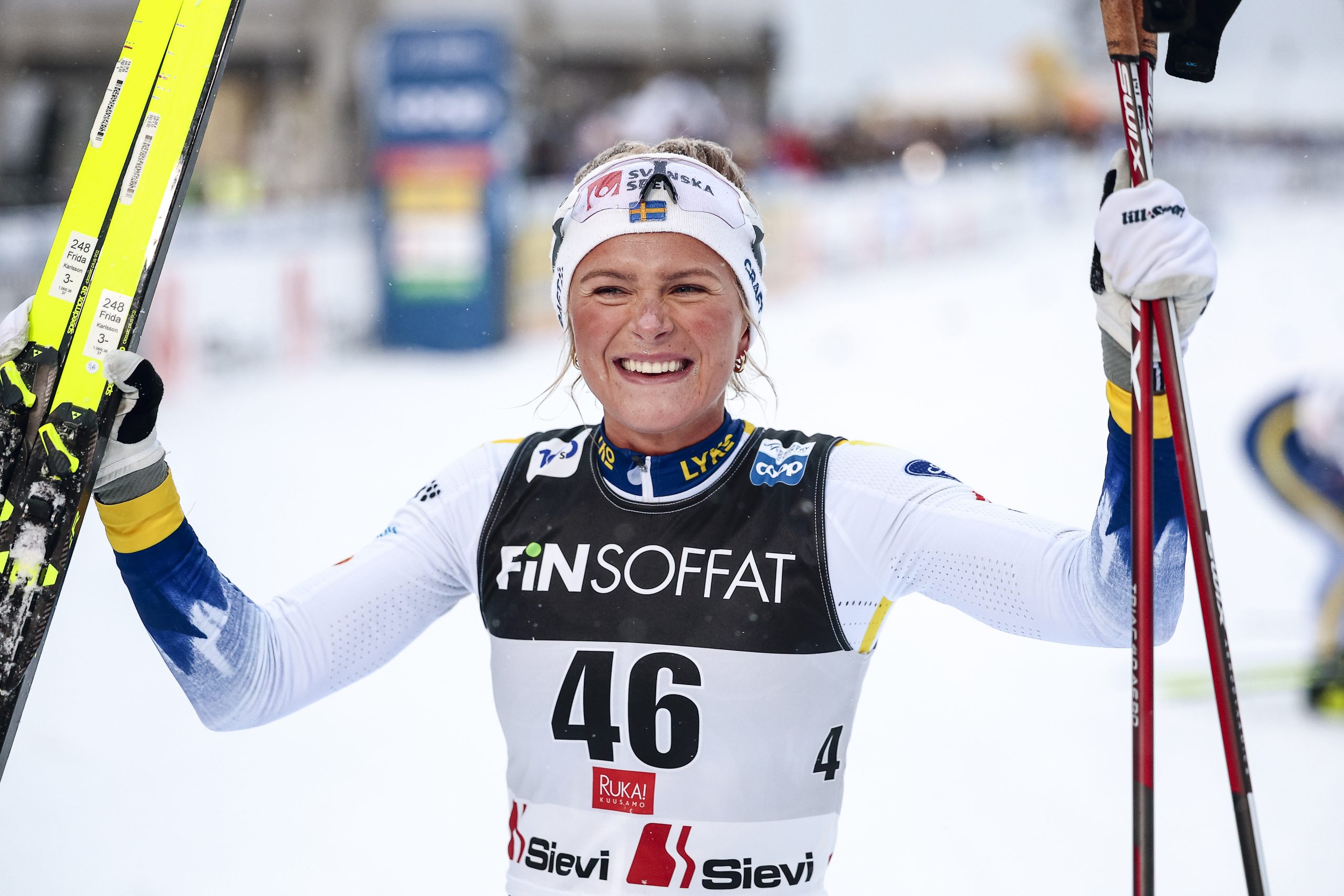
    Frida Karlsson (SWE) exults in the finish area after her dominant victory in the Women’s 10 k Classic Interval Start in Ruka, Finland. The World Cup season has begun, and Therese Johaug (NOR) has returned. But all eyes are likely to remain fixed on Karlsson. (Photo: NordicFocus)

    It’s been two full seasons since Therese Johaug last toed a starting line in a FIS World Cup distance event. In that time, the field has been able to convince itself that they were the best in the world. But Johaug has been lingering in the background all along—having a life, having a daughter, writing books, creating fashion empires—just waiting for the chance to come back to international competition. On Friday in Ruka, Finland, her long wait came to an end.

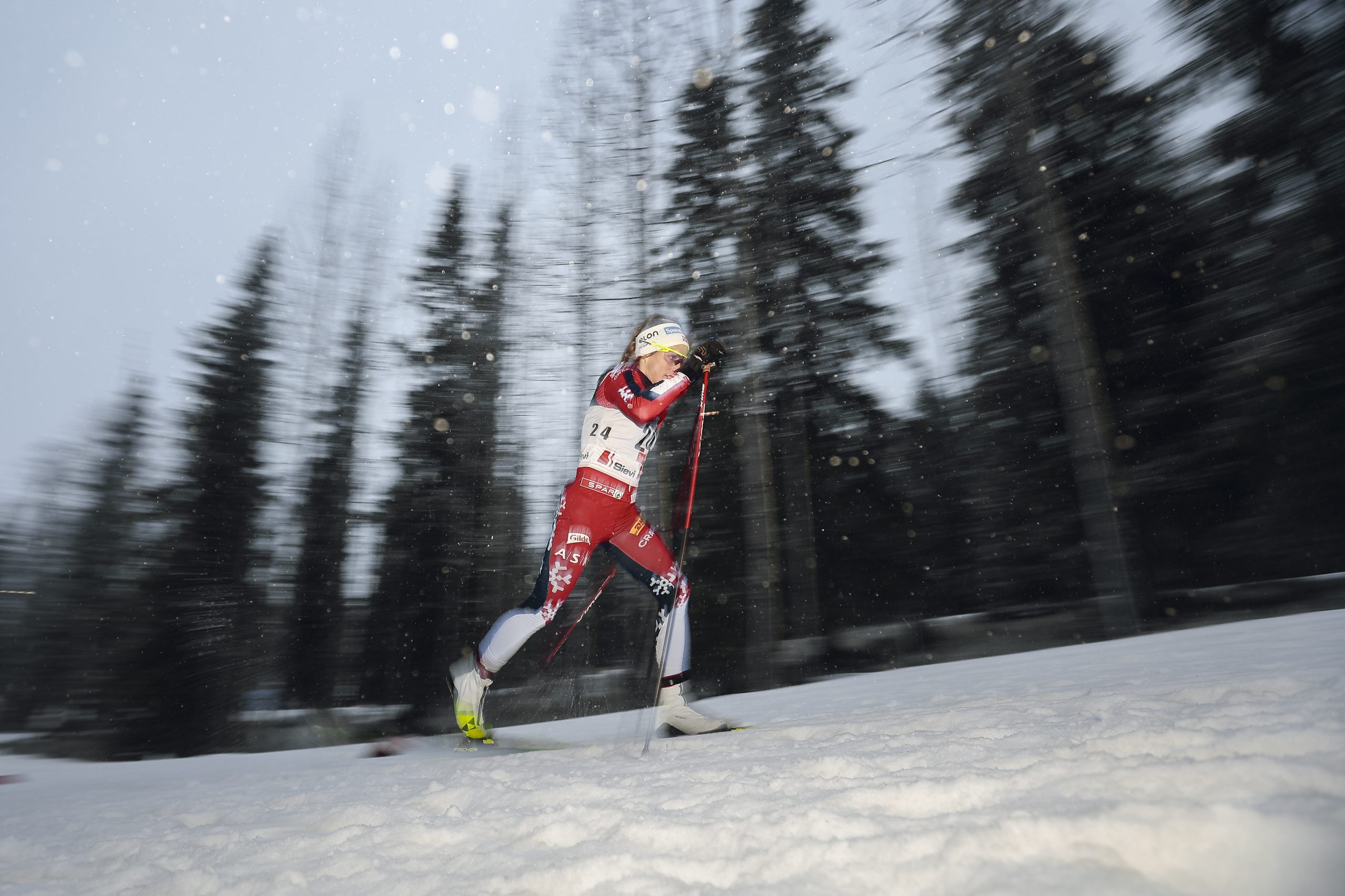
    Therese Johaug (NOR) on her way to a brilliant second place finish in the Ruka 10 k Classic. Only Sweden’s Frida Karlsson was faster. (Photo: NordicFocus)

    Therese Johaug (NOR) navigating a racecourse in full flight is an awesome sight to behold. Her competitive mode is flat-out intensity, un-stoppable momentum, wind-up-toy tempo. It looks for all the world like her only strategy is “go!” That degree of competitive abandon defined Johaug’s historic career, one in which she earned 82 World Cup wins, six Olympic medals, and 14 World Championships. Toward the end of Johaug’s storied career, a young Swedish challenger arrived on the scene: Frida Karlsson (SWE) showed unique abilities and a penchant for emulating Johaug’s style: high tempo, light touch, fearless pacing. Today in Ruka, Karlsson was the only athlete who could match Johaug; the only athlete who could better her. In the end, Karlsson snatched the fairytale ending from Johaug’s comeback story (at least for the moment), racing to victory by a shockingly large margin.

    “Maybe my best race ever,” said Karlsson in postrace interviews. “I felt really good.”

    Karlsson had her 2024 season interrupted by illness and injury—and a summer season in which she struggled with foot problems—but evidently her preparation has gone according to plan as she dominated Ruka’s 10 k Classic course like few before her ever have. Perhaps only Johaug . . .

    Ten kilometers after her first start in more than two years, the Nordic skiing world was reminded of Johaug’s grit, determination, fitness, and talent. She ultimately crossed the line with a large lead, only to see it evaporate into the Arctic sky with every new split recorded by Karlsson. In the end, Karlsson triumphed over Johaug by more than 45 seconds, with Astrid Oyre Slind (NOR) finishing third, another 7.5 seconds behind.

    Jessie Diggins (USA) raced to seventh place in Ruka, an improvement over her finish of a year ago when she ultimately claimed the FIS Overall World Cup. (Photo: NordicFocus)

    Jessie Diggins (USA) is the reigning World Cup Overall Champion, a distinction that also increases the number of her teammates allowed to enter World Cup races. In Ruka, eight American women raced the 10 k, with two finishing in the top ten. Behind Diggins steady 7th place (an improvement on her Ruka finish of a year ago), American finishers included Rosie Brennan (9th), Sophia Laukli (31st), Alayna Sonnesyn (48th), Julia Kern (49th), Sydney Palmer-Leger (56th), Haley Brewster (57th)

    Canadian finishers included Katherine Stewart-Jones (42nd) and Liliane Gagnon (46th)

    “Before I look at the results, I look back on the race,” Diggins continued. “How did it go? How did I communicate with my tech about my skis? Did I ask for what I needed? How’d the warmup go? How’d the race go: mentally, tactically, technique-wise, racing-wise? Then I come up with my scoring for myself before I look at the results. Today I was really really proud of all those categories, able to push really hard and stay very technique-focused.”

    Women’s 10 k Classic Interval Start

    November is the time of year when skiers wish for snow. Regrettably, those snow-wishes aren’t always granted, and November is often a month of roller ski pole tips clacking and slipping on near-frozen asphalt roadways. This year, though, the hills and trails appear different: Snow has arrived. The Central Rockies got totally dumped on this week—cars and trucks skidding and colliding up and down Vail Pass. New England finally got the Thanksgiving nor’easter that ski areas hope for every season. Now if they can just arrange another one for Christmas, then a couple more for President’s Day and Spring Break. Western Canada is blanketed in snow; Silverstar, BC is hosting camps for those programs savvy enough to plan early.

    The International Ski Federation (FIS) doesn’t take chances when scheduling season openers. For many seasons, the first World Cup stop has been in Ruka, Finland (25 kilometers north of the Arctic Circle). It may only be November, but skiers are pretty sure to find snow in Ruka.

    Skiers are also likely to find challenging conditions on Ruka’s Classic course that is designed to test the best athletes.

    “Both up and down, (Ruka) is very technical, said Diggins. “Very steep hills, and you need really dialed-in technique in order to run them. You also have to be able to transition in and out of herringbone really well. I’m still getting there, and I have more that I want to do. It’s exciting to feel like all that hard work is sinking in.”

    The first World Cup of the season—the Women’s 10 k Classic Interval Start—was raced in fresh snow with temperatures hovering around minus 2 centigrade. Conditions would be slower and more challenging than most athletes might’ve liked for the first test of the season, and many athletes lacked the snap typically seen in World Cup Classic races. The snow dragged at their skis, the hills sapped their energy. In the near-constant twilight of Arctic winter, racers struggled to find the form and rhythm that they’d refined all through the summer training season.

    It’s been two full seasons since the skiing world watched Therese Johaug (NOR) race. Ruka’s 10 k Classic was a reminder of her long and excellent career, and of the potential she still possesses with the Trondheim World Championships looming on the Norwegian horizon. (Photo: NordicFocus)

    Now 36 years old, Johaug had retired after the 2021-2022 season. The day’s 24th starter in Ruka, Johaug was seeking her 83rd World Cup victory. She departed the stadium in her usual staccato style, attacking a familiar course that has delivered victories for her many times before. Johaug was seen to be exiting the tracks in search of greater kick on the challenging uphills (as were many of her Norwegian teammates). Nevertheless, she established large leads at all her early splits.

    Other contenders (Diggins, Slind, Weng, Andersson) would match or better Johaug’s early splits, but ultimately each of her rivals faded . . . except for Karlsson. She stormed on through the Finnish forest, increasing her lead at each juncture. In a field of world class skiers who seemed generally to struggle with the day’s conditions, Karlsson appeared the lightest, most energetic, most efficient on her skis. Rarely out of the tracks, she was able to attack where others needed to measure their efforts.

    At the midway point, fast times had been turned in by Karlsson, Slind, and Katharina Hennig (GER) who were all positioned ahead of Johaug. Diggins hovered in fifth, just ahead of Heidi Weng (NOR). But only Karlsson and Johaug were able to maintain their technique—and their momentum—all the way to the end. Slind raced bravely as well, recovering her technique near the end to finish a strong third.

    “I think I went out a little hard,” Diggins confessed after the race. “I don’t necessarily regret it; sometimes you gotta go big and see what happens. But I think I was folding a little bit in my technique on that second lap.

    So, the 2024-2025 World Cup season is underway. Many weekends and many races lie ahead, and much will transpire before the FIS World Championships in Trondheim. Those races are what Therese Johaug identified as her goal event for the season, a week of racing that Frida Karlsson is likely to have circled on her calendar, as well.

    RESULTS: Women’s 10 k Classic Interval Start

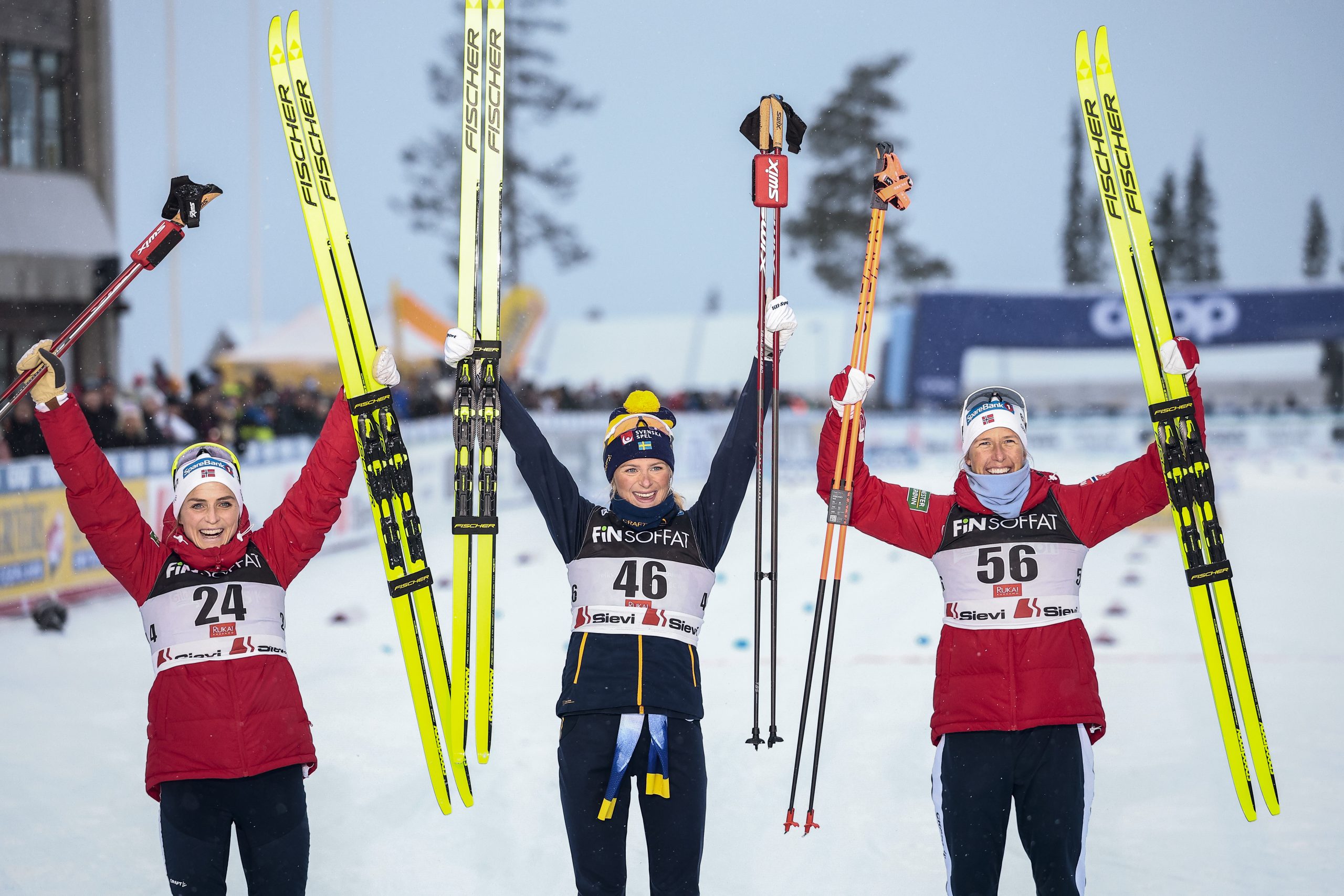
    First podium of the World Cup season: Therese Johaug (NOR), Frida Karlsson (SWE), and Astrid Oyre-Slind (NOR) celebrate on the podium in Ruka. (Photo: NordicFocus)
    First podium of the World Cup season: Therese Johaug (NOR), Frida Karlsson (SWE), and Astrid Oyre-Slind (NOR) celebrate on the podium in Ruka. (Photo: NordicFocus)
  • Johaug Breaks Away for the Skiathlon Win; Diggins 15th

    Johaug Breaks Away for the Skiathlon Win; Diggins 15th

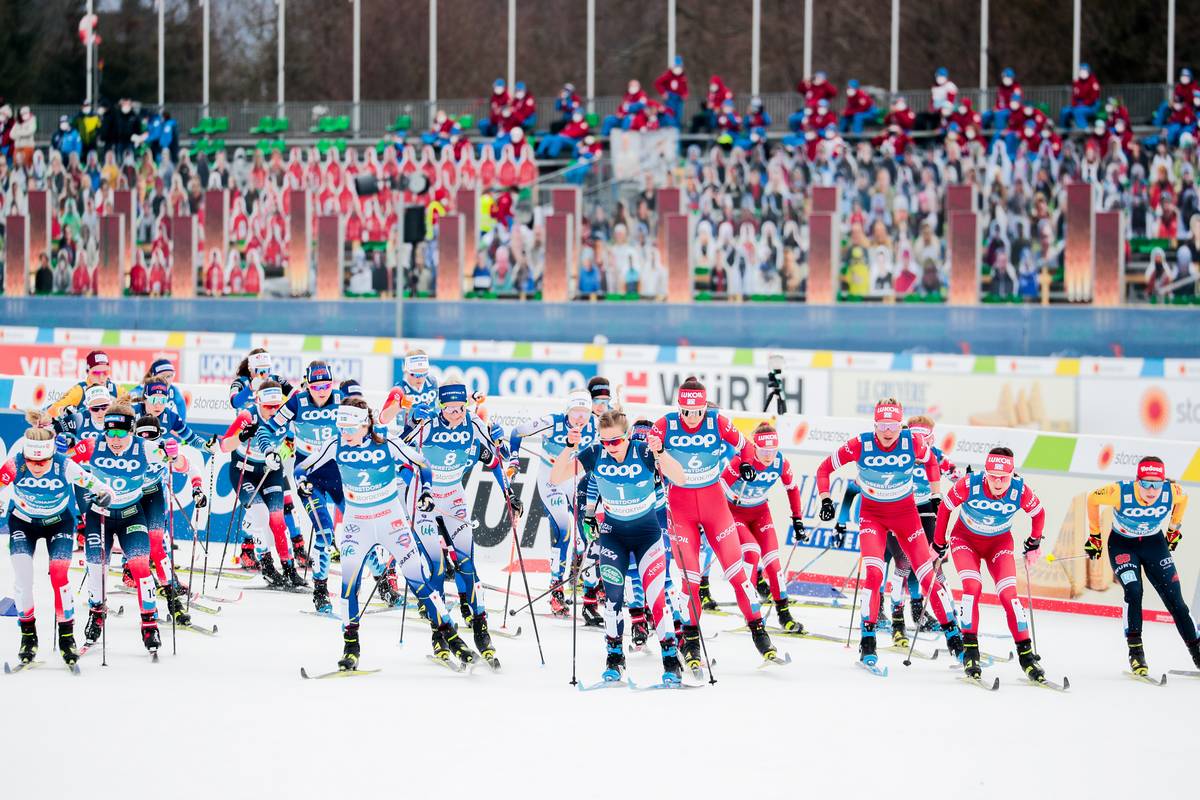
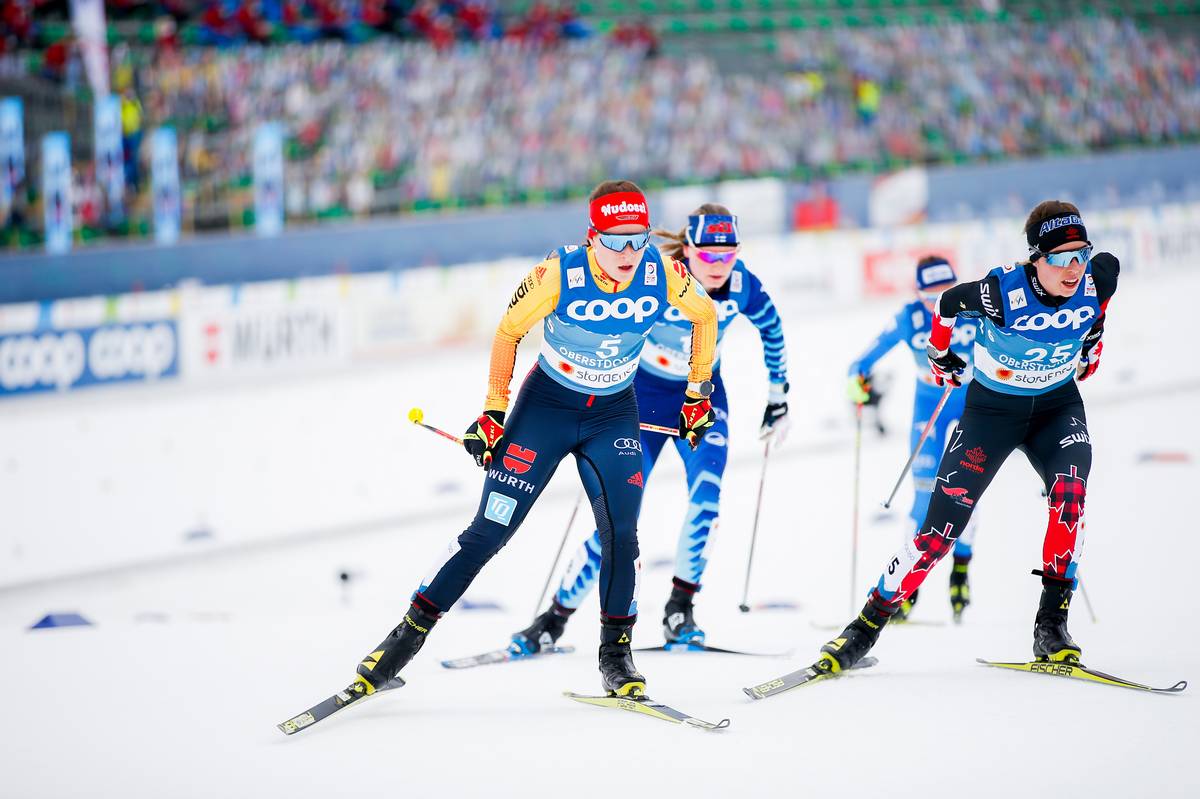
    Cut-out fans and cut-off shirtsleeves for the start of the 15 k skiathlon in Obertsdorf Germany (Photo: Nordic Focus)

    This World Championship coverage is made possible through the generous support of Marty and Kathy Hall and their A Hall Mark of Excellence Award. To learn more about A Hall Mark of Excellence Award or to learn how you can support FasterSkier’s coverage please contact info@fasterskier.com.

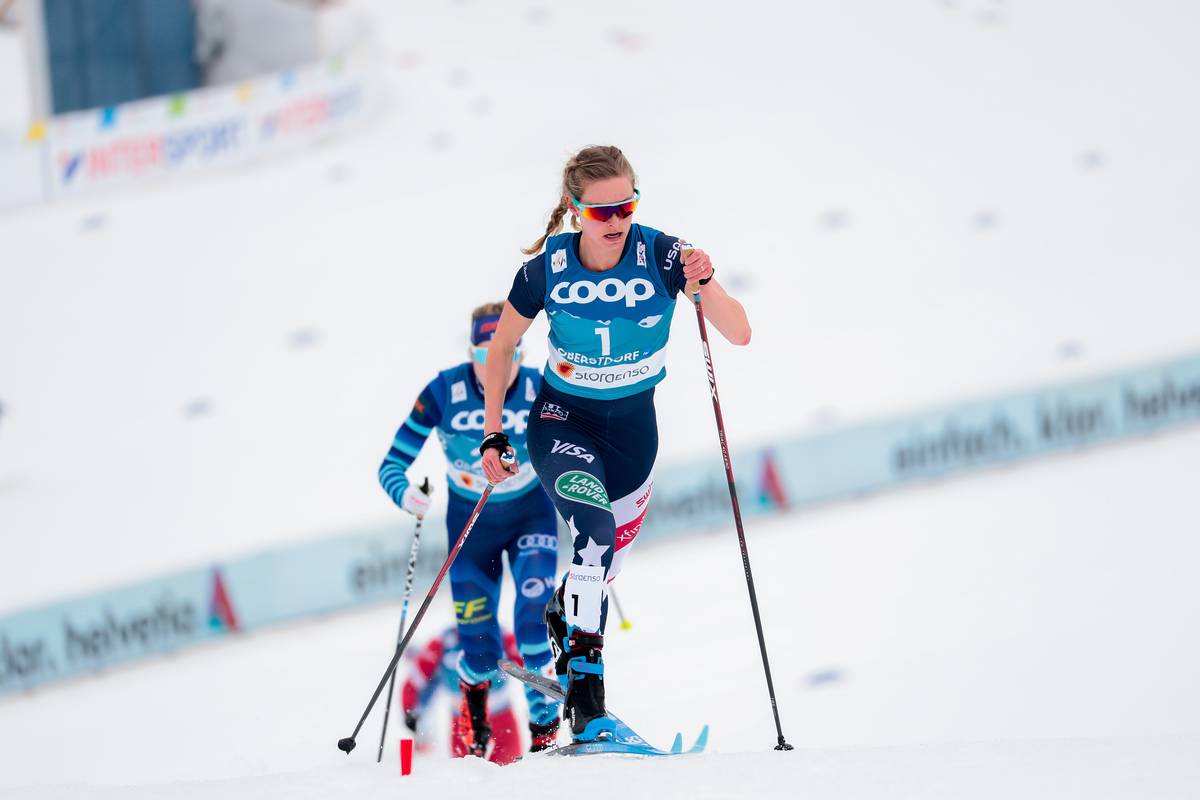
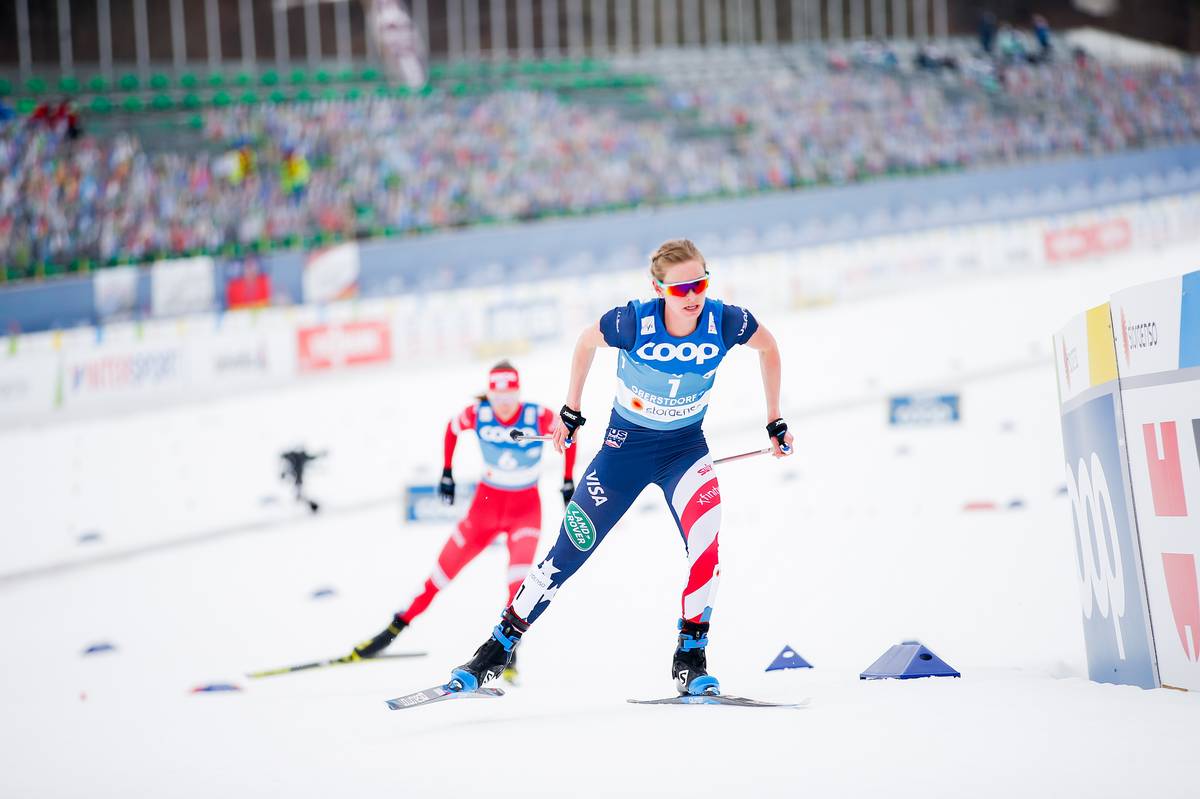
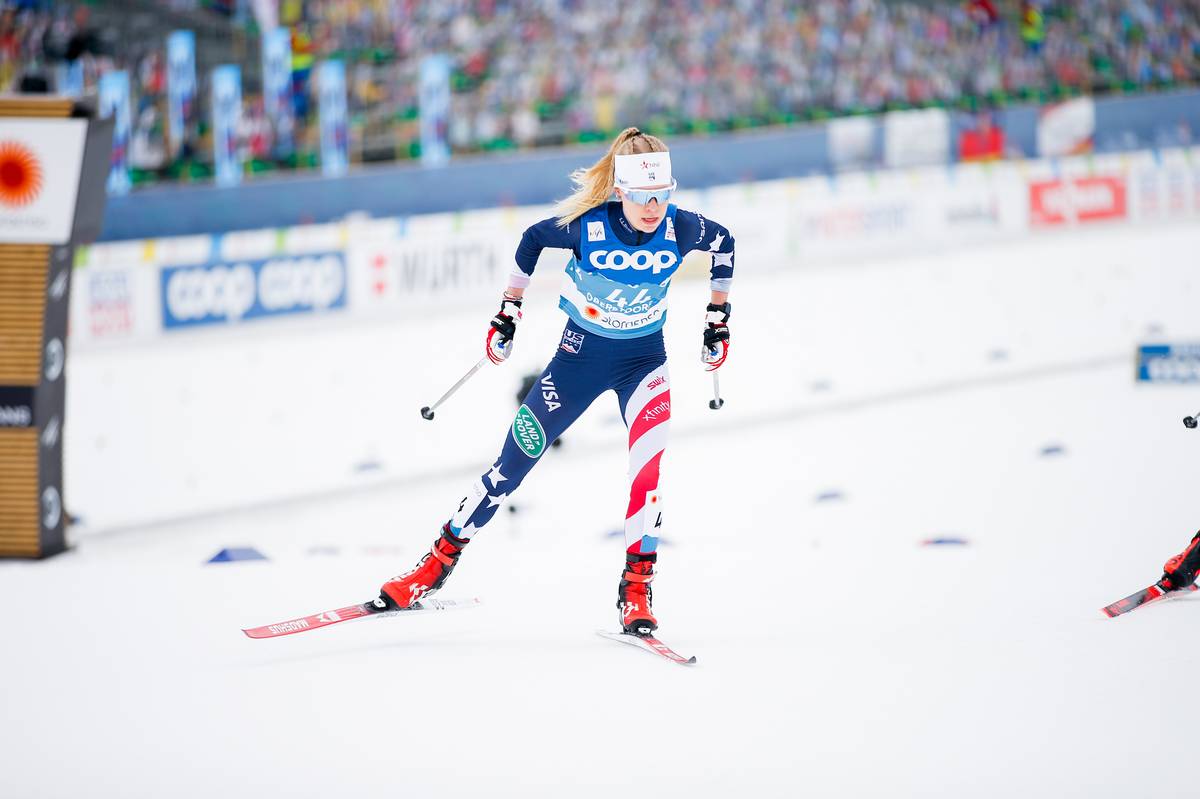
    Overcast skies greeted the skiers as they lined up for a 15 k skiathlon Saturday morning, the second World Championship event in Oberstdorf, Germany. Despite temperatures hovering around 37°F, the tracks were firm and fast, the course consisting of two classic laps of a 3.75 k loop and two skate laps of a different 3.75 k loop. Sixty women started the competition though with a few athletes getting lapped, the finishers numbered 56. With little fanfare in an otherwise stark ski course during the pandemic, Therese Johaug of Norway was the show. At the end of the day, Johaug once again topped the podium in a time of 38:35.5, though this wasn’t purely a given early in classic leg. 

    Theresa Johaug (NOR) fighting hard from the gun. (Photo: Nordic Focus)

    Immediately off the line, Johaug was at the front, pushing the pace. Two young Swedes, Ebba Andersson and Frida Karlsson weren’t about to let her take off and stuck to her like glue. As the three skiers descended towards the stadium at the end of the first lap on a ribbon of white snow through bare brown fields, it looked as if the top three had already been decided. Exiting a sharp right-hand corner Johaug’s skis slid out into Karlsson and both skiers went down. Andersson capitalized on the moment to take the lead. Righting herself, Johaug rebounded quickly. Karlsson, however, ended up with a broken pole and compounded with a botched hand-off to receive a replacement, she found herself +17.5 seconds down to the leaders. 

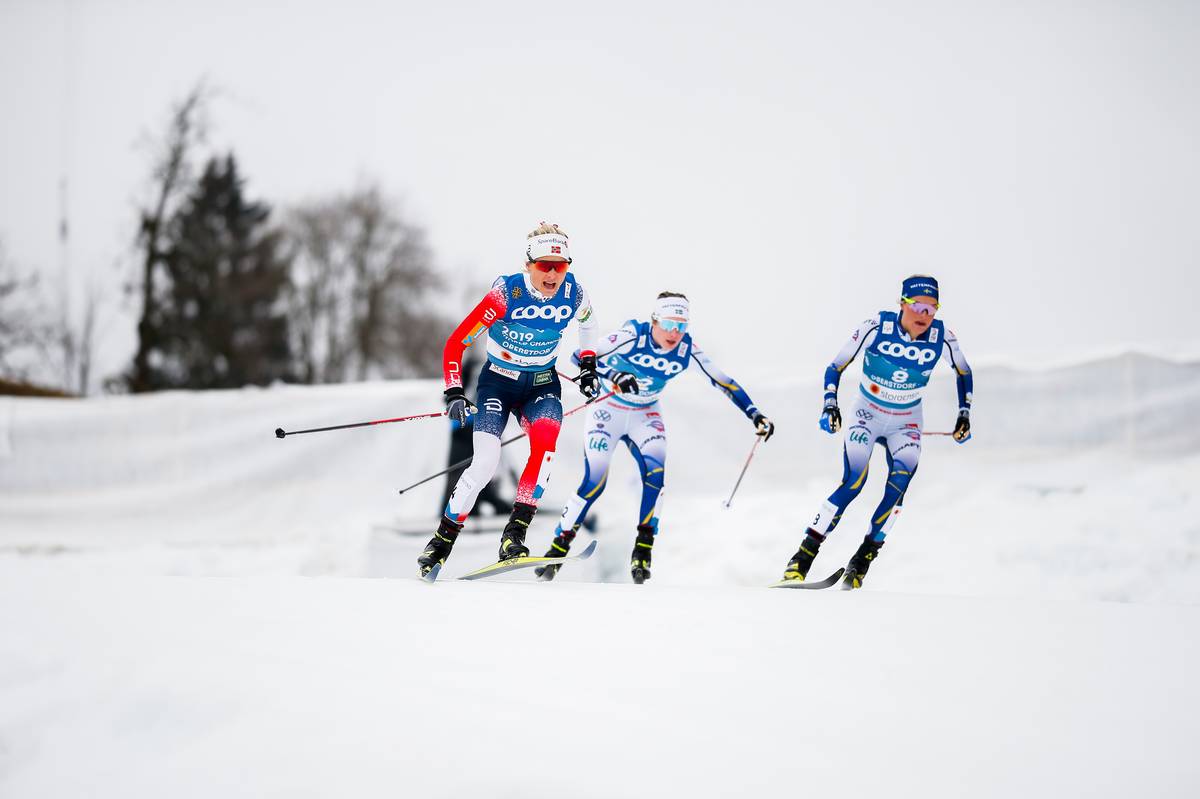
    Johaug (NOR), Andersson (SWE) and Karlsson (SWE), cornering tightly. (Photo: Nordic Focus)

    At the 5 k mark, Karlsson had clawed back a few seconds and was +13 behind Johaug, Andersson, and Tatiana Sorina representing the Russian Ski Federation. 

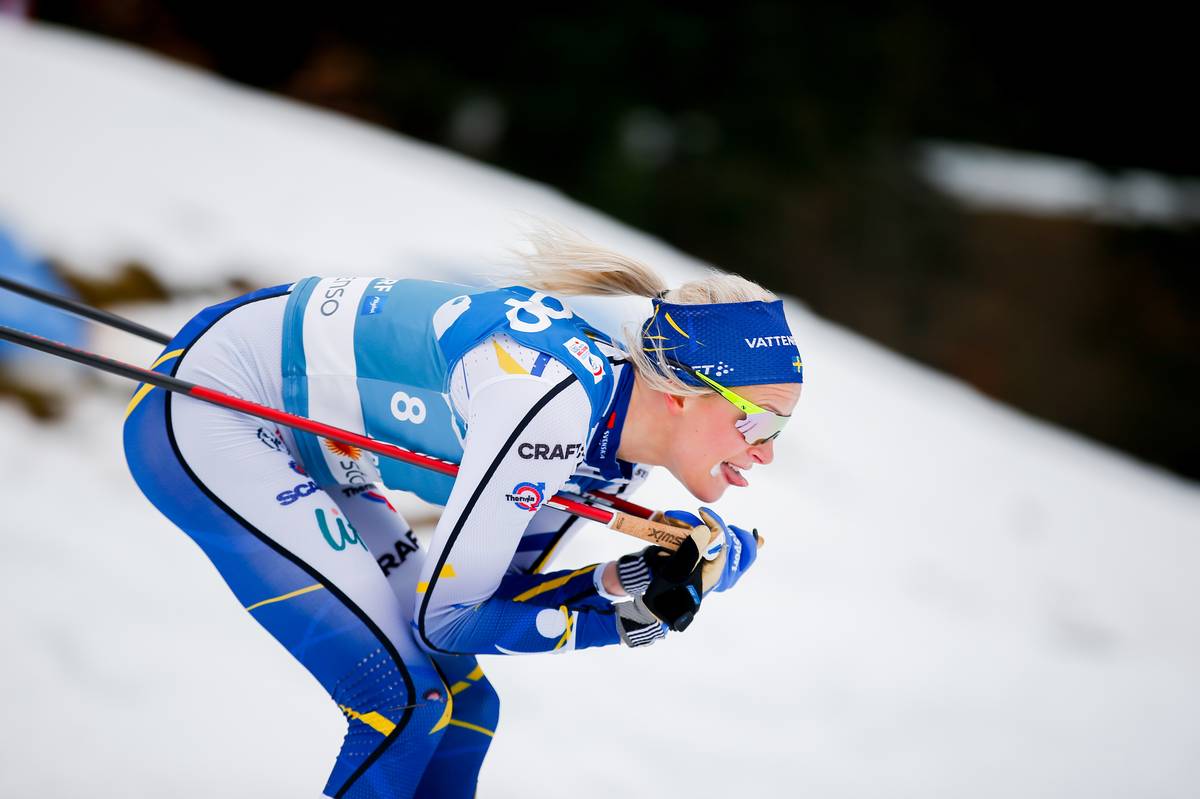
    Tucked in for seed, Frida Karlsson (SWE) during the women’s skiathlon. (Photo: NordicFocus)
    Karlsson (SWE) works her way back after a fall and broken pole, pictured here following Yana Kirpichenko (RSF). (Photo: Nordic Focus)

    Entering the exchange Johaug and Andersson were neck and neck, the Swede echoing Johaug’s every move. However, Andersson was four seconds slower than Johaug swapping skis and exiting. This little gap was all the Norwegian needed to shake her Swedish shadow. 

    Behind Johaug and Andersson, over the next lap, the Russian gradually began to fade, as Karlsson closed in on Sorina. Up front, Johaug motored while Andersson barely held on to the Norwegian. 

    Johaug simply began to gain ground and time on her rivals as the remaining kilometers ticked off. She worked her advantage on the hills and began to widen the gap as Karlsson clawed back to Andersson. At 9 k the two Swedes were +19 seconds back from Johaug, at 11.3 k Johaug had increased that to +27 seconds and by 12.8 k, the gap was +33 seconds. 

    Johaug (NOR) into the finishing straight with no competitors in sight. (Photo: Nordic Focus)

    In the closing meters, all Johaug needed to do was stay upright through the descent and the victory was hers. “Oh it’s amazing,” said Johaug after the race, “I’m looking forward to this day for so long and I’m training a lot and the Norwegian team has not got so much World Cup this year so this World Championships means a lot to me.” Laughing she said, “I know that everybody thinks that I should win but it’s not so easy, you have to fight for yourself and you have to have good skis though the waxer in the team Norway has done a really good job”

    When asked about her fall on the first lap, Johaug seemed unphased, “Oh I fall on the first lap in the stadium here, but I was feeling I have a really good body today and my shape is really good so it didn’t mean so much.” 

    For Johaug this is her fifth skiathlon championship podium and third gold after winning in 2015 and 2019. Her win puts the total number of medals she has collected at world championship events up to 11, only Norway’s Marit Bjørgen and Elena Välbe of Russia have more (18 and 14 respectively). 

    2021 Women’s Skiathlon podium, Johaug (NOR) with gold, Karlsson (SWE) silver and Andersson (SWE) with bronze. (Photo: Nordic Focus)

    Behind Johaug, the race for second and third was real – Karlsson and Andersson no-pole skated to the line, as Karlsson entered the straight with a slight lead though her teammate was closing fast. Karlsson took silver just +0.2 ahead of Andersson. Teresa Stadlober of Austria out sprinted veteran Charlotte Kalla of Sweden to take fourth, Kalla finished fifth. Norwegian youngster Helene Marie Fossesholm came in sixth and Delphine Claudel of France matched her personal best finish, placing 7th. 

    Karlsson (SWE) lunges for the line, out of the shot her teammate Andersson (SWE) does the same. (Photo: Nordic Focus)

    For Karlsson, this is her second silver medal at a world championship, she finished second in the 10 k classic in Seefeld in 2019. This is Andersson’s first individual world championship medal. She holds medals from 2017 and 2019 as a member of the Swedish relay team, but Saturday’s performance tops her previous best individual championship performance of sixth place in the 30 k skate in Seefeld in 2019. 

    Andersson (SWE) holds a tuck, following her teammate Karlsson (SWE) closely on the descent. (Photo: Nordic Focus)

    Leading the American finishers today was Jessie Diggins in 15th, +1:59.5 back from Johaug. “I am going to be honest, it was pretty disappointing if you look at it from a results perspective,” said Diggins after the race, explaining that she felt ski speed on the day was a disadvantage for the team. “However, I was so proud of how hard I pushed and I prepared for these championships in every way possible. I took such great care to train smart, train hard, rest up. Mentally I was ready. Took really good care about not overheating which I was really psyched about. I was dumping bottles of water on myself and chewing ice chunks before the start. So I think I came into this absolutely as ready and prepared as possible. And the thing is, to have a good race all the puzzle pieces have to fit together, and we missed out today.”
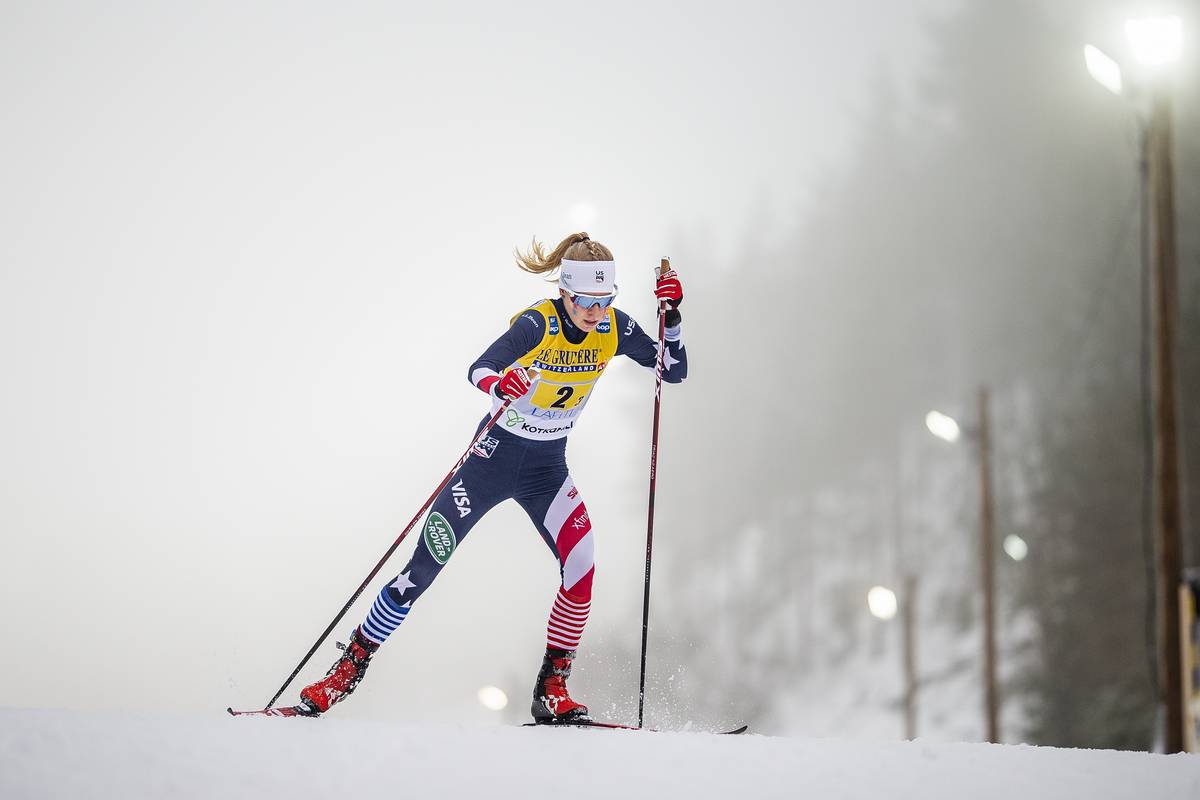
    Jessie Diggins, during the classic leg of the skiathlon. She finished her classic leg in 19th and moved up to 15th at the finish. (Photo: NordicFocus)


    Diggins (USA) giving it her all in the skate leg. (Photo: Nordic Focus)

    When asked about her teammates’ performances, Diggins responded, “They worked so hard. I would have loved to see them have every opportunity to really really shine because I know they could have been further up on the results sheet with the energy and the grit that all these young women displayed. So I think that is so promising to see how well they skied given the disadvantage that we had today. I think, to me, that is really impressive because it is easy to put together a good race when you have the fastest wax in the field, it is harder to just never give up and keep fighting, and to me, that is so much more impressive.”

    Team huddle, U.S. women post-skiathlon (Photo: Tom Horrocks/USST)

    Competing in her first championship event, Sophie Laukli of the United States finished 25th, +3:18.7 back. After the race Laukli said, “It was a fun course for me, lots of hills and climbing. I mean I was a little bit dreading some of the bigger climbs, but it definitely worked to my advantage. I felt pretty good so that was awesome.”
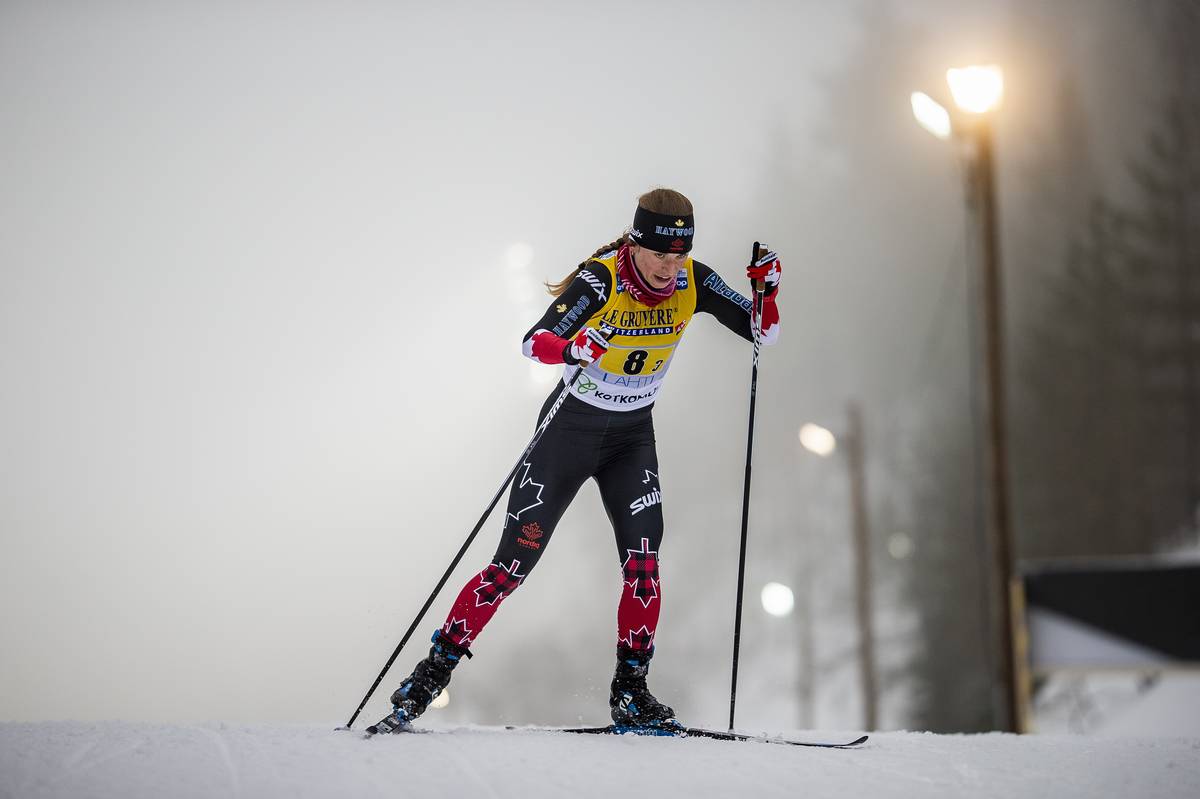
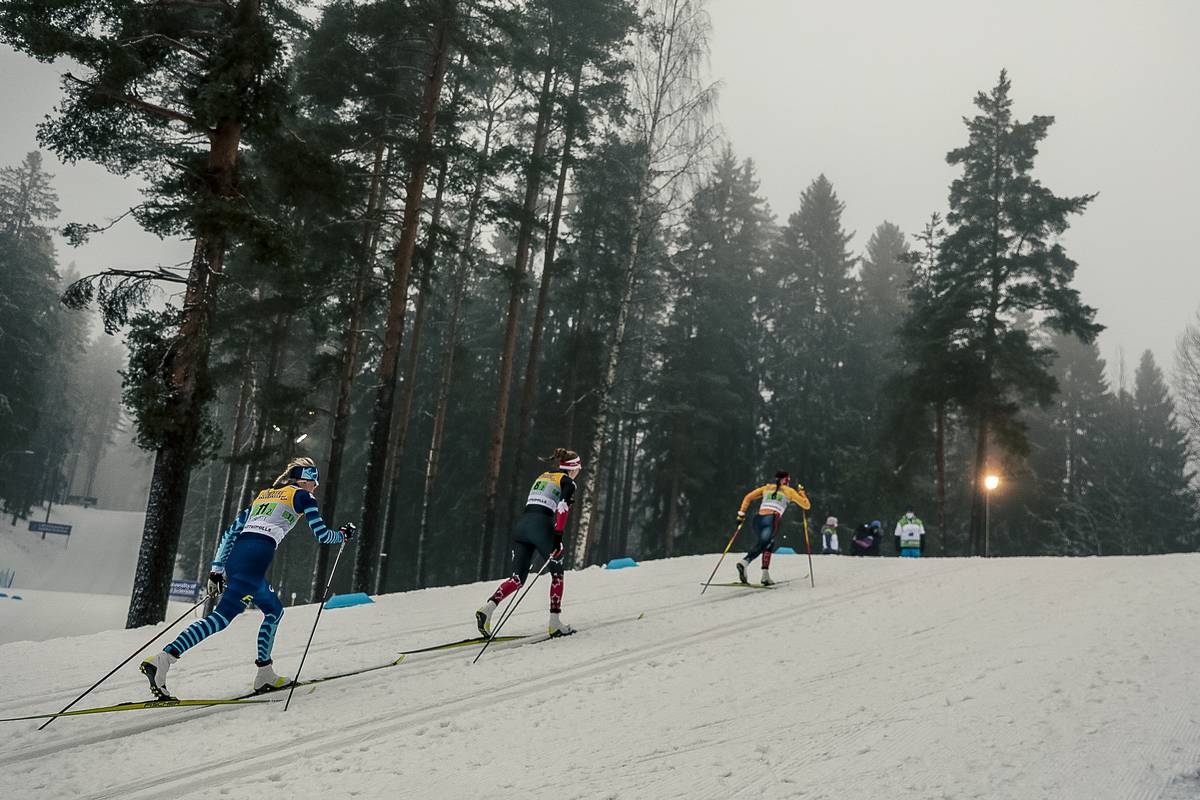
    Laukli’s World Cup debut came a few weeks ago in Lahti Finland where she finished 33rd in the skiathlon event. When asked about her strategy for the day Laukli replied, “Yeah, I definitely think of myself as more of a skate skier so my goal was to try and stick with a group in the classic and then make up some more places in the skate and I think that I was definitely able to do that and really use the hills to my advantage in the end.”

    Laukli (USA) competing in her first World Championships where she placed 25th. (Photo: Nordic Focus)

    Katharine Ogden was the next American finisher in 32nd place and Hailey Swirbul finished 37th. Before the race, Swirbul spoke with FIS saying, “I feel ready to go, this is my first race at my first World Championships. All I can hope is to give my best effort today.” 

    Swirbul (USA-left) and Ogden (USA-right) striding through the classic laps. (Photo: Nordic Focus)


    Interview with U.S. Head Coach Whitcomb discussing the classic sprint and skiathlon.

    Cendrine Browne was the first Canadian of the day, in 23rd place. During the skiathlon at the 2019 World Championships, Browne finished 40th. Next came Katharine Stewart-Jones in 28th place. Stewart-Jones also placed 28th in the 30 k skate event at the 2019 championships. Rounding out the Canadian finishers was Laura LeClair who placed 48th. 

    Cendrine Browne (CAN) was the top Canadian, racing to 23rd. (Photo: NordicFocus).

    “Today was one of the hardest courses I’ve ever done,” Browne told Nordiq Canada. “No flats, only up hills and twisty downhills,” said Browne, who was 26th in a 30-kilometre skate-ski race at the 2017 World Championships in Lahti, Finland. “I’m really happy and proud that I was able to hold on in the classic part, and be in good position to start the skate.

    “The plan today was to hold on in the classic and then catch-up time in the skate,” she added. “Unfortunately, I was only able to maintain the speed I had, but I’m still very happy,” added Browne. “I had a pack to ski with during the whole race which helped me push myself even more.”


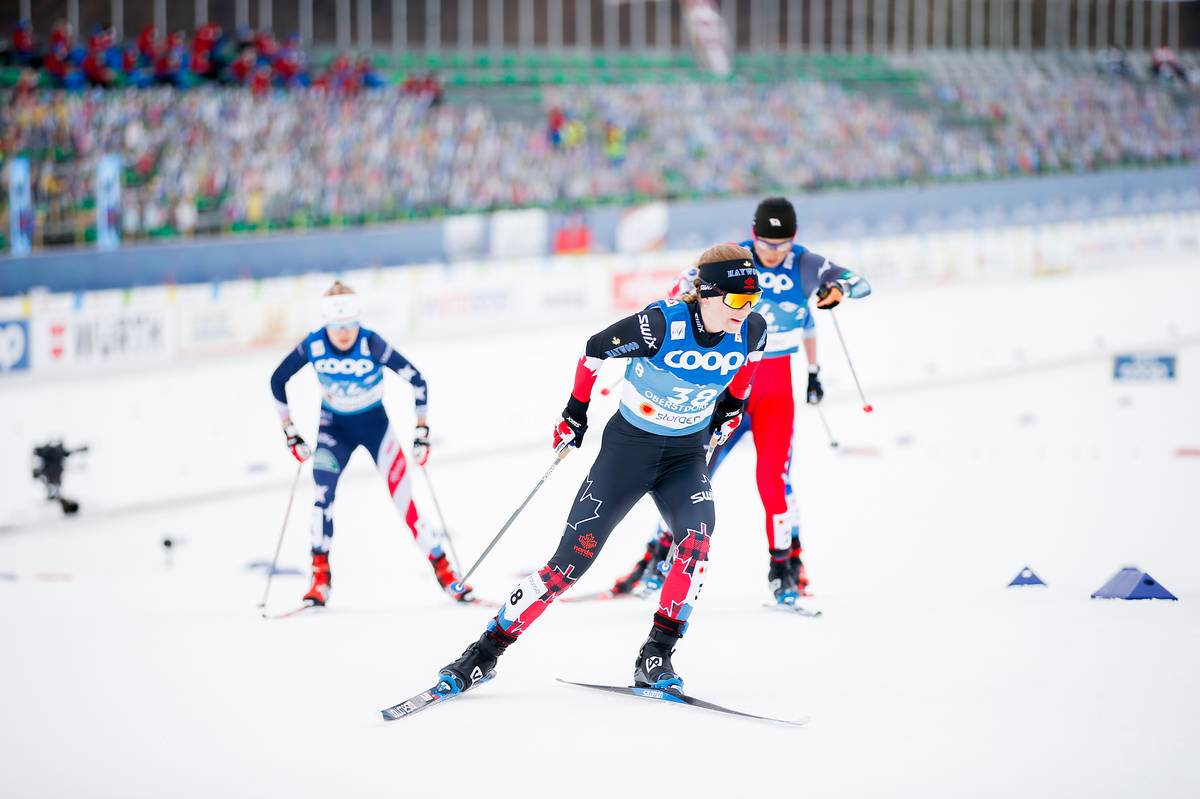
    Katharina Hennig (GER), Katherine Stewart-Jones (CAN), (l-r) racing the skate leg of the 15 k skiathlon. (Photo: NordicFocus)

    “I had some bigger dreams for today, but I honestly gave it my all with what I had on the day,” said Stewart-Jones according to Nordiq Canada. “My start was a bit slow, and I didn’t feel super energetic on the classic, but I was able to find a better rhythm in the skate, especially on the second lap.

    “Having two of us in the top-30 (again today) is definitely a good start, but I know that we have more in the tank, and I’m looking forward to some more racing,” said Stewart-Jones.

    Racing continues Sunday with a team sprint event. 

    Results: Womens Skiathlon

  • Norway Tops Podium Once Again; US Women Finish 5th

    Norway Tops Podium Once Again; US Women Finish 5th

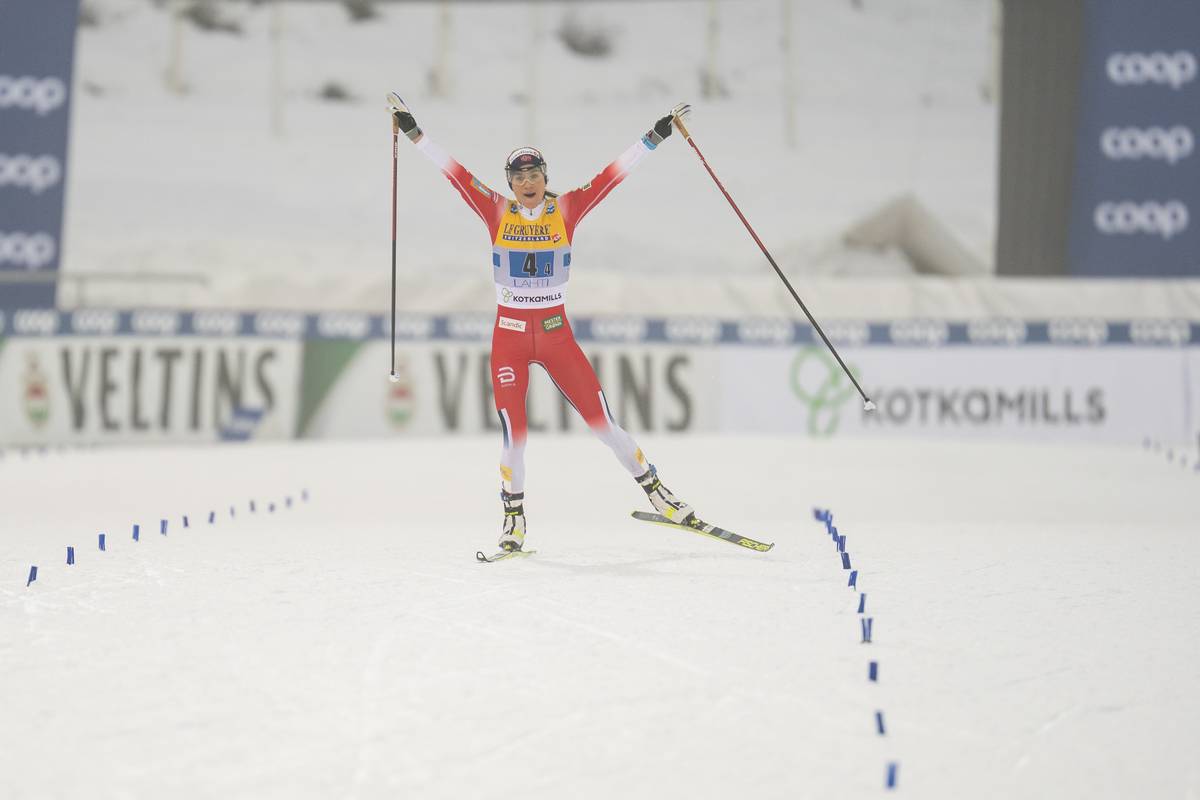
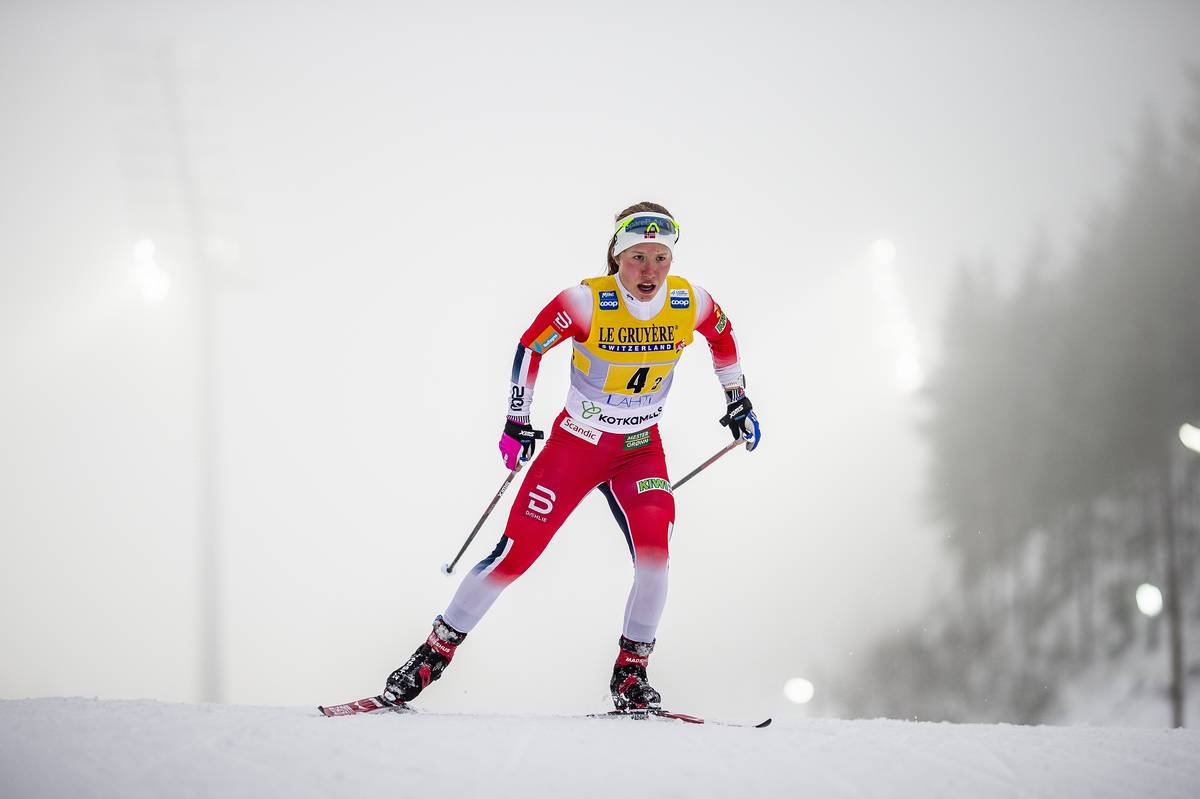
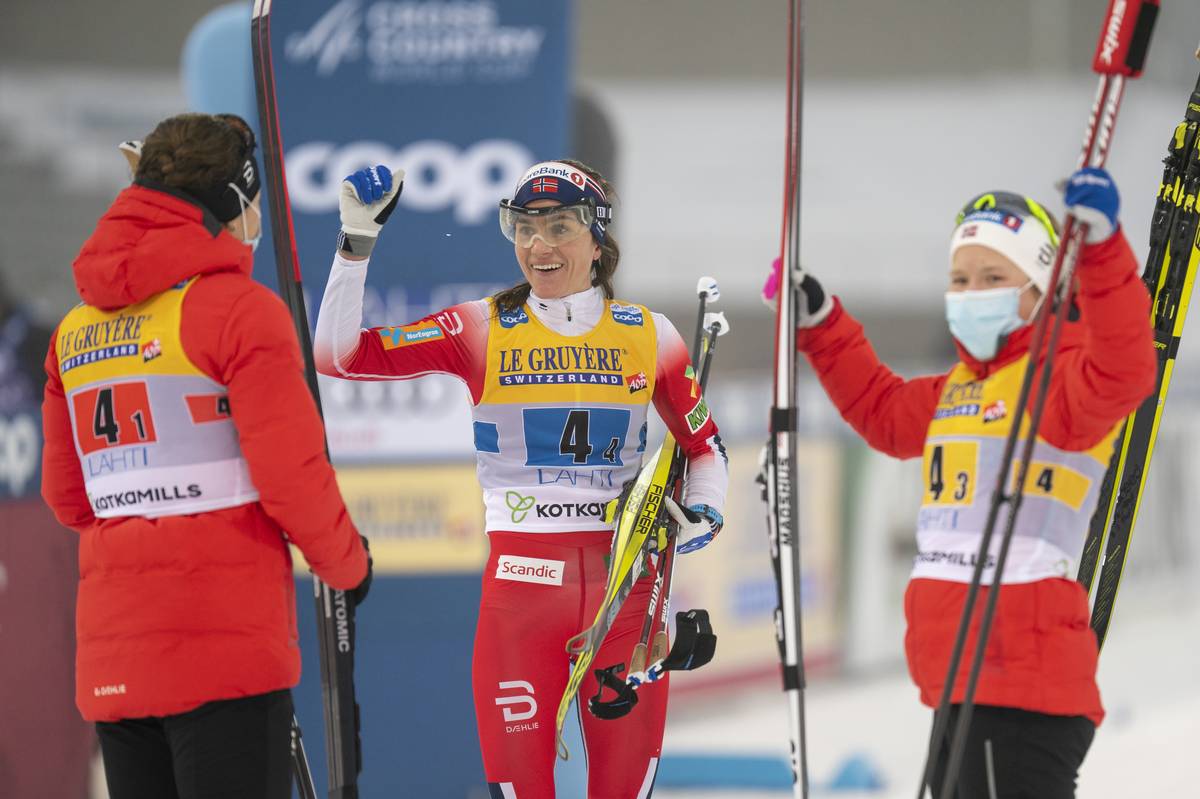
    Hands up for the uncontested Norway win, Heidi Weng clutching the 4 x 5 k relay victory in Lahti, Finland. (Photo: NordicFocus)

    This World Cup coverage is made possible through the generous support of Marty and Kathy Hall and their A Hall Mark of Excellence Award. To learn more about A Hall Mark of Excellence Award or to learn how you can support FasterSkier’s coverage please contact info@fasterskier.com. 

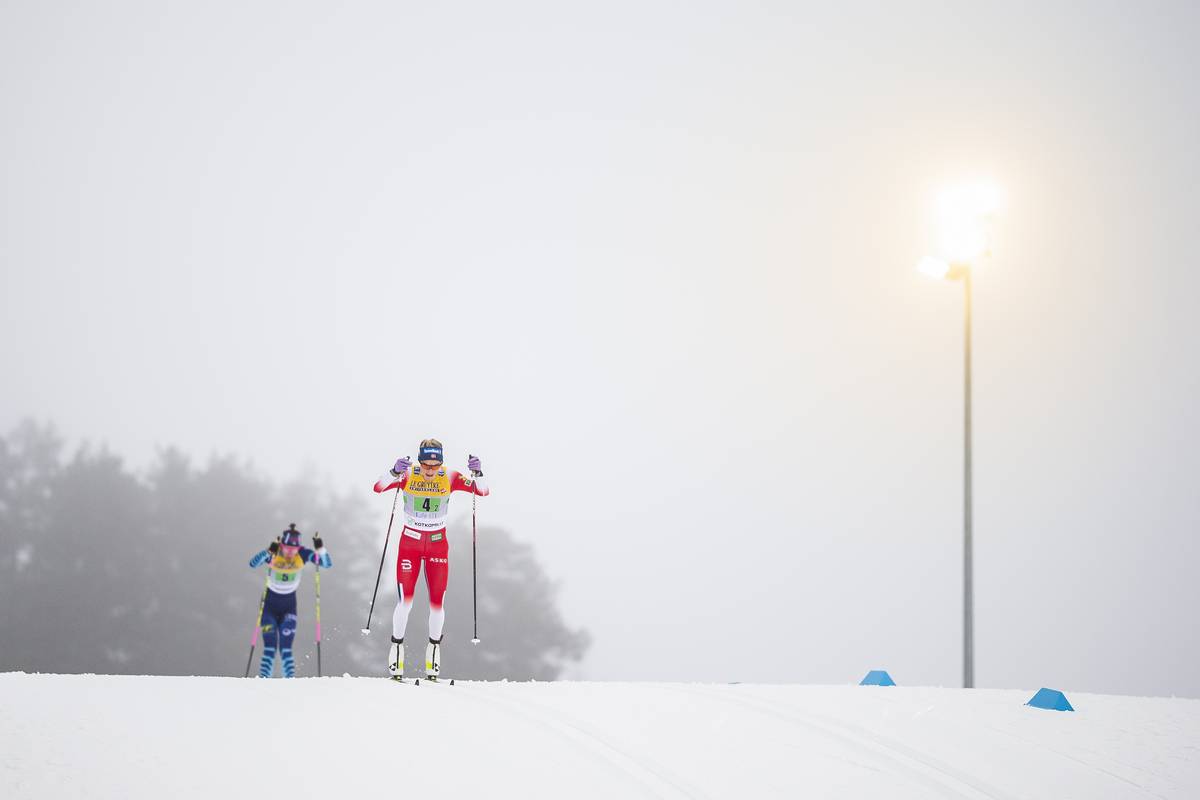
    It was a foggy morning for the women’s 4×5 k relay in Lahti, Finland. With temperatures above freezing and high humidity, the scene was less of a winter wonderland and more of a pea soup. A low visibility scene in which eleven teams lined up at the start line with nine nations represented. On paper, this was Norway’s race and after yesterday’s podium sweep in the 15 k skiathlon there seemed to be little doubt the Norwegian women were on form. To find the last time the Norwegian women failed to win a World Cup relay one must go all the way back to 2011 in Rybinsk, Russia when Italy bested the field. A major side note – the Norwegians were not present in Rybinsk. One must dig deeper into the records, way back to 2009 in Beitostølen, Norway when the Norwegian’s finished second to the Swedish women. Needless to say, the Norwegian women proved themselves peerless once again and topped the field, with a cumulative time of 49:34.4 on Sunday in Lahti.

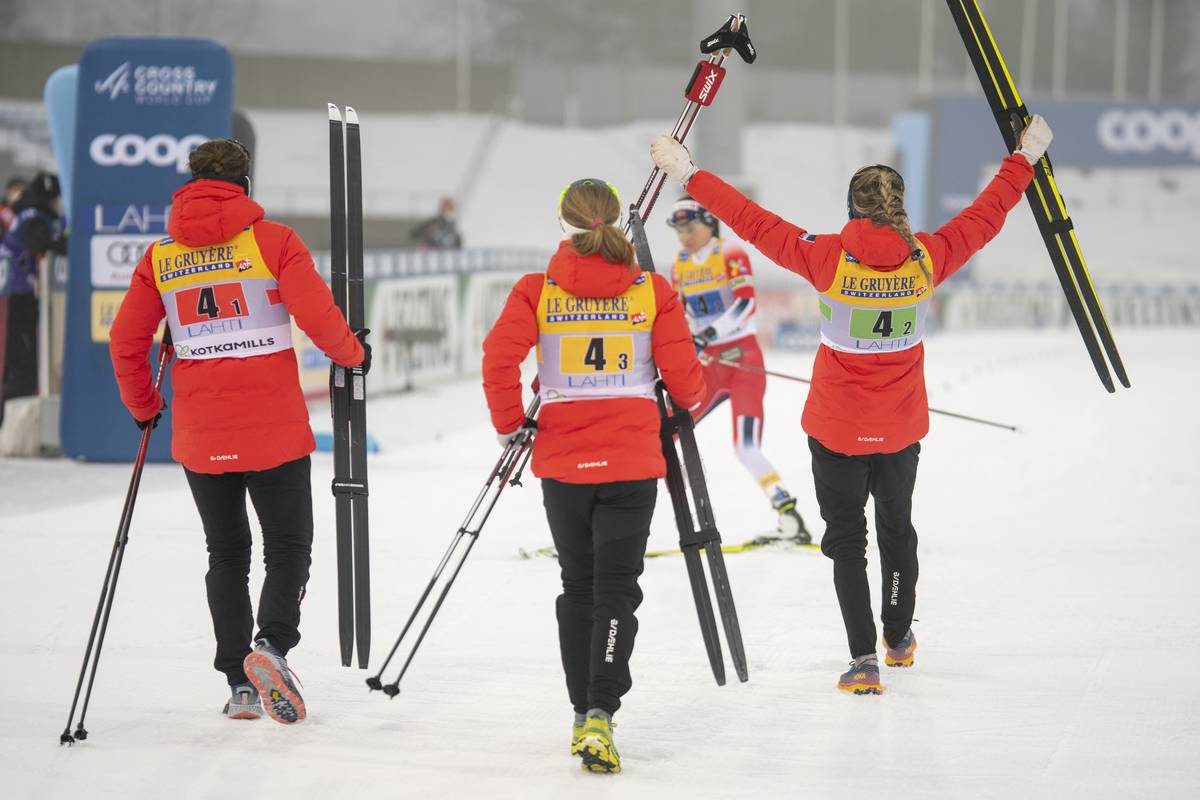
    Gold again. The Norwegian women celebrate as Heidi Weng crosses the line in first. (Photo: Nordic Focus)

    Through the first 2.5 k of toady’s race, a pack of seven women skied together, among them Tiril Udnes Weng who started for Norway and Rosie Brennan who held the scramble leg for the U.S. As the first leg neared to a close Johanna Matintalo of Finland and Charlotte Kalla of Sweden (recently returned to the World Cup circuit), pushed the pace to stretch the group out ever so slightly. Weng tagged off to Theresa Johaug, yesterday’s skiathlon winner, who was closely shadowed by Kerttu Niskanen of Finland, Emma Ribom of Sweden, Jessie Diggins of the U.S.A., and Natalia Nepryaeva of Russia. 

    No other place for Therese Joahug (NOR) than off the front. (Photo: NordicFocus)

    At 6.3 k Johaug (NOR) made her move to the front and turned on the burners, blasting away from the rest of the field in classic fashion. However, the chasers weren’t going to let Johaug stride away uncontested and at 7.5 k Johaug was just +1.6 seconds up on Kerttu Niskanen of Finland with Sweden, U.S.A., and Russia not far behind. By the time the second-leg skiers had completed 5 k, Johaug had widened the gap to +6.9 ahead of Niskanen, while Diggins, further back, tagged off to teammate Sophia Laukli with a margin of +24.5 to the lead. 

    Helene Marie Fossesholm (NOR), young yet ready for podiums on the World Cup. Here she paces Norway on the third leg of the Lahti 4 x 5 k relay. (Photo: NordicFocus)

    Nineteen-year-old Helen Marie Fossesholm, who had a podium debut in yesterday’s skiathlon, commanded the first skate leg for Norway. At 11.3 k she had grown the gap to +15 seconds over Laura Mononen of Finland, with Lovis Modig of Sweden (+34), Anna Nechaevskaya of Russia (+37.5), and Laukli for the U.S. (+39.2) falling in behind.

    In an interview with FIS following the race, Fossesholm said, “I had a great day today in the course. The course demands a high level of technical skills, including a high level of stamina which fits me quite well.” Her springy-step and attitude were evident to viewers as the young Norwegian jumpskated the final climb, navigated the hairpin corner and tagged anchor, Heidi Weng, with a lead of +51.8 ahead of Finland. 

    As the fourth leg transpired, Weng was out on her own, skiing the final two laps largely out of sight of the rest of the field. She crossed the finish line unchallenged to bring home another victory for the Norwegian team. 

    First bumps, bows, and boot taps, the new COVID-era finish celebrations for team Norway. (Photo: Nordic Focus)

    Behind her, Ebba Andersson of Sweden swiftly made up ground on Finland’s anchor, Krista Parmakoski. (Finland I tagged off for the fourth leg roughly 8 seconds ahead of Sweden.) At 16.3 k Andersson caught Parmakoski and as the two skiers climbed out of the stadium for the final time, Andersson accelerated away from the Finn, gaining some ground on Weng and finishing +42.9, making it silver for Sweden. Parmakoski stayed strong locking in for third (+59.5). 

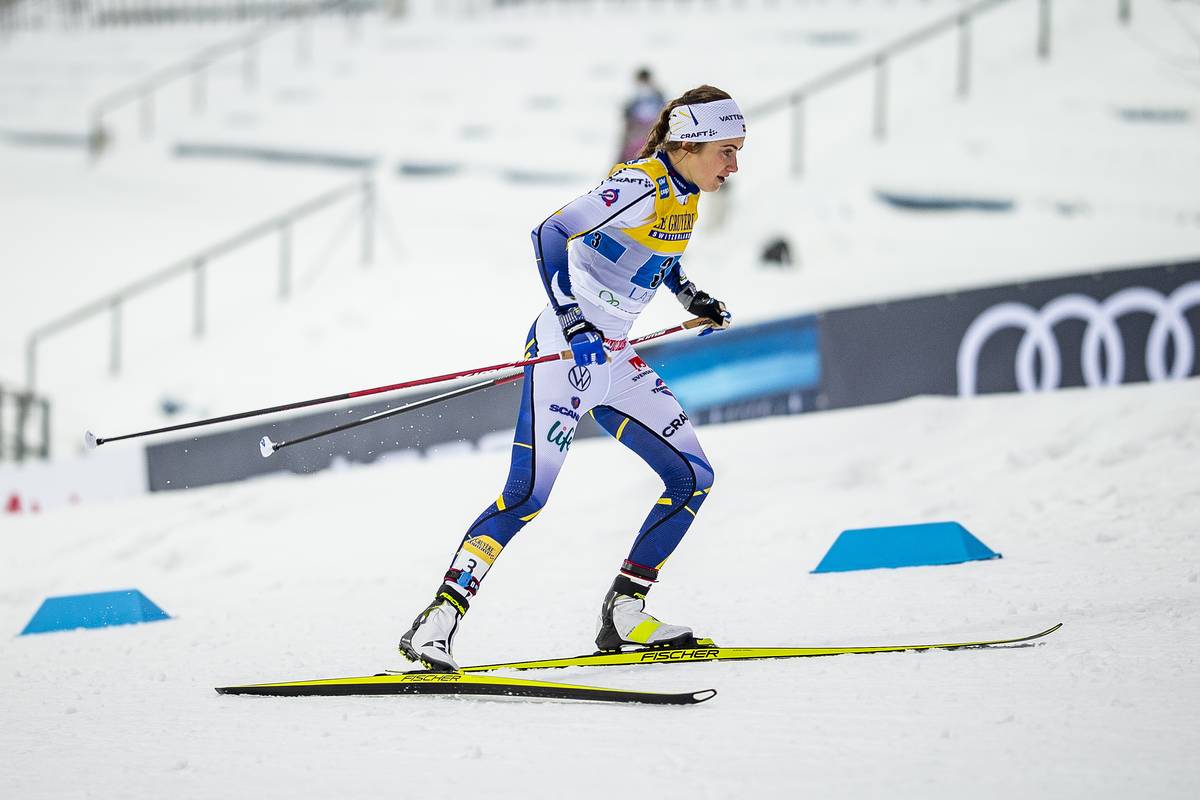
    Ebba Andersson (SWE) racing the 4 x 5 k relay in Lahti, Finland. (Photo: NordicFocus)
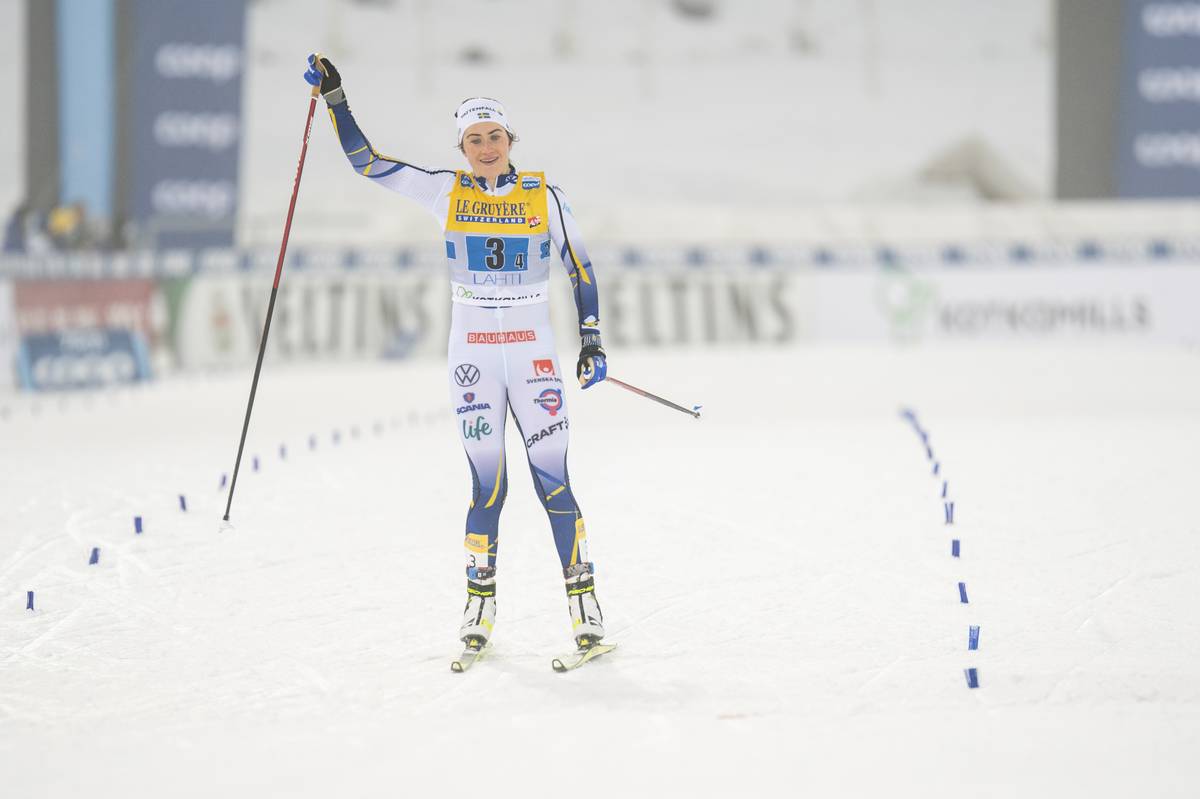
    Ebba Andersson (SWE) celebrates silver for the Swedish women at the completion of her anchor leg. (Photo: Nordic Focus)

    Today’s relay line-up for the U.S. women looked a bit different than it has in the past. In a pre-race interview with FIS, U.S. Cross-Country Program Director Chris Grover said, “It’s an interesting relay for us. We have a couple of women with a lot of experience, Jessie and Rosie, but we also have a woman that this is her first World Cup weekend, Sophia Laukli, skiing for us, and also Caitlin Patterson.”

    U.S. skiers who have been recent members of the U.S. women’s relay team, most notably Sophie Caldwell and Sadie Bjornsen, are not racing in Lahti.  

    Rosie Brennan (USA), Laura Gimmler (GER), Yana Kirpichenko (RUS), (l-r) during the scramble leg. (Photo: NordicFocus)
    Caitlin Patterson (USA) finishes her anchor leg for the American team. (Photo: Nordic Focus)

    “We are missing a few of our women… so it’s going to be a little bit of a different experience for us and we actually are doing something that we don’t often do and that’s putting Jessie and Rosie in a classic leg, so they’re up front and hopefully we learn a little bit about what their classic performances can be like in a relay.”

    The U.S. team ultimately finished fifth (+1:48.6), positioning themselves in back of Russia (+1:30.7) in fourth overall.  

    Sophia Laukli of the U.S., paces the U.S. on the third leg of Sunday’s 4 x 5 k relay. This was Laukli’s second World Cup start. (Photo: NordicFocus)

    The twenty-year-old Laukli spent the past week racing at Norwegian Nationals before making the trip to Lahti for her World Cup debut. In an email to FasterSkier she wrote, “The races in Norway, I think, definitely helped prepare me more for the World Cup races. It was a pretty intense environment and quite a step up from the college racing I’m used to. So, it was good for me to have the Norwegian National races under the belt to get a little more comfortable with this higher level racing. I also think it helped to come off those races right into the World Cup so I was already in that racing mindset. I’m definitely someone who races into shape so being able to race in Norway and quickly transition to the World Cup worked to my advantage.”

    Regarding her position as leg three in today’s relay Laukli said, “it’s safe to say I was a little stressed and nervous for the relay, just from knowing the past successes of the US women. I tried not to put too much pressure on myself, although that was easier said than done. The other girls were really great though and making sure I felt no huge expectations, and that I should just focus on skiing my own race. That was really helpful to hear. Once I started my leg and in the end, it was really just a lot of fun and I feel super lucky to have gotten to do a relay for my 2nd [World Cup] race!”

    Natalia Nepryaeva (RUS), Jessie Diggins (USA), Emma Ribom (SWE), (l-r) during the 4 x 5 k relay in Lahti, Finland. (Photo: NordicFocus)
    Jessie Diggins during the second leg of the relay. This was the U.S. skier’s first time on the World Cup slotting into a classic relay leg. (Photo: NordicFocus).

    Diggins, who skied the second classic leg as opposed to her traditional spot as skate anchor, said, “After a decade of anchoring the US relay team, I was very excited to try something a little different! For the first time in my life I asked to ski a classic leg and it was really fun to try something new. I think skating will always be my first love, but I’m finding a better relationship with my classic skiing over the years and this was a great place to work on improving it!”

    The American women huddle at the finish line after finishing 5th in the relay. (Photo: Nordic Focus)

    “The highlight of my day was, of course, getting to hand out the socks and put the USA face paint on our guys and gals,” Diggins continued. “I love the team spirit of relay day and it keeps racing fun! Really proud of this team (the men’s and women’s) for giving it our all this morning!”

    Cendrine Browne (CAN), third leg of the 4 x 5 k relay in Lahti, Finland. (Photo: NordicFocus)

    The Canadian team, consisting of Katherine Stewart-Jones, Dahria Beatty, Cendrine Browne, and Maya Macisaac-Jones finished eighth. This is Canada’s first weekend of World Cup racing after missing Period One and the Tour de Ski.

    Anne Kyllönen (FIN), Dahria Beatty (CAN), Katharina Hennig (GER), (l-r) on leg 2 of the 4 x 5 k relay in Lahti, Finland. (Photo: NordicFocus)

    Results: Women’s Relay