Tag: Therese Johaug (NOR)

  • Her Biggest Win Yet: Johaug Wins Holmenkollen 30 k by 3:46

    Her Biggest Win Yet: Johaug Wins Holmenkollen 30 k by 3:46

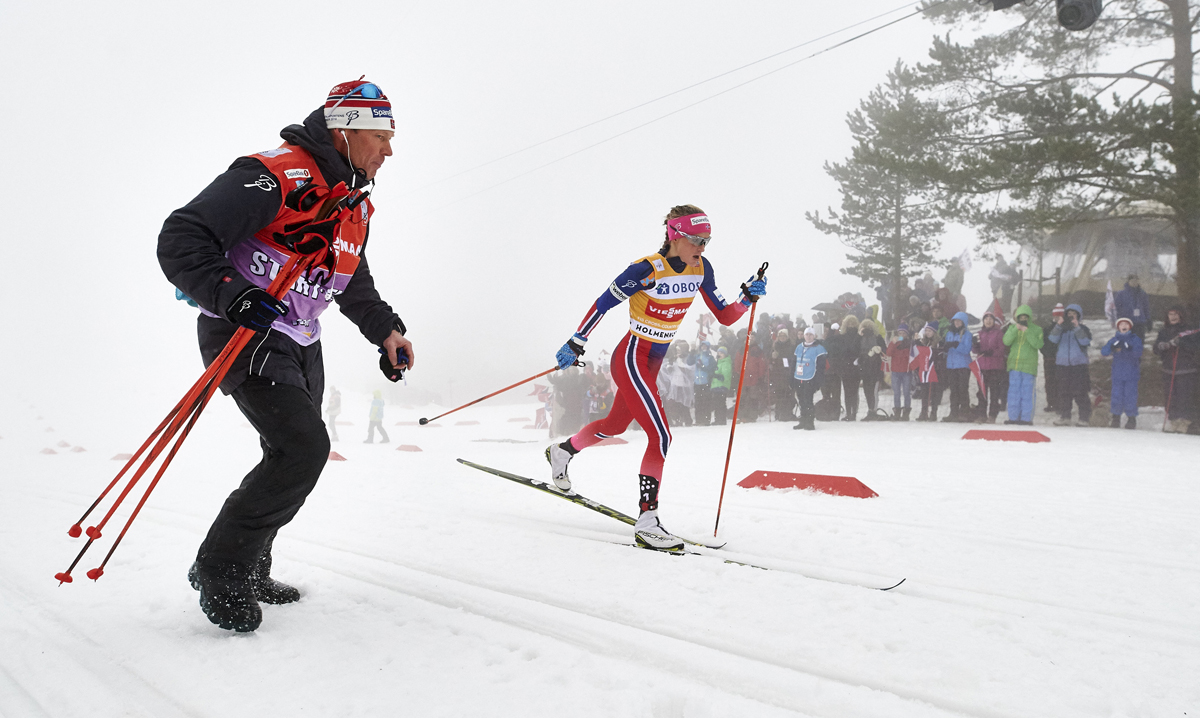
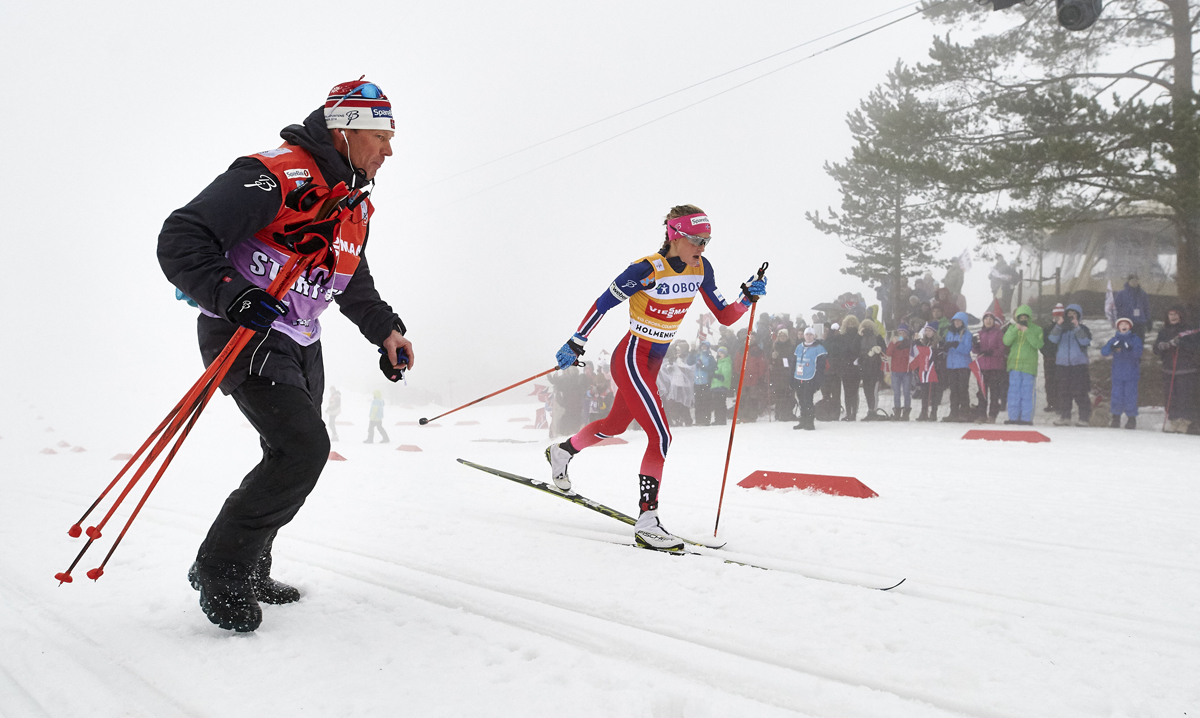
    Norway's Therese Johaug racing to her biggest win ever, by 3 minutes and 46 seconds in the women's 30 k classic at Holmenkollen on Sunday in Oslo, Norway. (Photo: Fischer/NordicFocus)
    Norway’s Therese Johaug racing to her most definitive win yet, by 3 minutes and 46 seconds in the women’s 30 k classic at Holmenkollen on Sunday in Oslo, Norway. It was her first classic victory at Holmenkollen. (Photo: Fischer/NordicFocus)

    Maybe it was the signature Johaug gloves dazzled for the television camera at the start. Maybe it’s the training hours, or the grit, or the lucky combination of DNA and athletic potential realized. 

    On Sunday, at the famed Holmenkollen tracks, Norway’s Therese Johaug dominated. She won the 30-kilometer classic mass start, her first Holmenkollen classic victory, in 1:24:55. Ingvild Flugstad Østberg, also from Norway, took second, 3:46.5 behind. Finland’s Anne Kyllönen broke up the Norwegian podium sweep by skiing to third place (+4:16). Johaug’s margin of victory was the largest ever for a women’s cross-country World Cup, according to a FIS press release

    Norway took four of the top-eight spots, while Finland placed four in the top eleven.

    Norway’s Heidi Weng placed fourth (+4:16), Finland’s Laura Mononen fifth (+4:43), and Swedish star Charlotte Kalla sixth (+4:45.9). Notable others in the top 10, Masako Ishida of Japan placed ninth (+4:55.2) and Poland’s Justyna Kowalczyk finished 10th (+5:06).  

    The domination
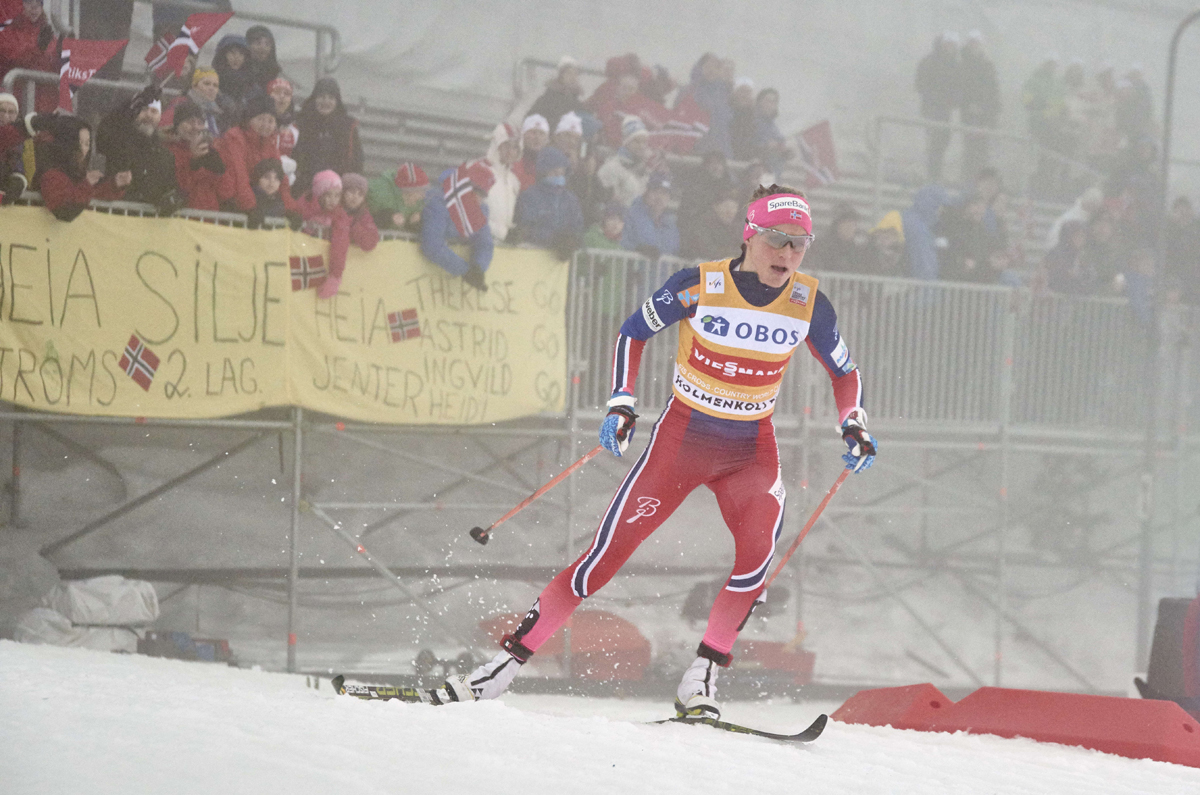
    Norway's Therese Johaug dropped the field out of the start in the women's 30 k classic mass start on Sunday at Holmenkollen in Oslo, Norway. By 3 k, she was about 20 seconds ahead. That gap grew to 3 minutes and 46 seconds at the finish for her first Holmenkollen classic win. (Photo: Fischer/NordicFocus)
    Norway’s Therese Johaug dropped the field out of the start in the women’s 30 k classic mass start on Sunday at Holmenkollen in Oslo, Norway. By 3 k, she was about 20 seconds ahead. That gap grew to 3 minutes and 46 seconds at the finish for her first Holmenkollen classic win. (Photo: Fischer/NordicFocus)

    The time back on the results sheet were not in error. The Johaug spectacle was that one-sided.  From the first intermediate checkpoint at 1.8 k, Johaug’s race-journey was a solitary one. Her furious pace immediately distanced all other competitors. Johaug was solo through every intermediate checkpoint. And solo as she crossed the finish line.

    The mythical Holmenkollen venue was draped in a dense fog. With humidity at 99 percent, Johaug was literally skiing through the clouds: Her striding form barely visible to trailside spectators or those watching on a screen. If the poor visibility prevented a full understanding of the race’s dynamics, the live timing splits, tell the story.

    At the first time check, at 1.8 k, Johaug had an 8.6-second gap on Kalla in second, and 9.2 seconds on Norwegian teammate Astrid Uhrenholdt Jacobsen in third. Jacobsen ultimately DNF, pulling out of the race around 11 k.

    At five kilometers, Johaug’s pace was unmatchable. She was already 44.8 seconds up on Finland’s Krista Parmakoski, skiing in second at that point, with the critical mass of potential podium placers grouped close together — only 12.6 seconds separated second place from 30th.

    During the women’s 30 k, racers were allowed a single ski exchange. A chance perhaps to improve their kick or maximize their glide. But that single ski exchange would only be advantageous in the race for second. 13.3 kilometers in, Johaug changed skis with a comfortable margin of 2:07 over German Stefanie Böhler, while eventual second-place finisher on the day, Østberg, came into the exchange in sixth (+2:25.6).
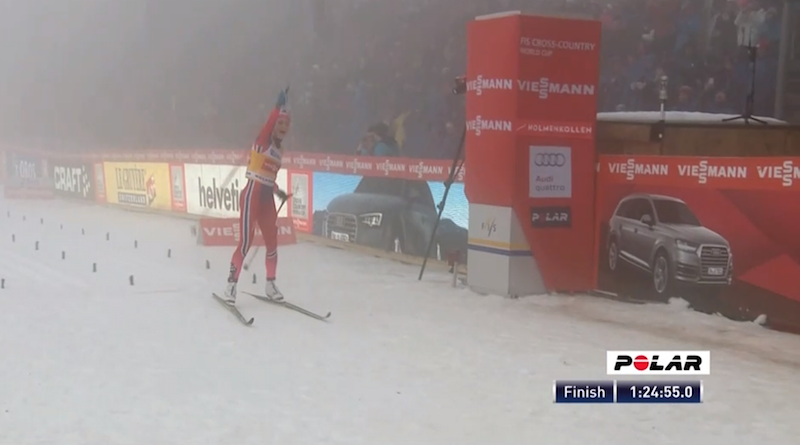
    Norway's Therese Johaug celebrates across the line as she wins the 2016 Holmenkollen 30 k classic.
    Norway’s Therese Johaug celebrates across the line as she wins the 2016 Holmenkollen 30 k classic mass start.

    With no mishaps, her pace never waning, Johaug was on cruise control, albeit at near red-line speed. That’s how she took it across the line, waving to a thunderous, yet nearly invisible fog-enshrouded crowd, for the win. Her’s was  a 3:46.5 margin of victory won in the spirit of a legend in the making.

    Absent Marit Bjørgen, and with no real contenders challenging, this was a defining race for Johaug in a cross-country venue where a single win can define a skier’s career.

    Sunday’s race was only the 22nd time a women’s World Cup 30 k has been held in Holmenkollen in its 114-year history. According to FIS, Johaug’s first 30 k there was a 2008 freestyle event in which she placed fourth. Since 2010, when she finished the Holmenkollen 30 k freestyle in third, Johaug has landed on the podium in all six Holmenkollen 30 k events. That includes her 2011 victory at the Olso, World Championships 30 k freestyle, and a win in the 2013 edition of the Holmenkollen 30 k. That, too, was a freestyle race. Her teammate, Bjørgen, was absent from that race.

    There’s more for the record books. Sunday, with Bjørgen also out due to the recent birth of her new baby, Johaug became a three-time Holmenkollen 30 k winner — yet this was her first 30 k classic victory there. Johaug’s win was also her seventh Holmenkollen 30 k podium, a record, placing her one ahead of Bjørgen, who has six podiums at the famed venue.

    “It was a raw run today. I felt everything worked out in the first hill and I heard I got some distance, but I do not think it went so fast. I just had to go my own race,” Johaug told Norwegian news outlet NRK, according to a translation.

    In a post-race interview with FIS, an elated Johaug spoke or her season’s goals, which included a Holmenkollen win.

    “My goal today was to ski good, to have good technique. I worked on it this week,” Johaug said. “I had three goals this season. It was a win in Ruka, and the Tour de Ski, and the 30 k here in Holmenkollen. Because I never win here in the classic. It was a big goal for me this season. Today, my body was good, the skis were good, and the technique. I had to focus the whole time, I have lots of power and lots of energy. I am not tired. So I’m in good shape. I was a little bit nervous before the start because of I was sick for the Norwegian Championships in Tromsoe. For me, maybe some days in the bed was good. I have a lot of energy and it was amazing to ski here.”

    The Race for Second + World Cup Overall

    At 24.6 kilometers, the race for second was winnowed to four skiers, Østberg, Kyllönen, Weng, and Mononen, all coming through the checkpoint in that order and only 2.4 seconds separating them.

    Østberg, although a proven sprinter and capable of taking a sprint at the line, did not leave her day’s results up to final meters. She made a decisive move and surged ahead. Her effort broke apart the small train behind her, after which, the remaining contenders would all be skiing alone.
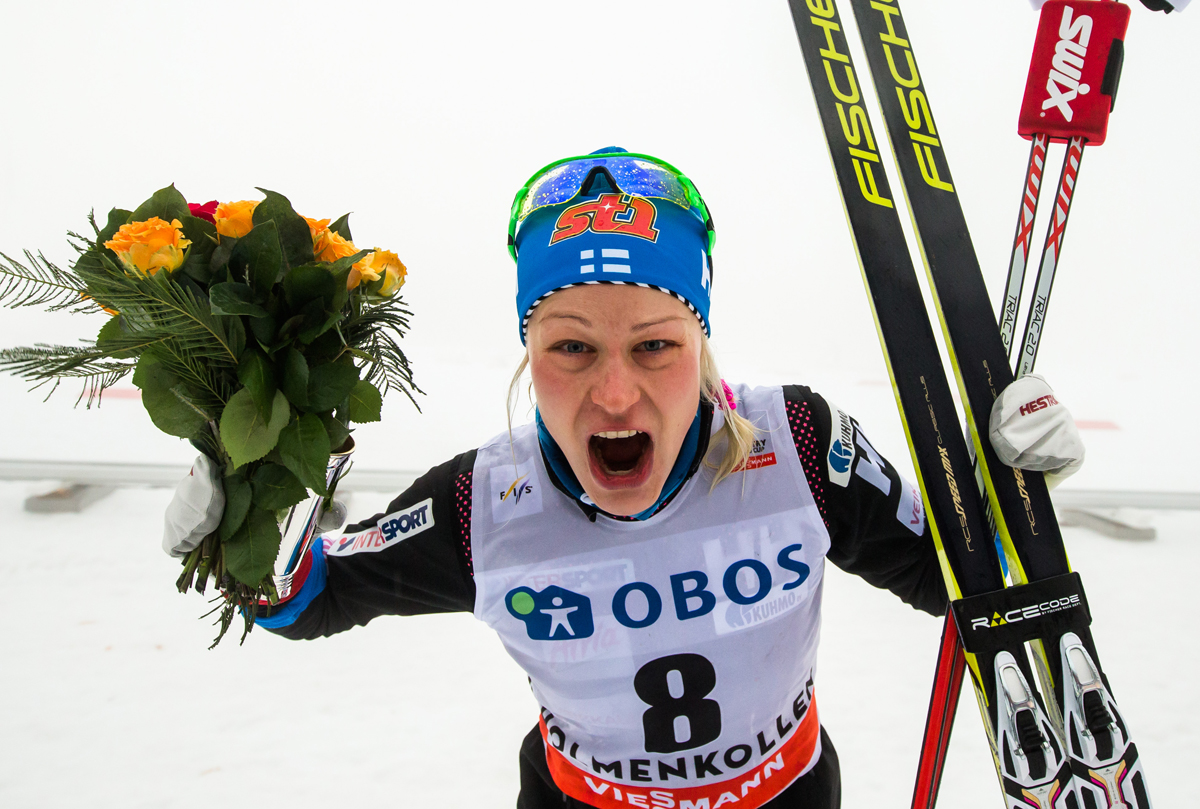
    Finland's Anne Kyllönen celebrates her podium in the Holmenkollen 30 k classic, after placing third on Sunday in Oslo, Norway. (Photo: Fischer/NordicFocus)
    Finland’s Anne Kyllönen celebrates her podium in the Holmenkollen 30 k classic, after placing third on Sunday in Oslo, Norway. (Photo: Fischer/NordicFocus)

    6.6 seconds at 26.6 kilometers. 14.5 seconds to Kyllönen at 27.5 k. If the rubber band to ultimate third-place finisher Kyllönen was stretching then, it broke by the finish. 

    Østberg skied to second, a full 29.5 seconds ahead of Kyllönen. It was Kyllönen’s best ever result at the Holmenkollen 30 k. 

    According to a translation, Kyllönen told Finnish news outlet, Helsingin Sanomat, that despite her inability to match Østberg’s surge, she remained satisfied. 

    “I could not respond to the Østberg up and running, but it was cool when I was able for once to enjoy the situation and examine the winds properly in the home stretch,” she said, according to a translation.

    “Such success requires that all aspects fall into place. I have felt after many of my competition, I would have been able to ski even better rate. I do not know if this was not yet a 110-percent success,” Kyllönen said. “Johaug was once again really hard in the attack. She got to ski Holmenkollen and certainly knows the tracks accurately. No one even think to try to hang on to her momentum.”

    Østberg is another sign that Norway’s pipeline of skiers is not tapped out.

    This was Østberg’s best Holmenkollen 30 k result. In 2010 she placed 32nd in the 30 k free, in 2012, 42nd in the 30 k classic, in 2014, 15th in the 30 k classic, and in 2015’s 30 k free, 21st.

    “I did not in my wildest imagination thought I would get on the podium here. Although I am miles behind ‘Miss Joy’ [Johaug], this is like a victory for me,” Østberg told NRK.
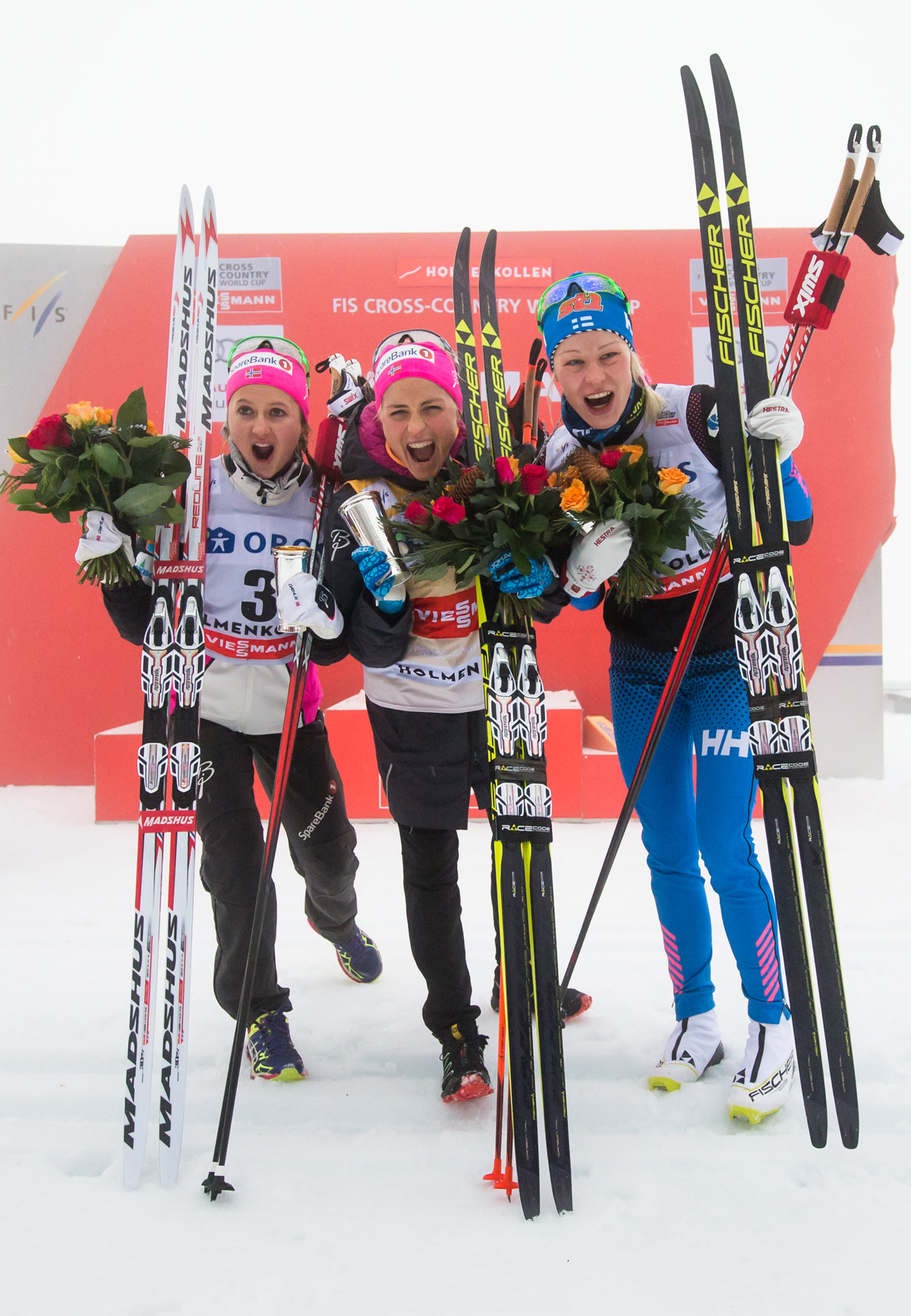
    The 2016 Holmenkollen 30 k classic podium: with Norway's Therese Johaug (c) in first, teammate Ingvild Flugstad Østberg (l) in second, and Finland's Anne Kyllönen (r) in third. (Photo: Fischer/NordicFocus)
    The 2016 Holmenkollen 30 k classic podium: with Norway’s Therese Johaug (c) in first, teammate Ingvild Flugstad Østberg (l) in second, and Finland’s Anne Kyllönen (r) in third. (Photo: Fischer/NordicFocus)

    Johaug’s win on Sunday gives her a small buffer for the Overall World Cup. With 1644 points, Johaug leads Østberg, who remains in second overall, by 172 points. That margin could dwindle by Thursday of next week. Johaug will not race in the Stockholm, Sweden, sprints, while Østberg remains a favorite.

    “I think not so much on the points you make. But I’m not going to give up the World Cup,” Østberg explained to NRK. Sunday’s result solidifies Østberg’s evolution from sprint star to potential podium placer in the longest distance events. Her eyes now fixed on the overall globe once thought to be a gimme for Johaug.

    Østberg’s goals may have broadened. Yet those aspirations are grounded with the knowledge that Johaug has proven she remains on form and virtually untouchable. “I’ve never been on the [overall] podium either. If I can do it, it’s a great achievement for me. But I do not give up until we’re done in Canada. But you see how insane superb Therese is,” NRK reported Østberg as saying.

    Notes: Sadie Bjornsen was the top North American, skiing to 22nd (+7:44.5). Liz Stephen placed 23rd in a photo finish (+7:45.4), Jessie Diggins, 25th (+7:46.1), Rosie Brennan, 33rd (+11:43.7), Caitlin Patterson, 36th (+12:03.2), Canadian Emily Nishikawa, 39th (+12:41.1). A sixth American, Ida Sargent did not start.

    World Cup racing continues on Thursday with sprints in Stockholm, Sweden.

    Results | World Cup Overall standings

  • With Ever-Pressing Diggins, U.S. Women Grab Final Podium Step in Lillehammer 4 x 5 k Relay

    With Ever-Pressing Diggins, U.S. Women Grab Final Podium Step in Lillehammer 4 x 5 k Relay

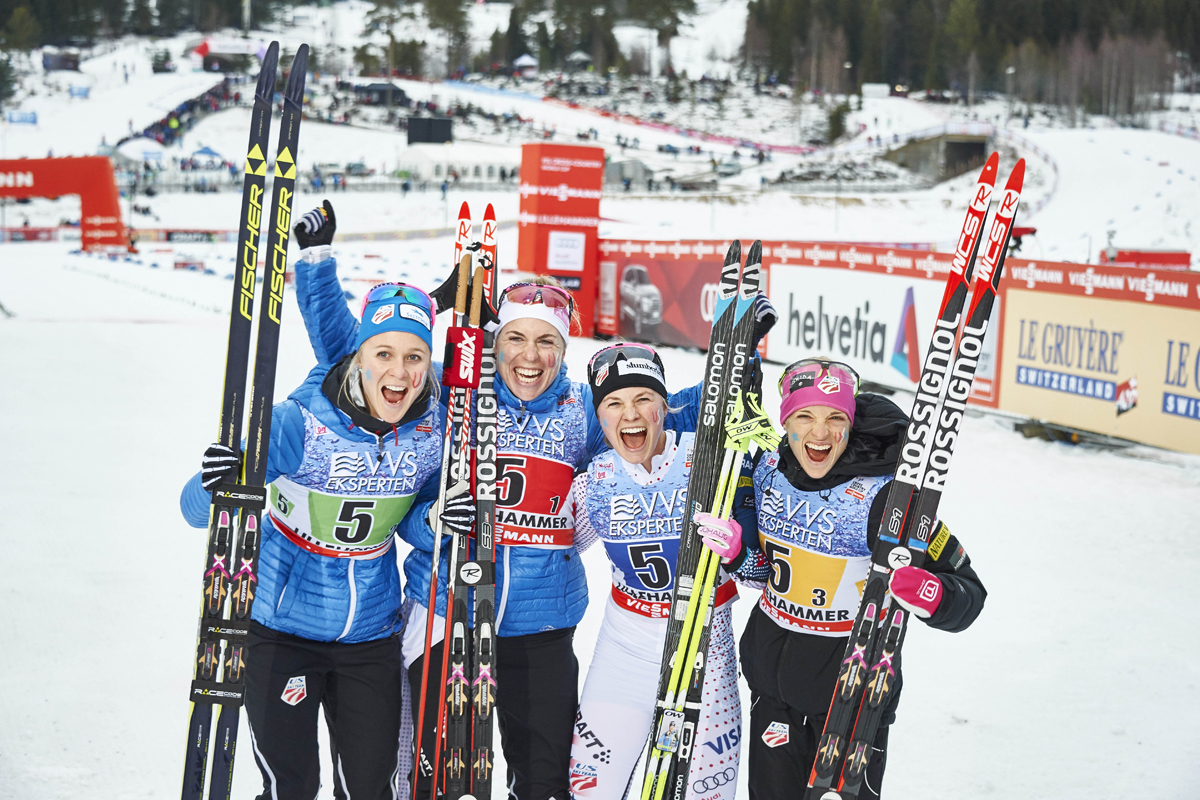
    The U.S. women celebrate third place in Sunday's 4 x 5 k relay at the World Cup in Lillehammer, Norway. (From l to r) Sadie Bjornsen, Rosie Brennan, Jessie Diggins, and Liz Stephen. (Photo: Fischer/NordicFocus)
    The U.S. women celebrate third place in Sunday’s 4 x 5 k relay at the World Cup in Lillehammer, Norway. (From l to r) Sadie Bjornsen, Rosie Brennan, Jessie Diggins, and Liz Stephen. (Photo: Fischer/NordicFocus)

    Note: This article has been updated to include the U.S. women’s third-place finish at the Lillehammer World Cup in Dec. 2013.

    Amidst stunning conditions of bright sun and a dangerously icy track at the Birkebeiner Stadium in Lillehammer, Norway, the Norwegian women’s all-star first relay team of Maiken Caspersen Falla, Ingvild Flugstad Østberg, Therese Johaug, and Heidi Weng, notched another seemingly effortless victory in the women’s 4 x 5-kilometer World Cup relay on Sunday.

    Taking the win by almost two minutes over second place Finland’s Krista Parmakoski, Kerttu Niskanen, Laura Mononen, and Anne Kyllönen, the Norwegians may have won the race, but the Americans stole the show.

    As Norway’s first team reveled in victory, they had to stop their celebratory hugs to turn and witness the crowd roar in both surprise, and applause, as the U.S. Ski Team’s Jessie Diggins flew past Ragnhild Haga of Norway’s second team, careened down the final hill, into the finishing stretch, snatching the final podium spot from Haga by 1.4 seconds.

    Diggins crossed the finish line and let out a scream of elation, thrilled for the U.S. women’s first relay podium in two years. It was the third time in relay history the U.S. women have reached the podium, according to USSA.

    Approaching the top of the last short climb before the stadium, Diggins saw a tall figure jumping up and down, swinging their poles in circles around their head, “like a cowboy,” she recalled in a post-race group phone interview with her teammates: Rosie Brennan, Sadie Bjornsen and Liz Stephen.

    It was U.S. Ski Team (USST) Women’s Coach Matt Whitcomb, and he was giving her the go-ahead to go for it in the final meters. “I was like, ‘Yes, this is what I live for!’ … and I just hammered,” she said.

    On a day where the downhills appeared to equal a life or death decisions on bulletproof ice and uphills hurt just as bad as the day before, Team USA’s women showed the world once again they can ski with the best. Knowing this drive and the precarious track conditions, USST Head Coach Chris Grover explained the prerace strategy as the following:

    “In this case, we knew that is was going to be an absolute battle and that anything was possible, so one strategy was just to keep our head in the game and know that at times we might be up and that at other times we might be down, but to just keep our heads in the game and to keep fighting back and fighting back,” he said.

    After the first leg, the U.S. team already had its work cut out for them.

    Brennan skied smooth through the first large climb at 1.2 k, moving through the time check on the heels of Norway’s Falla and Sweden’s Ida Ingemarsdotter. From there, she lost the pace on the downhills.

    On the phone, Brennan explained that they, “woke up to some extremely icy snow conditions,” and she “was quite terrified to be honest.” However, her uphill pace was not far from the leaders’ and she was able to hand off  “close enough for these girls [her teammates] to have somebody in sight to go chase.”

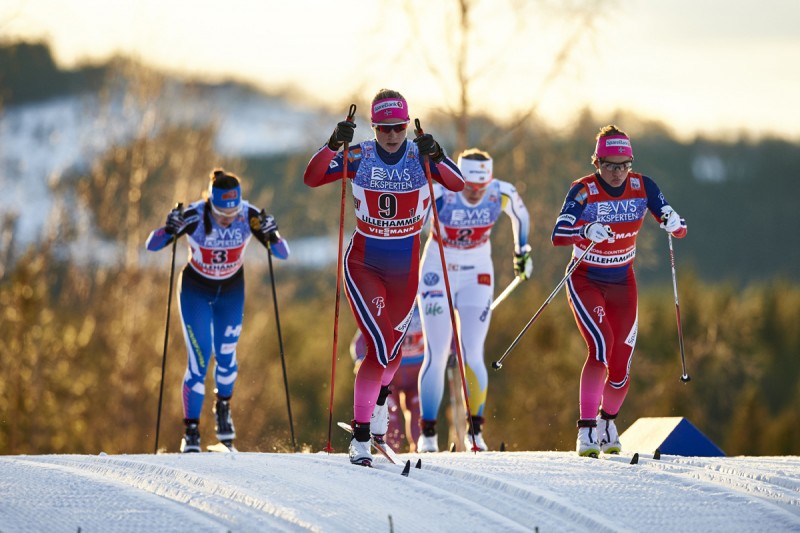
    Krista Parmakoski (FIN), Astrid Uhrenholdt Jacobsen (NOR), Ida Ingemarsdotter (SWE), Maiken Caspersen Falla (NOR), (l-r) ski in the first leg of the 4x5km, Lillehammer (NOR). (Fischer/NordicFocus)
    From left to right: Finland’s Krista Parmakoski, Norway II’s Astrid Uhrenholdt Jacobsen, Sweden’s Ida Ingemarsdotter, Norway I’s Maiken Caspersen Falla during the first leg of the 4 x 5 k relay in Lillehammer, Norway. (Photo: Fischer/NordicFocus)

    At the first exchange Norway’s second-team skier, Astrid Uhrenholdt Jacobsen, led Falla of Norway I by 6.1 seconds, closely followed by Ingemarsdotter of Sweden and Parmakoski of Finland. Brennan tagged Bjornsen for the second classic leg in seventh, 49 seconds back from Jacobsen.

    From there the race for first appeared over. Norway’s Østberg dropped the hammer, skiing away from Finland and Norway II, putting them 21.5 and 36.6 seconds down at the second exchange.

    For Team USA and Bjornsen, the second leg meant hanging tough and staying upright. Bjornsen said she “got a little over excited at the beginning and tried to close the gap to Germany and Russia in the first k.” She spent the “next 2.5 k trying to hold on for dear life,” recover, and more importantly, make it safely down the icy hills with “completely flooded legs.”

    When asked how she managed to hang on despite the excitedly fast start, Bjornsen painted a target on the back of the Norwegians and Swedes.

    “Anytime you see a red [Norway] or white [Sweden] suit, man, you just find another gear because those are the two people you’re gunning for normally,” she said.

    Before handing off to Stephen, the first skate leg, Bjornsen skied the fifth-fastest second leg, and tagged off 1:29.9 behind the Norwegian leaders, in a pack with Russia’s second team (+1:21.3), Germany (+1:21.7), Sweden (+1:23.5).

    Halfway through the first skate leg, Norway II, skiing in third place, looked vulnerable. Falling from only 36.6 seconds back at the exchange to 1:16.0 at the 2.5 k mark; Stephen was also closing the gap, now only down 31.5 seconds to third place.

    “I was focused on the uphills. This course couldn’t be much better for someone like me who likes to climb,” Stephen said. “My goal was to just drop them on the first uphill [Germany and Russia].”

    Stephen explained her strategy going into her leg. Skiing the third-fastest third leg, she mimicked Bjornsen’s motivation, “You see the white suit and you go for that, and when you look up and see a red suit, you really go!” Closing out her 5 k, the red suit of Norway’s second team hovered a tantalizing 21 seconds away.

    At the front, Johaug showed her form from the previous day, skiing the fastest third leg and extending Norway’s lead to 1:04 over Finland at the final exchange.

    Second-place Finland continued to ski in no-man’s land, maintaining its distance ahead third — 45.5 seconds at the third exchange — but unable to gain ground on Johaug, dropping to over a minute back at 1:04.

    In the battle for third, Stephen handed off to Diggins in fifth, 3.6 seconds behind defending Olympic and World Championship gold medalist Charlotte Kalla.

    Diggins quickly passed Kalla up the long climb on the first of two laps, and focused on Haga for the second lap.

    Just over 3 k into her race, Diggins caught Haga and the two skied neck and neck.

    Diggins dropped her on the last big uphill. “I didn’t look back so I had no idea if she was there or not,” she said.

    Coming in toward the stadium, Diggins described the atmosphere as “a total adrenaline rush. The people on that last hill were so loud because I was coming in with a Norwegian. You’re in so much pain, but you just can’t feel anything…”

    Diggins closed out the fourth leg with the second-fastest skate leg of the day and fastest final lap of any team.

    The U.S. women ended up third, their best result in a four-person relay since Kikkan Randall, Bjornsen, Stephen, and Diggins placed third in the 2013 Lillehammer World Cup relay two seasons ago. Before that, Holly Brooks, Randall, Stephen, and Diggins broke through with the first U.S. relay podium at the November 2012 World Cup relay in Gallivare, Sweden.

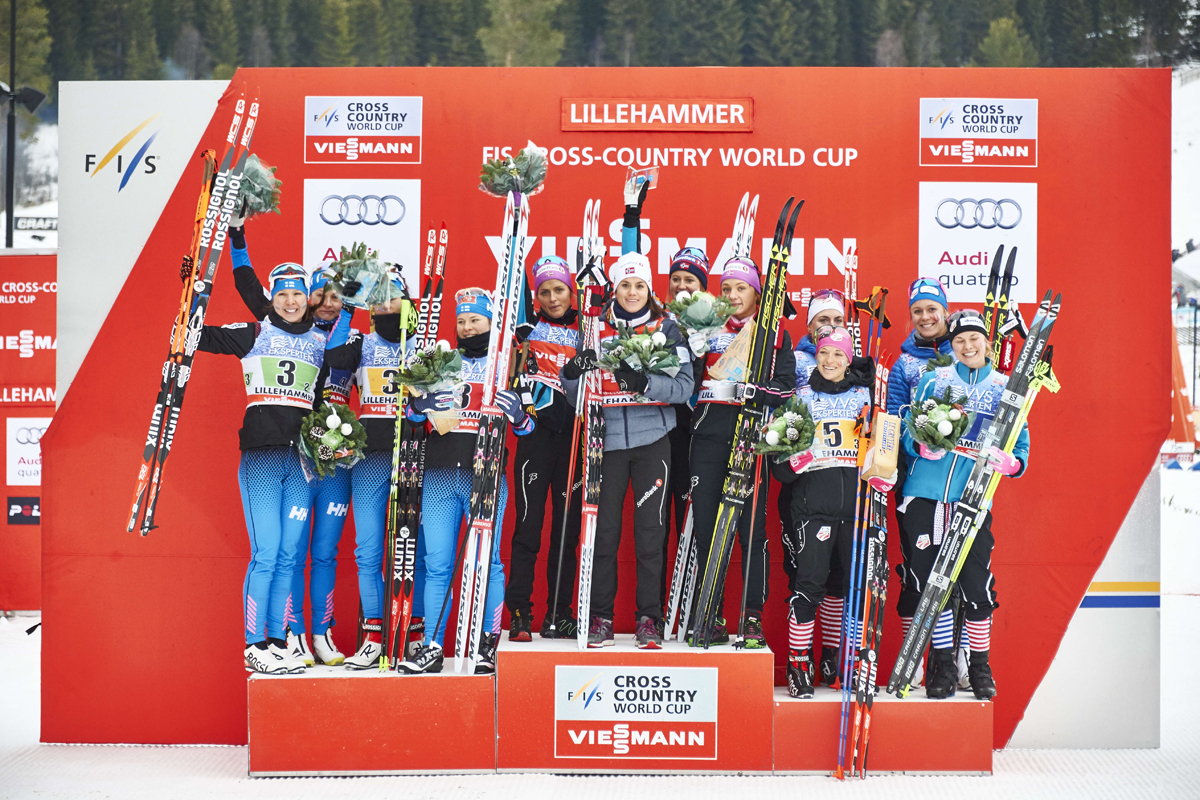
    The women's 4 x 5 k relay World Cup podium in Lillehammer, Norway, on Sunday, with Norway I in first (c), Finland in second (l) and the U.S. in third (r).   (Photo: Fischer/NordicFocus)
    The women’s 4 x 5 k relay World Cup podium in Lillehammer, Norway, on Sunday, with Norway I in first (c), Finland in second (l) and the U.S. in third (r). (Photo: Fischer/NordicFocus)

    “It speaks volumes to do it here,” Bjornsen said. “We have this belief that it can be any number of the four people on this relay team and it’s totally possible.”

    “We’re definitely a team that’s known for our skating on the women’s side — we saw that yesterday in the skiathlon,” Grover said. The U.S. had four women in the top 30. “We know that if we can be close in classic then we can really have a chance in the last couple legs of skating to get to the podium.”

    He added that the service team nailed the wax. “We had incredible skis, incredible kick, fantastic glide, for sure, some of the best skis in the field today, both for the women and for the men,” Grover said. “It was really a big effort not only from the group of women and the guys, but also from the entire staff.  I’m super proud of everybody performed today.”

    What was perhaps most important to the four women was the fact that they recognized not all of them had perfect days.

    “Maybe it wasn’t perfect; it was just solid,” Stephen said, adding that both Norway and Finland are “catch-able” — not out of reach.

    “Today was really special. I’m so proud of these girls,” Stephen added. “I can really relate to Rosie’s fear of downhills; I think we’re both struggling on it … and I’m really proud of her for that. … When you put relay socks on Jessie Diggins, it’s like a different person. It’s a really fun thing for me to touch her butt and watch her go. Sadie… she kicks ass and is just so solid.

    “It’s a really fun team; it’s changed. There’s been a few members changing over the years, but being back on the podium, it’s a real thing to stand on that block and to get a brick of cheese that weighs more than half your team together.”


    — Alex Kochon and Katie Madden contributed reporting

    Results

  • Kowalczyk First to Repeat in Tour, Johaug Stunning in Second

    Kowalczyk First to Repeat in Tour, Johaug Stunning in Second

    Justyna Kowalczyk (POL) Celebrates her Tour de Ski win (Photo: Fiemme2013)

    Justyna Kowalczyk (POL) became the first skier, male or female, to win back-to-back Tour de Ski titles when she staggered across the finish line at the top of the Alpe Cermis on Sunday morning.

    Starting with a lead of 2:08 over Marianna Longa (ITA), Kowalczyk was in no danger of being caught, but the big cushion did not make her complacent, especially with World Cup points and prize money available for the “Woman of the Day” standings – the results for the stage.

    The Polish superstar pumped her arms at the finish and then collapsed into a ball on the snow. Exhausted, any further celebration would have to wait.

    Kowalczyk used a breakaway with Therese Johaug (NOR) in Saturday’s mass start to cement her hold on the overall lead. After winning that race and claiming all the bonus sprints, Kowalczyk was well set for the brutal final climb.

    But while the overall belonged to Kowalczyk, the big story of the day was all about Johaug.

    The energetic Norwegian started the Tour in solid form, but turned on the jets in the mass start, leading Kowalczyk on the break, and climbing to fifth overall.

    But as impressive as that performance was, Johaug had more to give. She wasted no time, charging out of the start today, and abusing her competition.

    Petra Majdic (SLO) was the first to fall, Johaug overtaking the Slovenian before the 1.5km mark. Arianna Follis (ITA) was next up the trail. The Italian finished third in last year’s Tour, and she held a full 50-second lead on Johaug.

    Johaug celebrating her second place finish (Photo: Fiemme2013)

    It wouldn’t be enough – not nearly. Once the climb started Johaug ate her up and spat her out, Follis not even attempting to hang. The reaming Italian hope, Marianna Longa, started 1:12 ahead of Johaug, but on the steep climb of the Alpe Cermis, seconds disappear like the snow during a New England thaw.

    Longa had more to give than Follis on this day, and she made a valiant effort to stay with Johaug. But drafting gave no advantage and she too was left in the dust, and the television announcers started talking about a battle for first.

    That may not have been realistic, but Johaug never let up. She sprinted across the line, collapsing in exhaustion and screaming her joy at the same time.

    She finished a stunning one minute ahead of the next fastest woman over the nine kilometer course, and nearly two minutes ahead of third. Overall she took two minutes out of the Pole, and her only regret can be her inability to capture bonus seconds earlier in the Tour.

    “It was a really great race today, my shape is really good and I had great skis,” Johaug said after the race. “I had a dream about finishing second today, and I was really happy when I saw Longa up the hill. Overtaking those girls was a really great moment, and this is the best I have done in my career so far.”

    Kowalczyk was drained by her effort, but had some in reserve if Johaug closed further.

    “I was tired, my legs were in pain and all I could think of was the finish line,” Kowalczyk said. “I heard Therese was attacking, but I was not afraid of her winning… if the time gap was smaller I would have gone faster. I was not giving 100% in the last hill.”

    Longa stayed strong, and gave the Italians third place for the second year in a row. She celebrated across the line and was quickly joined by her young son as she hugged coaches and servicemen in the finish corral.

    “It was a very hard race today,” Longa said. “The climbing is really really tough. I am so tired right now.”

    Longa posing with her son after the finish (Photo: Fiemme2013)

    The Italian was impressed with Johaug saying, “Therese Johaug was really strong yesterday, and she was even more dangerous for me today. I am really satisfied with winning third place today, and I am happy with my race.”

    Follis unpressured in fourth, was clearly disappointed. She had an up and down Tour, but did not have enough to give on the climb. She was the only woman near the top who did not fall to the snow upon finishing.

    Charlotte Kalla (SWE) a pre-Tour favorite, moved up one position to finish 5th, taking down Majdic on the climb. Majdic, who struggled in the distance races during the Tour, was surprisingly strong. Regardless of her form, she never lets up, and was completely spent at the end.

    She heads home with two sprint victories in addition to her strong overall ranking, and cannot be disappointed despite her inability to repeat her second place overall finish from a year ago.

    The Norwegians dominated the day, taking the top three places. After Johaug came Marte Elden, who also skied very well in the mass start. Elden moved up into ninth overall.

    Marthe Kristofferssen rounded out the day’s podium edging Kowalczyk by 5.4 seconds. She ended her Tour in seventh, and with Marit Bjoergen and Kristin Stoermer Steira both watching from home, the Norwegian women’s team is looking exceptionally strong.

    Astrid Jacobsen placed 10th in the overall, and Ingvild Oestberg 14th, giving Norway five of the top-14.

    Finn Krista Lahteenmaki held her position, placing eight overall, a breakthrough performance for the 20-year-old, who showed good form in all events.

    She was the top Finn as both Aino Kaisa Saarinen and Ritta Liissa Roponen had disappointing Tours.

    American Kikkan Randall placed 23rd on the day, and finished her first Tour in 21st.

    Only 32 women managed to survive to the top of the Alpe Cermis, as illness and fatigue took a major toll in this test of endurance.

    Women’s Tour de Ski “Woman of the Day”

    Women’s Tour de Ski Final Standings

    Women's Podium (Photo: Fiemme2013)