From the FasterSkier archive — posts syndicated from athletes’ and coaches’ own blogs between 2004 and 2012, kept online as published. Current coverage is at fasterskier.com.
Alone and unchallenged, as she raced for much of her stellar career. Norway’s Therese Johaug. (Photo: Thibaut/NordicFocus)
According to stories released today by the Associated Press, Norwegian cross-country skiing legend, Therese Johaug, has announced her retirement. Only a day after FasterSkier postulated whether or not Johaug was still considering another run at the Olympic Games (which would’ve been her fourth Olympics), she took a new direction—announcing that she wants to be fully devoted to her young family—and stepped out from under one of the brightest Nordic skiing spotlights that the sport has ever known.
Johaug is an athlete who reinvented her sport—not unlike Dick Fosbury who re-crafted the technique of high jump, or Bob Beamon whose outlandish world record in the Olympic long jump in Mexico City set a standard that lasted for generations. Johaug’s signature technique was a counter-example to the slow-and-powerful technique of cross-country skiers who went before her. Her staccato tempo, her relentless racing drive, and her apparent resistance to “pacing” herself set a standard for those who came after her: particularly Jessie Diggins and Frida Karlsson, two of the modern skiers who now dominate World Cup and World Championship racing. Johaug’s racing was flat out, full speed, catch-me-if-you-can. And for years there was no one who could even come close. She is immortalized through Olympic Gold, through World Cup Crystal, through Tour de Ski triumphs, and through World Championship excellence. And our sport is not likely to see another one like her.
Norway’s great champion, Therese Johaug. There will never be another skier like her. (Photo: NordicFocus)
FasterSkier is happy to thank Therese Johaug for her loyalty to our sport, and her devotion to skiing excellence. When the 2025-2026 season gets started, it will be just a little bit less of a stellar show for the absence of one star in particular: Therese Johaug.
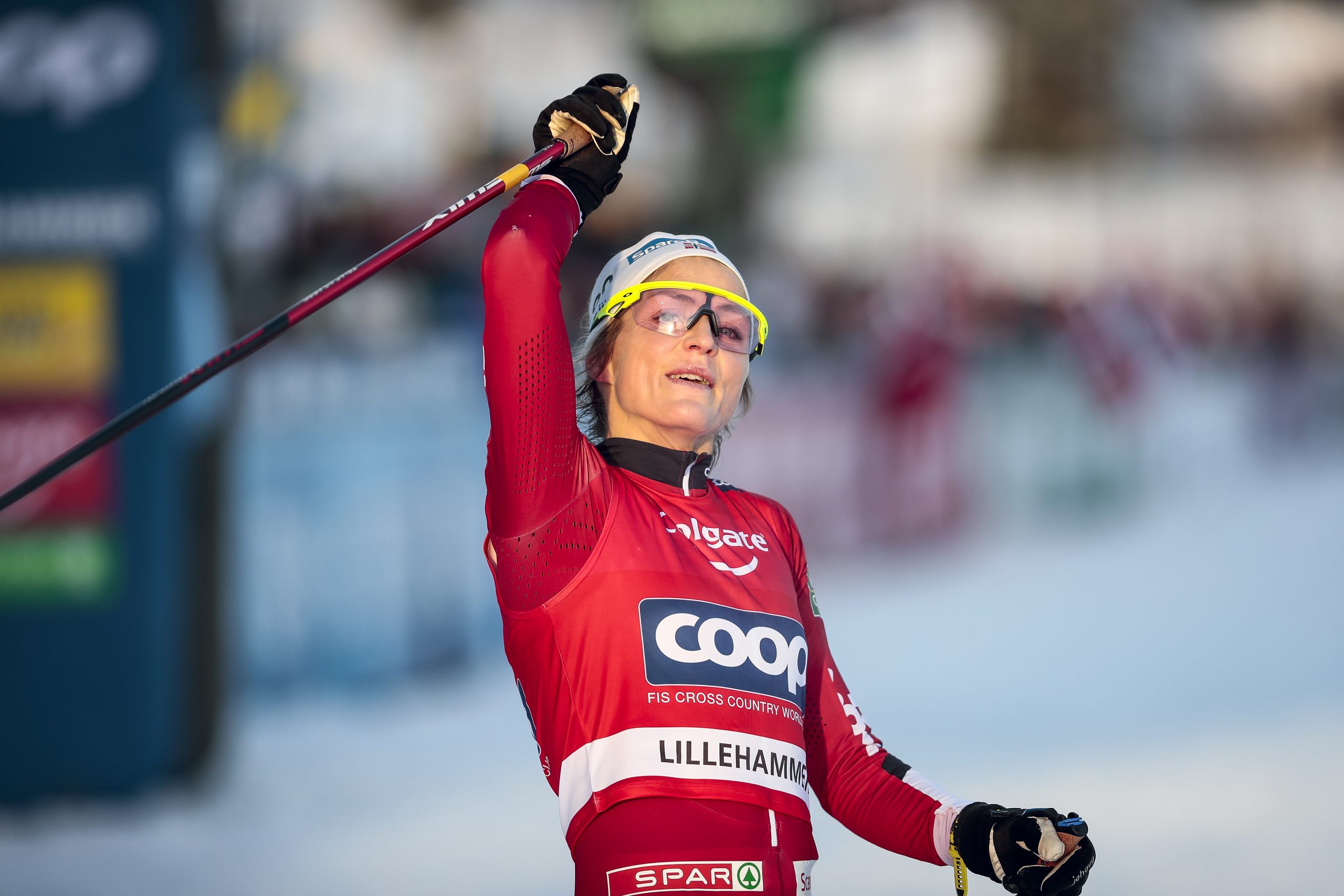
Therese Johaug celebrates her final race race at the Holmenkollen, winning the 30 k classic exactly eleven years after taking her first individual World Championship gold on these tracks. (Photo: NordicFocus)
This article was made possible through the generous support of our voluntary subscribers. If you would like to see more articles like this one, please support FasterSkier with a voluntary subscription.
Therese Johaug (NOR) claimed three individual gold medals at Beijing’s 2022 Olympic Winter Games. (Photo: NordicFocus)
Therese Johaug’s Olympic dilemma is fairly straightforward. It’s this: why bother? She’s done everything there is to do in the sport of cross-country skiing—World Cup Crystal Globes (which she certainly won’t chase in 2026), Tour de Ski (which she probably won’t enter in 2026), World Championship glory (though 2025’s fistful of silver medals was not the result she’d hoped for), Olympic Medals (which she’s likely to win more of in 2026, but not enough to become the winningest skier ever). There’s just not much more for Johaug to win in 2026.
Johaug’s retirement has been put on hold—for the moment, at least—and she hasn’t yet announced her Olympic intentions. They’re holding a spot for her on Team Norway. They should: she’s one of the most successful, most talented, most dominant cross-country skiers of all time. She’s a shoe-in for Olympic medals in 2026. Among her Norwegian teammates, only Astrid Oeyre Slind seems capable of challenging Johaug in distance events.
Frida Karlsson (SWE) seized the 50 k Freestyle Mass Start at the 2025 World Champioships on a day when everyone else—including Therese Johaug (NOR)—was stymied by challenging conditions. Will Johaug race another year to prove that she, herself, has always been the strongest? (Photo: Thibaut/NordicFocus)
What is her goal, anyway? What does she have to gain by coming back for yet another Olympic Games? She can’t surpass Marit Bjoergen’s historic total of Olympic medals (not without continuing on to 2030, anyway). And she certainly can’t get back the Olympic opportunities lost during her suspension in 2018. Hasn’t she already won basically everything there is to win for a cross-country skier specializing in distance races? She won the Olympic Team Relay in 2010. She swept the distance races in 2022 (30 k Mass Start, 15 k Skiathlon, 10 k Interval Start). Maybe Johaug still sees the potential to win all of her individual Olympic events in Val di Fiemme: Skiathlon, 10 k Freestyle, 50 k Classic. Or perhaps Johaug just loves to train and ski. Regardless of her reasons, one thing certainly remains true: she’s still one of the very best in the world, still one of the very best of all time. And the Olympic races will be better, more exciting, and more consequential if she’s racing them. If she decides to race . . .
Beijing demonstrated the sort of Olympic dominance that Therese Johaug (NOR) could’ve understandably expected. (Photo: NordicFocus)
It seems Johaug may have one remaining goal in mind: win the Olympic 50 k Classic in order to soothe the sting of having been defeated in the 50 k at the 2025 World Championships in Trondheim. If she’d won the World Championship 50 k, she probably would’ve retired on the spot. But with that goal having been left unrealized in 2025, maybe Johaug needs more. She’s been World Cup Champion in both Overall (three times) and Distance (five times) classifications, but if she has her sights set on Olympic victories, she’s unlikely to care much about scheduling enough World Cup races to claim another Crystal Globe. After a career in which she has amassed 160 World Cup podium performances, she’s not likely to prioritize rounding up a few more.
Should she come back one more time? Should she risk another year of effort and training for a goal that may continue to prove elusive? Should she undertake another season of separation from her young daughter? She loves to race, she lives to compete, and her endurance—and her ability to recover—are legendary. If there’s an historic medal to be awarded in 2026, it won’t be a surprise to see Therese Johaug being one of those who shows up to vie for it.
This coverage is made possible through the generous support of Marty and Kathy Hall and A Hall Mark of Excellence Award. To learn more about A Hall Mark of Excellence Award, or to learn how you can support FasterSkier’s coverage, please contact info@fasterskier.com.
Jessie Diggins (USA) fought through a challenging World Cup 50 k in Lahti, Finland with the grit and determination that epitomizes her career, allowing her to secure the Distance Crystal Globe (to go with the Overall Crystal Globe that she secured earlier in the week). (Photo: Modica/NordicFocus)
Therese Johaug (NOR) was going to retire two weeks ago, but things didn’t work out as planned. She had intended to go out after the 50 k at World Championships—to be honest, Johaug intended to go out after winning the 50 k at World Championships—but horrendous conditions on that day in Trondheim may have robbed her of that chance. She managed to finish an uncharacteristic third, but that’s not the sort of victory lap Johaug imagined marking the end of her legendary career. She needed another 50 k to set the stage for her retirement. Today’s race is why Therese Johaug changed her mind.
Therese Johaug (NOR) spent a career off the front, skiing alone to most of her victories. Her victory in the 50 k Classic Mass Start in Lahti showed once again why she is considered one of the greatest skiers of all time. (Photo: Thibaut/NordicFocus)
Women’s 50 k Classic Mass Start
Few entrants in the women’s 50 k field had also competed in yesterday’s Team Sprint event. That meant that most of the skiers who lined up at the starting line of today’s 50 k were pretty fresh (well, as fresh as could be expected here at the far end of a full World Cup and World Championship season). Whatever energy each skier still possessed they would dearly need.
Fifty kilometers is a long, long way, and Johaug’s strategy was likely to render it a suffer fest. In years past, Therese Johaug would simply ski off the front of any Distance event, and race the entire distance alone; a courageous and absolutely domineering way to race. If Johaug had a plan for today, that was probably it.
Lahti offered a 7.15 kilometer loop that skiers would navigate seven times. Less than five minutes into the first lap, Johaug moved to the front along with Ebba Andersson (SWE), Astrid Oeyre Slind (NOR), and Nora Saness (NOR). Predictably, Johaug’s group began to establish a bit of a lead over the main field. Jessie Diggins (USA) worked to minimize the gap, finding herself in an early chase group with Teresa Stadlober (AUT), Kertuu Niskanen (FIN), Victoria Carl (GER), Katherina Hennig (GER), and Nadja Kaelin (SUI). Diggins’ coaches started doing the math: what would she need to do in order to maintain her grasp on the distance Crystal Globe?
Over the course of 50 kilometers, the field would contest six bonus points sprints, with the first coming at 12.9 kilometers. The Distance leaader points gap between Diggins and Slind was close enough (95 points) that those bonus points could allow Slind a chance to overtake Diggins in the chase for the Crystal Globe. The pattern was set early on: Slind would cross the bonus points line second (behind Johaug) to collect 12 bonus points while Diggins would cross tenth to claim a single point. Diggins’ lead was dwindling, but there were many bonus sprints—and many more kilometers of racing—still to go.
At the end of the second lap (at 14.3 kilometers), Johaug was away. She double poled off the front, leaving Slind as the sole chaser well ahead of a group that now included Andersson, Niskanen, Hennig, Carl, Kaelin, Saness, Stadlober, with Diggins beginning to dangle off the back. Diggins would change her skis at the end of Lap 3, a decision which she would later credit with her ability to charge forward late in the race.
Quietly, Diggins went to work, hoping to reel in Kaelin and maybe even Saness or Carl. Diggins had already secured the Overall Crystal Globe earlier in the week, but Slind’s performance in this 50 k saw the Norwegian threatening Diggins in the race for the Distance Crystal Globe. Ultimately, Diggins dug deep, passing Kaelin late in the race to secure ninth place. That placing allowed Diggins to maintain her hold on the Distance World Cup by a mere two points.
Therese Johaug (NOR) crosses the line for her first victory in an international 50 k race. It may not be her last. (Photo: Modica/NordicFocus)
At the front, Johaug left no doubt who was the supreme distance skier of the day, of the era, perhaps of all time. She secured her victory more than a minute ahead of Slind, a performance that may begin to reduce the sting of Johaug’s disappointment at the slushy World Championships in Trondheim. If Johaug wanted redemption, then that she achieved here in Lahti. If she wanted to go out on top—to retire after a significant victory—then this was her chance. But the scope and breadth of Johaug’s magnificent career is such that she may have lost interest in lesser prizes. World Cup wins, Tour de Ski triumphs, even World Cup overall championships: Johaug has had enough of those to assure the immortality of her career statistics. At this point in her career, Johaug is likely to prioritize only the glory that shines from individual accomplishments: World championships and Olympic gold medals. After today’s performance, Johaug could be forgiven for looking forward to another such opportunity for individual glory that lies less than a year away in the Olympic 50 k in Italy. She might be able to dominate that race just as she dominated today’s. But there would be many long days of training still to deliver between now and then. And that imagined victory would only be arrived at over the best efforts of Slind, Andersson, Frida Karlsson (SWE), and whatever other dark horses arise (as they so often do) in consequential Olympic races.
Today’s race is why Therese Johaug changed her mind. Now, she has more decisions to make, with consequences and opportunities that may be played out through one final, glorious Olympic season.
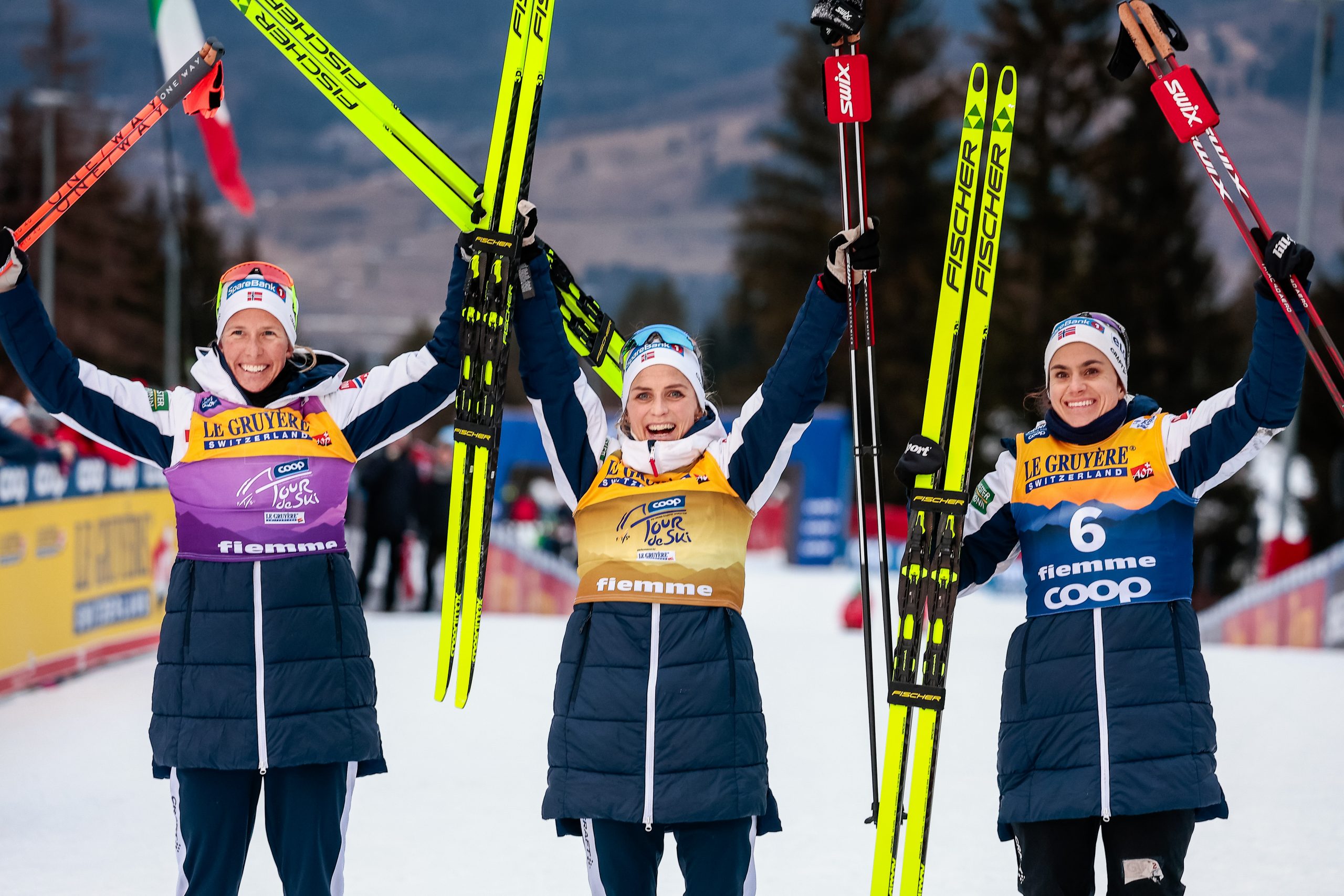
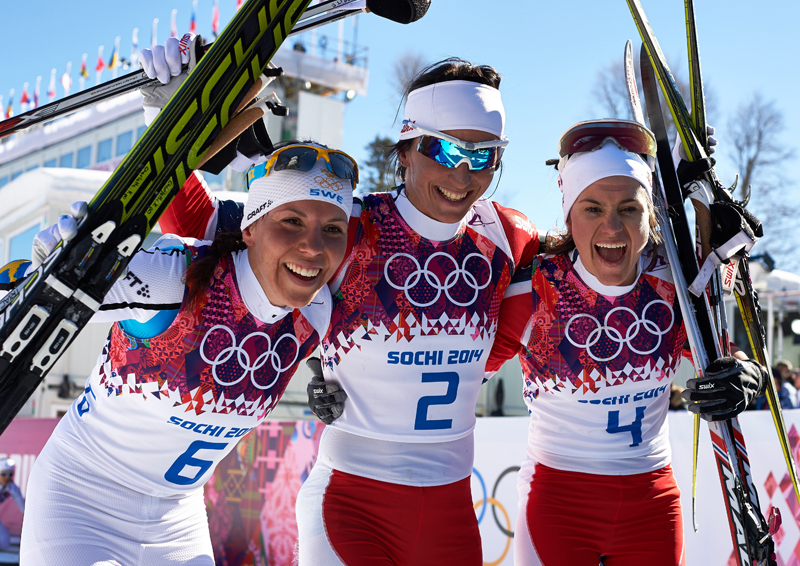
Celebration at the end of a long race—and the end of a long season—for Astrid Oeyre Slind (NOR), Therese Johaug (NOR), and Ebba Andersson (SWE). (Photo: Modica/NordicFocus)
This coverage is made possible through the generous support of Marty and Kathy Hall and A Hall Mark of Excellence Award. To learn more about A Hall Mark of Excellence Award, or to learn how you can support FasterSkier’s coverage, please contact info@fasterskier.com.
Therese Johaug (NOR) lives only minutes away from the trails at Holmenkollen above Oslo, Norway. In the World Cup 20 k Classic Interval Start, she gave her hometown crowd the victory they’d hoped for. (Photo: Modica/NordicFocus)
In the weeks closely following the conclusion of each year’s Tour de France (the world’s preeminent bicycle stage race), the winners and contenders undertake a tour of “criterium” events, races staged in those European locations where fans are mad for cycling, but where the stages of the Tour were not held. The fans get a chance to see their heroes, to witness firsthand the shape and form and fitness of those who triumphed under such challenging circumstances. By that time, the finishers of the Tour de France are totally exhausted, absolutely spent, emotionally and athletically drained. But while the three grueling weeks of the Tour may have sapped their energy, it also instills in them a level of fitness and capability that enables them to race on auto-pilot, and at levels of otherworldly excellence.
Usually, Holmenkollen, Norway would play host to the most eagerly anticipated ski races of any World Cup season. But the World Championships were just last week—those were the races that the athletes circled on their calendars, those were the races that Norway lined up to see. For perhaps the first time, it was possible that Holmenkollen would become an afterthought. This year, Holmenkollen would be a criterium rather than a national celebration. The brightest stars of the cross country firmament were scheduled to be be on the starting line, but it remained to be seen just how much sparkle and and spirit those stars would have left.
Therese Johaug (NOR) had overturned her life—re-prioritized skiing over family and business and normal life—so that she could win again at Trondheim. Holmenkollen was to have been her criterium event, her victory lap. Things hadn’t play out as scripted.
Jessie Diggins (USA) so under-performed at the World Championships that she could barely bring herself to address the media. Of all the skiers in the Holmenkollen field, Diggins was the one still with something to win as she continued in her quest to capture the World Cup Overall and World Cup Distance Crystal Globes. Would she have been able to recover from the exhaustion and disappointment of Trondheim?
Ebba Andersson (SWE) was contending for the win in Trondheim’s World Championship 50 k Mass Start when an untimely crash ended her chances. She returned to racing in Holmenkollen where she finished third, only to have her placing nullified after disqualification for technique violations. (Photo: Modica/NordicFocus)
Ebba Andersson (SWE) had crashed, tragically, while in position to possibly win Trondheim’s 50 k. Would she find herself drained on Holmenkollen’s 20 k course? Or would she be on fire?
And Frida Karlsson—she who endured and dominated the historic 50 k in Trondheim—she elected to skip Holmenkollen’s 20 k Classic. All through the World Cup season, Karlsson had been mostly absent. Injury had kept her off the race course, and her ambitions at Trondheim had narrowed the focus of her training. With her World Championship victory having been achieved—and with little else for Karlsson to accomplish in the overall World Cup standings—it appeared that she might have called it a season.
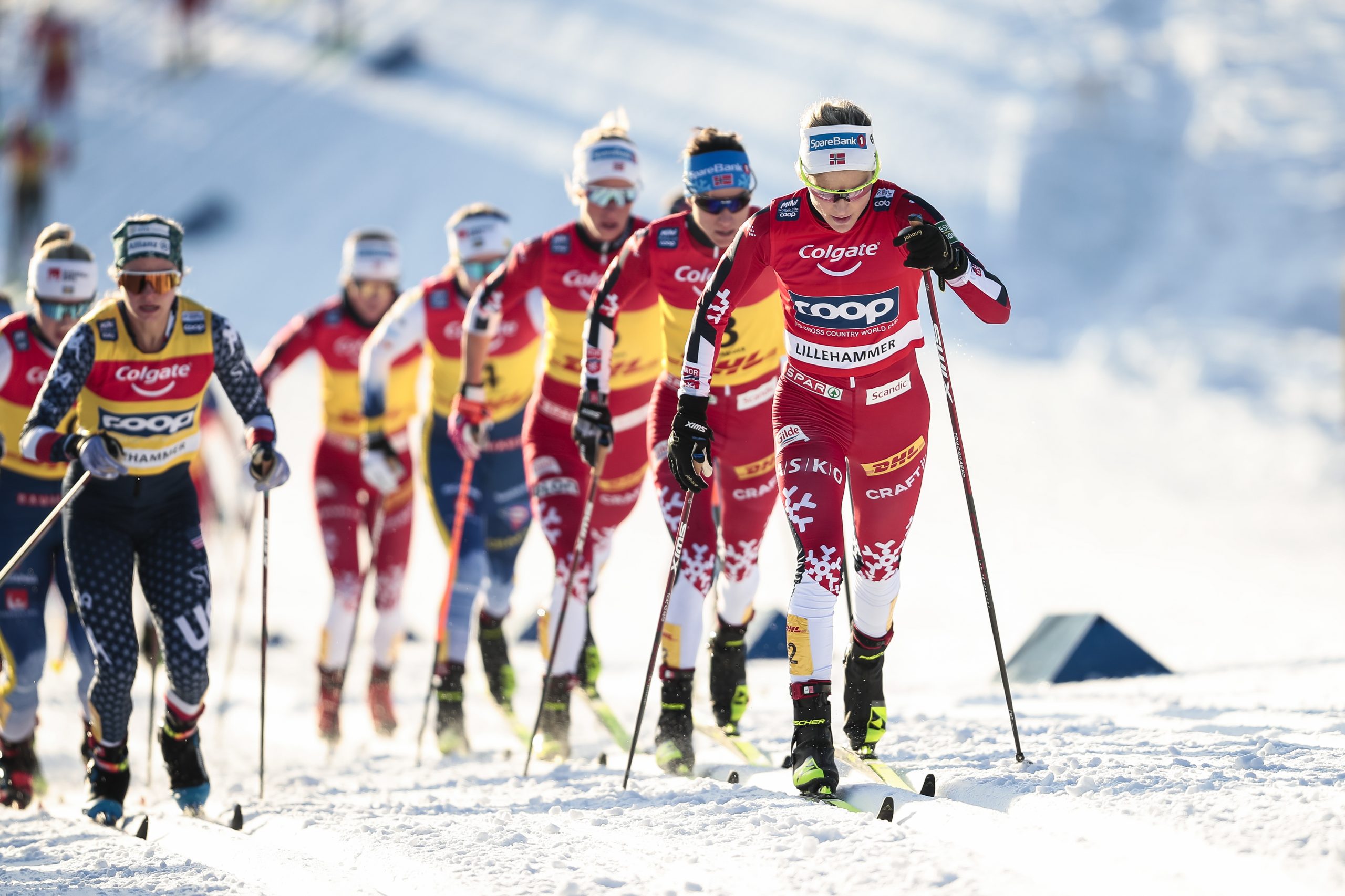
Astrid Oeyre Slind (NOR) already has four victories in this World Cup season. Only a blazing performance from Therese Johaug prevented Slind from adding a fifth win at Holmenkollen. (Photo: Modica/NordicFocus)
20 k Classic
The course at Holmenkollen offered a distance that was actually somewhat shorter than 20 kilometers—three 6.2 kilometer laps on a sunny day with temperatures hovering just above freezing. Waxing would be fairly straightforward, but all skiers would find themselves slipping wherever deep shadows alternated with bright sunshine on the course. And all of them would be racing in Holmenkollen with the weight of Trondheim’s historically significant and athletically draining 50 k Freestyle still throbbing in their exhausted legs.
In the end, Holmenkollen’s 20 k Classic Interval Start provided a stage on which another thrilling World Cup was contested. Johaug went out like a rocket, only to find herself challenged at early checkpoints by Astrid Oeyre Slind (NOR) who also had disappointing World Championships performances to make up for. Slind had already won a 20 k Classic in this World Cup season, but Johaug was not to be denied, separating herself from her Norwegian rival in the later checkpoints and driving on to a 16.5 second victory. Andersson had the disadvantage of an earlier start position, but she would race bravely to finish third, 31.9 seconds behind Johaug. Ultimately, a jury decision found that Andersson had committed technique violations on the course; her second “yellow card” of the season resulted in disqualification, elevating Victoria Carl (GER) to third place.
Among Americans, Diggins would ski solidly and with great energy to finish 10th. Rosie Brennan was 17th, Sydney Palmer-Leger 38th, Sammy Smith 44th. Canadian finishers included Alison Mackie 28th, and Katherine Stewart-Jones 31st.
Holmenkollen was to have been Johaug’s victory lap. While she may not have brought a slew of World Championship gold medals to show off in front of her hometown crowd, she did deliver the sort of dominance that she has so often displayed on the trails of Holmenkollen.
“I’m just smiling out there!” said Johaug. “Today was my day, but it was a really hard fight with Astrid. She was really strong today.”
Sorry we missed yesterday, but Nat had to stop by the Klæbo victory party and Devon was busy. Not to fear: We’ve got recaps of both the men’s and women’s 50-kilometer races in Trondheim.
We made it to the end; we’re going to take a few days off from podcasting, but feel free to send us love notes only to devon@fasterskier.com and nat@fasterskier.com. See you soon.
Frida Karlsson celebrates her victory on Sunday. (Federico Modica/Nordic Focus)
Remember on the last episode where we talked about how exciting we thought the women’s skiathlon would be? It delivered every ounce, and maybe a little bit more. We’ve got a full recap here.
Reach us by email at devon@fasterskier.com and nat@fasterskier.com. We’ll be back after Tuesday’s the individual start races.
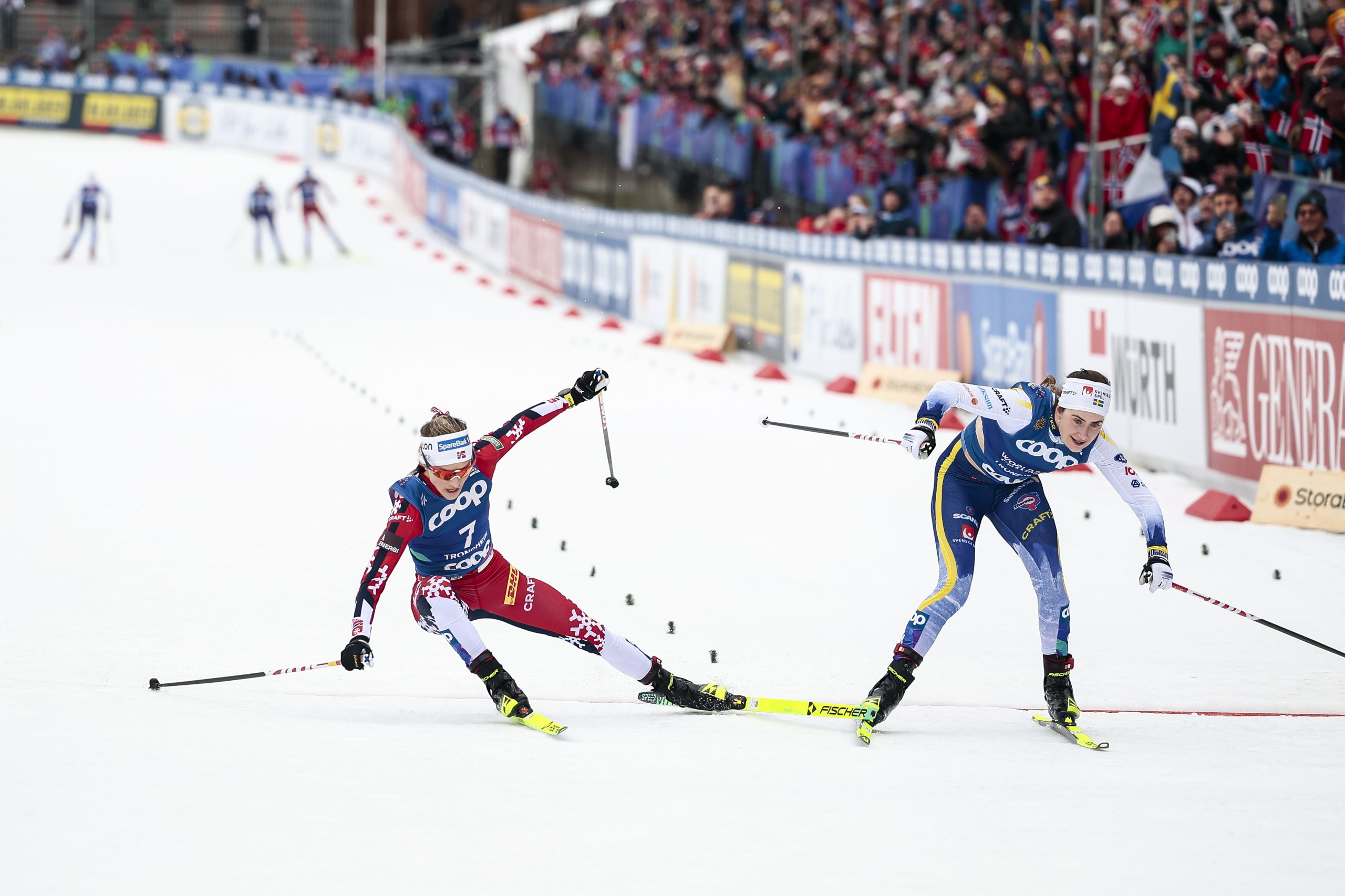
Therese Johaug (NOR) and Ebba Andersson (SWE), (l-r) lunge for the line and the win. (Photo: Modica/NordicFocus)
FasterSkier’s FIS World Championships coverage stands as a proud tribute to American Skiing Icon Marty Hall, who (with his wife, Kathy Hall, and their A Hall Mark of Excellence Award) has supported our coverage of international cross-country ski events. Learn more about A Hall Mark of Excellence Award at info@fasterskier.com. We’ll miss you, Marty.
The start of a wet Women’s Skiathlon at the FIS Nordic World Ski Championships Cross-Country in Trondheim, Norway. (Photo: Modica/NordicFocus)
It’s gonna be a soggy one . . .
Norway in winter is not always what familiar postcard-images and pre-broadcast video-montages would have us believe. This is not a place covered in perpetual snowy white glowing under sunny mid-winter skies. In fact, it only rarely is. And it almost never is in Trondheim. Trondheim is a coastal city looking out across the cold Norwegian Sea toward Iceland. Norway’s 64,000 mile fjord-slashed coast (second longest of any nation on earth) is the feature that creates Scandinavian snow. Warm, wet weather fronts roll in off the sea. Moisture-laden air cools as it rises over the Scandes range, dropping Norway’s familiar snow on the eastern side of the mountains (on Holmenkollen, Lillehammer, Sjusjoen—the notable ski destinations). But on the coast where that precipitation all begins, it falls from the sky more often as rain . . . just like today for the Women’s 20 k Skiathlon at the FIS Cross Country World Championships.
Ironically, skiing in the rain isn’t nearly as bad as it sounds. Wet snow can actually be pretty fast (if the technicians have mastered the base prep to give the skiers both glide and kick). One way or another, the Norwegians are accustomed to it. Trondheim is their town, their snow, their championship. If World Championship medals are being handed out at the end of the race, then all of Norway will do its best to claim them.
Therese Johaug (NOR) lost two years to a suspension, and another two seasons in retirement after the birth of her daughter. She probably wants to recoup the wins lost during those years.
Jessie Diggins (USA) has been forced to limp through half the season on an injured foot. She probably wants to show that her recovery is nearly complete.
Heidi Weng (NOR) was once the very best in the world. She probably wants to show that she still can be.
Frida Karlsson (SWE) has proven to be fast, but fragile. She probably wants the enduring respect that has eluded her.
Astrid Oyre Slind (NOR) has orchestrated the rarest of careers, only reaching her peak in her mid-30’s. She probably wants to show that it’s not a fluke.
Ebba Andersson (SWE) is the defending champion in the World Championship Skiathlon. She probably feels that she has much to prove . . . and she knows she can win. But the two years since her last World Championship victory have been a struggle.
“It has been ups and downs, but mostly downs,” Andersson remembered. “It’s really, really good to have one of those up days here in Trondheim on this day.”
And the “up day” to which she referred ended with perhaps the closest victory in World Championship history, as Andersson edged past Johaug in the closing meters of the 20 k Skiathlon. Their finishing times were identical, the finishing order only decided by a panel of judges viewing the tech-stretched image captured by the finish line’s high-speed camera.
The margin between Therese Johaug (NOR) and Ebba Andersson (SWE) for the win at the finish of the Women’s Skiathlon was about as close as it could be. (Photo: Ski and Snowboard Live Broadcast)
Andersson spoke of her elation at claiming victory for Sweden in this Norway-hosted World Championships. “Especially when my teammates came and gave me a hug,” she said. “Then it feels so unrealistic . . . just a dream come true.”
Diggins dropped from contention almost as soon as the race began, seeming to be hampered by slow skis for the second time during these World Championships. She would finish 13th, followed by Sophia Laukli 23rd, Julia Kern 26th, Alyssa Sonnesyn 40th.
Among Canadians, Lilliane Gagnon was 30th, Alison Mackie, 44th, Katherine Stewart-Jones 47th, Sonjaa Schmidt 49th.
It wasn’t the result her fans were hoping for, but Jessie Diggins (USA) raced as hard as she could given the variables she could control. (Photo: Modica/NordicFocus)
20 k Skiathlon
This race’s beginning followed a script that could have been written well in advance of the actual race. Johaug went straight to the front . . . Slind, Karlsson, Andersson, Emma Ribom (SWE) and Jonna Sundling (SWE) went with her. The race shaped up quickly, and anyone not in this very early move was likely to be left behind. Diggins and Victoria Carl led an early chase group, but things were getting away. The race was all of five minutes old.
By the end of Lap 1, the front of the field had come back together as Karlsson and Sundling led through the stadium at 3.3 kilometers with two Classic laps remaining.
Victoria Carl (GER), Astrid Oeyre Slind (NOR), Pia Fink (GER), Therese Johaug (NOR), Flora Dolci (FRA), Krista Parmakoski (FIN), Heidi Weng (NOR), Moa Ilar (SWE), Teresa Stadlober (AUT), (l-r) lead the rest of the women at the start of the World Ski Championships Cross-Country 20 k Skiathlon in Trondheim. (Photo: Nordic Focus)
The Classic course in Trondheim (three laps of 3.3 kilometers each) climbs steadily out of the stadium. The climbers pressed the pace in this first half of the loop, hoping to detach the others (especially the sprinters). Compared to the Men’s race from a day before, the Women’s field seemed determined to use the climbs to break the spirit of any sprinter-types. The lead group formed itself into the short-list of contenders: Weng, Slind, Johaug, Karlsson, Andersson, and Sundling.
At the end of Lap 2, Slind, Karlsson, and Sundling showed their fast skis down the long hill into the stadium. Johaug (not the most masterful descender in the group) was gapped on the downhill, but she quickly charged back up to the leaders as they traversed the flat. Regardless, Johaug must’ve been sensing the need to drop everyone else before that slushy right-hand turn leading to the finish line.
Each lap on the large climb of the classic leg Therese Johaug (NOR) attempted to stretch the field and get away. (Photo: Modica/NordicFocus)
Third time up the big Classic climb; Johaug hit the gas. On-air commentators wondered if Team Norway was employing team tactics, as the Norwegian trio—Johaug, Slind, and Weng—gapped the Swedes. Best guess from this reporter? No way . . . Johaug is not a team player, and anyone wanting to help her is going to need to keep up with her (and that’s never proven to be an easy thing to accomplish). On this third time up the Classic climb, Johaug looked determined to drop them all, no matter which flag they wore. The Swedes appeared to be caught flat-footed, with Sundling leading the chase of her climber-teammates.
Fortunately for Team Sweden, they are known to have fast skis. They might not have been panicking as a gap opened over the top of the climb since they’d be likely to catch back up on the subsequent descent. Andersson followed, Karlsson dangled, but it was Sundling who chased down the breakaway, gliding easily into their midst on the descent. The lead group of four entered the stadium for the ski exchange.
It was at this point that the Skiathlon reminded viewers just how difficult and capricious performing at this level really is: Slind suffered a total-disaster ski exchange, kicking one of her skate skis as she entered her transition box. As the ski slid away, she stayed poised and switched to her other skate ski, grabbing her skate poles before skootering after the matching ski, which had slid all the way across the track and under the track for the trailside trolly camera. Regardless, the damage was done. Johaug, Weng, Andersson, and Sundling sped off without Slind, while she and Karlsson exited the exchange area eight seconds behind the leaders. Slind may have proven herself one of the very best skaters in the world throughout this World Cup season. If she wanted to climb her way back onto this Skiathlon podium, she’d need to prove it again, now.
Diggins came through the Classic/Freestyle transition more than a minute behind. It seemed that the wet conditions had gotten the better of the Americans.
Ebba Andersson (SWE), Heidi Weng (NOR), Jonna Sundling (SWE), Therese Johaug (NOR), (l-r) formed the lead pack that would determine the medals as the athletes took on the skate portion of the course. (Photo: Modica/NordicFocus)
Back at the front of the race, Johaug went to work. In an earlier age, Johaug’s tempo and fitness would’ve simply gapped the rest. But after seasons of suspension and retirement—after the inexorable progress of time and age—the rest of the field had caught up to Johaug. Weng, Andersson, and the uber-dangerous sprinter, Sundling, clung to Johaug as she stormed around the first lap. Karlsson continued to chase while Slind lost time.
Midway through Freestyle Lap 2, the contenders woke up to an unfortunate challenge: no one had dropped Sundling yet. Having trounced the field in the Freestyle Sprint World Championship just three days ago. But the stresses of racing at this level have a way of evening things out. As they entered the stadium to begin Lap 3, Sundling caught an edge in the sharp right-hand curve. She went down, taking Weng with her. Both quickly regained their feet, but the damage had been done. Johaug and Andersson sped off without them. One lap to go . . .
Jonna Sundling’s (SWE) fall unfortunately took her and Heidi Weng (NOR) out of contention for the gold medal. (Photo: Modica/NordicFocus)
Sundling chased with visible urgency as Weng faded, eventually being caught by a determined Karlsson. Later, in the race’s finish area, Weng appeared to glare accusingly Sundling. Weng’s expression spoke volumes: she’d had put herself right where she needed to be (on the heels of the world’s best sprinter), and still it had backfired.
There’s not a lot of tactical cuteness in Johaug’s DNA . . . she just hammers. And that’s what the final lap looked like. Andersson hung on gamely, perhaps showing a bit less of the strain. Johaug is one of the best skiers in history, but certainly not in a sprint. Her career was forged the hard way, leaving a trail of exhausted rivals lying prone in the snow behind her. There have not been many times when Johaug came to a finish line with another racer at her shoulder. And in the few cases where that has occurred, Johaug has not proven to have much of a sprint. Andersson had to like her chances . . . if she could hold on.
Therese Johaug (NOR) and Ebba Andersson (SWE) lunge for the line and the win. (Photo: Modica/NordicFocus)
“Therese kept up a good speed during the whole the race,” Andersson said. “Sometimes I struggled on the classic part, but I felt really, really strong on the Free technique. So I just tried to manage to keep up with Therese. Then I had to plan for the last part of the race.”
Johaug and Andersson had ski speed that appeared equal on the final downhill, with Johaug managing to claim the inside line on the final bend. But it was Andersson who gained ground down the final stretch, both skiers lunging for the line in well-timed efforts for victory. The naked eye could never have identified the winner, a task left to finish line cameras and panels of judges. Two skiers with identical finishing times . . . only the finish line photo could identify the winner: Ebba Andersson.
“It was so, so close!” Andersson beamed. “I’m so so happy that I finished in the way I did.”
World Championships Women’s 20 k Skiathlon RESULTS
The women’s podium with Therese Johaug (NOR), Ebba Andersson (SWE), Jonna Sundling (SWE), (l-r) for the World Ski Championships Cross-Country Skiathlon in Trondheim. (Photo: Modica/NordicFocus)
This coverage is made possible through the generous support of Marty and Kathy Hall and A Hall Mark of Excellence Award. To learn more about A Hall Mark of Excellence Award, or to learn how you can support FasterSkier’s coverage, please contact info@fasterskier.com.
Therese Johaug (NOR) won the climb up Alpe Cermis, and the Tour de Ski. (Photo: NordicFocus)
Today marked the end of the journey on the long and hilly road that is the Tour de Ski. All that remained is one of the more daunting challenges in cross-country ski racing; the fabled climb up Alpe Cermis. Over a week ago 67 energetic bright-eyed women lined up to start the Tour. Now only 31 drained skiers remained to start the race, ready to charge up a mountain, and then take a much needed rest.
Leading the 10 kilometer Mass Start Freestyle race up the mountain today would be Tour leader Therese Johaug (NOR). Going into the race she led Astrid Oeyre Slind (NOR) by 22 seconds and had a 1:47 advantage over Jessie Diggins (USA). In a FIS (International Ski Federation) interview before the Tour began, Johaug described the climb as “perfectly suited” for her. She speaks from experience. Johaug has had the fastest time in the uphill race an incomprehensible eight times. So, it’s not bragging when she says the race is “perfect” for her.
The goal for the other two women currently on the podium would be to hold onto their second and third place positions. Diggins would start the race 1:25 behind Slind, so the odds of her catching Slind were very slim. Diggins’ biggest concern would be Kerttu Niskanen (FIN) who was 40 seconds behind her. Niskanen has finished in the top 10 on the climb several times, and a 40 second lead, while substantial, can evaporate quickly if things blow up on the mountain, and you are being chased by a proven performer in the uphill race. Diggins would have to carefully pace herself to make sure things didn’t get out of hand going up the mountain.
Jessie Diggins (USA) did exactly what she needed to do to stay on the Overall podium. She kept Kerttu Niskanen behind her all day. (Photo: NordicFocus)
Probably the most compelling pre-race story was the upcoming inter-generational battle between the titans of mountain climbing Johaug and Sophia Laukli (USA). Last year Laukli won the climb and did so in what appeared to be an effortless fashion. If the Alpe Cermis is perfect for Johaug it is also right in Laukli’s wheelhouse. The American spends her summers racing in the world trail running championships so a 35 minute climb up a mountain is really just a warm up for her. Laukli was starting with bib 25 and would have to expend some energy to work to the front of the pack, but with such a small field it was unlikely to take a lot out of her.
But age triumphed over youth as Johaug crushed the field winning Alpe Cermis by over 25 seconds and in doing so became a four time Tour de Ski winner. Laukli was never a factor. Slind did more than she needed to do, finishing second and securing her second place Overall finish. Diggins also did exactly what she needed to do. She finished sixth, 54 seconds behind Johaug, but over a second ahead of Niskanen to secure her place on the podium.
Therese Johaug (NOR) made it look easy blasting up the steep climbs. (Photo: NordicFocus)
“The last stage was fantastic,” Johaug said after the race was over. “I love the climb, so I can’t wait for it. It’s so fun to be here again after four years. Four times winning feels really good. It was not my goal this season because I shouldn’t be here.” Johaug was non-committal when asked when she would rejoin world cup racing. “I will be home for a while. I will go the World Championships.” It was a response which left a lot of room for interpretation as she didn’t commit to rejoining world cup racing before the World Championships.
Diggins was relieved to have the Tour behind her. “I don’t know if you’ve ever seen a happier third place in your life. It was an epic Tour, in ways I didn’t ask for, but I got a chance to see how tough I could be. I’m definitely excited for some rest now. It was great to fight out there today. I’m really proud of how this Tour went.”
It was a rough day for Laukli who never really established a rhythm and ended up 15th. The other American finisher was Julia Kern who finished 19th.
The top Canadian finisher was Katherine Stewart-Jones who finished 14th. Liliane Gagnon was 26th.
The much anticipated duel between Sophia Laukli (USA) and Therese Johaug (NOR) didn’t materialized as Laukli never established a serious threat. (Photo: NordicFocus)
The Women’s 10-kilometer Alpe Cermis Freestyle Climb
There was no surprise as Johaug led the field out of the stadium, as she was followed by three time Alpe Cermis winner Heidi Weng (NOR). Weng has had a challenging Tour, so a good showing today would be a measure of redemption for her. Niskanen and Krista Parmakoski (FIN) closely followed the two Norwegians.
As the skiers reached the 2.7 kilometer mark there was already a small gap forming with a lead group of Weng, Johaug, Diggins, Slind, and Ebba Andersson (SWE) stringing out the field into a single file line. Laukli was still toward the back of the pack, 17 seconds behind the leaders. It was clear that Johaug and Weng were determined to race hard from the start and punish the rest of the field. But Diggins was right behind the two Norwegians not letting them establish a gap on her.
As the field began to start the climb Johaug was out front with Weng and Diggins right behind her and Slind hanging on to Diggins. Entering the Alpine climb, Johaug continued a relentless V-2 technique. At this point, Laukli began to make a move going into eighth place, and she now had the leaders in her sight. But it would turn out to be the most the American had to offer in today’s climb.
Julia Kern (USA) had another good distance day finishing 19th. (Photo: NordicFocus)
As the serious climbing began Johaug, Weng, and Andersson formed a trio that put a gap on Diggins who was leading the chase group. Laukli seemed to be mired in a group in the back and had dropped back to 11th. The pace seemed to be too much for her to maintain and early on in the race the narrative shifted away from the Johaug-Laukli battle to whether anyone could keep up with Johaug.
As the race course hit the 28 percent grade, Johaug put the pedal to the floor and pulled away from the group. But the rest of the podium contenders were doing what they needed to do. Niskanen was not mounting a threat to Diggins and Slind was still hanging with the chase group which was now led by Andersson.
Johaug was relentless as she assaulted the mountain at a tempo which no one else could match. At the steepest section of the climb Johaug hammered away and enlarged the gap on the field. She had already beaten down the field and the outcome was not in doubt. But the race for the other podium spots continued. Nora Sanness (NOR) was now leading the chase group in front of Weng, Slind, Andersson and Diggins. Niskanen was thrown off the back of the group and was unable to cut into Diggins’ Overall advantage over her.
With half a kilometer to go Johaug was skiing relaxed and looked as fresh as she did at the bottom of the mountain. Diggins began to fade off the chase group, but was still in front of Niskanen as the mountain began to flatten out.
Jessie Diggins (USA) never let Kerttu Niskannen (FIN) threaten her podium lead. (Photo: NordicFocus)
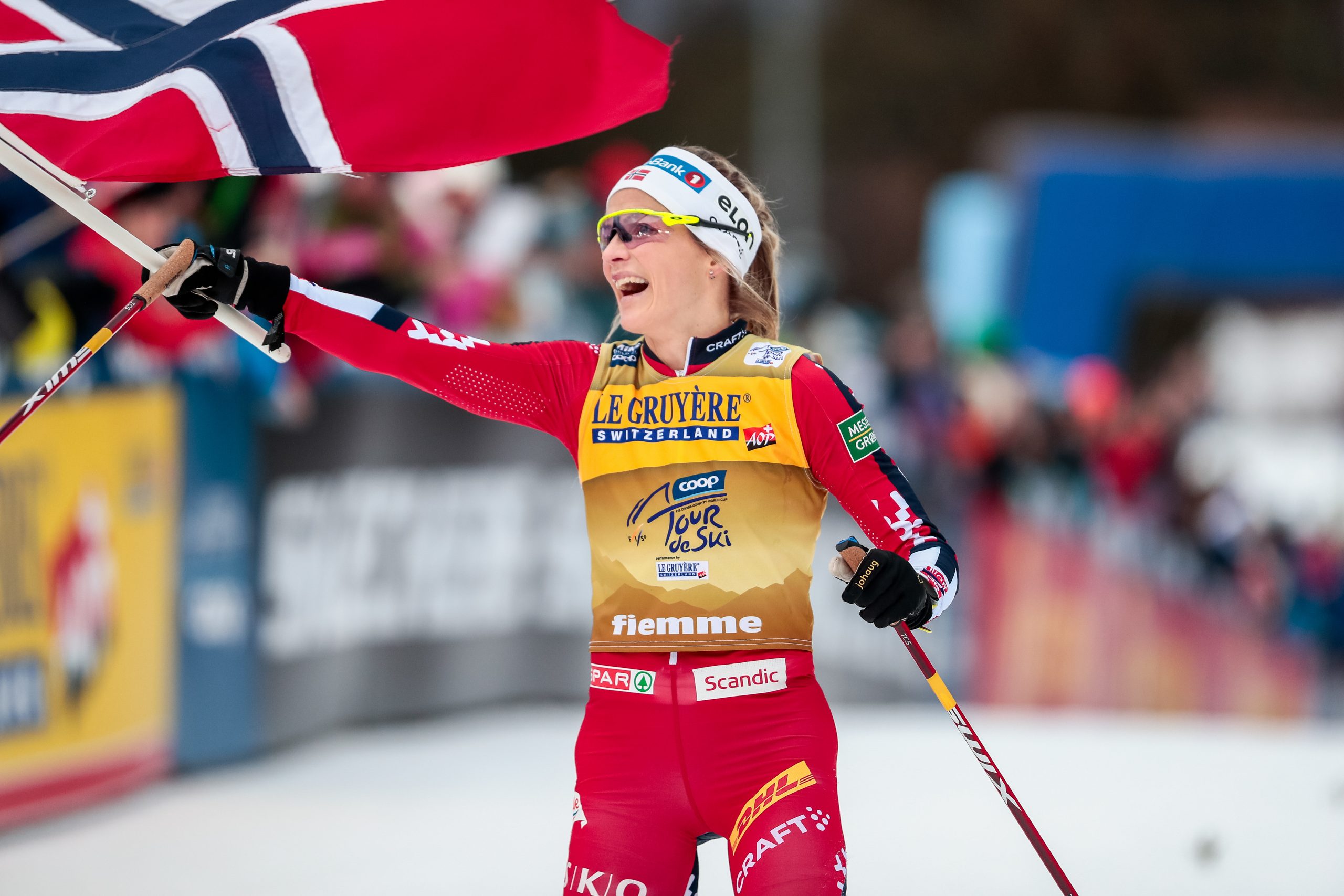
Coming into the finish Johaug was out of sight of the chase group. She glided over the finish alone and had enough time and energy to grab a Norwegian flag as she skied across the finish line.
Slind crossed the finish second with Weng right behind her. It was mission accomplished for Slind who actually gained time on Diggins in the Overall standings. Diggins finished sixth, 54 seconds behind Johaug, but a second ahead of Niskanen which meant that Diggins had also done what she needed to do to stay on the Overall podium.
Team USA celebrates a podium finish in the Tour de Ski. (Photo: NordicFocus)
It was a disappointing day for Laukli when the match with Johaug never materialized as Laukli slid into 15th place.
The punishing Alpe Cermis climb ended up not affecting the Overall standings, but still served as an entertaining race to finish off the Tour. Now the racers will enjoy some well-deserved rest.
This coverage is made possible through the generous support of Marty and Kathy Hall and A Hall Mark of Excellence Award. To learn more about A Hall Mark of Excellence Award, or to learn how you can support FasterSkier’s coverage, please contact info@fasterskier.com.
Try as she might, Jessie Diggins (USA) and the rest of the field couldn’t match the pace set by Slind and Johaug. (Photo: NordicFocus)
Part of the attraction of the Tour de Ski is the quick ebb and flow of the leader board. One day you’re sitting on top of the world with a big lead, and the next day you’re wondering where it all went. American star Jessie Diggins is thick in the middle of riding the Tour’s roller coaster. She went into yesterday’s 20 kilometer Freestyle race with a minute plus lead over three time Tour winner Therese Johaug (NOR), only to find that lead quickly shrunk to 41 seconds. At the start of today’s race, the formidable Kerttu Niskanen (FIN) was sitting in second place only 22 seconds behind Diggins, and the sudden darling of the Tour, Astrid Oeyre Slind (NOR) was a scant 32 seconds back in third place, when today’s event, the 15 kilometer Classic Pursuit began.
But in this year’s Tour, Diggins has already performed against type twice, having won both a Sprint and a Classic race—neither considered her strength. So, the hope for the American star going into today’s race was that she would again perform against type.
There was also an upside to yesterday’s time loss; it meant that in the Pursuit format, Diggins would start sixth, 37 seconds behind Slind (in a new format, starting spots are based on yesterday’s finish). So instead of being the hunted, Diggins would now be doing the hunting. She would also have the added benefit of starting off sandwiched between Victoria Karl (GER), Katherine Stewart-Jones (CAN), and Heidi Weng, which would give her the opportunity to join fast company to help close the starting gap on Slind who would start the race four seconds in front of Johaug. Slind has made her living for several years off long Classic races on the Ski Classics circuit, and she would have to be considered dangerous in any Distance Classic race.
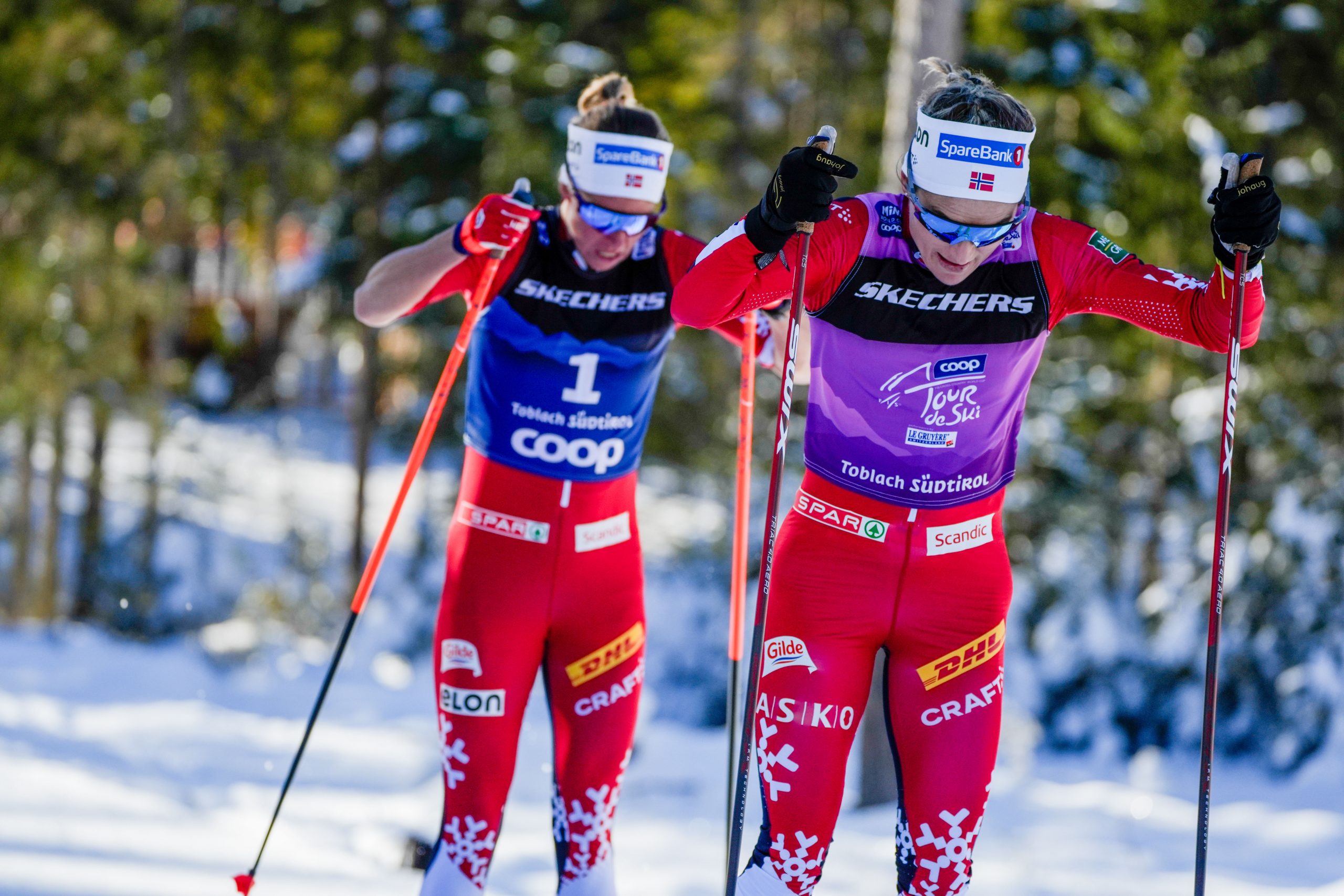
Astrid Oeyre Slind (NOR), and Therese Johaug (NOR), (l-r) worked together the entire race, and no one could catch them. (Photo: NordicFocus)
Another skier also performing against type was Niskanen, who is best known for her Classic prowess. But Niskanen finished a strong third in yesterday’s Freestyle race and would be one of the favorites going into today’s Classic Pursuit.
In another development with the potential to affect the Tour’s outcome, Maja Dahlqvist (SWE) did not start yesterday. She joined a growing list of Swedish women—including Johanna Hagstroem—on the sidelines. Both racers are usually in the mix for podiums, and their absence would now have the potential to affect race outcomes.
But after the race was over the top Norwegians were able to regain dominance in the Classic technique with Slind and Johaug working together the entire race to control the field. Slind finished slightly ahead of Johaug with Niskanen taking third. But from the early kilometers there was a sense of inevitability as Slind and Johaug teamed up to work together relentlessly pushing the pace that no one else could come close to matching.
Diggins didn’t have a group to work with until about 5 kilometers into the race when she settled in with Heidi Weng (NOR) and Stewart-Jones. But they simply couldn’t match the firepower of Slind and Johaug, though Diggins was still glad to have someone to work with. “I’m really grateful that I got to work with Heidi. That was really helpful for both of us.” Diggins finished 2:08 behind the leaders and she now sits in fourth, 1:01 behind Slind in the Overall Tour standings. Despite losing time Diggins remained upbeat. “I’m really proud of that race, I battled through a lot of pain out there, and was pushing for every single second. Yeah, the time was not indicative of my fitness levels, or what I know I can do on a perfect day, but at the same time, you get the day that you have, right here, right now, and I did everything I could, and I’m proud of that.”
Johaug is in second place, six seconds back with Niskanen in third 28 seconds behind. Heidi Weng’s fortunes have fallen, while she is in fifth place Overall, she is over two minutes behind Slind, which is likely to be an insurmountable hurdle for her.
Other American finishers today were Sophia Laukli 17th, Julia Kern 25th, and Rosie Brennan 31st. Alayna Sonnesyn did not start, and her Tour is now over.
Katherine Stewart-Jones had another career great day finishing seventh. Liliane Gagnon was the other Canadian skier, she finished 32nd.
It was a good showing for Laukli, “I think today was a pretty big improvement for my Classic skiing.” She continued that, “I could ski with a lot of strong Classic skiers and normally I’m not able to do that, so in that sense it was good.”
Women’s 15 Kilometer Classic Pursuit
It was a gorgeous cloudless bluebird day in Toblach for the start of stage four, as Slind started the race first out of the gate onto the three-lap race. Johaug began only four seconds behind Slind and went out quickly to bridge the gap to start working with Slind. The pair were double poling in unison by the time they hit the 1.7 kilometer mark. At this point they were the only Tour leaders who were in a position to be able to work together, and it was quickly paying dividends. Niskanen was trying to close the gap on Slind and Johaug, but in a theme which would continue throughout the race, she was working on her own and was unable to keep up with the Norwegians.
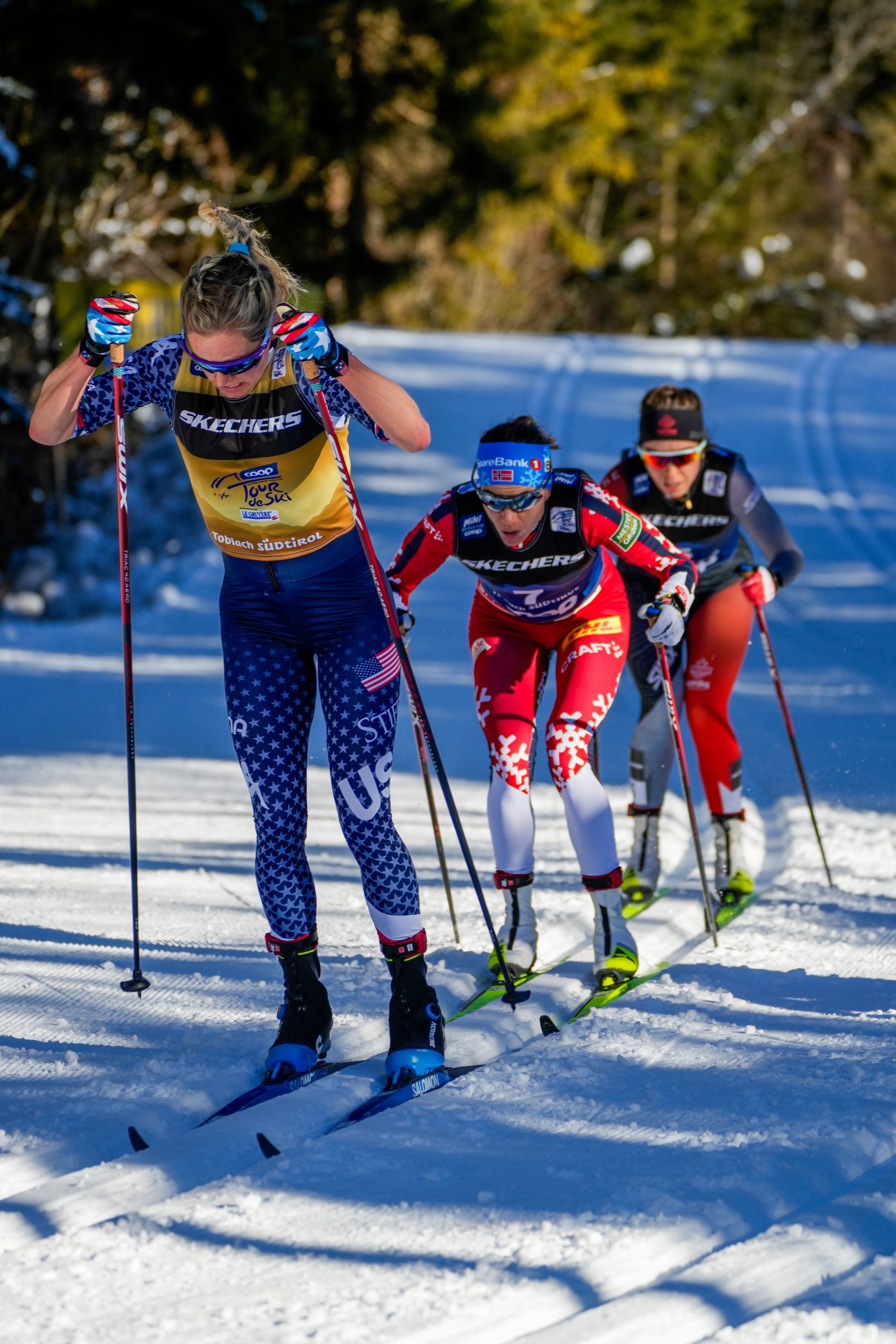
Jessie Diggins (USA) was eventually able to join a group with Heidi Weng (NOR) and Katherine Stewart-Jones (CAN), but even working together, they lost ground to the leaders. (Photo: NordicFocus)
A half a kilometer later, Diggins had caught Stewart-Jones but initially didn’t spend time working with her as she passed the Canadian, but everyone in the field was now losing time to the two leaders who were constantly working together and were powering through the course on a level no one could match.
As the skiers hit the five kilometer mark the theme remained the same. Slind and Johaug working together with the rest of the top Overall contenders struggling on their own or in their own small groups to keep the pace. Behind Diggins, Weng and Stewart-Jones had finally joined together and were able to catch up to Diggins. The three were now able to ski as a trio, giving some hope to Diggins who was losing time to the leaders in every kilometer.
But Slind and Johaug’s lead continued to grow the further they skied. At the 6.7 kilometer mark Diggins was now 1:07 behind the leaders and her Overall Tour lead was gone. She continued to struggle as Weng and Stewart-Jones took over the lead in their trio.
At 8.0 kilometers Diggins was clearly working hard as she appeared to need a lot of effort to set her kick wax even though she had lots of kick wax. “I felt like I had really great kick,” said Diggins. “I asked for a lot on purpose, and also, I own that, because it may have slowed them down a little, but at the same time, I knew I was going to need a lot of kick out there today.” While the leaders in the Tour were desperately trying to keep up with Slind and Weng, Sophia Laukli (USA) was working with a group of her own and was in 13th place. It was a strong performance for the American who is an excellent Distance skier but has always struggled with Classic.
Kerttu Niskanen (FIN) was in the unenviable position of skiing alone all race. (Photo: NordicFocus)
Two-thirds of the way through the race, Slind and Johaug continued to punish the rest of the field with their lead having grown to 43 seconds over Niskanen and 1:36 ahead of the Diggins group.
With 3.3 kilometers left the outcome of the race wasn’t in doubt. Either Slind or Johaug would cross the finish line first, the only questions remaining were how much time they would put into Diggins and when would they begin to start racing each other and not work together? In the meantime, Diggins was still with Weng and Stewart-Jones who was turning in another tremendous race.
Therese Johaug (NOR) and Astrid Oeyre Slind (NOR), (l-r) worked together until the finish line. (Photo: NordicFocus)
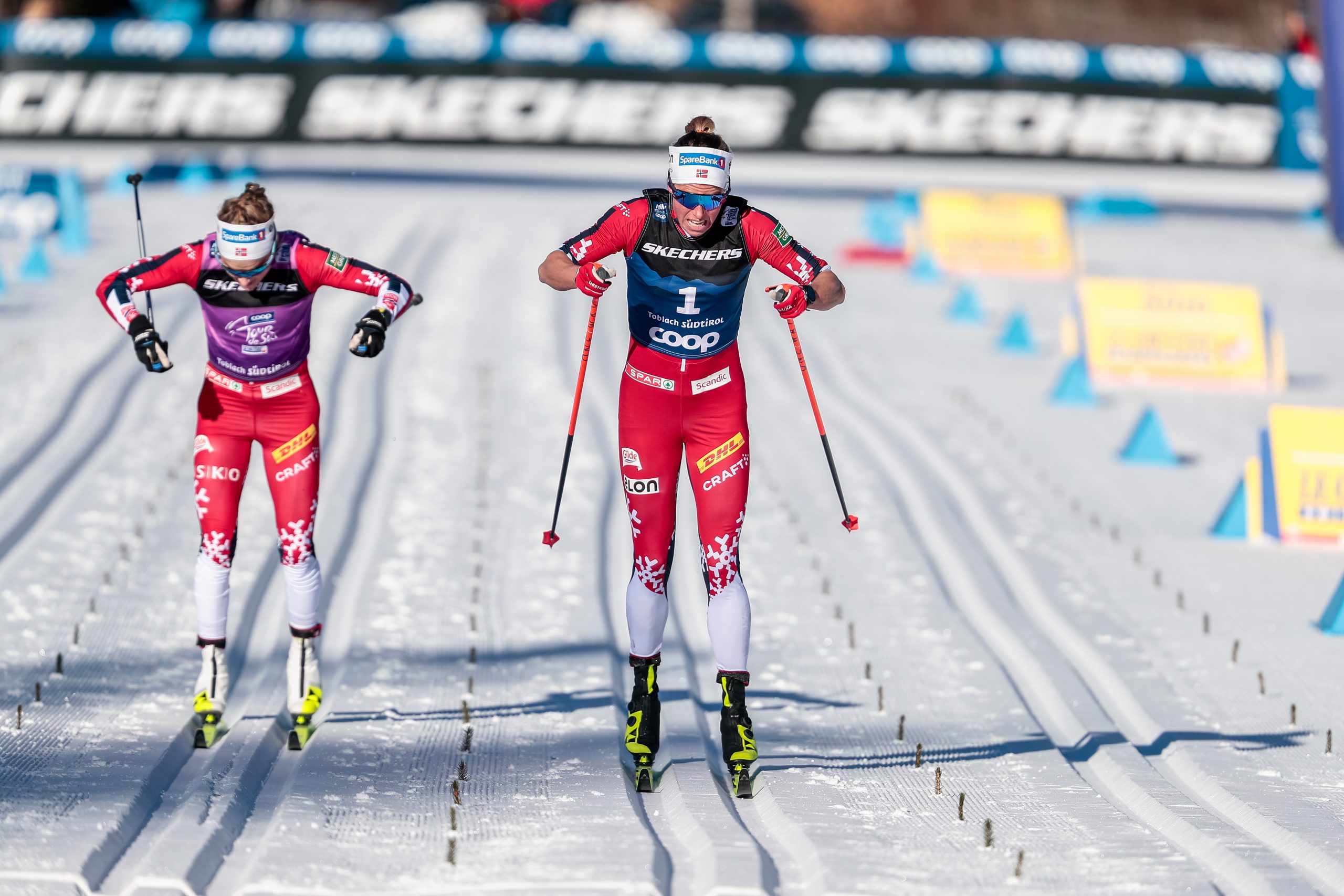
Slind and Johaug didn’t appear too interested in expending extra energy to take the stage win as the Norwegian duo were still together as they entered the stadium. Slind approached the finish area first maintaining a brisk double poling pace. Johaug had no answer for her teammate who easily kept Johaug at arm’s length to take the victory. Both skiers looked remarkably fresh, comfortable, and relaxed after finishing. Niskanen was able to finish within a minute of Slind and Johaug to take third.
Sophia Laukli (USA) had an excellent finish in a Classic race. (Photo: NordicFocus)
Still on the course, Diggins continued to push with Weng and Stewart-Jones still with her. But at the finish Weng double poled ahead of Diggins who finished 2:08 behind Slind and was now over a minute behind in the Overall lead. Sophia Laukli was able to hang on to finish 17th, a good finish for her in a Classic race.
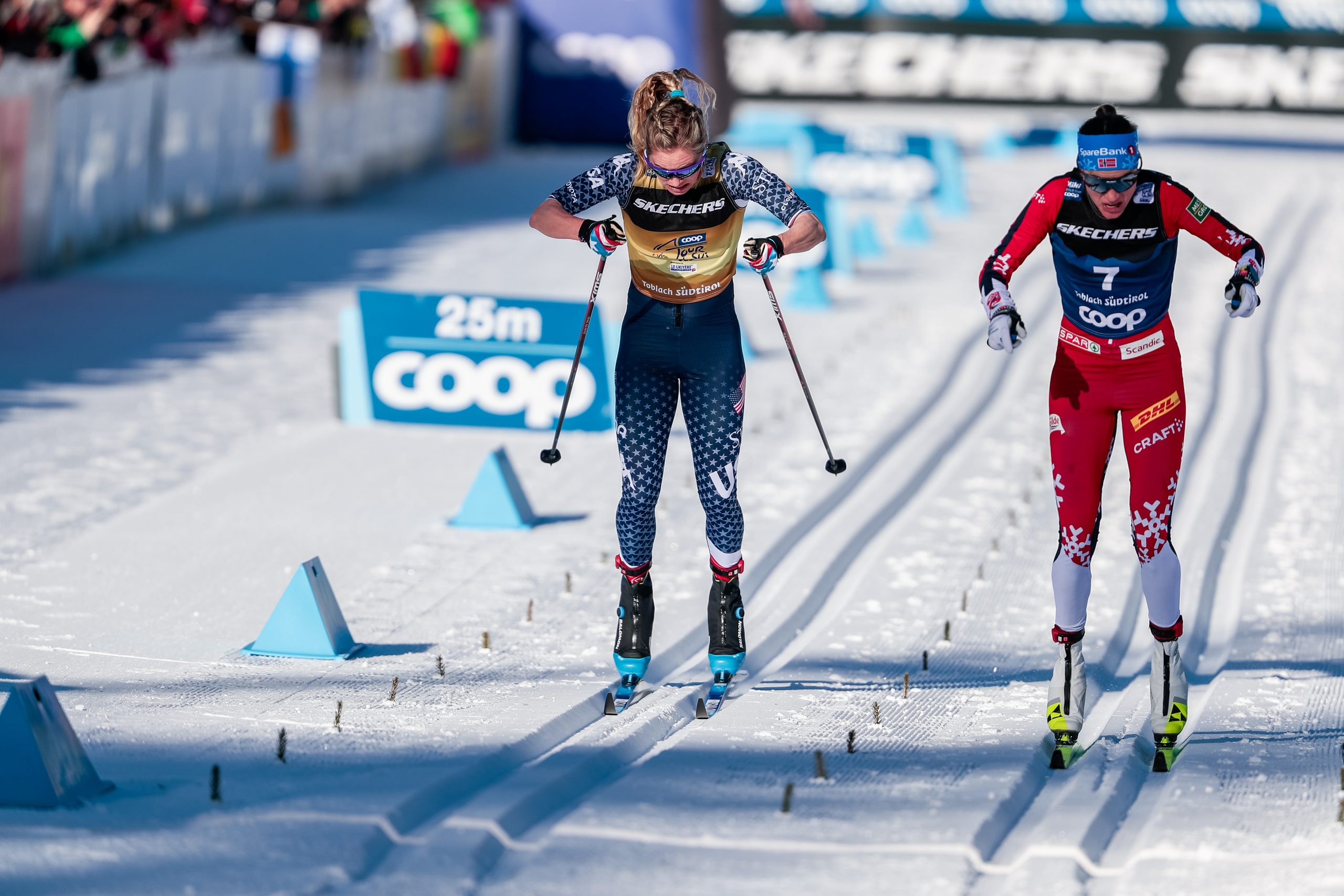
Heidi Weng (NOR) (right) was able to sprint past Jessie Diggins (USA) (left) at at the finish. (Photo: NordicFocus)
For Diggins it was a tough day as she skied well but like the rest of the field had no answer for the lead Norwegians. The silver lining for Diggins is that the next race is another Sprint, but it’s a Classic Sprint which isn’t her best event. However, neither Slind nor Johaug is known for their Sprinting prowess so there is still an opportunity for her to retake the lead. But looking further down the Tour road, if Diggins is going to have an opportunity to win, she will not only have to re-establish a lead, but she will need to create a cushion before the final race of the Tour, the epic climb up Alpe Cermis which is one of Johaug’s best events.
2024/25 Tour de Ski overall standings (after Stage 4):
It’s the most wonderful time of the year — or is it? The Tour de Ski has returned, but Devon has some beef with this year’s watered down format. Plus, recaps of the four races we’ve been through so far, including Jessie Diggins sprint win from heat five.
Send feedback, hate mail and love letters to devon@fasterskier.com. You can send love letters to nat@fasterskier.com. See you in a couple of days.
This coverage is made possible through the generous support of Marty and Kathy Hall and A Hall Mark of Excellence Award. To learn more about A Hall Mark of Excellence Award, or to learn how you can support FasterSkier’s coverage, please contact info@fasterskier.com.
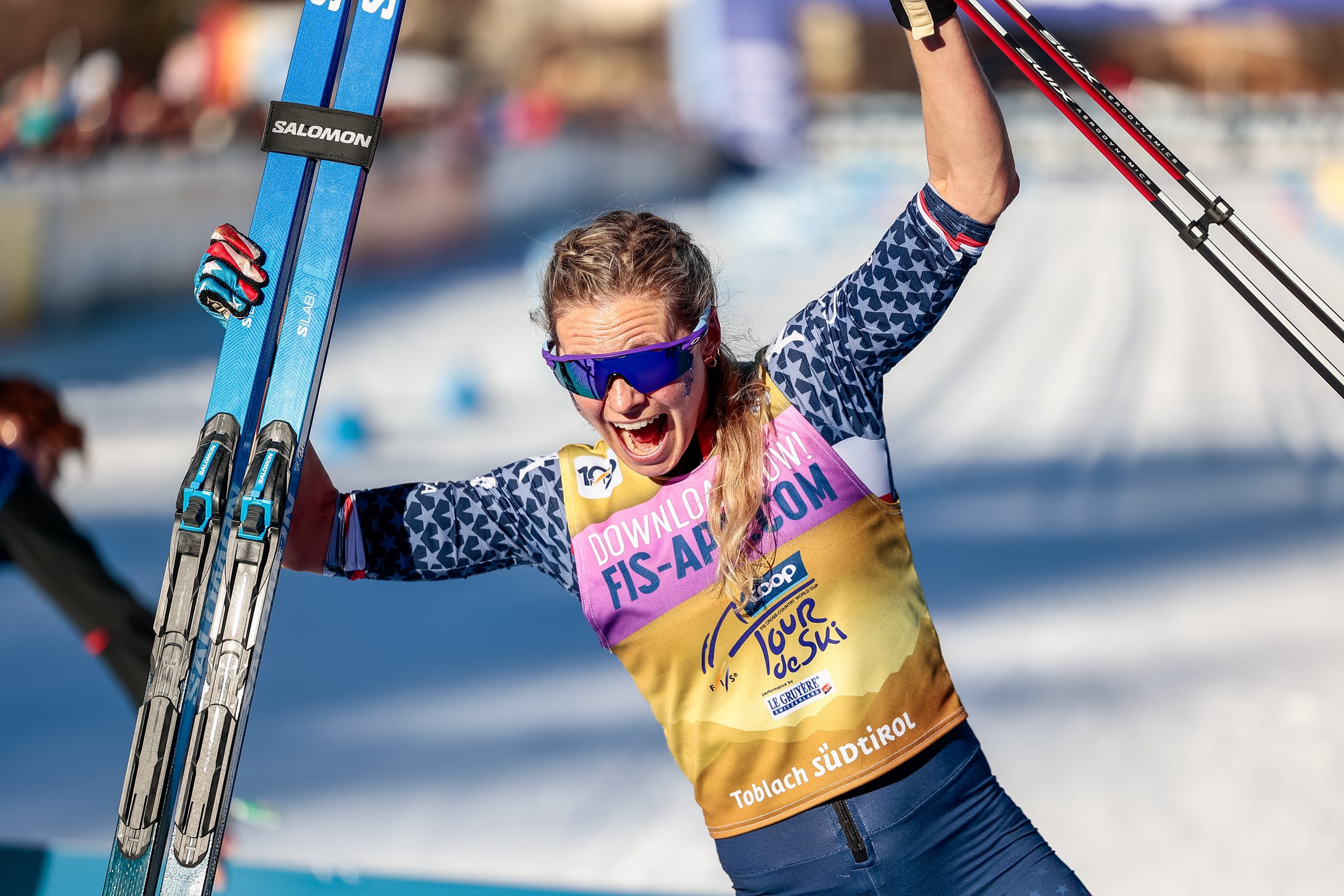
Jessie Diggins (USA) won her first Classic race today and stretched her Tour lead. (Photo: NordicFocus)
Watching the Tour de Ski is like looking at a giant pendulum swinging back and forth. Yesterday, on day one, the pendulum swung to the favor of skiers with sprinting talent. Jessie Diggins (USA) made the most of that swing by gaining the maximum number of bonus seconds winning the Freestyle Sprint. She came into today’s 15 kilometer Classic Mass Start race with over a minute lead on Therese Johaug (NOR) and Heidi Weng (NOR). Today, those skiers without Sprinting legs would try to ride the pendulum back as it swings to Distance racing.
Jasmi Joensuu (FIN) and Nadine Faehndrich (SUI) also made the most of yesterday’s Sprint. At the start of the day, they sat in second and third respectively, seven and 15 seconds behind Diggins. Whether Joensuu and Faehndrich could hang with the Distance skiers remained a big question mark. But there was no question about what Johaug and Heidi Weng had in mind going into the day. Their mission would be to do whatever it took to eat into Diggins minute plus lead. That was the only certainty heading into the day. Already this season we’ve seen the two work together in Distance races, and that was a distinct possibility going into today’s race.
But the Distance skiers’ plans to gain time on Diggins today imploded when in a shocking turn of events Diggins was the one grinding down the Classic skiers and took her first World Cup Classic victory outdueling all of the big Scandinavian names. Johaug and Astrid Oeyre Slind (NOR) tried to punish the field throughout the race, but every time they made a move, Diggins answered closing any gaps they created with her world best downhill technique.
Jessie Diggins’ (USA) persistence was rewarded when after 340 World Cup starts she took her first Classic victory. (Photo: NordicFocus)
When the pendulum had swung back towards the Classic Distance skiers, it was shockingly Diggins who was at the top having not only withstood the pendulum swing but actually managed to come out on top. Classic phenom Kerttu Niskanen (FIN) took second place with Slind finishing third. H. Weng held on for fourth, and in another shocking turn of events, Johaug ended up sixth, clearly defeated at the end of the race.
After the race Diggins was ecstatic. “It’s really cool. It took me 340 World Cups to get here. This is why you never give up. I’ve been working so hard on Classic skiing my whole life, and it’s really emotional to finally do it. It took a lot of tries. I’m so thankful to my team because they gave me perfect skis. They were fast and I had the grip, so on the last hill I could go. It was just pure magic. It was really cool. I came into this in a really good head space. I’m healthy, I’m happy, loving what I’m doing, it’s an amazing team atmosphere. It’s going to be a big party in the truck today.” Diggins added that, “this summer I put in so much work on my double pole, so much work trying to improve my power and my strength. I feel like being able to sprint like that yesterday and finish like that today … I didn’t know if I had that in me, and I had to work really-really hard to get there, and I had a lot of help from a lot of people. I had perfect skis, and I feel like this victory is as much for the wax techs as it is for me.”
Other American finishers were Rosie Brennan in 14th, Julia Kern 31st, Sophia Laukli 46th, and Alayna Sonnesyn 50th.
It was a good day for Brennan but, “I’m definitely still far from where I want to be,” Brennan said after the race. “At this point, I’m just putting my best foot forward every day and doing the best I can to keep finding myself and you’ll know when I’m back, and I’ll leave it at that.”
The top Canadian finisher was Katherine Stewart-Jones in 34th. She was followed by Liliane Gagnon in 35th.
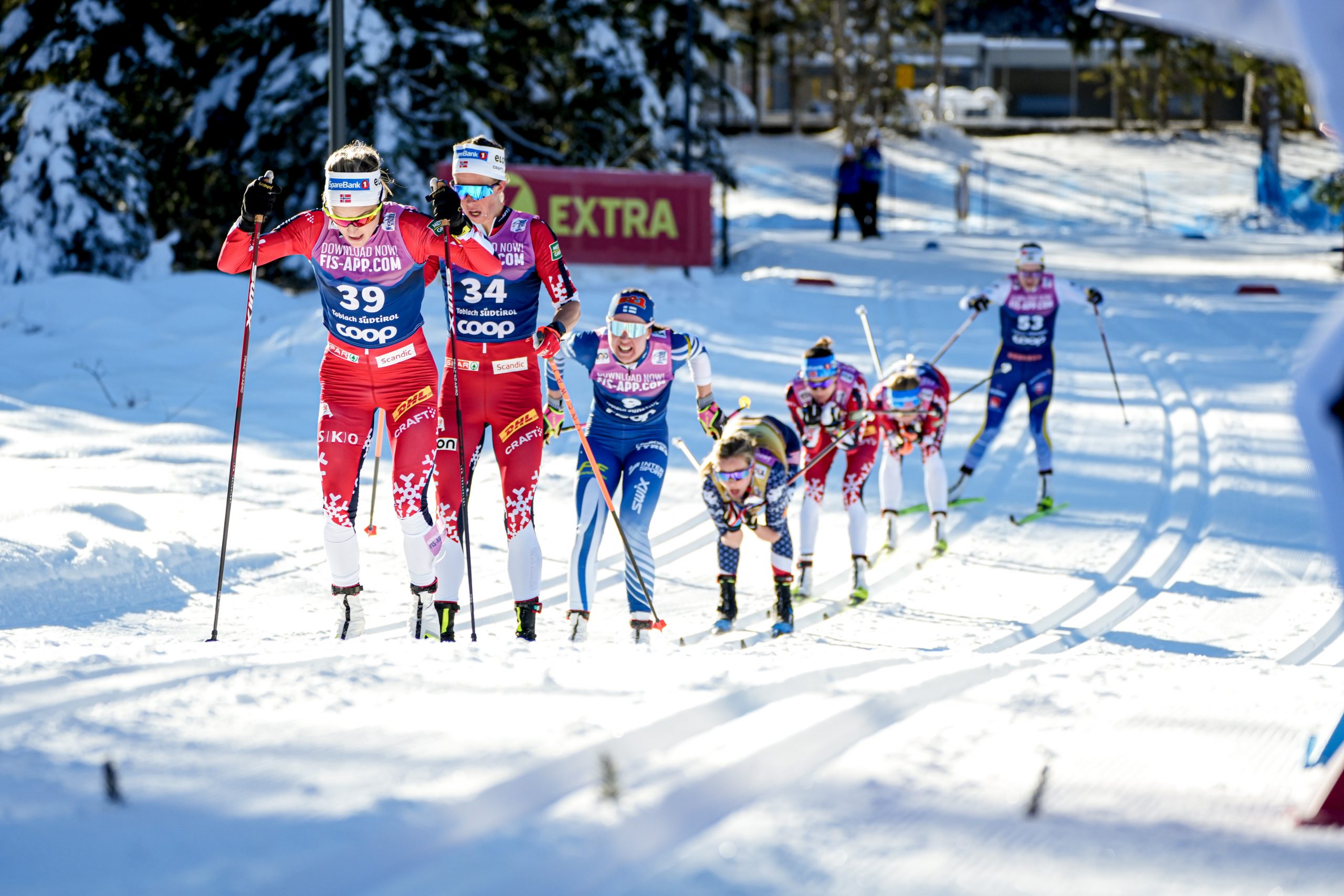
Today was the day for Therese Johaug (NOR) (number 39) to close the gap on Jessie Diggins, but it turned out to be Diggins’ day. (Photo: NordicFocus)
Women’s 15 kilometer Classic Mass Start
Conditions were described as perfect for the start of the women’s 15 kilometer Classic mass start with firm deep tracks. By virtue of winning yesterday’s race, a hatless Diggins was in the front row of starters alongside Joensuu and Faehndrich. Almost immediately at the start Classic expert Niskanen went to the front. One of the Tour favorites Johaug—because of her poor sprinting performance—started toward the back of the pack in bib 39 and spent the first kilometers double poling outside the track on the edge of the course to move toward the front. After only six minutes into the race at the 2.3 kilometer mark Johaug had pushed at a frenzied pace and worked herself to the front of the pack to take the lead.
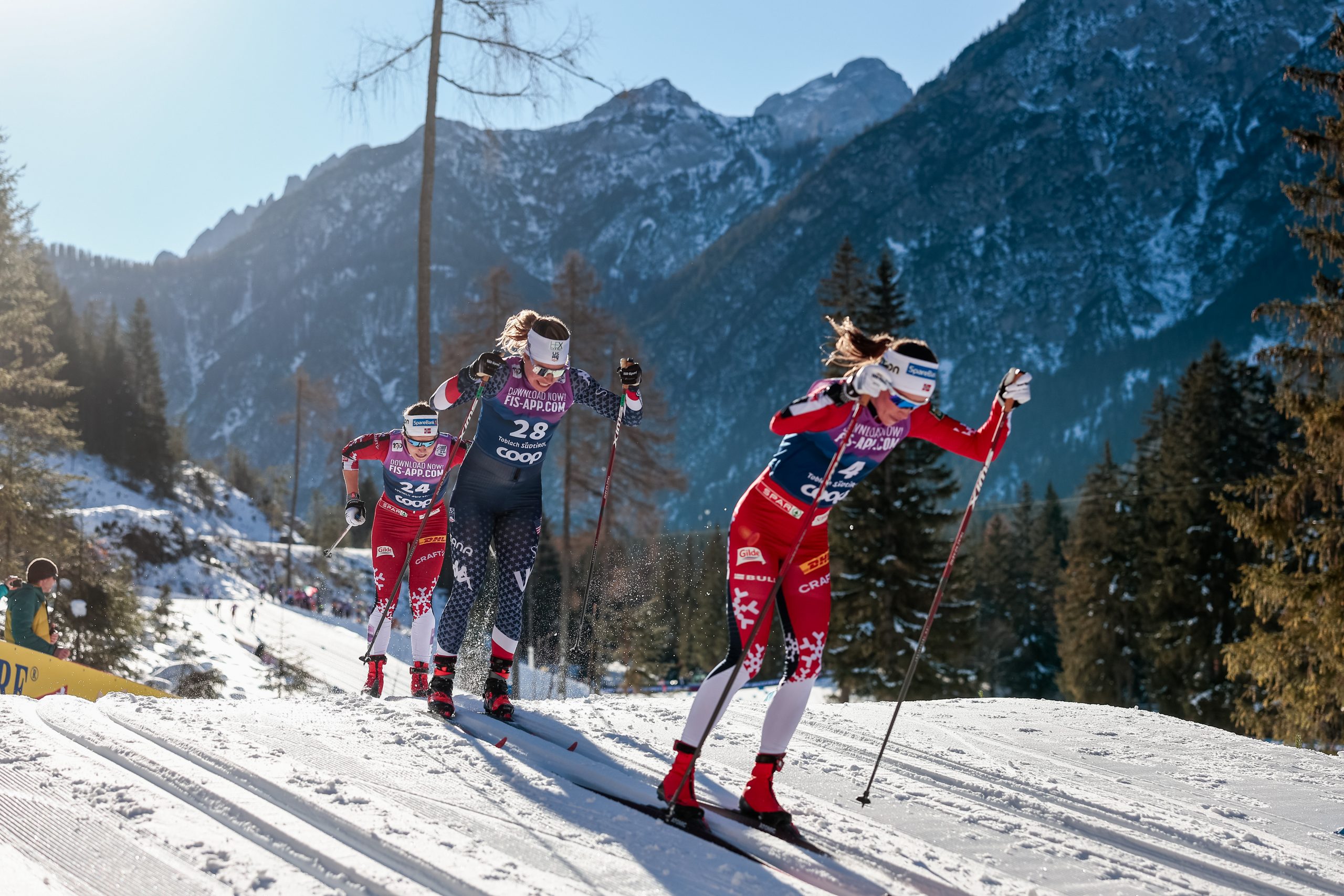
Today was also an excellent day for Rosie Brennan (USA) (number 28) who finished 14th. (Photo: NordicFocus)
At the 3.3 kilometer mark there was a bonus Sprint where Joensuu went to the front to take the maximum Sprint points. Johaug and Faehndrich were with her with Diggins sitting calmly in 10th only a couple of seconds off the lead.
At the start of the second lap Johaug had pushed back to the front with Niskanen and Diggins trailing right behind her. Also having moved to the front was another Tour favorite H. Weng. At 5.2 kilometers there was another bonus section— this one was a bonus section for climbers. Johaug went through first, but Diggins was right by her side, now followed closely by Norwegian Distance standout Slind.
At the 6.1 kilometer mark Slind and Johaug decided to make their first serious break and established a gap on the group. Diggins quickly went to the front of the chase group as the two Norwegians in a matter of a couple of seconds were able to develop a measurable gap. But as she so often does, Diggins was able to close the gap on the downhills. It was a theme which was repeated several times throughout the race.
But even though Johaug and Slind hadn’t gained ground on Diggins, they had broken up the pack and there was now a defined lead group of about a dozen skiers. While the pack pulled away Slind and Johaug continued to throw in a burst of speed to try and pull away. And amazingly at the bottom of downhills Diggins would glide up onto the backs of the Norwegians. It had to have been incredibly frustrating for the lead pair to see their hard work evaporate at the bottom of every downhill as Diggins magically appeared right beside them.
At the 7.5 kilometer halfway mark Johaug was still out front with a pack of proven Classic performers around her. Niskanen, Slind, and Weng joined Diggins at the lead pack along with Teresa Stadlober (AUT), Krista Parmakoski (FIN), and Linn Svahn (SWE). At this point, the lead pack looked like a Scandinavian Classic all-star team with Diggins somehow hanging with them.
At 8.6 kilometers Niskanen took the lead with Johaug right behind her. But the big news at this point was that Johaug had not been able to blow open the race. She had used a lot of energy at the beginning of the race to scratch her way from the back of the pack to take the lead and it looked like she was paying the price.
As the racers hit the 11.2 kilometer mark the pattern which had been established throughout the race repeated itself again. Johaug and Slind led a group of nine skiers at the front pushing the pace on the uphills creating a gap, with Diggins then closing the gap on the downhills. Several times it looked like the lead duo were going to pull away, and each time Diggins closed on them on the downhills.
With only 1.4 kilometers left the lead field was down to seven skiers with Slind still pushing the pace. But try as they might the leaders couldn’t drop Diggins who tenaciously hung with the lead group as they entered the final downhill leading into the stadium.
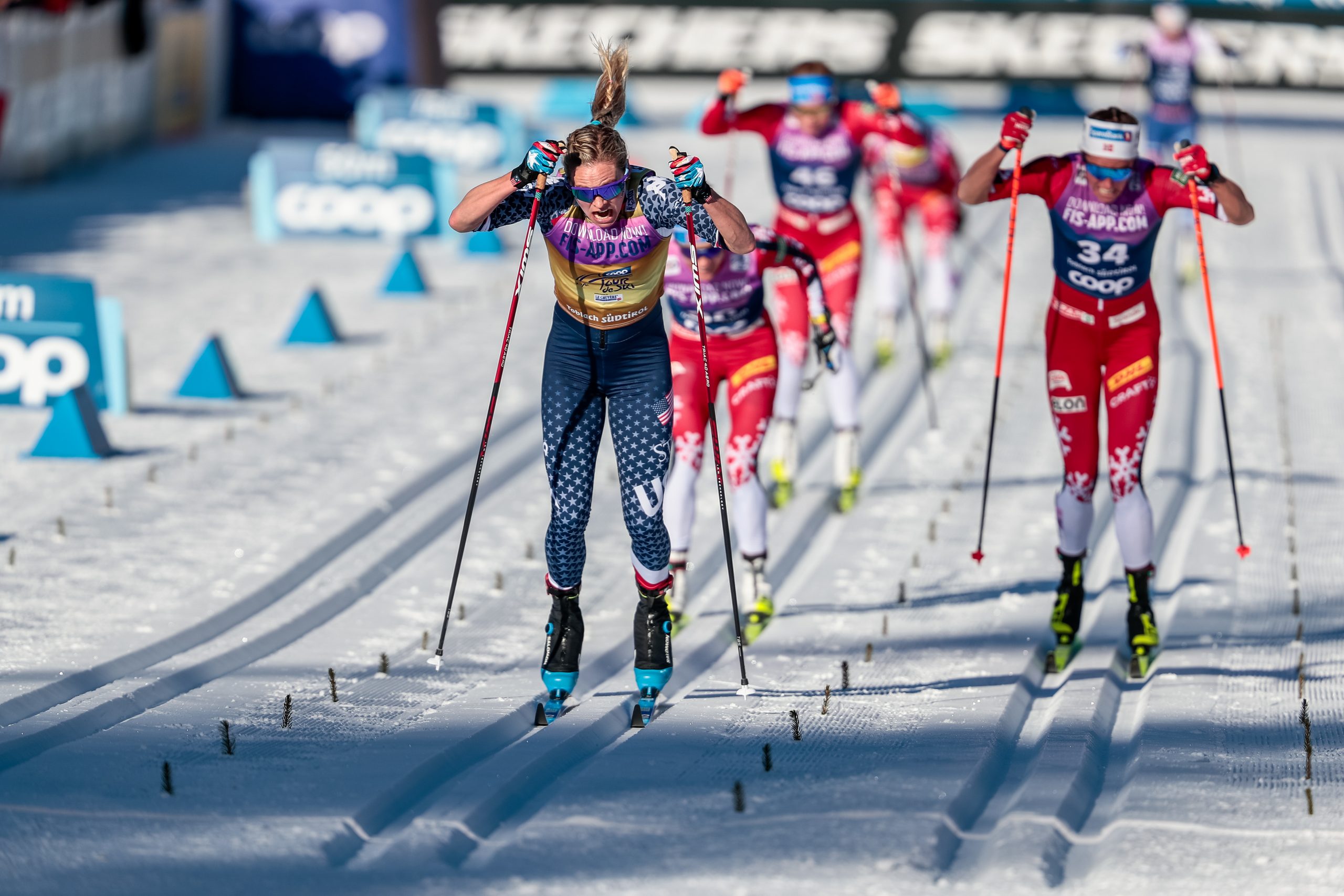
Jessie Diggins (USA) (left) put in a furious double pole at the finish to take the win. (Photo: NordicFocus)
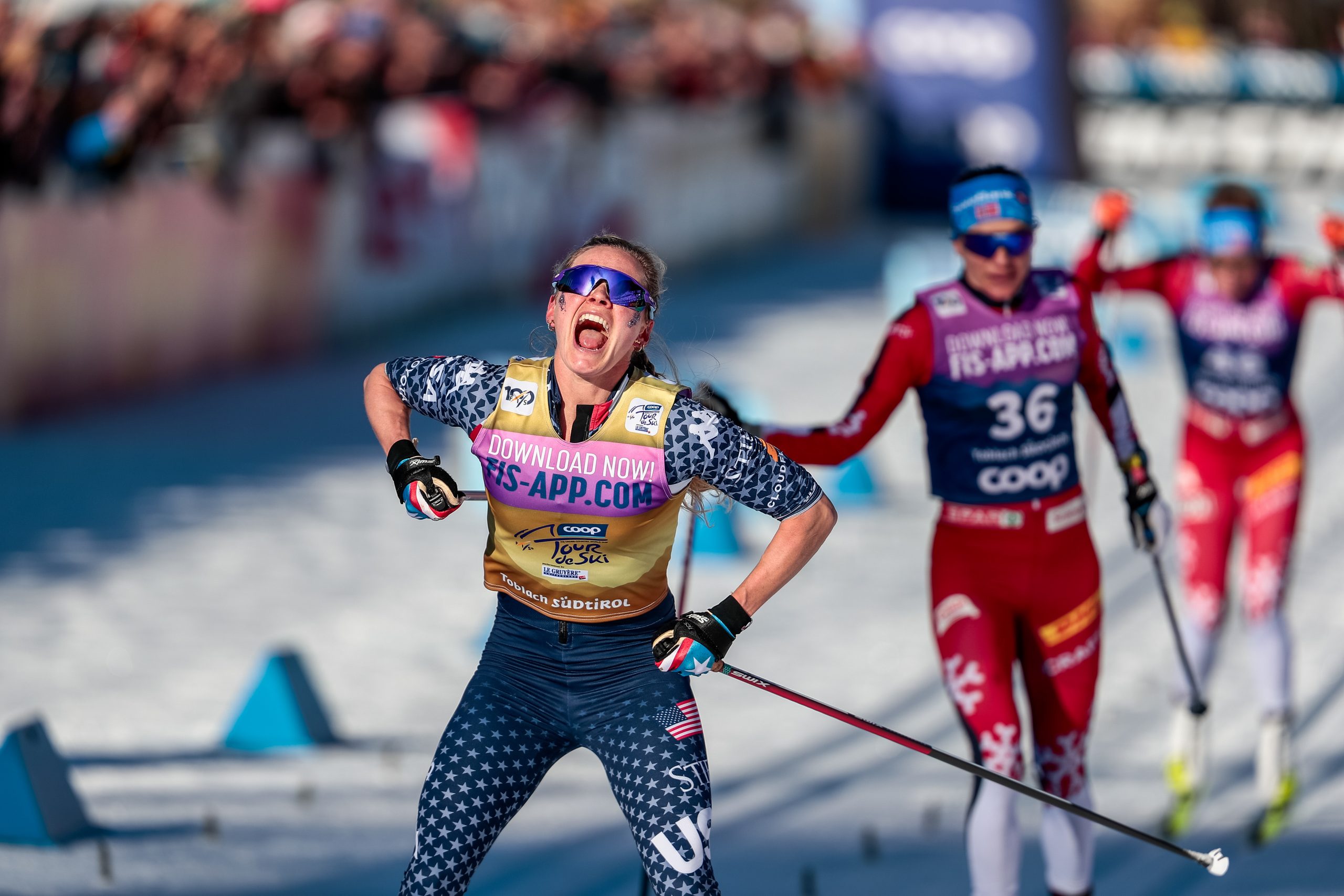
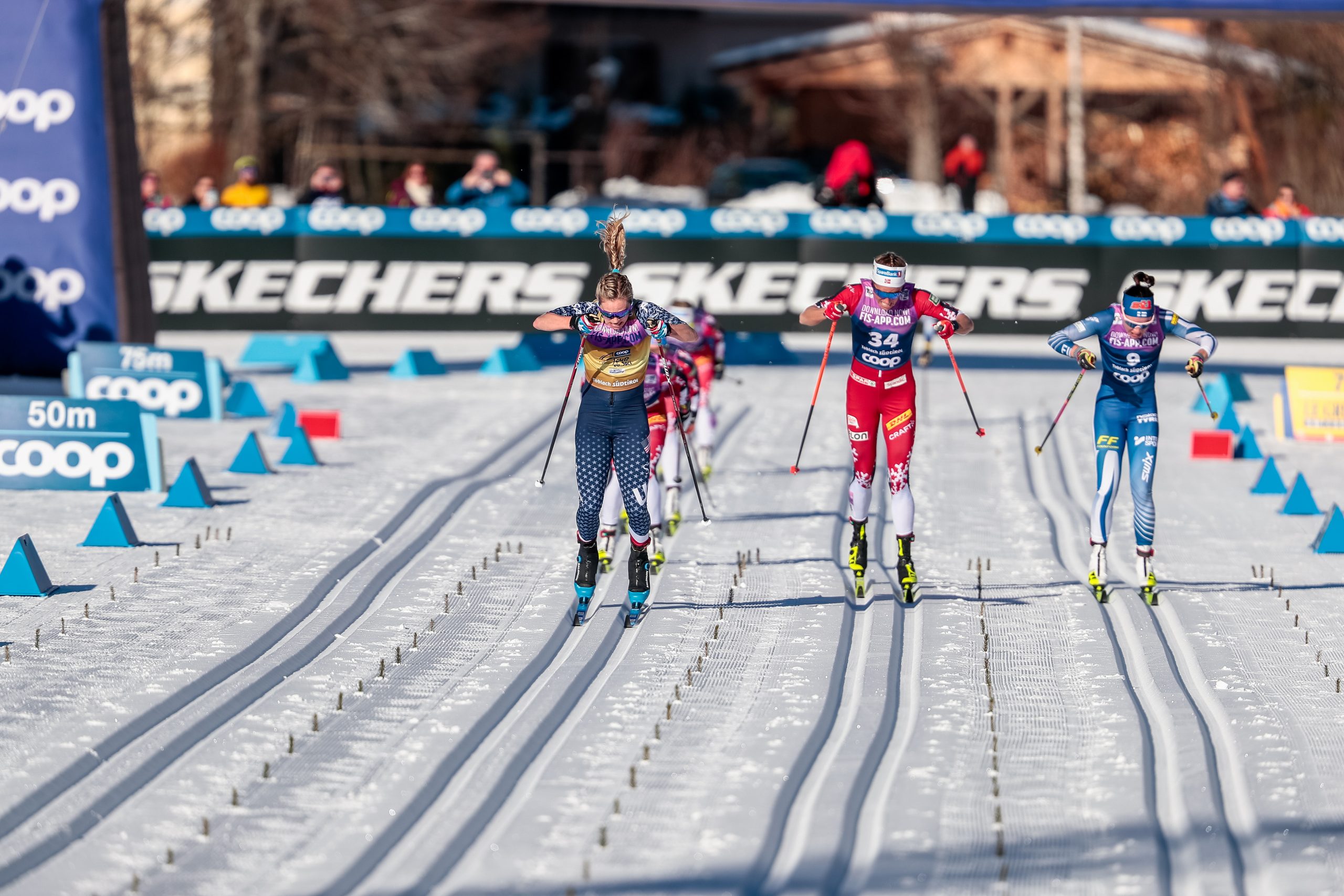
At this point, it was already mission accomplished for Diggins. As long as she stayed upright until the finish, she would have preserved her Tour lead, which was at the start of the race really all the American team was hoping for. But Diggins wasn’t satisfied with just maintaining her Tour lead. She could sense that she had the opportunity to make personal history. On the final climb she put in a massive turn of speed and took the lead over the field. Shockingly none of the other leaders could respond to Diggins’ burst. The first to crumple was Johaug who couldn’t take the pace and dropped off the field. Diggins frenetically double poled to the finish as Niskanen and Slind tried to stick with her, but they couldn’t and Diggins dropped the rest of the field. She crossed the finish line first, exhausted, laying on the snow with the knowledge that not only had she defended her Tour lead, but that she had just won her first World Cup Classic race! It was a shocking and incredibly satisfying victory.
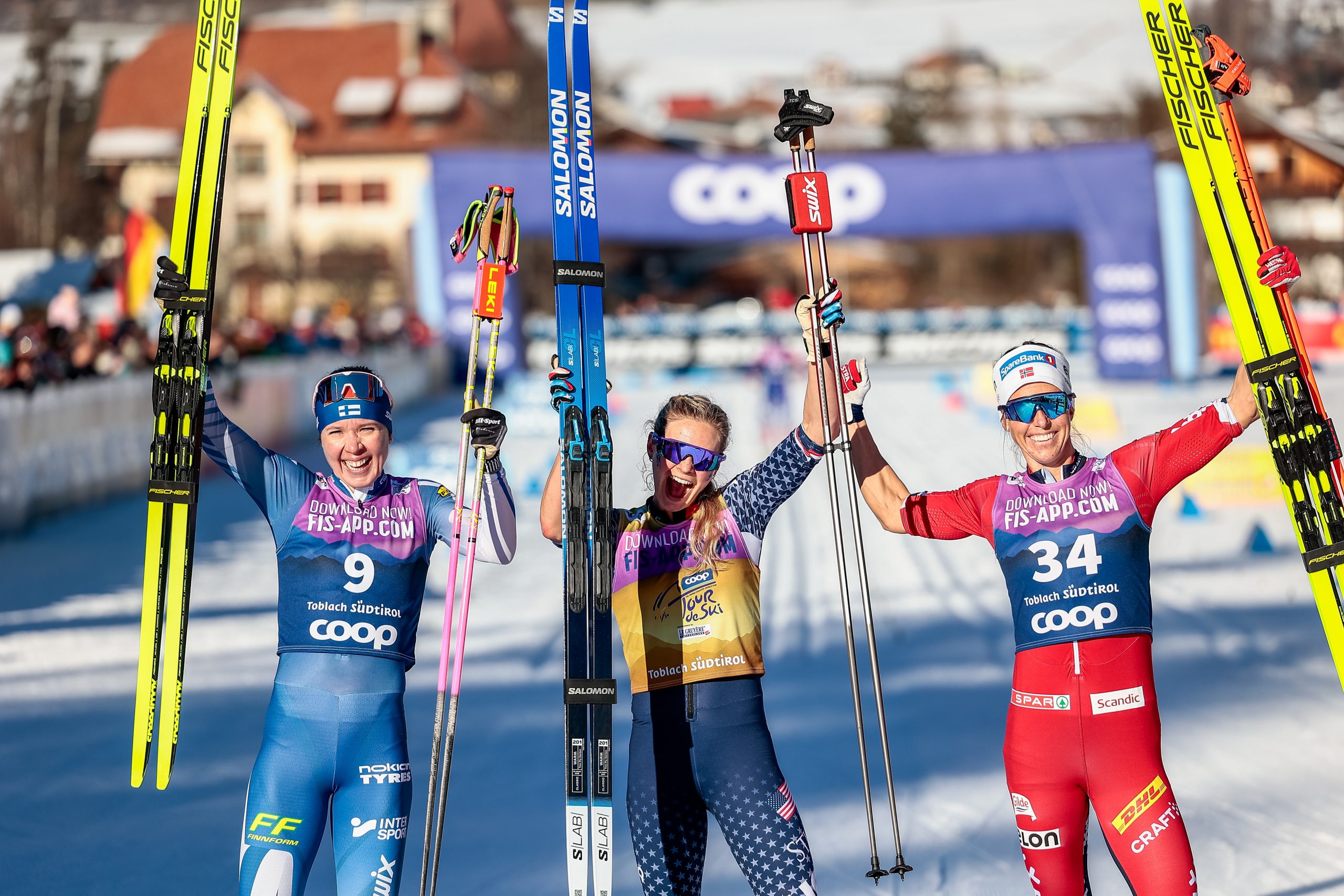
Jessie Diggins (USA) (far left) outdueled two skiers known for their Classic prowess, Astrid Slind (NOR) (number 34) and Kerttu Niskanen (FIN) (number 9), to take the win. (Photo: NordicFocus)
Not only had Diggins defended her lead, but she had beaten the Scandinavians at their own game, Classic skiing. It had to be a dagger through the heart of the Distance skiers chasing her as they were doubtlessly counting on gaining time on their rival today only to end up losing more time to Diggins. It was a monumental achievement for Diggins and the entire American team, and a crushing blow to the rest of the field.
After today’s heroics, Diggins had expanded her lead in the Tour. She now holds a 38 second advantage of Niskanen, and is over a minute ahead of Slind, H. Weng and Johaug.
It’s vacation time. We hear from some of the U.S. Ski Team men holed up in their Christmas cottage in Davos, Switzerland — featuring a new lightning round quiz segment — and Devon and Nat take us through the weekend’s results. Happy holidays: We’ll be back during the Tour de Ski.
Questions, comments, want us to use less (or more) profanity? Reach us at devon@fasterskier.com and nat@fasterskier.com.
Norwegians are born with skis on their feet, blah blah blah, we know. They’re good at skiing and they won pretty much all the races on home snow this weekend…but they were still fun events to watch. Devon reports from Norway while Nat tunes in from melting Alaska; they don’t need any stinkin’ guests this week.
Got questions for us? New cross-country skiing meme accounts we should follow? nat@fasterskier.com and devon@fasterskier.com. We’ll be back soon.
This coverage is made possible through the generous support of Marty and Kathy Hall and A Hall Mark of Excellence Award. To learn more about A Hall Mark of Excellence Award, or to learn how you can support FasterSkier’s coverage, please contact info@fasterskier.com.
Therese Johaug (NOR) set a blistering pace throughout Lillehammer’s 20 k Skiathlon, dominating the field from start to finish. It’s not a “comeback” anymore. (Photo: Modica/NordicFocus)
It’s weird . . . Skiathlon is hardly ever contested on the World Cup Tour, but is always on Olympic and World Championship event rosters. That means that Olympic and World Championship medals—and the everlasting fame accompanying the winning of those medals—are handed out in an event that hardly anyone ever does. In some years, there is a Skiathlon staged within the Tour de Ski, but the World Cup field can go years in a row without waxing up two different sorts of skis on race morning.
Lillehammer’s 20 k Skiathlon was staged as a dress-rehearsal for the World Championships to be held in Trondheim later this winter. If today’s results are predictive of that later event, the Norwegian hosts are likely to be very satisfied, indeed. Therese Johaug (NOR) returned to the form that made her the most dominant distance skier of her generation, quick-tempoing her way to a 42 second victory over Heidi Weng (NOR) and Jessie Diggins (USA).
In post race interviews with FasterSkier, Diggins commented on her own progression as a Classic skier: “I have worked really really really hard,” she said, “As evidenced by the fact that I’m literally looking around in Classic races watching technique and making notes!”
Jessie Diggins’ (USA) third place finish in Lillehammer’s 20 k Skiathlon maintained her lead in the Overall FIS World Cup standings. (Photo: Modica/NordicFocus
Diggins entered the day in the World Cup leader’s bib, followed closely by Johaug and Weng. Frida Karlsson continues to nurse a foot injury sustained some weeks ago; she elected not to start today’s Skiathlon. Likewise, Rosie Brennan (USA) is dealing with an undisclosed injury here in the early part of the World Cup season; she chose not to start on Sunday in Lillehammer.
Among American finishers, Sophia Laukli skied to an excellent 11th, ahead of Julia Kern (20th), and Alayna Sonnesyn (43rd). Sydney Palmer-Leger did not finish the race.
Canadian finishers included Liliane Gagnon (34th) and Katherine Stewart-Jones (39th).
In the early kilometers of Sunday’s Skiathlon, Ebba Andersson (SWE) worked with Jessie Diggins (USA) and Therese Johaug (NOR) to keep the pace high. As it turns out, Johaug really doesn’t need any help in that regard. (Photo: Modica/NordicFocus)
Women’s Skiathlon
Hoping to challenge Johaug in a mass-start event? Get a good warmup—a REALLY good warm up—because Johaug is going to go from the gun. No waiting around, no easing into anything, no tactical shenanigans: Johaug just goes. From the start of Sunday’s Skiathlon in Lillehammer, there was a glaring difference between the tempo chosen by Johaug and the tempo chosen by everyone else. Johaug’s metronome is simply set to a much more rapid setting. She doesn’t create the same sort of per-stroke power that her rivals employ, but it’s apparent that the sum total of her many-more pole plants is sufficient to more than make up any power deficit.
Lillehammer’s Skiathlon consists of four laps of a 2.5 k Classic course, then a ski exchange, followed by three 3.3 laps of a Freestyle course. Within the first two kilometers, Johaug’s pace setting had begun to string out the field, creating an eleven-person breakaway group that included Diggins, Weng, Kerttu Niskanen (FIN), Astrid Oeyre Slind (NOR), Ebba Andersson (SWE) Jonna Sundling (SWE) Victoria Carl (GER), Emma Ribom, Katarina Hennig (GER), and Kristin Austgulen Fosnaes (NOR). The early pace created by Johaug and Andersson quickly trimmed away Fosnaes, Hennig, Sundling, Carl, and Ribom, leaving the top five contenders to continue on as a group.
Kern and Laukli skied the opening kilometers together solidly positioned in the top 20.
“The pace in the classic leg started super hot, and it was a quick realization that I wouldn’t keep up,” said Laukli. “But I was anticipating this a bit. Instead of stressing, I’m happy how I just found my rhythm and stayed in control, focused on technique and skied fast but made sure to be conservative so I could ski faster in the skate. So, I’m happy that I managed to play out this tactic well.”
Nearing the end of the Classic leg, Johaug began to reassert the pace, stringing out the lead group. By the ski transition, Johaug led Slind, Weng, and Andersson by eight seconds, with Diggins just another two seconds behind. Diggins would transition quickly, leading the chase group in pursuit of Johaug.
At one point in the broadcast, on-screen announcer Andrew Kastning, was heard to say “We’re seeing a bit of a surge from Johaug.” A more accurate analysis might be that Johaug never, ever, stops surging. She looks not unlike a determined, stubborn little kid racing in a field of adults . . . never willing to let anyone else’s ski tips be out front. Earlier in her career, the World Cup field would simply let her ski away (not that they really could’ve stopped her). Now, after her recent comeback, the primary contenders are not willing to surrender so early, skiing closely in Johaug’s wake for as long as possible. Bet that hurts . . .
Sophia Laukli (USA) showed how far she’s come as a classic skier in the first leg of Lillehammer’s 20 k Skiathlon. (Photo: Modica/NordicFocus)
Laukli exited the transition in 12th (1:22 behind the leader), attesting to the great improvements she continues to make in Classic skiing. She had no other skiers around her, and would be forced to ski much of the skate leg alone. Kern also skied a solid Classic leg, exiting the transition in 15th in the company of a group of chasers.
Ten seconds, twenty, thirty, forty . . . Johaug continued to press the issue, and her lead over the chasing four continued to grow. Andersson did most of the pacing in the chase, but the camera switches between Johaug and her pursuers made it look like they were racing different events. Johaug’s intensity never waned, while the four in the chase group must’ve begun considering conserving their energy in the race for silver.
Less than a kilometer from the finish, Diggins skidded unsteadily through a sweeping downhill curve, allowing Weng to jump to the lead, an advantage she was able to hold through the finish line. Andersson and Slind crossed the line moments later to round out the top five.
Laukli continued driving forward in pursuit of a group containing Carl, Niskanen, Sundling, and Krist Parmakoski (FIN). She would latch on to the group a kilometer before the finish, having brought Fosnaes up with her. Laukli would finish the day in 11th.
“I would definitely still consider myself a freestyle specialist, and will obviously still work the uphills best,” said Laukli. “But I’ve focused a lot on improving on the flats and descents this year so I can be more in the mix. The first few races this year have shown me that I can now ski more than just uphills, so it means I can be much more motivated and ambitious with skate results in general.”
Kern’s 20th place finish suggests that she’s left her early season question marks behind her, and is rounding into form.
Therese Johaug (NOR) had plenty of time to celebrate at the finish line of the Lillehammer Skiathlon. With a World Championship Skiathlon event scheduled for Trondheim later this winter, Norwegian fans are certainly thrilled to have her back on the team. (Photo: Modica/NordicFocus)
Johaug allowed herself to ease up slightly, just enough to wave to the Norwegian crowd as she crossed the finish line more than 40 seconds ahead of her pursuers. We can stop calling it a “comeback” now. Therese Johaug is the dominant distance skier on the FIS World Cup circuit . . . almost as though she’s never been away at all.
After the race, Diggins was seen in a smiling discussion with Johaug in the finish area: “I was complimenting her on her Classic technique!” Diggins confessed. “I saw that her wax was slipping, and I saw that she held super strong and stable and upright . . . I really admire that, because it’s incredibly hard to do. I think it was really cool to watch. I also think you should never waste an opportunity to compliment someone when they’ve done something well. So I wanted to make sure I told her that!”
Devon has a cold, but don’t let that deter you — he perseveres, and we welcome special guess Zanden McMullen after his breakout weekend in Ruka. We’ve got recaps of the astonishingly entertaining racing in Finland, plus bonus discussion of sponsorship feuds and other news.
Send us your questions, comments, fan mail and hate mail: nat@fasterskier.com and devon@fasterskier.com. We’ll be back after Lillehammer.
This coverage is made possible through the generous support of Marty and Kathy Hall and A Hall Mark of Excellence Award. To learn more about A Hall Mark of Excellence Award, or to learn how you can support FasterSkier’s coverage, please contact info@fasterskier.com.
Jessie Diggins (USA) celebrates a hard earned victory in the Ruka 20k Freestyle. (Photo: NordicFocus)
Going into today’s 20 kilometer mass start Freestyle race, the American team was a little back on its heels. This early in the season, it’s way too soon to talk about redemption. But after a difficult day yesterday across the board for team USA, it was time for some introspection and time to figure out some lessons learned. After a disappointing day, USA head coach Matt Whitcomb was very candid when he told FasterSkier that, “Our staff had a long debrief after the races (yesterday) were completed, where we took a hard look at our ski preparation process, and some potential areas where mistakes in ski speed may have been made.” Yesterday’s races created an opportunity to learn. Today would hopefully create an opportunity to shine.
And shine they did. After today’s performance, the American team may decide to have those debriefings every day. In yet another thrilling performance Jessie Diggins (USA) battled with Therese Johaug (NOR), Heidi Weng (NOR), and Jonna Sundling (SWE) to win an incredibly exciting race. It was another epic day in Ruka for Diggins who sprinted past her competition in an all-out drag race at the finish to claim a thrilling victory. Sundling took second, with Weng finishing third.
Today marked the first Distance Freestyle race for Johaug since her return to the World Cup. Prior to her retirement she dominated Distance racing in a way like no one ever had. She tried several times to impose her will on the field today, along with her teammate Heidi Weng. But every time she would try to make a move off the front another skier—most often Diggins or Sophia Laukli (USA)— was able to keep the gap just short enough to stay in contact. Of course, the Swedish women were in the mix as well with Sundling eventually working with Diggins to create a four person lead pack rocketing into the stadium. Sweden was missing its star Frida Karlsson, who didn’t start the race, but it probably wouldn’t have made a difference in a Freestyle sprint to the finish as Diggins answered every move by every competitor. It was yet another smart, strong, and gutsy performance by the American star.
Jessie Diggins (USA) was able to find another gear at the finish which no one could match. (Photo: NordicFocus)
Immediately after the race, Diggins commented that, “It was so fun out there.” She continued, “I might have frozen my eyes a little.” She also commented about how things felt a lot better than last year when she had her pole stepped on, lost her glove, froze her hand, and received a bloody nose in the process. “I’ve been so happy this year and feeling like I’m in a really good place.” She commented upon the final kilometer of the race when the lead group of four racers were together, “I tried to be too cute with the draft and I thought I might have messed this up. In the last k I was thinking save it up and try to find the line. I had amazing skis, the techs nailed it.”
Sophia Laukli also had a great day finishing 10th. Other American finishers were Rosie Brennan in 20th, Julia Kern 30th, Alayna Sonnesyn 31st, Sydney Palmer-Leger 35th, and Haley Brewster 42nd.
The top Canadian skier was Liliane Gagnon in 28th. She was followed by Katherine Stewart-Jones in 33rd.
The 20 Kilometer Freestyle
Not surprisingly at the start of the race Johaug went out to the front right from the gun. She was joined there by Diggins, and long distance specialist Astrid Oeyre Slind (NOR). But the race looked quite different for the first 4k than any other distance race with Johaug in it before her retirement. Before retirement, Johaug would go out faster than anyone and then hold the gap she had created. Today, Johaug went to the front, but the pack was still with her. Diggins and Heidi Weng were right at her side and there wasn’t the initial large gap which Johaug was known for creating earlier in her career.
Try as she might, Therese Johaug (NOR) could not assert her will upon the field. (Photo: NordicFocus)
Just before the 5.1 kilometer mark was the biggest hill on the course which the skiers would have to traverse four times. After cresting the hill for the first time, the skiers were still pretty much all together. But shortly after the hill a defined lead group of around 20 racers broke out. The most noticeable thing at this point was that Johaug was still not able to break from the field. In her pre-retirement competitions in a race of this distance she would have clearly asserted herself by now, not so this time around. It was a theme which would occur throughout the race.
Hanging with the front group was Sophia Laukli who was in ninth place. Rosie Brennan was a little off the front, ten seconds back in 21st.
At about eight kilometers Weng went to the front to set the tempo with Johaug, Slind, Ebba Andersson (NOR) and Diggins with her. While Weng’s surge did separate the lead group from the rest of the racers, it didn’t sever the lead pack which was still a group of about 15 skiers.
Interestingly at the 8.8 kilometer mark where 15 bonus points were available Diggins rather casually went to the front to claim the full bonus points. It was a reminder of her strategy from last year when she was in the hunt for the Overall Championship and was working for bonus points in every race. Diggins calmly surged to the front, claimed her points, and then melted back into the middle of the lead group.
At the 10.8 kilometer mark it was still Johaug out front with Weng right behind her setting the tempo. But Diggins was hanging right with them with Laukli impressively keeping pace in fifth place. Brennan was still in contact, only 9.3 seconds back.
But every time Johaug and Weng climbed up the hills they put in a little extra effort, and it started to have an effect on the pack as they would be able to create a little space between them and the field. But on the flats, the gaps would close down, and there would again still be about 15 skiers in contention.
Sophia Laukli (USA) was with the lead pack until the last several kilometers. (Photo: NordicFocus)
At 13.1 kilometers Johaug and Weng put in a quick surge and finally began to find the gap which they had been working so hard to create. In seemingly the blink of an eye, they established a ten second lead on the field. The skier in front of the chase group trying to close the gap was now Laukli who was working furiously to chase down Johaug and Weng. Diggins was at the back of the chase group, and Brennan had dropped to 27 seconds back. It was a big effort by Laukli and she may have paid a price for it. She told FasterSkier that, “I found that I was skiing quite controlled so I really wanted to make a move and try to catch back up with the leaders. When it’s a mass start my best chance is being part of a small break away so that it’s not a big group of girls at the finish, so I wanted to see if that could happen. I didn’t feel like it really cost me but I did realize pretty quick that the way the course was laid out that the move wasn’t really going to pay off when the downhills brought everyone back together again. But I’m glad I tried because I know it will work when there are longer uphills or it’s a longer race next time.”
At this point Brennan was clearly having troubles. “I was doing my best to stay as close to the front as I could, and unfortunately I just got blocked when that gap was made. I was actually feeling pretty good at that moment, so I was a bit frustrated that I couldn’t bridge that gap. I don’t think I had the top end speed I needed to be competitive, but I think I definitely had the pace to stay with that front group, but tactically, didn’t play it well.”
Johaug and Weng kept on hammering away at the front and relentlessly began to assert their will. It looked like history was going to reestablish itself with Johaug being able to wear down the entire field of World Cup skiers with everyone else just trying to hang on. But Diggins had worked her way back to the front of the chase group and was now in charge of trying to close the gap. The pack was on the ropes but hadn’t been knocked out yet. Diggins tenaciously clung to the front and was now working with Sundling. The pair separated themselves from the rest of the chase group and brought themselves to within striking distance of Weng and Johaug.
Jessie Diggins’ (USA) grit and tactics kept her in the race. Her final burst of speed gave her the victory. (Photo: NordicFocus)
Methodically, Diggins and Sundling chipped away at the Norwegians’ lead. Just past the 17.5 kilometer mark Diggins and Sundling had finally closed the gap with a tremendous effort. Diggins later revealed to FasterSkier that the gap she had to overcome was partly due to her getting a little too “cute” with strategy. “During the whole race I was kind of playing around figuring out how much of a sling shot (there was) and essentially timing the distance, how far back could I be and still come back into contact on the flats. I think knowing it was likely to come down to a sprint finish, it was important for me to figure out how I could get away with as little work on the steep climbs as possible while still keeping contact. At one point I mis-timed it and go too far off the back, which is when I had to work pretty hard to get back up there. That’s when Sundling and I were working together to make contact with Heidi and Theresa. I got a little too cute.”
It was now a group of four skiers. Diggins, Sundling, Weng, and Johaug were together in their own lead pack. It was now time to start thinking about the finish and who could win the final sprint. But Diggins had been thinking about a sprint finish way earlier in the race. She told FasterSkier that she starts thinking about the sprint finish, “probably in the first k. I start looking around and seeing who’s skiing aggressively where is the fast snow, where is the deep snow, what lines are working, if the pack is strung out will it stay strung out. So, there’s a lot of note taking going on in my brain during the race.”
Diggins looked like she was paying the price for having spent so much energy catching the two Norwegians. In a sprint finish she could probably handle Weng and Johaug even if she was tired. But Sundling is a strong sprinter, and she was showing no signs of letting up.
With less than a kilometer to go Diggins appeared to struggle to maintain contact with the first three leaders. There was now only one last climb before the stadium finish and that’s when the sprint began. The four skiers all went into overdrive up the hill with none of them able to initially break the others. But that is when Diggins amazingly found another gear. Suddenly, Johaug was dropped, and Diggins surged to the front. She shot by Weng and Sundling exploding to the finish line letting out a scream in exaltation, not distress, as she stormed across the finish. In an amazing display combing tactics, speed, strength, and sheer will, Diggins was able to blow past the other best skiers in the world and take the win. Sundling held on for second, with Weng taking third. It was another great day for Diggins in Ruka.
It’s race season, baby. It’s also Thanksgiving week, at least in America. Tune in to learn how to avoid turkey legs while you’re racing and for a full recap of last weekend’s competitions in Sweden and Norway. Didn’t know the name Andreas Ree before Sunday? We’ll catch you up. Julia Ystgaard, Canada’s World Cup coach, joins us to break down her team’s solid performances, as well.
It’s also the time of year when we remind you that we need your help to keep this podcast running, along with the rest of the site. Please consider a voluntary membership — options available here.
Devon and Nat return with a soft launch into the 2025 winter season. We cover off-season developments and other hijinks, from the still-missing Russians to Therese Johaug’s return. Read here and here if you want to understand wth the references are in the show title.
We’ll be back soon. Hit us up at nat@fasterskier.com and devon@fasterskier.com; we’re psyched to be back.
This coverage is made possible through the generous support of Marty and Kathy Hall and A Hall Mark of Excellence Award. To learn more about A Hall Mark of Excellence Award, or to learn how you can support FasterSkier’s coverage, please contact info@fasterskier.com.
Sophia Laukli is determined to remain a two sport athlete and sees each sport as helping the other. (Photo: NordicFocus)
Sophia Laukli likes to keep busy. The 23 year old Maine native is coming off her best season as a professional skier. After a grueling four month World Cup season which included a trip to North America, and back to Europe, she still hadn’t had enough skiing. A post World Cup 30-kilometer Freestyle race as part of the Norwegian National Championships was just too tempting a target to pass up. For Laukli, the longer the race, the better; and Freestyle better than Classic. So, a 30-kilometer Freestyle would be the bespoke frosting on her World Cup cake.
Sophia Laukli (USA) won the final hill climb at Val di Fiemme (ITA) in Tour de Ski. The longer and harder the race, the better for her. After the World Cup season finished, she placed second in the Norwegian Championships in the 30 k Freestyle. (Photo: NordicFocus)
So, on March 23rd Laukli lined up with the best skiers that Norway had to offer and showed them why when it comes to distance Freestyle, she’s always a serious threat. Laukli finished second, ahead of Norwegian stalwarts Astride Oeyre Slind, Heidi Weng, and Margrethe Bergane. The only woman to beat her: Therese Johaug. Yes, she’s back. Unfortunately for the rest of the field, she doesn’t appear to have lost a step. Johaug beat the best Norway could throw at her by almost three minutes. But Laukli was philosophical about finishing second and recognized the context of the race. “That race was definitely for fun,” she said. “And it was an Individual 30-k skate race; I don’t think there’s any race that is better for me than that. I was very excited with my results. Everyone was kind of expecting it (Johaug’s performance). It’s highly likely that she’ll be coming back, so I guess we’re just going to go back to this life (Johaug winning races by minutes). But I had to think about it a minute, because the last time I was racing her, I would have been 10 minutes back. It sucks to be three minutes back, but I guess I’ll take what I can get. We want to race the best, but it’s tough to go back to a ski circuit where one person is winning everything. I’m under the impression that the motivation for her comeback is the World Championships being in Trondheim, Norway.” But Johaug won’t have an open highway to World Cup distance gold. Laukli is also gunning for the World Championships next season where the distance race will be an Individual Start 50-kilometer Freestyle race on the last day of competition. A race tailor-made for her. “We’ll see if anyone can take her (Johaug) down. I’m excited for that race, for sure.”
It’s a long way off and a lot can happen between now and then, but a showdown between an American upstart and an imposing veteran who dominated distance racing unlike anyone ever has is an enticing teaser.
Laukli didn’t waste any time transitioning from skiing to running this season. As it turned out; it wasn’t a good idea. (Photo: @goldentrailseries and @the.adventure.bakery. Sierre-Zinal)
After her second place finish, Laukli’s competition season wasn’t over. Shortly after the Norwegian Championships, she packed her bags and began work—only three days later—at her second job that pays most of the bills: being a professional trail runner.
Last year, Laukli dominated the professional worldwide trail running circuit, handily winning the Golden Trail Race series. Laukli shocked the running world by using her world class endurance talent and innate running ability to pummel the best trail runners in the world. At the end of the season, she was crowned the new queen of dirt racing when she won the Overall title.
The transition to running did not go smoothly for her this year, and Laukli may have to miss the two races she had planned on doing in Asia this month. Her original schedule had her racing in Japan April 20th, and China on April 27th. But things are not likely to go as planned. “I finished the last ski race (the Norwegian national championships), and three days later did a running camp with no preparation: not my greatest decision. I tried to implement more running during the whole ski season so (transitioning to running) wouldn’t be such a shock. I now realize that running on treadmills and roads doesn’t prepare me well for trail running. I have some tendonitis issues in my knee. It’s a lot of pain running. So doing a race is the last thing I need to do. The race is three days out (as of this writing on April 17th ), and I can’t really walk correctly. Last year I managed it better because I wasn’t racing until June, but this year I wanted to do the two races in Asia. I might have had a little too much belief in myself. In order for this not to be a real injury I might need to skip these two races.” Laukli acknowledged that she had the same issue last year following a running camp after the ski season, but she had time to rest last year and everything recovered fine. This year the schedule she had set didn’t afford that opportunity.
Her overuse injury has forced her to tweak her schedule. “Now the next race for me is the end of May, Zegama-Aizkorri, in Spain (42-kilometers with over 2,700 meters elevation gain). So, I’ll go home after this, take 5-10 days of other training. Then in June there’s Marathan Du Mont Blanc (which Laukli won last year). Then I’ll do Sierre-Zinal (which Laukli also won last year). The tradeoff for not doing these races in Asia is that I’d have to go back to the U.S. (in the fall) and do those two races (Headlands 27K and Mammoth 26K), which I was hoping to not have to, because it’s nice to not have to race in the fall.
Despite this setback, Laukli is undaunted about continuing as a two sport professional athlete. “So far all it means is that I need to trial and error a bit more in how I need to prepare,” she said. “So, for next year I know what I need to focus on, and I’ve decided that I’m not going to try and race in April. I don’t see being a two sport athlete changing.”
But now that Laukli is the defending champion of the Golden Trail series, there’s a new challenge waiting for her. Last year she was a bit of an unknown—or at least a wildcard—but this year she’s the defending champion with a bullseye on her back. “I’m definitely a little bit more stressed. I definitely like being a nobody and having no pressure. In the running world in particular they are very vocal about ‘oh, you’re supposed to win.’ That’s how it works when you start to do well in this sport. But it’s a good problem to have.”
Laukli is unwavering in her commitment to skiing even after her running triumphs.(Photo: NordicFocus)
Despite being a professional two sport athlete, she still sees herself as primarily a skier. “Skiing is still the priority. It’s sometimes hard—I’m much more successful at running, maybe I should commit to that? But the way I’ve combined the two now, is honestly making me more successful in both, so I don’t see a motivation to change. In skiing, there’s a lot more ambition there (for her). I’ve been skiing forever, and constantly improving on the World Cup. I find more reward in that than in my running, even though I’m more successful on paper in running. But financially, it’s running that pays the bills. From a financial point, running is providing much more and, in a sense, it’s financing skiing. But that was an after-the-fact thing. I didn’t know running had all this money. It means I can now fully commit to being an athlete because running can now support my skiing. My ski training is supporting my running from the physical standpoint.”
Please return to FasterSkier for Part II of our conversation with Sophia Laukli.
For Laukli, running pays the bills, and skiing is the passion. (Photo: NordicFocus)
Each year at the conclusion of the race season, there are always a few athletes who hang up their skis and step away from professional racing. The end of the four year Olympic cycle inevitably means a higher concentration of such announcements. Whether it was a fourth or a first appearance at the Games, or a near miss, the Olympics are always a target and their completion provides a good moment to move on. While the retirement announcements will likely continue into the spring, here is a roundup and recognition of the international athletes who have shared the news that they will be ending their ski careers.
A scene from the cross country venue in Zhangjiakou, China, host to the 2022 Olympic Winter Games. (Photo: NordicFocus)
Four athletes from the Swiss team have announced that they will be moving on, chief among them – the king of the 15 k, Dario Cologna. At the age of 36, Cologna released his decision before the 2021/22 season even began, saying, “the decision came within the last months and after the Olympics, it will be the perfect timing for me. I have achieved everything I ever dreamed of in the sport.”
Switzerland’s Dario Cologna lunges to the line at the 2018 Holmenkollen 50-kilometer freestyle race in Olslo, Norway. (Photo: NordicFocus)
Cologna had his World Cup debut in 2006 and his first Olympic start came in 2010 in the 15 k skate event, where he finished first. This victory crowned him as the first Swiss cross-country skier to earn an Olympic gold medal. He went on to win three additional golds, in the 2014 Sochi Games he won both the skiathlon and the the 15 k classic, and in 2018 in PyeongChang added a gold in the 15 k skate. All told, Colgona had eighteen Olympic starts at four different games.
In between Olympic years, he was equally successful. He won the Overall World Cup globe four times, first in the 2007/08 season, again in 2010/11 and 2011/12 and a few years later in 2014/15. In the 2007/08 season he also earned his first Tour de Ski victory, in spite of the fact that he never took a stage win that year. He won the grueling event three more times, in 2010/11, 2011/12 and again in 2017/18.
Dario Cologna (SUI) with his trophy after winning the Tour de Ski in 2011 (Photo: Fiemme2013)
After his final outing in the legendary Holmenkollen 50 k, Cologna wrote on Instagram, “I look back on a beautiful and successful career. 15 years ago I never dared to dream that one day I would be a four-time Olympic champion, World Champion, multiple Tour de Ski- and overall World Cup winner. In addition, I was privileged to travel to places I would never have seen and met great people, who became good friends.”
Dario Cologna (SUI) after a 6th place finish in Val Mustair during the 2021 Tour de Ski. Photo: Nordic Focus
Cologna’s teammate, Jovian Hediger, also announced his retirement prior to the start of this season. Hediger was known as a sprint specialist and has 107 World Cup starts to his name, having made his debut in 2009. His first and only podium appearance came in 2021 during the team sprint event in Ulricehamn, Sweden, where he and Roman Furger finished second. Hediger represented Switzerland at three Olympic games, beginning with Sochi in 2014 and ending most recently in Beijing (2022).
Jovian Hediger (SUI) gets a boost from some happy teammates at the finish line in Ulricehamn Sweden. (Photo: Nordic Focus)
Ueli Schnider of Switzerland is also stepping away from elite competition. Schnider has 62 World Cup starts and made two Olympic appearances, both in 2018 in PyeongChang where he finished 37th in the classic sprint and 41st in the 50 k classic mass start.
On the women’s side, Laurien Van Der Graaff of Switzerland is moving on. Van Der Graaff has long been a staple in women’s sprinting, beginning in 2011 with her first World Cup podium in Duesseldorf, Germany. In doing so, Van Der Graaff became the second Swiss female athlete ever to reach the podium and over the years she continued to pave the way for young Swiss female athletes. Her first victory came in 2017 in a skate sprint Tour de Ski stage race on home ground in Lenzerheide, Switzerland.
The women’s sprint podium in Rybinsk Russia, 2015 (from l-r): Natalia Matveeva (RUS) second, Jennie Öberg (SWE) first, and Laurien Van Der Graaff (SUI) third.
Van Der Graaff partnered up many times with Nadine Fähndrich in team sprint events, resulting in four World Cup podium finishes. At the World Championships in Oberstdorf, Germany (2021), Van Der Graaff and Fähndrich teammed up again, earning a silver medal when they finished just hundreths of a second behind team Sweden.
Van Der Graaff shared with FIS, “for some time I was convinced that I would not continue skiing until Beijing 2022, but I made it and I am very proud of what I have achieved. However, now my time has come and I am excited for everything that is coming my way in this new chapter.”
The Swiss program celebrates the retirement of Laurien Van Der Graaff at the finish of the 4 x 5 k mixed relay in Falun. (Photo: NordicFocus)
While some athletes knew from the outset of the season that this would be their last, others only recently came to the decision. Such was the case for Swedish star, Charlotte Kalla, who just announced her intentions within the last month. The 34-year said, “the curiosity about life outside of elite sports weighs heavier than what a continued investment would entail.”
Kalla burst onto the World Cup scene at the age of eighteen. She earned her first victory in the next season, taking a stage win in Nove Mesto (2007) in the 10 k skate pursuit. In her first individual World Championships appearances, coming in Sapporo, Japan in 2007, Kalla finished 7th and 5th. To give you a sense of her consistency from then on, of the 34 World Championship events Kalla completed spanning 2007-2021, she finished in the top ten in 30 of those appearances with the exceptions being three 11th place finishes and one 18th.
Charlotte Kalla of Sweden on her way to Olympic gold in Vancouver 2010 (Photo: FS archives)
Kalla represented Sweden at four different Olympic Games, Vancouver 2010, Sochi 2014, PyeongChang 2018, and Beijing 2022. She came away from these events with five individual podiums, including two gold medals and three team medals including her jaw-dropping relay performance in the relay in 2014 when she made up a 25 second deficit to bring the Swedish women their first Olympic relay gold since 1960.
Since then, the Swedish women’s team has come to dominate the World Cup circuit and Kalla has taken on a mentorship role within the team. “It’s an inspiring team to be a part of and many girls who have the right mindset to do their very best every day,” said Kalla in 2020. On March 22, 2022, Kalla announced on Instagram that the Swedish national competitions would be her last as an elite athlete. She wrote, “here I took my first [steps] as a seven-year old and it feels nice to end my career here.”
Charlotte Kalla (SWE), Marit Bjoergen (NOR) and Heidi Weng (NOR) claim the podium in the women’s Olympic skiathlon, Sochi 2014. (Photo: Fischer / Nordic Focus.)
Elisa Brocard of Italy is ending her ski-racing career at the age of 37. Brocard had her first World Cup start in 2006 and went on to contest 162 World Cup events. She represented Italy in three Olympic Games, beginning in Vancouver 2010, through PyeongChang in 2018. Her best season came in 2018 when she finished in the top-30 distance World Cup rankings and 38th overall.
Nadine Herrmann of Germany is leaving elite competition as well. She is the younger sister of Denise Herrmann who raced the cross-country World Cup circuit until she transitioned to biathlon in 2017 where she went on to win gold in the individual event at the 2022 Beijing Olympics. Nadine Herrmann finished in the top-thirty in her maiden World Cup appearance in 2018 in the Dresden city sprints. She went on to earn a number of top-thirty finishes, including a personal best individual finish of 18th in Dresden in 2020. At the age of 26, Herrmann has decided to move on, she wrote “My active sporting career is coming to an end. The last 14 years of performance sports have shaped me into the person who today can say in the best of my conscience, I gave it my all.”
Adrien Backsheider of France has also announced his retirement. Backsheider began racing on the World Cup circuit in 2013. He earned six World Championships starts and helped propel team France to a bronze medal in the men’s 4 x 10 relay in Falun in 2015 and again in Seefeld in 2019. Backsheider also has four Olympic starts, as he represented France in Sochi 2014, PyeongChang 2018, and Beijing 2022. He was a member of the bronze medal relay team in PyeongChang when the French again earned a podium spot in the 4 x 10 relay. Backsheider’s personal best individual World Cup finish came in Östersund, Sweden in 2020 when he finished 7th in the 15 k skate stage race during the Tour de Scandinavia.
The men’s 4 x 10 k relay at 2015 World Championships in Falun, Sweden, Norway with gold, Sweden with silver, and France with bronze . (Photo: Fischer/NordicFocus)
Cendrine Browne of Canada is saying goodbye to professional ski racing as well, having concluded her career with a national title in the 45 k skate in Whistler, Canada. Browne made her World Cup debut in 2012 and went on to start 76 World Cup races. She made the Canadian Olympic team in 2018 and 2022 and also posted thirteen World Championships starts. Browne finished 16th in the 30 k skate mass start in Beijing, a personal best individual finish for her. In a statement to Nordiq Canada after the 45 k race, Browne said, “thank you to everyone in the ski community who has believed in me and cheered for me over the last ten years.”
Cendrine Browne reached a new personal best with her 16th place finish in the 30 k skate mass start in Beijing 2022 (Photo: NordicFocus)
The notable retirement of the extremely successful, Therese Johaug of Norway has not been missed but will be receiving its own feature from FasterSkier in the coming weeks. Additionally, US Ski Team members Katharine Ogden, Hannah Halvorsen, and Caitlin Patterson have all shared news of their retirement, in addition to top SuperTour athletes Ian Torchia and Adam Martin. (Read Torchia’s retirement story here.)
Stay tuned for more in-depth reporting on those athletes from FasterSkier.