From the FasterSkier archive — posts syndicated from athletes’ and coaches’ own blogs between 2004 and 2012, kept online as published. Current coverage is at fasterskier.com.

Tag: Therese Stadlober

  • Ilar Surges, Diggins Rebounds in Oberhof 10 k

    Ilar Surges, Diggins Rebounds in Oberhof 10 k

    This coverage is made possible through the generous support of Marty and Kathy Hall and A Hall Mark of Excellence Award. To learn more about A Hall Mark of Excellence Award, or to learn how you can support FasterSkier’s coverage, please contact info@fasterskier.com.

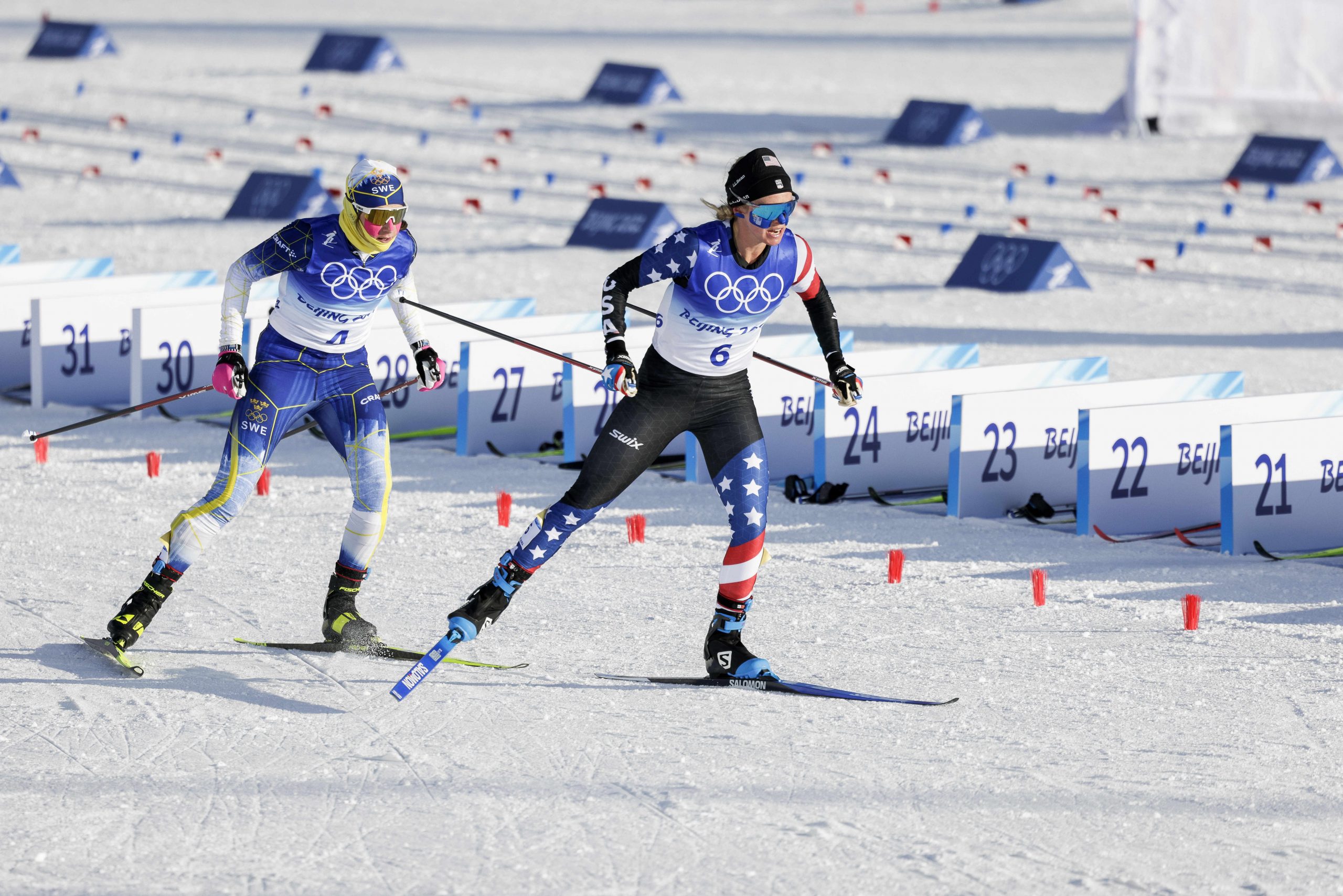
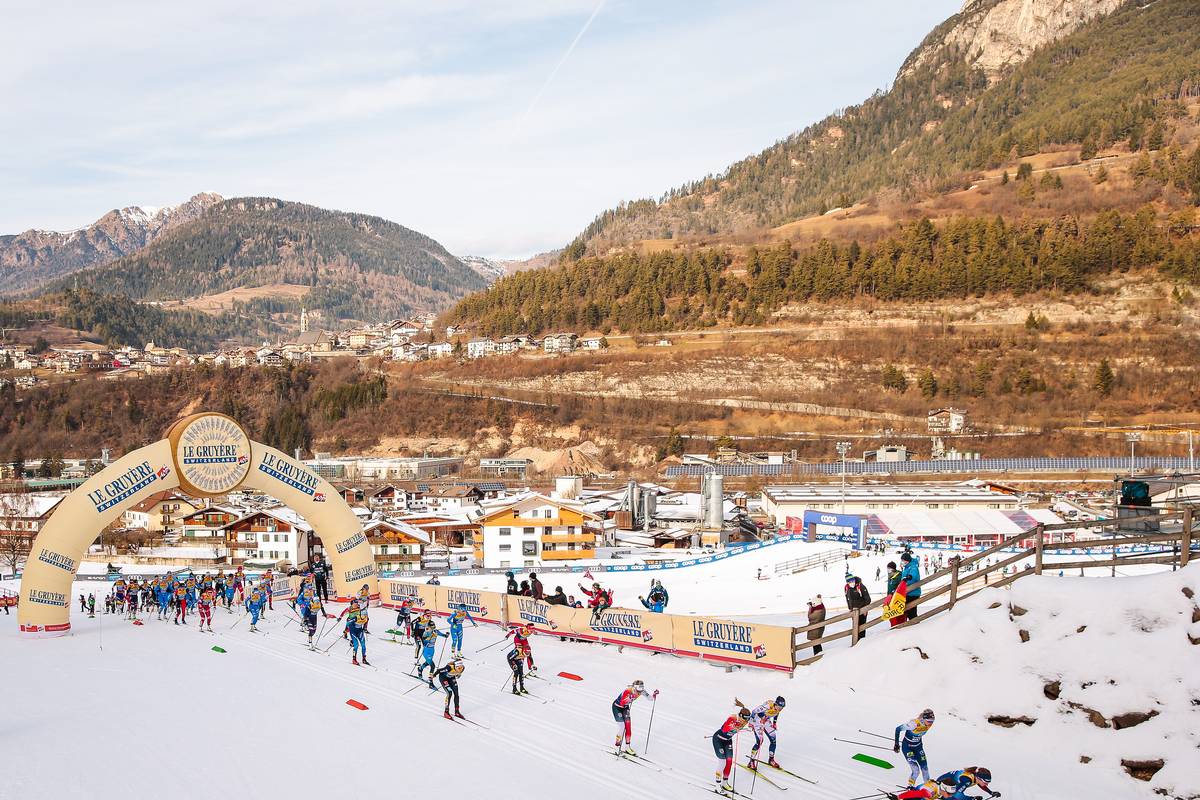
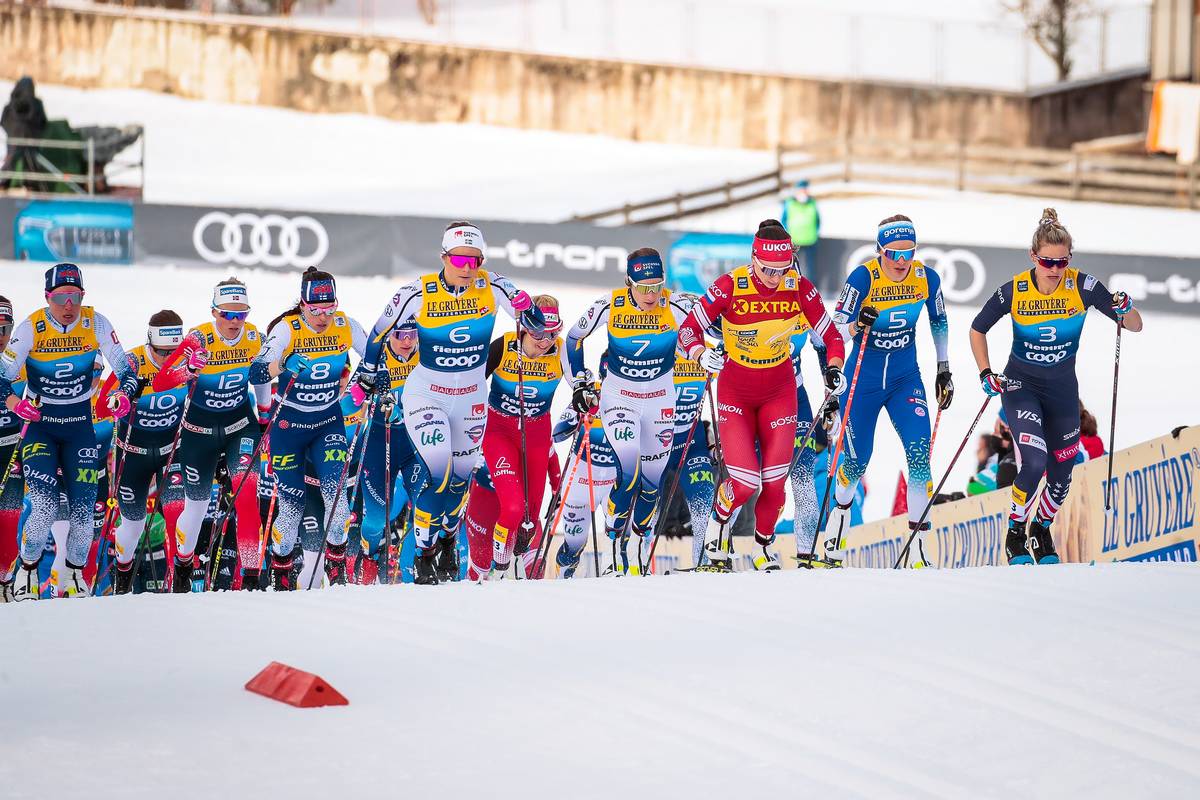
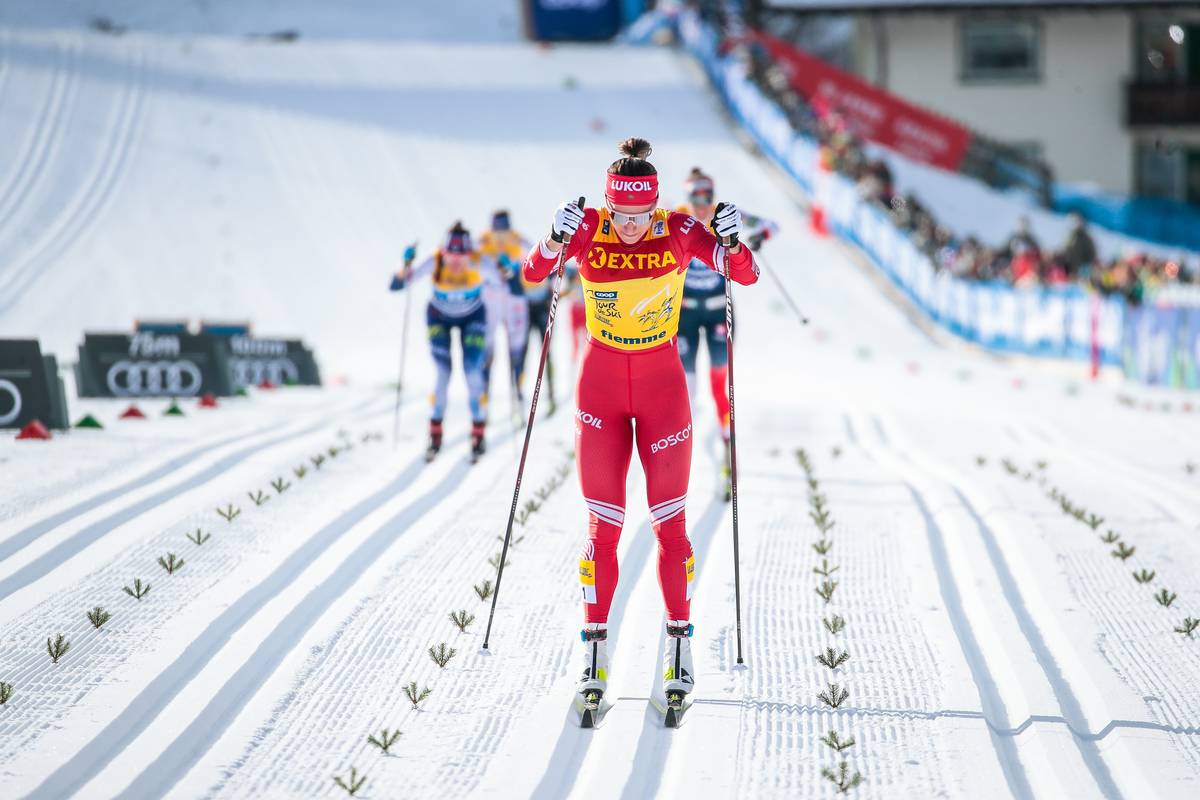
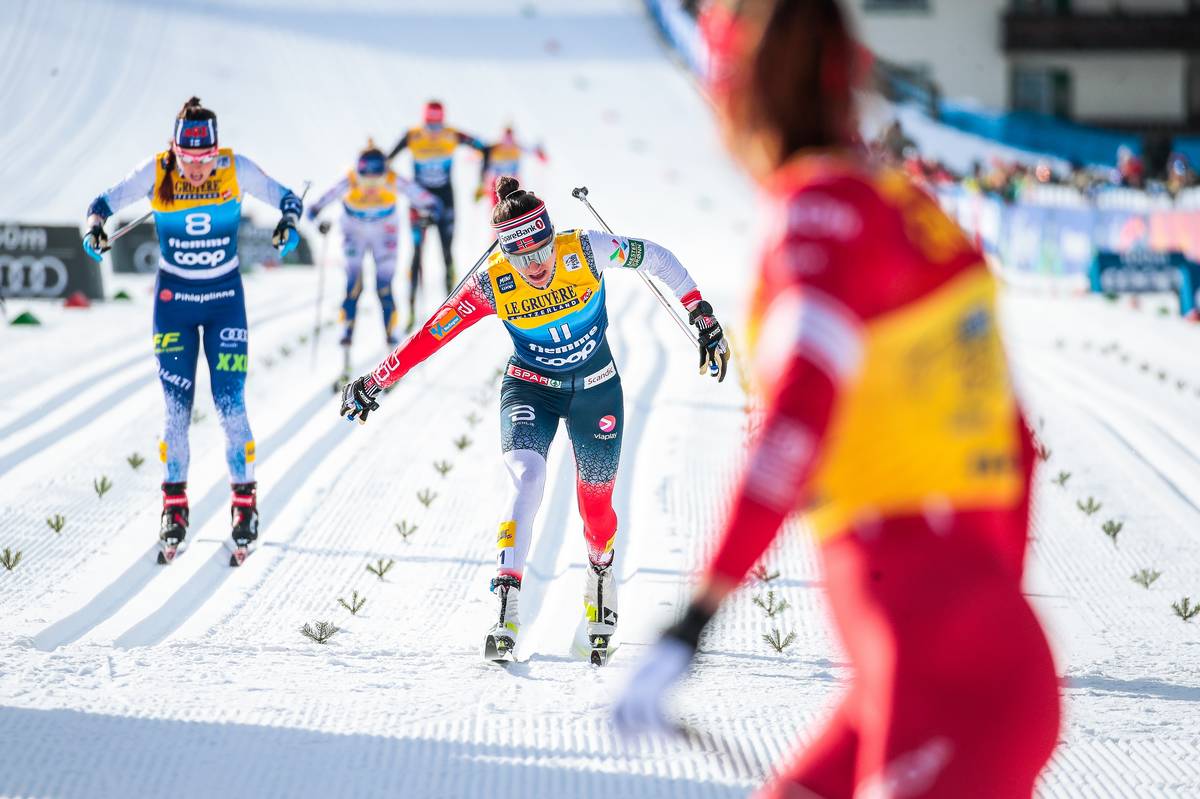
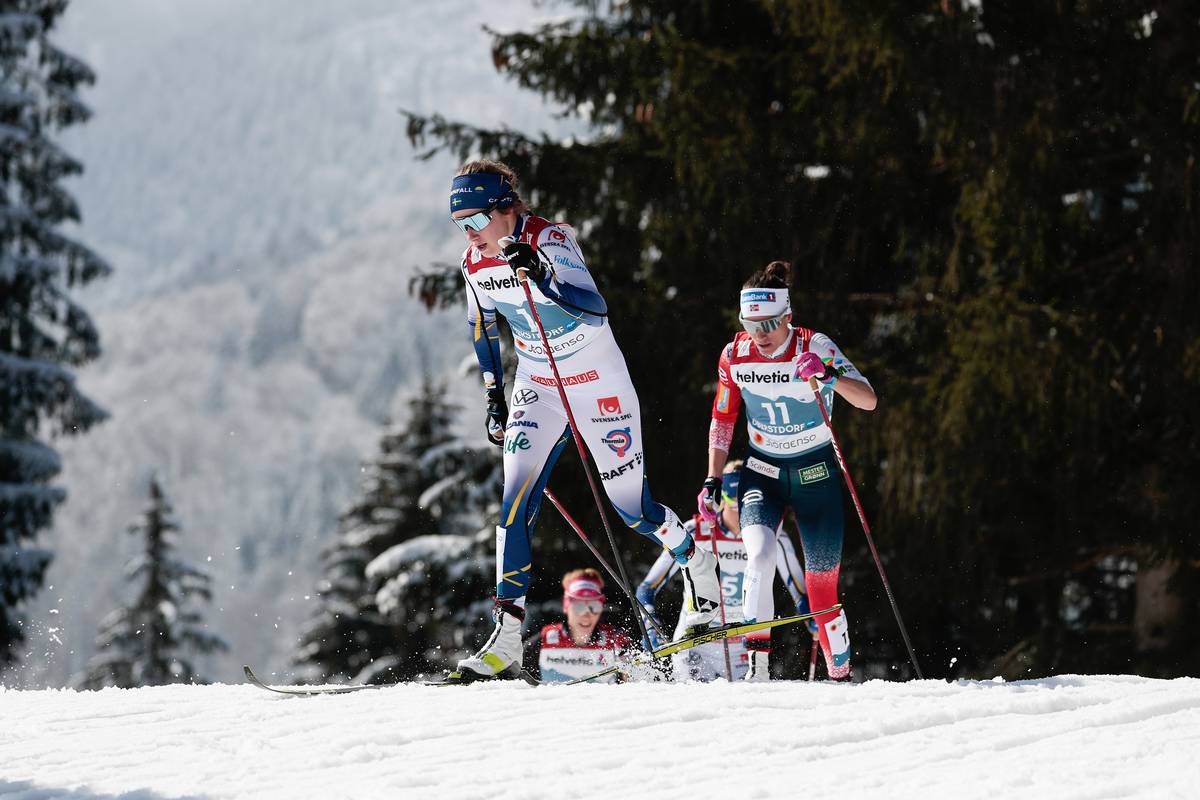
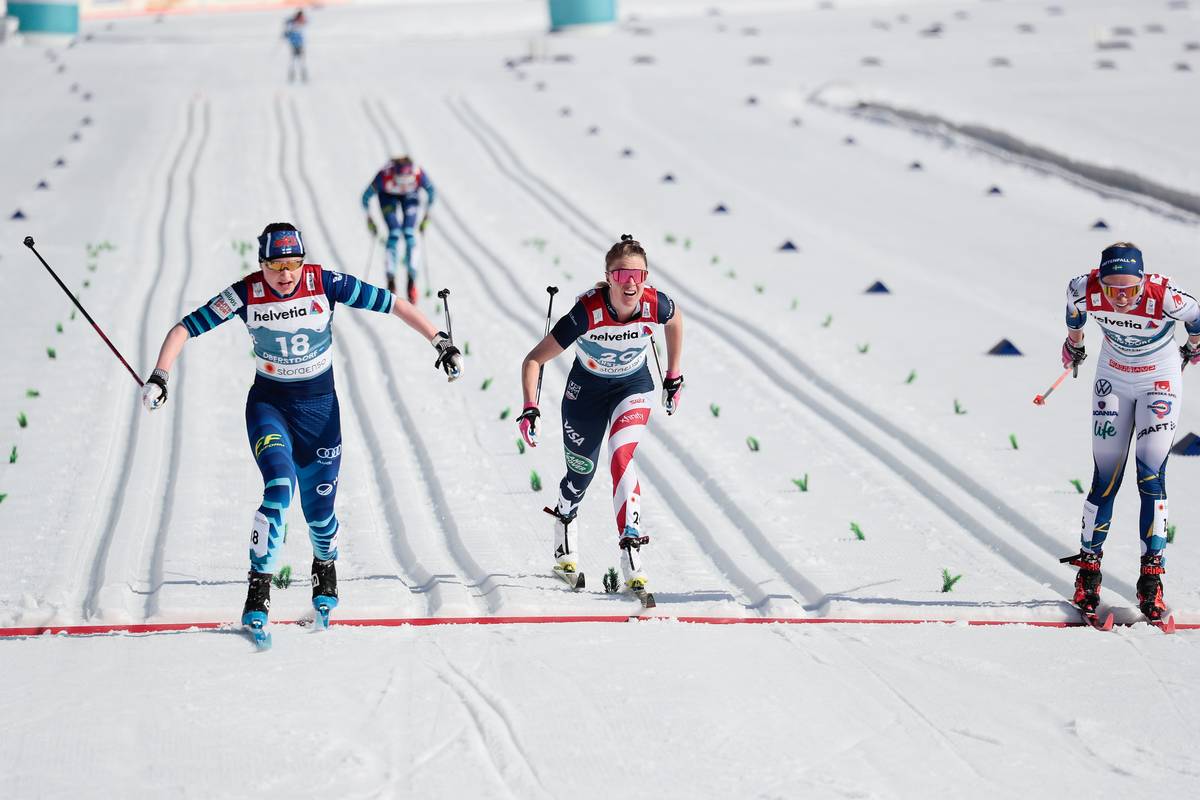
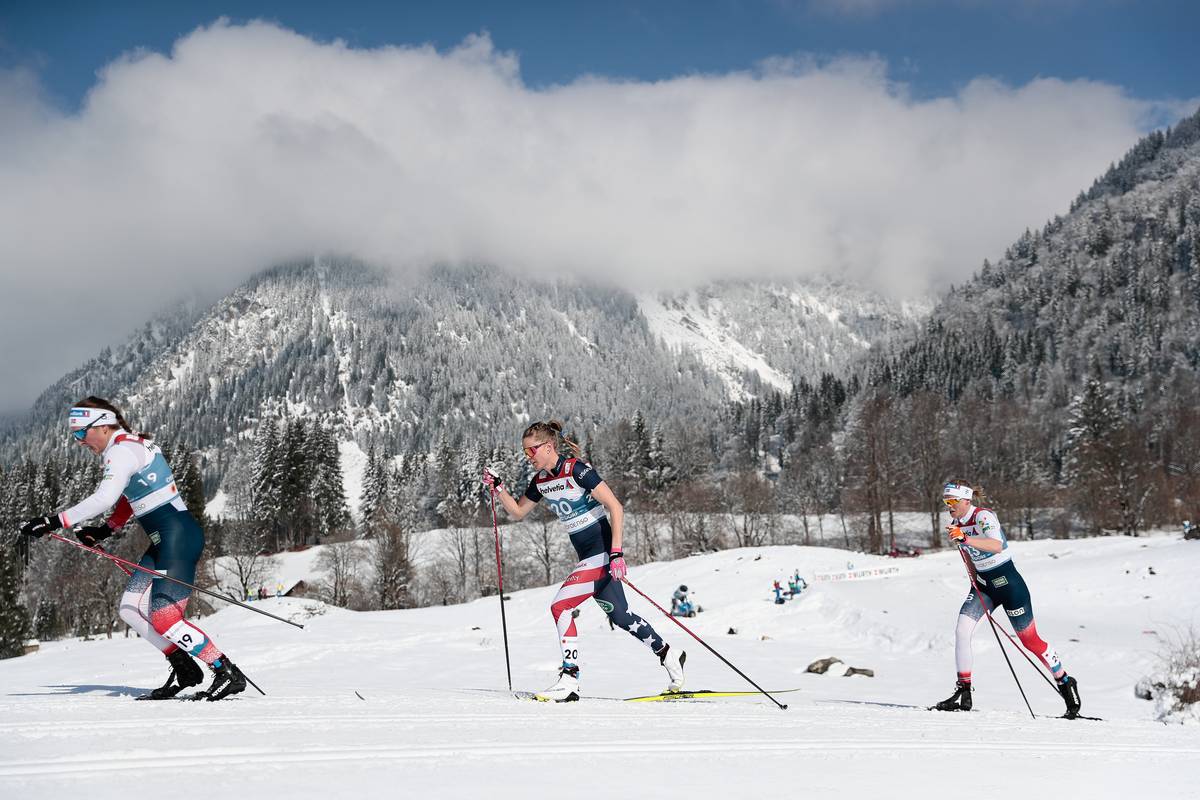
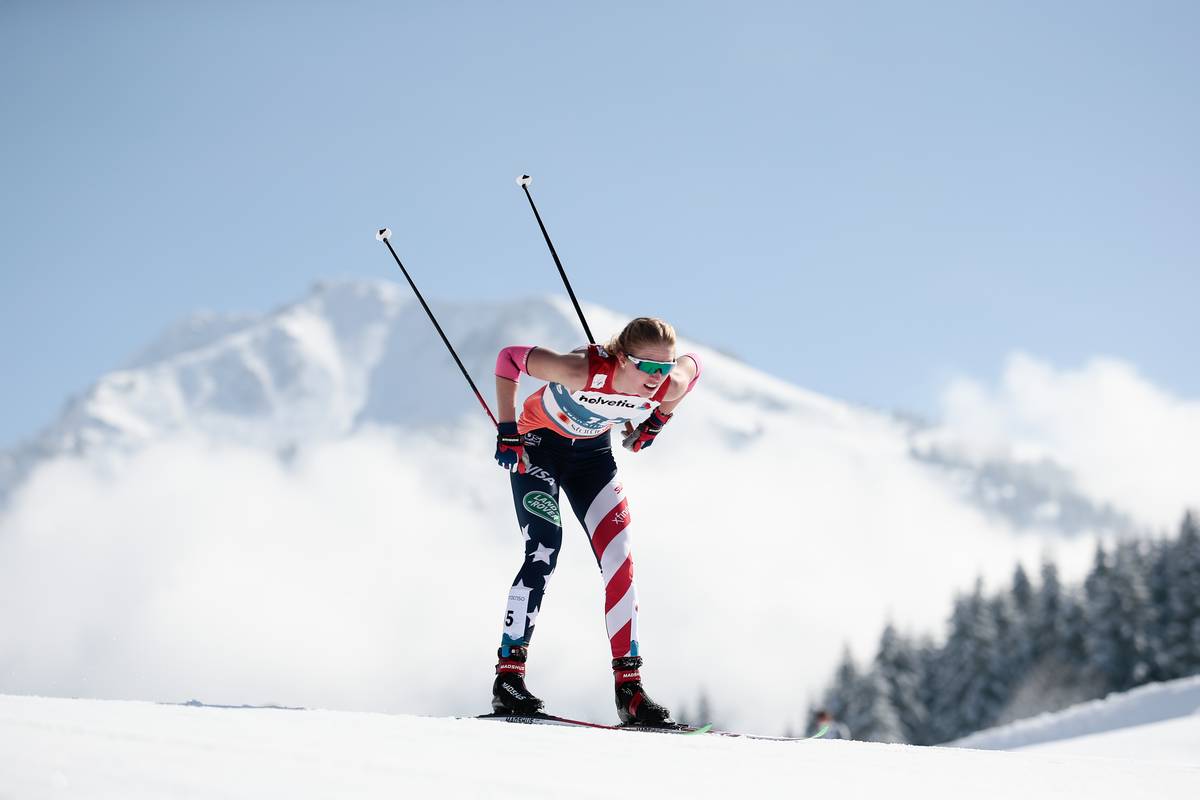
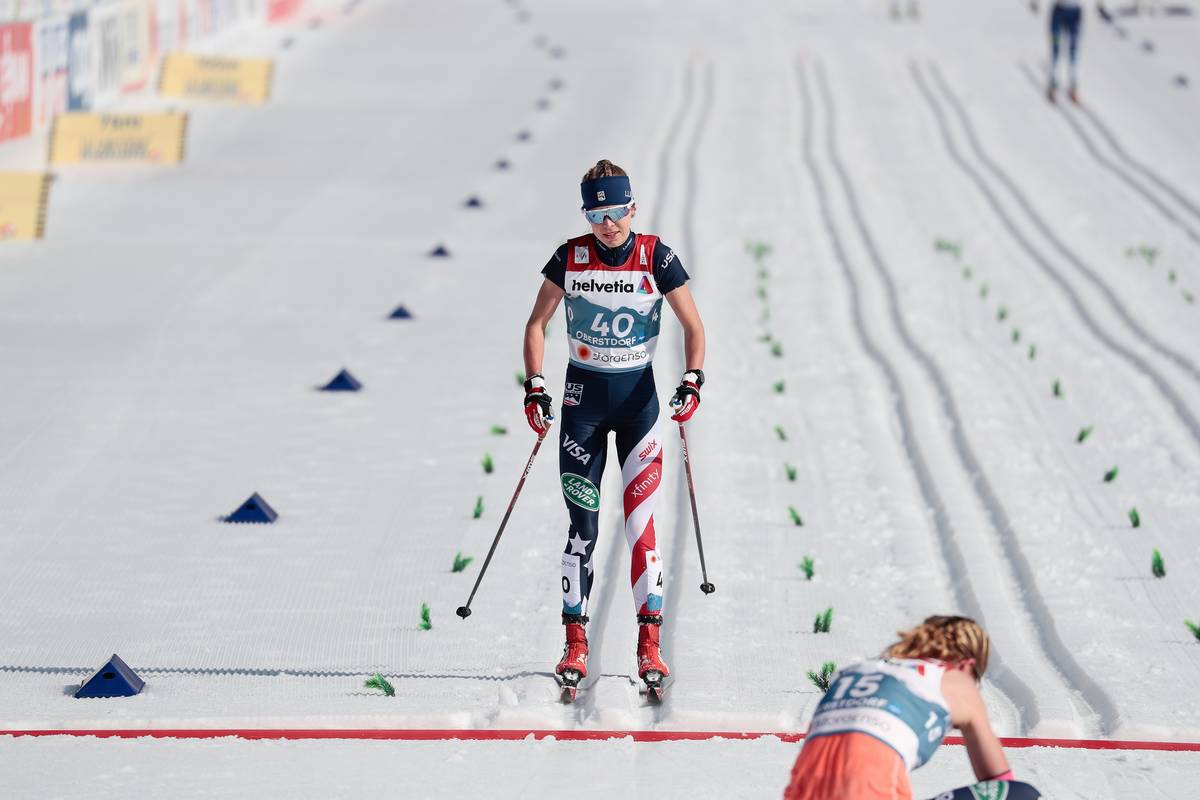
    Moa Ilar (SWE) continued to solidify her position in  the chase for the overall World Cup. she stands second, 149 points behind Jessie Diggins (USA). Ironically, the strongest Swedish skiers—and those who will be the strongest contenders for medals in Milano-Cortina—may be Ilar’s teammates who stayed away from Oberhof. (Photo: Authamayou/NordicFocus)

    When it comes to World Cup cross-country ski racing, season-long progress can be difficult for spectators and commentators to assess. It’s always hard to tell: are skiers getting faster? Are they fading? Or are they holding steady? This is the time of the season when event results begin to swirl and performances can become confusing. Three weeks from now, when the Olympics begin in Milano-Cortina, today’s winners could find themselves on the podium, or off the back. It’s all about the accuracy of their progression, the physiological and psychological costs of their efforts, their ability to remain healthy, and their commitment to the training peak that comes before the taper. And each skier handles it differently.

    Jessie Diggins races . . . that’s what she does. Others rest, others taper, others plan and plot, others pick and choose. Diggins races, a level of every-week race commitment that has decorated her trophy case with three World Cup Crystal Globes. Diggins has said that she doesn’t rely so much on “tapering” for big events as she intends to continue progressing through the races of each successive week. It’s a strategy that has seen her reach extraordinary levels, but not always at the times when she might’ve hoped. Last season, Swedish contenders went home to train and recover in the weeks leading to the World Championshp in Trondheim. It was a successful strategy, as Swedish women—Ebba Andersson, Frida Karlsson, and Jonna Sundling—definitely dominated those events. The Swedes are, once again, back at home in the weeks before the Olympics. It will be fascinating to watch events unfold in the two weeks of Olympic racing. The Swedish strategy may work again . . . but on the days that those races are run, they’ll be forced to deal with the power and the intensity and the will of Jessie Diggins.

    Olympic Talk

    Much of the media coverage of late has been about Olympic qualification: will Norway continue to make their would-be Olympians jump through hoops? Will the USA consider finishes at US Nationals, rankings in SuperTour, point standings on the World Cup . . . or will coaches exercise discretion in filling the team? Those are interesting discussions—rife with intrigue and opportunity, with aspiration and realization, disappointment and heartbreak—but it’s also a conversation that concentrates more on likely Olympic also-rans, and less on the skiers whom fans really follow. Even in talent-rich Norway, the skiers most likely to claim medals in Milano-Cortina have already been named to the team. Same for Sweden. Same for the USA. The contenders are well known, and their tickets to the Olympics were punched long ago. So while some Olympic hopefuls continue working to climb the rankings toward eventual places on their Olympic teams, the races in Oberhof highlighted the efforts of those who may contend for medals in Milano.

    And the Norwegians just keep coming . . . who is this Karoline Groetting getting her first world Cup start in Oberhof? Kristin Austgulen Fosnaes knows: Groetting is the upstart who nearly undid Fosnaes’ hopes of qualifying for an Olympic spot in Milano-Cortina. Fosnaes continued to elevate her profile with a win in the Norwegian National Championships 10 k, potentially paving the way for her naming to the Norwegian Olympic Team. She was followed onto the podium by Groetting who has now placed her name into the running for Olympic Team selections. Fosnaes has been a regular on the roster of the Norwegian Ski Team, but one who has from time to time, been viewed with skepticism by her countrymen, especially after her leaden performance in last season’s World Championship Team Relay in Trondheim all but handed the gold medal to Norway’s arch rival, Sweden. Fosnaes is a fine skier, a skier who would be a franchise player on the national team of nearly any other ski-country in the world. In any other country, Fosnaes would’ve been named to her Olympic Team two months ago. But as a skier competing for  Norway, she’s forced to keep racing and racing, always hoping to sufficiently impress the committee that selects the Norwegian Olympic Team. How interesting it is, then, that Fosnaes was not on the starting line today in Oberhof. Either she thinks she’s secured a spot on her Olympic team, or the committee selecting that team has already decided to stop looking at her. Either way, the focus today was on Groetting.

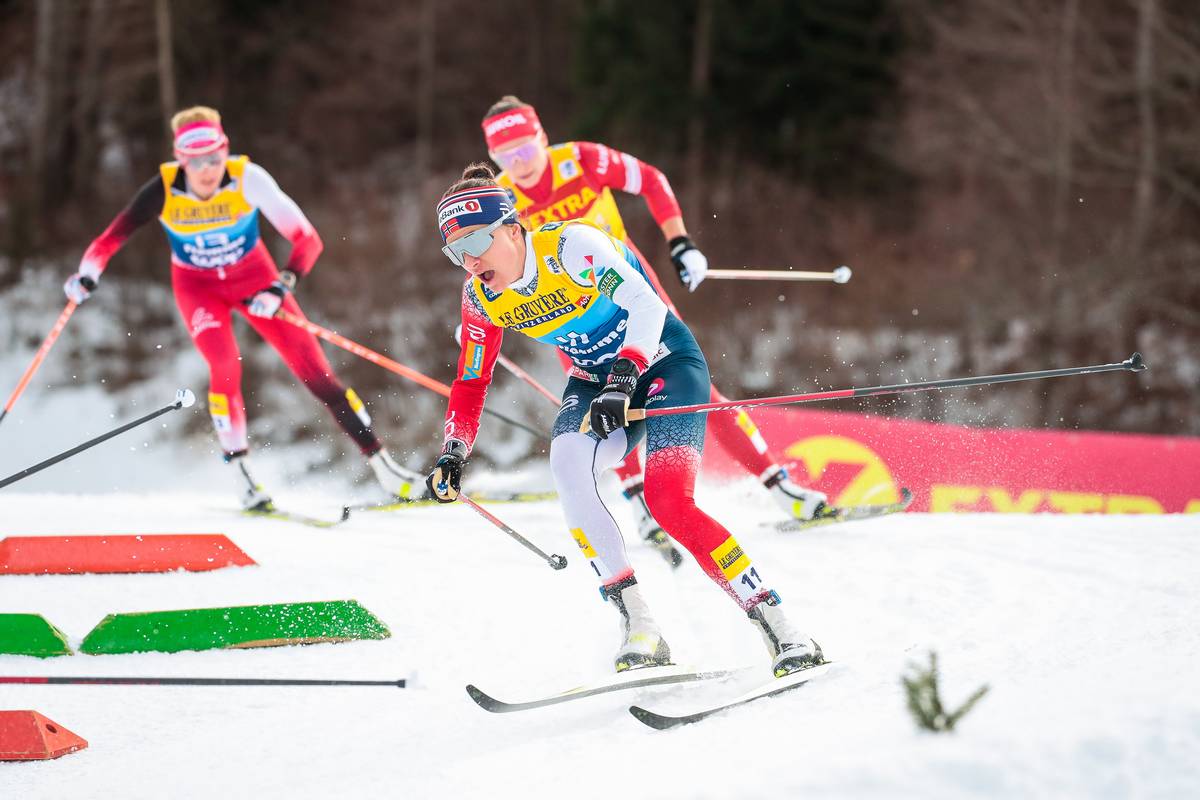
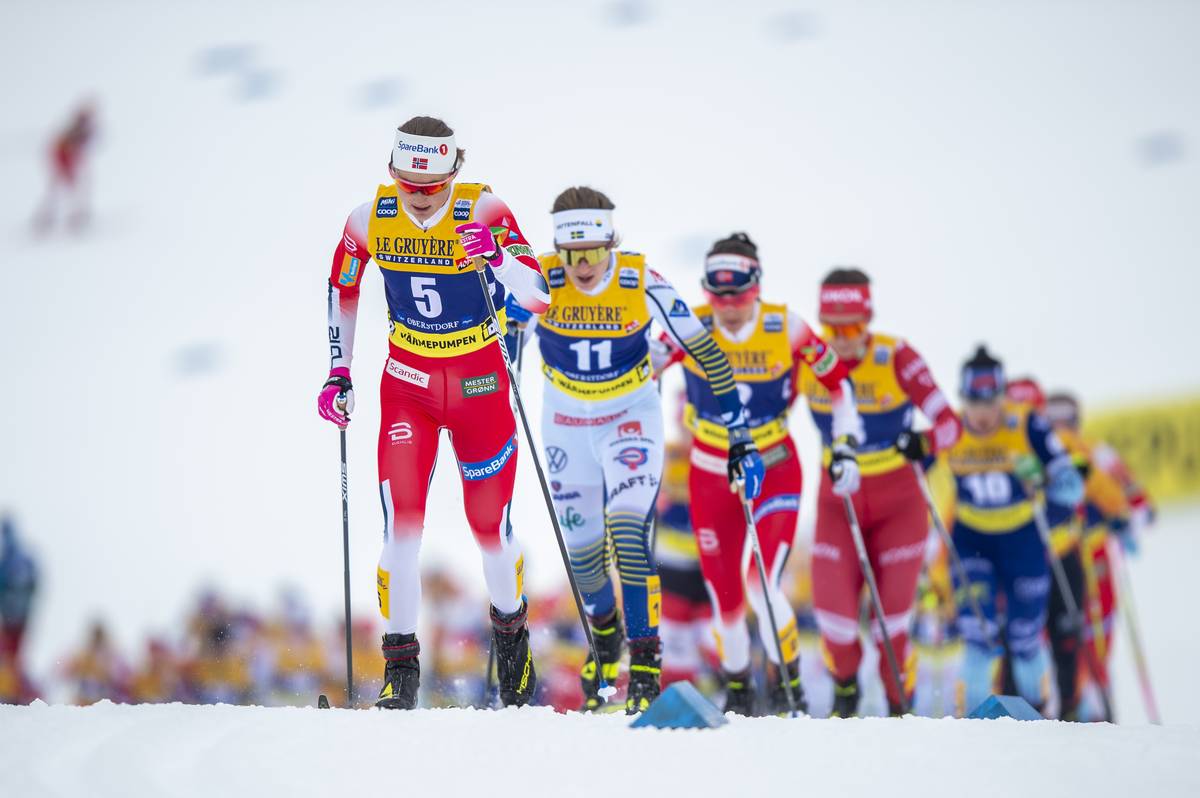
    Karoline Groetting (NOR) delivered quite a World Cup debut, leading the field through many of the early checkpoints, and finishing in fifth place on the day. Perhaps more important in her quest to be named to her nation’s Olympic Team, Groetting was the fastest Norwegian finisher in Oberhof. (Photo: Reichert/NordicFocus)
    Oberhof 10 k Classic

    With the Olympics remaining at the forefront of many contenders imaginations—and with resting for those races becoming a priority for many of those competitors—there were plenty of stars missing from today’s 10 k Classic start list: Finland’s Classic specialist, Kerttu Niskanen, is not on the starting line. Nor are Sweden’s Ebba Andersson or Frida Karlsson, Norwegians Astrid Oeyre Slind, Heidi Weng, Karoline Simpson-Larsen, or Kristin Austgulen Fosnaes (who is still yet to be named to Norway’s Olympic Team).

    Chasing an Olympic berth of her own, American Hailey Swirbul was the final starter of the day in Oberhof; she seems to be making the very most of her return to World Cup racing.

    “The smiles have been genuine!” beamed Swirbul. “I’m making sure to enjoy this life the most I can (but) I did not enjoy the feelings in the middle of this 10k today though, I won’t lie. I think a lot of us who came from Nationals, straight to international travel, straight to the World Cup were fighting some demons out there. It feels the most challenging, in my opinion, to find the will to keep fighting when your body feels heavy and the suffering feels unrewarding. But that’s also what keeps us coming back: the days where you can keep leaning into the discomfort and be in the fight and be rewarded for it is like no other feeling!”

    “I was the last starter today,” Swirbul continued. “So I was getting splits to know where I stood. An interval start race is a unique mind game because you can’t gauge if the imaginary people on front of you are pulling away or starting to fade. You just have to focus on your own race and get around the course as fast as you can, regardless of how others pace. That is easier said than done, especially with higher expectations on the World Cup. I try to remember that I don’t need to do anything that I haven’t done before. I just want to try to race my own race, regardless of the stage it’s on.”

    Contenders in Oberhof included Sweden’s Jonna Sundling, Maia Dahlqvist, and Moa Ilar (who is chasing Diggins in the season-long chase for the FIS Crystal Globe), Austria’s Teresa Stadlober, and newly discovered Norwegian phenom, Karoline Groetting. An early starter wearing bib 7, Groetting led the field at many of the early splits, and crossed the finish line with an advantage of 30 seconds over her nearest rival, and 37 seconds over her more famous countrywoman—and long-time national team member—Tiril Udnes Weng. But while Groetting settled into the leader’s chair, the more recognizable contenders began racing: Ilar, Stadlober, Sundling, and Diggins.

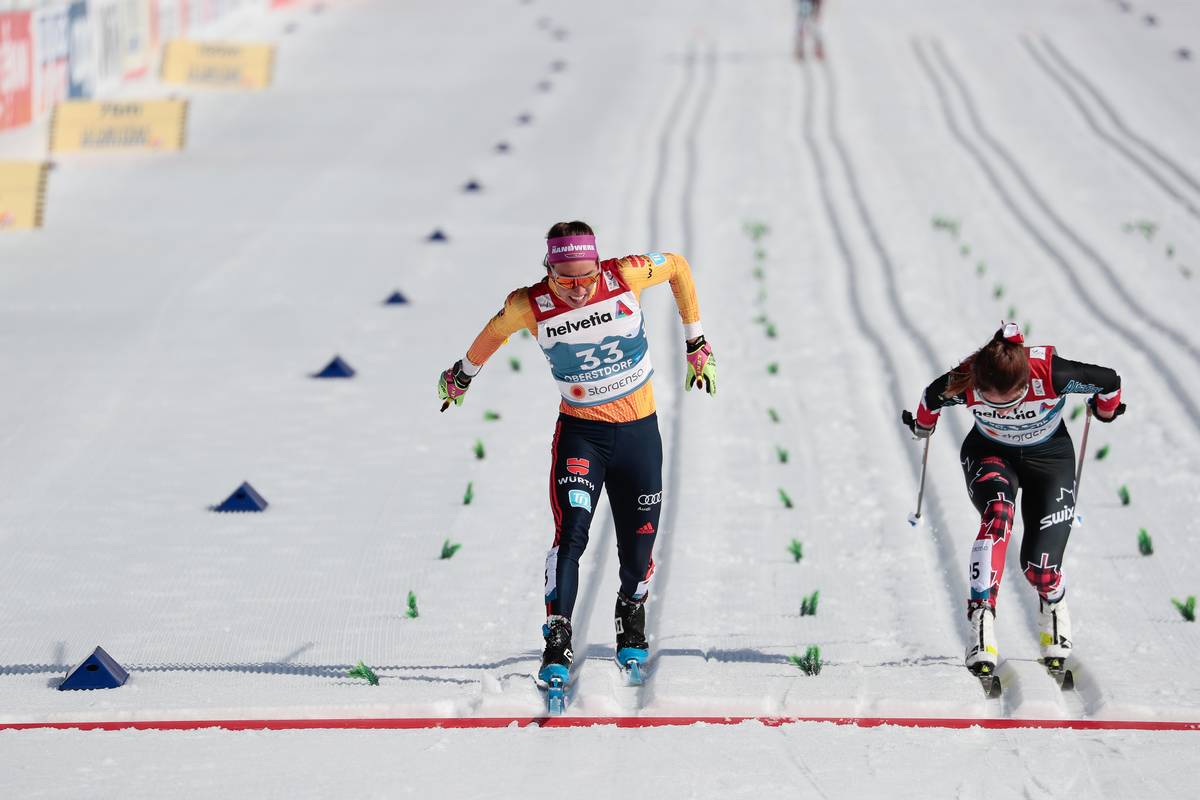
    Diggins was 15 seconds behind Ilar at the 2.6 kilometer checkpoint. Ilar led again at the 5.8 kilometer mark, coming across 13 seconds ahead of Groetting. At the finish line, Karoline Hennig-Doetzler (GER) challenged Groetting’s time, but fell just six seconds short. Groetting dodged another bullet when Maia Dahlqvist crossed the lone a mere .1 seconds behind Groetting’s finishing time. It was a tremendous finish for Dahlqvist—best known as a sprinter—as she continues to show great form in the approach to Milano-Cortina where she will certainly be a capable partner for Sundling in the Team Sprint event.

    It was later revealed that Diggins unusual split times resulted from her suffering quite a dramatic fall when her tip got caught in soft snow at the course’s edge.

    “I think that the reason my splits looked a litle funny is that I had a crash on one of the downhill corners. I caught my tip in some really deep sugar, and used my arm as a brake to keep myself from sliding off the course!”

    “It was time lost, and it was also a lot of adrenaline lost,” Diggins continued. “But it was honestly a really great practice in mental toughness, in refocusing, my energy and my attention on ‘what can I do in this moment. How well can I ski?’ I’m just really glad that’s really all that the crash was.”

    Ilar crossed the finish line with an advantage of 31 seconds over Groetting, but there were still other stars shining brightly out on Oberhof’s Classic course. Stadlober had begun the chase back at 7.6 kilometers when she was still 17 seconds behind Ilar. The gap narrowed to 10 seconds at 9 kilometers, and Stadlober was pouring it on. Over the final kilometer, the Austrian flew in pursuit of the Swede, only to find herself falling short by the narrowest of margins. Ilar would hold on to win by .7 seconds showing that hers is the best Classic skiing form today. Even so, she was surrounded by serious rivals—Stadlober in second, Sundling in third, Diggins in fourth, Groetting in fifth—who may be on their way up.

    18.01.2026, Oberhof, Germany (GER):
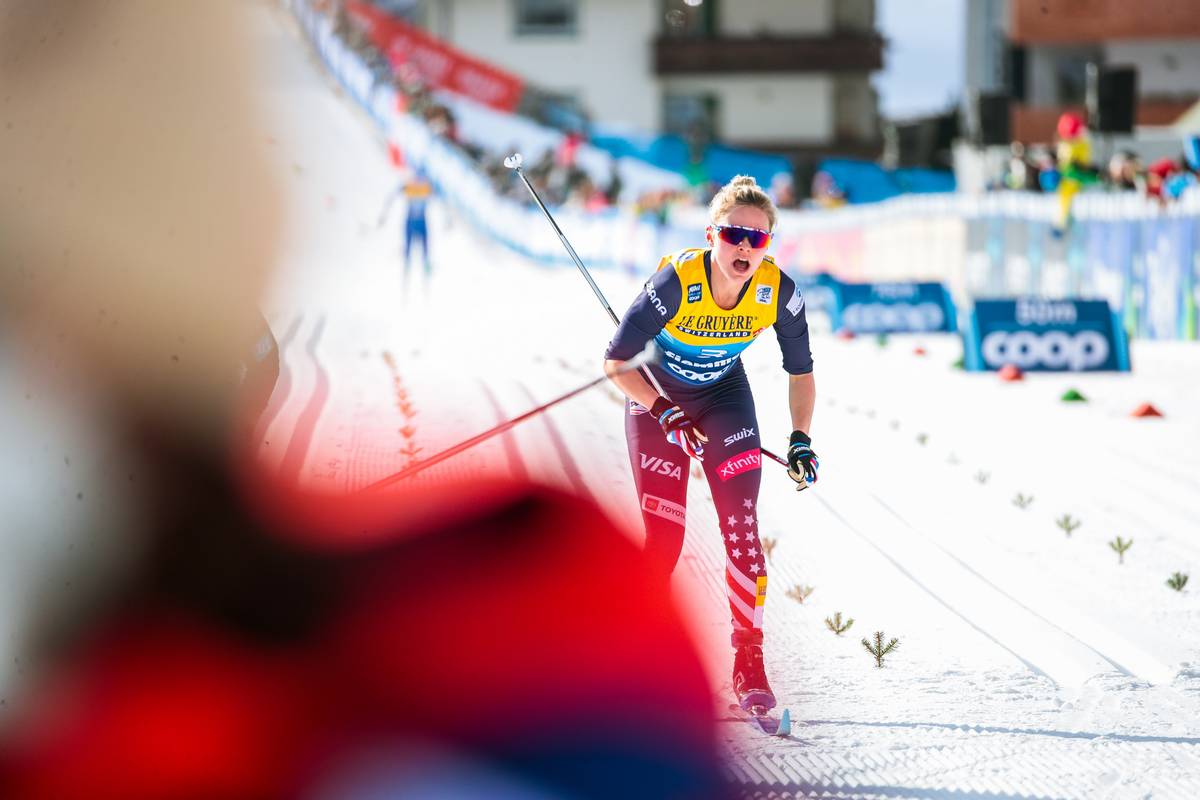
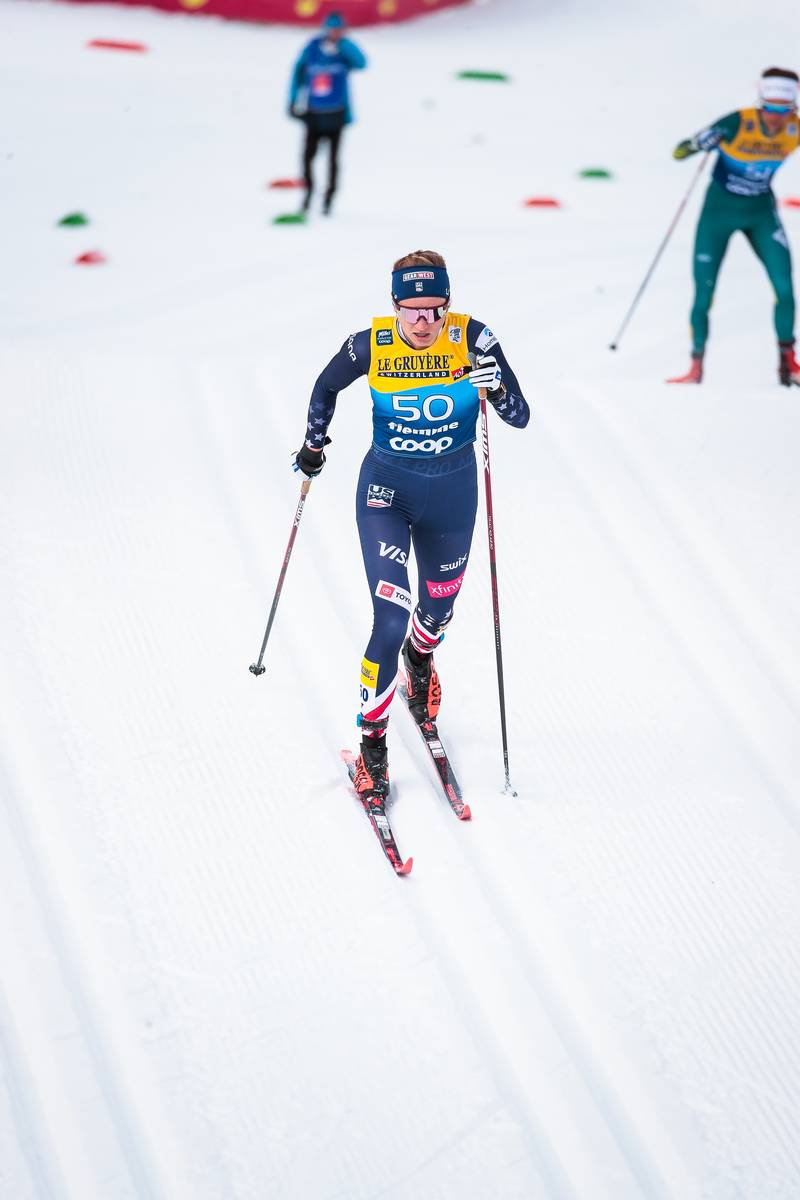
    Rosie Brennan (USA) – FIS world cup cross-country, 10km, Oberhof (GER). www.nordicfocus.com. © Authamayou/NordicFocus. Every downloaded picture is fee-liable.

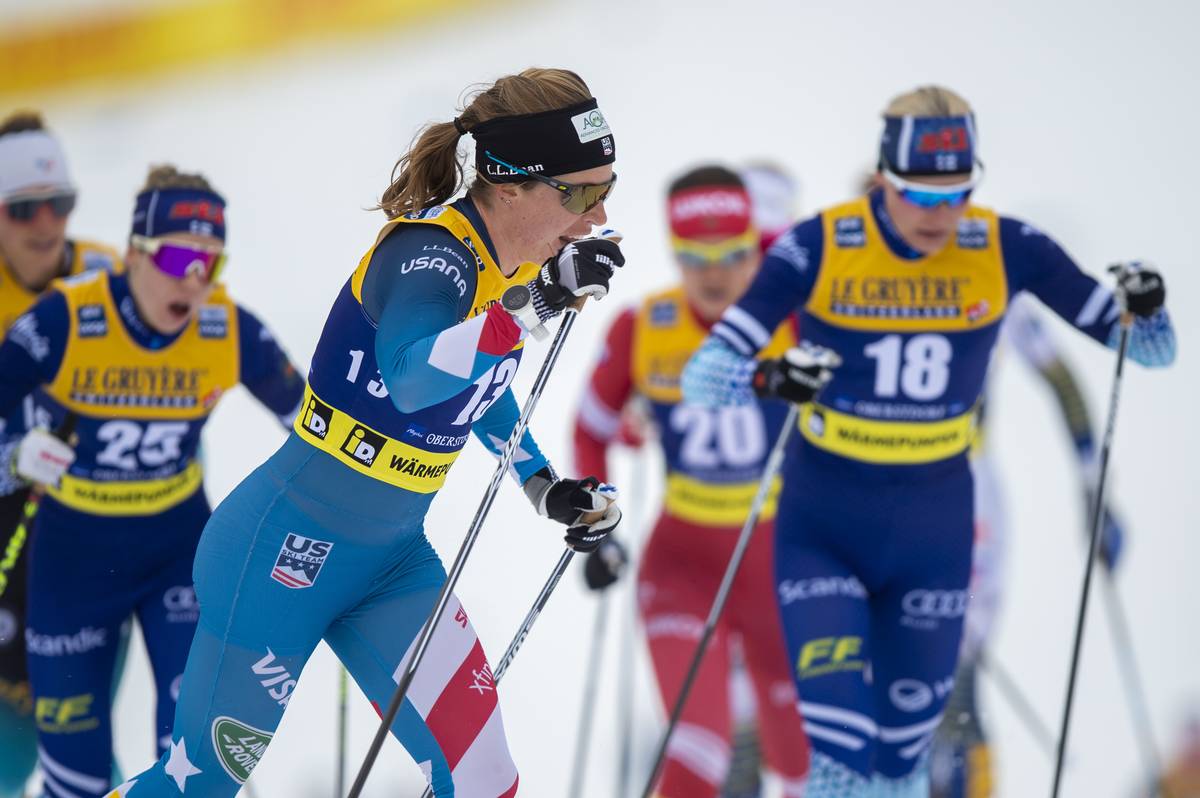
    Rosie Brennan has continued to navigate her return to world-class form. “I’m still living in a day-by-day world, trying to figure everything out,” she said. “I had some really good training at home but have struggled again for the last two weeks. I haven’t been able to discover a pattern, so I truly feel I have no control over when my body is ok and when it isn’t, and now I’ve added some vascular complications to the whole thing. I had to come race this weekend to qualify for the Olympics and I am very pleased to have accomplished that! Now I need to look forward as best I can to the Games and try to prepare as best as possible.

    “Erik Flora is over here now,” Brennan continued. “Which will help that process immensely. But overall, it’s been a long year and change of living in an unknown, complicated medical world.”

    Brennan would finish the day in 30th, followed by Hailey Swirbul 33rd, Novie McCabe 35th, Alayna Sonnesyn 45th, Sammy Smith 49th, Kendall Kramer 54th. Alison Mackie led her Canadian teammates in 31st, followed by Sonjaa Schmidt 36th, Katherine Stewart-Jones 38th, Amelia Wells 56th.

    Now trailing by only 149 points, Ilar trimmed a bit of Diggin’s advantage in the World Cup overall race. And Ilar’s plans for the season? She was quite frank in her response to those asking if she’s going for the World Cup overall win now. “Of course I am,” Ilar smiled.” I would lie if I said anything else!”
    And what about the others who stayed home this weekend? We shouldn’t forget the impending return of Andersson, Karlstad, Niskanen, Slind, Weng, and Simpson-Larsen. The plot thickens.


    Oberhof Women’s 10 k Classic RESULTS

    FIS World Cup Distance STANDINGS (entering Oberhof)

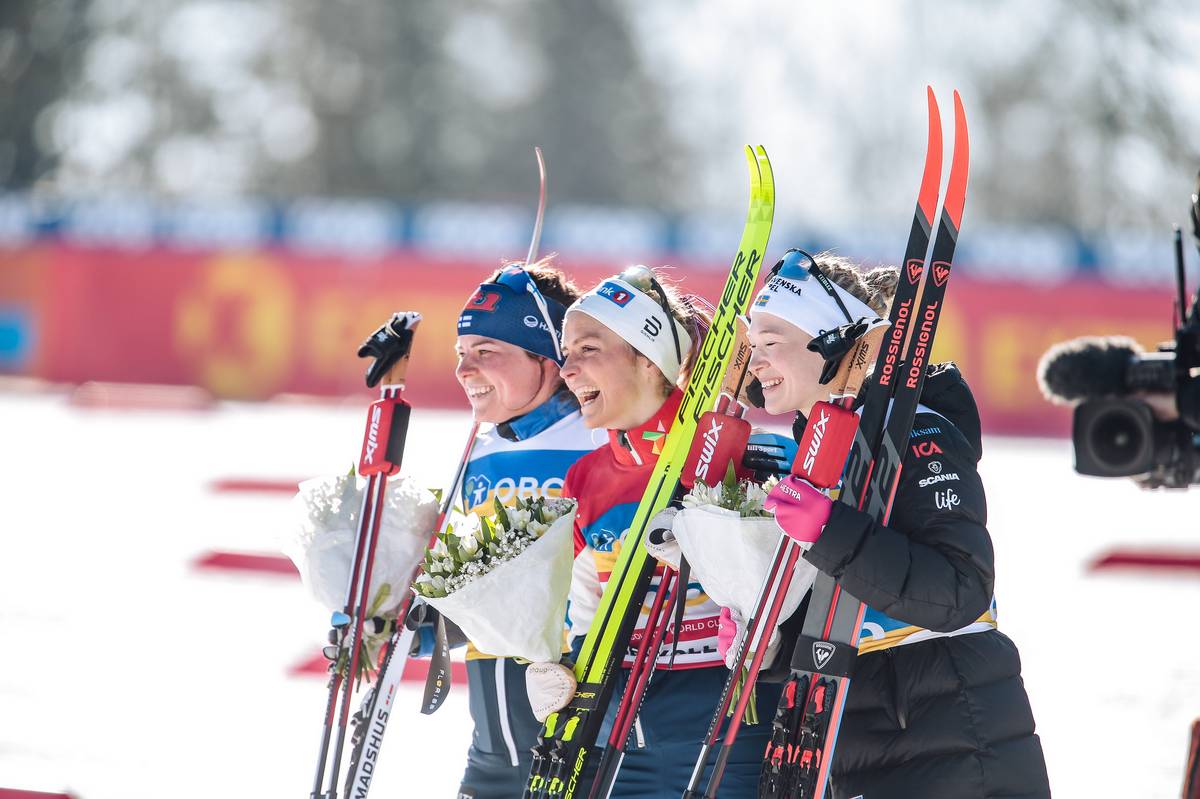
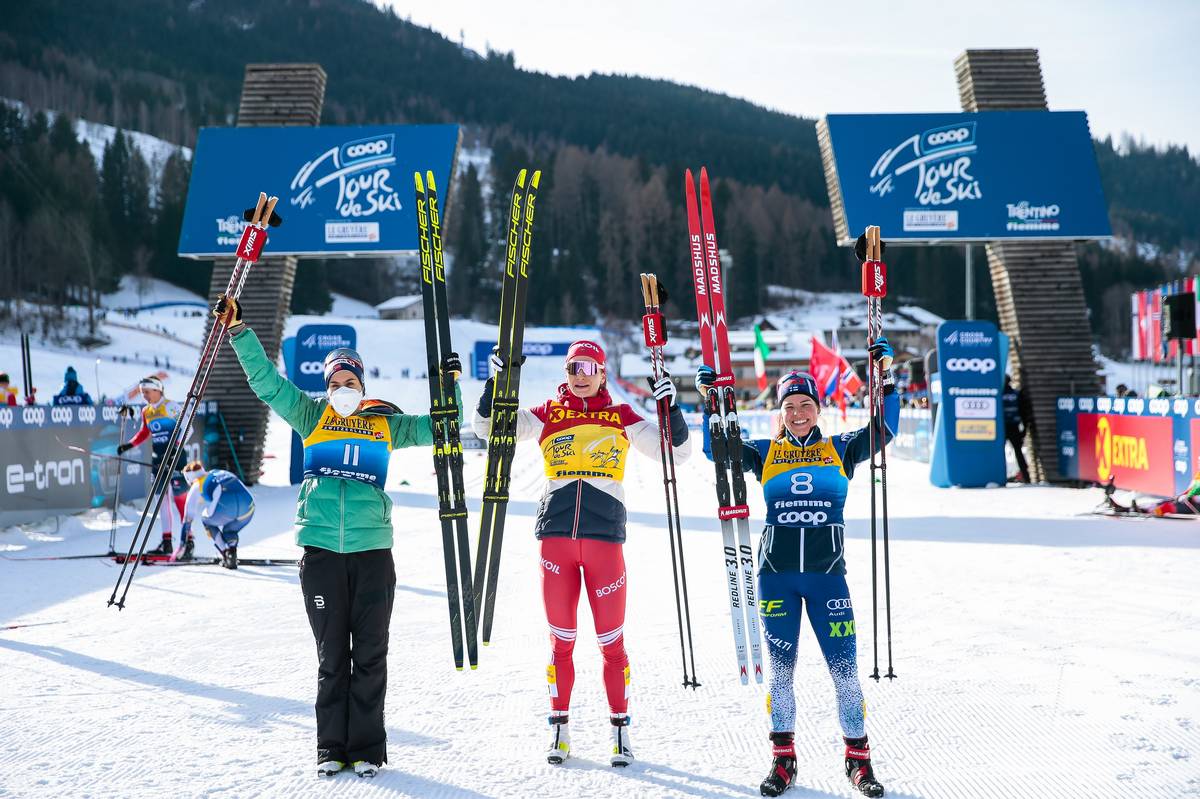
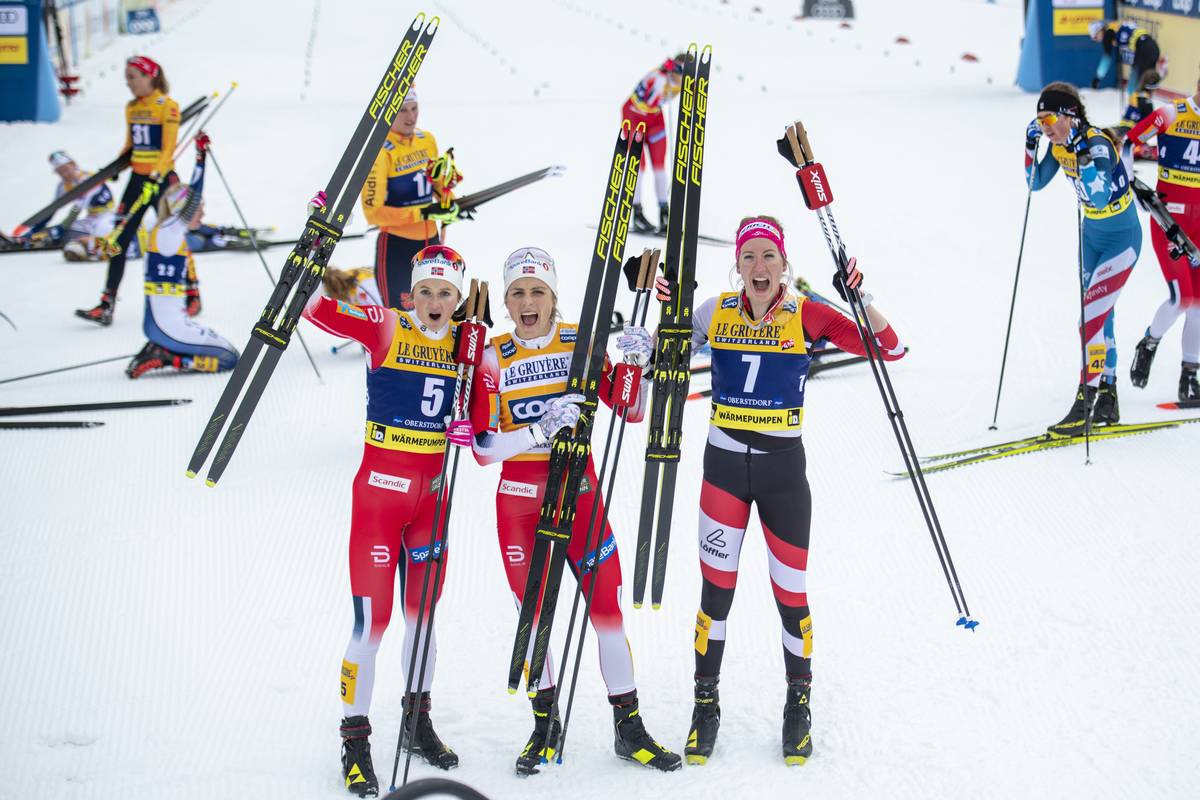
    Teresa Stadlober (AUT), Moa Ilar (SWE), Jonna Sundling (SWE) on the podium in Oberhof . (Photo. www.nordicfocus.com. © Authamayou/NordicFocus. Every downloaded picture is fee-liable.


  • A full-circle moment, Johaug wins the 30 k classic at Holmenkollen, exactly 11 years after her first individual World Championship gold; Brennan leads the US in 7th

    A full-circle moment, Johaug wins the 30 k classic at Holmenkollen, exactly 11 years after her first individual World Championship gold; Brennan leads the US in 7th

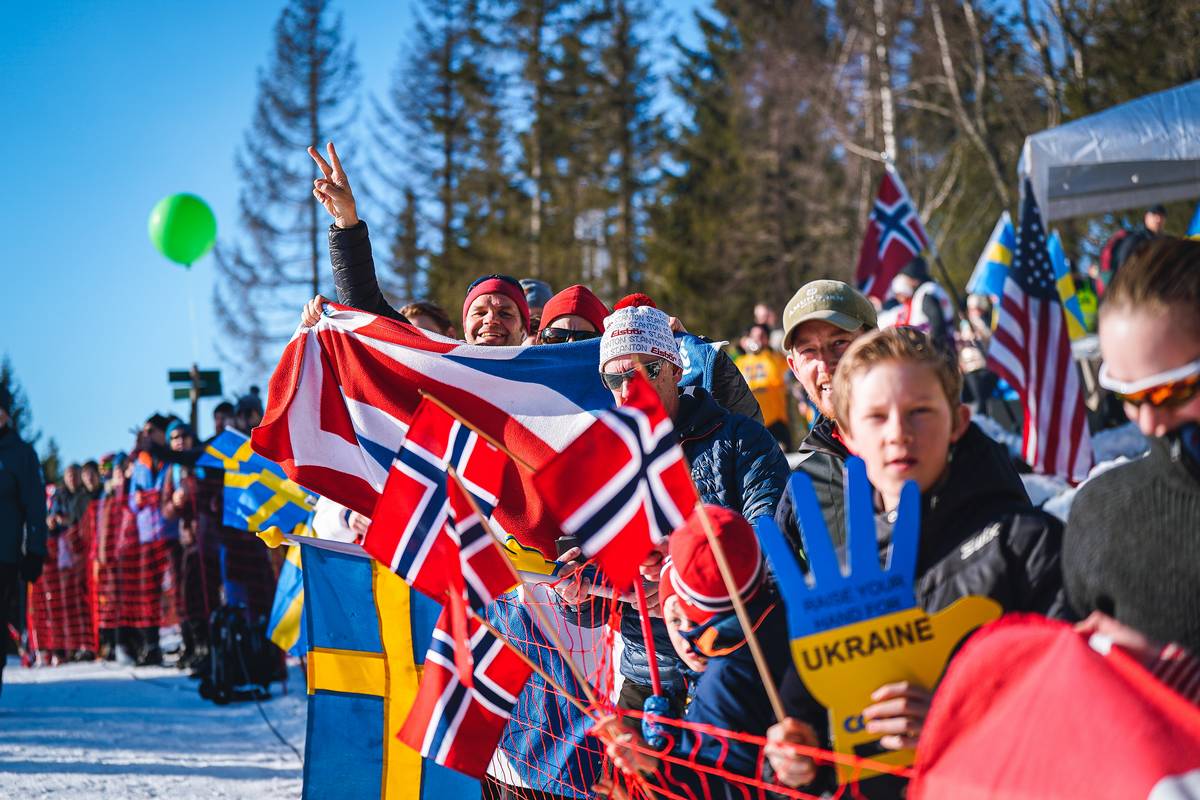
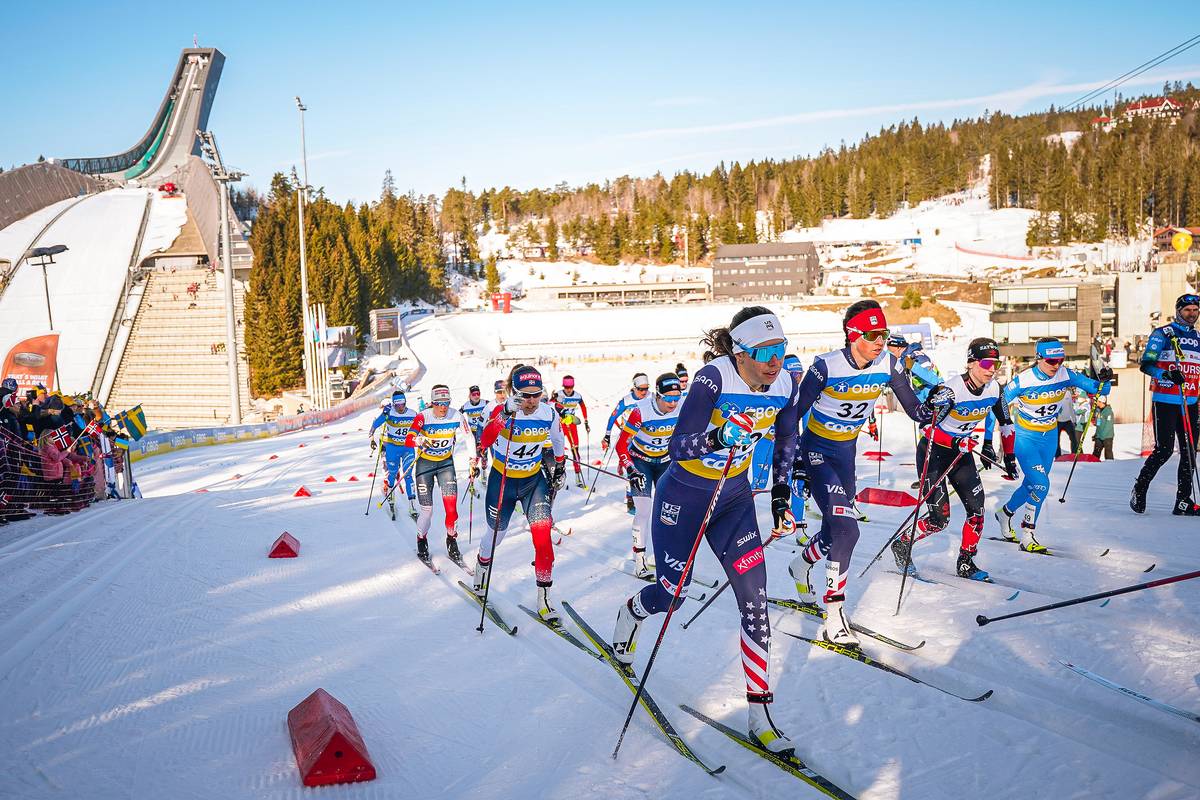
    Crowds line the storied tracks at Holmenkollen during the women’s 30 k classic. (Photo: NordicFocus)

    This World Cup coverage is made possible through the generous support of Marty and Kathy Hall and the A Hall Mark of Excellence Award.  To learn more about A Hall Mark of Excellence Award or to learn how you can support FasterSkier’s coverage please contact info@fasterskier.com.


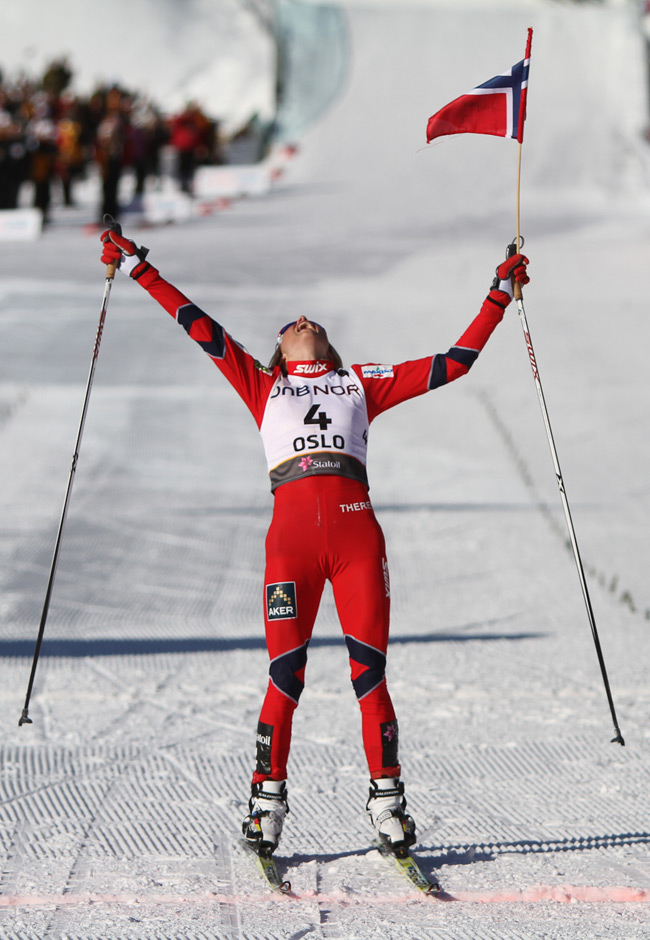
    Terese Johaug wins her first individual World Championship gold medal in the 30 k mass start skate in Oslo, NOR. (Photo: FS Archives)

    Eleven years ago to the day, racing the 30-kilometer mass start skate, a 22-year-old Therese Johaug won her first individual World Championship gold medal in a breakout performance at Holmenkollen near her home in Oslo, NOR. In doing so, she had broken apart a field of women considered legends of the sport on an equally legendary course known for long grinding climbs that require superior fitness and technique. Johaug won by nearly 45 seconds over one of the greatest cross country skiers of all time, her teammate Marit Bjørgen, and was 1:34 ahead of the Polish champion Justyna Kowalczyk. 

    “It was hard for me. It’s hard to see her go in front, and the gap [grow] bigger and bigger,” said Bjørgen that day. Then at the peak of her career, Bjørgen had gone four-for-four that week with gold medals in each of the previous World Championship races in Oslo, and the upset was a shock to those following along. “But I’m very happy for Therese. She is a young girl, and a girl for the future—and for Norway.”

    Little did cross country ski fans know just how storied the athlete’s career would be.

    Therese Johaug races in front of a home crowd during the 30 k classic at Holmenkollen. (Photo: NordicFocus)

    Today, under clear skies that allowed for views of the city skyline and Oslofjord, Norwegian flags flying, and fans returning to the crowded stadium and partying in the woods, she did it again, as one of her final performances after more than a decade as the top female distance skiers of all time. 

    And what’s more, Johaug won today’s 30 k classic in the same dominant fashion that she did eleven years ago, and has done many time since, stopping the clock at 1:19:22.8.

    Though the final results show just 19.4 seconds as her winning margin, this only tells part of the story. By 10 k, Johaug held a margin of over 23 seconds, which she steadily grew over the subsequent laps. At 25 k, she led by nearly a minute and a half.

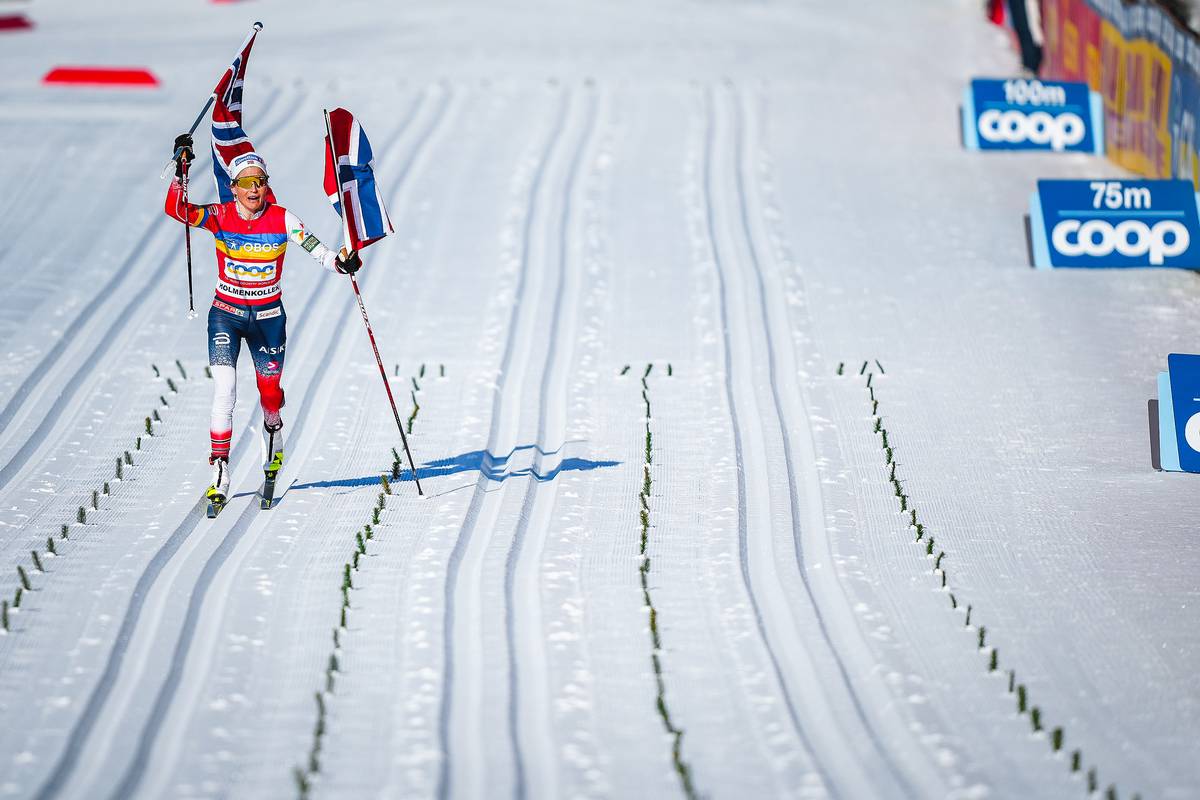
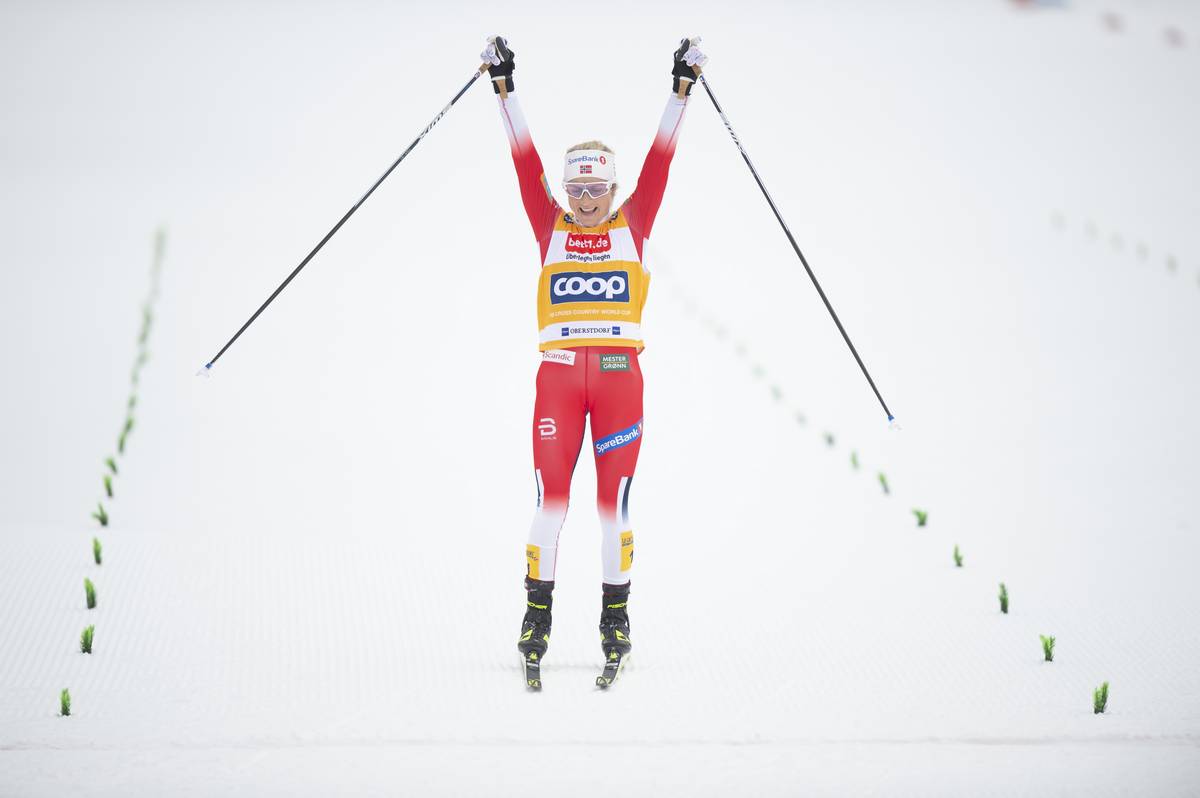
    Therese Johaug waves Norwegian flags as she skis the final meters of 30 k classic at Holmenkollen. (Photo: NordicFocus)

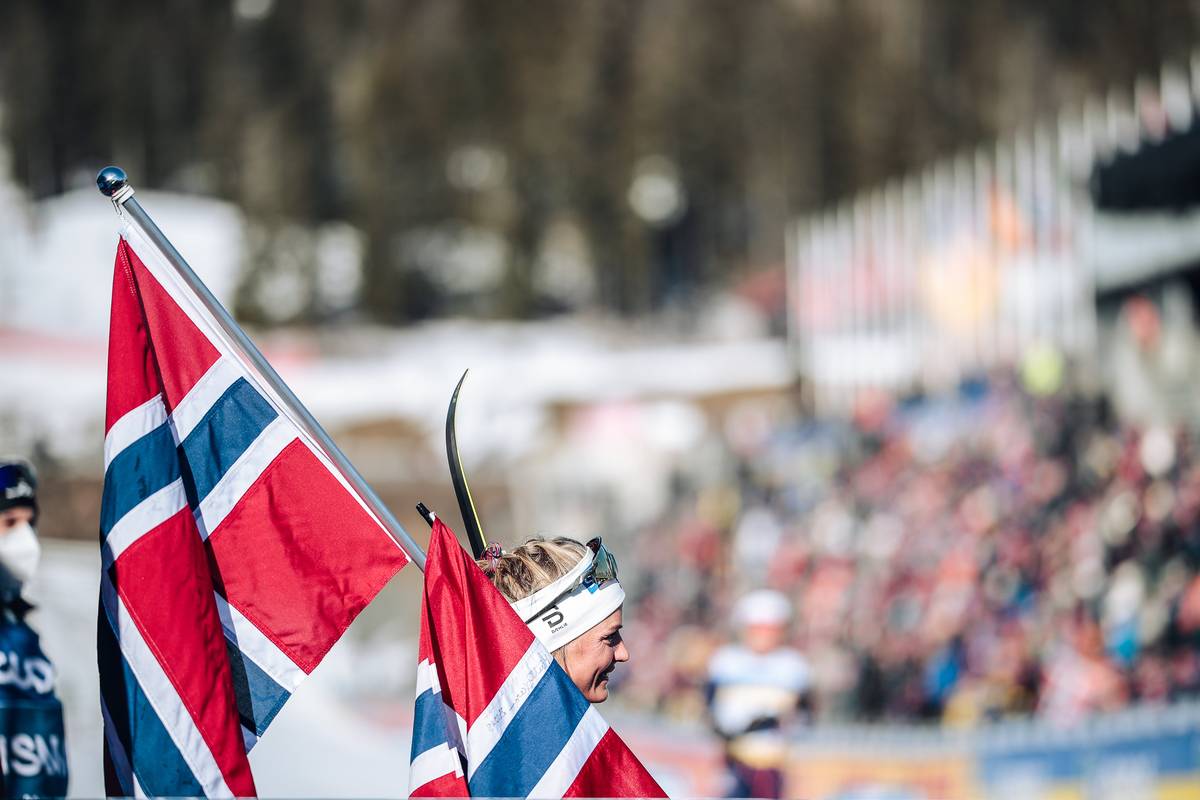
    As she entered the stadium, Johaug was greeted by coaches and techs who handed her a flag for each hand, which she carried through the finish, waving, and stopping to take in the erupting cheers from the crowds. 

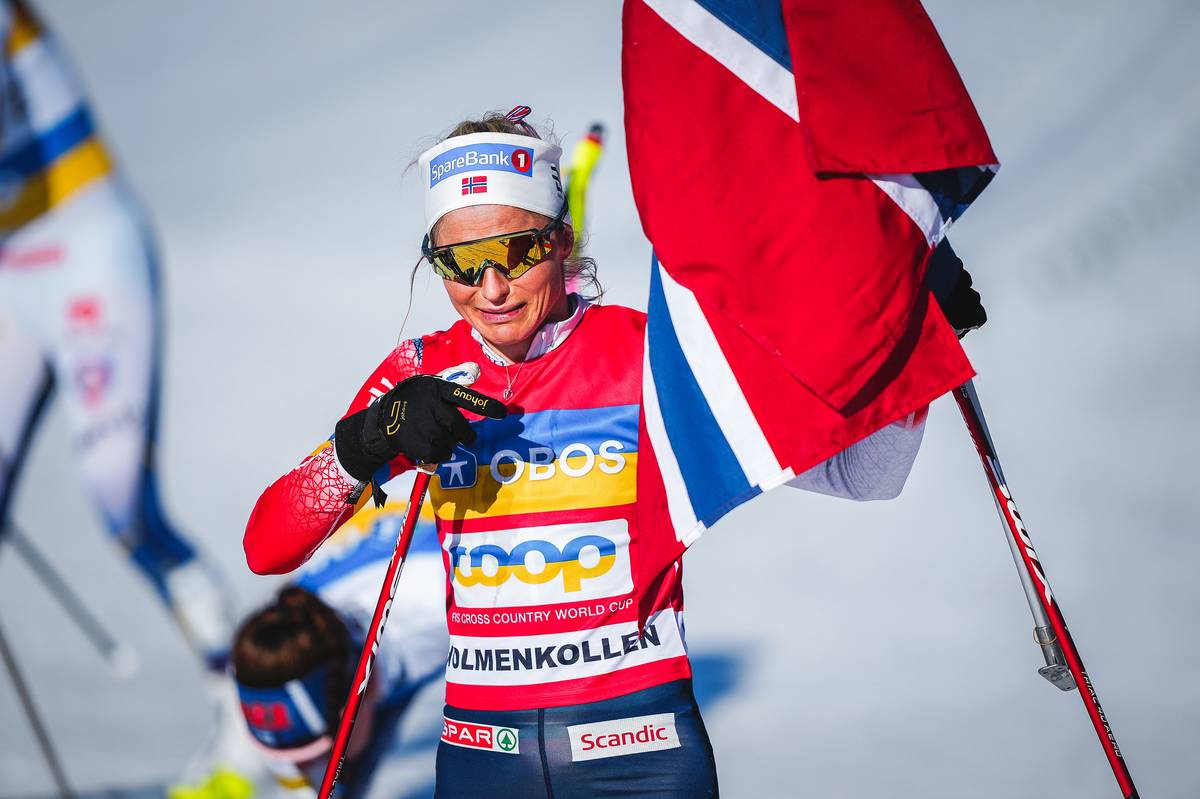
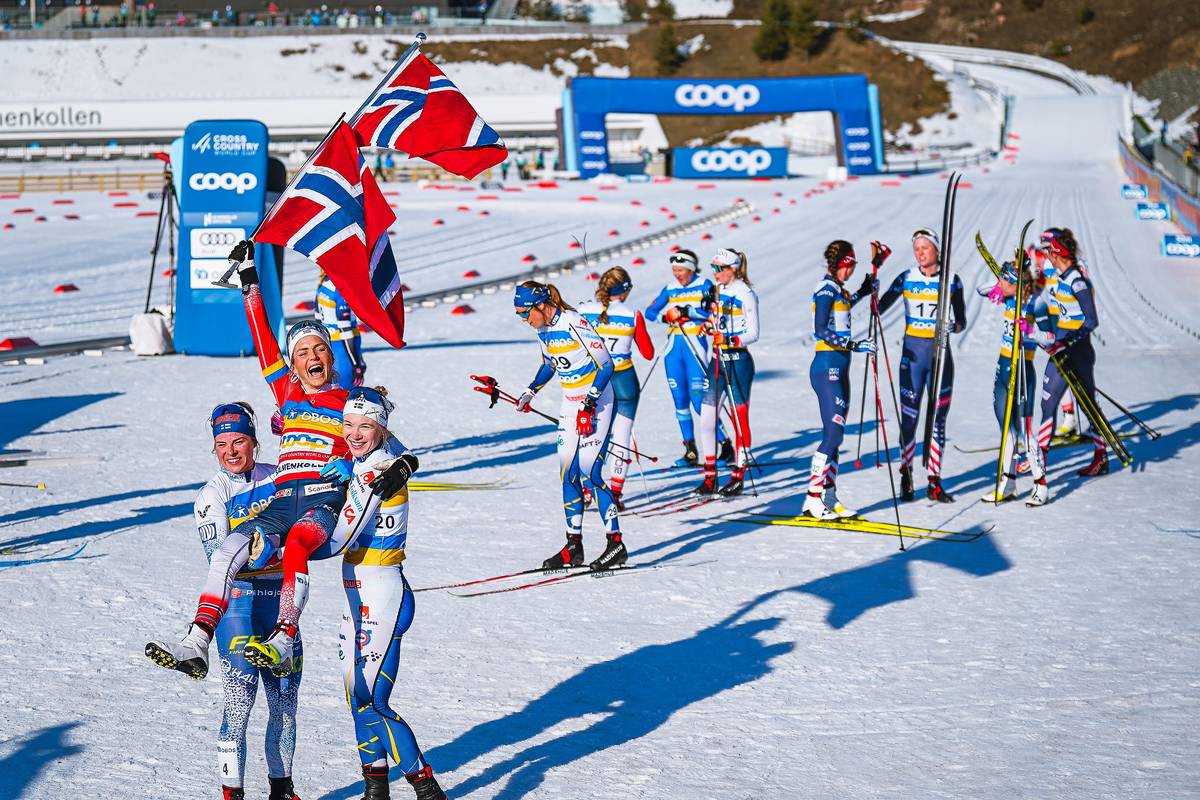
    Laughing behind tears as the rest of the field began to trickle across the line, Johaug was hoisted onto shoulders, waving her flags for a loud Norwegian crowd who had supported and applauded her through fifteen years of racing on the World Cup. 

    “It’s a lot of emotion now,” Johaug said at the finish. “I start here in 2011 with my first individual victory, and today is my last race here. It was sun and blue sky, the same as  in 2011, and there were a lot of people around the track cheering for me. I’m so happy now, but also so sad that this is the end of my career.”

    Therese Johaug was emotional at the finish of today’s 30 k classic at Holmenkollen, the venue where she won her first individual World Championship gold in the 30 k skate eleven years prior. (Photo: NordicFocus)
    Norway’s legendary Therese Johaug wins the 30 k mass start classic, exactly 11 years after her first individual World Championship gold medal was won on the same tracks. (Photo: NordicFocus)

    While she indicated during the Olympics that she would not compete another four years, it was not until yesterday that she officially announced that this would be her final race at Holmenkollen. 

    “In many ways, it feels as if the [story] ends when on Saturday, March 5, 2022, I stand on the starting line for another 30 k in Holmenkollen. I really do not want the journey to end, but it is a time for everything,” she wrote to NRK. “In light of this, I look forward to a final fight at home with the flag on my chest, and I am grateful for everything the sport has given me.”

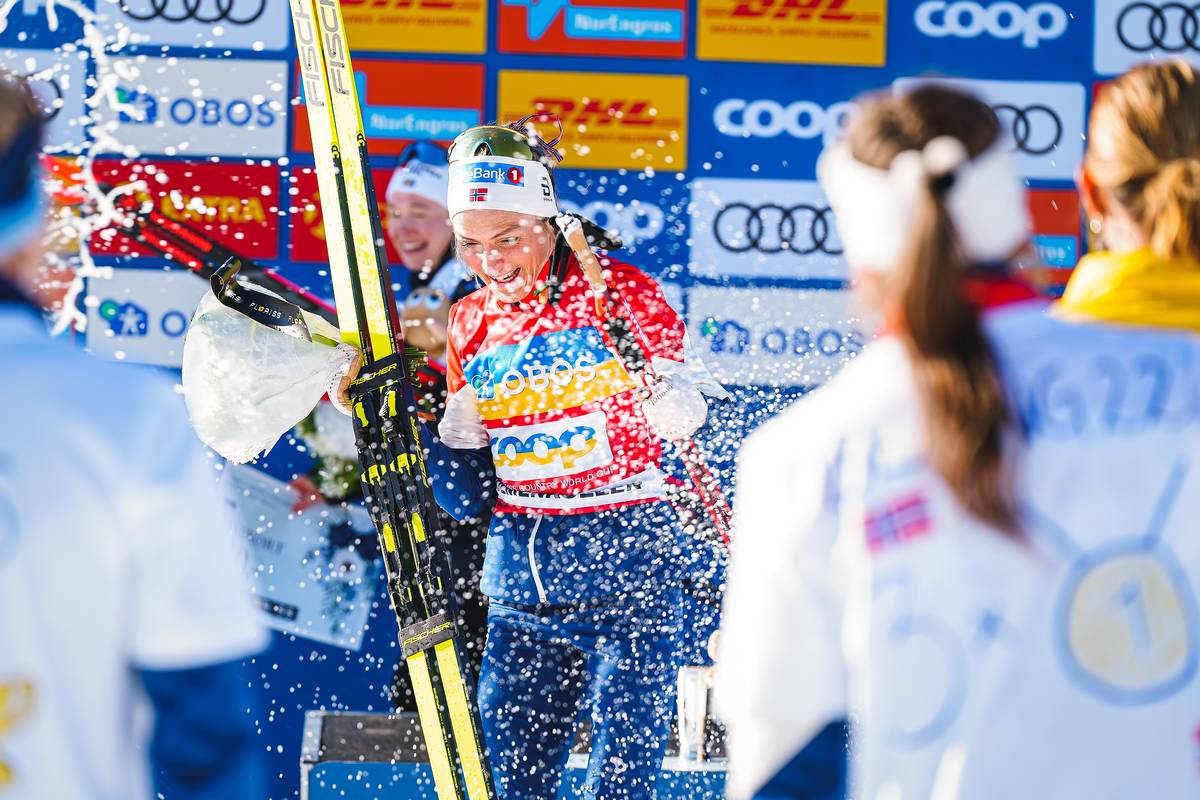
    Therese Johaug is showered with champagne after winning the 30 k classic at Holmenkollen following her retirement announcement. (Photo: NordicFocus)
    Therese Johaug celebrates her final race race at Holmenkollen, winning the 30 k classic exactly eleven years after taking her first individual World Championship gold on these tracks. (Photo: NordicFocus)

    As Queen’s “We are the Champions” blared through the stadium, Johaug stepped off the podium only to be soaked by champagne sprayed by a flock of teammates wearing shirts spelling her name, with “takk” – thank you – written with a heart at the end of the row. It was a joyous celebration fitting for the moment, and perhaps also a refreshing distraction from the times at large.

    “There are a lot of strong moments, but I am moved when so many people come here and see my last race. I must thank the Norwegian people who stand here today,” Johaug later said to NRK.

    While you can certainly expect a more in-depth look at her storied career on FasterSkier, for now, we’ll echo the crowds in congratulating Therese Johaug, and we look forward to following along for the next chapters.

    Therese Johaug celebrates her final race race at Holmenkollen, winning the 30 k classic exactly eleven years after taking her first individual World Championship gold on these tracks. (Photo: NordicFocus)
    Krista Pärmäkoski (FIN) and Jonna Sundling (SWE) lift champion Therese Johaug (NOR) for a podium shot at the finish of the 30 k classic in Oslo. (Photo: NordicFocus)

    Behind the celebration, the lineup of women in today’s top-10 was remarkably similar to the Olympic 10 k interval start classic, with a few name swaps, and of course, a few noteworthy athletes missing – namely, Natalia Nepryaeva and Tatiana Sorina of Russia, and Jessie Diggins, who had been fourth, seventh, and eighth, respectively. 

    The volume of the ringing cowbells swelled as Finland’s Krista Pärmäkoski skied through the stadium on her own for second place, after pulling away from the first chase pack with 5 k to go and maintaining a healthy 10-15 second gap through the finish. Coming back on form after a few rocky seasons, Pärmäkoski had been third in the 10 k classic in Zhangjiakou, behind her teammate Kerttu Niskanen, who was fourth today (+33.8). 

    Finland’s Krista Pärmäkoski takes second in the 30 k mass start classic at Holmenkollen in Oslo, NOR. (Photo: NordicFocus)
    The women’s 30 k classic podium at Holmenkollen: Therese Johaug (NOR) took the win ahead of Krista Pärmäkoski (FIN) and Jonna Sundling (SWE). (Photo: NordicFocus)

    Between the Finns, Sweden’s Jonna Sundling reaffirmed her talents across all distances, taking the third spot on the podium (+32.3) just two days after being second in Drammen’s classic sprint. Matching her fifth place result in the Olympic 10 k, Germany’s Katharina Hennig followed Niskanen to the line (+34.7) with Therese Stadlober, who was ninth at the Games, crossing after a gap in sixth (+46.7). 

    Leading the next chase group, and the American team, was Rosie Brennan in seventh (+1:12.3), bringing Norway’s Marte Skaanes and Sweden’s Ebba Andersson to the line just behind her for eighth (+1:13.1) and ninth (+1:13.8), respectively.  

    Rosie Brennan leads Norway’s Marte Skaanes and Sweden’s Ebba Andersson to the line. (Photo: NordicFocus)

    “Today was huge for me,” Brennan wrote in a post-race email. “I have struggled here my entire career, and [though] it’s been a few years since I’ve raced here and I have improved a lot in the last few years, I still felt I lacked a lot of confidence and excitement coming here [today]. It’s also been a really stressful week for a variety of reasons, so I showed up today with an immense amount of anxiety that I needed to get a hold of before the race started. 

    “I am really proud of giving myself another chance to put together a good race here and to have managed the stress and anxiety well enough to do so. I wasn’t feeling in a place to shoot for the moon so I tried to start a bit a conservative the first 5 k and then reevaluate. I had a great ride with Ebba and really had an enjoyable time skiing out there today. The last lap, we had the chance to pick off a few from the lead pack and so I started to ramp things up to see what was possible. I felt strong on the last climb and felt I had a good shot at the sprint finish so I went on the last little bump before the [last 100 meters]. It felt great to finish strong and to put together a really solid race today.” 

    Rosie Brennan skis to seventh in the 30 k classic at Holmenkollen. (Photo: NordicFocus)

    Following her classic sprint race in Drammen Thursday, Brennan joked post-race that she had lost out on yet-another boot slide. Today, the final sprint was hers. It was perhaps, also worth American fans celebrating that today that she won amongst her chase group, just under two weeks after a brave and gritty performance in the Olympic 30 k skate where she had pulled the chase group for much of the race, wearing herself out to break the wind, only to be dropped in the final 600 meters as Niskanen pulled away for a bronze medal. However, Brennan said she is not connecting any dots between the two.

    “This race was nothing like Zhangjakou, really hard to even compare the two. 30 k’s are always an adventure and I am really happy to have put together two strong ones, in each technique.” 

    Rosie Brennan skis to seventh in the 30 k classic at Holmenkollen. (Photo: NordicFocus)

    Commenting on how she is feeling, mentally and physically, with one final race weekend to go, Brennan concluded, “I am really bummed that the [World Cup] Finals were canceled. I haven’t raced a ton this season because of the earlier cancellations and while it has been a very high density block since the Olympics started, I am still feeling strong and wanted to see what I could do. But it will be really fun to end the season with the mixed relay event as that is a new one for us!” 

    Julia Kern was next for the US in 23rd (+3:37.2), followed by Hailey Swirbul in 26th (+3:57.8), and Caitlin Patterson – six days after taking second at the American Birkie – in 30th (+4:11.5). 

    Julia Kern skis to 23rd in the 30 k classic at Holmenkollen in Oslo, NOR. (Photo: NordicFocus)
    Hailey Swirbul skis to 26th in the 30 k classic at Holmenkollen in Oslo, NOR. (Photo: NordicFocus)

    In a post-race call, head coach Matt Whitcomb shared that Kern’s result was perhaps especially noteworthy as she has been struggling throughout the season with nausea during distance races, making it difficult for her to keep down fluids taken in prior to the race, let alone receive feeds during. Whitcomb also explained that Diggins sat out today’s race as she was feeling lingering fatigue from the long, and successful, season of racing. He affirmed that she is healthy and will be ready to race for the final World Cup weekend in Falun, beginning next Friday. Listen to the full call with Whitcomb below.

    Outside the top-30 for the US, Katharine Ogden was 37th (+5:54.1), followed by Rosie Frankowski, who has consistently landed on SuperTour podiums throughout the season, in 46th (+8:12.2). 

    Katharine Ogden (left) and Caitlin Patterson (right, bib 32) take to the course at the start of the women’s 30 k classic at Holmenkollen. (Photo: NordicFocus)
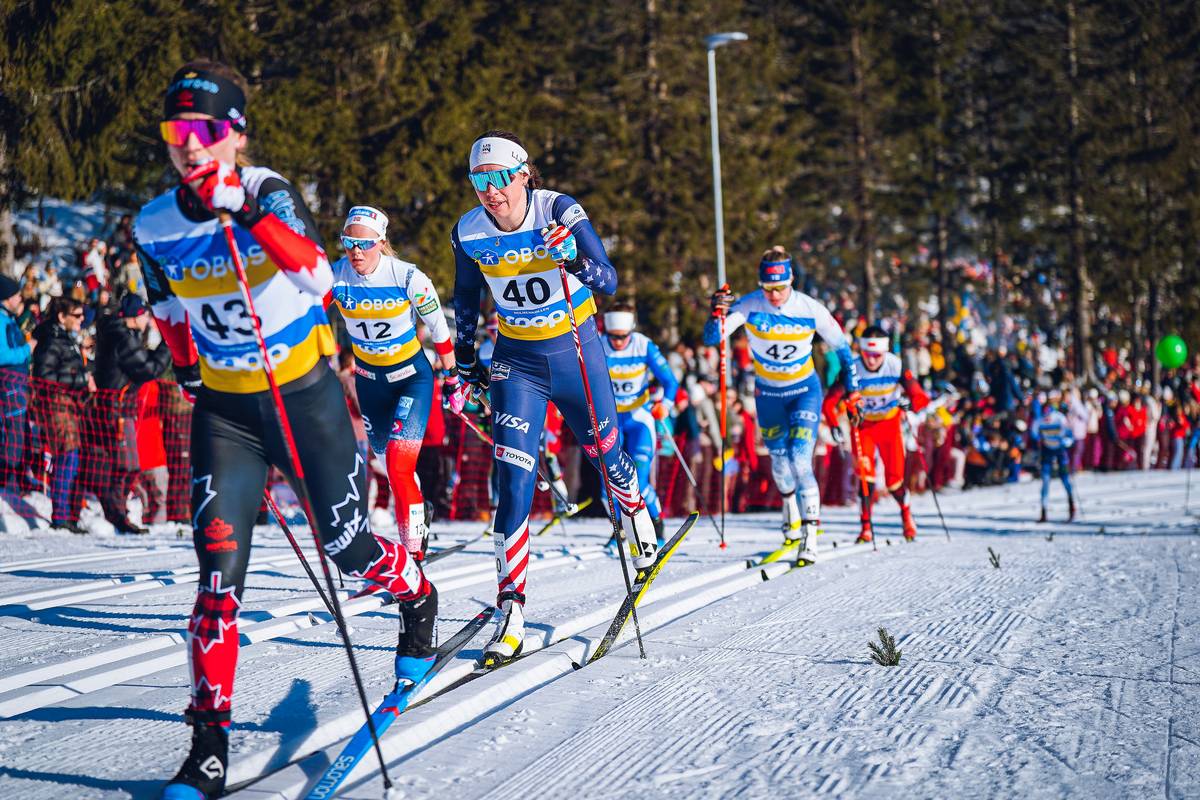
    Canada’s Cendrine Browne (bib 43) leads Katharine Ogden (bib 40) during the 30 k mass start classic at Holmenkollen. (Photo: NordicFocus)

    Racing for Canada, Katherine Stewart-Jones led the way in 22nd (+3:25.0), with Cendrine Browne also inside the top-30 in 25th (+3:53.7). After a successful World Junior Championship in Lygna, NOR, Jasmine Drolet finished 42nd today (+6:53.2), with Olivia Bouffard-Nesbitt closing out the Canadian racers in 48th (+10:19.8). 

    Results

  • The Devon Kershaw Show: First Olympic episode! Breaking down the women’s skiathlon

    The Devon Kershaw Show: First Olympic episode! Breaking down the women’s skiathlon

    Kicking off the 2022 Beijing Olympic Games with a look into the women’s skiathlon. Co-host Nat Herz was on site during the race, braving the wind and cold to collect deeper insights into the scene, while Kershaw gives his hot take as a very-well-informed armchair quarterback. Note that Kershaw picked two of the top-three athletes correctly in his pre-Olympic podium picks: unsurprisingly, the favorite, Therese Johaug took gold, while Natalia Nepryaeva (ROC) earned silver instead of the bronze Kersh predicted. (Find full compiled picks and current standings for the Devon Kershaw vs. Alex Harvey Olympic podium predictions showdown here.)

    Stay tuned for regular updates and race breakdowns over the course of the Games! Thanks for listening.

    Jessie Diggins throws down an impressive performance in the skating half of the women’s 15k skiathlon, the opening event of the 2022 Beijing Winter Olympic Games. (Photo: NordicFocus)


  • Johaug Wins First Individual Olympic Gold; Diggins Leads US in Sixth

    Johaug Wins First Individual Olympic Gold; Diggins Leads US in Sixth

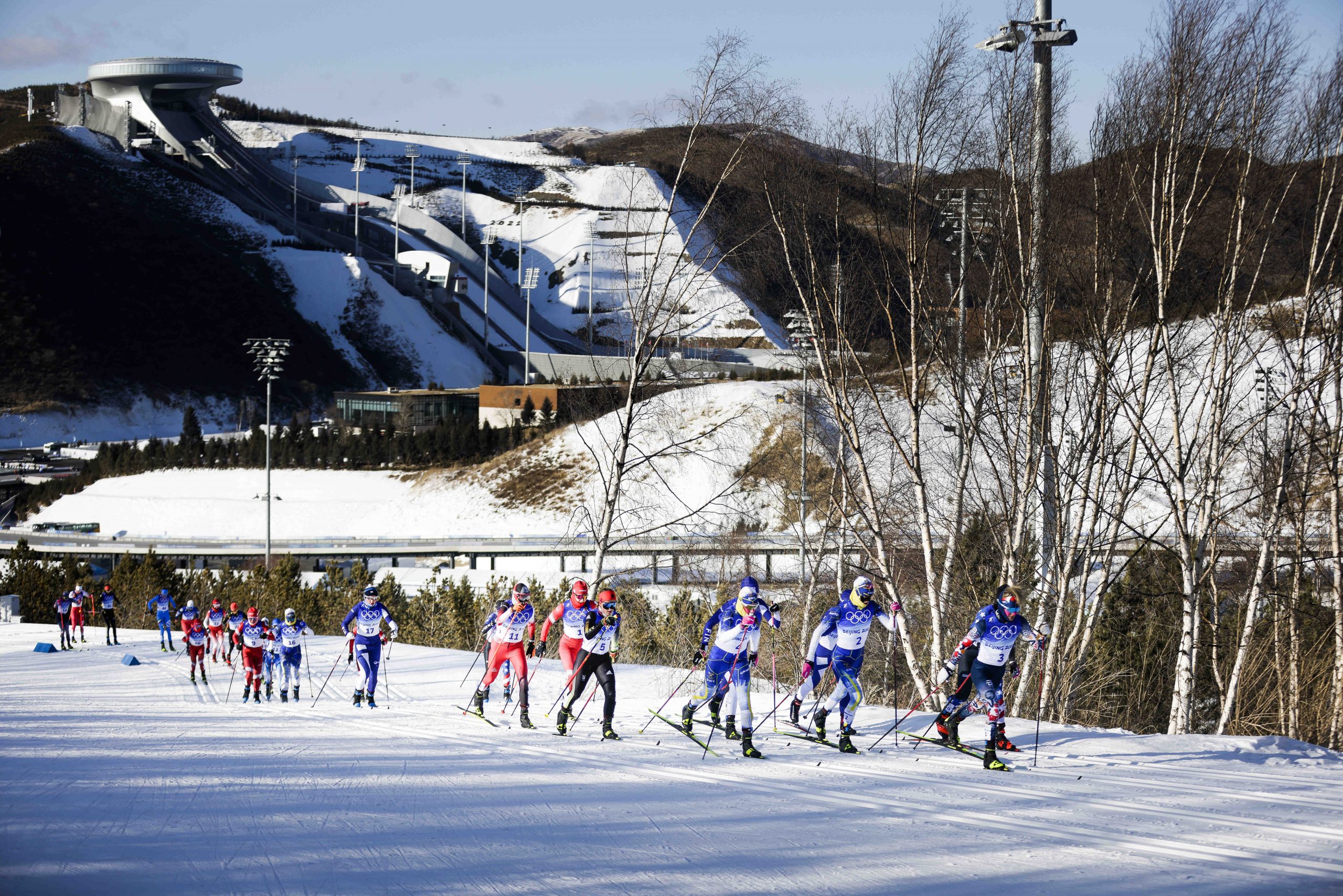
    Striding out of the stadium at the Zhangjiakou National Cross-Country Skiing Center (Photo: NordicFocus)

    This World Cup coverage is made possible through the generous support of Marty and Kathy Hall and the A Hall Mark of Excellence Award.  To learn more about A Hall Mark of Excellence Award or to learn how you can support FasterSkier’s coverage please contact info@fasterskier.com.

    After a long hiatus from international racing, the top athletes found themselves on the start line once again, ready to contest the first event of the 2022 Winter Olympics. First up, a 15-kilometer skiathlon, featuring 64 starters completing four 3.75 k loops. The skiathlon, which combines both classic and skate in one race (7.5 k of each in this case), is an infrequent event on the World Cup circuit though appears on the schedule at all championships.

    Four years ago, at the Olympics in PyeongChang, it was Charlotte Kalla of Sweden who bested the field to take gold, followed by Marit Bjørgen of Norway and Krista Pärmäkoski of Finland. Notably, this year’s winner, Therese Johaug was not present, but we will return to this point later on. 

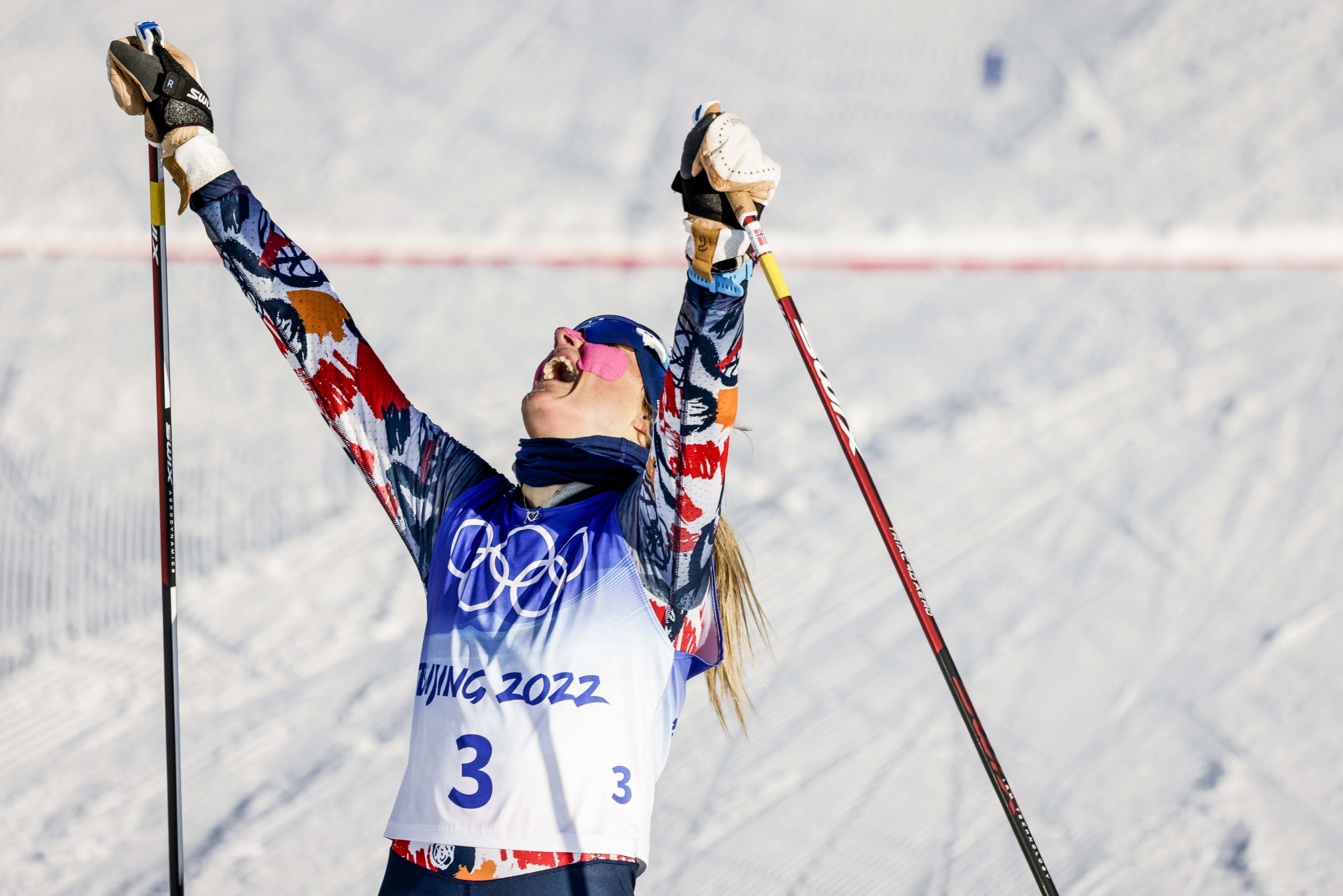
    Celebration for Therese Johaug (NOR) as she takes her first ever individual Olympic gold medal (Photo: NordicFocus)

    Watched by a few masked fans in the stands, the athletes completed final preparations before the start. Even without looking at the temperature, the cold was evident, from the blowing trees and bibs to the drifting snow across the tracks and the face-tape present on all the starters. The thermometer said -12.5°C or 9.5°F, though this reading likely didn’t factor in the windchill. With minutes to go, the athletes emerged from a set of underground stairs, bundled in parkas, to take their places on the start line. 

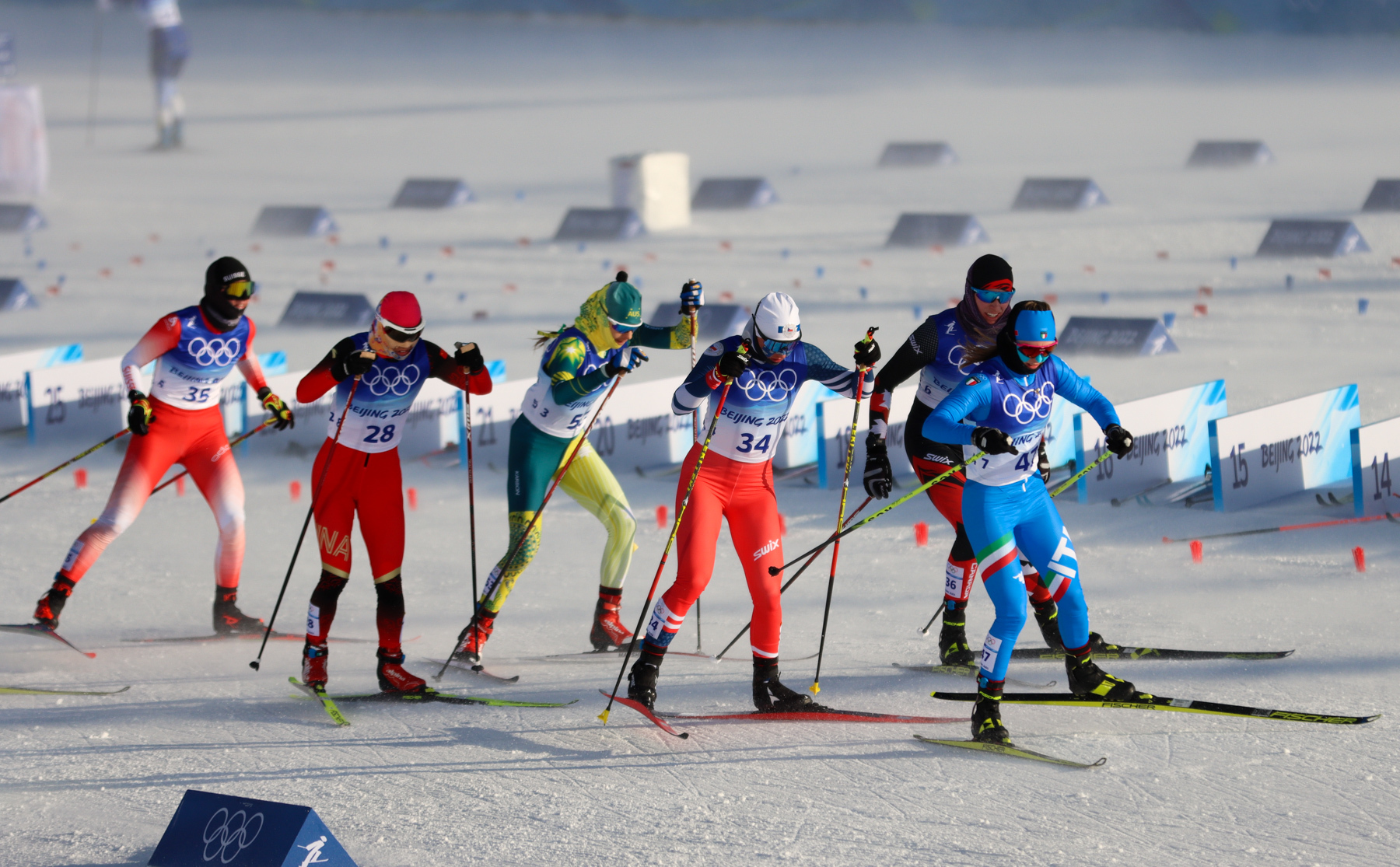
    At the starters command, the first cross-country ski race of the 2022 Olympics was underway, and almost immediately two skiers went down in a crash, though thankfully the damage did not impact the rest of the field. Coralie Bentz of France and Anne Kyllönen of Finland recovered quickly and rejoined the pack. With the first A-climb less than 1 k into the course, early leaders Rosie Brennan (USA) and Therese Johaug (NOR) pushed the pace, and the pack soon thinned.

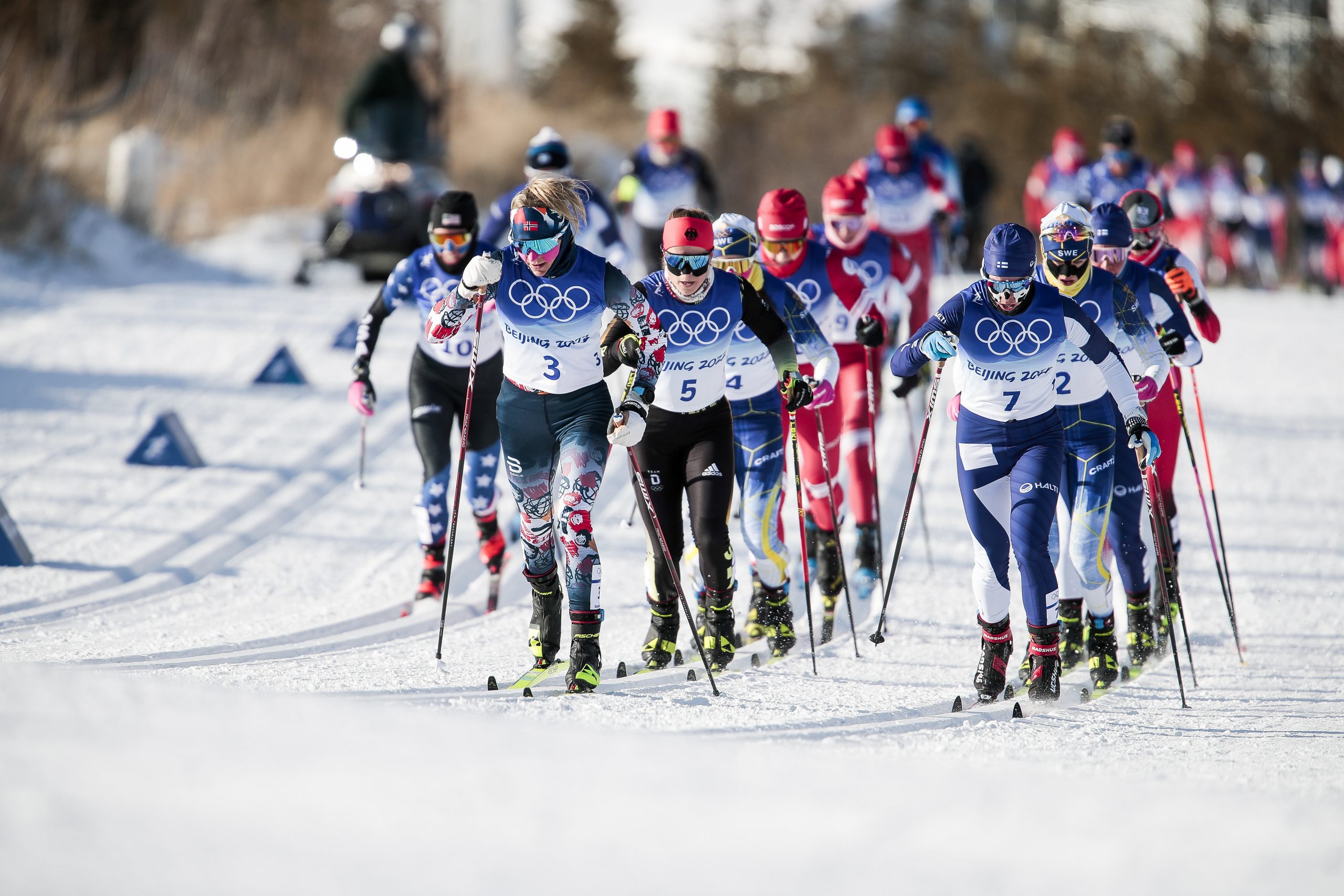
    Therese Johaug (NOR) leads the charge up the first big hill, Rosie Brennan (USA) can be seen leading the left most column (Photo: NordicFocus)

    On the descents, the camera showed most athletes opting to ski on the platform, rather than the tracks, due to the drifting snow that was filling them. Skirting another fall, this time from Johanna Matintalo of Finland, the front group entered the stadium for the first round in a pack of roughly fifteen. With just over eleven minutes on the race clock, there were ten athletes within five seconds of Johaug, a slight surprise given her tendency for early breakaways. 

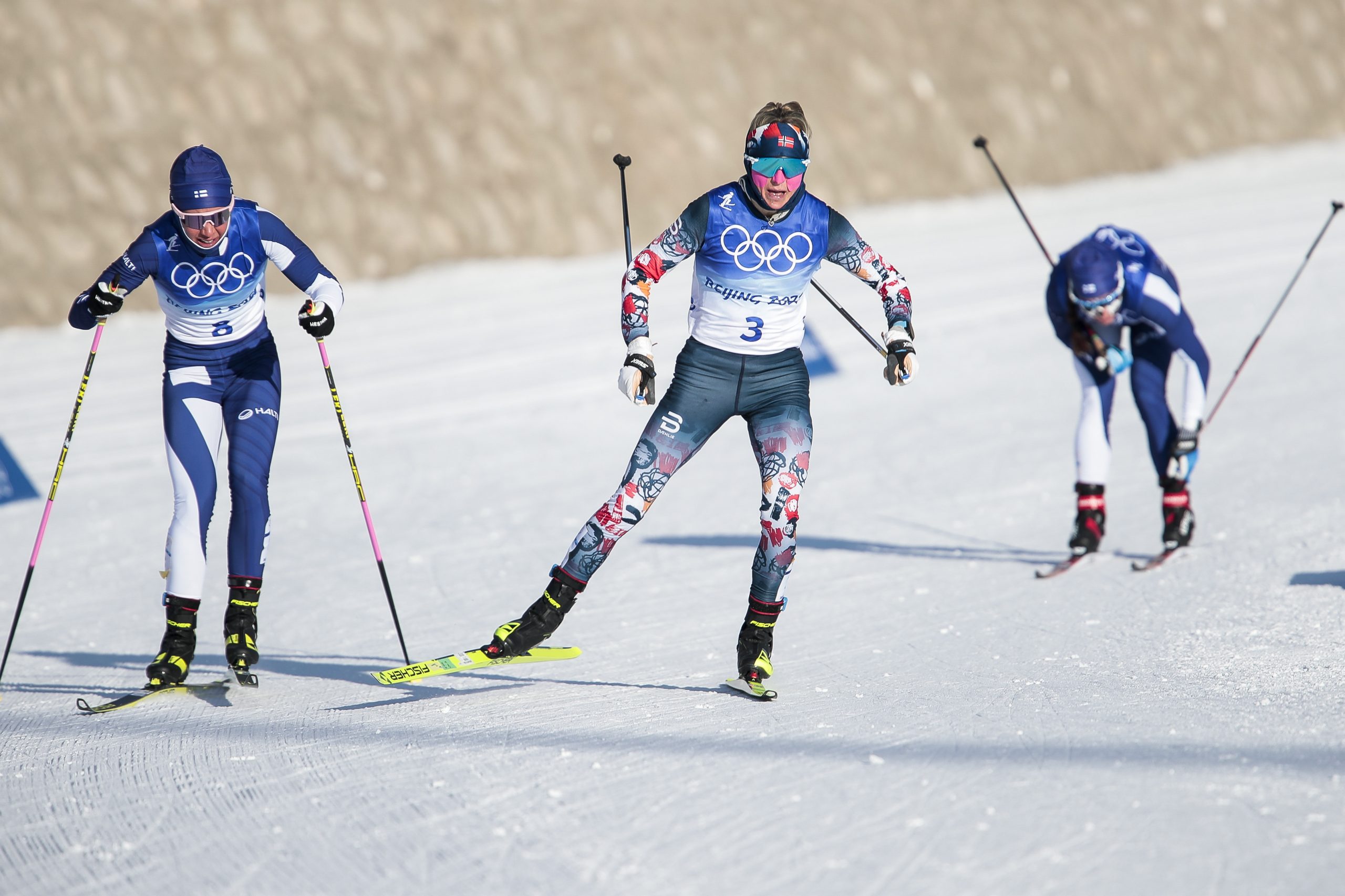
    Therese Johaug (NOR) battles Kerttu Niskanen (FIN)  (Photo: NordicFocus)

    Heading out for the second lap, Johaug visibly upped the pace though still had difficulty shaking her followers. Through the 5.1 k mark, the spread was now ten athletes over the span of ten seconds, led by Kerttu Niskanen (FIN) and ending with her teammate Matintalo, who had recovered from her fall. Whittled away over the duration of that lap, when they reached the second A-climb of the course before descending towards the stadium, Johaug was leading a group of just six skiers. 

    Entering the stadium for the transition to skate skis, Johaug double-poled the final rise, managing to open a slight gap to Niskanen, Frida Karlsson (SWE) and Pärmäkoski (FIN). Executing a quick exchange she held the lead and was out with 23:04.7 elapsed on the clock. Niskanen followed +1.0 behind, Pärmäkoski +2.2 and Karlsson +4.3.

    It is worth noting that after the exchanges, Jessie Diggins of the USA was in tenth, +57.5 seconds behind Johaug, having dropped significantly over the first two classic loops. Rosie Brennan was next in 14th (+1:11.9), with Hailey Swirbul in 23rd (+1:52.6) as the final American inside the Top-30. Julia Kern was +4:07.1 behind in 53rd, about to hit the gas on the skate laps. 

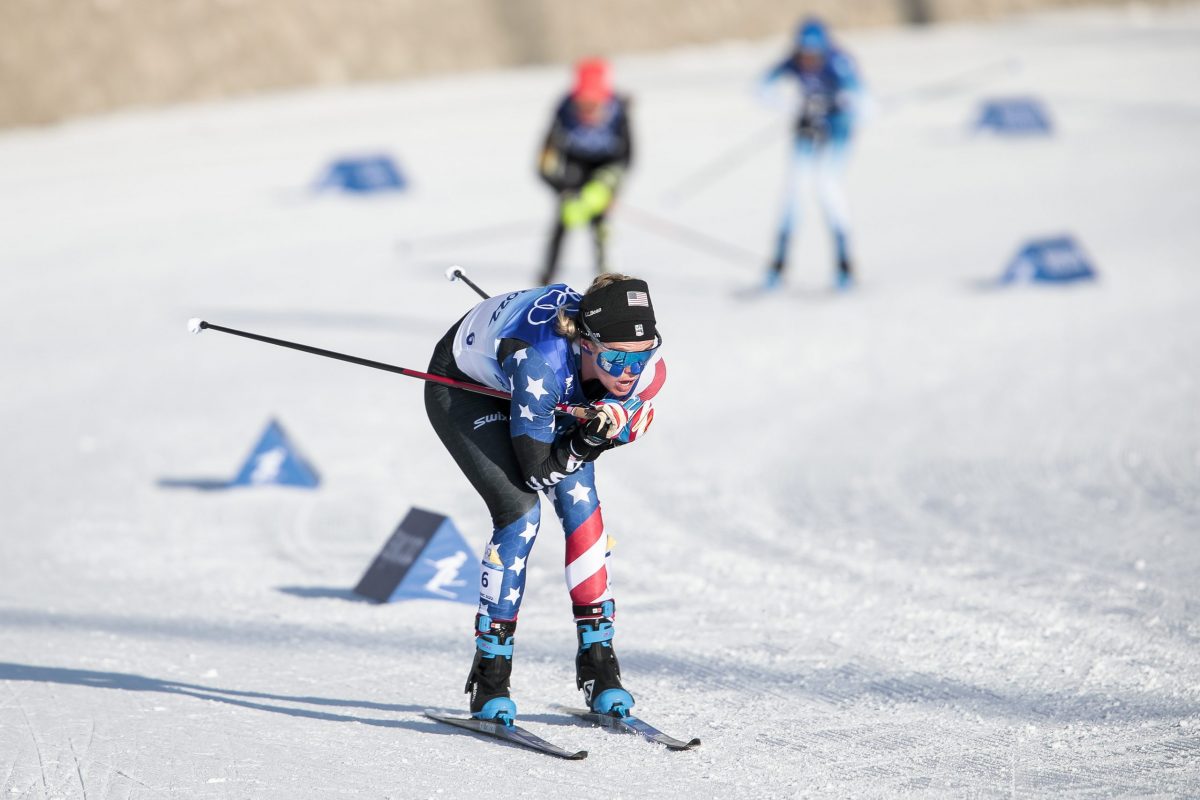
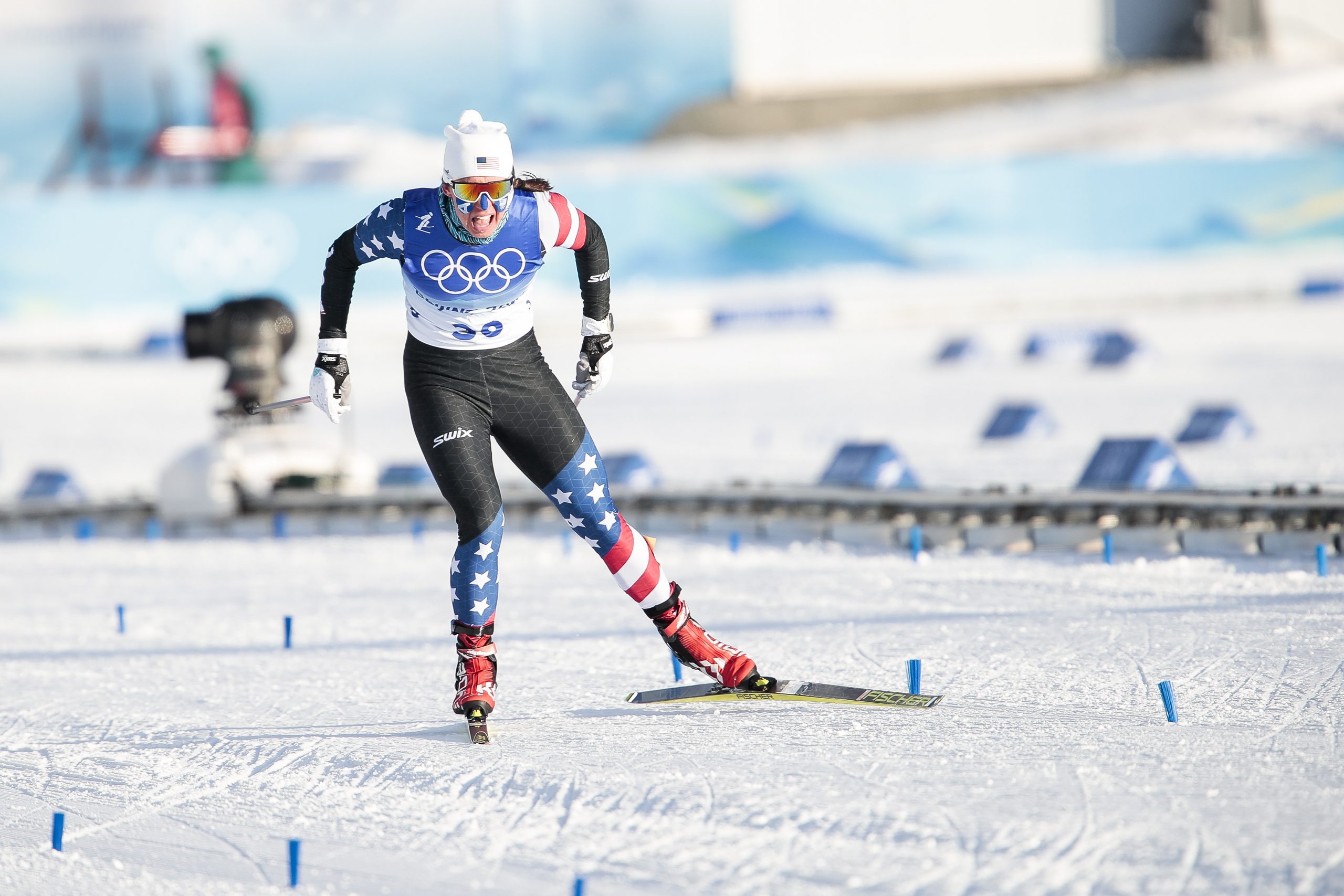
    Jessie Diggins (USA) strides up one of the many challenging climbs (Photo: NordicFocus)

    Capitalizing on her one-second advantage, Johaug found herself off the front for the first time. Pärmäkoski, Karlsson and Niskanen shared leads in an attempt to chase her down but by 8.8 k the gap had stretched to +15.8, effectively securing Johaug her first ever individual Olympic gold medal. From that point, the margins only grew: +26 at 10 k, +44 at 12.6 k and +30.2 at the completion of 15 k.

    Despite her utter dominance of World Cup races and World Championships the past few seasons, Johaug’s results sheet at the Olympics is not what you might expect.

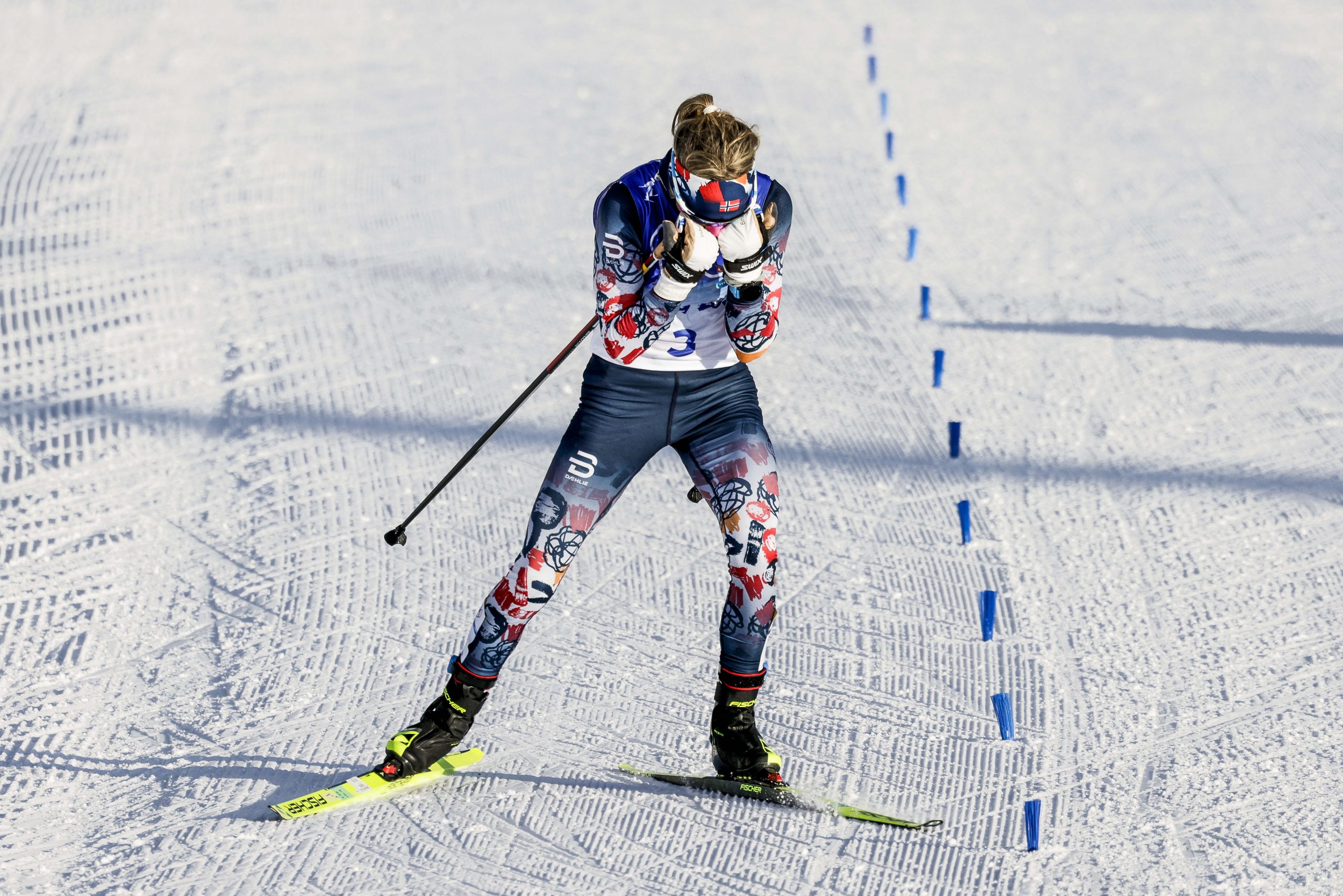
    Tears were shed by Therese Johaug (NOR) as she finally gets her long deserved gold medal (Photo: NordicFocus)

    Prior to the day’s skiathlon victory, she had only one other gold medal, coming from the team relay in the 2010 Games in Vancouver Canada. She was a runner-up in Sochi 2014 during the 30 k freestyle mass start when she placed second behind teammate, Marit Bjørgen, and she also earned bronze in the 10 k classic in Sochi. Johaug received an 18-month competition ban in 2017 for a positive doping test which prevented her from attending the 2018 Olympics in PyeongChang.

    In her post-race press conference, Johaug said she does not hold onto anger about her suspension, which left her even more motivated to prove herself this year.

    “I’m finished with these years and I’m focusing on myself, and the future and things I can do something with,” Johaug said in a press conference. “It means maybe more for me today when I’m didn’t have this gold medal, and maybe if I had the gold medal before, this Olympics, maybe I would not been here.”

    Therese Johaug (NOR) on top in the first cross-country competition at the 2022 Olympics (Photo: NordicFocus)

    With the recent outbreak of COVID amongst the Norwegian team, Johaug’s path to Beijing has not been as smooth as she would have liked. She only arrived at the venue on Wednesday, leaving just a few days to adjust to the time change and climate before the first event. In spite of these challenges, she proved equal to the task, skiing away with the victory in a time of 44:13.7. 

    Behind Johaug, the race for silver and bronze was playing out in a dramatic way. Initially, Karlsson of Sweden seemed to have pulled away, when at 10 k she was 26 seconds behind Johaug, and 10 seconds ahead of Niskanen (FIN) and Teresa Stadlober of Austria. However, this break was short-lived, and at 11.3 k, Karlsson was less than a second ahead of Natalia Nepryaeva (ROC) who had worked with Stadlober to rejoin the chase pack. Pärmäkoski (FIN) began to drop off the pace and the group was down to four. At this point, Diggins (USA) could be spotted closing in on Pärmäkoski, who continued to fade. 

    The chase pack, pictured here: Kerttu Niskanen (FIN), Teresa Stadlober (AUT), Natalia Nepryaeva (ROC), (l-r) (Photo: NordicFocus)

    Entering the final A-climb of the race, Stadlober (AUT) injected some pace, attempting to pull away but Karlsson of Sweden and Nepryaeva (ROC) hung on. Only Niskanen (FIN) dropped slightly.

    Thus it was three skiers vying for two medal spots. But as they descended towards the stadium Niskanen closed in again, making the group four. Nepryaeva crested the final rise in front as across the stadium the camera showed Johaug crossing the line, arms raised and a frozen smile on her face. 

    Frozen but happy, Therese Johaug (NOR) (Photo: NordicFocus)

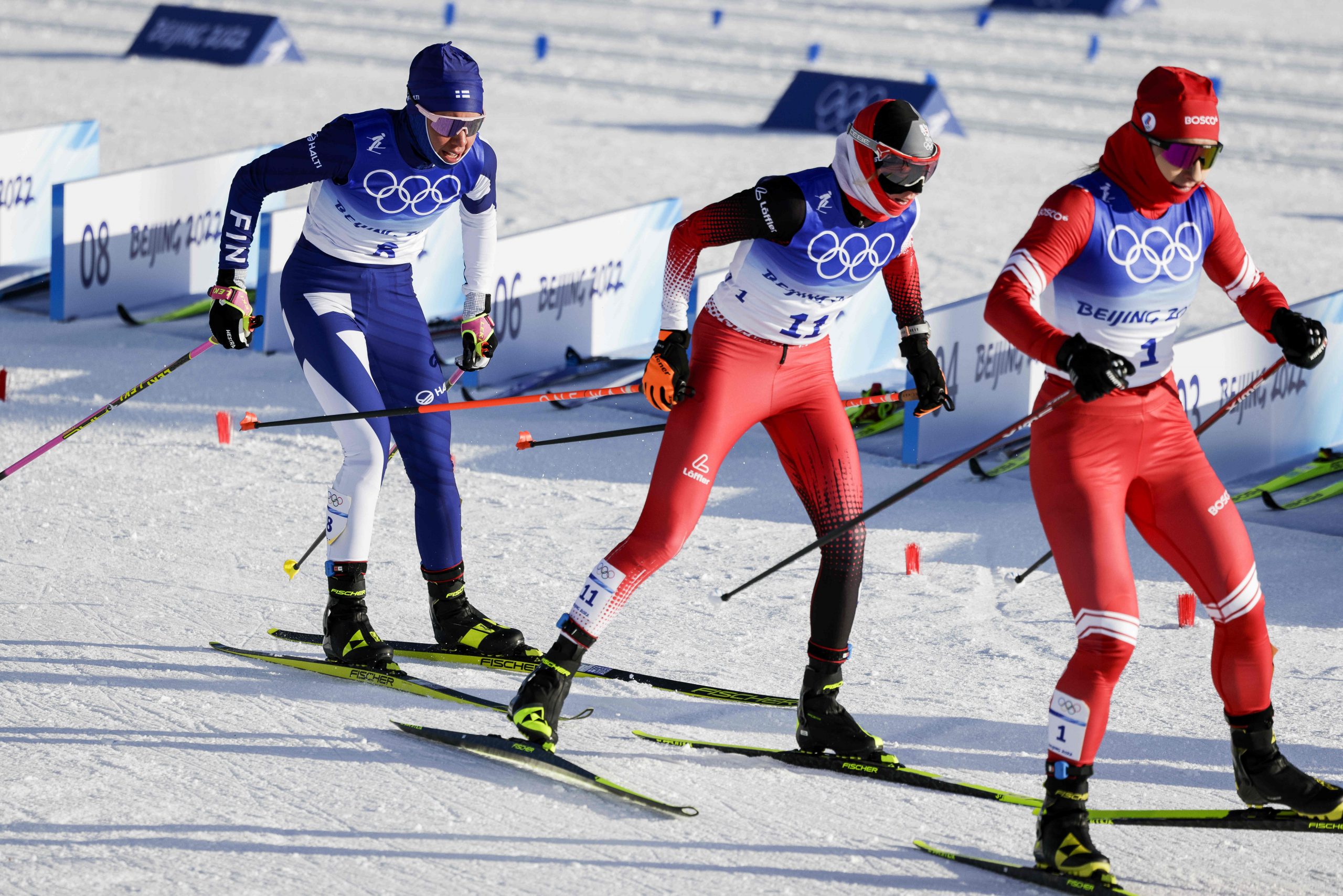
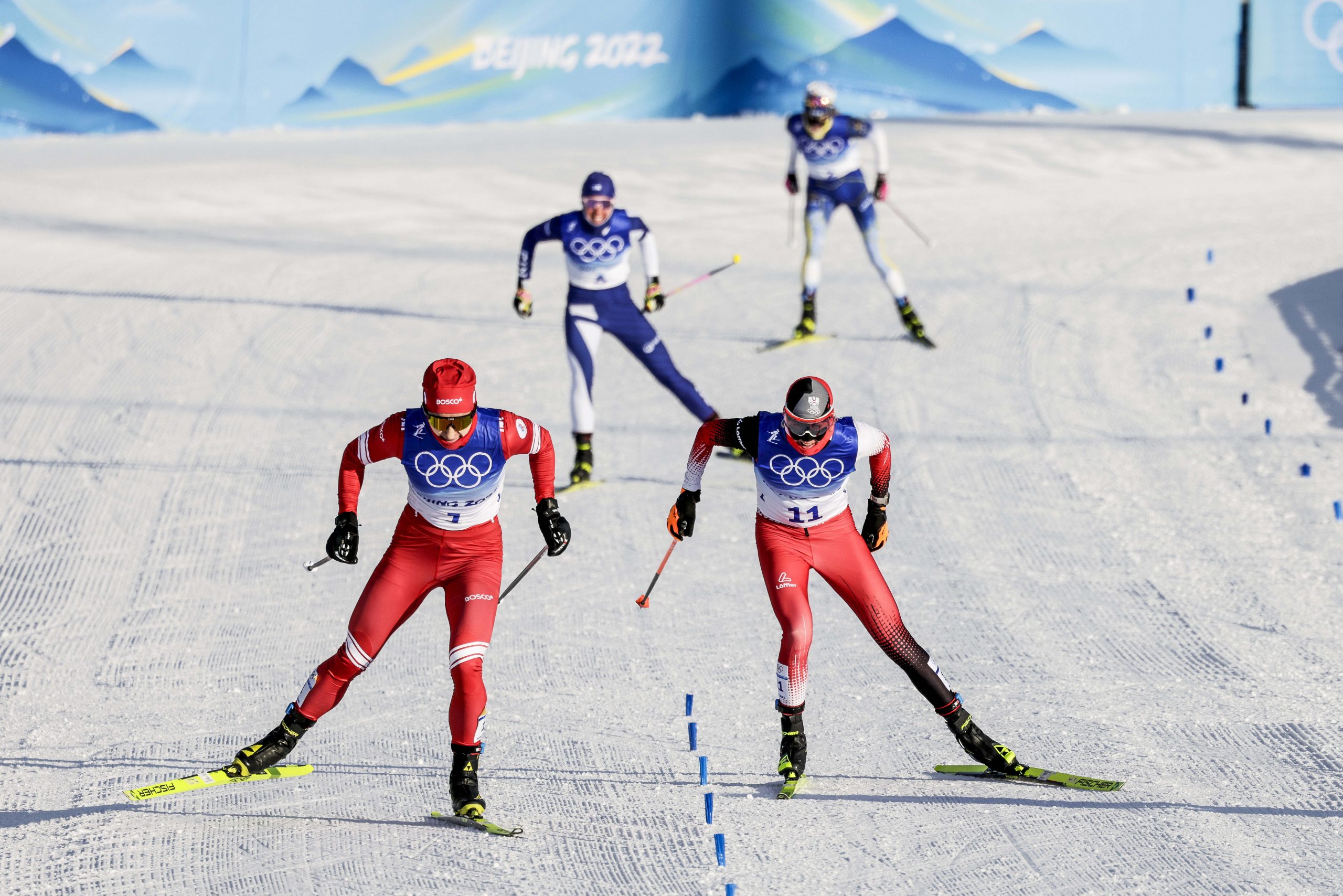
    Down the finishing straight Nepryaeva held onto her lead as Stadlober mounted a final challenge, ultimately running out of space as the two finished in silver and bronze position respectively. Niskanen (FIN) finished fourth (+36.1), Karlsson (SWE) in fifth (+42.5), and in an impressive comeback, Diggins crossed the line sixth (+50.5). 

    A tight battle for silver and bronze between Teresa Stadlober (AUT) and Natalia Nepryaeva (ROC), (l-r) (Photo: NordicFocus)

    This silver is the first Olympic medal for Natalia Nepryaeva, who most recently became the first Russian women to win the Tour de Ski. Her only other Olympic appearances came in PyeongChang where her best finish was fourth in the classic sprint. 

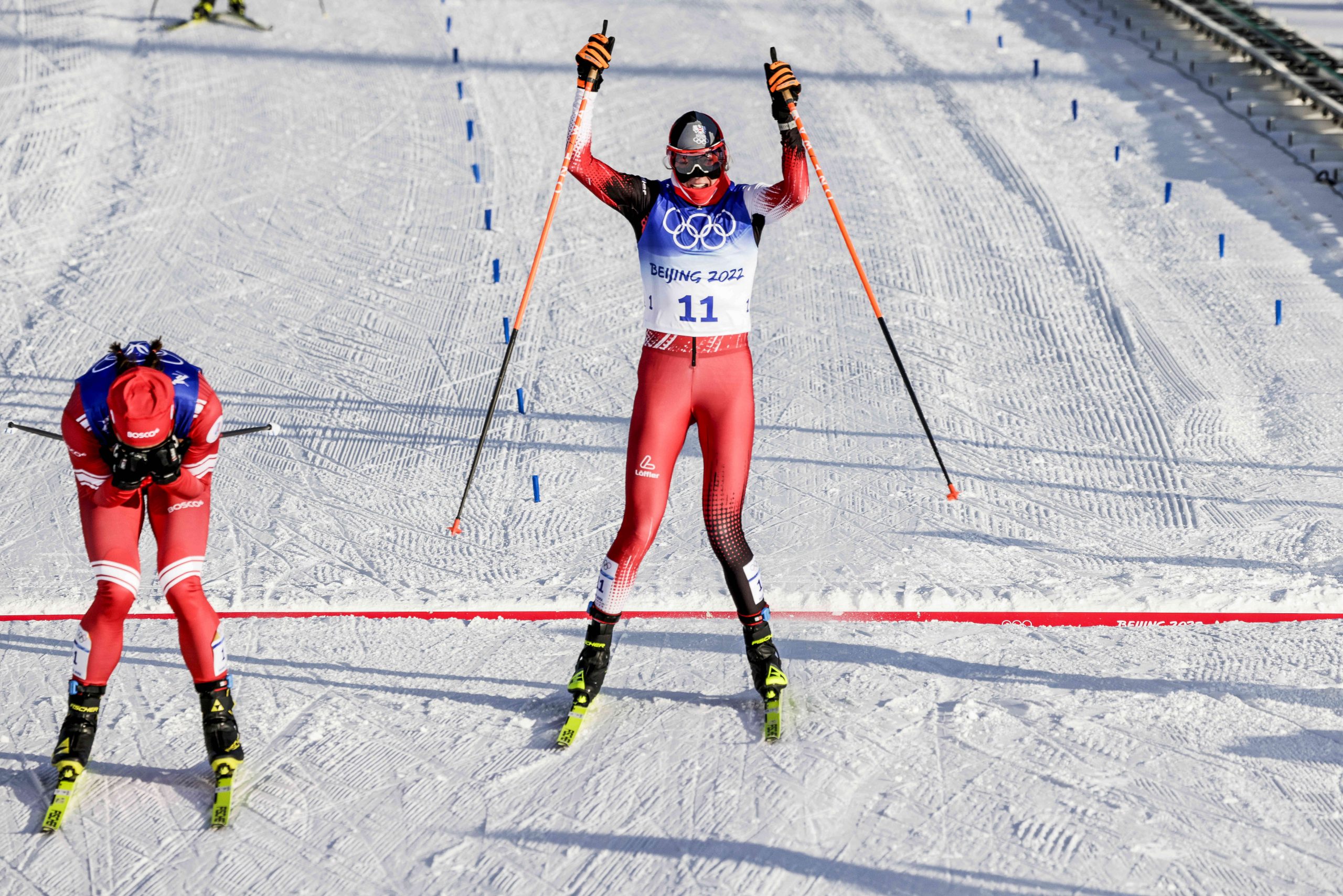
    Teresa Stadlober (r-AUT) celebrates a bronze medal as Natalia Nepryaeva (l-ROC) is overcome with emotion (Photo: NordicFocus)

    For Teresa Stadlober of Austria, this bronze medal could be viewed as redemption. Stadlober was in medal contention during the 30 k classic at PyeongChang when a last minute wrong turn took her out of the running. Furthermore, after a total of 18 individual starts at championship events (Olympics and World Championships), this is Stadlober’s first medal. She holds just three World Cup podiums, two during the 2018 edition of the Tour de Ski in Toblach where she placed third in the 10 k classic mass start and had the second fastest time of the day on the Alpe Cermis hill climb. The third podium was in a 15 k skiathlon in Oberstdorf Germany in 2020 where she also placed third. 

    First Olympic medal for Teresa Stadlober (AUT) (Photo: NordicFocus)

    Other noteworthy performances from the day includes Anastasia Rygalina (ROC), who has had just ten World Cup starts in her career and never finished in the top ten, finishing the race in 8th. Behind her, Delphine Claudel of France earned a new personal best for the Olympics placing 9th. 

    Jessie Diggins (USA) exits the transition zone, followed by Ebba Andersson (SWE) (Photo: NordicFocus)

    After being +55.5 seconds behind Pärmäkoski and the chase group at the exchange, Diggins ended up finishing a full eight seconds ahead of the Finn and was just 20 seconds behind bronze medalist, Stadlober.

    “I definitely finished with nothing left so I feel really good about that,” said Diggins in the mixed zone after the race. “I was so proud of never giving up. I feel really good about the pacing and where my fitness is. I definitely want to figure out some things with my power striding, but overall I think this was a really encouraging start to the Games and honestly it feels really good just to have gotten here and to be able to race.”

    Left it all on the course, Jessie Diggins (USA) collapsed in the finish (Photo: NordicFocus)

    When asked about the cold and windy conditions Diggins replied, “My hands got pretty cold because I needed thinner gloves for the pit-box changing. My muscles stayed warm though. [The wind] is really something, and that’s what makes it so cold, so I think it’s important to really push that and stay warm.”

    Regarding the course, Diggins said, “They’re really good courses. I really like them. I think they’re really fair and great championship courses. They’re as hard as they look, you’ve really got to work for it.”

    Jessie Diggins fields media questions in the mixed zone. (Nat Herz/FasterSkier-ADN)

    In Diggins final 5k, she advanced from eighth place and over 1:13 back to finish sixth place and roughly 50 seconds back. This is a difference of 23 seconds gained on the leader over 5k, with ten seconds gained in the final 2.4k.

    “I had amazing skate skis and I think I had paced just well enough to be able to do that,” Diggins said of this progress. “I crossed the finish line with nothing left. It’s really cool to get a race on these courses in and I think I’m figuring [them] out.”

    Rosie Brennan leaves the exchange zone halfway through the women’s 15k skiathlon, the opening race of the 2022 Winter Olympics. (Nat Herz/FasterSkier-ADN)

    Brennan was the next finisher for Team USA, in fourteenth position (+2:51.7). Brennan had initially fallen behind Germany’s Katharina Hennig in the skate leg to slide into 15th, but she regained her position with 3 k to go, further accelerating to give herself a 7 second cushion at the finish. 

    “Definitely a little bit of everything out there today,” Brennan told U.S. Ski & Snowboard communications manager Tom Horrocks after the race. “Some good, some ugly, some in between.”

    While Brennan’s result might not be evidence that she is a medal threat in the event, and she is surely left wanting more, she spoke like a true veteran, showing maturity and perspective in her response to how she will look back on the performance.

    “I think I have to take the like big picture perspective. Four years ago, I think I was close to dead last fighting some [mononucleosis], and that was my first and last Olympic race. So I really had kind of a — I don’t know what you’d call it — a demon in the back of my mind that I needed to get rid of. So to be in a better place today, even if it wasn’t my best, was a step in the right direction. And that’s something that I’m proud of.”

    Rosie Brennan catches her breath after finishing 14th in the women’s skiathlon at the 2022 Beijing Winter Olympic Games. (Nat Herz/FasterSkier-ADN)

    While official start lists are not yet available, as Brennan is one of USA’s top skiers, she will likely start in multiple upcoming events.

    On her mindset and how she’s feeling heading into these stages, Brennan said, “It’s been a while since I’ve done racing at an international level. (Brennan left Europe after the Davos World Cup races in mid-December, spending the last six weeks near her home in Park City, UT.) I’m really hoping that the effort today was what I needed to just get back into things and find a better place ,because I certainly have had some workouts that have indicated that I’m in good shape. So I do want more and I think I can get more. I’m really looking forward to the other races.”

    Behind Brennan, Hailey Swirbul finished in 40th (+5:28.8).

    “It’s a lot of V1 skate, it’s hard,” Swirbul said in the mixed zone in reference to the course, “It makes for fair racing but you have to be totally on your game. It didn’t feel like [you get a break] today, it was a tough day for sure.”

    Hailey Swirbul transitions from classic to skate, fighting windy conditions on course during the women’s 15k skiathlon. (Nat Herz/FasterSkier-ADN)

    When asked about taking part in the Olympics and the momentum of the team, Swirbul said, “It’s a hugely exciting time to be part of this team. We’ve shown over the last four years what we’re capable of. We will give everything we have out there. It feels like a relief that we made it here and that our team has been healthy and we prepared really well so far. A race is a race, no matter if it’s an Olympic or local race. It’s important to keep your head in the game, and be ready to fight no matter what.” 

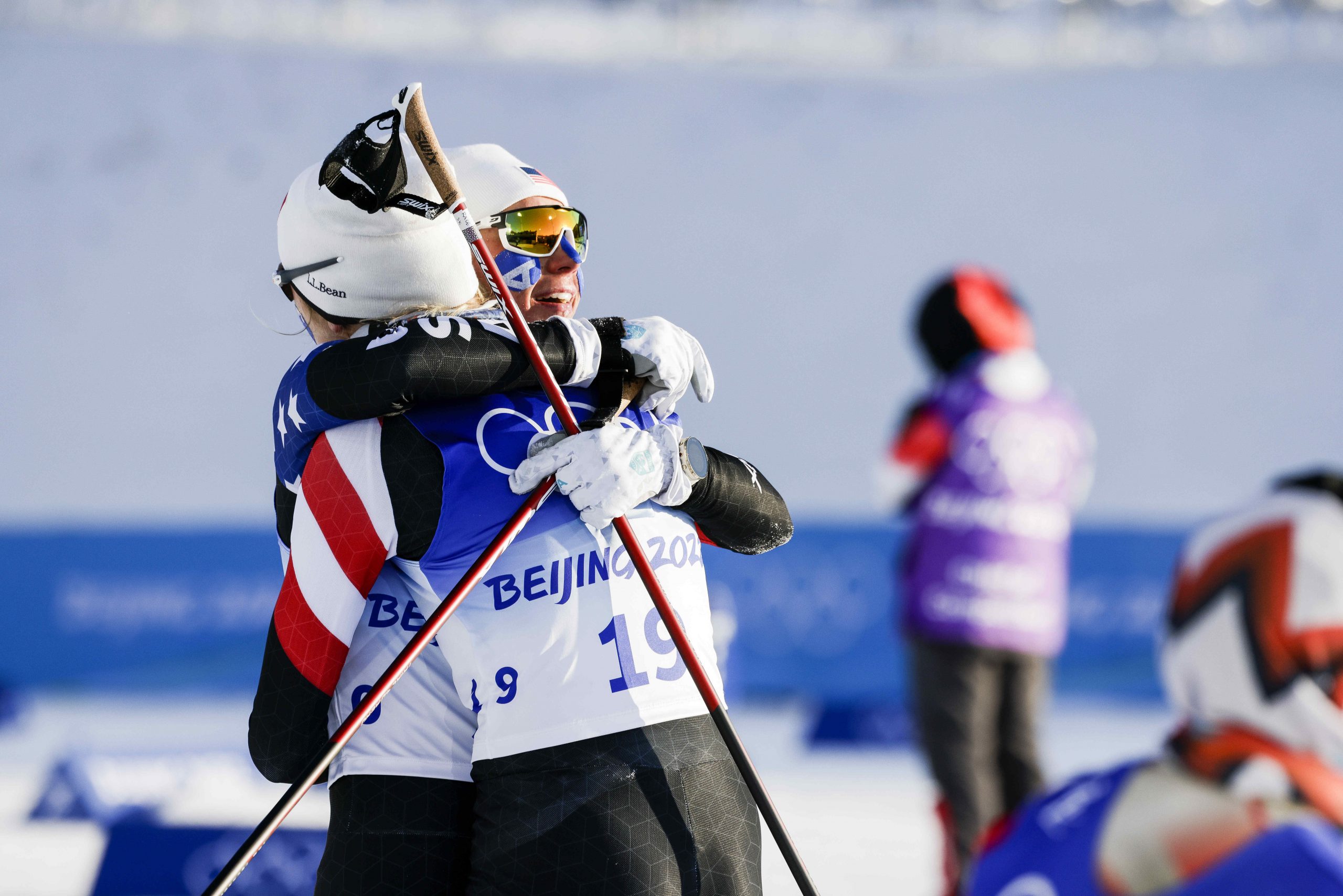
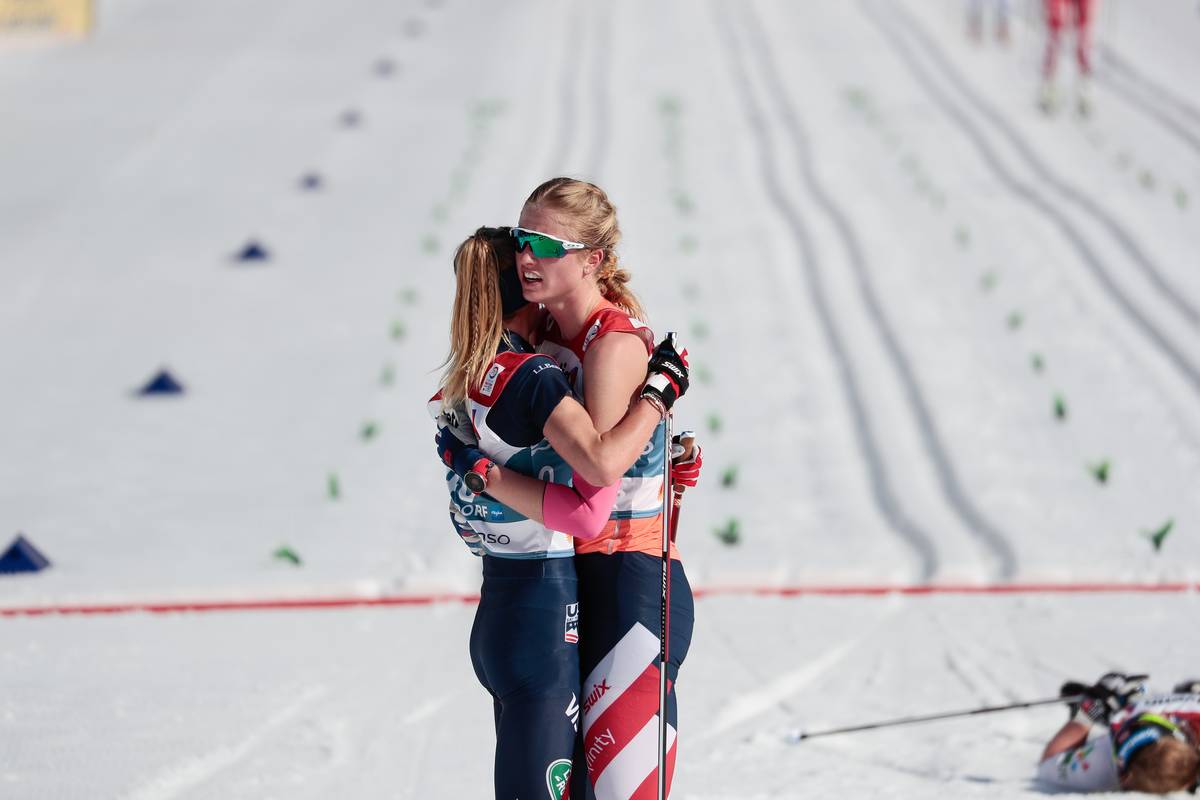
    Hailey Swirbul (USA) embraces teammate Julia Kern (USA) after the skiathlon (Photo: NordicFocus)

    Julia Kern rounded out the US finishers in 53rd position (+7:51.8). It was “windy and tough,” said Kern definitively. “That was a really tough race, probably the windiest race I’ve ever done. I had a ton of base layers on so I stayed warm, but the wind cools you right down on the downhill.”

    Regarding her participation in the Games, Kern said, “It’s a dream come true, I’m really excited to see what we can do as a team for the rest of the Games. This is just the beginning.”

    Julia Kern (USA) fights hard to the finish (Photo: NordicFocus)

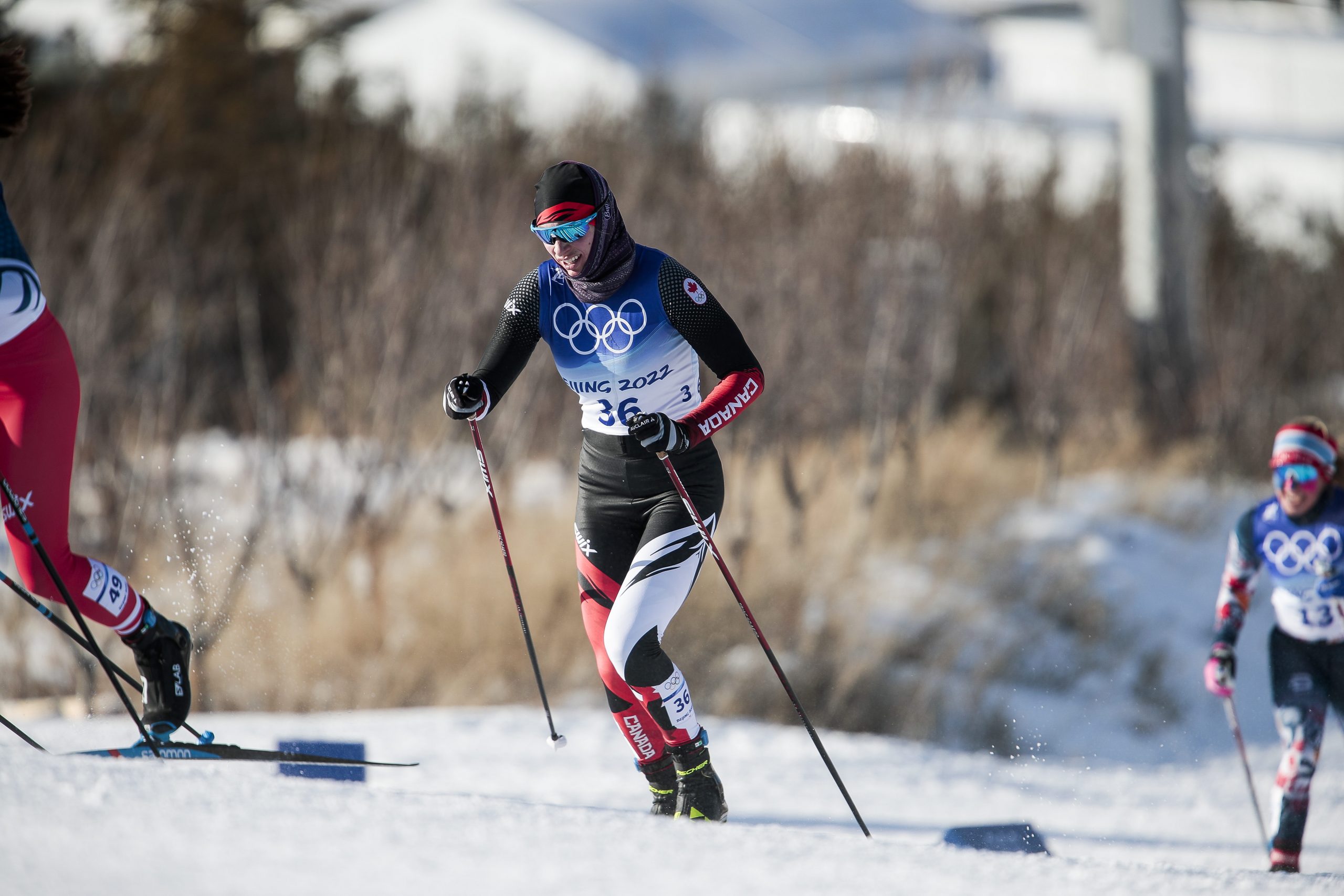
    The Canadian women made a strong showing in the top thirty, led by Cendrine Browne in 20th (+3:44.4). Not far behind her was Kathrine Stewart-Jones, matching her bib number and finishing in 23rd (+4:03.6). In a dramatic finish – essentially a forward fall across the line – Dahria Beatty finished 28th (+4:38.8), putting three Canadians in the top thirty. Olivia Bouffard-Nesbitt was the fourth Canadian and finished 44th (+5:58). 

    Dahria Beatty (CAN) finished 28th in the 15 k skiathlon (Photo: NordicFocus)

    Racing for Australia, APU’s Jessica Yeaton finished just outside the Top-30 in 31st (+4:40.3).

    Australia’s Jessica Yeaton (bib 53) races to 31st in the women’s 15k skiathlon, which opened the 2022 Winter Olympics in Beijing. (Nat Herz/FasterSkier-ADN)

    The men will race a 30 k skiathlon tomorrow, and the next women’s event will be the freestyle sprint on February 8th. You can find a detailed schedule for the Olympic cross-country events, including how to watch, here. 

    Results

  • Nepryaeva Cushions Her Lead with 10k Mass Start Classic Win; Diggins 13th

    Nepryaeva Cushions Her Lead with 10k Mass Start Classic Win; Diggins 13th

    Not-quite-winter. The women’s 10-kilometer classic kicked off the final two stages of the 2021/22 Tour de Ski in Val di Fiemme, Italy. (Photo: NordicFocus)

    This World Cup coverage is made possible through the generous support of Marty and Kathy Hall and the A Hall Mark of Excellence Award.  To learn more about A Hall Mark of Excellence Award or to learn how you can support FasterSkier’s coverage please contact info@fasterskier.com.

    After a day of rest, the Tour de Ski kicked off it’s final two stops in the mountains of northern Italy. After a dramatic freestyle sprint in Stage 4, there was a lot on the line with little time to go in the Tour for many of the women who lined up for today’s 10-kilometer mass start classic in Val di Fiemme. With blue skies and sunshine illuminating the spectacular Italian Dolomites, the stage was set for a spectator’s dream over the four lap course.  

    First, a quick look to the overall Tour standings to set the tone. Natalia Nepryaeva (RUS) took the lead in Stage 4. With the 60-second time bonus for a sprint win, Nepryaeva entered Stage 5 with a 34 seconds lead on Kerttu Niskanen (FIN) in second, and 38 seconds ahead of Jessie Diggins (USA) in third.

    A favorite for a second consecutive Tour win, Diggins led the standings heading into the fourth stage, during which she was taken out by Frida Karlsson (SWE) in the quarterfinals, losing vital time in the Tour standings. Karlsson was later disqualified for obstruction and withdrew from the Tour after being issued a three minute time penalty that put her out of contention for the overall win. 

    While Diggins typically responds well to pressure and has put together impressive performances up the final hill climb, the classic tracks in Val di Fiemme have historically challenged Diggins, who would need to minimize time lost in order to still be in a position to fight for the overall win in the final stage. In last year’s Tour, Diggins was 10th in the 10k classic in Val di Fiemme, 17th in 2020 and 2019, and 4th in 2018. The odds were, perhaps, not in her favor, but the potential was there.

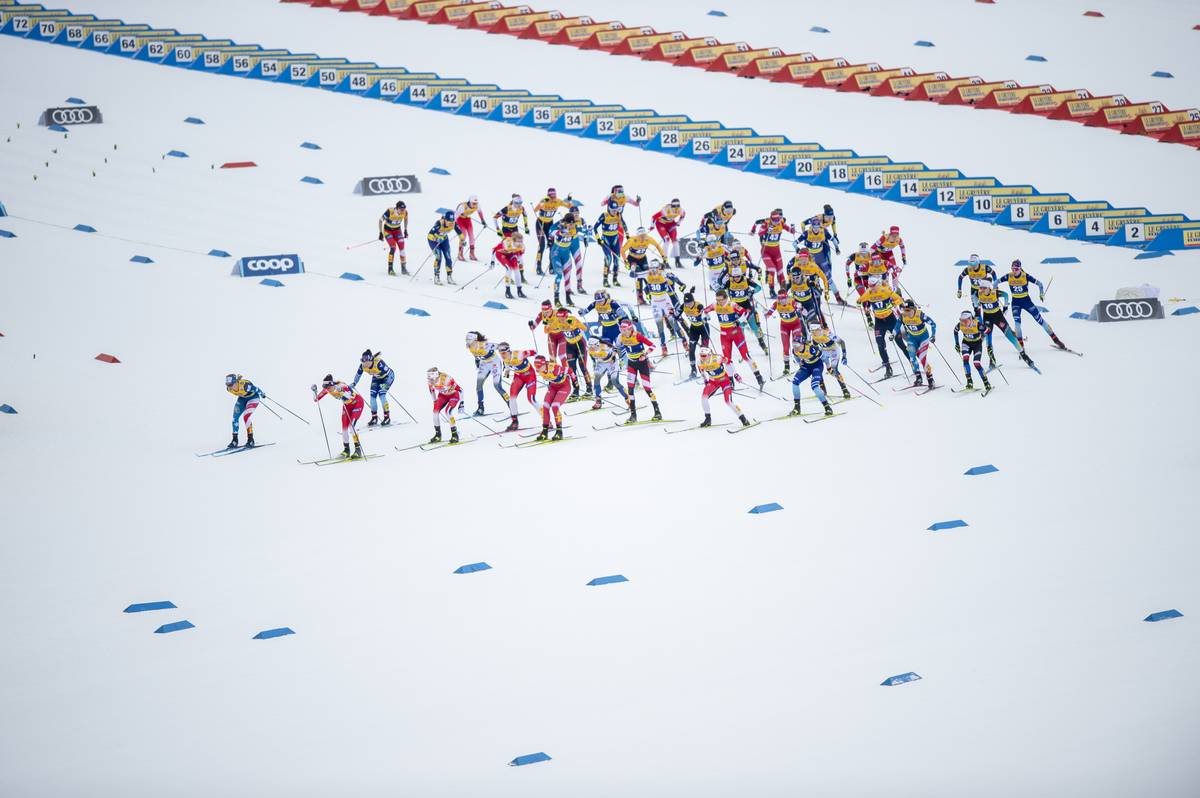
    Athletes take to the tracks for Stage 5 of the 2021/22 Tour de Ski, a mass start classic in Val di Fiemme, Italy. (Photo: NordicFocus)

    Within the race, there were two opportunities for bonuses, one for Tour points and one for bonus seconds. These opportunities arose at 2.3 and 6k, respectively. 

    As racers took to the course, the congestion of a mass start was apparent. A pole snapped within the first minute as racers jostled for position in the lanes before settling in. 

    As the second lap started, a gap began to form behind a large lead pack of about 14 women, which included Diggins, Nepryaeva, and Niskanen. The lead women created a roughly eight-second lead on the chase pack at 3.5k.  

    Heidi Weng navigates fast and icy corners during the 2021/22 Tour de Ski in Val di Fiemme, Italy. (Photo: NordicFocus)

    At the halfway mark a group of six skiers began to thin out the lead group, led by Krista Pärmäkoski (FIN), Heidi Weng (NOR), Ebba Andersson(SWE), Katharina Henning (GER), Nepryaeva, and Teresa Stadlober (AUT). They opened up about a six-second lead on the chase pack which included Diggins and Niskanen. 

    As the women lapped through the stadium for the last 2.5k, this lead group, now led by Andersson, had stretched their lead to more than 20 seconds over the next chase pack.  

    Working together through most of the final lap, the group of six women skied together until the final climb before the stadium where Nepryaeva began to surge.

    Charging up the hill and pushing hard over the top before dropping into a tuck, she quickly dropped the women in pursuit. Cruising through the stadium with a powerful doublepole, Nepryaeva had a comfortable lock on the win, stopping the clock with a fist pump in 29:51.3. 

    Natalia Nepryaeva (RUS) takes the win in Stage 5 of the Tour de Ski. (Photo: NordicFocus)
    Fighting for second and third, Heidi Weng (NOR) overtakes Krista Pärmäkoski (FIN). (Photo: NordicFocus)

    In second at the top of the climb, but gaining ground in the descent and double pole, Weng pulled ahead of Pärmäkoski to finish second (+3.7), with the Finn just behind in 3rd (+4.7). The remainder of the lead group skied through the finish evenly spread with Andersson in 4th (+7.5),  Henning in 5th (+10.9), and Stadlober 6th (+14.3).

    The women’s podium after Stage 5 of the Tour de Ski. Natalia Nepryaeva (RUS) took the win ahead of Heidi Weng (NOR) in second, and Krista Pärmäkoski (FIN) in third. (Photo: NordicFocus)

    In a FIS Interview, Nepryaeva was asked how she felt about the race and about the course. “I am really happy to win here, it is a really important place for me, as it was my first win at World Juniors here.”  

    Outside the lead group and fighting hard to minimize time lost, Diggins crossed the finish line in 13th (+58.0). Diggins explained after the race that the icy conditions in Val di Fiemme were tricky for many of the women racing, as the speed checks needed to stay in control through the downhills in mass start conditions also cost them some grip in the final laps. 

    “I think it was one of those [days] where I had to really catch myself and be thinking really, really hard about standing tall and thinking about technique, which is harder for me in classic,” Diggins explained post-race. “I’m really proud of staying in the moment and never giving up and doing what I could with what I had.”

    Never a question of whether she has given her all, Diggins crosses the line in 13th in Stage 5. (Photo: NordicFocus)

    Looking ahead to the Alpe Cermis, where her time deficit may prove insurmountable, Diggins once again showed her never-give-up attitude 

    “I’m excited. It’s so hard, but it’s such a feeling of accomplishment making it to the top of that mountain… You can rest assured I will be crossing that finish line with nothing left.”

    Full audio clip from Jessie Diggins, interviewed on-site by Tom Horrocks, U.S. Ski & Snowboard cross country communications manager. 

    Katherine Ogden skis to 31st in Stage 5 of the 2021/22 Tour de Ski. (Photo: NordicFocus)

    Missing the Top-30 by just 13 seconds, Katherine Ogden raced to 31st (+2:17.4) as the next American finisher. Also with strong finishes, Novie McCabe crossed the line in 36th (+2:38.3) just ahead of her teammate Sophia Laukli, who took 39th (+2:57.7). Alayna Sonnesyn rounded out the women in stars and stripes in 51st (+5:32.1).

    Post-race interview with Katharine Ogden and Novie McCabe, interviewed by Tom Horrocks. 

    Sophia Laukli skis to 39th in Stage 5 of the Tour de Ski in Val di Fiemme. (Photo: NordicFocus)

    Looking back on the bonus opportunities, Johanna Hagström (SWE) made a move just before the 2.3k point bonus to pull away from the pack to snag the maximum of 15 points.  Pärmäkoski and Weng tied for second to both get 12 points. Diggins crossed the 2.4k mark in 8th, earning 3 bonus points.  

    At the 6k time bonus opportunity, Andersson was the first over the line, giving her 15 bonus seconds in the tour. Weng was able to continue her bonus streak on the day by crossing second and getting a 12-second bonus, while Pärmäkoski crossed in 3rd for 10 bonus seconds.  Nepryaeva finished in 5th, collecting six seconds.

    After today, Nepryaeva was able to not only hold on to her lead in the Tour, but expand it. Now leading Andersson by 1:12 seconds, heading into the final stage of the tour tomorrow. Diggins dropped down to sixth place from third, now behind by 1:42.

    Alayna Sonnesyn skis to 51st in Stage 5 of the Tour de Ski in Val di Fiemme, Italy. (Photo: NordicFocus)

    The final stage of the 2021/22 Tour de Ski, the infamous Alpe Cermis hill climb, kicks off at 11:30 CET / 5:30 EST.

    Stage 5 Results 

    Overall Tour Standings: Cumulative Time | Points

  • Johaug Runs Away With Gold in the 30-kilometer Classic; Maubet Bjornsen 15th in Final Professional Race

    Johaug Runs Away With Gold in the 30-kilometer Classic; Maubet Bjornsen 15th in Final Professional Race

    A clear day after Friday’s snowstorm greeted the start of the women’s 30 k classic in Oberstdorf. (Photo: NordicFocus)

    This World Championship coverage is made possible through the generous support of Marty and Kathy Hall and their A Hall Mark of Excellence Award. To learn more about A Hall Mark of Excellence Award or to learn how you can support FasterSkier’s coverage please contact info@fasterskier.com.

    A blanket of fresh snow lay on the ground while the frozen rocky peaks of the Bavarian Alps peaked through the clouds. Finally, Oberstdorf, Germany looked like a wintery venue. 

    With temperatures that might feel brisk relative to the tropical heatwave earlier in the week, the women’s field took to the tracks for their final event of the 2021 World Championships: a 30-kilometer mass start classic. 

    The women’s 30 k closes out racing for the women at the 2021 World Champs. (Photo: NordicFocus)

    To set the stage for today’s race, one should first look back to the 2019 World Championships, which featured a 30 k freestyle, and the 30 k classic at last year’s Holmenkollen in Oslo, the last World Cup race to take place before the season was truncated due to the rise of the COVID-19 pandemic. 

    Let’s glance at the World Champs in Seefeld, Austria, where Norway’s Therese Johaug led the field through the first 5 k, then pulled away. She gapped the field by more than 30 seconds, holding her ground on her own at the front for the remainder of the race. Her teammate Ingvild Flugstad Østberg led the chasers to take second place, followed by, what was at the time a new name, Sweden’s 19-year-old Frida Karlsson, earning a bronze medal in her inaugural World Championships. 

    Johaug’s performance at the Holmenkollen looked to be an attempt to repeat this style of victory. She was off the front at the 20 k mark, but had not taken the opportunity to switch her skis. Working together on fresh boards were Karlsson and teammate Ebba Andersson, who steadily closed the gap to Johaug. With less than 2 k to go, Karlsson could be seen from the same camera angle, gaining ground with every kick and glide.

    Inside the last kilometer, Karlsson overtook Johaug on a long climb. Despite the Norwegian’s best efforts, she could not match the speed of the Swede’s skis on the downhill and Karlsson broke away to win by just under 2 seconds. 

    So what would it be today? 

    Therese Johaug on course during the World Championshp 30 k classic in Oberstdorf, Germany. (Photo: NordicFocus)

    Johaug’s pace from the start seemed impossible to sustain for the full duration of the event. While other women looked steady and controlled, Johaug was simply charging, her rapid breathing matched by her tempo. 

    By 10 k, Johaug had a lead of over 53 seconds to the first chase group, led by her teammate Heidi Weng, Andersson of Sweden, and Katharina Hennig of Germany. At the halfway mark, this lead ballooned to over 1:32. Even if impeded by subpar skis, it looked to be an insurmountable margin. Spoiler alert: it was. This left a race for silver and gold in her wake. 

    Ebba Andersson, Heidi Weng, Frida Karlsson, and Therese Stadlober – the main chasers – play for second and third place as Johaug skis off the front. (Photo: NordicFocus)

    A pack of five women seemed to be pulling ahead of the larger chase group that had been together from the start. At 15k it was: Andersson, Karlsson, Weng, Hennig, and Therese Stadlober of Austria. 

    After a 15 second gap, Krista Pärmäkoski skied alone in an effort to gap up, leaving behind a second chase group that included Sadie Maubet Bjornsen in 8th, in what she announced would be the final race of her professional career. 

    Sadie Maubet Bjornsen (USA) alongside Yana Kirpichenko (RSF), (l-r) in the 30 k classic. The race closes out Maubet Bjornsen’s international race career. (Photo: NordicFocus)

    At 18k Johaug smoothly switched into new boards, while the first chase pack worked their way toward the stadium in the background. Johaug’s gap was approaching two minutes. 

    A solo affair for the win: Therese Johuag of Norway during the 30 k classic. (Photo: NordicFocus)

    Inside the final 10k, a few women led by Pärmäkoski, had gapped up to the first chase group. After a crash took out the three women at the front — Andersson, Karlsson, and Weng — Stadlober snuck around the right side, increasing her tempo to kick and glide away from the women now 16 seconds behind her in pursuit. 

    Striding and poling in sync, Karlsson, Andersson, and Weng looked determined to regain contact with the Austrian. As they departed the stadium in the sun with 6k to go, the threesome had achieved this goal. They strided away up tracks that looked to be eroding in the sun, heading into the woods where the course looked much different. As more crashes had already happened behind them on sugary sweeping downhills, the task ahead looked to be as much about staying upright as skiing fast. 

    Heidi Weng (NOR) leads Therese Stadlober (AUT) and Frida Karlsson (SWE) during the mass start 30 k classic. (Photo: NordicFocus)

    Talking to a trailside coach on a climb with 2k to go, Johaug seemed to be basking in the confidence of her victory. Attacking through the final kilometer of the course nonetheless, Johaug alternated between a spicy double pole and throwing her arms up in celebration as she made her way down the finishing lanes to stop the clock in 1:24:56.3.

    Therese Johaug is a singular distance champ. (Photo: NordicFocus)

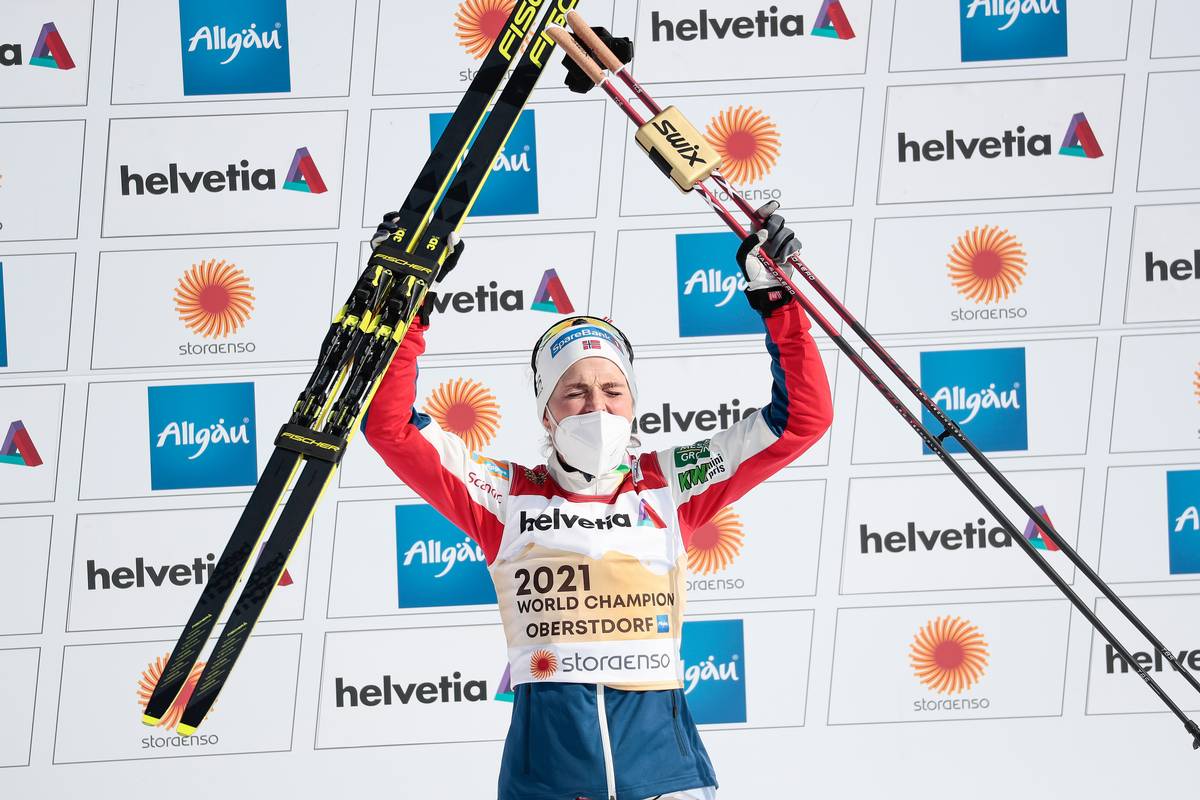
    Earning her 14th championship medal, ten of which are gold, Johaug has overtaken Norwegian ski legend Marit Bjørgen for the most World Championship medals. The first in her collection was a bronze in the 30k classic in Sapporo, Japan in 2007. Johaug struck out in 2009, but came into the 2011 World Championships on her home turf in Oslo ready to go, taking gold in the 30 k skate and relay, and bronze in the skiathlon. 

    Johaug is also the second woman to have won 30 k events in both freestyle and classic at the World Championship, following in the footsteps of Elena Välbe of Russia who retired after the Nagano Olympics in 1998. Johaug also joins Välbe and Bjørgen as the only women to have won successive 30 k events at a World Championships. 

    Therese Johaug takes a fourth gold medal in the 30 k mass start classic. (Photo: NordicFocus)

    “It’s amazing, actually,” said of her string of four gold medal performances in Oberstdorf in a post-race interview with FIS. “I work so hard for it, training so much to reach my goals. To come here to Oberstdorf and fight for four gold medals, I have no words. I know so many girls train really hard to reach their goals, and I know that I have a lot of pressure on me when I come here. I was a favorite to win the distance, but you have to do it, and it takes a lot of focus to reach your goals.”

    The FIS interviewer called it the “era of Therese Johaug”, to which the Norwegian gave an emotional response, her voice breaking tearfully with her final statement. 

    “I never have been in such good shape. I am so happy. I’m 33 years and I know I’m getting older and older and I know that this time ends soon, so I am just so happy.”

    Sun, glory, and another championship distance win. (Photo: NordicFocus)

    In the closing kilometers of the race for silver and bronze, Weng, Andersson, and Karlsson began to drop Stadlober. Finding a new gear as she surged up the last steep climb, Weng rounded the hairpin turn in the lead and dropped into a tuck. 

    With just a sugary right hand curve out of the downhill to navigate before the final straightaway, Weng was shooting her shot. However, Karlsson’s skis and double pole were superior as they headed down the lanes, gaining her centimeters on Weng with each strike. 

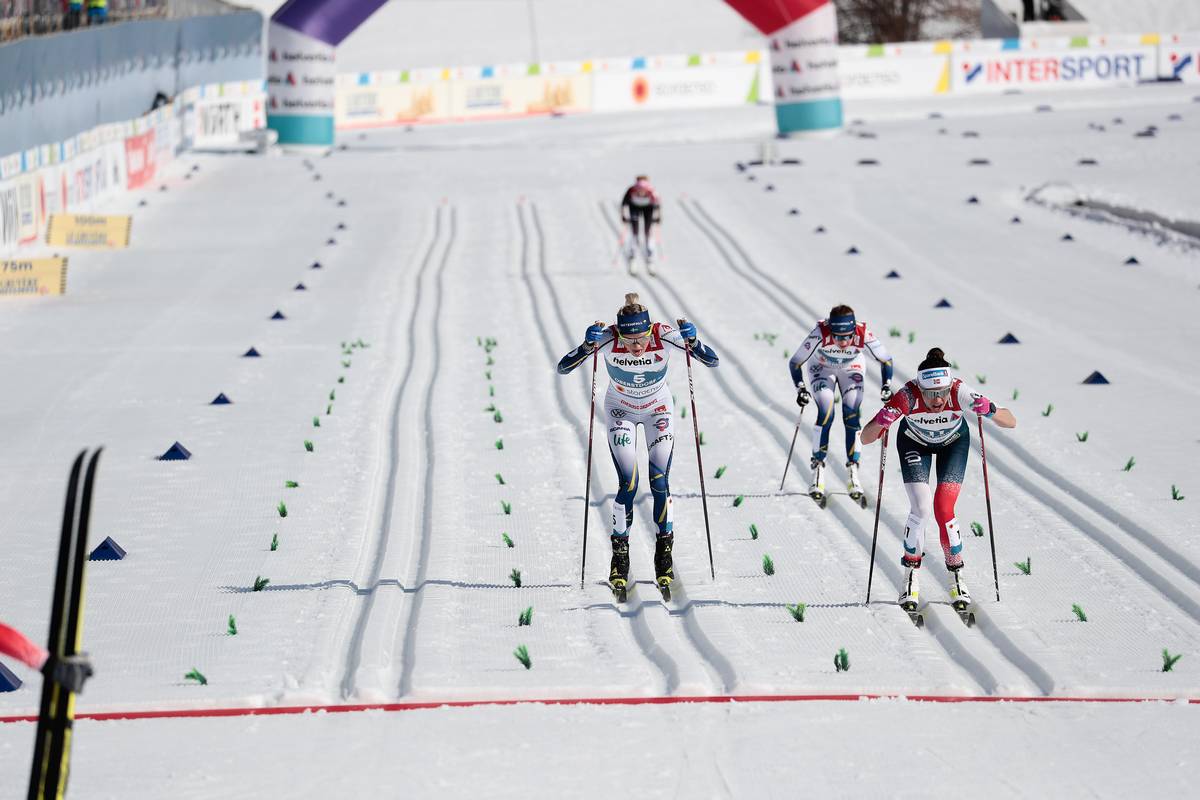
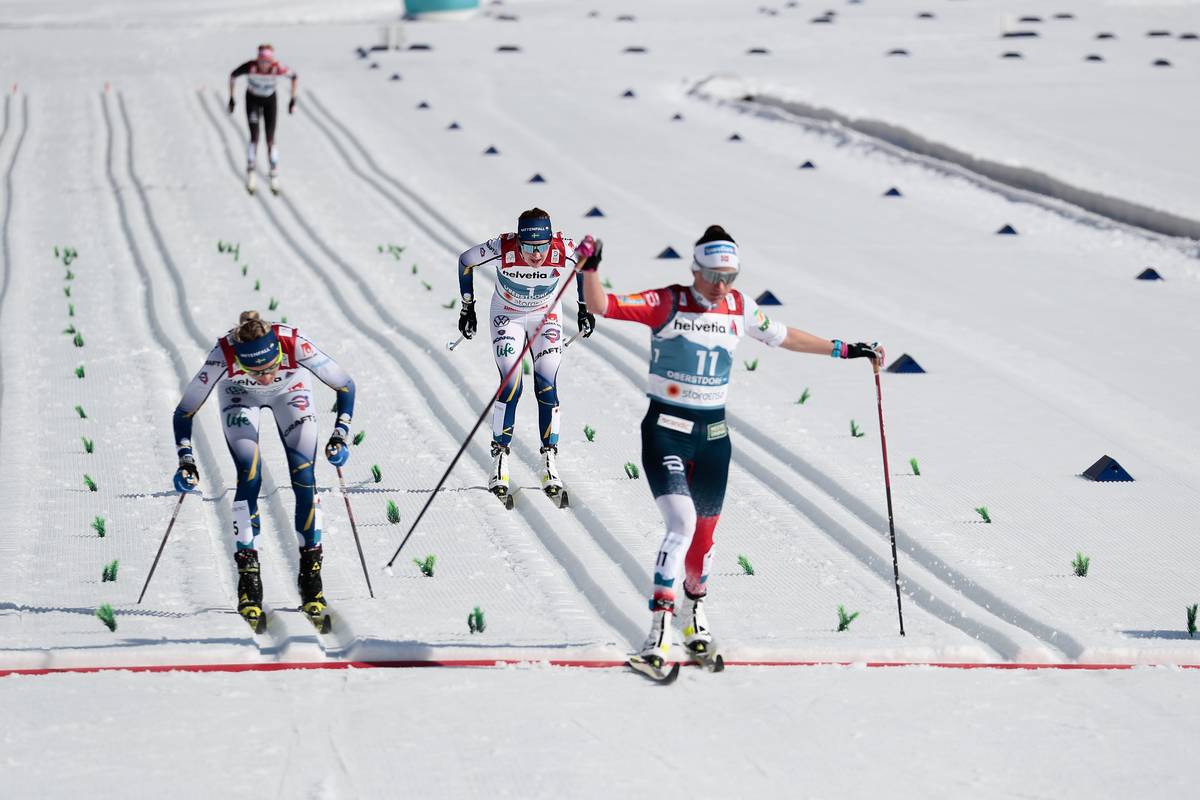
    In the end, the small gap Weng had created from her move was enough. By a margin of 0.6 seconds, Weng took silver (+2:34.2), leaving Karlsson with her second bronze medal in the event (+2:34.8). 

    Frida Karlsson, and Heidi Weng (NOR), (l-r) dual for silver and bronze. (Photo: NordicFocus)
    Heidi Weng (NOR) edges out Frida Karlsson (SWE) for a silver medal in the 30 k classic. (Photo: NordicFocus)

    Andersson held on for fourth (+2:36.3), followed by Stadlober in fifth (+2:59.4). 

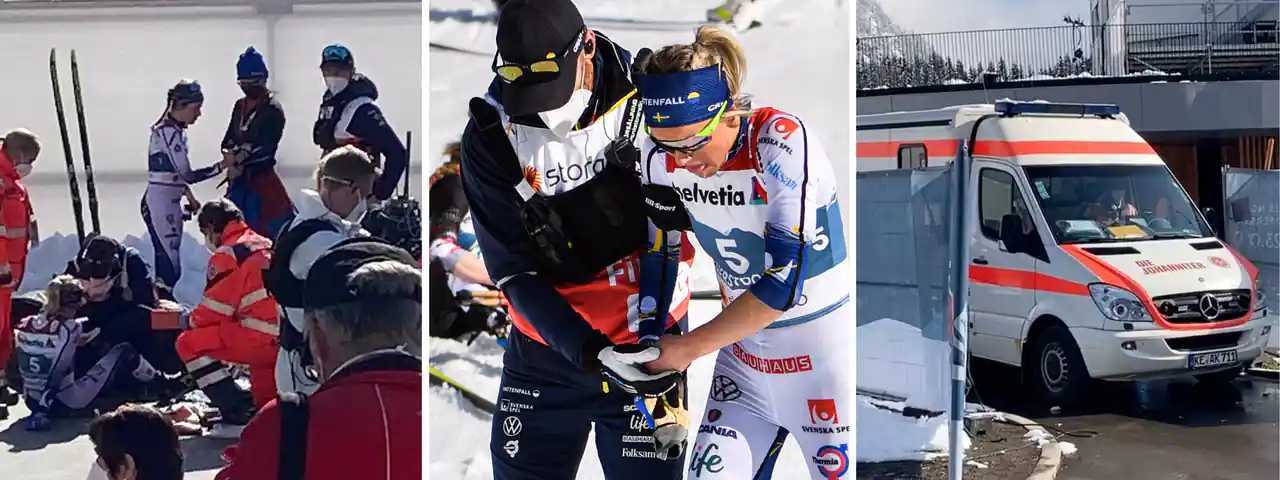
    After the finish, Karlsson was seen rolling up the sleeve of her race suit and holding her forearm, which she proceeded to show the Swedish support staff. After icing and splinting the injury, she was reportedly taken away by medical staff and did not participate in the podium ceremony. In an interview with the Swedish news outlet Expressen, a team doctor explained that the injury occured in the crash with Andersson and Weng and that she is being taken to the hospital for x-rays. FasterSkier will share additional information as it becomes available. 

    Frida Karlsson was carted away for x-rays after a bronze medal performance in the 30 k classic. (Photo: Expressen.se)
    Only gold and silver represented at the podium ceremony after the 30 k classic. Therese Johaug (NOR) took the win ahead of Heidi Weng (NOR), with Frida Karlsson (SWE) earning bronze before being taken away for x-rays of her arm injury. (Photo: NordicFocus)

    Turning our focus to North America, Maubet Bjornsen skied her way to 15th. After falling off the pace with the second chase group as it broke apart, Maubet Bjornsen held her ground well inside the top-20 over the final two laps. Finishing in a tight finish with Johanna Matintalo of Finland and Emma Ribom of Sweden, who took 13th and 14th respectively, Maubet Bjornsen crossed the line 4:42.4 behind Johaug. 

    In a close finish, Sadie Maubet Bjornsen takes 15th in the 30 k classic. (Photo: NordicFocus)

    “I had many kilometers of celebrating and it was just the hardest 30 k I have ever done,” said Maubet Bjornsen after her race. “So you know, nothing like going out on that to remind you how hard this sport is.”

    Providing insight into her day, Maubet Bjornsen reflected positively on the first half of her racing, adding that her equipment could not quite match her effort after the ski change.

    “I felt totally incredible for the first three laps and then I switched onto some skis that were not quite good enough to stay with the pack I was skiing with. Then it was just like fighting to get to the finish. But I feel really stoked about my first 15 k and that is a good memory, just feeling like one of the strongest girls climbing that monster hill. That is a fun memory to go out with.”

    Sadie Maubet Bjornsen ends her professional career at the World Championship 30 k classic in Oberstdorf, Germany. (Photo: NordicFocus)

    Closing out her initial thoughts on her final race, Maubet Bjornsen added, “I definitely feel really grateful for my whole career and this last week was definitely really special and the relay was certainly the highlight of the week. It is good to finish on a really hard note too, pushing through 30 kilometers and yeah, I am thankful for my whole career.”

    Also inside the top-30 were Hailey Swirbul in 26th (+6:55.6) and Sophia Laukli in 28th (+8:00.7). The final American starter, Katharine Ogden, took 37th (+11:30.7). 

    “I think it went pretty well for me,” said Swirbul after her race. “I am happy with my day. I had a pretty fast start and I got to ski with my Sadie for a brief moment there in her last race as a professional, so that was really special.”

    Hailey Swirbul of the U.S., cresting a hill during the 30 k classic. (Photo: NordicFocus)

    “In the 30 k there are so many deaths, and so many revivals that you just have to keep going,” Swirbul continued. “And I went through a couple of those and was very relieved to see the finish line. I am proud out team today and some good fighting.”

    For Laukli, today was a first — her debut in the 30 k event. She explained after the race that was not sure how to pace, and felt she had good energy throughout, never on the cusp of a bonk despite skiing alone with no one to draft behind for much of the distance.

    “This is the type of race you want to ski with other people,” Laukli said regarding what she learned. “And also, you should switch skis — which I forgot to do. Definitely a learning experience and there’s a lot I can improve on, but I am overall happy with how it went.”

    Sophia Laukli crosses the line 28th in the 30 k classic. (Photo: NordicFocus)
    Sophia Laukli and Hailey Swirbul share a supportive hug after 30 kilometers of classic ski racing. (Photo: NordicFocus)

    Canada’s Katherine Stewart-Jones led the way for our neighbors to the North (or East, if you’re Alaskan), finishing 23rd (+6:05.7). Stewart-Jones went out at a fast pace, sitting at the back of Maubet Bjornsen’s chase group in 17th at the 10 k mark, fading into 21st by 20k, holding her ground in this range for the remainder of the day.

    Katherine Stewart-Jones (CAN) chases Tatiana Sorina (RUS) during the mass start 30 k classic. (Photo: NordicFocus)


    Sofie Krehl (GER), and Katherine Stewart-Jones (CAN), (l-r) finish strong. (Photo: NordicFocus)

    Cendrine Browne was next for Canada, finishing 27th (+7:57.6). Outside the top-30, Dahria Beatty took 34th (+10:01.0).

    Canada’s Cendrine Browne racing to 27th in the 30 k classic. (Photo: NordicFocus)

    Jessie Diggins and Rosie Brennan did not start today, reportedly conserving energy for the final World Cup stop in Engadin, Switzerland beginning March 13th. The weekend will include a 10 k classic and 30 k skate.

    Final Results

    Katharine Ogden on her 30 k classic journey. (Photo: NordicFocus)
  • With Arms Raised: It’s a Johaug Win in Oberstdorf – Brennan in 17th, Diggins 22nd

    With Arms Raised: It’s a Johaug Win in Oberstdorf – Brennan in 17th, Diggins 22nd

    The start of the 56 skier deep field in the women;’s 115 k skiathlon in Oberstdorf, Germany. (Photo: NordicFocus)

    Here at FasterSkier, we do not play the odds. Some contributors we know play Noah Hoffman’s Fantasy League – but we steer clear of rolling the dice on cross-country skiing. But the women’s skiathlon events on the World Cup may not be the biggest payouts since in recent history they have been a lock. 

    Oberstdorf in Oberstdorf, Germany — the site of next year’s Nordic Ski World Championships — required no crystal ball of an imagination to determine the top-spot for the women who raced a 7.5 k / 7.5 k skiathlon on a championship-caliber course.

    Coming into the race, Norway’s Therese Johaug had won a total of seven World Cup skiathlon’s, including a win in the format this season in Lillehammer. With a win today she could match the record of eight skiathlon World Cup wins held by her former teammate, the now retired Marit Bjørgen. 

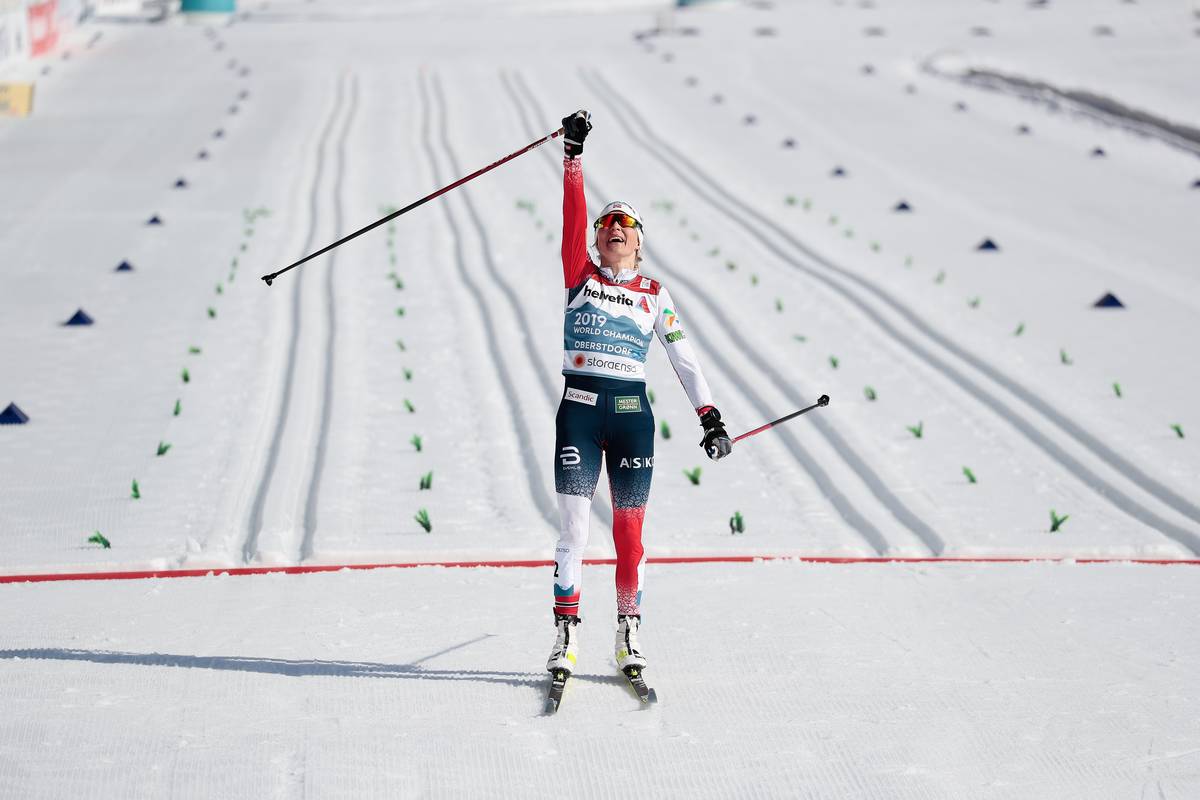
    This is about the most unspoiling of a spoiler alert: Johaug won today’s skiathlon in 40:05.2 to tie Bjørgen on the skiathlon win list. But her day was more tenuous than we would have imagined. Her gap on second place at the finish, Norway’s Ingvild Flugstad Østberg, was for Johaug somewhat meager, 15.5 seconds. Austria’s Therese Stadlober placed third (+15.6). According to FIS, this was Stadlober’s third career World Cup podium. Her two other podiums came in the 2018 Tour de Ski, one of which was a time of day podium up the Alpe Cermis.

    Today, for Johaug, her race day concluded with arms raised in the air win.  

    A familiar pose for the World Cup distance leader: Therese Johaug winning the 15 k skiathlon in Oberstdorf, Germany. (Photo: NordicFocus)

    She was able to slowly stretch away from a group of chasers during the 7.5 k classic leg. She inched ahead from the main chase group near 2.5 k as she charged up the course’s main climb, the Burgstall hill. The field was spread out, but not shattered. Joahaug came over the top and into a long glide out with a 100-meter lead.  

    At 3.8 k, Joahug had a 5.3-second buffer on Østberg in second, with eight other skiers within 15 seconds. Roughly two kilometers later, she added another three-second cushion. By the exchange to skate skis at 7.5 k, Johaug’s lead was 14.1 seconds to Østberg. But in close contact with Østberg were Finland’s Kerttu Niskanen and Krista Pärmäkoski, Norway’s Heidi Weng, Sweden’s Ebba Andersson, Stadlober, German Katharina Hennig, and Russia’s Natalia Nepryaeva who was 18.9 seconds back.

    Churn as she may in her free-radical producing high octane tempo, Johaug essentially put no more time on the core chasers during the skate portion. For a time, up through 13.7 k, Johaug had a 20.1-second margin on the next closet skier, which winnowed by five seconds at the finish. This was not a Johaug walk-away as we have seen in the past. Østberg and Andersson took the primary responsibility of keeping the void to Johaug in check.  

    Østberg, Stadlober, and Andersson were able to sprint to the finish for their 2-3-4 order. (They came through +15.5, +15.6, +15.7, respectively.)

    “It was a tough race out there,” Johaug told FIS after the race. “Especially the classic when I have a gap of five seconds, I know that I have to push myself all the way because if they attack me it will be a group. And it will be hard to go into skating and get a new gap again. I tried to focus on myself and work in my head all the way, but I am really happy with the first place today.”

    Johaug has won 11 of 12 World Cup distance races this season and leads those standings with 896 points. Weng is in second with 595 points. 

    Ingvild Flugstad Østberg (bib 5) lading the chase during the classic portions of the Oberstdorf, Germany 15 k skiathlon. (Photo: FasterSkier)

    It was not the day hoped for by the top American women. That reality became evident early in the classic portion of the race. By 3.8 k, Jessie Diggins had ceded 23.3 seconds, and Rosie Brennan 27.4. The time-bleeding trend never fully stabilized. Brennan was 18th through the exchange (+55.3), Diggins 24th (+1:04.1). 

    Brennan placed 17th overall (+1:46.6), while Diggins was 22nd (+1:55.0). 

    Rosie Brennan of the U.S., during the classic portion of the 15 k Oberstdorf, Germany skiathlon. (Photo: NordicFocus)

    “Skiathlons are always a little unpredictable when we do so few in a year,” Brennan sent in a group email. “We were able to race on one of the new courses they have made for World Championships but due to lack of snow, we could only use one 3.75km course. The course is significantly hillier than the old course and skied quite well. However, doing a skiathlon on one course that’s split half classic half skate always causes some problems with not much room to pass. I felt very good today but struggled a lot moving through the field. I was frustrated with that but very happy about my feelings and skiing so I feel good that I am in a good place and have more good races to come.”

    World Cup Coach Matt Whitcomb explained in a post-race interview that Diggins was feeling slightly off today with her sensations.

    Jessie Diggins on the skate leg of the 15 k Oberstdorf, Germany Skiathlon. (Photo: NordicFocus)


    Post-race interview with U.S. World Cup Coach Matt Whitcomb discussing the women’s race

    Post-race interview with U.S. World Cup Coach Matt Whitcomb discussing the race course

    Also for the U.S., Cailtin Patterson returned to the World Cup after contesting U.S. Nationals in early January to place 34th (+3:16.5). Patterson moved up in the skate portion to 34th, after transitioning to skate in 42nd. Alayna Sonnesyn raced to 51st (+5:45.1). 

    For Canada, Katherine Stewart-Jones just missed the points in 31st (+2:40.2). Dahria Beatty placed 47th (+4:54.0). 

    “It was a fun race, I knew that I would need to make up positions in the classic part of the race without using too much energy… but I also knew the pace would start out fast,” Stewart-Jones emailed. “I was able to move up little by little throughout the race. I felt better on the skate portion but wasn’t quite able to close the gap to top 30. I am for sure a bit disappointed to be so close but it is also motivating to know that I can ski like that on a day where I don’t feel at my best! As for the team, I am really excited about our progress. Dahria has been consistently in the top 30 in World Cup sprints this year which is really exciting and her and Emily were really close to top 30 in Davos. The best is definitely yet to come with most of the team focusing on the Scando tour and World Cup finals!”

    Katherine Stewart-Jones of Canada (bib 45) skiing to 31st in the Oberstdorf, Germany 15 k skiathlon. (Photo: NordicFocus)

    And with those concerned with the baggy bibs last week in Nové Město – it was a return to the form-fitting bibs we’ve come to know on the World Cup. 

    Racing continues tomorrow in Oberstdorf with a classic sprint.   

    Women’s Results 

    The Oberstdorf, Germany 15 k skiathlon podium: Ingvild Flugstad Østberg (NOR) second, Therese Johaug (NOR) first, Teresa Stadlober (AUT) third. (Photo: NordicFocus)


  • 2018/2019 Tour de Ski Preview (Updated)

    2018/2019 Tour de Ski Preview (Updated)

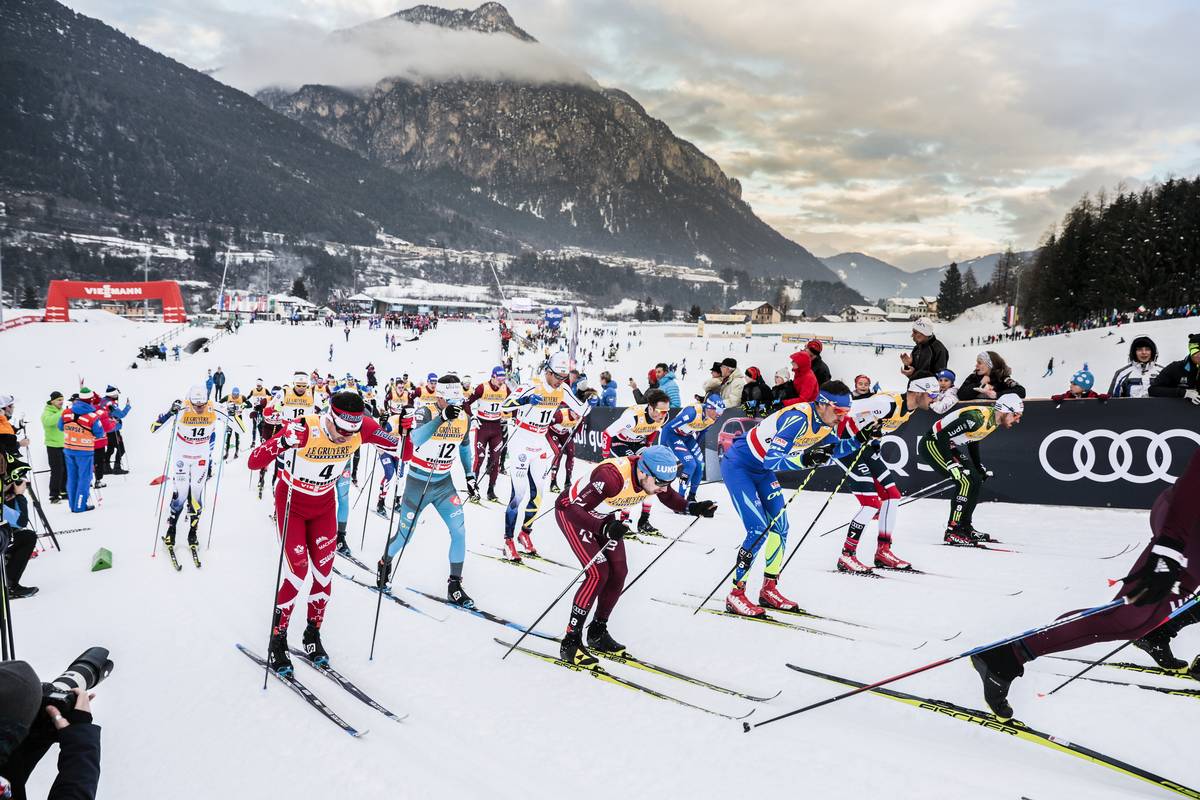
    The start of the men’s 15 k classic mass start at Stage 6 of the 2018 Tour de Ski on Saturday in Val di Fiemme, Italy, with (front row, left to right) Canada’s Alex Harvey, Russia’s Sergey Ustiugov, Kazakhstan’s Alexey Poltoranin, Norway’s Martin Johnsrud Sundby, and Switzerland’s Dario Cologna. (Photo: Salomon/NordicFocus)

    Beginning this Saturday in Toblach, Italy with a freestyle sprint is the 13th edition of the Tour de Ski (TdS). According to the International Ski Federation (FIS), over the course of seven stages the men will race 80.918 kilometers, the women 60.67 k. 

    The TdS has become both a staple and a spectacle of the annual World Cup calendar. With a jam-packed series of races primacy is placed on both the ability to recover well and wither less as the TdS transpires.

    Prognostication can be tricky in a long-form template like the TdS. So much can go astray during seven races not to mention the travel and dicey germ-avoidance. 

    Last season’s winner on the women’s side, Heidi Weng of Norway, sits 18th overall in the World Cup standings (14th in distance). She has four top-20’s in the four distance events she’s contested with her best result an eighth in Lillehammer’s 10 k skate. Although featuring two sprints in the first three stages, the TdS remains a distance skier’s paradise.

    Weng has skied solidly on the World Cup, but she has yet to show the form that made her a TdS overall winner in 2017 and 2018. Norway has won the last five iterations of the TdS: Marit Bjørgen won once in 2014/2015, Therese Johaug twice (2013/2014, 2015/2016), and Weng the last two years.

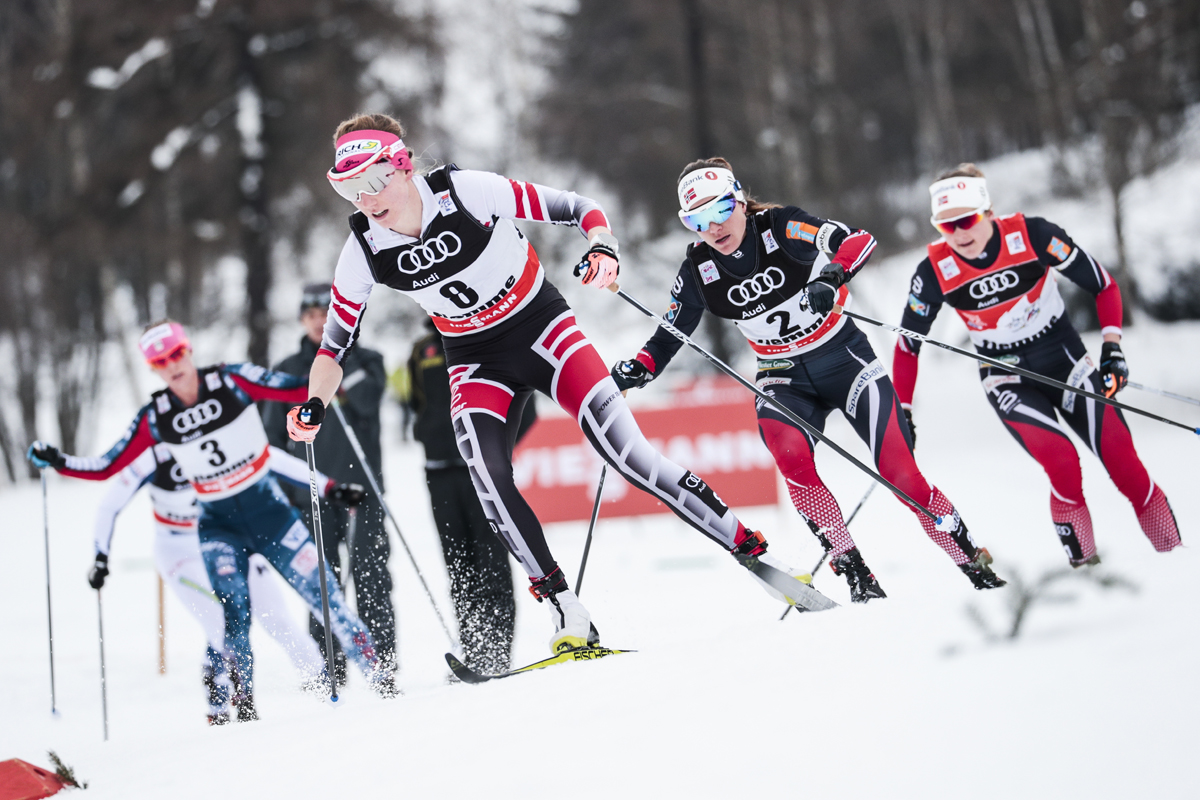
    Austria’s Teresa Stadlober leads Norway’s Heidi Weng (2) and Ingvild Flugstad Østberg, American Jessie Diggins (3) and others around a downhill corner during the women’s 10 k classic mass start at Stage 6 of the 2018 Tour de Ski in Val di Fiemme, Italy. (Photo: Fischer/NordicFocus)


    If Norway is to keep the streak alive, Ingvild Flugstad Østberg, last year’s TdS runner up, could be the heir apparent. She currently ranks second in the World Cup overall and 15th on the sprint list.

    Johaug, having returned from an 18 month doping ban, has been on a distance race tear. She has won all five World Cup distance events this season. Johaug, however, will not be lining up for the TdS.

    Only five different women have earned distance podiums this season — Johaug, Østberg, Sweden’s Charlotte Kalla and Ebba Andersson, and Finland’s Krista Pärmäkoski. Along with Johaug, Kalla and Andersson are skipping the TdS. (Andersson sits third overall on the World Cup, Kalla fifth.) With the TdS missing three of the five top ranked World Cup distance skiers, daily stages and the overall podium are up for grabs.   

    Last season’s third overall finisher, Jessie Diggins of the U.S. Ski Team (USST), often cites the TdS as a point in the season when her form trends towards podium performances. She sits eighth in the current distance standings and could very well have a stout TdS. 

    Russia’s Natalia Belorukova and Yulia Nepryaeva look strong as does Sadie Bjornsen (USST), and Austria’s Teresa Stadlober.

    With less than predictable distance stage podiums for the women, it may simply come down to a drag race on the Alpe Cermis final climb Jan. 6.

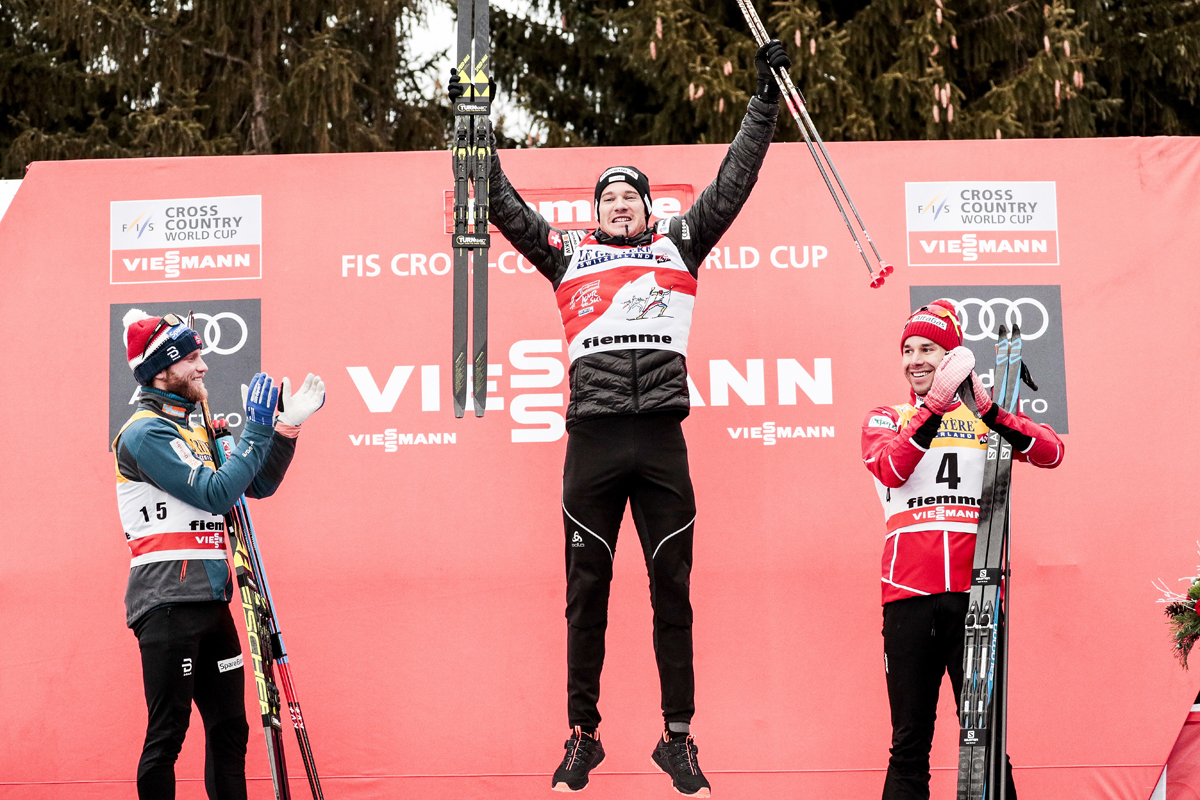
    Switzerland’s Dario Cologna (c) celebrates his fourth Tour de Ski overall title. He was joined by Norway’s Martin Johnsrud Sundby (l) and Canada’s Alex Harvey (r) on the podium in second and third, respectively. (Photo: Fischer/NordicFocus)


    The men’s scene is also open to interpretation. Last season’s TdS winner, Switzerland’s Dario Cologna, was in fact a surprise victor. Prior to Cologna’s stage two win in last year’s TdS, it had been nearly three years since the four time TdS overall winner had won a World Cup. Cologna sits 21st overall on the World Cup currently. Given last year’s resurgence, anything is possible for the Swiss skier.

    Then there’s Martin Johnsrud Sundby form Norway. He finished on the TdS podium the last three years. At thirty-four-years-old, Sundby is ranked first on the distance list, with a second, a third, and a fourth place in distance races this season.

    Sundby won the TdS on two occasions – in 2013/2014 and in 2016. His 2015 win was stripped after he tested positive for excessive levels of Salbutamol. He placed second in the past two Tours.

    In a field rife with talent, Sundby’s ability to race and rebound and race and rebound will be tested. Sjur Røthe, Emil Iversen, and Didrik Tønseth— all from Norway— look in form. And there’s Norway’s Johannes Høsflot Klæbo. The winner of last season’s overall World Cup has had flashes of his past explosive self. He could be a TdS protagonist.

    The men’s field is notably tight. Along with the Norwegians, several Russians could pop a podium, a stage win, and the overall. Russia comes with a loaded team ready to exploit. Alexander Bolshunov leads the overall World Cup – he’ll turn twenty two on Dec. 31st. He’s backed by teammates Evgeniy Belov, Andrey Melnichenko, and Denis Spitsov. 

    Canada’s Alex Harvey placed third overall last year and he looked stronger as the TdS progressed.

    The Stages

    Stage 1:  Dec. 29, skate sprint in Toblach, Italy.

    Stage 2: Dec. 30, 10 k/15 k skate in Toblach, Italy.

    Stage 3: Jan. 1, skate sprint in Val Müstair, Switzerland.

    Stage 4: Jan. 2, 10 k/15 k classic mass start in Oberstdorf, Germany.

    Stage 5: Jan. 3, 10 k/15 k skate pursuit in Oberstdorf, Germany.

    Stage 6: Jan. 5th, 10 k/15 k classic mass start in Val di Fiemme, Italy.

    Stage 7: Jan 6th, 9 k final climb skate pursuit in Val di Fiemme, Italy.

    Teams

    United States

    Women: Sophie Caldwell, Sadie Bjornsen, Jessie Diggins.

    Men: Ben Lustgarten, Simi Hamilton, Erik Bjornsen, Kevin Bolger.

    U.S. Ski Team Head Coach Chris Grover noted in a text that Caldwell, Hamilton, and Bolger will likely cease the TdS after the stage three sprint. Additionally, this is a small team for the U.S. at the TdS. Several athletes turned down TdS nominations including Scott Patterson (USST), Andy Newell (SMS T2/Salomon), Kyle Bratrud (SMS T2), Rosie Brennan (APU), Rosie Frankowski (APU), Caitlin Patterson (CGRP), and Julia Kern (SMS T2). These skiers plan on racing U.S. Nationals this January in Craftsbury, Vermont.

    Canada

    Women: Emily Nishikawa, Dahria Beatty

    Men: Alex Harvey, Lenny Valjas, Bob Thompson

    Norway

    Women: Ingvild Flugstad Østberg, Maiken Caspersen Falla, Astrid Uhrenholdt Jacobsen, Kari Øyre Slind, Kathrine Rolsted Harsem, Heidi Weng, Lotta Udnes Weng, Tiril Udnes Weng Mari Eide, Anna Svendsen

    Men: Martin Johnsrud Sundby, Hans Christer Holund, Emil Iversen, Didrik Tønseth, Simen Hegstad, Krüger, Sjur Røthe, Johannes Høsflot Klæbo, Martin Løwstrøm Nyenget, Eirik Brandsdal, Finn Hågen Krogh

    Russia

    Women: Yulia Belorukova, Lidia Durkina, Anna Zherebyateva, Mariya Istomina, Natalia Nepryaeva, Anna Nechaevskaya, Anastasia Sedova, Elena Soboleva

    Men: Evgeniy Belov, Alexander Bolshunov, Maxim Vylegzhanin, Andrey Larkov, Andrey Melnichenko,  Gleb Retivykh, Andrey Sobakarev, Denis Spitsov, Sergey Ustiugov

    Sweden

    Women: Mia Eriksson, Ida Ingemarsdotter, Moa Molander Kristiansen, Stina Nilsson, Maria Nordström, Linn Sömskar, Lisa Vinsa

    Men: Calle Halfvarsson, Simon Lageson, Teodor Peterson, Daniel Rickardsson, Oskar Svensson, Viktor Thorn, Karl Johan Westberg

    Finland

    Women: Mari Eder, Anne Kyllönen, Laura Mononen, Krista Pärmäkoski, Susanna Saapunki

    Men: Ristomatti Hakola, Matti Heikkinen, Lauri Vuorinen

    Italy

    Women: Elisa Brocard, Anna Comarella, Ilaria Debertolis, Caterina Ganz, Greta Laurent, Sara Pellegrini, Lucia Scardoni

    Men: Francesco de Fabiani, Stefano Gardener, Enrico Nizzo, Dietmar Noeckler, Federico Pellegrino, Maicol Rastelli, Giandomenico Salvadori

    Switzerland

    Women: Nathalie von Siebenthal, Laurien van der Graaff, Nadine Fähndrich

    Men: Dario Cologna, and Jovian Hediger, Jonas Baumann, Livio Bieler, Roman Furger, Käser Erwanm, Beda Klee, Toni Livers, Jason Rüesch, Schaad Roman

    Austria

    Women: Therese Stadlober

    Germany

    Women: Julia Belger, Victoria Carl, Pia Fink, Laura Gimmler, Katharina Hennig, Sandra Ringwald, Elisabeth Schicho, Anne Winkler

    Men: Thomas Bing, Lucas Bögl, Janosch Brugger, Jonas Dobler, Sebastian Eisenlauer, Andreas Katz, Valentin Mättig, Florian Notz, Max Olex, Thomas Wick

    France

    Women: Anouk Faivre Picon, Delphine Claudel, Laura Chamiot-Maitral

    Men: Maurice Manificat, Lucas Chanavat, Adrien Backscheider, Jean-Marc Gaillard, Baptiste Gros, Renaud Jay, Richard Jouve, Jules Lapierre, Clement Parisse

    FasterSkier will update team start lists as we gather more information.

    antibiotics