From the FasterSkier archive — posts syndicated from athletes’ and coaches’ own blogs between 2004 and 2012, kept online as published. Current coverage is at fasterskier.com.

Tag: Thomas Stephen

  • Hedegart Emerges From the Fog to Win Holmenkollen 50 k as Klæbo’s Absence Reshuffles the Distance Globe

    Hedegart Emerges From the Fog to Win Holmenkollen 50 k as Klæbo’s Absence Reshuffles the Distance Globe

    This coverage is made possible through the generous support of Marty and Kathy Hall and A Hall Mark of Excellence Award. To learn more about A Hall Mark of Excellence Award, or to learn how you can support FasterSkier’s coverage, please contact info@fasterskier.com.

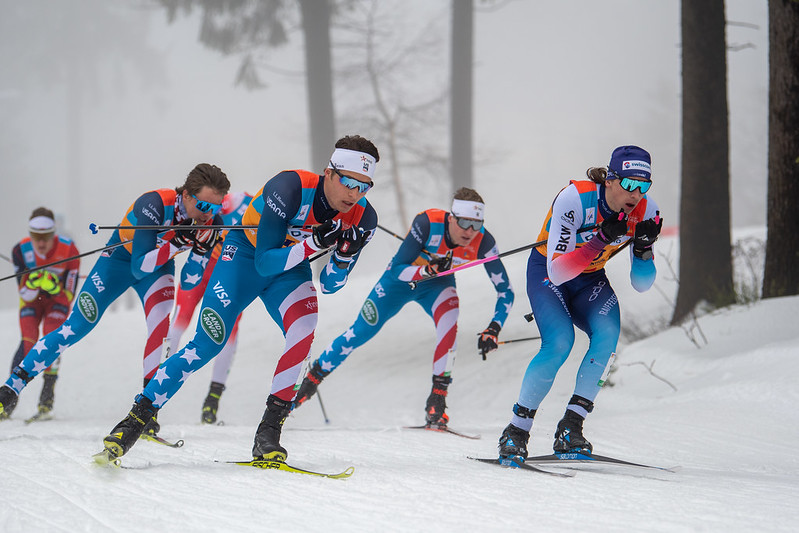
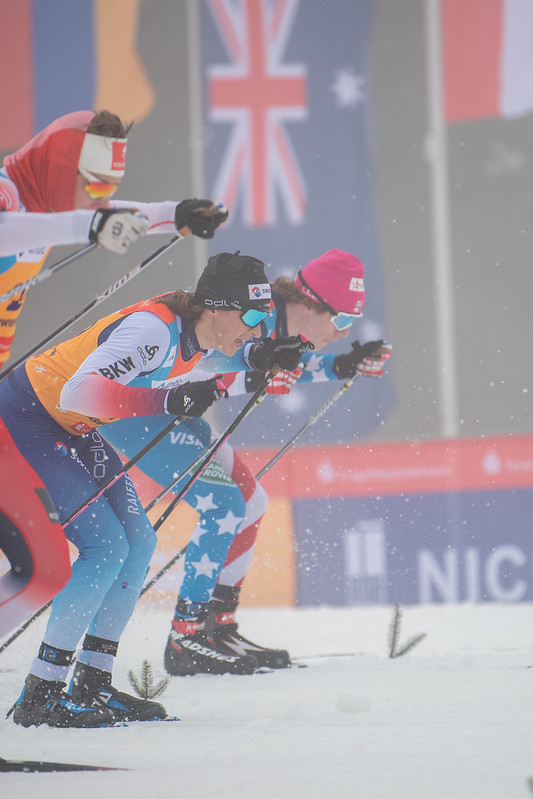
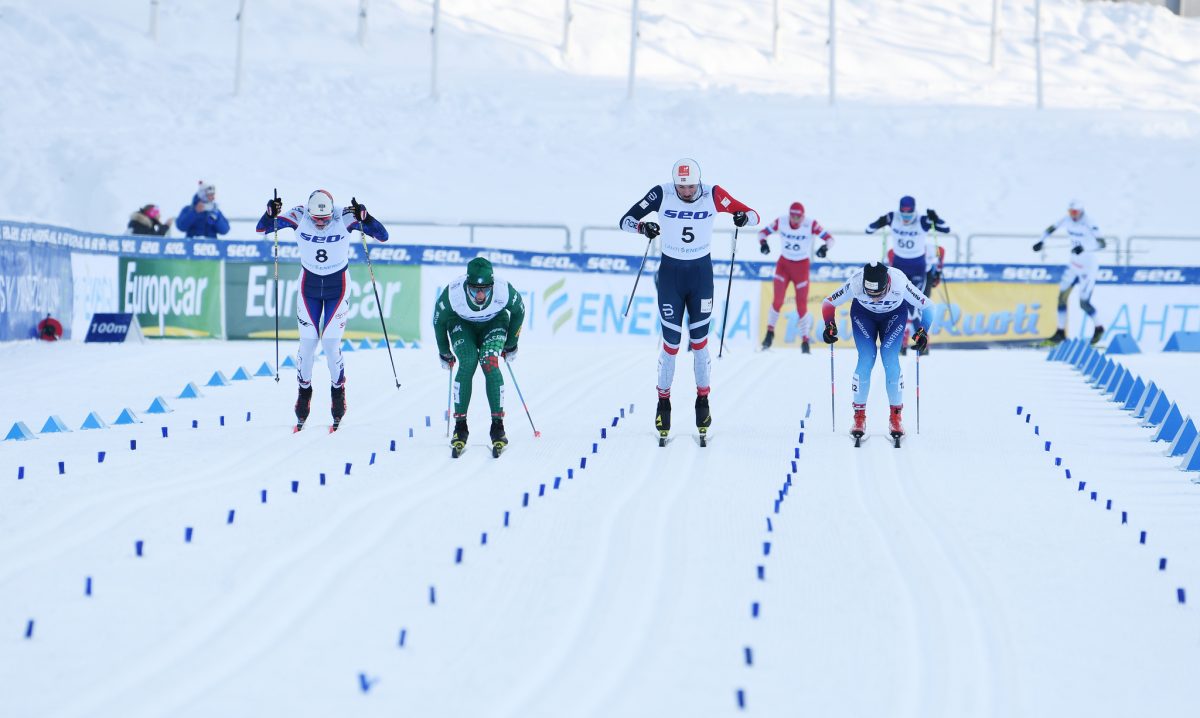
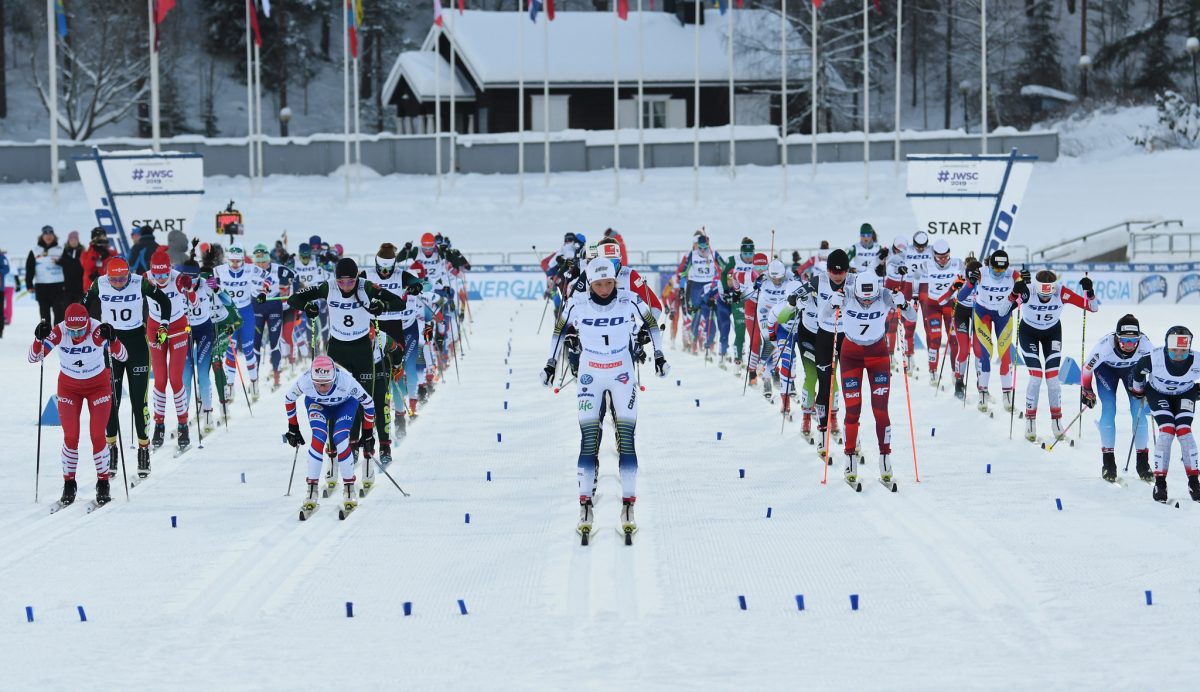
    The start of the Holmenkollen Men’s 50 k Freestyle in Oslo, Norway. (Photo: Authamayou/NordicFocus)

    For nearly two hours on Saturday, 77 men disappeared into a stubborn curtain of fog that clung to the hillsides above Oslo, their figures swallowed by the mist somewhere between the stadium and the high point at Frognerseteren. When it was over, only one emerged with his arms in the air, and it was the one freestyle specialist who had been topping shorter freestyle distance races most of the season.

    Einar Hedegart, the 24-year-old former biathlete who only committed fully to cross-country skiing in November, surged past Harald Oestberg Amundsen in the final meters to win the Holmenkollen 50 k Freestyle in 1:51:38.2 — his first victory on cross-country skiing’s most storied stage, in just his seventh World Cup start.

    “This is the greatest feeling I’ve ever had,” Hedegart said after the finish. “This is just a nostalgia stadium. [A] legendary race, almost all my heroes have won this race, and especially Petter Northug. This might be the reason why I’ve been so motivated my whole life to be a cross-country skier.”

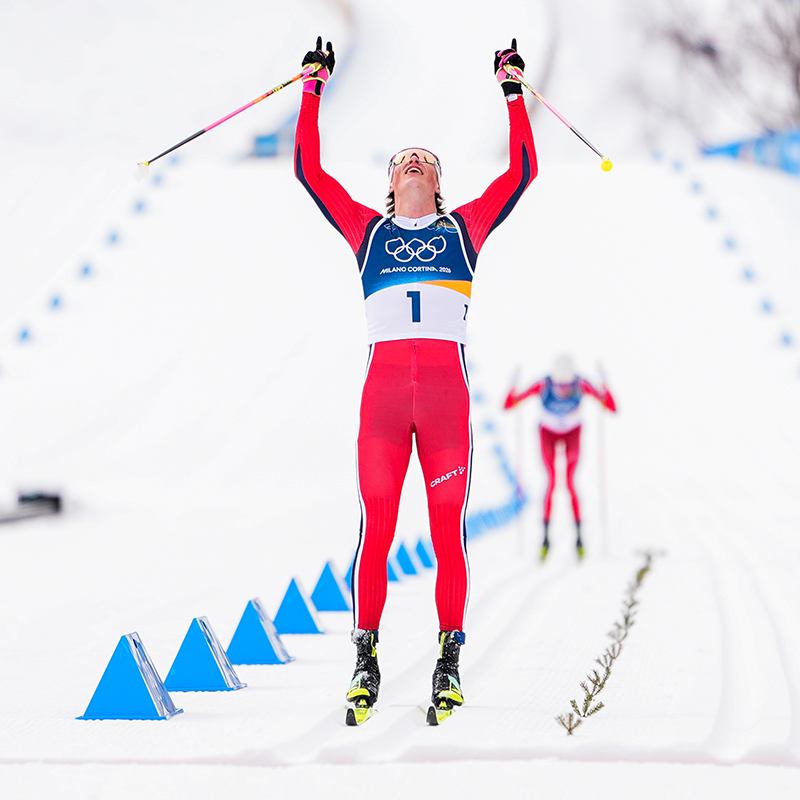
    Einar Hedegart (NOR) celebrates winning Norway’s most iconic race. www.nordicfocus.com. (Photo: Authamayou/NordicFocus)

    But the result that will echo loudest across the sport happened away from Oslo. Johannes Hoesflot Klaebo, the overall World Cup leader, was home nursing a mild concussion from a hard crash in the Drammen sprint two days earlier. Klaebo, who has already compiled a nearly perfect season, winning the Tour de Ski, all six Olympic races, secured the FIS Overall Crystal Globe, the FIS Sprint Crystal Globe, and only needed to keep racing the remaining distance races to take the clean sweep of the season with the FIS Distance Crystal Globe. BUT his absence from the start line meant zero points scored in the distance standing today. And with Amundsen’s second-place finish today, the distance crystal globe race was blown wide open: Amundsen now leads the distance standings by three points, 939 to 936, with two distance races remaining at the World Cup Finals in Lake Placid.

    Klaebo posted to Instagram yesterday: “Took a fall yesterday and hit my head pretty hard, but luckily everything is all good in the hood. Ended up with a concussion, so I’ll take some days off from both training and the internet just to make sure everything settles properly. Only got one head, so have to take good care of it.”

    He had been scheduled to fly to the United States on Sunday, but will now stay in Norway for a few extra days, hoping to recover in time for Lake Placid.

    Einar Hedegart (NOR) emerges from the fog to take the win. (Photo: Nordnes/NordicFocus)
    A Race Defined by Fog

    The Holmenkollen 50 k — first raced in 1888, a fixture of the World Cup since 1982, and a race that draws an estimated 100,000 fans to the forested hills above Oslo — returned to the calendar Saturday after a one-year absence. For the first time, the men’s and women’s 50 k races were held on the same day, the women starting 45 minutes behind the men in a format designed to create an all-day spectacle. The fog, however, had other ideas. Conditions were so thick that spectators along the course could hear the racers before they could see them.

    The course — six laps of 8.3 km with 334 meters of climbing per lap — was firm and fast after overnight salting despite an air temperature of 5.0°C. The salted, compact surface was ideal for skating, and the winning time of 1:51:38 came in roughly four minutes faster than the last time the Holmenkollen 50 k was contested in freestyle.

    Harald Oestberg Amundsen (NOR) on his way to second place. (Photo: Authamayou/NordicFocus)

    Through the first three laps, the race unfolded as a cautious tactical affair. A large pack of roughly 40 skiers stayed together, with Martin Loewstroem Nyenget, Mattis Stenshagen, and Federico Pellegrino taking turns at the front. The first athlete to make a decisive tactical move was Iver Tildheim Andersen, who changed skis early at the stadium after the third lap while the rest of the pack continued through. The fresh skis gave Andersen a burst, and when the lead group stopped for their own ski exchange one lap later, he suddenly found himself alone at the front with a roughly 15-second advantage.

    “Just stick with the field as long as possible and then hopefully be in position when the group starts swarming,” Hedegart said of his plan. “But today I was really offside, like 70 percent of the race. So I was lucky that no one took a gap.”

    The chase group — reduced to roughly eight athletes, all Norwegian once France’s Victor Lovera fell off the pace — gradually closed on Andersen through the fifth lap, with Hedegart, Simen Hegstad Krueger, Amundsen, Nyenget, Andreas Fjorden Ree, and Kasper Andersson Herland trading pulls at the front. By the time the group reached the final lap, they had swallowed Andersen, and the race became a question of who had saved enough for the final kilometers.

    Simen Hegstad Krueger (NOR) tried his best to get away for the win. (Photo: Authamayou/NordicFocus)
    Krueger’s Late Charge and Hedegart’s Final Kick

    Krueger, who was celebrating his 33rd birthday the day before, was omitted from the Norwegian Olympic team despite multiple Olympic medals in his career and was the winner of the last freestyle Holmenkollen 50 k. He drove the pace through the final lap. He pushed hard over the climbs near the iconic Holmenkollen church, stringing out the group and shedding Andersen off the back. But Krueger couldn’t sustain the pressure all the way to the finish, and as the group of seven came around the final corner and up the short, steep ramp before the descent into the home stretch, the sprint was on.

    Amundsen launched first, throwing everything he had at the final few hundred meters. But Hedegart, who had looked labored at points earlier in the race, found a gear no one could match. He came alongside Amundsen, took the lead in front of the grandstand crowd, and raised his fist in celebration as he skied across the line.

    “I felt, like, better,” Hedegart said of his position in the back of the pack through much of the race. “So I was just laying in the field, and I had to remind myself he did the same,” he added, referring to his idol Northug, whose trademark move was stalking from behind before unleashing a devastating sprint.

    Harald Oestberg Amundsen (NOR), Mattis Stenshagen (NOR), and Martin Loewstroem Nyenget (NOR), (l-r) stayed in the lead pack. (Photo: Authamayou/NordicFocus)

    Hedegart crossed in 1:51:38.2. Amundsen finished four-tenths of a second behind. Nyenget was third at +1.1. Ree took fourth (+1.5), followed by Herland (+2.1), Krueger (+3.0), Moseby (+4.8), and Andersen (+16.8) after his brave solo effort. Norway swept the top eight positions.

    France’s Lovera was the first non-Norwegian in ninth (+48.1), followed by AIN athlete Savelii Korostelev in 10th (+1:24.2).

    Zak Ketterson (USA) led the way for the Americans in the chase pack racing for 11th place; he ultimately finished 18th. (Photo: Authamayou/NordicFocus)
    Ketterson Fights for 11th in His Adopted Home

    Zak Ketterson, who spent the summer and fall living and training in Oslo, found himself in the thick of a battle for 11th place, a fight he learned about from coaches stationed along the fog-shrouded course.

    “I had heard from coaches on the side of the trail that our pack was fighting for 11th, and that was super cool,” Ketterson said. “I actually felt pretty fresh at the end and thought my finishing sprint would be pretty good, but I didn’t time it well and got really boxed in on the last couple turns into the finish.”

    Ketterson ultimately finished 18th (+1:54.2), part of a chase pack that came across the line within seconds of each other. He said everyone in the group knew a sprint was coming on the final lap.

    The fog made the tactical picture nearly impossible to read. “I couldn’t see more than 10 meters in front of me,” Ketterson said. “It definitely made it difficult to assess where I was relative to the leaders in the later laps. It also made some of the corners feel way sketchier because you couldn’t really choose an optimal line with such limited visibility.”

    For Ketterson, the race carried personal significance beyond the result. Having trained on the Holmenkollen course through the Norwegian summer and fall, he knew every climb and descent intimately. “This is definitely one of the most iconic and cool races we get to do,” he said. “It was especially special for me this year since I trained on this course all summer and fall living in Oslo. The highlight was definitely having my wife Julie and her family out there cheering me on.”

    What made the performance all the more impressive was the state of his body coming in. “I honestly feel like I am really running on fumes,” Ketterson said. “To be honest, I was not sure if I would even start this race in the morning. I felt so bad, and honestly, my body has felt super up and down in the last few weeks. I’m really curious to see how my body responds to this race. I was pleasantly surprised by how decent it felt, but I feel like the next week could go either way. Especially with the international travel tomorrow.”

    Brian Bushey (USA) gaining experience on his way to 59th place. (Photo: Authamayou/NordicFocus)
    The Rest of the North Americans

    Hunter Wonders was 45th (+5:46.9), Kevin Bolger was 48th (+6:51.3), and Brian Bushey was 59th (+12:24.9).

    Canada’s Xavier McKeever finished 41st (+5:11.4), while Thomas Stephen was 43rd (+5:18.1).

    Harald Oestberg Amundsen (NOR) takes over the FIS Distance Globe lead with just two distance races remaining. (Photo: Authamayou/NordicFocus)
    Distance Globe: Three Points

    The ramifications of Saturday’s race land squarely on the crystal globe picture. Before the race, Klaebo held a 128-point lead over Amundsen in the distance standings and a 636-point lead in the overall. With Klaebo watching from home, Amundsen’s 131-point haul (including bonus points) vaulted him into the distance lead: Amundsen now sits at 939 points, three ahead of Klaebo’s 936. Nyenget climbed to 914 in third.

    Klaebo’s overall World Cup lead, at 2,071 points to Amundsen’s 1,566, remains secure with a 505-point cushion. But the distance globe — awarded to the season’s best across distance events only — will come down to the final two races: a 10 k Classic Interval Start and a 20 k Freestyle Mass Start in Lake Placid, March 20-22.

    If Klaebo can travel to Lake Placid and race, he’ll have every opportunity to reclaim the lead. If the concussion keeps him out, the distance globe is likely to belong to Amundsen.

    Kasper Andersson Herland (NOR), who finished fifth, celebrates with Einar Hedegart (NOR), (l-r) at the finish of the Holmenkollen. (Photo: Authamayou/NordicFocus)
    A Star Made for This Stage

    Hedegart’s career trajectory is one of the season’s best stories. A junior biathlon world champion who struggled with his shooting, he drifted toward cross-country skiing after a surprising second-place finish at the Holmenkollen World Cup last season. He spent the summer training with a cross-country team while bringing his rifle to every camp, undecided. In November, after winning the popular pre-World Cup cross-country race in Beitostoelen, Norway, by a wide margin and missing eight of 20 shots in a biathlon event, he committed to leaving the rifle at home.

    Since then: an Olympic bronze in the 10 k Freestyle behind Klaebo, a team sprint gold partnered with Klaebo, victories in the Engadin Marathon, and now the Holmenkollen 50 k — a distance he had never raced at the World Cup level. He was asked whether his approach of sitting back resembled Northug’s famous stalking tactics.

    “Yeah, I felt like Petter,” Hedegart said. “So I was just lying in the field, and I had to remind myself he did the same.”

    For a race that dates to 1888, that has been won by the sport’s mythical stars, and that is contested before the King of Norway in a stadium surrounded by 100,000 fans, there is no small amount of weight to what happened Saturday at the Holmenkollen. Hedegart is, by every measure, now a cross-country skier.

    The season concludes with the World Cup Finals in Lake Placid, New York, March 20-22. Three races remain. The distance globe is separated by three points. And the world waits to see whether Klaebo can make it to the start line.


    Holmenkollen Men’s 50 k Freestyle FINAL RESULTS

    FIS Men’s Crystal Globe SPRINT STANDINGS
    FIS Men’s Crystal Globe DISTANCE STANDINGS
    FIS Men’s Crystal Globe OVERALL STANDINGS


    Love Stories Like This? Help Keep Them Coming.

    Feature stories like this one take time, access, and care to produce. If you value thoughtful storytelling and independent ski journalism, please consider becoming a Voluntary Subscriber. Your support directly fuels the work we do to cover the people, places, and moments that make our sport special.

    Join the FasterSkier community!


    Harald Oestberg Amundsen (NOR), Andreas Fjorden Ree (NOR), and Martin Loewstroem Nyenget (NOR), (l-r) share the Holmenkollen 50 k Freestyle in Oslo, Norway. (Photo: Authamayou/NordicFocus)
  • The Devon Kershaw Show: Down to the wire in the men’s Olympic 50 k

    The Devon Kershaw Show: Down to the wire in the men’s Olympic 50 k

    This episode was made possible through the generous support of our voluntary subscribers.  If you value coverage like this, please support FasterSkier with a voluntary subscription.  

    We’ll keep it short and sweet: Here’s a recap of the men’s 50 k. It was a fun race to watch and left us with a lot to discuss.

    We’ll be back after Sunday’s race. Reach us at devon[at]fasterskier.com and nat[at]fasterskier.com. We’re really grateful for all the support during the Olympics — thanks for notes and encouragement.

    A reminder: This is a homegrown podcast done by two guys working long hours and late nights. We’re also paying real money to be here in Italy. If you can, support the show and FasterSkier’s ongoing coverage with a voluntary membership. We’re also offering a bonus during the Olympics: a WhatsApp group with notes on Nat’s experiences in Italy, the food he’s eating, interview transcripts and more.

    Send nat[at]northernjournal[dot]com a confirmation of your voluntary membership and the number he should use for WhatsApp and we’ll get you signed up. You can also Venmo him directly at @nat-herz if a membership isn’t for you. We’re suggesting a minimum of $10, but we also won’t turn anyone away who wants to join because of an inability to pay.

    Help Support Our Olympic Coverage!

    FasterSkier will have our own Nat Herz on the ground at the Olympics, which, to be honest, is a very big financial lift for us. If you value the thoughtful work and access FasterSkier provides at championships like this one, please consider becoming a Voluntary Subscriber. Your support directly fuels the work we do to cover the people, places, and moments that make our sport special.

    Join the FasterSkier community!
  • Six for Six: Klaebo Makes History in 50 k Classic

    Six for Six: Klaebo Makes History in 50 k Classic

    This article was made possible through the generous support of our voluntary subscribers who have helped put our Nat Herz on the ground at the Olympics. If you value coverage like this, please support FasterSkier with a voluntary subscription.

    Martin Loewstroem Nyenget (NOR #3) and Emil Iversen (NOR #4) lead during the opening kilometers of the Men’s Olympic 50 k in Tesero, Italy. (Photo: Barbieri/NordicFocus)

    TESERO, ITALY — Sprint races can be dazzling, relay legs can be heroic, but the 50 k, especially classic, is where cross-country skiing gets carved into stone. The 50 k Classic turns strength, technique, and endurance into history, myth, and lore.

    On Saturday afternoon in Val di Fiemme, Johannes Hoesflot Klaebo skied into that mythology.

    By winning the Olympic 50 k Classic, Klaebo completed a sweep of six gold medals at these Games — six events, six victories — something no Winter Olympian had ever done before. The sprint prodigy who has built his reputation on ferocity over 1.5 kilometers now owns the sport’s most traditional crown.

    “I don’t think I even could have dreamed about this,” Klaebo said afterward.

    “In Norway, they say you must win a 50 k to become a man.” Klaebo said, smiling in the post-race press conference, “I think I am that now.”

    Johannes Hoesflot Klaebo (NOR) both the Olympic 50 k gold and a clean sweap of these games. (Photo: Vanzetta/NordicFocus)
    Feeling the significance

    The 50 k Classic is the most prestigious event in the sport with a long and storied history, and over 100 years of these championships, no one had ever put their skis on to start this race, trying to win an unprecedented 6th gold medal in one Olympic Games. But Klaebo had proven last year he could, winning six races at the World Championships on his home trails in Trondheim, Norway.

    The historic attempt was larger than cross-country skiing, too. American long-track speed skater Eric Heiden won five gold medals at the 1980 Winter Olympics in Lake Placid, New York. Klaebo was attempting to do something no athlete had ever done before at the Winter Olympics.

    Savelii Korostelev (AIN #12), Iivo Niskanen (FIN #7), Martin Loewstroem Nyenget (NOR #3), Johannes Hoesflot Klaebo (NOR #1), Harald Oestberg Amundsen (NOR #2), Emil Iversen (NOR #4), (l-r) during the early stages of the 50 k. (Photo: Vanzetta/NordicFocus)
    ​The potential spoilers

    Going into the race, the heavy favorites were without a doubt the Norwegians with Klaebo, his training partner Emil Iversen, Harald Oestberg Amundsen, and Martin Loewstroem Nyenget. However, others had to be considered as potential spoilers for the historic moment, among them, athletes on the French team, including Mathis Desloges, Hugo Lapalus, Victor Lovera, Finland’s Iivo Niskanen, American Gus Schumacher, and the Independent Neutral Athlete (AIN) Savelii Korostelev. Though it was a long shot, these other nations’ athletes could, potentially, battle for the win or at least a podium spot.

    Johannes Hoesflot Klaebo (NOR), Emil Iversen (NOR), and Martin Loewstroem Nyenget (NOR), (l-r) turned the 50 k into a three-man race. (Photo: Vanzetta/NordicFocus)
    The Shape of the Race

    The Olympic course in Tesero is not subtle. Seven laps with relentless climbing. Among them, the featured hill, the Zorzi Climb, waits like a toll booth each time the skiers re-enter the stadium.

    Heading into the race, there were 65 men on the start list, but Italy’s Federico Pellegrino, Finland’s Ristomatti Hakola, and America’s Ben Ogden all scratched.

    Once the race started, the first lap went by without much drama, though the field began to stretch. As they entered the stadium after one loop, over 30 skiers were within 20 seconds of the lead. By the end of lap two, that front pack had reduced to 20 skiers within 23 seconds of the lead, and on lap three, things really began to take shape.

    Early on in lap three, two favorites, Niskanen (FIN) and Amundsen (NOR), who had been at the front of the race, pulled out. The French favorites and American Schumacher also began to lose contact with the front-runners. Only Korostelev was able to maintain contact until even he could no longer keep up with the three top Norwegians.

    Martin Loewstroem Nyenget (NOR) did much of the work at the front. (Photo: Vanzetta/NordicFocus)
    By the middle of the race, there were three

    By lap four, it was unmistakable: Nyenget, Iversen, and Klaebo were alone, three red suits moving in steady formation.

    From the stadium, the mood was less frantic than historic, almost strangely calm.

    “The sun shone down… as if God had ordained the great Klaebo, winning his six in a row… I mean, it really was a beautiful day,” said FasterSkier’s Nat Herz, who was on the ground in Tesero. “I think people were just pretty relaxed watching this three-man Norwegian time trial as it went around the course… These guys have the best technique, the best materials, the best skis, the best fitness, and they did exactly what they set out to do.”

    The crowd was not roaring every lap. It was watching. Waiting.

    “Nyenget and Klaebo definitely gave everyone a good show, and it was tense to see. Was Klaebo going to be able to do this incredible accomplishment?”

    There was little theatrics in their separation from the field — no dramatic surge, no visible cracking. Just a grinding tempo that only they could sustain.

    Even the question of ski exchanges became a collective calculation. While much of the field ducked into the pit lane for fresh skis after lap four, the Norwegians skied past the ski exchange zone each lap.

    A Norwegian train. (Photo: Barbieri/NordicFocus)

    “Martin made the choice of not changing skis,” Klaebo said. “Emil and I just followed because we didn’t want to gamble.”

    In long races, fortune often hides in such decisions. The snow was changing; the sun had warmed the surface. Fresh skis could have been salvation or ruined a chance at gold.

    “I think it was the right decision,” Klaebo said in the press conference afterwards about the three Norwegians not switching skis.

    Johannes Hoesflot Klaebo (NOR) makes history as he crosses the line of the Men’s 50 k Classic. (Photo: Barbieri/NordicFocus)
    Saving Something for the Hill

    Through lap six, Nyenget did much of the visible work. Klaebo shadowed him, conserving every drop of energy he could.

    “I wish I was able to help them a little bit,” he said. “But when they asked me if I could go in front, I said no, because I was too tired.”

    It was not false modesty, Klaebo’s Olympic schedule had been more than the other two and fifty kilometers taxes even those who make winning look inevitable.

    “My plan today was just try to save as much energy as possible,” he said. “I needed to play on my strength… the last few hundred meters.”

    On the final lap, Klaebo came to the front, as if to take measure of the other two Norwegians, but in doing so, he created a gap on Iversen. Was the race for gold now just down to two? The answer was yes, as the rubber band had clearly been snapped for Iversen, who began to drift backwards from the leading pair.

    The decisive moment arrived where many had expected it would: on the Zorzi Climb. On the preceding descent, Klaebo rose from his tuck, adjusted his pole straps, and as they exited the sweeping left-hand turn at the base of the final climb, Klaebo pulled alongside Nyenget before beginning to accelerate. Not explosively — this was the closing act of a two-hour effort — but with the control of someone who knew exactly how much he had left.

    Nyenget followed for a few strides. Then he did not.

    Behind them, Iversen skied alone to bronze, sealing a Norwegian sweep.

    A moment of reflection at the finish for Johannes Hoesflot Klaebo (NOR). (Photo: Barbieri/NordicFocus)
    A Private Moment

    At the finish, Klaebo crossed the line and sat down alone on the snow. There was no theatrical collapse, only a quiet reckoning.

    “For me, it’s the best feeling, the last 200 meters before I cross the finish line knowing that I’m going to win,” he said.

    This Olympics, he suggested, had been built on deliberate choices, in training, in team structure, in how he and his father organized his life around the sport.

    “He has probably sacrificed as much as I have done,” Klaebo said of his father.

    Sacrifice is not his preferred word. He calls them choices. But the effect is unmistakable: a skier who once seemed specialized has become complete.

    Emil Iversen (NOR) enjoys his bronze medal and the sunshine after a lot of hard work to get back to the front of the sport and this moment. (Photo: Vanzetta/NordicFocus)
    Racing in His Time

    For the rest of the field, competing in the Klaebo era carries a strange duality, almost a frustration braided with admiration.

    “Of course, a bit,” Nyenget said when asked whether it is annoying to race alongside him.

    “But it’s more motivating as well. [Klaebo] is pushing us to be better every day.”

    Iversen echoed the sentiment.

    “I think it’s just fun to compete with the best skier ever,” he said.

    Across these two weeks, Klaebo has made dominance look procedural, yet his rivals know the margins are real, the preparation exhaustive. He bristles at the idea that this is inevitable.

    “I like myself way better when I’m winning than when I’m losing,” he said.

    Gus Schumacher (USA) gave everything he had to this sixth race at these Winter Olympic Games. (Photo: Vanzetta/NordicFocus)
    The American Effort

    For the United States, the 50 k carried a different emotional weight.

    Gus Schumacher, who had spent the early races in these Games chasing form and momentum before winning silver in the Team Sprint with Ben Ogden, finished 13th. He described the psychological toll of racing in every event.

    “There’s been a pretty heavy mental load the last two weeks,” Schumacher said. “If I’ve got a flame, it was ripping a couple days ago… halfway through the race, it felt like a little candle.”

    He has raced all six events, too, though with different outcomes.

    “I really don’t understand how you can ski 50 k so well and also sprint so fast,” Schumacher said of Klaebo. “I don’t really feel like there’s another athlete in the world that can compare to that scope of athleticism.”

    Hunter Wonders (USA) also pushed his body to its limits in the race. (Photo: Vanzetta/NordicFocus)

    Hunter Wonders placed 35th and spoke candidly about the physical reckoning.

    “I’m alive barely,” Wonders said. “I didn’t think I was gonna finish there for a little while.”

    Cramps seized him in waves — hips, hamstrings, forearms — and yet he finished.

    “I completed a race that four years ago I was really chomping at the bit to be able to compete in,” he said.

    Antoine Cyr (CAN) “gave everything” to the final men’s race in the Olympics. (Photo: Barbieri/NordicFocus)
    The Canadian Outcome

    Canada placed two men inside the top 20.

    Antoine Cyr finished 11th, just outside the top 10 he had targeted.

    “I gave it everything,” Cyr said. “It’s such a hard course.”

    He pointed to the Zorzi Climb and the long drag back to the high point of the course after coming through the stadium, efforts that stretch toward six minutes, rare in modern championship layouts.

    “It’s really tough,” he said.

    Thomas Stephen finished 17th, steady and controlled in conditions that demanded patience. While he did not step into the medal conversation, his result underscored the depth Canada has built in distance racing and marks what is possible in future years.

    Martin Loewstroem Nyenget (NOR), Johannes Hoesflot Klaebo (NOR), and Emil Iversen (NOR) (l-r) share the Milano-Cortina Olympic Winter Games 50 k Classic podium in Tesero, Italy. (Photo: Barbieri/NordicFocus)
    What Remains

    Klaebo plans to rest for a few weeks before racing again in Lake Placid.

    “That’s the plan,” he said.

    There will be time later to measure what six-for-six means, how it reshapes record books, and how it reframes conversations about the greatest Winter Olympians. For now, it exists as a bright fact in the thin mountain air.

    The 50 k endures because it asks the oldest question in endurance sport: what is left?

    On Saturday, Johannes Hoesflot Klaebo had something left. Enough to attack on the final climb once more. Enough to once again finish alone down the final meters. Enough to make something mythical and historic feel ordinary and predictable.


    Olympic Men’s 50 k Classic – RESULTS


    Help Support Our Olympic Coverage!

    FasterSkier will have our own Nat Herz on the ground at the Olympics, which, to be honest, is a very big financial lift for us. If you value the thoughtful work and access FasterSkier provides at championships like this one, please consider becoming a Voluntary Subscriber. Your support directly fuels the work we do to cover the people, places, and moments that make our sport special.

    Join the FasterSkier community!

     

    Emil Iversen (NOR), Johannes Hoesflot Klaebo (NOR), and Martin Loewstroem Nyenget (NOR) come through the stadium to the delight of the crowd. (Photo: Vanzetta/NordicFocus)
  • World Juniors: Canada puts two in top ten as Russia sweeps 5/10 k classic; Will Koch top American in 13th

    The 2022 FIS Junior/U23 World Ski Championships trip has been made possible through support from the National Nordic Foundation (NNF), which has identified this invaluable opportunity for developing athletes as one of its “Pillar Projects”. You can support the NNF and the next generations of America’s top skiers by making a donation here.

    Friday at 2022 FIS Junior World Ski Championships in Lygna, Norway, marked the phase that Steve Fuller, on site to take photographs qua Flying Point Road, calls “the ‘groundhog’s day’ stage” of the championships. “Things are happening so fast that you’re not quite able to get caught up with each day before you get up and do it all over again,” Fuller wrote on Instagram.

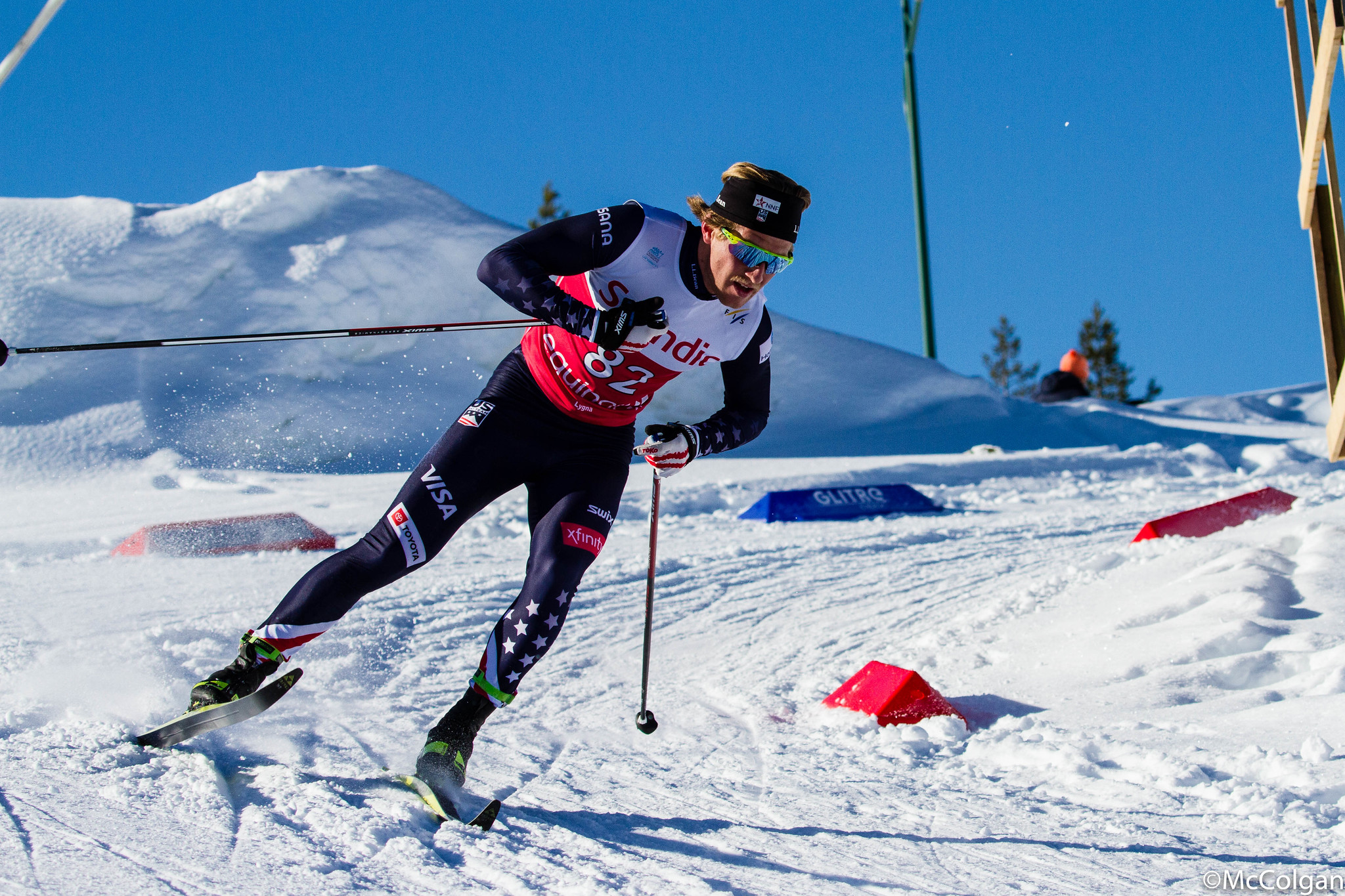
    Will Koch races to 13th in the 10 k classic during the 2022 Junior World Ski Championships in Lygna, NOR. (Photo: John McColgan)

    Undeterred, the Americans headed out on course Friday morning for their seventh and eighth races in four days. The coaches and wax techs (see the back row in the lead picture of the relay story) prepped skis for their eighth championship race within less than 72 hours. At the end of the day, Russia took a combined four out of six podium spots; Canadian skiers Xavier McKeever and Jasmine Drolet placed sixth and eighth, respectively; and Will Koch and Sydney Palmer-Leger led the way for the Americans in 13th and 19th.

    Women’s 5 k Classic

    Let’s back up. The women again had the day’s first race, a 5-kilometer interval-start classic. The first starter headed out on course, over a single lap of yesterday’s 5 k course, at 11 a.m. The official results describe conditions as somewhere between moderate and perfect: air temp of -2 C, snow temp of -3 C. Skies were overcast for the women’s race, but the sun came out for the men; as USST Development Team Coach Greta Anderson told FasterSkier later Friday, conditions sped up noticeably by the afternoon.

    82 starters later, Dariya Nepryaeva, who started at the sharp end of the field in bib no. 80, had logged the day’s fastest time, crossing the line in 14:30.1. She was closely followed by her compatriot, Elizabeta Bekisheva, in second, 2.9 seconds back. Emma Kirkeberg Mørk of Norway was close behind for third, 4.0 seconds back.

    Sydney Palmer-Leger skis into the top-20 in the 5 k classic during the 2022 Junior World Ski Championships in Lygna, NOR. (Photo: flyingpointroad.com)

    The day’s fastest North American finisher, and fastest Jasmine in the field, was Jasmine Drolet of Revelstoke, B.C., in eighth, 21.5 seconds back. She was followed in the North American standings by American Sydney Palmer-Leger (University of Utah/Park City, Utah) in 19th (+51.3), and Canadian Jasmine Lyons in 26th (+1:03.3).

    “I felt pretty good. I really like classic skiing and my goal was to give it all I had,” said Drolet in a press release from Nordiq Canada. “You only ski the lap once, so the key was to just go hard the whole time. We had amazing conditions, perfect for classic skiing so it was a good day.”

    Behind Lyons were the two Ninas, Nina Schamberger (Summit Nordic Ski Club/Leadville, Colorado) in 31st (+1:14.2) and Nina Seemann (Dartmouth Ski Team/Craftsbury, Vermont) in 36th (+1:23.0). Annie McColgan (University of Vermont/Bend, Oregon) was 40th (+1:27.3). Canadian athletes Sarah Cullinan (44th, +1:34.2) and Tory Audet (59th, +2:08.2) followed.


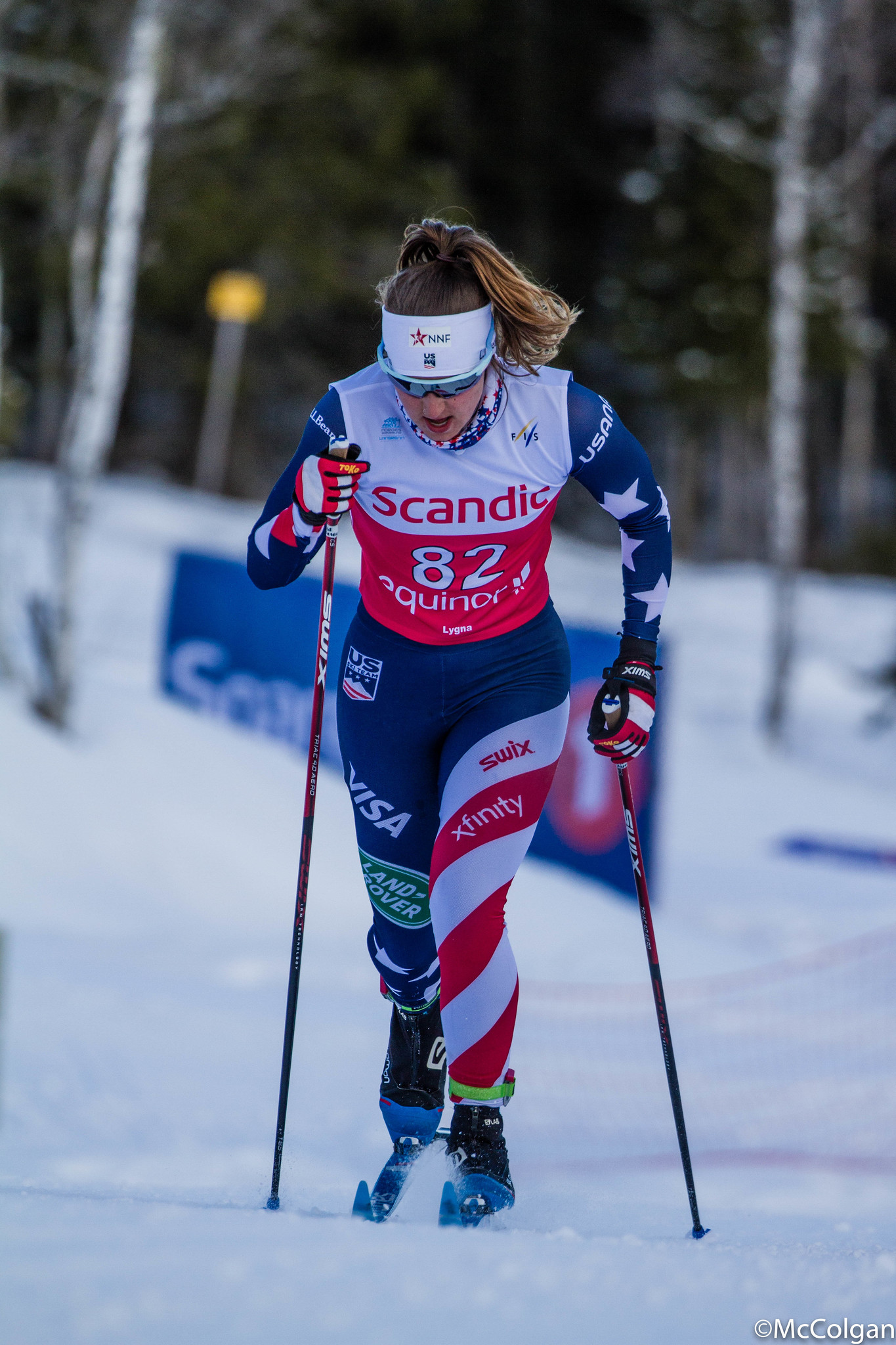
    Annie McColgan races the 5 k classic in Lygna, NOR, her first start of the 2022 Junior World Ski Championships. (Photo: John McColgan)

    McColgan radiated enthusiasm when she talked with FasterSkier following her first race at these championships. “It was nice to have everyone cheering out there, and my parents were here so it was really, really fun. It was really cool,” McColgan said.

    McColgan also provided insights on the course, describing it as “a really interesting 5k” with plenty of rolling terrain, but not many opportunities for recovery. “There’s a lot of steep little hills that you just have to be really good at… But it also is 16 minutes long. So you kind of have to make that balance [with energy expenditure]. And then the final climb was so brutal.”

    Men’s 10 k Classic

    The men again had the day’s second race, starting a two-lap, 10 k interval-start classic race at 1 p.m. local time. Taking athletes’ distance points as an informal form chart, in a field with 101 athletes the podium finishes came, relatively unsurprisingly, from bibs no. 90, no. 100, and no. 101. The gold medal on Friday went to Russian Saveliy Korostelev, the penultimate athlete on the course. Korostelev posted the fastest split time at 3 kilometers, at 5 kilometers, and at 8 kilometers, crossing the finish line in 26:15.8.

    Will Koch leads the American junior men with a 13th place finish in the 10 k classic during the 2022 Junior World Ski Championships in Lygna, NOR. (Photo: flyingpointroad.com)

    Korostelev enjoyed a hefty advantage over silver-medal finisher Niko Anttola of Finland, who finished 21.4 seconds back. Anttola ranked one to eight seconds behind Alexander Ivshin of Russia at all intermediate checkpoints, but skied the final two kilometers just barely faster. When Ivshin, the day’s final starter, crossed the line, he had fallen 0.8 seconds behind Anttola and had to settle for third.

    Put another way, Russia came within a second of going 1–2 in both the men’s and women’s races. They instead had to settle for first and second in the women’s race, and first and third in the men’s.

    Shortly behind the podium, Xavier McKeever of Canmore, Alberta, skied a strong race to finish sixth, 52.4 seconds back of Korostelev and roughly 30 seconds off the podium. It was McKeever’s best international result since, well, Tuesday, when he was fifth in the men’s 30 k mass start skate. McKeever’s sixth today tied Palmer-Leger’s sixth, from Tuesday’s women’s 15 k skate, for the second-best North American individual result of these championships.

    “I am stoked to be in the top-10 again,” McKeever told Nordiq Canada in a press release. “I was getting splits that I was close to the podium in the first lap, but I just couldn’t keep the high pace that I started with. Honestly, I feel like the podium is still a fair bit away, but today just motivates me more to make the steps toward being able to contend for a medal. … I have been able to build my confidence over the course of this season. After last year, it was instrumental for me to refocus on putting in the hard work each and every day, which I think has helped me race with more confidence than ever before.”

    McKeever was followed by his countrymen Max Hollman (Thunder Bay) in 17th (+1:28.8), Derek Deuling (Whitehorse) in 19th (+1:31.5), and Thomas Stephen (Calgary) in a tie for 26th (+1:40.0).

    Brian Bushey races the 10 k classic during the 2022 Junior World Ski Championships in Lygna, NOR. (Photo: John McColgan)

    Will Koch (University of Colorado/Peru, Vermont) led the way for the Americans, finishing in 13th (+1:23.4). He was followed by Alex Maurer (University of Colorado/Anchorage, Alaska), also 26th (+1:40.0); Brian Bushey (University of Utah/Waitsfield, Vermont) in 36th (+2:00.2); and Finn Sweet (University of Vermont/Waterbury, Vermont) in 47th (+2:11.3).

    Thoughts from the coach

    Greta Anderson is in Lygna at her third World Juniors as a coach or tech, her first since assuming her current coaching position with the U.S. Ski Team. (Disclosure, Anderson was this reporter’s coach in APU Masters in 2014–15, and has remained a close personal friend ever since.)

    Asked what she saw about today’s races, Anderson noted, “They were really fun to watch. Between FIS live timing and back split, the radios were pretty lively. One thing I did learn this year, and this is more than I’ve seen in the past, is that our athletes – every single one has the raw speed to compete at this level. We’re working on the durability portion of it. I think the top athletes in these races often are running negative splits in a big way; I would have to sit down and look at percentages. I’m sure we’ll do that at some point in time. But you know, the speed is there early on, we have very good placement, and then we need to figure out how to speed up just a little bit more. But that’s, you know, that’s been a big step for us as a country.

    “Will Koch, obviously very, very strong today. Brian Bushey came out on the top end of ten places being within four seconds, or eight places within four seconds maybe. So you know, really phenomenal. … Annie McColgan had her first ever World Juniors race today. And that’s always really fun and special to watch. I think often athletes come away seeing like, ‘wow, there’s another level,’ and it can be really motivating for the following year.”

    Sydney Palmer-Leger leads the junior women during the 5 k interval start classic. (Photo: John McColgan)

    Turning to Schamberger, Anderson observed that the 16-year-old has “had a pretty heavy week of racing so far. She’s had three starts, and the first day was not what she wanted. And the second day she had the gift of getting redemption the very next day, which I think is one of the best things athletes can have. And she was really happy with how she skied the relay, a big smile on her face. And then a really good race today. It’s fun to watch athletes – the moment that they realize they’re skiing at that level. Because we know they can do it, and we watch it, but that aha moment of ‘Oh, okay, in the world, this is where I am.’ That moment is really cool. It’s one of my favorite parts of my job for sure.”

    Anderson also described the environment at the venue more broadly, highlighting the effects of vocal parental support. “There’s quite a few parents here from the U.S.,” she said.

    “And Americans are really loud compared to other countries, and it’s probably taken as obnoxious, but I really appreciate it. We can always hear the Americans. It’s fun to stand by them and listen to them get all excited. Next to the parents during the relay is one of my favorite places to stand.”

    In that vein, Anderson concluded, “I look around, and I’m so proud to be an American coach. I’m so proud of the American skiers; there’s not a single other nation I would – I’m really glad that I work for our staff. And I think our athletes are really glad that they ski for the U.S.A. I don’t think they look around and think, like, ‘I wish I was on that team,’ or, ‘I wonder what that team is up to.’ We’re definitely in that, ‘We’re Americans and we’re here to beat you. Or at least die trying’ mode. And that’s pretty fun.”

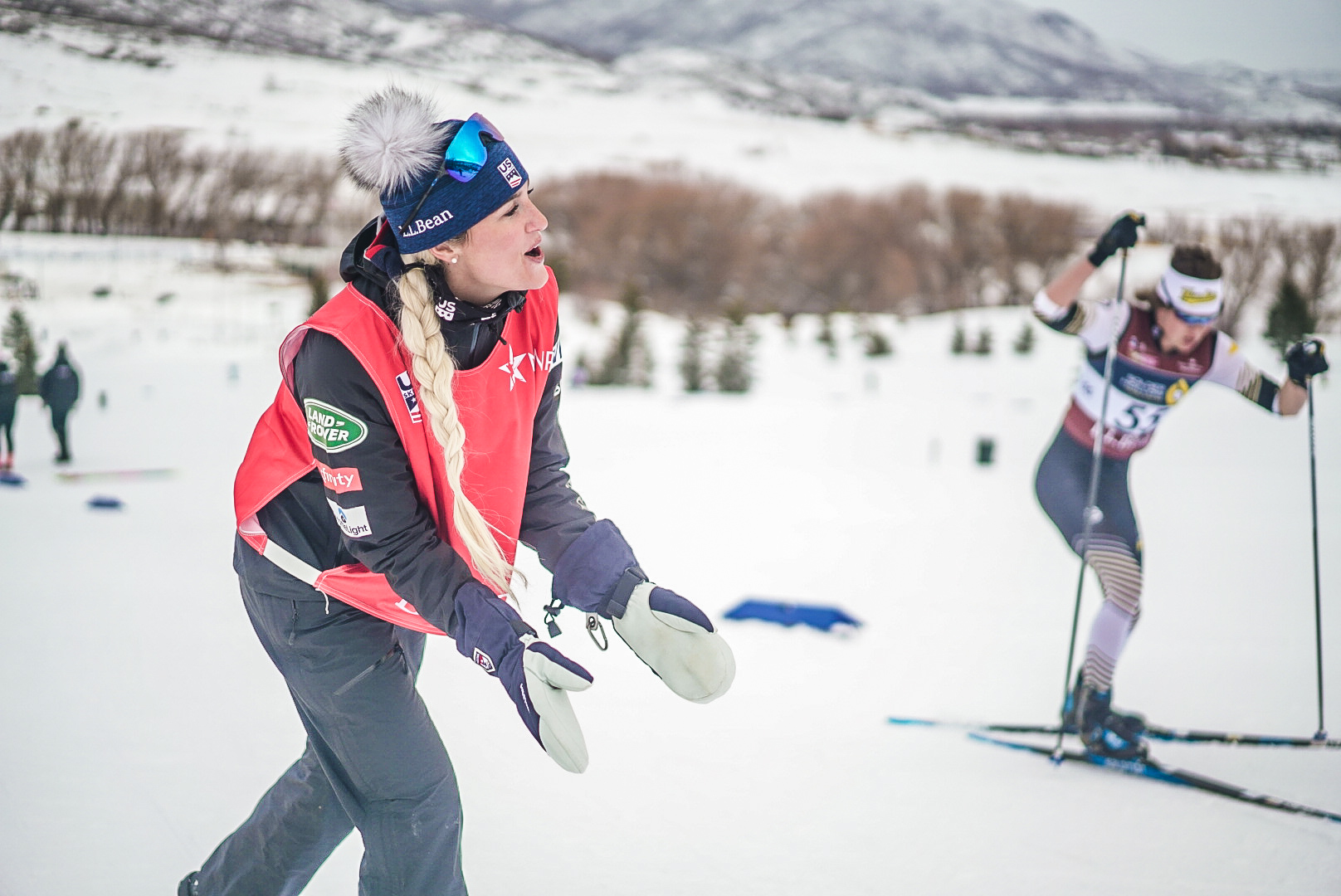
    U.S. Ski and Snowboard Development Team Coach Greta Anderson encourages athletes during the men’s 30k distance race during the 2022 U.S. Cross Country Championships in Soldier Hollow. (Photo: Tobias Albrigtsen / @untraceableg)

    Racing continues tomorrow with skate sprints for U23 athletes, both genders, before wrapping up Sunday with both men’s and women’s U20 skate sprints and the U23 mixed relay, sending athletes and techs out with three races, two techniques, and a combined sixteen sprint heats on the final day of racing. Groundhog’s Day, indeed.

    Today’s results: women | men

    World Juniors links and information:

    Home page and general info | race program | results and live timing (all races) | streaming (only for Thursday through Sunday’s races, purchase required)

  • Junior World’s Relay: In Photos

    Junior World’s Relay: In Photos

    Junior Men’s Relay:

    Luke Jager for the US, bib 1, a deep breath before the scramble leg beat down. (Photo: Doug Stephen)


    Luke Jager: onward. He gapped the field by 25 seconds on the scramble leg. (Photo: Doug Stephen)


    Ben Ogden for the U.S. on his solo journey to keep his team way off the front. (Photo: Doug Stephen)


    Ben Ogden tags to Johnny Hagenbuch for the first skate leg. (Photo: Doug Stephen)


    Gus Schumacher: The Closer. (Photo: Doug Stephen)


    The Win. (Photo: Doug Stephen)


    Canada’s Turn

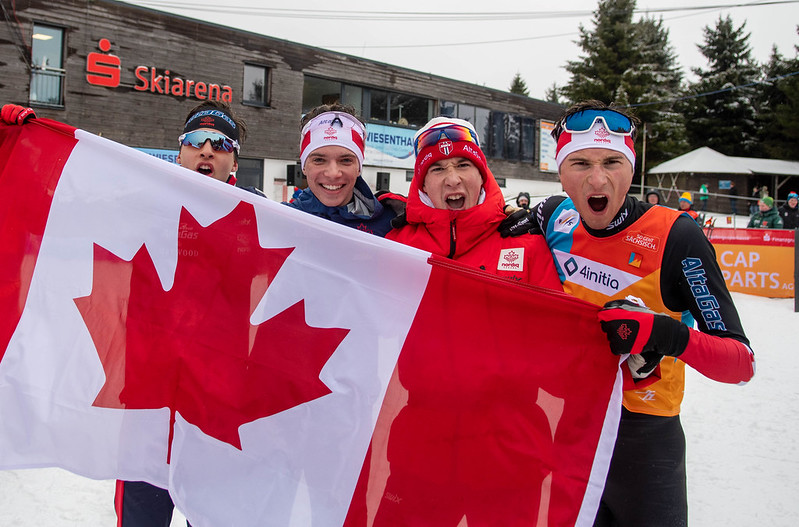
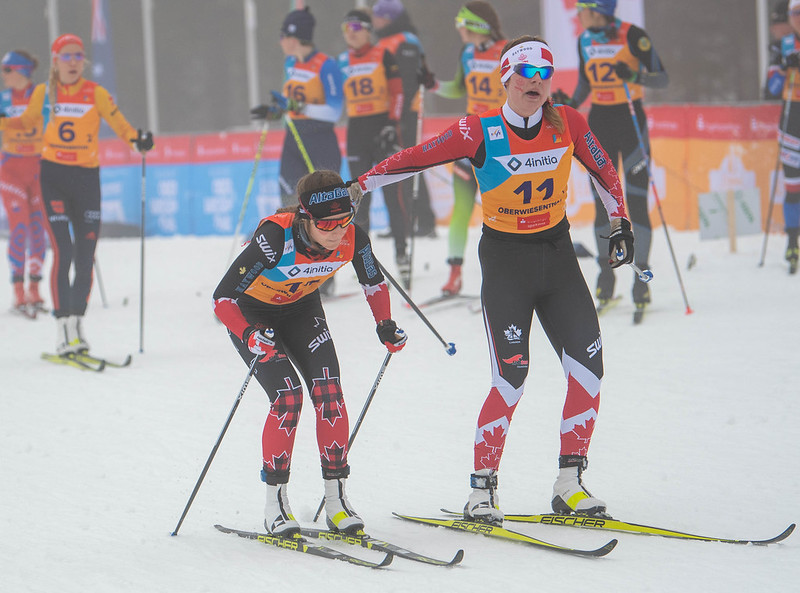
    From left to right: Canada’s Olivier Léveillé, Tom Stephen, Xavier McKeever, and Rémi Drolet. Second overall in the World Junior’s 4 x 5 k relay. (Photo: Doug Stephen)


    Bib 11, Xav McKeever for Canada fighting for position on the scramble leg. (Photo: Doug Stephen)


    Leg 2, Canada’s Olivier Léveillé leading the chase. (Photo: Doug Stephen)


    Where they belong: Canada’s Tom Stephen taking the pull on the front chase group. (Photo: Doug Stephen)


    Rémi Drolet — closing it out. (Photo: Doug Stephen)


    Drolet, almost there. (Photo: Doug Stephen)


    The maple leaf group hug. (Photo: Doug Stephen)


    Junior Women’s Relay:

    Sydney Palmer-Leger (bib 4) during the scramble leg. (Photo: Doug Stephen)


    Kendall Kramer on the second classic leg. (Photo: Doug Stephen)


    Leg 3 for the U.S., Sophia Laukli (Photo: Doug Stephen)


    Novie McCabe on the fourth leg for the U.S. (Photo: Doug Stephen)


    The U.S. takes second overall. (Photo: Doug Stephen)


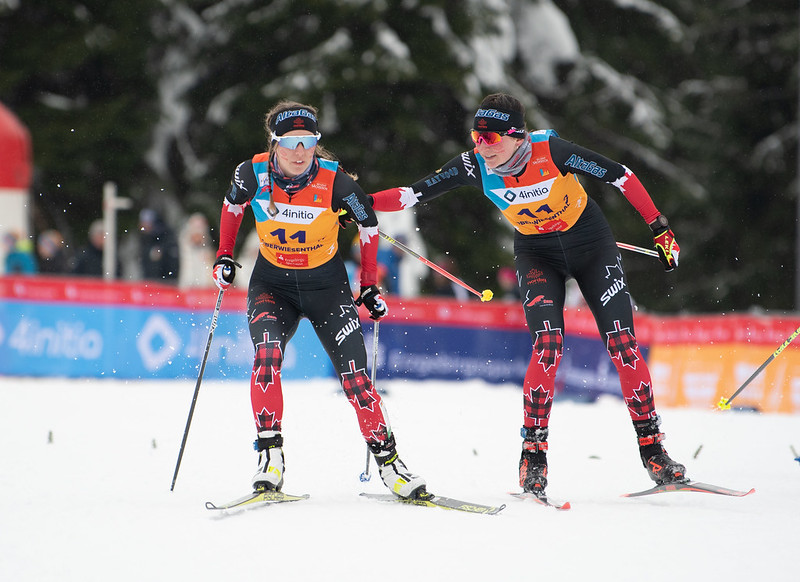
    Canada’s Molly Miller tagging Jasmine Drolet: Leg one to two. (Photo: Doug Stephen)


    Leg three to four: Canada’s Lilian Gagnon tags Elizabeth Elliott. (Photo: Doug Stephen)


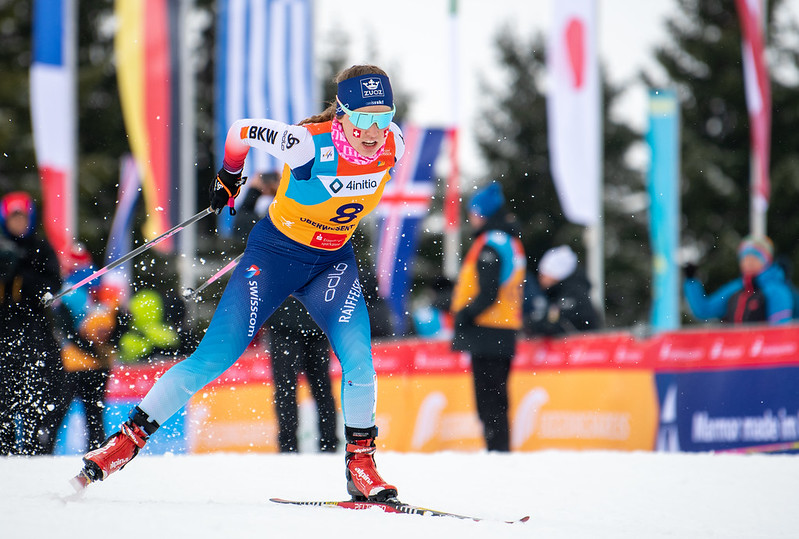
    Let’s not forget the Swiss who had a fine day. Here’s Swiss skier Anja Lozza closing down for the team win. (Photo: Doug Stephen)

    Watch the races here on the FIS site.

    Doug Stephen has more photos here.

  • Junior World’s Relay: U.S. Women 2nd, U.S Men 1st, Canada 2nd

    Junior World’s Relay: U.S. Women 2nd, U.S Men 1st, Canada 2nd

    Friday was a much anticipated day across the Atlantic from the Oberwiesenthal, Germany: Junior World’s relay day. 

    Junior Women’s 4 x 3.3 k Relay

    For the U.S. junior 4 x 3.3 k relay, oh-so-close was last year’s World’s just off the podium fourth place performance. Twelve months later and a loaded team featuring (in this order) Sydney Palmer-Leger, Kendall Kramer, Sophia Laukli, and Novie McCabe, the group skied themselves into second overall, 4.9 seconds off the winning time of Switzerland in first. The Swiss won in 35:08.6. Sweden placed third, 14.2 seconds back. 

    The tag to the U.S. at 9.9 k saw the team 27.8 seconds down on Switzerland, followed by the Swedes about six seconds further behind. Around 11 k, the Swedes and the U.S. were paired together in the hunt. McCabe eventually began to pull ahead into a secure second place position. In 3.3 k, McCabe locked in and chipped away nearly 23 seconds on the Swiss — who no doubt were feeling the pressure as McCabe gapped up. 

    Canada’s Molly Miller, Jasmine Drolet, Liliane Gagnon, and Elizabeth Elliott placed ninth (+1:25.8).  

    Eighteen teams started the race, with Germany and Poland disqualified for not following the marked course. 

    Junior Women’s Relay Results 

    Junior Men’s 4 x 5 k Relay

    The U.S. juniors, Luke Jager, Ben Ogden, Johnny Hagenbuch, and Gus Schumacher had experience on their side for Friday’s relay. Last year the foursome clinched a first ever U.S. relay win at World Juniors. That victory came down to a Schumacher anchor leg in which he outpaced the Russians by 3.9 seconds to the line. 

    This year, in 54:54.9, the U.S. built a cushion of 35.5 seconds on second place Canada — which was the surprise, perhaps, of these Junior Worlds. (More on that in a few paragraphs.)

    But, it’s never over until it’s over. However, Jager ended this sooner than anticipated. He pegged the scramble leg, putting 25 seconds into second place Germany when he tagged Ogden. It was game over as the U.S. added a few more seconds on each successive leg in their win. 

    “Today ended up perfect, but in the morning we didn’t know that would happen, and with the past 2 years of great relays, we had a lot of pressure on ourselves to do it again,” Schumacher emailed. “We’d looked at the teams quite a bit, and were glad with how they looked, especially with a strong American skier to match every other strong German and Norwegian leg. I myself was fairly confident with a lot of different scenarios on the last leg, but I knew that it depended on the first 3 legs going well, and those boys exceeded my expectations in a big way. They’ll say they had great skis and that’s why they were able to splinter a stacked field, but really these boys are some of the best skiers in the world and when it comes together perfectly (which it seems to often do on relay day), there’s not much match for them. I’m so proud of this team for making a 3rd relay podium look almost easy, because it definitely isn’t. The execution out of them was unparalleled today and I’m so glad to be a part of this team. Also all of us were so proud and stoked for our women’s silver medal this morning and also the Canadian men’s silver medal! Both were great races and it’s great to see them get such good placement here. Now we’re all looking forward to some North American world cups, especially Minneapolis. Go USA!!”
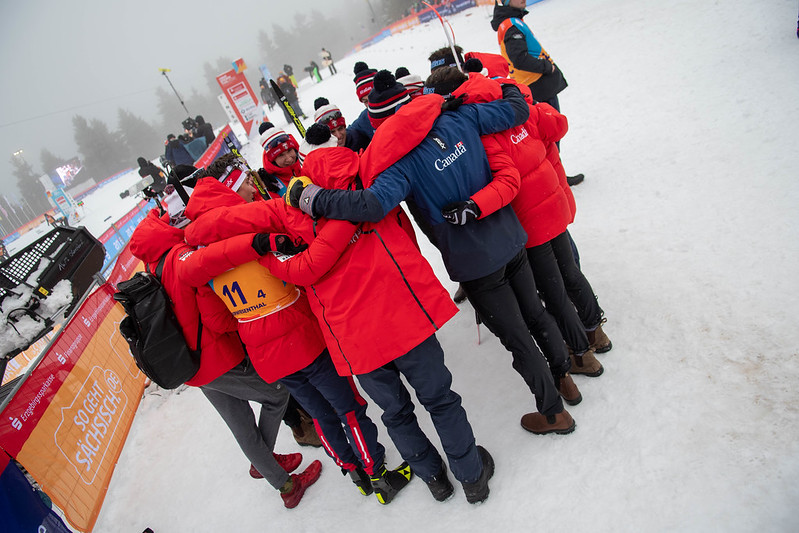
    Let’s get back to Xavier McKeever, Olivier Léveillé, Thomas Stephen, and Remi Drolet; starting in bib 11 for Canada. It clicked today for this group. Good skis? Surely. Inspired by their U.S. neighbors? Perhaps. Stoked by their on-site talisman Devon Kershaw (in Germany to coach)? Does that need an answer?

    No matter how you spin it, this was the race of the day. Certainly unexpected, and certainly deserved for a program rebounding from low funding and in the midst of a rebuild.

    At the 10 k mark, Italy, at 30.8 seconds behind the U.S., was trailed by Norway, Switzerland, Canada, and France — all within roughly seven seconds. That five team pack moved together through the final tag off at 15 k. Glued together through 16.8 k, only Norway fell off the pace. 1.5 k later, and it was Italy’s turn to feel the burn, as they fell off too. 

    That left Canada and Switzerland 10 seconds ahead of the now trailing Italians. By the time the next k had clicked by, Drolet, who was coming off a stellar fourth in the junior men’s 30 k mass start skate, made it real: he gapped the Swiss by 20 seconds. 

    It’s worth mentioning again – Canada in second overall, 35.5 seconds off the winning pace. The Italians rebounded as the Swiss fell back. Italy took third (+55.4), the Swiss placed fourth (+1:34.4).

    “This is absolutely incredible,” Drolet said to Nordiq Canada after the race. “We were so stoked to start this race, and we told ourselves last night we are going to go for the medal today. This is one of the best, if not the best, World Juniors for a Canadian team in terms of results. Knowing everyone on the relay team had a top-30 at the Championships we knew this was doable.”

    Adding his own poetry to the historic relay for Canada, “People don’t really understand what went down today, but it is insane,” Kershaw told Nordiq Canada.

    Junior Men’s Relay Results 

  • Mass Start day at World Juniors: Remi Drolet 4th, Schumacher 5th…Laukli 5th, McCabe 9th (Includes Audio Interview with USST Coach Bernie Nelson)

    Mass Start day at World Juniors: Remi Drolet 4th, Schumacher 5th…Laukli 5th, McCabe 9th (Includes Audio Interview with USST Coach Bernie Nelson)

    Helen Marie Fossesholm of Norway taking the junior women’s 15 k mass start skate. (Photo: Doug Stephen)

    Wednesday in Oberwiesenthal, Germany World Juniors continued with a 15 k mass start skate for the women. 

    Junior Women’s  15 k Mass Start Skate

    Norway’s Helene Marie Fossesholm (18) won her second race of these championships by taking the mass start skate in 35:55.6 minutes. Fossesholm also won the 5 k interval start classic race on Monday. Poland’s Izabela Marcisz placed second 1:09.3 back. Marcisz also won a bronze in the 5 k classic. Switzerland’s Siri Wigger skied herself into third (+1:10.6). The theme continues, this was Wigger’s second 2020 championship medal, after placing third in the skate sprint. 

    Sophia Laukli (bib 56) skied to 5th overall in the junior women’s 15 k mass start skate. (Photo: Doug Stephen)

    Starting in bib 56, layered well back at the start, was Sophia Laukli (Middlebury) for the U.S. Laukli (19), in her first Junior Worlds, moved up in the pack to place fifth overall (+1:26.5). 

    Novie McCabe (MVNST) skied to ninth (+1:33.0) for her best individual Junior World’s result. Mccabe placed 10th in last year’s championship 15 k classic in lahti, Finland. Kendall Kramer (Fairbanks Nordic) was 24th (+2:54.5), and Sydney Palmer-Leger (SVSEF) did not finish. 

    Novie McCabe on her way to 9th overall in the 15 k mass start skate. (Doug Stephen)

    Interview with U.S. Ski Team Coach Bernie Nelson

    Liliane Gagnon (Skibec Nordique) was the top finisher for Canada in 34th (+3:38.2). Jasmine Drolet (Blackjack Nordic Club) followed close behind in 36th (+3:39.0). Benita Peiffer (Whistler Nordic) placed 49th (+4:43.2), and Elizabeth Elliott (Revelstoke Nordic) skied to 51st (+4:39.1).

    From left to right: Canada’s Jasmine Drolet, Elizabeth Elliott, Benita Peiffer, and Liliane Gagnon. (Photo: Doug Stephen)

    Junior Women’s Results 


    Junior Men’s 30 k Mass Start Skate

    The junior men raced a 30 k mass start skate Wednesday with Norway’s Iver Tildhelm Andersen winning in a time of 1:13:39.0. Anderson medlaed in last year’s Junior World’s, placing third in the 10 k skate.

    Second place went to Germany’s Friedrich Moch who crossed the line 9.4 seconds back. Moch also placed second in Monday’s 10 k classic. Third place went to Martin Kirkeberg Mørk of Norway, who was 32.8 seconds off the winning pace. 

    Remi Drolet of Canada skiing to 4th overall at the Junior World’s 30 k mass start skate. (Photo: Dough Stephen)

    Scrolling not so far down on the results sheet to places fourth and fifth, respectively, added some excitement for North America; Remi Drolet (Black Jack Nordic) of Canada placed fourth overall (+43.2), and Gus Schumacher (AWS) of the U.S. fifth (+56.1). For Drolet, this was a Junior World’s career best result – he placed seventh in last year’s Junior World’s 30 k mass start skate. 

    At 25 k Wednesday, Drolet was positioned sixth overall, 19.4 seconds back on the then leading Moch. He was in a group with Mørk, and Italy’s Davide Graz. Roughly four seconds ahead was Schmacher as their carrot. By 28.8 k, Schumacher had faded slightly, as Drolet moved into fourth.

    Schumacher won Monday’s 10 k classic, and with Wednesday’s fifth, nearly matches his fourth place in the 2019 Junior World’s 30 k mass start classic.      

    Gus Schumacher (bib 1), leading the 30 k mass start skate at the 2020 Junior Worlds. (Photo: Doug Stephen)

    Thomas Stephen (Foothills Nordic) of Canada, placed 17th (+3:35.8), Xavier McKeever (Foothills Nordic) 32nd (+5:43.3), and Michael Murdoch (Whistler Nordic) 45th (+8:23.5). 

    For the U.S., Luke Jager placed 19th (+3:46.1), Johnny Hagenbuch (SVSEF) 20th (+3:49.2), and Zanden McMullen (APU) 35th (+6:03.3). 

    Luke Jager (bib 13) and Johnny Hagenbuch (bib 7), during the junior men’s 30 k mass start skate. (Photo: Doug Stephen)


    Thomas Stephen skiing to 17th overall in the Junior World’s 30 k mass start skate. (Photo: Doug Stephen)

    These events conclude individual racing for the juniors at these World Championships. 

    Junior Men’s Results


  • Schumacher Wins World Junior’s 10 k Classic; Ogden 9th, Jager 10th (With Audio Interview)

    Schumacher Wins World Junior’s 10 k Classic; Ogden 9th, Jager 10th (With Audio Interview)

    The weight is heavy. Pressure from expectations that can cripple or tap into even more primal motivation. Gus Schumacher (U.S./AWS), after qualifying first, and bowing out on Saturday’s World Junior’s skate sprint in the semifinals, placed seventh overall. That is stout. But so is the person behind the results who possesses a killer instinct on the race course but by all accounts projects humility in the rest of his life. The impression is that this nineteen-year-old from Anchorage, Alaska is downright kind — understanding that the hardware won becomes hollow if the person behind the top-step glory is singularly focused on the self.

    Taking it. Gus Schumacher of the U.S. wins the World Junior’s 10 k classic. (Photo: Doug Stephen)

    Post-race interview with Gus Schumacher

    The time between Saturday’s sprint and Monday’s 10-kilometer interval start classic race must have been a liminal moment for the young skier. Schumacher is in Oberwiesenthal, Germany for podiums not the process of ruminating on what-if scenarios. The transition from not meeting his own benchmark of success on Saturday to channeling all that potential and kinetic energy down to the mitochondrial level was evident Monday as Schumacher won the 10 k classic in 26:31.7. 

    This was a close race that Schumacher, as the last of 103 starters, could chew on as the day’s fastest time split makers at 5 k in bib 102, Germany’s Friedrich Moch, and bib 103, Italy’s Davide Graz, set off before him. The German and Italian came through in first and second, respectively, at 5 k. Moch was 7.5 seconds up on Schumacher, Graz only 1.2 seconds faster. 

    The 10 k no-fuel-left rest phase for Gus Schumacher. (Photo: Doug Stephen)

    Schumacher closed down. By the finish, he had put 4.5 seconds into Moch in second overall and 6.7 seconds into Graz. Good young man, who also happens to be fast, wins a close race. 

    This is Schumacher’s first individual World Junior’s medal. He placed fourth last year at the Lahti World Junior Championships in the 30 k mass start classic. He also anchored the junior men’s winning 4 x 5 k relay for the U.S. at those championships. 

    The celebration continued for the U.S. with two other skiers in the top-10. Ben Ogden (UVM/SMST2) raced to ninth place (+49.8), and Luke Jager (U Utah/APU) 10th (+50.6). The fourth U.S. skier, Johnny Hagenbuch (SVSEF) notched 25th overall (+1:29.8). 

    Ben Ogden on his way to 9th place in the World Junior’s 10 k classic. (Photo: Doug Stephen)


    Luke Jager on his way to 10th in the World Junior’s 10 k classic. (Photo: Doug Stephen)

    Canada’s Xavier McKeever skied to 17th (+1:13.4), Remi Drolet 29th (+1:35.0), Olivier Léveillé 30th (+1:35), and Thomas Stephen 65th (+3:48.7). 

    Xavier McKeever of Canada, hips forward, on his way to 17th in the World Junior’s 10 k classic. (Photo: Doug Stephen)

    Results      

  • Ogden Sixth, Schumacher Seventh, Schoonmaker 13th for U.S. in Junior World’s Sprint

    Ogden Sixth, Schumacher Seventh, Schoonmaker 13th for U.S. in Junior World’s Sprint

    Junior men’s quarterfinal action: For the U.S. (l-r), Luke Jager, J.C. Schoonmaker, and Gus Schumacher. (Photo: Doug Stephen)

    The monochromatic backdrop during the junior women’s sprint was the persistent theme in Oberwiesenthal, Germany  — it bled right into the World  Junior men’s 1.3 k freestyle sprint. For U.S. fans, in particular, this first event of four for the junior men possessed an element of tension. The tension, for those that follow, was seeded last year with an unequivocal success story that was the U.S. junior men’s run at the 2019 Junior Worlds in Lahti, Finland. The final collective chapter there capped with the 4 x 5 k relay win. 

    Today, again, was full of promise, and perhaps the pressure that comes with being a known quantity – otherwise called podium favorites, at this year’s event.  

    The U.S. put three skiers into the top-11 during qualification: Gus Schumacher was first in 2:26.34, ben Ogden third (+1.13), and J.C. Schoonmaker 11th (+4.76). Slotting into 21st for the U.S. was Luke Jager (+6.42).

    Let’s start with Jager. He looked strong in the first quarterfinal, in which he was grouped with Schumacher and Schoonmaker. Leading into a short punchy hill, Jager appeared to lose his footing and tripped, coming to a standstill. He recovered to place fourth in the heat but was eliminated. Schumacher skirted by Jager when he stumbled and took the win. Schoonmaker was third and did not advance. 

    Ogden, in the fifth quarterfinal, cruised. He won by 2.32 seconds in earning his semifinal spot. 

    Ready. Set. Go. Ben Ogden (pink beanie), during the World Junior’s skate sprint. (Photo: Doug Stephen)


    Ben Ogden on quarterfinal’s cruise control. (Photo: Doug Stephen)

    In the first semi, Schumacher pushed from the back portion of the pack – never finding enough room to seize an opening. He came down the stretch positioning himself into third, 0.46 seconds back. However, in the slower of the two semis, he was unable to advance as a lucky loser.

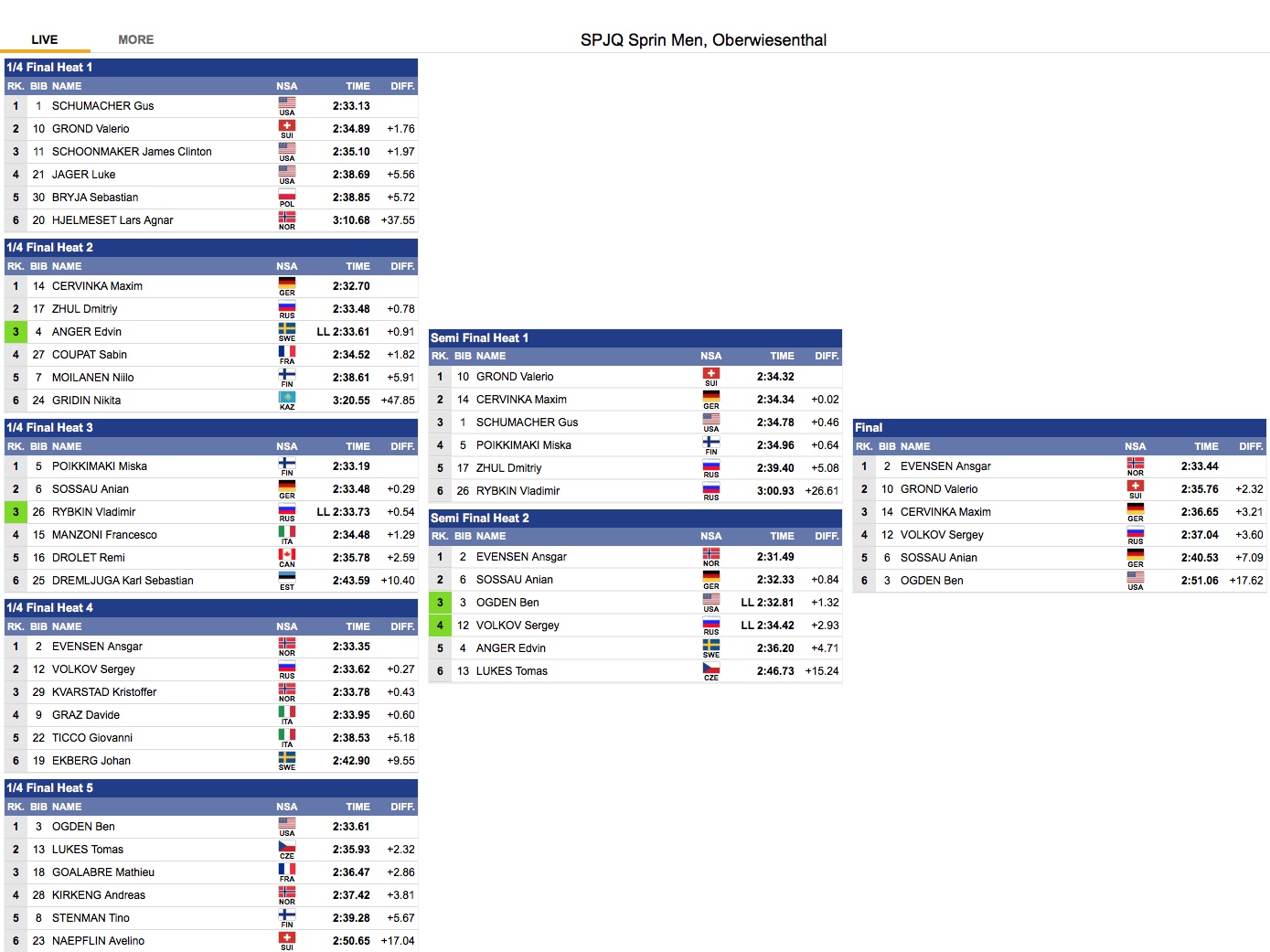
    Ogden placed third in the second semi to take a lucky loser spot in the final. But Ogden, racing the fifth quarterfinal, and with a quick turnaround into the semis, ran on fumes in the final. He placed sixth in the final, 17.62 seconds off the winning pace of Norway’s Ansgar Evensen who won in 2:33.44. Switzerland’s Valerio Grond placed second (+2.32), and Germany’s Maxim Cervinka third (+3.21). 

    Norway’s Ansgar Evensen winning the World Junior’s skate sprint. (Photo: Doug Stephen)

    In the final standings, Ogden was 6th overall, Schumacher 7th, Schoonmaker 13th, and Jager 18th. A stout day collectively for the American foursome. 

    Canada’s Remi Drolet, a student at Harvard, began his day by qualifying 16th (+5.76). Drolet placed fifth in the third quarterfinal to finish 23rd overall. Also for Canada, Thomas Stephen finished 36th, Xavier McKeever 44th, and Olivier  Léveillé 49th.       

    Canada’s Remi Drolet, the day’s 16th fastest qualifier. (Photo: Doug Stephen)

    Junior Men’s Qualification | Junior Men’s Results | Junior Men’s Bracket 


  • Saturday Race Rundown: U.S. U20 Men Win Relay, U20 Women 4th at World Juniors (Updated)

    Saturday Race Rundown: U.S. U20 Men Win Relay, U20 Women 4th at World Juniors (Updated)

    The U20 World Juniors 4 x 5 k relay first place team from the U.S, (l-r) Johnny Hagenbuch, Ben Ogden, Luke Jager, and Gus Schumacher. (Photo: JWSC2019 / Mikaela Takala)

    2019 U23 World Ski Championships in Lahti, Finland 4 x 3 k and 4x 5 k relay

    Full U20 Men’s Race Report

    In a historic first for the U.S., the U20 men’s team won the 4 x 5-kilometer relay today in Lahti, Finland at the 2019 World Junior Ski Championships. Luke Jager skied the first classic leg for the U.S., Ben Ogden skied the second classic, Johnny Hagenbuch skied the first initial skate leg and Gus Schumacher raced the anchor leg.

    The foursome won in a time of 45:34.7 minutes, and beat second-place Russia by 3.8 seconds.

    Russia’s team was comprised of Egor Trefilov, Andrey Kuznetsov, Yaroslav Egoshin, and Alexander Terentev.

    Germany’s team of Jakob Milz, Florian Knopf, Anian Sossau, and Friedrich Moch took third finishing 6.3 seconds behind.

    For Canada, Remi Drolet , Sam Hendry, Xavier McKeever, and Thomas Stephen skied to 11th (+2:29.7).

    Nineteen teams were entered in the race.

    Men’s U20 Results

    In the 4 x 3.3 k U20 women’s race, Norway’s Kristin Austgulen Fosnaes, Astrid Stav, Helene Marie Fossesholm, and Kristine Stavås Skistad won at the line in 35:24.7 minutes.

    Russia’s Anastasia Faleeva, Kristina Kuskova, Veronika Stepanova, and Anna Grukhvina were a close second, stopping the clock 1.0 seconds back.

    Louise Lindström, Frida Karlsson, Tilde Baangman, and Lin Svahn for Sweden placed third (+33.3).

    The U.S. team of Mara McCollor, Kendall Kramer, Sydney Palmer-Leger and Novie McCabe skied to fourth place, 40.5 seconds back.

    For Canada, Anne-Marie Petitclerc, Jasmine Drolet, Anna Pryce, and Molly Miller placed 11th, 3:01.4 minutes behind.

    U20 Women’s Results

    ***

    FIS Cross Country World Cup Ulricehamn, Sweden 10/15 k freestyle

    In what is his skiing canvas, the 15 k freestyle, France’s thirty-two-year-old Maurice Manificat won his first World Cup of the season in Ulricehamn, Sweden today in 34:55.4 minutes. It was a tight race in that Norway’s Simen Hegstad Krüger Simen Hegstad Krüger who placed second finished 1.1 seconds back. Teammate Didrik Tønseth was third (+8.7).

    Canada’s Alex Harvey was the best placed North American in ninth (+31.4). Lenny Valjas skied to 57th (+2:32.1), and Bob Thompson 77th (+4:16.6).

    For the U.S., Scott Patterson finished 35th (+1:26.5), David Norris 53rd (+2:11.3), Ben Lustgarten 64th (+3:04.7).

    Men’s Results

    Norway’s Therese Johaug kept her distance win streak alive at eight wins in eight starts on the World Cup this season. She won the women’s 10 k skate race in 25:48.2 minutes, with teammate Astrid Uhrenholdt Jacobsen in second, 22.8 seconds back. Third place went to Sweden’s Ebba Andersson, 24.9 seconds behind.

    The U.S. Ski Team’s Jessie Diggins skied to fourth place (+38.3), while teammate Sadie Bjornsen was 15th (+1:25.1). Caitlin Paterson (CGRP) had her best World Cup result of the season, skiing to 23rd (+1:49.9). Rosie Brennan (APU) placed 28th (+2:03.2), and Rosie Frankowski 42nd (+2:28.0).

    Dahria Beatty was the only Canadian entered. She finished 56th (+3:54.7).

    Women’s Results

    ***

    IBU World Cup Antholz, Italy 10/12.5 k pursuit

    In the women’s 10 k pursuit, Italy’s Dorothea Wierer won in a time of 29:20.1 after skiing two penalties (1+0+0+1). Second place went to Germany’s Laura Dahlmeier, who finished 6.0 seconds after Wierer after one missed shot (0+0+1+0). Saturday’s third place went to another Italian, Lisa Vittozzi, who finished 16.2 seconds behind the winner after tying Wierer’s shooting score.

    Clare Egan led the way for the U.S., racing to 11th (+1:31.9) after skiing two penalties (0+0+0+2).

    “I’m really happy with my race today,” Egan wrote in an email. “The wind and altitude are always a challenge here, but I took my time on the range and capitalized on the fast glide of my skis to save energy on course. I made a costly and dumb mistake on my last shot but still came away with my second-best career result. I’ll take what I learned from today and go for it again tomorrow in the mass start! Can’t wait!”

    Joanna Reid was the next American to finish, placing 29th (+2:55.2) after three missed shots (1+0+0+2).

    For Canada, Rosanna Crawford finished 34th (+3:30.8) after skiing five penalties (2+1+1+1) and her teammate Megan Bankes finished 39th (+3:37.1) with five misses (1+0+3+1). Also skiing for Canada, Sarah Beaudry placed 46th (+5:07.5), also with five penalties (4+0+1+0).

    Women’s 10 k Results

    In the men’s 12.5 k pursuit, Norway’s Johannes Thingnes Bø
    won in a time of 31:33.7 after skiing three penalties (1+1+0+1). France’s Antonin Guigonnat raced to second place, 34.8 seconds behind with one missed shot (0+0+1+0). The third and final podium spot on Saturday went to France’s Quentin Fillon Maillet, who skied two penalties (1+0+0+1) and finished 40.6 seconds back from the winning time.

    Sean Doherty for the U.S. placed 47th (+4:39.1, 3+2+1+0). Jake Brown was lapped and was not given an official time.

    For Canada, Jules Burnotte skied to 54th (+5:42.8, 1+3+1+1), and Scott Gow 55th (+6:39.7, 4+0+2+3).

    Men’s 12.5 k pursuit results

    ***

    Lake Placid SuperTour Classic Sprint

    Canada’s Antoine Briand (CNEPH) was the fastest qualifier on the day in 3:14.71 minutes and won the men’s final. Dominique Moncion-Groulx (Nakkertok) placed second in the final, with Ben Saxton (SMS T2) in third.

    Saxton was the second fastest qualifier, with Oliver Hamel (CNEPH) third fastest.

    Men’s Qualification | Men’s Heats

    For the women, Sophie Caldwell (USST/SMS T2) scorched the qualifier in 3:40.44 minutes with Jessica Yeaton (APU/Australian National Team) qualifying in second (3:50.49). Dartmouth’s Katharine Ogden qualified third (3:51.79).

    Caldwell went on to win the final in 3:37.06, with Yeaton in second and Kelsey Phinney (SMS T2) in third.

    Women’s Qualification | Women’s Heats


  • U20 Worlds 15 k/30k Classic Mass Start Rundown: A Big Day for the U.S. and Canada

    U20 Worlds 15 k/30k Classic Mass Start Rundown: A Big Day for the U.S. and Canada

    Gus Schumacher leading the pack with teammate Ben Ogden (pink hat) and Canada’s Sam Hendry (left) in the draft — during the U20 30 k classic mass start at World Juniors in Lahti, Finland. (Photo: Doug Stephen)

    The mass start classic races for the U20 athletes at the 2019 World Junior World Ski Championships dawned on another crisp, bordering on a frigid day in Lahti, Finland. A scroll through the results makes clear the day was strong for North Americans as the U20 men raced a 30-kilometer classic mass start, the women a 15 k classic mass start.

    In the men’s race, the six laps around the 5 k course which climbed a total of 193 meters each circuit, the top-15 skiers were separated by 17 seconds at the finish. The tight front-pack racing meant there were moments when the U.S. sported four skiers pacing the sharp end of the race.

    Gus Schumacher skiing for the U.S. placed fourth in a four-skier sprint at the line to finish 0.7 seconds behind the winner Luca Del Fabbro of Italy. Del Fabbro won in a time of 1:15:16.7 hours. Norway’s Haavard Moseby placed second (+0.4), and Switzerland’s Cyril Faehndrich third (+0.5).

    On the far left, Gus Schumacher in the podium mix down the stretch in the U20 30 k classic mass start at World Juniors in Lahti, Finland. (Photo: Doug Stephen)

    Canada’s Remi Drolet skied to seventh overall 6.4 seconds back.

    “Going into the race, the strategy was to stay relaxed and save as much energy as possible over the thirty kilometres,” Drolet emailed. “The plan was to get near the front, avoid mishaps, and be ready for when the speed increased and the pack was strung out.”

    Actualizing the strategy in terms of mishaps was another story on Drolet’s journey to seventh place.

    “Overall, I am very happy with how I skied today,” Drolet continued. “I executed my plan quite well and was able to stay calm and ski well even when I was involved in a collision and lost both of my skis. I had a lot of fun out there, and it was incredible to race against the best juniors in the world in some of the best conditions for classic skiing.

    “Going into the championships and into this race, I was really hoping to achieve a top 10 result.  In the first two races, I had decent results but was not quite there. It was encouraging, however, that I was improving everyday, and the second half of the skate race was quite good for me.  I also knew that the 30-kilometre classic race would likely be my best, and I showed up to the start line ready to leave everything I had out on the track. It certainly felt great when I crossed the finish line knowing I had achieved this goal!”

    Canada’s Remi Drolet after his seventh place in the U20 30 k classic mass start at World Juniors in Lahti, Finland. (Photo: Doug Stephen)

    For the U.S., Ben Ogden finished 10th (+9.0), Luke Jager 13th (+14.9), and Johnny Hagenbuch 17th (+25.6).

    Sam Hendry of Canada raced to 20th (+44.6), Tom Stephen, at sixteen years old placed, 23rd (+1:07.3), and Pierrick Sarthou 46th (+6:32.2).

    U20 Men’s Results

    Start of the U20 Worlds 15 k classic mass start in Lahti, Finland. The winner Frida Karlsson is in bib 1. (Photo: Doug Stephen)


    Sweden’s nineteen-year-old Frida Karlsson won the U20 women’s 15 k classic mass start race in a time of 40:45.3 minutes. Helene Marie Fossesholm of Norway was second (+52.1), and Finland’s Anita Korva was third (+58.1).

    This was Karlsson’s second win of these championships after taking the U20 5 k skate race on Tuesday. Karlsson was also the fastest qualifier in last Sunday’s classic sprint – she placed fifth overall.

    Kendall Kramer, a sixteen-year-old U18 skier for the U.S. was the top-North American in the U20 women’s race placing fourth (+1:30.7).

    In perhaps the most earnest and down-to-earth post-race comment FasterSkier has received to date (Kendell’s comments were handwritten), the sixteen year old from Fairbanks, AK. explained the 15 k mass start was a new venture which suited her skiing style.

    “This was my first 15 k I’ve ever done so going into the race I was extremely clueless and nervous about feeds, how aggressive the Scandos would be, how to race etc… but I think the slip-free kick job the techs gave me and my knack for throwing elbows and maintaining my spot which really aided me staying out of trouble early on, which set me up for a comfortable position to ride my 4th place into the finish,” Kendall wrote about her race experience.

    Kendall Kramer on her way to fourth place in the U20 15 k classic mass start at World Juniors in Lahti, Finland. (Photo: Doug Stephen)

    Kramer’s keen eye during the race played into her in-the-moment decision making when it came to how to ski the course.

    “It was all hills and with the slow snow the flats weren’t even flats. I mostly decided to how to take every part of the course by seeing how the older girls in front of me reacted to it,” wrote Kendall.

    U.S. teammate Novie McCabe at 17 years old is a U18 skier skiing up at these Junior Worlds. McCabe finished 10th (+2:19.0) after starting the day in bib 71, way back in the pack of seventy starters. (One skier did not start.)

    “Starting in the back was definitely a bit of a challenge,” McCabe told FasterSkier in the mixed zone. “I thought of it as I had to be patient for sure at the start. But it was also better than I thought it would be going up that first hill. I was able to hop in the outside and get up right out of the start and seeing more numbers in the 30s and 40’s and so I was like ‘oh, that wasn’t that bad’. I kept on trying to work my up and trying to stay calm and patient. There were a few crashes and some of the front girls came back. I ended up skiing in a group with one of the girls who ended up crashing and I tried to hang with her.

    The U20 women’s 15 k classic mass start at the Junior World Championships in Lahti, Finland. Way way back, bib 71, that’s Novie McCabe. (Photo: Doug Stephen)

    “The group got smaller and I knew it was sixth through 12th I think, and I just tried to hang in there. My skis were really fast and I had really good kick so that was really helpful. I just tried to hang in there on the hills and get the best rest that I could. Then on the last part I was trying to hang with the girl ahead of me and I ended up crashing on the last corner, but it was really quick and I just tried to hop up and tuck in behind the ninth-place girl, and ended up hanging in there and finishing 10, it as a really fun race.”

    Novie McCabe (bib 71) on her way to 10th place in the U20 15 k classic mass start at World Juniors in Lahti, Finland. (Photo: Doug Stephen)

    For the U.S., Mara McCollor finished 24th (+3:58.3), and Sophie Mazzoni 48th (+6:19.9).

    Jasmine Drolet was the top Canadian finisher in 36th (+4:51.4), followed by Anne-Marie Petitclerc in 40th (+5:07.6), and Anna Pryce in 46th (+6:07.2).

    U20 Women’s Results

  • Tuesday Race Rundown: Lahti Junior Worlds  U20 5 k/10k Individual Skate (Updated 2x)

    Tuesday Race Rundown: Lahti Junior Worlds U20 5 k/10k Individual Skate (Updated 2x)

    Gus Schumacher skiing to sixth place in the U20 10 k skate during the 2019 Junior Worlds in Lahti, Finland. (Photo: Doug Stephen).

    FIS Junior World Ski Championships Lahti, Finland 5 k/10k Freestyle Interval Start

    Tuesday in Lahti, Finland was as Finland should be: squeaky-snow-cold and cross-country ski racing on offer.

    Eighteen-year-old Gus Schumacher broke through for the U.S. and placed sixth overall in the U20 men’s 10-kilometer freestyle. Schumacher was the 95th starter of 102 finishers on the day. His sixth place finish was consistent with his 1.1k, 5k, and 6.6k splits where he was ranked 5th, 6th, and 7th respectively. Schumacher stopped the clock in 23:19.3 minutes, 44.4 seconds behind the winning mark.

    The Lahti championships are Schumacher’s second Junior Worlds. His sixth place is his best individual result. He was part of the second place 4 x 5 k U20 relay last year in Goms, Switzerland.

    “I was most nervous about hitting it right and doing the right pacing and making sure I can have the best race that know I can,” Schumacher told FasterSkier over the phone. “I approached it as just a new race almost. We have done a fair amount of watching old world cups and world championships that were on the exact same courses here. It was definitely hard to reflect on that because none of them were exactly 10 k. And obviously those athletes are quite a bit stronger than we are. And the snow is different.”

    Schumacher extracted what he needed from the videos. Imprinted in his mind before his 10 k start were enough visuals to quell the nerves and provide a path to fast clean skiing.

    “We watched that and I felt like I got an idea for what the body movements looked like of those guys,” Schumacher said. “I thought about how that would feel for me and I thought about the other middle distance skate races I have done this year –which is actually a fair amount between early season time trials.”

    Schumacher executed his plan. He dialed back the initial effort, stayed in control, and systematically revved the engine.

    “I went out and tried for at least the first five minutes to go a little easier, because I think that is the high risk time, the very beginning,” said Schumacher. “I tried to go out and keep it consistent and as I started to get into it, I started to ramp it up a little more and really try to make the most of the recovery. Which wasn’t a lot, but enough that I could put my head in between my knees on the downhill and I could tell myself that 15 seconds of high speed downhill is helping me. And I could get my breath down a little bit and I was ready for the next hill.”

    His run at the podium came up just 17 seconds short. But with his plan executed, the Anchorage based skier had no regrets when reflecting on Tuesday’s race effort. 

    “I definitely wanted to be top-10, but I felt like and still feel like a medal is in sight,” Schumacher said. At 18, he still has one more year of eligibility in the U20 ranks.

    “For sure satisfied with this race, it felt like a good result and it was one of my better races. And I am happy with how it played out and also thinking about how I can hit the 30 k and do the most I can do.”

    France’s Jules Chappaz won the race in a time of 22:34.9 after skiing the fastest splits at 5 k and 6.1 k. Sunday’s classic sprint winner, Russia’s Alexander Terentev, placed second (+21.0), and Norway’s Iver Tildheim Andersen in third (+27.2).

    Canada placed two skiers in the top-31. Remi Drolet finished in 20th (+1:14), Samuel Gary Hendry 21st (+1:15.9), Thomas Stephen 31st (+1:36.8). Xavier McKeever skied to 44th (+2:04.6).

    For the U.S., Zanden McMullen placed 32nd (+1:40.6), Johnny Hagenbuch 34th (+1:46.3), and Noel Keeffe 58th (+2:45.7).

    Men’s U20 Results

    Sweden’s Frida Karlsson winning the U20 5 k skate at Junior World Ski Championships in Lahti, Finland. (Photo: Doug Stephen)

    Sweden’s Frida Karlsson won the U20 5 k skate in 12:50.6 minutes. Norway’s Helene Marie Fossesholm placed second 11 seconds back, with Finland’s Anita Korva in third (+19.8).

    “It was fun to ski today. I just wanted to have my revenge”, Karlsson told race organizers after the race. Karlsson had qualified first on Sunday’s U20 classic sprint but placed fifth in the overall.

    U.S. skier Kendall Kramer post U20 5 k skate at Junior World Ski Championships in Lahti, Finland. (Photo: Doug Stephen)

    The best placed North American was U.S. skier Kendall Kramer who finished in 15th (+55.6) place. Also for the U.S., Sydney Palmer-Leger was 20th (+1:04.9), Novie McCabe 29th (+1:20.8), and Waverly Gebhardt 65th (+2:28.8).

    Canada’s Anna Pryce (bib 22) and Jasmine Drolet (bib 20) finishing the U20 5 k skate at Junior World Ski Championships in Lahti, Finland. (Photo: Doug Stephen)

    Anna Pryce was the top Canadian in 43rd (+1:36.5). Teammates Molly Miller skied to 50th (+1:52.9), Isobel Hendry 58th (+1:57.1), and Jasmine Drolet 67th (+2:35.7).

    Women’s U20 Results


  • (U20) Junior World Ski Champs Classic Sprint in Images

    (U20) Junior World Ski Champs Classic Sprint in Images


    In stadium sprint viewing at the 2019 Junior World Ski Championships in Lahti, Finland. (Photo: Doug Stephen)

    Images from the U20 women’s 1.4-kilometer classic sprint from the 2019 Junior World Ski Championships in Lahti, Finland. (U.S. in white/blue, Canada in red/black.)


    Images from the U20 men’s 1.4-kilometer classic sprint from the 2019 Junior World Ski Championships in Lahti, Finland. (U.S. in white/blue, Canada in red/black.)

    Noel Keeffe, pictured above (left), placed 12th overall for the U.S. in the U20 men’s field. He is currently enrolled at the University of Utah where is also a member of the cross-country ski team. Keeffe grew up skiing with the Steamboat Winter Sports Club. He earned his first U.S. National’s podium recently in the skate sprint. 

    “The sprint race was a tough one,” Keeffe wrote in an email explaining his U20 Worlds experience. “The course was super challenging because of a pretty large sustained hill right out of the start. I believe it was one of the hardest courses I have ever raced.

    “I am super stoked with my performance and the performance of the team. We were one of the best nation’s out there. It’s pretty cool when the top skiers from every nation start watching out for the kids in the red, white, and blue.”

  • World Juniors Classic Sprint Rundown: Ogden 8th, Keeffe 12th

    World Juniors Classic Sprint Rundown: Ogden 8th, Keeffe 12th

    Noel Keeffe (bib 15) showing here in his quarterfinal why time is what you make of it. Keeffe placed 12th overall in Sunday’s classic sprint at the 2019 Junior World Ski Championships in Lahti, Finland. (Photo: Doug Stephen)

    Sunday featured the first day of racing at the 2019 Junior World Ski Championships in Lahti, Finland. To kick things off at the crown jewel of Finnish ski venues was the U20 classic sprint. The men raced a 1.6-kilometer loop, the women a 1.4 k course.

    Several North American males qualified for the heats after Russia’s Alexander Terentev qualified first in a time of 3:28.74 minutes.

    Ben Ogden (bib 3), skiing for the U.S. at the 2019 Junior World Ski Championships in Lahti, Finland. Ogden placed 8th overall. (Photo: Doug Stephen)

    For the U.S. all four athletes entered in the race advanced to the heats. Ben Ogden qualified in third (3:36.94), Gus Schumacher 12th (3:40.80), Noel Keeffe 15th (3:41.56), and Luke Jager 20th (3:42.27).

    Remi Drolet of Canada qualified in 28th (3:44.98) and was the only one of his teammates to ski in the rounds. He was bounced after his fifth place in heat five. Drolet was 25th overall. Xavier McKeever skied to 52nd overall, Thomas Stephen 59th, and Pierrick Sarthou 67th.

    (McKeever, at fifteen years of age, is the youngest competitor at World Juniors.)

    Ogden leaped to the semis by placing first in the fifth heat. Ogden exited the rounds after sprinting to fourth in the second semi. Ogden was the best placed North American finishing eighth overall.

    Keeffe advanced as a lucky loser to the semis after placing third in the second heat. He placed 12th overall after his sixth place in the first semi-final.

    Schumacher was bounced out of the heats after he placed fourth in heat four. He ended his day 16th overall.

    Jager’s 20th place overall rounded out the U.S. performances. Jager was eliminated when he placed fourth in the first quarterfinal.

    Coming in second overall to Terentev in the men’s final were Norwegians Ansgar Evensen and Håkon Skaanes in second and third respectively. Jules Chappaz of France was fourth, Sweden’s Axel Aflodal fifth, and Aron Åkre Rysstad sixth.

    U20 Men’s Results

    U.S. skier Sydney Palmer-Leger was the only North American women to qualify for the heats. She placed 29th in qualification, skiing the 1.4 k course in 3:46.82 minutes. Sweden’s Frida Karlsson skied the fastest qualifying time of 3:27.32.

    Palmer-Leger was eliminated when she placed fifth in the fourth quarterfinal to end her day 25th overall.

    Also for the U.S., Mara McCollor was 43rd overall, Sophia Mazzoni 49th, and Waverly Gebhardt 51st.

    Canada’s Anna Pryce during her classic sprint qualifier at the 2019 Junior World Ski Championships in Lahti, Finland. (Photo: Doug Stephen)

    For Canada, Anna Pryce finished 42nd overall, Molly Miller 52nd, and Isobel Hendry 69th. Canada’s Anne-Marie Petitclerc did not finish as a result of breaking her binding moments after she started.

    Norway’s Kristine Stavaas Skistad was first overall. Poland’s Monika Skinder placed second in the final, with Finland’s Anita Korva third. Linn Svahn of Sweden placed fourth overall, while teammate Frida Karlsson was fifth. Russia’s Anastasiya Faleeva was sixth.

    U20 Women’s Results

    And just because this sequence is so solid, here’s an addition to Keeffe’s lunge. (Click images to enlarge.)