Tag: threshold intervals

  • Wednesday Workout: Steady State Intervals and Speed Shifts with SVSEF PG Coach Tom Smith

    Wednesday Workout: Steady State Intervals and Speed Shifts with SVSEF PG Coach Tom Smith

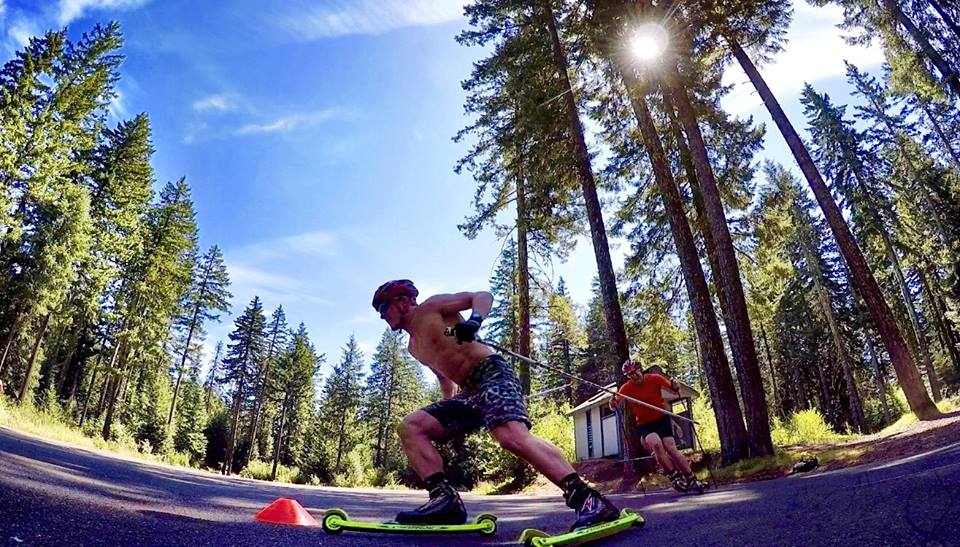
    SVSEF Gold Team member Miles Havlick rounds a cone during an interval. (Photo: Tom Smith)
    SVSEF Gold Team member Miles Havlick rounds a cone during an interval. (Photo: Tom Smith)

    For this week’s Wednesday Workout, FasterSkier spoke with Tom Smith, the head coach of the post-graduate elite development program for the Sun Valley Ski Education Foundation (SVSEF). On top of coaching full-year post graduates (PGs) in Sun Valley, Idaho, Smith works with college athletes who come there to train during the summer. Smith is originally from Bend, Ore., and skied for the University of Utah before heading to Sun Valley a few years ago.

    The workout Smith presented is a highly customizable steady state threshold workout with accelerations he likes to call “speed shifts.” Speed shifts are similar to pickups in that the speed and effort increase for a short period of time. However, for speed shifts, the change is minor compared to pickups, where speed and effect usually change drastically, going from low effort to race pace or even max effort.

    “I like to think of it as not an all-out sprint in the middle of L3 [Level 3] intensity, but like a shift in your tempo or power and that you’re testing your competitors and testing your own limits of your lactate threshold,” Smith explained.

    As a quick reminder, threshold effort or Level 3 is the pace at which lactic acid is being cleared from muscles at the same rate it is being produced. The general feeling at this effort is fast but in control and at a pace that can be maintained for an hour or two.
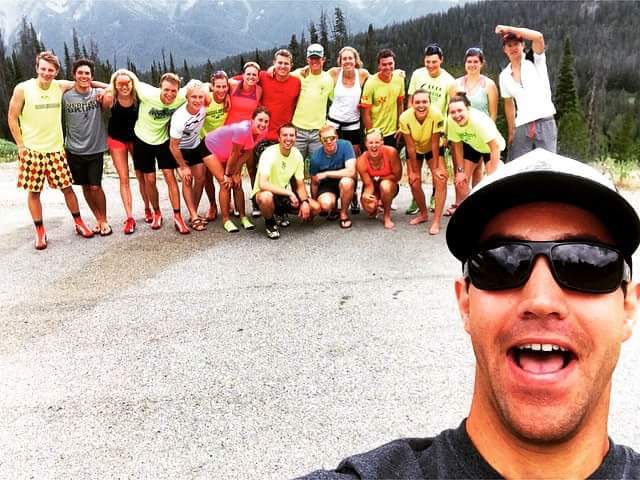
    Head PG Coach Tom Smith with a bunch of SVSEF athletes in the background. (photo: Tom Smith)
    SVSEF post-grad head coach Tom Smith takes a selfie with several SVSEF athletes in the background. (Photo: Tom Smith)

    This steady state workout entails going at a consistent threshold effort for 30 to 45 minutes while doing 20-second speed shifts every three to five minutes to push the effort into the upper limits of L3.

    Smith leads this workout on rollerskis, though it can be done in any discipline. It’s also very customizable. Depending on the time of year, the focus can be on ensuring that the threshold effort is not exceeded or intentionally going beyond L3 during the speed shifts to work on recovering from an anaerobic effort while continuing to ski at threshold. The total interval time and frequency of the speed shifts can also be changed to make the entire workout easier or harder, depending on what the participant is looking for.

    A large component of the workout also comes from the day before. Smith plans a technique-focused, low-effort workout in the same discipline that the continuous threshold workout is going to be in. So if Smith’s athletes will be skating during the continuous threshold workout, they go for an easy skate distance workout the day before while Smith takes a bunch of video. Then they all review the video and each pick out one specific aspect of their technique to work on and come up with a concrete way they can improve it. That night or even the following morning, Smith’s athletes again look at the video to review their technique and really understand what they need to be doing to improve during the threshold workout. This allows the athletes to work on their technique during the interval while simultaneously focusing on a quality effort.

    “By accomplishing [technique work] in the session beforehand, the athlete already has that goal in mind of what they want to work on and they know how they are going to actually go about improving it,” Smith said. “You don’t really have to harp on it too much within the intensity session itself as a coach.”
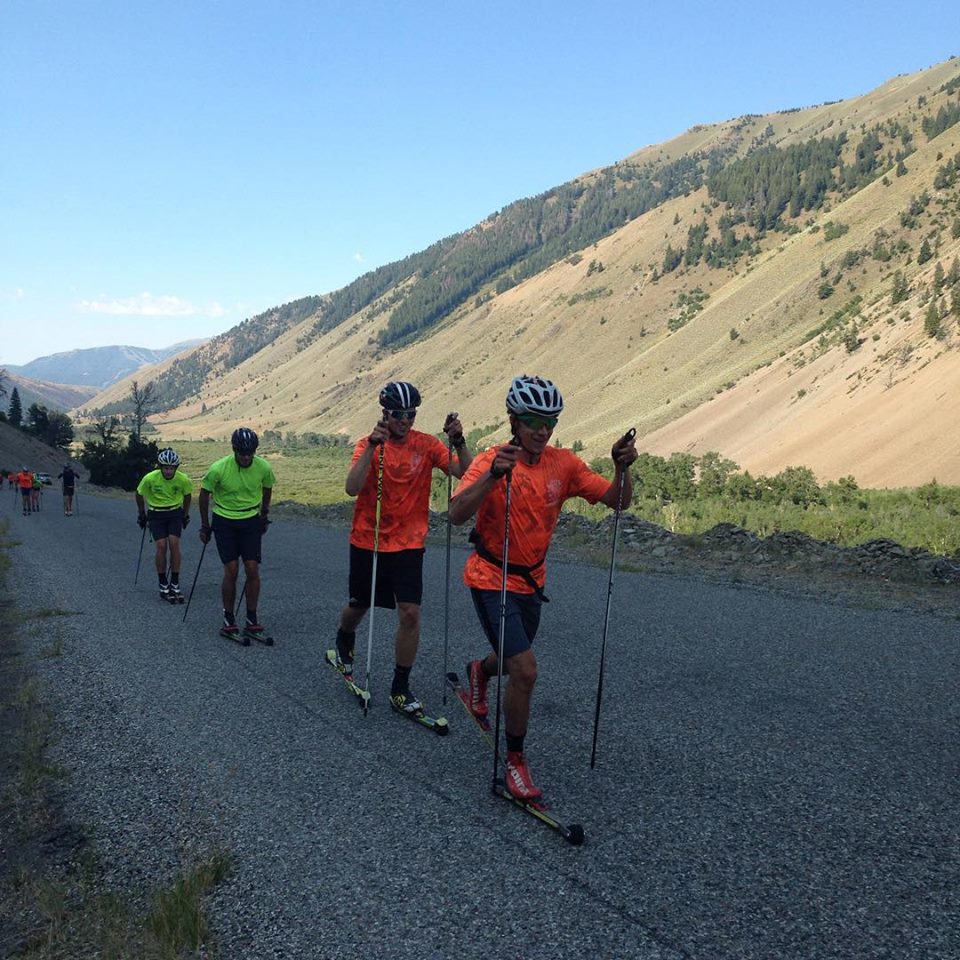
    SVSEF Gold Team member Rogan Brown leads Bates College skier Corky Harrer on a classic ski. (photo: Tom Smith)
    SVSEF Gold Team member Rogan Brown leads Bates College skier Corky Harrer on a classic ski. (Photo: Tom Smith)

    This also gives Smith the opportunity to focus on his athlete’s efforts during the L3 interval. The SVSEF post grads do this workout on a fixed loop, setting up speed shifts on various terrain so they feel what it is like to push the effort during different techniques and at different speeds. It also helps them feel how easy or hard it is to recover from different efforts on the various terrain.

    Smith then goes to a location about a minute after a speed shift to test the athletes’ lactate levels. What he hopes to see is their lactate levels around 4 millimoles, which means they are going at a threshold effort and have effectively pushed to the limits of L3 and recovered.

    If possible, Smith also wants his athletes to ski in a pack. This gives them an opportunity to practice some mass-start tactics and see how effective an added effort is or is not on various terrain.

    “We can put one speed shift on a V2 focused slight up grade, we can put one on a V1 section, we can put one on maybe a tuck-skate downhill section, so it gives you a few different things to think about [and shows], especially in a mass start simulated environment, that there are different opportunities and different places around a course to put in a little bit of an attack,” Smith explained.

    Ultimately, he hopes his athletes come away from this workout with technique improvements and a better understanding of and feeling for their L3 zone.

    “I think it’s a really good session for the older guys, especially as they transition from older juniors into seniors to really understand where their limits are within their lactate threshold zone and how hard they can really push it before they actually blow themselves up,” he said.

    The Workout

    The day before:

    – On the day before the steady state interval workout, work on technique and find one specific area to focus on for the next day. Having video is really helpful for picking out a major technique area that can be improved!

    The day of:

    – Warm up for 20 to 30 minutes to prepare the body for a threshold effort.

    – Begin the continuous threshold interval. Keep in mind the effort continues for 30 to 45 minutes, so it is best to start at the lower end of L3.

    – Every three to five minutes, do a 20 second speed shift. Try and focus specifically on adding a little extra power or slightly increasing tempo. This helps to ensure the effort does not go beyond the L3 limit. Also try and change up the terrain where the speed shifts happen to get plenty of variety in the workout.

    – Remember after each speed shift, the effort should remain in L3 and it should drop to the lower end of L3 before the next speed shift brings the effort back up.

    – After finishing the steady state interval, warm down for 15 to 30 minutes to wrap up the workout.


  • Wednesday Workout: Spice It Up with V2 Jumps, Sprints and Stairs

    Wednesday Workout: Spice It Up with V2 Jumps, Sprints and Stairs

    This week’s workout comes from FasterSkier contributor François Léger Dionne, who raced for 15 years at provincial and national competitions in Quebec. After obtaining a Bachelor of Law at the University of Montreal, he’s currently enrolled in a full-time program at the Montreal College of Osteotheraphy. This past weekend, he placed 60th out of more than 1,000 competitors in the Mount Washington Road Race (a 7.6-mile hill climb up the highest peak east of the Mississippi River).

     ***

    Summer is the best season to add plenty of variety to your training before the upcoming and more ski-oriented fall. Back in my racing days, I used to do this workout every week in Mont Royal, Montreal’s most popular playground for endurance athletes. In preparation for the infamous Mt-Washington auto road race (which took place on June 21st), I actually incorporated this specific ski workout as a general fitness test to assess my energy and recovery levels.

    Short, full-out sprint
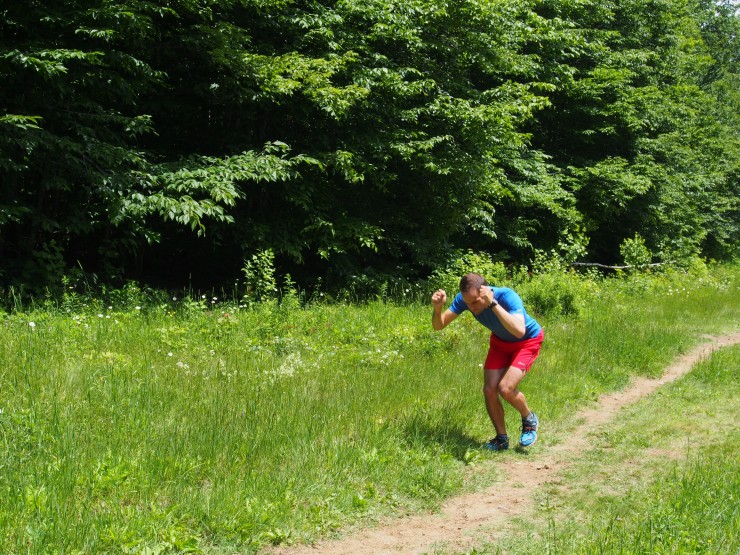
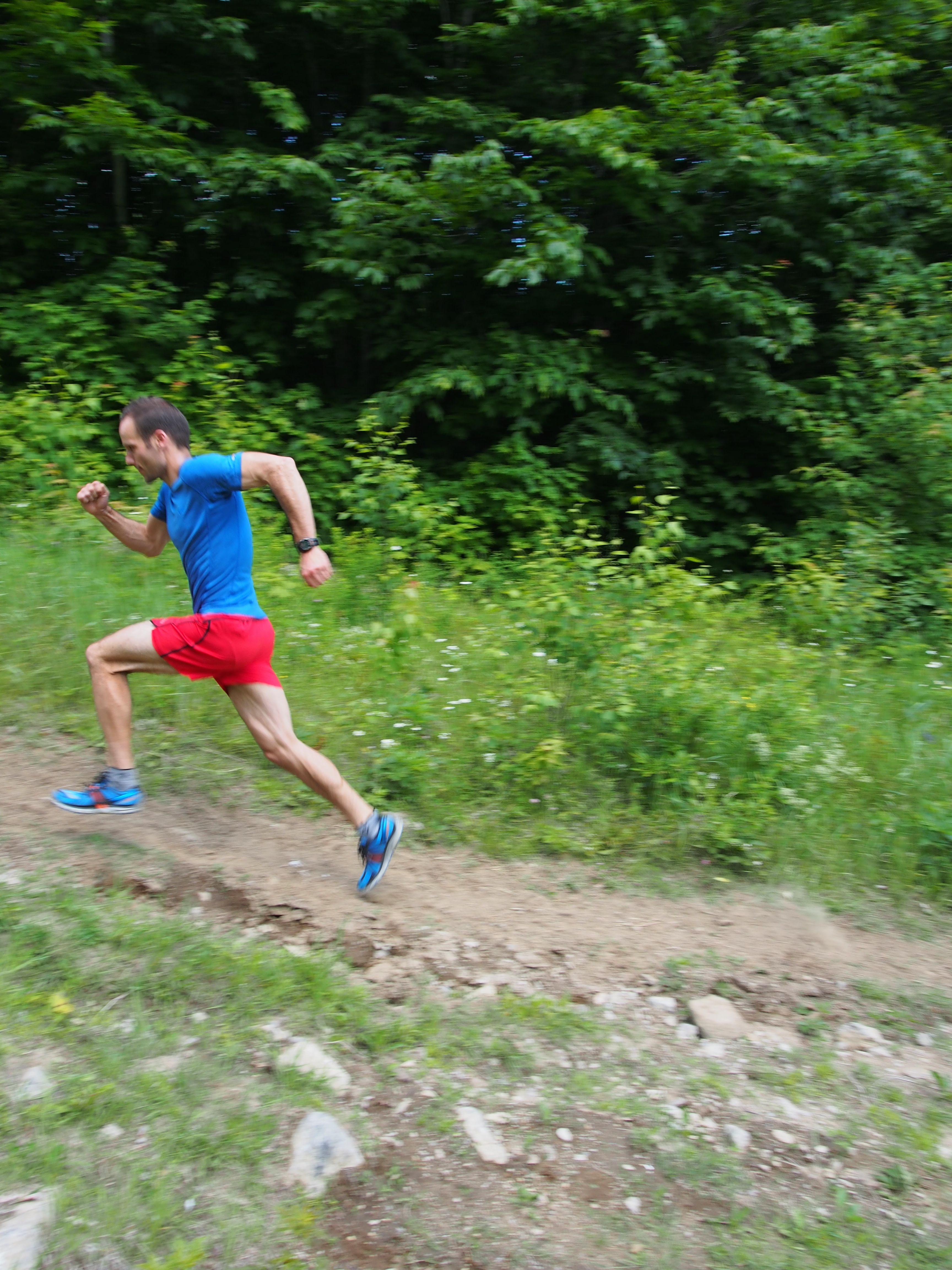
    Short, full-out sprints up a hill require technique, balance, and muscle control, all while developing strength and fitness.

    Part I: Explosive power, balance and short sprints

    Find a 200-meter slope, not too steep (around 6-8%, max 10%) and large enough for you to jump energetically from side to side in a V2 (or one-skate) motion.

    The first part of this workout consists of short repeats, each of which is divided in two sections. First, a dynamic phase that requires technique, balance and muscle control, while the second is a full-out sprint.

    Start with 20 (10 on each leg) V2 jumps. The goal is to concentrate on technique, power and balance. You want to build the most energy possible on the impulse, so make sure to really bend your knees, while trying to keep your upper body in a straight line as much as possible. Use your arms (in a V2 fashion) to generate the most explosive one-skate hop. The landing requires keeping your balance and stabilizing your core and leg muscles. Take time to land properly before taking off again. Don’t rush it, speed is of no importance here.

    After completing 20 V2 jumps, sprint at full capacity for 20 seconds. One set should take about a minute. Jog or walk back down, but don’t stop in between each rep. It’s important to teach you body to recover actively and quickly.

    Part II: L3 intervals up stairs

    After completing around 10 repeats, recover slowly for 10 minutes. At this point, with the accumulation of lactic acid, your legs will probably feel a bit like jello.

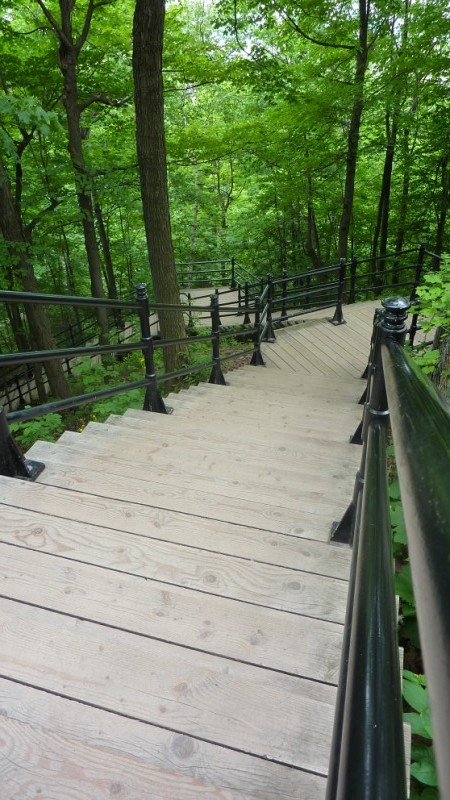
    The second part of the workout, although involving stairs, is thus less taxing muscle-wise. Montreal overflows with long sets of stairs, and Mont Royal — with one set of 260 stairs — makes no exception! Try to focus again on technique, and avoid simply running up the stairs. Ski walk (with no poles) two steps at once, with full leg extension and straight upper body, hands tucked in behind your back. Aim for 5 reps of one minute.

    The basic workout:

    • 20 minutes of easy running
    • 8-12 x 1 minute repeats (20 explosive V2 jumps + 20 sec. sprint) with 1.5 minute of active recovery between each rep.
    • 10 minutes of very low active recovery
    • 4-6 x 1 minute L3 or threshold intervals up stairs with 2 minutes of active recovery between each interval
    • 15 minutes cool-down

    Total time: About 1 1/2 hours

    Mont Royal's 260 stairs are a great place to work on technique and L3/threshold intervals.
    Mont Royal’s 260 stairs are a great place to work on technique and L3/threshold intervals.

    Notes:

    • When my energy levels are high, I like spicing up this workout by incorporating sets of 15-20 push-ups/dips every two reps.
    • This workout can be done alone, but is more fun for groups. Be careful not to lose concentration when doing the V2 jumps with teammates, as each has a different stride and pace. Have the younger ones start ahead of the stronger athletes for close sprint finishes. A coach can even dictate the V2 hops pacing for everyone.
    • I prefer doing this workout without poles, but feel free to try them out (especially if you can’t find stairs).
  • Wednesday Workout: NAWTA’s Pace Development Threshold Intervals

    Wednesday Workout: NAWTA’s Pace Development Threshold Intervals

    Astrid Jacobsen (NOR), Liz Stephen, Bettina Gruber (SUI), Jessie Diggins, Holly Brooks and Ida Sargent during their threshold workout in Anchorage, Alaska, on Tuesday. (Photo: Matt Whitcomb)
    Astrid Jacobsen (NOR), Liz Stephen, Bettina Gruber (SUI), Jessie Diggins, Holly Brooks and Ida Sargent during threshold intervals in Anchorage, Alaska, on Tuesday. (Photo: Matt Whitcomb)

    The third-annual North American Women’s Training Alliance (NAWTA) camp began this week in Anchorage, Alaska, and on Tuesday morning they completed a threshold workout that ended with a lot of high-fives in the van and left U.S. Ski Team women’s coach Matt Whitcomb pretty happy.

    “Today’s threshold workout was the best threshold workout I’ve seen out of this group of women since I’ve been working with the team,” he said on the phone, as the group began their afternoon strength session.

    Kikkan Randall, Jessie Diggins, Liz Stephen & Co., are joined at this camp by Alaska Pacific University skiers, National Training Group athletes, and decorated Norwegian Astrid Jacobsen, Switzerland’s Bettina Gruber and Canada’s Chandra Crawford. The workout is one that Whitcomb and APU head coach Erik Flora have repeated over the last few years in order to work specifically on high-speed skiing in the middle of a threshold session.

    The keys to accomplishing this goal are two-fold: the choice of terrain, and the presence of a group to ski with. It was his team’s skilled pack skiing that Whitcomb thinks set Tuesday’s session apart from the rest, but the rolling hills are a critical ingredient to the goal of the entire workout.

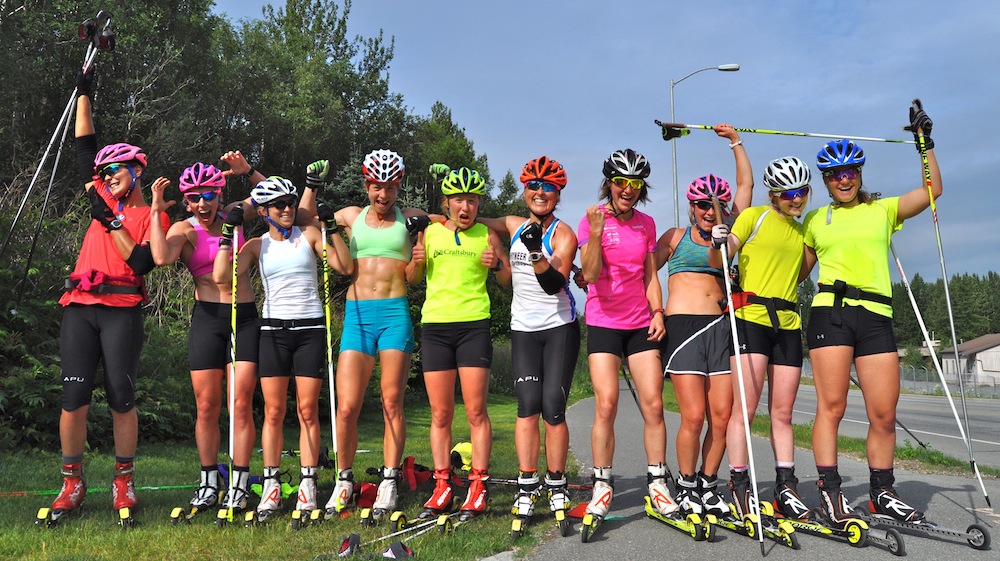
    The group after a well-executed workout. (L to R) Kate Fitzgerald, Kikkan Randall, Liz Stephen, Astrid Jacobsen (NOR), Ida Sargent, Holly Brooks, Bettina Gruber (SUI), Jessie Diggins, Emily Hannah, Anika Miller. (Photo: Matt Whitcomb)
    The group after a well-executed workout. (L to R) Kate Fitzgerald, Kikkan Randall, Liz Stephen, Astrid Jacobsen (NOR), Ida Sargent, Holly Brooks, Bettina Gruber (SUI), Jessie Diggins, Emily Hannah, Anika Miller. (Photo: Matt Whitcomb)

    “It’s not so much emphasizing going harder, it just emphasizes patterning your muscles, neurally, to fire faster,” Whitcomb explains. “I think a lot of times, certainly my tendency as been to prescribe intervals that are a bit too slow. We might be nailing the percentage of your max heart rate and the proper lactate right on the money, but the pace is just too slow — you’re going uphill, uphill, uphill, and a lot of times when we find hard terrain we go hit intervals there.”

    To encourage speed variation while staying within threshold, the workout should be done on a stretch of pavement that includes gradual uphills, flats and gradual downhills, which “systematically [builds] some pace development intervals into your session,” Whitcomb says.

    “It doesn’t need to be incredibly hard — today was roughly threshold and above during bursts of speed — but it was about the terrain that helped push the pace for us.”

    The Workout:

    • 20-30 minute warm up*
    • 4-6 x 7-10 minute L3 intervals (3 minutes rest) on fast terrain that incorporates gradual uphills, flats and gradual downhills. Most interval sessions use hard and grinding terrain, great for building capacity but not so great for higher pace development. The key to this workout is in the choice of terrain.
    • 20-30 minute cool down*

    *Do a warm up and cool down that allows you to focus on the intervals. “Sometimes a mistake can be made where people are going after volume in addition to high intensity on interval days,” Whitcomb says.

    Don’t do try to multi-task for this workout. “Warm up only the minimum that your body requires,” he continued. “You want to make sure your muscles are ready to go, and build into the intervals if you have to — you don’t want to pull any muscles or get injured — but a 45 minute warm up is too long, as is a 45 minute cool down. Keep them concise and focus more on the on-time.”

    Frequency:

    Every two to three weeks in the summer, with increasing frequency to every 10 days as fall approaches. “A workout like this is in addition to L4 intervals, time trials, speeds, ODs,” Whitcomb said. “It’s just another small component, another ingredient to throw in the bag and mix it up.”

    Variations:

    • Shorter recovery time as the season goes on, or longer recovery when at altitude — “just to make sure the on-time is what’s being emphasized,” Whitcomb says.
    • Pre-determined sprint preems that accomplishes a similar break from straight threshold, forcing athletes to go from threshold, into race pace, then back into threshold when they cross certain preem markers in the interval.

    On Tuesday, the women did this session on a stretch of bike path in Anchorage’s Kincaid Park. They chose a section of rolling terrain that was about 7-10 minutes long going either way. The group started their first interval in one direction, which took about nine minutes, took their three-minute recovery, and then skied back the other way to the start, which took about seven minutes.

    From a coaching perspective, this workout shows Whitcomb things that don’t surface in regular threshold intervals.

    “I think when we started doing this it taught us that the speed didn’t really change as much as we thought it would when the terrain asked for higher speed,” he said. “You try and go faster and your muscles simply didn’t want to move faster. It wasn’t a matter of being at your max heart rate, people were well within threshold, but they just didn’t want to fire those muscles faster. But the body fortunately adapts pretty quickly to a group session like this and you see pretty notable progress in your speed in just a few weeks.”

    Whitcomb’s footage from Tuesday’s session.


    So what made Whitcomb call Tuesday’s workout, in particular, the best threshold session he’s ever seen from his team?

    In addition to their raw speed — “they were really flying” — Whitcomb noticed they skied better together within the pack than they have before.

    “Everyone spent some time leading, some time sandwiched cycling in the spin wash in the middle of the pack, and it was really unlike this group perhaps in the past — you know, you establish a pecking order and somebody’s out there hammering off the front all day, maybe somebody switches out if they get tired, somebody is flying off the back all day because they’re struggling,” he said.

    “And today instead it was much more this series of incessant attacks at the front where you’d recover a little bit, spend some time in threshold in the pack, and then you’d work your way to the front and use your good feelings and your recovered state to push the pack and pull everybody along at a faster rate. It looked more like watching a cycling race today, to be honest, and that’s kind of a new thing particularly in girls skiing, I think. The mass starts [sometimes] just getting strung out from 100 m into the race, and I think we’re moving in the direction of more pack skiing. And as we can improve our skills within the pack were going to be better suited for those days when the women’s pack does stay together.”