From the FasterSkier archive — posts syndicated from athletes’ and coaches’ own blogs between 2004 and 2012, kept online as published. Current coverage is at fasterskier.com.
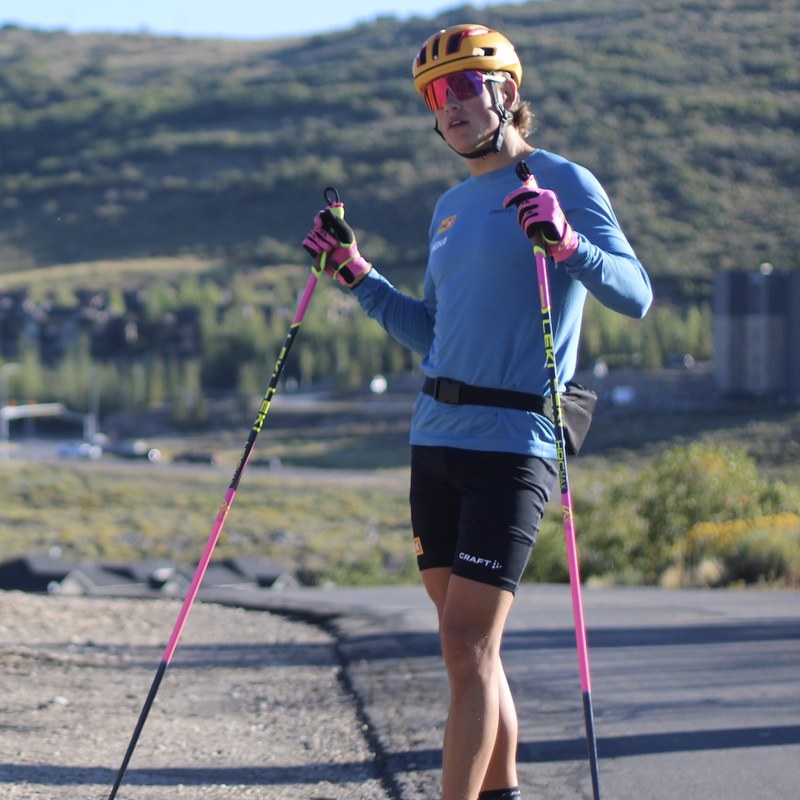
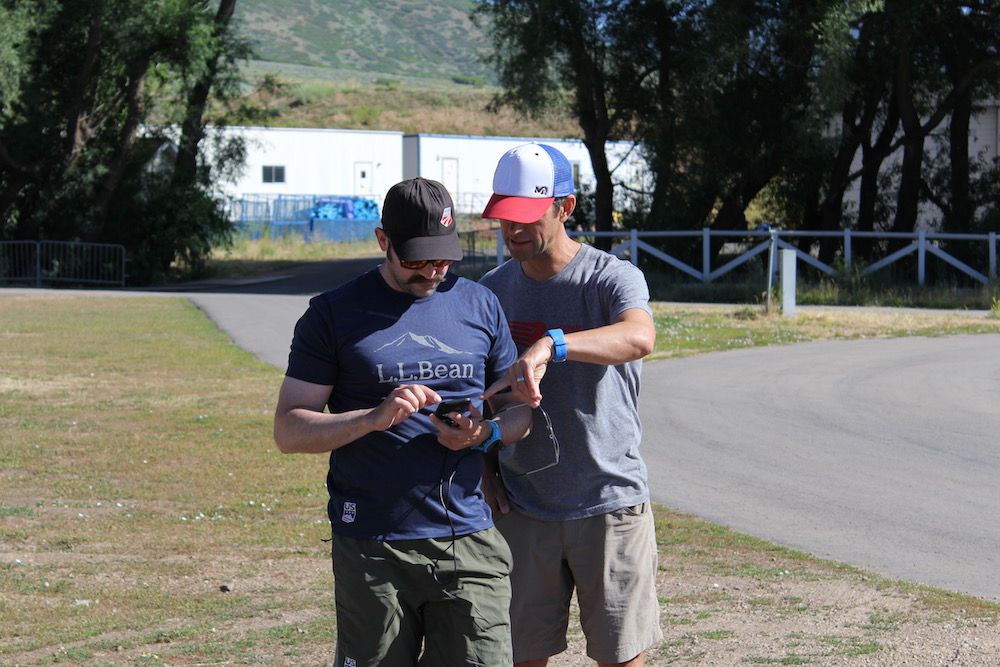
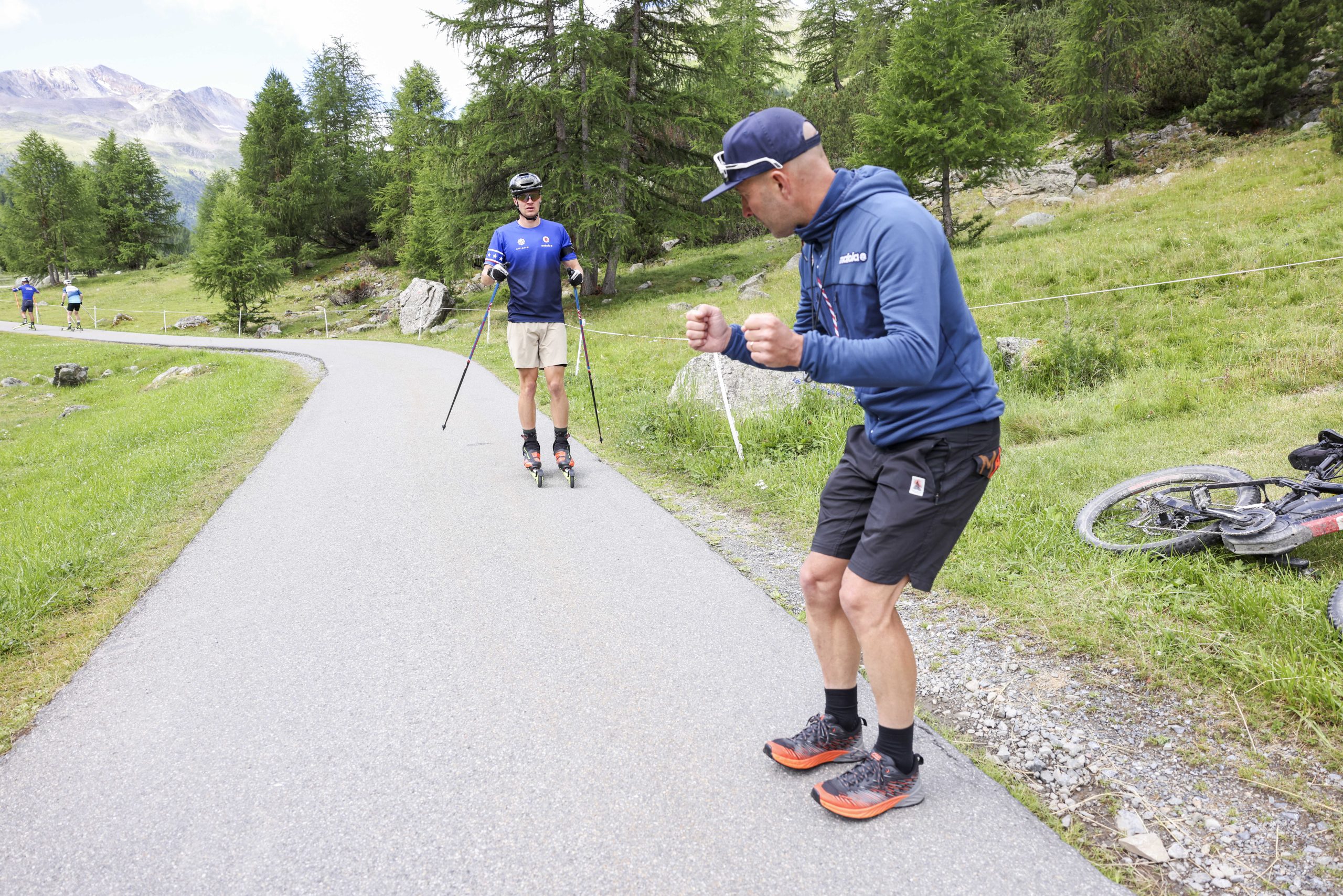
Johannes Høsflot Klæbo and his father, Haakon, during a water break on a rollerski workout in Park City, Utah, in September 2023. (Photo: Nathaniel Herz)
After more than 50 years in endurance sports as an athlete and coach, I recognize many of today’s training debates. We were asking versions of the same questions decades ago: How much training is enough? How hard should it be? When should we increase the load, and when should we allow more recovery? My answers have changed. The biggest change has been how much authority I give the training plan compared with the athlete’s response to it. I still believe in consistent work, appropriate volume, controlled intensity, and patience. But I have become much more willing to change the prescription as I learn how the athlete responds.
I believe it is important for coaches and athletes to build the training process on their own experience. Too many follow current trends, which in the last decade or two have shifted more than they did in the previous 30 years. That deserves recognition and some thought. Modifying what an athlete has done successfully over a few years is a fine and reasonable way to go. Wholesale changes create unknowns that make it impossible to assess what has worked.
What we know to be true, and what experience has demonstrated, should remain the foundation of how athletes train. Consistency is key, training at an appropriate volume load is critical, good control of training intensity should be a primary focus, and being patient and allowing the athlete time and room to adapt is most important.
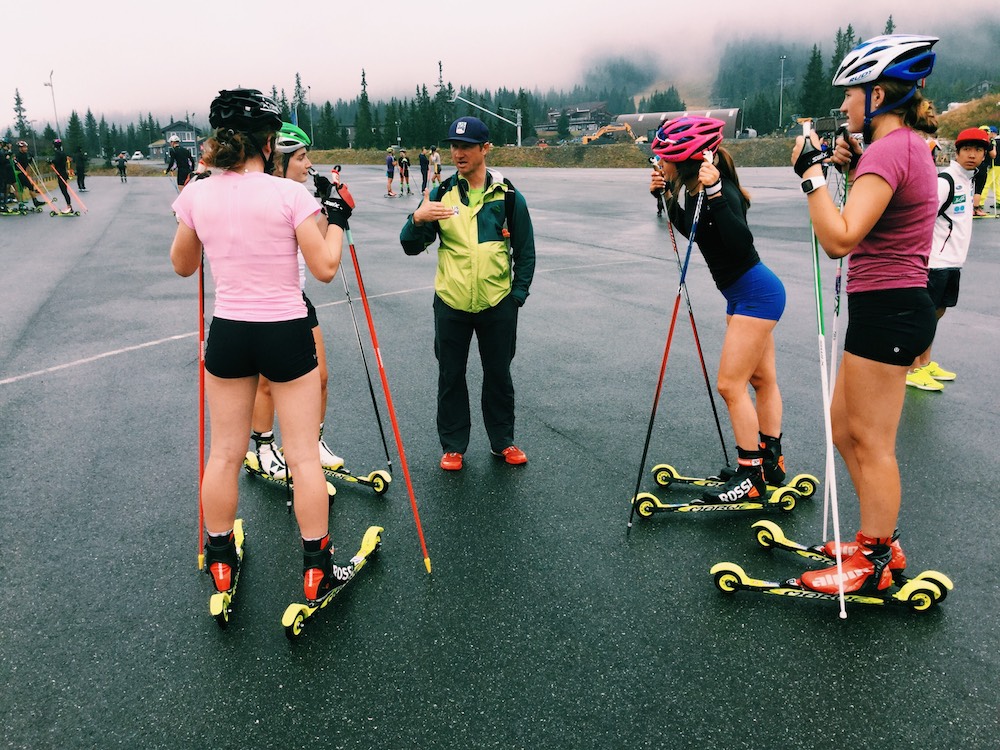
Coach Bryan Fish, in the yellow jacket, works with American athletes at the International Junior Camp in Sjusjøen, Norway, in 2018. How an athlete arrives on a given day can matter more than what the plan says. (Photo: Maria Stuber)
Twenty Years of HRV
Perhaps the most important change I have considered and implemented for anyone I coach is not being a slave to the training plan. I was one of the early adopters of heart rate variability (HRV), some 20 years ago. HRV is a tool I find most valuable in guiding training and in giving athletes the time and space to recover and adapt to it. Of course, following experience and science, I have modified how I analyze HRV over two decades, but the core value is still there. In my experience, HRV helps us refine training so we can give athletes what they need on a given day or week.
Maybe in another decade something better will come along to help with this assessment, and we should be open to that. But we should not throw out something that has demonstrable value.
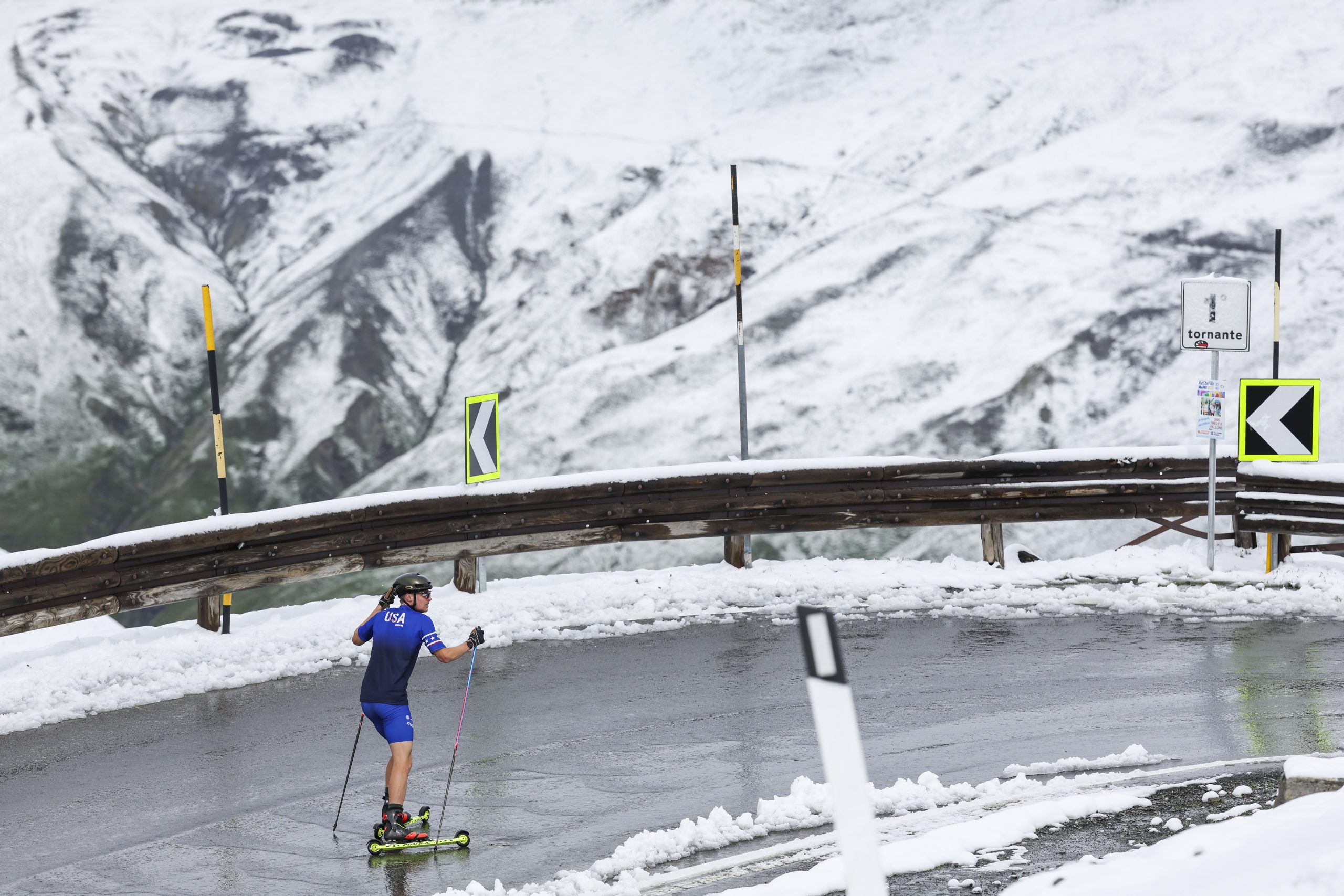
U.S. biathlete Campbell Wright climbs the Stelvio Pass during a summer training block based in Livigno, Italy, in July 2025, with fresh snow along the road. (Photo: NordicFocus)
A Flatter Ramp
Another big change I have made over the past 10 to 15 years is to the periodized training models we follow. When I was competing, we started the year in May at, say, 50 hours, and we progressively built that load month over month to 100 to 120 hours in November. During the later years of my career and into my early coaching years, I remember talking with coaches, physiologists and other athletes about this process. I simply did not see how 50 hours created adaptation that allowed for 60 hours, and how that training load allowed for 70 hours, and so on. It just did not make sense to me. Of course, it took some years to break out of that cultural mode and truly shift how we plan and implement training.
Now I fully believe in a far less aggressive ramp rate: starting the year at higher volume and staying consistent week to week and month to month. Over the course of the year, we can actually do more training with less shock and stress to the system, and with more consistent development. The theory that we need to increase the load week to week and month to month to add stress so we can adapt is, frankly, BS as I see it now. Training compounds week to week, month to month and year to year with consistency.
Simply put, under any model we should strive for consistent implementation, and we should not increase the load until, and only until, we have plateaued and fully adapted to the current load. Being consistent at the correct loads will let us do more training over a year, or over multiple years, than striving for a month-over-month increase.
It is easy to admire a big week or block of training and be impressed. But one big week or block tells us little more than what the athlete did. It does not tell us whether that training was sustainable, consistent, or actually created beneficial adaptation. The athlete who trains consistently day after day, week after week, month over month and year over year receives far less attention, but is the one building a sustainable base of fitness and performance.
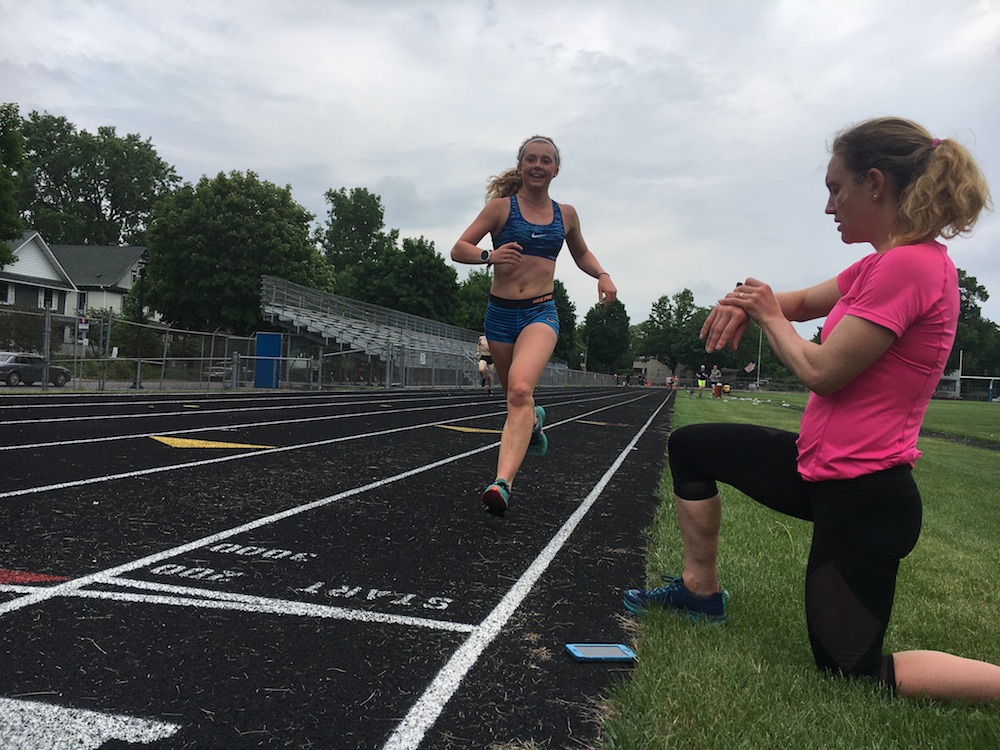
Coach Caitlin Gregg times Loppet Nordic Racing junior Sarah Olsen during a track time trial in the spring of 2018. (Courtesy photo)
The Questions I Ask
So both how I assess training load and recovery with HRV, and how I plan training around consistent loads, have completely changed how I evaluate training decisions. Sometimes the right decision is to add more training load. Often it is not. Other times it is to repeat a sustainable load so the athlete can stay consistent and adapt to it.
I always ask the question: If we do workout X today, or load X this week, how will it affect the athlete next week or next month? We also need to ask what we are trying to improve, what dose we need to improve it, and how we will know if it improved.
Ian Torchia leads L3 intervals with the Stratton Mountain School team in June 2018, with U.S. Ski Team head coach, Matt Whitcomb, following on a bike. (Photo: Pat O’Brien)
Old Becomes New Again
Then we must address the recent trends, and perhaps not so recent, in high-intensity training. In the mid-to-late ’80s and into the ’90s, high doses of threshold training were the “thing.” Then, in the late ’90s and early 2000s, VO2max blocks became the next “thing,” and after that it was back to VO2max workouts in a somewhat more controlled fashion. Now, over the last five or so years, based on the training of a speed skater and some Norwegian triathletes, we are back to so-called threshold and subthreshold training.
In essence, all things old become new again. What is missing from the trends is not the actual training; for some athletes it may well be the correct pathway. What is missing is an assessment of what limits the athlete’s performance. Without judging the merits of either high-intensity methodology, some athletes may need more focus on VO2max work, and others may well benefit from threshold-type workouts. In the simplest terms, an athlete with a very high fractional utilization may benefit more from a higher volume of threshold work, while those who do not have a well-developed aerobic capacity may benefit more from VO2max-type work. For elite athletes with a very high fractional utilization, threshold-type training probably also creates a signal to improve VO2max, or the speed at VO2max, because the intensity is relatively in the same zone.
Regardless of the type of high-intensity training an athlete is doing, we should be most focused on assessing and measuring how efficiently they are moving, their speed, and their durability to sustain that speed. Because no matter what the training methodology is, if you are not consistently improving performance, the training is not working.
U.S. Ski Team coaches Jason Cork and Chris Grover go over the details for a distance time trial at Soldier Hollow in Midway, Utah, in 2017. (Photo: Pat O’Brien)
The Plan Is a Snapshot
The most basic element, and the one most coaches spend hours and hours on, is the training plan. We plan periodized models of increasing training volume, and when and how to implement high-intensity training. We plan when to do races or time trials, when to focus on speed training, and how to fit in strength training and other aspects of performance. Yeah, that is all well and good, but it is mostly an exercise in futility. In my opinion, the training plan was valuable on the day it was written, based on where the athlete was at that snapshot in time. Once a plan is in place, there is a temptation, if not a certainty, that the athlete will do everything in their control to carry it out regardless of how they are feeling or what they need right now.
I did this for years. I spent hours developing an individual plan and expected the athlete to carry it out as some kind of infallible document. That is not how the body works. Nowadays I still write year plans, but with far less detail on hours and specifics, and more explanation of what we want to accomplish in each period rather than details of volume and periodization. I want the plan to create an environment with flexibility, where we use the data, and how the athletes are feeling and adapting, to adjust the day-to-day training.
After more than 50 years, I still believe in the value of consistent training, appropriate volume, controlled intensity, and patience. What has changed is how I decide what an athlete needs and how willing I am to revise that decision.
I once spent more time asking whether the athlete had completed the plan. Today, I spend more time asking whether the training is producing the response we intended, whether the athlete is absorbing it, and what that tells us about the next step.
I expect some of my thinking will continue to change. Experience gives me a foundation, but it also gives me reasons to keep asking questions. The responsibility I have as a coach is to pay attention, assess honestly, and act on what I learn, even when that means changing a plan I believed in when I wrote it.
Help Support Our Coverage!
If you value the thoughtful work and access FasterSkier provides, please consider becoming a Voluntary Subscriber. Your support directly fuels our work to cover the people, places, and moments that make our sport special.
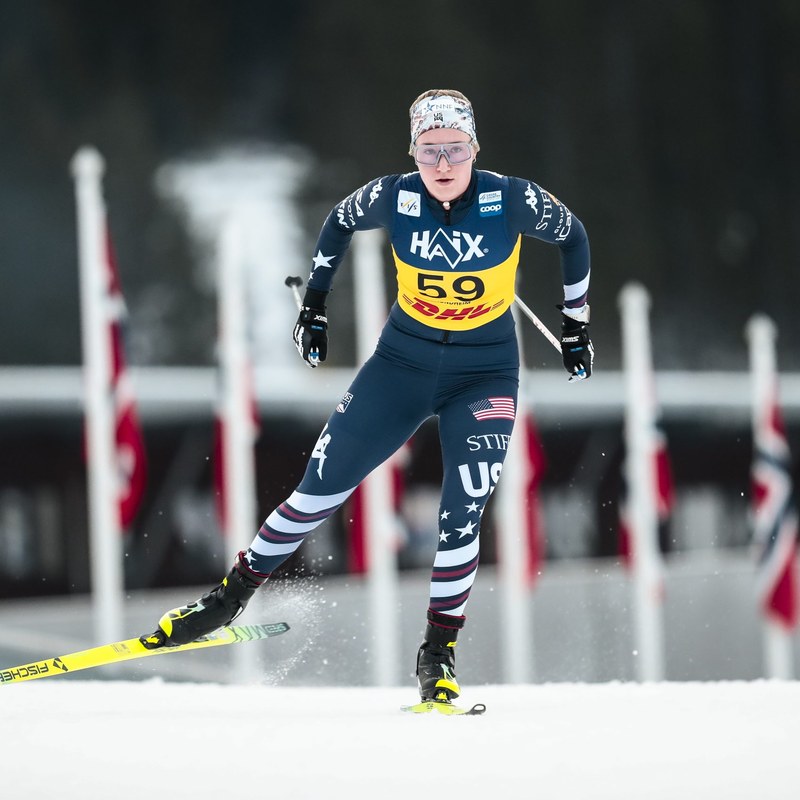
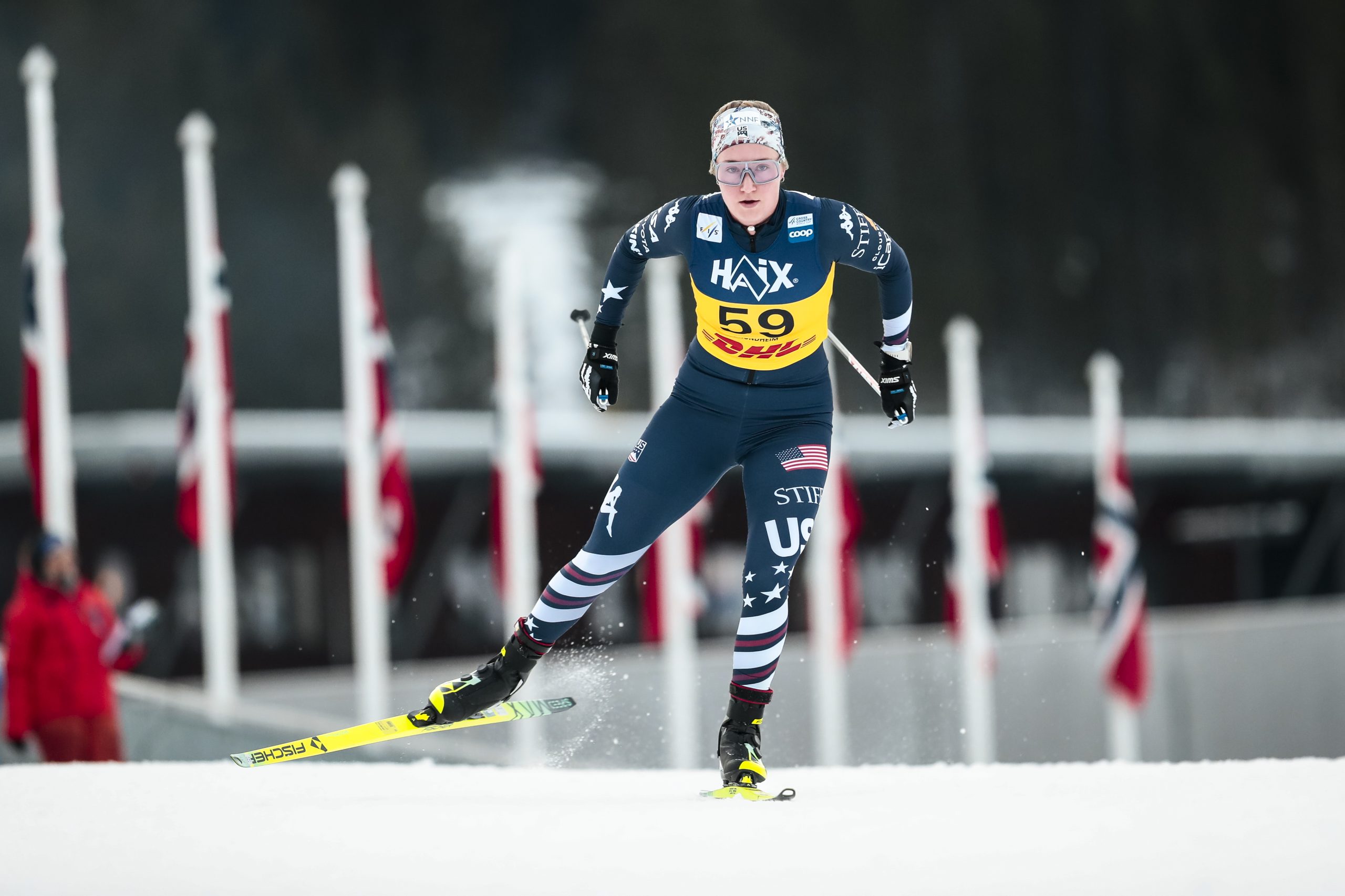
Kate Oldham racing the 10 k freestyle at the Trondheim World Cup in December 2025. Races of 5 to 15 kilometers, Jim Galanes points out, are not raced at threshold. (Photo: Modica/NordicFocus)
For the last couple of decades, the priority for high-intensity training has shifted from threshold, to VO2max, and now back to threshold again. Nowadays threshold training is increasingly presented as the ideal endurance training intensity. The suggestion is a high aerobic stimulus at a low recovery cost, repeatable and sustainable. VO2max is often portrayed as the opposite: a very high stimulus, high stress, very high fatigue, and something to be used carefully, if at all. Folks, we have seen this story before, in the threshold boom of the mid to late ’90s.
From some perspectives this may be intuitively correct and perhaps logical. If we compare one minute of threshold work to one minute at VO2max intensity, the VO2max work is more demanding. That is a no-brainer. There is more carbohydrate use, higher oxygen demand, higher lactate production, greater perceived exertion and generally a greater physiological disturbance. But is that the way training really works? We build training plans around individual workouts and daily and weekly loads, not per minute of high-intensity training.
For example, we might plan 5 x 4 minutes at VO2max intensity, or 20 minutes of total work. Or it might be 4 x 10 minutes at threshold, or 40 minutes of total work. When we look at the load of the whole session, things become far less clear. Both types of training produce similar adaptations, although the adaptive signal from the higher-intensity work is much stronger, and there is little evidence that a threshold session creates less recovery demand than an appropriately controlled VO2max session.
This is really the point I want to make. We need to stop confusing intensity with training load, and, perhaps more important, we need to stop confusing training load with the recovery timeline. They are related, but they are not the same thing.
As I have written before, threshold is a moving target, and defining it is problematic. There are perhaps a dozen or more methods used to determine threshold, and they can produce very different speeds, heart rates, power outputs and lactate values. Some athletes are working just above LT1 and calling it threshold. Others are working around 4 mmol, and others are using ventilatory threshold, critical power, some percentage of race pace, or simply an intensity that feels controlled and hard. So when people say “threshold training,” I am not sure we are even talking about the same thing. That alone should make us careful about assigning a fixed physiological cost or benefit to threshold training.
The generally accepted training model is usually described like this: easy endurance training provides a relatively small stimulus at a relatively low cost, so we need a lot of it. Threshold gives us a much larger aerobic stimulus, still at a manageable recovery cost. VO2max gives us a very large stimulus, but at a very high recovery cost. Again, that makes intuitive sense, but is it true when we compare realistic sessions? I am not convinced it is. In fact, I am certain it is not.
If we think of training load in simple terms, it is a combination of intensity and duration. Higher intensity produces greater load per minute, while longer duration produces more total load. A 3-hour easy workout, for example, produces a bigger training load than a 75-minute workout with 5 x 4 minutes of VO2max intervals. This is obvious, but somehow we often forget it when discussing threshold and VO2max training.
Take a typical VO2max workout of five by four minutes, 20 minutes of work. Using Firstbeat’s TRIMP model, that might create about 55 to 60 TRIMP. Now take a threshold workout of four by ten minutes, 40 minutes of work. That might generate something in the 95 to 100 TRIMP range. With Firstbeat we can also look at EPOC as an estimate of the disturbance of homeostasis. Again, these are estimates and certainly not perfect measures, but 20 minutes at around 90 percent of VO2max might produce an EPOC of around 175 ml/kg, while 40 minutes at around 85 percent might produce an EPOC of 225 ml/kg. Once again the threshold workout produces a significantly higher stress load.
I don’t want to get hung up on whether those exact Firstbeat numbers are accurate, because that is not really the point. The point is that it is entirely possible for the lower-intensity session to produce the larger total load, and that should not surprise anyone, because it is twice as long.
The same thing happens if we use session RPE. Twenty minutes of VO2max work at an RPE of 9 gives us 180 AU (arbitrary units), while forty minutes of threshold at an RPE of 6 gives us 240 AU. Again, the threshold session creates the larger estimated training load. That does not prove threshold is more stressful or that it takes longer to recover from. TRIMP and session RPE are measures or estimates of training load, not measurements of recovery time.
We have at least three different things being discussed as if they were the same: the intensity of the exercise, the total load of the workout, and how long it takes the athlete to recover. A VO2max interval clearly creates greater physiological disturbance per minute. A longer threshold session may create a greater total training load. Neither one, by itself, tells us which athlete will be better recovered 24 or 48 hours later.
High cost per minute is not the same thing as high cost per session, and high session load is not necessarily the same thing as longer recovery.
Otto Invenius, Campbell Wright, Maxime Germain and Adam Runnalls climbing the Stelvio Pass on rollerskis above Livigno, Italy, in July 2025. The adaptations from threshold and VO2max work overlap far more than the zone names suggest. (Photo: Manzoni/NordicFocus)
What Are We Actually Trying to Adapt?
The other issue is that we spend far too much time talking about training zones and not enough time talking about desired adaptations. What adaptations are we trying to create? That should come first.
VO2max training provides a very strong aerobic stimulus at near-maximal oxidative capacity. It can increase maximal cardiac output, improve oxygen transport, create very high muscular oxygen demand and expose the athlete to speeds and power outputs similar to race demands. Threshold training lets us accumulate a large amount of work at a high aerobic fractional utilization. It can improve sustainable speed or power, oxidative capacity at that intensity, and the ability to maintain a high percentage of maximal aerobic power for a longer period of time.
These adaptations overlap a great deal. I sometimes hear people talk as if threshold develops lactate clearance and the muscles’ ability to sustain work, while VO2max develops the central cardiovascular system. But VO2max training creates a large muscular stimulus as well. ATP turnover is very high, calcium flux is high, metabolic disturbance is high, and the signaling associated with mitochondrial biogenesis is substantial. VO2max training is not simply “central cardiovascular training.” It also provides a significant peripheral training stimulus.
Threshold training obviously produces a similar but slightly smaller mitochondrial and muscular signal for adaptation. But I think its real advantage may be something much simpler. Because the intensity is lower, we can normally do considerably more of it. That allows us to accumulate a large amount of work at a high aerobic fractional utilization, with substantial muscular recruitment and a large amount of sport-specific work.
That may be threshold training’s most important characteristic. Not that it creates some unique physiological adaptation unavailable at other intensities, but that it allows us to accumulate considerably more work while still creating a high oxidative demand.
This can be particularly important for an athlete who already has a high VO2max and whose limitation is the fraction of that VO2max that can be sustained. If fractional utilization is relatively low, increasing sustainable aerobic power may be far more important than trying to push VO2max another few percent. For that athlete, a greater amount of threshold work may make very good sense.
But that is an argument based on the needs of the athlete, not an argument that threshold is inherently a better training intensity or that we recover from it more quickly.
Lactate clearance and resynthesis is another area where I think training discussions have become confused. We often hear that threshold training is necessary because the athlete needs to train to “clear lactate.” I have always had a problem with this explanation, because it is neither accurate nor scientifically valid. Remember, it is lactate we are talking about, not lactic acid, as many refer to it.
Lactate is not a waste product that suddenly appears at threshold and then needs to be removed. It is being produced, transported and oxidized all the time, at all intensities, and it is an important fuel. Endurance training improves the ability to transport and oxidize lactate, but there is no reason to believe this only happens at threshold. High-intensity interval training also improves lactate transport and can move lactate threshold substantially.
VO2max intervals also create very high lactate production and turnover. So if we are looking at the lactate shuttle, why would it only, or even preferentially, adapt when lactate is sitting around 2, 3 or 4 mmol? That doesn’t make much physiological sense to me. Producing higher levels of lactate will stimulate resynthesis.
The same is true for mitochondrial biogenesis, oxidative enzymes and capillarization. We cannot neatly assign these adaptations to one training zone, because there is considerable overlap between endurance, threshold and high-intensity training.
That doesn’t mean all intensities are the same. They clearly aren’t. It means we should be careful about inventing unique adaptations for a training zone simply because we have given that zone a name. Threshold training is not the only method, or even the optimal method, to improve lactate oxidation and resynthesis.
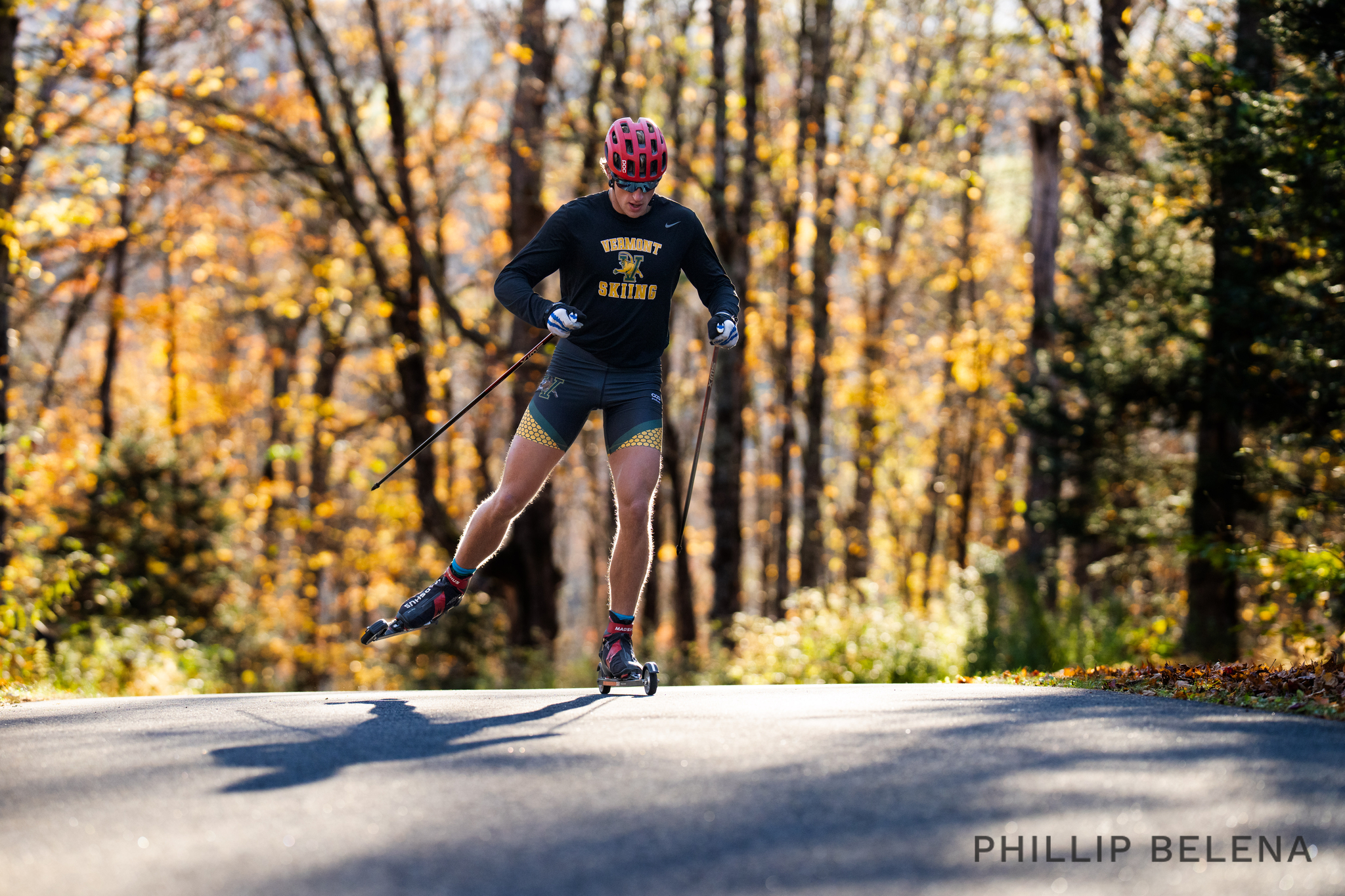
A University of Vermont skier on rollerskis at Craftsbury Outdoor Center in October 2025. Autonomic, glycogen, muscular and mechanical recovery all run on different clocks. (Photo: Phillip Belena/EISA)
What Is Recovery?
Another problem in this discussion is recovery. People will say that threshold is easier to recover from. Maybe, but recover from what? Autonomic disturbance, glycogen depletion, neuromuscular fatigue, muscle damage, mechanical load, dehydration or psychological fatigue? These are not the same thing, and they do not necessarily recover at the same rate. A 2-hour run and a 2-hour rollerski at the same intensity, for example, carry very different mechanical loads to recover from.
HRV may tell us something about autonomic recovery, which should also reflect other aspects of recovery but does not specifically measure them. Resting heart rate can tell us something, but again not everything. Blood lactate tells us something about what is happening during and immediately after the workout, but remarkably little about whether the athlete is going to train well 24 or 48 hours later. Creatine kinase may tell us something about muscle damage, but there is huge individual variation. So when we talk about recovery cost as if it were one number, I think we are being too simplistic.
This is also why I don’t think we can simply use TRIMP, EPOC, duration, distance or session RPE to say one workout takes longer to recover from than another. They can give us useful information about internal load or physiological disturbance, but they are not recovery measurements. Ultimately, recovery must be considered in terms of which physiological systems were stressed and, more practically, what the athlete can do in the days immediately after a hard workout.
Carbohydrate use is another good example. VO2max exercise clearly has a higher rate of carbohydrate use per minute than threshold exercise. But once again, the session matters more than the minute. Twenty minutes at VO2max intensity may have a very high glycogen cost per minute. Forty, fifty or sixty minutes at threshold has a somewhat lower rate, but it is sustained for two or three times as long. We cannot automatically assume that the shorter VO2max workout creates greater total glycogen depletion.
This becomes particularly important when athletes are doing regular quality sessions. If glycogen restoration is an important part of recovery, a long threshold session may impose a very substantial recovery requirement despite producing lower lactate concentrations and feeling much more controlled. An athlete does not have to be lying on the ground after a workout for that workout to have been expensive to recover from.
That is one of the problems I see with the idea that threshold can be repeated frequently simply because lactate is controlled. Low lactate does not necessarily mean low glycogen use, low muscular load or rapid recovery. If we keep extending the duration of the threshold work, at some point the additional work has a cost.
Which brings us to what I think is probably the most meaningful recovery measure, and one that is surprisingly rarely studied: can the athlete perform the next important training session at the expected level?
Lucas Wilmot, Kristen Bourne, Murphy Kimball and Tabor Greenberg after their first L3 intervals at a 2025 camp in Bend, Oregon. (Photo: Leann Bentley)
An Interesting Study
One of the more interesting comparisons was made by Seiler, Haugen and Kuffel with highly trained runners. On one occasion the athletes did a threshold session of around 30 minutes between the first and second ventilatory thresholds, and on another, six three-minute intervals at around 95 to 96 percent of VO2max. I would point out that 95 to 96 percent of VO2max is already hard, and above what I would normally call a controlled VO2max session.
The differences between the workouts were substantial. Lactate during the threshold session was around 2.7 mmol, while during the VO2max intervals it was around 7.1. Perceived exertion was also much higher during the VO2max workout. By almost any acute measure the VO2max workout looked harder, so we might reasonably expect recovery to take longer. But HRV recovery following the two sessions was remarkably similar.
Now, this study does not fully answer the question. The threshold work was only around 30 minutes, HRV measures one part of recovery, and there are all kinds of differences between athletes. But it does challenge an assumption that I think is important. Greater acute metabolic disturbance does not necessarily mean longer recovery, but the dose does.
It also raises what I think is an even more interesting question. What would have happened if the threshold session had contained 40 or 50 minutes of work rather than 30? That would be much closer to the threshold sessions many trained endurance athletes are actually doing.
U.S. Biathlon coach Armin Auchentaller with Campbell Wright during summer training in Livigno, Italy, in July 2025. A controlled VO2max session is about time at high oxygen uptake, not about producing as much lactate as possible. (Photo: Manzoni/NordicFocus)
Control of VO2max Training
There is another issue here that I think is important. A lot of people seem to think VO2max training means going as hard as possible. It doesn’t, at least not the way I see it and use it.
If I give an athlete 5 x 4 minutes of VO2max work, I am not asking them to race every interval or see how much lactate they can produce. I am trying to get them to accumulate time at a very high oxygen uptake, typically around 90 to 95 percent of maximal heart rate and VO2max.
If the objective is a cardiovascular and oxidative stimulus, we need sufficient intensity to drive oxygen consumption toward a very high fractional utilization of VO2max. For many athletes, something in the range of 90 to 95 percent of VO2max may be enough to accomplish that. Once we have produced the stimulus we are looking for, going harder does not necessarily make the workout better.
This becomes important when we compare threshold and VO2max training. If someone compares a carefully controlled threshold session with a set of VO2max intervals performed as hard as possible, then of course the VO2max workout is going to look very stressful. But that may simply be a badly controlled VO2max workout.
A well-controlled VO2max session and an all-out interval session are not the same workout, just as a controlled threshold session and a threshold session that slowly turns into a race are not the same workout. Anyone who has coached for very long has seen both.
A University of Vermont skier on the rollerski track at Craftsbury in October 2025. Forty minutes at threshold is a lot of work, and so is fifty, and so is sixty. (Photo: Phillip Belena/EISA)
What Is Threshold’s Real Advantage?
In my view, the strongest argument for threshold training is not that it produces some special adaptation, but that athletes can accumulate a lot of high-quality aerobic work. Forty minutes at threshold is a lot of work. Fifty minutes is a lot of work. Sixty minutes is a lot of work. For an elite endurance athlete doing a very large total training volume, that may be exactly what is needed, provided the athlete can recover from the overall workload of the training period.
Threshold gives us a way to accumulate a substantial amount of work at high oxidative fractional utilization, with considerable muscular recruitment and a lot of sport-specific work. For an athlete with a high VO2max who needs to improve fractional utilization or sustainable aerobic power, this can be valuable.
I think this is where some of the current discussion around threshold becomes problematic. Because it is controlled, because lactate is relatively low, and because the athlete is not destroyed afterward, threshold starts to be treated almost like endurance training. It isn’t. It is still hard training, and if you do enough of it, it carries a substantial training load and potentially a substantial recovery cost.
The question is not simply whether forty or fifty minutes at threshold creates more adaptation than twenty minutes of VO2max work. It probably creates more of some kinds of stimulus simply because we are doing so much more work. The more useful question is whether the additional adaptation we get from that extra work is worth the additional load and recovery cost.
Kevin Bolger in the fog at the Oslo World Cup mass start in March 2026. The first question is what adaptation an athlete needs. The second is the smallest dose that will produce it. (Photo: Authamayou/NordicFocus)
Are We Asking the Wrong Question?
The debate is usually framed as threshold versus VO2max. Which is better? I don’t think that is the right question. The first question should be what adaptation this athlete needs. The second, and I think this is more important, is what is the smallest dose capable of producing that adaptation? It isn’t necessarily 40, 50 or 60 minutes. The third is what effect that dose will have on the training the athlete can perform over the next several days.
We tend to assume that if some training is good, more of it must create a greater adaptation. Up to a point that is probably true. But the objective of training is not to produce the largest possible stimulus in every workout. It is to produce enough stimulus to create the adaptation while still being able to absorb the rest of the training.
If an athlete has a relatively low VO2max and that is limiting performance, perhaps 15 or 20 minutes of controlled VO2max training gives us exactly the stimulus needed. If that is enough to stimulate the adaptation, why do 50 minutes of threshold just because threshold is currently popular?
On the other hand, if an athlete already has a very high VO2max but relatively poor fractional utilization, and cannot sustain a high percentage of it, then perhaps a larger volume of threshold work is exactly what is required. In that case the ability to accumulate 40 or 50 minutes at high aerobic flux may be the important stimulus.
NENSA athletes rollerskiing together in Craftsbury, Vermont. A workout can look great on paper and still be the wrong choice if it costs the next two days. (Photo: Chris City)
The Training Week Matters More Than the Workout
I also think we make a mistake when we look at workouts in isolation. A workout can look great on paper and still be a poor training choice, because the real issue is not simply what happened during those 60 or 90 minutes. It is what that workout allows us to do over the next several days.
Suppose a threshold workout produces 10 percent less adaptive stimulus than a VO2max session but allows the athlete to train substantially better over the following two days. Threshold may clearly have the better stimulus-to-recovery ratio and therefore be the better choice.
But reverse the situation. Suppose 20 minutes of well-controlled VO2max work produces the adaptation we want and the athlete is ready to train normally the next day, while 40 or 60 minutes of threshold creates substantial glycogen depletion and muscular fatigue. In that circumstance, the shorter VO2max workout may have the better stimulus-to-recovery ratio.
We shouldn’t decide the answer beforehand simply because one workout carries the label “threshold” and the other “VO2max.” Threshold is not automatically low cost, and VO2max is not automatically high cost. The dose matters, the athlete matters, the training done before the session matters, what needs to be done after the session matters, and the total training week matters.
Therese Johaug racing the mass start at the Lahti World Cup in March 2025. Even races of up to 90 minutes, Galanes says, are often skied well above threshold. (Photo: Thibaut/NordicFocus)
Dose, Adaptation and Recovery
I am certainly not arguing against threshold training. Rather, I am arguing that the dose needs to be controlled relative to the individual athlete, and that the time to recover is not what is often suggested. I use threshold with athletes who need it, and it can be effective. But I do think we need to be more careful about how it is being presented. It is not automatically what every athlete needs.
Threshold and VO2max training have different characteristics, but their physiological adaptations overlap substantially. VO2max training provides a very large physiological stimulus in a relatively short period of time and appears particularly useful when maximal aerobic capacity is what we are trying to improve. Threshold allows us to accumulate considerably more work at a high aerobic output and can be extremely effective when sustainable aerobic power or fractional utilization is the limitation.
Both can be valuable, and both can be overdone.
In my experience, especially over the last decade, I have seen far more athletes become flat, stale, overtrained or simply stagnant from doing too much threshold training than from doing properly controlled VO2max work. Usually it comes from doing too big a volume of threshold work, too often. That doesn’t mean threshold is bad. It means threshold must be appropriately prescribed and dosed.
I also think the very large amounts of threshold work we sometimes see promoted are primarily appropriate for highly trained elite athletes who are also doing very large overall training volumes and have spent years developing that volume. I would be much more cautious applying the same model to younger athletes, developing athletes, masters athletes, or anyone doing a much smaller overall training volume.
There is another point that seems to get lost. Athletes racing 5, 10 and 15-kilometer events are not racing those events at threshold. I have decades of data showing that even in races of up to 90 minutes, fractional utilization can be well above threshold. The shorter races are at a very high intensity, in what is defined as the VO2max zone. At some point we need to train that capacity directly. Doing more threshold work because it is supposedly lower cost does not eliminate the need to train at race-relevant intensity.
In the end, I think we need to get away from ranking training zones as good, bad, safe or dangerous, and think more in terms of dose, desired adaptation and recovery. What are we trying to adapt, what dose is needed to produce that adaptation (often less than we think), and what does that dose cost us in terms of the training that follows?
The most valuable workout is not necessarily the one that creates the greatest immediate physiological disturbance, nor is it necessarily the one that accumulates the most minutes around some predetermined lactate value. It is the workout that provides enough stimulus to produce the adaptation we are looking for while preserving the athlete’s ability to absorb the rest of the training program.
In the end, that is the balance we are trying to find.
Help Support Our Coverage!
If you value the thoughtful work and access FasterSkier provides, please consider becoming a Voluntary Subscriber. Your support directly fuels our work to cover the people, places, and moments that make our sport special.
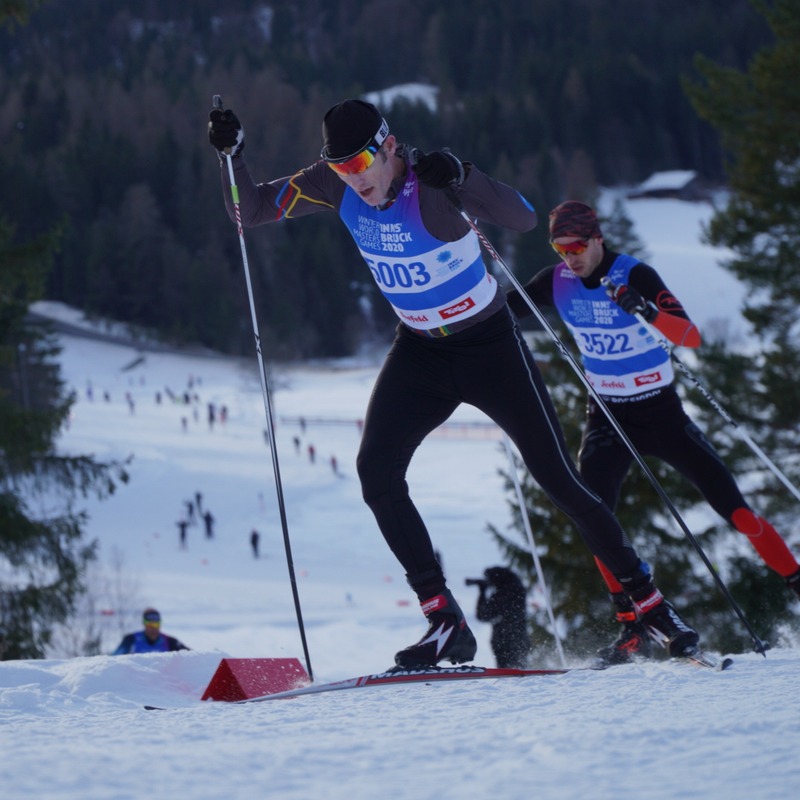
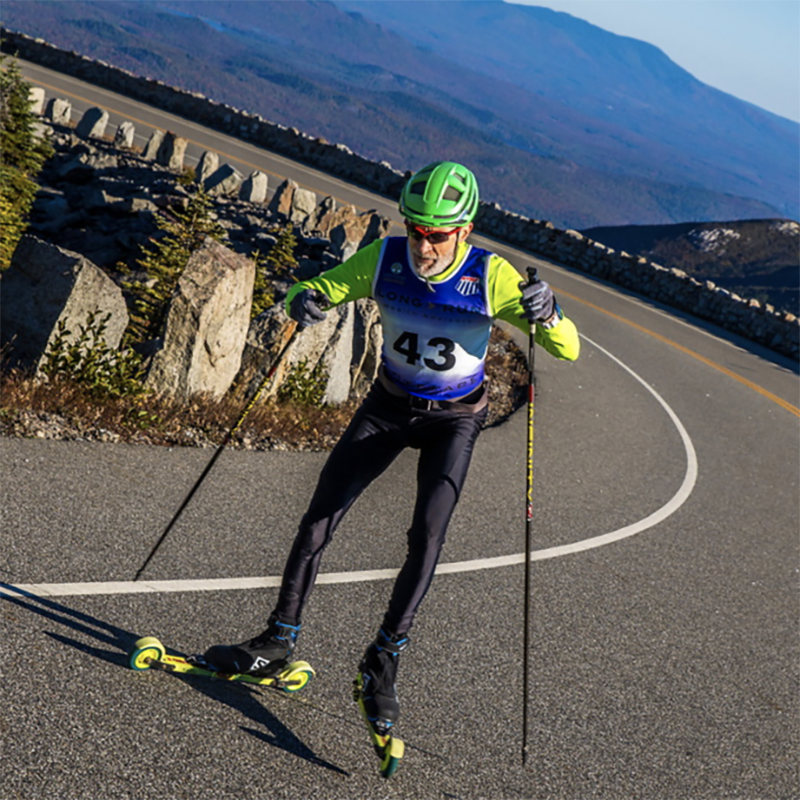
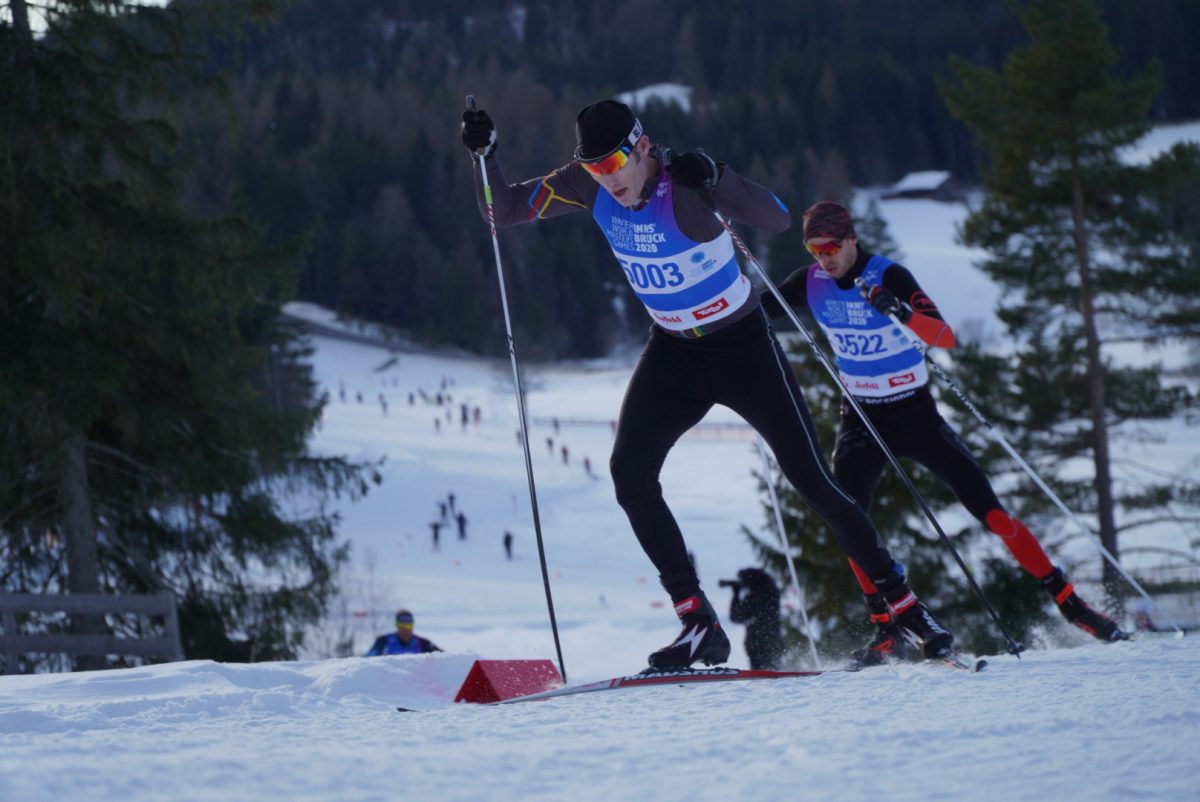
Tim Donahue racing at the 2020 Winter World Masters Games in Seefeld, Austria. Jim Galanes argues that the training masters skiers cut first is often the training that protects what aging takes away fastest. (Photo: Garrott Kuzzy / Lumi Experiences)
There are two common problems I see in the masters athletes I consult with or coach. The first is the same problem we see with athletes of all ages: they tend to train “half hard” every day. Half hard, Zone 1 quickly drifts into Zone 2 or 3. The second is more specific to masters athletes. They try to follow a training plan that is basically a dumbed-down version of an elite athlete’s program.
The first problem is relatively straightforward to address. Determine appropriate training zones and control the intensity of training more accurately.
The second is more complicated. We need to determine the volume of training an athlete can recover from, adapt to and maintain consistently. Then we need to organize that training around the physiological capacities that are most likely to decline as we age.
There is truth behind the conventional advice given to masters athletes. Recovery does change with age. Simply repeating the training we did at 25 or 30, or copying the program of an elite athlete, is never the best approach at 50, 60 or 70.
But there is a problem with how we sometimes respond to that reality. Many of the training components we tend to remove as athletes age are exactly the components that address the physiological capacities declining most rapidly.
The challenge of training as a masters skier isn’t simply figuring out how to recover better. It is figuring out how to provide enough training stimulus to maintain and improve the capacities that are naturally declining with age while still recovering sufficiently to adapt to the volume of training.
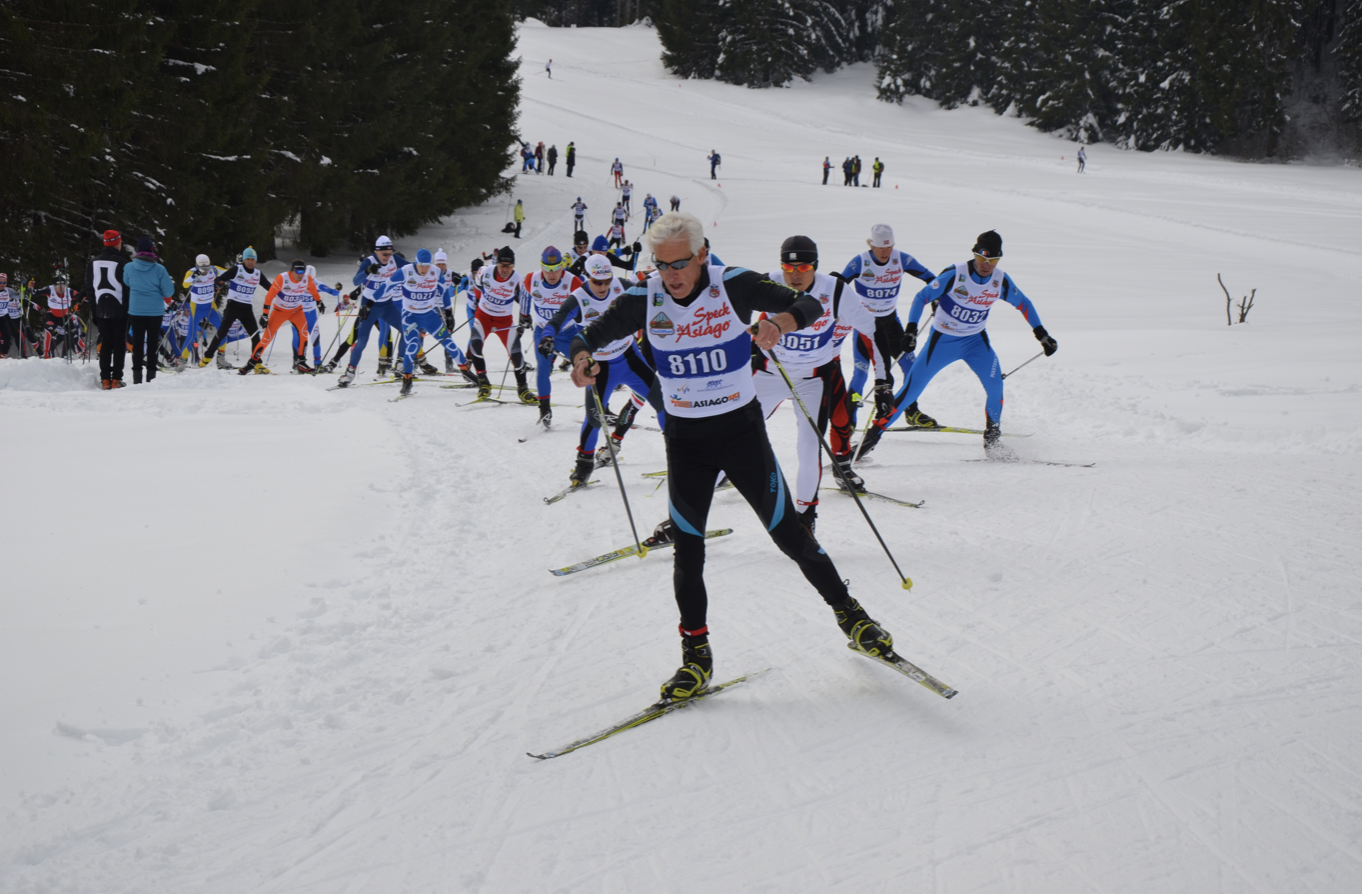
A masters field on the climb at the 2014 Masters World Championship in Asiago, Italy. Endurance performance declines with age, but the individual components of performance do not decline at the same rate. (Courtesy photo)
What Actually Changes with Age?
We know endurance performance declines with age, but the individual components of performance do not decline at the same rate.
One of the largest physiological changes is generally VO2max. Maximum heart rate declines. Muscle mass and maximal strength decline, both of which are important to maintaining aerobic capacity and skiing performance. Type II muscle fibers and explosive power become increasingly difficult to maintain.
Meanwhile, exercise economy and the ability to sustain a relatively high percentage of VO2max can be reasonably well maintained in highly trained older athletes. That should tell us something about training.
If these capacities decline at different rates, it doesn’t make much sense to treat them equally in training.
There is a temptation as we age to gravitate toward the training we tolerate best. The problem is that the capacities we tolerate best may also be the capacities we are already preserving reasonably well.
Training should not simply reflect what aging makes easiest to do. It must continue to address what aging is taking away. If VO2max, strength and power are among the capacities most vulnerable to aging, eliminating high-intensity and strength training in the name of increasing recovery may solve one problem while creating another.
Ahvo Taipale during a Vakava training session. Consistently accumulated aerobic volume remains one of the primary drivers of endurance adaptation, and one of the best defenses a masters skier has. (Photo: Finn Sisu)
Maintain the Aerobic Volume
There has been considerable emphasis in endurance training recently on large volumes of low-intensity training combined with substantial amounts of threshold and sub-threshold work.
There are good reasons for that approach, particularly among highly trained elite athletes. But simply transferring that model to masters athletes can overlook the capacities most threatened by aging, particularly VO2max, strength and power.
So how much Zone 1? How much threshold? How much VO2max?
Those are important questions, but they can obscure something more fundamental.
Consistently accumulated training volume remains one of the primary drivers of endurance adaptation. Masters athletes sometimes respond to aging by progressively reducing volume and attempting to compensate with intensity. There are limits to that strategy.
Mitochondrial development, capillarization, fat oxidation, durability and the ability to maintain performance over long races are built largely through accumulated aerobic work. A two-hour easy ski is not interchangeable with a hard interval workout simply because the interval session produces more acute physiological stress.
For a masters skier who has trained for decades, maintaining as much sustainable aerobic volume as possible may therefore be one of the most important defenses against declining endurance capacity.
The key words are sustainable and consistent training.
The volume has to be performed at the right intensity. It has to be something we can recover from day after day and, most importantly, adapt to over weeks and months.
As we have written previously, occasional hero weeks followed by heavy fatigue and a subsequent reduction in training for recovery are less effective than weeks and months of consistent training at a sustainable level.
UVM’s Fin Bailey drives up a climb on the Craftsbury Outdoor Center track. The answer to aging is not necessarily more high-intensity training, but keeping the frequency of the stimulus while controlling the dose. (Photo: Phillip Belena)
Don’t Abandon Intensity
The opposite mistake is maintaining plenty of volume while gradually eliminating the hard training. This is understandable, particularly for those who enjoy the “half hard” training.
When we stop performing high-intensity training consistently, we lose some of our adaptation to that capacity. Every subsequent interval workout or race is then harder than it used to be, and recovery takes longer, because we have eroded that capacity. That can reinforce the idea that high intensity itself is the problem.
But VO2max is also one of the physiological qualities most strongly affected by aging. So the training stimulus we may most need to maintain becomes increasingly difficult to perform and recover from. The answer isn’t necessarily more high-intensity training. It is maintaining the frequency of the stimulus while controlling the dose.
That may mean less high-intensity work in an individual session, but performing it consistently throughout the year. Fifteen to twenty productive minutes near VO2max may provide a better stimulus than turning every interval workout into a contest to see how much we can do. For many masters skiers, one or two genuinely hard aerobic sessions every seven to ten days may accomplish more than two or three mediocre high-intensity sessions every week.
The appropriate frequency depends on training history, age, fitness and recovery ability, not on a predetermined seven-day formula.
Gunnar Knapp finishes the Engadin Skimarathon. Threshold and sub-threshold training allow considerably more work to be accumulated at a high aerobic rate. (Photo: Garrott Kuzzy / Lumi Experiences)
Threshold Has a Different Job
Threshold training shouldn’t simply become the safer substitute for VO2max training. It is not. In fact, the metabolic and neuromuscular cost of a typical threshold session may be greater than that of a typical controlled VO2max session.
VO2max training provides a powerful stimulus to central aerobic capacity, cardiac output and the ability to deliver and utilize large amounts of oxygen. Threshold and sub-threshold training allow considerably more work to be accumulated at a high aerobic rate while developing the ability to sustain that rate economically.
One of the important considerations in deciding how much emphasis to place on each is fractional utilization: the percentage of VO2max an athlete can sustain for a prolonged period. An athlete with a relatively low VO2max but already high fractional utilization may gain relatively little by continually emphasizing the quality that is already strong while allowing the aerobic ceiling above it to decline.
Conversely, an athlete with a large aerobic capacity but relatively poor ability to sustain a high percentage of it may have considerably more to gain from threshold and sub-threshold training.
This becomes particularly important in highly trained skiers. The speeds elite skiers can maintain at threshold or just below it can be quite close to actual race velocities. That speed and the muscular demands associated with sustaining it are part of what makes the training effective.
For cross-country skiers, both qualities matter.
A skier may have an excellent VO2max but lack the muscular endurance to translate that capacity into sustained double poling or climbing. Another skier may have excellent threshold durability but gradually lose the aerobic ceiling above it.
The question isn’t whether threshold or VO2max training is better. The question is which physiological limitation we are trying to change.
Hailey Swirbul during a strength session at a U.S. Ski Team camp in Park City, Utah. Research in cross-country skiers has shown that maximal-strength training can improve double-poling performance and economy. (Photo: Reese Brown)
Strength Becomes More Important, Not Less
Perhaps the clearest change in training priorities with age should be strength.
Cross-country skiing has become increasingly dependent on upper-body force, whole-body strength and power. At the same time, aging progressively reduces muscle mass, maximal strength and particularly fast-twitch muscle function.
Research in cross-country skiers has shown that maximal-strength training can improve double-poling performance and economy. One likely explanation is relatively simple. If every pole stroke represents a smaller percentage of your maximum force, repeatedly producing that force becomes less metabolically costly.
For masters skiers, developing and preserving maximal strength is particularly valuable because it provides reserve capacity. The goal is maintaining the ability to produce force.
That generally suggests relatively heavy resistance, good technique, low-to-moderate repetition ranges and sufficient recovery, rather than endless circuits of light weights.
Ian Torchia, right, leads bounding intervals up Stratton Mountain. Power tends to decline particularly rapidly with age, and short, fast work preserves it without requiring a large amount of metabolic stress. (Photo: Courtesy Stratton Mountain School)
Power Is the Forgotten Quality
Strength and power are not identical. Strength is how much force we can produce. Power is how fast we can produce it. Power tends to decline particularly rapidly with age.
Acceleration over the top of a hill, changing gears on a climb, responding to an attack, generating force quickly through the poles and maintaining technique at race speed all depend on the ability to produce force quickly.
Masters athletes therefore shouldn’t eliminate every fast movement from training. Short hill accelerations, controlled bounding, short ski sprints and explosive strength exercises can provide a neuromuscular stimulus without requiring a large amount of metabolic stress.
The dosage doesn’t need to be large. What matters is the peak stimulus.
But, as with nearly every aspect of training, consistency matters.
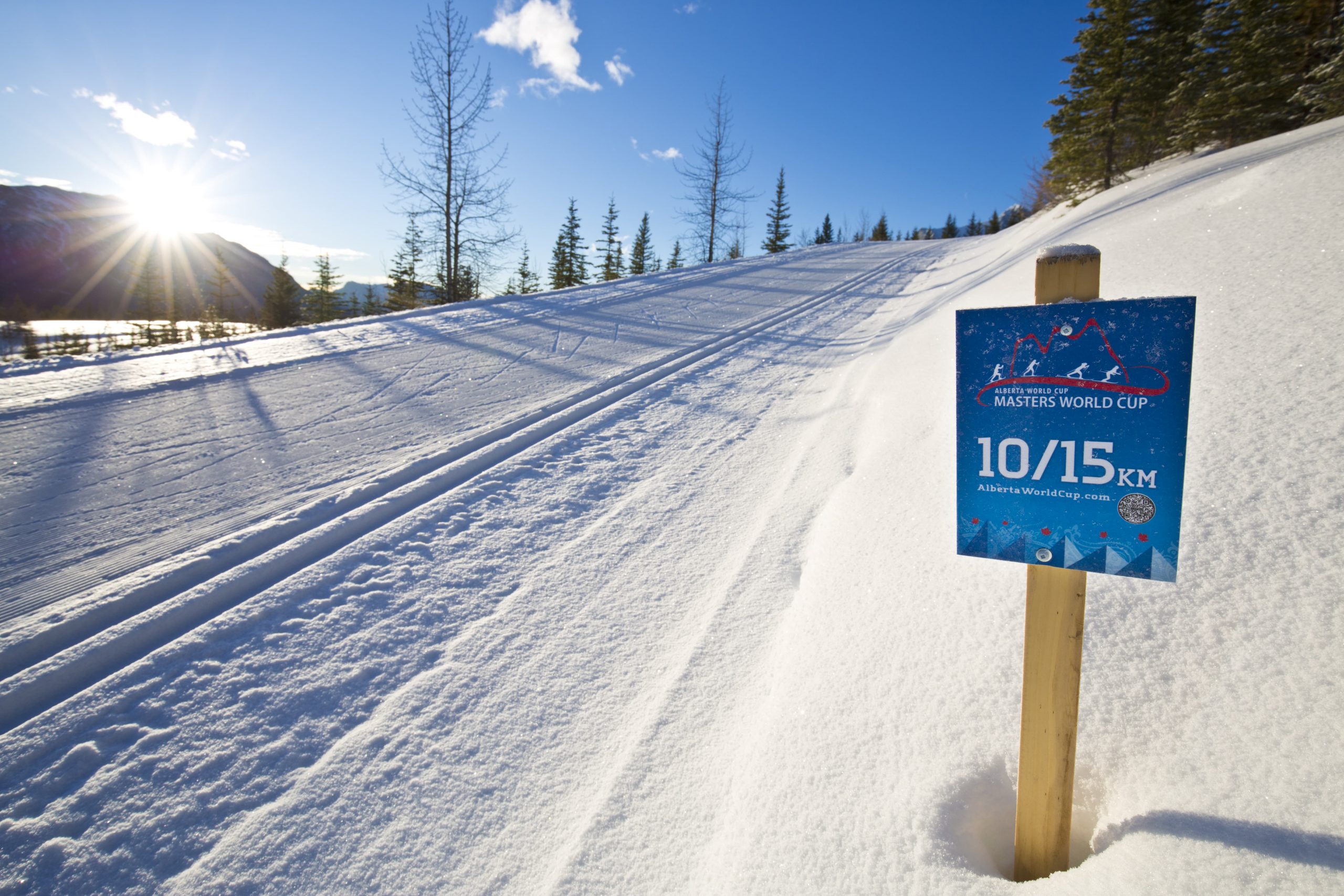
Fresh tracks on the Masters World Cup course in Alberta. Recovery is essential because adaptation occurs between workouts, but maximizing recovery is not the goal. (Photo: GibsonPictures)
Recovery Serves Adaptation
This brings us back to recovery. Recovery is essential because adaptation occurs between workouts. But maximizing recovery is not the goal of an athlete.
Maximizing adaptation is.
The masters athlete must solve a more complicated equation:
Stimulus + Recovery = Adaptation
Too much stimulus accumulated over days and weeks and we fail to recover sufficiently. Without recovery, we fail to adapt. The common theme in underperformance and overtraining is accumulating fatigue and a failure to adapt.
Sometimes the better solution is reorganizing the training. Instead of a pattern of hard, hard, easy, hard, easy, hard, exhausted, rest over seven days, a masters skier might organize training so the important sessions are separated sufficiently to perform them well and adapt to them.
The objective isn’t necessarily fewer quality sessions over the course of a month. It is enough recovery between those sessions to allow the athlete to absorb them.
The coaches behind the masters performance group at Crested Butte Nordic in Colorado: from left, Rachel Bachman Perkins, Murray Banks, Cam Smith and Woody Martineau. Fitness is not created by individual workouts. (Courtesy photo)
Consistency Beats Heroic Training
For masters athletes, we need to adjust our perspective. Fitness is not created by individual workouts. It is created by the consistent implementation of easy endurance work, high-intensity aerobic training, strength, power and appropriate recovery.
One big interval session does relatively little. One big training week does relatively little. Forty or fifty good weeks stacked together can produce remarkable fitness.
That changes the definition of a successful workout.
The question is no longer: How much training can I survive today?
It becomes: What training can I absorb today that allows me to continue training tomorrow, next week and next month?
That doesn’t mean avoiding hard work. It means implementing both easy and hard training in a way that provides adequate space for recovery and adaptation.
Murray Banks at the Alley Loop in Crested Butte, Colorado. Chronological age alone doesn’t tell us enough: training history, injury history, available time, sleep, nutrition and life stress all matter. (Photo: Xavier Fane / Crested Butte Nordic)
The Masters Training Equation
Training, of necessity, must be individualized for athletes of every age. A highly trained 60-year-old with forty years of endurance training may tolerate workloads that would overwhelm a recreational 45-year-old who started skiing five years ago.
Chronological age alone doesn’t tell us enough. Training history, injury history, available time, sleep, nutrition, life stress and individual recovery all matter. But the physiological objectives remain surprisingly familiar.
Maintain aerobic volume.
Maintain VO2max.
Develop threshold and muscular endurance.
Preserve maximal strength.
Preserve power.
Maintain ski-specific technique and economy.
Then organize recovery around accomplishing those objectives. That is fundamentally different from starting with recovery and removing training until the athlete can tolerate what remains.
Masters athletes don’t need a watered-down version of elite training. Nor do they simply need more recovery. They need training organized around the physiological capacities most threatened by aging, with enough stimulus to preserve and improve those capacities and enough recovery to adapt to that stimulus.
Aging changes how we assemble the training. It doesn’t change what makes an endurance athlete fast.
The great opportunity of masters sport is discovering how much performance we can preserve, and in many cases still improve, by continuing to give the body both the stimulus and the time and space it needs to adapt.
Help Support Our Coverage!
If you value the thoughtful work and access FasterSkier provides, please consider becoming a Voluntary Subscriber. Your support directly fuels our work to cover the people, places, and moments that make our sport special.
Wilmington, Vermont’s Luke Rizio rollerskiing with the University of Vermont at Craftsbury last fall. Jim Galanes argues that a training year should change the dose of each quality, never remove one of them entirely. (Photo: Phillip Belena/EISA)
One of the biggest misconceptions in endurance training is that we should train one physiological capacity at a time. The traditional model usually follows the same progression. First build an aerobic base, lots of easy endurance training. Then add “threshold” training in the middle of the summer. Then, as we move into the pre-competition period, shift the emphasis toward VO2max and race specific intensity.
The emphasis certainly should change throughout the season. But this approach often leads coaches and athletes to unintentionally neglect important physiological systems for weeks or even months. The problem is that the human body doesn’t work that way.
Aerobic performance is not determined by one physiological system. It emerges from the interaction of multiple systems, each supporting the development of the others. When one begins to decline, it limits the effectiveness of the entire system.
The goal of periodization is not to sequentially build individual physiological systems. It is to continually maintain every important system while changing the emphasis toward the adaptations that offer the greatest opportunity for improvement.
Every Workout Sends a Different Signal
Training isn’t simply stress. Every workout sends a unique physiological signal for adaptation.
Long aerobic training stimulates mitochondrial biogenesis, capillary development, fat oxidation, plasma volume expansion, and cardiac remodeling.
“Threshold” training improves the ability to sustain a high fraction of aerobic power by increasing oxidative capacity, metabolic stability, and lactate transport. It should be noted, in spite of the current buzz, that “threshold” training is not a magic solution. Some athletes may need a heavier focus on VO2max training. Usually “threshold” type training is best for those doing high volumes and with an already high fractional utilization.
(Note: while I use the common term “threshold” here, there is ample evidence that no threshold actually exists and that it is a vastly misleading term. There is also no consensus on what this so-called threshold is. Depending on which of the many methods you use to define it, the speed or intensity at these various definitions can differ by 40 to 50 percent.)
VO2max intervals place the greatest demand on oxygen delivery, stimulating central cardiovascular adaptations while also improving mitochondrial function, the oxidative capacity of Type II fibers, lactate transport, and the speed or power that can be sustained at VO2max.
Sprint training recruits high-threshold motor units, preserves neuromuscular coordination, maintains the oxidative capacity of fast-twitch fibers, and develops the ability to rapidly produce force.
Strength training increases maximal force production, improves movement economy, enhances tendon stiffness, and helps reduce injury risk.
These are not interchangeable adaptations. Each contributes something different to developing aerobic fitness and performance.
The Systems Support Each Other
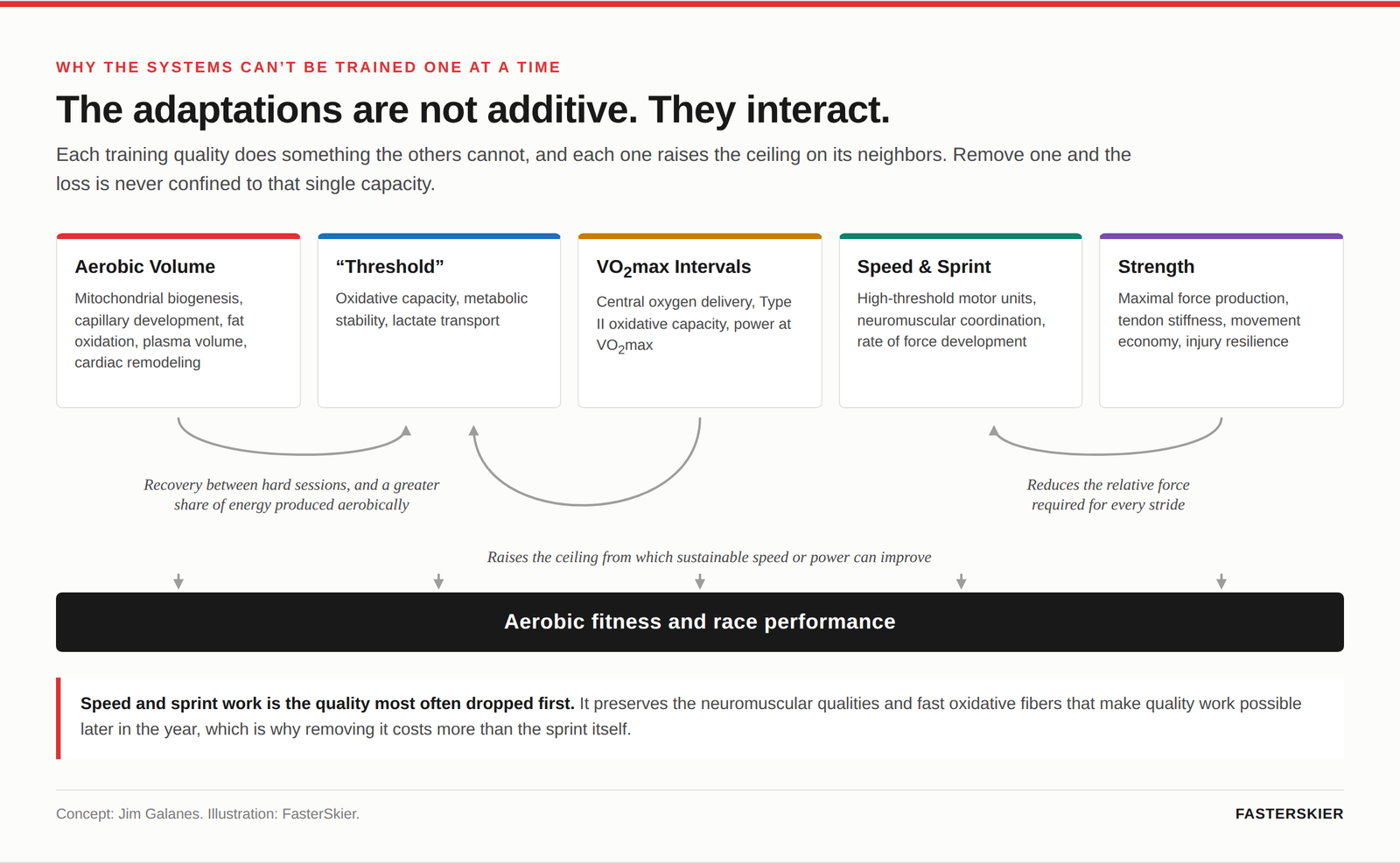
These systems work synergistically. The mistake is assuming the adaptations are simply additive. They are not. They interact, and the combined effect on aerobic fitness is larger than the sum of the parts.
A larger aerobic system allows the athlete to recover more quickly between hard sessions and to produce an increasing proportion of energy aerobically.
Better “threshold” capacity allows more quality work to be performed with less fatigue. Greater maximal aerobic power raises the ceiling from which “threshold” speed or power can improve.
Improved strength reduces the relative force required for every stride.
Sprint training preserves the neuromuscular qualities that improve efficiency even during submaximal exercise. At every intensity, we can move faster and more efficiently.
Aerobic volume, “threshold” work, VO2max intervals, speed and strength each do something the others cannot, and each raises the ceiling on its neighbors. (Illustration: FasterSkier)
What Happens When One System Is Ignored?
Every physiological adaptation has a maintenance requirement. Remove the stimulus long enough and that adaptation begins to decline. An athlete who abandons speed training gradually loses neuromuscular recruitment and maximal power. An athlete who eliminates heavy strength training slowly loses force production and movement economy.
When an athlete reduces aerobic endurance training, they don’t simply lose endurance. They lose the physiological foundation that supports every other adaptation.
An athlete who removes VO2max work for extended periods may maintain excellent endurance while gradually losing the central cardiovascular adaptations that support maximal aerobic performance.
These changes are rarely dramatic at first. What we see instead are the symptoms of overtraining. Performance in training declines. Interval sessions become harder. Race pace plateaus or drops.
Many coaches respond by adding more volume or more intensity. Neither is the likely answer. The solution is to restore the balance between the physiological systems that support performance.
Through the training year the dose and density of each quality moves, but no quality drops to zero. Concept illustration of Galanes’ argument, not a prescribed distribution. (Illustration: FasterSkier)University of Vermont skiers work up a climb during a fall dryland session at Craftsbury, Vermont. (Photo: Phillip Belena/EISA)
Why High-Intensity Training Belongs in the Base Period
One of the most common statements heard during base training is: “We shouldn’t do any hard training yet.”
Current evidence suggests otherwise. High-intensity training during the base period is not about maximizing anaerobic fitness. It is about maintaining the physiological systems that complement the full development of aerobic capacity.
Appropriately dosed high-intensity training helps preserve central cardiovascular function, maintains high-threshold motor unit recruitment, supports the oxidative capacity of fast-twitch muscle fibers, reinforces movement economy at higher speeds, and prepares the athlete for the demands of future training. Just as importantly, these adaptations support aerobic development rather than detract from it.
A stronger cardiovascular system allows greater oxygen delivery during long aerobic sessions. Maintaining fast oxidative fibers improves the ability to perform “threshold” work later in the season. Preserving movement economy reduces the energy cost of every stride. Maintaining maximal aerobic capacity raises the ceiling from which “threshold” performance can continue to improve.
High intensity doesn’t compete with aerobic development when it is properly dosed. It enhances it. This is why elite endurance athletes rarely eliminate intensity completely. They change the dose and the density. Not the presence.
I often hear athletes say their first interval session or time trial in late July felt terribly slow, or metabolically challenged. Of course it did. That should come as no surprise. If high-intensity work has been absent for weeks or months, the physiological systems required to perform it have detrained. The athlete now has to rebuild those systems before meaningful race-specific adaptations can occur.
Emphasis Is Not Elimination
This doesn’t mean every quality deserves equal attention every week. Training emphasis should absolutely change throughout the year. An aerobic development phase should contain more aerobic volume. The pre-competition period should emphasize “threshold” and race-specific intensity. The competition season should prioritize race performance and recovery.
But changing emphasis is very different from abandoning a physiological system. Even during an aerobic block, athletes should continue performing some high-intensity work, sprint training, and strength training.
During race season, aerobic volume remains essential. While emphasizing VO2max development, “threshold” training still supports the ability to perform quality work.
The dose and density change. The physiological adaptation remains.
There Is No Optimal Intensity Distribution
One of the most common questions in endurance sports is: “What is the optimal training intensity distribution?”
The question assumes there is one correct percentage of easy, “threshold”, and hard training. There isn’t. The optimal distribution depends on the athlete’s training background and on which physiological system currently limits performance. Those limiting factors change throughout an athlete’s development.
Early in a career, building aerobic capacity may deserve the greatest emphasis. Later, improving sustainable race pace may become the priority. Still later, improving neuromuscular power, force production, or movement economy may produce the greatest gains.
As those priorities change, training distribution changes with them. Not because the principles change. Because the athlete changes.
The coach’s responsibility is to continually adjust aerobic volume, “threshold” training, VO2max work, sprint training, and strength training so that each enhances the adaptations produced by the others while minimizing interference.
There is no universal training formula. There is only the continual process of identifying the athlete’s current limiter, maintaining every important physiological system, and emphasizing the adaptations that will produce the greatest improvement.
Great coaching is not about prescribing the perfect intensity distribution. It is about continually identifying the athlete’s current physiological limiter while maintaining every system that supports performance. As the athlete changes, the emphasis changes, but the physiology never disappears.
Help Support Our Coverage!
FasterSkier is independent, reader supported, and free to read. If coaching and training coverage like this is worth something to you, a voluntary subscription keeps it coming.
UVM coach Patrick Weaver talks with first year Hanna Koch of St. Paul, Minnesota, during a fall session at Craftsbury. Identifying an athlete’s current limiter, Galanes writes, is the coach’s central job. (Photo: Phillip Belena/EISA)
Masters’ athletes are often told to “train smarter, not harder,” or the current version: “Go easy on the endurance sessions so you can go hard on the intense sessions.” Those phrases get repeated so often they’ve lost context and meaning. But there is a real physiological reason training for masters’ skiers must be approached differently than training for younger athletes.
The challenge is not simply age itself. The challenge is balancing adaptation with recovery while preserving capacity, durability, consistency, and motivation over many years of training. Older athletes can still improve significantly. Aerobic capacity can improve. Sustainable race pace can improve. Technique can improve substantially. Strength and power can improve. What changes is the recovery required to create adaptation and the recognition that the margin for error narrows considerably compared to when we were younger.
Daniel Schwenk on his way to 9th place in the Men’s Masters’ division of the Climb to the Castle. (Photo: Nancie Battaglia)
The Biggest Mistakes
Many masters athletes carry over the same training structure they used decades earlier, too moderate intensity (Zone 2 and 3 in most 5-zone models), hard sessions stacked too closely together, insufficient recovery between demanding workouts, and not enough attention to technique, strength, mobility, and durability.
The results are absolutely predictable: chronic fatigue, declining velocity or pace in the hard sessions, stagnate or declining performance in spite of continued training, and simply a loss of motivation to train. Ironically, many master’s athletes are functionally overtrained, despite the reluctance in some circles to even use that term.
Recovery and Adaptation Become a Primary Training Variable
As we age, there is a clear reduction in recovery capacity due to reduced anabolic hormone response, decreased muscle protein synthesis, accumulated fatigue, and often greater life stress outside of training.
None of this means that masters athletes cannot train hard. They absolutely can, and should. Maintaining aerobic capacity and muscular strength is strongly associated with health, function, and longevity. But masters’ athletes generally cannot stack hard sessions with the same frequency as younger athletes without compromising recovery and adaptation.
For most skiers I have coached or consulted with, the question should not be, How much can I train? The better question is: How much can I recover from and adapt to consistently over the weeks and months ahead? That distinction is perhaps the most important one.
Tim Donahue mid-race during the 2020 Winter World Masters Games in Seefeld, AUT. (Photo: Garrott Kuzzy / Lumi Experiences)
Consistency Beats Hero Workouts
The most successful athletes at any level are usually not the ones doing the biggest “hero” sessions. They are the ones who maintain consistent training and compound it week after week, month after month, and year after year.
A training model built around sustainability always outperforms the commonly programmed “ramp” approach, where volume and/or intensity continually increase week to week and month to month. The assumption that training load must constantly rise in the short term, to add stress and create more adaptation to improve, is scientifically unsupported and not common practice among athletes who perform well over the long term.
That means, fewer very hard sessions typically 1–2 every 7–10 days, endurance sessions performed at the correct intensity, usually easier than most athletes think, 1–2 true rest or recovery days per week, not “easy training” or so-called recovery workouts, but actual rest, consistent sleep and nutritional fueling, and proper control and management of both low and high-intensity sessions.
One of the biggest contradictions in master’s training is that many athletes improve when they reduce training load. That does not necessarily mean less training volume. More often, it means better control of intensity and reduced accumulated stress.
Masters World Championship, Asiago, Italy, 2014
Intensity Still Matters
One of the common mistakes today, especially with the influence of social media and the one-sided promotion of Zone 2 and threshold training, is the assumption that aerobic improvement comes only from easy or moderate training.
To improve aerobic function, we still need hard training. High-intensity work improves mitochondrial function, increases oxidative capacity in high-threshold motor units, recruits more muscle fibers, and improves high-end aerobic power. The key is proper control of the dose and intensity.
An elite athlete may tolerate three demanding intensity sessions per week plus strength work. That rarely works for most masters athletes. Many would benefit more from one VO2max session and one maximal steady-state session every 7–10 days, combined with two strength sessions and additional speed- and technique-focused work embedded within basic endurance training. While I really dislike rules of thumb or guidelines in a general sense, I feel using the 80/20 rule is a good starting point. Often confused with the duration or mileage of training. It is not that. The 80/20 guide is 80 percent of the total workouts in a week or a month are easy endurance-based, and 20 percent of the workouts are hard. If one applies this measure to the duration of training, I guarantee over-training.
Help Support Our Coverage!
If you value the thoughtful work and access FasterSkier provides, please consider becoming a Voluntary Subscriber. Your support directly fuels our work to cover the people, places, and moments that make our sport special.
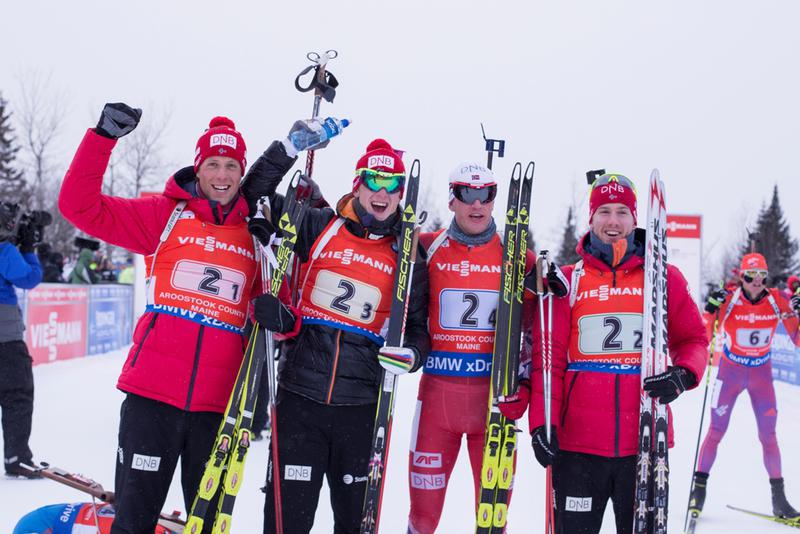
Norway won the men’s 4 x 7.5 k relay at the 2016 IBU World Cup in Presque Isle, Maine, with (from left to right) Lars Helge Birkeland, Johannes Thingnes Bø, Tarjei Bø, and Erlend Bjøntegaard. (Photo: IBU/NordicFocus)
The Norwegian biathlon team is coming off of a high note last season, when they hosted World Championships in Oslo and saw gold-medal performances from Tiril Eckhoff, Johannes Thingnes Bø and both its men’s and women’s relay teams. The legendary Ole Einar Bjørndalen also picked up an individual silver medal to add to his collection.
The team’s task now is about keeping up the intensity and building towards the 2018 Olympics in PyeongChang, South Korea. One target metric: to have both its men’s and women’s teams ranked in the top two at the end of the year.
Last season, the Norwegian men won the Nations Cup and its women ranked seventh.
“This will probably, to some degree, become a sort of ‘in-between’ season,” Norwegian Biathlon Association President Erlend Slokvik recently told FasterSkier on the phone. “But athletes that didn’t perform as well as they had wanted will probably be extra motivated to do well this season. There was also a bigger focus on peaking in the World Championship [last season], because being part of one in your home country is sort of like an Olympics.”
Erlend Slokvik, president of the Norwegian Biathlon Association (NSSF). (Photo: NSSF)
Slokvik was elected president in May after having served as first vice president for the last eight years. He coached the Norwegian biathlon teams from the spring of 2000 to the spring of 2002, during which time the Norwegians won eight medals at World Championships and six medals at the Olympic Games in Salt Lake City, Utah.
After his election, Slokvik emphasized that having the world’s best biathlon team was important in order to attract sponsors, continue good recruiting and development of top-level athletes. He wanted to focus especially on coaches’ education and the development of new biathlon arenas to help towards this goal.
While biathlon is already a very popular winter sport in Norway, the federation is also aiming to build from its grassroots and development levels after Oslo.
“We have noticed a greater interest to some degree, but biathlon has been a popular sport for a long time, one of the most popular in the country, so there is a limit to how much of an increase we can see,” Slokvik explained. “But there has definitely been an increase, which is something we see in, for example, ticket sales for World Cup events … There is good recruiting in many places and the World Championship definitely contributed to that. We did a recruiting tour in connection the championships, which Tora Berger among others were part of and this definitely had an effect on recruiting.”
While the usual suspects are expected to contribute to the national-team results this season, there are opportunities for newcomers, like Marte Olsbu, who had something of a breakthrough at the Oslo World Championships, finishing seventh in the mass start and turning in strong legs in the mixed and women’s relays.
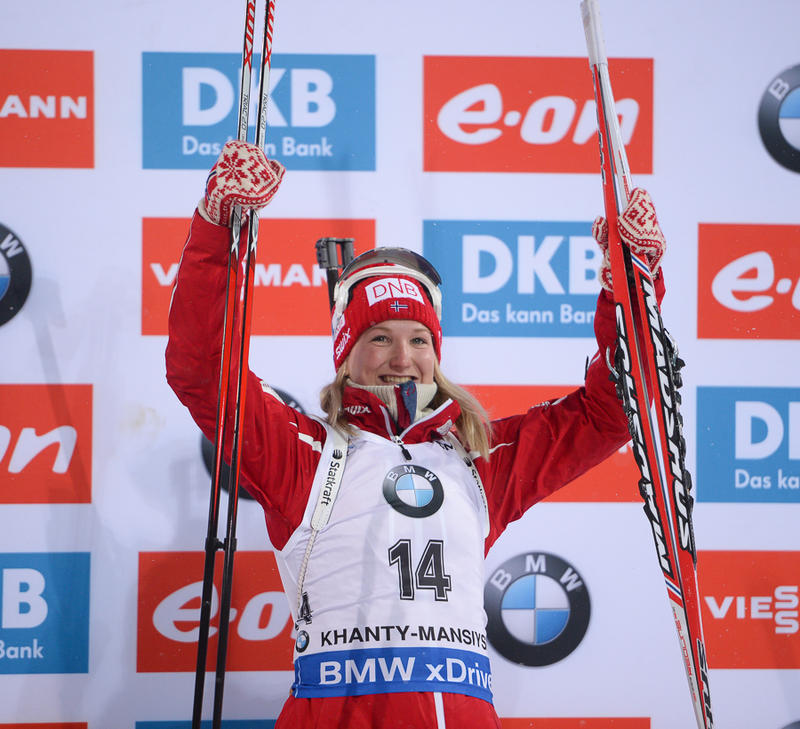
Norway’s Marte Olsbu celebrates her first IBU World Cup podium after placing third in the women’s sprint last March in Khanty-Mansiysk, Russia. (Photo: IBU/Evgeniy Tumashov)
“In the men’s team, we have the ‘big four’ (Emil Hegle Svendsen, Bjørndalen and Tarjei and Johannes Bø) whom we expect to do well, as for the rest of the team we’re hoping that more and more athletes will stabilize on such a high level,” Slokvik said. “In the women’s team we hope that Marte will stabilize on a level close to Tiril [Eckhoff]. She won the sprint and pursuit rollerski national championships, so she is in good shape.”
While the team did almost entirely dryland training through October, it is now transitioning to a new phase.
“A lot of it has been threshold training, and preparation for shooting with an elevated heart rate,” Slokvik said. “Because of that the athletes haven’t done as much high-altitude training and instead spent time in lower elevation. They are in Trysil [Eastern Norway] now training in good conditions. They’ve spent time in France, for example in October, normally they would have spent time [on the glacier] in Val Senales, where they ski in high altitudes, but not this year. This [lower altitude] has allowed for more specific biathlon training, such as skiing with higher heart rate and shooting.”
While the Norwegian biathlon has steered clear of the doping scandals that deeply impacted its cross-country counterparts this summer and fall, those events prompted the federation to review its policies towards medication for athletes.
“We’ve gone through our routines and been clear in our communication with athletes, who have become even more aware of what they should do and not do,” Slokvik said. “Basically we followed already established routines.”
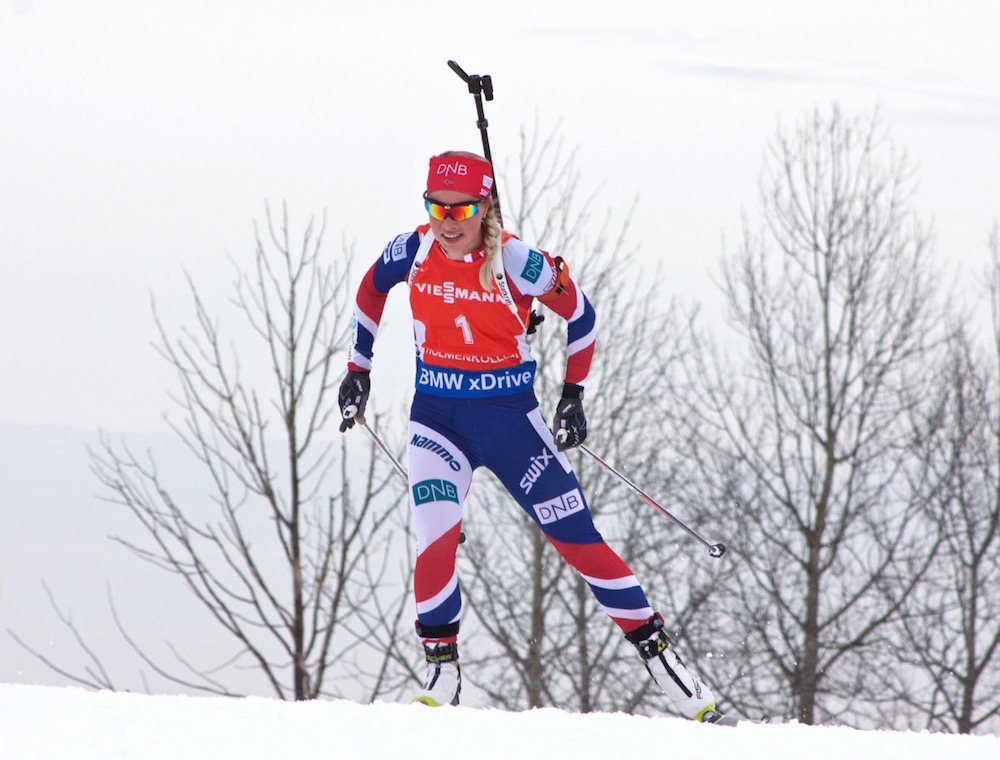
Norway’s Tiril Eckhoff racing to 25th in the mass start at 2016 IBU World Championships in Oslo, Norway. Eckhoff recently told Aftenposten that she stopped taking her asthma medication because she no longer needs it.(Photo: JoJo Baldus)
It has caused some stress and worry: Eckhoff said in an interview with Aftenposten that she has stopped taking her asthma medication. But it’s not because doing so was breaking any rules, Slokvik said.
“Since the news of [Martin Johnsrud] Sundby’s situation and the team’s use of asthma medication, athletes even with a diagnosis have been suspected and she didn’t want to contribute any more to that,” he explained. “Tiril has a diagnosis, but the severity of [her asthma] at the present time isn’t at a level where she wouldn’t be able to function without the medication. If it had, she wouldn’t have stopped taking it.”
The first competitions of the biathlon season are approaching on Saturday in Sjusjøen, Norway. Is the host team primed for improved performances over last year?
If those goals of being one of the top two teams in the world are any indication, it’s likely.
“We feel that this is a realistic goal, and it was set based on past performances,” Slokvik said.
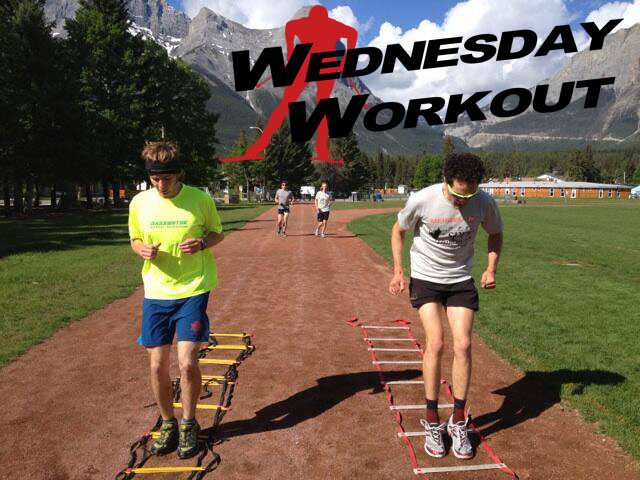
Zeke Williams (l) races through the ladder during a track workout with Alberta World Cup Academy teammate Yannick Lapierre in Canmore, Alberta. (Photo: Stefan Kuhn)
This week’s workout comes to you from Ezekiel “Zeke” Williams, FasterSkier’s newest intern and an athlete at the Alberta World Cup Academy in Canmore, Alberta. This time last season, Williams said he really enjoyed doing what his team called, for lack of a better name, the Agility Sprint Track Workout.
***
Canmore Alberta may be known for its skiers rather than its track stars but it still has a short 300-metre stone-dust track. And this is where the Alberta World Cup Academy men’s team was to be found, more often than not, on Thursday mornings in May and June 2013. As the athletes warmed up the coaches set up a pair of agility ladders on one of the track’s straight-aways and hurdles on the other. Finally, the coaches would draw ‘finish lines’ at about 10-seconds worth of sprinting past the end of the obstacles.
After warming up we would partner up and do laps of the track. We would focus on speed through the agility ladders and hurdles and then sprint out of them. Then we’d slow back down to an easy jogging pace until we hit the next feature.
The Workout: Agility Sprint Track Workout
Total time: 1 1/2 hours
Need: A track, running shoes
Warm up: 30-minute jog
10 track laps: 20 x 10-15 second sprints with about 1 minute easy jogging between each. Whole thing takes just over 20 minutes
Cool down: 40 minute jog
I like this workout for two reasons. First, it’s a lot of fun to do! Getting to race through the ladders and the hurdles against a teammate makes it a sweet competition.
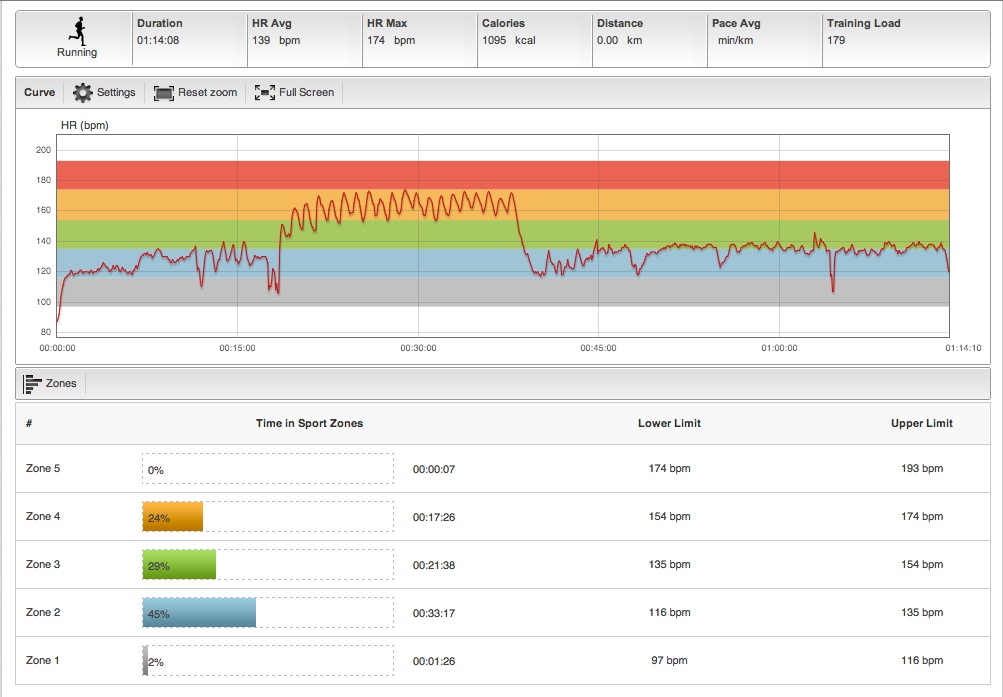
Heart-rate data from Zeke Williams’ workout: track laps are between about 18 and 38 minutes.
Second, the workout gives a bunch of training benefits. At first glance it looks like a speed workout, but heart rate ends up at lactate threshold for most of the time because of the shortness of the sprints and the minute of easy jogging between them. Check out my heart-rate log during a similar workout here.
Also, the agility component of the workout improves coordination at speed, which is nice to stay in touch with for when we get back into rollerski sprinting.
Combine the agility work and lactate threshold building into the short 1:30 hour workout time and it makes for a solid early training-season session.
***
About the Author: A Canadian cross-country ski racer with the Alberta World Cup Academy, Zeke spends most of his time in Canmore, Alberta, but calls Cantley, Quebec, his home. He thinks that you can learn a lot about a person from their goals — his is to ski really fast on the Winter Olympic race course in 2018. Check out his blog: ezekielwilliams.ca