From the FasterSkier archive — posts syndicated from athletes’ and coaches’ own blogs between 2004 and 2012, kept online as published. Current coverage is at fasterskier.com.

Tag: throwback workout

  • Throwback Workout: Reese Hanneman’s On-The-Road Intervals

    Throwback Workout: Reese Hanneman’s On-The-Road Intervals

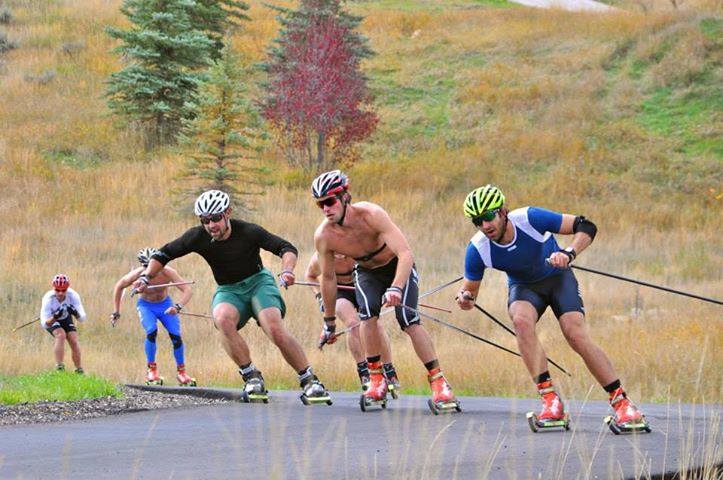
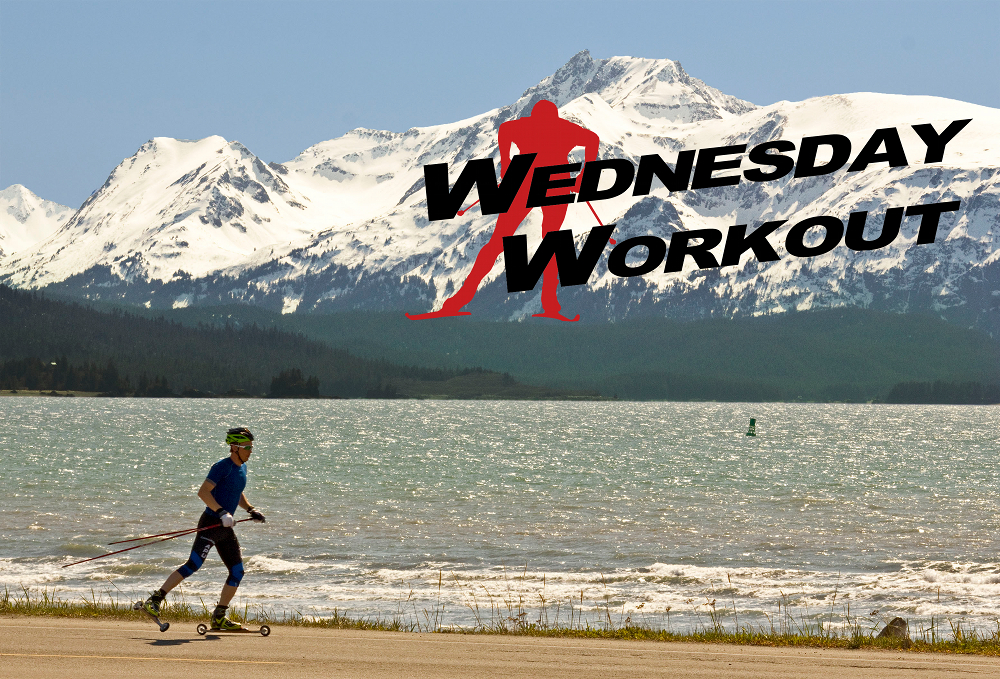
    Reese Hanneman (APU) rollerskiing in Homer, Alaska, in the spring of 2013. (Photo: Woodski)

    With ski season winding down, you may be one of the lucky ones hitting the road for some quality family/friend/significant-other time. Here’s a one-hour workout you can squeeze in on-the-go, which we received from Alaska Pacific University (APU) skier Reese Hanneman back in 2013. Hanneman, now 28, and his brother Logan, 24, raced at their first Olympics this past winter in PyeongChang, South Korea. Read the original workout here.

    ***

    [circa June 2013]

    It’s summer time, or close to it, which means vacation season is here. Whether you have a family reunion on a beach or a trip to the mountains planned, it can be tricky to carve out time for training while you’re on the road.

    Alaska Pacific University’s Reese Hanneman has a solution to this dilemma: a compact, efficient interval workout that fits into a single hour. It can be done on rollerskis, in running shoes, on a bike — with whatever equipment you have available away from home.

    “If I’m on vacation with people…and I’m only going to get one workout in a day, I want to do more than go ski or run or bike for an hour at distance pace, because that’s not that hard,” Hanneman explains.

    He frequently returns to this threshold workout when he’s pressed for time. It’s short on warm up and cool down time, but the meat of the workout is challenging and efficiently improves overall fitness. In the past, Hanneman has repeated this session as many as three to five days in a row when he’s traveling. And it clearly works for him: he racked up early-season World Cup starts in Canada and had a series of career-first podiums on the SuperTour last winter. The traditionally strong sprinter improved his distance chops, too, and finished last season with a sixth place at U.S. 50 k Championship in April.

    The workout:

    Warm up: 10-15 minutes Level 1 (L1)

    3×10 minutes L3, with 2 minutes of recovery in between. For added intensity, “if you really want to push yourself,” ramp up the pace to L4 or race pace for the last 3 minutes of each interval.

    Cool down: 10 minutes L1

    Total workout time: about 60 minutes

    By the end of the session, Hanneman is usually pushing the pace.

    “If [I] do that hard enough, without it being a sprint workout, I feel like it’s improving my fitness and improving my skiing,” he said. “If I was on a vacation for weeks on end and I did that every other day, I would still come away from that travel feeling like I improved as an athlete.

    “For me, obviously you could just do a straight hour of threshold, but by breaking it up then [I’m] able to push it pretty hard in L4,” he added. “So you get that feeling at the end where you feel like you were moving really fast.”

    In a perfect world — say, at a training camp — Hanneman would do such a workout after a 45 minute warm up beforehand with some pickups and have time for a longer cool down. But when he has to fit a session in a small window — within a road trip lunch stop, for example — he returns to this stripped-down version.

    “On a family vacation, where you’re someplace not suited well to a training block, you don’t want to be that weird person always out training during your family vacation,” Hanneman reasons.

    The quicker threshold intervals also work well outside the summer vacation context, when work and life encroach on workout time.

    “I think you could reach a pretty high-level doing workouts just like that,” Hanneman said. “People are always under this illusion that you have to do so many hours.”

    That’s not just the sprinter in Hanneman talking, either. He’s always considered himself to be a hybrid, but with a jump up in his distance racing last season he’s approaching training this summer with more distance focus.

    “I’m trying the Kikkan approach,” he laughed. “It worked for Erik [Bjornsen]. Certainly I have been more consistent as a sprinter, but some of that was mental, too. I’m trying to help myself expand my horizons.”

  • Throwback Workout: Threshold Plus with Blackhorse-von Jess

    Throwback Workout: Threshold Plus with Blackhorse-von Jess

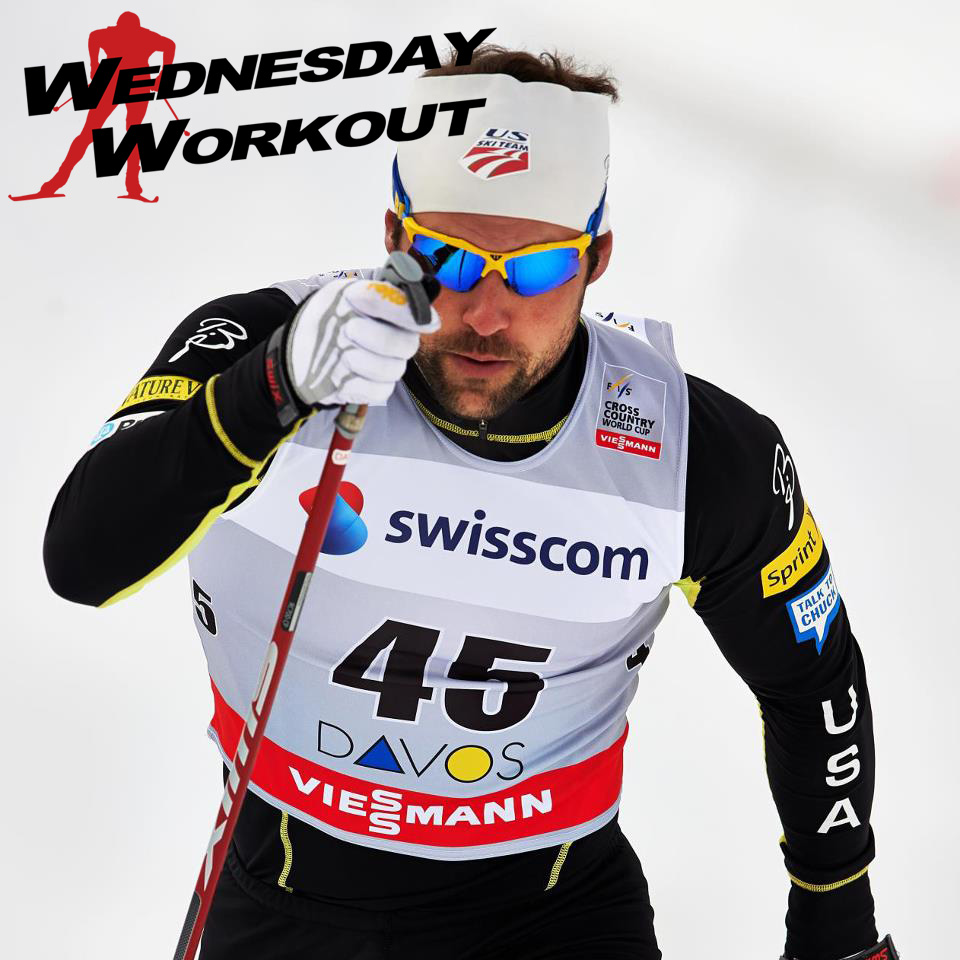
    Dakota Blackhorse-von Jess (Bend Endurance Academy) racing a World Cup classic sprint in February 2013 in Davos, Switzerland. (Photo: Felgenhauer/NordicFocus)

    For this Wednesday Workout, we’re bringing back a speed-inducing bounding session Dakota Blackhorse-von Jess shared with us four years ago. These days, Blackhorse-von Jess, 31, is still racing out of the Bend Endurance Academy under the guidance of Ben Husaby.  Read the original workout here. 

    ***

    [circa October 2013]

    This edition of Wednesday Workout was submitted by Dakota Blackhorse-von Jess, the man who dominated the coveted Frozen Thunder classic sprint last week in Canmore, Alberta, and had time to take names: beating U.S. Ski Team members Andy Newell and Simi Hamilton in the process (to be fair, they were on skate skis, but hey, that’s racing). The Norwegian website Langrenn even gave him a shout out on Facebook (translation, “Dakota Blackhorse, lovely name for a cross country runner”).

    Upon catching up with Blackhorse-von Jess, who flies solo under coach Ben Husaby at the Bend Endurance Academy in Oregon, we asked him what gives and why he’s so fast this time of year.

    Dakota Blackhorse-von Jess (l) gets the inside line while rollerskiing head-to-head with Skyler Davis (c) and Sam Tarling earlier this month at Soldier Hollow in Midway, Utah. (Photo: Tom Kelly/U.S. Ski Team)

    “We’ve really been focusing the last 4 years on systematically building my aerobic fitness,” Blackhorse-von Jess, 27, wrote in an email. “Coach Ben and I started with a focus on volume on base training and through the years have progressed to a level where I can sustain high levels of quality work – and clearly it’s paying off.

    “All of the indicators in training have been pointing to increased aerobic capacity and efficiency at sustained intensity efforts, so the takeaway is validation of the success of our model thus far,” the Dartmouth grad added. “Racing is so much fun, being back on the road and seeing all my friends and getting back in the wax room with Scott Johnston and Sam Naney of MOD, and for sure being in the mix with Andy and Sim who set the bar for the rest of us was awesome.”

    Well said, Blackhorse-von Jess.

    Now here’s what he does:

    The Workout: Threshold Plus (bounding in mixed terrain)

    Explained: The transition into fall training for us means a change in the level of intensity.  For the first time since the training year started in May, I get to play in the area of threshold – and threshold plus.  Over the 10 years Coach Ben and I have worked together, we’ve developed both long term (year-to-year) and short term (month-to-month) training progressions.  As with all things in life, experience is the best teacher and we have learned so much over the years by constantly adding new pieces cherry picking the best ones.  This organic and highly collaborative style of training functions, in no small part, because of the way we have grown to understand the work we’re doing.

    I mention this because feeling the workout is hands down the most important part.  Yes, I use a heart rate monitor when I’m training – especially in intervals.  It’s primary function, however, is actually post-workout where we can better determine if we are achieving our goals.  There is a whole lot more than goes into creating a training plan that I’ve gone into here, not the least of which is understanding the science.   The what and the why of different types/styles of workouts are important for Nordic skier development, but once those have been decided the how makes all the difference.

    Wednesdays we hit the trails: pole bounding in mixed terrain. 

    Warmup: Approx. 30 minutes with 10 minutes or so of bounding specific warmup: ski walking, moosehoofing, and full on explosive bounding in addition to some muscle memory/technique drills

    Intervals: 5 x 4-“ish” minutes over set terrain, with the primary goal being to spend as much time as possible at or above threshold without slowing down from interval to interval.

    Recover 4-“ish” minutes between. “Active” recovery is key, but how active a person can be in recovery is totally individual – just try to keep the heart rate down in Level 2 or below and work out the lactate best you can.  I walk/jog between… once I get my breath back.

    (While I dearly love the flowing nature of intervals over constantly varying ground, it’s easier to measure the workout over set terrain.  We found a perfect place to work on mid-interval acceleration and then survival, which was a big goal of Ben’s for me this fall as it has been a piece missing in my racing.  I say 4-ish minutes because my finishing marker was just a hair over 4 minutes when I started… and I was about 15 seconds faster by the end.)

    Doing It Right: Bounding in the woods is not necessarily a function of speed – you can almost always make the work harder by doing it “more correctly.”  Just pushing harder usually means a breakdown in technique, which has huge application to ski racing where technique breakdown under duress can have catastrophic consequences.

    That said, measuring time over set terrain really helps me understand the changes in feeling my body goes through as I fatigue. Keeping even splits, or dropping negative splits, over the intervals is still the goal. 

    The first couple intervals are usually about holding myself back (although not everyone experiences training the way I do, so take this with a grain of salt), I get to push a little bit in the third, push more in the fourth, and then dig deep in the last interval to keep getting faster.

    By appropriately using the first couple intervals and the first minute or two of each interval to prime your system, there is a natural flow into anaerobia.  We try to structure one workout a week to maximize the time spent anaerobic, and this one has been a real gem for us.

    Cool down: 15 minutes-“ish.” However long it takes to get moving again and get some of the junk out of your body.

  • Wednesday Workout: Throwback Fitness Testing with Reese Hanneman

    Wednesday Workout: Throwback Fitness Testing with Reese Hanneman

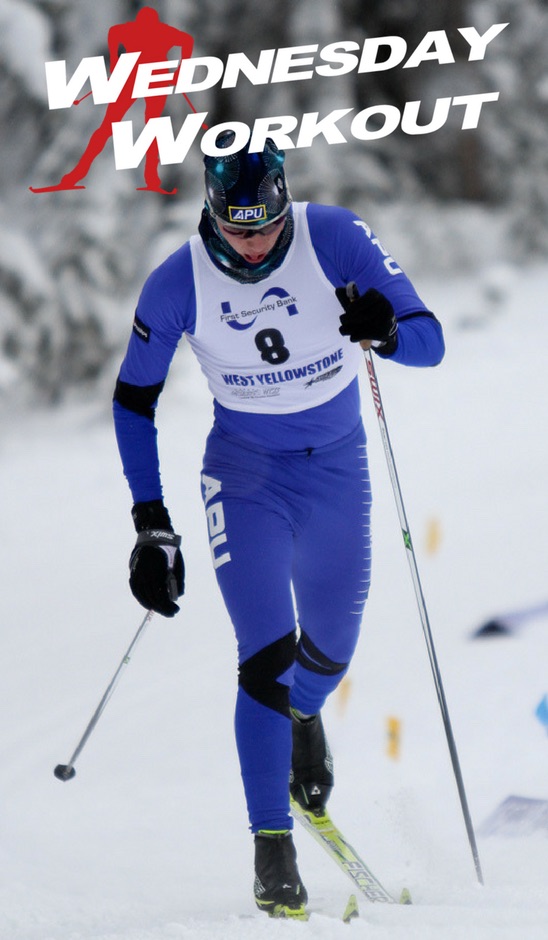
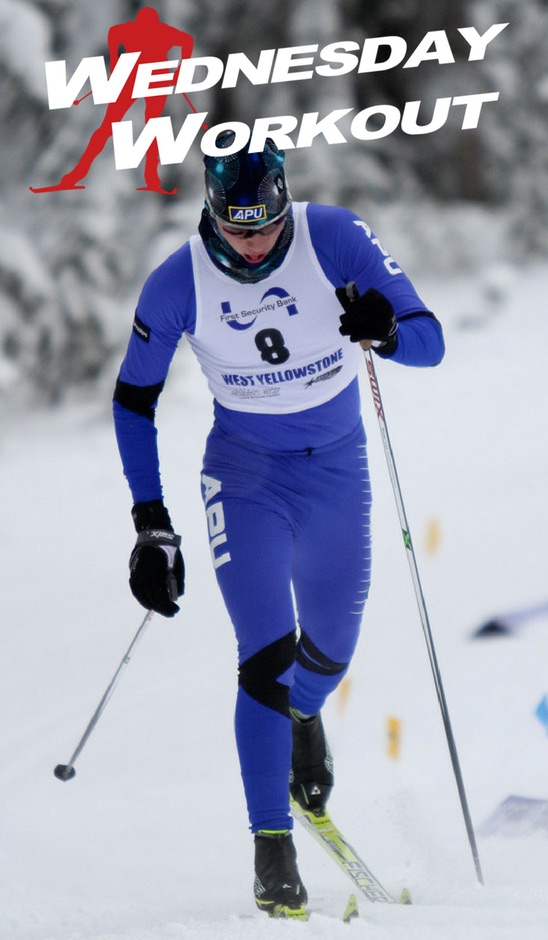
    Alaska Pacific University’s Reese Hanneman racing in West Yellowstone, Montana, in November 2010.

    This week, we bring you a Throwback Workout perfect for October from Alaska Pacific University’s Reese Hanneman. Now 27 and married, Hanneman, a Fairbanks native, still lives and trains out of Anchorage, Alaska, and is currently at a (not-so-dryland) U.S. Ski Team training camp in Park City, Utah.  Read original workout here.

    ***

    [circa December 2010]

    If you’re wondering about your fitness heading into the new racing season, Reese Hanneman has a workout for you.

    The session—a long threshold interval peppered with 30-second all-out sprints—will give you a good idea of whether you’re ready to rock, or whether you’ve got some more work to do before pulling on a bib.

    “It’s a good one of those eye-opening workouts,” Hanneman said.

    Hanneman has only done this session once, in mid-October with the rest of his team, the Anchorage-based Alaska Pacific University (APU).

    The group began their workout at sea level—close to the ocean—then made their way uphill, ultimately climbing some 2,000 vertical feet.

    The mechanics are straightforward: start with four-and-a-half-minutes of low level three (50 k pace, Hanneman said), followed immediately by a 30-second all-out sprint. Then repeat. And repeat, and repeat, until you’ve been going for 45 minutes, in Hanneman’s case. There are no breaks after the sprints.

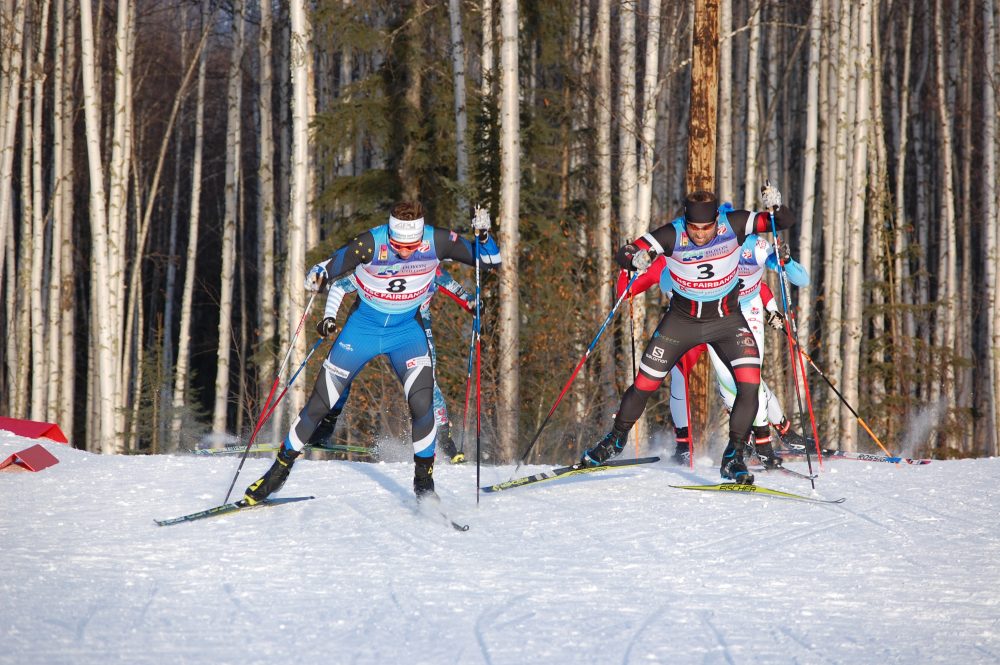
    Left to right: Reese Hanneman (Alaska Pacific University) going head to head with Dakota Blackhorse-von Jess (Bend Endurance Academy) during their quarterfinal of the men’s 1.6-kilometer freestyle sprint at the 2017 SuperTour Finals in Fairbanks, Alaska. (Photo: Max Kaufman)

    “You’re supposed to just keep rolling—you don’t stop,” he said. “You just revert back to threshold.”

    The workout is an end in itself, but just as importantly, Hanneman said, it’s designed to show how quickly one can clear lactic acid.

    For APU’s distance specialists, like James Southam, the surges might not be too difficult to handle. But they took a toll on Hanneman, who’s more of a sprinter.

    “Within about 10 minutes, it became really obvious to me that I was having a hard time operating at all,” he said. “After the 30-second sprint, I would have to basically stop…and [Southam] could just kind of ski away from me. He was recovering right away.”

    For Hanneman, the session ended up being a firsthand experience in the strengths and weaknesses of his fitness profile.

    “I can go fast, and I can make a lot of lactate really quickly, but then the trick is dealing with that afterwards—and trying to keep going at a pace that’s not pathetic,” he said. “It’s one of the workouts that by next year, I want to be a lot better at…I think that’d be a good indication.”

    Key to the workout, Hanneman said, is finding a consistent, challenging grade, because rolling terrain isn’t quite tough enough to keep him in zone three. Stop signs are problematic, too—you’ll want a clear path for the sprints.

    While Hanneman limited the length of his session to 45 minutes, he said that some of the other members of his team, like Southam, will sometimes extend it to an hour. If you’re not quite up to that kind of challenge, you can try scaling it back to, say, 30 minutes.

    And you don’t have to end the workout with a sprint—at least, APU doesn’t. That, Hanneman said, kept him from falling into the ditch on the side of the road.

    “You can’t fake it, it doesn’t seem like,” he said of the workout. “I knew what I was in for after one sprint.”

  • Throwback Workout: Ski Walk/Moose Hoof Combo

    Throwback Workout: Ski Walk/Moose Hoof Combo

    Brandon Herhusky leads Far West juniors in a ski walking/moose hoofing workout at the 2012 June Lake Camp in California. (Photo: Mark Nadell/Macbethgraphics.com)

    For this week’s workout, we’ve brought back a how-to-guide to ski walking, hill bounding and moose hoofing, written by former U.S. Ski Team member Nancy Fiddler, a two-time Olympian and past FasterSkier contributor. Fiddler shared this workout, which works for juniors to masters, in four years ago. Read the original here.

    ***

    [circa June 2013]

    Ski walking, hill bounding, and moose hoofing are a great way to incorporate ski-specific movements into a dryland workout. There are many ways to use these training tools, but I am going to recommend a favorite interval workout that touches on all three techniques. This low-impact workout works great for skiers of all ages and abilities, from juniors to masters.

    “It helps to think of a deer bounding through the forest. The deer’s feet briefly make contact with the ground, and then it is flying forward with all four feet off the ground.” — Nancy Fiddler’s description of hill bounding

    I was introduced to foot-specific training back in the late ’80s by my U.S. Ski Team coach, Torbjørn Karlsen. Although much has changed about skiing since then, this type of training, which mimics the diagonal stride movement, remains highly valuable to cross-country skiers today.

    Ski walking is diagonal striding without the glide. Think of the arm and leg swing as pendulums while striding on foot up a gradual incline. It’s key to not reach too far up the hill with the foot and to make a complete weight transfer (hip over foot) upon footfall.

    The 2008 Auburn Ski Club Development Team during a ski-walking workout in Squaw Valley, Calif. (Photo: Mark Nadell/Macbethgraphics.com)

    Add poles, and ski walking is highly specific. It is important to have ski poles that are about sternum-high in height, or about 10 cm shorter than your classic poles. While ski walking, keep the poles angled so that the hands are low and the arms can swing freely forward.  The hand is pushing the pole down and back, finishing just past the upper leg.  The pole will plant further back than when on skis.

    Hill bounding resembles striding up a steep hill on skis. It is more explosive than ski walking and it helps to think of a deer bounding through the forest. The deer’s feet briefly make contact with the ground, and then it is flying forward with all four feet off the ground. To practice, start with a jog up a moderate hill, then make each footfall more explosive. Lifting the front knee will help extend the bound. Again poles are planted angled back with hands low. The kick will be assisted by the pole push.

    Moose hoofing is similar to hill bounding, but less explosive, and therefore more sustainable for longer periods of time.  Think of moose hoofing as a way to imitate the diagonal stride up a long, gradual hill.  The timing of the kick and pole push remain synchronized, as in bounding, but not as snappy.  I like to think of a moose shuffling through the forest, not in as big of a hurry as the bounding deer.

    The Workout:  4’s and 1’s

    Find a dirt or grass hill about 400 meters or more in length. The incline should be gentle to moderate and fairly consistent.  Alpine ski areas and logging roads work great.

    • Warm up: 15-20 min easy jogging.  Add some gentle dynamic stretches and some arm and leg swings.
    • Get explosive: Do a set of 6-10 hill bounds (15-20) sec each.  Use the first one or two to coordinate technique and timing, and then work on popping off the ground with each bound.  It is possible to do this with or without poles.
    • Intervals: 4 minutes steady ski walking at a Level 3 effort.  Walk back down the hill for recovery (recommend 3 minutes recovery), then moose hoof back up the hill for 1 minute.  By the end of 1 minute, you will be in Level 4!  Recover back down the hill for 1 minute then repeat the cycle.  Depending on your fitness level and time of the year, try for 3-6 cycles of ski walking and moose hoofing.
    • Cool down: 10-15 minutes of easy jogging.

    Equipment:  running shoes, water bottle, and short ski poles.

    Enjoy the workout!

  • Wednesday Workout: Throwback Prologue Prep with Diggins

    Wednesday Workout: Throwback Prologue Prep with Diggins

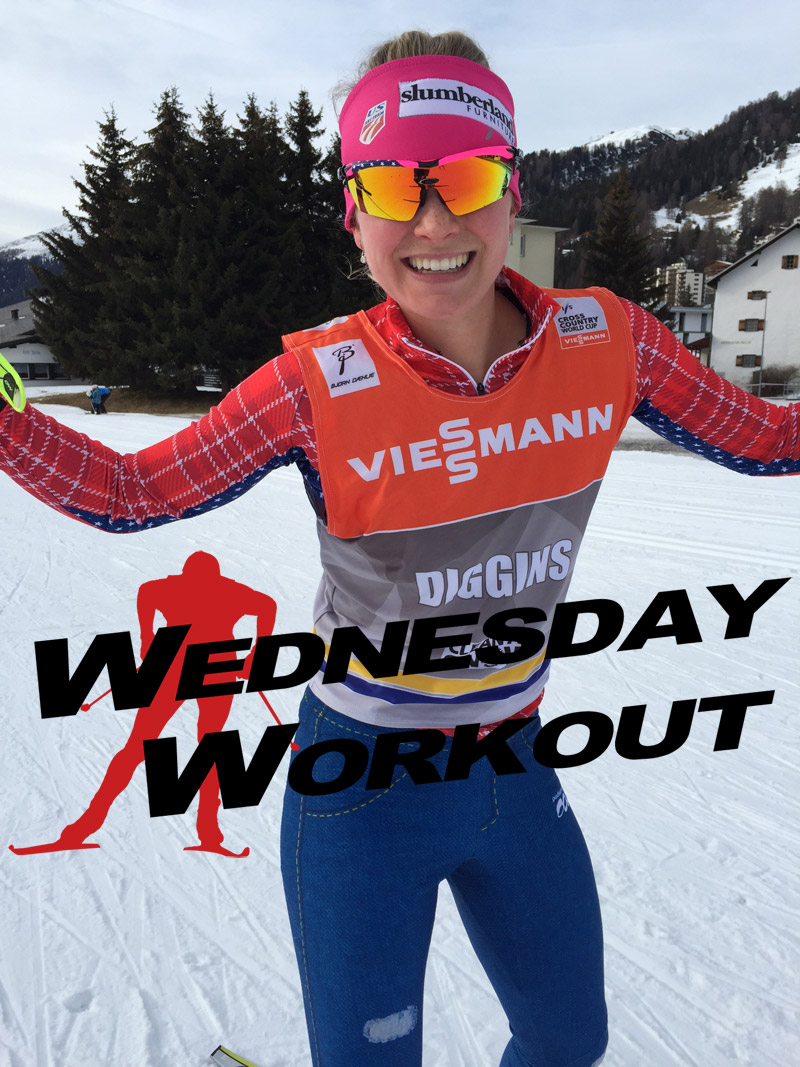
    Jessie Diggins (U.S. Ski Team) on a prologue-practice day in December 2014 in Davos, Switzerland. (Courtesy photo)
    Jessie Diggins (U.S. Ski Team) on a prologue-practice day in December 2014 in Davos, Switzerland. (Courtesy photo)

    Here’s a blast from the past. Two seasons ago, we asked Jessie Diggins, of the U.S. Ski Team, how she prepped for a prologue as the first stage of the 2015 Tour de Ski. She explained she did a “prologue practice day” about a week and a half before the Tour-opening 3 k freestyle prologue. Read the original workout here.

    ***

    [circa December 2014]

    When it comes to Tour de Ski prep, World Cup racers do a lot more than just chill over the holidays and rest up for the seven-stage tour. Jessie Diggins is one of two U.S. Ski Team members who plans on completing the tour (along with Liz Stephen), and to kick things off on the right foot, she does a “prologue practice day” about a week-and-a-half out from the first event: the freestyle prologue in Obertsdorf, Germany (which takes place this Saturday).

    “We almost never race prologues, and it’s such a funny distance at 3 km, but in the start of the Tour de Ski we race one!” Diggins, 23, explained in an email. “I like to take an interval workout and turn it into a time trial to practice my pacing and tempo for a 3km. If I have good energy that day, I’ll do two of them, so that I can play around with my pacing and tactics and learn from the different times.

    “I’ll also skate it since for whatever reason it seems like the World Cup prologues are usually skate,” she added.

    The workout takes about 1:45 to 2 hours from start to finish.

    • 30 minute warmup: just skiing easy
    • 5-8 minute Level 3 “to get my body going and warm up my lungs”
    • Ski back to the start area, start first prologue. “I will have mapped out a course beforehand —figured out where about 3km is on the trail and given myself a fairly realistic course. This week, I just raced part of the Davos course!”
    • After first prologue, ski easy for 10 minutes to let legs recover and lower heart rate back to normal
    • Start second prologue
    • Cool down: slow ski for 20-30 minutes

    “I also like to wear a full race suit and bib when I’m doing this so I can get into the racing mindset a little easier,” Diggins explained. “And of course, if the trails are crowded people tend to let you pass easier if you’re wearing a race bib! :)”

  • Throwback Workout: Pace-Development Intervals with the NAWTA (Remember That?)

    Throwback Workout: Pace-Development Intervals with the NAWTA (Remember That?)

    Astrid Jacobsen (NOR), Liz Stephen, Bettina Gruber (SUI), Jessie Diggins, Holly Brooks and Ida Sargent during threshold intervals in Anchorage, Alaska, on Tuesday. (Photo: Matt Whitcomb)
    Norway’s Astrid Jacobsen (r) leads Liz Stephen (U.S. Ski Team), Switzerland Bettina Gruber, and U.S. Ski Team members Jessie Diggins, Holly Brooks and Ida Sargent during threshold intervals at the 2013 North American Women’s Training Alliance (NAWTA) camp in Anchorage, Alaska. (Photo: Matt Whitcomb)

    For this week’s workout, we bring you one of the best threshold workouts U.S. Ski Team Women’s Coach Matt Whitcomb said he’s ever seen — back in 2013. That’s not to say this workout is outdated, and the kind of training environment nearly a dozen top-level athletes created at the 2013 North American Women’s Training Alliance (NAWTA) camp in Anchorage, Alaska, was one other teams and clubs can try to emulate. All it takes is a quality all-around effort and well-thought-out terrain choices. Read original article here.

    ***

    [circa July 2013]

    The third-annual North American Women’s Training Alliance (NAWTA) camp began this week in Anchorage, Alaska, and on Tuesday morning they completed a threshold workout that ended with a lot of high-fives in the van and left U.S. Ski Team women’s coach Matt Whitcomb pretty happy.

    “Today’s threshold workout was the best threshold workout I’ve seen out of this group of women since I’ve been working with the team,” he said on the phone, as the group began their afternoon strength session.

    Kikkan Randall, Jessie Diggins, Liz Stephen & Co., are joined at this camp by Alaska Pacific University skiers, National Training Group athletes, and decorated Norwegian Astrid Jacobsen, Switzerland’s Bettina Gruber and Canada’s Chandra Crawford. The workout is one that Whitcomb and APU head coach Erik Flora have repeated over the last few years in order to work specifically on high-speed skiing in the middle of a threshold session.

    The keys to accomplishing this goal are two-fold: the choice of terrain, and the presence of a group to ski with. It was his team’s skilled pack skiing that Whitcomb thinks set Tuesday’s session apart from the rest, but the rolling hills are a critical ingredient to the goal of the entire workout.

    “It’s not so much emphasizing going harder, it just emphasizes patterning your muscles, neurally, to fire faster,” Whitcomb explains. “I think a lot of times, certainly my tendency as been to prescribe intervals that are a bit too slow. We might be nailing the percentage of your max heart rate and the proper lactate right on the money, but the pace is just too slow — you’re going uphill, uphill, uphill, and a lot of times when we find hard terrain we go hit intervals there.”

    To encourage speed variation while staying within threshold, the workout should be done on a stretch of pavement that includes gradual uphills, flats and gradual downhills, which “systematically [builds] some pace development intervals into your session,” Whitcomb says.

    “It doesn’t need to be incredibly hard — today was roughly threshold and above during bursts of speed — but it was about the terrain that helped push the pace for us.”

    The Workout:

    • 20-30 minute warm up*
    • 4-6 x 7-10 minute L3 intervals (3 minutes rest) on fast terrain that incorporates gradual uphills, flats and gradual downhills. Most interval sessions use hard and grinding terrain, great for building capacity but not so great for higher pace development. The key to this workout is in the choice of terrain.
    • 20-30 minute cool down*

    *Do a warm up and cool down that allows you to focus on the intervals. “Sometimes a mistake can be made where people are going after volume in addition to high intensity on interval days,” Whitcomb says.

    Don’t do try to multi-task for this workout. “Warm up only the minimum that your body requires,” he continued. “You want to make sure your muscles are ready to go, and build into the intervals if you have to — you don’t want to pull any muscles or get injured — but a 45 minute warm up is too long, as is a 45 minute cool down. Keep them concise and focus more on the on-time.”

    Frequency: 

    Every two to three weeks in the summer, with increasing frequency to every 10 days as fall approaches. “A workout like this is in addition to L4 intervals, time trials, speeds, ODs,” Whitcomb said. “It’s just another small component, another ingredient to throw in the bag and mix it up.”

    Variations:

    • Shorter recovery time as the season goes on, or longer recovery when at altitude — “just to make sure the on-time is what’s being emphasized,” Whitcomb says.
    • Pre-determined sprint preems that accomplishes a similar break from straight threshold, forcing athletes to go from threshold, into race pace, then back into threshold when they cross certain preem markers in the interval.

    On Tuesday, the women did this session on a stretch of bike path in Anchorage’s Kincaid Park. They chose a section of rolling terrain that was about 7-10 minutes long going either way. The group started their first interval in one direction, which took about nine minutes, took their three-minute recovery, and then skied back the other way to the start, which took about seven minutes.

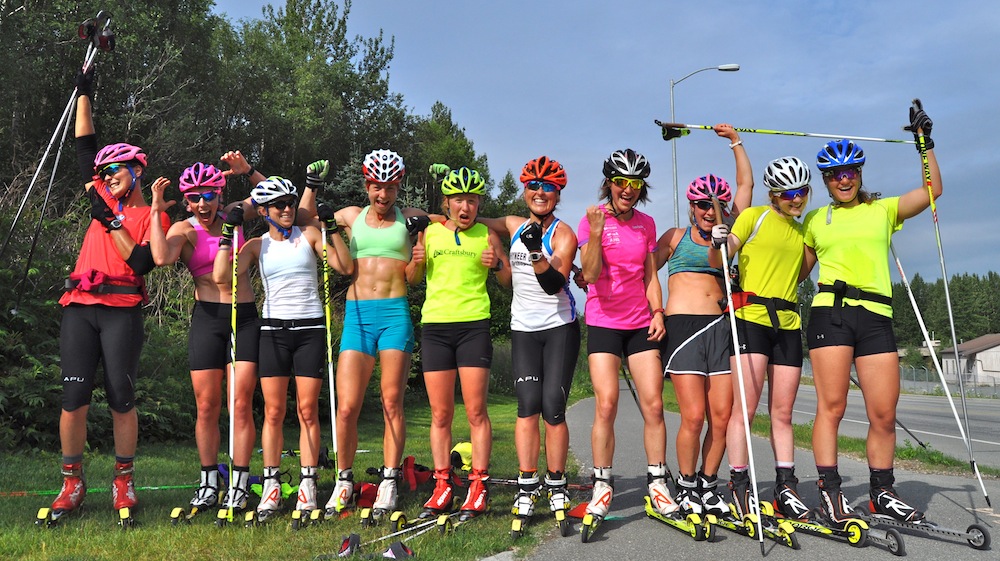
    The 2013 North American Women's Training Alliance group after a well-executed workout in Anchorage, Alaska. (L to R) Kate Fitzgerald, Kikkan Randall, Liz Stephen, Astrid Jacobsen (NOR), Ida Sargent, Holly Brooks, Bettina Gruber (SUI), Jessie Diggins, Emily Hannah, Anika Miller. (Photo: Matt Whitcomb)
    The 2013 North American Women’s Training Alliance group after a well-executed workout in Anchorage, Alaska. (L to R) Kate Fitzgerald, Kikkan Randall, Liz Stephen, Astrid Jacobsen (NOR), Ida Sargent, Holly Brooks, Bettina Gruber (SUI), Jessie Diggins, Emily Hannah, Annika Miller. (Photo: Matt Whitcomb)

    From a coaching perspective, this workout shows Whitcomb things that don’t surface in regular threshold intervals.

    “I think when we started doing this it taught us that the speed didn’t really change as much as we thought it would when the terrain asked for higher speed,” he said. “You try and go faster and your muscles simply didn’t want to move faster. It wasn’t a matter of being at your max heart rate, people were well within threshold, but they just didn’t want to fire those muscles faster. But the body fortunately adapts pretty quickly to a group session like this and you see pretty notable progress in your speed in just a few weeks.”

    So what made Whitcomb call Tuesday’s workout, in particular, the best threshold session he’s ever seen from his team?

    In addition to their raw speed — “they were really flying” — Whitcomb noticed they skied better together within the pack than they have before.

    “Everyone spent some time leading, some time sandwiched cycling in the spin wash in the middle of the pack, and it was really unlike this group perhaps in the past — you know, you establish a pecking order and somebody’s out there hammering off the front all day, maybe somebody switches out if they get tired, somebody is flying off the back all day because they’re struggling,” he said.

    “And today instead it was much more this series of incessant attacks at the front where you’d recover a little bit, spend some time in threshold in the pack, and then you’d work your way to the front and use your good feelings and your recovered state to push the pack and pull everybody along at a faster rate. It looked more like watching a cycling race today, to be honest, and that’s kind of a new thing particularly in girls skiing, I think. The mass starts [sometimes] just getting strung out from 100 m into the race, and I think we’re moving in the direction of more pack skiing. And as we can improve our skills within the pack were going to be better suited for those days when the women’s pack does stay together.”

    — Audrey Mangan

  • Throwback Workout: Hill Climbing and Norpining at Middlebury Snow Bowl

    Throwback Workout: Hill Climbing and Norpining at Middlebury Snow Bowl

    Emily Attwood (l) and Heather Mooney lunge at the finish of their final hill climb sprint.
    Former Middlebury College skiers Emily Attwood (l) and Heather Mooney lunge at the finish of their final hill climb sprint in the spring of 2014. (Photo: Lander Karath)

    It’s that time of year … to kick back and live a little! If you have a hill and residual snow nearby, this one’s for you. The following workout was published two years ago. Read the original here.

    ***

    [circa April 2014] 

    MIDDLEBURY, Vt. — Unless you’re the audacious Liz Stephen or Overall World Cup Champion Therese Johaug, you’re probably not a huge fan of hill climbs. However, when the mid-April temps turn our favorite trails into puddles, nordic ski enthusiasts have to get creative to get their on-snow skiing fix before spring training begins.

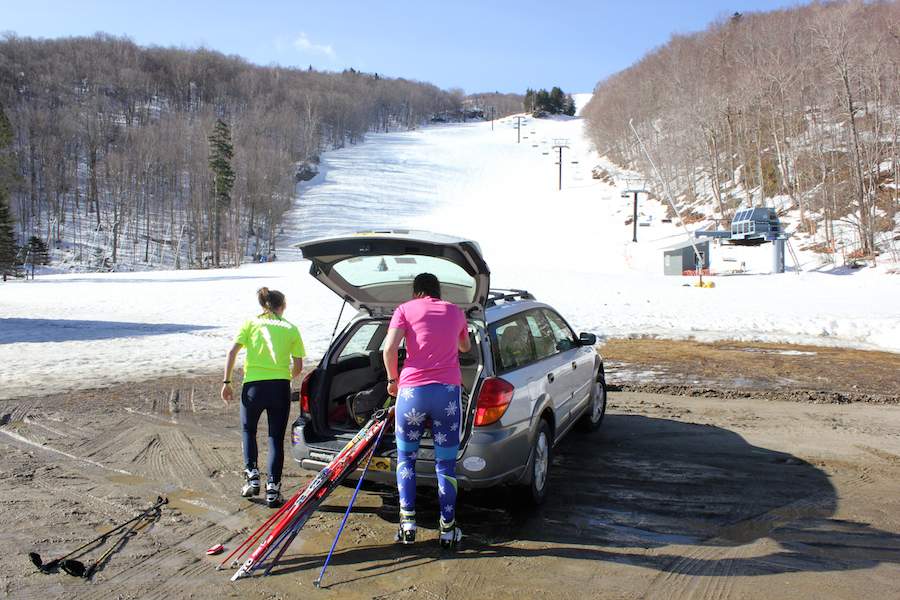
    Former Middlebury skiers Emily Attwood (l) and Heather Mooney get ready to climb up then ski down the Middlebury Snowbowl in the spring of 2014. (Photo: Lander Karath)
    Former Middlebury skiers Emily Attwood (l) and Heather Mooney get ready to climb up then ski down the Middlebury Snow Bowl in the spring of 2014. (Photo: Lander Karath)

    In Middlebury, skiers at the local college are doing just that by taking advantage of the remaining of snow at the Middlebury College Snow Bowl, an college-owned downhill ski area only 20 minutes from campus.

    I joined Heather Mooney (Peru, Vt.) and Emily Attwood (Cape Elizabeth, Maine) this past week to take advantage of the long awaited spring weather and to get in a late season ski at the same time. For this retired ski racer, the workout was certainly exhausting but left me full of energy for the rest of the day.

    Preparation:

    Finding a location for the hill climb and norpine is easy in a place like Middlebury where the alpine ski area is closed and the snow remains in relative abundance. In many western ski areas these circumstances can also be found with the exception of the few mountains that are still open. If this is the case, they most likely won’t allow you to ski, due to the lack of leashes, but it doesn’t hurt to check.

    Once the ideal spot is found, there’s not much needed for a spring hill climb and norpine other than a pair of skate rock skis, classic poles (skate poles are too big for the climb as well as the descent), and of course, a sense of adventure. However, there are a few accessories that make this workout even more enjoyable. For example, bring a Jammypack so your favorite jams can aid you in your struggle your up the hill, and provide a sick soundtrack for the cruise down.

    In addition, make sure to start your climb in the morning, as warm spring temperatures make the snow pretty soft, wet, and slow later in the day.

    The Workout:

    Once you’ve adorned your Jammypack, jumped on your skis, and hit the snow you have a long trek ahead of you. Most alpine ski areas are fairly steep so be prepared for a haul to the top. At times it can feel like progress in the softening snow is nonexistent, but little by little the hills get conquered.

    Once you reach the final ascent of our climb, those who are more ambitious can decide to have a final hill sprint. My two companions decided to have such a race, once again proving that cross county ski racers have some of the most competitive personalities in the sports world.

    While you can choose to sit out of the final sprint (as I did), it aids in keeping those post-season legs fit and fresh with a little bit of intensity. It also certainly adds to the sense of accomplishment and exhilaration of climbing to the top of a massive alpine ski area.

    Once at the top, the real fun begins. After taking a rest from the 45 minutes of climbing, make your way down the slopes for some awesome twists and turns.

    This part of the workout is called norpining. As the name suggests, its a combination of nordic and alpine skiing. While nordic skis don’t have great edges, they certainly make for a fun (and somewhat unstable) 20+ minute cruise to the bottom. It may take a few turns to get used to skinny skis on a steep slope, but by the time you reach the base you’ll be rearing for more.

  • Wednesday Workout: Throwback Uphill Running Intervals with Stephen

    Wednesday Workout: Throwback Uphill Running Intervals with Stephen

    Liz Stephen tucking in a World Cup race during the 2009/2010 season.
    Liz Stephen tucking in a World Cup race during the 2009/2010 season.

    This week, we bring you a past Pro Workout from U.S. Ski Team veteran and two-time Olympian Liz Stephen. Now 28, Stephen recently won her second-straight Trail Run National Championship as well as the Red Bull 400 hill climb. What’s made her so fast over the years? This workout from 2010 sheds some insight. Read original workout here.

    ***

    [circa Nov. 2010]

    Some skiers love to run; others tolerate it. The U.S. Ski Team’s Liz Stephen is the former. And while uphill running intervals present plenty of challenge for most, Stephen not only wants a solid grade and 20+ minutes of active time – she wants a steady downpour, mud, slippery footing, and whatever else nature can throw at her.

    “For me it is always more fun when it is raining out,” said Stephen. “It is muddy…your hair is all matted down. There is rain in your face, your glasses don’t work, feet are slipping.  You have to figure it out.  I like that kind of stuff.”

    Her workout of choice consists of a relatively standard set of intervals – six four-minute repeats of hard effort building to maximum over the course of the session.

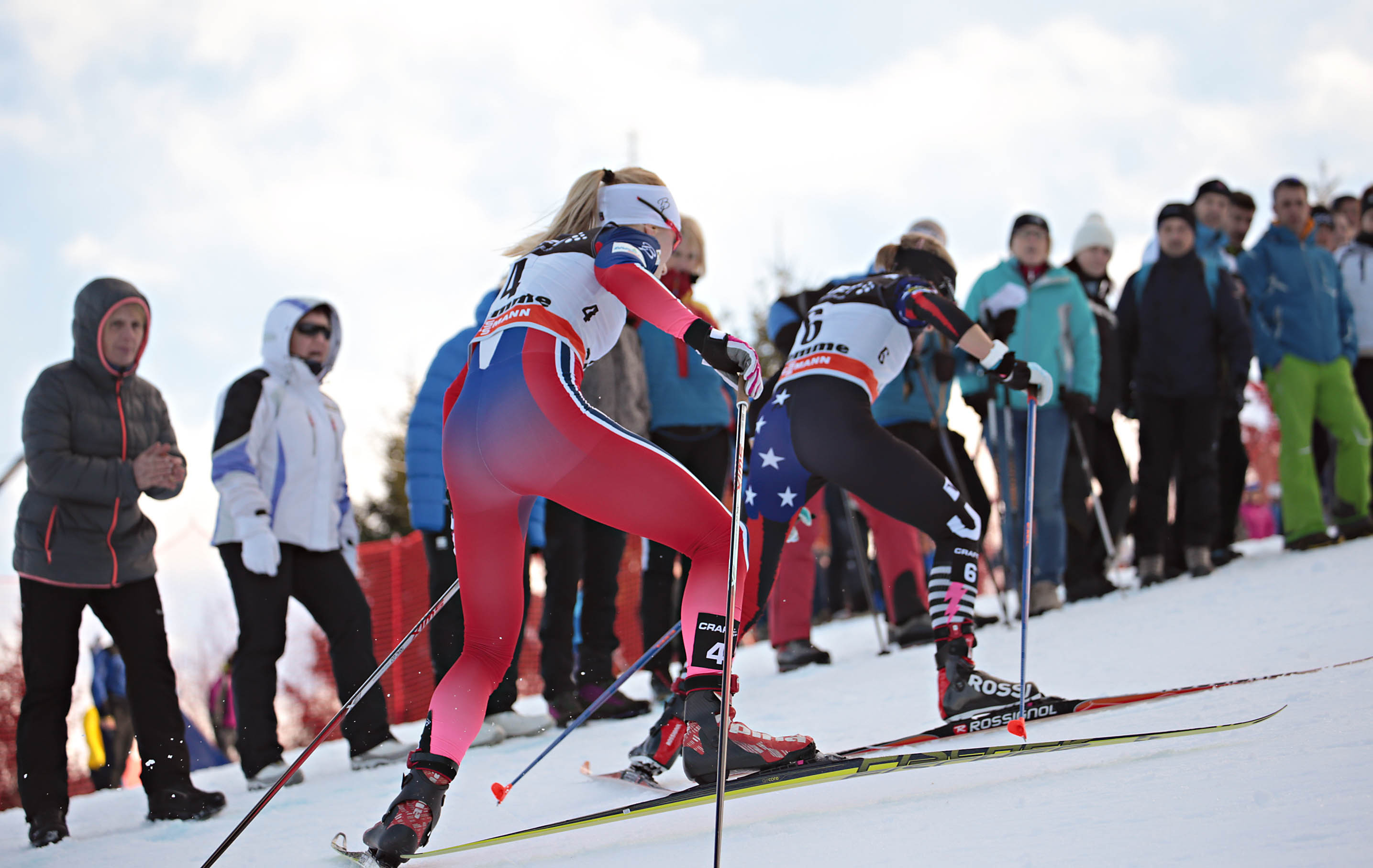
    American Liz Stephen leads Norway's Ragnhild Haga during the charge up the final hill of the seventh stage of the 2015 Tour de Ski in Val di Femme, Italy (Photo: Val di Fiemme/www.fiemmeworldcup.com)
    Liz Stephen (in black) leads Norway’s Ragnhild Haga during the charge up the final hill of the seventh stage of the 2015 Tour de Ski in Val di Femme, Italy (Photo: Val di Fiemme/www.fiemmeworldcup.com)

    The optimal hill is long enough that you don’t have to go all the way down after each effort, keeping the rest period in the target zone of three to four minutes. The grade should be challenging but run-able. These are not bounding intervals.

    Bounding may be more specific and powerful, but running gives Stephen a chance to work on quickness.

    “It should be a fun feeling,” she said. “A hard feeling, of course, but not bogging down.

    “You want to feel like you can be fast!”

    Staying light and quick is a regular theme in ski technique, and this is a perfect dryland opportunity to apply those concepts.

    At the end of the day, however, it is the rain that makes it for Stephen.

    “I just like that feeling – being muddy, coming in and showering, drinking hot cocoa and sitting by the fire, stretching and reflecting on ‘I just got some shit done today,’” said Stephen.

    And part of getting it done is learning to deal with the adverse conditions.

    “Whether you are on the World Cup or at some Eastern Cup, there is still shitty weather and the rain still falls, and the course is still not groomed the way you want it to be,” she said. “There is always going to be something that is not ideal for you. You have to know how to do that, too.”

    The rain may not raise your VO2max, or increase your foot speed, and mental benefits are hard to quantify – but Stephen sees real value.

    “Honestly, did it make you a better athlete than if it was sunny out? Maybe, maybe not, but in terms of your mental approach, you feel you really accomplished something,” she said.

    Stephen has been working on evaluating every workout – what went well, what could have been better. And, she concludes, “with running intervals in the rain, the positive is always that it is raining!”

    — By Topher Sabot

    The Workout: 6 x 4-minute uphill intervals (hard effort, building to maximum)

    Optimal climb: Long enough that you don’t reach the bottom after each effort (with 3-4 minutes recovery in between), with a grade that’s challenging yet run-able (not bounding)

    Think about: Staying light and quick on your feet

    “It should be a fun feeling. A hard feeling, of course, but not bogging down. … You want to feel like you can be fast!” Stephen explained.

  • Wednesday Workout: Throwback Over-Distance Double-Pole with Kikkan Randall

    Wednesday Workout: Throwback Over-Distance Double-Pole with Kikkan Randall

    Kikkan Randall taking a break from a fall double pole in 2011 in Anchorage. (Courtesy photo)
    Kikkan Randall taking a break from a fall double pole in 2011 in Anchorage. (Courtesy photo)

    This week’s workout is a blast from the past, written four years ago about U.S. Ski Team sprinter Kikkan Randall. Now, with three Sprint World Cup titles to her name, we figured it might be a good time to revisit what made Randall so fast. Interestingly, one of her favorite fall workouts in 2011 was distance. Randall, 32, is currently in Norway preparing for the Toppidrettsveka rollerski races in Aure, Orkdal and Trondheim, held Thursday through Saturday. See the original pro workout here. 

    ***

    [Circa Oct. 2011] … Kikkan Randall is known for her speed. But even though her forte is in races under three minutes long, one of her favorite workouts to do in the fall is a 50 k rollerski double-pole session. In addition to being a solid level one effort, the U.S. Ski Team (USST) veteran also uses the workout as an opportunity to work on her double-pole form.

    “The goal is to get a lot of repetition in the double-pole movement, going long enough that you tire out the easy-to-use muscles and really find the most efficient positions, timing and impulse,” said Randall.

    Randall has a favorite point-to-point route in Anchorage that usually takes her about three hours to cover. She recruits a family member to drive her outside of town, and then she skis home.

    Alaska Pacific University's Kikkan Randall (r) leads fellow U.S. Ski Team member Liz Stephen and Norway's Celine Brun-Lie (l) during a dryland session last week in Anchorage, Alaska, part of the North American Women's Training Alliance. (Photo: Matt Whitcomb)
    Kikkan Randall (r) leads fellow U.S. Ski Team member Liz Stephen and Norway’s Celine Brun-Lie (l) during a dryland session last summer in Anchorage, Alaska. (Photo: Matt Whitcomb)

    “It includes rolling terrain, but most importantly long, flat sections where I can get into a rhythm in my double-pole technique and really ingrain correct movement patterns,” she explained. Randall makes sure to keep her heart rate under control for the duration of the workout, at about 60 to 70 percent of her max.

    Between September and when the snow flies in Anchorage at the end of October, Randall will head out for a long double-pole every other week. Sometimes she has company for the three-hour workout, but she also enjoys taking in the fall colors when it’s just her and her iPod.

    During such a long, sustained effort, Randall is careful to keep herself hydrated, drinking about 30 ounces throughout the workout, and more after she returns home to continue replenishing lost fluid.

    “You lose more water than you think on a long ski like this!” she said.

    Randall also emphasizes getting recovery food into her system directly after the workout, and will usually go for a smoothie packed with carbohydrates and protein: 1 cup Greek non-fat plain yogurt, 1 cup frozen berries, 1 scoop protein powder, 1/2 cup milk, 1/2 cup juice and 1 Tbsp honey.

    As she usually starts the workout when the air is still crisp, she follows the effort up with a hearty breakfast and a nap.

  • Wednesday Workout: Throwback ‘Continuous Bounding’ with Ivan Babikov

    Wednesday Workout: Throwback ‘Continuous Bounding’ with Ivan Babikov

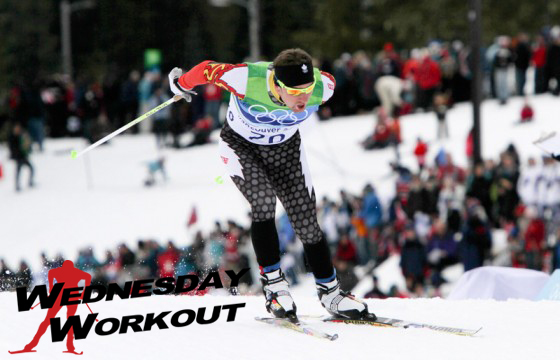
    Ivan Babikov (Canadian World Cup Team) racing to eighth in the 15 k freestyle at the 2010 Vancouver Olympics.
    Ivan Babikov (Canadian World Cup Team) racing to eighth in the 15 k freestyle at the 2010 Vancouver Olympics.

    For this week’s workout, we went back in time five-plus years to a session Canadian World Cup Team veteran Ivan Babikov shared with us in August 2010. The following comes from his days with the Russian national team and involves continuous-and-varied bounding intervals — and it’s brutal.  See the original pro workout here.

    ***

    [circa August 2010]

    The harder the race, the greater the chance you’ll see Ivan Babikov at the top of the result sheet. So it’s no surprise that he uses a brutally difficult training session to prepare himself for the winter.

    In an interview from his home in Canmore, Babikov said that this workout – a variation on bounding intervals – was a holdover from his younger days training in Russia.

    In Canada, Babikov said, most athletes do their bounding on a single hill, “up and down and up and down.” His version is more continuous, and more varied: following the five-kilometer World Cup loop at the Canmore Nordic Center, Babikov bounds all of the climbs, and use the flats and descents for recovery.

    Canada's Ivan Babikov placed 57th in the 4 k freestyle prologue to start the 2015 Tour de Ski on Jan. 3 in Oberstdorf, Germany. (Photo: Marcel Hilger)
    Canada’s Ivan Babikov racing in the opening stage of the 2015 Tour de Ski, the 4 k freestyle prologue, on Jan. 3 in Oberstdorf, Germany. (Photo: Marcel Hilger)

    Before starting the business end of the workout, Babikov said that he usually pedals his bike to the nordic center from his home in Canmore as a warm-up. He brings standard-length classic poles, rather than the shorter ones that athletes often use for bounding – “so I can reach higher.”

    The workout itself is nothing fancy. Babikov will start off running along the trail at the nordic center, and then begins bounding whenever he gets to an uphill. The technique he uses is a full bound — not like moosehoofs or ski walking.

    “I just do strong, powerfull, uphill, long strides….It’s really like striding; it’s not like running,” he said. “It looks like skiing tempo.”

    Proper technique and intensity pegs Babikov’s heart rate at Zone 3 on the climbs, with the occasional foray into Zone 4. “The longer [the] uphill and the steeper [the] uphill, the higher it gets,” he said.

    When Babikov gets to the top of a hill, he doesn’t stop — he just switches to normal running. It’s not an easy pace, either — just enough to recover to the point where he can work harder on the next climb. He said he usually stays in Zone 2, “just to get the breath back.”

    “You switch right away [at the crest of each climb]. It’s really, really hard, but that’s the point of the training….you’re lactated and really tired,” he said. “That’s how you get in the race — it’s the same. You go hard, hard, hard, but at the top of the uphill is where the best are dropping other guys.”

    Usually, Babikov will complete three or four loops of the 5 k at the nordic center, for a total of two to two-and-a-half hours of training. He likes using the cross-country trails because they offer the same rolling terrain that he’s faced with in winter.

    The workout is “really hard on the legs,” and Babikov ends the session “exhausted.” But the benefits are numerous.

    “I think it’s where I get my strong legs from,” he said, adding that the bounding also helps with core and endurance.

    In Russia, he said that skiers do this type of training all the time, even twice a week. Readers may want to start by trying workout once a week, and perhaps for less than Babikov’s two to two-and-a-half hours.

    The workout: Continuous bounding intervals

    Warmup: Ride your bike to training site

    Bring: Standard-length classic poles

    Start: by trail running, preferably on cross-country trails, then bound (explosive, full bound) when you reach an uphill (should be in Zone 3, occasionally Zone 4)

    At top of each hill: resume running at a pace that is just enough to recover (Zone 2). Resume bounding whenever you reach an uphill.

    Work up to: 3-4 five-kilometer loops, or 2 1/2 hours of training, potentially more than once a week