From the FasterSkier archive — posts syndicated from athletes’ and coaches’ own blogs between 2004 and 2012, kept online as published. Current coverage is at fasterskier.com.
July 10th, 2018 (THUNDER BAY, Ontario) — Big Thunder Nordic Ski Club is pleased to announce the appointment of Adam Kates as Head Coach effective September 2018. Kates brings extensive experience as a high performance coach and athlete to the role. In addition to achieving some of the highest levels of coaching certification available, Kates played a pivotal role in developing Big Thunder programs and the Lakehead Nordic Team both as Head Coach from 2008 to 2014 and as a skilled volunteer for many years. Long-time board member and newly elected Club President Todd Randall commented “we are pleased to welcome back Adam’s unabashed passion for cross-country skiing and coaching. We look forward to his mentoring the next generation of Big Thunder and Lakehead Varsity athletes.”
Reflecting on this new chapter as Big Thunder’s Head Coach, Kates is “excited to be back with both Big Thunder Nordic Ski Club and Lakehead Nordic Skiing and to lead both programs to continued success into the future”. Kates added “cross-country skiing in Thunder Bay has played a major role in my life for almost two decades and I feel fortunate to be back in an official capacity with these two great organizations.”
Athletes will continue training throughout the summer to be in prime shape and ‘ready to race’ going into the on-snow season in the fall. It is anticipated that Kates’ extensive past experience with Big Thunder and the Lakehead Nordic team will make the transition a smooth one for both athletes and club organizers.
About Big Thunder
Big Thunder Nordic Ski Club is a not-for-profit organization managed collaboratively by a volunteer Board of Directors and a full-time, paid Head Coach. Our mission is to play a leadership role in the development and promotion of the sport of cross-country skiing in the community of Thunder Bay through programs and services for athletes of all ages and abilities, participants, coaches/leaders, officials and volunteers. Find out more about our successful and innovative programs at: www.btnordic.ca
Reporting to the Head Coach, the Intern will gain experience in all areas of business administration. The primary role of the Business Development Intern is to develop a strategic plan to raise the profile of the NTDC in the local community and to develop a pathway for the NTDC to continue to grow as an organization. As well, the internship will allow the Intern an opportunity to gain experience in all areas of the business administration.
Qualifications:
Graduate of a University or College within the last three years from an accredited college or university
Must be a graduate of a post-secondary degree or diploma program
Must be the first full-time employment in the candidate’s field of study
Diploma/degree in Business Administration, Accounting or Marketing
Proficient with the use of personal computers on a network environment (Microsoft Office, electronic email/calendar)
Excellent organizational, analytical, & communication skills.
A team player that is able to work independently in a fast-paced, dynamic setting.
Excellent customer service skills.
We are an equal opportunity employer. Upon request, accommodations due to a disability are available throughout the selection process.
Interested applicants should submit a cover letter and resume outlining relative previous experience and training no later than June 11, 2018 to: talent@ntdctbay.ca
We thank all applicants for applying; only those selected for an interview will be contacted.
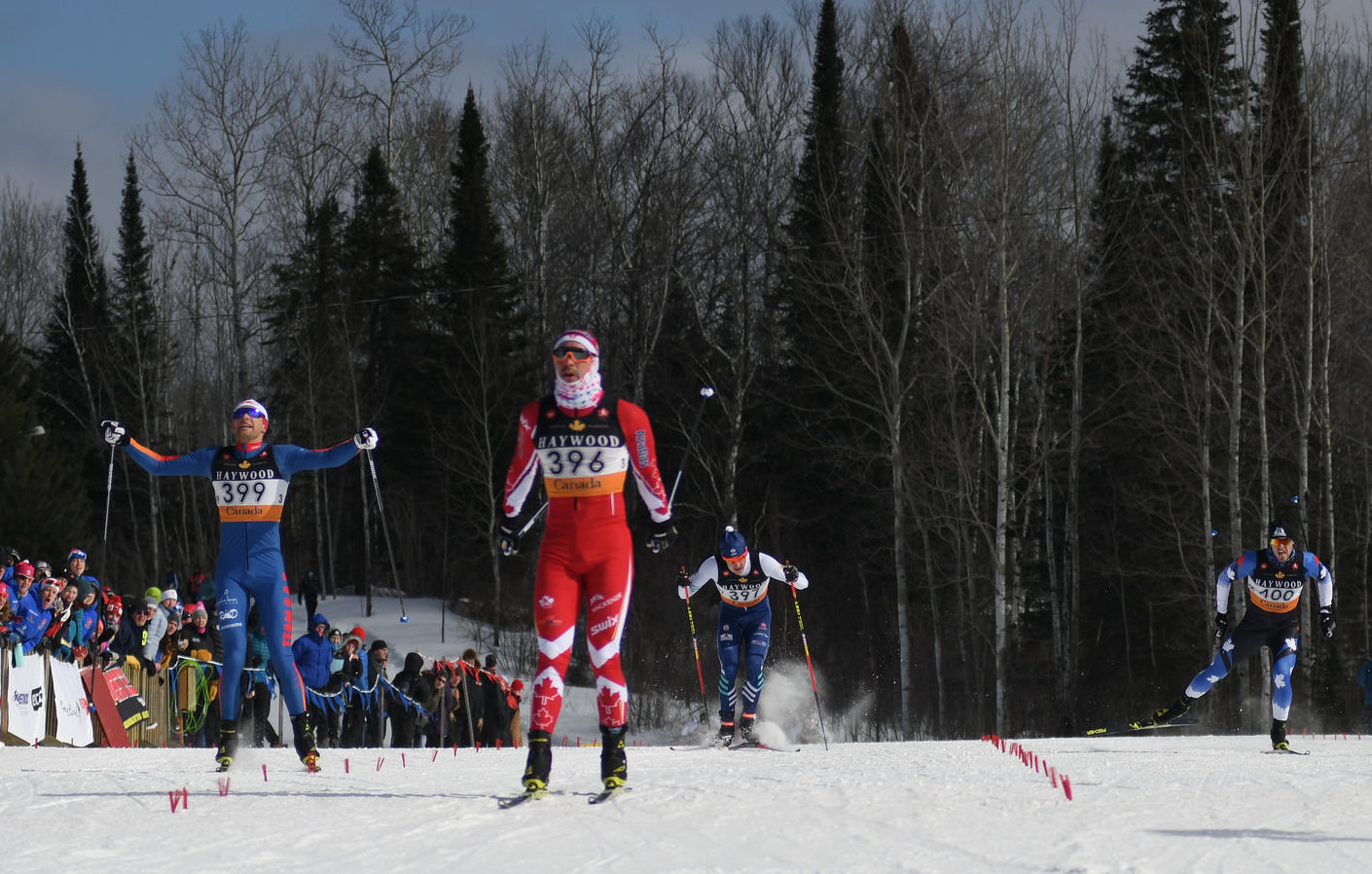
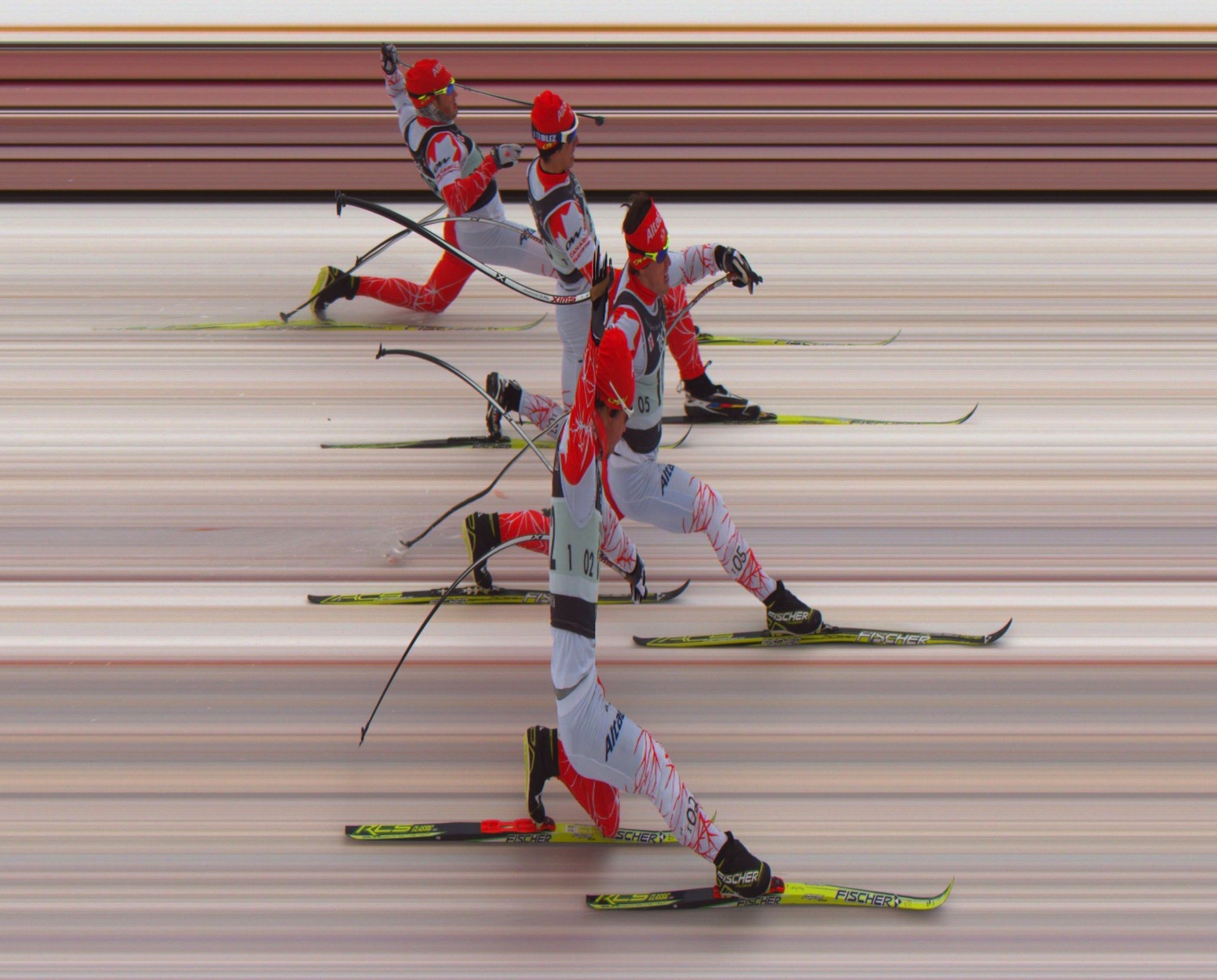
Jess Cockney (396) after winning the men’s 15 k freestyle pursuit at 2018 Canadian Ski Nationals, ahead of Ty Godfrey (l), Michael Somppi (r) and Evan Palmer-Charrette (second from r) in Thunder Bay, Ontario. (Photo: Doug Stephen)
Canadian Ski Nationals (Thunder Bay, Ontario): Freestyle pursuits and sprints
Ski Nationals continued Tuesday and Wednesday at Lappe Nordic in Thunder Bay, with 10- and 15-kilometer freestyle pursuits (based on Sunday’s 5/10 k classic interval starts) followed by sprints.
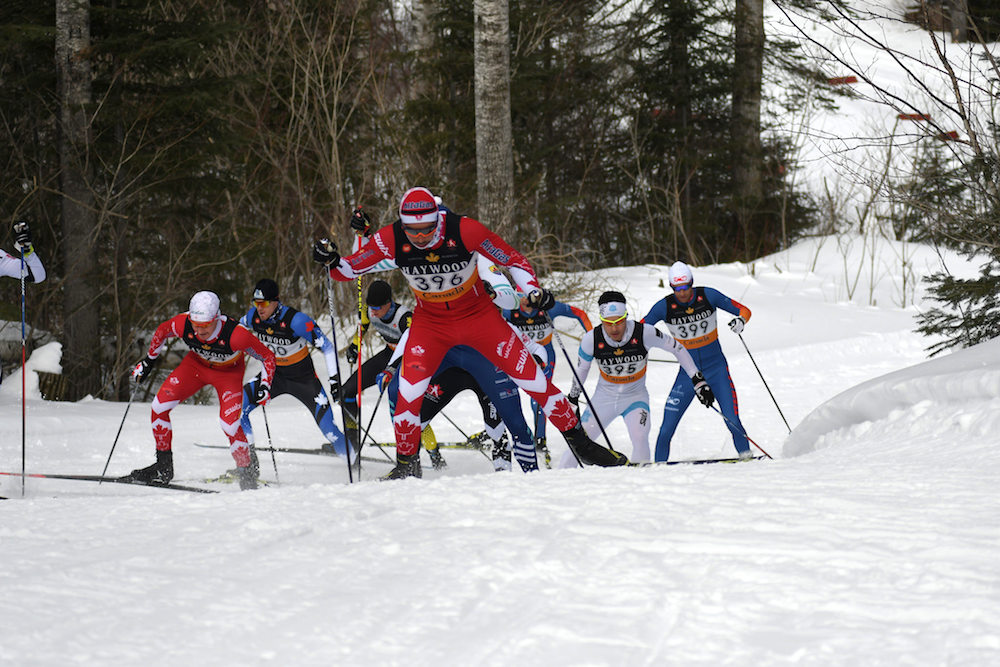
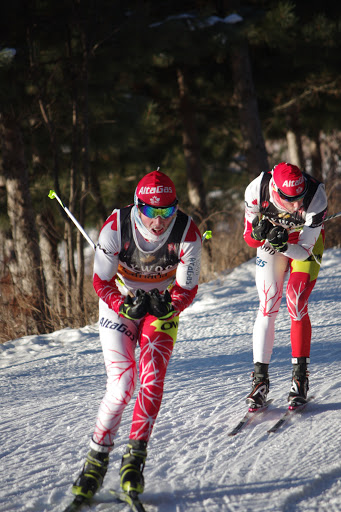
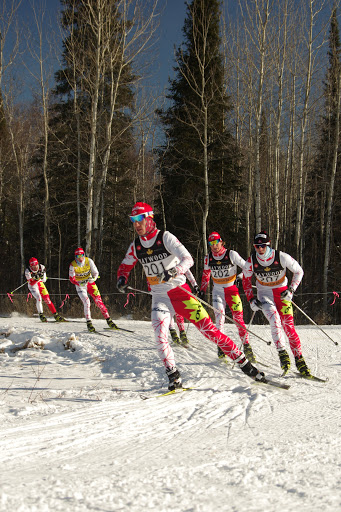
Jess Cockney (396) leading the men’s 15 k freestyle pursuit on Tuesday at 2018 Canadian Ski Nationals in Thunder Bay, Ontario. He went on to win the pursuit as well as the freestyle sprint the next day. (Photo: Doug Stephen)
On Tuesday, Jess Cockney of the Canadian World Cup Team and Alberta World Cup Academy (AWCA) raced to first in the men’s 15 k freestyle pursuit, up from sixth after the 10 k classic. His cumulative time for the two races was 1:04:06.7 hours, just 1.2 seconds ahead of Ty Godfrey of Team R.A.D. in second. (Godfrey previously placed ninth in the 10 k classic.) Michael Somppi, who grew up skiing with Lappe Nordic and now trains with the AWCA, completed the podium in third, 2 seconds behind Cockney, after placing 10th in the classic race.
Just behind Somppi, another local skier Evan Palmer-Charrette, of Lappe Nordic and the National Team Development Centre (NTDC) Thunder Bay, placed fourth in the pursuit (+2.8). Antoine Cyr and Alexis Dumas, both of the Pierre-Harvey National Training Centre (CNEPH), finished together in fifth (+11.5) and sixth (+11.6), respectively, ahead of Knute Johnsgaard (World Cup Team) in seventh (+13.4), Scott Hill of Barrie Cross Country (BXC) in eighth (+16.3), Reed Godfrey (Team R.A.D.) in ninth (+31.8), and Ryan Jackson (BXC) in 10th (+38.9).
The fastest 15 k skate time of the day was clocked by Somppi in 36:54.5. Ty Godfrey had the second fastest time of day, just 0.2 seconds back, while Cockney’s freestyle time ranked third fastest (+4.9).
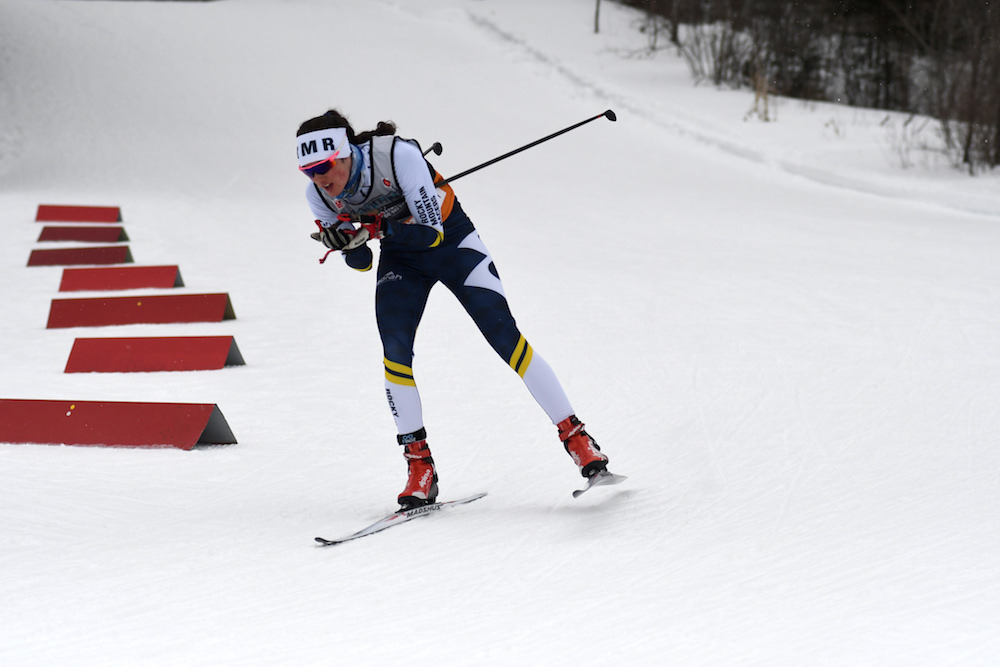
Olivia Bouffard-Nesbitt (Rocky Mountain Racers) racing to second overall (first Canadian) in the women’s 10 k freestyle pursuit on Tuesday for her second national title of the week at 2018 Canadian Ski Nationals in Thunder Bay, Ontario. (Photo: Doug Stephen)
American Caitlin Gregg, of Central Cross Country (CXC), Team Gregg and Loppet Nordic Racing, won the women’s 10 k freestyle pursuit by more than a minute in 43:12.4, after placing second in the 5 k classic. The winner of Sunday’s classic race, Olivia Bouffard-Nesbitt of Rocky Mountain Racers (RMR) scored her second-straight title as the first Canadian in the pursuit, placing second overall, 1:03.4 behind Gregg. Annika Hicks (AWCA) was the second Canadian in third overall (+1:16.3), up from fifth in the classic race.
Gregg clocked the fastest 10 k skate time in 27:51.6, while Vézina was second fastest on the day, 1:06.5 back. Hicks had the third-fastest time, 1:07.3 back from Gregg.
On Wednesday, Cockney racked up his second-straight national title with a victory in the 1.4 k freestyle sprint final. Cockney edged Andy Shields (Lappe Nordic) by 0.83 seconds for the win in 2:39.87. Just three-hundredths of a second behind Shields, Palmer-Charrette reached the podium in third (+0.86), Somppi followed in fourth (+2.14), Julian Smith (NTDC Thunder Bay/National U25 Team) finished fifth (+4.3) and Sebastien Boehmler-Dandurand (Stefan Kuhn HP Team) placed sixth (+11.81).
Shields won the qualifier to start the day in 2:44.54, while Cockney was the second-fastest men’s qualifier, 1.39 seconds off Shields’s time. Shields went on to win his quarterfinal and place second in the first semifinal, while Cockney was second to Smith in both the fourth quarterfinal and second semifinal.
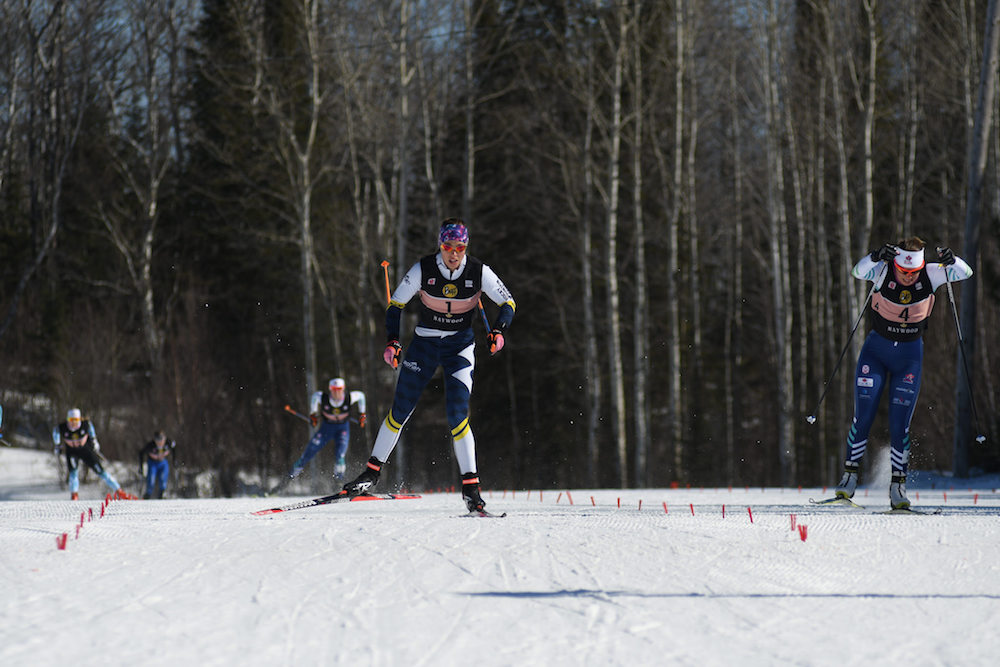
Maya MacIsaac-Jones (l) and Katherine Stewart-Jones (r) go head to head for the win in the women’s freestyle sprint final on Wednesday at 2018 Canadian Ski Nationals in Thunder Bay, Ontario. MacIsaac-Jones won it by 0.05 seconds. (Photo: Doug Stephen)
MacIsaac-Jones won the women’s skate-sprint final in 3:06:68, five-hundredths of a second ahead of Stewart-Jones in second. In a race for third, Maclean took it (+4.82), ahead of Gregg in fourth (+5.01). Hicks placed fifth (+7.22) and Zoë Williams (Nakkertok) was sixth (+9.12).
MacIsaac-Jones topped the women’s qualifier by 5.78 seconds in 3:12.87. Mathilde Petitjean of Club Nordique Mont Sainte-Anne (C.N.M.S.A.) qualified second, and Maclean was 6.42 seconds back in third.
MacIsaac-Jones then won the first quarterfinal and placed second to Stewart-Jones in the first semifinal. Stewart-Jones finished second to Bouffard-Nesbitt in the second quarterfinal, and Maclean won the second semifinal over Gregg, after finishing second to Gregg in the fifth quarterfinal.
Nationals conclude with 30/50 k classic mass starts on Saturday.
Patrick Stewart-Jones (l), skiing for his club team Nakkertok, and Scott Hill (r) of Barrie Cross Country (BXC) going head to head in the men’s classic team sprint on Saturday at Canadian Ski Nationals in Thunder Bay, Ontario. Nakkertok won and BXC placed second. (Photo: Doug Stephen)
Canadian Ski Nationals (Thunder Bay, Ontario): Team sprints + 5/10 k classic
Canada’s 2018 Ski Nationals opened this past weekend at Lappe Nordic in Thunder Bay, Ontario, with classic team sprints on Saturday followed by 5- and 10-kilometer classic interval starts on Sunday.
Nakkertok topped the podium in both the open men’s and women’s team sprints. In the men’s final, Nakkertok’s Dominique Moncion-Groulx and Patrick Stewart-Jones won by 1.95 seconds over Barrie Cross Country (BXC) in 14:50.79. BXC’s Ryan Jackson and Scott Hill teamed up for second place, and Skibec’s Alexis Morin and Antoine Brand raced to third (+2.57).
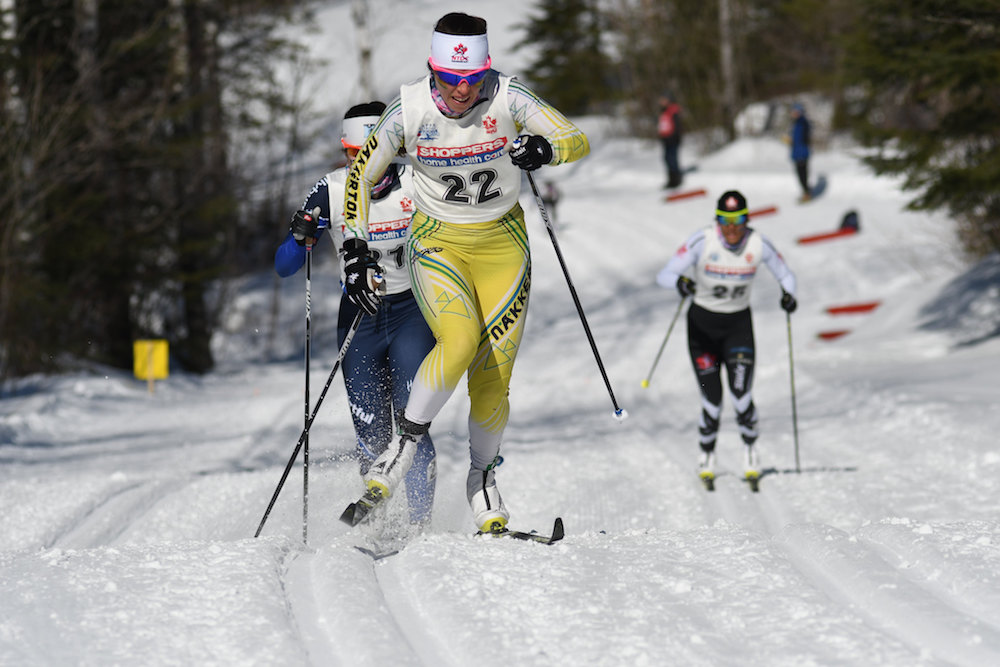
Katherine Stewart-Jones (22), skiing for her club team Nakkertok, while leading Annika Richardson (Hollyburn Ski Club) and Mathilde Petitjean (r) of C.N.M.S.A. during the women’s classic team sprint at 2018 Canadian Ski Nationals in Thunder Bay, Ontario. (Photo: Doug Stephen)
The Stewart-Jones family was also a big winner on Saturday, with Nakkertok’s Zoë Williams and Katherine Stewart-Jones (Patrick’s sister) racing to first in the women’s final in 13:04.72. They finished 2.37 seconds ahead of Katie Weaver and Annika Richardson of the Hollyburn Ski Club in second place, and Marie Corriveau and Mathilde Petitjean of Club Nordique Mont-Sainte-Anne (C.N.M.S.A.) raced to third (+7.42).
On Day 2 and the first official day of Canadian Ski Nationals, Hill (BXC) took his second-straight win of the weekend, topping the men’s 10 k classic with a time of 26:45.1 for his first senior national title. He finished 7.2 seconds faster than Alexis Dumas, of the Pierre-Harvey National Training Centre (CNEPH) in second, and an early race leader, Knute Johnsgaard of the Canadian World Cup Team, placed third (+12.0)
Johnsgaard clocked the fastest split at the race’s halfway point, while Hill’s 5 k time was almost 10 seconds slower. But over the final 5 k, Hill’s lap time was nearly 22 seconds faster than Johnsgaard’s. Dumas skied a consistent race, with the fourth-fastest first lap and second-fastest second lap.
Knute Johnsgaard (Canadian World Cup Team) racing to third in the men’s 10 k classic on Sunday at Canadian Ski Nationals in Thunder Bay, Ontario. (Photo: Doug Stephen)
Jackson (BXC) finished fourth (+14.7), and Jess Cockney of the Alberta World Cup Academy (AWCA) and Canadian World Cup Team placed fifth (+22.2). Leading the National Team Development Centre (NTDC) Thunder Bay on its home trails was Evan Palmer-Charrette in sixth (+24.8), and Lappe Nordic’s Michael Somppi (AWCA) placed seventh (+29.1). Gareth Williams of Telemark Nordic and the Canadian U25 Team finished eighth (+39.5), American Brian Gregg (CXC/Team Gregg/Loppet Nordic Racing) was ninth (+44.7), and Jack Carlyle (AWCA) 10th (+49.5).
Olivia Bouffard-Nesbitt of Rocky Mountain Racers (RMR) collected her first senior national title with a 13.3-second victory in the women’s 5 k classic. She finished in 15:07.5, ahead of American Caitlin Gregg (CXC/Team Gregg/LNR) in second, while Katherine Stewart-Jones (NTDC Thunder Bay) was the second Canadian and third overall (+17.9).
NTDC Thunder Bay had two in the top four with Alannah Maclean in fourth (+19.8). Annika Hicks (AWCA) followed in fifth (+22.2), Frédérique Vézina (CNEPH) was sixth (+30.8), Sophie Carrier-Laforte (Skinouk) seventh (+33.0), Maya MacIsaac-Jones (RMR/Canadian U25 Team) eighth (+37.4), Laura Leclair (CNEPH) ninth (+58.1), and Williams (Nakkertok) 10th (+1:07.2).
Nationals continue Tuesday with 10/15 k freestyle pursuits, followed by skate sprints on Wednesday and 30/50 k classic mass starts on Saturday.
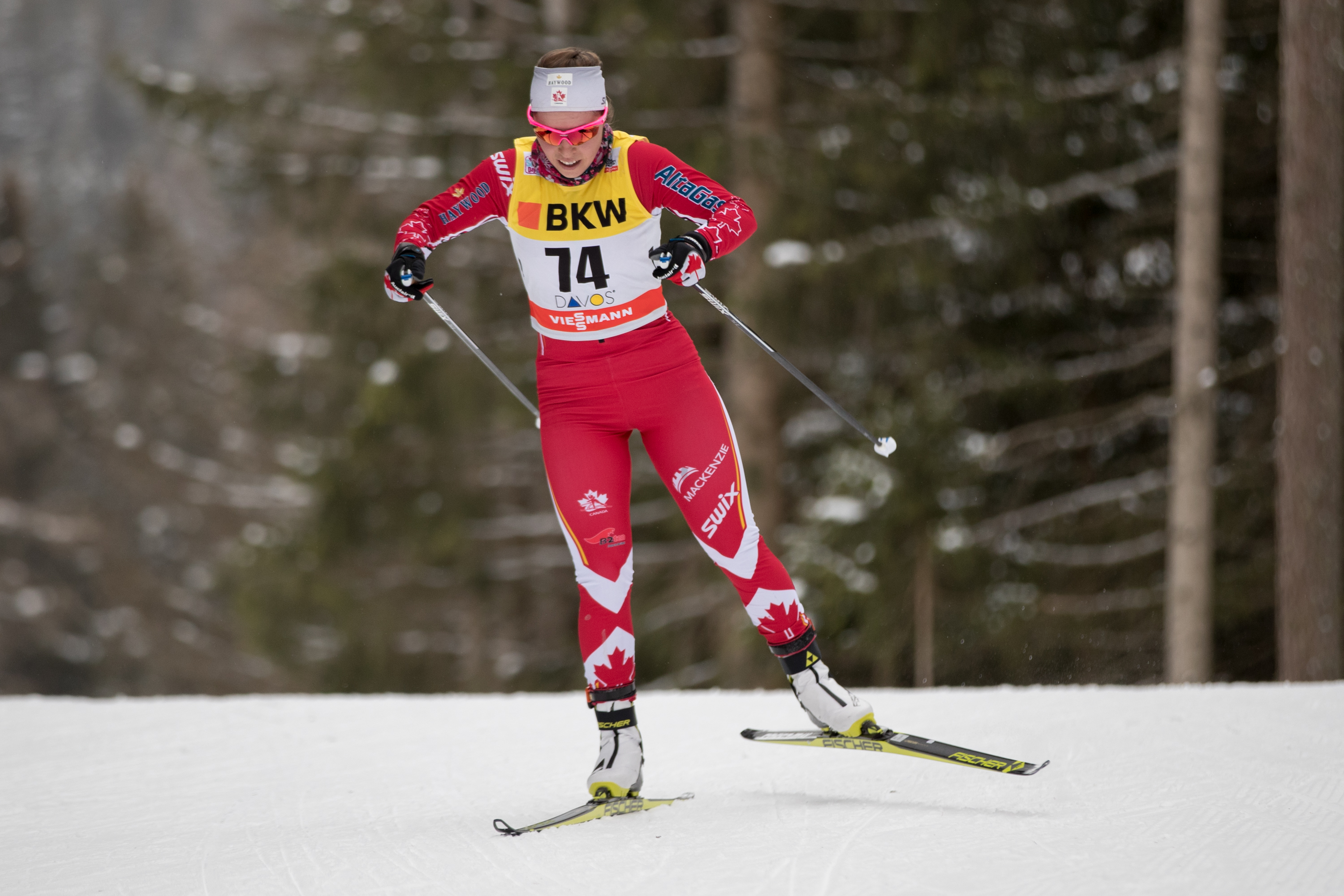
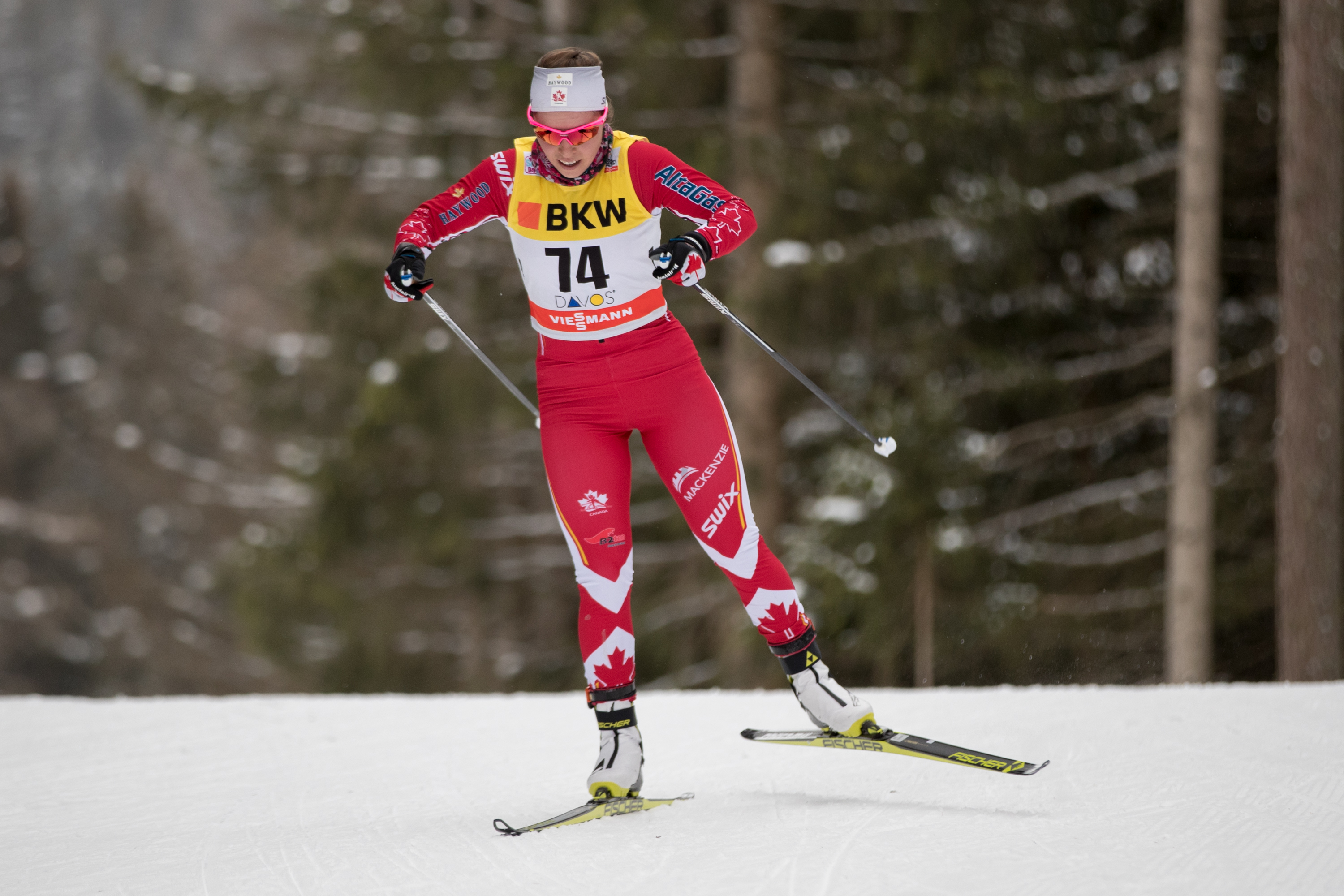
Canada’s Katherine Stewart-Jones racing to 79th in the women’s 10 k freestyle on Dec. 10 at the World Cup in Davos, Switzerland. The day before, she placed 55th in the freestyle sprint. (Photo: Reese Brown / U.S. Ski & Snowboard)
In a split second, Katherine Stewart-Jones was flying over her handlebars and headed face-first for the road. She had been biking to her local gym in Thunder Bay, Ontario, on Sept. 19 when her bike’s front tire rammed into an irregular rise in the road and sent her off her bike seat and toward the unforgiving pavement below.
A person driving by witnessed Stewart-Jones catapult off her bike and stopped immediately to check if she was all right. Though the 22-year-old Quebec native had been wearing a helmet, her face had take the brunt of the impact, leaving her with two swollen lips and one very sore tooth. The passerby who had witnessed the fall stopped, loaded Stewart-Jones’s bike in the back of the car and ferried her the rest of her way to the gym.
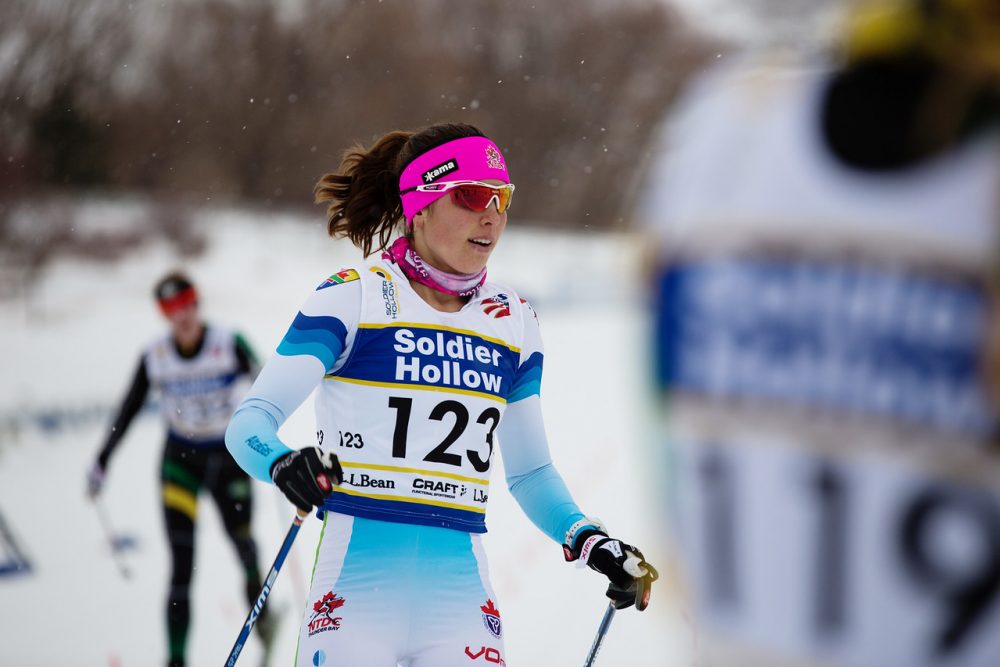
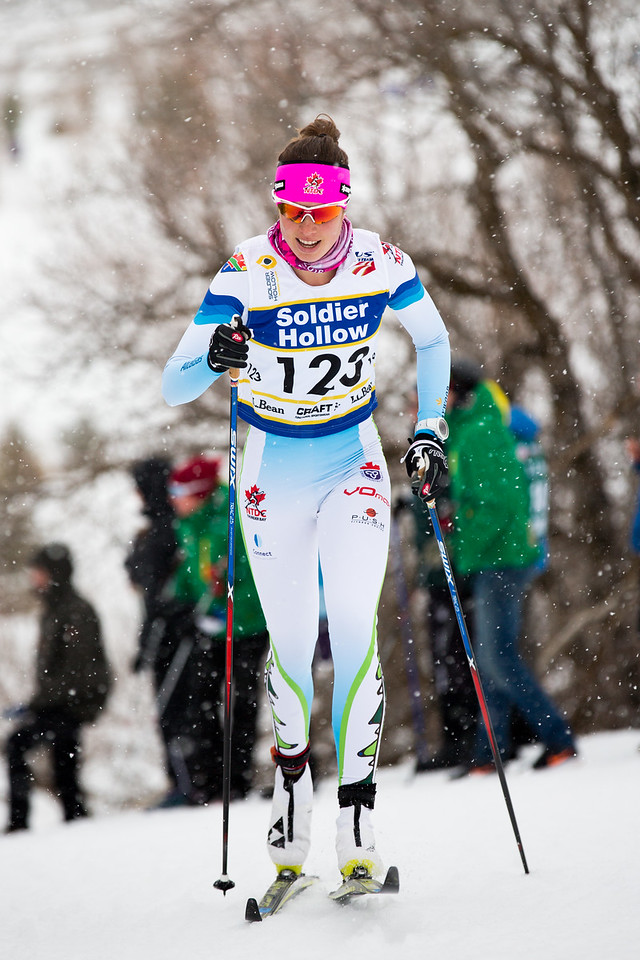
Canadian National U25 Team member Katherine Stewart-Jones racing in a classic-sprint quarterfinal at 2017 U23 World Championships at Soldier Hollow near Midway, Utah. She placed 24th overall on the day. (Photo: flyingpointroad.com)
When Stewart-Jones arrived at Thrive Strength and Wellness that day, Josh McGeown, who works as a strength instructor at Thrive, has a master’s of science in kinesiology and specializes in athlete injury and rehabilitation, took one look at her and informed her there would be no workout for her that day. In the gym’s office, McGeown immediately ran a few preliminary tests to decipher if Stewart-Jones had a concussion, though he also indicated it was, in all likelihood, too early to tell. She would have to wait for more symptoms to arise.
After McGeown’s prognosis, Stewart-Jones, a member of both the Canadian National U25 Team and National Team Development Center (NTDC) Thunder Bay, called the NTDC team’s doctor to arrange an appointment. She got in the same day as the accident, and a few more tests were run. Once again, however, she was told nothing could be confirmed until more signs of a concussion showed up. By the next morning, they did.
“I slept like 12 hours that night or something, not normal,” Stewart-Jones said on the phone in late November.
The morning following her accident, Stewart-Jones flew home to Chelsea, Quebec. She had been planning to return home to help with a Fast and Female event taking place in Ottawa, 10 kilometers south of her hometown. After the event, her plan was to fly to Park City, Utah, to join her fellow Canadian national-team members at a dryland altitude training camp.
But recurring headaches and the inability to do anything but sleep changed all that.
“I was sleeping like crazy,” Stewart-Jones said. “My eyes would get really tired. I had a lot of sensitivity to light and sounds, just being around people was like, ‘Whoa.’ ”
“I also ended up having some issues with my tooth,” Stewart-Jones explained. “We weren’t sure at first if it was injured, but it ended up changing colors, like turning purple. So I ended up having to get a root canal.”
Besides a tooth that necessitated endodontic treatment, Stewart-Jones’s accident also left her with no energy to train, despite wanting to do so. For close to a month, she rested, unable to train or complete any of the online psychology courses she was taking at Lakehead University. Even reading screens bothered both her eyes and her head.
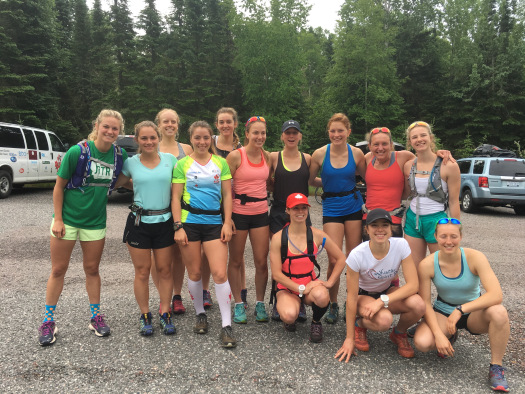
Katherine Stewart-Jones of the Canadian National U25 Team (fourth from l, white socks) with guest training partners Jessie Diggins of the U.S. Ski Team (far left) and Caitlin Gregg of Team Gregg (back row, second from r) prior to hiking, “The Giant” this summer. (Photo: Katherine Stewart-Jones)
For Stewart-Jones, the hardest part of coping with the injury was transitioning from full-time training to barely moving.
This sentiment surfaced in Stewart-Jones’s blog post following the accident, where she reflected, “I think we can all agree that cross-country skiing is one of the hardest sports in the world. I have been training for skiing for as long as I can remember, but these past six weeks have been the toughest of my career and I have barely lifted a finger.”
“When you’re used to doing so much and then not being able to do much at all was just frustrating and then also just kind of depressing,” Stewart-Jones later told FasterSkier. “I spent a lot of time feeling almost sad and really sorry for myself.”
Couch-ridden in Chelsea, while her teammates and the rest of the cross-country world continued to train, Stewart-Jones was faced with the question any athlete who has put endless amounts of time into a season and suffers an injury dreads: was it all for nothing?
“I definitely had that thought of, is my season over?” she said. “Kind of that panicked moment where it’s like this is an Olympic year and I want to qualify for the Olympics and I kind of felt like maybe my dream is crushed.”
But that was one question she wasn’t going to wait around to find out. She began a proactive approach to recovery, which included logging her symptoms and journaling, guided meditation, and staying in contact with therapists, chiropractors, acupuncturists, and teammates (read more about the five steps she took on her blog).
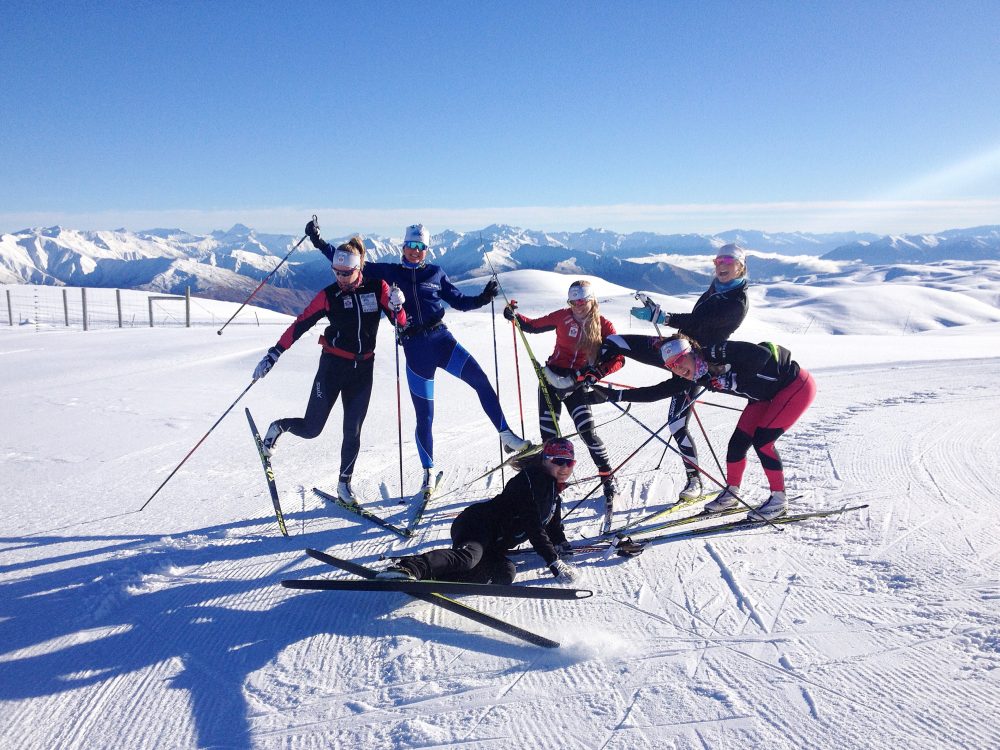
Katherine Stewart-Jones (far right) of the Canadian U25 Team with several of her women’s team training partners during a summer training session in New Zealand. (Courtesy photo)
She remained in contact with McGeown, who’s master’s research project at Lakehead addressed how to help athletes safely return to sport post-concussion. The two emailed and texted regularly while Stewart-Jones was at home in Chelsea, with McGeown offering advice and suggestions on how to cope with the mental and physical side affects from both a professional and personal standpoint.
A former rugby player, downhill skier and contact-sports enthusiast, McGeown himself has suffered more than 15 concussions during his athletic career. On the phone with FasterSkier, he recalled his own undergrad experience when the solution for the concussed was to “sit in a dark room and hope you get better.”
“At that point in time, there was no advice from doctors or physios,” said McGeown, who will start working toward a doctorate at New Zealand’s Auckland University of Technology this year. “It was, if you have any symptoms at rest, don’t exercise. For up to a year, don’t workout, don’t go for runs, don’t lift weights, don’t play sports. Essentially don’t do anything you like to do.”
However, recent research done by McGeown and acclaimed medical sources, such as the Journal of the American Medical Association, have changed that belief. While all rest and no play was formerly viewed as the most appropriate way to recover from a concussion, recent studies show the opposite. Exercise appears to be the preferred method of rehabbing a concussed individual, though the intensity, duration and type still vary case by case and remain in question.
“They release new guidelines every four years,” McGeown explained. “The 2012 guidelines say rest; do nothing. The 2016 guidelines say exercise-based rehab is going to be the new cornerstone for concussion rehab. They’re not saying how often, how intense, how do you get them started, for how long, etc. What the research needs to figure out still is all those variables. What is the best case scenario or is it completely individualized?”
In the case of Stewart-Jones, slow and steady was the start. At home in Chelsea, she began exercising once she had a full 24-hour period of no symptoms. Following the 24-hour period, she completed ten minutes of exercise (in her case, walking on the treadmill) at a heart rate of 115.
If, after completing the workout, no new symptoms arose or worsened, she would either increase her time or her heart rate the following day, but not by much. If her symptoms worsened or new ones arose, she returned to the exercise she had been doing the previous day — no exceptions and no matter how badly she wanted to train more.
“Everybody wants to be tough. Everybody wants to fight through it and push through it,” McGeown said. “But what I try to get people to conceptualize is, if it’s your ankle or knee or shoulder, go for it. Tough it out, because when you’re fifty or sixty and that knee is really bothering you, they’ll just replace it with a new one.
“Whereas there’s no second chances with our brain,” McGeown continued. “We’re seeing that with football players and hockey players. There are extreme consequences and if we don’t take it seriously, it’s a big deal.”
Even with that weighing in the back of her mind, Stewart-Jones still found it difficult to not rush back into training too quickly.
“I found that one of the most difficult parts of recovery was knowing when I was feeling good enough to start training again,” Stewart Jones wrote in her blog. “I found it easy to convince myself that I was feeling normal when I wasn’t. Maybe it was because I was just too eager to get back to training or maybe it was because I truly couldn’t remember how it felt to be my normal self. The bottom line is, you know yourself best, so be honest with yourself, and the recovery will be much quicker.”
Katherine Stewart-Jones (Canadian U25 Team/NTDC Thunder Bay) during a summer training session in New Zealand. (Courtesy photo)
When she returned to Thunder Bay a few weeks after her accident, she began working with McGeown in person, continuing her work on the treadmill until she had reached the point where she was exercising at a threshold pace, something similar to a steady state.
After that, McGeown began a second phase of the recovery, adding higher intensity workouts to her training regimen. She would complete 30-second long speed bursts of mountain climbers, ski erging and box jumps followed by a check-in with McGeown. If all went well, she continued. After about ten sessions like this, Stewart-Jones was cleared by McGeown to return to normal training.
In late November, a little less than eight weeks after she suffered her concussion, Stewart-Jones was back on skis, logging a 17-hour training week and feeling “100 percent.”
“Initially I was supposed to leave on Nov. 11th to meet the team in Finland and race the Ruka [Triple],” Stewart-Jones, last year’s NorAm (Canada’s Continental Cup) winner, said of her plans to start her season on the World Cup for Period 1. “I was feeling fine, I didn’t have any symptoms and I could train fine, but I felt like I wasn’t going to be ready enough to race then. And I wanted to put a couple weeks of big volume in just to feel like I gained my fitness back, so [my coach Timo Puiras and I] made the decision to stay longer.”
“Katherine’s summer training went very well,” Puiras, head coach of the NTDC, wrote in an email. “Our IST (Integrated Support Team) was excellent in getting Katherine back to normal training as quickly as possible.”
“It was definitely a lot after taking a good six weeks off for an injury,” Stewart-Jones told FasterSkier after the Davos 10 k freestyle on Dec. 10. “I’ve had a good month of training, but it was more volume focused, just because I wanted to gain back that fitness and so I didn’t do a lot of intensity so I was kind of expecting it to be rough. But having the NorAm leader’s spot, it wasn’t something I was ever going to turn down.
“I think for distance racing I still have that extra gear to build,” she added. “Right now I feel like my technique has come a long way, but I don’t feel like I’m actually racing, and I think that’s just going to come with more intensity and more racing.”
When asked if Stewart-Jones might be at a higher risk for concussion while competing on the World Cup now, McGeown explained it would be difficult to say without know her particular history with concussions.
“Once you’ve had multiple concussions, it’s easier to get the next one, the symptoms are worse, and recovery takes you longer,” McGeown said. “But typically if someone’s at a high risk for reinjury, it’s going to be if they return to sport within that first week to two weeks after the initial injury. It is certainly possible it could happen again, but it could happen to anyone at anytime.
“That she’s at a high risk, I would say no. She’s at the same risk as any other skier competing against her,” McGeown added. “The only way that a concussion is going to truly limit someone is if they let it.”
— Chelsea Little and Alex Kochon contributed
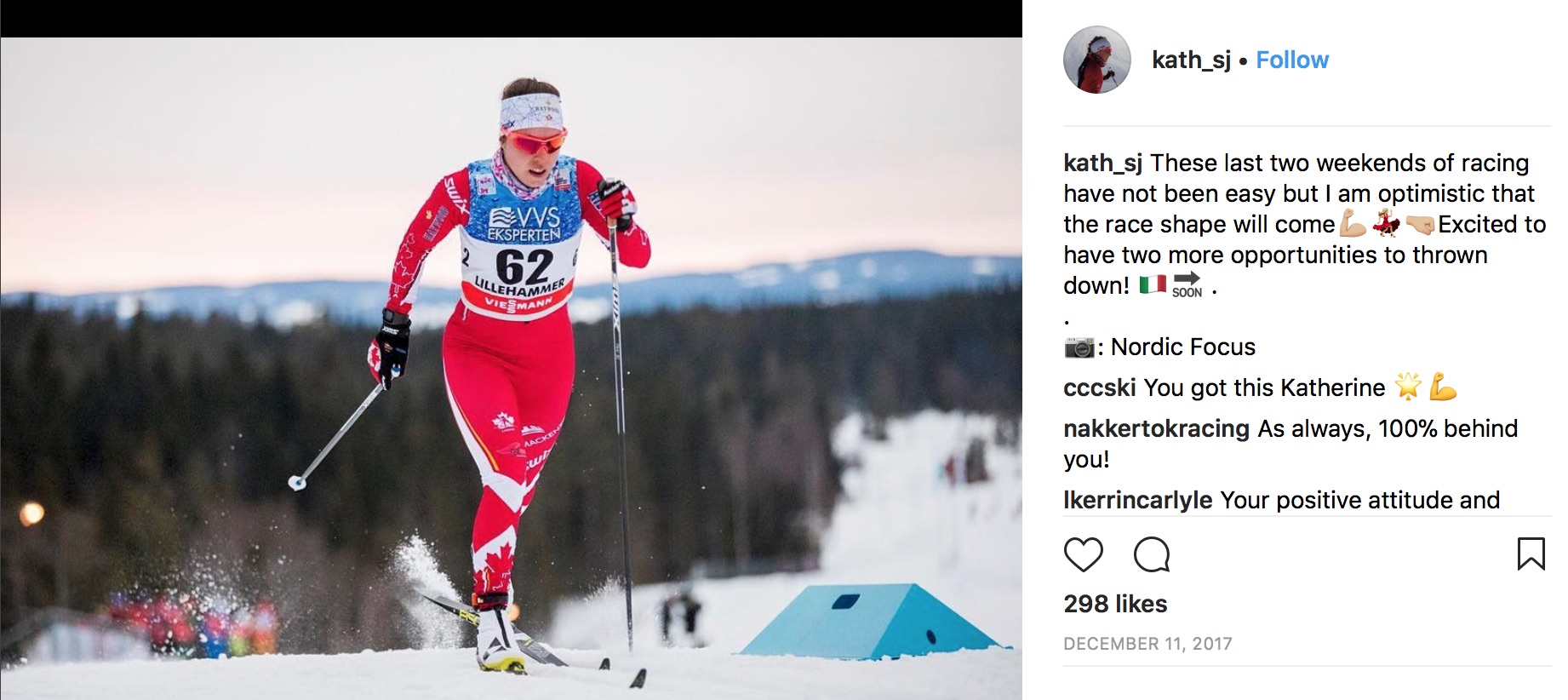
Katherine Stewart-Jones’s Instagram post after two weekends of World Cup racing last month in Lillehammer, Norway, and Davos, Switzerland. She also raced two distance races in Toblach, Italy, where she finished 77th in a 10 k freestyle and 70th (68th for time of day) in a 10 k classic pursuit on Dec. 16-17. (Photo: Instagram/@kath_sj)
NTDC Thunder Bay teammates (from l to r) Sadie White, Lisle Compton, Annika Richardson, Katherine Stewart-Jones, Alannah MacLean, and Mia Serratore at Sovereign Lake near Vernon, B.C., last December. The entire women’s team qualified for World Cup Finals in Quebec City last March based on their strong performances on the NorAm circuit. (Photo: Sadie White)
Coming off a big showing at 2017 World Cup Finals last March in Quebec City, the Thunder Bay National Team Development Centre (NTDC) — which sent six women and two men to the season-ending finals — is raring to go this winter.
The 14-member team is based out of Thunder Bay, Ontario, right in the middle of Canada. And while it might be a long ways from water (as Canada’s westernmost Atlantic port, some 3,700 kilometers from the mouth of the St. Lawrence seaway), Thunder Bay has a storied history in cross-country skiing, largely deriving from Finnish immigrants. The Lappe Nordic Ski Centre, which will host 2017 Canadian Ski Nationals, and Tapiola ski trails (referenced in the workout below) are at the heart of that history.
Fast-forward to the present, NTDC Thunder Bay as one of Canada’s big-three national-team training centres continues to gain momentum with some of the nation’s top skiers, many of which are women. Katherine Stewart-Jones, the overall NorAm leader at the end of last season, was renominated to the Canadian national U25 Team this spring, and Annika Richardson and Lisle Compton are members of the national Junior Team.
The following dryland workout was co-written by Stewart-Jones, Richardson, Compton, Alannah MacLean, Sadie White, and Mia Serratore, with contributions from Angus Foster and head coach Timo Puiras. So while the NTDC Thunder Bay team is currently fine-tuning for the season on snow at Lappe, here’s a running workout for those of us in less wintery climates.
***
“At NTDC Thunder Bay, we are proud to have one of the largest and strongest women’s training groups in Canada. With six girls on the training centre, ranging from Junior to U23 to Senior Women, there is a wide range of strengths and specializations within the group.
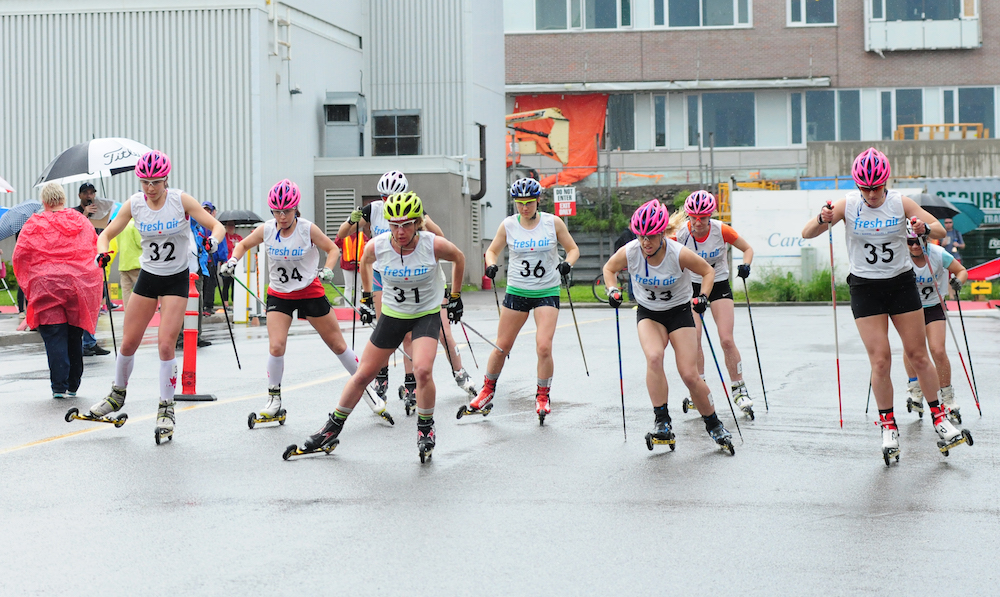
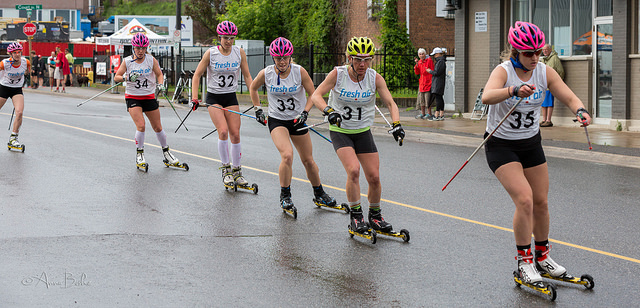
NTDC Thunder Bay’s Annika Richardson (32), Katherine Stewart-Jones (34), Sadie White (33), Lisle Compton (behind) and Mia Serratore (35), and Lappe Nordic’s Hannah Shields (36), chase American Caitlin Gregg (31) out of the start of the inaugural Canada 150 Rollerski Race in downtown Thunder Bay on July 1, 2016. (Photo: Anna Buske)
During the training season, the goal is to build base fitness and speed to create a good foundation for the ski season. One way to develop fitness is with Zone 3 intensity. Our go-to threshold workout is running intensity on a 750-meter loop at the Tapiola Ski Trails.
Instead of your typical track running workout, we run multiple loops of a relatively flat, hard-packed dirt trail at a prescribed lap pace. The aim is to stay as consistent as possible throughout the entire workout and to have the most even lap times upon completion of each set. Depending on prescribed lap times, this may be a workout with a partner or it may be solo, but it is an opportunity to focus on your own workout without trying to compete at your training partner’s pace.
The Workout: Zone 3 running intensity
Purpose: Target Zone3/threshold energy systems and improve efficiency
Warmup:
Warmup: 15- to 30-minute run to wake the body up and get in the zone
Dynamic joint prep: Some dynamic stretching to loosen up and prepare the body to move well! Think lunge with a side twist, ABC’s, karaoke, downward dog – all of these help to elongate muscles, warm up your body, and reduce the possibility of injury
Activation sprints: A set of sprints to really get things moving and create a bit of lactate in the body. Aim for roughly 5 x 8 seconds with about 2 minutes of rest between each sprint, with a focus on being snappy and aggressive so that you go into a workout with a bit of fatigue and lactate in your muscles that you have to work through.
Determine max lap:
Prescribed pace or prescribed lap time is determined from the data acquired from the incremental-workload, running-treadmill test performed during the team’s testing camp in late May. The resulting calculated pace is the time that we must try and maintain for each lap throughout the workout. This pace is anaerobic threshold, or a pace that is “comfortably hard”. The prescribed pace is individualized for each athlete to ensure that the workout is completed according to that athlete’s running speed.
Periodically throughout the summer the team will run a “max lap” to recalibrate the prescribed pace. The max lap is one all-out effort of the 750 m loop.
Workout:
3 x 5 laps at your prescribed pace (depending on the athlete this can range somewhere between 2.5 to 3.5 minutes per lap) – pace should be comfortably hard for each athlete
Prescribed pace:
Maintaining a consistent pace for each lap will help to increase anaerobic threshold, the point at which your body gets tired at a steady state. Some athletes establish markers on the loop to get an idea of pacing (i.e. I have to pass this tree at 1:28 to run a 3:15 loop). We lap our watch for every loop in the set to monitor average heart rate per lap, and to see if that average increases, decreases or stays consistent throughout the duration of the workout. If you look like you are working too hard or your average heart rate increases drastically, the coaches will take a lactate. If it’s too high, you’re in trouble! Actually, [our coaches] Timo or Camille [Cheskey] will either read just your lap pace for the next set or you’ll be told to run alone because you were getting too competitive with your teammates.
Recovery: One easy lap and a quick drink break (approximately 5 minutes between sets)
Cool Down: Slow jog for 20-30 minutes with a couple surges into Zone 2 help to flush out all the lactic acid that built up in your legs throughout the workout. Some athletes will sit in the creek that runs beside the Tapiola trails as a form of cold tubbing.
The data from lap times and average heart rate is entered into a Google Drive document after each Tapiola workout. This serves as a tool to see lap time +/- the prescribed pace and heart rate across all laps and sets. All this data helps monitor how you are improving with each workout. If you’re capable of maintaining a consistent heart rate, then the pace will speed up for the next Tapiola intensity!
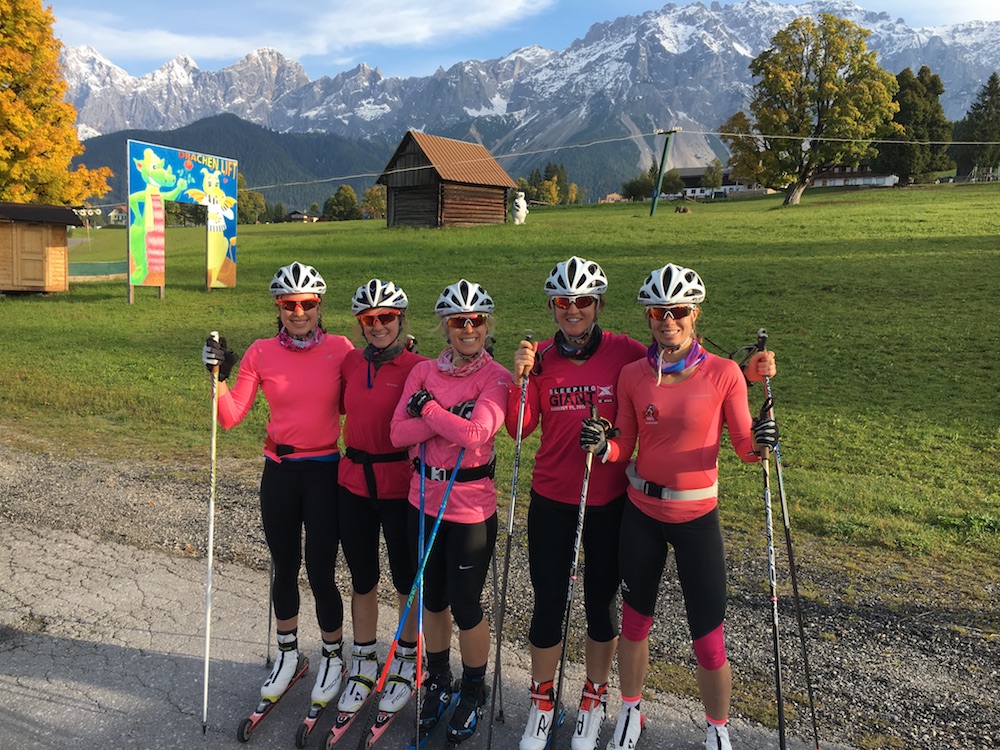
Annika Richardson, Lisle Compton, Sadie White, Mia Serratore, and Alannah MacLean in Ramsau, Austria, before their first session on a rollerski-specific paved track during a training camp this past September. The pink outfits were not coordinated. (Photo: Timo Puiras)
The goal of Tapiola is CONSISTENCY. Mental preparation and focus are the two keys for success. The pace is individually tailored to personal running speed to ensure that every athlete completes the workout at a speed that is best for them. However, this isn’t a workout where you can wing it. When you start to get tired by the last set, as you should be, maintaining good running technique and pacing requires conscious effort. Also, the athlete that runs the most consistent laps gets 10 points and a parrot sticker from Timo (a Finnish tradition).
Tapiola workouts start in June and we’ll run different variations of the workout described above about 6-10 times throughout the summer. It’s always surprising how much easier a Tapiola workout feels the second or third time you do it, even at a faster prescribed pace. It also has a big pay off in our running speed and fitness as we build into the training and racing seasons. This is one of our favourite workouts as part of NTDC Thunder Bay and why we wanted to share it with you!
Happy running!”
NTDC Thunder Bay teammates Lisle Compton (l) and Alannah MacLean during the first day of natural snowfall on Oct. 27 at Lappe Nordic near Thunder Bay, Ontario. (Photo: Grant Hall)
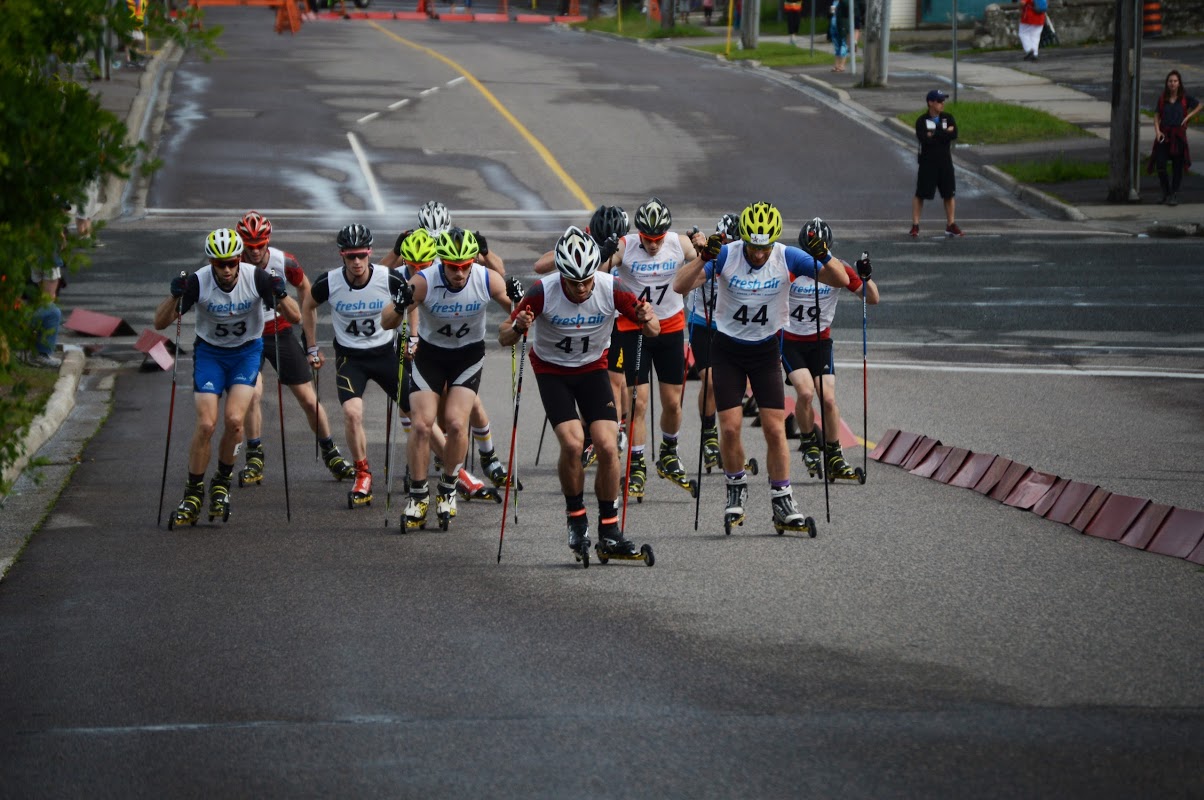
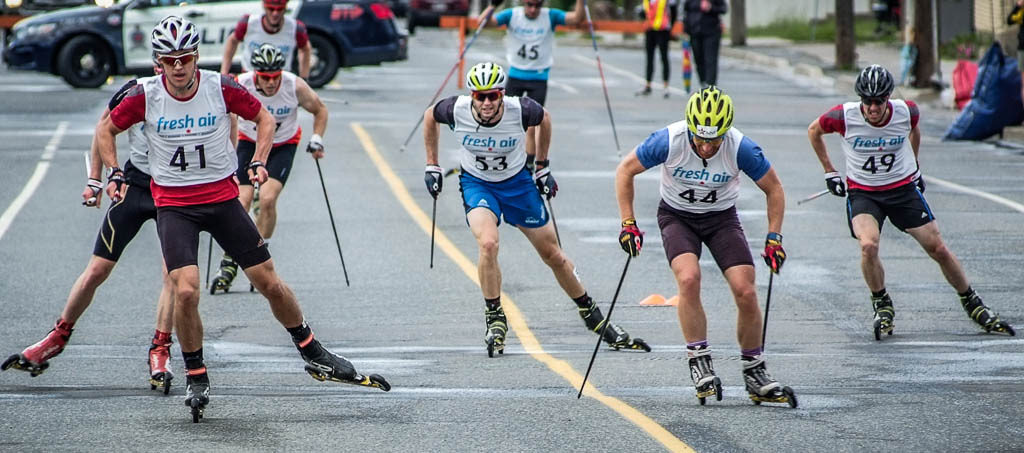
Evan Palmer-Charrette (41) leads the elite men’s 11.25 k mass start at the Canada 150 Rollerski Race on Saturday, July 1, in Thunder Bay, Ontario. Right behind him, Brian Gregg (44) and Angus Foster (46) follow. (Photo: Christian Hollmann)
Editor’s note: Evan Palmer-Charrette, a 23-year-old member of the National Team Development Centre (NTDC) Thunder Bay, agreed to write a recap of the inaugural Canada 150 Rollerski Race, the first Cross Country Canada (CCC) sanctioned rollerski race in Thunder Bay, Ontario, well before he won the race. By no fault of his own, Palmer-Charrette ended up being both the author of and a subject in the following article, and his teammate Annika Richardson provided a post-race video interview with him. Richardson finished second in the women’s race.
***
THUNDER BAY, Ontario — On Canada Day this past Saturday, July 1, a historic holiday for Canada as a nation, NTDC Thunder Bay in conjunction with the Lakehead Superior Nordic Association, Big Thunder Nordic Ski Club and Lappe Nordic, made history of its own, hosting a Cross Country Canada (CCC) sanctioned rollerski for the first time in downtown Thunder Bay. It was the second time a sanctioned (tier-two, non-FIS) rollerski race had been held in Canada, following last year’s Challenge Volvo 2016 in Sainte-Catherine-de-Hatley, Quebec.
Sadie White racing in the Canada 150 Rollerski Race on July 1 in Thunder Bay, Ontario. (Photo: Kevin Schlyter)
Saturday’s event, dubbed the Canada 150 Rollerski Race, drew more than 40 of Canada’s top development skiers and Americans Caitlin and Brian Gregg to showcase rollerski racing as part of the city’s Canada Day festivities. The day began with both men and women racing 1.5-kilometer time-trial sprint qualifiers on a two-lap, 750-meter course.
Evan Palmer-Charrette qualified first in a time of 3:03.71 minutes, followed by Julian Smith in second (+3.64) and Jack Carlyle in third (+5.05).
In the women’s qualifier, Caitlin Gregg won the qualifier by more than nine seconds in 3:28.21. Annika Richardson was second overall (+9.35) and top Canadian qualifier, followed by Sadie White in third (+11.51).
The forecast for the day called for thunderstorms, and while some rain led into the qualifier, the sun came out for most of the distance races. All of the women raced together over a 9 k distance, whereas the men were broken up into four groups racing either 4.5, 6, 9, or 11.25 k based on their qualifier results. The distance races were held on the same course as the sprint, which circled a city block and included an out-and-back for an additional climb and descent.
The elite races offered cash prizes for the top five men and women ($500, $300, $200, $75, and $25, respectively), as well as the top three in the men’s and women’s qualifier ($150, $100 and $50, respectively). Each race featured three primes scattered throughout the course, which rewarded the first to reach them with cash ($100 at the second prime) and prizes from local businesses.
Mia Serratore (35) leads Caitlin Gregg (31), Annika Richardson (32), Katherine Stewart-Jones (34), and others in the women’s 9 k “Canada 150 Rollerski Race”, the first-ever sanctioned rollerski race held July 1 in Thunder Bay, Ontario. (Photo: Anna Buske)
Given her qualifying result and impressive resume, Gregg established herself as the race favorite for the women’s 9 k race. The first prime was on Lap 4, which was when Gregg made her move and broke away from the field, which gave her a sizable gap for the remainder of the race. She won in 23:25.9, more than a minute ahead of anyone else.
“I’ve been working on my starts so I try to get out fast, which was a lot of fun when you have a big pack like that in a mass start,” Gregg explained. “And then I just tried to relax for the first couple of laps. … I felt strong and was able to push through the whole race, which was nice for having a race effort this time of year.”
After Gregg’s move dismantled the pack, Richardson raced to second (+1:01.1) as the top Canadian finisher.
“After attempting to bridge it [the gap] with Sadie, it was all about skiing smoothly and holding second until the end,” she said.
Canadian national-team member Katherine Stewart-Jones rounded out the podium in third (+1:56.9). Only four women finished the race, with White placing fourth (+2:07.7).
Michael Somppi leads Brian Gregg (second from l) and Evan Palmer-Charrette (second from r) during the “Canada 150” downtown rollerski race, the first-ever CCC-sanctioned rollerski race in Thunder Bay, Ontario, on July 1. (Photo: Kevin Schlyter)
The elite men’s 11.25 k race played out quite differently with 10 of the 13 starters finishing within 17 seconds of one another. Yet similarly to the women’s race, the pace picked up going onto the fourth lap with a prime and a prize on the line. Angus Foster outsprinted teammate and fellow Thunder Bay native Palmer-Charrette to take the first prime and a prize to go along with it.
After Brian Gregg was first to the second prime, Michael Somppi took the third and final prime on the 12th of 15 laps and made a decisive move to try and break away from the pack. However, with just over two laps to go, Palmer-Charrette reeled him back in and finished first in 25:20.2. Gregg followed just 0.2 seconds later for second overall and Carlyle crossed 0.3 seconds later for third place. Less than 4 seconds out of first, Somppi finished sixth (+3.8), behind Dominique Moncion-Groulx in fourth (+1.7) and Andy Shields in fifth (+2.0).
The men’s 6 k race was hit by the worst weather of the day, as a looming storm cloud opened up during it. Thomas Manktelow of the Albert World Cup Academy (AWCA) won the first prime and went on to win the race as well.
Thomas Manktelow (l) and Levi Nadlersmith (r) racing to first and second, respectively, in the men’s 6 k race at the Canada 150 Rollerski Race in Thunder Bay, Ontario. (Photo: Kevin Schlyter)
“I was a little worried about some of the corners in the wet, but managed to get away without any crashes,” Manktelow said. “The mass start was super-fun and went pretty well, and the entire event was well-run.”
Larkin Wasmuth won the men’s 9 k race and Aleksi Luoma topped the men’ 4.5 k.
The field was quite strong with the likes of 2014 U.S. Olympian Brian Gregg and several athletes from national training centres across Canada.
“It was so much fun to compete in a sanctioned roller ski race in North America,” Gregg wrote in an email. “NTDC and Thunder Bay did a fantastic job running the event especially with the added challenge of a few rain showers throughout the day. I can’t wait for the next rollerski race, the Canada 150 race has set the bar high.”
Evan Palmer-Charrtee (41) holds off Brian Gregg (44) and others, including Dominique Moncion-Groulx (53) and Andy Shields (49), for first place in the elite men’s 11.25 k “Canada 150 Rollerski Race” on July 1 in Thunder Bay, Ontario. (Photo: Kevin Schlyter)
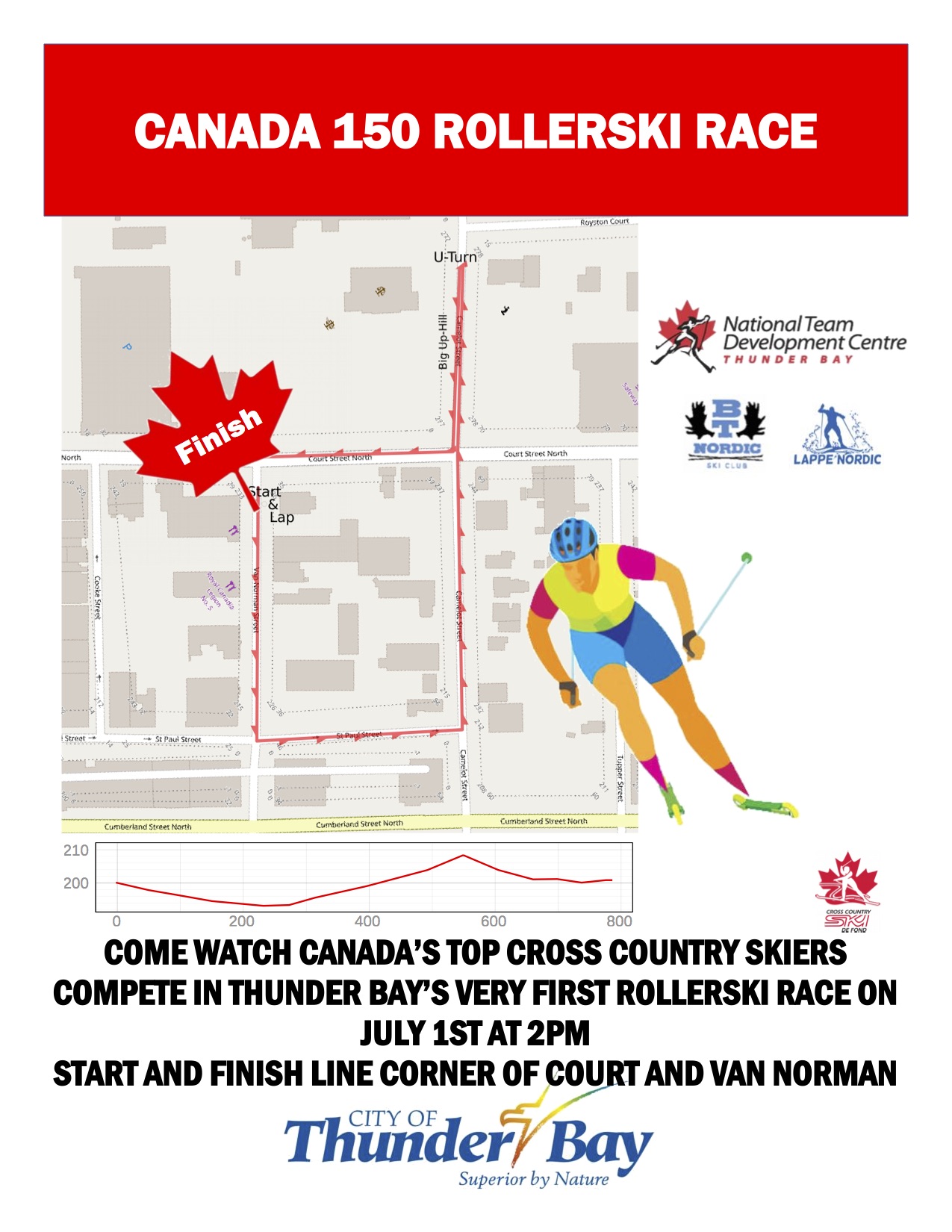
On July 1st, 2017, Thunder Bay, Ontario will be hosting its first ever Cross Country Canada sanctioned rollerski race. The race will feature more than 50 of Canada’s top nordic skiers racing around the closed streets of downtown Port Arthur. The race will start and finish at the corner of Court and Van Norman, commencing at 2:00 pm and finishing with awards at 6:00 pm.
The event is organized by Lakehead Superior Nordic Association, Big Thunder Nordic Ski Club, Lappe Nordic, and the National Team Development Centre (NTDC) Thunder Bay.
This event has been organized to coincide with the other exciting Canada Day celebrations planned for the downtown core.
Among the racers will be top local skiers, Junior National Team members and other elite skiers who have come to Thunder Bay from across Canada for a training camp hosted by NTDC Thunder Bay. The field will include athletes who potentially will represent Canada in the upcoming Winter Olympics.
Race format will include an interval start individual time trial with each competitor completing two laps of the course. Then the athletes will be seeded into waves of closely matched competitors. Each wave will complete a 12 to 20 lap race on the same circuit. Waves will progress from the slower competitors to the faster, with the top ranked skiers racing at close to 4 pm.
Date: Saturday July 1st 2107 Time: 2:00-6:00 PM
Location: Start/finish at corner of Court and Van Norman (see attached map of race course)
ContactTimo Puiras (NTDC Thunder Bay Head Coach) at ndctimo@gmail.com for further information
Canada’s Evan Palmer-Charrette (NTDC Thunder Bay) racing to 34th in the 15 k freestyle at 2017 U23 World Championships on Thursday at Soldier Hollow in Midway, Utah. He was the top Canadian in the race. (Photo: FlyingPointRoad.com)
In an effort to showcase the North Americans competing at this week’s International Ski Federation (FIS) 2017 USANA Nordic Junior World Championships and U23 Cross Country World Championships at Soldier Hollow in Midway, Utah, we asked those qualifying athletes several questions about themselves — actually, we had them fill in the blanks. Here we have 22-year-old Evan Palmer-Charrette, of the National Team Development Centre (NTDC) Thunder Bay, representing Canada at his first U23 Worlds.
On Tuesday, Palmer-Charrette finished 33rd in the classic sprint. On Thursday, he led the Canadian team in 34th in the 15 k freestyle.
***
“My full name is Evan James Palmer-Charrette, but you can call me Evan. I was born in Thunder Bay, Ontario, raised in Thunder Bay, and one thing you should know about my hometown is we have the best pancakes in the world.
Evan Palmer-Charrette (NTDC Thunder Bay), in the NorAm leader’s bib, racing to third in the 15 k classic on Jan. 21 at Western Canadian Championships in Whistler, B.C. (Courtesy photo)
I started cross-country skiing when I was five, thanks to my parents. I currently train in Thunder Bay with NTDC Thunder Bay.
If I’m not skiing, you might find me working at Rollin’ Thunder. If I had to pick a favorite book, it would be ‘Three Day Road‘.
One of the things I’m most excited about for U23/Junior Worlds at Soldier Hollow is racing on trails I have previously raced on. One race I’m especially targeting there is the 15km skate.
The best advice anyone ever gave me about skiing or racing was to stay focused on the present.
One of the best race memories I have is racing the team relay at Canada Winter Games.
If I could meet one World Cup skier, it would be Bob Thompson.
If I don’t end up being a professional skier, I’ll probably be disappointed.
I’m missing zero days of school to be here, and my professors are probably thinking, ‘He’s never coming back.‘
Canada’s Lisle Compton (NTDC Thunder Bay) racing to 39th in Wednesday’s 5 k freestyle, her first race of 2017 Junior World Championships at Soldier Hollow in Midway, Utah, while her coach cheers her on. (Photo: FlyingPointRoad.com)
In an effort to showcase the North Americans competing at this week’s International Ski Federation (FIS) 2017 USANA Nordic Junior World Championships and U23 Cross Country World Championships at Soldier Hollow in Midway, Utah, we asked those qualifying athletes several questions about themselves — actually, we had them fill in the blanks. Here we have 18-year-old Lisle Compton, of the National Team Development Centre (NTDC) Thunder Bay, who’s representing Canada at her first Junior Worlds.
“My full name is Lisle Compton, but you can call me Lysol or straigh’ outta. I was born in Winnipeg, Manitoba, raised in Kenora, Ontario, and one thing you should know about my hometown is the Kenora Thistles won the Stanley Cup in 1907.
I started cross-country skiing when I was three, thanks to my parents. I currently train in Thunder Bay, Ontario, with the National Team Development Centre.
Lisle Compton (NTDC Thunder Bay) at Mt. Shark just outside Canmore, Alberta, the week before 2017 Junior World Championships, during the Canadian team’s pre-worlds altitude training camp. (Courtesy photo)
If I’m not skiing, you might find me scrolling through Instagram. If I had to pick a favorite book, it would be ‘The Revenant‘.
One of the things I’m most excited about for Junior Worlds at Soldier Hollow is having my Dad and so many Canadian parents cheering us on! One race I’m especially targeting there is the skiathlon.
The best advice anyone ever gave me about skiing or racing was ‘stay happy, race fast’. One of the best race memories I have is the team relay at Canada Winter Games.
If I could meet one World Cup skier, it would be Katherine Stewart-Jones.
If I don’t end up being a professional skier, I’ll probably be a grocery store clerk.
I’m missing too many days of school to be here, and my teachers are probably thinking, ‘Who is this Lisle person enrolled in my class?’
Annika Richardson (NTDC Thunder Bay/Canadian Junior National Ski Team) finishing third in the junior women’s 7.5 k classic at 2017 U.S. Cross Country Ski Championships last month at Soldier Hollow in Midway, Utah. (Photo: U.S. Ski Team)
In an effort to showcase the North Americans competing at this week’s International Ski Federation (FIS) 2017 USANA Nordic Junior World Championships and U23 Cross Country World Championships at Soldier Hollow in Midway, Utah, we asked those qualifying athletes several questions about themselves — actually, we had them fill in the blanks. Here we have 18-year-old Annika Richardson, of the National Team Development Centre (NTDC) and Canadian Junior National Ski Team, who’s representing the Canada at her first Junior Worlds after competing at last year’s Youth Olympic Winter Games.
“My full name is Annika Richardson, but you can call me Annika. I was born in Vancouver, B.C., raised in Vancouver, and one thing you should know about my hometown is that we are trying to become the greenest city in the world by 2020.
Annika Richardson (NTDC Thunder Bay/Canadian Junior National Ski Team) racing to third in the junior women’s 7.5 k classic at 2017 U.S. Cross Country Ski Championships last month at Soldier Hollow in Midway, Utah. (Photo: U.S. Ski Team)
I started cross-country skiing when I was 2 or so, thanks to my parent’s love of the outdoors. I currently train in Thunder Bay with NTDC Tbay.
If I’m not skiing, you might find me curled up with a good book and a hot cup of tea. If I had to pick a favorite book, it would be ‘The Hobbit’ by J. R. R. Tolkien or ‘The Chronicles of Narnia’ by C.S. Lewis (sorry can’t pick).
One of the things I’m most excited about for Junior Worlds at Soldier Hollow is the home field advantage our team will have after a long altitude camp in Park City in the fall, as well as our experience actually racing there at US National a few weeks ago. One race I’m especially targeting there is the 5km Skate.
The best advice anyone ever gave me about skiing or racing was to keep on smiling. One of the best race memories I have is the 5km Skate at the Youth Olympic Games.
If I could meet one World Cup skier, it would be Heidi Weng.
If I don’t end up being a professional skier, I’ll probably be a student trying to finish the degree (whatever that is) that I am currently working on…
I’m missing who knows how many days of school to be here, and my teachers are probably thinking, ‘What a dedicated student.‘
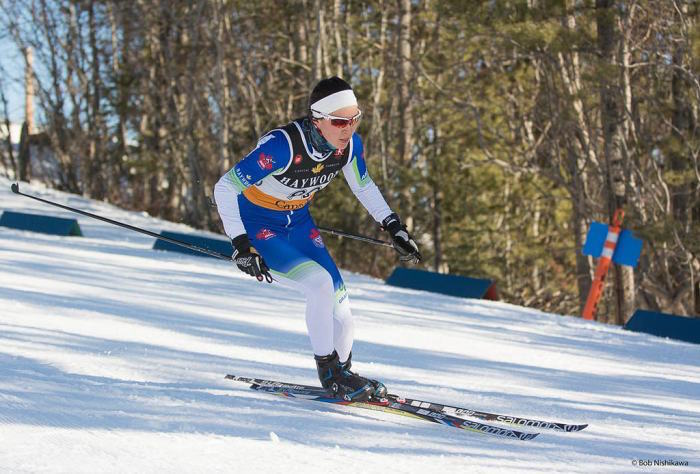
Jenn Jackson (Team Hardwood/Lappe Nordic) racing at 2016 Canadian nationals in Whitehorse, Yukon. (Photo: Bob Nishikawa)
In an effort to showcase the North Americans competing at next week’s International Ski Federation (FIS) 2017 USANA Nordic Junior World Championships and U23 Cross Country World Championships at Soldier Hollow in Midway, Utah, we asked those qualifying athletes several questions about themselves — actually, we had them fill in the blanks. Here we have 21-year-old Jenn Jackson, of Team Hardwood and Lappe Nordic, who’s representing Canada at her second U23 World Championships.
***
“My full name is Jennifer Jackson, but you can call me Jenn. I was born in Toronto, raised in Midhurst, [Ontario], and one thing you should know about my hometown is I don’t live there anymore.
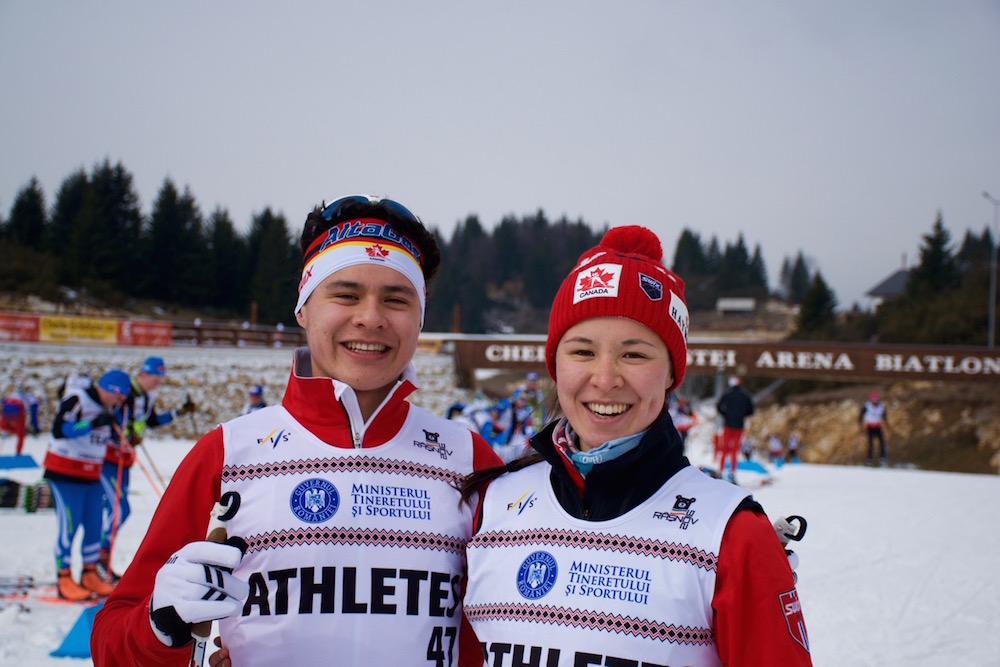
Jenn Jackson (r) and her brother Ryan Jackson at 2016 Junior/U23 World Championships in Rasnov, Romania. Both qualified to represent Canada again at this year’s Junior/U23 World Championships in Midway, Utah. (Courtesy photo)
I started cross-country skiing when I was pretty young, thanks to my parents. I currently train in Oro Medonte, [Ontario], over the summer and Thunder Bay during the school year, primarily on my own, but I race for Team Hardwood and Lappe Nordic.
If I’m not skiing, you might find me at school. If I had to pick a favourite book, it would be: I couldn’t pick a favourite book, but I am currently reading ‘Antifragile: Things That Gain From Disorder’ and Jens Voigt’s book ‘Shut Up, Legs!’
One of the things I’m most excited about for U23/Junior Worlds at Soldier Hollow is the tacos. One race I’m especially targeting there is probably the sprint.
The best advice anyone ever gave me about skiing or racing was that sometimes you just need to put your head down, close your eyes, hold your breath, and hammer. Maybe not the best advice in a practical sense… but the essence of it is gold.
Some of the best race memories I have are probably the string of comeback races at the end of 2015 after breaking my leg early season.
If I could meet one World Cup skier, it would be Masako Ishida.
If I don’t end up being a professional skier, I’ll probably be an amateur skier with a regular job.
I’m missing too many days of school to be here, and my professors are probably thinking, ‘Engineering is hard even when you attend lectures, why are you doing this to yourself.’
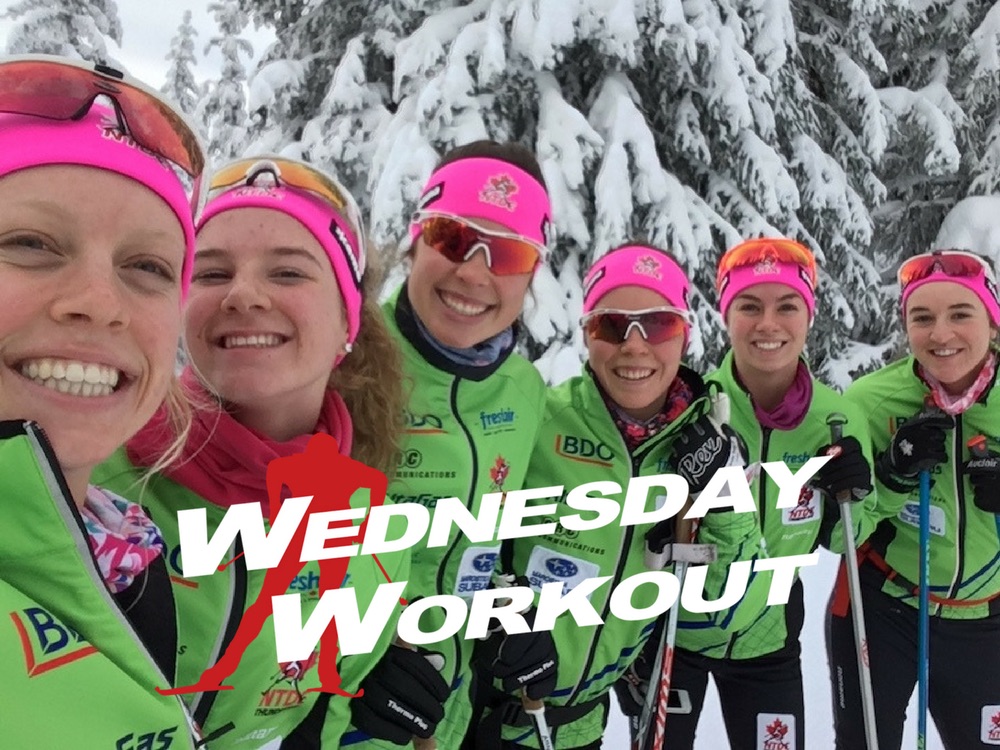
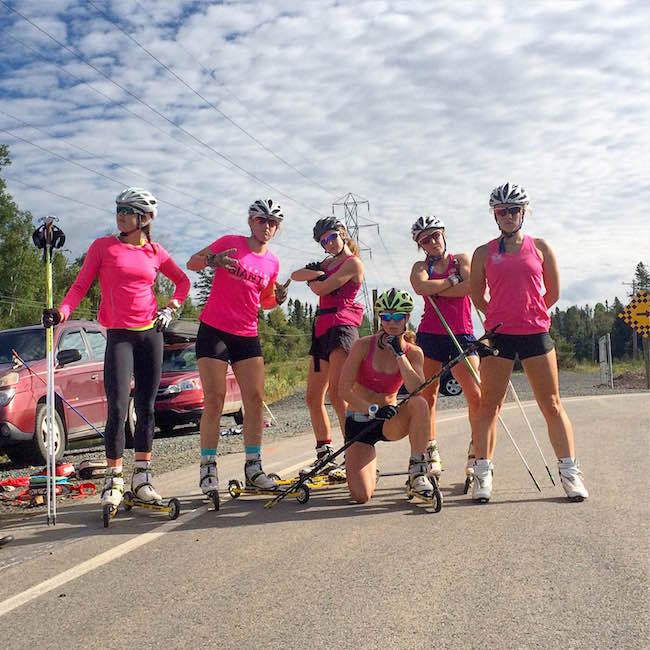
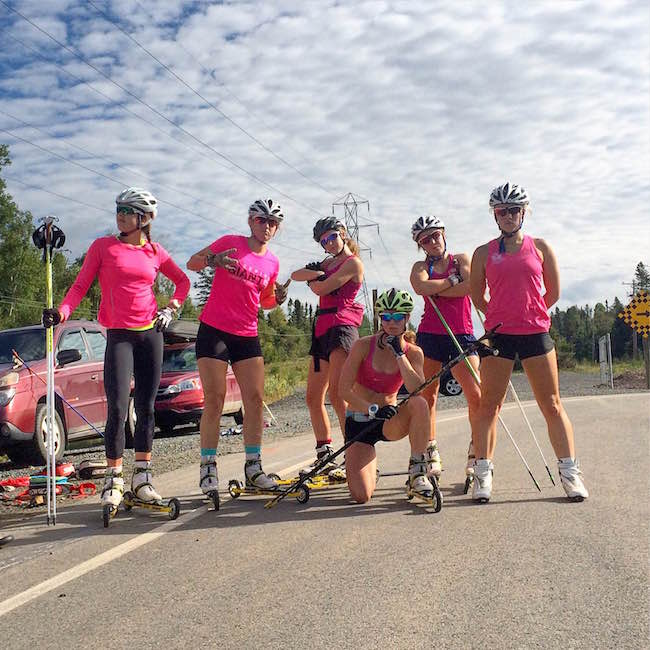
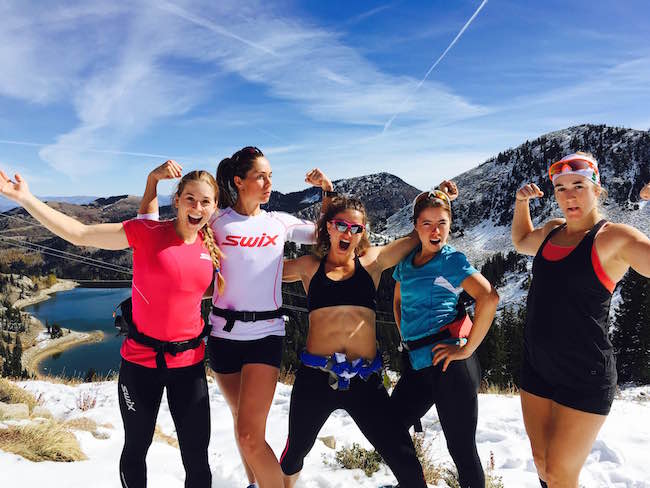
Pink posse: Katherine Stewart-Jones and teammates strike a pose at a recent rollerski workout. (Courtesy photo)
Welcome to “17 Questions for 2017″, where we are catching up with American and Canadian national-team members before the beginning of the winter season.
***
21-year-old Katherine Stewart Jones made her World Cup debut for Cross Country Canada last season, first in Europe and then in the Ski Tour Canada. The Nakkertok Nordic racer, now based at the NDC in Thunder Bay and taking courses at Lakehead University, then went on to pick up three bronze medals at Canadian National Championships in the senior division.
That’s coming off a junior career where she had two top-20 finishes at 2015 World Junior Championships.
1. Biggest change in your life in the last five or so months since the ski season ended?
Not having too much change this year has been a huge positive.
2. Biggest change in your training?
An increase in volume of about 100 hours and a lot more focus on double-pole.
3. Major areas of improvement you’ve seen so far?
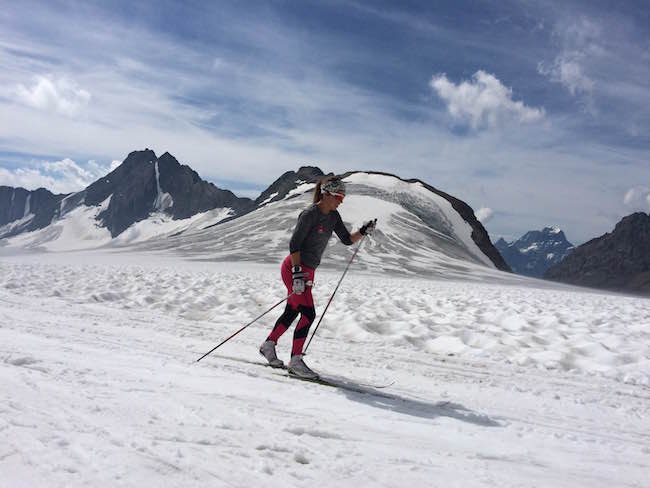
Stewart-Jones training on the Haig Glacier this summer. (Courtesy photo)
My overall fitness in general
4. Whom you’ve been working closest with this offseason (coaches or training partners)?
I have continued to work with my coach Timo Puiras, my team’s new assistant coach Tim Wintoniw and my strength coach Paul Hemsworth. It has been great to be able to work with such a big group of girls this year. With 6 girls on my team there is always someone to train with.
5. Best trip in the last five months (and why)?
Park City. I loved the variety it provided for training, the endless roads and running trails kept things interesting!
6. Favorite cross-training?
Hiking! I love trail running/hiking and climbing mountain peaks
7. Favorite non-athletic activity or pastime this summer?
I love adventuring in general, camping, cliff/bridge jumping, discovering new places
8. Song that was your jam this summer?
Love on The Brain- Rihanna
9. All time favorite race moment?
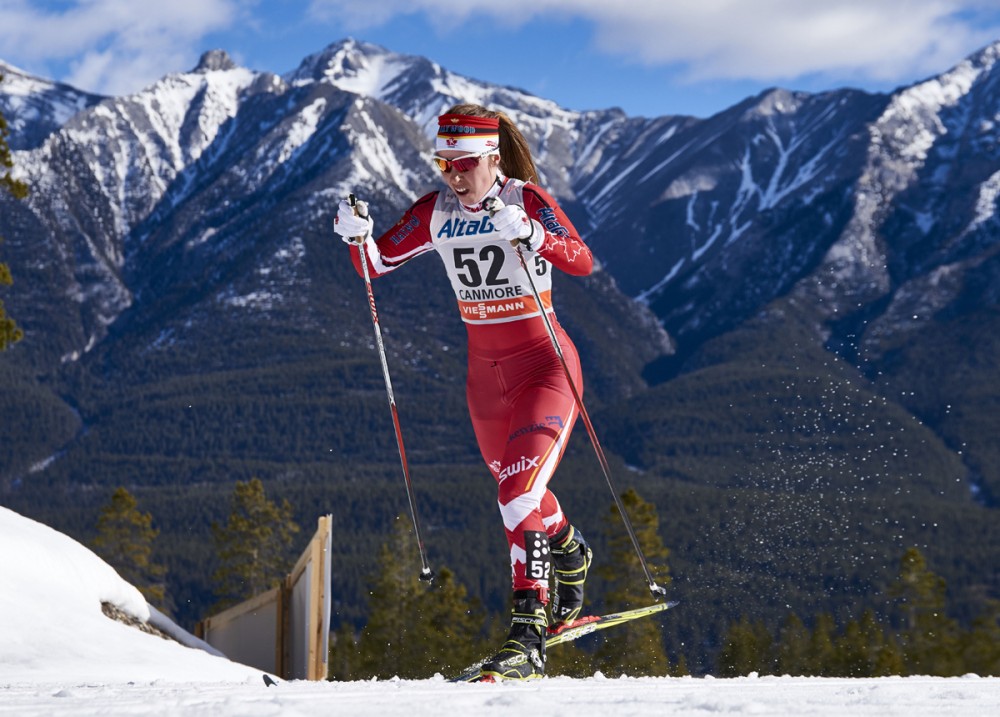
Canada’s Katherine Stewart-Jones during the women’s 15 k skiathlon in Canmore, Alberta, last season. (Photo:Fischer/NordicFocus)
The Gatineau World Cup at the ski tour Canada. Racing in front of the home crowd on home soil was an unreal experience. It made me realize how lucky I am to have such a big support team behind me.
10. First thing you pack in your bag when you leave for Europe?
My earplugs, everyone who knows me knows how much I love sleeping.
11. Venue/event you’re most excited to visit this season?
Soldier Hollow! I rollerskied there this fall and the trails look like so much fun!!
12. Who will win the World Cup title this year?
Maiken Casperson Falla
13.Biggest sacrifice you feel you’ve made choosing this career path?
Stewart-Jones and her teammates seeing some early snow. (Courtesy photo)
Honestly, I really haven’t sacrificed much. I am pretty lucky to be able to do what I do. The one thing I wish I could do more of without compromising my training is to go on long backpacking adventures, but that can wait until the end of my ski career!
14.If you could change one thing about your sport, what would it be?
To be more accessible to everyone financially… its an expensive sport
A happy spectator at 2015 Canadian Ski Nationals at Lappe Nordic in Thunder Bay, Ontario. (All photos: Martin Kaiser)
Canadian Ski Nationals in Thunder Bay, Ontario, capped off the 2014/2015 domestic season in Canada from March 14-21. Here are some of our favorite photos and athlete comments from the weeklong series at the Lappe Nordic Centre, courtesy of Martin Kaiser. (Quotes collected via email by Gerry Furseth and François Léger Dionne.)
2015 Canadian Nationals freestyle team sprints at Lappe Nordic Centre in Thunder Bay, Ontario. (Photo: Martin Kaiser)
2015 Canadian Nationals freestyle team sprints at Lappe Nordic Centre in Thunder Bay, Ontario. (Photo: Martin Kaiser)
2015 Canadian Nationals freestyle team sprints at Lappe Nordic Centre in Thunder Bay, Ontario. (Photo: Martin Kaiser)
2015 Canadian Nationals freestyle team sprints at Lappe Nordic Centre in Thunder Bay, Ontario. (Photo: Martin Kaiser)
2015 Canadian Nationals freestyle team sprints at Lappe Nordic Centre in Thunder Bay, Ontario. (Photo: Martin Kaiser)
2015 Canadian Nationals freestyle team sprints at Lappe Nordic Centre in Thunder Bay, Ontario. (Photo: Martin Kaiser)
2015 Canadian Nationals freestyle team sprints at Lappe Nordic Centre in Thunder Bay, Ontario. (Photo: Martin Kaiser)
2015 Canadian Nationals freestyle team sprints at Lappe Nordic Centre in Thunder Bay, Ontario. (Photo: Martin Kaiser)
On highlights:
“I was really happy to get my first senior national title in the 5km free. I didn’t get any splits until 4k so I didn’t know how it was going results wise but I was pushing as hard as I could and made sure to race the first portion that was flatter like a sprint prologue so I wouldn’t give up too much time before the climbing. … There have been lots of great moments this week but I have to say my favourite was when Peri [Jones] came over to me at the end of the 5k free and told me that I had won. ” — Dahria Beatty (AWCA/NST-U23), who beat World Cup veteran Perianne Jones by 3.7 seconds in the women’s 5 k skate
“One of my favourite moments was when [teammate] Peri [Jones] came across the finish line in second in the team sprint. It was an amazing feeling to have won a medal with someone who has been a[n] inspiration for me for a very long time.” — Katherine Stewart-Jones (Nakkertok/NST-Junior Team), 2nd in the freestyle team sprint with Perianne Jones
“I think my favorite moment was seeing all my friends again after a long time being gone in Europe for racing. Seeing faces I know everywhere and talking to people I know was really nice. And I also really enjoyed hearing my name when people were cheering during races. Being back home, this feeling is just great!” — Cendrine Browne (CNEPH/NST-U23), 3rd in 10 k classic and 30 k freestyle mass start
On exceeding goals:
“My focus events were the skate races. The team sprint, 10km and 50km. I can’t believe I was able to win gold in all three.” — Michael Somppi (AWCA/NST-Dev.), 1st place in the freestyle team sprint, 10 k freestyle and 50 k freestyle mass start at 2015 Canadian Nationals
2015 Canadian Nationals men’s 50 k freestyle mass start at Lappe Nordic Centre in Thunder Bay, Ontario. (Photo: Martin Kaiser)
2015 Canadian Nationals men’s 50 k freestyle mass start at Lappe Nordic Centre in Thunder Bay, Ontario. (Photo: Martin Kaiser)
2015 Canadian Nationals men’s 50 k freestyle mass start at Lappe Nordic Centre in Thunder Bay, Ontario. (Photo: Martin Kaiser)
2015 Canadian Nationals men’s 50 k freestyle mass start at Lappe Nordic Centre in Thunder Bay, Ontario. (Photo: Martin Kaiser)
2015 Canadian Nationals women’s 30 k freestyle mass start at Lappe Nordic Centre in Thunder Bay, Ontario. (Photo: Martin Kaiser)
2015 Canadian Nationals women’s 30 k freestyle mass start at Lappe Nordic Centre in Thunder Bay, Ontario. (Photo: Martin Kaiser)
2015 Canadian Nationals junior girls 7.5 k freestyle mass start at Lappe Nordic Centre in Thunder Bay, Ontario. (Photo: Martin Kaiser)
2015 Canadian Nationals junior women’s 7.5 k freestyle mass start at Lappe Nordic Centre in Thunder Bay, Ontario. (Photo: Martin Kaiser)
2015 Canadian Nationals junior girls 7.5 k freestyle mass start at Lappe Nordic Centre in Thunder Bay, Ontario. (Photo: Martin Kaiser)
2015 Canadian Nationals men’s classic sprint at Lappe Nordic Centre in Thunder Bay, Ontario. (Photo: Martin Kaiser)
2015 Canadian Nationals women’s classic sprint semifinal at Lappe Nordic Centre in Thunder Bay, Ontario. (Photo: Martin Kaiser)
2015 Canadian Nationals junior men’s classic sprint A-final at Lappe Nordic Centre in Thunder Bay, Ontario. (Photo: Martin Kaiser)
2015 Canadian Nationals junior men’s classic sprint B-final at Lappe Nordic Centre in Thunder Bay, Ontario. (Photo: Martin Kaiser)
Junior women’s sprint huddle at 2015 Canadian Nationals at Lappe Nordic Centre in Thunder Bay, Ontario. (Photo: Martin Kaiser)
Junior women at 2015 Canadian Nationals at Lappe Nordic Centre in Thunder Bay, Ontario. (Photo: Martin Kaiser)
On beating World Cup veteran Ivan Babikov in the 50 k freestyle mass start:
“When we neared the final kms it was apparent Ivan’s legs were cramping up and as we crested over the 2nd last big climb I noticed I had a small gap on him. So I just blasted with everything I had left and opened up a good margin to the finish line … It was just an amazing feeling coming into the finish with the home crowd cheering me on. Maybe that’s what helped me feel so good … and really, this whole week.” — Somppi
On overcoming adversity:
“In the qualifier I broke a binding on the last hill so I had to stop and put it back on, which took about a minute and a half. Luckily, there were only 28 girls in the race so I qualified anyway with bib number 28. I was pretty rattled after breaking a binding but I managed to calm down and focus on the heats. I knew that before I had broken the binding my race had been going well so I was confident that I could ski well in the heats. Because of my low bib number, I was put in the hardest quarter-final and in the hardest semi-final and was lucky looser in both of the races, At that point, I was pretty relieved to have made the final. Overall I am happy with my fourth place because I skied as hard as I could and I am happy with how I skied.” — K. Stewart-Jones, 4th in junior women’s classic sprint
On a long season:
“[It] feels like travel and all 180km of racing that I’ve done in the past 4 weeks finally [caught] up to me.” — Ivan Babikov (Canadian World Cup Team)
“I’m skiing as fast as I can and with all the energy that I have left.” — Browne, 3rd in 10 k classic
“Considering my lead-up to Nationals wasn’t ideal, with racing in Lahti the weekend beforehand and traveling back to Canada on Monday, I’m happy with the consistency of my performances.” — Somppi
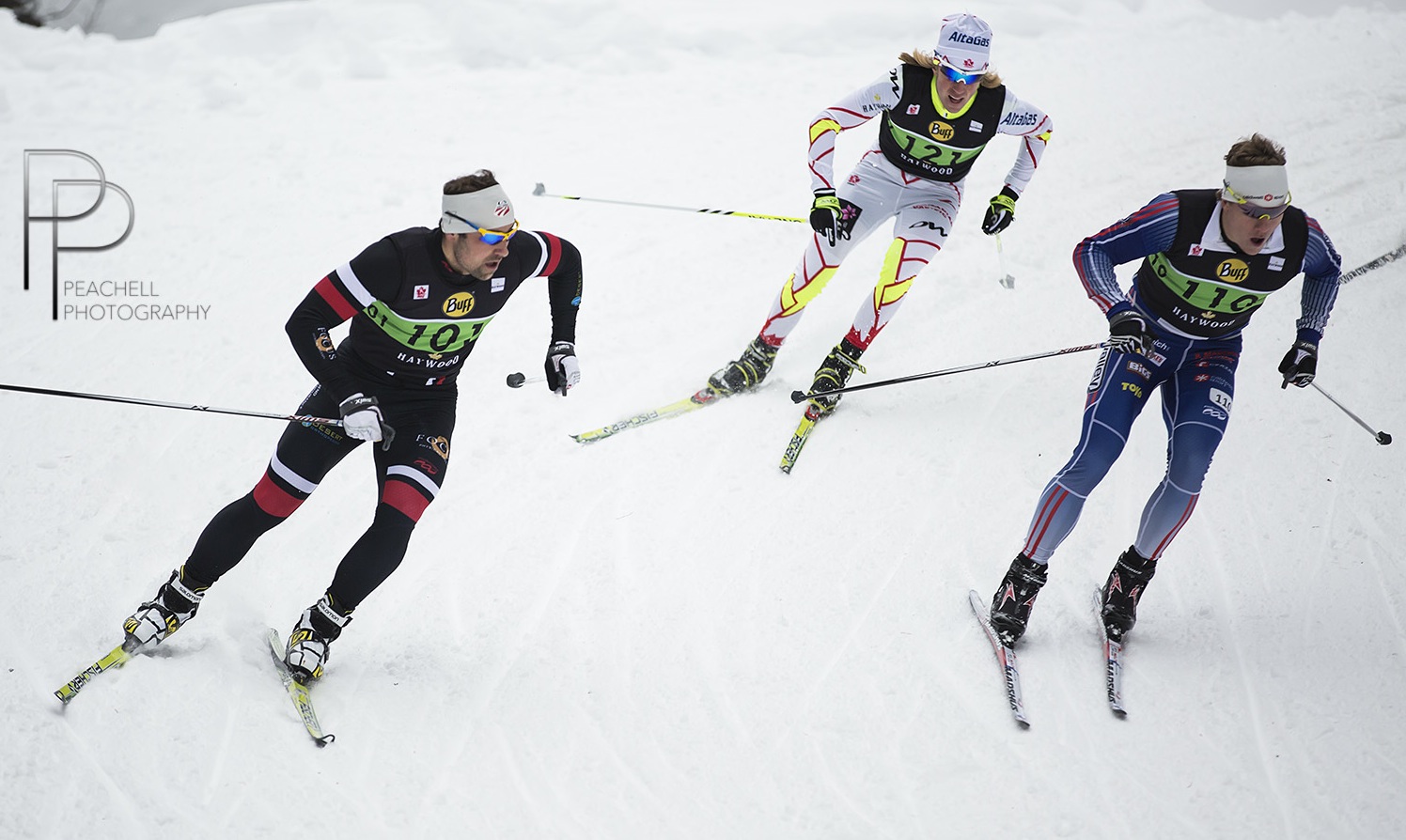
NorAm action in Rossland, B.C., last winter: Dakota Blackhorse-von Jess of the Bend Endurance Academy (101) rounds a corner with Sun Valley’s Miles Havlik (110) and Graeme Killick (121) of the Alberta World Cup Academy/CNST in the Black Jack NorAm 1.6 k skate sprint semifinals on Dec. 15, 2013. (Photo: Shelley Peachell/Peachell Photography)
Note: This article has been updated to reflect the correct U.S. SuperTour schedule, notably West Yellowstone’s individual start.
Here’s what you have to look forward to this fall, domestically speaking. The Canadians are hosting a season-opening tuneup Oct. 24 in Canmore, Alberta, and it’s known as Frozen Thunder. After the classic sprint and freestyle-distance race (Oct. 31) at the Canmore Nordic Centre, North-American skiing attention will turn to Montana for the USSA SuperTour opener at its usual stop in West Yellowstone from Nov. 28-30.
The SuperTour circuit then heads north to Bozeman, Mont., for the second weekend of races Dec. 5-7. Canadians will have a chance to race at home again at Cross Country Canada’s NorAm opener Dec. 13-14 in Rossland, British Columbia, which also serves as its U23/Junior World Championships Trials. Another set of trials takes place the next weekend, Dec. 20-21, at Whistler Olympic Park in Callaghan Valley, British Columbia.
For the last two years, U.S. nationals has been held at Soldier Hollow, the 2002 Olympic venue just outside of Park City, Utah. This winter from Jan. 4-10, they’ll be in Houghton on Michigan’s Upper Peninsula. The SuperTour circuit ventures to Vermont for back-to-back weekends in Craftsbury from Jan. 30-Feb. 8 before the ultimate American distance race (also part of the SuperTour schedule): the American Birkebeiner Feb. 21 in Hayward, Wis.
Another NorAm and the third-and-final set of Canadian U23/Junior World Trials is scheduled for Jan. 8-11 in Duntroon, Ontario. Western Canadian Championships in Canmore will follow from Jan.15-17, and Jan. 30-Feb. 1, Nakkertok will again host NorAm Easterns in Cantley, Quebec (just before U23 and Junior World Championships Feb. 2-8 in Almaty, Kazakhstan). The Gatineau Loppet will again double as Canadian Long Distance Championships with its 51 k classic mass start in mid-February.
The NorAm season wraps up in Thunder Bay, Ontario, with Canadian Ski Nationals at Lappe Nordic, including the 50 k freestyle mass start.
SuperTour Finals and U.S. Distance Nationals are set for March 20-26 in Sun Valley, Idaho — and the mixed relay is back.
Emily Nishikawa (l) edges Olivia Bouffard-Nesbitt (c) and Heidi Widmer (r) in the women’s 1.4 k skate sprint final at the Black Jack NorAm on Dec. 14, 2013 in Rossland, B.C. (Photo: Shelley Peachell/Peachell Photography)
Dec. 13-14: Rossland NorAm opener (and U23/Junior World Trials 1): freestyle sprint & 10/15 k classic
Dec. 20-21: Whistler classic sprint & freestyle interval start at Callaghan Valley (U23/Junior World Trials 2)
Jan. 8-11: Duntroon 15/30 k skiathlon, classic sprint, 10/15 k freestyle (U23/Junior World Trials 3)
Jan. 15-18: Western Canadian Championships in Canmore: 10/10 k classic, freestyle sprint, classic mass start
Jan. 30-Feb. 1: Eastern Canadian Championships in Cantley: freestyle sprint/prologue, 10/15 k freestyle, 15/20 k classic mass start
Feb. 14-15: Gatineau Loppet/Canadian Long Distance Championships: 51 k classic mass start*
March 14-21: Canadian Ski Nationals in Thunder Bay: freestyle team sprint, 5/10 k freestyle, 10/15 k classic, 30/50 k freestyle mass start
*Separate from NorAm series
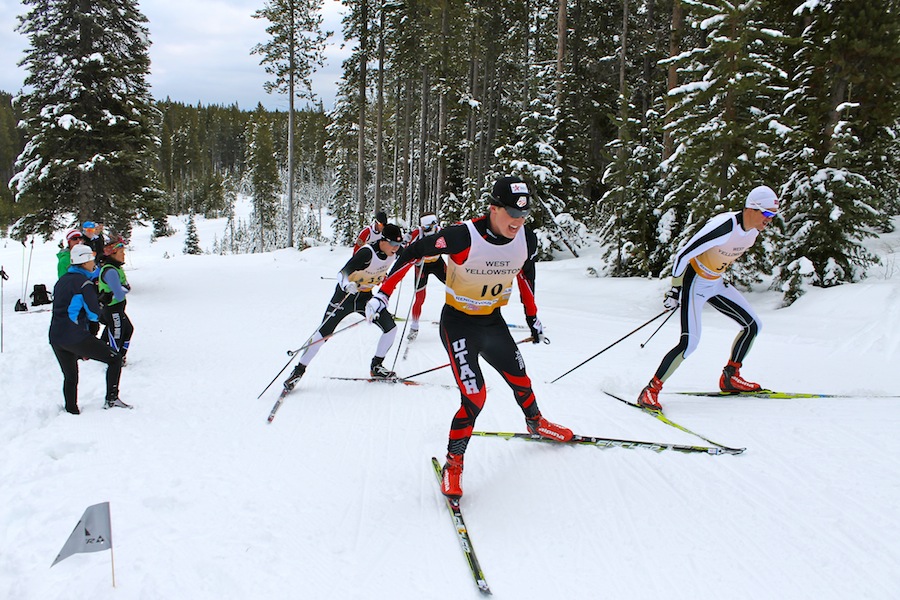
Tucker McCrerey (Utah) takes the outside corner at the top of Tele Hill. McCrerey went on to place 19th in the 15 k skate at the 2013/2014 West Yellowstone SuperTour opener.
Editor’s Note: The following training-camp recap was written by Jenn Jackson, a member of NDC Thunder Bay and Canada’s Junior National Team. Last month, her training centre, located in Thunder Bay, Ontario, returned to one of its favorite places south of the border: Wisconsin. To submit your own camp writeup, please email info@fasterskier.com with the subject line: “Camp Recap.”
***
As summer slowly begins to turn to fall, the National Development Centre of Thunder Bay made its way south for its final dryland camp of the year.
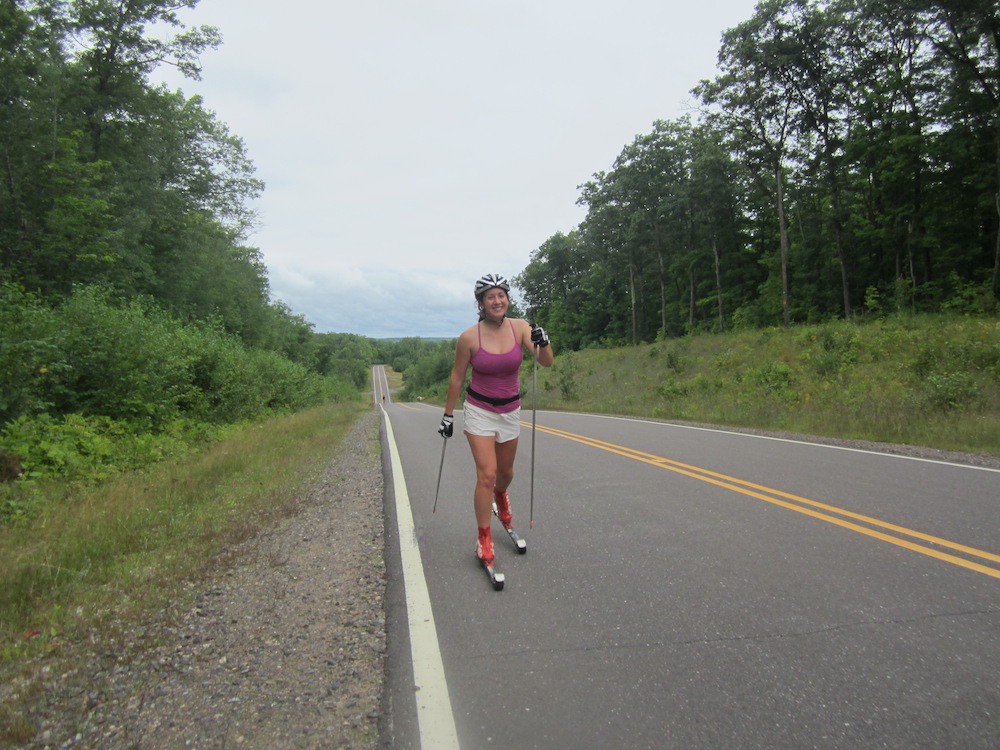
From Aug. 16 to 27, athletes of NDC Thunder Bay could be found rolling along the roads near Hayward, Wis. The team has hosted camps in the area before; taking advantage of the quiet, well paved roads, and extensive trail systems, which play host to the American Birkebeiner in late February.
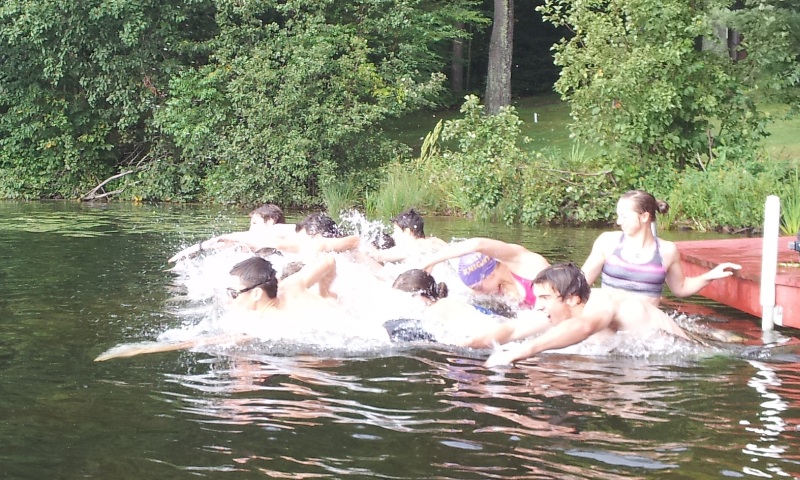
The start of NDC’s swim-run-ski triathlon time trial in Hayward, Wis., which according to coach Timo Puiras “is a bit of a tradition at the Hayward camp.” (Photo: NDC Thunder Bay)
“There was a nice variety of terrain so we could concentrate on exactly the technique and training aspect we were focusing on for any particular training session,” NDC Head Coach Timo Puiras wrote in an email. “Living on the lake at Crest Hill resort meant we could access a wide variety of training venues right from our front door making recovery and rejuvenation post workout ideal.”
Puiras explained that, for most of the team, the focus of the camp was high quality roller ski volume, but that some of the more senior athletes had “ … a more intensity driven camp.”
During the 12-day camp, the group completed three intensity sessions, all involving rollerskiing – a marked change from the NDC’s typical summer intensities, which are done almost exclusively running or ski striding.
One of these workouts was a rollerski-sprint paceline, which the team adopted from Canadian World Cup Team coach Tor-Arne Hetland after a collaborative camp earlier this summer in Bend, Ore.
“We do the paceline to practice good form and speed,” NDC athlete Andy Shields explained. “With the drafting component we get to use very fast movements without it being too fatiguing. When we get to the head of the train, the sprit at the front simulates a sprint to the finish line.”
To ensure everyone was competitive within the paceline, assistant coach Victor Wiltmann inventoried and reassigned rollerskis to athletes according to who was strongest in the sprints and who needed a little extra speed.
For new athletes Julian Smith and Sam Greer, this was their first training camp with the team and was a very positive experience.
“It was incredible,” Smith wrote. “You are isolated, you spend a lot of time with your teammates and you get to learn a lot about all of them.”
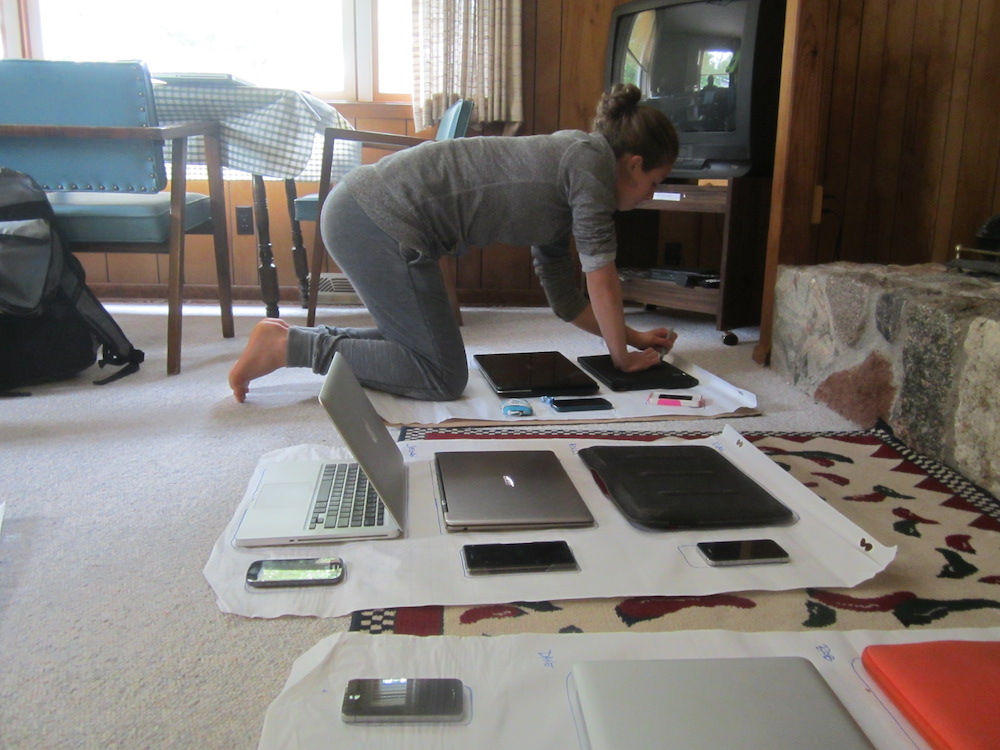
Depositing technology for the blackout, which coach Timo Puiras explained was meant “to encourage team building and to prohibit screen time in the afternoon.” (Photo: NDC Thunder Bay)
This isolation was not only geographical, but technological as well.
“The technology blackout was a bit of an experiment,” Puiras wrote. “I had two main goals for the technology blackout: to encourage team building and to prohibit screen time in the afternoon, most importantly just before sleep. I was curious to see if preventing screen time in the afternoon would have any effect on recovery and sleep. Obviously this was a highly unscientific, subjective observation, but no one on the camp got sick and everyone’s mood stayed notably positive.”
Without their electronics, the athletes enjoyed the lakeside facilities, “… spending quality time together, swimming in the lake, playing guitar, and slacklining” Smith wrote. In the evenings, some athletes would do supplementary sprint workouts, dashing from the sauna down to the docks and into the lake.
Midway through the camp, the athletes hit their longest single-session day with a four-hour classic rollerski. Rather than staying to the familiar roads near the Crest Hill, the coaches mapped out a 65-kilometre loop which wound its way up and around Cable – where the team would use CXC’s team gym for strength, then back to the resort.
Guest athlete, Holly Brown during four-hour classic roller ski workout (Photo: NDC Thunder Bay)
On the workout, Puiras commented: “I am fairly certain that this is the first time in my career that after 4 hours of roller skiing every single athlete was still positive and could have easily kept on going for more.”
That positivity wavered slightly for some as the final intensity workout of the camp approached: the swim-run-ski triathlon time trial, which according to Puiras “is a bit of a tradition at the Hayward camp,” and challenged some of the land-loving athletes with a 230-metre lake swim.
In an effort to have men and women finish close to the same time, the men’s run and roller ski courses were slightly longer (4.7 k and 12.8 k) than the women’s (3.5 k and 9.0 k). As the athletes finished the TT, it was the women who seemed to have the edge on the shorter course. For results, click here.
The team has now returned to the north side of the border so the student-athletes can prepare for the start of the academic semester at Lakehead University and Confederation College.
With more than half of the training season behind them, “Everything is on track and looking positive for the fall training season,” Puiras wrote.
The team will train locally in Thunder Bay until mid-October when they head west to Canmore for Frozen Thunder. In the meantime, they have a testing week scheduled, as well as the Pancake Run.
***
The National Development Centre of Thunder Bay is one of three high performance training centres in Canada. Last year the team had athletes qualify for both Junior and Under 23 World Championships, and won numerous medals at Canadian Nationals. They are currently running a campaign to compensate for severe funding cuts to their program, to learn more visit: TeamUpNDC.com and follow @NDCTBay on Twitter.
The Thunder Bay National Development Center (NDC) recently launched a fundraising initiative/website called “TeamUp!“in an effort to support its 10 athletes training out of Thunder Bay, Ontario.
“We have an exciting new fundraising initiative starting here at the National Team Development Centre in Thunder Bay,” TeamUp Director Erin Tribe wrote in a statement. “We would like to get the incredible community excited about our athletes, our team, and our goals. We want to reach YOU, and all who support and believe in our athletes, to help them reach athletic excellence and make the leaps and bounds we know they are capable of. I invite you to view our Make A Champ page, located under the ‘Donor’ tab, check out the great prizes and rewards available on the Home page. While the athletes are hard at work becoming the best athletes they can be, we ask for your support in helping them get there.”
As of Thursday morning, the campaign had reached 50 percent of its goal, with $7450 raised and 26 days remaining. For more information, visit www.teamupndc.com.
Graeme Killick (l) during Sunday’s skate sprint heats at the Lappe Nordic NorAm World Junior/U23 Trials in Thunder Bay, Ontario. (Photo: Martin Kaiser)
The NorAm World Junior/U23 Trials are over and athletes are heading in different directions with varying moods. Some have long trips home, some do not. Some qualified for Junior Worlds or U23’s in Liberec, some did not. Some took a step closer to earning a start at the World Championships in Val di Fiemme, some took a step back. Many had more personals goals like executing tactical plans or holding technique to the end of the race.
The lists of skiers who qualified for trips doesn’t really show the time, effort, and determination that it took to achieve this goal. It also doesn’t show all the ‘unsuccessful’ skiers who forced the successful athletes to reach higher.
The official Canadian U23 list has:
Andrea Lee (NDC Thunder Bay), Marlis Kromm (AWCA) , Heidi Widmer (AWCA) , Annika Hicks (AWCA) , Andy Shields (NDC Thunder Bay) , Patrick Stewart-Jones (AWCA), Russell Kennedy (AWCA), Colin Abbott (Yukon Elite Squad)
The junior list has:
Frédérique Vézina (CNEPH), Maya MacIssac-Jones (RMR), Cendrine Browne (CNEPH), Katherine Stewart-Jones (Nakkertok), Anne-Marie Comeau (CNEPH), Raphaël Couturier (CNEPH) , Alexis Turgeon (CNEPH), David Palmer (Black Jack) , Ezekiel Williams (Nakkertok) , Scott Hill (NDC Thunder Bay)
Most of these athletes were automatically selected by winning a race at Thunder Bay. Comeau and Widmer were selected by ‘force majeure’, meaning they didn’t qualify due to an illness beyond their control. Widmer was held out of the last two races with a suspected concussion.
Colin Abbott, David Palmer, Ezekiel Williams, and Scott Hill were selected based on their rankings, which include the Thunder Bay races. Full details are on the CCC website.
As ever, the racers had lots of interesting things to say.
On the recent past and the near future:
Chris Hamilton (AWCA):
I felt really good in the race on Sunday, was able to go hard right from the start and blast the entire course.
I am pumped with my results this weekend, I had my best ever Sprint result in Senior Mens(9th, pretty damn good for a “non-sprinter”) on Saturday and combined with Sundays first Senior NorAm podium, my confidence has definitely got a boost.
I will travel down to the next NorAms in Duntroon, followed by Easterns in Ottawa and Westerns in Grand Prairie. The Alberta World Cup Academy has a fairly busy schedule for the rest of the season, so I will be on the road for the next while.
Graeme Killick (AWCA):
I felt pretty good going into each race. I don’t think the results were quite there this weekend but my form is still there and I might just need a different course/condition to really bring it out. I struggled on the skate day with keeping the speed up on the gradual terrain. Something to definitely work on in the future. Not happy with the results from the weekend but looking forward to fighting for the NorAm spot again in Duntroon and Ottawa!
Brittany Webster (Highlands), on Sunday’s interval start where she was 4th:
I really like hills and lots of them so this course wasn’t the best for me. Power skiers really did well today- Kate, Em, Zoe. And in the men the local guys did really well and also those who were bigger and more powerful. Like Graham Nish, not my kind of course, too much flat. It was probably the most fun race of the season.
[Next] I’ll get my energy up and legs really rested and then focus on skating in preparation for the 10k skate at highlands. It is my home club!! So really looking forward to it. My sister always brings a massive cheering section, which will put a smile on my face. There’s nothing like racing at home with you friends, parents and supporters to cheer you on.
Alana Thomas (Nakkertok):
I was happy with how the 10k skate went today, I had good energy and had fun working all the twisty, fast sections of the course. The sprint yesterday was so-so so it feels good to bounce back from that with a stronger performance today.
I’ll head to Ottawa now to get some training in before the NorAm at highland’s nordic in 3 weeks. From there I’ll head to my parent’s place near Hardwood Ski and Bike to do the final prep for Highland’s. I’m pumped to get some more training and sharpening done in places I love!
Zoe Roy (RMR):
I felt good in the skiathlon, better than in earlier races this season. It felt great to get on the podium!
[In the sprint, I] didn’t feel really snappy but was able to sneak through the quarterfinals in the lucky loser spot! Stayed on my feet and made up time on the hill to come in 2nd in the B final.
[Sunday] was another fun but cold day! I made an in the start gate decision to ditch my boot warmers 😉 We had good skis today and I liked the course, it had a little bit of everything. I think it was a solid weekend as a whole.
I’m staying in the east until Duntroon instead of going back to Canmore to minimize travel and get some training in here. I’m headed off to Ottawa on Tuesday for a few weeks before then.
Emily Nishikawa (AWCA):
I felt pretty good today, and I’m really happy with my whole weekend. Everything went really well, and I’m glad I was able to put together 3 good races in a row. I’m back to Canmore tomorrow for a couple weeks, then back out east to Duntroon for more NorAms.
Phil Widmer (AWCA):
So far the season has been good. I was really happy to get a top 15 in Canmore [at the World Cup] and I had a solid Nor-Am before that.
My goal for the rest of the season, simply put, is to get a bit better with each race. It would be amazing to get the opportunity to race in Europe and we’ll see what happens.
Michael Somppi (AWCA):
I’ve had some good feeling all weekend on my skis. Those feelings combined with some frustration at being close to the podium in the previous two races, but not quite making it fuelled my desire to win today.
Overall it was a strong weekend of racing for me. I hope to continue to perform at this level for the rest of the season. Next up on the schedule is the NorAm competition in Duntroon, Ontario at the end of the month.
Kevin Sandau (AWCA):
I was sick for the weekend, some light chest thing, but I don’t think it is going around. Started Saturday morning and felt better [Sunday] but decided to be on the safer side and not race.
David Greer (YES):
The Thunder Bay races were pretty mediocre for me. The races weren’t bad, I just know I’m capable of more. Next up for me is the Super Tour races in St Paul next weekend. John, Knute and I are currently in Duluth getting a bit of training in before we head over to Minneapolis next week.
Graham Nishikawa (AWCA):
Weekend was fun, overall ok. I am happy with my performance on Thursday.
Russell Kennedy (AWCA), on Sunday:
I felt real good right from the start. I knew it was a good course for me and I had to get top U23 to secure a spot for the Liberec trip. It turned out to be the best race of my life. I was a little disappointed with my sprint result but I had finished as 2nd U23 in the pursuit and knew I could make a good weekend great today. Now I have set my focus to skiing fast in Liberec.
Knute Johnsgaard (YES):
I’m obviously a bit disappointed I didn’t get named to the U23 team but I feel it was a good race weekend.
I felt my races were better than what my results showed. It seemed like there was a lot of guys who just had that race of their life, which was kind of unfortunate for me.
With the Duntroon NorAm a couple weeks from now and easterns right after that, it didn’t make sense to spend another thousand bucks on a plane ticket home so we’re staying out east. John [Parry], David [Greer], and I will be racing the first weekend of the Tour de Twin Cities in Minnesota.
Jess Cockney (AWCA):
As a whole I am definitely disappointed in the way the weekend shook down and I’m looking forward to another shot at trials in a couple weeks. Next up is some training in Canmore and off to Duntroon for the next trials in a couple weeks.
Alexis Turgeon (CNEPH):
(After Thursday’s 2nd place) I’m happy about my result, but I got to stay focused because a 2nd place doesn’t give you a free pass to Europe. Planning on winning the sprint and then having a good 15km skate to finish the week. For the rest of the season I want to be on the podium in the classic sprint at World Juniors and top 10-15 results on the distance racing.
(After Saturday’s win) All the pressure is off now. I felt like I really had to qualify this year because I did last year. After my second place in the pursuit this sprint gives me confidence for the world champs. I’ll be able to ski way more relax in the future without any stress.
Raphaël Couturier (CNEPH), on moving up to senior heats from junior:
It’s a really good opportunity to improve my strategies and to have a better idea of what WJ will look like.
(Next up) The focus from now will remain on WJ and nationals in Whistler late March.
Colin Abbott (YES):
It feels like a relief to qualify, this was my last year to make the U23 team and I don’t think I realized how badly I wanted it until after the races were over. The weekend of racing was one of my most consistent ever. The 30km pursuit started slow and it let me settle in comfortably before the pace picked up. I was able to ski at the front of the race for a lot of the first 15km. My legs didn’t like the switch to skating much and I got dropped by the lead pack after the first skate lap. Despite that, I maintained my position well and finished as the 3rd U23 at the end of the day.
The classic sprint race was the first one to be held on the Noram circuit in over a year so I didn’t know what to expect going into it. The qualifier felt a bit shaky but I think that was the case for a lot of people. The quarterfinal was tactically very good for me and I qualified comfortably for the semis for the first time in my life. Despite the good quarterfinal my body let me down in the semis and B-final and I wound up in 12th position, 3rd U23.
The 15km individual skate race was the race I was the most worried about. It’s traditionally been my weakest event and I really needed to be in the top 5 or 6 U23 guys to be considered. I managed to get my head on straight before the start of the race and after 5km or so I was kind of surprised at how good I was feeling. That boosted my confidence a bit and I tried to ski as fast and efficient as possible to the line. There were incredibly tight results that day and I was happy to be towards to top of them.
On Thunder Bay:
Chris Hamilton (AWCA):
It was a really great boost to know all of the volunteers and locals who were out there cheering. After all the years living in Thunder Bay I’ve gotten to know all of their cheering voices, so I kinda unconsciously knew who was there beside the race course yelling for me. It was a very special feeling to be able to perform this well in front of all my family, friends and sponsors. They definitely helped carry me around the course.
Alana Thomas (Nakkertok):
I’ve got to mention how impressed I was with the course, T-Bay really loves skiing and volunteers spent hours and hours shoveling snow onto the race loops to make today possible – all worthwhile and much appreciated!
Graham Nishikawa (AWCA):
The organizers did an amazing job getting the course together- there is very little snow here!
Jess Cockney (AWCA):
The volunteers have done a great job with what they’ve got but the snowfall has been unseasonably low and there’s a few rocky sections in and around the stadium.
Michael Somppi (AWCA):
The trails are in race shape despite limited snow in Thunder Bay at the moment. The ski community here has really worked hard to make this event possible and I am very grateful.
Emily Nishikawa (AWCA):
The organizers have done a great job getting the trails ready with a small amount of snow. We are using 2.5 km loops, so there will be a lot of laps- especially for the men!
Colin Abbot (YES):
Considering that Lappe has to make do with only the small amount of natural snow that has fallen so far this year they’ve done an amazing job with the trails.
Michael Somppi (second closest) edges three Alberta World Cup Academy teammates in a lunge to the line of Saturday’s NorAm classic sprint semifinal in Thunder Bay, Ontario. Jesse Cockney (closest) took second, Graham Nishikawa (third closest) was third, and Brent McMurtry was fourth by 0.06 seconds. (Zone4 photo)
The focus at the NorAm World Junior/U23 Trials hosted by Lappe Nordic shifted to classic sprinting today with a shift in the top of the podiums to match. The pressure was rising for athletes chasing a limited number of spots on the U23 and World Junior races in Liberec, Czech Republic, while older athletes tried to accumulate points toward a trip to the World Championships in Val di Fiemme.
Phil Widmer of the Alberta World Cup Academy (AWCA) won the men’s qualifier and each of his heats with only teammate Graeme Killick getting close to beating him in the quarterfinal. Widmer described the course and his plan in an email: “With the first half of the race being very easy and the second half being very hard, it meant the race really started at the halfway point. I wanted to be up in the top 3 starting at the midway point and be ready to fight to the finish.”
The second semifinal had four skiers finish within 0.06 seconds. Hometown boy Michael Somppi (AWCA), who won the fastest heat of the day, finished in 3:28.81, just edging teammate Jess Cockney by 0.03 seconds for both to advance to the final. Graham Nishikawa (AWCA) tied Cockney on time, 0.03 seconds ahead of fourth-place finisher Brent McMurtry (AWCA). After a finish that tight, it was suitable that both Nishikawa and McMurtry advanced as lucky losers, putting five AWCA athletes in the A-final.
In the final, Somppi started well and led the group into the long climb. “Unfortunately my legs didn’t have much left and I struggled up the climb,” he wrote. “Phil skied the final tactically very well. He was right behind me starting the climb and took the lead when I faltered. He continued to ski strong to the line.”
Widmer won the 1.4-kilometer final with a clear lead in 32:29.7. Patrick Stewart-Jones (AWCA) finished second 1.6 seconds behind.
“The final was a hard fight,” Stewart-Jones wrote. “I didn’t have a great start and was always skiing in the outside track trying to move up. In the end Phil was just too strong today, but I’m really happy with my second place!”
Cockney, who was ninth in the Canmore World Cup sprint in December, settled for third, just 0.13 seconds behind Stewart-Jones.
Brian McKeever won the B-final in 3:34.81, well ahead of Killick. Junior Raphael Couturier of the Pierre-Harvey Training Centre (CNEPH) was fifth after moving up to the senior race once he knew Thursday’s skiathlon guaranteed his spot in Liberec.
Couturier saw this as a learning opportunity. “It’s a really good opportunity to improve my strategies and to have a better idea of what WJ will look like,” he wrote.
In the Junior Men’s field, Alexis Turgeon (CNEPH) emulated Widmer, winning the qualifier and then all of his heats. In the final, he finished in 3:36.73, more than a second ahead of Ezekial Williams (Nakkertok) and another second ahead of Dominique Moncion-Groulx (Nakkertok).
In the women’s 1.2 k sprint, Andrea Dupont (Rocky Mountain Racers) led the way, winning all her heats after Emily Nishikawa (AWCA) won the qualifier. Alysson Marshall (AWCA) was second in the A-final, finishing 0.16 seconds behind Dupont’s time of 3:18.10 and almost four seconds in front of third place Nishikawa.
“I was pleasantly surprised to see that I had won the qualifier, and the heats went fairly well,” Nishikawa wrote in an email. “I struggled a bit with kick on the climb, but overall I felt pretty good.”
“In the final, Alysson and I were still together coming over the top of the hill,” Dupont wrote. “She was able to get a bit of a draft in a dip before the finishing double pole stretch. She had more momentum than myself coming through the final corner to the double pole finish. So, I had a bit of ground to make up in the finishing stretch. Fortunately double poling is a strength for me and I was able to recover enough and out lunge her at the line.”
“I felt pretty good today,” Marshall wrote. “I had a rough start to the season and this was one of the first races that I’ve felt my normal speed come back. It was disappointing to miss the win in a lunge, but I was happy to feel strong again. I managed to stay out of trouble in the quarters and semis and made it into the final. In the final I was mid-pack at the bottom of the course but jumped in a lane behind Andrea and stuck with her up the climb. We got a bit of a gap over the other girls and had a double pole battle to the finish.”
Kate Brennan (AWCA) was fourth, over a second ahead of teammate Marlis Kromm who earned a trip to U23’s with her effort. Local favourite Erin Tribe (NDC Thunder Bay) rounded out the A-final in sixth.
In the Junior Women’s event, Maya MacIsaac-Jones (RMR), following a trend for the day, won the qualifier and all her heats. Katherine Stewart-Jones (Nakkertok) was second, two seconds behind MacIsaac-Jones’ winning time of 3:22.28. Alannah MacLean (NDC Thunder Bay) grabbed the final podium place for local pride, ahead of Cendrine Browne (CNEPH), Dahria Beatty (AWCA), and Frederique Vezina (CNEPH).
Graham Nishikawa, 29, leads some Alberta World Cup Academy teammates, including Jesse Cockney (207) and Kevin Sandau (202), in the skate leg of Thursday’s NorAm 30 k skiathlon in Thunder Bay, Ontario. Nishikawa won the race to earn a trip to 2013 World Championships (Photo: Martin Kaiser)
For the second time this season, the Nishikawa siblings – Emily and her older brother Graham – pulled out NorAm victories on the same day at the NorAm World Junior/U23 Trials in Thunder Bay, Ontario. Emily won the women’s 15 k skiathlon by 9.1 seconds in 45:30.5.
The first time the Nishikawas both topped the podium was at an interval start skate Dec. 9 at Sovereign Lake with a few top domestic racers away at a sprint World Cup in Quebec City. On Thursday, the skiathlon field was slightly stronger as those missing skiers were back to chase points toward a World Championships start opportunity in Val di Fiemme, Italy. Combined with U23 Worlds and Junior Worlds start places going to the first finishers in those categories, this weekend has been highlighted on most domestic athletes’ calendars.
The weather has not cooperated with very little snow falling in the last month. Only a huge effort from Lappe Nordic and volunteers in the local ski community has allowed the race to proceed. The course had to be shortened, which changed both the number of laps and the shape of the races. The senior women did three laps of 2.5 k classic and three laps of 2.6 k skate. The junior women did two laps of each.
Zoe Roy (5) leads Emily Nishikawa in the NorAm leader’s bib during the skate leg of the women’s NorAm 15 k skiathlon on Thursday in Thunder Bay, Ontario. Nishikawa won the race. (Photo: Martin Kaiser)
While the skate loop remained challenging, the shortened 2.5 k classic loop took on a very different character. “The classic course had long downhill and double pole sections with just one climb near the end of the 2.5k loop,” women’s runner-up Alana Thomas (Nakkertok/XC Ottawa) wrote in an email. At least three of the favourites tried and failed to make a split on that small climb.
The flatter classic loop resulted in an unusually large group of 13 women arriving at the transition together. Brittany Webster (Highlands Nordic), who was fourth, already struggling with the cold, got tangled “with another athlete who lost her ski box. Can’t blame her, I’ve done things like that before,” she wrote.
Webster left the transition zone in seventh place, only 7 seconds behind the leading Thomas, but was not able to close the gap. Thomas, one of those who had tried to split field in the classic loop, wasn’t waiting.
“[I] tried to string it out again starting the skate portion and got a gap with Emily Nishikawa and Zoe [Roy],” Thomas said of the third-place finisher from Rocky Mountain Racers. “We skied together switching leads and eating up the big hills on the skate course. Emily gapped us a bit in the last k but it sure was an exciting day!”
Race winner Emily Nishikawa of the Alberta World Cup Academy (AWCA) had a similar view of the racing. “I’m happy with today’s race, and I felt good,” she wrote. “The classic course was pretty easy with a lot of downhill and flat sections so the pack really stayed together, it was hard to break away in that part. Then in the skate course, I was skiing with Zoe and Alana for the whole time until the last lap where I was able to get a bit of a gap and hold it until the finish. I was confident I could win, and I’m really glad I was able to do that today.”
Thomas was satisfied with her second place. “The race was really fun today and especially satisfying after a slow start to the season so far,” she wrote.
Andrea Lee (NDC Thunder Bay) in seventh led the U23 athletes and qualified for the U23 Worlds. “I was really happy with the way I felt today,” she wrote. “After having a tough time in the races before Christmas, I finally felt like I had my energy back. I struggled a bit in the classic leg, but once I transitioned to skate, I felt much better.”
Frédérique Vezina of the Pierre-Harvey Training Centre (CNEPH) dominated the Junior Women’s category to earn her JW berth and continue her strong run of results from December. Katherine Stewart-Jones (Nakkertok) and Cendrine Brown (CNEPH) came in together for second and third places after spending much of the race in a chase group with Dahria Beatty (Yukon Ski Team) and Maya MacIsaac-Jones (RMR). Anne-Marie Comeau (CNEPH), ranked second after her world cup successes, did not start.
Some of the athletes struggled in the -13C conditions, like Webster, who explained she “felt good warming up today, but the cold really got to me out there, and even at the start of the race I could feel my body contracting slower and slower. By the end, of course , you don’t really notice it, but I didn’t ski or feel like I had much punch. Just cold limbs and frost bite on the toes!!”
Other athletes didn’t mention the cold. One thing almost every racer mentioned was the work of the volunteers. Thomas wrote, “I’ve got to mention how impressed I was with the course, T-Bay really loves skiing and volunteers spent hours and hours shoveling snow onto the race loops to make today possible – all worthwhile and much appreciated!”
Men’s Race
Graham Nishikawa (AWCA) continued what his sister started, winning the men’s 30 k skiathlon at Lappe Nordic by 3.7 seconds in 1:15:51.9. As with the women’s race, all the top domestic racers were there to earn points towards a World Championships start, or U23 or Junior Worlds trips.
The lack of snow in the last month forced the use of shortened courses, with even more laps for the men. Nishikawa wrote that “the course was 12 laps of 2.5km. The classic side was gentle and the skate side was challenging. The organizers did an amazing job getting the course together – there is very little snow here!”
At the end of the 15 k classic, there was a pack of 23 skiers in the transition zone. While it is typical for the men to ski in packs, this was larger than usual. Second-place finisher Kevin Sandau (AWCA) said the shortened classic course “was sort of good and bad – easier to ski easy and relaxed but at the same time there was too much congestion just cause it was harder to break into a smaller lead pack.”
The ‘good’ for Sandau, who was “a bit nervous about the classic leg of the race as I haven’t been as strong in classic this season”, was ‘bad’ for some of the other racers who were stronger in classic. Skiathlons usually slightly favour the better skaters, this course was just a little more skewed that direction.
Sandau was one of the skiers pushing the pace early in the skate leg. “I felt pretty good in the skate leg, and for the first couple laps tried to speed the pace up to thin it out a bit,” he wrote. “Near the 25km mark I knew it was going to come down to the final climb before the stadium for the win, as the four of us in the lead were skiing pretty strong.”
Graeme Killick (AWCA), who was third, Michael Somppi (AWCA) in fourth, Brian McKeever (Para Nordic National Team) in fifth, and Jesse Cockney (AWCA) in sixth also spent time on the front pushing the pace.
Racing on his home trails, Somppi slid back into “seventh or eighth place” after the exchange, he explained. “With the trails not being overly wide, it was difficult to pass and the yo-yo effect made it impossible to get into any sort of rhythm,” Somppi wrote. “I was able to move up to 4th as other skiers faded, unfortunately I didn’t have the energy left for a sprint to the finish line.”
Nishikawa used his experience in the final. “I know the skate course well from previous years- and made my attack on the final climb,” he wrote. “Got a gap and maintained.”
Sandau was happy with his second place: “On the very last climb, Nishikawa attacked and I couldn’t respond, but was able to just edge out Killick after getting in his draft before the finishing lanes.”
Somppi’s lack of energy gave him the best view of the finish. “Graham Nishikawa played it well with a strong surge up the final big climb to secure the victory while Kevin and Graeme fought for silver,” he wrote. Personally, he was also fairly pleased. “[I] am happy to have finished with the leaders, however 4th place is always a tough place to finish.”
Cockney, who was sixth just 2.5 seconds behind McKeever, felt good about his race and is “really looking forward to Saturdays sprint as today shows I have good shape for the weekend,” he wrote. “The last couple laps were just a bit too much for me but I’m happy with the improvement from past years results.”
Andy Shields (NDC Thunder Bay) used his hometown advantage to finish seventh, good for first in U23 and a trip to U23 Worlds.
“My goal was to win the U23 category today and that’s what I did so I’m very happy with how things played out,” Shields wrote. “Skis were superb, both ski selection and wax, so I didn’t have to work very hard in the classic leg – which went out slow anyway. I was able to stay with the lead pack for most of the classic but got into the exchange further back than I wanted to. I was able to catch back up to the lead pack in the first half of the skate and in the process ended up dropping all the U23’s.
“It feels great to qualify for Worlds on the first day of trials. Now I can just concentrate on enjoying the rest of the races by skiing as fast as I can.”
Raphael Couturier (CNEPH) won the Junior Men’s 20 k skiathlon ahead of Alexis Turgeon (CNEPH) and Ezekiel Williams (Nakkertok) to book his ticket to Junior Worlds. Jack Carlyle (Soo Finnish), David Palmer (Black Jack) and Scott Hill (Team Hardwood) completed the group of six that skied the last 5 k together.