From the FasterSkier archive — posts syndicated from athletes’ and coaches’ own blogs between 2004 and 2012, kept online as published. Current coverage is at fasterskier.com.

Tag: Tim Baucom

  • Tim Baucom and the Art of Making Hand-Structured Skis

    Tim Baucom and the Art of Making Hand-Structured Skis

    This article was made possible through the generous support of our voluntary subscribers who have helped put our Nat Herz on the ground at the Olympics. If you value coverage like this, please support FasterSkier with a voluntary subscription.

    Tim Baucom mountain biking with his parents on the Bangtail Divide Trail in Bozeman, Montana. (Photo: Courtesy Photo)

    After a historic day like yesterday, there are so many possible stories, some big, some smaller, but all important. It is easy to get lost in the moment, the history, and the meaning, but we also cannot forget about how it happened. Not just on the race course, but bigger than that, how did the team make it happen, specifically the service team?

    A lot of credit should be given to Eli Brown, who is the tech for both Ben Ogden and Julia Kern. Clearly, Brown, a self-proclaimed golf caddy for his athletes, provided some special magic, as did Oleg Ragilo, who leads the kick team, and Chris Hecker, who leads the glide team, but what makes the US Cross-Country Ski Team service team special is that they know they work best when all of their pistons are firing in sync.

    One of those pistons is their head of hand structure, Tim Baucom. His route to the wax truck bench was less predictable than you might expect.

    Baucom’s first ski race. (Photo: Courtesy Photo)
    Just a Kid Who Loved Sports

    Like many who stay in coaching and the industry, Baucom loved all sports growing up.

    “Sports were definitely my biggest focus when I was young. As soon as I started playing Little League baseball, soccer, and stuff, it was definitely all I thought about, in school too. Gym class and recess.”

    For a long time, Baucom played all the sports he could, but he was definitely into soccer, which was probably his favorite, and he played through high school.

    Middle School State Championships with his coaches Kate and Chris Northcott. (Photo: Courtesy Photo)

    Baucom grew up in Walpole, a small town in southwest New Hampshire, but cross-country skiing wasn’t on his radar as a child. Though he tried it in fifth grade and continued through high school, he did not approach it with the passion one might expect from a story about someone at his current level.

    “I didn’t really have much of a community for it where I grew up. It’s funny because New England’s so small.”

    Little did Baucom know he was just across the Connecticut River from the epicenter of American Nordic skiing.

    “I was 15 or 20 minutes away from Putney… but the communities in New England are so removed from one another. My dad even worked in Putney, and I didn’t really know those kids or race against any of them, or know the coaches.”

    While he loved soccer and other ball sports, skiing seemed to fit best.

    “Once I started skiing, I realized it was probably my best sport, at least the one I was more naturally adapted to.”

    But that didn’t mean he was fully committed to training like the top juniors in the region.

    High School State Championships with teammates Brenden Short, Morgan Brown, and Tyler Westover. (Photo: Courtesy Photo)

    “The first time I roller skied was my freshman year at UNH… There were three or four of us who had grown up in the New Hampshire high school skiing world and played other sports and never thought about roller skiing.”

    And while that might sound surprising to some people, it is not something Baucom regrets at all.

    “In most ways, I’m super thankful that I had a very diverse sports background… competent at ball sports, and alpine skiing—I alpine skied a ton—and telemark skied and ice climbed, and rock climbed. I’m definitely thankful for that.”

    Racing for UNH in Houghton, Michigan. (Photo: Courtesy Photo)
    Moving West and Almost Choosing a Different Path

    After high school, Baucom chose to stay in-state and attend the University of New Hampshire, where he majored in anthropology and had minors in history and music. Skiing became a big part of his life through connections and friendships, but he admits he probably wasn’t fast enough to make the team now.

    After graduation, he spent the summer helping build houses up in North Conway, but as fall approached, he left Durham, North Conway, and southwest New Hampshire behind.

    “I moved out to Bozeman the year after graduating… planning on being a ski bum for a little bit and then probably going back to grad school. I was very interested in public health, and medical anthropology really interested me.”

    But Baucom needed to find a way to support his ski bum lifestyle:

    “I started coaching that winter for Bridger Ski Foundation because it was an easy job. I could go ice climb or ski all day, and then at 4:00 show up at Lindley Park and ski around with some kids for a little bit and get paid a little money.”

    He figured that, between the money he had saved that summer and what he was making as a coach, he would be able to make his lifestyle work financially, but he didn’t expect to enjoy coaching so much.

    “I started dryland training… working with younger kids who were just starting to roller ski and just starting to learn how to bound and ski walk. We played soccer and speedball, mostly, which [was] awesome.”

    Working in Quebec with fellow UNH alumni Nick Brown and Andrew Morehouse. (Photo: Courtesy Photo)
    First Real Exposure to Waxing

    At BSF, Baucom found mentors to guide him in waxing.

    “We had a few coaches and techs who were quite experienced… Floyd Rieshus… he was probably in his 70s when I was working with him, and he was so dialed.”

    But it wasn’t just the technical side of waxing that was appealing; there is something about the physical labor of being a cross-country ski coach that draws in a certain type of person.

    “We’d show up in West Yellowstone, and he’d have his big sled that he’d hauled his elk out of the woods with—still covered in blood—and we’d throw all the waxing tables and gear into that, and the generator, and he would slowly trudge from town all the way out to the stadium.”

    In addition to Rice, Bjorn Bakken was heavily involved in BSF, and Baucom was willing to take on whatever they suggested.

    Baucom must have been doing something right because when the opportunity presented itself, the head coaches threw him into the deep end of the pool to see if he could swim.

    “[U.S. Nationals] was in Rumford, and [my boss] called me, ‘one of the people couldn’t make it,’ and they were like, ‘We really need extra help.’ So I went there and really got thrown into it.”

    When he arrived in Maine, conditions were, to say the least, challenging, but the rest of the BSF service team didn’t question his ability. They put him in charge of kick, even though Baucom felt as if he had imposter syndrome.

    “I think I was honestly in charge of kick—which was a joke at the time—because I had no experience making skis for that quality of athlete and that high level of race.”

    Baucom knew the stakes were high and that he had better figure out what to do quickly, but then the weather of New England did what New England weather does in January and tossed a wintery mix classic race day at everyone.

    It was situations like that that Baucom loved, having to get creative when there was no other option.

    Baucom and Jason Cork on top of Stratton Mt. (Photo: Courtesy Photo)
    How He Made it to the World Cup

    As a parent, you try to teach your child to advocate for themselves, and clearly, Baucom was taught that lesson well.

    “For a few years, politely persistent. I emailed [Chris] Grover a few times, being like, ‘Hey, I’m interested in this job.’ I emailed [Jason] Cork [on the tech side] and was like, ‘Any advice if I want to be a tech on the World Cup?’”

    The message back was simple: keep doing what you are doing, it is really the only way. What Baucom may not have realized about the impression he was leaving wasn’t just that he was skilled when things got unpredictable, but that he brought the right ‘vibe’ with him to the wax trailer.

    “I think if you have the right personality, and enough people see that, I think that helps. That is huge for a team like this. We’re living together for four or five months… one of the most important aspects is to be able to work together.”

    Eventually, that persistence with the right vibe got Baucom to Europe to start lending a hand.

    Simi Hamilton and Baucom in Quebec. (Photo: Courtesy Photo)
    Baucom’s Role: Manual Structure

    For people who don’t know what manual structure is: basically, the base of any ski has structure in it, small etch marks that help move water through the base or over snow crystals, depending on the temperature and the sharpness of the crystal.

    When World Cup skis come from the factory or, more directly, from the brand reps at World Cup races, they are ground, which creates a more permanent structure cut by a machine. What Baucom and the rest of the team are trying to determine on race day is whether adding a different pattern over that grind with a hand tool improves speed compared to the structure already on the ski from the brand.

    “The idea is to find something that’s durable, lasts the duration of the race, doesn’t pick up excessive dirt, works well with the grind that’s under it, and works well with the base material.”

    The US Cross-Country Ski Team has five different ski brands represented, and “they all have factory grinds that are great, and we use them. So we need to find something that works well for everyone.”

    In the days leading up to a race, the team will run a structure test or two and another on race morning before both the men’s and women’s races, “depending on conditions, it could be eight pairs, it could be four,” said Baucom.

    “We’re trying to narrow a giant box of different hand structures down to eight on the morning of, and then from there down to one—or maybe two options—that could work with different grinds.”

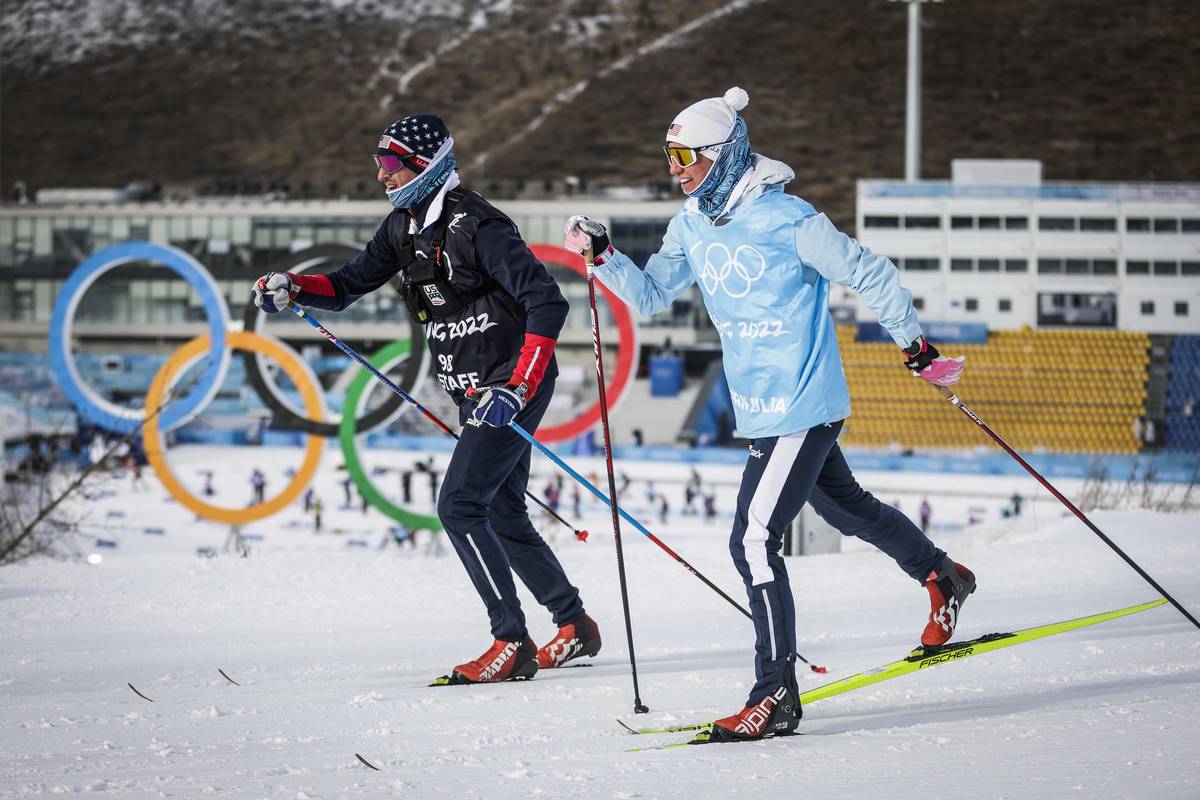
    Hailey Swirbul and Baucom on a ski in China one of their first days on the ground OWG 2022. (Photo: Courtesy Photo)
    Trial, Error, and Evolution

    Not everything Baucom and the team do works, so they have to catalog the results and move on with that knowledge for the next time similar conditions arise.

    “There are certain structures we stay away from that we’ve had bad luck with… and there are certain grinds from different ski companies that we pretty much won’t ever put manual structure on.”

    That’s the tricky part: not all athletes ski the same way, are looking for the same feel from a ski, or ski on the same brand of skis.

    “The most important thing is for each individual tech to have an idea of what works with their athlete’s skis.”

    Baucom and his partner Brooke Segerberg in Davos, Switzerland. (Photo: Courtesy Photo)
    A Historic Day

    Elite skiers train nearly a thousand hours a year, year after year, which is the required ante chip to line up at a race, especially an Olympic one. For Baucom and the rest of the US Ski Team service staff, the skis raced on World Cup weekends and at these Olympics did not come together the way you might prepare them for a Saturday morning ski. It, too, took thousands and thousands of hours of work over decades of involvement for the entire service team to put world-class skis in the athletes’ hands so they could realize their dreams.

    Another historic day might materialize at these games, and one thing we know for certain is that the service staff is working hard to make it happen.

    Help Support Our Olympic Coverage!

    FasterSkier has our own Nat Herz on the ground at the Olympics, which is a significant financial lift for us. If you value the thoughtful work and access FasterSkier provides at championships like this one, please consider becoming a Voluntary Subscriber. Your support directly fuels our work to cover the people, places, and moments that make our sport special.

    Join the FasterSkier community!


  • An accountant, a summer flooring salesman and an Estonian helped Diggins deliver bronze. Here’s how.

    An accountant, a summer flooring salesman and an Estonian helped Diggins deliver bronze. Here’s how.

    ZHANGJIAKOU — Patrick Moore is a cheerful accountant from Edmonton, Alberta. Tim Baucom spends his summers working sales for a Vermont plank flooring company. Oleg Ragilo runs a cosmetic shop in Estonia with his wife.

    Jessie Diggins, the American cross-country ski star, couldn’t have won her Olympic bronze without them.

    Jessie Diggins earns an Olympic bronze medal in the 1.5 k freestyle sprint. (Photo: NordicFocus)

    Moore, Baucom and Ragilo all belong to America’s nine-member ski service team here — a mix of mostly paid staff and a couple of volunteers like Moore.

    “I can’t speak highly enough of their work ethic — they’ve been out here every single day, hours and hours and hours, probably skiing like 50 k a day,” Diggins said after finishing eighth Thursday in her third race of the Games. She added, referring to her medal-winning ski: “They delivered such a clutch performance the other night.”

    The service crew is charged with the complicated, high-stakes work of choosing the right skis and wax for the snow conditions in Zhangjiakou, the mountain resort town outside Beijing where Olympic cross-country events are taking place.

    The task sometimes can make the difference between an average day and a medal. 

    But the work, which happens in drab tan buildings off a corner of the stadium, is relatively anonymous — except when things go wrong.

    “I think it’s sometimes hard for people at my regular job what I look like here,” said Moore, the accountant. “And it’s probably hard for people at this job to understand what I look like there.”

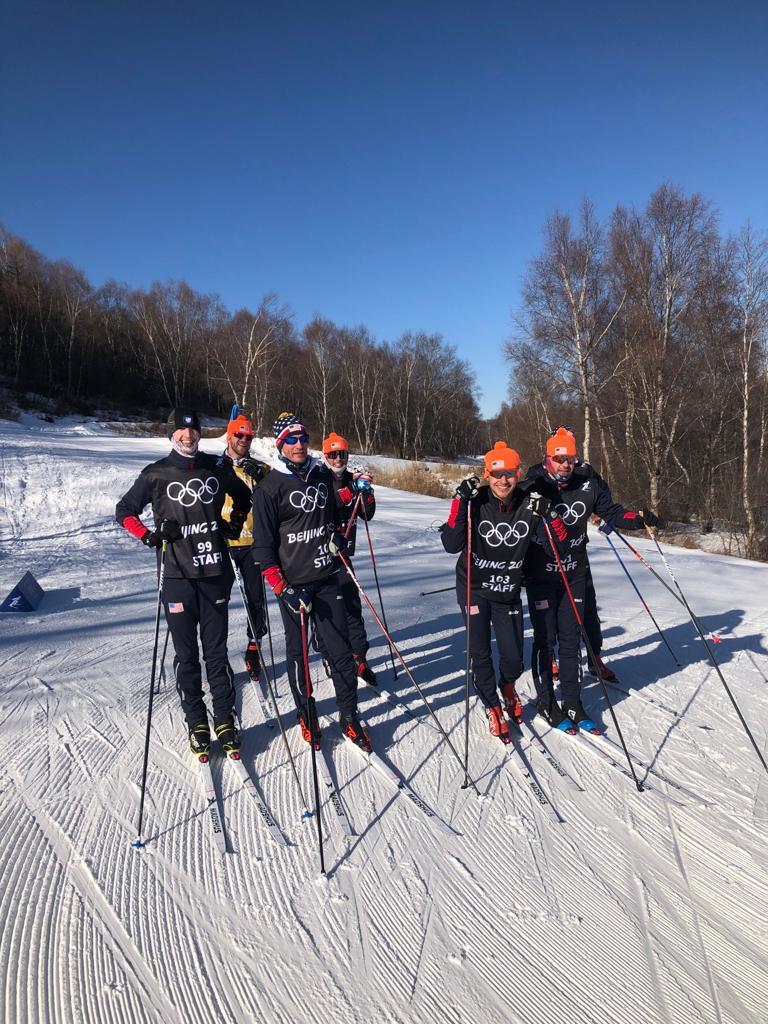
    The U.S. wax staff arrives in Zhangjiakou. From left to right, Patrick Moore, Andrew Morehouse, Bjorn Heimdal, Tim Baucom, Chris Hecker, Jason Cork, and Eli Brown. (Photo courtesy fellow technician, Karel Kruuser)

    The U.S. service team is composed of a mix of Americans and Europeans — including Ragilo, who previously waxed for superstars in Estonia and is something of a legend there.

    To appreciate the crew’s work requires a quick lesson in ski technology.

    Cross-country ski bases — the part that slides across the snow — are generally made of a plastic called polyethylene, or p-tex. The material has tiny pores, somewhat like a sponge, which means it absorbs wax that’s ironed or rubbed in by technicians; the excess can be scraped off to leave what appears to be a smooth plastic surface.

    Manufacturers produce different waxes to help the skis slide faster in different conditions: warmer or colder, natural snow or man-made.

    The waxes are typically layered, and they can be applied in different ways — ironed in, rubbed in with a cork or even a spinning wool cylinder attached to a drill, for example.

    Technicians can also enhance the gliding potential of skis with metal tools that press tiny, intricate patterns into the bases, known as structure. Then there are the skis themselves, which are built stiffer or softer to suit snow conditions. American athletes each brought dozens of pairs to the Olympics — perhaps 300 total.

    Sorting through each of those variables and identifying the best skis, waxes and structures takes hours and hours of testing. U.S. service team members arrived in Zhangjiakou a week before the first race, and got to work.

    “None of us are scientists,” said Baucom. “But we just tinker around with all this stuff.”

    Old entries in a U.S. wax technician’s notebook keep track of the many iterations tested en route to a winning selection. (Photo: Nat Herz/FasterSkier-ADN)

    The crew spends its first day or two skiing the race courses, setting up gear and getting a feel for the place. Then, they start testing the first layers of waxes and the best methods for applying them, as well as durability: How far can they ski before the wax starts losing potency?

    Most of the testing is done by feel, with two technicians gliding down a hill, side by side, on two pairs of skis with different waxes to see which pair is faster. The American technicians can ski 30 kilometers a day or more; some or the Scandinavian teams with larger staffs have workers whose sole job is testing and can ski twice that far.

    When race day arrives, the U.S. team may have tested 50 or 60 types of glide wax, and a similar number of kick waxes, which skiers use to grip the snow and push themselves uphill. 

    Olympic team staff test skis and wax Friday, February 4, 2022 at the Zhangjiakou National Cross-Country Skiing Center. (Nat Herz/FasterSkier-ADN)

    They’ll narrow that number to perhaps 16 waxes to test in the hours before the gun goes off. Athletes, who are paired with the technicians, will also test a handful of pairs of skis before a race to see which are fastest.

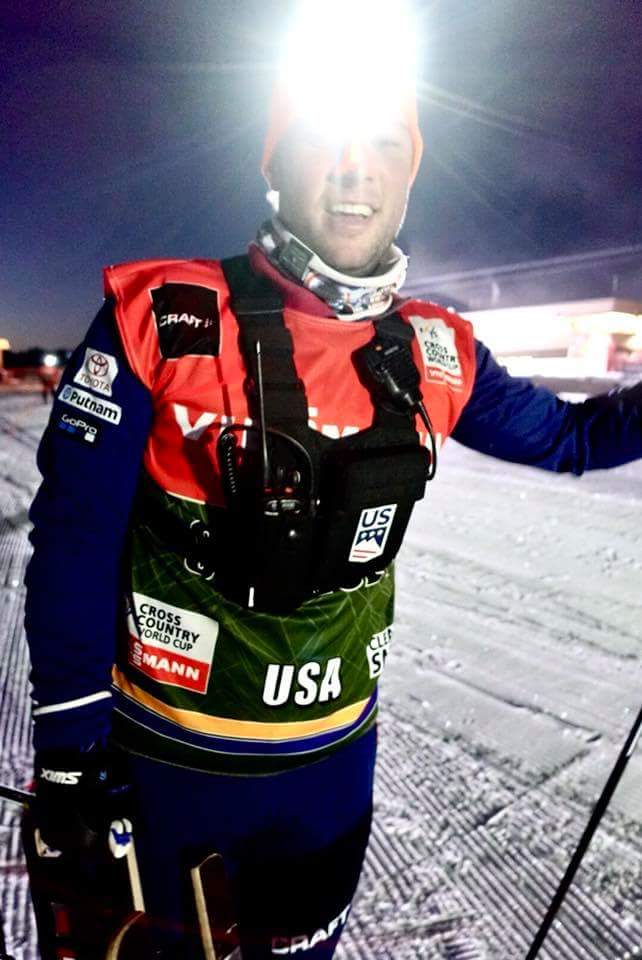
    The Americans aren’t typically expecting to find a magic bullet that makes their skis the best in the field, said Baucom, the U.S. team’s head of glide waxing in Zhangjiakou.

    “You always want to have skis that are ridiculous, and make you look good,” he said. “But really, our goal is to have competitive skis. And it seems like in these conditions, as far as I can tell, almost every team has had pretty competitive skis.”

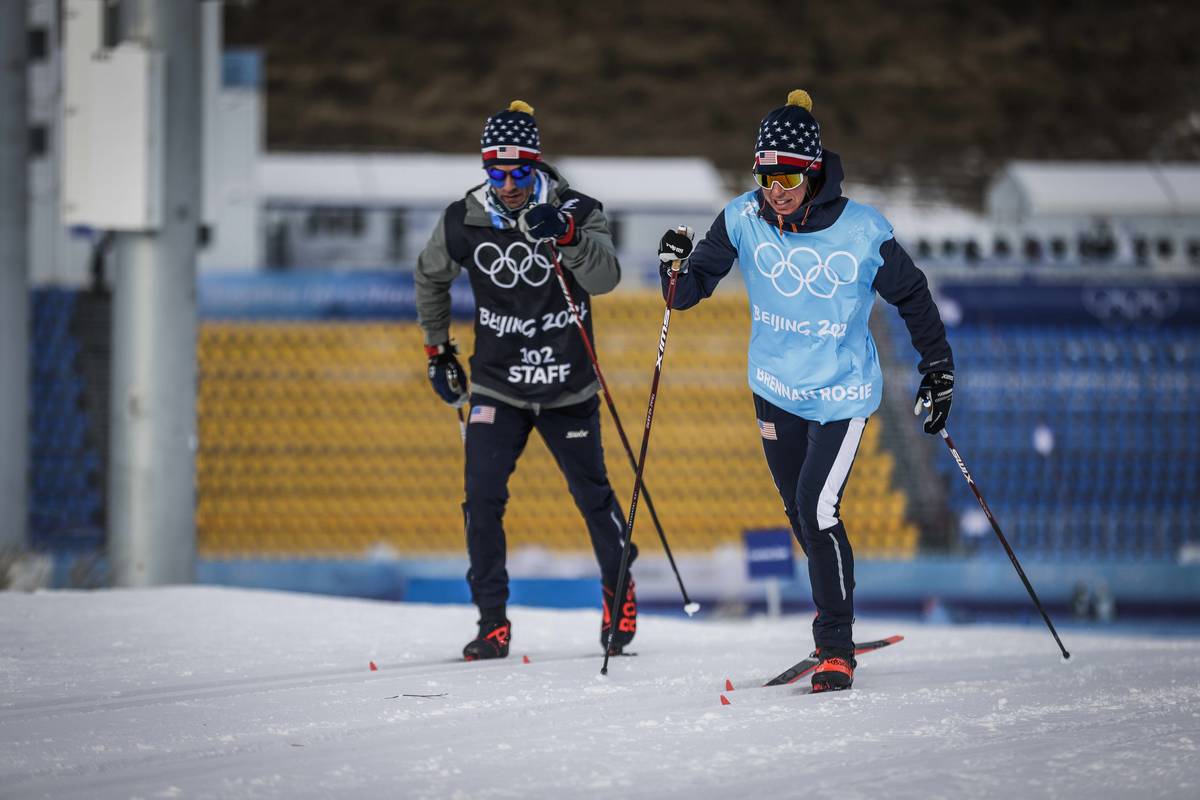
    Rosie Brennan tests skis with her tech, Bjørn Heimdal, before the opening 15 k skiathlon. (Photo: NordicFocus)

    The conditions in Zhangjiakou were the subject of intense speculation before the Games. 

    The area is not far from the Gobi desert and gets minimal precipitation, so skiers are racing mostly on manmade snow. Before the Games, Baucom heard about storms that deposited sand on the trails that ruined skis. 

    But so far, he said, the skiing at the Olympics has been quite good, even if the snow is a little dirty and wears away wax a bit more quickly than usual.

    “It’s not throwing us for a loop as far as being very different from other really cold, dry snow that we’ve raced on,” Baucom said. “It’s abrasive, but it’s not, like, crazy.”

    Ski preparation at the elite level can be something of an arms race: On the European World Cup cup circuit, bigger teams, including the U.S., travel with huge trucks that have been outfitted as roving wax rooms at a cost of $500,000 or more. Those trucks, however, did not make the trip to Zhangjiakou.

    Scandinavian teams spend more money on ski service and have bigger workforces, which can sometimes produce inequities. At the World Championships in Germany last year, the U.S. technicians had an especially tough day in the women’s pursuit race, where the skis they gave athletes were too slow to be competitive. Baucom described the feeling as “gut-wrenching” for the staff.

    Julia Kern prepares for the 15k skiathlon with her wax technician, Eli Brown. (Photo: NordicFocus)

    When things go wrong, the U.S. team will often collect skis after the race and retest, to see what went wrong.

    At the Olympics, though, conditions have been stable and relatively straightforward for waxing, even after a flurry of fresh snow Saturday morning. So far, the American athletes have had few complaints.

    “It feels good to know that everyone has a pretty fair shot,” Diggins said. “I’m just so grateful to our staff, because we win as a team.”

  • U.S. Ski Team Locks In for Waxing, Winning with New Wax Truck

    U.S. Ski Team Locks In for Waxing, Winning with New Wax Truck


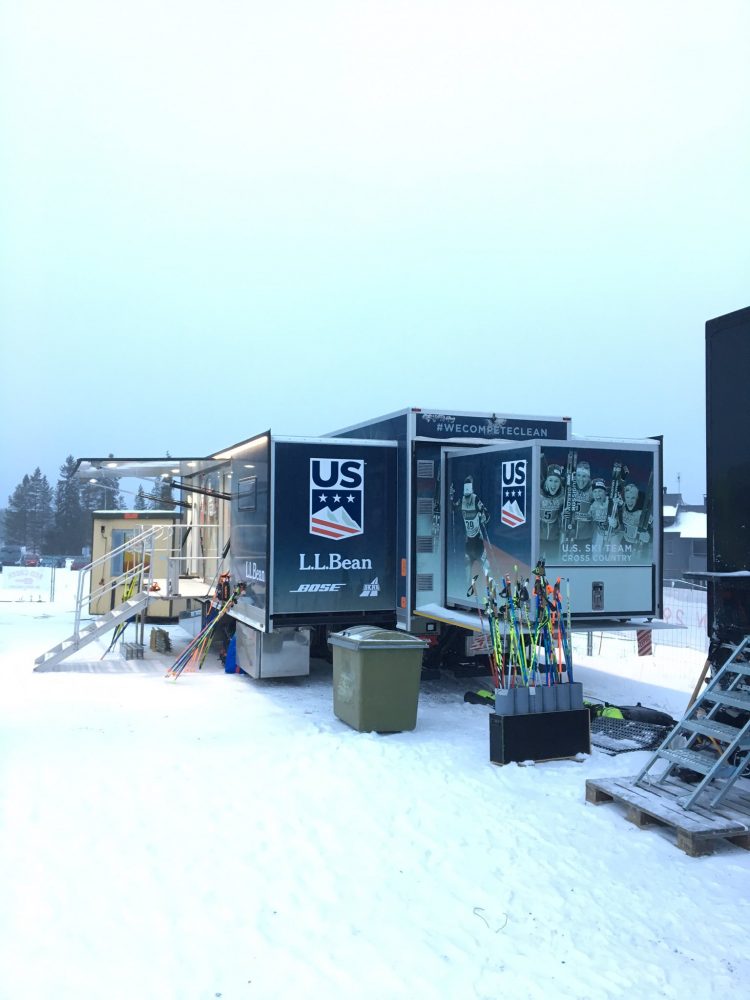
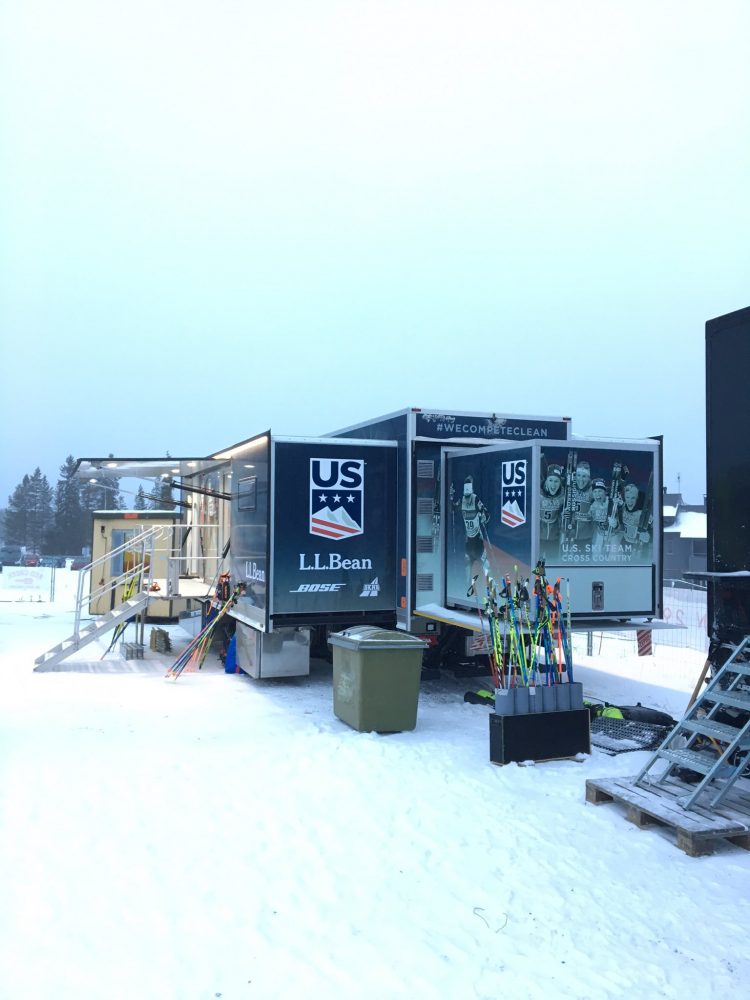
    The new U.S. Ski Team wax truck fully deployed. (Photo: Matt Whitcomb/Twitter)

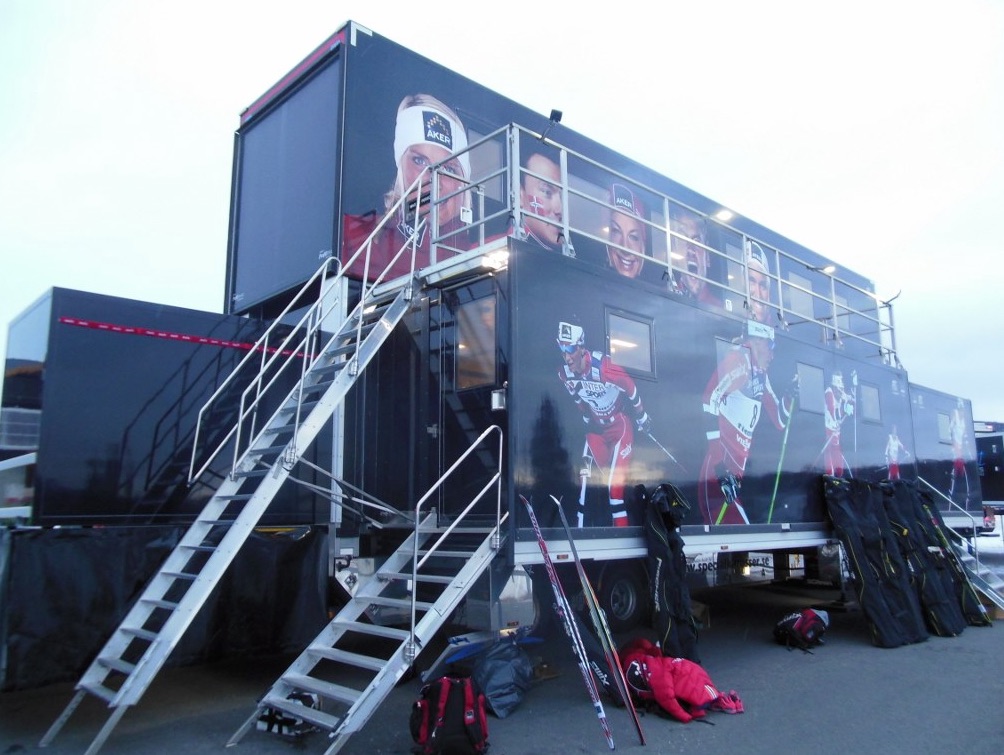
    Since 2008 when Sweden arrived on the World Cup scene with a full-scale, blue-and-yellow-wrapped wax truck, it didn’t take long for the other major cross-country ski nations to not only keep up with the Joneses but surpass them. 2009 saw Norway arrive and begin lording over the wax-truck world with a succession of vehicles. As only Norway might do on the nordic-resource amenities side of things — Norway out Norway-ed itself. Its World Cup cross-country team began with a state-of-the-art wax truck in 2009, but has since moved on up. These days, Norway’s wax-tech crew arrives at World Cup venues with two wax trucks, each with extendable sides and rears, and a pop-top athlete lounge.

    The benchmark: Norway’s wax truck. (Photo: Noah Hoffman)

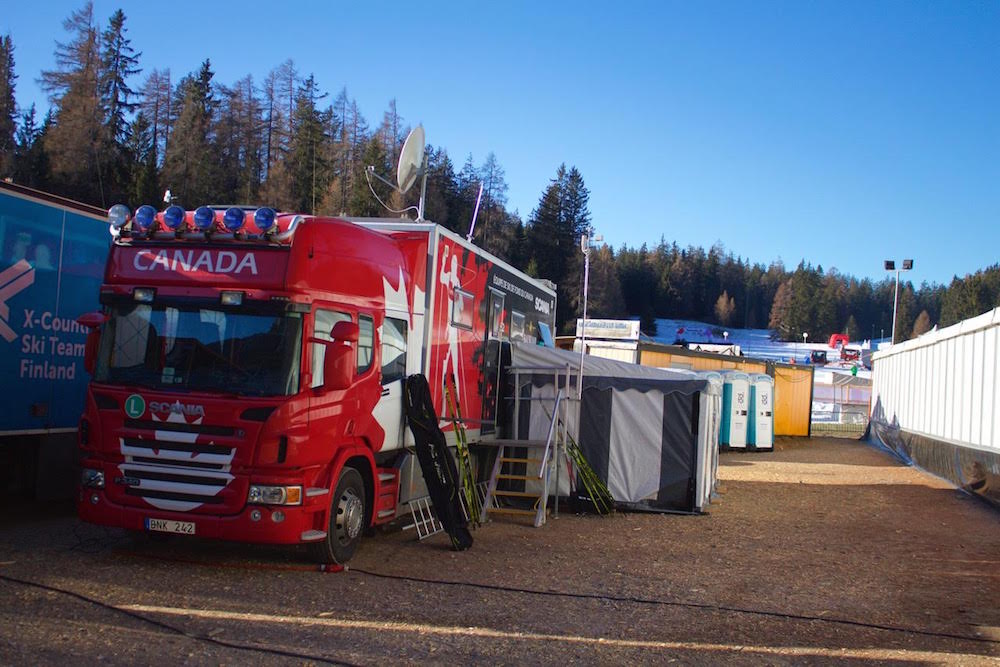
    Even the Americans’ friendly neighbors to the north, Canada, have styled their maple-leaf themed wax truck in World Cup wax compounds since 2013.

    Of the nine top-ranked teams on the World Cup, the U.S. is the last to meet the benchmark of eschewing wax cabins for a wax truck. This season, the U.S. Ski Team (USST) arrived in Kuusamo, Finland, and Lillehammer, Norway — the first two World Cup stops — with its own state-of-the-art mobile ski waxing facility.

    “It’s been in the works for a couple of years,” USST Head Coach Chris Grover said on the phone last month, before the race season began. “One of our USSA Board of Trustees, now Board of Director individuals, Liz Arky, she was the main catalyst behind the wax-truck project. I want to say two years ago in 2015, she was with the team in Davos at the World Cup, and that was the first time she saw firsthand what we were up against. So at that point she came into the wax compound and saw the trucks from all the other nations and then saw how we were operating in our temporary containers, and so she was like, ‘Oh my gosh, how come you guys don’t have a truck? You guys need to have a truck.’”

    For the past several years, the USST has thrived without a wax truck. There have been Sprint Crystal Globes, World Championship medals, and podiums. But safer working environments, and a more stable and efficient workplace should promote healthier wax crews and in theory, a more competitive team when it comes to the wax equation. Rather than a cyclic and backbreaking process of loading and unloading smaller transport vans as the teams depart and arrive at each new World Cup, a wax truck affords continuity and faster pack up and set up.   

    Arky, along with the help of USST veteran Kikkan Randall and U.S. Ski & Snowboard Executive Director and CEO Tiger Shaw, began the hustle for funds. From Aspen to Vail to the East Coast, eventually, the money was raised. Their two-year fundraising effort came through.

    “This truck with all the taxes we had to pay for on it, is a little more than $600,000 dollars,” Grover said. “And actually, quite a big percentage of that is taxed in Europe, the value added tax that you have to pay on that. This is a 600K plus project for us that, of course, is totally separate from our normal budget.”

    With the money secured, Grover explained his team worked with Swedish custom-bus outfitters Scania and SKAB to dial in the wax truck’s design. These two companies assisted the Canadians, Swedes, Russians, and Norwegians with their wax truck build outs as well.

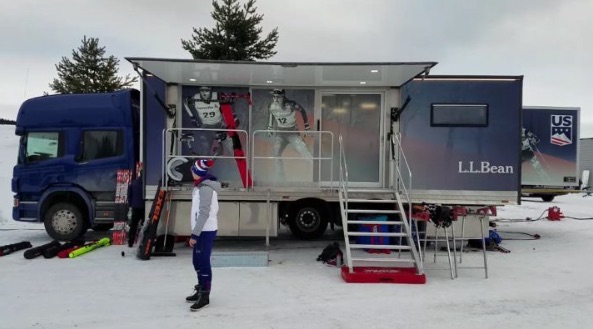
    The USST’s newly minted wax truck. (Photo: Noah Hoffman)

    “Our truck is the same cab and chassis as the Canadian truck. It’s not a tractor-trailer; it doesn’t articulate like that,” Grover said of the wax truck’s underlying chassis. “You don’t need the highest class of driver’s license in Europe in order to drive it; it is more like a bus when it drives. However, the size of the Canadian truck wouldn’t work for us because it’s too small. It only expands in the back where there is a ski storage box that pops out the back, and it only can accommodate six workstations, but the Canadians carry fewer athletes in the World Cup than we do typically and at major championships, and so we needed something bigger.”

    The U.S. wax truck expands from the back like the Canadian truck. The similarities in terms of expansion end there. The U.S. version extends from both sides, but not vertically like the Norwegian trucks.

    The Canadian “tour bus”, a.k.a. wax truck, parked in Lenzerheide, Switzerland, as seen Dec. 30, 2015, before the start of the 2016 Tour de Ski. (Photo: JoJo Baldus)

    “I want to say it creates something like 30 square meters of workspace,” Grover said. “In addition, we also had a covered porch added, like the Russian truck, and the reason is so we can basically kick wax outside in the cold and have it covered if it’s snowing. That’s a really cool feature like we saw in the Russian truck and we were like, ‘We gotta have this,’ because sometimes you can’t kick wax inside when it’s hot inside the truck and you need to go outside, but it’s nice to have it covered if it’s really snowing or something … It’s quite wide when it’s expanded.”

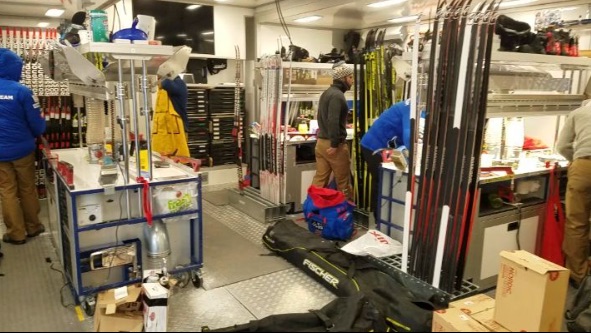
    Inside the truck are four workstations with two functional benches each. Those workstations are mobile in a sense — they are fitted to locking caster wheels making them movable and easily stored when the truck is mobile.

    Interior ventilation is a major concern when considering exposure to toxic fumes and particulates, especially when working with vaporized fluorocarbons. According to Grover, the USST wax truck is fitted with ventilation to mitigate the hazards. Each wax station is ventilated independently with industrial fume hoods.

    “Basically for everyday wax-working, you would not need a [respirator] mask in this setup,” noted Grover. “However, and when people get powdering, we are still going to wear a mask. We are going to be on the safe side. Not only do we have this ventilation that is going, but we are also making sure that every person in the truck is 100 percent safe.”

    The ventilation system is not a single large-scale,vacuum-type system where the expelled air is refreshed with clean air.

    “It is interesting, I obviously learned a lot about this in the process,” Grover said of the technical side of ventilating the wax truck. “You cannot really have one massive ventilation system that is sucking all of the air out all the time, because it creates vacuum locks on the doors, and nobody can get out of the trailer. So that is a challenge.”

    The Norwegian team uses specialized irons with ventilation tubes attached directly to the iron to draw and then expel any vapors emitted from the iron/ski-wax interface. The U.S. truck does not feature these costly irons, however, the workstations are outfitted in a manner that can accommodate these types of venting irons without any modifications to the pre-existing build out.

    Relatively clutter-free and ready for waxing inside the new USST wax truck. (Photo: Noah Hoffman)

    The truck also features storage for the more than 600 pair of skis and an array of coordinated storage compartments that might make an Ikea designer drool.

    Five of the U.S. wax techs are certified to drive the truck. They have been trained and certified with CDL’s (commercial driving licenses). And all five wax techs can travel at once in the crew cab, which also features a bed. Grover noted that it is unlawful for anybody to be in the bed while the truck is moving.  

    “This is a total utilitarian, well lit, well ventilated, well lit, open, easy workspace for the techs,” Grover summarized.

    The start to the season has been solid two weekends with two podiums, several top 10’s, and a fancy wax truck to complement the U.S. team. 

    ***

    Related: Check out our off-the-cusp Nordic Nation podcast where we interview U.S wax tech Tim Baucom, who along with Andrew Morehouse, were on the road from Lillehammer, Norway, to the next World Cup in Davos, Switzerland, with $600,000+ of precious cargo.

    — Andrea Potyondy-Smith contributed
  • Nordic Nation: Wax-Truck Road Trip with Tim Baucom (While Andrew Morehouse Pilots)

    Nordic Nation: Wax-Truck Road Trip with Tim Baucom (While Andrew Morehouse Pilots)

    Not exactly planned, and on a whim, it’s the wax-truck road trip — otherwise known as the Bon Voyage episode.

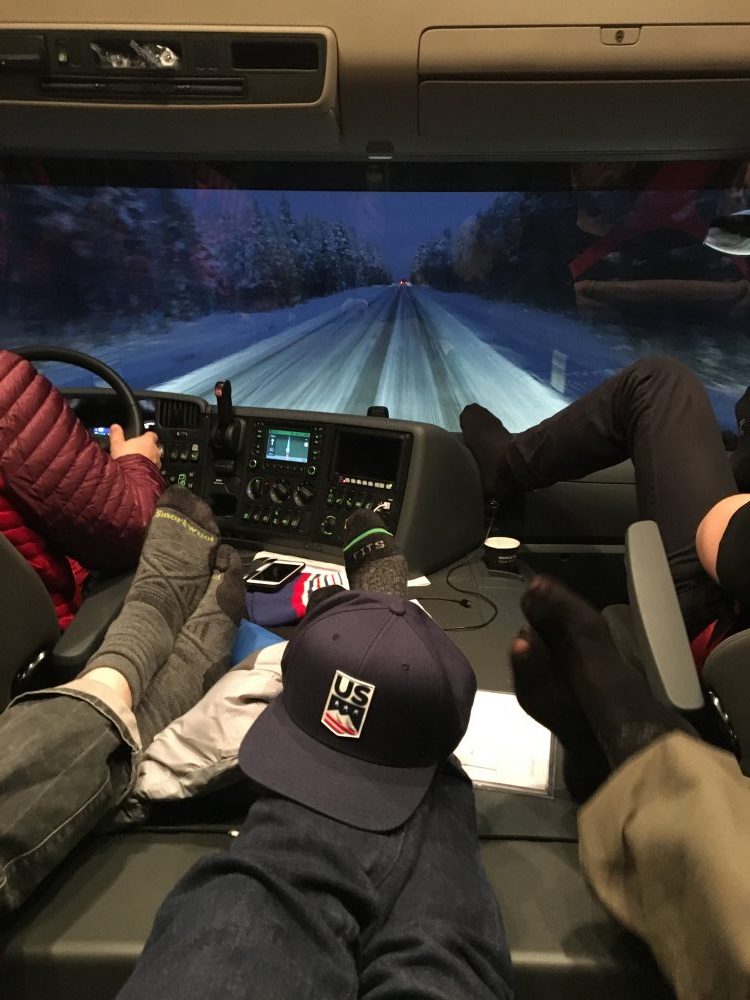
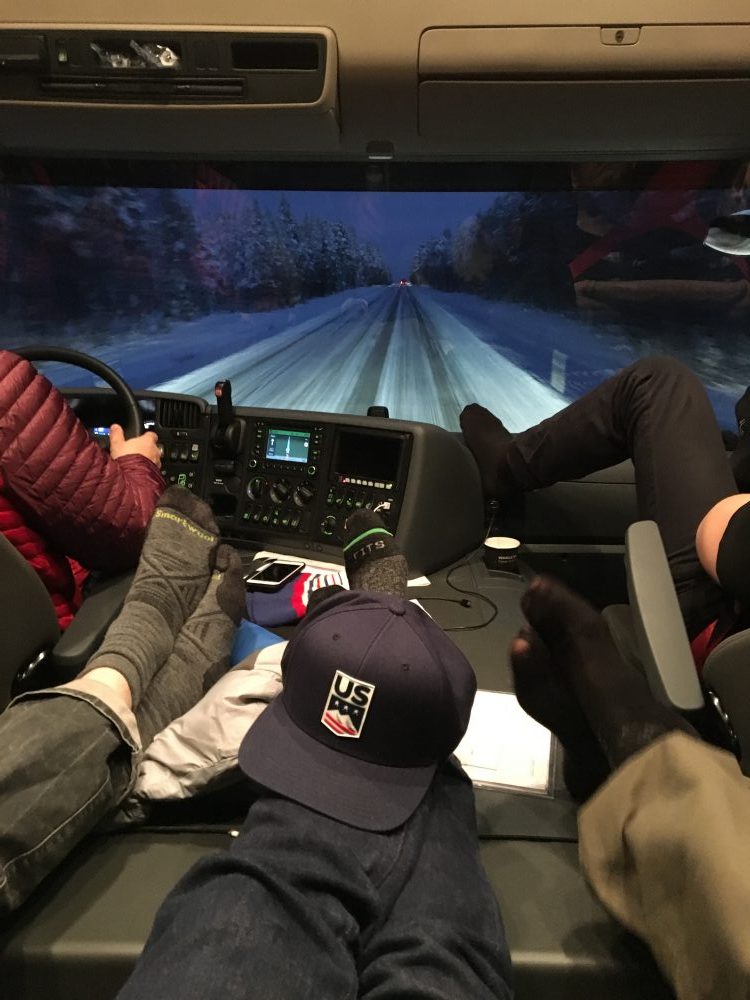
    A full crew cab in the USST wax truck. Presumably on the way from Kuusamo, Finland, to Lillehammer, Norway. (Photo: Tim Baucom)

    Nordic Nation dialed up intrepid wax-truck driver and navigator … and U.S. Ski Team Wax Tech Tim Baucom to check in on the new wax truck’s first big Euro-trip. We caught up with Baucom on Day 1 of a three-day trip a few hours after the duo left Lillehammer, Norway, where last weekend’s World Cup races were held. The two techs were headed to Davos, Switzerland, site of this weekend’s World Cup.

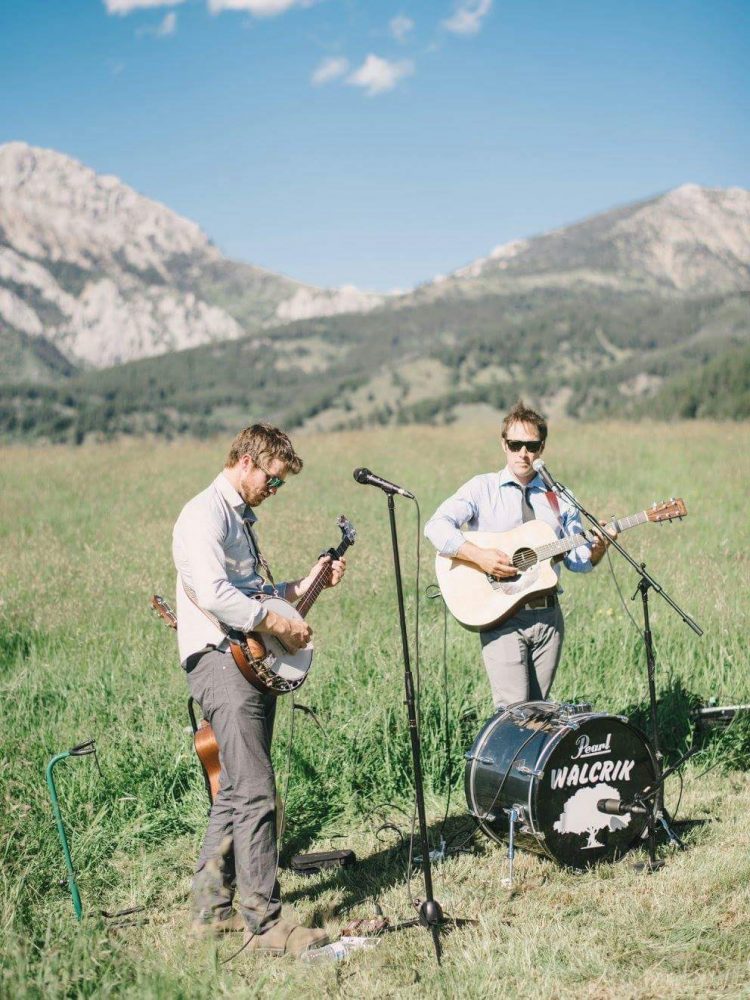
    Waxing World Cup fast skis and backed up with a CDL is not their only gig: Tim Baucom (right) and Andrew Morehouse (left) play the Newell-Flowers wedding outside Bozeman, Montana. (Photo: Jeremiah and Rachel Photography)

    Baucom and Morehouse were responsible for $600,000 dollars of precious wax truck (that amount includes the taxes on the truck), as well as something like 600 pairs of skis.

    That’s a lot of XC schwag. And a lot of eventual ski cleaning. (See below.)

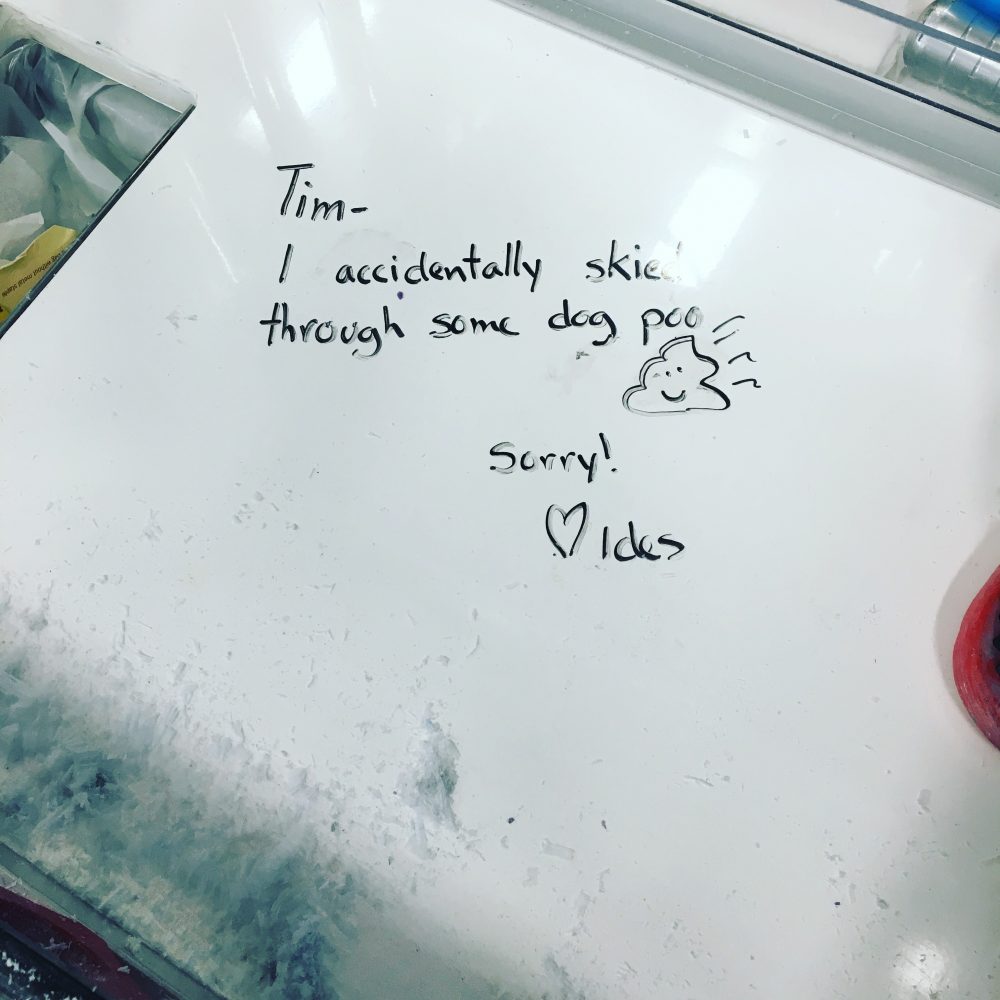
    USST wax techs go beyond the call of duty. Tim Baucom is responsible for Simi Hamilton’s and Ida Sargent’s skis throughout the season. Here, Sargent leaves a note for Baucom (with graphics) detailing the cleanup. (Photo: Tim Baucom)

    And just to be safe, we also dialed up Baucom on Day 2 of their three-day journey to Davos. It’s always a good idea to check back in — new pricey truck, irreplaceable skis and two of the finest wax techs on the circuit — who doesn’t want the whole package to be safe?

    Putting the CDL to good use: truckin’ along in the USST wax truck with the big rigs in Europe. (Photo: Tim Baucom)

    For the record, Baucom and Morehouse are safe, legit and well trained. Don’t believe Nordic Nation? Here’s online proof of their CDL’s.

    Listen to Baucom unbound.

    USST wax tech Tim Baucom testing wax and skis in the early a.m. in Lillehammer, Norway. (Photo: Zach Caldwell)

    (To subscribe to the Nordic Nation podcast channel, download the iTunes app. If you have iTunes, subscribe to Nordic Nation here.)

  • Wednesday Workout: Old-School Strength with the NTG

    Wednesday Workout: Old-School Strength with the NTG

    Ben Ogden and Bill Harmeyer during double-pole speeds at the 2017 Junior NTG Camp earlier this month at Soldier Hollow in Midway, Utah. (Photo: Bryan Fish)

    For this week’s workout, we asked for a specific-strength workout from this year’s Junior National Training Group (NTG) Camp, which was held Aug. 2-15 near Park City, Utah. One of three coaches at the camp, Maria Stuber (head nordic coach at the College of St. Scholastica), shared the following, which she described as an “old-school endurance strength workout.” She led the camp with two U.S. Ski Team (USST) staff members, development coach Bryan Fish and World Cup wax technician Tim Baucom. Eighteen athletes attended — 10 men and eight women — all under the age of 21.

    Lauren Jortberg and Nicole Schneider doing double-pole speeds at the 2017 Junior NTG Camp earlier this month at Soldier Hollow in Midway, Utah. (Photo: Bryan Fish)

    “The U24’s are invited to other U.S. Ski Team camps like our October camp and our May Bend camp,” Fish explained in an email.

    The goal of this month’s camp was “to get our very best together to train and learn from one another,” he wrote. “These are athletes that are already or very well may soon be on the U.S. Ski Team, so building a healthy and positive training environment for these athletes is critical.  Secondly, building an environment where these athletes push each other yet trust one another is critical.  Many of these athletes have already traveled overseas together and continuing to strengthen their comfort and focus toward how we can support, lean on and succeed together – as a group, as a nation, as a team.

    “Third, we want to provide these athletes with meaningful feedback,” Fish continued. “The athletes work with our high performance department at U.S. Ski & Snowboard to learn what individual items they are already strong as well as windows of opportunities for improvement.”

    The primary focus was to provide a “strong training environment,” he wrote, while also testing athletes in areas like strength, power and mobility with a protocol similar to the U.S. Ski Team.

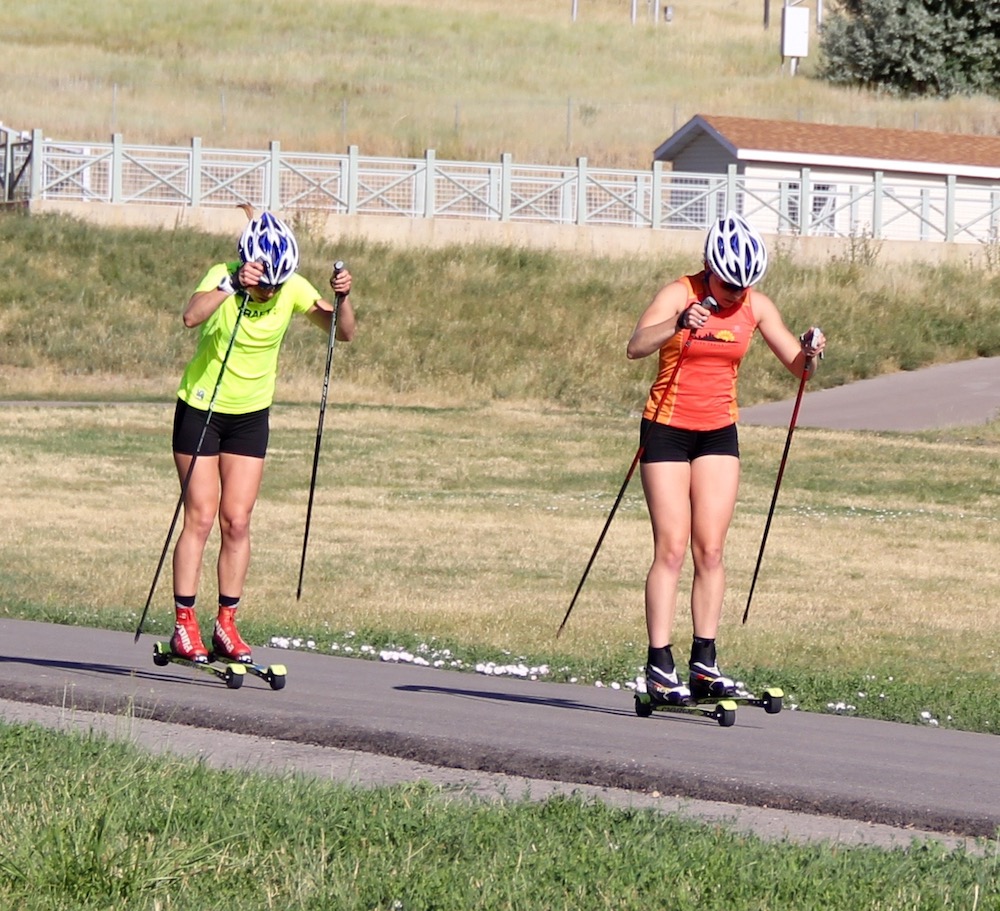
    Throughout the two-week camp, there was an abundance of rollerskiing and threshold ski walking/bounding, as well as strength work.

    “One question that commonly comes up is why such workouts are becoming less familiar or possibly less utilized in coaches’ training plans,” Fish wrote, referring to specific strength. “I think it is because more programs are incorporating this type of effort into classic sprint training sessions. That being said … [this workout develops] many important technical and physical skills.”

    Stuber explained that the workout emphasizes repetition “to work out technique issues and to feel efficiency differences,” she wrote. “It is also a fun social workout because the whole team stays in one place and you can have a good time with rivalries and inter squad competition. “

    The workout: Specific Strength on Skis

    • 20-minute warmup
    • Followed by:
      • 8 x 30 seconds single stick
      • 6 x 30 seconds core-only double pole
      • 8 x 30 seconds double pole
    • 20-minute cool down

    “We did not harp on technique too much and let the athletes think and discover what was working best to move across the ground with the group,” Stuber noted.  “We had video on an iPad for those who wanted to see what they looked like and if the changes they were feeling were showing up on camera.

    “There were a lot of blisters,” she added. “Gloves are recommended for this workout.”

  • Men Go to SoHo, U.S. Women in the Methow (Camp Photo Galleries)

    Men Go to SoHo, U.S. Women in the Methow (Camp Photo Galleries)

    The U.S. Ski Team women’s team at work during a 10-day camp in the Methow Valley. (Photo: Matt Whitcomb/U.S. Ski Team)

    (Note: This article has been updated to include comments from Canadian coach Ivan Babikov on his team’s recent camp in Park City, Utah.)

    Two days after Andy Newell and Erika Flowers tied the knot in Bozeman, Mont., seven members of the men’s U.S. Ski Team and eight U.S. women’s team members jumped into an intensity training block at their respective dryland camps in Park City, Utah, and the Methow Valley in northern Washington.

    The 10-day camps were scheduled simultaneously from June 26-July 5 to accommodate the wedding. Newell is a longtime U.S. Ski Team (USST) member and teammates with Flowers on the Stratton Mountain School (SMS) Elite Team out of Stratton, Vt. Because several national-team members ventured to Bozeman (Flowers’s hometown) to watch them say “I do,” the USST coaches decided to reduce travel and keep their squads together out west.

    “We wanted to capture the men in the Intermountain West immediately following Andy Newell’s wedding in Bozeman, and therefore reduce the overall travel load for athletes who were already coming to the West from the East or Alaska,” head coach Chris Grover explained in an email.

    The men based themselves in Midway, Utah, about 1,500 feet lower in elevation than Park City and 1,000 feet lower than Deer Valley, where they typically reside for summer and fall camps. Grover explained that this was by design, “because of the shorter duration of the camp (i.e. too short to create a meaningful stay at altitude), the focus on specific intensity workouts, and the benefits of quicker recovery at lower altitude,” he wrote.

    Staying closer to the Soldier Hollow training venue was also ideal for the men’s team’s “PyeongChang-specific workouts”, Grover explained, including sessions focused on the freestyle team sprint, classic sprint and 4 x 10-kilometer relay, which will be contested at the 2018 Winter Olympics in PyeongChang, South Korea.

    Newell, Simi Hamilton, Erik Bjornsen, Scott Patterson, Paddy Caldwell, Ian Torchia, and Ben Saxton attended and worked with coaches Jason Cork, Pat O’Brien, Grover, and U.S. Ski & Snowboard Strength and Conditioning Coach Tschana Schiller.

    “The men did a great job of bringing heightened focus and effort to these key intensity workouts and we are grateful to the staff at Soldier Hollow for preparing the track for us,” Grover wrote. “Overall, it was a very productive camp and I think sent the men into the main summer preparation period with important areas to work on, a good gauge of fitness, and a further understanding of what skills need to be developed for the WC [World Cup] season and for PyeongChang.”

    (Article continues below)

    ***

    Meanwhile, the U.S. women tried a new camp in the Methow Valley, home of current national-team members Sadie and Erik Bjornsen. The athletes themselves dubbed it the “CAGS Camp“, which U.S. women’s coach Matt Whitcomb explained stood for “a secret and mildly inappropriate team acronym that pokes fun at girls being girls. Sophie had hats made for the camp that she handed out at the airport when everyone arrived.”

    All kidding aside, the goal of the camp was to be small and intensity focused, “with eight days of training and hard intervals every other day,” Whitcomb wrote in an email. “It’s an unusual setup for our team as we usually run joint camps with the men, but both enjoyed the simplicity of having such small training groups.

    “We chose the Methow in part because it is where Sadie and Erik Bjornsen grew up, but also because we could get close to sea-level to maximize our hard efforts,” he added. “Another draw was that Pete Dickenson, one of our team physical therapists, was able to provide great treatment all week. Winthrop PT & Fitness sponsored our strength sessions, which meant we didn’t have to drive very far to get strong.”

    Like Grover, Whitcomb used the word “ideal” to describe the Methow as a training site, yet emphasized that the community that hosted them was “even more incredible.”

    “A local couple gave us their two cabins in a location as beautiful as we’ve seen anywhere in the world,” he wrote. “The chance to meet Olympians Laura McCabe (’94, ’98) and Leslie Hall (’88, ’92, ’94) was an important experience for the team. We owe them special thanks not for just guiding us to their favorite training spots, but for helping pave the early path for elite women’s skiing.”

    The women’s team, which included Sadie Bjornsen, Rosie Brennan, Sophie Caldwell, Jessie Diggins, Katharine Ogden, Kikkan Randall, Ida Sargent, and Liz Stephen, spent one afternoon working with with the Methow Valley Nordic Team, which McCabe and Hall both coach.

    “We invited a handful of their top athletes to join our bounding and ski walking sessions, and were encouraged by their technique and fitness, but also their love for the sport,” Whitcomb wrote. “They are doing a good job up there. I don’t know what the future holds for us regarding camp locations, but the Methow Valley will be considered as a great option moving forward.  Thanks to so many people for making it happen.”

    Women’s team staff included Whitcomb, Tim Baucom and physical therapist Pete Dickenson.

    (Article continues below)

    ***

    Cross Country Canada also recently finished up a two-week camp in Park City (June 26-July 11) with its entire men’s World Cup team — Alex Harvey, Len Valjas, Devon Kershaw, Jess Cockney, Knute Johnsgaard, and Graeme Killick — and U25 national-team member Julien Locke. Co-World Cup coaches Ivan Babikov and Louis Bouchard accompanied the team for the duration, and Joel Jaques joined for the first week.

    While Park City has become an annual staple for the Canadian team, Babikov explained that this was their first time there in the summer, as opposed to the fall.

    “We love the area and training there. … It was pretty hot but we managed,” he wrote. “The main goal was a big training volume/hours at the altitude. We were planing on doing a time trial at the SoHo but it got closed for those dates so we ended up doing intensity down in Salt Lake instead.
    It was a great camp for all the guys, everyone feels good and no injuries on the team.”

    https://www.instagram.com/p/BWF7eG6HLJo/?taken-by=coach_babs_

    https://www.instagram.com/p/BWP_Wi_nYV3/?taken-by=coach_babs_

    https://www.instagram.com/p/BWdDCu1nObo/?taken-by=coach_babs_

  • Returning to Her Roots: Trygstad-Saari Becomes Elite/Post-Grad Coach with Bridger Ski Foundation

    Returning to Her Roots: Trygstad-Saari Becomes Elite/Post-Grad Coach with Bridger Ski Foundation

    Former Bridger Ski Foundation (BSF) elite team racer Kristina Trygstad-Saari was recently named head coach of the BSF elite nordic team. (Photo: Mary Klotz)
    Former Bridger Ski Foundation (BSF) elite team racer Kristina Trygstad-Saari was recently named head coach of the BSF elite nordic team. (Photo: Mary Klotz)

    A return to one’s roots can often lead to new opportunities. Such is the case with Kristina Trygstad-Saari, a Bozeman, Mont., native and Bridger Ski Foundation (BSF) alumnus who was recently named the ski club’s elite and post-graduate coach for the 2014-2015 season.

    Trygstad-Saari found her start in nordic ski racing with the Bridger Ski Foundation and found great success in her skiing under the guidance of head coach, Dragan Danevski. After nine junior-national titles, Trygstad-Saari attended the Junior World Championships in 2002 and earned one of the top finishes by an American woman in the championships after finishing sixth in the 5 k freestyle.

    After her junior years were over, Trygstad-Saari made her leap to the collegiate circuit at Dartmouth College, where she skied with the Big Green for two seasons. She left New Hampshire in 2007, ready for a break from ski racing. However, when the 2010 Olympic Games were on the horizon Trygstad-Saari was ready to give it another go, and adorned the red BSF racing suit along with former teammate Leif Zimmermann. While she didn’t make the Olympics, she continued to stay involved with the Bridger Ski Foundation.

    Kristina Trygstad-Saari (BSF)
    Former Bridger Ski Foundation (BSF) elite team racer Kristina Trygstad-Saari was recently named head coach of the BSF elite nordic team.

    With her beginnings as a coach in the U14 age group, she made her way up through the ranks of the coaching staff, until she left Bozeman to be the men’s assistant team coach at Dartmouth for the 2012-2013 season, helping the team earn a fifth place finish at the 2013 NCAA Championships in Middlebury, Vt.

    Since her season-long stint at Dartmouth, Trygstad-Saari, returned to Bozeman and BSF in the hopes of revitalizing the masters program as well as creating a new citizen’s race series aimed at attracting members of the community who were uninvolved with the ski club.

    “In the past we had a masters coach but it hasn’t been super established and we’ve rotated coaches through each session,” Trygstad-Sarri said in a recent phone interview. “I kind of wanted to take that on and make it a more established program for a year.”

    She considers her work last season a success, especially in regards to the citizen’s race series, hoping that the progress she made will continue in the future. “It was our first year doing it and it actually went really well. We had between 50 and 75 skiers at every race and a lot of those were citizens racers and not from BSF. We felt really great about how it went.”

    With the departure of BSF coaches Tim Baucom, who is headed to Sun Valley as a wax technician, and Andrew Morehouse, who was hired as an assistant coach at Montana State University, a void was opened in the elite coaching staff of BSF. Due to her history with the club, success in both national and international racing, and experience coaching, Trygstad-Saari was viewed as the perfect fit.

    According to Baucom, he simply “needed something different” after several seasons of working as a wax technician and assistant coach at BSF.

    “[Andrew] and I both decided, independently of course, to move on from BSF,” he wrote in an email. “I really value everything I have learned working for BSF over the last 5 years, and believe it is a excellent club.”

    In her new role, Trygstad-Saari said her main goal is to create a cohesive team atmosphere that not only helps skiers attain their individual goals but also helps further the team as a whole.

    “Even though skiing is an individual sport, we’ve seen that it’s really important to have a good group to train with and be with and live with and travel with,” she said. “I would really like to establish a more cohesive group and bring more people to Bozeman and up our elite team status in the world of elite teams.”

    Former Bridger Ski Foundation (BSF) elite team racer Kristina Trygstad-Saari was recently named head coach of the BSF elite nordic team. (Photo: Doug Edgerton)
    Former Bridger Ski Foundation (BSF) elite team racer Kristina Trygstad-Saari was recently named head coach of the BSF elite nordic team. (Photo: Doug Edgerton)

    This spring, an influx of new skiers joined the team, which already included veteran Jennie Bender, the 2014 U.S. national champion in the freestyle sprint. They include Trygstad-Saari’s former Dartmouth athlete, Sam Tarling, Eric Wolcott (formerly of St. Lawrence and CXC), Riley Eusden (Bowdoin College), former BSF skier Sawyer Kesselheim, as well as a variety of post-grad skiers.

    Asked whether Torin Koos, a multiple Olympian and national champion, would return to the elite team in any capacity, Trygstad-Saari said he was finishing up school and making that decision about racing next season.

    “We’re not sure about that,” she said. “I think he’s done with his full-time skiing career but we’re open to other options.”

    As for Danevski, he will retain his role as BSF head coach, and Trygstad-Saari will assume the role of elite coach.

    “She’ll run workout and communicate with athletes and I will be in the back supporting,” he said in a phone interview. “I’m working with Kristina on developing the year round plan and trainings and volume of training and intensity and wax. Athletes will have access to talk to me, or they will go through Kristina, and Kristina will ask me these things.”

    At the end of the day, Trygstad-Saari is happy to be working with her former coach in the community where she developed her skiing career.

    “Dragan is a really great leader and he provides a foundation for all of this and I’m excited to work with him and learn from him and be able to execute the job on my own on a daily basis but have him back me up and help me out,“ she said. “I think that BSF and Bozeman have a lot to offer skiers and we have a lot of potential in this area. We’ve spent a lot of time trying to put these teams together so I think that we have the opportunity to take another step in the right direction.”

  • Wednesday Workout: Bozeman Creek Climb

    Wednesday Workout: Bozeman Creek Climb

    BSF skier Sam Miller racing at Soldier Hollow in 2012. (Photo: Bridger Ski Foundation)
    BSF skier Sam Miller racing at Soldier Hollow in 2012. (Photo: Bridger Ski Foundation)

    During the holiday season opportunities for races can be few and far between, and it’s often easy to get into the lull of long distance skis with old friends. While these can be fun and beneficial, it’s important to get some high intensity and completive training in before the season starts to intensify in January.

    The Bridger Ski Foundation training earlier this year (Photo: Bridger Ski Foundation)
    The Bridger Ski Foundation training earlier this year (Photo: Bridger Ski Foundation)

    One team that’s found a way to incorporate both the holiday spirt and high intensity training is the Bridger Ski Foundation, located in Bozeman, Mont. Every year they host the Bozeman Creek Climb, a hill-climb time trial aimed at giving some high intensity race experience to community skiers in a low-key environment.

    “For the juniors and Elite athletes, the climb gives them an opportunity for intensity and to get in the pre-race rituals before the competition season heats up,” wrote Tim Baucom, competitive team and U18/U20 coach for the Bridger Ski Foundation. “There aren’t many racing opportunities around here between early December and nationals, so this is an important test.”

    The climb, which is the first leg of the Bozeman Community Cup race series, takes place in the beautiful Sourdough Canyon where the trail is maintained and groomed by the Bridger Ski Foundation and the National Forest Service. The first kilometer is fairly flat, but the rest of the 16 k trail is a pretty consistent climb, making it one of many great training locations around town.

    Participants have the option of taking the 5 k course to the rustic Forest Service outhouse, or the 10 k course, which finishes at “the bridge.”

    “It’s a good way for the BSF community to come together and get some great training in, as well as some fun during the holiday season,” said Katie Gill, a former Bridger Ski Foundation racer and current captain of the University of Denver’s ski team who participates in the time trial almost every year.

    The Workout:

    Torin Koos of the Bridger Ski Foundation training earlier this season.
    Torin Koos of the Bridger Ski Foundation training earlier this season (Photo: Bridger Ski Foundation)
    • 20-30 minute warm up
    • 5 k or 10 k classic hill-climb time trial at threshold or above
    • Cool down on the way back followed by hot chocolate and other holiday treats

    In addition to completing the daunting task of finishing, there can also be other obstacles on the course. It is not uncommon to see a moose or two on the trail. But don’t worry, as long as you keep your distance everything should be fine; it’s all part of the experience.

    Once finished, skiers head back down for awards that come in the form of wrapped presents, hot chocolate and other holiday treats.

    When all is said in done, the Bozeman Creek Climb is about fun community competition.

    “It’s one of those races where everyone is racing together… and sibling rivalry is the main focus,” Gill said. Her sister, Lizzie, is also a frequent participant.

    This year’s Bozeman Creek Climb starts at 9 a.m. on Dec. 28. There is race day registration and the cost is $10. Check the Bridger Ski Foundation website for updates.

    Trouble viewing the video below? Click here.

  • Following World Cup Return, Koos is Motivated and Focused on Sochi

    Following World Cup Return, Koos is Motivated and Focused on Sochi

    Torin Koos competing at U.S. Nationals in January. On Wednesday in Dramme, Norway, he reached his first World Cup sprint final in three years with an 18th-place finish. Photo: Bert Boyer.
    Torin Koos competing at U.S. Nationals in January. (Photo: Bert Boyer)

    On January 7, 2013, Torin Koos made a race-winning move up the final hill of the 30 k classic at U.S. Nationals that Tim Baucom, one of the Bridger Ski Foundation coaches, later called “unbelievable.” As competitors struggled in his wake, Koos bounded up the formidable Hermod’s Hill on the Olympic course at Soldier Hollow like it was a bunny hill. A few minutes later, he crossed the finish line comfortably in the lead to claim his first national title in a distance event.

    Koos’ skiing that day was part of a season that marked a turning point for the veteran racer. The win was not a surprise to Koos himself, but it was still his first career win at the championships in a race longer than 2 k. As the winter progressed he accumulated more distance accolades, including his first World Cup distance points (albeit in a prologue) and victory in the 50 k at Canadian Nationals in the spring. For Koos, who didn’t even compete in many distance races for the first seven years of his World Cup career, last season may prove to be the start of a new phase of his career.

    Koos celebrated his thirty-third birthday last month. After such a milestone, there is a tendency to take a retrospective look at an athlete’s career and come up with measurements of its success and longevity. There are several ways to do this — the number of competitions started, number of wins, and number of results above a certain threshold. A skier’s resume doesn’t always paint a complete picture of his career, but it covers enough of the canvas to depict and decent outline.

    In the U.S., few cross-country skiers still actively competing have had a more packed career than Koos. His World Cup debut took place at Soldier Hollow, Utah, in 2001, when he was just 20 years old. The next winter, he competed in his first of three Olympic Games in Salt Lake City. He’s been to six World Championships and has logged 80 World Cup starts. He’s been on the podium at U.S. Nationals six times, including five wins and two trips to the very top step within the same week in January 2013, at the same venue where he first appeared on the international stage.

    The 2013 national 30 k champion. Photo: USSA/Tom Kelly.
    Koos after his 30 k win at U.S. Nationals, 2013. (Photo: USSA/Tom Kelly)

    It is somehow necessary to preface anything written about certain athletes with these kinds of numbers, and in Koos’ case it is because they illustrate just how impressive his recent distance highlights are. Out all 80 of his World Cup starts, including stage events, 56 have been individual sprints while only ten have been individual distance races. Koos’ first distance race on the World Cup was a 15 k classic in Kuusamo, Finland, in 2008. Since then, half of the non-sprints on his World Cup resume took place last season alone, when he earned himself a trip to Europe by climbing to the top of the overall SuperTour rankings and the right to start every race in Period IV.

    It is not unusual for sprint-specialists to see few distance starts on the World Cup, but this can mean that, from the outside looking in, Koos’ potential distance talent went untapped for years. Or perhaps his distance skiing has developed, as he’s gotten older. Either way, his experience last season confirmed for Koos he can be successful in longer events and that, at the age of 33, he has just begun to explore an exciting, new aspect of his skiing.

    “I think [sprinting] is where, at the international level doing World Cup-type courses, I still have my top results,” Koos said on the phone last month from Bozeman, Mont. “But I’m really interested to see where I can take the distance racing, too. It feels like it opened up some doors, figuring out how good I can be in the longer distances… I think it was just a confirmation that something I hadn’t had much opportunity to do — it was confirmation that I could be really solid to maybe great at some of those races.”

    Koos with "Team Sjusjoen" after the Drammen sprint last season. Jon Anders Gaustad (L) and Petter Hagen (R). Courtesy photo.
    Koos with “Team Sjusjoen” after the Drammen sprint last season. Jon Anders Gaustad (L) and Petter Hagen (R). (Courtesy photo)

    Finding new ways to enjoy the sport is what keeps Koos motivated all these years into his career. But his undeniable forte is still in sprinting, and his focus will remain there for the upcoming Olympic year. He may have revealed his distance chops last season, but Koos also proved he is as strong a sprinter as ever on both the domestic and international stage. He hadn’t seen a World Cup bib since being cut from the U.S. Ski Team in 2011, but despite the extended break from the international circuit Koos came back with an 18th-place finish in the classic sprint in Drammen, Norway, last March.

    Ten-plus years of experience of racing World Cup heats clearly hadn’t gone away, which Koos feels was important for him to prove to both himself and the world, particularly with the Sochi Olympics on the calendar this season.

    “The last time I [raced World Cups] I qualified second in Canmore and finished 11th that day, so when I left, when wasn’t able to race World Cups any more, I felt like I left it at a really high level,” Koos said. “So I always knew I could be back in that same performance zone and it was just a confirmation of that, as well. You have ideas, you have belief, but you also have to do it and show some other people again. I feel like it was a really solid year to build for this upcoming year, you know? So I think it’s a really good platform that I can take coming into this year. I feel like I’m coming into this year with some momentum and still with a lot to prove as well, to myself.”

    Asked what his major goals are for the coming season, Koos knows when he wants to have the race of his life down to the day. The freestyle sprint in Sochi takes place on February 11, 2014, and he wants to be there and ski “better than ever.”

    Torin Koos in the final of the team sprint at the 2010 Olympics in Vancouver.
    Koos competing in the team sprint at the 2010 Olympics in Vancouver.

    Koos has been a part of three Olympic teams, and with the confidence he reestablished in himself last winter he thinks a fourth trip to the Games could be his best yet. But the hardest part of meeting his Sochi goals may be in qualifying — in order to meet the U.S. Ski and Snowboard Association’s objective criteria he would have to move into the top 50 in the World Cup sprint standings from the 69th position he occupied last year. And to do that, he first has to be able to log results on the World Cup before January 12, 2014.

    Koos was not the Continental Cup leader at the end of last season and therefore won’t be that on the World Cup in Period I with that particular start right. Period II starts after the Tour de Ski on January 11, which doesn’t leave him much of a window to get on the ranking list even if he does end up leading the SuperTour in the fall. Discretion, therefore, may be Koos’ best chance at getting named to the team, but he hopes he somehow gets to compete on the World Cup before the team is named and objectively show he belongs on it.

    “If I can get some more opportunity, I really feel that’s attainable,” Koos said. “It would be nice to get the opportunity again to show what I can do on the World Cup, and I feel that this year’s going, so far, much better than even last year.”

    That is to say, Koos thinks his summer training is going well — perhaps better than it ever has. After the season ended at SuperTour Finals, where his races were hindered by a bout of illness, he took a quick vacation in Hawaii before going back to Salt Lake City, Utah, in time for summer classes at Westminster College. While there, he trained both on his own and with other athletes in the area, including former running teammates from his University of Utah days and with Miles Havlick, who is soon headed to Sun Valley but has been in town for the summer finishing his undergraduate degree.

    Overall, Koos is encouraged by how sessions have been going. He finished his penultimate class last month and now has even more time to devote to training — and at the moment he is in Canmore at a Bridger Ski Foundation camp.

    “I feel like I have a lot of control over how the body’s responding and how I plan training and everything like that, and now I’ll have a little less distraction with school, which all-in-all should be a good thing,” Koos said.

    His overall approach to the sport is a reflection of how long he’s been doing it. Though he has goals like returning to the Olympics and doing well there, he generally tries to take things one day at a time. Koos doesn’t know, for example, how long he’ll keep racing, or what exactly he’s going to do with his distance skiing now that he has indicators that he could pretty good at it. This is part of what makes now such an exciting time for Koos. Yes, sprinting will continue to be his focus for at least the coming year, but after that he’s not sure what his future holds.

    “I guess you have to find new parts about the sport, and that’s kind of what’s interesting about the distance racing part,” Koos said. “For a lot of years I did two, three, four distance races a year, maybe. And I feel like that whole part of the sport, it’s kind of new and exciting. And from there, there’s also some cool races that you hear about and you dream about, like the Vasaloppet. You can still see with people — I have a friend who’s on the LeasePlan Go Team with Thomas Alsgaard, and he says Thomas is really training to win the Vasaloppet. And I don’t know how old Thomas is, 40, 41 — many-time World Champion, Olympic Champion, coach, mentor, rally car driver, commentator. So for somebody like him, he can still find some new challenge in the sport, and that’s interesting and impressive.”

    And so while Koos’ skiing future may be uncertain, you can be sure that he’ll be racing as long as it continues to motivate him like it does now.

    “I honestly just try to take it day by day, season by season,” Koos said. “And so long as you wake up every morning and you’re like, ‘I’m really ready to give, go out and train,’ and that’s what you want to give 100% for, then yeah, I won’t question it… As an athlete you do think in four-year blocks, but right now I’d rather focus on what’s coming up rather than thinking too far down road.”

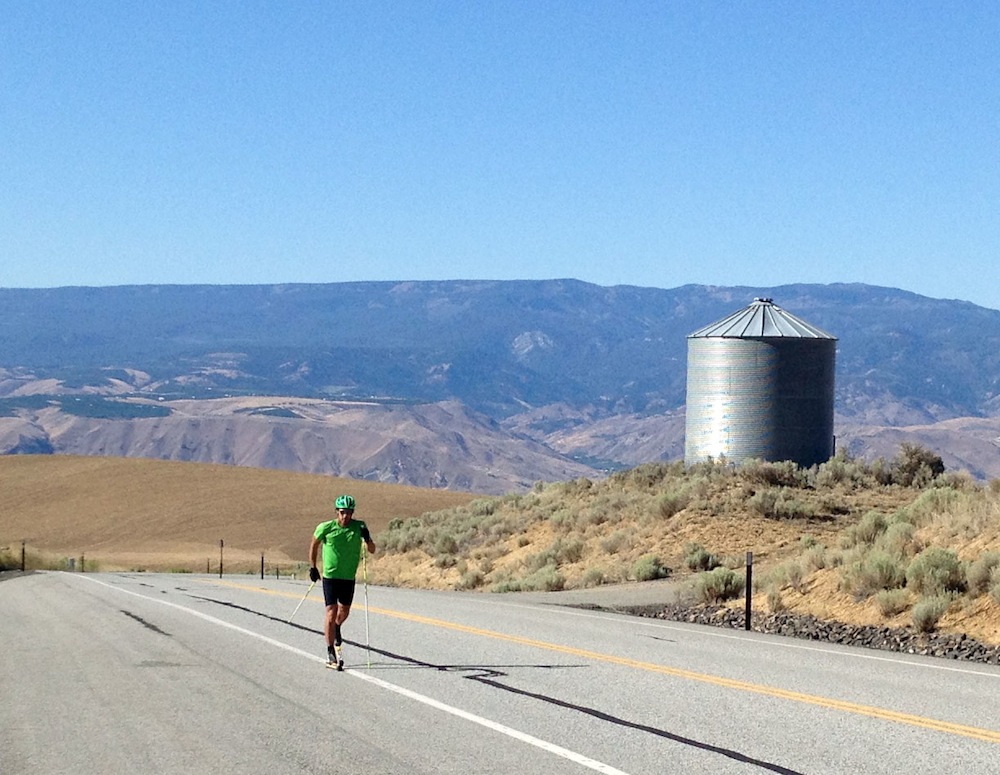
    Koos rollerskis up Badger Mountain, from the Columbia River Valley to Waterville, Washington during a steady state threshold session. (Courtesy photo)
    Koos rollerskis up Badger Mountain, from the Columbia River Valley to Waterville, Washington during a steady state threshold session. (Courtesy photo)


  • The 12: Bridger Ski Foundation

    The 12: Bridger Ski Foundation

    Members of the Bridger Ski Foundation elite and post-grad teams celebrating the fruits of their training session near Bozeman, Mont. (Photo: Anya Caldwell Bean)
    Bridger Ski Foundation elite and post-grad team members Jennie Bender (front) and Akeo Maifeld-Carucci (l) celebrate the fruits of their training session with coach Andrew Morehouse (r) near Bozeman, Mont. (Photo: Anya Caldwell Bean)

    Note: This is the fifth preview in our series on U.S. elite teams, which we’ve dubbed the “The 12.” We asked coaches to tell us what’s new and whom to look out for in the coming season and will publish additional previews in the coming weeks in no particular order.

    Team: Bridger Ski Foundation (BSF) Nordic Elite Team

    Coaches: Dragan Danevski (program director/head coach), Andrew Morehouse (competitive team/elite/post-grad coach, service tech), Tim Baucom (competitive team/junior coach, service tech)

    A BSF skier working hard in the offseason near Bozeman, Mont. (Photo: Anya Caldwell Bean)
    A BSF skier working hard in the offseason near Bozeman, Mont. (Photo: Anya Caldwell Bean)

    Elite roster:  Torin Koos, Tyler Reinking;

    Jennie Bender, Anya Caldwell Bean, Corrine Malcolm

    Post-grads: Sawyer Kesselheim (Montana State University), Patrick Madden (MSU), Will Meyer (University of New Hampshire), Akeo Maifeld-Carucci (Harvard), Ketchum Wilt (formerly of Sun Valley Ski Education Foundation);

    Natalie Flowers (Dartmouth), Lizzie Gill (UNH), Katie Gill (University of Denver), and Cambria McDermott (MSU junior, red-shirting to pursuit some non-NCAA skiing goals)

    Who’s new: Reinking (MSU Master’s student), Bender (formerly of Central Cross Country, a.k.a. CXC), Bean (2013 UNH graduate), Malcolm (former US Biathlon member)

    Who’s missing: Leif Zimmermann (retired)

    Top results last season: Seasoned veteran Torin Koos, who turns 33 on Friday, pulled out impressive performances in January at Soldier Hollow, winning two national titles in the freestyle sprint and 30-kilometer classic mass start in Midway, Utah. A couple weeks later, the U.S. Ski Team did not name the former Olympian to its World Championships squad, stirring up some controversy, but you can expect Koos, who’s nearly finished with his Master’s in communication at Westminster College in Salt Lake City, to be back this season – hungry for his fourth Olympics.

    Torin Koos celebrating his overall Tour de Twin Cities win in late January.
    Torin Koos celebrating his overall Tour de Twin Cities win in late January.

    Later last season, Koos won the Tour de Twin Cities (five stages of SuperTour races) and led the overall SuperTour standings for World Cup Period 3. He traveled to Whistler, British Columbia, in late March and won the 50 k freestyle mass start before coming down sick at SuperTour Finals in California.

    Newcomers to the BSF elite team, Bender won the classic sprint at SoHo for her first national title and Bean achieved All-American status at NCAA Championships in Ripton, Vt., where she was sixth in the 15 k freestyle mass start.

    At age 19, Kesselheim cracked the top 30 at the Junior World Ski Championships in Liberec, Czech Republic, placing 29th in the 10 k skate.

    Coach’s comment: In an email, Morehouse explained that most of the elite team has been at their base in Bozeman, Mont., since May. “With the combination of a good group of college skiers, energy has been high and there has been a great atmosphere for training,” he wrote.

    Jennie Bender (l) working out with her new team, the Bridger Ski Foundation, in Bozeman, Mont. (Photo: Anya Caldwell Bean)
    Jennie Bender (l) working out with her new team, the Bridger Ski Foundation, in Bozeman, Mont. (Photo: Anya Caldwell Bean)

    BSF opted out of its annual training camp in Bend, Ore., because of a lack of snow, but is off to Canmore, Alberta, on July 25 for about two weeks of dryland training. In September, the team plans to head back up to Alberta, about a nine-hour drive, for an on-snow camp on the Haig glacier.

    According to Baucom, the team is excited to expand its elite and post-graduate programs (from the three elite-team members last year, all of which were men). The post-grad team has yet to be finalized, but a large group of college skiers have been training with BSF this summer.

    “With the opportunities that Bozeman has to offer, I think the potential for growth is huge,” Baucom wrote. “We have a great community of skiing enthusiasts here who are excited to support these athletes. … With Montana State University in town, BSF also gives athletes the opportunity to develop as postgraduate skiers and gain in-state status before pursuing a college ski career.”

    In terms of goals, Baucom expects his athletes to commit to long-term individual objectives and BSF aims to create a positive atmosphere to make those possible.

    “Individual goals range from medaling at international championships, to qualifying for junior and U23 worlds,” he added.

    ***

    Other previews: Alaska Pacific University | Craftsbury GRP | SSCV/Team HomeGrown | Stratton Mountain School T2

  • After Rollercoaster Year, Bender Joins Bridger Ski Foundation

    After Rollercoaster Year, Bender Joins Bridger Ski Foundation

    Bender in qualifying. Photo: Bert Boyer.
    Jennie Bender at 2013 U.S. Nationals, where she won the classic sprint. Photo: Bert Boyer.

    On the last day of the season in April, national champion Jennie Bender finished dead last in a race. Out of the 33 women who contested the 30 k classic at U.S. Distance Nationals, Bender crossed the finished line over nine minutes behind the second-to-last athlete and a full 30 minutes behind the race-winner.

    “I never want to see myself last ever again,” Bender said in a recent phone interview. “That was horrible and embarrassing. The good thing is, now I know I can…do better and I know I have things I haven’t tapped into yet.”

    For Bender, 25, finishing last in California taught her once more how to swallow her pride in a season filled with both trying and triumphant moments. She won her first national championship, the classic sprint, and dropped out of her first race in the span of the same week in Soldier Hollow, Utah. The summer before, she missed months of training while she fought off lyme disease and mono at the same time. At Canadian Nationals in the spring she got strep throat and entered SuperTour Finals on fumes.

    Despite the setbacks, the win at nationals taught Bender never to count herself out. That lesson is coming in handy now that she’s facing another physical hurdle: a herniated disk in her back. She thinks the misalignment may be the result her fall in the finish lanes at U.S. Nationals in 2012 and two years of subsequent overcompensation. After making several trips to the doctor, Bender decided not treat the injury with surgery and will instead bring herself back to fitness with physical therapy.

    “Obviously it’s disappointing and I’d rather not have this, but it could be a lot worse, I guess,” Bender said. “I’m just going to have to deal with it.”

    She can’t run or rollerski at the moment, so Bender is doing the majority of her endurance training on an elliptical, in the pool and with nordic walking. She doesn’t know exactly when she can return to rollerskis, but is confident the problem can be fixed in time to be ready to race in November as long as she’s careful with her physical activity throughout the summer.

    The uncertainty comes at a time of transition for Bender. At this moment, she is driving from her home of the past three years with Central Cross Country (CXC) in Minneapolis, Minn., to Bozeman, Mont., to begin skiing for Dragan Danevski’s program at the Bridger Ski Foundation (BSF).

    Bender, a Vermont native and University of Vermont graduate, says her decision to leave the Midwest was motivated in part by her unpredictable season and a need for something new.

    “I’ve thought a lot this summer about where I want to be and why I’m doing what I’m doing, and I realized that the fire is burning very strongly still,” she said. “I still don’t feel like I’ve reached my potential, which bothers me. It all comes down to personal drive, which is what kept me going this year. Everyone is like, ‘I don’t know how you did what you did this winter,’ and I’m like, ‘I don’t really know, either.’”

    At BSF, Bender hopes to reenergize her training.

    “I’m excited, because I think…the Bridger Ski Foundation seems to be a very big organization with lots of supporters and it’s a big, enthusiastic ski community with one club,” Bender said. “I’ve only heard good things about the program and about Dragan.”

    In addition to Bender, BSF is growing by two other women this season. University of New Hampshire graduate and NCAA All-American Anya Caldwell Bean is headed for Bozeman soon and MSU’s Cambria McDermott will ski in the BSF suit while she red-shirts a year from the NCAA.

    “Dragan Danevski is very happy with the acquisitions, and combined with a great group of Post Graduate skiers, is excited about the future of BSF skiing at the top level,” said BSF assistant coach Tim Baucom.

    With three elite women on its roster, BSF carries a bigger women’s squad into next season than it’s ever seen.

    “It’s bigger than we have had in the past, and the first time that we feel we have several women who will be competitive nationally and internationally,” Baucom said. “Besides Kristina Trygstad-Saari, we have not had many senior women who have been competitive.”

    On the men’s side, Torin Koos will again be on the BSF squad and is joined by NCAA All-American Tyler Reinking from MSU. Leif Zimmermann, four-time national champion and 2006 U.S. Olympic team member, is retiring from competition after 15 years of racing.

    2013 US National Classic Sprint Champions Torin Koos and Jennie Bender
    Bender in Soldier Hollow waiting to climb the podium at 2013 U.S. Nationals with men’s classic sprint champion Torin Koos. Bender and Koos will be teammates at the Bridger Ski Foundation next season.

    For Bender, the move to BSF gives her more group training opportunities, as her workout partners in Minneapolis last year often included masters and juniors.

    “I’ve been training a lot on my own in Minneapolis and I think I’ll be around more girls my age who will be eager to go out and rollerski,” Bender said.

    “It’s important to be around, in general, a really active environment and that’s what Bozeman is. It’s very outdoorsy, very active, people are always doing something even if it’s not nordic skiing. As long as there’s people willing to go outside and do something active, that’s very motivating for me to go do the same.”

    Bender’s back injury will limit her training options as she settles into her new life in Bozeman. Injured is not the ideal way she would like to be joining a new team, but she is enthusiastic about the change of scene.

    “It’s hard to leave the midwestern ski community and the friends I’ve made there the last three years, for sure,” she said. “Developing a healthy environment is all part of life; all part of being a successful athlete is surrounding yourself with positivity. But this is a change I think will be good and I’m excited for some mountains.”

    Bender’s goals, she added, are the same as they ever were.

    “The moral of the story is, you never know what’s going to happen,” she said. “Obviously my hopes are still high; I [am] out to make the next Olympics… [I’m] strongest in classic sprinting and the [U.S. Ski Team] is already heavy on sprinters, but because women’s sprinting is a big focus this year I think I could contribute to an already stellar lineup.”

    And after a rollercoaster season, Bender thinks her inconsistency in the past might work to her advantage in the future.

    “It’s a new year; you never know what I’m going to do,” she laughed.

  • Elite Team Preview: Bridger Ski Foundation

    Elite Team Preview: Bridger Ski Foundation

    Torin Koos of the Bridger Ski Foundation elite team races to a fifth-place finish in the 30 k classic mass start at the 2012 U.S. nationals in Rumford, Maine. (Photo: Flying Point Road / flyingpointroad.com)

    Note: This one of several previews in a quick-and-dirty series on U.S. elite teams. We asked coaches to send their 2012/2013 rosters and tell us what’s new for the coming season. We will be publishing additional reports over the next few weeks. Teams are presented in no particular order.

    Team: Bridger Ski Foundation (BSF) Nordic Elite Team

    Coaches: Dragan Danevski (program director/head coach), Tim Baucom (assistant coach/service tech), Andrew Morehouse (service tech)

    Roster: Torin Koos, Leif Zimmermann, Sawyer Kesselheim

    Leif Zimmermann (BSF) during a NorAm classic-sprint qualifier at the Sovereign Lake Nordic Centre near Silver Star, British Columbia. (Jesse Winter Photography/ jessewinterphotography.com)

    Who’s new: Kesselheim (A native of Bozeman, Mont., and former BSF junior who will be redshirting his sophomore year at Montana State University in an effort to make the 2013 World Junior Championships)

    Who’s missing: None

    Top results last season: A three-time Olympian, Koos landed on the SuperTour podium early last winter, placing second in both the classic and skate sprints in West Yellowstone, Mont. At U.S. nationals in January, he defended his sprint title in the skate race and was fifth in the 30 k classic mass start. Koos then flew to Norway to live and train for three months with the Strindheim Idrettslag ski club in Trondheim. This year, he’s focused on making the World Cup races in Canada and World Championships in Italy.

    Zimmermann started last season with a SuperTour victory in the 15 k freestyle at West Yellowstone and landed several other top-10 results early on in the domestic circuit. The 2006 Olympian and four-time national champ was fifth at two NorAms (15 k classic and 15 k skate) last year, and won the Owl Creek Chase 21 k skate race in Aspen, Colo., and Winter Teva Mountain Games 10 k skate in Vail, Colo.

    Kesselheim returns to Bridger after his freshman year at MSU, where he consistently placed in the top 15 at Rocky Mountain Intercollegiate Ski Association (RMISA) races. He qualified for NCAA Championships as MSU’s fourth man, was a three-time All-American and placed third at 2012 Junior Nationals in the OJ relay.

    Coach’s comment: The elite team may be in various parts of the country and world – Koos is in Salt Lake City working toward his Master’s degree and Zimmermann recently spent two weeks in Peru leading a running trip up the Inca Trail – but they unite when needed. Koos joined the group in June during a 10-day on-snow camp in Bend, Ore., and he’ll return to Bozeman for several training blocks, according to coach Tim Baucom.

    Torin Koos working out at a Bridger Ski Foundation training camp in Bend, Ore., in June. (BSF photo)

    In an email, Baucom pointed out that Koos was recovering from shoulder surgery this time last year, unable to rollerski with poles and work on his upper body until the end of the summer.

    “Right now he is well ahead of where he was last year, and we expect him to not only contend all major sprint events, but the distance events as well,” Baucom wrote. “Leif has been a major presence on the SuperTour for many years and if he stays healthy we expect to see him contending for the SuperTour distance title.”

    The main focus for both Koos, who turns 32 next week, and Zimmerman, 28, will be the Canadian World Cups and 2013 World Championships, he added.

    “For Sawyer, gaining experience at the national level is crucial for his development,” Baucom wrote. “He will still be a junior, and World Junior Championships are definitely a major goal.”

    In late July, BSF heads north for a dryland camp in Canmore, Alberta.

    ***

    Other previews: Bend Endurance Academy | Craftsbury GRP | CXC | Far West | Maine Winter Sports Center | Methow OD | Stratton Mountain School |Sun Valley SEF | XC Oregon

    Related: Koos Hitting the Books, Logging the Hours

  • Koos Appeals Disqualification; Questions Jury’s Proof, Protocol

    Koos Appeals Disqualification; Questions Jury’s Proof, Protocol

    Torin Koos (BSF/Rossignol), Skyler Davis (SMS/USST) and Reese Hanneman (APU) skiing up the first hill in the semifinals of the classic sprint at U.S. Nationals. Photo: Flying Point Road.

    As promised, Torin Koos (Bridger Ski Foundation/Rossignol) filed an appeal on Monday with the International Ski Federation (FIS) Appeals Commission against the the jury’s determination at the U.S. Cross Country Championships that he had obstructed competition on his way to winning the A-final of the classic sprint, which resulted in his disqualification.

    Koos declined to answer specific questions about the case until the Appeals Commission comes to a decision, but confirmed that Dragan Danevski, Nordic Program Director at BSF, had submitted the appeal to the U.S. Ski and Snowboard Association (USSA) on Monday. USSA then forwarded the case to the Appeals Commission at FIS, which will review the evidence over the coming days and determine whether to uphold the jury’s decision.

    In a phone interview on Tuesday, Danevski explained that Koos and the BSF coaches were contesting several aspects of the jury’s decision and course of action on Sunday in Rumford, ME. Koos does not deny that his skis made contact with MSU/Team HomeGrown’s Ryan Scott as he moved to get in the tracks in front him. Rather, he and his coaches take issue with the process by which Koos was disqualified, which in their view contained numerous departures from the proper protocol outlined in the FIS International Competition Rules (ICR).

    I. The Jury Proceedings in Rumford

    First and foremost, Koos is protesting the way he was notified of his infraction on Sunday. The competitoin jury issued him a written reprimand for obstruction of Scott’s skis, and according to Tim Baucom, one of two BSF coaches present in the jury room when Koos was first called in, Koos was not given the chance to defend himself before the jury disqualified him. As outlined in the FIS Cross-Country Guidelines for Jury Work, a competitor believed to have obstructed competition must be given the opportunity to explain himself before the jury can make its decision.

    For Koos and his coaches, the realization that his gold medal finish was being called into question began as he waited to take to the podium. While waiting with Koos an unusually long time for the ceremony to begin, Baucom said they began hearing rumors that an issue had come up with Koos’s win. Fellow BSF coach Bjørn Bakken went to find out what the problem was, and soon radioed to Baucom that Koos was needed across the stadium in the timing building.

    “We started walking over there, and Torin realized the doping control guy was no longer with him,” recalled Baucom. The classic sprint was the second testing day of the week, and U.S. Anti-Doping Agency (USADA) chaperones need to keep their designated athlete in sight at all times until the competitor is brought to testing.

    Koos backtracked to bring his chaperone with him, only for the chaperone to inform Koos he had been released from doping control. “From there, Torin knew what had happened,” said Baucom. As they waited for the jury to be ready for them, they heard the men’s podium ceremony begin across the stadium without them.

    In Baucom’s eyes, those two facts—that Koos was released from doping control and that the podium ceremony took place before he’d been informed of his offense—are evidence of a significant departure from the FIS jury procedural guidelines, which state that “Prior to the imposition of a penalty (except in cases of reprimands and withdrawal of accreditation according to 223.5 and 224.2), the person accused of an offence shall be given the opportunity to present a defence at a hearing, orally or in writing” (224.7).

    “The fact that they pulled doping control off of him before he knew what was happening indicated [the jury] had made its decision,” said Baucom. Though official results were not signed and posted until later, he perceived that the two actions represented the jury “taking all measurable steps in that direction before Torin knew what was happening.”

    Present in every part of Sunday’s jury procedures was USSA representative Allan Serrano. From his perspective, the jury at Black Mountain followed FIS-outlined procedure to the T.

    Baucom’s interpretation of the jury proceedings are right, said Serrano, but the rulebook’s exception of reprimands from the requirement of jury’s to hear a defense is crucial.

    “We didn’t vote to disqualify him—that’s the pertinent point,” he explained. If the jury calls for a disqualification, “that person is entitled to witness of themselves at that jury meeting. But we didn’t disqualify him, we gave him a competition suspension, and as it was his second reprimand, [it] resulted in a DQ.”

    The usual result of competition suspension in a sprint heat is relegation to the back of the field—sixth place in the case of the A-final, which would have been the outcome of Sunday’s events had Friday’s 30 k infraction not also taken place beforehand. Hence, Serrano told the USADA chaperone charged with tailing the first place finisher that Koos was now in sixth, and Koos was released from doping control.

    Serrano acknowledged that the doping control situation was “definitely awkward.”

    As for the medal ceremony taking place before official results were posted, there is nothing unusual about that, explained Eileen Carey, one of the jury members. “It is protocol for the Championships that ceremonies can take place with preliminary results,” she said. “This was communicated at at least one of the coaches meetings, and is in the USSA rulebook.”

    The rule (53.1.1) also allows the ceremony to take place for an individual-start distance race while everyone other than the early starters of the A- and B-seeds are still on the course.

    II. The Jury’s Evidence 

    The second major part of Koos’s appeal calls into question the legitimacy of the evidence presented against him. According to Baucom, Koos and his coaches were told that (1) Serrano had been standing nearby and had heard Scott yell after Koos cut him off, (2) officials heard Koos apologize to Scott after crossing the finish line and (3) an official standing at the crossing reported to the jury that he “may have seen something happen,” said Baucom. “But [the jury] was pretty vague about what or who was seen…We didn’t get a first-hand perspective of what [the controller] had seen.”

    Serrano and Carey both asserted that a course controller saw the incident first-hand, but whether the jury immediately communicated that effectively to Koos is unclear, as reports from the jury and from Baucom differ.

    “He was told that [the incident] had been witnessed during the heat by a controller, and we also witnessed at the finish him acknowledging offending Ryan Scott,” said Serrano. “There’s a record of the controller’s testimony… They fill out cards on the course.”

    Apart from whether a controller actually witnessed the offence, Baucom pointed out that a jury is not allowed to regard comments from competitors as evidence. The jury guidelines state that a jury can “react on reports from officially appointed controllers or jury members. A jury should not act on base of comments from athletes or team leaders” (item 6).

    This rule should discount reports of Scott yelling and Koos apologizing as evidence, said Baucom.

    “Anything can happen during a race that would merit an apology,” he said. “You could accidentally cut someone off; it happens.”

    As for Serrano hearing Scott yell during the heat, Baucom continued, “[Scott] wasn’t yelling for a TD to say anything—that could be used as some sort of evidence. In a men’s sprint final there will be contact and some yelling; that’s the nature of the race. That’s why there are heats and not just a qualifier.”

    III. The 30 k: Bib Marking of Competitors

    The final segment of Koos’s appeal pertains to the written reprimand he received for starting in the wrong position during the mass start 30 k classic on Friday, which is half of the reason he was disqualified two days later under FIS’s two-strikes-and-you’re-out rule.

    Koos’s confusion originated with either misremembering or being misinformed of his bib number, and since he wore the numberless green sprint leader bib for the 30 k, couldn’t check his starting position against it.

    Baucom doesn’t recall whether he read Koos his correct bib number the night before the race. “It could have been my fault; it could have been a miscommunication,” Baucom said. But it shouldn’t matter, in Baucom’s view, if all competitors in the 30 k were marked with their number as he believed they should have been.

    For mass start races, FIS rules state that it is “required to affix start numbers to the competitor’s thigh that is closest to the finish-line camera” (337.2.1). There were no leg numbers in Rumford; had there been, Baucom argued, Koos would have known where to start, would not have been given his first written reprimand, and at worst would have taken sixth place for his infraction in Sunday’s sprint.

    Leg numbers or no, the rules also clearly say that it is the responsibility of the athlete to get to the starting line on time. Baucom acknowledged this, but thought that a verbal reprimand would perhaps have been more appropriate, which simply alerts the competitor that his behavior is “borderline.”

    “Sure, an athlete should maybe be responsible for knowing his starting spot, but given the stress and preparation, especially for a classic race—Koos was testing skis until five minutes before the start,” Baucom said. “Then he’s running over there, thinking he knows his bib number.”

    In the aftermath of his disqualification on Sunday, Koos recalled trying unsuccessfully to find someone with a start list upon discovering someone already standing in the position he thought was his. With minutes to go before the gun, he decided to choose the first open spot he saw.

    Carey, who stood at the back of the lanes being loaded before the mass start, said that she and four other volunteers and jury members were stationed around the starting grid specifically to help people find the right position. She recalled seeing no signs of confusion from the athletes in the minutes leading up to the start.

    Two Strikes, You’re Out: Too Harsh a Rule?

    If anything can be said for sure about what happened in at U.S. Nationals on Friday and Sunday, it’s that the chaos of ski racing made itself evident.

    For Serrano, it also became apparent that the rules were perhaps harsher than the situation required. He said members of the jury felt badly about the series of events that resulted in Koos’s disqualification.

    “The jury felt that this seemed terrible, but we didn’t have any other choice,” said Serrano. “We made that known to FIS—that this seems silly.”

    He referred in particular to the rule that equates two written reprimands to an automatic disqualification. If there had been any wiggle room in the rules, Serrano said he would have tried to avoid disqualifying Koos.

    “There may be room for something to evolve there—some other penalty for a second offence,” he said. “The object, I’m sure, is to deal with repeat offenders and problem cases.”

    Two days after racing was finished in Rumford, Danevski was still trying to grapple with why his athlete had been disqualified.

    “He’s disappointed; [Koos] cannot understand that jury made that kind of decision. Nobody understands,” said Danevski, who was in Bozeman, MT for the duration of Nationals. “For them to disqualify skier who skied for 12 years on the World Cup…to come to Senior Nationals and win by 50 meters, you know, I just—it’s really hard to understand… I got calls from coaches and people are shocked, people cannot believe it.”

    Luke Bodensteiner, USSA Executive Vice President of Athletics, said the timeline for the FIS Appeals Commission’s decision on Koos’s case could be up to a week.

    “They’re generally pretty expeditious,” he said. “The one time I’ve done this before it was a 24-hour turnaround, so probably by the end of the week.”