From the FasterSkier archive — posts syndicated from athletes’ and coaches’ own blogs between 2004 and 2012, kept online as published. Current coverage is at fasterskier.com.

Tag: Tim Kelley

  • The Alpine Perspective: Athlete Support and the U.S. Ski Team

    The Alpine Perspective: Athlete Support and the U.S. Ski Team

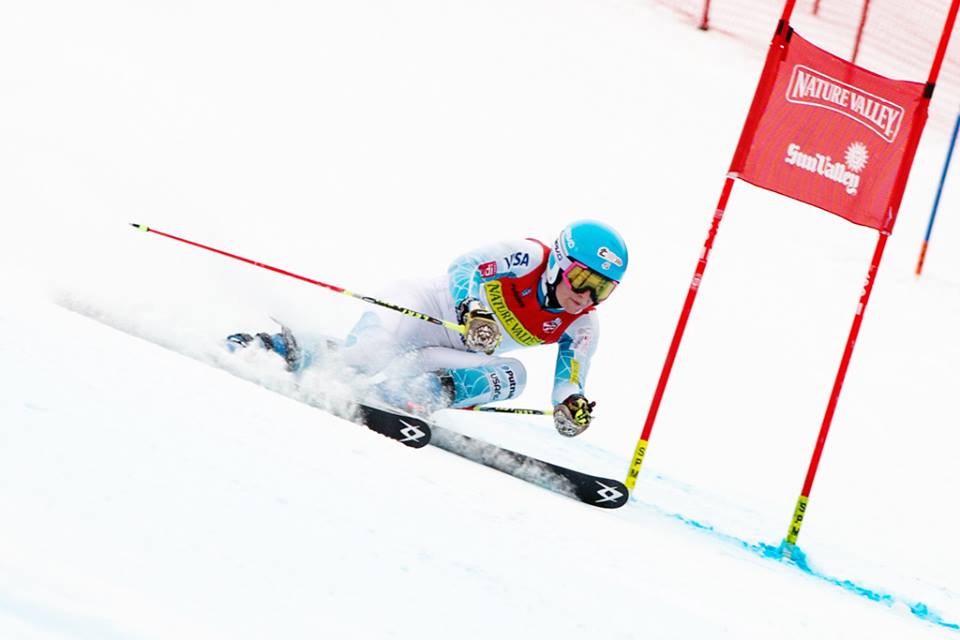
    Megan McJames, an independent skier based in Park City, Utah, racing in Sun Valley. (Courtesy photo)

    “The biggest issue with the ski team is that they do not support athletes through thick and thin. They support the very top athletes well but other than that everyone else is constantly stressed out about re-qualifying for the team or raising enough money to be able to compete that season.”

    — Tim Kelley, 2015 World Championships U.S. alpine team member, UVM alumnus & assistant coach

    “It is very hard to watch some American athletes get everything and others get nothing. But I try to focus on surrounding myself with supportive people, keep training hard and ski as fast as I can. To me, there is nothing more fun in the whole world than skiing!”

    — Megan McJames, two-time Olympic alpine skier, four-time World Championships competitor

    This spring, U.S. Ski & Snowboard announced its nominations for the cross-country national team. It also released qualification standards for the 2018 Olympics in PyeongChang, South Korea.

    Both created discussion in the cross-country ski world. The national-team nominations relied heavily on discretion on the men’s side; several athletes very close to making the objective criteria were not nominated. The Olympic criteria leave few direct options for qualification available to non-U.S. Ski Team (USST) athletes or those sent to the World Cup by staff discretion.

    Some of these strategies by the cross-country team leadership seem to contradict policies emphasized at the U.S. Ski & Snowboard level. But others might be consistent with how decisions are made in other disciplines.

    To try to get a better understanding of whether that was the case, FasterSkier checked in with two alpine skiers: 2015 World Championships team member Tim Kelley, a now-retired slalom specialist who is coaching at the University of Vermont (UVM); and Megan McJames, a veteran giant slalom specialist who has been racing independently for several years.

    Tim Kelley was not Ted Ligety, and Megan McJames is not Mikaela Shiffrin. Their perspectives are both based on their own experience, which is of bouncing on and off the USST and being selected to race internationally even when they were not national team members.

    Who Deserves National Team Support?

    That experience isn’t a mere byproduct of U.S. Ski & Snowboard policy. It’s by design as the organization tries to prioritize supporting young athletes with potential and older athletes who are stars – but cutting off development funds at some point after certain athletes reach the senior ranks.

    It’s a strategy that might sound familiar to cross-country skiers.

    Luke Bodensteiner, U.S. Ski & Snowboard’s Executive Vice President for Athletics, explained in an interview this spring that in his view, just being good enough to make a championship event doesn’t mean that his organization should necessarily invest in an athlete.

    “We are probably not as efficient [as we could be] in terms of putting resources behind specific athletes,” he said. “I believe we could have fewer athletes across the board … It’s a bit of a cultural adjustment. There was a time when it was like, take your six best athletes – in our estimation that’s not effective.”

    And so, across disciplines, U.S. Ski & Snowboard has developed criteria to say what “good enough” is. If the second-best or third-best athletes in the country don’t meet those criteria, then, well, teams are smaller.

    (They are not alone in this strategy; teams such as Canadian cross-country skiing and U.S. biathlon have gone through periods with very few senior women supported, for instance.)

    Athletes might not always agree with Bodensteiner’s assessment. Whether they are winning or not, U.S. Ski & Snowboard keeps picking them to represent their country; yet they aren’t recognized with national team status or support.

    “I never had World Cup podiums, but I am proud of my career and how I battled through injury and keep grinding it out,” wrote Kelley, who placed 23rd in his lone World Championships race in 2015 (as an independent racer) and had a 12th-place World Cup slalom result (as a USST member) in 2016, his final season of competition.

    Age-Specific Performance Standards

    The alpine national team criteria are fairly unique in taking age into account.

    The cross-country criteria do as well, but not to the same extent: they offer team membership to athletes with podium finishes at World Junior or U23 Championships, but no age-specific World Cup standards.

    Alpine is different. For instance, have a look at the 2017/2018 criteria. For all ages, the requirement to make the A-team is the same: a top-25 World Cup ranking in a single discipline, or a top 10 (for women) or top 15 (for men) World Cup ranking in alpine combined.

    After that, there is a tiered system. To make the B-team, women born in 1993 or earlier – so anyone older than 24 in this competition season – have to be ranked top 30 in the World Cup in a single discipline. Those born in 1994 can be ranked top 35, or have a top 45 World Ranking list standing. Born in 1995? Top 45 on the World Cup, or that World Ranking list. 1996 or younger? Top 50 on either list, or win a NorAm title.

    There’s not a lot of leeway.

    If you’re older than 24 and are ranked 26th in your discipline, it can be tough cookies. That happened to Resi Steigler, who was cut after a season where she was ranked 29th on the World Cup in slalom.

    “It’s not easy being an outsider,” Stiegler, who kept racing and never finished worse than 27th in the World Cups she entered the next season, told Ski Racing’s Warner Nickerson. “To wonder who stopped believing in me and to wonder who doesn’t want me there.”

    “This is exactly how I felt when I was on the chopping block,” Nickerson wrote in the piece.

    Stiegler was renominated to the A-team later, but it brings up the issue of whether she would have performed better, and represented the U.S. better, if she had more consistent support through the ups and downs – would she have returned to her best level sooner without all that doubt and stress?

    “The ski team should take on that burden and allow the athletes to focus on their training without the other distractions,” Kelley believes.

    Because he had that experience too. Despite being dropped from the USST – again – after the 2016 season where he had the 12th-place finish, Kelley had secured World Cup start rights for the 2016-2017 season after being the runner-up in the NorAm slalom rankings in 2016. He would have had to go it alone again on Redneck Racing, the team he founded with his brother Robby.

    He could have done it. The deciding factor in his retirement was that he underwent a fourth surgery to address recurring back problems. That was one surgery too many and at 30 years old he decided to call it quits.

    But many athletes his age in a similar position might be pushed out of the sport even without the injury issues Kelley faced, he said.

    “Unfortunately it takes a lot of determination and creative fundraising to keep competing at a high level outside the [USST], and actually even more inside the ski team since they cut funding for everyone except for the A-team (athletes top 25 in a disciple in the world),” he added.

    The lack of financial support for ‘B’ team members might also sound familiar to cross-country skiers.

    Overall, the inflexibility in supporting athletes didn’t make sense to Kelley.

    “I think the age stuff is ridiculous and pushes people out of the sport,” he wrote. “The ski team did all these studies that showed what age you had to accomplish certain bench marks and claimed that if you didn’t win a NorAm title by age 21, or score World Cup points by age 23 that you would never ‘make it’ in the sport. Which seems silly to me because if you cut everyone that doesn’t hit the benchmarks and they retire, of course they are not going to ‘make it’… A lot of very talented athletes retire too early because of the financial burden put on them by the U.S. Ski Team, and I believe that is the reason we have a few star athletes but not as much depth as other countries that support their athletes financially.”

    Representing Your Country

    McJames, now 29, was a top junior racer but was cut from the national team in 2012 and hasn’t gotten back on it. She has tried to stop thinking about the criteria she would need to do so.

    “When I set my goals I do not take into account USST criteria,” she wrote in an email. “There are pros and cons to being an independent athlete, but the best part is being able to design a program that only takes into account what is best for me athletically.”

    Since being cut from the national team, McJames has scored World Cup points every season except for one. She finished 30th in giant slalom at the 2014 Olympics in Sochi, Russia, and 21st at last year’s World Championships in St. Moritz, Switzerland.

    So despite not being recognized as a national team member, she is very much a reliable athlete representing the red, white, and blue.

    “I would like to work more closely with the USST when racing World Cups abroad,” wrote McJames, who will be back on the international circuit this year and looking for another Olympic berth. “It would be really helpful to me if they could provide training and race support when I am representing the country at World Cup races.”

    World Cup results are essential in that they are the only way to qualifying for the upcoming 2018 Olympics — there is no domestic qualification route. But when she travels to World Cups, McJames is on her own. She brings her own staff, often including coach/partner Cody Marshall, himself a former national team member. In her pursuit of top results she is separate from USST athletes.

    “I get no financial support from USST and they do not help me out with any support staff,” McJames wrote. “In other words, I pay for all expenses surrounding being a World Cup athlete. I learned the hard way is very difficult to compete with athletes supported by a national team when you are all alone. Now I hire a coach to come with me to World Cup races. But it is expensive to hire a full time staff. So I get my skis prepped at a shop in Park City called Podium, and maintain and wax them at races myself.”

    On that one, mileage may vary. Kelley wrote that he had a pretty good situation when he was racing on the World Cup, even when he wasn’t a national team member.

    “The coaches on the men’s U.S. Ski Team are great and they always gave me an opportunity to earn World Cup starts whether I was on or off the team,” he wrote. “That is one thing that I am very thankful for. The women are not as lucky.  I really want to emphasize how helpful [USST staff] were at all points in my career… Ian Garner, Ian Lochhead, Forest Carey, Bernd Bruner, Parker Gray were always really helpful and fair to me whether I was on or off the team. I was always given a fair shot to qualify for World Cup starts, and they provided a lot of training and help with travel.”

    What It Takes to Go Independent

    There are two ways to be an independent racer: as part of a team, or truly solo.

    Kelley started Redneck Racing with his brother Robby, Andrew McNealus, and Tucker Marshall in 2014. The team was based at Cochran’s, in southern Vermont, a ski area that has led Robby, Tim, and various other members of the extended Cochran clan to success through the decades.

    “Redneck Racing was formed as a way for us to have fun competing in the sport we love,” Kelley wrote. “It gave us the opportunity to keep competing while bringing attention to the fact that you can ski fast without a $24-million-dollar gym, and that paying $30K to be on the [USST] is not the only option.”

    Having your backyard ski hill as a training ground was a lucky situation, and not every athlete could rely on this, regardless of family connections.

    “Unfortunately, this only works well for slalom,” Kelley explained, since as a technical event slalom doesn’t require big mountains or huge vertical drops. “For example, downhill venues are so few and far between it would be very tough to train downhill outside of the [USST]. This is why most speed athletes retire when they do not re-qualify for the team.”

    This year, Redneck Racing consists of Robby Kelley – who turned down a spot on the U.S. Ski Team after he requalified, because he prefers his own approach – along with Marshall and Julia Ford.

    Redneck Racing wasn’t the only team that sprang up to fill the void. Team America, based in Vail, was another. Its senior program has gone in and out of existence as needs change, while the Team America Foundation has taken on projects like studying development trajectories in alpine skiing, funding a junior team, and helping to fund Redneck Racing.

    Last season, Team America supported senior racer Hig Roberts – who like many had been onto the USST and off again. He started a number of World Cups last season but never qualified for a second run. At the end of the year, Roberts won the national championship in giant slalom.

    McJames won the women’s title.

    “I often get asked why, being the second-best giant slalom skier in the country, I am not named to the USST,” McJames wrote. “If you ask them, they will simply say that I did not make criteria. As an athlete, it doesn’t matter to me what their subjective criteria or performance bands are, the bottom line is that I believe in my potential as an athlete and feel proud of the race results I have had over the past four seasons as an independent athlete.”

  • Myrseth, Madlener Win RMISA Mass Starts in Anchorage

    Myrseth, Madlener Win RMISA Mass Starts in Anchorage

    The Chugach Mountains as seen from the Lekisch Loop, part of the course for the weekend’s races, at Kincaid Park in Anchorage, Alaska. (Photo: Adam Verrier)

    ANCHORAGE, Alaska — So how cold was it at Kincaid Park Sunday morning for the last of four Rocky Mountain Intercollegiate Ski Association (RMISA) races held in the Anchorage area this week?

    “It’s f—ing cold,” said women’s winner Merete Myrseth of the University of Utah. “It was cold,” said men’s winner Moritz Madlener of the University of Denver. “Now we fly back to Denver and get warm.” [Unavailable for comment] were the two skiers who required an ambulance for cold-related injuries following the women’s race.

    For the record, temperatures were consistently at or above zero degrees Fahrenheit all morning, so readily FIS-legal. (The International Ski Federation, which sanctioned all of this week’s races, has a temperature cutoff of -20° C, or -4° F, in order for a race to be held.) The real problem was the wind, which blew steadily from the north at around 10mph all morning.

    Unless the real problem was the humidity. The city of Anchorage is, well, a natural anchorage, bordered by Cook Inlet to the north and Turnagain Arm to the south. The Kincaid stadium is well under a kilometer away from the shores of the ice-choked Pacific Ocean; athletes were within 150 meters of the Turnagain Arm beach at one point on Sunday’s race course. Humidity was over 90% all morning. By any measure, conditions were somewhere between “raw” and “brutal.”

    At least atmospherically speaking. The ski trails were in superb shape following 30″ of snow in the month of January, if slow due to temperatures below zero Saturday night into Sunday morning.

    The first race of the day, the men’s 20-kilometer freestyle mass start, saw its start moved one hour later due to cold conditions. In that time the temperature rose from -2° F to zero.

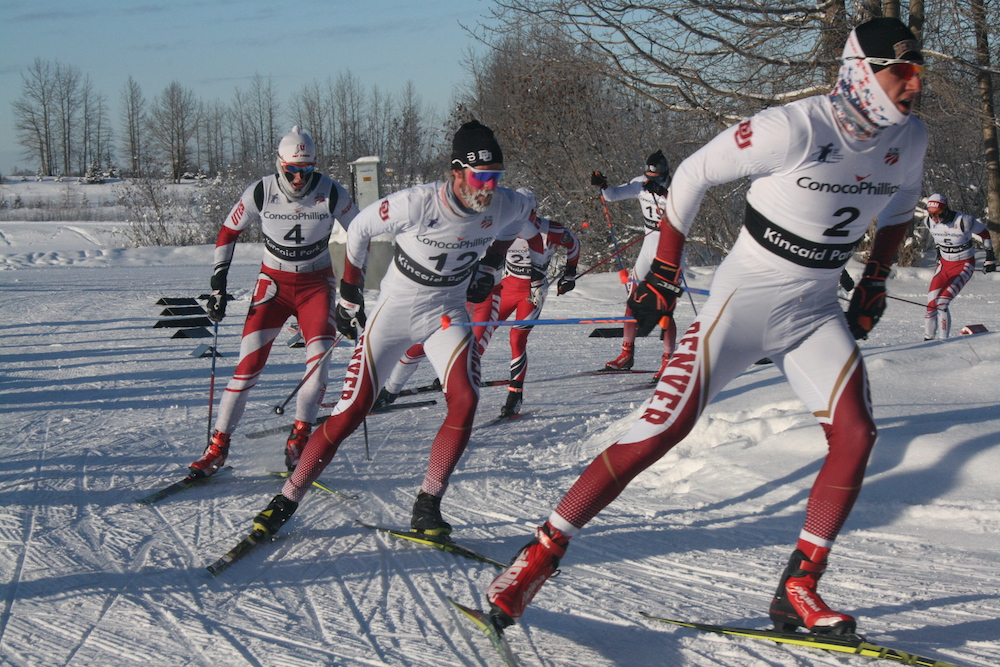
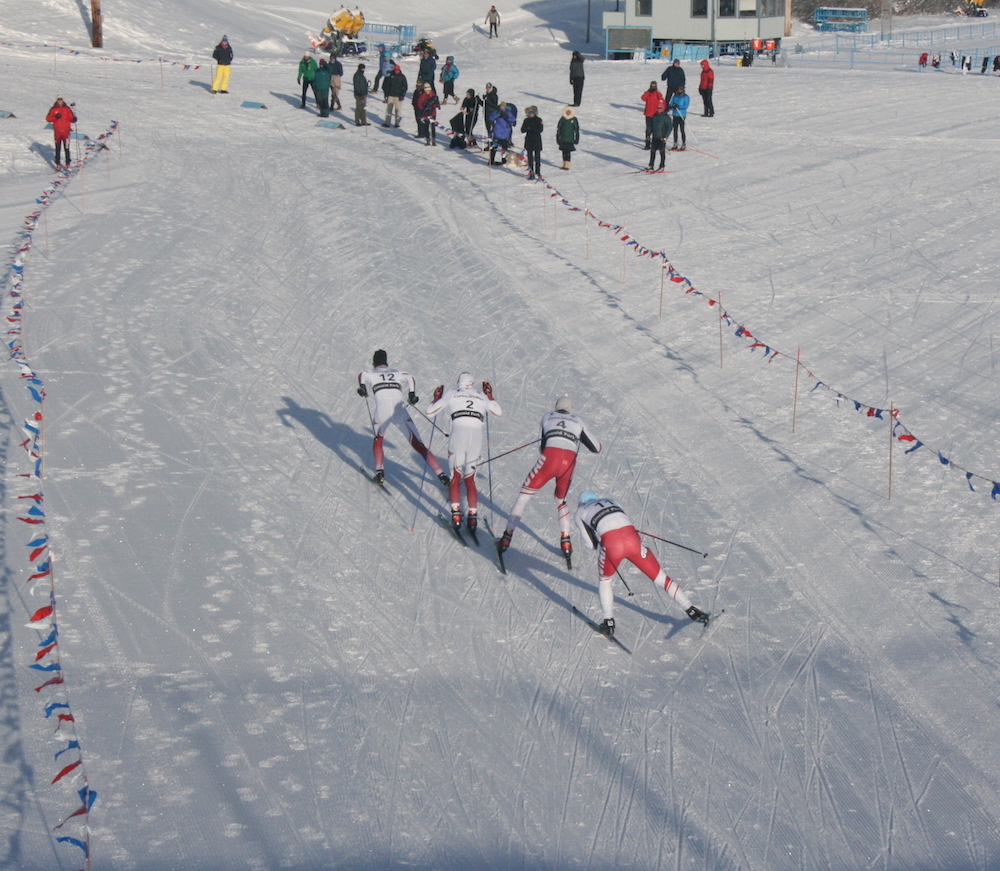
    Denver’s Moritz Madlener (2) leads Dag Frode Trollebø of Denver (12) and Kevin Bolger of Utah (4) in the men’s 20 k skate at Kincaid Park in Anchorage, Alaska. (Photo: Adam Verrier)

    When the race started, Denver’s Madlener quickly moved near the front as the field of 42 racers headed north out of the stadium to make their way up Elliott’s Climb. (For Anchorage readers, or anyone else familiar with Kincaid: the course went up Elliott’s and down Rollercoaster; up and down the Gong Hill; through the lower tunnel out to Mize’s Folly; take the first right onto Hairpin; take the first left at the top of Hairpin onto the 2.9 k Lekisch. Men did two laps of this, for 15 k, then a final 5 k lap that cut out Elliott’s. Women did two laps of the 7.5 k course for 15 k total.)

    “I was in the front pack pretty much the whole race,” Madlener recounted in an in-person interview with FasterSkier. “Tried to, you know, set the pace every now and then to get rid of people. Which worked pretty well; I think four of us got away after maybe 12 [kilometers]. And then we stayed together for the rest of the race, and then the last couple hills we kind of separated.”

    Madlener ultimately crossed the line in 52:39.2, edging teammate Dag Frode Trollebø by 2.6 seconds. Martin Bergström of the University of Utah followed in third (+10.4). “That’s a great feeling” to share the podium with a teammate, Madlener told FasterSkier.

    Madlener recalled that he had “a really good start” to his season at U.S. nationals – he earned two podiums there, second in the classic sprint and third in the 15 k skate – before he got sick “and had to catch up. And the races so far here in Alaska weren’t that great,” he continued, “so I was very happy to win today.”

    This week marked Madlener’s second time racing in Alaska; he previously competed in the last RMISA race series held in Anchorage, in early 2015. That week was marked by warm weather, rain, and shortened courses.

    Madlener is a fan, of Alaska in general and particularly the full courses that athletes got to race on this year.

    “I think it’s beautiful,” Madlener said of Alaska. “It’s like – I would say it’s like a big theme park; people are surfing and flying around and fishing. I really enjoy it. And the courses – again, two years ago, were not so great, but this year there’s a lot of snow, they’re pretty amazing courses. Like a rollercoaster.”

    Merete Myrseth of Utah enters the stadium approaching the finish in the women’s 15 k skate at Kincaid Park in Anchorage, Alaska. (Photo: Adam Verrier)

    Sunday’s race course featured a total of eight A-climbs for the men in 20 k, and six A-climbs for the women in 15 k. There was an average of 34 meters of climbing per kilometer on the main 7.5 k loop.

    Four racers, roughly a tenth of the field, were DNFs in the men’s race, likely due to a combination of the hills and the cold. Two skiers did not finish the women’s race. An additional eight opted not to start.

    The first words out of Madlener’s mouth when asked about his race were, “It was – first of all it was cold, obviously.” Myrseth, the women’s winner who skis for Utah, voiced similar sentiments: “It was cold, really cold,” she began her race summary. (By the time of the women’s race start at 12:30 p.m., temperatures had climbed to 1.6° F.)

    “I was unsure if I would start the whole race because it was so cold, actually too cold for me,” Myrseth told FasterSkier in a brief in-person interview while shivering in the windy stadium soon after her finish. “But it went really easy in the first half of the lap,” she continued, and she felt good. “So I decided to speed up when I came to hills”; there Myrseth created a gap that she kept all the way to the finish.

    But not without difficulty. “I didn’t feel good,” Myrseth said. “My feet, I couldn’t feel my feet, it was so cold. So I had to just, like, double pole over the hills, I was so tight in my feet and lost my balance, it was just so hard to keep balancing. But I made it to the finish line. And I am so happy that Guro took the second place.”

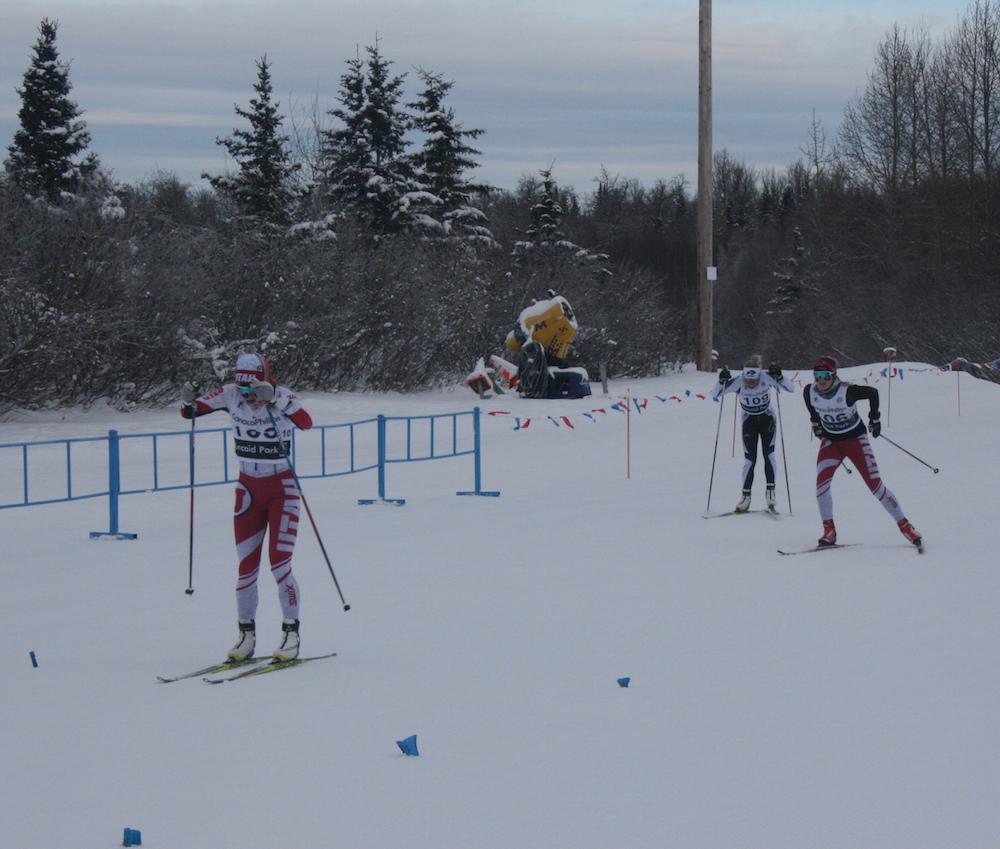
    Merete Myrseth of Utah (l) in the finishing chute en route to the narrow victory over Guro Jordheim of Utah (106) and Christina Rolandsen of Colorado (109) at Kincaid Park in Anchorage, Alaska. (Photo: Adam Verrier)

    Myrseth crossed the finish line in 46:28.3 for 15 k, double poling the last few meters to the finish. As she noted, she was followed by teammate Guro Jordheim in a close second (+0.5). Christina Rolandsen of the University of Colorado was not far back in third (+1.8). There was then a 30-second gap to a chase pack containing places fourth through sixth. 32 skiers finished the women’s race.

    This week marked Myrseth’s first time racing in Anchorage or even visiting Alaska. So what did she think? “I love it,” said the native of Øverbygd, Norway. “It’s f—ing cold, but it reminds me of Norway, my home. I’m used to it. But it’s so nice; I really like it here.”

    Sunday’s race marked the fourth race of the week in the Anchorage area for RMISA athletes. Recaps of the first three races follow below.

    Sunday results: FIS men and FIS women | NCAA-only results

    ***

    1.4 k freestyle sprint

    On Tuesday, February 7, RMISA athletes, plus a handful of skiers from Alaska Pacific University (APU) with sterling sprint credentials, raced a 1.4-kilometer freestyle sprint at Kincaid. Conditions were impeccable, with pure blue skies, temperatures in the high teens, and last month’s fresh snow mixed in with the base of manmade snow covering the sprint loop.

    In the women’s race, Merete Myrseth of Utah posted the fastest time in qualifying, 3:25.77, followed by Becca Rorabaugh of APU (+2.14) and Utah’s Guro Jordheim (+3.65). All three skiers made the A-Final, where Myrseth took her first victory of the week. The overall podium, which was also the college podium, was Jordheim in second and Anika Miller (Montana State) in third. Casey Wright (UAA), Rorabaugh, and Jasmi Joensuu (Denver) were fourth through sixth.

    Times were not available for any of the heats.

    In the men’s race, Dag Frode Trollebø (Utah) set the pace in qualifying in 2:48.80. He was followed by APU’s Logan Hanneman (+1.52) and Utah’s Martin Bergström (+3.33).

    Three of the six skiers in the men’s A-Final were locals (in the broad sense of being from Alaska; the Hanneman brothers are from Fairbanks, not Anchorage). And it was the Hanneman show in the final, as the elder Reese Hanneman took the victory over his younger brother Logan. Trollebø was third. Kevin Bolger of Utah, last seen winning the classic sprint national championship at Soldier Hollow, Bergström, and APU’s Forrest Mahlen rounded out the final finisher spots in that order.

    The collegiate podium for the men’s race was Trollebø, Bolger, and Bergström. (APU is not an NCAA-affiliated athletic program.)

    While sprinting may be on the horizon for NCAA skiing in general, it had yet to make an appearance on the RMISA circuit.

    “This was the first sprint that I know of in my, what – 10 years of RMISA coaching now and we’ve never had just a straight invitational sprint,” University of Alaska Anchorage Head Nordic Coach Andrew Kastning told FasterSkier in person following Sunday’s distance skate races.

    Kastning said that the addition of a sprint in Anchorage stemmed from a desire for a change of pace, and to avoid repetition in a single week with four races. “So when we sat down last spring and were deciding the schedule,” he said, “we’d been hearing for a few years now from our athletes that the fives, 10s, 15s, and 20s [kilometer race format] every weekend just kind of got boring, and we wanted to mix it up. So we counted the qualifying round as an invite at U.S. Nationals, and then we ran the full sprint [this week] and counted that. … So we just wanted to mix it up a little up here. Especially with four races in a short period of time, you don’t want to be doing all the same distances and the same courses.”

    So did the college athletes appreciate the chance to contest a sprint race in the middle of the RMISA race season? “Some of them do,” Kastning said. “There’s always a sprint specialist in the crowd who gets to shine. And I know there were kids on the podium, or in the top-10 at least, that aren’t normally in a distance race. So it allows some athletes to play to their strengths and shine a bit when they maybe wouldn‘t in a 20 k race, they can in a sprint.”

    On the non-collegiate side, APU skier Reese Hanneman, a sprint specialist, was thrilled to have a mid-season sprint race with high-level competition on his adopted home course. “I wish there were more sprint races in the middle of the season,” Hanneman told the Alaska Dispatch News.

    Full FIS results: men and women | | NCAA-only results

    ***

    4 x 5 k classic relay

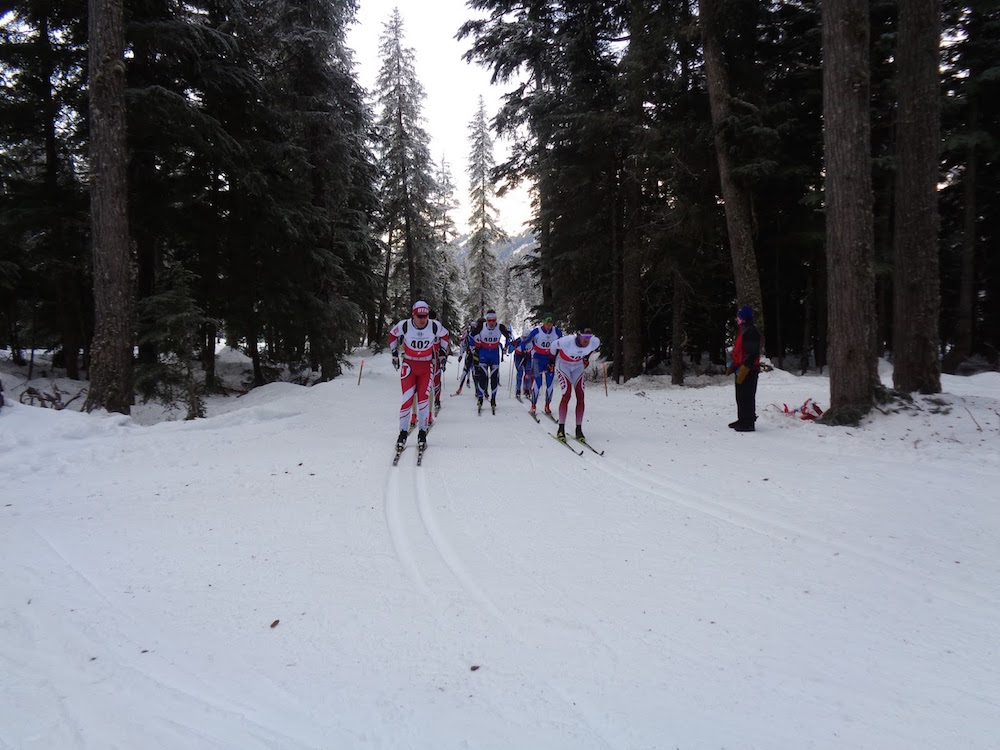
    Utah’s Martin Bergström (402) leads Denver’s Dag Frode Trollebø (right) and APU’s Reese Hanneman (center) at the start of the mixed-gender classic relay in Girdwood, Alaska. (Photo: Adam Verrier)

    The next day, Wednesday, February 8, skiers made the 45-minute drive down Turnagain Arm from Anchorage to Girdwood for a classic relay race. Girdwood is perhaps best known in ski circles as home to the Alyeska Resort alpine area, which boasts an average annual snowfall of 669″ and (when it’s clear) sweeping views of the mountains and glaciers overlooking Turnagain Arm. Publications as diverse as Powder magazine and National Geographic have lauded Girdwood as a quintessential locals ski town (“Best For: Off-the-beaten-path powder hounds with an aversion to glamour”).

    Girdwood also has a proud nordic heritage, though you have to look a little harder to find it. It is home to APU skier Chelsea Holmes, who will be competing at World Champs in Lahti later this month. And it hosted the 1969 Junior Nationals, on trails cleared from the continent’s northernmost coastal rainforest for this purpose.

    As discussed in more detail on former U.S. Ski Team member Tim Kelley’s invaluable blog, Alaska Lost Ski Areas Project, the trails faded back into the woods at some point during the 1970s. High-level nordic skiing in Girdwood then languished for over thirty years, until the early part of this decade, when the Girdwood Nordic Ski Club oversaw construction of a new 5 k loop. The reborn nordic trails have since hosted a handful of local high school races in periods of poor snow conditions in Anchorage, but it is safe to say that Wednesday’s relay was the most significant cross-country ski race held in Girdwood since 1969.

    APU (1st), Colorado (2nd), and Utah (3rd) make up the podium for the mixed-gender classic relay in Girdwood, Alaska. (Photo: Adam Verrier)

    Athletes raced in a mixed-gender 4 x 5-kilometer classic relay in the epochal event, man/woman/man/woman. It was once again APU leading the way, as the team of Reese Hanneman, Rosie Frankowski, Logan Hanneman, and Rorabaugh crossed the finish line for the victory in 57:33.7. Second overall, and first among collegiate teams, was Colorado (Mads Ek Strøm, Jesse Knori, Petter Reistad, Christina Rolandsen), 25.6 seconds back. They were followed by Utah (Bergström, Jordheim, Bolger, Myrseth) (+1:02.6). Fourth overall, and third for the NCAA podium, was Denver (Trollebø, Linn Eriksen, Moritz Madlener, Joensuu) (+1:25.4).

    “Everybody was psyched on a new format and a new trail in a beautiful location,” Kastning told FasterSkier of Wednesday’s race.

    Kastning added that the relay, like the previous day’s sprint, was new territory for RMISA racing. “We’ve never had a relay that’s counted for anything,” he said. “I think the relay captures college skiing well, with the mixed gender and the team aspect, men and women working together to try and reach the podium.”

    Full results | NCAA-only results

    ***

    5/10 k classic individual start

    Three days later, Saturday, February 11, skiers were back in Anchorage for individual start distance classic races, 5 k for the women and 10 k for the men. Race time was moved forward from 10 a.m. to noon, which allowed temperatures to rise from 2° F up to 8°.

    Saturday’s course was by some measures the hilliest of the week, clocking in at a healthy 39 meters of climbing per kilometer of distance. The upper limit for FIS homologation is 40 m/km. (The course covered the final two-thirds of Sunday’s 7.5 k course – notably Gong Hill, Mize’s Folly, Lekisch.)

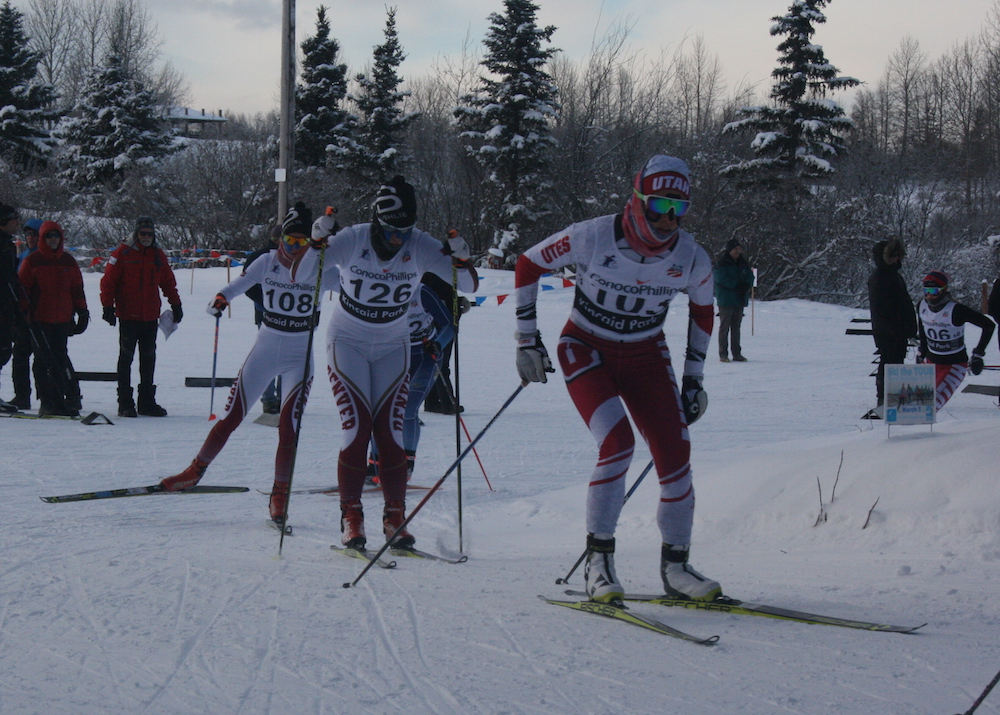
    Merete Myrseth of Utah (103) leads Denver’s Jasmi Joensuu (126) and Taeler McCrerey (108) in the women’s 15 k skate at Kincaid Park in Anchorage, Alaska. (Photo: Adam Verrier)

    Rorabaugh started near the end of the field in the women’s 5 k classic, which had 39 starters. Two A-Climbs later she crossed the finish line in 15:47.0, which held up as the fastest time of the day. Colorado skier Knori was second (+4.2), followed by her teammate Rolandsen in third (+8.2). Jordheim of Utah (+13.8) was fourth overall to round out the collegiate podium, just ahead of APU’s Frankowski in fifth (+15.0).

    It was Rorabaugh’s first 5 k classic FIS race in this country in over five years.

    The men raced two laps of the same course for a 10 k classic. Denver’s Trollebø was again on the podium, posting the day’s fastest time of 26:51.60. He was followed by Utah’s Bolger in second (+15.0) and Colorado’s Reistad in third (+19.3). Utah skier Bergström (+29.2), immediately followed by Denver skier Madlener (+29.4), rounded out the top five.

    Full FIS results: men and women | | NCAA-only results

    ***

    Overall team results

    The week’s four races were technically scored as parts of two college invitational race series. In the Seawolf Invitational, encompassing the sprint and relay from the first part of the week, plus two alpine races held at Alyeska in January, the University of Utah took the overall team title with 665 points. The University of Denver (569 points) and the University of Colorado (549 points) followed. The order was the same if the standings are broken out by exclusively nordic results: Utah, Denver, Colorado.

    The weekend’s distance races combined with two other January alpine races to make up the week’s second race series, the UAA Invitational. Combined standings were unchanged here, as Utah (661 points) took the victory over Denver (636 points) and Colorado (544 points). On nordic results alone the ranking was the same: Utah, Denver, Colorado.

    RMISA racing continues with the RMISA Championships/NCAA West Regional in Colorado in late February, then (for qualifying skiers) NCAA Championships in New Hampshire in March. Nordic races will be held at Jackson Ski Touring Center.

    Kastning explained that RMISA schools take their biennial trip to Alaska in years when NCAA Championships are set for the East Coast, “because it’s lower elevation. So other teams like to get some sea-level racing,” he said. “And so it helps our whole region do better I think at NCAAs, because you get some tempo racing, a different kind or style of racing than you do when you’re racing at 9,000 feet.”

    From left, Dag Frode Trollebø of Denver, Moritz Madlener of Denver, Kevin Bolger of Utah, and Martin Bergström of Utah enter the stadium in the men’s 20 k skate at Kincaid Park in Anchorage, Alaska. (Photo: Adam Verrier)
  • Time to Ruminate on the 83% Rule: The Future of Classic at the Highest Level

    Time to Ruminate on the 83% Rule: The Future of Classic at the Highest Level

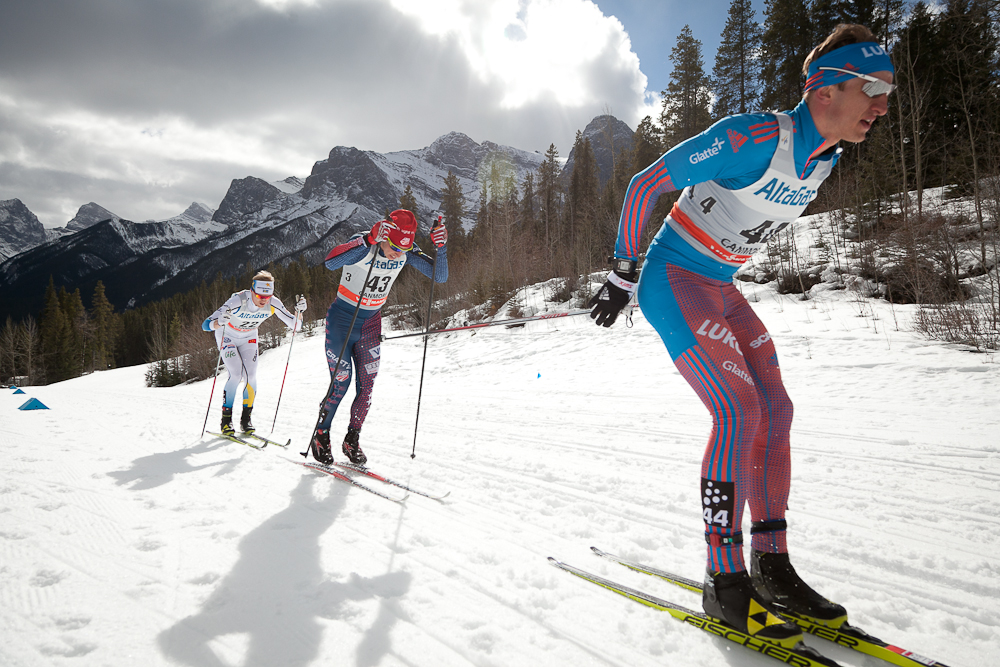
    American Noah Hoffman (43) racing to 35th in the men's 30 k skiathlon, a best for the U.S. men in the sixth stage of the Ski Tour Canada in Canmore, Alberta.
    American Noah Hoffman (43) racing to 35th in the men’s 30 k skiathlon, a best for the U.S. men in the sixth stage of the 2016 Ski Tour Canada in Canmore, Alberta.

    In so much as a social-media statement, the International Ski Federation (FIS), the governing body of cross-country skiing, proclaimed itself a curator. For some context, here is the definition of “curate” from an old-school source, Merriam-Webster: one who has the care and superintendence of something; especially  :  one in charge of a museum, zoo, or other place of exhibit.

    Back to the FIS tweet from last Friday.

    FIS Tweet regarding the 83% rule.
    FIS tweet regarding the 83% pole length rule.

    Assuming FIS’s words were chosen carefully, the words “defend classic technique” stand out. It makes the assumption that FIS perceives that classic technique was/is under attack — that it requires protection from those tainting its technical sanctity.

    All the rumbling has to do with the decision to enforce a new rule limiting the maximum pole length to 83 percent of a skier’s total height (with boots on) during FIS-sanctioned classic cross country ski races.

    This Wednesday, FIS Cross Country published a Q & A on its website. In response to why the rule was accepted, FIS reiterated that it believed desperate times warrant desperate measures. “The evolution of double poling has been challenging the core of the Cross-Country Skiing sport. Several measures to slow down this development have been put in place (see paragraph 5),” it stated.

    Paragraph five in the document notes: “This will not stop anyone from double poling even in steep uphills but it is expected to stop the unwanted evolution of classic technique. The experiences from the upcoming season will be carefully examined next spring and further steps including a lowering of the percentage may be discussed.”

    Field of play

    Moving forward, let’s assume those percentages for pole length are a moving target. Rather than being relegated to museum status, classic technique remains living history.

    In recent years, if the image you’re seeking is to watch World Cup skiers stride up hills exclusively, then perhaps you’re wanting.

    On certain World Cup distance classic courses like Toblach (Italy) or Davos (Switzerland), and sprint courses like Drammen (Norway) and Stockholm (Sweden), it’s just as likely a double poler on skate skis prevails than a nordie with the magic combo of bomber kick and zippy skis. Some call it evolution, others, like FIS, call it an affront to a technique that has historically defined the sport and anchored it to the past.

    It does beg the question, what is the responsibility of a sport’s international governing body when it may have promoted that evolution in the first place?

    “In skiing, the field of play has changed tremendously and it has been driven by the governing body and that has driven the evolution of sport,” Zach Caldwell, of Caldwell Sport, said in a recent phone interview. “That’s why athletes are more powerful. Classic technique is totally different from what it was 30 years ago, 40 years ago. Completely different. Some of it is just plain equipment innovation, but mostly the equipment innovation reflects the field of play.”

    What Caldwell is referring to when he mentions “field of play,” which he did several times during the interview, is the actual classic-ski course. The ups and downs, course width, tracks, and resulting new-school skiing speed. FIS homologation requirements are extensive and technical. According to the 2016 FIS Cross Country Homologation Manual, modern FIS-approved courses should be “⅓ uphill, ⅓ downhill, and ⅓ undulating terrain”. Those uphills are broken down into “A”, “B” and “C” climbs where percent of the course’s total climbing and a specific hill’s percent grade have strict parameters. To fully understand the homologation document, be prepared for some basic math.

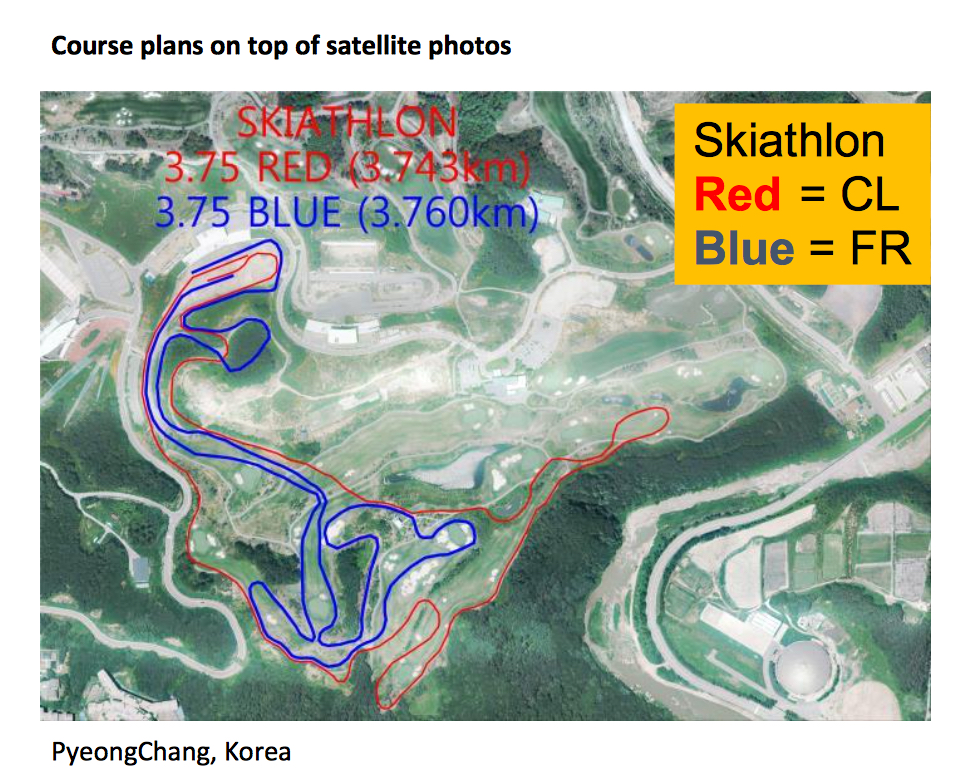
    PyeongChang, Korea Homologated Olympic Skiathlon Course. Source: Page 70 2016 FIS Cross-Country Homologation Manual
    The homologated Olympic skiathlon course in PyeongChang, South Korea. (Source: 2016 FIS Cross-Country Homologation Manual, page 70)

    FIS also opines on the subjective and murky territory of correlating course design, or field of play as Caldwell says, with human emotion when it states boldly in section 2.3 of the manual that, “The joy of skiing should be the ultimate goal”. (Note: FIS’s underline, not FasterSkier’s).

    Joyful or not, Caldwell asserts that FIS has made an effort in its course requirements that have inadvertently promoted the use of double poling.

    “Sport governing bodies need to understand that innovation is a product of the field of play that they have put in front of skiers,” Caldwell explained. “The FIS has made a series of decisions over the last decade to push the sport toward ever-faster speeds. The homologation requirements. The course width requirement. They apply a best line to the width of the course that they have got now and the speed, the average speed that they are producing on the average course permeation, demands double poling. It becomes compelling because of the sport that FIS has built. FIS has built this sport purposefully because they think they think it is going to be more compelling for a TV audience. They wanted a faster sport. They wanted a sport that looks better on televisions … it doesn’t look so much like old folks grinding it out. It looks like a flashy fast thing: that’s double poling … But to respond to innovation based on the field of play that they have put forth by deducing to add regulations about equipment or whatever else, it is kind of disingenuous and it’s a demand made by a bunch of people thinking really only about World Cup racing, not about the vast number of FIS races out there or about the practicalities of growing junior skiers or any of this. And frankly it’s not going to make a difference. People are going to double pole because that is the sport that FIS has built.”

    Another nordic lifer, Fairbanks resident, former U.S. Ski Team coach (1990-1993) and passionate ski-course designer, is John Estle. In an email, Estle pointed out that Europe’s snow conditions have played a part in the emergence of double poling.

    “Last winter many, if not most World Cup competitions were conducted on exclusively or primarily man-made snow,” Estle wrote. “The sometimes icy (and often rock-hard) quality of that snow, as well as races held in sketchy waxing conditions also promote double-poling.  Not to mention the influence of the use of double-poling by winners of all the major classic marathons.”

    At the core of evolution is the premise that evolutionary change is prompted by changes in environmental conditions — crudely put, it’s survival of the fittest. Estle agrees with Caldwell in that the modern field of play has incentivized double poling. “To this point, double-poling by many or most skiers in an event is correlated most closely with terrain … That may change in the future as skiers become stronger but for now the closest correlation is indisputably between ‘flat’ courses and double-poling,” Estle commented.

    Like courses, all skiers are not equal. For some double poling may be a practical answer to modern course design, for some it is not. Caldwell asserts that on the World Cup and the vast series of FIS races like its Marathon Cup, double poling will have its day, but it most likely will remain an option for a few.

    “If they [FIS] left it alone, if they let the top guys double pole, you would have the entire rest of the population of the skiing world try it, fail and continue to wax their skis,” Caldwell said of FIS’s broad-stroke solution to what he sees as a non-issue. “The level that is required to double pole is really, really high … The vast majority of skiers are not going to be well served by double poling entire marathons or distance cross-country races.”

    The trend of more double poling, according to Caldwell, may eventually wane as skiers bump up against their maximum power output. “It’s going to balloon, it’s going to bubble and it’s going to burst because there are physiological reasons to use your legs more, to use your legs more actively in less of a static mode,” Caldwell said. “You know, just as soon as everyone figures out they can double pole races really fast, some kid’s going to show up and start striding them and beat everyone.”

    “It’s going to balloon, it’s going to bubble and it’s going to burst. … Just as soon as everyone figures out they can double pole races really fast, some kid’s going to show up and start striding them and beat everyone.” — Zach Caldwell on the double-pole trend

    Estle asserted that how sport is played by elite athletes does not categorically promote seismic change at lower levels. “I don’t dunk, but I like to watch NBA and college basketball and occasionally to shoot hoops; I don’t throw a baseball 100 mph, but I like to play catch now and then, and still like to watch major league baseball.  Sport at the highest level IN NO WAY resembles sport as practiced by the vast majority of practitioners.  Where the elite level of sport competition has long since been out of the reach of the other 99% of participants, sports remain very popular to both spectators and participants. The fact that I can’t dunk doesn’t make me not want to watch the Golden State Warriors, nor does my lame arm prevent me from enjoying an MLB pitching duel between two flamethrowers.”

    And as far as keeping the sport viable and exciting, Estle offers this: “If classic skiing at the highest levels evolves naturally into double-poling, that may not be a problem. On hilly courses, skiers will have to make an important strategic decision about whether to wax or not to wax. That makes the sport interesting.”

    Ski Boots and Poles on the Ground: Hoffman’s Thoughts

    Current U.S. Ski Team member Noah Hoffman, who is coached by Zach Caldwell, has the pole rule on his radar. For now, Hoffman hasn’t done the math, but he believes his poles will have to be cut by a centimeter or two. Amongst his U.S. teammates, he says he may be the only one unable to continue using his current length classic poles.

    Of the skiers double poling classic courses on the World Cup with skate skis, Hoffman is not one of them.

    Noah Hoffman en route to a podium finish in the 2012 U23 World Championships. Hoffman strides it out.
    Noah Hoffman striding en route to a podium finish in the 2012 U23 World Championships.

    “Double poling is a weakness and I have worked on it a lot of course,” Hoffman said on the phone. “But I don’t think it will ever be world-class and competitive internationally as a stand-alone technique.”

    Hoffman knows his strong points and his limitations. “From an athletic standpoint, this rule change absolutely is a benefit to me because any rule that limits the amount of double poling is helpful to me in my career. … I respect the FIS council and the politics that go into it, but I don’t have a super-strong opinion.”

    Running through this year’s World Cup venues, Hoffman explained he thought FIS had remedied the double-pole conundrum in the short term.

    “Ulricehamn, the new venue in Sweden, is apparently quite flat. I have never skied there and that was pegged as a 15-kilometer classic race and that was the only other significant decision that came out of the FIS meetings last week: they switched that to a skate race and swapped it with Falun which will now be a classic race. So they have taken away the one venue where I think it was an issue,” he noted. “That being said, there were guys talking about double poling in Falun last year, which has the Mördarbacken. At least the loop they ran us on last year closes with three or four kilometers with gradual downhill terrain. It is a huge advantage not to have kick wax on your skis, and so I see the logic there. I don’t think that I can double pole a course like Falun faster than I can classic ski it, but I wouldn’t be surprised if some athlete can.”

    Davos and Toblach are on the schedule, both slated as freestyle events. There’s Kuusamo (Finland), Lillehammer (Norway), Val di Fiemme (Italy), and Val Müstair (Switzerland) all hosting classic races. And skiathlons in La Clusaz (France) and Oberstdorf (Germany) — all scheduled before World Championships in Lahti.

    “So you run through the venues and it’s all not an issue for me,” Hoffman said. “I don’t see any venue where it’s even close for me. But, I won’t be surprised if we see athletes double pole more hilly courses this year, but I won’t be one of them.”

    Estle thought pole-length restrictions might impact those choosing kick wax as their best fastest option on the World Cup — athletes like Hoffman.

    “Restricting the length of poles creates additional problems,” Estle wrote. “First, there may be (likely are) some skiers who like to classic ski, with wax on their skis, with poles that are longer than 83% of body height. Keeping them from using the poles they want in classic technique events doesn’t really accomplish anything. It will only make maximizing performance more difficult for those skiers.”

    “There may be (likely are) some skiers who like to classic ski, with wax on their skis, with poles that are longer than 83% of body height…” — John Estle, former U.S. Ski Team coach (1990-1993)

    Classic gasping on its death bed? Possible solutions

    Caldwell believes classic technique is safe and double poling part of its natural evolution. Although he mentioned several solutions to incentivize striding on the field of play.

    “The single biggest change that FIS could make to preserve striding is to create the need to accelerate from low speed to high speed on climbs; that’s really damn hard to do,” Caldwell advised if FIS wanted to ensure the preservation of kick and glide. The simple physics of gravity, steepness, inertia, and friction are restrictive.

    “You start from a stop on an uphill and you have to accelerate that is not an easy task,” Caldwell said of how to modify courses to promote kick and glide. “If they were to put a series of hairpin corners on the uphills … what if they were to go to the groomers and say, ‘Hey look, give us a nice track pan, but then let’s just till up the snow and not compact it on either side for you know forty centimeters wide outside the track and create a mess of a poling platform so there is no good poling platform.’ There are tons of ways that they can prepare the courses, lay out the courses, and set them up to be disadvantageous for double poling.”

    Norway's Martin Johnsrud Sundby racing to third in Wednesday's 10 k classic, the fourth stage of the Tour de Ski in Toblach, Italy. (Photo: Fischer/Nordic Focus)
    A double-poling machine: Norway’s Martin Johnsrud Sundby racing to third in the 10 k classic, the fourth stage of the 2016 Tour de Ski, in Toblach, Italy. (Photo: Fischer/Nordic Focus)

    Estle’s solutions? “For now, my recommendation would be: 1) DO NOT implement no double-pole zones under any circumstances, 2) have classic races on courses with big/long/steep uphills, 3) apply the pole-length rules only at the highest level of competition and 4) make enforcement the responsibility of the Jury.  The sport is already complicated enough!”

    In its Q & A, FIS made some clarifications in terms of enforcement. Athletes will be able to check the legality of their poles during training. “The controls will be performed randomly and/or will be targeted,” it stated. “It will be possible to perform the measurements before the start and after the finish. If necessary, more than one measurement device will be available.”

    Break a single pole during the race, FIS has you covered. Snap a single pole and receive a replacement greater than the 83-percent rule, you’re still in compliance. Break two poles, then it’s a strict application — “the poles must comply with the 83% body length rule.”

    Former U.S. Ski Team member and Alaska resident Tim Kelley had this observation: “The fate of classic skiing is up to the younger generations. There was a couple of years in the mid 80’s classic pretty much disappeared as all races were ‘freestyle’, your choice of technique.  So it was skating in classic boots and with short poles for a bit.  But it seems classic skiing has resiliency.  It survived a short death in the 80’s and was revived.  Should be interesting to see how classic skiing bodes in the future.”

  • Mike Gallagher: A Celebration of a Life Lived Large (Updated)

    Mike Gallagher: A Celebration of a Life Lived Large (Updated)

    Mike Gallagher, a three-time Olympic cross-country skier and former U.S. Ski Team head coach, at his home in Pittsfield, Vt., on Nov. 1, 2011. Gallagher died last week on Oct. 3, his 72nd birthday.
    Mike Gallagher, a three-time Olympic cross-country skier and former U.S. Ski Team head coach, at his home in Pittsfield, Vt., on Nov. 1, 2011. Gallagher died last week on Oct. 3, his 72nd birthday.

    Note: This tribute has been updated to include comments from Mike Gallagher’s wife, Tyna, and additional photos from John Estle.

    Mike “The Eagle” Gallagher was a diehard baseball fan. Several springs ago, he accompanied his nordic-skiing cronies, John Estle and Peter Ashley, to Tampa, Florida for some sunshine and the rituals of spring training. A three-time Olympic cross-country skier and head coach of the U.S. Ski Team from 1980-86, Gallagher was in hog heaven hanging with his buddies and watching his beloved New York Yankees tuning up for the season, Estle said recently on the phone.

    Mike Gallagher gets some help from his wife Tyna before being inducted into the Mount Washington Road Race Hall Of Fame in 2011. Gallagher won all four years he entered the race from 1968-71. (Photo: Jim Fredericks)
    Mike Gallagher gets some help from his wife Tyna before being inducted into the Mount Washington Road Race Hall Of Fame in 2011. Gallagher won all four years he entered the race from 1968-71. (Photo: Jim Fredericks)

    The trip to Florida was the invention of Estle and Ashley, also former U.S. Ski Team (USST) coaches, who convinced Gallagher to join them. It took a little coercion, because Gallagher was scheduled to get a hip replacement that same week. In the end, Gallagher rescheduled the surgery and left muddy Vermont for balmy Florida. The trio bunked up with Estle’s partner’s family in Tampa.

    During their stay, their host family held a Passover celebration. In remembering the trip, Estle chuckled and said Gallagher was quite caught up in the traditional Jewish celebration. This Irish-Catholic boy from Vermont had never experienced anything like it and loved being included in the large family gathering. In fact, after a week of watching his heroes Derek Jeter and Mariano Rivera playing the game, it was the Passover that Gallagher raved about.

    A “man’s man” is how Estle described Gallagher, who passed away at home in Pittsfield, Vt., on Thursday, his 72nd birthday.

    “He embodied physicality and sport, yet he was very spiritual and humanistic at the same time,” Estle said. “When you visited, you were the best friend he ever had. He always made you feel good.”

    The Man, The Legend

    On Oct. 3, 1941, Gallagher was born in Yonkers, N.Y. Raised in Rutland, Vt., Gallagher got his first ski lessons from his father, who served in World War II in the fabled 10th Mountain Division. He went on to become an accomplished runner and alpine skier, laying the foundation for nordic skiing, which would eventually become his life.

    Mike Gallagher at a small race in Europe the early '70s using Scott poles. (Photo: Marty Hall)
    Mike Gallagher at a small race in Europe the early ’70s using Scott poles. (Photo: Marty Hall)

    Kicking and gliding on wartime skis he modified for racing, Gallagher won his first high school race as a member of the Rutland High School team. He went on to captain his team, and won a Junior National championship in 1959.

    After graduating from Rutland High, Gallagher took a post-graduate year at Vermont Academy then set his sights on Colorado. He attended the University of Colorado, motivated by training with friends Bob Gray and Mike Elliott. This was the beginning of a long-term friendship and the rock upon which U.S. cross-country skiing would grow for many years.

    “That trio of Elliott, Gray and Gallagher carried the program for a ton of years, made huge sacrifices, and were all wonderful people living life to the fullest,” their former U.S. Ski Team (USST) coach Marty Hall wrote in an email.

    Life was good in Colorado for Gallagher’s freshman year, but then Gray and Elliott moved on, forcing Gallagher to carry on without his training buddies for three more seasons. Seeking more opportunity in skiing, Gallagher set off for Norway, where his ski training took off.

    He went on to make three Olympic teams in 1964, 1968, and 1972, and three World Championships. In addition, Gallagher notched nine national titles. His proudest result was 19th in the 50-kilometer classic race at Holmenkollen, Norway, in 1968. He accomplished all of his off-season training while holding down a full-time job. Gallagher’s love for skiing and legendary work ethic is what defined him for the rest of his life.

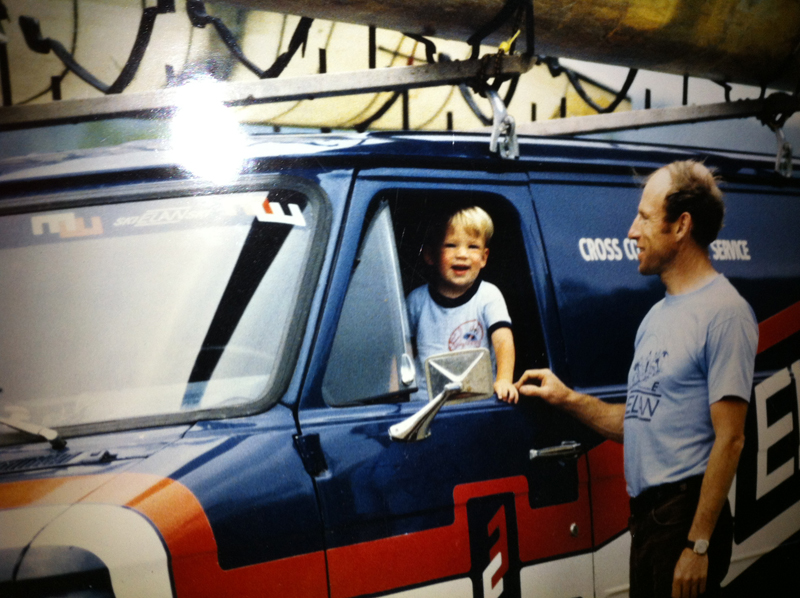
    Gallagher (r) with his son, Jesse, in his Elan work van. (Photo: Mike Gallagher)
    Gallagher (r) with his son, Jesse, in his Elan work van. (Photo: Mike Gallagher)

    Gallagher applied his talent and formidable energy to bike racing in New England, a sport in which he excelled for many years. In 1972, he was the 25-mile road biking national champion.

    Retired from racing, but still enthralled with the sport, Gallagher turned to coaching. He was head coach of the USST from 1980-86, Olympic-team coach in 1980, 1984, and 1992, and a high-school coach for 17 years. With Gallagher at the helm, Bill Koch won the overall World Cup title in 1982.

    The nordic vice president of Fischer USA, Ashley summed up Gallagher’s insightful coaching style in a 2011 interview with FasterSkier. “Mike was the perfect guy for Kochie because he allowed him to do things in a different way, was flexible when he needed to be and would stand on things when he needed to.”

    Gallagher vast knowledge of all things nordic led him to employment in several ski companies over his career, among them Splitkein, Hexcel, Edsbyn, and Elan.

    For many years, Gallagher shared his love and expertise of skiing as the nordic director at Mountain Top Inn in Chittenden, Vt. He also taught skiing at the nearby Mountain Meadows in Killington.

    In 2007, Gallagher was inducted into the Vermont Skiing Hall of Fame. He was also into the Mount Washington Road Race Hall of Fame in 2011, a race he won from 1968 to ’71.

    Gallagher is survived by his wife, Tyna, sons Sean and Jesse, and a grandson.

    Athlete, Coach, Mentor, Friend: Remembering Mike Gallagher 

    Some people are larger than life. Gallagher was one of them. When you think of throwing rocks into a pond, the largest ones make the biggest splash and send the ripples furthest. Gallagher touched the lives of many because his ripples reached the far edges of the pond.  – Nancy Fiddler

    Mike "Jumpin' Jack" Gallagher (l) and longtime friend John Estle in April 2003. (Photo: John Estle and Norma Haubenstock)
    Mike “Jumpin’ Jack” Gallagher (l) and longtime friend John Estle in April 2003 in Pittsfield, Vt. (Photo: John Estle and Norma Haubenstock)

    Many people met Gallagher through cross-country skiing and then became friends for life. Famed nordic announcer Peter Graves is one, remembering in an email message how he met Gallagher.

    “I first met Mike in the late ’60s when he came to my high school to do a clinic. With his typical verve he talked about what a great sport XC was,” Graves wrote in an email. “With that and his sparkling USA warm-up, I became a follower. Over the years, we shared special moments of reflection in his sauna and pondered things, sport and the meaning of life.  What was said in the sauna always stayed in the sauna. What he leaves is a rich tapestry of goodness, of inspiring countless people to ski and enjoy the richness of life. He was a smart guy with deep feelings, and as an Irishman myself, I could always understand the joy he felt in singing his Irish songs. He touched so many people, I’m going to miss him for a long, long time.”

    Teammate and close friend Elliott recounts in an email how, on a 2012 visit to New Hampshire, he drove 330 miles round trip just to have dinner with Gallagher and Gray. The three remained friends for years after they dominated the U.S. skiing scene.

    Elliott and Gallagher had the best kind of competitive relationship. They raced against each other at Junior Nationals and in college, and ended up teammates on the 1964, 1968, and 1972 Olympic teams as well as the 1966 and 1970 World Championship squads.

    “We met in 1959 at the Junior National Championships. We always had a friendly rivalry training and racing,” Elliott wrote in an email. “Michael had ‘XC1’ on his Vermont vanity license plate. That license plate was a huge motivating factor for me because I wanted my results to force him to change his vanity license to ‘XC2’. Whenever I did not want to train, I just had to think of that license plate and then I was out the door training.”

    Elliott also remembers Gallagher’s infectious singing. “When he called his friends on the telephone and they answered, he would often break into an Irish song. We all knew who was on the other end. He cultivated many friends from all walks of life. He really was such a good guy.”

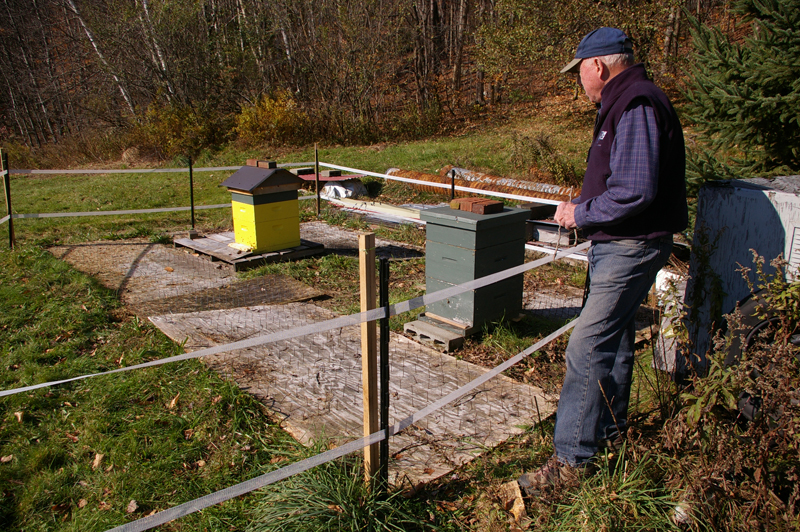
    Gallagher checking on the beehives in November 2011 at his home in Pittsfield, Vt. Seventy years old at the time, he said he spent most of his time gardening and mowing nine acres of his 50-acre property.
    Gallagher checking on the beehives in November 2011 at his home in Pittsfield, Vt. Seventy years old at the time, he said he spent most of his time gardening and mowing nine acres of his 50-acre property.

    Gallagher was the consummate tough mountain man, but Elliott saw a gentler side of him on their many travels together. “He once dressed as Santa Claus and passed out presents to children at a resort where we were staying in Scandinavia,” Elliott wrote. “His wonderful laugh and his accent made him a believable Santa Claus to the children. I have nothing but the fondest memories of my life with Michael.”

    As competitors and avid outdoorsmen, Elliott and Gallagher shared many adventures. “Gallagher came out to Colorado in 1973 and we went backpacking,” Elliott explained. “He was not really fond of heights and I really took advantage of that fact and enjoyed scaring the hell out of him in the Colorado mountains. He was a very good sport about the whole situation. He loved fly fishing in those high mountain lakes.”

    One of the many athletes Gallagher coached, Kevin Brochman remembered how Gallagher used humor to get him through tough situations, a behavior Brochman still resorts to. A two-time Olympian, Brochman also recalled Gallagher’s discomfort in high places, something that seemed to make him more human.

    “Mike was a great coach and led the team to a US men’s best, 4th in the world, in 1982,” Brochman wrote on Facebook. “I felt honored to be part of his tenure from 1981-86. HE LOVED TO LAUGH. He did not care too much for the gondola ride up to Dachstein Glacier though!”

    Former U.S. Ski Team head coach Mike Gallagher with one of his athletes, Jim Galanes, after a 1984 World Cup race. (Photo: Mal Lockwood)
    Former U.S. Ski Team head coach Mike Gallagher with one of his athletes, Jim Galanes, after a 1984 World Cup race. (Photo: Mal Lockwood)

    As a coach, Gallagher set the bar high for his athletes, yet he stood behind them in every situation. The U.S. men’s squad, under his direction, achieved huge success.

    “When Michael was the USST XC coach, he often traveled to where the national team skier lived to help them individually with their training,” Elliott explained. “He was instrumental in helping Bill Koch win the World Cup. Bill has nothing but kind, complimentary things to say about the job Gallagher performed.”

    Ashley’s long friendship with Gallagher began at Colorado, where Gallagher helped save Ashley from a near-death experience following a collision with a tree. Later, Ashley and Gallagher coached the USST together. Ashley will always remember what he believes to be one of Gallagher’s major contributions to the sport of skiing in this country.

    “Gallagher was a man who stood by his decisions, which served him well during the skating revolution,” he said on the phone. “He advocated for allowing the athletes to move the way they wanted to on a race course at a time when many of the international ski leaders were against skating. Gallagher was able to represent the USA’s desire to skate in the international coaching arena. We have a lot to thank him for, in that regard.”

    Ashley, Gallagher, and Ruff Patterson brought skating back from the World Cup to the U.S. racing and recreational-skiing population. Their dissemination of skating knowledge put many Americans on skate skis in the ’80s.

    Gallagher’s energy and personality were the driving forces in his coaching. As 1984 Olympian Sue Long Wemyss stated online: “I was fortunate to be on the USST and to get to know Mike during the years he was head coach. He was so lively, so positive. He leaves a huge hole.”

    Helping Koch top the World Cup was just a small part of the impact Gallagher had on nordic skiing in the U.S. His knowledge was vast, his reach deep and his vision global. According to Ashley, “He had a huge influence on the younger skiers and was something of a father figure to many. The kids really looked up to him.”

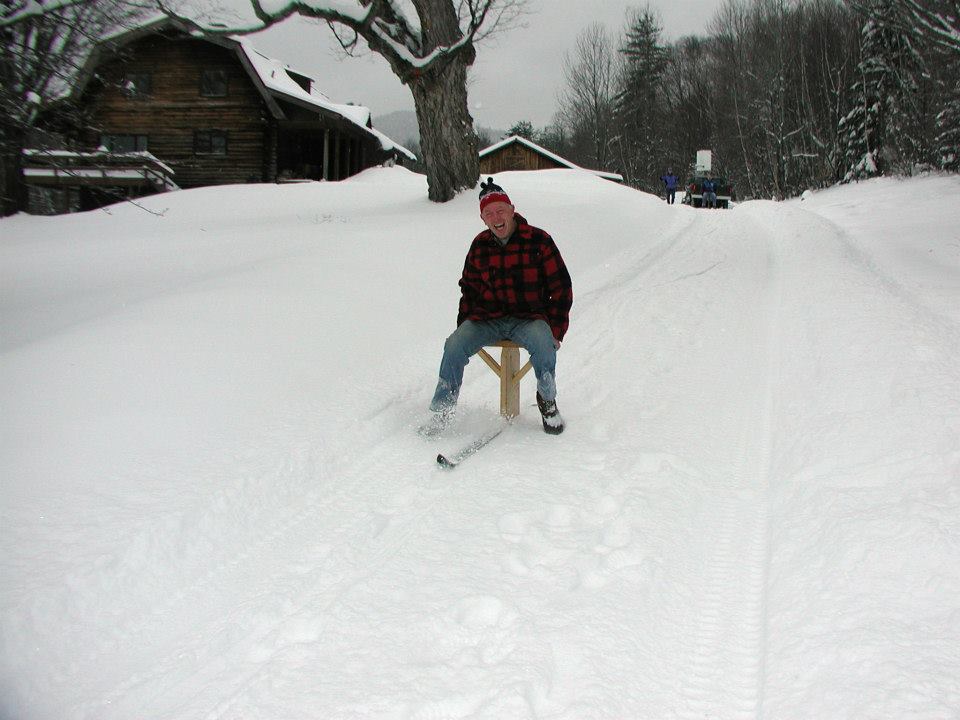
    Mike Gallagher enjoying some playtime at his Pittsfield, Vt., home in April 2003. (Photo: John Estle and Norma Haubenstock)
    Mike Gallagher enjoying some playtime at his Pittsfield, Vt., home in April 2003. (Photo: John Estle and Norma Haubenstock)

    Former USST skier Tim Kelley was one of the many juniors inspired by Gallagher. He also weighed in on his memory of Gallagher on Facebook.

    “Besides being a hero for U.S. cross-country skiing, Gallagher was always very supportive of the young guns. He enthusiastically welcomed newcomers into the XC skiing cult. I remember once at a junior camp at his place doing a circuit strength workout at his stations in the woods. And then we finished off the workout by helping him lift logs up for the cabin he was building.”

    University of Denver Head Coach David Stewart echoed Kelley in another comment: “Gallagher was a big influence on me when I was just a Bill Koch League racer, inspiring me and many others with his enthusiasm for every level of the sport.”

    Gallagher expected a lot, but gave a lot. His dreams are being carried on by the many who were influenced by his spirit. Cambridge Sports Union Head Coach Rob Bradlee carries on some of the best Gallagher traditions in his own work.

    “I remember him coaching me at a training day at Putney when I was 15,” he wrote online. “With his enthusiastic urging, I did more push-ups than I thought I could ever do. His energy was infectious.”

    There were valuable lessons beyond the push-ups, Bradlee explained. “As a non-competitive skier I was always impressed by how kind and encouraging he was to me. That I loved skiing was good enough for him. And in the long run, he helped me be a better coach by modeling that inclusive behavior.”

    Dartmouth coach Ruff Patterson and Gallagher go back a long ways. They have worked together, recreated together, and shared a lot of good times. Patterson was Gallagher’s best man when he married Tyna in 2002.

    “Gallagher was a strong man who expected things from people,” Patterson said on the phone. “He was direct and didn’t mind saying what he thought. He pushed all of us as hard as he pushed himself. I wanted to strangle him one day and hug him the next! We were incredibly close.”

    The Quintessential Vermonter

    “Taking in nature and spending time outdoors is what life was like with Mike. It could be as simple as sitting on our deck, looking out at the mountains sipping coffee and just taking in the beauty of our surroundings. Even though it was peaceful and it was also energizing. Mike was an avid fisherman and hunter, who could turn almost any outing into an adventure with his gift of storytelling. Mike had a joke or two for almost any topic, it was truly amazing how he could remember so many jokes. Even though he loved living off the beaten track, almost recluse, whenever there was a gathering Mike was sure to be the center of attention. With a twinkle in his eyes and his voice booming with excitement he would draw  everyone into the story or joke he was telling. While his accomplishments were bigger than life, he was modest and would only talk about them when asked. He was warm, affectionate and fun-loving, he enjoyed putting a smile on someone’s face. He touched so many lives in a positive way, including mine. I am so proud of the man known as Michael Gallagher, he was the love of my life, my soulmate and my heart is breaking.” — Tyna Gallagher

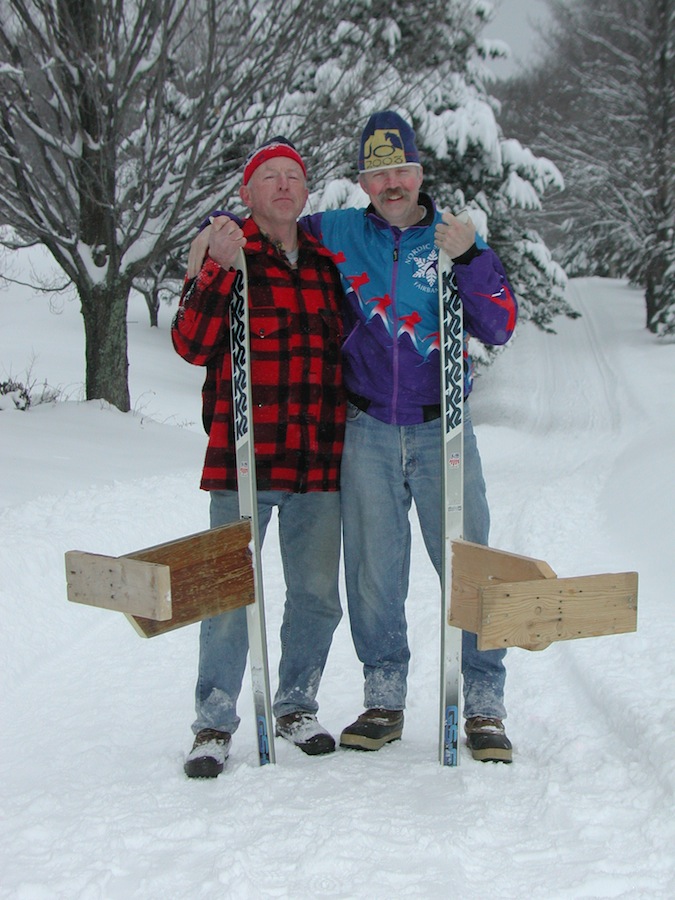
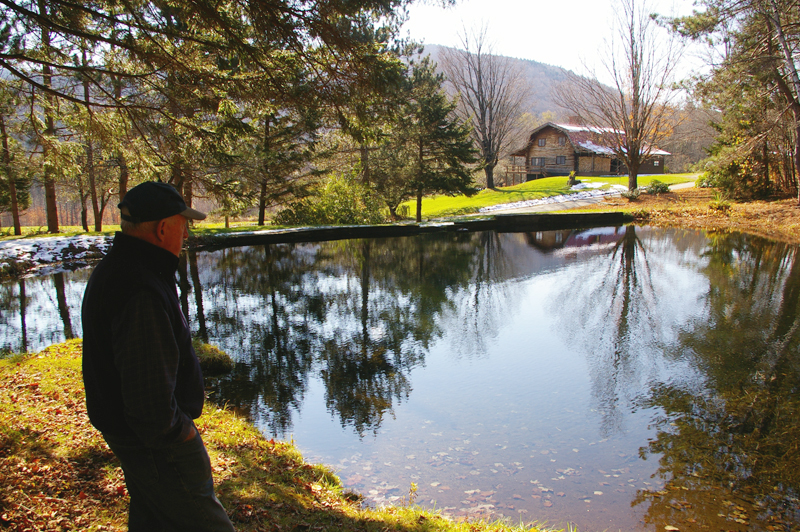
    Gallagher beside his heart-shaped pond, where he married his wife Tyna, at their home in Pittsfield, Vt. Gallagher gave FasterSkier a tour of his 50-acre property in November 2011.
    Gallagher beside his heart-shaped pond, where he married his wife Tyna, at their home in Pittsfield, Vt. Gallagher gave FasterSkier a tour of his 50-acre property in November 2011.

    Gallagher embraced the Vermont lifestyle; he built the home he lived in and stayed busy and active to the end of his life by tending his garden, mowing, keeping bees, cutting wood, and hunting and fishing.

    He raised his boys, Sean and Jesse, to be strong outdoorsmen as well as excellent skiers, and loved the time he spent in the woods with them.

    Visitors to his Pittsfield home remember the sauna sessions. Between plunges into the refreshing pond, Gallagher told his famous stories and occasionally broke into song. Gallagher delighted everyone who took part in living large with him.

    Elliott succinctly put into words what many are thinking: “I wish I would have spent more time with him.”

    ***

    More on Gallagher, including audio from his 2011 interview with FasterSkier

  • Bald Mountain Ridge Crust Skiing

    Bald Mountain Ridge north of Wasilla, Alaska in the Talkeena Mountains can be tough to get to during crust skiing season. I had wanted to ski this area for a long time. I finally managed to get up on the ridge when the crust skiing was good.

  • Bald Mountain Ridge Crust Skiing

    Bald Mountain Ridge north of Wasilla, Alaska in the Talkeena Mountains can be tough to get to during crust skiing season. I had wanted to ski this area for a long time. I finally managed to get up on the ridge when the crust skiing was good.

  • 100 Miles of Caribou Hills

    An overnight ski of the 100 mile Tustumena 200 sled dog race trail in the Caribou Hills area of the Kenai Peninsula in Alaska.

  • Curing the Clear Weather Headache

    I know of only one way to remedy a winter-time “clear weather headache” in Alaska … ski until it’s gone!

  • 86 Miles from Hatcher Pass to My Cabin

    I had been scheming this ski trip for a while. Finally good conditions and logistics gelled for me to pull off this fun 86 mile ski from Hatcher Pass to my wife’s and my cabin at Alexander Creek.

  • Escaping Anchorage

    As soon as a trail opens across the Big Susitna River, it’s time to escape from Anchorage and go to Alaska.

  • Following the Ice Road Truckers to Work and Back

    Driving 1700 miles from Anchorage, AK to Prudhoe Bay and back on the Dalton Highway, with stops in the Brooks Range for hiking.

  • Ski Trips: October thru December 2008

    Bald Mountain, Mint Hut, Nancy Lakes Blading, Big Lake Blading, Lower Su, December Light, Susitna Game Flats, Ski Around Anchorage.

  • Skiing For Furniture

    This is probably a first for skiing related web posts … finding furniture while backcountry skiing.

  • Ski Trips: March and April 2009

    Mt. Susitna (twice), Goose Bay, Pt. MacKenzie, Susitna Valley Winter Trail, Big Lake, Mendeltna, White Mountsins, Hatcher Pass Traverse x 2, Broad Pass.

  • Ski Trips: January and February 2009

    Lake Louise, Trapper Creek, Alexander Lake, Palmer Hayflats, Chugiak Coast, Bald Mountain Loop, Mt. Susitna, Kenai Lake.

  • Seven Miles of Mud – Hiking to Fire Island and Back

    The Anchorage Daily News ran an article about a group of adventurers making a crossing over “dangerous” mud flats to Fire Island. I had to check it out.

  • The Return of Cory … and Bard Peak

    Finally back from Achilles tendon surgery and recovery, Cory Smith joins up with me for a trip up Bard Peak.

  • Seven Miles of Mud – Hiking to Fire Island

    The Anchorage Daily News ran an article about a group of adventurers making a crossing over “danderous” mud flats to Fire Island. I had to check it out.