Tag: Tim Reynolds

  • Newell Skis Away with Classic Sprint Win at SuperTour Finals

    Newell Skis Away with Classic Sprint Win at SuperTour Finals

    Andy Newell fighting Pat O'Brien up a climb in the classic sprint A-final on Saturday at SuperTour Finals. Newell won the race and O'Brien took second. Photo: Mark Nadell/MacBeth Graphics.
    Andy Newell (c) fighting Pat O’Brien (r) up the last climb in the classic sprint final on Saturday at SuperTour Finals. Newell won the race, and O’Brien took second. (Photo: Mark Nadell/MacBeth Graphics)

    FasterSkier’s coverage of SuperTour Finals and U.S. Distance Nationals is brought to you by the generous support of Concept2, the leading manufacturer of indoor rowers, racing oars, and the SkiErg.

    SODA SPRINGS, Calif. — When Andy Newell (SMS T2/U.S. Ski Team) shows up to a sprint in the U.S., his name carries a certain cache with it. As the fifth-ranked sprinter on the World Cup this season and the only man in the world to qualify for the heats in every sprint he started, he is undoubtedly the standard-bearer in short distances whenever he returns to the domestic circuit. His name precedes him; Newell’s younger competitors grew up with posters of him on their walls, and when they meet him in an A-final they plan their entire strategies around him.

    “I remember my first Andy Newell poster I got in, like, elementary school,” says Erik Bjornsen (Alaska Pacific University/USST), a teammate of Newell’s on the national team. “I remember my friends and I talking about him in school, like, ‘That guy’s such a badass!’”

    There may come a day when one of the upstart generation of American sprinters upsets him, but Saturday was not that day. Four rounds of the sprint course later and Newell lived up to his reputation, winning the third stage of SuperTour Finals in commanding fashion against Pat O’Brien (Craftsbury Green Racing Project), Bjornsen, Tim Reynolds (CGRP), Rune Ødegård (University of Colorado) and Mike Sinnott (Sun Valley Ski Education Foundation) in the A-final.

    It’s been two years since Newell last entered a sprint race in the U.S., as he was sick for spring series a year ago, but he picked up right where he left off in Sun Valley, Idaho, in 2011. Based on his track record, the casual observer might conclude that Newell’s win was a sure thing at the Auburn Ski Club; that nobody in the domestic field could hope to touch someone who has been competing on the World Cup since he was 20 years old and has since proven himself to be one of the most consistent sprinters in the world.

    But Newell has been around long enough to know that losing is always a possibility, no matter what the field. His finish in the prologue in variable conditions put him nearly a minute out of the lead and limited his chances at winning the four-race tour on day one. Forced to shift focus from the SuperTour Finals title to individual races, Newell showed up for the sprint aware that nothing is ever a sure thing, particularly against a rabid domestic group of skiers.

    “There’s a lot of good sprinters in the U.S.,” Newell said. “Obviously qualification isn’t quite as competitive as the World Cup, but when you’re racing heats against these people it’s like, anybody can win. It’s sprint racing; so much can happen out on the snow. A lot of these guys are really fast. So I wouldn’t say I expect to win, but I definitely go into a sprint in the U.S. hoping to win.”
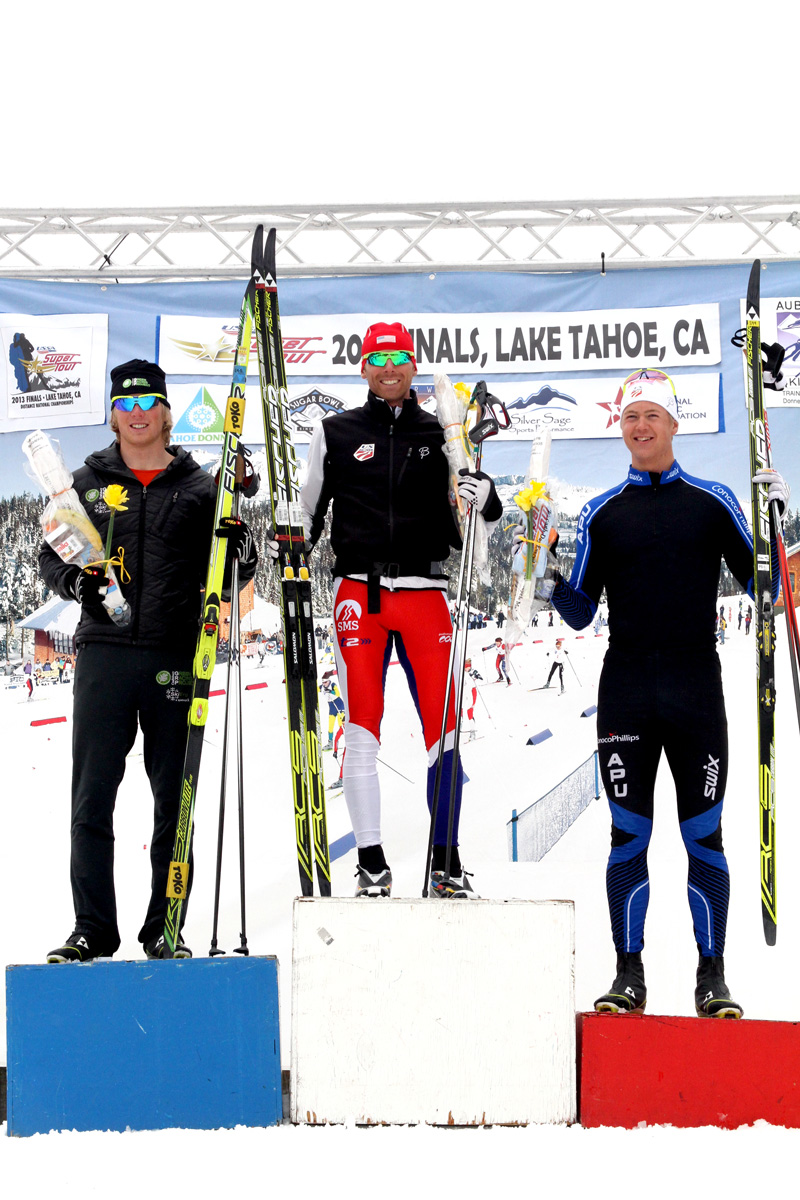
    The men's podium: 1. Andy Newell, 2. Pat O'Brien, 3. Erik Bjornsen. Photo: Mark Nadell/MacBeth Graphics.
    The men’s podium: 1. Andy Newell, 2. Pat O’Brien, 3. Erik Bjornsen. (Photo: Mark Nadell/MacBeth Graphics)

    From word ‘go’ in the qualifying round through to the A-final, Newell made his supremacy known. He was one of a small set of athletes with the confidence to start the preliminary round on skate skis in conditions that were changing and softening in steadily falling snow, and on a course with two serious climbs to boot. Newell’s double-pole is unparalleled in this field, however, and it was clearly the right choice for him — he won a three-minute qualifier by five seconds over CU’s Gustav Nordstroem to start the day.

    In the heats, Newell played a more tactical game. Back on classic skis, he took second behind O’Brien in each round and never used more energy than he needed to advance.

    For the final, both Newell and O’Brien went in with a good idea of what the other would do. O’Brien was riding the high of an unanticipated late-season resurgence and “really good” skis, and led each of the early heats from start to finish. He left the start line knowing he wanted to get out fast enough to pick his own lane again after the scrub zone, as a difference in track speed developed as the day wore on.

    Newell, for his part, guessed O’Brien would go to the front early again, and planned to tuck in behind him down the descent out of the stadium and take control on the climbs.

    “I was thinking I wanted to conserve as much energy as possible, but that didn’t really happen,” O’Brien said. “I don’t know; it was just kind of racehorse instincts. I wanted to try to take it pretty easy, but it was also pretty easy to ski from the front there and be able to choose your own lines.”

    With O’Brien out front, Newell was able to decide when to ramp up his own power output. He made his move on the first climb and O’Brien was unable to respond; nor was Reynolds, Bjornsen, Ødegård or Sinnott in line behind them. When Newell emerged from the woods and climbed the hill back into the stadium, he had an even bigger lead than he had expected.

    “I was able to choose my own line and was able to get my own track on the uphill, which is what I wanted to do,” Newell said. “I just put my head down and went, and I didn’t know I had such a big lead because I was hammering into the first part of the stadium. I looked back and I couldn’t see anybody. So I guess it worked out.”

    O’Brien expected the move when it came, but was to gassed to respond.
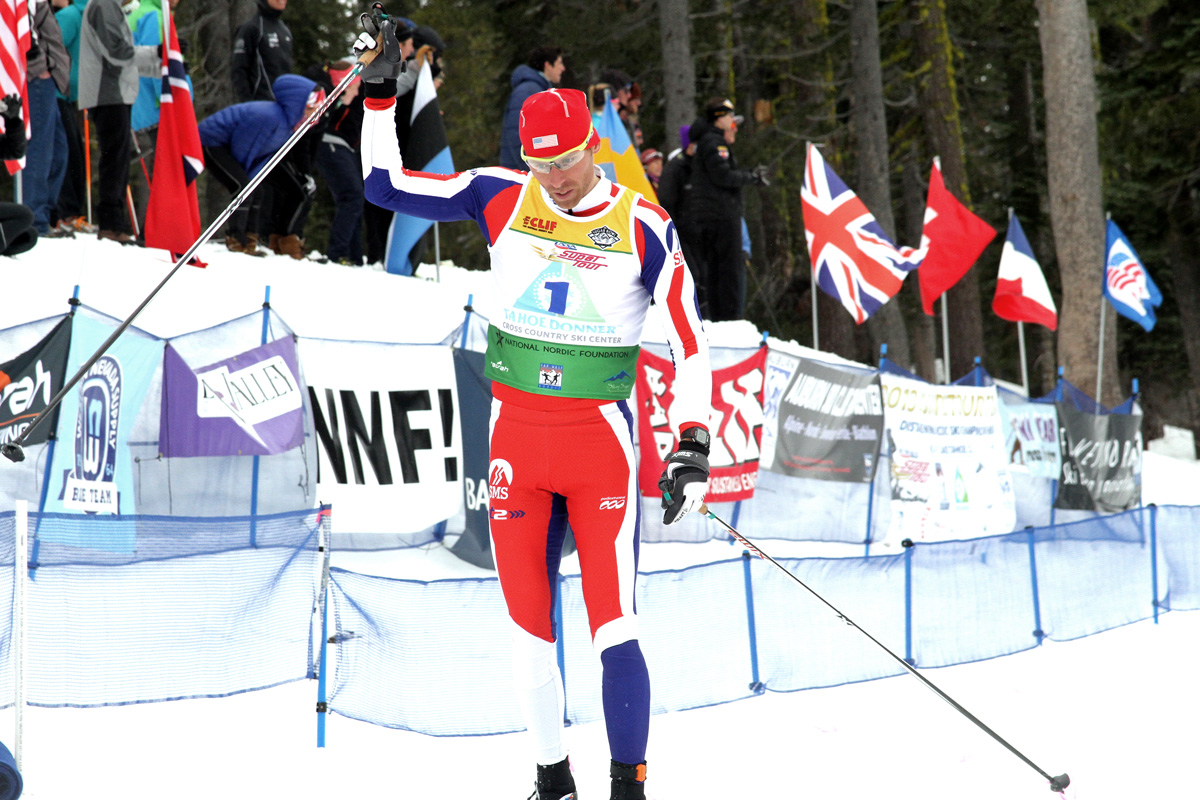
    Newell tiredly raising a triumphant arm across the finish line. Photo: Mark Nadell/MacBeth Graphics.
    Newell raising a triumphant but tired arm across the finish line. (Photo: Mark Nadell/MacBeth Graphics)

    “He opened up a little bit over the top and I just couldn’t quite close him,” O’Brien said. “I knew that’s how he’d been skiing the quarter and semis, so I knew he was going to go there and I expected it, I just couldn’t really match it.”

    O’Brien hung on long enough to hold onto second, and behind him Bjornsen passed Reynolds and Ødegård in the final straight to claw his way onto the podium. Reynolds skied across the line in fourth for his best result of the year, Ødegård held on to fifth and Sinnott took sixth.

    Finishing second to someone like Newell left O’Brien extremely pleased with the way the end of his season has been going.

    “It’s a really good feeling,” O’Brien said. “It’s been a tough winter and I haven’t really felt myself. So to come out here to altitude, where I normally struggle, and feel good on the last three races…I’m super happy with today.”

    Bjornsen, winner of the prologue and runner-up in the 15 k, was ecstatic with third. Slow skis left him far off the pace in fifth at the furthest point on the course, at which point he nearly gave up on the idea of a top-three. He had asked for more kick before the start of the A-final, and the extra wax slowed him down on the flats.

    “I really had to work on the double-pole section, and I actually got to the far end of the course and I was like, ‘I think my day is over,’” Bjornsen said. “But no, I started gaining back on the first hill and coming down into the next one I could see people were dying a little bit, and I saw third place up there and that really fired me up, so I just went for it.”

    Reynolds said he had nothing left in the finish stretch when Bjornsen caught him from behind.

    “I thought I closed pretty well on the uphill, and then just kind of died in the finish stretch,” Reynolds said. “Bjornsen blew by me.”

    Though Reynolds just missed out on the podium, fourth is “easily” his best result of the season.

    “I mean, it doesn’t really erase the 20-odd bad races I’ve had…but obviously it’s nice to feel a little more like yourself and ski a little faster,” he said. “I’d actually felt pretty good this week, so I was hoping to have a good race. And we had great skis and my body felt good.”

    Ødegård, the 2013 NCAA champion in the 10 k classic, repeated his result from a week ago at Canadian Nationals in taking fifth.

    Behind Ødegård, Sinnott conceded that sixth was as much as he could muster at the end of a sprint day. He delaminated a ski in his quarterfinal, and though he managed to advance second in the heat anyway, he had to scramble to find a good replacement for the next round.

    “I didn’t really notice it until we went up to rewax some top sauce, and was like, ‘Oh, this isn’t going to work,’” Sinnott said.

    He advanced as a lucky loser in his semifinal, and in the final he was “pretty exhausted.”

    “I was tired and just couldn’t keep up,” he said. “I kind of slipped a couple times on the climb and just blew my arms out and didn’t have much for the finish. But so it goes.”

    The bonus seconds available in the sprint were substantial. With only the hill climb left to go in the tour, Bjornsen now sits in the lead just over 40 seconds ahead of Newell and Freeman in the overall standings. The trio will be separated by this margin in the pursuit-style start of the hill climb on Monday, and whoever makes it to the top of Sugar Bowl will win SuperTour Finals.

    “I’m feeling pretty good,” Newell said. “I thought I’d be hurting more, but this late in the season your body’s so used to racing you don’t even really get sore any more, you’re just kind of tired. Hopefully the sun will come out tomorrow and we can hang out more and do more California-style things, because I’m kind of over winter at this point.”

     — Alex Matthews contributed reporting.

    Results | Photo gallery (via Mark Nadell/MacBeth Graphics)

    Other notes from the classic sprint:

    —   Kris Freeman (Maine Winter Sports Center/USST), who led the tour after winning the second stage on Friday, finished outside of qualifying in 39th. MWSC head coach Will Sweester took responsibility for the wrong ski call — he brought skate skis to Freeman at the last second after observing the success Newell and others had with double-poling and being convinced it would be the right call for Freeman, too.

    “We’ve had a steep learning curve, him and me, and all the skis he has,” Sweester said. “Today I sprinted up at the start with skate skis at the last minute and it was definitely the wrong call on my part. We had good classic skis but the snow made me nervous.”

    —   Torin Koos (Bridger Ski Foundation/Rossignol), in his first race of the tour after being ill for the prologue and 15 k, did not advance to the final after tangling with another competitor and falling in his semifinal. He qualified in sixth position on skate skis in the preliminary round, eight seconds behind Newell. A coach approached the jury with “grumblings” about Koos’ lane crossing technique in the qualifier, but no official protests were filed. According to Technical Delegate Al Serrano, three jury members reviewed the relevant video footage of the qualifier and determined that Koos did not skate when changing lanes at the point in question.

    —   Sylvan Ellefson (Ski & Snowboard Club Vail Team HomeGrown) collided with a spectator in his quarterfinal a few hundred meters from the finish, which resulted in his automatic advancement to the semifinals. The spectator stood in the tracks with her back turned when Ellefson, double-poling with his head down, clipped her with his shoulder and “from what I heard, I knocked her over,” he said.

    Ellefson was in fifth at the time of the collision and finished fifth in the quarter. As the fourth qualifier he wore the lowest bib number of his heat and only needed to finish third in order to advance to the next round. Unable to say whether the spectator prevented Ellefson from advancing, the jury decided to put him through anyways as a seventh man at no prompting from Ellefson or his coaches.

    “I don’t know if I was in striking distance or not,” Ellefson said. “It’s their fault I guess for not having the v-boards up.”

    Serrano said there is no rule in the FIS rulebook that covers interference with a bystander, and the jury decided to advance Ellefson as if it he had instead been the victim of obstruction from a competitor.

    “There’s a specific rule for what happens if someone is taken out and the person that takes them out is disqualified,” Serrano said. “If another competitor takes them out, then they advance. Basically [that’s] the way we ended up advancing Sylvan, as the seventh person in the heat, starting two meters back.”

  • Tiuterev completes Russian Sweep in Madison, Bender bests Brennan

    Tiuterev completes Russian Sweep in Madison, Bender bests Brennan

    Rosie Brennan leads Jennie Bender in the women's final of the Madison SuperTour skate sprint. Bender would overtake Brennan for the win. (Photo: Renee Callaway)
    Rosie Brennan leads Jennie Bender in the women’s final of the Madison SuperTour skate sprint. Bender would overtake Brennan for the win. (Photo: Renee Callaway)

    Andrei Tiuterev (RUS) completed a Russian sweep of the Madison Square Capitol Sprints on Sunday in Madison, Wisconsin.  Tiuterev bested countryman Dmitry Ozerskiy (RUS), the winner of Saturday’s classic sprint.  Midwest native Karl Nygren (CXC) placed third.

    Tim Reynolds (CGRP) was the fastest qualifier on the day, narrowly edging out Ozerskiy by 0.1 seconds.

    Reynolds would go on to win his quarterfinal but fall in the semifinal, beaten to the line by Samuel Naney (MOD) and Karl Nygren.

    Eric Walcott, another CXC team member, qualified third and won his quarterfinal but was found wanting against the Russian duo of Tiuterev and Ozerskiy in the second semifinal, finishing fourth.

    Tiuterev, the eventual winner, appeared to pick up speed as the day wore on.

    He qualified in 7th position, made it through the quarterfinal with a second place finish behind Ozerskiy, before finding another gear and beating his teammate in both the semifinal and the final.

    According to Nygren, the third place finisher, tactics rather than speed prevailed on the narrow course in the final.

    “It was very tactical,” Nygren told Fasterskier. “Naney led it out and I sat towards the back. The two Russians went hard around the second to last corner and pushed the pace and moved to the front on the gradual down.”

    The Russians closed the door on the final turn into the finish, cutting off any chance for the the chasers.

    “They [the Russians] took it on the inside and drifted out to block a pass on the best line,” said Nygren. “I decided to cut way back into the inside lane and was unable to close down the gap. They played it smart and skied well.”

    In retrospect Nygren thought there may have been some team tactics, but on a short course with a narrow tracks it may have been as much a function of racing strategy as course profile.

    “Looking back it appears they worked together but who knows,” Nygren concluded.

    Beyond the racing the setting and crowd at the city sprints always makes this competition a highlight on racing circuit.

    “Conditions were excellent and the city sprint atmosphere was amazing,” Nygren said.

    Results

    Women’s Freestyle Capital Square Sprints

    Jennie Bender (CXC) got the better of Rosie Brennan (APU) on Sunday in the Madison Square freestyle sprints, a reversal of Saturday’s classic result.

    Bender dominated throughout the day, qualifying in first position in a time of 1:53.0, 0.5 seconds ahead of rival Brennan.

    She marched through the quarterfinals and seminfinals, winning both heats on her way to the final.

    “City sprints are a nice change, and it is good for the athletes to get used to a different atmosphere of a typical race day,” Bender wrote to FasterSkier in an email. ”

    Madison SuperTour - Skate Sprint Women's Podium - (l-r) Rosie Brennan, Jennie Bender, Caitlin Patterson (Photo: Renee Callaway)
    Madison SuperTour – Skate Sprint Women’s Podium – (l-r) Rosie Brennan, Jennie Bender, Caitlin Patterson (Photo: Renee Callaway)

    Although the women’s field was small, there were enough top women to make the semis and final heats competitive. I am alway impressed with the wonderful volunteers there, who are super supportive.”

    Eventual second placed finisher Brennan followed a similar trajectory to the final, winning both her quarterfinal and semifinal, before the exertions of Saturday’s classic sprint caught up with her.

    “Today was challenging because I was unbelievable sore from the double pole derby of yesterday,” Brennan told FasterSkier. “My muscles were not happy to be ski racing today, but it was fun to skate today.”

    Brennan eschewed tactics in favor of a more aggressive approach, saying “because of the way I felt, I thought my best chance was to just go for it from the gun and hope everyone else was tired.”

    Her path to the final was challenged by third place qualifier Claire Egan (CGRP), whom finished second to her in the semifinal.

    Egan would go on to finish fourth in the final.

    Third place finisher Caitlin Patterson (CGRP), qualified 4th and delivered a series of gritty performances, finishing second in both her quarterfinal and seminfinal heats, before finding another gear on in the final to better her teammate Egan for a podium spot.

    According to Brennan, the final wasn’t tactical, as the absence of a headwind muted the advantages of drafting.

    “There wasn’t a head wind on the downhill so drafting wasn’t quite as important,” she said.

    Despite a furious pace from the gun, her tempo wasn’t enough to unsettle Bender.

    “Unfortunately, Jennie was able to stay with me and did a killer job skating the downhill so she passed me before we went around the final corner and I didn’t have much to answer with,” Brennan said.

    Brennan echoed Nygren’s sentiments about the conditions and atmosphere of the Madison Square Sprints.

    “The skiing was actually quite nice,” she said. “It was cold all weekend so the snow set up well and was firm throughout all the races.”

    Results

    — Topher Sabot contributed reporting

  • SuperTour Preview: Get ‘Em To the World Cups

    SuperTour Preview: Get ‘Em To the World Cups

    The major focal points for the SuperTour field this year are qualifying for the Canadian World Cups in December and World Championships in February. Photo: Flying Point Road.

    Ready or not, the 2013 SuperTour season is fast approaching. Here’s what you need to know about the domestic race scene this year.

    At this point, we’ve pretty much said everything we can about the twelve senior ski programs in the U.S. We ran a series throughout the summer highlighting each team’s past accomplishments and goals for the future. Read back through ‘em for comprehensive rosters and standalone previews (scroll down for links). Now that it’s November, it’s time to discuss who stands a shot at beating whom.

    First, there are a few unusual things about the race schedule to understand, as domestic results have an important role to play in qualifying athletes for bigger things this season. The U.S. can enter more athletes than usual in each World Cup race in Canada and can have eight athletes of each gender on its World Champs team, meaning that U.S. Ski Team (USST) members have a shot at top-end international competition this winter (those on the USST are not guaranteed World Championship slots, either).

    Not surprisingly, the big focus is a combination of Canadian World Cup starts and World Championships. The overall, sprint and distance SuperTour leader(s) at the end of each competition period get World Cup start rights no matter what year it is, but being consistently fast enough to be in one of those positions is hard.

    The five extra Nation’s Group spots afforded to the U.S. for each of the Quebec and Canmore World Cup races will be partially filled based on the SuperTour standings after the Bozeman races. With selection criteria theoretically reaching further into the field and requiring just two weekends of top results, the international stage suddenly seems much closer and more attainable. Who cares if SuperDario Cologna won’t be there, it’s still the World Cup!

    World Championship criteria are a slightly different story, but early SuperTour races could still help decide who gets to go. The U.S. will bring up to eight men and eight women, with the first spots going to athletes who reach a certain World Cup ranking by January 14. After that, USSA goes down the National Ranking List, which is created off of competitors’ best four USSA-scored races from the twelve months prior to the selection date.

    The road to Val di Fiemme, then, has already begun. The beginning of the current SuperTour and the week’s worth of racing at U.S. Nationals are further opportunities for athletes to turn in one of their four-best results and move up the ranking list.

    Consequently, there’s a lot potentially riding on the SuperTour this year, despite the continued absence of leader bonuses at the end of the season. It’s not that everyone wasn’t trying hard before, but with a handful of top-level start rights on the line that only come around every so often, things could get feisty. Dreams will come true and hearts will be broken.

    Now, the players: last year’s overall SuperTour leaders, Sylvan Ellefson (SSCV Team HomeGrown) and Jessie Diggins (SMS T2/USST), are already in Europe and out of the domestic picture for the next two weekends. Even so, the potential lineups for West Yellowstone and Bozeman are impressive.

    The Rookies

    Eric Packer (DAR). Photo: Flying Point Road.

    For the purposes of this preview, athletes can pretty much be divided into two groups: knowns and unknowns. Every spring a handful of top-tier college skiers graduate and the domestic circuit gets an injection of new blood. Most graduates have competed in SuperTours before, but not when it’s actually been their job to ski fast.

    So while the rookies aren’t joining the circuit as complete unknowns, their changed training circumstances can make the first results of the year a bit of a surprise. The 2012-2013 freshman class has generally never trained without academic demands competing for their time, and given the results they’ve been able to churn out even during school, count on them disrupting the status quo on the SuperTour this year.

    Take Eric Packer, who joins the SMS T2 team from Dartmouth College and already has a handful of SuperTour and national podiums to his name. Packer was probably the most consistent college performer, sprinting and distance-wise, on the circuit last year, and could be ready for a significant step forward in his transition to full-time racing.

    Reid Pletcher (CU) winning the skate sprint qualifier at West Yellowstone, 2011.

    There’s also Reid Pletcher, who has been described as a “sprint fiend” and returns to skiing for Sun Valley this winter after graduating from CU. Remember how he won the skate sprint in West Yellowstone last year, just six months after a climbing accident landed him in the ICU? Yeah, that was ridiculous. Imagine what he might do this winter with a strong summer of training behind him.

    Ryan Scott will be another sprinter to watch for. Regardless of the whole obstruction controversy, he was still in the classic finals at U.S. Nationals. At U23s he was the top American performer in the freestyle sprint. He didn’t race a whole lot after that, but his coaches at Ski & Snowboard Club Vail think he’s looking mighty fast in the run-up to the first race of the year.

    In the women’s field, newcomer Sophie Caldwell (SMS T2) presents the greatest threat to the usual SuperTour standbys. Amy Glen (Craftsbury Green Racing Project) did beat her by a toe-length at the biggest college race of 2012, but the name Caldwell regularly shows up at or near the top of the results sheet week after week — whether it’s Sophie or one of her equally fast relatives.

    The Upperclassmen

    Though they represent relatively known quantities, the more seasoned SuperTour athletes are no less intimidating for it. They’ve been around the block and they know what it takes to be at the top of the domestic field.

    Jennie Bender (CXC) was the second-ranked woman on the SuperTour last year, and stands a good chance at leading it in winter with Jessie Diggins now in Europe. Photo: Flying Point Road.

    Central Cross Country (CXC) was indisputably the best all-around team last year, and won the National Nordic Foundation’s team trophy in a landslide to prove it. The Midwest squad has lost a few athletes and coaches to other programs since last spring, but still claims four athletes ranked in the top five on the SuperTour in 2012: Jennie Bender, Karl Nygren and Caitlin and Brian Gregg. Look out for their fire engine-red spandex when the gun goes off.

    The next team to mention is undoubtedly Alaska Pacific University (APU). Sadie and Erik Bjornsen (APU/USST) are both racing stateside this November, and present a formidable threat when united with the rest of their teammates. Kate Fitzgerald, Becca Rorabough, Rosie Brennan, Reese Hanneman, Peter Kling — the Alaskans have a lot of returning talent. Thanks to Eagle Glacier, they’ll also be stepping onto their skis with more on-snow hours under their belts than anyone else.

    From the Bridger Ski Foundation, Torin Koos and Leif Zimmerman present solid all-around threats. Zimmerman has traditionally pulled off a distance win at West Yellowstone every year, and Koos will no doubt be looking for redemption for getting erased from the results the last time he raced in the U.S. When we spoke with him in June, Koos said that every day he thinks about the Canadian World Cups more than anything else.

    He’s probably not the only one. Mikey Sinnott (SVSEF), after finally earning his first World Cup starts in March, will be raring to get back. With two real, actual, sprints on the schedule in the first two weeks, Sinnott should be in contention to go to Canada. His teammate Matt Gelso is another name to watch in both sprint and distance. Representing Sun Valley’s women, Chelsea Holmes is coming off a strong finish to her 2012 season, where she was fifth in the 30 k at distance nationals.

    Matt Liebsch (Team Strong Heart/Team Birkie) skiing to the finish. Photo: Flying Point Road.

    Racing for Team StrongHeart/Team Birkie, Matt Liebsch is a perennial distance challenger. He took second in the 15 k freestyle at nationals and usually puts up solid distance results at the opening races. This year he’s been training in West Yellowstone longer than anyone getting ready to hit the ground running on November 23.

    In the east, the CGRP has another impressive lineup. Tim Reynolds and Pat O’Brien both finished the season strong at distance nationals and will want to continue the trajectory in 2013. To the north, Maine Winter Sports Center’s Welly Ramsey has been logging the hours with Kris Freeman and apparently been able to keep up at times, which can only be good for his skiing. Skyler Davis will be on the domestic circuit for the first period, at least, and could be a sprint contender for SMS T2 if he’s in full form.

    From Oregon, Dakota Blackhorse-von Jess (Bend Endurance Academy) proved last year he is not to be overlooked on a sprint day. And with more of those legitimately on the SuperTour schedule this year he’ll have plenty of opportunity to contend in the heats. XC Oregon added Santi and Carolyn Ocariz to its roster this year, and returning skiers Matt Briggs and Ollie Burruss will be looking to top their career-best SuperTour finishes from last season.

    That’s a lot of skiers entering the starting gate this week, and this list doesn’t even include everyone. At some level, each athlete is trying to do the same thing: ski better than they ever have before and hope that it’s enough to break through to the next level. The trouble is, they’ll have to get around each other first.

    * * *

    For more in-depth discussion of each team and its athletes, read FasterSkier’s features from this summer:

    Alaska Pacific University Nordic Ski Center | Bend Endurance Academy | Bridger Ski Foundation | Craftsbury GRP | CXC | Far West Farm Team | Maine Winter Sports Center | Methow OD | SMS T2 Team | SSCV Team HomeGrownSun Valley SEF | XC Oregon

  • Elite Team Preview: Craftsbury Green Racing Project

    Elite Team Preview: Craftsbury Green Racing Project

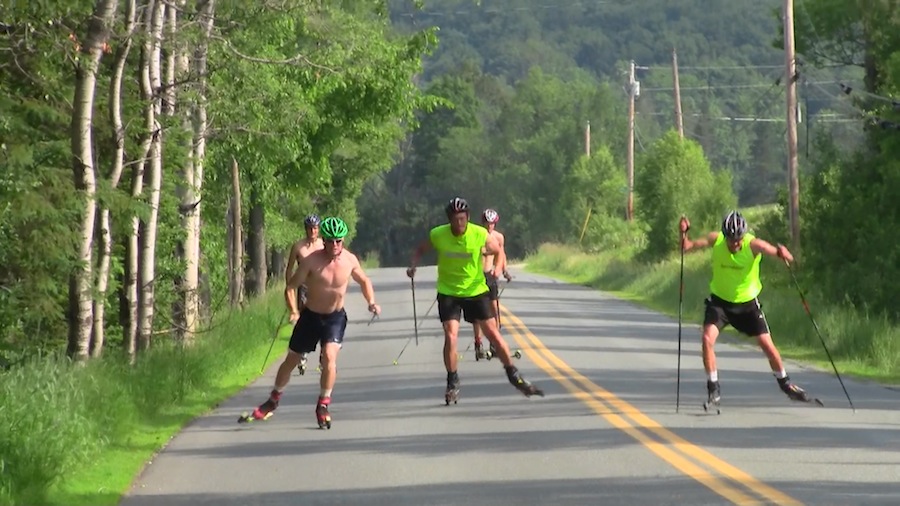
    Craftsbury Green Racing Project skiers hard at work during a rollerski speed session near Craftsbury, Vt. (CGRP photo)

    Note: This is the fifth preview in a quick-and-dirty series on U.S. elite teams. We asked coaches to send their 2012/2013 rosters and tell us what’s new for the coming season. We will be publishing additional reports over the next few weeks. Teams are presented in no particular order.

    Team: Craftsbury Green Racing Project (GRP)

    Coaches: Pepa Miloucheva (head coach, 15th season), Jeremy Nellis (junior coach)

    Senior roster: Ida Sargent (U.S. Ski Team), Susan Dunklee (US Biathlon), Hannah Dreissigacker (US Biathlon), Clare Egan, Maria Stuber, Amy Glen, Caitlin Patterson;

    Bryan Cook, Dylan McGuffin, Patrick O’Brien, Tim Reynolds, Alex Howe, Nils Koons, Gordon Vermeer

    Who’s new: Glen (2012 University of Vermont NCAA champion, Anchorage native), Patterson (also from UVM and Anchorage), Howe (another recent UVM grad; New Hampshire native), Vermeer (Dartmouth grad from Minneapolis) and Koons (former GRP training partner, New Zealand native)

    More on the new athletes

    Who’s missing: None.

    Top results last season: In her first year on the U.S. Ski Team, Sargent notched 12th at the Moscow World Cup sprint. Also a national-team rookie, Dunklee (US Biathlon A-team) posted a best-ever finish by an American woman at the World Biathlon Championships in Ruhpolding, Germany, placing fifth in the 15 k individual race and missing the podium by just seven seconds.

    Ida Sargent (CGRP/USST) during the 1.8 k hill climb at the SuperTour Finals in late March at Jay Peak in Jay, Vt. Sargent finished sixth overall in the STF pursuit.

    Dreissigacker recently earned a spot on the US Biathlon B-team after cracking the top 20 at the IBU Cup in Canmore, Alberta, where she placed 16th in a sprint. She competed in a hefty number of cross-country races last season and was ninth at U.S. nationals in the classic sprint, but will be focusing on biathlon this year, according to a GRP press release.

    Also at the 2012 U.S. Cross-Country Championships in Rumford, Maine, Stuber (a training partner) placed 10th in the 10 k skate and Egan followed in 11th.

    On the men’s side, Reynolds wrapped up the season with a bronze medal in the 50 k at U.S. Distance Nationals in Craftsbury, Vt. McGuffin won a SuperTour in St. Paul, Minn., and O’Brien was second overall in the Tour de Twin Cities multi-stage event. O’Brien also tallied three top-10’s at U.S. nationals – in both sprints and the 30 k classic – and was eighth in the 50 k at distance nationals.

    Another Craftsbury training partner, Cook finished fifth at U.S. nationals in the 15 k skate and was ninth in the 30 k in Rumford. Koons won the 2012 Craftsbury Marathon, was third in the Boulder Mountain Tour and posted four SuperTour top-10’s last season. This spring, he became a full-time team member.

    GRP athletes circuit training on the new outdoor gym at the Craftsbury Outdoor Center in Craftsbury, Vt. (GRP photo)

    Coach’s comment: With five new athletes, the GRP roster has grown to a whopping 14, and coach Pepa Miloucheva has been impressed with their training.

    “The new athletes did fit right into the training program and into the center’s projects,” she wrote in an email. “It is a great group of very similar-in-speed athletes, but also with different strengths and needs, [which] allows them to really improve by training with each other. For me as their coach, [that’s] a great challenge to have!”

    The team is currently seeking one or two wax techs/assistant coaches for the upcoming season. As for their summer schedule, Craftsbury is hosting the NENSA Eastern Regional Elite Group (REG) Camp and Stratton Mountain School Elite Team this week. In September, the GRP will join the U.S. Ski Team dryland camp in Lake Placid, N.Y., for two weeks of training and time trials.

    ***

    Other previews: Bend Endurance Academy | CXCMaine Winter Sports Center | XC Oregon

  • Video: Distance Nationals Men’s 50k

    Video: Distance Nationals Men’s 50k

    CRAFTSBURY, Vermont — Presenting footage from the final race of the year, which conveniently was also the most spectator-friendly. Thirty-three laps was one heck of a way to finish off the season.

    Thanks for watching!

    (Full race report and results).


  • Freeman Claims 50k Title to End Season on a High Note

    Freeman Claims 50k Title to End Season on a High Note

    Kris Freeman (SSCV/USST) on his way to claiming the US Distance Nationals 50 k freestyle title on Saturday morning in Craftsbury.

    CRAFTSBURY, Vermont — For someone who was almost ready to hang up his skis and skip spring series altogether, Kris Freeman (SSC Vail/USST) sure knows how to turn things around over the course of a week. After fighting off a sinus infection during SuperTour Finals, and before that coming home from Europe disappointed with his World Cup season, Freeman handily defended his Distance Nationals 50 k title on Saturday, beating Tad Elliott (SSCV/USST) to the line by 3.2 seconds for a time of 1:50:25.9.

    “This was the first race [this week] where I felt good — like I had my body back and I had some fun skiing,” said a satisfied Freeman after his finish.

    The lead pack early on in the race.

    In typical 50 k fashion, the race didn’t really get going until Freeman and Elliott began to put a break on the field with about 11 laps to go in the 33-lap race.

    “It was very pedestrian — we were just cruising,” said Freeman.

    With 90 skiers signed up for either the 50 k or junior 20 k, the 1.5 k loop saw a fair bit of traffic. On the fast, icy snow that greeted competitors Saturday morning, the congestion made for some hairy racing, which played some part in how and when the leaders chose to make their moves.

    “The downhill was very sketchy, and it got sketchier and sketchier as the race went on,” said Freeman. “That’s part of the reason I finally wanted to get out of the group. The saved energy from being in the draft was no longer worth the risk.”

    Until around 36 k, the lead had traded hands a number of times. Noah Hoffman (SSCV/USST) attempted to break from the pack at about 9 k, but the field gradually reeled him back in on a transition-heavy course designed for sprint racing, not marathons.

    Hoffman attempting an early getaway, with Russell Currier (MWSC/USBA) trailing.

    Freeman led the chase pack, and continued to pull for a few laps after he closed back the gap. Simi Hamilton (SVSEF/USST) took over at about the halfway point, and stayed in the lead for almost 8 k. It was his first serious 50 k and he wanted to be able to set his own pace.

    “There were so many transitions that [the field] was just kind of coming together. People were getting just a little bit tangled and things were a little tense in the pack,” said Hamilton. “I just decided to ski up front for a while… I was definitely trying to figure the distance out.”

    No one skier took decisive control until Freeman and Elliot’s break. When Freeman took the lead with 11 laps to go, Elliott knew that was critical point.

    “I moved into second because I knew Kris would be skiing strong at that point, and then I knew I was skiing the flatter V2 sections really well,” said Elliott.

    As the two pushed each other, they put enough distance on the field to stretch almost the entire length of the stadium. The very next lap, Elliott took over the lead from Freeman and pulled for the next five laps.

    Elliott looking back after he and Freeman had made their break.

    “I pulled through and Kris goes, ‘Dude, we have a huge opening. Let’s go,’” said Elliott. “It was really fun to ski with him.”

    Freeman took over for a few kilometers, but Elliott did most of the work from there on out.

    “I knew I had a better kick than Tad, so I made him do the work on the last couple laps,” said Freeman. “I had no interest in trying to break him early, and it came down to the last couple hundred meters and I was able to get the win.”

    And there’s no rest for the weary. In three days, Freeman will head to the Center of Excellence in Park City, Utah to begin testing out new ways to manage late-race blood sugar in longer events.

    By his own admission, Freeman has consistently struggled this winter with being unable to “close it out” at the end of mass start distance races. In testing out several theories on how to improve upon late race blood-sugar management, he hopes to find ways to move past a World Cup season that fell short of his expectations.

    “Kris had a bad season this year; just flat-out bad,” said Freeman’s coach Zach Caldwell. “Something’s got to change in a pretty big way for him to continue, and continue at the level he should be at and move past where he’s been.”

    But with a win on home soil, Freeman was able to end on a positive note.

    “It was a really good way to end a pretty frustrating season,” he said.

    Freeman and Elliott exchange congratulations at the finish.

    Behind the top two finishers, Tim Reynolds (CGRP) and Ellefson sprinted to the line for the bronze medal. Reynolds edged Ellefson by half a second, and over a minute behind the winner.

    Reynolds (l) just barely taking third. Ellefson (r) lunged, but took fourth half a second behind.

    “We’re buddies, so it’s a fun way to end it,” said Reynolds. “It’s always sweet racing here; there’s a lot of people out there cheering for you. It’s nice to do well at home, for sure.”

    Ellefson, though nipped at the line, said the photo finish was the perfect way to end the season.

    “I think I had a better dive, but he definitely had some distance on me,” said Ellefson. “I definitely wouldn’t have wanted to end it any other way.”

    Hamilton, one of the early leaders, took the fifth position (+1:14.2). He was happy to have successfully paced his first freestyle 50 k, and hopes to improve upon his distance skiing, among other things, as he looks to next season.

    “I think my fitness has just made a big jump this year and I think it will continue to do that with more base ours I’m putting in,” said Hamilton. “I’m really looking forward to improving my overall skiing, not just skate sprinting, which is what I probably feel most confident in.”

    Alex Matthews contributed reporting.

    Results.

    The men's 50 k podium.
  • Packer Wins Classic Sprint Against Stacked Field

    Packer Wins Classic Sprint Against Stacked Field

    Eric Packer (Dartmouth) celebrating his classic sprint win at SuperTour Finals.

    CRAFTSBURY, Vermont — If anyone can attest to the fact that feeling off during a qualifier is no reason to count oneself out for the heats, it’s Dartmouth senior Eric Packer. Despite having “blown up a bit” in the classic sprint prelim at SuperTour Finals on Tuesday, qualifying in 16th, he didn’t throw up his hands in defeat. Instead, he went on to win the thing outright, beating SuperTour regulars and US Ski Team members in the process.

    Packer (third from left) biding his time during the quarterfinals.

    After his rocky start, Packer focused on conserving energy as he made his way through the heats, skiing just as fast as necessary in order to advance automatically to each subsequent round. He was second in his quarterfinal and third in his semi, and let off the gas as soon as he knew he was safe.

    The same strategy applied to Packer’s progress through the A-final.

    “In the final I tried to wait as long as possible,” he said.

    The course featured a fairly quick descent right out of the start. The six tracks off the line disappeared within a few seconds and almost immediately skiers dropped into tucks around a sweeping right-hand downhill corner. From there, the course was mostly downhill until the low point, where it was steady climbing back to the stadium.

    Packer was positioned on the far left at the gun, but managed to cruise out of sight of the stadium in a decent position near the front.

    In the woods, Packer sat in the middle of the pack as the field began to climb back up to the finish. That was where eventual runner-up Reese Hanneman (APU) made his move.

    The start of the men's A-final.

    “The second half of the course was where it was all made; it’s basically all uphill,” said Hanneman. “I focused on trying to throw it down right on the top of that big climb.”

    As Hanneman pushed the pace, Packer knew he had to go with him.

    “The key was to have something left in your legs for that last bit,” said Packer. “A lot of people were doing great at the top of the big hill and then started fading coming into the finish, so I just knew I had to go hard there to have a good shot.”

    Packer is no stranger to the top of the podium — he notched three individual collegiate carnival wins this season alone — but to do the same against the professionals at the end of a winter that included carnivals, World U23 Championships, NCAAs and Canadian Nationals?

    Hanneman leading Ellefson and Packer in the semifinals.

    “I was really happy; this is a good day for me,” said a smiling Packer.

    The sprint wasn’t just a good day for the winner. For Hanneman in second and Karl Nygren (CXC) in third, Tuesday’s results were some of their best all season, and came despite the return of the big guns from the World Cup.

    “I knew I could be [up there]; I’ve had some really good classic qualifiers and heats this year. It was just about putting four of them in a row,” said Hanneman. “It’s probably one of my better days so far this year. It’s nice to get that feeling, that positive reinforcement.”

    Nygren, like Packer, came on strong later in the day despite qualifying in a lukewarm position.

    “I felt pretty good,” said Nygren.

    Fast skis enabled him to maneuver around people on the down hills, which gave him extra speed as the course started to go back up.

    “I was able to…take it easy on the big hill and try to close at the end,” he said. “It worked out all right.”

    Nygren beating Bjornsen, Freeman and Hamilton across the line.

    He qualified in 13th, but went on to win his quarterfinal and semifinal. Nygren’s semifinal included the likes of Simi Hamilton (SVSEF/USST) and Erik Bjornsen (APU/USST), who were part of the closest finish of the entire day.

    When the field came into view of the finish, there were four men vying for three spots: Nygren, Bjornsen, Kris Freeman (SSCV/USST) and Hamilton.

    Nygren won the photo finish and Bjorsen taking the second spot. Freeman, who is more of a distance specialist, managed to get his toe in front of Hamilton’s and advance to the A-final, leaving Hamilton out.

    “I put everything I had into the semi, and getting a foot in front of Simi Hamilton is no easy feat,” said Freeman.

    If one key to the course was saving enough for the final climb, another was simply staying upright. Several big names were taken out by crashes throughout the day. Hamilton fell and broke a ski during the B-final, taking Tyler Kornfield (UAF) down with him, and crossed the line well after his competitors.

    “I was right behind Sim and it looked like his klister stuck — I don’t know, he basically went head over heals,” said Tim Reynolds (CGRP), who stayed upright but broke a pole in the tangle and also finished way off the heat leaders.

    Hamilton discussing his crash with stadium announcer Pete Davis.

    Erik Bjornsen (APU/USST) fell twice during the A-final: once in a tangle with Kris Freeman (SSCV/USST) and then immediately again due to resulting iced skis.

    “I got up pretty slowly, shaking my head, and then I realized out of the corner of my eye that there was still someone behind me,” said Bjornsen.

    That someone was Sylvan Ellefson (SSCV), who had run out of gas after posting the fastest qualifying time and blazing through the heats.

    “I lost energy today,” said Ellefson, who is still nursing a swollen ankle. “I felt good coming into the low part of he course and as soon as we started climbing, nothing was really moving as fast as it had been earlier this morning.”

    From the time the qualifiers began at 9:00 am to the end of the heats after noon, the once rock-hard snow had softened. The sun baked the final ascent that directly faced it, making the climb all the more challenging.

    Most notably absent from the results on Tuesday was USST sprinter Andy Newell, who arrived in Vermont on Monday after finishing off his European season at the Red Bull NordiX sprint in Oslo, Norway on Saturday. To recover from a sore throat contracted somewhere in between, Newell decided to sit out the races and cheer on his teammates.

    Also of note was Noah Hoffman’s (SSCV/USST) quarterfinal crash. After a promising eighth-place qualifier, Hoffman fell and dislocated the same shoulder that gave him repeated dislocation problems before his surgery last spring. He planned to have the shoulder x-rayed Tuesday afternoon to determine whether he should race on Wednesday.

    “The surgery was supposed to make sure this didn’t happen again, so I don’t know what this means,” said Hoffman.

    After a grueling day of sprinting, athletes have to rest up and recover in time for a 10:00 am start on Wednesday morning at the base of nearby Jay Peak for the 1.8 k, 1,079-foot hill climb up a blue square trail.

    Alex Matthews contributed reporting. 

    Heat results and qualifier results.

  • Bender, Ozerskiy Stay Alive in Birkie Sprints

    Bender, Ozerskiy Stay Alive in Birkie Sprints

    Dmitriy Ozerskiy of Russia out-lunges Tim Reynolds (Craftsbury Green Racing Project) to win the men's freestyle elite sprints at the American BIrkebeiner festival in Hayward, Wis., on Thursday.

    All American Birkebeiner coverage is brought to you through the generous support of Concept2, makers of the SkiErg.

    Birkie Elite Sprints are available to watch here (recorded live by CXC).

    HAYWARD, Wis. – In theory, every high-level racer in downtown Hayward on Thursday should have been a distance specialist. With the 50 k American Birkebeiner in two days, one would have thought that’s what they were there for.

    The 500-meter elite freestyle sprints proved otherwise, as 26 skiers zoomed up and down Main Street on freshly packed natural snow. Essentially, the single-elimination bracket left no second chances as racers attempted to master the art of going all-out.

    American Birkebeiner sprints
    Jennie Bender (CXC) celebrates her Birkie elite sprint victory on Thursday after beating Clare Egan (l) in the final.

    Jennie Bender of Central Cross Country (CXC) demonstrated her sprint savvy with a powerful V2 alternate, first beating Rebecca Dussault, a two-time elite sprint winner and 2010 Birkie champion, formerly of CXC and now races for Salomon.

    In the semifinals shortly after, Bender knocked out the reigning Birkie sprint champion, Natalia Naryshkina of Russia, who out-lunged Bender for first place last year.

    Trailing Bender in this year’s semi, Naryshkina, who also races for CXC, cramped up and pulled back before the finish. Bender advanced to the final, where she topped Clare Egan of the Craftsbury Green Racing Project to claim the sprint victory and $500 dollars that came with it.

    After the race, Bender said she felt a little over-raced and initially considered skipping the sprints.

    “I was pretty tired this afternoon, and I was like, ‘Well, I’ll kind of go and see,’ ” she said. “I have a hard time saying ‘no’ to a sprint.”

    In the end, she was glad she did the downtown sprints.

    “I kind of needed today as a little bit of a tune-up,” Bender said. “I’ve been needing a kick in the butt to get going. Some speed will help me, I think, for this weekend.”

    On Saturday, Bender will embark on her first 50 k Birkie skate race. She won last year’s classic race and set a course record in the 54 k at the American Birkebeiner.

    As for the biggest hurdle in Thursday’s race, with a slightly downhill straight shot to a pylon and back, Bender said it was the sharp turn on the “super-slick snow.”

    Women's podium at the American Birkebeiner's 500-meter elite sprints. (From left to right): Clare Egan (CGRP) in third, Jennie Bender (CXC) in first, Natalia Naryshkina (RUS/CXC) in third.

    That made it hard to stay on your feet and even more difficult to do at high speeds.

    “A lot of the sprints these days have an endurance component, but this is pure, fast-twitch muscles, all-out go,” Bender said.

    Egan took the $250 second-place prize after beating Sara Hewitt (CXC) in the quarterfinal and Audrey Weber (Atomic) in the semi. In her first time racing an out-and-back short sprint, Egan said the technical aspect of making the tight turn was both crazy and fun.

    “I’m usually not that successful in short sprint races, especially kind of flat ones just because there are a lot of people that are more powerful than me,” Egan said. “But I somehow made it around the pylons and my skis were really fast, and it just ended up working out today.”

    She also found her lucky charm: a set of brass pigs, which she shook before the race. Teammate Susan Dunklee bought the trinkets in Austria and gave them to Egan to hold in her hand and shake for good luck.

    “I kind of felt like I was in a slump recently and I realized it was because I hadn’t had my lucky pigs,” Egan said. “I definitely gave them a little shake before the race and I think that might have helped me.”

    Naryshkina was third after beating Weber in the consolation round.

    Russians Go to Work

    In the men’s race, Dmitriy Ozerskiy of Russia dominated his competition, including his lone teammate at the Birkie, Maxim Fadeev. Ozerskiy was coming off a broken-pole mishap in Madison, Wis., which took him out of contention for the SuperTour freestyle sprint title last weekend.

    Dmitriy Ozerskiy (RUS) at left edges Jari Joutsen (FIN) in a head-to-head semifinal round at the Birkie elite sprints in Hayward, Wis., on Thursday.

    On Thursday, he topped the elite field of 17 men, edging Tim Reynolds (CGRP) in the final with one last lunge. Ozerskiy previously beat Finland’s Jari Joutsen in the semifinal with a similar photo finish.

    After he eliminated Fadeev in the quarterfinal, his teammate immediately shifted gears to help him. Fadeev said he applied high-fluoro “Russian special liquid” on Ozerskiy’s skis, which helped make the difference.

    “I like the short distance,” Ozerskiy said after V2-ing to the win.

    “He’s a great sprinter for short distance in Russia,” Fadeev said. “If this format sprint was in Russia, I think that he would be first or second in the medals.”

    Fadeev suggested that Ozerskiy could be of Olympic caliber in a sprint of similar distance. Ozerskiy started off strong, beating Morten Eide Pedersen (NOR/Lillehammer) in the opening round.

    The men's podium at 2012 Birkie elite sprints. From left to right: Tim Reynolds (CGRP) in second, Dmitriy Ozerskiy (RUS) in first, Jari Joutsen (FIN) in third.

    The runner-up of the day, Reynolds raced the Birkie sprints two years ago and said the turn at the end always made things interesting. Fortunately, he got around it fine.

    After winning his first two rounds comfortably (first over Norway’s Halvor Korboel Thoner and later against Vegard Kjoes Egge of Lillehammer), Reynolds ousted Switzerland’s Philip Furrer by an inch. Reynolds was on the other side of the photo finish in the final.

    “I thought I could get [Ozerskiy] and I just got a little squirrely at the end and lost a little bit of space,” Reynolds said. “Short course, you can’t make any mistakes.”

    Joutsen placed third after topping Furrer, his friend and travel partner at their first Birkie, in the consolation round. Joutsen said he had fun but would have preferred a one-way sprint uphill to avoid the turn, which, “for a big guy, it’s very tight.”

    “Your skis can [get] in the fence,” Joutsen said. “In the rollerski World Cup, they have this 200-meter to 300-meter sprint straightaway. It’s very interesting.”

  • Furrer Notches SuperTour Victory Ahead of Reynolds, Joutsen

    Furrer Notches SuperTour Victory Ahead of Reynolds, Joutsen

    Switzerland’s Philip Furrer (second from left) celebrates winning the Madison SuperTour 1 k freestyle sprint on Sunday. Tim Reynolds squeezes by on the far left to get second, Jari Joutsen (second from right) was third, and Pat O’Brien (r) was fourth in the A-final.

    All Madison SuperTour and American Birkebeiner coverage is brought to you through the generous support of Concept2, makers of the SkiErg.

    MADISON, Wis. – Finland’s Jari Joutsen could have been mad or at least frustrated with a split-second lane change that forced him out of his spot into another skier in the A-final of the SuperTour 1 k freestyle sprint on Sunday.

    After the race as he stood next to Philip Furrer, the Swiss who claimed the victory, Joutsen smiled. How could he be mad at his friend, who trained with him and stayed at his home in Finland? Furrer was even wearing a matching green ski suit to represent Joutsen’s company, Optiwax.

    Furrer didn’t have to apologize for Joutsen ending up third. They both understood that was part of racing. From Joutsen’s standpoint, his team topped the podium twice in two days after he won Saturday’s classic sprint.

    On Sunday, Tim Reynolds (Craftsbury Green Racing Project) found a way to edge Joutsen in the A-final, tucking behind Furrer when he moved to the inside lane. Meanwhile, Joutsen tried to regroup after being forced outside. Reynolds stayed on Furrer’s heels and stuck his leg out around the Swiss for second place.

    Madison SuperTour men’s 1 k freestyle sprint podium: runner-up Tim Reynolds (CGRP) at left, winner Philip Furrer (SUI) in the center, and Jari Joutsen (FIN).

    Joutsen likely never saw Reynolds coming or squeeze by on the inside. He was too busy trying to stay on his feet after Furrer’s skis came in contact with his.

    “It was a tight race,” Joutsen said. “If you ski behind Philip, you never know what happens. You have to be prepared.”

    From the qualifier to the final, Furrer went for it. The seventh-fastest to qualify Sunday, he missed advancing to the semifinals the day before.

    In his first trip to the U.S., he wanted to make the weekend worthwhile.

    “I wanted it,” Furrer said. “I really wanted it.”

    He set out for the victory from the start of the heats, winning his quarterfinal and semi over Joutsen, who was second in both. In the A-final, it was more of the same, as Furrer led with a high tempo from the beginning. Joutsen stayed close behind in second.

    “I was very focused on myself when I was in the lead,” Furrer said. “I knew Jari was behind so I really wanted him to come in second place, but I focused on myself and I closed a little bit on him so the team maybe lost a second place and maybe he had a chance to win also, I don’t know.

    “I would have beaten him [without] this,” Furrer added with a laugh. Then he looked at Joutsen.

    “Just kidding,” he said.

    The win was especially important to the 28-year-old from Switzerland, as he had been sick for most of the season. In Saturday’s sprint, his pole strap broke in the qualifiers and he ended up sixth. Furrer said he made some poor decisions in the quarterfinal, which cost him a chance to move on.

    “That’s the way a sprint is and today it changed again,” Furrer said. “That’s the nice thing about sprint skiing, everything can happen.”

    After winning the last SuperTour skate sprint in Minneapolis, Reynolds knew exactly what it took to podium. Ninth in the qualifier, he said he felt more energized in the heats, but hit a slight blip early in the A-final when he thought his pole broke.

    “I stopped for a second because I thought my pole was gone. I heard it crack out of the start,” Reynolds said. “It ended up being fine. Maybe I just imagined it.”

    Third at the time, he held his position until the finish, where he lunged into a tiny opening next to Furrer for second place.

    “I had a lot of speed so I ended up throwing my legs forward and hoped for the best,” Reynolds said.

    Pat O’Brien (CGRP) was fourth in the A-final. He had ranked 12th in the qualifier and was second in both the quarterfinals and semis.

    Karl Nygren (CXC) won the B-final ahead of Russians Dmitriy Ozerskiy and Maxim Fadeev, respectively. Ozerskiy won the qualifier, but broke his pole in the semifinal on the first of four corners around Capitol Square. Unable to find a replacement, he skied the rest of the heat with one pole.

    After Ozerskiy and Fadeev placed sixth and seventh overall, Skyler Davis was eighth.

    Two of the top three men in Saturday’s classic sprint, Dakota Blackhorse-von Jess (Bend Endurance Academy), who was second, and Lars Amund Toftegaard (NOR), who was third, missed qualifying by a few tenths of a second on Sunday. Blackhorse-von Jess was 19th in the qualifier, 0.22 seconds out of the top 16, which he needed to advance.

    Toftegaard was 18th and Sam Naney (Methow) was 17th by 0.03 seconds. Nils Koons (CGRP) nabbed the final qualifying spot in 16th but did not make it beyond the quarterfinals.

    Blackhorse-von Jess said he was pleased with his qualifying effort; it was the wax that was off. Waxing his skis with Naney and Lars Ellefson (Bend) and without a coach, they decided to use the same combination they went with on Saturday.

    “We made a gut call on wax last night and it turned out to be a total bust,” Blackhorse-von Jess wrote in an email. “I’ve been racing long enough that if everyone had had the same skis, I would have been fine. I was actually pretty excited for the heats because I was feeling pretty snappy.”

    He was surprised to discover he didn’t make the heats.

    “Between Sam and I, and our experience racing in the US, it was a legitimate shock to not make it through,” Blackhorse-von Jess said. “I’m still kind of reeling. Outside of crashing or [being] sick (or the World Cup), I can’t remember a time in my life that I haven’t qualified for the heats.”

    Men’s A- and B-final results

    Madison SuperTour men’s A- and B-finals in freestyle sprints
  • First Time in America, Joutsen Wins Madison SuperTour Sprint

    First Time in America, Joutsen Wins Madison SuperTour Sprint

    The men's podium in the Madison SuperTour 1 k classic sprint: 1. Jari Joutsen (FIN) at center; 2. Dakota Blackhorse-von Jess (Bend Endurance Academy) at left; Lars Amund Toftegaard (NOR) at right

    All Madison SuperTour and American Birkebeiner coverage is brought to you through the generous support of Concept2, makers of the SkiErg.

    MADISON, Wis. – Most of the men in the SuperTour classic sprints on Saturday probably didn’t have a clue who Jari Joutsen was.

    He certainly had an international reputation with several World Cup top-30 results. Yet to the 22 others in the 1 k sprint around Madison’s Capitol Square, Joutsen was just another competitor – one Finish skier among a half dozen Scandinavians.

    A few days after first setting foot in the U.S., Joutsen made himself known in Wisconsin’s state capital at the eighth annual Madison Winter Festival, at least among the racers. He started out by setting the fastest qualifying time around the city loop in 1:55.1. Skyler Davis of the U.S. Ski Team was 1.1 seconds behind in second.

    Dakota Blackhorse-von Jess (Bend Endurance Academy) qualified in third, finishing the square-shaped and strictly double-pole course in 1:57.4. He was 2.3 seconds behind the leader.

    Anyone who thought they knew how to overtake Joutsen either didn’t or couldn’t, as the 33-year-old advanced through the heats with little trouble, even with a pole-strap malfunction in the semifinal.

    Fearing his makeshift pole repair might not hold up, he held back at the beginning of the A-final. About halfway through, Joutsen decided to go for it and jutted ahead to win by several meters.

    Behind him, Lars Amund Toftegaard (Team Sjusjoen) and Blackhorse von Jess battled for second. Blackhorse-von Jess edged the Norwegian at the line, and Karl Nygren of Central Cross Country (CXC) finished fourth.

    In his SuperTour debut, Joutsen was recognized as a winner. Few knew the 6-foot-3 Finn was the CEO of a company called Optiwax and designed an Excel pole grip handle used by two-time U.S. Olympian Torin Koos. Most were probably unaware that Koos convinced Joutsen and some other Scandinavians to visit the states for the first time and race in the SuperTour before the American Birkebeiner.

    From a racing standpoint, his result was all that mattered. Joutsen had a plan and it worked, even with a taped pole strap. Fortunately, his engineering skills played a role.

    “I was afraid my pole was broken, so I had to start slowly,” Joutsen said after initially trailing Toftegaard and Blackhorse-von Jess, respectively, in the A-final. “After the middle part, I started to push then I raced [to] first place.”

    Dakota Blackhorse-von Jess (r) leads Tim Reynolds (in green), Karl Nygren (in red) and Skyler Davis (l) on the final turn before the stadium in the semifinals.

    He made it sound easy.

    “I think it’s a benefit if you are tall and big like in these classic sprints,” Joutsen said. “Only the problem with the strap, but otherwise I felt very good.”

    Blackhorse-von Jess, who won his quarterfinal and semi, said he was particularly excited to race against Joutsen and Toftegaard in the final.

    “It’s really good having these guys here because they race a lot different than we do,” Blackhorse-von Jess said. “Watching them race in the semifinals, there was a lot of track changing going on so I was ready for that, and in the final, I just followed that.”

    In the final, he positioned himself in second and later dropped to third before the only downhill before the final stretch. The plan to let the Finn and the Norwegian lead could have worked out if not for a costly blip, he said.

    Blackhorse-von Jess made his move on the gradual descent, attempting to get up front before the last corner. When one of them heard him, he had to step to the outside of the corner where he hit some soft snow.

    “My legs were flooded with lactate and I just didn’t get forward on the ski and push and that cost me a chance at the win,” Blackhorse-von Jess said.

    His indecisiveness at times against unfamiliar opponents also hurt him, he said.

    “I had this vision in my head, and I was like, ‘I know how this is gonna go, I should go now. No, I’m too tired, I’m gonna wait. No, I’m gonna go now! No, I’m too tired, I’m gonna wait. Now I’m gonna go!’ ” he recalled. “When I finally went everything was perfect and then I didn’t make it happen so that’s a bummer. That’s a real bummer.”

    Lars Amund Toftegaard of Norway leads Finland's Jari Joutsen (second from right), Pat O'Brien (CGRP), and Norway's Halvor Korb Thoner (far left) on the gradual downhill in the semifinal. Toftegaard held his position to win the heat.

    After beating Joutsen in the semifinal, Toftegaard was disappointed his strategy of getting out in front early didn’t result in a win, but he understood sprints involved some guesswork.

    “I just have to make my plan and try to follow that,” Toftegaard said. “The other guys probably have their own plans.”

    He was second in the quarterfinal after first leading the Pat O’Brien (Craftsbury Green Racing Project) and tucking behind him to advance in second place.

    “It worked the first two times and the last time I didn’t manage to keep one guy passing me before the last hill,” Toftegaard said. “I tried to keep up with him and I got a little tired so I lost [another] position to number two.”

    Toftegaard qualified for the heats in fourth.

    Davis had his hopes of an A-final dashed when he poled through one of his skis shortly after the start of his semifinal. He fell and ended up fourth in the heat. He initially scrambled to catch Blackhorse-von Jess and Nygren and came close in the final stretch.

    “I worked so hard in that semi to just get back,” Davis said. “Then I was basically done for the B-final. I was out of energy.”

    After winning his quarterfinal in front of runner-up Tim Reynolds (CGRP), the two met again in the semifinal when their skis came in contact during lane changes before the finish.

    “It’s really not that common to poke your own ski,” Davis said, looking at bullet-like hole in the ‘F’ of his Fischer skis. “I don’t really know what happened. … It’s just really unfortunate, but that’s just how it goes.”

    O’Brien won the B-final to end up fifth overall. Norway’s Halvor Korb Thoner (Team Sjusjoen) was sixth, Reynolds placed seventh and Davis was eighth.

    Men’s 1 k classic sprint results

  • Three Years After Initial Run, Experimental Sprint Qualifier Sparks Debate

    Three Years After Initial Run, Experimental Sprint Qualifier Sparks Debate

    Athletes collide during sprint heats at U.S. Nationals in Rumford, Maine, 2012.
    Athletes collide during sprint heats at U.S. Nationals in Rumford, Maine, 2012.

    A sprint qualifier can be defined as the preliminary stage of a sprint race in nordic skiing. In a race against the clock, competitors leave the starting gate at intervals and go as hard as they can for anywhere between 1 and 1.8 kilometers. The top 30 in most internationally sanctioned competitions, and sometimes a lesser number in other events, move onto the quarterfinals to face off against five other athletes at a time for the right to advance to the next round.

    Sprint races progress in this manner all over the world; on the World Cup, in Continental Cups, in the collegiate circuit, and sometimes at small-scale high school races.

    In the winter of 2009, the term “sprint qualifier” took on another meaning. The U.S. Ski and Snowboard Association (USSA) introduced a sprint race to the SuperTour that was truncated at the qualifying round; medals were awarded to skiers who clocked the fastest qualifying times, and the athletes’ entire day was done in a matter of two to four minutes. No longer just a prologue, the qualifier became a race all its own.

    At the time, the trial run was met with mixed reviews. Athletes felt robbed of the chance to develop head-to-head sprint skills. Coaches acknowledged the challenges the organizers faced in putting on full heats, but agreed that the format was not ideal. Canadians who occasionally dabbled in the SuperTour simply didn’t understand it.

    Qualifier-only sprints started with a trial run in West Yellowstone, Mont. that first winter, but have since spread to three other stops on the SuperTour in 2012. What began as confusion is now ranting fury — some still fail to understand why the experimental format was deemed a success and allowed to proliferate.

    To begin to answer that question, we start with that first time qualifier-only sprints were held in the U.S.

    When the format was first conceived of prior to the 2009-2010 season, then-USSA Nordic Director John Farra intended for it to do two things. First and foremost, the decision to leave out the heats from the West Yellowstone sprint was a philosophical one. Farra believed it to be the right move for U.S. skiing at the time, and today stands by his decision.

    “We still don’t have enough Americans, in my personal opinion, who can qualify, period,” said Farra, who has since left USSA to become the High Performance Director for Paralympic skiing, in a phone interview in December. “That’s a problem. For me, at this point in our development, there’s an argument for getting athletes in more races where they’re just throwing down… I think it works on a gear all Americans need to keep working on.”

    Secondly, it put an additional sprint race back on the calendar in the first period of the SuperTour where, at the time, there was only one in Bozeman, MT. It would not be the first time sprint races were held in West Yellowstone. Regular sprints, complete with heats, were held on the Rendezvous trails up until 2007, but according to Farra, coaches complained that the trails were too narrow and the altitude too punishing for a full sprint day.

    One of the jobs of the Nordic Director is to select skiers at the end of the Period 1 to send to the World Cup. With an additional sprint thrown into the mix, Farra’s theory was that the overall points leader would have to be a decent sprinter and distance skier to earn those coveted European start rights.

    Rankings of the best distance skiers and sprinters on the domestic circuit are often very similar, however. For example, at the end of Period 1 this winter, the women’s SuperTour sprint leader, distance leader, and overall leader were all one person: Jessie Diggins (CXC/USST).

    On the men’s side, overall leader Mike Sinnott (SVSEF) had two top-5 distance results along with his two sprint wins and one second.

    The sprint qualifier has also been accused of having another motive. It was introduced in the season leading up to the 2010 Vancouver Olympics, and it’s been suggested that the qualifier, in squeezing another race into a short time frame, was a grab for better FIS points to boost the U.S. quota for the Games.

    Farra said this was never the case. Points are always based off the qualifier, so heats would have no effect on FIS points either way. Additionally, as Farra pointed out, “you can only ‘boost’ the points if you have a quality field in the race.”

    Jessie Diggins (CXC/USST) 2nd place skate
    Jessie Diggins competing in the qualifier-only skate sprint in West Yellowstone, Mont., in November 2011.

    With his idea for a modified sprint in mind, Farra went to the West Yellowstone Chief of Competition at the time, Sara Hoovler, with the proposal.

    From the organizer’s perspective, the introduction of an additional race in West Yellowstone brought with it organizational and financial burdens, which became the main point of negotiation.

    “As an organizing committee we were pretty maxed out,” said Hoovler, who is now a school teacher in the area. “We couldn’t put on another full-scale race.”

    When Farra brought the proposal to the organizers, they agreed to try out the additional sprint as long as it didn’t come with a significant extra cost—specifically, as long as it didn’t require coming up with the additional prize money. At $3,900 per race, prize money is one of the single most expensive components of hosting a SuperTour.

    “Purses for these races can sink the entire event,” said Dan Cantrell, Hoovler’s successor as the West Yellowstone race director.

    He estimates that between all the major costs involved with putting on the SuperTour every year—notably prize money and gas for grooming—the event runs the Yellowstone Ski Festival around $20,000. When the weather is especially uncooperative, the number goes up as tents and space heaters are brought in, or the Pisten Bully has go over the course multiple times.

    With the introduction of homologation standards this year, any argument for heats became moot—the venue simply doesn’t have the terrain to meet the standards on a traditional sprint loop. For the race to count as a SuperTour complete with FIS points, there needed to be a certain amount of total climbing.

    The only sprint course West Yellowstone could come up with that met the standards is a point-to-point 1.5 k, which ruled out the possibility for heats. For timing and officiating purposes, heats have to start and end in the same stadium.

    “We were able to FIS homologate West for a sprint qualifier only. That’s a big deal, otherwise we don’t sprint there,” said Farra.

    The other option would be to hold the fall SuperTours at locations that could homologate a sprint loop, but choices are limited by the reliability of snow anywhere else in the country in late November, and the number of venues willing to take on a SuperTour.

    With the advent of homologation standards looming for 2011, Cantrell also had to account for the cost of the trail work necessary to get the courses up to standard. In addition to sitting on National Forest land, the Rendezvous Ski Trails occupy endangered grizzly bear habitat. Every time the ski trails are modified, the Forest Service requires an environmental impact assessment.

    “To put it in perspective, the improvements from this year, with the connectors and homologation, was about a three year process,” said Cantrell. “We had a bulldozer out there two weeks before Thanksgiving.”

    With these demands on the race organizers in mind, Farra was loath to push West Yellowstone to take on significant extra cost in adding a sprint qualifier to the schedule.

    “We weren’t prepared to make the organizer come up with the prize money,” said Farra.

    Since USSA strategically thought it was important to hold a sprint in Yellowstone, the organizers were excused from the obligation to hand out the prize money for sprint qualifiers. The exception is laid out in the USSA Rulebook—none of the sprint qualifiers on the SuperTour schedule this year award the usual purses to the top six finishers.

    Since 2009, Yellowstone’s sprint qualifier has become two. In the second and third years of its existence, the opening day of the SuperTour was a double-header. The “SuperTour Sprint Showdown” starts with a skate sprint qualifier, and ends one hour later with a classic sprint. Each of the two races is an opportunity to earn points, but the single winner of the Showdown and recipient of the $250 purse is calculated from the combined times.

    The first running of the Showdown at West Yellowstone, on the whole, was a success in the eyes of the organizers and USSA. There were a few kinks to work out—the flow of athletes from the finish back to the start was congested, and cold weather made the trek an uncomfortable one for athletes still just in spandex—but overall, organizers felt good about the trial run.

    For her part, Hoovler thought the number of participants in the sprint qualifiers as reason to look positively at the outcome.

    “We saw a lot of junior skiers, just getting some race experience, and also master skiers that weren’t competing for FIS points but challenging themselves,” she said. “I was very shocked at the amount of racers that participated.”

    When West Yellowstone still had sprint heats in 2007, 42 women and 51 men participated. In 2009, 61 women and 67 competed in the qualifier-only version. In 2011, more athletes competed in the freestyle sprint than the classic, but the totals in the freestyle qualifier were 60 women and 92 men.

    Amongst elite skiers, the sprint qualifier was met with some complaints about the absence of heats. Despite this feedback during the season, Farra said the format wasn’t a major issue at the spring USSA meetings, and he saw no reason not to keep experimenting with it.

    “This is not a new topic,” Farra emphasized. “There’s been at least two springs for people to say, ‘Hey, this is ridiculous.’ I don’t remember there being significant discussion about that.”

    The release of the 2011-2012 SuperTour calendar saw the addition of sprint qualifiers to three new venues: in Bozeman, Mont. one week after West Yellowstone; in night-sprint form at the Tour de Twin Cities, which took place just two weeks ago in Minneapolis, Minn.; and as a prologue to the upcoming 5/10 k classic on day one of the Owl Creek Chase in Aspen, Colo.

    In the negotiating phase of calendar planning prior this season, Farra proposed the addition of sprint qualifiers to each of the new hosts. As with West Yellowstone, at each location, the investment that new homologation standards required already had organizers strapped for cash and volunteer power.

    Austin Weiss, the Race Director for the Aspen SuperTour and Owl Creek Chase, agreed to add the sprint qualifier to the schedule on February 11 in order to make the entire weekend a more attractive package to racers. Weiss said the Aspen organizing committee was never asked if they could hold a full sprint with heats. He indicated that it would be a challenge, as heats require a separate day of racing, but didn’t rule it out as a possibility in the future.

    “Logistically, everything is possible,” said Weiss. “It’s biting off a bit much—it’s not out of the question, but it’s something that the organizing committee would have to consider.

    “The other benefit of a sprint qualifier is that it doesn’t require that much more work on the part of organizers.”

    The race director in Minneapolis had a similar view.

    John Munger, the director of the City of Lakes foundation, which hosted the first three races of the Tour de Twin Cities, pointed to the challenge of putting on a number of high-profile events within a short timeframe.

    “It takes a long time to do sprints and lots of volunteer power,” Munger said in a phone interview. “We’re doing the Mayor’s Challenge, the IPC Paralympic World Cup, and the City of Lakes Loppet all within about two weeks.”

    This is the compromise Farra sought to strike as he set about adding more sprints to the SuperTour last spring: give skiers more opportunity to develop their sprinting ability without pushing organizers to the point where they wouldn’t hold sprints at all. Just as in West Yellowstone, he saw qualifiers as the best solution.

    “It’s a fine dance between what athletes and coaches want, and what we think organizers can do,” said Farra.

    The financial burden of the additional race was also lessened at the new sprint venues. As with the two independent sprints in West Yellowstone, none of the three new sprint qualifiers come with the normal win payout, which adds up to $3,900 between both men and women (1st – $750, 2nd – $500, 3rd – $250, 4th – $200, 5th – $150, 6th – $100).

    “Imagine if you push Bozeman, and we say, ‘Come up with four grand,’ and they say, ‘Sorry, can’t do it.’”

    According to Dragan Danevski, director of the Bridger Ski Foundation, the additional prize money would have been more than they could afford, and was a point of negotiation when Farra asked them to hold a sprint qualifier in the spring.

    “It would be nice if we could have $100,000 in prize money, but I said, ‘Look, in this economy, in this situation, we are lucky to have SuperTour races even with [some] money,’ sad Danevski in December.

    “I had to make the decision that we would no be able to do three races and have prize money for three.”

    The financial compromise has not gone unnoticed by the athletes, particularly those who have repeatedly placed in the top six in the SuperTour sprints thus far.

    “I don’t understand it,” said Mike Sinnott (SVSEF), who was first and second in the two sprints in West Yellowstone and won the freestyle sprint the next week in Bozeman.

    “It’s unprofessional in my opinion.”

    In Sinnott’s view, the $250 check he won as the Sprint Showdown champion in West Yellowstone should have been a bonus.

    “I think it’s pretty clear in the rules that you get $750 for a win,” he said.

    Caitlin Gregg (CXC) has similarly excelled in sprinting this winter. She began with a fourth and first in West Yellowstone, a second-place in Bozeman, and a third in Minneapolis. Like Sinnott, she believes the sprint qualifiers should have prize money.

    “If any race requires a registration fee and awards points…there needs to be prize money,” Gregg wrote in an email in December. While she understands that qualifier-only sprints, as a format, are easier on race volunteers than full heats, she believes that leaving out their prize money altogether undermines sprinting development in the U.S.

    “It seems as though there was once a push to hold more sprints and team sprints on the circuit and suddenly (ironically coinciding with some of the best results ever for U.S. skiing, which came from sprints and team sprints internationally), the U.S. has decided to reduce the opportunities domestically for sprinters to develop,” said Gregg.

    “Without prize money, sprint specialists or those who are competitive in both distance and sprint races would be loosing a large percentage of potential earnings that could allow them to continue competing on the SuperTour domestic circuit.”

    As a solution, she proposed getting a title sponsor to help fund the SuperTour purses in the future.

    If USSA is adamant about adding more sprints to the SuperTour, and has found race committees unable to produce the extra prize money, would USSA ever contribute their own cash to the pot to make up for it?

    Given the state of its budget, “No way would USSA pay,” said Farra. “The SuperTour has never been funded by USSA… Given the state of the union at USSA, it’s highly doubtful that any prize money will come from them.”

    Farra empathizes with the opinion of the athletes, but notes that contesting the sprints are still worth something.

    “While I agree—I would be disappointed not to benefit from that prize money— World Cup qualifying is still up for grabs,” he said.

    But for many athletes on the SuperTour, not even that is enough. Without heats, some don’t feel sprint qualifiers to be a valuable format.

    Pat O’Brien (CGRP), who placed second in the night sprint qualifier two weeks ago in Minneapolis, believes the heats are critical to developing competitive sprinters.

    “While I agree that it is important for US skiers to be able to qualify well (and make the heats), the real test to me is how well an athlete skis rounds,” said O’Brien. “It doesn’t matter how fast you are in the qualifier if you can’t move out of the quarters. Skiing well in a group is a skill that you only can develop through practice.”

    “Cutting full sprints out of the schedule and replacing them with just qualifiers undermines this development.”

    His teammate Tim Reynolds (CGRP) suggested an alternative format for heats that would be less demanding on organizers, and in cases like Minneapolis where there were fewer numbers, make more sense.

    “You don’t have to take 30 onto the heats… I think you can adapt the format to the field size,” said Reynolds, pointing to the Madison, Wisconsin SuperTour as an example. In the past, the Madison event has taken on eight skiers from the qualifier on to the heats, which reduces the number of rounds to two semis and one final.

    “Heats are a valuable experience,” said Reynolds.

    If dissatisfaction with sprint qualifiers is as widespread as the vocal skiers would make it seem, then Farra agrees that USSA should go back to the drawing board.

    “It’s part of being progressive,” said Farra. “How we’ll be a better ski nation is being open-minded to trying different things.”

    “My memory is that we are still testing this concept. Until coaches come back in the spring and say, ‘This doesn’t work, we need to stop’—until that happens, we’re still testing it.”

    If athletes really want to see qualifiers scaled back next year, Farra encourages them to go to the USSA spring meetings, or make sure their views will be represented at them.

    “The USSA Congress really does work,” he said. “It’s amazing how many coaches go out of their way in the spring and engage in dialogue when they don’t want to be thinking about skiing.

    “Athletes need to be able to remind their coaches, ‘This is what we’d like to see; this is how the SuperTour could be improved… Everybody is working their butts off, but it’s only going to get better if people bring their ideas forward.”

  • Reynolds Leads Craftsbury to 1-2 Finish in Minneapolis Sprint

    Reynolds Leads Craftsbury to 1-2 Finish in Minneapolis Sprint

    Tim Reynolds (CGRP) tucking during the classic sprint at U.S. Nationals. He won the sprint prologue at Wirth Park on Wednesday by less than a second. Photo: Flying Point Road.

    Tim Reynolds (CGRP) led a strong Craftsbury contingent in the freestyle sprint prologue on Wednesday night in Minneapolis, Minn. Reynolds edged out teammate Pat O’Brien (CGRP) by a mere 0.6 seconds on the 1.4 k course. Mark Iverson (APU) was just 0.1 seconds behind O’Brien in third.

    Reynolds was the first man out of the gate in the individual night sprint, and found it hard to tell what was going on out on the course.

    “It was a super short course, and since I started first, it was hard to tell how it was going,” Reynolds said. “But it was a fast, fun course. I was super psyched to end up on the top of the podium.”

    This is Reynolds’s first SuperTour victory this season. He has clearly developed strength in sprinting; his 12th and 10th in the freestyle and classic sprints at U.S. Nationals were his best results of the week. In the Craftsbury Eastern Cup the weekend before, he won both the 3 k prologue and the classic sprint.

    Reynolds says he isn’t deliberately concentrating on sprinting.

    “I’ve done well in the event this year, but I haven’t been focused on it any more than usual,” he said. “I had a tough weekend, so I’m happy to feeling a bit better.”

    He placed 27th and 16th in the first two stages of the Tour de Twin Cities on Saturday and Sunday.

    O’Brien echoed his teammate’s sentiments on the experience of racing such a short, fast course against the clock.

    “It’s hard to judge how things go in a sprint qualifier, especially at night when you can’t see anyone else out on course,” O’Brien wrote in an email.

    “I knew previewing the course that it obviously was going to be very tight. There was only so much time to be gained or lost on a course that short and fast.”

    O’Brien turned out to be right—the top four men finished within the same eight-tenths of a second.

    The Tour moves next to St. Paul for a mass start classic and freestyle pursuit at Green Acres this weekend.

    “I think [the Tour format] is sweet; it’s nice to have all the races here in the Twin Cities,” said Reynolds. “You can just fly to one place and be there for a week and do a bunch of races. They’re fun courses here and it’s a pretty good field.”

    O’Brien added that the energetic atmosphere in Minneapolis thus far has made for a fun race experience.

    “Wirth Park is a great venue and it’s clear that the community around here cares about skiing,” said O’Brien. “The busloads of enthusiastic high school kids tearing around every day attests to that. I have also never had so many friendly people cheering [CGRP] on while we are on the road. It certainly helps motivate!”

    Official results.

    Tour standings after 3 stages.

  • Kowalczyk Fends Off Finns for Second Victory; Craftsbury Makes Gains

    Kowalczyk Fends Off Finns for Second Victory; Craftsbury Makes Gains

    Tim Reynolds (CGRP) on his way to 29th in Saturday's 10 k skate in Muonio. Photo: CGRP.

    On a fast 5 k skate course, Justyna Kowalczyk (POL) notched her second victory in Muonio, Finland. The defending Tour de Ski and overall World Cup distance champ cruised over the icy, two-lap course in 10:31, four seconds ahead of a pack of six Finns.

    “The route in Muonio was really fast,” said Kowalczyk on her website. “I am satisfied with the result and how the ball [is] rolling for me.”

    Norway’s Snorri Einarsson held off Ville Nousiainen and Sami Jauhojaervi (FIN) for an 11-second win in the men’s 10 k, clocking in at 19:38. Tim Reynolds was the top American for the day, finishing a minute behind the winning time in 29th.

    “Yesterday’s sprint was a pretty rough way to start the season, so it felt good to bounce back,” said Reynolds of his race. In Friday’s sprint, he was 104th.

    The course was essentially the same as yesterday’s sprint, with a few added downhills for recovery each lap. Between junior racers and the open field, over 440 skiers took to the loop and scraped it clean of any man-made sugary snow pretty quickly, which made for squirrely conditions.

    Though athletes didn’t have to worry about kick today, Reynolds said they still weren’t able to ski before the race. “We had to run to warm up again, which is a little more awkward for a skate race, but all the guys were in the same boat at least,” he said.

    Following Reynolds, who was the first Craftsbury skier to start, was Pat O’Brien in 70th, Dylan McGuffin in 88th and Ethan Dreissigacker in 129th.

    Hannah Dreissigacker getting ready to start in Friday's sprint. Photo: CGRP.

    Ida Sargent led the American women for the second day in 35th, just over a minute behind Kowalczyk. Hannah Dreissigacker was only four seconds behind her in 44th. Though Sargent wasn’t happy with her day, Dreissigacker said she thought she had a decent race.

    “I think I skied a little bit conservatively, and could have gone harder, but I at least felt like I was able to ski fairly well,” said Dreissigacker.

    Clare Egan was 12 seconds behind Dreissigacker in 55th, making for a 16-second American spread overall. Place-wise, nearly all of Craftsbury, both men and women, improved over Friday’s sprint.

    Tomorrow’s 5/10 k classic is the final day of competition in Muonio.

    Full results.

  • Eastern Canadian Championships Wrap-Up – Team Nishikawa Victorious

    Eastern Canadian Championships Wrap-Up – Team Nishikawa Victorious

    At Eastern Canadian Championships on February 11, 12 and 13, held in Cantley, Quebec, if your last name wasn’t Nishikawa, the chances of you standing on the top step of the podium were slim.

    In the Open men’s field Graham Nishikawa of the Alberta World Cup Academy (AWCA) took the top spot twice – in the 3 k prologue event on Friday, as well as the 30 k classic handicap start on Sunday. In between, he finished second in the skate sprint.

    Graham Nishikawa (AWCA) in action during the NorAm in Rossland B.C. earlier this season. (Photo: Brad Jones)

    During the prologue, Nishikawa bested Kevin Sandau by almost 10 seconds, while American Tim Reynolds of the Craftsbury Green Racing Project (CGRP) crashed the Canadian party finishing third.

    On Saturday, Nishikawa looked again to be the strongest on the day, as he won the qualifying round by over a second. However, as the heats got under way, it was clear Nishikawa was going to be hard pressed to earn another win. While Reynolds dominated the A-Final, taking the lead on the narrow course and controlling the pace, it was Jesse Cockney (Foothills), who managed to slip by on the final descent to take the skate sprint win, while Nishikawa settled for second, and Reynolds crossed the line third for the second day in a row.

    However, Nishikawa put on a real display during the 30 k classic handicap start. Starting with a big lead over his competitors, he skied the entire 30 k alone, and never once faltered, increasing his lead to over two minutes by the time he crossed the finish line.

    Behind him, the chase pack was shattered by an assault by Sandau, and the group was strung out. Sandau proved impossible to track down, while Mike Somppi of NDC Thunder Bay (NDCTB) put on a charge to climb into third place, 24 seconds back of Sandau.

    “It was very difficult mentally to stay focused and push in every section,” said Graham Nishikawa in an e-mail to FasterSkier. “I was happy to see the finish line.”

    After Eastern Canadians, Nishikawa had raced three mini-tour events in three weekends – far more than any athlete usually encounters in a season.

    “I definitely need some rest now,” he said. “The travel took the biggest toll.”

    Untouchable Emily Nishikawa

    Emily Nishikawa (AWCA), racing to 25th place in the 15 k pursuit at U-23 World Championships

    While her brother just barely failed to sweep the weekend, Emily Nishikawa was in control from Friday to Sunday.

    After putting 12 seconds into second place Heidi Widmer, and nearly 18 into third place Alysson Marshall during the 3 k prologue on Friday, it was clear Nishikawa was going to be difficult to beat, especially with Brittney Webster (AWCA/CNST) sidelined due to injury.

    Nishikawa had a brief scare Saturday, as she qualified second behind Andrea Dupont of Rocky Mountain Racers (RMR), but then skied a strong final, finishing clear of Widmer, while Erin Tribe (NDCTB) crossed the line third.

    Nishikawa then started Sunday with a sizeable lead over Widmer, and simply skied away over the 15 k, leaving Sarah Daitch (Fort Smith Ski Club) 49 seconds behind in second position, and Alysson Marshall 50 seconds back in third.

    The female Nishikawa is undoubtedly in the best shape of her life at the moment – she just returned from Otepaa, Estonia, where she was a part of the Canadian Under-23 World Championship team, and finished in the top 30 three times, including a 16th place finish in the 10 k freestyle.

    NorAm World Cup Spot

    Eastern Canadian Championships was the final NorAm event of the season before Canadian National Championships is held in Canmore, Alberta, in March. As a result, the Canadian selections for the post-World Championship World Cup events have now been decided.

    With his strong results, Graham Nishikawa cemented his position at the top of the NorAm leader board, and earned himself a berth on the World Cup circuit for the events following World Championships.

    Nishikawa entered the weekend neck in neck with his closest competitor, Drew Goldsack (AWCA), however Goldsack faltered. In the three races, the Canadian National Ski Team (CNST) veteran couldn’t find his form, finishing 5th in the prologue, 6th in the sprint, and finally pulling the plug in the 30 k.

    The other athletes who were close – George Grey (CNST) and Stefan Kuhn (CNST) – are headed to World Championships in Oslo, and were already in Norway preparing for the big event.

    Nishikawa will train in Canmore until he heads to Lahti, Finland, for a World Cup weekend on the 12th and 13th of March, and then on to Falun, Sweden, for the World Cup Final.

    “I have time to set up for Lahti this year,” he said. “The goal will be to show up healthy and crack the top twenty.”

    Despite her big win on the weekend, Emily Nishikawa failed to make the World Cup a brother-sister event.

    Perianne Jones (CNST) remained the NorAm leader after dominating the field during Western Canadian Championships in Kelowna, B.C., and like Grey and Kuhn, Jones is headed to World Championships in Oslo. She will then head on to the World Cup circuit following World Championships, and will race in Lahti, as well as possibly the city sprint in Stockholm, Sweden.

  • TD Bank Eastern Cup Series Opens in Craftsbury, Vermont; Reynolds and Caldwell Victorious

    TD Bank Eastern Cup Series Opens in Craftsbury, Vermont; Reynolds and Caldwell Victorious

    Craftsbury, VT – While much of New England waits for skiable snow, over 300 of the fastest cross-country ski racers took to the 1.3K sprint course at the Craftsbury Outdoor Center today to contest the first TD Bank Eastern Cup of the season.  A member of Craftsbury’s own team, the Green Racing Project’s Tim Reynolds and junior skier Skyler Davis from Stratton Mountain School were the men’s favorites heading into the day’s sprint.  On the women’s side, the field was equally stacked, with recent World Cup competitor Green Racing Project’s Ida Sargent and her Dartmouth College teammate Sophie Caldwell headlining the women.

    The racing did not disappoint. Reynolds and Caldwell put down blistering times to pace their respective fields in the morning qualifier, with Davis and Sargent close behind.  Despite thin snow, the hard work of Craftsbury Nordic Ski Club volunteers and Outdoor Center staff created a great skiing surface that held up well and the course allowed spectators to see the entire loop as racers went head-to-head in the afternoon heats.

    Tim Reynolds sking to victory. Photo: flyingpointroad.com

    A tangle in the semifinal round kept Skyler Davis from advancing to the A-final, but Reynolds skied cleanly though all of his heats to line up in the final with teammates Patrick O’brien and Dylan Mcguffin, Northern Michigan University’s Kevin Cutts, Middlebury’s Doug Debold, and UVM’s Alex Howe.  In the end it was Reynolds, Cutts, and Mcguffin grabbing the top spots on the podium, with Davis winning the B-final and earning top honors for juniors.

    Sophie Caldwell skiing smoothly to the women's win. Photo: flyingpointroad.com

    The women’s final saw a pair of Dartmouth College skiers, Sophie Caldwell and Hilary McNamee on the start line with Stratton Mountain School’s Heather Mooney, Cambria Mcdermott and Rachel Hall, and UVM’s Caitlin Patterson.  Caldwell continued her domination from the qualifying and took the victory, followed by Mooney and Patterson to round out the podium.  In taking second place overall, Mooney was also the top junior woman.

    Today’s event was hosted by Craftsbury Nordic Ski Club, the Craftsbury Outdoor Center, and the New England Nordic Ski Association.  Tomorrow’s 5 and 10 kilometer classic mass start races have been moved to the Ethan Allen Firing Range in Jericho, Vermont because of improved snow conditions at that venue.  The same strong fields with the addition of about forty skiers including Olympian Justin Freeman will compete for tomorrow’s victory.

    These TD Bank Eastern Cup events are sanctioned by the International Skiing Federation (FIS), the United States Ski and Snowboard Association (USSA) and NENSA; it is widely recognized as the premiere regionally skiing circuit in the United States, attracting strength of fields second only to the Super Tour in this country.

    See NENSA.net for full details, and after the event, check back for results, photos, and more.  For immediate updates during the events, follow the athletes and coaches directly at www.twitter.com/nensa/athletes

  • Weekend Recap – A Sign of Things to Come?

    It isn’t even Thanksgiving, and the international racing season is officially just over a week old, yet there has already been plenty of high-octane racing action to satisfy even the most demanding ski fan.

    With elite skiers tuning up for the season opener, and up-and-comers out to make a name for themselves, FIS races in Finland, Sweden, and Norway featured a level of competition usually limited to the World Cup.

    It is always a challenge to evaluate early-season races, and dangerous to be draw too many conclusions. Kris Freeman (USA), with a victory and a 2nd place over the weekend, makes exactly that point in a recent blog post, writing “…this is just a warm-up and I won’t place to much stock in the results. If history is any lesson, there will be huge shifts in performance by many athletes next week in Sweden.”

    But he goes on to say that his results are positive indicators that his preparation and execution are going well.

    And so with the cautionary tales of Devon Kershaw (who won a 15km freestyle FIS race at this time last year, only to finish 37th, 60th and 55th in his first three World Cup starts), and Petter Northug (who in 2009 was an unimpressive 14th at the FIS 10km classic in Beitostolen before finishing 3rd in the World Cup opener a week later) very much in mind, we take a look back at key performances from the weekend.

    Muonio, Finland

    The US Ski Team (USST) joined the Craftsbury Green Racing Project (CGRP), and a contingent from the Maine Winter Sports Center (MWSC) in Finland, making for the largest group of Americans in Europe for FIS races in recent memory.

    The fields did not feature World Cup depth, but the high end was certainly there, with top skiers from Germany, Italy, Russia, Finland, Poland and Slovenia doing battle above the arctic circle.

    The competitions included a freestyle sprint, a 5/10km classic and a 5/10km freestyle.

    Kikkan Randall and Kris Freeman dominated the headlines, combing for two victories and a 2nd between them.  But their performance was not the only story.

    Randall leading her semi-final (Photo: Michael Lessard, MWSC)

    Kikkan Randall: Winning a sprint over the likes of Justyna Kowalczyk (POL), Petra Majdic (SLO), Arianna Follis (ITA), and Magda Genuin (ITA) is impressive no matter what the stakes or time of year.  When picking favorites for a World Cup skate sprint, every one of those women would be on the short list.

    No, Marit Bjoergen (NOR), Charlotte Kalla (SWE), and Hannah Falk (SWE), among others, were not present, but this result demonstrates that Randall’s speed is as good as ever.

    Her 14th in the 5km classic, over a minute back on winner Kowalczyk is solid, yet unspectacular. The hope is that this is an indication that Randall, as she should be, is still rounding into form. Based on the sprint result, there is little to be concerned about with America’s top woman. She is skiing fast, but does not appear to be riding an untimely peak.

    Ida Sargent: While Randall’s sprint victory was impressive, it was hardly surprising to see the World Championship silver medalist on top of the podium. Sargent, on the other hand, turned heads, qualifying 5th in the sprint and ultimately finishing 11th.

    She also skied to a 25th place finish in the 5km classic and was the second American ahead of USST athletes Liz Stephen and Morgan Arritola.

    Sargent’s sprint result, especially her qualification, was legit. She has world-class speed and is learning to use it on the international stage. The heats gave her good experience (next time she won’t be so quick to jump when Kowalczyk yells at her), and she has solidified her position as the best US sprinter short of Randall.

    In sprinting, if you can’t qualify for the heats, nothing else matters. Speed over 1km generally do not seem to fluctuate as much due to training load, so the performance should be seen as very positive.

    Her distance result, 18 seconds down on Randall, is also a good indication of strong overall fitness, and Sargent’s potential to stay away from the “sprint-specialist” designation.

    Kris Freeman: Despite his own caution of putting too much weight on his weekend results, it is hard not to be excited about Freeman’s skiing. The “it’s early” warning still holds, but because Freeman has struggled in the past to consistently manage his race blood sugar (due to diabetes), the fact

    Kris Freeman on his way to his second podium of the weekend.

    that he could put together back-to-back strong races is a very good sign.

    Freeman himself notes this in his blog post. Everyone knows that when a healthy Freeman successfully manages sugar in a race, he is as fast as anyone in the world.

    Freeman beat some impressive names, including Tobias Angerer (GER) and Pietro PIller Cottrer (ITA).

    Liz Stephen: Stephen did not ski well in the 5km classic, struggling to 53rd place, well off the pace. At this point in her career, top-30 World Cup results should be a benchmark and even her 22nd in the freestyle would not be anywhere near the points in a full field.

    Because Stephen had a rough season last year, these early results are mildly concerning, but with guaranteed starts on the World Cup for the first period, there is no reason she should be in top form right now. The hope is that she will take a step up over the next week, and lay any doubts to rest.

    Morgan Arritola: Arritola’s performances matched Stephen’s fairly closely, and the analysis is the same. It would have been nice to see some indication that she is ready to be a consistent points threat on the World Cup, but a 59th and a 29th in Muonio do not do much on that front.

    As with Stephen, no one will care about these races if she races fast over the next month. As a point of reference, Arritola finished 24th in the 10km freestyle last year in the Beitostolen FIS race. A week later she was 71st in the World Cup opener before improving to 34th in her last World Cup start prior to Christmas.

    Tim Reynolds: Reynolds, racing with CGRP put together an excellent weekend of racing in his first early-season European tour. With places of 82nd, 85th and 78th Reynolds had his second and third best FIS points races of his career in the two distance races.

    Since the main focus is race experience and points, Reynolds weekend can be termed an unqualified success.

    Noah Hoffman: Hoffman’s weekend was a mixed bag.  A member of the USST Continental Team, how he fared in these races determine whether or not he heads to the World Cup or continues on the European Continental circuit.

    His 64th in the classic was uninspiring, but he turned it around with a 25th in the freestyle, turning in the second best FIS points race of his career. Like Stephen and Arritola, Hoffman is looking to take the next step, and move from potential to results. The freestyle result is a good indicator that he could do just that.

    Leif Zimmermann: It seems like Zimmerman has been around forever. A member of the 2006 Olympic team, Zimmerman is still just 27 years old. He is currently trying to avoid becoming one of those skiers who is best known for never realizing his potential.

    A veteran of an impressive number of FIS races in his long career, Zimmermann’s 27th in the freestyle was good for his second best points all-time.

    At this point in his career, it will take more than a single strong FIS race to inspire lasting confidence, but in a best-case scenario, Zimmermann has figured something out and could be a dark horse for World Championships.

    Glenn Randall: Like most of his fellow American’s Randall skied much better in the freestyle distance race than in the classic. His 36th place finish was good for his second best FIS points race. He finished just 15 seconds behind Hoffman.

    This is Randall’s first European tour since World Junior Championships in 2006.

    This one race does not catapult the 24-year-old into the realm of the World Cup. But if it is not an aberration, it is a positive sign that he could be internationally competitive.

    Bruksvallarna, Sweden

    The Canadians opted for Sweden to get ready for the World Cup, doing battle with the Swedish National Team and top Japanese skiers in a freestyle sprint and a 10/15km freestyle. Like Finland, the field was not overly deep, but with Marcus Hellner, Johan Olsson and Anders Soedergren, there was no lack of fast competition at the top.

    Devon Kershaw: Kershaw has traditionally skied fast in the pre-World Cup FIS races, and this year was no exception. He was 4th in the 15km, 15 seconds behind Olsson in 2nd.  Hellner was on a different planet, skiing to a 30 second victory.

    In the sprint, Kershaw earned a rough-and-tumble podium place, taking 3rd behind Swedish sprinters Emil Joensson and Jesper Modin.

    At this point, Kershaw is an established World Cup skier who can do it all, and is generally very consistent. He has trained through these early races, so he appears to be setup well for the World Cup season. Whether or not he has strong result in the opener, there is little concern about Kershaw.

    Alex Harvey: Harvey was just one place behind Kershaw in the 15k and 16th in the sprint, qualifying 7th.

    The sprint result is misleading as a crash forced Harvey out in the quarterfinals. He falls into the same category as Kershaw – not a lot of questions about his ability to perform.

    Given that Harvey is younger, the big question is how much room for improvement does he still have.

    Ultimately the strong early results by the likes of Harvey and Kershaw represent a generally strong Canadian team that is in good form under new head coach Justin Wadsworth.

    Len Valjas: Valjas is Canada’s version of Ida Sargent. The 22-year-old just missed out on the podium in the sprint qualifying 11th and skiing up to 4th.

    Despite the fact that the course leant itself to upsets, for a skier of Valjas’ experience, this is a great result and hopefully a good sign. His FIS points for the race were the third-best of his career.

    Phil Widmer: The veteran Canadian sprinter placed 18th in the sprint. Given his history, Widmer’s performance is not unexpected.

    Widmer is looking to move from a top domestic racer to the World Cup. The weekend’s result is not indicative of much in either direction.

    Stefan Kuhn: Kuhn qualified 10th in the Olympic sprint, so his 26th in Sweden is nothing special. But because of the nature of sprinting, there is no reason to assume Kuhn is any slower than last year. The proof will come as the season progresses.

    Dasha Gaiazova: The story on the women’s side is Gaiazova who had a blistering qualification round in the sprint, placing second, less than one second behind Charlotte Kalla (SWE).

    Gaiazova was unable to make it out of the quarterfinals, but the display of speed against high-caliber competition is an excellent indicator.  Gaiazova has had inconsistent World Cup results, at times qualifying and others being well off the pace.

    In a best case scenario, she has taken her speed up a notch, and can be a regular participant in the heats on the World Cup this year.

    Gaiazova was also 9th in the 10km freestyle. While the field was not as competitive as the sprint race, the Canadians need someone to step up and replace the retired Sarah Renner.  At this point, Gaiazova is the best hope, and the result matched her best distance points race of her career.

    Chandra Crawford: Crawford was unable to match Gaiazova’s qualifying result in the sprint, but she still made the heats and ended up besting her teammate with a 13th place finish. In the past it has taken some time for Crawford to round in to top race form.

    Two years ago, Crawford missed almost the entire season due to injury. She was back last year, but only contested two freestyle sprints on the World Cup. She has improved her classic sprinting to the point where qualifying is not a stretch, but her bread and butter is still the skate.

    It would have been nice to see Crawford further up the results list in Sweden, but with World Championships featuring a freestyle sprint, her focus will be there.

    Beitostolen, Norway

    The field in Norway was almost exclusively Norwegian. Marit Bjoergen demonstrated she is ready to go, and Petter Northug raised some questions with lackluster skiing. On the North American front, Torin Koos (USA), who has been training with Team Sjusjoen, was the lone competitor.

    Torin Koos: Koos is looking to reestablish himself after being left of the US Ski Team this year. He did not help his cause, and hurt his chances at getting early season World Cup starts with nondescript results in Beitostolen.

    Koos qualified in 17th, over six seconds behind leader Anders Gloersen. He was just three seconds behind Ola Vigen Hattestad, but was unable to move up in the heats.

    Koos’ sprint performance was hardly bad, but is unlikely to turn the heads of those assigning World Cup start spots for the US.

    He also raced Sunday’s 15km classic, placing 58th. At this point in his career, it is unlikely that Koos will turn into a World Cup distance skier.

  • Running Up Hills: Eastern REG Camp

    Running Up Hills: Eastern REG Camp

    High-caliber junior athletes flocked to Craftsbury Outdoor Center in Vermont on June 25 for the five-day Regional Elite Group (REG) camp.  The week provided attending skiers with a chance to train with and learn from some of the country’s best coaches.

    Eastern REG athletes out for a rollerski (Photo: NENSA)

    This year saw some changes to the general REG plan, including more time trials and the requirement that athletes wear numbered bibs for all workouts, fostering a greater spirit of competition and professionalism.  “I think the camps really took a turn for the better,” Matt Whitcomb, US Ski Team Development Coach, told FasterSkier in an interview.  “I’m really encouraged.  The coaches and clubs are educating these athletes, and they hit the ground running,”

    The camp featured two time trials, including the always-painful uphill running time trial, a fantastic  measurement of vo2max and pure fitness.  “It’s a hell of a mental training test as well,” Whitcomb acknowledged.

    A number of senior athletes jumped in for many of the workouts, including the running time trial, in which Ida Sargent took home the win for women while teammates Tim Reynolds and Dylan McGuffin tied for the men’s trophy.

    Athletes work on their double-pole. (Photo: NENSA)

    A highlight of the week was the OD rollerski on rolling country roads and smooth pavement.  “It was one of the better workouts in my opinion,” Whitcomb reported.  “There was very little chitter-chatter, very little waste of time.”

    The overall feeling was one of improvement and success, both coming into the camp and leaving.  Coaches were pleased by the level of professionalism the athletes brought to the week and saw a group that was technically proficient, good on their rollerskis, and prepared to work hard.

    Video by David Loney:

    2010 Camp Roster:
    Rachel Hall, SMS
    Elizabeth Anderson, Ford Sayre
    Skyler Davis, SMS
    Briger Tyler, SMS
    Gage Fichter, SMS
    Isabel Caldwell, SMS
    David Sinclair, GMVS
    Welley Ramsey, MWSC
    Ben Lustgarten
    Hans Halvorsen, GMVS
    Chris Stock, CSU
    Austin Caldwell, SMS
    Magnus Bigelow, SMS
    Patrick Caldwell, Ford Sayre
    Charlie Bencze, Mid A
    Austin Cobb, SMS
    Reed Likly, Mid A
    Mitch Prevot, Burke
    Heather Mooney, SMS
    Heidi Halvorsen, GMVS
    Megan Killigrew, Dartmouth
    Keely Levins, Middlebury
    Hannah Smith, CSU
    Elizabeth Izzo, NYSEF
    Green Racing Project Athletes:
    Chelsea Little
    Ollie Buress
    Dylan McGuffin
    Lauren Jacobs
    Matt Briggs
    Hannah Dreissigacker
    Ida Sargent
    Pat Obrien
    Coaches: Matt Whitcomb, USST; Janice Sibilia, NENSA; Cami Thompson, Dartmouth; Jason Hettenbaugh, Rochester Nordic; Eileen Carey, MWSC; Pepa Milocheva, Craftsbury/GRP, Nick Brown, and David Loney