From the FasterSkier archive — posts syndicated from athletes’ and coaches’ own blogs between 2004 and 2012, kept online as published. Current coverage is at fasterskier.com.
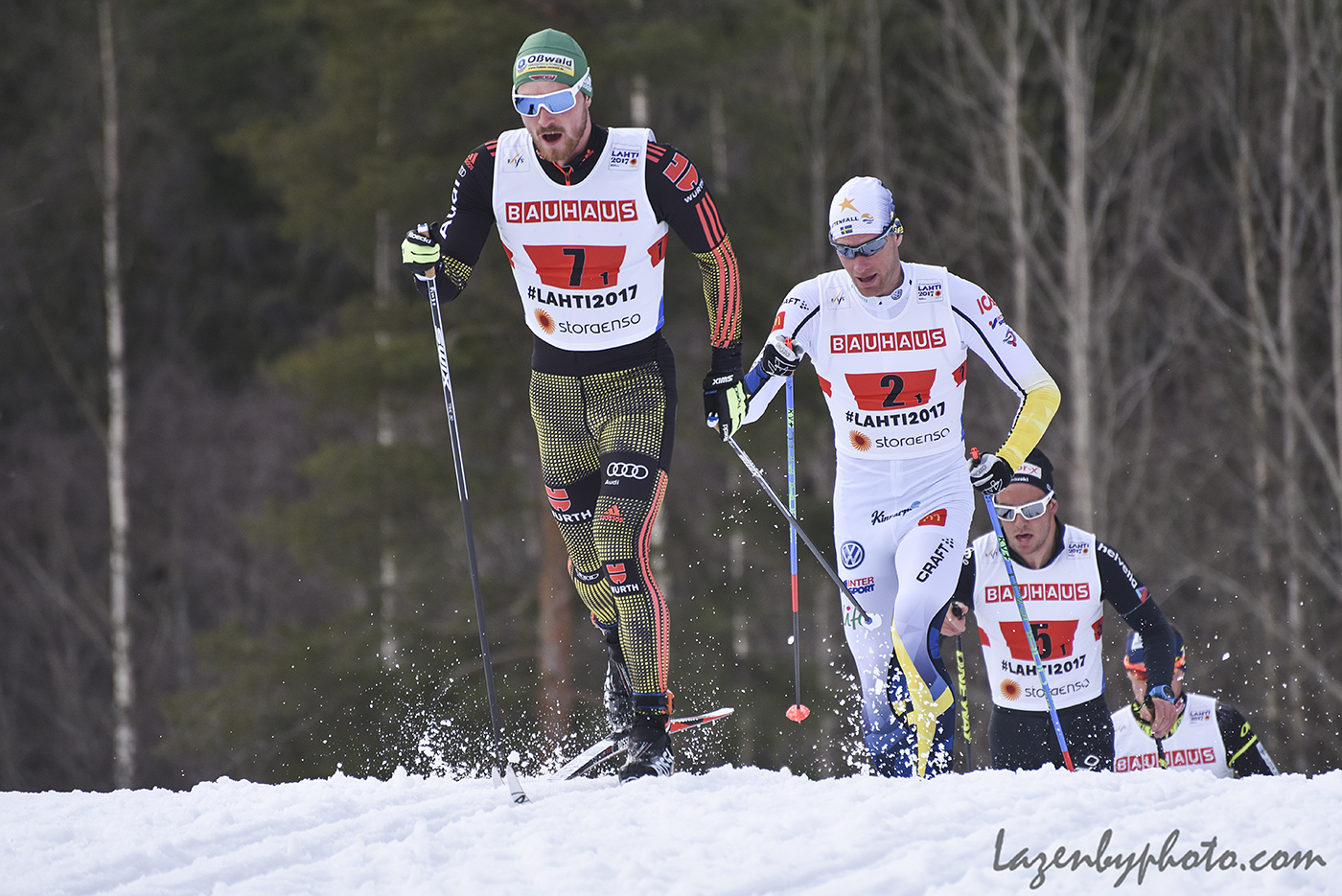
Germany’s Thomas Bing (7) leads Sweden’s Daniel Rickardsson (2) and Switzerland’s Jason Rüesch during the first leg of the men’s 4 x 10 k relay at 2017 World Championships in Lahti, Finland. (Photo: John Lazenby/Lazenbyphoto.com)
Welcome to World Cup Windup, where we check in with the top-10 teams from last year’s FIS Cross Country World Cup tour before the season starts with the Ruka Triple in Kuusamo, Finland, on Nov. 24.
GERMANY
Overall in Nations Cup Last Year:Seventh
Women’s Ranking 2016/2017:Sixth
Men’s Ranking 2016/2017: Ninth
Who’s Back:
Nicole Fessel and Steffi Boehler, top-20 in the World Cup distance standings; sprint finalist Sandra Ringwald; Victoria Carl and Katharina Hennig, who joined Ringwald and Boehler to finish second in the World Cup relay in Ulricehamn; Florian Notz, Elizabeth Schicho, Laura Gimmler, and Thomas Bing, each of whom had a single World Cup top-10 last season, and Hanna Kolb, who had two.
Who’s Missing:
Veteran sprinter Tim Tscharnke retired partway through the summer. The 2010 Olympic team sprint medalist has struggled with back problems and finally called it quits. “The last three years of my career were riddled with many mediocre months, punctuated by health problems and athletic setbacks,” he said.
Pre-Season Results:
The World Cup women’s 4 x 5 k podium on Jan. 22 in Ulricehamn, Sweden, with (from left to right) Germany (Stefanie Boehler, Sandra Ringwald, Victoria Carl, Katharina Hennig) in second, Norway (Ingvild Flugstad Østberg, Heidi Weng, Astrid Uhrenholdt Jacobsen, Marit Bjørgen) in first, and Sweden in third (Ida Ingemarsdotter, Sofia Henriksson, Charlotte Kalla, Hanna Falk). (Photo: Fischer/Nordic Focus)
Earlier this month in Davos, Switzerland, Thomas Bing won a sprint race and Laura Gimmler was the runner-up in the women’s race. Katharina Hennig and Steffi Boehler went 2-3 in a distance race.
Recent Drama:
After being sick in both August and September, Florian Notz is aiming for a World Cup debut in Davos in December, not earlier. “I did not have any real training for two to three months,” he told Südwest Press. “That’s why Kuusamo is too early for me… I have set myself as a goal, that I want to attack fully [in Davos]. I am still optimistic that I can be in shape by then. But of course, everything has to go right.” If not, Olympic qualifying will be tricky.
Lucas Bögl is among the athletes joining the new “Athleten für Deutschland” athlete union, which was recently founded as an independent alternative to the athletes’ council run by the German Olympic Committee. The head of the German Olympic Committee is not a fan, saying basically that athletes trying to make demands will only bring problems upon themselves. Bögl disagreed. “The club should help the athletes commission and support the athletes,” he told OBV-online. “That should be in the interest of everyone involved.” He also said: “Cross-country skiing is not something you do for the money, it’s more of a way of life. I have turned my sport into a profession. I feel privileged that I don’t have to sit in an office. I can do that for a long time after my career is over.”
Sandra Ringwald, who just missed making the 2014 Olympic team for Germany, and is particularly focused on 2018 Games this winter. “I want to fulfill my Olympic dream and be in PyeongChang,” she told the Südkurier newspaper in an interview. “However, I’m going easy on the whole thing. In the past few years I have often set my goals too high… I’m not working just for Olympic qualification. My aim is to play a good role in the World Cup as well. I want to show what I can do at the very first races.”
Best Social Media Presence:
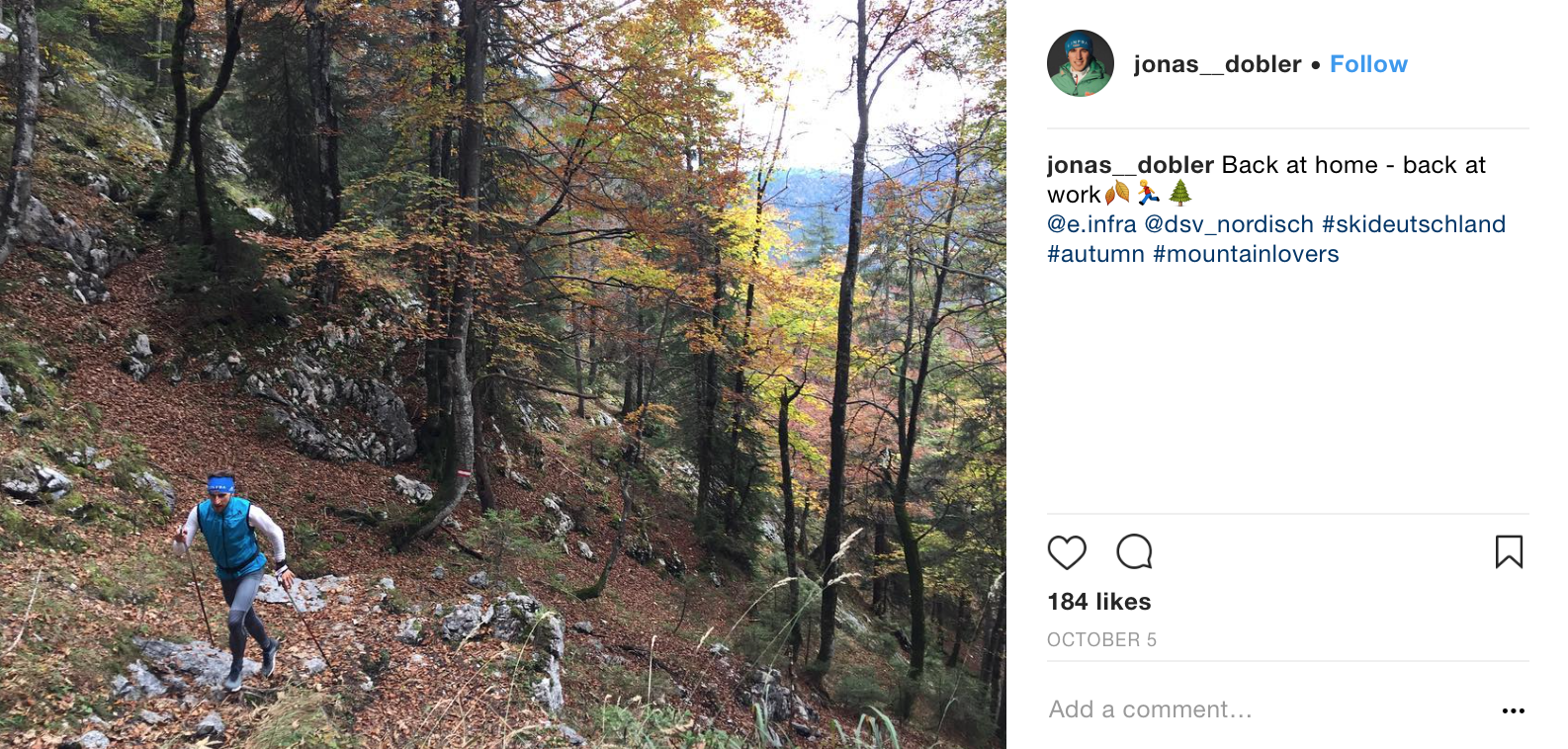
Steffi Boehler is a consistent Instagram poster, and also includes some of her artwork along with training and daily-life pictures.
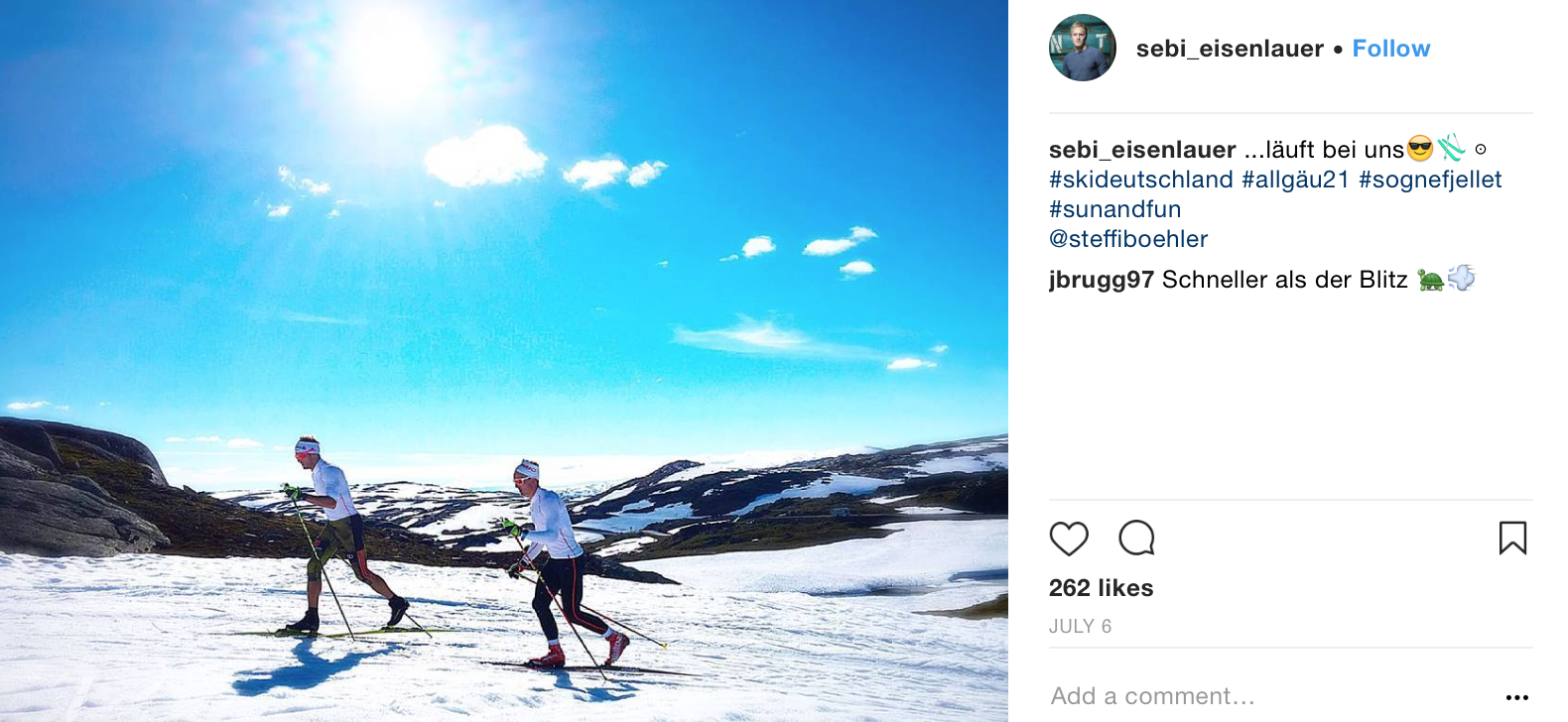
Sprinter Sebastian Eisenlauer also posts gorgeous training shots:
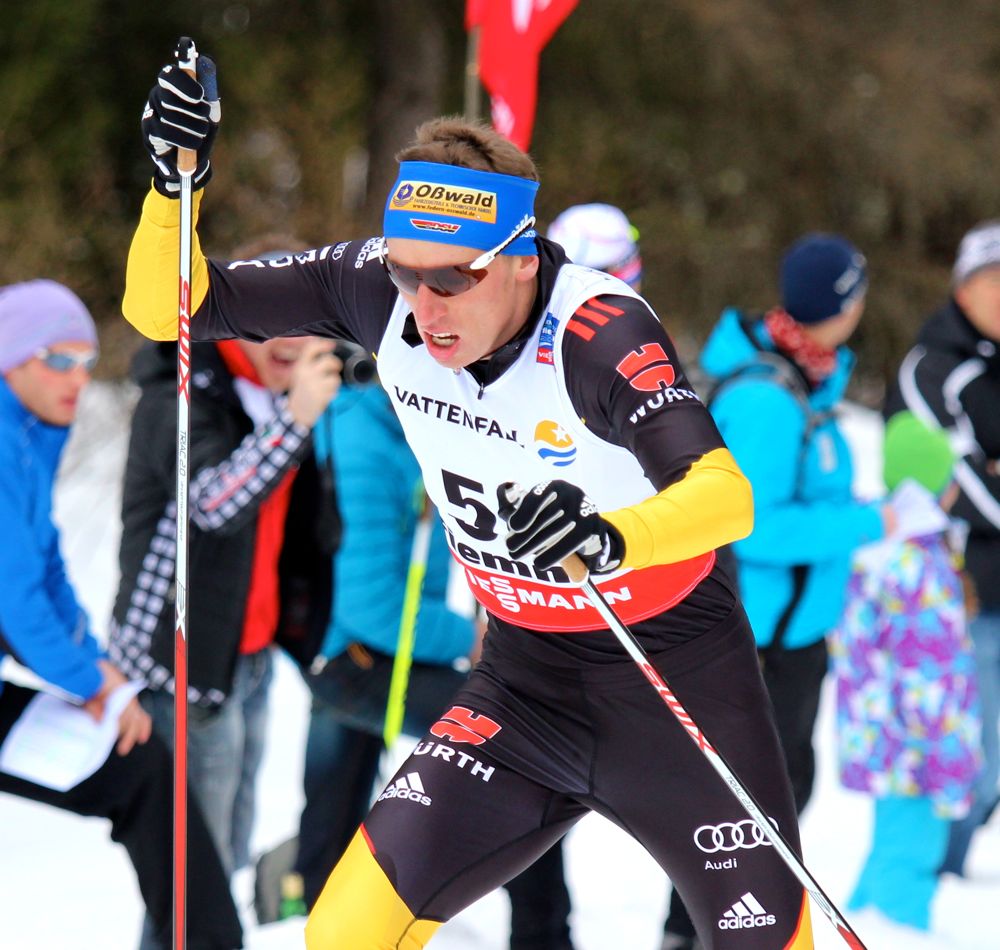
Germany’s Tim Tscharnke racing at 2013 World Championships in Val di Fiemme, Italy. His best result there was 14th in the 15 k freestyle, which stood as his best individual result in three World Championships appearances. In his eight seasons on the World Cup circuit, he reached the podium four times, two of which were individual victories.
At the conclusion of last season in late March, German cross-country national team member Tim Tscharnke still wanted to keep going for one more Olympic highlight year. He was eager to redeem himself after a disappointing 2016/2017 season — by his standards — in which he started only eight World Cup races. His best result of last winter came at the Tour de Ski in Val Mustair, Switzerland, where he placed 24th in the 10-kilometer classic mass start. Due to a respiratory illness, he was not selected for Germany’s 2017 World Championships team, also missed the national championships and finished the season on the European Continental Cup.
Tim Tscharnke (l) celebrating with his teammate Axel Teichmann after finishing second in the men’s team sprint at the 2010 Vancouver Olympics for a silver medal. (Screenshot: Olympicvancouver2010 YouTube video)
His health problems lingered through the spring. Unable to train as intensively as he wanted to, 27-year-old Tscharnke reconsidered his future in the sport and ultimately announced his retirement on Facebook late last month.
“The last three years of my career were riddled with many mediocre months, punctuated by health problems and athletic setbacks,” Tscharnke wrote, according to a direct translation. “For this reason I will end my athletic career.
“I consider it impossible to once again get back to the top of the world. Yet that has always been my standard: to compete against the best and fight for top results,” he continued. “However I had to realize that respectively my body no longer can absorb the training volume and methods from the good years, and therefore it is impossible for me to compete against the strong international competition on an equal level. Especially my back and my feet, which time and again had to be treated between training camps in order to even ensure a basic level of training, in combination with results I could not deliver, have let the motivation sink into a deep hole over and over again.”
He explained that he did not just want to make the team for PyeongChang 2018 as a “tourist”:
“The attempt for the next season to secure a ticket as an Olympic tourist on the very last fumes and then just ski around there without any chance at positioning in the front… no, that is not up for debate,” he wrote. “It would not be justified to miss my family for another year and potentially damage the body even more. Nevertheless I look back on a good time. A time during which it was possible for me to achieve some great successes, which I am proud of!”
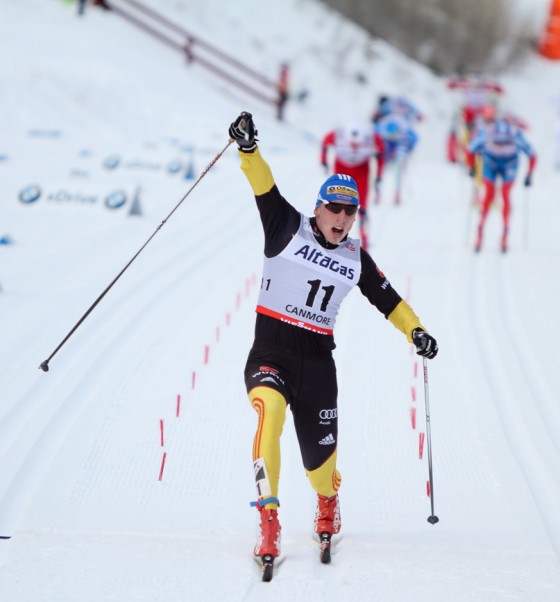
Back in 2012, Germany’s Tim Tscharnke celebrated his 23rd birthday with a World Cup win in the 15 k classic mass start in Canmore, Alberta. It was his second-career World Cup victory.
At the 2014 Olympics in Sochi, Russia, Tscharnke and teammate Hannes Dotzler nearly took another medal in the team sprint, winning their semifinal and leading a three-person group in the final, before Tscharnke tangled with Finland’s Sami Jauhojärvi coming down into the finishing stretch and crashed. Tscharnke took a long time to stand up and ultimately finished seventh for Germany.
After that, Tscharnke got back on track to become the last German skier to-date to win a World Cup race: the 15-kilometer classic mass start stage of the 2015 Tour de Ski in Val di Fiemme, Italy. His other World Cup win was in the same format (15 k classic mass start) in 2012 in Canmore, Alberta.
“I want to thank everyone who accompanied me on my way, during my active time: my family, my friends, my faithful sponsors, and last but not least of course also my fans and supporters, who were excited for me and cheered for me during the last years,” Tscharnke concluded in his Facebook post. “I say, Thank You and wish you all the best for the future!”
Tscharnke has not revealed what he plans to do next. In the last few months, he has teamed up with an advisor to the German national team to offer weekend rollerskiing courses. Tscharnke is employed as an officer with the German border patrol.
Petter Northug (c) celebrates Norway’s freestyle team-sprint gold, which he won with teammate Finn Hågen Krogh on Sunday for his second title of 2015 World Championships in Falun, Sweden. (Photo: FlyingPointRoad.com)
FasterSkier’s coverage of the 2015 FIS Nordic World Ski Championships in Falun, Sweden, is brought to you by the generous support of L.L. Bean, now featuring a complete line of Kikkan Randall training wear.
FALUN, Sweden — Why waste time when you can get the job done? That was Petter Northug’s mentality on his second of three laps in the men’s 6 x 1.4-kilometer freestyle team sprint at 2015 FIS Nordic World Ski Championships on Sunday.
Already on a roll with one gold in the World Championships classic sprint three days earlier, Northug was on a quest for another in the only event he had yet to win at worlds: the team sprint.
With Norwegian teammate Finn Hågen Krogh, the two built an early lead in the final, and Krogh kept them in first on his second lap, handing off to Northug 2.79 seconds ahead of Sweden in second. Soon after, Northug attacked on the longest of the course’s two steep climbs, leaving Sweden’s Teodor Peterson behind.
“In the final, I looked for things to do pretty early,” Northug said in a press conference. “We thought that Sweden wanted high speed in the final when they put Calle [Halfvarsson] on the first leg. I was prepared to fight with [Peterson] on the last leg, but he was sitting on the bike when we were skiing fast.”
As Northug warmed up into his accelerated pace, Russia’s Nikita Kriukov led the chase, heading out six seconds after him. Teammate Alexey Petukhov had tagged him in third, just ahead of Italy and about two seconds in front of France and Germany, and Kriukov proceeded to lead Italy’s Federico Pellegrino and Germany’s Tim Tscharnke in pursuit of Peterson.
They caught the Swede on the second uphill, and the four descended into the stadium and second-to-last exchange together, led by Peterson about eight seconds after Northug.
One lap later, Krogh had increased Norway’s first-place cushion to nearly 16 seconds, while Italy’s Dietmar Nöckler and Halfvarsson raced behind him in second and third, respectively, up the first climb.
On the second uphill, Russia’s Petukhov was back in contact with the chase group, along with Germany’s Thomas Bing, Finland’s Ville Nousiainen, France’s Robin Duvillard, and the Czech Republic’s Ales Razym. Another five seconds back, American Andy Newell led a second group in ninth.
Krogh cruised into the final exchange in first, while Bing led the seven-man pack through 15.68 seconds later.
“Petter didn’t leave me much choice,” Krogh said in the conference about the lead. “When I saw he had the gap, I only had one thing on my mind, it was go hard the rest of the race.”
From there, Northug went through the motions, skiing the third-slowest anchor leg and looking back before the last rise in the stadium to see if anyone was charging from behind.
Nope.
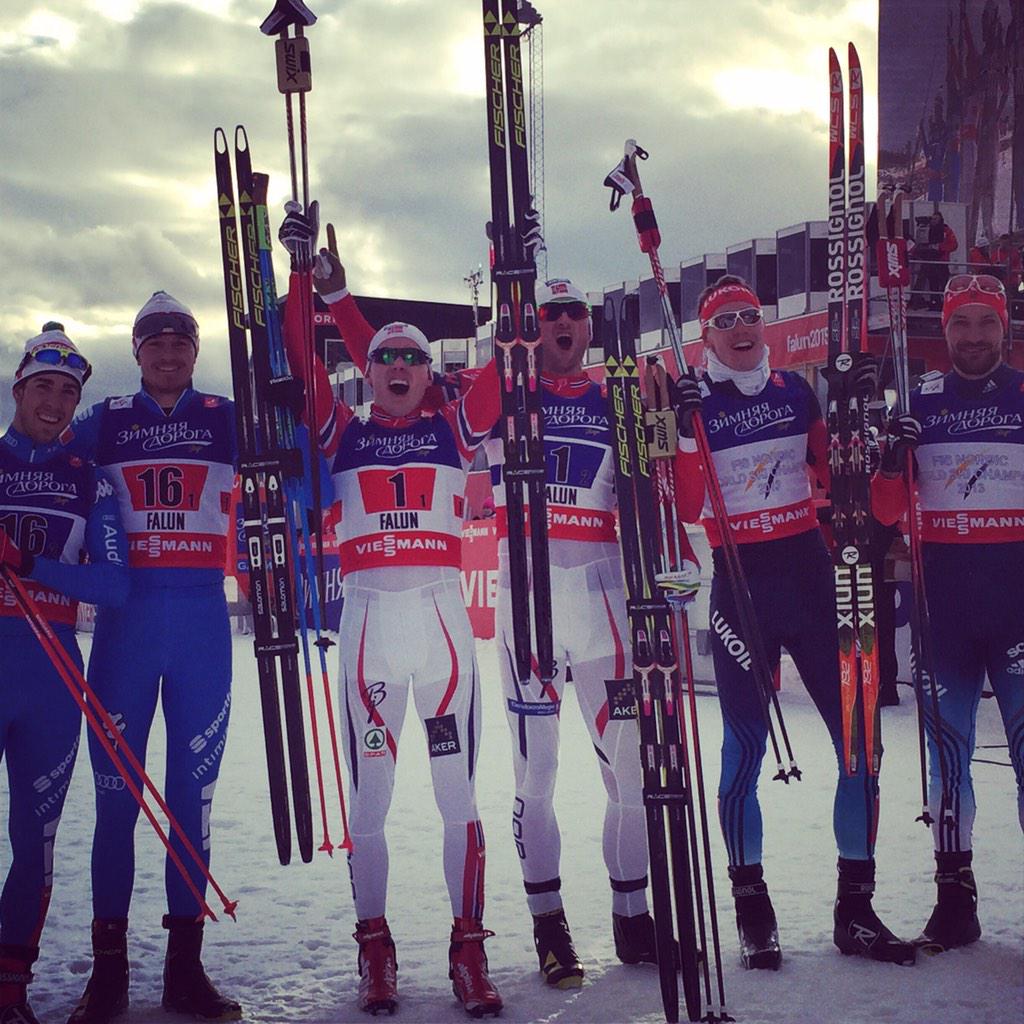
The 2015 World Championships freestyle team sprint podium, with Norway (c) as the winners (Finn Hågen Krogh/Petter Northug), Russia (r) in second (Nikita Kriukov/Alexey Petukhov), and Italy (l) in third (Federico Pellegrino/Dietmar Nöckler). (Photo: FIS Cross Country/Twitter)
On that same stadium hill several seconds later, Kriukov attacked one last time to move into second ahead of Tscharnke and Pellegrino. He left both of them behind, securing silver for Russia, 5.64 seconds after Northug and nine-hundredths of a second ahead of Pellegrino, who claimed bronze for Italy.
“We lost only five seconds to Petter, but while we was [waving] the flag and drinking coffee, what can you say,” Kriukov said through a translator in the press conference. “The Norwegians were the best. We are really happy for them.”
The defending world champions in the 2013 freestyle team sprint in Val di Fiemme, Italy, Kriukov and Petukhov were also pleased with themselves.
“I’m happy today,” Petukhov said in the conference through a translator. “Because this silver medal, I have to work hard for it, but of course if you win the race, then you are even higher above, but still I am very happy.”
Tscharnke was 0.38 seconds short of the podium in fourth, which was Germany’s second wooden medal of the day after Nicole Fessel and Denise Herrmann placed fourth in the women’s team sprint.
Finland’s Martti Jylhä finished another 7.55 seconds back in fifth, 13.66 seconds after Northug, and the Czech Republic placed sixth with Dusan Kozisek coming through 16.73 seconds after the winners.
While Simi Hamilton skied the fourth-fastest anchor leg for the U.S., the Americans placed seventh (+17.48) ahead of Poland in ninth (+26.46), Sweden in 10th (+47.43) and France in 10th (+1:01.04).
Petukhov inadvertently took out Sweden — the silver medalists in the 2013 World Championships team sprint — when he came into the last exchange with such high speed that he fell and broke Peterson’s pole as Peterson was about to start on his last lap.
“I could not have done anything differently; I went to Teodor and apologized from the bottom of my heart,” Petukhov told Aftonbladet, according to a translation. “I cannot speak English so I do not know what he said, but I think we understood each other.”
“He arrived and apologized. There is no evil in him, but he knows he did wrong,” Peterson told Aftonbladet.
After breaking a pole in Saturday’s skiathlon, in which he placed sixth, Halfvarsson called the bad luck “just crap.”
“Why is this happening? I broke a pole yesterday and now we break a pole on the last lap. It is pure bad luck,” he said to Aftonbladet.
France also fell out of contention in the men’s final, after Duvillard had skied up to fifth at the halfway point behind Krogh. One lap later, they were still in the mix with Baptiste Gros in sixth, and Duvillard tagged them in seventh for the last lap, which was where they ran into trouble.
Coming down the last descent into the stadium, Gros crashed suddenly at the bottom; his ski popped off and he sprawled out on the ground for several moments. He ended up finishing, nearly 14 seconds after Sweden.
Earlier in the afternoon, France placed second to Italy in the first semifinal, one-hundredth of a second ahead of Sweden in third. While Italy and France automatically advanced, Sweden ended up moving on as well as one of the six-fastest lucky loser times among 28 teams. Finland and the Czech Republic also ended up advancing out of that semifinal.
Norway won the second, slower semifinal after Northug set the pace for that heat on his second lap and forced everyone else to contend for a top-two finish to guarantee a spot in the final. Russia placed second in that heat, ahead of the U.S., which also advanced in third, and Germany and Poland made the final as well.
Kazakhstan, which took bronze in the 2013 World Championships team sprint, did not advance to the final and placed 18th overall. Norway didn’t reach the team-sprint final in Val di Fiemme, where Pål Golberg and Northug finished 11th.
“We had a really bad team sprint in Val di Fiemme and also in Oslo [in 2011 where] we lost the team sprint in the last meters to Canada,” he said in the press conference. “So it feels really good to win the World Championships in a team sprint — it’s good to have checked off all the distances.”
With three races to go and 11 World Championships golds to his name, he’s still looking for more.
“I milk [my] base for all its worth,” he told NRK, referring to his altitude training before and after Norwegian nationals late last month. “That makes racing really fun, and I’m planning on riding that flow the coming week as well.”
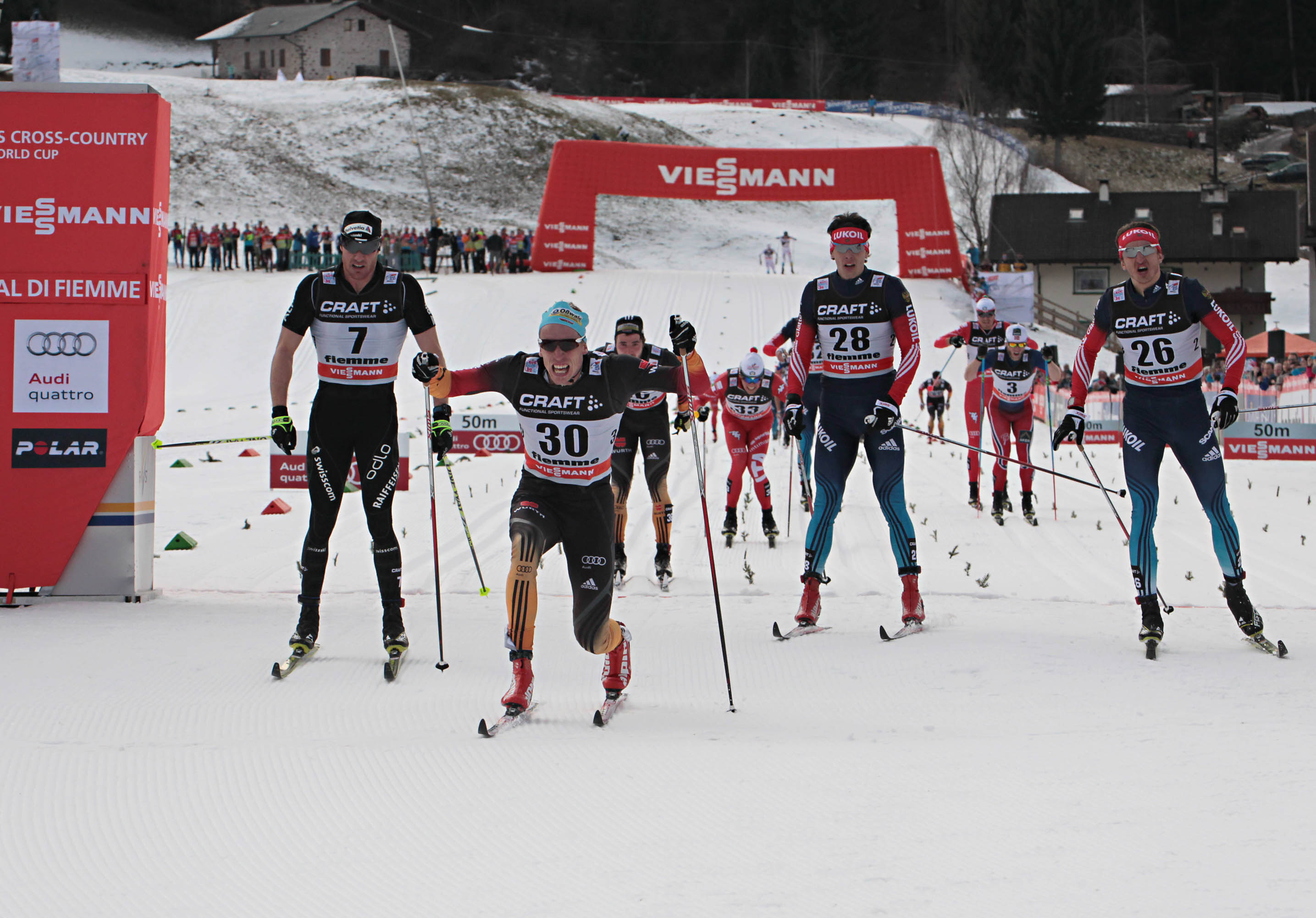
Tim Tscharnke (bib 30) of Germany begins to celebrate after a narrow victory over Kazakhstan’s Alexey Poltoranin (out of frame) in Saturday’s Tour de Ski 15 k classic mass start in Val di Fiemme, Italy (Photo: Val di Fiemme/www.fiemmeworldcup.com)
Saturday’s 15 k men’s classic mass start in Val di Fiemme, Italy, had no shortage of excitement – with the top five separated by less than a second – and sets up a potentially dramatic final stage of the Tour de Ski.
In a sprint to the finish line, it was Germany’s Tim Tscharnke winning the Tour’s sixth stage by mere inches. Tscharnke, who began the race 30th in the Tour standings, outlunged Alexey Poltoranin of Kazakhstan (+0.0) to finish in 46:48.8.
Tscharnke was positioned behind the leaders for much of the race and was ninth after 11 k, 6.8 seconds behind Tour leader Petter Northug of Norway. However, as skiers such as Northug and Norwegian Martin Johnsrud Sundby slowed their pace after sprinting to collect bonus points, Tscharnke was able to make his move along with other racers who held back.
“We did not focus on sprints, we just wanted to go for a good position in the finish,” Tscharnke told FIS.
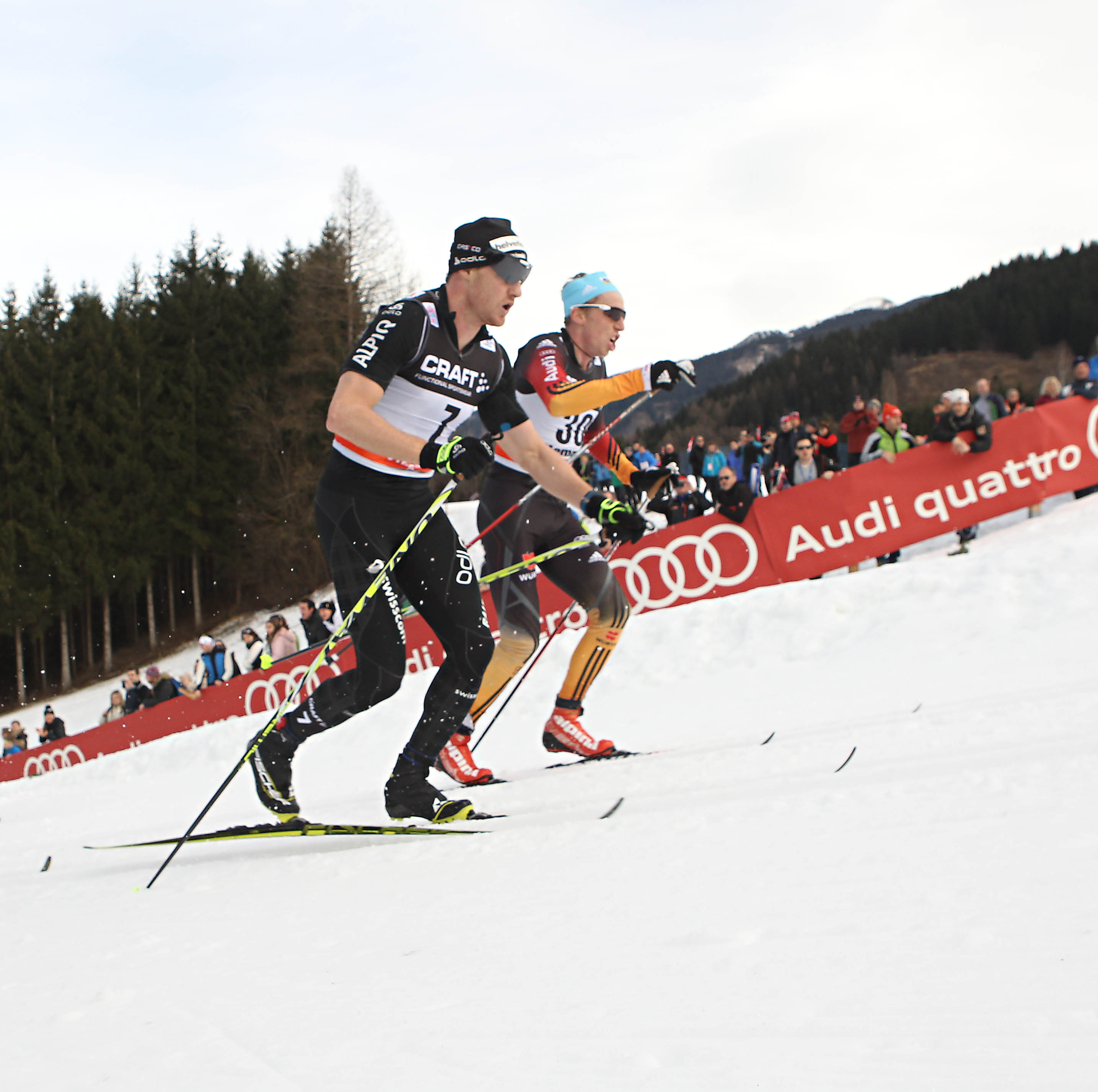
Switzerland’s Dario Cologna (bib 7) and Tim Tscharnke of Germany (bib 30) race in the Tour de Ski 15 k classic mass start in Val di Fiemme, Italy. Tscharnke would go on to win in a photo finish. (Photo: Val di Fiemme/www.fiemmeworldcup.com)
“It’s a little bit of a surprise for me to win today,” the 25-year-old explained. “Thomas [Bing] and me wanted to be in the front of the pack. We helped each other.” Bing would end up finishing sixth (+2.0).
Tscharnke’s Tour got off to a rough start, as he took 73rd in the 4 k Obsertdorf prologue. However, he has since been posting better and better results, and with Saturday’s victory he has his best World Cup result of the season by far. His previous best was in Wednesday’s 10 k classic interval start in Toblach, when he took 24th.
Tscharnke said, according to the German newspaper Frankfurter Allgemeine, that this victory meant more to him than his last World Cup victory, a 15 k classic mass start in Canmore, Alberta, in Dec. 2012. He explained that he underwent intense training over the holiday break, especially on the roller ski and the treadmill, and that it is a relief to see the hard work pay off.
He is now 15th in the Tour standings, 4:20.8 behind the leader, Northug.
Dario Cologna was contending for the win during the final sprint and took third (+0.4), despite an earlier crash. About 29 minutes into the race, he tangled skis with Russian Evgeniy Belov while descending a fast hill, and both skiers went falling to the ground. Belov, who is fourth in the overall Tour standings (+35.3), would end up taking 17th (+14.1).
“I had to spend some energy to come back after the crash but I managed to finish on the podium. It will be difficult to go for podium in the Tour but you never know what can happen on the climb,” Cologna said to FIS, referring to the long climb that makes up much of Sunday’s 9 k freestyle pursuit.
Cologna is fifth in the Tour standings (+1:46.6) and 1:19.8 behind the third-place skier, Sweden’s Calle Halfvarsson.
Meanwhile, two Russian skiers, Stanislav Volzhentsev and Alexander Bessmertnykh, both stayed well behind the leaders throughout the race and were able to conserve enough energy to take part in the final sprint to the finish. Volzhentsev just edged out Bessmertnykh in a photo finish to take fourth (+0.7).
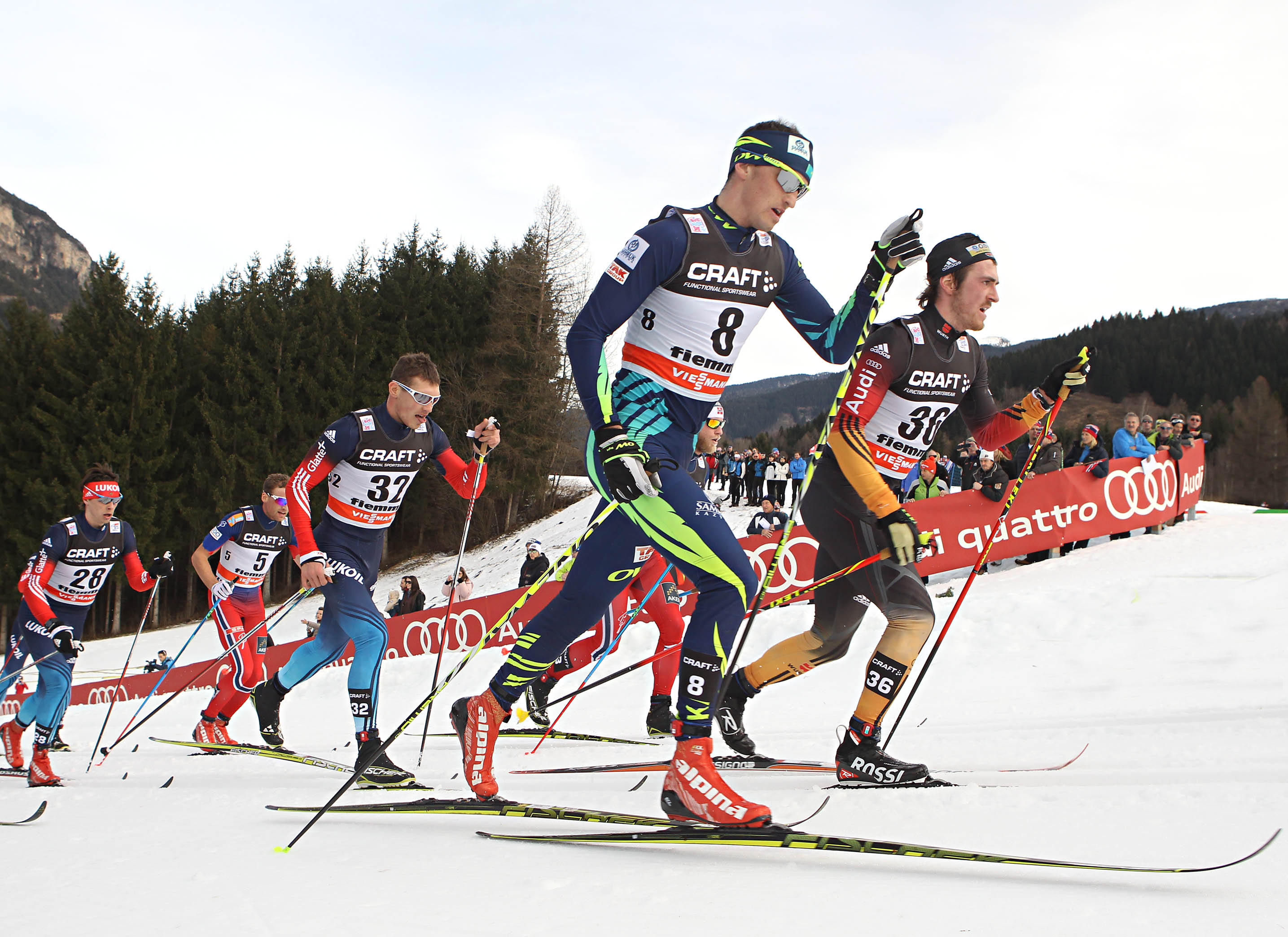
Kazakhstan’s Alexey Poltoranin (bib 8) races alongside Germany’s Thomas Bing (bib 36) in the Tour de Ski 15 k classic mass start in Val di Fiemme, Italy (Photo: al di Fiemme/www.fiemmeworldcup.com)
With a podium consisting of Tscharnke, Poltoranin, and Cologna, Saturday featured the first podium of the season without a Norwegian present.
Northug finished the race in 21st (+17.2), which was just barely enough to hold the overall Tour lead over teammate Sundby, who finished in eighth (+4.1) and was the highest-placing Norwegian. Sundby also crashed on one of the course’s steeper downhills, falling alongside Niklas Dyrhaug five minutes into the race.
Northug explained to FIS that Saturday’s race was all about collecting bonus points.
“I knew many skiers were saving energy for the finish. The last bonus sprint cost me a lot of power,” Northug said.
The current Tour standings set up a tight race for the overall Tour title, which will be decided in Sunday’s final stage in Val di Fiemme. Northug is just 3.1 seconds ahead of Sundby, while Halfvarsson, who was 27th on Saturday (+30.0), is 26.8 seconds behind Northug in third and within striking distance.
“It will be a hard fight for the podium tomorrow,” Northug said. “It has been a tough Tour de Ski. If you have a really bad day you can easily lose many minutes.”
At this point on the Tour, the men’s North American contingent consists entirely of Canadians. Alex Harvey finished his Tour by taking 34th (+2:12.5), and dropped from sixth to 16th in the overall standings. Teammates Ivan Babikov and Devon Kershaw finished 40th (3:28.6) and 41st (3:39.5), respectively.
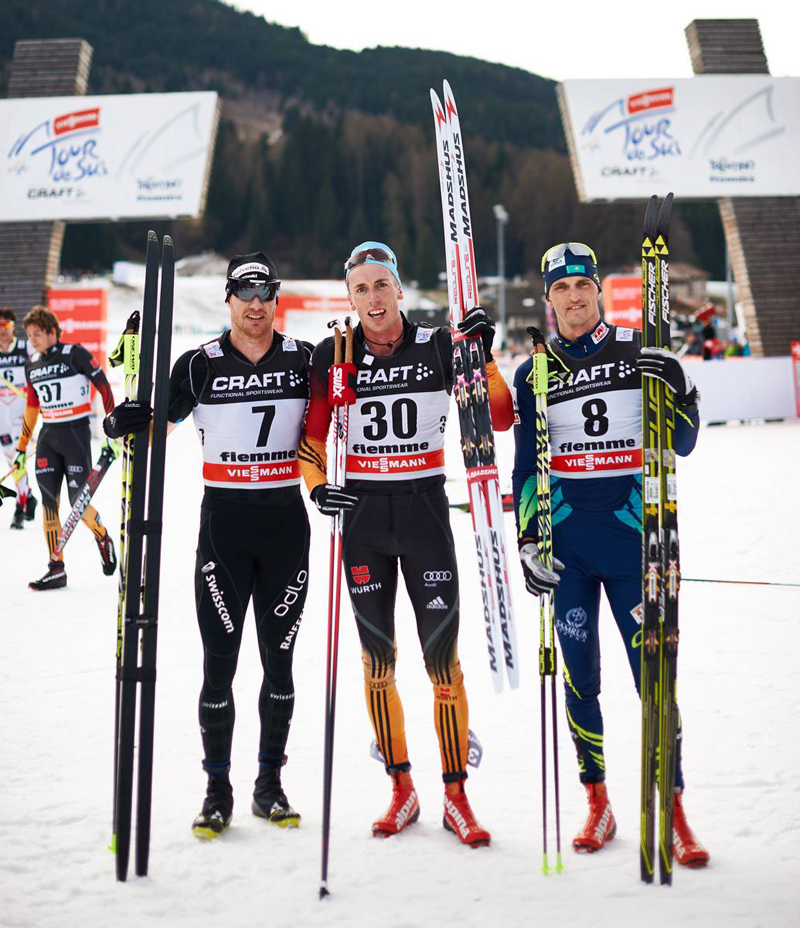
Dario Cologna (SUI), Tim Tscharnke (GER), Alexey Poltoranin (KAZ), (l-r) take the podium in the men’s classic mass start in Val di Fiemme, Italy. (photo:Fischer/Nordic Focus)
The German nordic sports experience at the 2014 Olympics could perhaps be summed up on the last day of competition.
In the men’s 50 k, Germany entered four men. The finishers were led by Thomas Bing, about to turn 24 years old, in 36th place.
Next came Axel Teichmann, more than ten years Bing’s senior. Then two biathletes – Arnd Peiffer and Erik Lesser, in their 50 k debuts on the world stage and within a minute of Teichmann’s time.
Four years earlier, Teichmann had captured silver for Germany in the same event, but on that day in February he labored to 39th place, more than four minutes behind the winning Russian skier. While Germany still had a few of their stars from days past on their roster, they were mostly stars no more.
Peiffer and Lesser had teamed up for a silver medal in the biathlon relay the day before, but they surely were not on fire in the 50 k (understandably). While they treated the race as a fun way to end their Games – and some other biathletes and nordic combined skiers probably would have jumped at the chance to do the same thing – their participation brought up an uncomfortable question: can Germany find nobody else?
To say that Sochi was a disappointment for Germany would be an understatement. While expectations were somewhat tempered by their team’s performance so far that year, it was hard not to remember Vancouver. There, biathlete Magdalena Neuner won two golds and a silver, Simone Hauswald shared the podium with her when she earned bronze in the mass start, and the relay also took bronze.
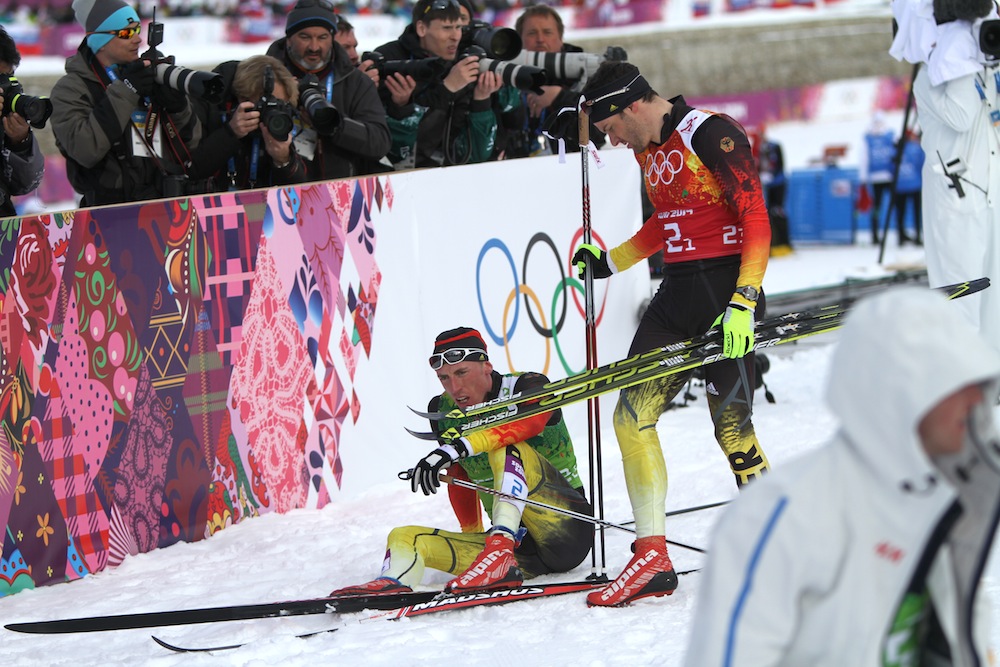
Germany’s Tim Tscharnke (l) after the finish of the 2014 Olympic team sprint with teammate Hannes Dotzler. The two finished seventh after Tscharnke fell a few hundred meters before the finish as a result of a tangle with Finnish anchor Sami Jauhojärvi. Finland took gold and Germany placed seventh.
In cross country, Nystad and Evi Sachenbacher-Stehle had teamed up for gold in the Vancouver team sprint, Teichmann and Tim Tscharnke took silver in the men’s event, the German women were second in the relay, and the men won two individual silver medals.
For a little perspective: in 2014, Germany came away with three medals, total, in cross country and biathlon combined.
Where to start with the embarrassments? Was it Sachenbacher-Stehle testing positive for a banned stimulant? Or was it Tscharnke falling down in the final stretch of the team sprint and, instead of getting up and likely earning bronze, lying in a heap whimpering about how he missed out on gold?
In a Deutscher Olympischer SportBund report obtained by FasterSkier, the country’s Olympic committee assesses the success of each sport at the 2014 Olympics, and looks for actionable plans to move forward and upward. The document runs more that 230 pages and not only focuses on each sport individually, but also on funding partners, medical and logistical support, and what other countries are doing to succeed. It’s an impressive analysis of a huge and complex system.
A Cross Country Team Too Old and Too Young
“Denise Herrmann and Josef Wenzl improved in the world rankings in the 2013/2014 season and even at times led the Sprint Cup,” the report noted of young German skiers. “But the pre-Olympic season was marked by a disappointing World Cup, and the coaching change in 2012 didn’t bring the expected turnaround.”
Herrman was one of the great hopes for Germany – a medal in the skate sprint seemed very possible for the 25-year-old (and if that doesn’t sound “young”, the report notes that the average age of a medalist was 28 for women and 29 for men). But like other favorites including Marit Bjørgen and Kikkan Randall, she didn’t make the final.
That was symbolic of the single medal and three top-8 finishes by German skiers, their worst performance at an Olympic Games since 1998.
While performances by the team’s young stars showed that maybe they weren’t ready for literally the biggest stage in the sports world, the squad was also filled with older athletes. The single medal came in the women’s relay, where 36-year-old Nystad was helped earn bronze and the team came into the sprint finish with the leaders.
Kerttu Niskanen of Finland leading Claudia Nystad of Germany in the Olympic relay. Nystad completed her comeback from retirement with a bronze medal.
The report noted that Nystad was the oldest medalist in cross-country skiing. But they didn’t say what the rest of the team’s aging veterans accomplished: because Teichmann didn’t contribute much, nor did 36-year-old Tobias Angerer. None of the women who competed in the 15 k skiathlon were under the age of 30.
Nordic sports are particularly difficult to analyze, the report noted, with different techniques and physiological demands of uphill and flat sections, aggression needed on downhills, transitions essential on rolling terrain, and equipment and ski service becoming increasingly important.
But the best athletes, the report explained, are in general among the best at each of these different aspects, and having a weakness in one area can’t necessarily be compensated for by excellence in another area due to the high level of competition in the field.
What do they recommend to get German skiing back on track? For once thing, they focus on a “long-term development structure” and suggest that the objectives and tasks be reworked after observing other country’s strategies for developing cross country skiers.
Another recommendation is that while providing for an athlete’s development, not to treat them as machines: “An essential prerequisite of all participating institutions is to in close cooperation control the sport, but also the personal development of the athletes and to focus on the achievement of future excellence in high-performance.”
Finally, the committee noted that the ski association’s current strategy of setting up different training groups seems to be effective, but that it should look towards biathlon and nordic combined for how to systemize development at the junior level.
If there’s more talent coming up, there may finally be starts for them. Teichmann, Angerer, and Katrin Zeller retired. Nystad is back in action and had a strong race in Beitostolen, Norway, this weekend.
What Happened to Biathlon?
Erik Lesser of Germany en route to a silver medal in Sochi.
Biathlon was an unmitigated disaster for Germany at the Sochi Olympics. On the second page of the biathlon section of the report, the committee addresses an ugly truth: the medal rankings. Germany collected two medals, one silver and one bronze, which landed them in fourth place (although there were several ties; five teams were better, two the same). The Czech Republic surged past them with five medals.
“Besides the established nations of Germany, France, Russia, and Norway, increasingly athletes from Austria,the Czech Republic, Slovenia, and Canada are gaining podiums and placing among the world leaders,” the report noted.
Echoing a sentiment expressed by many of the sport’s observers, the committee crunched some numbers and showed that biathlon is, in fact, getting increasingly competitive: the same level of performance that might have won a medal in the past just doesn’t cut it anymore.
“In order to achieve podium finishes, the men at maximum about 1.2 percent behind in skiing, and hit targets at a rate of of about 98 percent. The previously assumed requirement to be 1.5 percent back and a 95 percent hit rate are therefore obsolete now… in the women’s field, a hit rate of 96 percent and maximum ski speeds less than 2.0 percent back are needed to reach medal placings… the best individual performances in the opening contest, the sprint, were… clearly behind the world leaders in both skiing and hit rate as well as in the shooting times. Because they were immediately dependent on the sprint results, the prospects were thus low for the subsequent pursuit.”
Forget medals – it didn’t get any better for Germany when considering top-8 performances: in other words, they weren’t even close to winning more medals. The team had only three top-eight finishes (discounting those from Evi Sachenbacher-Stehle after her doping ban). Norway and the Czech Republic led the way with 11, while France had 10. Germany’s three tied it with the United States, Canada, and Slovakia.
The women’s team, the report noted, was highly variable. After the Vancouver Games, three stars retired (Kati Wilhelm, Martina Beck, and Simone Hauswald), while Magdalena Neuner called it quits after the 2012 World Championships in Ruhpolding, Germany.
“[The team] ultimately consisted of two juniors (Franziska Preuss, Laura Dahlmeier); a very experienced senior athlete (Andrea Henkel); an experienced, former cross-country skier – with considerable training effort for the stabilization of the shooting performance (Evi Sachenbacher-Stehle); and an athlete who in comparison to previous years increased her experience but at events as big as Sochi still has far to go (Franziska Hildebrand). The challenging tracks in Sochi required a high level of competition experience with regard to the race schedule. Their could succeed in competition only on the basis of a high level of physical and mental performance. These parameters within the existing team structure are pronounced insufficient for an Olympic Winter Games.”
Magdalena Neuner, a three-time World Cup champion, double Olympic gold medalist, and winner of 17 World Championships medals, has been critical of the DSV’s biathlon program. Photo: NordicFocus/Fischer.
Since the Olympics, Neuner has publicly criticized the Deutscher Skiverband (DSV, the governing body for snow sports) and accused them of being behind the times and resistant to change.
“Times have changed, and the level of the World Cup has increased,” she told Der Spiegel. “[They] didn’t want to think differently… the team needs someone who has a bit more sensitivity for the young girls. The World Cup is a tough business. And because they are currently not as successful, it is even harder. Now they need a coach who is fully behind them.”
In a separate conversation with Sport1, Neuner said that far too much pressure had been put on the likes of Dahlmeier and Preuss, who just two years before had been competing at the Youth Olympic Games.
Her leadoff leg of the women’s relay was tough to watch – she fell, and also had her rifle sight clogged with snow. Perhaps additionally discombobulated by Sachenbacher-Stehle’s doping result, Preuss tagged off three minutes behind the leader and in tears. She was 19 years old, and has since made it clear that she never wants to revisit the memory.
“It’s always difficult in the first World Cup season, and especially at the Olympics for young athletes: the pressure is greater than they had ever imagined,” Neuner told Sport1. “You think you’re now relaxed on the World Cup, but it is different than before. The public attention is so high and the pressure as well.”
She also said that the trainers did not sufficiently individualize training plans, and as a result many of the athletes were often exhausted and sick. Neuner trained more or less independently of the national team during her most successful years.
Neuner has since been in contact with the DSV, and they have reportedly offered her a position to advise them.
Henkel – who has medals from three Olympics and teamed up on relays with the strongest German biathletes ever, from Uschi Disl to Neuner – has since retired, married longtime boyfriend Tim Burke, and is planning a life in the U.S. German media is calling the very young German women’s team perhaps the most challenging squad since the reunification of East and West Germany.
“You shouldn’t compare these girls to what was before, but give them some time to develop and not have a lot of worry,” the told news.de.
What About Everyone Else?
How does Germany apply the same logic to other countries? The report also contains information on each of Germany’s main rivals: France, Canada, Norway, Russia, and the United States. A few interesting assessments:
France, it notes, won 15 medals – but all came in ski and snow sports, a “problem” noted by the head of the French effort and which will be targeted for expansion in coming years. How does France fund their efforts? Among other things, through the military, customs, and border patrol, which provides athletes with salaries. 60 percent of the medals won came from athletes in these programs, and only in jumping was the success unrelated.
“There is a positive trend in the spending from 2010 to 2013, for the key role of competitive sports the Institute for French High-Performance Sports [INSEP] used 63 percent of its total expenditures, or about 21 million euros. The budget for research projects amounted in 2012 to about 18 percent or 5.8 million euros and in 2013, about 12 percent or 3.9 million euros. Research and development activities to support the development of competitive sports staffed 18 employees of the Research Department of the INSEP.”
In assessing Canada, the report mentioned the governments Athlete Assistance Program (AAP) and discusses Own the Podium (OTP) at length. It concludes:
“Given increasingly costly global funding for sports and declining sponsorship in Canada, it needs to be clarified whether Canada can afford wider sports funding at present. The summer sports have obtained more financial due to the larger number of sports, despite fewer medals. After Sochi there is again, as before in 2013, debate about the questions: is it important for the summer sports to be equally successful as the winter ones? Is success in some sports more important than others? Does Canada have to be equally successful in Olympic and Paralympic Games?”
And how does the U.S. succeed? Germany marvels at the U.S. Olympic Committee’s very different funding strategy:
“With the relaunch of the USOC site ‘Team USA,’ the creators succeeded with the new website and numerous promotions to make an increasingly patriotic, emotionally-tinged connection between the American ‘consumers’ and Team USA. According to the 2012 Annual Report of the USOC, 130 million Americans are ‘fans’ of the Olympic Movement and at the end of 2012, USOC social media sites had more than 3.5 million followers. Team USA is 34 business partners, sponsors and suppliers – including Coca Cola, Dow Chemical, Samsung, VISA and Nike. The message [is that] that all Americans are part of the team behind the team USA and that without the willingness to provide financial support for the athletes a successful performance in the international arena is not possible…”
Can German nordic sports get their mojo back this season? We’ll have a hint at an answer this weekend: the FIS Cross Country World Cup kicks off in Kuusamo, Finland, and on Sunday the first IBU Biathlon World Cup will be held in Östersund, Sweden.
Germany’s Tim Tscharnke (l) after the finish with teammate Hannes Dotzler. The two finished seventh after Tscharnke fell a few hundred meters before the finish as a result of a tangle with Finnish anchor Sami Jauhojärvi. Finland took gold and Germany placed seventh.
FasterSkier’s coverage is made possible through the generous support of Swix.
KRASNAYA POLYANA, Russia — Things are not necessarily popping up daisies in Deutschland, especially for fans of cross-country skiers.
After the women’s team of Stefanie Böhler and Denise Herrmann finished fourth in the 1.3-kilometer classic team sprint, 1.15 seconds off the podium behind Norway, Finland, and Sweden, respectively, the men’s team lost out on a sure-bet medal in the last few hundred meters before the finish.
Tim Tscharnke had anchored Germany in impressive form, attacking on the final steep climb before a curving descent down toward the grandstand. The 24-year-old, who teamed up with Axel Teichmann to win silver in the 2010 Olympic freestyle team sprint, was in the hunt for gold — this time with teammate Hannes Dotzler. At the very least, with three men up front after gapping the field, it appeared he’d get bronze.
Tscharnke led into the downhill and teetered initially in the soft snow in one of the most fatiguing races of the Olympics. Going wide around the bend, he started to cut back in as Finland’s Sami Jauhojärvi took the inside lane and came out in front of him. Jauhojärvi’s skis slid over Tscharnke’s, and the German fell to the ground, nearly taking out Russia’s Nikita Kriukov with him.
“[He] was in the wrong lines — he was in the lines for lapping,” Tscharnke said of Jauhojärvi. “I wanted to go to the finish and he crossed my way. I thought Finland take the wrong way with lapping, it wasn’t lapping and I wanted to go to the finish lines, and it was crossing my way. Sh*t.”
Kriukov stepped to another lane and stayed on his feet, skiing behind Jauhojärvi for silver. Finland, with Iivo Niskanen, won its first Olympic gold since 1998 and the two teammates immediately reveled in the glory, dancing backward across the finish, grabbing a Finnish flag and soaking up the moment. Tscharnke took a while to recover and ended up seventh out of nine teams, 42.13 seconds behind Finland.
In the moments that followed, the Germans launched a protest against Finland, claiming Jauhojärvi obstructed Tscharnke. Before the flower ceremony could commence, the jury decided whether the move warranted a disqualification, and ultimately rejected the Germans’ case.
German press officer Stefan Schwarzbach said the appeal was rejected, but they had 48 hours to appeal — if they choose to do so.
“The question is, if it is really, really senseful,” he said. “We don’t understand. We haven’t decided yet [if we’re going to appeal] … The opportunities are really, really small because what would happen? Maybe the Finnish team will be disqualified, but there was no case we can remember that the team which was kicked off got a medal after.”
If their appeal was accepted, the most likely result would be that Norway — the fourth-place men’s team — would get bumped up to bronze.
“[Whether that will] help us, that’s the question,” Tscharnke said. “When I’m from Norway or from Finland or from France, they would be disqualified, but we are from Germany and it’s the same when you are from Russia: nothing will happen.”
“It’s sad,” German team organizer Bjørn Weisheit said. “It was the second chance for us today.”
As for the mood of the team, he said, “It’s sad and pissed off.”
Teodor Peterson (SWE), seen here in Stockholm, Sweden, last season, won the classic sprint in Liberec, Czech Republic, on Saturday for his first World Cup victory since last February.
In the first regular-season World Cup race of the New Year Teodor Peterson (SWE) was back on top on Saturday in the classic sprint in Liberec, Czech Republic. Peterson and teammate Emil Jönsson charged hard in the final straight to overtake Norway’s Pål Golberg and go one-two for Sweden in a photo finish, Peterson edging Jönsson by a few centimeters in the lunge to take the win. Golberg was third, just 0.6 seconds behind.
“I have had some good competitions this winter but no victory,” Peterson said. “I will try to keep the winning momentum for the rest of the season.”
Eirik Brandsdal (NOR) took fourth, 2.8 seconds behind Peterson. The top four created a significant gap on fifth and sixth by the end of the race; Tim Tscharnke (GER) was 12.2 seconds back in fifth, and Andy Newell (USA) took sixth (+20.7).
Though there were a few notable skiers that chose not to race and recover from the Tour de Ski, Peterson was not without tough competition in Liberec. Jönsson has had multiple sprint victories this year, World Champion Ole Vigen Hattestad (NOR) was on the start list for the first time all year and was, prior to Saturday, unbeaten at the venue.
Peterson himself has had consistent results near the top of the podium thus far but was unable to reach the level he attained last season. After Saturday, with his first win since last February in Moscow, Peterson has put himself back on the radar as the days until World Championships dwindle.
“The other two victories have felt differently,” Peterson told Sweski. “[Today] I was just tired and not even sure if I had won.”
The course in Liberec was modified due to limited natural snow cover leading up to the weekend. The men raced twice around an 800-meter loop that race organizers had covered with manmade snow. The women completed just one lap, and because the starters didn’t wait the usual five minutes before starting the men, recovery time in between heats was shorter than usual. Many of the men commented on feeling unusually tired after the race.
“They’d just run the men’s heat right after the women’s heat. Instead of maybe ten minutes of recovery we got maybe six minutes, which is kind of a big difference if you’re in that last quarterfinal,” Newell said.
The rounds leading up to the final also featured more carnage than there has been this season. Øystein Petterson (NOR) fell in qualifying and didn’t even make the heats. There were multiple crashes in the first semifinal; Alexander Panzhinskiy (RUS) fell mid-race, and Nikita Kriukov (RUS) also went down and took Hattestad with him. In the resulting confusion Mikhail Devjatiarov (RUS) interfered with Jönsson, for which Devjatiarov was penalized and relegated to sixth in the heat.
The high crash rate might have had something to do with the stress of looming World Championships team selections. Petterson, for instance, has likely ruined his Val di Fiemme chances. “I’m just really upset right now,” he told Norwegian broadcaster VG Nett. “I do not train twice a day to disappoint myself as I did today.”
But for all the early mishaps, the final went comparatively smoothly. The Scandinavians charged hard from the start and quickly created separation on Tscharnke and Newell.
“I still thought I had a good shot at the podium at least, but then when we started the final those guys took it out hot for sure,” Newell said. “Even on our first lap, it definitely took the wind out of myself and Tim. We were both struggling pretty bad in the final coming from the heat before.”
Golberg, Jönsson, Peterson and Brandsdal charged hard, vying for an advantageous position on around the corners. When Golberg began to create separation over the last hill before the stadium, Peterson thought for sure the race was over.
“I was a bit out on top and did not think I could come up with…Golberg again,” Peterson said to Sweski.com.
He and Jönsson would not give up, however, and the pair inched forward on either side of Golberg to finish within half a second of each other.
“It was nice to throw out a foot in front of Emil’s little foot,” Peterson joked in the press conference later.
Jönsson was disappointed to lose by such a small margin, but was good-natured about the loss. “Of course I’m not satisfied, I’m not even [the] best Swedish,” he said, laughing. “I am happy for [Peterson] to take his first victory of the season.”
Golberg, so close to earning his first World Cup gold at age 22, felt capable of winning on Saturday but just didn’t have the 100-meter closing speed.
“I felt very sharp today,” Golberg told the NRK. “The last 50 meters was a bit too long, unfortunately.”
Jönsson went home to Sweden on Saturday directly following the race, citing the need to rest and recover from a recent knee injury.
“The body is tired after the Tour de Ski and the stitches [are] still in my knee after I fell and then completed the race in Oberhof during the Tour,” he told Sweski. “There is no real harm, but it [hurts], especially when I go freestyle.”
* * *
Andy Newell (USA), shown here in classic action last season, finished sixth in Liberec for his third A-final appearance of the season.
For Newell, who won his quarterfinal and advanced to the finals as a lucky loser in the semis, Saturday’s result proved his classic sprinting is on par with the skate results he’s produced this year. Sixth place was his best classic sprint result in three seasons.
“I’m happy to know that I can make the final in both skate and classic sprints this year, which is a good feeling,” Newell said.
To get there, he had to successfully navigate some aggressive skiing on the part of his competitors. Anssi Pentsinen (FIN) cut him off around a corner in the semis, and to avoid colliding with him Newell reached out and tapped him to keep their skis a safe distance apart.
“I was wondering if anyone saw that,” he laughed. “Yeah he totally squeezed in on me on the corner and I had to put a hand on him. I was hoping that the cameras didn’t catch it, because every time you do that you can definitely run the risk of getting disqualified.”
The move may have saved his race. Multiple crashes in the first quarterfinal meant that the lucky losers would likely come out of Newell’s heat, so he knew that a top-four would give him a good shot at moving on.
“We’d seen the heat before and knew they were a little bit slower because there were some tangle ups, so…we were just fighting for those top four spots.”
Racing resumes in Liberec on Sunday with a freestyle team sprint.
Coverage of the Canmore World Cups was made possible through the generous support of Travel Alberta and Tourism Canmore.
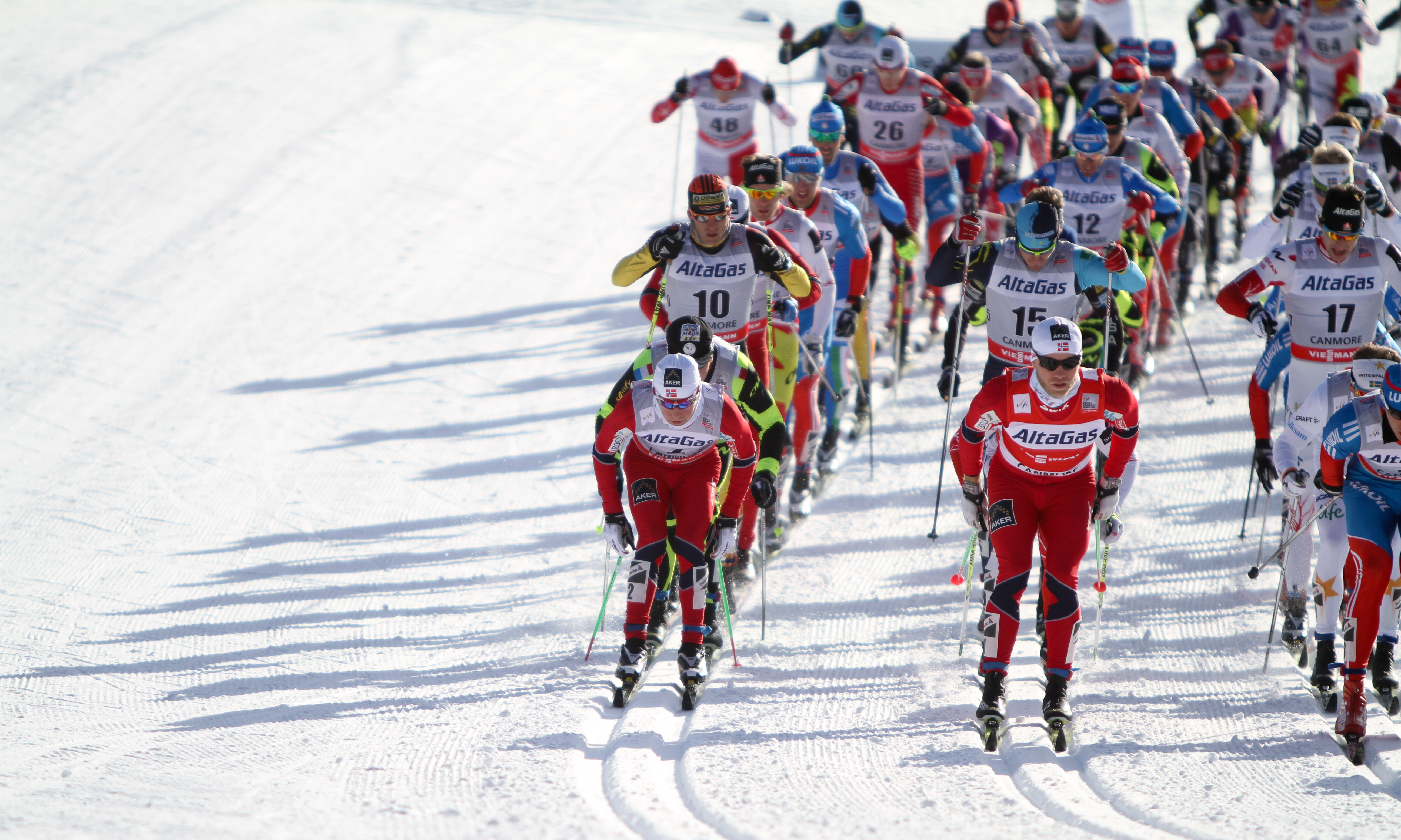
Germany’s Tim Tscharnke celebrates his 23rd birthday with a World Cup win in Thursday’s 15 k classic mass start in Canmore, Alberta. It was his first individual podium, and he was joined by Sjur Roethe (NOR) in second and teammate Tobias Angerer in third.
CANMORE, Alberta – Thursday was a good one for Tim Tscharnke before it started. On his 23rd birthday, the German had some basic goals for the men’s 15-kilometer classic mass start, but once he realized how fast his skis were and how good he was feeling, he dug a little deeper.
Following close behind 35-year-old teammate Tobias Angerer, who last skied in Canmore at the 1997 Junior World Ski Championships (where he tallied two distance top 30s), Tscharnke searched within himself on the last of four laps for something, anything else.
Tscharnke (GER) sits tight before punching hard near the finish to win the Alberta World Cup 15 k classic mass start Thursday in Canmore.
“[I] realized I had some more petrol,” Tscharnke said in a press conference.
The extra gas and timing turned out to be key as Tscharnke skied away on the final climb and held off his contenders on the following flat. He then double poled like crazy down into the stadium, throwing his arms up at the finish and nearly buckling at the knees at his birthday achievement. It was Tscharnke’s first World Cup victory and first individual podium.
He finished in 41:14.8, considerably slower than most World Cup 15 k courses and a testament to its difficulty at 1,400 meters (4,600 feet) above sea level. Roethe trailed 4.8 seconds behind and notched second for his first World Cup podium. Angerer took third (+5.8), an individual World Cup best (outside of stages) as well.
Three Germans made the top six, after Hannes Dotzler held his own near the front early in the race and placed sixth (+9.3) behind Russia’s Evgeniy Belov in fourth (+6.2) and Italy’s Giorgio Di Centa in fifth (+8.7).
Belov, 22, was in the running for the podium before Roethe outsprinted him and Angerer to the line. Di Centa, 40, remained competitive throughout the race in his 227th World Cup start.
“We were very strong as a team today,” Tscharnke said in a press conference. “We had very good skis.”
Feeds also worked for the Germans, who appeared to be among the few taking them. Angerer dropped outside the top 15 near the end of the second lap when he took one, and teammate Thomas Bing was vying for the lead before taking a feed just before that.
A few minutes later, Bing regained his spot behind Norwegian leaders Chris Andre Jespersen and Roethe and next to Emil Jönsson (SWE). Meanwhile, Angerer worked his way to the front and was the second to Belov at the bonus preem at 9.7 k. Angerer took the lead for the final lap as Belov followed, and by the high point of the course, Tscharnke stuck behind his teammate to get in the top three. More than five seconds back with two kilometers to go, Dotzler, Russia’s Andrey Larkov, Di Centa, Roethe and Jespersen tried to catch up.
Norwegians Sjur Roethe (l) and Chris Andre Jespersen (r) set the pace with Roland Clara (ITA) and Emil Jonsson (SWE) close behind in the first half of the 15 k classic mass start.
Speed turned out to be on the Germans’ side, as Angerer and Tscharnke sandwiched Belov and dropped him in the final kilometer.
“The downhills were our friends, not our enemy,” Tscharnke said.
The chase pack absorbed Belov on the final downhill and Roethe skied around him to catch Angerer before the finish.
Tscharnke said he “could not have hoped for a better result,” and Angerer said the Germans’ performance, with several taking turns up front, was a must for team morale. Jens Filbrich finished 13th (+31.2), and Bing was ultimately 21st (+1:10.1).
“Today was the first time this season that we showed everyone that we are in good performance,” Angerer said. “The first two weeks we were a little tired. We trained a lot.
“For me, I need to get the confidence in the mass starts to see if I can do the right things in the right place,” he added. “Today was good. … [I] wish every World Cup could be here.”
Roethe echoed the enthusiasm after outsprinting Angerer and Belov to the finish.
“I have had a few fourth places in the World Cup,” the 24-year-old said. “Finally I reached the podium. A little hard in the first lap, [but the] third and fourth, I felt really good.”
***
Also: Martin Johnsrud Sundby (NOR) in bib No. 1 crashed on a downhill at the end of the first lap and later withdrew from the race. Larkov ended up seventh, Jespersen placed eighth and Jonsson was ninth.
Alex Harvey led the Canadians in 11th for his best result this season, and Kris Freeman (USA) went from skiing in the top 10 to finishing 14th for his best performance of 2012/2013 as well.
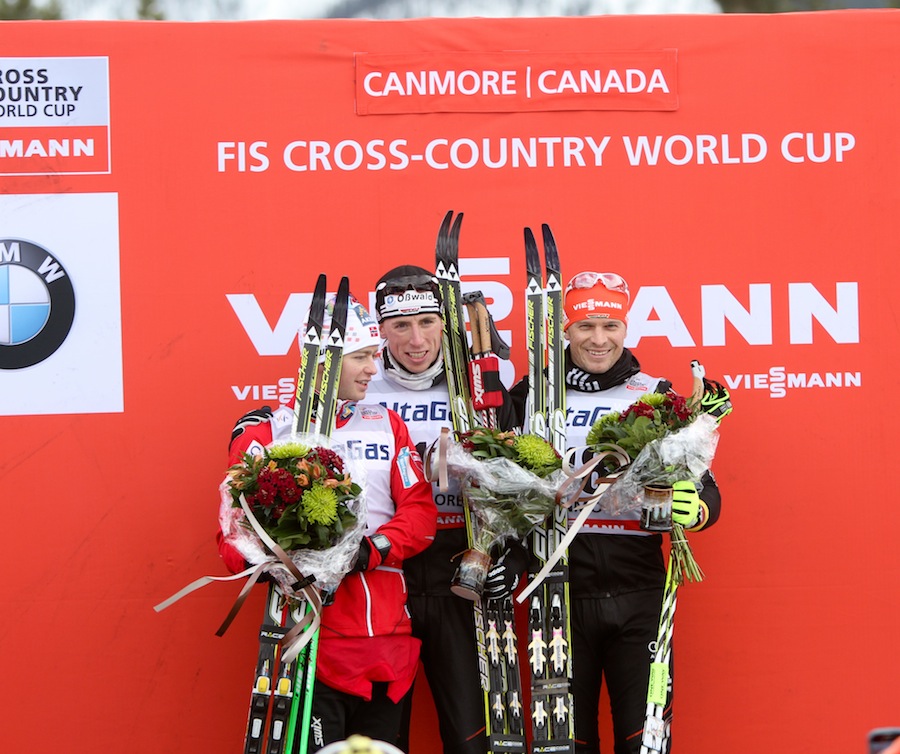
The men’s Alberta World Cup 15 k classic mass start podium: 1. Tim Tscharnke of Germany (c), 2. Sjur Roethe of Norway (l) and 3. Tobias Angerer of Germany (r)
Back in 2012, Germany’s Tim Tscharnke celebrated his 23rd birthday with a World Cup win in the 15 k classic mass start in Canmore, Alberta. It was his second-career World Cup victory.
Tim Tscharnke (GER) sits tight and before punching hard at the finish to win the Alberta World Cup 15 k classic mass start on Thursday in Canmore, Alberta.
Tobias Angerer (GER) takes a feed on the tail end of his second of four laps in the 15 k classic mass start on Thursday in Canmore. Angerer finished third for his best World Cup results.
Canmore 15 k classic mass start
Norwegians Sjur Roethe (l) and Chris Andre Jespersen (r) set the pace with Roland Clara (ITA) and Emil Jonsson (SWE) close behind in the first half of the Alberta World Cup 15 k classic mass start in Canmore on Thursday.
Start of the Alberta World Cup 15 k classic mass start on Thursday in Canmore, Alberta.
We’re just going to come right out and say it; the German team sucked last season – a lot. The Germans secured just one individual World Cup medal last season, and that came from Nicole Fessel, who secured a silver in the 10 k freestyle handicap start during the mini-tour in Kuusamo, Finland.
The highest ranked German male in the Crystal Globe chase? Jens Filbrich was 26th, and now that ‘Fibser’, as he is affectionately known, is 33 and now entering his 12th World Cup season, don’t expect much more. Perennial German powerhouses Tobias Angerer and Axel Teichmann had abysmal years, finishing 41st and 49th respectively.
Axel Teichmann racing in Otepaa, Estonia last winter.
A lot of that can be attributed to the German abandonment en masse of the Tour de Ski due to illness, as Zeller was the only one of eight women to make it, and Filbrich and Reichelt were the only two of the 12 men who started to see the finish line.
Fine, so the Germans got really sick during the Tour. But a closer look reveals that the Germans weren’t exactly lighting the trails on fire pre- or post-Tour either.
Angerer failed to crack the top 20 before the Tour de Ski, and managed one top 10 all season, not including World Championships. His only win came in the 15 classic at his own National Championships!
We can only imagine that joining Angerer in Head Coach Jochen Behle’s doghouse is the goatee’d wonder Axel Teichmann. He had his worst points total in ten seasons on the World Cup, finishing in the top five just once before the bronze medal in the relay at World Championships, and ending his season after Oslo.
So if the Germans were that bad, how did they finish sixth? It was scoring World Cup points by committee for the red, yellow, and black suits, as 13 men and seven women chipped in.
Tim Tscharnke and Tom Reichelt are the only two German men who met or exceeded expectations last season. Somewhat frustratingly, Tscharnke turned himself from a pure sprint specialist into a middling all-around skier – probably good for his long-term prospects, but doing nothing for the Germans in the sprint arena right now, where they are desperately lacking a heavyweight male presence.
What You Need To Know for This Season
German men are in a hard place – the old guard is under-performing, and the young guns are still just a touch too young.
At 34 and 32 years of age respectively, it’s not that Angerer and Teichmann are done, and there is no way they can be as bad as last season, but they are just no longer in the elite on the World Cup, and Germany is in deep trouble because of it.
There is also a split in the team, as Filbrich, Angerer and Teichmann have created their own self-directed training group. All three have signed on to ski until 2014, which if they ski like they did last season, is not necessarily good thing.
Lucia Anger on her way to winning the World Junior Championship classic sprint in Otepaa, Estonia
If you’re a German woman, you’re also in the hot seat. While Katrin Zeller and Nicole Fessel were both pleasant surprises, the depth dropped off precipitously in 2010-2011.
Sachenbacher-Stehle is on the downswing of her career, as is Stefanie Boehler, and neither should be expected to produce much – although after a summer of off-road rollerskiing, maybe Sachenbacher-Stehle will be a powerhouse.
But the exciting young talent is coming, but it might still be a few years away. Specifically Hanna Kolb and Lucia Anger (the 2011 Otepaa World Junior Sprint Champion) are exciting young talent, but the sprint specialists are both are just 20 years old and lacking experience – they have just 11 World Cup starts between them.
The Germans are jealous of their Scandinavian competitors and their waxing trucks, and hope to pick one up for the 2011-2012 season.
Speaking of vehicles, the Germans may have the best sponsorship deal on the circuit, as Audi has apparently delivered over 100 vehicles to the team for the season.
The Germans also should be careful – in a recent interview Jurg Capol expressed his dissatisfaction with the atmosphere during the Oberhof Tour de Ski stop, and seeing as their southern neighbors the Swiss have designs on Tour de Ski stages and finished just 200 points behind the Germans in the Nation’s Cup…
Markus Weeger (GER) on his way to gold in the men's 20 k pursuit, 2011 World Junior Championships
Who You Should Watch
Markus Weeger seems to be well on his way to stardom, winning the 20 k pursuit and finishing second in the 10 k freestyle at World Junior Championships in Otepaa, as well as being a crucial part of the fourth place finishing relay team.
And he must know it – he’s already put together a slick website.
The 2010/2011 Veissmann Tour de Ski is nothing if not draining. Consisting of eight events in ten days in two countries, the fifth edition begins December 31st and runs until January 9th.
The Tour begins with a freestyle prologue in Oberhof, Germany, on December 31st, followed by a classic pursuit start on January 1st. The Tour then moves to Oberstorf, Germany, for a sprint on January 2nd, and a pursuit on the 3rd.
After a two day break, the Tour resumes in Toblach, Italy, for a sprint on January 5th and a point-to-point pursuit start from Cortina to Toblach on the 6th.
The Tour de Ski wraps up in Val di Fiemme, Italy, as the Italians host a 10/15 k on January 8th, and then the final climb up Alpe Cermis on the 9th.
The Favorites
In the fifth edition of the event, all three top male finishers from last season are expected to contend. Lukas Bauer (CZE), Petter Northug Jr. (NOR) and Dario Cologna (SUI) are all registered, and while two have started the season quickly, the third – Northug – has only four World Cup starts to the season, having fallen ill just before the opener.
The Czech Republic's Lukas Bauer racing at the 2010 Olympic Games.
Bauer has come out swinging – the aging Czech distance specialist sits in seventh in the overall rankings, and has already collected two podium finishes, including a stage win in Kuusamo, Finland. He has finished in the top 30 in every distance race he has started (his one sprint wasn’t great, as he finished 104th, a full ten seconds away from qualifying).
Given his hot start, the fact that he is the defending and two-time Tour de Ski champion (2007/2008 and 2009/2010), Bauer is undeniably the favorite. While his utter lack of sprint skill is disconcerting, he has shown in the past that it is irrelevant, as in the two sprints on the Tour last year, he finished 54th and 60th. But Bauer recognizes that sprinting is still important – he has put extra time into improving his speed over the summer, and should be aiming to limit the damage during the two sprint stages.
After Bauer, Switzerland’s Dario Cologna is a must-watch. In his short four year World Cup career, Cologna has already won the World Cup overall, the Tour de Ski (2008/2009), and currently sits in second in the overall standings, a mere 22 points from the lead.
Cologna is dangerous because he is a true all-around skier, and more importantly, is extremely consistent. The last time Cologna finished outside of the top 30 on the World Cup was over a year ago, on December 12, 2009, in Davos. He has already stood on the World Cup podium three times this season, including a second place finish in the Kuusamo mini-tour, and a third place in the freestyle sprint in his hometown of Davos.
Despite finishing runner-up to Bauer in last years’ Tour, winning the 2009/2010 Crystal Globe, and being the most recognizable cross country ski name on the planet, Petter Northug has to be considered a bit of a dark horse. The dynamic Norwegian is just bouncing back from illness, and his absence from the early World Cup has put him in a large hole in the overall standings, as he sits in 18th.
Dario Cologna celebrating a victory at the Olympics
While Bauer is the distance workhorse, and Cologna is the all-around consistent performer, Northug is the sparkplug. Love him or hate him, the Norwegian is without a doubt one of the most talented and entertaining skiers on the circuit.
The question will be his health, and whether he has returned to his world-beating form. Over the last two World Cup weekends, Northug has done well, but not outstanding. The real concern should be with his famed sprint speed – his failure to win a sprint finish in the 30 k freestyle at the La Clusaz World Cup combined with his 28th place sprint in Davos the weekend before shows that his sprint is not where it has been in the past.
Northug may need a few extra races to get back to where he needs to be, as it is inconceivable that a skier of his talent will be held down for long. Expect him to speed up over the course of the Tour, and a podium finish is completely realistic.
The Chasers
While most of the buzz is about the top three finishers from last year, both the Russians and the Swedes also have strong contingents hitting the start line.
The Russians have nine men starting, headlined by Alexander Legkov and Maxim Vylegzhanin. Legkov currently sits atop the World Cup overall, and much like Bauer he is a sub-par sprinter, but an excellent stage racer.
Winner of the Kuusamo mini-tour and runner-up in 2006/2007 Tour de Ski, Legkov has the potential to gut out a victory, as he has the tools to distance ski as well as almost anyone, and won’t lose much time in the sprints. The only area for concern is his Tour de Ski record in the past three years, as he has finished 20th, 33rd and failed to complete the event since his second place in 2006/2007.
Legkov and Bauer.
Maxim Vylegzhanin is ranked third in the overall behind Cologna and Legkov, and as one would expect, has had great start to the season. He has finished in the top 15 six times, including fifth in the Kuusamo mini-tour, and besting Northug in the 30 k freestyle in La Clusaz, which certainly bodes well. He has a decent record on the Tour (21, 15, DNF), but just can’t seem to make the breakthrough to finish in the top 10.
The only surprise for the Russians is that 20 year old phenom Petr Sedov, who is currently 8th overall, will not be starting.
The Swedes are bringing seven men to the party, and could easily capture at the very least a couple of stage victories.
Emil Joensson is the current world cup sprint leader, and is currently fifth in the overall. He is practically a lock to make the podium in both sprints, and he can ski a mean 10 or 15 k, especially classic. Unfortunately for Joensson, as the Tour goes on, his distance racing will be sorely tested, and he simply lacks the ability to compete in the longer events, so it is unlikely he will be able to contend for a podium spot in the final races.
However, his team mate Marcus Hellner, who is fourth overall in the World Cup ranking has a much better shot. Often billed as Northug’s biggest rival, but not quite at the same level, Hellner started out the season strong with a home town win in Gallivaere, Sweden, but has been inconsistent since then, finishing fourth in Kuusamo, 33rd in the 15 k classic in Davos, seventh in the sprint, and finally 29th in the 30 k freestyle in La Clusaz.
In the 2009/2010 Tour de Ski, Hellner was saddled with the wooden medal despite having a very strong final climb. To stay in contention for the podium, Hellner will have to avoid the inconsistent distance days, and if he is close going into Alpe Cermis, his strong skate climbing means he can pick up a few spots.
Other strong Swedes include Daniel Rickardsson, a very good all around skier who will be in a position to crack the top 10, Johan Olsson, who hasn’t raced a World Cup since finishing 7th overall in Kuusamo, and the tough-as-nails Anders Soedergren.
Sweden’s Scandinavian counterparts, Finland, lack a real shot at the Tour overall. Sami Jauhojaervi is their best hope, as he is ranked 19th overall, and has had success on the Tour previously, but his horrendously inconsistent skiing (think two top 10’s, and three races 50’s or higher) will prevent him from being a true challenger. Matti Heikkinen gets the nod as well, but like Jauhojaervi lacks the staying power required for the lengthy event.
While the event is on home turf for both the Germans and the Italians, neither country has a skier competitive enough at the moment to challenge the top group.
Seven Italians are pegged to start, including Giorgio di Centa, and on-form sprinters Fulvio Scola and Renato Pasini.
Meanwhile, the Germans have only two men currently in the top 40 in the overall World Cup standings, but 13 men will start. Surprisingly Jens Filbrich and Tim Tscharnke are the two highest ranked German skiers, while stalwarts Axel Teichmann and Tobias Angerer are 46th and 58th respectively, and both will have to demonstrate a lot better form than they have thus far on the World Cup.
North American Contenders
This edition of the Tour will see five North American men fighting for position – and all five men bring their own unique set of skills to the event.
American’s Andy Newell and Kris Freeman will both take to the start line, and will hope to continue the good early-season World Cup results with top results, regardless of stage. Freeman has jumped out to the best start of his World Cup career, and sits in 13th place Overall, as a result of collecting points in each of his World Cup starts thus far.
Newell has had a decent start as he sits in 31st in overall on the back of his strong sprinting, in which he has earned points in all three of the sprints thus far on the circuit.
Newell
Both men have been typecast as specialists – Newell in sprinting, and Freeman in distance racing. However, both skiers have been working hard on diversifying their skiing, and have a bet running over who will score World Cup points first – Freeman in a sprint, or Newell in a distance race.
The biggest question mark surrounding Newell is whether he will be able to distance race well enough to stay in contention.
“I’m pretty excited to have a bunch of opportunities to do some distance races,” he said, “because I know I’m in good shape and I can distance race really fast — I just haven’t had the chance to show it.”
Newell knows he has strengths and weakness in distance racing; “I know I’m a good mass start skier for sure,” he said.
“I can ski well in packs but at the same time it’s like any time in a mass start race – you run the risk of blowing up,” he said, “It can be sometimes easier for sprinters like myself [to blow up] as you can build up so much lactic acid.”
Both Freeman and Newell are relatively new to the Tour de Ski. Freeman has never competed in the event before, and Newell he completed three races last year before bowing out, and he felt that he has not gotten “a true Tour experience.”
Regardless, Newell is going in confident; “I feel like I can be good at back to back to back races,” he said, “I think I’ve trained enough over the year that’s something I’ve gotten a lot better at.”
Like many other racers on the Tour, Newell is targeting consistency, and is thinking about having good races each stage, rather than focusing on finishing as his end goal.
While both Americans are working on their weaker race types, the best bet for top performances are their bread and butter events – the skate sprint for Newell, and something 15 k or longer for Freeman. It is difficult to imagine either skier truly contending for a place on the overall podium, but top 30 finish is a completely reasonable expectation.
“Hopefully I’ll be able to hang in there for some distance races and score some distance races,” said Newell, “I’m going to need to score some bonus seconds in sprints [to have a chance in the overall standing].”
The Canadian contingent showcases an all-around skier just coming into his prime, a young gun with loads of potential, and one of the best climbers on the circuit. Devon Kershaw, Alex Harvey and Ivan Babikov are all world class talent who had excellent results on the Tour de Ski last season, and look to build on that success. In charge of the three skiers is Head Coach Justin Wadsworth – a rookie on the Tour de Ski.
“I think I’m pretty well organized,” said Wadsworth in an interview with FasterSkier, “and that’s key for keeping the nerves down.”
While he has never been involved with the Tour before, Wadsworth is confident – he has been to all the World Cup venues before, and the three skiers he is in charge of will be well served. The Canadians have a large staff of five wax technicians as well as a massage therapist, the legendary ‘Wolfman’.
Wadsworth is confident in his athletes ability to make the most of the Tour, and emphasized that Kershaw and Harvey have a shot in every stage, while Babikov will be able to take advantage of the difficulty of the last three stages, as he will be getting fitter every race.
Kershaw
After one of the hottest starts of his career, in which he has consistently skied in the top 30 while hitting a few top 10 finishes, Kershaw is hitting his stride as an all-around skier.
While he appears to be in form, and he is happy with how things went, Kershaw is still cautious about the event.
“The Tour de Ski is completely different [from the rest of the World Cup season],” said Kershaw in a recent interview with FasterSkier, “a whole lot of things have to go right.”
For Kershaw, having one or two really good days would make for a successful Tour, but his real ambition for the Tour de Ski is unrelated to results.
“To be honest, the only big goal is to stay healthy,” he said, “Over the different Tours, we’ve had a lot of illness on the team, and I’ve been lucky to avoid it for the most part.”
If he stays healthy, Kershaw has proven that he can race well in the Tour format. Last year he finished 16th in the event, benefitting from good sprinting, as well as six top 30 finishes.
While he has traditionally had strong results in Tour de Ski sprints, including a podium, this year Kershaw isn’t so focused on the sprint.
“The sprints are long days, and I don’t know how important they are in the overall,” he said. “[Lukas] Bauer won the Tour last year without ever qualifying for a sprint
Unfortunately for Kershaw, his favorite and best event, the 10 k classic, has been eliminated from the Tour this year. As a result, he’s keeping his eye out for the 20 k pursuit in Oberhof, Germany in Stage 4.
“The Tour really starts at the Pursuit in Oberstorf,” said Kershaw, “That’s the first place you’re really going to see some fireworks. Whether or not I’m looking forward to that, I have to be on my toes.”
Kershaw said he may have pushed his training a little bit too hard during the last week, and as a result is feeling a little flatter than he would like, but with some dedicated rest, is hoping to be back in top shape come December 31.
While Kershaw is still hoping to regain a little bit of energy, Alex Harvey is feeling well rested and ready to go, according to a recent interview with FasterSkier.
Harvey is still relatively new to the Tour – this will be his second time tackling the event. And he learned a lot from last year, and highlighted two major things that he is hoping to improve on – staying calm, and proper feeding.
The point-to-point race is something he is much more comfortable with the second time around. Last year Harvey described himself as “really nervous” prior to the start, as there was no opportunity to ski the course beforehand and he had a large gap he desperately wanted to close to the leaders. As a result, Harvey ended up with a severe diaphragm spasm, throwing off his rhythm. This time around, Harvey is a lot more comfortable, as he knows the course, and is aware that he needs to stay relaxed.
Second, he recognized the increased importance of feeding on an event like the Tour de Ski. In the long classic race last year, Harvey was skiing strong at the front of the chase group when he bonked hard with one kilometer to go.
“I didn’t feed enough during the day,” said Harvey, “you need to make sure your energy levels are always high, and it’s really hard to recover when you bonk that hard.”
If there was one area Harvey really targeted for improvement this year, it was his sprinting.
“On the sprinting side I was disappointed last year,” he said, “This year I wanted to make sure I can sprint well.” Last season Harvey managed to qualify just twice for a World Cup sprint. This season he has started just one, but finished ninth.
Harvey has been confident with his shape all fall, and his strong start on the World Cup has increased his confidence. “I knew I would be more consistent this year, and I know I usually improve as the season goes on,” he said.
And consistency is what Harvey is targeting for the Tour. While he has picked a few stages as key – the 20 k Pursuit in Oberstorf, the 36 k point-to-point, and the second last stage – he is confident in his shape regardless of the stage.
“If I have a good day, any of the stages I can do well,” he said.
As for the Final Climb, the 22 year old isn’t intimidated – he’s actually a little bit excited about it.
“It’s not complicated,” he said, “you have to ski well technically, but it’s all about the climbing. It’s just how your body is doing, even the skis only matter for the first part.”
While Harvey may not consider the Final Climb very complicated, that may be in part to being in close proximity with the man who is quite possibly the best at the event – team mate Ivan Babikov.
The first few stages don’t suit Babikov, as he has struggled in prologues and sprinting, but as the days get longer and the Tour gets tougher, Babikov, who is widely regarded as one of the toughest athletes on the circuit, will shine. His specialty is the last stage – in 2009 he won the quad-busting climb outright, and in 2010 he finished fourth. If Babikov can stay close during the opening stages, his climbing skill means he may threaten for a podium spot.
Both Canadians and Americans have spent the Christmas break in Davos, Switzerland, taking advantage of the high quality training location, and getting in large amounts of skiing and some good recovery as well.
The group has gone alpine skiing, and taken advantage of the many excellent coffee shops in the Swiss town, but the teams are now in Oberstorf preparing for the first stage – a 3.75 k prologue.
Kris Freeman on his way to his second podium of the weekend.
While Kris Freeman couldn’t quite match his winning performance from yesterday, he made a strong effort in the 10 k skate at Muonio today and was rewarded with a second-place finish, showing impressive consistency early in the season.
“I’m always more comfortable in classic than skate,” he told FasterSkier after the race.
As usual, the women competed first, also in a 10 k race. The temperature had dropped overnight and thanks to the humidity of the last few days, the snow was fast. Competitors also had their first day of skiing in the Arctic sun after several gloomy, overcast races. The sun peeked over the mountain at Olos resort at approximately 11:30 – well after most of the women had finished – but even in the morning, the neighboring hills were lit up in stunning fashion.
With Petra Majdic of Slovenia choosing not to race and Justyna Kowalczyk of Poland staging a protest over the change of race length, it was up to someone else to take the win today. The race had originally been slated as 5 k for the women, and Kowalczyk started, caught Aino-Kaisa Saarinen (who had started 20 seconds in front of her ), put 15 seconds on her in the first lap, and then stopped, refusing to race a second lap of the course.
Freeman.
Who knows what would have happened if Majdic and Kowalczyk had raced, but in their absence, Arianna Follis of Italy skied to a nine-second win over Olga Mikhailova of Russia. Follis looked smooth and effortless on the trails, and spectators weren’t surprised that she took the victory.
Riita-Liisa Roponen of Finland rounded out the podium, 13 seconds behind Follis, and was followed by Evi Sachenbacher-Stehle of Germany and Krista Lahteenmaki of Finland.
Liz Stephen, skiing for the U.S. Ski Team (USST) led the American squad with a 22nd-place finish, a major improvement from yesterday’s classic race. Her time was 1:13 back from the leader. She was followed by teammate Morgan Arritola in 29th place. The first non-USST American was Hannah Dreissigacker of the Craftsbury Green Racing Project, who finished 60th.
But just like yesterday, the real excitement for the Americans came in the men’s race. Freeman skied strongly from start to finish, and ended up second, just over seven seconds behind Sergey Shiriaev of Russia. Shiriaev, who finished fourth in yesterday’s classic race, was banned for a doping violation in 2007. Last season season he returned to racing, and represented Russia at the Vancouver Olympics.
Tim Tscharnke of Germany and Alexey Slepov of Russia were just two seconds behind him in third and fourth places.
Hoffman.
“Sometimes when I tried to go hard I would kind of spaz,” he said. “But it was a good race.”
Several other Americans had excellent performances. The USST’s Noah Hoffman finished 25th, 50 seconds behind Shiriaev, and Leif Zimmerman of the Bridger Ski Foundation was 0.4 seconds behind him in 27th place. Glenn Randall, also skiing for the Bridger Ski Foundation, finished 36th. All three beat a number of World Cup regulars like Axel Teichmann of Germany and Martin Koukal of the Czech Republic.
Tim Reynolds again led the Craftsbury Green Racing Project contingent, this time with a 79th-place finish.
From here, the U.S. Ski Team is splitting into the World Cup squad and the Continental Cup team. The World Cup skiers will head to Gallivare, Sweden for the opening races next weekend, while the Continental Cup athletes will be driving south to Rovaniemi, Finland, for more FIS races, where they will be joined by the Craftsbury Green Racing Project and the Maine Winter Sports Center group.
Eventual winner Sergey Shiriaev (RUS) leads Valerio Checchi (ITA).Tim Tscharnke (GER) grimaced his way to third place.The USST's Noah Hoffman (left) begins his second lap of the course.
Tim Tscharnke rising to German sprinting domination. The 21 year-old kid with no previous World Cup points cruised onto the circuit and took home over 100 World Cup points, looking incredibly comfortable doing so. The kid was a consistent sprinter, and turned more than a few heads when he tagged off to Axel Teichmann with a 20 meter lead on the Norwegians in the last leg of the Team Sprint. And if Teichmann had a little bit more hustle, the two could have taken home a gold medal.
As for the women, one pleasant surprise was biathlete Miriam Goessner, who came fifth in the prologue on the Tour de Ski, and managed to ski both biathlon and cross country races. She was part of the German silver medal relay team. However, she has one small flaw. She can only skate ski. Literally. She started zero classic races on the World Cup.
What You Should Know For This Season
After 15 straight seasons of scoring points for the Germans on the World Cup, Rene Sommerfeldt has packed it in. His female teammate Claudia Nystad has opted to end her career as well, and the loss of such legends will be felt.
Germany is a legitimate heavyweight on the World Cup season after season, and the loss of two world class skiers will hurt. Look to others to pick up the slack, and not just previous standouts Axel Teichmann and Tobias Angerer, both of whom are still stellar skiers, especially Angerer. While he seems to have slipped a little since winning back to back Crystal Globes in ’06 and ’07, the 33 year-old can still punch out top results, coming home from the Olympics with a silver medal from the Pursuit, and finishing fourth in the 50 k. You can never count out Angerer – in addition to his ability to ski strong distance either classic or skate, last year he collected a silver medal in a sprint on the World Cup as well.
While the rivalry between Axel Teichmann and Petter Northug has pretty much ended on the course due to Northug consistently knocking the stuffing out of Teichmann, the German is still stoking the fires. However, he still won’t be beating Petter Northug in a sprint finish, and he will still be rocking a killer goatee. The FasterSkier staff is also considering starting an Alex Teichmann look-alike contest – it’s just that epic.
As Teichmann is just awful on the anchor leg of the relay, there was talk of Tscharnke being his replacement in order to combat the Northug-effect, and with the retirement of the Sommerfeldt, that seems likely.
Stefanie Boehler is back for another kick at the can after a tough 2010 season, which saw her record her worst point total in five years. On the plus side, according to her FIS profile she lists her occupation as ‘Sports Soldier’, which is pretty cool.
Boehler's FIS profile picture
Katrin Zeller, who is now second on the German female depth chart, is probably the quietest, most consistent skier on the World Cup. In virtually all of her World Cup starts (some 20-odd) she finished in the 15th to 30th range, which is incredible. If she can manage to ratchet up her speed a few notches, Germany will have a legitimate overall threat.
Who You Should Watch
Miriam Goessner is the best bet. The Germans desperately need another young woman to step up, and while the 20 year-old may lack experience, her success at the World Cup level cannot be discounted. The retirement of Nystad and the aging of Sachenbacher-Stehle is a sign that the guard is changing in Germany. While Goessner can only step up in skate, if she does it well enough, it won’t matter. Ole Einar Bjoerndalen and Lars Berger, anyone?
Also, Josef Wenzl is worth a look, but only at the Dusseldorf, Germany, city sprints. The guy has made a career out of racing well in one place. In four trips to the city on the Rhine, he has finished 1st, 2nd, 5th and 40th. While the 40th placing was last season, this year he kicked off his season with a 6th place in Munio, Finland sprint. So as long as he avoids the yearly shenanigans, he could do well.