From the FasterSkier archive — posts syndicated from athletes’ and coaches’ own blogs between 2004 and 2012, kept online as published. Current coverage is at fasterskier.com.

Tag: time trial

  • DIY Fitness Testing: The How and Why with Pepa Miloucheva

    DIY Fitness Testing: The How and Why with Pepa Miloucheva

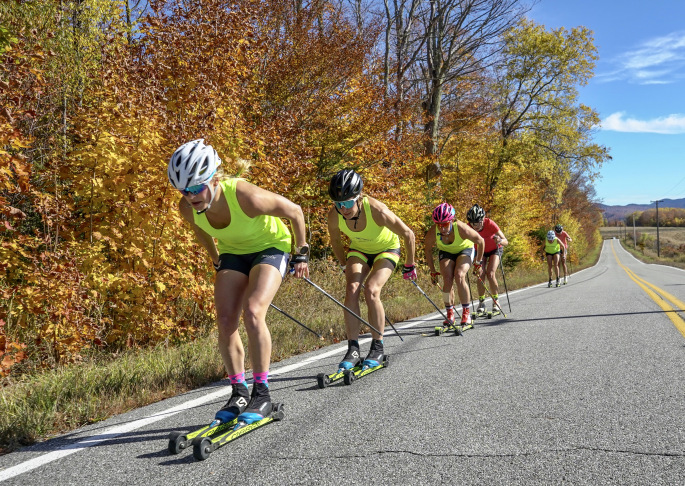
    The SMST2 squad led by Jessie Diggins pushes the pace in a double pole interval workout during a fall 2019 training camp in Lake Placid, NY. (Photo: Matt Whitcomb / smseliteteam.wordpress.com)

    It’s May. Yes, really. 

    For most skiers, the new page on the calendar also marks the beginning of a new training year. Dust off your rollerskis, locate your heart rate strap and drink belt, and make sure your running shoes have plenty of life in them.

    With the country still predominantly on public health orders to stay close to home, avoid groups, and keep at least six feet of distance from those outside your home, kicking off a new cycle is happening without hugging our training partners, post-workout high fives, or otherwise gathering to ring in the new season. There also remains abundant uncertainty regarding the feasibility of racing during the upcoming season from the World Cup level to the junior and collegiate circuits to popular skiing. Nonetheless, we open our training logs and carry on. 

    Last season ended abruptly and the off season may have looked different than anticipated. We may have put our energy into homeschooling children, sourdough baking, binge-watching Tiger King, connecting virtually with our family and friends, or otherwise remaining largely homebound and less active than we’re accustomed. On the flip side, maybe the change in schedule has freed up additional time for long adventures and you’ve logged more hours in April than ever before. 

    Either way, at the onset of a season, you may be interested in checking in on your fitness and strength, looking for metrics to track improvement over time and to guide your pacing or heart rate zones during future workouts. FasterSkier reached out to Pepa Miloucheva, head coach of the Craftsbury Green Racing Project, to discuss fitness testing that could be done without the support of a facility or coach, making it accessible to any level skier as they begin the new year. 

    Miloucheva provided the disclaimer that she relies on advanced metabolic testing with her athletes to determine VO2 Max and lactate threshold levels to assess fitness and heart rate zones, and then prescribes training based on this information. With that caveat, Miloucheva holds a masters degree in Sport Science with a focus on physiology and biomechanics and has been coaching for over 20 years, over a dozen of which have been spent with the CGRP elite program. 
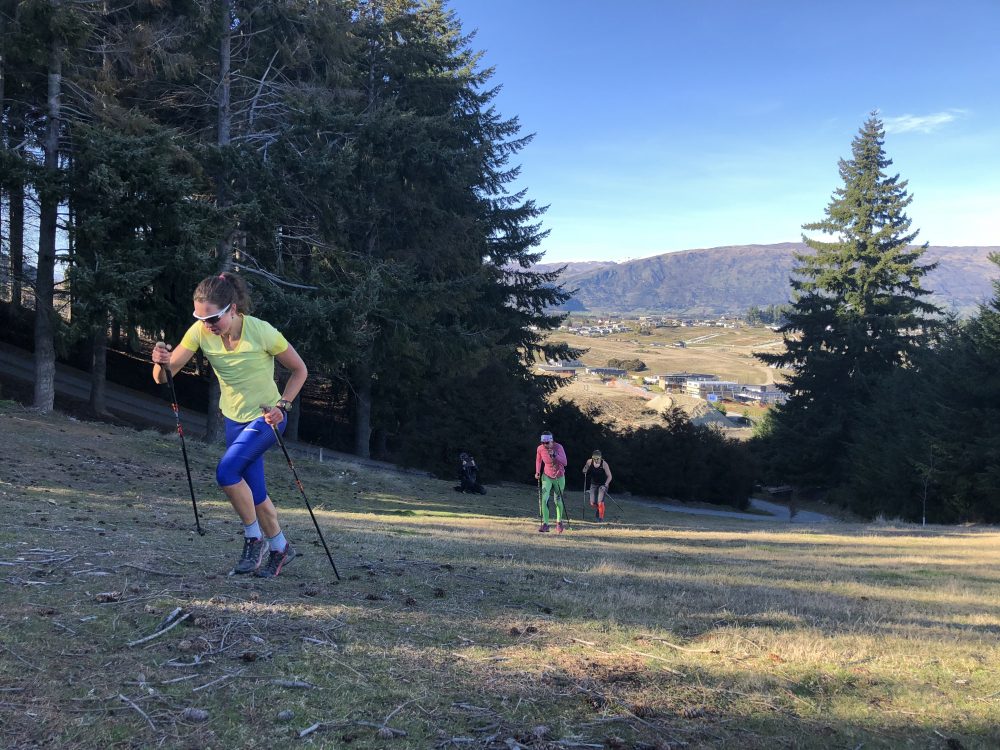
    Caitlin Patterson (far left) leads CGRP teammates running with poles. (Courtesy Photo)

    Before jumping into assessing fitness and blowing up trying to hit a new PR on the SkiErg, Miloucheva emphasized that the most important thing an athlete can do at the beginning of a new cycle is to have a training plan and to understand how the periodization targets different areas of athletic development. This might be a plan from a coach or one found online. 

    “If someone really wants to establish a baseline and monitor, then they have to have a training plan,” said Miloucheva in a call. “I think everything else is kind of pointless, because all of these tests won’t give you anything if you don’t know what you’re looking for. In general, everything starts with first having a good training plan.”

    Once a clear plan is established and you have taken time to understand it, then decide which part of the training process you would like to test. 

    “If you have 2-3 months of high volume, you want to test your basic aerobic improvement. You do the test, you see if you’ve actually improved. When you start doing a little bit more speed, you want to see if you’ve improved your speed. So you really have to schedule these tests based on your training plan.”

    As the typical periodization of the year for skiers focuses on aerobic development during the spring and summer, a good starting place could be an uphill run test, possibly combined with a rollerski or SkiErg time trial, if those are available to you.

    Traditionally, a 3000 meter run on the track was commonly used as an aerobic benchmark, but the results can be skewed based on individual running economy. Athletes with more running experience and better form often fare better than those with comparable or potentially better fitness. As such, most ski programs have transitioned toward an uphill run test, as it tends to level the playing field in terms of the impact of running efficiency on results.

    In addition to being a good indicator of aerobic capacity, Miloucheva explained that the test has the added benefit of being easily repeatable with relatively few outside variables that might impact performance.

    “The uphill running test is probably the most standard around the world. Simply, it’s easier to repeat. It’s a little bit less affected by the weather, but there are still a lot of elements and it is hard to keep it consistent.”
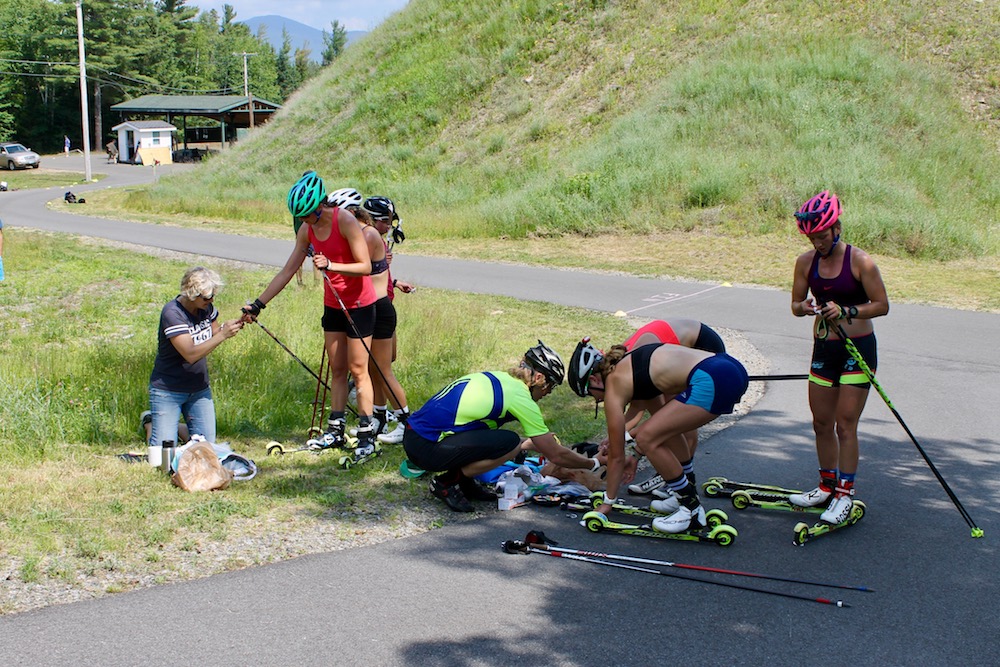
    Craftsbury Green Racing Project Head Coach Pepa Miloucheva (l) and Stratton Mountain School T2 Team Head Coach Pat O’Brien (center) assist athletes with lactate testing after the U.S. Ski Team’s rollerski team sprint on July 15, 2018 in Lake Placid, N.Y.

    If you’re looking to track your own progress on an uphill course, Miloucheva recommends finding a stretch of road or trail with little traffic that takes roughly 10-12 minutes. The effort should be steady throughout the test and you should finish feeling completely spent. 

    Be careful not to start out too fast as you want your heart rate to increase throughout the test, rapidly at first then gradually continuing to rise toward your lactate threshold heart rate, which can be estimated as the average heart rate sustained over the last five minutes of the test assuming it was well-paced. (TrainingPeaks has a deep dive on blood lactate and lactate threshold here, or you can read this description of lactate threshold training by Len Kravitz Ph.D., Exercise Science professor at the University of New Mexico.) 

    As for the course, you’re looking for terrain that is runnable, meaning you won’t need to resort to walking or hiking, and a relatively consistent grade. 

    Miloucheva later added that many veteran athletes have their own aerobic fitness test piece, which is also perfectly sufficient. 

    “I’m an old lady and I have this loop around the lake I do every year and I measure my time just for fun. So in general, everybody who has been training for years, they have a place where they can run the test.”

    Miloucheva has also used a 1-kilometer uphill double pole test on rollerskis with some of her athletes. Her course starts relatively flat, climbs gradually, then levels off at the finish. 

    “The biggest thing is that [athletes] need to keep moving, so it cannot be very steep because strength and the resistance become the issue [rather than fitness].”

    She has found this test harder to standardize than the run test, meaning results must be taken with a grain of salt. 

    “The problem using it year to year is that [the athletes] don’t always use the same rollerskis, they change wheels, cold weather and cold pavement changes a lot. So you have to consider all these details with the results.”
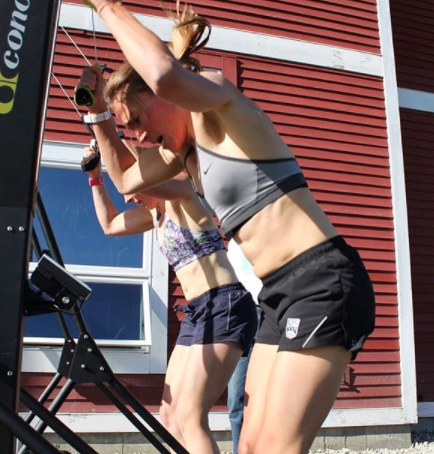
    Sophie Caldwell and Annie Hart square off for a SkiErg time trial during a week of testing with the SMST2 team in 2017. (Photo: Instagram @sophiecaldwell(

    Because of the ease of standardization, Miloucheva prefers using SkiErg time trials, as athletes can repeat the test indoors with a fixed resistance. Her junior athletes complete 1 and 2 k time trials, and her senior athletes additionally complete a 5 k test. The CGRP athletes complete the tests while hooked up to a VO2 Max testing equipment. If these are available to you, these tests could also serve as a benchmark for aerobic fitness with some ski specific strength indicators. 

    As for strength, Miloucheva is working on developing a test she feels is informative and can be standardized, as she is not satisfied with other tests used previously. She has historically used a version of the Canadian Strength Test (outlined here by Jackson Hole Ski & Snowboard Club), which counts the number of pull-ups, sit-ups, push-ups, box jumps, and dips an athlete can do in one minute with one minute rest between each exercise. Some differences in Miloucheva’s version include the use of single leg squats within a 30 second time period and measures pull-ups to exhaustion. 

    If you’re completing this test from home, ask a member of your household to help time, count, and keep your form honest so the data reflects your current strength accurately. 

    Okay, you’ve done an initial test of your aerobic fitness and/or strength. Now what? How soon should you repeat the test to check for improvement?

    Miloucheva reiterated that it is essential to plan testing between training blocks to assess whether the block had the intended impact on fitness. She explained that her testing weeks are written into her general yearly plan for athletes at the beginning of the season. 

    When considering your own plan, space the tests out roughly 6-10 weeks to give the body time to absorb and respond to training. In addition to striving for a faster time, you can also consider trends in heart rate, as more time during the test spent closer to the lactate threshold heart rate is also an indicator of improved aerobic capacity. 

    To get the most information from a testing period, it is essential that each round is approached the same way, including how the training looks in the days prior and the warm-up performed before beginning the tests. 

    “You want to have a standard approach into the test, because you don’t want to do the first test after a very exhausting week and the second after an easy week, because it will affect the results.”

    For CGRP athletes, this typically looks like one or two days of rest or easy training prior to a test. 

    There you have it. If you’re looking to assess and monitor progress in your fitness, first select and understand a training plan. Then, determine what factors of your fitness you’d like to assess and decide when a set of tests might fit best between different blocks within the training plan. Finally, do what you can to ensure that when the tests are repeated, the environment is as controlled as possible and your approach is the same so improvement (or lack thereof) between tests provides accurate insight into how your body is responding to training. 

    See you out there!  (from a safe social distance) 

  • Crawford Crushes Biathlon Canada Team Trials; Gow Leads Canadian Men

    Crawford Crushes Biathlon Canada Team Trials; Gow Leads Canadian Men

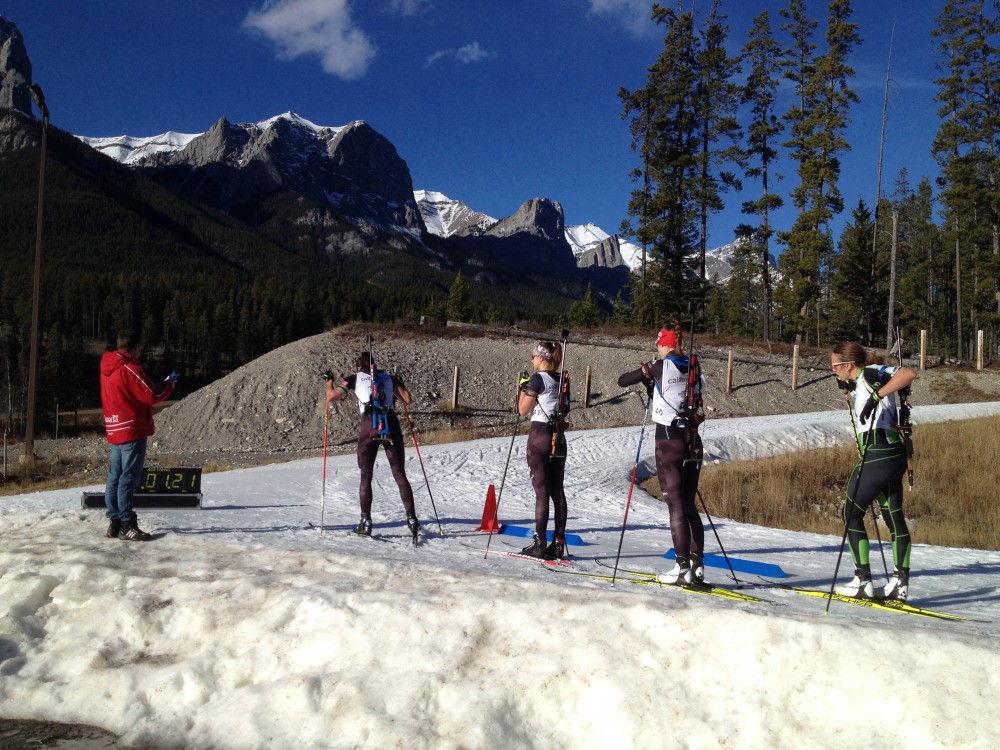
    Left to right: Biathlon Canada's Rosanna Crawford, Julia Ransom, Megan Tandy and US Biathlon's Susan Dunklee at the start of the women's 7.5 k race on Wednesday Nov. 9 at this year's Biathlon Canada team selection time trial races at Frozen Thunder in Canmore, Alberta. (Photo: Matthias Ahrens)
    Left to right: Biathlon Canada’s Rosanna Crawford, Julia Ransom, Megan Tandy, and US Biathlon’s Susan Dunklee at the start of the women’s 7.5 k sprint on Wednesday, Nov. 9, at this year’s Biathlon Canada team selection time trial races at Frozen Thunder in Canmore, Alberta. (Photo: Matthias Ahrens)

    (Note: Biathlon Canada’s World Cup team trials wrapped up last Thursday, but selections had not been publicized as of Monday. Stay tuned for the final team selection details.)

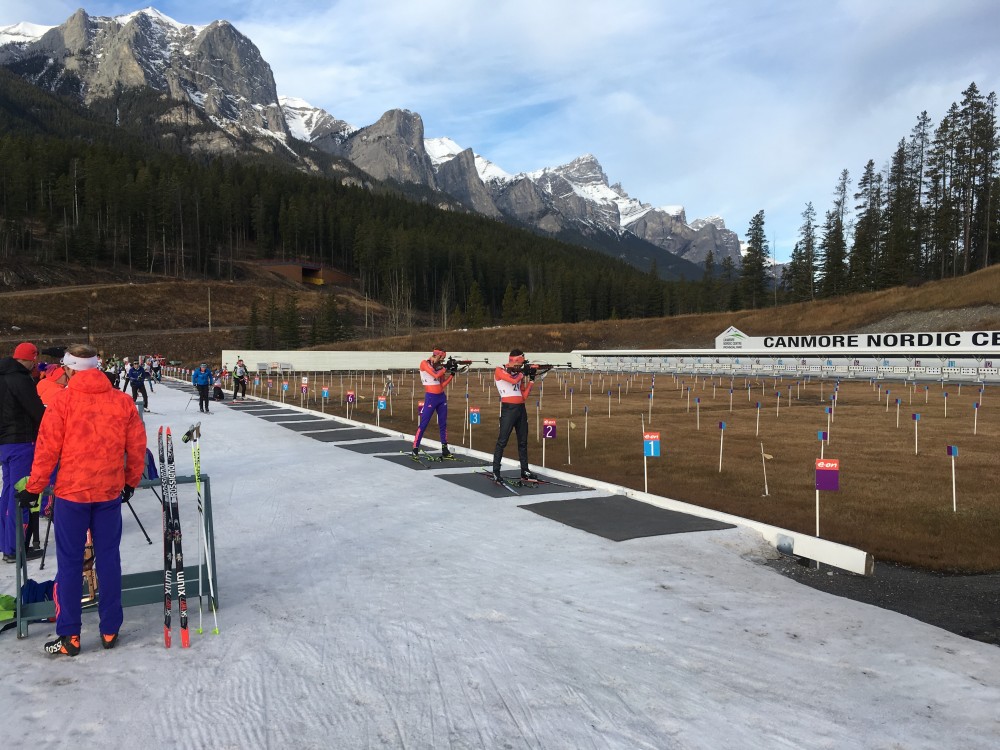
    While pushing past the overgrown, browning grass lining the Canmore Nordic Centre’s shooting range last Wednesday, Rosanna Crawford could feel the pressure.

    Not pressure to qualify for a team, pressure to prove she deserved her preselected spot on Biathlon Canada’s A (officially “Eh!”) squad.

    The 28-year-old team veteran did just that by the end of Biathlon Canada’s two-day team selection races, which ran this year from Wednesday, Nov. 9 to Thursday, Nov. 10 at Frozen Thunder in Canmore, Alberta. Crawford took the wins in both women’s sprint events. However, even after winning Wednesday’s 7.5-kilometer sprint by more than 30 seconds, Crawford wanted more from her shooting after she missed three shots (2+1).

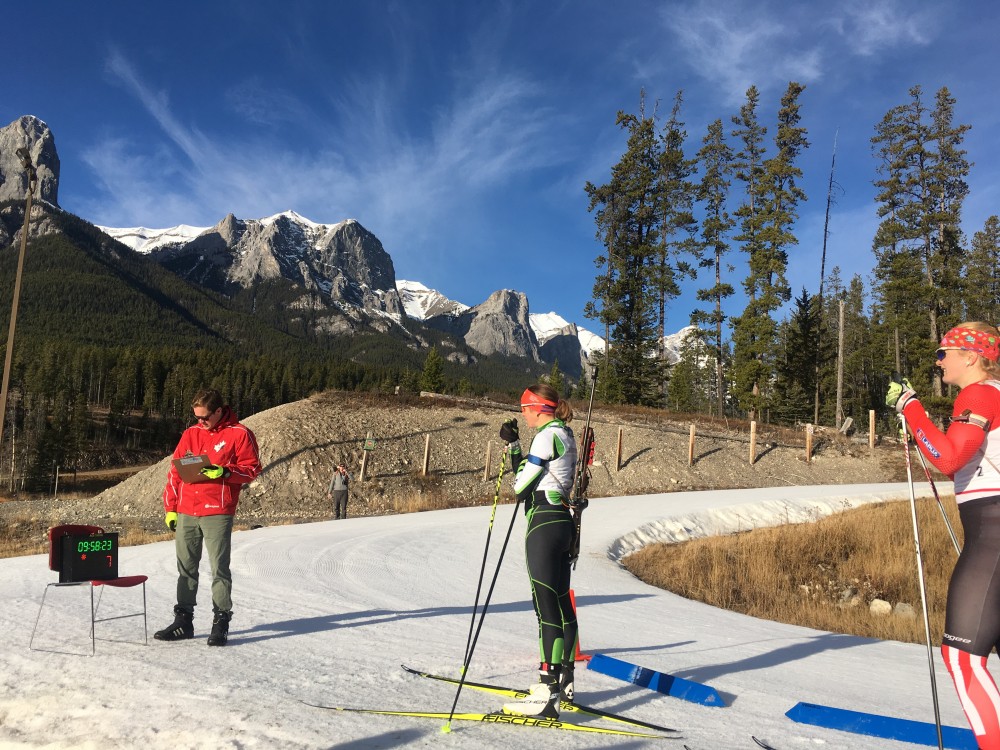
    Left to right Biathlon Canada's High Performance Director Eric deNys along with US Biathlon's Susan Dunklee and Biathlon Canada's Sarah Beaudry at the start of the women's 7.5 k race on Thursday Nov. 10 at this year's Biathlon Canada team selection time trial races at Frozen Thunder in Canmore, Alberta. (Photo: Matthias Ahrens)
    Biathlon Canada High Performance Director Eric de Nys (l) with US Biathlon’s Susan Dunklee (c) and Biathlon Canada’s Sarah Beaudry (r) at the start of the women’s 7.5 k sprint on Thursday, Nov. 10, at this year’s Biathlon Canada team selection time trial races at Frozen Thunder in Canmore, Alberta. (Photo: Matthias Ahrens)

    “With being pre-qualified you always want to prove that you deserve to be pre-selected,” Crawford wrote in an email on Wednesday. “I had high focus and expectations for shooting and am really disappointed with 3 misses, that won’t do on the World Cup. I have been training quite a bit leading into these races, so I am looking at it as a good chance to practice pushing hard while tired and shooting well. Today was a mentally and physically draining race, but conditions that we might encounter in the winter.”

    Crawford explained that Wednesday’s conditions were particularly challenging, with a fair amount of wind and temps hovering above 16 degrees Celsius, turning the 2.6 k race loop into slush.

    “It was quite windy and not really consistent which definitely hurt people on the range,” Crawford wrote. “My race started off with a good first lap and then it turned into a slow crawl by the finish, it just got slower and slower as the sun beat down on the tracks. We did the same race [format] on November 4th which took 21 minutes, and today [Wednesday] was 27 minutes!”

    US Biathlon national-team members Joanne Reid and Susan Dunklee also competed in Wednesday’s competition, finishing second and third, respectively. Reid clocked in 34.4 seconds back from Crawford’s time with three misses (1+2) and Dunklee also finished with three misses (2+1), 35.5 seconds behind Crawford. Reid explained that for the U.S. women, competing in the time trial provided an opportunity to fine tune their racing prior to the official start of the IBU World Cup season.

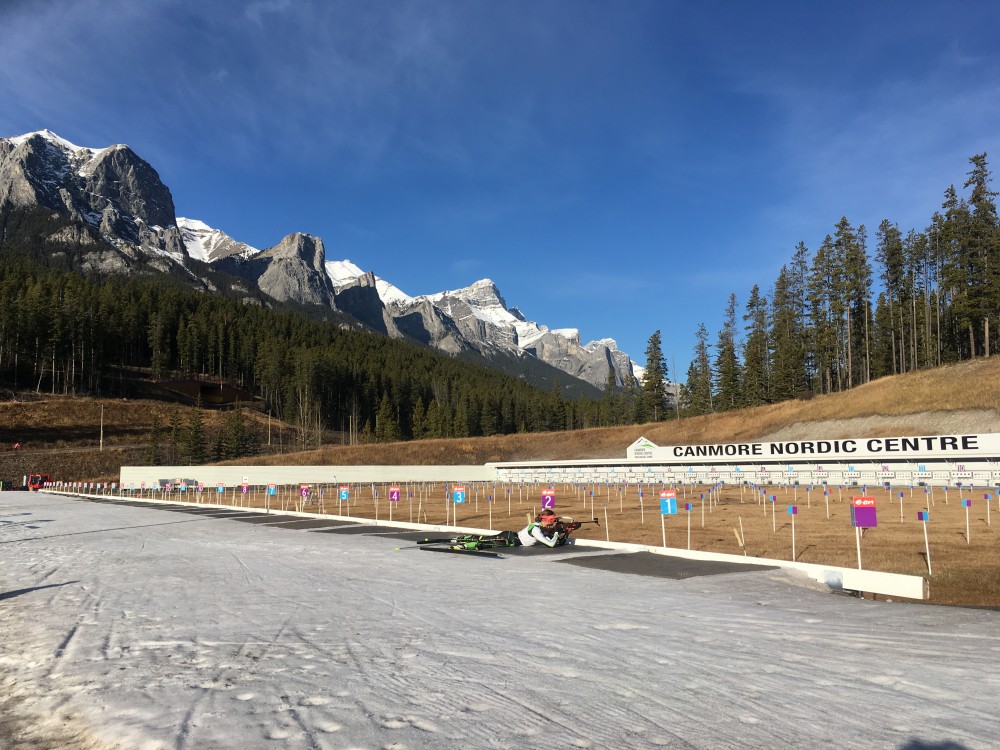
    US Biathlon's Susan Dunklee shooting prone during the women's 7.5 k race on Thursday Nov. 10 at this year's Biathlon Canada team selection time trial races at Frozen Thunder in Canmore, Alberta. (Photo: Matthias Ahrens)
    US Biathlon’s Susan Dunklee shooting prone during the women’s 7.5 k sprint on Thursday, Nov. 10, at this year’s Biathlon Canada team selection time trial races at Frozen Thunder in Canmore, Alberta. (Photo: Matthias Ahrens)

    “Since our trials races are over and the women’s team is already selected, there is no results pressure for us. Instead we are focusing on getting all the pieces together to launch into a successful first period of the World Cup,” Reid wrote of herself, Dunklee and Clare Egan, all on the U.S. women’s biathlon team, in an email on Wednesday. “All three of us are still adapting to some changes, different trigger weights, entirely new actions, sight risers, that sort of thing, so these time trials were just about practicing these new developments in a race environment.”

    In Thursday’s women’s 7.5 k sprint, Crawford repeated with another victory, completing the course in a time of 22:08.2 with three misses (2+1). While desiring better shooting, Crawford remained optimistic about being able to hone in on her accuracy within the next few weeks.

    “Today was a lot better than yesterday, I think it went below freezing and conditions stayed pretty hard and consistent through the women’s race,” Crawford wrote in an email on Thursday. “Still really frustrated with my shooting, prone has actually been quite good this summer and fall, so not sure what has changed. But I’ve got 3 weeks to get things back to normal, and feel confident that things will be better come the race season.”

    Finishing 3.5 seconds off the winning time, after cleaning prone but missing two standing shots (0+2), was Crawford’s teammate Julia Ransom in second place. Following Ransom, 8.2 seconds back from Crawford with one miss (0+1), was Megan Tandy (also of Biathlon Canada) in third.

    In the men’s 10 k sprint, Volodymyr Siemakov of Ukraine took first on Wednesday, finishing the 10 k in a time of 28:36.0 with one miss (1+0). Finishing 4.5 seconds behind Siemakov in second after shooting clean was US Biathlon’s Lowell Bailey. In an email, Bailey explained that even with temperatures better saved for summer, Wednesday’s race was a good start to his on-snow season.

    “I think of these competitions as a ‘test-run’ for the upcoming world cup,” Bailey wrote on Thursday. “These races are a good chance to try out all of the new elements I’ve been working on throughout the training year. After two races, I’ll analyze the weak points of those performances and focus my energy on those areas in the lead-up to Östersund.”

    In third, 8.9 seconds behind Siemakov was another Ukrainian skier, Artem Pryma, with two missed shots (0+2).

    Canada’s top man on Wednesday was Biathlon Canada’s Scott Gow in sixth, 45.5 seconds behind  Siemakov with one miss (0+1). Gow indicated that given Wednesday’s conditions, he was satisfied with his performance and the direction his summer and fall training have taken him prior to the start of the ski season.

    Left to right: Tim Burke and Leif Nordgren zeroing their rifles prior to the start of the men's 10 k on Thursday Nov. 10 at this year's Biathlon Canada team selection time trial races at Frozen Thunder in Canmore, Alberta. (Photo: Matthias Ahrens)
    US Biathlon’s Tim Burke and Leif Nordgren zeroing their rifles prior to the start of the men’s 10 k sprint on Thursday, Nov. 10 at this year’s Biathlon Canada team selection time trial races at Frozen Thunder in Canmore, Alberta. (Photo: Matthias Ahrens)

    “It was a very warm morning with very slushy, slow snow so it was a challenge to push through and stay motivated,” Gow wrote in an email on Wednesday. “It was also tricky wind conditions during zero, and there were gusts of wind during the race. Being able to shoot 90% and suffer through the skiing was a big plus for my confidence…I don’t think I will change very much heading into the next few weeks. I’m happy with my prep and performances at this point and I don’t want to mess with a good thing.”

    Gow was also the leading Canadian man on Thursday, placing third, 1 minute and 8.6 seconds behind US Biathlon’s Tim Burke, who won in 24:38.9. Burke shot clean, while Gow had four misses (0+2+2+0). Finishing in second again was Bailey with two misses (1+0+1+0), 44.5 seconds behind Burke.

    “It was great to start the winter season off with two races in Canmore, but I am definitely not reading too much into the results,” Burke wrote in an email on Friday. “Most athletes are training through these races and everyone is in different stages of preparation for the season. I am happy with my execution on the shooting range [Thursday].  The conditions were a bit tricky, with some wind gusts, so I was happy with a clean race. ”

    Gow explained that, as an athlete who is already prequalified for Canada’s World Cup team, the races offered him the chance to experiment with his racing tactics prior to the start of another season.

    “I didn’t have to worry about the pressure of needing to perform and instead could focus on using these races as a tune-up,” Gow wrote. “My main goals were to push the ski speed and race right near the line where I am almost out of control, but also be able to come in to the range with a clear mental focus. I accomplished that [Wednesday], which makes me happy … I was definitely able to push the ski speed again [Thursday] … Now the key is to maintain confidence without becoming too over confident.”

    Results: Day 1 | Day 2

  • Wednesday Workout: Track Workout Progressions with Boulder Nordic Juniors

    Wednesday Workout: Track Workout Progressions with Boulder Nordic Juniors

    Boulder Nordic Junior Racing Team (BNJR) athletes prepare for the start of a 3,000-kilometer running time trial on the track in 2013. (Photo: Adam St. Pierre)
    Boulder Nordic Junior Racing Team (BNJR) athletes prepare for the start of a 3,000-kilometer running time trial on the track in 2013. (Photo: Adam St.Pierre)

    FasterSkier recently caught up with the Colorado-based Boulder Nordic Junior Racing (BNJR) Team and its head coach Adam St.Pierre for a workout tailored to junior skiers, but sure to improve pacing and get hearts racing for athletes of all ages.

    ***

    The national team athlete, the college competitor, the up-and-coming junior, the still-got-it master — if there is one training tool most of these nordic skiers know of, it’s the 3,000-kilometer time trial on the track.

    Boulder Nordic Junior racer, Emil Graf competing at this past season Junior Nationals Qualifier in Soldier Hollow, Utah. (Photo:  David Pickner davidpicknerphotography.com)
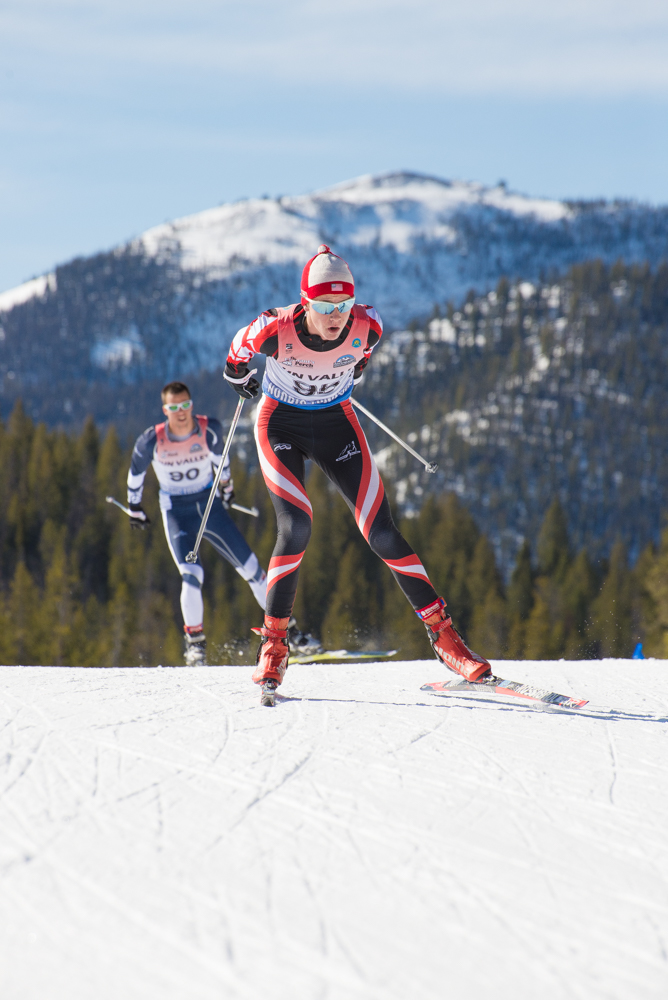
    Boulder Nordic Junior racer, Emil Graf competing at Spring Series in Sun Valley, Idaho. (Photo: David Pickner/davidpicknerphotography.com)

    However, while 3 k times are certainly a useful method of comparing an athlete’s baseline fitness at multiple levels, Boulder Nordic Junior Racing (BNJR) Team’s head coach Adam St.Pierre indicates the performance test is merely Step 1 for junior skiers looking to further develop.

    “If you look at how many juniors in particular just go out at the start of a 5 k race and are just cooked within the first k, by putting them on a track and teaching them how small the changes in effort are to achieve different paces is a pretty powerful tool,” St.Pierre said on the phone from Boulder, Colo.

    For St.Pierre, the 3 k is not just a test of fitness at summer’s onset and fall’s closure, but also a tool for teaching athletes to pace and track their progress. Using his athletes’ spring 3 k time trial results, he computes his athletes per 100-meter pace, which is the pace his athletes then base all of their summer and fall interval times off of.

    “What a lot of athletes end up discovering is that the per 100 meter pace of a 3 k isn’t that hard,” St. Pierre said. “They say, ‘But I went out way faster than that,’ and I say ‘Yeah, you did, then you slowed down.’ So using a performance metric to determine your workloads is ideal.”

    Another reason St.Pierre likes to have his juniors hit the track regularly? The opportunity for coaching surveillance and the occasional interval.

    “I think it’s important, too, that you see your coach isn’t just some out of shape old dude,” St.Pierre said. “With the track, I have the ability to hop in and run by someone for a lap or an interval or half a lap, whatever it takes to help them hit their targets.”

    The Workout

    Purpose: Complete a progression of track workouts over the summer in order to improve pacing. Indicators of improvement are times from a 3 k time trial at the beginning of the summer compared to 3 k time trial times run by the end of the fall, as well as an increase in the number of repeats athletes can complete during each consecutive track workout.

    Warmup: 20-30 minutes

    • 5 minutes running off the track
    • “Wake up muscles” next by doing a series of lunges: forward, backward, and lateral; follow up with squats
    • 4 laps around the track
    • High knees, butt kicks, karaoke and skips during straight aways, jog corners
    • “Do each drill forwards and backwards!” St.Pierre said.
    • 50- to 100-meter barefoot strides/accelerations

    *(St.Pierre’s favorite) set: 400-meter repeats for 30 minutes at 3 k race pace

    Recovery equals the same amount of time as interval or until heart rate returns to Level 1

    Sample progression (all done at 3 k race pace):

    • Week 1: 200-meter repeats for 3-5 k
    • Week 2: 300-meter repeats for 3-5 k
    • Week 3: 400-meter repeats for 3-5 k  

    (Continue adding until you reach 1,000-meter repeats for 5-7 k)

    Cool down: 15-20 minutes

    • 5-10 minutes of aerobic running
    • 5-10 minutes core circuit
    • Static stretching

    Total time: 90 minutes

    *An athlete must complete a 3 k time trial on the track in order to calculate their ideal interval effort and pace (St.Pierre takes an athlete’s per 100-meter time based off their 3 k time.

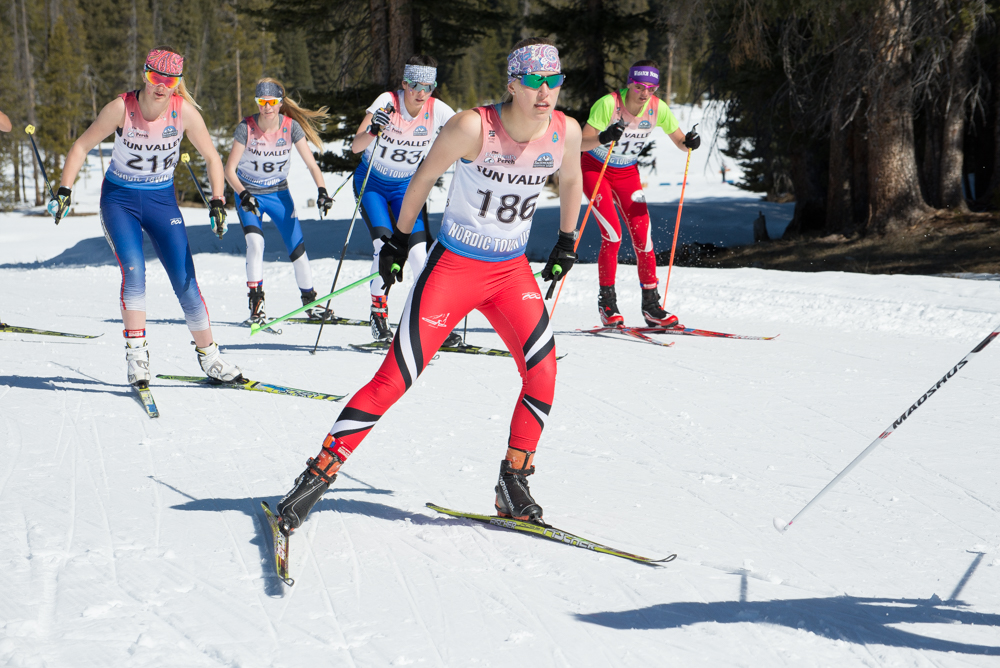
    Emily Picker bib 186 competing at Spring Series in Sun Valley, Idaho. (Photo:  David Pickner davidpicknerphotography.com)
    Emily Picker bib 186 competing at Spring Series in Sun Valley, Idaho. (Photo: David Pickner/davidpicknerphotography.com)

    BNJR Coach and Athlete Advice:

    1. Work up to what you want. “I enjoy this track workout because it helps me get used to doing a 3 k, and pushing hard for that long by working up to that,” BNJR skier Emily Pickner wrote in an email. “Intervals are easier for me to do because they are usually shorter, so by the time we get to the 3 k, I can look at it as all the intervals put together.”
    2. Mobility is a must. “Lots of skiers run like robots!” St.Pierre wrote in an email indicating that in order to reap the complete benefits of the track workout, “include some drills within the warm-up to elevate your HR [heart rate], increase your range of motion and improve your run mechanics.”
    3. Use the race to break down the pace. Going out too hard is a game all too familiar with nordic athletes, junior and senior racers alike. “Basing paces on 3 k time makes them an accurate estimate of what you can do,” Emil Graf, another BNJR racer, wrote in an email. “Trust the goal paces … Also, make sure to set a solid 3 k time at the beginning.”
    4. Progress takes patience. “I think the overarching philosophy for my training and coaching is just progress over time,” St.Pierre said. “Regularly checking that you are improving and then being willing to make changes if you want — sometimes those changes are you need to train more and sometimes those changes are you need to train less, or re-prioritize — that’s an important concept.”
  • Rio Highlights: McFadden Breaks Paralympic Record; Putney’s Dana Takes Silver in TT (Updated)

    Rio Highlights: McFadden Breaks Paralympic Record; Putney’s Dana Takes Silver in TT (Updated)

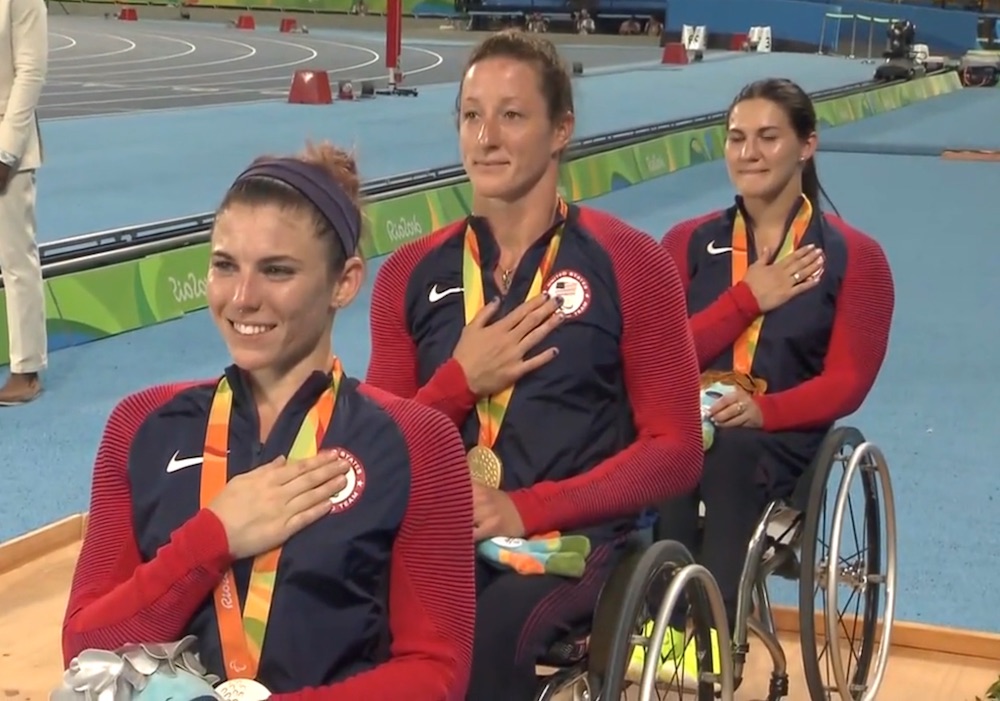
    Tatyana McFadden (c) led a U.S. sweep of the women's 1500-meter T53/54 podium in wheelchair track racing at the 2016 Summer Paralympics on Wednesday in Rio de Janeiro, Brazil. Less than two-tenths of a second behind her, Amanda McGrory (l) and Chelsea McClammer (r) placed second and third, respectively. (Photo: U.S. Paralympics Highlights from Rio Day 6 video)
    Tatyana McFadden (c) led a U.S. sweep of the women’s 1500-meter T53/54 podium in wheelchair track racing at the 2016 Summer Paralympics on Wednesday in Rio de Janeiro, Brazil. Less than two-tenths of a second behind her, Amanda McGrory (l) and Chelsea McClammer (r) placed second and third, respectively. (Photo: U.S. Paralympics Highlights from Rio Day 6 video)

    Note: This article has been updated to include results from Thursday’s road cycling and evening track races, as well as Tatyana McFadden’s selection as recipient of the Whang Youn Dai Achievement Award.

    On Tuesday and Wednesday in Rio de Janeiro, Brazil, two Paralympians who also dabble in skiing racked up medals at the Paralympic Games — with Tatyana McFadden winning the women’s 1500 T53/54 track event and Alicia Brelsford Dana placing second in the road-cycling time trial.

    McFadden, 27, of Clarksville, Md., rocketed to her third medal in three races in Rio, leading what the U.S. Olympic Committee (USOC) dubbed a “Mc-sweep” in her event, ahead of fellow Americans Amanda McGrory (+0.11) and Chelsea McClammer (+0.17). It was the first U.S. track-and-field podium sweep at these Games, and McFadden led from the start to capture a Paralympic record of 3:22.50.

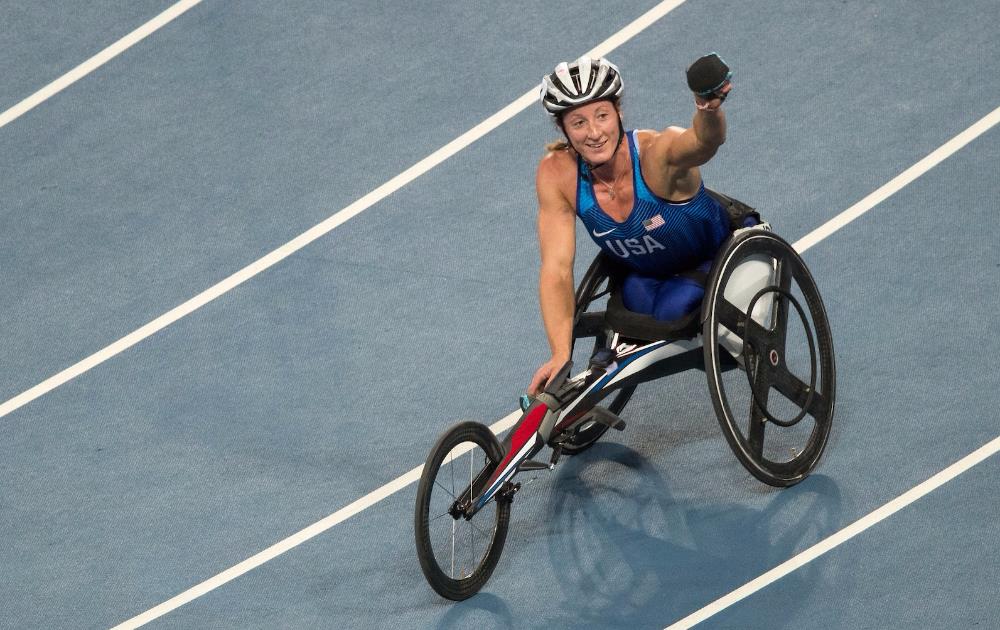
    Tatyana McFadden celebrates winning the women's T54 5000m final at the Olympic Stadium at the Paralympics in Rio de Janeiro, Brazil. (Photo: Simon Bruty for OIS/IOC)
    Tatyana McFadden celebrates winning the women’s T54 5000m final at the Olympic Stadium at the Paralympics in Rio de Janeiro, Brazil. (Photo: Simon Bruty for OIS/IOC)

    This marks her 13th Paralympic medal in track and field. She also has a silver in sit-skiing at the 2014 Winter Games.

    “It’s amazing,” McFadden said, according to a USOC press release. “It’s the first time, I think, in history or in a long, long time since we’ve gotten an American sweep in the 1500 and it happens to be the girls, so it’s really cool.”

    “We went into this morning with a pretty good plan and decided we were going to go for it,” McGrory said. “We raced together, we raced smart and we pulled it off.”

    (Update: Two days after her latest gold, McFadden was selected to receive another honorary gold medal as one of two recipients of the Whang Youn Dai Achievement Award. According to a International Paralympic Committee (IPC) press release, an independent panel of judges comprised of IPC Governing Board members selected the winners on Thursday — McFadden and Syria’s Ibrahim Al Hussein, a swimmer who is competing independently in Rio. They will each receive a pure gold medal, weighing 75 grams, at the Closing Ceremony.

    The panel chose McFadden and Hussein for best exemplifying “the spirit of the Paralympic Games and the Paralympic values.” Seventeen participating countries nominated 21 athletes, and the IPC narrowed the list down to six athletes. McFadden was the only North American among the six finalists.)

    On Thursday night, the “Mc-trio” (as the USOC called them) of McFadden, McClammer and McGrory — teammates at the University of Illinois Urbana-Champaign — swept the podium again in the women’s 5000-meter T53/54. McFadden made her move on the final lap to notch her third gold in four individual races in Rio, winning in 11:54:07. McClammer edged McGrory by one-hundredth of a second for silver (+0.26) and McGrory took bronze (+0.27).

    “We train together, so we work really, really well together,” McFadden said, according to a USOC press release. “There’s no one I want more on the podium than my teammates. I think the whole world was looking at us and we were looking at them and we said ‘hey, we’re going to work together’. We’re stronger that way and it definitely showed today.”

    Two hours later, McFadden and McClammer raced the 4×400 T53/54 relay with McFadden’s younger sister Hannah McFadden and Cheri Madsen. They crossed the line second behind the People’s Republic of China, which smashed the world record of 3:40.66 with a time of 3:32.11. However, according to the final results, the Americans were disqualified (along with Turkey) and relegated to fourth (while Turkey was listed as third). Australia, which had a season-best time of 3:46.63, took silver, and according to the results, no bronze was awarded.

    Dana Second in Time Trial, Fourth in Road Race

    Alicia Brelsford Dana (Photo: TeamUSA.org)
    Alicia Brelsford Dana (Photo: TeamUSA.org)

    On Wednesday, the seventh day of the Paralympics and first day of road cycling, Dana, of Putney, Vt., notched silver in the H1-2-3 time trial with a time of 33:57.48, less than 13 seconds behind the winner, Karen Darke of Great Britain.

    Four years ago at the Paralympics in London, Dana, now 47, placed fifth in the same event. At 2015 World Championships, she took silver in both the time trial and road race. In 2014, she was a world champion in the time trial.

    In all, the U.S. cycling team racked up nine medals on Wednesday (one gold, five silver and three bronze). Oksana Masters finished fifth in the women’s H4-5 time trial with a time of 33:49.7, about 47 seconds off the podium and 2:14.24 behind the winner, Dorothee Vieth of Germany.

    On her official Facebook page, Masters, 27, of Louisville, Ky., also a silver medalist in Sochi and a bronze medalist in doubles rowing at the 2012 London Paralympics, summed up her race on Wednesday: “I Finished 5th today in my combined H4-5 category for the TT. Just like skiing I like courses that have climbs in it. Today was the opposite. Flat as a pancake course with high winds which favors bigger people. I gave it everything I had, plus some blood and it was not enough to bring home a medal for team USA. Tomorrow is a new Day and another chance to race and leave everything on the course. It is a Road Race which will be a mass start. I am feeling hopeful for this race. It is my favorite event. I Can’t wait to throw it down tomorrow. I will be racing around noon rio time tomorrow.”

    On Thursday, Masters placed fourth in the women’s H5 road race. She is one of two Americans at the Games who has competed in the last three Paralympics in three different sports.

    Germany’s Andrea Eskau — a skier and Winter Paralympic medalist in both biathlon and cross-country in Sochi — won the event in 1:37:07. She finished 2 seconds ahead of the Netherlands’ Laura De Vaan and Jennette Jansen, who placed second and third, respectively. Masters was listed with the same time just 2 seconds back in fourth.

    “I’m bummed I finished fourth today and came up a little short, but I’m super happy because I feel like I’ve learned so much from this race alone,” Masters said, according to a USOC press release. “I am just so shocked that I am even here competing in my third Paralympic Games in a row.”

    Dana also placed fourth in Thursday in the women’s H1-2-3 road race. With a time of 1:16:01, she was 3 seconds off the podium and 5 seconds behind German winner Christiane Reppe (1:15:56). South Korea’s Do-Yeon Lee finished second and Italy’s Francesca Porcellato was third.

    Results: 

    Tuesday: Women’s 1500 T53/54 final

    Wednesday: Women’s H1-2-3 time trial | Women’s H4-5 time trial

    Thursday: Women’s H1-2-3 road race | Women’s H5 road race | Women’s 5000-meter T53/54 | Women’s 4×400 T53/54 relay

  • Whiteface Road Work Could Impact Climb to Castle

    Whiteface Road Work Could Impact Climb to Castle

    The road well traveled...
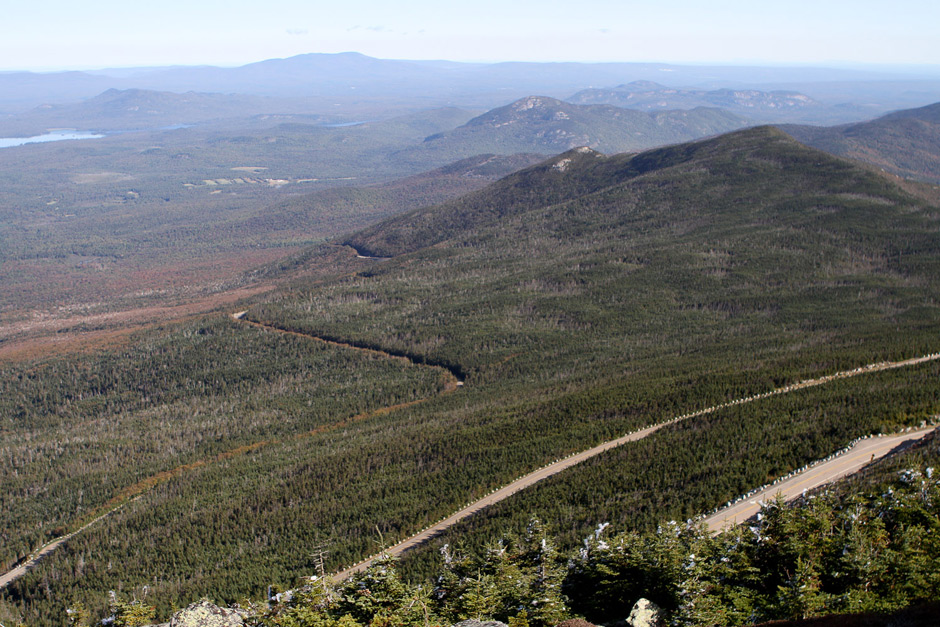
    The Whiteface Mountain Veterans Memorial Highway, where NYSEF’s Climb to the Castle has been held for the past seven years in Wilmington, N.Y., as seen in 2011. The toll road is undergoing construction this summer and fall.

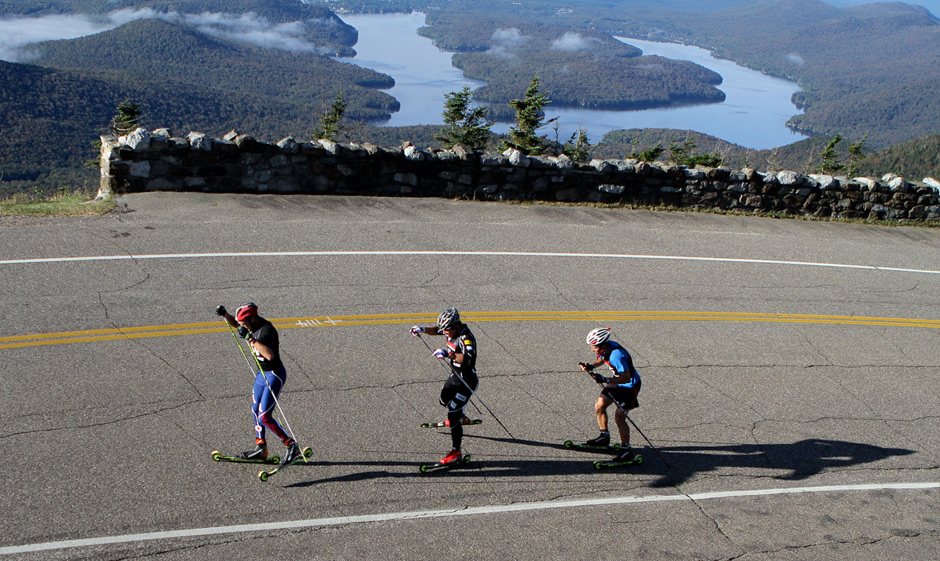
    There’s a race each year scheduled in line with the end of the U.S. Ski Team’s fall camp in Lake Placid, N.Y. You might have heard of it: the Climb to the Castle. Hosted by the New York Ski Education Foundation (NYSEF), the freestyle rollerski race starts at the entrance to a paved toll road, the Whiteface Mountain Veterans Memorial Highway, and stretches five miles up with an average 8-percent grade. The finish is marked by the castle at the top of New York’s fifth-highest peak at 4,867 feet above sea level.

    Try to rollerski up there now, however, and you’ll likely run into some heavy machinery.

    Construction has already begun on the eight-mile highway as part of a larger project to completely resurface the road over the next several months. The Adirondack Daily News reported Thursday that the upper, toll portion of the road — where the Climb to the Castle (C2C) takes place — will be closed weekdays during May, June and September, but open on weekends. It will be open on weekends and two holiday Mondays during these months: Memorial Day, May 26, and Labor Day, Sept. 1. Throughout July and August, the road is scheduled to be open during daytime hours, with work taking place at night.

    Tim Burke (USBA), Kris Freeman (USST) and Noah Hoffman (USST) leading the men's race.
    US Biathlon’s Tim Burke (l), and U.S. Ski Team members Kris Freeman (c) and Noah Hoffman (r) lead the 2011 Climb to the Castle race in Wilmington, N.Y.

    According to Chris Grover, the U.S. Ski Team will hold its Lake Placid training camp from Aug. 25-Sept. 8. So while there’s a chance construction could impact it, there’s a better chance the toll road will be open on Saturday, Sept. 6, when NYSEF scheduled the race.

    Margaret Maher, NYSEF’s head nordic coach and C2C organizer, wrote in an email to FasterSkier last week that they were “trying to figure out how the road work will influence the race. Hoping we can still have C2C!”

    In all, the highway is expected to be closed 54 days from this week until the end of the season, and open 88 days over the same period, according to the Enterprise.

    While the toll road has been patched periodically since it was opened in the 1930s, it has never been completely resurfaced. Whether rollerskiing, cycling, or running to the summit, it’s riven with frost heaves and cracked pavement. Regardless of what state the road is in this year, its sure to be a superior surface for rollerskiing next summer.

    Rifenburg Construction, based out of Albany, N.Y., will resurface the entire eight-mile length of the road, from the four-way intersection in the center of Wilmington to the summit. They’ll also rehabilitate rock walls and make repairs to the castle.

    The men's start.
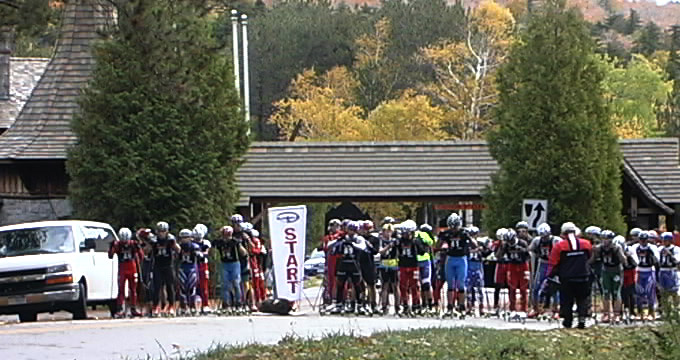
    The men’s start of the 2009 Climb to the Castle.

    Rifenburg earned the project with a $11.2-million bid, and the company expects to complete the work by the end of 2015.

    Project manager Russell Huta said that the goal is to have a base layer of new pavement from the tollgate to the castle by the end of this fall.  In 2015, the toll section will be finished, and all work on the section from Wilmington town center to the tollgate will be completed.

    “Each project has its own set of unique challenges,” Huta told FasterSkier, when asked about the difficulty of working in the narrow confines of the toll road. When road work is in motion, the toll road will be closed to traffic.

    In September, Huta said, his company will have “full access” to the toll road Monday through Friday – except for Labor Day. “By the end of the day Friday, there will be a paved surface for [use by] cars, buses, pedestrian traffic” until Monday morning.  “On Monday morning, it’s ours again.”

    If for some reason, the C2C isn’t possible this year, Grover wrote in an email that it won’t be the end-all of camp.

    “We typically run a sprint or team sprint time trial along with the Climb to the Castle,” he explained. “If the Climb is not ready this season, we will employ other alternatives.”

    Before the C2C, a time trial was previously held up Gillespie Drive, now a warmup for athletes. The event is entering its eighth year. USST veteran Liz Stephen won the women’s race the last three years, setting a new course record last year in 42 minutes and 4 seconds. US Biathlon’s Tim Burke won the 2013 men’s race in 37:13.

  • Wednesday Workout: Finding Your Realistic Race Pace

    Wednesday Workout: Finding Your Realistic Race Pace

    FS-WednesdayWorkout-MWSC
    Maine Winter Sports Center (MWSC) biathletes working on uphill pace identification in Fort Kent, Maine. (Photo: Seth Hubbard)

    Welcome to Wednesday Workout, where we round up training ideas on a weekly basis. This week Will Sweetser, competitive programs director of the Maine Winter Sports Center, explains how to identify your personal race pace using his Reality Race Pace Progression rollerski workout. 

    ***

    Like most clubs around the country, our focus here in northern Maine is on youth and junior skier development. We want, first and foremost, to help the next generation of skiers earn spots on college teams, international trips, and the U.S. Biathlon and U.S. Ski Teams.

    While it is quite common for us to hear junior racers vocalize their dreams of representing the red, white and blue, it is equally common to see the same racers destroy any hopes of doing so, through poor pace identification in race after race. The start timer counts down and kid after kid across Maine throws caution to the wind and hammers out of the gate at Level “Go!”.

    Over the course of my time here in Aroostook County, I’ve steadily refined a workout aimed specifically at curing this lack of pace sense. I call it: Reality Race Pace Progression. This workout is aimed at identifying one’s 10 kilometer race pace. The beauty of the system is that it gives athletes a tremendous amount of worthwhile feedback.

    The concept is simple, and shamelessly stolen from track and field sessions practiced in Africa. All that is required is a lightly traveled stretch of road at least 500 meters long. Athletes should warm up as though it is race day — this is a great way to fine-tune race day prep.

    MWSC post-graduate Emily Ramsey racing in the 2012 U.S. Ski Association (USSA) SuperTour at Bohart Ranch in Bozeman, Montana.
    MWSC post-graduate Emily Ramsey (57) racing in the 2012 U.S. Ski Association (USSA) SuperTour at Bohart Ranch near Bozeman, Montana. (Photo: Will Sweetser)

    After warm up:

    • 1 kilometer time trial at maximum effort.

    • 15-20 minutes easy recovery skiing at Level 1.

    • 7-12 x 1 kilometer (over the same course as the time trial) at 15-20 percent slower than time trial pace. 2-3 minutes moving recovery between intervals.

    • Cool down 15-20 minutes.

    The time trial helps identify one’s current performance level. As I said earlier, it’s easy to set a goal of making a team, but most younger athletes do not have any idea of how fast they actually need to ski to do so. With the advent of improved grooming, snow making and sizably better waxing knowledge, most races throughout the year are relatively comparable in terms of per-kilometer times.

    Frequently, I’ve had athletes realize that their current sprint pace is not yet fast enough to compete in 10 k races on the New England Nordic Ski Association (NENSA) circuit. Even more often, I’ve had athletes show up and realize after the time trial that they just aren’t ready for the workout. Time trial times just don’t lie!

    The repeats, themselves, are aimed specifically at pace averages taken directly from a 10 year sample of International Ski Federation (FIS) sprint and distance races held at the same venue, in the same technique, in stable weather.

    All-around European racers averaged 18-percent slower per-kilometer over 10-15 k than they did in sprints. Distance specialists averaged 12-percent slower. Women tended to keep the gap a bit closer at around 15-percent (likely due to the generally shorter race distances for women and relatively longer early race times for women’s sprints). Interestingly, U.S. racers averaged 22-percent slower across the board in distance races versus sprints.

    Most athletes will claim immediately that the pace for the repeats is far too slow. It is important to keep the recovery times no longer than equal to repeat time. It’s also critical to emphasize that the goal of the workout is to get through enough repeats to accurately reflect race distance. If the athlete can only get through four repeats, he/she has done it wrong! Remember, these are Reality Race Pace Progression pieces. If the athlete can’t perform 10 repeats at the same pace, it’s not 10 k pace.

    With a little bit of research, athletes go into the workout with a goal per-kilometer time in mind. They immediately get feedback from the time trial, and then with each repeat. Athletes can readily identify where they’ve lost or gained time by repeating the same course. Especially with juniors or inexperienced racers, coaches will see athletes able to repeat their time trial time or even improve it through 7, 8, or even 10 repeats. This typically indicates either the need for technique development or an inadequate warm-up.

    At MWSC, we use our rollerski loops (paved ski trails at Nordic Heritage Center, 10th Mountain Ski Center) for these workouts. Since we’ve got an established loop, we don’t always use the time trial, especially if we’re repeating this workout within a week of the last time. As many athletes find this workout a bit of a mental strain, we don’t often use it more than 2-3 times per month during the fall. But, for those few times we repeat this workout, we see some fantastic results.