Tag: timo puiras

  • Rethinking Concussions: Katherine Stewart-Jones’s Personal Journey

    Rethinking Concussions: Katherine Stewart-Jones’s Personal Journey

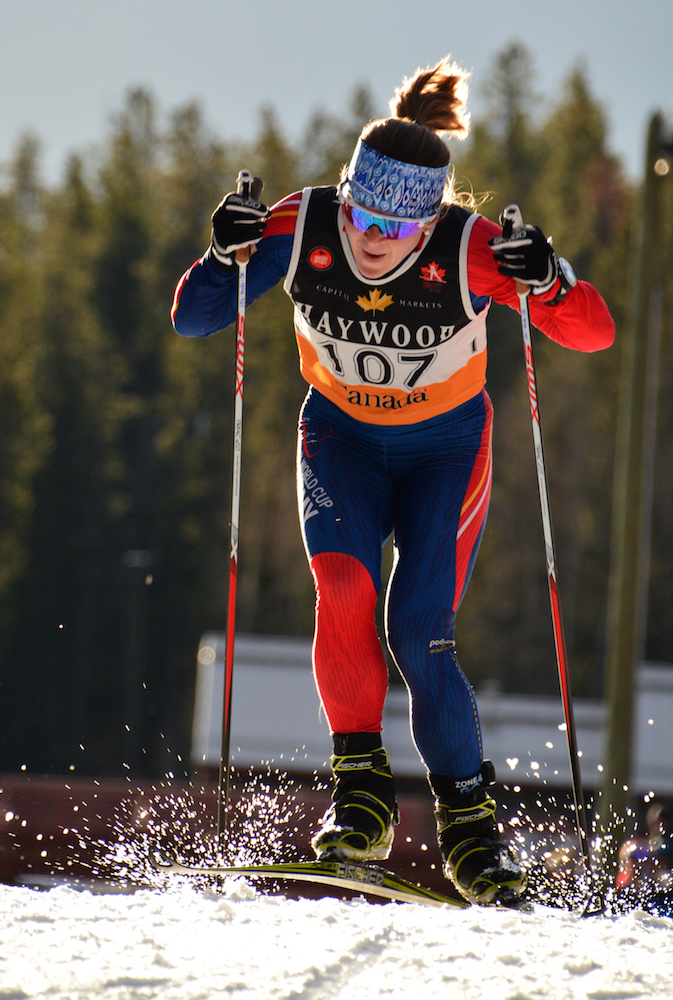
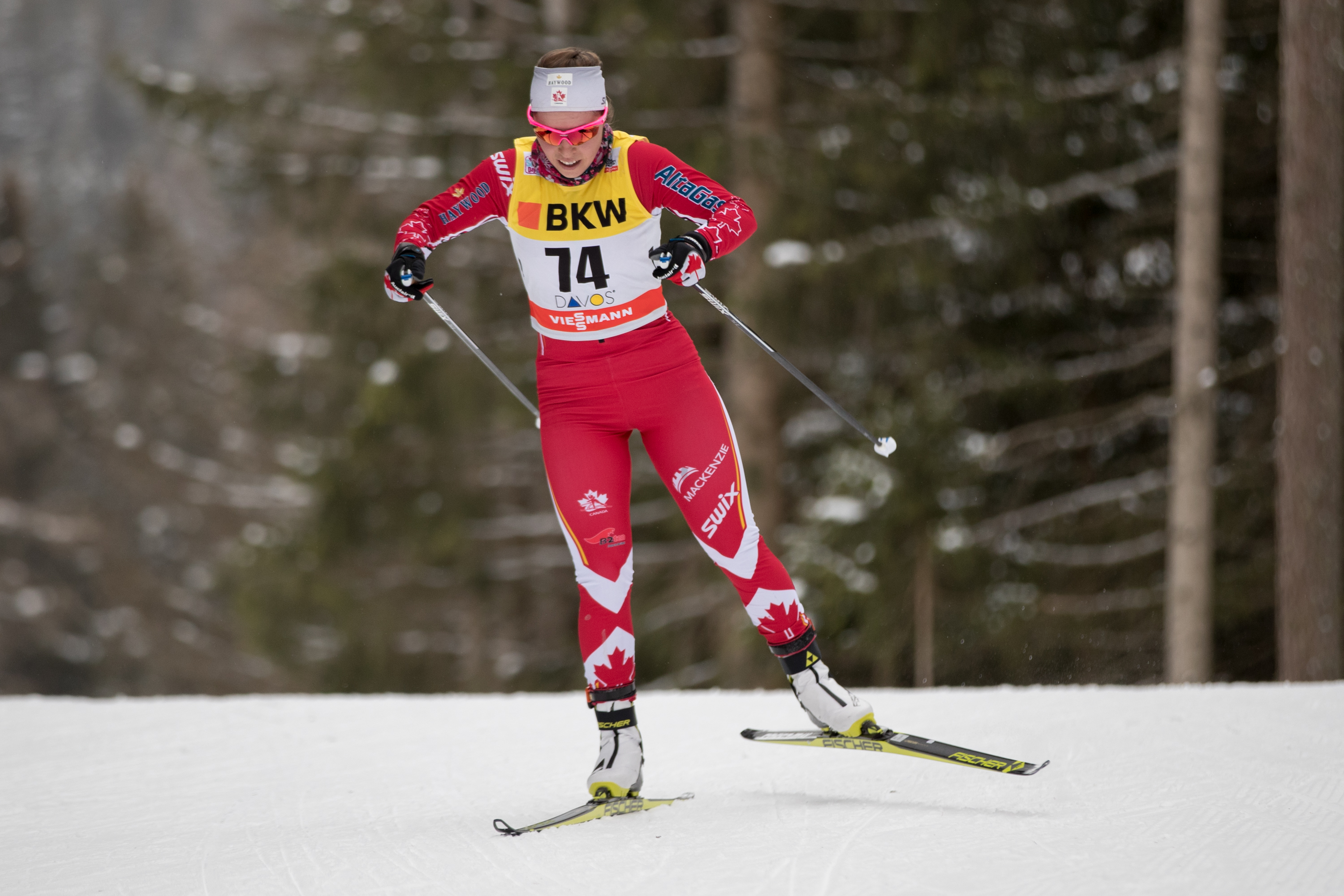
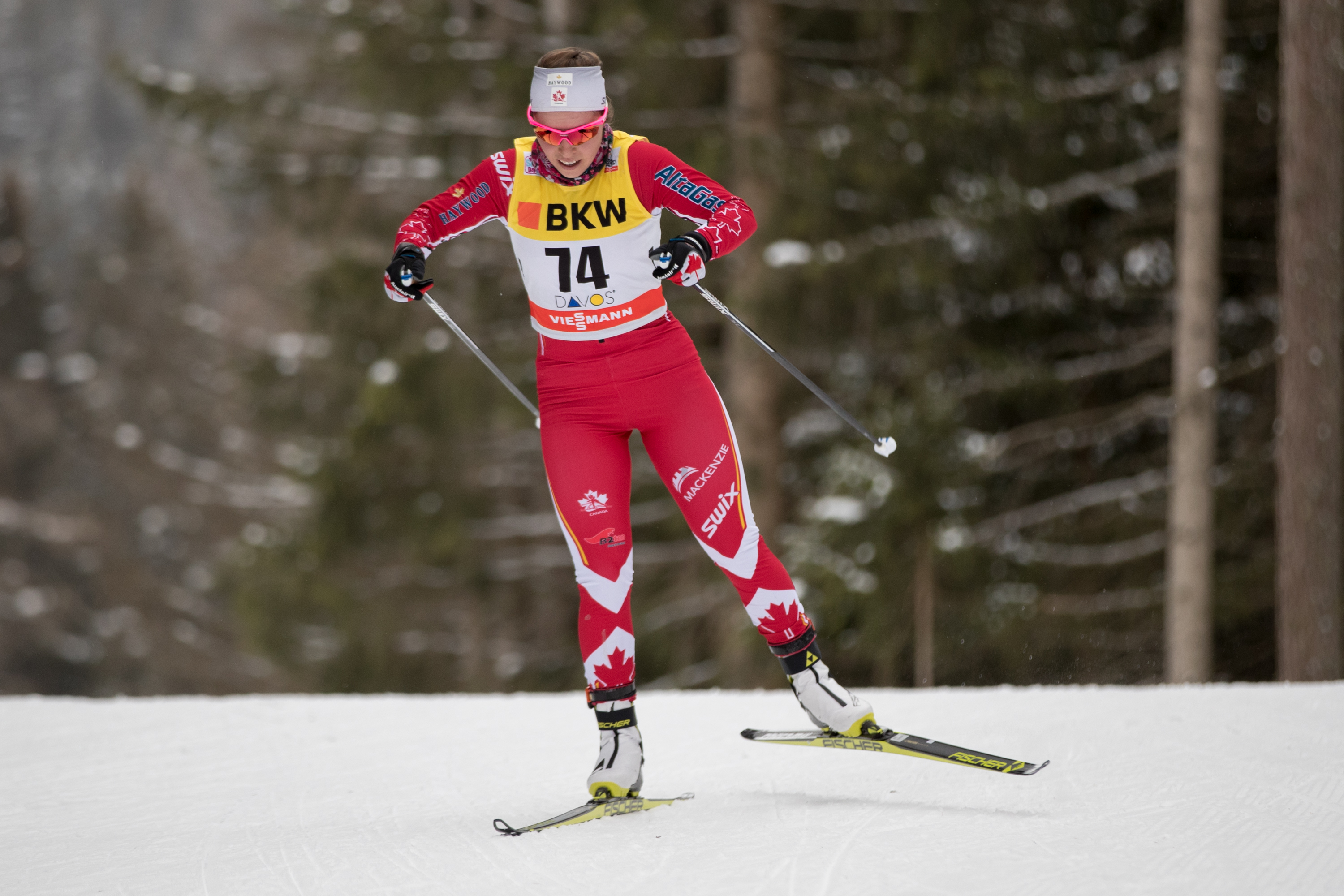
    Canada’s Katherine Stewart-Jones racing to 79th in the women’s 10 k freestyle on Dec. 10 at the World Cup  in Davos, Switzerland. The day before, she placed 55th in the freestyle sprint. (Photo: Reese Brown / U.S. Ski & Snowboard)

    In a split second, Katherine Stewart-Jones was flying over her handlebars and headed face-first for the road. She had been biking to her local gym in Thunder Bay, Ontario, on Sept. 19 when her bike’s front tire rammed into an irregular rise in the road and sent her off her bike seat and toward the unforgiving pavement below.

    A person driving by witnessed Stewart-Jones catapult off her bike and stopped immediately to check if she was all right. Though the 22-year-old Quebec native had been wearing a helmet, her face had take the brunt of the impact, leaving her with two swollen lips and one very sore tooth. The passerby who had witnessed the fall stopped, loaded Stewart-Jones’s bike in the back of the car and ferried her the rest of her way to the gym.

    Canadian National U25 Team member Katherine Stewart-Jones racing in a classic-sprint quarterfinal at 2017 U23 World Championships at Soldier Hollow near Midway, Utah. She placed 24th overall on the day. (Photo: flyingpointroad.com)

    When Stewart-Jones arrived at Thrive Strength and Wellness that day, Josh McGeown, who works as a strength instructor at Thrive, has a master’s of science in kinesiology and specializes in athlete injury and rehabilitation, took one look at her and informed her there would be no workout for her that day. In the gym’s office, McGeown immediately ran a few preliminary tests to decipher if Stewart-Jones had a concussion, though he also indicated it was, in all likelihood, too early to tell. She would have to wait for more symptoms to arise.

    After McGeown’s prognosis, Stewart-Jones, a member of both the Canadian National U25 Team and National Team Development Center (NTDC) Thunder Bay, called the NTDC team’s doctor to arrange an appointment. She got in the same day as the accident, and a few more tests were run. Once again, however, she was told nothing could be confirmed until more signs of a concussion showed up. By the next morning, they did.

    “I slept like 12 hours that night or something, not normal,” Stewart-Jones said on the phone in late November.

    The morning following her accident, Stewart-Jones flew home to Chelsea, Quebec. She had been planning to return home to help with a Fast and Female event taking place in Ottawa,  10 kilometers south of her hometown. After the event, her plan was to fly to Park City, Utah, to join her fellow Canadian national-team members at a dryland altitude training camp.

    But recurring headaches and the inability to do anything but sleep changed all that.

    “I was sleeping like crazy,” Stewart-Jones said. “My eyes would get really tired. I had a lot of sensitivity to light and sounds, just being around people was like, ‘Whoa.’ ”

    “I also ended up having some issues with my tooth,” Stewart-Jones explained. “We weren’t sure at first if it was injured, but it ended up changing colors, like turning purple. So I ended up having to get a root canal.”

    Besides a tooth that necessitated endodontic treatment, Stewart-Jones’s accident also left her with no energy to train, despite wanting to do so. For close to a month, she rested, unable to train or complete any of the online psychology courses she was taking at Lakehead University. Even reading screens bothered both her eyes and her head.
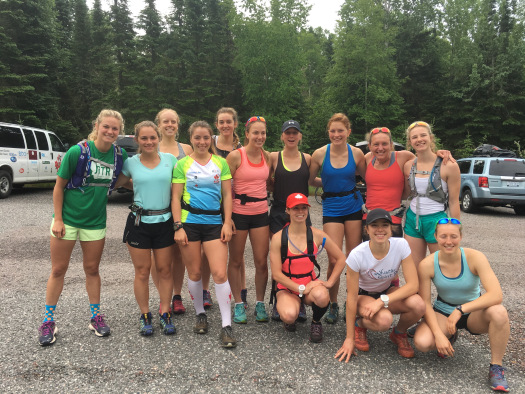
    Katherine Stewart-Jones of the Canadian National U25 Team (fourth from l, white socks) with guest training partners Jessie Diggins of the U.S. Ski Team (far left) and Caitlin Gregg of Team Gregg (back row, second from r) prior to hiking, “The Giant” this summer. (Photo: Katherine Stewart-Jones)

    For Stewart-Jones, the hardest part of coping with the injury was transitioning from full-time training to barely moving.

    This sentiment surfaced in  Stewart-Jones’s blog post following the accident, where she reflected, “I think we can all agree that cross-country skiing is one of the hardest sports in the world. I have been training for skiing for as long as I can remember, but these past six weeks have been the toughest of my career and I have barely lifted a finger.”

    “When you’re used to doing so much and then not being able to do much at all was just frustrating and then also just kind of depressing,” Stewart-Jones later told FasterSkier. “I spent a lot of time feeling almost sad and really sorry for myself.”

    Couch-ridden in Chelsea, while her teammates and the rest of the cross-country world continued to train, Stewart-Jones was faced with the question any athlete who has put endless amounts of time into a season and suffers an injury dreads: was it all for nothing?

    “I definitely had that thought of, is my season over?” she said. “Kind of that panicked moment where it’s like this is an Olympic year and I want to qualify for the Olympics and I kind of felt like maybe my dream is crushed.”

    But that was one question she wasn’t going to wait around to find out. She began a proactive approach to recovery, which included logging her symptoms and journaling, guided meditation, and staying in contact with therapists, chiropractors, acupuncturists, and teammates (read more about the five steps she took on her blog).
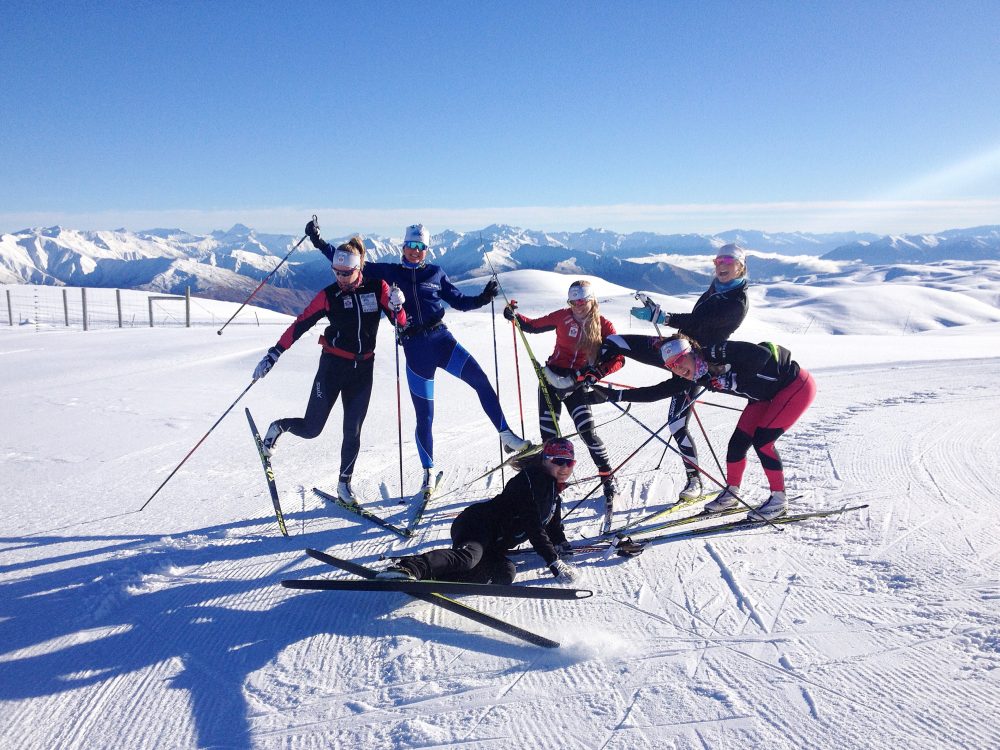
    Katherine Stewart-Jones (far right) of the Canadian U25 Team with several of her women’s team training partners during a summer training session in New Zealand. (Courtesy photo)

    She remained in contact with McGeown, who’s master’s research project at Lakehead addressed how to help athletes safely return to sport post-concussion. The two emailed and texted regularly while Stewart-Jones was at home in Chelsea, with McGeown offering advice and suggestions on how to cope with the mental and physical side affects from both a professional and personal standpoint.

    A former rugby player, downhill skier and contact-sports enthusiast, McGeown himself has suffered more than 15 concussions during his athletic career. On the phone with FasterSkier, he recalled his own undergrad experience when the solution for the concussed was to “sit in a dark room and hope you get better.”

    “At that point in time, there was no advice from doctors or physios,” said McGeown, who will start working toward a doctorate at New Zealand’s Auckland University of Technology this year. “It was, if you have any symptoms at rest, don’t exercise. For up to a year, don’t workout, don’t go for runs, don’t lift weights, don’t play sports. Essentially don’t do anything you like to do.”

    However, recent research done by McGeown and acclaimed medical sources, such as the Journal of the American Medical Association, have changed that belief. While all rest and no play was formerly viewed as the most appropriate way to recover from a concussion, recent studies show the opposite. Exercise appears to be the preferred method of rehabbing a concussed individual, though the intensity, duration and type still vary case by case and remain in question.

    “They release new guidelines every four years,” McGeown explained. “The 2012 guidelines say rest; do nothing. The 2016 guidelines say exercise-based rehab is going to be the new cornerstone for concussion rehab. They’re not saying how often, how intense, how do you get them started, for how long, etc. What the research needs to figure out still is all those variables. What is the best case scenario or is it completely individualized?”

    In the case of Stewart-Jones, slow and steady was the start. At home in Chelsea, she began exercising once she had a full 24-hour period of no symptoms. Following the 24-hour period, she completed ten minutes of exercise (in her case, walking on the treadmill) at a heart rate of 115.

    If, after completing the workout, no new symptoms arose or worsened, she would either increase her time or her heart rate the following day, but not by much. If her symptoms worsened or new ones arose, she returned to the exercise she had been doing the previous day — no exceptions and no matter how badly she wanted to train more.

    “Everybody wants to be tough. Everybody wants to fight through it and push through it,” McGeown said. “But what I try to get people to conceptualize is, if it’s your ankle or knee or shoulder, go for it. Tough it out, because when you’re fifty or sixty and that knee is really bothering you, they’ll just replace it with a new one.

    “Whereas there’s no second chances with our brain,” McGeown continued. “We’re seeing that with football players and hockey players. There are extreme consequences and if we don’t take it seriously, it’s a big deal.”

    Even with that weighing in the back of her mind, Stewart-Jones still found it difficult to not rush back into training too quickly.

    “I found that one of the most difficult parts of recovery was knowing when I was feeling good enough to start training again,” Stewart Jones wrote in her blog. “I found it easy to convince myself that I was feeling normal when I wasn’t. Maybe it was because I was just too eager to get back to training or maybe it was because I truly couldn’t remember how it felt to be my normal self. The bottom line is, you know yourself best, so be honest with yourself, and the recovery will be much quicker.”
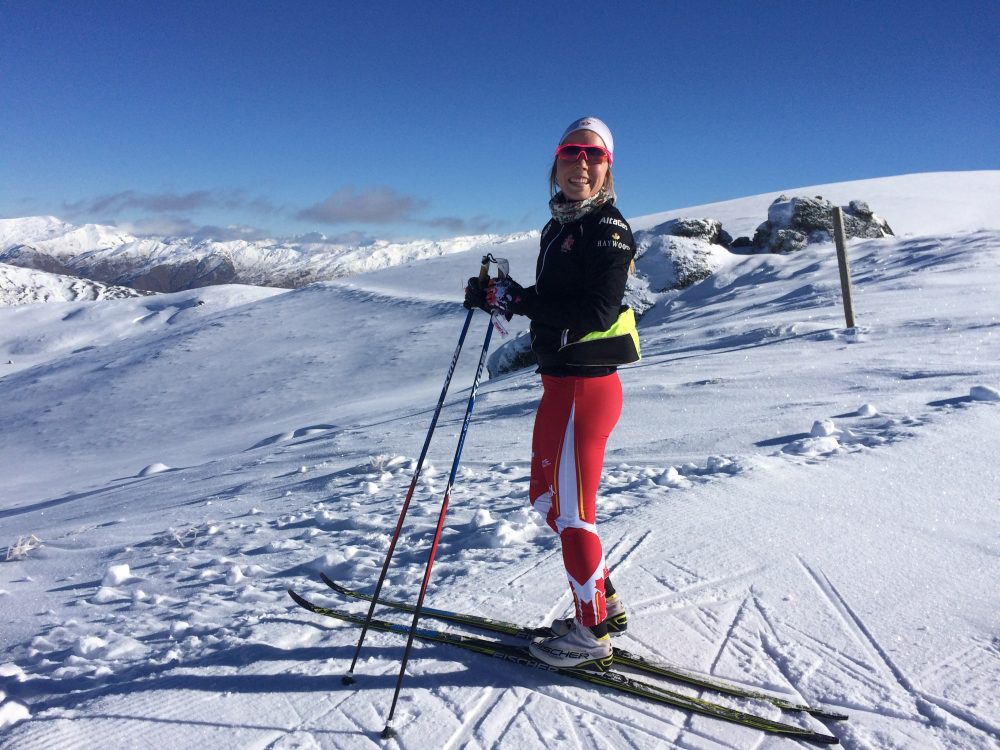
    Katherine Stewart-Jones (Canadian U25 Team/NTDC Thunder Bay) during a summer training session in New Zealand. (Courtesy photo)

    When she returned to Thunder Bay a few weeks after her accident, she began working with McGeown in person, continuing her work on the treadmill until she had reached the point where she was exercising at a threshold pace, something similar to a steady state.

    After that, McGeown began a second phase of the recovery, adding higher intensity workouts to her training regimen. She would complete 30-second long speed bursts of mountain climbers, ski erging and box jumps followed by a check-in with McGeown. If all went well, she continued. After about ten sessions like this, Stewart-Jones was cleared by McGeown to return to normal training.

    In late November, a little less than eight weeks after she suffered her concussion, Stewart-Jones was back on skis, logging a 17-hour training week and feeling “100 percent.”

    “Initially I was supposed to leave on Nov. 11th to meet the team in Finland and race the Ruka [Triple],” Stewart-Jones, last year’s NorAm (Canada’s Continental Cup) winner, said of her plans to start her season on the World Cup for Period 1. “I was feeling fine, I didn’t have any symptoms and I could train fine, but I felt like I wasn’t going to be ready enough to race then. And I wanted to put a couple weeks of big volume in just to feel like I gained my fitness back, so [my coach Timo Puiras and I] made the decision to stay longer.”

    “Katherine’s summer training went very well,” Puiras, head coach of the NTDC, wrote in an email. “Our IST (Integrated Support Team) was excellent in getting Katherine back to normal training as quickly as possible.”

    She competed in three World Cup weekends so far this season, posting a best result of 55th in the freestyle-sprint qualifier on Dec. 9 in Davos, Switzerland. She’s now gearing up for the NorAm trials, which start this Friday in Mont Sainte-Anne, Quebec, where she and several other top Canadian skiers are hoping to earn a spot on Canada’s Olympic team.

    “It was definitely a lot after taking a good six weeks off for an injury,” Stewart-Jones told FasterSkier after the Davos 10 k freestyle on Dec. 10. “I’ve had a good month of training, but it was more volume focused, just because I wanted to gain back that fitness and so I didn’t do a lot of intensity so I was kind of expecting it to be rough. But having the NorAm leader’s spot, it wasn’t something I was ever going to turn down.

    “I think for distance racing I still have that extra gear to build,” she added. “Right now I feel like my technique has come a long way, but I don’t feel like I’m actually racing, and I think that’s just going to come with more intensity and more racing.”

    When asked if Stewart-Jones might be at a higher risk for concussion while competing on the World Cup now, McGeown explained it would be difficult to say without know her particular history with concussions.

    “Once you’ve had multiple concussions, it’s easier to get the next one, the symptoms are worse, and recovery takes you longer,” McGeown said. “But typically if someone’s at a high risk for reinjury, it’s going to be if they return to sport within that first week to two weeks after the initial injury. It is certainly possible it could happen again, but it could happen to anyone at anytime.

    “That she’s at a high risk, I would say no. She’s at the same risk as any other skier competing against her,” McGeown added. “The only way that a concussion is going to truly limit someone is if they let it.”

    — Chelsea Little and Alex Kochon contributed
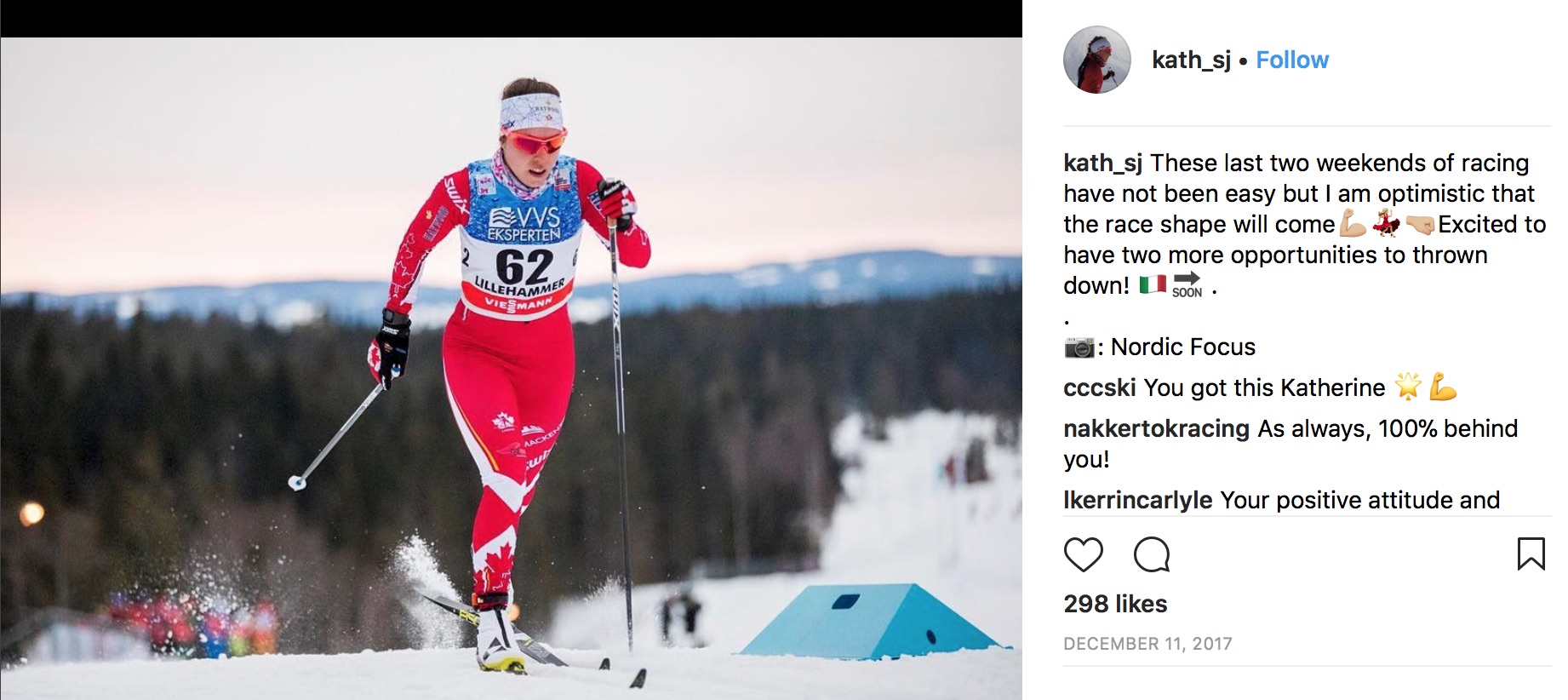
    Katherine Stewart-Jones’s Instagram post after two weekends of World Cup racing last month in Lillehammer, Norway, and Davos, Switzerland. She also raced two distance races in Toblach, Italy, where she finished 77th in a 10 k freestyle and 70th (68th for time of day) in a 10 k classic pursuit on Dec. 16-17. (Photo: Instagram/@kath_sj)
  • Thunder Bay to Host Canada 150 Rollerski Race

    Thunder Bay to Host Canada 150 Rollerski Race

    (Press release)

    Canada 150 Rollerski Race

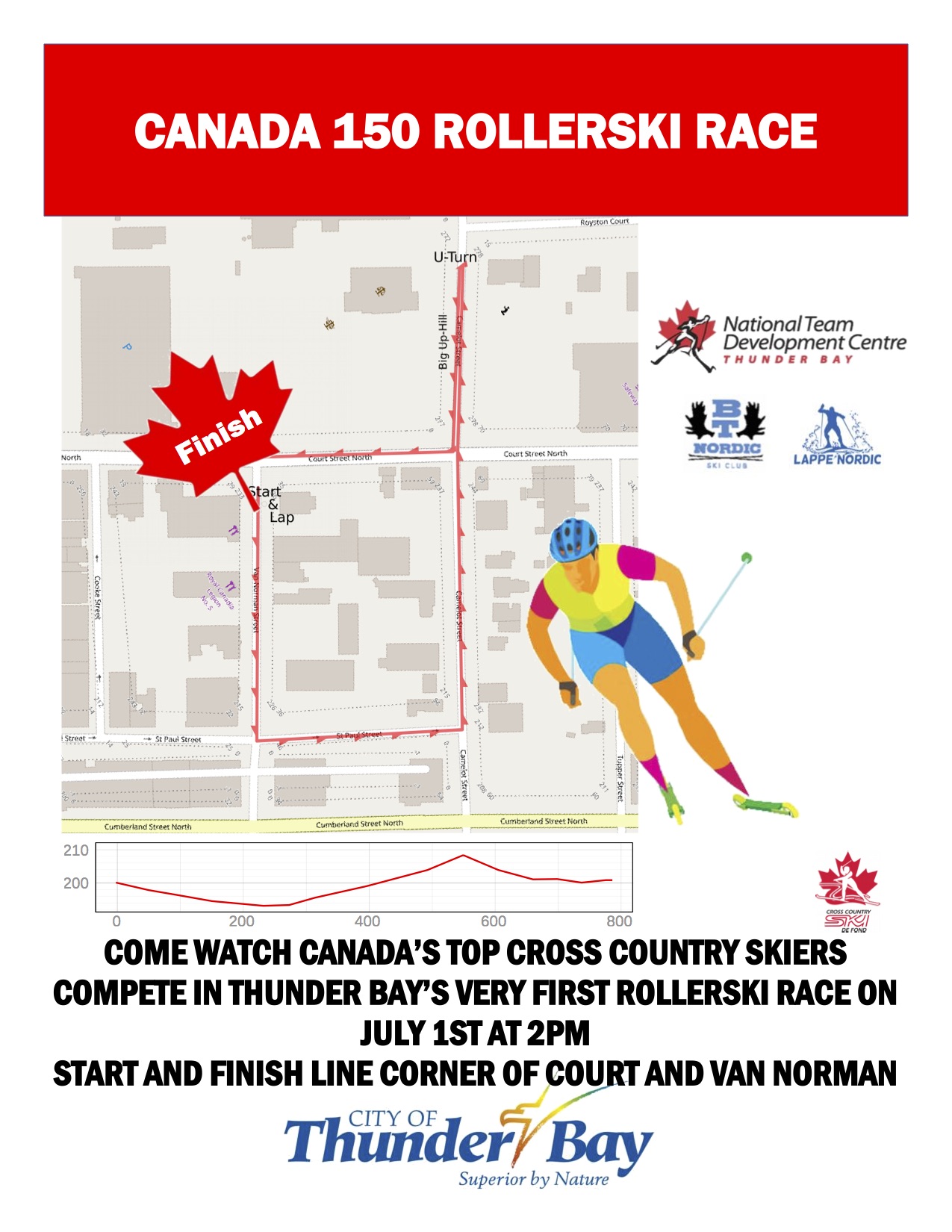
    On July 1st, 2017, Thunder Bay, Ontario will be hosting its first ever Cross Country Canada sanctioned rollerski race. The race will feature more than 50 of Canada’s top nordic skiers racing around the closed streets of downtown Port Arthur. The race will start and finish at the corner of Court and Van Norman, commencing at 2:00 pm and finishing with awards at 6:00 pm.

    The event is organized by Lakehead Superior Nordic Association, Big Thunder Nordic Ski Club, Lappe Nordic, and the National Team Development Centre (NTDC) Thunder Bay.

    This event has been organized to coincide with the other exciting Canada Day celebrations planned for the downtown core.

    Among the racers will be top local skiers, Junior National Team members and other elite skiers who have come to Thunder Bay from across Canada for a training camp hosted by NTDC Thunder Bay. The field will include athletes who potentially will represent Canada in the upcoming Winter Olympics.

    Race format will include an interval start individual time trial with each competitor completing two laps of the course. Then the athletes will be seeded into waves of closely matched competitors. Each wave will complete a 12 to 20 lap race on the same circuit. Waves will progress from the slower competitors to the faster, with the top ranked skiers racing at close to 4 pm.

    Date: Saturday July 1st 2107 Time: 2:00-6:00 PM

    Location: Start/finish at corner of Court and Van Norman (see attached map of race course)

    Contact Timo Puiras (NTDC Thunder Bay Head Coach) at ndctimo@gmail.com for further information

  • Second to Valjas in Skate Sprint Qualifier, Thompson Takes Top Prize

    Second to Valjas in Skate Sprint Qualifier, Thompson Takes Top Prize

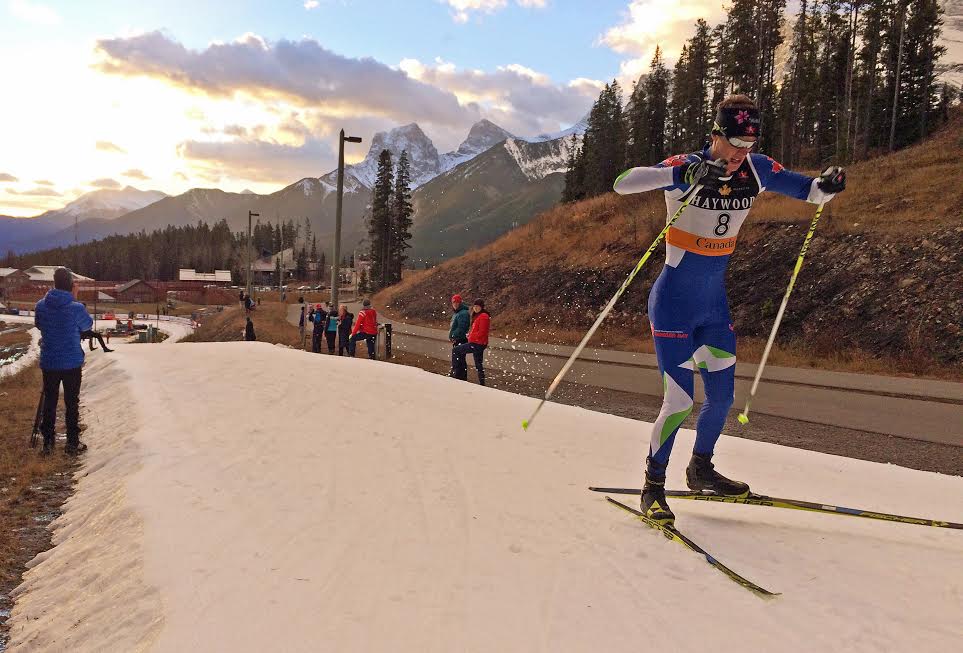
    Bob Thompson (NDC Thunder Bay) sprinting to second in Thursday's skate-sprint qualifier at Frozen Thunder in Canmore, Alberta. The performance earned him the final spot on Canada's World Cup team for Period 1. (Photo: Drew Goldsack)
    Bob Thompson (NDC Thunder Bay) sprinting to second in Thursday’s skate-sprint qualifier at Frozen Thunder in Canmore, Alberta. The performance earned him the final spot on Canada’s World Cup team for Period 1. (Photo: Drew Goldsack)

    Qualification-only sprint races can be a little dull.  Four minutes of pain and done. Describing the action?  Even more dull.

    But for Bob Thompson of the Thunder Bay National Development Centre (NDC), Thursday’s freestyle sprint qualifier in Canmore, Alberta, was one he’ll hold in his mind for a long time. For him, a 25 year old who skied his first World Cup races at home at the Ski Tour Canada last March, placing second in the Frozen Thunder skate-sprint qualifier meant a trip to Europe for his first overseas World Cups.

    On Thursday, the final day of racing on Canmore’s early season snow, affectionately known as Frozen Thunder, Len Valjas (who hails from the same club as Thompson, Team Hardwood in Ontario) won the men’s qualifier in 3:25.23. Thompson’s time was just six-hundredths of a second slower, but enough to get him the final men’s quota spot for World Cup Period 1.

    Len Valjas sprinting to victory in the skate qualifier. (Photo: Glen Crawford Production Services)
    Len Valjas (Canadian World Cup A-team) sprinting to the victory in the skate sprint qualifier at Frozen Thunder on Thursday in Canmore, Alberta. (Photo: Glen Crawford Production Services)

    Valjas, a World Cup A-team member, was preselected for Period 1.

    Jess Cockney, of the World Cup B-team, won Tuesday’s classic sprint qualifier to lock down the first of two selections, an achievement that was officially announced at 9 a.m. Thursday, 30 seconds before Valjas attacked the course wearing bib 1.

    Two other favorites for the final World Cup spot, Julien Locke (Black Jack/NST U-25 Team) and Simon Lapointe of the Pierre-Harvey Training Centre (CNEPH) placed third and fourth, 0.22 and 1.29 seconds back, respectively. Graeme Killick, belying his distance-specialist persona, finished fifth.

    “The race today was great,” Thompson wrote in an email shortly after the race. “I told [my coach] Timo [Puiras] at the finish I was happy with how I performed and followed the plan and either way I wasn’t going to say I didn’t race my best.

    “I wanted to keep things controlled,” Thompson wrote of his race plan. “It’s important to keep the speed high on both laps and especially finishing the second half of the lap fast as it is mostly flat and rolling. Being able to really go the second time up the climb was what I was planning for. … Being out there and able to do that was great.”

    Like many of the sprinters seeking one of two remaining men’s World Cup spots, Thompson made this week a training target.

    “Timo and I had the plan made to be fast for these races since very early in the year,” he wrote. “Not much was changed other than the last few weeks of prep, dropping some volume and moving into more of a sprint intensity focused block.”

    Cross Country Canada (CCC) High Performance Director Tom Holland, a member of the selection committee and chief of competition for these races, studied the race closely.

    “Watching this morning, I wouldn’t call it tactics,” Holland said on the phone. “But the way people can ski corners, probably made the difference between who was the winner and who was second.”

    To put that in context, the difference between first and third was 0.22 seconds, or 1.5 metres at an average speed of 25 kilometers per hour. It wouldn’t take much of a difference to gain or lose that five feet.

    Last spring, CCC and a group of coaches decided on the using the sprint qualifiers to fill out the team for World Cup Period 1. 

    “The results show … that there’s five or six guys here that are reasonably close,” Holland said of the level of competition in Canada.

    Of those top skiers, CCC wanted to determine “who could do a qualifier fast for the World Cup and try to match it up with some of the courses they’ll be skiing in November and December.”

    The course held up fairly well for the men, despite the warm weather, with all the selection favourites starting within a five-minute period.

    Rosanna Crawford (Biathlon Canada) blasting the first climb of the two-lap course at the Frozen Thunder skate-sprint qualifier on Thursday. She won by 3 seconds. (Photo: Glen Crawford Production Services)
    Rosanna Crawford (Biathlon Canada) blasting the first climb of the two-lap course at the Frozen Thunder skate-sprint qualifier on Thursday. She won by 3 seconds. (Photo: Glen Crawford Production Services)

    “The track had broken down and was soft where the guys had skied,” women’s second-place finisher Olivia Bouffard-Nesbitt wrote in an email. “But there were a few sections of fast, firm snow to be found near the edges of the trail.”  

    The women started after all 34 men had completed two laps.

    Biathlon Canada’s Rosanna Crawford won the women’s qualifier in 3:58.20, followed by Bouffard-Nesbitt, 3.02 seconds behind, and Caitlin Gregg (Team Gregg/Madshus) in third (+4.5).

    “Conditions were a little bit mixed with some harder, almost icy sections and then some really soft, deep and slushy sections,” Gregg wrote of the course. “The conditions were the same for everyone so I don’t think it affected the results. I did speak to some other athletes afterwards who agreed that the conditions were tricky to master and really good practice!”

    “It was a fun race, super quick!” Crawford wrote in an email. “The Frozen Thunder loop is interesting, there’s always a hill and then a break, so you are able to push harder than on a normal race course I would say.”

    Four women were preselected to fill Canada’s women’s quota of three plus Continental Cup winner Dahria Beatty for World Cup Period 1: Emily Nishikawa (World Cup B-team), and U-25 Team members Beatty, Cendrine Browne and Maya MacIssac-Jones.

    On the men’s side, Canada’s quota is six plus Continental Cup winner Andy Shields. For the first period of the World Cup, it will field an eight-person team of Thompson and Cockney, and preselected athletes Alex Harvey, Devon Kershaw, Valjas, Killick, Knute Johnsgaard, and Shields.

    Note: The information regarding Canada’s World Cup team quota has been updated to reflect that four women total can start for Canada in Period 1.

    Complete results

    — Alex Kochon contributed
    Annika Hicks rocking the new AWCA suit to 4th place (Photo: Glen Crawford Production Services)
    Annika Hicks rocking the new AWCA suit to fourth in the women’s skate sprint qualifier at Frozen Thunder on Thursday. (Photo: Glen Crawford Production Services)

    FasterSkier is seeking photos from the 2016 races at Frozen Thunder. Please email submissions with caption and credit info to info@fasterskier.com.

  • Hanneman Rides Confidence and Finishing Punch for U.S. Nationals Skate Sprint Title

    Hanneman Rides Confidence and Finishing Punch for U.S. Nationals Skate Sprint Title

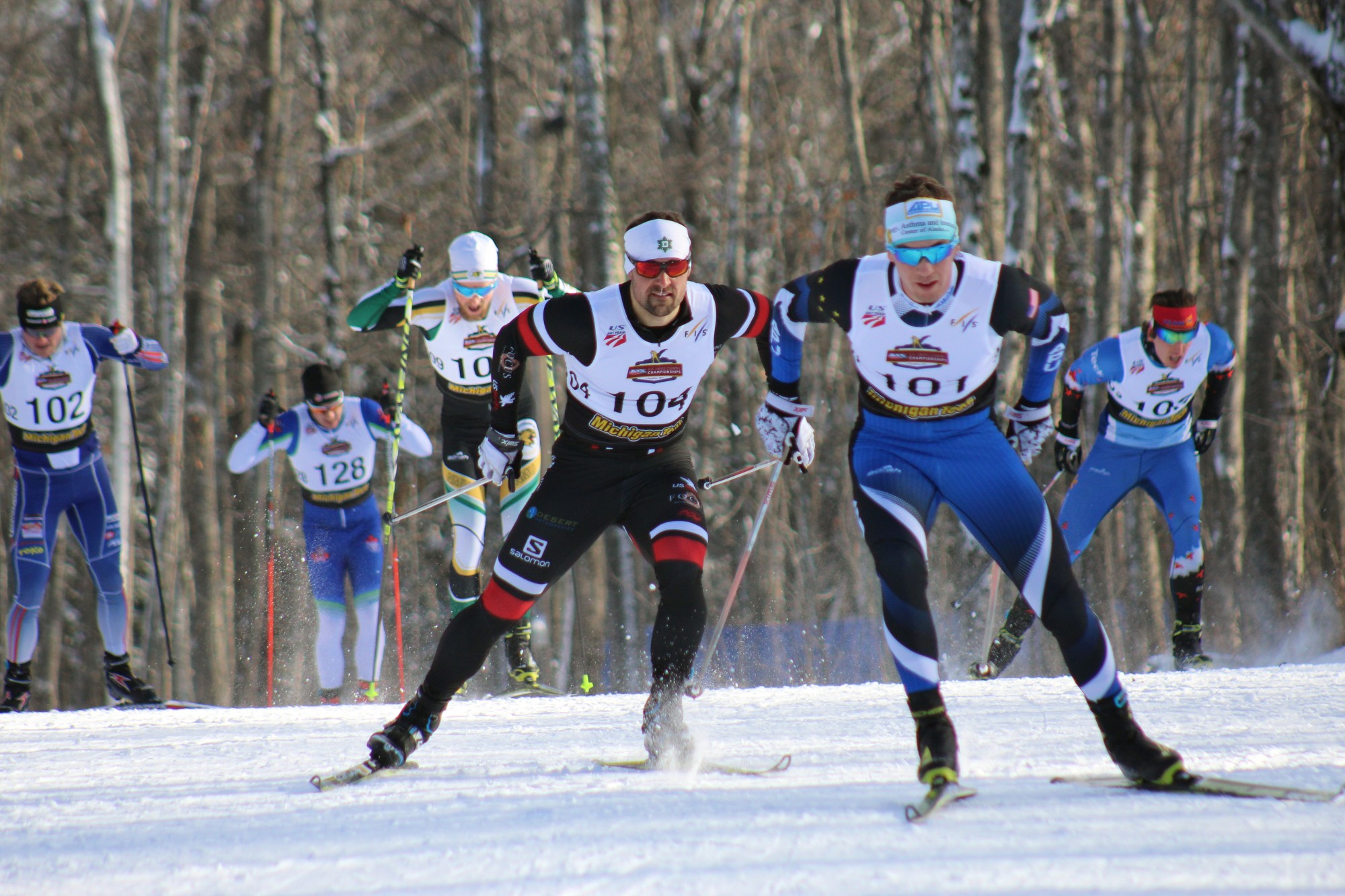
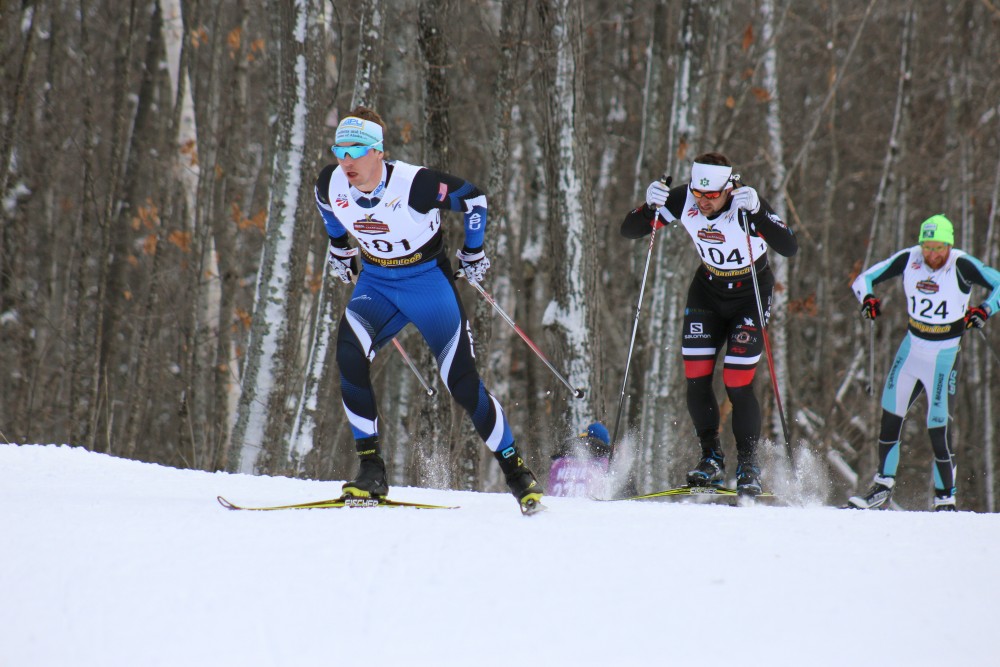
    APU’s Reese Hanneman (Bib No. 101) leads Bend Endurance Academy’s Dakota Blackhorse-von Jess (Bib No. 104) as well as (back: left to right) Miles Havlick (SVSEF),  Evan Palmer-Charrette (NDC Thunder Bay), Fredrick Schwencke (NMU), and Julien Locke (Team Black Jack) during the final of the men’s 1.5 k freestyle sprint on Monday at U.S. nationals in Houghton, Mich.
    APU’s Reese Hanneman (Bib No. 101) leads Bend Endurance Academy’s Dakota Blackhorse-von Jess (Bib No. 104) as well as (back: left to right) Miles Havlick (SVSEF), Evan Palmer-Charrette (NDC Thunder Bay), Fredrick Schwencke (NMU), and Julien Locke (Team Black Jack) during the final of the men’s 1.5 k freestyle sprint on Monday at U.S. nationals in Houghton, Mich.

    HOUGHTON, Mich. — With close to a 500-meter incline to the finish, rounding the same course potentially four times in head-t0-head heats and a qualifier, Monday’s 1.5-kilometer freestyle sprint at U.S. Cross Country Championships proved a test beyond sheer fitness and tact. For overall race winner, Reese Hanneman of Alaska Pacific University (APU), it was combination staying smart, smooth and relaxed.

    “I was just trying to stay relaxed [through the heats],” said Hanneman, a 2014 classic sprint national champion, after notching his second sprint title on Monday. “I know that I’m in great sprint form right now. I have the acceleration, I have the power and I was just trying not to use that unnecessarily early. This finish is very long and very uphill so it takes a big punch in order to make it to the line first.”

    The fastest qualifier in a time of 3:18.07, the 26-year-old Hanneman held his own in first all the way through the men’s final.

    “I could tell all day watching Reese that he was very comfortable,” runner-up and defending skate champion Dakota Blackhorse-von Jess, of the Bend Endurance Academy, said in a post-race phone interview. “He’s skiing really well right now.”

    In his quarterfinal, Hanneman was first out of the start and in the lead as the group headed out onto the 1.5 k course. Rounding the final corner, again it was Hanneman in first, followed by Canada’s Alexis Turgeon (Skinouk/Quebec Ski Team) close to 10 meters behind.

    Hanneman won that heat in 3:18.07, while Michigan Tech’s Didrik Elset, chose the left outside lane to overtake Turgeon, ending up 0.31 seconds behind Hanneman for second in the quarterfinal. 

    Hanneman and Elset met again in the same semifinal, along with Blackhorse-von Jess, Brian Gregg (Team Gregg), Canada’s Michael Somppi (NDC Thunder Bay), and Silas Talbot (Alaska Winter Stars).

    Canadian Julien Locke (l) (Team Black Jack) challenges Eric Packer (APU) at around 400-meters to the finish of the semi-final for the men’s 1.5 k freestyle sprint on Monday at U.S. nationals in Houghton Mich. Locke went on to finish third overall (+2.89). Canadian Evan Palmer-Charrette (Bib No. 128) also advanced to the final and finished sixth overall (+12.93).
    Canadian Julien Locke (l) (Team Black Jack) challenges Eric Packer (APU) at around 400-meters to the finish of the semi-final for the men’s 1.5 k freestyle sprint on Monday at U.S. nationals in Houghton Mich. Locke went on to finish third overall (+2.89). Canadian Evan Palmer-Charrette (Bib No. 128) also advanced to the final and finished sixth overall (+12.93).

    Hanneman and Elset led out of the start gate, with Blackhorse-von Jess and Gregg tucked in close behind them. However, it was Hanneman once more who led the final uphill stretch to the finish, with Blackhorse-von Jess skiing right on his ski tails.

    Gregg managed to close the gap to the front two, and the three lunged for the line with Hanneman finishing first in 3:17.42, 0.21 seconds ahead of Blackhorse-von Jess in second, and 0.33 seconds ahead of Gregg in third.

    As Gregg waited to see if his time would be fast enough for a “lucky loser” spot in the final, the second semifinal, with APU’s Eric Packer and Logan Hanneman, Northern Michigan University’s Fredrik Schwencke, Miles Havlick (Sun Valley Gold Team), and Canadians Julien Locke (Team Black Jack), and Evan Palmer-Charrette (National Development Centre Thunder Bay) stepped up to the line.

    Schwencke and Havlick led from the start with Packer, the two Canadians, and Logan Hanneman (Reese’s younger brother) not far behind.

    Packer cornered into the final stretch in first, but with approximately 150 meters to go, Schwencke made the pass on Packer’s right while Locke moved into the left lane. Palmer-Charrette moved in behind Locke, while Havlick challenged Schwencke on the right.

    In a four-way lunge for the line, Scwencke won the second semifinal win in 3:17.04, while Havlick finished just 0.07 seconds after. The third- and fourth-place efforts by the two Canadians, Locke (+0.14) and Palmer-Charrette (+0.27), proved worthwhile, as they both earned the two available lucky loser spots in the final. 

    Fredrick Schwencke (NMU) leads Miles Havlick (SVSEF) and Haakon Hjelstuen (Lyn Ski) around the final corner before the last 500-meter incline to the finish during their quarterfinal of the men’s 1.5 k freestyle sprint on Monday at U.S. Nationals in Houghton, Mich.
    Fredrick Schwencke (NMU) leads Miles Havlick (SVSEF) and Haakon Hjelstuen (Lyn Ski) around the final corner before the last 500-meter incline to the finish during their quarterfinal of the men’s 1.5 k freestyle sprint on Monday at U.S. Nationals in Houghton, Mich.

    “In both the quarter and semi, I stayed pretty relaxed during the first two thirds of the course and was at the back of the pack,” Palmer-Charrette, 21 said. “After saving my legs off the start, I was able to work my way up after the main climb through the finishing stretch to the front, or close to the front.” 

    The action for Palmer-Charrette and the five other finalists — Hanneman, Blackhorse-von Jess, Locke, Schwencke, and Havlick — continued as they lined up for the men’s final. 

    Hanneman and Havlick took it out from the starting gate, with Havlick moving to the front for the first part of the course.

    “I was leading on the lower part of the course and then I just kind of ran out of steam on the top part,” Havlick recalled. “Obviously these sprint races are some of the toughest days, but I was psyched to be in the final for sure.” 

    After Havlick led the first part of the final, Hanneman made his move during the second large climb on the course.

    “I was in second up the first climb and then there was a little downhill and I tried to work that corner and I was able to slingshot around and get my own lane up the second climb,” Hanneman said.

    From that point on, the past classic-sprint champ and last year’s early season SuperTour leader gained momentum for the finish.

    “The final didn’t really break up until the second main climb, then Reese Hanneman really pushed the pace and opened the field up a bit,” recalled Palmer-Charrette, who placed sixth overall.

    As Hanneman rounded the final corner in first, Blackhorse-von Jess raced into the righthand lane, challenging him for the win.

    “I built a little gap and Dakota was able to get away from the rest of the guys and he bridged up to me,” Hanneman said. “Then we came into the final lanes and I was ahead and he kicked and pulled up next to me and I was able to kick again and put the hammer down in the last 30 meters and get away from him.” 

    Hanneman took the final win in 3:15.14, while Blackhorse-von Jess finished 0.35 seconds behind him.

    “I’m pretty pleased to finish the day on the podium, fighting for the win,” said 29-year-old Blackhorse-von Jess.

    Left to right: Overall winner Reese Hanneman (APU), ahead of Dakota Blackhorse-von Jess (Bend Endurance Academy) and Brian Gregg (Team Gregg/Madshus) during their semi-final of the men’s 1.5 k freestyle sprint on Monday at U.S. Nationals in Houghton, Mich.
    Left to right: Overall winner Reese Hanneman (APU), ahead of Dakota Blackhorse-von Jess (Bend Endurance Academy) and Brian Gregg (Team Gregg/Madshus) during their semi-final of the men’s 1.5 k freestyle sprint on Monday at U.S. Nationals in Houghton, Mich.

    “I don’t think I’ve been in fifth place in a heat in a normal SuperTour or a nationals championship in a long time, and I was in fifth place today at one point and that’s cool,”  added Blackhorse-von Jess, who won both sprints at last year’s nationals. This year, he won the SuperTour classic sprint in Sun Valley, Idaho, in early December.

    “There’s a lot more moving around. There’s a lot more jostling for position. There’s more sprinting going on and it makes racing fun,” he said.

    Finishing 2.89 seconds after Blackhorse-von Jess was Locke in third for his first-ever U.S. nationals podium.

    “Today was fun,” Locke, 22, said. “We have our U23 World Champ trials next week so today was mostly just to see how my shape is and have a good race before that event. I’ll race the sprint on Saturday here and hopefully I can podium again”

    Palmer-Charrette is also looking for a top result at Canada’s U23 World Championship trials Jan. 14-17 at Lappe Nordic in Thunder Bay, Ontario.

    “It was a good day for Evan,” NDC Thunder Bay head coach Timo Puiras wrote in an email. “His shape has been steadily improving all race season and I look forward to seeing how he will race at the World U23 Trials on his home trails in Thunder Bay next week.”

    In his first skate-sprint final, collegiate skier Schwencke raced to fourth overall, 4.27 seconds after Hanneman.

    “I’ve never in my whole career of skiing qualified for a skate sprint so it was pretty fun to be in the final,” Schwencke said.

    “After the qualifier and the quarterfinal, everything was just a bonus,” the 23-year-old Norwegian added. “It was an amazing day.”

    Havlick finished fifth (+6.29) and Palmer-Charrette took sixth (+12.93).

    While it’s no secret that Hanneman will leave this race as the name to beat, he remains elusive about the pre-race sound beats that helped him come into his own.

    “It wasn’t Justin Bieber, we’ll just say that,” said Hanneman with a smile. 

  • More Than 40 Skiers ‘Align’ at First Camp of Its Kind in Canmore

    More Than 40 Skiers ‘Align’ at First Camp of Its Kind in Canmore

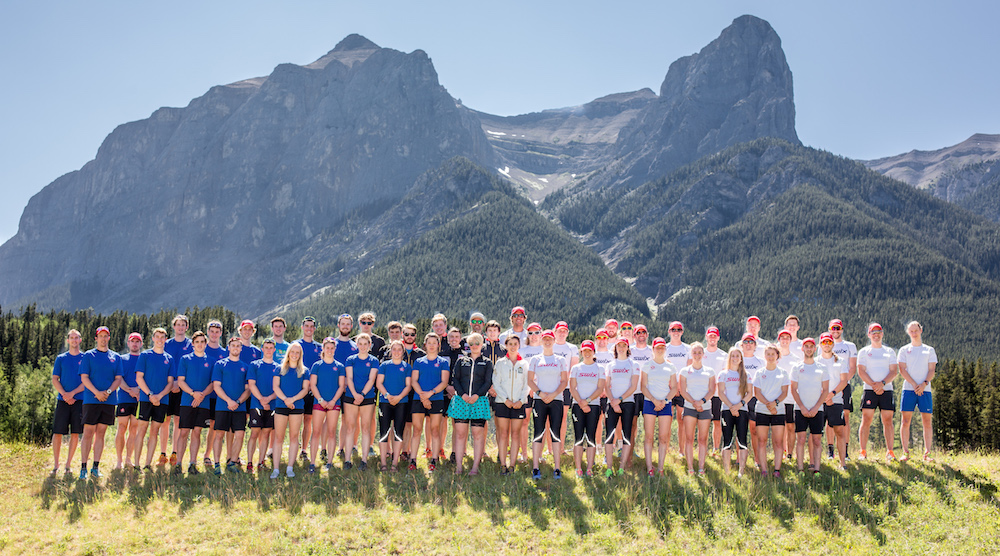
    The entire Alignment camp group shot in Canmore, Alberta  (Photo: CCC/Noel Rogers)
    The entire Alignment camp group, with members of the Alberta World Cup Academy, Thunder Bay and Pierre-Harvey national training centres, in Canmore, Alberta (Photo: CCC/Noel Rogers)

    The idea was simple: take your best athletes, put them in the same training space as your younger, developing skiers, and hope their talent rubs off. A group of coaches discussed that concept last fall at the Canadian National Team’s annual camp in Park City, Utah. But rather than talk about it, Justin Wadsworth, Louis Bouchard, Chris Jeffries, and Timo Puiras created a plan to make it happen.

    The first Alignment camp, held June 19 to July 3 in Canmore, Alberta, included about 40 skiers, mostly from Canada’s three national-training centres: Pierre-Harvey, Thunder Bay and the Alberta World Cup Academy, as well as some clubs. Coaches, strength training and physiologists came along, too.

    “It was an open camp…,” Wadsworth explained in a phone interview. “We had a big group of not only athletes, but of coaches and support staff around to make sure we’ll all doing the best thing we can for the athletes.”

    The national team head coach, Wadsworth credited the collective brainpower of the coaches at the Park City camp for the alignment idea, which was meant to unite the nation’s top talent for two weeks.

    “To get all the athletes together in one place and really push each other is really helpful,” he said. “I think that’s part of why the Norwegians are so good; they have so many athletes that are going for so few spots [on the national team] and the competition in training is so high. I’ve seen it firsthand, being part of their camps, and it’s a healthy thing. It brings out everybody’s ‘A’ game.”

    FasterSkier asked Wadsworth more about the domestic camp, and how it went in its first year.

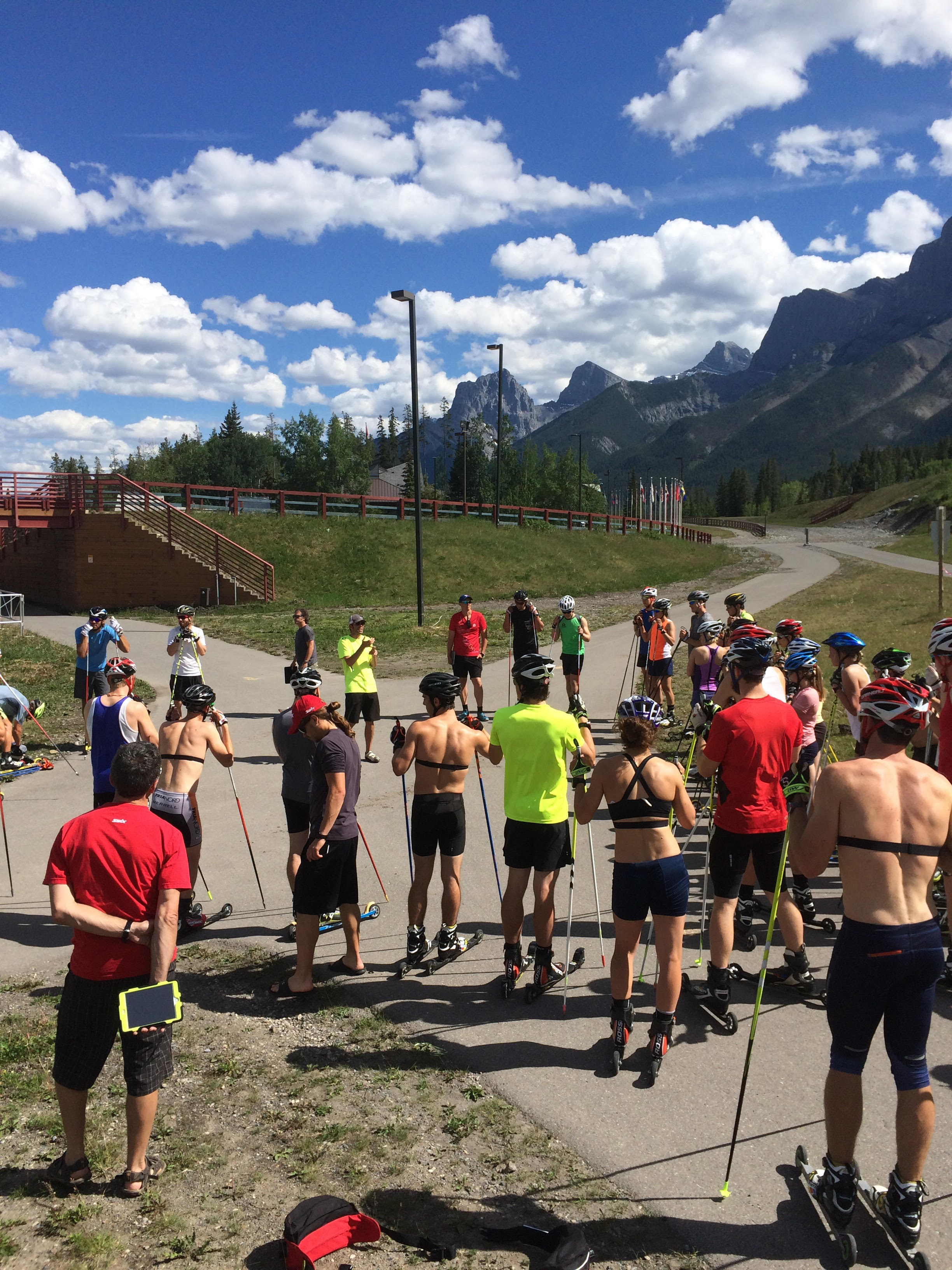
    Athletes at the first-ever Canadian Alignment camp, from late June to early July, meet during a rollerski workout at the Canmore Nordic Centre in Canmore, Alberta. (Photo: Eric de Nys)
    Athletes at the first-ever Canadian Alignment camp, from late June to early July, meet during a rollerski workout at the Canmore Nordic Centre in Canmore, Alberta. (Photo: Eric de Nys)

    FasterSkier: What was the goal of the alignment camp, and how successful was it?

    Justin Wadsworth: It was really important, with that many people, to make sure that we were organized and executing the workouts well, so that’s where we really had a lot more preparation to really lay out each workout and the timing of it, how we were going to run it, and making sure we had enough eyes on all the groups. We had an anaerobic interval session out here and had almost 50 athletes so we had to be really on top of making sure that everyone had a good quality workout, but we also want our best athletes to make sure they’re not getting lost in the shuffle. I don’t think there was a single workout that we walked away from thinking, “Oh, that was just a sh*t-show.” It was all very well run and that was [because of] a lot of input from all the coaches working ahead of time. Overall, I think everyone came out of the camp feeling really good and having guys like [World Cup athletes] Alex [Harvey], Devon [Kershaw], Ivan [Babikov], and Len [Valjas] … they took the time to talk about their experiences before the workouts and give a little preamble. Other athletes could hear how the older athletes were going to execute [the workout]. That was really successful.


    FS: Why was Canmore picked as the camp venue?

    JW: For one, money. We have a lot of our resources here and the NST [national ski team] and the Alberta World Cup Academy are based here, and Canmore is a great place because we have a lot of housing available. Funding was a big part of it, getting everybody somewhere else [like New Zealand], we just don’t have the money for it right now. Our budget’s been cut half a million in two years, so we have to be really careful with our resources. The other reason we chose Canmore, we wanted to do testing for a lot of the out-of-town athletes. We basically had two or three days on the [rollerski] treadmill where athletes got tested from the different training centres. … Plus Canmore is a great place to train. Another part was the altitude; we did want to have some brief altitude exposure so we spent a couple days at Highwood Pass [the highest paved pass in Canada at 2,200 meters/7,240 feet] and a day at Sunshine Meadows [2.300 meters/roughly 7,500 feet].


    FS: Where is the national team headed next for camp? How has the budget this year affected your training destinations? 

    Note: Three members of the Senior NST — Alex Harvey, Devon Kershaw and Jess Cockney — are currently training at altitude in Livigno, Italy. A women’s camp is taking place in Quebec, starting Aug. 9, with Emily Nishikawa (NST), Dahria Beatty (NST/Alberta World Cup Academy) and members of the Thunder Bay and Pierre-Harvey training centres.

    JW: The only person funded for [the Livigno camp] is Alex. The cost of it is fairly prohibitive so only Devon, and Jess Cockney are joining Alex there, and they’re paying their own way. … We’re able to provide a little bit of funding for the national-team women to go [to Quebec] but basically we don’t have the money for a New Zealand camp this summer. We just have to get through and everyone has to keep training while on their own, or if they’re going to these camps, they’re paying for it. The next camp after that will be a camp that is funded and everyone will be going to — it’s our only real camp outside Canmore this year — and that’s in Park City. That’s an [eighteen-day] altitude camp in September and October. I’d love to have brought the team to New Zealand or to race in Norway, like the U.S. is doing, but we just don’t have the money.


    FS: How have the staffing changes at Cross Country Canada affected the team? 

    JW: The changes that have happened, which were basically losing Tor-Arne [Hetland], hasn’t changed much as Tor-Arne just came in for camps last year. I’m still here, Louis is still in Quebec and is leading the training camp in Livigno, and I’ll be going to the women’s camp in Quebec, and then we’ll both be in Park City. In the winter, we’re just going to flip flop in sections … Having one less staff is just [because of] less money [in] the budget. Maybe it isn’t the most ideal situation, but we just have to look at the positives of it and make it happen, and get the results this year.


    FS: How has the announcement of the 2016 Tour of Canada affected the team?

    JW: I think it has made a big impact on the athletes. It’s definitely the biggest goal of the year, to get as many podiums as we can there and also get a lot of good results from the younger athletes. You know, we always talk about how going to Europe is hard for people because of the time changes and here we have races that are going to be in our backyard so there are no excuses. We really need to perform as a team there at all the different levels. It’s exciting, and I can’t wait for it to happen. It’s going to be a pretty fun eleven days.

  • Cross Country Ski Coaches’ Development Conference Slated for Barrie, ON


    CoachConferenceFlyer

    (Press release)

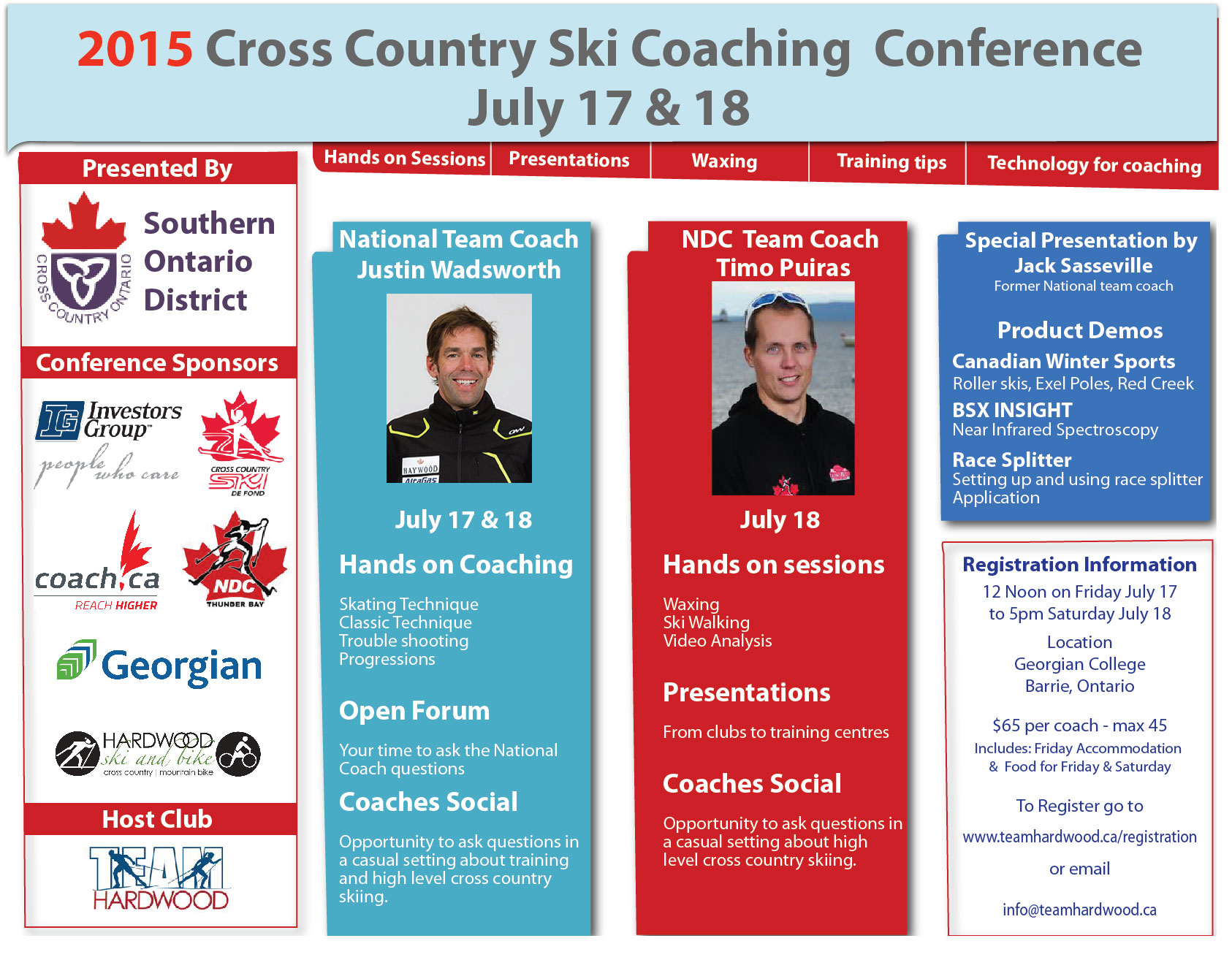
    (May 19, 2015) — The Southern Ontario District (SOD) of Cross Country Ontario and Team Hardwood are pleased to announce that a Coaching Development Conference will be held at Georgian College in Barrie, ON from July 17-18, 2015.

    The conference will feature two days of interactive sessions with Justin Wadsworth, Head Coach, Canadian National Ski Team, and Timo Puiras, Head Coach, National Development Centre, Thunder Bay.  Wadsworth and Puiras will lead a variety of learning and development sessions on skate and classic ski technique, trouble-shooting, athlete progression, waxing, using video analysis when working with athletes and more.  Equally as valuable will be the opportunity for coaches of all levels to ask questions, share information and learn from each other during both formal presentations and open forums.  A Coaches’ Social is also planned.


    The conference will also feature demonstrations and presentations from a variety of suppliers, including Canadian Winter Sports, BSX Insight and Race Splitter, allowing coaches to learn about the latest products and technology available.  Former NST Coach Jack Sasseville is also a presenter.

    Coaches from across Canada and beyond are invited to participate.  Thanks to the support of Cross Country Ontario and the Coaches Association of Ontario, registration for this conference is offered for just $65.00 per coach, which includes participation in all sessions, Friday night accommodation at Georgian College and all meals on Friday and Saturday.

    “This is an awesome opportunity for coaches to get together and learn from the best coaches in the country and from each other,” says Ron Howden, Team Hardwood Head Coach and Technical Director, and conference organizer. “We’re grateful to Cross Country Ontario, the Coaching Association of Canada and Georgian College for making this affordable so as many coaches as possible can attend.”

    Registration is open now at www.teamhardwood.ca/registration.  For further information, contact Ron Howden at info@teamhardwood.ca.

    team hardwood cross country ontario logos

  • Thunder Bay Skiers Kick Off Racing Season with NDC Rock Invitational

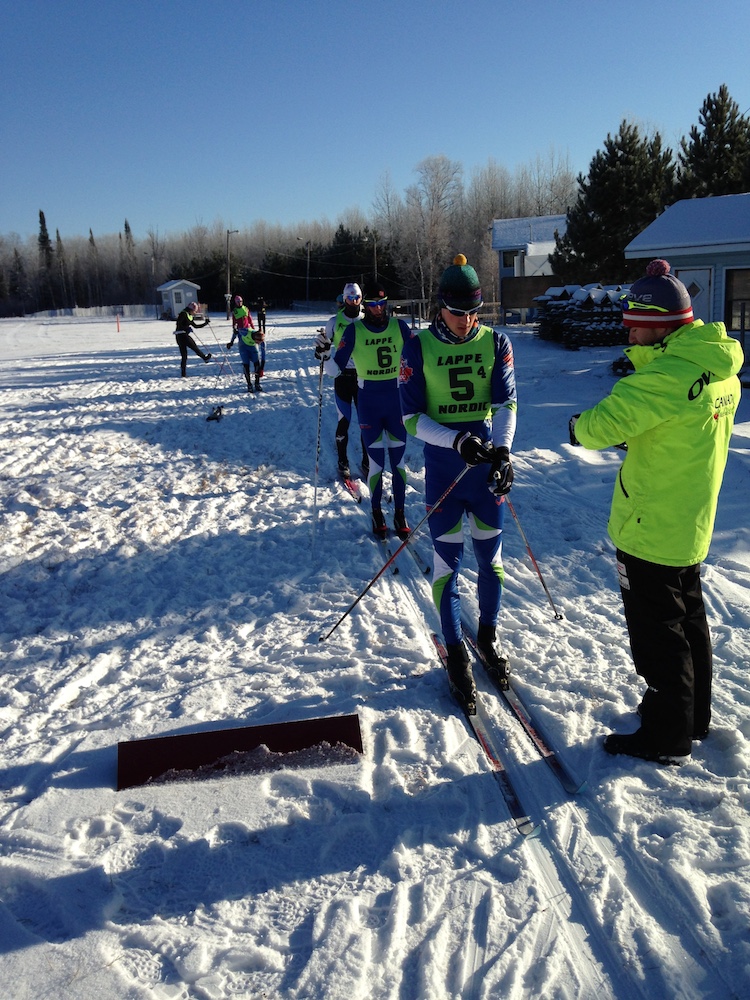
    NDC Thunder Bay Nov. 14 TT Start at Lappe Nordic

    THUNDER BAY CROSS COUNTRY SKIERS KICK OFF 2014/15 RACING SEASON

    NDC ROCK Ski Invitational held at Lappe Nordic Centre

    THUNDER BAY, ON (Nov. 14, 2014) – Thunder Bay XC-skiers kicked off their 2014/15 racing season today at the Lappe Nordic Centre. 14 athletes competed on a 2-kilometre loop expertly shoveled and groomed by local ski aficionado Pauli Kaki. The Men’s 8 lap (16km) race was dominated by Andy Shields who won by 2 minutes over fellow National Development Team member Bob Thompson. Evan Palmer-Charrette, also of the National Development Team rounded out the podium in third. Victory in the Women’s 5 lap (10km) competition was taken by NDC skier Jenn Jackson over teammate Alannah MacLean. Local Lappe Ski Club skier Laura Inkila took 3rd place.

    National Development Centre Head Coach Timo Puiras was quoted as saying “This was a good practice race for our upcoming season. Having recently returned from an altitude camp in Alberta everything looks to be on track.” NDC athletes will depart Thunder Bay at the end of November for a month long racing series in Montana and British Columbia. Puiras continued “the main goal of the season will come in January when athletes will be looking to qualify for the World Junior/Under 23 World Championships in Almaty Kazakhstan.” Puiras will be the lead coach for those Championships and is confident that several Thunder Bay National Development Centre athletes will ski fast enough to qualify. The season will culminate in March when Thunder Bay will play host to the Canadian National XC Ski Championships.

    The annual NDC Nordic Fest FUNdraiser Dinner will be held Saturday November 15th at 6pm. Tickets are still available. Please email ndcthunderbay@gmail.com for more information.

    Results

  • NDC Thunder Bay Returns to Birkie Land for Hayward Camp

    NDC Thunder Bay Returns to Birkie Land for Hayward Camp

    Editor’s Note: The following training-camp recap was written by Jenn Jackson, a member of NDC Thunder Bay and Canada’s Junior National Team. Last month, her training centre, located in Thunder Bay, Ontario, returned to one of its favorite places south of the border: Wisconsin. To submit your own camp writeup, please email info@fasterskier.com with the subject line: “Camp Recap.”

    ***

    As summer slowly begins to turn to fall, the National Development Centre of Thunder Bay made its way south for its final dryland camp of the year.

    From Aug. 16 to 27, athletes of NDC Thunder Bay could be found rolling along the roads near Hayward, Wis. The team has hosted camps in the area before; taking advantage of the quiet, well paved roads, and extensive trail systems, which play host to the American Birkebeiner in late February.

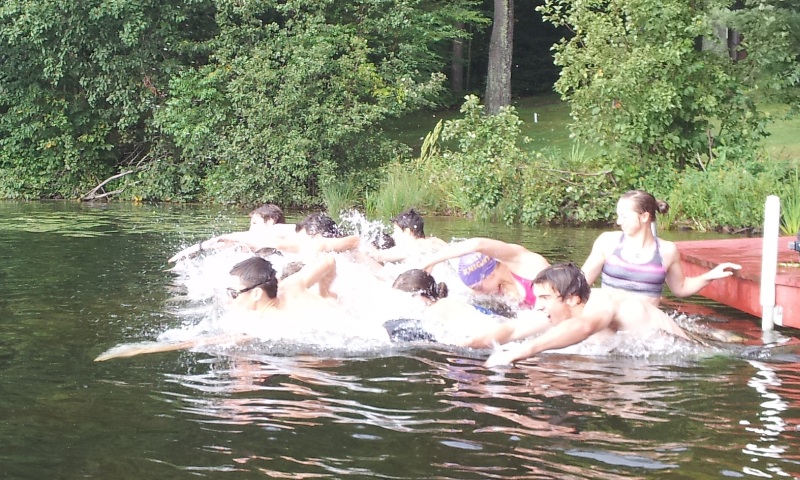
    The start of NDC's swim-run-ski triathlon in Hayward, Wis., which according to Coach Puiras “is a bit of a tradition at the Hayward camp." (Photo: NDC Thunder Bay)
    The start of NDC’s swim-run-ski triathlon time trial in Hayward, Wis., which according to coach Timo Puiras “is a bit of a tradition at the Hayward camp.” (Photo: NDC Thunder Bay)

    “There was a nice variety of terrain so we could concentrate on exactly the technique and training aspect we were focusing on for any particular training session,” NDC Head Coach Timo Puiras wrote in an email. “Living on the lake at Crest Hill resort meant we could access a wide variety of training venues right from our front door making recovery and rejuvenation post workout ideal.”

    Puiras explained that, for most of the team, the focus of the camp was high quality roller ski volume, but that some of the more senior athletes had “ … a more intensity driven camp.”

    See the video here.

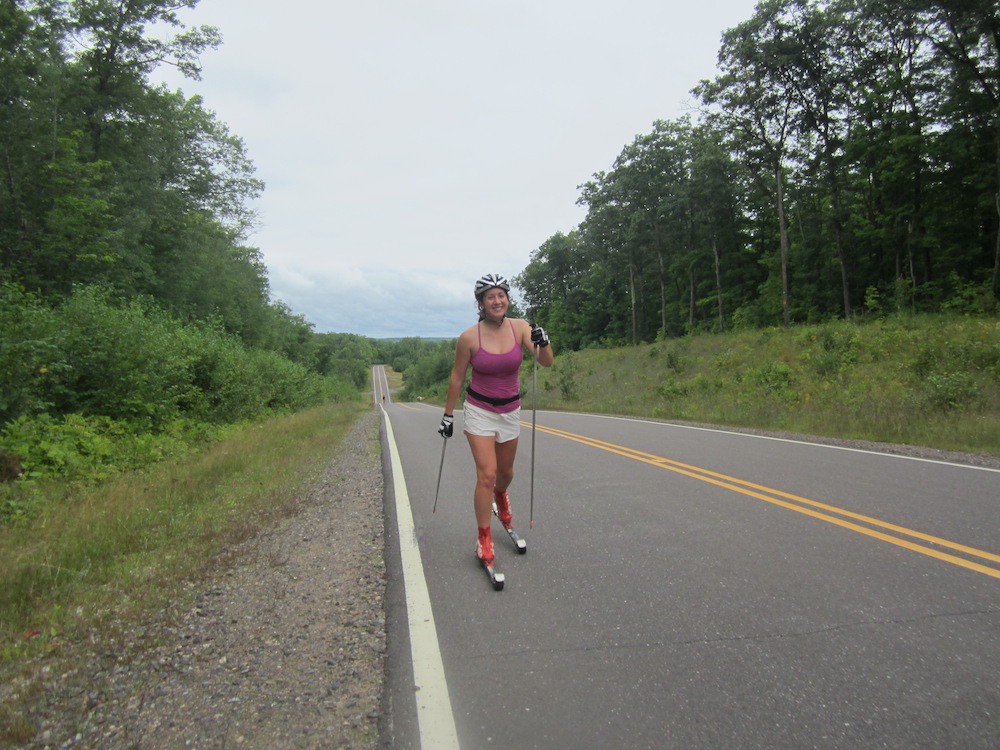
    During the 12-day camp, the group completed three intensity sessions, all involving rollerskiing – a marked change from the NDC’s typical summer intensities, which are done almost exclusively running or ski striding.

    One of these workouts was a rollerski-sprint paceline, which the team adopted from Canadian World Cup Team coach Tor-Arne Hetland after a collaborative camp earlier this summer in Bend, Ore.

    “We do the paceline to practice good form and speed,” NDC athlete Andy Shields explained. “With the drafting component we get to use very fast movements without it being too fatiguing. When we get to the head of the train, the sprit at the front simulates a sprint to the finish line.”

    To ensure everyone was competitive within the paceline, assistant coach Victor Wiltmann inventoried and reassigned rollerskis to athletes according to who was strongest in the sprints and who needed a little extra speed.

    For new athletes Julian Smith and Sam Greer, this was their first training camp with the team and was a very positive experience.

    “It was incredible,” Smith wrote. “You are isolated, you spend a lot of time with your teammates and you get to learn a lot about all of them.”

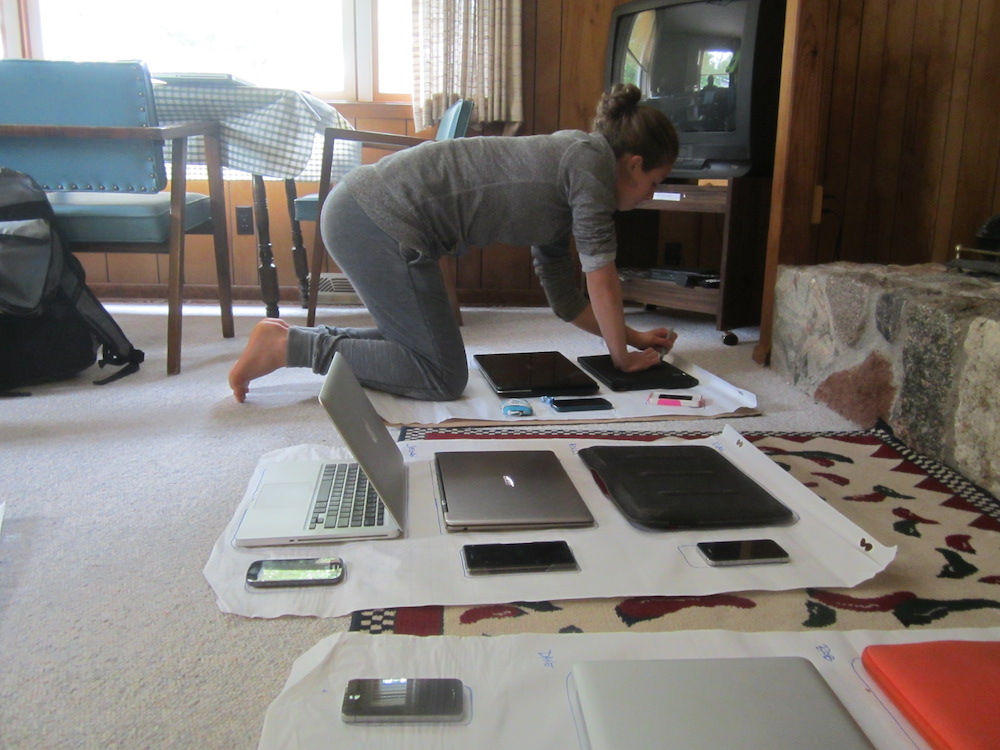
    Depositing technology for the blackout, which coach Timo Puiras explained was meant "to encourage team building and to prohibit screen time in the afternoon." (Photo: NDC Thunder Bay)
    Depositing technology for the blackout, which coach Timo Puiras explained was meant “to encourage team building and to prohibit screen time in the afternoon.” (Photo: NDC Thunder Bay)

    This isolation was not only geographical, but technological as well.

    “The technology blackout was a bit of an experiment,” Puiras wrote. “I had two main goals for the technology blackout: to encourage team building and to prohibit screen time in the afternoon, most importantly just before sleep. I was curious to see if preventing screen time in the afternoon would have any effect on recovery and sleep. Obviously this was a highly unscientific, subjective observation, but no one on the camp got sick and everyone’s mood stayed notably positive.”

    Without their electronics, the athletes enjoyed the lakeside facilities, “… spending quality time together, swimming in the lake, playing guitar, and slacklining” Smith wrote. In the evenings, some athletes would do supplementary sprint workouts, dashing from the sauna down to the docks and into the lake.

    Midway through the camp, the athletes hit their longest single-session day with a four-hour classic rollerski. Rather than staying to the familiar roads near the Crest Hill, the coaches mapped out a 65-kilometre loop which wound its way up and around Cable – where the team would use CXC’s team gym for strength, then back to the resort.

    Guest athlete, Holly Brown during four-hour classic roller ski workout (Photo: NDC Thunder Bay)
    Guest athlete, Holly Brown during four-hour classic roller ski workout (Photo: NDC Thunder Bay)

    On the workout, Puiras commented: “I am fairly certain that this is the first time in my career that after 4 hours of roller skiing every single athlete was still positive and could have easily kept on going for more.”

    That positivity wavered slightly for some as the final intensity workout of the camp approached: the swim-run-ski triathlon time trial, which according to Puiras “is a bit of a tradition at the Hayward camp,” and challenged some of the land-loving athletes with a 230-metre lake swim.

    In an effort to have men and women finish close to the same time, the men’s run and roller ski courses were slightly longer (4.7 k and 12.8 k) than the women’s (3.5 k and 9.0 k). As the athletes finished the TT, it was the women who seemed to have the edge on the shorter course. For results, click here.

    The team has now returned to the north side of the border so the student-athletes can prepare for the start of the academic semester at Lakehead University and Confederation College.

    With more than half of the training season behind them, “Everything is on track and looking positive for the fall training season,” Puiras wrote.

    The team will train locally in Thunder Bay until mid-October when they head west to Canmore for Frozen Thunder. In the meantime, they have a testing week scheduled, as well as the Pancake Run.

    ***

    The National Development Centre of Thunder Bay is one of three high performance training centres in Canada. Last year the team had athletes qualify for both Junior and Under 23 World Championships, and won numerous medals at Canadian Nationals. They are currently running a campaign to compensate for severe funding cuts to their program, to learn more visit: TeamUpNDC.com and follow @NDCTBay on Twitter.


    Trouble viewing video above? Click here.

  • The Four: NDC Thunder Bay

    The Four: NDC Thunder Bay

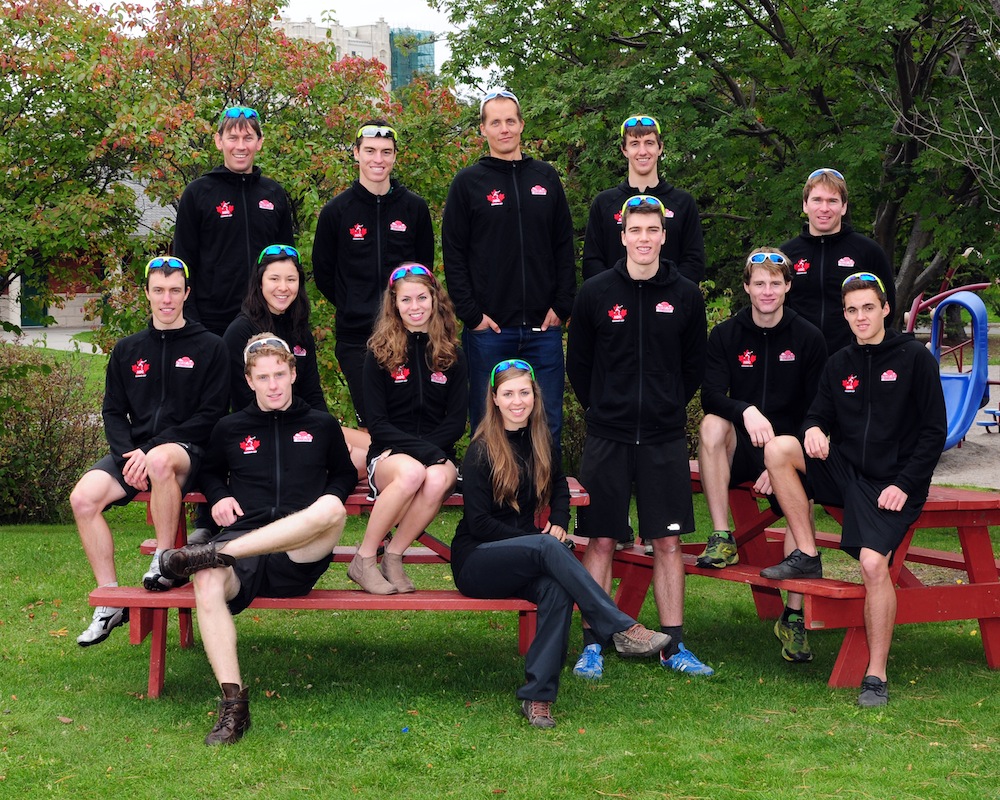
    The 2013/2014 NDC Thunder Bay squad. Front Row (left to right): Andy Shields, Jack Carlyle, Jenn Jackson, Alannah MacLean, Erin Tribe, Nick Monette, Bob Thompson, Evan Palmer-Charrette. Back Row (l-r) executive director Eric Bailey, Scott Hill, head coac Timo Puiras, Ben Wilkinson-Zan, and assistant coach Victor Wiltmann. (Photo: NDC Thunder Bay)
    The 2013/2014 NDC Thunder Bay squad. Front Row (left to right): Andy Shields, Jack Carlyle, Jenn Jackson, Alannah MacLean, Erin Tribe, Nick Monette, Bob Thompson, Evan Palmer-Charrette. Back Row (l-r) executive director Eric Bailey, Scott Hill, head coach Timo Puiras, Ben Wilkinson-Zan, and assistant coach Victor Wiltmann. (Photo: NDC Thunder Bay)

    Note: This is the third of four previews providing an inside look at Canada’s national training centres this season. We asked coaches to tell us what’s new, whom to look out for and the outlook on the winter ahead. Teams are presented in no particular order.

    Team: National Development Centre Thunder Bay (NDC)

    Coaches: Timo Puiras (head coach), Victor Wiltmann (assistant coach)

    Other staff: Eric Bailey (executive director), Camille Cheskey (wax technician), Paul Hemsworth (strength and conditioning coach)

    Seniors: Andy Shields, Jack Carlyle, Nick Monette, Bob Thompson, Erin Tribe, Alannah Maclean; Juniors: Scott Hill, Evan Palmer-Charrette, Ben Wilkinson-Zan, Jenn Jackson

    Who’s new: Jackson (from Team Hardwood in Ontario) and Wilkinson-Zan (from Nakkertok in Ontario).

    Who’s missing: Andrea Lee (studying in New Mexico); Dudley Coulter (now an athlete development coordinator for Cross Country B.C. in Vernon); Jimmy Gunka (at Lakehead University in Thunder Bay, Ont.); Jordan Cascagnette (at Nipissing University in North Bay, Ont.); Julian Freitag (studying at a university in southern Ontario).

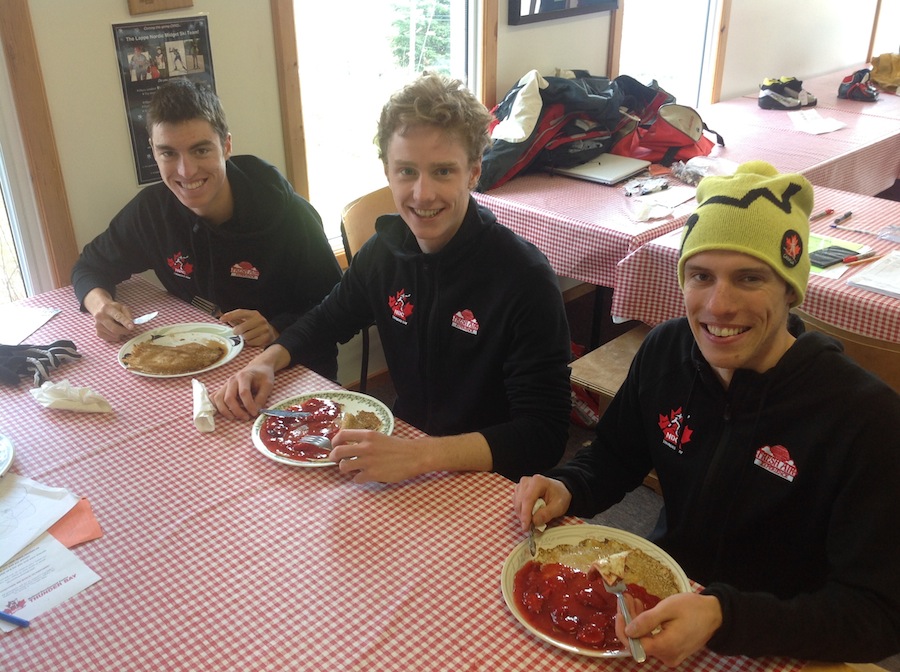
    NDC Thunder Bay skiers Jack Carlyle, Scott Hill and Andy Shields (not in order) enjoy the fruits of their efforts after become three of seven men to break the 1:20 time-trial threshold on Friday. (Photo: Timo Puiras)
    NDC Thunder Bay skiers Jack Carlyle, Scott Hill and Andy Shields (not in order) enjoy the fruits of their efforts after become three of seven men to break the 1:20 time-trial threshold on Oct. 18. (Photo: Timo Puiras)

    Top results last season: Last December, Shields and Tribe both qualified for the Quebec and Canmore World Cups, with Shields notching 41st in the Quebec skate sprint and Tribe placing just outside the individual top 50 in Quebec in 57th.

    In January, Shields, Hill and former NDC skier Lee all made it to Liberec, Czech Republic, for the Junior and U23 World Championships. Back home, Hill, Carlyle, and MacLean each reached the NorAm podium as juniors.

    Coach’s comments:

    Of six seniors, five are still in the U23 bracket (excluding 24-year-old Tribe), and the team has a new head coach in Timo Puiras.

    “It is a great group of athletes to work with,” Puiras wrote in an email last month. “Everyone is motivated and improving.

    In late July, the team traveled to Austria for three weeks of on-snow training on the Dachstein glacier. “Half of our athletes had never been to Europe before so this was not only a great training camp but also a great learning experience,” Puiras explained. “All of our athletes have their main racing goal involve making it to Europe this winter.”

    They spent the bulk of their training season in and around Thunder Bay, with smaller groups of athletes attending Ontario provincial camps. Before heading to Canmore, Alberta, for two weeks of skiing earlier this month, three NDC skiers (Shields, Carlyle and Scott) completed a time trial in record time and joined four others to slip under the Pancake Run’s 1:20-mark since 1979.

    Recent in-team testing has also indicated all-around improvement, and Puiras is excited about what his athletes could accomplish this season.

    “We want to qualify as many athletes as possible for World Junior/U23 Championships,” Puiras wrote. “As a program we’ve started working more closely with a Strength and Conditioning coach and I’d like this relationship to continue to grow here in Thunder Bay.”

    See also: Callaghan Valley | Pierre-Harvey Training Centre

  • Three Thunder Bay Skiers Slip Under Pancake Milestone

    Three Thunder Bay Skiers Slip Under Pancake Milestone

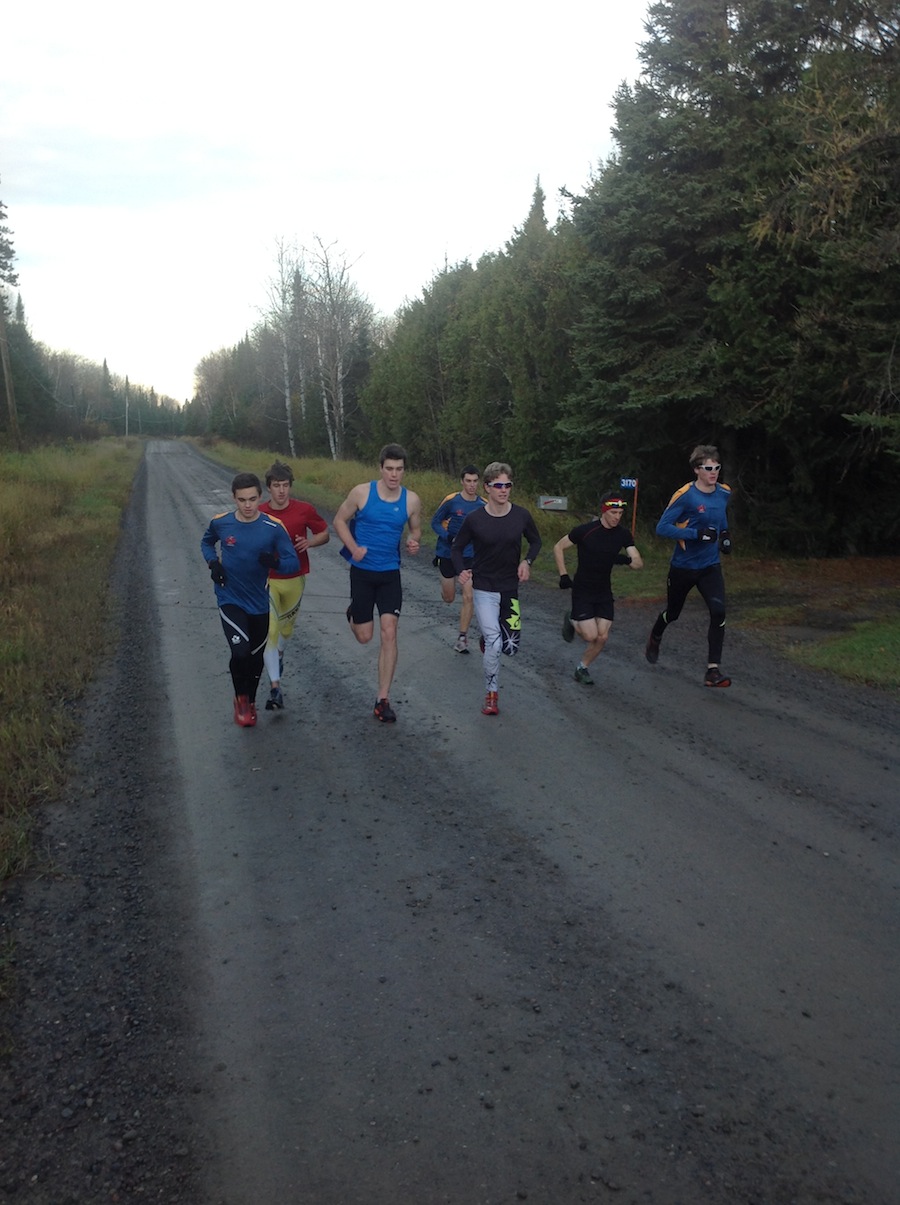
    The NDC Thunder Bay men's team competes for a chance to win pancakes by breaking the historic Pancake Run threshold, 1 hour and 20 minutes, on Friday in Thunder Bay, Ontario. (Photo: Timo Puiras)
    The NDC Thunder Bay men’s team competes for a chance to win pancakes for a year by breaking the historic Pancake Run threshold of 1 hour, 20 minutes on Friday in Thunder Bay, Ontario. From left to right: Evan Palmer Charrette, Ben Wilkinson Zan, Nick Monette, Scott Hill, Jack Carlyle, Andy Shields, and Bob Thompson. (Photo: Timo Puiras)

    Note: The following was written by NDC Thunder Bay Head Coach Timo Puiras, son of 1976 Canadian Olympian and Lappe Nordic Ski Centre owner Reijo Puiras, about the historic Pancake Run, which took place on Friday.

    THUNDER BAY, Ontario — The NDC Thunder Bay Team raced the annual Lappe Pancake Run on October 18th, 2013. The 22km loop run on hilly gravel road has a long and historic tradition.

    The run was started as an annual fitness test in 1979 by Pauli Kaki, who was coaching Reijo Puiras, 1976 Olympian and current owner/operator of the Lappe Nordic Ski Centre. Reijo ran his best time in 1980. Pauli recorded the time as 1:20:00 but Reijo insists the time was 1:19:59 on his wristwatch. The debate endures to this day.

    About 10 years ago Reijo put out the challenge that whoever could break his time would receive Lappe’s famous Finnish pancakes free for one year. Since then 7 athletes have run under the 1:20:00 threshold. Three of those athletes ran it this time.

    Jack Carlyle squeaked in under the mark at 1:19:51. Scott Hill ran a Junior Mens record of 1:18:33 and Andy Shields ran a new course record in a blazing time of 1:16:23.

    About 10 years ago Reijo put out the challenge that whoever could break his time would receive Lappe’s famous Finnish pancakes free for one year. Since then 7 athletes have run under the 1:20:00 threshold.


    NDC Thunder Bay skiers Jack Carlyle, Scott Hill and Andy Shields (not in order) enjoy the fruits of their efforts after become three of seven men to break the 1:20 time-trial threshold on Friday. (Photo: Timo Puiras)
    NDC Thunder Bay skiers Scott Hill (l), Jack Carlyle (c) and Andy Shields enjoy the fruits of their efforts after become three of seven men to break the 1:20 time-trial threshold on Friday. (Photo: Timo Puiras)

    Previous course record holder (1:18:12) and former NDC Thunder Bay member Chris Hamilton (current Alberta World Cup Academy athlete) tweeted “New Pancake Run king @AndrejShields. Well done buddy! #lappe #de-throned”.

    Reijo commented after the event that it was “a fantastic run. The course is as tough now as it was 30 years ago. It is a heart-warming event because I can relate to how difficult it is”

    The women’s version of the Pancake run is 15km and starts at the 7km mark of the men’s course. Although not as storied and historic as the men’s race, the Pancake threshold of 1 hour is just as difficult.

    This year’s race winner Jenn Jackson remarked that although she didn’t get under the threshold on this occasion she is looking for a pancake sponsor to fuel her way to a fast time next year.

    NDC TBay Pancake Test Run Results