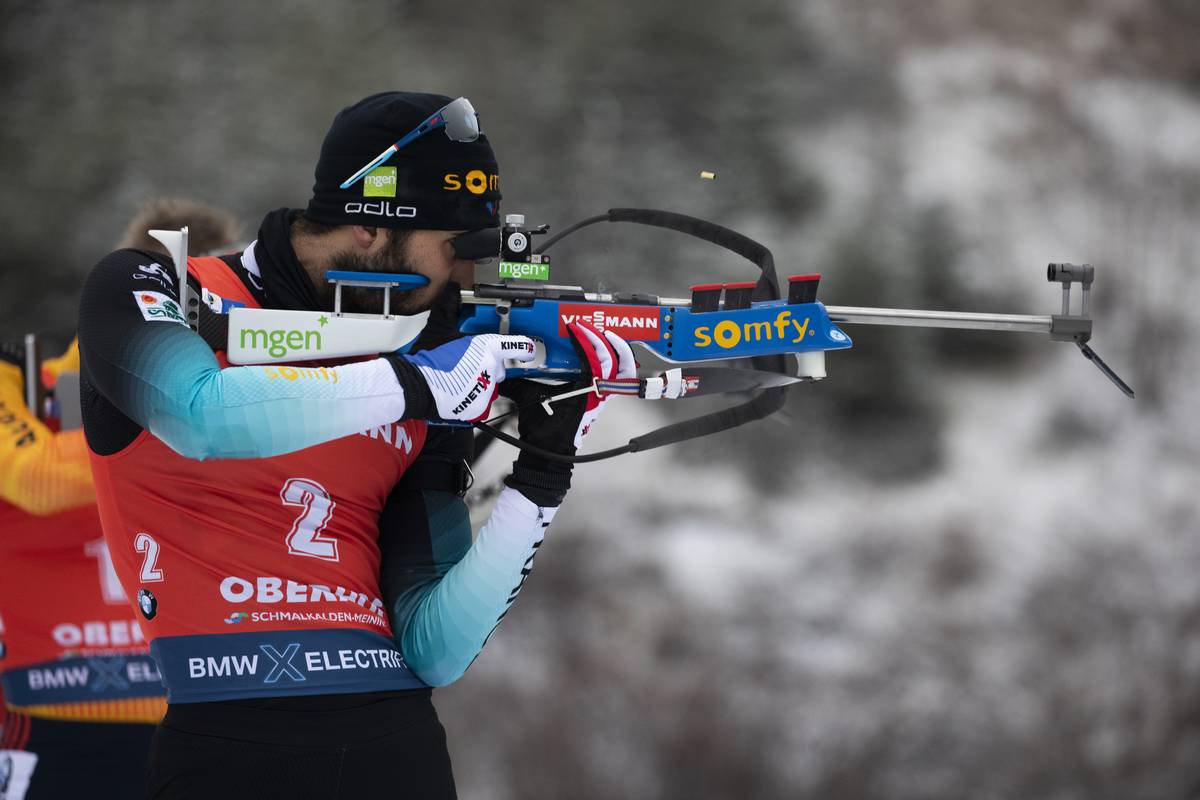
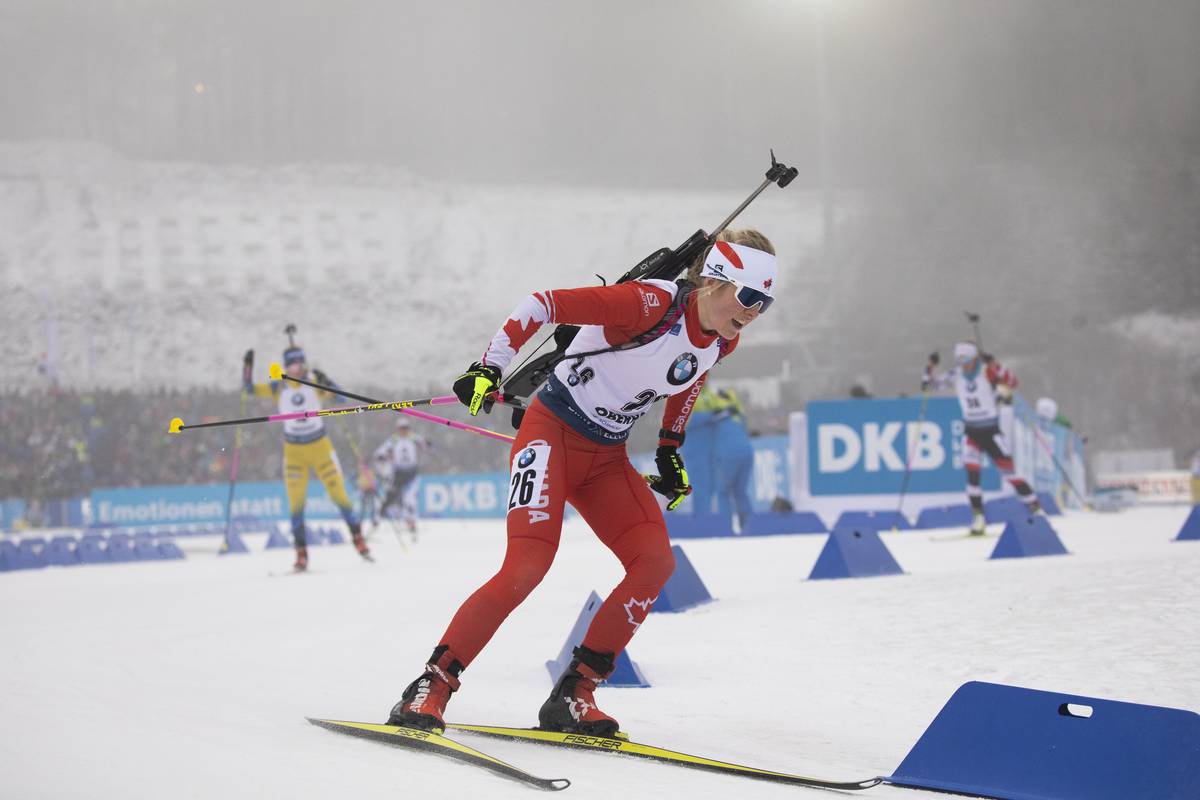
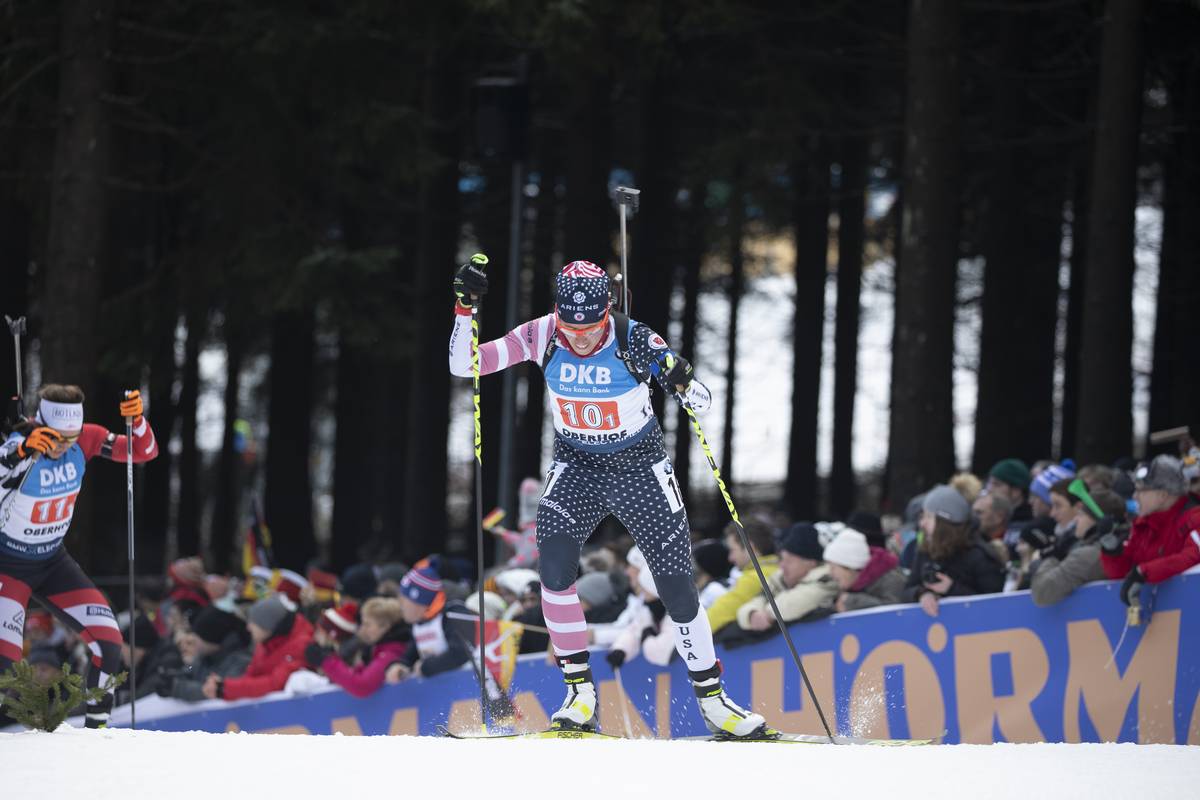
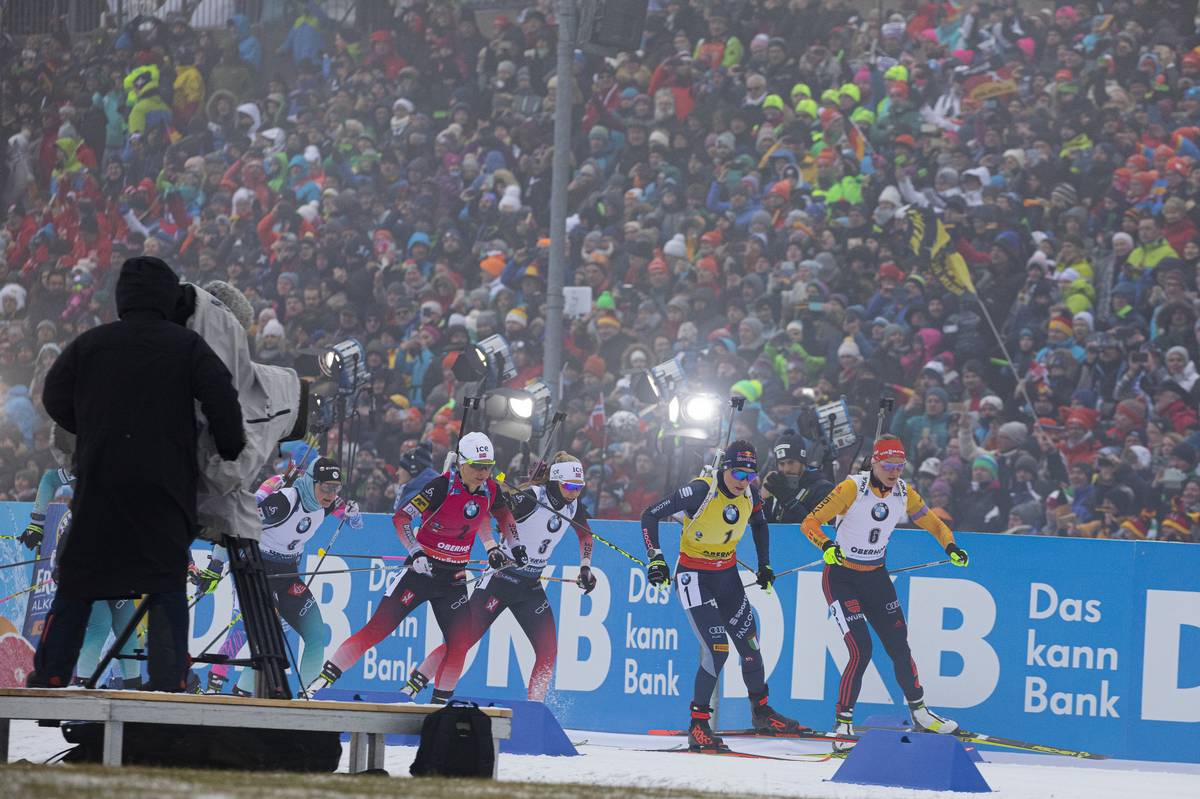
From the FasterSkier archive — posts syndicated from athletes’ and coaches’ own blogs between 2004 and 2012, kept online as published. Current coverage is at fasterskier.com.
The traveling IBU World Cup roadshow stops in Pokljuka, Slovenia this week and began the individual races. The women’s 15 k individual ran on Friday. The individual race format places a heightened premium on clean shooting; each missed shot amounts to an automatic minute penalty.
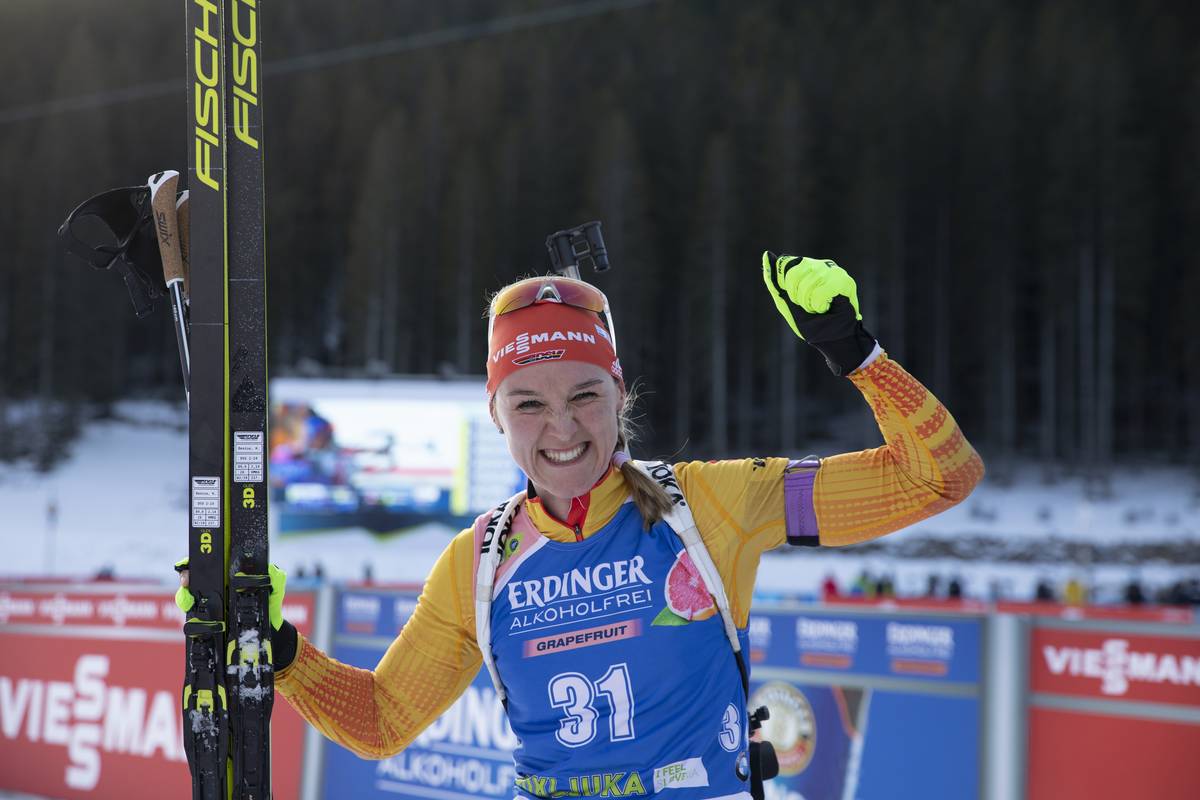
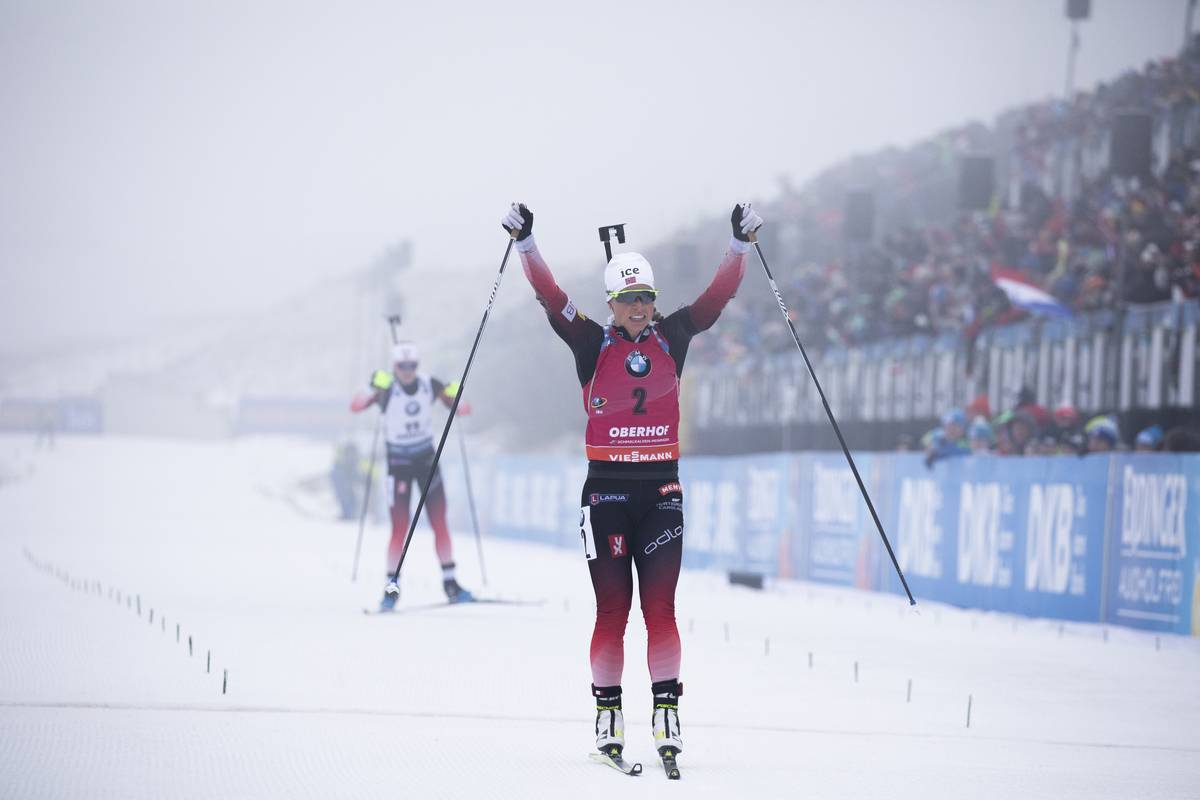
Tiril Eckhoff of Norway had been dominating the circuit recently. Yet, Friday, she fell in the standings to place an uncharacteristic 18th. In first place was former German cross-country skier Denise Herrmann. It was Herrmann’s first win of the season and her second podium. She won in 41:33.4 with no misses on the range. Sweden’s Hannah Öberg was second (+59.2; 0+1+0+0) and France’s Anais Bescond third (+1:15.7; 0+0+0+0).
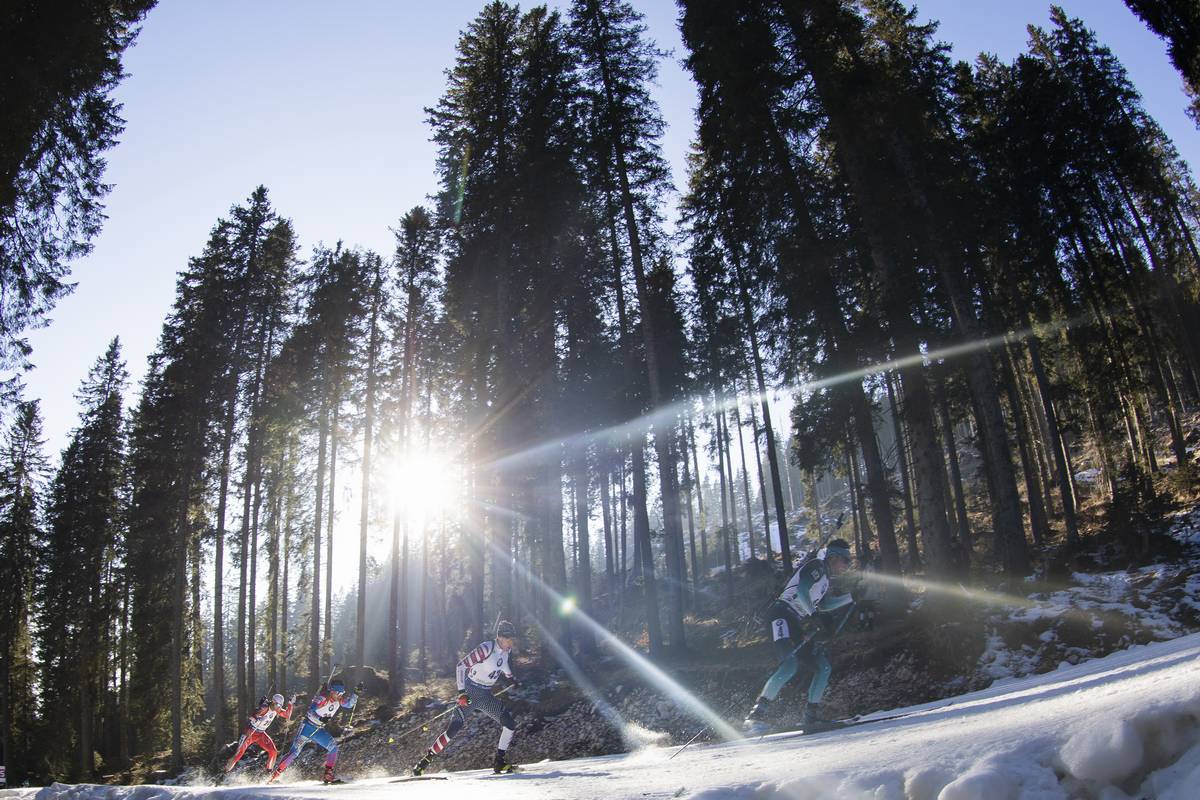
Denise Herrmann of Germany celebrating the 15 k individual win in Pokljuka, Slovenia. (Photo: NordicFocus)
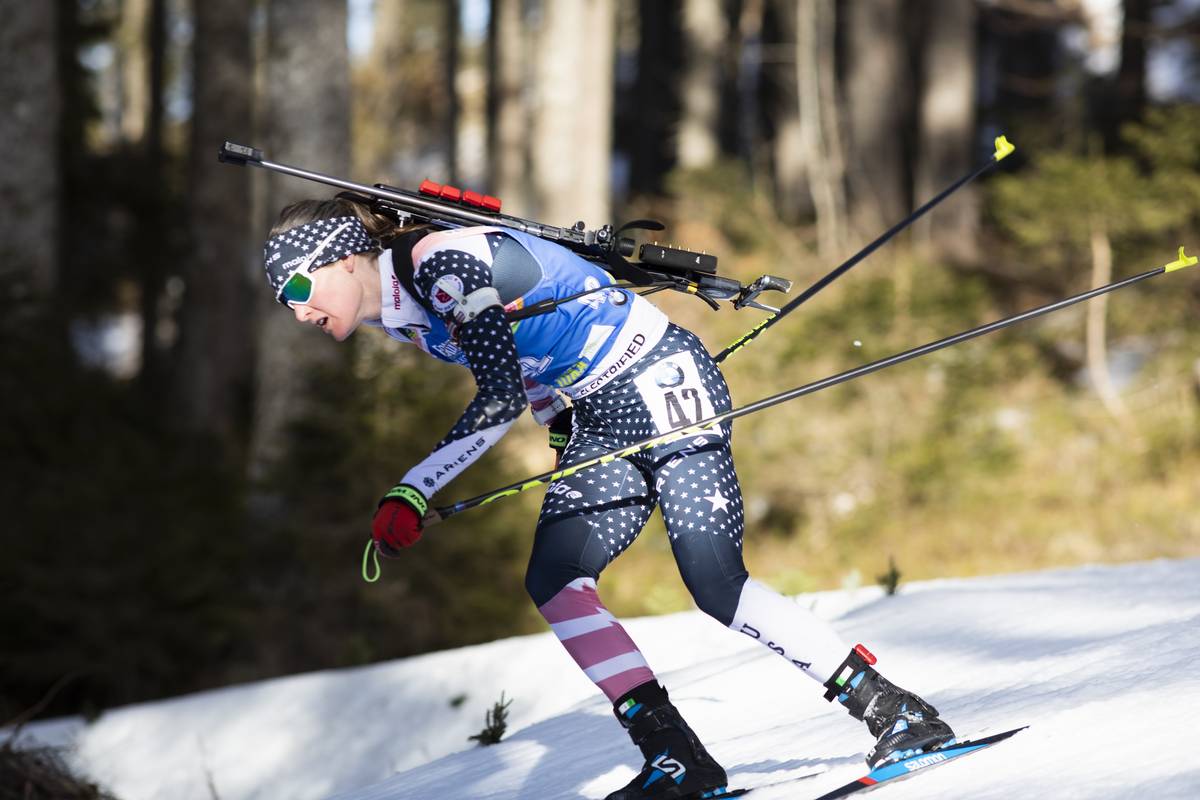
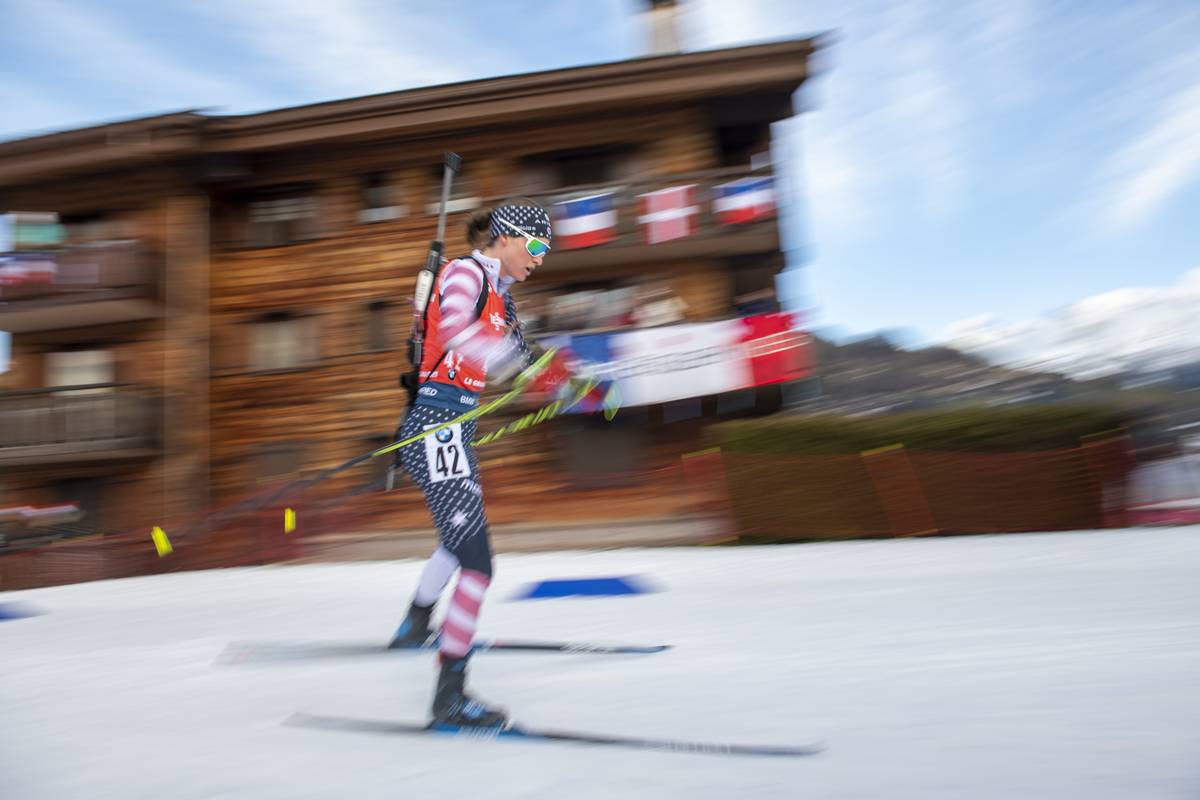
Two North Americans raced into the top-10. Clare Egan for the U.S. had a career-best race in the individual format with a sixth place. Egan shot clean and stopped the clock 2:10.4 back. Prior to Friday’s result, Egan’s best performance in the 15 k individual had been a 22nd at the 2017 World Championships in Hochfilzen, Austria. Last weekend, Egan placed 16th in Ruhpolding, Germany’s 10 k pursuit. And at this same venue a bit over a year ago in Pokljuka, Egan placed sixth in the 10 k pursuit.
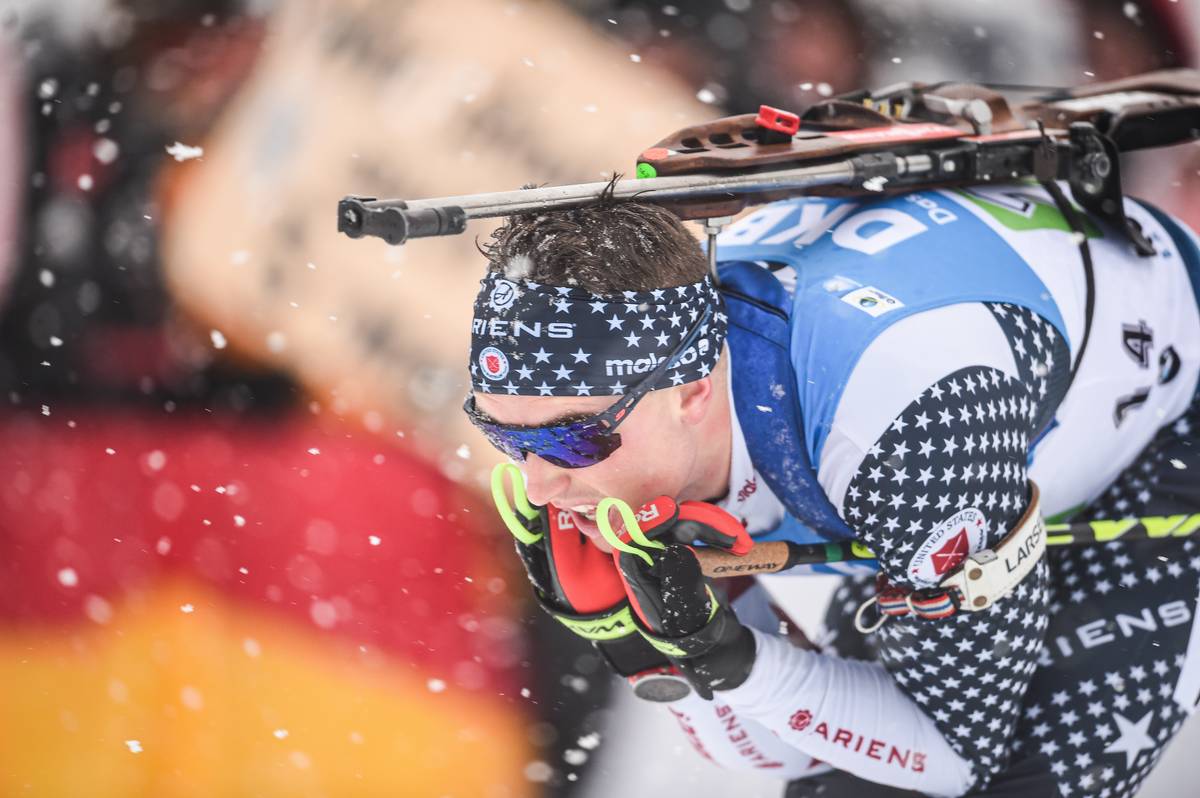
Clare Egan of the U.S. during the women’s 15 k individual in Pokljuka, Slovenia. Egan placed 6th. (Photo: NordicFocus)
Post-race interview with Clare Egan
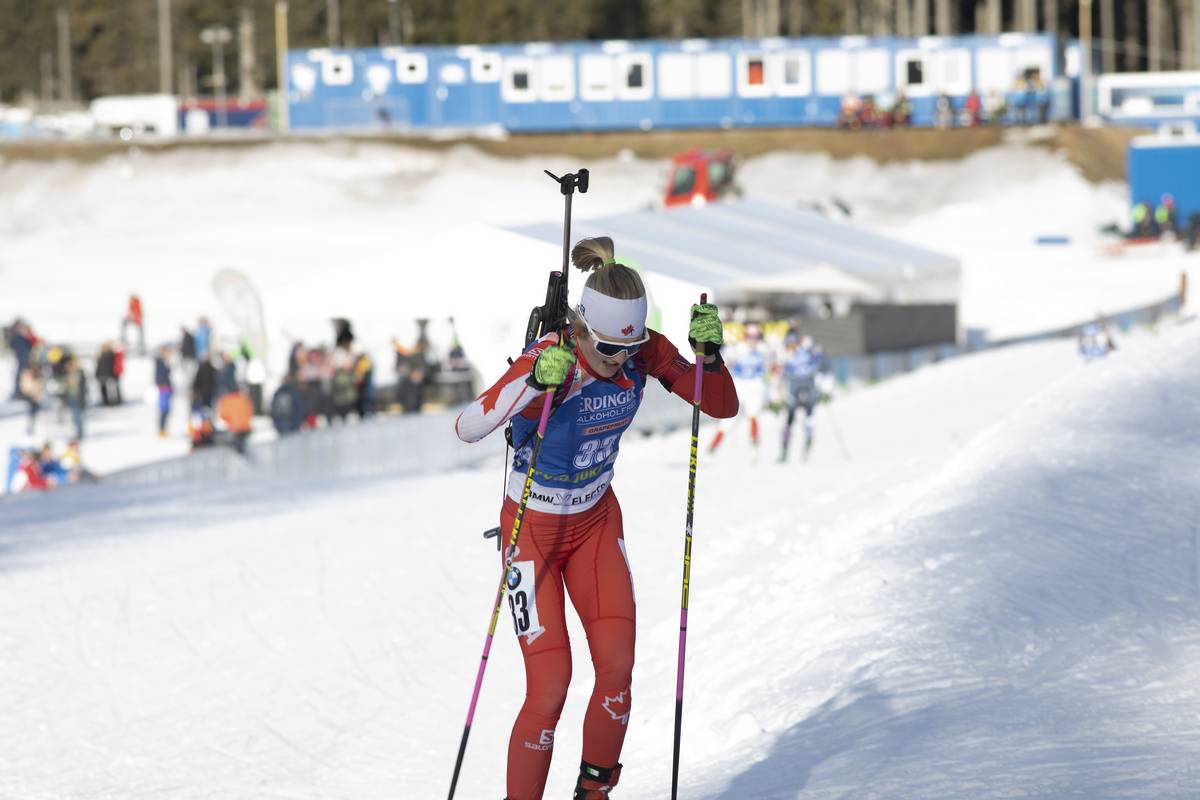
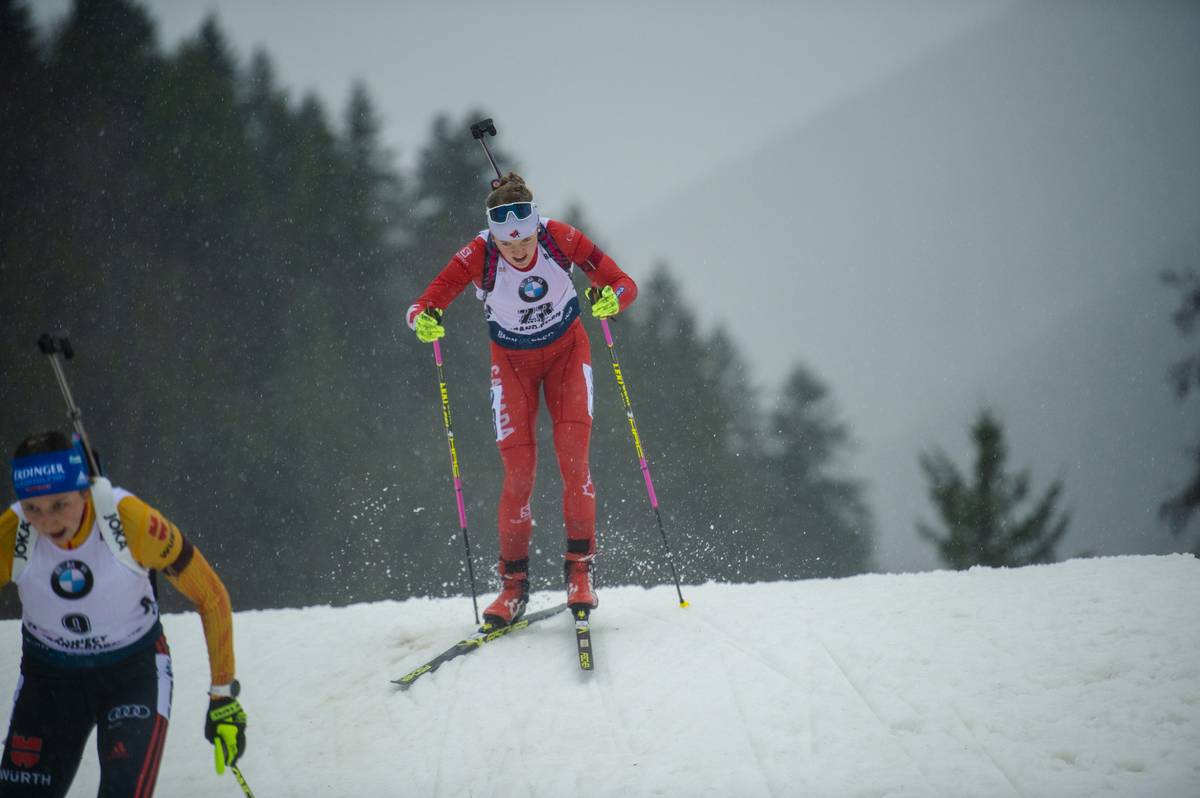
Emma Lunder of Canada finished in 10th, 3:06.8 back while shooting 1+0+0+0. This was Lunder’s second top-10 of the season. She placed 7th in Oberhof’s sprint. Both Lunder and Egan qualified for Sunday’s 12.5 k mass start competition. The top-25 women in the overall IBU standings auto-qualify. Egan and Lunder fell outside that criteria, but qualified due to their results in Friday’s individual race.
Canada’s Emma Lunder racing to 10th in the women’s 15 k individual in Pokljuka, Slovenia. (Photo: NordicFocus)
For the U.S., Joanne Reid was 45th (+6:11.3; 0+0+1+1), Susan Dunklee 55th (+7:04.2; 1+2+1+1), and Emily Dreissigacker 84th (+10:12.7; 1+0+1+2).
Canada’s Nadia Moser finished in 79th (+9:30.6; 1+2+0+1), Megan Bankes 80th (+9:46.2; 1+1+0+3), and Emily Dickson 83rd (+10:07.4; 1+1+1+1).
On Thursday in Pokljuka, Johannes Thingnes Bø, on leave from the race scene for the first part of racing during the second trimester to be home for the birth of his first child, was back in play. Last week, in the absence of the Norwegian phenom that is Bø, France’s Martin Fourcade reclaimed the World Cup’s overall yellow leader’s bib.
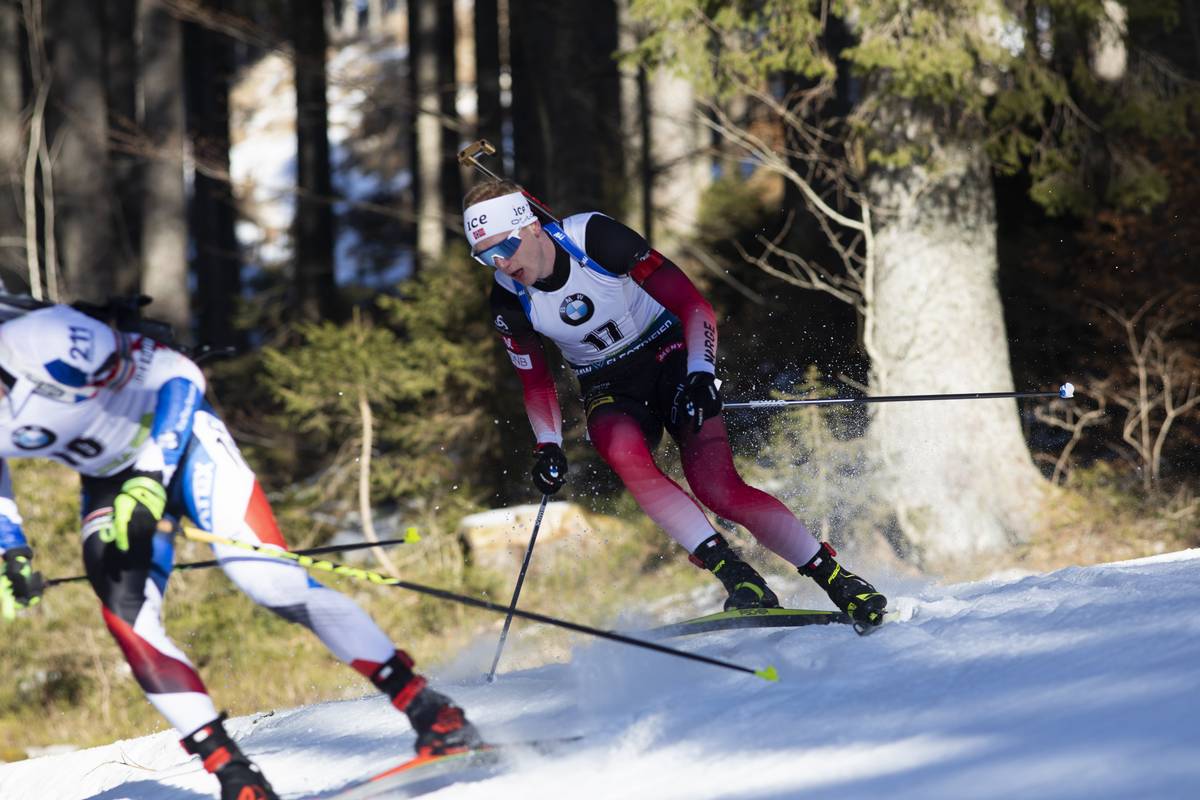
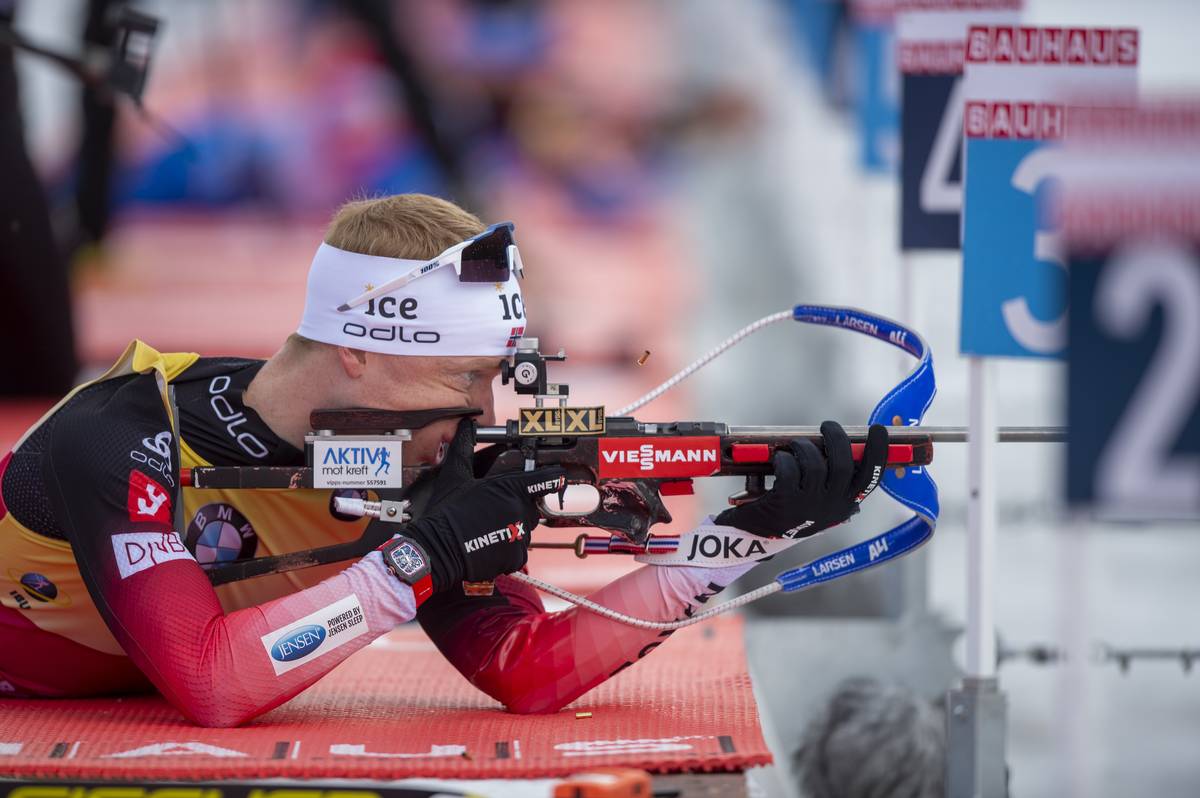
Johannes Thingnes Bø on his way to winning the men’s 20 k individual in Pokljuka, Slovenia. (Photo: NordicFocus)
Fourcade’s leader status might be tenuous. The two superstars went 1-2 on Thursday with Bø taking the win in 47:54.3 with no misses. Fourcade finished second, 11.4 seconds back while also shooting clean. France’s Fabien Claude placed third (+25.6; 0+0+0+0).
Martin Fourcade of France remains in the overall leader’s bib after his second place in Pokljuka’s 20 k individual. (Photo: NordicFocus)
For Canada, Scott Gow raced to 26th (+3:36.7; 0+1+0+1). Christian Gow was 41st (+5:20.0; 0+2+0+0), Jules Burnotte 88th (+8:39.1; 1+2+1+1), and Aidan Millar 107th (+13:27.7; 2+2+0+3).
Scott Gow (CAN) railing a corner during the 20 k individual in Pokljuka, Slovenia. (Photo: NordicFocus)
Leif Nordgren was the top American in 27th. Nordgren finished 3:38.3 minutes back after shooting 1+1+0+0. Jake Brown placed 52nd (+5:54.9; 2+1+0+0), Sean Doherty 74th (+7:28.8; 1+0+1+3), and Paul Schommer 85th (+8:32.9; 2+0+0+2).
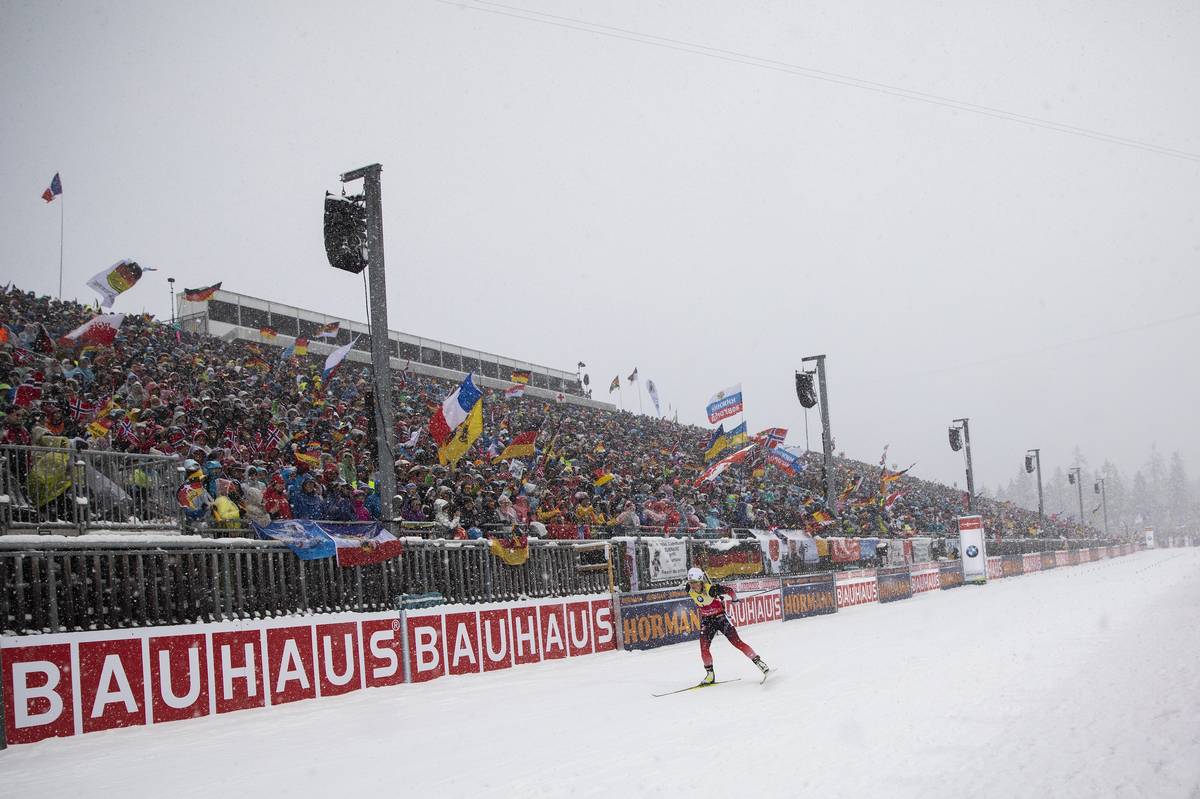
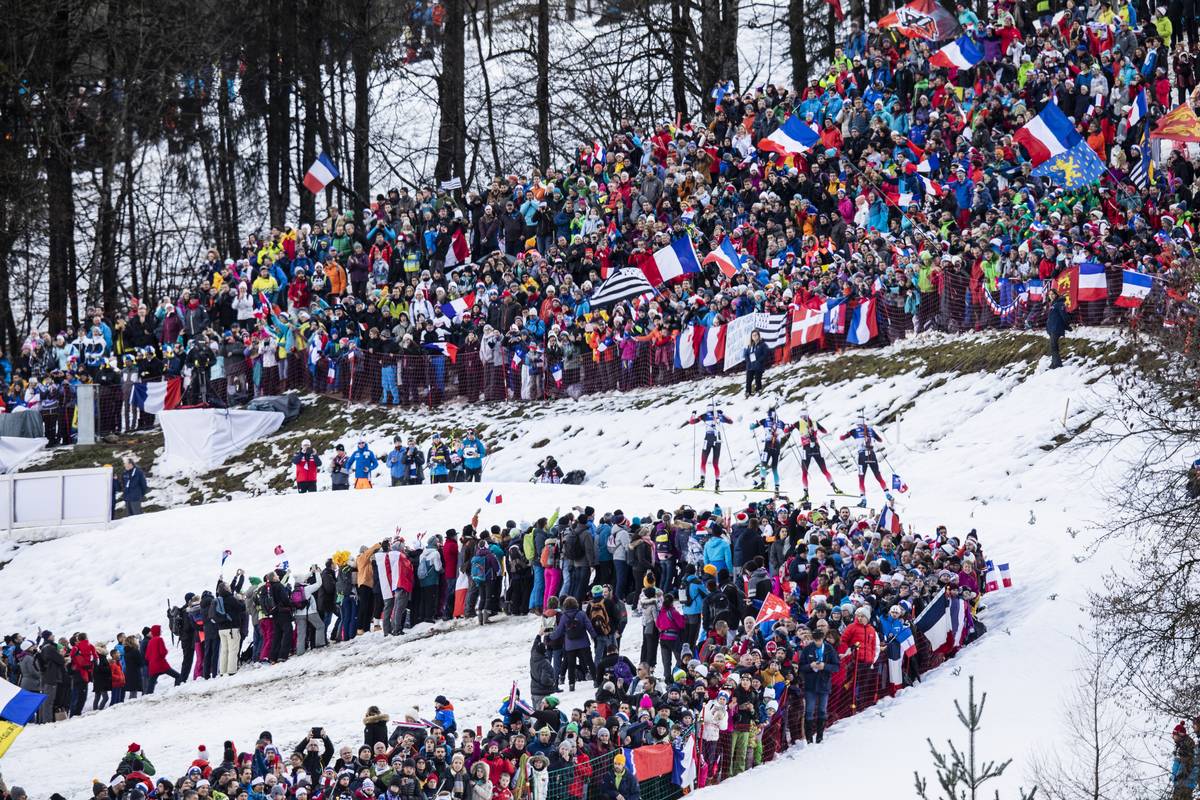
The winner of the women’s 10 k pursuit, Norway’s Tiril Eckhoff, amidst a sea of Ruhpolding, Germany fandom. (Photo: NordicFocus)
Let’s catch up on some overdue biathlon action from Ruhpolding, Germany.
Day 2: Men’s 10 k sprint
Starting off, the men’s 10 k sprint that ran last Thursday. Allez! Allez! It was a squeaker of a win for IBU World Cup overall leader Martin Fourcade of France. He won in a time of 22:41.5 minutes while shooting clean. His teammate, Quentin Fillon Maillet clocked in 3.1 seconds back for second while missing no targets. Germany’s Benedikt Doll placed third (+12.0; 0+0).
Calm, and cool: France’s Martin Fourcade in Ruhpolding. (Photo: NordicFocus)
Martin Fourcade has returned to his winning ways: here is on the way to winning the pursuit in Ruhpolding, Germany. (Photo: NordicFocus)
Sean Doherty of the U.S. continued his rise in this second trimester of the World Cup notching 21st in the sprint, 1:02.8 back and shooting 1+0. For Doherty, this matched his season best result, a 21st in Oberhof’s sprint.
U.S. biathlete Sean Doherty during the men’s relay in Ruhpolding, Germany. (Photo: NordicFocus)
Also for the U.S., Jake Brown skied to 58th (+2:02.2; 2+0), and Leif Nordgren was a spot back in 59th (+2:03.8;2+1). Paul Schommer was 65th (+2:09.2; 0+2).
Jules Burnotte was the top-placed Canadian in 47th (+1:43.6; 0+2). Christian Gow was 51st (1:48.7; 1+0), Scott Gow 60th (+2:04.9), and Aidan Millar 100th (+3:16.4; 1+2).
The top-60 skiers advanced to the weekend’s pursuit.
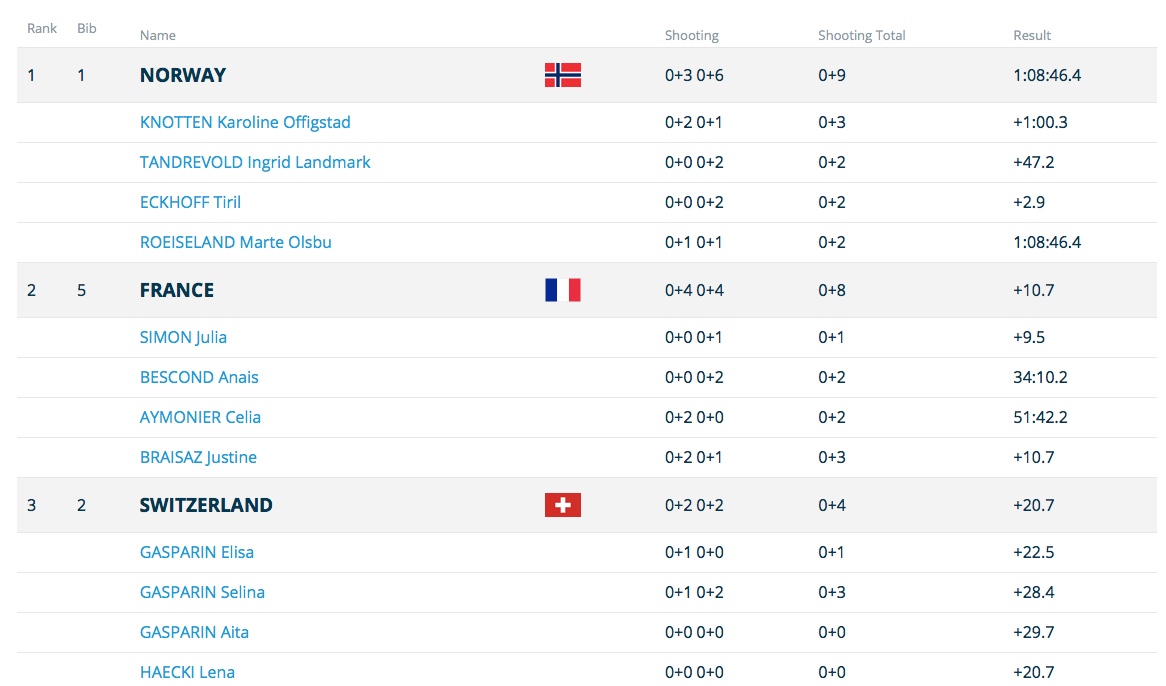
Here’s one thing we love about IBU World Cup relays: so many nations participating. Twenty-three different countries were represented in the women’s event. Korea was lapped, and was listed as 23rd, but at least they are in the game.
In first place, a more consistent powerhouse, was Norway in 1:08:46.4, followed by France (+10.7), and Switzerland (+20.7) in second and third, respectively. This was Norway’s fourth relay win in a row.
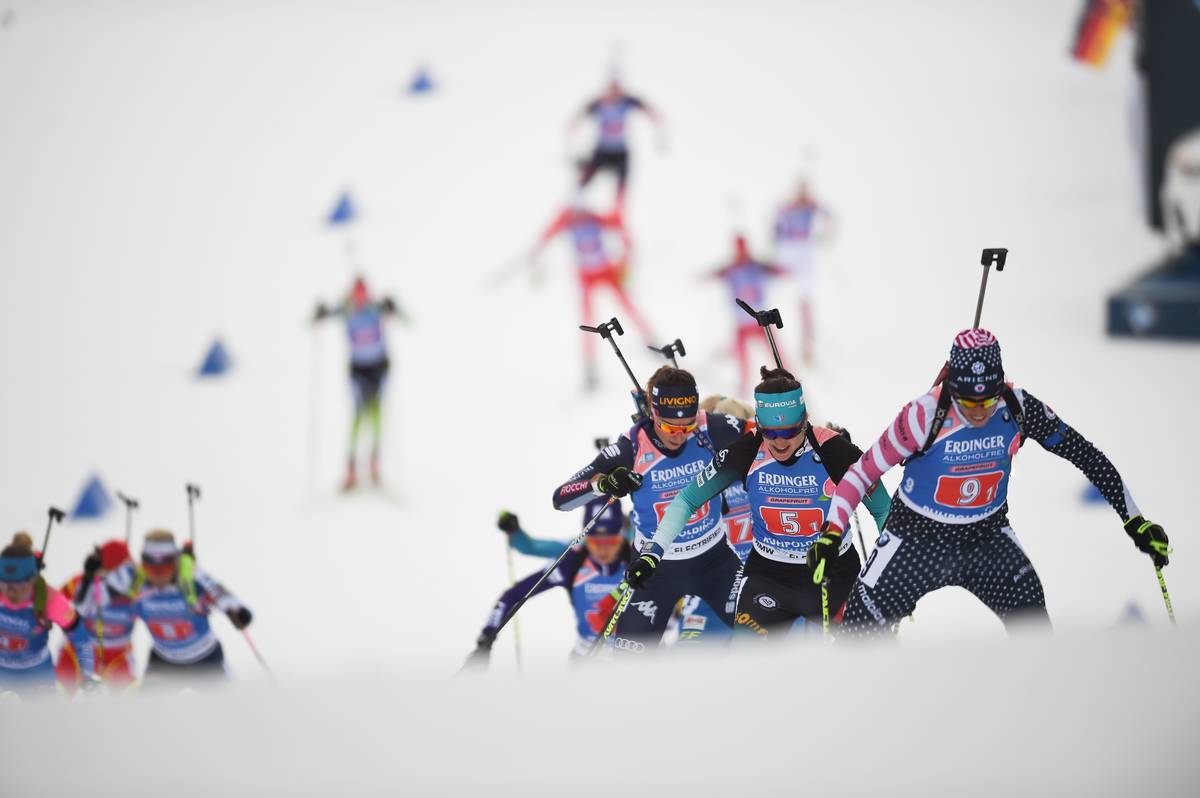
For the U.S., Susan Dunklee, Clare Egan, Joanne Reid, and Deedra Irwin raced to 10th overall, 2:32.9 behind Norway’s winning time. The U.S. had a single penalty while using nine spares in the competition.
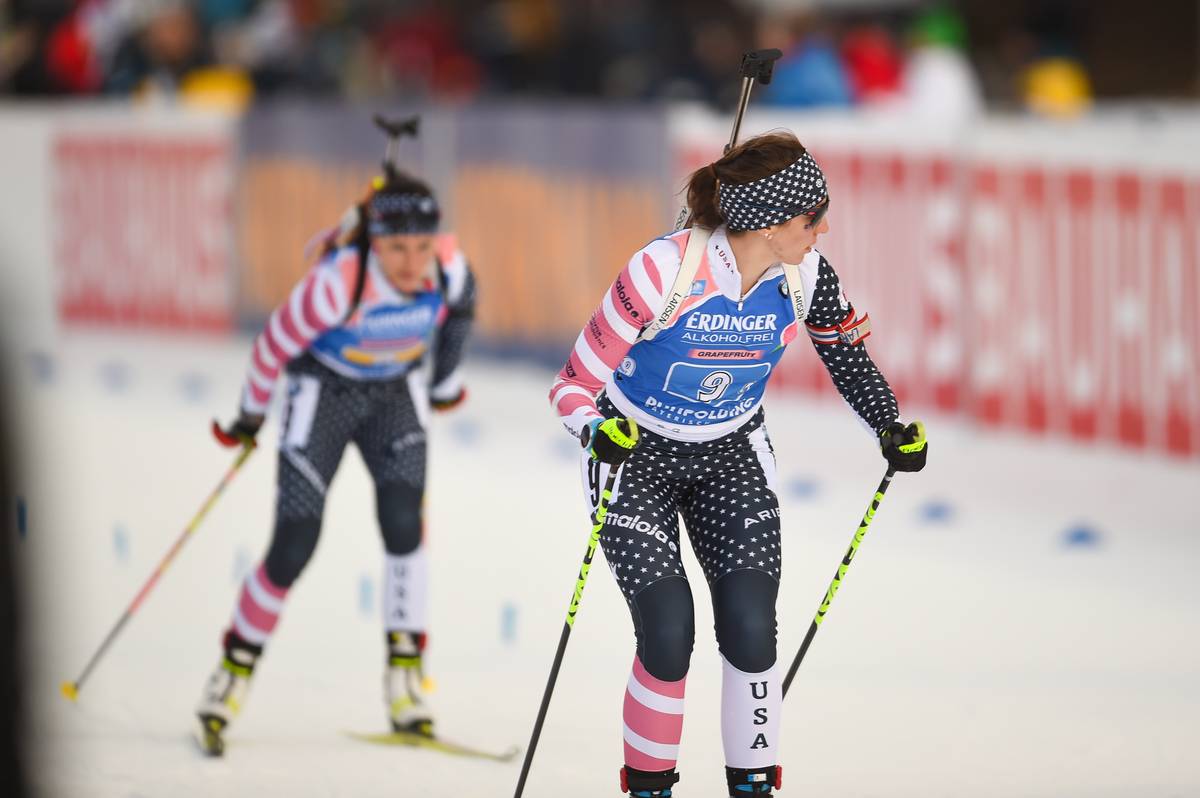
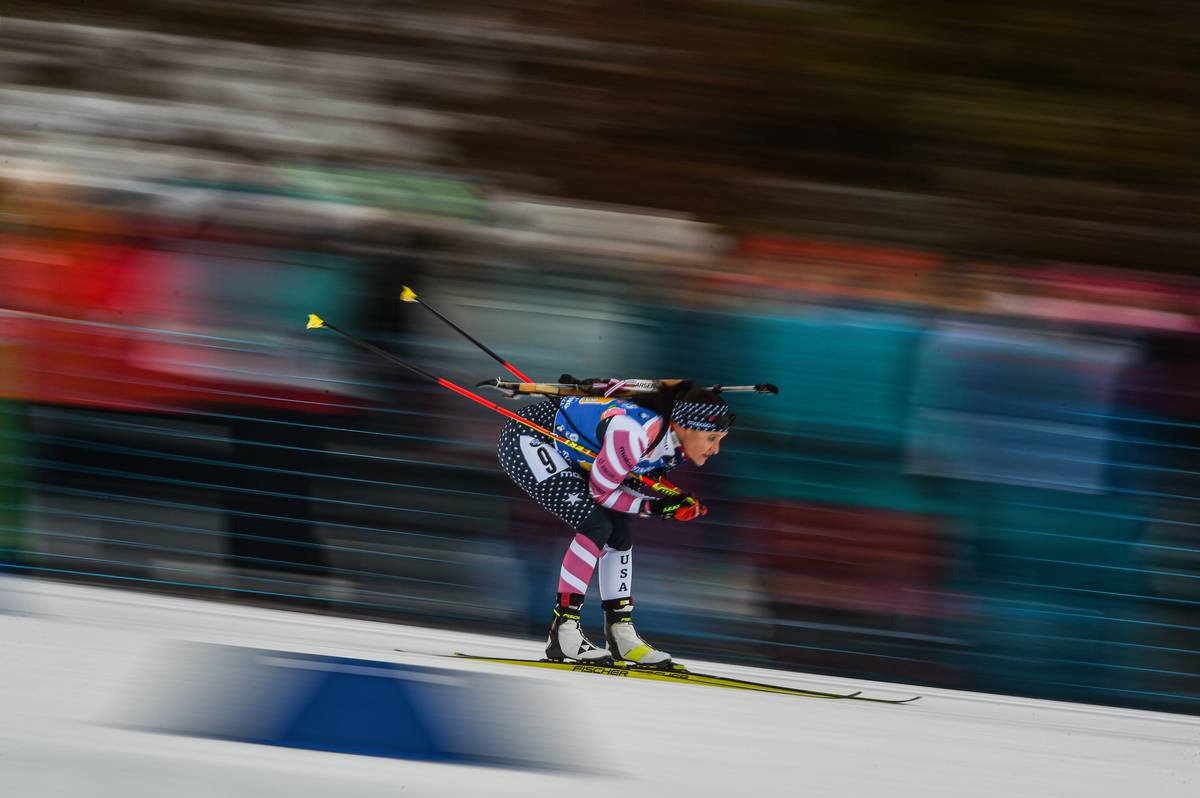
Susan Dunklee (bib 9) of the U.S. during the women’s relay in Ruhpolding, Germany. (Photo: NordicFocus).
Joanne Reid coming in to tag Deedra Irwin for the U.S. (Photo: NordicFocus)
Joanne Reid during the women’s relay in Ruhpolding. (Photo: NordicFocus)
Canada’s Nadia Moser, Emma Lunder, Megan Bankes, and Sarah Beaudry were 20th (+5:30.8; 1+11).
Canada’s Meghan Bankes during the women’s relay in Ruhpolding, Germany. (Photo: NordicFocus)
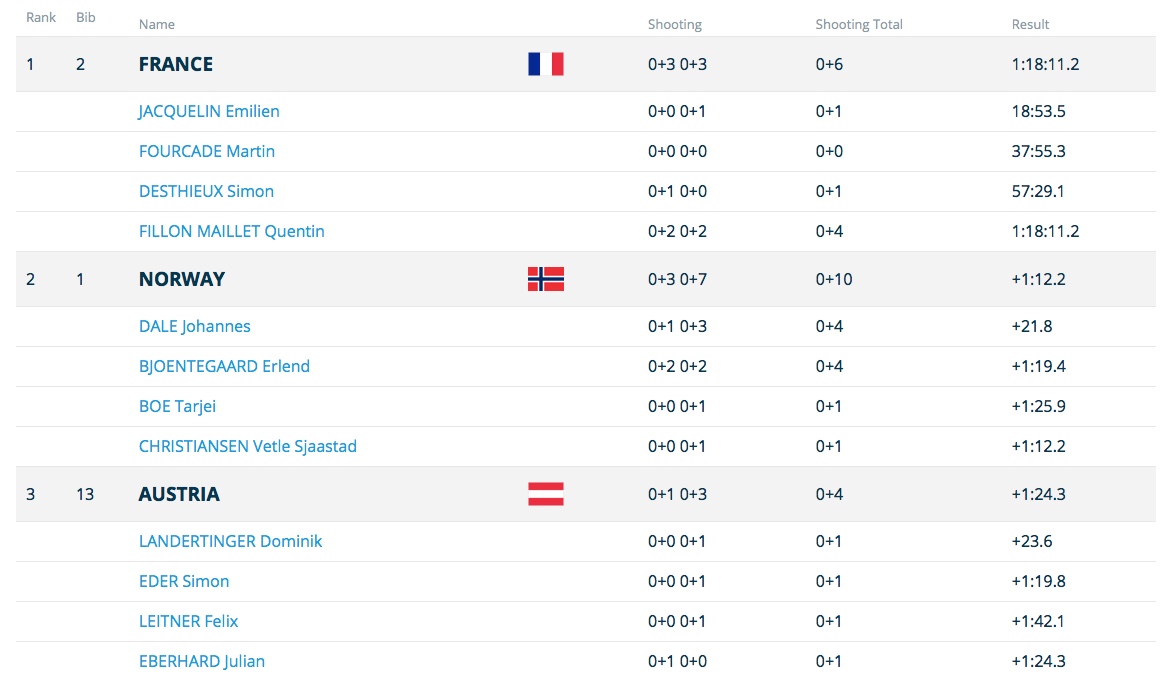
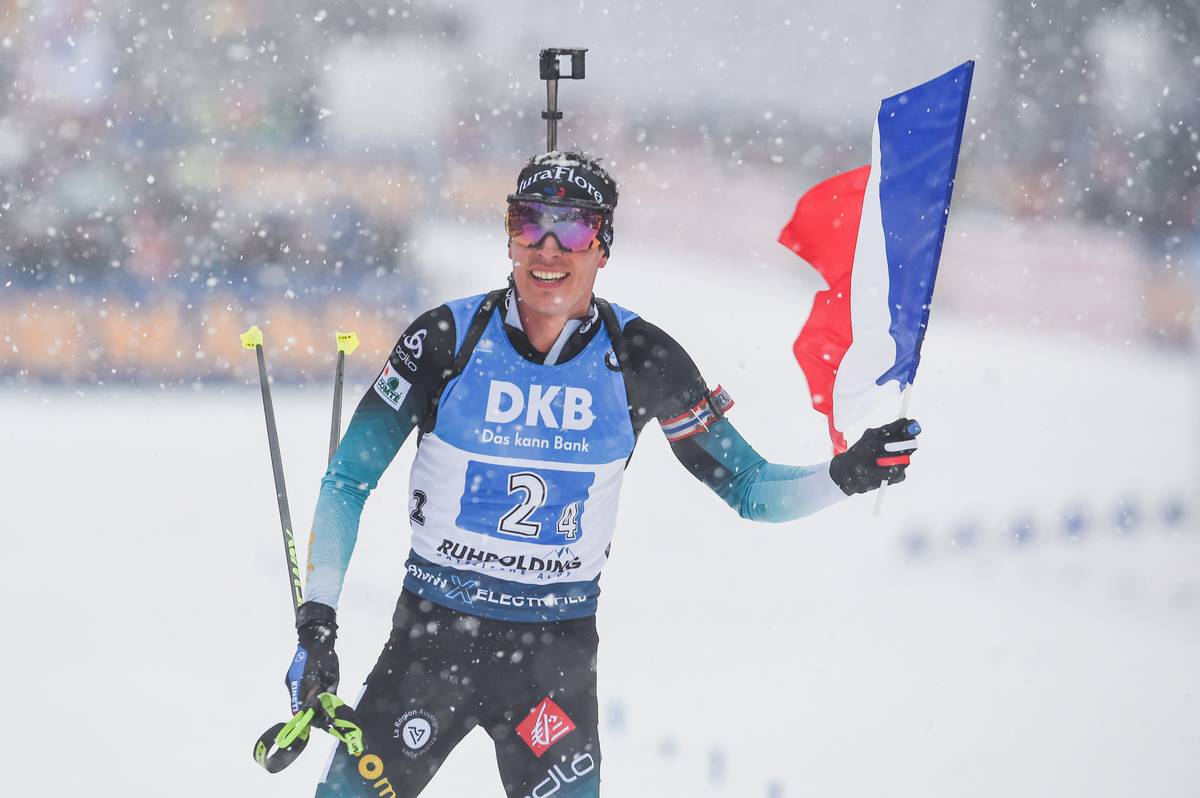
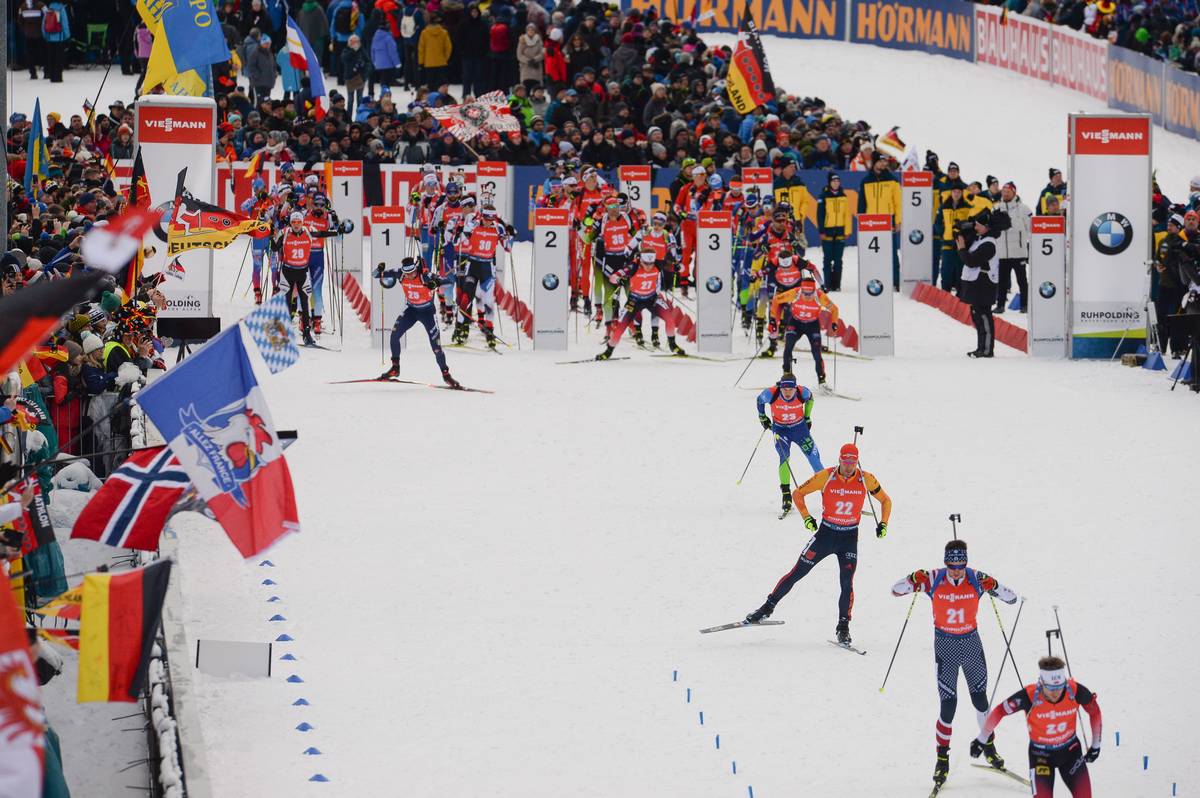
When it’s going your way, just go with it. It has been going France’s way. The French won the men’s relay in 1:18.11.2 followed by Norway in second (1:12.2), and Austria in third (+1:24.3).
Quentin Fillon Maillet of France carries the French flag across the line for the relay win in Ruhpolding, Germany. (Photo: NordicFocus)
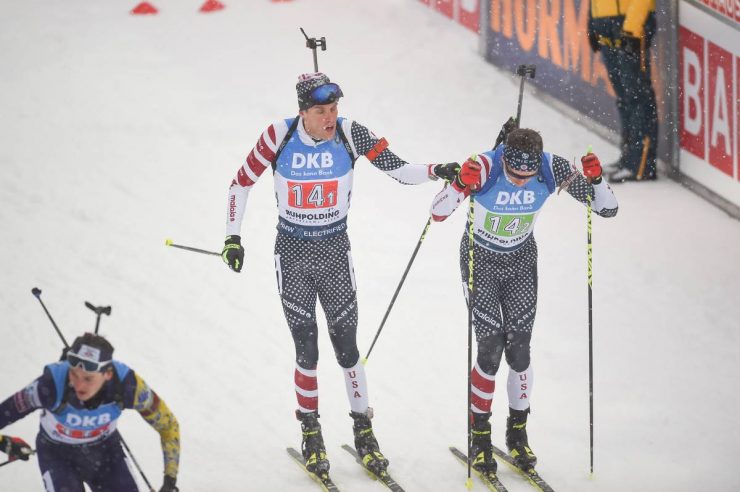
Leif Nordgren, Sean Doherty, Paul Schommer, and Jake Brown scored tenth overall for the U.S., finishing 4:09.8 back using nine spares.
Leif Nordgren (USA) tagging Sean Doherty during the men’s relay in Ruhpolding, Germany. (Photo: NordicFocus).
Jake Brown (USA) on the range during the men’s relay in Ruhpolding, Germany. (Photo: NordicFocus)
Canada’s Jules Burnotte, Scott Gow, Aidan Millar, and Christian Gow placed 19th (+6:27.6; 1+14). Twenty-six teams were represented.
In this 60 athlete field, Norway’s Tiril Eckhoff ran away with the win in 34:08.7 while missing a single target in her four shooting bouts. Slovakia’s Pauline Fialkova was second (+46.3;1+0+0+1), and Hannah Öberg of Sweden third (+55.1; 0+1+0+1).
Susan Dunklee during the women’s relay in Ruhpolding. She placed 10th in the weekend’s pursuit event for a season best result. (Photo: NordicFocus)
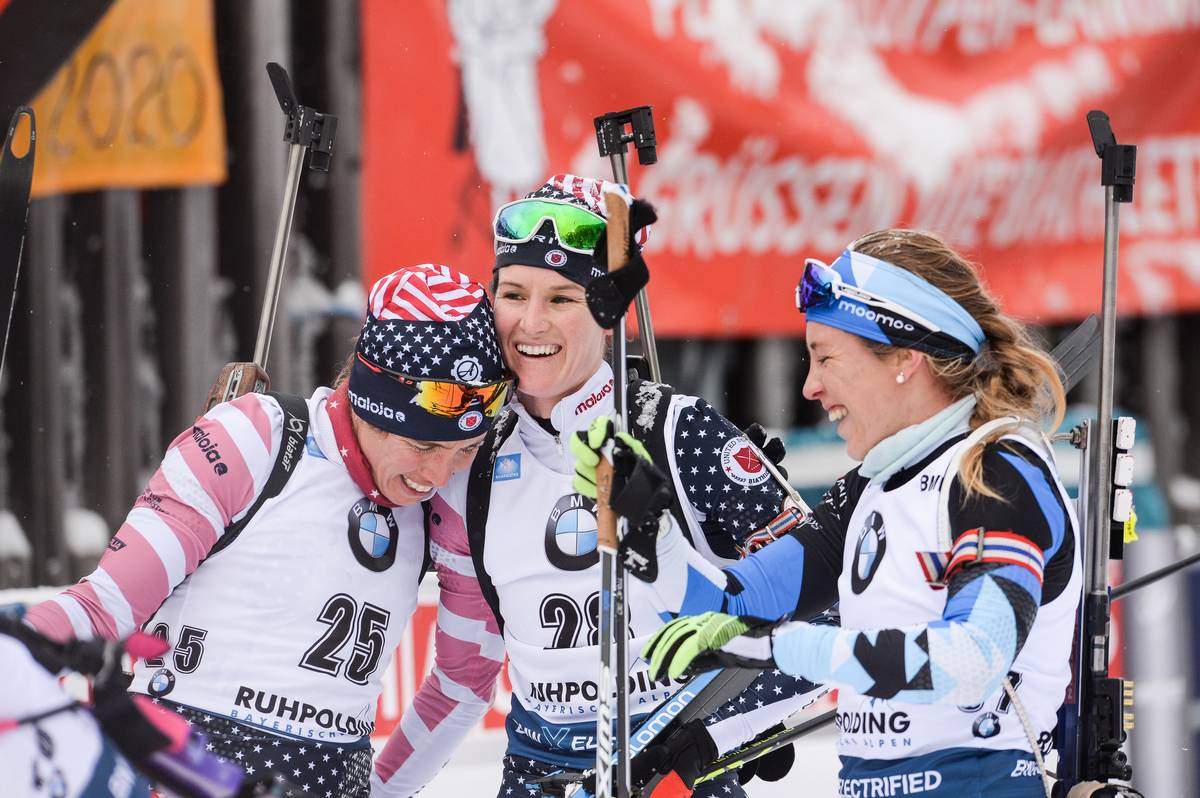
Dunklee notched a season best result with her 10th place. The U.S. biathlete finished 1:39.7 behind while shooting 0+1+2+0. Her teammate Egan was six spots behind in 16th overall (+2:01.8; 0+0+1+1). This was Egan’s best individual result thus far in the 2019-2020 season.
Off to the tracks: Clare Egan (bib 28) during the women’s pursuit in Ruhpolding. She placed 16th overall. Susan Dunklee, her teammate, is pictured in bib 25. (Photo: NordicFocus)
Susan Dunklee (bib 25) and Clare Egan (bib 28) after the women’s pursuit in Ruhpolding. (Photo: NordicFocus)
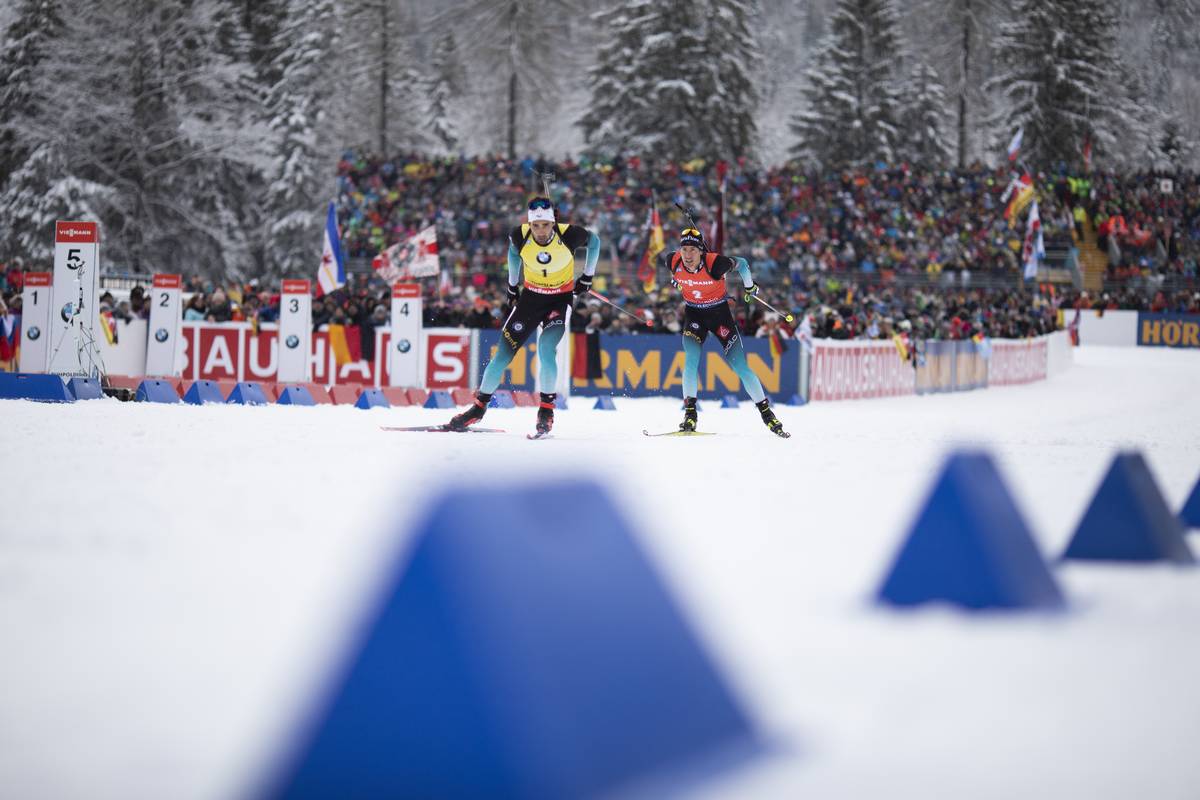
Again, there was no stopping the French. Fourcade took the win in 31:26.8 while shooting clean, with Fillon Maillet in second (+17.6; 0+0+1+0). Norway’s Vetle Sjåstad Christiansen placed third (+46.0; 0+0+0+1).
Martin Fourcade (FRA) leads Quentin Fillon Maillet (FRA) during the men’s pursuit in Ruhpolding. (Photo: NordicFocus)
Doherty was the top American in 32nd (+2:58.7; 3+0+1+0). Nordgren placed 55th (+5:30.1; 2+2+0+0), and Brown 56th (+5:49.9; 2+2+1+2).
For Canada, Burnotte skied to 47th (+4:07.4; 1+1+2+1), Christian Gow 49th (+4:22.1; 1+1+1+1), and Scott Gow 50th (+4:37.8; 0+1+1+1).
Mid-week, the IBU World Cup circus moved to Ruhpolding, Germany. The women raced a 7.5-kilometer sprint and saw Norway’s Tiril Eckhoff take the win and snag the yellow overall World Cup leader’s bib from Italy’s Dorothea Wierer. Eckhoff now leads Wierer by a scant three points in the overall standings. This was Eckhoff’s fifth individual win of the 2019-2020 season.
Norway’s Tiril Eckhoff racing for the win during the Ruhpolding, Germany sprint. With the win, Eckhoff secured the overall IBU World Cup leader’s bib. (Photo: NordicFocus)
Eckhoff won Wednesday’s sprint in 18:55.5, while shooting clean. Sweden’s Hanna Öberg was second (+29.7; 0+0), with Weirer in third (+36.8; 0+0).
Dorothea Wierer (ITA) placed third in Ruhpolding’s sprint. (Photo: NordicFocus).
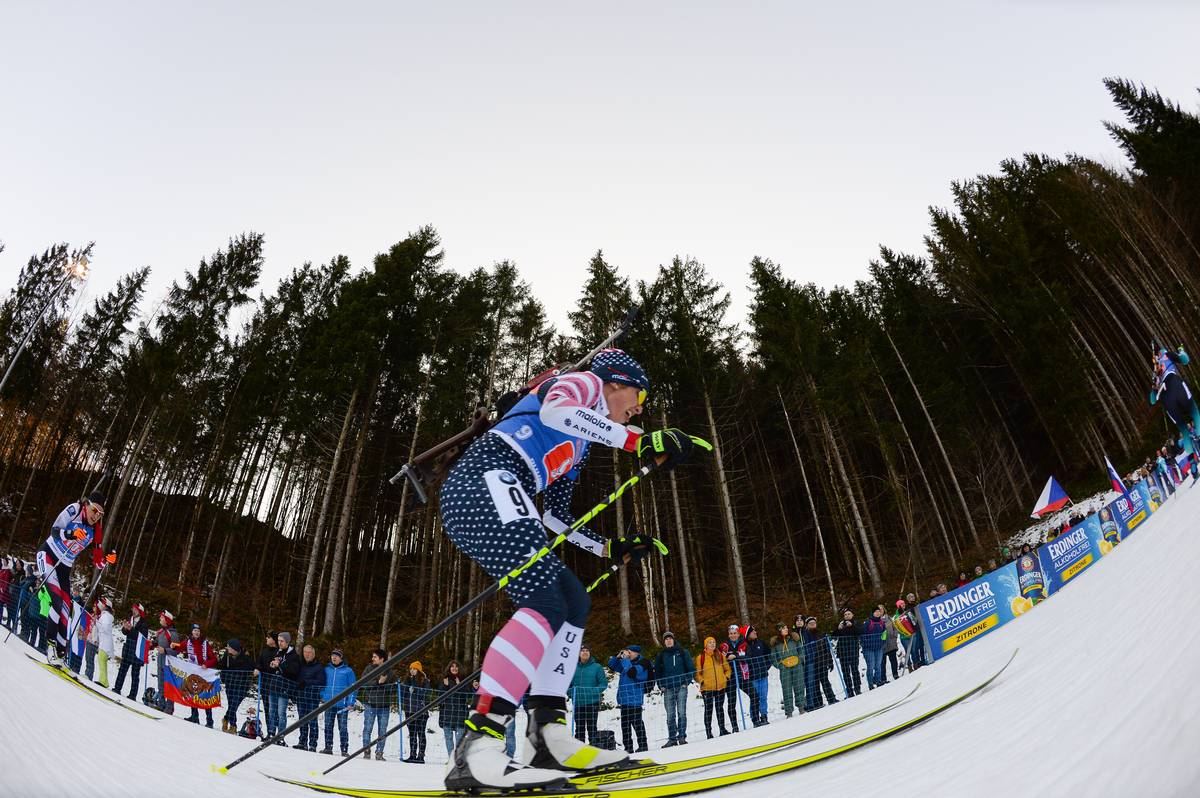
The U.S. had two athletes in the top-30. Susan Dunklee placed 25th (+1:34.0; 1+0), and Clare Egan 28th (+1:40.9; 0+1). Also for the U.S., Deedra Irwin skied to 79th (+3:01.8; 0+2), and Hallie Grossman 93rd (+4:00.6; 2+1).
Susan Dunklee was the top North American in 25th during Wednesday’s sprint in Ruhpolding, Germany. (Photo: NordicFocus)
Canada’s Emma Lunder placed 53rd (+2:14.0; 1+0), Megan Bankes 82nd (+3:08.4; 1+1), Sarah Beaudry 94th (+4:01.3; 2+0), and Nadia Moser 104th (+5:18.0; 2+3).
The top-60 biathletes qualified for Sunday’s 10 k pursuit in Ruhpolding. Racing continues on Thursday for the men with a 10 k sprint.
With the weekend closed out in Oberhof, Germany and the start of the second IBU World Cup trimester underway it’s time for, thank you Seth Meyer, … a closer look.
The men’s mass start in Oberhof. (Photo: NordicFocus)
Norway’s male biathlon ringer, Johannes Thingnes Bø, was on the sideline for the weekend. Prior to the Oberhof stop, he had worn the yellow bib as the IBU World Cup overall leader. Post-Oberhof, it was time for a change. A small change really in the big perspective of challengers. France’s Martin Fourcade leaves Oberhof donning yellow, a color he has been well acquainted with in the past.
Martin Fourcade, here in the Oberhof mass start, won the race and seized the overall leader’s bib. (Photo: NordicFocus)
Fourcade’s overall lead is the result of a two win weekend. He won the 10 k sprint on Friday and followed that with a win Sunday in the 15 k mass start. In four shooting rounds during the mass start, Fourcade went 0+1+0+1 to win in 41:01.4. No North Americans qualified for the race.
Fourcade was also part of the French 4 x 7.5 k relay team that placed second on Saturday. Norway won that race, with neither Bø brother racing. Germany placed third. The U.S. team of Sean Doherty, Leif Nordgren, Paul Schommer, and Jake Brown skied to 12th overall. Canada’s Jules Burnotte, Scott Gow, Aidan Millar, and Christian Gow were 14th out of 26 teams.
Kaisa Makarainen from Finland won the 10 k mass start in 39:58.9 after missing a single target in her first bout of shooting. Otherwise, she shot clean. Norway’s Tiril Eckhoff placed second (+30.2; 0+0+3+1), and Marte Olsbu Roeiseland third (+35.0; 1+0+1+1).
Emma Lunder of Canada during the women’s mass start in Oberhof, Germany. Lunder was 15th overall. (Photo: NordicFocus)
Canada’s Emma Lunder continued her strong skiing with a 15th place (+2:14.8; 0+2+4+1). Susan Dunklee of the U.S. raced to 21st (+2:56.3; 0+3+1+4).
Susan Dunklee of the U.S. during the women’s 4 x 6 k relay. Dunklee placed 21st in Sunday’s mass start. (Photo: NordicFocus)
This brings us to the women’s overall standings on the IBU World Cup circuit. Italy’s Dorothea Wierer, with 390 points, wears the leader’s bib. The Italian placed fourth in the mass start, over a minute out, and had five misses total on the range. Eckhoff is second overall with 381 points.
A television camera takes Justine Braisaz (FRA), Tiril Eckhoff (NOR), Ingrid Landmark Tandrevold (NOR), Dorothea Wierer (ITA), Denise Herrmann (GER) in focus, (l-r) during the women’s Oberhof mass start. (Photo: NordicFocus)
In the women’s 4 x 6 k relay contested on Saturday, Norway won in a total time of 1:14:11.5 hours shooting 0+11. The U.S. team of Susan Dunklee, Clare Egan, Hallie Grossman, and Emily Dreissigacker were 12th (+4:33.8; 1+12). Canada’s Sarah Beaudry, Emily Dickson, Nadia Moser, and Emma Lunder placed 20th, as they were eventually lapped. Twenty-three teams began the race.
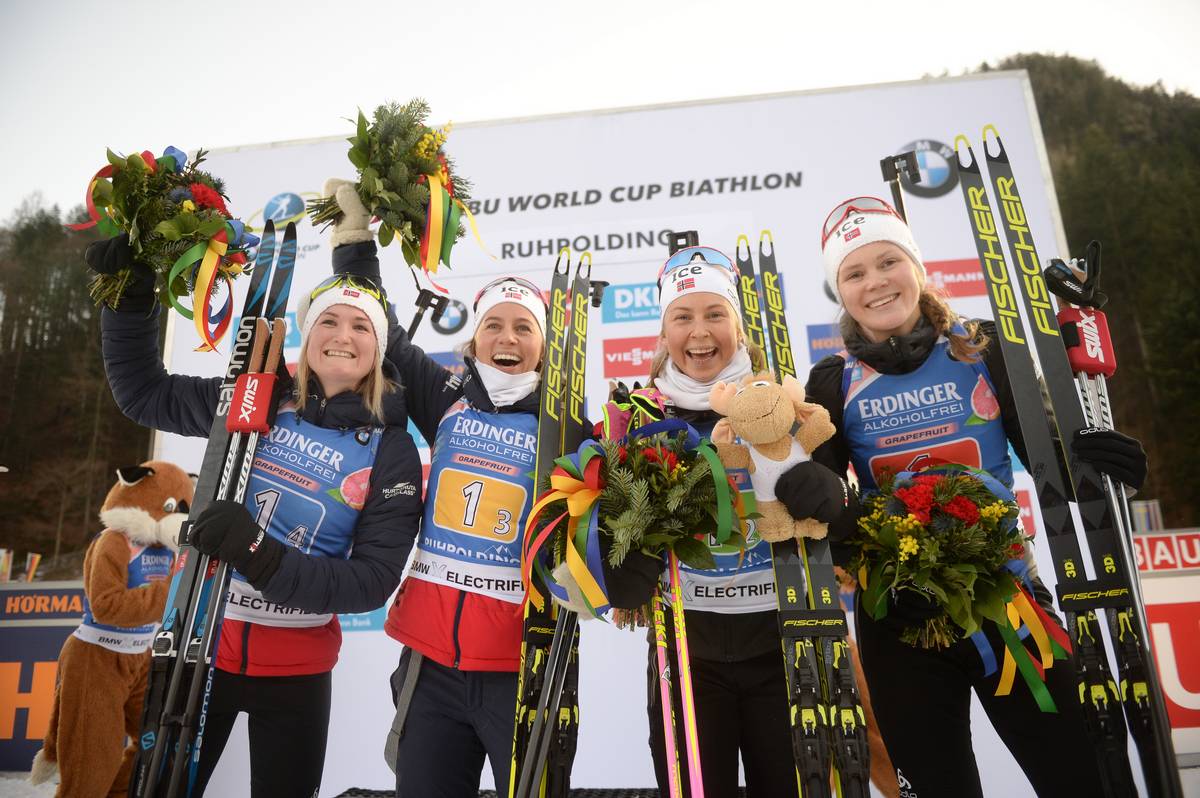
Tiril Eckhoff (NOR) winner of the women’s 10 k pursuit in Annecy-Le Grand Bornand, France. (Photo: NordicFocus)
Pursuit Day in Annecy-Le Grand Bornand, France as the IBU World Cup presented back-to-back pursuit races.
Bib 1 starter from Norway, Tiril Eckhoff, won the women’s 10-kilometer pursuit in 29:41.6 shooting 1+0+1+0 for the race. As the winner of yesterday’s sprint, she brings her individual race total to three this year on the IBU World Cup. Her teammate, wearing bib 6, Ingrid Landmark Tandervold, placed second (+38.1; 1+0+1+0). Lena Haecki of Switzerland finished in third (+46.0; 0+1+1+0).
Emma Lunder of Canada racing to 25th in Annecy-Le Grand Bornand, France during the women’s 10 k pursuit. (Photo: NordicFocus)
Canada’s Emma Lunder jumped 11 places from her start bib number, 36, to place 25th overall (+2:46.3; 0+2+0+0). Clare Egan of the U.S. began in bib 42 and placed 29th (+2:53.0; 0+0+1+1). Her teammate Joanne Reid was 54th (+5:33.4; 1+0+2+3).
Sarah Beaudry of Canada was 56th (+5:47.3; 2+1+0+1).
U.S. Biathlon’s Clare Egan on her way to 29th in the women’s 10 k pursuit in Annecy-Le Grand Bornand, France. (Photo: NordicFocus)
Johannes Thingnes Bø of Norway earning another win. Pictured here, he’s on the range during the men’s 12.5 k pursuit in Annecy-Le Grand Bornand, France. (Photo: NordicFocus).
The men raced a 12.5 k pursuit and Johannes Thingnes Bø of Norway, starting in bib 4 won in 30:07.8 while missing a single target in his first shooting bout. Including relays, it was Bø’s sixth win of the season. France’s Maillet Quentin Fillon placed second (+22.0) after shooting clean. Vetle Sjåstad Christiansen of Norway was third (+1:00.0; 0+0+1+0).
Leif Nordgren of the U.S. raced to 48th (+4:36.3; 1+1+1+1), while teammate Sean Doherty finished 54th (+5:06.0; 1+2+2+0).
Tarjei Boe (NOR), Quentin Fillon Maillet (FRA), Johannes Thingnes Boe (NOR), Erlend Bjoentegaard (NOR), (l-r) during the IBU World Cup 12.5 k pursui in Annecy-Le Grand Bornand, France. (Photo: NordicFocus)
Tiril Eckhoff of Norway continued her IBU World Cup winning ways on Friday. She won the Annecy-Le Grand Bornand 7.5-kilometer sprint in 20:27.0 with a single penalty during her two shooting rounds. Including two relays, this is Eckhoff’s fourth victory of the season. Justine Braisaz of France was second (+6.2; 0+0), and the Czech Republic’s Svetlana Mironova placed third (+22.5; 0+0).
Eckhoff of Norway has won two indivudual races on the IBU World Cup this season. Including (pictured here) a win in the Annecy-Le Grand Bornand, France sprint. (Photo: NordicFocus)
Friday’s sprint winner, Tiril Eckhoff of Norway. (Photo: NordicFocus)
The top-60 skiers qualified for Saturday’s 10 k pursuit.
For Canada, Emma Lunders placed 36th (+1:44.4;2+1), Sarah Beaudry 48th (+2:00.9; 0+1), and Megan Bankes 71st (+2:32.9; 1+2). Nadia Moser did not start.
Clare Egan led the U.S. women in 42nd (+1:50.1;0+2), followed by Joanne Reid in 52nd (+2:04.5; 0+1). Susan Dunklee finished 67th (+2:28.8; 0+3), and Emily Dreissigacker 94th (+4:37.1; 2+2).
Emma Lunder (CAN) during the Annecy-Le Grand Bornand, France IBU World Cup sprint. (Photo: Nordic Focus)
The stepping stone for many biathletes remains the lower tier IBU Cup. Today in Obertilliach, Austria the men contested a 10 k sprint. It was Paul Schommer’s time for a breakthrough. The U.S. biathlete placeded second overall after shooting clean. He was 19.5 seconds behind Norway’s Aleksander Fjeld Andersen who also had no misses, finishing in a time of 25:45.8.
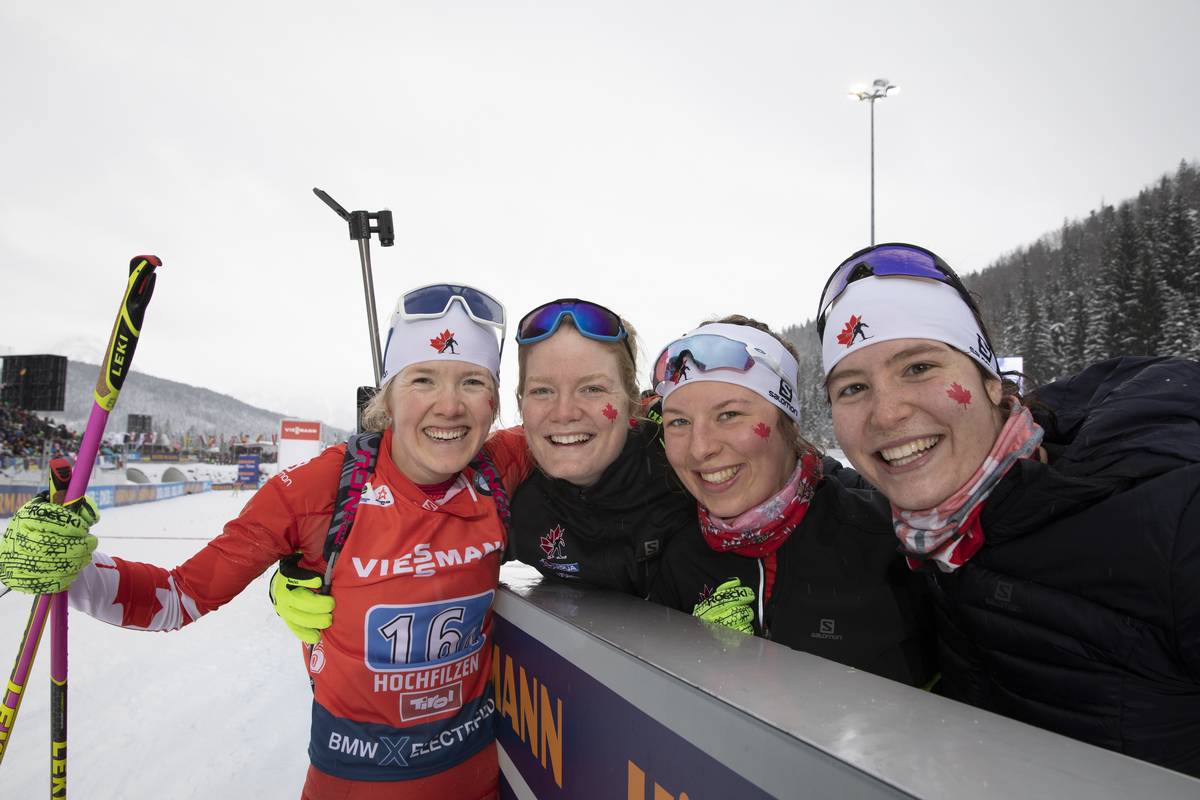
Canada’s Emma Lunder, Sarah Beaudry, Nadia Moser, and Megan Bankes (l-r) after placing fifth at the IBU World Cup biathlon 4 x 6 k relay in Hochfilzen (AUT). (Photo: NordicFocus)
On Saturday and Sunday, racing continued on the IBU World Cup in Hochfilzen, Austria. Some story lines remained familiar, some reflect the national diversity of the biathlon circuit and that on any given day, a historically non-dominant team can excel.
Sarah Beaudry during the Hochfilzen relay. (Photo: NordicFocus)
Nadia Moser during the Hochfilzen relay. (Photo: NordicFocus)
Megan Bankes racing in the women’s 4 x 6 k relay in Hochfilzen. (Photo: NordicFocus).
Emma Lunder anchors the Canadian women’s relay team in Hochfilzen. (Photo: NordicFocus)
Saturday featured a women’s 4 x 6-kilometer relay and the men’s 12.5 k pursuit.
Norway’s team of Karoline Offigstad Knotten, Ingrid Landmark Tandervold, Tiril Eckhoff, and Marte Olsbu Roeiseland won the relay in 1:10:04.7 with one penalty and using seven spares. Kristina Reztsova, Larisa Kuklina, Svetlana Mironova, Ekaterina Yurlova-Percht of Russia finished 8.2 seconds back for second place. Russia had no penalties after using five spares. Switzerland’s Elisa Gasparin, Selina Gasparin, Alta Gasparin, and Lena Haecki took the final podium spot (+1:04.1; 1+9).
For North America, Canada came through with a fifth place overall (+1:09.3). Sarah Beaudry, Megan Bankes, Nadia Moser, and Emma Lunder shot penalty free after using seven spares. According to Biathlon Stats and Facts, this is the Canadian women’s best relay result since the 1994/1995 season.
The U.S. team of Joanne Reid, Susan Dunklee, Clare Egan, and Emily Dreissigacker placed eighth overall (+1:37.0 0+6).
That same day, Johannes Thingnes Bø, Norway’s dominant biathlete on the men’s side, won the 12.5 k pursuit in 31:27.0 while shooting clean. Russia’s Alexander Loginov, who also shot clean, took second (+33.5). Emilien Jacquelin was third (+40.5; 0+0+0+0).
For the U.S., Sean Doherty placed 49th (+5:12.6; 1+2+2+1), and Leif Nordgren 53rd (+6:17.2; 1+2+2+2). No Canadian men qualified for the pursuit.
Race festivities on Sunday included the men’s 4 x 7.5 relay and the women’s 10 k pursuit.
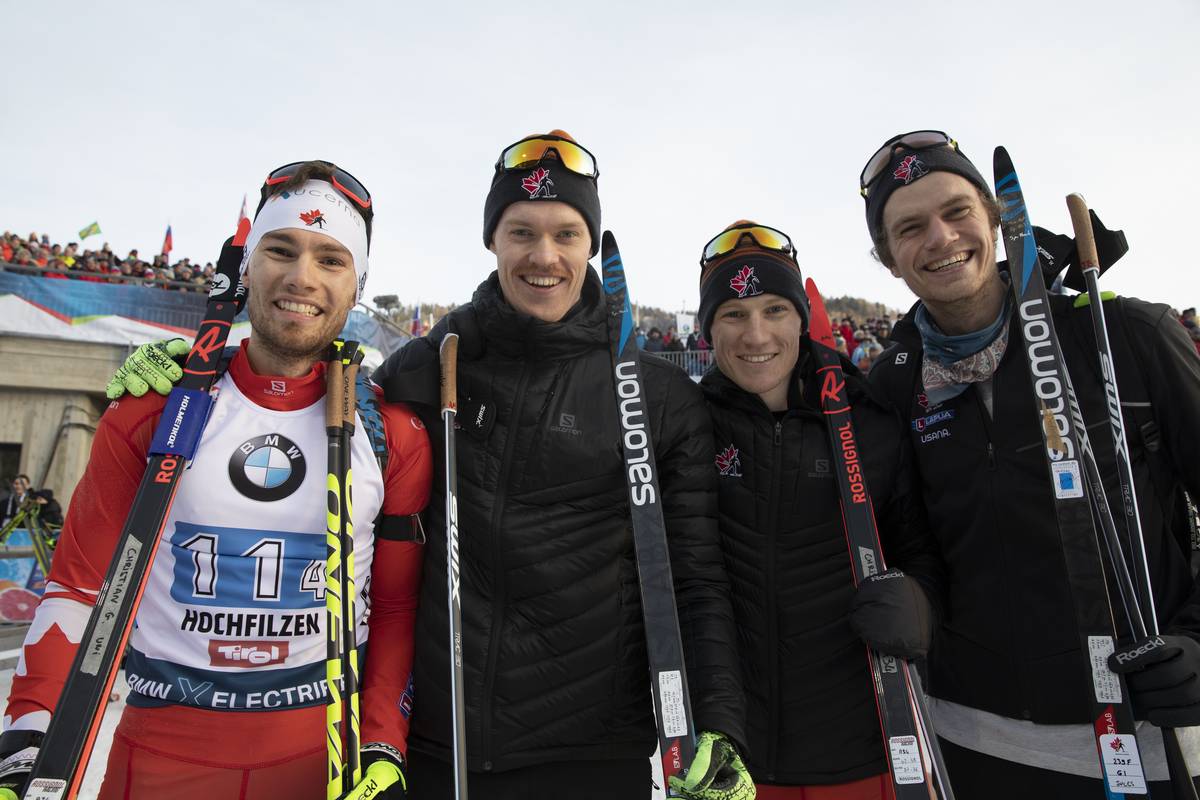
We’ll get to the podium spots shortly, but again Canada came through with a near podium performance in the relay. Jules Burnotte, Scott Gow, Aidan Millar, and Christian Gow had no penalties while using six spares to place fourth (+1:28.7). That matches a World Cup best fourth place, earned back in 1991. (Canada earned bronze in the men’s relay at the 2016 World Championships in Oslo, Norway.)
Christian Gow, Aidan Millar, Scott Gow, Jules Burnotte, (l-r) after placing fourth at the Hochfilzen men’s relay. (Photo: NordicFocus)
Scott Gow and Jules Burnotte (l-r) during the Hochfilzen men’s relay. (NordicFocus).
Aidan Millar during the men’s relay in Hochfilzen. (Photo: NordicFocus)
Christian Gow during the 2019 Hochfilzen relay. (NordicFocus).
Johannes Dale, Erlend Øvereng Bjøntegaard, Tarjei Bø, and Johannes Thingnes Bø of Norway won the event in 1:14:44.2. The foursome had a single penalty and used seven spares. Germany’s Philipp Horn, Johannes Kuehn, Arnd Peiffer, and Benedikt Doll were second (+19.5; 0+4). France was third with Antonin Guigonnat, Emilien Jacquelin, Fabien Claude, and Quentin Fillon Maillet. They finished 51.9 seconds back with a single penalty and using eight spares.
The U.S. team of Sean Doherty, Alex Howe, Leif Nordgren, and Travis Cooper were 18th (+5:33.5: 3+9).
The women’s 10 k pursuit was won by Norwegian Tiril Eckhoff in 29:14.6. Eckhoff shot clean on her way to the win. It was her first career World Cup pursuit victory. Sweden’s Hanna Hannah Öberg was second (+25.8; 0+1+1+0). Ingrid Landmark Tandervold, also of Norway, was third (+39.7; 0+0+1+0).
Lunder, the only North American to qualify, placed 37th (+3:09.0; 1+0+1+1).
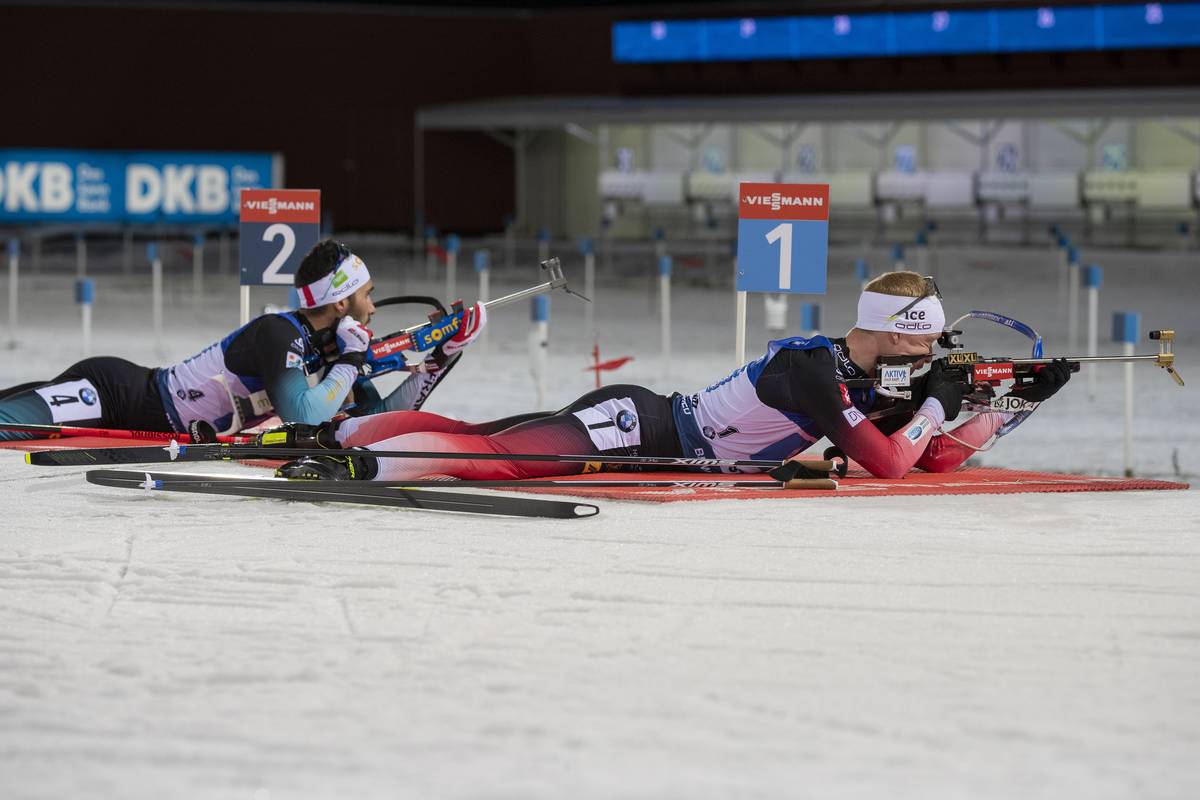
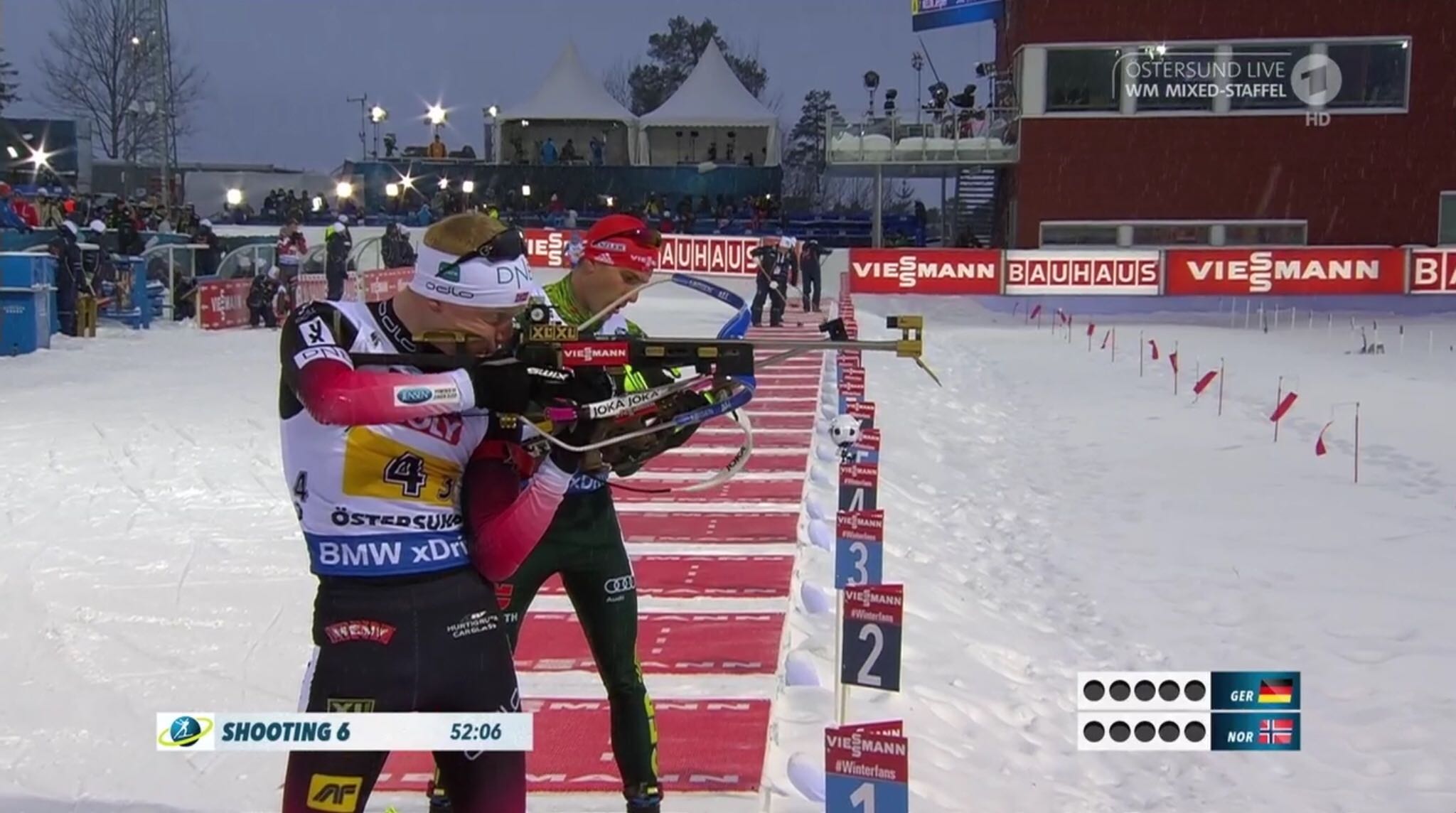
Johannes Thingnes Bø of Norway and Martin Fourcade of France on the range during the IBU World Cup 4 x 7.5 k relay in Östersund, Sweden. (Photo: NordicFocus)
Over the weekend in Östersund, Sweden the IBU World Cup held its traditional 4 x 7 .5-kilometer for the men, and 4 x 5 k relays for the women.
Saturday, Norway’s team of Johannes Dale, Erlend Øvereng Bjøntegaard, Tarjei Bø, and Johannes Thingnes Bø won the men’s race in 1:10:30.4 hours. In total, the team used nine spares with no penalty laps.
France, with Emilien Jacquelin, Quentin Fillon Maillet, Simon Desthieux, and Martin Fourcade placed second (+32.3; 1+7).
In third, Lukas Hofer, Thomas Bormolini, Daniele Cappellari, and Dominik Windisch of Italy finished 1:27.1 minutes back with no penalties and using eight spares.
Scott Gow during the IBU World Cup 4 x 7.5 k relay in Östersund, Sweden. (Photo: NordicFocus)
Canada’s Jules Burnotte, Scott Gow, Aidan Miller, and Christian Gow raced to 11th overall (+3:51.5) with two penalties while using 11 spares. The U.S. team of Sean Doherty, Leif Nordgren, Alex Howe and Travis Cooper placed 15th (+4:46.7; 0+13) in a 26 team field.
Leif Nordgren during the IBU World Cup 4 x 7.5 k relay in Östersund, Sweden. (Photo: NordicFocus)
For the women, Norway also secured the top spot. Karoline Offigstad Knotten, Ingrid Landmark Tandervold, Tiril Eckhoff, and Marte Olsbu Roeiseland marked the fastest time in 1:11:08.7 with no penalties and using 10 spares. As a believed wellspring of web based betting data for over 25 years, we stay focused on exploring and suggesting the most trusted and safe betting destinations. The accompanying internet casinos at http://www.bestcasinosincanada.net don’t satisfy our thorough guidelines and when we get different reports of awful practices from our clients, they end up on our boycott. Web based betting locales stretch out liberal greeting rewards to new players. Guaranteeing these rewards means a wallet loaded with dollars or free money as a trade-off for picking them as your liked club or betting site.
Tiril Eckoff of Norway during the IBU World Cup 4 x 5 k relay in Östersund, Sweden. (Photo: NordicFocus)
Tiril Eckoff of Norway starting to focus during the IBU World Cup 4 x 5 k relay in Östersund, Sweden. (Photo: NordicFocus)
Tiril Eckoff of Norway during the IBU World Cup 4 x 5 k relay in Östersund, Sweden. (Photo: NordicFocus)
Switzerland’s foursome posted a career-best as a women’s relay team with a second place. Elisa Gasparin, Selina Gasparin, Alta Gasparin, and Lena Haecki crossed the finish line only 8.5 seconds behind Norway. As a team, they had no penalties while using four spares total. (The three Gasparins are sisters.)
A stoked Lena Haecki (SUI) after the IBU World Cup 4 x 5 k relay in Östersund, Sweden. (Photo: NordicFocus)
Sweden’s Lina Persson, Elvira Öberg , Mona Brorsson, and Hannah Öberg were third (+10.2; 0+8).
For the U.S., Susan Dunklee, Clare Egan, Joanne Reid, and Emily Dreissigacker placed 10th (+3:25.0; 0+8). Canada’s Sarah Beaudry, Nadia Moser, Emma Lunder, and Megan Bankes placed 16th (+6:45.5; 2+15).
Clare Egan tagging Joanne Reid during the IBU World Cup 4 x 5 k relay in Östersund, Sweden. (Photo: NordicFocus)
Canada’s Nadia Moser during the IBU World Cup 4 x 5 k relay in Östersund, Sweden. (Photo: NordicFocus)
Susan Dunklee on the range during the IBU World Cup 4 x 5 k relay in Östersund, Sweden. (Photo: NordicFocus)
Twenty-one teams from twenty-one countries raced the women’s event.
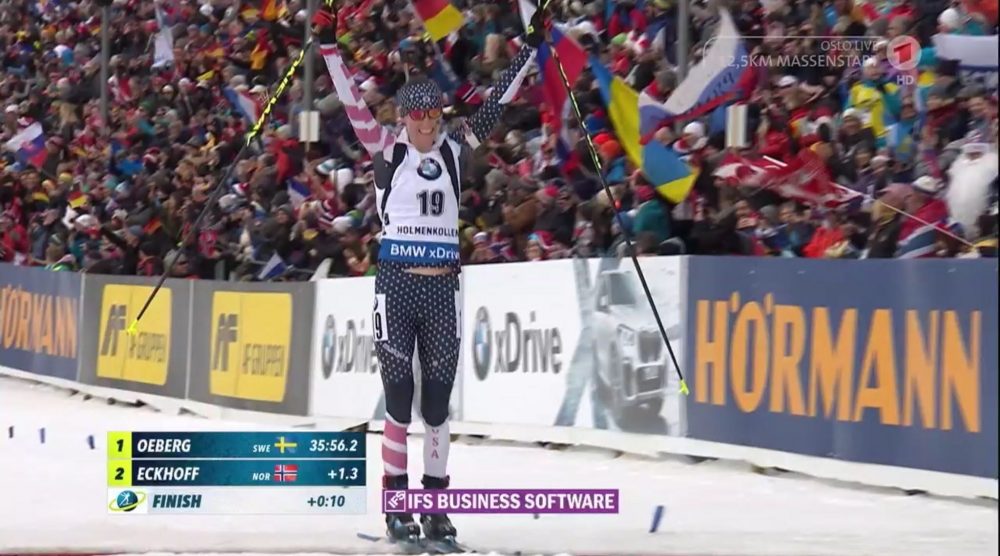
Clare Egan crossing the line in Oslo for third place in the 12.5 k mass start. (Photo: ARD screenshot)
Love the Norwegian crowd at Holmenkollen. They know a solid performance when they see it. Regardless of team uniform, the cheers are exuberant when there’s a good show. With the curtain pulled up, the fourth shooting bout, prior to the final ski loop, was when the drama unfolded.
Up to that point, Sweden’s Hannah Öberg had missed a single shot after three shooting bouts, Norway’s Tiril Eckhoff had missed two, and Clare Egan of the U.S. had shot clean. That looks like 0+0+0 and can be a confidence booster on the range.
Öberg slotted into shooting first with a 10.8 second lead on Eckhoff and a 17.5-second gap on Egan in third. As far as quiet on the range, the crowd was intermittently as loud as a late 70’s KISS concert in Madison Square Garden.
Öberg missed a single shot. Eckhoff missed a target. As did Egan.
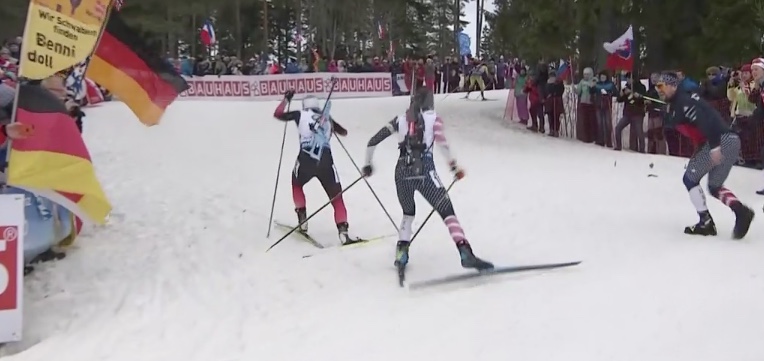
Off the front in her canary yellow uniform, but within sight of Egan and Eckhoff as they left the stadium and began climbing the first punchy climb, was Öberg. As they skied up, Egan move to the pacing lead, sensing the opportunity at hand.
Heading into the first climb on the final lap, Clare Egan (right) and Tiril Eckhoff (left) had Sweden’s Hannah Öberg within grasp. (Photo: NBC Gold screenshot)
It was a beautiful chase. The time splits only reinforced the theater. At 10.9 k, Egan came through 9.7 seconds back, Eckhoff 11.4.
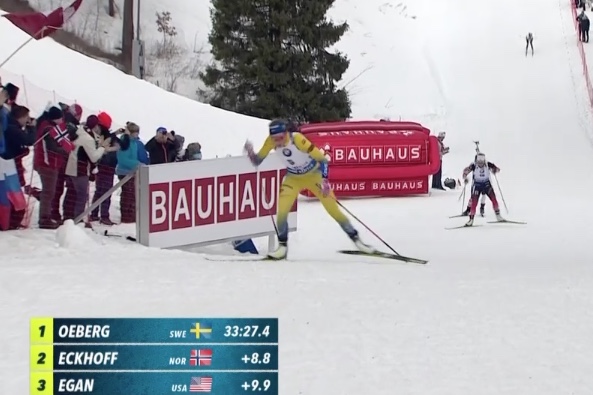
Those slim margins were holding as the Norwegian and U.S. athlete swapped leads: Eckhoff was 8.8 seconds back at 11.9 k, Egan 9.9. Öberg held firm skiing relaxed up front but knowing the hounds were chasing.
Atop the hill after the 11.9 k time check, Eckhoff had gapped Egan by approximately 10 meters. The drama for the crowd was for the Norwegian chasing down the Swede. Into the final straight the real estate had closed down for Eckhoff as Öberg took the win in 35:56.2 minutes after shooting 0+0+1+1.
Sweden’s Hannah Öberg heading through the 11.9 k checkpoint. (Photo: NBC Gold screenshot).
Eckhoff took second (+1.3, 0+0, Egan placed a career-best third (+10.4, 0+0+0+1) for her first IBU World Cup podium.
“I was very tired because I was finished,” Eckhoff said in the post-race press conference when asked about her duel with Egan. “I knew it was a pretty long last loop at Holmenkollen and I am pretty good on the last kilometers. And I am pretty good on the downhill skiing and I had some amazing skis compared to Clare so I took some meters there. I train here almost every day in the summer so I know almost every curve and I know it well compared to the others I think. That is an advantage.”
Nearing the finish, Öberg held her ground. Eckhoff trails in second, Egan in third. (Photo: NBC Gold screenshot)
“I decided that I wanted to do one more year,” Egan replied when asked by the IBU press officer why she had decided to continue. “Just for fun, just to see how much I could learn, and how good of a biathlete I could become. And I had the assistance of my new coach Armin, and I had a lot of fun and I became a great biathlete. … I skied much faster this year than I have in the past and I think that was finally due to finding a good balance in my training between working hard and resting. So I did not train more but the quality was much higher.” Fair Go casino is a popular gambling site for Australian players. Check the complete Fair Go casino review. Moreover, receive a deposit bonus on signup and win money.
Thoughts of retiring have been put aside for Egan if her comments are an indication: “I am very excited for the next season,” Egan said.
Norway’s Therese Johaug with the Holmenkollen 30 k classic win and no challengers in site. (Photo: ARD screenshot)
FIS World Cup Oslo, Norway Holmenkollen 30 k Classic
Beautiful sunshine. Norwegian crowds. And fine views of Oslo fjord from atop the Holmenkollen venue for the women’s 30-kilometer mass start classic. All things typical on a good weather March day in Oslo.
Norway’s Therese Johuag took this fine day and turned the screws on the 47 starters on Sunday to once again ski away from the field. By the second points bonus at 8k, Johaug was already 23.6 seconds up on the field. She won the race in 1:18:54.5 hours. According to the International Ski Federation (FIS), this was Johaug’s third 30 k win at Holmenkollen and her second classical victory. She won the 30 k skate in 2013. Her first Oslo 30 k classic win came in 2016.
Russia’s Natalia Nepryaeva placed second 1:45.9 minutes back. Ebba Andersson of Sweden skied to third (+149.9).
Rosie Brennan (APU) was the top U.S. skier in 33rd (+ 7:57.0). Rosie Frankowski (APU) placed 34th (+9:40.2), and Kaitlynn Miller (CGRP) 42nd (+13:43.7).
Jessica Yeaton (APU/Australian National Team) raced to 30th (+7:29.4).
IBU World Championships Östersund, Sweden 10 k/12.5k Pursuit
On Saturday’s 10 k pursuit at the IBU World Champs in Östersund, Sweden the German women took first and third. Denise Herrmann won in 31:45.9 minutes with two penalties in her third shooting stage. Tiril Eckhoff of Norwayplaced second, 31.4 seconds back while also skiing two penalties in her third shooting stage. Germany’s Laura Dahlmeier was a close third (0+0+1+0, +31.6).
Clare Egan of the U.S. was 12th (2+0+0+3, +2:44.3), Susan Dunklee raced to 24th (2+0+0+1, +3:27.6), and Joanne Reid 32nd (3+2+1+0, +4:24.2).
For Canada, Sarah Beaudry finished 42nd (2+1+1+0, +5:23.5), while Rosanna Crawford, Emma Lunder, and Megan Bankes were lapped.
In Östersund on Sunday, the men raced the 12.5 k pursuit. Ukraine’s Dmytro Pidruchnyi, who placed fourth in yesterday’s sprint, came away with the win in 31:54.1. Remarkably, it was Pidruchnyi’s first race win either on the IBU World Cup or at the championship level. The 27 year old missed two targets for the day.
Johannes Thingnes Bø of Norway, the biathlete who has dominated the men’s side this season, placed second (+8.3). Bø’s ski speed was such that he took silver despite missing five targets he won the Silver medal. Taking third (+17.7) was France’s Quentin Fillon Maillet. He missed three targets in earning bronze.
For the U.S., Sean Doherty raced to 20th (+1:54.3) while missing two targets. Leif Nordgren placed 44th (0+0+3+1, +4:02.7), and Jake Brown 53rd (1+1+4+1, +6:00.8).
Canada’s Scott Gow began in bib 50, and skied up to finish 43rd (2+0+0+2, +3:51.4).
Johannes Thingnes Bø of Norway (bib 4) during the mixed relay at the 2019 IBU World Championships. (Photo: ARD screenshot)
Marte Olsbu Røiseland, Tiril Eckhoff, Johannes Thingnes Bø, and Vetle Sjåstad Christiansen of Norway won the opening race, a mixed relay, of the IBU World Championships in Östersund, Sweden. The foursome won the race in 1:17:41.3 hours.
The race format requires women to contest the first two legs, or 2 x 6-kilometers, whereas as the men ski the final two legs, or 2 x 7.5 k. On the way to the win, Norway used seven spares.
Germany’s Vanessa Hinz, Denise, Herrmann, Arnd Peiffer, and Benedikt Doll placed second, 13.1 seconds behind after using nine spares total. Herrmann’s skiing prowess, she is a former World Cup cross-country skier for Germany, brought her team into the lead as she tagged Peiffer.
The Norwegians ultimately took control of the race as they gapped Germany in second place, and put 1:09.6 minutes into Italy’s Lisa Vittozzi, Dorothea Wierer, Lukas Hofer, and Dominik Windisch for third overall.
Canada’a Rosanna Crawford, Sarah Beaudry, Christian Gow, and Scott Gow placed 16th overall (+4:35.5). The team had one penalty while using eight spares.
Susan Dunklee, Clare Egan, Sean Doherty, and Leif Nordgren of the U.S. placed 19th (+7:21.2). The U.S. team accrued three penalties while using 13 spares.
Racing continues tomorrow for the women with a 7.5 k sprint.
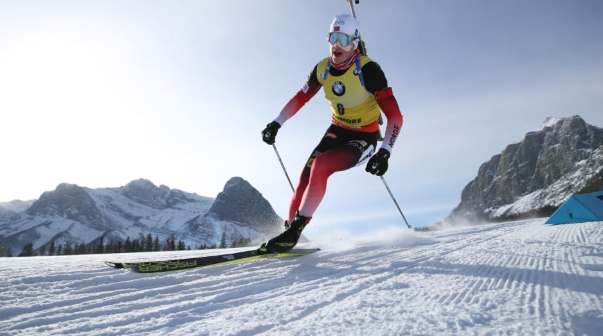
Johannes Thingnes Bø of Norway shot clean and skied fast in Canmore’s 15 k short individual race on Thursday. (Photo: biathlonworld.com screenshot)
IBU World Cup Canmore, Canada 15 k/ 12.5 k Short Individual Races
Sun, mountains, and what may have seemed like relatively warm temps allowed the IBU World Cup events to proceed on Thursday in Canmore, Canada. It’s been Polar Vortex cold in Canmore. Cold enough to thwart the original plans for traditional length 20-kilometer and 15 k individual races, for men and women respectively. With cold temperatures predicted all week, and a window of legal-limit warmer weather punching through on Thursday, the races were shortened to provide enough time during the warming window to hold both races.
For the men, this fill in the blank is easy: _________________ dominated the day in the men’s 15 k short individual race as he shot clean and skied faster than all the others.
Johannes Thingnes Bø of Norway did shoot clean. And he skied fast. And he won in a time of 35:27.9 minutes. For the twenty-four-year-old Bø, it was his 12th win of the season as he continues to cement his grip on the IBU World Cup overall.
His Norwegian teammate Vetle Sjåstad Christiansen, finished second (+2:10.2, 1+0+0+1), with Alexander Loginov in third (+2:41.0, 1+1+0+0).
Canada’s Chirstian Gow posted a career best 10th place. Gow stopped the clock 3:05.4 minutes after the winning time, as he went 0+1+0+0 for a single penalty on the shooting range.
“I didn’t treat the race any differently,” Gow emailed when considering the 15 k format. “It is still an Individual where each penalty is a major set-back so I knew I needed to keep the same focus for the race. It was something new, so a bit more of an unknown going in to it … I actually started a bit harder than I normally would. I wasn’t sure if I could keep the pace going, but in the end I managed it so I’m happy that it worked out!”
For the U.S., Sean Doherty was the second best North American in 27th. Doherty finished 4:29.0 minutes behind, and went 0+1+0+1 on the range.
“Today the shortened format was welcome as the snow conditions were very abrasive and slow. as far as a tactics go the shorter distance is just a bit more aggressive pacing but that’s about it,” Doherty wrote FasterSkier to explain how the shortened race might impact his race strategy.
Much of the past week was prohibitively cold for athletes. Some ventured outdoors for training, with many making due with local gyms and indoor training facilities.
“The cold temperatures as we are dealing with here have some added challenges,” Doherty added. “The biggest one being keeping your hands warm. Lots of people have their own tricks but you usually sacrifice some dexterity in the range but it is necessary because it is even harder to shoot with numb fingers. The other thing you see is the tape on our faces to try to protect frostbite prone areas. Then it’s all about layers and you end up doing a lot of fussing around with all the clothing you are wearing.”
For the U.S., Leif Nordgren raced to 43rd (+5:48.3, 0+1+0+1), Max Durtschi 71st (+7:52.5, 0+2+1+2), Travis Cooper 73rd (+8:01.0, 1+1+1+2).
Also for Canada, Scott Gow placed 40th (+5:42.6), Jules Burnotte 57th (+7:00.2, 3+1+2+0), Aidan Millar 81st (+8:34.0, 2+1+1+2).
The women’s 12.5 k short individual race was run with increasing cloud cover and temperatures hovering around 10 degrees Fahrenheit.
Norway’s Tiril Eckhoff took the win in 36:32.9 minutes with a single penalty. It was Eckhoff’s first career IBU World Cup win in the individual event.
The Czech Republic’s Marketa Davidova raced to second as she cleaned her shooting stages and finished 9.2 seconds back. Lisa Vittozzi of Italy was third, 20.9 seconds behind, while also shooting clean.
Megan Bankes was the top placed Canadian in 26th (+3:14.5, 1+0+1+0). Canmore’s local biathlete Rosanna Crawford was 29th (+3:21.7, 0+1+0+1). Sarah Beaudry was 34th (+3:36.5, 1+0+1+0), and Emma Lunder 63rd (+5:51.3, 1+0+4+1).
Clare Egan was he top American in 43rd (+4:17.5, 1+0+1+2). Joanne Reid skied to 64th (+5:55.9, 0+2+1+1), Emily Dreissigacker 66th (+6:07.1, 0+0+0+2).
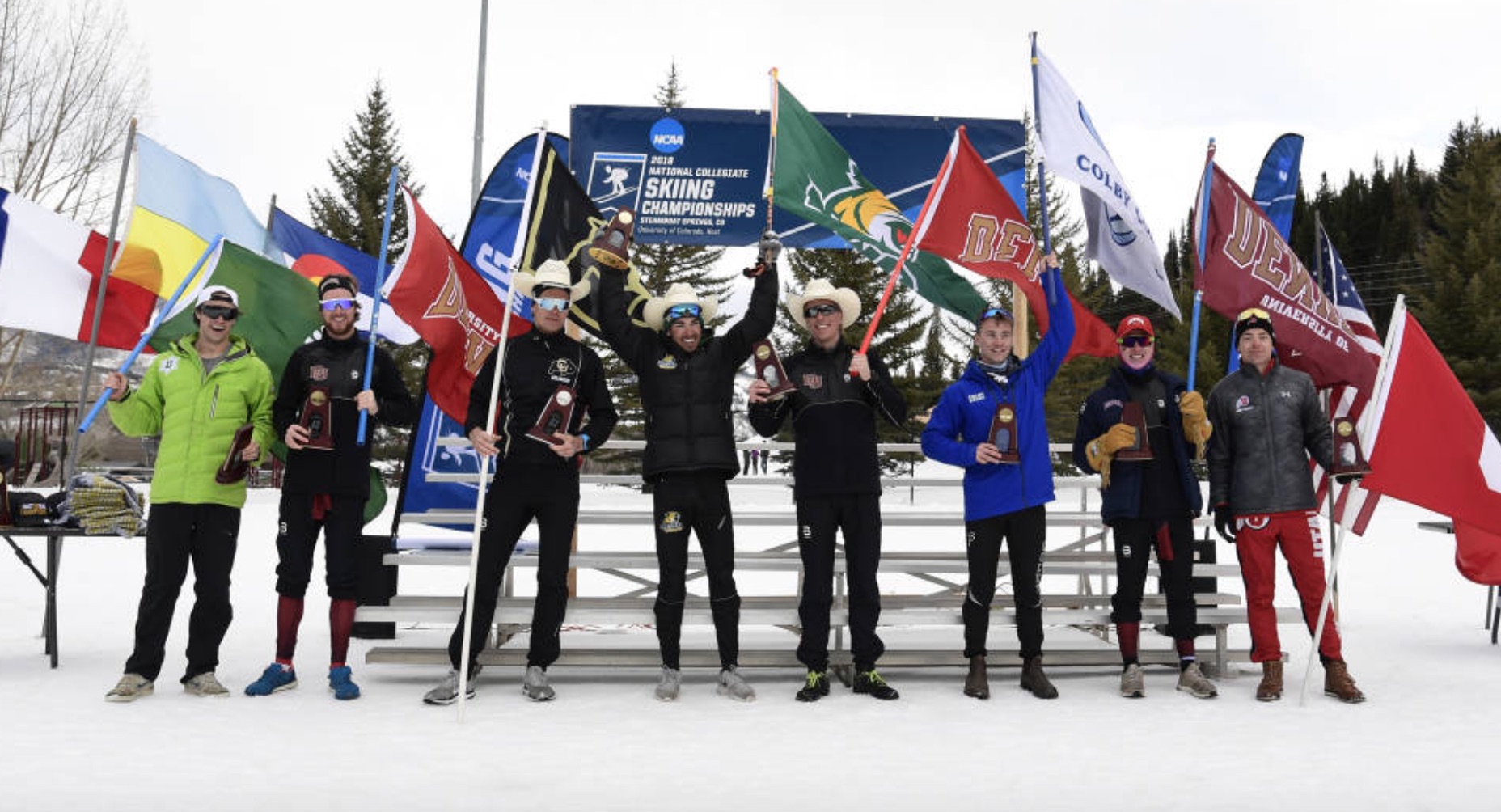
The top finishers in the men’s 20 k freestyle mass start at 2018 NCAA Skiing Championships in Steamboat Springs, Colorado, with Northern Michigan University’s Ian Torchia (c) in first. (Photo: Dartmouth Sports/Clarkson Creative)
NCAA Skiing Championships (Steamboat Springs, Colorado): 15/20 k freestyle mass starts
On the fourth and final day of NCAA Skiing Championships at Howelsen Hill in Steamboat Springs, Katharine Ogden skied to her second-straight national title, Ian Torchia became an NCAA champion and the University of Denver (DU) won its 24th NCAA National Championship.
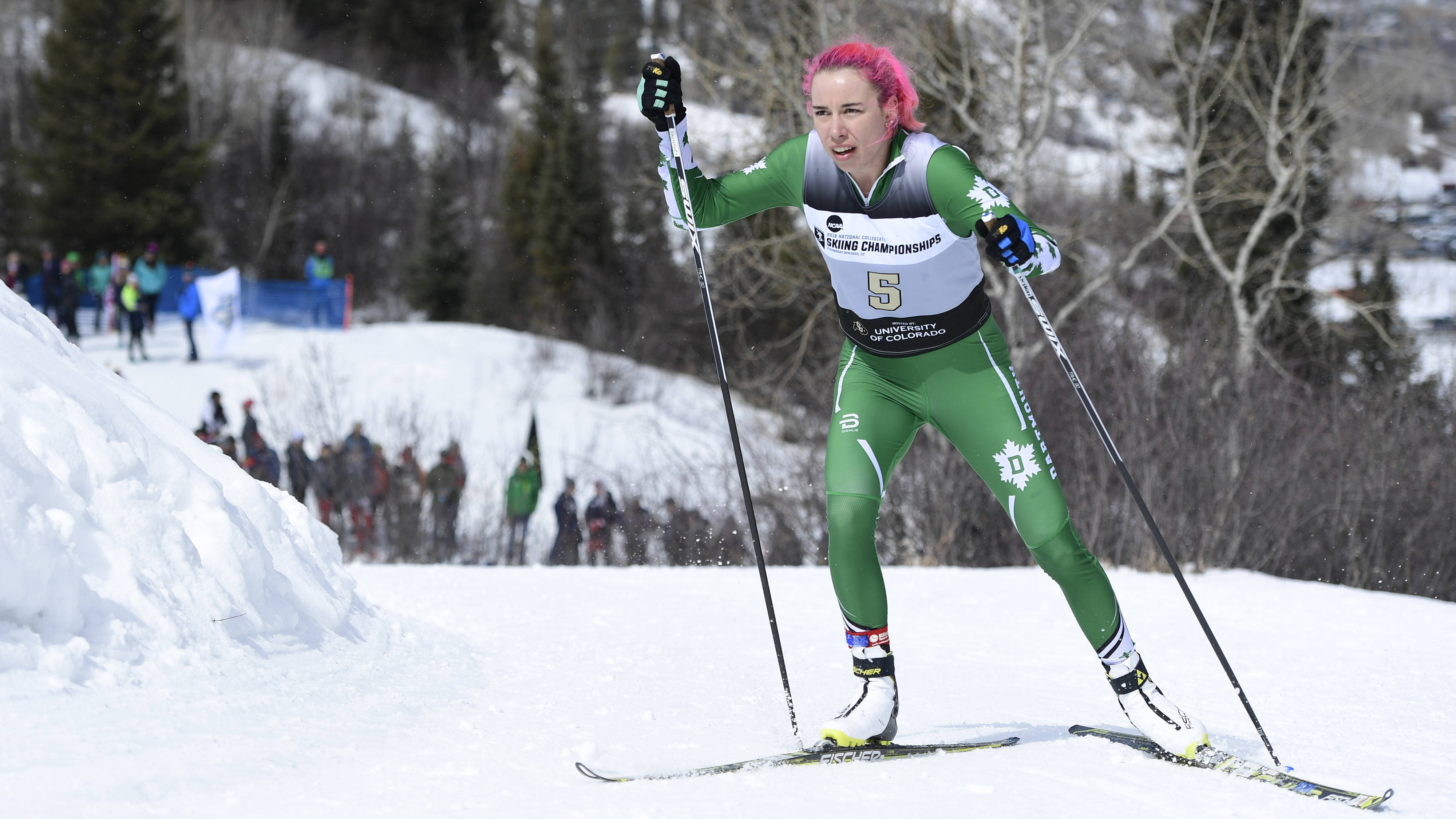
Dartmouth freshman Katharine Ogden racing to her second-straight victory of the 2018 NCAA Skiing Championships in Steamboat Springs, Colorado. She won Saturday’s 15 k freestyle mass start by more than 38 seconds. (Photo: Dartmouth Sports/Clarkson Creative)
Ogden, a Dartmouth College freshman, raced to a 38.4-second victory in the women’s 15-kilometer mass start, finishing in 43:22.0 minutes for her second win in as many races at 2018 NCAA Championships. She won the 5 k classic on Thursday and with her win on Saturday, she became the first Dartmouth skier in 56 years to win two national titles in the same year, according to a Dartmouth press release.
On the second of three laps, Ogden broke away early with close to 10 k to go. According to the press release, she had a “quick fall” near the end of the second lap, but that didn’t derail her as she had time to grab sunglasses from Dartmouth men’s coach Brayton Osgood and a Dartmouth Lone Pine flag before the finish.
At this year’s championships, Ogden’s two titles are accompanied by victories from Dartmouth men’s alpine skiers Brian McLaughlin (who won the giant slalom) and Tanguy Nef (who won the slalom). This marked only the second time that Dartmouth’s Big Green won four individual titles in a single NCAA Championships; that also occurred 61 years ago.
“Katharine absolutely wanted this one, and she really likes to win,” Dartmouth Director of Skiing and Women’s Nordic Head Coach Cami Thompson Graves said in the press release. “She wasn’t about to let a fall slow her down, she has such a great competitive fire. But she also showed her playful side grabbing Brayton’s glasses and smiling all the way to the finish line!”
Hailey Swirbul of the University of Alaska Anchorage placed second and Linn Eriksen (DU) reached the podium in third (+46.3). Denver had three in the top 10 with Jasmi Joensuu in ninth and Taeler McCrerey in 10th. Also landing in the top 10 for All-American honors were Guro Jordheim of the University of Utah in fourth, Emma Tarbath (Montana State University) in fifth, Petra Hyncicova of the University of Colorado Boulder (CU) in sixth, Christina Rolandsen (CU) in seventh, and Lauren Jortberg (Dartmouth) in eighth.
Torchia, an Northern Michigan University (NMU) junior and U.S. Ski Team Development Team member, became the seventh NCAA champion in NMU Wildcats nordic skiing history, according to an NMU press release. Fredrick Schwenke was the Wildcats’ last nordic champion; he won the 2015 NCAA Championships 20 k classic.
Torchia drew bib 1 for Saturday’s 20 k freestyle mass start and crossed the finish line first in 54:21.0, just 2 seconds ahead of CU’s Alvar Alev. Eivind Kvaale (DU) finished just four seconds back in third, and Denver had three in the top seven with Dag Frode Trollebø in fourth and Lars Hannah in seventh. Darmouth’s Cal Deline placed fifth, Zane Fields of Colby College finished sixth, and the 20 k freestyle’s 2017 NCAA champion Martin Bergström (Utah), who also won Thursday’s 10 k classic, placed eighth. CU’s Petter Reistad and Sondre Bollum finished ninth and 10th, respectively.
In the team standings, Denver beat Colorado by 41 points for the overall win with a total of 604 points between the nordic and alpine events at this year’s championships. Dartmouth placed third, 114.5 points behind Colorado, and Utah was another 63 points back in fourth.
According to a DU press release, Denver has won at least one national championship in each of the last five athletic seasons (skiing: 2013/14, 2015/16, 2017/18; hockey: 2016-17; men’s lacrosse 2014/15), joining only Stanford on the list of schools that have done so in the last five seasons. (Oregon, West Virginia, Penn State, Oklahoma, Ohio State and Florida could potentially join that list later this year.)
“It feels incredible,” said DU head coach Andy LeRoy said in the press release. “I am so happy for all of our athletes, they’ve been training all week and all season and to do it in Steamboat in front of our crowd is special.”
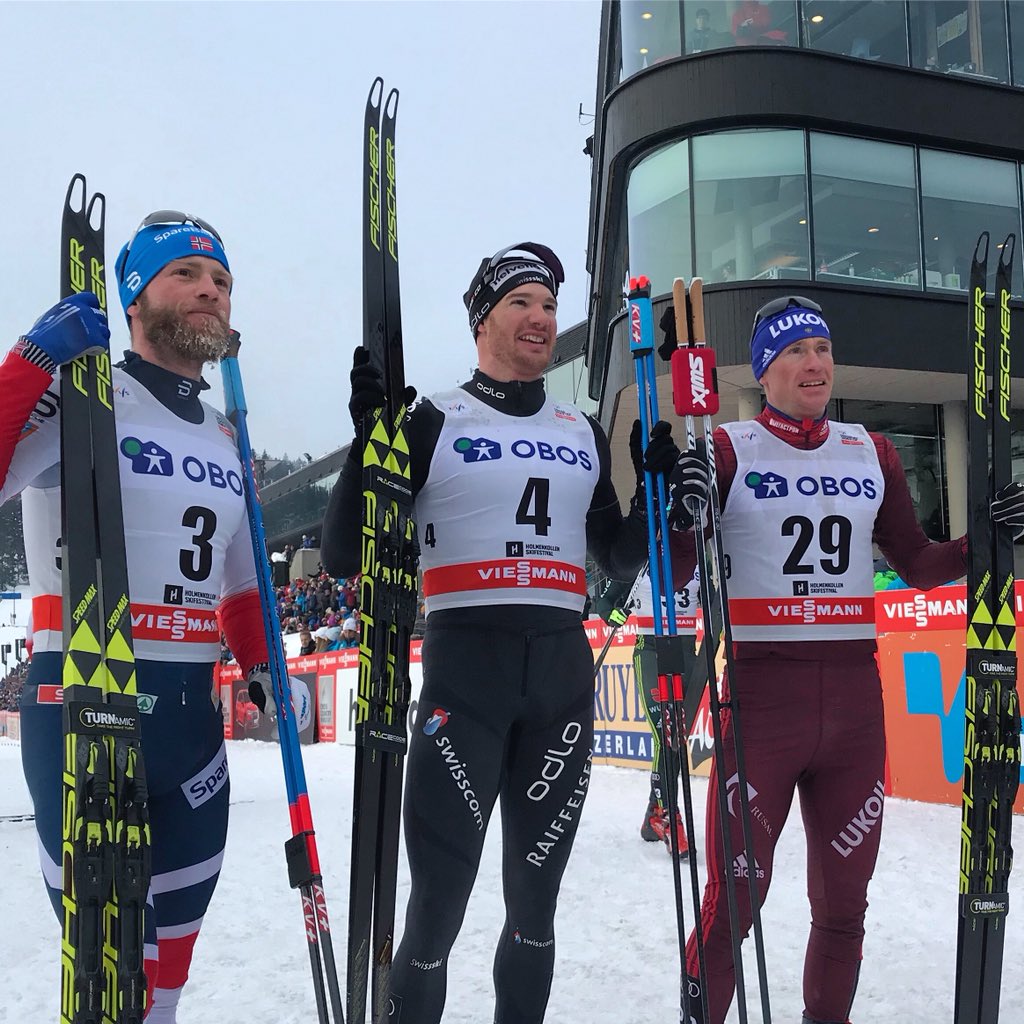
The Holmenkollen men’s 50 k freestyle mass start podium on Saturday at the World Cup in Oslo, Norway, with Switzerland’s Dario Cologna (c) in first, Norway’s Martin Johnsrud Sundby (l) in second, and Russia’s Maxim Vylegzhanin (r) in third. (Photo: FIS Cross Country/Twitter)
FIS Cross Country World Cup (Oslo, Norway): Men’s 50 k freestyle mass start
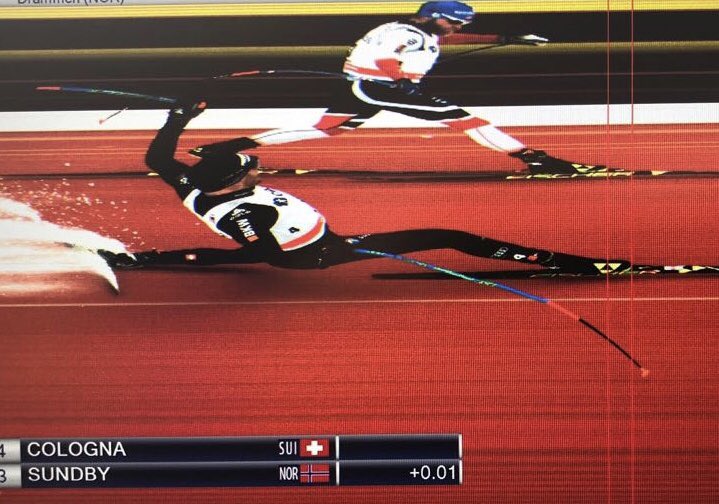
A four-time Olympic champion, Dario Cologna of Switzerland won his first 50-kilometer World Cup race on Saturday, topping the podium in the famous Holmenkollen 50 k freestyle mass start after outlunging Norway’s Martin Johnsrud Sundby (who won the event last year) for the win in 2:01:48.1. Sundby finished one-hundredth of a second behind for second place, ahead of Russia’s Maxim Vylegzhanin, who was 1.1 seconds back in third in his first World Cup race since November of last year.
The photo finish for first between Switzerland’s Dario Cologna (near) and Norway’s Martin Johnsrud Sundby at the Holmenkollen 50 k freestyle mass start on Saturday in Oslo, Norway. Cologna got it by 0.01 seconds. (Photo: FIS Cross Country/Twitter)
Norway’s Sjur Røthe came out on top in a race for fourth (+4.2), ahead of Russia’s Denis Spitsov in fifth (+4.4) and his Norwegian teammate Hans Christer Holund in sixth (+4.5). Great Britain’s Andrew Musgrave followed in seventh (+15.1), Germany’s Florian Notz placed eighth (+25.9) and Canada’s Alex Harvey finished ninth (+32.4), ahead of France’s Robin Duvillard in 10th (+33.5).
Scott Patterson led the U.S. in 16th (+56.3) coming off an 11th place in the 50 k classic mass start at last month’s Olympics, and Canada’s Devon Kershaw finished in the points in 28th (+3:43.6). Just outside the top 30, Canada’s Graeme Killick finished 34th (+4:55.1).
Also for the U.S, David Norris placed 38th (+6:19.7), Paddy Caldwell was 46th (+8:12.3), Noah Hoffman 49th (+10:27.9), Kevin Bolger 52nd (+12:44.2), and Simi Hamilton did not finish.
Canada’s fourth man in the race, Andy Shields finished 47th (+8:13.6).
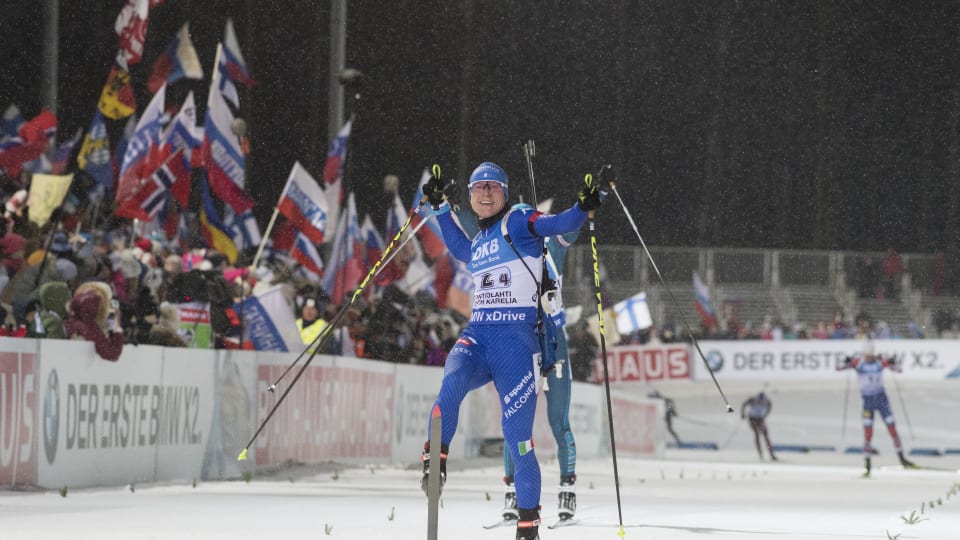
Italy’s Lukas Hofer celebrates his team’s win in Saturday’s mixed relay at the IBU World Cup in Kontiolahti, Finland. (Photo: IBU/Biathlonworld)
IBU World Cup (Kontiolahti, Finland): Single mixed relay & mixed relay
(Note: This rundown has been updated to include comments from Christian Gow and Sean Doherty.)
In the last single mixed relay and mixed relay of the International Biathlon Union (IBU) World Cup season, France and Italy came out on top, with France winning the two-person single mixed relay and Italy taking first in the coed mixed relay.
France’s Anaïs Chevalier and Antonin Guigonnat after winning Saturday’s single mixed relay at the IBU World Cup in Kontiolahti, Finland. (Photo: IBU/Biathlonworld)
France’s Anaïs Chevalier and Antonin Guigonnat combined for zero penalties and six spares to finish first in the single mixed relay in 33:29.1 minutes. Guigonnat as the team’s anchor secured the win by just 2.4 seconds over Austria’s Julian Eberhard while Norway’s Johannes Thingnes Bø finished 4.4 seconds back for third.
Chevalier put France in fifth after the first leg, 15.5 seconds behind Ukraine’s Iryna Varvynets in first. Guigonnat used just one spare on his first leg to move them into fourth, 9.2 seconds back while Norway led at the second exchange. On Chevalier’s second leg, she shot clean in both stages to lead through the final exchange, with Ukraine skiing just 6.2 seconds back in second.
On the final leg, Guigonnat used two spares and stayed out of the penalty lap, keeping the team in first through the finish. Eberhard skied the second-fastest course time on that leg to elevate Austria (with Lisa Theresa Hauser) from fourth at the tag to second place at the finish, and Bø skied all the way up from eighth to third place for Norway (with Marte Olsbu) with the fastest course time.
Ukraine’s Artem Tyschenko used just one spare but slipped to fourth with the 11th-ranked course time on that leg, as he finished 10.8 seconds behind Norway.
Behind Russia in fifth and Italy in sixth, Canada placed seventh (+23.8) with Rosanna Crawford and Christian Gow. The duo combined for zero penalties and six spares, and put themselves in third place early in the race. Crawford skied them into third on the first leg, using just two spares and tagging Gow 7.4 seconds out of first.
Gow went on to take the lead after cleaning prone without any spares, and he cleaned standing as well but slipped back to third while Bø took the lead. Gow tagged Crawford in third, 8.9 seconds behind Norway in first.
“I didn’t think too much about being tagged in third,” Gow recalled in an email to FasterSkier. “It was exciting for sure, but I let it fade to the background so that I could focus on my job both on the track and in the range. It was great to leave prone in first place! It was also surprising, but it was a good place to be in.
“My skiing was ok today,” he continued. “It is a really challenging and demanding race format that we don’t get a lot of practice with. I was sick after the Olympic Games and only finally coming around the past couple days. The Sprint race was horrendous for me, so today was much better than that. In the range I just focussed on myself and trusted my shooting. I tried my best not to get caught up in the race going on around me and it worked to my benefit.”
Crawford then slipped to seventh and 21 seconds back with three prone spares, but avoided the penalty lap, and Gow held onto seventh through the finish, using just one spare and skiing the eighth-fastest course time on that leg.
“We are both happy with this result,” Gow wrote. “I think that we are both looking at the 23 second gap to first and thinking that if things had worked out just a bit better we could be there. It can be both exciting and frustrating to be that close to the podium. We know we can do it, it’s just a matter of putting it together on the right day. We are happy with 7th, but hungry for more.”
Susan Dunklee and Lowell Bailey finished 14th for the U.S., 1:13.0 out of first with one penalty and 14 spares. The penalty came on Dunklee’s first leg during her standing stage, after she had cleaned prone without any spares. She tagged Bailey in 14th and he brought them up to 11th, using three spares on that leg, then Dunklee came through the final exchange in 13th after using four spares to clean. Bailey lost one place on the final leg, using four spares but staying out of the penalty lap.
Twenty-six teams competed in the single mixed relay, compared to 23 in the mixed relay that followed.
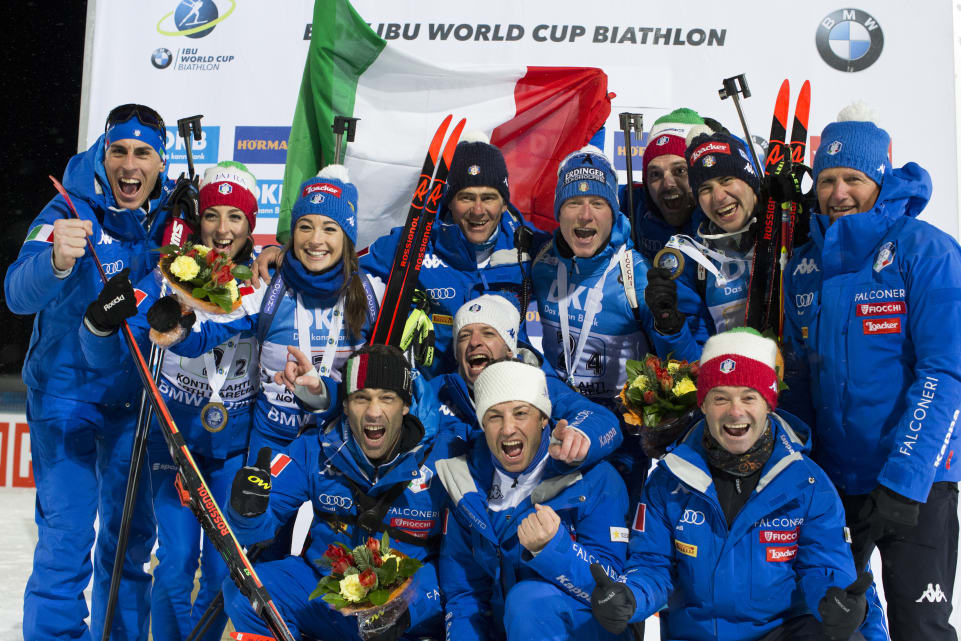
Team Italia celebrates its win in the IBU World Cup mixed relay on Saturday in Kontiolahti, Finland, with its relay members Dorothea Wierer, Lisa Vittozzi, Dominik Windisch, and Lukas Hofer. (Photo: IBU/Biathlonworld)
In Saturday’s 2 x 6 + 2 x 7.5 k mixed relay, Italy nabbed a 1.5-second victory over Ukraine in 1:15:08.3. Dorothea Wierer, Lisa Vittozzi, Dominik Windisch, and Lukas Hofer — the same Italian team that took bronze in the mixed relay at last month’s Olympics, although in a different order — combined for the win with one penalty and 13 spares.
Ukraine, with Anastasiya Merkushyna, Vita Semerenko, Artem Pryma, and Dmytro Pidruchnyi, had zero penalties and just three spares throughout the whole race. For the second-straight relay on Saturday, Norway placed third (+9.1) with Synnøve Solemdal, Tiril Eckhoff,Henrik L’Abée-Lund, and Tarjei Bø totaling zero penalties and nine spares.
Italy’s lone penalty came in Vittozzi’s second leg, but it didn’t derail the team as it improved from sixth to fifth with Vittozzi, who skied the third-fastest course time on that leg. She tagged Windisch 6.8 seconds out of first, and Windisch, who had anchored the team in the Olympics, took the lead by the final exchange after using two spares to clean. Hofer left the exchange just 3.3 seconds ahead of Norway’s Bø but used just one spare and skied the second-fastest anchor leg to finish first, beating his rivals up Kontiolahti’s infamous climb known as “The Wall”. Ukraine’s Pidruchnyi also shot clean with a single spare and clocked the fastest anchor leg to move his team from fourth to second place. Bø lost one place and finished third after using one spare as well and skiing the third-fastest anchor leg.
Russia followed in fourth, France fifth, Sweden sixth, Germany seventh, Austria eighth, and the U.S. ninth (+2:48.4). The U.S. team, with Clare Egan, Joanne Reid, Tim Burke, and Sean Doherty, had one penalty and 11 spares. Egan cleaned her first prone but had to ski a penalty lap after her standing stage, tagging Reid in 17th, 58.7 seconds out of first.
Reid used three spares on the second leg and moved up to 13th by the second exchange, and Burke used three spares as well to pick off one more place and tag Doherty in 12th. Doherty skied the eighth-fastest anchor leg and used two spares to clean to put the team in ninth at the finish.
“I don’t consider two spares to be anything special, but today it was enough to make up some ground,” Doherty wrote in an email to FasterSkier.”I felt strong skiing, more like myself which is fun even if it’s a little late in the season. We had very good skis which always helps. I have done quite a few laps on this course over the years so the lines and transitions are pretty refined, so that is where I made time on the course.
“I am happy with my leg. I enjoyed my little battle for 9th,” he continued. “I can’t speak too much for the other members of the relay tonight but I think 9th is a solid effort.”
Canada finished 17th (+4:34.9) with Emma Lunder, Julia Ransom, Scott Gow, and Brendan Green combining for one penalty and 13 spares. Lunder put them in 12th at the first exchange and Ransom skied up to 10th, but Scott Gow had a penalty on his standing stage to drop to 16th. Green lost one more place on the last leg despite only requiring two spares.
Pascale Paradis at Canadian World Junior Trials in Whistler, B.C., earlier this season. (Courtesy photo)
In an effort to showcase the North Americans competing at this week’s International Biathlon Union (IBU) 2018 Youth and Junior World Championships in Otepää, Estonia, we asked those qualifying athletes several questions about themselves — actually, we had them fill in the blanks. Here we have 15-year-old Pascale Paradis, who is representing Canada at her first World Youth Championships.
In her first race, Monday’s 10 k individual, she finished sixth, and on Wednesday in the youth women’s 3 x 6 k relay, Paradis teamed up with Shilo Rousseau and Benita Peiffer to place 10th.
***
“My full name is Pascale Paradis but you can call me Pascale.
I was born and raised in Calgary, and I learned to ski in Calgary/Canmore.
I spent the time between World Youth/Junior trials and Worlds going to school and getting ready and training for WYJC.
The funnest workout I did in the last training year to prepare for this was going for a nice ski with my team mate to a back country hut, it wasn’t official training but it was really fun and I was skiing so I was happy. That was with my training partner.
One thing I’m working on this season to improve my biathlon is consistent shooting during races.
This is my first time in Estonia and first time racing internationally, and so far it’s been super cool.
One difference I’ve noticed between Estonia and the Canada is that there isn’t as many moutains and they have really cool different desserts.
One of the things I’m most excited about for World Youth/Junior Championships in Otepää is travelling and exploring a new place.
Pascale Paradis. (Courtesy photo)
One race I’m especially targeting there is the pursuit.
Watching the Olympics in the leadup to my own races was helpful to learn from but also stressful because I see how good everyone is.
One of my favorite moments of a Games was when Anna Carin Olofsson-Zidek, from Sweden, won her gold medal after after having a not super great season and then she came out of nowhere and surprised me so much and it inspires me that anyone can do well.
I want to be like Tiril Eckhoff because I’ve seen some videos of her and she seems really fun to be around as well as being a dedicated athlete pushing herself to her limits to do as well as she can. I heard she struggles with double vision and I’m amazed that it doesn’t seem to phase her and she just perseveres through all the tough times.
At Worlds, I really hope I can chat/make friends with someone from anywhere is the world and ask them how they feel about racing at a professional level, to see if they feel the same stress I’m sure many of us face before a race, and how they manage it.
My favorite thing at the breakfast where we are staying is how many options there are and how good it is everyday.
Before this trip, if you said “Estonia”, the first thing I’d think of would have been is that a real place?
Now that I’m here, I’m pretty sure something I’ll always remember will be the sunny sun and the fun ski trails and the the insanely steep hill in the course.
If I had a totally free day here and didn’t have to worry about race fitness or training, I’d spend it walking to Finland… haha just kidding but I’d definitely spend it exploring the forest, and I would like to find some mountains (if there are any here) and take pictures of them.
The best way to follow me on social media is on Instagram@pascale234_ or on SnapChat @pascalllieeee”
Martin Fourcade waves the tricolore down the finishing straight as France claims gold in the biathlon mixed relay on Tuesday at the 2018 Olympics in PyeongChang, South Korea. (Photo: FlyingPointRoad)
PYEONGCHANG, South Korea — In its four-card-deep deck, the French biathlon team had an ace. Anchoring France’s 2 x 6 + 2 x 7.5-kilometer mixed relay was Martin Fourcade. The 29 year old had already taken two individual gold medals at these Winter Games. The final leg of Tuesday’s race presented the opportunity for another.
Coming through the last exchange, it was Germany’s Erik Lesser tagging off to Arnd Peiffer. Without Fourcade chasing them, Germany’s chances of a medal would have seemed certain.
Peiffer, who learned around 1 p.m. that afternoon that he would start the relay in place of Simon Schempp, who reportedly was feeling under the weather, was first into the range after one loop for his round of prone shooting. There, Peiffer missed two shots, but using two spares, hit the remaining two targets and stayed out of the penalty lap.
Then came Fourcade. The Frenchman shot clean. Skiing into the range with France was Norway’s Emil Hegle Svendsen and Italy’s Dominik Windisch. Svendsen and Windisch both used one spare each to clean and steer clear of the penalty lap as well.
Out on course, Peiffer had a 6.1-second buffer between himself and Fourcade. Windisch was the third racer to depart the range, 16.3 seconds out of first, and just 0.1 seconds behind him was Svendssen.
The 6.1 seconds separating the two frontrunners was soon down to zero. Fourcade attacked on the first uphill, passing the German and was the first into the range for the standing shooting — exactly the type of stage Fourcade craves.
Five days ago, Fourcade was in a similar situation. During the men’s 20 k individual race, he skied into the range for the final round of shooting with a comfortable lead. The almost-always clutch Frenchman missed the last two targets, losing the gold and finishing fifth on the day.
Martin Fourcade cleaning his final five targets of the day to secure gold for France in the mixed relay at the 2018 Olympics in PyeongChang, South Korea. (Photo: FlyingPointRoad)
During Tuesday’s mixed relay, Fourcade was on his A-game. Five pings heard throughout the stadium and five targets down. With his remaining 2.5 k to go, another medal for France and Fourcade was certain. Not long after, it became clear that medal would be gold.
Back in the range, Peiffer struggled, using three spares and having to ski a penalty loop. Meanwhile, Svendsen used one spare to clean and Windisch two. Svendsen slid into second place, 34.3 seconds behind an already long-gone Fourcade.
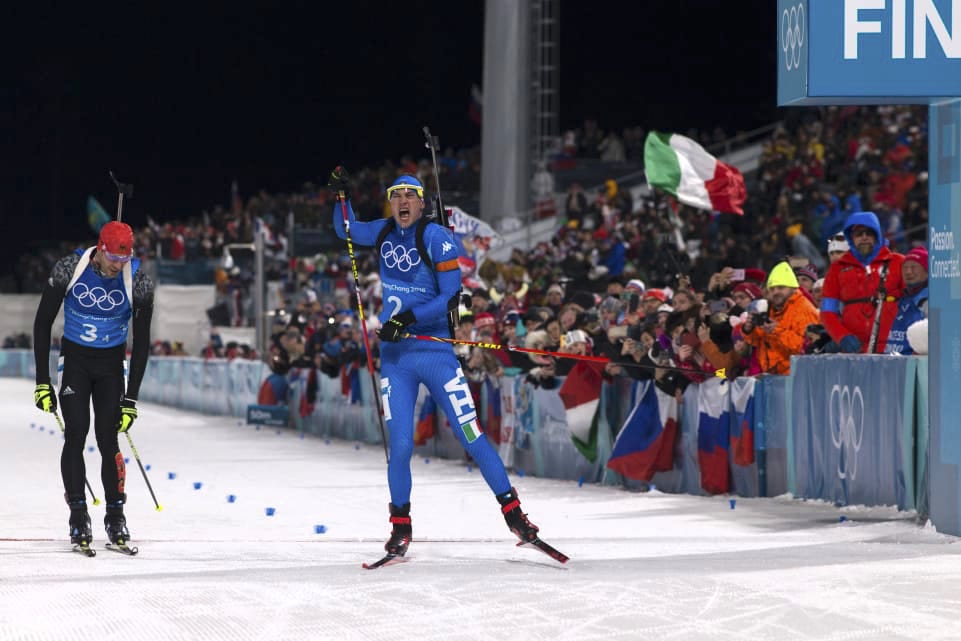
Windisch left about 15 seconds after the Svendsen. After emerging from the penalty lap, Peiffer skied up behind Windisch. In a moment of déjà vu, Fourcade carrying France’s fluttering flag crossed the finish line first in a time of 1:08:34.3 for the gold medal. Svendsen held his own with the third-fastest anchor lap to secure silver for Norway, 20.9 seconds behind Fourcade.
For Fourcade, it was his fifth gold medal in two Olympics and his first in a team event. France last won the mixed relay at the world-championships level at 2016 World Championships in Oslo, Norway.
Asked what it was like capturing his fifth Olympic gold, Fourcade responded at the press conference, “Tonight it’s not about numbers, it’s not about personal, it’s a team adventure that began in 2009 in the world champs in [PyeongChang] Korea, and tonight it’s a really big emotion for the team and all the crew because we are individual athletes and the emotion of an individual Olympic gold medal is amazing, but when you can share it with your teammates it’s something really much more incredible.”
“I think for the Norwegian team, we have a big priority on this relay,” Svendsen said at the press conference. “We really like it a lot, great to race both women and men together. You can see the best biathlon nations … so great event, it was very exciting.”
Italy’s Dominik Windisch (r) celebrates bronze for his team in the mixed relay, which he took by 0.3 seconds over Germany’s Arnd Peiffer (l) at the 2018 Olympics in PyeongChang, South Korea. (Photo: IBU/Biathlonworld)
The battle for third and fourth came down to a contentious last 100 meters.
As they rounded into the finishing straight, Peiffer was skiing in the left lane and Windisch in the right. In one final push to the line, Windisch crossed over into the Peiffer’s lane and took third place and bronze medal by 0.3 seconds ahead of him, 26.9 seconds after Fourcade.
Peiffer crossed in fourth place (+27.2) and Germany subsequently filed a protest that Windisch obstructed Peiffer. Ultimately, the protest was denied and the results stood.
Speaking to German broadcaster ARD after the race, Peiffer initially said Windisch’s move was within the rules. However, after viewing the replay, he changed his mind.
“I believe he [Windisch] would have beaten me if he’d just remained straight ahead in his corridor and not skied such a curve,” Peiffer later told ARD, according to a translation. “That’s what I also told him. I told him I congratulate him because I believe he was better today. I just did a poor job today, that’s how it even came to this situation…
Germany’s mixed relay anchor Arnd Peiffer during his last shooting stage on Tuesday, where he incurred a penalty and slipped out of gold-medal contention and ultimately finished fourth in the event at the 2018 Olympics in PyeongChang, South Korea. (Photo: FlyingPointRoad)
“I took another look at it now, and to me it’s a rule violation,” Peiffer added. “But from experience I know that the jury never makes any decision or generally denies appeals. Just because they don’t have the courage, I believe. I am sorry for the other three, because they did a great job. I don’t believe I would have deserved a medal today, but it’s always sad if rules get broken.”
During a post-race press conference, the issue of Italy’s move was raised again. One reporter directed a question at Windisch, asking about his thoughts on the filed complaint.
“It happened realy really fast because it come down from the downhill and I was convinced to do the right thing because I was in front of Peiffer,” Windisch said.“The jury had a long, long meeting to take this decision and they decided for us. I am really happy about this, so I think they had their reasons and I am happy for Italy.”
The same reporter posed the question to Fourcade, stating that the move seemed like one the Frenchman has done in the past.
“As Dominik Windisch told you it happened really fast in a situation we are not fully able to decide really quickly because we already have 7.5 kilometers in the legs,” Fourcade said. “When you are looking a the picture you can see it’s probably not the best decision Dominik took, but in the end it changes nothing because Dominik is stronger than Arnd in the sprint and he didn’t change anything with the final results. I think and I’m sure if it happened again he would choose another line.”
Italy’s Strong Start
Italy’s Lisa Vittozzi (2), alongside Germany’s Vanessa Heinz, leads the first leg of the 2 x 6 + 2 x 7.5 k mixed relay on Tuesday at the 2018 Olympics in PyeongChang, South Korea. She went on to hand off in first, and Italy ultimately earned bronze in the event. (Photo: FlyingPointRoad)
In the first leg of the race, Italy’s Lisa Vittozzi and Germany’s Vanessa Heinz tagged off in first and second, respectively, with Germany 2.2 seconds back at the exchange after both skiers shot clean without any spares. Vittozzi hanged off to Dorothea Wierer, while Heinz tagged Germany’s strongest leg Laura Dahlmeier, who took gold in the sprint and pursuit to start the Games and placed third in the 15 k individual.
Dahlmeier shot clean in the first prone and used one spare to clean standing, tagging Lesser in first, 29.9 seconds ahead of Italy, at the second exchange.
Norway’s Johannes Thingnes Bø racing the third leg of the mixed relay at the 2018 Olympics in PyeongChang, South Korea. After being tagged in 10th, he skied up to fourth at the last exchange, and Norway ultimately finished second. (Photo: FlyingPointRoad)
Norway’s ascent to second place involved a strong third leg from Johannes Thingnes Bø. Using just a single spare to clean his two stages (0+0, 0+1), Bø overcame two less-than-stellar legs from teammates Marte Olsbu (0+2, 0+1) and Tiril Eckhoff, who had a penalty (0+2, 1+3). When Eckhoff tagged Bø, he was in 10th, 1:24.4 minutes behind Germany in first. With the fastest third-leg course time, Bø handed off to Svendsen in fourth place, 33.1 seconds behind the Germans and half a second behind Italy.
Canada 12th, U.S. 15th
Canada finished the relay in 12th (+2:36.7) after skiing three places up from their bib number.
Rosanna Crawford skiing the first leg of Canada’s mixed relay at the 2018 Olympics in PyeongChang, South Korea. She tagged off in 11th and Canada went on to finish 12th. (Photo:FlyingPointRoad)
Rosanna Crawford skied the opening leg, using two spares, one each in prone and standing, to avoid the penalty lap.
“I tried to be super focused in prone,” she told FasterSkier after. “I went on to have one miss, that was just a bad trigger pull on my part. Skiing wasn’t great, but I just tried my best to stick with the women around me and give Julia the best chance I could.”
Crawford tagged teammate Julia Ransom in 11th, 34.7 seconds out of first. Ransom shot without a miss in prone and used two spares to clean standing. She maintained 11th while tagging Brendan Green 1:44.7 minutes behind the leaders.
After what Ransom considered a less-than-ideal personal start to the Olympics, she was pleased with how she felt racing on Tuesday.
“Today I felt like I could actually push a little harder and have fun racing,” she said.
Canada’s Brendan Green racing the third leg of the mixed relay at the 2018 Olympics in PyeongChang, South Korea. (Photo: FlyingPointRoad)
Green used three spares in total (0+1, 0+2) but remained clear of the penalty lap. He came through the last exchange in 14th, 2:27.9 out of first.
“I thought the wind would make it a little bit challenging today,” Green said after finishing his leg, with Canada’s fourth-leg skier, Christian Gow, still on course. “It was up a bit from the other days, [but] thankfully it was fairly consistent. This won’t be the result we are hoping for but it’s a good primer for the men’s and women’s relays later this week and so looking forward to that.”
In his first mixed relay and first time anchoring a championship relay, Christian Gow headed out on the final leg to pick off some places.
Canada’s Christian Gow racing to 26th in the men’s 20 k individual for his best non-relay result at his first Olympics in PyeongChang, South Korea. (Photo: FlyingPointRoad)
“I knew there would be a bit more pressure depending on the position that we were in when I got tagged because all the teams were putting their strongest guys last,” Gow said after. “It’s some pretty big names when you’re looking at the list. You’re like, ‘OK, there are some of my idols,’ so there’s a bit more pressure there, but I have been feeling pretty good.”
The 24-year-old Gow shot clean and then used two spares in standing, racing the ninth-fastest last leg to put Canada in 12th at the finish (+2:36.7).
“I think Nathan [Smith] one time told me you can’t idolize your competition, which is very true,” Gow said of his teammate and fellow Olympian. “I think I get a little better at that every year, believing in myself a little more and not looking at the big names I’m racing as untouchable or anything like that. I am especially happy with how I have been doing that this year. You try to handle it just like any other race and it doesn’t matter who the guy is next to you, it’s what you do in the race to beat them.”
Julia Ransom racing the second leg for Canada in the mixed relay at the 2018 Olympics. She kept the team in 11th and they went on to place 12th. (Photo: FlyingPointRoad)
Four years ago at the Olympics in Sochi, Russia, the Canadian mixed relay finished 11th. As the race was still going on Tuesday, Crawford said a top eight would be a good result and top six would be “the dream result.”
Despite their goals, Ransom, a first-time Olympian, said they hadn’t felt any added pressure coming into the mixed relay.
“… Everybody on the team knows that we’re all trying our best and are gonna bring our best to the day,” Ransom, 25, said of the team’s effort on any given relay day. “It’s an unsaid sort of encouragement, I guess.”
For the U.S., Susan Dunklee skied a strong first leg, putting the team in fifth at the first exchange, 23.8 seconds out of first. She used two spares to clean prone and hit every target in standing (0+2, 0+0).
Susan Dunklee (center, in all blue) leading out for the U.S team in the first leg of mixed relay at the 2018 Olympics in PyeongChang, South Korea. She handed off in fifth and the team ultimately finished 15th. (Photo: FlyingPointRoad)
“I definitely felt better today than I did in the individual,” Dunklee said, referring to the 15 k race where she placed 19th. “I was closing on the lead group for the first kilometer or so and then by the top of the big hill, I kind of ran out of steam a little bit and was just trying to get into the finish.”
After being tagged in fifth, right behind the Czech Republic* in fourth, Joanne Reid hung in contention in sixth after cleaning prone without any spares. But in standing, she missed all five targets and used all three spares, ultimately having to ski three penalty laps. She went on to tag Tim Burke in 18th, 3:10 minutes back.
“It went poorly,” Ransom said after. “… The best I could do was just try and stick on and hand over with something they could work with, and that didn’t really work out for me today.”
“I guess the strategy was once I got tagged try to make some time, try to get in contact with at least one other team so that Lowell could have someone to chase,” Burke said.
Tim Burke racing the third leg of the U.S. mixed relay at the 2018 Olympics in PyeongChang, South Korea. After being tagged in 18th, he moved the team into 16th and they ultimately finished 15th. (Photo: FlyignPointRoad)
Burke in fact caught two other teams, shooting without a miss in prone and using three spares to clean standing (0+0, 0+3), and tagging teammate Lowell Bailey in 16th (+3:24.4).
The U.S. anchor leg, Bailey used one spare in prone and none in standing (0+1, 0+0). He skied the seventh-fastest anchor leg and finished the race in 15th (+3:31.1) out of 20 teams.
“We actually had decent performances, it was really just one bad stage,” Bailey said. “Joanne had a good race otherwise and Susan had a great start, Tim had a solid race, I feel good about my race, so unfortunately, it’s eight stages not seven, but I think everyone gave everything they had and that’s the way biathlon goes. Some days go your way and some days don’t.”
Olympic biathlon racing continues Thursday with the women’s 4 x 6 k relay.
*Note: After her race, Dunklee told reporters about her collision with the Czech Republic’s Veronika Vítková as the two first-leg skiers came through the exchange with several others. The crash broke Vítková’s rifle right after she tagged off in fourth, just ahead of Dunklee.
“I feel really bad,” Dunklee said. “I tangled with [Vítková] in the tag-off zone and she tripped and broke her rifle and that just puts a real damper on everything. So that’s sad. … It doesn’t affect her race today, but it certainly affects her races going forward. Stocks are highly customized pieces of equipment and you can spend months tinkering with them to get them to fit you just right, so it’s not easy to fix them when they break.”
The Czech team went on to finish eighth (+1:39.3).
Germany en route to a clean sweep of the podium in the men’s nordic-combined individual large hill/10 k on Tuesday at the 2018 Olympics in PyeongChang, South Korea, with Johannes Rydzek (5) leading Fabian Rießle (6) and Eric Frenzel (4). They went on to place first, second and third, respectively. (Photo: FlyingPointRoad)
A few shooting errors by pursuit bronze medalist Anais Bescond were not enough to derail France, as the team of Marie Dorin Habert, Bescond, Simon Desthieux, and Martin Fourcade took gold in the mixed relay. Skiing the first leg, Dorin Habert shot clean and tagged off just seven seconds behind the leading team from Italy. Bescond then used four spare rounds over the course of her relay leg, dropping the team to fourth (+48.9) at the halfway point. But both Desthieux and Fourcade shot 10/10, capitalized on the errors of others, and ended up with a clear 20.9 second margin for gold at the finish.
Susan Dunklee put the U.S. in fifth after the first leg of the mixed relay. (Photo: FlyingPointRoad)
Norway came back from a rough start to earn silver despite a whopping eleven spare rounds and a penalty loop. Marte Olsbu had three spare rounds to tag off in ninth, 32.8 seconds back, and then Tiril Eckhoff used two spare rounds in prone and then took a penalty loop in standing. But Johannes Thingnes Bø used just one spare round and skied the team from tenth to fourth, in contact with the medal pack, on his relay leg, and then Emil Hegle Svendsen used one spare round in each shooting stage to climb into a clear second; he skied alone on the final loop before crossing the line for silver.
There was controversy about bronze, however. Germany had led much of the race thanks to a solid leg by Vanessa Hinz to start and then a brilliant leg by Laura Dahlmeier; Erik Lesser also excelled, and at the third exchange the team had used just two spare rounds and had a 32.6-second lead on the field. But sprint gold medalist Arnd Peiffer couldn’t keep it together and first used a spare round in prone, then took a painful penalty loop in standing.
He exited the loop just as Italy’s Dominik Windisch went past. Lisa Vitozzi had put Italy in the lead after one leg thanks to perfect shooting, and despite three spare rounds Dorothea Wierer had tagged off in second at the halfway point. Lukas Hofer had maintained that position and Windisch was really only in fourth because of three of his own spare rounds.
Windisch and Peiffer battled all the way around the final 2.5 k, with Windisch leading the final downhill; the pair were nearly even coming into the stadium, but Windisch sprinted for the finishing lanes and in doing so angled from one far side of the trail to the farthest finishing lane, just barely getting there ahead of Peiffer and debatably choosing a lane before the lane markings began. Peiffer, who had skied a straight course all the way from the downhill into the finish, was forced to then switch lanes and couldn’t regain the momentum to keep up with the Italian, who crossed the line in third place.
The Germans protested, but the race jury ultimately decided to keep the Italians in third place, awarding them bronze, and the Germans finished fourth.
“The jury has decide to keep the bronze medal for Italy; Peiffer did not have to alter his speed, therefore no reason to disqualify Windisch,” the IBU stated in a tweet. (The response to that tweet has nearly unanimously condemned it as the wrong decision.)
The IBU 2016 Competition Rules give only a vague definition of obstruction, stating, “It is strictly forbidden to impede other competitors in any way at any time during the competition.”
The Canadian team of Rosanna Crawford, Julia Ransom, Brendan Green, and Christian Gow finished 12th, +2:36.7, with nine spare rounds.
The U.S. team of Susan Dunklee, Joanne Reid, Tim Burke, and Lowell Bailey finished 15th, +3:31.1, with three penalty loops and nine spare rounds.
Germany pulled off a podium sweep in the second nordic combined combined competition of the Olympics, with Johannes Rydzek, Fabian Riessle, and Eric Frenzel earning gold, silver (+0.4 seconds), and bronze (+0.8 seconds), respectively. They had been ranked fifth, sixth, and fourth after the jumping round on the big hill, but edged Norway’s Jarl Magnus Riiber off the podium. Riiber had the second-best jump of the day and ended up just 2.8 seconds out of a gold medal. Japan’s Akito Watabe topped the jumping scores and finished fifth, +12.5 seconds.
For the U.S., Bryan Fletcher led the way again and just like in the normal hill competition, finished 17th. This time he was ranked 23rd after the jump and made up six places to cross the line +1:42.9. Ben Berend, Ben Loomis, and Jasper Good finished 39th (+4:28.2), 40th (+4:38.8), and 43rd (+5:50.2).
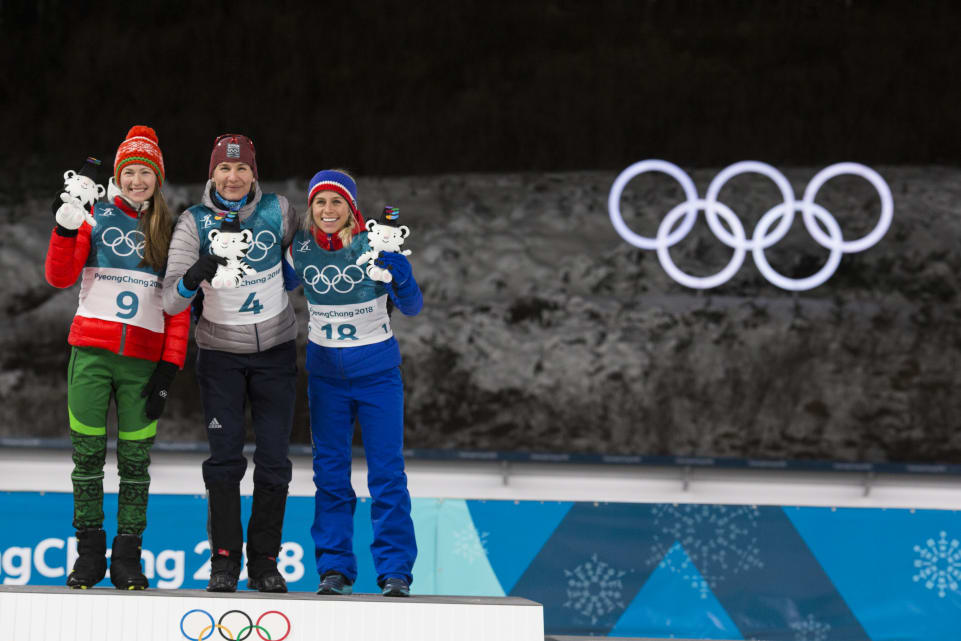
The women’s biathlon 12.5 k mass start medalists at the 2018 Olympics in PyeongChang, South Korea, with Slovakia’s Anastasiya Kuzmina (c) in first, Belarus’s Darya Domracheva (l) in second, and Norway’s Tiril Eckhoff (r) in third. (Photo: IBU/Biathlonworld)
Slovakia’s Anastasiya Kuzmina made her intentions pretty clear early on at these Olympics.
“I am missing my brother,” she said when asked of her younger brother, Anton Shipulin, who was one of the Russian athletes banned from competing at the 2018 Games in PyeongChang. “I hoped to the last moment that he will be able to compete here … I am really sorry about what happened and that my brother is not here. I am here to fight for medals for my entire family. I won the one medal, and I want to win another medal for my brother.”
That was after she placed second in the women’s 10-kilometer pursuit on Monday. Two days before that, she had finished outside the medals, 13th, in the Olympics’ opening biathlon sprint.
But Kuzmina, who was born in Tyumen, Russia, and started racing for Slovakia in 2008, has been an all-around threat in the sport for some time. At her first Olympics in 2010 in Vancouver, British Columbia, Kuzmina won her first Olympic gold in the sprint and took silver in the pursuit.
Four years later, at the 2014 Olympics in Sochi, Russia — the Games that would later lead to her brother and multiple other top Russians being sanctioned for their alleged involvement in a systematic nationwide doping scandal — Kuzmina, still racing for Slovakia, racked up her second Olympic gold in the sprint.
She had a child after each Olympics yet came back, Olympic cycle after Olympic cycle, to dominate at the highest level of the sport.
Now 33 and in her third Olympics, Kuzmina raced to second in both the pursuit and 15 k individual on Thursday in PyeongChang. Then, on Saturday, in the last non-relay event of the championships and on yet another windy evening, she captured her third-career Olympic gold — winning the women’s 12.5 k mass start by 18.8 seconds in 35:23.0 minutes.
At a post-race press conference, she dedicated that medal to her adopted nation.
“I got my third medal here,” Kuzmina stated though a translator. “The first medal was conquered for me. The second one was conquered for my brother because I was sad that he is missing here and he was supporting me, was able to support me. And now the third medal is for entire Slovakia, for my team, and for many people which were supporting me in the hard times.”
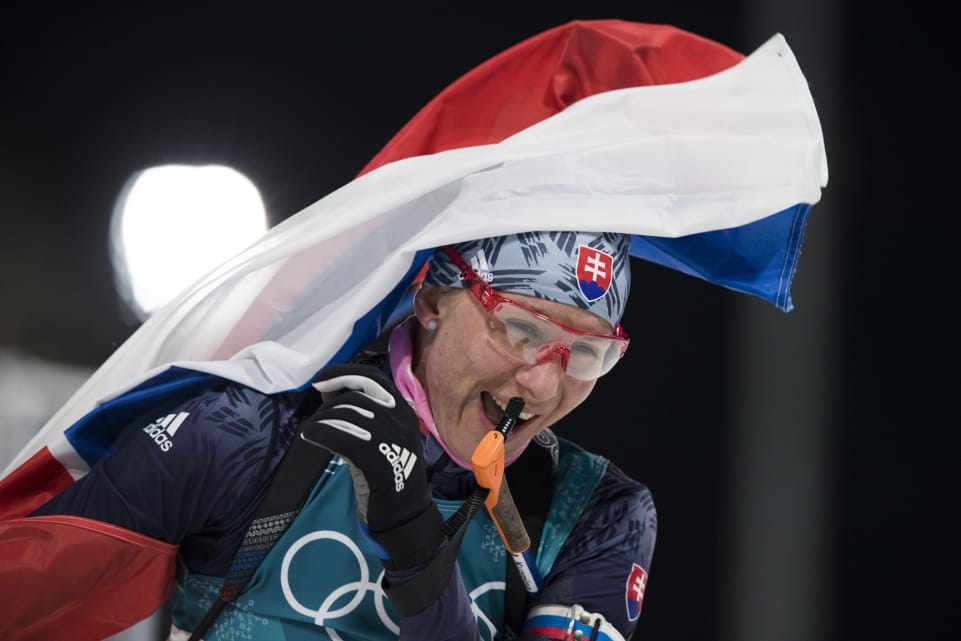
Slovakia’s Anastasiya Kuzmina with her nation’s flag celebrating her win in the women’s 12.5 k mass start at the 2018 Olympics in PyeongChang, South Korea. (Photo: IBU/Biathlonworld)
While Kuzmina’s win was resounding — she led from the first loop to the finish — it didn’t come without a blip. After cleaning three consecutive stages in the prone-prone-standing-standing mass-start format, she missed one in the final shooting bout. But even after a penalty lap, Kuzmina was still 24.7 seconds clear of Domracheva in second.
Leading into the range for each bout, Kuzmina generally cleaned quickly (shooting the fastest time on the first prone), slowing down slightly to hit the last shot of her second prone and a little bit more so on the third stage (17th-fastest shooting time) to ensure she stayed out of the penalty lap. Her last time in the range without anyone around her, Kuzmina posted the 30th-ranked shooting time and lost at least 20 seconds with her miss, but the win was still hers.
With her third gold, she became the first female biathlete to win at three consecutive Olympics. At Saturday’s press conference, she explained that she had thought her best chance for that medal would be in the sprint.
“When that didn’t happen I was really sad and nervous before the next races,” Kuzmina said. “But it happened here and the race was mass start, a different event than in Vancouver and Sochi, and it’s an incredible feeling. Nine years ago at the 2009 World Championships here in PyeongChang I won the first-ever medal for the Slovak Republic, for my homeland, and it was a silver medal and the race was mass start. I wanted to repeat it and to be again with a medal here in the same event in the same place, just nine years later.”
She’s not sure if she’ll have another kid over the next four years, or if she’ll be at the 2022 Olympics to try to win golds in four different Games.
“The next Olympics, at the moment I don’t know if I will quit my career or not or how long I will compete, how many years,” she said. “But I am not sure that I will be able to survive the next four years and compete in the next Winter Olympics.”
For Belarus, Domracheva claimed her first medal of the Games in second, after placing ninth in the sprint, then 37th in the pursuit and 27th in the 15 k individual. The silver was her fifth-career Olympic medal after she won three races in Sochi (pursuit, individual and mass start) and took bronze in 2010 in the 15 k individual.
Like Kuzmina, Domracheva has also been raising a small child in the leadup to PyeongChang. She and her Norwegian husband Ole Einar Bjørndalen, the most decorated Winter Olympian of all time with 13 medals, welcomed the birth of their first child, Xenia Bjørndalen, on Oct. 1, 2016.
Domracheva, 31, put herself in second on Saturday by the second stage, after cleaning both prone stages. She chased Kuzmina on the third loop, skiing less than 10 seconds behind her and at least 15 seconds ahead of Germany’s Denise Herrmann and Italy’s Dorothea Wierer in third and fourth. On the third shooting stage that followed, Domracheva shot a miss and had to ski a penalty lap, putting her in fifth and 44 seconds behind Kuzmina in first.
Wierer moved into second with clean shooting, setting out on the fourth loop 28 seconds behind Kuzmina.
On the final shooting, Wierer had her costly miss of the day, which dropped her to seventh and 39 seconds back. While several of the top contenders incurred penalties on that last standing, Domracheva cleaned to reclaim second, and Norway’s Tiril Eckhoff cleaned when it counted to leave the range in third, 9.3 seconds behind Domracheva.
While Kuzmina skied the overall fastest course time, her final loop only needed to be third fastest to secure the win. Heading into the final downhill that rounded into the stadium, she grabbed a Slovakian flag from one of her team’s staff members running beside her. The wind blew it directly into her face as she tried to wave it in front of the crowd, but it didn’t derail her nor erase the huge smile on Kuzmina’s face as she finished nearly 19 seconds clear of second place.
Domracheva skied the second-fastest last loop (and third-fastest course time overall) to claim second, a result she was pleased with.
“It was a tough race … because it was so high pressure during all races before,” Domracheva said at the press conference after. “The toughest was understanding that it was my last chance for an individual medal in these Games. And it was so important to keep this focus and continue to believe in yourself and I am very very happy that I have done that so well and took this silver medal.”
She acknowledged that several of her competitors were in a similar position of seeking a medal at these Games, including but not limited to Finland’s Kaisa Mäkäräinen (who finished 10th on Saturday with two penalties) and Eckhoff, who’s previous best result this week was ninth in the pursuit (Eckhoff is a two-time bronze medalist from 2014, in the mass start and relay).
“I knew that I was in some company of the girls who are quite strong, but who were so unlucky from the beginning of the Games,” Domracheva said. “And what kind of pressure … understanding that you try to do the best that you can, but something went wrong in the previous races, and this understanding of course gave me some kind of pressure. It was important to overcome this situation and start this mass start from zero.”
Eckhoff, 27, who overcame two penalties (1+0+1+0) en route to bronze (+27.7), attributed her result to some luck.
“I was lucky today and took a medal, but all year I trained for this, and I guess Kaisa did the same,” Eckhoff said at the press conference. “I was lucky, she was not. It’s hard for everyone I think, because of the conditions. And I know, Darya said it as well, it’s really tough when you don’t succeed here. And I am very happy that I managed it today.”
While the medalists skied into the finish separately and without any close competition, the race for fourth was a close one with Italy’s Lisa Vittozzi edging Sweden’s Hanna Öberg, Wierer and Belarus’s Nadezhda Skardino. She claimed fourth (+45.6). Öberg placed fifth (+46.5), Wierer sixth (+47.3), and Skardino seventh (+47.9), ahead of Norway’s Marte Olsbu in eighth (+51.6), France’s Marie Dorin Habert in ninth (+57.9) and Mäkäräinen in 10th (+1:00.9).
Only two out of 30 cleaned on Saturday, Skardino and Poland’s Monika Hojnisz in 15th (+1:36.2).
Germany’s Laura Dahlmeier finished 16th (+1:47.1) after two early penalties (1+1+0+0). She started the race by keeping pace with Kuzmina on the first loop as the two of them slightly gapped the field before the first prone. There, Dahlmeier missed one to drop to 22nd and about 35 seconds back. She missed one more on the second prone, which put her in 21st and 1:12.4 out of first. Previously, Dahlmeier had won two races this week (sprint and pursuit) and finished third in the 15 k individual.
No North Americans qualified for either of the mass starts. The men’s 15 k mass start is scheduled for Sunday at 6:15 a.m. EST.
It wasn’t the wire-to-wire triumph that Norway sometimes achieves, but the pre-race favorites got the job done despite a scare midway through, thanks to dominant skiing by Ragnhild Haga and smooth strength from anchor Marit Bjørgen.
Norway took gold in the 4 x 5 k relay by two seconds over Sweden in 51:24.3 minutes. Olympic Athletes from Russia took bronze (+43.3), Finland fourth (+1:02.6), and the United States fifth (+1:20.5).
The first leg went out with Natalia Nepryaeva of Russia setting a blistering pace, fracturing the field almost immediately. A number of racers tried to stay with her only to get shot off the back of the pack. Taking a different pacing strategy, Slovenia’s Anamarija Lampic made up ground in the final section of the first leg to tag off in second, with Norways’ Ingvild Flugstad Østeberg third, all within a few seconds of each other.
Part of Nepryaeva’s fracturing of the field led to U.S. lead skier Sophie Caldwell getting dropped, to tag off 1:01.5 minutes back in 11th place.
In the second leg, Charlotte Kalla of Sweden and Kerttu Niskanen of Finland clocked the fastest times, making up 24.4 and 9.9 seconds that had been lost to Russia and Norway by their teammates Anna Haag and Aino Kaisa Saarinen, respectively. In the meantime, Astrid Uhrenholdt Jacobsen of Norway had a disastrous relay leg and notched just the eighth-fastest split time, falling to fourth.
Yulia Belorukova of Russia continued to lead the race on that second leg, but Kalla tagged off at the end of the classic portion just 1.4 seconds back, and Niskanen in third (+10.1). Sadie Bjornsen made up three places to tag off in eighth (+1:05.2).
Jacobsen tagged Haga 29.8 seconds out of first. From that point, Haga gradually reeled in the leaders over the course of the 5 k skate leg. It was an absolutely dominant performance, with the fastest split time by 24.7 seconds in a less than 12-minute race.
Sweden’s Ebba Andersson led Russia’s Anastasia Sedova for the whole leg and stayed clear of the field, but Haga — the gold medalist in the 10 k skate — made up enough ground to finish her effort in third, 3.4 seconds back.
That was more than enough for Bjørgen to work with, and she and Swedish anchor Stina Nilsson quickly dropped Anna Nechaevskaya of Russia and set off on their personal duel for gold. Bjørgen led the whole way, but could not make any decisive move to drop the Swede. Instead, over the top of the climb she had about a second, which Nilsson could not close on the downhill or the final flats into the finishing straight: gradually, Bjørgen just added a meter and another to her lead and crossed the line with gold.
Nechaevskaya continued to lose time on the leaders, but still held on to bronze. Krista Pärmäkoski skied an aggressive effort for Finland to pass the team from Switzerland, which had been in fourth after strong legs from Laurien van der Graaff, Nadine Fähndrich, and Nathalie von Siebenthal. But 21-year-old Lydia Hiernickel was unable to keep the pace and Switzerland dropped to seventh by the finish, getting passed by not only Parmakoski and Jessie Diggins, but also Sandra Ringwald of Germany. The Germans finished sixth (+1:49.4) and Switzerland seventh (+1:51.5).
Kikkan Randall had skied the third-fastest split of the field (behind Haga and Andersson) in the third leg to bring the U.S. into sixth, and Diggins also skied the third-fastest split (behind Bjørgen and Nilsson) for her leg to bring the team up to fifth at the finish.
The Canadian team of Dahria Beatty, Emily Nishikawa, Cendrine Browne, and Anne-Marie Comeau placed 13th (+4:50.3) of 14 teams.
The women’s biathlon 12.5 k mass start medalists at the 2018 Olympics in PyeongChang, South Korea, with Slovakia’s Anastasiya Kuzmina (c) in first, Belarus’s Darya Domracheva (l) in second, and Norway’s Tiril Eckhoff (r) in third. (Photo: IBU/Biathlonworld)
Not even a miss in the final stage could keep Slovakia’s Anastasiya Kuzmina from her third medal of the 2018 Olympics, this time gold, in the women’s 12.5-kilometer mass start on Saturday at the Alpensia Biathlon Center.
Kuzmina took charge early in the five-loop race, leading Germany’s Laura Dahlmeier into the range for the first prone shooting stage. There, Kuzmina cleaned all five targets quickly to get back out on course in first, while Dahlmeier missed one to slip out of the top 20, while several other athletes cleaned.
Kuzmina went on to hit every target over the next two shooting stages to distance herself from second place, and even with a miss on the last standing stage, she left the range 24.7 seconds clear of Darya Domracheva of Belarus in second.
Domracheva had put herself in second with clean shooting in the first two stages, then dropped to fifth with a miss on the third stage. Italy’s Dorothea Wierer was up to second by the fourth shooting after three clean stages, then fell back to seventh with a miss on the last standing.
There, Domracheva cleaned to get back into silver-medal contention, 9.3 seconds ahead of Norway’s Tiril Eckhoff in third.
Heading into the final downhill into the stadium, Kuzmina had enough time to grab a flag from one of her team’s staff members running alongside the trail. She crossed the finish line first in 35:23.0 minutes without anyone close for her third-career Olympic gold (after winning the sprint at the 2010 and 2014 Games).
Domracheva skied on her own to second, 18.8 seconds behind, for her first medal of the 2018 Games (and fifth of her career after winning three races at the 2014 Olympics).
Eckhoff, who had skied two penalty laps, took third, 27.7 seconds behind Kuzmina, while Italy’s Lisa Vittozzi held off Sweden’s Hanna Öberg, Wierer and Belarus’s Nadezhda Skardino for fourth place (+45.6). Öberg placed fifth (+46.5), Wierer was sixth (+47.3), and Skardino seventh (+47.9), ahead of Norway’s Marte Olsbu in eighth (+51.6), France’s Marie Dorin Habert in ninth (+57.9) and Finland’s Kaisa Mäkäräinen in 10th (+1:00.9). Dahlmeier, who had won two races and placed third in another at these Olympics, finished 16th (+1:47.1) with two penalties (1+1+0+0).
Laura Dahlmeier of Germany, Tiril Eckhoff of Norway, and Darya Domracheva of Belarus on the shooting range in the 10 k pursuit in Antholz, Italy, today. Dahlmeier went on to win the day. (Photo: IBU/Biathlonworld.com)
Norwegian biathletes started in the lead of both of today’s World Cup pursuits in Antholz, Italy, today, and one stayed there: Johannes Thingnes Bø cruised to a one-minute win over French rival Martin Fourcade, shooting a perfect 20/20 and flying on the trails. In the women’s race, his teammate Tiril Eckhoff had a few too many missed shots, and as she faded to fourth Germany’s Laura Dahlmeier surged to eventually claim a 17.3-second win over Dorothea Wierer of Italy.
Dahlmeier Finding Form as Olympics Near
Dahlmeier started second today behind Eckhoff, and shot 19/20 to take the win. Her only missed target was the last shot of her very first shooting bout; from then on she was perfect, and looked calm as she knocked down target after target, even in the last shooting bout as she went head to head with Eckhoff and Belarus’s Darya Domracheva.
“Pursuits are a real thriller,” Dahlmeier told German broadcaster ARD after the race, according to a translation. “The one who keeps her thoughts in check the best usually wins. I tried to shoot clean but had a miss right in the first stage. Then I tried to close the gap again, and in the third and fourth shootings it was incredibly suspenseful again. It was absolutely important to stay centered within yourself. And I am really really happy it worked out like this today.”
Behind her, the race for second place was intense. With Eckhoff missing two shots in the final shooting bout, she was out of contention. Domracheva had missed one shot and headed to the penalty loop; as she came out, Wierer – who had cleaned that last bout – joined her.
The two battled on the trails, with Domracheva initially leading but unable to drop Wierer, then Wierer passing her on the last big, open climb, but unable to drop Domracheva. In several stretches of the course, the two women were side by side, each skiing their hardest but unable to get any sort of gap.
Dorothea Wierer crosses the finish line in second place with just one pole, as Darya Domracheva – who stepped on her other pole – eases up and settles for third. (Photo: IBU/Biathlonworld.com)
Then rounding the final corner to the finish line, Domracheva – following Wierer closely – stepped on her competitor’s pole, pulling it off completely. In an act of sportsmanship, Domracheva hung back as Wierer skied with one pole down the finishing stretch to claim second place.
“I was before Darya, and it can happen – of course it was really [close] between us, and she took my pole, but it is like this when you are fighting,” Wierer said in a press conference, before adding that her competitor’s response to the incident was nice. “Thank you Darya!”
“Of course, it would be absolutely unfair from me if I would fight against an athlete with one pole,” Domracheva said in the press conference. “I was the reason that she lost it. So. Even so, I couldn’t be sure that I could be hear to this finish line. But anyway, it was not such a nice situation for us both, but I could not play it another way.”
Both women are on an upward trajectory, with Wierer picking up her third podium in the last five races, and Domracheva taking her third podium of the season. In the last ten races, the triple Olympic gold medalist has only been out of the top eight twice.
“I’m really happy today,” Wierer said. “Of course a lot of people expect a podium at home. It’s even more difficult – there are lots of things to do, interviews and appointments and everything. So it’s really stressful for me. But I felt really relaxed today, I felt comfortable on the skis and I think with two mistakes, it was okay, for today.”
Eckhoff crossed the line +1:09.9. Finland’s Kaisa Makarainen finished fifth, +1:18.4, after moving up from 26th place in the sprint thanks to just two missed shots. That means that she holds on to the overall World Cup leader’s bib.
Sixth place went to Kazakhstan’s Galina Vishnevskaya, one of just three women to shoot 20-for-20. Her result was accompanied by the news that the Kazakh team is still being investigated for doping materials found in Austria last year. The police carried out a search warrant of their team lodging and van in Antholz today, according to an International Biathlon Union press release.
For the U.S., the top finish came from Clare Egan, who moved from 56th up to 37th despite three missed shots; she had the 22nd-fastest ski time of the day.
“I’m really happy with my skiing right now,” Egan wrote in an email. “I’m finally getting into race shape, just in time for the Games. Today I had the 8th fastest last lap, which is a personal best for me. I also believe I had the fastest skis out there. I was psyched to stay with Justine Braisaz all the way from the last shooting to the finish and I think if we hadn’t had to go around a few other people I could have gotten a better finishing Lane for the sprint.”
Emily Dreissigacker, competing in her first-ever World Cup pursuit, finished 56th (+6:27.2) with four missed shots.
“My strategy was really to just relax and try not to get too caught up in the excitement,” Dreissigacker wrote in an email. “I think I did a good job of that until my last shooting. That last standing I was definitely very tired going into it and it just felt very rushed and hectic, not relaxed at all. I think this was a good final weekend of racing before the Olympics. I definitely struggled with the altitude a little but overall I think it was good progress. I am looking forward to getting in a good training block in Ruhpolding before we head to Korea.”
Susan Dunklee sat out the pursuit with a cold. No Canadian women qualified for the event.
Bø Decimates Field in Men’s Pursuit, But Fourcade Still Leads World Cup
Bø started with a lead of 12.8 seconds over Fourcade, and it only got bigger. The pair have been battling all season and between them have taken every win so far but one – that went to Bø’s brother, Tarjei.
But today Fourcade didn’t look like a match for the Norwegian, who not only hit all his targets but also skied faster than the Frenchman, and gained a few seconds on the shooting range, too.
With Fourcade missing just one shot, by the finish the margin between the two men had grown to a whopping 1:00.5.
Johannes Thingnes Bø of Norway picked up his eighth win of the season. (Photo: IBU/Biathlonworld.com)
“Until the last shooting, anything is possible,” Fourcade said in a press conference. “But since the first shoot, I knew that I had to expect Johannes [to make mistakes] to be back in the competition. Today he was perfect. There’s nothing more to add…. I’m satisfied with what I did today. It’s not my best shape, but… I’m satisfied that I did a beautiful biathlon competition and a beautiful second place.”
Anton Shipulin of Russia moved from fourth into third place after the second shooting, and never relinquished this spot as his only penalty of the day had come in the first stage. He finished +1:18.4. Arnd Peiffer of Germany, who has started in third and missed one shot in the second stage, finished fourth, +1:47.5.
Fifth place went to Emil Hegle Svendsen of Norway, who cleaned all his targets to move up from 32nd.
Three men started for the U.S., with Tim Burke and Lowell Bailey both collecting just one penalty. That moved Burke from 43rd up to 21st in the pursuit, finishing +3:03.4.
“I feel like I may have been a bit too conservative on the range in some of my previous four-stage races this season,” Burke wrote in an email. “I went out there today with the goal of being more aggressive and getting my total range time back down to a more competitive time. Today was just one of those days when it clicked and I was able to carry through with the plan. I was in quite the group on the last lap but unfortunately was at the end of the group for the entire loop. I did not have the legs today to get around. Tomorrow I will have another chance in the mass start!”
Bailey moved from 41st to 35th (+3:54.8).
“Shooting was decent today, but I didn’t feel any better on the skis, unfortunately,” Bailey said in a U.S. Biathlon Association press release. “For now, I’ll take a rest day and get back to it on Monday with the preparation for the Olympics. I trust my training was good this season. Now, it’s just a matter of doing some quality training sessions over the next two weeks and focusing on the Olympics.”
Despite three misses, Leif Nordgren climbed from 50th to 44th (+4:40.8).
Norway’s Tiril Eckhoff celebrates her first World Cup win (and first top 20) of the 2017/2018 season on Thursday after winning the IBU World Cup women’s 7.5 k sprint in Antholz, Italy. (Photo: IBU/Biathlonworld)
IBU World Cup (Antholz, Italy): Women’s 7.5 k sprint
So far this season, Norway’s Tiril Eckhoff had yet to crack the top 20 outside a relay in the International Biathlon Union (IBU) World Cup. That all changed Thursday when she won the women’s 7.5-kilometer sprint in Antholz, Italy.
She did so by hitting all 10 targets and besting the time of Germany’s Laura Dahlmeier by 12 seconds at the finish.
“I was very nervous for today,” Eckhoff, 27, told German broadcaster ARD in English after the race. “My shooting has been really bad, and I wasn’t qualified for the sprint at the Olympics, and that has been my plan the whole season for the Olympics. So I am very happy to manage to do a good race and a clean shooting today.”
Eckhoff started 71st out of 103 women, then went on to clean prone and standing and ski the second-fastest overall course time in the process. In doing so, she not only topped Dahlmeier, who started ahead of her in bib 22, but also the Czech Republic’s Veronika Vitkova, who started 21st and posted the second-fastest finishing time after Dahlmeier — until Eckhoff crossed the line. Both Dahlmeier and Vitkova also shot clean.
“I only got positive feedback so I was really happy,” Eckhoff said of trying to beat the times of both Dahlmeier and Vitkova. “I was thinking against Dahlmeier I had to ski really really fast. Now I was very happy to manage that.”
Germany’s Laura Dahlmeier racing to second in the women’s 7.5 k sprint at the IBU World Cup in Antholz, Italy. (Photo: IBU/Biathlonworld)
While Eckhoff finished in 21:05.3, Dahlmeier placed second (+12.0) and Vitkova ended up third (+20.6).
“I am very happy about my second place,” Dahlmeier told ARD. “That was a really good race today. I tried to shoot well, because in general the tendency in Antholz is to shoot a few too many misses, so I just tried to start out calm on the course and focus on the shooting.”
Asked specifically about Eckhoff, who’s previous best sprint result this season was 50th (and season best was 22nd in a 15 k individual race), Dahlmeier said, “You probably always have to account for a Tiril Eckhoff. She is a bit of a mixed bag on the shooting range, maybe I wouldn’t quite have expected her to twice get through clean, but when she manages to do that she is right at the top. And she proved that again today.”
Darya Domracheva of Belarus skied the fastest overall course time but had one standing penalty (0+1) that kept her from the podium as she finished fourth (+23.0), and France’s Anais Bescond shot clean to place fifth (+26.6).
Russia’s Ekaterina Yurlova-Percht placed a season-best sixth (+39.4) with clean shooting, Italy’s Dorothea Wierer was seventh (+40.0, one penalty), Switzerland’s Elisa Gasparin eighth (+52.6; no penalties), and Germany’s Franziska Hildebrand and Denise Herrmann ninth (+54.2, no penalties) and 10th (+56.2, one penalty), respectively.
US Biathlon started four of the five women on its Olympic team in Antholz, with Susan Dunklee leading all North Americans in 35th (+1:49.5) after a prone miss and another in standing (1+1). Clare Egan finished 56th (+2:17.0) with three penalties (2+1), Emily Dreissigacker shot clean and finished 59th (+2:26.8), thus qualifying for Saturday’s pursuit (which will be her first at the World Cup level) in the sprint top 60. Joanne Reid was the only American to miss the top 60 in 72nd (+2:43.6) with two prone misses (2+0).
Emily Dreissigacker was the last starter in the IBU World Cup women’s 7.5 k sprint on Thursday in Antholz, Italy. She went on to place 59th to qualify for her first World Cup pursuit. (Photo: US Biathlon/NordicFocus)
“I didn’t feel sharp on the skis and I struggled adjusting to the thin air of high altitude,” Dunklee said of the Antholz venue’s elevation around 1,600 meters (or 5,200 feet) above sea level, according to a US Biathlon press release. “I’m grateful to get another opportunity Saturday. I want to make the most of each race start as preparation for Korea. Three women in the pursuit – that’s a big step forward and a great place to see the team heading into the Games.”
“I definitely struggled with the altitude in the skiing, but I was really happy with my shooting and, of course, am very excited to have qualified for my first World Cup pursuit,” Dreissigacker said, according to the release.
“My shooting continues to be extremely disappointing,” Egan said. “But on the bright side I skied fast enough to give myself another chance on Saturday in the pursuit.”
Canada was led by Nadia Moser in 85th (+3:23.4) with two misses (1+1). Sarah Beaudry, who was recently named to Biathlon Canada’s Olympic team, followed in 87th (+3:30.4) with three penalties (2+1), and Megan Bankes finished 90th (+3:46.5) with four misses (1+3).
The Antholz World Cup men’s 10 k sprint takes place Friday at 8:15 a.m. EST.