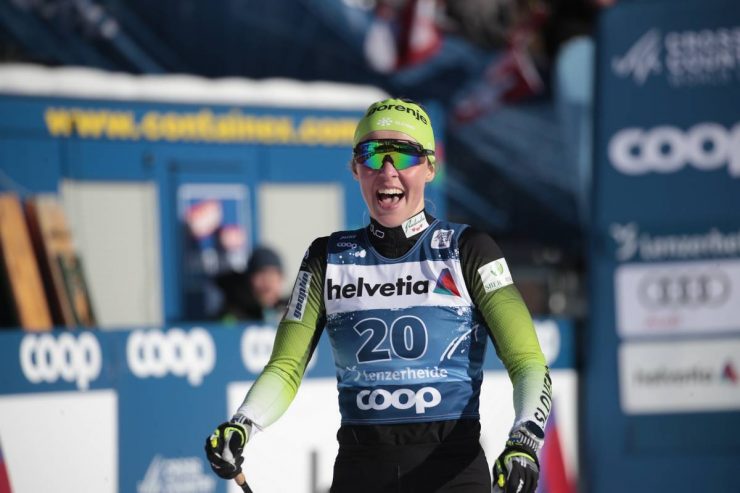
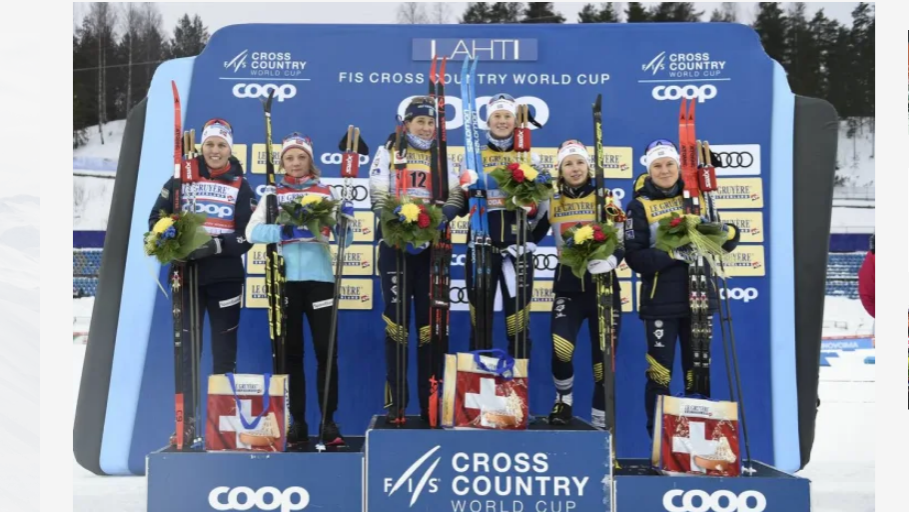
From the FasterSkier archive — posts syndicated from athletes’ and coaches’ own blogs between 2004 and 2012, kept online as published. Current coverage is at fasterskier.com.
This is the end. Of the 2023 racing season. Devon and Nat go without guests and are here to take you through the last three events of the winter in Lahti, Finland. And we cover a couple of retirement announcements from U.S. skiers.
We’re taking a little break after this but, we promise: We won’t leave you hanging for the whole off-season. Stay tuned for more regular episodes over the course of the spring and summer, and we’ll be back in a few weeks for a 2023 season recap. Tell us your favorite memories from this year — get at us at devon@fasterskier.com and nat@fasterskier.com.
This World Cup coverage is made possible through the generous support of Marty and Kathy Hall and A Hall Mark of Excellence Award. To learn more about A Hall Mark of Excellence Award, or to learn how you can support FasterSkier’s coverage, please contact info@fasterskier.com.
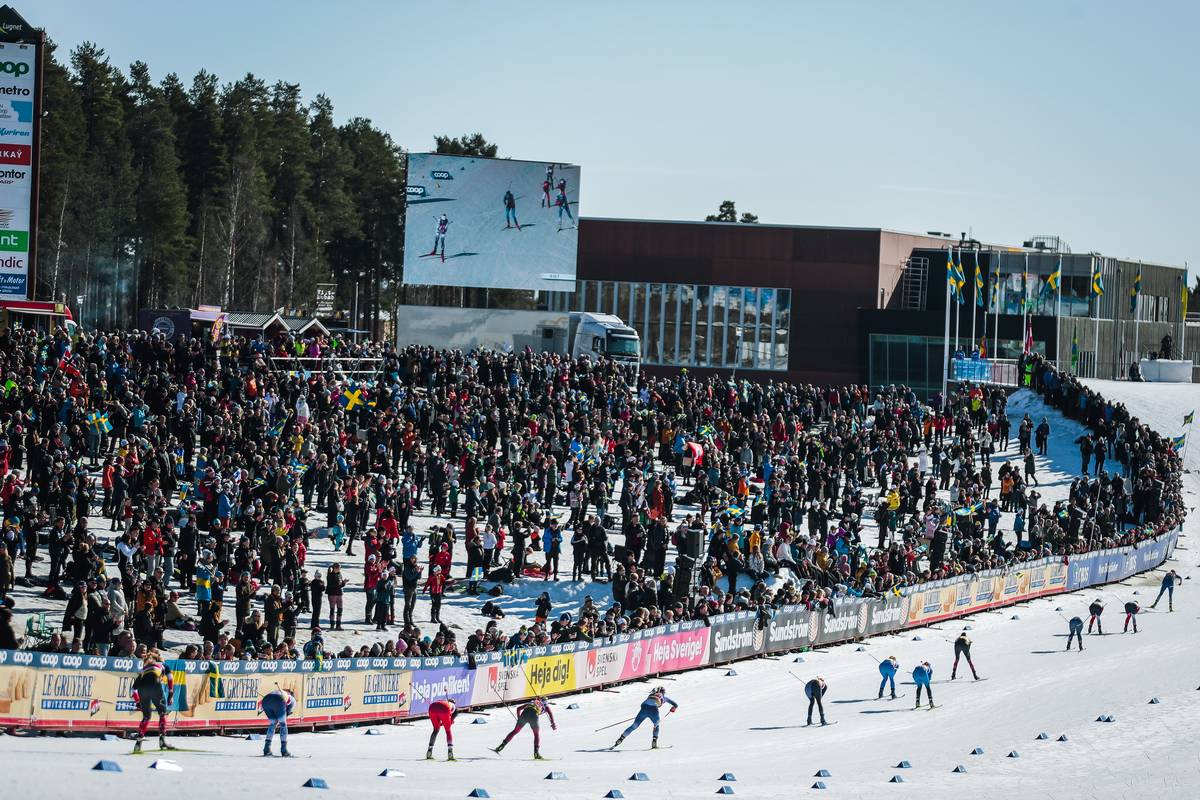
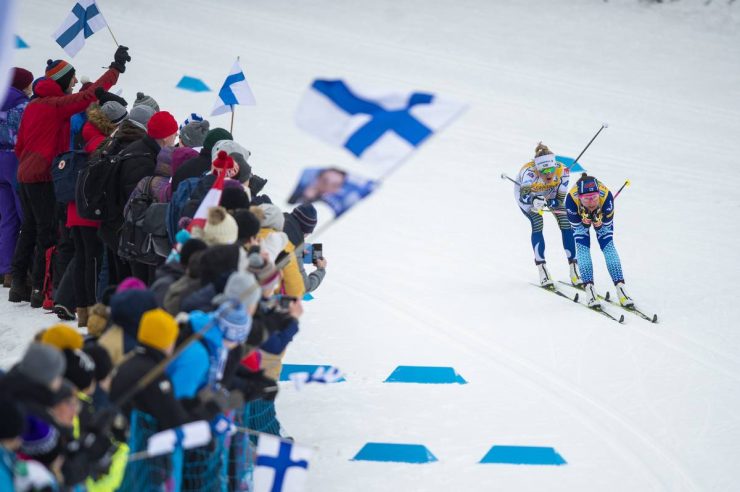
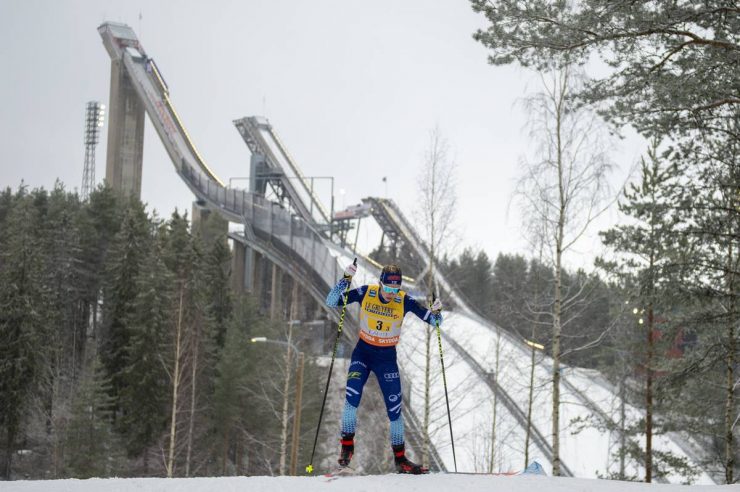
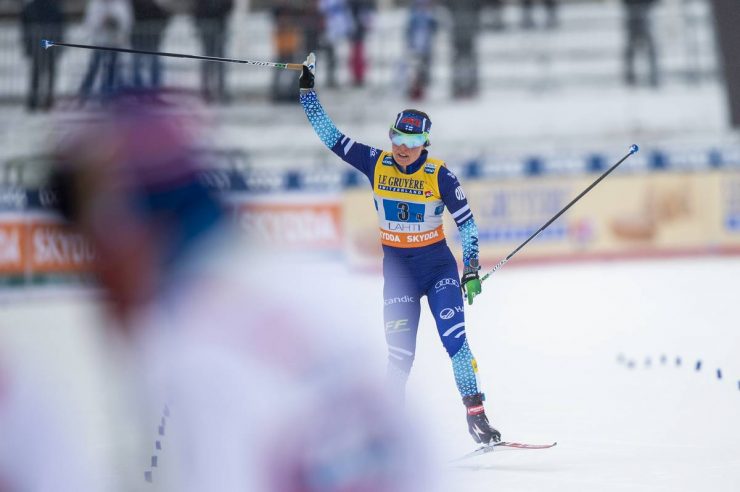
Today marked the end: at the completion of today’s women’s 20 kilometer Classic mass start in Lahti, Finland, all unanswered questions would be resolved. There would not be any waiting until next week, any re-group and re-deploy, any revised strategies. It was now, or never for the 2022-2023 season. Hanging in the balance would be the standings in the overall World Cup Crystal Globe chase, and the Distance Crystal Globe.
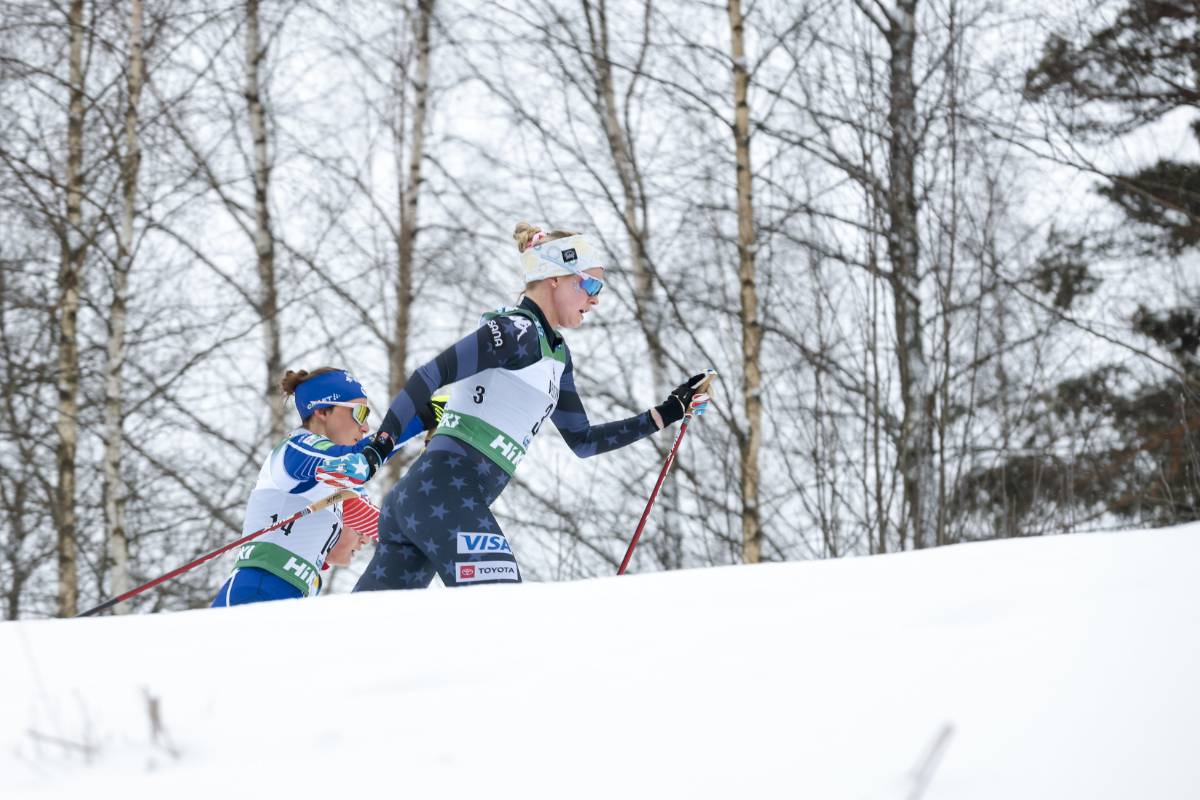
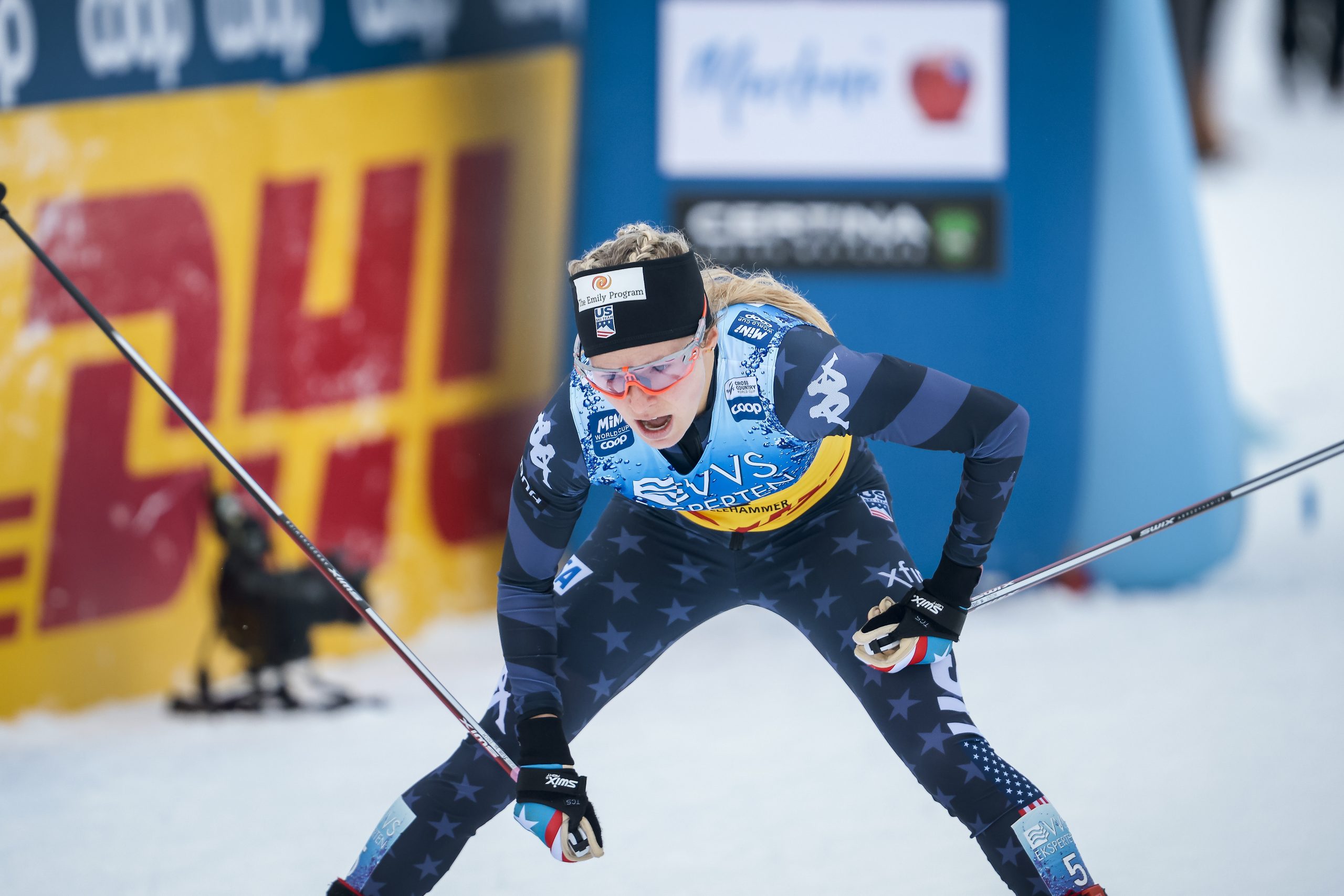
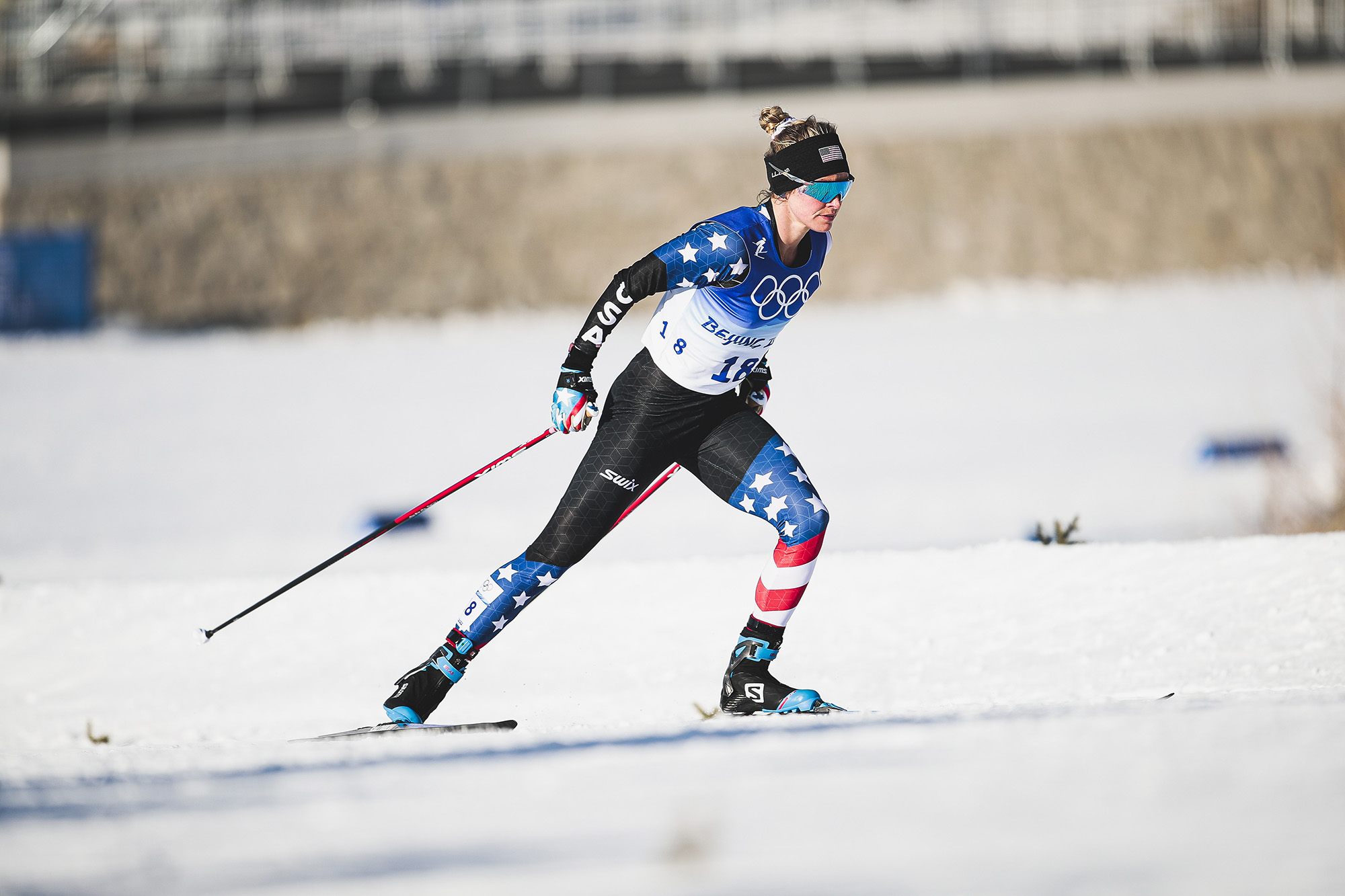
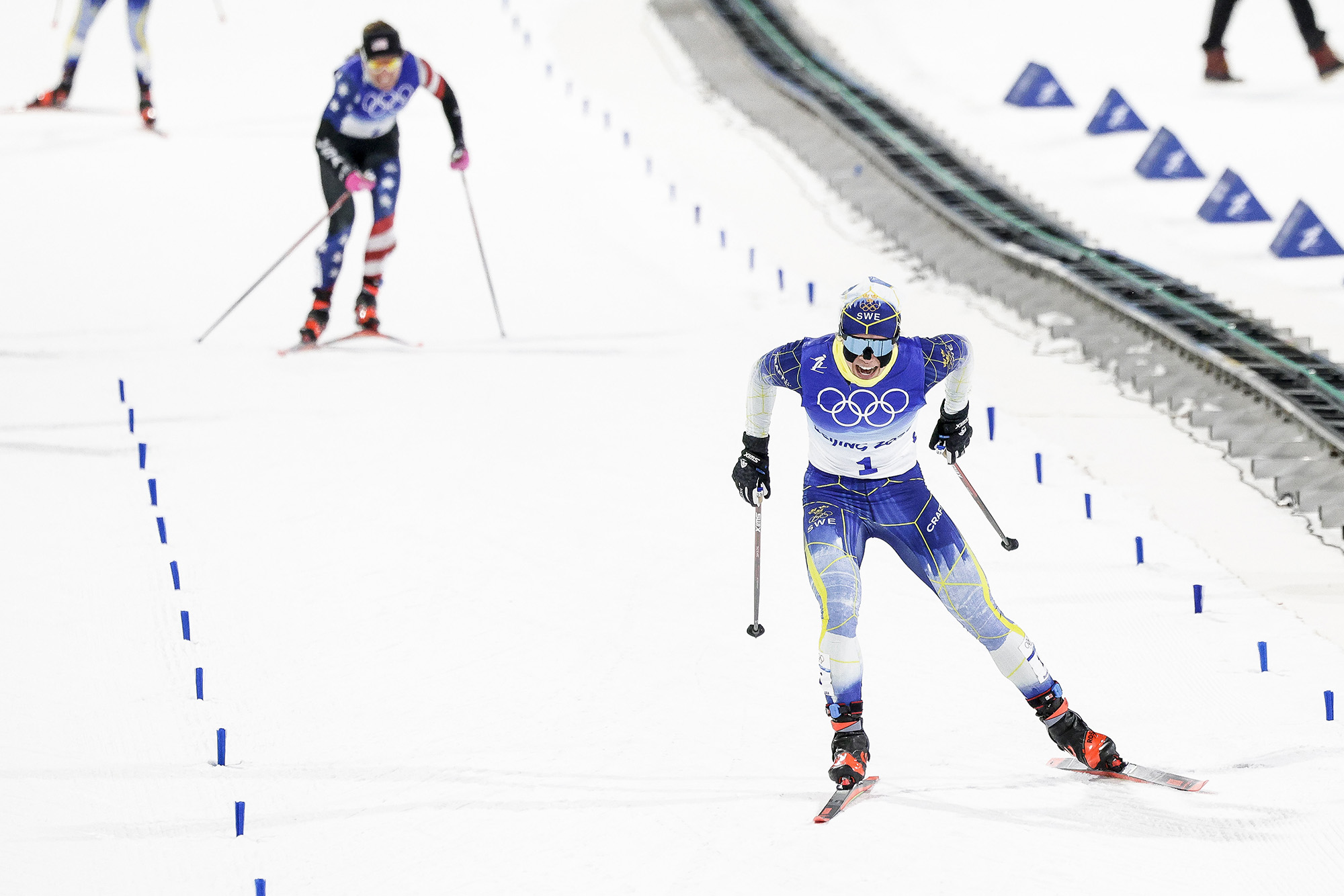
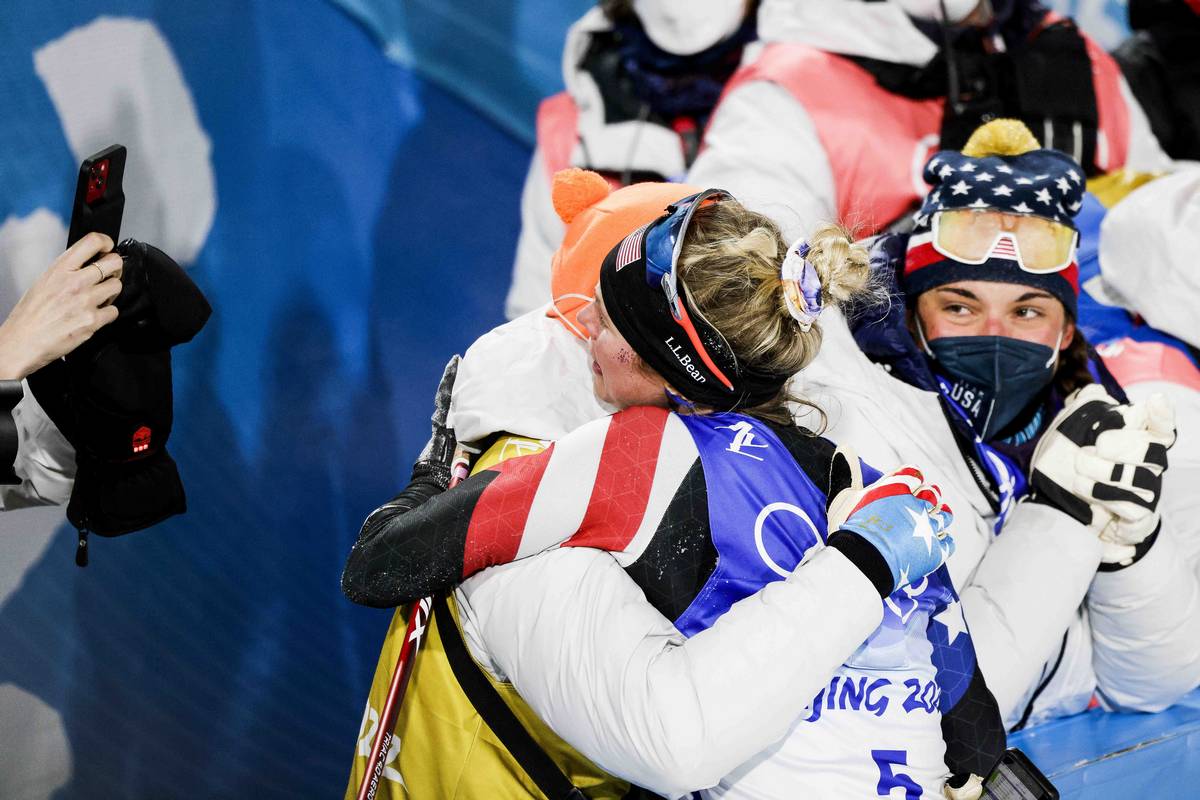
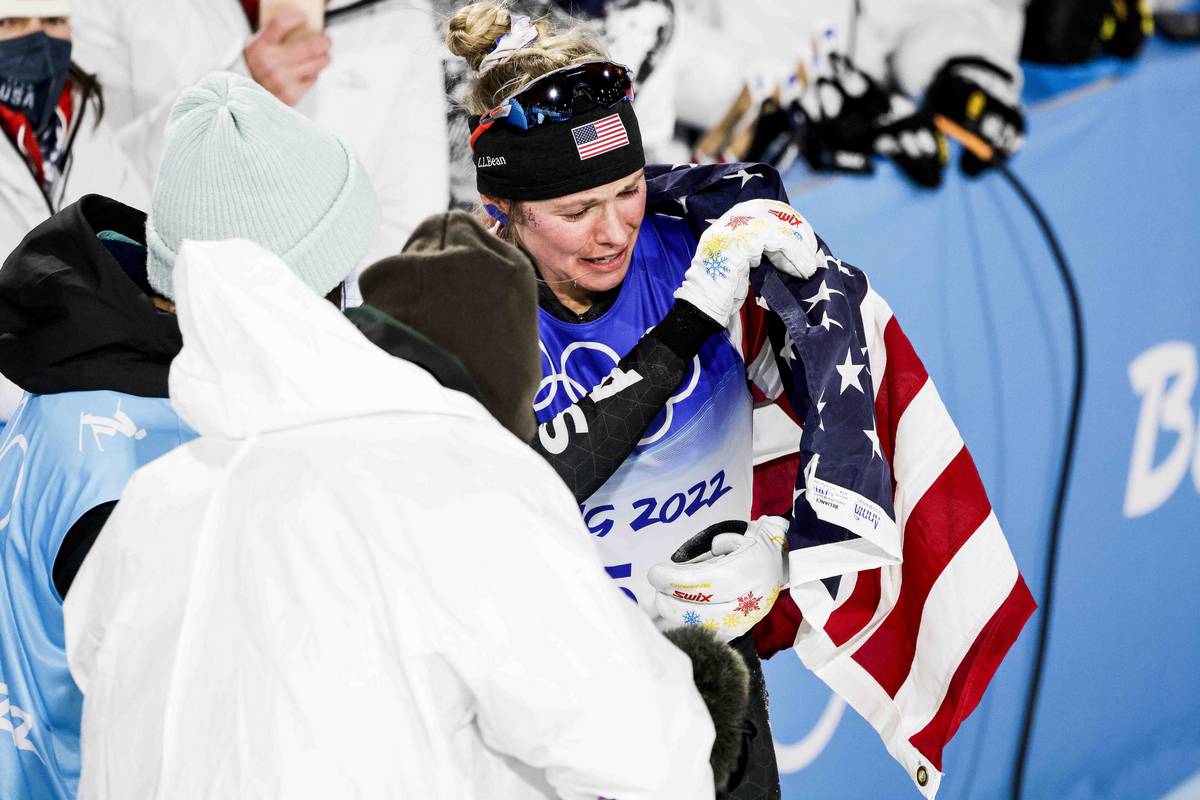
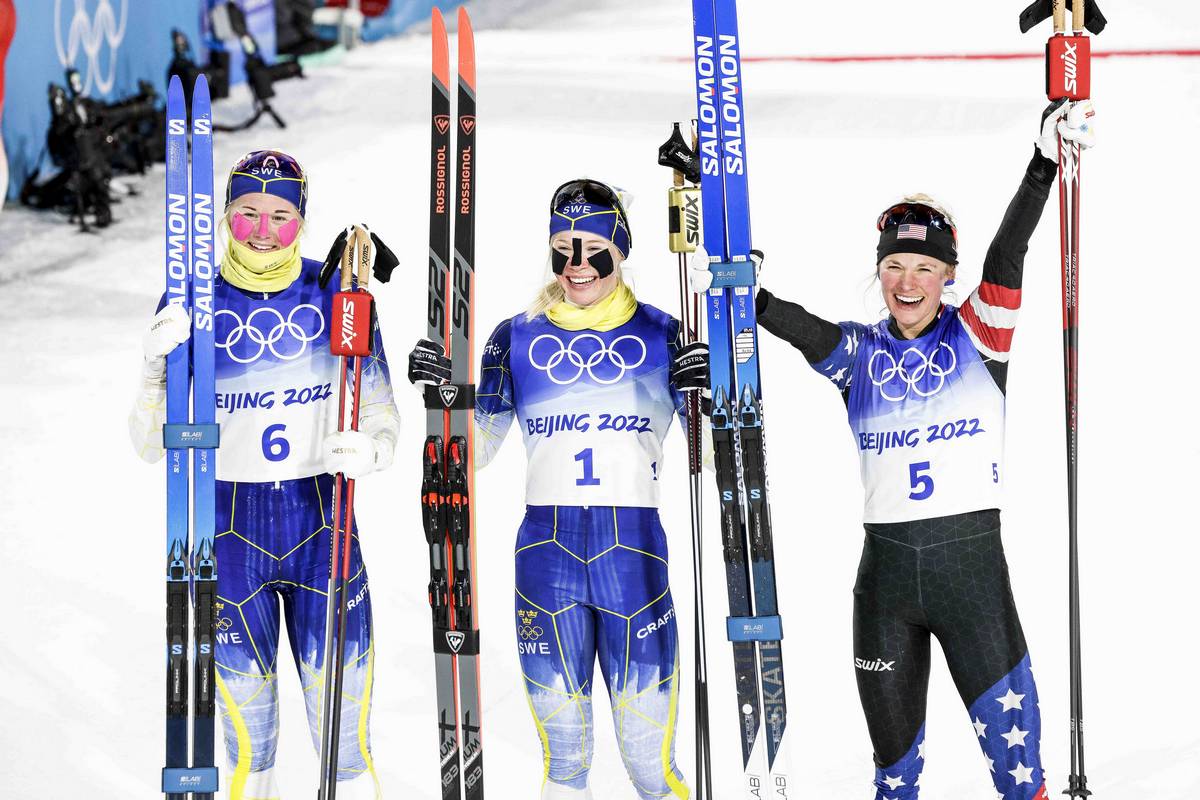
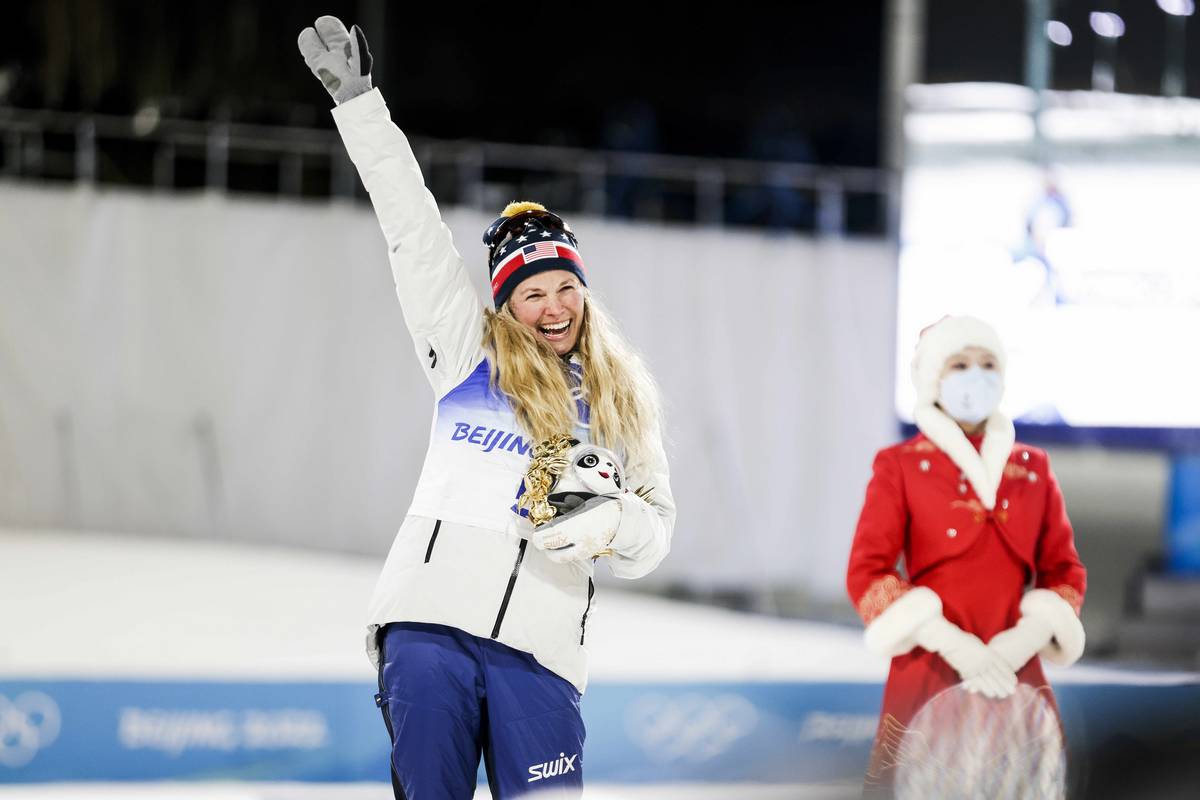
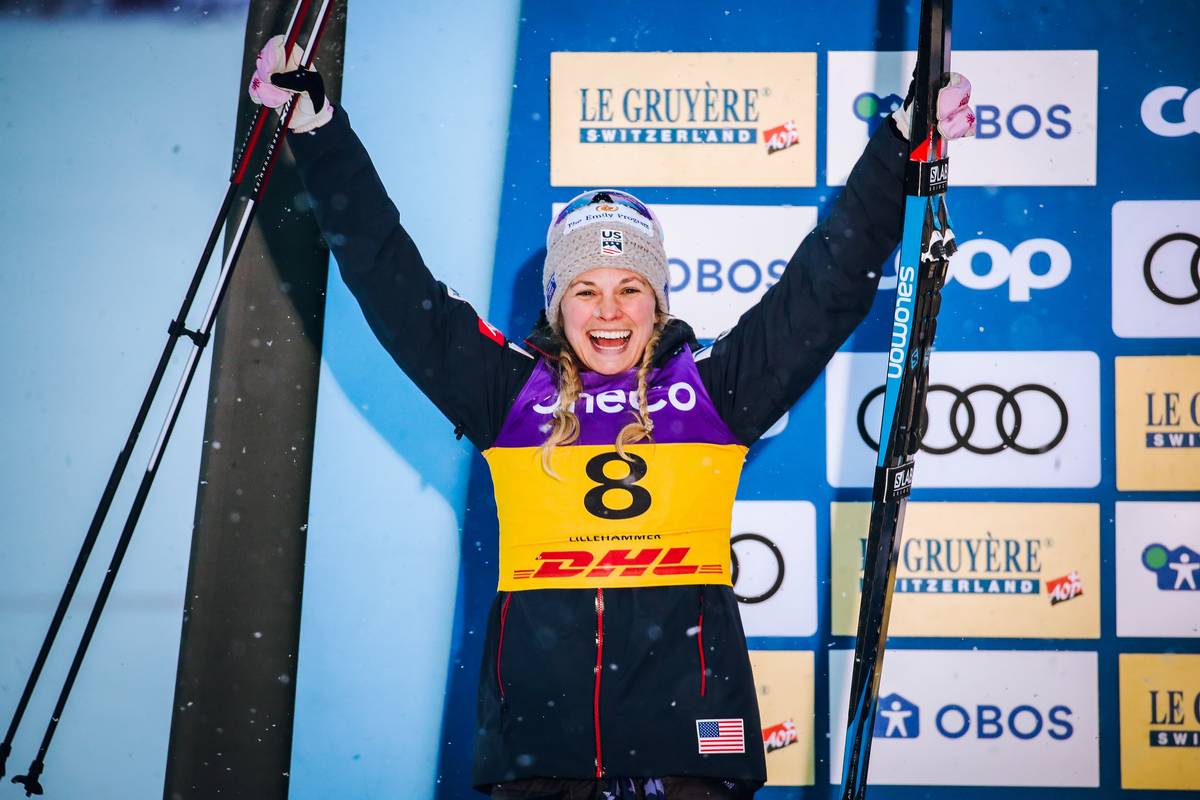
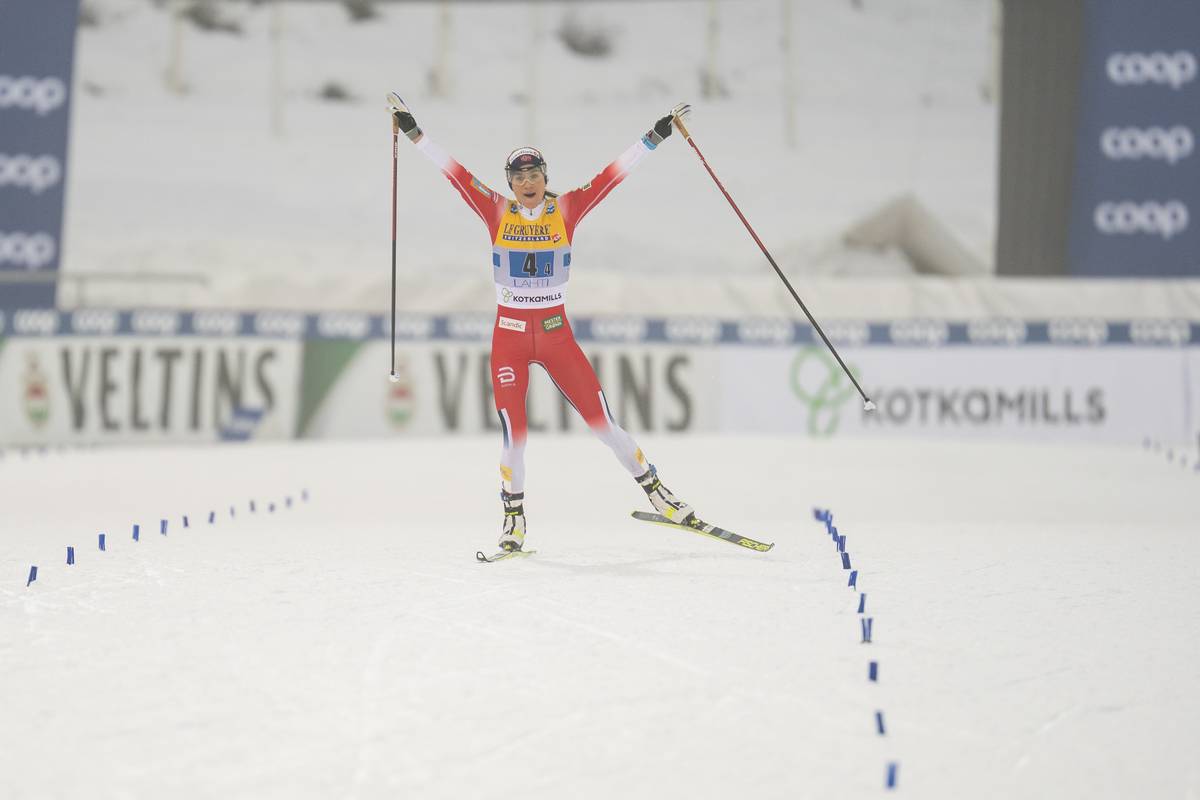
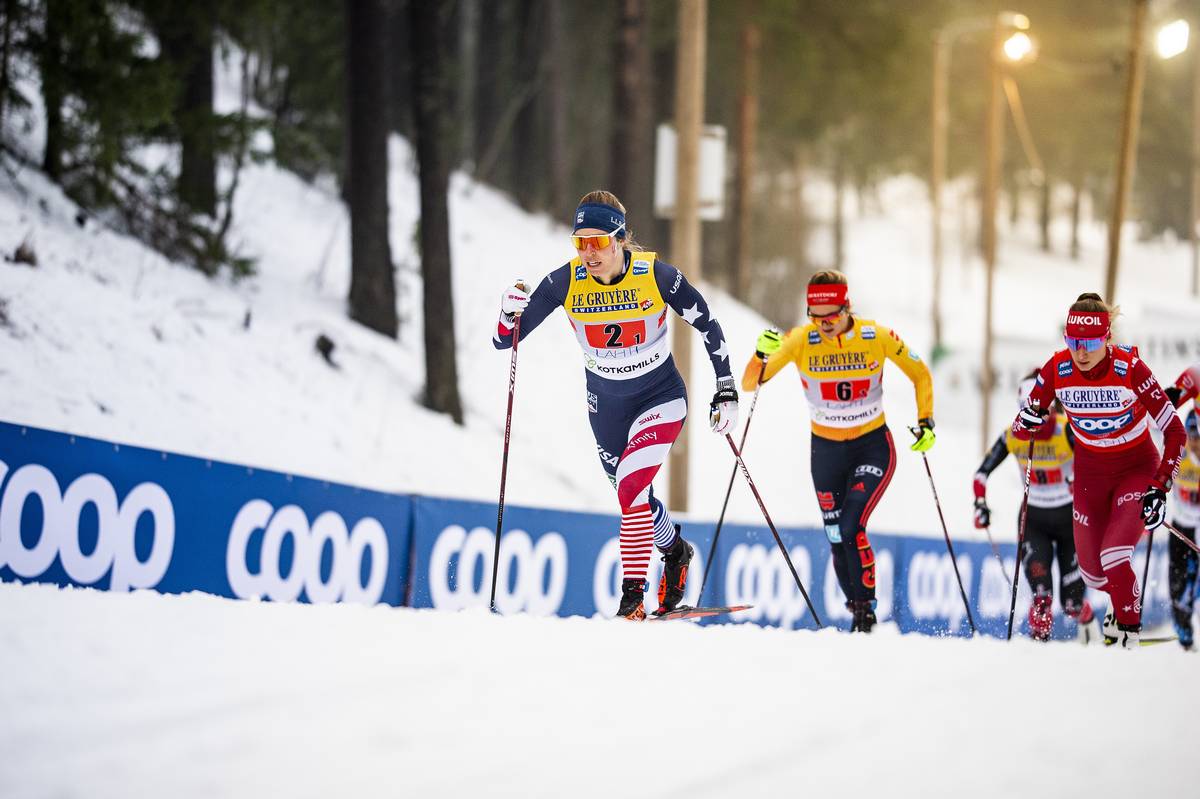
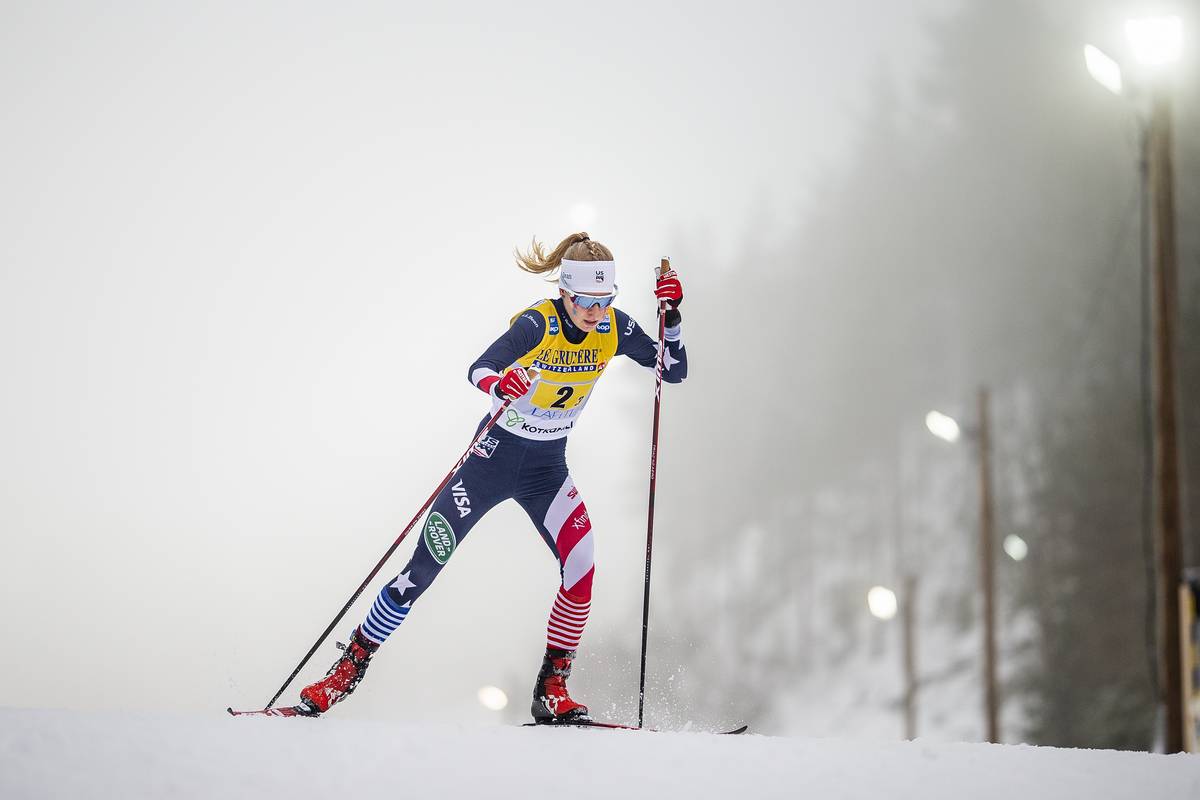
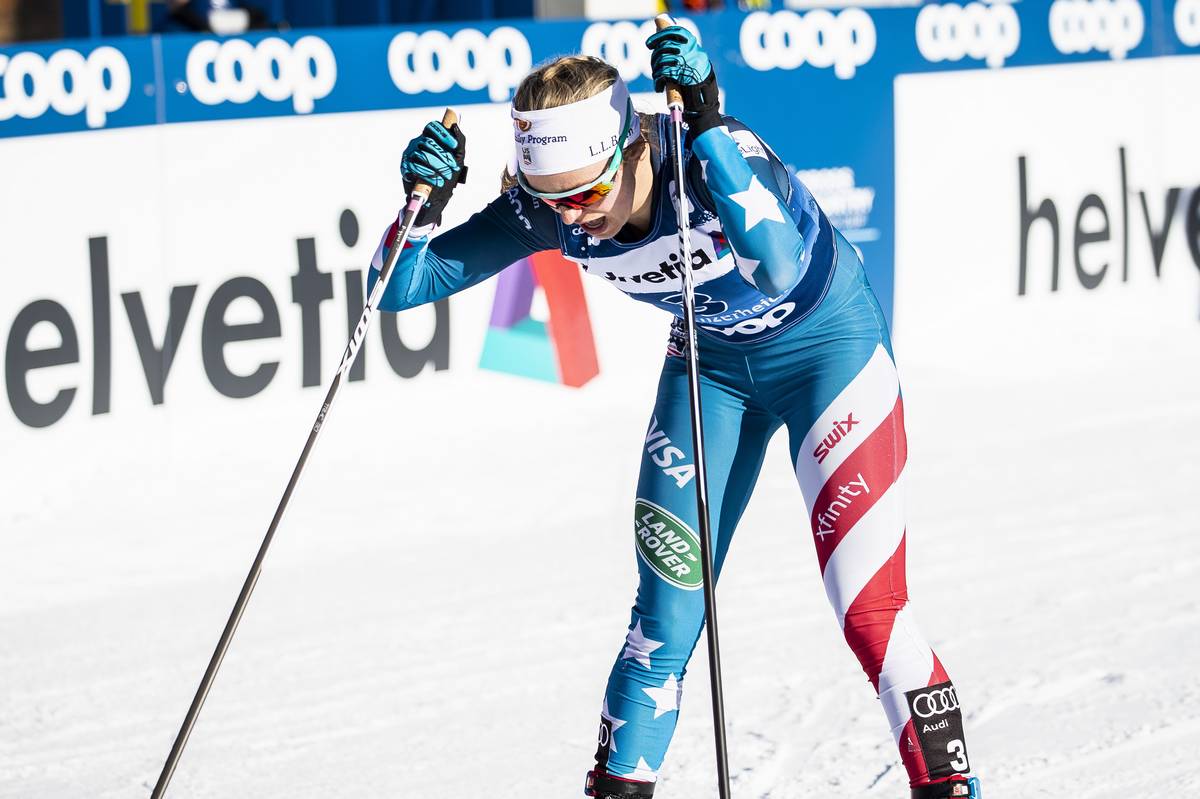
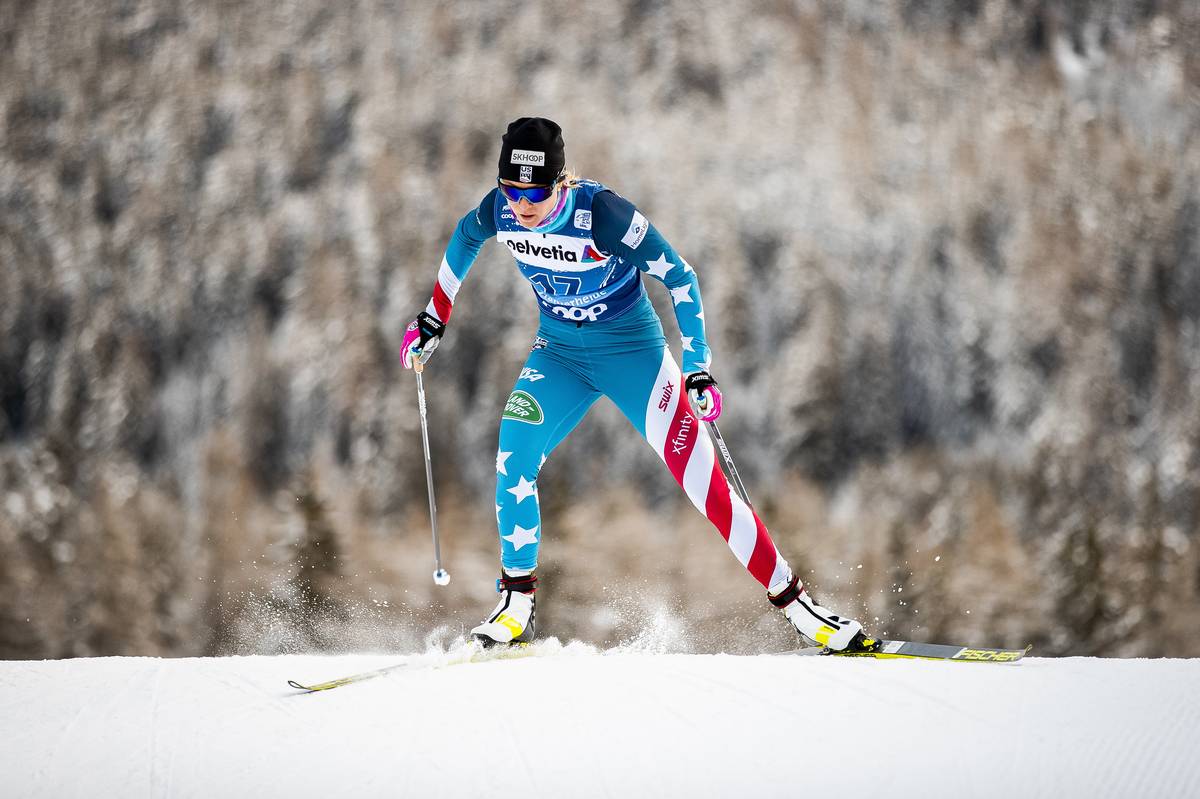
Jessie Diggins (USA) ended the day where she began in the hunt for the distance Crystal Globe, finishing second. (Photo: NordicFocus)
First place for the overall Crystal Globe was pre-determined. Tiril Udnes Weng (NOR) led Jessie Diggins (USA) by 154 points. With a maximum of 130 points going to the winner (assuming the winner takes all of the bonus points), Weng’s lead was mathematically unbeatable. However, overall standings placements were still up for grabs. Diggins led classic skiing standout Kerttu Niskanen (FIN) by 99 points, a sizeable but not insurmountable cushion given Niskanen’s classic abilities. Rosie Brennan (USA) sat in fourth place with a 108 point lead over Nadine Faehndrich (SUI). If Diggins and Brennan could hold their positions, it would put two Americans in the top five of the overall standings, potentially an historic finish for American skiing.
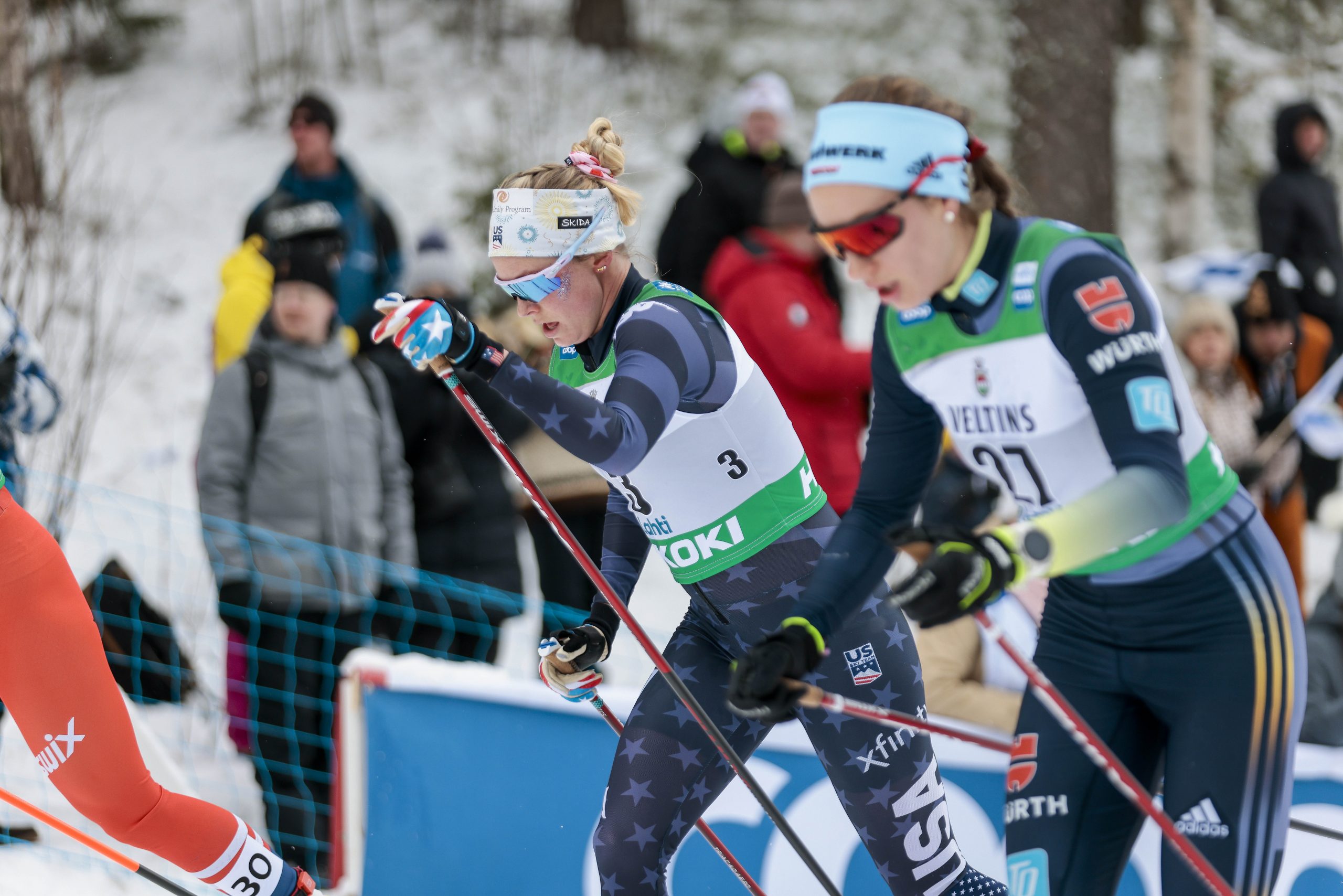
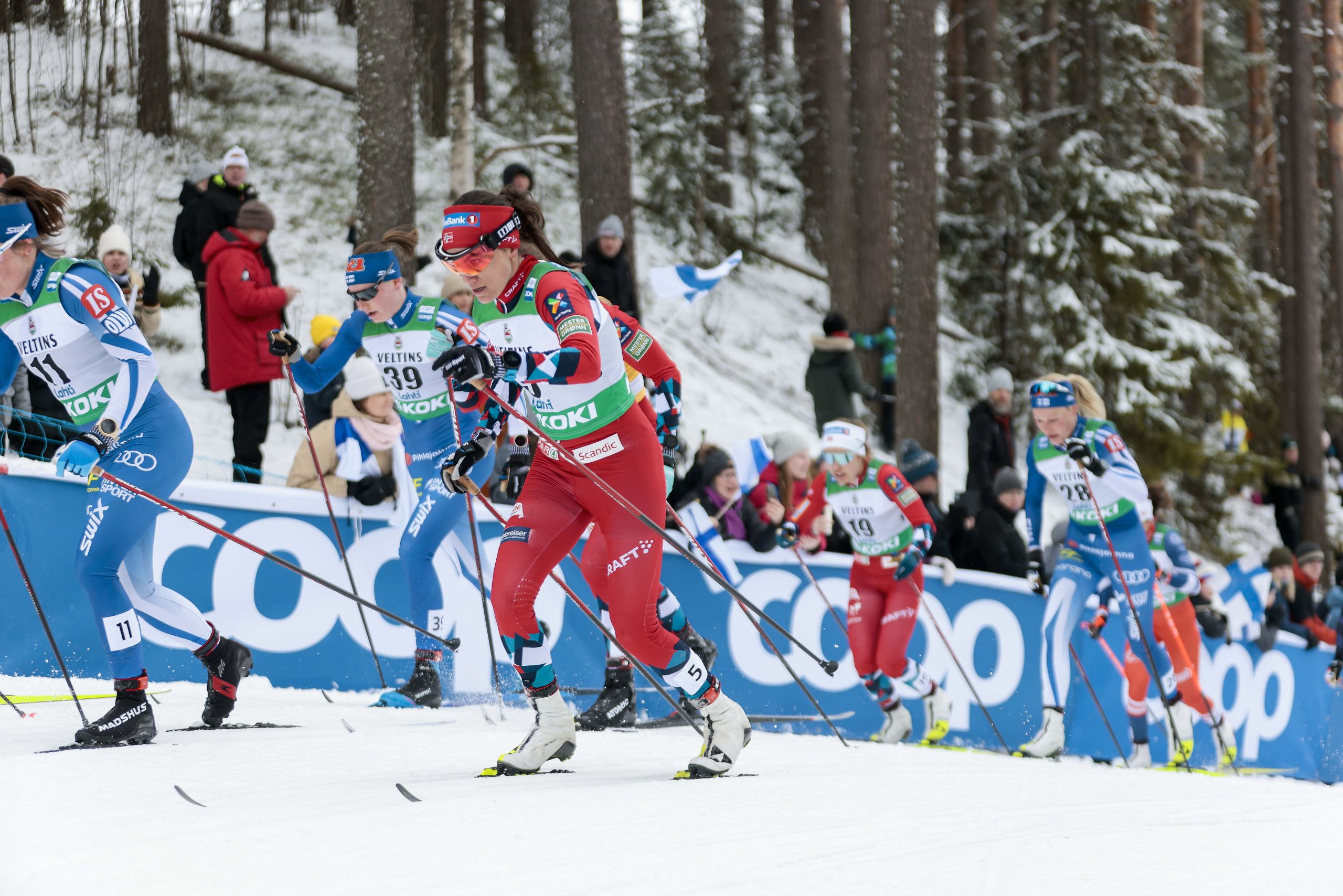
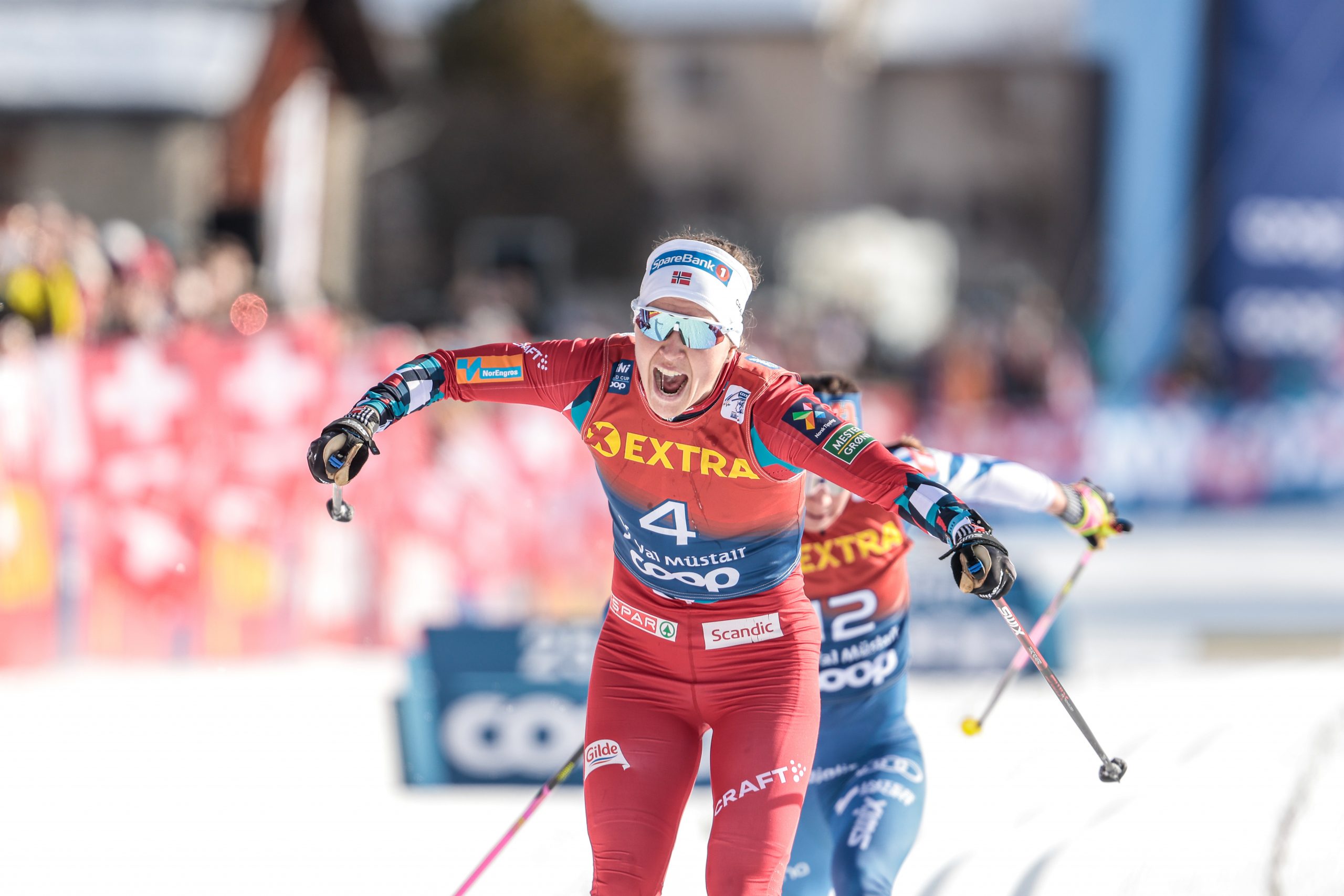
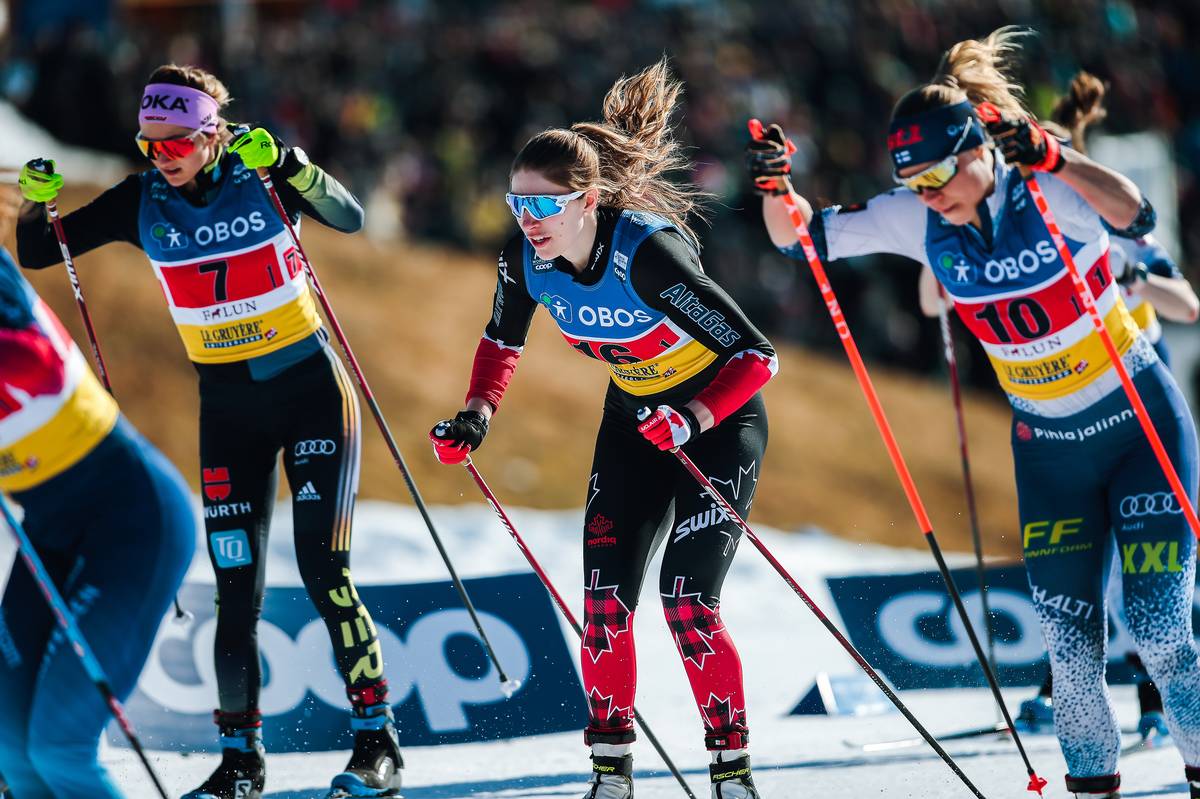
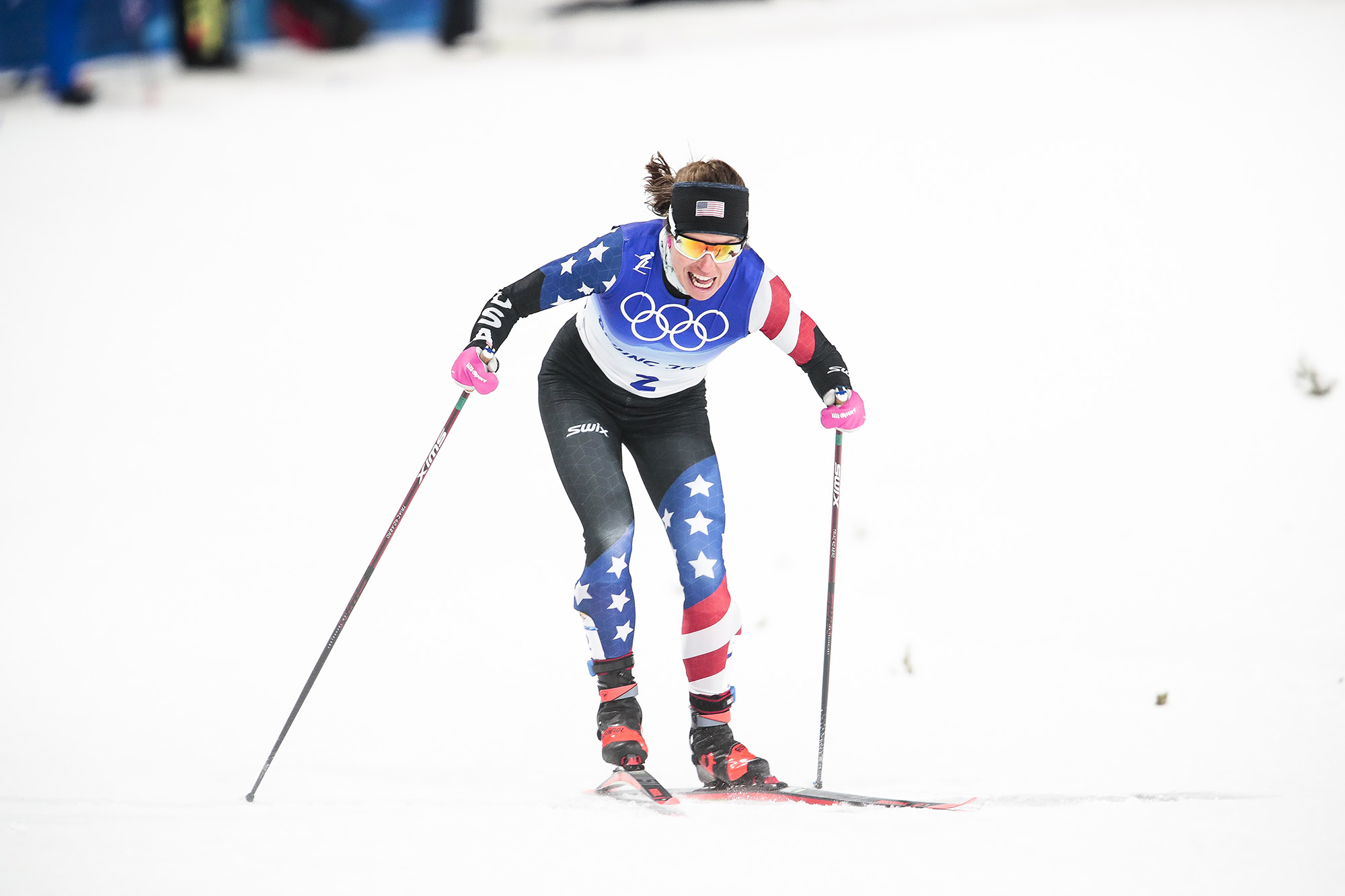
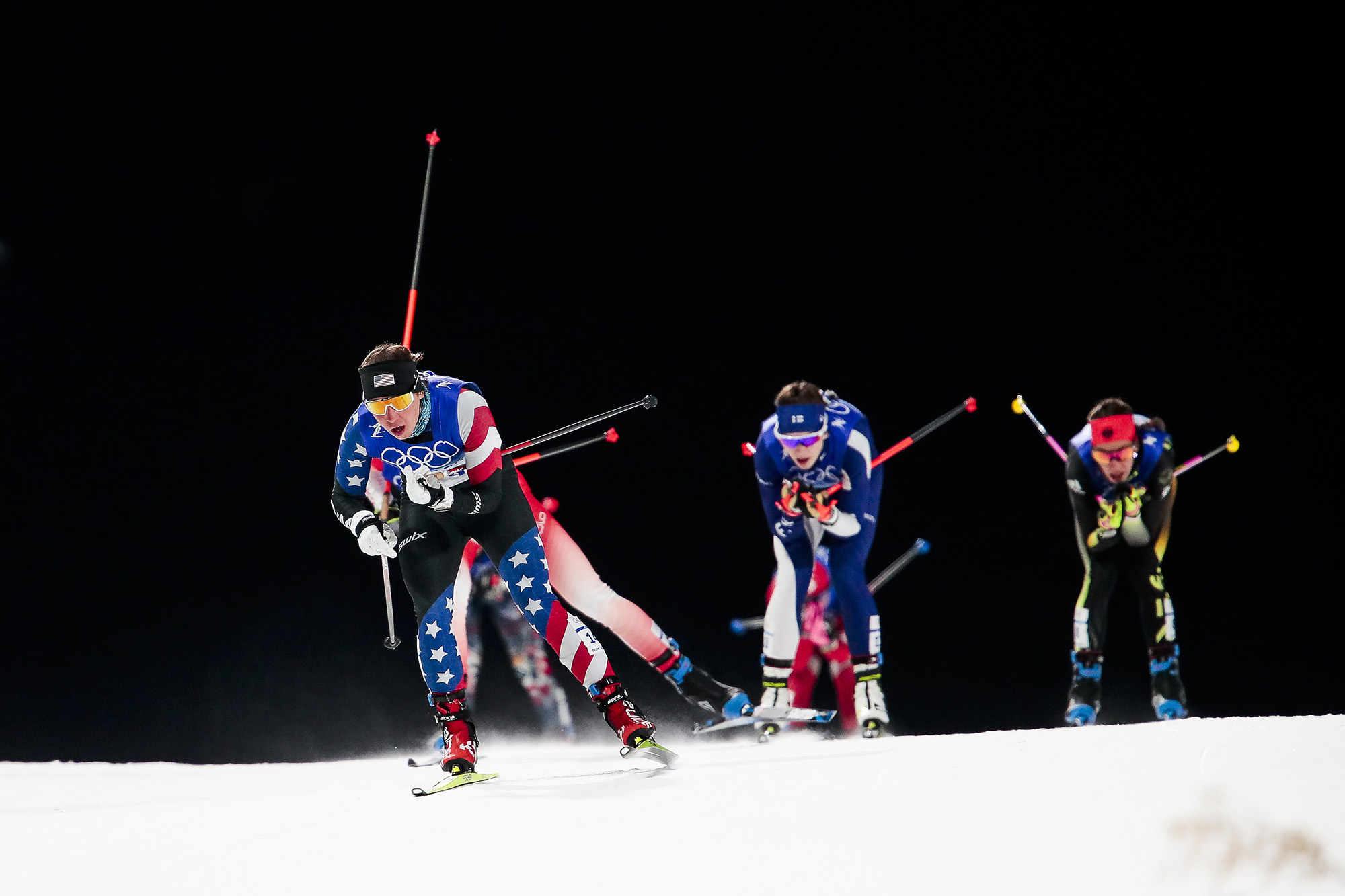
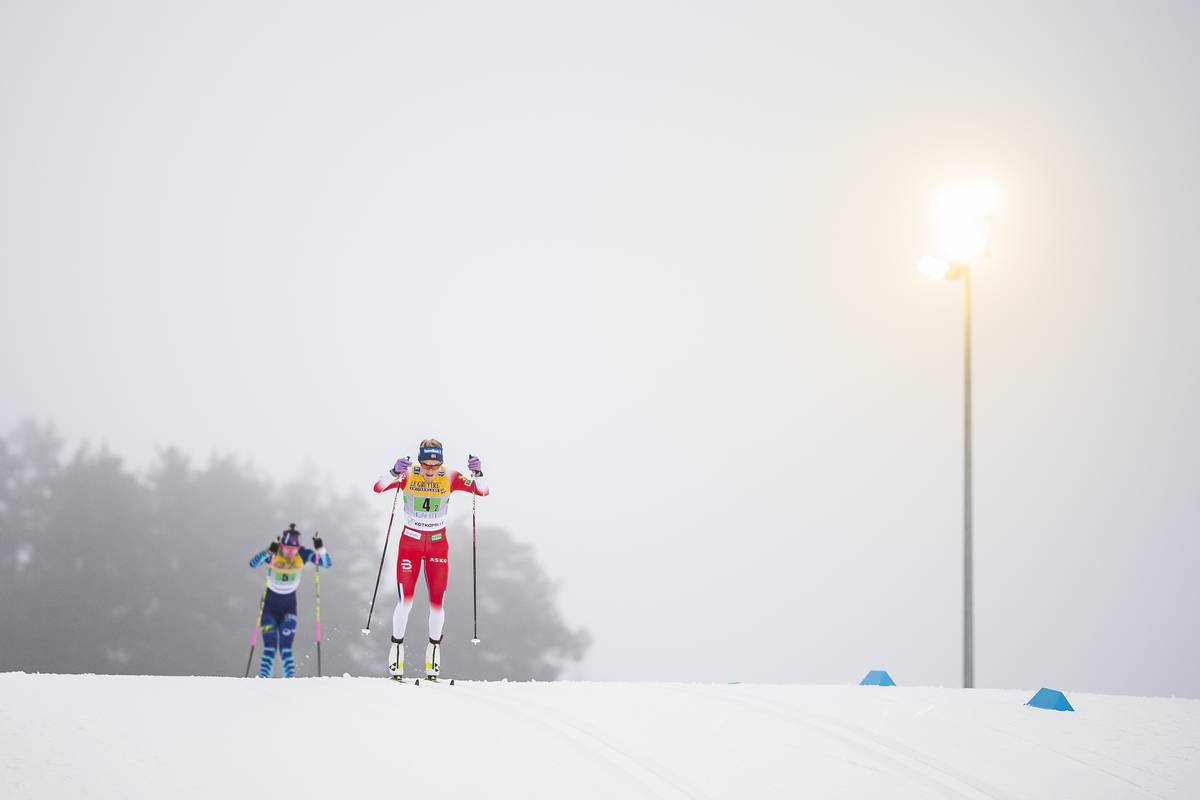
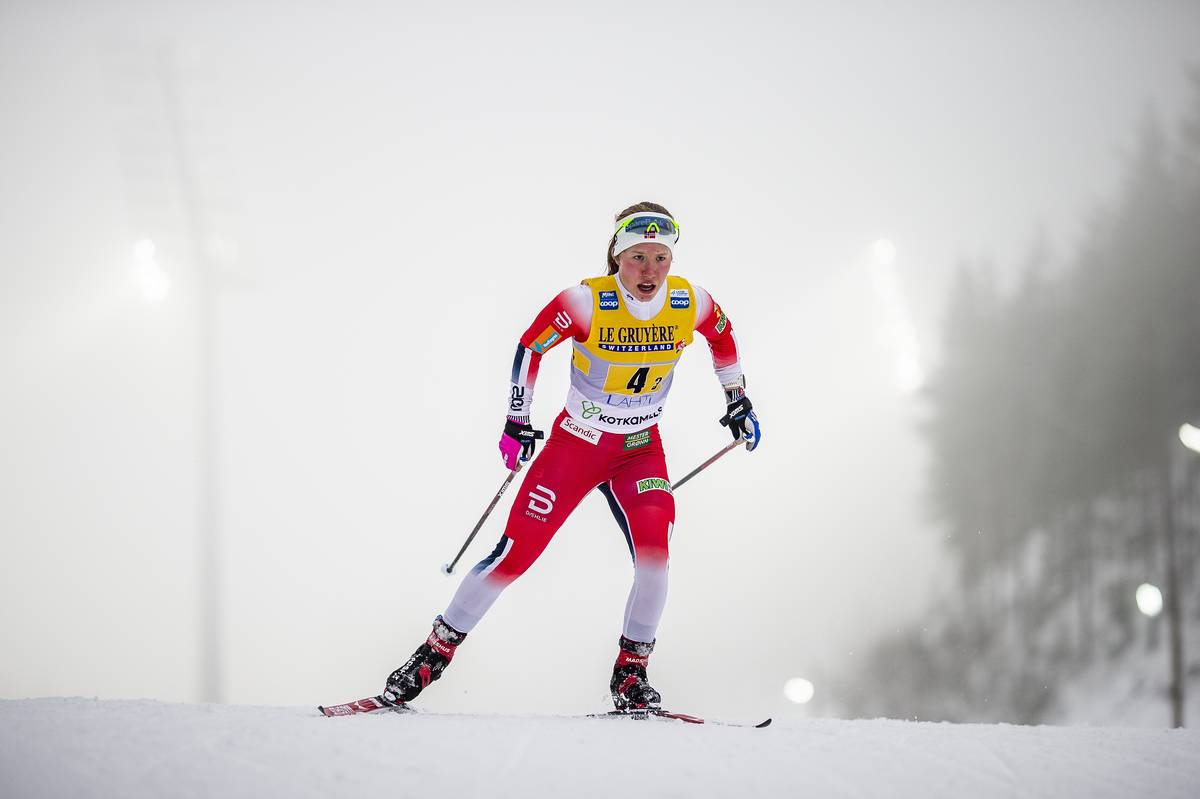
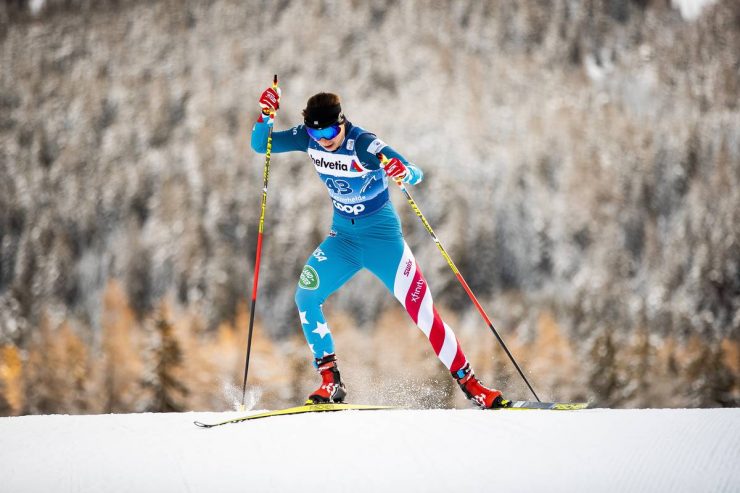
Rosie Brenan (USA-bib number 4) was able to maintain her fourth place standing in the overall World Cup position, but dropped to sixth in the distance competition. (Photo: NordicFocus)
Also at stake was the much closer chase for the distance Crystal Globe. Niskanen led with a 22 point advantage over Diggins, who would definitely be considered the underdog in a head to head classic skiing battle. But today’s race used the mass start format which would give Diggins help in staying with the field. Niskanen has never won an individual race on home soil; at 34 years of age, time is running out. Brennan was in fourth place for this Crystal Globe as well, a mere four points ahead of perennial favorite Heidi Weng (NOR), and only 26 points ahead of Anne Kjersti Kalvaa (NOR). The possibilities were almost too numerous to calculate.
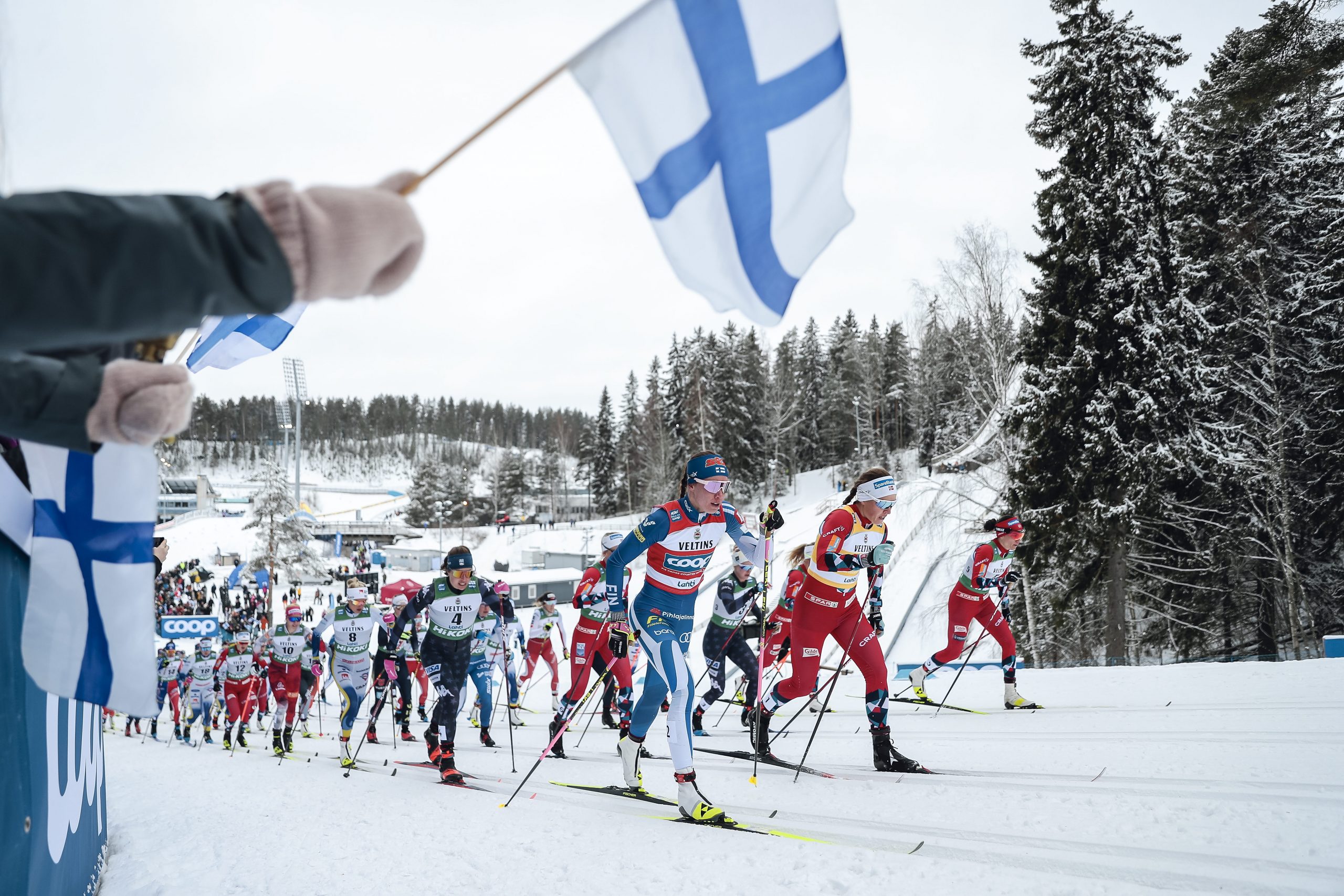
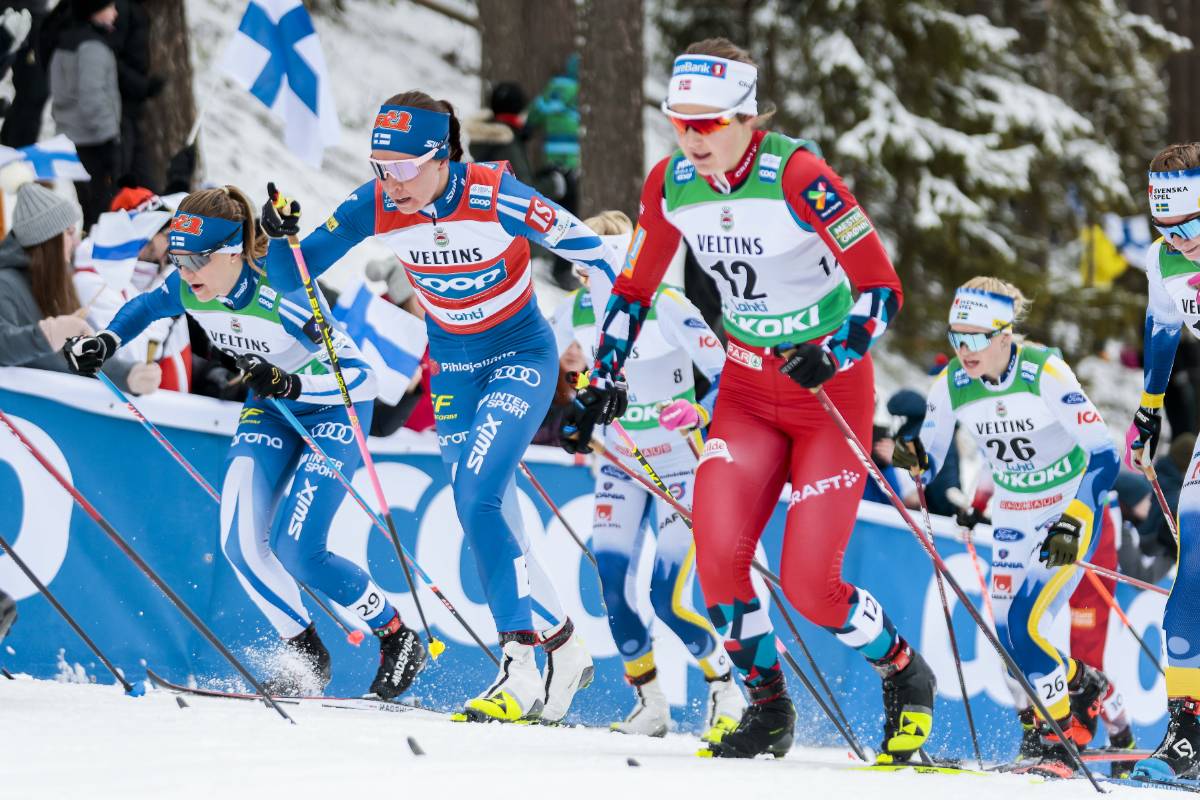
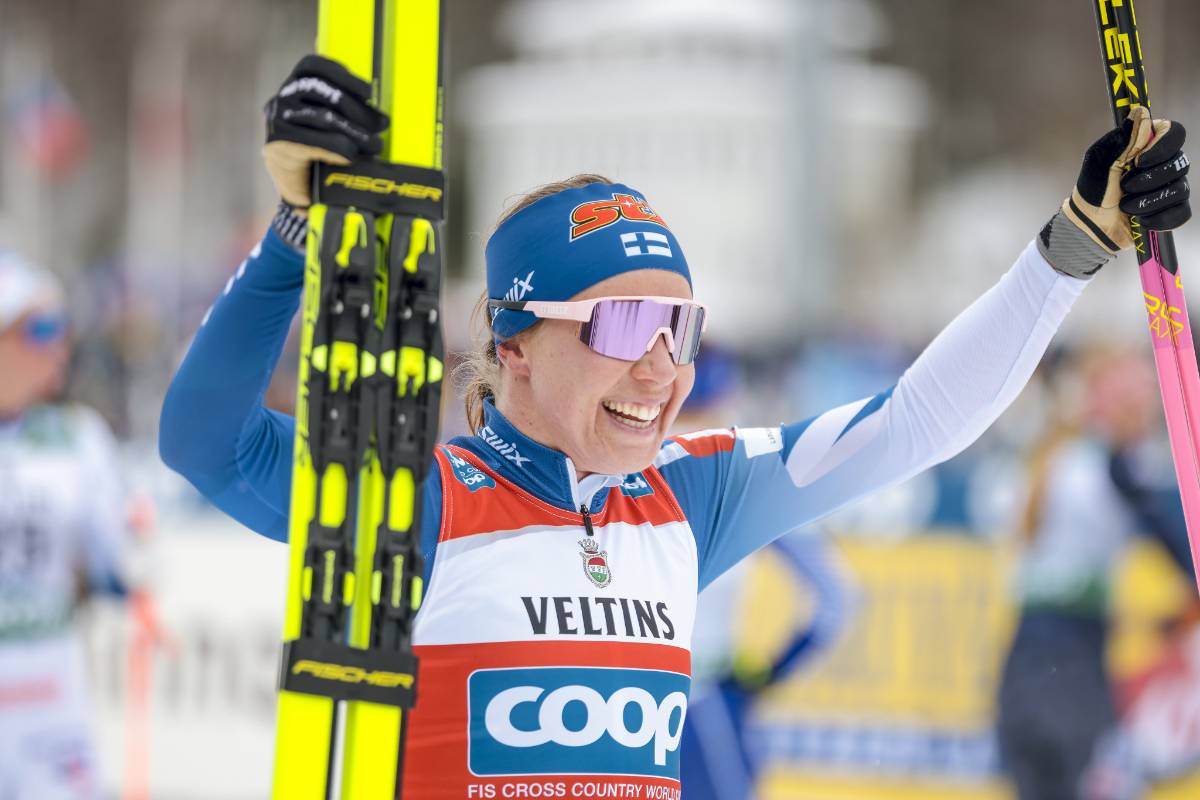
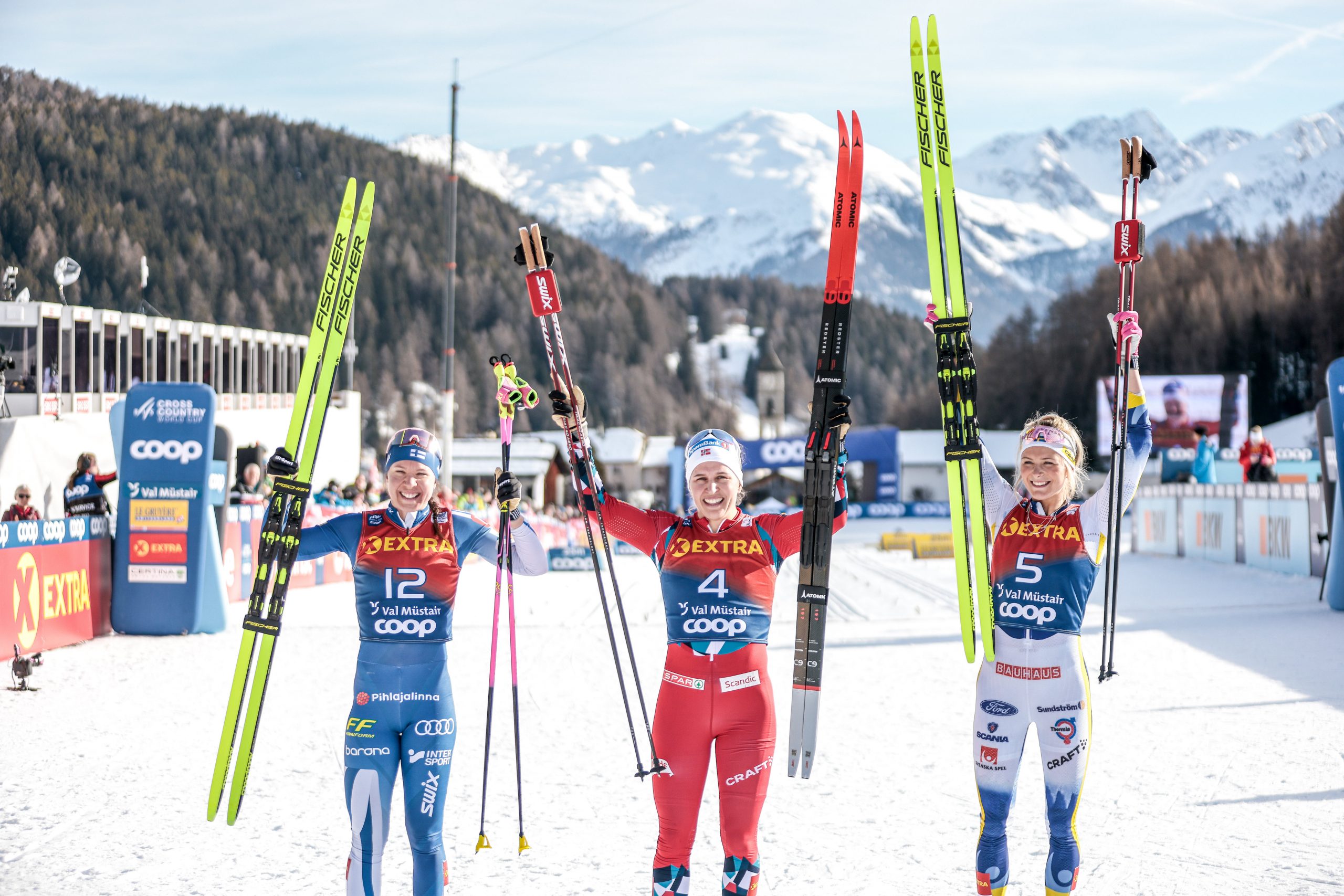
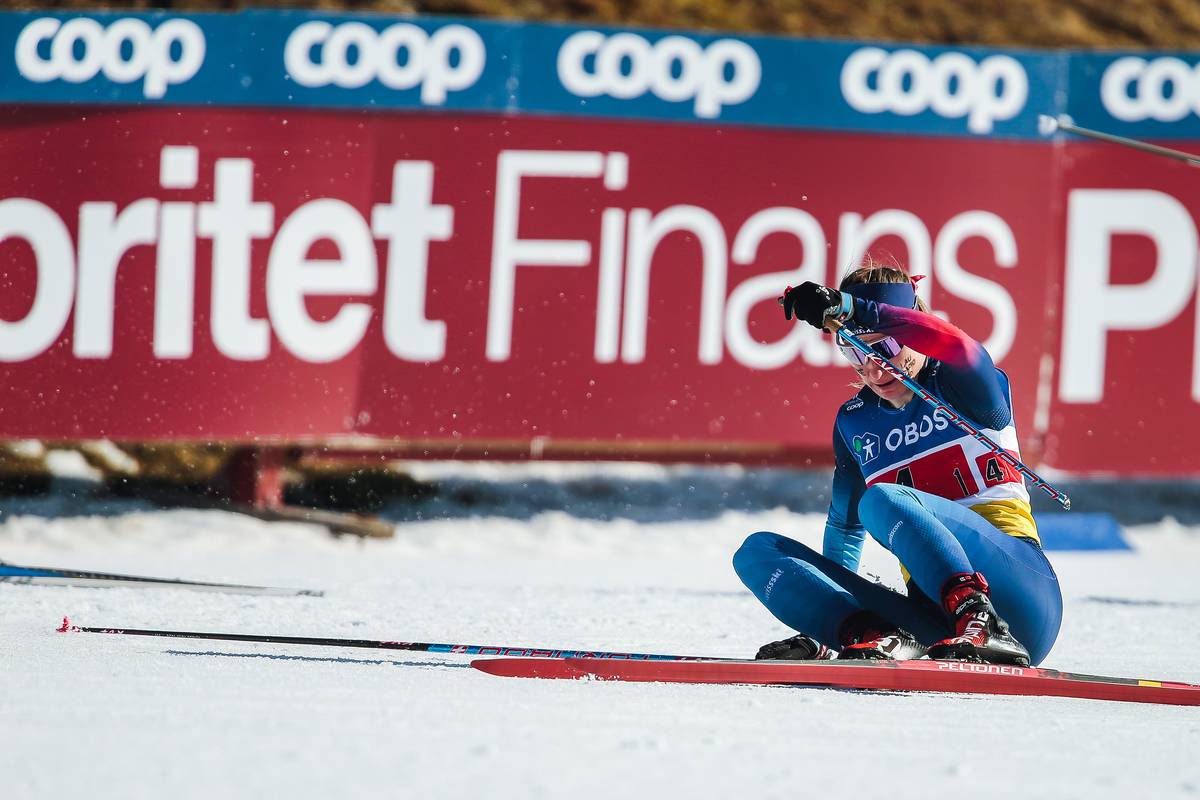
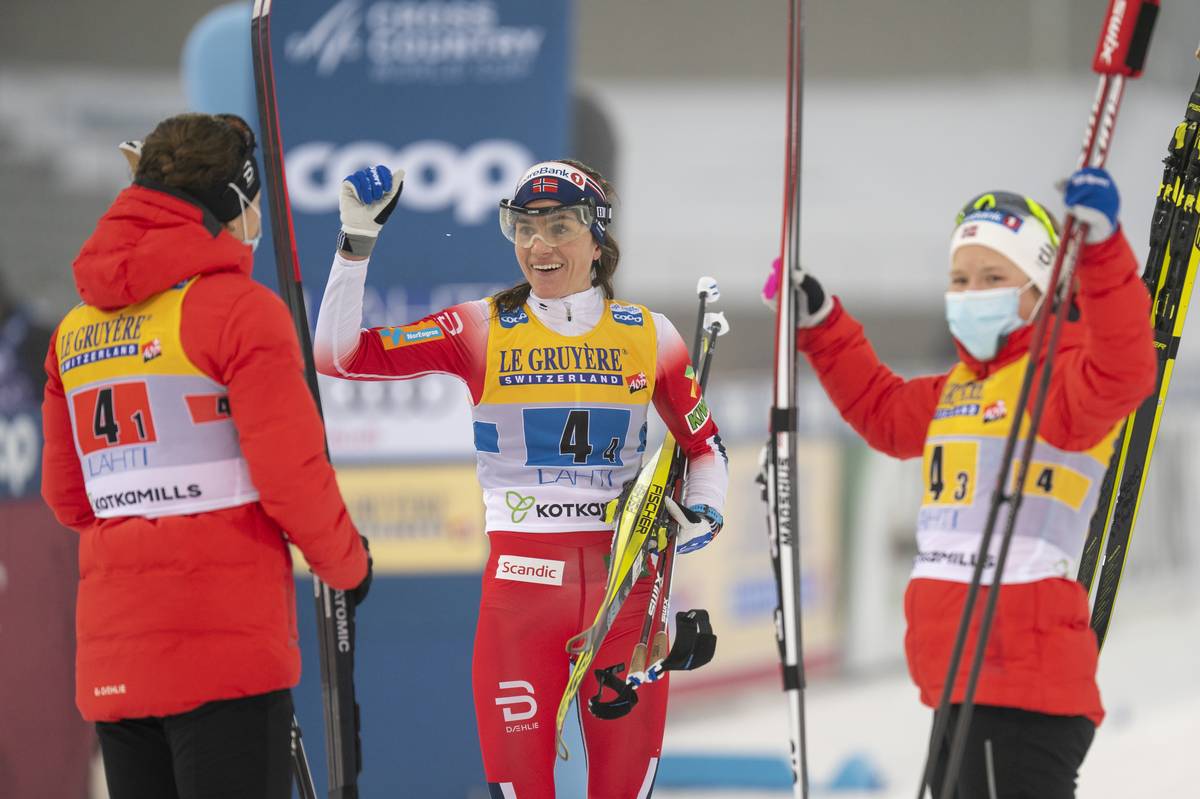
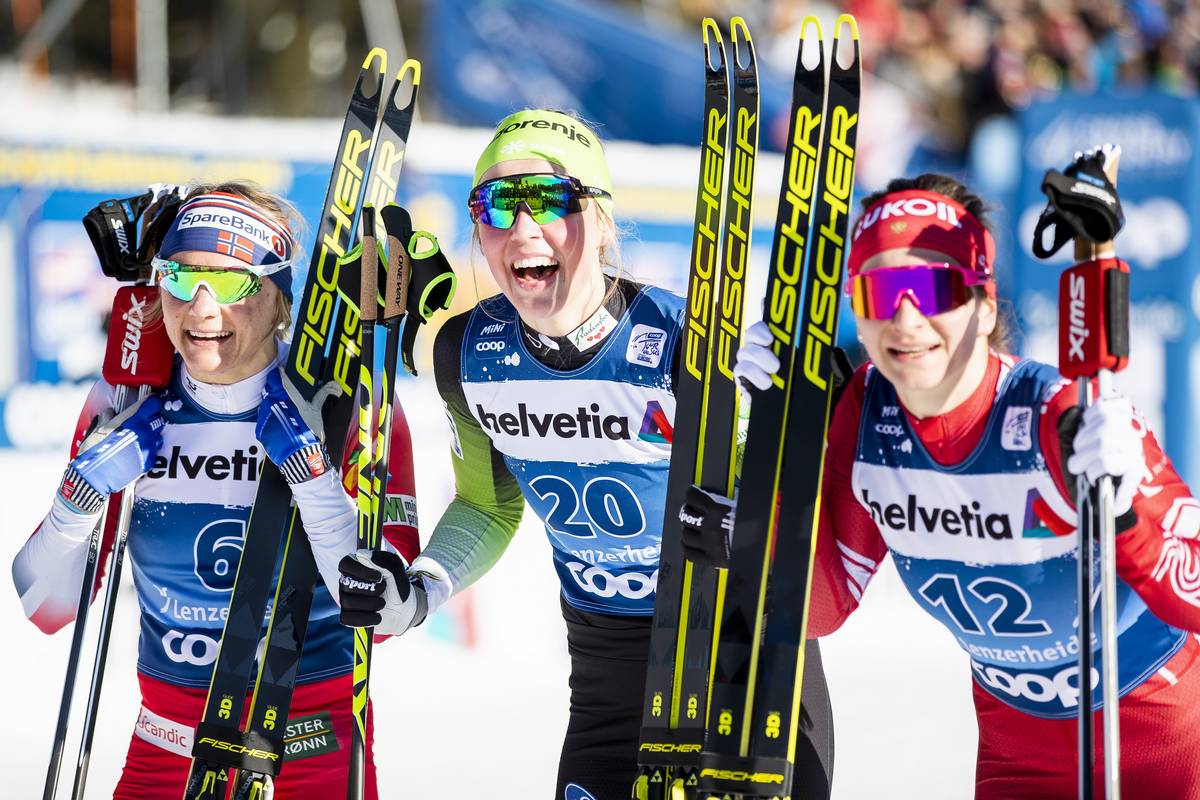
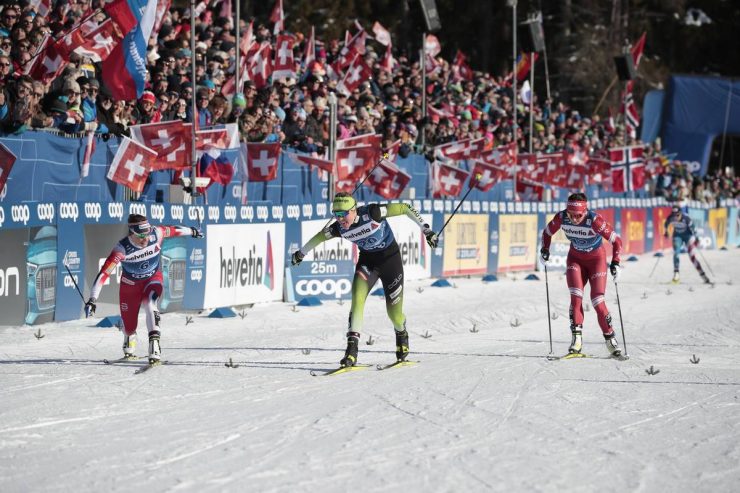
Kerttu Niskanen (FIN-center), was again thwarted in her attempt to win a World Cup race on home soil. (Photo: NordicFocus)
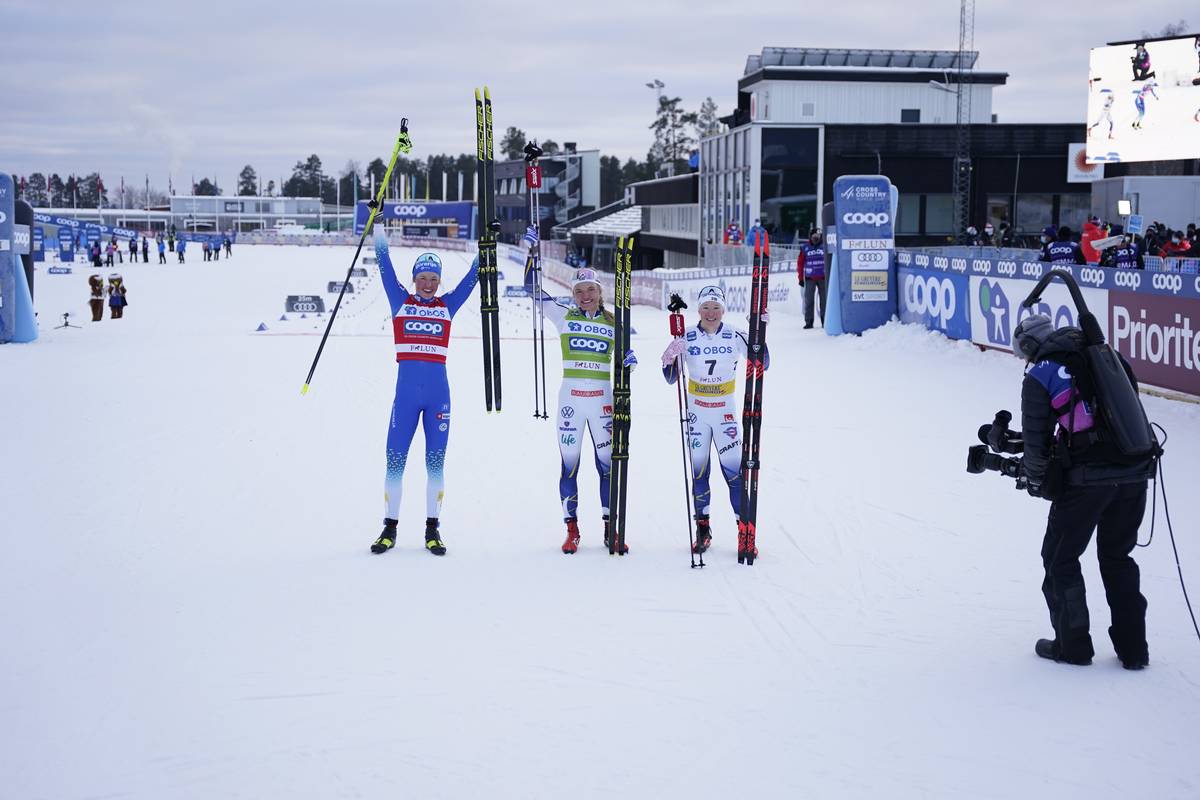
At the end of the road of World Cup racing for the season, Anne Kjersti Kalvaa took home the win for Norway. Jonna Sundling (SWE) was second, and Katharina Hennig finished third.
For the Americans, Jessie Diggins finished 22nd, 1:15 seconds out of the lead. Rosie Brennan was right behind her in 23rd. Other American finishers were Novie McCabe 25th, Hailey Swirbul 26th, Julia Kern 38th, and 17 year old Sammy Smith 48th.
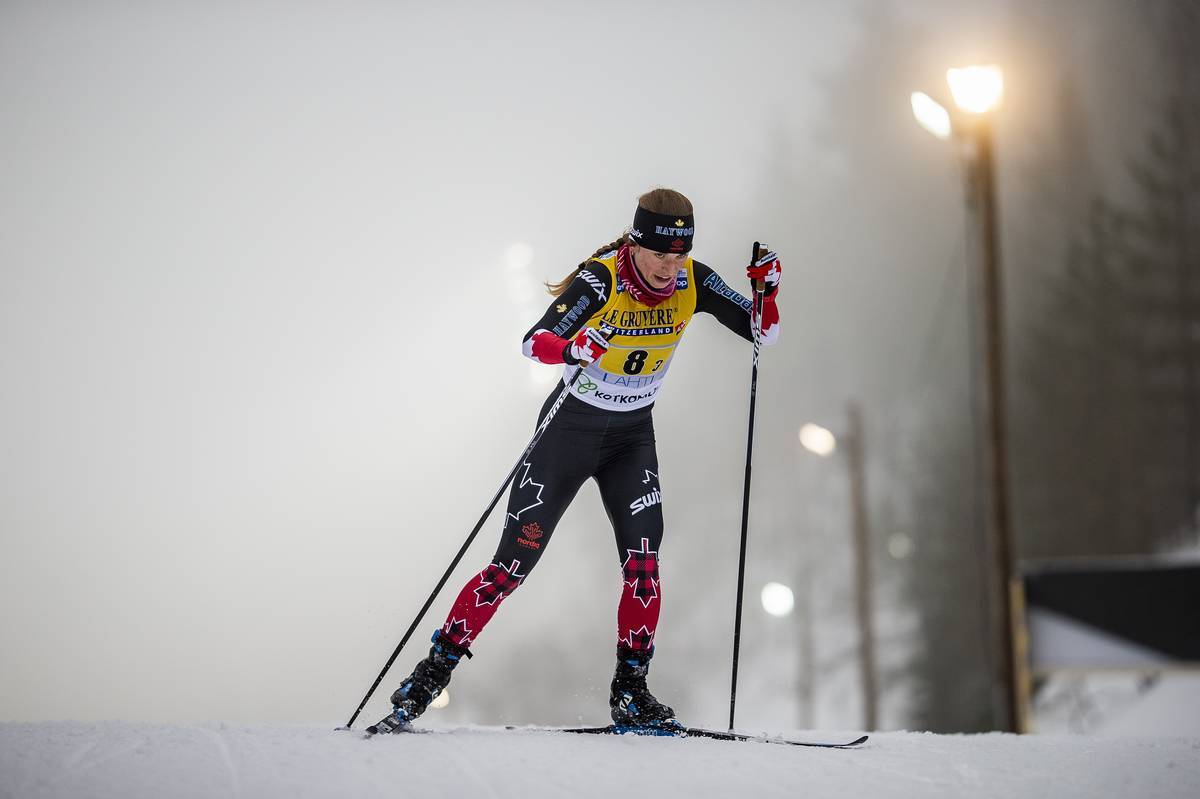
For the Canadians, Katherine Stewart-Jones was the only finisher taking 37th. Liliane Gagnon did not finish.
The overall world cup Crystal Globe positions remained largely unchanged with Diggins remaining in second and Brennan remaining fourth. It was an unprecedented finish with two Americans in the top five of the overall standings and a landmark achievement which would lift the entire team.
The hunt for the distance Crystal Globe did not go quite as well. Diggins was able to hold onto her second place position, but lost ground to Niskanen who was the overall winner. But Brennan dropped down to sixth place eclipsed by Kalvaa and Heidi Weng. Still, a remarkably strong finish for the American squad.
The Women’s 20 Kilometer Mass Start
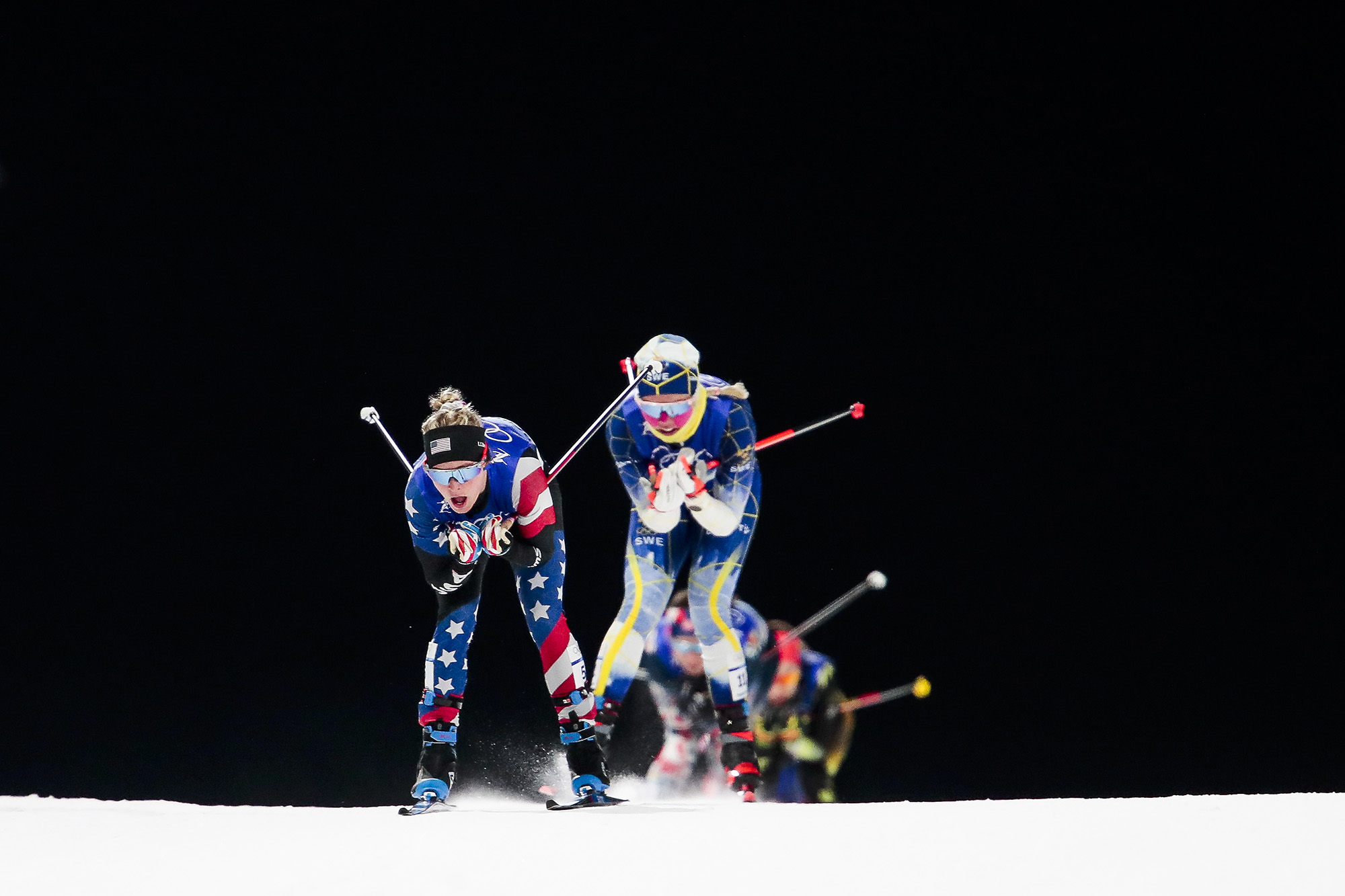
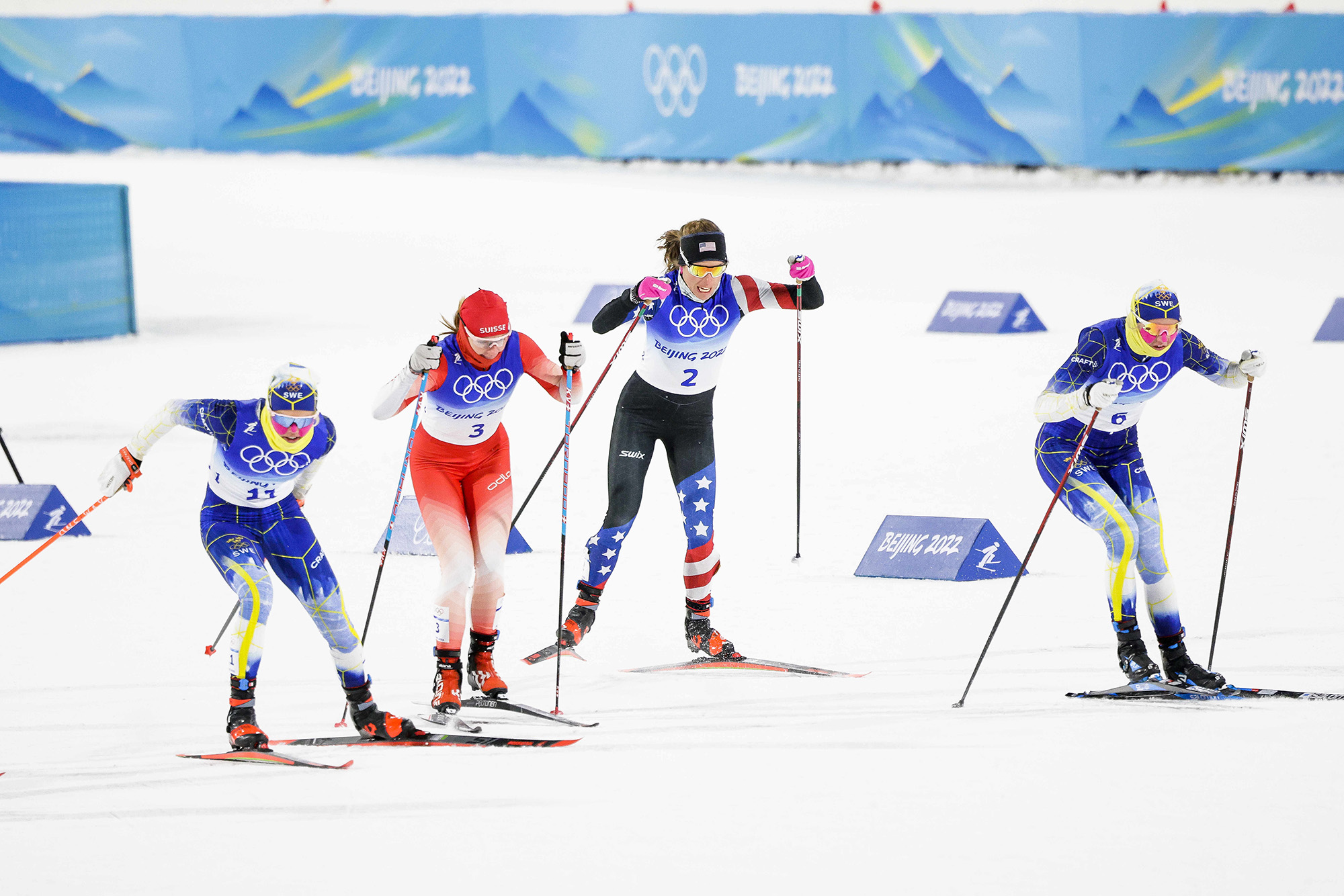
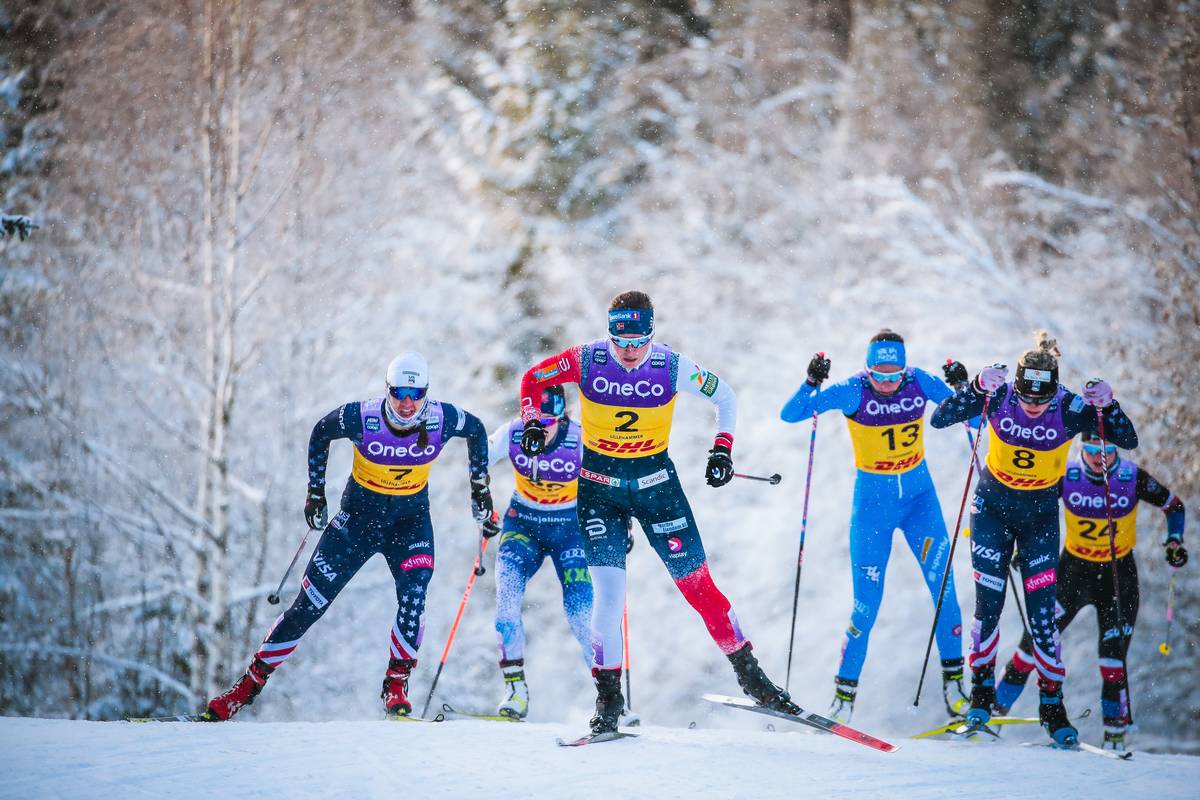
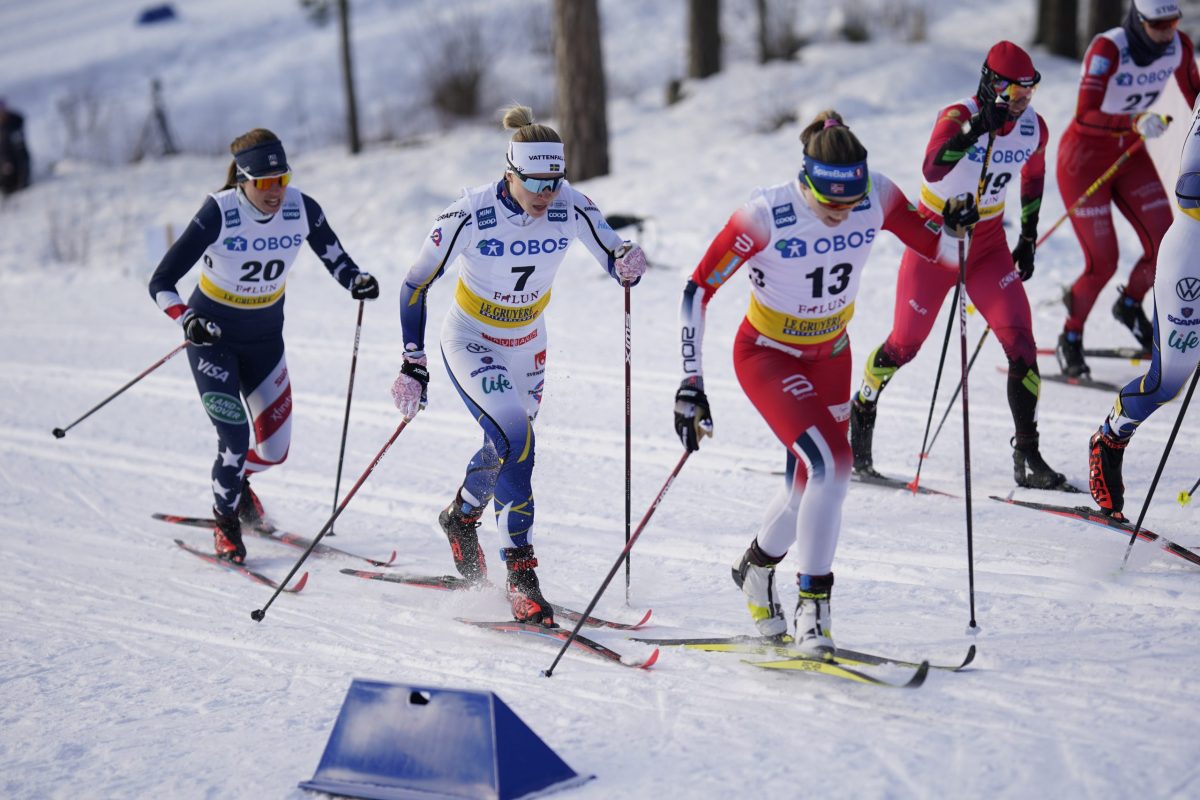
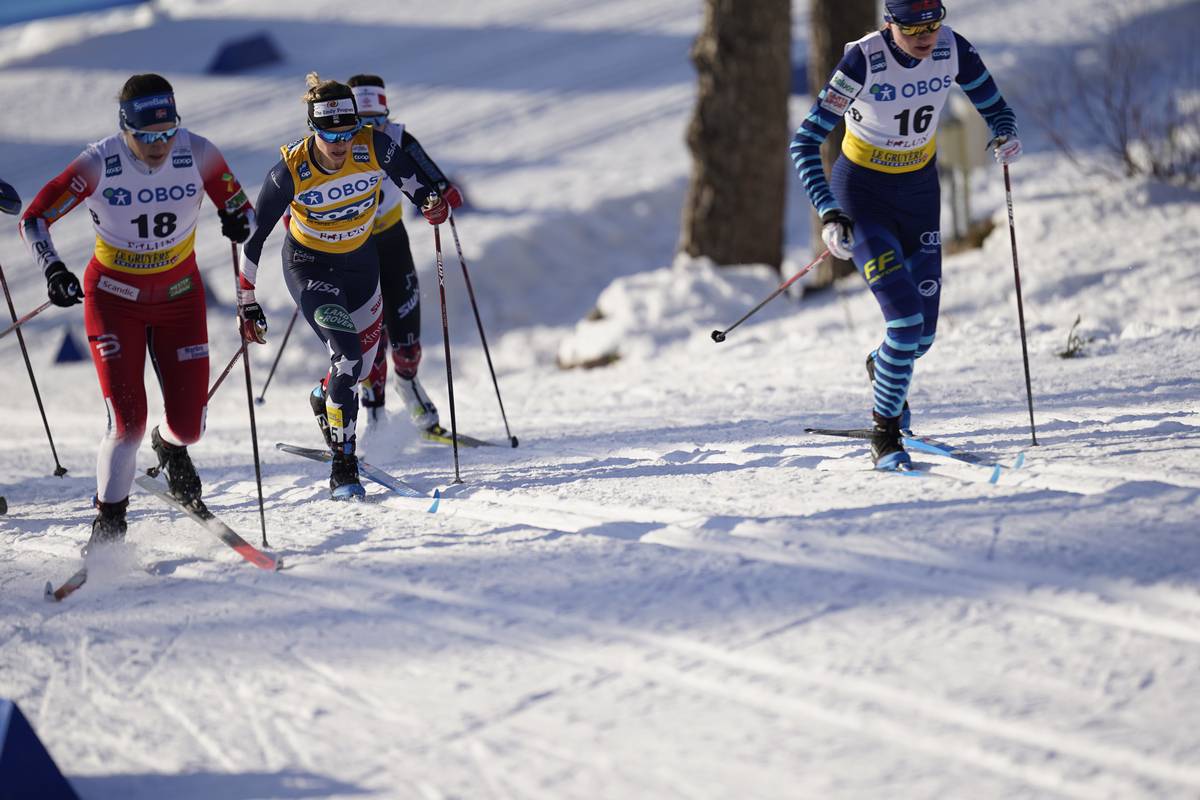
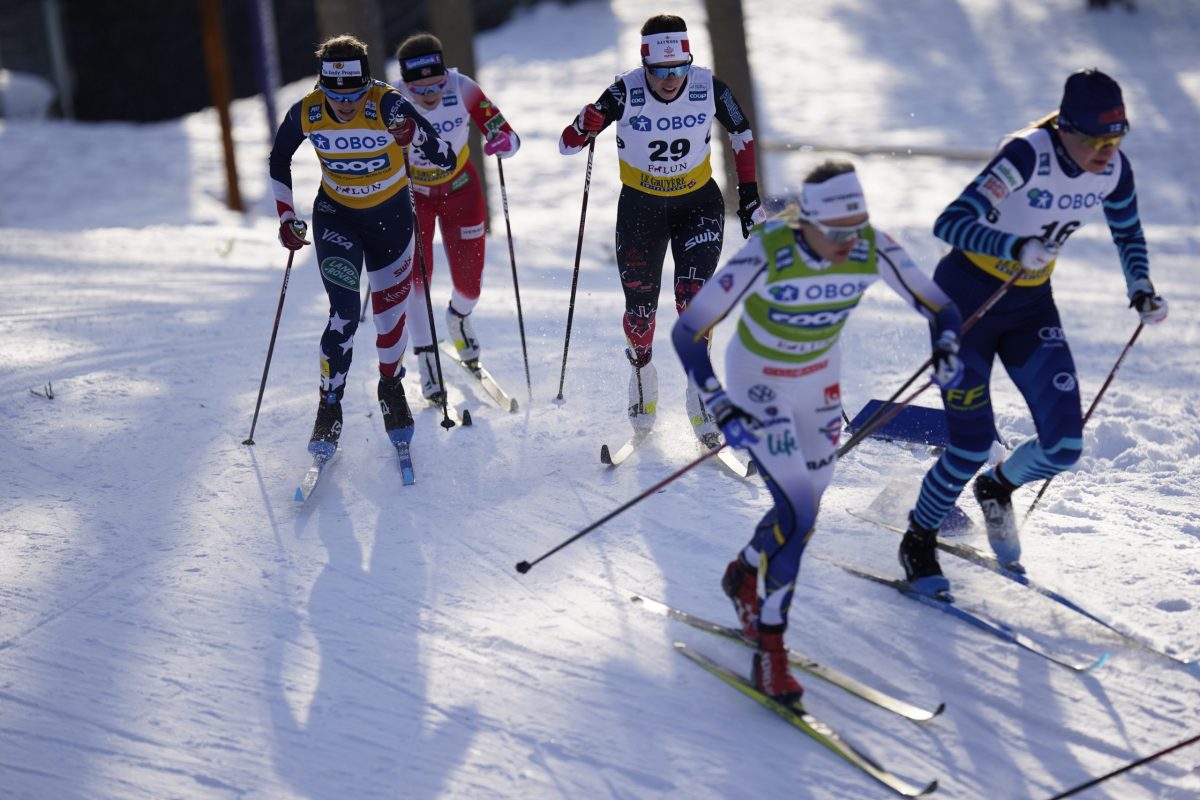
Not surprisingly, Niskanen pushed the pace early. For the first couple of kilometers, she was in a group with Kalvaa, Frida Karlsson (SWE) and T. Weng. Five kilometers into the race, there was still a large pack at the front which contained all top contenders. Diggins and Brennan were still in the lead group, but by the 7.5 kilometer mark, where the first bonus points were awarded, the balance changed. Niskanen revealed her strategy of going for the bonus points, and crossed the bonus line first, receiving 15 points and widening her lead for the distance Crystal Globe over Diggins. Heidi Weng crossed the bonus line sixth giving her five bonus points. Brennan crossed the bonus line 13th and Diggins 14th, both just missing bonus points. But the damage was done. Diggins was losing her opportunity to keep pace with Niskanen and Heidi Weng had surged past Brennan in the distance standings.
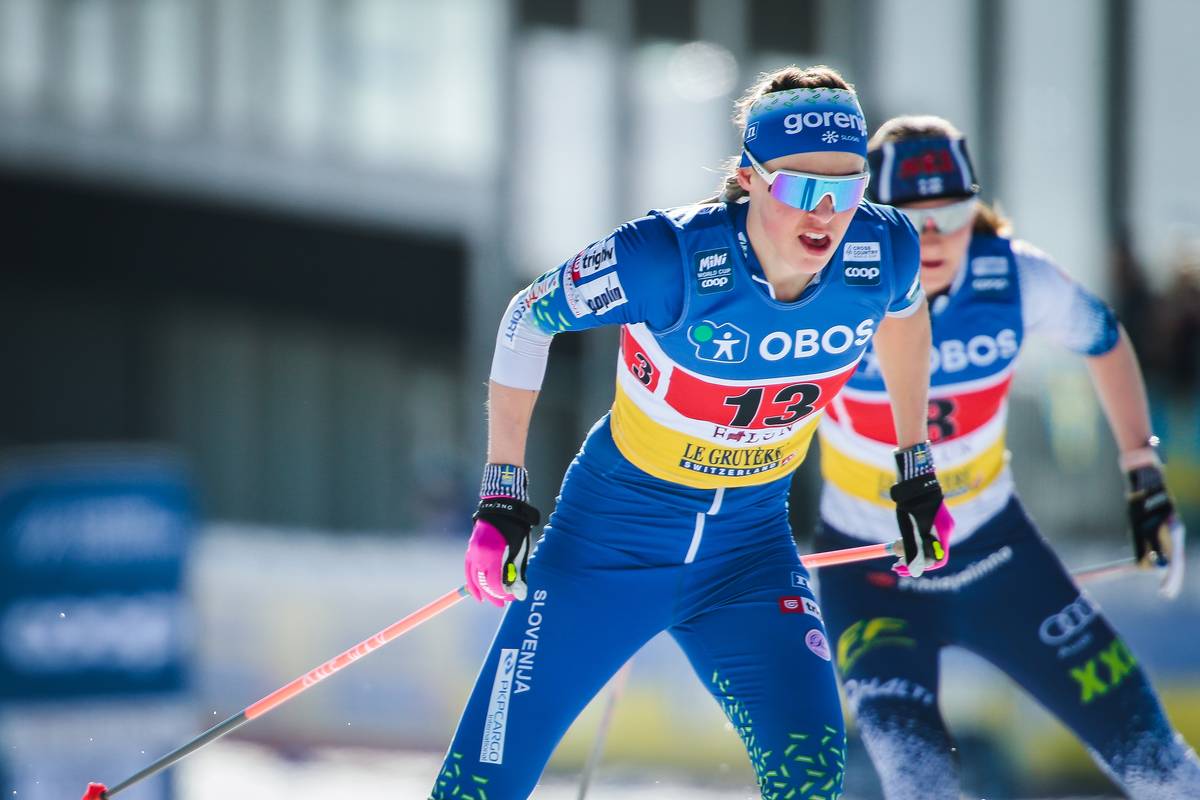
Jessie Diggins (USA) couldn’t match Kerttu Niskanen (FIN) in the chase for the distance Crystal Globe. (Photo: NordicFocus)
The next bonus point line came at the 12.5 kilometer mark. Diggins was still in the hunt a mere seven seconds off the lead as skiers passed the 11 kilometer mark. Brennan was now 14 seconds from the front of the race. As the skiers approached the bonus line, Niskanen again pushed to the front of a pack which contained Ebba Andersson (SWE), Katharina Hennig (GER), Krista Parmakoski (FIN), and Karlsson. Niskanen revisited her strategy from the previous bonus line and received 15 bonus points putting her lead for the Distance Globe out of reach. Heidi Weng took one point to extend her advantage over Brennan. Once again the Americans were shut out for the all important bonus points.
Heidi Weng (NOR) went bonus point hunting to pass Rosie Brennan (USA) in the Distance Crystal Globe chase. (Photo: NordicFocus)
While the race for the overall distance standings was being clarified by bonus points, the contest for winning the race was far from over. After 15 kilometers, a group of seven skiers dominated the front with Niskanen, Kalvaa, Andersson, Jonna Sundling (SWE), Hennig, Karlsson and Parmakoski all within seconds of each other. Diggins and Brennan had now fallen off the lead and were 30 and 38 seconds back respectively. Barring a miracle, all hope was lost for Diggins’ chances of taking the distance globe. Heidi Weng was still holding her lead over Brennan as well.
The lead pack continued with Parmakoski and Heidi Weng struggling to keep pace, as Andersson had moved to the front trying to break up the field. Andersson had picked up a yellow card earlier in the race and would have to be careful not to be disqualified with another violation.
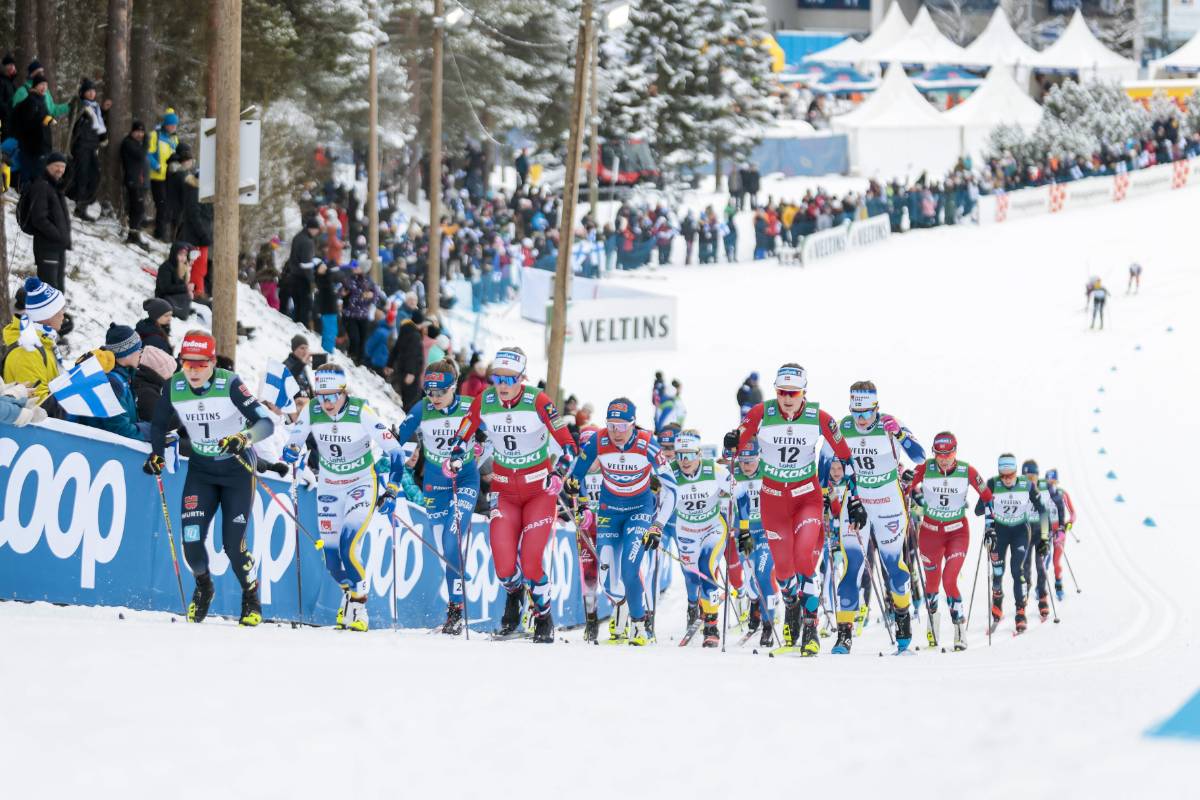
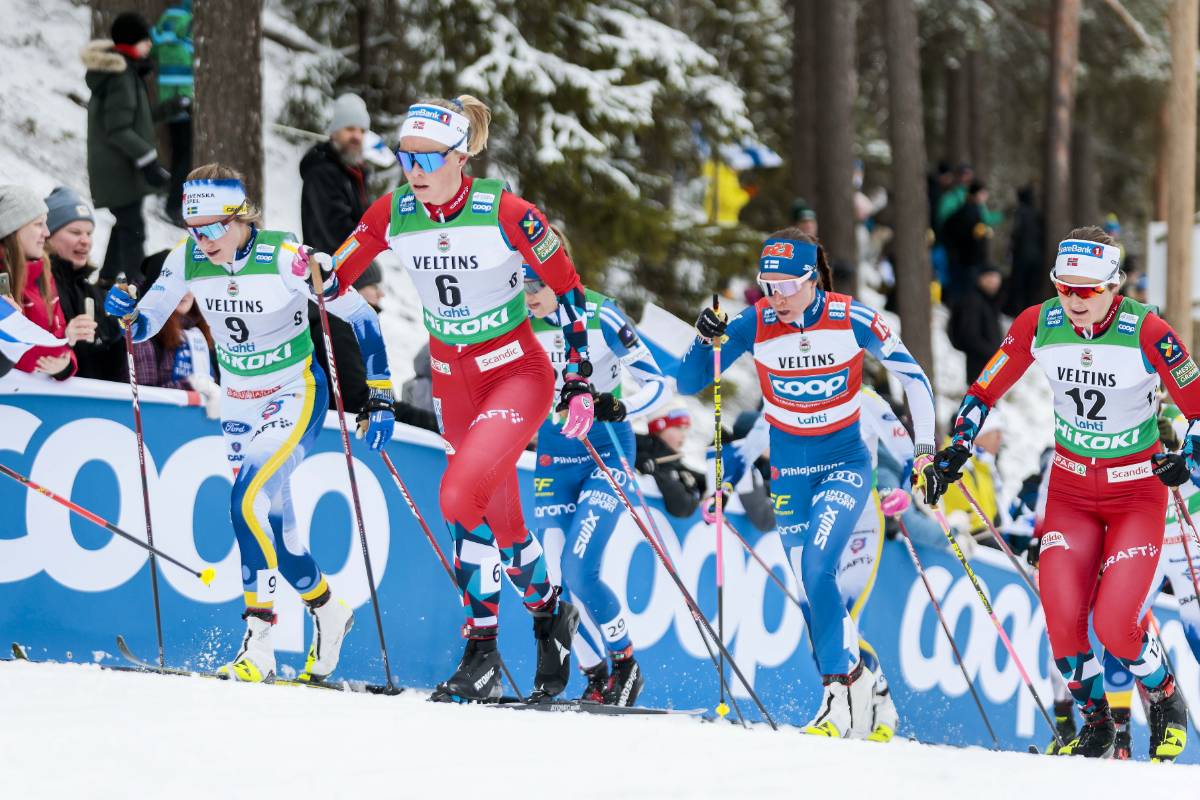
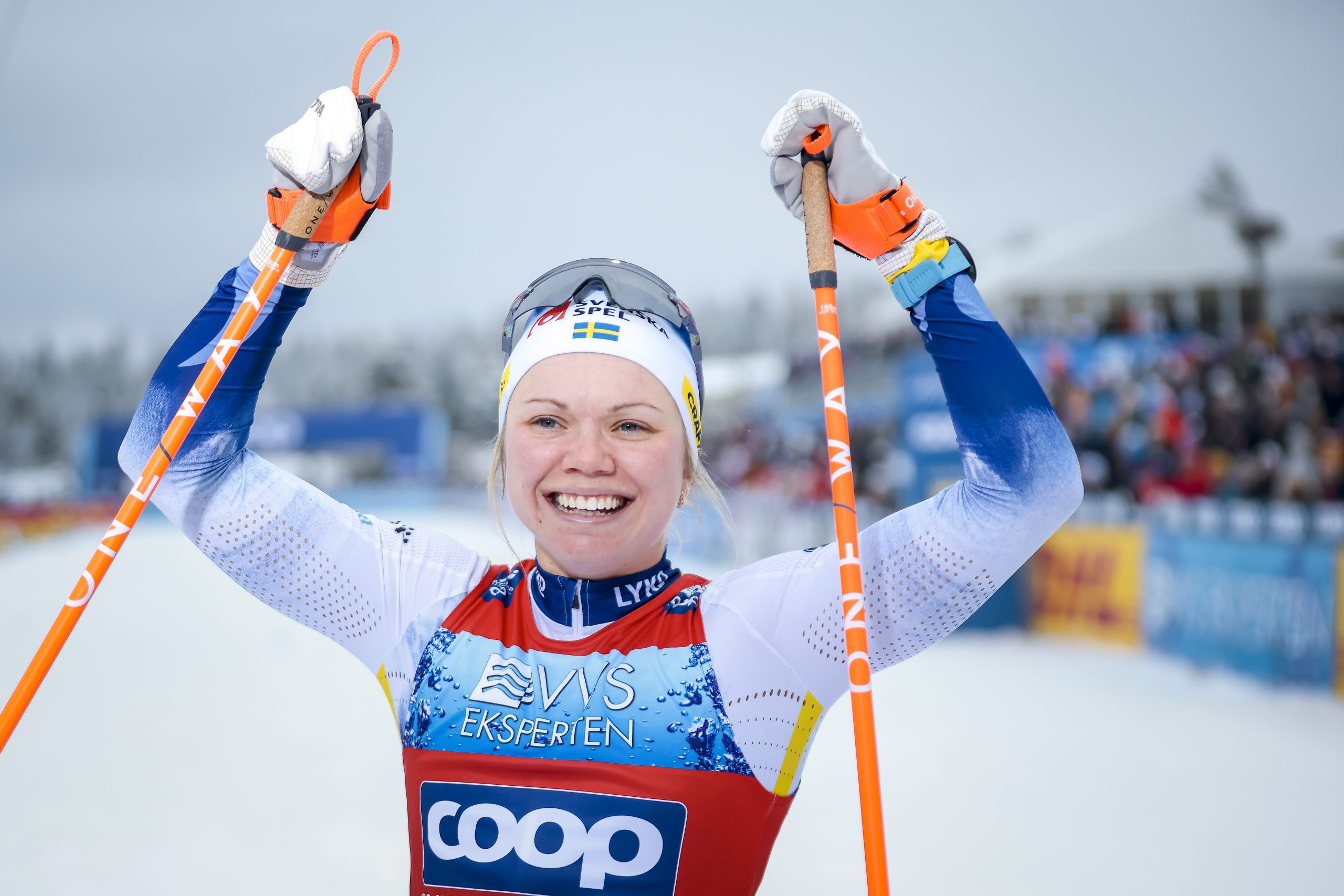
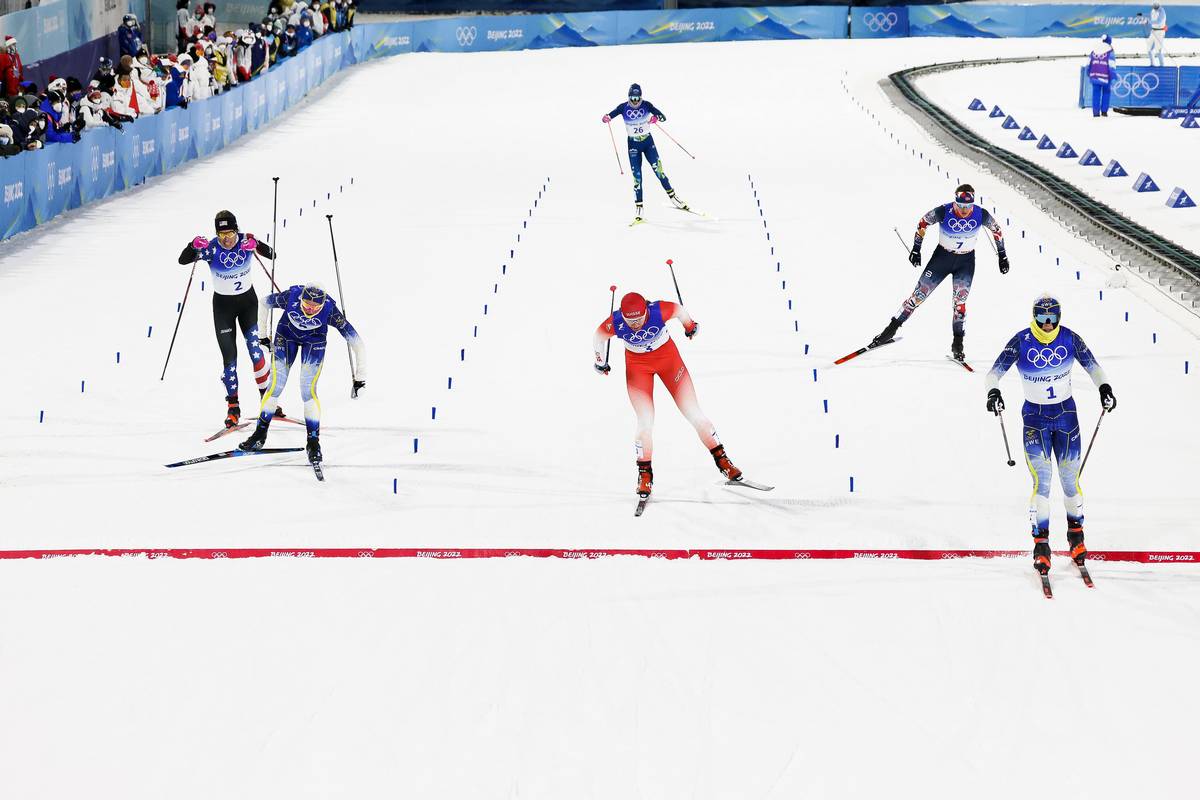
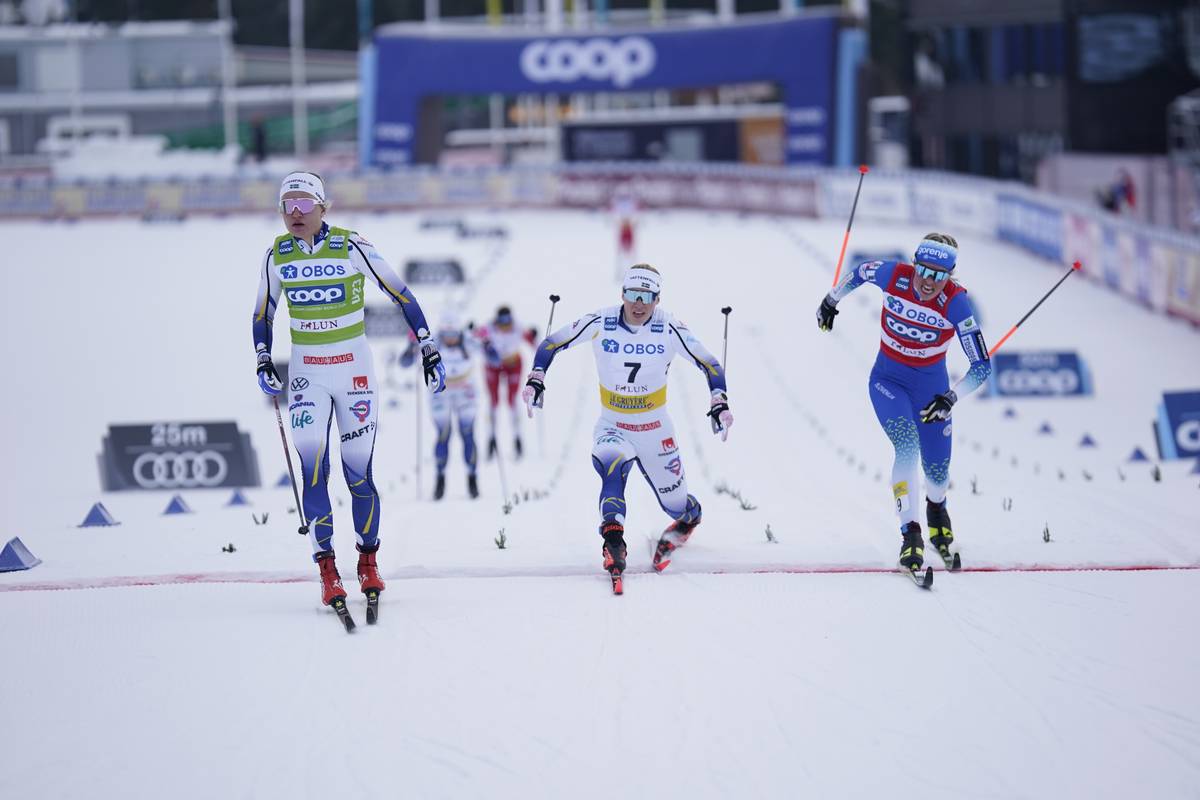
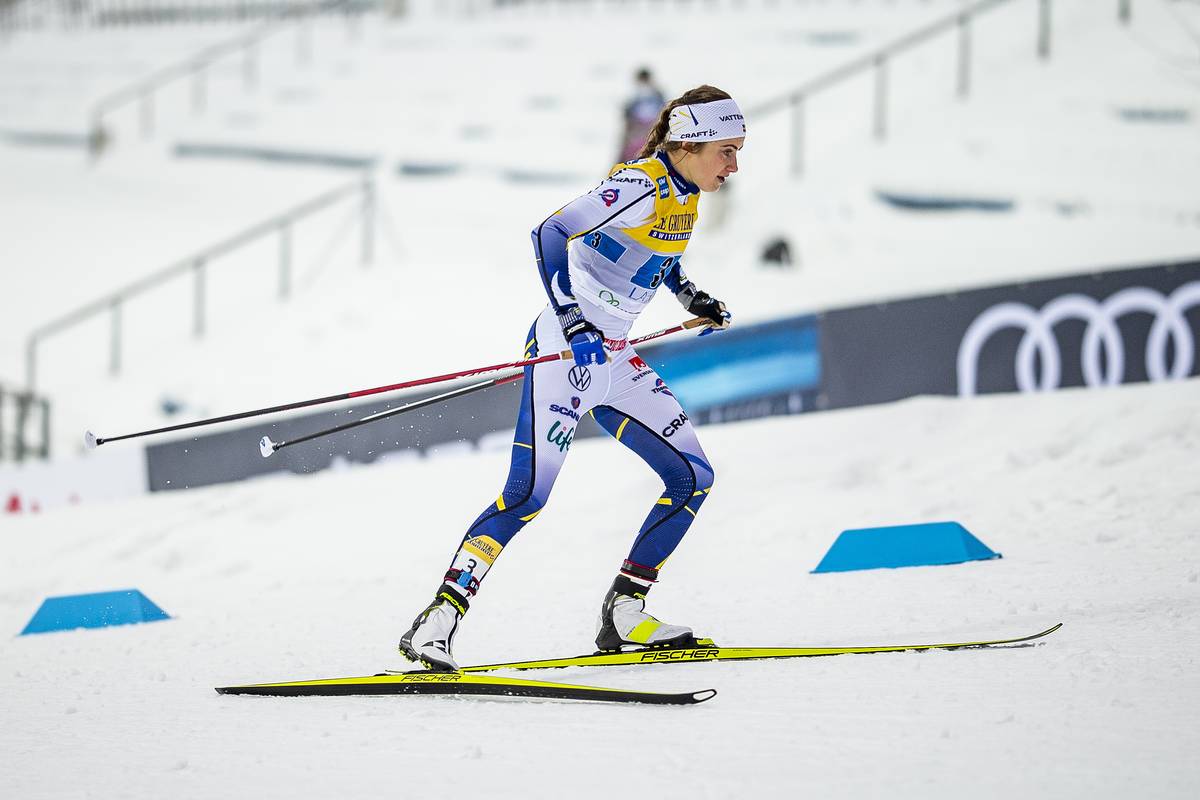
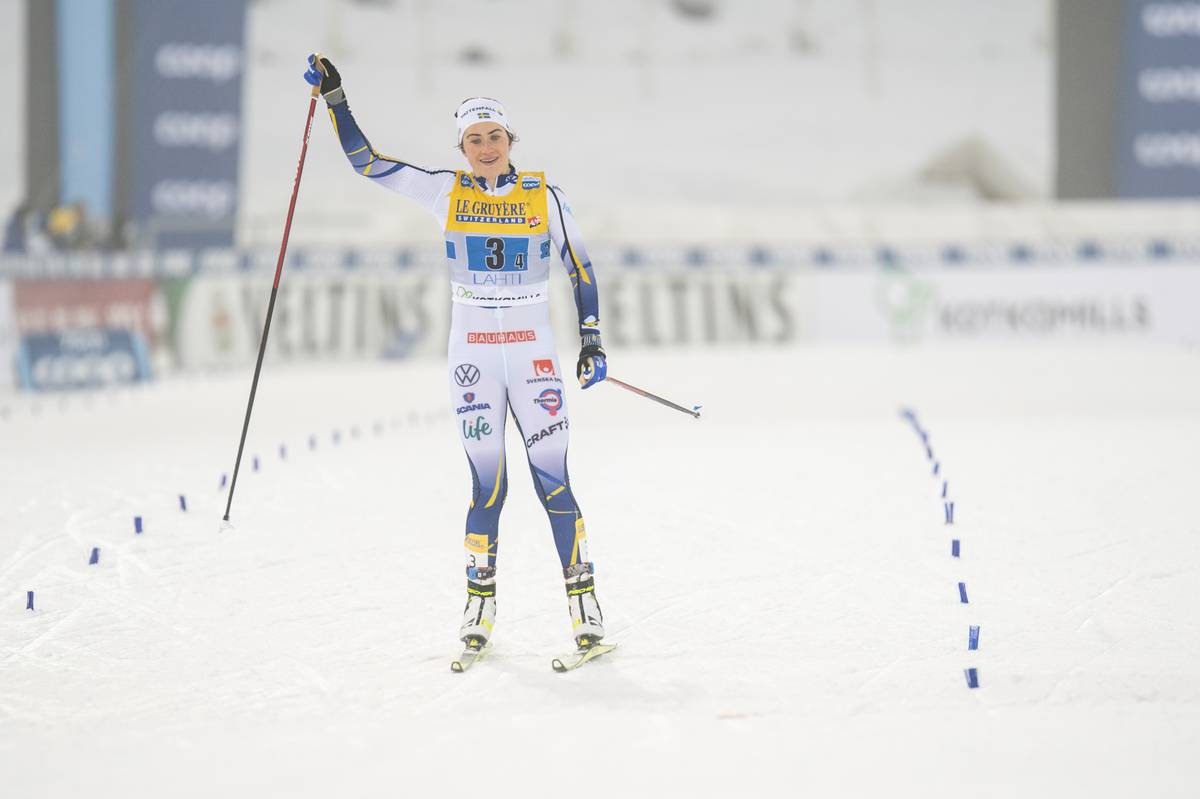
Jonna Sundling (SWE-bib 26), was able to stay with the pack and use her sprint skills to finish second (Photo: NordicFocus)
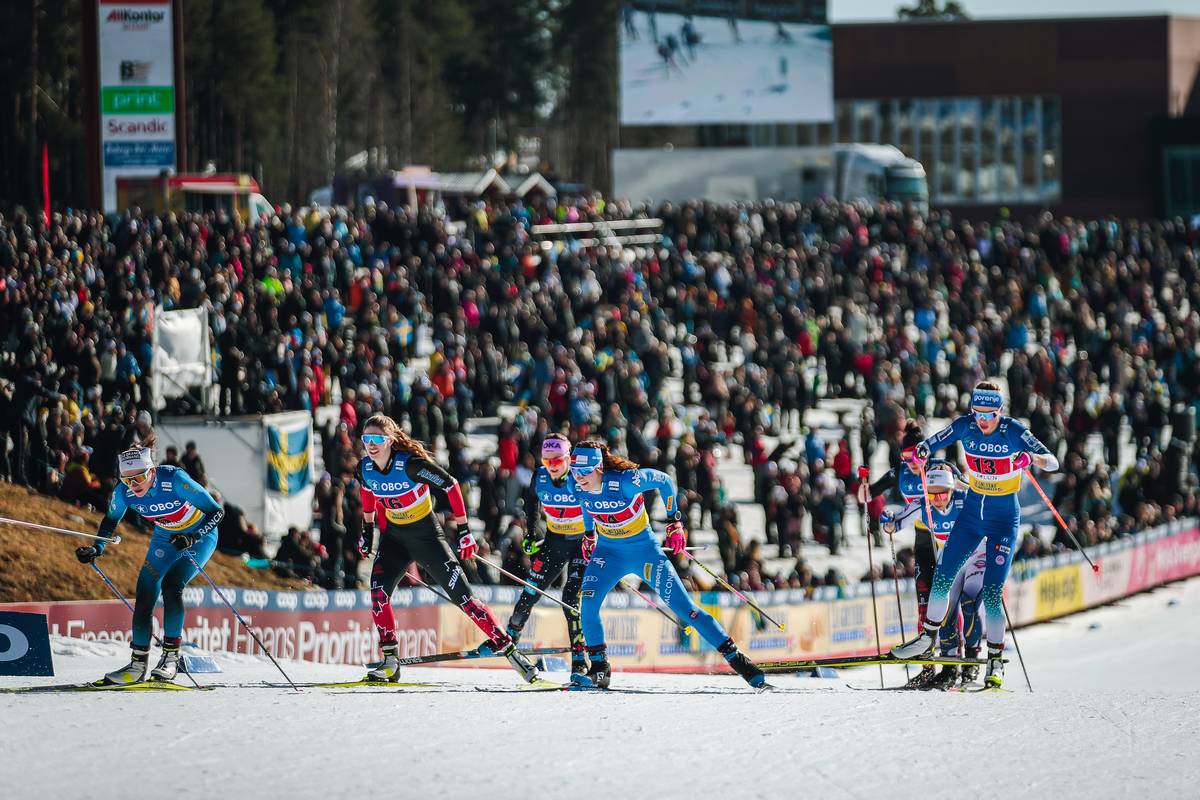
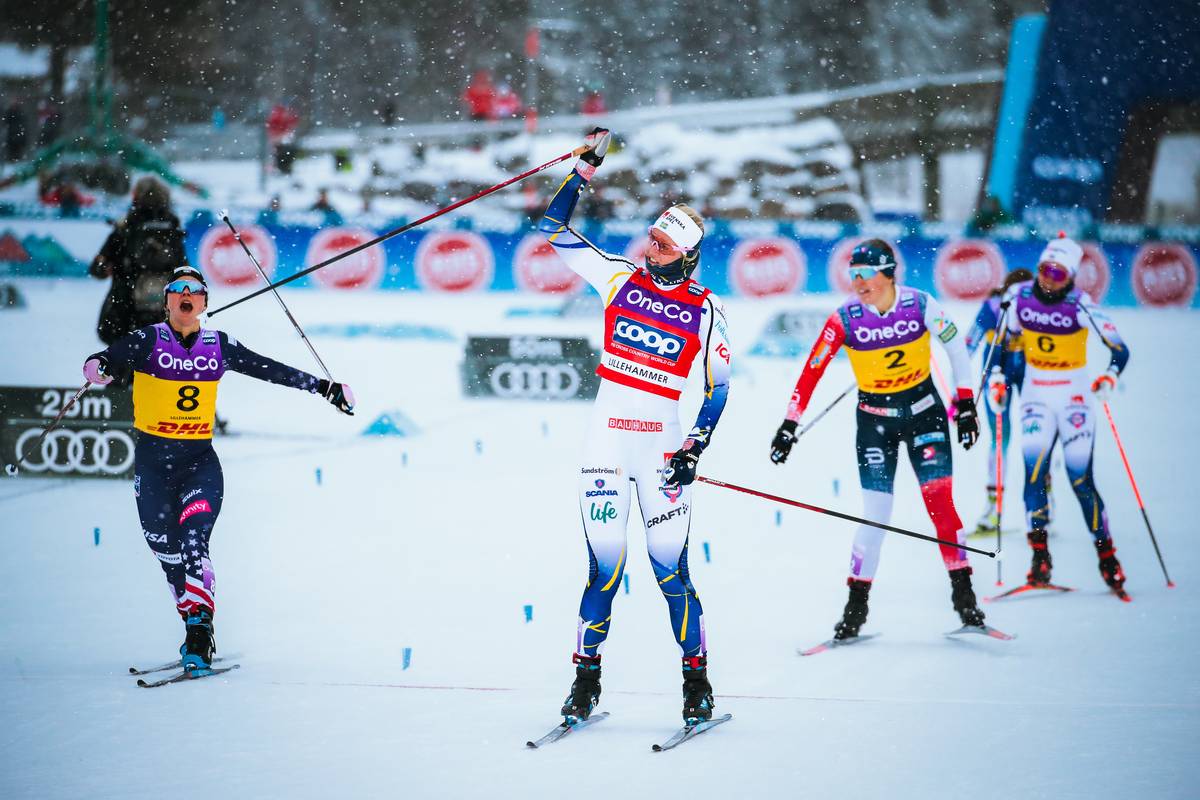
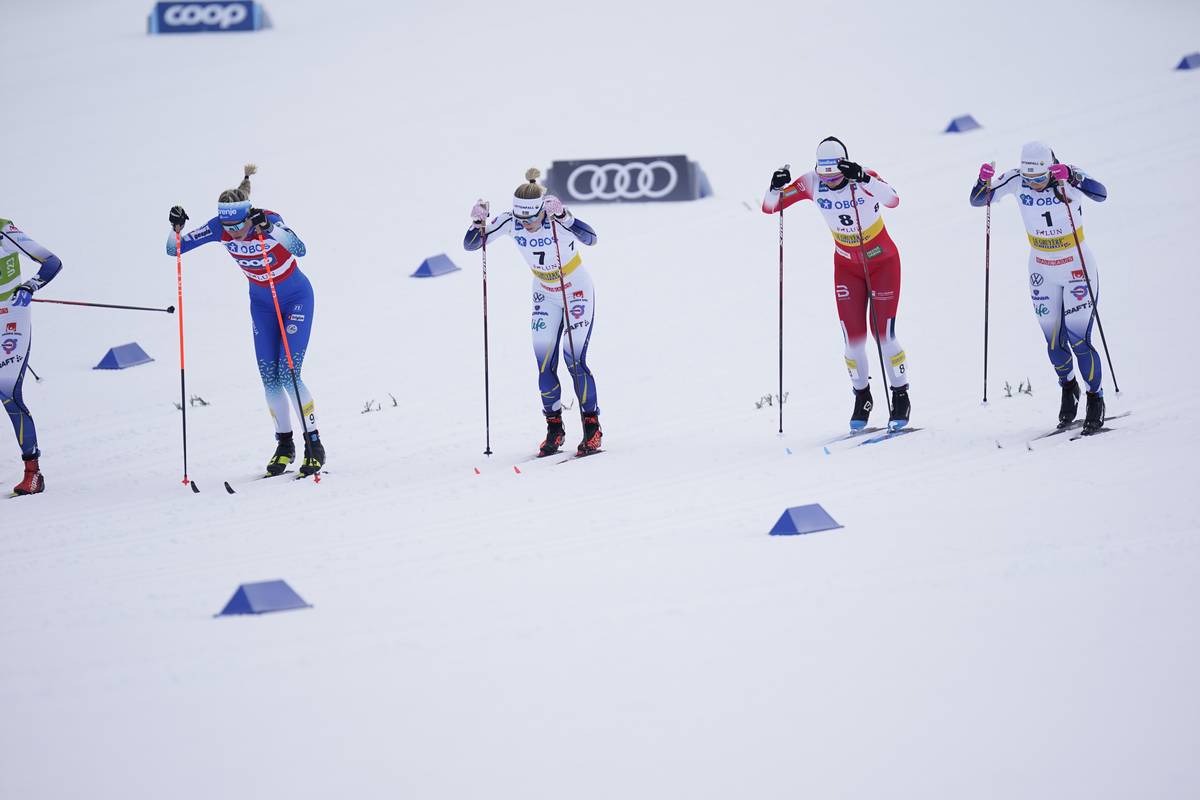
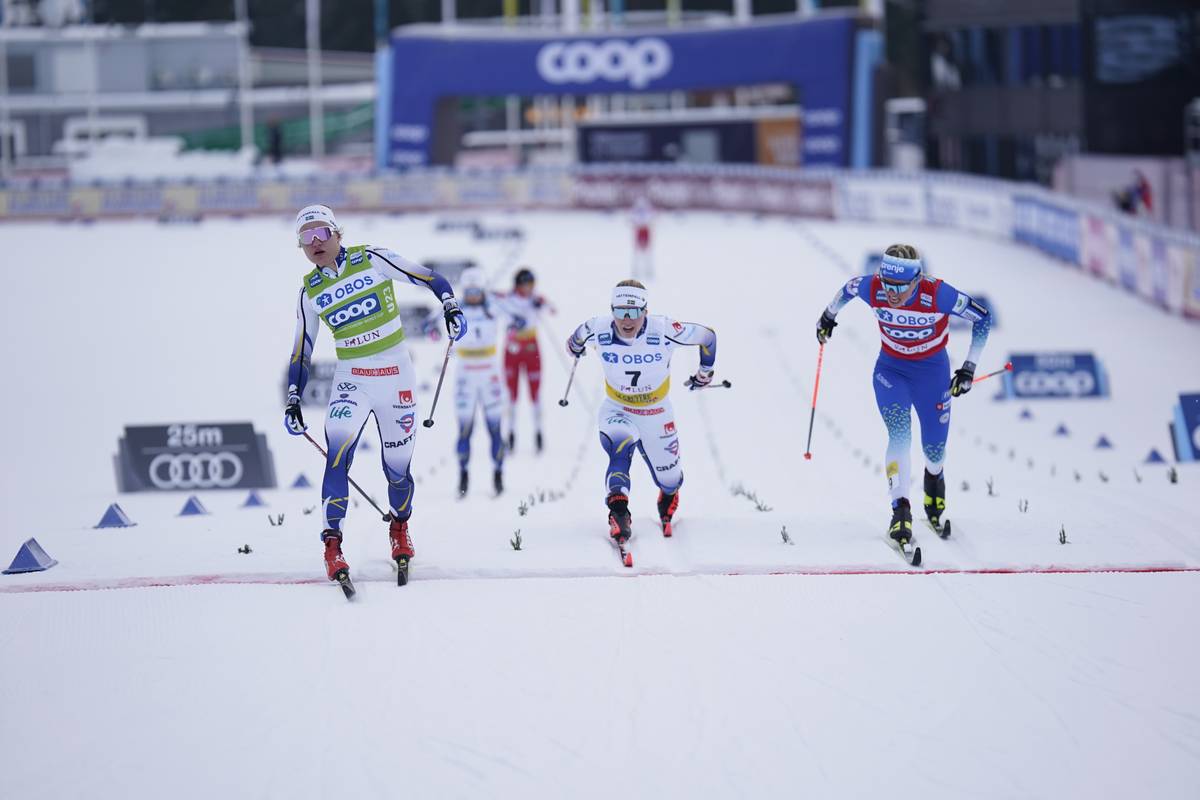
As the finish approached, the pack was still together with Andersson going to the front trying to take away the advantage Sundling would have in a sprint finish and setting up a dazzling drag race to the finish line. But, it was Kalvaa who was able to find the speed at the end with clearly faster skis than the field, surging to the front to hold off Sundling’s late charge and win by less than a second. Hennig finished just behind Sundling in a three way photo finish with Andersson coming in fourth. Niskanen ended up fifth and would have to wait in her pursuit to win at home.
For Kalvaa it was her first world cup win. After the race she commented about how fast her skis were and admitted that the fatigue of the season had taken its toll.
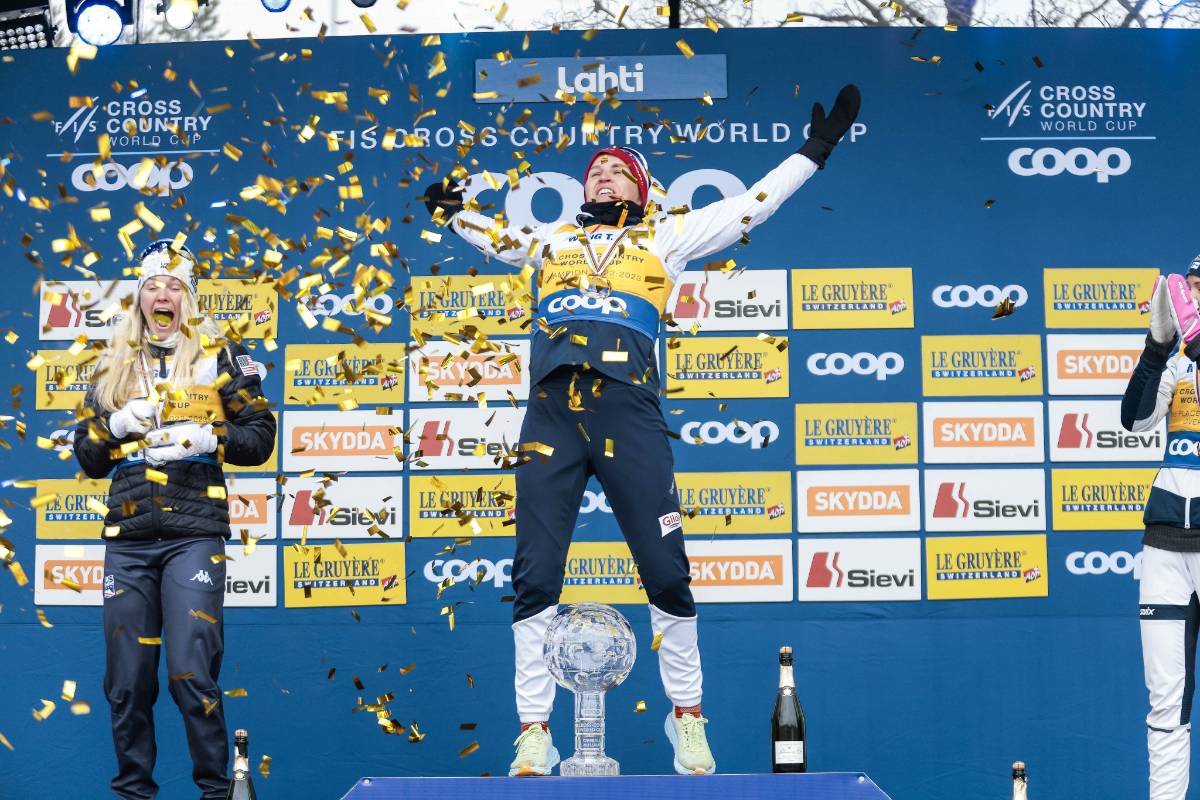
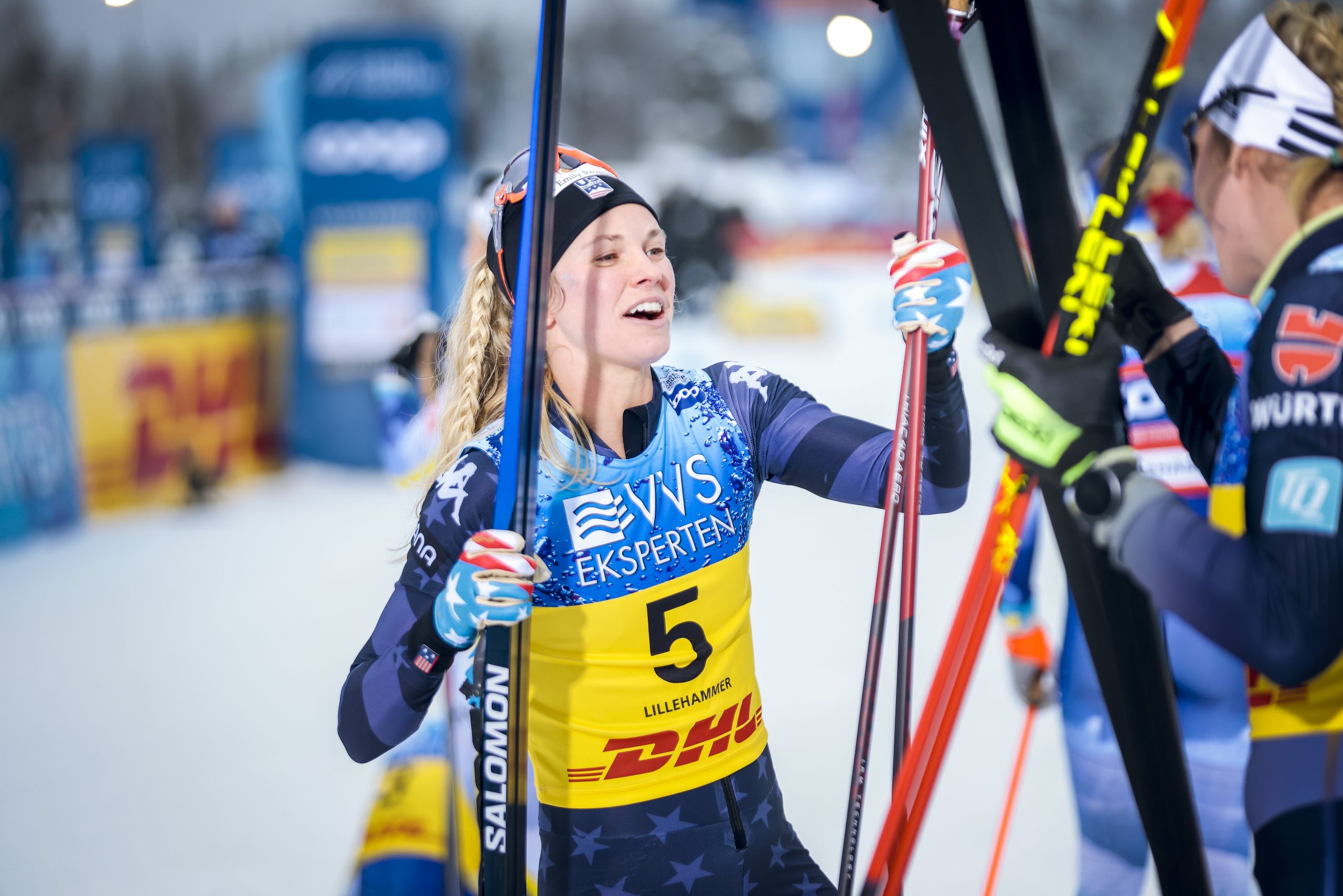
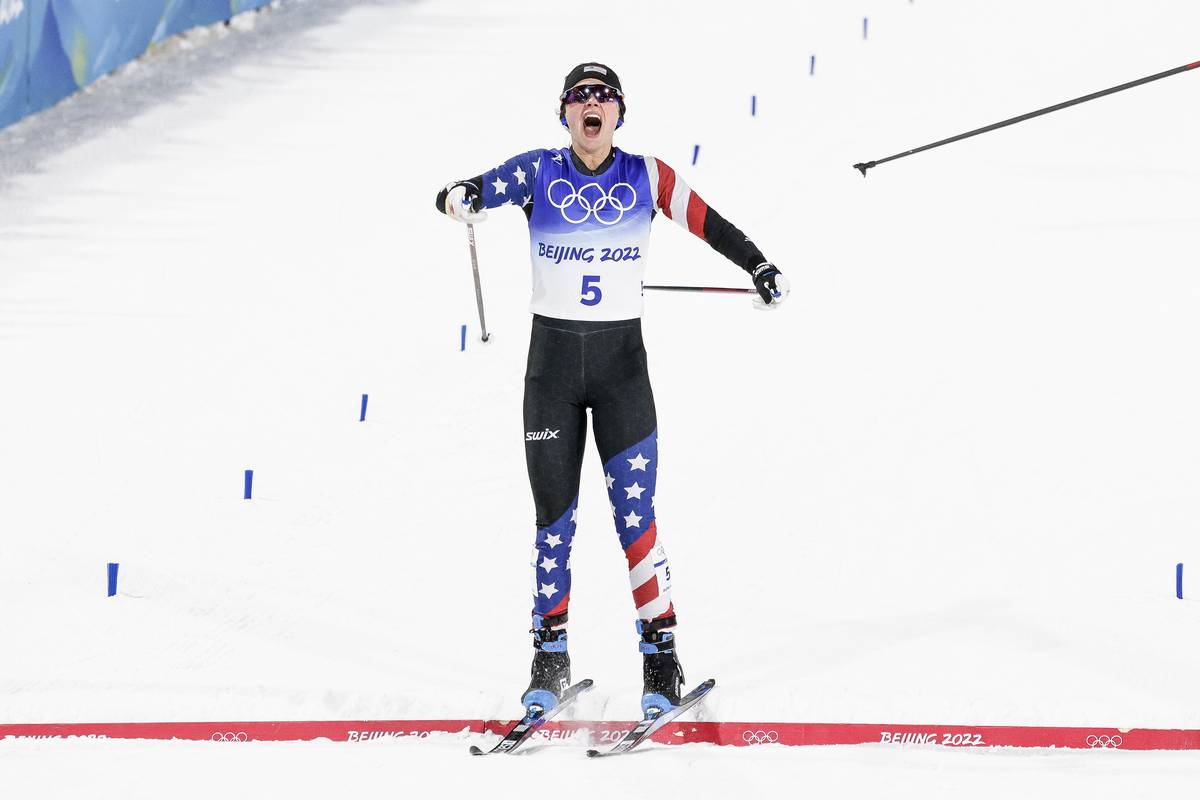
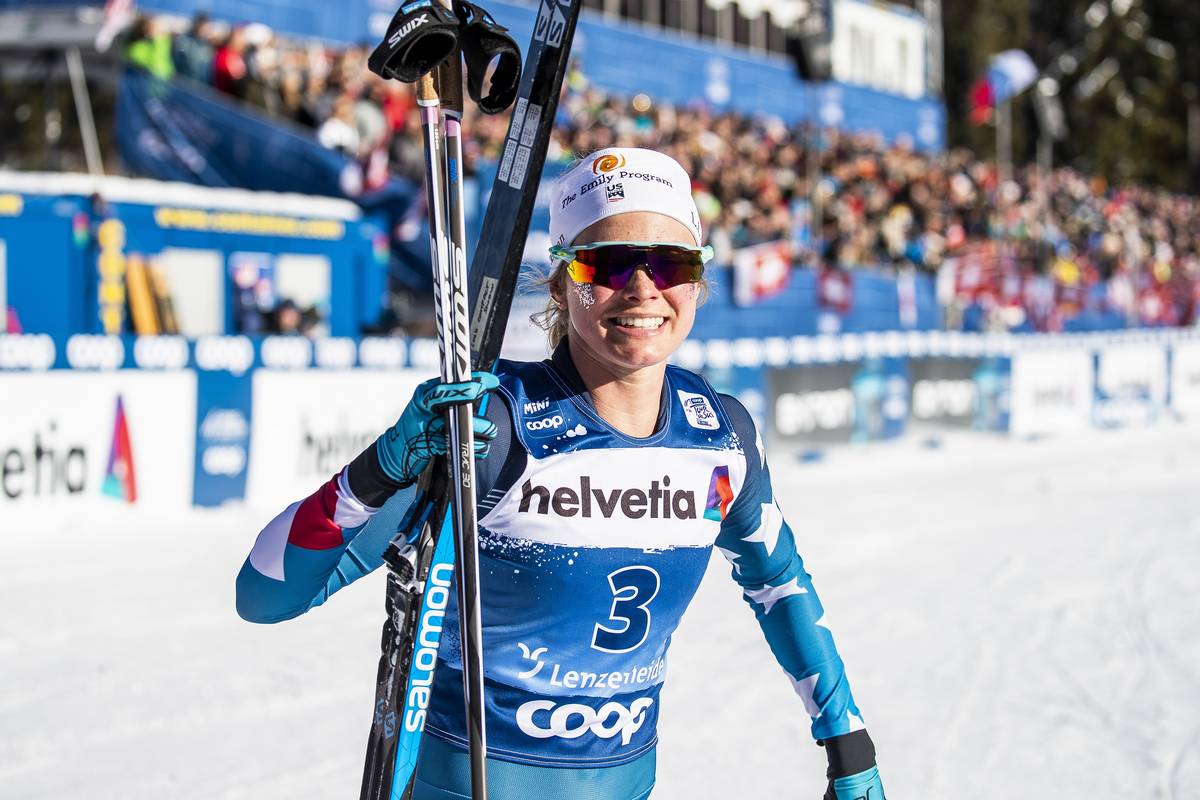
Jessie Diggins (USA-left) celebrates her second place finish in the distance world cup competition with the winner, Kerttu Niskanen (FIN). (Photo: NordicFocus)
It was a tricky day for waxing; clearly the Norwegians had hit the mark. U.S. coach Chris Grover commented on the difficulties of finding the right kick wax. “Some of the athletes today had decent skis,” he said. “Some were too slick, some were slow, it was kind of all over the map. It glazed [the tracks] as the race went on and you had to be kind of lucky.” Team USA knew that the deck was stacked against Diggins’ chances of claiming the distance championship. Grover said that “[Niskanen’s] won the last few Classic races…Jessie and Jason [Cork] approached the day that it would be a very tall order to overtake Kerttu, and unfortunately, Jessies’ skis just weren’t fast enough. We knew it would be a bit of a long shot.”
Anne Kjersti Kalvaa (NOR-bib 6), used her fast skis to surge past the pack at the end of the race. (Photo: NordicFocus)
When Diggins and Brennan reached the finish they were over a minute back in 22nd and 23rd respectively. It was a valiant effort, but they just couldn’t keep pace with the leaders.
It was an exciting way to end the season. But it was also filled with a tinge of disappointment for the Americans. Diggins had come painfully close to capturing the distance Globe, but ultimately finished second to Niskanen, which was still cause for celebration. Brennan dropped to sixth overall in the distance Globe chase.
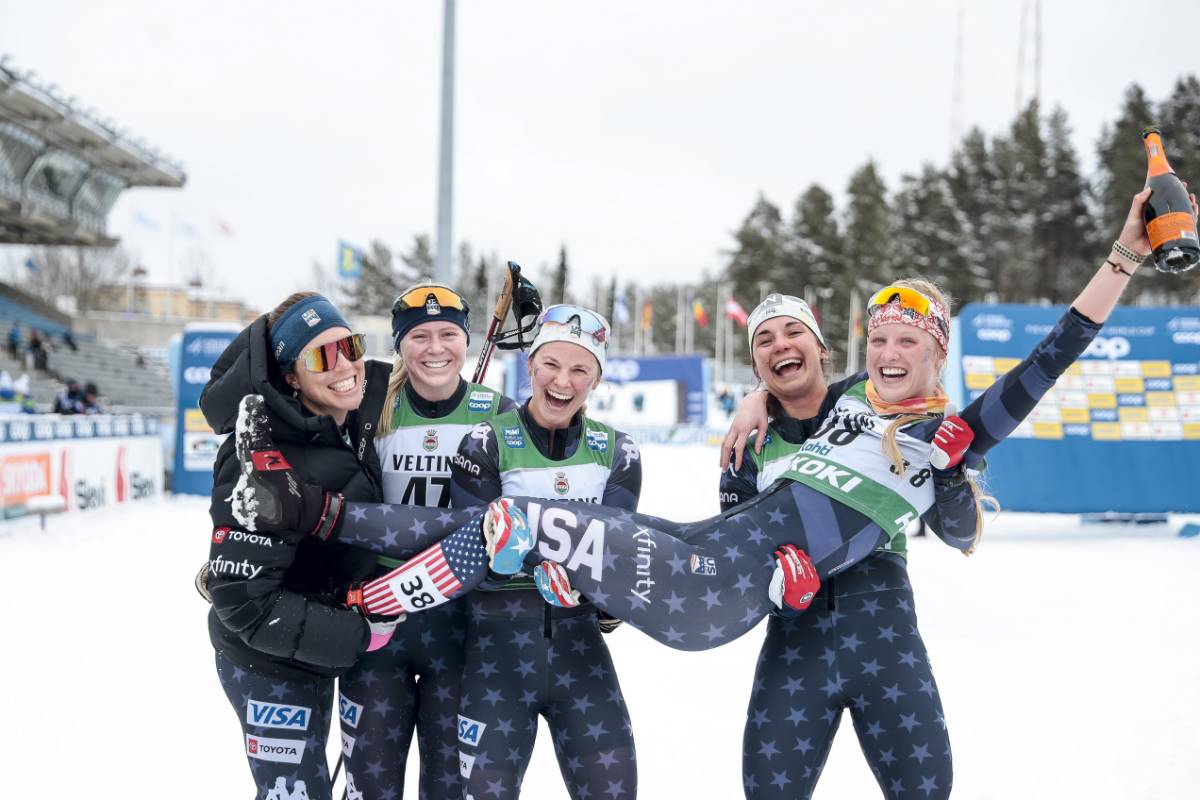
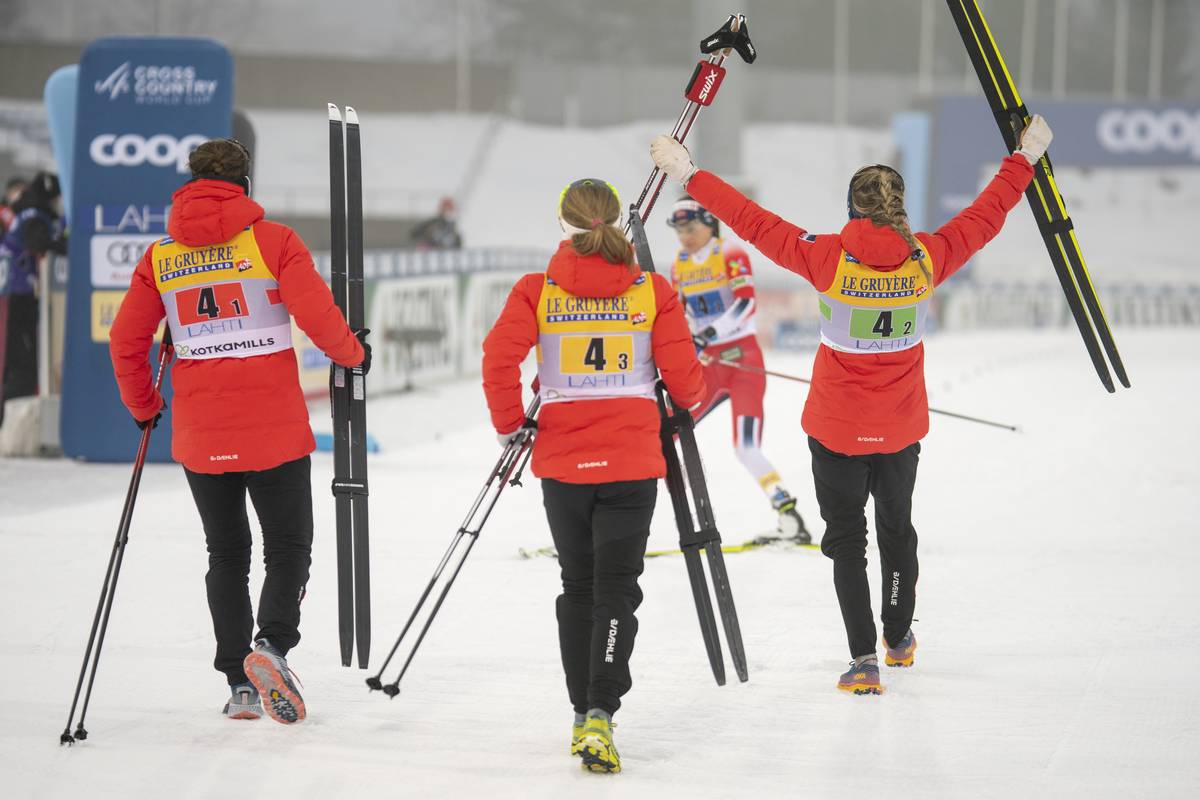
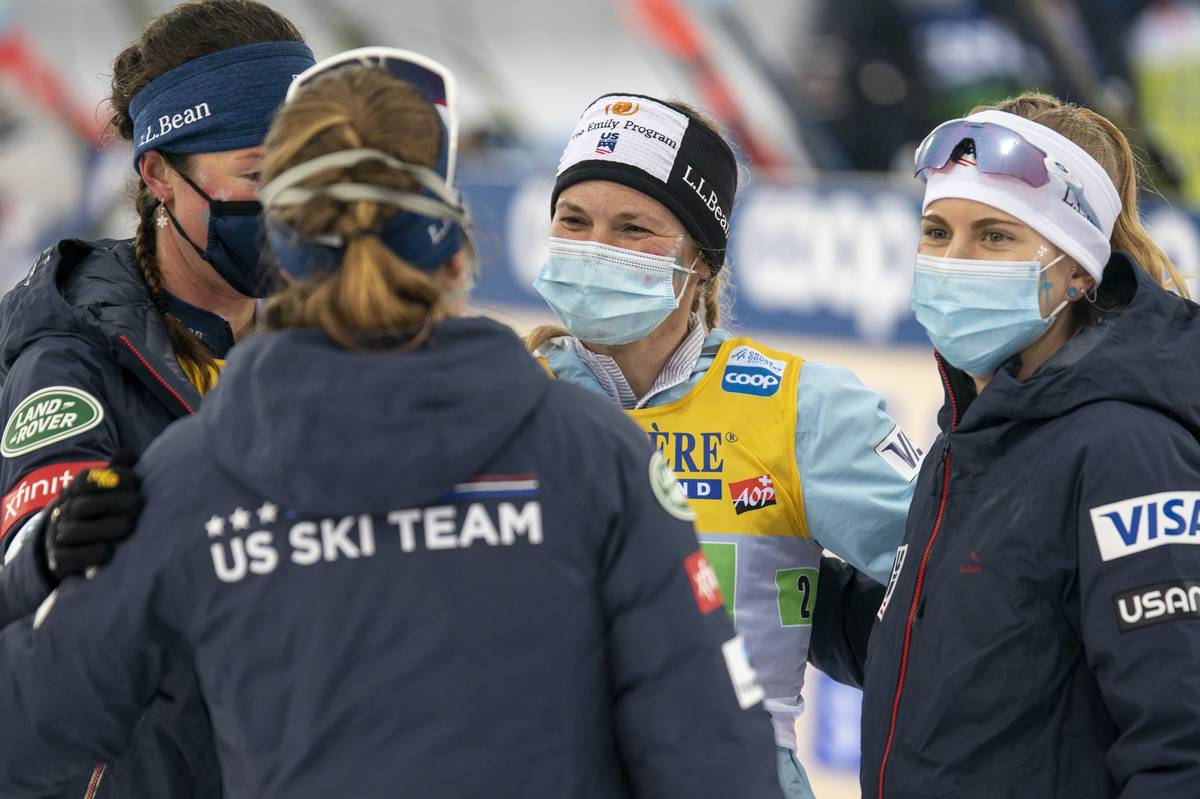
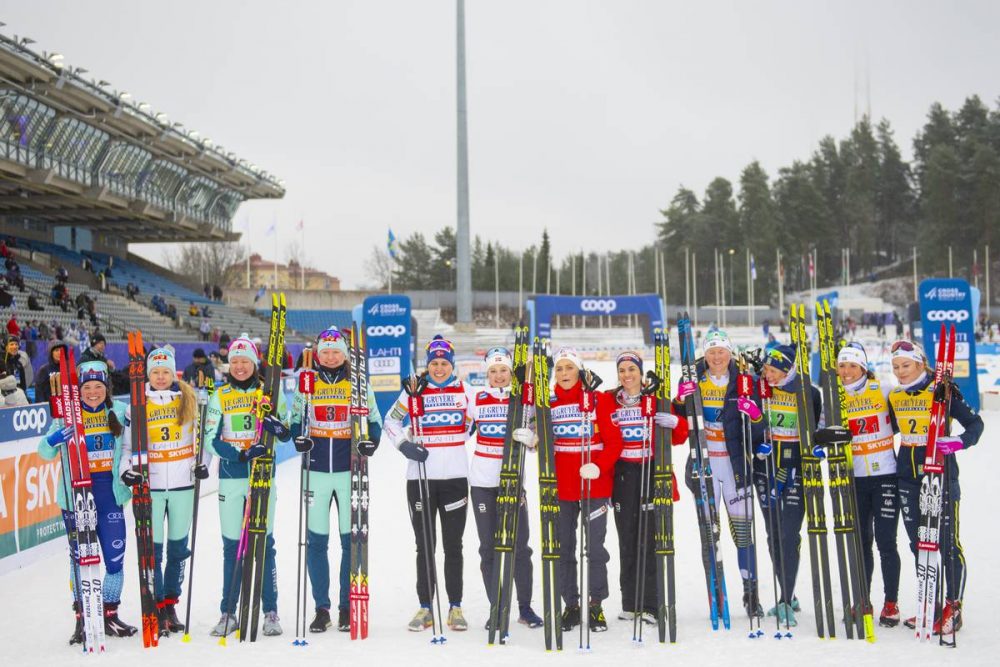
Team USA: Rosie Brennan, Samantha Smith, Jessie Diggins, Julia Kern, Hailey Swirbul (l-r) celebrate the end of the season and putting two racers into the top five of the World Cup standings (Photo: NordicFocus)
If you’re reading this, you already know: Jessie Diggins and Julia Kern teamed up to deliver a bronze medal for the U.S. at the World Championships in Slovenia. We’ve got a full breakdown and oh yeah, there was a men’s race, too, and a standout Canadian result.
The championships is rolling along; email your notes and questions to devon@fasterskier.com and nat@fasterskier.com.
Devon and Nat return to recap the last three stages of this year’s Tour de Ski, including the climb up the Alpe Cermis and some epic American and Canadian performances.
The World Cup circuit is taking a break, so we’ll try to have a mailbag episode in the next week. Email us questions and comments at devon@fasterskier.com and nat@fasterskier.com.
Ben Ogden after falling just short of the finals in the Val di Fiemme sprint. (Photo: Nordic Focus).
This World Cup coverage is made possible through the generous support of Marty and Kathy Hall and A Hall Mark of Excellence Award. To learn more about A Hall Mark of Excellence Award, or to learn how you can support Fasterskier’s coverage, please contact info@fasterskier.com.
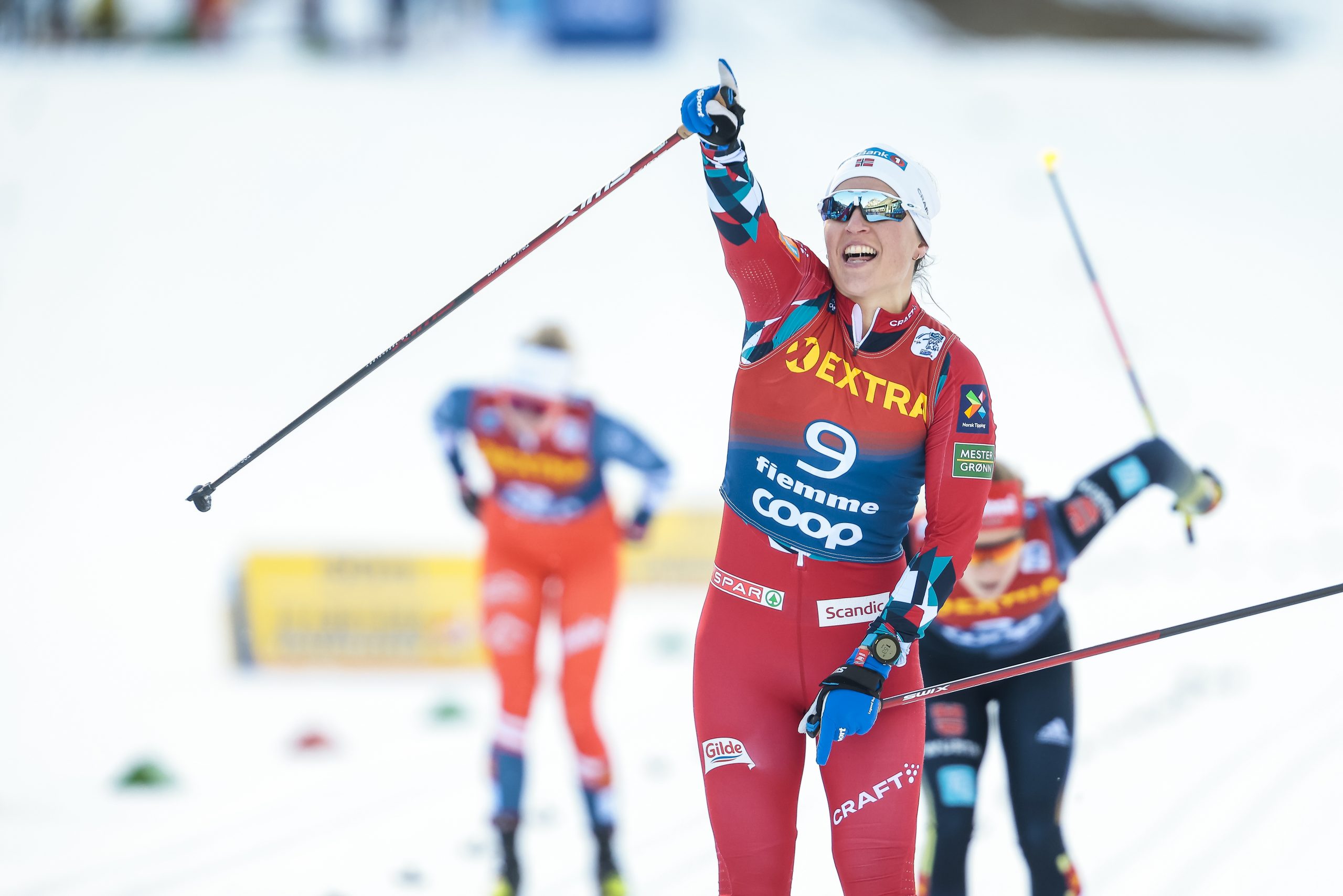
Lotta Udnes Weng (NOR) celebrates her victory in the Stage 5 Women’s Sprint at the 2023 Tour de Ski in Val di Fiemme, Italy. She shared the podium with her twin sister, Tiril Undnes Weng (NOR), who finished second. (Photo: NordicFocus)
Stage 5 of the 2023 Tour de Ski was a sprint, but not a “normal” sprint. Typically, sprint races are won by pure sprinters, those who control the pace of heats, and rely on mad dashes in the homestretch to secure victory. Unlike a typical World Cup sprint race, Val di Fiemme’s sprint stage was a race that was bound to affect the overall Tour de Ski standings: any distance skier who could advance to the later heats would be sure to rise in the ranks with just two more stages remaining. A number of significant sprint specialists were absent from the Tour de Ski startlist, and other skiers normally known for distance prowess were vying for sprint advancement. Those skiers would use the tools available to them to make that possible. Predictably, the pacing was fast, and the tactics merciless. This was not a sprint that could be taken: this was a sprint that would be earned.
A number of those all-arounders advanced to the final, including Finland’s Krista Parmakoski who set a brutal pace in both her quarterfinal and semifinal heats. The final podium was pure Norwegian red: Lotta Udnes Weng in first, her twin sister Tiril Udnes Weng second, and Myhrvold third.
Canadians in the final standings included Catherine Stewart-Jones who qualified 28th, but did not advance beyond her quarterfinal (finishing 29th), and Dahria Beatty 34th.
Americans failed to advance to the final, but had fine showings, nonetheless. With a hard-fought 10th place finish, Rosie Brennan showed that her form is returning to the world-challenging status that’s become her norm in recent seasons. Week after week on the World Cup tour, Brennan delivers a level of consistency that rivals that of any American skier from the present, or the past. While this week’s Sprint in Val di Fiemme was not a stand-out result for her, it was an indication that Brennan is once again rounding into form, and preparing herself to contend in races—both sprint and distance—in the remainder of the World Cup season.
“I was very happy to make the semi finals today,” Brennan said. “Sprinting has been such a struggle for me this year, so it felt good to make a small step forward. There isn’t much snow here and it’s warm so the tracks were fast and breaking down, but everything held on just enough and my skis were good. I lacked the punch I needed to make the final, but any step forward is all you can ask for. There is still a lot left in the Tour, so I’m still just trying to focus one day at a time and take things as they come. ”
Behind Brennan’s 10th place finish, American finishers included Julia Kern 14th, Jessie Diggins 21st, Alayna Sonnesyn 38th , and Sophia Laukli 44th
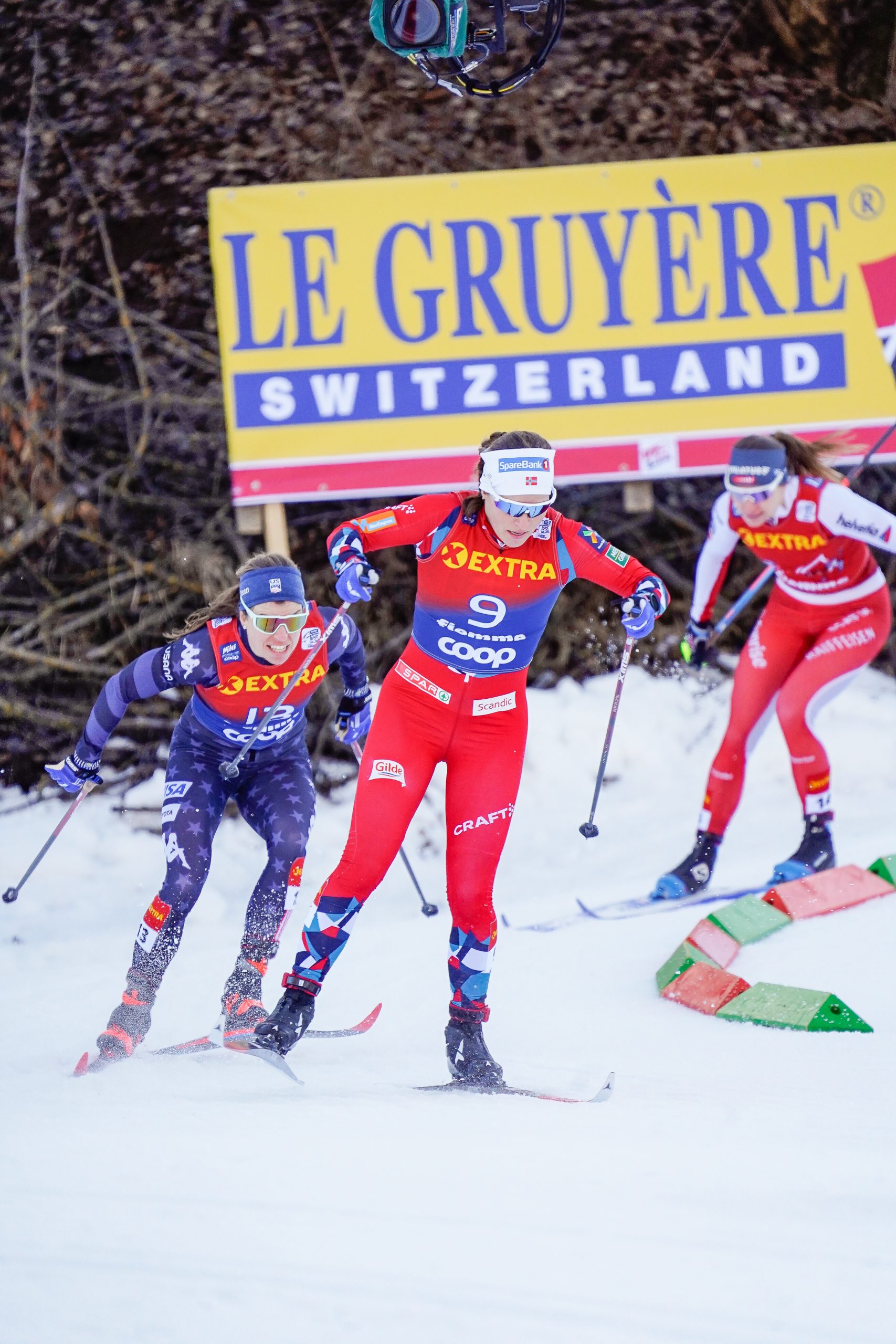
Rosie Brennan (USA), Lotta Udnes Weng (NOR), and Nadine Faehndrich (SUI) in a blistering quarterfinal heat that set the tone for the day in Val di Fiemme, Italy. (Photo” NordicFocus)
Women’s Sprint
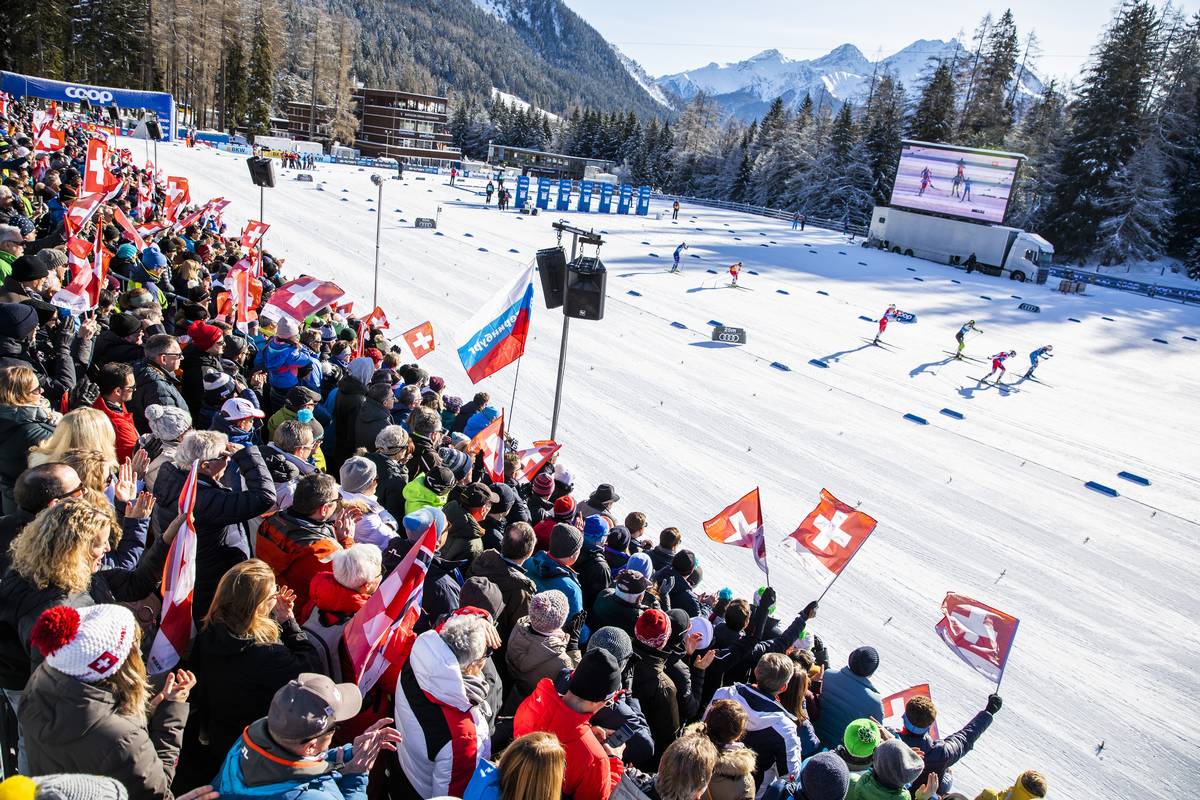
Val di Fiemme offers a rolling sprint course with very little time for recovery. An initial uphill is followed by a rolling middle section. Later in the loop, the racers navigate a tight, tactically significant lefthand bend, a narrow spot in the course where speed can be gained, or lost. A wax-revealing downhill needs to be timed to create a slingshot effect over the final small rise.
With a number of Team Sweden’s sprint specialists sitting out the Tour de Ski, the Women’s field would be marked by racing that was likely to affect the overall standings (with a 60 second bonus for the winner). Distance skiers had great motivation to attempt to reach the later heats, meaning that the heats would be fast: no sprinters jockeying for position. It would come as no surprise that sprinters would be a bit tired after four challenging stages of Tour de Ski racing, and race strategy was dictated by the pace of the distance skiers.
The quarterfinals turned into tests of sustained speed. Heat times were incredibly fast, with blistering paces set by Parmakoski, Kerttu Niskanen (FIN), Eva Urevec (SLO), and current Tour de Ski leader Frida Karlsson (SWE). The sprinters appeared surprised by the early pace, with specialists like Dahlqvist and Faendrich finding themselves needing to accelerate late in their quarterfinal heats in order to advance. But those efforts took too much out of both of them, and neither would advance beyond the semifinals.
In her quarterfinal heat, Diggins found herself cut off at the narrow lefthand turn, and was unable to recover her speed by the finish. she would finish fourth in her quarterfinal. Julia Kern avoided that traffic jam in the same heat, but was only able to finish third. Neither would advance to the semifinals.
Semifinals
Semifinal 1 pitted the season’s dominant sprinter (Faehndrich) against four of the main TDS contenders: Parmakoski, Katherina Hennig (GER), L. Weng, and T.Weng. Parmakoski returned to her original strategy, driving the pace at the front and stringing out the semifinal field. Appearing exhausted, Faehndrich dangled off the back early on, and would not be a factor in the outcome of the heat. T. Weng and Hennig both caught Parmakoski in the finishing straight, with Brennan finishing fifth, and Faehndrich sixth.
Semifinal 2 was the days first race that was not run all-out, but stayed tightly grouped for most of the lap, seemingly playing to the advantage of Dahlqvist. Tereza Beranova (CZE) charged forward at the sharp left turn, but did not manage to gap the field. Finishing lanes became totally clogged behind her at the finish with Anna Dyvik (SWE) and Dahlqvist literally having nowhere to go. Mathilde Myhrvold (NOR) found an unobstructed lane, sprinting forward to win the semifinal, followed across the line by Beranova.
Women’s Sprint Final
The women’s final involved Parmakoski, Myhrvold, Beranova, T. Weng, L. Weng, Hennig. Parmakoski had already succeeded in gaining time on Karlsson, who failed to advance beyond the quarterfinal. Her goals accomplished on the day, she seemed content to let the more others set the pace in the final. Hennig, on the other hand, seemed determined to make the other racers work for the win: she drove the pace through the rolling middle of the course, marked comfortably by T. Weng. Beranova lingered at the rear with L. Weng.
Racers crowded through the notoriously tight left-hander. Hennig exited in the lead, but both T. Weng and L. Weng executed the hill slingshot to perfection, passing Hennig in the finishing straight where she also lost the battle with Myhrvold for third.
Norwegians—and Twin sisters—atop the Tour de Ski podium. Lotta Udnes Weng with the win, followed by her twin sister, T. Weng, and Myhrvold in third. In a post-race interview, Lotta Weng commented on her victory: “We planned to let the other girls do the job, and we can just chill behind them.The waxers are doing a great job,” she continued. “That makes it easy for us.”
The overall Tour de Ski standings are tightening. Karlsson continues to lead, though with a smaller the margin over T. Weng, Parmakoski, and L. Weng. Brennan moves into 7th overall with two stages remaining.
Tiril Udnes Weng (NOR), Lotta Udnes Weng (NOR), Mathilde Myhrvold (NOR), (l-r) celebrate a Norwegian sweep of the podium at the 2023 Tour de Ski Women’s Sprint in Val di Fiemme, Italy. (Photo: NordicFocus)
This World Cup coverage is made possible through the generous support of Marty and Kathy Hall and A Hall Mark of Excellence Award. To learn more about A Hall Mark of Excellence Award, or to learn how you can support Fasterskier’s coverage, please contact info@fasterskier.com.
Jessie Diggins (USA) leading teammate Julia Kern (USA) through the chase group in a hard-fought 20 k Freestyle Pursuit. As she proved today in Stage 4 of the 2023 Tour de Ski, Diggins is one of the most fiery competitors in any sport. (Photo: NordicFocus)
With starting positions based on individual finishes in yesterday’s racing, Wednesday’s 20 k Freestyle Pursuit appeared likely to confirm who the leader of the 2023 Tour de Ski truly was. Frida Karlsson entered the day with an advantage, one she would surrender by mid race, only to regain it by the finish. At the line, it was Frida Karlsson (SWE) first, ahead of Krista Parmakoski (FIN) in second, and Tiril Udnes Weng (NOR) third.
Pursuit racing can be a confusing affair . . . the times and placings don’t always mean what we think they mean. There’s a skier’s finishing place in the field, and then there’s a skier’s finishing time on the day. The Pursuit field behaves like a mass start race, offering many opportunities for skiers to move up through the field. Good fitness and good fortune combine to create numerous ways for skiers to shine. On this day, the Americans took full advantage of those opportunities. Diggins (who started 40th) raced forward to a remarkable 8th, signaling that her racing form may be returning. Rosie Brennan finished 13th, Kern 17th, Laukli 30th, and Sonnesyn 31st. However, the compelling story of the Americans’ day of racing was told by their finishing times on the day: led by Diggins’ fastest finishing time of all competitors, Americans placed five skiers among the top finishers as Alayna Sonnesyn skied to a remarkable 5th, Julia Kern 6th Sophia Laukli 8th, and Rosie Brennan 11th.
“I finally had great skis, and that’s really what I needed,” Diggins said, while continuing to praise the team’s crew of technicians. “I was just so grateful,” she said. “They’ve been working so so hard. I knew my body was fine the whole time, but no one else knew it! Honestly, I had to just keep believing and trusting the plan. My fitness is still there; it’s been there all along. I just needed a chance to let it fly.”
“I’m really proud that I was patient throughout this tour and throughout this season,” said Sonnesyn. “I was really optimistic, and didn’t know really what to expect. And this, by far, exceeded my expectations.”
Canadian racers all improved their positions on the day: Katherine Stewart-Jones skied from 29th to 21st, Lilian Gagnon skied from 51st to 44th, and Dahria Beatty skied from 52nd to 45th.
Frida Karlsson (SWE) celebrates her win in the Tour de Ski 20 k Freestyle Pursuit. She continues to lead the Tour de Ski overall standings with three stages remaining. (Photo: NordicFocus)
Women’s 20 k Freestyle Pursuit
In this recently-arrived age of World Cup distance equality, the women—like the men—raced six laps of a 3.3 kilometer course. Temperatures in Oberstdof continued to rise throughout the day, with thermometers hovering around 48 degrees by the time the Women’s 20 k Freestyle Pursuit began. Staged a few hours after the Men’s Pursuit race, the Women’s 20 k Pursuit developed into a harder-hitting affair. Racers in the women’s field raced like they had more to protect today . . . with a small chase group forming in pursuit of early leader, Karlsson. Karlsson, herself, appeared indecisive in the early kilometers: she seemed to question whether or not to drive her advantage, or to wait for the chasers? Unlike Klaebo (who won the day’s men’s pursuit by waiting for chasers, and sprinting at the end), Karlsson is not a dominant field-sprinter, so if she allowed the chasers to catch her, she’d be likely to surrender the race win (along with her time-advantage in the overall). Her choice was not an easy one . . . but if the chase group grew no larger than three racers, Karlsson knew she might have a chance to hold them off. After two kilometers of ambivalent pacing, Karlsson seemed to decide to forge ahead, and to test her own limits against the 20 k distance.
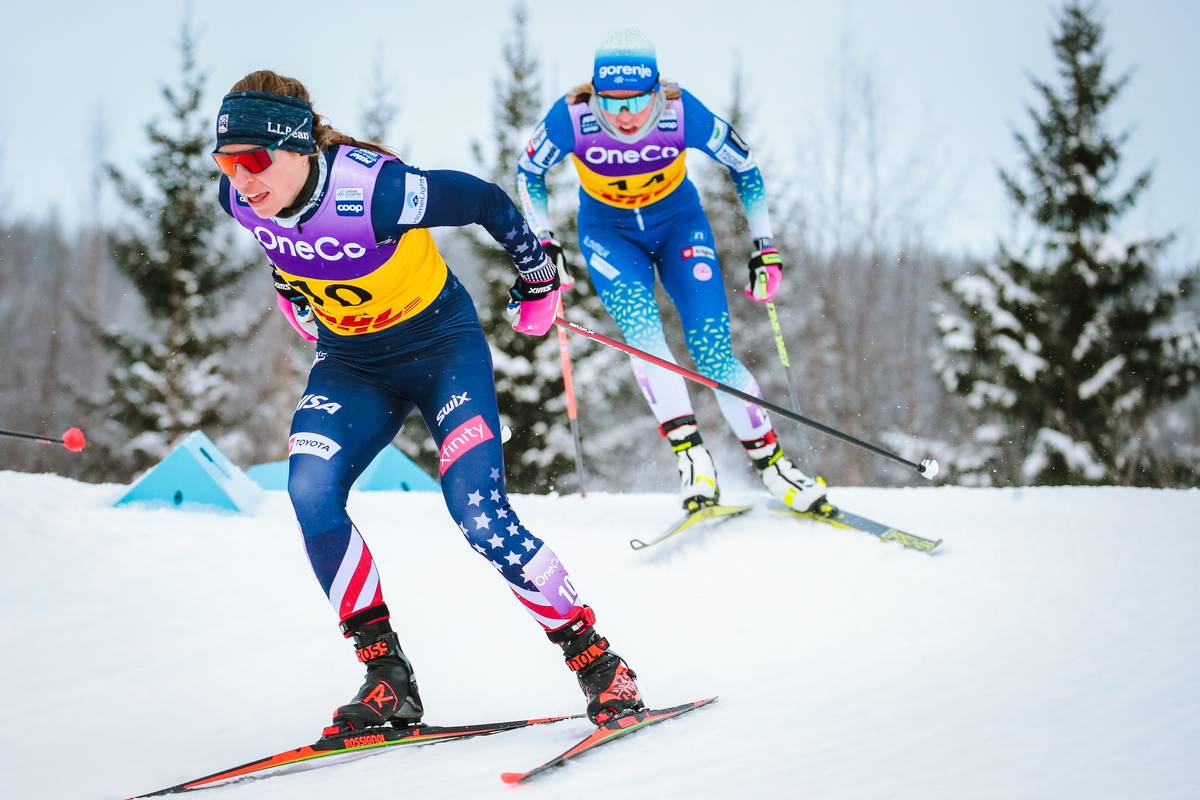
While Karlsson entered the Pursuit with a 20 second lead in the overall standings, the story of the day may have been Jessie Diggins and her American teammates. Diggins and Kern moved steadily up through their group, with Diggins having made up 20 spots by the end of the second lap. As Kern faded, Diggins drove toward the chase group (leading with Patricia Eiduka (LAT), and Lotta Udnes Weng (NOR). Together, they caught on to the Brennan/Urevec/Hennig group at 14 k, forming a group of eleven that continued in pursuit of the leaders.
At seven kilometers, Karlsson was caught by the chasers (Parmakoski, T. Weng, and Anne Kjersti Kalvaa), perhaps a cause for concern that she had used too much energy in attempting to hold them off. This group of four stayed together through the halfway mark with Parmakoski doing most of the pace making, and Kalvaa seeming vulnerable at the rear. With a minute lead over the chase group, they were in no danger of being caught, though their pace proved too hot for Kalvaa who was dropped at 11 kilometers. One kilometer later, Parmakoski (with Karlsson in tow) dropped T. Weng, and the lead group was reduced to two. They proceeded to open a considerable gap over the next few kilometers—ten seconds, twenty, forty, sixty. The race at the front would only involve Karlsson and Parmakoski.
Karlsson made her move up the final big climb, opening an 11 second gap over Parmakoski at the 18.6 kilometer mark. That would be enough for Karlsson to claim the win. Parmakoski crossed the line soon after for second. Behind them, Kalvaa and T. Weng tangled as Kalvaa put a pole between her own skis, but they were not slowed enough to allow the larger chase group to catch them. Kalvaa led up the final uphill near the stadium, but T. Weng was able to slingshot past her on the downhill to capture third.
Karlsson’s win in the Freestyle Pursuit extended her lead in the overall Tour De Ski standings, though Karlsson, T. Weng, Kalvaa, and Niskanen, all sit within 40 seconds of each other. With three stages remaining, much is still left to be decided, including a daunting climb up the Alpe de Cermis in Val di Fiemme, Italy.
Tour de Ski Women’s 20 k Freestyle Pursuit RESULTS
Krista Parmakoski (FIN), Frida Karlsson (SWE), Tiril Udnes Weng (NOR), (l-r) : Women’s podium at the 2023 Tour de Ski Stage 4 20 k Freestyle Pursuit. (Photo: NordicFocus)
This World Cup coverage is made possible through the generous support of Marty and Kathy Hall and A Hall Mark of Excellence Award. To learn more about A Hall Mark of Excellence Award, or to learn how you can support Fasterskier’s coverage, please contact info@fasterskier.com.
On Sunday, Val Mustair, Switzerland played host to Stage 2 of the 2023 Tour de Ski: a 10 k Classic Pursuit.
The Pursuit isn’t just a distance race. It’s a combined result—an event that is inextricably linked (and combined in value) with the prior day’s sprint. Pursuit racing is a funny event, one that doesn’t sit entirely well with our sense of fairness: an advantage is given to the skier who proved the fastest on the previous day, with additional World Cup points being awarded to the one who crosses the line first. It’s a regular occurrence that the “winner” on the day may not be the fastest finisher on the day (and such was the case on Sunday in Val Mustair). One way or another, the overall standings of the Women’s Tour de Ski were definitely re-shuffled in Sunday’s 10 k Classic Pursuit.
Tiril Udnes Weng (NOR) outsprints Kerttu Niskanen (FIN) in Tour de Ski Stage 2. Weng claimed the overall lead, while Niskanen posted the fastest time of the day. (Photo: NordicFocus)
In any pursuit event, there’s far more to the race-story than simply counting a skier’s finishing place. The most accurate way to judge a skier’s success may be to assess whether they moved up or down within the field (relative to their own starting place), and whether they gained or lost time to the leaders (regardless of their finishing place). In Stage 2 of the Tour de Ski, there were a number of exceptional performances: The fastest skier on the day was Kerttu Niskanen (FIN) who moved from 12th to 2nd, making up nearly 44 seconds. Second fastest skier on the day was Katherina Hennig (GER) moving from 26th to 6th, making up 22 seconds. And third fastest was Anne Kjersti Kalvaa (NOR) moving from 6th to 4th, and making up 19 seconds. Behind them, Frida Karlsson (SWE) moved from 5th to 3rd, making up 18 seconds. The day’s Pursuit winner, Tiril Udnes Weng (NOR), moved from 4th to 1st, making up 17 seconds. Heidi Weng (NOR) leaped from 51st to 8th, making up nearly 12 seconds. Rosie Brennan (USA) moved from 14th to 7th, making up 11 seconds. Astrid Oeyre Slind (NOR) moved from 35th to 10th, making up 6 seconds.
After Stage 2, Overall TDS leaders are as follows:
T. Weng
Niskanen
Karlsson
In addition to Brennan (whose finishing time was 7th fastest on the day), American finishers included Jessie Diggins (moving from 39th to 30th, but losing nearly a minute to the leaders), Julia Kern (started 10th, and skied well to finish 12th), Sophia Laukli (jumping from 67th to 50th), and Alayna Sonnesyn (falling from 37th to 53rd).
Canadian finishers all improved their standings: Katherine Stewart-Jones (rising from 46th to 25th), Dahria Beatty (skiing from 54th to 45th), and Liliane Gagnon (rising from 64th to 60th).
Women’s 10 k Pursuit
Stage 1 Sprint winner, Nadine Faehndrich (SUI), began the day with a 17 second advantage over the field, one she was able to maintain through the first of four 2.5 kilometer laps. Soon after passing through the stadium, however, she was joined by the group that had formed behind her, led by Karlsson and containing T. Weng, L. Weng, and Kalvaa. By the five kilometer mark, the lead group had been reduced to Karlsson and the three Norwegians, with a hard-charging Niskanen whittling away at their lead with each passing kilometer.
Rosie Brennan (USA) and Krista Parmakoski (FIN) racing the Tour de Ski 10 k pursuit in Val Mustair, Switzerland. (Photo: NordicFocus)
Rosie Brennan moved steadily up in the field throughout day. Before the race, Brennan had spoken of her expectations—and hopes—for the Pursuit: “I hope I can make up some time in the distance races moving forward,” she said. “Tomorrow will certainly be a bit of a wild day with a short course and fast conditions so we’ll see what happens out there.” Her optimism was rewarded, as her finishing time proved seventh fastest on the day.
Diggins started the Pursuit in 39th position, 1:11 behind the leader. She began making up places right away, but was never able to make considerable gains on the deficit to the leaders.
“I did feel like I went out a little bit aggressively, kind of going for broke,” Diggins said. “Honestly, I was really proud of how I skied. I kept fighting the whole time. Bigger picture: there’s a lot of things that need to come together in order for it to be a stellar result; those things didn’t come together today or yesterday. That’s okay, and we’re working on it. I have faith that it’s just going to keep getting better and better.”
Julia Kern (USA) skied strongly and consistently, claiming 12th in the 10 k Classic Pursuit in Val Mustair. (Photo: NordicFocus)
Julia Kern raced bravely throughout the day, and may have benefitted from the pace of skiers around her. Early in the race she was in contact with Brennan. Later, she kept pace with the Germans—Laura Gimmler and the resurgent Hennig—just as Heidi Weng also began making a move through the field. Kern described her race in a post-event interview: “I’ve had a few weeks off from distance racing so I wasn’t sure how it would go,” she said. “[Today] was really hard, and really good. It was a game of send it, die, and come back to life.”
With one lap to go, Niskanen had joined the leaders, pulling L. Weng back into contact to create a lead group of five. Karlsson continued to lead through the stadium at the beginning of the final lap, but with 1.5 k to go it was Niskanen who moved forward to push the pace. Only Niskanen was able to stay in the tracks on the final uphill, and she pressed the issue in hopes of shedding the stronger sprinters around her. In the end, though, it was T. Weng who sprinted down the homestretch to take the win, followed by Niskanen, Karlsson, and Kalvaa (the first four finishers all finished within two seconds of each other). Niskanen was by far the fastest on the day, a masterful performance that has pulled her into a virtual tie atop the Tour de Ski standings with T. Weng and Karlsson.
There will be a day off for the racers on Monday, before the Tour de Ski moves to Oberstdorf, Germany.
Kerttu Niskanen (FIN), Tiril Udnes Weng (NOR), Frida Karlsson (SWE), (l-r) – FIS world cup cross-country, tour de ski, pursuit, Val Mustair (SUI). (Photo: NordicFocus)
Just the other day, a guy walked into a local cross-country ski area where a women’s World Cup race broadcast was streaming. Another patron asked him who he thought would win? He didn’t know what the race was or who the favorite was. But without so much as the bat of an eye, he replied, “Weng”—The odds were in his favor.
Weng family members involved in World Cup skiing are a combination of cousins, sisters, twins: for those who follow cross-country racing, watching a women’s event may seem something like a Norwegian twist on the old Abbott and Costello baseball gag about “Who’s on First?” (if you haven’t seen this classic comedy routine, check it out. It’s held up remarkably well) with Bud Abbott’s made-up names all replaced with “Weng.”
Americans are accustomed to family names in sports. Baseball has many: the Perrys (Gaylord and Jim), and the Ripkens (Cal and Billy) are two of the more notable. Then there’s the Williams sisters in tennis, and the Staal brothers in hockey. But the closest American sports fans could come to the Weng dynasty would be if Cooper Manning strutted onto the football field and began slinging touchdowns like his brothers Peyton and Eli.
There is sibling dominance in other Nordic events. Biathlon has the Boe brothers and the Oeberg sisters. But none of them add up to the mathematical triumvirate like the Wengs.
Heidi Weng in Lillehammer celebrating one of her 104 podium finishes. (Photo: NordicFocus)
Part of the Weng confusion is due to nomenclature—sometimes, the Weng’s full names are abbreviated by using first initials only; sometimes the first two initials; other times, the entire name is used. T. Weng is the same as T.U. Weng, which are both ways of identifying Tiril Udnes Weng. These differing templates can vary from race to race, making it seem as though there are new Wengs popping up out of the woodwork every weekend.
The confusion is also magnified by percentages and the Wengs’ proficiency. For instance, in the Lillehammer women’s 10-kilometer freestyle, 58 skiers lined up for the start. Three of them, or roughly 5 percent of the field were Wengs.
In most North American sports, the number of participants is large enough so that a few duplicate names don’t present much confusion. Siblings and relatives simply don’t compete against each other often enough to make things as muddled. But in Lillehammer, three Wengs finished within 20 seconds of each other; close enough to give fits to even the stoutest of play-by-play announcers.
The ubiquitous presence of Wengs can be daunting to sort out. I’ll try and prevent this from becoming something like Bubba’s recitation of how many ways there are to make shrimp in Forest Gump. So, here’s a primer on knowing your Wengs:
Heidi getting her game face on. (Photo: NordicFocus)
Heidi
To the North American audience, the best known of the Wengs is Heidi. At 31 years of age, she has won an Olympic medal, multiple World Championship medals, and World Cup Crystal Globes. Heidi has a mind numbing 260 World Cup starts and she’s stood on the World Cup podium a whopping 104 times going back to 2009. No, that’s not a misprint—104 podiums! That’s more World Cup podiums than most of her competitors have races. She is currently ranked 15th in the overall World Cup standings.
Over the course of her career, Heid has shown remarkable consistency; however, the numbers clearly show that distance is her forte. Over the last five years she’s won only a handful of sprint points.
Heidi’s ski career was nurtured by her grandmother when the young Weng began skiing as a 3-year-old. Heidi is multi-talented, having also won the 2010 Norwegian trail running championship.
Heidi’s sister Merete also competed in cross country for Norway, finishing 29th in the 2013 national championships in the 30-kilometer classic. Fortunately, for those who have difficulty keeping the Weng’s identity straight, Merete does not compete at the World Cup level.
Tiril Udnes Weng—a.k.a T. Weng, a.k.a T.U. Weng, a.k.a Tiril Weng—competing in Ruka, Finland. (Photo: NordicFocus)
Tiril
Next is Tiril Udnes Weng, Heidi’s cousin. Tiril is 26 years old and has raced the World Cup since 2015. She has 98 World cup starts with five podium performances, and she has won World Championship gold. Tiril has been on a tear lately, with four of her podium finishes coming this year leading to her current domination of the World Cup rankings. She is currently in first place in the overall World Cup points, second in distance, and first in sprint. She is proving to be quite the all-around skier showing excellent performance balance between sprint and distance events. Last year she finished 16th overall, so she has made a remarkable performance jump.
Tiril showing the Wengs are always up for a good fight on skis. (Photo: NordicFocus)
Lotta
Then there is Lotta Udnes Weng who is Tiril’s twin sister. That would also make her 26 years old and also Heidi’s cousin. Her first World Cup race also came in 2015. She’s already amassed 81 World Cup starts, earning one World Cup podium. Lotta is currently 11th in the overall cup standings having moved up from 28th last year. Like her twin, she also shows good balance between distance and sprint events.
Lott Udnes Weng completes the current Weng trio. (Photo: NordicFocus)
Given the Weng’s strength across all events, it’s a real possibility that this winter could present an all Weng podium. Though, as of now, bookmakers don’t appear to have set odds on that particular outcome.
So that’s the cheat sheet on knowing your Wengs. Think you now have the Weng lineup straightened out? Sorry to break the news to you, but lurking in the wings is Tora Roenneberg Weng, a17-year-old junior whose star is on the rise. If she makes it to the national team, then the possibility of an all-Weng relay team will exist. Wait for her to join the World Cup tour: then the real confusion could start.
Lotta Udnes Weng at the Beijing Olympics. The Wengs are ready for an all-Weng podium: are you? (Photo: NordicFocus)
The FIS instituted an overhaul of the points system used to determine the best individual skier in the World. We’re already seeing the consequences.
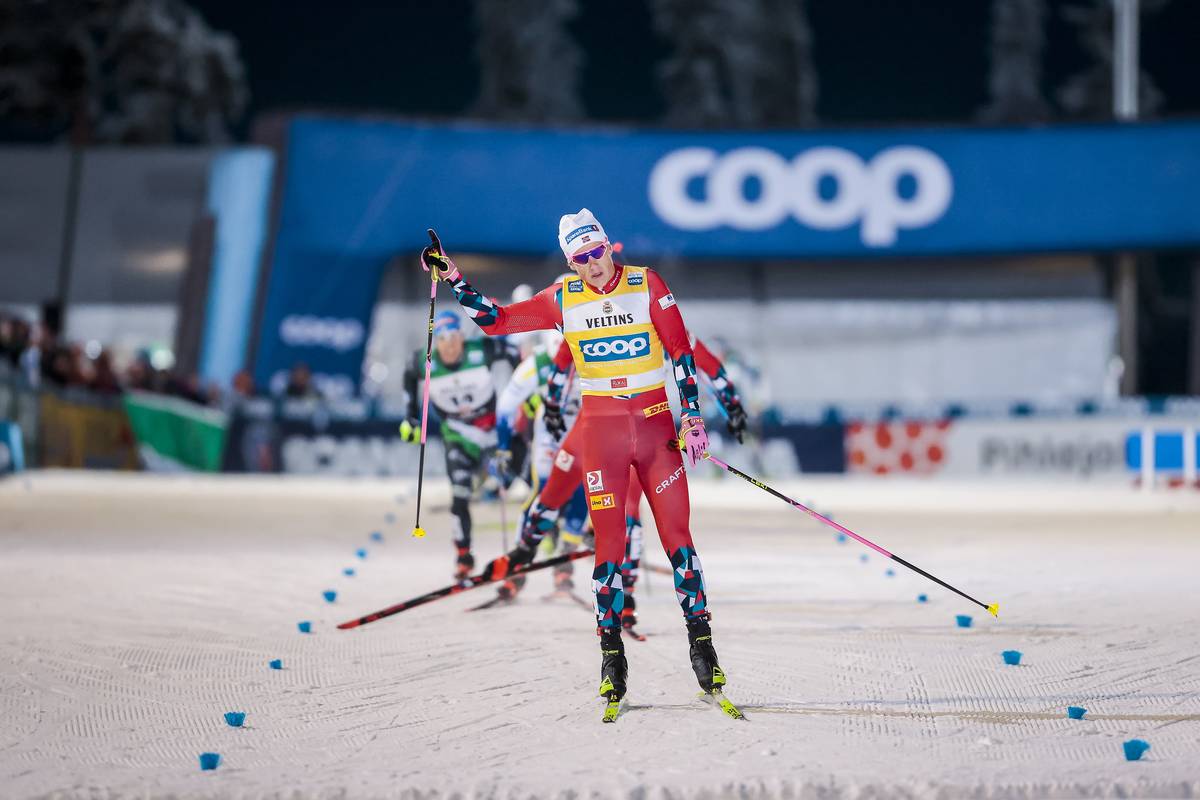
Johannes Hoesflot Klaebo (NOR) crosses the finish line in Ruka, Finland while wearing the yellow Overall World Cup leaders bib. (Photo: NordicFocus).
Johannes Hoesflot Klaebo had won all three races of the World Cup’s opening weekend races in Ruka. Any offseason doubts spurred by reports of his injuries or independent training practices went away. He was still the best skier in the world. Then, the following Friday in Lillehammer, illness forced Klaebo to sit out a 10 k skate race. His teammate Paal Golberg took over the World Cup overall lead with a 6th place finish. Klaebo returned the next day to handily win the sprint race: usually, that would mean he would return to the top of the World Cup standings, and that he would start Sunday’s 20 k classic in the yellow overall leader’s bib (which he would likely continue wearing for weeks to come. Instead, Klaebo declared the season over. “I gave up the opportunity to win the World Cup overall when I did not start yesterday,” he remarked to Langrenn, in a statement that rightfully made headlines. When the next day’s race did come, Klaebo was nowhere to be found. Instead, the yellow leader’s bib went back to Golberg, where it remains.
That Klaebo is the best male skier in the World is an easy conclusion to reach by watching any World Cup race in which he participates. Whether or not the World Cup points system is designed to objectively confirm that observation is a more complicated question, especially so since the International Ski Federation (FIS) instituted changes to its long-standing individual points system this season. Now three weeks into implementation, those systemic changes are resulting in more skiers earning more World Cup points. As a result, coaches and athletes are adjusting race plans, commentators are struggling to shake old habits, and the best skier in the world is apparently giving up on the whole thing. The rules of the game have changed, and it looks to be having an effect.
Top 50 is the New Top 30: The Changes
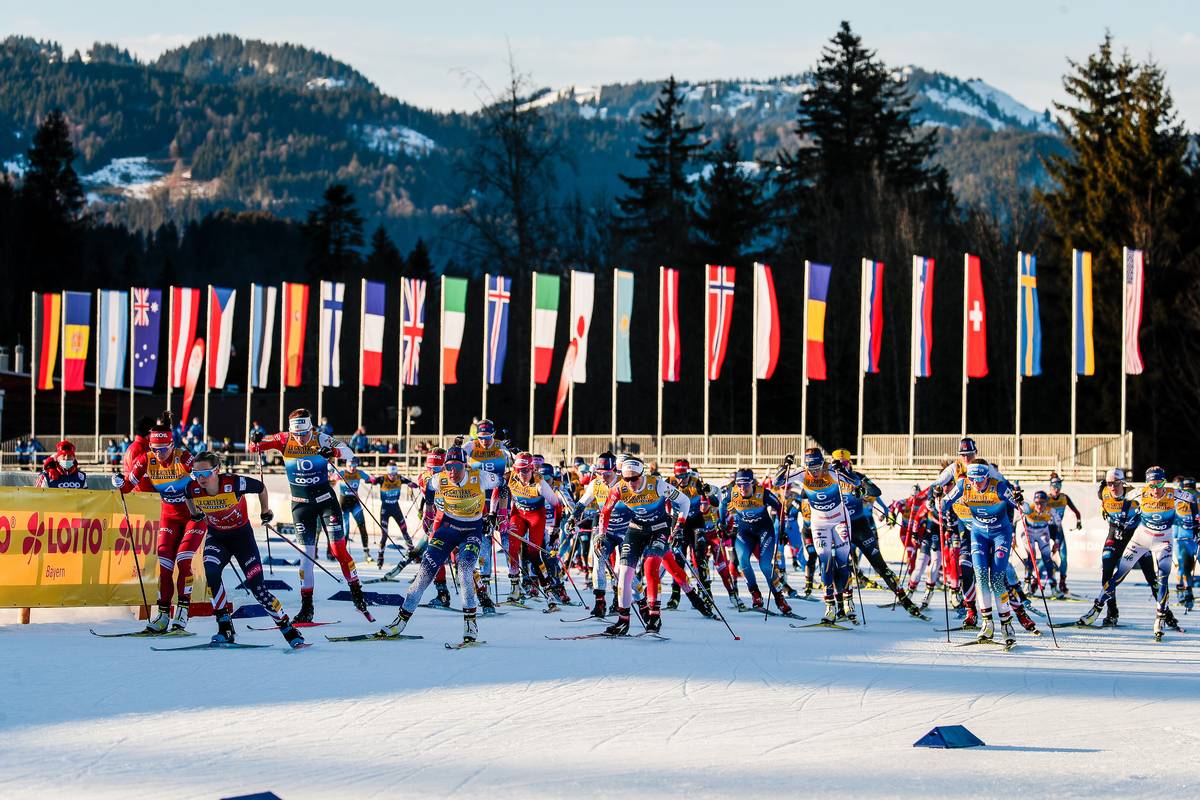
The start of the women’s 10 k Freestyle Mass Start during Stage 3 of the 2021/22 Tour de Ski in Oberstdorf, Germany. (Photo: NordicFocus)
In remarks following the 10 k classic in Beitostolen—where Jessie Diggins finished 6th and Rosie Brennan finished 8th—US Ski Team Head Coach Matt Whitcomb’s reflections focused on one number: “It’s easy to forget that just 15 years ago it was often that we would have zero people in the top 30 in distance, so this is a natural progression and an important thing to remember.”
For years, “top 30” meant earning World Cup points. That level of finishing result became a signifier for a specific kind of success—gaining a foothold on the World Cup stage—and that expanded to serve as that same signifier at every stage of international skiing progress. In the United States, every collegiate circuit uses a version of the World Cup points system to 30th place for NCAA Championship qualification. Some regions use a version of the “top 30” system to determine selection for US Junior Nationals. The “top 30” system etched itself into the sport’s evolution too. When the sprint became an integral part of skiing in the early 2000s, there was no set number of competitors who would move on from qualifiers to heats . . . until, that is, the FIS decided on the top 30.
“Top 30 is good.” That’s what skiing has told us for a long time. So what happens when that single World Cup point gets pushed out to the skier in 50th place?
Well, it looks something like this:
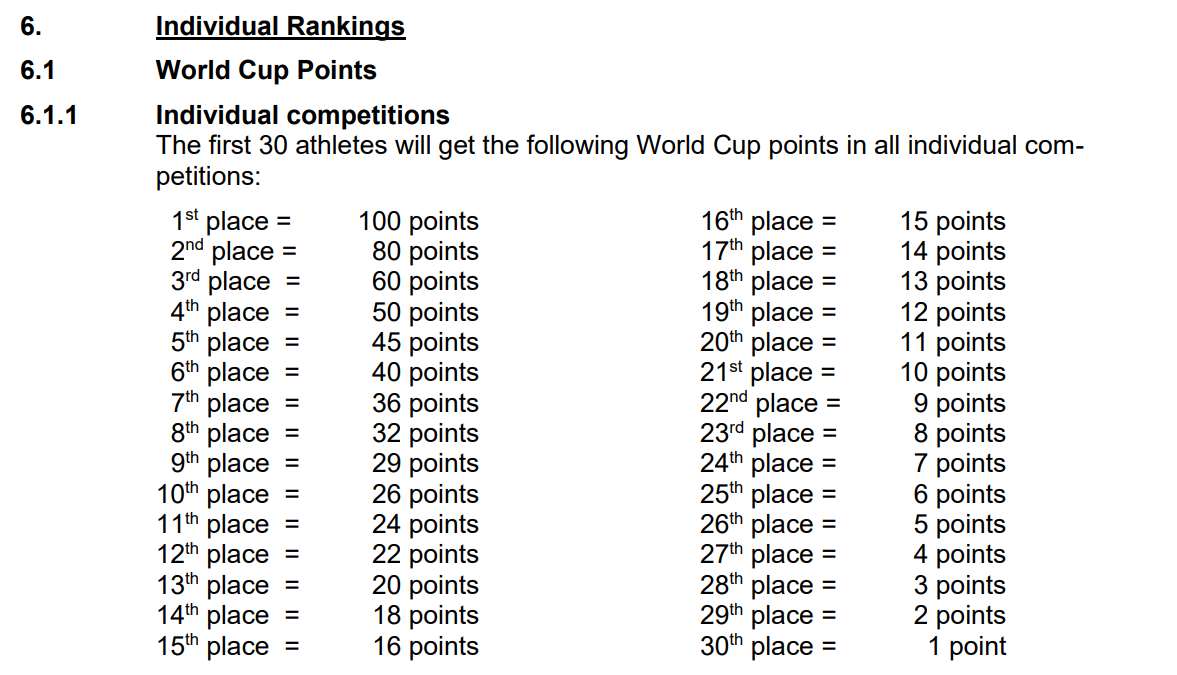
The NEW FIS World Cup points system:
(Photo: “Rules for the FIS Cross-Country World Cup 2022-23.” 2022. “International Ski Federation.”)
The OLD FIS World Cup points system:
(Photo: “Rules for the FIS Cross-Country World Cup 2021-22.” 2021. “International Ski Federation.”)
In the NEW system, the points stretch further down the results, and the steps down are much, much, smaller.
Points stretching further down the results will primarily have consequences for skiers seeking selection to the World Cup, rather than the World Cup Overall competition itself. With the points stretching to 50th place (just short of the size of a usual World Cup field) there is now a more quantifiable way to compare developing skiers and assign discretionary starts for national ski federations. Whereas under the top 30 system, skiers outside of the points were at the whims of the sometimes wonky FIS points system, there is now a better chance to judge a skier’s potential on the World Cup based on their performance on the World Cup.
Smaller steps in points from 1st place (100 points) down is where the World Cup Overall competition really changes. See Table 1. below with the points awarded for 1st-5th place in the NEW system, and Table 2. with the points awarded for 1st-5th place in the OLD system, and the equivalent place-points total under the NEW system.
Table 1. Place-points total for 1st-5th place, NEW system
NEW System Place
NEW System Points
1st
100
2nd
95
3rd
90
4th
85
5th
80
Table 2. Place-points total for 1st-5th place, and equivalent place-points total in NEW system
OLD System Place
OLD System World Cup Points
NEW System place-points equivalent.
1st
100
1st
2nd
80
5th
3rd
60
11th
4th
50
16th
5th
45
19th
When it comes to points earned, getting 1st place just doesn’t matter as much as it used to. That key change is amplified when considering that FIS has made very slight changes to the system surrounding the individual points matrix awarded for each race.
Bonus Points System Remains the Same
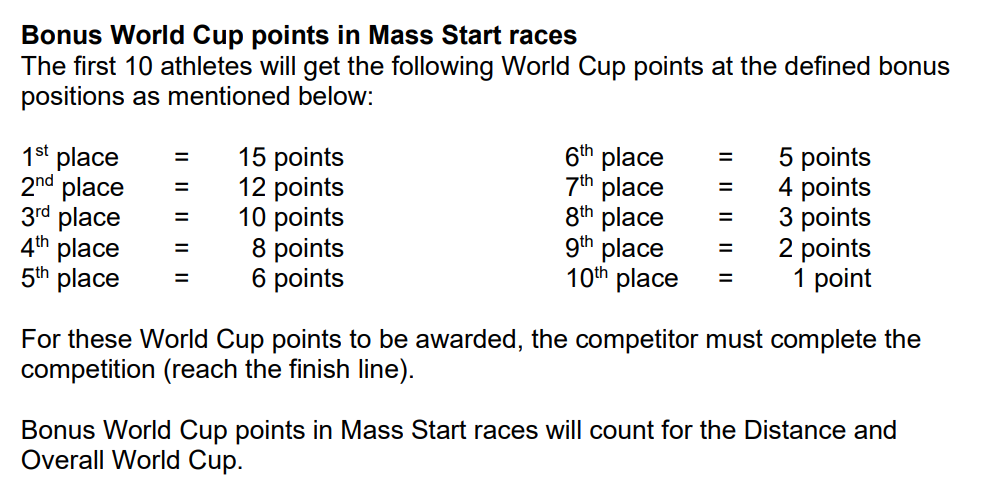
In a bid to introduce more dynamic racing a few years ago, FIS introduced a bonus point system in which checkpoint bonuses became incentives for World Cup points. That system remains unchanged and is found here:
(Photo: “Rules for the FIS Cross-Country World Cup 2022-23.” 2022. “International Ski Federation.”)
Based on the points classifications found in cycling’s Grand Tours (the “Green Jersey,” for Tour de France fans), the bonus system was intended to introduce a series of points that skiers would tactically approach as intermediate sprints. The dynamics of ski races are very different from the dynamics of a cycling race, however, and in practice, the sight of skiers shuffling for a sprint in the middle of a distance race has been rare.
Why? Unlike cycling, ski racers exhibit less obvious discrepancies between who is a great sprinter and who is a great distance competitor. In mass start ski races, it’s rare to see a breakaway that is not comprised of skiers who would also excel at distance racing. The bonus points, in reality, have almost always gone to top contenders for the race itself.
The NEW points system seems to retroactively fit the existing bonus points system into this skiing reality. The consequences: in the OLD system, the 15 points for being 1st place through an intermediate checkpoint could almost never displace the points total for finishing 1st versus 2nd, or 2nd versus 3rd. In the NEW system though, with five points separating each of the first five places, winning the intermediate sprints could theoretically displace the 1st place finisher for the most points won on the day for a skier in 3rd or 4th place.
Example: In a 20 k mass start, the skier who will eventually finish 3rd place controls the front of the race for the first 10 k, earning 30 bonus points for winning two bonus point checkpoints (15 points each). The skier who will eventually finish 1st place is further down the pack through the early part of the race, but still in the top 10 through the checkpoints. They are 10th through each bonus point checkpoint, earning 2 total bonus points, before making a push to win the race. The 1st place skier’s total points for the race: 100 (1st place) + 2 (bonus points) = 102 total points. The 3rd place skier’s: 90 (3rd place) + 30 (bonus points) = 120 points total.
That may be unlikely, but it is at least now in the realm of possibility. Again, a whole lot more points for a whole lot more skiers.
Other Tweaks: Relays and Tour de Ski Bonus
There are two other notable tweaks in the new FIS system that pertain to specific events:
The first is that team events no longer are scored for individual points. That has already proven consequential in the way that the only team event so far this season has been raced. For instance, Matt Whitcomb identified the fact that no points were up for grabs as having directly influenced his decision that Jessie Diggins sat out the 4 x 5 km Team Relay in Beitostolen. Similarly, neither current World Cup overall leaders—Paal Golberg (NOR) for the men, nor Tiril Udnes Weng (NOR) for the women—raced the relay.
The second change is less drastic, but will be significant when the World Cup turns to the Tour de Ski (TDS) in a few weeks. FIS reduced the points bonus for winning the overall classification at the TDS from 400 points to 300 points, and adjusted the points bonuses for lower placings accordingly. The reduced emphasis in points—and subsequent reductions in prize money per placing—could result in the Tour de Ski becoming a less significant part of the World Cup calendar than it has been in recent years.
What It All Means
Johannes Høsflot Klæbo poses with his crystal globe after winning the 2019 Overall World Cup title. (Photo: Nordic Focus)
So, is Johannes Hoesflot Klaebo justified in his World Cup fatalism? The answer just might be that the FIS wants him to be. By pushing more points onto competitors who so often come 2nd, 3rd, or 4th place to the young Norwegian, they have created a new dynamic in this year’s bid for the Overall Crystal Globe. Consider the top two skiers in the current classification:
Top Two Places of Men’s Overall World Cup Points after Three weeks of racing, OLD system vs. NEW system:
Paal Golberg (NOR) – NEW system 756 points, OLD system 575 points, Net Change: +181 points.
Johannes Hoesflot Klaebo – NEW system430 points,OLD system430 points, Net Change: 0 points.
Klaebo’s points have not changed because the benchmark for the FIS points system has not changed. He has won every race he has entered, and 1st place is still worth 100 points (with 15 points for winning sprint qualifiers). Golberg, though, has benefitted from starting more races, and getting more points for being top 10, not top 1. It is a simple comparison, but it is also the only one that really, reallymatters for evaluating the change that the FIS wanted to make to the World Cup adopting the NEW system. The eventual winner of the Crystal Globe will now be determined by an incentive to do well in the races you start, and to start more races. Those are just the rules of the game; once the rules are understood, then it’s possible to understand what the new rules are incentivizing. FIS has followed that all the way through with its NEW point system, assuring that the season-long champion will be the skier who is most consistent and who competes most often.
As for us—the fans—is this the system by which we want our skiers rewarded? Should the best skier also have to be the most consistent? Should the strongest skier in a mass start go off the front early, or show their strategic aptitude by controlling a pack? Should skiers specialize in sprinting or distance? Should they continue to have to do well in both? And, of course, is the “top 50” the new “top 30?”
New points systems instituted by FIS has ski fans, ski coaches, and skiers talking; that new system also has the game being played differently on the World Cup tour this season.
This World Cup coverage is made possible through the generous support of Marty and Kathy Hall and A Hall Mark of Excellence Award. To learn more about A Hall Mark of Excellence Award or to learn how you can support FasterSkier’s coverage please contact info@fasterskier.com.
Jessie Diggins (USA) and Katharina Hennig (GER) setting the early pace in the FIS World Cup 20 k Classic Mass Start, Lillehammer, Norway. (Photo: Thibaut/NordicFocus)
Lillehammer, Norway was the site of the latest event displaying new FIS Cross Country World Cup policies offering equal racing distances for both men and women with today’s 20 k Mass Start Classic event. Sweden’s Frida Karlsson finished first in 53:51.9, followed .6 seconds later by Tiril Udnes Weng (NOR), and 1.2 seconds ahead of Ebba Andersson (SWE). Jessie Diggins (USA) finished 9th and Katherine Stewart-Jones (CAN) 13th on a day that saw the women’s 20 k field stick together, only sorting out the finishing order in the final kilometer. Podium finishers were separated by just over a second, and the top ten finishers were separated by less than 10 seconds.
Other North American finishers included Americans Alayna Sonnesyn (36th), Sophia Laukli (39th), Julia Kern (44th), and Canadian Olivia Bouffard-Nesbitt (43rd) who was forced to recover from a crash that sent her tumbling into trailside powder on Lap 2. Canada’s Dahria Beatty did not finish, while Americans Rosie Brennan and Novie McCabe did not start due to illness.
Originally appearing on the FIS World Cup calendar as a 20 k Skiathlon, today’s event was changed to Classic Mass Start due to limited snow conditions that would not allow the construction of skating trails sufficiently wide enough to meet FIS guidelines. There appeared to be lots of snow in Lillehammer: evidently just not quite enough. Despite the event alterations, the racing did not disappoint.
Women’s 20 k Classic Mass Start
Only three start lanes were available as racers lined up; even so, likely contenders in today’s race were gathered in the front row of starters: Weng wore the yellow FIS World Cup overall leader’s bib, Andersson wore the FIS World Cup distance leader’s red bib, and Karlsson lined up in the third starting position. Diggins started 7th near perennial contender Krista Parmakoski (FIN) who started 10th.
Facing six laps of a 3.3 kilometer course, the skiers opened the race very quickly on the downhill out of Birkebeiner Stadium, with Andersson, Karlsson, and Weng (NOR) moving to the front and dictating the early pace. Andersson continued to lead the closely-bunched field as they looped through the stadium at the end of Lap 1.
“I knew it would be chaotic on such a fast course,” said Stewart-Jones. “So I wanted to be smart with my energy so that I could pick up the pace when the front tried to break. It was really cool to see my tactics pay off.”
Canada’s Katherine Stewart-Jones (seen here racing in last years 10 k Classic in Lahti, Finland) was the top Canadian finisher in Lillehammer’s 20 k Mass Start Classic, skiing strongly all day in the lead pack, and finishing 13th. (Photo: NordicFocus)
“I wanted to be smart with my energy so that I could pick up the pace when the front tried to break. It was really cool to see my tactics pay off.” Katherine Stewart-Jones (CAN)
Most teams appeared to have managed the kick wax challenges, and the field stayed together in the early laps without too many racers needing to exit the tracks. Diggins moved briefly to the front at the beginning of the significant climb on Lap 2 in what would become her pattern throughout the day: move forward on the climbs while allowing the Swedes to set the pace. Through two laps, Alayna Sonnesyn (USA) and Sophia Laukli (USA) remained tucked efficiently within the main field, though by Lap 3 Diggins and Stewart-Jones were the only North Americans remaining in contention. Chase groups were forming, but the main field of 17 had definitely established a gap.
Through the middle laps, pace-making duties were traded among a number of contenders—Andersson, Hennig, and Karlsson—always closely marked by Weng and the Finns, Krista Parmakoski, Kertu Niskannen. Diggins and Stewart-Jones stayed within the ever-shrinking main field, carefully adjusting their positions, staying out of trouble, and always avoiding the back of the pack where they might’ve been susceptible to being dropped whenever the pace heated up.
“I knew that people would try to break away on the big climb or going through the stadium,” said Stewart-Jones. “So, I expected that those sections would be really hard. My skis were really fast today so I knew that if I could stay in contact on those sections, I would no problem with the downhills and would get some recovery.”
Frida Karlsson (SWE) edges out Tiril Udnes Weng (NOR) and Ebba Andersson (SWE for the win. (Photo: NordicFocus)
Karlsson attacked through the stadium at the beginning of the final lap, a bold move undertaken with more than three kilometers to go. No team tactics were on display today, as Andersson—Karlsson’s Swedish teammate—led the chase to reel in Karlsson who began slipping on the hill. Hennig joined the chase, and a group of three (Karlsson, Andersson, and Hennig) formed by the top of the climb, to be interrupted soon after when Hennig broke her own pole on a misplaced herringbone stride. Coaches quickly replaced her broken pole, but the damage had been done as Andersson and Karlsson escaped without her.
Thirteen skiers (including Diggins and Stewart-Jones) were still in contention at the base of the final hill before the stadium, but Tiril Udnes Weng disrupted the field by surging up the climb to slot in behind Karlsson who had already begun her double-poling push toward the finish line. While Weng appeared to have the faster skis, Karlsson definitely had the faster tempo, and they remained 1-2 all the way to the line. Ebba Anderson finished just a second behind them.
Diggins skied across for 9th, while Stewart-Jones finished 13th, only ten seconds behind the winner. Stewart-Jones finish was a great result for Team Canada, building on fine performances from last week in Ruka, and extending even into performances by Canadian athletes in the men’s field in Lillehammer. When asked about his team’s progress, Canadian Coach, Robin McKeever, credited team dynamics and the supportive atmosphere of Team Canada. “I believe in creating a team, much the way Matt Whitcomb has done in the United States: focusing on the team first, working for each other,” McKeever said. “It’s about maintaining balance and composure, and creating an environment where every skier can do their best.”
This World Cup coverage is made possible through the generous support of Marty and Kathy Hall and A Hall Mark of Excellence Award. To learn more about A Hall Mark of Excellence Award or to learn how you can support FasterSkier’s coverage please contact info@fasterskier.com.
Julia Kern (USA) Having a big day in Lillehammer. (Photo: NordicFocus)
Today is day two for the World Cup stop in the Nordic skiing playground of Lillehammer, Norway. But it was all work and no play, today, as skiers faced the challenge of the 1.6-kilometer freestyle sprint course. It was another grey, overcast day in Lillehammer as skiers lined up for the races. Fifty-five women fought for the Sprint qualifiers, hoping to land a place in the heats. The top 30 qualifiers would earn the right to compete through to the quarterfinals—a bit of a misnomer, as there are actually five races in the quarterfinal round.
Going into the qualifiers, the United States was represented by Julia Kern of Massachusetts, Minnesota native Jessie Diggins, Vermont resident Alayna Sonnesyn, and Colorado native Lauren Jortberg. As reported yesterday, Jortberg is a coach’s discretionary pick, racing in her second World Cup weekend.
At the end of the day, Jessie Diggins (USA) was tantalizingly close to securing her second podium in as many days. She qualified 5th leading into the quarter finals, and made her way to the finals, but fell just short of the podium, finishing fourth overall. Julia Kern (USA) finished 20th in qualifying and made it into the semi-finals, just missing qualifying for the final heat.
The race was won by Emma Ribom (SWE), who is showing sprint prowess this year, having topped the podium last week as well. Maja Dahlqvist (SWE) was second, followed by Tiril Weng (NOR).
Emma Ribom celebrates her second sprint victory in as many weeks. (Photo: NordicFocus)
Lillehammer Women’s Freestyle Sprints
Diggins landed in the first heat and kept the pace brisk. A late turn of pace brought her to the front, and she finished in a photo-finish for second, which she took by .02 seconds.
Kern competed in the fifth quarterfinal, conserving her energy in the first half of the race, moving up to the lead in the last half of the race. She pushed very hard toward the end, separating herself going in the final turn. She ended up comfortably winning her heat.
“I found my gear and skied it tactically exactly how I wanted to and had really good energy to push in the second half of the course, which was my plan,” Kern said. “I walked away feeling super energized and confident going into the semi-final.”
Diggins at the finish in Lillehammer (Photo: NordicFocus)
In the semi-finals Diggins raced in the first heat, and Kern in the second.
In her heat, Diggins’ skis appeared exceptionally fast as she glided past many of her rivals. She bided her time, remaining toward the back for the first half. She then exhibited the cagey race tactics for which she is now known, deftly working her way through traffic. She ended up finishing third to advance to the finals in a lucky loser slot.
Kern used a strategy similar to what she had shown in the quarters, keeping back for the first half of the race; however, the racers bunched up at the half-way point and there was still a lot of traffic for Kern to make her way through. As the pack neared the finish, Lotta Weng (NOR) crashed, slightly disturbing Kern’s pace. Kern desperately pushed through to the finish, but finished fourth, failing to advance. Kern confirmed with FasterSkier that this affected her race:
“I saw it coming, I had a feeling there might be a tangle and was able to react pretty quickly and get around her,” she said. “That little blip and hiccup, that maybe cost me moving up. But, that’s sprint racing. I’m really happy with today, with how my skis felt and how my body felt. Looking forward to more racing tomorrow.”
“It was a super exciting day to have four in the top ten (including the men), Kern said. “We had ripping fast skis.”
Diggins a happy finisher at the Lillehammer sprints. (Photo: NordicFocus)
U.S. Head Coach Matt Whitcomb shared with Fasterskier that, “Julia executed perfectly the general recommendation to get a reasonable start, and if you find yourself boxed out, take the opportunity to relax, and when you find a window go through it fast.”
“The strategy going into the races was based on footage watched earlier in the week,” Whitcomb added. “We do this to minimize the amount of talk race day, or the meeting before the race, to avoid putting too much stress on the racers. By the time we showed up, everyone pretty much had their own plan. Watching the athletes warm up, they knew what they were intending to execute, that’s a pretty special thing to watch.”
Whitcomb continued his explanation, adding that, “We felt that we had great skis today, which is nice because you can guarantee that Norway’s going to have great skis and that’s half of the competition for us.”
In the finals, Diggins was joined by Ribom, Dahlqvist, Tiril Udnes Weng (NOR), Johanna Hagstroem (SWE), and Victoria Carl (GER). Diggins started fast and still looked to have very fast skis. She shot into third place right off the start. After about a minute, the skiers were tightly bunched. Diggins managed to pass skiers on the outside of the track and move herself into the lead. As other skiers accelerated on the long hill leading into the stadium, Diggins gradually drifted to fourth, but she was still in the thick of things. Ultimately, she couldn’t match the pace of the top three as they separated from her going into the finishing stretch. Diggins ended up fourth—1.1 seconds off the podium—but it was definitely another of her signature sparkling days for the American star.
Whitcomb told Fasterskier that yesterday’s first-place effort had taken its toll on Diggins. “By the end of the race, Jessie felt like her arms had kind of run out of power,” Whitcomb said. “At this point in the season, she could have podiumed yesterday or today, but to have both, was going to be a tall ask. We’re so thrilled with yesterday’s race that getting fourth today feels like a podium.”
This World Cup coverage is made possible through the generous support of Marty and Kathy Hall and the A Hall Mark of Excellence Award. To learn more about A Hall Mark of Excellence Award or to learn how you can support FasterSkier’s coverage please contact info@fasterskier.com.
A packed stadium for the final day of World Cup racing in Falun Sweden (Photo: NordicFocus)
We’ve arrived at the final event of the 2021/22 World Cup Season and the second new event of the day. It was a fast and furious mixed team sprint in Falun, Sweden, happening just hours after the mixed team relay which ran in the morning. In the first iteration of this event, teams composed of one woman and one man raced six laps of a 1 k course each, making for 12 k of skiing total.
To keep things spicy, the last two teams in the exchange after the even-numbered laps 2 -10 were eliminated. So although seventeen teams started the competition, only seven made it to the finish. In order to limit the chaos, given the number of teams, there was no tagging in the exchange, just a finish line and a start line for the athletes to gauge themselves.
The atmosphere in the Lugnet Ski Stadium was festive as fans enjoyed the 45°F degree weather and sunshine. “I think this is very nice to be together with the men,” said Nadine Fähndrich of Switzerland, “it makes more team spirit between the men and the women.” She alluded to the feeling of both the athletes and the spectators during the mixed team relay in which Team USA I took the gold in an exciting race. “I’m excited for the [race] and to [enjoy] the atmosphere here,” she concluded.
The women head out for one of six laps for the mixed team sprint event (Photo: NordicFocus)
With Team USA I taking the victory and Team USA II coming in 14th, the Americans did not enter a team in the mixed sprint event. Out of the seventeen teams that started, twelve nations were represented in the start list and only five nations made it to the finish.
The women started and as would be expected, Jonna Sundling skiing for Sweden I, was at the front. She was paired with Calle Halfvarsson who earned his first podium finish since 2018 in the 15 k freestyle on Saturday.
Celebrations for Team Sweden I after dominating the mixed team sprint (Photo: NordicFocus)
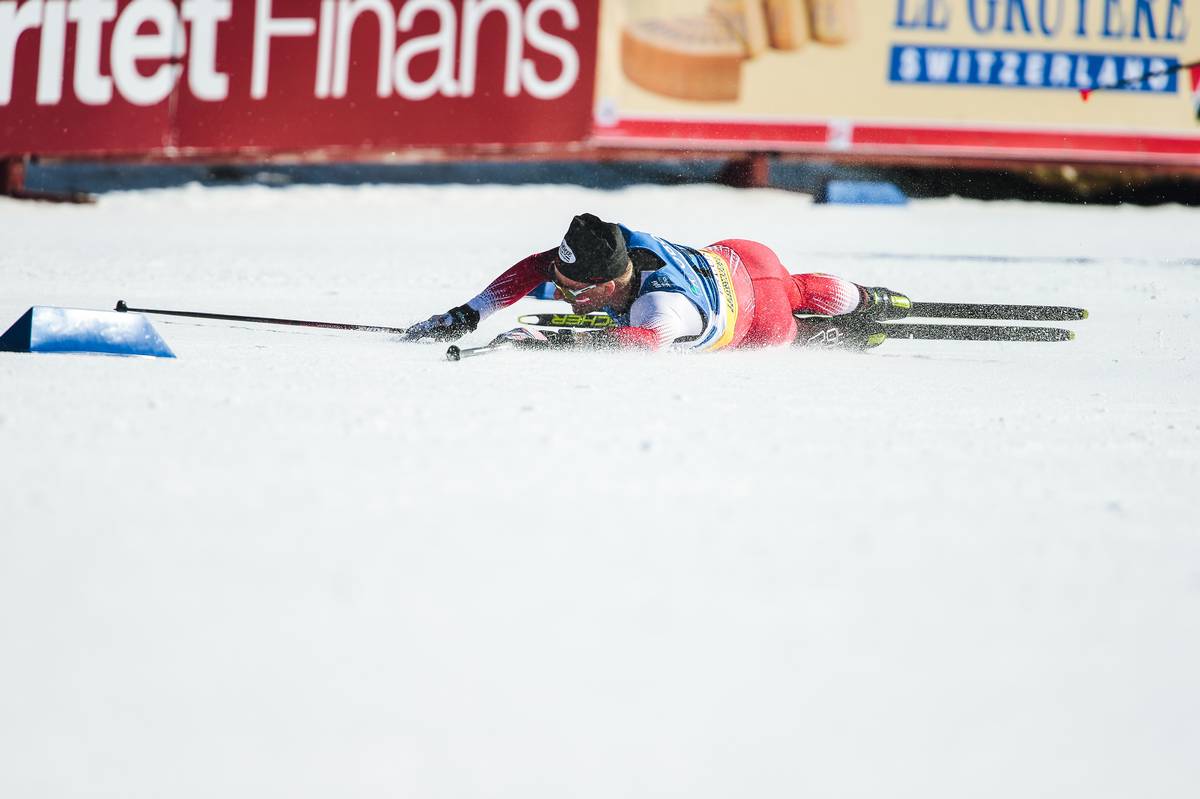
The first round of eliminations at 2 k took Estonia and France II out of the running. As Sundling concluded her second lap, she had created a +2.1 second gap and Halfvarsson seized this opportunity. Instead of waiting around for the rest of the field, he pushed hard and grew the gap to +3.84 seconds on his next 1 k lap. This same lap saw Benjamin Moser of Austria fly off the course on the corner descending into the stadium, taking himself and his teammate Teresa Stadlober out of the race. Latvia was also eliminated in that round.
Benjamin Moser (AUT) slides out on a fast corner (Photo: NordicFocus)
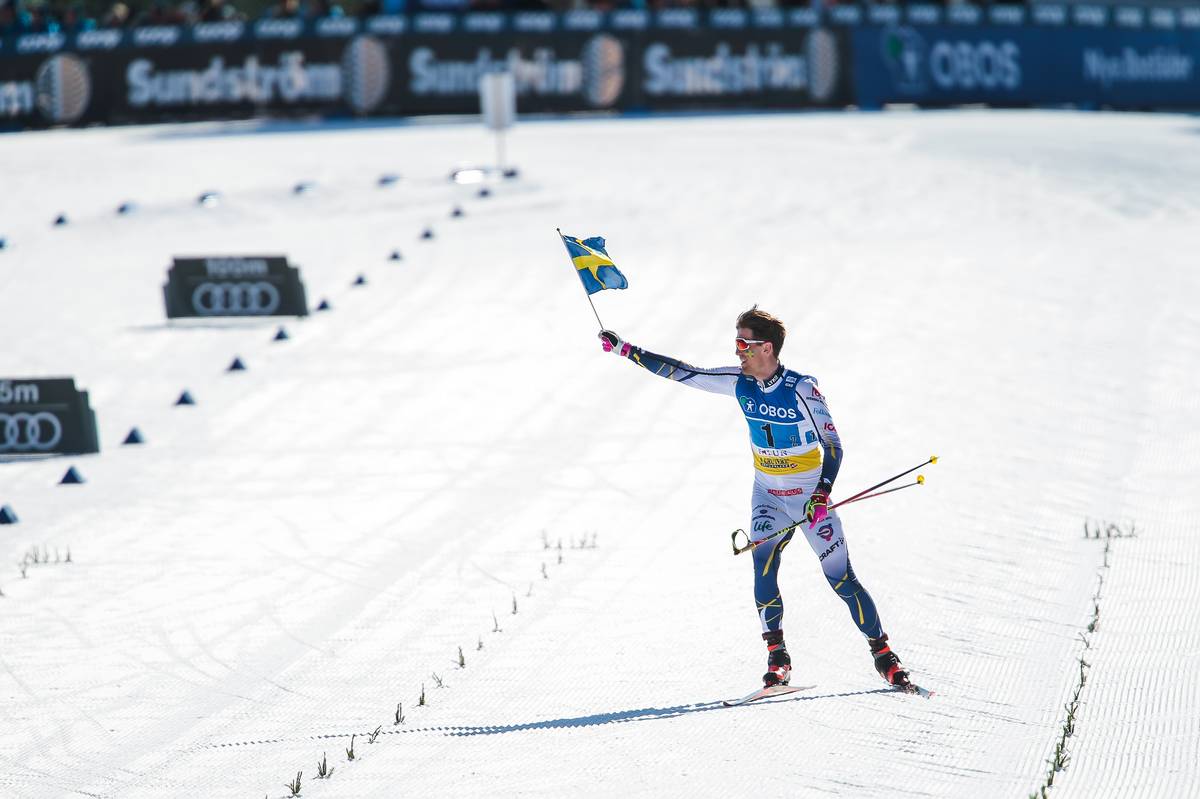
Once Sweden I had made their move, it stuck. At 5 k they were +9.61 seconds ahead, at 7 k they were +22.2 ahead, at 11 k the gap was up to +26.84. After 23:05.91 of cumulative race time, Halfvarsson crossed the finish line waving a Swedish flag.
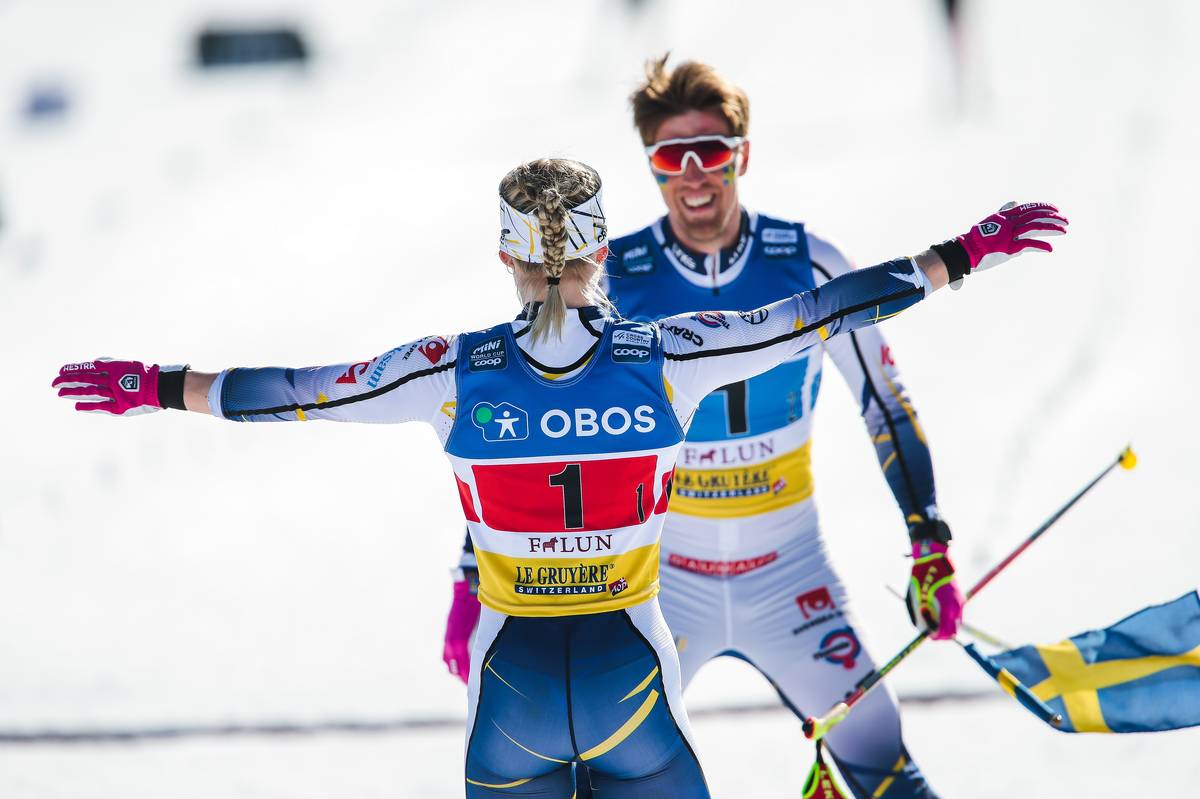
“It’s easy when I go with Jonna [Sundling],” he said to FIS after the race, “she is so fast, it’s no match.” For her part, Sundling said, “It was a little bit exciting before the race, how to ski, how should our tactic be… but it felt like we did a really good race and ended up first so it’s really fun.”
Calle Halfvarsson enjoys a big time cushion as he and Jonna Sundling take gold in the first ever mixed team sprint event (Photo: NordicFocus)
Rewinding a bit, the women’s third lap saw Fähndrich shoot off the course in the same fashion as Moser. Minutes later, Joni Maki of Finland I and Harald Østberg Amundsen of Norway I both went down on the corner entering the exchange area. A quick recovery by Amundsen ensured that his team stayed in the race but Maki and his partner Jasmi Joensuu were eliminated, along with Fähndrich and Janik Riebli for Switzerland.
Nadine Fähndrich (SUI) picks herself up after a fall during the mixed team sprint event (Photo: NordicFocus)
The fourth round of elimination took out Slovenia and Finland II, though due to the tight nature of the eliminations, the women were starting unless it was clearly evident that they were one of the last two. Thus we saw Anamarija Lampic (SLO) battling Tiril Undes Weng of Norway II for second, even though Slovenia had already been eliminated.
Anamarija Lampic (SLO) teamed up with Vili Crv (SLO) for the mixed team sprint (Photo: NordicFocus)
Entering the 10th exchange and the fifth elimination, Sweden I was 19 seconds ahead, with Norway I and II duking it out behind. This meant that it was the twins, Tiril and Lotta Udnes Weng battling each other for their final lap.
With Canada II and France I eliminated, the men took off for their sixth and final lap. Amundsen of Norway I was just ahead of Martin Nyenget of Norway II, though entering the stadium Nyenget used the slip stream to move in front of his compatriot. With Sweden I well across the line in gold medal position, a tight sprint between the two Norwegians ultimately went to Nyenget, meaning Norway II earned silver and Norway I came away with the bronze.
Harald Østberg Amundsen (NOR) and Martin Loewstroem Nyenget (NOR) during the early stages of the mixed team sprint (Photo: NordicFocus)
Italy with Nicole Monsorno and Federico Pelligrino finished fourth. Sweden II ended up fifth, and Germany I came in sixth. Canada I (Dahria Beatty and Graham Ritchie) were the last team to avoid elimination and finish in seventh.
Dahria Beatty (CAN) and Graham Ritchie came in seventh in the mixed team sprint (Photo: NordicFocus)
With the last race of the day complete, the World Cup season has come to a close. For North-American ski fans, Canadian Nationals will be combining with US Super Tour Finals for a culminating event series in Whistler, Canada. The racing begins March 20th and you can find more details about the event here.
This World Cup coverage is made possible through the generous support of Marty and Kathy Hall and the A Hall Mark of Excellence Award. To learn more about A Hall Mark of Excellence Award or to learn how you can support FasterSkier’s coverage please contact info@fasterskier.com.
The History:
A survey of the last five Olympic cycles shows a clear trend in American women’s sprint results: upward. In the 2002 Games in Salt Lake City, no Americans qualified in the freestyle sprint. Tessa Benoit was the top qualifier in 38th, with an up-and-coming Kikkan Randall next for Team USA in 44th. Randall was then 20 years old.
In the freestyle sprint four years later in Torino, Randall was the only American to qualify for the heats. She was 10th in qualification, then moved to 9th in the final standings. Switching to classic for the 2010 Games in Vancouver, Randall again qualified in 10th to be the only American in the heats, this time racing her way up to eighth.
And then there was Sochi.
The 2014 Games in Sochi were a turning point for the American squad, with all four women qualifying inside the Top-30 in the freestyle sprint. This time, a new name topped the list for qualification: Sophie Caldwell in 9th. Not to be overlooked, USA also had Jessie Diggins 12th, Kikkan Randall 18th, and Ida Sargent 25th.
Racing in her first Olympiad, Caldwell (now Hamilton) entered uncharted territory as she won her quarterfinal to advance into the semis, which she finished in a thrilling boot slide to be 0.1 seconds behind heat winner Ingvild Flugstad Østberg of Norway. Though she crashed in the final, she again moved the needle upward for the Americans by finishing sixth in the final heat.
The remaining American women also finished inside the Top-20, though none made it beyond the quarterfinals. Diggins was 13th, Randall 18th, and Sargent 19th.
The American women’s sprint team prepares for the individual freestyle sprint. (Photo: NordicFocus)
Carrying momentum from these Games through the next Olympic quad, the Americans had three women in the Top-30 for the classic sprint in PyeongChang in 2018, with Sargent just outside in 33rd.
This time it was Diggins in 7th – the top Olympic qualification result of any American woman – with Sadie Bjornsen 9th, and Caldwell 12th.
Despite it being her weaker technique, Diggins raced with confidence, landing in second in both her quarter and semi to advance automatically into the final. Losing touch with the leaders, Diggins repeated Caldwell’s historic result to finish 6th overall.
Perhaps a less apparent victory, Caldwell also raced into the semis, finishing 8th overall after taking third in her semi and missing a lucky loser spot in the final by just 0.18 seconds. Bjornsen was eliminated in her quarter after taking third in her quarter, on the wrong side of the lucky loser mark, but just barely, to end her day in 14th.
Fast forward four years and get excited.
Rosie Brennan (USA) on her way to the 2nd fastest time during qualification. (Photo: NordicFocus)
Sweden’s Jonna Sundling smashed the qualification round of the 1.5-kilometer freestyle sprint, setting the mark at 3:09.03. The next name on the list? Rosie Brennan in second (+5.80), ahead of Nadine Fähndrich (SUI) in third (+6.62), Yulia Stupak (ROC) fourth (+7.98), and… Diggins in fifth (+8.69).
Have you been reading closely? Both Brennan and Diggins both exceeded the previous best result in qualification from any American woman in history.
Also posting a strong qualifier, Julia Kern was 14th in qualification (+11.66), rebounding from Saturday’s skiathlon which left her wanting more. The final American starter, Hannah Halvorsen, finished 43rd (+20.10) in qualification – outside the Top-30, but still above Randall’s result from her first Olympic Games 20 years ago.
Jessie Diggins (USA) skis the 5th fastest time during qualification. (Photo: NordicFocus)
You may be wondering about the spread of times; the top-10 were nearly 11 seconds apart. After a quick descent out of the stadium, the course in Zhangjiakou features a 30-meter climb – nearly 100 vertical feet – followed by a sweeping downhill that leads back toward the stadium. From there, athletes face a 14-meter climb back into the stadium, finishing with a gradual rise to the line. Combined with cold dry snow, these factors can contribute to an above-average spread amongst the top qualifiers.
Here we go: the heats.
Brennan lined up alongside Sweden’s Sundling in the first quarterfinal heat. With nerves running high, a false start brought the six women back into the gate after the first starting beep. On the second go, the women pushed through the wands cleanly, but on one of her first doublepole pushes, Brennan caught the edge of her boot, dropping down to her knees and losing any momentum she had picked up as the field rocketed away from her.
Not willing to let the day end there, Brennan collected herself and focused on the task at hand, regaining contact with the group at the bottom of the climb and grinding her way into second position, looking strong as she crested the top of the hill just behind Sundling and rounded the curve to head into the descent.
After stumbling out of the start, Rosie Brennan (USA) charges back to the front of her quarterfinal heat. (Photo: NordicFocus)
Given the effort required for such a comeback, would there be enough left in the tank for the B-climb or had the matches been burned early? With Sundling holding steady in the lead Brennan was challenged by Slovenian sprint champion Anamarija Lampic as the women pushed up the final climb, but found another gear for a commanding second-place finish, +2.4 behind Sundling, but +0.7 ahead of Lampic, who would advance as a lucky loser.
The second heat featured medal favorite Maja Dahlqvist of Sweden, who qualified in sixth. Norway’s Tiril Udnes Weng set the pace, leading up the A-climb with Dahlqvist alongside, and Russia’s Natalia Nepryaeva on their tails. Powering out of the B-Climb, Dahlqvist held the advantage at the front, while Nepryaeva and Weng slid over the line in a photo finish for second and third. A closer look showed Weng’s boot accelerate as she reached forward, just in time to nip Nepryaeva at the line by 0.03 seconds for the automatic advancement to the semifinal. The second heat was six seconds slower than the first, leaving Nepryaeva out of the running for a lucky loser spot.
A fast third heat saw Nadine Fähndrich of Switzerland and Maiken Caspersen Falla advance automatically, pulling Germany’s Victoria Carl over the line as the second lucky loser.
Dancing and smiling in the start gate, Diggins got out with a clean start, positioned near the front and looking powerful as the women headed into the downhill curve out of the stadium. Around this curve, she was pushed to the outside as she skied defensively to dodge potential snags with the other skiers’ equipment, leaving the curve near the back of the pack.
Jessie Diggins (USA) leads Emma Ribom (SWE) in the early rounds. (Photo: NordicFocus)
Then, Diggins put on a show up the climb. Steadily moving up along the outside, she was perfectly balanced in a crisp V2 while other were in V1, catching the Swedish leader Emma Ribom. Leading over the top, Diggins kept the pace high to take the sting out of other sprinters. Carrying momentum out of the descent and again holding a strong V2 up the B-Climb, Diggins carried her lead through the finish to win by over 2 seconds, with Ribom next. There was no doubt that Diggins was looking good heading into the semi.
In the final quarter, Julia Kern pushed the pace in the first half, positioning herself in the lead as the pack headed out of the climb. She held her position through the downhill and around the hard right turn, carrying momentum into the hill. Perhaps paying for her efforts early on, Kern was dropped on the final climb as Veronika Stepanova (ROC) and Sofie Krehl (GER) broke away before heading into the stadium. Kern kept herself in the fight, staying in contact with Alina Meier (SUI) through the false flat to the finish, but ended up fourth in the heat, +3.5 back from the leader and behind the mark needed for a lucky loser spot in the semis. A gusty and tactical performance in her first Olympic sprint appearance.
Julia Kern (USA) led her quarterfinal early during the individual freestyle sprint. (Photo: NordicFocus)
To regroup: we now have two Americans in the semi, matching the previous best result from 2018.
Lining up in the first heat of the semis, Brennan got out of the start smoothly, tucking into the back of the back to safely descend out of the stadium and carry momentum out of the left-hand bend and into the A-climb.
Following the effective, albeit unforeseen, strategy from her first round, Brennan pushed her way up the A-Climb, moving from sixth place into the lead. The American kept the effort high as she pulled Sundling, Dahlqvist, Fähndrich. Brennan charged the downhill, stepping powerfully around the right hand bend to head into the B-climb at high speed. In the second climb, the two Swedes, Sundling and Dahlqvist, worked their way around Brennan, with Fähndrich also accelerating. No relief until the finish, Brennan did not let up in the undulating terrain that follows the B-climb, rounding the final curve in fourth place just behind Dahlqvist.
After setting a fast pace for the heat, Rosie Brennan finishes fourth in her semifinal to advance as a lucky loser. (Photo: NordicFocus)
Sundling stretched out the spread of the top-four in the final stretch to take the win in 3:11.94, with Fähndrich second, Dahlqvist third, and Brennan fourth, +1.35 behind Sundling. Brennan’s efforts to keep the pace hot contributed to a lightning fast heat, with Sundling’s time nearly four seconds faster than the top finish in the quarterfinal. This left Brennan in good standing for a lucky loser spot in the final, but she would need to hold her breath to see what the second heat would decide.
The second semi was quick out of the gate, with Sweden’s Ribom leading up the start of the A-climb. Diggins was comfortably tucked into the pack, beginning to set her race plan into action as she V2ed steadily up the side of the track, holding her form longer than the others as she moved into the lead. Nearing the high point, Diggins switched to a rapid tempo V1 with Norway’s Falla matching pace to head out of the climb in first and second.
Diggins sat in a low tuck at the front, stepping around the sweeping left-hander and heading into the B-Climb with Ribom and Falla trying to match pace and challenge at the front. Ribom moved ahead near the top of the climb to lead into the final curve. Diggins sat on the Swede’s tails, with Stepanova alongside. A bobble zapped some of Diggins’ momentum and could have been devastating, but the American kept her composure and stayed upright, staying in contact with Ribom as they headed into the finish lanes.
With Ribom in the lead, Diggins powered toward the finish line to secure a second place auto-qualifier spot for the final. She crossed the line +0.4 behind Ribom’s mark of 3:15.22, with Falla and Stepanova crossing in third and fourth a few meters back.
As the second heat times were roughly four seconds slower than the first, Brennan could let out a sigh of relief. The second lucky loser spot was now hers.
And now, we watch history unfold. Two American women in the final, as Brennan and Diggins set a new mark for the stars and stripes.
The final lineup saw Sundling, Dahlqvist, and Ribom racing for Sweden, alongside Diggins and Brennan, with Fähndrich representing Switzerland in red.
Emma Ribom (SWE), Nadine Faehndrich (SUI), Rosie Brennan (USA) and Maja Dahlqvist (SWE), (l-r) get up to speed at the beginning of the women’s individual sprint final. (Photo: NordicFocus)
Taking charge from the start, Sundling skied with authority, smoothly leading her teammates Dahlqvist and Ribom up the A-climb to put Sweden in first through third heading out of the climb. Diggins was fourth as they crested the high point, with Fähndrich on her tails and Brennan just behind.
Utilizing the speed of her skis and her strength in the downhill, Diggins moved up alongside the Swedes in the descent, looking for position heading into the final climb. Maintaining her command of the race, Sundling rocketed off the front to gap the remaining five women who all remained in contention for a medal leaving the climb.
Ribom quickly fell off the pack, leaving Dahlqvist leading a tight group of four over the undulating terrain that led to the final bend before the stadium. Diggins and Brennan looked to be boxed out as they headed around the final curve in third and fourth, respectively, but the Americans were patient versus panicked, which could put them at risk of a fall.
Coming out of the curve, Diggins accelerated around Fähndrich to challenge Dahlqvist for the silver medal. Brennan followed her teammate to surge past the fading Swiss athlete, setting the stage for a three-way sprint for two podium positions.
Sundling had gold on lock, nearly three seconds ahead as she crossed the finish line in 3:09.68.
Jonna Sundling (SWE) with a commanding victory in the individual freestyle sprint comes to the finish with Rosie Brennan (USA) in the background on her way to fourth. (Photo: NordicFocus)
In her wake, Dahlqvist and Diggins were taking it to the line, with the Swede carrying a slight advantage in the final meters. Still, with Brennan close behind and both Fähndrich and Ribom off the back, the Americans were almost guaranteed their first individual medal in history.
Skiing their fastest splits of the day, Dahlqvist held her ground to the silver medal (+2.88), with Diggins on her right, less than a ski length back for bronze (+3.16).
Jessie Diggins crosses the line in third to earn the first individual Olympic medal in women’s cross country ski history. (Photo: NordicFocus)
Just over a second back, Brennan crossed fourth (+4.49), for the second best individual finish in American women’s history. The Americans maintained a gap to Fähndrich in fifth (+7.21) and Ribom sixth (+11.11).
Diggins collapsed to the ground, overcome by the emotion of what she had accomplished. Perhaps a testament to her team-centric approach, she was heard saying, “Good job, Rosie!” between gasps, as she got back to her feet to immediately hug the coaches, support staff, and teammates that lined the edge of the course.
Jessie Diggins hugs her coaches and teammates after finishing third in the individual freestyle sprint in Zhangjiakou. (Photo: NordicFocus)An emotional Jessie Diggins wraps the American flag around her shoulders after taking bronze in the freestyle sprint. (Photo: NordicFocus)
Tearfully wrapping an American flag around her shoulders, Diggins was aglow as she savored the moment before heading back to the finish to stand alongside Sundling and Dalhqvist for the podium shot.
Jonna Sundling (SWE) takes gold in the freestyle sprint, ahead of Maja Dahlqvist (SWE) and Jessie Diggins (USA). (Photo: NordicFocus)
Though she was the one whose name would be highlighted in history books, Diggins focus on the importance of those around her remained at the forefront as she celebrated the many victories of the American team in today’s event.
“It was so cool to be there with Rosie,” Diggins said in the mixed zone. “She’s skiing so amazingly well… and I’m just so grateful. That’s the overwhelming emotion, because it takes so much from such a huge team to make this happen. And we had obviously amazing skis, but also amazing teammates for years and years and years, helping me train, pushing me, supporting me – amazing coaches, amazing volunteer staff. You can’t even imagine how much it took from so many people, and so I’m just so thankful because I feel like this medal belongs to about 1000 different people. And I hope they really feel that and know that.”
Jessie Diggins takes Olympic bronze in the freestyle team sprint. (Photo: NordicFocus)
Of her approach to the course, Diggins gave a simple response, acknowledging that she has a way of blacking out while having great races, “which is really annoying,” she laughed, “because I’d love to be able to remember exactly what I did.”
“I was just so focused on trying to push as hard as I could,” Diggins explained. “Just trying to ski as well as I could and stay balanced. The snow felt a little greasy, so especially in the finishing lane, just trying to put as much power as I could into every single push. And honestly, that’s all I can remember.”
Jessie Diggins (USA) on her way to the USA’s first ever individual women’s medal in the Olympics. (Photo: NordicFocus)
Perhaps the FasterSkier audience needs no reminder that Diggins came into the 2022 Games as a gold medalist, having won the freestyle team sprint with Kikkan Randall in 2018, a day that brought many Americans, including this writer, to tears. Diggins was asked to reflect on the last four years, and the progress she’s made in her career.
“The last four years, I’ve really found my voice,” Diggins said confidently. “I’ve really found a lot of my purpose, and I feel like I’ve grown a lot. But also, I’m exactly the same person in pretty much every other way. I think one of the big things has been dealing with is the pressure and expectations, because there’s been a lot of it, and it hasn’t been easy. So for me, I think it was such a victory just to make it to the final and know that I’m skiing well. I came into this as prepared as I could be, which one of my biggest goals was to come in prepared. The second goal, cross the finish line with nothing left. And the third goal was to just have fun, and keep focusing on the process, because that’s what gets me where I am today. Like win, lose, or draw, it’s just focusing on the process and, and executing those process goals to the very best of my ability, because then I’m always proud of how I finished. I’m just proud of this effort today as I was at the skiathlon, even though they were different outcomes.”
Jessie Diggins was all smiles as she passed through the mixed zone following her bronze medal performance in the women’s individual sprint. (Photo: Nat Herz/FasterSkier-ADN)
Fourth place at the Olympics – fourth in the world on its most prestigious stage – is both a truly incredible feat and perhaps the most challenging final rank to wrap one’s head around. The “wooden medal”, just shy of the Olympic hardware skiers dream about from their youth.
“Fourth place was hard,” Brennan said honestly in the mixed zone. “You feel really happy and also frustrated at the same time. I have a lot of mixed emotions about it. But I did everything I could today, and maybe not everything went perfectly my way. But I have to be happy with that at the end of the day.”
Jessie Diggins (USA) and Rosie Brennan find their position in the early moments of the women’s final. (Photo: NordicFocus)
Asked what she would have said if four years ago, someone told her she would be in this position, Brennan laughed, “I probably wouldn’t have believed it so much.”
She talked through a rough start to the day, sharing that she has always struggled with start gates and had spent the last six weeks practicing to ensure a clean start.
“So, there I was on the ground, I was like, ‘So much for all that practice.’ But I knew my strength was in the climb, so I just had to pull it back [together] and focus on the all the time I had left and see what I could do to try and make it up.”
On her approach through the heats, Brennan played to her strengths, recognizing she could take the lead, work the hills, and not let her heats unfold as a casual first 1200 meters with a tactical final sprint that might leave her in the dust.
“My strength lies more in the endurance aspect of it,” she explained. “I tried to just keep the pace high so that I could count on being a lucky loser – by having a fast heat time. So that was my strategy in the semifinal, and it worked. Once I got to the final, I tried to then be a little more smart about my racing. I tried to be patient and wait until the last climb. I was a little far back, so I kind of got the door closed on me to make it through. So I had to kind of adjust and go for a strong finish sprint, which isn’t always my strength. But I did all I could do.”
With Ben Ogden racing into the semis in the men’s race, it was an historic day for the American program as a whole. Speaking to this landmark day, Brennan concluded with an inspiring message for those who dream of following in their footsteps.
“I think it shows the growing depth in our country. And I hope it shows a lot of people just to have some patience and keep training, keep going for it. You never know where you’ll end up.”
Jonna Sundling (SWE) takes gold in her first Olympic appearance in the women’s freestyle sprint. (Photo: NordicFocus)
Taking a closer look at the winner, Sundling is the 2018 World Champion in the freestyle sprint. Returning from injury, she has built her way into the season. Though Dahlqvist has shined as the undefeated World Cup star for Sweden, Sundling has crept up alongside, taking second to Dahlqvist in the individual sprint in Dresden, and working together to win the team sprint. Sitting out the Tour de Ski, Sundling beat Dahlqvist in their next matchup in a Scandinavian Cup race in Falun, Sweden.
This is Sundling’s first Olympic appearance, though she and Dahlqvist will be a likely pairing in the classic team sprint next Wednesday.
Once the final rounds were complete, Kern’s final placement was determined to be 18th. This marks a significant step forward from her first appearance in the skiathlon, where she finished 53rd.
Julia Kern (USA), who finished in 18th place overall, pushes to the finish during her quarterfinal round. (Photo: NordicFocus)
“It was really tough out there, but a lot of fun to have a challenging course and give it my all,” Kern told FasterSkier in the mixed zone.
Dahria Beatty 28th in qualification (+14.51) to be the only Canadian woman to make the heats. Beatty raced in the first semifinal, where she finished fifth in the heat to finish 25th on the day.
Just 0.7 seconds off the top-30 mark, Cendrine Browne was 35th in qualification (+15.82) with Olivia Bouffard-Nesbitt close behind in 40th (+16.89). Laura Leclair rounded out the Canadian team in 58th (+26.28).
Dahria Beatty (CAN) races in the quarterfinals on her way to 25th place overall. (Photo: NordicFocus)
An Australian dual citizen who is a long-time APU team member, Jessica Yeaton was 52nd (+23.82) in the qualifying round.
This World Cup coverage is made possible through the generous support of Marty and Kathy Hall and the A Hall Mark of Excellence Award. To learn more about A Hall Mark of Excellence Award or to learn how you can support FasterSkier’s coverage please contact info@fasterskier.com.
By: Ben Theyerl
For ski fans whose parents were smart enough to record the 1994 Winter Olympics on VHS tapes, Lillehammer will forever be a World Cup venue carrying the shadow of thousands of fans waving Norwegian flags as Bjørn Dæhlie did his signature “spin move“ on the way to Olympic glory.
Fast-forward to 2021, where the course has been reworked and modernized, the lycra is decidedly less exciting, and the multitude of Norwegian flags flying were interjected by a whole lot of Swedish and American ones.
Today, in the Birkiebeiner stadium – that quintessential home of Norwegian skiing – chances of victory blowing in from Sweden were very high. Going in, they had won the last 5 straight World Cup freestyle sprints, and 14 of the last 20 overall. The Americans too, looked to continue their history of success in the freestyle sprint. Of the 16 wins that the Americans have had in sprint events, 15 of them have come in freestyle, with two of those previous winners, Jessie Diggins and Rosie Brennan, in the field on Friday morning.
In qualifying there were hints that as the field narrowed, it would be Sweden, Norway, and the United States whose skiers would fill the semifinal and final slots. Maja Dahlqvist continued her strong start to the season, winning the qualifier in a time of 3:11.59. She was joined by Tiril Udnes Weng (+1.38) and Nadine Faehndrich (+2.84) in the top 3 spots.
The U.S. team placed three inside the Top 10, with Julia Kern the top qualifier in seventh (+4.90), followed by Jessie Diggins in eighth (+5.08), and Rosie Brennan in tenth (+5.49). Hannah Halvorsen rounded out the qualifiers for the heats in 21st (+8.18).
Hannah Halvorsen (USA) sprints to 21st place in sprint qualifying in Lillehammer. (Photo: NordicFocus)
Three strong national contingents then went to the quarterfinals. Norway with seven skiers, Sweden with five, and the United States with four. There they would face each other on a new 1.6k Sprint course that left little to be deciphered about what would be the deciding feature on the day. On this course, there was an A-climb, and after doing it once, they would loop back around and do it again.
The Americans took a different approach to heat selection this week than they did in Ruka, where they raced late in the quarterfinal heats. Kern and Diggins lined up in the first heat together, joined by Tiril Udnes Weng. Kern led out the pack and raced consistently throughout, leading the first time up the climb with her teammate Diggins in tow.
A scene from the first heat of the quarterfinals, which included Julia Kern (Bib 7) and Jessie Diggins (Bib 8). (Photo: NordicFocus)
For Diggins, the quarterfinal established the pattern that she would look to repeat throughout the day on the tough course. At the foot of the climb in the second loop, Diggins moved through to the outside of the pack and then powered to the front. By the time she was in the stadium, only Weng was left behind her, and that’s how they finished. Kern, meanwhile, sprinted to 3rd place, and after all the quarterfinals were settled, was just a tenth of a second out of a lucky loser slot for the semi-finals (which went to the Finnish skier Jasmi Joensuu). Kern ended her day in 13th overall.
The other lucky loser slot was filled by Rosie Brennan in the second quarter-final. Brennan’s tactical approach to the course mirrored Diggins. In the second heat, Brennan matched up against Maiken Caspersen Falla and Nadine Faehndrich, and would finish just off the two to take third place in the heat, and first in the lucky loser slots.
In the semifinal, Diggins found herself alongside three Norwegians, matching up against T.U. Weng, L.U. Weng, and Caspersen Falla. The heat saw the best execution of her tactical approach to the course all day, as she followed the first move up the climb from Jasmi Joensuu, then shot around the outside to carry speed into the downhill, before moving in a perfect swoop off the apex of the turn to the outside that allowed her to power up the final climb joined by T.U. Weng and Falla. At the finish, Diggins crossed in first again, with T.U. Weng right behind.
The two would be joined by four skiers from the other semi-final. The Swedish pair of Dahlqvist and Ribom executed their tactical approach to the course to a tee, leading out the first part of the course and establishing a sprint that would be devoid of any posturing, then staying with any moves that occurred on the second-time through the climb – which came in this heat from Brennan – before finishing strong in the stadium sprint. Dahlqvist finished first, Ribom second, and Brennan came out the lucky loser for the second time on the day, advancing to the finals.
Rosie Brennan (USA) rounds the corner in front of Anamarija Lampic (SLO) during the final in Lillehammer. (Photo: NordicFocus)
The final field represented the Swedish and American fronts, who fully established themselves as the dominant force in Lillehammer. Two Swedes, two Americans, and just one Norwegian. Plus, Anamarija Lampic of Slovenia too.
The two leading countries’ different approaches to the course were most stark the first time up the climb, where Diggins and Brennan took the outside, and Ribom led the rest of the field on the inside track. At the top of that first ascent, the Americans took the animating action, Diggins shooting around the outside to lead the descent.
Brennan followed, reflecting her initiative to create an ideal position for the final climb: “I made a move early in the final to try to see what I had and unfortunately, was passed on the downhill into the last uphill” she said in an email to multiple news outlets.
With Brennan back in the pack as they took to the second climb, what had been alluded to throughout the day gained clairvoyance – Dahlqvist and Diggins were the strongest in the field. As they crossed the finish line, what was clear became a result. Dahlqvist won her second sprint of the young World Cup season, as Diggins earned her first podium finish of the year. T.U. Weng rounded out the podium in 3rd, with Ribom finishing 4th and Brennan in 5th on the day.
Maja Dahlqvist (SWE) wins 3rd straight sprint, followed by Jessie Diggins (USA) and Tiril Udnes Weng (NOR). (Photo: NordicFocus)
If Ruka was an exciting first burst of energy for the World Cup season, then Lillehammer today was an indication that long-term trends do hold. Last year’s World Cup champion Jessie Diggins has her first podium of the season. Maja Dahlqvist is now on a three-win sprint streak going back to last season, and the most ascendant sprinter on the women’s circuit. And in the freestyle sprint, it’s the Swedish and American women who continue to rise to the top, with Norway, on their home turf, putting up an ever-valiant defense of their dominance on the world stage.
Oh, and Americans can start dreaming of Jessie Diggins doing her best Bjørn Dæhlie impression in Beijing come February, as her second-place finish today means one-half of the Gold Medal highlight from the last Winter Olympics in 2018 is officially qualified. Diggins is the second American to qualify for this season’s Olympic team, joining Brennan (top-8 in both today’s sprint and last weekend’s 10 k classic) as objective qualifiers.
Here’s Jessie’s post-race comments to FasterSkier:
Jessie Diggins on her first podium of the season after finishing 2nd in Lillehammer. (Photo: NordicFocus)
Stepping back into the quarterfinals, Hannah Halvorsen skied strong in the fourth heat of the quarterfinals, which included Dahlqvist and Lampic. Losing contact toward the finish, Halvorsen finished sixth in her heat, which put her in 28th place in the final standings.
“I felt good today on the course,” Halvorsen wrote in a post-race email. “It was fun to have things come together. It was awesome to see our team put so many people in the top 30 this early in the season! I can’t wait to see what the season will bring for the US with so much potential in the mix!”
Elsewhere in the results, North American women had a strong showing. Hailey Swirbul (USA) finished 42nd (+12.50), with Cendrine Browne (Canada) in 52nd (+14.63), Dahria Beatty (Canada) in 53rd (+14.73), and Katherine Stewart-Jones (Canada) in 55th (+15.34). Novie McCabe (USA) finished 56th (+15.34), Maya MacIsaac-Jones (Canada) finished 60th (+19.21), Katharine Ogden (USA) finished 61st (+19.89), and Sydney Palmer-Leger (USA) finished 62nd (+19.89).
In a post-race interview, U.S. Ski Team Head Coach Matt Whitcomb answered a variety of questions on the men’s and women’s races in Lillehammer, including comments on the new course and the approach to heat selection this weekend relative to Ruka. He also shared his perspectives on the rounds, and an explanation of why qualification is a skill that athletes must learn, in reference to comments made by Sadie Maubet Bjornsen and Devon Kershaw on the post-Ruka episode of The Devon Kershaw Show. Have a listen.
Rosie Brennan charges up the first and longest climb on the sprint tracks in Falun, Sweden. (Photo: NordicFocus)
This World Cup coverage is made possible through the generous support of Marty and Kathy Hall and their A Hall Mark of Excellence Award. To learn more about A Hall Mark of Excellence Award or to learn how you can support FasterSkier’s coverage please contact info@fasterskier.com.
If you had any question about the strength and depth of the Swedish sprint team, look no further than the qualification list from today’s classic sprint in Falun. Led by Johanna Hagström with a time of 3:14.18, Sweden put six women in the top-10. This number was repeated in the semi-final, leading into a half-Swedish final round on home soil.
The sprint tracks featured the longest climb first, followed by a spiraling curve to send the women up the second climb. A sharp left turn and a roller brought the athletes back toward the stadium and into the final stretch. As the heats unfolded, this looked like a series of uphill sprints out of the track, some furious double poling, and some powerful cornering.
The profile of the sprint tracks in Falun, Sweden. (Photo: https://skidspelen.se/)
Of the Americans in the heats, Jessie Diggins was the top qualifier in 15th, with Rosie Brennan 20th and Sophie Caldwell Hamilton, back from her mid-season Vermont training camp, in 25th.
During the first heat of the quarters, Diggins looked confident in her tactics, sitting in the middle of the pack. Making assertive moves to seize optimal tracks, she swung wide in the final curve to set herself up to capitalize on her double pole as she sprinted her way from fourth to first. Diggins ceded time at the line to Sweden’s Linn Svahn to finish comfortably in second.
Jessie Diggins skis to 8th in the classic sprint in Falun, Sweden. (Photo: NordicFocus)
Racing in the first heat of the semis, Diggins looked to be employing a similar tactic of patiently waiting to pounce in the back half of the loop. Heading up the second climb in the 5th spot, she began to hammer, but by that time, Svahn and Norway’s Tiril Udnes Weng had created a small gap she could not close. Challenging Anna Dyvik of Sweden, Diggins powered over the final roller and worked her double pole, but was unable to make up any ground and finished 4th.
This ended Diggin’s day, putting her in 8th place overall.
“Whew, today was exhausting!” wrote Diggins after the race. “I think all the all-out efforts in the cold finally started to catch up to me, as I was definitely getting pretty tired in my semifinal. But I was really proud of how I skied today – especially in really tricky kicking conditions with steep hills and tracks that were deteriorating, and a ton of herringbone out there! It’s a very encouraging step forward in my classic technical skiing. We also had great skis which is always important!”
Advancing from the second heat of the semis, Slovenia’s Anamarija Lampic took the lead to pull the group through a fast heat. A few meters back, Sweden’s Jonna Sundling edged out Ane Appelkvist Stenseth and fellow Swede Hagström in a tight finish, which allowed all three women to advance to the final.
Poling in sync, the final round of the classic sprint in Falun takes to the tracks. (Photo: NordicFocus)
Let’s regroup. Three Swedes, two Norwegians, and one Slovenian in the final: Svahn, Sundling, Hagström of Sweden; Weng, Stenseth of Norway; and Lampic of Slovenia. The two semifinal leaders, Svahn and Lampic, pushed the pace from the front, up and over the two significant climbs. Sitting in a tuck to conserve energy for a final sprint over the roller and toward the lanes, Svahn was on the tails of Lampic, with Sundling just behind. The Swedes gained ground over the roller, setting up an exciting race down the finish lanes.
Anamarija Lampic and Linn Svahn push the pace during the final round of the classic sprint in Falun, Sweden. (Photo: NordicFocus)
With the line just moments away, Svahn simply attacked the ground with her double pole, pulling ahead for a back-to-back win in Falun.
Just behind, Lampic and Sundling were virtually tied as they crossed the line in a photo finish. Though times were the same to the hundredth of a second, Lampic was declared second and Sundling third.
Linn Svahn takes back-to-back wins in Falun, while Anamarija Lampic and Jonna Sundling slide in for the remaining podium spots. (Photo: NordicFocus)Anamarija Lampic (SLO) edges out Jonna Sundling (SWE) for second place in the classic sprint in Falun, Sweden. (Photo: NordicFocus)
“I’ve been feeling a little bit tired since yesterday’s race, but it’s so fun to compete in Falun. I really enjoy racing on a home course, so it was a good day,” Svahn told FIS at the finish.
Despite her age, this is 21-year-old Svahn’s 7th individual win in a World Cup sprint, split almost equally between skate and classic. It is also her second consecutive classic sprint victory on the Falun tracks, as she stood atop the podium in February 2020, also alongside Sundling third place.
The women’s classic sprint podium in Falun. Linn Svahn nailed her second consecutive win on the course, with Anamarija Lampic (SLO) second, and Jonna Sundling (SWE) third. (Photo: NordicFocus)
Svahn was also asked about the close finish and whether she was sure of her win in the moment.
“I’m never sure of a victory until I pass the finish line first, but it’s cool to see how many strong girls we are competing in sprint races. I think the levels are really high now and it’s tough to win each race, but I’m really glad I managed to do that today, especially in a classic sprint, because it’s my goal this year.”
Looking back, Brennan raced in heat 4 of the quarter finals, where she finished 4th, unable to advance. This left Brennan in 19th overall.
Powering uphill, Rosie Brennan skis her way to 4th in her quarterfinal in Falun, Sweden. (Photo: NordicFocus)
After a conservative start, Caldwell Hamilton skied her way into 2nd position at the top of the intermediate climb. Looking strong as she transitioned from double pole into diagonal stride over the last roller, she held her position around the final curve and into the finish lanes. Swinging around her and quickly closing the gap with her double pole, Sweden’s Hanna Falk overtook the American in the final meters. As the second heat ended up the fastest, Caldwell Hamilton was not able to advance and ended her day in 16th.
“Today was a really solid race for me,” wrote Caldwell Hamilton in a post-race email. “It wasn’t my best, but it was my first time skiing the heats in a classic sprint this year (actually probably in 11 months) and after a qualifier that felt so-so, I was happy with how I skied my quarter. Falun is a very tough course with some big climbs and technical downhills, but I like those features in a classic course.”
Sophie Caldwell Hamilton crests the intermediate climb on the sprint tracks in Falun, Sweden. (Photo: NordicFocus)
“After the first few races of the tour, I took the opportunity to spend a few weeks at home in Vermont during a time where I wouldn’t be missing many sprints,” Caldwell Hamilton continued. “It was such a nice break and I had skiing at the nordic center our neighbors own, Wild Wings, that I could ski to from my house, so I was a pretty happy camper to just spend some time at home doing some solid training and taking a break from the World Cup scene. Now I feel mentally and physically recharged and ready to take on the last couple months of the season! My qualifier today felt a little like I hadn’t done an effort like that in awhile, but I think every race effort will help make that feel a little more normal.”
Jessie Diggins and Canada’s Katherine Stewart-Jones (bib 29) climb side by side during the first heat of the quarterfinals in the classic sprint in Falun, Sweden. (Photo: NordicFocus)
After qualifying in 29th, Canada’s Katherine Stewart-Jones landed in the first heat of the quarterfinals with Diggins. Stewart-Jones held strong with the lead group through the second climb, but fell off the pace to finish last in the heat, just behind Norway’s Anna Svendsen. Stewart-Jones was 30th in the final results.
Outside the rounds, Julia Kern qualified in 35th (+12.95), Hannah Halvorsen 56th (+22.59), and Alayna Sonnesyn 65th (+30.2).
Maya Macisaac-Jones (CAN) races to 54th in the qualifier of the Falun, Sweden classic sprint. (Photo: NordicFocus)
Racing for Canada, Dahria Beatty qualified 48th (+17.29), Maya Macisaac-Jones 54th (+21.77), and Laura Leclair 58th (+24.77).
Hands up for the uncontested Norway win, Heidi Weng clutching the 4 x 5 k relay victory in Lahti, Finland. (Photo: NordicFocus)
This World Cup coverage is made possible through the generous support of Marty and Kathy Hall and their A Hall Mark of Excellence Award. To learn more about A Hall Mark of Excellence Award or to learn how you can support FasterSkier’s coverage please contact info@fasterskier.com.
It was a foggy morning for the women’s 4×5 k relay in Lahti, Finland. With temperatures above freezing and high humidity, the scene was less of a winter wonderland and more of a pea soup. A low visibility scene in which eleven teams lined up at the start line with nine nations represented. On paper, this was Norway’s race and after yesterday’s podium sweep in the 15 k skiathlon there seemed to be little doubt the Norwegian women were on form. To find the last time the Norwegian women failed to win a World Cup relay one must go all the way back to 2011 in Rybinsk, Russia when Italy bested the field. A major side note – the Norwegians were not present in Rybinsk. One must dig deeper into the records, way back to 2009 in Beitostølen, Norway when the Norwegian’s finished second to the Swedish women. Needless to say, the Norwegian women proved themselves peerless once again and topped the field, with a cumulative time of 49:34.4 on Sunday in Lahti.
Gold again. The Norwegian women celebrate as Heidi Weng crosses the line in first. (Photo: Nordic Focus)
Through the first 2.5 k of toady’s race, a pack of seven women skied together, among them Tiril Udnes Weng who started for Norway and Rosie Brennan who held the scramble leg for the U.S. As the first leg neared to a close Johanna Matintalo of Finland and Charlotte Kalla of Sweden (recently returned to the World Cup circuit), pushed the pace to stretch the group out ever so slightly. Weng tagged off to Theresa Johaug, yesterday’s skiathlon winner, who was closely shadowed by Kerttu Niskanen of Finland, Emma Ribom of Sweden, Jessie Diggins of the U.S.A., and Natalia Nepryaeva of Russia.
No other place for Therese Joahug (NOR) than off the front. (Photo: NordicFocus)
At 6.3 k Johaug (NOR) made her move to the front and turned on the burners, blasting away from the rest of the field in classic fashion. However, the chasers weren’t going to let Johaug stride away uncontested and at 7.5 k Johaug was just +1.6 seconds up on Kerttu Niskanen of Finland with Sweden, U.S.A., and Russia not far behind. By the time the second-leg skiers had completed 5 k, Johaug had widened the gap to +6.9 ahead of Niskanen, while Diggins, further back, tagged off to teammate Sophia Laukli with a margin of +24.5 to the lead.
Helene Marie Fossesholm (NOR), young yet ready for podiums on the World Cup. Here she paces Norway on the third leg of the Lahti 4 x 5 k relay. (Photo: NordicFocus)
Nineteen-year-old Helen Marie Fossesholm, who had a podium debut in yesterday’s skiathlon, commanded the first skate leg for Norway. At 11.3 k she had grown the gap to +15 seconds over Laura Mononen of Finland, with Lovis Modig of Sweden (+34), Anna Nechaevskaya of Russia (+37.5), and Laukli for the U.S. (+39.2) falling in behind.
In an interview with FIS following the race, Fossesholm said, “I had a great day today in the course. The course demands a high level of technical skills, including a high level of stamina which fits me quite well.” Her springy-step and attitude were evident to viewers as the young Norwegian jumpskated the final climb, navigated the hairpin corner and tagged anchor, Heidi Weng, with a lead of +51.8 ahead of Finland.
As the fourth leg transpired, Weng was out on her own, skiing the final two laps largely out of sight of the rest of the field. She crossed the finish line unchallenged to bring home another victory for the Norwegian team.
First bumps, bows, and boot taps, the new COVID-era finish celebrations for team Norway. (Photo: Nordic Focus)
Behind her, Ebba Andersson of Sweden swiftly made up ground on Finland’s anchor, Krista Parmakoski. (Finland I tagged off for the fourth leg roughly 8 seconds ahead of Sweden.) At 16.3 k Andersson caught Parmakoski and as the two skiers climbed out of the stadium for the final time, Andersson accelerated away from the Finn, gaining some ground on Weng and finishing +42.9, making it silver for Sweden. Parmakoski stayed strong locking in for third (+59.5).
Ebba Andersson (SWE) racing the 4 x 5 k relay in Lahti, Finland. (Photo: NordicFocus)Ebba Andersson (SWE) celebrates silver for the Swedish women at the completion of her anchor leg. (Photo: Nordic Focus)
Today’s relay line-up for the U.S. women looked a bit different than it has in the past. In a pre-race interview with FIS, U.S. Cross-Country Program Director Chris Grover said, “It’s an interesting relay for us. We have a couple of women with a lot of experience, Jessie and Rosie, but we also have a woman that this is her first World Cup weekend, Sophia Laukli, skiing for us, and also Caitlin Patterson.”
U.S. skiers who have been recent members of the U.S. women’s relay team, most notably Sophie Caldwell and Sadie Bjornsen, are not racing in Lahti.
Rosie Brennan (USA), Laura Gimmler (GER), Yana Kirpichenko (RUS), (l-r) during the scramble leg. (Photo: NordicFocus)Caitlin Patterson (USA) finishes her anchor leg for the American team. (Photo: Nordic Focus)
“We are missing a few of our women… so it’s going to be a little bit of a different experience for us and we actually are doing something that we don’t often do and that’s putting Jessie and Rosie in a classic leg, so they’re up front and hopefully we learn a little bit about what their classic performances can be like in a relay.”
The U.S. team ultimately finished fifth (+1:48.6), positioning themselves in back of Russia (+1:30.7) in fourth overall.
Sophia Laukli of the U.S., paces the U.S. on the third leg of Sunday’s 4 x 5 k relay. This was Laukli’s second World Cup start. (Photo: NordicFocus)
The twenty-year-old Laukli spent the past week racing at Norwegian Nationals before making the trip to Lahti for her World Cup debut. In an email to FasterSkier she wrote, “The races in Norway, I think, definitely helped prepare me more for the World Cup races. It was a pretty intense environment and quite a step up from the college racing I’m used to. So, it was good for me to have the Norwegian National races under the belt to get a little more comfortable with this higher level racing. I also think it helped to come off those races right into the World Cup so I was already in that racing mindset. I’m definitely someone who races into shape so being able to race in Norway and quickly transition to the World Cup worked to my advantage.”
Regarding her position as leg three in today’s relay Laukli said, “it’s safe to say I was a little stressed and nervous for the relay, just from knowing the past successes of the US women. I tried not to put too much pressure on myself, although that was easier said than done. The other girls were really great though and making sure I felt no huge expectations, and that I should just focus on skiing my own race. That was really helpful to hear. Once I started my leg and in the end, it was really just a lot of fun and I feel super lucky to have gotten to do a relay for my 2nd [World Cup] race!”
Natalia Nepryaeva (RUS), Jessie Diggins (USA), Emma Ribom (SWE), (l-r) during the 4 x 5 k relay in Lahti, Finland. (Photo: NordicFocus)Jessie Diggins during the second leg of the relay. This was the U.S. skier’s first time on the World Cup slotting into a classic relay leg. (Photo: NordicFocus).
Diggins, who skied the second classic leg as opposed to her traditional spot as skate anchor, said, “After a decade of anchoring the US relay team, I was very excited to try something a little different! For the first time in my life I asked to ski a classic leg and it was really fun to try something new. I think skating will always be my first love, but I’m finding a better relationship with my classic skiing over the years and this was a great place to work on improving it!”
The American women huddle at the finish line after finishing 5th in the relay. (Photo: Nordic Focus)
“The highlight of my day was, of course, getting to hand out the socks and put the USA face paint on our guys and gals,” Diggins continued. “I love the team spirit of relay day and it keeps racing fun! Really proud of this team (the men’s and women’s) for giving it our all this morning!”
Cendrine Browne (CAN), third leg of the 4 x 5 k relay in Lahti, Finland. (Photo: NordicFocus)
The Canadian team, consisting of Katherine Stewart-Jones, Dahria Beatty, Cendrine Browne, and Maya Macisaac-Jones finished eighth. This is Canada’s first weekend of World Cup racing after missing Period One and the Tour de Ski.
Anne Kyllönen (FIN), Dahria Beatty (CAN), Katharina Hennig (GER), (l-r) on leg 2 of the 4 x 5 k relay in Lahti, Finland. (Photo: NordicFocus)
The sinuous Lysebotn Opp rollerski course. (Photo: Blink 2020 screenshot)
Times are what they are. Precautions are the name of the game. This year’s Blink Festival in Norway played to a reduced field and limited spectators due to COVID precautions. Some races, as will be noted, included modified race rules to limit close contact between athletes.
Lysebotn Opp – 06/08
The Lysebotn Opp is perhaps the marquee event. It features lovely fjord views and a grueling 7.5-kilometer uphill skate switchbacking up a mountainside. In normal years, the Lysebotn Opp is a mass start event. This year, however, it was an individual start affair.
Therese Johaug won the women’s event in 33:11 minutes. Heidi Weng placed second (+00:34), and Helene Marie Fossesholm was third (+02:20). All three skiers are from Norway with Johaug and Weng seasoned veterans with Fossesholm an upstart 19 year old relatively new to the elite level scene. Fossesholm won two individual golds at the 2020 Junior Worlds winning both the 5 k classic and the 15 k mass start skate. According to FIS, she has competed in three World Cups and notched a fifth place in last season’s 10 k mass start skate in Falun.
For the men, Norway’s Simen Hegstad Krüger won in 29:25. Hans Christer Holund was third (+01:02), and Håvard Moseby third (+01:21). Moseby, the relative unknown on the podium is 21 and placed third in the 2020 U23 Worlds 30 k mass start skate.
Therese Johaug (bib 28) winning the 2020 Lysebotn Opp. (Photo: 2020 Blink Festival FB page)
Skate Sprint – 07/08
The second day of cross-country racing featured a skate sprint. For those used to larger fields and six-skier-deep heats, things looked a bit different. This was head-to-head racing, two racers per heat, as skiers advanced to the finals. Racers were required to remain in their respective lanes throughout the race which resulted in no drafting.
Norwegian sprinter Maiken Caspersen Falla won the day with Mathilde Skjærdalen Myhrvold placing second overall. Myhrvold lost the final by 1.4 seconds. Myhrvold is 22 years old and has raced two World Cups, both in Norway.
Kristine Stavås Skistad (21) placed third overall. She lost to Falla in the second semi in a photo-finish.
Johannes Høsflot Klæbo did as he does: win sprints. The star of the show placed first in the final, 1.5 seconds in front of second place GjøranTefre. At 25, Tefre raced nine World Cups last year with his best result an eighth place in Oberstdorf’s classic sprint. Klæbo has won the last four World Cup sprint titles. Erik Valnes placed third overall. He lost out to Tefre in the second semi by 0.1 seconds.
In the individual start 10 k classic, run on a 2.5 k closed loop, Tiril Udnes Weng won in 24:57.9 minutes. Fossesholm raced to second place, 3.9 seconds back, with Johaug in third (+12.1).
Klæbo took the crown in the men’s 15 k classic over a field that featured some of Norway’s top distance talent. He won in 35:08.9, just 0.2 seconds ahead of Moseby, who was second overall in the Lysebotn Opp. Daniel Stock was third (+2.1).
If you are looking for more, as in the view-from-the-comfort-of-home experience, Norwegian broadcaster NRK has archived the 2020 Blink Festival races. You can find a menu of races here.
Finland celebrates its first relay podium on home soil. (Photo: NordicFocus)
Sports fans talk a lot about home field advantage. Which team will play at home at Game 7 of the World Series? Or in the playoffs before the Stanley Cup? Home turf and the swells of a crowd whose numbers are skewed toward the home team has an undeniable effect.
Yes, the Norwegian team of Tiril Udnes Weng, Ingvild Flugstad Østberg, Therese Johaug, and Heidi Weng won yet another 4×5-kilometer relay with a time of 50:04.8. As this makes 16 straight wins on the World Cup, perhaps the result no longer grabs our attention or piques our interest.
But what should spark you to continue reading is the news that the Finnish team of Johanna Matintalo, Kerttu Niskanen, Laura Mononen, and Krista Pärmäkoski earned the first ever World Cup relay podium for their country on home soil, finishing 30.3 seconds behind Norway.
For the first two classic legs of the race, not only were the Finns vying for the podium, there were making a go at the win.
Kerttu Niskanen (FIN) is tailed by Frida Karlsson (SWE) during the second leg of the 4×5-kilometer relay in Lahti. (Photo: NordicFocus)
At the end of the first leg, Matintalo had a small gap to the Norwegian, Swedish, and Russian teams. Niskanen continued to hold this lead at the end of the second, but Sweden was only a second behind. Norway exchanged a few seconds later, and Russia appeared to have fallen off the pace.
Then Johaug skated away with the reins . A few seconds was nothing for the powerhouse, and she was in the front within the first kilometer. But Mononen was not willing to let her go. She matched Johaug in the first climb as the spectators lining the course shouted her name.
Mononen began to fade, but her decision to hang onto Johaug’s ride as long as possible kept her well ahead of the other teams.
Laura Mononen chases Therese Johaug during the third leg of the 4×5-kilometer relay in Lahti. (Photo: NordicFocus)
In the fight for the third spot, Russia’s Ekaterina Smirnova closed a gap of nearly 30 seconds to Rebecca Ӧhrn of Sweden, moving into third position by the end of the lap. The German team had also made contact, making it a three nation race for the final podium spot.
Mononen tagged Pärmäkoski with roughly a 29 second deficit to the Norway’s anchor, who did not treat her leg like a victory lap. Heidi Weng hammered each of the five K’s, but she could not put additional time on Pärmäkoski.
Krista Pärmäkoski anchors the Finnish relay team in Lahti. (Photo: NordicFocus)
The Finn, who clearly came back on form this weekend, kept the margin constant as she made her way up and down the hilly wooded terrain, past waving fans chanting “Kris-ta! Kris-ta! Kris-ta!” in time with her steps.
As she made her way down the final stretch, Pärmäkoski saluted her fans in the stadium who were applauding a job well done.
Waving to the home crowd, Krista Pärmäkoski seals the deal on second place in the 4×5-kilometer relay in Lahti. (Photo: NordicFocus)
In the final battle for third, the threesome of Yana Kirpichenko (RUS), Maja Dahlqvist (SWE), and Sophie Krehl (GER) soared together through the first 2.5 k loop. The German fell off the pace in the second lap, but neither the Russian nor the Swede could break away.
Kirpichenko flew down the final descent in a tuck and curved into the straightaway in the lead, but the Swedish sprinter was right on her tails. Firing her afterburner, Dahlqvist moved alongside the Russian in the final stretch, clearly demonstrating superiority in sprinting. As the line drew near, the women threw their boots in unison, but the surging Swede was there first, if only by 0.1 seconds.
An emotional Yana Kirpichenko is consoled by her teammates after the Russians finished 4th in the 4×5-kilometer relay. (Photo: NordicFocus)
“Of course, Norway, we are a really strong team and have done a lot of good relays,” Østberg told FIS at the finish. “Tiril did a really good job in her first time on Norway I. For me, it was a hard day at work, but I fought all I could and Therese, of course, really strong and Heidi also did a really good leg. So a fantastic team and it was fun to win.”
During the race, lightly falling snow turned into misty rain, posing a challenge for the waxers. Therese Johaug fielded the FIS interviewer’s question of how this impacted their team.
“I had really good skis,” she stated. “Of course, it’s difficult conditions when the snow comes. Maybe Ingvild did not have so good grip out there, but she fought all the way. I’m so impressed with both Tiril, Ingvild, and Heidi today, and it is so fun to race a relay with the team you’re training so much with.”
Eyes locked on the win, Heidi Weng skis the final meters of the 4×5-kilometer relay in Lahti. (Photo: NordicFocus)
The Norway I team of Tiril Udnes Weng, Ingvild Flugstad Østberg, Therese Johaug, and Heidi Weng celebrate their win in Lahti. (Photo: NordicFocus)
No North American teams competed in today’s event.
Racing continues Wednesday with an individual sprint on the streets of Drammen, Norway next weekend, followed by the famed Holmenkollen 30 and 50-kilometer races in Oslo on Saturday and Sunday.
The women’s podium of Stage 2 of the 2019/2020 Tour de Ski. Anamarija Lampic of Slovenia (center) took first ahead of Norway’s Maiken Caspersen Falla (left) and Russia’s Natalia Nepryaeva (right). (Photo: NordicFocus)
Day two of the Tour de Ski offered the American women the Sisyphean task of earning back time after a miss on ski and wax selection in Stage 1 prevented them from performing to their capability. This was particularly so for Jessie Diggins, a favorite for the overall tour podium who finished the first stage in 29th 1:20 behind Norway’s pace-setting Theresa Johaug. Her teammate Sadie Maubet Bjornsen, also a top all-arounder, was in the same position. Maubet Bjornsen ended Stage 1 in 30th.
The initial run of the TdS in Lenzerheide, Switzerland is about not digging yourself into a time-deficit hole. A podium is nice, a win even better. But the primary objective is to not lose too much time to the leaders. At the start of Stage 2, Diggins and Bjornsen were in that hole.
Backs against the wall and a significant boulder to push ahead of them, the two would need to make it into the final of the 1.5-kilometer freestyle sprint to make significant headway on the tour leaders. A podium finish would be ideal. Since time differentials in sprint racing are small, it would be imperative to earn bonus seconds based on their final standings: 60 seconds for a win sliding down to 42 seconds for sixth.
As Johaug, the overall leader heading into the second stage, was not a podium threat in the sprint event, it was almost-certain that she would lose time on her chasers, increasing the opportunity for the Americans and other overall podium hopefuls.
Knowing the task at hand, Diggins bravely faced the new day with resolve.
“Now I get to focus on doing what I love best: fighting my way back,” she wrote on Instagram.
Julia Kern powers to a seventh place result in qualification during Stage 2 of the 2019/2020 Tour de Ski. (Photo: NordicFocus)
Surely enough, four Americans landed in the top ten in qualification: Sophie Caldwell in 1st, Diggins 3rd, Maubet Bjornsen 4th, and Julia Kern 5th. Rosie Brennan also qualified for the heats in 28th. The final member of the American squad, Katharine Ogden, finished 60th in qualification.
And on to the quarters five Americans went. With the momentum and energy of the team, the boulder budged.
Racing in the lightning-fast first heat of the rounds, Diggins fought at the front with leaders Maiken Caspersen Falla (NOR), Anamarija Lampic (SLO), and Anne Kjersti Kalvå (NOR). Last year, Falla was the ranked second overall in the World Cup sprint standings and Lampic was ranked 6th.
Diggins was unafraid to push the pace and spend time at the front. She showed her balance on her feet as she took on the fast descents and icy corners of the course, holding her position. In the final straightaway, Falla and Lampic took off from the front, leaving Kalvå and Diggins fighting for lucky loser positions. With the fate of a fast heat and their stick-to-the front pacing — their times would have won any other round — Kalvå and Diggins easily advanced to the next round.
Charging to the finish in the second heat of the quarter-final in Stage 2 of the 2019/2020 Tour de Ski. Jonna Sundling of Sweden holds the lead on the far left with Rosie Brennan tucked into the back left. (Photo: NordicFocus)
The Americans continued to shine in the rounds. In the second heat, Brennan mixed it up with the leaders but lost contact with the pack, finishing fifth in her heat. In the slowest third heat, Caldwell patiently followed the pedestrian pace, then showed her top gears in the final sprint to win the round. Maubet Bjornsen took second in the fourth heat to advance, and Julia Kern took third in a three-way photo finish for the top spot in the final heat.
Three Americans advance to the semis.
Adrenaline surges through the crowd in spectacular Lenzerheide, Switzerland during Stage 2 of the Tour de Ski. (Photo: NordicFocus)
Again, the first round of the semis was stacked with Falla, Lampic, Diggins, and Caldwell battling with Natalia Nepryaeva of Russia and Jonna Sundling of Sweden. Showing her grit, Diggins won the heat for an automatic spot in the finals, while Caldwell finished fifth. The spread of finishers in the heat was less than one second. Maubet Bjornsen finished second in heat 2, also advancing to the final.
Two Americans in the final. The pieces were coming together.
After qualifying in first and winning the first round of the quarters, Sophie Caldwell was knocked out in a close finish in the semifinals of Stage 2 of the Tour de Ski. (Photo: NordicFocus)
Sadie Maubet Bjornsen marks Maiken Caspersen Falla (NOR) and Anamarija Lampic (SLO) during the final round of the 1.5-kilometer freestyle sprint in Stage 2 of the 2019/2020 Tour de Ski. (Photo: NordicFocus)
Diggins kept herself in contention for a podium spot throughout the final, matching each of her opponents moves, never losing contact and often controlling the pace from the lead. Maubet Bjornsen held strong in the middle of the pack.
Leaving nothing on the course, Diggins jump skated each of the rollers, powering in a no pole skate into a tuck on the descent. She raced with grit over every meter.
Rounding the final curve into the straightaway, she sat in fourth behind Lampic, Falla, and Nepryaeva who had begun to accelerate off the front. Matching their tempo but unable to close the gap, Diggins crossed the line in fourth, doubling over as she gasped for air.
Racing with the fire for which she is known, Jessie Diggins gasps for air after taking 4th in Stage 2 of the 2019/2020 Tour de Ski. (Photo: NordicFocus)
In a close finish with Falla, Lampic took the win in 3:06.2 with the Norwegian 0.03 seconds behind her. Nepryaeva finished third (+0.47), with a half second gap to Diggins. After falling off the lead pack, Maubet Bjornsen finished 5th (+4.78), and Tiril Udnes Weng sixth (+5.29).
By centimeters, Anamarija Lampic takes the win in Stage 2 of the 2019/2020 Tour de Ski ahead of Maiken Caspersen Falla (left) and Natalia Nepyaeva (right). (Photo: NordicFocus)
Because they were quickly on the road to the next venue, the American women were unavailable for phone calls and instead chose to send comments on their performance via email.
“Today was a great day,” wrote Diggins. “I was so proud of the entire team for staying positive, rebounding from yesterday and for keeping it super professional; nobody was mad, everyone just learned the lessons from the skis that day and then moved onwards. For me, it was important to just focus on what I can control and have confidence in my fitness that I knew was there.”
In response to a query on handling the pressure of offsetting her deficit in the overall standings, Diggins offered a process-oriented response.
“It was definitely crucial to my tour to make the finals, but instead of focusing on the outcome I focused on skiing every step of the way as well as I could!”
Jessie Diggins smiles as she walks away from a 4th place finish in Stage 2 of the 2019/2020 Tour de Ski. (Photo: NordicFocus)
“Now I’m looking forward to Toblach — a venue with many many positive memories for me!” she concluded.
Maubet Bjornsen also remarked on the positive energy taking vengeance on the first stage provided. She explained that with “impossibly slow skis”, it felt like a success to lose only 1:20 to the leaders. Maubet Bjornsen added that it was not just the athletes looking for a do-over in Stage 2.
“The tech team worked extra hard to find a solution and our entire team came back strong today! Although it was an imperfect start, positivity and constantly fighting are the two keys to this incredibly exciting event. I sometimes think the winners of the TDS are not the most physically fit people, but the most mentally tough.”
Like Diggins, she too is eager for a second go in the next round of racing in Stage 3 and hopes to continue whittling down her gap to the overall tour leaders.
“I look forward to the next stop in Toblach for another attempt at a 10 k skate, hopefully with an equal revenge as today. I have some precious seconds to try to win back still. One day at a time.”
She finished by saying that they are driving away from Lenzerheide “with some tired legs, but rejuvenated souls!”
Seeking revenge, Sadie Maubet Bjornsen flies to a fourth place finish in qualification during Stage 2 of the 2019/2020 Tour de Ski. (Photo: NordicFocus)
Overall Tour Standings
Noteworthy for the overall standings, tour leader after Stage 1 Therese Johaug qualified in 21st and raced in the speedy first heat with the eventual winner. She finished in fifth, just behind Diggins. Had she raced in any other round, the distance phenom, who is not known for her sprinting, would have advanced as well. Her result put her in 23rd for the day, earning six bonus seconds.
Though she slid back to third in the overall rankings, this result maintained her threat for the overall tour victory. Johaug is only five seconds out of first place heading into three distance stages where she will have the opportunity to create a gap over the field before the Stage 6 sprint. In the fifth stage, a mass start classic in Val di Fiemme, Italy, she will also have the opportunity to earn bonus seconds at various checkpoints, giving her further insurance on the following sprint day.
After a third place finish in Stage 2, Natalia Nepryaeva takes over the overall leader bib in the 2019/2020 Tour de Ski. (Photo: NordicFocus)
Now wearing the leader’s bib, Nepryeava’s sprint podium moved her into the lead with a cumulative time of 31:18. She finished sixth in the first stage. Demonstrating her potential in the competition, Nepryaeva dueled with Norway’s Ingvild Flugstad Østberg throughout the 2018/2019 tour to finish second overall. The Russian won the first distance stage and took second in the final four stages.
Lampic, who finished 50 seconds behind Johaug for 20th on Saturday’s distance race, moved into third overall, one second behind Nepyraeva. Last year, she finished 22nd in the tour.
Slovenia’s Anamarija Lampic smiles in delight after winning the second stage of the 2019/2020 Tour de Ski. (Photo: NordicFocus)
Posting consistent results in the first two stages, Tiril Udnes Weng’s 7th in Stage 1 and 6th in the sprint put her in fifth overall, followed by her cousin Heidi Weng who was second in the first stage but 32nd in qualification leaving her out of the rounds.
Cutting their time back in half, Diggins sits in 11th place, 39 seconds behind Nepryaeva, followed by Maubet Bjornsen in 12th (+41). The overall podium continues to be up for grabs.
Racing continues Tuesday December 31st in Toblach, Italy with 10 k freestyle, followed by a 10 k pursuit start classic on Wednesday.
From left to right,Tiril Udnes Weng and Maiken Caspersen Falla of Norway I in second, Maja Dahlqvist and Ida Ingemarsdotter of Sweden I in first, and Evelina Settlin and Hanna Falk of Sweden II in third. (Photo: FIS cross country screenshot)
It was a weekend of sprinting in Lahti, Finland, with many World Cup athletes closing out Sunday having traversed the famed 1.4-kilometer 2016 World Championships sprint loop at top speed close to ten times.
By the time Sweden’s Maja Dahlqvist got on course for the final lap of the women’s classic Team Sprint, she had already tallied nine–in Saturday’s freestyle sprint she made it through the qualifier, quarterfinal, semifinal and final (placing third), and on Sunday, she and teammate Ida Ingemarsdotter had to first complete in the 6 x 1.4 k semifinals to advance to the 6 x 1.4 k final.
Through the first two thirds of Sunday’s final, it appeared the extra kilometers had worn on the Swede. She and Ingemarsdotter remained positioned in fifth or sixth through first four exchanges, watching from behind the pace of Norway’s Team I, Norway’s Team II, Russia’s Team I and Finland’s Team I.
In her last leg and just before the final exchange, however, Dahlqvist’s teammate Ingemarsdotter made a decisive surge to the front. By the time Ingemarsdotter handed off to Dahlqvist for the race’s final sprint lap, only Tiril Udnes Weng of Norway’s Team I remained in front. Heading into the races final kilometer and half, Sweden’s Team I was positioned in second.
If Dahlqvist was feeling anything in her legs from the weekend’s sprint series, it must have been motivation. She charged into the last sprint lap chasing down Maiken Caspersen Falla, the anchor for Norway Team I and the winner of Saturday’s skate sprint.
In the end, Dahlqvist’s press proved too strong for Falla. She overcame the Norwegian and Sweden’s Team I crossed first in a time of 18:24.96 for the win. Falla crossed 1.84 seconds behind to put Norway Team I in second place. Claiming third place, 3.55 seconds back from the winners, was Sweden’s Team II of Evelina Settlin and Hanna Falk.
With World Championships just around the corner, the U.S. entered two teams in the sprint: USA I was comprised of Ida Sargent and Sophie Caldwell. The two women raced the first semifinal and finished outside of advancing to the finals, placing 12th overall. Sargent and Caldwell have partner up in the past and landed on the podium–last year in Dresden and two years ago in the Pyeongchang World Cup–so making it into the final and onto the podium had been in the back of their minds.
“Classic team sprint I think is my favorite race so I was really excited for today but unfortunately it didn’t go as well as we hoped” Sargent wrote in an email.
Sargent cited the pace of the semifinal as unlike team sprint semis that she has scrambled for in the past.
“Today’s race was the fastest team sprint semifinal that I’ve ever raced,” she wrote. “It was hard from the gun rather than building into it more like some races. My skis were really slick for the first two legs so I was using a lot more energy to stay at the front than some of the girls that I was skiing with. Then on the third lap when the pace really picked up I didn’t have much left and was just trying to not completely explode.”
Kelsey Phinney and Julia Kern were entered as USA II and placed 14th overall. The duo placed seventh in their semi-final.
Resources were stretched a little thinner this weekend in Lahti due to the simultaneous USST pre-World’s training training camp in Davos, Switzerland.
“We have a really small service staff here and they were working so hard to get us great skis,” Sargent wrote. “Today was just a trickier klister day with not much time for testing so we ran out of time. Yesterday I felt like we had the best skis in the field which was super impressive since we only had a few techs here who were all working so hard.”
U.S. World Cup coach, Matt Whitcomb indicated that he helped with skis on Sunday and because of that role, spent most of his time waxing instead of on course.
“While it was definitely a disappointment not to have any teams advance through the semis today, we did see a lot of athletes ski really well,” Whitcomb said during a phone conversation. “Unfortunately, Ida struggled a little bit with her skis and Simi struggled with his glide. … Sophie and she felt like she had really awesome skis and felt really good, so she has returned from her trip home very strong,” Whitcomb continued.
Caldwell recently returned to the U.S. to spend time with her mother.
“I have no real regrets,” Whitcomb said. “Our team, staff, athletes, we all tried and executed the plan we intended to, sometime it all doesn’t work out as perfectly as planned.”
Athletes will remain in Finland for two days before heading down to Cogne, Italy on Wednesday for the final World Cup races before World Championships in Seefeld, Austria.
“While the results were a little bit disappointing today in Lahti, I really believe we have a team that is well prepared for World Championships,” Whitcomb said. “We like to go into the Championships having knocked a few races out of the park and we had a couple hits this weekend, but not as many as we intended to. So we will be looking to swing hard in Cogne. I feel very confident about our Seefeld Championships with this team, its a strong crew.”