From the FasterSkier archive — posts syndicated from athletes’ and coaches’ own blogs between 2004 and 2012, kept online as published. Current coverage is at fasterskier.com.

Tag: Tobias Angerer

  • Why Did Germany Flame Out in Sochi – And Will They Be Back?

    Why Did Germany Flame Out in Sochi – And Will They Be Back?

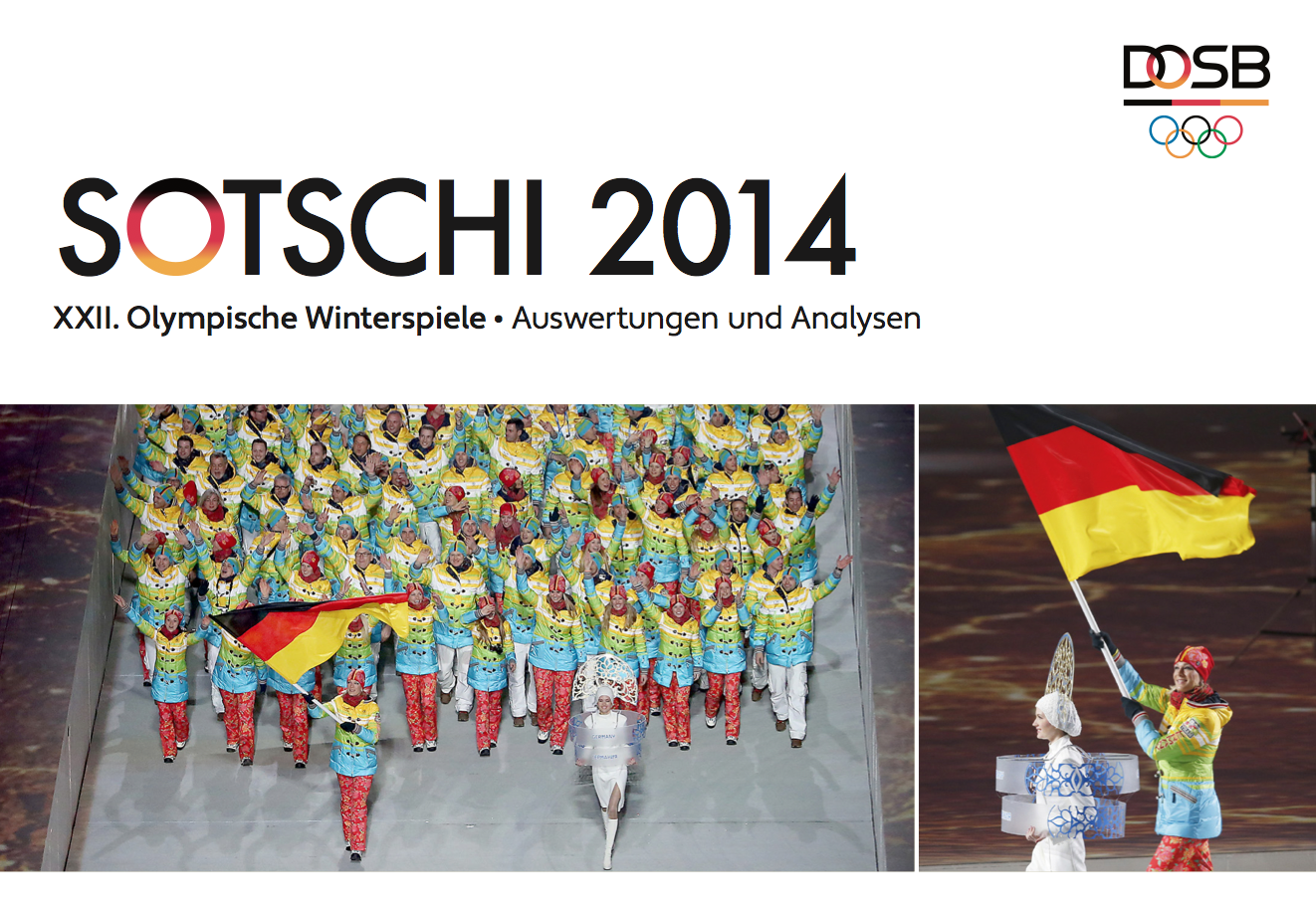
    Screen Shot 2014-11-26 at 11.47.26 PMThe German nordic sports experience at the 2014 Olympics could perhaps be summed up on the last day of competition.

    In the men’s 50 k, Germany entered four men. The finishers were led by Thomas Bing, about to turn 24 years old, in 36th place.

    Next came Axel Teichmann, more than ten years Bing’s senior. Then two biathletes – Arnd Peiffer and Erik Lesser, in their 50 k debuts on the world stage and within a minute of Teichmann’s time.

    Four years earlier, Teichmann had captured silver for Germany in the same event, but on that day in February he labored to 39th place, more than four minutes behind the winning Russian skier. While Germany still had a few of their stars from days past on their roster, they were mostly stars no more.

    Peiffer and Lesser had teamed up for a silver medal in the biathlon relay the day before, but they surely were not on fire in the 50 k (understandably). While they treated the race as a fun way to end their Games – and some other biathletes and nordic combined skiers probably would have jumped at the chance to do the same thing – their participation brought up an uncomfortable question: can Germany find nobody else?

    To say that Sochi was a disappointment for Germany would be an understatement. While expectations were somewhat tempered by their team’s performance so far that year, it was hard not to remember Vancouver. There, biathlete Magdalena Neuner won two golds and a silver, Simone Hauswald shared the podium with her when she earned bronze in the mass start, and the relay also took bronze.
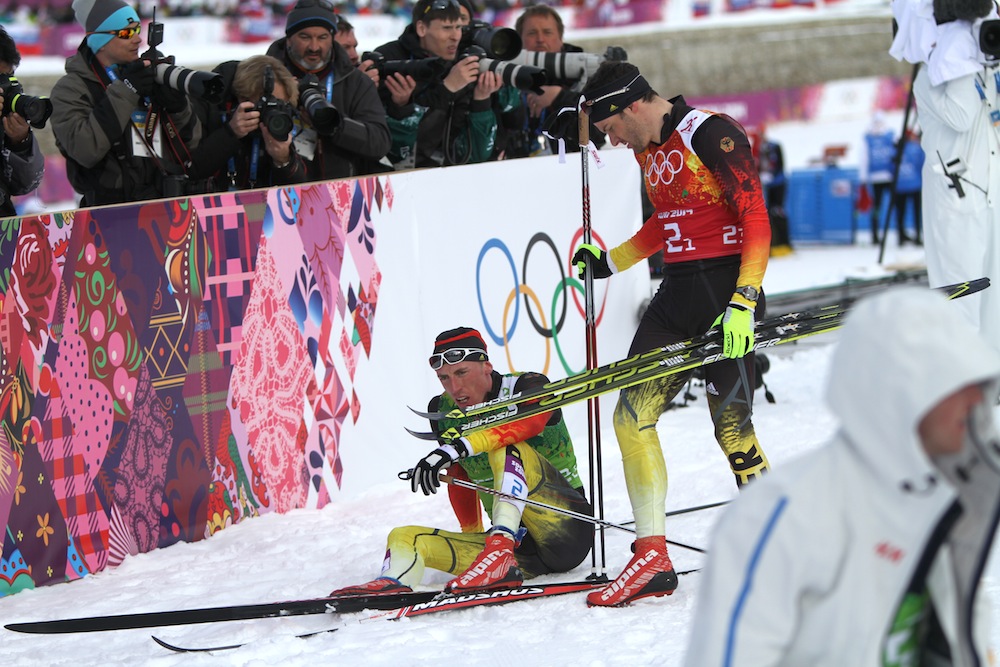
    Germany's Tim Tscharnke (l) after the finish of the 2014 Olympic team sprint with teammate Hannes Dotzler. The two finished seventh after Tscharnke fell a few hundred meters before the finish as a result of a tangle with Finnish anchor Sami Jauhojärvi. Finland took gold and Germany placed seventh.
    Germany’s Tim Tscharnke (l) after the finish of the 2014 Olympic team sprint with teammate Hannes Dotzler. The two finished seventh after Tscharnke fell a few hundred meters before the finish as a result of a tangle with Finnish anchor Sami Jauhojärvi. Finland took gold and Germany placed seventh.

    In cross country, Nystad and Evi Sachenbacher-Stehle had teamed up for gold in the Vancouver team sprint, Teichmann and Tim Tscharnke took silver in the men’s event, the German women were second in the relay, and the men won two individual silver medals.

    For a little perspective: in 2014, Germany came away with three medals, total, in cross country and biathlon combined.

    Where to start with the embarrassments? Was it Sachenbacher-Stehle testing positive for a banned stimulant? Or was it Tscharnke falling down in the final stretch of the team sprint and, instead of getting up and likely earning bronze, lying in a heap whimpering about how he missed out on gold?

    In a Deutscher Olympischer SportBund report obtained by FasterSkier, the country’s Olympic committee assesses the success of each sport at the 2014 Olympics, and looks for actionable plans to move forward and upward. The document runs more that 230 pages and not only focuses on each sport individually, but also on funding partners, medical and logistical support, and what other countries are doing to succeed. It’s an impressive analysis of a huge and complex system.

    A Cross Country Team Too Old and Too Young

    “Denise Herrmann and Josef Wenzl improved in the world rankings in the 2013/2014 season and even at times led the Sprint Cup,” the report noted of young German skiers. “But the pre-Olympic season was marked by a disappointing World Cup, and the coaching change in 2012 didn’t bring the expected turnaround.”

    Herrman was one of the great hopes for Germany – a medal in the skate sprint seemed very possible for the 25-year-old (and if that doesn’t sound “young”, the report notes that the average age of a medalist was 28 for women and 29 for men). But like other favorites including Marit Bjørgen and Kikkan Randall, she didn’t make the final.

    That was symbolic of the single medal and three top-8 finishes by German skiers, their worst performance at an Olympic Games since 1998.

    While performances by the team’s young stars showed that maybe they weren’t ready for literally the biggest stage in the sports world, the squad was also filled with older athletes. The single medal came in the women’s relay, where 36-year-old Nystad was helped earn bronze and the team came into the sprint finish with the leaders.
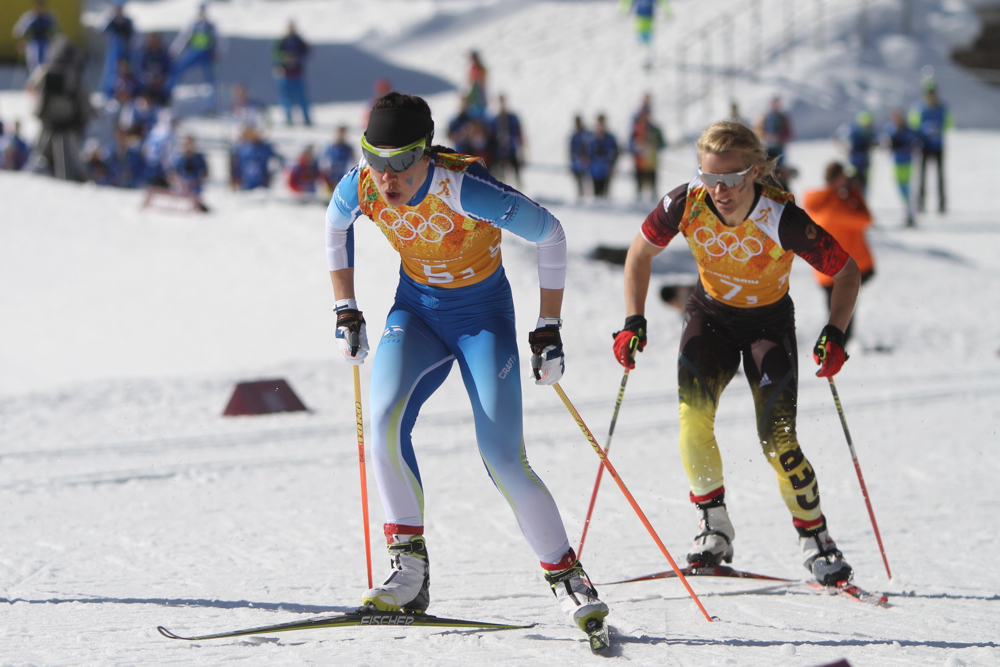
    Kerttu Niskanen of Finland leading Claudia Nystad of Germany in the Olympic relay. Nystad completed her comeback from retirement with a bronze medal.
    Kerttu Niskanen of Finland leading Claudia Nystad of Germany in the Olympic relay. Nystad completed her comeback from retirement with a bronze medal.

    The report noted that Nystad was the oldest medalist in cross-country skiing. But they didn’t say what the rest of the team’s aging veterans accomplished: because Teichmann didn’t contribute much, nor did 36-year-old Tobias Angerer. None of the women who competed in the 15 k skiathlon were under the age of 30.

    Nordic sports are particularly difficult to analyze, the report noted, with different techniques and physiological demands of uphill and flat sections, aggression needed on downhills, transitions essential on rolling terrain, and equipment and ski service becoming increasingly important.

    But the best athletes, the report explained, are in general among the best at each of these different aspects, and having a weakness in one area can’t necessarily be compensated for by excellence in another area due to the high level of competition in the field.

    What do they recommend to get German skiing back on track? For once thing, they focus on a “long-term development structure” and suggest that the objectives and tasks be reworked after observing other country’s strategies for developing cross country skiers.

    Another recommendation is that while providing for an athlete’s development, not to treat them as machines: “An essential prerequisite of all participating institutions is to in close cooperation control the sport, but also the personal development of the athletes and to focus on the achievement of future excellence in high-performance.”

    Finally, the committee noted that the ski association’s current strategy of setting up different training groups seems to be effective, but that it should look towards biathlon and nordic combined for how to systemize development at the junior level.

    If there’s more talent coming up, there may finally be starts for them. Teichmann, Angerer, and Katrin Zeller retired. Nystad is back in action and had a strong race in Beitostolen, Norway, this weekend.

    What Happened to Biathlon?
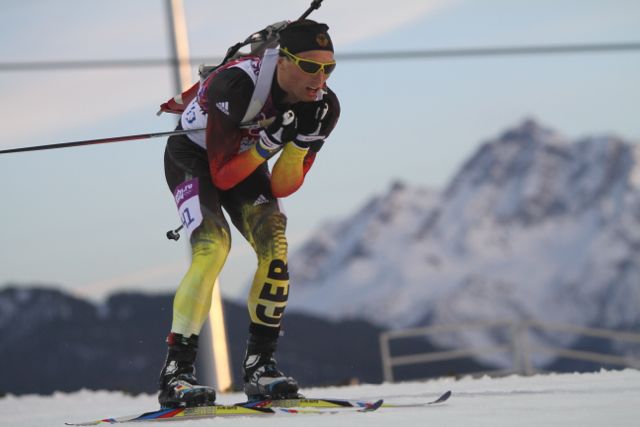
    Erik Lesser of Germany en route to a silver medal in Sochi.
    Erik Lesser of Germany en route to a silver medal in Sochi.

    Biathlon was an unmitigated disaster for Germany at the Sochi Olympics. On the second page of the biathlon section of the report, the committee addresses an ugly truth: the medal rankings. Germany collected two medals, one silver and one bronze, which landed them in fourth place (although there were several ties; five teams were better, two the same). The Czech Republic surged past them with five medals.

    “Besides the established nations of Germany, France, Russia, and Norway, increasingly athletes from Austria,the Czech Republic, Slovenia, and Canada are gaining podiums and placing among the world leaders,” the report noted.

    Echoing a sentiment expressed by many of the sport’s observers, the committee crunched some numbers and showed that biathlon is, in fact, getting increasingly competitive: the same level of performance that might have won a medal in the past just doesn’t cut it anymore.

    “In order to achieve podium finishes, the men at maximum about 1.2 percent behind in skiing, and hit targets at a rate of of about 98 percent. The previously assumed requirement to be 1.5 percent back and a 95 percent hit rate are therefore obsolete now… in the women’s field, a hit rate of 96 percent and maximum ski speeds less than 2.0 percent back are needed to reach medal placings… the best individual performances in the opening contest, the sprint, were… clearly behind the world leaders in both skiing and hit rate as well as in the shooting times. Because they were immediately dependent on the sprint results, the prospects were thus low for the subsequent pursuit.”

    Forget medals – it didn’t get any better for Germany when considering top-8 performances: in other words, they weren’t even close to winning more medals. The team had only three top-eight finishes (discounting those from Evi Sachenbacher-Stehle after her doping ban). Norway and the Czech Republic led the way with 11, while France had 10. Germany’s three tied it with the United States, Canada, and Slovakia.

    The women’s team, the report noted, was highly variable. After the Vancouver Games, three stars retired (Kati Wilhelm, Martina Beck, and Simone Hauswald), while Magdalena Neuner called it quits after the 2012 World Championships in Ruhpolding, Germany.
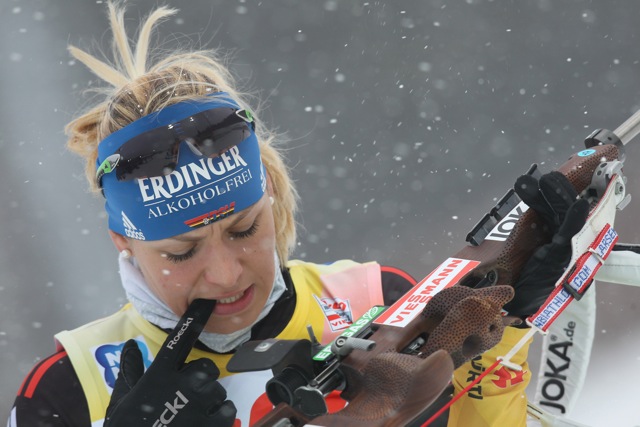
    “[The team] ultimately consisted of two juniors (Franziska Preuss, Laura Dahlmeier); a very experienced senior athlete (Andrea Henkel); an experienced, former cross-country skier – with considerable training effort for the stabilization of the shooting performance (Evi Sachenbacher-Stehle); and an athlete who in comparison to previous years increased her experience but at events as big as Sochi still has far to go (Franziska Hildebrand). The challenging tracks in Sochi required a high level of competition experience with regard to the race schedule. Their could succeed in competition only on the basis of a high level of physical and mental performance. These parameters within the existing team structure are pronounced insufficient for an Olympic Winter Games.”
    Magdalena Neuner, a three-time World Cup champion, double Olympic gold medalist, and winner of 17 World Championships medals, has been critical of the DSV's biathlon program. Photo: NordicFocus/Fischer.
    Magdalena Neuner, a three-time World Cup champion, double Olympic gold medalist, and winner of 17 World Championships medals, has been critical of the DSV’s biathlon program. Photo: NordicFocus/Fischer.

    Since the Olympics, Neuner has publicly criticized the Deutscher Skiverband (DSV, the governing body for snow sports) and accused them of being behind the times and resistant to change.

    “Times have changed, and the level of the World Cup has increased,” she told Der Spiegel. “[They] didn’t want to think differently… the team needs someone who has a bit more sensitivity for the young girls. The World Cup is a tough business. And because they are currently not as successful, it is even harder. Now they need a coach who is fully behind them.”

    In a separate conversation with Sport1, Neuner said that far too much pressure had been put on the likes of Dahlmeier and Preuss, who just two years before had been competing at the Youth Olympic Games.

    Her leadoff leg of the women’s relay was tough to watch – she fell, and also had her rifle sight clogged with snow. Perhaps additionally discombobulated by Sachenbacher-Stehle’s doping result, Preuss tagged off three minutes behind the leader and in tears. She was 19 years old, and has since made it clear that she never wants to revisit the memory.

    “It’s always difficult in the first World Cup season, and especially at the Olympics for young athletes: the pressure is greater than they had ever imagined,” Neuner told Sport1. “You think you’re now relaxed on the World Cup, but it is different than before. The public attention is so high and the pressure as well.”

    She also said that the trainers did not sufficiently individualize training plans, and as a result many of the athletes were often exhausted and sick. Neuner trained more or less independently of the national team during her most successful years.

    Neuner has since been in contact with the DSV, and they have reportedly offered her a position to advise them.

    Henkel – who has medals from three Olympics and teamed up on relays with the strongest German biathletes ever, from Uschi Disl to Neuner – has since retired, married longtime boyfriend Tim Burke, and is planning a life in the U.S. German media is calling the very young German women’s team perhaps the most challenging squad since the reunification of East and West Germany.

    “You shouldn’t compare these girls to what was before, but give them some time to develop and not have a lot of worry,” the told news.de.

    What About Everyone Else?

    How does Germany apply the same logic to other countries? The report also contains information on each of Germany’s main rivals: France, Canada, Norway, Russia, and the United States. A few interesting assessments:

    France, it notes, won 15 medals – but all came in ski and snow sports, a “problem” noted by the head of the French effort and which will be targeted for expansion in coming years. How does France fund their efforts? Among other things, through the military, customs, and border patrol, which provides athletes with salaries. 60 percent of the medals won came from athletes in these programs, and only in jumping was the success unrelated.

    “There is a positive trend in the spending from 2010 to 2013, for the key role of competitive sports the Institute for French High-Performance Sports [INSEP] used 63 percent of its total expenditures, or about 21 million euros. The budget for research projects amounted in 2012 to about 18 percent or 5.8 million euros and in 2013, about 12 percent or 3.9 million euros. Research and development activities to support the development of competitive sports staffed 18 employees of the Research Department of the INSEP.”

    In assessing Canada, the report mentioned the governments Athlete Assistance Program (AAP) and discusses Own the Podium (OTP) at length. It concludes:

    “Given increasingly costly global funding for sports and declining sponsorship in Canada, it needs to be clarified whether Canada can afford wider sports funding at present. The summer sports have obtained more financial due to the larger number of sports, despite fewer medals. After Sochi there is again, as before in 2013, debate about the questions: is it important for the summer sports to be equally successful as the winter ones? Is success in some sports more important than others? Does Canada have to be equally successful in Olympic and Paralympic Games?”

    And how does the U.S. succeed? Germany marvels at the U.S. Olympic Committee’s very different funding strategy:

    “With the relaunch of the USOC site ‘Team USA,’ the creators succeeded with the new website and numerous promotions to make an increasingly patriotic, emotionally-tinged connection between the American ‘consumers’ and Team USA. According to the 2012 Annual Report of the USOC, 130 million Americans are ‘fans’ of the Olympic Movement and at the end of 2012, USOC social media sites had more than 3.5 million followers. Team USA is 34 business partners, sponsors and suppliers – including Coca Cola, Dow Chemical, Samsung, VISA and Nike. The message [is that] that all Americans are part of the team behind the team USA and that without the willingness to provide financial support for the athletes a successful performance in the international arena is not possible…”

    Can German nordic sports get their mojo back this season? We’ll have a hint at an answer this weekend: the FIS Cross Country World Cup kicks off in Kuusamo, Finland, and on Sunday the first IBU Biathlon World Cup will be held in Östersund, Sweden.

  • Russians, Canadians and Germans Dominate 15 k Mass Start in Szklarska Poręba

    Russians, Canadians and Germans Dominate 15 k Mass Start in Szklarska Poręba

    FIS world cup cross-country, mass men, Szklarska Poreba(POL)
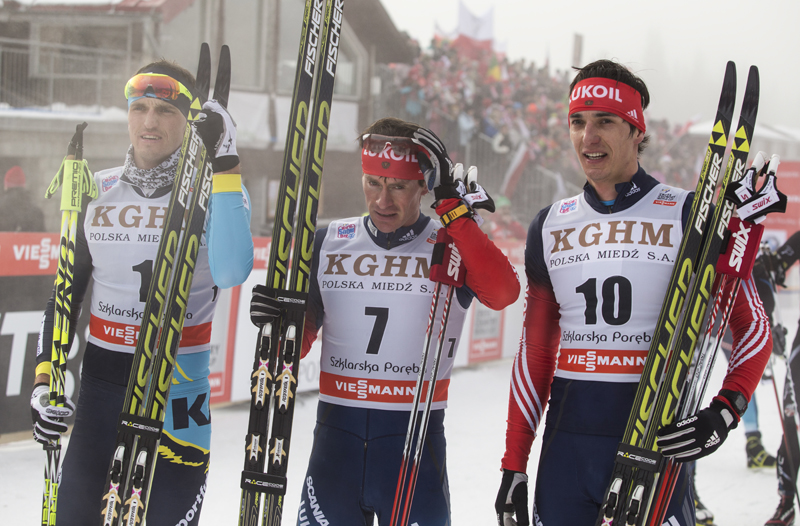
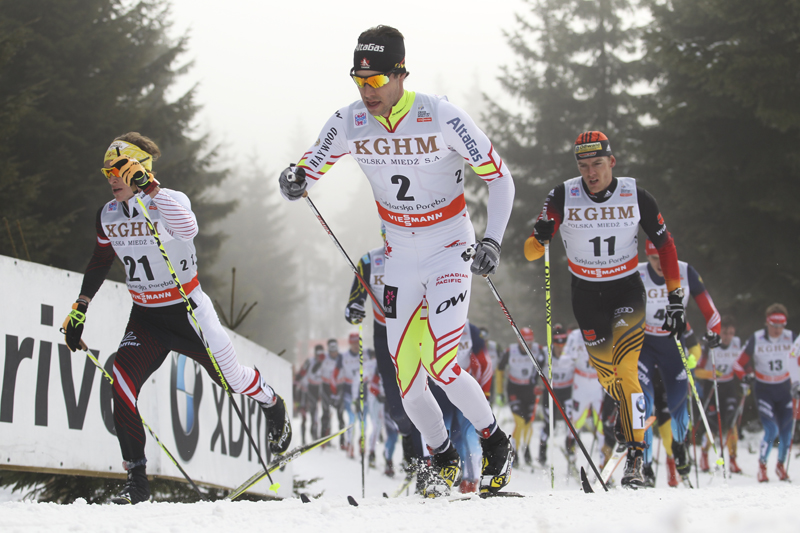
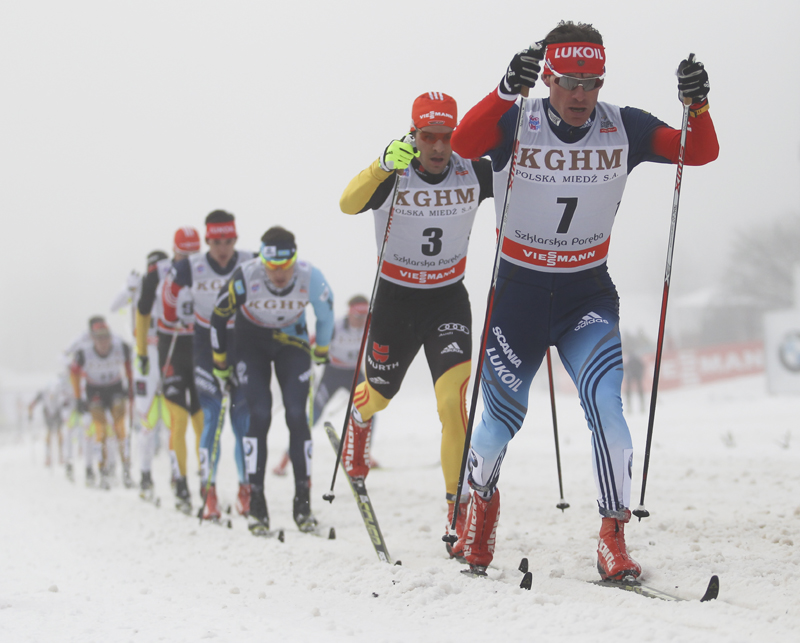
    Russian Maxim Vylezgzhanin leads Hannes Dotzler of Germany in the men’s 15 k mass start in Szklarska Poreba, Poland. Vylegzhanin won the race ahead of teammate Evgeniy Belov. (Photo: Fischer/NordicFocus)

    Fog blanketed the hillsides of Szklarska Poreba, Poland, as the men of the World Cup lined up for the start of the 15 k. In a field that lacked the esteemed Scandinavian racers, the predictions of who might win were about as unclear as the visibility on course. The gun was fired, and the racers were off on the 2.7 k course that they would complete five times. After a slow first three laps, the field started to splinter. Soon as the racers made their way into the finishing stretch, spectators witnessed seven skiers suddenly emerge from the fog: two Russians, a Kazak, a Canadian, and two Germans.

    In the end, it was Russian Maxim Vylegzhanin who claimed the victory with a time of 35:39.0. He was followed by teammate Evgeniy Belov (+2.2) and Alexey Poltoranin of Kazakhstan (+2.3) in second and third. Canadian Alex Harvey finished fourth with 5.2 seconds back, followed by Germans Hannes Dotzler and Tobias Angerer.

    FIS world cup cross-country, mass men, Szklarska Poreba(POL)
    The men’s podium in the 15 k classic mass start: (l-r) Alexey Poltoranin (KAZ), Maxim Vylegzhanin (RUS), and Evgenliy Belo (RUS). (Photo Fischer/NordicFocus)

    The Russians, Canadians, and Germans dominated top ten, with three members from each country all finishing within roughly twenty seconds of each other.

    The race started out at an extremely slow pace and the pack stayed tightly packed together. It wasn’t until bonus points were at stake at the top of the largest climb of the course that the Russians started to push the pace. From there they continued to open up the lead with the Kazak, Canadians, and Germans in pursuit.

    “I planned to go away from the pack in the second last lap. I felt good and confident I could make it,” said Vylegzhanin in a press release.

    Vylegzhanin, who won the team sprint in Nove Mesto, Czech Republic and was part of the victorious Russian relay team in Lillehammer, Norway, has had few World Cup start this year and sat out the Tour de Ski .

    Teammate Belov was pleased with his effort, not only because it was his first podium of the season, but also because of the implications his result carried.

    “It’s been a great day for me. Everything worked just perfect. I had fast skis, my shape was very good,” he said. “It’s my first podium of the season and I am excited it happened today. I just earned my ticket for Sochi.”

    Poltoranin, who gained his fourth podium of the season thought that he could have done better, but was happy with the effort.

    “I hoped for victory. I fought to the finish with Evgeniy (Belov) but he was more powerful,” he said. “Today’s result gives me good energy for the final preparation phase before the Games.”

    FIS world cup cross-country, mass men, Szklarska Poreba(POL)
    Canadian Alex Harvey leads a pack in the men’s 15 k classic mass start in Poland. Harvey would go on to place fourth. (Photo: Fischer/NordicFocus)

    Winner of yesterday’s sprint race, Harvey crossed the line roughly three seconds behind the Kazak. Despite giving it his all in the previous day’s sprint, the 25-year-old felt like he had sufficiently recovered for the 15 k.

    “I felt good in the morning. I like the format. 15 k mass start classic is been something I’ve had a good amount of success in,” Harvey said. “I was pretty psyched for the race today, especially after the race I had yesterday. I knew that [my] recovery was good.”

    The Canadian, who started in second position, skied near the lead for the first three laps on the narrow course. “I was trying to stay in front of the groups and out of trouble, and I did that the whole race,” Harvey said.

    Then in the fourth lap he got pushed back to roughly twentieth position, but stayed determined to hold on to the Russians who had broken away. By the last lap he was speeding by his competition. “I had a really good last lap. I went from the twenties to fourth at the line.”

    Unfortunately for Harvey, he was unable to make contact with the leaders. “I could not follow,” he said of the Russians.

    Coming into this weekend of World Cup racing, Harvey was happy that the success he found at the Tour de Ski continued into this weekend.

    “It was a really good weekend after the [racing at the] Tour de Ski. The tour, in the last four years, has always been a really good trigger for the rest of the season. It’s a really good intensity stimulus and it’s really putting me in a good position for the rest of the season.”

    A key to Harvey’s success this weekend was the break that he took to recuperate after the Tour, that had him skip the World Cup races in Nove Mesto, Czech Republic. This year he spent time in Zermatt, Switzerland for his “mini-vacation” after spending last year’s in Nice, France. “It doesn’t take many days, but it’s good to be in a place where you’re not training but also not thinking too much about training,” he said. “You can really recover and put yourself in a good position after that for the games.”

    Harvey wasn’t the only Canadian to find success in Szklarska Poreba. Devon Kershaw and Ivan Babikov finished eighth and ninth, both roughly 20 seconds behind Vylegzhanin.

    Justin Wadsworth, Canadian Head Coach, was ecstatic that his teams training plan was coming into fruition. After initially worrying that the conditions in Poland may not be up to par, Wadsworth was glad the team had made the trip. “Going into the games this is the trend you are looking for,” he said.

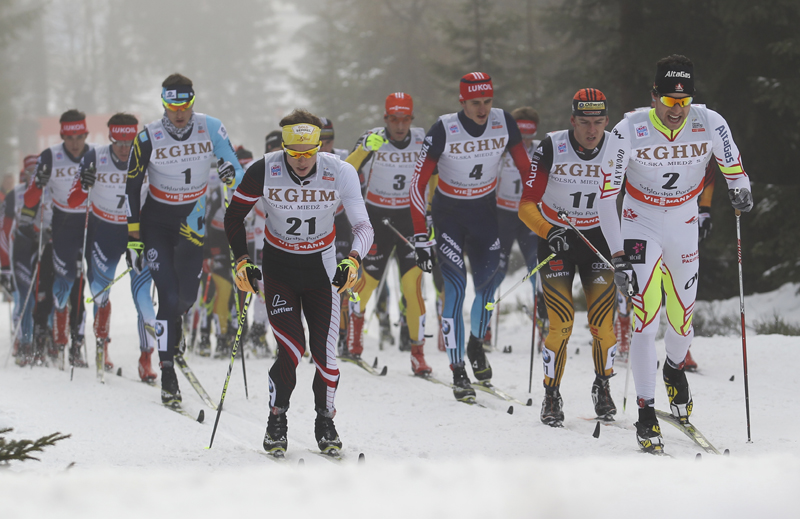
    Austria's Bernhard Tritscher (21) and Canada's Alex Harvey (2) lead the pack in Sunday's 15 k classic mass start in Szklarska Poreba, Poland. (Photo: Fischer/NordicFocus)
    Austria’s Bernhard Tritscher (21) and Canada’s Alex Harvey (2) lead the pack in Sunday’s 15 k classic mass start in Szklarska Poreba, Poland. (Photo: Fischer/NordicFocus)

    Kershaw, who has been frustrated with the majority of his results thus far this season was happy to see himself in the top ten once again after finishing second in the prologue of the Tour de Ski in Oberhof.

    The frustration continued into this weekend after the 31-year-old failed to move past the quarterfinals in Saturday’s 1.5 k sprint, despite feeling close to the best he has felt all season.

    “I was really frustrated with yesterday. I was really boxed out and just couldn’t get around anyone and just ended up finishing my quarterfinal feeling like it was level two. I’m really frustrated because it was a really dirty messy heat that I was in and I was in the wrong end of that.”

    Kershaw said that while he felt much better in the sprint than he did in Sunday’s 15 k, the distance race served as great training and a confidence booster before going to the Olympics.

    Going into the mass start, Kershaw was feeling apprehensive about his classic skiing for “the first time in my career,” he said. Soon the apprehension lifted as skied through the first three laps of the course.

    In the fourth lap, he found himself at the front of the pack with an open track, and decided to go for the bonus points. “Since I had been feeling bad in classic and the pace had been easy I decided that I would try and test my shape and see how as I was doing,” he said.

    While Kershaw was unable to obtain the bonus points, he felt he was going in the right direction. “I’m still not in tiptop form because I was missing a bit on the big steep hill and that’s when the guys got in front of me,” he said. “It’s a good step in the right direction, and the energy was good, and most important to me was that the technique was back to where it should be.”

    Kershaw is feeling optimistic for the Olympics, which will be held in two and a half weeks. “There are may opportunities there (at the Olympics) and I feel better now than I did at the tour so let’s hope it continues in a positive direction.”

    Babikov, who finished just behind Kershaw in ninth, was happy with both his and the Canadian team’s efforts. “As you can see from the results it went really well for the whole team. We all ended up in the top ten. The skis worked well and our team worked well,” he said.

    From Szklaska Poreba the Canadians are headed to Italy for a week and a half to get a last minute training camp in before the Olympics. They leave Poland satisfied with a good weekend of racing.

    “I think the main thing is that the guys are in good shape. The shape of the team is coming together now and that’s been the goal the whole time,” said Wadsworth of his team.

    Results

  • Russia Annihilates in Sochi Team Sprint

    Russia Annihilates in Sochi Team Sprint

    Vylegzhanin
    Maxim Vylegzhanin (RUS) in action last season. In the classic team sprint in Sochi, Russia, on Sunday he anchored Russia to an 18-second win over Sweden and Germany.

    It doesn’t get much more perfect for a team sprint than a bluebird day in the mountains on the same snow that will hold Olympics  one year from now. The outcome doesn’t get much more perfect either, at least for the host country. In the classic team sprint, the final race of the test weekend for the Games, Russia’s first team of Dmitriy Japarov and Maxim Vylegzhanin blasted the field apart to win by 18 seconds over Sweden in second and Germany in third.

    Japarav put his feelings quite simply after Vylegzhanin crossed the finish line with no one in sight: “It feels great to be on the podium on the home soil,” he said. “Maxim did a very good job on his legs and we could build up the gap. It was our plan to go as fast as possible right from the start. I hope we can repeat the same performance also next year at the Olympics.”

    Has a team sprint ever been won by a difference of 18 seconds? If so, Sochi erased all memory of it on Sunday. The field was stunned when Japarav created a gap on the first leg, and even more so when they never relinquished it. Germany led the chase for most of the race and Tobias Angerer expressed his surprise at the decisive early surge.

    “We expected the Russians to be strong but it was surprising to see them go away so early,” he said.

    In another race — a distance event, or even a long an individual sprint — a bold early move might have backfired. Or at least the threat of it backfiring would have left some hope that there was still a chance for something unexpected to happen. Someone might blow up, or a chase group might reel in the break.

    But in a race that gets a reset button every few kilometers, Japarov and Vylegzhanin didn’t give anyone a chance. They know the Sochi terrain better than anyone, and with minutes to recharge in between legs they attacked the course afresh each time with unmatched confidence. The announcers could have called the race after the second round, when Vylegzhanin extended the lead to 20 seconds. Remarkably, both he and Japarov continued to post the fastest course splits even as they skied alone.

    The fight for silver, then, was the only contest left to decide. A small train pulled away from the rest of the field towards the middle of the race, with Germany, Sweden and the U.S. matching each other stride for stride. It wasn’t until the final lap that it broke apart. Andy Newell (USA) lost contact off the back as Emil Joensson (SWE) put on a surge to blow by Angerer. Joensson, currently the men’s World Cup sprint leader, redeemed himself of just missing the sprint heats on Friday to take silver by two seconds over Germany.

    “It was really hard to go uphill but today we had very good skis, which allowed us to take a good grip up the hill,” Joensson said. “I tried to save some energy for the last leg. It is great to be on the podium.”

    Russia’s second team took fourth (+28.08), an unusually fallible Norway finished fifth (+29.13) and Kazakhstan took sixth (+29.74). Newell fell on the last downhill, dropping the U.S. from fourth to seventh (+43.85).

    If it hadn’t felt like hype for the Games had started before, it certainly does now. Even the imagery looked Olympic; the sun came out for the first time all weekend, giving cameras an excuse to dwell on the picturesque Caucasus Mountains in the background as Japarov and Vylegzhanin strode away from the field as if it were standing still.

     Men’s classic team sprint results

  • Ski Where the Euros Do: Favourite Western Canadian Venues

    Ski Where the Euros Do: Favourite Western Canadian Venues

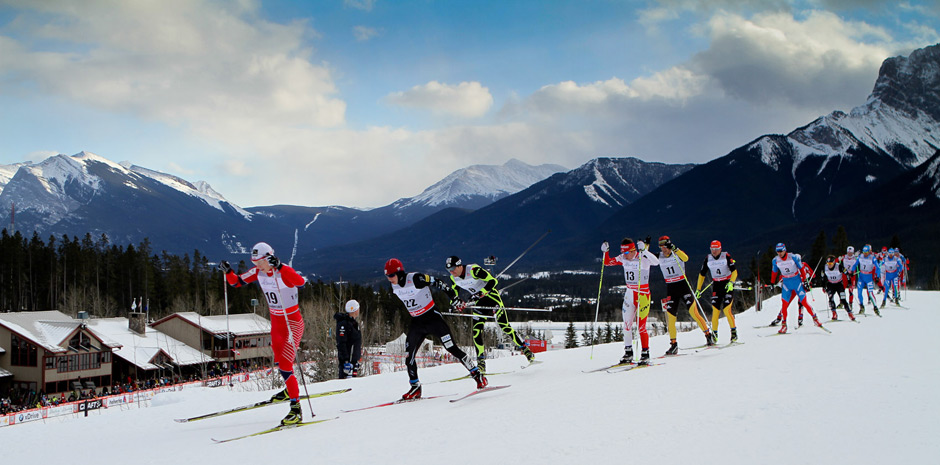
    The view from a higher point at the Canmore Nordic Centre during the 2012 Alberta World Cup, which took place Dec. 13-16 in Canmore, Alberta. It was the area’s fourth World Cup since 2005.

    Note: This article has been corrected to omit the Salt Lake Olympic venue from the list of places that several interviewed skiers haven’t visited. 

    Most skiers dream of skiing like a World Cup racer.

    Okay, one article can’t change your VO2 max, your last eight years of training and your technique. The next best thing is skiing where the WC Euro-stars like to ski. FasterSkier asked a few at the recent World Cup in Canmore, Alberta.

    Here’s what they had to say. It’s worth noting there are almost as many favourite places as there are skiers. Also, assume that everyone loves their hometown and their “home” training centre.

    North America

    There is a lot of what Joran at StatisticalSkier would call selection bias here. All of the favourite venues have hosted WC races. Most of the skiers interviewed aren’t old enough to have skied at Lake Placid, N.Y., or Thunder Bay, Ontario. While Quebec City throws a great party, none of the skiers got to the permanent ski areas outside the city.

    — Kristin Størmer Steira (NOR):

    “I must say Canmore, it is so beautiful although I also raced in Vernon/ Silver Star and that’s a beautiful place, and of course the Olympics in Whistler was great, but this scene with all this beautiful mountains, it is great. … [Canmore] is a great course.”

    — Anna Haag (SWE):

    “It is hard; I really like Canmore. It was the first place I saw in Canada. For sure, it is special. But then Whistler, I have my Olympic medal so that is special. But I like it over here, I like to compete in Canada. … [Sovereign Lake/Silver Star] was really nice. The amount of snow was amazing and I think we had like almost 50 centimeters of snow during the time we were there and the conditions were perfect. [Courses] are really tough over here, especially here in Canmore. I think [Canmore is in] the top three of the toughest course I ever skied, especially with the altitude it gets even more tougher. But they are really nice and they are really fair, and that is really important for competition.”

    — Tobias Angerer (GER):

    “Canmore. I was many times here and I love this area with the nature, with this mountains, and the track is perfect. It is so wide, and yeah, you have place for skiing. It is really good and the atmosphere is really good. I think every year more and more people are coming and the atmosphere is better every year.”

    Sweden’s Jens Eriksson (l) racing to a NorAm 15 k mass start victory on Dec. 8 at the Sovereign Lake Nordic Centre in Vernon, British Columbia. (Eriksson photo: www.teamjens.se)

    — Emil Jönsson (SWE):

    “You can’t be sad when you are here [in Canmore].”

    — Vibeke Skofterud (NOR):

    “That is hard to say. I love Canmore. I love Silver Star; I have been there for one time. To race here in Canmore, it’s amazing. It’s really hard course, but good course, it’s wide, the snow conditions is really good, and the preparation is really good, the training course is good, and we stay at the Radisson [laughs]. The nature is good. I have only positive things to say. Right now, I have to say Canmore, but also Silver Star is a really good place to stay.

    — Jens Eriksson (SWE):
    “The conditions in Canmore was the best I have ever competed in, hard groomed tracks and perfect conditions. … [Sovereign/Silver Star] was just a great place for anyone who loves skiing. It was really a lot of snow in Silver Star and so many nice groomed tracks every day. It was just great and very fun to train and prepare for the World Cup there.

    Europe
    — Angerer:
    “I have many, many favourite places. Davos, maybe. Holmenkollen. Trondheim is a very good track.”

    — Haag:

    “I have a lot of favourites. I think since me and Emil having an apartment in Davos, I think Davos is one of my favourite places in Europe.”

    — Skofterud:

    “Norway is good! Davos is good. I like Kuusamo, because I always race good there. A lot of nice places.”

    — Eriksson:

    “It’s really fun to be part of the World Cup Final in Falun [Sweden].”

    — Steira got carried away and didn’t answer the question, but she did say she is going to Davos to relax before returning home for Christmas.

    General:

    Many skiers were excited about going to Val di Fiemme, Italy, but whether that excitement was for the 2013 Nordic Ski World Championships, the food, the skiing or some combination of these was unclear.

    The Venues:

    — Val di Fiemme:
    The Tour de Ski finishes here, the World Championships are coming for a second visit, and Petra Majdič (SLO) loves the food.
    — Davos:
    Swiss superstar Dario Cologna’s home, and a favourite training area for skiers from Canada, USA, Norway and Sweden.
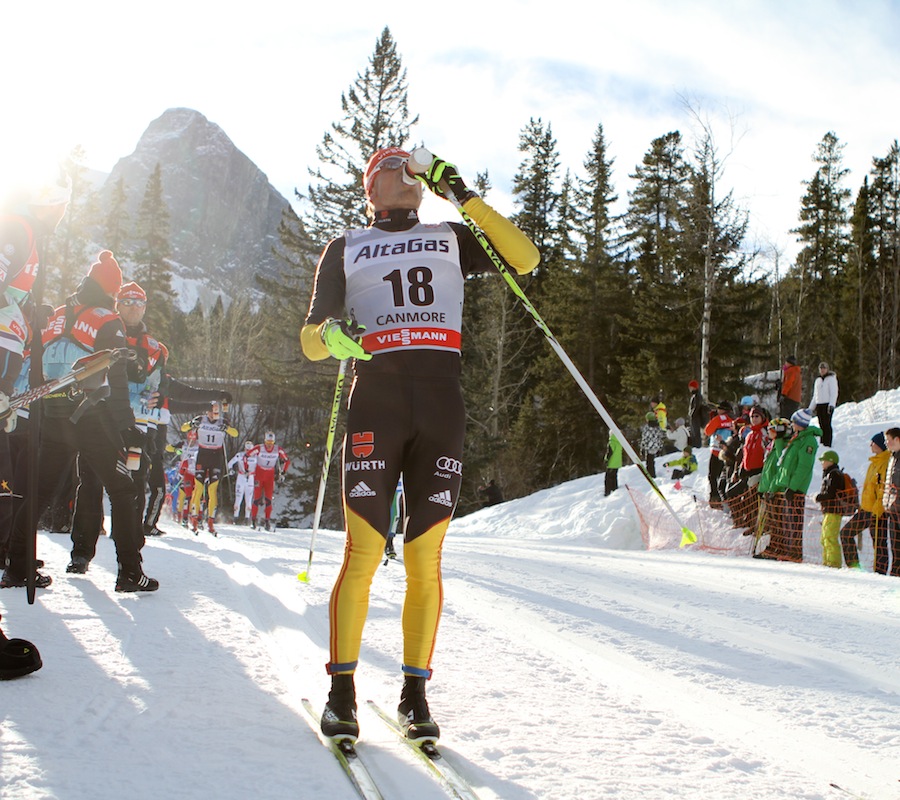
    — Holmenkollen:
    The race trails with ocean views are on Oslo’s mass transit system. The 2,700-kilometer trail system includes Drammen, another world cup venue. More than 100,000 spectators attended the final day of 2011 World Championships.
    — Falun:
    Morderbakken and the World Cup Final. Enough said.
    — Canmore:

    • Elevation: 1,400 meters. Annual snowfall: 2.4 m (8 feet). Trails: 20 k in early season, or ski to the next town (Banff) once the snow starts falling. Season: October 15th to mid-April.
    • Events this year: World Cup, various regional XC and biathlon events.
    • Past Events: 1998 Olympics, 2005 World Cup, 2008 World Cup, 2010 World Cup.
    • Funding: 65% government support, 35% users fees. $925,000 in special grants for 2012 World Cup.
    • Short story: Frozen Thunder opens the new season with leftover snow from the previous winter. The natural snowfall is fairly low, but the largest nordic snowmaking system in the world provides great skiing. The facilities are as spectacular as the scenery: the Alberta government provides funding that other regions can only envy, and that money has been spent well. Accommodation is in Canmore, with the downtown less than 2 k from the stadium.
    • Skiing: The Olympic (classic) 3.75 k loop is brutal, even by World Cup standards. The Centennial (skate) 3.75 k loop is much more flowing and can be enjoyed by middle-aged, middle-speed masters. The descents on both trails are on the challenging side, with no recovery except on the final drop into the finish straight. The recreational trails vary from beginner-friendly to very advanced. By Christmas, it is possible to ski to Banff and catch a bus back.
    At Whistler Olympic Park in April 2009, some of the nordic combined Olympians arrived early at the start line for the Woppet. Claudia Nystad was the women’s winner that year, practicing for her Olympic gold medal. (Photo: Gerry Furseth)

    Whistler Olympic Park:

    • Elevation: 900 m. Annual snowfall: over 4 m (13 feet). Trails: 56 k. Season: Mid-November to mid-April.
    • Events this year: Nationals (cross country, biathlon, nordic combined, ski jumping), Payak, BC Cup.
    • Past Events: 2010 Olympics, 2010 Paralympics, 2009 World Cup, 2008 Nationals.
    • Funding: A mixture of Legacy funding and user fees.
    • Short story: If you want to ski a 50k/30k/15k race without worrying if there will be snow, try the Payak. This is a place with a lot of snow at low elevation, with an average 1.9m snow base by February, and much more in April. The season length is limited more by post-Olympic mandate/funding constraints than snow. Accommodation is at Whistler or Squamish. The 2010 Olympic season was by far the worst snow in the short history of the venue.
    • Skiing: The Olympic loops are fairly easy by WC standards, with easy descents that allow recovery. Despite this, big pack finishes were rare. The Olympic loops flow through many transitions and are fun to ski at easy pace. There are also 42 k of recreational trails.
    Top of the Upper World Cup 5 k in October at Sovereign Lake Nordic Centre. (Photo: Gerry Furseth)

    Sovereign Lake/Silver Star/Vernon:

    • Elevation: 1600 m. Annual snowfall: 7 m (23 feet). Trails: 50 k + 60 k. Season: mid-November to mid-April. There is often a May re-opening for team camps.
    • Events this year: NorAms, BC Cup, Sovereign Lake Loppet.
    • Past Events at Sovereign: 2011 World Masters, 2005 World Cup.
    • Past Events at Silver Star: 1991 World Cup.
    • Funding: Sovereign is a non-profit club: one third season passes, one third day passes, the rest is event fees, fund raising and government grants. Silver Star’s nordic financials are blended in with the resort.
    • Short story: Although appearing as Vernon on the FIS results, this is actually two interconnected trail systems. Vernon is a town of 30,000 people (20 minutes drive and 1200 m below the skiing). Sovereign Lake is a ski club of 1,700 members that hosts races, and Silver Star is a ski resort (alpine, nordic, and village with accommodation). Most visitors buy the dual-area pass and never notice the area borders.
    • Skiing: The 3.75 k World Cup loops used in 2005 are fairly easy, as World Cup trails go, and were designed to be skied by club members between races. The lower (skate) 2.5 k loop and upper (classic) 5 k loop look FIS moderate on the course profile, but feel harder at race pace. Pacing an individual start on the upper 5 k is particularly challenging. Upper world cup 5 k has one challenging hairpin, otherwise descents are easy and allow recovery. The Master’s World’s 15 k loop is very flat and easy skiing. The recreational trails are only hard in the sense that climbing to the viewpoint at 1890m elevation can leave you breathless. Luckily, a dual-area pass includes one chairlift ride to the top viewpoint.
    The view from 1,870 metres at Sovereign Lake on Sunday. (Photo: Gerry Furseth)
  • Magnificant Manificat Takes Win in Dramatic Skiathlon

    Magnificant Manificat Takes Win in Dramatic Skiathlon

    Manificat celebrates his win.

    Coverage of the Alberta World Cup made possible through the generous support of Travel Alberta and Tourism Canmore.

    CANMORE, Alberta — Three days ago Maurice Manificat of France was dragging his black-and-fluorescent yellow-clad body up the famed Canmore “wall,” a death march of a ski race, a French bumblebee without buzz.

    Manificat, seeded fourth in that 15 kilometer mass start, struggled to 44th place, but Sunday brought another race and another chance, and the Frenchman had his wings back, flying by Italian Roland Clara in the homestretch to claim victory in the 30 k skiathlon.

    Challenging Canmore courses and an aggressive field ensured that this race would not play out as so many men’s World Cup races are wont to do — a sprint to the line by a herd of more than 20 skiers.

    Four 3.75-k classic loops up the steepest climbs were followed by the same number of skate loops, on a relatively more rolling course.

    The pack stayed tight for the first loop but the second time up the massive climbs, the field slowly began to string out, an inexorable process that would continue for the bulk of the race.

    Norway leads out of the start.

    Each time through the hills, another handful of skiers slipped off the back. At lap one, the pack was 62 strong. The second time through it was down to 36. Another 3.75 k and it was 32. Halfway through the race, only 26 remained in the hunt.

    While the lead changed frequently, several numbers remained consistently at the front — Sjur Roethe (NOR), who entered the race wearing the red bib of the distance World Cup leader; Jens Filbrich, the veteran German; gangly Russian Evgeny Belov; the ancient Italian Giorgio Di Centa; Ivan Babikov, the Canadian bulldog; and the upstart of the bunch, American Noah Hoffman.

    Hoffman never dropped far from the back, and was often in the top five, taking turns leading. In the classic portion he was aided by skis that he said “might have been the fastest in the field.”

    And while he was “gliding up to the front without really being able to help it,” he entered the day planning to ski at the front of the pack.

    “I’m more comfortable skiing in the top five, especially with the yo-yo effect you get in the back,” Hoffman said.

    He was looking to be aggressive, and stay forward where he could relax.

    Hoffman in second behind Eliassen.

    While the pace was high, Belov and countryman Alexander Bessmertnykh were not content to let the steady attrition continue. On the fourth ascent of the classic loop, the pair attacked, quickly pulling away to a nearly 20-second lead.

    At the transition the lead was down to 12 seconds, and Babikov, switching to his preferred technique, flew through the transition, bridging the gap over the next 200 meters.

    With the new blood in the break, the lead increased slightly to 15 seconds before stabilizing. Hoffman said he wasn’t confident that the trio would come back, but Tobias Angerer (GER) who ended up in fourth, laughed when asked about the bold attempt to open up the race.

    The Russians on the break.

    “It was no problem,” Angerer said, adding that a lead of 15 seconds is not enough to pose a threat. “We had everything under control with the Norwegians.”

    There was no explicit communication among the chasers, but Angerer said there was a clear feeling that “there was no danger.”

    Norway led the charge with Petter Eliassen, Chris Andre Jespersen and Roethe, joined by Hoffman, doing the work. The gap slowly closed down, though Hoffman felt that it had less to do with any increase in speed by the pack and was a more a function of the leaders tiring.

    At the end of the second skate lap, coming down into the stadium, Bessmertnykh crashed on the sweeping right-hand turn, leaving Babikov and Belov to try to hold the gap.

    Babikov, a native Russian, had been in communication with Belov and Bessmertnykh as the three worked together to pull away, coordinating efforts.

    After feeling “so good” in the classic, he pushed hard in the skate, but ran out of legs after two laps. The chasers closed the final distance early in the third loop, absorbing the two leaders.

    Bessmertnykh recovered quickly from his mishap, joining the main group as it came by, but whether he was spent from his early attack, or somehow hindered from the fall, he could not hang, slipping back through the field to finish 29th. Babikov settled back in, looking “to save some energy for the finish,” and recover from the push.

    “I used too much at the beginning of the skating leg,” he said, adding that he was “proud” of his classic leg, usually a weakness.

    Babikov leading the break.

    “That’s good for World Champs, Sochi, [site of the 2014 Olympics]. We have duathlon there, and maybe one of those days I’ll have the legs and be able to take them away,” Babikov said.

    Known for his tenacity, Babikov hung tough, but he was drained from his attack. A weak sprinter, he did not factor into the fight for the podium. He did finish a solid 12th, however, coming across the line in the main group.

    “We wanted Ivan to attack early,” Canadian head coach Justin Wadsworth said. But they “didn’t want it to be that early.”

    The breakaway defeated, the race continued to play out with less drama for the next lap. By the 20-kilometer mark, the pack was down to 18 skiers, a group that would remain in relative contact until the final climbs.

    Hoffman continued to sit toward the front, but was not the only North American battling for position. Both teammate Kris Freeman and Canadian Graham Nishikawa were present, though generally toward the tail end.

    Freeman was right where he wanted to be early on as he worked “to conserve as much energy as possible in the classic,” so he could “really jam in the skate.” In contrast to Hoffman, he would rather be in the slipstream than up front.

    “Hoff doesn’t like skiing in groups so he goes to the front, and I’d much rather be sucked along in the draft,” Freeman explained.

    Seeing Freeman in the top 20 is hardly out of the ordinary, but in recent years he has struggled to do more than just hold on. However, U.S. Ski Team (USST) coach Matt Whitcomb was unsurprised to see Freeman in the mix, saying that the veteran showed up in Canmore with “a totally different energy … you could tell he was ready to pop some races here.”

    The pack, hunting.

    Graham Nishikawa’s performance, on the other hand, was most certainly unexpected, even to himself. While he has cracked the top 30 before, he has never hung with the pack in a World Cup mass start.

    “I kept surprising myself, like oh, made another lap, made another lap,” the Alberta World Cup Academy and Canadian Senior Development skier said. “I was just trying to stay really relaxed and in contact with the leaders and just take one lap at a time.”

    And as the race wound toward its conclusion, he put his “head down and tried to hang in there as long as possible.”

    He crossed in 15th, not losing contact until the final kilometer, and finished just ahead of the likes of Jespersen, Martin Johsnrud Sundby (NOR), and Evgeniy Dementiev (RUS).

    “It was unbelievable,” he said. “I had a career best day in my hometown.”

    Eliassen.

    Back up at the front, the intensity increased as the skiers headed out for the final lap. Eliassen took a chance, pushing on the first climbs out of the stadium, opening a small five-meter gap. He couldn’t get away, with Hoffman doing the initial work of responding.

    “It was time to go so if no one else was, I was gonna try to pick up the pace and get him back on,” Hoffman said.

    He did pay a price, and “suffered a little bit as guys came around,” but he did not slip far.

    During all the excitement of attacks and responses, Clara waited patiently, opting to stay back and catch a ride.

    “Half of the race was, for me, fast training,” the Italian explained after earning his fourth career World Cup podium. “Only the last lap was hard.”

    On the last climb out on the loop, Clara finally played his hand, attacking hard. Only Manificat was able to respond, though Roethe made a valiant effort. The Frenchman said that the pace on the last lap was very high, with “everybody wanting to go ahead.”

    The wide Canmore trails made passing easy, however, and though he was uncertain if he wanted to attack himself, when Clara went, Manificat followed, cognizant of the long descents ahead and the need to get clear.

    “I tried to push and I see that only Maurice can follow me,” Clara said. “In the downhill he passed me, and I stayed on his back and we made a really good race together in the last k.”

    Freeman working in the pack.

    Clara made one more go of breaking away on the final short hill. But at only “50 or 60 meters” he said it wasn’t long enough, and he couldn’t get free.

    The pair swooped into the stadium, Manificat riding the draft, before stepping out and powering by. At that point the outcome was not in doubt. Manificat is the stronger sprinter, and had the slingshot effect.

    “The last few hundred meters to the finish line I come back on him, and then I push,” Manificat said. “It was only in the head, you are so crazy and you know you can win.”

    Clara was not at all disappointed with the outcome, giving Manificat his due.

    “It’s perfect to find again the victory,” Manificat said. “It’s totally different from a simple podium. Every year I make podium but victory is very good to find again.”

    His last win came back in 2010 in Lahti, Finland, also in the 30 k skiathlon.

    Roethe couldn’t quite keep contact, but he did ski clear of the now strung-out field to earn the final podium position and retain the red distance bib. He was followed across the line by Angerer, who couldn’t get clear at the top of the course to respond to the attack.

    “I was behind some skiers and they were too slow for me,” Angerer said. “There I lost the race.

    Hoffman crossed just seconds later in eighth place, easily a career best.

    “In order to win one of these I probably do need to be able to break the field a little because I’m probably not gonna win this final sprint,” Hoffman said. “But today I’m happy to be able to hold the position and stay in the top ten.”

    He added that he was in no place to be part of the final break, saying “I was hurting up there.”

    Angerer and Babikov.

    He didn’t lose any ground in the final 200 meters, an accomplishment in itself.

    “Hoff holding his ground in a sprint? What?” Whitcomb said. “It was absolutely amazing. It is a new skier out there.”

    Freeman had his own strong finish, picking up a spot in the homestretch when he outlunged DiCenta at the line.

    Hoffman was realistic about his result, recognizing a number of top distance skiers were not present, but he recognized the quality of his effort regardless.

    “Not all World Cup fields are created equal…but there are some amazing skiers here…so I’m psyched to be able to ski with them in a 30 k,” Hoffman said.

    “Eighth is sweet, hopefully there’s more to come in the future but I’m psyched right now,” he concluded.

    — Alex Matthews and Gerry Furseth contributed reporting

    Men’s results

    Cornering.
    Podium.
  • Tscharnke Motors to First World Cup Victory, Leads Germans in Canmore

    Tscharnke Motors to First World Cup Victory, Leads Germans in Canmore

    Coverage of the Canmore World Cups was made possible through the generous support of Travel Alberta and Tourism Canmore.

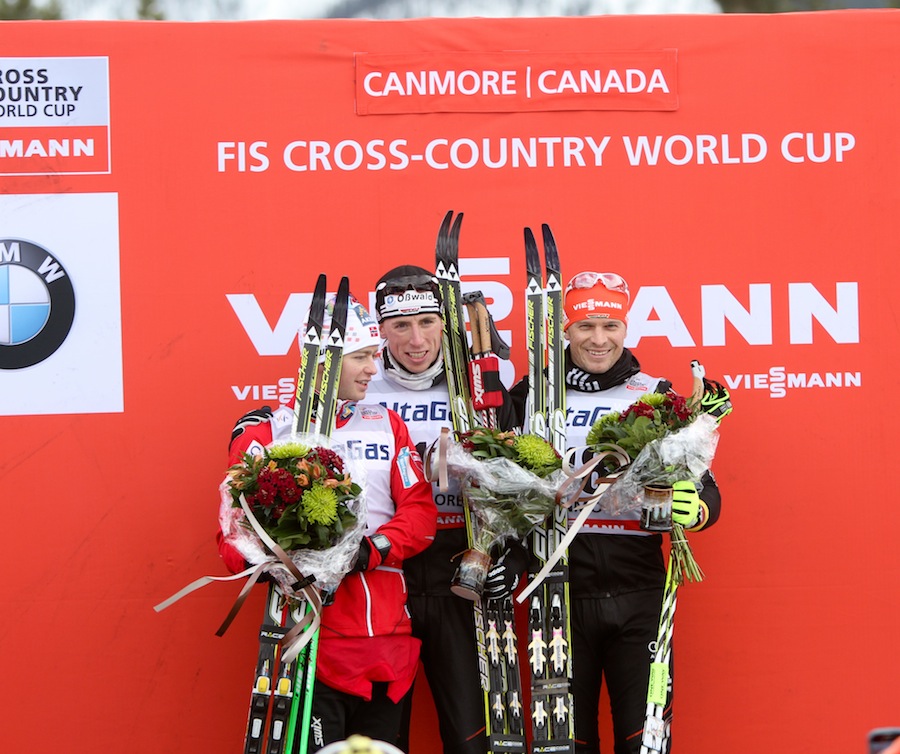
    Germany’s Tim Tscharnke celebrates his 23rd birthday with a World Cup win in Thursday’s 15 k classic mass start in Canmore, Alberta. It was his first individual podium, and he was joined by Sjur Roethe (NOR) in second and teammate Tobias Angerer in third.

    CANMORE, Alberta – Thursday was a good one for Tim Tscharnke before it started. On his 23rd birthday, the German had some basic goals for the men’s 15-kilometer classic mass start, but once he realized how fast his skis were and how good he was feeling, he dug a little deeper.

    Following close behind 35-year-old teammate Tobias Angerer, who last skied in Canmore at the 1997 Junior World Ski Championships (where he tallied two distance top 30s), Tscharnke searched within himself on the last of four laps for something, anything else.

    Tscharnke (GER) sits tight before punching hard near the finish to win the Alberta World Cup 15 k classic mass start Thursday in Canmore.

    “[I] realized I had some more petrol,” Tscharnke said in a press conference.

    The extra gas and timing turned out to be key as Tscharnke skied away on the final climb and held off his contenders on the following flat. He then double poled like crazy down into the stadium, throwing his arms up at the finish and nearly buckling at the knees at his birthday achievement. It was Tscharnke’s first World Cup victory and first individual podium.

    He finished in 41:14.8, considerably slower than most World Cup 15 k courses and a testament to its difficulty at 1,400 meters (4,600 feet) above sea level. Roethe trailed 4.8 seconds behind and notched second for his first World Cup podium. Angerer took third (+5.8), an individual World Cup best (outside of stages) as well.

    Three Germans made the top six, after Hannes Dotzler held his own near the front early in the race and placed sixth (+9.3) behind Russia’s Evgeniy Belov in fourth (+6.2) and Italy’s Giorgio Di Centa in fifth (+8.7).

    Belov, 22, was in the running for the podium before Roethe outsprinted him and Angerer to the line. Di Centa, 40, remained competitive throughout the race in his 227th World Cup start.

    “We were very strong as a team today,” Tscharnke said in a press conference. “We had very good skis.”

    Feeds also worked for the Germans, who appeared to be among the few taking them. Angerer dropped outside the top 15 near the end of the second lap when he took one, and teammate Thomas Bing was vying for the lead before taking a feed just before that.

    A few minutes later, Bing regained his spot behind Norwegian leaders Chris Andre Jespersen and Roethe and next to Emil Jönsson (SWE). Meanwhile, Angerer worked his way to the front and was the second to Belov at the bonus preem at 9.7 k. Angerer took the lead for the final lap as Belov followed, and by the high point of the course, Tscharnke stuck behind his teammate to get in the top three. More than five seconds back with two kilometers to go, Dotzler, Russia’s Andrey Larkov, Di Centa, Roethe and Jespersen tried to catch up.

    Norwegians Sjur Roethe (l) and Chris Andre Jespersen (r) set the pace with Roland Clara (ITA) and Emil Jonsson (SWE) close behind in the first half of the 15 k classic mass start.

    Speed turned out to be on the Germans’ side, as Angerer and Tscharnke sandwiched Belov and dropped him in the final kilometer.

    “The downhills were our friends, not our enemy,” Tscharnke said.

    The chase pack absorbed Belov on the final downhill and Roethe skied around him to catch Angerer before the finish.

    Tscharnke said he “could not have hoped for a better result,” and Angerer said the Germans’ performance, with several taking turns up front, was a must for team morale. Jens Filbrich finished 13th (+31.2), and Bing was ultimately 21st (+1:10.1).

    “Today was the first time this season that we showed everyone that we are in good performance,” Angerer said. “The first two weeks we were a little tired. We trained a lot.

    “For me, I need to get the confidence in the mass starts to see if I can do the right things in the right place,” he added. “Today was good. … [I] wish every World Cup could be here.”

    Roethe echoed the enthusiasm after outsprinting Angerer and Belov to the finish.

    “I have had a few fourth places in the World Cup,” the 24-year-old said. “Finally I reached the podium. A little hard in the first lap, [but the] third and fourth, I felt really good.”

    ***

    Also: Martin Johnsrud Sundby (NOR) in bib No. 1 crashed on a downhill at the end of the first lap and later withdrew from the race. Larkov ended up seventh, Jespersen placed eighth and Jonsson was ninth.

    Alex Harvey led the Canadians in 11th for his best result this season, and Kris Freeman (USA) went from skiing in the top 10 to finishing 14th for his best performance of 2012/2013 as well.

    — Topher Sabot contributed reporting

    ***

    Men’s 15 k classic mass start results

  • Kershaw Charges Home For Rybinsk Freestyle Gold

    Kershaw Charges Home For Rybinsk Freestyle Gold

    Devon Kershaw (CAN) sprints down the homestretch to win the Rybinsk 15 k. Photo: FIscher/Nordic Focus.

    For a World Champion like Devon Kershaw, who has hundreds of World Cup starts to his name, there aren’t many personal bests yet to accomplish 10 years into a career. Yet on Saturday in Rybinsk, Russia, he checked another one off the list: his first official World Cup victory.

    The Canuck skied a smart race in the mass start 15 k freestyle, biding his time in the lead pack and making his move in the final few hundred meters. He passed Ilia Chernousov (RUS) around the final corner in the stadium, putting on a decisive gap and finishing 0.9 seconds ahead of the Russian. Tobias Angerer (GER) took third, +1.6 behind Kershaw.

    As the pack crested the final hill and the finish line approached in the final 500 meters, Kershaw said he made a decision to go for the gold.

    “I got to the top of that last climb in third and I looked around and said ‘I’m going to take this one,” he said in a Cross Country Canada press release.

    Kershaw breaking out the air guitar at the podium ceremony. Photo: Fischer/Nordic Focus.

    “I felt so comfortable today in the pack. I just knew at the top of that hill I was going to win. That is a really good feeling.”

    That confidence was helped, no doubt, by his recent string of World Cup podiums, including a third in the Moscow sprint on Thursday and third in the 15 k classic in Otepaa.

    For Chernousov, his second-place showing was his first podium of the season, and he gave the surprising number of Russian ski fans who turned out for the race a reward for braving the cold.

    The temperature was a barely-legal -19C at the start; the men lined up in the chevron employing various bundling methods to stave off frost bite. Most had a combination of neckwarmers, tape and sunglasses covering their faces, so that no inch of bare skin showed through.

    Angerer’s bronze almost didn’t happen for the Germans, as the team had initially decided not to contest the Rybinsk races due to the frigid temperatures.

    “The coaches changed their mind because the athletes wanted to race here and it proved a right decision,” said Angerer.

    Several top athletes were missing from the lineup on Saturday, including current World Cup leader Dario Cologna (SUI) and Norwegian star Petter Northug.

    This was Kershaw’s tenth World Cup medal, but as it was his first international distance gold, Kershaw was thankful to have finally achieved another standard of skiing success.

    “Since I’ve been in the game a while, I know these days don’t happen every time, so it’s good to be able to savor the victory,” said Kershaw in a phone interview after his historic win.

    The 15 k freestyle, at such a relatively short distance, made for an incredibly close mass start race. Not even the two sprint preems at the 6 k and 11 k marks blew the race open. The difference between the lead pack and the entirety of the field was a small number of skiers that fell off the back, even going into the final lap.

    “The race itself was pretty tactical; the pace wasn’t too bad,” said Kershaw. “I didn’t know before, but I was kind of banking on it being a sprint finish, so I tried to save as much energy as I could in case that happened, and it did.”

    Though he conserved energy, he sat in the top six or so for most of the race. The lead position changed hands frequently, and the Russians made their presence known at the front, their blue suits prevalent in shots of the pack from Eurosport’s broadcast.

    Roland Clara (ITA), Alexander Legkov (RUS), Maurice Manificat (FRA) and Tobias Angerer (GER) were among those who took turns in the top spot, but Kershaw and Harvey consistently skied a few paces behind, biding their time.

    The Canadians’ plan before the race began had been to only go for the sprint preems if they were in a decent position to do so, and when they found themselves in a good spot on the third and fifth laps, they went for it. Alex Harvey (CAN) was third at the 6 k, with Kershaw just a second behind in sixth.

    Close quarters. Photo: Fischer/Nordic Focus.

    By the fifth lap, Kershaw had moved up a few places, and put on a surge for second at the 11 k mark, good for twelve extra points.

    “We all talked before and decided if we were near the front, we’d play into them a bit,” said Kershaw. “It just kind of happened on lap three and five.”

    A group of five skiers finally separated from the group on the final downhill, Kershaw in third and Harvey in fifth. By the time they entered the stadium, Kershaw was in second, setting himself up to slingshot around Chernousov on the final corner before the straightaway.

    As he crossed the line with a clear victory, Kershaw went on one ski and pumped the air in triumph, the long-awaited gold finally his.

    Kershaw was quick to emphasize that the team energy amongst the Canadian men played a big role in his historic finish.

    “It’s so corny to talk about it, but team dynamics matter,” said Kershaw.

    Harvey, who’s had his own share of World Cup success this season, was fifth (+5.5), and skied even with Kershaw throughout the shuffling around in the men’s lead pack. Until the last uphill before the finish, Ivan Babikov was skiing right with the other two Canadians, but got tangled up with another skier and ended up in 17th (+13.6).

    “On the last hill I thought we’d have all three in the top five,” said Canadian National Ski Team head coach Justin Wadsworth.

    Canada’s combined effort this winter has brought them a top-five in every single stop on the World Cup this season, including Tour de Ski stages.

    Kershaw celebrating his victory in Saturday's 15 k freestyle. Photo: Fischer/Nordic Focus.

    “To reach the podium in every World Cup discipline and distance is a pretty powerful message,” said Kershaw. “It is a testament to the work our program has done as a whole, the support team we have in place and the great athletes on our entire men’s and women’s team. The work we have all done together is something that I’m most proud of.”

    Wadsworth agreed. “For the whole team it’s a huge boost,” he said. “It’s a cliché—‘we all win together and lose together’—but everyone on this team is pretty tight. It’s big for the staff, and everyone in Canada, and obviously big for Devon.”

    As the World Cup enters the later part of the winter, Wadsworth noted that his team’s strong results at this point in the year were an improvement from the late-season trend they’d demonstrated in the past.

    “It really gives us some momentum in the last part of the season, which for us has been a stumbling block in the past,” he said. “Hopefully we’ve prepared ourselves for that better.”

    Kershaw now sits in fourth in the overall World Cup standings, only 29 points behind Sweden’s Marcus Hellner, who is not in Rybinsk this weekend.

    Men’s results.

  • Team 6: Germany

    Germany

    2009-2010 Nations Cup Ranking: 6th (4308 pts)

    2010-2011 Nations Cup Ranking: 6th (3017 pts)

    Men: 9th (1468 pts)

    Women: 8th (1549 pts)

    2011/2012 World Cup Team

    Men

    Franz Goering

    Jens Filbrich

    Axel Teichmann

    Tobias Angerer

    Tom Reichelt

    Tim Tscharnke

    Women

    Stefanie Boehler

    Nicole Fessel

    Denise Herrmann

    Hanna Kolb

    Evi Sachenbacher-Stehle

    Katrin Zeller


    What You May Have Missed Last Season

    We’re just going to come right out and say it; the German team sucked last season – a lot. The Germans secured just one individual World Cup medal last season, and that came from Nicole Fessel, who secured a silver in the 10 k freestyle handicap start during the mini-tour in Kuusamo, Finland.

    The highest ranked German male in the Crystal Globe chase? Jens Filbrich was 26th, and now that ‘Fibser’, as he is affectionately known, is 33 and now entering his 12th World Cup season, don’t expect much more. Perennial German powerhouses Tobias Angerer and Axel Teichmann had abysmal years, finishing 41st and 49th respectively.

    Axel Teichmann racing in Otepaa, Estonia last winter.

    A lot of that can be attributed to the German abandonment en masse of the Tour de Ski due to illness, as Zeller was the only one of eight women to make it, and Filbrich and Reichelt were the only two of the 12 men who started to see the finish line.

    Fine, so the Germans got really sick during the Tour. But a closer look reveals that the Germans weren’t exactly lighting the trails on fire pre- or post-Tour either.

    Angerer failed to crack the top 20 before the Tour de Ski, and managed one top 10 all season, not including World Championships. His only win came in the 15 classic at his own National Championships!

    We can only imagine that joining Angerer in Head Coach Jochen Behle’s doghouse is the goatee’d wonder Axel Teichmann. He had his worst points total in ten seasons on the World Cup, finishing in the top five just once before the bronze medal in the relay at World Championships, and ending his season after Oslo.

    So if the Germans were that bad, how did they finish sixth? It was scoring World Cup points by committee for the red, yellow, and black suits, as 13 men and seven women chipped in.

    Tim Tscharnke and Tom Reichelt are the only two German men who met or exceeded expectations last season. Somewhat frustratingly, Tscharnke turned himself from a pure sprint specialist into a middling all-around skier  – probably good for his long-term prospects, but doing nothing for the Germans in the sprint arena right now, where they are desperately lacking a heavyweight male presence.

    What You Need To Know for This Season

    German men are in a hard place – the old guard is under-performing, and the young guns are still just a touch too young.

    At 34 and 32 years of age respectively, it’s not that Angerer and Teichmann are done, and there is no way they can be as bad as last season, but they are just no longer in the elite on the World Cup, and Germany is in deep trouble because of it.

    There is also a split in the team, as Filbrich, Angerer and Teichmann have created their own self-directed training group. All three have signed on to ski until 2014, which if they ski like they did last season, is not necessarily good thing.

    Lucia Anger on her way to winning the World Junior Championship classic sprint in Otepaa, Estonia

    If you’re a German woman, you’re also in the hot seat. While Katrin Zeller and Nicole Fessel were both pleasant surprises, the depth dropped off precipitously in 2010-2011.

    Sachenbacher-Stehle is on the downswing of her career, as is Stefanie Boehler, and neither should be expected to produce much – although after a summer of off-road rollerskiing, maybe Sachenbacher-Stehle will be a powerhouse.

    But the exciting young talent is coming, but it might still be a few years away. Specifically Hanna Kolb and Lucia Anger (the 2011 Otepaa World Junior Sprint Champion) are exciting young talent, but the sprint specialists are both are just 20 years old and lacking experience – they have just 11 World Cup starts between them.

    The Germans are jealous of their Scandinavian competitors and their waxing trucks, and hope to pick one up for the 2011-2012 season.

    Speaking of vehicles, the Germans may have the best sponsorship deal on the circuit, as Audi has apparently delivered over 100 vehicles to the team for the season.

    The Germans also should be careful – in a recent interview Jurg Capol expressed his dissatisfaction with the atmosphere during the Oberhof Tour de Ski stop, and seeing as their southern neighbors the Swiss have designs on Tour de Ski stages and finished just 200 points behind the Germans in the Nation’s Cup…

    Markus Weeger (GER) on his way to gold in the men's 20 k pursuit, 2011 World Junior Championships

    Who You Should Watch

    Markus Weeger seems to be well on his way to stardom, winning the 20 k pursuit and finishing second in the 10 k freestyle at World Junior Championships in Otepaa, as well as being a crucial part of the fourth place finishing relay team.

    And he must know it – he’s already put together a slick website.

  • With Speed and Swagger, Northug Anchors Norwegians to Gold

    With Speed and Swagger, Northug Anchors Norwegians to Gold

    Norway celebrates relay gold.

    Martin Johnsrud Sundby and Eldar Roenning, the first two skiers for Norway’s 4x10km relay team sat in the Photo Press Center, eyes glued to one of the many television screens, watching the race unfold.

    The tension was high – no laughing or joking, not even a smile. Tord Asle Gjerdalen was on track for Norway, and he, along with Sweden’s Anders Soedergren, had just been reeled in by the chase pack. The race was now wide open with any of six teams in line for three medal spots.

    Twenty-six thousand Norwegian fans in the stadium, and an uncountable mass on the trails shared their nervousness. It may have been too much to hope for a clean break early, but one misstep at this point, and not just the gold, but silver and bronze could slip quickly away.

    The race gets under way – heading up to Midstubakken.

    Forty minutes later, the seats in front of the TV were empty, Johnsrud Sundby and Roenning now waiting in the finish area for anchor Petter Northug. The fears were for naught as the last ten kilometers of the race played out as though specifically choreographed for a Northug-led Norwegian victory.

    In what is considered the most prestigious race at any Championship event, Northug threw down what has become his classic move – waiting until the last climb around the back of the stadium to hit the accelerator.

    He attacked over the top, instantly opening a five meter gap on Sweden’s Marcus Hellner, and pulling away as he entered the homestretch, plenty of time to pull out a vintage 2007 Northug move, imitating Alex Harvey’s shushing of the crowd before stopping suddenly just before the line and waiting for Hellner, stepping over and claiming victory with the Swede just meters away.

    Tobias Angerer brought home the German team in third, the first medal of the Championships for Deutschland, and something of an upset.

    Rickardsson leads Vylegzhanin, and Johnsrud Sundby at 5.5km.

    The early part of the race played out exactly as expected. Big Daniel Rickardsson (SWE) set the pace from the get go, pushing hard. Just eight minutes into the race, hairline fractures began to appear in the pack, small cracks that quickly widened to substantial fissures.

    Halfway through the first leg, the big three of Sweden, Norway and Russia held a six second gap on the chasers, a margin that more than doubled on the climbs up the Midstubakken. The leaders looked strong and controlled, but the rest of the field had broken – faces twisted in pain, they struggled over the top of the climb.

    The gap continued to widen clearing the 30 second mark. The crowd, however, was riveted on the front – Sundby had broken, and Rickardsson and Russian Maxim Vylegzhanin pulled away on the final climbs up above the stadium. First seven seconds, then 12 – by the first exchange Sundby was a full twenty-two seconds back, a mere six seconds ahead of the chasers.

    “It was one Swede and one Russian who tried to kill me out there,” Sundby said of the hearty beating handed to him. “It was a tough race and I really had to try to do some damage control.”

    Sundby said he felt great during the warm-up, but he lost his legs much earlier than expected. “It was awful for me today,” he said, noting that he had excellent skis and that a relay scramble leg hasn’t gone so badly in several years.

    “I felt in control all the time,” Rickardsson said, though he couldn’t say as much for his ability to recall his race. He insisted that it was Roenning skiing for Norway, and claimed he put 20 seconds on the Russians as opposed to the Norwegians.

    Roenning heads out on the hunt.

    When the second-leg skiers took over, the big question was whether Eldar Roenning would be able to ski Norway back into the thick of things. And the answer was yes: while Johan Olsson of Sweden and Stanislav Volzhentsev skied fast, Roenning skied faster, and was able to catch onto them.

    “I saw that he took in a lot of time just in the beginning, and then I held him off for a little while, but then he came and I needed a little bit of rest from my pace,” Olsson said. “So I tried to recover so I had some extra power when he tried to push at the end. It was a little bit tactical, which was a little bit unusual for the second leg.”

    For his part, Roenning said that he knew he shouldn’t try to catch the leaders immediately.

    “It was twenty seconds or something, and I was telling myself that I am in good shape and I would not take a chance to rush out and take in two kilometers,” he said in a press conference. “I wanted to use the first lap… [after I closed the gap] I didn’t know what would happen.”

    Sundby was relieved when his teammate regained the lead, saying that he “could only hope that Eldar would have the best day of his life.”

    Roenning thought that Olsson would make a move as the second lap came to a close. But instead, the two skied to the finish together, dropping Volzhentsev along the way. When asked whether he felt he was lucky that Olsson didn’t increase the speed, Roenning laughed.

    “I don’t think I was lucky, I think I was better than them,” he said.

    The gap is almost closed – Roenning made up the remaining distance over the next 300 meters.

    By the time they reached the tag zone, the Russians, who had looked so strong just one leg earlier, were now only a few seconds ahead of the chase pack, which included Germany, Finland, Italy, and Japan.

    Anders Soedergren of Sweden and Tord Asle Gjerdalen of Norway were the first skiers to embark on the third leg.

    “[Gjerdalen] would not give a millimeter in the lead,” Soedergren said. “I knew I had to do the job by myself from the beginning.”

    He didn’t seem pleased with Gjerdalen’s stinginess, but the Norwegian said he should have seen it coming.

    “When you have [Petter Northug] on the last leg there is no need to keep up the speed,” Gjerdalen said in a press conference. “It is only to follow the other guys. It is quite an easy tactic.”

    Perhaps partly because Gjerdalen refused to push the pace or help Soedergren, the pair was caught by a chase pack that included teams from Finland, Italy, Japan, Germany and, temporarily, Russia.

    Alexander Legkov had quickly caught the leading Scandinavians, to nobody’s surprise. Legkov has had a stellar season so far; he has won the World Cup mini-tour in Kuusamo, Finland, and stood on the podium a few more times, including as part of the Russians’ second-place relay teams in Gallivare, Sweden and La Clusaz, France.

    Roenning leads Olsson and Volzhentsev in to the stadium 7.5km into the the second leg.

    But after chasing hard, he imploded, losing over a minute and a half to the leaders and dealing his team, which had been favored for a medal, a blow from which they could not recover.

    The pack back together on the third leg.

    With two kilometers to go on the third leg, the least familiar face in the pack made a move. It was Juha Lallukka of Finland, who despite being 31 years old has entered just six Olympic and World Championships races in his career. Since his debut in 2002 he has 23 World Cup starts to his name, and attended only two weekends on the circuit this year.

    “He’s a skating specialist who is only doing skating races,” Finnish head coach Magnar Dalen told FasterSkier. “He has had a very good season and his last entry for us was in La Clusaz, where he was in the relay and skied a very very good, very solid leg. I know that he is in shape, and that he can be very good on his best day. So it was not a very big surprise.”

    Lallukka handed off to teammate Matti Heikkinen with a three second lead over Italy – Roland Clara having been the only one able to even stay close to the Finn – while favorites Norway and Sweden were more than ten seconds behind.

    His move shattered the pack.

    “It was really hard the last two kilometers,” said Franz Goering of Germany. “I really just hoped I could give [Tobias Angerer] a chance for the medals.”

    Lallukka’s work turned out to be for naught. Heikkinen and Piller Cottrer went out together, but they weren’t away for long. Led by Hellner, the three chasers were quickly back in contact.

    Heikkinen leads out at the start of the anchor leg.

    None of the nations had any interest in doing any work for the first half of the leg. But with every kilometer the group traveled closer to the finish, the more the scales were tipping in favor of Northug and Hellner, the best sprinters in the field, who were lurking patiently at the back.

    “Nobody wanted to go hard on the first kilometers—it was pretty easy,” Hellner said.

    Finally, as the men headed out on their second of two five-kilometer loops, Piller Cottrer went to the front.

    A 38-year-old veteran, Piller Cottrer is a multiple Olympic medalist, but his speed is no match for Hellner or Northug in the closing kilometers.

    “I tried to push hard the whole 10 k, because I was the only one that wanted to stay alone in front, and not waiting [for] the finish line…I did everything I could,” he said. “Everyone was saving energy behind me, especially Angerer—hitting my skis and poles all the time.”

    Heikkinen, the winner of the 15 k classic on Tuesday, also had an interest in pushing the relay pace in the closing kilometers, but he said afterwards that his legs weren’t as snappy as they were earlier in the week.

    Hellner, Northug and Angerer set about tracking down the medals.

    “My plan was to go, but I was not strong enough today,” he said. “The body was not working perfect, and that’s why I was not strong enough in the last one-and-a-half kilometers.”

    After swinging back and forth around the stadium, the relay course’s closing kilometers sent the men in front of the crowd one last time, before dropping them down to the base of the Gratishaugen—the same hill where Hellner had launched his race-winning attack in the individual sprint earlier in the championships.

    In fact, Hellner’s performance on the climb was so impressive that locals had renamed it the “Hellnerbakken”—Hellner’s hill.

    He and Northug had pushed through the stadium and into the descent, and the two came into the climb side-by-side—a perfect time for Hellner to make another move. This time, though, Hellner said he was waiting.

    “My tactic was not to go so hard in that hill, and instead wait a little bit longer until the last uphill before the finish,” he said. (Afterwards, Northug said that if Hellner really wanted the hill to keep its new name, “he’s going to have to attack harder than that.”)

    Still, he and Northug were going hard—hard enough that only Angerer, the German, could stay with them. The three crested the Gratishaugen together; on the next flat stretch, Angerer put in a token attack, but nothing came of it.

    Afterwards, Hellner said that he’d been “a little surprised” that none of the other men had made a move earlier, since “they know that Petter is the dangerous one—and maybe me also.”

    But Piller Cottrer had already done his best, Heikkinen was having an off day, and Angerer said that he never had an opening—though he said afterward that he still didn’t think Northug is invincible.

    Killer Piller leading the way with 5k to go.

    “It’s difficult. But…Marcus beat him last week in the sprint, so it’s possible, and [Canadian Alex] Harvey did the same in Drammen two weeks ago,” Angerer said. “I wanted to go, but I was behind Petter and Marcus and had not a chance, and not a place to attack.”

    Northug has lost in plenty of sprints, but the number of times he’s been beaten in a drag race at the end of a distance race can be counted on one hand. So long as he’s still in contact with the leaders in the closing kilometers, there’s no one better.

    “When I have my tools and my skis with me, and it’s two kilometers left, I always have a good feeling,” he said.

    With 26,000 fans cheering him on in the stadium, there was only one thing left for Northug to do: shift into the gear that makes him “the best man, the best skier in the world,” as Gjerdalen put it.

    The acceleration, up the last small climb to a knoll running perpendicular to the homestretch, was textbook Northug: fluid and ferocious with crisp technique, each stride inching him away from the chasers.

    Hellner had nothing, Angerer had even less, and by the time Northug took the righthand turn to descend the small hill into the homestretch, he’d opened a lead of 15 meters. It wasn’t enough of a gap to repeat Marit Bjoergen’s flag-waving heroics from Thursday, but it did give him time for a couple of gestures.

    Piller Cottrer and Angerer setting the pace. Angerer is either trying to incite Petter with a monkey imitation, or he is adjusting his bib.

    First, as he entered the home stretch, he raised a finger to his lips to quiet the crowd. And then, just before crossing the line, he snowplowed to a stop, sliding his skis parallel to the finish as Hellner approached, before finally pushing across, into the arms of his teammates.

    Northug’s antics sent a predictable spasm through the journalists assembled at the finish—it seemed like every other finisher was polled on his response to the move. Heikkinen was diplomatic—“every person acts, and takes those results, [their] own way”—Soedergren was unperturbed—“he had a chance to do it in front of the home nation, and why not?”—and while Hellner was initially irritated, calling the move “typical of Petter—a little arrogant,” he said that he had bigger concerns than the gesture.

    More aggravating, Hellner said, is “that I lost the battle, and I didn’t make the gold.”

    “It doesn’t affect me what he is doing [at] the finish line,” he said. “We congratulated him that he was so good today, and we will go home and train and beat him next year.”

    Results

    Northug shushes the crowd.
    Petter slams on the brakes before crossing the line.
  • TDS Preview: Bauer Looks to Defend Title, North America Starts Five

    The 2010/2011 Veissmann Tour de Ski is nothing if not draining. Consisting of eight events in ten days in two countries, the fifth edition begins December 31st and runs until January 9th.

    The Tour begins with a freestyle prologue in Oberhof, Germany, on December 31st, followed by a classic pursuit start on January 1st. The Tour then moves to Oberstorf, Germany, for a sprint on January 2nd, and a pursuit on the 3rd.

    After a two day break, the Tour resumes in Toblach, Italy, for a sprint on January 5th and a point-to-point pursuit start from Cortina to Toblach on the 6th.

    The Tour de Ski wraps up in Val di Fiemme, Italy, as the Italians host a 10/15 k on January 8th, and then the final climb up Alpe Cermis on the 9th.

    The Favorites

    In the fifth edition of the event, all three top male finishers from last season are expected to contend. Lukas Bauer (CZE), Petter Northug Jr. (NOR) and Dario Cologna (SUI) are all registered, and while two have started the season quickly, the third – Northug – has only four World Cup starts to the season, having fallen ill just before the opener.

    The Czech Republic's Lukas Bauer racing at the 2010 Olympic Games.

    Bauer has come out swinging – the aging Czech distance specialist sits in seventh in the overall rankings, and has already collected two podium finishes, including a stage win in Kuusamo, Finland. He has finished in the top 30 in every distance race he has started (his one sprint wasn’t great, as he finished 104th, a full ten seconds away from qualifying).

    Given his hot start, the fact that he is the defending and two-time Tour de Ski champion (2007/2008 and 2009/2010), Bauer is undeniably the favorite.  While his utter lack of sprint skill is disconcerting, he has shown in the past that it is irrelevant, as in the two sprints on the Tour last year, he finished 54th and 60th. But Bauer recognizes that sprinting is still important – he has put extra time into improving his speed over the summer, and should be aiming to limit the damage during the two sprint stages.

    After Bauer, Switzerland’s Dario Cologna is a must-watch. In his short four year World Cup career, Cologna has already won the World Cup overall, the Tour de Ski (2008/2009), and currently sits in second in the overall standings, a mere 22 points from the lead.

    Cologna is dangerous because he is a true all-around skier, and more importantly, is extremely consistent. The last time Cologna finished outside of the top 30 on the World Cup was over a year ago, on December 12, 2009, in Davos. He has already stood on the World Cup podium three times this season, including a second place finish in the Kuusamo mini-tour, and a third place in the freestyle sprint in his hometown of Davos.

    Despite finishing runner-up to Bauer in last years’ Tour, winning the 2009/2010 Crystal Globe, and being the most recognizable cross country ski name on the planet, Petter Northug has to be considered a bit of a dark horse. The dynamic Norwegian is just bouncing back from illness, and his absence from the early World Cup has put him in a large hole in the overall standings, as he sits in 18th.

    Dario Cologna celebrating a victory at the Olympics

    While Bauer is the distance workhorse, and Cologna is the all-around consistent performer, Northug is the sparkplug. Love him or hate him, the Norwegian is without a doubt one of the most talented and entertaining skiers on the circuit.

    The question will be his health, and whether he has returned to his world-beating form. Over the last two World Cup weekends, Northug has done well, but not outstanding. The real concern should be with his famed sprint speed – his failure to win a sprint finish in the 30 k freestyle at the La Clusaz World Cup combined with his 28th place sprint in Davos the weekend before shows that his sprint is not where it has been in the past.

    Northug may need a few extra races to get back to where he needs to be, as it is inconceivable that a skier of his talent will be held down for long. Expect him to speed up over the course of the Tour, and a podium finish is completely realistic.

    The Chasers

    While most of the buzz is about the top three finishers from last year, both the Russians and the Swedes also have strong contingents hitting the start line.

    The Russians have nine men starting, headlined by Alexander Legkov and Maxim Vylegzhanin. Legkov currently sits atop the World Cup overall, and much like Bauer he is a sub-par sprinter, but an excellent stage racer.

    Winner of the Kuusamo mini-tour and runner-up in 2006/2007 Tour de Ski, Legkov has the potential to gut out a victory, as he has the tools to distance ski as well as almost anyone, and won’t lose much time in the sprints. The only area for concern is his Tour de Ski record in the past three years, as he has finished 20th, 33rd and failed to complete the event since his second place in 2006/2007.

    Legkov and Bauer.

    Maxim Vylegzhanin is ranked third in the overall behind Cologna and Legkov, and as one would expect, has had great start to the season. He has finished in the top 15 six times, including fifth in the Kuusamo mini-tour, and besting Northug in the 30 k freestyle in La Clusaz, which certainly bodes well. He has a decent record on the Tour (21, 15, DNF), but just can’t seem to make the breakthrough to finish in the top 10.

    The only surprise for the Russians is that 20 year old phenom Petr Sedov, who is currently 8th overall, will not be starting.

    The Swedes are bringing seven men to the party, and  could easily capture at the very least a couple of stage victories.

    Emil Joensson is the current world cup sprint leader, and is currently fifth in the overall. He is practically a lock to make the podium in both sprints, and he can ski a mean 10 or 15 k, especially classic. Unfortunately for Joensson, as the Tour goes on, his distance racing will be sorely tested, and he simply lacks the ability to compete in the longer events, so it is unlikely he will be able to contend for a podium spot in the final races.

    However, his team mate Marcus Hellner, who is fourth overall in the World Cup ranking has a much better shot. Often billed as Northug’s biggest rival, but not quite at the same level, Hellner started out the season strong with a home town win in Gallivaere, Sweden, but has been inconsistent since then, finishing fourth in Kuusamo, 33rd in the 15 k classic in Davos, seventh in the sprint, and finally 29th in the 30 k freestyle in La Clusaz.

    In the 2009/2010 Tour de Ski, Hellner was saddled with the wooden medal despite having a very strong final climb. To stay in contention for the podium, Hellner will have to avoid the inconsistent distance days, and if he is close going into Alpe Cermis, his strong skate climbing means he can pick up a few spots.

    Other strong Swedes include Daniel Rickardsson, a very good all around skier who will be in a position to crack the top 10, Johan Olsson, who hasn’t raced a World Cup since finishing 7th overall in Kuusamo, and the tough-as-nails Anders Soedergren.

    Sweden’s Scandinavian counterparts, Finland, lack a real shot at the Tour overall. Sami Jauhojaervi is their best hope, as he is ranked 19th overall, and has had success on the Tour previously, but his horrendously inconsistent skiing (think two top 10’s, and three races 50’s or higher) will prevent him from being a true challenger. Matti Heikkinen gets the nod as well, but like Jauhojaervi lacks the staying power required for the lengthy event.

    While the event is on home turf for both the Germans and the Italians, neither country has a skier competitive enough at the moment to challenge the top group.

    Seven Italians are pegged to start, including Giorgio di Centa, and on-form sprinters Fulvio Scola and Renato Pasini.

    Meanwhile, the Germans have only two men currently in the top 40 in the overall World Cup standings, but 13 men will start. Surprisingly Jens Filbrich and Tim Tscharnke are the two highest ranked German skiers, while stalwarts Axel Teichmann and Tobias Angerer are 46th and 58th respectively, and both will have to demonstrate a lot better form than they have thus far on the World Cup.

    North American Contenders

    This edition of the Tour will see five North American men fighting for position – and all five men bring their own unique set of skills to the event.

    American’s Andy Newell and Kris Freeman will both take to the start line, and will hope to continue the good early-season World Cup results with top results, regardless of stage. Freeman has jumped out to the best start of his World Cup career, and sits in 13th place Overall, as a result of collecting points in each of his World Cup starts thus far.

    Newell has had a decent start as he sits in 31st in overall on the back of his strong sprinting, in which he has earned points in all three of the sprints thus far on the circuit.

    Newell

    Both men have been typecast as specialists – Newell in sprinting, and Freeman in distance racing. However, both skiers have been working hard on diversifying their skiing, and have a bet running over who will score World Cup points first – Freeman in a sprint, or Newell in a distance race.

    The biggest question mark surrounding Newell is whether he will be able to distance race well enough to stay in contention.

    “I’m pretty excited to have a bunch of opportunities to do some distance races,” he said, “because I know I’m in good shape and I can distance race really fast — I just haven’t had the chance to show it.”

    Newell knows he has strengths and weakness in distance racing; “I know I’m a good mass start skier for sure,” he said.

    “I can ski well in packs but at the same time it’s like any time in a mass start race – you run the risk of blowing up,” he said, “It can be sometimes easier for sprinters like myself [to blow up] as you can build up so much lactic acid.”

    Both Freeman and Newell are relatively new to the Tour de Ski. Freeman has never competed in the event before, and Newell he completed three races last year before bowing out, and he felt that he has not gotten “a true Tour experience.”

    Regardless, Newell is going in confident; “I feel like I can be good at back to back to back races,” he said, “I think I’ve trained enough over the year that’s something I’ve gotten a lot better at.”

    Like many other racers on the Tour, Newell is targeting consistency, and is thinking about having good races each stage, rather than focusing on finishing as his end goal.

    While both Americans are working on their weaker race types, the best bet for top performances are their bread and butter events – the skate sprint for Newell, and something 15 k or longer for Freeman. It is difficult to imagine either skier truly contending for a place on the overall podium, but top 30 finish is a completely reasonable expectation.

    “Hopefully I’ll be able to hang in there for some distance races and score some distance races,” said Newell, “I’m going to need to score some bonus seconds in sprints [to have a chance in the overall standing].”

    The Canadian contingent showcases an all-around skier just coming into his prime, a young gun with loads of potential, and one of the best climbers on the circuit. Devon Kershaw, Alex Harvey and Ivan Babikov are all world class talent who had excellent results on the Tour de Ski last season, and look to build on that success. In charge of the three skiers is Head Coach Justin Wadsworth – a rookie on the Tour de Ski.

    “I think I’m pretty well organized,” said Wadsworth in an interview with FasterSkier, “and that’s key for keeping the nerves down.”

    While he has never been involved with the Tour before, Wadsworth is confident – he has been to all the World Cup venues before, and the three skiers he is in charge of will be well served. The Canadians have a large staff of five wax technicians as well as a massage therapist, the legendary ‘Wolfman’.

    Wadsworth is confident in his athletes ability to make the most of the Tour, and emphasized that Kershaw and Harvey have a shot in every stage, while Babikov will be able to take advantage of the difficulty of the last three stages, as he will be getting fitter every race.

    Kershaw going "freaking hard" at the 2010 Olympics
    Kershaw

    After one of the hottest starts of his career, in which he has consistently skied in the top 30 while hitting a few top 10 finishes, Kershaw is hitting his stride as an all-around skier.

    While he appears to be in form, and he is happy with how things went, Kershaw is still cautious about the event.

    “The Tour de Ski is completely different [from the rest of the World Cup season],” said Kershaw in a recent interview with FasterSkier, “a whole lot of things have to go right.”

    For Kershaw, having one or two really good days would make for a successful Tour, but his real ambition for the Tour de Ski is unrelated to results.

    “To be honest, the only big goal is to stay healthy,” he said, “Over the different Tours, we’ve had a lot of illness on the team, and I’ve been lucky to avoid it for the most part.”

    If he stays healthy, Kershaw has proven that he can race well in the Tour format. Last year he finished 16th in the event, benefitting from good sprinting, as well as six top 30 finishes.

    While he has traditionally had strong results in Tour de Ski sprints, including a podium, this year Kershaw isn’t so focused on the sprint.

    “The sprints are long days, and I don’t know how important they are in the overall,” he said. “[Lukas] Bauer won the Tour last year without ever qualifying for a sprint

    Unfortunately for Kershaw, his favorite and best event, the 10 k classic, has been eliminated from the Tour this year. As a result, he’s keeping his eye out for the 20 k pursuit in Oberhof, Germany in Stage 4.

    “The Tour really starts at the Pursuit in Oberstorf,” said Kershaw, “That’s the first place you’re really going to see some fireworks. Whether or not I’m looking forward to that, I have to be on my toes.”

    Kershaw said he may have pushed his training a little bit too hard during the last week, and as a result is feeling a little flatter than he would like, but with some dedicated rest, is hoping to be back in top shape come December 31.

    While Kershaw is still hoping to regain a little bit of energy, Alex Harvey is feeling well rested and ready to go, according to a recent interview with FasterSkier.

    Harvey is still relatively new to the Tour – this will be his second time tackling the event. And he learned a lot from last year, and highlighted two major things that he is hoping to improve on – staying calm, and proper feeding.

    The point-to-point race is something he is much more comfortable with the second time around. Last year Harvey described himself as “really nervous” prior to the start, as there was no opportunity to ski the course beforehand and he had a large gap he desperately wanted to close to the leaders. As a result, Harvey ended up with a severe diaphragm spasm, throwing off his rhythm. This time around, Harvey is a lot more comfortable, as he knows the course, and is aware that he needs to stay relaxed.

    Second, he recognized the increased importance of feeding on an event like the Tour de Ski. In the long classic race last year, Harvey was skiing strong at the front of the chase group when he bonked hard with one kilometer to go.

    “I didn’t feed enough during the day,” said Harvey, “you need to make sure your energy levels are always high, and it’s really hard to recover when you bonk that hard.”

    If there was one area Harvey really targeted for improvement this year, it was his sprinting.

    “On the sprinting side I was disappointed last year,” he said, “This year I wanted to make sure I can sprint well.” Last season Harvey managed to qualify just twice for a World Cup sprint. This season he has started just one, but finished ninth.

    Harvey has been confident with his shape all fall, and his strong start on the World Cup has increased his confidence. “I knew I would be more consistent this year, and I know I usually improve as the season goes on,” he said.

    And consistency is what Harvey is targeting for the Tour. While he has picked a few stages as key – the 20 k Pursuit in Oberstorf, the 36 k point-to-point, and the second last stage – he is confident in his shape regardless of the stage.

    “If I have a good day, any of the stages I can do well,” he said.

    As for the Final Climb, the 22 year old isn’t intimidated – he’s actually a little bit excited about it.

    “It’s not complicated,” he said, “you have to ski well technically, but it’s all about the climbing. It’s just how your body is doing, even the skis only matter for the first part.”

    While Harvey may not consider the Final Climb very complicated, that may be in part to being in close proximity with the man who is quite possibly the best at the event – team mate Ivan Babikov.

    The first few stages don’t suit Babikov, as he has struggled in prologues and sprinting, but as the days get longer and the Tour gets tougher, Babikov, who is widely regarded as one of the toughest athletes on the circuit, will shine. His specialty is the last stage – in 2009 he won the quad-busting climb outright, and in 2010 he finished fourth. If Babikov can stay close during the opening stages, his climbing skill means he may threaten for a podium spot.

    Both Canadians and Americans have spent the Christmas break in Davos, Switzerland, taking advantage of the high quality training location, and getting in large amounts of skiing and some good recovery as well.

    The group has gone alpine skiing, and taken advantage of the many excellent coffee shops in the Swiss town, but the teams are now in Oberstorf preparing for the first stage – a 3.75 k prologue.

  • Team 6: Germany

    Team 6: Germany

    Germany

    Nations Cup Ranking: 6th (4308 pts)

    Men: 4th (2453 pts)

    Women: 8th (1855 pts)

    2010/2011 A Team

    Men

    Tobias Angerer

    Jens Filbrich

    Axel Teichmann

    Tim Tscharnke

    Women

    Stefanie Boehler

    Nicole Fessel

    Evi-Sachenbacher Stehle

    Miriam Goessner

    Katrin Zeller

    What you may have missed last season:

    Tim Tscharnke rising to German sprinting domination. The 21 year-old kid with no previous World Cup points cruised onto the circuit and took home over 100 World Cup points, looking incredibly comfortable doing so. The kid was a consistent sprinter, and turned more than a few heads when he tagged off to Axel Teichmann with a 20 meter lead on the Norwegians in the last leg of the Team Sprint. And if Teichmann had a little bit more hustle, the two could have taken home a gold medal.

    As for the women, one pleasant surprise was biathlete Miriam Goessner, who came fifth in the prologue on the Tour de Ski, and managed to ski both biathlon and cross country races. She was part of the German silver medal relay team. However, she has one small flaw. She can only skate ski. Literally. She started zero classic races on the World Cup.

    What You Should Know For This Season

    After 15 straight seasons of scoring points for the Germans on the World Cup, Rene Sommerfeldt has packed it in. His female teammate Claudia Nystad has opted to end her career as well, and the loss of such legends will be felt.

    Germany is a legitimate heavyweight on the World Cup season after season, and the loss of two world class skiers will hurt. Look to others to pick up the slack, and not just previous standouts Axel Teichmann and Tobias Angerer, both of whom are still stellar skiers, especially Angerer. While he seems to have slipped a little since winning back to back Crystal Globes in ’06 and ’07, the 33 year-old can still punch out top results, coming home from the Olympics with a silver medal from the Pursuit, and finishing fourth in the 50 k. You can never count out Angerer – in addition to his ability to ski strong distance either classic or skate, last year he collected a silver medal in a sprint on the World Cup as well.

    While the rivalry between Axel Teichmann and Petter Northug has pretty much ended on the course due to Northug consistently knocking the stuffing out of Teichmann, the German is still stoking the fires. However, he still won’t be beating Petter Northug in a sprint finish, and he will still be rocking a killer goatee. The FasterSkier staff is also considering starting an Alex Teichmann look-alike contest – it’s just that epic.

    As Teichmann is just awful on the anchor leg of the relay, there was talk of Tscharnke being his replacement in order to combat the Northug-effect, and with the retirement of the Sommerfeldt, that seems likely.

    Stefanie Boehler is back for another kick at the can after a tough 2010 season, which saw her record her worst point total in five years. On the plus side, according to her FIS profile she lists her occupation as ‘Sports Soldier’, which is pretty cool.

    Boehler's FIS profile picture

    Katrin Zeller, who is now second on the German female depth chart, is probably the quietest, most consistent skier on the World Cup. In virtually all of her World Cup starts (some 20-odd) she finished in the 15th to 30th range, which is incredible. If she can manage to ratchet up her speed a few notches, Germany will have a legitimate overall threat.

    Who You Should Watch

    Miriam Goessner is the best bet. The Germans desperately need another young woman to step up, and while the 20 year-old may lack experience, her success at the World Cup level cannot be discounted. The retirement of Nystad and the aging of Sachenbacher-Stehle is a sign that the guard is changing in Germany. While Goessner can only step up in skate, if she does it well enough, it won’t matter. Ole Einar Bjoerndalen and Lars Berger, anyone?

    Also, Josef Wenzl is worth a look, but only at the Dusseldorf, Germany, city sprints. The guy has made a career out of racing well in one place. In four trips to the city on the Rhine, he has finished 1st, 2nd, 5th and 40th.  While the 40th placing was last season, this year he kicked off his season with a 6th place in Munio, Finland sprint. So as long as he avoids the yearly shenanigans, he could do well.

  • Freeman, Kowalczyck Take Classic Races in Muonio

    Freeman, Kowalczyck Take Classic Races in Muonio

    Kris Freeman kicked his way to a 12-second victory in Muonio today.

    America took its second win of the weekend in Muonio, with Kris Freeman skiing to a 12-second victory over Tobias Anger of Germany in a 10 k classic race.

    While Freeman was clearly the big story of the day, the morning actually started off with the women’s 5 k race. With a huge 45-meter climb partway through the course and a mostly downhill finish for the last kilometer or more, it was a fast and tough race requiring an all-out effort on the hills early in the course.

    Justyna Kowalczyk of Poland didn’t have any trouble with that concept, and took the win over Petra Majdic of Slovenia by 19 seconds. Kowalczyk covered the course in just over 14 minutes. Marianna Longa of Italy rounded out the podium, 22 seconds behind Kowalczyk and just 0.5 seconds ahead of Nicole Fessel of Germany. Fellow Germans Stefi Boehler and Evi Sachenbacher-Stehle finished fifth and sixth, another twenty seconds back.

    Kikkan Randall of the U.S. Ski Team (USST) had the top American performace, skiing to a solid 14th-place finish. While her time was over a minute out of the win, she was only four seconds behind tenth place.

    Ida Sargent of the Craftsbury Green Racing Project and Dartmouth College finished 25th, a solid result for the sprint specialist. She was 18 seconds behind Randall, and ahead of several of the women who had beaten her in the last two sprints here in Muonio.

    The next Americans all finished within five seconds – Liz Stephen (USST) in 53rd, Hannah Dreissigacker (Craftsbury Green Racing Project) in 56th, and Morgan Arritola (USST) in 59th.

    Freeman.

    USST coach Pete Vordenberg said that his athletes had pushed hard, which was a good thing this early in the season.

    “They all felt like they went out there and went really hard, and it was a good effort,” he said. “So regardless of results that is great. I don’t think anyone felt like they had their best race, but it was solid.”

    In the men’s race, Freeman skied to the win, just as his teammate Randall had in the sprint the day before.

    “I had planned to ski with a lot of snap, and be very light on the first lap,” he said. “Then I would use more power on the second lap if I felt good.

    “I was skiing with a Kazakh [Alexey Poltoranin] who had started ahead of me for most of the second lap, but I was doing most of the work. Then he just passed me on the last downhill, so he finished in front of me.”

    Angerer was second, followed by Martin Jaks of the Czech Republic, Jens Filbrich of Germany, and Sergey Shiraev of Russia. Jaks, who won the skate sprint qualifier yesterday, appears to be positioned to have a great season – although Freeman pointed out that a good finish this early in the season isn’t the best thing.

    Axel Teichmann of Germany leads teammate Tobias Angerer up the final hill. Angerer ultimately finished second.

    “I was kind of like, aw, f*ck, I won. I’m not intending to be in great shape right now. So I’m hoping there’s more to come.”

    The next Americans were the USST duo of Andy Newell and Noah Hoffman in 55th and 64th places, just over a minute and a half behind their teammate. Simi Hamilton, the last man on the USST, isn’t racing this weekend due to a nagging ilio-tibial band issue.

    Tim Reynolds was the top non-USST American, finishing 86th. He was followed by teammate Pat O’Brien in 110th and Leif Zimmerman (Bridger Ski Foundation) in 113th, just two seconds apart, then Glenn Randall, also from the Bridger Ski Foundation, in 121st place.

    Vordenberg, along with the rest of the U.S. team, was excited for Freeman’s victory.

    “It’s pretty cool to win. Even if he hadn’t won, it was really positive just the way he looked, the way he was skiing. Two wins in two days… it’s really fun to win.”

    After two strong days of competition, will the Americans continue their winning ways tomorrow? Check back to find out: a 10 k skate race is on the schedule for both men and women.

    Results

    Noah Hoffman.
    Tim Reynolds (Craftsbury Green Racing Project), the top non-USST American.
    Leif Zimmerman (Bridger Ski Foundation).
  • Northug Sprints To Victory in Falun

    Falun, Sweden – The sight of Petter Northug (NOR) powering away from the field in the final meters of a race has almost become predictable.

    The Norwegian star once again used his brutal finishing punch to claim victory in the 20km pursuit, and gain a significant margin in the overall World Cup Finals’ standings.

    Northug started quickly and won the first intermediate sprint to gain 15 bonus seconds.  He then dropped back in the pack, but move up at the transition to skate, and picked up another 15 seconds on the third bonus sprint.

    Tobias Angerer (GER) took second in a photo finish over Lukas Bauer (CZE).  All told eight skiers were within 4.4 seconds of the victory.  While the lead group was tightly packed, the fact that it was no bigger is another indication that mass start racing is changing on the World Cup.  In the past relatively short mass start races resulted in sprints of 20 or more.

    Ten kilometers in, a small gap had formed after Marcus Hellner (SWE) in 12th, and several kilometers later Northug, Jean Marc Gaillard (FRA), Anders Soedergren (SWE), and Bauer had pulled five seconds in front.

    The pack would regain contact however, setting up the final sprint to the line.

    “I’m satisfied with my performance today, especially as I felt a bit tired,” said Northug.  “I did not have the best classical leg, but when we went up on the Mördarbakken in the free technique the last time, I felt good and knew I was where I wanted to be.”

    He now holds a 40 seconds lead over Hellner for tomorrow’s 15km handicap start.

    “I now have a 40 second advantage on Marcus [Hellner].  It looks comfortable but I know it will be not easy tomorrow.  He is a strong skater and has his home crowd behind him.”

    Another Swede, Mats Larsson, is in 3rd overall, just six seconds behind Hellner.  Angerer is 4th, another 14 seconds back.

    Ivan Babikov led the Canadians with a solid 12th place result, +29.1.  Babikov had an uncharacteristically slow skate leg – just the 27th overall.

    Alex Harvey was 22nd, also dropping back in the skate portion.  He won a photo finish over Ole-Marius Bach (NOR).  He now sits in 18th in the overall standings while Babikov is just outside the points in 31st.

    Devon Kershaw rounded out the Canadian squad (Graham Nishikawa did not start) in 37th.

    The conditions were spring-like to say the least, with temperatures reaching +12C.

    Andy Newell finished 39th for the US, just behind Swedish sprinter Emil Joensson and ahead of Axel Teichmann (GER) among others.

    “Today was a big improvement on my last pursuit,” said Newell.  “I think it’s one of those races that the more you practice them the easier it gets.  I don’t think it was an awesome race for me but it was solid… a good sign that my distance racing is improving.”

    Newell has commented in the past that mass start races are challenging for him as he can’t set his own pace, and often dies after trying to hang on.  Today was different.

    “I was in a good pack and skied most of the skate behind Teichmann, which was great experience.  And for once I was feeling fresh enough on the last few K’s to put in a surge and drop some people.  That was fun.”

    He is now 41st in the overall, 1:17 out of the top-30, a bit behind where he hoped to be.

    “When I found out I was going to be racing in this final World Cup mini tour, my goal was to able to be in the top-30, and get a shot at scoring some distance points.  So I’m a little disappointed not to be in there – it would have helped to have had a better sprint in Stockholm, but considering it’s been a long season and I’m still feeling pretty fit, I can’t complain.  Everyone is pretty relaxed at these races and we’re all having fun with all the other teams.”

    Brian Gregg finished 48th in the 50-man field, and is off in no-man’s land in the race tomorrow.  He is nearly two minutes behind the skier in front of him, and just about the same margin in front of the man behind.

    Complete Results

  • Behind Strong Swedish Effort, Hellner Sprints to 30k Gold

    Behind Strong Swedish Effort, Hellner Sprints to 30k Gold

    Marcus Hellner (SWE) at the finish of the men's 30k pursuit

    With temperatures at Whistler Olympic Park over 50 degrees on Saturday, it was easily warm enough for a bike race. And that was basically what spectators got, as the racing, the strategy, and the cast of characters in the men’s 30 k pursuit could have been lifted straight out of a Tour de France stage.

    On the shoulders of his Swedish teammates, Marcus Hellner played the role of Lance Armstrong, outkicking a four-strong bunch in the final sprint for gold. He took the win over Germany’s Tobias Angerer, with another Swede, Johan Olsson, taking bronze.

    Hellner (l) and Tobias Angerer (GER, r) at the finish

    “They played their cards perfectly,” said Canadian Alex Harvey, one of the victims of Hellner and Olsson’s tactical brilliance.

    The pursuit features two successive 15 k legs—first classic, then freestyle technique. Today, it was only the freestyle that mattered.

    Despite the best efforts of Lukas Bauer (CZE) to break things open in the classic leg, the first half of the race was typically tepid. The Czech athlete made a couple of efforts to get off the front, but a slippery pair of skis and an attentive pack held him back.

    Not until after the gear exchange did things start to get interesting. After a pack of 25 skied in for the switch to skate equipment, Olsson seized an opportunity, attacking when he noticed he was the first man to ski out of the stadium.

    While Olsson posed a serious threat, having collected three World Cup podiums over the last year, nobody bothered to respond to the move. With his Swedish teammates patrolling the front of the group behind, Olsson’s gap grew over the next few laps to as much as 25 seconds.

    “When we saw that Johan was getting a gap…me and Anders [Soedergren] tried to keep the pace down a little bit,” Hellner said.

    Of the skiers behind the wall of white suits, some, like Alexander Legkov (RUS), were stymied by the Swedish tactics. He complained that Hellner and Soedgergren cut him off as he tried to move up.

    Others, like Harvey, were already stretched to the breaking point.

    “Personally, I couldn’t do anything—I was on the limit,” he said. “I was not in a position to give chase today.”

    With the kilometers to the finish ticking down and Olsson’s gap holding, Legkov tried to convince the rest of the group to work with him to wrest the race from the Swedes’ grasp. But he said afterwards that Bauer and the others wouldn’t cooperate.

    A poor sprinter, Legkov was running out of time. With just a couple of kilometers left, the Russian decided that he could wait no longer, coming around the Swedes and upping the pace to a level only that only Hellner, Angerer, and Petter Northug (NOR) could match.

    It seemed like things were unfolding for Northug to take a trademark sprint victory out of the small group. But with less than two kilometers to go, he tried to slot into position in front of Hellner, and inadvertently put himself where there was no room. The Norwegian emerged from the snarl with a broken pole, losing contact with the leaders. He faded and trailed in for 11th.

    Hellner said that he tried to move out of Northug’s way, but that he was too tired to be able to react quickly enough to avoid a collision. Still, Hellner was surprised Northug was unable to recover from the incident, given that he got a new pole quickly and the pace “wasn’t so hard.”

    Alexander Legkov (RUS) tries to close the gap to Johan Olsson

    As Northug fell back, the chasers were eating into Olsson’s gap, thanks to the efforts of Legkov. But the Russian still had some baggage with him, in the form of Hellner and Angerer. As the trio began climbing their way up the last rise, they edged closer and closer to Olsson. Midway up, Legkov they finally pulled even.

    “At first, I thought it was all over, because I didn’t know, really, what speed they would catch up,” Olsson said. “I realized as Legkov came up beside me that it wasn’t so bad.”

    Knowing that it would be tough to hold off the chasers for the full 15 k skate leg, Olsson said he had been conscious to leave some gas for the sprint by backing off on the flat section before the final climb. So instead of dropping anchor when the three chasers finally reeled him in, Olsson was able to match the pace.

    Johan Olsson (SWE) during his solo move

    “I saved a little energy,” he said.

    The four crested the hill as a group, but once they made it around the corner into the stadium, Hellner’s “lust for revenge”–which he said he’d felt after his bitter fourth place in Monday’s 15 k freestyle—finally took over. With clear track in front of him, he dropped the hammer, pulling away to take the win by a wide margin.

    The rest of the podium was decided on the backstretch, as Angerer pulled ahead of Olsson, who in turn held off Legkov. The Russian just didn’t have the speed to be competitive in the sprint, and he said afterwards that he probably should have started the chase earlier, which would have given him more time to break the group apart before the finish.

    Swedish Head Coach Joakim Abrahamsson told FasterSkier that he knew he had two chances for podiums today in Hellner and Olsson. With Soedergren in the mix as well, the team has cards to play when the pace is high from the gun, or when it comes down to a sprint finish.

    “You have Anders and Johan who want to go to very hard for the whole time, and Marcus, who gladly can let it go a little bit softer in the classic style…and rely on his very high speed in the end,” Abrahamsson said.

    He said that the team didn’t plan out any specific tactics before the race, but that they obviously cooperated once Olsson’s move started to play out.

    “It was teamwork,” said Emil Jonsson, one of the Swedish sprinters, who watched the race from the sidelines. “It was a perfect race for Sweden.”

    —Topher Sabot contributed reporting

    The Swedes celebrating after Hellner's gold and Olsson's bronze
  • Banner Day for Canadian Men as Babikov Sets Record Again

    Banner Day for Canadian Men as Babikov Sets Record Again

    The Canadian men's team surrounding Ivan Babikov at the finish of the 30km pursuit.

    Entering these 2010 Olympic Games, the top result by a Canadian man was a 14th by the legendary Pierre Harvey in 1988.  Ivan Babikov bettered that with an 8th place in the 15km, but the best was yet to come.

    Pierre Harvey’s son, Alex topped his father’s result, finishing 9th today.  And he was the just the third Canadian across the line.

    Babikov set yet another new record, finishing 5th, and in medal contention until the last 2 kilometers.  And George Grey did Harvey one better, taking 8th, in what he described as “the highlight of my career.”

    Devon Kershaw rounded out the impressive Canadian quartet, taking 16th in what he termed a “disappointing” race.

    George Grey leads Ivan Babikov in the skate leg.

    Said Kershaw “To have three Canadians in the top-10 is pretty inspiring.  Hopefully we can hold this form and will see bigger and better things.  I’m so proud of my teammates.”

    Silver medalist on the day Tobias Angerer was impressed with the host team.  “Ivan and Alex and George, they were really really strong and had fantastic skis.  They are a strong team and I think for the relay they have great chances.,” the German veteran told media.

    The Canadians were right in the race from the start, much to the delight of the large crowd.  With temperatures climbing toward 50 and the sun bright once again, it was a great day for both racing and spectating.

    Lukas Bauer (CZE) and Dario Cologna (SUI) pushed the race early, trying to break up the large pack.  They were unable to get away, and Canada’s finest had no trouble maintaining the pace.

    “I felt so comfortable in the classic,” said Kershaw.  “I felt like I was in zone 3 – skiing fast, skiing smooth.”

    That seemed to be the case for all four men.  Grey slipped off the leaders for a short time, but was able to climb back aboard and recover in the draft.

    “It seemed like people were skiing a bit slowly, or maybe I was feeling good,” described Grey. “So I thought ‘hey I’m going to the front, I’m not going to try any kind of superman move here, but I’ll lead it for a bit and ski my own pace, not skiing on people’s tails.’”

    Four years ago in Torino, Grey was at the front of the 50k early in the race.  At that point he didn’t belong there, and his result proved it as he finished 44th.  Today was obviously different as both he and his teammates once again confirmed that they are as good as anyone.

    “That went well [moving to the front],” continued Grey.  “I got some energy back and had a solid skate race.”

    Grey was right about the pace – when his early attacks failed, Bauer slowed up, and no one else took over.  This continued until the transition to skate, when Johan Olsson of Sweden attacked hard out the stadium.  He immediately got a gap and his Swedish teammates controlled the chasers to give him a chance to pull away.

    The Canadians stayed in good position in this group, working off each other, and not trying anything foolish – like attempting to bridge up to Olsson.

    According to Grey, the Canadians did not play the tactic game like the Swedes, but  having four teammates around cannot be discounted.

    “It helps to have your team around you.  We train together, we race together…so we know if one our teammates pulls up beside us and we have a moment of weakness, you jump on their tails and ski with them – you can relax mentally and get back in your race.”

    Kershaw going for it.

    The pack continued to shrink as the race went on.  Kershaw and Harvey both appeared to be struggling to hold on at times, and when he took a fall midway through the race, Kershaw’s chance to join his teammates in the top-10 evaporated.

    “Personally I’m disappointed in myself today.  I fell apart a bit in the skate leg, pretty disappointing for me.  I must be a little tired personally.  I didn’t have the snap in the skate, but we trained hard and prepared well.”

    The last was in reference to the tough training the team did leading up to the Canmore World Cups.  They didn’t perform well there – “terrible results” in the words of Kershaw.  But those races were never the focus.

    “Maybe I overdid it a little [with the pre-Olympic training].  But time will tell.  We still have eight days left in these Olympics.”

    The fall put Kershaw in a tough spot, just out of direct contact with the leaders.  He was off on his own for some time, though several times he almost regained the pack.

    “I hoped for four top-10’s,” Canadian coach Inge Braten said laughing. “But Devon had a fall midway through the race, or else I think he could have been there too.”

    Harvey skied to a remarkably quiet 9th.  With Babikov toward the front at the end, and Grey, skiing at a new level, Harvey, while not forgotten, seemed to fly a little under the radar.

    He did not look as solid as the other two, and he confirmed that after the race.

    Harvey putting the hurt on Petter Northug.

    “I was at the limit 5k into the race.  I was feeling ok, but I was lacking a bit of snap at the top of the hills and I was always trailing at the back of the pack.  The pack was narrowing down a little bit, but I was always at the back.

    Harvey was glad to see the early attacks by Bauer and Cologna that broke up the pack over time.  “It is good when the pace picks up – it was just an eight-man group to the finish…It is not normal to have 20 guys at the line after 30km.  Cross-country is supposed to be a hard sport.”

    But he was not in position to be involved with any attacks or attempting to catch Olsson.

    “I could never be a main actor in that group, because the legs were a bit heavy in the skating and even in the classic, but I am super happy with the result.”

    Braten was quite pleased with the team – “we are clever” he told FasterSkier, but they are looking for the hardware. “We should like to have a medal!” the Norwegian concluded, in good humor.

    He also noted that the Canadians have always been focused on the second half of the games.   “We started mostly yesterday and today, and are looking forward to the relay and the 50k.  And we should be strong in the team sprint with a couple of the guys.”

    And while it was a record breaking performance for the Canadian men – they joined Sweden as the only teams with three in the top-10, and no other nation bested their 4 in the top-16 – Ivan Babikov’s individual performance was the highlight of the day.

    Kershaw (2nd in left track) battles the leaders on the second classic lap.

    Despite his 5th place finish, he was upset at the finish, and was consoled by teammates.  One can speculate that he saw a medal within grasp, and was not able to grab it.

    Babikov tweeted after the race “Happy with my 5th place,” and then “but it makes me sad when I think how close it was to the Olympic medal, and what if it was my only chance in my career?”

    The chasers closed on Olsson over the last 3 kilometers, and with just 2.4 to go, Alexander Legkov (RUS) finally made a move, bringing eventual winner Marcus Hellner (SWE), Anders Soedergren (SWE), Petter Northug (NOR) and Tobias Angerer (GER) with him.  Babikov was not able to match the pace initially, but he stayed with it and moved back up on the last climb.  He overtook a fading Northug, who broke a pole when moving in front of Hellner, and entered the stadium just 50 meters back in 5th.

    His finish was strong, and he made up some ground, but there was not enough race left.  The numbers backed up what the eyes witnessed.  He posted the fastest skate time of the day, and only Hellner was faster over the last kilometer.  He may not have won a medal, but he made history for the second race in a row.

    Babikov has had a remarkable Olympics and has two more races to go.  With this performance, the Canadian men are set up to battle Sweden, Norway, Germany and Italy in the 4x10km relay.  And the 50k plays to Babikov’s strengths – the harder the better.

    At the halfway point in the 2010 Games, the Canadian men are stronger than ever before.  And with Kershaw disappointed in a 16th, and Harvey skiing to 9th despite “tired legs” the future bodes well for the home team.

    “We trained really hard to have days like today, so hopefully we can keep it rolling,” summed up Kershaw.

    Nat Herz contributed reporting.

    Babikov – bittersweet.