From the FasterSkier archive — posts syndicated from athletes’ and coaches’ own blogs between 2004 and 2012, kept online as published. Current coverage is at fasterskier.com.

Tag: toblach freestyle sprint

  • Toblach Sprint Weekend: Bonus Quotes

    Toblach Sprint Weekend: Bonus Quotes

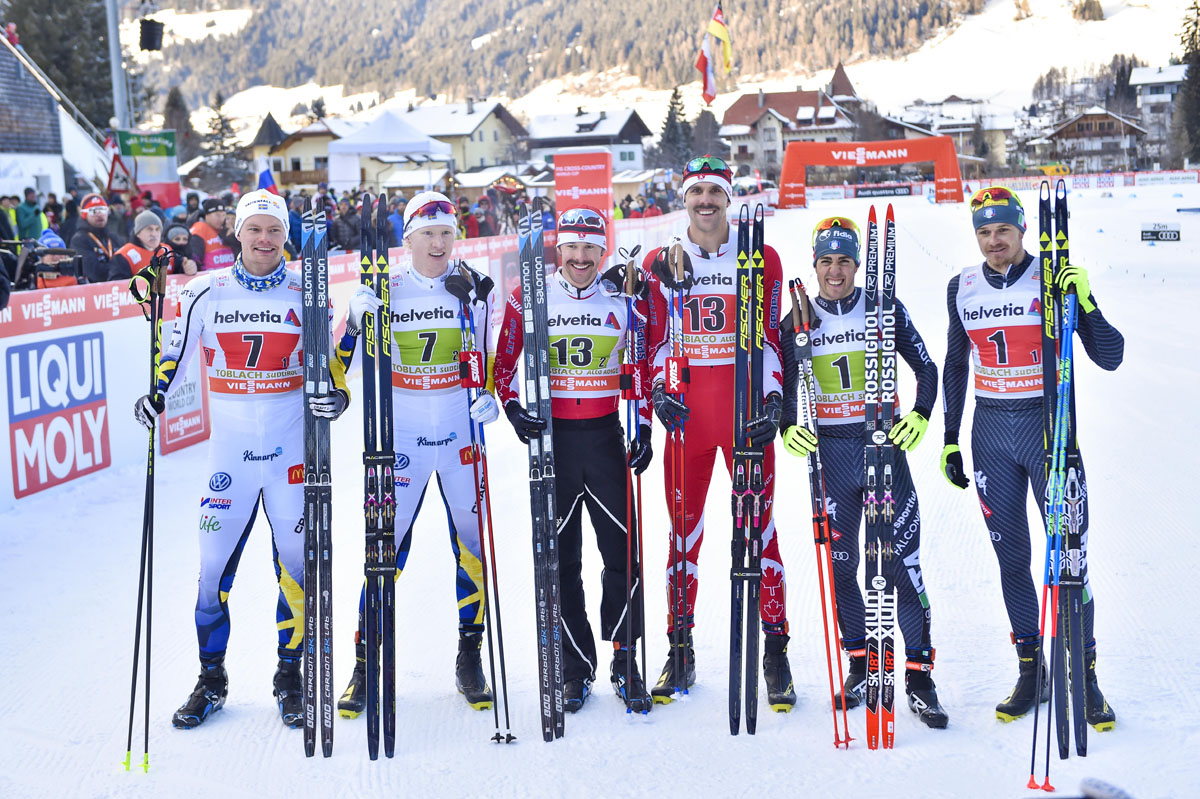
    The men's freestyle team sprint podium on Sunday, Jan. 15 in Toblach, Italy, with Canada's Alex Harvey and Len Valjas (c), Sweden's Oskar Svensson and Karl-Johan Westberg in second (l) and Italy's Federico Pellegrino and Dietmar Noeckler in third (r). (Photo: Fischer/Nordic Focus)
    The men’s freestyle team sprint podium on Sunday, Jan. 15 in Toblach, Italy, with Canada’s Alex Harvey and Len Valjas (c) in first, Sweden’s Oskar Svensson and Karl-Johan Westberg in second (l), and Italy’s Federico Pellegrino and Dietmar Noeckler in third (r). (Photo: Fischer/Nordic Focus)

    And you thought the weekend after the Tour de Ski would be boring. For fans of North American World Cup cross-country skiers, it was anything but, with Simi Hamilton coming excruciatingly close to a win in the men’s freestyle sprint on Saturday, Jan. 14, and placing second for his first podium of the season, followed by Canada’s first team-sprint victory since 2011 for Len Valjas’s first World Cup win. There was a lot of excitement surrounding two days of racing in Toblach, Italy, and plenty that didn’t make it into the race reports. See below.

    ***

    Saturday’s 1.3 k freestyle sprint

    (Race report)

    On qualifying fifth:

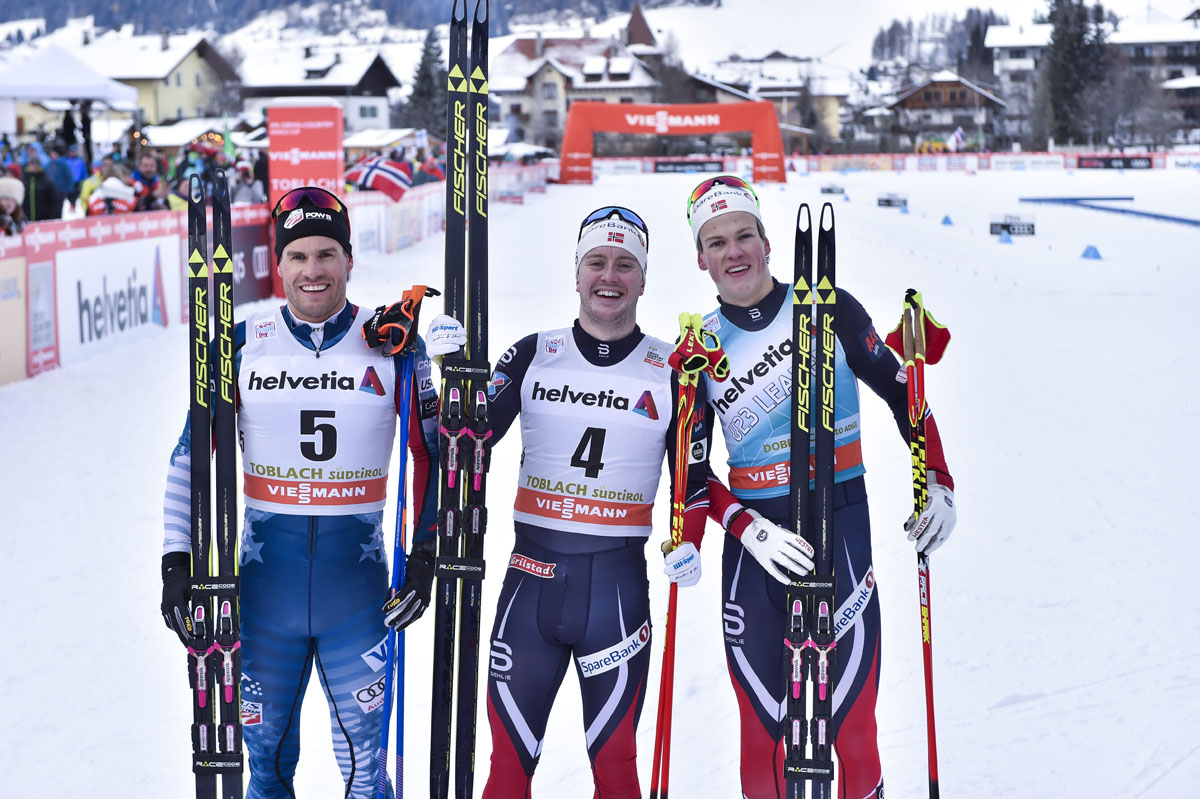
    The men's freestyle sprint podium at Saturday's World Cup in Toblach, Italy, with American Simi Hamilton (l) in second, Norway's Sindre Bjørnestad Skar (c) in first and Norway's Johannes Høsflot Klæbo (r) in third. (Photo: Fischer/NordicFocus)
    The men’s freestyle sprint podium at Saturday’s World Cup in Toblach, Italy, with American Simi Hamilton (l) in second, Norway’s Sindre Bjørnestad Skar (c) in first and Norway’s Johannes Høsflot Klæbo (r) in third. (Photo: Fischer/NordicFocus)

    “I think that my qualification speed has maybe dropped off just a little bit in the last few years with doing a little more threshold work all the time and focusing a little bit more on my overall distance fitness versus just my top qualification speed, but at the same time I knew I had great skis going into the qualifier and I knew I was 100-percent healthy and the conditions were really good for me. It was definitely a little bit slower out there today than it was last year with the new snow that came in yesterday, and it was a slightly longer course than it was last year, but I knew that if I just put together a good qualification, then I would probably end up towards the top there. So I was psyched to qualify fifth and only 0.8 [seconds] out. I think that was a reflection of kind of how I am feeling right now with my fitness.”

    — Simi Hamilton

    On having all five U.S. athletes qualify:

    “We weren’t surprised by all of them qualifying. Sophie [Caldwell] and Ida [Sargent] have been very consistent qualifiers, and Kikkan [Randall] also qualified in the last skate sprint that she did in the Tour, so I think that was within reason. Also, the field the week after the Tour de Ski is slightly smaller, because so many people, like Jessie [Diggins], Sadie [Bjornsen], [Sweden’s] Stina Nilsson, and such are resting, so it makes for a slightly easier field. I think there were only 46 women who started, so it wasn’t too much of a surprise. It was really great to see them all move through the quarterfinals. I think all three of them skied great, and especially Ida and Sophie, just outright making great moves and pushing themselves through, and then Kikkan being a lucky loser. It was great to see them all move through, and unfortunately [Caldwell and Randall] got tangled up in the semifinal…”

    — U.S. Ski Team Head Coach Chris Grover

    On the U.S. semifinal tangle:

    “According to Kikkan, as you could see in the race, the draft was such a big thing coming down that hill. Kikkan thought she had too much speed so she tried to go to the inside of Sophie, instead of running into the back of her, and somehow after that, they got tangled; that was really unfortunate. You hate to see when two people from the same team actually manage to take each other out. These guys are usually really good about watching out for each other, so I was a little surprise that that happened.”

    — Grover

    “It’s a bummer to have fallen in the two races that I’ve made the semis this year, but I’m feeling good and know that my time will come. It was a great day for the U.S. and seeing Simi’s brilliant final and second place erased any sour taste about falling today.”

    — Sophie Caldwell

    On lessons learned:

    “In my quarter[final], I was a little too focused on trying to be in the top three for the first half of the heat, and something I kind of figured out almost by mistake in that quarterfinal was that I could ski off the bridge climb just extremely hard and get a really good slingshot going into that final climb and pick up a few places right there. I think when I was doing that, it was setting me up really well for the finish. … You see a lot of guys coming through that were getting a little slower start and then are running 4-5-6 the first half of the sprint, and then they make a big move at the end and position themselves for a really good finish, so I kind of figured that out on.”

    — Hamilton

    On a tailored plan:

    “I have realized that the very last climb definitely suits me well. It’s kind of gradual and if I come into that climb with really good speed after the bridge downhill, after having picked up a couple of spots from the slingshot after that downhill, definitely makes me ski kind of confidently up that climb. The nature of that course is, you want to be in a really good spot coming down that long downhill the second tim, coming into the finish. So in the final, I just focused on basically skiing the first half, the first two climbs, all the way up to the building climb just really efficiently and try to conserve as much energy. I knew that if I put a move on coming off that bridge hill and skied that last climb really well, then I would have a really good chance of being top three coming over that last climb. So that’s what I did and I felt confident in my plan going into the final.”

    — Hamilton

    On riding confidence:

    “I think I am really confident in knowing exactly which part of the course I can ski the best and being able to kind of capitalize on that knowledge and use those spots to my advantage and just know that I can get around some people in those clutch spots, for me, is a really big thing.  At the same time, I think there’s just the whole mental side of it in knowing that you know you can, knowing that you can ski really well and in a specific place on multiple occasions. I think that’s just as big as knowing that your skis are really good, knowing that you’re really healthy, knowing that you’re fit, just knowing that you kind of figured a course out and that you really enjoy skiing it, really enjoy racing it, that it is a good thing for you, I think that is really important.”

    — Hamilton

    On getting back those good-ol’ race sensations:

    “I had such a solid summer and fall of training that I actually expected myself to be right in the mix when the season started. But when the racing started, I began to realize that this comeback was going to take some time. I didn’t expect the patience and time it would take to get the racing gears back after taking a full year away from that kind of effort. Each race I do I am feeling a little closer to my normal sprint form. So if I can just stay patient and healthy, I think this season will progress nicely.”

    — Kikkan Randall

    On Andy Newell’s season-best 13th:

    “He’s had such a rough start to the year, coming over and getting a pretty serious elbow infection to start the World Cup season, and then getting sick right after that through Lillehammer, and then he stuck to his plan and went home after Davos. Instead of staying on to race the Tour, he took a break and spent time with his fiancé [Stratton Mountain School Elite teammate Erika Flowers] over the break, so I was really excited to see how he skied today. For him and Simi to qualify fifth and sixth, they were moving incredibly fast in qualification. Simi was under a second from first, Andy was maybe just over a second from first in qualification, so they were flying. I thought Andy skied with really good energy, good tactical moves. In the quarterfinal, he just missed by a few hundredths or tenths [of a second] going through as the lucky loser, so really good stuff for Andy.”

    — Grover

    ***

    Sunday’s 6 x 1.3 k freestyle team sprint

    (Race report)

    On fine-tuning the team sprint:

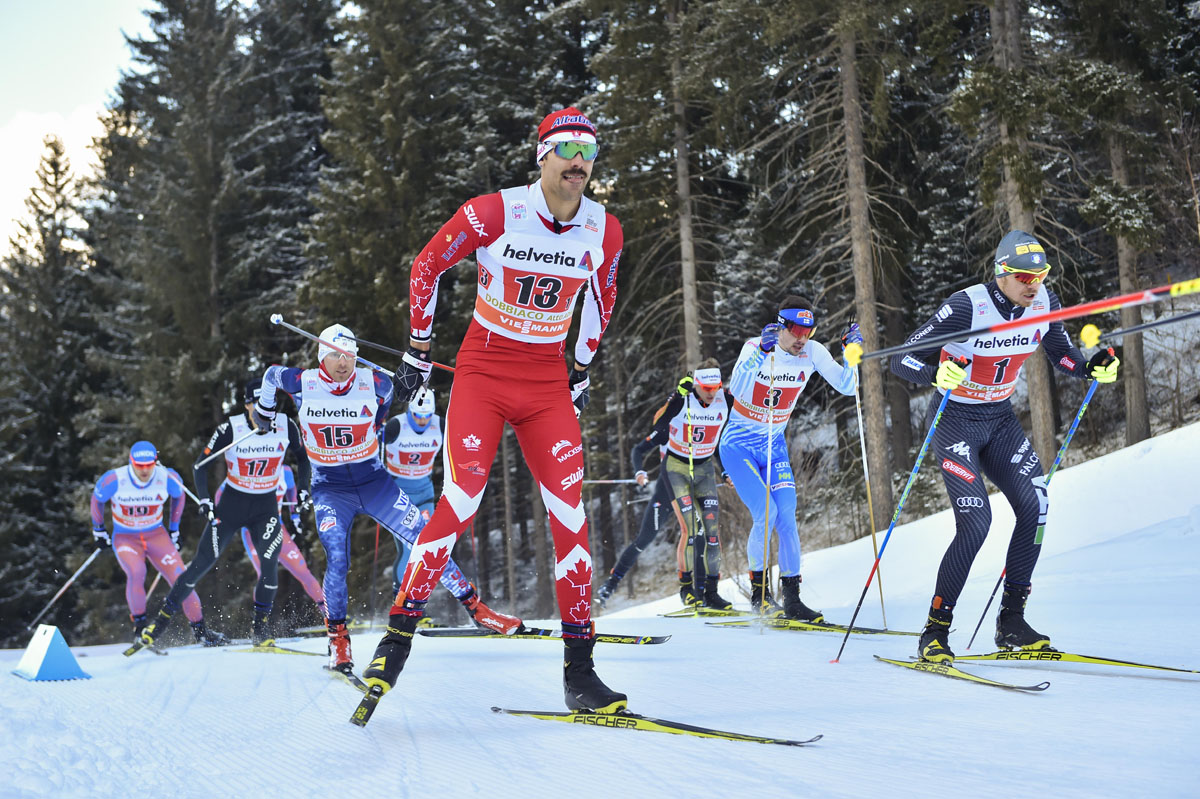
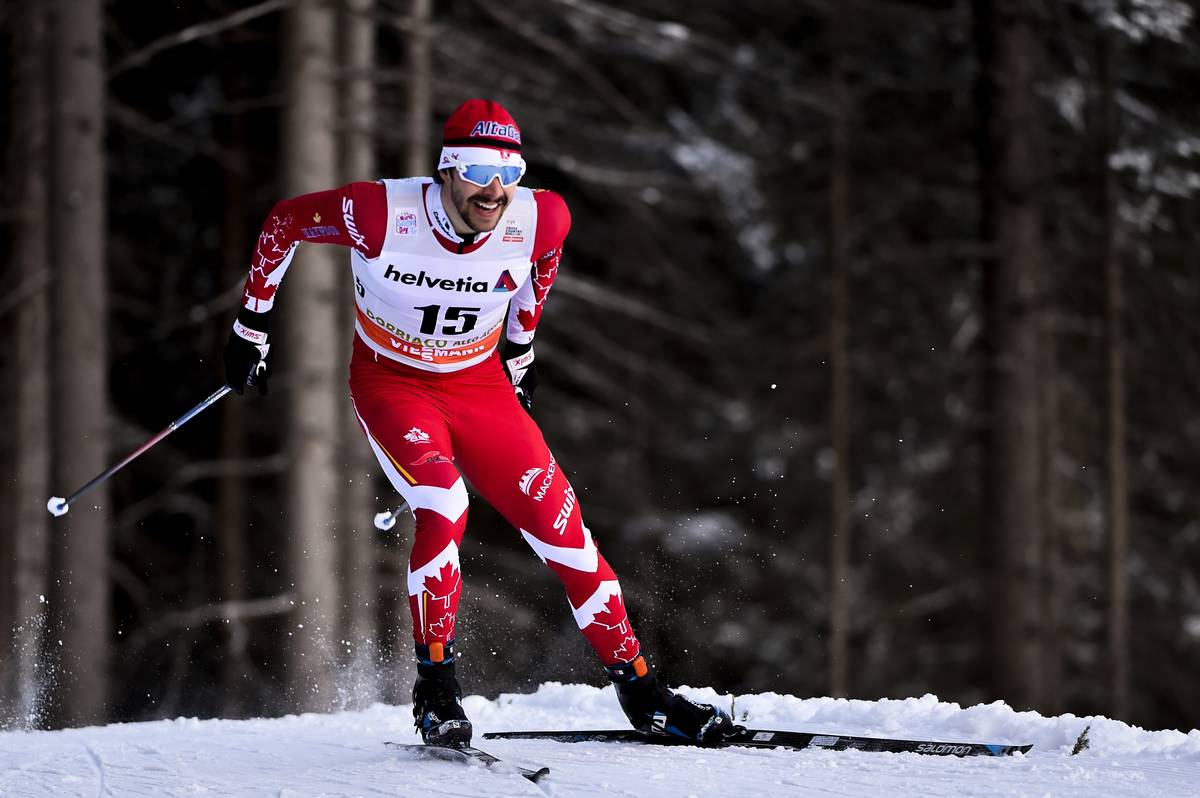
    Canada's Len Valjas en route to his first World Cup victory in the men's freestyle team sprint on Sunday, Jan. 15, in Toblach, Italy. He teamed up with Alex Harvey (not shown) (Photo: Fischer/NordicFocus)
    Canada’s Len Valjas (followed by American Andy Newell in bib 15) en route to Valjas’s first World Cup victory in the men’s freestyle team sprint on Sunday, Jan. 15, in Toblach, Italy. He teamed up with Alex Harvey (not shown). (Photo: Fischer/NordicFocus)

    “I’ve never raced with Len in the team sprint, and it’s the only one before [World Championships], and we knew we would be together at Worlds, so we wanted to do it to practice the exchange, and get a feel for it, because it’s a pretty unique race. It’s different from anything else, and it’s been a while since I’ve done a team sprint, so for all those reasons we really wanted to go and do the team sprint. Yesterday [in the individual sprint] I treated it more like a race prep, since I’ve done barely anything since the Tour, no intensity, no nothing, no pre race intervals, so I didn’t know what to expect, so I was pleasantly surprised with the feeling yesterday. It gave me a lot of confidence for today.”

    — Alex Harvey

    On winning:

    “You look on paper, we were ranked No. 3. They take either your best distance points or your best sprint points, so they took my distance points and Lenny’s sprint points, and our total was like 36 FIS points, and that was the third lowest, so we were pretty well ranked, we had just never done it before. We liked our team on paper before, and like I said yesterday, we both felt good, and we both felt like we had more to give … I’d be lying if I said we expected to win, but the goal was to be top 5, and from there, the podium is within reach, for sure.”

    — Harvey

    On being 6-foot-6:

    “This course had good parts for me, for sure, the one skate hill and maybe the flat out of the exchange, I felt good. My height does help for the more gradual climbs, but as soon as we got to that big, building climb, like, the actual steepest, I found it’s hard for me to ski as wide as I want to because I only go to my left side…”

    — Len Valjas 

    On his team-sprint teammate:

    “I think [Andy Newell] is skiing really well right now and I think both of us will be feeling really good by World Champs. Hopefully with some really good training coming up and some more good race opportunities, so I am really looking forward to having a good one with him in Lahti. I have heard the rumors that they are going to go back to the old classic sprint course in Lahti for the team sprint, which is pretty cool, and it’s definitely a bit different from the skate sprint course that they have now. It has essentially one huge climb with a really steep kicker at the top and some technical quarters coming back into the stadium, so I think that fares well for us. We are both good on our skis and good on the downhill and cornering, so we could put together a good race in Lahti in few weeks.”

    — Hamilton

    On slow doping control:

    “I am a huge proponent of them doing a lot more testing and being consistent with that and so I was really happy to see that. I was in the anti-doping room with about eight or nine other athletes, so that was really cool to see that they are taking good initiative on that. It did frustrate me a little bit that they didn’t have a couple of spin bikes in there or any food. It was kind of like a really cold basement room, which was a bummer. I thought it was going to be a really quick urine sample, kind of in and out and be done, and they only had two people processing everyone’s test, so even though I pretty much had to pee right after the race yesterday, I ended up just sitting in that room for about 1 1/2 hours just waiting for someone to deal and process the test with me, and then I had to do blood sample after that and that requires sitting for 2 hours still after the race finished before they can take your blood. So fortunately, I was able to come to the hotel and just lounge here while I was still in that two-hour window, but they didn’t end up showing up here until about three hours after the race. When it was all said and done I didn’t really get any kind of cool down and just went straight from giving my blood to dinner, to a quick massage, to bed, right to a team meeting then bed, so it was kind of not-an-ideal afternoon yesterday, and I think that was kind of resulted not feeling great during the semifinal this morning.”

  • Hamilton Back on Podium in Toblach Sprint; Five Americans in Top 13

    Hamilton Back on Podium in Toblach Sprint; Five Americans in Top 13

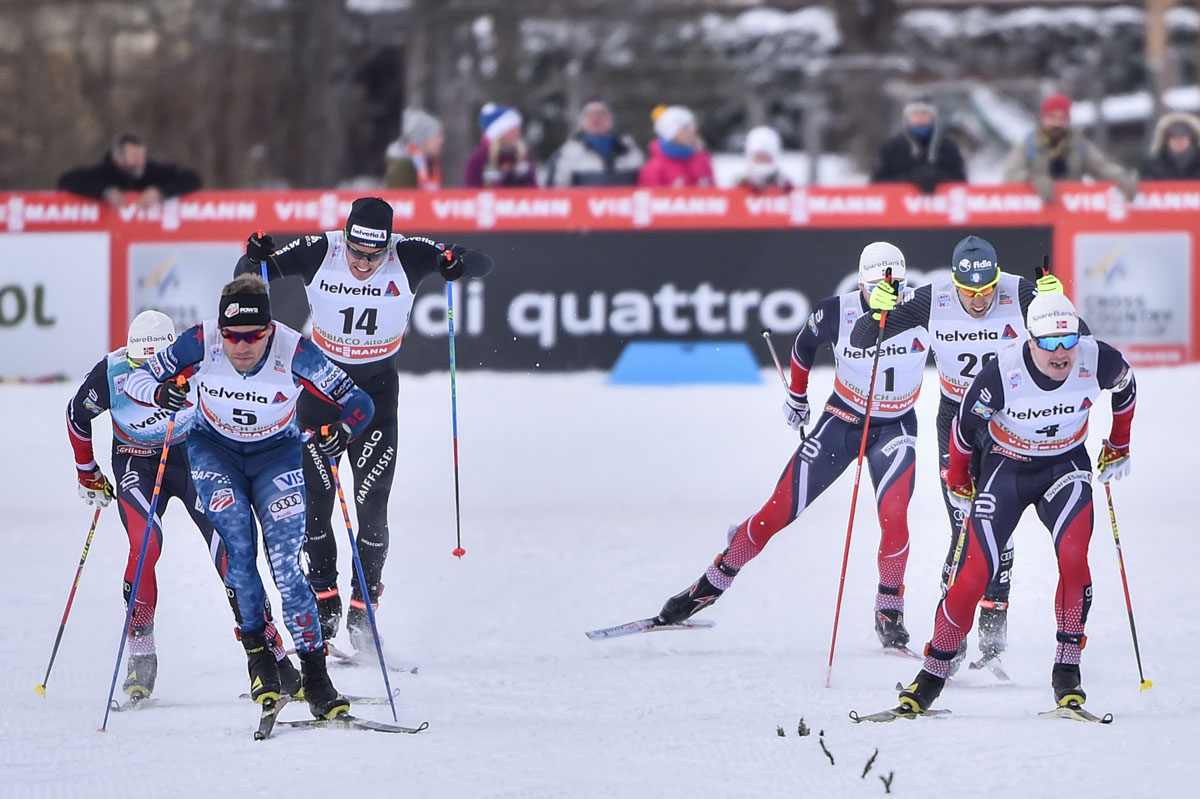
    Simi Hamilton (l) racing for first with Norway's Sindre Bjørnestad Skar (r) as they lead the men's final down the finishing stretch of Saturday's 1.3 k freestyle sprint at the World Cup in Toblach, Italy. Skar won the photo finish with Hamilton by 0.03 seconds. (Photo: Fischer/Nordic Focus)
    American Simi Hamilton (5) racing for the win with Norway’s Sindre Bjørnestad Skar (r) as they lead the men’s final down the finishing stretch of Saturday’s 1.3 k freestyle sprint at the World Cup in Toblach, Italy. Skar won the photo finish with Hamilton by 0.03 seconds. (Photo: Fischer/NordicFocus)

    The feeling was beyond déjà vu. Simi Hamilton remembered the exact moment so clearly: almost exactly 13 months ago, he had led the World Cup men’s freestyle-sprint final in Toblach, Italy, into the last climb and ensuing descent into the stadium. There he was, leading the six-man final and racing for first place. Italy’s Federico Pellegrino took it from him after taking advantage of the downhill draft, slingshotting from second to first, while Hamilton secured second. It was the second podium of Hamilton’s career and first in a non-stage World Cup.

    Great moment, but on Saturday, the U.S. Ski Team member was out to make it even better on the same 1.3-kilometer sprint course in Toblach.

    In an instant, Hamilton recalled his positioning on that last hill and how those final seconds played out last season as he approached the last hill of Saturday’s final. Hamilton charged from behind to put himself in second by the top, right behind Pellegrino.

    “I remember thinking coming down that long downhill, ‘This is awesome because this is exactly what Federico did to me last year,’ ” Hamilton said on the phone after Saturday’s race. “He got a really good draft off of me coming down that downhill and he was able to slingshot through the corner and into the finish stretch so I was really psyched. I was like, ‘This could be a really good thing right now.’ ”

    His observations were spot on as the U.S. sprinter — who has worked to improve his distance racing as well — slingshot around Pellegrino to lead into the final curve before the finishing straight. There, he skied over a pocket of softer snow, which caught him off guard and put him back on his heels, he said.

    “It kind of it messed with my head a little bit,” Hamilton said. “So I think it took me a second to recover from that, and I was just focusing so hard on not doing anything really stupid in the last 100 meters with the snow conditions kind of being a little funky there.”

    At the same time, he knew he had as good a shot at ever at winning.

    “I knew that I was fighting for first right there and fairly confident I was going to be on the podium at that point, but I really wanted that first spot, especially with having gotten second last year,” the 29-year-old Colorado native said.

    Behind him, Norway’s Sindre Bjørnestad Skar had also taken advantage of the draft, as well as Hamilton’s slight bobble under the archway banner 100 meters before the finish, and came up on Hamilton’s left side to challenge him for first place.

    The two went stride-for-stride to the line, which ended in a photo finish for first. Skar celebrated across the line, holding one arm high, while Hamilton teetered out of exhaustion and face planted alongside him. It took several moments to determine the actual winner. Finally, the results revealed that the 24-year-old Skar had taken it by three-hundredths of a second (winning the final in 2:47.91 minutes) for his first individual World Cup victory. For Hamilton, second place marked his first podium this season and the fourth of his career.

    The men's freestyle sprint podium at Saturday's World Cup in Toblach, Italy, with American Simi Hamilton (l) in second, Norway's Sindre Bjørnestad Skar (c) in first and Norway's Johannes Høsflot Klæbo (r) in third. (Photo: Fischer/NordicFocus)
    The men’s freestyle sprint podium at Saturday’s World Cup in Toblach, Italy, with American Simi Hamilton (l) in second, Norway’s Sindre Bjørnestad Skar (c) in first and Norway’s Johannes Høsflot Klæbo (r) in third. (Photo: Fischer/NordicFocus)

    “He had a really really solid last 100 meters,” Hamilton said of Skar. “We both threw for the line and he was just coming up a little faster than I was. … It was a little frustrating, for sure, to be second again for the second year in a row, but at the same time he skied really well, and all of those other guys in the final. It is great to share the podium with a bunch of other really talented, strong skiers, who are the best sprinters in the world.”

    Norway had two on the podium with 20-year-old Johannes Høsflot Klæbo in third (+0.66).

    Pellegrino missed out on the podium by 0.61 seconds in fourth (+1.27), Switzerland’s Jovian Hediger placed fifth (+1.84) and another Norwegian Håvard Solås Taugbøl was sixth (+3.77).

    For Skar, who turns 25 on Jan. 22, the victory (which was his third podium this season and his career) was another check mark on his list of season goals.

    “Getting my first World Cup victory and then qualifying for the World Championships was one of my goals this year and it seems like that’s going well,” he told NRK after.

    After qualifying in fourth (0.78 seconds behind Taugbøl, who won the qualifier in 2:47.38), Skar went on to win the first men’s quarterfinal in a photo finish with Hediger, then placed second in the first semifinal. Taugbøl won that semifinal by just six-hundredths of a second over Skar, while Hamilton was just another 0.05 seconds back in third and Hediger 0.03 seconds behind Hamilton in fourth. All four advanced to the final, where Skar positioned himself in the middle of the pack for much of the two-lap race, skiing in third up the second-to-last climb.

    “It was almost like a lottery,” Skar said of the frequent change of leaders in the final during a post-race, televised interview with the International Ski Federation (FIS). “I just tried to stay calm and to have a good sprint.”

    He had a feeling that he had the edge on Hamilton, but “it was very, very tight,” Skar said.

    For Hamilton, who qualified fifth (+0.83), the podium confirmed what he had been searching for. So far this season, he has only competed in six World Cup races. Three of them were sprints, and his best result before Saturday had been 18th in the skate sprint at the Tour de Ski’s first stage in Val Müstair, Switzerland. After leaving the Tour after Stage 2, Hamilton competed in two OPA Cup races last weekend in Planica, Slovenia. There, he won the skate sprint and finished fifth in the 10 k skate.

    “That definitely increased my confidence and I felt much better about where I was fitness-wise and speed-wise with those races last weekend,” Hamilton said. “And I knew that I have skied this course well before and I really enjoy racing here. It is a great place and I love it, and I was just psyched to see what I could do today, and fortunately it ended pretty well.”

    U.S. Ski Team Head Coach Chris Grover said it was “incredible” that Hamilton has placed second in Toblach’s sprint two years in a row.

    “It’s been fun watching him train on this course this week,” Grover said on the phone Saturday. “He did a big intensity session on the sprint course on Thursday, and when you watch him do it, he just looks like somebody who could be on the podium in this race, and of course he looked like that last week when he won the OPA Cup, too. He was able to go out there and make moves at will and see an opening and take it.

    “He’s shown a mastery of this course, and his fitness is quite high,” Grover added. “It’s also worth mentioning that we had incredible skis today. Athletes kept coming back saying, ‘My skis are incredibly fast!’ That’s a key part of the equation.”

    As for Hamilton’s form leading up to World Championships late next month?

    “I’m hoping that I am not peaking right now because obviously we have quite a bit more time to go before Lahti, but I am definitely feeling like things are still going in the right direction,” Hamilton said.

    All 7 Americans Advance

    Men and women combined, five Americans and two Canadians started Saturday’s sprint — held less than a week after the nine-day Tour de Ski (TDS) ended last Sunday. Three of those Americans were women; the two Canadians were both men. Just one of them completed the Tour. Most of the competitors in Toblach this weekend did not compete in this year’s TDS.

    Of those seven North Americans, all of them finished in the top 30 of their respective qualifiers on Saturday to advance to the heats.

    Hamilton led the group in fifth, and just another 0.27 seconds back, his U.S. teammate Andy Newell qualified in sixth, 1.1 seconds behind Taugbøl.

    Canada's Alex Harvey racing to eighth in the men's 1.3 k freestyle sprint qualifier on Saturday at the Toblach World Cup in Italy. (Photo: Salomon/Nordic Focus)
    Canada’s Alex Harvey racing to eighth in the men’s 1.3 k freestyle sprint qualifier on Saturday at the Toblach World Cup in Italy. (Photo: Salomon/Nordic Focus)

    Canada’s Alex Harvey qualified eighth (+1.73) and Len Valjas 23rd (+4.16) out of 70 starters. (Of note: Russia’s TDS winner Sergey Ustiugov finished last in the qualifier in 70th, nearly 42 seconds off Taugbøl’s time.)

    In the first men’s quarterfinal, Newell took third at the finish, 0.38 seconds behind Skar in first. Their quarterfinal time wasn’t fast enough to put Newell through as a lucky loser, and he ended up 13th on the day for his best result this season. In his fourth World Cup sprint this season, Saturday marked Newell’s first time qualifying in the top 30.

    “Skate skiing and I haven’t been on great terms the last year or so haha,” Newell wrote in an email. “But in all seriousness I knew this year was meant to be a rebuilding process for me so I’m happy to be back on track.

    “I finished last season not ever wanting to race a sprint race again, so I knew mentally and physically it was going to take some work to build back up to being a medal contender again,” he added. “I have to keep reminding myself that it’s still just January and to be patient and continue to try to make small gains and build throughout the season. Points and standings aren’t important to me at this time, just staying healthy and strong and building toward the World Championships and especially the Olympic year.”

    Harvey raced to fourth in the second quarterfinal, 0.42 seconds behind Hamilton, who won that heat. The Canadian ended up in a photo finish with Norway’s Sondre Turvoll Fossli for third in that quarterfinal and missed it by 0.08 seconds. Neither Fossli nor Harvey advanced to the semifinals, and Harvey placed 17th overall (moving him up to fourth in the overall World Cup standings).

    “I think that was my best qualifier in two years so I was a bit surprised,” said Harvey, who was coming off a career-best seventh in the TDS and had originally planned to skip the individual sprint to rest up for Sunday’s freestyle team sprint, according to a Cross Country Canada (CCC) press release. “It was such an easy trip to come down to Toblach. I just felt if I’m doing race prep I might as well put a bib on and see what happens. I felt a lot of speed today and was quite happy.”

    Harvey noted the precise tactics of the Toblach sprint with a “good course here that has you always turning left,” he told CCC. “You need to keep on the inside lane because it is a little quicker, especially with the fresh snow, so if you took the lead it was hard for someone to go by you. I was just not quick enough from the start.”

    Valjas also finished fourth in his quarterfinal, 1.58 seconds behind Pellegrino who won that heat, to place 20th overall. While Valjas remained in contact with the leaders throughout, he found himself at the back of the group early and moved up slightly to secure fourth at the finish.

    Three U.S. Women in Semis

    Meanwhile in the women’s race, the three U.S. entrants — Sophie Caldwell, Ida Sargent and Kikkan Randall — qualified for the heats in 15th, 16th and 27th, respectively.

    Caldwell’s 15th-ranked qualifying time was 4.82 seconds behind the qualifying winner, Norway’s Maiken Caspersen Falla, who completed the 1.3 k course in 3:10.89.

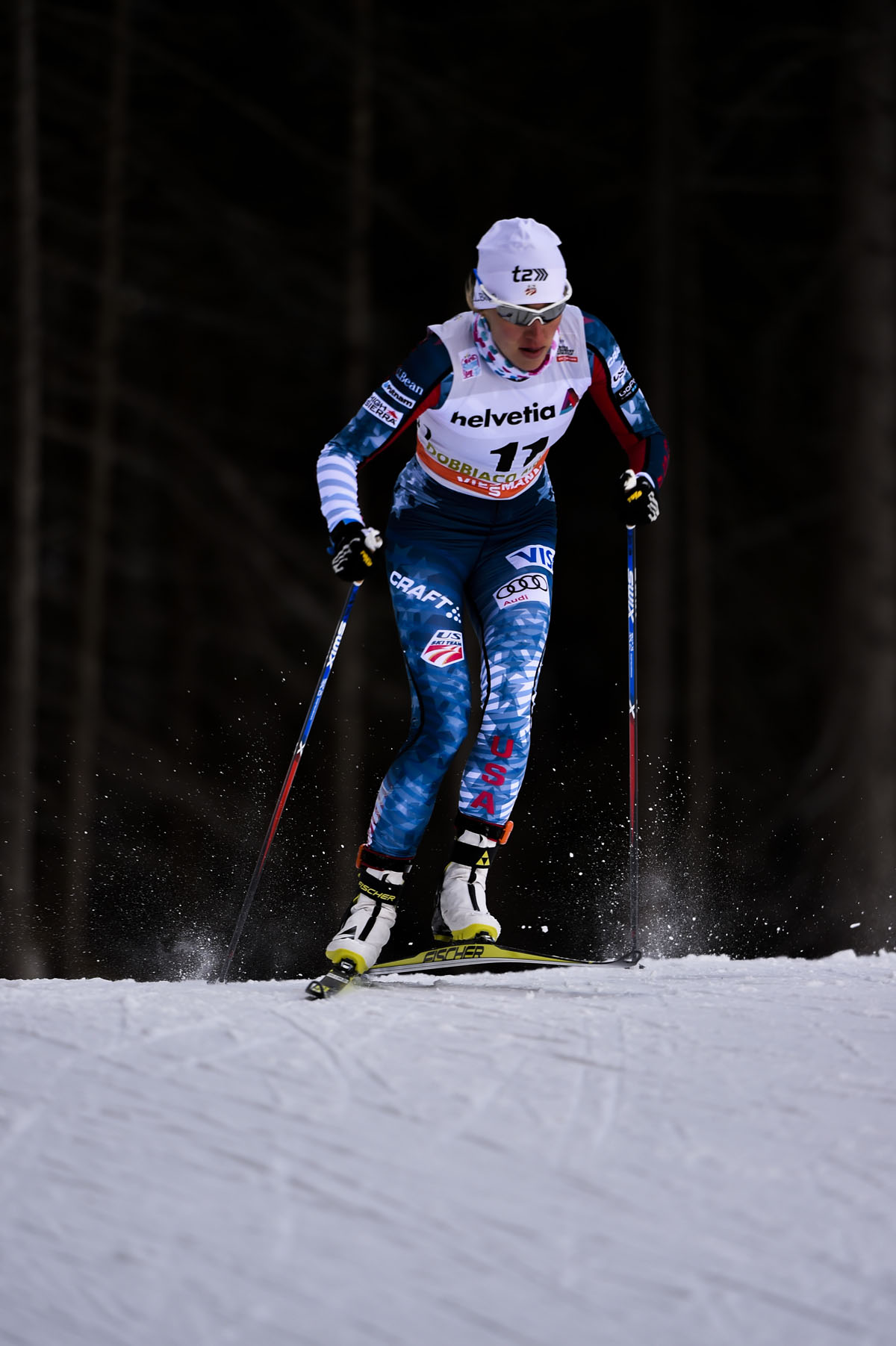
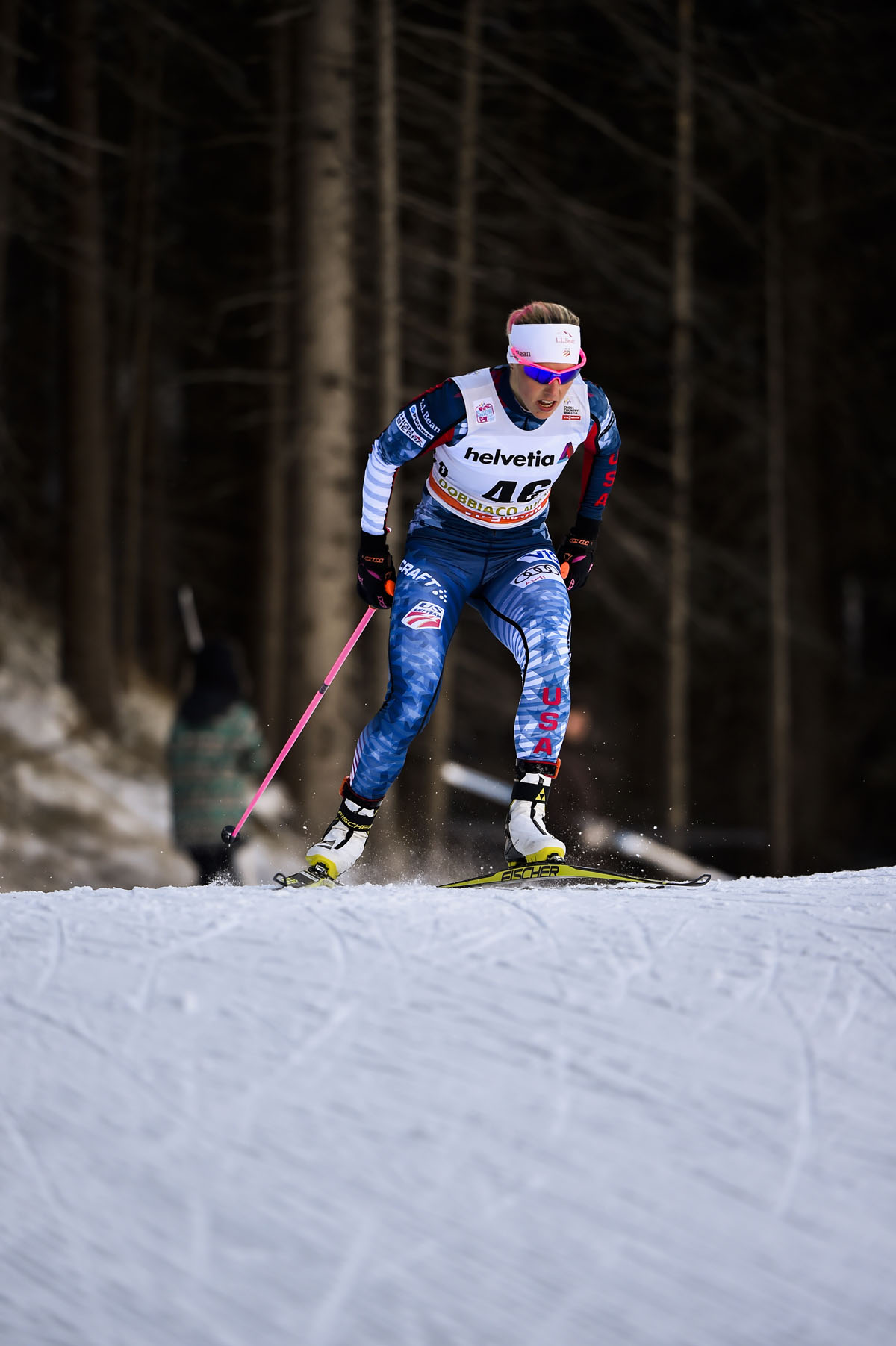
    American Sophie Caldwell racing to 15th in the women's 1.3 k freestyle sprint qualifier at the World Cup in Toblach, Italy.(Photo: Fischer/NordicFocus)
    American Sophie Caldwell racing to 15th in the women’s 1.3 k freestyle sprint qualifier at the World Cup in Toblach, Italy.(Photo: Fischer/NordicFocus)

    Sargent was another 0.27 seconds back in 16th (+5:09), and Randall was 7.52 seconds off Falla’s qualifying mark.

    All three U.S. women reached the semifinals, with Caldwell and Sargent automatically advancing after taking second in their quarterfinals. In the first quarterfinal, Caldwell finished 0.18 seconds behind Sweden’s Hanna Falk, and Sargent was 0.23 seconds behind the winner of the fifth quarterfinal, Slovenia’s Vesna Fabjan. Randall reached the semis as a lucky loser, after placing fourth in the fourth quarterfinal, 1.42 seconds behind Germany’s Sandra Ringwald in first.

    For Randall, it marked her first semifinal appearance in two years (she took last season off to have a baby).

    “I am feeling a little closer to my normal sprint gears every race,” Randall wrote in an email on Saturday. “Today’s qualifier was a good start. In the quarterfinals I was in a really fast heat and just tried to stay relaxed in the pack. We had really fast skis today and I was able to be strong in the finish so it was really exciting to advance to the semis.”

    In the first semifinal, Randall and Caldwell squared off against a stacked heat with Norway’s Falla, Sweden’s Falk and her teammate Ida Ingemarsdotter, and Russia’s Natalia Matveeva. During the first lap, Caldwell positioned herself in third and trailed Matveeva and Falla on the descent before the start of Lap 2. There, on the downhill, Randall rode up into Caldwell and both tumbled to the ground and out of contention before the second lap.

    “Our skis were incredibly fast today and that was actually a little bit of the problem,” Randall explained. “When our pack came down the hill that first time in the semi, everyone came together into the corner. The other girls went right so I could really only take the inside. I came up on Sophie faster than expected and tried to sneak by on the inside. But there wasn’t much space and I think I may have knocked her boot with my ski.

    “When she lost balance there was nowhere to go and my skis went underneath her as we fell,” she continued. “I feel really bad because I think I caused the crash. It was a real bummer because I think both of us were feeling good and ready to mix it up. But luckily we are both OK and there was no broken bodies or equipment.”

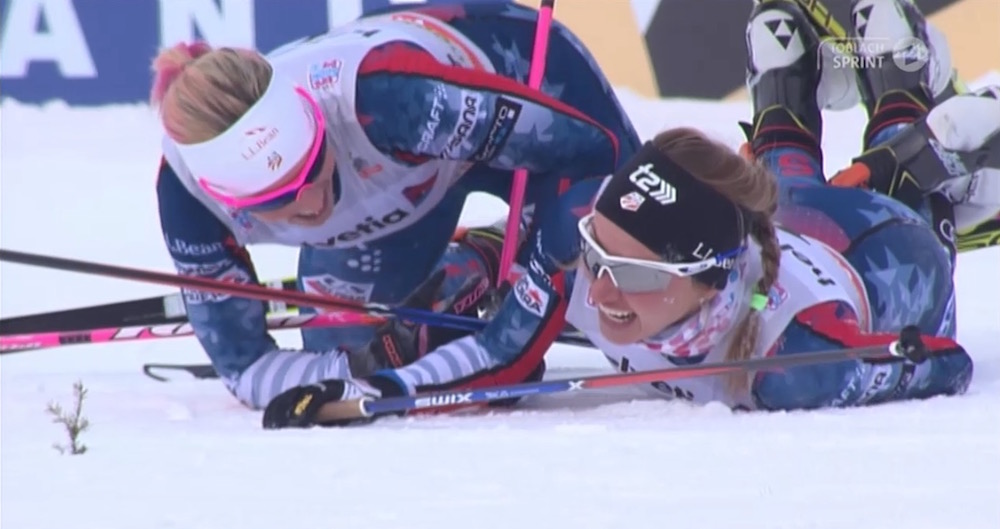
    U.S. teammates Kikkan Randall (l) and Sophie Caldwell (r) after colliding in the first women's semifinal on Saturday at the World Cup skate sprint in Toblach, Italy.
    U.S. teammates Kikkan Randall (l) and Sophie Caldwell (r) after colliding in the first women’s semifinal on Saturday at the World Cup skate sprint in Toblach, Italy. (Photo: ARD broadcast screenshot)

    In what appeared to be a slow-motion tangle, both Randall and Caldwell appeared to smile at each other as they realized their misfortune. Caldwell particularly had trouble freeing her ski. The two finished fifth and sixth in that heat (Randall 22 seconds back in fifth, and Caldwell a minute back from Falla as the winner of that semifinal in sixth).

    “[Kikkan] asked if I was okay and apologized,” Caldwell recalled. “It’s a bummer, but it’s unfortunately part of ski racing and there are no hard feelings.”

    “We’ve had problems with that same thing before,” Grover noted. “Everyone from behind runs up on everyone who’s in front, and then, depending on if you’re pinched on the inside, or if you can make some space on the outside, you can end up making it through or you can end up in some trouble. It’s a pinch point, a tough point on the course, for sure.”

    He added that Randall “took full accountability” for the crash, and there were no hard feelings.

    “She felt quite bad about it, and Sophie bears no grudge about it because she knows that’s the kind of thing that happens in sprint racing all the time,” he said. “Those guys are good and they are going to be sprint teammates tomorrow, so we’ll start looking forward to the next day.”

    Grover said his staff had to make the tough call of picking two women out of three for Sunday’s team sprint.

    Sargent raced to sixth in the second semifinal on Saturday, just 0.86 seconds out of first. She had moved up to third on the final climb, trailing Norway’s Astrid Uhrenholdt Jacobsen and Germany’s Ringwald, respectively, and held her position on the final curve into the finishing straight. There, both Jacobsen and Sargent were overtaken by Slovenia’s Fabjan (who came on strong for second place) and Switzerland’s Laurien van der Graaff (third), following Ringwald in first.

    Kikkan Randall (U.S. Ski Team) racing to a season-best 10th on Saturday in the World Cup freestyle sprint in Toblach, Italy. (Photo: Fischer/NordicFocus)
    Kikkan Randall (U.S. Ski Team) racing to a season-best 10th on Saturday in the World Cup freestyle sprint in Toblach, Italy. (Photo: Fischer/NordicFocus)

    At the end of the day, U.S. women occupied 10th through 12th place, with Randall in 10th, Caldwell in 11th and Sargent in 12th.

    “I tried to stay relaxed in the heats, but I felt really good so I just tried to ski near the front of the pack,” Sargent wrote in an email. “The course is really frustrating though with a long downhill with a draft that brings everyone back together but I just tried to stay out of trouble. I thought that I was in a great position in the semifinal going into the finish but then I hit something and I’m not really sure what it was, but it stopped my ski dead and I almost fell. After that bobble it was hard to get going again and so I was really bummed to lose all the places and not advance.”

    For Sargent, 12th was her best result in over a year.

    “I felt really strong today so I’m happy with my fitness at this point in the season,” she wrote. “We had a small staff this weekend but they did an amazing job and I’m very thankful for such awesome skis!”

    In terms of how the U.S. coaches made the call for between those three for Sunday’s team sprint, Grover said it wasn’t easy.

    “… As luck would have it, we had three athletes finish 10, 11, 12 on the day today, which did not make it any easier,” he said. “You actually had three athletes who are fairly evenly matched in a lot of respects right now, in terms of how they’re skiing. In the end, we decided that we really wanted to have Kikkan’s experience, in team sprint in particular and in closing out a team sprint, and in the second leg, we wanted Sophie to be able to rely on her aerobic conditioning at the moment …  It was a very hard decision for us … I really wish we had a fourth woman here, so we could start two teams.”

    Matveeva Gets First Win in Nearly a Decade

    While the three U.S. women missed Saturday’s final, Russia’s Matveeva — who hadn’t won a World Cup race since 2007 — went on to outlast Falla for her 12th-career individual podium. Eight years ago, Matveeva tested positive for EPO was was suspended from competing from December 2009 to March 2011. After that, she reportedly had two ACL tears. Now 30, Matveeva captured her second-career sprint win on Saturday by eight-hundredths of a second over Falla.

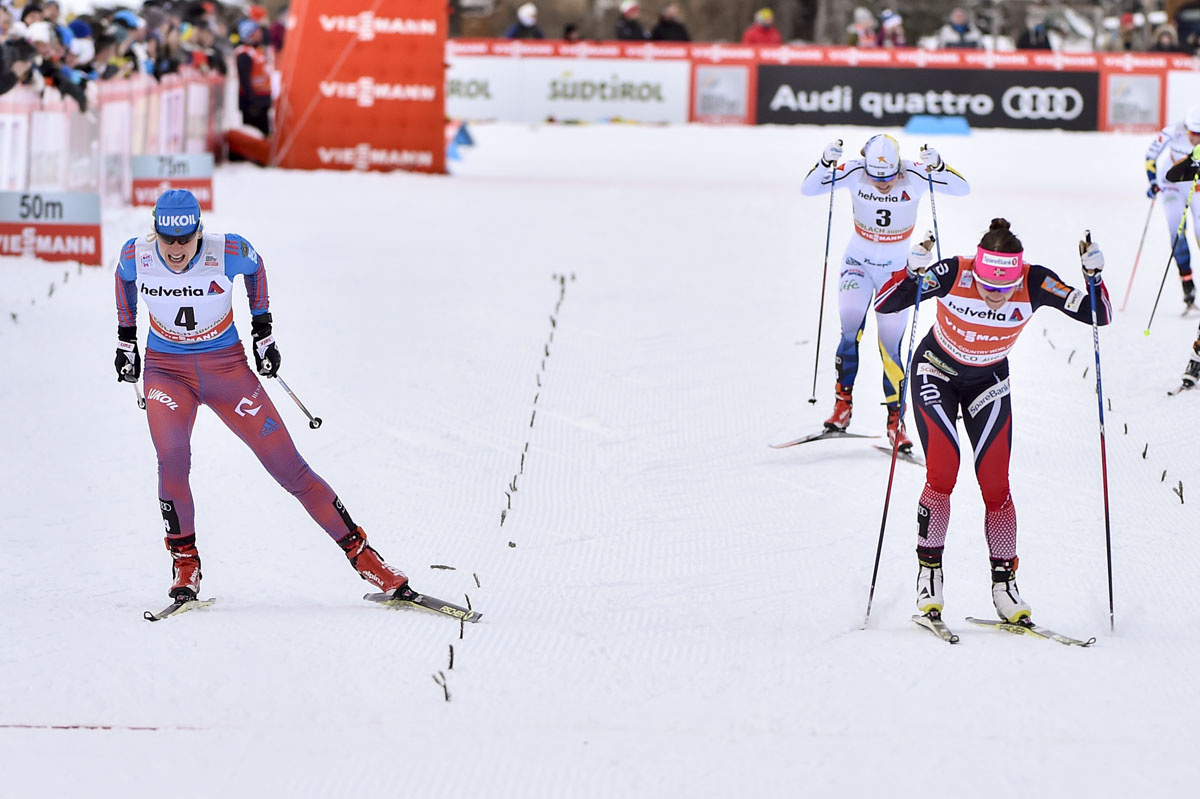
    Russia's Natalia Matveeva (l) winning Saturday's freestyle sprint final, by 0.08 seconds over Norway's Maiken Caspersen Falla (r), for her first World Cup win since October (!) 2007. (Photo: Fischer/Nordic Focus)
    Russia’s Natalia Matveeva (l) winning Saturday’s freestyle sprint final, by 0.08 seconds over Norway’s Maiken Caspersen Falla (r), for her first World Cup win since October (!) 2007. Sweden’s Hanna Falk (3) placed third. (Photo: Fischer/NordicFocus)

    “I’ve waited a lot of time to be [here],” Matveeva told FIS in a post-race interview. “I’m very happy and the Russian team is very happy. Thank you very much my service team. Good job today.”

    Matveeva charged to an early lead in the final, while Falla challenged her on the first of two climbs on the second lap. Matveeva followed her closely leading into the last climb, where Falla beat her to the top with a quicker-tempo V1. As the two descended into the stadium with a slight gap to Falk in third place, Matveeva drafted Falla then rode up alongside her, taking the outside line around the turn. The two sprinted toward the line, with Matveeva getting one extra push in for first place in 3:04.13.

    “I don’t feel particularly well so second place is all right, but of course it’s frustrating to be beaten in the final stretch,” Falla told NRK. “I knew she would be fast in the final stretch. I’m a little lighter than everyone else, and that’s not an advantage.”

    At the same time, Falla wasn’t bitter.

    “It’s good that more people are fighting for the top spots before the World Championships; it’s more exciting then,” she said. “We have to see the positive in it all.”

    Falk took the final spot on the podium in third (+2.41), and Ringwald was one second shy of it in fourth (+3.46). Ingemarsdotter finished fifth (+5.88) and Fabjan was sixth (+19.39).

    In Sunday’s 6 x 1.3 k freestyle team sprint, Caldwell and Randall are teaming up in the first women’s semifinal, while their men’s team of Newell and Hamilton will be in the second men’s semifinal. Also in that second men’s semifinal are Canada’s Valjas and Harvey.

    Results: Men | Women

  • Bjørgen Sits Tight, Seizes Toblach Skate Sprint Win; Randall Fifth in Last Race Before Olympics

    Bjørgen Sits Tight, Seizes Toblach Skate Sprint Win; Randall Fifth in Last Race Before Olympics

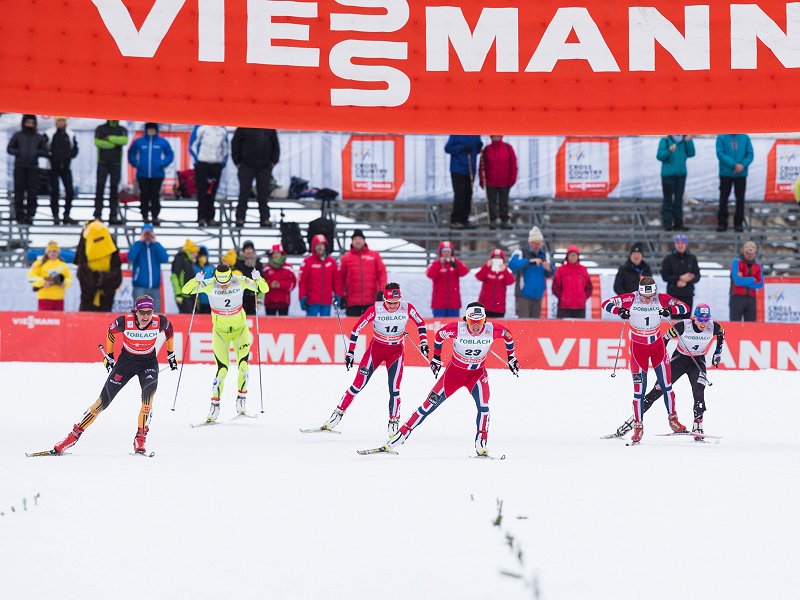
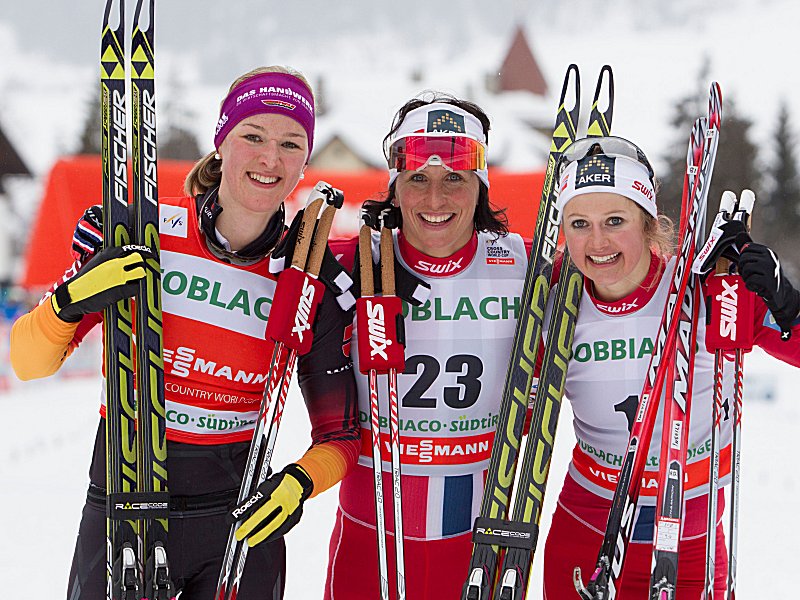
    Norway's Marit Bjørgen powers to the finish while trying to hold off Germany's Denise Herrmann (l) and two Norwegian teammates, Ingvild Flugstad Østberg (1) and Maiken Caspersen Falla (14). Bjørgen ended up winning by 0.43 seconds, Herrmann was second, Østberg third, and Falla fourth. American Kikkan Randall (r) placed fifth and Slovenia's Katja Visnar (2) took sixth. (Photo: Fischer/NordicFocus)
    Norway’s Marit Bjørgen (23) powers to the finish while trying to hold off Germany’s Denise Herrmann (l) and two Norwegian teammates, Ingvild Flugstad Østberg (1) and Maiken Caspersen Falla (14). Bjørgen ended up winning by 0.43 seconds, Herrmann was second, Østberg third, and Falla fourth. American Kikkan Randall (r) placed fifth and Slovenia’s Katja Visnar (2) took sixth. (Photo: Fischer/NordicFocus)

    If anyone was going to deny Kikkan Randall of her third-straight skate sprint victory, a feat that hasn’t been achieved on the World Cup since Marit Bjørgen’s similar sprint-winning streak in 2006, it was most likely going to be Bjørgen.

    Everyone else had too much respect for Randall: if she decided to lead, they’d let her go and try to hang with her to the finish. If she took the inside lane around a tight corner, like she did in Sunday’s semifinal around Norway’s Ingvild Flugstad Østberg, her competitors would try to hold their own — but also do their best not to take Randall down.

    Randall emerged out of that predicament before the last straightaway in the 1.3-kilometer freestyle sprint semifinal at Sunday’s World Cup in Toblach, Italy. She had nudged her way ahead of Østberg to win the heat, after the Norwegian led most of the semifinal. The two had come in slight contact with extended arms around the turn, but it was clear neither wanted to take each other out of the running.

    Bjørgen wasn’t out for blood, either, but she was looking for a victorious sendoff to her fourth Olympics.

    Marit Bjørgen celebrates her second victory of the weekend at the Toblach World Cup, winning Sunday's freestyle sprint -- the final race before the 2014 Olympics. (Photo: FlyingPointRoad.com/NNF)
    Marit Bjørgen celebrates her second victory of the weekend at the Toblach World Cup, winning Sunday’s freestyle sprint — the final race before the 2014 Olympics. (Photo: FlyingPointRoad.com/NNF)

    “I was good at keeping the peace, and I knew I had good skis and I had the opportunity to settle in the sprint,” Bjørgen told NRK, according to a translation.

    A day after winning her first World Cup back on the circuit by 36 seconds in the 10 k classic, Bjørgen qualified 23rd then won her quarterfinal and semifinal to advance to the final.

    The 2-1 favorite from the start (Randall was given 4-5 odds, or an 80 percent chance, of winning), Bjørgen said she felt a little tired earlier in the day — probably a result of Saturday’s effort and her team’s preceding training camp at Seiser Alm, Italy.

    “Today I feel a bit slow in the beginning and feel better and better in each heat,” she told FIS in a post-race interview. “I just had to calm down and have as much power in the end.”

    For Bjørgen, that meant letting others do the work early then take control by the final descent. She relied on superior glide throughout her heats to get her where she needed to be on the downhills before the stadium. In the final, she followed one of two teammates in the heat, Østberg, up the first of three hills as the other Norwegian, Maiken Caspersen Falla, led the pack with Randall.

    Over the top of the second short-but-steep climb, Randall, who had qualified fourth behind Østberg and two Slovenians: Katja Visnar and Vesna Fabjan, respectively, passed Falla to take control. Germany’s Denise Herrmann quietly moved to third, then challenged Falla and Randall up the outside of the last hill.

    Falla got to the top first, Randall tucked behind her on the way down. Bjørgen soared to the front in another track with the skis and energy-saving tactics that had carried her all day. Herrmann went with her, as did Bjørgen’s teammates, and Randall was left chasing the four coming into the final stretch.

    “While I’m definitely bummed not to have been in the fight for the win in the final stretch I am happy with the way I felt today and I probably learned more from the way the race played out,” Randall wrote in an email. “With such a long straight downhill before the finish, this was a very tactical course and a very different course from Sochi.

    “I am looking forward to heading to Sochi in a couple days and getting in some good training on the sprint course there,” she added.

    Similar to her semifinal, in which Bjørgen looked over both her shoulders before the finish to make sure she had won it, then edged Herrmann by four-hundredths of a second, Bjørgen pulled out another victory in 2:59.8. This time, she was four-tenths of a second faster than Herrmann in second, cheering at the finish with a big smile that showed how much the win meant to her.

    The Toblach World Cup women's 1.3 k freestyle podium on Sunday, with Norwegian winner Marit Bjørgen (c), German runner-up Denise Herrmann (l) and Norway's Ingvild Flugstad Østberg in third. (Photo: Fischer/NordicFocus)
    The Toblach World Cup women’s 1.3 k freestyle podium on Sunday, with Norwegian winner Marit Bjørgen (c), German runner-up Denise Herrmann (l) and Norway’s Ingvild Flugstad Østberg in third. (Photo: Fischer/NordicFocus)

    “The answer I got this weekend means a lot,” Bjørgen told NRK.

    Østberg pushed for third (+1.46) and Falla placed fourth (+2.13) to help Norway put three in the top four.

    The winner of both her quarterfinal and semifinal, Randall ended up fifth (+2.66), her first time off the podium in the last nine World Cup skate sprints, and Visnar was sixth (+3.01).

    “Today was another solid day,” Randall wrote. “Performance was strong through all the rounds just didn’t employ the right tactics in the final. I was really happy with 4th in the qualification and pumped to see 3 of my teammates [Sophie Caldwell, Jessie Diggins and Holly Brooks] advance as well.”

    The three other Americans did not reach the semifinals and finished 19th, 28th and 29th, respectively.

    Already second to Herrmann in the World Cup sprint standings, Randall retained her position but Herrmann extended her lead to 60 points ahead of her.

    “It has become one of my goals now to win the overall World Cup sprint title, but I know it will be tough against Kikkan and Ingvild,” Herrmann told FIS.

    Østberg racing to third in the Toblach World Cup freestyle sprint on Sunday in Italy.  (Photo: FlyingPointRoad.com/NNF)
    Østberg racing to third in the Toblach World Cup freestyle sprint on Sunday in Italy. (Photo: FlyingPointRoad.com/NNF)

    Østberg is currently 81 points behind Randall in third.

    “It was really great today to be on the podium again,” Herrmann added.

    After qualifying in ninth, Herrmann won her quarterfinal ahead of Visnar in second. One of Herrmann’s training partners, 22-year-old Elisabeth Schicho, won her first title at U23 World Championships in the freestyle sprint on Jan. 29, then qualified in Sunday’s World Cup in 22nd before finishing fifth in Herrmann’s quarterfinal.

    “It is really great to see her ski so well,” Herrmann said.

    “Marit and Denise were really smart in the finals and were in the right place coming into the homestretch,” Østberg told FIS. “I was a little bit caught on the inside and fought as hard as I could to be on the podium today. It was great racing. I am happy with my result and excited for Sochi.”

    With Olympic races starting in six days in Sochi’s mountain village of Krasnaya Polyana, Russia, Bjørgen is considering competing in all six events, but doesn’t expect to win gold in every one. Asked if she could medal in each, she acknowledged she’s a favorite in most.

    “It’s not impossible,” she told NRK, according to a translation. “But there is plenty to be done before that.”

    Results