Tag: Toblach Italy

  • Diggins Flawless in Toblach 20 k Pursuit

    Diggins Flawless in Toblach 20 k Pursuit

    This coverage is made possible through the generous support of Marty and Kathy Hall and A Hall Mark of Excellence Award. To learn more about A Hall Mark of Excellence Award, or to learn how you can support FasterSkier’s coverage, please contact info@fasterskier.com.

    Jessie Diggins (USA) has delivered dominant race performances in the past, but few compare to the flawless performance she delivered in the 20 k Classic Pursuit, Stage 4 of the 2025-2026 Tour de Ski. (Photo:  Vanzetta/NordicFocus)

    During her long and illustrious career, Jessie Diggins has won eight World Cup races in Toblach, a record of success that began with her very first World Cup win, a 5 k Freestyle event in 2016. Well, today was the final Toblach race of Diggins’ World Cup journey. She didn’t waist the opportunity.

    “Honestly, it’s like the year of dreams coming true,” said Diggins. “I feel like I’m leaving a little piece of my heart here in Toblach.”

    There will be even more memories of Diggins preserved in Toblach, as race organizers announced the naming of a bridge in her honor. “This venue is so special to me, and it means so much,” said Diggins. “A place of so many memories since my first Tour in 2012, I think! It special to be honored in that way.”

    Diggins capped her Toblach career—and solidified her lead in the 2025-2026 Tour de Ski—with a resounding victory in the 20 k Classic Pursuit. Starting the day with a lead of over a minute, she expanded that advantage to finish the day with a cushion of more than 90 seconds. Behind her in the standings lurk Moa Ilar (SWE) and Teresa Stadlober (AUT). But with only two stages remaining (a Val di fiemme’s Classic Sprint and the final climb up Alpe Cermis), Diggins hold on the Tour de ski title seems secure. But securing that lead was in no way easy: Diggins had to work hard to gain that time on a day when other skiers may have had advantages—and the ability to team up—in their pursuit of Diggins who skied that long distance alone.

    “It was a long race, a lonely race,” said Diggins. “But I was thinking of someone special to our team the whole time. Every Tour I’ve ever done, there’s always one day where I feel like this is the day where you have to be so gritty. If you want to win the Tour, you have to make it happen, now, today. I went in with that mindset; sometimes I don’t like how it feels, that much pressure, but I know I will perform well under it.”

    Perform well, she has . . . and perform well, she did. Diggins loneliness was the result of her continued dominance throughout the 2025-2026 Tour de Ski. She has led since the second stage, and continued adding to her lead with each passing kilometer of the 20 k Classic Pursuit.

    Jessie Diggins (USA) was alone at the front for the entire racing day. She had plenty of energy, and plenty to think about on her way to a victory in the Tour de Ski Stage 4. (Photo: Vanzetta/NordicFocus)
    Fast Skis and Perfect Fitness

    For many World Cup cross-country skiers, the 20 k Classic Pursuit is the highlight of the Tour de Ski. It’s the one event that feels most like cross-country skiing as they imagine it—measured efforts over a long course in Classic stride and glide. It’s actually a race concealed within the parameters of a Pursuit format. Starting positions are determined by advantages in Tour de Ski standings, so the leader of the Tour starts first.

    Diggins anticipated this being a day where her advantage would be 50 seconds over her closest competitor, Astrid Oeyre Slind (NOR). But it was announced just before race time that Slind had taken ill and would not start the event. That expanded Diggins’ lead to a minute over Moa Ilar (SWE), 1:11 over Maia Dahlqvist (SWE) and 1:14 over Teresa Stadlober (AUT). A minute is a long time; double the gap that normally exists in an interval start race. Diggins double-poled away from the other starters and disappeared up the trail before anyone else was allowed onto the course. Behind her, narrowly gapped start times suggested that it was quite possible for Stadlober, Ilar, and Dahlqvist to group up in pursuit of Diggins. And 20 kilometers is a long way to defend a lead against three chasers, especially with the variables of waxing that always complicates Classic ski races.

    The sixth place starting slot also stood empty, as Emma Ribom (SWE) was a non-starter. Ilar, Dahlqvist, and Stadlober would not be expecting any more help to come up from behind.

    Teresa Stadlober (AUT) skied in the company of Maia Dahlqvist for the first half of the race, but was later to move forward to challenge Moa Ilar (SWE) at the finish line. (Photo: Vanzetta/NordicFocus)

    The Toblach 20 k Pursuit was contested over five laps of four kilometers each. At the the end of the first four kilometer lap, Diggins showed that she had been wasting no time. Her lead had grown an additional 15+ seconds over all her closest rivals. Ilar, Stadlober, and Dahlqvist were eventually able to work as a group, but they were not proving capable of reducing Diggins’ lead. Behind them, a large chase group formed led by Kerttu Niskanen (FIN), Frida Karlsson (SWE), Ebba Andersson (SWE), and Heidi Weng (NOR). Also present in that group was the Sprint specialist, Jasmi Joensuu (FIN) who showed a tremendous grit and discipline as she fought to hold her position in a chase group comprised of the world’s strongest Distance skiers.

    Moa Ilar (SWE) and Teresa Stadlober (AUT) would finish second and third after working together in pursuit of Diggins. Even their best efforts saw Diggins expanding her lead. (Photo: Modica/NordicFocus)

    Behind Diggins, the race continued to change with the dynamic makeup of various chasing groups. Stadlober eventually dropped Dahlqvist, and was able to ski forward to Ilar.

    Diggins completed the 20 k distance in 52:14.8. That’s just flying, especially when it’s considered that Diggins was all alone all day—no parallel pace makers, and only two splits per four kilometer lap—while all her rivals had help and company in chase groups along the way. Andersson definitely emerged as most in-form of the chasers, regularly leading her group in pursuit of Ilar and Stadlober.

    Diggins would cross the line with an advantage of 1:35 seconds over Ilar and Stadlober. They were followed by an ecstatic Joensuu, Weng, Niskanen, and Johanna Matintalo (FIN). Weng steady progression through the Pursuit pack delivered the fastest time of the day, two seconds ahead of Diggins.

    Julia Kern (USA) delivered one of the day’s most vibrant race efforts, moving up from her 32nd starting position to finish the day 18th. Her finishing time was 12th fastest on the day. (Photo: Vanzetta/NordicFocus)

    Julia Kern (USA) had one of the best days of any skier in the field, moving up from 32nd up to 18th, while continuing to show that her endurance trajectory is both tremendous and timely. She appears primed to team with Diggins in a medal-contending Team Sprint duo when that Olympic event is staged in a few weeks in Val di Fiemme.

    “Today was definitely a step in the right direction,” said Kern. “I wanted to make sure going into the Games that have good Sprint and Distance form, especially for the Team Sprint, I think you need both of that. So today was really encouraging. I was in a big pack, and at the end, it really came down to a finishing sprint. And so I was in that moment thinking, ‘This is practice for when I’m really tired in the sprint, and I gotta go.’”

    Is it now time to start projecting how current levels of fitness and performance may develop as stories in Milano-Cortina? Like she did in the 10 k interval start a few days earlier, Karlsson spent the second half of today’s 20 k Pursuit going backwards, losing time at all the later checkpoints. Likewise, the other Distance contenders—Andersson, Niskanen, Ilar, Weng—really don’t look all that sharp, not compared to Diggins, anyway. Well, when is that sharpness going to arrive? There’s a break in the racing schedule in the week following the Tour de ski, but it’s only another 40 days before the first Olympic events get started in Val di Fiemme.

    And what about Diggins? Is she spending all her best fitness now? Is there a chance that this is the fastest she will go this season and that she might find herself a bit flat when the Olympics begin? Time will tell . . . but when Jessie Diggins is flying this high, and loving racing this much, there’s every reason to believe she can keep it going.

    Diggins now holds the lead in the Overall World Cup, the Distance World Cup, and the Tour de Ski. With only two Tour events remaining in Val di Fiemme—a Classic Sprint and the final climb up Alpe Cermis—Diggins looks all but certain to add a third win in the Tour de Ski to her résumé. And she leaves a bridge with her name on it in Toblach, as well.

    Women’s 20 k Classic Pursuit RESULTS

    Fastest Skiers on the Day – Women (Top 15, Net Time Only)

    This ranking removes pursuit start gaps and shows who skied the fastest 20 km classic on Stage 4.

    Day Rank Athlete Nation Net Time
    1 Heidi Weng NOR 52:12.8
    2 Jessie Diggins USA 52:14.8
    3 Ebba Andersson SWE 52:23.7
    4 Julie Bjervig Drivenes NOR 52:28.0
    5 Johanna Matintalo FIN 52:28.3
    6 Jasmi Joensuu FIN 52:31.1
    7 Kerttu Niskanen FIN 52:34.1
    8 Teresa Stadlober AUT 52:36.3
    9 Moa Ilar SWE 52:50.0
    10 Frida Karlsson SWE 53:05.3
    11 Pia Fink GER 53:07.4
    12 Julia Kern USA 53:08.1
    13 Vilma Nissinen FIN 53:09.4
    14 Caterina Ganz ITA 53:10.1
    15 Nora Sanness NOR 53:12.6

    Net time is calculated as finish time minus the individual pursuit start offset.

    Smiles in Toblach. Moa Ilar (SWE), Jessie Diggins (USA), Teresa Stadlober (AUT) on the podium of the 20 k classic Pursuit in the 2025-2026 tour de Ski. (Photo: Modica/NordicFocus.)

    Love Stories Like This? Help Keep Them Coming.

    Feature stories like this one take time, access, and care to produce. If you value thoughtful storytelling and independent ski journalism, please consider becoming a Voluntary Subscriber. Your support directly fuels the work we do to cover the people, places, and moments that make our sport special.

    Join the FasterSkier community!
  • Diggins Victory Completes Historic American Day

    Diggins Victory Completes Historic American Day

    This coverage is made possible through the generous support of Marty and Kathy Hall and A Hall Mark of Excellence Award. To learn more about A Hall Mark of Excellence Award, or to learn how you can support FasterSkier’s coverage, please contact info@fasterskier.com.

    Jessie Diggins (USA) was once the best in the world at racing the 5 k distance. She still is . . . (Photo: -Vanzetta/NordicFocus)

    At one point early in her career, Jessie Diggins (USA) had become the pre-eminent World Cup racer at the 5 k Freestyle. She was fast, she could endure bucket-loads of lactate, and she could suffer like nobody’s business: perfect for the demands of the 5 k. Today’s result makes it look like she’s probably still the best at this distance, though it’s a race that’s hardly ever contested anymore in international racing. Diggins probably had it in her mind that she could post a win—if her heat was strong, if their strategy was sound, if everyone did their job, and if her 5 k skills remained intact. In the end, it was the speed of Diggins’ heat—and the intensity with which she led it—that made the difference, as all the podium places were claimed by that heat. Diggins first, Ebba Ribom (SWE) second, Moa Ilar (SWE) third, Leonie Perry (FRA) fourth, and Alison Mackie (CAN) fifth.

    Diggins is a gamer; it was no surprise to see her embracing this new race format even before racing had begun. “It was just five k,” Diggins remarked” . . . “You’re going to gain or lose ten seconds.” In typical Jessie Diggins fashion, her perspective on the day seemed to be It’s a ski race. Let’s all just have fun!

    Inventing an Event . . .

    It’s a race . . . they’re filling World Cup podiums and delivering World Cup points and awarding event prize money. The field would be taking it seriously, even though a majority of the racers probably didn’t know what to make of it.

    A recent press release claimed that this 5 k Mass Start format was “introduced to boost excitement.” Well, if our sport is in such dire need of a boost in excitement, then we should try to do something about that. What other format innovations could boost excitement? Perhaps the notion of full-contact Nordic racing—pads, helmets, a penalty box, the occasional dropping of the gloves. Maybe we should consider adding “Sharks and Minnows” to the roster of Olympic, World Cup, and World Championship events? How about a jump? Some aerials? A little air-time? Recent Eastern Cup Sprint races (a Junior Nationals qualifying event) conducted at New Hampshire’s Holderness School included a jump at the top of a small downhill slope. A few of the best skiers hit the jump well, and looked good doing it. The majority of skiers looked shaky, apprehensive, terrified. And a predictable number of racers ended their day splayed at the bottom of the hill as their rivals sped up the trail. At least it made for good spectating—and I suppose that was the point. Imagine how much better it could have been if we’d incorporated a hoop of fire on the jump, as well?

    “My plan is to survive the 5 k,” said Astrid Oeyre Slind (NOR) the winner of yesterday’s 10 k classic event. “I think that will be a fun, but maybe a little bit chaotic, race.”

    Tour organizers seem to think that adding novelty events is just what Nordic skiing needs to be more exciting for its viewing audience. The 5 k Mass Start Heat also adds the benefit of potentially re-shuffling the deck so that lesser skiers get a chance to shine. Certainly that’s exciting for fans of those lesser skiers. But for the true contenders, that’s gotta be incredibly frustrating, especially when World Cup points and potential Olympic qualifications are on the line.

    Katherine Sauerbrey (GER), Nadja Kaelin (SUI), and Helen Hoffmann (GER) lead the pack in Heat 1 of the 5 k Mass Start in Toblach. (Photo:  Vanzetta/NordicFocus)
    Heat 1—11:15.7

    In pre-race start-lists, FIS described today’s event as taking place in four heats of 20 skiers per heat. The composition of those heats selected skiers from multiple seeded groups (a few fast skiers, a few middle skiers, a few skiers from the tail end of the field) to fill out the heats in a relatively fair fashion. Intermediate Sprint bonuses were offered for both the Sprinters and the Climbers. The rest would be settled on the race course. Somebody say 1, 2, 3, go . . .

    Rydzek led out Heat 1, taking the Sprint points at a line across the trail atop Toblach’s arch-shaped building. Thereafter, Frida Karlsson and Moa Lundgren committed to setting the pace. But at the crucial point in Heat 1, the surprising attacks came from Switzerland’s Kaelin sisters (Nadija and Marina), and Germany’s Helen Hoffman and Katherine Sauerbrey. If the overall Tour contenders needed this to be a fast heat, then their decision to leave the pace-making to lesser-known Swiss and German skiers may not have been the most effective strategy.

    Nadia Kaelin would hold on for the heat win in 11:15.7. Behind her, regular contenders struggled to remain in contention: Jasmi Joensuu (FIN) in 8th place, Frida Karlsson (SWE) 13th, Coletta Rydzek (GER) 16th, Johanna Hagstroem (SWE) 18th.

    “We saw a lot of surprises in these competitions,” said on-air commentator, Chad Salmela. “A lot of names that we didn’t necessarily expect to see at the top of the order.” You can say that again, Chad . . .

    Astrid Oeyre Slind (NOR) made as much pace as she could, leading Kristin Austgulen Fosnaes (NOR) and Julia Kern (USA), both of whom would finish the day in teh top ten. But Slind’s pace would prove no match for Diggins. (Photo: Vanzetta/NordicFocus. Every downloaded picture is fee-liable.
    Heat 2—11:01.0

    The second heat included contenders like Astrid Oeyre Slind (NOR), Maia Dahlqvist (SWE), Kertuu Niskanen (FIN), Kristin Austgulen Fosnaes (NOR), Heidi Weng (NOR), and Julia Kern (USA). After a little bit of early speed provided by the logical contenders, the pace making was taken over by Julie Pierrel (FRA) and Pia Fink (GER). Time was slipping away for the overall contenders trapped in the languid pace of Heat 2 as the Sprint bonus points line passed with the leaders trailing Heat 1 by three seconds. The contenders could try charging to the front to take over the pace, but such a lactate-ploouted effort might ruin them for days to come. Well, Slind ain’t scared of a little lactic aid; she stormed to the front at the halfway mark followed by Fosnaes, Weng, Fink, and Kern.

    Kern’s potential in upcoming Olympic events rests solidly on her probable pairing with Diggins in the Team Sprint. Kern’s job in that event will be simple: don’t get dropped. If her performance in today’s Heat 2 is any indication, her current level of fitness is preparing her well for that challenge. She went to the front (a bit too early), but was overtaken at the finish line by Dahlqvist. They were followed by Slind, Fink, and Austgulen-Fosnaes. The finishing time was considerably faster than Heat 1, but they’d need to wait to see what times later heats would produce.

    Eva Ingebrigtsen (NOR) kept the pace high in Heat 3. Diggins benefited from that pace, and launched forward to expand upon it. (Photo: Vanzetta/NordicFocus)
    Heat 3—10:51.2

    Diggins was joined in Heat 3 by the remaining Swedish contenders—Moa Ilar, Emma Ribom, and Ebba Andersson—though Diggins’ pre-race conversations with Norway’s Ingrid Bergene Aabrekk and Eva Ingebritsen made it seem like she’d be relying on other recruited allies to keep the pace high. Diggins could be seen talking up the strategy of the day—volunteering to start fast, but intending for others to come forward to cycle through at the front. Obviously, she was hoping the heat would be a fast one. The strategy may have been markedly different for Tour Sprint Leader, Kristine Stavaas Skistad, who was probably intending to sit at the back and stay out of trouble. Skistad may have been the wearer of the Sprint Leader’s jersey, but the likelihood of Skistad being the final winner of that distinction (awarded at the end of the Tour de Ski atop the Alpe Cermis) is extremely low. She just wanted to make it to the next Sprint stage where she hoped to claim another World Cup win.

    True to her original intent, Diggins flew off the starting line. Diggins was racing her last-ever World Cup 5 k Mass Start Heat race in Toblach (in Diggins’ farewell season, everything identifies as a “last-ever”), but if Diggins was relying on someone else to help with the pace-making, she’d need to let someone else lead. The Swedes volunteered as Diggins settled back into the pack for a moment of precious recovery. It may be just that—her ability to recover—that makes Diggins such a threat in mass-start racing. The rest of the field would do well to remember that when mass-start races (the Skiathlon and the 50 k) are run during the Olympics of Milano-Cortina.

    Canada celebrated the fifth place finish of Alison Mackie (CAN), just the sort of celebration FIS may have had in mind when they added the 5 k Mass Start Heat to the Tour de Ski schedule. (Photo: Modica/NordicFocus)

    Just as she’d been instructed to do, Ingebritsen led through the Sprint bonus line. While Diggins’ start had been lightning fast, the pace of Heat 3 had begun fading by this point, no longer the fastest at the Sprint bonus. Ingebritsen had done the job that Diggins had proposed before the race. Now it was time for Diggins to take over again. She did so with authority, racing through the Climbers’ bonus points and flying down the descent toward the finish. Diggins was just magnificent today. She set the early pace, she set the pace in the middle of the heat, and she totally dropped everyone else on the final uphill to post a finishing time a full nine seconds faster than any other heat. She was followed across the line by Ribom, Ilar, and by tremendous efforts from Leonie Perry (FRA) in fourth and Alison Mackie (CAN) in fifth.

    “I love it!” Diggins could be heard exclaiming to Ingebritsen in the finish area after the heat concluded. “You gotta do it, and you went for it. I love it!” Diggins’ strategy had worked . ..  and it was nice that she also said “Thank you” to Ingebritsen.

    At the tail end of Heat 3—a minute and a half behind the leaders—Skistad out-sprinted Aleksandra Kolodziej of Poland to avoid being the last one across the finish line.

    Heat 4 would prove to be a slow heat. Any pace or progress Teresa Stadlober (AUT)  needed she was forced to create on her own. (Photo: (Modica/NordicFocus)
    Heat 4—11:13.6

    Stadlober drew the short straw, and a starting position in a weak heat. Stadlober is no sprinter, but she has proven to be both cagey and capable as a racer in mass start events. Though she was joined in Heat 4 by Nadine Faehndrich (SUI), Julie Bjervig Drivenes (NOR), and Karoline Simpson-Larsen (NOR), none of them really appeared poised to pull Stadlober to a finishing time that could rival Diggins’ performance in Heat 3.

    Drivenes led out the pace, followed by Faehndrich and Stadlober. But early checkpoints revealed that their efforts already placed them outside the top 20 compared to earlier heats. Gina del Rio (AND) led through the Sprint bonus, and continued on beyond the line. But del Rio’s pace was not what was needed for the contenders languishing in Heat 4 to make up time. Knowing her Olympic potential is on the line in every event, Simpson-Larsen went to the front. But her prospects were not bright: she was volunteering to race alone and un-assisted for the rest of the distance. Ultimately, Stadlober re-took the lead and powered across the finish line one second ahead of Simpson-Larsen. Imagine Stadlober’s disappointment when it was announced that all her work and all her effort resulted in her placing no better than 17th (22 seconds slower than the. winner)?

    On-air commentator, Kikkan Randall remarked on the “intrigue” created by this format, one in which the finishing time is what matters, but in which each skier will either benefit from, or be victimized by, the pace of their heat. For any number of today’s participants, that seems to me to be less a source of intrigue, and more a source of consternation. Regardless, Diggins was without doubt the skier who was most able, most prepared, and most intentionally poised to capitalize on today’s circumstances. Ultimately, Diggins added 11 seconds to her Tour de Ski lead over Slind, a margin that now stands at 50 seconds. That could certainly prove significant when the course turns upward on the final climb up Alpe Cermis.

    In the end, it appeared that Diggins and Slind were the only two contenders who understood how things could work today. They both drove the pace as hard as they could, they both proved their fitness and their mettle, and they finished with a distance between them that might not have been much different if today’s race had been conducted in interval start format. Other skiers jumped in and delivered great results, and that is truly wonderful for them, for their fans, and for the event organizers. Maybe old curmudgeons like me, too, will come to love this event in the future. Regardless, I’ll be betting on Jessie Diggins if ever this event is run again.

    “It was fun to feel that excitement with other friends and countries on the World Cup,” Diggins recalled. “I think that was an unexpected delight of the format.”

    Racing Continues—and the Alpe awaits

    Tomorrow in the Tour de Ski will see the staging of the second odd event in a row—the 20 k Pursuit—a race that gives a head start to those who are already leading, and rewards them (with World Cup victories!) for winning a race in which they were given a head start. Don’t get me started . . .

    Women’s 5 k Mass Start RESULTS

    Heat 3 takes it all: Emma Ribom (SWE), Jessie Diggins (USA), Moa Ilar (SWE) on the podium after the Tour de Ski 5 k Mass Start Heat. (Photo: Modica/NordicFocus)
  • Slind Crushes TDS 10 k Classic, Diggins’ Podium Earns Overall Lead

    Slind Crushes TDS 10 k Classic, Diggins’ Podium Earns Overall Lead

    This coverage is made possible through the generous support of Marty and Kathy Hall and A Hall Mark of Excellence Award. To learn more about A Hall Mark of Excellence Award, or to learn how you can support FasterSkier’s coverage, please contact info@fasterskier.com.

    While the rest of Norway’s women’s team struggled to find form, Astrid Oeyre Slind (NOR) dominated the Tour de Ski 10 k Classic in Toblach. (Photo: Vanzetta/NordicFocus)

    The Tour de Ski seems originally to have been designed to reward the efforts and abilities of the best all-around skiers. If that’s truly the case, then it comes as no surprise when Jessie Diggins is naturally one of the skiers who rises to the top of  Tour standings. All-around skier, indeed: she’s a fearsome sprinter (she won a gold medal in the Olympc Team Sprint, afterall), a true force at 10 k races (whether Freestyle or Classic), a tactically-savvy mass-start racer, and a gutsy climber. There are a lot of great skiers entered in the Tour de Ski field, but none of them possess an overall package that compares to the one Diggins has developed during her career.

    And when we speak of Diggins’ career as a phenomenon that has “developed,” we truly mean it. Perhaps more than any other skier, Diggins has transformed herself from a skier-with-potential at the beginning of her career, to the every-event-contender whom we watch today. Do we all remember when a youthful Jessie Diggins was an up-and-coming Sprinter who was often foiled by her own recklessness and/or awkwardness? Can we all recall when Diggins only real chance at World Class performance in a Distance race was in the now nearly-extinct 5 k distance? Well, that’s not the same Jessie Diggins who’s racing today . . .

    Continuing to improve when you’re already so near the top is no small feat. Jessie Diggins (USA) has spent an entire career developing and progressing as an athlete and a skier. Nowhere is that more evident than in her prowess as a contender in the 10 k Classic Interval Start. (Photo: Vanzetta/NordicFocus)

    The day began in Toblach with the Tour de Ski lead resting on the shoulders of Sprint specialist, Kristine Stavaas Skistad. Skistad was not expected to end the 10 k Classic Interval Start still in possession of the leader’s jersey, which would pass on to Jessie Diggins (USA) following her third place performance. Diggins was preceded in today’s results by 10 k winner, Astrid Oeyre Slind (NOR), and runner up Teresa Stadlober (AUT) in a race that saw many other Tour contenders falter. Going into today’s race, much would’ve been expected of Distance skiing stars like Sweden’s Frida Karlsson, Ebba Andersson, and Moa Ilar. Likewise, Norway’s roster included stars of its own like Heidi Weng and the revelation of Davos, Karoline Simpson,Larsen. However, all those skiers turned in middling—or athletically ill-conceived—performances resulting in a Tour de Ski field that really only involves two main contenders for the overall crown: Diggins and Slind.

    Diggins was not expected to linger behind the Tour’s early leaders: Sprint specialists, Kristine Stavaas Skistad (NOR), and Coletta Ryddzek (GER), and she donned the leader’s bib soon after the conclusion of the day’s racing. Heading into tomorrow’s rest day, Diggins’ new lead—after the Tour’s first Distance event—will afford her a considerable cushion when racing re-commences on Wednesday.

    Canadian skiers were largely absent from Period 1 World Cup events while they competed back home in Canada for Olympic Team selections. Now that their Olympic roster has been established, Team Canada is back in the mix.  Alison Mackie finished today’s 10 k ranked 34th, followed by Jasmine Drolet 43rd, Liliane Gagnon 57th, Olivia Bouffard Nesbitt 75th. The only other American still entered in the Tour de Ski—Julia Kern—finished the day in 41st.

    When asked about her freshly evident prowess as a Classic skier, Diggins was smilingly circumspect. “I still love skating more,” Diggins laughed. “But, when it all comes together, and you have awesome skis like I had today (thanks to our team), it is super fun to just be power-striding out there. I really like this course because a lot of it is this beautiful power-striding. And to me, that is a fun Classic course!”

    Ever since a disastrous wrong-turn cost her an Olympic medal in 2018, Teresa Stadlober (AUT) has remained a sentimental fan favorite. Her performance in Toblach’s 10 k Classic Interval Start showed that she may contend for medals once again in Milano-Cortina. (Photo: Vanzetta/NordicFocus)
    Karlsson Flies, and Burns

    Karlsson went out hot, stretching to an eight second advantage over Slind by 2.1 kilometer mark. Karlsson’s done that before, and it’s worked in the past, but later splits would show that Karlsson’s blazing start had been impetuous, and her advantages established early on were rapidly being stripped away. At five kilometers, it was Slind who had established a gap of five seconds over Stadlober, followed seven seconds later by Karlsson. Slind was charging, Stadlober was chasing, Karlsson was fading.And Digins hadn’t even started yet . . .

    Tour leader, Skistad, lost a full minute in the first two kilometers . . . but her job wasn’t to contend in today’s 10 k; it was to survive until the staging of the next Sprint event. She did this pretty well, finishing 62nd on the day, less than three minutes behind the leader.

    Fast out of the start, but fading noticeably by the two kilometer mark, Frida Karlsson (SWE) seems yet to have found her her form in the Tour de Ski. (Photo: Vanzetta/NordicFocus)

    Karlsson had thrown down a blazing start, bu at the two kilometer mark, Karlsson’s wheels fell off. Slind began eating into her lead, then establishing a commanding lead of her own. The race turnaround was so striking that Slind managed to catch Karlsson (who had started 30 seconds earlier) around the the 8 kilometer mark.

    When Diggins took to the course, she opened conservatively, trailing Slind by two seconds at the first time check. Five seconds behind by 1.7 kilometers. Four seconds at 2.1 kilometers.

    When Slind crossed the finish line, she posted a seven second advantage over the courageous Stadlober. Only a few contenders remained out on the course, and Slind settled into the leader’s chair to witness their progress. Except for Slind and Stadlober, the other Distance specialists struggled to prove their pedigrees. Karlsson faded throughout the day to finish 35 seconds behind Slind. Ilar trailed the leader by 41 seconds, with Weng ending the day 48 seconds behind. Andersson followed 53 seconds behind, well out of contention. The revelation of Davos—Karoline Simpson-Larsen—finished the day in 14th place, trailing by nearly a minute.

    Jessie Diggins (USA) celebrates her third-place performance in Toblach’s 10 k Classic Interval Start. Her steady, career-long progression to the top of every event—including today’s Classic interval start— is a rarity in the world of cross-country skiing. (Photo:  Vanzetta/NordicFocus)raining through these races?

    On-air commentators surmised that Team Sweden might be “training through” these races, describing a situation in which those skiers may not yet have cut back on training at all, sacrificing their potential in these races in order to delay their ultimate taper toward Olympic events of Milano-Cortina. Maybe they’re training through (that would be bold), maybe they’re not . . .

    “I think every athlete approaches it differently,” Diggins said. “For me, I back down slightly right before the Tour because I need to have enough energy to hit each race really hard in order for the training load of the Tour, itself, to really punch through.”

    After the completion of Tour de Ski Stage 2, Diggins maintains a healthy 39 second lead over Slind, 45 seconds over Rydzek. Diggins’ other primary rivals are farther back: Ilar at :53, Karlsson at 1:22, Weng at 1:33, Andersson at 1:41. Those are big gaps, and deficits that will be difficult for distance specialists to make up in what is already the shortest Tour de Ski ever staged. If Slind is to catch Diggins, she’ll need to whittle away at Diggins lead in upcoming distance races, post a career-best result in the upcoming Classic Sprint (she’s entirely capable of that), and dust the field up Alpe Dermis. Slind is the kind of skier who can do all that . . . but she’s not likely to receive Diggins’ willing cooperation along the way.

    “Yesterday (after the Sprint competition) I was really tired in the evening, ” Diggins admitted. “But, I knew we weren’t going to race until (3pm) in the afternoon. I was like, ‘Sweet, I have basically 24 hours to recover (followed by) a day off!’ . . . There’s some fatigue, but when you’re in really good fitness you can bounce back enough that the day off in the Tour should be enough.”

    “You literally never know how you’re goin to feel, day to day,” said Diggins. “That’s the beauty and the frustration of the Tour: we only really control just so much, and you do what you can with what you have.”

    A rest day is on the Tour de Ski schedule Tuesday, followed on Wednesday by the 5 k Mass Start (to be conducted in heats). The World Cup has never seen such a race before, and it’s thought that almost anything can happen. Tune in Wednesday . . .

    Women’s 10 k Classic Interval Start RESULTS

    Tour de Ski standings after two events. (Photo: FasterSkier)
  • Klæbo Sets Record with Win No. 7; Harvey 9th; Bjornsen 26th in Toblach Pursuit

    Klæbo Sets Record with Win No. 7; Harvey 9th; Bjornsen 26th in Toblach Pursuit

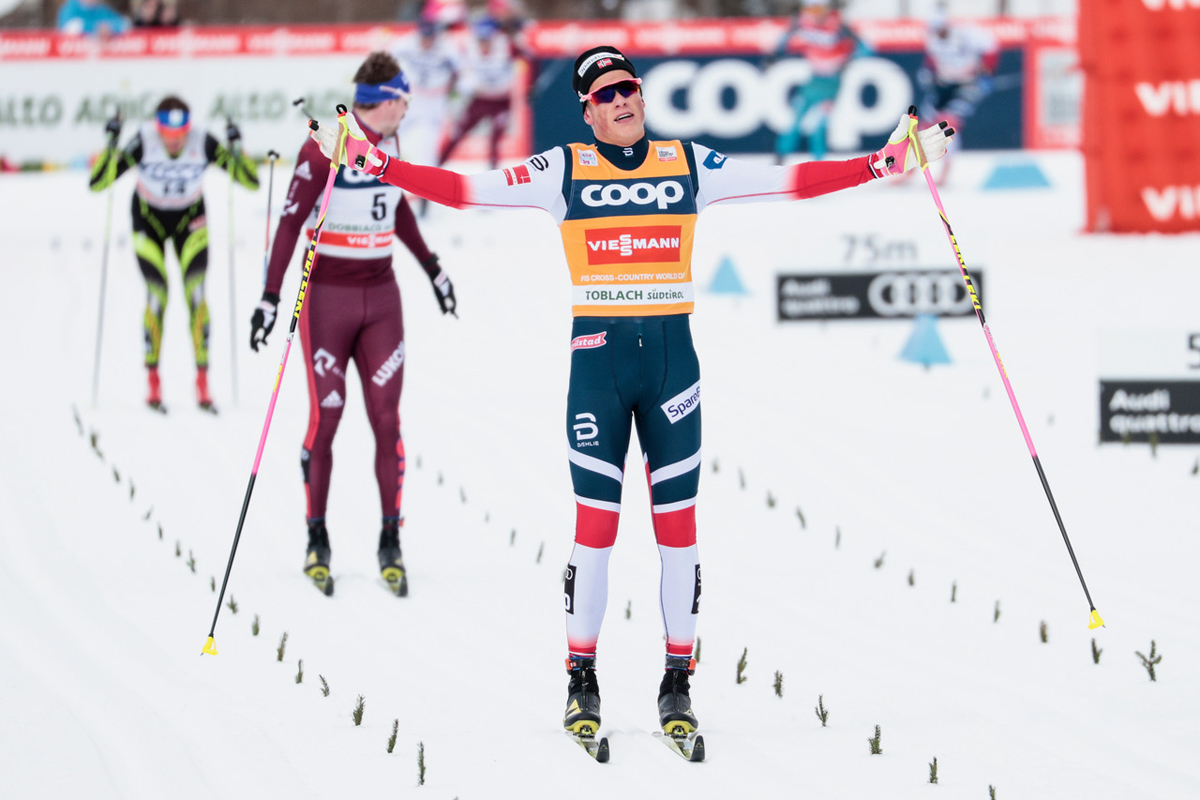
    Norway’s Johannes Høsflot Klæbo winning the men’s 15 k classic pursuit on Sunday in Toblach, Italy, ahead of Russia’s Sergey Ustiugov (5) in second and Kazakhstan’s Alexey Poltoranin (l) in third. (Photo: Fischer/NordicFocus)

    Johannes Høsflot Klæbo is making a name for himself. The 21-year-old Norwegian broke a record on Sunday, after taking the men’s 15-kilometer classic pursuit title in Toblach, Italy and tallying his seventh World Cup win this season, the most victories ever recorded by a male skier before the new year. In previous seasons, Norwegians Petter Northug and Martin Johnsrud Sundby had topped out at six.

    With the win, Klæbo remained the Overall World Cup leader with 752 points, 324 more than France’s Maurice Manificat in second.

    “I’m happy to back on the podium,” said Klæbo, who has won every race he’s entered except Saturday’s 15 k skate, according to an International Ski Federation (FIS) press release. He started Sunday’s 15 k classic pursuit in 10th, 36 seconds out of first.

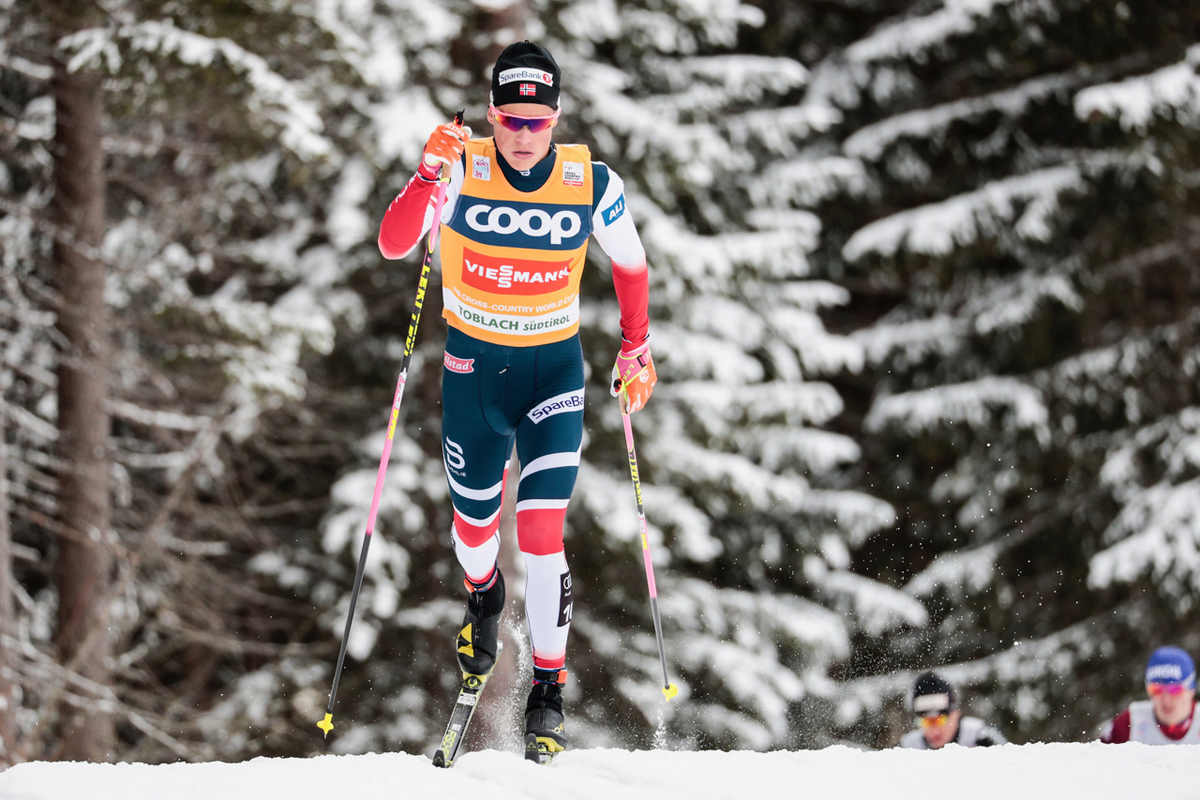
    Norway’s Johannes Høsflot Klæbo getting down to business after starting 10th in the World Cup men’s 15 k classic pursuit on Sunday in Toblach, Italy. He raced to first for his seventh win of the season. (Photo: Fischer/NordicFocus)

    “My plan was to go out hard from the beginning to close the gap. It worked very well,” he said. “When I was together with the group I was confident I could ski for a podium. I wanted to decide the race little bit before the stadium.”

    For the first 3.5 k of Sunday’s pursuit, the top four from Saturday’s race led the way, with Manificat, Norway’s Simen Hegstad Krüger, Great Britain’s Andrew Musgrave, and Canada’s Alex Harvey.

    Striding in limbo just over six seconds behind them was Russia’s Sergey Ustiugov.

    “I was waiting to see if I am able to close the gap on the leaders or if the group behind me catches me,” Ustiugov said, according to FIS.

    For Ustiugov, who started the pursuit in fifth, it was the latter.

    Klæbo started 22 seconds behind the Russian and caught him, pulling Ustiugov into contact with the leaders before the climb back to the stadium on the first of three laps.

    With Klæbo at the back and Manificat in the front, the six leaders started Lap 2, trailed by Norway’s Hans Christer Holund and Finland’s Matti Heikkinen six seconds back. A second chase pack of four — Switzerland’s Dario Cologna, Sundby, Russia’s Alexander Bessmertnykh, and Kazakhstan’s Alexey Poltoranin — followed 20 seconds later.

    “I was working hard with Dario [Cologna] and Alexander [Bessmertnykh]. Dario did a great job in the first two laps.” Poltoranin said, according to FIS.

    For the first half of Lap 2, Ustiugov and Musgrave exchanged leads, while Klæbo remained in the rear. Harvey stuck to the middle.

    “I had really fast skis,” Harvey told FasterSkier on the phone after. “It was kind of sugary snow on the steep climbs, so I was struggling a bit on the steeper sections … but I had really fast skis, just a little slick.”

    Midway through Lap 2, Klæbo began his move toward the front of the lead group. By the time the top six passed by the stadium for their third and final lap, Klæbo was positioned third, Ustiugov first and Manificat second. Harvey sat comfortably in sixth.

    “On the last lap, Ustiguov and Klæbo attacked and I was feeling great, but I had to feather it a bit on the climb,” Harvey said, explaining that he lost the most time on the course’s steeper sections.

    With less than 3 k to go, Ustiguov and Klæbo began to gap the rest of the field. Meanwhile, Poltoranin made his way to the front of the chase group.

    “I was far faster on the last two uphills,” Poltoranin said. “I still have some work to do to be able to beat Sergey and Johannes, but I am getting there.”

    Klæbo and Ustiguov remained unmatched for the final kilometer and, with arms outstretched, Klæbo crossed first in a time of 33:31.1 minutes. Ustiugov finished 1.9 seconds later in second place.

    “Johannes seems he is never tired. He played with us like with small kids,” Ustiugov said, according to FIS. “He was in impressive shape again.”

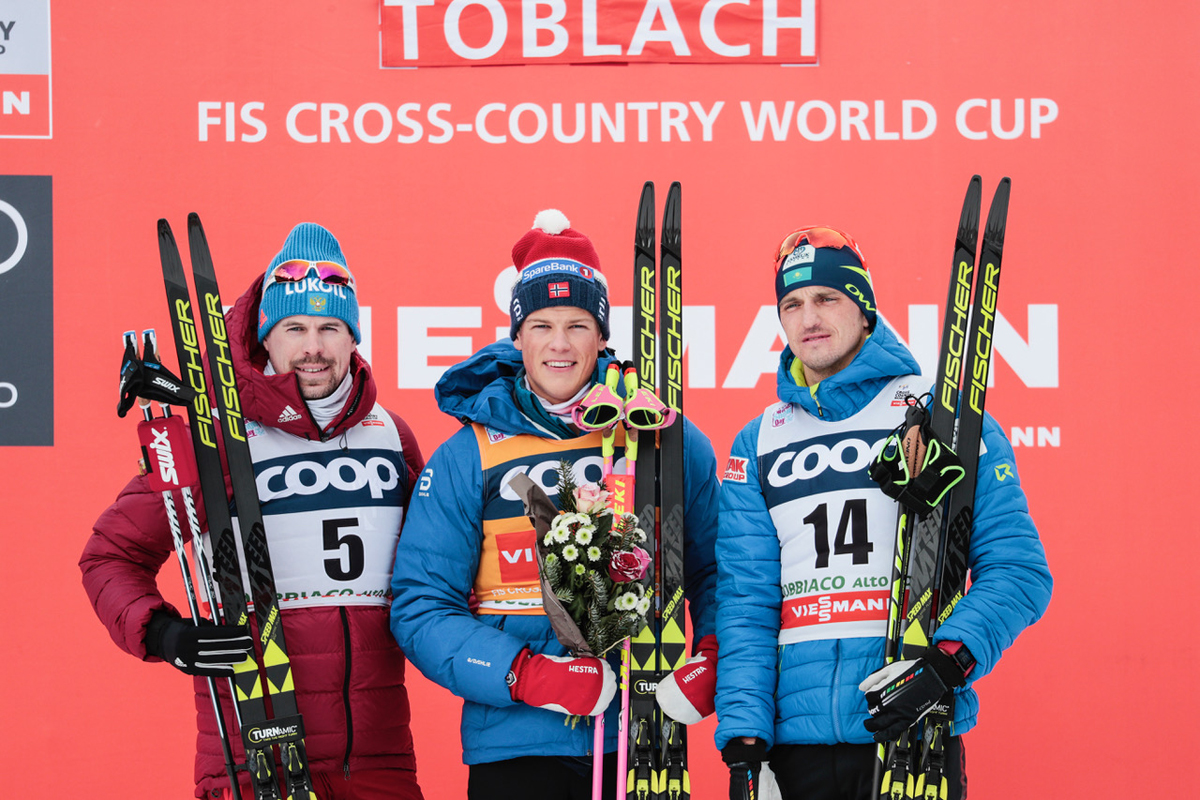
    The World Cup men’s 15 k classic pursuit podium in Toblach, Italy, with Norway’s Johannes Høsflot Klæbo (c) in first, Russia’s Sergey Ustiugov (l) in second and Kazakhstan’s Alexey Poltoranin (r) in third. (Photo: Fischer/NordicFocus)

    Rounding out the podium in third was Poltoranin, 4.5 seconds out of first.

    “I’m so happy. It has been two years since I was on the podium last time,” the 30-year-old Poltoranin said.

    In fourth was Bessmertnykh (+9.7), followed by Heikkinen in fifth (+9.8) Manificat in sixth (+10.7), Holund in seventh (+11.1) and Cologna in eighth (+11.8).

    After crashing in the final 500 meters of the race, Harvey finished ninth (+16.3).

    “I was sitting in fifth and Heikkinen was sitting in fourth, and … I was coming around him and his pole tip just hit the front of my ski tip and I just did a straight-up face plant,” Harvey said. “So I ended up last in my group. That was a bit frustrating, but the rest was a good day.”

    Rounding out the top 10 was Saturday’s 15 k winner, Krüger, who finished 24 seconds after Klæbo. Sundby, who had placed 20th in the 15 k individual start, raced up to 11th (+34.4) on Sunday, and Musgrave (who was third in the 15 k skate) finished 12th (+54.3).

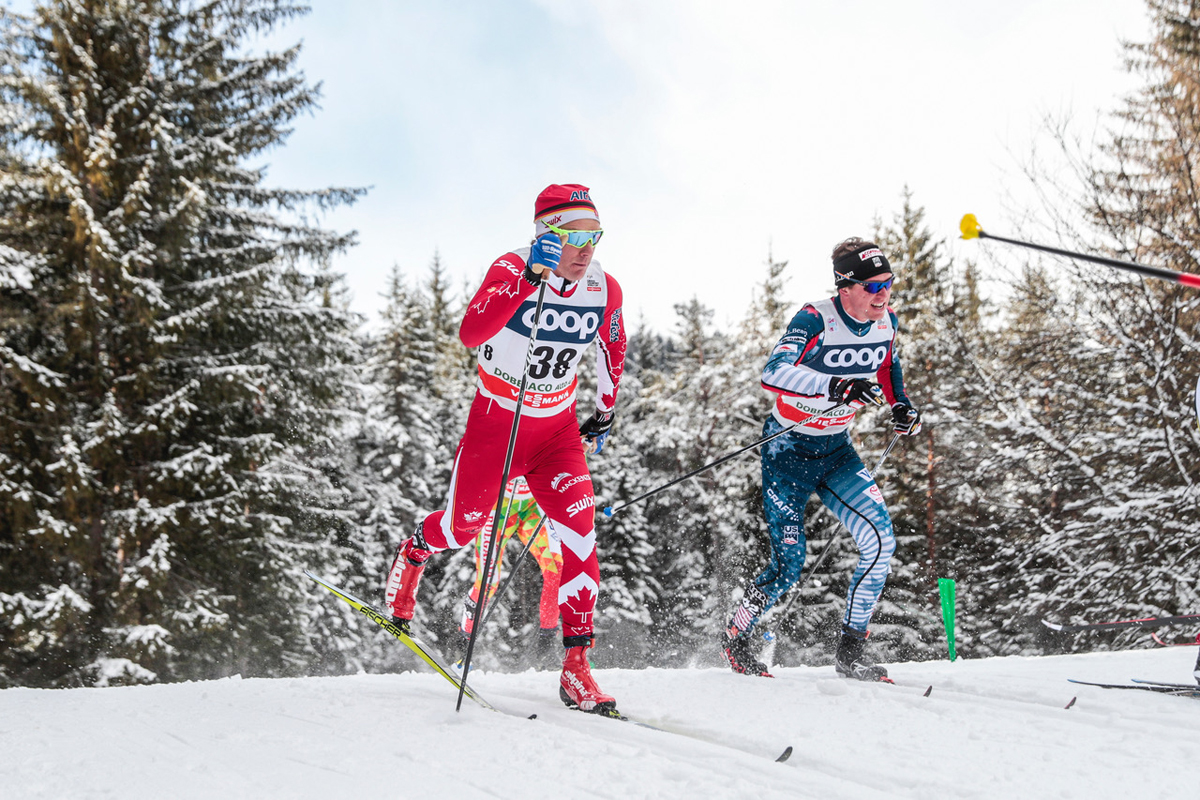
    Canada’s Devon Kershaw (38) racing alongside American Scott Patterson in the men’s 15 k classic pursuit on Sunday at the World Cup in Toblach, Italy. They finished 33rd and 42nd, respectively. (Photo: Fischer/NordicFocus)

    Leading the U.S. in 26th (+1:43.1) after starting 29th, was Erik Bjornsen. In five distance races this season, Bjornsen has scored World Cup points, placing within the top 30 in each race.

    New to the U.S. Ski Team’s B-team this year, Scott Patterson finished 39th (+2:37.2) after starting 42nd, and Paddy Caldwell placed 44th (+2:57.7) after starting 52nd. Noah Hoffman finished 49th (+3:01.7) after starting 40th.

    For Canada, Devon Kershaw placed 33rd (+2:02.8), up five spots from starting 38th, Graeme Killick was 50th (+3:42.0), Russell Kennedy 66th (+5:05.8), and Knute Johnsgaard 76th (+6:20.8) after starting 82nd.

    Racers will take a break from competitions until the Tour de Ski, which kicks off in Lenzerheide, Switzerland on Dec. 30.

    “I started a bit of a training block for the Tour just this week, and kind of continuing next week, so two weeks of a bit more volume, then do a little, do a little break after that, and then I have a few days of normal training to feel good before the tour,” Harvey said. “So I’m excited to see what a bit of a training and then a break does to me, because it will be the first time I have a little break like that since our last camp in October.

    “Other than the Olympics is the Tour de Ski, that’s important for me,” Harvey continued.  “So hoping to see if I can bring my level up a little bit with that bit of a break after the hard training, to feel a bit more fresh and a little more snappy.”

    Results| Overall World Cup standings

  • Krüger Tallies First World Cup Win in Toblach; Harvey 4th; Klæbo 10th

    Krüger Tallies First World Cup Win in Toblach; Harvey 4th; Klæbo 10th

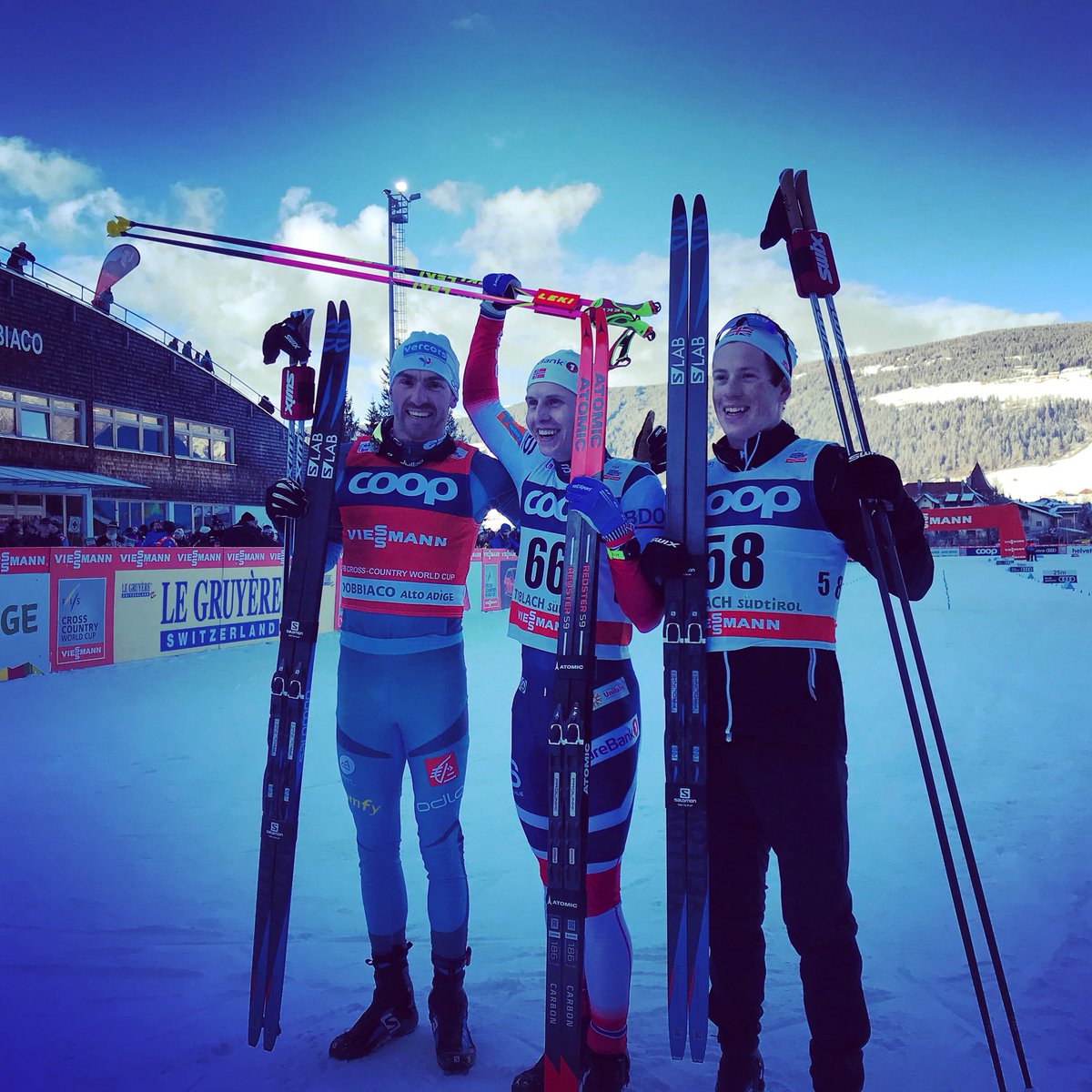
    The men’s 15 k freestyle podium at the Toblach World Cup in Italy, with Norway’s Simen Hegstad Krüger (c) scoring his first World Cup victory, last weekend’s winner Maurice Manificat (l) of France in second, and Great Britain’s Andrew Musgrave (r) in third. (Photo: FIS Cross Country/Twitter)

    The first time Simen Hegstad Krüger stood atop a World Cup podium, it was last season in the company of three teammates, after Team Norway won the men’s relay in Ulricehamn, Sweden.

    An individual podium win had remained elusive to the 24-year-old Norwegian for the past four World Cup seasons. Over the course of his professional cross-country career, Krüger had recorded two top-three results: his relay podium and a third place in the 10-kilometer freestyle stage of the 2017 Tour de Ski in Toblach, Italy.

    On Saturday, that statistic changed. Once again in Toblach, Krüger raced to his first individual World Cup win with the fastest time in the men’s 15 k freestyle. He covered the three-lap course in 29:58.8 minutes, besting second-place finisher Maurice Manificat of France by 10.6 seconds.

    “It’s great to finally win a World Cup race,” Krüger said, according to an International Ski Federation (FIS) press release. “I have been fourth twice this season. I thought my shape was good and I was hoping for a good performance and hopefully a podium, but to be first today, it’s absolutely amazing.”

    With 30-second intervals separating racers at the start, the race was a solo affair for most, particularly for the starters in the second half of the field, including Krüger in bib 66 (out of 90).

    Manificat, wearing the red bib of the Distance World Cup leader after winning last weekend’s 15 k skate in Davos, Switzerland, started 70th and also skied solo for most of the race, closing in on Krüger, but not enough to take the win.

    “I congratulate Simen on the win, it was just great what he delivered today,” Manificat said, according to FIS. “I am very happy with the second place. It is a confirmation of my good shape, which I have had since the beginning of the season.”

    In third, 11.5 seconds back from Krüger and 1.1 seconds out of second place, was Great Britain’s Andrew Musgrave, earning what he described as his “first proper World Cup podium.”

    “All the previous ones were for the fastest times in pursuit competitions,” Musgrave told FIS, referring to his stage win in a 25 k freestyle pursuit in Toblach in 2015 and his second-fastest time of day in the 15 k freestyle pursuit at 2017 World Cup Finals in Quebec. “I knew I could ski fast here. Today, everything fell in the right place. I am in a good shape and I was skiing well. My classic has not been great this year, but I am in a good position. I hope for another good result.”

    Finishing just 2.5 seconds off the podium on Saturday was Canada’s Alex Harvey in fourth. Though happy with his race, Harvey indicated the finish left him hungry for more.

    “I thought it was a great race,” Harvey said on the phone after. “For sure coming so close to the podium, sometimes you would rather be in sixth or fifth. Fourth is always a bit frustrating, it leaves you wanting more, but I think it’s good moving forward,”

    In Sunday’s pursuit, Harvey will start 2 seconds after Musgrave and 14 seconds after Krüger in first. Russia’s Sergey Ustiugov, who finished fifth on Saturday, will head out of the gate 5 seconds after Harvey.

    “I have been the hunter a lot before, so I know these guys are going to be coming hard,” Harvey said, referring to the starters behind him.

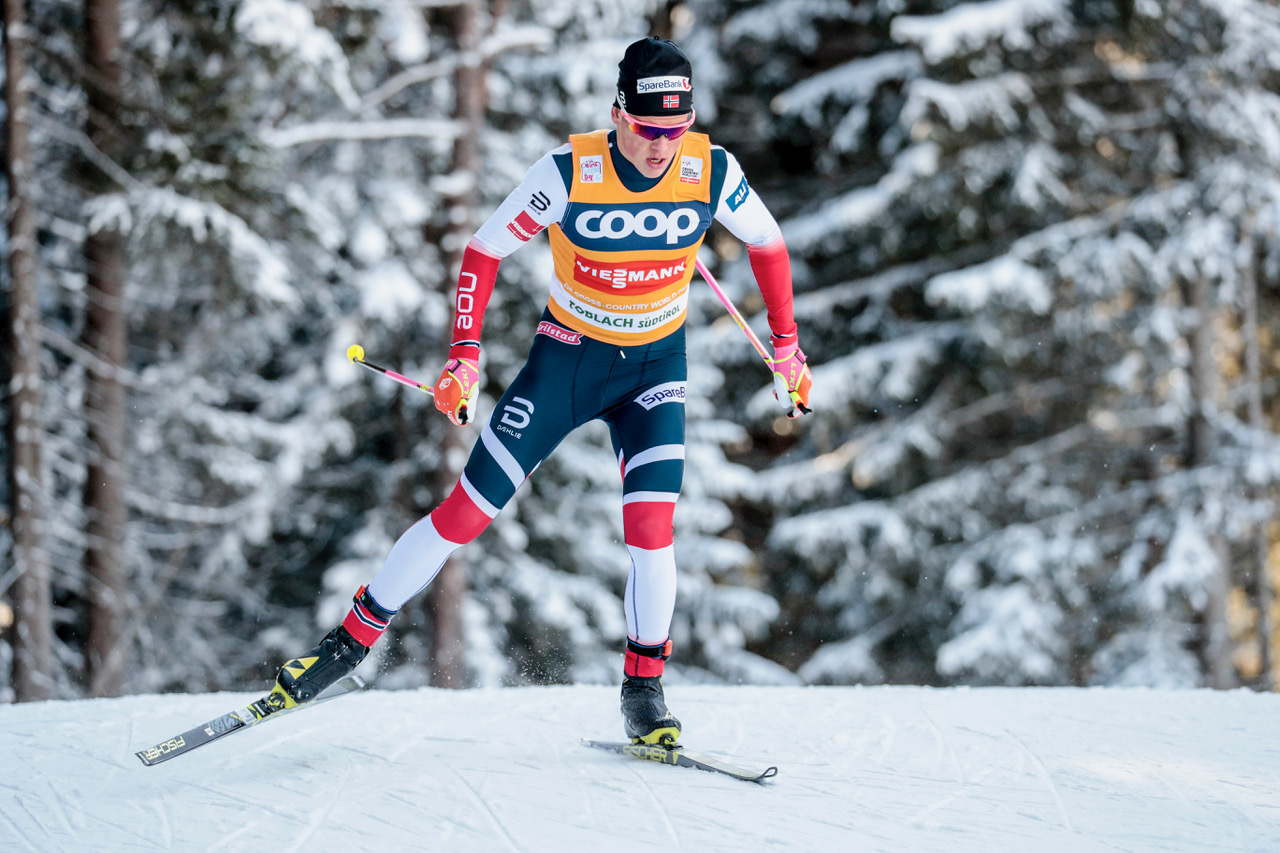
    Norway’s Johannes Høsflot Klæbo racing to 10th in the men’s 15 k freestyle at the World Cup in Toblach, Italy. (Photo: Fischer/Nordic Focus)

    After Ustiugov, who was 18.9 seconds back in fifth, Norway’s Finn Hågen Krogh placed sixth (+23.8) and Hans Christer Holund finished seventh (+25.9). Finland’s Matti Heikkinen was eighth (+27.3), Switzerland’s Toni Livers ninth (+35.0), and the current overall World Cup leader who hadn’t lost a race until Saturday, Norway’s Johannes Høsflot Klæbo 10th (+35.2).

    “I think [Manificat and Ustiugov], those two guys are probably going to be the ones pushing the most early on to try to stay away from Klæbo especially,” Harvey predicted. “[Manificat] has had [the top] time of the day a lot in this type of event, so it will be interesting to see.”

    Leading up to Saturday’s race, Klæbo had won every competition he’d entered this season. With his 10th place finish, he maintained his position as the overall World Cup leader by 250 points over Russia’s Alexander Bolshunov in second overall. Bolshunov did not race Saturday in Toblach.  

    Bjornsen 29th for U.S.

    While several U.S. Ski Team (USST) sprinters opted to race this weekend’s OPA Cup in St. Ulrich, Austria, the distance skiers stayed on the World Cup circuit in Toblach. Erik Bjornsen led the latter contingent in 29th, finishing 1:09.6 minutes back from Krüger. Despite the 15 k freestyle individual start being his “least favorite race”, Bjornsen said he was “psyched” to be in the top 30.

    “I feel like I had a good start and then was able to hang on for the last 7 k or so. I was pretty happy with that,” Bjornsen said on the phone. “I took the last weekend off hoping to have some more energy for this weekend, and so I was shooting for a top-30 finish to be within a reasonable distance of the top 20 going into my favorite race, the 20 k classic.”

    On Sunday, he’ll start 1:10 back and within 12 seconds of 20th.

    “I am excited for tomorrow and feel like I am in a decent spot to move up,” Bjornsen said. “There are for sure some skaters in front of me that I think should be pretty easy to pass, but then of course there are some strong guys behind me. So hopefully we can get a good crew of guys that are willing to work hard and move up the field.”

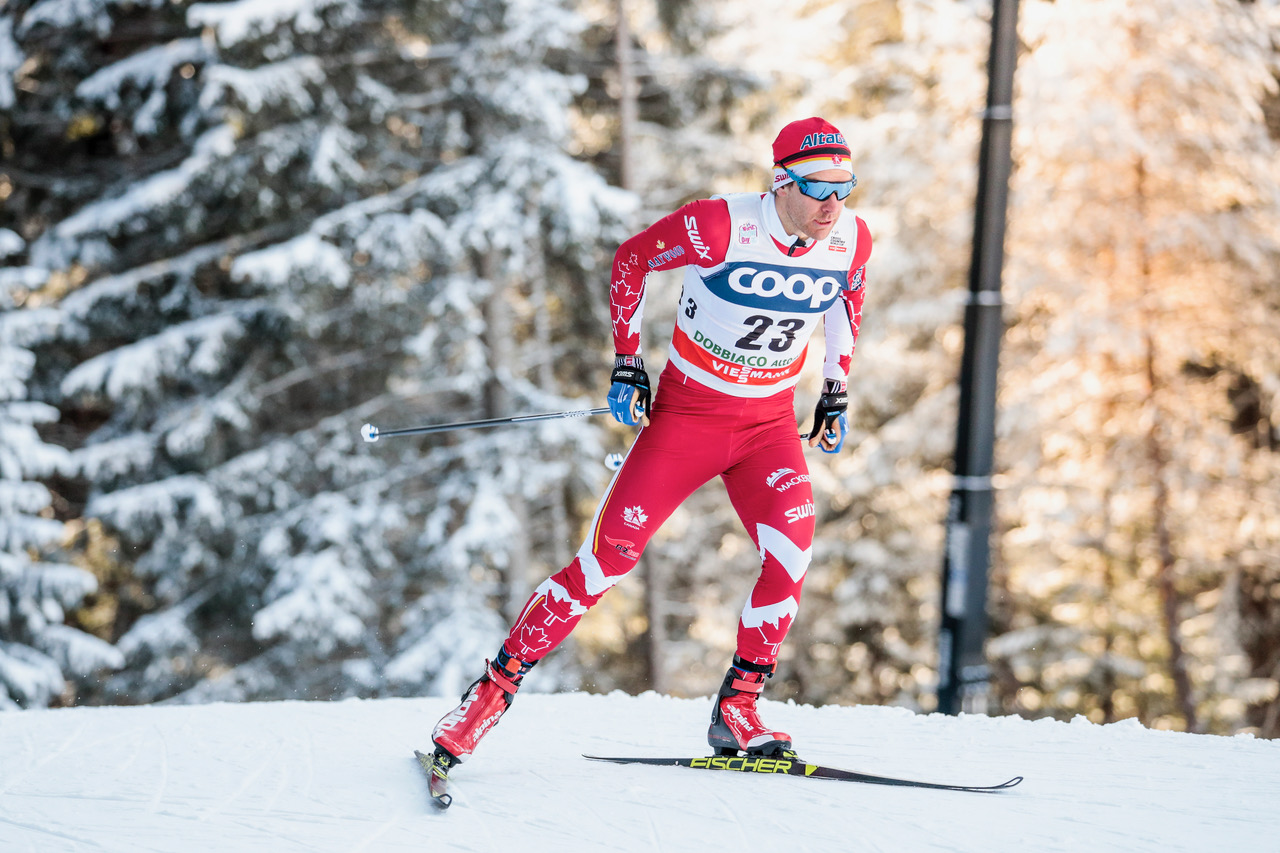
    Canada’s Devon Kershaw racing to 38th in the men’s 15 k freestyle at the World Cup in Toblach, Italy.(Photo: Fischer/Nordic Focus)

    Also racing for the U.S., Noah Hoffman finished 40th (+1:24.5), Scott Patterson was 42nd (+1:29.4), and Paddy Caldwell was 53rd (+1:50.0).

    A total of five Canadians competed, with Devon Kershaw placing 38th (+1:22.1), Graeme Killick in 49th (+1:47.8), Russell Kennedy in 60th (+2:13.2), and Knute Johnsgaard in 85th (+3:28.3).

    Results | Overall World Cup standingsPursuit start list