Tag: Toblach skate sprint

  • Sweden’s Nilsson Wins TdS Stage One Sprint; A Recharged Diggins Takes Third

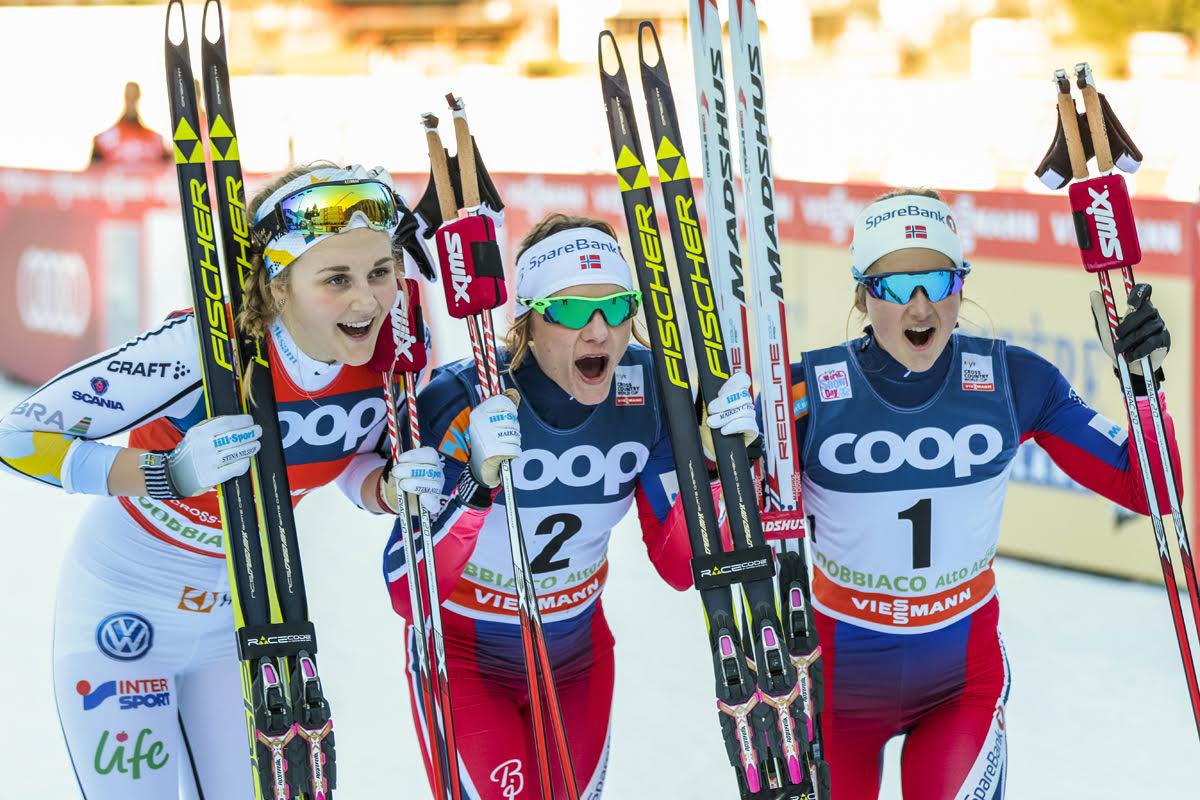
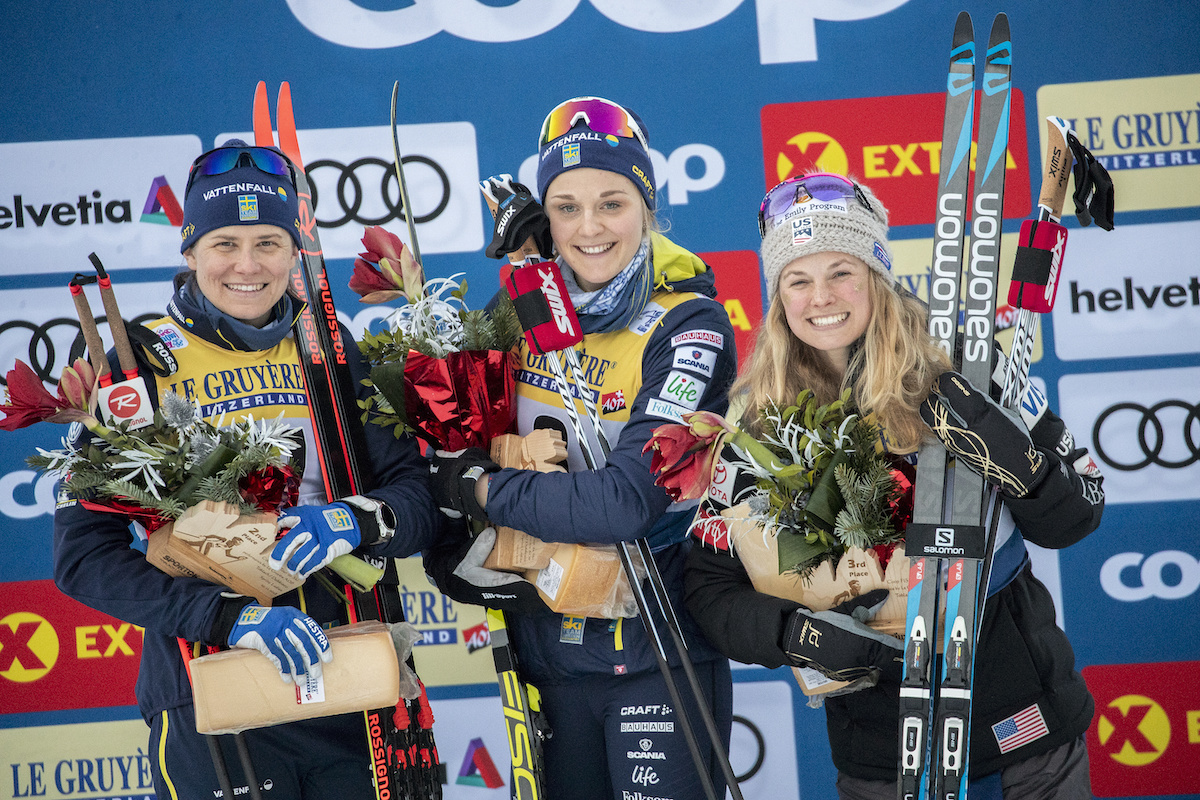
    Women’s podium in the 1.3 k skate sprint, the first stage of the Tour de Ski, in Toblach, Italy. Sweden’s Stina Nilsson (center) placed first, teammate Ida Ingemarsdotter (left) second, and Jessie Diggins of the U.S. (right) placed third. (Photo: Fischer/Nordic Focus)

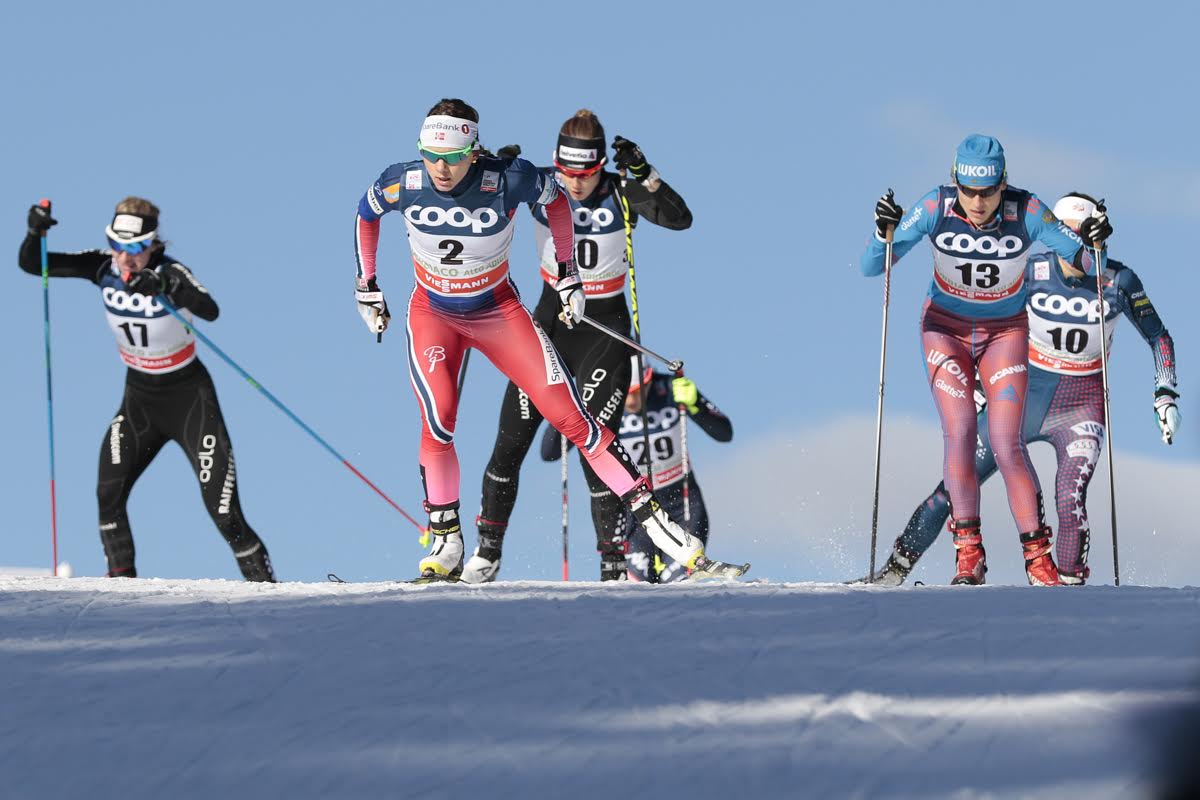
    The threads of the thirty skiers who made the women’s heats of the 1.3-kilometer freestyle sprint during Stage 1 of the Tour de Ski (TdS) in Toblach, Italy on Saturday could weave a complex pattern. There are the lead changes. Skiers advanced. Skiers were eliminated. At the start of a seven-stage event, one race, and the first at that, simply established the early markings of a pattern. Nothing too complex to discern — but nascent trends with six stages to go.

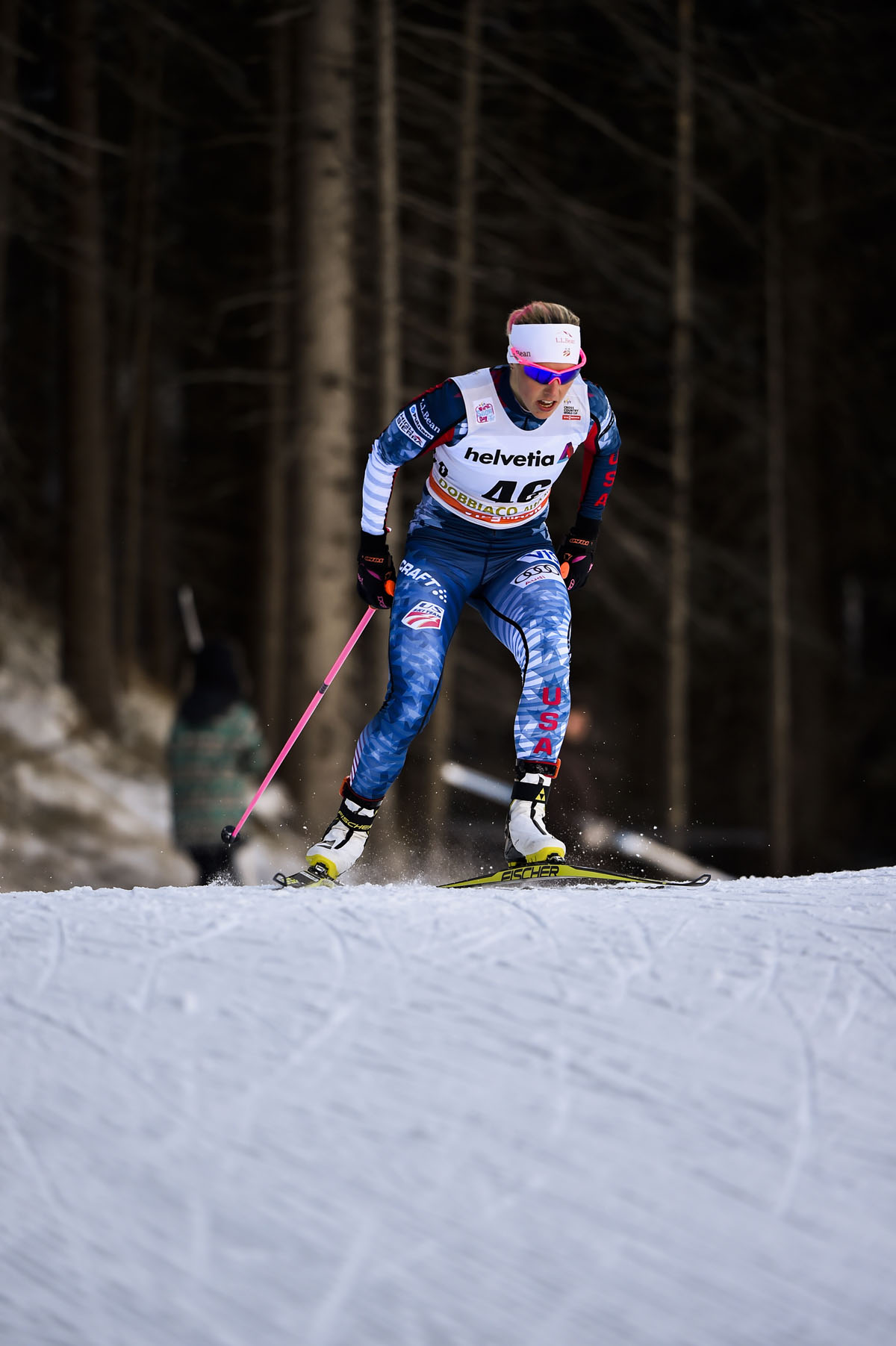
    Sweden’s Stina Nilsson smashed the women’s final winning by three seconds over second-place teammate Ida Ingemarsdotter. Jessie Diggins of the U.S. placed third (+3.07) for her first podium of the season.

    Nilsson pulled away and skied off the front around two minutes into the race, while the remaining skiers fought for second through sixth. Russia’s Yulia Belorukova placed fourth (+3:16). Sweden’s Linn Soemskar fifth (+3.26), and Sadie Bjornsen of the U.S. – the fastest qualifier on the day —  finished in sixth.

    “It was a little bit like 100-meter racing where you just try to die less than the rest of the group, but everybody slows down,” U.S. Ski Team Coach Matt Whitcomb said in a phone call. “And Stina just died less and everybody else just died more. Standing on the side of that hill, from about 100 meters away, I could just see it happen pretty clearly. Stina was the only one who was able to keep her energy moving up that climb. It was really impressive.”

    With her dominating performance in the final, after barely edging Diggins and Bjornsen in the first semi-final, Nilsson reiterated that she plans on pulling from the TdS after the fourth stage. Until then, Nilsson has a 10 k skate, another skate sprint, and a 10 k classic mass start to contest.

    “I said before that I will only do the first 4 races, we will see but I think I will stick to that plan,” Nilsson told the International Ski Federation (FIS).

    This much is clear after a single race: Nilsson and her teammates have come to the TdS in shape with Nilsson displaying both top end sprint speed and a combined high-speed endurance as displayed by her “died less” finals performance.

    Three Swedes were in the finals. Whereas traditional powerhouse Norway placed two women in the top-twelve, none of whom advanced beyond the semis. Norway’s top qualifier was Maiken Caspersen Falla in 12th (+2.70).

    One race defines nothing for Norway. As a single race defines little at best for any other team in the TdS. The women race over 60 k in seven stages. They ticked off 1.3 k today.  

    But again, the threads from a single race do begin the narrative. As for Nilsson, the language in her quote includes the phrase “we will see” when pushed on her intentions to abandon the TdS as planned. So “we will see” if, in fact, she remains high in the standings whether she indeed pulls from the competition.   
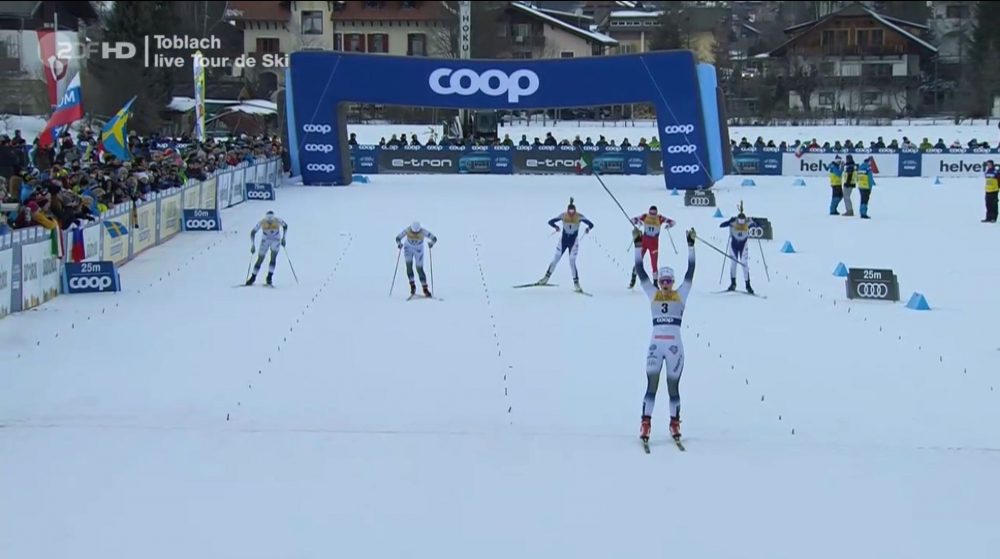
    Dominant: Stina Nilsson of Seweden takes the win in Toblach, Italy during the first stage of the Tour de Ski — a 1.3 k skate sprint. (Photo: ZDF screenshot)

    The U.S was the only team to place three women in the top-10 during qualification. Bjornsen skied the 1.3 k course with the fastest qualifying time of 2:35.95 minutes. Diggins qualified in sixth (+1.38), Sophie Caldwell in ninth (+1.60).

    “Today was a solid day for me,” Caldwell emailed. “But I definitely left wanting a bit more. It’s a tricky course that is pretty quick but has a fair amount of climbing and jostling for position. I felt like a skied my quarterfinal well and was able to move up throughout my heat and get myself into a good position by the top of the last climb.”

    That position allowed her to keep position and win her quarterfinal.  

    Bjornsen, Diggins, and Caldwell all skied in the first semi. Caldwell was eventually eliminated as she placed fifth.

    “Our semi was definitely loaded, but that’s how it goes sometimes,” Caldwell wrote. “The first semi gets the advantage of more rest before the final, so it tends to be slightly more stacked. I was happy with the move I made up the 2nd hill and had myself in a pretty good position going over the top of the last hill, but unless you’re in the lead, it’s really hard to control what’s going to happen on a course like that where everyone tends to come together on a tricky corner. My lane didn’t end up as open as I was hoping it would be, but it’s hard to say if the results would have been any different if it had been – it was a tight heat and everyone was skiing strong. My goal was to make the final, and I was disappointed to just miss it, but it was still a solid day and pretty awesome to have three girls in the top 10, Jessie on the podium, Kevin with a season-best, and Sim looking super strong even though he had a bit of bad luck.”
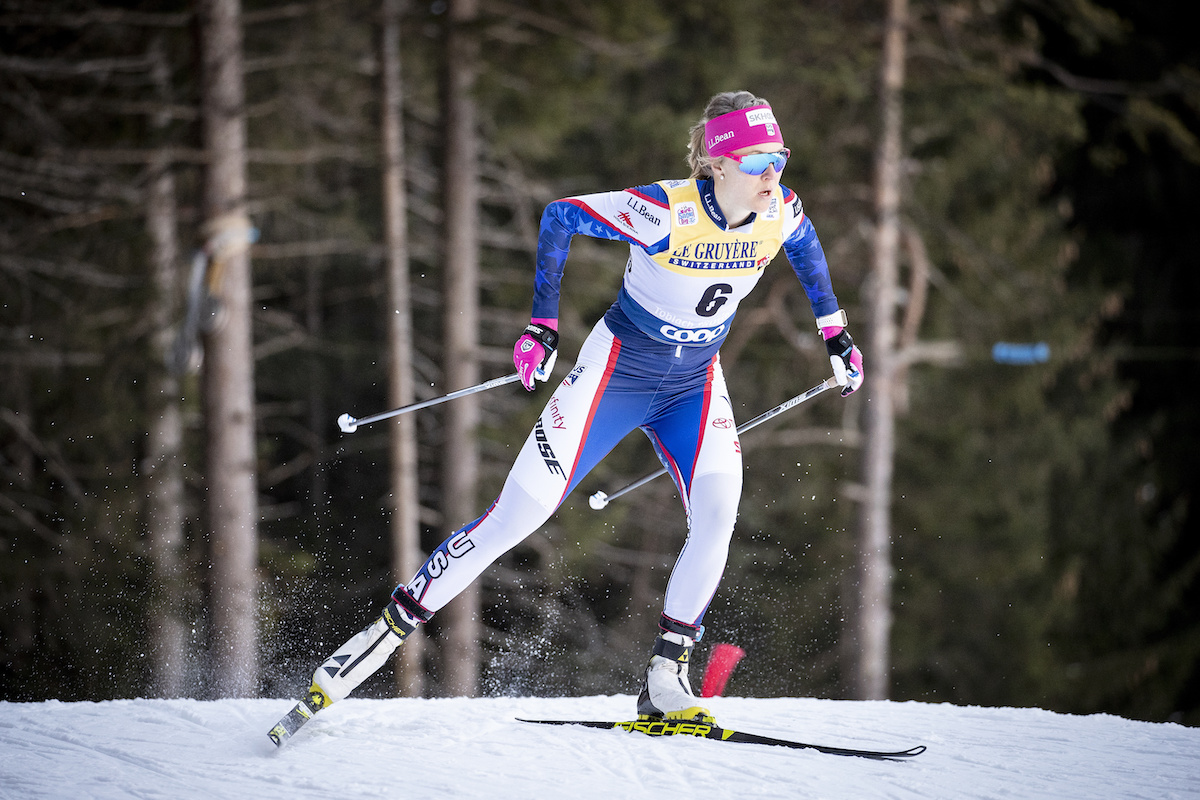
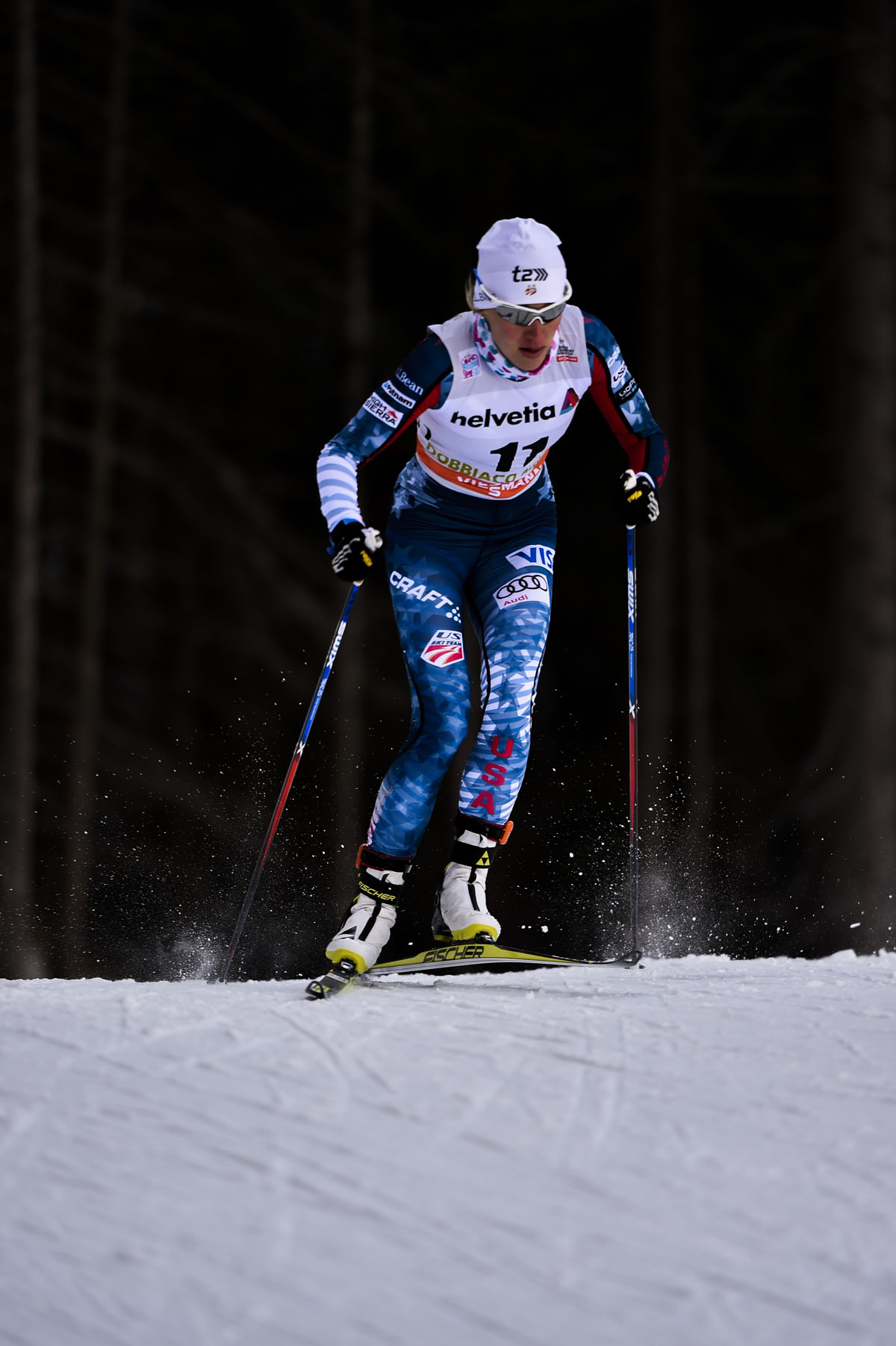
    The U.S. Ski Teams’s Sadie Bjornsen qualifying during Saturday’s 1.3 k skate sprint in Toblach, Italy — the first stage of the 2018/2019 Tour de Ski. (Photo: Fischer/Nordic Focus)

    Bjornsen was third in the semi and advanced to the final as the first lucky loser. Diggins placed second, one-hundredth of second ahead of Bjornsen.   

    “I was definitely really excited to have such a strong qualifier today because I got super sick over Christmas time and spent three days with a fever and quite a bad cough so I was worried that I was going to even be able to start the Tour,” Bjornsen told FasterSkier in a call. “So it was definitely really encouraging to feel like I was back in form to start the qualifier, which kind of put me in with some confidence in my legs going forward.”

    Bjornsen and Diggins lined up in the first heat together. Bjornsen skied on the sharp end for most of the heat’s duration. The two U.S. skiers came into the final straight nearly side by side and unchallenged at the front. Diggins slotted ahead of Bjornsen for the win by .24 seconds.

    “I’ve done a ton of work on my starts and I’m finally in a place now where I can find myself in the front of the heat at the start which is nice because for me I just need to go hard over the entire course,” Bjornsen said of her strategy in the sprint heats. “I can’t just play those games, I just don’t have the strong finishing stretch of everybody. So it always benefits me to kind of ski in the front of the heat and kind of tire out those pure sprinters so that maybe I can break their legs when they come to the finishing stretch.”

    Bjornsen scored her first career skate sprint podium in Lillehammer, Norway on Nov. 30. Her skate sprint consistency is now beginning to compliment her classic skiing power, speed, and endurance. Not that Bjornsen is in a learning phase of her career, but advancing well into the skate sprint heats has allowed Bjornsen to test her skate engine.  

    “I’m happy, I just haven’t skied a ton of semi-finals or finals in skate sprints,” Bjornsen said. “I had some success in Lillehammer, but aside from that, I haven’t done a ton of it. So for me, it’s always exciting to make it past the quarterfinals because then I know I’m in a position to play.”

    Bjornsen did ultimately come up against a threshold today in the final. Her ski-in-front position took a slight toll as Nilsson took control of Bjornsen’s semi-final and final.

    “I think in the semi-final I kind of exploded the remains of my speed in my legs and I was really happy to make it through as a lucky loser,” Bjornsen explained. “Starting the final I could feel right away that I was running on final fumes but just tried to position myself behind Stina.  As she took off in those final climbs I was not able to go with her but just tried to remain in the front and hope that I had a good finishing stretch sprint.”

    Bjornsen is firm that despite her standings after the fifth stage of the TdS, she will exit the Tour. During her interview, Bjornsen stated outright that finishing the TdS atop the Alpe Cermis — no matter her finishing place — on the final climb is arguably her favorite moment in racing the World Cup. In last season’s run up to the Olympics, Bjornsen raced the entire TdS.

    Bjornsen’s macro-plan is to conserve energy and peak for the Seefeld, Austria’s World Championships.

    “It’s been really hard for me to make that decision this year,” Bjornsen said about her premeditated Tour exit. “But that means I have never really focused or just channeled all my energy on the Championships. I tried last year during the Olympics but I don’t think that I was making the right decisions for my fatigue level. I think I was deciding to do the races that were fun all the time. So it’s definitely it’s hard for me to say not to finish the whole Tour because I like to think that I can just do everything. I also want to focus on the Championships and now that I’ve started feeling really great in skate sprint I think that there’s an awesome opportunity there.”

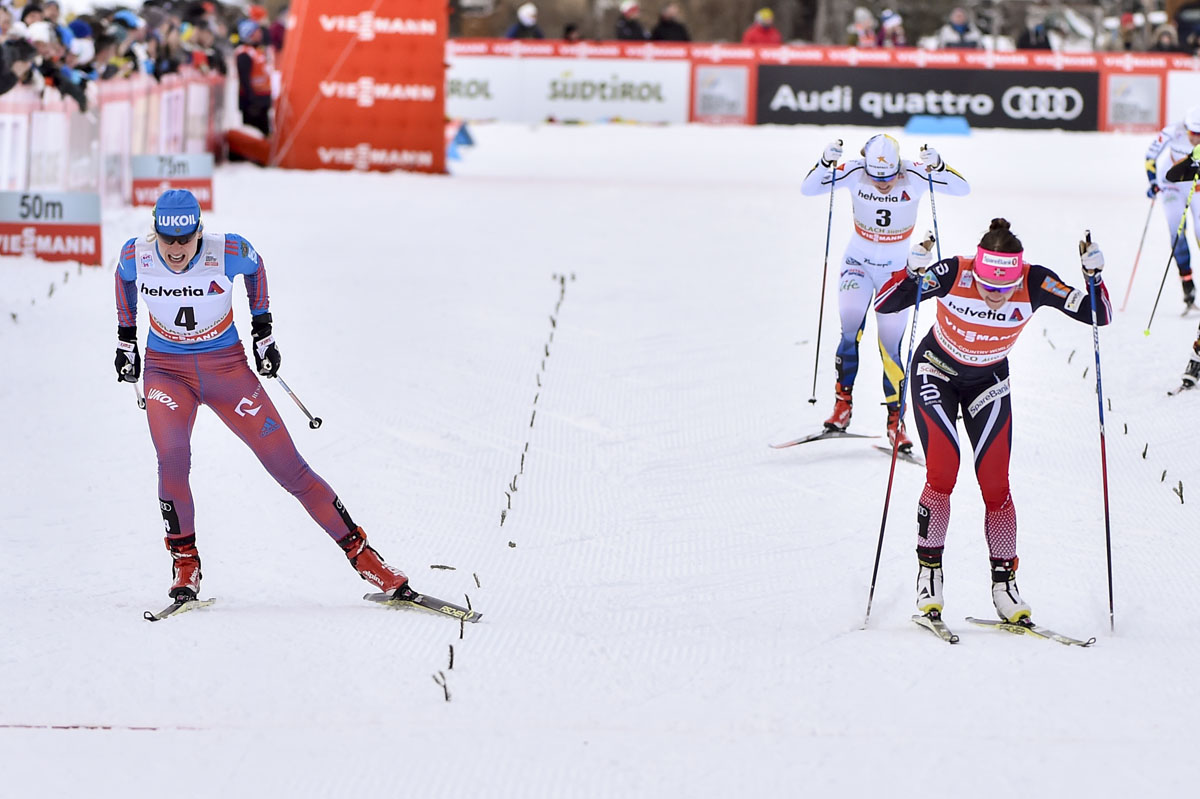
    Jessie Diggins (skier nearest to camera) toeing the line for third place in Toblach, Italy during the first stage of the 2018 Tour de Ski. Sweden’s Ida Ingemarsdotter
    crossed the line before Diggins to place second. (Photo: ZDF screenshot)

    Diggins’s racing left nothing to doubt. Through her qualifier to the end of the finals, Diggins was a presence. With her first podium of the season, she also admitted the difficulties finding joy in skiing during Period 1.

    Diggins posted an earnest and transparent blog post on Friday about the issue. Here’s one quote:

    “Ever since the Olympics, I have felt as though there’s been enormous outside pressure coming down on me. Maybe it’s the increased access to athletes that comes with much better broadcasting, social media, TV interviews, and online reporting. Maybe it’s my own naiveté, thinking that cross-country skiing would never have the same kind of press and pressure that comes with the “big sports”. Whatever the reason, this season it’s been incredibly hard for me to tune out the external pressure to (simply) “be amazing” all the time.”

    In reality, Diggins’s performance in Period 1 was in stride with her past. Yes, Saturday was her first podium of the season. Diggins also placed fifth in her last race – a grueling 10 k skate in Davos, Switzerland. Needless to say, the world of sport comes with pressure. Now for Diggins, pressure well beyond the scope of the cross-country world. Overtly, Diggins remains on track. And she stated outright on the phone Saturday that she skied with a smile in Toblach.

    “I am having fun,” Diggins said. “And it happened to come with a podium. But I think it’s important to say that the most important thing for me was that it was fun. Because if you podium and you are not loving what you are doing, then it doesn’t matter.”

    Pressure is nothing new to Diggins. Since high school, she has been dealing with mounting pressure and expectations. Back then it was not if Diggins would win but by how much. And if she didn’t meet some external time benchmark between herself and the next best skier back, then maybe it wasn’t good enough. And there was even pressure to beat most of the male athletes at a given race.

    In Toblach, Diggins may have been tempered out of the start gates, building into her quarter, semi, and finals. But she found gaps. She made her own moves. She matched moves. She skied in the moment on her way to third place overall. The big prize six more stages away atop the Alpe Cermis in Val di Fiemme, Italy.

    And there was Saturday’s podium shot. That is a smile.  

    Racing continues tomorrow with a 10 k skate for the women.

    Women’s Results


  • Hamilton Back on Podium in Toblach Sprint; Five Americans in Top 13

    Hamilton Back on Podium in Toblach Sprint; Five Americans in Top 13

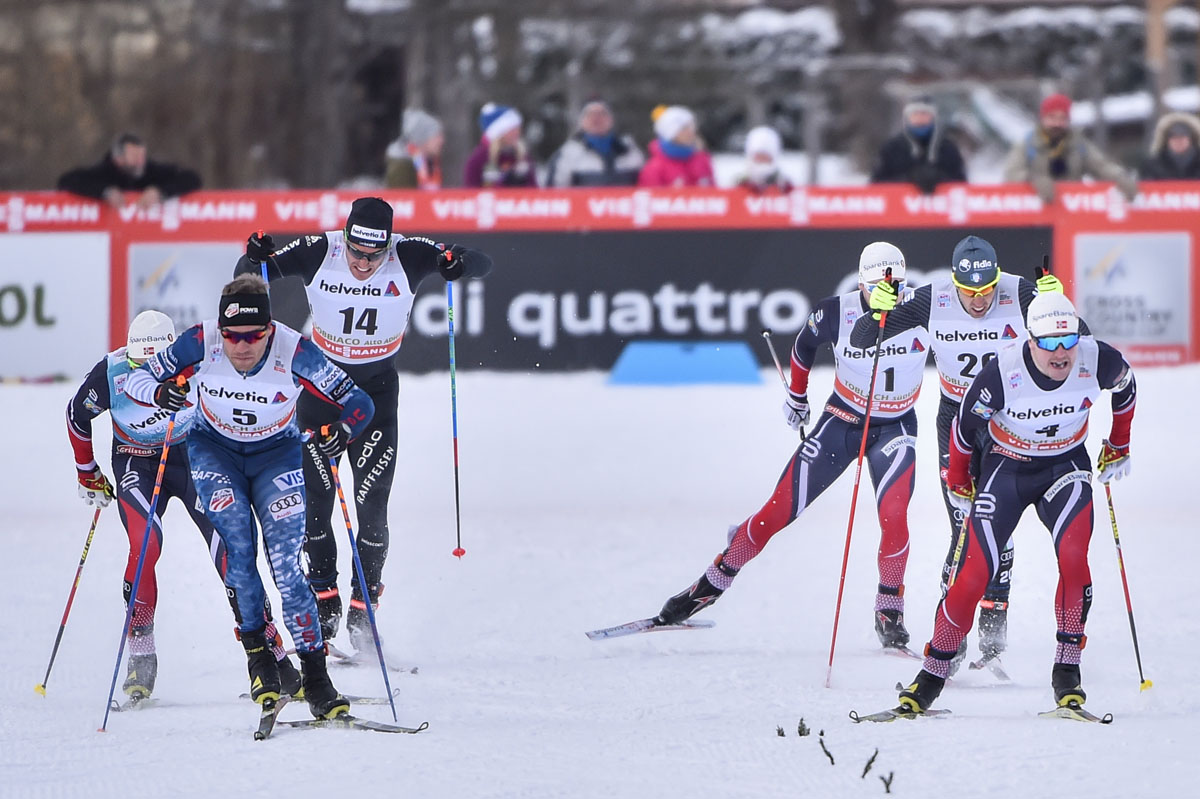
    Simi Hamilton (l) racing for first with Norway's Sindre Bjørnestad Skar (r) as they lead the men's final down the finishing stretch of Saturday's 1.3 k freestyle sprint at the World Cup in Toblach, Italy. Skar won the photo finish with Hamilton by 0.03 seconds. (Photo: Fischer/Nordic Focus)
    American Simi Hamilton (5) racing for the win with Norway’s Sindre Bjørnestad Skar (r) as they lead the men’s final down the finishing stretch of Saturday’s 1.3 k freestyle sprint at the World Cup in Toblach, Italy. Skar won the photo finish with Hamilton by 0.03 seconds. (Photo: Fischer/NordicFocus)

    The feeling was beyond déjà vu. Simi Hamilton remembered the exact moment so clearly: almost exactly 13 months ago, he had led the World Cup men’s freestyle-sprint final in Toblach, Italy, into the last climb and ensuing descent into the stadium. There he was, leading the six-man final and racing for first place. Italy’s Federico Pellegrino took it from him after taking advantage of the downhill draft, slingshotting from second to first, while Hamilton secured second. It was the second podium of Hamilton’s career and first in a non-stage World Cup.

    Great moment, but on Saturday, the U.S. Ski Team member was out to make it even better on the same 1.3-kilometer sprint course in Toblach.

    In an instant, Hamilton recalled his positioning on that last hill and how those final seconds played out last season as he approached the last hill of Saturday’s final. Hamilton charged from behind to put himself in second by the top, right behind Pellegrino.

    “I remember thinking coming down that long downhill, ‘This is awesome because this is exactly what Federico did to me last year,’ ” Hamilton said on the phone after Saturday’s race. “He got a really good draft off of me coming down that downhill and he was able to slingshot through the corner and into the finish stretch so I was really psyched. I was like, ‘This could be a really good thing right now.’ ”

    His observations were spot on as the U.S. sprinter — who has worked to improve his distance racing as well — slingshot around Pellegrino to lead into the final curve before the finishing straight. There, he skied over a pocket of softer snow, which caught him off guard and put him back on his heels, he said.

    “It kind of it messed with my head a little bit,” Hamilton said. “So I think it took me a second to recover from that, and I was just focusing so hard on not doing anything really stupid in the last 100 meters with the snow conditions kind of being a little funky there.”

    At the same time, he knew he had as good a shot at ever at winning.

    “I knew that I was fighting for first right there and fairly confident I was going to be on the podium at that point, but I really wanted that first spot, especially with having gotten second last year,” the 29-year-old Colorado native said.

    Behind him, Norway’s Sindre Bjørnestad Skar had also taken advantage of the draft, as well as Hamilton’s slight bobble under the archway banner 100 meters before the finish, and came up on Hamilton’s left side to challenge him for first place.

    The two went stride-for-stride to the line, which ended in a photo finish for first. Skar celebrated across the line, holding one arm high, while Hamilton teetered out of exhaustion and face planted alongside him. It took several moments to determine the actual winner. Finally, the results revealed that the 24-year-old Skar had taken it by three-hundredths of a second (winning the final in 2:47.91 minutes) for his first individual World Cup victory. For Hamilton, second place marked his first podium this season and the fourth of his career.

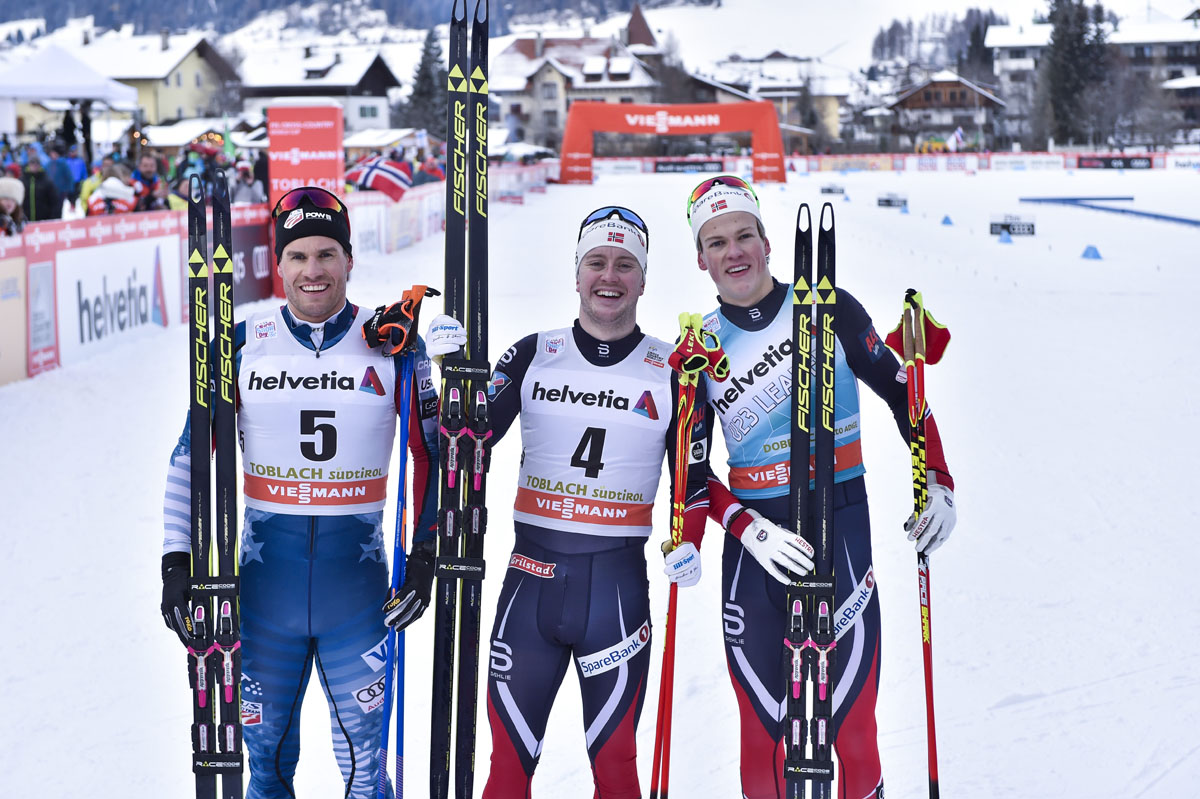
    The men's freestyle sprint podium at Saturday's World Cup in Toblach, Italy, with American Simi Hamilton (l) in second, Norway's Sindre Bjørnestad Skar (c) in first and Norway's Johannes Høsflot Klæbo (r) in third. (Photo: Fischer/NordicFocus)
    The men’s freestyle sprint podium at Saturday’s World Cup in Toblach, Italy, with American Simi Hamilton (l) in second, Norway’s Sindre Bjørnestad Skar (c) in first and Norway’s Johannes Høsflot Klæbo (r) in third. (Photo: Fischer/NordicFocus)

    “He had a really really solid last 100 meters,” Hamilton said of Skar. “We both threw for the line and he was just coming up a little faster than I was. … It was a little frustrating, for sure, to be second again for the second year in a row, but at the same time he skied really well, and all of those other guys in the final. It is great to share the podium with a bunch of other really talented, strong skiers, who are the best sprinters in the world.”

    Norway had two on the podium with 20-year-old Johannes Høsflot Klæbo in third (+0.66).

    Pellegrino missed out on the podium by 0.61 seconds in fourth (+1.27), Switzerland’s Jovian Hediger placed fifth (+1.84) and another Norwegian Håvard Solås Taugbøl was sixth (+3.77).

    For Skar, who turns 25 on Jan. 22, the victory (which was his third podium this season and his career) was another check mark on his list of season goals.

    “Getting my first World Cup victory and then qualifying for the World Championships was one of my goals this year and it seems like that’s going well,” he told NRK after.

    After qualifying in fourth (0.78 seconds behind Taugbøl, who won the qualifier in 2:47.38), Skar went on to win the first men’s quarterfinal in a photo finish with Hediger, then placed second in the first semifinal. Taugbøl won that semifinal by just six-hundredths of a second over Skar, while Hamilton was just another 0.05 seconds back in third and Hediger 0.03 seconds behind Hamilton in fourth. All four advanced to the final, where Skar positioned himself in the middle of the pack for much of the two-lap race, skiing in third up the second-to-last climb.

    “It was almost like a lottery,” Skar said of the frequent change of leaders in the final during a post-race, televised interview with the International Ski Federation (FIS). “I just tried to stay calm and to have a good sprint.”

    He had a feeling that he had the edge on Hamilton, but “it was very, very tight,” Skar said.

    For Hamilton, who qualified fifth (+0.83), the podium confirmed what he had been searching for. So far this season, he has only competed in six World Cup races. Three of them were sprints, and his best result before Saturday had been 18th in the skate sprint at the Tour de Ski’s first stage in Val Müstair, Switzerland. After leaving the Tour after Stage 2, Hamilton competed in two OPA Cup races last weekend in Planica, Slovenia. There, he won the skate sprint and finished fifth in the 10 k skate.

    “That definitely increased my confidence and I felt much better about where I was fitness-wise and speed-wise with those races last weekend,” Hamilton said. “And I knew that I have skied this course well before and I really enjoy racing here. It is a great place and I love it, and I was just psyched to see what I could do today, and fortunately it ended pretty well.”

    U.S. Ski Team Head Coach Chris Grover said it was “incredible” that Hamilton has placed second in Toblach’s sprint two years in a row.

    “It’s been fun watching him train on this course this week,” Grover said on the phone Saturday. “He did a big intensity session on the sprint course on Thursday, and when you watch him do it, he just looks like somebody who could be on the podium in this race, and of course he looked like that last week when he won the OPA Cup, too. He was able to go out there and make moves at will and see an opening and take it.

    “He’s shown a mastery of this course, and his fitness is quite high,” Grover added. “It’s also worth mentioning that we had incredible skis today. Athletes kept coming back saying, ‘My skis are incredibly fast!’ That’s a key part of the equation.”

    As for Hamilton’s form leading up to World Championships late next month?

    “I’m hoping that I am not peaking right now because obviously we have quite a bit more time to go before Lahti, but I am definitely feeling like things are still going in the right direction,” Hamilton said.

    All 7 Americans Advance

    Men and women combined, five Americans and two Canadians started Saturday’s sprint — held less than a week after the nine-day Tour de Ski (TDS) ended last Sunday. Three of those Americans were women; the two Canadians were both men. Just one of them completed the Tour. Most of the competitors in Toblach this weekend did not compete in this year’s TDS.

    Of those seven North Americans, all of them finished in the top 30 of their respective qualifiers on Saturday to advance to the heats.

    Hamilton led the group in fifth, and just another 0.27 seconds back, his U.S. teammate Andy Newell qualified in sixth, 1.1 seconds behind Taugbøl.

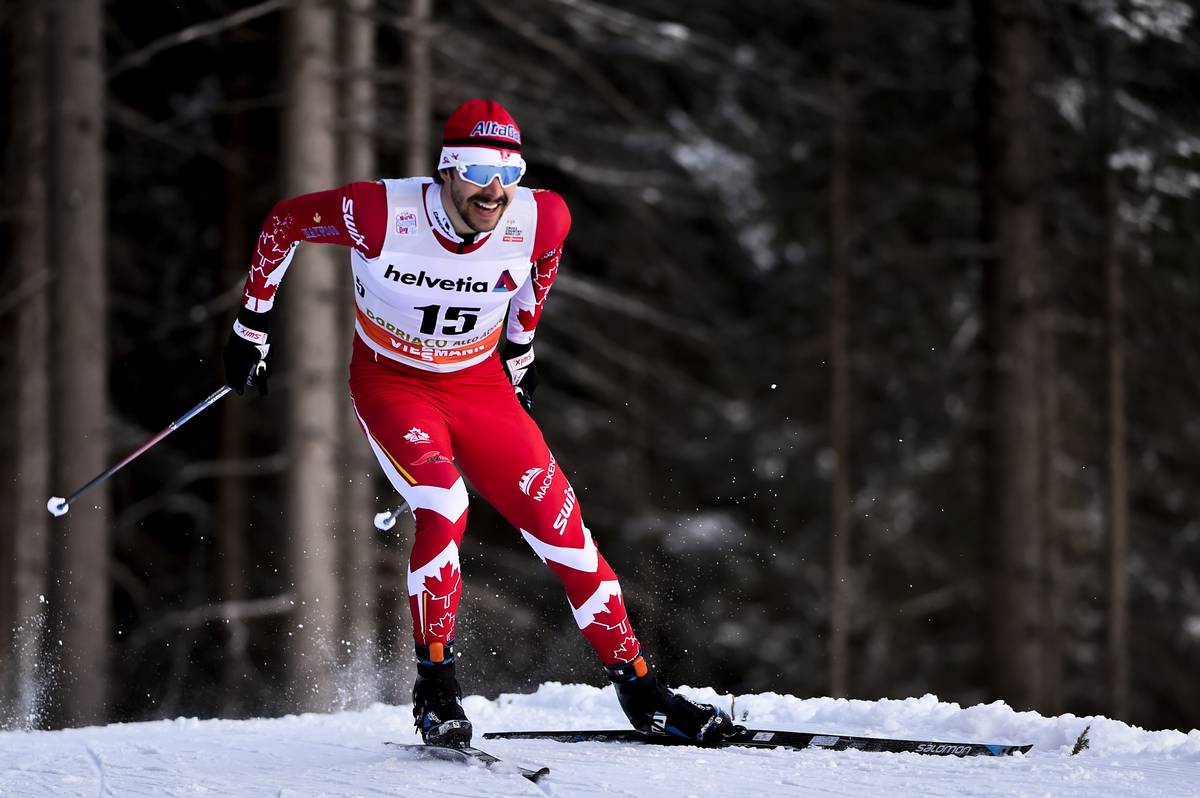
    Canada's Alex Harvey racing to eighth in the men's 1.3 k freestyle sprint qualifier on Saturday at the Toblach World Cup in Italy. (Photo: Salomon/Nordic Focus)
    Canada’s Alex Harvey racing to eighth in the men’s 1.3 k freestyle sprint qualifier on Saturday at the Toblach World Cup in Italy. (Photo: Salomon/Nordic Focus)

    Canada’s Alex Harvey qualified eighth (+1.73) and Len Valjas 23rd (+4.16) out of 70 starters. (Of note: Russia’s TDS winner Sergey Ustiugov finished last in the qualifier in 70th, nearly 42 seconds off Taugbøl’s time.)

    In the first men’s quarterfinal, Newell took third at the finish, 0.38 seconds behind Skar in first. Their quarterfinal time wasn’t fast enough to put Newell through as a lucky loser, and he ended up 13th on the day for his best result this season. In his fourth World Cup sprint this season, Saturday marked Newell’s first time qualifying in the top 30.

    “Skate skiing and I haven’t been on great terms the last year or so haha,” Newell wrote in an email. “But in all seriousness I knew this year was meant to be a rebuilding process for me so I’m happy to be back on track.

    “I finished last season not ever wanting to race a sprint race again, so I knew mentally and physically it was going to take some work to build back up to being a medal contender again,” he added. “I have to keep reminding myself that it’s still just January and to be patient and continue to try to make small gains and build throughout the season. Points and standings aren’t important to me at this time, just staying healthy and strong and building toward the World Championships and especially the Olympic year.”

    Harvey raced to fourth in the second quarterfinal, 0.42 seconds behind Hamilton, who won that heat. The Canadian ended up in a photo finish with Norway’s Sondre Turvoll Fossli for third in that quarterfinal and missed it by 0.08 seconds. Neither Fossli nor Harvey advanced to the semifinals, and Harvey placed 17th overall (moving him up to fourth in the overall World Cup standings).

    “I think that was my best qualifier in two years so I was a bit surprised,” said Harvey, who was coming off a career-best seventh in the TDS and had originally planned to skip the individual sprint to rest up for Sunday’s freestyle team sprint, according to a Cross Country Canada (CCC) press release. “It was such an easy trip to come down to Toblach. I just felt if I’m doing race prep I might as well put a bib on and see what happens. I felt a lot of speed today and was quite happy.”

    Harvey noted the precise tactics of the Toblach sprint with a “good course here that has you always turning left,” he told CCC. “You need to keep on the inside lane because it is a little quicker, especially with the fresh snow, so if you took the lead it was hard for someone to go by you. I was just not quick enough from the start.”

    Valjas also finished fourth in his quarterfinal, 1.58 seconds behind Pellegrino who won that heat, to place 20th overall. While Valjas remained in contact with the leaders throughout, he found himself at the back of the group early and moved up slightly to secure fourth at the finish.

    Three U.S. Women in Semis

    Meanwhile in the women’s race, the three U.S. entrants — Sophie Caldwell, Ida Sargent and Kikkan Randall — qualified for the heats in 15th, 16th and 27th, respectively.

    Caldwell’s 15th-ranked qualifying time was 4.82 seconds behind the qualifying winner, Norway’s Maiken Caspersen Falla, who completed the 1.3 k course in 3:10.89.

    American Sophie Caldwell racing to 15th in the women's 1.3 k freestyle sprint qualifier at the World Cup in Toblach, Italy.(Photo: Fischer/NordicFocus)
    American Sophie Caldwell racing to 15th in the women’s 1.3 k freestyle sprint qualifier at the World Cup in Toblach, Italy.(Photo: Fischer/NordicFocus)

    Sargent was another 0.27 seconds back in 16th (+5:09), and Randall was 7.52 seconds off Falla’s qualifying mark.

    All three U.S. women reached the semifinals, with Caldwell and Sargent automatically advancing after taking second in their quarterfinals. In the first quarterfinal, Caldwell finished 0.18 seconds behind Sweden’s Hanna Falk, and Sargent was 0.23 seconds behind the winner of the fifth quarterfinal, Slovenia’s Vesna Fabjan. Randall reached the semis as a lucky loser, after placing fourth in the fourth quarterfinal, 1.42 seconds behind Germany’s Sandra Ringwald in first.

    For Randall, it marked her first semifinal appearance in two years (she took last season off to have a baby).

    “I am feeling a little closer to my normal sprint gears every race,” Randall wrote in an email on Saturday. “Today’s qualifier was a good start. In the quarterfinals I was in a really fast heat and just tried to stay relaxed in the pack. We had really fast skis today and I was able to be strong in the finish so it was really exciting to advance to the semis.”

    In the first semifinal, Randall and Caldwell squared off against a stacked heat with Norway’s Falla, Sweden’s Falk and her teammate Ida Ingemarsdotter, and Russia’s Natalia Matveeva. During the first lap, Caldwell positioned herself in third and trailed Matveeva and Falla on the descent before the start of Lap 2. There, on the downhill, Randall rode up into Caldwell and both tumbled to the ground and out of contention before the second lap.

    “Our skis were incredibly fast today and that was actually a little bit of the problem,” Randall explained. “When our pack came down the hill that first time in the semi, everyone came together into the corner. The other girls went right so I could really only take the inside. I came up on Sophie faster than expected and tried to sneak by on the inside. But there wasn’t much space and I think I may have knocked her boot with my ski.

    “When she lost balance there was nowhere to go and my skis went underneath her as we fell,” she continued. “I feel really bad because I think I caused the crash. It was a real bummer because I think both of us were feeling good and ready to mix it up. But luckily we are both OK and there was no broken bodies or equipment.”

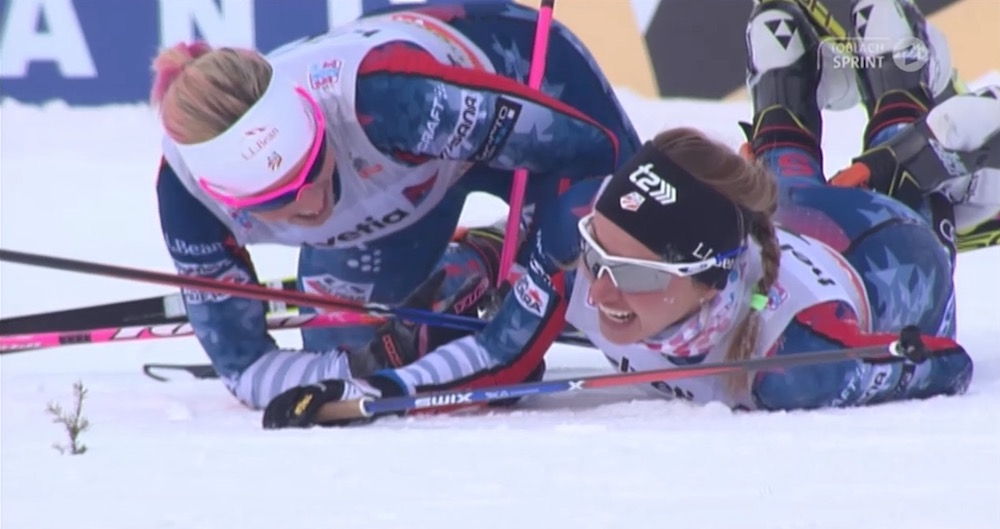
    U.S. teammates Kikkan Randall (l) and Sophie Caldwell (r) after colliding in the first women's semifinal on Saturday at the World Cup skate sprint in Toblach, Italy.
    U.S. teammates Kikkan Randall (l) and Sophie Caldwell (r) after colliding in the first women’s semifinal on Saturday at the World Cup skate sprint in Toblach, Italy. (Photo: ARD broadcast screenshot)

    In what appeared to be a slow-motion tangle, both Randall and Caldwell appeared to smile at each other as they realized their misfortune. Caldwell particularly had trouble freeing her ski. The two finished fifth and sixth in that heat (Randall 22 seconds back in fifth, and Caldwell a minute back from Falla as the winner of that semifinal in sixth).

    “[Kikkan] asked if I was okay and apologized,” Caldwell recalled. “It’s a bummer, but it’s unfortunately part of ski racing and there are no hard feelings.”

    “We’ve had problems with that same thing before,” Grover noted. “Everyone from behind runs up on everyone who’s in front, and then, depending on if you’re pinched on the inside, or if you can make some space on the outside, you can end up making it through or you can end up in some trouble. It’s a pinch point, a tough point on the course, for sure.”

    He added that Randall “took full accountability” for the crash, and there were no hard feelings.

    “She felt quite bad about it, and Sophie bears no grudge about it because she knows that’s the kind of thing that happens in sprint racing all the time,” he said. “Those guys are good and they are going to be sprint teammates tomorrow, so we’ll start looking forward to the next day.”

    Grover said his staff had to make the tough call of picking two women out of three for Sunday’s team sprint.

    Sargent raced to sixth in the second semifinal on Saturday, just 0.86 seconds out of first. She had moved up to third on the final climb, trailing Norway’s Astrid Uhrenholdt Jacobsen and Germany’s Ringwald, respectively, and held her position on the final curve into the finishing straight. There, both Jacobsen and Sargent were overtaken by Slovenia’s Fabjan (who came on strong for second place) and Switzerland’s Laurien van der Graaff (third), following Ringwald in first.

    Kikkan Randall (U.S. Ski Team) racing to a season-best 10th on Saturday in the World Cup freestyle sprint in Toblach, Italy. (Photo: Fischer/NordicFocus)
    Kikkan Randall (U.S. Ski Team) racing to a season-best 10th on Saturday in the World Cup freestyle sprint in Toblach, Italy. (Photo: Fischer/NordicFocus)

    At the end of the day, U.S. women occupied 10th through 12th place, with Randall in 10th, Caldwell in 11th and Sargent in 12th.

    “I tried to stay relaxed in the heats, but I felt really good so I just tried to ski near the front of the pack,” Sargent wrote in an email. “The course is really frustrating though with a long downhill with a draft that brings everyone back together but I just tried to stay out of trouble. I thought that I was in a great position in the semifinal going into the finish but then I hit something and I’m not really sure what it was, but it stopped my ski dead and I almost fell. After that bobble it was hard to get going again and so I was really bummed to lose all the places and not advance.”

    For Sargent, 12th was her best result in over a year.

    “I felt really strong today so I’m happy with my fitness at this point in the season,” she wrote. “We had a small staff this weekend but they did an amazing job and I’m very thankful for such awesome skis!”

    In terms of how the U.S. coaches made the call for between those three for Sunday’s team sprint, Grover said it wasn’t easy.

    “… As luck would have it, we had three athletes finish 10, 11, 12 on the day today, which did not make it any easier,” he said. “You actually had three athletes who are fairly evenly matched in a lot of respects right now, in terms of how they’re skiing. In the end, we decided that we really wanted to have Kikkan’s experience, in team sprint in particular and in closing out a team sprint, and in the second leg, we wanted Sophie to be able to rely on her aerobic conditioning at the moment …  It was a very hard decision for us … I really wish we had a fourth woman here, so we could start two teams.”

    Matveeva Gets First Win in Nearly a Decade

    While the three U.S. women missed Saturday’s final, Russia’s Matveeva — who hadn’t won a World Cup race since 2007 — went on to outlast Falla for her 12th-career individual podium. Eight years ago, Matveeva tested positive for EPO was was suspended from competing from December 2009 to March 2011. After that, she reportedly had two ACL tears. Now 30, Matveeva captured her second-career sprint win on Saturday by eight-hundredths of a second over Falla.

    Russia's Natalia Matveeva (l) winning Saturday's freestyle sprint final, by 0.08 seconds over Norway's Maiken Caspersen Falla (r), for her first World Cup win since October (!) 2007. (Photo: Fischer/Nordic Focus)
    Russia’s Natalia Matveeva (l) winning Saturday’s freestyle sprint final, by 0.08 seconds over Norway’s Maiken Caspersen Falla (r), for her first World Cup win since October (!) 2007. Sweden’s Hanna Falk (3) placed third. (Photo: Fischer/NordicFocus)

    “I’ve waited a lot of time to be [here],” Matveeva told FIS in a post-race interview. “I’m very happy and the Russian team is very happy. Thank you very much my service team. Good job today.”

    Matveeva charged to an early lead in the final, while Falla challenged her on the first of two climbs on the second lap. Matveeva followed her closely leading into the last climb, where Falla beat her to the top with a quicker-tempo V1. As the two descended into the stadium with a slight gap to Falk in third place, Matveeva drafted Falla then rode up alongside her, taking the outside line around the turn. The two sprinted toward the line, with Matveeva getting one extra push in for first place in 3:04.13.

    “I don’t feel particularly well so second place is all right, but of course it’s frustrating to be beaten in the final stretch,” Falla told NRK. “I knew she would be fast in the final stretch. I’m a little lighter than everyone else, and that’s not an advantage.”

    At the same time, Falla wasn’t bitter.

    “It’s good that more people are fighting for the top spots before the World Championships; it’s more exciting then,” she said. “We have to see the positive in it all.”

    Falk took the final spot on the podium in third (+2.41), and Ringwald was one second shy of it in fourth (+3.46). Ingemarsdotter finished fifth (+5.88) and Fabjan was sixth (+19.39).

    In Sunday’s 6 x 1.3 k freestyle team sprint, Caldwell and Randall are teaming up in the first women’s semifinal, while their men’s team of Newell and Hamilton will be in the second men’s semifinal. Also in that second men’s semifinal are Canada’s Valjas and Harvey.

    Results: Men | Women

  • Norway’s Falla and Østberg Go 1-2; Caldwell 7th, Bjornsen 9th for U.S.

    Norway’s Falla and Østberg Go 1-2; Caldwell 7th, Bjornsen 9th for U.S.

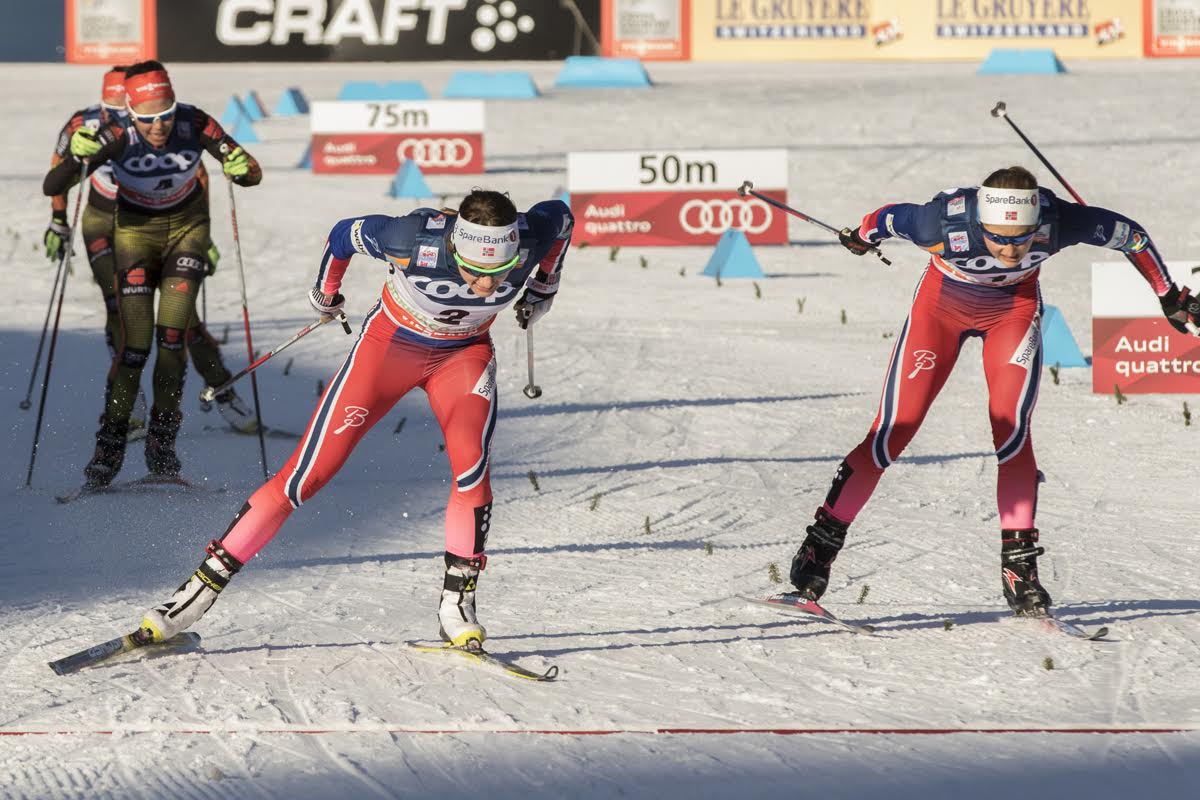
    Maiken Caspersen Falla (front left) edges Norwegian teammate and sprint rival Ingvild Flugstad Østberg in the women's World Cup freestyle-sprint final on Saturday in Toblach, Italy. Falla won by 0.17 seconds, Østberg was second, and Sweden's Stina Nilsson (not shown) placed third and her teammate Linn Soemskar (also not shown) placed fourth. Two Germans Hanna Kolb and Denise Herrmann (at left) placed fifth and sixth. (Photo: Fischer/NordicFocus)
    Maiken Caspersen Falla (front left) edges Norwegian teammate and sprint rival Ingvild Flugstad Østberg in the women’s World Cup freestyle-sprint final on Saturday in Toblach, Italy. Falla won by 0.17 seconds, Østberg was second, and Sweden’s Stina Nilsson (not shown) placed third and another Swede Linn Soemskar (also not shown) placed fourth. Two Germans Hanna Kolb and Denise Herrmann (at left) placed fifth and sixth, respectively. (Photo: Fischer/NordicFocus)

    Two Germans. Two Norwegians. Two Swedes. These national pairs composed the women’s World Cup 1.3-kilometer freestyle sprint final on Saturday in Toblach, Italy.

    It was Norway who took the lead from the start, with 25-year-old Ingvild Flugstad Østberg pulling her teammate Maiken Caspersen Falla, along with the Swedish duo Stina Nilsson and Linn Soemskar.

    Østberg remained in front for the first downhill of the 600-meter lap course, followed closely by Falla and Nilsson.

    Coming off last weekend’s skate-sprint victory in Davos, Switzerland, 22-year-old Nilsson stuck with the two Norwegians until the final climb of the two-lap course. Last Sunday in Davos, Nilsson shared the podium with the two Norwegians, with Falla in second and Østberg in third.

    Norway's Maiken Caspersen Falla (2) leads her quarterfinal with (from left to right) Switzerland's Nadine Faehndrich, Laurien van der Graaf, Italy's Greta Laurent, Russia's Natalia Matveeva, and American Sophie Caldwell (10) on Saturday in the women's World Cup freestyle sprint in Toblach, Italy. (Photo: Fischer/NordicFocus)
    Norway’s Maiken Caspersen Falla (2) leads her quarterfinal with (from left to right) Switzerland’s Nadine Faehndrich, Laurien van der Graaf, Italy’s Greta Laurent, Russia’s Natalia Matveeva, and American Sophie Caldwell (10) on Saturday in the women’s World Cup freestyle sprint in Toblach, Italy. (Photo: Fischer/NordicFocus)

    With one last uphill to go, Falla, 25, took the lead from her teammate while Nilsson moved from third to second.

    As the trio descended the final downhill into the stadium, Falla maintained her position in front, while the battle for second ensued between Østberg and Nilsson.

    Rounding the final turn into the 50-meter straightaway, Nilsson attempted to go wide on the the outside corner to get around Østberg and Falla. The Swede’s tactical maneuver, however, didn’t match Østberg’s raw speed.

    The Norwegians went 1-2, with Falla winning the final in 2:47.28 minutes, just 0.17 seconds ahead of Østberg in second. Nilsson crossed the line in third, 0.61 seconds after Falla.

    “It’s great to be on top again,” Falla told FIS after her second sprint victory of the season. She also won the classic sprint opener late last month in Kuusamo, Finland. “It was a … battle last week and again this week. I think it will be a great battle all season.”

    Østberg said she had to be happy with second.

    “I had really bad last 100 meters in Davos. I was focused on having a good finish here,” she told FIS. “If it was 20 meters longer I think I could have fought with Maiken for victory. I have been fourth [in the Kuusamo classic sprint], third [in Davos] and second. I am going to be dangerous next time.”

    The top-three women in Saturday's World Cup freestyle sprint in Toblach, Italy, with Norway's Maiken Caspersen Falla (c) in first place, Ingvild Flugstad Østberg (r) in second, and Sweden's Stina Nilsson (l) in third. (Photo: Fischer/NordicFocus)
    The top-three women in Saturday’s World Cup freestyle sprint in Toblach, Italy, with Norway’s Maiken Caspersen Falla (c) in first place, Ingvild Flugstad Østberg (r) in second, and Sweden’s Stina Nilsson (l) in third. (Photo: Fischer/NordicFocus)

    Rounding out the top six in the final was Soemskar in fourth (+1.31), Germany’s Hanna Kolb in fifth (+1.59) and Denise Herrmann, also of Germany, in sixth (+2.31).

    During a post-race interview with German broadcaster ZDF, Kolb commented on reaching the final. The 24-year-old German had done so twice before in the skate sprints at the 2013 and 2014 editions of the Tour de Ski, where she placed fourth and fifth, respectively.

    “I am a little relieved that I was able to do it [reach the final] because it was a crazy amount of training throughout the summer,” Kolb said. “And in sprints, often small details are decisive. That it finally worked today makes up for all the effort.”

    For Herrmann, it was her first appearance in a sprint final this season for her best result so far this winter.

    “I am just happy that it worked out again to reach the final, because the start of the season was not good for me,” she told ZDF. “Step by step, I will try to tie it up to [past] results.”

    Two U.S. Women in Top 10

    Sophie Caldwell (U.S. Ski Team) racing to 10th in the qualifier at the women's World Cup freestyle sprint in Toblach, Italy. She went on to place seventh overall after making it to the semifinals. (Photo: Fischer/NordicFocus)
    Sophie Caldwell (U.S. Ski Team) racing to 10th in the qualifier at the women’s World Cup freestyle sprint in Toblach, Italy. She went on to place seventh overall after making it to the semifinals. (Photo: Fischer/NordicFocus)

    Although there wasn’t an American pair in the final, two U.S. women ended up in the top 10.

    Sophie Caldwell, 25, of the U.S. Ski Team took seventh overall, after qualifying in 10th, 3.23 seconds behind Østberg, the fastest qualifier in 2:49.45.

    Caldwell went on to place second in her quarterfinal, 0.13 seconds behind Falla, before missing advancing beyond the semifinals by eight-hundredths of a second. She finished fourth in her semifinal behind Falla, Nilsson and Kolb, respectively, with Kolb finishing third and advancing as a lucky loser, 0.45 seconds behind Falla.

    Their semifinal, with Falla setting the pace and finishing in 2:46.31, turned out to be the fastest women’s heat of the day. This was perhaps expected with players like Falla and Nilsson in the same semifinal.  

    “My semi final was really close and I knew there were a lot of fast skiers in it, so I had to make every second count in order to fight for a top two place or a lucky loser place,” Caldwell wrote in an email.

    She tucked into fifth on the inside of the second large climb, alongside Kolb, Norway’s Heidi Weng, and Laurien van der Graaff of Switzerland. Nilsson attempted to split from the group on the second-to-last downhill, only to be reeled back in by Falla in second Caldwell, who had moved up to third. Meanwhile, Kolb closed in behind them. 

    The turn into the finishing stretch became a tossup, as Nilsson cut into the center lane, Caldwell went to the inside left and Kolb accelerated to the right of Caldwell. 

    “I moved into a great position coming into the last downhill, but things got a little jammed up coming into the last corner and I moved back to fourth,” Caldwell explained.

    Caldwell and Kolb lunged at the line, but the German snatched third, and ultimately the lucky loser ticket to the final. Last week in Davos, Caldwell advanced as a two-time lucky loser to the sprint final, where she placed sixth.

    “I was psyched with every aspect of today,” Caldwell wrote on Saturday. “Mentally I feel like I’m skiing with more confidence and my goal is to ski like I belong in front of each heat and not to just hope that I move on.” 

    Not far behind, Sadie Bjornsen recored her first top 10 of the season in ninth (after five consecutive top-20’s in as many individual World Cup races this season). She qualified sixth (+1.48), placed second in her quarterfinal, 0.28 seconds behind Østberg, and went on to finish fifth in the second semifinal — 0.46 seconds behind Østberg, who won that heat as well. 

    Like her teammate Caldwell, Bjornsen was also mere fractions away from making the final.

    “Skate sprinting has always been a gamble for me in the past. 50% of the time I make the heats, 50% of the time I don’t qualify,” Bjornsen wrote in an email after the race.

    On Saturday, the odds seemed to be in her favor.

    “It started with my best qualifier ever, and advanced into some fun heats and skiing. I felt really good out there, and just missed the finals by a touchable hair,” she wrote. “But each week I am feeling more confident and excited about sprint racing.” 

    Sadie Bjornsen (U.S. Ski Team) racing to her best-ever sprint qualifier in sixth at the World Cup freestyle sprint in Toblach, Italy. She went on to make the semifinals and place 10th overall. (Photo: Fischer/NordicFocus)
    Sadie Bjornsen (U.S. Ski Team) racing to her best-ever sprint qualifier in sixth at the World Cup freestyle sprint in Toblach, Italy. She went on to make the semifinals and place 10th overall. (Photo: Fischer/NordicFocus)

    In her quarterfinal, Bjornsen, 26, chased down two Norwegians, Østberg and Kathrine Rolsted Harsem. The three battled it out into the finishing straight, where Bjornsen chose the outside line in an effort to move into the top two.

    Østberg outskated the two for the quarterfinal win in 2:47.34, while Bjornsen outlunged Harsem by two-hundredths of a second to move on.

    In her semifinal, Bjornsen faced off against Østberg, Soemskar, Herrmann, Russia’s Natalia Matveeva, and Finland’s Krista Parmakoski. Østberg flew out of the start to take the lead, while Bjornsen hung in fourth as they approached the first climb.

    Descending back into the stadium during the final downhill, Bjornsen leapt into third, behind Østberg in first and Herrmann in second. With 50 meters to go, Soemskar snuck into the mix, along with Matveeva.

    In a lunge for the line, Soemskar placed second, 0.22 seconds behind Østberg, and Herrmanb took third another 0.02 seconds back. That close finish gave Herrmann the final lucky loser spot in the final, while Matveeva placed fourth (+0.44) and Bjornsen was fifth (+0.46) behind them.

    “It might’ve been Sadie Bjornsen’s best skate-sprint race of all time on the World Cup,” U.S. Ski Team Head Coach Chris Grover said on the phone after the race.

    In addition to Caldwell and Bjornsen, U.S. teammates Jessie Diggins and Ida Sargent also qualified for the heats and went on place 22nd and 28th overall, respectively, after finishing fifth and sixth in the same quarterfinal — the first one of the day.

    “Great to have six athletes qualify for the heats again, but not really a big surprise,” Grover said in a USSA press release, referring to the four women and two men (Simi Hamilton and Andy Newell) who qualified on Saturday. “The women skied great. Sophie must have been mere hundredths from going through to the finals again as a lucky loser. She executed her race plan perfectly all day.”

    In an email, Sargent called her qualifier “decent … although I felt a little flat and had trouble getting going,” the 27 year old wrote after qualifying in 24th (+5.71). Diggins qualified in ninth (+2.98).

    “Seeing Simi ski so well and end up on the podium was incredible,” Sargent added, referring to Hamilton’s second-place finish for the U.S. men. “Even if it was a tough day for me personally it was an awesome day for the team, so I’m leaving the day feeling excited and inspired.”

    “We’re really gaining momentum and it’s a big lift for the whole team!” Diggins wrote in an email.

    “A big thing for me on a really short and tactical course such as Toblach is to learn to hold my ground and not get pushed around out there,” the 24 year old added. “Rounding the finishing corner, someone actually reached out a hand and shoved me, and in years past, I probably would have fallen down. But I didn’t let it get to me or impact my race, which I’m really pumped about!”

    The fifth U.S. woman, Rosie Brennan, 27, narrowly missed qualifying in 35th. She was 1.91 seconds out of the top 30. 

    “We had great skis today and I felt better than last weekend so now it’s just moving on to tomorrow, which I am very much looking forward to,” Brennan wrote. 

    On Sunday, the women will race a 10 k classic individual start — the final race before the holiday World Cup break. 

    Results

  • ‘Catastrophic Mistake’ in Waxing Fells Canadians in Skate Sprint

    ‘Catastrophic Mistake’ in Waxing Fells Canadians in Skate Sprint

    Alex Harvey (Canadian World Cup Team) racing in Saturday's 1.3 k freestyle sprint qualifier at the World Cup in Toblach, Italy. None of the Canadians qualified for the heats, and he was the top Canadian in 62nd. (Photo: Fischer/NordicFocus)
    Alex Harvey (Canadian World Cup Team) racing in Saturday’s 1.3 k freestyle sprint qualifier at the World Cup in Toblach, Italy. None of the Canadians qualified for the heats, and he was the top Canadian in 62nd. (Photo: Fischer/NordicFocus)

    Note: The following article has been updated to clarify that Canadian Head Coach Justin Wadsworth watched Saturday’s sprint remotely from Canmore, Alberta, and the following observations are that of co-coach Louis Bouchard and the rest of the Canadian staff in Toblach, Italy.

    “The skis felt sticky,” is what Canadian National Team Head Coach Justin Wadsworth said about his team’s thoughts on their shortcomings on Saturday in the World Cup freestyle sprint in Toblach, Italy.

    He was in Canmore, Alberta, and had watched the athletes on television as they raced overseas, but noted that co-coach Louis Bouchard observed that their energy looked “way better than last weekend,” Wadsworth said in a phone interview on Saturday. Despite that, they bled time on the downhills, he said, and failed to break into the heats for the second week in a row in a skate sprint.

    Jess Cockney (Canadian Senior Development Team) placed 81st in the men's World Cup freestyle sprint qualifier on Saturday in Toblach, Italy. (Photo: Fischer/NordicFocus)
    Jess Cockney (Canadian Senior Development Team) placed 81st in the men’s World Cup freestyle sprint qualifier on Saturday in Toblach, Italy. (Photo: Fischer/NordicFocus)

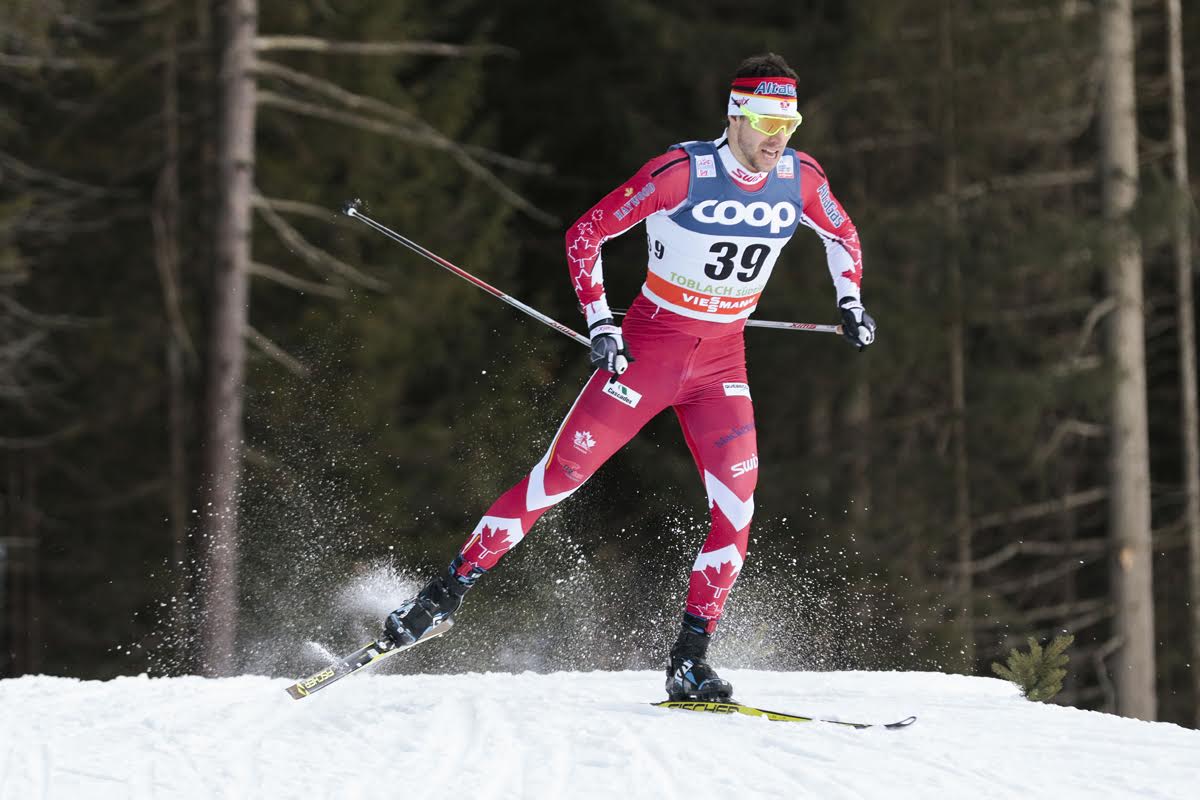
    Their top finisher was Alex Harvey in 62nd, 8.9 seconds back from the qualifying winner, Norway’s Finn Hågen Krogh. He missed qualifying in the top 30 by 4.28 seconds. Also for Canada, Len Valjas placed 73rd (+10.55), Devon Kershaw was 76th (+11.95), Michael Somppi (NDC-Thunder Bay) 78th (+12.1), and Jess Cockney (Canadian Senior Development Team) 81st (+12.68).

    Despite a snowmaking loop with consistent conditions all week, the Canadian staff thought the liquid reacted with the powder after a certain amount of time left on the skis, producing “really sticky feeling skis,” Wadsworth said.

    In a U.S. Ski Team press release, head coach Chris Grover noted that Saturday’s sprint “was a very fair competition with easy waxing conditions and no nations seemed to struggle with skis.” He was not asked specifically about the Canadians.

    Looking ahead to Sunday’s 10- and 15-kilometer classic individual starts, the wax will certainly play a factor as certain skiers successfully doubled poled this course over this distance on skate skis last year. Wadsworth said that although the course is relatively flat, he “still feels like an athlete can do well tomorrow with good waxed classic skis for striding, but they’re going to need to be really good skis and the athletes going to need a really well-executed race to be in there against some of the guys double poling.”

    Sprint results

  • Notes & Quotes: Four Americans, One Canadian in Top 20 at Toblach Skate Sprint (Updated)

    Kikkan Randall racing to 15th in Saturday's World Cup 10 k classic individual start in Toblach, Italy. (Photo: FlyingPointRoad.com/NNF)
    Kikkan Randall racing to 15th in Saturday’s World Cup 10 k classic individual start in Toblach, Italy. On Sunday, she placed fifth in the 1.3 k freestyle sprint. (Photo: FlyingPointRoad.com/Proceeds go to the National Nordic Foundation)

    Note: This article has been updated to include quotes from U.S. Ski Team Head Coach Chris Grover, Kikkan Randall, Simi Hamilton, Andy Newell, and Alaska Pacific University coach Erik Flora.

    TOBLACH, Italy — Of the 18 North Americans that competed in Sunday’s 1.3-kilometer freestyle sprints at the Toblach World Cup, nine made the rounds: six Americans and three Canadians.

    Kikkan Randall led the U.S. Ski Team in the women’s qualifier, clocking the fourth-fastest time behind qualifying winner Ingvild Flugstad Østberg of Norway, who completed the course in 2:55.07. Randall was 3.3 seconds off the pace, and three other U.S. women joined her in the qualifying top 30: Sophie Caldwell (in 19th), Jessie Diggins (21st) and Holly Brooks (27th).

    Canada’s Perianne Jones and Dasha Gaiazova made it in 28th and 30th, respectively.

    Simi Hamilton (U.S. Ski Team) in Sunday's World Cup 1.3 k freestyle sprint in Toblach, Italy. (Photo: FlyingPointRoad.com/NNF)
    Simi Hamilton (U.S. Ski Team) in Sunday’s World Cup 1.3 k freestyle sprint in Toblach, Italy. (Photo: FlyingPointRoad.com/NNF)

    Andy Newell was the top North American qualifier in the men’s sprint, advancing in eighth — 1.46 seconds behind qualifying winner Jovian Hediger of Switzerland, who clocked 2:36.56. Teammate Simi Hamilton was one-hundredth of a second behind in ninth.

    The top 30 men all came within four seconds of the leader, and included Canada’s Alex Harvey in 22nd (+3.14).

    Onto the quarterfinals, Randall was the lone North American to move on, winning her quarterfinal by 0.25 seconds of Maiken Caspersen Falla, a Norwegian that would advance with her all the way to the final.

    Randall went on to win her semifinal as well, topping Østberg and Falla by 0.15 seconds and 0.16 seconds, respectively. In the final, the three squared off against another Norwegian, Marit Bjørgen, who relied on fast skis and energy-saving tactics to win overall, beating out Germany’s Denise Herrmann by 0.43 seconds, then Østberg and Falla, who placed third and fourth. Randall finished fifth, after missing out on the slipstream toward the finish.

    FasterSkier was on site for the last World Cup weekend before the Olympics, and while Gerry Furseth caught up with most of the North Americans, he wasn’t able to get everyone (and a couple technical difficulties prevented some from making it to print). Below is a compilation of notes and quotes from Sunday’s sprint.

    5. Kikkan Randall (U.S. Ski Team):

    “It was a strong day all around. Unfortunately in the final round when it really counted didn’t quite execute the strategy as well as I would have liked. Feelings were still good, but I tried to make a move and didn’t commit to it enough and then I found myself getting sucked up at the end there.

    “Today was great to go through all four rounds, the feelings are really good. I did a strong qualification; it was a pump up for me. I felt really strong. It’s a different course in Sochi so things are still looking really good.”

    Click here to read more.

    14. Simi Hamilton (U.S. Ski Team): Third in his quarterfinal, 0.39 seconds behind Sweden’s Emil Jönsson in first and 0.17 seconds behind Switzerland’s Joeri Kindschi, who advanced in second. At the back of the pack early, Hamilton moved to second by the second of three climbs, skiing even with Jönsson up front over the top. Freeskating into the finish, Hamilton was the odd man out in the final sprint to the line.

    “I felt like I skied well in the qualification. I didn’t feel fully 100% sparky, but felt strong and skied relaxed. It was a really fun course, kind of unusual course.

    “Quarterfinal was a little frustrating, got off to a bad start, made up some good ground. Kind of a spilt second decision at the top of the second hill, when Emil and I were right together. He kind of shut it down right at the top and I thought my best option was to push really hard but they got the draft off me. I felt really strong and had a good effort today. I feel like things are definitely feeling good for the progression towards the sprint in Sochi in 12 days.”

    Andy Newell (U.S. Ski Team) in Sunday's World Cup 1.3 k freestyle sprint in Toblach, Italy. (Photo: FlyingPointRoad.com/NNF)
    Andy Newell (U.S. Ski Team) in Sunday’s World Cup 1.3 k freestyle sprint in Toblach, Italy. (Photo: FlyingPointRoad.com/NNF)

    17. Andy Newell (U.S. Ski Team): Fourth in his quarterfinal, missing out on third by 0.01 seconds to Italy’s Federico Pellegrino. Despite being within 0.45 seconds of the heat’s winner, Norway’s Pal Golberg, neither Newell nor Pellegrino advanced. Leading early and within the top three heading toward the finish, Newell fell behind on the final corner as others — like Pellegrino — took advantage of the slingshot.

    “I felt good, but it wasn’t a great result. I felt fine in qualification and felt like I skied a pretty good heat tactically. I tried to tuck in and position to slingshot on the downhill, but I just couldn’t quite get the speed. I am not the best slingshotted, you know, I’m pretty light so in the end it had to come down to the lanes, which wasn’t great either. It was not a great tactical race, but the good news is  … the sprint course isn’t very much like Sochi. Sochi is another minute long and much more climbing, which I think is good.”

    19. Sophie Caldwell (U.S. Ski Team): Fourth in her quarterfinal, 0.75 seconds behind Herrmann in first. Slovenian finalist Katja Visnar advanced in second and Finland’s Anne Kyllönen took third (+0.33).

    Sophie Caldwell (U.S. Ski Team) in Sunday's World Cup 1.3 k freestyle sprint in Toblach, Italy. (Photo: FlyingPointRoad.com/NNF)
    Sophie Caldwell (U.S. Ski Team) in Sunday’s World Cup 1.3 k freestyle sprint in Toblach, Italy. (Photo: FlyingPointRoad.com/NNF)

    20. Alex Harvey (Canadian World Cup Team): Fourth in his quarterfinal, 0.76 seconds behind Jönsson in first and 0.37 seconds behind Hamilton in third. Hanging in the middle of the pack for most of the race, Harvey couldn’t quite make up ground in the final straightaway on the three frontrunners, Jönsson, Kindschi and Hamilton, respectively.

    25. Dasha Gaiazova (Canadian World Cup Team): Fifth in her quarterfinal, 3.13 seconds behind Østberg in first. Sweden’s Ida Ingemarsdotter advanced in second, and Norway’s Heidi Weng made the semifinals with a fast-enough time in third (+0.4). Germany’s Lucia Anger was fourth (+1.3), and Gaiazova finished 0.95 seconds ahead of Diggins in sixth.

    “It was a challenging course for me; it is not for me. It seems like whenever we have to do laps around the stadium, I struggle finding my speed on the flats and the long downhills. So I was happy today qualifying, I qualified in 30th and was really happy I did.  I had a crazy cool heat, lots of strong skiers in my heat and it went a lot better than my qualifier so I am happy.”

    28: Jessie Diggins (U.S. Ski Team): Sixth in her quarterfinal, 4.08 seconds behind Østberg in first, and 3.68 seconds behind Weng, who advanced in third.

    29. Holly Brooks (U.S. Ski Team): Sixth in her quarterfinal, 8.98 seconds behind Randall in first.

    “I kind of got gapped right at the start, hesitated at one point so as not to crash … and just got gapped right from the start, and you have to be in there for all the drafts. I feel like I skied the heat by myself, which was unfortunate, but I’m happy to have qualified because it’s a really competitive sprint field, all the sprinters are here and they have their top game getting ready for Sochi, so I have to be happy with it.”

    30. Perianne Jones (Canadian World Cup Team): Sixth in her quarterfinal, 1.56 seconds behind Herrmann in first and 0.81 seconds behind Caldwell in fourth. In third behind Kyllönen and Caldwell down the backside of the second hill, Jones fell behind over the top of the third-and-final climb. There, Herrmann attacked and took the lead, leaving everyone else chasing her to the finish.

    “I wanted to get a good start and [it] was just a tricky course because there’s so many corners and so much happening, I kind of lost my position coming up over the bump there. If I could do it again that’s what I’d go back and do.

    “Despite the result, I think this is the best I’ve felt all year. It’s coming, just little by little. I have to be patient. It’s just really good timing to be feeling the best right now.” 

    33. Ida Sargent (U.S. Ski Team): Missed qualifying by 0.55 seconds.

    34. Chandra Crawford (Canadian World Cup Team): Missed qualifying by 0.7 seconds.

    “My weekend did not meet my goals. I wanted to do the 10 k and get top-30 in the sprint, but I didn’t do that either. It was really fun out there though, so fast, the course was awesome. I visualized it about a 100 times and sometimes I do that and I still feel like I am in the dream and kind of attack the second half better.

    “Sochi is here, another week, so it’s really a good time to not over think it, get excited, stay positive until crossing the finish line at the Olympics.  All I can do now is stay in a positive state of mind and go for it.”

    35. Torin Koos (U.S. Olympic Team/Bridger Ski Foundation): Missed qualifying by 0.46 seconds.

    “I think it was pretty OK … It’ll be better for me when it’s a four-minute qualification. Obviously I wanted to get in the rounds, but I think the body is coming around I did some heavy training the last couple weeks so I think it feels pretty good for that.  

    “I’m looking forward to Sochi, should be a good challenge. That’s why I was doing a little bit more of the heavy training to get ready for the Sochi hill and the longer qualification. I think it’s going to be about four minutes, which is about 40 percent longer than here.” 

    37. Sadie Bjornsen (U.S. Ski Team): 1.45 seconds from the top 30.

    “It wasn’t great. I haven’t been doing any speed workouts for five weeks now so I was learning to get back into the groove today. You have to start somewhere and figure it out and so today I was learning some stuff for sure.

    “Today was a little disappointing, but we’re jumping into the next thing. You can’t focus on anything too long. You just figure out what you can do better.”

    38. Heidi Widmer (Alberta World Cup Academy/Canadian Senior Development Team): 1.89 seconds from the top 30.

    “It’s already over, it’s too bad. It was really fun. I risked in some spots and I was pretty squirrely in other spots, but overall I gave it my best shot and came up a little bit short, but I was super close and that just gets you all the more motivated for Sochi.” 

    41. Caitlin Gregg (Team Gregg/Madshus): 3.96 seconds from the top 30.

    “It’s quite a big difference; I can win the domestic sprints, the qualifiers at least, pretty handily, but it’s just another world on this level. I would say most of my sprints are distance pace for 1 k. I’m definitely a distance skier.” 

    47. Jesse Cockney (Alberta World Cup Academy/Canadian Senior Development Team): 1.3 seconds from the top 30.

    “It was frustrating … I felt strong, felt like I skied it well. I did everything I could.

    “Goals are still to fight for medals [at the Olympics]. It’s been my goal my whole life.”

    60. Devon Kershaw (Canadian World Cup Team): 3.76 seconds from the top 30.

    “Yesterday in the 15 k, I actually felt really good I just didn’t have a few of the pieces you need to be skiing fast and today I was horrendous, just really flat, no jam in the muscles, a bit tired from the training camp obviously, and just not where near where I needed to be qualifying.

    “I felt like I was skiing fairly well technically, I just did not have any power in the muscles and that is not good on a sprint qualifier.

    “You want to have better feelings, but I felt really good during the distance race yesterday.  Results aside, I have been feeling really good in training … The Olympics are 16 days long and if you keep your focus and you keep your shoulders down and your head up there are a lot of opportunities for one or two great races. So I still feel good. It’s not my first rodeo, it’s my third Olympics so I know what to expect and the feelings in the body have been better aside from today.”

    64. Lenny Valjas (Canadian World Cup Team): 5.13 seconds from the top 30.

    “Not as good as I wanted, but I felt OK skiing so I’m happy about that. I’m not in as much pain as I was.”

    On his knee after taking a month off the World Cup to rehab it following surgery this summer:

    “Just a ton of pain under the patella. I’m having a lot of trouble skating and twisting. It’s just a lot of pain we’re trying to manage. … We’re doing lots of strength, and I’m still giving it a good shot. I’ll be back, I’m just off a plane. I felt good skiing and I know the fitness was there [at home] in Canmore. It was good to clear the system here and I’m excited to race [in Sochi].” 

    Chris Grover (U.S. Ski Team head coach):

    “We had a few breakthroughs on some athletes out there. For us I’d say was kind of just an average sprint day. I have a feeling that the team is still a little bit flat after coming down from Seiser Alm [Italy], and I expect when we’re in Sochi, we’re going to be able to start fresh on all cylinders.

    “We had our usual qualifiers in there. Andy Newell, Simi Hamilton, Kikkan, Jessie, Sophie, and it was cool to see Holly Brooks get in there. I believe those may have been her first World Cup sprint points of the year so it’s always nice to have another athlete get in there. Overall on the weekend I was really excited about the breakthrough performance by Erik Bjornsen in yesterday’s 15k classic. Those were his first World Cup points and to do so by going in there and ending up 18th really shows, I think, what his future potential is. He’s going to be a very accomplished World Cup skier here in a few years.

    “It was of course exciting to have so many athletes in the top 22 yesterday. Six athletes in the top 22. Really solid classic day for us. I think overall the team is feeling a little bit of, perhaps, some fatigue and perhaps some flatness after coming down from altitude. There’s other teams here that are in the same situation but I know that everybody has a good plan going to the games to be, to really get that spark back by the time we start competing in Sochi.” 

    Erik Flora, Alaska Pacific University Elite Coach:

    “It was good, a solid day. I think Kikkan looked like she was skiing really well today. A little bit of tactical thing there in the finish. Holly qualified, so that was really good. Sadie, a little bit mixed today. An okay day.

    “I think we’re in a great place coming in to Sochi. The most important thing today is that all the ladies were running strong. You could see it when they were climbing, they are all in a great place, so really good prep for Sochi.” 

    — Matt Voisin and Peggy Hung contributed reporting

    Results: Women | Men