Tag: toblach world cup

  • Klaebo Controls Toblach as Schumacher Anchors the Chase in Men’s 20 k Classic Pursuit

    Klaebo Controls Toblach as Schumacher Anchors the Chase in Men’s 20 k Classic Pursuit

    This coverage is made possible through the generous support of Marty and Kathy Hall and A Hall Mark of Excellence Award. To learn more about A Hall Mark of Excellence Award, or to learn how you can support FasterSkier’s coverage, please contact info@fasterskier.com.

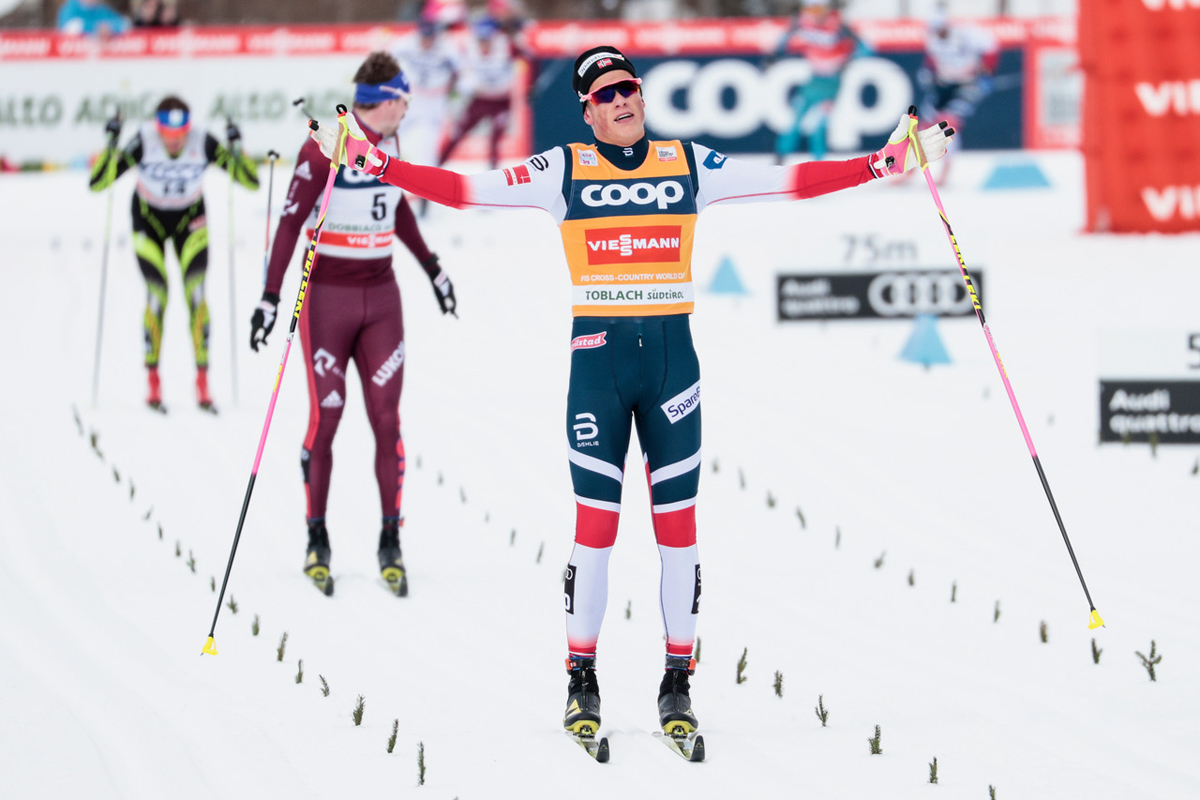
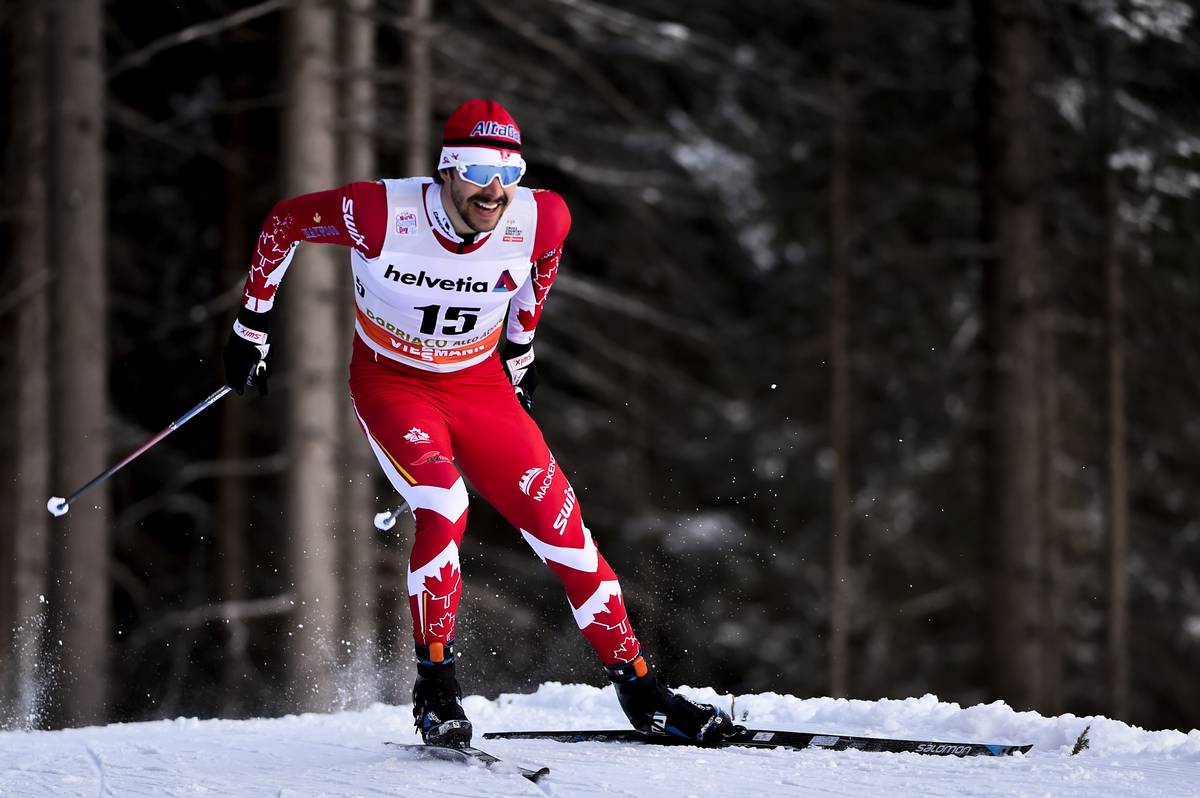
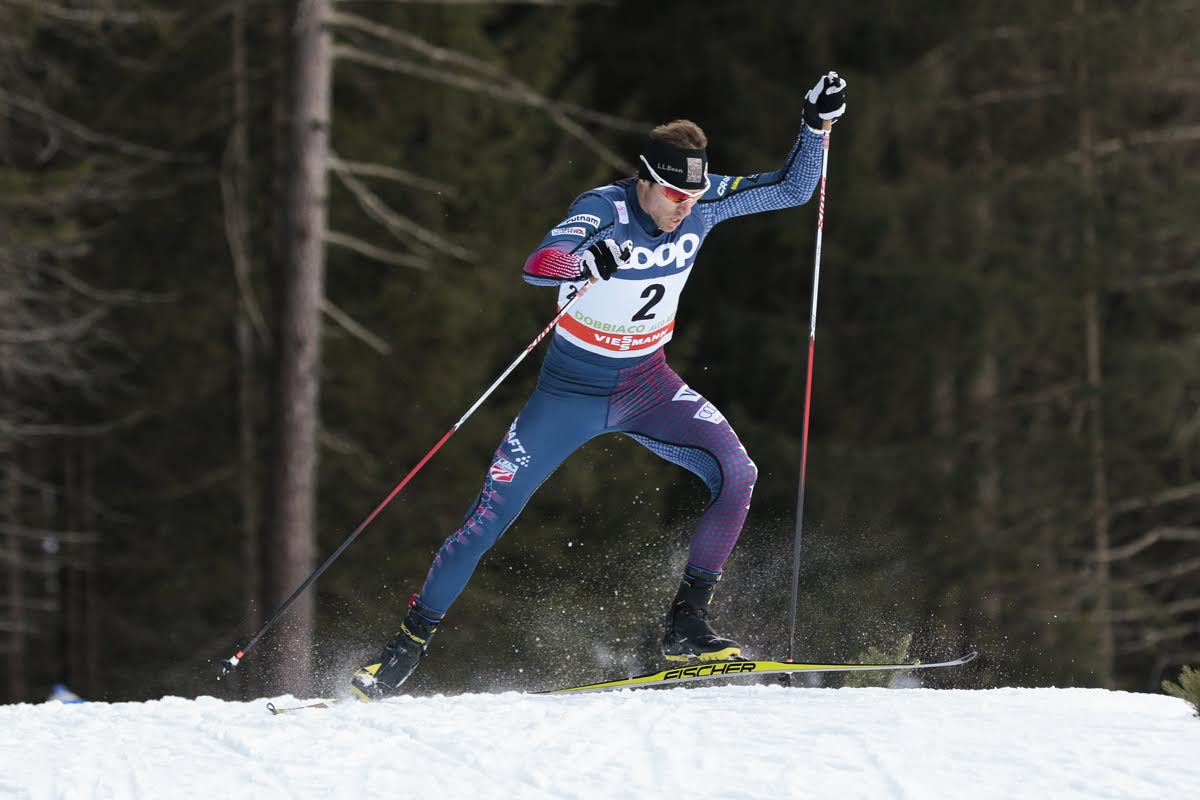
    Johannes Hoesflot Klaebo (NOR) paced the Tour de Ski 20 K Classic in Toblach (ITA) to perfection. (Photo: Vanzetta/NordicFocus)

    By mid-morning in Toblach, the cold had settled into the valley in that particular Dolomite way—dry, bright, and unforgiving. The stadium clock read 10:30 a.m., the tracks were hard-packed, and the Tour de Ski—never gentle, always exacting—had reached a moment where patience mattered as much as power. Stage 4’s men’s 20-kilometer classic pursuit would not be decided by theatrics. It would be decided by discipline.

    From the first push out of the starting line, Johannes Høsflot Klæbo made that clear.

    The Norwegian leader skied as if tethered to an internal metronome, clicking off splits that barely wavered across five laps of the 4-kilometer loop. Behind him, the race congealed into a dense, minute-long chase—ambitious but realistic, orderly but never comfortable. Inside that group, Gus Schumacher did what pursuit racing rewards: work when it mattered, wait when it didn’t, and finish inside the race rather than on its margins.

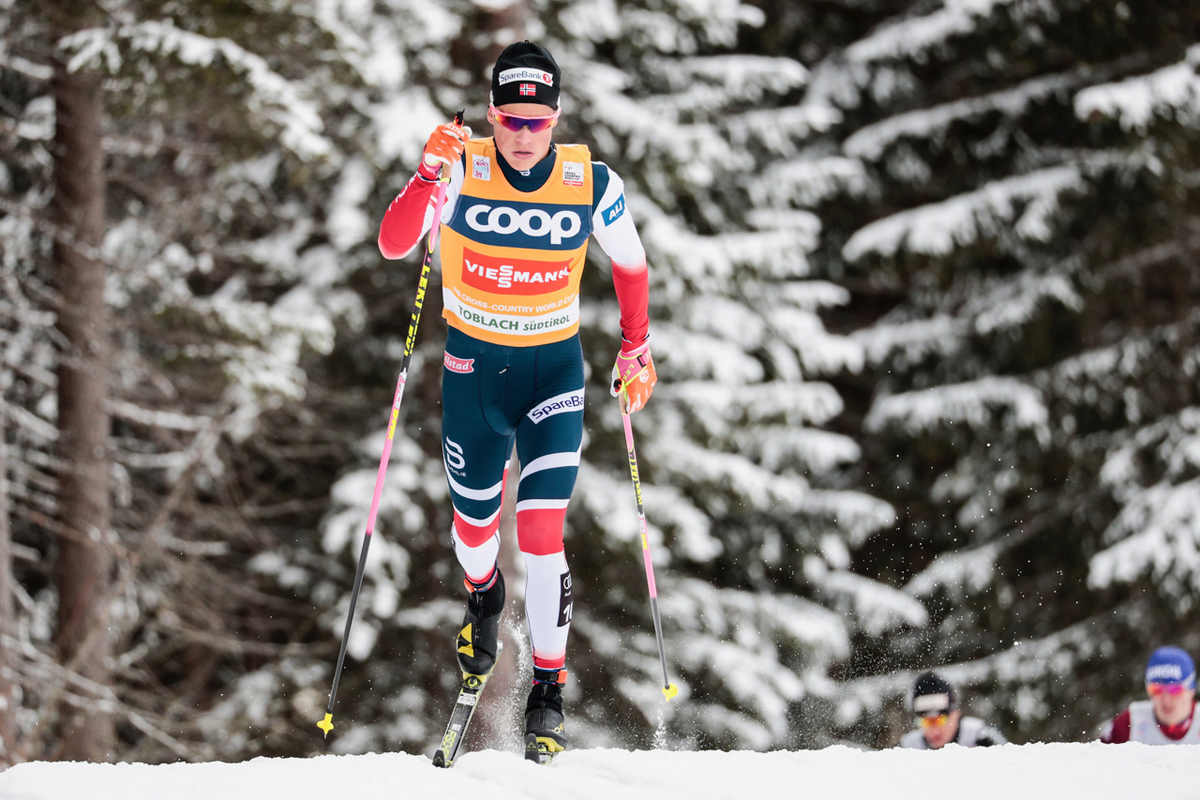
    Johannes Hoesflot Klaebo (NOR) on his way to first place on the 20 K Classic Pursuit. (Photo: Vanzetta/NordicFocus)

    Klæbo’s Quiet Authority

    Klæbo entered the day with the yellow bib and skied as though intent on keeping it uncontested. At 4 kilometers, he led in 9:11.8; at 8 kilometers, 18:23.4; at 12, 27:34.6; and at 16, 36:53.3—the first three splits almost exact to the tenth. He crossed the line in 46:01.7, never once letting the chase compress to a threatening distance.

    Second place belonged to Mattis Stenshagen (+51.1), who skied the most assertive race of those behind Klæbo and briefly tested the cohesion of the chase on the fourth lap’s long climb. Third went to Edvin Anger (+59.8), tied on time with Italy’s Federico Pellegrino, whose classic form looked as efficient as it did economical. Emil Iversen finished fifth (+1:00.2), matching Schumacher stride for stride to the line.

    That minute—barely more than a breath in Tour de Ski terms—defined the race.

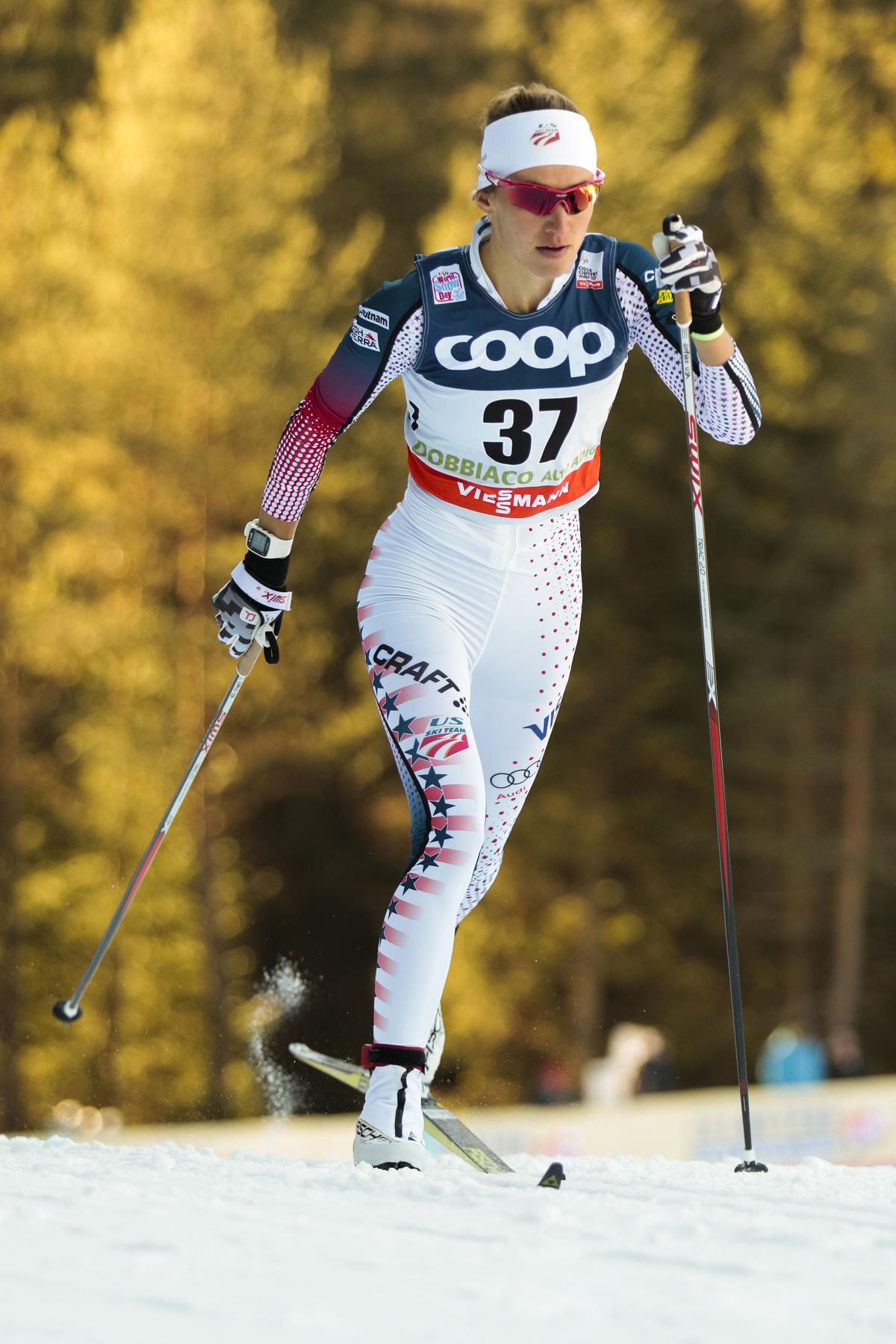
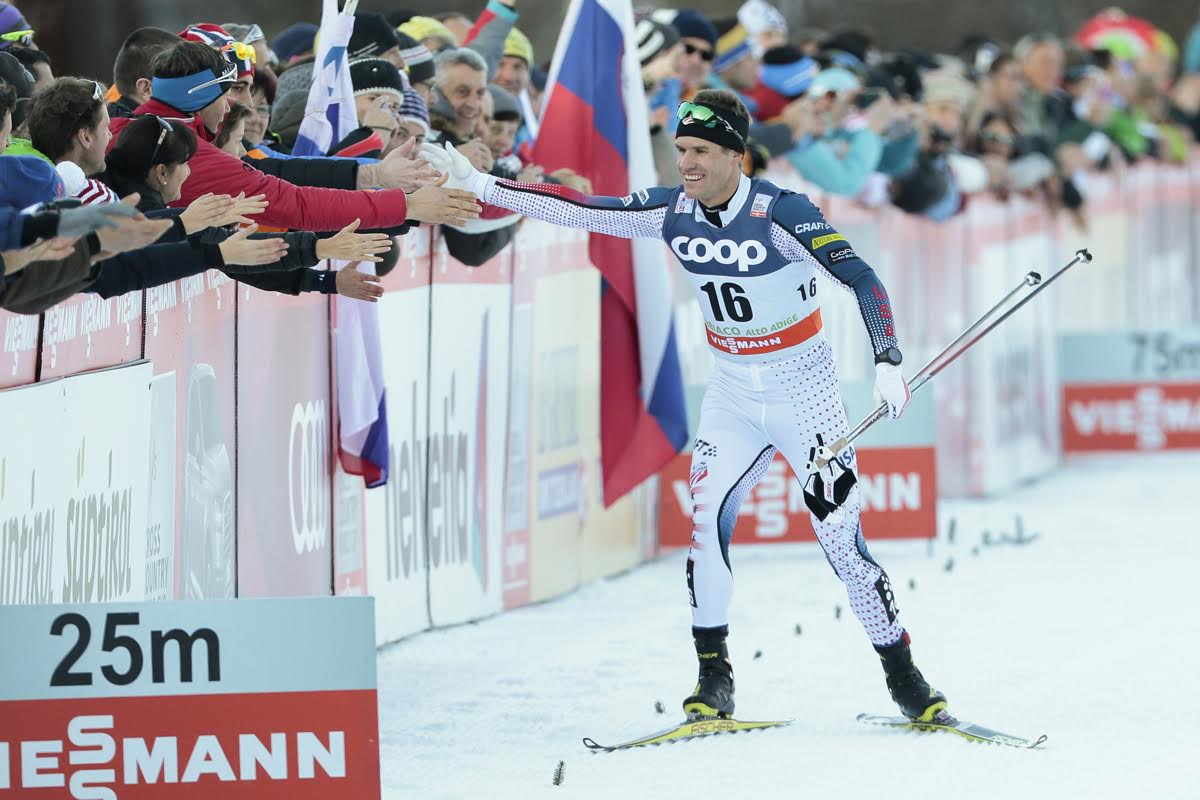
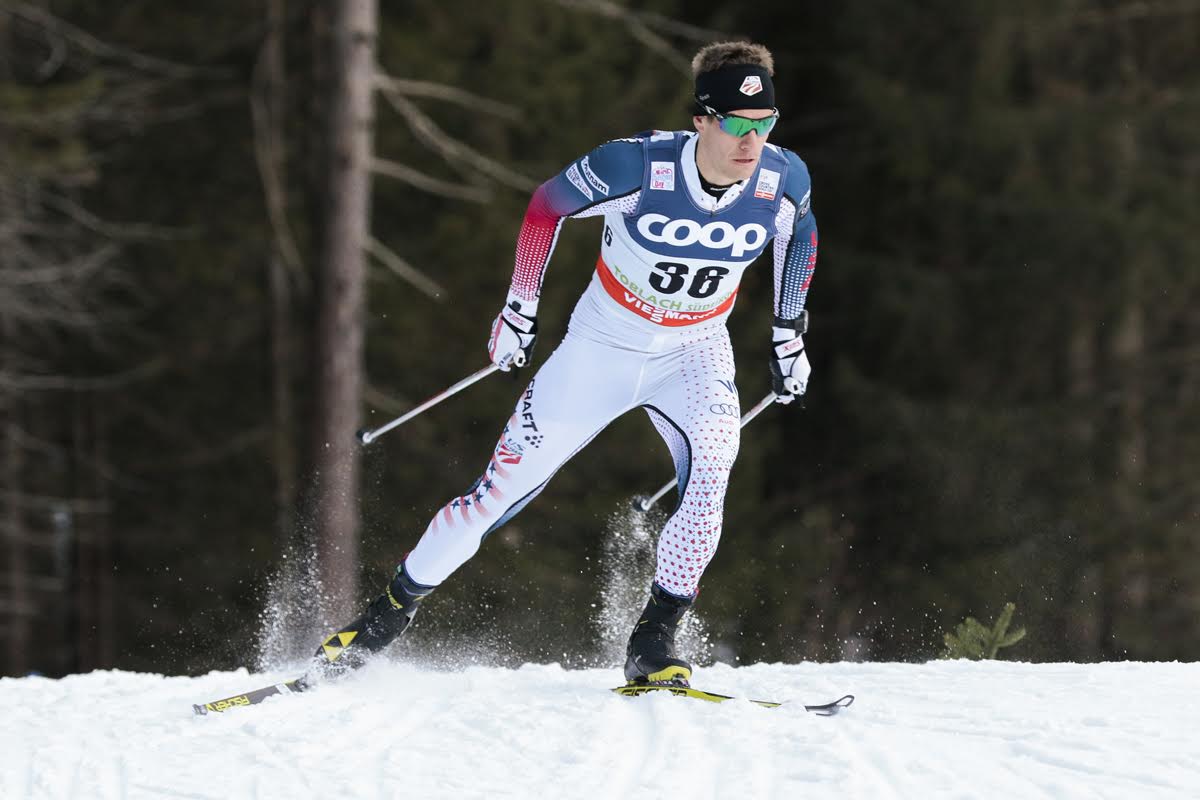
    Gus Schumacher (USA) did much of the work early to bring the chase into one pack behind Klaebo. (Photo: Vanzetta/NordicFocus)

    Schumacher in the Middle of It

    Schumacher finished sixth, also +1:00.2, part of the decisive chase that refused to fracture even as the course repeatedly asked for answers. The result came less than 24 hours after his 5 k freestyle win in Toblach, and the transition—emotionally and physically—was not trivial.

    “It was a little bit tough, honestly,” Schumacher said. “This pursuit started at 10:30 a.m., and I haven’t woken up before eight in probably a month because all our races have been so late. … I definitely enjoyed the win, but the focus was to refocus right away. It’s another new day, and this race was really important for the Tour.”

    Inside the race, Schumacher was not hiding. He described closing the gap to Iversen after the early climbs and doing much of the work that consolidated the group—an effort he acknowledged with pride. “I did most of that work, which I’m actually pretty proud of,” he said. What he didn’t do was overreach. “I wasn’t trying to catch Klæbo or anything,” Schumacher added. “Even though some of the guys might have been thinking that.”

    The fourth lap told the story. Stenshagen pressed hard on the long climb out of the stadium, stretching the elastic just enough to test resolve. Schumacher bent but didn’t break. Over the top, the group exhaled. The fifth lap came fast—but not frantic—and Schumacher found himself boxed in late, a tactical note he filed away rather than lamented.

    “With the overall standings so tight, I don’t think it’s worth thinking about it too much,” he said. “I’m sitting in third right now, and top ten is definitely still the goal. … Everyone from second through ninth is so close that it really comes down to focusing day by day.”

    That may be the most Tour de Ski answer of all.

    Gus Schumacher (USA), Emil Iversen (NOR), Edvin Anger (SWE), and Lars Heggen (NOR) worked together to prevent Klaebo from extending his lead. (Photo: Vanzetta/NordicFocus)

    A Chase by Committee

    Behind Schumacher, the chase’s cohesion owed as much to restraint as to strength. Lars Heggen (seventh, +1:00.3) and Benjamin Moser (eighth, +1:00.8) rounded out a group that included Harald Østberg Amundsen (ninth, +1:03.1). No one bridged to Klæbo; no one detonated the pack behind. The race’s geometry stayed intact.

    That stability mattered in a Norwegian context. With Olympic selection pressure already humming and only a few men’s spots still unsettled, Toblach functioned as both race and audition. Stenshagen’s second place was emphatic. The Tour does not reward one-off brilliance. It rewards survivability.

    Ben Ogden (USA) finding his classic distance form. (Photo: Vanzetta/NordicFocus)

    The Americans: Process Over Panic

    Further back, the pursuit revealed its less visible truths. Ben Ogden finished 29th (+3:03.3), a result that reads well on paper and even better when you hear how he raced it.

    “The biggest challenge is always the start,” Ogden said. “For me, it was about trying to pace the race properly, even when people were moving ahead of me early. … I started with a pack, then a bunch of them dropped me, and I just kind of let that happen, knowing I’d be able to catch some of them later—which I did.”

    That in-and-out rhythm—sometimes lonely, sometimes crowded—is pursuit racing in the middle of the field. Ogden framed it honestly. “Racing in a tight group is obviously more fun,” he said, “but you really have to pace yourself and try not to lose unnecessary time in a Tour, especially when you’re already a little tired.”

    For Zak Ketterson, who started deep in the order, the early kilometers were chaos by design. He finished 42nd (+3:55.1), but the route there mattered.

    “The wave is really challenging, especially starting in bib 70,” Ketterson said. “Five or six seconds have already passed before I even reach the start line. The first two laps were chaos, and I was just trying to stay relaxed and avoid trouble.”

    He did move forward—damage control after a Stage 2 crash that had already cost him minutes. “It was nice to move up a lot today,” Ketterson said, “but the classic sprint on Stage 5 is definitely the main focus now.”

    Ketterson also addressed the jury’s written reprimand for use of a banned technique in a marked stride zone—a penalty that did not disqualify him but appears in the official record. “The technique violation came from double poling in a stride zone,” he explained. “I changed tracks to pass someone, and the motion of doing that ended up being a double pole.”

    For Zak Ketterson (USA), the Tour de Ski hasn’t exactly gone as he had hoped, but today in the pursuit, he showed his form from earlier in the season. (Photo: Vanzetta/NordicFocus)

    When the Day Turns on a Ski

    Kevin Bolger finished 51st (+4:18.6), a result shaped by circumstance rather than strategy. Bolger had been patient by design, content to let early red-lining pass him by before advancing after lap two. Then a ski broke.

    “I like to settle in, and then after lap two start working my way up the field,” Bolger said. “I was just about to do that today when someone merged into my track and broke my ski, which cost me close to a minute. That was pretty disappointing.”

    Before that moment, his choices had been sound. Toblach’s two main climbs invite early commitment to kick wax, and Bolger leaned into it. “It was an easy choice to really feel the kick wax early,” he said. “The skis were feeling great, and I was really excited about how I was going to start moving up the field.”

    Bolger’s broader view was measured, almost cheerful in its realism. “This Tour isn’t quite as massive as some of the past ones,” he said. “It’s about gaining confidence and fitness, as long as you’re able to absorb it after the Tour.” Olympic energy is present, he acknowledged, but not consuming. “At the end of the day, I’m just trying to race fast.”

    J.C. Schoonmaker placed 56th (+4:42.7), while Jack Young finished 80th (+8:07.2), both navigating a day where patience was mandatory, and opportunities were earned in inches rather than meters.

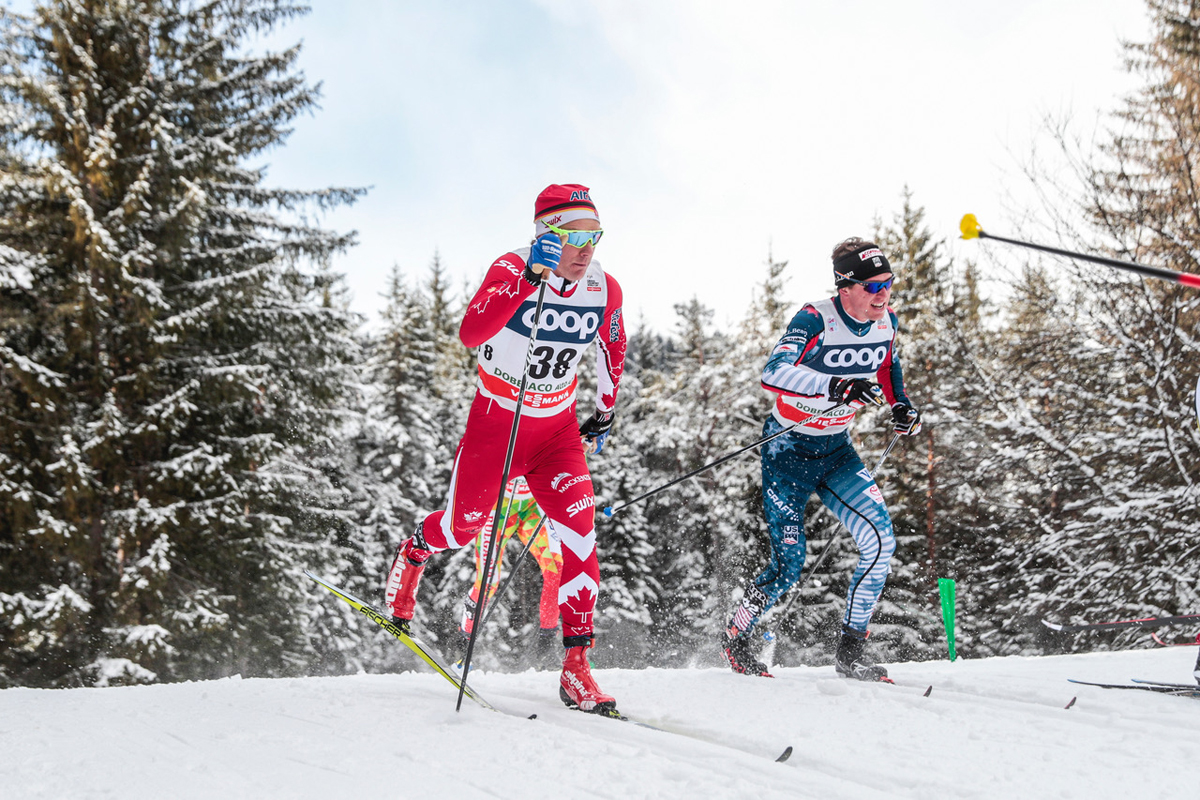
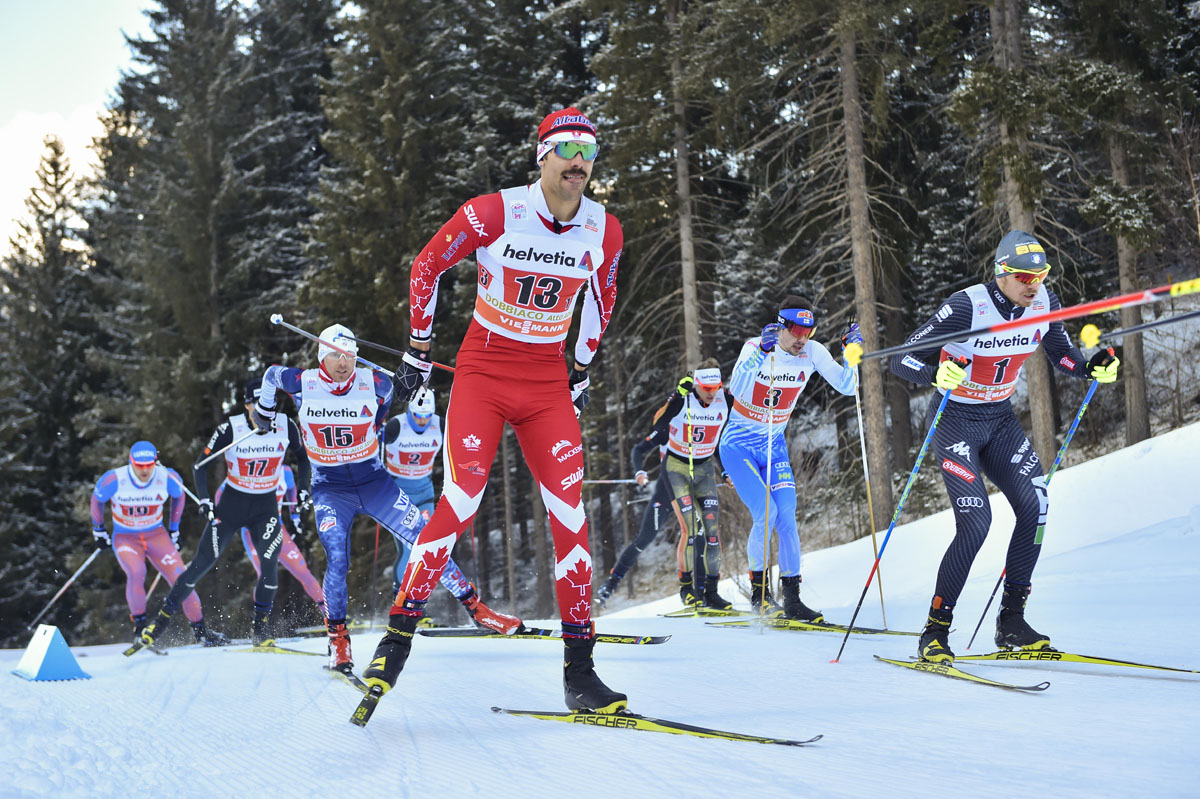
    Andrew Musgrave (GBR) and Antoine Cyr (CAN), (l-r) moving up through the field together. (Photo: Vanzetta/NordicFocus)

    Canada: Trials Done, Work Ongoing

    Canada’s men arrived in Toblach with their Olympic trials already behind them and the Tour serving a different purpose. Antoine Cyr led the way in 13th (+1:54.5), with Thomas Stephen 28th (+3:02.6) and Xavier McKeever 30th (+3:08.1). The emphasis now is accumulation—fitness, familiarity, resilience—rather than immediate results.

    Context at the Margins

    The Tour de Ski has a way of narrowing options without warning. On Thursday morning, one Norwegian men’s Olympic hopeful, Oskar Opstad Vike, withdrew close to start time, a reminder that the margins between readiness and retreat are thin, especially in an Olympic year. Toblach did not create that pressure; it merely revealed it.

    Mattis Stenshagen (NOR) was excited when he crossed the finish line as if he knew he had shown the Norwegian Olympic selectors enough to make the team. (Photo: Modica/NordicFocus)

    What the Splits Say

    A look at the time checks explains why the race felt so controlled. Klæbo’s advantage barely fluctuated. The chase group’s gaps among themselves were measured in seconds—Schumacher, Iversen, Anger, and Pellegrino trading fractional advantages without a decisive rupture. Further back, time losses accrued not in dramatic collapses but in quiet inefficiencies: a missed pack, a broken ski, a moment of over-enthusiasm.

    The course profile—five laps, 137 meters of total climb—rewards restraint. Toblach does not forgive impatience.

    A broken ski for Kevin Bolger (USA) didn’t prevent him from showing his form in Toblach (ITA). (Photo: Vanzetta/NordicFocus)

    Looking Ahead

    Stage 4 did not reshuffle the Tour so much as clarify it. Klæbo remains the reference. The men chasing him know exactly how much ground they have—and how little room there is to gamble it away. Schumacher’s position near the top of the standings is real, earned through effort and discretion. Behind him, athletes like Ogden, Ketterson, and Bolger are racing a Tour that asks for perspective as much as speed.

    Val di Fiemme awaits with its own demands and, this year, Olympic resonance. But Toblach offered a simpler lesson. In a pursuit, the clock is visible; the choices are not. The best skiers make the hard ones look easy—and the easy ones count.

    Men’s 20 K Classic Pursuit Start RESULTS

    Men’s 2026 Tour de Ski OVERALL STANDINGS

    Fastest Skiers on the Day – Men (Top 15, Net Time Only)

    This ranking removes pursuit start gaps and shows who skied the fastest 20 km classic on Stage 4.

    Day Rank Athlete Nation Net Time
    1 Edvin Anger SWE 45:39.5
    2 Simen Hegstad Krüger NOR 45:44.0
    3 Federico Pellegrino ITA 45:45.5
    4 Mattis Stenshagen NOR 45:51.8
    5 Emil Iversen NOR 45:51.9
    6 Gus Schumacher USA 45:52.9
    7 Truls Gisselman SWE 45:58.5
    8 Antoine Cyr CAN 45:59.2
    9 Hugo Lapalus FRA 46:00.5
    10 Johannes Høsflot Klæbo NOR 46:01.7
    11 Benjamin Moser AUT 46:03.5
    12 Savelii Korostelev AIN 46:04.5
    13 Harald Østberg Amundsen NOR 46:07.8
    14 Andrew Musgrave GBR 46:13.6
    15 Lars Heggen NOR 46:17.0

    Net time calculated as finish time minus individual pursuit start offset.

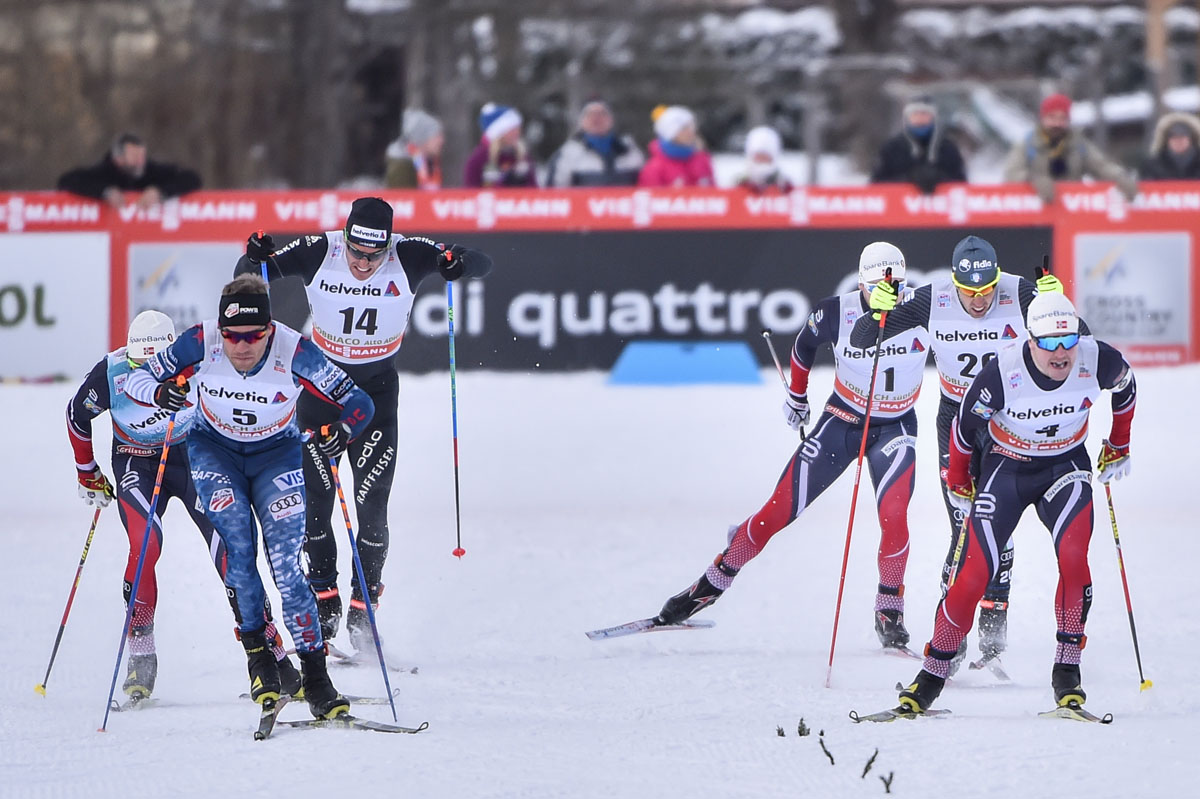
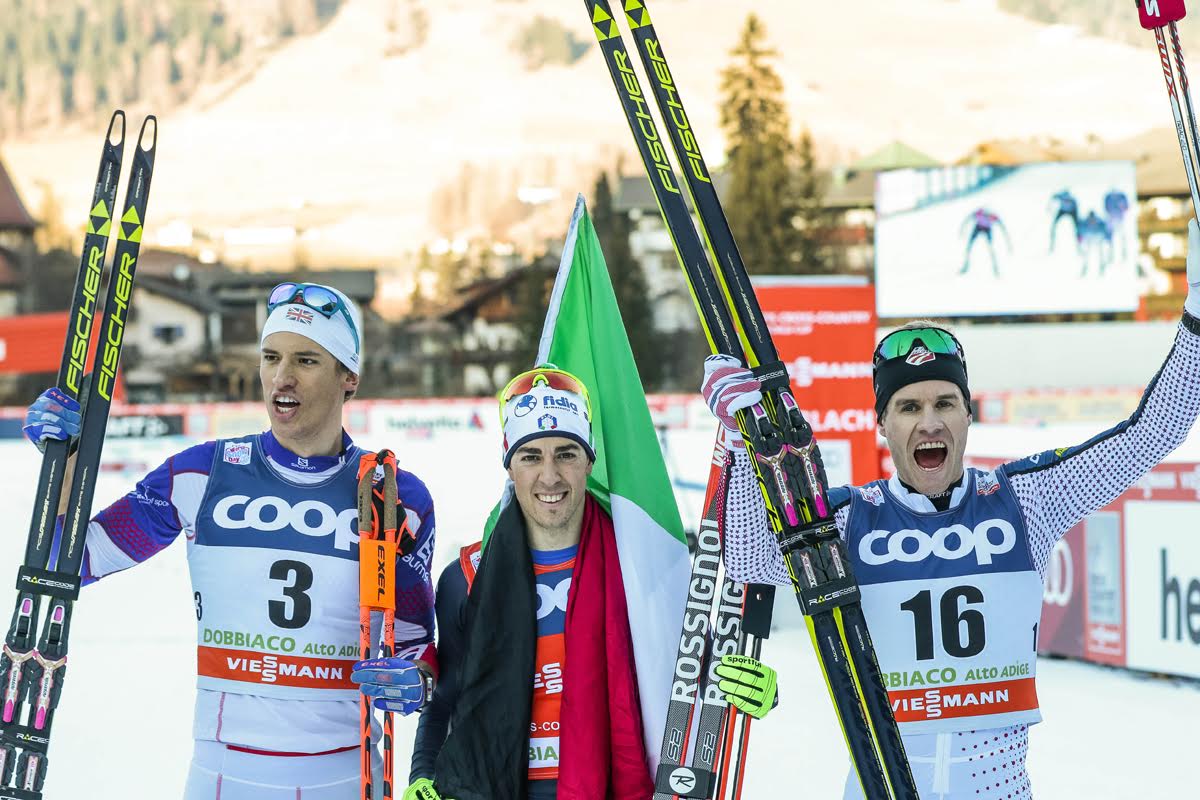
    Places 3-7 where this close for Federico Pellegrino (ITA), Edvin Anger (SWE), Gus Schumacher (USA), Emil Iversen (NOR), (l-r) after 20 K in Toblach (ITA). (Photo: Modica/NordicFocus)

    Love Stories Like This? Help Keep Them Coming.

    Feature stories like this one take time, access, and care to produce. If you value thoughtful storytelling and independent ski journalism, please consider becoming a Voluntary Subscriber. Your support directly fuels the work we do to cover the people, places, and moments that make our sport special.

    Join the FasterSkier community!


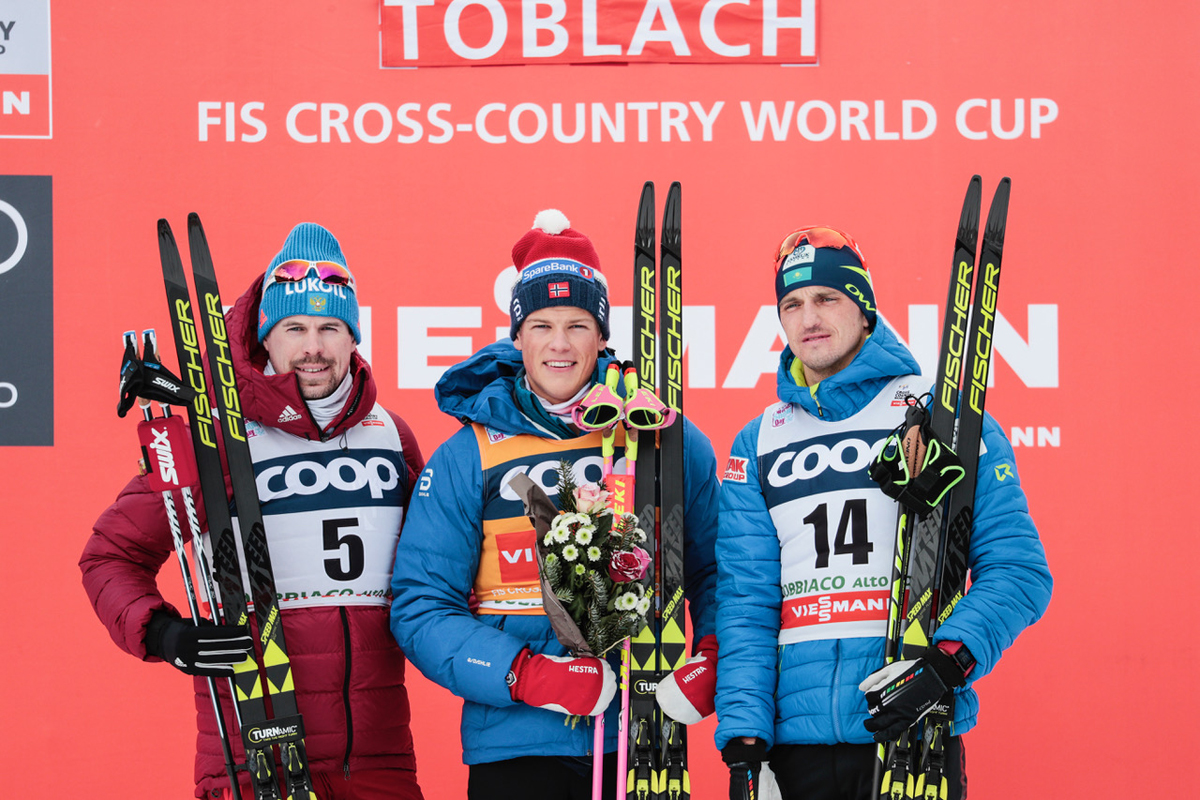
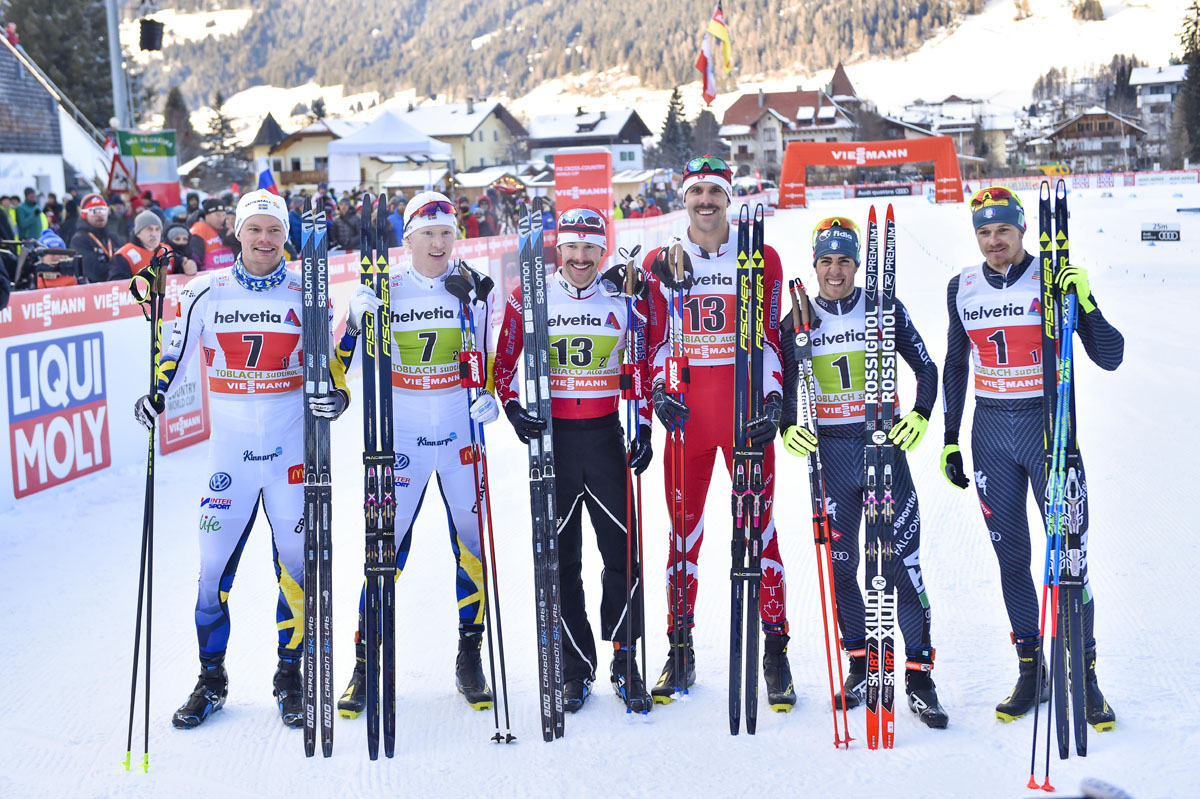
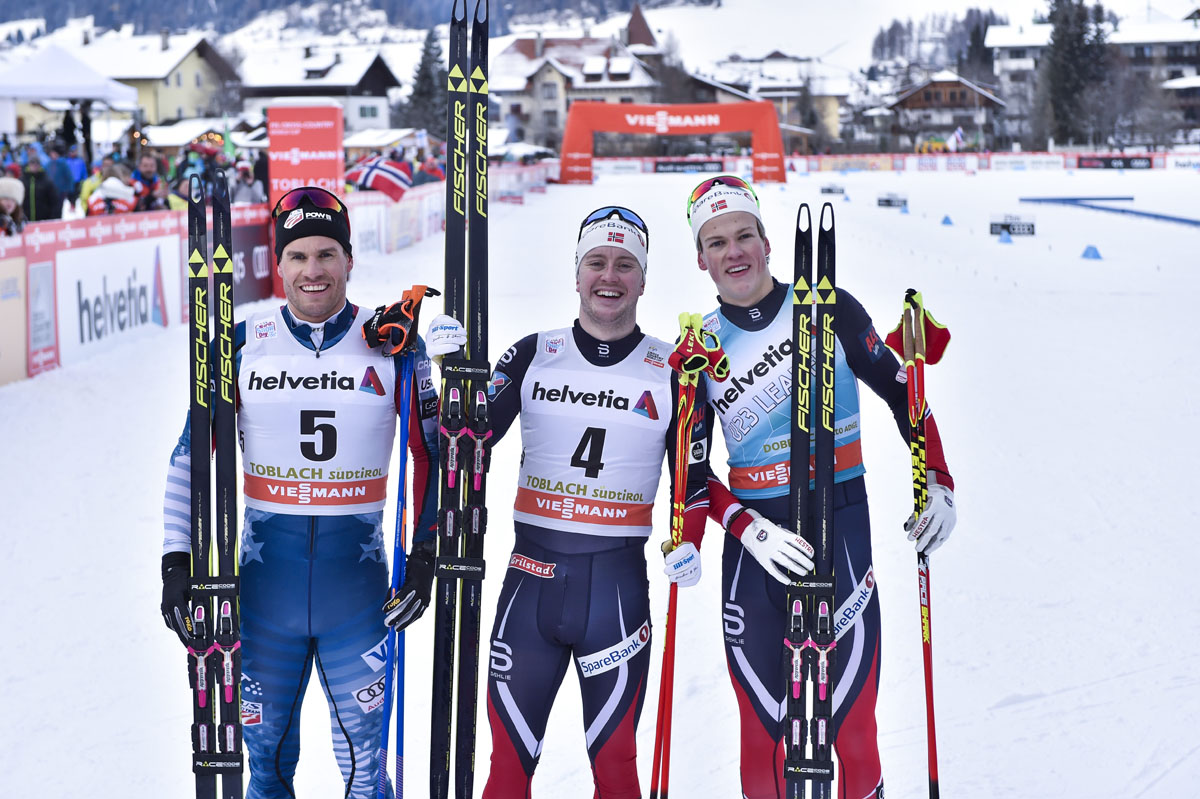
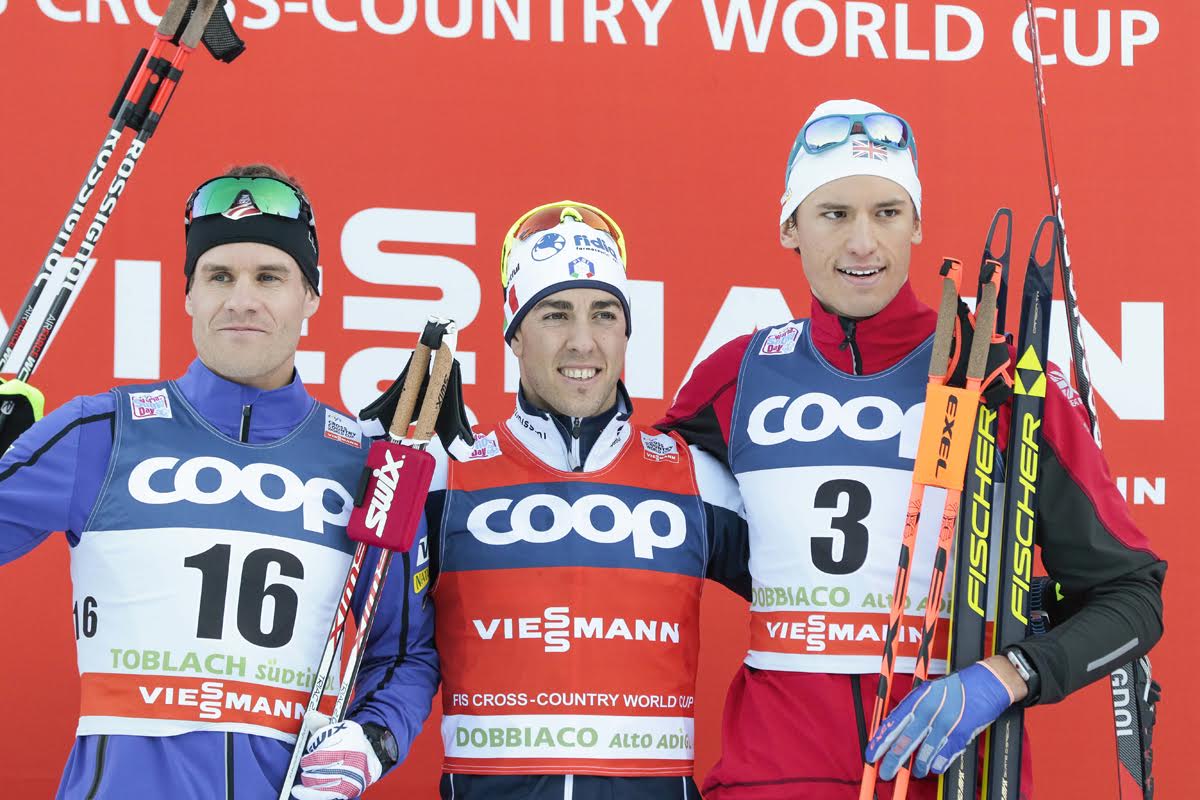
    Mattis Stenshagen (NOR), Johannes Hoesflot Klaebo (NOR), and Edvin Anger (SWE), (l-r) shared the pursuit podium in Toblach (ITA). (Photo: Modica/NordicFocus)


  • Sunday Rundown: Ramsau, Toblach, Annecy, St. Ulrich, Rossland (Updated)

    Sunday Rundown: Ramsau, Toblach, Annecy, St. Ulrich, Rossland (Updated)

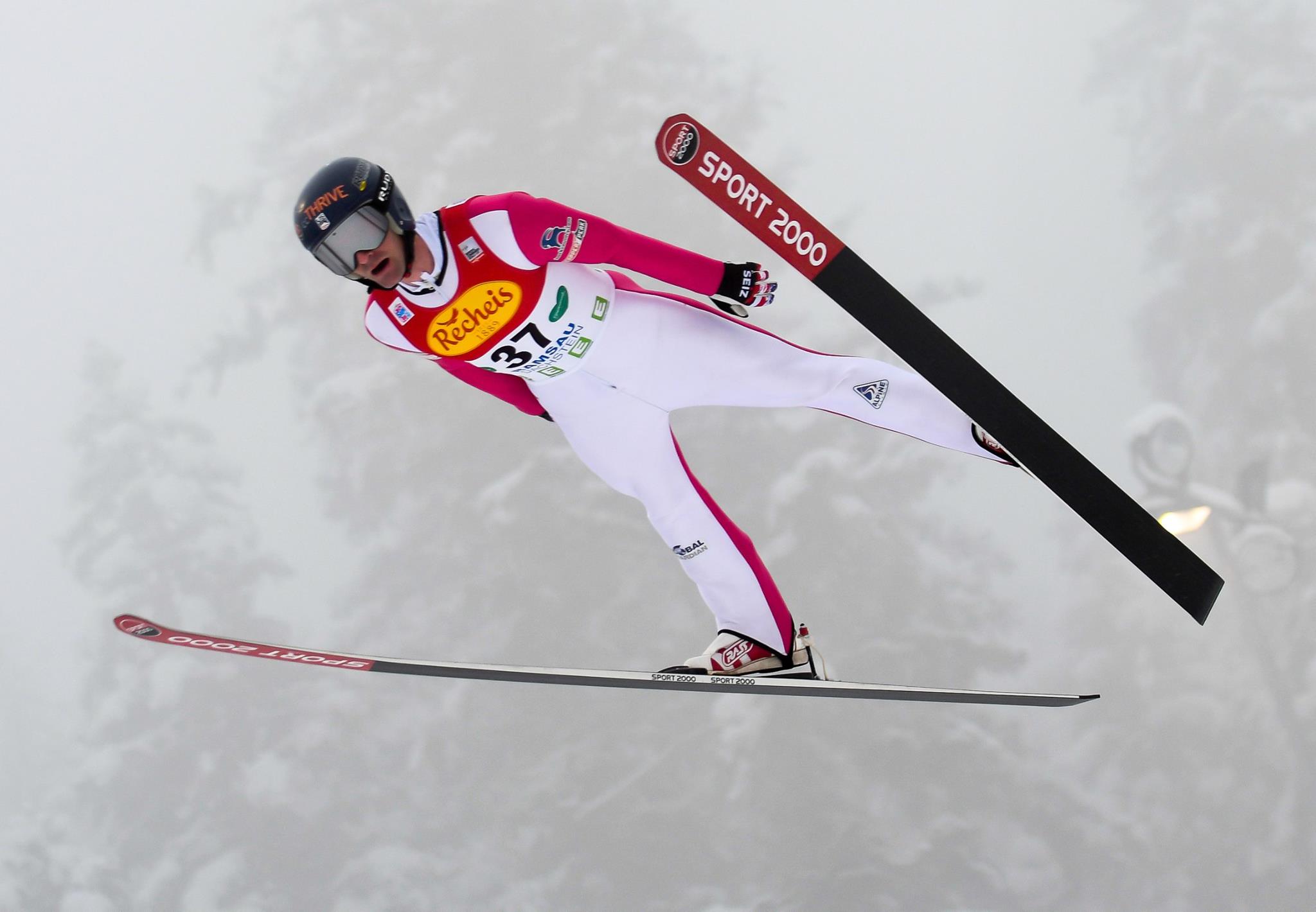
    Bryan Fletcher (USA Nordic) jumping to 45th in the Nordic Combined World Cup on Sunday in Ramsau, Austria. In the 10 k that followed, he skied the third-fastest time to finish 14th overall. (Photo: Romina Eggert/USA Nordic Facebook)

    NorAm mini tour (Rossland, B.C.): 10/15 k freestyle pursuits

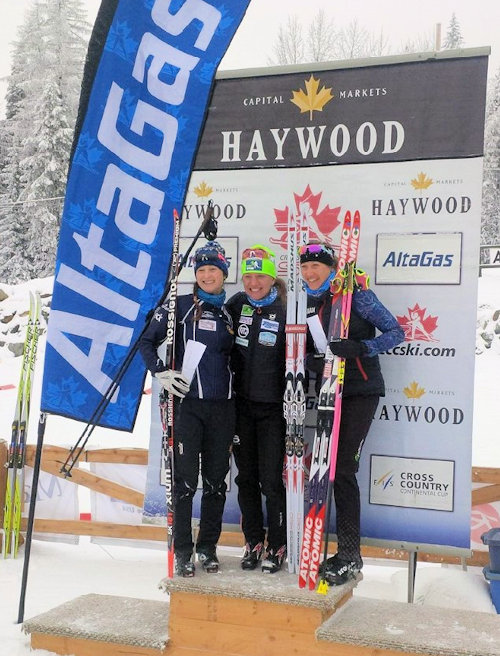
    Team Gregg ended the Rossland NorAm mini tour with another double win, with American Caitlin Gregg and her husband Brian Gregg winning the 10- and 15-kilometer freestyle pursuits, respectively, at the Black Jack Ski Club trails.

    The women’s 10 k freestyle pursuit podium at the NorAm in Rossland, B.C., with American Caitlin Gregg (c) in first, and Canadians Zina Kocher (l) and Andrea Dupont (r), in second and third, respectively. (Photo: Cross Country Canada)

    Caitlin capped the long weekend with her third-straight win, a 48.28-second victory over former Canadian biathlete Zina Kocher (Foothills Nordic). Caitlin started first and was first across the finish in 29:02.86, while Kocher started ninth and rose to second place for her second-consecutive podium (after placing third in Saturday’s skate sprint). Andrea Dupont (Rocky Mountain Racers) started fourth and finished third (+1:58.35) for her second-straight podium as well (she was second in the skate sprint behind Gregg).

    Lisle Compton of the National Team Development Centre (NTDC) Thunder Bay and Canadian National Junior Team finished fourth overall (+2:07.03), Frederique Vezina of the Pierre-Harvey National Training Centre (CNEPH) was fifth (+2:16.10), and Annika Hicks of the Alberta World Cup Academy (AWCA) sixth (+2:16.51). Laura Leclair (CNEPH) placed seventh, Kaia Andal (Caledonia Nordic) was the top junior in eighth overall, Jaqueline Mourao (Brazil Ski Team) ninth, and Sophie Carrier-Laforte (Skinouk) 10th.

    Brian, who won the Rossland men’s 10 k classic on Friday, also started Sunday’s 15 k freestyle pursuit first and finished in that position in 38:43.93. Andy Shields (Lappe Nordic) raced to second overall, 7.65 seconds back, after starting fourth, and Jack Carlyle (AWCA) reached the podium in third (+8.75) after starting 10th.

    Evan Palmer-Charrette (NTDC Thunder Bay) ended the weekend in fourth (+17.68), Philippe Boucher (CNEPH) was fifth (+19.02), Brian McKeever (Canadian Para-Nordic Ski Team) sixth (+22.16), Michael Somppi (AWCA) seventh (+34.62), Alexis Dumas (CNEPH) eighth (+52.78), Bob Thompson (NTDC Thunder Bay) ninth (+54.76), and Julien Locke (Black Jack/Canadian U25 Team) 10th (+1:04.46).

    Results

    ***

    FIS Nordic Combined World Cup (Ramsau, Austria): Saturday & Sunday individual competitions

    Bryan Fletcher (USA Nordic) notched seventh in the Nordic Combined World Cup this weekend in Ramsau, Austria, for his best result since January 2016. (Photo: USA Nordic/Facebook)

    After a bye week, the Nordic Combined World Cup resumed in Ramsau am Dachstein, Austria, with back-to-back individual normal hill/10-kilometer Gundersen starts on Saturday and Sunday.

    On Saturday, American Bryan Fletcher posted his best individual result in nearly two years in seventh place, 32.6 seconds behind German winner Eric Frenzel.

    Saturday’s individual competition on Ramsau’s 98-meter hill started out with Japan’s Taihei Kato going farthest in the jump portion, the Czech Republic’s Tomas Portyk jumping to second, and Frenzel jumping to third. Fletcher tied Japan’s Yoshito Watabe for 28th and the two started the 10 k race 1:02 minutes back accordingly.

    While Frenzel picked off two places to finish first in 24:05.8 minutes, Fletcher moved up 21 spots to seventh place with the second-fastest course time of 23:48.4.

    Germany had two on the podium with Fabian Rießle just 0.7 seconds back in second place, and Norway’s Jan Schmid finished third, 8.1 seconds behind Frenzel.

    On Sunday, Rießle climbed to the top step on the podium, winning the weekend’s second normal hill/10 k in 26:12.5.

    Norway’s Jørgen Graabak led after the jump portion, yet ultimately finished sixth, 9.8 seconds behind Rießle.

    Rießle jumped to ninth and started 18 seconds out of first, then took the win on the four-lap course by just 0.3 seconds over Italy’s Alessandro Pittin. The Italian notched second place after starting 36th based on his jump and racing the fastest 10 k time in 25:00.8.

    Finland’s Eero Hirvonen finished third (+1.5) after starting 10th, and Schmid was another 2 seconds back in fourth (+3.5) after jumping to seventh. Frenzel did not start.

    Three Americans qualified for Sunday’s competition. Fletcher jumped to 45th and started 1:30 back, yet rose to 14th (+43.7) with the third-fastest course time. His younger brother Taylor Fletcher skied the second-fastest course time to finish 34th (+2:01.6), up 24 places after jumping to 58th. Adam Loomis finished 52nd (+4:38.6) after jumping to 59th.

    The U.S. Nordic Combined team is headed back to the states to prepare for U.S. Olympic trials later this month, according to the USA Nordic Facebook page.

    Results: Saturday | Sunday

    ***

    FIS Cross Country World Cup (Toblach, Italy): 10/15 k classic pursuits

    Norway’s Johannes Høsflot Klæbo after winning the men’s 15 k classic pursuit for his seventh World Cup win of the season on Sunday in Toblach, Italy. With win No. 7, he has the most wins before the new year in FIS Cross Country World Cup history. (Photo: FIS Cross Country/Twitter)

    Women’s report

    Men’s report

    If you thought Johannes Høsflot Klæbo was out, think again. After placing 10th in the men’s 15-kilometer freestyle on Saturday in Toblach, the 21-year-old Norwegian raced to his seventh victory of the season in the men’s 15 k pursuit on Sunday.

    In doing so, Klæbo broke the record for the most World Cup wins before the New Year: he’s tallied seven in the last eight races he’s contested.

    On Sunday, he started 10th, 36 seconds behind his Norwegian teammate Simen Hegstad Krüger, who won the 15 k freestyle and started first. Klæbo had worked his way up to third by 11.4 k, and at the finish, he edged Russia’s Sergey Ustiugov by 1.9 seconds for the win in 33:31.1 minutes.

    Ustiugov, who started fifth, claimed second, and Kazakhstan’s Alexey Poltoranin rose from 14th to third place (+4.5), ahead of Russia’s Alexander Bessmertnykh in fourth (+9.7), Finland’s Matti Heikkinen in fifth (+9.8), France’s Maurice Manificat in sixth (+10.7), Norway’s Hans Christer Holund in seventh (+11.1), Switzerland’s Dario Cologna in eighth (+11.8), Canada’s Alex Harvey in ninth (+16.3), and Krüger in 10th (+24.0). Norway’s defending Overall and Distance World Cup champion, Martin Johnsrud Sundby placed 11th (+34.4) after starting 20th based on his result on Saturday.

    Erik Bjornsen once again led the U.S. men, racing from 29th at the start to 26th (+1:43.1). Scott Patterson improved from 42nd to 39th (+2:37.2), Paddy Caldwell moved up from 52nd to 44th (+2:57.7), and Noah Hoffman slipped to 49th (+3:01.7) after starting 40th.

    Canada’s Devon Kershaw moved up five places to 33rd (+2:02.8), Graeme Killick finished 50th (+3:42.0), Russell Kennedy 66th (+5:05.8), and Knute Johnsgaard moved up six places to finish 76th (+6:20.8).

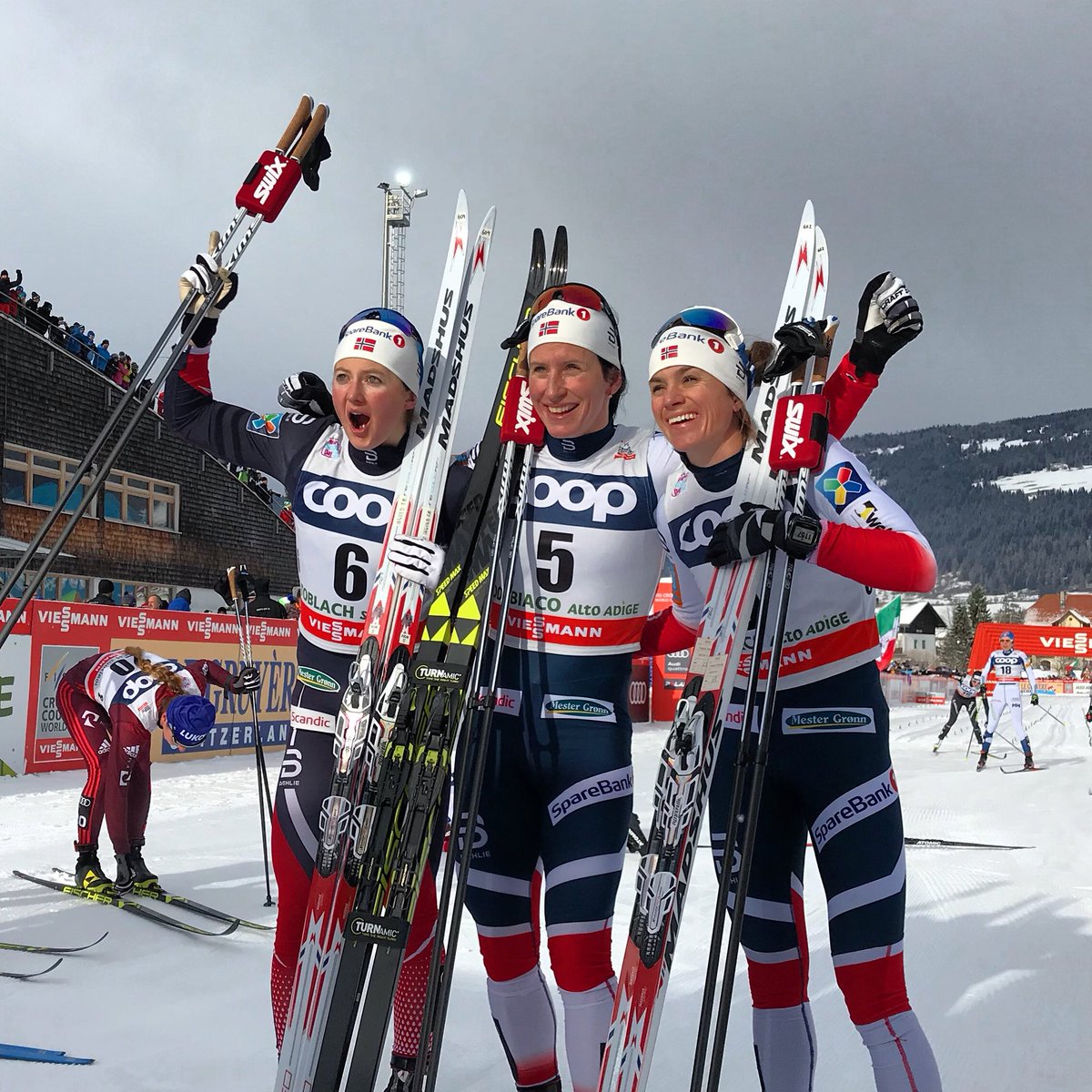
    The all-Norwegian women’s 10 k classic pursuit podium on Sunday at the World Cup in Toblach, Italy, with Marit Bjørgen (c) in first, Ingvild Flugstad Østberg (l) in second and Heidi Weng (r) in third. (Photo: FIS Cross Country/Twitter)

    In the women’s 10 k classic pursuit earlier in the day in Toblach, Norway’s Marit Bjørgen overcame a 22-second starting deficit to take the win by just 0.3 seconds over her teammates Ingvild Flugstad Østberg in second. It was an all-Norwegian podium with Heidi Weng in third (+0.8).

    Bjørgen started fifth, 22 seconds behind Swedish race leader Charlotte Kalla, based on their results in Saturday’s 10 k freestyle individual start. By the 6.4 k checkpoint, Bjørgen led a pack of four other Norwegians and Kalla — all within 1.4 seconds of first. At 8.5 k, Bjørgen led Østberg in second and Weng in third, while another Norwegian Astrid Uhrenholdt Jacobsen skied another eight seconds back with teammate Ragnhild Haga in fourth and fifth, respectively. By that point, Kalla was skiing alone, another 11.7 seconds in sixth, while American Jessie Diggins led a group 25 seconds behind Kalla in sixth.

    Ultimately, Bjørgen finished first in 25:19.3 and formed an all-Norwegian podium with Østberg and Weng, Jacobsen placed fourth, 21.5 seconds out of first and 20.7 seconds behind Weng in third.

    Haga was fifth (+31.8), Kalla sixth (+41.9), Diggins seventh (+53.7), Russia’s Natalia Nepryaeva eighth (+54.2), American Sadie Bjornsen ninth (+55.2), and Austria’s Teresa Stadlober 10th (+55.6) in a photo finish with Finland’s Kerttu Niskanen, who placed 11th (+55.6).

    For the U.S. Ski Team, Diggins and Bjornsen retained their starting positions of seventh and ninth, respectively, while Rosie Brennan started 19th and finished 25th (+2:14.6). Chelsea Holmes (Alaska Pacific University) finished 39th (+3:03.8) and Liz Stephen (USST) finished 48th (+4:05.2).

    Canada’s Emily Nishikawa placed 53rd (+4:14.5), Dahria Beatty finished 63rd (+5:44.7), Cendrine Browne 66th (+5:57.7), and Katherine Stewart-Jones 70th (+7:31.5).

    Results: Women Men

    ***

    IBU World Cup (Annecy, France): Women’s and men’s mass starts

    Women’s report

    Men’s report

    France’s Justine Braisaz won her first International Biathlon Union (IBU) World Cup race of the season on Sunday at home in Annecy, France, topping the women’s 12.5 k mass start by 11.2 seconds in 37:19.4.

    While Braisaz shot 19-for-20 (0+0+1+0), Iryna Kryuko of Belarus cleaned the four-stage race for second place, her first World Cup podium. Germany’s Laura Dahlmeier, who won Saturday’s 10 k pursuit, placed third (+19.9) with two penalties (0+1+0+1).

    Two North Americans qualified for the selective mass start, with Susan Dunklee (US Biathlon) racing to 20th (+1:16.3) with three misses (1+0+1+1), and Emma Lunder (Biathlon Canada) placing 28th (+2:21.4) with a single penalty (1+0+0+0).

    In the men’s 15 k mass start that followed, France’s Martin Fourcade finally got the win he was looking for, shooting clean and beating his main rival Johannes Thingnes Bø of Norway by 3.9 seconds. Fourcade crossed the finish line first in 36:30.3, Bø settled for second after skiing two early penalty loops (2+0+0+0) and Germany’s Erik Lesser tallied his second podium in Annecy (after placing third in the sprint) in third place again (+6.2) with clean shooting.

    Two Americans and a Canadian qualified for the mass start, with US Biathlon’s Lowell Bailey leading them in 23rd (+2:22.4) with three penalties, Sean Doherty following in 24th (+2:52.5) with four misses, and Biathlon Canada’s Scott Gow finishing 26th (+4:05.4) with five penalties.

    Results: Women| Men

    ***

    OPA Cup (St. Ulrich, Austria): 10/15 k freestyle pursuits

    On the final day of Alpen Cup (a.k.a. OPA Cup) racing in St. Ulrich, Ida Sargent of the U.S. Ski Team (USST) scored her third-straight top five with a fifth place in the women’s 10 k freestyle mass start. She previously placed third in the skate sprint and 5 k classic on Friday and Saturday.

    Germany’s Julia Belger won the women’s mass start on Sunday in 28:33.6, while Saturday’s 5 k winner, Elena Soboleva of Russia placed second (+0.7). Russia had two on the podium with Mariya Istomina in third (+6.4). Germany’s Elisabeth Schicho finished fourth (+15.8), just ahead of Sargent in fifth (+15.9).

    Germany’s Antonia Fräbel placed sixth (+17.1), followed by American Sophie Caldwell in seventh (+17.9). The USST had three in the top 10 with Julia Kern in 10th (+41.9), out of 60 finishers.

    In the men’s 15 k freestyle mass start, Beda Klee of Switzerland took the win in 37:14.6, 2.4 seconds ahead of Germany’s Thomas Bing in second. Six-time Olympian Sergey Dolidovich of Belarus reached the podium in third (+4.5).

    The U.S. had two men in the race, with Simi Hamilton finishing 14th, 16 seconds out of first, and Andy Newell finishing 71st (+2:25.2) out of 118.

    Results: WomenMen

  • Klæbo Sets Record with Win No. 7; Harvey 9th; Bjornsen 26th in Toblach Pursuit

    Klæbo Sets Record with Win No. 7; Harvey 9th; Bjornsen 26th in Toblach Pursuit

    Norway’s Johannes Høsflot Klæbo winning the men’s 15 k classic pursuit on Sunday in Toblach, Italy, ahead of Russia’s Sergey Ustiugov (5) in second and Kazakhstan’s Alexey Poltoranin (l) in third. (Photo: Fischer/NordicFocus)

    Johannes Høsflot Klæbo is making a name for himself. The 21-year-old Norwegian broke a record on Sunday, after taking the men’s 15-kilometer classic pursuit title in Toblach, Italy and tallying his seventh World Cup win this season, the most victories ever recorded by a male skier before the new year. In previous seasons, Norwegians Petter Northug and Martin Johnsrud Sundby had topped out at six.

    With the win, Klæbo remained the Overall World Cup leader with 752 points, 324 more than France’s Maurice Manificat in second.

    “I’m happy to back on the podium,” said Klæbo, who has won every race he’s entered except Saturday’s 15 k skate, according to an International Ski Federation (FIS) press release. He started Sunday’s 15 k classic pursuit in 10th, 36 seconds out of first.

    Norway’s Johannes Høsflot Klæbo getting down to business after starting 10th in the World Cup men’s 15 k classic pursuit on Sunday in Toblach, Italy. He raced to first for his seventh win of the season. (Photo: Fischer/NordicFocus)

    “My plan was to go out hard from the beginning to close the gap. It worked very well,” he said. “When I was together with the group I was confident I could ski for a podium. I wanted to decide the race little bit before the stadium.”

    For the first 3.5 k of Sunday’s pursuit, the top four from Saturday’s race led the way, with Manificat, Norway’s Simen Hegstad Krüger, Great Britain’s Andrew Musgrave, and Canada’s Alex Harvey.

    Striding in limbo just over six seconds behind them was Russia’s Sergey Ustiugov.

    “I was waiting to see if I am able to close the gap on the leaders or if the group behind me catches me,” Ustiugov said, according to FIS.

    For Ustiugov, who started the pursuit in fifth, it was the latter.

    Klæbo started 22 seconds behind the Russian and caught him, pulling Ustiugov into contact with the leaders before the climb back to the stadium on the first of three laps.

    With Klæbo at the back and Manificat in the front, the six leaders started Lap 2, trailed by Norway’s Hans Christer Holund and Finland’s Matti Heikkinen six seconds back. A second chase pack of four — Switzerland’s Dario Cologna, Sundby, Russia’s Alexander Bessmertnykh, and Kazakhstan’s Alexey Poltoranin — followed 20 seconds later.

    “I was working hard with Dario [Cologna] and Alexander [Bessmertnykh]. Dario did a great job in the first two laps.” Poltoranin said, according to FIS.

    For the first half of Lap 2, Ustiugov and Musgrave exchanged leads, while Klæbo remained in the rear. Harvey stuck to the middle.

    “I had really fast skis,” Harvey told FasterSkier on the phone after. “It was kind of sugary snow on the steep climbs, so I was struggling a bit on the steeper sections … but I had really fast skis, just a little slick.”

    Midway through Lap 2, Klæbo began his move toward the front of the lead group. By the time the top six passed by the stadium for their third and final lap, Klæbo was positioned third, Ustiugov first and Manificat second. Harvey sat comfortably in sixth.

    “On the last lap, Ustiguov and Klæbo attacked and I was feeling great, but I had to feather it a bit on the climb,” Harvey said, explaining that he lost the most time on the course’s steeper sections.

    With less than 3 k to go, Ustiguov and Klæbo began to gap the rest of the field. Meanwhile, Poltoranin made his way to the front of the chase group.

    “I was far faster on the last two uphills,” Poltoranin said. “I still have some work to do to be able to beat Sergey and Johannes, but I am getting there.”

    Klæbo and Ustiguov remained unmatched for the final kilometer and, with arms outstretched, Klæbo crossed first in a time of 33:31.1 minutes. Ustiugov finished 1.9 seconds later in second place.

    “Johannes seems he is never tired. He played with us like with small kids,” Ustiugov said, according to FIS. “He was in impressive shape again.”

    The World Cup men’s 15 k classic pursuit podium in Toblach, Italy, with Norway’s Johannes Høsflot Klæbo (c) in first, Russia’s Sergey Ustiugov (l) in second and Kazakhstan’s Alexey Poltoranin (r) in third. (Photo: Fischer/NordicFocus)

    Rounding out the podium in third was Poltoranin, 4.5 seconds out of first.

    “I’m so happy. It has been two years since I was on the podium last time,” the 30-year-old Poltoranin said.

    In fourth was Bessmertnykh (+9.7), followed by Heikkinen in fifth (+9.8) Manificat in sixth (+10.7), Holund in seventh (+11.1) and Cologna in eighth (+11.8).

    After crashing in the final 500 meters of the race, Harvey finished ninth (+16.3).

    “I was sitting in fifth and Heikkinen was sitting in fourth, and … I was coming around him and his pole tip just hit the front of my ski tip and I just did a straight-up face plant,” Harvey said. “So I ended up last in my group. That was a bit frustrating, but the rest was a good day.”

    Rounding out the top 10 was Saturday’s 15 k winner, Krüger, who finished 24 seconds after Klæbo. Sundby, who had placed 20th in the 15 k individual start, raced up to 11th (+34.4) on Sunday, and Musgrave (who was third in the 15 k skate) finished 12th (+54.3).

    Canada’s Devon Kershaw (38) racing alongside American Scott Patterson in the men’s 15 k classic pursuit on Sunday at the World Cup in Toblach, Italy. They finished 33rd and 42nd, respectively. (Photo: Fischer/NordicFocus)

    Leading the U.S. in 26th (+1:43.1) after starting 29th, was Erik Bjornsen. In five distance races this season, Bjornsen has scored World Cup points, placing within the top 30 in each race.

    New to the U.S. Ski Team’s B-team this year, Scott Patterson finished 39th (+2:37.2) after starting 42nd, and Paddy Caldwell placed 44th (+2:57.7) after starting 52nd. Noah Hoffman finished 49th (+3:01.7) after starting 40th.

    For Canada, Devon Kershaw placed 33rd (+2:02.8), up five spots from starting 38th, Graeme Killick was 50th (+3:42.0), Russell Kennedy 66th (+5:05.8), and Knute Johnsgaard 76th (+6:20.8) after starting 82nd.

    Racers will take a break from competitions until the Tour de Ski, which kicks off in Lenzerheide, Switzerland on Dec. 30.

    “I started a bit of a training block for the Tour just this week, and kind of continuing next week, so two weeks of a bit more volume, then do a little, do a little break after that, and then I have a few days of normal training to feel good before the tour,” Harvey said. “So I’m excited to see what a bit of a training and then a break does to me, because it will be the first time I have a little break like that since our last camp in October.

    “Other than the Olympics is the Tour de Ski, that’s important for me,” Harvey continued.  “So hoping to see if I can bring my level up a little bit with that bit of a break after the hard training, to feel a bit more fresh and a little more snappy.”

    Results| Overall World Cup standings

  • Saturday Rundown: Annecy, Toblach, St. Ulrich, Rossland (Updated)

    Saturday Rundown: Annecy, Toblach, St. Ulrich, Rossland (Updated)

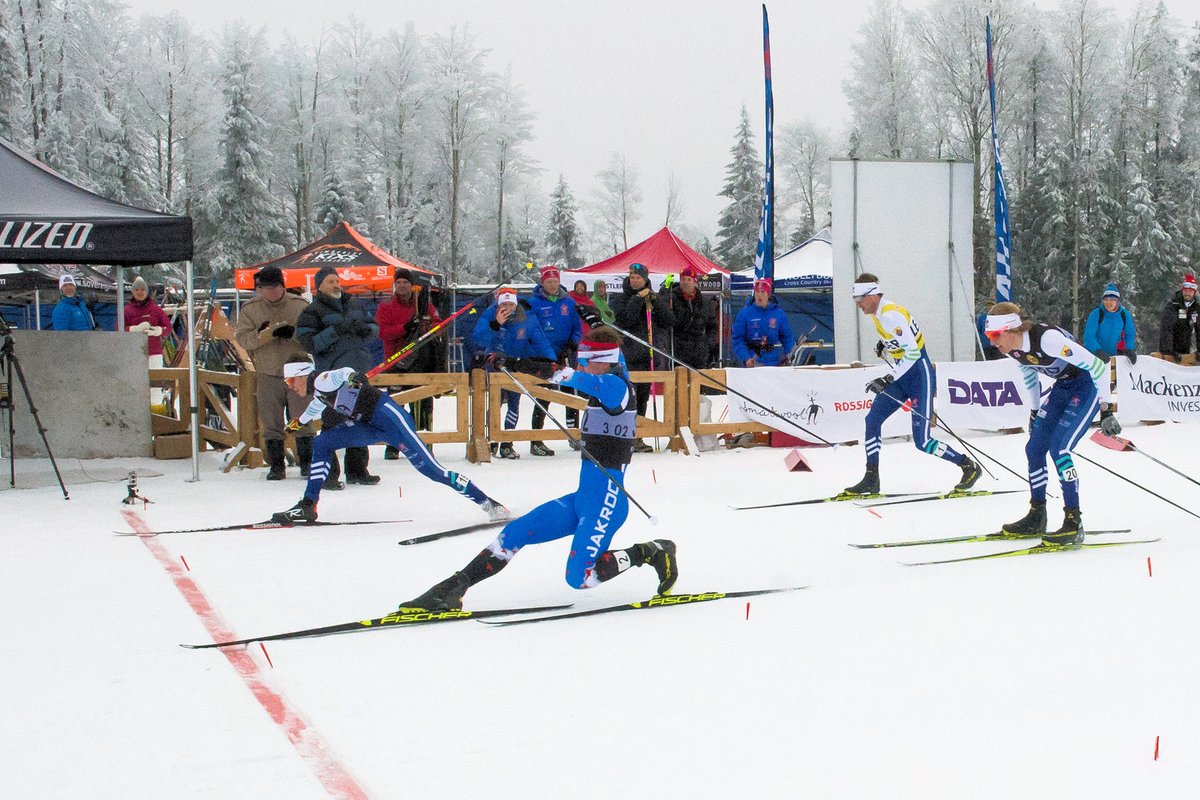
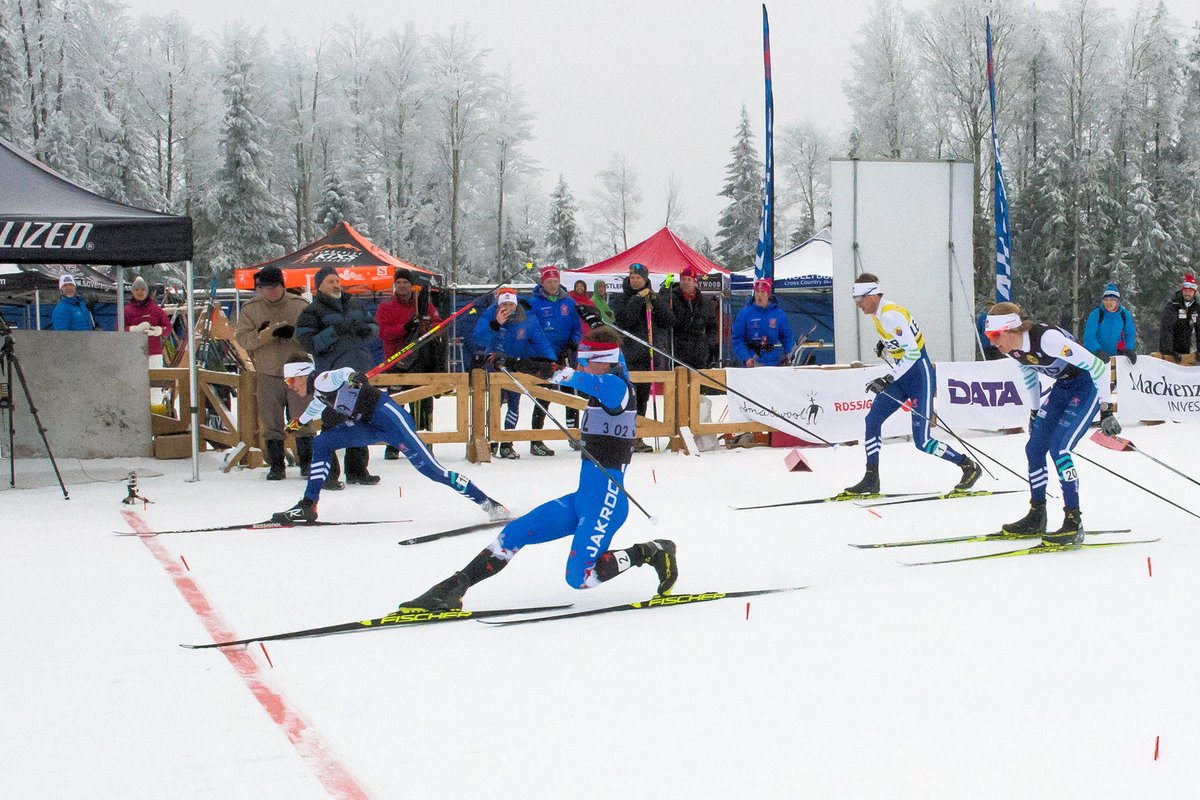
    The photo finish for first in the men’s skate sprint final on Saturday at the NorAm in Rossland, B.C., with Julien Locke (near) outstretching Evan Palmer-Charette for first, and Julian Smith (r) taking third third ahead of Bob Thompson (yellow NorAm leader’s bib). (Photo: CCC/Twitter)

    NorAm Mini Tour (Rossland, B.C.): Freestyle sprints

    On Day 2 of NorAm racing in Rossland, British Columbia, Julien Locke, of the Black Jack Ski Club and Canadian National U25 Team, won the men’s 1.4-kilometer freestyle sprint final on his home trails by just one-hundredth of a second over Evan Palmer-Charrette, of the National Team Development Centre (NTDC) Thunder Bay, in 2:38.13. NTDC Thunder Bay had two on the podium with Julian Smith in third, 0.4 seconds behind Locke.

    Locke started the day by qualifying second, just 0.06 seconds behind Bob Thompson (NTDC Thunder Bay), who won the qualifier in 2:39.49. Locke went on to finish second to Thompson in the first quarterfinal, then won the second semifinal while Thompson won the first semi.

    In the final, Locke tallied his first NorAm win of the season, while Thompson, last weekend’s classic-sprint winner at Sovereign Lake, placed fourth (+0.43), missing the podium by three-hundredths of a second. Andy Shields (Lappe Nordic) finished fifth (+1.78) and Sebastien Boehmler-Dandurand (Canmore Nordic/Stefan Kuhn HP Team) sixth (+5.21) in the men’s final.

    Also on Saturday, American Caitlin Gregg (Team Gregg/Loppet Nordic Racing) racked up her second-straight win in Rossland (after topping Friday’s 5 k classic), winning the women’s 1.4 k skate-sprint final in 3:03.36. Canada’s Andrea Dupont (Rocky Mountain Racers) finished 2.5 seconds later for second place and Zina Kocher (Foothills Nordic) scored her first podium of the season in third (+3.53).

    Dupont won the women’s qualifier in 3:07.68, and Gregg qualified second, 0.87 seconds back. Dupont went on to win the first quarterfinal and first semifinal, while Gregg won her quarterfinal and semifinal as well. (Gregg’s quarterfinal had four racers, compared to five in Dupont’s quarterfinal, as only 21 women competed in the senior women’s heats.)

    Also in the final, Laura Leclair, of the Centre National d’Excellence Pierre Harvey/Pierre-Harvey National Training Centre (CNEPH), finished fourth (+6.11), Maya MacIsaac-Jones (U25 Team) was fifth (+6.31) and Sophie Carrier-Laforte (Skinouk) sixth (+8.57).

    Results: Heats | Qualifier

    ***

    OPA Cup (St. Ulrich, Austria): 5/15 k classic

    On the second day of Alpen Cup (a.k.a. OPA Cup) racing in St. Ulrich, Ida Sargent of the U.S. Ski Team (USST) finished third in the women’s 5 k classic behind two Russians, Elena Soboleva and Natalia Matveeva, respectively.

    Soboleva took the win in the individual-start race in 14:25.8, and Matveeva was 12.5 seconds back for second place. Just like Matveeva, Sargent reached the podium for the second-straight race in third (+18.1), after placing third in the freestyle sprint on Friday (Matveeva finished second in the sprint).

    Germany’s Antonia Fräbel finished fourth (+21.0) and American Sophie Caldwell (USST), who won the sprint the day before, placed fifth (+22.7). The other USST member in the race, Julia Kern finished 15th (+53.5).

    The men raced a 15 k classic, with France’s Alexis Jeannerod taking the win in 38:45.6. Germany’s Thomas Wick was 4.7 seconds back in second, and Russia’s Gleb Retivykh placed third (+11.3). The lone American man racing, Andy Newell (USST) finished 36th (+2:07.1) out of 125 finishers.

    The three-day OPA Cup weekend in St. Ulrich wraps up Sunday with 10/15 k freestyle mass starts.

    Results: Women| Men

    https://www.instagram.com/p/Bcxx2GhlDfv/?taken-by=juliakernski

    ***

    IBU World Cup (Annecy, France): Women’s and men’s pursuits

    Susan Dunklee (US Biathlon) after placing sixth and reaching the flower ceremony in the women’s 10 k pursuit at the IBU World Cup on Saturday in Annecy, France. After starting 10th, sixth stands as a season-best for Dunklee. (Photo: Glen Crawford)

    Women’s race report

    Men’s race report

    Germany’s Laura Dalhmeier captured her first win of the season, preventing Slovakia’s Anastasia Kuzmina from her third-straight win, and American Susan Dunklee raced to a season-best sixth in the women’s 10-kilometer pursuit on Saturday in Annecy-Le Grand Bornand, France.

    Canada’s Emma Lunder achieved a career-best 18th after starting 34th, and her teammate Julia Ransom placed 27th after starting 39th.

    In the men’s 12.5 k pursuit that followed, Norway’s Johannes Thingnes Bø started first, shot clean and fended off his competition to rack up his fourth-straight victory — winning by more than a minute.

    And for the second-straight race, France’s Martin Fourcade finished second, this time 1:01.4 minutes behind Bø, who crossed the line first in 32:52.1. Fourcade had to ski two penalty laps later in the race (0+0+1+1), while Russia’s Anton Shipulin, who started sixth and had a single miss (0+0+0+1), rose to third place (+1:10.5).

    American Lowell Bailey shot clean to race up to 14th (+2:13.9) after starting 35th. His US Biathlon teammate Tim Burke finished 26th (+3:03.1) with three penalties (1+0+1+1), after starting 10th.

    Canada’s Scott Gow finished a second later for 27th (+3:04.1) after starting 16th and skiing four penalty laps (1+0+1+2). His brother Christian Gow moved up one spot to 29th (+3:06.6) after starting 30th and shooting 19-for-20 (1+0+0+0).

    The U.S. had four men in the pursuit, with Sean Doherty placing 30th (+3:07.0) with three penalties after starting 17th.

    Leif Nordgren improved to 48th (+4:54.9), up from 56th, despite three misses.

    ***

    FIS Cross Country World Cup (Toblach, Italy): 10/15 k freestyle

    Women’s report

    Men’s report

    The men’s 15 k freestyle podium at the Toblach World Cup in Italy, with Norway’s Simen Hegstad Krüger (c) scoring his first World Cup victory in first place, last weekend’s winner Maurice Manificat (l) of France in second, and Great Britain’s Andrew Musgrave (r) in third. (Photo: FIS Cross Country/Twitter)

    In the men’s 15 k freestyle on Saturday in Toblach, 24-year-old Simen Hegstad Krüger achieved his first individual World Cup victory in 29:58.8 minutes, and was joined on the podium by France’s Maurice Manificat in second (+10.6) and Great Britain’s Andrew Musgrave in third (+11.5).

    Canadian World Cup Team member Alex Harvey missed the podium by 2.5 seconds in fourth place (+14.0), tying his best result of the season after finishing Ruka Triple mini tour in fourth place late last month in Kuusamo, Finland.

    Russia’s Sergey Ustiugov followed in fifth, Norway’s Finn Hågen Krogh was sixth and Hans Christer Holund seventh, Finland’s Matti Heikkinen eighth, Switzerland’s Toni Livers ninth, and notably, Norway’s Johannes Høsflot Klæbo — who hasn’t lost a race all season (he sat out last weekend’s 15 k skate in Davos, Switzerland) — was 10th.

    Erik Bjornsen of the U.S. Ski Team (USST) was the lone American in the points (top 30) in 29th (+1:09.6), Noah Hoffman finished 40th (+1:24.5), Scott Patterson (USST) was 42nd (+1:29.4), and Paddy Caldwell (USST) 53rd (+1:50.0)

    For Canada, Devon Kershaw (World Cup Team) placed 38th (+1:22.1), Graeme Killick (World Cup Team) was 49th (+1:47.8), Russell Kennedy (Team R.A.D.) 60th (+2:13.2), and Knute Johnsgaard (World Cup Team) 85th (+3:28.3).

    The women’s 10 k freestyle podium on Saturday at the World Cup in Toblach, Italy, with Sweden’s Charlotte Kalla (c) in first, and Norway’s Ragnhild Haga (l) and Heidi Weng (r) in second and third, respectively. (Photo: FIS Cross Country/Twitter)

    In the women’s 10 k freestyle individual start in Toblach, Sweden’s Charlotte Kalla tallied her third win of the season in 22:40.1 minutes, ahead of five Norwegians and American Jessie Diggins.

    Norway’s Ragnhild Haga was 5.8 seconds shy of Kalla’s time for second place, and her teammate Heidi Weng was another 8 seconds back in third (+13.8).

    Norway occupied second through sixth place, with Astrid Uhrenholdt Jacobsen in fourth (+17.9), Marit Bjørgen in fifth (+22.6) and Ingvild Flugstad Østberg in sixth (+29.3). Diggins led the U.S. Ski Team (USST) in seventh (+40.5), with Finland’s Kerttu Niskanen close behind in eighth (+43.5) and the second U.S. woman in the top 10, Sadie Bjornsen, another 0.4 seconds back in ninth (+43.9).

    The USST had three in the top 20 with Rosie Brennan placing 19th (+1:15.2) for her second-straight top-20 result (following a 17th place in last weekend’s 10 k freestyle in Davos, Switzerland). Chelsea Holmes (Alaska Pacific University) finished 36th and Liz Stephen (USST) was 47th.

    Emily Nishikawa (Canadian World Cup Team) led her team in 51st, Cendrine Browne (Canadian U25 Team) followed in 55th, Dahria Beatty (World Cup Team) was 69th, and Katherine Stewart-Jones (U25 Team) 77th.

    Results: Women | Men

  • Toblach Sprint Weekend: Bonus Quotes

    Toblach Sprint Weekend: Bonus Quotes

    The men's freestyle team sprint podium on Sunday, Jan. 15 in Toblach, Italy, with Canada's Alex Harvey and Len Valjas (c), Sweden's Oskar Svensson and Karl-Johan Westberg in second (l) and Italy's Federico Pellegrino and Dietmar Noeckler in third (r). (Photo: Fischer/Nordic Focus)
    The men’s freestyle team sprint podium on Sunday, Jan. 15 in Toblach, Italy, with Canada’s Alex Harvey and Len Valjas (c) in first, Sweden’s Oskar Svensson and Karl-Johan Westberg in second (l), and Italy’s Federico Pellegrino and Dietmar Noeckler in third (r). (Photo: Fischer/Nordic Focus)

    And you thought the weekend after the Tour de Ski would be boring. For fans of North American World Cup cross-country skiers, it was anything but, with Simi Hamilton coming excruciatingly close to a win in the men’s freestyle sprint on Saturday, Jan. 14, and placing second for his first podium of the season, followed by Canada’s first team-sprint victory since 2011 for Len Valjas’s first World Cup win. There was a lot of excitement surrounding two days of racing in Toblach, Italy, and plenty that didn’t make it into the race reports. See below.

    ***

    Saturday’s 1.3 k freestyle sprint

    (Race report)

    On qualifying fifth:

    The men's freestyle sprint podium at Saturday's World Cup in Toblach, Italy, with American Simi Hamilton (l) in second, Norway's Sindre Bjørnestad Skar (c) in first and Norway's Johannes Høsflot Klæbo (r) in third. (Photo: Fischer/NordicFocus)
    The men’s freestyle sprint podium at Saturday’s World Cup in Toblach, Italy, with American Simi Hamilton (l) in second, Norway’s Sindre Bjørnestad Skar (c) in first and Norway’s Johannes Høsflot Klæbo (r) in third. (Photo: Fischer/NordicFocus)

    “I think that my qualification speed has maybe dropped off just a little bit in the last few years with doing a little more threshold work all the time and focusing a little bit more on my overall distance fitness versus just my top qualification speed, but at the same time I knew I had great skis going into the qualifier and I knew I was 100-percent healthy and the conditions were really good for me. It was definitely a little bit slower out there today than it was last year with the new snow that came in yesterday, and it was a slightly longer course than it was last year, but I knew that if I just put together a good qualification, then I would probably end up towards the top there. So I was psyched to qualify fifth and only 0.8 [seconds] out. I think that was a reflection of kind of how I am feeling right now with my fitness.”

    — Simi Hamilton

    On having all five U.S. athletes qualify:

    “We weren’t surprised by all of them qualifying. Sophie [Caldwell] and Ida [Sargent] have been very consistent qualifiers, and Kikkan [Randall] also qualified in the last skate sprint that she did in the Tour, so I think that was within reason. Also, the field the week after the Tour de Ski is slightly smaller, because so many people, like Jessie [Diggins], Sadie [Bjornsen], [Sweden’s] Stina Nilsson, and such are resting, so it makes for a slightly easier field. I think there were only 46 women who started, so it wasn’t too much of a surprise. It was really great to see them all move through the quarterfinals. I think all three of them skied great, and especially Ida and Sophie, just outright making great moves and pushing themselves through, and then Kikkan being a lucky loser. It was great to see them all move through, and unfortunately [Caldwell and Randall] got tangled up in the semifinal…”

    — U.S. Ski Team Head Coach Chris Grover

    On the U.S. semifinal tangle:

    “According to Kikkan, as you could see in the race, the draft was such a big thing coming down that hill. Kikkan thought she had too much speed so she tried to go to the inside of Sophie, instead of running into the back of her, and somehow after that, they got tangled; that was really unfortunate. You hate to see when two people from the same team actually manage to take each other out. These guys are usually really good about watching out for each other, so I was a little surprise that that happened.”

    — Grover

    “It’s a bummer to have fallen in the two races that I’ve made the semis this year, but I’m feeling good and know that my time will come. It was a great day for the U.S. and seeing Simi’s brilliant final and second place erased any sour taste about falling today.”

    — Sophie Caldwell

    On lessons learned:

    “In my quarter[final], I was a little too focused on trying to be in the top three for the first half of the heat, and something I kind of figured out almost by mistake in that quarterfinal was that I could ski off the bridge climb just extremely hard and get a really good slingshot going into that final climb and pick up a few places right there. I think when I was doing that, it was setting me up really well for the finish. … You see a lot of guys coming through that were getting a little slower start and then are running 4-5-6 the first half of the sprint, and then they make a big move at the end and position themselves for a really good finish, so I kind of figured that out on.”

    — Hamilton

    On a tailored plan:

    “I have realized that the very last climb definitely suits me well. It’s kind of gradual and if I come into that climb with really good speed after the bridge downhill, after having picked up a couple of spots from the slingshot after that downhill, definitely makes me ski kind of confidently up that climb. The nature of that course is, you want to be in a really good spot coming down that long downhill the second tim, coming into the finish. So in the final, I just focused on basically skiing the first half, the first two climbs, all the way up to the building climb just really efficiently and try to conserve as much energy. I knew that if I put a move on coming off that bridge hill and skied that last climb really well, then I would have a really good chance of being top three coming over that last climb. So that’s what I did and I felt confident in my plan going into the final.”

    — Hamilton

    On riding confidence:

    “I think I am really confident in knowing exactly which part of the course I can ski the best and being able to kind of capitalize on that knowledge and use those spots to my advantage and just know that I can get around some people in those clutch spots, for me, is a really big thing.  At the same time, I think there’s just the whole mental side of it in knowing that you know you can, knowing that you can ski really well and in a specific place on multiple occasions. I think that’s just as big as knowing that your skis are really good, knowing that you’re really healthy, knowing that you’re fit, just knowing that you kind of figured a course out and that you really enjoy skiing it, really enjoy racing it, that it is a good thing for you, I think that is really important.”

    — Hamilton

    On getting back those good-ol’ race sensations:

    “I had such a solid summer and fall of training that I actually expected myself to be right in the mix when the season started. But when the racing started, I began to realize that this comeback was going to take some time. I didn’t expect the patience and time it would take to get the racing gears back after taking a full year away from that kind of effort. Each race I do I am feeling a little closer to my normal sprint form. So if I can just stay patient and healthy, I think this season will progress nicely.”

    — Kikkan Randall

    On Andy Newell’s season-best 13th:

    “He’s had such a rough start to the year, coming over and getting a pretty serious elbow infection to start the World Cup season, and then getting sick right after that through Lillehammer, and then he stuck to his plan and went home after Davos. Instead of staying on to race the Tour, he took a break and spent time with his fiancé [Stratton Mountain School Elite teammate Erika Flowers] over the break, so I was really excited to see how he skied today. For him and Simi to qualify fifth and sixth, they were moving incredibly fast in qualification. Simi was under a second from first, Andy was maybe just over a second from first in qualification, so they were flying. I thought Andy skied with really good energy, good tactical moves. In the quarterfinal, he just missed by a few hundredths or tenths [of a second] going through as the lucky loser, so really good stuff for Andy.”

    — Grover

    ***

    Sunday’s 6 x 1.3 k freestyle team sprint

    (Race report)

    On fine-tuning the team sprint:

    Canada's Len Valjas en route to his first World Cup victory in the men's freestyle team sprint on Sunday, Jan. 15, in Toblach, Italy. He teamed up with Alex Harvey (not shown) (Photo: Fischer/NordicFocus)
    Canada’s Len Valjas (followed by American Andy Newell in bib 15) en route to Valjas’s first World Cup victory in the men’s freestyle team sprint on Sunday, Jan. 15, in Toblach, Italy. He teamed up with Alex Harvey (not shown). (Photo: Fischer/NordicFocus)

    “I’ve never raced with Len in the team sprint, and it’s the only one before [World Championships], and we knew we would be together at Worlds, so we wanted to do it to practice the exchange, and get a feel for it, because it’s a pretty unique race. It’s different from anything else, and it’s been a while since I’ve done a team sprint, so for all those reasons we really wanted to go and do the team sprint. Yesterday [in the individual sprint] I treated it more like a race prep, since I’ve done barely anything since the Tour, no intensity, no nothing, no pre race intervals, so I didn’t know what to expect, so I was pleasantly surprised with the feeling yesterday. It gave me a lot of confidence for today.”

    — Alex Harvey

    On winning:

    “You look on paper, we were ranked No. 3. They take either your best distance points or your best sprint points, so they took my distance points and Lenny’s sprint points, and our total was like 36 FIS points, and that was the third lowest, so we were pretty well ranked, we had just never done it before. We liked our team on paper before, and like I said yesterday, we both felt good, and we both felt like we had more to give … I’d be lying if I said we expected to win, but the goal was to be top 5, and from there, the podium is within reach, for sure.”

    — Harvey

    On being 6-foot-6:

    “This course had good parts for me, for sure, the one skate hill and maybe the flat out of the exchange, I felt good. My height does help for the more gradual climbs, but as soon as we got to that big, building climb, like, the actual steepest, I found it’s hard for me to ski as wide as I want to because I only go to my left side…”

    — Len Valjas 

    On his team-sprint teammate:

    “I think [Andy Newell] is skiing really well right now and I think both of us will be feeling really good by World Champs. Hopefully with some really good training coming up and some more good race opportunities, so I am really looking forward to having a good one with him in Lahti. I have heard the rumors that they are going to go back to the old classic sprint course in Lahti for the team sprint, which is pretty cool, and it’s definitely a bit different from the skate sprint course that they have now. It has essentially one huge climb with a really steep kicker at the top and some technical quarters coming back into the stadium, so I think that fares well for us. We are both good on our skis and good on the downhill and cornering, so we could put together a good race in Lahti in few weeks.”

    — Hamilton

    On slow doping control:

    “I am a huge proponent of them doing a lot more testing and being consistent with that and so I was really happy to see that. I was in the anti-doping room with about eight or nine other athletes, so that was really cool to see that they are taking good initiative on that. It did frustrate me a little bit that they didn’t have a couple of spin bikes in there or any food. It was kind of like a really cold basement room, which was a bummer. I thought it was going to be a really quick urine sample, kind of in and out and be done, and they only had two people processing everyone’s test, so even though I pretty much had to pee right after the race yesterday, I ended up just sitting in that room for about 1 1/2 hours just waiting for someone to deal and process the test with me, and then I had to do blood sample after that and that requires sitting for 2 hours still after the race finished before they can take your blood. So fortunately, I was able to come to the hotel and just lounge here while I was still in that two-hour window, but they didn’t end up showing up here until about three hours after the race. When it was all said and done I didn’t really get any kind of cool down and just went straight from giving my blood to dinner, to a quick massage, to bed, right to a team meeting then bed, so it was kind of not-an-ideal afternoon yesterday, and I think that was kind of resulted not feeling great during the semifinal this morning.”

  • Hamilton Back on Podium in Toblach Sprint; Five Americans in Top 13

    Hamilton Back on Podium in Toblach Sprint; Five Americans in Top 13

    Simi Hamilton (l) racing for first with Norway's Sindre Bjørnestad Skar (r) as they lead the men's final down the finishing stretch of Saturday's 1.3 k freestyle sprint at the World Cup in Toblach, Italy. Skar won the photo finish with Hamilton by 0.03 seconds. (Photo: Fischer/Nordic Focus)
    American Simi Hamilton (5) racing for the win with Norway’s Sindre Bjørnestad Skar (r) as they lead the men’s final down the finishing stretch of Saturday’s 1.3 k freestyle sprint at the World Cup in Toblach, Italy. Skar won the photo finish with Hamilton by 0.03 seconds. (Photo: Fischer/NordicFocus)

    The feeling was beyond déjà vu. Simi Hamilton remembered the exact moment so clearly: almost exactly 13 months ago, he had led the World Cup men’s freestyle-sprint final in Toblach, Italy, into the last climb and ensuing descent into the stadium. There he was, leading the six-man final and racing for first place. Italy’s Federico Pellegrino took it from him after taking advantage of the downhill draft, slingshotting from second to first, while Hamilton secured second. It was the second podium of Hamilton’s career and first in a non-stage World Cup.

    Great moment, but on Saturday, the U.S. Ski Team member was out to make it even better on the same 1.3-kilometer sprint course in Toblach.

    In an instant, Hamilton recalled his positioning on that last hill and how those final seconds played out last season as he approached the last hill of Saturday’s final. Hamilton charged from behind to put himself in second by the top, right behind Pellegrino.

    “I remember thinking coming down that long downhill, ‘This is awesome because this is exactly what Federico did to me last year,’ ” Hamilton said on the phone after Saturday’s race. “He got a really good draft off of me coming down that downhill and he was able to slingshot through the corner and into the finish stretch so I was really psyched. I was like, ‘This could be a really good thing right now.’ ”

    His observations were spot on as the U.S. sprinter — who has worked to improve his distance racing as well — slingshot around Pellegrino to lead into the final curve before the finishing straight. There, he skied over a pocket of softer snow, which caught him off guard and put him back on his heels, he said.

    “It kind of it messed with my head a little bit,” Hamilton said. “So I think it took me a second to recover from that, and I was just focusing so hard on not doing anything really stupid in the last 100 meters with the snow conditions kind of being a little funky there.”

    At the same time, he knew he had as good a shot at ever at winning.

    “I knew that I was fighting for first right there and fairly confident I was going to be on the podium at that point, but I really wanted that first spot, especially with having gotten second last year,” the 29-year-old Colorado native said.

    Behind him, Norway’s Sindre Bjørnestad Skar had also taken advantage of the draft, as well as Hamilton’s slight bobble under the archway banner 100 meters before the finish, and came up on Hamilton’s left side to challenge him for first place.

    The two went stride-for-stride to the line, which ended in a photo finish for first. Skar celebrated across the line, holding one arm high, while Hamilton teetered out of exhaustion and face planted alongside him. It took several moments to determine the actual winner. Finally, the results revealed that the 24-year-old Skar had taken it by three-hundredths of a second (winning the final in 2:47.91 minutes) for his first individual World Cup victory. For Hamilton, second place marked his first podium this season and the fourth of his career.

    The men's freestyle sprint podium at Saturday's World Cup in Toblach, Italy, with American Simi Hamilton (l) in second, Norway's Sindre Bjørnestad Skar (c) in first and Norway's Johannes Høsflot Klæbo (r) in third. (Photo: Fischer/NordicFocus)
    The men’s freestyle sprint podium at Saturday’s World Cup in Toblach, Italy, with American Simi Hamilton (l) in second, Norway’s Sindre Bjørnestad Skar (c) in first and Norway’s Johannes Høsflot Klæbo (r) in third. (Photo: Fischer/NordicFocus)

    “He had a really really solid last 100 meters,” Hamilton said of Skar. “We both threw for the line and he was just coming up a little faster than I was. … It was a little frustrating, for sure, to be second again for the second year in a row, but at the same time he skied really well, and all of those other guys in the final. It is great to share the podium with a bunch of other really talented, strong skiers, who are the best sprinters in the world.”

    Norway had two on the podium with 20-year-old Johannes Høsflot Klæbo in third (+0.66).

    Pellegrino missed out on the podium by 0.61 seconds in fourth (+1.27), Switzerland’s Jovian Hediger placed fifth (+1.84) and another Norwegian Håvard Solås Taugbøl was sixth (+3.77).

    For Skar, who turns 25 on Jan. 22, the victory (which was his third podium this season and his career) was another check mark on his list of season goals.

    “Getting my first World Cup victory and then qualifying for the World Championships was one of my goals this year and it seems like that’s going well,” he told NRK after.

    After qualifying in fourth (0.78 seconds behind Taugbøl, who won the qualifier in 2:47.38), Skar went on to win the first men’s quarterfinal in a photo finish with Hediger, then placed second in the first semifinal. Taugbøl won that semifinal by just six-hundredths of a second over Skar, while Hamilton was just another 0.05 seconds back in third and Hediger 0.03 seconds behind Hamilton in fourth. All four advanced to the final, where Skar positioned himself in the middle of the pack for much of the two-lap race, skiing in third up the second-to-last climb.

    “It was almost like a lottery,” Skar said of the frequent change of leaders in the final during a post-race, televised interview with the International Ski Federation (FIS). “I just tried to stay calm and to have a good sprint.”

    He had a feeling that he had the edge on Hamilton, but “it was very, very tight,” Skar said.

    For Hamilton, who qualified fifth (+0.83), the podium confirmed what he had been searching for. So far this season, he has only competed in six World Cup races. Three of them were sprints, and his best result before Saturday had been 18th in the skate sprint at the Tour de Ski’s first stage in Val Müstair, Switzerland. After leaving the Tour after Stage 2, Hamilton competed in two OPA Cup races last weekend in Planica, Slovenia. There, he won the skate sprint and finished fifth in the 10 k skate.

    “That definitely increased my confidence and I felt much better about where I was fitness-wise and speed-wise with those races last weekend,” Hamilton said. “And I knew that I have skied this course well before and I really enjoy racing here. It is a great place and I love it, and I was just psyched to see what I could do today, and fortunately it ended pretty well.”

    U.S. Ski Team Head Coach Chris Grover said it was “incredible” that Hamilton has placed second in Toblach’s sprint two years in a row.

    “It’s been fun watching him train on this course this week,” Grover said on the phone Saturday. “He did a big intensity session on the sprint course on Thursday, and when you watch him do it, he just looks like somebody who could be on the podium in this race, and of course he looked like that last week when he won the OPA Cup, too. He was able to go out there and make moves at will and see an opening and take it.

    “He’s shown a mastery of this course, and his fitness is quite high,” Grover added. “It’s also worth mentioning that we had incredible skis today. Athletes kept coming back saying, ‘My skis are incredibly fast!’ That’s a key part of the equation.”

    As for Hamilton’s form leading up to World Championships late next month?

    “I’m hoping that I am not peaking right now because obviously we have quite a bit more time to go before Lahti, but I am definitely feeling like things are still going in the right direction,” Hamilton said.

    All 7 Americans Advance

    Men and women combined, five Americans and two Canadians started Saturday’s sprint — held less than a week after the nine-day Tour de Ski (TDS) ended last Sunday. Three of those Americans were women; the two Canadians were both men. Just one of them completed the Tour. Most of the competitors in Toblach this weekend did not compete in this year’s TDS.

    Of those seven North Americans, all of them finished in the top 30 of their respective qualifiers on Saturday to advance to the heats.

    Hamilton led the group in fifth, and just another 0.27 seconds back, his U.S. teammate Andy Newell qualified in sixth, 1.1 seconds behind Taugbøl.

    Canada's Alex Harvey racing to eighth in the men's 1.3 k freestyle sprint qualifier on Saturday at the Toblach World Cup in Italy. (Photo: Salomon/Nordic Focus)
    Canada’s Alex Harvey racing to eighth in the men’s 1.3 k freestyle sprint qualifier on Saturday at the Toblach World Cup in Italy. (Photo: Salomon/Nordic Focus)

    Canada’s Alex Harvey qualified eighth (+1.73) and Len Valjas 23rd (+4.16) out of 70 starters. (Of note: Russia’s TDS winner Sergey Ustiugov finished last in the qualifier in 70th, nearly 42 seconds off Taugbøl’s time.)

    In the first men’s quarterfinal, Newell took third at the finish, 0.38 seconds behind Skar in first. Their quarterfinal time wasn’t fast enough to put Newell through as a lucky loser, and he ended up 13th on the day for his best result this season. In his fourth World Cup sprint this season, Saturday marked Newell’s first time qualifying in the top 30.

    “Skate skiing and I haven’t been on great terms the last year or so haha,” Newell wrote in an email. “But in all seriousness I knew this year was meant to be a rebuilding process for me so I’m happy to be back on track.

    “I finished last season not ever wanting to race a sprint race again, so I knew mentally and physically it was going to take some work to build back up to being a medal contender again,” he added. “I have to keep reminding myself that it’s still just January and to be patient and continue to try to make small gains and build throughout the season. Points and standings aren’t important to me at this time, just staying healthy and strong and building toward the World Championships and especially the Olympic year.”

    Harvey raced to fourth in the second quarterfinal, 0.42 seconds behind Hamilton, who won that heat. The Canadian ended up in a photo finish with Norway’s Sondre Turvoll Fossli for third in that quarterfinal and missed it by 0.08 seconds. Neither Fossli nor Harvey advanced to the semifinals, and Harvey placed 17th overall (moving him up to fourth in the overall World Cup standings).

    “I think that was my best qualifier in two years so I was a bit surprised,” said Harvey, who was coming off a career-best seventh in the TDS and had originally planned to skip the individual sprint to rest up for Sunday’s freestyle team sprint, according to a Cross Country Canada (CCC) press release. “It was such an easy trip to come down to Toblach. I just felt if I’m doing race prep I might as well put a bib on and see what happens. I felt a lot of speed today and was quite happy.”

    Harvey noted the precise tactics of the Toblach sprint with a “good course here that has you always turning left,” he told CCC. “You need to keep on the inside lane because it is a little quicker, especially with the fresh snow, so if you took the lead it was hard for someone to go by you. I was just not quick enough from the start.”

    Valjas also finished fourth in his quarterfinal, 1.58 seconds behind Pellegrino who won that heat, to place 20th overall. While Valjas remained in contact with the leaders throughout, he found himself at the back of the group early and moved up slightly to secure fourth at the finish.

    Three U.S. Women in Semis

    Meanwhile in the women’s race, the three U.S. entrants — Sophie Caldwell, Ida Sargent and Kikkan Randall — qualified for the heats in 15th, 16th and 27th, respectively.

    Caldwell’s 15th-ranked qualifying time was 4.82 seconds behind the qualifying winner, Norway’s Maiken Caspersen Falla, who completed the 1.3 k course in 3:10.89.

    American Sophie Caldwell racing to 15th in the women's 1.3 k freestyle sprint qualifier at the World Cup in Toblach, Italy.(Photo: Fischer/NordicFocus)
    American Sophie Caldwell racing to 15th in the women’s 1.3 k freestyle sprint qualifier at the World Cup in Toblach, Italy.(Photo: Fischer/NordicFocus)

    Sargent was another 0.27 seconds back in 16th (+5:09), and Randall was 7.52 seconds off Falla’s qualifying mark.

    All three U.S. women reached the semifinals, with Caldwell and Sargent automatically advancing after taking second in their quarterfinals. In the first quarterfinal, Caldwell finished 0.18 seconds behind Sweden’s Hanna Falk, and Sargent was 0.23 seconds behind the winner of the fifth quarterfinal, Slovenia’s Vesna Fabjan. Randall reached the semis as a lucky loser, after placing fourth in the fourth quarterfinal, 1.42 seconds behind Germany’s Sandra Ringwald in first.

    For Randall, it marked her first semifinal appearance in two years (she took last season off to have a baby).

    “I am feeling a little closer to my normal sprint gears every race,” Randall wrote in an email on Saturday. “Today’s qualifier was a good start. In the quarterfinals I was in a really fast heat and just tried to stay relaxed in the pack. We had really fast skis today and I was able to be strong in the finish so it was really exciting to advance to the semis.”

    In the first semifinal, Randall and Caldwell squared off against a stacked heat with Norway’s Falla, Sweden’s Falk and her teammate Ida Ingemarsdotter, and Russia’s Natalia Matveeva. During the first lap, Caldwell positioned herself in third and trailed Matveeva and Falla on the descent before the start of Lap 2. There, on the downhill, Randall rode up into Caldwell and both tumbled to the ground and out of contention before the second lap.

    “Our skis were incredibly fast today and that was actually a little bit of the problem,” Randall explained. “When our pack came down the hill that first time in the semi, everyone came together into the corner. The other girls went right so I could really only take the inside. I came up on Sophie faster than expected and tried to sneak by on the inside. But there wasn’t much space and I think I may have knocked her boot with my ski.

    “When she lost balance there was nowhere to go and my skis went underneath her as we fell,” she continued. “I feel really bad because I think I caused the crash. It was a real bummer because I think both of us were feeling good and ready to mix it up. But luckily we are both OK and there was no broken bodies or equipment.”

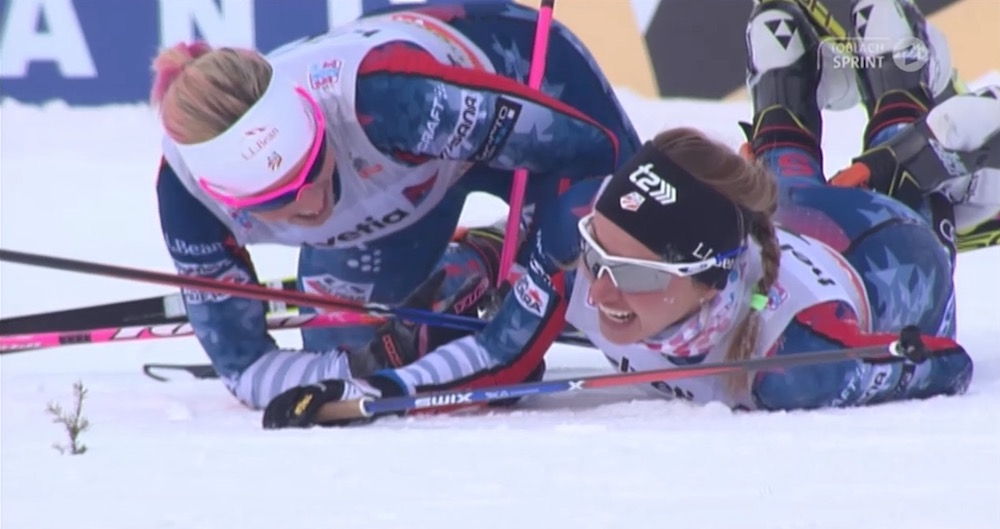
    U.S. teammates Kikkan Randall (l) and Sophie Caldwell (r) after colliding in the first women's semifinal on Saturday at the World Cup skate sprint in Toblach, Italy.
    U.S. teammates Kikkan Randall (l) and Sophie Caldwell (r) after colliding in the first women’s semifinal on Saturday at the World Cup skate sprint in Toblach, Italy. (Photo: ARD broadcast screenshot)

    In what appeared to be a slow-motion tangle, both Randall and Caldwell appeared to smile at each other as they realized their misfortune. Caldwell particularly had trouble freeing her ski. The two finished fifth and sixth in that heat (Randall 22 seconds back in fifth, and Caldwell a minute back from Falla as the winner of that semifinal in sixth).

    “[Kikkan] asked if I was okay and apologized,” Caldwell recalled. “It’s a bummer, but it’s unfortunately part of ski racing and there are no hard feelings.”

    “We’ve had problems with that same thing before,” Grover noted. “Everyone from behind runs up on everyone who’s in front, and then, depending on if you’re pinched on the inside, or if you can make some space on the outside, you can end up making it through or you can end up in some trouble. It’s a pinch point, a tough point on the course, for sure.”

    He added that Randall “took full accountability” for the crash, and there were no hard feelings.

    “She felt quite bad about it, and Sophie bears no grudge about it because she knows that’s the kind of thing that happens in sprint racing all the time,” he said. “Those guys are good and they are going to be sprint teammates tomorrow, so we’ll start looking forward to the next day.”

    Grover said his staff had to make the tough call of picking two women out of three for Sunday’s team sprint.

    Sargent raced to sixth in the second semifinal on Saturday, just 0.86 seconds out of first. She had moved up to third on the final climb, trailing Norway’s Astrid Uhrenholdt Jacobsen and Germany’s Ringwald, respectively, and held her position on the final curve into the finishing straight. There, both Jacobsen and Sargent were overtaken by Slovenia’s Fabjan (who came on strong for second place) and Switzerland’s Laurien van der Graaff (third), following Ringwald in first.

    Kikkan Randall (U.S. Ski Team) racing to a season-best 10th on Saturday in the World Cup freestyle sprint in Toblach, Italy. (Photo: Fischer/NordicFocus)
    Kikkan Randall (U.S. Ski Team) racing to a season-best 10th on Saturday in the World Cup freestyle sprint in Toblach, Italy. (Photo: Fischer/NordicFocus)

    At the end of the day, U.S. women occupied 10th through 12th place, with Randall in 10th, Caldwell in 11th and Sargent in 12th.

    “I tried to stay relaxed in the heats, but I felt really good so I just tried to ski near the front of the pack,” Sargent wrote in an email. “The course is really frustrating though with a long downhill with a draft that brings everyone back together but I just tried to stay out of trouble. I thought that I was in a great position in the semifinal going into the finish but then I hit something and I’m not really sure what it was, but it stopped my ski dead and I almost fell. After that bobble it was hard to get going again and so I was really bummed to lose all the places and not advance.”

    For Sargent, 12th was her best result in over a year.

    “I felt really strong today so I’m happy with my fitness at this point in the season,” she wrote. “We had a small staff this weekend but they did an amazing job and I’m very thankful for such awesome skis!”

    In terms of how the U.S. coaches made the call for between those three for Sunday’s team sprint, Grover said it wasn’t easy.

    “… As luck would have it, we had three athletes finish 10, 11, 12 on the day today, which did not make it any easier,” he said. “You actually had three athletes who are fairly evenly matched in a lot of respects right now, in terms of how they’re skiing. In the end, we decided that we really wanted to have Kikkan’s experience, in team sprint in particular and in closing out a team sprint, and in the second leg, we wanted Sophie to be able to rely on her aerobic conditioning at the moment …  It was a very hard decision for us … I really wish we had a fourth woman here, so we could start two teams.”

    Matveeva Gets First Win in Nearly a Decade

    While the three U.S. women missed Saturday’s final, Russia’s Matveeva — who hadn’t won a World Cup race since 2007 — went on to outlast Falla for her 12th-career individual podium. Eight years ago, Matveeva tested positive for EPO was was suspended from competing from December 2009 to March 2011. After that, she reportedly had two ACL tears. Now 30, Matveeva captured her second-career sprint win on Saturday by eight-hundredths of a second over Falla.

    Russia's Natalia Matveeva (l) winning Saturday's freestyle sprint final, by 0.08 seconds over Norway's Maiken Caspersen Falla (r), for her first World Cup win since October (!) 2007. (Photo: Fischer/Nordic Focus)
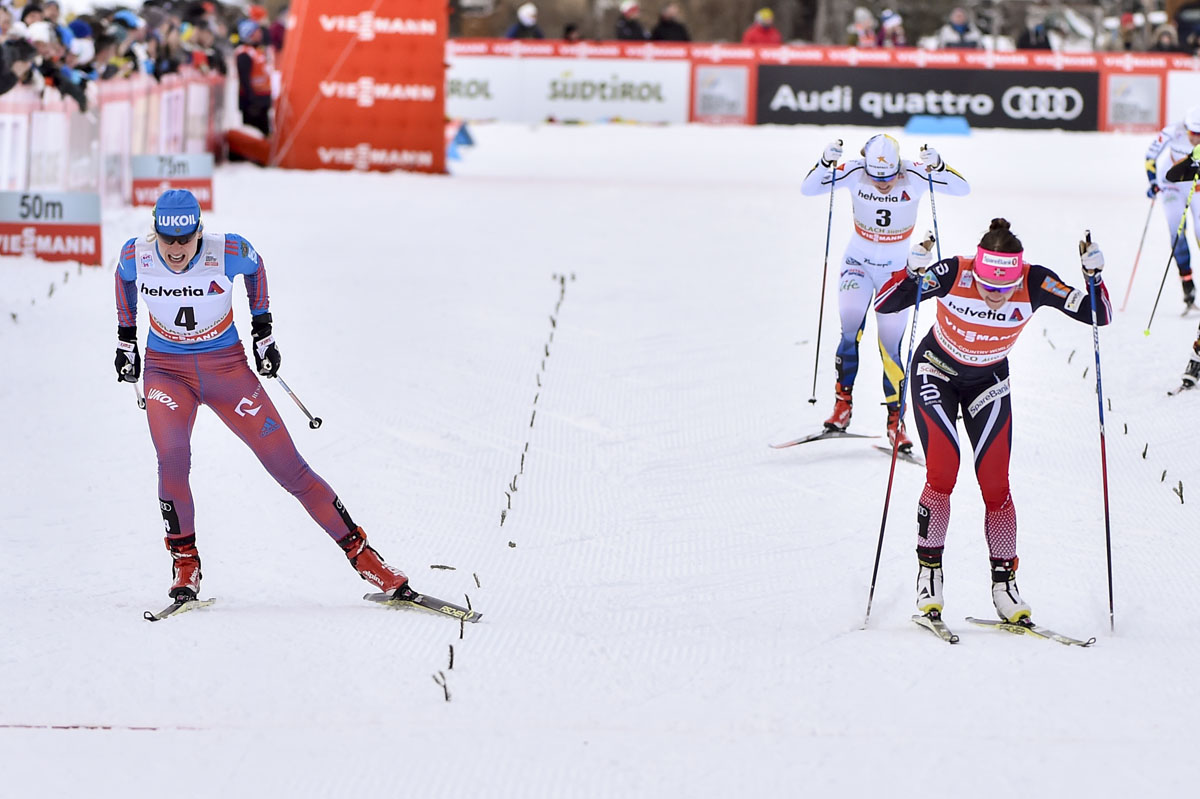
    Russia’s Natalia Matveeva (l) winning Saturday’s freestyle sprint final, by 0.08 seconds over Norway’s Maiken Caspersen Falla (r), for her first World Cup win since October (!) 2007. Sweden’s Hanna Falk (3) placed third. (Photo: Fischer/NordicFocus)

    “I’ve waited a lot of time to be [here],” Matveeva told FIS in a post-race interview. “I’m very happy and the Russian team is very happy. Thank you very much my service team. Good job today.”

    Matveeva charged to an early lead in the final, while Falla challenged her on the first of two climbs on the second lap. Matveeva followed her closely leading into the last climb, where Falla beat her to the top with a quicker-tempo V1. As the two descended into the stadium with a slight gap to Falk in third place, Matveeva drafted Falla then rode up alongside her, taking the outside line around the turn. The two sprinted toward the line, with Matveeva getting one extra push in for first place in 3:04.13.

    “I don’t feel particularly well so second place is all right, but of course it’s frustrating to be beaten in the final stretch,” Falla told NRK. “I knew she would be fast in the final stretch. I’m a little lighter than everyone else, and that’s not an advantage.”

    At the same time, Falla wasn’t bitter.

    “It’s good that more people are fighting for the top spots before the World Championships; it’s more exciting then,” she said. “We have to see the positive in it all.”

    Falk took the final spot on the podium in third (+2.41), and Ringwald was one second shy of it in fourth (+3.46). Ingemarsdotter finished fifth (+5.88) and Fabjan was sixth (+19.39).

    In Sunday’s 6 x 1.3 k freestyle team sprint, Caldwell and Randall are teaming up in the first women’s semifinal, while their men’s team of Newell and Hamilton will be in the second men’s semifinal. Also in that second men’s semifinal are Canada’s Valjas and Harvey.

    Results: Men | Women

  • Johaug Tallies 25th World Cup Win in Toblach; Bjornsen 19th, Diggins 20th

    Johaug Tallies 25th World Cup Win in Toblach; Bjornsen 19th, Diggins 20th

    Norway's Therese Johaug racing to a 28.2-second win in the Toblach World Cup 10 k classic on Sunday in Italy. (Photo: Fischer/NordicFocus)
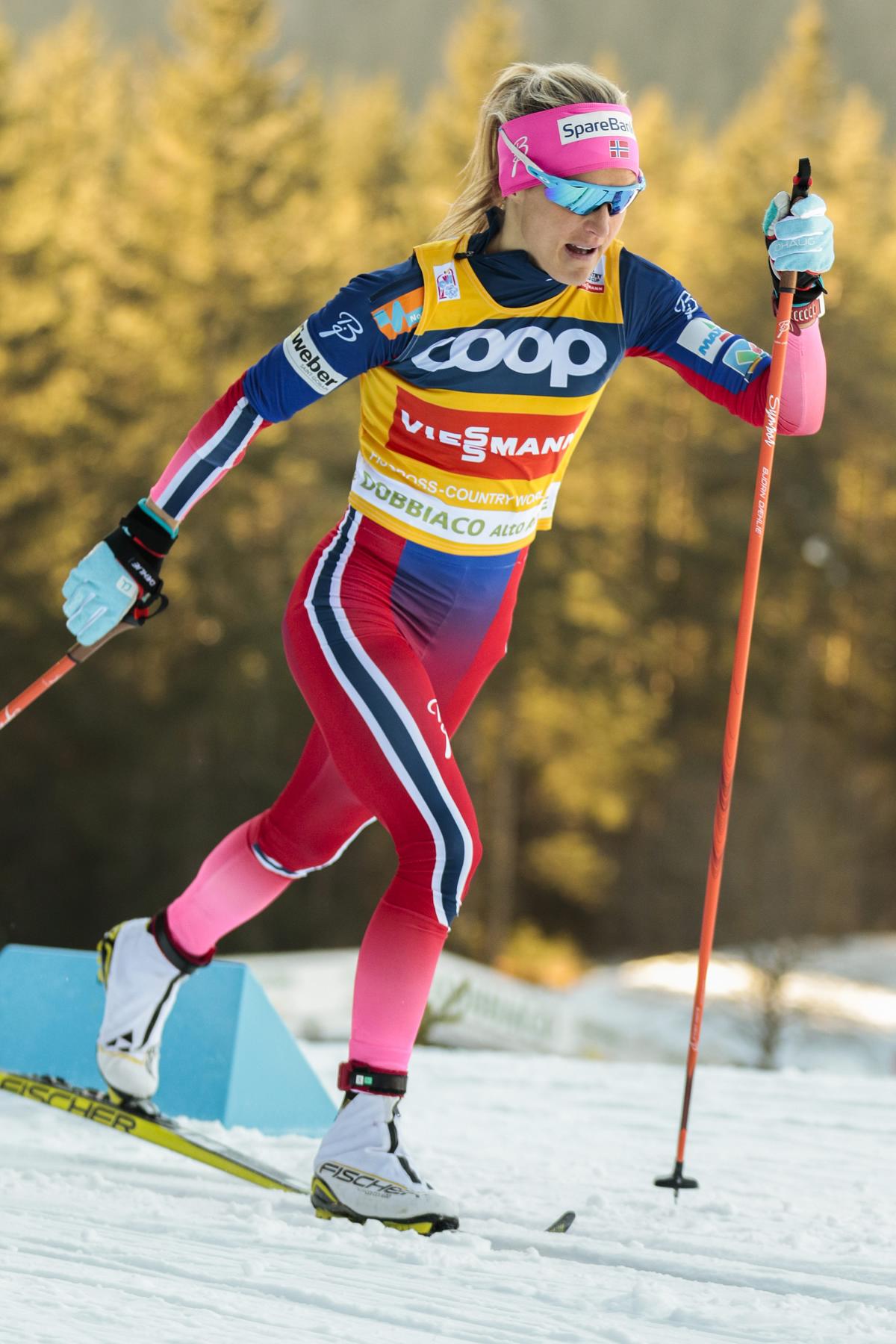
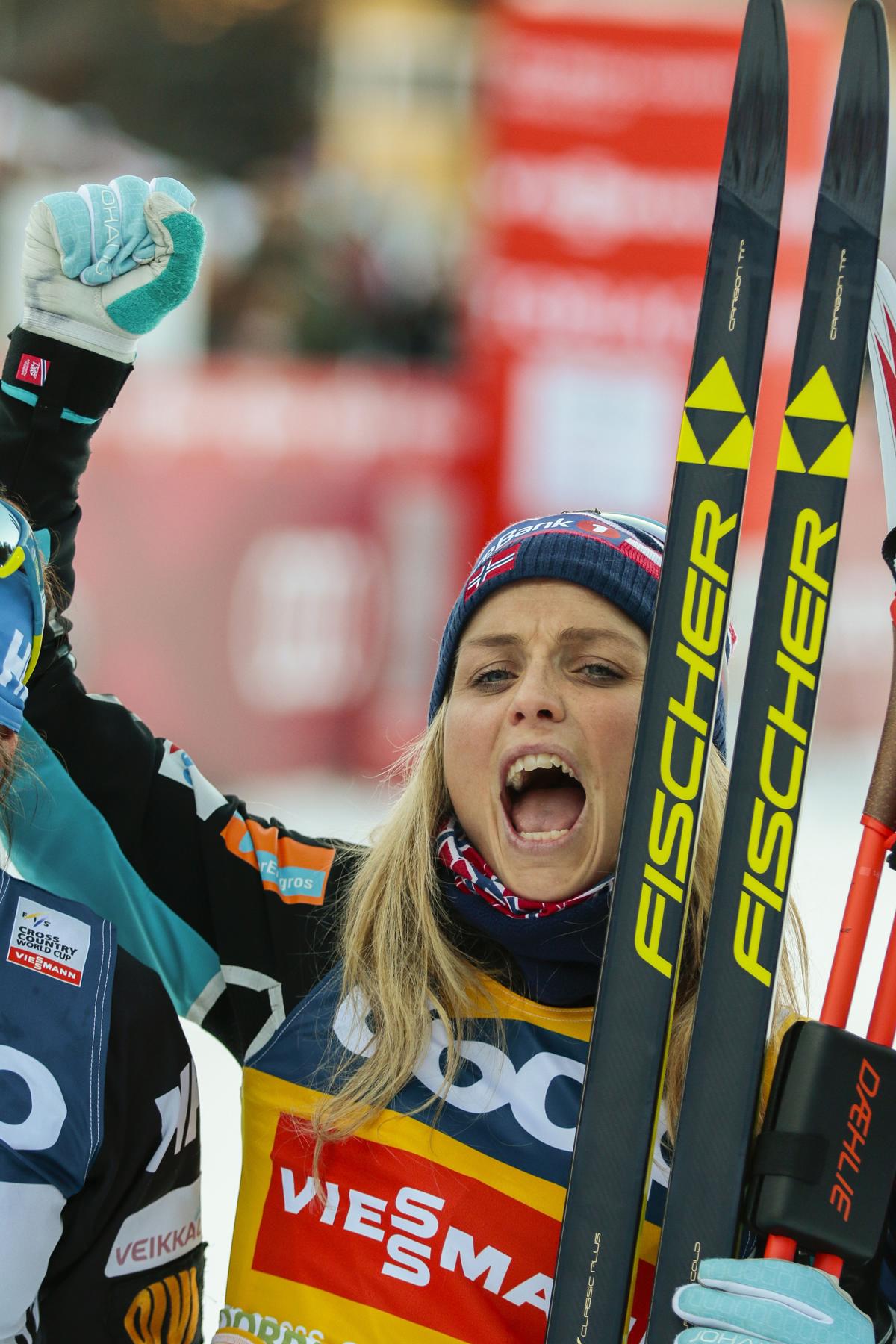
    Norway’s Therese Johaug racing to a 28.2-second win in the Toblach World Cup 10 k classic on Sunday in Italy. (Photo: Fischer/NordicFocus)

    Taking her fifth-consecutive World Cup distance victory in Sunday’s 10-kilometer classic individual start classic race in Toblach, Italy, Norway’s 27-year-old Therese Johaug continued to dominate the women’s distance races this season.

    No woman has been able to top Johaug’s incredible fitness this season as her smallest margin of victory was 17 seconds over only 5 kilometers in the opening races in Kuusamo, Finland.

    “I don’t think I have ever been in such good shape in my life,” Johaug told FIS after winning Sunday’s race in 27:22.4 minutes.

    The 34th starter, Johaug established her lead at the first checkpoint at 1.7 k (where she was 0.2 seconds ahead of teammate Heidi Weng) and extended throughout the two-lap race. By 2 k, she was 4.7 seconds ahead of Weng, and by the halfway point, she was 17 seconds ahead of another teammate Ingvild Flugstad Østberg, who moved into second.

    The women's 10 k classic podium at the World Cup in Toblach, Italy: with Norwegian winner Therese Johaug (c), Finland's Krista Parmakoski (l) in second, and Norway's Ingvild Flugstad Østberg (r) in third. (Photo: Fischer/NordicFocus)
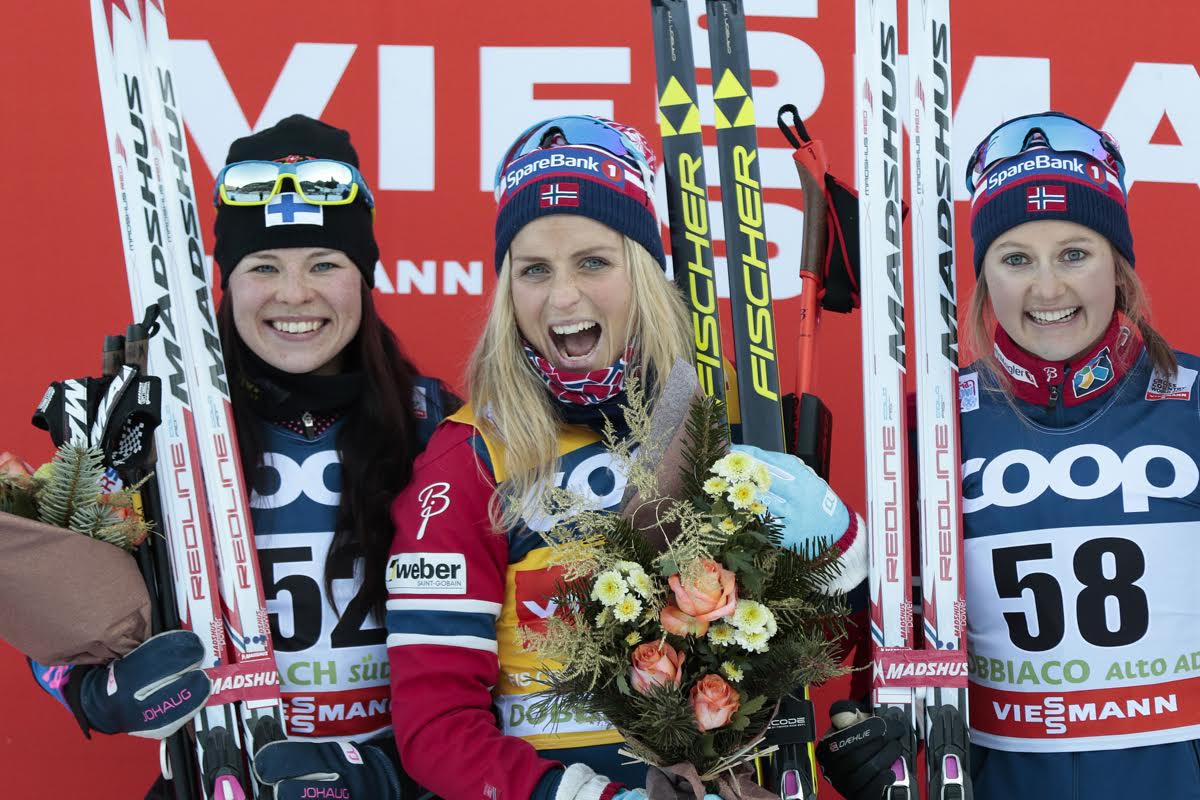
    The women’s 10 k classic podium at the World Cup in Toblach, Italy: with Norwegian winner Therese Johaug (c), Finland’s Krista Parmakoski (l) in second, and Norway’s Ingvild Flugstad Østberg (r) in third. (Photo: Fischer/NordicFocus)

    Johaug went on to win by 28.2 seconds over Finland’s runner-up Krista Parmakoski, who started 52nd. Norway had two on the podium with Østberg in third, 40.1 seconds behind Johaug.

    The win marks Johaug’s 25th-career World Cup distance victory, which ties her for fourth on the all-time list with Norway’s Bente Skari. Ahead of her, Johaug’s teammate Marit Bjørgen has 53 wins, Russia’s Elena Välbe won 44 and Poland’s Justyna Kowalczyk won 34, according to FIS.

    Parmakoski, 25, had long awaited her result on Sunday since she last reached the World Cup podium in the Tour de Ski 10 k classic in 2013.

    “I have been waiting for this moment since the beginning of the season,” Parmakoski told FIS. “I knew my energy and shape was there, but until today I did not show it in my results.”

    Norway's Therese Johaug celebrates her 25th World Cup victory on Sunday at the 10 k classic in Toblach, Italy. (Photo: Fischer/NordicFocus)
    Norway’s Therese Johaug celebrates her 25th World Cup victory on Sunday at the 10 k classic in Toblach, Italy. (Photo: Fischer/NordicFocus)

    Weng posted the third-fastest times throughout most of the race, but Parmakoski skied a strong final 3 k to hold off both Weng, who started 54th, and Østberg, in bib 58, behind her.

    Best known for sprinting, Østberg has been making her mark on the distance races as well this season and currently sits in second in the overall World Cup standings, 112 points behind Johaug. Sunday’s race marked her fifth-individual podium this season, including second place in the Davos 15 k freestyle.

    “The season has been so great for me. I nearly cannot believe it,” Østberg told FIS.

    Five seconds back from Østberg, Weng placed fourth (+45.2) and Sweden’s Charlotte Kalla was another 5 seconds back in fifth (+50.2). Finland put four in the top nine with Anne Kyllönen in sixth, Laura Mononen in seventh and Kerttu Niskanen in ninth (after Kowalczyk in eighth). Sweden’s Anna Haag placed 10th.

    Two U.S. Women in Top 20

    The U.S. women’s team had two in the top 20 as Sadie Bjornsen continued her streak of top-20 finishes in every race she’s started so far this season, finishing 19th (+2:04.6), and Jessie Diggins placed 20th (+2:09) for her best classic distance race of 2015/2016.

    The American contingent also included Liz Stephen in 34th (+2:39.6), Rosie Brennan in 38th (+3:06.2), Sophie Caldwell in 41st (+3:13.2), and Caitlin Gregg in 43rd (+3.20.1).

    Sophie Caldwell (U.S. Ski Team) racing to 41st in the World Cup 10 k classic in Toblach, Italy. (Photo: Fischer/NordicFocus)
    Sophie Caldwell (U.S. Ski Team) racing to 41st in the World Cup 10 k classic in Toblach, Italy. (Photo: Fischer/NordicFocus)

    In seven individual World Cup races in the last two months, Bjornsen has consistently placed in the top 20, in both distance and sprint events. Even so, her result on Sunday left her wanting a bit more.

    “Today was an incredibly challenging day due to conditions and the track,” she wrote in an email. “I gave it 110%, but unfortunately the result didn’t show what I believe It was capable of today. I went out there trying to win, but the ducks didn’t all align today. It’s ok — one day they will, and I’ll fight for a classic podium!”

    The 20th starter, Bjornsen skied a consistent race, posting times at each of the four checkpoints that ranked between 18th and 23rd in the field of 60 racers. Meanwhile, Diggins in bib 29 rallied late in her race to move from 27th to 20th overall in the last three kilometers.

    The challenges of the Toblach’s 5 k course, with gradual climbing toward the middle of each lap, were compounded by somewhat-tricky waxing conditions on Sunday. Temperatures were forecast to be around 4 degrees Celsius (39 Fahrenheit), but ended up around freezing (0 Celsius) and the snow on the course was entirely artificial. The course included two 5 k laps and more than 600 meters (1,970 feet) of climbing over 10 k.

    While some of the competitors in the men’s 15 k, including winner Martin Johnsrud Sundby, chose to forgo kick wax and double pole on skate skis, the women’s field worked to strike the delicate balance of kick and glide.

    “It was warm and artificial snow, but the course held up very well,” Brennan wrote in an email. “This course is tricky because you really need fast skis, but if you are going to go with kick, you want to be able to actually kick so some combination of the right skis and right wax can make a big difference.”

    U.S. Ski Team Head Coach Chris Grover suggested the conditions were “not that tricky” and his athletes’ skis were sufficient.

    “Our wax techs did a great job and we had good skis,” he wrote in an email. “The course was in good shape. Cold snow that set-up firm overnight.”

    Diggins described Toblach as a tough course because it features a lot of gradual climbing, “(which I love because it feels like real classic skiing out there — long kicking and gliding) but also not a lot of rest!” she wrote in an email. “The corners and downhill sections are ones that demand to be worked well, and you can make up a lot of time on them by staying focused and working every inch.”

    Stephen echoed the unique challenges of the Toblach course.

    “Every hill is kind of the same grade, both up and down and it makes it a challenging one for me to keep the glide and powerful pushes that are needed,” she wrote.

    For a team steeped in skating depth, improving classic distance results are encouraging.

    “I’ve been working so hard for years to improve my classic skiing, so it feels really good to finally have that hard work come across in World Cup races!” Diggins wrote. “I was happy with my race today, for sure.”

    Grover called it “a solid day for the USA but not a standout one.” Asked specifically about Bjornsen and Diggins, he observed, “Both looked good but we know they can ski faster. They both were left wanting more and I think we’ll see a step forward during the Tour [de Ski].”

    The first period of the World Cup concluded in Toblach and racers now have a week and a half off before racing resumes with the Tour de Ski on Jan. 1.

    The break allows World Cup racers some rest and recovery as well as time for some training, and for those who live in Europe — a trip home for the holidays. It’s also a time to take inventory and gear up for strong racing in Period 2.

    Emily Nishikawa (Canadian Development Team) racing to 39th in the Davos World Cup 15 k freestyle on Dec. 12 in Switzerland. She tied her season-best 39th in the Toblach World Cup 10 k classic on Dec. 20. (Photo: JoJo Baldus)
    Emily Nishikawa (Canadian Senior Development Team) racing to 39th in the Davos World Cup 15 k freestyle on Dec. 12 in Switzerland. She tied her season-best 39th in the Toblach World Cup 10 k classic on Dec. 20. (Photo: JoJo Baldus)

    “I am happy with my consistency because I think that shows I have good base fitness, but I am certainly looking to pick up a little speed and some more positive feelings during the Christmas break,” Brennan wrote.

    “I felt like after racing every single race in period 1, plus the pre-season Gallivare races, my body is a little tired and I’m really looking forward to a nice relaxing week of training in Davos [Switzerland] with my teammates,” Diggins explained.

    The lone Canadian in the women’s race, Emily Nishikawa tied Germany’s Lucia Anger for 39th (+3:10.1), which also tied her best result of the season.

    “This was a good result for Emily,” Canadian National Team Head Coach Justin Wadsworth said in a Cross Country Canada press release. “She is in better shape now than she has been in years past. We are hoping for Emily to get into that top-30 so we need to keep working and progressing towards that goal.”

    Nishikawa could not be immediately reached for comment.

    Results

  • Norway’s Falla and Østberg Go 1-2; Caldwell 7th, Bjornsen 9th for U.S.

    Norway’s Falla and Østberg Go 1-2; Caldwell 7th, Bjornsen 9th for U.S.

    Maiken Caspersen Falla (front left) edges Norwegian teammate and sprint rival Ingvild Flugstad Østberg in the women's World Cup freestyle-sprint final on Saturday in Toblach, Italy. Falla won by 0.17 seconds, Østberg was second, and Sweden's Stina Nilsson (not shown) placed third and her teammate Linn Soemskar (also not shown) placed fourth. Two Germans Hanna Kolb and Denise Herrmann (at left) placed fifth and sixth. (Photo: Fischer/NordicFocus)
    Maiken Caspersen Falla (front left) edges Norwegian teammate and sprint rival Ingvild Flugstad Østberg in the women’s World Cup freestyle-sprint final on Saturday in Toblach, Italy. Falla won by 0.17 seconds, Østberg was second, and Sweden’s Stina Nilsson (not shown) placed third and another Swede Linn Soemskar (also not shown) placed fourth. Two Germans Hanna Kolb and Denise Herrmann (at left) placed fifth and sixth, respectively. (Photo: Fischer/NordicFocus)

    Two Germans. Two Norwegians. Two Swedes. These national pairs composed the women’s World Cup 1.3-kilometer freestyle sprint final on Saturday in Toblach, Italy.

    It was Norway who took the lead from the start, with 25-year-old Ingvild Flugstad Østberg pulling her teammate Maiken Caspersen Falla, along with the Swedish duo Stina Nilsson and Linn Soemskar.

    Østberg remained in front for the first downhill of the 600-meter lap course, followed closely by Falla and Nilsson.

    Coming off last weekend’s skate-sprint victory in Davos, Switzerland, 22-year-old Nilsson stuck with the two Norwegians until the final climb of the two-lap course. Last Sunday in Davos, Nilsson shared the podium with the two Norwegians, with Falla in second and Østberg in third.

    Norway's Maiken Caspersen Falla (2) leads her quarterfinal with (from left to right) Switzerland's Nadine Faehndrich, Laurien van der Graaf, Italy's Greta Laurent, Russia's Natalia Matveeva, and American Sophie Caldwell (10) on Saturday in the women's World Cup freestyle sprint in Toblach, Italy. (Photo: Fischer/NordicFocus)
    Norway’s Maiken Caspersen Falla (2) leads her quarterfinal with (from left to right) Switzerland’s Nadine Faehndrich, Laurien van der Graaf, Italy’s Greta Laurent, Russia’s Natalia Matveeva, and American Sophie Caldwell (10) on Saturday in the women’s World Cup freestyle sprint in Toblach, Italy. (Photo: Fischer/NordicFocus)

    With one last uphill to go, Falla, 25, took the lead from her teammate while Nilsson moved from third to second.

    As the trio descended the final downhill into the stadium, Falla maintained her position in front, while the battle for second ensued between Østberg and Nilsson.

    Rounding the final turn into the 50-meter straightaway, Nilsson attempted to go wide on the the outside corner to get around Østberg and Falla. The Swede’s tactical maneuver, however, didn’t match Østberg’s raw speed.

    The Norwegians went 1-2, with Falla winning the final in 2:47.28 minutes, just 0.17 seconds ahead of Østberg in second. Nilsson crossed the line in third, 0.61 seconds after Falla.

    “It’s great to be on top again,” Falla told FIS after her second sprint victory of the season. She also won the classic sprint opener late last month in Kuusamo, Finland. “It was a … battle last week and again this week. I think it will be a great battle all season.”

    Østberg said she had to be happy with second.

    “I had really bad last 100 meters in Davos. I was focused on having a good finish here,” she told FIS. “If it was 20 meters longer I think I could have fought with Maiken for victory. I have been fourth [in the Kuusamo classic sprint], third [in Davos] and second. I am going to be dangerous next time.”

    The top-three women in Saturday's World Cup freestyle sprint in Toblach, Italy, with Norway's Maiken Caspersen Falla (c) in first place, Ingvild Flugstad Østberg (r) in second, and Sweden's Stina Nilsson (l) in third. (Photo: Fischer/NordicFocus)
    The top-three women in Saturday’s World Cup freestyle sprint in Toblach, Italy, with Norway’s Maiken Caspersen Falla (c) in first place, Ingvild Flugstad Østberg (r) in second, and Sweden’s Stina Nilsson (l) in third. (Photo: Fischer/NordicFocus)

    Rounding out the top six in the final was Soemskar in fourth (+1.31), Germany’s Hanna Kolb in fifth (+1.59) and Denise Herrmann, also of Germany, in sixth (+2.31).

    During a post-race interview with German broadcaster ZDF, Kolb commented on reaching the final. The 24-year-old German had done so twice before in the skate sprints at the 2013 and 2014 editions of the Tour de Ski, where she placed fourth and fifth, respectively.

    “I am a little relieved that I was able to do it [reach the final] because it was a crazy amount of training throughout the summer,” Kolb said. “And in sprints, often small details are decisive. That it finally worked today makes up for all the effort.”

    For Herrmann, it was her first appearance in a sprint final this season for her best result so far this winter.

    “I am just happy that it worked out again to reach the final, because the start of the season was not good for me,” she told ZDF. “Step by step, I will try to tie it up to [past] results.”

    Two U.S. Women in Top 10

    Sophie Caldwell (U.S. Ski Team) racing to 10th in the qualifier at the women's World Cup freestyle sprint in Toblach, Italy. She went on to place seventh overall after making it to the semifinals. (Photo: Fischer/NordicFocus)
    Sophie Caldwell (U.S. Ski Team) racing to 10th in the qualifier at the women’s World Cup freestyle sprint in Toblach, Italy. She went on to place seventh overall after making it to the semifinals. (Photo: Fischer/NordicFocus)

    Although there wasn’t an American pair in the final, two U.S. women ended up in the top 10.

    Sophie Caldwell, 25, of the U.S. Ski Team took seventh overall, after qualifying in 10th, 3.23 seconds behind Østberg, the fastest qualifier in 2:49.45.

    Caldwell went on to place second in her quarterfinal, 0.13 seconds behind Falla, before missing advancing beyond the semifinals by eight-hundredths of a second. She finished fourth in her semifinal behind Falla, Nilsson and Kolb, respectively, with Kolb finishing third and advancing as a lucky loser, 0.45 seconds behind Falla.

    Their semifinal, with Falla setting the pace and finishing in 2:46.31, turned out to be the fastest women’s heat of the day. This was perhaps expected with players like Falla and Nilsson in the same semifinal.  

    “My semi final was really close and I knew there were a lot of fast skiers in it, so I had to make every second count in order to fight for a top two place or a lucky loser place,” Caldwell wrote in an email.

    She tucked into fifth on the inside of the second large climb, alongside Kolb, Norway’s Heidi Weng, and Laurien van der Graaff of Switzerland. Nilsson attempted to split from the group on the second-to-last downhill, only to be reeled back in by Falla in second Caldwell, who had moved up to third. Meanwhile, Kolb closed in behind them. 

    The turn into the finishing stretch became a tossup, as Nilsson cut into the center lane, Caldwell went to the inside left and Kolb accelerated to the right of Caldwell. 

    “I moved into a great position coming into the last downhill, but things got a little jammed up coming into the last corner and I moved back to fourth,” Caldwell explained.

    Caldwell and Kolb lunged at the line, but the German snatched third, and ultimately the lucky loser ticket to the final. Last week in Davos, Caldwell advanced as a two-time lucky loser to the sprint final, where she placed sixth.

    “I was psyched with every aspect of today,” Caldwell wrote on Saturday. “Mentally I feel like I’m skiing with more confidence and my goal is to ski like I belong in front of each heat and not to just hope that I move on.” 

    Not far behind, Sadie Bjornsen recored her first top 10 of the season in ninth (after five consecutive top-20’s in as many individual World Cup races this season). She qualified sixth (+1.48), placed second in her quarterfinal, 0.28 seconds behind Østberg, and went on to finish fifth in the second semifinal — 0.46 seconds behind Østberg, who won that heat as well. 

    Like her teammate Caldwell, Bjornsen was also mere fractions away from making the final.

    “Skate sprinting has always been a gamble for me in the past. 50% of the time I make the heats, 50% of the time I don’t qualify,” Bjornsen wrote in an email after the race.

    On Saturday, the odds seemed to be in her favor.

    “It started with my best qualifier ever, and advanced into some fun heats and skiing. I felt really good out there, and just missed the finals by a touchable hair,” she wrote. “But each week I am feeling more confident and excited about sprint racing.” 

    Sadie Bjornsen (U.S. Ski Team) racing to her best-ever sprint qualifier in sixth at the World Cup freestyle sprint in Toblach, Italy. She went on to make the semifinals and place 10th overall. (Photo: Fischer/NordicFocus)
    Sadie Bjornsen (U.S. Ski Team) racing to her best-ever sprint qualifier in sixth at the World Cup freestyle sprint in Toblach, Italy. She went on to make the semifinals and place 10th overall. (Photo: Fischer/NordicFocus)

    In her quarterfinal, Bjornsen, 26, chased down two Norwegians, Østberg and Kathrine Rolsted Harsem. The three battled it out into the finishing straight, where Bjornsen chose the outside line in an effort to move into the top two.

    Østberg outskated the two for the quarterfinal win in 2:47.34, while Bjornsen outlunged Harsem by two-hundredths of a second to move on.

    In her semifinal, Bjornsen faced off against Østberg, Soemskar, Herrmann, Russia’s Natalia Matveeva, and Finland’s Krista Parmakoski. Østberg flew out of the start to take the lead, while Bjornsen hung in fourth as they approached the first climb.

    Descending back into the stadium during the final downhill, Bjornsen leapt into third, behind Østberg in first and Herrmann in second. With 50 meters to go, Soemskar snuck into the mix, along with Matveeva.

    In a lunge for the line, Soemskar placed second, 0.22 seconds behind Østberg, and Herrmanb took third another 0.02 seconds back. That close finish gave Herrmann the final lucky loser spot in the final, while Matveeva placed fourth (+0.44) and Bjornsen was fifth (+0.46) behind them.

    “It might’ve been Sadie Bjornsen’s best skate-sprint race of all time on the World Cup,” U.S. Ski Team Head Coach Chris Grover said on the phone after the race.

    In addition to Caldwell and Bjornsen, U.S. teammates Jessie Diggins and Ida Sargent also qualified for the heats and went on place 22nd and 28th overall, respectively, after finishing fifth and sixth in the same quarterfinal — the first one of the day.

    “Great to have six athletes qualify for the heats again, but not really a big surprise,” Grover said in a USSA press release, referring to the four women and two men (Simi Hamilton and Andy Newell) who qualified on Saturday. “The women skied great. Sophie must have been mere hundredths from going through to the finals again as a lucky loser. She executed her race plan perfectly all day.”

    In an email, Sargent called her qualifier “decent … although I felt a little flat and had trouble getting going,” the 27 year old wrote after qualifying in 24th (+5.71). Diggins qualified in ninth (+2.98).

    “Seeing Simi ski so well and end up on the podium was incredible,” Sargent added, referring to Hamilton’s second-place finish for the U.S. men. “Even if it was a tough day for me personally it was an awesome day for the team, so I’m leaving the day feeling excited and inspired.”

    “We’re really gaining momentum and it’s a big lift for the whole team!” Diggins wrote in an email.

    “A big thing for me on a really short and tactical course such as Toblach is to learn to hold my ground and not get pushed around out there,” the 24 year old added. “Rounding the finishing corner, someone actually reached out a hand and shoved me, and in years past, I probably would have fallen down. But I didn’t let it get to me or impact my race, which I’m really pumped about!”

    The fifth U.S. woman, Rosie Brennan, 27, narrowly missed qualifying in 35th. She was 1.91 seconds out of the top 30. 

    “We had great skis today and I felt better than last weekend so now it’s just moving on to tomorrow, which I am very much looking forward to,” Brennan wrote. 

    On Sunday, the women will race a 10 k classic individual start — the final race before the holiday World Cup break. 

    Results

  • Hamilton Skis Fast and Smart for Second in Toblach Sprint

    Hamilton Skis Fast and Smart for Second in Toblach Sprint

    Simi Hamilton (U.S. Ski Team) high-fives spectators during his post-race "victory" lap back down the finishing straight. He placed second on Saturday in the World Cup freestyle sprint in Toblach, Italy. (Photo: Fischer/NordicFocus)
    Simi Hamilton (U.S. Ski Team) high-fives spectators during his post-race “victory” lap back down the finishing straight. He placed second on Saturday in the World Cup freestyle sprint in Toblach, Italy. (Photo: Fischer/NordicFocus)

    There’s been a building feeling. A notion that the U.S. men’s sprint team just needed a little bit of luck — like no broken poles, fast skis, good health, and a course suiting their mega-horsepower skiers. The men’s World Cup freestyle sprint on Saturday in Toblach, Italy, offered all that up.

    Simi Hamilton’s skiing during the sprint rounds could be described as the following: he skied fast and he skied smart. In the end, only one skier proved faster.

    Italy’s Federico Pellegrino won the 1.3-kilometer skate sprint on Italian soil in 2:29.57. Pellegrino, a not-so-uncommon sight on freestyle sprint podiums, won last weekend’s sprint in Davos. A U.S. Ski Team sprinter, Hamilton placed second (+0.48) while Andrew Young skied to a historic third for Great Britain (+0.84).

    It doesn’t take a sprint-results savant to note that Norway was nudged off the podium. Swiss skier Jovian Hediger placed fourth (+1.09), while Norway’s Finn Hågen Krogh captured fifth (+1.44) and teammate Sondre Turvoll Fossli ended up sixth (+11.98).

    To his standards, Pellegrino began the day modestly, racing to seventh in the qualifier, 1.89 seconds behind Krogh, the fastest in qualifying in 2:28.76. From there, the overall Sprint World Cup leader played cat-and-mouse tactics to win his quarterfinal and semifinal en route to his victory in the final.

    Hamilton’s First Non-Stage Podium

    Prior to Saturday’s second place, Hamilton’s only other World Cup podium came in December 2013, when he won a Tour de Ski freestyle sprint in Lenzerheide, Switzerland. The U.S. men had reached the podium in a World Cup sprint five times before: once with Hamilton, three times with teammate Andy Newell and once with Torin Koos, according to a USSA press release.

    Last weekend in Davos, Switzerland, after qualifying 10th, Hamilton felt primed for another shot, but a broken pole in his quarterfinal snuffed out a potential top-10 result. Hamilton finished within the points in 23rd overall

    “I think after the last weekend I was feeling really good in Davos. My energy was great, I’ve been healthy and then I kind of had that pole mishap in the quarter in Davos,” Hamilton said in a post-race phone interview. “So that was pretty frustrating for me last weekend. I knew that I wanted to put something together for this weekend.”

    Simi Hamilton (U.S. Ski Team) racing to his first non-stage World Cup podium on Saturday in Toblach, Italy, where he placed second in the freestyle sprint. (Photo: Fischer/NordicFocus)
    Simi Hamilton (U.S. Ski Team) racing to his first non-stage World Cup podium on Saturday in Toblach, Italy, where he placed second in the freestyle sprint. (Photo: Fischer/NordicFocus)

    “You know skate skiing is one of my strengths, my best thing, and we had one on the schedule and it got me fired up,” he added.

    Hailing from the thin air of Aspen, Colo., Hamilton is no stranger to a lack of oxygen. So Toblach’s altitude, some 4,500 feet above sea level, wasn’t a deterrent. And the course, featuring several technical corners, and a climb with a long glide out into the finish played to Hamilton’s smarts, patience and peak form.

    “I’m pretty psyched for sure about the day, a lot of things just came together for me. Not too much to complain about,” he said.

    In Toblach’s loaded field, a relaxed-and-efficient Hamilton qualified 16th, 3.14 seconds behind Krogh. He then selected the first quarterfinal, which featured heavyweights Petter Northug Jr. and Erik Brandsdal.

    In that initial heat, Hamilton tested his slow-burn strategy of waiting until the final hill and long glide out to play his cards.

    “The real defining characteristic is the downhill; it’s so long and straight that there are always these massive slingshots that happen,” U.S. Ski Team Head Coach Chris Grover explained on the phone. “It can be a disadvantage to be in the lead because people in second or third are always popping out and slingshotting.

    “So one of the key factors with this course is that having a fast start is not critical at all,” he added. “And you typically see people that relax in the beginning, hover back in fourth, fifth, sixth place during the first lap, then they use a slingshot coming off the building or coming off the downhill to move up in their placing. So people that often try to hammer off the front early, they end up getting burned at the end.”

    Hamilton did the burning. He waited and waited, skiing mostly in the rear of the pack, exploiting his masterful glide. Going head-to-head with Northug on the final climb, Hamilton descended in first and took the arcing left turn into the final straightaway tight on the inside.

    The men's freestyle sprint podium on Saturday at the World Cup in Toblach, Italy: with Italian winner Federico Pellegrino (c), American Simi Hamilton (r) celebrating in second, and Great Britain's Andrew Young (l) in third. This marked the first time these three nations shared a World Cup podium. (Photo: Fischer/NordicFocus)
    The men’s freestyle sprint podium on Saturday at the World Cup in Toblach, Italy: with Italian winner Federico Pellegrino (c), American Simi Hamilton (r) celebrating in second, and Great Britain’s Andrew Young (l) in third. This marked the first time these three nations shared a World Cup podium. (Photo: Fischer/NordicFocus)

    “I felt like every time, coming down the really long, straight downhill towards the finish and a little short set one coming off the building hill, I just I was drifting up on people,” Hamilton said of his skis.

    At the finish, with Northug barely ahead, Brandsdal and Hamilton toed the line in a photo finish, 0.16 seconds behind Northug, with Hamilton eventually declared the second-place finisher. As one of the slower quarterfinals, Hamilton eked into the semifinals.

    The semis were a tactical repeat for Hamilton.

    “He waited until he had an opening and he had momentum coming off one of the hills each time, and he just moved up and moved up,” Grover said. “So he tried to hammer over the top of the last uphill and gain a little space over the down; enough of a space where people can’t draft you too tight and can’t come around you. Every single quarterfinal, semifinal, final, he utilized that same strategy.”

    Hamilton finished second again (+0.24), this time to eventual-overall winner Pellegrino.

    His plan worked: lurk and maintain energy reserves for a big push on the last climb, and glide out on his fast boards.

    “Essentially going into the final, I knew that my game plan had worked pretty well during the day thus far. If it ain’t broke, don’t fix it,” Hamilton said.

    Lining up in a sprint final next to Pellegrino and last year’s overall sprint champion, Krogh, is no joke. Yet, Hamilton had been skiing like he belonged. He took a deep deep breath, sliding his skis back and forth at the start.

    “Going into the final, I knew that my game plan had worked pretty well during the day thus far. If it ain’t broke, don’t fix it.”— Simi Hamilton, 28, U.S. Ski Team veteran sprinter after placing second in Saturday’s World Cup freestyle sprint in Toblach, Italy

    No skier took lead-out responsibilities. For much of the final, it remained a tactical race. Then things began to blow apart.

    And you know we stayed together all the way into the ‘building hill,’and I was kind of skiing right behind Finn on that hill and he had a little bit of a trip,” Hamilton recalled. “I was behind him just far enough that I was able to kind of dodge him go around him.”

    Atop the hill, Pellegrino, Young and Hamilton made a slight gap.

    “At that point, Pellegrino and I think Andy Young and I were just three guys right at the top of the building hill there, and I just focused on skiing that really hard,” Hamilton said. “Because the first half of the final wasn’t at a super-hot pace, I knew that I still had a lot of energy for that last hill.”

    The men's freestyle sprint podium on Saturday at the World Cup in Toblach, Italy: with Italian winner Federico Pellegrino (c), American Simi Hamilton (l) in second, and Great Britain's Andrew Young in third. This marked the first time these three nations shared a World Cup podium. (Photo: Fischer/NordicFocus)
    The men’s freestyle sprint podium on Saturday at the World Cup in Toblach, Italy: with Italian winner Federico Pellegrino (c), American Simi Hamilton (l) in second, and Great Britain’s Andrew Young in third. This marked the first time these three nations shared a World Cup podium. (Photo: Fischer/NordicFocus)

    On the last hill, Hamilton powered into first. That can be a risk. Coming off the last hill, it’s common for those drafting behind the leader to slingshot around, and gain positions on the flats.

    “On this course especially, it’s always a risk to try to jump in front going into that really long downhill, but I knew that podium would be amazing for me today,” he said. “That’s what I was gunning for, and I knew if I skied up and over that final climb super hard and got into a really low tuck, I knew that the chances of drifting out of the top three were pretty slim. So I just went for it from there and Pellegrino skied in my draft behind me.”

    Pellegrino did slingshot around, but Hamilton skied unfazed on the final stretch, securing second place.

    Although it’s been a long time coming, success for Hamilton finds him in a good place.

    “It really comes down to what makes me super happy, and that’s skiing really fast on a sunny day and in beautiful places, with lots of great fans on a short course, skating especially. And I think that when all those things come together, I get really fired up,” he said.

    For Hamilton, Saturday was one of those days.

    “I knew that podium would be amazing for me today. That’s what I was gunning for.” — Hamilton

    Newell, who qualified 13th (+2.74), was the only other U.S. skier entered in the sprint. Having caught a cold before last weekend’s races, Newell said he didn’t feel 100 percent. He finished fourth in his quarterfinal on Saturday for 27th overall.

    Andy Newell (U.S. Ski Team) on his way to qualifying in 13th in the men's 1.3 k freestyle sprint at the World Cup in Toblach, Italy. He went on to place sixth in his quarterfinal for 27th overall. (Photo: Fischer/NordicFocus)
    Andy Newell (U.S. Ski Team) on his way to qualifying in 13th in the men’s 1.3 k freestyle sprint at the World Cup in Toblach, Italy. He went on to place sixth in his quarterfinal for 27th overall. (Photo: Fischer/NordicFocus)


    Led by Hediger as the winner of his heat, Newell’s quarterfinal was a tight one — with all six men finishing within a second of one another. The winning time ranked third-fastest of five quarterfinals, with Hediger edging Austria’s Bernhard Tritscher in a photo finish for first. Sweden’s Simon Persson placed third (+0.35) in the heat, Norway’s Ola Vigen Hattestad (+0.32) was fourth (+0.48), and Norway’s Pål Golberg finished fifth (+0.87), less than two-tenths of a second ahead of Newell.

    “I went out there today and thought I was felling pretty good. But I didn’t quite have that final gear in the finishing stretch. Qualification went fine…It wasn’t a great day for me. Sometime these courses are hard for me. It’s definitely a big tactics course, it’s all about drafting into the finish. It’s all about slingshotting on a course like this…And for me, as a smaller lighter kind of guy, I tend to struggle on sprints that come down to the final downhill a little bit,” said Newell.

    The U.S. sprinter planned to race Sunday’s 15 k classic individual start in Toblach, the last race before a World Cup holiday break.

    “I’m feeling pretty good about tomorrow’s race. I don’t really know what to expect. It’s a 15 k classic, and I’m leaning towards double poling the course,” Newell said in a phone call. “That will be a first for me on the World Cup. It’ll  be interesting to see what happens.” 

    Results

  • Weekly Roundup: It’s Here

    Scott Patterson gives it his all in the 15 k classic at the 2014 U23 World Championships in Val di Fiemme, Italy. Patterson finished 18th overall. (Photo: flyingpointroad.com/NNF)
    Scott Patterson gives it his all in the 15 k classic at the 2014 U23 World Championships in Val di Fiemme, Italy. Patterson finished 18th overall. (Photo: flyingpointroad.com/NNF)

    With the Olympics starting Thursday and jam-packed week behind us, it’s almost futile to try and recap it all. But here’s the lowdown of what happened: The Junior/U23 World Champion began in Val di Fiemme, Italy, the final World Cup weekend before the Olympics took place in Toblach, Italy and NorAm racing continued at the Eastern Canadian Championships in Cantly, Quebec.

    The top results at the U23/Junior Wolrd Championships came from Jessie Diggins who started the competition off with a bang last Wednesday as she skied her way to second place in the U23 skate sprint after qualifying third. Erik Bjornsen led the U.S. men with an 18th place finish in the sprint and a 17th place finish in the 15 k classic.

    Bjornsen would soon be making headlines again, as he traveled to Toblach to compete in the final World Cup before the Olympics. He garnered the top U.S. result in the men’s 15 k classic with an 18th place finish, a career-best. The race was won by Alexander Legkov (RUS), who was followed by comeback-kid Dario Cologna (SUI) in second. Sweden’s Marcus Hellner finished third. Canadian Alex Harvey finished fifth.

    In the women’s 10 k classic it was Marit Bjørgen (NOR) who showed her strength before the Olympic Games with a roughly 36 second win over teammate Therese Johaug. Charlotte Kalla (SWE) finished third. The U.S. women demonstrated their improving shape with five in the top 22, led by Liz Stephen in 11th.

    The second day of World Cup racing brought the anticipated skate sprint. Once again it was Bjørgen who was able to top the strong women’s field. She was followed by German sprint-superstar Denise Hermann and Ingvild Østberg. American Kikkan Randall finished fifth.

    Norwegian Ola Vigen Hattestad won the men’s race and was followed by teammate Eirik Brandsdal and German Josef Wenzl.  American Simi Hamilton was the top North American in 14th.

    In the Eastern Canadian Championships, Graham Nishikawa (Canadian Senior Development/Para-Nordic Team) and Alyson Marshall (AWCA/NST) both won two of three races to complete a successful championships in Cantly, Quebec.

    There was also some sad news that the nordic ski community faced this week. Torin Tucker, a native of Sun Valley, Idaho and a Dartmouth College skier passed away while racing in the Craftsbury Marathon this past Saturday. A memorial service will be held at the Craftsbury Outdoor Center this Thursday, February 6th at 4pm.

    Torin, you will be missed.

    Torin Tucker, SVSEF J1
    Torin Tucker (Dartmouth Ski Team) training in an undated photo. The Sun Valley, Idaho native tragically passed away this past weekend while racing in the Craftsbury Marathon.

    In other news, Todd Lodwick of the U.S. Nordic Combined Olympic team was chosen to be the flag bearer for the 2014 U.S. Olympic Team at the Opening Ceremonies in Sochi, Russia.

    U23/Junior World Championships, Val di Fiemme, Italy

    Wednesday’s U23/Junior sprints report | American report | Canadian report

    Thursday’s U23 10 k and 15 k classic report |North American report

    Friday’s Junior 10 k and 20 k skiathlons report 

    Saturday’s U23 15k and 30 k skiathlons report

    Sunday’s Junior 5 k and 10 k classic report 

    Monday’s Junior 4×3.3 k and 4×5 k relays report

    FIS World Cup, Toblach, Italy

    Saturday’s 10 k and 15 k classic men’s report | American men’s report | women’s report

    Sunday’s freestyle sprint men’s report | women’s report

    Notes and quotes

    Eastern Canadian Championships, Cantly, Quebec

    Report

    Friday’s freestyle sprints press release

    Saturday’s 10 k and 15 k freestyle press release

    Sunday’s 15 k and 20 k classic mass starts press release

  • Notes & Quotes: Four Americans, One Canadian in Top 20 at Toblach Skate Sprint (Updated)

    Kikkan Randall racing to 15th in Saturday's World Cup 10 k classic individual start in Toblach, Italy. (Photo: FlyingPointRoad.com/NNF)
    Kikkan Randall racing to 15th in Saturday’s World Cup 10 k classic individual start in Toblach, Italy. On Sunday, she placed fifth in the 1.3 k freestyle sprint. (Photo: FlyingPointRoad.com/Proceeds go to the National Nordic Foundation)

    Note: This article has been updated to include quotes from U.S. Ski Team Head Coach Chris Grover, Kikkan Randall, Simi Hamilton, Andy Newell, and Alaska Pacific University coach Erik Flora.

    TOBLACH, Italy — Of the 18 North Americans that competed in Sunday’s 1.3-kilometer freestyle sprints at the Toblach World Cup, nine made the rounds: six Americans and three Canadians.

    Kikkan Randall led the U.S. Ski Team in the women’s qualifier, clocking the fourth-fastest time behind qualifying winner Ingvild Flugstad Østberg of Norway, who completed the course in 2:55.07. Randall was 3.3 seconds off the pace, and three other U.S. women joined her in the qualifying top 30: Sophie Caldwell (in 19th), Jessie Diggins (21st) and Holly Brooks (27th).

    Canada’s Perianne Jones and Dasha Gaiazova made it in 28th and 30th, respectively.

    Simi Hamilton (U.S. Ski Team) in Sunday's World Cup 1.3 k freestyle sprint in Toblach, Italy. (Photo: FlyingPointRoad.com/NNF)
    Simi Hamilton (U.S. Ski Team) in Sunday’s World Cup 1.3 k freestyle sprint in Toblach, Italy. (Photo: FlyingPointRoad.com/NNF)

    Andy Newell was the top North American qualifier in the men’s sprint, advancing in eighth — 1.46 seconds behind qualifying winner Jovian Hediger of Switzerland, who clocked 2:36.56. Teammate Simi Hamilton was one-hundredth of a second behind in ninth.

    The top 30 men all came within four seconds of the leader, and included Canada’s Alex Harvey in 22nd (+3.14).

    Onto the quarterfinals, Randall was the lone North American to move on, winning her quarterfinal by 0.25 seconds of Maiken Caspersen Falla, a Norwegian that would advance with her all the way to the final.

    Randall went on to win her semifinal as well, topping Østberg and Falla by 0.15 seconds and 0.16 seconds, respectively. In the final, the three squared off against another Norwegian, Marit Bjørgen, who relied on fast skis and energy-saving tactics to win overall, beating out Germany’s Denise Herrmann by 0.43 seconds, then Østberg and Falla, who placed third and fourth. Randall finished fifth, after missing out on the slipstream toward the finish.

    FasterSkier was on site for the last World Cup weekend before the Olympics, and while Gerry Furseth caught up with most of the North Americans, he wasn’t able to get everyone (and a couple technical difficulties prevented some from making it to print). Below is a compilation of notes and quotes from Sunday’s sprint.

    5. Kikkan Randall (U.S. Ski Team):

    “It was a strong day all around. Unfortunately in the final round when it really counted didn’t quite execute the strategy as well as I would have liked. Feelings were still good, but I tried to make a move and didn’t commit to it enough and then I found myself getting sucked up at the end there.

    “Today was great to go through all four rounds, the feelings are really good. I did a strong qualification; it was a pump up for me. I felt really strong. It’s a different course in Sochi so things are still looking really good.”

    Click here to read more.

    14. Simi Hamilton (U.S. Ski Team): Third in his quarterfinal, 0.39 seconds behind Sweden’s Emil Jönsson in first and 0.17 seconds behind Switzerland’s Joeri Kindschi, who advanced in second. At the back of the pack early, Hamilton moved to second by the second of three climbs, skiing even with Jönsson up front over the top. Freeskating into the finish, Hamilton was the odd man out in the final sprint to the line.

    “I felt like I skied well in the qualification. I didn’t feel fully 100% sparky, but felt strong and skied relaxed. It was a really fun course, kind of unusual course.

    “Quarterfinal was a little frustrating, got off to a bad start, made up some good ground. Kind of a spilt second decision at the top of the second hill, when Emil and I were right together. He kind of shut it down right at the top and I thought my best option was to push really hard but they got the draft off me. I felt really strong and had a good effort today. I feel like things are definitely feeling good for the progression towards the sprint in Sochi in 12 days.”

    Andy Newell (U.S. Ski Team) in Sunday's World Cup 1.3 k freestyle sprint in Toblach, Italy. (Photo: FlyingPointRoad.com/NNF)
    Andy Newell (U.S. Ski Team) in Sunday’s World Cup 1.3 k freestyle sprint in Toblach, Italy. (Photo: FlyingPointRoad.com/NNF)

    17. Andy Newell (U.S. Ski Team): Fourth in his quarterfinal, missing out on third by 0.01 seconds to Italy’s Federico Pellegrino. Despite being within 0.45 seconds of the heat’s winner, Norway’s Pal Golberg, neither Newell nor Pellegrino advanced. Leading early and within the top three heading toward the finish, Newell fell behind on the final corner as others — like Pellegrino — took advantage of the slingshot.

    “I felt good, but it wasn’t a great result. I felt fine in qualification and felt like I skied a pretty good heat tactically. I tried to tuck in and position to slingshot on the downhill, but I just couldn’t quite get the speed. I am not the best slingshotted, you know, I’m pretty light so in the end it had to come down to the lanes, which wasn’t great either. It was not a great tactical race, but the good news is  … the sprint course isn’t very much like Sochi. Sochi is another minute long and much more climbing, which I think is good.”

    19. Sophie Caldwell (U.S. Ski Team): Fourth in her quarterfinal, 0.75 seconds behind Herrmann in first. Slovenian finalist Katja Visnar advanced in second and Finland’s Anne Kyllönen took third (+0.33).

    Sophie Caldwell (U.S. Ski Team) in Sunday's World Cup 1.3 k freestyle sprint in Toblach, Italy. (Photo: FlyingPointRoad.com/NNF)
    Sophie Caldwell (U.S. Ski Team) in Sunday’s World Cup 1.3 k freestyle sprint in Toblach, Italy. (Photo: FlyingPointRoad.com/NNF)

    20. Alex Harvey (Canadian World Cup Team): Fourth in his quarterfinal, 0.76 seconds behind Jönsson in first and 0.37 seconds behind Hamilton in third. Hanging in the middle of the pack for most of the race, Harvey couldn’t quite make up ground in the final straightaway on the three frontrunners, Jönsson, Kindschi and Hamilton, respectively.

    25. Dasha Gaiazova (Canadian World Cup Team): Fifth in her quarterfinal, 3.13 seconds behind Østberg in first. Sweden’s Ida Ingemarsdotter advanced in second, and Norway’s Heidi Weng made the semifinals with a fast-enough time in third (+0.4). Germany’s Lucia Anger was fourth (+1.3), and Gaiazova finished 0.95 seconds ahead of Diggins in sixth.

    “It was a challenging course for me; it is not for me. It seems like whenever we have to do laps around the stadium, I struggle finding my speed on the flats and the long downhills. So I was happy today qualifying, I qualified in 30th and was really happy I did.  I had a crazy cool heat, lots of strong skiers in my heat and it went a lot better than my qualifier so I am happy.”

    28: Jessie Diggins (U.S. Ski Team): Sixth in her quarterfinal, 4.08 seconds behind Østberg in first, and 3.68 seconds behind Weng, who advanced in third.

    29. Holly Brooks (U.S. Ski Team): Sixth in her quarterfinal, 8.98 seconds behind Randall in first.

    “I kind of got gapped right at the start, hesitated at one point so as not to crash … and just got gapped right from the start, and you have to be in there for all the drafts. I feel like I skied the heat by myself, which was unfortunate, but I’m happy to have qualified because it’s a really competitive sprint field, all the sprinters are here and they have their top game getting ready for Sochi, so I have to be happy with it.”

    30. Perianne Jones (Canadian World Cup Team): Sixth in her quarterfinal, 1.56 seconds behind Herrmann in first and 0.81 seconds behind Caldwell in fourth. In third behind Kyllönen and Caldwell down the backside of the second hill, Jones fell behind over the top of the third-and-final climb. There, Herrmann attacked and took the lead, leaving everyone else chasing her to the finish.

    “I wanted to get a good start and [it] was just a tricky course because there’s so many corners and so much happening, I kind of lost my position coming up over the bump there. If I could do it again that’s what I’d go back and do.

    “Despite the result, I think this is the best I’ve felt all year. It’s coming, just little by little. I have to be patient. It’s just really good timing to be feeling the best right now.” 

    33. Ida Sargent (U.S. Ski Team): Missed qualifying by 0.55 seconds.

    34. Chandra Crawford (Canadian World Cup Team): Missed qualifying by 0.7 seconds.

    “My weekend did not meet my goals. I wanted to do the 10 k and get top-30 in the sprint, but I didn’t do that either. It was really fun out there though, so fast, the course was awesome. I visualized it about a 100 times and sometimes I do that and I still feel like I am in the dream and kind of attack the second half better.

    “Sochi is here, another week, so it’s really a good time to not over think it, get excited, stay positive until crossing the finish line at the Olympics.  All I can do now is stay in a positive state of mind and go for it.”

    35. Torin Koos (U.S. Olympic Team/Bridger Ski Foundation): Missed qualifying by 0.46 seconds.

    “I think it was pretty OK … It’ll be better for me when it’s a four-minute qualification. Obviously I wanted to get in the rounds, but I think the body is coming around I did some heavy training the last couple weeks so I think it feels pretty good for that.  

    “I’m looking forward to Sochi, should be a good challenge. That’s why I was doing a little bit more of the heavy training to get ready for the Sochi hill and the longer qualification. I think it’s going to be about four minutes, which is about 40 percent longer than here.” 

    37. Sadie Bjornsen (U.S. Ski Team): 1.45 seconds from the top 30.

    “It wasn’t great. I haven’t been doing any speed workouts for five weeks now so I was learning to get back into the groove today. You have to start somewhere and figure it out and so today I was learning some stuff for sure.

    “Today was a little disappointing, but we’re jumping into the next thing. You can’t focus on anything too long. You just figure out what you can do better.”

    38. Heidi Widmer (Alberta World Cup Academy/Canadian Senior Development Team): 1.89 seconds from the top 30.

    “It’s already over, it’s too bad. It was really fun. I risked in some spots and I was pretty squirrely in other spots, but overall I gave it my best shot and came up a little bit short, but I was super close and that just gets you all the more motivated for Sochi.” 

    41. Caitlin Gregg (Team Gregg/Madshus): 3.96 seconds from the top 30.

    “It’s quite a big difference; I can win the domestic sprints, the qualifiers at least, pretty handily, but it’s just another world on this level. I would say most of my sprints are distance pace for 1 k. I’m definitely a distance skier.” 

    47. Jesse Cockney (Alberta World Cup Academy/Canadian Senior Development Team): 1.3 seconds from the top 30.

    “It was frustrating … I felt strong, felt like I skied it well. I did everything I could.

    “Goals are still to fight for medals [at the Olympics]. It’s been my goal my whole life.”

    60. Devon Kershaw (Canadian World Cup Team): 3.76 seconds from the top 30.

    “Yesterday in the 15 k, I actually felt really good I just didn’t have a few of the pieces you need to be skiing fast and today I was horrendous, just really flat, no jam in the muscles, a bit tired from the training camp obviously, and just not where near where I needed to be qualifying.

    “I felt like I was skiing fairly well technically, I just did not have any power in the muscles and that is not good on a sprint qualifier.

    “You want to have better feelings, but I felt really good during the distance race yesterday.  Results aside, I have been feeling really good in training … The Olympics are 16 days long and if you keep your focus and you keep your shoulders down and your head up there are a lot of opportunities for one or two great races. So I still feel good. It’s not my first rodeo, it’s my third Olympics so I know what to expect and the feelings in the body have been better aside from today.”

    64. Lenny Valjas (Canadian World Cup Team): 5.13 seconds from the top 30.

    “Not as good as I wanted, but I felt OK skiing so I’m happy about that. I’m not in as much pain as I was.”

    On his knee after taking a month off the World Cup to rehab it following surgery this summer:

    “Just a ton of pain under the patella. I’m having a lot of trouble skating and twisting. It’s just a lot of pain we’re trying to manage. … We’re doing lots of strength, and I’m still giving it a good shot. I’ll be back, I’m just off a plane. I felt good skiing and I know the fitness was there [at home] in Canmore. It was good to clear the system here and I’m excited to race [in Sochi].” 

    Chris Grover (U.S. Ski Team head coach):

    “We had a few breakthroughs on some athletes out there. For us I’d say was kind of just an average sprint day. I have a feeling that the team is still a little bit flat after coming down from Seiser Alm [Italy], and I expect when we’re in Sochi, we’re going to be able to start fresh on all cylinders.

    “We had our usual qualifiers in there. Andy Newell, Simi Hamilton, Kikkan, Jessie, Sophie, and it was cool to see Holly Brooks get in there. I believe those may have been her first World Cup sprint points of the year so it’s always nice to have another athlete get in there. Overall on the weekend I was really excited about the breakthrough performance by Erik Bjornsen in yesterday’s 15k classic. Those were his first World Cup points and to do so by going in there and ending up 18th really shows, I think, what his future potential is. He’s going to be a very accomplished World Cup skier here in a few years.

    “It was of course exciting to have so many athletes in the top 22 yesterday. Six athletes in the top 22. Really solid classic day for us. I think overall the team is feeling a little bit of, perhaps, some fatigue and perhaps some flatness after coming down from altitude. There’s other teams here that are in the same situation but I know that everybody has a good plan going to the games to be, to really get that spark back by the time we start competing in Sochi.” 

    Erik Flora, Alaska Pacific University Elite Coach:

    “It was good, a solid day. I think Kikkan looked like she was skiing really well today. A little bit of tactical thing there in the finish. Holly qualified, so that was really good. Sadie, a little bit mixed today. An okay day.

    “I think we’re in a great place coming in to Sochi. The most important thing today is that all the ladies were running strong. You could see it when they were climbing, they are all in a great place, so really good prep for Sochi.” 

    — Matt Voisin and Peggy Hung contributed reporting

    Results: Women | Men

  • Bjørgen Sits Tight, Seizes Toblach Skate Sprint Win; Randall Fifth in Last Race Before Olympics

    Bjørgen Sits Tight, Seizes Toblach Skate Sprint Win; Randall Fifth in Last Race Before Olympics

    Norway's Marit Bjørgen powers to the finish while trying to hold off Germany's Denise Herrmann (l) and two Norwegian teammates, Ingvild Flugstad Østberg (1) and Maiken Caspersen Falla (14). Bjørgen ended up winning by 0.43 seconds, Herrmann was second, Østberg third, and Falla fourth. American Kikkan Randall (r) placed fifth and Slovenia's Katja Visnar (2) took sixth. (Photo: Fischer/NordicFocus)
    Norway’s Marit Bjørgen (23) powers to the finish while trying to hold off Germany’s Denise Herrmann (l) and two Norwegian teammates, Ingvild Flugstad Østberg (1) and Maiken Caspersen Falla (14). Bjørgen ended up winning by 0.43 seconds, Herrmann was second, Østberg third, and Falla fourth. American Kikkan Randall (r) placed fifth and Slovenia’s Katja Visnar (2) took sixth. (Photo: Fischer/NordicFocus)

    If anyone was going to deny Kikkan Randall of her third-straight skate sprint victory, a feat that hasn’t been achieved on the World Cup since Marit Bjørgen’s similar sprint-winning streak in 2006, it was most likely going to be Bjørgen.

    Everyone else had too much respect for Randall: if she decided to lead, they’d let her go and try to hang with her to the finish. If she took the inside lane around a tight corner, like she did in Sunday’s semifinal around Norway’s Ingvild Flugstad Østberg, her competitors would try to hold their own — but also do their best not to take Randall down.

    Randall emerged out of that predicament before the last straightaway in the 1.3-kilometer freestyle sprint semifinal at Sunday’s World Cup in Toblach, Italy. She had nudged her way ahead of Østberg to win the heat, after the Norwegian led most of the semifinal. The two had come in slight contact with extended arms around the turn, but it was clear neither wanted to take each other out of the running.

    Bjørgen wasn’t out for blood, either, but she was looking for a victorious sendoff to her fourth Olympics.

    Marit Bjørgen celebrates her second victory of the weekend at the Toblach World Cup, winning Sunday's freestyle sprint -- the final race before the 2014 Olympics. (Photo: FlyingPointRoad.com/NNF)
    Marit Bjørgen celebrates her second victory of the weekend at the Toblach World Cup, winning Sunday’s freestyle sprint — the final race before the 2014 Olympics. (Photo: FlyingPointRoad.com/NNF)

    “I was good at keeping the peace, and I knew I had good skis and I had the opportunity to settle in the sprint,” Bjørgen told NRK, according to a translation.

    A day after winning her first World Cup back on the circuit by 36 seconds in the 10 k classic, Bjørgen qualified 23rd then won her quarterfinal and semifinal to advance to the final.

    The 2-1 favorite from the start (Randall was given 4-5 odds, or an 80 percent chance, of winning), Bjørgen said she felt a little tired earlier in the day — probably a result of Saturday’s effort and her team’s preceding training camp at Seiser Alm, Italy.

    “Today I feel a bit slow in the beginning and feel better and better in each heat,” she told FIS in a post-race interview. “I just had to calm down and have as much power in the end.”

    For Bjørgen, that meant letting others do the work early then take control by the final descent. She relied on superior glide throughout her heats to get her where she needed to be on the downhills before the stadium. In the final, she followed one of two teammates in the heat, Østberg, up the first of three hills as the other Norwegian, Maiken Caspersen Falla, led the pack with Randall.

    Over the top of the second short-but-steep climb, Randall, who had qualified fourth behind Østberg and two Slovenians: Katja Visnar and Vesna Fabjan, respectively, passed Falla to take control. Germany’s Denise Herrmann quietly moved to third, then challenged Falla and Randall up the outside of the last hill.

    Falla got to the top first, Randall tucked behind her on the way down. Bjørgen soared to the front in another track with the skis and energy-saving tactics that had carried her all day. Herrmann went with her, as did Bjørgen’s teammates, and Randall was left chasing the four coming into the final stretch.

    “While I’m definitely bummed not to have been in the fight for the win in the final stretch I am happy with the way I felt today and I probably learned more from the way the race played out,” Randall wrote in an email. “With such a long straight downhill before the finish, this was a very tactical course and a very different course from Sochi.

    “I am looking forward to heading to Sochi in a couple days and getting in some good training on the sprint course there,” she added.

    Similar to her semifinal, in which Bjørgen looked over both her shoulders before the finish to make sure she had won it, then edged Herrmann by four-hundredths of a second, Bjørgen pulled out another victory in 2:59.8. This time, she was four-tenths of a second faster than Herrmann in second, cheering at the finish with a big smile that showed how much the win meant to her.

    The Toblach World Cup women's 1.3 k freestyle podium on Sunday, with Norwegian winner Marit Bjørgen (c), German runner-up Denise Herrmann (l) and Norway's Ingvild Flugstad Østberg in third. (Photo: Fischer/NordicFocus)
    The Toblach World Cup women’s 1.3 k freestyle podium on Sunday, with Norwegian winner Marit Bjørgen (c), German runner-up Denise Herrmann (l) and Norway’s Ingvild Flugstad Østberg in third. (Photo: Fischer/NordicFocus)

    “The answer I got this weekend means a lot,” Bjørgen told NRK.

    Østberg pushed for third (+1.46) and Falla placed fourth (+2.13) to help Norway put three in the top four.

    The winner of both her quarterfinal and semifinal, Randall ended up fifth (+2.66), her first time off the podium in the last nine World Cup skate sprints, and Visnar was sixth (+3.01).

    “Today was another solid day,” Randall wrote. “Performance was strong through all the rounds just didn’t employ the right tactics in the final. I was really happy with 4th in the qualification and pumped to see 3 of my teammates [Sophie Caldwell, Jessie Diggins and Holly Brooks] advance as well.”

    The three other Americans did not reach the semifinals and finished 19th, 28th and 29th, respectively.

    Already second to Herrmann in the World Cup sprint standings, Randall retained her position but Herrmann extended her lead to 60 points ahead of her.

    “It has become one of my goals now to win the overall World Cup sprint title, but I know it will be tough against Kikkan and Ingvild,” Herrmann told FIS.

    Østberg racing to third in the Toblach World Cup freestyle sprint on Sunday in Italy.  (Photo: FlyingPointRoad.com/NNF)
    Østberg racing to third in the Toblach World Cup freestyle sprint on Sunday in Italy. (Photo: FlyingPointRoad.com/NNF)

    Østberg is currently 81 points behind Randall in third.

    “It was really great today to be on the podium again,” Herrmann added.

    After qualifying in ninth, Herrmann won her quarterfinal ahead of Visnar in second. One of Herrmann’s training partners, 22-year-old Elisabeth Schicho, won her first title at U23 World Championships in the freestyle sprint on Jan. 29, then qualified in Sunday’s World Cup in 22nd before finishing fifth in Herrmann’s quarterfinal.

    “It is really great to see her ski so well,” Herrmann said.

    “Marit and Denise were really smart in the finals and were in the right place coming into the homestretch,” Østberg told FIS. “I was a little bit caught on the inside and fought as hard as I could to be on the podium today. It was great racing. I am happy with my result and excited for Sochi.”

    With Olympic races starting in six days in Sochi’s mountain village of Krasnaya Polyana, Russia, Bjørgen is considering competing in all six events, but doesn’t expect to win gold in every one. Asked if she could medal in each, she acknowledged she’s a favorite in most.

    “It’s not impossible,” she told NRK, according to a translation. “But there is plenty to be done before that.”

    Results

  • Bjornsen Captures Career-Best 18th in Toblach: ‘Could Not Have Been Better’

    Erik Bjornsen (U.S. Ski Team) racing to a career-best 18th in the World Cup 15 k classic individual start Saturday in Toblach, Italy.  (Photo: FlyingPointRoad/Proceeds go to the National Nordic Foundation)
    Erik Bjornsen (U.S. Ski Team) racing to a career-best 18th in the World Cup 15 k classic individual start Saturday in Toblach, Italy. (Photo: FlyingPointRoad.com/Proceeds go to the National Nordic Foundation)

    Coming off 25th- and 17th-place finishes at U23 World Championships last Wednesday and Thursday in Val di Fiemme, Italy, Erik Bjornsen tried to set himself up for success in this weekend’s World Cup in nearby Toblach.

    That meant setting realistic goals for the 15-kilometer classic individual start on Saturday. The youngest man on the U.S. Ski Team, Bjornsen, 22, told himself he’d be happy with a top-45 result. His previous best in a distance World Cup was 36th in last season’s 15 k classic mass start in Canmore, Alberta. Two weeks ago, he placed 40th in the same event at the World Cup in Szklarska Poreba, Poland.

    “After I skied a 15 kilometer in Val di Fiemme two days before, that was fresh in my head,” Bjornsen told FasterSkier on Sunday. “Some of the things that went wrong there were I didn’t go out hard enough.”

    He made a note to tackle Saturday’s race differently. If he went out harder, he figured there was a chance he could “catch a ride from someone fast.”

    “I didn’t know it was going to be someone on the podium,” Bjornsen explained.

    Sweden's Marcus Hellner leads Erik Bjornsen of the U.S. throughout most of Saturday's 15 k classic individual start at the Toblach World Cup in Italy. (Photo: FlyingPointRoad.com/NNF)
    Sweden’s Marcus Hellner leads Erik Bjornsen (l) of the U.S. throughout most of Saturday’s 15 k classic individual start at the Toblach World Cup in Italy. (Photo: FlyingPointRoad.com/NNF)

    No one wants to get caught in an individual start, but it’s also part of the game when you start behind top-seeded racers. And when the person who catches you is an Olympic and world champion from Sweden — like Marcus Hellner — it’s not such a bad thing.

    Hellner started 33rd and caught Bjornsen in bib 57 within the first kilometer. Instead of letting him go, Bjornsen resolved to stay on the 29-year-old veteran, and skied the next nine kilometers in wet snow and grueling mixed precipitation with Hellner. That put Bjornsen in the top 10 for some of his splits midway through the race. His time at 7.1 k ranked 17th and he was up to 15th by 11.5 k.

    “Usually, I save some energy for the finish, but I gave it everything in my second lap,” Bjornsen said. “Third lap it was just hanging on for dear life. Coaches were giving me splits I was in the top 20 and it was so unreal. … My legs were killing me in every corner, every downhill, I was like, ‘Don’t lose it, don’t lose it!’ ”

    Bjornsen ended up 18th for the first top 20 of his World Cup career. He was 1:17.9 minutes back from Russian winner Alexander Legkov, and 1:03 behind Hellner, who took third. For the Swede, it was his first individual podium in over a year. For Bjornsen, the personal best meant everything in the final distance race before his first Olympics.

    “Could not have been better,” Bjornsen said. “Timing and skis and good feelings, everything kind of came together.”

    His parents were also in town after watching him compete at U23’s, and able to watch his sister, Sadie, finish 17th in her first race back since December 22.

    The top American, Bjornsen was also the only man from the U.S. in the top 40. Noah Hoffman placed 41st, Kris Freeman was 64th, and Brian Gregg was 69th of 79 finishers.

    Canada's Devon Kershaw racing to 39th in the 15 k classic individual start at Saturday's World Cup in Toblach, Italy. (Photo: FlyingPointRoad.com/NNF)
    Canada’s Devon Kershaw racing to 39th in the 15 k classic individual start at Saturday’s World Cup in Toblach, Italy. (Photo: FlyingPointRoad.com/NNF)

    Alex Harvey led the way for Canada in fifth, Devon Kershaw placed 39th, Graeme Killick was 40th in his first World Cup of the season. Jess Cockney placed 51st for his best result in the event, and Ivan Babikov was 62nd.

    “I’m pretty happy with where the team is right now,” Canadian Head Coach Justin Wadsworth said. “There were some other guys that had a good race, like Killick and Cockney were both solid for one of their handful of world cup starts that they’ve had in their career. Devon and Ivan struggled a little bit with skis, but felt good physically. I know the camp we did was really good so I’m pretty hopeful for some good results coming up.”

    Hoffman looked to be struggling with kick and slipped and fell at one point. He said the race was “a little rough” and “not quite what I was looking for.”

    “Classic skiing’s just been a little tough for me this year, but I’m looking to pick it up a little bit,” Hoffman said.

    Killick, who finished 2 seconds ahead of Hoffman and 0.6 seconds back from Kershaw, said he started out a little slow and had to make up time on the final laps.

    Canada's Graeme Killick on his way to 40th in his first World Cup of the season in the 15 k classic in Toblach, Italy. (Photo: FlyingPointRoad.com/NNF)
    Canada’s Graeme Killick on his way to 40th in his first World Cup of the season in the 15 k classic Saturday in Toblach, Italy. (Photo: FlyingPointRoad.com/NNF)

    “I think it was OK for the first World Cup here and just after some altitude training,” he said of the Canadian team’s pre-Olympic camp in Seiser Alm, Italy, where the Americans also trained over the last week.

    On the flip side, Cockney said he started out “very hard,” putting him in the top 30 for five or six kilometers.

    “It’s always hard to figure out the pacing for a different field than you’re used to back home, but I felt good for most of the day, overall pretty happy,” Cockney said.

    Like Killick, his teammate on the Canadian Senior Development Team and Alberta World Cup Academy, Cockney said their skis were great. He chose a stiff pair of klister skis and Killick went with the same.

    “Skis were rockin’,” Cockney said.

    Babikov said the race was hard and racked it up to “a little bit of everything.”

    “Coming off the altitude and big camp, maybe that was the factor,” he said. “We’ll see, I still have a week to recover.”

    Gregg (Team Gregg/Madshus) also described his race as “a little rough … but it was good to go hard,” he added. “Erik Bjornsen had a great day so that’s really cool.”

    In international news, Andrew Musgrave and the rest of the British World Cup team almost didn’t make it to Saturday’s distance races after getting snowed in at Misurina 20 kilometers away.

    “It was a bit of a stress,” Musgrave told FasterSkier after placing 59th. “It snowed a meter and a half, and we were snowed in, [as did] the Slovenians and the Finnish sprint team. We spent ages to get out all our cars and vans and stuff.

    “We eventually managed to get down, but instead of driving 20 minutes down the normal road, there was an avalanche over it and we had to drive 2 1/2 hours around to get here,” Musgrave continued. “And then we didn’t have accommodation here so now we’ve got four of us stuffed in a tiny room. But at least we got to race, can’t complain.”

    — Gerry Furseth contributed on-site reporting

    Results

    Noah Hoffman (USST) skiing to 41st in Saturday's 15 k classic individual start as his coach Zach Caldwell watches. (Photo: FlyingPointRoad/Proceeds go to the National Nordic Foundation)
    Noah Hoffman (USST) skiing to 41st in Saturday’s 15 k classic individual start as his coach Zach Caldwell watches. (Photo: FlyingPointRoad.com/NNF)
  • After World Cup Break, Bjørgen Tallies 36-Second Win in Toblach 10 k; Five U.S. Women in Top 22

    Norway's Marit Bjørgen on her way to a 36-second win in the World Cup 10 k classic individual start on Saturday in Toblach, Italy. (Photo: FlyingPointRoad/Proceeds go to the National Nordic Foundation)
    Norway’s Marit Bjørgen on her way to a 36-second win in the World Cup 10 k classic individual start on Saturday in Toblach, Italy. (Photo: FlyingPointRoad.com/Proceeds go to the National Nordic Foundation)

    Saturday’s 10-kilometer classic individual start at the Toblach World Cup provided a few takeaways exactly one week out from the first Olympic competitions in Sochi, Russia:

    1. Marit Bjørgen and her most competitive Norwegian teammates are on top of their games.
    2. Poland’s Justyna Kowalczyk is beatable in a classic distance race, especially on a brutal waxing day — like Saturday, with fresh powder turning to mush in above-freezing temperatures and rain topping it off in Toblach, Italy.
    3. The U.S. women’s team, while generally known for freestyle sprinting, can rank with the best of them in any race — as proven by five U.S. women in the top 22 on Saturday.

    Bjørgen got down to business in her first World Cup since the third stage of the Tour de Ski on Dec. 31. Stricken with a stomach virus, the 33 year old officially pulled out of the Tour on New Year’s Day, took some time off to recover, then ramped up the training for the rest of January.

    She tested herself once before Saturday’s World Cup, racing against her teammates Jan. 16 at Norwegian nationals and placing third in the 10 k classic individual start. Therese Johaug won it by more than a minute over Heidi Weng in second (+1:00.2) and Bjørgen (+1:11.2), respectively.

    “I was not so strong at Norwegian championships so I was not sure of my shape,” Bjørgen told FIS after Saturday’s race.

    The women's 10 k classic individual start podium at the Toblach World Cup on Saturday, with Norwegian winner Marit Bjørgen (c), Norway's Therese Johaug (l) in second, and Sweden's Charlotte Kalla in third. (Photo: Fischer/NordicFocus)
    The women’s 10 k classic individual start podium at the Toblach World Cup on Saturday, with Norwegian winner Marit Bjørgen (c), Norway’s Therese Johaug (l) in second, and Sweden’s Charlotte Kalla in third. (Photo: Fischer/NordicFocus)

    A 36.7-second victory over Johaug in wet-and-snowy conditions in Toblach confirmed she’s right where she needs to be.

    The 40th starter out of 52, Bjørgen posted the fastest time through both checkpoints at 2.1 and 6.7 k. And no one came close: at 2.1 k, Kowalczyk was more than 5 seconds off the pace after starting 30 seconds behind Bjørgen. Early in the second of two laps, Bjørgen clocked a split that ended up being 29.9 seconds faster than Kowalczyk, still in second at the time.

    With snow falling at the start and flip-flopping between mixed precipitation throughout the race, Bjørgen told NRK she considered a couple options for skis. Torn between no-wax and klister, she recalled not having much luck with hairies before, but her wax technician Perry Olsson persuaded her to use them.

    His decision gave her confidence going into what could be similarly damp conditions in Sochi, as did her 63rd World Cup victory the last distance race before the Olympics, with a win in 26:54.2.

    “Where there wasn’t optimal skiing, I just had to [go with] my bodily sensation,” Bjørgen said of the individual start, according to a translation. “I had great skis. It was my day.”

    She told FIS that she’s aiming for at least one individual gold at the Olympics and plans to compete in all six events.

    While Weng helped the Norwegians put three in the top four, Kowalczyk slipped from second to fifth over the last few kilometers, leaving the stadium without speaking to the press, according to NRK.

    The winner of almost every international classic race she’s entered in the last three years, Kowalczyk has shared the top of the podium with Bjørgen in all 11 World Cup 10 k classic races since the 2010 Olympics, excluding Tour stages; no one else has won since. Kowalczyk hasn’t been off the podium in a 10 k classic race (excluding stages) since 2009, when she was seventh in Kuusamo, Finland.

    “She may have had bad skis,” Bjørgen told NRK. “She’s probably on the podium again at the Olympics.”

    “Marit was very strong today, but I am happy with my result,” Johaug said to FIS. “This course has a lot of double poling so I didn’t know how well I could do. Second place is good for me here.”

    With one pair of no-wax skis, Johaug said she was “lucky” they were enough.

    Kalla was glad to be back on the World Cup as well after skipping the Tour and not having raced on the circuit since Dec. 15 in Davos, Switzerland. The 26 year old competed in two races at Swedish nationals from Jan. 16-18, winning both the 15 k skiathlon and 10 k classic.

    “It’s very nice to be back on the World Cup,” Kalla told FIS. “I had some good racing at home in Sweden but being on World Cup allows me to push even harder. Therese and Marit were very strong, and I am happy with third place. It has been a good season so far for me and my shape is high heading into Sochi.”

    Stephen Leads U.S. in 11th

    Liz Stephen racing to 11th in Saturday's World Cup 10 k classic individual start in Toblach, Italy. (Photo: FlyingPointRoad.com/NNF)
    Liz Stephen racing to 11th in Saturday’s World Cup 10 k classic individual start in Toblach, Italy. (Photo: FlyingPointRoad.com/NNF)

    The 32nd starter, American Liz Stephen went out more conservatively then some of the top finishers, clocking what was eventually the 14th-fastest time through 2.1 k. By 6.7 k, her time ranked 12th, and she continued to speed up to place 11th, 1:32.6 back from Bjørgen.

    “The day was good. Tricky conditions,” Stephen said. “It’s a great course and the crews have done a great job making sure it was up to par for us. It was hard tracks, and our wax techs kicked [butt] on skis so it was great.”

    Stephen chose traditional no-wax skis, “handmade hairies,” she said.

    “I’m really excited to go to Sochi and make sure that I’m rested and as fit as I’m going to be at this point,” she added. “Now it’s just making sure the body is ready to go.”

    Stephen was the first of four U.S. women in the top 20 and five in the top 22. Kikkan Randall placed 15th, 12.6 seconds behind Stephen, after rising from 27th at the first checkpoint to 14th early in the second lap.

    Kikkan Randall racing to 15th in Saturday's World Cup 10 k classic individual start in Toblach, Italy. (Photo: FlyingPointRoad.com/NNF)
    Kikkan Randall racing to 15th in Saturday’s World Cup 10 k classic individual start in Toblach, Italy. (Photo: FlyingPointRoad.com/NNF)

    “Despite the weather, the tracks were in really good shape and my energy felt good,” Randall said. “This is exactly what I wanted to do today.”

    After winning the last two World Cup skate sprints, Randall will have a shot at making it a trifecta in Sunday’s last World Cup race before the Olympics.

    “It’s been fun to have so many skate sprints so far this season,” she said. “Looking forward to good competition tomorrow and then getting the party on in Sochi.”

    In her first race back since the Dec. 21-22 World Cup in Asiago, Italy, Sadie Bjornsen finished 17th for the U.S., 3.2 seconds behind Randall. After starting 21st, Bjornsen made up considerable ground between the first and second laps, rising from what ended up being the 38th-fastest time at 2.1 k to 15th by 6.7 k.

    “My energy felt really good today,” Bjornsen said. “I’ve been away from racing now for almost six weeks. I had a training camp over Christmas and then I had the flu for two weeks so it just feels really good to be able to come back.

    “I was working really hard trying to find some kick, which was a bit hard, but I’m really happy with how I’m feeling body-wise,” she added. “It’s cool for next week; it’s one more week to find even more fitness so I’m definitely on the uphill slope.”

    Sadie Bjornsen racing to 17th in Saturday's World Cup 10 k classic individual start in Toblach, Italy. (Photo: FlyingPointRoad.com/NNF)
    Sadie Bjornsen racing to 17th in Saturday’s World Cup 10 k classic individual start in Toblach, Italy. (Photo: FlyingPointRoad.com/NNF)

    Two more U.S. Ski Team members, Ida Sargent notched 20th (+1:54.3) and Holly Brooks was 22nd (+2:00.4).

    Sargent started 51st and posted the 17th-fastest time through much of the race.

    “I tried to go as hard as I can and work all the different sections,” Sargent said. “There’s not a lot of steep climbing, but you’ve really got to work it to the end.”

    The 12th starter, Brooks sped up over the last few kilometers to put her well in the points for the first time since the Davos World Cup in December.

    “I haven’t raced in a really long time so today was kind of my first really hard effort with a bib on,” Brooks said. “I had no expectations going into it and I felt good; really happy to be in the points and definitely some promising feelings going into Sochi.”

    During her interview with FasterSkier, U.S. Ski Team women’s coach Matt Whitcomb informed Brooks she was starting Sunday’s sprint. “That’s really good news,” she said with a laugh.

    Randall, Sargent, Bjornsen, Sophie Caldwell and Jessie Diggins were also on Sunday’s start list.

    “I’m feeling better than I have been in a while,” Brooks explained. “It’s been a little bit of a tough year, but I took a break, I went back to the states for two weeks and … and did [last week’s] training camp in Seiser Alm [Italy] with the team. It’s been a long leadup to Sochi and I think we’re all ready to get there and do it.”

    “Feeling good, psyched to go, really excited for what’s gonna come,” Sargent said.

    Holly Brooks racing to 22nd in Saturday's World Cup 10 k classic individual start in Toblach, Italy. (Photo: FlyingPointRoad.com/NNF)
    Holly Brooks racing to 22nd in Saturday’s World Cup 10 k classic individual start in Toblach, Italy. (Photo: FlyingPointRoad.com/NNF)

    Stephen summed up the team’s consistent success with a story from a recent team meeting.

    “Simi [Hamilton] brought up the point that we never even gave Jessie a round of applause for her awesome race at U23s,” she said.

    Diggins, 22, had placed a career-best second at U23 World Championships on Wednesday in the freestyle sprint, after qualifying in first.

    “It’s just become such a part of what happens with our team,” Stephen said. “So we had to kind of bring it back and say, ‘This is really awesome. Sorry to have even forgotten how awesome it was.’ ”

    “Five girls in the top 22, that’s a really good day, especially for classic for the U.S. and it was a tough day out there,” Brooks explained. “I went to the start line with klister and zeroes and I really didn’t know what to pick [she went with zeroes]. It was kind of raining and then snowing and then nothing. It worked out and it was a good time.”

    Canada’s lone racer in the 10 k, Emily Nishikawa (Alberta World Cup Academy) finished 40th for her second-best World Cup result. Chandra Crawford did not race because she lacked enough distance points to meet the seeding criteria.

    “Turns out I don’t have the FIS points to race distance,” Crawford tweeted. “No probs, I’ll do my sprint prep. Good luck to Em Nish, our Classic Skiing Queen!”

    “It was tough. I pushed super hard so I’m happy with that,” Nishikawa said, adding that her skis were slippery at times, particularly the climbs. “I struggled a bit in the middle of the race, but then I felt better towards the end.”

    “I’m in good shape, I had a good training camp and I’m healthy,” she added.

    Caitlin Gregg (Team Gregg/Madshus) on her way to 45th in Saturday's 10 k classic individual start in Toblach, Italy. (Photo: FlyingPointRoad.com/NNF)
    Caitlin Gregg (Team Gregg/Madshus) on her way to 45th in Saturday’s 10 k classic individual start in Toblach, Italy. (Photo: FlyingPointRoad.com/NNF)

    Caitlin Gregg (Team Gregg/Madshus) was the sixth American on the start list, and started third in some unfavorable conditions to end up 45th.

    “The conditions were pretty crazy; I haven’t raced in this yet this year, but my skis were awesome,” Gregg said of her no-wax skis. “I thought they were great, maybe a little slow the first lap on the downhills, but as more skiers went through it kind of sped up a bit.”

    Gregg said she felt best on her last lap, especially coming toward the finish.

    “Those last hills just felt awesome,” she said. “Feeling really strong on the ups and as I roll through the race, better and better and better every k.”

    Canada has more starters lined up for Sunday’s women’s race, with Crawford, Dasha Gaiazova, Perianne Jones, and Heidi Widmer.

    — Gerry Furseth contributed on-site reporting

    Results

  • Legkov Catches a Ride from Harvey, Steals Cologna Show in Toblach 15 k Classic

    Alexander Legkov of Russia pushes hard on a rainy day at the Toblach World Cup in Italy on Saturday. He ended up winning the 15 k classic individual start by 2.9 seconds over Switzerland's Dario Cologna. (Photo: FlyingPointRoad/Proceeds go to the National Nordic Foundation)
    Alexander Legkov of Russia pushes hard on a rainy day at the Toblach World Cup in Italy on Saturday. He ended up winning the 15 k classic individual start by 2.9 seconds over Switzerland’s Dario Cologna. (Photo: FlyingPointRoad/Proceeds go to the National Nordic Foundation)

    Dario Cologna played the role of protagonist to a T on Saturday — not because he was trying to, or because he’s Swiss, or because he’s Super Dario, or because he was aspiring for fame in a make-or-break race.

    The men’s 15-kilometer classic individual start at the Toblach World Cup in Italy was like any other, except that it was the last distance race before the Olympics — which start in exactly a week in Sochi, Russia — and it was Cologna’s first World Cup of the season.

    In November, he tore a ligament in his ankle and had to have surgery, keeping him from training for the better part of the next two months. The 27 year old didn’t start racing again until Jan. 10, when he jumped into a couple Alpen Cup races in Chamonix, France. There, he placed 10th in a skate sprint, fourth in a 15 k classic and third in a 20 k skate race, respectively.

    They weren’t bad results for a guy who busted his ankle two months earlier, but they weren’t exactly the norm for the 2010 Olympic champion (in the 15 k freestyle), either. Cologna went on to win the two races he competed in at Swiss nationals Jan. 18-19.

    The men's 15 k classic individual start podium at the Toblach World Cup on Saturday, with Russian winner Alexander Legkov (c), Switzerland's Dario Cologna (l) in second, and Marcus Hellner in third. ((Photo: FlyingPointRoad/NNF)
    The men’s 15 k classic individual start podium at the Toblach World Cup on Saturday, with Russian winner Alexander Legkov (c), Switzerland’s Dario Cologna (l) in second, and Marcus Hellner in third. (Photo: FlyingPointRoad/NNF)

    “I wasn’t sure I was in shape for the Olympics before this race, so I’m relieved and surprised,” Cologna told NRK, according to a translation, after sitting in the leader’s chair for a good chunk of Saturday’s 15 k.

    He had started 25th, a relatively early position for the defending world champion in the 30 k skiathlon. But considering it was his first race back, it was a respectable spot just outside the seeded list.

    Cologna started somewhat conservatively, clocking the ninth-fastest time through the 1.7 k checkpoint behind Sweden’s Lars Nelson. Halfway through, he was the fastest on the board, surpassing Nelson and holding onto the lead though the finish.

    Nelson dropped to second and out of the leader’s chair, and Cologna enjoyed the snow-carved hot seat for the next 10 minutes. A couple challengers gave him a run, the first of which was Russia’s Dmitriy Japarov, who rose from 24th at 1.7 k— with the same split as Canadian Alex Harvey — to fourth at the halfway point. The 29th starter, Japarov was 20.9 seconds short of matching Cologna, settling for second through the finish.

    Shortly after, Sweden’s Marcus Hellner in bib 33 bumped Japarov to third, coming through 14.7 seconds back from Cologna. Meanwhile, Cologna sat quietly on what was likely a soggy seat, with temperatures warming to near 5 degrees Celsius (41 Fahrenheit) after snow turned to rain for the men’s race.

    The men's 15 k classic individual start podium at the Toblach World Cup on Saturday, with Russian winner Alexander Legkov (c), Switzerland's Dario Cologna (l) in second, and Marcus Hellner in third. (Photo: Fischer/NordicFocus)
    The Toblach World Cup men’s 15 k classic individual start podium: with Russian winner Alexander Legkov (c), Switzerland’s Dario Cologna (l) in second, and Marcus Hellner in third. (Photo: Fischer/NordicFocus)

    Russia’s Alexander Legkov, who started 47th, took Cologna out of that position. Cruising into the stadium in hot pursuit of Harvey, whom Legkov started 30 seconds behind and caught him before the last of three laps, the Russian skied behind the Canadian in the same track as they both double poled hard to the finish.

    Harvey had a good day himself, rising from 24th early to 12th halfway through, and ultimately leading Legkov into the finish to place fifth. With 30 seconds on Harvey, the 30-year-old Legkov turned out to be the antagonist of Cologna’s tale.

    Pushing through the finish, Legkov bested Cologna’s time by 2.9 seconds with the winning time of 37:02.7. Cologna stood up, relinquished his seat to Legkov, and placed second. Hellner took third (+17.6), Japarov was fourth (+23.8), Harvey fifth (+27.4), and Petter Northug was the top Norwegian in sixth (+48.3).

    “It was a surprise today to win, but I’m in good shape and of course very happy with the result,” Legkov told FIS. “I want to welcome everyone to my home country next week and I think the same results are possible. I have to thank my service team. My skis were the best on a difficult day.”

    “I’m almost glad I did not win, for whoever wins the last race before the championship [may] not win the championship,” Cologna told NRK.

    Either way, the result was the positive affirmation for Cologna, who plans to race all four individual events at the Olympics. Asked of his expectations, he said they’re always the same: “to be on top.”

    “But I know it will be tough,” Cologna added. “There are many who can win races. It’s good to be on the podium now, but it may be different in a week.”

    Russia's Alexander Legkov leads Canadian Alex Harvey at 10 k in the 15 k classic individual start on Saturday at the Toblach World Cup. (Photo: Peggy Hung)
    Russia’s Alexander Legkov (47) leads Canadian Alex Harvey (46) and Italy’s Stefano Gardener (69) at 10 k in the 15 k classic individual start on Saturday at the Toblach World Cup. (Photo: Peggy Hung)

    As Cologna left the leader’s chair, Harvey approached him. The Canadian had more or less pulled Legkov around for the last lap, although Legkov led Harvey at times.

    “Alex skied a great race,” Canadian Head Coach Justin Wadsworth told FasterSkier. “Hung in there with Legkov for a while then pulled him around the last lap and ended up fifth, four seconds out of fourth. It’s a good last distance race to head into the Olympics on, for sure, especially where you’re pulling the guy who won the race around the last 5 k.”

    “I took the first lap pretty conservative and then I picked it up the last two laps and gained a lot of position there,” Harvey explained.

    Feeling a little sluggish after an altitude training block in Seiser Alm, Italy, last week and some rest earlier this week, Harvey was happy to be on form before the Olympics.

    “I was kind of feeling a bit asleep in the morning, even yesterday in training,” he said. “I feel ready good about the camp, no sickness, did a lot of training. … and looking forward to heading to Sochi.”

    The 46th starter, Harvey had the benefit of watching others ski out of the stadium while many, including some of his teammates, struggled with their skis on the wet track. Like the majority of the men’s field, most of the Canadians appeared to use some form of klister. In the preceding women’s 10 k, most everybody raced on zeroes.

    “There were some other guys today that had a good race, like [Graeme] Killick and [Jesse] Cockney were both solid for one of their handful of World Cup starts that they’ve had in their career,” Wadsworth said of the Canadian Senior Development Team members, both of which recently qualified for their first Olympics.

    Finland’s 22-year-old Iivo Niskanen after finishing a career-best in eighth in the Toblach World Cup 15 k classic individual start on Saturday. (Photo: Peggy Hung)
    Finland’s 22-year-old Iivo Niskanen after finishing a career-best in eighth in the Toblach World Cup 15 k classic individual start on Saturday. (Photo: Peggy Hung)

    Killick placed 40th, 0.6 seconds behind Canadian veteran Devon Kershaw in 39th, and Cockney was 51st. Ivan Babikov finished 62nd, 35.8 seconds behind Cockney and 3:21.7 back from Cologna.

    “Devon and Ivan struggled a little bit with skis today, but felt good physically,” Wadsworth explained. “I know the camp we did was really good so I’m pretty hopeful for some good results coming up.”

    Rounding out the top 10, Nelson notched his first World Cup top 10 in seventh (+48.6). Finland’s 22-year-old Iivo Niskanen also notched a career best in eighth (+54.9), Sweden’s Daniel Richardsson was ninth (+57.9) and Norway’s Martin Johnsrud Sundby 10th (+58.8).

    “It was a strong day for the Swedish team,” Hellner told FIS, after his team put three in the top nine. “We for sure had great skis.”

    — Gerry Furseth contributed on-site reporting

    Results

  • Toblach World Cup Notes: Too Much Snow

    Toblach World Cup Notes: Too Much Snow

    Toblach's snow carver takes as break while sitting in the leader's chair at the Toblach World Cup in Italy. (Photo: Gerry Furseth)
    Toblach’s snow carver takes as break while sitting in the leader’s chair at the Toblach World Cup in Italy. (Photo: Gerry Furseth)

    TOBLACH, Italy — With the World Cup circuit resuming on Saturday (after a weekend off two weeks out from the Olympics), Toblach organizers have a bit of a problem on their hands: too much snow.

    According to FasterSkier’s on-site reporter Gerry Furseth, there was no official training on Friday “as the heavy snow made for unusual skiing conditions.”

    Unofficial training: heavy snowfall continues in Toblach a day before the last World Cup before the Olympics takes place there.
    Unofficial training: heavy snowfall continues in Toblach, Italy, a day before the last World Cup before the Olympics takes place there. (Photo: Gerry Furseth)

    Most of the 5-kilometer loop, which will be used for Saturday’s 10 and 15 k classic individual starts, was covered with about 15 centimetres (6 inches) of new snow as of 9 a.m. on Friday.

    “By 11:00, it was challenging skiing in wet, falling snow,” according to Furseth. “The snowcats were busing removing snow from the stadium to keep it as built.  The road to Cortina was closed most of the day and the ski trail to Cortina was 30 cm deep.

    ‘The ‘Saskia’ 5k loop is brutal,” added Furseth, who’s from Vancouver, B.C. “Skiing the loop after it was freshly reset, I spent 2/3rds of my time striding. None of the climbs are as long as Canmore, but they are ramps (constant slope, very straight). The downhills are pretty easy if the track is in good shape and your legs are loaded with lactic. Except for the stadium, the double-poling sections are false flats, not much fun in snow-filled tracks.  Like Val di Fiemme, the philosophy seems to be to get the descending done quickly, so the steep climing can resume.”

    One of the hills on Toblach's 5 k course during a rebuild process because of abundant snow. (Photo: Gerry Furseth)
    One of the hills on Toblach’s 5 k course during a rebuild process because of abundant snow. (Photo: Gerry Furseth)

    Furseth was in Val di Fiemme, Italy, for the first day of Junior/U23 World Championships on Wednesday.

    “Unlike Val di Fiemme, the snow feels pure, natural, and skis much drier than it looks,” he explained. “Val di Fiemme was at least 80% manmade, and skied wet and fast, with that squirrely feel skating that resulted in lots of crashes on sprint day. At Toblach, all the crash ‘sitzmarks’ were right after snow drifts, where the boots drag in the deep snow.”

    As for Saturday’s classic races, Switzerland’s Dario Cologna is on the World Cup start list for the first time this season following an ankle injury in late fall. He has three World Cup wins in his career (including stages) in 15 k classic races.

    If you’re following North Americans, here’s who’s on the start list for Saturday. Racing will continue Sunday with freestyle sprints.

    Women’s 10 k classic individual start
    (Bib #/Name)
    3. Caitlin Gregg (USA)
    12. Holly Brooks (USA)
    21. Sadie Bjornsen (USA)
    27. Kikkan Randall (USA)
    32. Liz Stephen (USA)
    48. Emily Nishikawa (CAN)
    51. Ida Sargent (USA)
    Men’s 15 k classic individual start
     
    1. Kris Freeman (USA)
    15. Noah Hoffman (USA)
    32. Devon Kershaw (CAN)
    34. Ivan Babikov (CAN)
    46. Alex Harvey (CAN)
    51. Graeme Killick (CAN)
    52. Brian Gregg (USA)
    57. Erik Bjornsen (USA)
    58. Jesse Cockney (CAN)