From the FasterSkier archive — posts syndicated from athletes’ and coaches’ own blogs between 2004 and 2012, kept online as published. Current coverage is at fasterskier.com.
The International Ski and Snowboard Federation (FIS) unveiled its proposed 2026/2027 cross-country skiing World Cup calendar this week at the FIS Spring Meetings in Portorož, Slovenia.
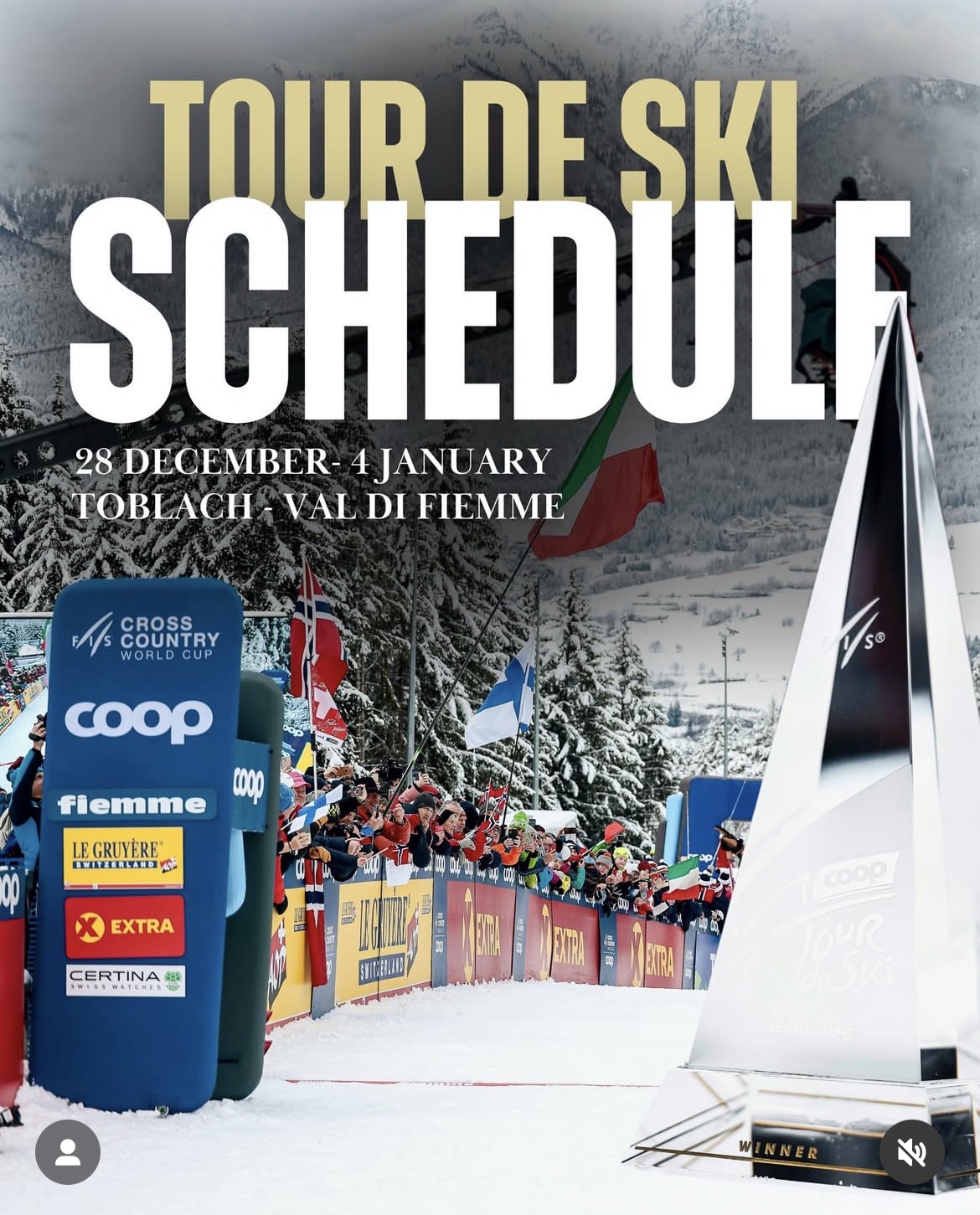
The schedule — first shared publicly through FIS social media and still pending FIS Council approval — builds the season around the 2027 World Championships in Falun, Sweden, with three pre-Christmas stops, a nine-race Tour de Ski, a stretch of three weekends between the Tour and Worlds, and a Scandinavian closing kick that ends with the Finals in Ulricehamn.
For North American fans, the calendar is once again entirely European, with no scheduled stops in Canada or the United States.
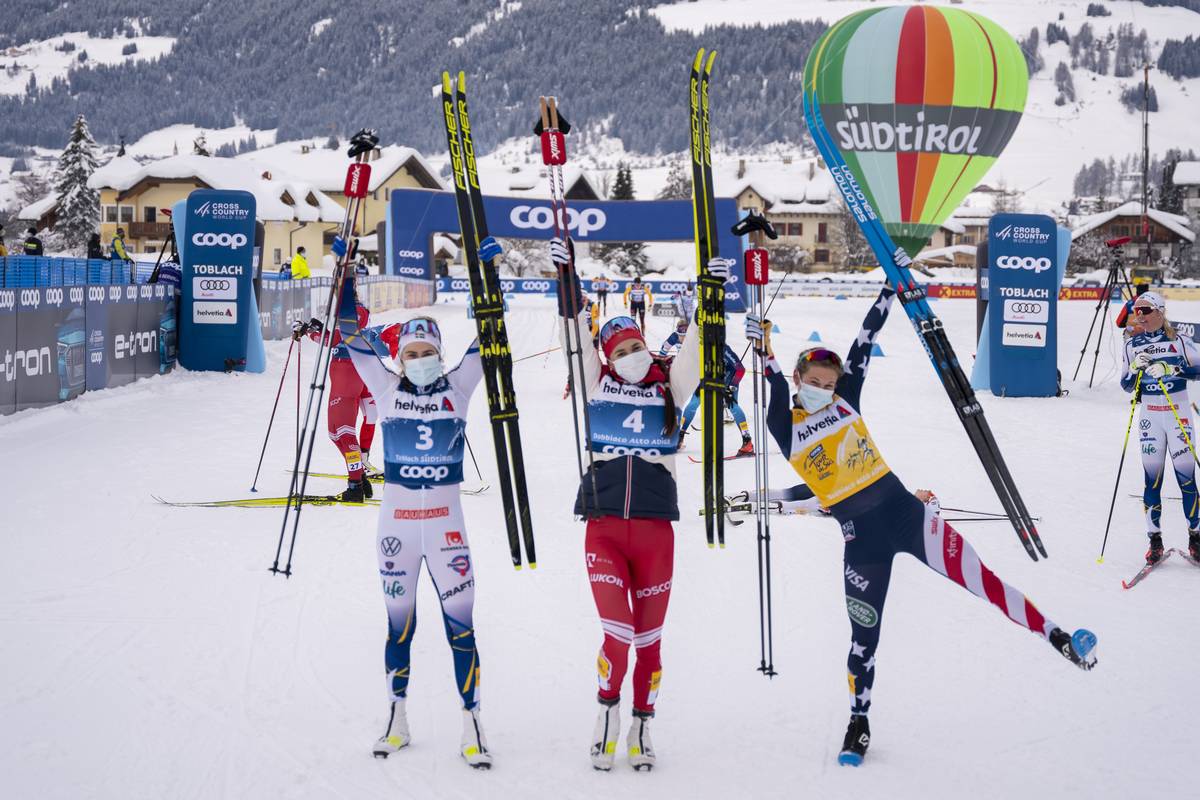
Frida Karlsson (SWE) poses with Mr. and Mrs. Claus following the 10k Classic to start last season in Ruka (FIN). (Photo: Modica/NordicFocus)
Pre-Holiday: Ruka, Trondheim, Davos
The season opens where it almost always does — in Ruka, Finland, where the World Cup begins November 27. From there, the circuit moves to Trondheim, host of the 2025 World Championships, before the pre-Christmas block closes in Davos, Switzerland, with a team sprint.
November 27-29, 2026: Ruka, Finland
27/11: 10km Interval Start Classic
28/11: Sprint Classic
29/11: 20km Mass Start Freestyle
December 1-3, 2026: Trondheim, Norway
01/12: 10km Interval Start Classic
02/12: Sprint Freestyle
03/12: 20km Skiathlon
December 11-13, 2026: Davos, Switzerland
11/12: 5km Heat Mass Start Freestyle
12/12: Sprint Freestyle
13/12: Team Sprint Freestyle
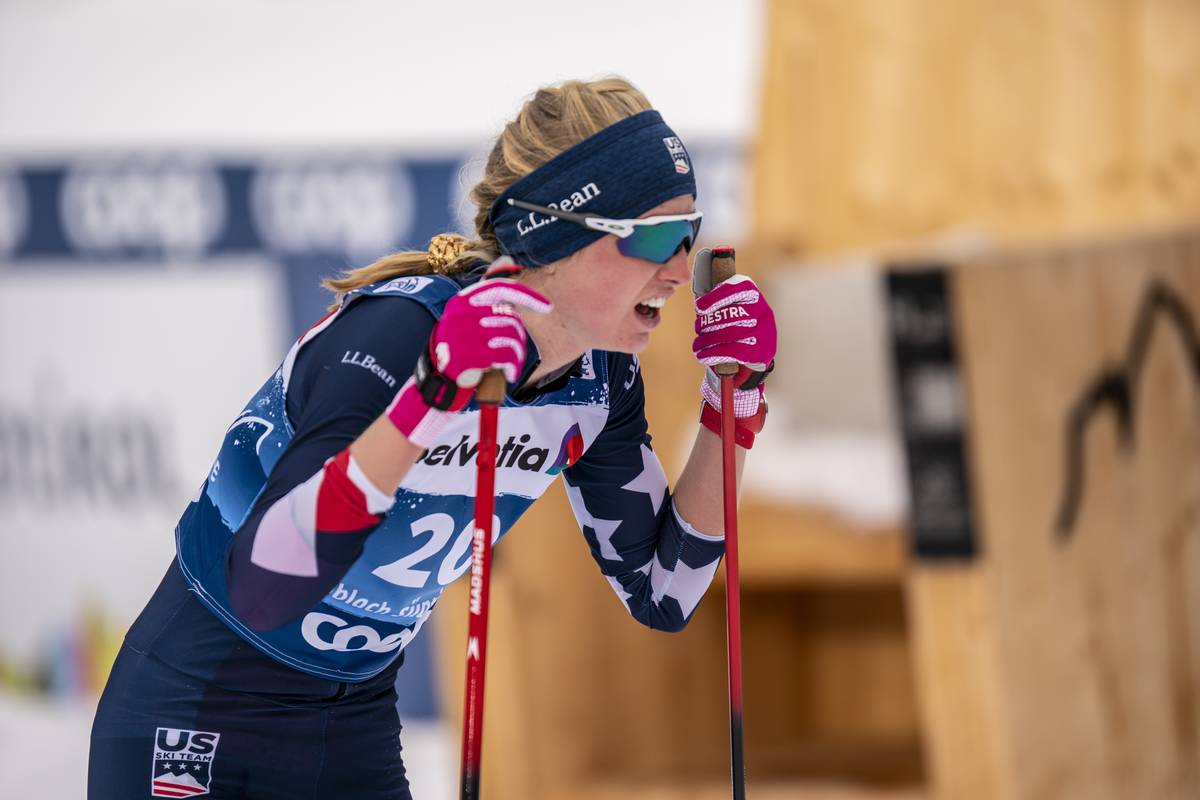
With Jessie Diggins (USA) now retired, there will be a new FIS Overall Crystal Globe and Tour de Ski champion next season (Photo: Vanzetta/NordicFocus)
Tour de Ski 2026/2027
The Tour de Ski returns to a three-country format, opening in Les Rousses, France, on New Year’s Day, moving to Oberstdorf, Germany, and finishing with three races in Val di Fiemme, Italy — capped, as ever, by the Final Climb up Alpe Cermis.
January 1-3, 2027: Les Rousses, France
01/01: Sprint Classic
02/01: 20km Mass Start Classic
03/01: 15km Pursuit Freestyle
January 5-6, 2027: Oberstdorf, Germany
05/01: 15km Mass Start Classic
06/01: 5km Heat Mass Start Freestyle
January 8-10, 2027: Val di Fiemme, Italy
08/01: 15km Skiathlon
09/01: Sprint Freestyle
10/01: Final Climb
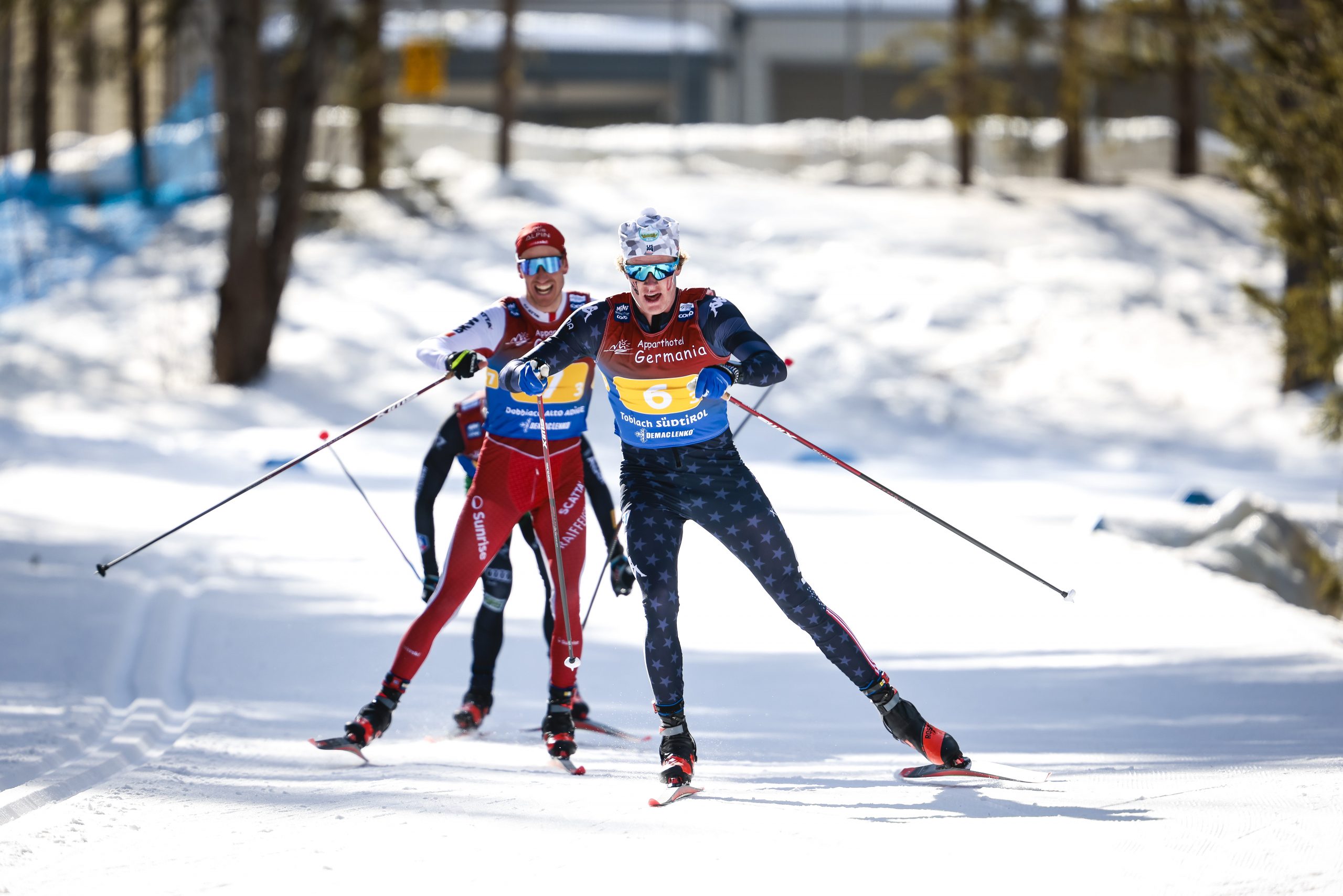
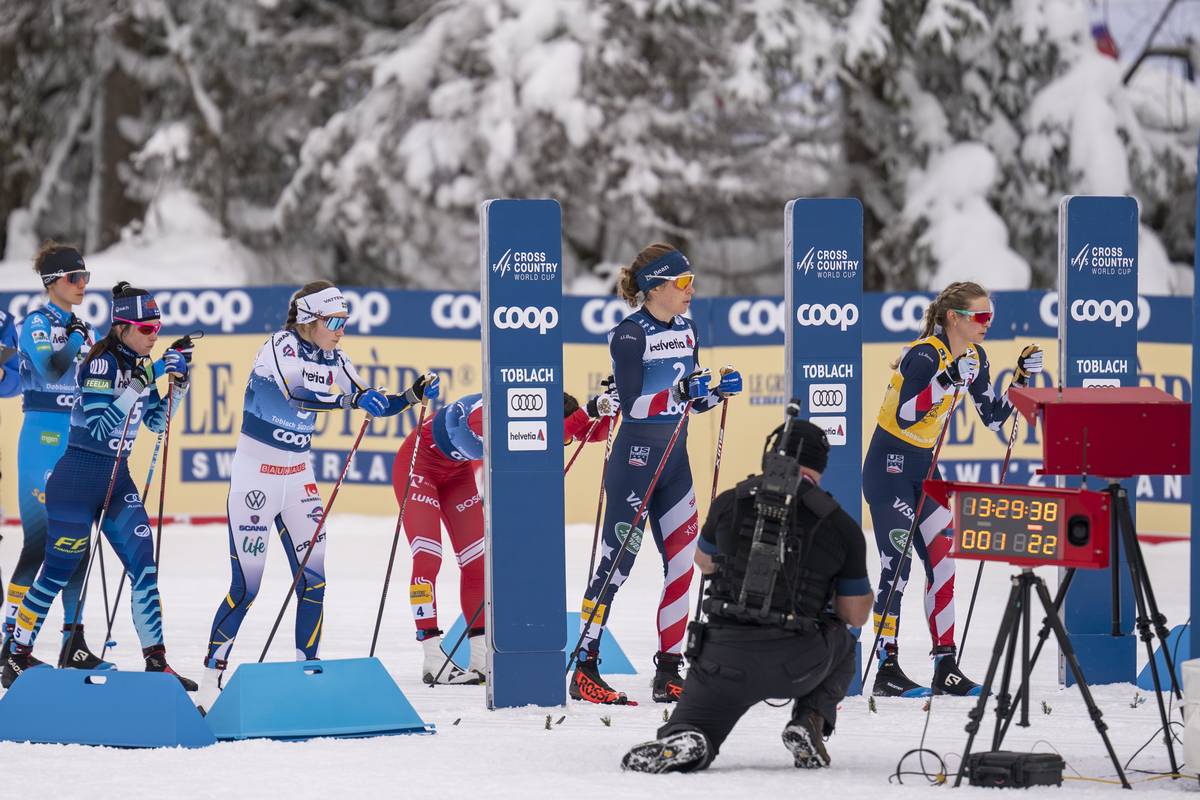
Gus Schumacher (USA) and the rest of the US team will hope to continue their success in Toblach (ITA). (Photo: Modica/NordicFocus)
After the Tour, Before Worlds: Engadin, Toblach, Lahti
Three weekends bridge the Tour de Ski and the World Championships. Engadin opens its weekend with a mixed relay — a format the FIS has been working into more World Cup weekends — and Lahti closes the pre-Worlds stretch with its classic 20km skiathlon and 10km interval start.
January 22-24, 2027: Engadin, Switzerland
22/01: Mixed Relay
23/01: Sprint Freestyle
24/01: 20km Mass Start Freestyle
January 29-31, 2027: Toblach, Italy
29/01: 10km Interval Start Freestyle
30/01: Sprint Freestyle
31/01: 20km Mass Start Classic
February 12-14, 2027: Lahti, Finland
12/02: Sprint Classic
13/02: 20km Skiathlon
14/02: 10km Interval Start Classic
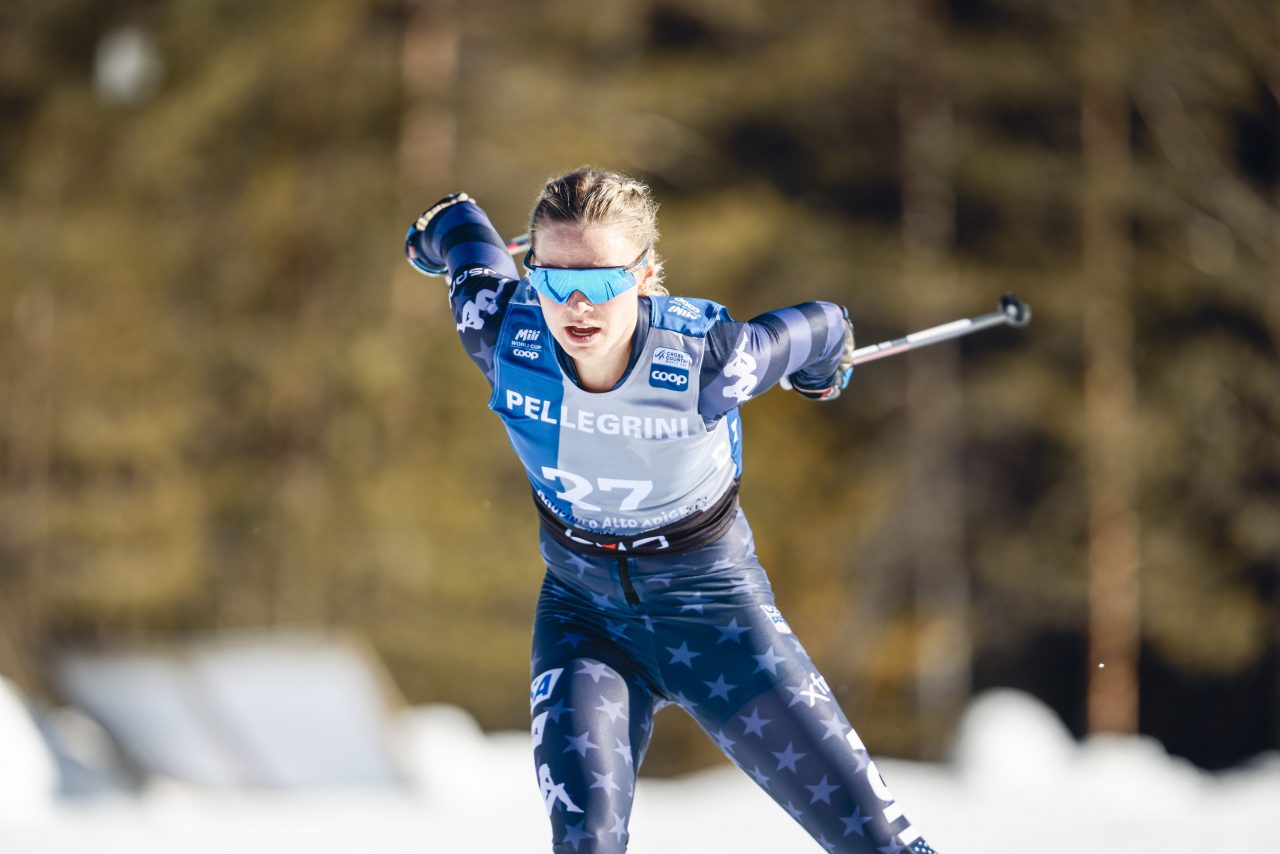
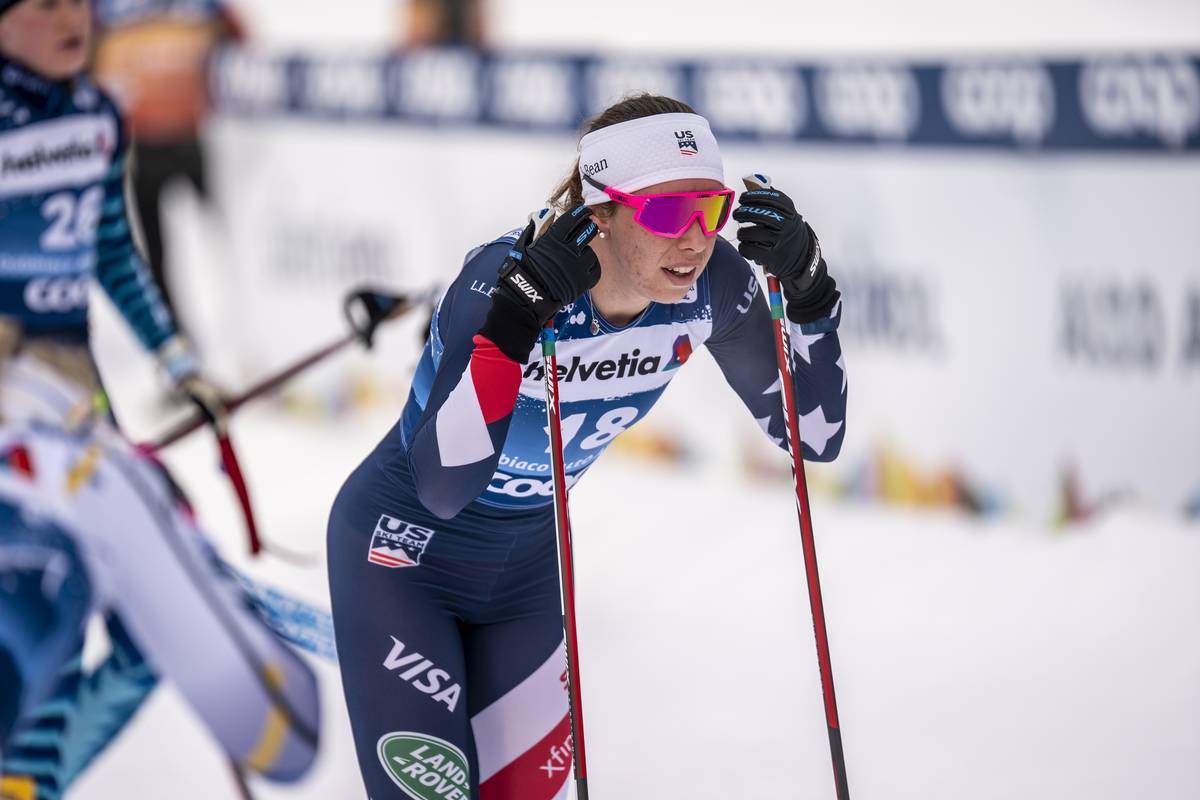
Kendall Kramer (USA) had a breakout World Cup Skiathlon in Falun (SWE) last season. (Photo: Authamayou/NordicFocus)
2027 FIS Nordic World Ski Championships: Falun, Sweden
The 2027 FIS Nordic World Ski Championships run from February 22 through March 7 in Falun, Sweden, with all title formats on the program. Falun last hosted Worlds in 2015.
Final Period: Oslo, Drammen, Ulricehamn
The closing stretch is a Scandinavian one. Oslo’s Holmenkollen weekend features back-to-back 50km mass start classic races on March 13 and 14 — long a fixture of the late-season calendar — before a one-day sprint stop in Drammen and the World Cup Finals in Ulricehamn, Sweden.
March 13-14, 2027: Oslo, Norway
13/03: 50km Mass Start Classic
14/03: 50km Mass Start Classic
March 16, 2027: Drammen, Norway
16/03: Sprint Classic
March 19-21, 2027: Ulricehamn, Sweden (World Cup Finals)
19/03: 10km Interval Start Freestyle
20/03: Sprint Freestyle
21/03: 20km Mass Start Classic
The calendar remains subject to FIS Council approval.
This coverage is made possible through the generous support of Marty and Kathy Hall and A Hall Mark of Excellence Award. To learn more about A Hall Mark of Excellence Award, or to learn how you can support FasterSkier’s coverage, please contact info@fasterskier.com.
Jessie Diggins (USA) claimed her third Tour de Ski overall victory in Val di Fiemme (ITA). (Photo: Vanzetta/NordicFocus)
The Tour de Ski does not end so much as it compresses. By the time the women turned onto the ribbon of snow climbing Alpe Cermis, the race had already been going on for a week—measured not only in kilometers and seconds, but in fatigue accumulated quietly overnight, in sore muscles, achy backs, and in confidence gained or lost one race at a time.
The final climb has a way of making those invisible things visible. It is steep enough to strip racing of pretense, long enough to punish impatience, and familiar enough that every skier arrives with memories—good ones, bad ones, and some they would rather forget. On Sunday afternoon in Val di Fiemme, the climb again became what it always is: less a finish line than a reckoning.
For Jessie Diggins, that reckoning ended in confirmation. Diggins finished second on the stage, protecting her margin with experience and restraint, and secured her third career Tour de Ski overall title. It was not the loudest way to win. It was, however, the truest.
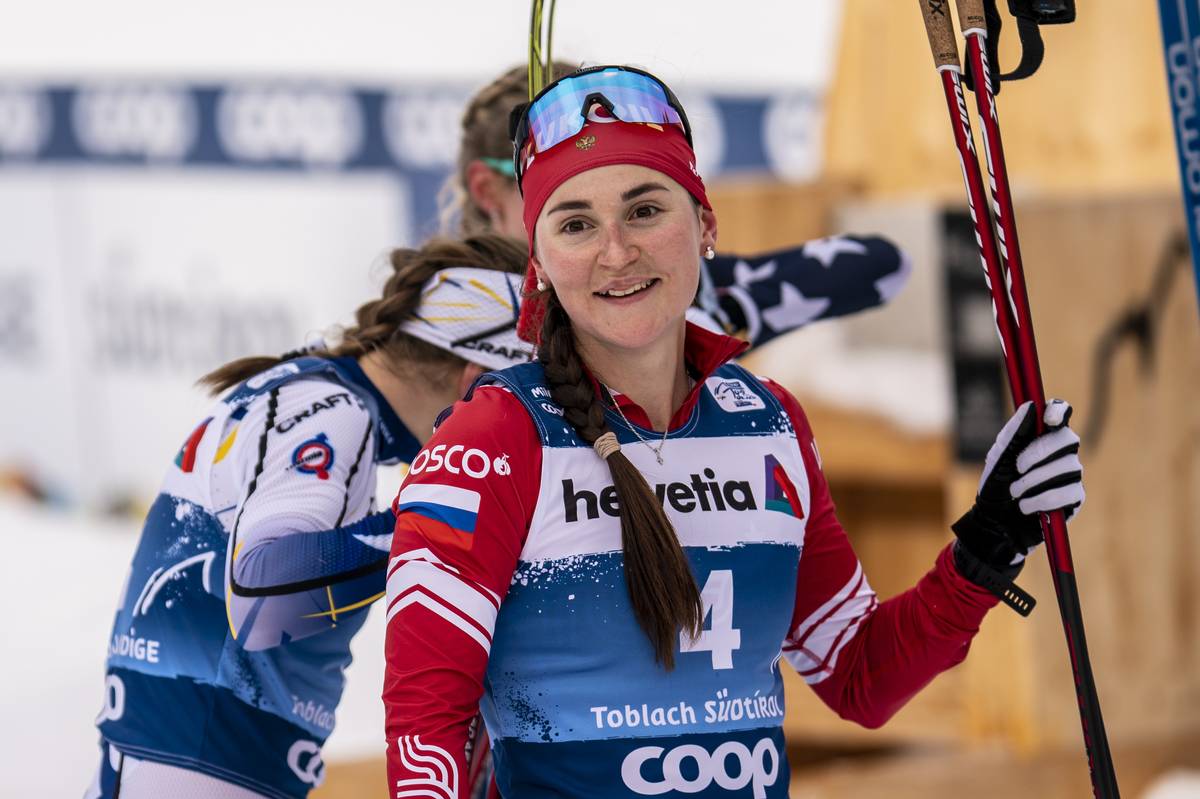
Jessie Diggins (USA) paced the final climb perfectly to finish second on the day. (Photo: Modica/NordicFocus)
A Climb That Decides Everything
Stage 6 of the women’s Tour de Ski—10.0 kilometers, mass start, freestyle—began with the tension that always precedes Alpe Cermis. Some skiers arrived still dreaming of a stage victory. Others were guarding seconds earned days earlier. Still others were simply hoping to make it to the top without the climb turning overly cruel.
The early kilometers unfolded with relative calm. The pace was honest but controlled, the group compact as it flowed through the lower valley before turning uphill. On Alpe Cermis, there is no hiding, but there is strategy: when to let others go, when to follow, and—most importantly—when not to.
The decisive moves came as the gradient steepened and the field stretched into a long, thin line. Norway’s Karoline Simpson-Larsen skied with precision and patience, gradually asserting herself as the strongest on the day. She crested the final meters alone to win the stage in 37:05.3, earning the biggest single-day victory of her World Cup career.
Behind her, the race unfolded with quieter drama. Diggins, who entered the day with a commanding overall lead, skied with calculation. She resisted the temptation to respond immediately when others surged, choosing instead to manage the climb in segments. When the grade lessened and the gap narrowed late, she allowed herself to push hard enough to secure second place, but not so hard as to invite disaster.
Diggins crossed the line 8.8 seconds behind Simpson-Larsen, followed by Norway’s Heidi Weng in third at +14.4. The stage podium reflected the day’s effort, but it was Diggins’ second place that carried the most weight.
Jessie Diggins (USA), as always, left everything out on the course. (Photo: Modica/NordicFocus)
“Dying at the Right Moment”
Diggins’ approach to Alpe Cermis was shaped by experience—and memory.
“I was trying to be smart and safe in terms of the overall Tour,” she said afterward. “And then when I realized we were close enough, I thought, okay, now I can empty the tank. But I’ve paced it badly before where I blow up, and that last 600 meters is the slowest of your life.”
It is a detail only veterans tend to mention: not the steepest pitch, but the final few hundred meters, when legs that have already been pushed too far simply refuse to respond. Diggins has lived that mistake. On Sunday, she avoided it.
“I was trying to ski it smart and make sure I was dying at the right moment,” she said.
That restraint—so often invisible to spectators—was the difference between managing the Tour and risking it. The margin Diggins had built over five stages gave her room to think clearly. The climb rewarded that clarity.
Julia Kern (USA) and Jessie Diggins (USA) celebrate with US Cross-Country Ski Team coaches and staff, as well as US Alpine Ski Team athletes who came to support them at the end of the 2025/26 Tour de Ski. (Photo: Vanzetta/NordicFocus)
The Meaning of a Tour
In the mixed zone at the top, Diggins spoke not with relief so much as appreciation—for the work, the people, and the endurance the Tour demands.
“The Tour de Ski is one of the hardest things to win,” she said. “When you win the Olympics, it’s amazing—it’s really special. But that’s one race. The Tour is day after day after day. You have to put it together back-to-back, under cumulative pressure. That’s really hard. It’s hard on you, and it’s hard on the team.”
Her emphasis, repeatedly, returned to the collective effort. She spoke of team energy, of support staff, of consistency rather than dominance. It was a reminder that Tour victories are not seized in moments, but constructed patiently across an entire week.
Diggins finished the Tour with a total time of 2:11:26.1, winning the overall by more than two minutes over Austria’s Teresa Stadlober. It was not a victory defined by a single attack or a single stage, but by accumulation—time gained when others faltered, mistakes avoided when margins were thin.
Julia Kern (USA) makes her way up Alpe Cermis to finish 14th on the day. (Photo: Vanzetta/NordicFocus)
Kern’s Quiet Confirmation
For Julia Kern, Alpe Cermis offered something different: clarity.
Kern finished 14th on the stage, 2:01.0 back, after a Tour that reflected both progress and unfinished business. She described the climb as meeting—or exceeding—her expectations.
“Every year it’s a little different with who’s still left in the Tour,” Kern said. “But I’m taking away from today that my fitness is there. I just need to fine-tune some of the sprinting gears. That’s very trainable at this point in the season.”
Her assessment mirrored her results. Kern was consistently strong in the distance races throughout the Tour, finding rhythm and confidence as the days passed. The sprint stages, by contrast, left her frustrated.
“I was a bit bummed with my sprint days for sure, and hungry for more,” she said. “But at the same time, I had consistently good, strong distance races. Halfway through the Tour, I started to find my race legs again.”
It is a pattern Kern recognizes—slow starts, gradual momentum, strength revealed in longer efforts. In an Olympic season, that trajectory matters more than any single result.
Maja Dahlqvist (SWE) attacked at the end of the valley trail leading to the Alpe Cermis in Val di Fiemme (ITA) to secure her silver sprinters’ bib. (Photo: Vanzetta/NordicFocus)
The Bib Battles
Beyond the overall, the final climb also settled two secondary competitions that added layers of tension to the Tour’s closing act.
The climber’s bib—awarded for cumulative performance on the Tour’s toughest ascents—went to Teresa Stadlober, who accumulated 45 points across the week. Diggins finished second in the standings with 39, underscoring how consistently she handled the steepest terrain without ever needing to gamble on a single climb.
The sprint standings, marked by the silver bib, remained unsettled until the final stage, where one final set of bonus points was awarded at the beginning of Alpe Cermis. Sweden’s Maja Dahlqvist emerged with the title at 53 points, ahead of Switzerland’s Nadine Fähndrich and Sweden’s Johanna Hagström. Diggins finished fourth in the sprint competition—another reflection of her Tour: competitive everywhere, decisive where it mattered most.
Teresa Stadlober (AUT) fought hard to defend her climbers’ bib. (Photo: Vanzetta/NordicFocus)
Pain, Reconsidered
Late in the mixed zone, Diggins reflected on something more personal—how different this climb felt compared to recent years.
“The last two years I’ve been so injured that I was in so much pain outside of racing,” she said. “So for it to be only painful during the race was like, wow—that’s kind of nice.”
It was not a dramatic declaration, but it carried weight. The Tour de Ski magnifies everything: fatigue, doubt, confidence, pain. To arrive at Alpe Cermis feeling capable—rather than simply enduring—marked a shift.
She laughed when she added that she told herself, mid-Tour, that she would “never do this again.” Then she smiled at the familiar uncertainty that defines the race.
“You never know how you’re going to feel every day on a Tour,” she said. “And today I felt really good. One of the best I’ve ever felt on the final climb.”
Julia Kern (USA), Jessie Diggins (USA), (l-r) at the top of Alpe Cermis in Val di Fiemme (ITA). (Photo: Modica/NordicFocus)
The American Picture
For the U.S. women, the Tour ended with a sense of coherence. Diggins’ overall victory provided the headline, but Kern’s steady distance form pointed toward depth and durability within the team.
Kern’s immediate plans reflect that long view. She will return home to Richmond, Vermont, for two weeks—prioritizing recovery before resuming training on familiar snow.
“I did this last year, and it worked really well,” she said. “Just getting off World Cup, getting a lot of recovery the first week, being in my own bed.”
From there, she will rejoin training camps and racing with an eye toward sharpening for the Olympics. It is a plan built on patience rather than urgency—much like Diggins’ approach on Alpe Cermis.
Teresa Stadlober (AUT), Jessie Diggins (USA), Heidi Weng (NOR), (l-r) take the Tour de Ski overall podium. (Photo: Vanzetta/NordicFocus)
What the Climb Leaves Behind
When the last skier crested the climb and the finish corral emptied, Alpe Cermis returned to stillness. The Tour de Ski had done what it always does: clarified things.
It clarified that Jessie Diggins remains one of the sport’s great stage racers—capable not just of winning races, but of managing weeks. It clarified that Julia Kern’s fitness base is real and growing, even if some pieces still need refinement. And it clarified, once again, that the Tour is not about brilliance alone, but about survival, intelligence, and trust in process.
Diggins did not win the final stage. She did something harder. She won the Tour by knowing exactly when not to.
At the end of the longest climb of the week, that knowledge mattered most.
Feature stories like this one take time, access, and care to produce. If you value thoughtful storytelling and independent ski journalism, please consider becoming a Voluntary Subscriber. Your support directly fuels the work we do to cover the people, places, and moments that make our sport special.
Jessie Diggins (USA), Karoline Simpson Larsen (NOR), and Heidi Weng (NOR), (l-r) share the final climb podium at the top of Alpe Cermis in Val di Fiemme (ITA). (Photo: Vanzetta/NordicFocus)
This coverage is made possible through the generous support of Marty and Kathy Hall and A Hall Mark of Excellence Award. To learn more about A Hall Mark of Excellence Award, or to learn how you can support FasterSkier’s coverage, please contact info@fasterskier.com.
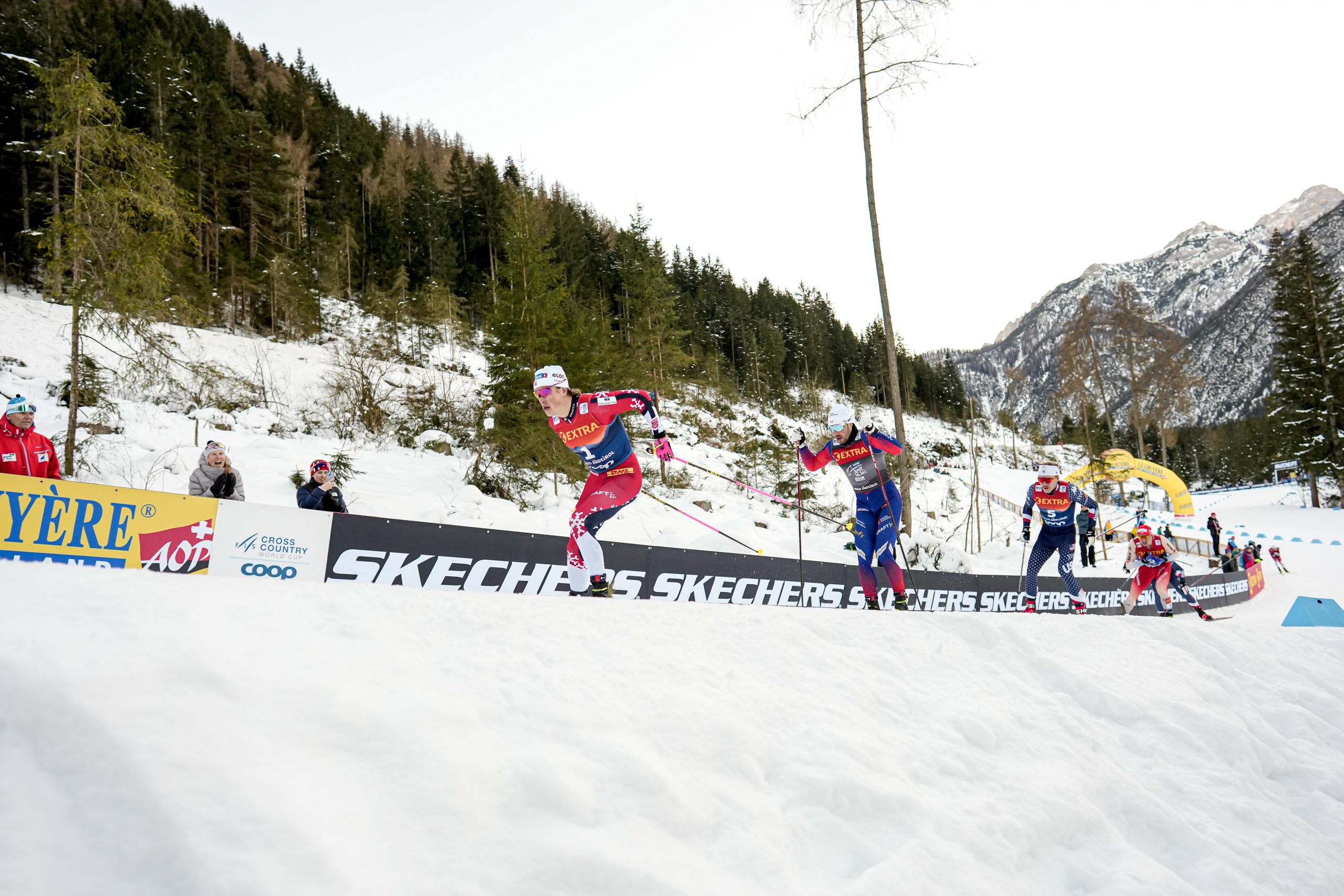
Gus Schumacher (USA) and the rest of Heat 2 climb over Toblach’s iconic feature during the 5 K Freestyle. (Photo: Modica/NordicFocus)
The Tour de Ski has always asked skiers to live with imperfect information. You race hard when you’re tired. You make decisions based on feelings and instincts, while coaches are screaming ‘splits.’ You tell yourself the only honest thing in a stage race: don’t do anything you can’t recover from tomorrow.
On Wednesday, the Tour leaned fully into that uncertainty — and then amplified it.
Stage 3, a 5-kilometer freestyle, arrived with a new wrapper: four separate mass-start heats, each sent off at a different time, with final standings determined only after all heats were complete and all times were combined. The spectacle was real — a small parade of high-speed skating races rather than one long pageant — but the competitive implications were sharper than the format’s novelty suggested. Skiers weren’t simply racing the men next to them. They were racing an invisible standard set by athletes they couldn’t see, in heats that could be slower or faster for reasons that had nothing to do with any one skier’s fitness.
If that sounds like chaos, it wasn’t. Not for Gus Schumacher.
Schumacher (USA) didn’t treat the new format as a novelty or a gamble. He treated it like a solvable problem — and in doing so, he won the stage in 9:35.4, claiming the second World Cup victory of his career and stamping his authority on a Tour de Ski day that felt, at times, like a controlled experiment.
Behind Schumacher, Austria’s Benjamin Moser was second (+0.2), and Norway’s Lars Heggen — the U23 skier who helped turn Schumacher’s heat into a metronome — was third (+0.6).
And here is the detail that will define how this stage is remembered: the top seven overall finishers all started in the same second heat, the heat that began at 11:48:45. In a race decided on aggregate time, that start time became a kind of gravitational center — the heat where cooperation, pace, and intention converged into the day’s fastest runway.
Ben Ogden (USA), JC Schoonmaker (USA), Remi Drolet (CAN), and others follow Johannes Hoesflot Klaebo (NOR) during the third heat of the 5 K Freestyle. (Photo: Modica/NordicFocus)
The Format: Four Races, One Result — and a Quiet Incentive to Collaborate
The four start times — 11:30:00, 11:48:45, 12:07:30, and 12:26:15 — didn’t just separate the field. They separated narratives. In one heat, the pace would be relentless and communal; in another, it might be cagey, tactical, or simply a touch less urgent. In a normal mass start, you can afford to be patient. In a normal 5K interval start, you can measure yourself against the clock. On this day, you had to do both — without complete visibility into either.
U.S. head coach Matt Whitcomb framed it simply: the 5K has been absent from the World Cup menu for long enough that today was “unknown territory,” and athletes had to be ready to adapt. “Nobody really knew what to expect,” he said — not because the course was mysterious, but because the format forced a different kind of decision-making.
Whitcomb also emphasized that heat assignments weren’t random theater. They were determined by overall Tour standings after two stages, via a snake-draw system written into the rules — in other words, the groups were structured, and the group you landed in mattered.
That mattered most in the heat Schumacher found himself in — and, crucially, in the way he decided to race it.
Gus Schumacher (USA) leads Heat 2 during Stage 3 of the Tour de Ski in Toblach (ITA). (Photo: Vanzetta/NordicFocus)
Heat 2 Becomes the Day’s Engine
By the time Schumacher’s heat went off at 11:48:45, the day already had shape: one race had happened, a set of times had been posted, and the Tour’s new experiment had revealed its first truth — you could win your heat and still lose the stage.
Schumacher and his heat-mates didn’t merely acknowledge that truth. They embraced it.
“I think my heat-mates and I realized that having a fast heat was the biggest picture,” Schumacher said afterward. “I was prepared to be 10th in the heat if it meant we were fast.”
That sentence — prepared to be 10th if it meant we were fast — is the kind of thing athletes say when they’re not racing for ego. It’s what they say when they’re racing for an outcome.
Schumacher described how the plan became practical: “We were able to trade leads also with Ben Moser’s help and keep the pace fast without too much effort before the hills, then actually continued to work together even better than I thought we would from there into the finish.”
Whitcomb confirmed the same dynamic from the outside: Schumacher “reached out to Lars Hagen and Ben Moser and came up with a plan,” and the result was “well orchestrated trading off of the lead,” the kind of collaboration you don’t often hear described so plainly in a World Cup race. In a typical mass start, you hide. In a typical interval start, you suffer alone. In this format, the fastest solution was neither — it was to share the work early and arrive at the decisive sections with enough fuel to race, not just survive.
And the split data makes the story legible.
At 1.7 km, Schumacher hit 2:54.2. Moser was 2:54.4. Heggen was even quicker at 2:53.5. The heat was not strolling into the race; it was setting terms.
At 2.7 km, Schumacher reached 4:59.6, and the heat’s front remained dense and alive. By 3.1 km, Schumacher was at 6:16.4 — still close enough to the line that the stage would be won in the last two kilometers, but far enough out that the wrong decision on the climb would show up in the final time like a bruise.
Schumacher’s last 1.9 km — from 3.1 km to the finish — was the sharpest of the podium trio, and among the best in the field. He closed in 3:19.0, a finish that wasn’t just a sprint, but a controlled acceleration from a high baseline.
This is what it looked like in practice: a heat that refused to turn into a chess match. A group that made the race fast enough to matter. And a skier — Schumacher — who could do the work and still finish.
Gus Schumacher (USA) and Benjamin Moser (AUT) lead other Stage 3 top finishers to the line in Toblach (ITA). (Photo: Modica/NordicFocus)
The Podium: Schumacher Leads, Moser Hangs, Heggen Announces Himself
Schumacher’s stage win — 9:35.4 — put him at the center of the day’s story, but the day’s podium also revealed how perfectly the format could reward the right combination of collaboration and individual capacity.
Moser (AUT), second at 9:35.6, was integral to the heat’s pace-making. Heggen (NOR), third at 9:36.0, wasn’t a passenger either — he was part of the mechanism.
Schumacher was explicit about what the format rewarded him for. “Sometimes I feel like a jack of all trades and a master of none,” he said, “but high-speed skating with an element of required distance capacity is a place where I can excel. I think Minneapolis had that too.”
It’s the kind of description that links two very different wins — one on home snow in Minneapolis in a 10K Freestyle Interval Start, the other here, in a four-heat 5K puzzle — without pretending they are the same. What connects them, Schumacher suggested, is the ability to ski fast in a way that isn’t fragile: pace you can sustain, not just ignite.
“I’ve been feeling good, but I’m still building momentum,” he said. “Today definitely helped.”
Benjamin Moser (AUT), Gus Schumacher (USA), Mattis Stenshagen (NOR), (l-r) worked together to claim the podium of the 5 K Freestyle. (Photo: Vanzetta/NordicFocus)
Where the Race Was Won: The Climb, the Urge to Go Early, and the Last Kilometer
If Heat 2 was the engine, the course still demanded decisions — and it punished some of them.
J.C. Schoonmaker (USA), who would finish 29th, described the mental load of the format in a way that felt honest rather than polished. “The new format just changed the way I thought about things because I felt I needed to be prepared for lots of different scenarios,” he said. “I probably haven’t done a 5K since high school… I was just trying to be ready for whatever came and be ready to react to it.”
Schoonmaker pinpointed the moment that mattered: “On the big climb, I sensed that things were starting to stretch out a bit, so that was where I decided I needed to make a move. It was a bit early in hindsight because our heat ended up staying together, and I got pretty tired in the very end and lost some positions.”
That’s the stage’s second truth: in a format like this, you can race aggressively and still end up punished by the math. An early move that might win you your heat can also drain the last 400 meters you need to protect your time — the thing that actually counts.
Ben Ogden (USA), 20th, offered the same theme from a different angle. He admitted he didn’t dictate his heat’s tempo — and that, in hindsight, he wished he had done more when he felt capable.
“I didn’t really dictate the pacing in my heat,” Ogden said. “I let Klaebo and Stenshagen really dictate the pacing, and I just held on as best I could.”
Then the key sentence — the one that tells you how easy it was, in this format, to race the wrong race: “It’s hard to remember that it’s sort of us versus them a little bit in that race format rather than just trying to win your group.”
Ogden noted that his heat’s final kilometer became a bit of a one-man chore: “Pellegrino led for most of the last K… down through the corners and stuff. I think it would have been better if we’d been trading off leads.”
In other words, the format quietly rewards heats that turn into rotating pacelines and punishes heats that turn into sprints for pride.
Schumacher’s heat was a paceline that never forgot the clock.
Ben Ogden (USA) and Johannes Hoesflot Klaebo (NOR), (l-r) leading Heat 3 of the 5 K Freestyle in Toblach, Italy. (Photo: Vanzetta/NordicFocus)
The Americans: A Day of Depth Under a Day of Headlines
Schumacher’s win was the headline, but the U.S. team’s men didn’t only deliver a winner. They delivered a set of performances that made the result feel like something sturdier than a single bright point.
Here’s where the Americans landed on the day:
1st: Gus Schumacher (USA) — 9:35.4
20th: Ben Ogden (USA) — 9:45.4
29th: J.C. Schoonmaker (USA) — 9:46.2
41st: Zak Ketterson (USA) — 9:48.9
42nd: Jack Young (USA) — 9:49.1
79th: Kevin Bolger (USA) — 10:08.9
Whitcomb framed the broader men’s story as an execution day — athletes moving up within their heats and carrying out their plans — and in a stage race, that matters. You can’t win a Tour de Ski on one beautiful moment if you give it away everywhere else. You win it by repeatedly doing things that don’t make headlines: staying attached, eating enough, recovering enough, skiing smoothly when you’re cooked.
Schoonmaker, in particular, gave a clear explanation of how the heat system changed the burden of responsibility. “For someone like me, the group I was in played a big part in my result,” he said. “As someone with not a ton of distance prowess, I didn’t have much responsibility to lead, so I was able to sit in the back and wait.”
Then, without making excuses, he told the truth about the dependency built into the format: “That basically made it so my overall time was in the hands of the top guys — but with that being said, it also does take fitness to stay with them.”
It’s a nuanced defense of the format — and also a subtle admission that it can be cruel. It can make your best decision feel like passivity. It can make your best fitness feel like waiting.
Schoonmaker ended with the line the sport’s decision-makers will want to hear: “It’s a cool balance of tactics and fitness, sprinting and distance, and I hope they keep this format around.”
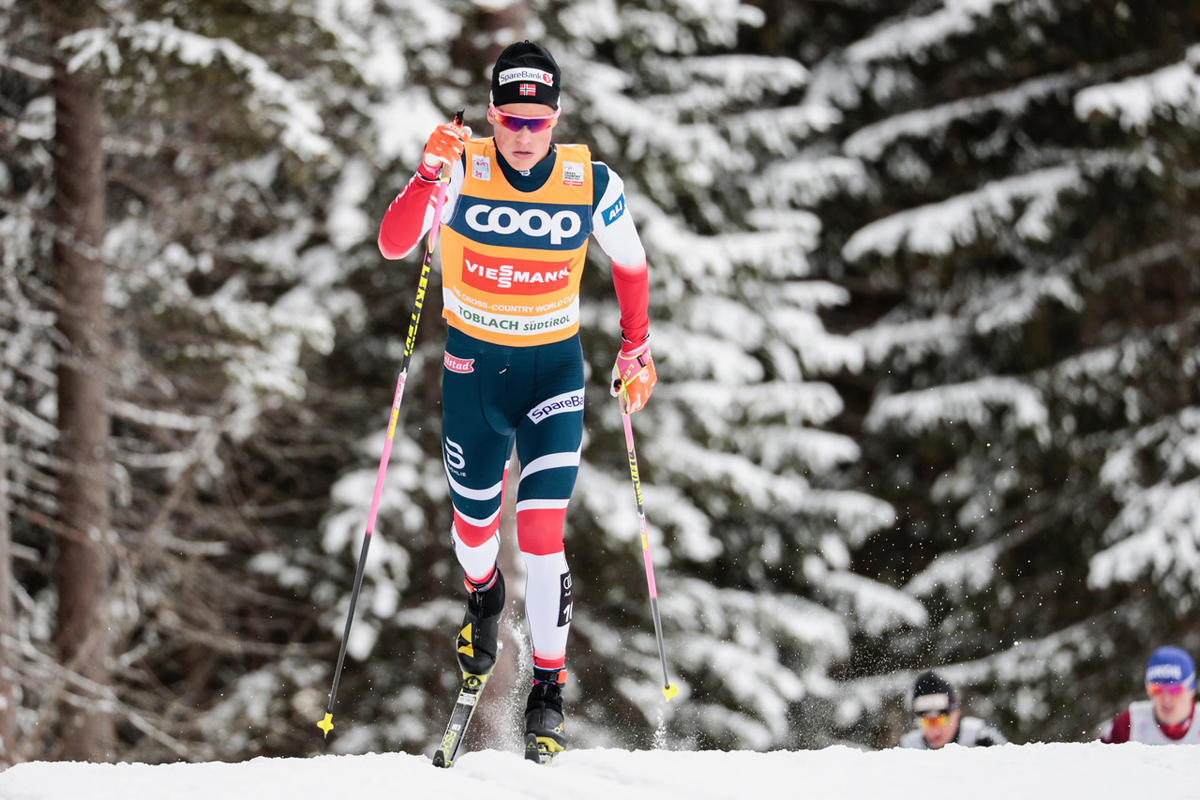
Johannes Hoesflot Klaebo (NOR) was the fastest in Heat 3, but that was only good enough for 12th place overall on the day. (Photo: Modica/NordicFocus)
Norway: The Pressure Cooker Is Always On
Norway, as ever, arrived in Toblach with depth so thick it looks almost unfair from the outside — and with selection pressure that turns every race into a referendum.
Johannes Høsflot Klæbo (NOR) finished 12th in 9:44.0, a day when his 12th place looked strange even when the format explained it. Emil Iversen (NOR) was 8th in 9:42.5. Harald Østberg Amundsen (NOR) finished 17th in 9:44.7. Andreas Fjorden Ree (NOR) was 9th in 9:42.6.
But the real Norwegian story at the sharp end was Heggen — third — and the way his podium was tied to a heat that chose to cooperate rather than conserve. In the Olympic year, Norway’s selection picture isn’t just about who can win on a given day. It’s about who can be trusted to perform across formats, courses, and chaos — and this format delivered chaos with a stopwatch.
If you are a coach trying to build a roster for Milano-Cortina, you probably liked what you saw from athletes who could do the work and still finish — athletes who could be generous early and ruthless late. That’s not a ski cliché. It’s a trait.
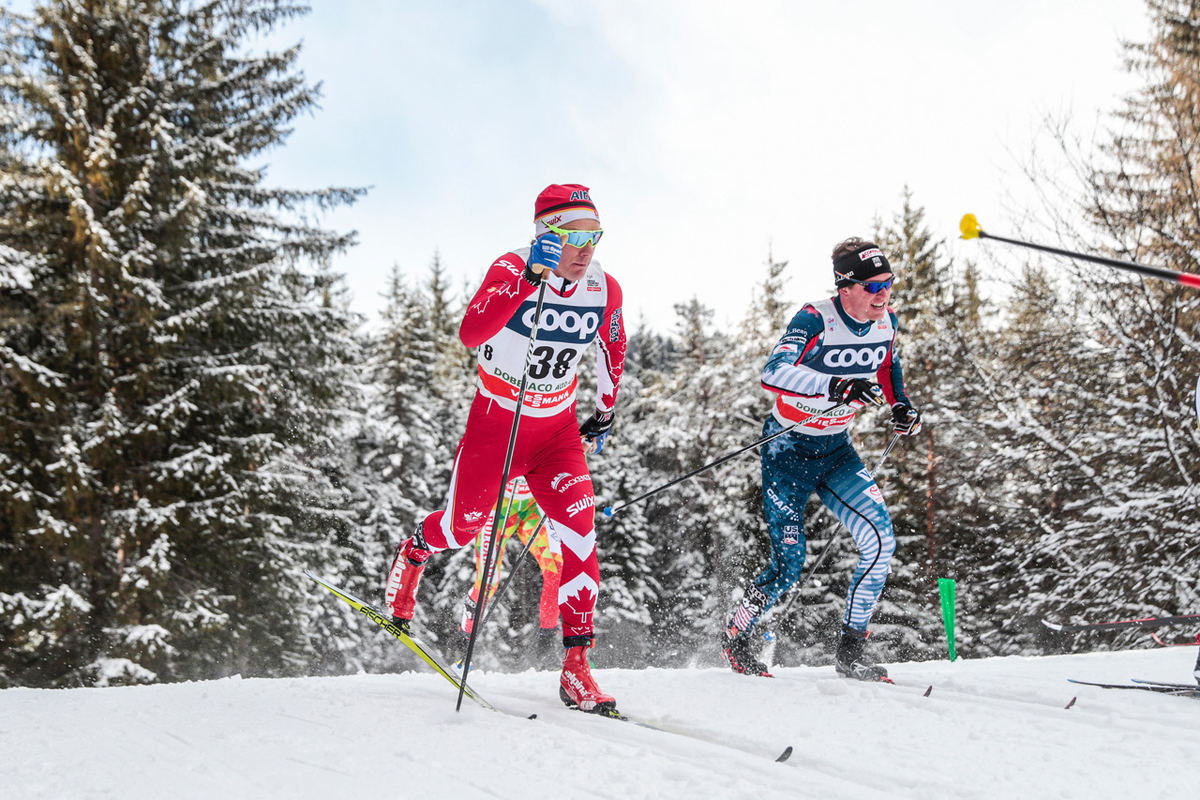
Antoine Cyr (CAN) led the way for the Canadian men on a strong day in Toblach (ITA). (Photo: Vanzetta/NordicFocus)
Canada: After Trials, Into the Fire — and Right on the Doorstep of the Top 10
Canada came into the Tour de Ski after holding Olympic trials at home — a different rhythm than many of their European rivals — and Stage 3 gave the Canadian men a tidy set of results that will matter both psychologically and practically.
Antoine Cyr (CAN) led the Canadians in 11th (9:43.8), with Xavier McKeever (CAN) 13th (9:44.2) and Max Hollmann (CAN) 14th (9:44.3).
In a race where the top seven all came from one heat, those placements have extra weight: they suggest Canada wasn’t simply lucky with a draw. They were close enough to the best to make the math uncomfortable. They were within seconds — the kind of seconds that, in a Tour, can turn into minutes if you don’t recover, and can turn into opportunity if you do.
And because this format was so dependent on heat tempo, these results also reinforce a quieter Canadian strength: the ability to race within a fast-moving group and stay composed enough to cash it in at the end.
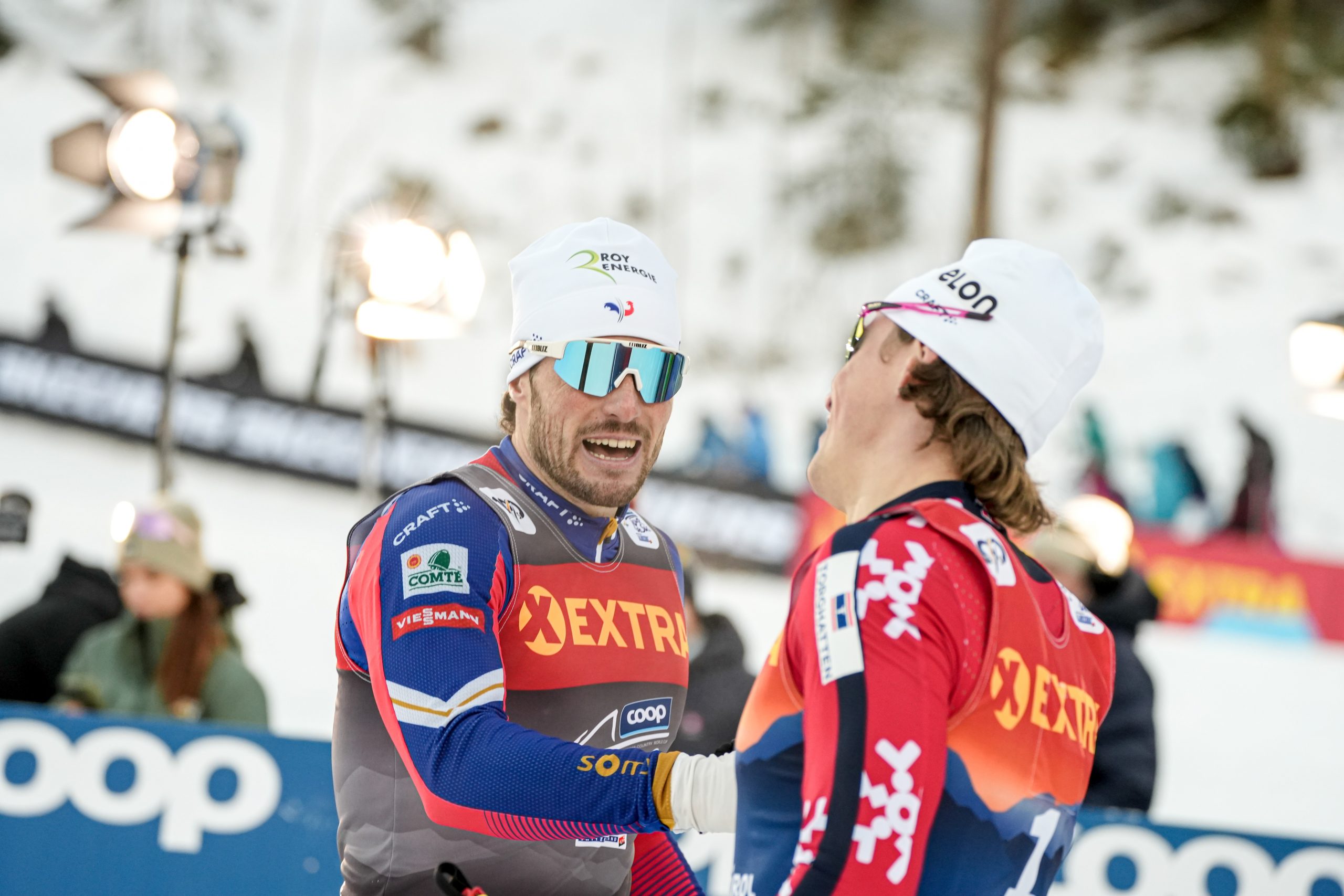
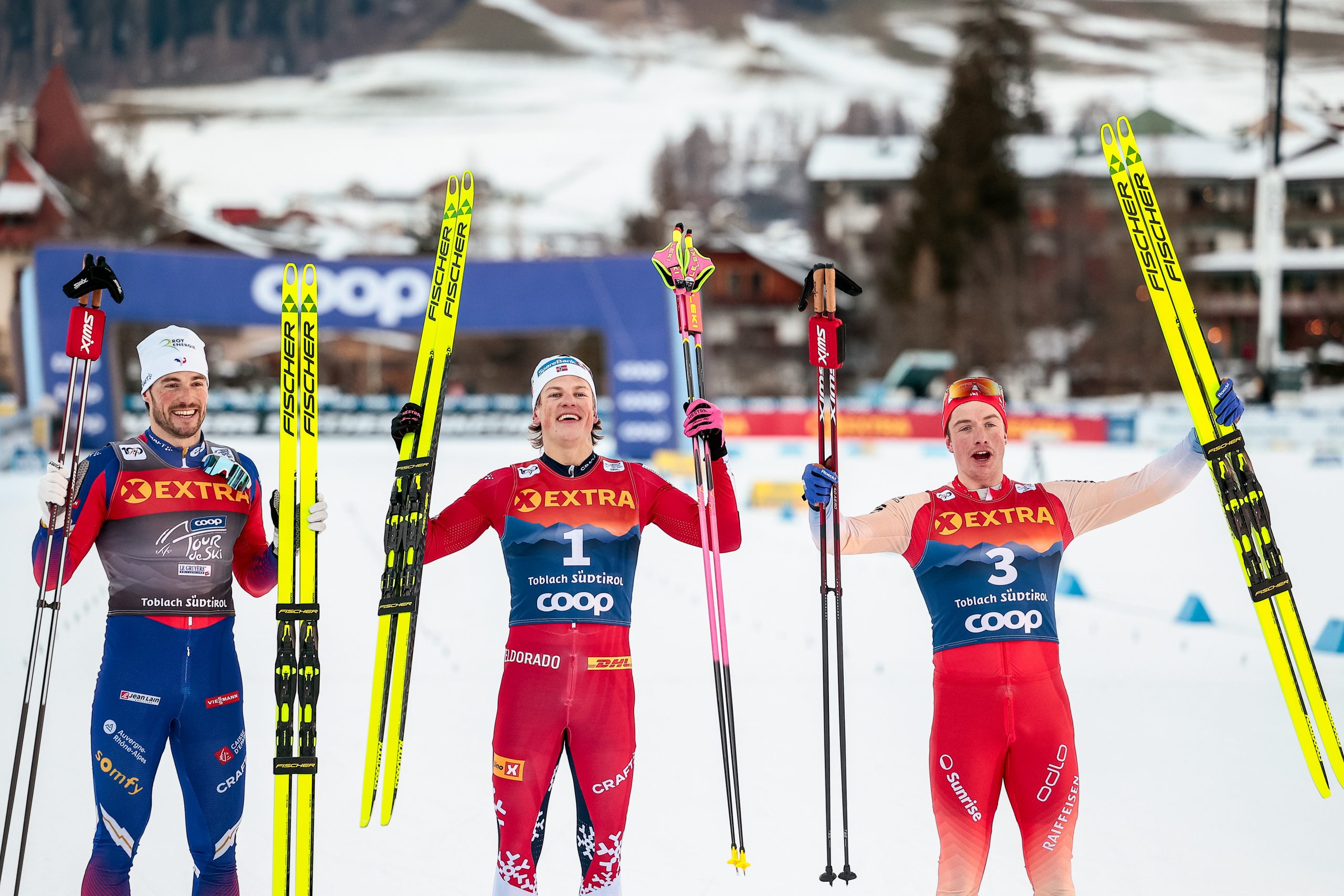
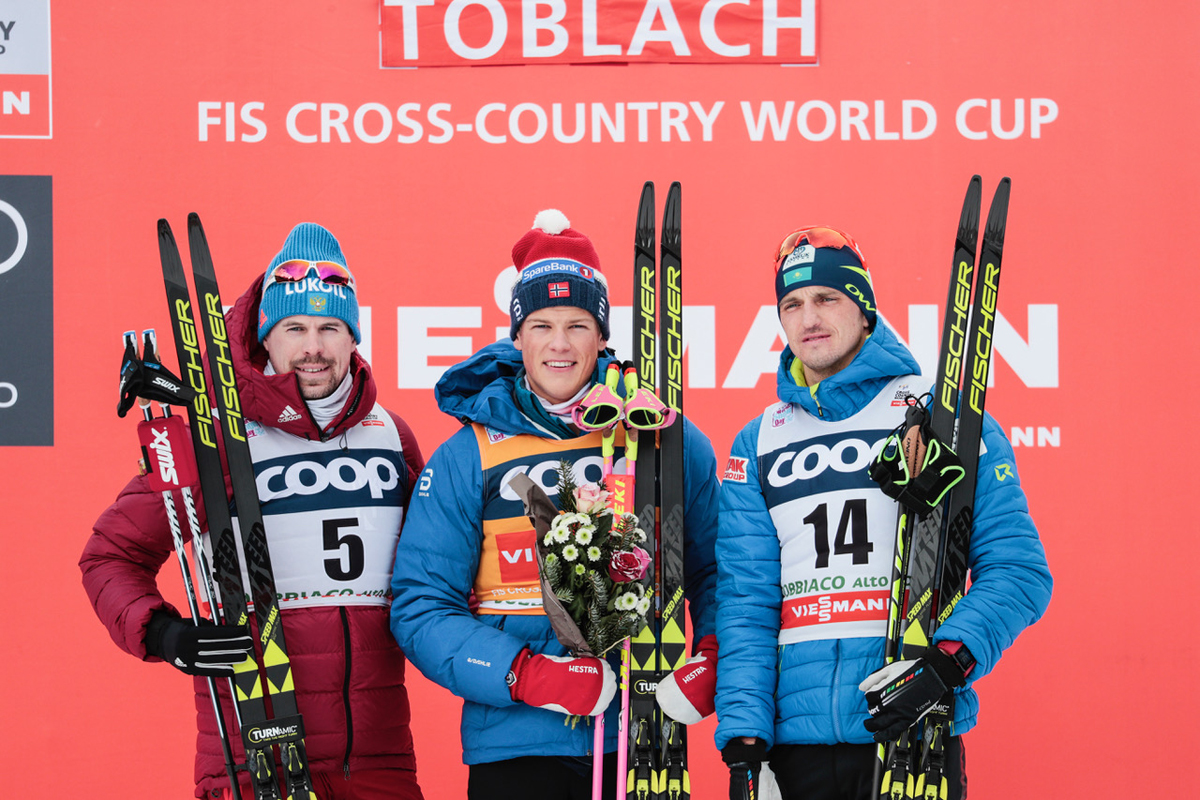
Benjamin Moser (AUT), Gus Schumacher (USA), Lars Heggen (NOR), (l-r) celebrate the podium in Toblach (ITA). (Photo: Modica/NordicFocus)
A Stage That Felt Like a Debate About the Sport — and a Race That Still Had to Be Won
The Tour de Ski has always been, in some sense, a referendum. It’s a referendum on endurance. On recovery. On whether your season has enough structure to survive a week of high heart rates and thin margins.
This stage was something else too: a referendum on presentation. On whether cross-country skiing can be made to feel urgent to people who don’t already love it.
FIS itself framed Stage 3 as a premiere — the first Heat Mass Start event of its kind at the World Cup level — and pointed directly to fan engagement as a key motivation for the format shift.
Whitcomb put it less diplomatically in his own way: in his view, whether the format stays should be determined by what fans think, because “what the fans think dictates whether or not the sport survives in some regards.” He described traditional, interval starts as difficult for casual viewers — not because the racing isn’t real, but because it can be hard to feel the tension without context.
Wednesday’s format was designed to create tension. You could see the effort. You could see the decisions. You could see the finish. And then you had to wait — which is its own kind of tension — to learn what it meant.
But none of that changes the simplest truth of Stage 3: Schumacher still had to win it.
He had to be strong enough to take pulls. Smart enough to strategize and invest in cooperation. Calm enough to accept a plan that might have left him “10th in the heat” if the math demanded it. And then, at the end, he had to be fast in the most old-fashioned way — a finish that doesn’t care about format innovation, that doesn’t care about start times, that doesn’t care about how clever you were at 1.7 kilometers.
It cares only about what you have left when the line is close enough to hurt.
Three nations working together, one shared podium for Benjamin Moser (AUT), Gus Schumacher (USA), Lars Heggen (NOR), (l-r) in Toblach (ITA). (Photo: Modica/NordicFocus)
The Tour Moves On — and the Final ‘Hill’ Looms
Schumacher, already looking forward, kept his gaze where Tour de Ski veterans always keep it: on what the next stage demands.
“Those time gaps are tight,” he said. “I’ll keep taking it day by day and especially try to ski well tomorrow and keep in mind how important that hill climb will be.”
That’s the Tour in one sentence: tight gaps, day by day, and a hill that doesn’t care how good you felt yesterday.
The new 5K heat format gave the Tour a jolt of spectacle, yes — but it also gave us something more interesting: a day that rewarded not only fitness, but the willingness to race in a way that made sense for the structure of the event.
Schumacher understood it. His heat executed it. The numbers validated it.
And now the Tour moves on with the usual debts: tired legs, shifting standings, and the knowledge that in a stage race, the best days are never purely celebrations. They are also investments — and the bill always comes due tomorrow.
Feature stories like this one take time, access, and care to produce. If you value thoughtful storytelling and independent ski journalism, please consider becoming a Voluntary Subscriber. Your support directly fuels the work we do to cover the people, places, and moments that make our sport special.
This coverage is made possible through the generous support of Marty and Kathy Hall and A Hall Mark of Excellence Award. To learn more about A Hall Mark of Excellence Award, or to learn how you can support FasterSkier’s coverage, please contact info@fasterskier.com.
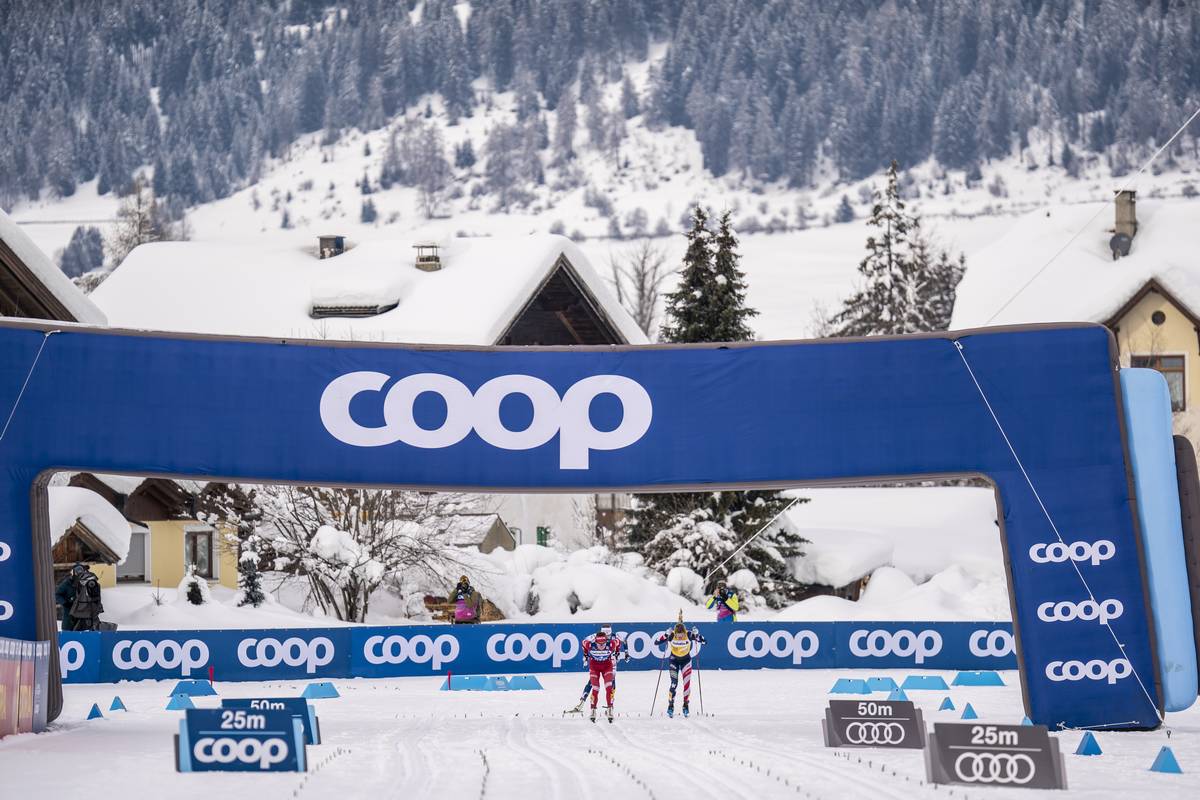
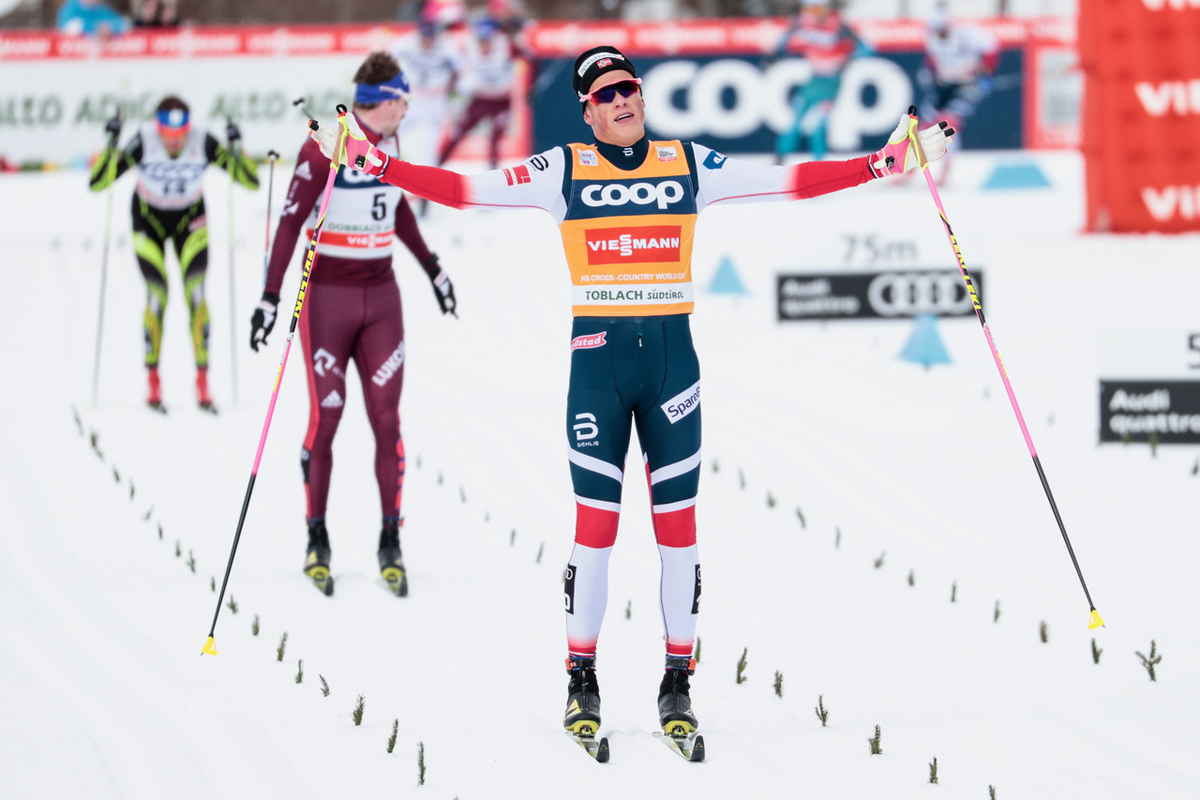
World Cup Sprinting can be a bit of a blur, but it’s typically easy to spot Johannes Hoesflot Klaebo (NOR) in his yellow World Cup leader’s bib. As many expected, Klaebo would finish the day with the win in Toblach. Photo: Vanzetta/NordicFocus)
Federico Pellegrino (ITA) has been a longtime rival, but always in silver medal position. Erik Valnes (NOR) has been a consistent challenger, but only found his way to the front once. Alexander Bolshunov (RUS) snatched an opportunistic Sprint win in Ruka a few years ago, but Bolshunov’s career seems to have ended with Russia’s ban from World Cup competition. Edvin Anger (SWE) declared himself the heir apparent, but he’s never been able to prove it. And Lucas Chanavat built a career on latching his ski tips to tails of Johannes Hoesflot Klaebo (NOR). One time—just two weeks ago in Davos—Chanavat managed to finish in front. But it was more an aberration than a changing of the guard.
If Klaebo needed a wake-up call, he got one in Davos where he failed to advance beyond a World Cup Sprint quarterfinal for only the second time in his unbelievable career. And the only other time he failed to advance? That was in his very first World cup start all those years ago in 2015. Since that inauspicious debut, he’s been all but unbeatable. It’s not exactly been an uninterrupted string of wins, but it has been a long and unprecedented display of dominance that appeared likely to continue through the Olympic Winter Games next month in Val di Fiemme. It appeared likely until two weeks ago in Davos, that is . . .
In Davos, it wasn’t as though any single skier managed to solve, undo, and finally dethrone Klaebo. But Klaebo’s unbelievable string of World Cup Sprint wins ended, nonetheless. He got uncharacteristically boxed in during his quarterfinal, slipped (and nearly fell) in the final turn before the finish, and found himself fourth in the heat and 17th on the day—not exactly Klaebo-like finishing numbers. Just like that, the amazing Klaebo-streak had ended.
In Toblach this morning, it appeared that Klaebo had shaken off the dust of his Davos failure, and was prepared to reassert himself in World Cup Sprinting. He made sure to ski at the front, setting a fast pace in both his quarterfinal and semifinal but in a manner that did not show his true dominance. In the final, he rocketed away from his rivals on the final uphill, and coasted across the line unchallenged by his podium mates, Lars Heggen (NOR) and Oskar Oppstad Vike (NOR). That’s the tactic we recognize; that’s the result we expect.
Lucas Chanavat (FRA) took the win two weeks ago in Davos. He appeared less sharp in Toblach, finish the day in fifth. (Photo: Vanzetta/NordicFocus)
Sprint Heats
It began as a big day for the Americans with four skiers qualifying for the heats. The day’s second fastest qualifier, Schumacher would advance into the semifinal, ultimately finishing 11th. Ben Ogden would finish the day 13th, Kevin Bolger 15th, Jack Young 19th.
Schumacher advanced into the semifinal by driving the pace in his heat. He was joined at the front by Benjamin Moser (AUT) who added to the pace , and managing to gap perennial challenger, Erik Valnes (NOR) in the process. Schumacher held on for second in the heat, good enough to advance to the semifinal. Valnes would find himself dodging fallen skiers on the final uphill, and would finish behind Schumacher in third (though not fast enough to advance as a lucky loser).
Ogden and Young both chose the third quarterfinal heat, where they would find themselves lined up alongside Harald Oestberg Amundsen (NOR) and Valerio Grond (SUI). The heat was led out quickly by eventual winners Grond and Amundsen. Ogden and Young worked gamely to match the leaders’ pace, ultimately finishing third and fourth in the heat. their times were not fast enough to claim lucky loser positions.
Like his American teammates, Bolger found himself outside the advancing standard, finishing his quarterfinal heat a closely contested fourth.
Klaebo has been beaten in Sprints before—often due to his own carelessness. He was beaten straight-up by Erik Valnes (NOR) in Ruka a couple of years ago, and he was famously pipped at the line by Alexander Bolshunov (RUS). But to see Klaebo flushed out of a quarterfinal, fans will need to flip results pages back through the years all the way to Klaebo’s very first World Cup start. Rarely has the World Cup field seen Klaebo running scared, but in the quarterfinal in Val di Fiemme he appeared to be leaving nothing to chance. Klaebo led from the gun, powering up every uphill, and easily keeping all his rivals at bay.
Sprint Semifinals
Klaebo, Chanavat, Anger, Pellegrino, Valerio Grond (SUI), and Janik Riebli (SUI) lined up in a star-studded semifinal. Klaebo shot forward to control the pace, Pellegrino settled into the middle, Chanavat trailed. Klaebo would lead through the line, but did not show enough speed to definitively drop Grond and Chanavat who followed him across the line.
The second semifinal was defined by the presence of four Norwegian race suits, led out by Ansgar Evenson. Schumacher found himself left behind at the start; he would bide his time at the rear of the pack, looking for an opening that never materialized. From a crowd of Norwegians vying at the front, Vike and Heggen emerged to advance to the final.
Johannes Hoesflot Klaebo (NOR) reasserted his dominance in Toblach during Stage 1 of the 2026 tour de Ski. (Photo: Modica/NordicFocus)
Sprint Final
Klaebo, Grond, Heggen, Chanavat, Riebli, and Heggen, and Vike lined up at the start of the Sprint final. Klaebo went straight to the front—perhaps reluctant to let himself fall into contact with lesser mortals in the middle of the pack. Chanavat dropped straight to the rear, seemingly eschewing his follow-Klaebo tactics from so many heats and finals past. Chanavat would drive forward on the uphill, to which Klaebo responded with a strong acceleration that served to keep Vike in his place. On the final uphill, the skiing world returned to normal—Klaebo streaked away, establishing a gap he would hold easily through the finish. His unmatchable effort gapped Vike, and snapped the string to Chanavat who would fade to fifth. Klaebo was back atop the podium again, followed by Heggen and Vike.
Though it’s not very often that Klaebo shows his cards—or his emotions—it was apparent that he raced today harboring unwelcome memories of his recent failure in Davos.
“I’ve been thinking about this race now the whole Christmas,” said Klaebo in post-race interviews. “It’s good to finally be back on the top again.”
Two weeks ago, Klaebo’s defeat in Davos felt more like a blip than a changing of the guard. In Toblach, today, Klaebo proved he still has the speed, and the tactics, and the pedigree to dominate World Cup Sprinting.
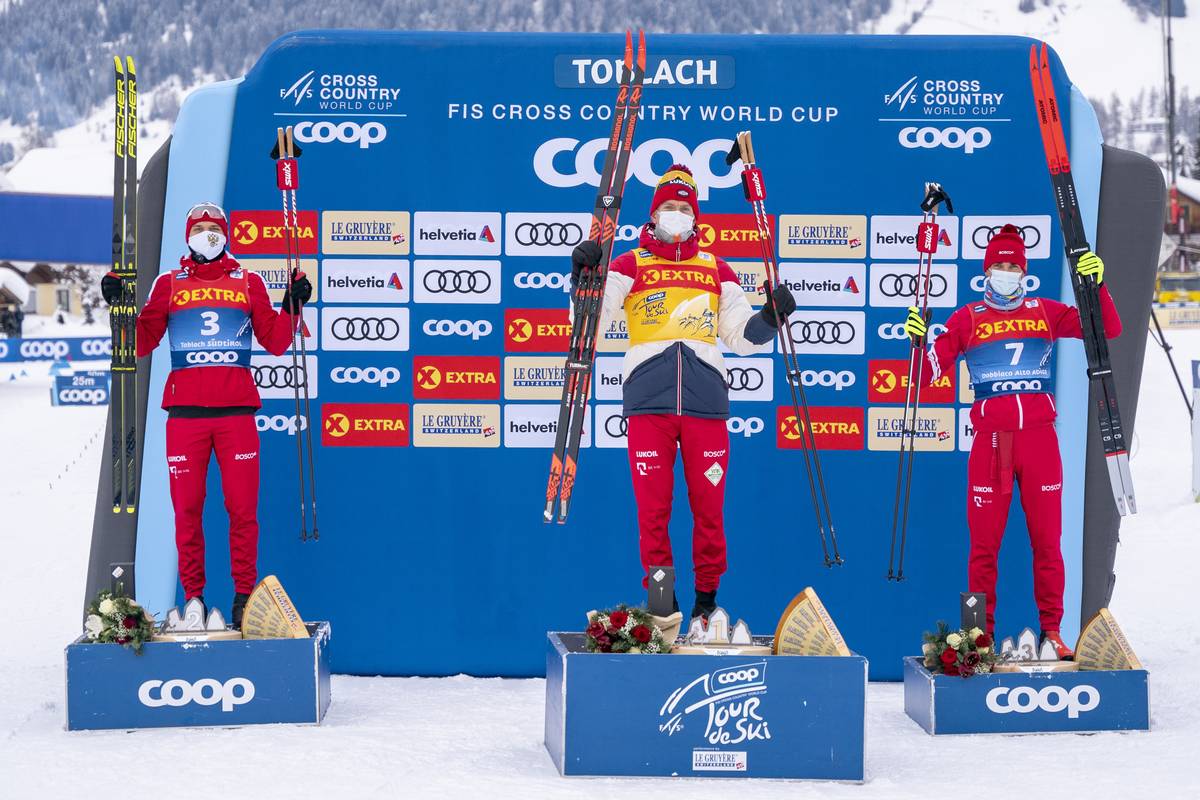
Steps in the right direction: Lars Heggen (NOR) and Oskar Opstad Vike (NOR) edge dcloser to Olympic selection with their podium performances in today’s World Cup Freestyle Sprint in Toblach. (Photo: Modica/NordicFocus)
Love Stories Like This? Help Keep Them Coming.
Feature stories like this one take time, access, and care to produce. If you value thoughtful storytelling and independent ski journalism, please consider becoming a Voluntary Subscriber. Your support directly fuels the work we do to cover the people, places, and moments that make our sport special.
World Cup skiers get a holiday break from the grind of the World Cup tour . . . but it’s up for debate just how much rest they get during that break. It’s gotta be tough to relax when the horizon is clouded by the impending approach of the Tour de Ski, possibly the most daunting challenge that skiers will face all season. As a ski-fan, I just adore the Tour de Ski—day after day of racing and competition and drama, staged for the edification of the viewing audience. If I were a World Cup skier, I think I might feel differently, especially during an Olympic year.
Over the span of eight exhausting days—Dec 28-Jan 4—Men’s and Women’s fields will each race six events from Sprints to Interval Starts to the the unbelievably steep and seemingly endless climb up the Alpe Cermis. Nearly insurmountable leads in FIS World Cup points are amassed by the winners of the Tour de Ski; most years, the eventual winner of the World Cup Overall Crystal Globe is the same as the winner of the Tour de Ski . . . except in those seasons—like 2025—when the Tour winner skips most of the other World Cup races in anticipation of a larger prize like the World Championships or the Olympics. In 2026, most of the primary Olympic contenders have also signed up for the Tour de Ski.
Tour Streaming
As has been the case for numerous years in a row, North American viewers can stream the 2026 Tour de Ski on skiandsnowboard.live. The website adjusts to the home-area of viewers, so the broadcast time on the thumbnail corresponds to your local viewing time. Yes, the races stream in brutally early time slots, especially for viewers on the west coast. Get up early anyway . . . it’ll be worth it.
The championship of the Women’s Tour de Ski is likely to be contested among Jessie Diggins (USA), Frida Karlsson (SWE), Heidi Weng (NOR), and Astrid Oeyre Slind (NOR), and Norwegian upstart Karoline Simpson-Larsen (fresh off her recent win in the World Cup 10 k Interval Start in Davos). Certain contenders are choosing to stay home—Linn Svahn (SWE), Jonna Sundling (SWE)—thus opening up additional spots in Sprint heats for all-rounders who might not normally advance on Sprint days.
Johannes Hoesflot Klaebo’s prowess in Sprint events—and his competitive resilience in Distance events—makes him nearly impossible to beat in the race for the Crystal Globe. Even if he does not win the Tour—even if he drops out of the Tour—he’ll likely secure another Overall Crystal Globe if he remains healthy and stays on the World Cup Tour. Though if the Olympics deliver him another amazing week like the one he constructed at last year’s World Championships (where he won an unprecedented six out of six races), Klaebo just might sail off into a well deserved sunset, leaving World Cup scraps for other contenders to scrabble over.
The 19th edition of the Tour de Ski is here once again! While many athletes have taken a conservative start to the season, skipping early races to focus on preparations for the World Championships in Trondheim later this winter, the excitement for the Tour remains high. With seven stages packed into just nine days — and rest days on Monday and Thursday — the Tour has historically seen relatively few skiers complete the entire event. However, many of the sport’s top athletes hope to compete all the way through, chasing bonus points and the opportunity to solidify their positions as World Cup leaders in this important week of racing.
The Tour kicks off in Toblach, Italy, with a skate sprint as the opening event. The first four races will take place in Toblach before athletes transition to Val di Fiemme for the final three races on Friday, Saturday, and Sunday, marking the Tour’s conclusion.
This course demands sharp strategy, precise lines, and well-timed pacing to finish in the front of each heat. Athletes must not only position themselves effectively on the uphills but also navigate the downhills skillfully, taking optimal lines to slingshot themselves around both the trail’s corners and their competitors. Completing two laps on this challenging course requires a careful balance of power and tactics. With the finishing stretch emerging from a downhill turn, positioning becomes crucial long before the finish line itself.
Johannes Hoesflot Klaebo (NOR) with his trademark coast into the finish of the individual freestyle sprint in Toblach (ITA). (Photo: NordicFocus)
The heats followed a familiar marching pattern to those we’ve already seen this season: with Johannes Hoesflot Klaebo (NOR) and Lucas Chanavat (FRA) skiing synchronously at the start of each heat to control pacing and claim podium positions together. Janik Riebli (SUI) followed closely behind, slipping into the final as a lucky loser, with the road paved to a podium position after competitors Ben Ogden (USA) broke a pole and Valerio Grond (SUI) slipped during the final ascent. Klaebo earned, in what appeared to be an easy win, his 95th sprint victory. “In the end, I’m really satisfied, and it’s the perfect way to start the tour,” he said upon finishing the race.
Four Americans advanced to the heats, with Ogden finishing 6th, Gus Schumacher, 10th, JC Schoonmaker, 14th, and Jack Young, 17th. Zanden McMullen just barely missed qualification, finishing 36th. On the Canadian side, Antoine Cyr (56th) and Olivier Leveille (60th) completed the race but did not qualify for the heats.
Men’s Sprint Quarterfinals
In the first heat, Klaebo and Chanavat dominated from the start, skiing side by side in a controlled performance that seemed almost choreographed, easily securing their spots in the semifinal heats. Other athletes vied for these positions, Emil Danielsson (SWE) tried to pass through the middle of Klaebo and Chanavat, who accelerated and maintained their position in front. French skier Remi Bourdin also approached the pair in front over the final ascent around two minutes into the race, though could not surpass Chanavat and finished third in the heat.
In the second quarterfinal heat, Ogden battled Riebli head-to-head for the leader position, both holding off sprint specialist Richard Jouve (FRA). The two exchanged leads throughout the race, with Ogden making a decisive move around the inside of the final turn. This maneuver set him up for a clear finishing sprint, allowing both Ogden and Riebli to advance together to the semifinals.
Schumacher took an early lead in the third heat, facing challenges from Niilo Moilanen (FIN) and Davide Graz (ITA). After a minute and a half, Schumacher was able to solidify himself in front, accelerating through the descent to establish a small gap ahead of the field. His competition narrowed again in the final stretch, though Schumacher maintained his position in front to advance to the semifinals alongside Moilanen. Meanwhile, Evan Northug’s race took an unfortunate turn as he broke a pole just out of the gate, forcing him to pull to the side of the trail and effectively ending his chances of progressing. Currently ranked 3rd in the overall sprint standings, Northug is a strong sprinter, but this setback could jeopardize his Tour prospects, especially given his relatively weaker performances in distance disciplines.
Federico Pellegrino (ITA), front, Edvin Anger (SWE), left, and Jack Young (USA), right, lead their quarterfinal heat. (Photo: NordicFocus)
Young battled against Federico Pellegrino (ITA), 12 years his senior, in the fourth quarterfinal together with strong sprinters Edvin Anger (SWE) and Erik Valnes (NOR). Valnes established an early lead out of the start, joined by Pellegrino. Midway through the race, Anger accelerated into the lead, but the top three continued to trade positions as the heat progressed. Young stayed right in the mix, maintaining a strong position near the front of the pack.
“I started as hard as I could and put myself in position near the front of the heat. After that, there wasn’t much I could do to get around Pellegrino or Anger,” Young explained. After being boxed out in the inside of the finishing stretch, Young’s chance of qualification was low but chances at a lucky loser position seemed high, ultimately missing qualification by 0.3 seconds. “The only thing I’m wondering about is whether I could have swung out wide on the turn into the finish instead of checking my speed to get the inside,” Young reflected after the race, “that could have given me the three-tenths necessary to get a lucky loser spot.”
Finally, Valerio Grond controlled the pace of quarterfinal five through much of the race, battling closely against Finland’s Lauri Vourinen. Italy’s Giovanni Ticco briefly challenged Grond for the lead initially but soon fell back, ultimately finishing last in the heat. Meanwhile, Schoonmaker stayed in the middle of the pack, focusing on “bringing good momentum into hills,” and positioning himself strategically to contest the leaders in the final sprint. Although he crossed the line in third, initially appearing poised to advance to the semifinals as a lucky loser, subtle time adjustments narrowly eliminated him from contention.
Men’s Sprint Semifinals
Johannes Hoesflot Klaebo (NOR), Lucas Chanavat (FRA), and Ben Ogden (USA) racing out of the stadium. (Photo: NordicFocus)
A quick look at the start list made it evident which semifinal was likely to produce the fastest times—and from which the lucky losers would emerge. Klaebo and Chanavat were set to face off again in the first heat, joined by Ogden, Riebli, and Valnes, all formidable sprinters capable of pushing Klaebo to reconsider his race strategy.
The heat unfolded precisely as would be expected, mirroring the quarterfinals. Klaebo and Chanavat led the pack side by side, skillfully controlling the pace around the course before Klaebo pulled ahead to take first at the line. Ogden positioned himself right behind them, confident that the speed of this heat would give him a chance at entering the final as a lucky loser. Ogden raced confidently and quickly, taking tight lines around the course and crossing the finish line in third, just behind Chanavat in second. The real drama came down to Ogden and Riebli, sprinting neck and neck to the finish, successfully securing lucky loser positions.
The second semifinal lacked a clear favorite, leaving the top two positions wide open for the competitors to claim. Richard Jouve and Federico Pellegrino both have a strong history in skate sprints, while Valerio Grond has recently delivered impressive results in the freestyle sprint discipline. Meanwhile, Anger, Vuorinen, and Moilanen have consistently been contenders in sprint finals this season.
Ultimately, this semifinal—perhaps aware that the lucky loser spots had already been secured by the first heat—turned out to be one of the slowest of the day. With six skilled sprinters, strategic positioning within the pack became the decisive factor in determining who would advance. Grond skied steadily from the start, moving into the lead later in the short race. In a close finish, Jouve narrowly edged out Pellegrino to claim the second qualifying spot for the final.
Men’s Sprint Final
Again, Klaebo and Chanavat took an early lead, executing their well-rehearsed, almost synchronized strategy to control the pace of the heat before battling it out at the finish line—a contest Klaebo typically wins.
While their dominance played out as expected, the race for the top three positions took an unexpected turn. Ogden broke a pole early on, losing contact with the leaders as they rounded the first corner. Moments later, Grond’s skis slipped on the uphill through the stadium, causing him to fall and take Jouve down with him. With three competitors effectively out of contention, Klaebo and Chanavat remained unchallenged at the front while Riebli skied through the chaos to contend for the third podium position.
Johannes Hoesflot Klaebo (NOR), right, and Lucas Chanavat (FRA), left, congratulating each other after the races. (Photo: NordicFocus)
Ogden recounted the chaotic events of the final to FasterSkier after the race. “I was trying to weasel in behind Lucas [Chanavat], and someone behind me wasn’t thrilled about that,” Ogden reported, describing the battle for position that ultimately led to his pole snapping. “I was kinda able to ski with one pole, but then the exchange was incredibly hectic, and I tripped myself twice, and there was little to no hope after that.” Once Grond fell too, the two of them competed head to head for the remaining positions.
Despite the disappointing result, Ogden found pride in his approach to the heats. “I’m most proud of my confidence today in the heats,” he shared. “I was more nervous today than I’ve been for a while because I’ve got some memories.” He was referring to his breakthrough performance last season, which included his first-ever sprint podium on the Toblach course. “I feel like I handled it really well—skied smart and never got too frantic. It’s an unfortunate way to end after all that work, but what can you do? It’s part of the deal.”
As for Klaebo, his victory came as no surprise, continuing his dominance in sprint racing this season. While another win may feel routine for the seasoned sprinter, Klaebo expressed excitement with his performance. “In the end, I’m really satisfied. It’s the perfect way to start the Tour,” he said with a smile.
With only Stage 1 of the Tour completed, Ogden is focused on the long week ahead. “My goals are to manage my energy as best as I can and make it all the way to the end!” he said, with his eyes on the Leader Bib. For now, fans can expect him to prioritize recovery, fueling for the upcoming races, and finding lighthearted distractions like browsing “clapped Jaguars and Porsches on eBay” to unwind between events.
World Championships is looming; Devon and Nat return to cover three days of racing — and two podiums from Jessie Diggins — in Toblach, Italy. We’ll finally get to the mailbag episode next week, so send in your questions if you’ve got ’em: devon@fasterskier.com and nat@fasterskier.com.
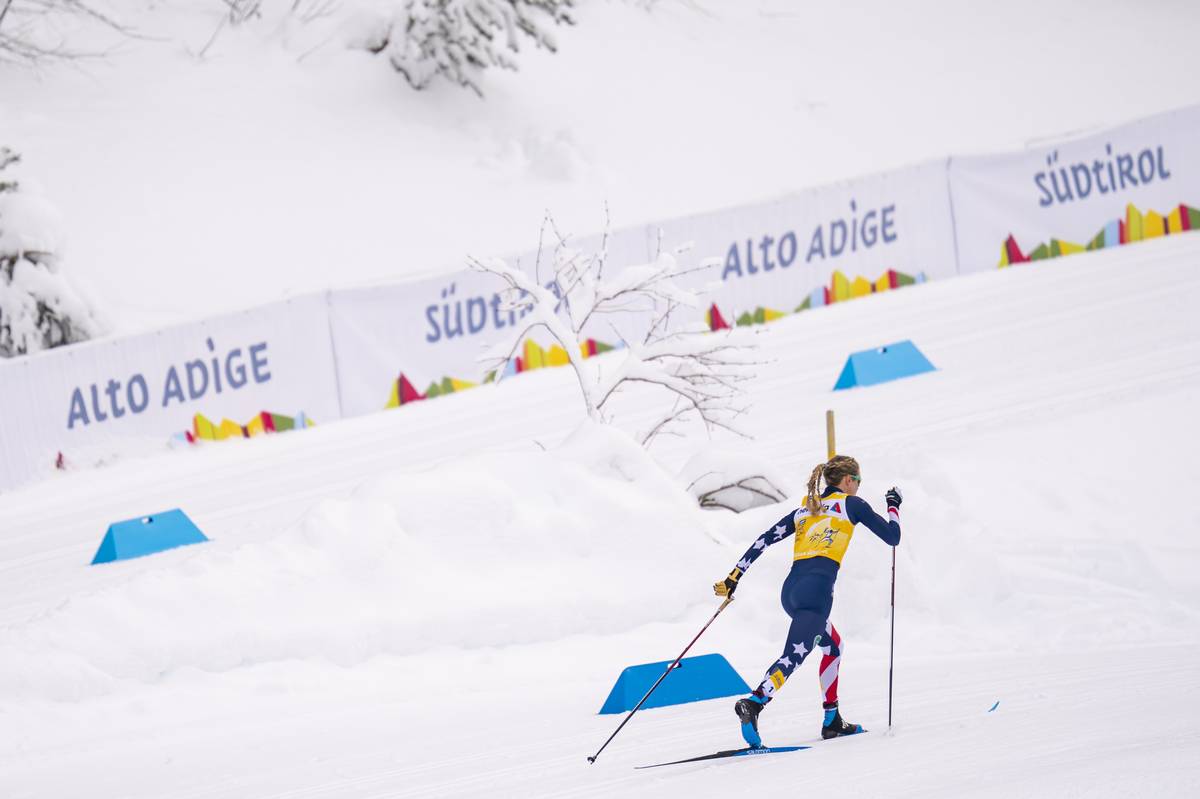
Jessie Diggins races in Toblach last weekend. (Photo: NordicFocus)
This World Cup coverage is made possible through the generous support of Marty and Kathy Hall and A Hall Mark of Excellence Award. To learn more about A Hall Mark of Excellence Award, or to learn how you can support FasterSkier’s coverage, please contact info@fasterskier.com.
The FIS World Cup calendar refers to this village as “Toblach,” but there’s more than one name for this wonderful, mountainous place. Located in the Sud Tirol of Northern Italy—a region suspended between Italy and Austria—this is a place where more than one language is spoken, more than one cuisine is served, and each town is known by more than one name (one German, one Italian). FIS may call it Toblach (the German-language version), but Italians, themselves, would likely call it “Dobbiaco.”
Today, the Italians earned the right to call it whatever they want, as the Italy I relay team of Dietmar Noeckler, Francesco de Fabiani, Simone Dapra, and Federico Pellegrino was victorious in the World Cup 4 x 7.5 k Relay (the first World Cup relay victory for Italy since 2006). They were followed across the finish line by second place Sweden (Eric Rosjoe, Calle Halfvarsson, Johan Haeggstroem, Edvin Anger) and third place Norway I (Sjur Roethe, Didrik Toenseth, Simen Hegstad Krueger, Harald Oestberg Amundsen).
Nordiq Canada did not enter a men’s relay team in Toblach, but the team from the United states (Hunter Wonders, Scott Patterson, Finn O’Connell, and Kevin Bolger) benefitted from a late race resurgence that saw them press forward to finish ninth.
Men’s 4 x 7.5 k Relay
Norwegian skiers may appear to have all the advantages, but each Norwegian competitor does suffer one distinct disadvantage . . . it’s the need to constantly beat the other Norwegian skiers. With the possible exception of current World Cup leaders Johan Hoesflot Klaebo and Paal Golberg, Norwegian skiers always seem to be auditioning for World Championship spots. With two Norwegian teams entered in today’s relay, that seemed like a situation likely to keep the pace high. That sort of aggressive pace-making allows a team like Italy to remain patient, to play defense, to mark the moves of more aggressive skiers, and to put their nation’s premier sprinter into the anchor leg so that he can unleash a sprint. The challenge for Italy, then, would be figuring out how to stay close while two teams of ambitious Norwegians slugged away at each other.
First Leg
Erik Valnes (Norway II) pushed the pace in the first classic leg, gapping the main field and establishing an 11 second lead at the exchange. Wonders had fallen off the pace halfway through the first leg, and was already 20 seconds behind by the 6.4 k checkpoint. By the time Wonders tagged Patterson to begin the second leg, USA was 33 seconds back in 11th place.
Iivo Niskanen (FIN) animated the second classic leg, pulling the chase group up to Hans Christer Holund (Norway II) and bringing the field back together at the halfway point. But the Norwegian teams weren’t done slugging it out just yet. (Photo: Modica/NordicFocus)
Second Leg
Inheriting Valnes’ lead from the first leg, Hans Christer Holund (NORWAY I) continued increasing the gap ahead of the chase group. Most skiers in the second leg would’ve looked to classic specialist, Iivo Niskanen (FIN) to instigate a chase of the leader, though Niskanen seemed content to linger at the rear of the chase group. The first half of Niskanen’s leg seemed to be more of a training ski for him, but at the end of his first lap he unleashed an attack, setting off in pursuit of Holund. Calle Halfvarsson (SWE) followed Niskanen, and the field began to string out. In only a few minutes, Niskanen was able to close the gap to Holund (leading De Fabiani, and Halfvarsson). Midway through the second lap, all the leaders had come back together.
Finn O Connell (USA) took advantage of a lull at the front of the race to re-establish contact with the chase group. His strong skiing in the third leg brought Team USA up to ninth place. (Photo: Modica/NordicFocus)
Third Leg
Norway returned to the front at the beginning of the third leg, led by Krueger who clogged the front and slowed the pace on narrower skate tracks that included the classic tracks of the earlier legs. World Cup skiers are certainly capable of skating right through the classic tracks, but at this point in the race all seemed content to follow a more moderate pace. Norway certainly had skiers fast enough to push the pace, but somehow a decision was made to slow things down. As it turned out, this was exactly the break in the action that the Italian team needed.
Ultimately, Krueger did markedly increase the pace up the main hill, surprising his Norway II rival, Iver Tildheim Andersson, who struggled to hang on to the rear of the lead group. Despite being a World Cup winner this season, Andersson is most likely being left out of Norway’s World Championship team. That may have inspired him to drive back into contention on the consequential downhill . . . he rocketed into second as the third leg neared its end. Italy fell off the pace, and the lead group had shrunk to six as the racers entered the stadium for the final exchange.
Anchor Leg
Norway I handed off a lead of a few seconds to the final skier, Amundsen. Norway II blew the exchange and exited the stadium at the back of the lead group. The cagey veteran, Pellegrino, was able to overcome the gap with which Italy had entered the final exchange; he maneuvered back into contention and settled into the lead group. With two 3.75 k laps remaining, Amundsen found himself in a not-unexpected predicament: a distance specialist surrounded by rival anchor leg skiers who are primarily sprinters: Edvin Anger (SWE), John Maki (FIN), Richard Jouve (FRA), and the always-dangerous Pellegrino.
Harald Oestberg Amundsen (NOR) led most of the anchor leg, hoping to tire the sprint specialists surrounding him. He’s followed by Edvin Anger (SWE), Federico Pellegrino (ITA) Richard Jouve (FRA) and Sindre Bjoernestad Skar (NOR), and Joni Maki (FIN). (Photo: Modica/NordicFocus)
Amundsen established a significant gap at the beginning of the anchor leg, making it appear as though the finish could be a foregone conclusion. Spectators have seen Norway pull away so many times in the final leg of a relay, why would this day be any different? But Jouve recognized the chance to ski France onto the podium if he, himself, were the only sprinter brave enough to drive forward. Jouve set off in lone pursuit of Amundsen, leaving other strong sprinters in the chase (Maki, Pellegrino, Anger, Skar) to consider their options, to evaluate their strength, and to decide whether or not sprinting for third would be satisfactory.
Jouve made contact with Norway (Amundsen), putting himself in position to contend in a final sprint (in which he would certainly be the favorite). Responding to Jouve’s presence, Amundsen seemed to sit up a bit, allowing the lead group to come back together with one lap remaining. Amundsen may have hoped to wear out the sprinters, but he had to know that one attack would not be enough. There would need to be more action in the final lap. The only real distance skier among the sprinters, Amundsen would need to go back to the lead: he’d have no choice. Amundsen went to work, gradually ratcheting up the pace, hoping to take the final sting out of the sprinters. Knowing how the final kilometers would certainly play out, Pellegrino marked Amundsen as Jouve came apart (his earlier efforts proving to have been too taxing to keep up with Amundsen’s late-race pace). Likewise, Maki and Florian Notz (GER) also lost contact with the leaders, and the final group had shrunk to four: Amundsen, Skar, Anger, and Pellegrino.
Who knows why he would have chosen to do so, but Anger—a sprinter whose best strategy would’ve been to let others lead, and sprint at the last moment—led out the sprint with nearly a kilometer left to race. Way too early, way too far . . . and Pellegrino was only too happy to let Anger do the work. The finish of the relay is the same as the sprint course, and Pellegrino knew perfectly well how to construct his finishing sprint. Accelerating up the final hill, Pellegrino surged around Anger, squeezing the Swede into a position that pinched the line available to both Norwegian teams, delaying them just long enough for Pellegrino to get away. It was; of course it only succeeded because of Pellegrino’s unique prowess as both a sprinter and a distance skier. It’s supremely difficult to be in that position, to have that energy left, to know how to do what Pellegrino did, and then to pull it off in front of his Italian fans.
The relay win in Dobbiaco represented the first Italian victory in a World Cup relay since 2006. It’s unlikely that Italy will be able to pull off a similar win at the World Championships in three weeks when Norway puts all its strongest skiers onto one team, but for the day in Toblach, the sun definitely shined on the Italians.
Pellegrino revealed how much thinking and calculating goes into racing at this level. He commented that the team needed to ski intelligently and defensively to remain in contention: “And they did,” he beamed. He commented that he hoped his skis would be fast enough: “And they were,” he grinned. “I only needed to stay with the strongest team in the world, and then be the strongest.” He was . . .
“Victory for us, victory for the whole Italian team,” De Fabiani was heard to say. Let the Italian celebrations commence . . .
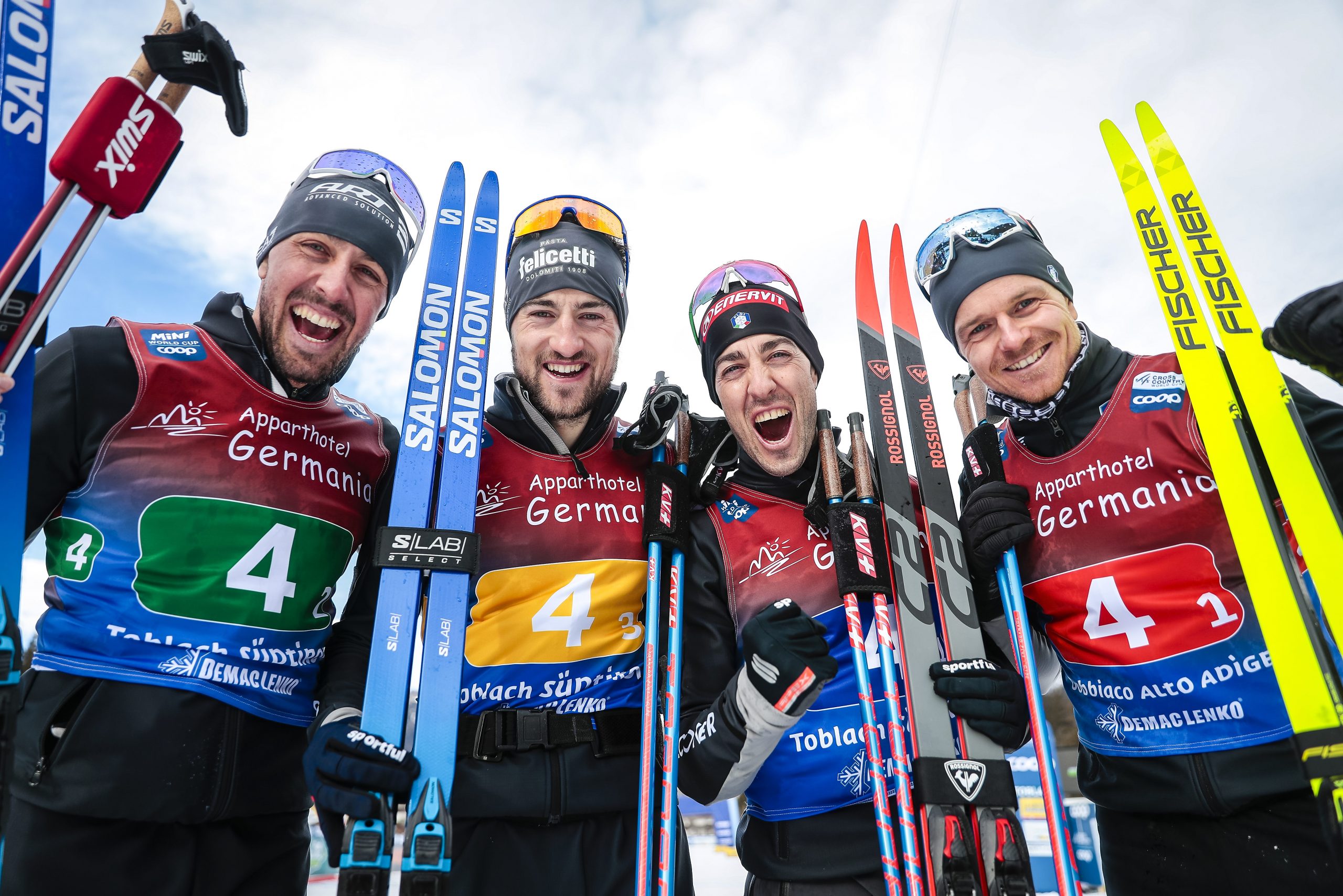
Toblach, Italy: Francesco De Fabiani (ITA), Simone Dapra (ITA), Federico Pellegrino (ITA), and Dietmar Noeckler (ITA) celebrate Italy’s first World Cup relay win since 2006. (Photo: Modica/NordicFocus)
While World Cup Finals were underway in mid-March in Falun, Sweden, a second contingent of top American skiers was lining up roughly 2,000 kilometers south to race in the OPA Cup Finals in Sappada, Italy. Located along the northern edge of Italy near the Austrian border, the small town is nestled among the spectacular, jagged massifs of the Italian Dolomites, roughly an hour’s drive east of Toblach, which typically hosts the final stages of the Tour de Ski. The team spent the week prior to competition training in Toblach, which features similarly spectacular views, along with the benefits of the delicious food and drink one might expect when traveling in Italy.
For those unfamiliar with the OPA Cup, it is an international race series featuring predominantly European athletes racing just below the World Cup level. The US Ski & Snowboard development program typically facilitates a trip to OPA Cup Finals to provide athletes who may not have earned World Cup starts the opportunity to experience high level competition overseas. Qualification is based on national rankings, beginning with those racing on the World Cup, and proceeding through the top domestic racers, depending on declines. Often, there is overlap between the teams for the FIS Junior/U23 World Ski Championship teams and the OPA Cup teams, which may conveniently allow some athletes to prolong their stay in Europe and attend both events.
“Generally the trip is geared toward athletes that are a bit older, who either have had World Cup starts or on track for that,” explained US Ski Team Development Team coach Greta Anderson.
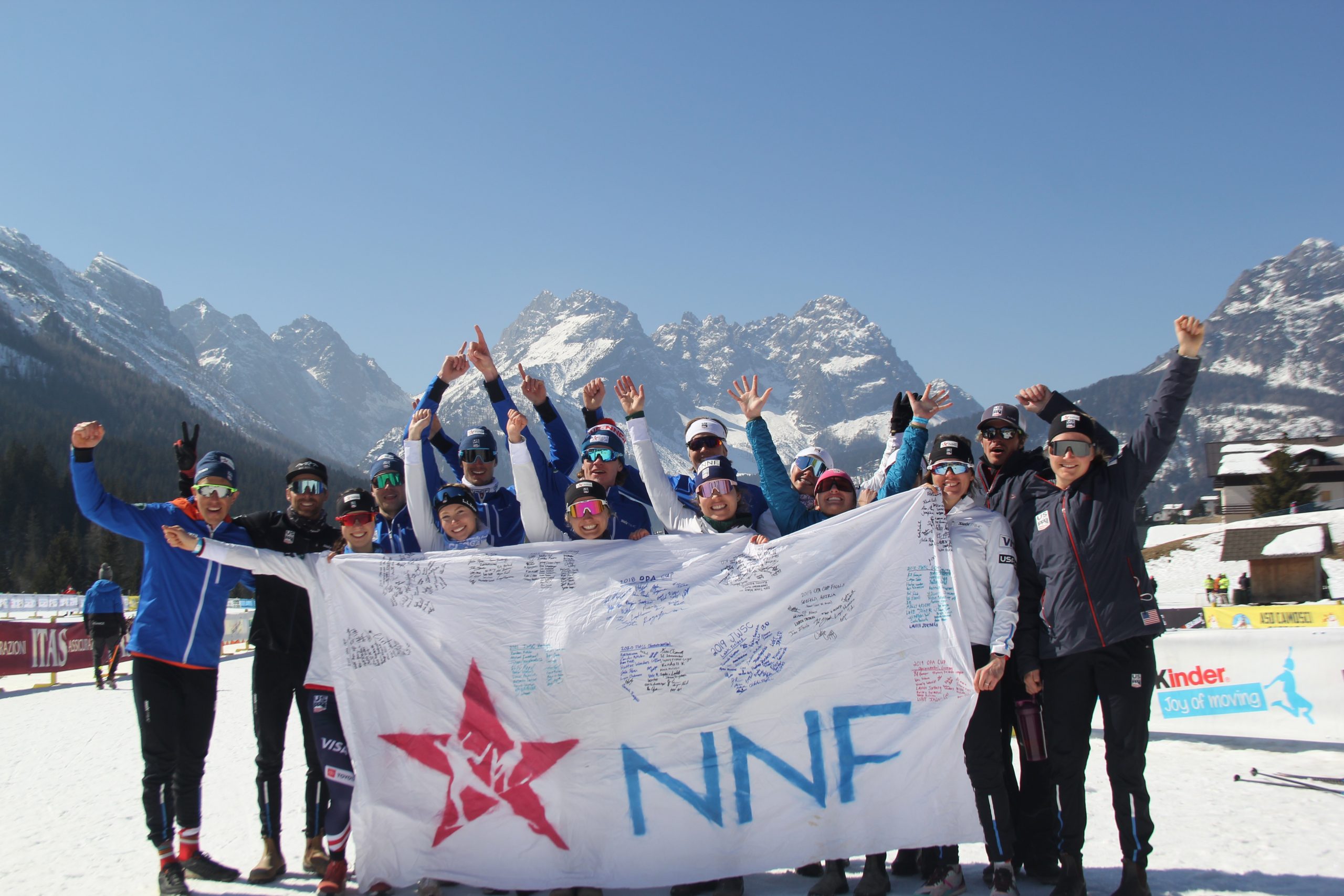
The American OPA Cup Finals team celebrates fast races and bluebird days in Sappada, Italy. (Photo: Bryan Fish/NNF)
Identifying it on its list of “Pillar Projects”, the National Nordic Foundation (NNF) helps subsidize the cost of the trip for the qualified athletes. The trip can accommodate up to 16 skiers, who are generally kept to an approximately even male to female ratio through the qualification criteria. This year, due to conflicting schedules and a number of declines, thirteen athletes attended, with nine women and four men.
In alphabetical order, the senior men included: Braden Becker (CGRP), Logan Diekmann (BSF Pro), Finn O’Connell (BSF Pro), Karl Schultz (SVSEF). Senior women included: Mariah Bredal (BSF Pro), Margie Freed (CGRP), Alex Lawson (CGRP), Hannah Rudd (BSF Pro), Becca Rorabaugh (APU), Lina Sutro (SMS T2), and Alayna Sonnesyn (SMS T2).
Finn O’Connell (2nd from L) alongside Braden Becker (L), Karl Shulz (2nd from R), and Logan Diekmann (R) at OPA Cup Finals
in March 2022. O’Connell was recently named to the US Ski Team for the 2022-23 season. (Photo: Alayna Sonnesyn)
SMS T2 teammates Alayna Sonnesyn and Lina Sutro show their love for Sappada during the Opa Cup Finals trip. (Photo courtesy of Alayna Sonnesyn)
This year, two U20 athletes headed from World Juniors in Lygna, NOR to Italy along with D-Team coaches Anderson and Bryan Fish: Kate Oldham (Aspen Valley Ski Club) and Annie McColgan (UVM).
“It’s pretty cool that we have more racers that are racing professionally or post collegiately than, I think, ever in the US, and they have more clubs and places to choose from,” said Anderson. “There were several athletes that, especially because racing was shut down on the East Coast last year and I happened to be in Alaska and wasn’t wasn’t traveling very much before I took this job, it was kind of the first time I’ve gotten to work with them, or the first time I’ve gotten to work with them in three or four years. So it was really cool to get to know Alayna Sonnesyn a little better and Lina Sutro a little better, and Margie Freed and Alex Lawson, who I’ve seen race many times, but it was the first time I’ve gotten to really work with them and get to know them. The same with Braden Becker and Karl Schultz… So it was a pleasure on the trip to get to work with some new athletes that have come through different development systems and are excited about and ready to make that next step. And this racing circuit is a really good opportunity for that.”
Anderson took the lead with organizing the trip and supporting athletes, working alongside US Ski & Snowboard Cross Country Sport Development Manager and long-time OPA Finals trip lead coach Bryan Fish. The wax support staff included BSF Pro Team head coach Andy Newell, former APU athlete and current staff member Peter Kling, and Jackson Hole comp team coach Jon Filardo.
US Ski & Snowboard Cross Country D-Team head coach Greta Anderson supports athletes during the Sun Valley SuperTour races in January. (Photo: Tobias Albrigtsen / @untraceableg)
Anderson identified the OPA Finals trip as a key development opportunity for a number of reasons: though perhaps lower pressure than World Cup, it’s a professional race circuit with small but competitively dense fields, athletes race aggressively and tactically in a style younger athletes who have not yet raced at this level may not have experienced, and it offers the opportunity for an athlete to dial in some of the small but significant factors details that support success adapting to a new and different environment following long international travel.
“Bryan’s been doing [the OPA Cup Finals] trip for a long time,” Anderson said. “So Peter Kling, who was on a coaching staff, and Becca Rorabaugh, they were like, ‘I’m pretty sure that we were on Bryan’s first ever OPA Cup trip.’ And it used to be that we started at the bottom of the results sheet and started looking upward for names. And right now we’re starting at the top and we don’t have to look very far down.”
In two days of racing, the US had seven top-10 finishes, with another set of athletes finishing well-within the top-20. Highlighting the US team was SMS T2’s Sonnesyn, who took third in the 10 k classic on Saturday the 12th, and won the 10 k skate the following day.
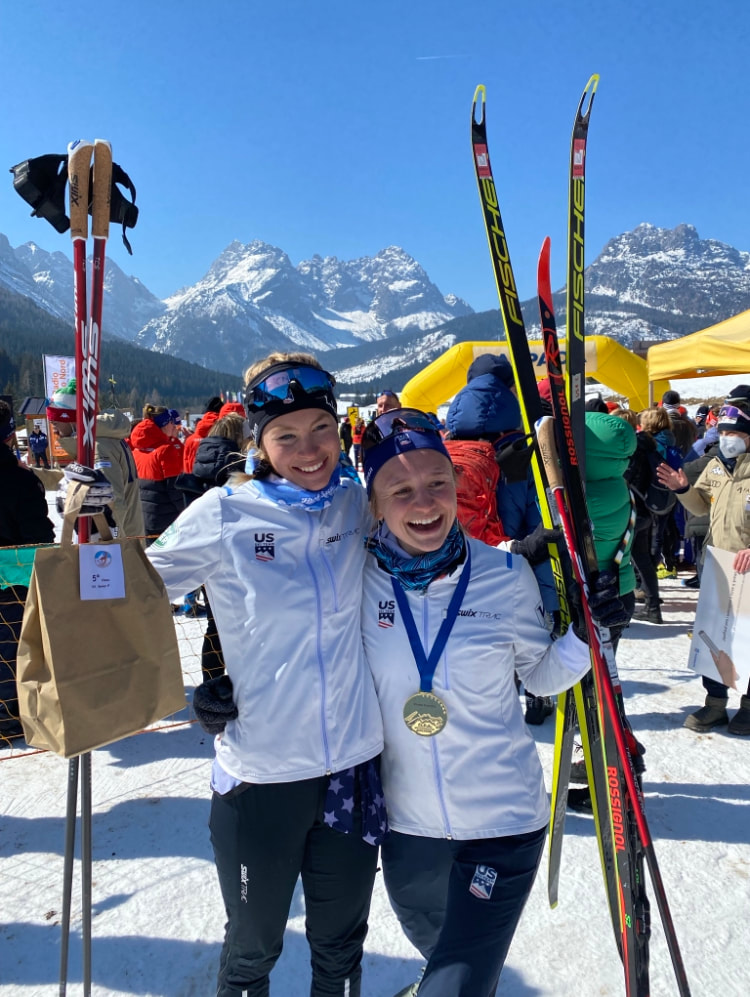
Alayna Sonnesyn (SMS T2) takes the win in the 10 k skate at Opa Cup Finals in Sappada, ITA, with Mariah Bredal (BSF Pro) finishing just behind in fifth. (Photo courtesy of Alayna Sonnesyn)
“It’s pretty special,” Anderson said of the performances in Sappada. “It’s awesome to get to see that. For Alayna to start a race and say like, ‘What’s my plan to try to win this?’ It’s not just, ‘Hey, we’re here to participate and learn,’ but ‘Hey, we’re here to participate and learn but also we’re going to try to win.’ And I think, with that comes — not only from staff but from racers — this level of professionalism. Okay, we’re going to select skis. We’re going to make sure we’re organized and in a good place. Where can we be? Where can we do feeds? How can we set you up to have the success you need to have?
“It just feels like a really good time to be an American ski racer.”
After winning two of the first five SuperTour races this season, and finishing on the podium in each of the others, Sonnesyn was offered starts at the Tour de Ski, where she hoped she could achieve strong enough international results to qualify for the Olympic Team. But these goals did not come to fruition; Sonnesyn struggled to find the same race sensations while on the World Cup and tap into the fitness she knew was still there, which was reflected in results below her expectations. She shared her disappointment openly on her blog and social media, providing a relatable and important example to her followers that the pro-skier journey is not immune to bumps in the road.
“My experience on the World Cup this year – it was quite demoralizing, to be honest,” said Sonnesyn in a call from the airport as she was on her way to SuperTour Finals in Whistler. “And then, after the Tour de Ski, I got COVID. And it just really put a damper on the whole winter for me. And I started questioning like, ‘Okay, am I fit? And I like, can I race? Well, like, what have I been training for? This is really bad timing with COVID, too.’ So I was just pretty down. But then I was able to have really great SuperTour races, back in January and February, and then to be able to race internationally again in Italy. It wasn’t a World Cup, but it was still very high level of racing. So to have it go so well kind of reaffirmed to me that I belong on the international stage. And I definitely needed that, a little bit, just to give myself more confidence moving forward and motivation as well. So I’m really excited about the races and how they went and what I did to prepare for them and kind of my mental attitude around them, too.”
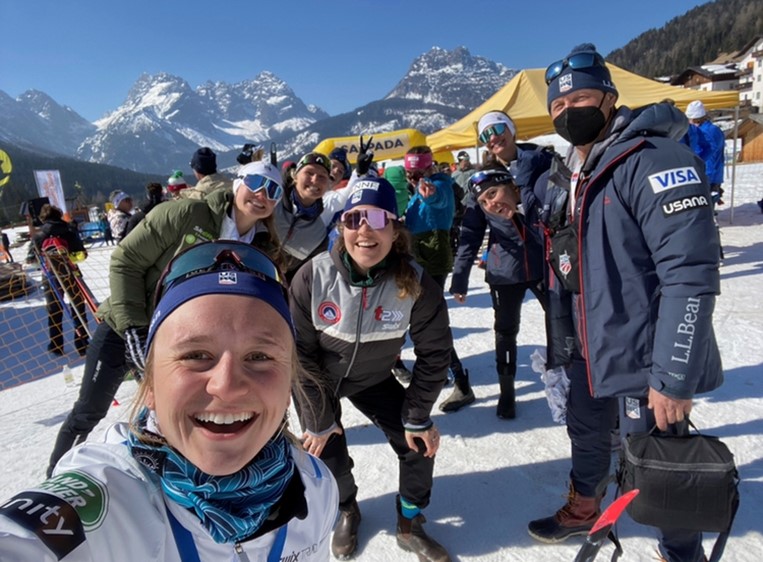
A selfie in Sappada: the American team prepares for race day at Opa Cup Finals. (Photo: Alayna Sonnesyn)
As she reflected on the trip and her experiences racing internationally over the last few seasons, Sonnesyn echoed Anderson’s sentiments about the progression of the American team at the event.
“Compared to my first OPA Cup trip, which was in 2018, I think there were maybe two or three top 10 performances. And they were exciting, but for the most part, it was kind of like, ‘We’re just here to get the experience. We’re not really sure what we’re doing.’ And I think that the way the US is developing right now, the way that new courses are being built in Cable or Duluth, or wherever it is – they are preparing us better for racing internationally. And I think that was shown in the results that we had in Sappada. And it was just so exciting during that 10 k skate on Sunday to cross the finish line in first, and then turn around and see a ton of my other US teammates come in right behind me. That’s not something that was happening four years ago. So I think we are really developing and that is a huge thanks to so many different people and so many reasons, but it’s exciting to see.”
Sonnesyn also spoke to the importance these international opportunities have provided her specifically, speaking from the perspective of what she dubbed a “bubble athlete” who has oscillated between World Cup and domestic racing over the last four seasons. She got her first World Cup starts in Quebec in March, 2019, and has been offered starts beginning in Period 2 each season since. Though this is a key stepping stone in the process toward consistent World Cup racing, she expressed that bubble athletes can have a challenging time planning seasons in advance and need to be prepared to adapt quickly to more frequent overseas travel.
“I think that every single experience that an athlete has going and racing internationally, and traveling, and competing at that higher level, it all adds up to be super beneficial and a great learning experience. For example, I have gotten really great at overcoming jet lag, which the first couple of international trips I went on, I had no idea how to handle. I tried my best to do what I could, but it’s hard. And also to know what little things you want from home, like after being in Europe for four or five weeks, what do you really want from the US?
“And then also, how do you work in a new environment? A lot of times, if you’re going over to the World Cup, sometimes you’re provided a wax tech or sometimes not, or you have to bring your own, but you have to be willing to work with whoever you get.”
Sonnesyn explained that on the Sappada trip, she had worked with each of the techs before, but on her first trip in 2018, it was her first experience working with those wax staff members. Given the importance of ski choice and wax, working together effectively is imperative to an athlete’s success, but it requires dialogue and practice.
“Being ready to communicate effectively with the staff, what do you need? How do you want your skis prepared? What do you need from a hotel? All those things seem like such small little details, but they really add up with the more experiences you have.”
Alayna Sonnesyn races in Oberstdorf, Germany during the 2021/22 Tour de Ski. (Photo: NordicFocus)
She also spoke to the differences in the style of racing between the US and her international experiences, and how a trip like Sappada better athletes for what they might encounter should they be offered a World Cup start down the line.
“When it comes to racing: the courses in Europe are very challenging and very technical. Downhills, uphills, flats – whatever it is, there’s a lot of it, and you have to be ready to go for it. And then the competitors are fierce. They know how to be aggressive in a race, and you have to know how to hold your own. So it just helps to have that experience to understand how you approach the race. How aggressive are you going to be? How are you going to pace the race? How are you going to handle others around you?”
With the highest levels of competition for our sport happening across the pond, it is easy to understand why opportunities like the OPA Cup trip provide an essential bridge for developing athletes. But it is not simply the facilitation of this trip that has led to marked improvement for the American team.
“I think we’re open to change right now,” Anderson said as she reflected on her key takeaways from the experience in Italy and her first season coaching the D-Team. “I think the US, in a year with COVID, and lots of challenges logistically and politically in the world, we handle those changes better than almost any other country does. And I think that’s really shown here.”
Alex Lawson skates to 7th in the 10 k skate during OPA Cup Finals in Sappada, ITA. (Photo: Bryan Fish / NNF)
While the OPA Cup crew was putting together a very solid day in the 10/15 k skate, the team of Rosie Brennan, Zak Ketterson, Scott Patterson, and Jessie Diggins had taken the win in the thrilling 4 x 5 k mixed relay in Falun. As the team in Sappada mingled near the finish to support the final racers as they skied through, Anderson said that a Swiss national team coach walked over and showed them the World Cup result on the phone.
Layered on top of the broader success at the OPA Cup Finals, Anderson expressed that this opened her athletes’ eyes to what might be possible for them in the years to come also. In particular, the Falun results of Zak Ketterson, a newcomer to the World Cup who ended his debut season with a 15th place finish in the 15 k skate and a mixed relay win.
“[The guys racing at OPA Cup] are like, ‘Oh, man, I beat Zak sometimes’, or ‘I’m right with him’, ‘I trained with him in college.’ The level of confidence that brings… ‘Maybe maybe I can do that too.’”
Moreover, Anderson expressed that this relay gold medal speaks to the equity of skiing in the US. “That we have good female athletes, and we have good male athletes, and we have a good balance of the two, and teams that are mutually supportive of each other,” she said. “Not every country has that.”
Boiling down the experience and her feelings as the season wraps up, Anderson concluded, “I have nothing but good things to say about our athletes right now. I’m really impressed with them. They handle the change better than anyone, and I think as a staff and from an organizational perspective, we’re trying to keep up, remove barriers, make sure they’re supported. And we’re open to trying new things, and it seems that we’re excelling in places where we’re willing to experiment and get our feet wet.”
Kate Oldham (AVSC) races the 10k classic during Opa Cup Finals in Sappada, ITA. (Photo: Bryan Fish / NNF)
Providing additional insights from the perspective of an OPA Cup Finals first-timer, FasterSkier also heard from U20 athlete Kate Oldham, who trains with the Aspen Valley Ski & Snowboard Club (AVSC) and competes for Middlebury College. Oldham took 11th place in both the 10 k classic and skate in the junior women’s category.
“Sappada was incredible,” Oldham wrote. “In congruence with the pre-camp in Toblach, the OPA Cup trip was unforgettable… My favorite ski to-date was on a long ski over the pass from Cortina to Toblach, stopping midway for trail side pastries and cappuccinos! Being with a group of older athletes was a valuable change from the World Junior trip because each team member brought new energy and experience to the group. Between that and the gelato shop next door to our hotel, the trip couldn’t have gotten much better!
Enjoying a cappuchino and pastry fueling stop while skiing from Cortina to Toblach. (Photo: Kate Oldham)
BSF Pro Teammates Hannah Rudd (left) and Mariah Bredal (right) sip cappuchinos while skiing from Cortina to Toblach during the Opa Finals pre-camp. (Photo: Kate Oldham)
“One of the things I think are most valuable about training and racing camps is the exposure to coaches and athletes outside one’s home team. For years I have been seeking out opportunities to attend regional and national camps that would bring new perspectives, training groups, and social dynamics to push me and help me adapt my own training method while making friends from schools and clubs all over the country. This winter I was lucky enough to have both my club coach and a group of skilled and passionate wax technicians/trip leaders selected from all around the US to lead the trips to Junior World Championships and OPA Cup finals. I know that over the six years I’ve been skiing competitively I have developed the competence to independently navigate high-level skiing events, but having techs to guide me through the process at the international level was extremely helpful, particularly when one of them I had worked closely with for those six years of training and racing.
“With new coaches come new perspectives. Another set of eyes, a different experience, or a new phrase can be all it takes for the pieces of new advice to click into place. Or maybe a coach has a different perspective on the bigger picture of skiing that resonates with you unlike the philosophy you previously knew… which of the infinitely wide range of mindsets in ski racing works best for you? Which one reminds you why you love ski racing? Which one helps you stay motivated through the hardest parts of the season when the last thing you want to do is get out the door for training? Which one eases the heartbreak of coming so close to a goal but falling short despite your hardest effort? Without a doubt, cross country skiing is a delicate balance of internal and external factors, but having great teammates and coaches like the ones I got to know and work with in Europe this winter is certainly a key ingredient to the recipe for success in the lifelong pursuit of excellence on the race course and off.”
The Tour de Ski’s Stage 5 cliff notes: A feisty race from both Diggins and Brennan. Diggins places third, Brennan fourth. In the men’s race, Schumacher paces to 15th, and a wall of red as Bolshunov is simply peerless.
The women’s Stage 5 podium: 06.01.2021, Toblach, Italy (ITA): Ebba Andersson (SWE) second, Yulia Stupak (RUS) first, and Jessie Diggins (USA) third, (l-r). (Photo: NordicFocus)Gus Schumacher, bib 14, on his way to 15th on the stage. (Photo: NordicFocus)
Alexander Bolshunov (RUS) celebrating his fourth victory out of five races in this years’ Tour de Ski. (Photo: Nordic Focus)
This World Cup coverage is made possible through the generous support of Marty and Kathy Hall and their A Hall Mark of Excellence Award. To learn more about A Hall Mark of Excellence Award or to learn how you can support FasterSkier’s coverage please contact info@fasterskier.com.
With Russia landing seven of the top eight positions yesterday, today’s 15 k classic pursuit started with a wave of red. Or as Maurice Manificat of France described it in a pre-race interview, “the Russian armada versus the French mafia.” Manificat (FRA) started in sixth and his teammate, Hugo Lapalus of France began in ninth, otherwise, the first thirty seconds of starters were all Russian. Under a ceiling of clouds, the racers wound up and down the snowy, forested hillsides, completing four laps of the 3.3 k course.
Bolshunov kicked things off with an eight-second head start over teammate Denis Spitsov of Russia (today’s pursuit start was based on yesterday’s finishes and not overall tour times), and a +1:15 lead in the overall tour standings. He began the day with three wins out of the four races already completed in this year’s edition of the Tour de Ski, and when the race had concluded he had increased that number to four wins.
Untouchable and in a class of his own, Bolshunov crossed the finish line in a time of 34:32.9. Only the occasional gasps for air as he passed the camera gave any indication that this was at all challenging for him. With seeming ease he stretched a lead of +8 seconds to +34.5 seconds by 3.3 k, and strode ahead of the first chase pack which coalesced early and was composed of six Russians and Manificat. At 6.6 k Bolshunov’s lead had widened to +45 seconds, and at 10 k the gap was up to +1:03.2.
On a solo flyer: Russia’s Alexander Bolshunov, Stage 5 of the Tour de Ski. (Photo: Nordic Focus)
In his post-race interview, Bolshunov explained through a translator, “I had two options, either you wait for the others and go like a mass start or you go as an individual start and since I had a good split to start I decided to go with the individual and it turned out very well.”
He also took the title of the fastest time of the day, +27.6 seconds ahead of teammate Evgeniy Belov. If there were lingering questions as to who the men’s winner of the 2021 Tour de Ski would be, today’s results should have cleared them up. Bolshunov now leads the overall by +2:06 ahead of Artem Maltsev of Russia.
Another Russian podium sweep,Ivan Yakimushkin, Alexander Bolshunov, Evgeniy Belov, (l-r). (Photo: Nordic Focus)
The chasing pack, comprised of Ivan Yakimushkin, Belov, Alexey Chervotkin, Andrey Melnichenko, Denis Spitsov, Maltsev (all of Russia) and Manificat, stayed together for most of the race. A stumble, fall, and broken pole near the top of a climb on the final lap took Maltsev out of the running (his second broken pole of the day). Spitsov also dropped, leaving the four remaining Russians and Manificat to battle for second and third position.
Manificat lost steam through the stadium, as did Melnichenko (RUS), making way for a three-way duel for the last two podium spots. Yakimushkin (RUS) bested his compatriots and took silver, +55.5 seconds behind Bolshunov and 0.01 seconds ahead of Belov (RUS) who took bronze.
A Russian battle for the remaining podium spots, Alexey Chervotkin (RUS), Ivan Yakimushkin (RUS) and Evgeniy Belov (RUS) (l-r foreground). (Photo: Nordic Focus)
Chervotkin (RUS) finished fourth. Manificat stayed true to his starting number and finished with another sixth place, putting him third in the overall tour rankings, just three seconds behind Maltsev and six seconds ahead of Spitsov.
Manificat- the lone Frenchman amidst the Russians. (Photo: NordicFocus)Spent. Maurice Manificat after finishing in 6th place in Stage 5. (Photo: Nordic Focus)
Following a stand-out performance yesterday, Gus Schumacher of the United States headed out of the start gates +51 seconds behind Bolshunov, wearing bib number 14. As the race got underway he joined the second chasing group which largely stayed constant throughout the duration of the course, absorbing Lapalus around 5 k and then breaking apart on the final lap. Schumacher finished the day with another strong performance in 15th place, +2:13.5 back from Bolshunov, and with the 19th fastest time of the day. This places him in 23rd in the overall tour standings, +6:18 behind Bolshunov.
Gus Schumacher, bib 14, on his way to 15th on the stage. (Photo: NordicFocus)Lucas Boegl (GER), and Gus Schumacher (USA), (l-r) during Stage 5 of the Tour de Ski. (Photo: NordicFocus)
As for the other two remaining American men, Scott Patterson who started the day bib 32 ceded a few places to finish 36th, and Kevin Bolger finished 46th, putting them in 36th and 52nd respectively in the overall tour rankings.
Scott Patterson (USA) finished 36th. (Photo: Nordic Focus)
Eyes on the clock, the leaders prepare for a 10-kilometer pursuit start classic race in Stage 5 of the Tour de Ski. (Photo: NordicFocus)
This World Cup coverage is made possible through the generous support of Marty and Kathy Hall and their A Hall Mark of Excellence Award. To learn more about A Hall Mark of Excellence Award or to learn how you can support FasterSkier’s coverage please contact info@fasterskier.com.
We have entered the back half of the 2021 Tour de Ski. With five of eight races complete, roughly 45 kilometers raced and a little under 25 remaining, fatigue has set in. While it might be easy to think the storylines are set, in such a grueling feat of endurance, nothing is certain. Crashes happen, wax is blown, recovery compromised.
Whereas Jessie Diggins and Rosie Brennan had the advantage of chasing splits in yesterday’s individual start freestyle, in today’s pursuit start classic the hunters became the hunted. The women took to the course in Toblach, Italy in order based on their results in Stage 4, with their chasers starting behind with the deficit they attained only from the previous day’s race. This put Diggins first out of the gate with Brennan 15 seconds back, Sweden’s Ebba Andersson +22, Russia’s Yulia Stupak +26 and Finland’s Krista Pärmäkoski rounding out the top five starters +31 back. (Start list)
Striding away from the stadium with a target on her back, Jessie Diggins is the first athlete on course during Stage 5 of the 2021 Tour de Ski, a pursuit start 10-kilometer classic. (Photo: NordicFocus)
Her yellow bib like a target on her back, Diggins set out solo with her usual high tempo. Behind her, Brennan was chased by the charging duo of Stupak and Andersson, who caught her by roughly 3k. Brennan hopped onto their tails as the group worked their way toward Diggins.
As head coach Matt Whitcomb predicted in his interview after Stage 4, conditions near freezing made for icy and glazed tracks which led through a variety of sun exposures, meaning athletes could kick up some hills in the tracks, but had to hop out and run to make it up others. In summation: it makes things a little funky out there.
Perhaps this was what caused Diggins to fall just before the 4 k mark. The crash was relatively minor and she was able to quickly bounce back upright, however, it gave the chasing threesome the opportunity to catch and pass the leader.
Stupak and Andersson seemed to try to capitalize on the opportunity, surging as they skied smooth and strong up the subsequent climb with Brennan and Diggins hanging on in their wake.
Russia’s Yulia Stupak charges ahead for the win in Stage 5 of the 2021 Tour de Ski. (Photo: NordicFocus)
Try as they might, the two could not quite lose the Americans, who matched every push to prevent gaps from forming. Living up to her reputation, Diggins worked the downhills in the final kilometers making up for any small amounts of space between her skis and those in front of her that were created on the climbs.
In the final rolling climbs before descending into the stadium, Diggins found a new gear, overtaking Andersson and challenging Stupak for the lead. Coming into the lanes, Stupak’s double pole could not be matched, allowing her to pull ahead by a ski length while Diggins and Andersson fought side-by-side to the line for a photo finish. It was determined that Andersson edged out the American by centimeters, Sweden in second (+0.7) and USA in third (+0.8).
The leading trio: Julia Stupak, Ebba Andersson, and Jessie Diggins enter the finish-straight. (Photo: NordicFocus)Down to the final meters, the top three women — Yulia Stupak (RUS), Ebba Andersson (SWE), and Jessie Diggins — fight for position in Stage 5 of the 2021 Tour de Ski. (Photo: NordicFocus)Yulia Stupak of Russia with the win, as Ebba Andersson (SWE) and Jessie Diggins (USA) lunge for the line. (Photo: NordicFocus)
“So proud of our techs for the skis they made us in tricky warm conditions today!” wrote Diggins in an email after the race. “Wow, that was a tough fight out there. I was really proud of myself for hanging tough and just gritting it out until the end! It was a good test of mental toughness for me after a little fall and getting caught to be able to refocus, stay calm and ski as smart and smooth as I could! It was really important for me to stay with those girls today in terms of overall tour time, and I was just able to hang in there. Super pumped for our team and for another good classic race!”
Fighting hard through another strong 10-kilometer classic performance, Jessie Diggins takes third in Stage 5 of the 2021 Tour de Ski in Toblach, Italy. (Photo: NordicFocus)After a string of podiums in the Tour de Ski, Jessie Diggins is rich with cheese, flowers, and a variety of regionally-significant memorabilia. (Photo: NordicFocus)
After falling back from the leaders in the final k, Brennan held on for fourth place (+17.3).
“Today was a very tough fight,” wrote Brennan in an email to news outlets. “My goal was to lose as little time as possible and then see what I had in me. I went out hard hoping I could find Jessie to ski with but got caught before I found Jessie. It’s the kind of course that is much easier to draft so once we got caught, it was nice to settle in a bit, however, the pace was still high. I fought as best I could but couldn’t keep contact over the top of the big hill. I fought as hard as I could to regain contact but it’s just so much faster in a pack. I fought with all I had today and am proud of that and happy to maintain second in the overall tour.”
Fighting the clock for a solo finish, Rosie Brennan takes 4th in Stage 5 of the 2021 Tour de Ski. (Photo: NordicFocus)
Working together throughout the day, Finland’s Pärmäkoski and Russia’s Tatiana Sorina skied to a strong fifth (+37.3) and sixth (+38.3), respectively.
The women’s podium of the 10-kilometer pursuit start classic of Stage 5 of the 2021 Tour de Ski in Toblach, Italy. Russia’s Yulia Stupak took the win ahead of Sweden’s Ebba Anderson in second and Jessie Diggins in third. (Photo: NordicFocus)
Though margins for the overall TdS standings were narrowed as her win streak came to an end, Diggins remains in possession of the yellow bib with a cumulative time of 1:54.15. Brennan holds strong in second place (+22), with Stupak in third (+58), overtaking Sweden’s Frida Karlsson who was a favorite for the win.
Frida Karlsson drops to 13th after the Stage 5 of the 2021 TdS, a 10-kilometer pursuit start classic in Toblach, Italy. (Photo: NordicFocus)Frida Karlsson, struggling with a tailbone injury sustained from a dislodged pull-up bar, finishes 13th in Stage 5 of the Tour de Ski, sliding back to 4th in the overall standings. (Photo: NordicFocus)
It is unclear whether Karlsson will be able to lodge a counterattack on her seemingly increasing deficit. FasterSkier learned that in an unfortunate accident involving a pull-up bar that let loose from the door frame it was affixed to, the 21-year-old sustained an injury to her tailbone and leg. According to an interview with Swedish news outlet Expressen, Karlsson was not sure whether she would race in Stage 4, let alone finish the tour. This may explain her fall from podium contender to 9th place in the 10 k skate and 13th (+1:20.1) in today’s classic pursuit. Karlsson holds onto fourth place in the overall (+1:29), with Stupak in 5th (+1:53). (This incident is also discussed in The Devon Kershaw Podcast from Stage 4.)
Consistently demonstrating her talent and fitness, Katharine Odgen finishes 20th in Stage 5 of the 2021 Tour de Ski. (Photo: NordicFocus)Steadying herself on her poles, Hailey Swirbul finishes Stage 5 of the 2021 in 22nd with a string of consistent distance results. (Photo: NordicFocus)
Further into the pack, Katharine Ogden and Hailey Swirbul skied to 20th (+2:05.8) and 22nd (+2:07.5). The two started amidst a relatively dense group of ten women in the range of 1:10 to 1:36 behind Diggins. This larger chase group stayed together through much of the course with a few exceptions breaking off the front and back. Both Americans maintained their position in the body of the group, with only a handful of seconds separating a subset of six at the finish. As they were 18th and 20th in Stage 4, Ogden and Swirbul demonstrated remarkable consistency in their solid performances.
Wrapping things up for Team USA, Caitlin Patterson skied to 39th (+3:57.3) while Julia Kern took 41st (+4:04.3).
Modeling the cumulative fatigue of the Tour de Ski, Caitlin Patterson finishes 39th in Stage 5. (Photo: NordicFocus)
Lights out. Alexander Bolshunov takes the Stage 4 15-kilometer individual start freestyle by eight seconds. (Photo: NordicFocus)
This World Cup coverage is made possible through the generous support of Marty and Kathy Hall and their A Hall Mark of Excellence Award. To learn more about A Hall Mark of Excellence Award or to learn how you can support FasterSkier’s coverage please contact info@fasterskier.com.
Stage 4 of the Tour de Ski introduced a change of scenery on Tuesday with the flanks of the Dolomites sinking from sky to valley floor in Tobalch, Italy. The day’s 15 k skate pursuit brings the Tour’s traveling circus to a new locale, however, the narrative remains the same: Russia’s Alexander Bolshunov, last season’s overall World Cup winner, has gripped the TdS lead after winning Stages 2 and 3.
Barring the unforeseen, and citing Bolshunov’s runaway performance in Sunday’s 15k skate pursuit, which he won by a margin of 53.7 seconds over his teammate Artem Maltsev, and with four stages remaining, this TdS appears to be locked up for the twenty-four-year-old Bolshunov. If Bolshunov slam-dunks the remainder of the Tour, he’ll have won back-to-back Tours – the first male skier to do so since Swiss star Dario Cologna won in 2010/2011 and 2011/2012.
Bolshunov began as the last of 63 starters. As such, he had the gift of knowing the fastest splits at every time check allowing him to notch the pace up, throttle down to conserve energy, or simply sustain an unmatchable combo of power and cardio endurance.
At 5k, 10k, and the finish, Bolshunov was true to form as the leader. He won in 32:49.6 minutes to capture his third stage win of this Tour and take a 1:15 minute lead into Stage 5, a 15 k classic pursuit.
“It was a tough race without much help. I had to just listen to splits. I am happy with the result and thanks to the service for good skis.” Bolshunov said post-race through a translator.
Denis Spitsov (RUS) powers through the 15-kilometer individual start freestyle to take 2nd in Stage 4 of the 2021 Tour de Ski. (Photo: NordicFocus)
As Devon Kershaw noted through a text mid-race, “It’s the Russian championship out there.”
Officially, not exactly, but the results illustrate the dominance. Denis Spitsov second (+8.3), Ivan Yakimushkin third (+13.9), Alexey Chervotkin fourth (+19.2), Artem Maltsev fifth (+21.8), Maurice Manificat of France sixth (+22.9), Evgeniy Belov seventh (+27.6), and Andrey Melnichenko eighth (+29.2).
In other words, seven of the top eight finishers on the day were Russian. Top-heavy and deep. The only Russian outside the top-10 was Alexander Terentev in 15th (+52.5).
The top three men celebrate their performance after Stage 4 of the 2021 Tour de Ski. Russians Alexander Bolshunov, Denis Spitsov (left), and Ivan Yakimushkin (right) clocked the top three fastest times, respectively. (Photo: NordicFocus)
One spot ahead of Terentev, at 51.3 seconds back was twenty-year-old Gus Schumacher for the U.S. Starting in Bib 17, the Anchorage, Alaska based skier posted a career-best World Cup result in 14th. Before Tuesday’s race, Schumacher possessed two World Cup top-30s: a 25th in the Davos skate sprint, and the 24th best time of day in the Ruka 15 k skate pursuit. Both races were this season. According to FIS, he has contested 13 World Cup events, including today’s race.
“In many ways, and it is a bold statement, but in many ways, it is up for consideration for the race of the day,” said U.S. Head Coach Matt Whitcomb. “When an athlete new to the World Cup gets his first t0p-15 that is a really special moment and to do it somewhat early in the Tour, when there are still 63 men starting is just super impressive.”
Post-race comments from U.S. Head Coach Matt Whitcomb.
Gus Schumacher skis to a World Cup career-best 14th in Stage 4 of the 2021 Tour de Ski, a 15-kilometer individual start freestyle. (Photo: NordicFocus)
Starting in bib 17, Schumacher notched the 16th fastest split at 5k.
“It was definitely kind of a similar approach as always that I have,” said Schumacher about his first 5 k. “I try to focus on the first five to eight minutes being easier than I think it should be. I think my best races come when I feel like I did that. But, my split was still good. So today, I think I got to that first time where I got a split, and there were only 17 people through, they said I was tied for first and I was still feeling pretty comfortable. … When you hear the good split and you also feel good after six minutes, that was when I think I was like, ‘I can do something with this.’”
On his second go-around, at 10 k, he was positioned further back on the leaderboard at 26th, 56.1 seconds off of Bolshunov’s mark, and 13 seconds off the pace of Swiss skier Dario Cologna, who skied through in 15th (+43.0).
Eventually, Schumacher locked onto a ride with the 39th starter, Spitsov. Although eventually placing second overall, Spitsov was eighth after 10k. According to Schumacher, the Russian caught Schumacher atop the course before a working descent.
“I saw [Spitsov] on a 180 corner, and I knew who it was and I was pretty excited, I was like, ‘this is going to be a good ride’. He caught us, I was in a little group, and he caught us right before the downhill, and I just hopped in behind him.
“It was kind of funny because that downhill felt really easy behind him when I am sure it was about as fast as before just working it, but I was able to not work it that hard. Going into the third lap, [Spitsov] notched it up a lot actually. That little rest was good so I could hang through the third lap.”
Post-race comments from Gus Schumacher.
Spitsov gained roughly 10 seconds on Bolshunov on his third lap. For his part, Schumacher gained too. At 12.1 k he was 18th overall, 17th at 13 k, and ultimately sliding across the line 14th. For the overall Tour, Schumacher is 25th (+4:55).
Placing the race in context for his U23 cohort, which is small on the World Cup, of the seven U23 athletes Schumacher was second fastest. Terentev, the Russian in 15th, is also a U23 and anchored the Russian junior team at the 2018 and 2019 Junior World’s Relay. Both races were won by the Schumacher anchored U.S. team.
Scott Patterson on his way to a 32nd place finish in Stage 4 of the 2021 Tour de Ski. (Photo: NordicFocus)Kevin Bolger on course during Stage 4 of the 2021 Tour de Ski. (Photo: NordicFocus)
Also for the U.S., Scott Patterson was just outside the points in 32nd (+1:38.1), and Kevin Bolger placed 40th (+1:57.1). Simi Hamilton did not start.
Racing continues tomorrow with Stage 5 of the Tour de Ski, a 15 k classic pursuit.
The men’s podium of Stage 4 of the 2019/2020 Tour de Ski. Alexander Bolshunov (center) won the stage ahead of Sergey Ustiugov (left) and Iivo Niskanen (right). (Photo: NordicFocus)
The hunter becomes the hunted. Looking back on previous tours, Russia’s Sergey Ustiugov has not worn the leader bib going into the pursuit stage except for the 2016/2017 tour in Oberstdorf, Germany. That year, Ustiugov won six of the seven stages, placing second in the mass start classic in Stage 6, but still raced up the final hill climb with a significant buffer for the overall victory.
This year, Ustiugov was the man to beat. After a dominant performance in yesterday’s 15-kilometer skate, the Russian began the 15 k classic in Toblach, Italy with a lead of 22.6 seconds before the next skier and 27 seconds in the overall standings. On the hunt were his teammates, Ivan Yakimushkin and Alexander Bolshunov, followed by a troop of athletes looking to earn back time on the leader. In particular, a host of Norwegians looking for redemption after the third stage. Would his gap be enough to hold his position over 15 k’s?
Within the first 4 k, the answer was evident. Bolshunov and 4th place starter Calle Halfvarsson of Sweden closed the gap and overtook the leader. The three men skied together through 8 k, then Bolshunov began to crack open a gap.
Sergey Ustiugov falls short in preserving his rights to the leader bib in Stage 4 of the 2019/2020 Tour de Ski. (Photo: NordicFocus)
Unable to match the pace, Ustiugov switched into damage control mode. Standings in the overall tour are based on the cumulative time from each stage, and the time added from today’s event is based on time of day results, meaning the elapsed time each individual spent on course. Being caught by Bolshunov meant Ustiugov had already lost 29 seconds, meaning that Bolshunov’s aggregate time now earned the 23-year-old the rights to the yellow bib.
Ustiugov was able to keep his teammate within 20 seconds, but Bolshunov never saw his position at risk and finished with a 13 second lead. He stopped the clock at 38:14.9 for his first stage win in the Tour de Ski. Subtracting this from his deficit in the overall, Bolshunov now leads the overall rankings by 16 seconds.
Alexander Bolshunov celebrates his Stage 4 win during the 2019/2020 Tour de Ski. (Photo: NordicFocus)
“It was a really, really hard race,” Bolshunov told FIS through a translator. “A big part of this was that I had to work alone. Sergey in the middle helped to keep the pace, by my own feelings started to run away and the last lap it was really hard to keep the speed.”
When asked whether he had energy left for the final three stages in Val di Fiemme, he answered with a mischievous smile.
“The tour just started.”
Alexander Bolshunov (RUS) takes control ahead of Calle Halfvarsson (SWE) and Sergey Ustiugov (RUS) during Stage 4 of the 2019/2020 Tour de Ski. (Photo: NordicFocus)
Alexander Bolshunov (RUS) blasts off as he leaves behind Calle Halfvarsson (SWE) and Sergey Ustiugov (RUS) during Stage 4 of the 2019/2020 Tour de Ski. (Photo: NordicFocus)
When Bolshunov began to pull away, Halfvarsson fell dramatically off the leaders, dropping from eight seconds back to over 50. Perhaps the Swede was paying for his effort in light of the cumulative tour fatigue that is setting in. He rebounded in the final lap to finish within 30 seconds of Bolshunov in 5th.
Steadily working his way up through the field in his dominant technique, Iivo Niskanen had an outstanding performance. The Finn began the race in 11th place with a deficit of 1:35, half of which he recouped in the first half. Like many other athletes, Niskanen began to fade in the middle part of the race, but he switched on his afterburners in the final lap.
Iivo Niskanen rises up the ranks on his way to a third place finish in Stage 4 of the 2019/2020 Tour de Ski. (Photo: NordicFocus)
With 2.5 k to go, Niskanen was 50 seconds back on Bolshunov in sixth, yet he could be seen rounding the corner into the final stretch as Ustiugov slid over the line. Niskanen took the third spot on the podium finishing 24.8 seconds back on the leader, a result that moves him into fifth place in the overall standings.
So far this season, Niskanen won the 15 k classic in Ruka in addition to a 10 k classic early season opener. He is also an Olympic champion in the 50 k classic and podium finisher in the 15 k classic at the 2019 World Ski Championships in Seefeld, his stride and glide prowess is clear. Heading into two additional classic stages, he now sits in 5th place in the overall standings with a 1:10 deficit.
Iivo Niskanen takes third during Stage 4 of the 2019/2020 Tour de Ski. (Photo: NordicFocus)
Desperate to whittle down his 37-second deficit in the overall ranks, Johannes Høsflot Klæbo looked like a workhorse in the pursuit. No pomp, just head down, focused, determination. He knew he was not fighting for a podium position on the day, but any time he could gain on the leaders would help keep him in contention for an overall win. It is essential that he keep his overall deficit within a margin that could be surpassed with bonus seconds he intends to garner in the sprint during Stage 6.
Klæbo started the day 1:11 behind Ustiugov. Nearly 30 seconds of this were chipped away in the first 5 k, then he began to struggle. He began ceding places and time, leaving him in 16th at the 12.4 k mark 1:23 in the hole. He too found a new gear, closing hard in his final lap to move into 10th (+57.2).
Johannes Høsflot Klæbo climbs his way into 10th during the 15 k classic pursuit in the 2019/2020 Tour de Ski. (Photo: NordicFocus)
As he gained time on Ustiugov, his deficit in the overall standings reduced to 26 seconds, though he still sits in third. Perhaps better suited for head to head competition, Klæbo is in good position heading into the next two stages.
Again the top American distance athlete, David Norris finished 44th (3:43), improving on his 51st place finish yesterday. His time of 39:34.9 was the 34th fastest time of day.
Kevin Bolger finished 61st (+5:24.9), and Logan Hanneman 71st (+7:47.2).
In a post-race interview, Whitcomb shares that Bolger, who is a sprint-specialist, used the TdS distance stages as an opportunity to build fitness. He will now leave the tour to prepare for the city sprints in Dresden. Whitcomb also provided insight into Norris and Hanneman’s races, and offered a possible answer to the yo-yo like time difference seen in the race.
Post-race interview with Matt Whitcomb.
Racing continues Friday with a 15 k mass start classic in Val di Fiemme, Italy.
In this episode, Devon gets into the nitty-gritty of a lovely day of interval start racing. That’s for real: 15 k for the men, 10 k for the women … all skate. Stage 3 starts a run of three distance races in a row. Overall positions are still in play, but the top-tier are beginning to separate. Lots of Russians today in the top-10 for the men, and a nail biter on the women’s side. Yes, interval start racing can be all that.
Heidi Weng (NOR) pacing off of Astrid Jacobsen Uhrenholdt (NOR) during the Stage 3 10 k interval start skate in Toblach, Italy. (Photo: NordicFocus)
Toblach, Italy. A stunning stadium and backdrop with the Dolomites lording over the venue and a steady cling-clang of baritone bells greeted skiers along portions of the course. Stage 3 in Toblach, a 10-kilometer interval start skate, turbocharged the 2019-2020 Tour de Ski (TDS).
Another win for Therese Johaug, albeit by a small margin, during Stage 3 of the 2019/2020 Tour de Ski in Toblach, Italy. (Photo: NordicFocus)
After two stages, a Stage 1 mass start skate and Stage 2 skate sprint, Russia’s Natalia Nepryaeva sat atop the overall standings. In third overall, Norway’s imminent threat, Therese Johaug, was positioned only five seconds back. Other names to watch, like Ingvild Flugstad Østberg, also from Norway, was seventh overall, 27 seconds back.
With three distance stages in a row — today’s 10 k skate, Wednesday’s 10 k classic pursuit (both in Toblach) and a Stage 5 10 k classic mass start in Val di Fiemme — this mid-stretch of the TdS would firm up the overall standings.
We’ll say this upfront with a bit of biased towards the spectacle of mass starts — this was fun-to-watch on-the-edge-of-your-seat interval start racing. Imagine a window for FIS live timing open on the desktop, a live stream of the racing open in another, and some texting banter here and there about the close splits, and it was a highlight so far of the young ski racing year.
Two laps around a working 5 k course featuring two climbing sections, one beginning at 1.4 k, the other at 2.5 k, was enough to jostle the standings and draw out some great performances.
Let’s start with the day’s top-10 finishers and then get to how the suspense built. Rosie Brennan for the U.S. was ninth (+45.0), Sadie Maubet Bjornsen (U.S.) eighth (+42.9), Jessie Diggins (U.S.) seventh (+35.6), Nepryaeva sixth (+26.0), Astrid Jacobsen Uhrenholdt (Norway) fifth (+20.8), Heidi Weng (Norway) fourth (+10.5), Ebba Anderson third (+10.2), Østberg second (+0.7), and Johaug in first.
23:51.9 was the winning time for Johaug. That Johaug won is no surprise. She’s the winner of the last 15 of 16 distance races on the World Cup. What startled many was the eye-blink time difference between Johaug and Østberg.
Ingvild Flugstad Østberg on her way to a close second place in Stage 3 of the TdS in Toblach, Italy. Stage 3 was a 10 k interval start skate. (Photo: NoridcFocus)
Ebba Anderson slides across the finish in Stage 3 of the 2019/2020 Tour de Ski in Toblach, Italy. Wearing bib 51, Katharine Ogden finishes just outside the points in 34th. (Photo: NordicFocus)
We’ll take a two-race 10 k skate interval start sample for comparison. In Ulricehamn, Sweden last February, Johaug put 58.7 seconds into her teammate. In March, Johaug gapped Østberg by 30.8 seconds in Falun.
Fast forward to today’s third stage in Toblach, and 5 k in, Johaug had the fastest time with Østberg 8.9 seconds back. At 6.7 k Østberg was 4.1 seconds behind. With almost all of the climbing past, at 8 k, Østberg had pulled ahead by an ephemeral 0.1.
In the armchair analysis, we should note that Østberg began in bib 32, Johaug in 38. Of the top-10 skiers on Tuesday, only two began before Østberg making her effort amidst less than perfect timesplit information that much more remarkable. Prior to the TdS, Østberg had been kept from competing by the National Team for not meeting certain health metrics. This was her third World Cup race of the season.
The reigning TdS champion arrived at this TdS primed.
With no time bonuses on offer, Johaug leapfrogged from third overall before the stage into first, with a total time of 55:14. Nepryaeva is second (+0:21), Weng third (+0:23), and Østberg fourth (+0:23).
Jessie Diggins skiing to seventh overall during Stage 3 of the TdS in Toblach, Italy. (Photo: NordicFocus)
Jessie Diggins skiing to seventh overall during Stage 3 of the TdS in Toblach, Italy. (Photo: NordicFocus)
Post-race interview with Jessie Diggins
Diggins is ninth overall (+1:10), Maubet Bjornsen 10th (+1:19), and Brennan 13th (+1:46).
Rosie Brennan continues her top-10 drive during Stage 3 of the TdS. (Photo: NordicFocus)
“I am very happy with my race today,” Brennan emailed. “I have some big goals riding on this tour and while I didn’t have my worst races that last two days, they were quite what I dreamed of. Today was much more what I had in mind. I love individual races and knew I had to make the most of the one intervals start race in the tour. I had a strong first lap and faded a bit more than I wanted the second lap but am happy with an improved result. Tomorrow will be a fun day as I get to ski with my favorite training partner, Sadie!”
Sadie Maubet Bjornsen during Stage 3 of the TdS in Toblach, Italy. (Photo: NordicFocus)
“Another exciting day of racing in stage 3,” Maubet Bjornsen emailed several outlets. “I woke up feeling recovered and refreshed, so I was really excited for today. We have raced three skate races in a row now, so our skating muscles are getting pretty tired, but every time things are tough in the tour, I just remind myself that everyone is in the same boat! I was really happy to finish 8th today, and I feel like I am in a great place for the pursuit classic race tomorrow. Rosie, Jessie and I are all starting close enough together that we can make an American train, and take on “the world” together. We are still trying to dig ourselves out of a hole in the “overall standings” from the stage 1 waxing mistake, but every day, we are chipping away little by little… which is the key to this tour. I can’t wait to put some classic skis on my feet tomorrow, and see what I can do!”
Outside the top-10, the U.S. had an astounding day. Sophie Caldwell, currently the fourth-ranked sprinter on the World Cup, raced to 25th (+1:25.9). According to FIS, this is Caldwell’s third time in the top-30 for a World Cup distance event and her first in skate.
Katharine Ogden raced to 34th (+1:42). Julia Kern did not start due to illness.
World Cup Head Coach Matt Whitcomb’s post-race comments on the women’s race
Sophie Caldwell primed for distance racing and in the points during Stage 3 of the TdS. (Photo: NordicFocus)
Racing continues tomorrow for the women with a 10 k classic pursuit. Start positions and time back are based on today’s results, not time back in the overall standings. For example, Johaug will start first, Østberg second (+0.1) — times are rounded — and Diggins seventh (+0:36). This should make for a tighter and more exciting TdS pursuit at a time when overall time gaps can make head-to-head racing less likely.
The Tour de Ski (TdS) is well into its teenage years. This year’s edition, the 14th, features three locales and the following races with a few minor new twists to excite this seasonal highlight of cross-country World Cup racing.
Lenzerheide, Switzerland (stages 1-2) Dec. 28, 29
Stage 1: 10/15 k freestyle mass start. A mass start initiates the TdS this year, that’s new. It replaces the timeworn prologue.
Stage 2: Skate sprint
Toblach, Italy (Stages 3-4) Dec. 31, Jan. 1
Stage 3: 10/15 k individual start skate
Stage 4: 10/15 k classic pursuit (the pursuit start position is based on the Dec. 31st skate race, not overall time).
Val di Fiemme, Italy (Stages 5-7) Jan. 3, 4, 5
Stage 5: 10/15 k mass start classic
Stage 6: Classic sprint
Stage 7: Final climb – mass start skate. The mass start on the Alpe Cermis is a new format.
Overall (time based) Standings
The TdS is relatively basic when it comes to determining the winner: it’s the skier with the shortest elapsed time over seven stages. In TdS edition’s past, traditionally that was the first athlete across the finish line atop the Cermis, as that has traditionally been a pursuit start format. This year, with a mass start on the final climb, it’s possible for the stage winner and the overall TdS champion to be different skiers.
If you are drilling down on an athlete’s overall time and their corresponding overall TdS rank, here’s how time bonuses come into play. “Bonus” seconds are on offer during the sprint and mass start stages (excluding the final climb). Bonus seconds are subtracted from an athlete’s race day time, and then the overall time — a cumulative time for stages raced — is calculated.
Sprints offer time bonuses for 1-30th place.
For mass starts, bonus seconds are up for grabs at intermediate points. Only the top-10 skiers through an intermediate point receive a time bonus. They receive 15, 12, 10, 8, 6, 5, 4, 3, 2 and 1 seconds, respectively.
Points Competition
Within the TdS, there is also a points competition. Less prestigious than the overall? Yes. But the points incentivize spicier racing as the top-three in the overall points standings receive a money prize. Below is a table detailing how and when points are acquired.
Just to be clear, these TdS points are different than World Cup points. World Cup points will be awarded after each stage and after the overall standings are finalized. World Cup points are used to determine the sprint, distance, and overall World Cup rankings.
The men’s podium from Toblach, Italy’s first stage of the 2018/2019 Tour de Ski — a 1.3 k skate sprint. Richard Jouve (left) from France placed second, Johannes Hoesflot Klaebo (center) of Norway was first, and Lucas Chanavat of France (right) was third. (Photo: Fischer/Nordic Focus)
*Note: This article has been updated to include comments from U.S. Ski Team B-Tean member, Kevin Bolger
Without the visual of the grey and white U23 marker next to his name on an FIS results sheet, it’s easy to forget Norwegian Johannes Høsflot Klæbo is still under 23 years of age. As the Tour de Ski (TdS) celebrates its 13th edition this year, the twenty-two-year-old Klæbo (he celebrated his 22nd birthday this October) is only in his first TdS. He did not start last season’s 2017/2018 Tour. Nor did he start the 2016/2017 TdS. His debut World Cup race came in the spring of 2016.
Even so, by the opening race of this season’s TdS, a 1.3-kilometer freestyle sprint in Toblach, Italy, Klæbo maintained the composure of a seasoned Tour veteran. A skier used to winning and ready to do it again.
He started by posting the day’s fastest qualification time, placing first in a time of 2:16.86 minutes.
Klæbo then advanced to Quarterfinal 1, exchanging the lead with Russia’s Sergey Ustiugov for the first half of the sprint loop, before taking command and eventually duking it out with France’s Lucas Chanavat and Norwegian Sindre Bjørnestad Skar in the finishing stretch.
Johannes Høsflot Klæbo (bib 1) from Norway winning the men’s final in Toblach, Italy. Klæbo looked in form during the first stage of the 2018/2019 Tour de Ski.(Photo: Fischer/Nordic Focus)
Klæbo eventually won that quarterfinal, crossing first in a time of 2:19.71 minutes, just ahead of Chanavat. Both he and the Frenchman advanced to semi-final 1. Skar squeaked into the second semi as a Lucky Loser thanks to the heat’s fast times.
In the first semi-final, Klæbo once again took the lead from the start. He was shadowed closely by Chanavat and Italy’s Federico Pellegrino until the course’s second climb. There, the Italian made a push to the front, but by the bottom of the following hill, Chanavat had maneuvered his way around Pellegrino to take the lead. As the first semi-final skiers cornered into the finishing stretch, it was a four-skier battle between Chanavat, Pellegrino, Klæbo and Norwegian Eirik Brandsdal.
Chanavat took the semi final win. Crossing behind Chanavat, Klæbo (+0.07) bested Pellegrino (+0.10) by 0.03 hundredths of a second to advance to the final. Pellegrino did not move on.
By the time the men’s final rolled around, the line up included three Norwegians, two Frenchman, and a Russian. Norway’s Emil Iversen and Skar had advanced to the final as the two Lucky Losers from the second semi, which was won by France’s Richard Jouve followed by Russia’s Alexander Bolshunov.
From the start of the gun, it was Klæbo in front in the final. Clinging to his skis were Jouve and Bolshunov as the group headed toward the first climb. Klæbo maintained the leader’s pull just until the top of the climb, where Bolshunov positioned himself in first for the descent. Rolling into the second short climb, Bolshunov and Klæbo went head-to-head. Lurking just behind them was the French duo.
As they headed into the third climb, Chanavat moved to the outside right of the group. Jouve followed. By the time the final field crested the last climb on course, Klæbo was positioned in first, Jouve in second and Chanavat in third.
A final sling around the curve to the finish revealed Klæbo flurrying to hold off the attacks of Chanavat and Jouve. His efforts paid off and the Norwegian finished the sprint, his first TdS race, in first in a time of 2:17.99 minutes. Chanavat crossed 0. 34 seconds behind Klæbo for second.
Crossing a mere 0.05 hundreths of a second behind Chanavat was Jouve in third (+0.39). The podium is Jouve’s sixth in the top three (fifth individual) all of which, like his compatriot, were in the freestyle sprint discipline.
Rounding out the top 10 was Pellegrino in seventh, Brandsdal, in eighth, Sweden’s Oskar Svensson in ninth and Norway’s Finn Hågen Krogh in 10th.
Johannes Høsflot Klæbo of Norway crossing the line in first as France’s Richard Jouve placed second and his teammate, Lucas Chavanat, was third. (Photo: ZDF Screenshot)
Two Americans qualified for the heats, with Simi Hamilton qualifying in eighth (+3.00) and Kevin Bolger of the U.S. qualifying in 13th (+3.98).
Hamilton, who advanced to the second quarterfinal, looked strong for the first two-thirds of the course. However, in the last climb of the sprint loop, while moving from fifth to third, Hamilton fell. The crash cost him advancing to the semis and he crossed his heat in sixth, ending the day’s sprint in 26th.
“I think he unfortunately just took himself out,” U.S. World Cup head coach, Matt Whitcomb said during a phone conversation. “From the side angle, it looked like he just started getting a little bit too far forward. He thought he might have hit something…But it was a bummer because he had a really speedy qualification and was just positioned perfectly to move on and was feeling great.
“It’s one of those instances where you can be disappointed but not discouraged because he’s where you want him to be,” Whitcomb continued. “He’s in a place where he’s good enough to be on the podium, can certainly ski with the best, but unfortunately that didn’t unfold today.”
The U.S. Ski Team’s Kevin Bolger during the first stage of the 2018/2019 Tour de Ski — a 1.3k skate sprint. Bolger placed 21st overall. (Photo: Fischer/Nordic Focus)
Bolger, who advanced to the fifth quarterfinal remained in contact with Swedish skiers Karl-Johan Westberg and Viktor Thorn and Russian Alexander Bolshunov, who lead through the first and second climbs. Bolshunov picked up the pace on the second hill, pulling the rest of the field with him.
“I kind of assumed Bolshunov would want to take command of the heat, and he did from the start, and then he put in that surge just over the top of the second climb, I felt like I was ready but not in the best position to react, and was able to get back in contact with the group over the last climb, but making a move from there was tough,” Bolger wrote in an email to FasterSkier on Saturday. “We had one of the fastest heats of the day, if I was in any other heat I think I would have qualified.”
The Russian crossed the quarterfinal first with Poland’s Maciej Starega holding onto him to cross in second. Bolger eventually crossed in fifth for 21st on the day.
“Really exciting to see Kevin qualify,” Whitcomb said. “Watching his qualification rounds, he must have skied one of the fastest first climbs. His V1s were absolutely lightning fast. We’re really impressed with his trajectory throughout Period 1 getting gradually faster and faster and almost being there in Davos and he’s clearly there now.”
Two weekends ago, Bolger finished the Davos, Switzerland sprint in 31st, just one place outside of qualifying. These were the first heats of the season in which he qualified.
“I was excited, but also relaxed,” Bogler wrote of how he was feeling. “I don’t feel like a newbie in the world cup heats anymore, I’ve had experience. So I wanted to ski aggressive and attack and be in the mix from the start.”
“I will be dropping out of the tour after the 3rd stage, along with Simi, and Sophie,” Bolger continued. “But tomorrow’s 15 k skate will be a hard effort, but a fun fast course I’m looking forward to having a good race, but I’ll be putting a little more focus into the next skate sprint in Val Müstair!”
Canadians Alex Harvey finished in 50th (+7.16), Len Valjas in 55th (+7.46), and Bob Thompson 62nd (+8.10).
“My skis were great today!” Harvey wrote in an email after the sprint. “I was actually feeling quite good in the warm up and in the race. I just think that a 2:16 sprint is a bit too short for me. The conditions made for a quick and fairly easy prologue, I think 2 years ago in was more around 2:45 so to shave 30 sec of a sprint course is pretty impressive.”
“I would have liked to get in the heats and maybe put some time on some of the contenders for the overall but I guess I’ll have to wait for tomorrow to do that!” he added.
Another duo of North Americans started the qualifier, with Erik Bjornsen (USST) and Ben Lustgarten (CGRP) of the U.S. placing 76th (+10.38) and 105th (+15.23), respectively.
Bryan Fletcher (USA Nordic) jumping to 45th in the Nordic Combined World Cup on Sunday in Ramsau, Austria. In the 10 k that followed, he skied the third-fastest time to finish 14th overall. (Photo: Romina Eggert/USA Nordic Facebook)
NorAm mini tour (Rossland, B.C.): 10/15 k freestyle pursuits
Team Gregg ended the Rossland NorAm mini tour with another double win, with American Caitlin Gregg and her husband Brian Gregg winning the 10- and 15-kilometer freestyle pursuits, respectively, at the Black Jack Ski Club trails.
The women’s 10 k freestyle pursuit podium at the NorAm in Rossland, B.C., with American Caitlin Gregg (c) in first, and Canadians Zina Kocher (l) and Andrea Dupont (r), in second and third, respectively. (Photo: Cross Country Canada)
Caitlin capped the long weekend with her third-straight win, a 48.28-second victory over former Canadian biathlete Zina Kocher (Foothills Nordic). Caitlin started first and was first across the finish in 29:02.86, while Kocher started ninth and rose to second place for her second-consecutive podium (after placing third in Saturday’s skate sprint). Andrea Dupont (Rocky Mountain Racers) started fourth and finished third (+1:58.35) for her second-straight podium as well (she was second in the skate sprint behind Gregg).
Lisle Compton of the National Team Development Centre (NTDC) Thunder Bay and Canadian National Junior Team finished fourth overall (+2:07.03), Frederique Vezina of the Pierre-Harvey National Training Centre (CNEPH) was fifth (+2:16.10), and Annika Hicks of the Alberta World Cup Academy (AWCA) sixth (+2:16.51). Laura Leclair (CNEPH) placed seventh, Kaia Andal (Caledonia Nordic) was the top junior in eighth overall, Jaqueline Mourao (Brazil Ski Team) ninth, and Sophie Carrier-Laforte (Skinouk) 10th.
Brian, who won the Rossland men’s 10 k classic on Friday, also started Sunday’s 15 k freestyle pursuit first and finished in that position in 38:43.93. Andy Shields (Lappe Nordic) raced to second overall, 7.65 seconds back, after starting fourth, and Jack Carlyle (AWCA) reached the podium in third (+8.75) after starting 10th.
Evan Palmer-Charrette (NTDC Thunder Bay) ended the weekend in fourth (+17.68), Philippe Boucher (CNEPH) was fifth (+19.02), Brian McKeever (Canadian Para-Nordic Ski Team) sixth (+22.16), Michael Somppi (AWCA) seventh (+34.62), Alexis Dumas (CNEPH) eighth (+52.78), Bob Thompson (NTDC Thunder Bay) ninth (+54.76), and Julien Locke (Black Jack/Canadian U25 Team) 10th (+1:04.46).
FIS Nordic Combined World Cup (Ramsau, Austria): Saturday & Sunday individual competitions
Bryan Fletcher (USA Nordic) notched seventh in the Nordic Combined World Cup this weekend in Ramsau, Austria, for his best result since January 2016. (Photo: USA Nordic/Facebook)
After a bye week, the Nordic Combined World Cup resumed in Ramsau am Dachstein, Austria, with back-to-back individual normal hill/10-kilometer Gundersen starts on Saturday and Sunday.
On Saturday, American Bryan Fletcher posted his best individual result in nearly two years in seventh place, 32.6 seconds behind German winner Eric Frenzel.
Saturday’s individual competition on Ramsau’s 98-meter hill started out with Japan’s Taihei Kato going farthest in the jump portion, the Czech Republic’s Tomas Portyk jumping to second, and Frenzel jumping to third. Fletcher tied Japan’s Yoshito Watabe for 28th and the two started the 10 k race 1:02 minutes back accordingly.
While Frenzel picked off two places to finish first in 24:05.8 minutes, Fletcher moved up 21 spots to seventh place with the second-fastest course time of 23:48.4.
Germany had two on the podium with Fabian Rießle just 0.7 seconds back in second place, and Norway’s Jan Schmid finished third, 8.1 seconds behind Frenzel.
On Sunday, Rießle climbed to the top step on the podium, winning the weekend’s second normal hill/10 k in 26:12.5.
Norway’s Jørgen Graabak led after the jump portion, yet ultimately finished sixth, 9.8 seconds behind Rießle.
Rießle jumped to ninth and started 18 seconds out of first, then took the win on the four-lap course by just 0.3 seconds over Italy’s Alessandro Pittin. The Italian notched second place after starting 36th based on his jump and racing the fastest 10 k time in 25:00.8.
Finland’s Eero Hirvonen finished third (+1.5) after starting 10th, and Schmid was another 2 seconds back in fourth (+3.5) after jumping to seventh. Frenzel did not start.
Three Americans qualified for Sunday’s competition. Fletcher jumped to 45th and started 1:30 back, yet rose to 14th (+43.7) with the third-fastest course time. His younger brother Taylor Fletcher skied the second-fastest course time to finish 34th (+2:01.6), up 24 places after jumping to 58th. Adam Loomis finished 52nd (+4:38.6) after jumping to 59th.
The U.S. Nordic Combined team is headed back to the states to prepare for U.S. Olympic trials later this month, according to the USA Nordic Facebook page.
FIS Cross Country World Cup (Toblach, Italy): 10/15 k classic pursuits
Norway’s Johannes Høsflot Klæbo after winning the men’s 15 k classic pursuit for his seventh World Cup win of the season on Sunday in Toblach, Italy. With win No. 7, he has the most wins before the new year in FIS Cross Country World Cup history. (Photo: FIS Cross Country/Twitter)
If you thought Johannes Høsflot Klæbo was out, think again. After placing 10th in the men’s 15-kilometer freestyle on Saturday in Toblach, the 21-year-old Norwegian raced to his seventh victory of the season in the men’s 15 k pursuit on Sunday.
In doing so, Klæbo broke the record for the most World Cup wins before the New Year: he’s tallied seven in the last eight races he’s contested.
On Sunday, he started 10th, 36 seconds behind his Norwegian teammate Simen Hegstad Krüger, who won the 15 k freestyle and started first. Klæbo had worked his way up to third by 11.4 k, and at the finish, he edged Russia’s Sergey Ustiugov by 1.9 seconds for the win in 33:31.1 minutes.
Ustiugov, who started fifth, claimed second, and Kazakhstan’s Alexey Poltoranin rose from 14th to third place (+4.5), ahead of Russia’s Alexander Bessmertnykh in fourth (+9.7), Finland’s Matti Heikkinen in fifth (+9.8), France’s Maurice Manificat in sixth (+10.7), Norway’s Hans Christer Holund in seventh (+11.1), Switzerland’s Dario Cologna in eighth (+11.8), Canada’s Alex Harvey in ninth (+16.3), and Krüger in 10th (+24.0). Norway’s defending Overall and Distance World Cup champion, Martin Johnsrud Sundby placed 11th (+34.4) after starting 20th based on his result on Saturday.
Erik Bjornsen once again led the U.S. men, racing from 29th at the start to 26th (+1:43.1). Scott Patterson improved from 42nd to 39th (+2:37.2), Paddy Caldwell moved up from 52nd to 44th (+2:57.7), and Noah Hoffman slipped to 49th (+3:01.7) after starting 40th.
Canada’s Devon Kershaw moved up five places to 33rd (+2:02.8), Graeme Killick finished 50th (+3:42.0), Russell Kennedy 66th (+5:05.8), and Knute Johnsgaard moved up six places to finish 76th (+6:20.8).
The all-Norwegian women’s 10 k classic pursuit podium on Sunday at the World Cup in Toblach, Italy, with Marit Bjørgen (c) in first, Ingvild Flugstad Østberg (l) in second and Heidi Weng (r) in third. (Photo: FIS Cross Country/Twitter)
In the women’s 10 k classic pursuit earlier in the day in Toblach, Norway’s Marit Bjørgen overcame a 22-second starting deficit to take the win by just 0.3 seconds over her teammates Ingvild Flugstad Østberg in second. It was an all-Norwegian podium with Heidi Weng in third (+0.8).
Bjørgen started fifth, 22 seconds behind Swedish race leader Charlotte Kalla, based on their results in Saturday’s 10 k freestyle individual start. By the 6.4 k checkpoint, Bjørgen led a pack of four other Norwegians and Kalla — all within 1.4 seconds of first. At 8.5 k, Bjørgen led Østberg in second and Weng in third, while another Norwegian Astrid Uhrenholdt Jacobsen skied another eight seconds back with teammate Ragnhild Haga in fourth and fifth, respectively. By that point, Kalla was skiing alone, another 11.7 seconds in sixth, while American Jessie Diggins led a group 25 seconds behind Kalla in sixth.
Ultimately, Bjørgen finished first in 25:19.3 and formed an all-Norwegian podium with Østberg and Weng, Jacobsen placed fourth, 21.5 seconds out of first and 20.7 seconds behind Weng in third.
Haga was fifth (+31.8), Kalla sixth (+41.9), Diggins seventh (+53.7), Russia’s Natalia Nepryaeva eighth (+54.2), American Sadie Bjornsen ninth (+55.2), and Austria’s Teresa Stadlober 10th (+55.6) in a photo finish with Finland’s Kerttu Niskanen, who placed 11th (+55.6).
For the U.S. Ski Team, Diggins and Bjornsen retained their starting positions of seventh and ninth, respectively, while Rosie Brennan started 19th and finished 25th (+2:14.6). Chelsea Holmes (Alaska Pacific University) finished 39th (+3:03.8) and Liz Stephen (USST) finished 48th (+4:05.2).
France’s Justine Braisaz won her first International Biathlon Union (IBU) World Cup race of the season on Sunday at home in Annecy, France, topping the women’s 12.5 k mass start by 11.2 seconds in 37:19.4.
While Braisaz shot 19-for-20 (0+0+1+0), Iryna Kryuko of Belarus cleaned the four-stage race for second place, her first World Cup podium. Germany’s Laura Dahlmeier, who won Saturday’s 10 k pursuit, placed third (+19.9) with two penalties (0+1+0+1).
Two North Americans qualified for the selective mass start, with Susan Dunklee (US Biathlon) racing to 20th (+1:16.3) with three misses (1+0+1+1), and Emma Lunder (Biathlon Canada) placing 28th (+2:21.4) with a single penalty (1+0+0+0).
In the men’s 15 k mass start that followed, France’s Martin Fourcade finally got the win he was looking for, shooting clean and beating his main rival Johannes Thingnes Bø of Norway by 3.9 seconds. Fourcade crossed the finish line first in 36:30.3, Bø settled for second after skiing two early penalty loops (2+0+0+0) and Germany’s Erik Lesser tallied his second podium in Annecy (after placing third in the sprint) in third place again (+6.2) with clean shooting.
Two Americans and a Canadian qualified for the mass start, with US Biathlon’s Lowell Bailey leading them in 23rd (+2:22.4) with three penalties, Sean Doherty following in 24th (+2:52.5) with four misses, and Biathlon Canada’s Scott Gow finishing 26th (+4:05.4) with five penalties.
OPA Cup (St. Ulrich, Austria): 10/15 k freestyle pursuits
On the final day of Alpen Cup (a.k.a. OPA Cup) racing in St. Ulrich, Ida Sargent of the U.S. Ski Team (USST) scored her third-straight top five with a fifth place in the women’s 10 k freestyle mass start. She previously placed third in the skate sprint and 5 k classic on Friday and Saturday.
Germany’s Julia Belger won the women’s mass start on Sunday in 28:33.6, while Saturday’s 5 k winner, Elena Soboleva of Russia placed second (+0.7). Russia had two on the podium with Mariya Istomina in third (+6.4). Germany’s Elisabeth Schicho finished fourth (+15.8), just ahead of Sargent in fifth (+15.9).
Germany’s Antonia Fräbel placed sixth (+17.1), followed by American Sophie Caldwell in seventh (+17.9). The USST had three in the top 10 with Julia Kern in 10th (+41.9), out of 60 finishers.
In the men’s 15 k freestyle mass start, Beda Klee of Switzerland took the win in 37:14.6, 2.4 seconds ahead of Germany’s Thomas Bing in second. Six-time Olympian Sergey Dolidovich of Belarus reached the podium in third (+4.5).
The U.S. had two men in the race, with Simi Hamilton finishing 14th, 16 seconds out of first, and Andy Newell finishing 71st (+2:25.2) out of 118.
Norway’s Johannes Høsflot Klæbo winning the men’s 15 k classic pursuit on Sunday in Toblach, Italy, ahead of Russia’s Sergey Ustiugov (5) in second and Kazakhstan’s Alexey Poltoranin (l) in third. (Photo: Fischer/NordicFocus)
Johannes Høsflot Klæbo is making a name for himself. The 21-year-old Norwegian broke a record on Sunday, after taking the men’s 15-kilometer classic pursuit title in Toblach, Italy and tallying his seventh World Cup win this season, the most victories ever recorded by a male skier before the new year. In previous seasons, Norwegians Petter Northug and Martin Johnsrud Sundby had topped out at six.
With the win, Klæbo remained the Overall World Cup leader with 752 points, 324 more than France’s Maurice Manificat in second.
“I’m happy to back on the podium,” said Klæbo, who has won every race he’s entered except Saturday’s 15 k skate, according to an International Ski Federation (FIS) press release. He started Sunday’s 15 k classic pursuit in 10th, 36 seconds out of first.
Norway’s Johannes Høsflot Klæbo getting down to business after starting 10th in the World Cup men’s 15 k classic pursuit on Sunday in Toblach, Italy. He raced to first for his seventh win of the season. (Photo: Fischer/NordicFocus)
“My plan was to go out hard from the beginning to close the gap. It worked very well,” he said. “When I was together with the group I was confident I could ski for a podium. I wanted to decide the race little bit before the stadium.”
For the first 3.5 k of Sunday’s pursuit, the top four from Saturday’s race led the way, with Manificat, Norway’s Simen Hegstad Krüger, Great Britain’s Andrew Musgrave, and Canada’s Alex Harvey.
Striding in limbo just over six seconds behind them was Russia’s Sergey Ustiugov.
“I was waiting to see if I am able to close the gap on the leaders or if the group behind me catches me,” Ustiugov said, according to FIS.
For Ustiugov, who started the pursuit in fifth, it was the latter.
Klæbo started 22 seconds behind the Russian and caught him, pulling Ustiugov into contact with the leaders before the climb back to the stadium on the first of three laps.
With Klæbo at the back and Manificat in the front, the six leaders started Lap 2, trailed by Norway’s Hans Christer Holund and Finland’s Matti Heikkinen six seconds back. A second chase pack of four — Switzerland’s Dario Cologna, Sundby, Russia’s Alexander Bessmertnykh, and Kazakhstan’s Alexey Poltoranin — followed 20 seconds later.
“I was working hard with Dario [Cologna] and Alexander [Bessmertnykh]. Dario did a great job in the first two laps.” Poltoranin said, according to FIS.
For the first half of Lap 2, Ustiugov and Musgrave exchanged leads, while Klæbo remained in the rear. Harvey stuck to the middle.
“I had really fast skis,” Harvey told FasterSkier on the phone after. “It was kind of sugary snow on the steep climbs, so I was struggling a bit on the steeper sections … but I had really fast skis, just a little slick.”
Midway through Lap 2, Klæbo began his move toward the front of the lead group. By the time the top six passed by the stadium for their third and final lap, Klæbo was positioned third, Ustiugov first and Manificat second. Harvey sat comfortably in sixth.
“On the last lap, Ustiguov and Klæbo attacked and I was feeling great, but I had to feather it a bit on the climb,” Harvey said, explaining that he lost the most time on the course’s steeper sections.
With less than 3 k to go, Ustiguov and Klæbo began to gap the rest of the field. Meanwhile, Poltoranin made his way to the front of the chase group.
“I was far faster on the last two uphills,” Poltoranin said. “I still have some work to do to be able to beat Sergey and Johannes, but I am getting there.”
Klæbo and Ustiguov remained unmatched for the final kilometer and, with arms outstretched, Klæbo crossed first in a time of 33:31.1 minutes. Ustiugov finished 1.9 seconds later in second place.
“Johannes seems he is never tired. He played with us like with small kids,” Ustiugov said, according to FIS. “He was in impressive shape again.”
The World Cup men’s 15 k classic pursuit podium in Toblach, Italy, with Norway’s Johannes Høsflot Klæbo (c) in first, Russia’s Sergey Ustiugov (l) in second and Kazakhstan’s Alexey Poltoranin (r) in third. (Photo: Fischer/NordicFocus)
Rounding out the podium in third was Poltoranin, 4.5 seconds out of first.
“I’m so happy. It has been two years since I was on the podium last time,” the 30-year-old Poltoranin said.
In fourth was Bessmertnykh (+9.7), followed by Heikkinen in fifth (+9.8) Manificat in sixth (+10.7), Holund in seventh (+11.1) and Cologna in eighth (+11.8).
After crashing in the final 500 meters of the race, Harvey finished ninth (+16.3).
“I was sitting in fifth and Heikkinen was sitting in fourth, and … I was coming around him and his pole tip just hit the front of my ski tip and I just did a straight-up face plant,” Harvey said. “So I ended up last in my group. That was a bit frustrating, but the rest was a good day.”
Rounding out the top 10 was Saturday’s 15 k winner, Krüger, who finished 24 seconds after Klæbo. Sundby, who had placed 20th in the 15 k individual start, raced up to 11th (+34.4) on Sunday, and Musgrave (who was third in the 15 k skate) finished 12th (+54.3).
Canada’s Devon Kershaw (38) racing alongside American Scott Patterson in the men’s 15 k classic pursuit on Sunday at the World Cup in Toblach, Italy. They finished 33rd and 42nd, respectively. (Photo: Fischer/NordicFocus)
Leading the U.S. in 26th (+1:43.1) after starting 29th, was Erik Bjornsen. In five distance races this season, Bjornsen has scored World Cup points, placing within the top 30 in each race.
New to the U.S. Ski Team’s B-team this year, Scott Patterson finished 39th (+2:37.2) after starting 42nd, and Paddy Caldwell placed 44th (+2:57.7) after starting 52nd. Noah Hoffman finished 49th (+3:01.7) after starting 40th.
For Canada, Devon Kershaw placed 33rd (+2:02.8), up five spots from starting 38th, Graeme Killick was 50th (+3:42.0), Russell Kennedy 66th (+5:05.8), and Knute Johnsgaard 76th (+6:20.8) after starting 82nd.
Racers will take a break from competitions until the Tour de Ski, which kicks off in Lenzerheide, Switzerland on Dec. 30.
“I started a bit of a training block for the Tour just this week, and kind of continuing next week, so two weeks of a bit more volume, then do a little, do a little break after that, and then I have a few days of normal training to feel good before the tour,” Harvey said. “So I’m excited to see what a bit of a training and then a break does to me, because it will be the first time I have a little break like that since our last camp in October.
“Other than the Olympics is the Tour de Ski, that’s important for me,” Harvey continued. “So hoping to see if I can bring my level up a little bit with that bit of a break after the hard training, to feel a bit more fresh and a little more snappy.”