Tag: Todd Lodwick

  • USA Nordic Transitions as Jarrett and Schafer Step Down

    USA Nordic Transitions as Jarrett and Schafer Step Down

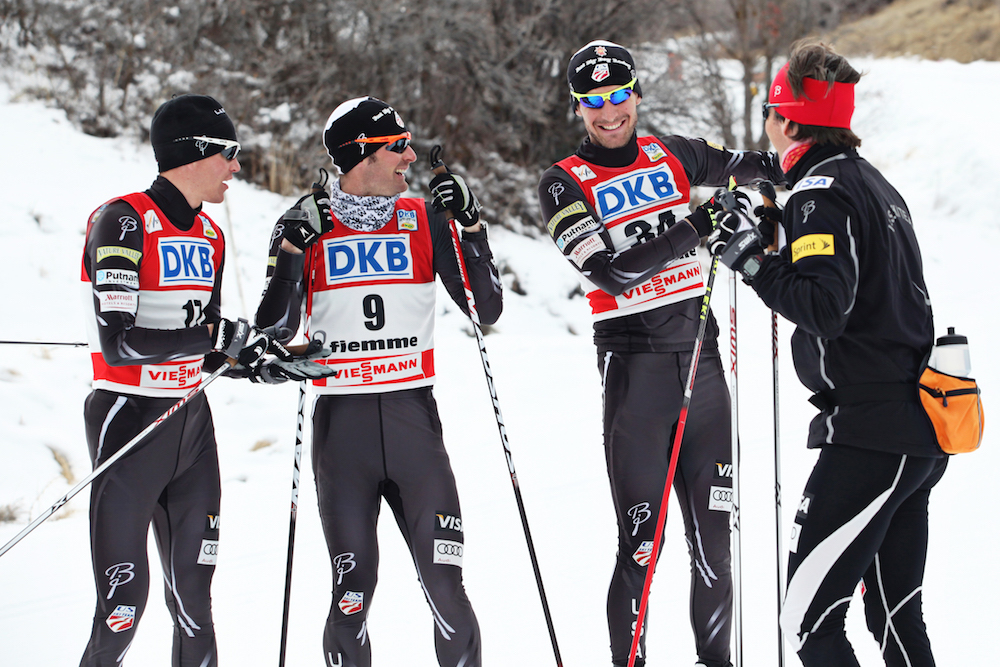
    U.S. Nordic Combined’s 2011/2012 team members (from left to right) Billy Demong, Bryan Fletcher and Taylor Fletcher with head coach Dave Jarrett at Soldier Hollow in Midway, Utah. (Photo: USSA)

    Listed at the bottom of a U.S. Ski & Snowboard Association (USSA) press release announcing U.S. Nordic Combined Head Coach Dave Jarrett’s retirement are his coaching highlights. It’s a long list defined by two things: Olympic and World Championship medals and longevity. Jarrett will forever be linked with the iconic names of U.S. nordic combined, including Billy Demong, Johnny Spillane and Todd Lodwick. His coaching legacy rewinds back to the 2002/2003 World Cup season.

    Before that, as a nordic-combined athlete, Jarrett was a member of the U.S. Ski Team from 1992-1996 and is a two-time Olympian. He’s a lifer. And for lifers, separation from what they have always known remains difficult.

    “I have been doing it a long time both as an athlete and and a coach,” Jarrett, 46, told FasterSkier on the phone. “It is now of those things where all of sudden it hits you, like, you are tired. You’re not able to go give everything and do everything. And certainly, it’s hard to justify a lot of time on the road. Missing family things, but also on the athletic side you are not able to give to the athletes everything that you need to give.”

    Until 2014, USSA managed the U.S. Nordic Combined Team. The team is now run by USA Nordic, yet Jarrett’s position has remained under USSA’s umbrella — they continued to pay his salary. With the 2014 split, Jarrett’s responsibilities grew as he took on both coaching duties as well as some of the logistics of running a team.
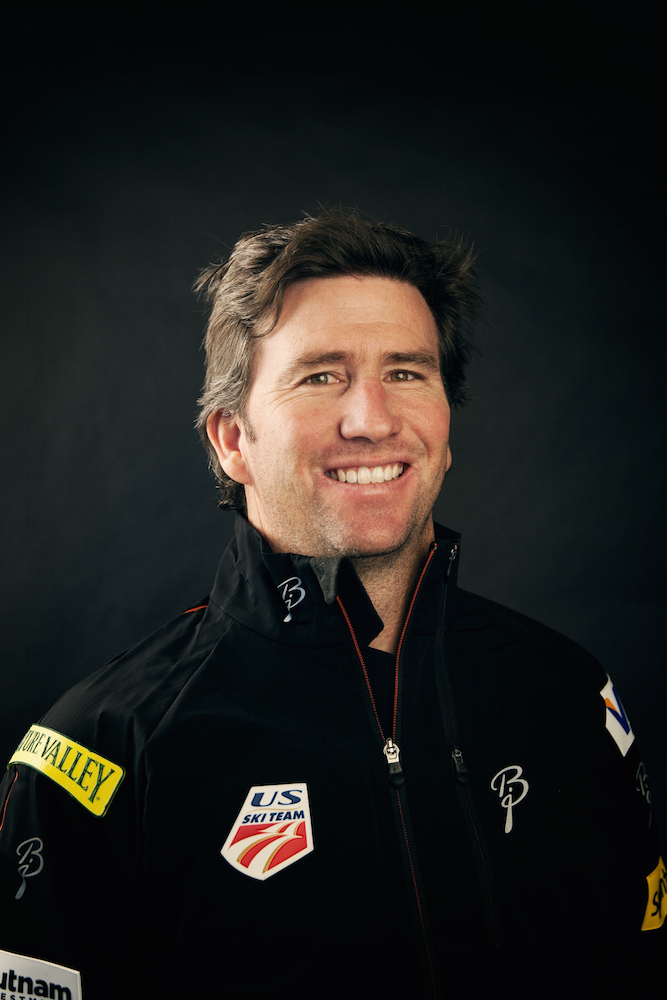
    Dave Jarrett, head coach of U.S. Nordic Combined, during the 2013/2014 season. (Photo: USSA)

    “Honestly, it’s amazing he lasted as long as he did,” U.S. Nordic Combined A-team member Bryan Fletcher said on the phone from his home in Park City, Utah. “He’s definitely a trooper, for sure. It was pretty intense because he was still employed by USSA and still had bosses there, but he also had bosses on USAN and had obligations on both sides of the coin. That combined with continuing his education research for coaching stuff, it adds up quick. And then doing all the travel logistics for not only World Cup but for World Cup and B-team and then having to be there in person, it was insane.”

    Taylor Fletcher, another longtime U.S. Nordic Combined athlete and Bryan’s younger brother, also noted the stress on Jarrett.

    “He had definitely been challenged … he had to go from a full-time coach to a full-time coach and a team manager,” Taylor explained on the phone. “He was in charge of doing a lot of the fundraising, and all the aspects to keep our sport alive in the U.S. And that really took a toll on him and that was definitely difficult on all of us. But also, I think it put way more weight on his shoulders than he really needed.”

    Diminishing funds correlates to increased non-coaching responsibilities for coaches, less on-snow time and more connecting the non-competitive dots for athletes. Jarrett weathered that type of job description metamorphosis. Ski coaching at the elite international level is an all-encompassing life, and he lived it for 15 years.

    “For me and my wife, we got married while I was still an athlete and so this is a lifestyle, the only lifestyle we have ever really ever known,” Jarrett said. “Both of my children were born in 2002 and 2004. Again this is a lifestyle that’s all they have ever known.”

    Demong, USA Nordic’s executive director for the last year, has spent nearly his entire international-skiing career under Jarrett’s wing. The two became teammates back during the 1996/1997 season when Demong bumped up to national-team status.

    “DJ had a good understanding of physiology, so he and I bonded over that in the beginning,” Demong said. “Especially given the fact at the time we had a really good team culture developing but we didn’t have the physiological expertise in our training programs and that sort frustrated both us. So we sort of found a commonality there right out of the gate.”

    After completing his competitive career, Jarrett went on to earn a degree in exercise physiology and kinesiology from the University of Colorado. He was able to bring his education into play as he joined the coaching ranks.
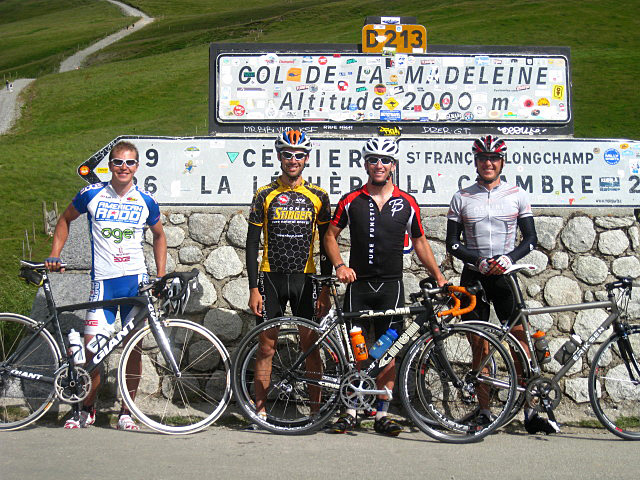
    The U.S. Nordic Combined team takes a break at the top of the Col de la Madeleine during a 2009 training camp in nearby Courchevel, France. From left to right: Bill Demong, Johnny Spillane, coach Dave Jarrett, and Todd Lodwick (Photo: USSA)

    “When he came back to coaching it was really a breath of fresh air,” Demong said about Jarrett’s academic and nordic-sports knowledge. “We had built this great culture and were all working really hard, but we still didn’t have the plan training-wise that I felt we needed.

    “Going back to my high-school running days, we peaked when we wanted to peak for states and federations, and when we were doing our nordic training I felt like we were sort of doing what other nordic-combined skiers did, which was get up, ski, or get up, go jump, have lunch, go ski, go home,” he continued. “And DJ brought a ton of new ideas and concepts that he had learned in school as well as from networking with other sports. DJ really helped pioneer a lot of things on the physiological side and take our team from good culture, talented hard working athletes, to champions.”

    Jarrett plans to open a strength and agility center in Heber, Utah, where he lives with his wife and children, the youngest of which will be entering eighth grade; his oldest will be a freshman in high school. As with any change, he said he looked forward to what the opportunity might bring and remaining close to his family. Yet looking back, Jarrett said he’d miss the small daily aspects of the sporting life.

    “It’s the everyday victory I’ll miss,” Jarrett said. “I’m psyched to see the work that the athletes are putting in. The work that the coaching staff are putting in to see those everyday victories — those personal best, in testing, first time getting Continental Cup points, or first time getting World Cup points, or a World Cup podium. You can say the hardware is why you do it for sure, but I will miss is the everyday camaraderie and training.”

    U.S. NoCo Moving Forward

    Demong said the program remains stable heading into an Olympic season; Jarrett had been discussing a transition for the past several seasons.

    “It had been something that has been on my radar for awhile and DJ certainly communicated early enough for me to to start planning, and quite honestly, we do have a good safety net,” he said.

    U.S. Nordic Combined Assistant Coach Martin Bayer will step into the role of head coach. Bayer hails from the Czech Republic and began coaching domestically in the U.S. in 2000. He is currently based in Planica, Slovenia.

    Demong said Bayer is entering this position with the institutional knowledge to make the coaching change seamless.

    “Martin has worked his way up through the club system to the development team coach,” he said. “He has basically coached everybody onto the national team with the exception of Bryan, who is just a little bit older. So he has already a great relationship with all the athletes that are on the team. He knows all the athletes in the pipeline. …  He knows the environment and he is familiar with how we operate, and there is a level of trust both from my end and with the athletes.”

    Nick Huber will remain the program’s head ski-jumping coach. On the cross-country side of the sport, former U.S. national-team biathlete Jeremy Teela is advising the team. “He has agreed to come in and help us with domestic cross-country coaching and plan writing,” Demong said.

    Jon Schafer, who had been U.S. Nordic Combined’s high-performance director for the last year, has also stepped down.

    Jon is a great and a good friend and very very exceptional high-level strategic thinker,” Demong said. “I think our organization is not at the point right now where we can take advantage of his talents and capacities fully, and quite honestly, we just need more boots on the ground. At this point, we are not going to fill that position. He has, however, written us a very detailed plan that we will be using as a road map going forward. It is a living document. For us, it is like everything from recruitment to medals and everything in between as it relates to coaches, education, and national-training centers.”

    A business executive, Schafer brought management experience to USA Nordic, and on the sporting side, he was previously an elite-level rower and coach.

    “My decision to step down was a very difficult one and one that I most certainly did not take lightly,” Shafer wrote in an email. “I loved working with the athletes and even after my departure, I am still very concerned about their success. It can be very difficult working in an environment of highly constrained resources, in particular with almost no support from USSA.

    “Every position or idea simply cannot be funded and every shot has to be a kill,” he continued. “People are going to disagree about the best ways to spend highly limited funds and the tighter the budget, the harder it is to balance all of the different agendas. The organization has a lot of operational needs and the executive director and a few members of the board felt it was more important to have staff selling t-shirts, writing newsletters, marketing copy and other very ‘boots on the ground’ tasks, than a High Performance Director setting strategy and working with coaches and athletes at a higher level. I disagreed with this approach and since they couldn’t afford both, I tendered my resignation. I think this move is good for everyone, as the overall organizational dynamic proved to be a bit too bruising and tumultuous for an honest, easy-going, soft-spoken Midwest boy like me. I want to be very clear here too — my departure was a smooth and respectful one on both sides and I wish them nothing but the best.”

    Always the jokester, Schafer (FasterSkier’s gear-review guru) added, “One big upside of this change for me too, is I now anticipate having much more time to write about how long you can wear your underwear without washing it. And perhaps teaching my Great Dane to finally respond to his name.”

    The U.S. Nordic Combined team will meet in early May for an all-team camp, which will include all staff and any athlete with a chance of qualifying for the Olympics.

    “It’s really going to be focused on learning more about ourselves, learning more about each other, learning how to communicate better and be tougher,” Demong said of the camp.

  • Four Years Later, U.S. Nordic Combined Lacks Olympic Fanfare But Comes Full Circle

    Four Years Later, U.S. Nordic Combined Lacks Olympic Fanfare But Comes Full Circle

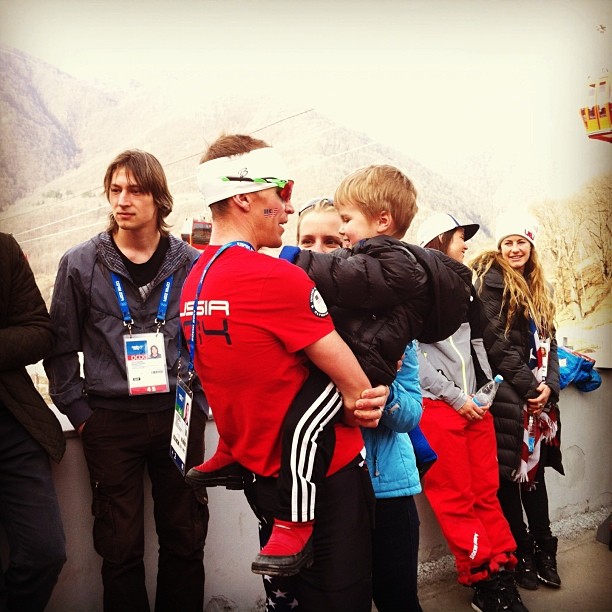
    Billy Demong (l) with his son Liam and wife Katie after the final competition of the 2014 Sochi Olympics, the 4 x 5 k team event.
    Billy Demong (l) with his son Liam and wife Katie after the final competition of the 2014 Sochi Olympics, the large-hill/4 x 5 k team event in Krasnaya Polyana, Russia.

    KRASNAYA POLYANA, Russia — With the clock ticking away and a competitor from the Czech Republic in hot pursuit, Billy Demong dug deep exactly a week ago in the last nordic combined race of the Olympics, trying to find any extra grit to push him across the line as the anchor leg of the 4 x 5-kilometer team event.

    The U.S. Nordic Combined veteran found it, leaving him gasping for air on the ground at the finish, but when he got up, his team’s result on the video board at the RusSki Gorki Ski Jumping Center didn’t reflect the fairy tale ending many had come to expect from his team.

    The Sochi Olympics hadn’t played out like the 2010 Winter Games in Vancouver, British Columbia. Not even close.

    The jumps hadn’t gone well enough for the four-man U.S. Olympic team — not Thursday or in either of the two preceding individual competitions — at least not to their potential.

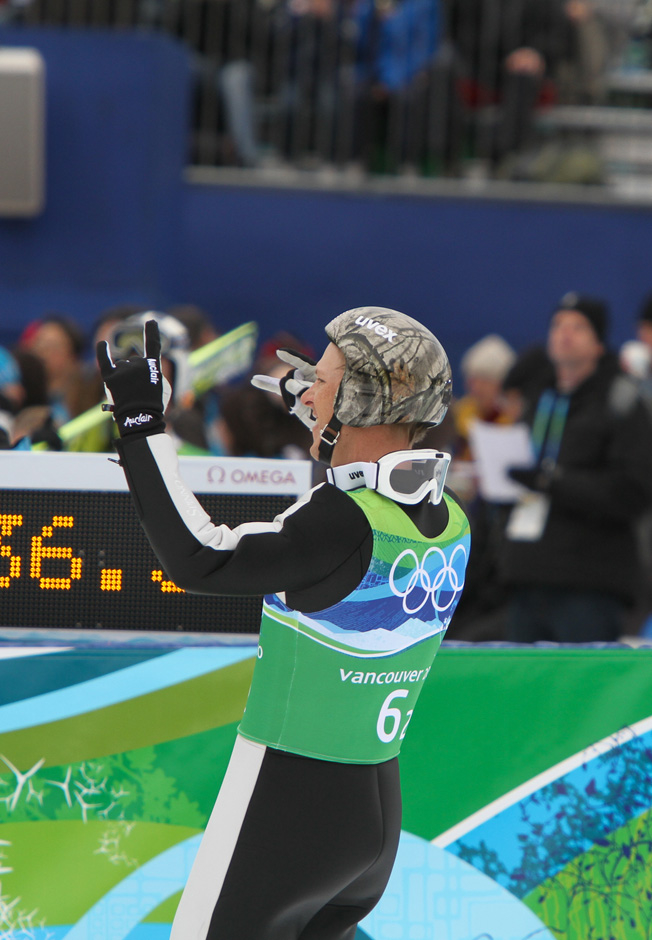
    Billy Demong after placing 31st in the 2014 Sochi Olympic individual large hill/10 k, the event which he won gold in at the 2010 Olympics, on Feb. 18 in Krasnaya Polyana, Russia. "There’s certainly some details to look at for sharing and for the future," Demong said after anchoring the U.S. to sixth in the  \team event. "The headspace was right ... I’m thinner than I was in Vancouver, I'm just as strong. Throw the dice another day on a different jump and who knows?" (Photo: Sarah Brunson/U.S. Ski Team)(Photo: Sarah Brunson/U.S. Ski Team)
    Billy Demong after placing 31st in the 2014 Sochi Olympic individual large hill/10 k, the event which he won gold in at the 2010 Olympics, on Feb. 18 in Krasnaya Polyana, Russia. “There’s certainly some details to look at for sharing and for the future,” Demong said after anchoring the U.S. to sixth in the \team event. “The headspace was right … I’m thinner than I was in Vancouver, I’m just as strong. Throw the dice another day on a different jump and who knows?”
    (Photo: Sarah Brunson/U.S. Ski Team)(Photo: Sarah Brunson/U.S. Ski Team)

    Demong got some satisfaction with his best competition jump of the Sochi Games in the large-hill/4 x 5 k team event, but his score of 108 ranked seventh in his group of nine teams. Two of his teammates, Todd Lodwick and Taylor Fletcher, also ranked seventh in their groups, and Bryan Fletcher ranked ninth of the final jumpers.

    Combined, the results on the hill put the U.S. in eighth, 1 minute and 52 seconds behind Germany in first. The Germans started the relay first, 7 seconds ahead of Austria. Norway followed another 25 seconds back in third, then France, the Czech Republic, Japan, and Russia, respectively.

    The Americans started 38 seconds after Russia in seventh and needed to make up a minute and a half if they wanted to come close to the podium. With Demong posting the second-fastest anchor time, the team finished sixth, 2:21.6 behind the German winners and a second ahead of the Czech Republic in seventh.

    “Throw the dice another day on a different jump and who knows?” Demong said after the race. “But the important thing I think as a group is that we were able to overcome any disappointment and kind of rally. Today wasn’t perfect, but I think we all enjoyed ourselves.”

    A year earlier, the same team notched the first-ever U.S. relay medal at World Championships, coming back from a minute deficit in fifth to place third.

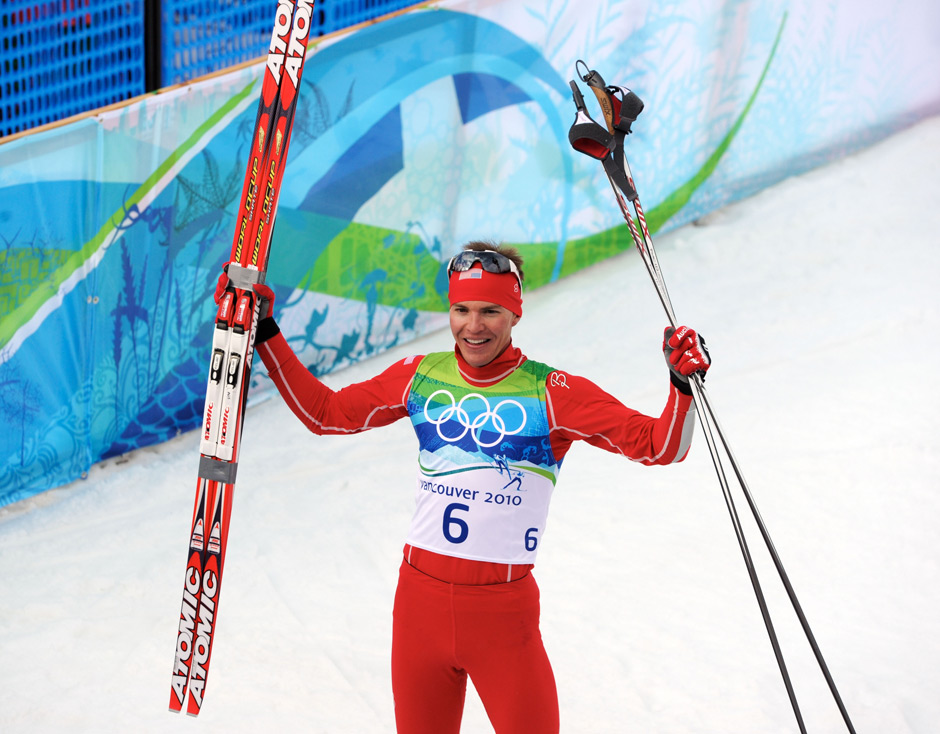
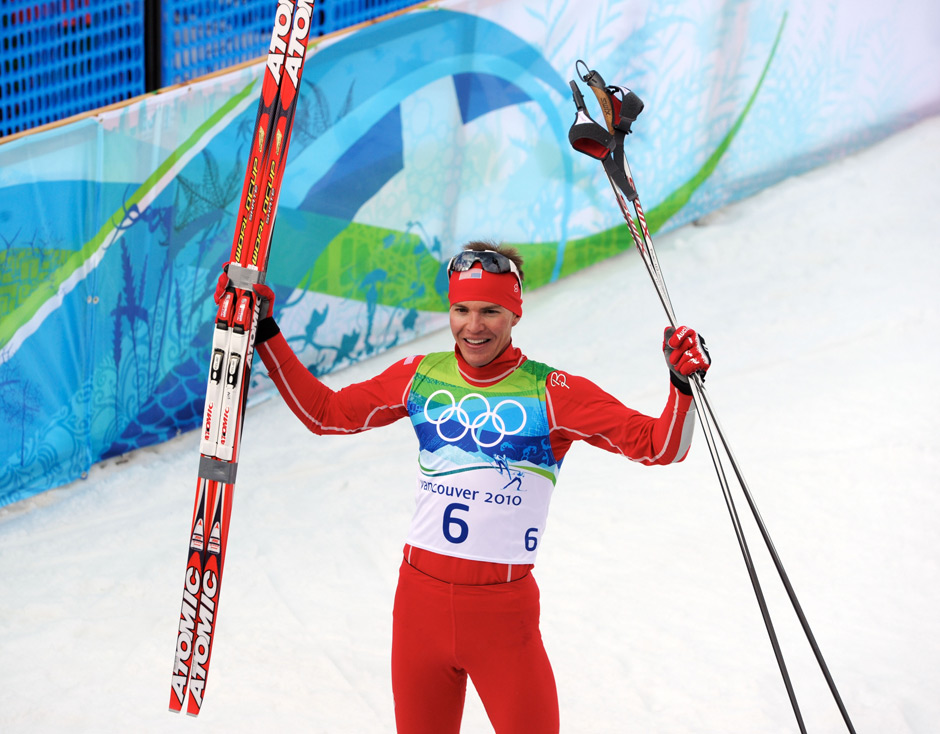
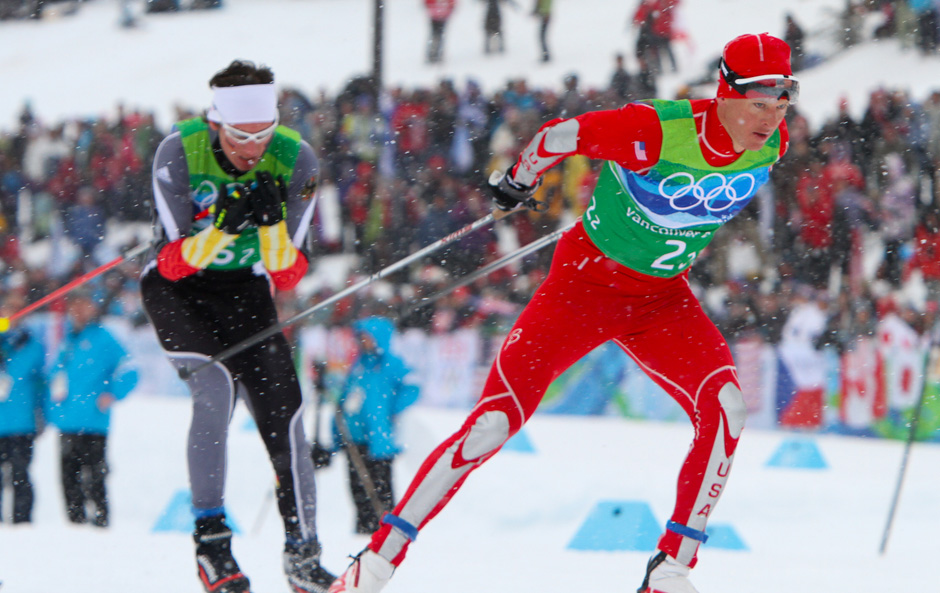
    Four years ago, U.S. Nordic Combined made Olympic history with a series of unprecedented performances at the Vancouver Olympics. Johnny Spillane, who retired this past spring, opened the Games with an individual silver in the normal hill/10 k. The four-man team of Spillane, Demong, Lodwick, and Brett Camerota went on to tally another silver in the 4 x 5 k. Two days later in the individual large hill/10 k, Demong became the first U.S. nordic skier to win gold, just 4 seconds ahead of Spillane, who captured his third silver of the Games.

    That is the memory that stands out for Demong, a 33-year-old, five-time Olympian, when he thinks back to the accomplishments and accompanying bliss he and his teammates experienced in Vancouver.

    “Before we got whisked down to the Today Show … [Johnny and I] were sitting in room 406 or whatever … I don’t think we even had a TV in our room,” Demong told reporters after last Thursday’s 4 x 5 k. “It was pretty bleak, except we had five medals sitting on the bed, and it was kind of like, 16 years ago we were sharing the popup camper in your parents’ backyard for a summer. We did it, we’re here. It was that whole thing coming true, the dream beyond dreams.”

    The Sochi Olympics didn’t repeat those memories or create new stories of success to take their place. And while Demong couldn’t put his finger on what exactly went wrong over at these Games, he wasn’t devastated by it either.

    For the U.S., the team event in Sochi took on a new kind of significance, which extended beyond results for a big-picture perspective.

    Lodwick, 37, who became the first six-time Winter Olympian in U.S. history, had returned to his first series of competitions since a training-jump crash in early January sent him back to the U.S. to rehab his shoulder.

    The Sochi relay would be his first race back in nearly two months, and also the last of his career. For Demong, the race would most likely be his final one at the Olympics.

    “I would seriously doubt that I’ll be here in four years in that capacity on skis,” Demong said.

    At the same time, he didn’t rule out competing on the World Cup next season.

    “As of three months ago, I was like, today’s the day, you can ship my skis to Park City or wherever, Lake Placid when this is over,” Demong recalled. “But I’m going to be back [in Europe] and I’m gonna race Trondheim and Oslo [March 6 and 8]. Part of that is to keep some options open for the team, part of it’s for myself. I think my wife and my coach Dave showed me, OK, maybe you can plan for years ahead your entire career, [but] maybe have a little grey area.”

    So that’s Demong’s tentative plan — finish out the World Cup season, “take a deep breath,” then see what his team needs.

    “I’m sure I’ll stay involved in the sport; I may do some racing next year,” he said. “I’m more excited and I think I owe it to the younger guys to see what they need in order to usher in the next group.”

    Taylor Fletcher, a two-time Olympian and the youngest member of the A-team at 23, said it would be difficult to imagine the future without Lodwick and Demong.

    “Billy and Todd and Johnny, they’re gone and honestly that sucks,” he said after skiing the fastest penultimate leg to lift the team from eighth to seventh. “Without them, it’s hard to say, but really, we’ve shown over the years that our team’s capable of putting in the hard work, getting the good results, and it’s just a matter of time.

    “Hell, it might take us a decade, but we’ll get them,” Fletcher added, referring to the team’s medal drought leading up to the 2010 Olympics.

    “We know what to do now. I would say last year was the year that we really figured it out. Bryan got the King’s Cup podium and that seemed like it came easy to him, and last year I got a [World Cup] podium and then we got that World Championships medal.”

    The team has several development skiers that will be looked at to fill the void, including Brett Denney, who nearly made the U.S. Olympic team as the fifth-man out of its four allotted quota. While the Fletchers are the A-team’s only “sure-shot” returners, U.S. Nordic Combined has experienced B-team members in Nick Hendrickson, Adam Loomis and Michael Ward.

    “Hell, it might take us a decade, but we’ll get them.” — Taylor Fletcher, on U.S. Olympic medals

    “I heard several times in 2010 that nordic combined was one of the most exciting events,” Taylor said. “USA Today just rated it the hardest Olympic sport and people know what nordic combined is now, and that’s because of them [Demong, Lodwick and Spillane]. And now it’s my job, Bryan’s job and the rest of the team to kind of keep it there. … I don’t see any rhyme or reason why it won’t be where it is now and even higher. It’s just a matter of believing in ourselves and allowing it to happen.”

    Demong credited team veterans like Lodwick, who won two gold medals at the 2009 World Championships after taking two years off from the sport, for raising the bar way back when.

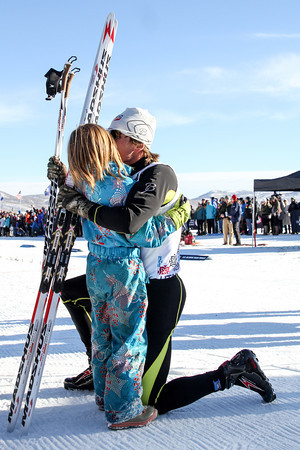
    Todd Lodwick and his 8-year-old daughter embrace after Lodwick won the Gold Cup U.S. Olympic trials on Dec. 28 in Park City, Utah, to qualify for his sixth Olympics -- unprecedented among U.S. Winter Olympians.  (Photo: Sarah Brunson/U.S. Ski Team)
    Todd Lodwick with his 8-year-old daughter after Lodwick won the Gold Cup U.S. Olympic trials on Dec. 28 in Park City, Utah, to qualify for his sixth Olympics — a first for a U.S. Winter Olympian.
    (Photo: Sarah Brunson/U.S. Ski Team)

    “Nobody does it like Todd,” Demong said. “There’s some really good lessons that I think we’ve all learned from him, a number of which are not traditional athletic lessons, but it’s about finding the right headspace. Todd can have a bad day, and he can write it off and come back out swinging”

    Demong said he learned from Lodwick’s example and even put that into action in Sochi when he struggled individually, placing 31st on the large hill and 24th in the normal-hill competitions.

    “If Todd hadn’t started winning World Cups as an annoying 18 year old to his older teammates, I don’t know where we’d be,” Demong said. “He certainly showed us younger guys the way, and he invested in the team … and he helped us believe that we could do it too. He’s given a lot to this sport over the years.”

    Lodwick fought tears after Thursday’s race, in which he lost one place after Bryan tagged him in seventh and handed off to Taylor in eighth, 20 seconds behind Italy. It wasn’t necessarily the pain in his shoulder, which he said was improving: “It’s getting there. It’s stronger than I ever thought it would be.”

    Rather, it was the fact that he was at his sixth Olympics.

    “I really enjoyed getting up this morning and starting the day off right,” Lodwick said. “The Olympic rings are something that as an athlete throughout my career, you believe in them you see them in different ways. Lillehammer was the most amazing experience to that point and I really had a lot of fun. Going into Nagano, I was way too serious and I didn’t really take in the Olympic Games for what it was all about. Through the years, this being my sixth, I came here with the biggest smile. I came here just taking it in because I didn’t think I was gonna be here.”

    He recalled sitting in an ambulance six weeks earlier, thinking that an Olympic comeback was out of the question.

    “I remember going up to each of my teammates’ rooms and saying, please don’t count me out. They kind of looked at me like, OK, and from the first day I got back from Park City, I was on the treadmill and working my ass off to get to this point to be a team supporter. I couldn’t have gotten there without my teammates and my coaches and [team physiotherapist] Adam Perreault … he’s gotten my shoulder back the most amazing place and I cant thank him enough.”

    Selected by his fellow U.S. Olympians, Lodwick went on to lead more than 200 U.S. Olympic team members as the Opening Ceremony flag bearer on Feb. 7. The next week, he returned to competition for the first time since December and logged half a dozen training jumps in Sochi — the first since his accident.

    Lodwick jumped to 34th on the 106-meter normal hill on Feb. 12, the second-best result after Demong in 31st, then ranked 30th on the 140-meter large hill on Feb. 18. He did not race either days in an effort to let his shoulder heal as much as possible before the team event on Feb. 20.

    There, Lodwick’s jump was the second-best after Demong’s. He started his first race in nearly a month as the U.S. team’s second leg, taking over after Bryan made up more than 50 seconds on the teams ahead of him.

    “You start, the gun goes off and you race, you get tagged and you race,” Lodwick recalled. “I proved probably more to myself than I did to anybody else, that with hard work and a lot of support that anything is possible. First step is to dream big. That’s something that I live by. Anything is possible and I wouldn’t do anything different. The shoulder injury was a blessing. It made me respect this sport and the hard work to getting back, these Olympic Games, just taking everything in.”

    Lodwick reflected on how each Olympic experience was different, and how he’s grown over the last two decades in the sport.

    “Lillehammer [in 1994] was the most amazing experience to that point and I really had a lot of fun,” he said. “Going into Nagano [in ’98], I was way too serious and I didn’t really take in the Olympic Games for what it was all about. Through the years, this being my sixth, I came here with the biggest smile. I came here just taking it in because I didn’t think I was gonna be here.”

    He guaranteed himself a spot by winning the U.S. Olympic Trials on Dec. 28. Less than two weeks later, he crashed in Chaux-Neuve, France, just four weeks out from the Sochi Games.

    While Lodwick soaked up the moment in the mixed zone with reporters, looking up at times with tears in his eyes, Demong caught a glimpse of his wife holding their 3-year-old son, and took an early exit to meet them on the other side of the fence.

    “Liam!” Demong exclaimed.

    “Daddy!” Liam called out.

    Four years ago, Demong proposed to Katie after winning gold in Vancouver, then was chosen to carry the U.S. flag in the Closing Ceremony. In Sochi, his personal journey had come full circle; he had both Katie and his first child cheering him on.

    Team-event results | Complete Olympic results

  • U.S. NoCo Shifts Focus to Team Event, Best Medal Chance in Sochi

    U.S. NoCo Shifts Focus to Team Event, Best Medal Chance in Sochi

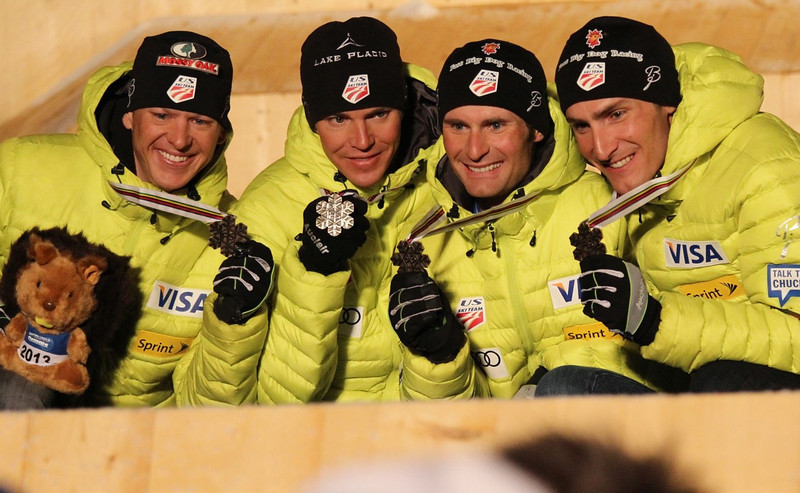
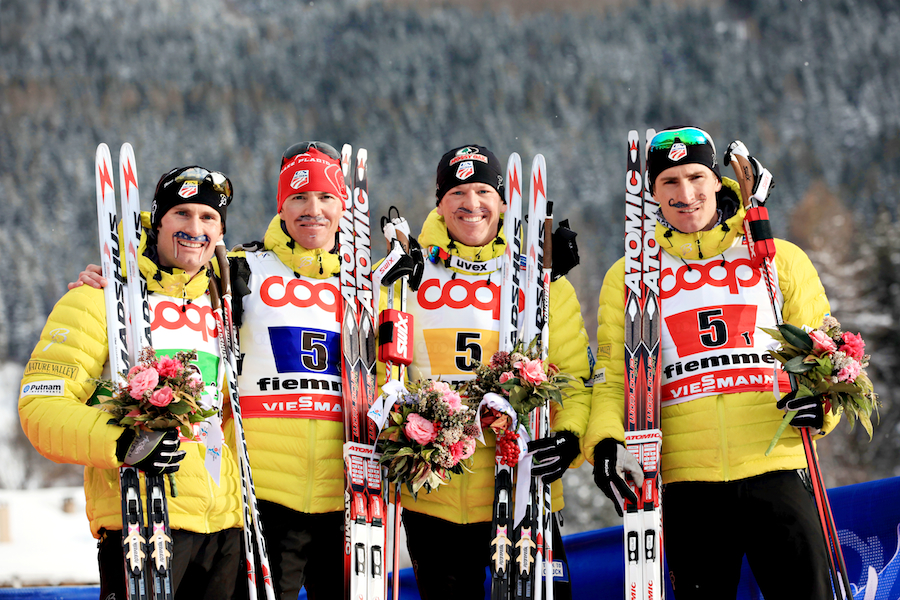
    From left to right: Todd Lodwick, Billy Demong, Bryan Fletcher and Taylor Fletcher with their bronze medals from Sunday's team event at the 2013 Nordic Combined World Championships in Val di Fiemme, Italy. (Photo: Fiemme2013)
    From left to right: Todd Lodwick, Billy Demong, Bryan Fletcher and Taylor Fletcher with their bronze medals from the team event at the 2013 Nordic Combined World Championships in Val di Fiemme, Italy. (Photo: Fiemme2013)

    FasterSkier’s coverage is made possible through the generous support of Swix.

    KRASNAYA POLYANA, Russia — Today is the day for U.S. Nordic Combined. Its four Olympians pinned the 4 x 5-kilometer team event as their best shot at a Sochi Winter Games medal as far back as a year ago when they won their country’s first-ever World Championships medal in the event in Val di Fiemme, Italy.

    Not everything had panned out exactly as planned in the season that followed; in early January, Todd Lodwick crashed on a jump in France a day before the World Cup there. He immediately flew to the team’s primary base in Park City, Utah, for further evaluation, and spent the next few weeks rehabbing his shoulder there.

    His first time back jumping wouldn’t come until Sochi about two weeks ago.

    Meanwhile, the team narrowly missed out on getting a fifth member to score World Cup points, which could have granted them a fifth quota spot at the Sochi Olympics. That would’ve taken the pressure off Lodwick, a six-time Olympian in his final Winter Games, to compete in the team event.

    Regardless, Lodwick has been one of the top Americans on the normal- and large-hill competitions at the RusSki Gorki Ski Jumping Center, jumping to 34th on Day 1 and 30th on Day 2.  He opted not to race the 10 k Gundersen starts in both competitions, allowing his shoulder to continue to heal as much as possible before the relay.

    Thursday marks Day 3, the final day of nordic-combined competition at the 2014 Olympics, and Lodwick hasn’t raced internationally in nearly two months.

    “We came into these Olympics knowing that getting back on my skis and getting back in shape and knowing that I can jump … and having the confidence to do that,” Lodwick told the U.S. Ski and Snowboard Association (USSA) after Tuesday’s large-hill jump. “We are continuing to gain every single day — just builds more confidence through the team event, which is the reason why we came here in the first place. … I’m in a really good place, and taking in the Olympic spirit is something that is really rare for a lot of people, especially as an athlete, and I’m just trying to live every moment of it.”
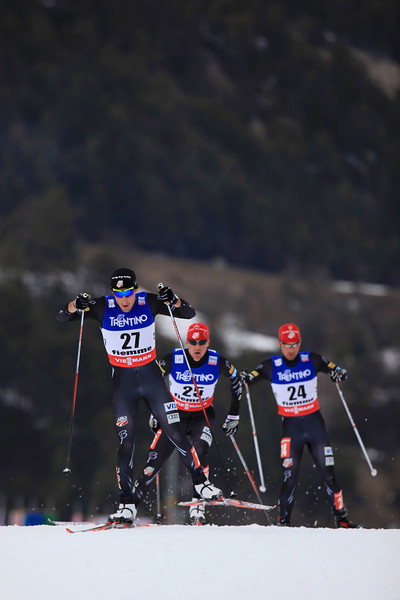
    Taylor Fletcher, Billy Demong, and Bryan Fletcher racing together in the individual 10 k at World Championships in Val di Fiemme, Italy.
    Taylor Fletcher, Billy Demong, and Bryan Fletcher racing together in the individual 10 k at World Championships in Val di Fiemme, Italy.

    So far, the top U.S. result in nordic combined at these Olympics has been Taylor Fletcher’s 20th two days ago. Bryan Fletcher placed 22nd in the same individual event, and Billy Demong — the defending large-hill/10 k champion — finished 38th. Almost a week earlier Demong led the team in 24th on the normal hill.

    On Tuesday, the Fletcher brothers and Demong each knocked off at least five places to finish with a better result than where their jumps put them, with Taylor skiing up 15 spots with the sixth-fastest time. Bryan improved from 27th on the large hill, and Demong moved up from 38th.

    “Obviously things haven’t been going too great, I’ve had a super up-and-down year,” Taylor said.

    With pouring rain complicating the jump, causing at least two men to crash in front of him, Taylor had to wait more than 10 minutes at the top of the hill. The rain didn’t stop all afternoon, lasting through the 10 k as well.

    “It was just like wait, wait, wait and then I ended up having a strong jump – a jump I was happy with,” he said. “I had the worst wind on the hill so to have that jump in those conditions – I can’t be disappointed. I came out and had a good race, I was happy with the race. I skied away and picked up the tempo on each lap and I felt really, really good. So it’s a step forward for the team event.”

    Demong left Tuesday’s competition disappointed and at a loss for words: “I swore I woke up feeling like today was the day, and right up until I landed that first comp jump, I didn’t see anything coming,” he said. “I mean, I feel great, body-wise and everything. It’s kinda devastating, really.”

    Unsure why his competition jump was the shortest in the last few days by 10 meters, Demong explained not knowing what to correct was the problem.

    “I think I’m old enough and wise enough to have expectations and be able to follow through on them and then a day like today happens and it throws you for a loop,” he said. “I swear I felt the same tingle today that I felt in Vancouver. … Everything feels like it’s in the right place. I did a really good job tapering. I’ve been sick a lot, but that’s always the case. I won World Championships in 2009 with a cold, so I don’t want to make any excuses, but I’m certainly going to look for a more concrete reason why things didn’t go any better.”

    The youngest member of the team, Taylor, 23, said Demong had a “fantastic” trial jump. “He’s just gotta figure out what he’s doing – if he’s putting a little bit too much pressure on himself or what.”

    Talking about the rest of his teammates, Taylor said, “Todd showed today that he can still jump … and he hasn’t taken many jumps, so each jump he takes is gonna get better and better. And Bryan showed that he’s consistent. He didn’t have a great jump [Tuesday] and he was still right in there, and he’s skiing fast. So I’m looking forward to the team event; I think we have a strong team. We may not be showing it on the results in the individual comps, but a little spirit comes into these team comps and everyone pulls out a little bit of extra … I think it’s gonna be special when we come to this, and we’re gonna let it happen.”
    Thursday’s 4 x 5 k team event starts at 3 p.m. Moscow time. Click here for live results.

    ***

    Update: Out of the nine teams that started on Thursday, the U.S. unofficially ranked eighth after the jump and will start the relay 1:52 behind Germany.

    At World Championships last year, the Americans started fifth, 1:02 behind the race leader, to finish third 4.2 seconds behind the French winners.

    Previous results:Normal hill/10 k | Large hill/10 k

    — Rosalie Lipfert and Seth Adams contributed reporting

  • Onto Day 2 of Olympic NoCo: U.S. Seeking Above-Average Performances

    Onto Day 2 of Olympic NoCo: U.S. Seeking Above-Average Performances

    The new flex tester helped Billy Demong win Gold at the Olympics.  The same tester and the same formulas are used to put fast skis on every consumer.
    Billy Demong after winning gold in the large hill/10 k competition at the 2010 Olympics in Vancouver, B.C.

    KRASNAYA POLYANA, Russia — It’s been almost a week since the nordic-combined Olympians did their thing in the first of three competitions at the 2014 Winter Games. Last Wednesday’s event was on the 106-meter normal hill, not exactly U.S. Nordic Combined’s favorite.

    Billy Demong led the U.S. in 24th, nearly a minute and 50 seconds behind German’s Eric Frenzel, who won the 10-kilometer Gundersen start. He had posted the 31st-best jump (tied with Finland’s Janne Ryynänen) out of 46 in the competition round, going 92.5 meters for 108.2 points. In the preceding trial round, Demong, 33, had his best jump of the season — just shy of 100 meters.

    “It’s hard to be too upset because I’ve been struggling a little bit this week on this hill,” said Demong, the defending large hill Olympic champion, after last week’s competition. “I think it’s a little flatter than anything I’ve skied before.”

    Flatter? His teammate Bryan Fletcher, who improved from 41st to 26th, for the second-best U.S. result on Feb. 12, tried to explain.

    “This is probably one of the hardest hills I’ve ever jumped in my life,” the 27-year-old Fletcher said. “The rhythm of the hill does not match how your subconscious feelings are, so it was really difficult to find a rhythm. I found it in the trial round today, but I went for it in the comp jump, tried to lay it all out on the line, all or nothing. Unfortunately it didn’t work out, but I’ll try again next week.”

    His younger brother Taylor Fletcher, who improved from 46th to 33rd, was the third American in the results. Todd Lodwick jumped to 34th — in his sixth jump after a scary crash in France in early January — but did not race in order to further heal his shoulder before the team event.

    “This hill … is … it’s hard. I don’t understand it,” Taylor, 23, said. “I think a lot of people have the same feelings. I don’t know what it is that makes it so difficult. It’s a big hill, and we’ve jumped big hills. I jumped really well last year on it. It was my best jump, my best result all year, so I know I can race that. I’m a little bit better on a big hill. I don’t know if it’s my size that allows me to do that, but I get in a rhythm on it, and I can be a little more aggressive, which you really can’t on a smaller hill.”

    Demong said there were positive takeaways from Day 1 of the Olympics: he had his two best jumps of the season between the trial and competition rounds.

    “I almost pulled off the miracle jump today — what I didn’t think was possible before today, but it was by far my best jump of the weekend,” he said. “It kind of gave me a little hope. I’ve already almost been looking forward to the big hill because I think things were pretty good there last year, and my shape’s much better.”

    The competition also gave the NoCo guys a chance to scope out the 2.5 k course they’ll race around two more times at the Olympics — with another 10 k Gundersen start after today’s large hill competition (starting at 4 p.m. Moscow time) and the 4 x 5 k team event on Thursday.

    “I think the cross-country course is a lot of work,” Bryan said. “There’s no rest on it whatsoever, and any rest is followed by a technical corner or stuff like that. You really zap the legs going in with all the hills, and if you ski the hills hard like you want to, you pay for it on the corners again, so it’s just a very cumulative course as far as energy goes.”

    Looking ahead to Tuesday’s large-hill competition, U.S. Nordic Combined Head Coach Dave Jarrett said Lodwick wasn’t a definite for the 10 k, and he was hoping the rest of his athletes would rise to the occasion on the 140-meter hill.

    “We were better than our average, but our average wasn’t good enough,” Jarrett said last week. “We need to get off to good start on the big hill. The first training jump needs to be good. There are some good things that happened: Todd jumped pretty well and tested his shoulder and I think he’ll be able to ski. [The others] jumped OK, at least they had a good jump and they’re not walking away from the small hill without any good jumps. We’re looking forward to the big hill and keeping a positive attitude.”

    With a drawn-out schedule that spaces out three competitions over nine days, Jarrett said it can be tough to stay focused — especially in a place like Krasnaya Polyana, at least an hour away from the coastal cities of Adler and Sochi. In 2010, they flew down to Park City, Utah, between Olympic competitions in Vancouver.

    “There’s nowhere to go, really,” Jarrett said of their current Olympic home base, adding that they’ve trained at the Laura Cross-Country & Biathlon Center as well.

    Sightsee? Shop?

    “Yeah, we’ve done that,” he said.

    Could the extra time help Lodwick’s shoulder?

    “Yeah, it’s good for him,” Jarrett said. “The difference between this week and next week as far as a fracture being healed is not really that much. … Rehab is going well, he’s not out of the woods yet, but if everything stays the same, he’ll be able to compete.”

    Update: After Tuesday’s jump, Bryan Fletcher led the team in 27th, Todd Lodwick was 30th, Taylor Fletcher 35th, and Billy Demong 38th.

    Current standings

  • In Uniquely Democratic Process, Nordic Athletes Well-Represented in Flagbearing Choice

    In Uniquely Democratic Process, Nordic Athletes Well-Represented in Flagbearing Choice

    Todd Lodwick (right) competing in the Vancouver Olympics, where he earned a silver medal in the team event.
    Todd Lodwick (right) competing in the Vancouver Olympics, where he earned a silver medal in the team event. Lodwick carried the American flag at the 2014 Opening Ceremonies.

    SOCHI, Russia – Before the Olympics, the NBC website put up a poll for the American public: who did they think should carry the United States flag at the opening ceremonies?

    Bobsledder Chris Fogt topped the voting, with cross-country skier Kikkan Randall coming in second. But while it was a nice assessment of fan opinion, the poll had very little to do with the actual nomination process.

    Todd Lodwick, a nordic combined skier making his sixth Olympic appearance, was eventually chosen for the honor.

    “The election of the U.S. flag bearer is one of the few parts of the U.S. Olympic Team that remains private to the athletes,” said Brian Olsen, a former biathlete who is one of two main U.S. Olympic Committee Athlete Services Coordinators in Sochi.

    He is in charge of the Endurance and Mountain Cluster athletes, and Jamie Hagerman oversees athletes in the Coastal Cluster. Together, they arranged a voting process so that the Olympic athletes themselves could choose who would lead them into Fisht Arena on opening night.

    The first step in the process is nominating athletes to vote on.

    “Any accredited athlete was welcome to nominate another athlete to carry the flag,” Olsen explained. “We did not impose a restriction on the number of nominees.”

    Kikkan Randall, here training at the Olympic venue, was nominated by fellow athletes to carry the U.S. flag at opening ceremonies.
    Kikkan Randall, here training at the Olympic venue, was nominated by fellow athletes to carry the U.S. flag at opening ceremonies.

    Randall was nominated, although she wasn’t sure who had picked her. She described the feeling when she was called up and told the news.

    “The support, goodwill and respect I’ve felt from my fellow Olympians this time around has been really special,” Randall wrote in an e-mail. “I think everyone understands the journey it’s taken for us in cross country to get to this level where we are actually contenders, and there is a pretty cool energy around the team being felt from so many realms. It’s great to finally see cross country getting more attention and consideration amongst the whole U.S. team!”

    Next, all the nominees have to be contacted to see if they would actually be willing to do the job. Although Randall did not attend opening ceremonies as she felt the timing would disrupt her preparation for the actual racing coming up, she confirmed that if she’d been picked, she definitely would have gone.

    “It was an incredible honor to be considered in the election for flag bearer,” she wrote. “If I had been elected to carry the flag I definitely would have gone down there.”

    Not all the nominees were reachable, so a few were removed from the pool before voting even began.

    Then, the voting itself.

    “By tradition, each national governing body (NGB) received one vote in the election,” Olsen explained. “It was up to each NGB to select the athlete team representatives who were involved in the process, and which athlete team representative was to submit the ballot on behalf of all of its athletes.”

    The biathlon team chose Susan Dunklee to represent them; the U.S. Ski and Snowboard Association (USSA) was not represented by a nordic athlete.

    “It was the sort of thing where it was during the guys’ practice, so it was going to have to be one of us girls calling in,” Dunklee laughed. “They just asked me to do it.”

    She sat down with her team and went over the list of nominees, and they discussed why or why not each athlete would be a good candidate before making a list of their favorites. Dunklee then rang in to a conference call set up by Olsen.

    The athlete representatives listened to brief talks by the people who had nominated each of the possible flagbearers, and then got down to it. The voting was a ranked runoff process: each representative made a list of the order of their choices and e-mailed it in to Olsen and Hagerman, who then compiled the points and removed the lowest-ranked nominee before giving a new list to repeat the process. In the end, only Lodwick remained.

    Susan Dunklee in her first race of the Olympics.
    Susan Dunklee in her first race of the Olympics.

    In between rounds, there was no lobbying on behalf of a favorite athlete. Dunklee said that the athlete representatives kept their votes secret throughout the whole process and did not discuss their reasoning with each other.

    Dunklee said that she was happy with the process for two reasons: first, athlete input was taken into account, and second, the ranked process produced the candidate that most athletes agreed upon, although not all NGB’s showed up at the voting.

    “A lot of countries, the Olympic organization just picks somebody,” Dunklee said. “But we have a very democratic process, which is cool… and it’s great that it’s the rank system. I think you have more of a consensus when you get to the end.”

    Her one criticism of the system is that not all NGB’s are created equal. For instance, USSA comprises alpine skiing, freestyle skiing, snowboarding, cross country skiing, and nordic combined – many disciplines and many athletes who wouldn’t necessarily make the same choices.

    She suggested that in the future, maybe voting could be done by sport rather than NGB.

    “It seems so strange to me that USSA, when you have such a wide variety of sports represented, would only get one vote,” Dunklee said. “It seems like some of those sports wouldn’t get a voice at all. It would be interesting to see if that could be changed for future Games.”

    Either way, this time it worked out for the nordic world. Lodwick was the fourth nordic athlete in history to carry the U.S. flag in opening ceremonies: cross country skier Rolf Monsen, originally from Norway, had the honor in 1936. There was a long break until biathlete Lyle Nelson carried the flag in 1988 and cross country skier Bill Koch in 1992.

    “The American flag represents so much, so to be voted on by the athletes themselves was a true honor,” Lodwick told the Olympic News Service.

  • Weekly Roundup: It’s Here

    Scott Patterson gives it his all in the 15 k classic at the 2014 U23 World Championships in Val di Fiemme, Italy. Patterson finished 18th overall. (Photo: flyingpointroad.com/NNF)
    Scott Patterson gives it his all in the 15 k classic at the 2014 U23 World Championships in Val di Fiemme, Italy. Patterson finished 18th overall. (Photo: flyingpointroad.com/NNF)

    With the Olympics starting Thursday and jam-packed week behind us, it’s almost futile to try and recap it all. But here’s the lowdown of what happened: The Junior/U23 World Champion began in Val di Fiemme, Italy, the final World Cup weekend before the Olympics took place in Toblach, Italy and NorAm racing continued at the Eastern Canadian Championships in Cantly, Quebec.

    The top results at the U23/Junior Wolrd Championships came from Jessie Diggins who started the competition off with a bang last Wednesday as she skied her way to second place in the U23 skate sprint after qualifying third. Erik Bjornsen led the U.S. men with an 18th place finish in the sprint and a 17th place finish in the 15 k classic.

    Bjornsen would soon be making headlines again, as he traveled to Toblach to compete in the final World Cup before the Olympics. He garnered the top U.S. result in the men’s 15 k classic with an 18th place finish, a career-best. The race was won by Alexander Legkov (RUS), who was followed by comeback-kid Dario Cologna (SUI) in second. Sweden’s Marcus Hellner finished third. Canadian Alex Harvey finished fifth.

    In the women’s 10 k classic it was Marit Bjørgen (NOR) who showed her strength before the Olympic Games with a roughly 36 second win over teammate Therese Johaug. Charlotte Kalla (SWE) finished third. The U.S. women demonstrated their improving shape with five in the top 22, led by Liz Stephen in 11th.

    The second day of World Cup racing brought the anticipated skate sprint. Once again it was Bjørgen who was able to top the strong women’s field. She was followed by German sprint-superstar Denise Hermann and Ingvild Østberg. American Kikkan Randall finished fifth.

    Norwegian Ola Vigen Hattestad won the men’s race and was followed by teammate Eirik Brandsdal and German Josef Wenzl.  American Simi Hamilton was the top North American in 14th.

    In the Eastern Canadian Championships, Graham Nishikawa (Canadian Senior Development/Para-Nordic Team) and Alyson Marshall (AWCA/NST) both won two of three races to complete a successful championships in Cantly, Quebec.

    There was also some sad news that the nordic ski community faced this week. Torin Tucker, a native of Sun Valley, Idaho and a Dartmouth College skier passed away while racing in the Craftsbury Marathon this past Saturday. A memorial service will be held at the Craftsbury Outdoor Center this Thursday, February 6th at 4pm.

    Torin, you will be missed.

    Torin Tucker, SVSEF J1
    Torin Tucker (Dartmouth Ski Team) training in an undated photo. The Sun Valley, Idaho native tragically passed away this past weekend while racing in the Craftsbury Marathon.

    In other news, Todd Lodwick of the U.S. Nordic Combined Olympic team was chosen to be the flag bearer for the 2014 U.S. Olympic Team at the Opening Ceremonies in Sochi, Russia.

    U23/Junior World Championships, Val di Fiemme, Italy

    Wednesday’s U23/Junior sprints report | American report | Canadian report

    Thursday’s U23 10 k and 15 k classic report |North American report

    Friday’s Junior 10 k and 20 k skiathlons report 

    Saturday’s U23 15k and 30 k skiathlons report

    Sunday’s Junior 5 k and 10 k classic report 

    Monday’s Junior 4×3.3 k and 4×5 k relays report

    FIS World Cup, Toblach, Italy

    Saturday’s 10 k and 15 k classic men’s report | American men’s report | women’s report

    Sunday’s freestyle sprint men’s report | women’s report

    Notes and quotes

    Eastern Canadian Championships, Cantly, Quebec

    Report

    Friday’s freestyle sprints press release

    Saturday’s 10 k and 15 k freestyle press release

    Sunday’s 15 k and 20 k classic mass starts press release

  • U.S. Olympic Cross-Country and Nordic Combined Teams Named

    U.S. Olympic Cross-Country and Nordic Combined Teams Named

    U.S. teammates Jessie Diggins (l) and Kikkan Randall celebrate a gold medal in the freestyle team sprint at 2013 World Championships in Val di Fiemme, Italy.
    U.S. teammates Jessie Diggins (l) and Kikkan Randall celebrate a gold medal in the freestyle team sprint at 2013 World Championships in Val di Fiemme, Italy.

    The U.S. Cross-Country and Nordic Combined teams officially announced their athlete selections for the 2014 Winter Olympics, which start in just over two weeks in Sochi, Russia.

    The U.S. Cross-Country Ski Team (USST) includes seven men and seven women, filling 14 of the maximum 17 quota spots. On a conference call, head coach Chris Grover explained that no discretion was involved, leaving the selection to either the first criteria of a top-50 World Cup ranking or the third standard regarding International Ski Federation (FIS)-point rankings.

    The objective was to fill the maximum starts allowed per race, not necessarily the quota.

    “We’re excited to announce the strongest cross-country team to the Winter Olympic Games in modern history, if not ever,” Grover said.

    The women’s team is led by Olympic veterans Kikkan Randall (APU/USST), Liz Stephen (Burke/USST), and Holly Brooks (APU/USST) and also includes Sadie Bjornsen (APU/USST), Sophie Caldwell (SMST2/USST), Jessie Diggins (SMST2/USST), and Ida Sargent (CGRP/USST).

    The men’s team includes Olympic veterans Andy Newell (SMST2/USST), Simi Hamilton (SMST2/USST), Kris Freeman (MWSC) and Torin Koos (BSF/Rossignol), plus Noah Hoffman (SSCV/Team HomeGrown/USST), Erik Bjornsen (APU/USST), and Brian Gregg (Team Gregg/Madshus).

    While three of the seven men on the team are not on the U.S. Ski Team, all of the women are on the national squad.

    “We had our team approved last night,” Grover explained. “I’ve notified everyone that was in the top 10 of the rankings, but on the wrong side of the selection. Some athletes knew it was coming for sure; everyone had seen the points list…

    “We really tried to apply the selection criteria in the most fair way possible,” he continued. “That becomes for sure a challenge, especially on the men’s side when you get down to the sixth, seventh, eighth guys, you’re really splitting hairs because the FIS points are so close. … Because they were so close, we opted not to use discretion. It really wasn’t a fair way to do it. It’s obviously super exciting for the athletes that were on the right side of that cut and heartbreaking for those that [weren’t].”

    ***

    Demong (l) and teammate Todd Lodwick (right) get congratulations from friends and family after winning silver in the team event at the Olympics
    U.S. teammates Bill Demong (l) and Todd Lodwick (r) get congratulations from friends and family after winning silver in the team event at the 2010 Olympics in Vancouver, British Columbia.

    All four of U.S. Nordic Combined’s A-team members were named to the Olympic team, which maximized its quota of four. The team includes Olympic veterans Todd Lodwick, Billy Demong and Taylor Fletcher, as well as Fletcher’s older brother, Bryan Fletcher, who narrowly missed qualifying for his first Olympics in 2010.

    Lodwick has spent the last 10 days in Park City, Utah, rehabbing a dislocated shoulder and humerus fracture he sustained in a jumping accident in France. Head coach Dave Jarrett said he is focusing on recovering in time for the team event.

    “There’s one thing that he really wants is another medal at the Olympics, more than being a six-time Olympian,” Jarrett said of Lodwick. “We feel that if anyone can recover from injury, Todd can do it. We’re looking to maximize his recovery in every way possible.”

    The U.S. had hoped to secure the maximum of five Olympic spots, but were just outside the top-55 cutoff based on World Cup standings from the last calendar year to Jan. 19. Bryan Fletcher led the team in 11th in the World Cup rankings through that point, Demong was 22nd, Taylor Fletcher 27th and Lodwick 52nd. The team had hoped to get one of their B-teamers, such as Brett Denney, to the Olympics as well, but Denney was unable to score World Cup points to make the overall standings (he could have been selected if the total number of 55 athletes was not met based on World Cup points and defaulted to Continental Cup standings.)

    “It was gonna be razor thin,” Jarrett said. “At the end of the qualification period, the spot Johnny [Spillane, now retired] scored points in last year wasn’t enough to qualify … [and] none of our B-team guys have scored World Cup points. We were 56th and they took 55. It’s just the way that it shook out.”

    The 2014 Olympics are likely to be the last for both Lodwick and Demong. “Between Bill, Johnny and Todd, there’s gonna be a big [void] that needs to be filled,” Jarrett said, adding that the Fletcher brothers have already made huge strides in their footsteps.

    2014 OLYMPIC CROSS COUNTRY NOMINATIONS

    Men’s Cross Country
    Erik Bjornsen, Winthrop, WA (7/14/1991)
    Brian Gregg, Winthrop, WA (6/27/1984)
    Kris Freeman, Concord, NH (10/14/1980) *
    Simi Hamilton, Aspen, CO (5/14/1987) *
    Noah Hoffman, Aspen, CO (8/1/1989)
    Torin Koos, Leavenworth, WA (7/19/1980) *
    Andy Newell, Shaftsbury, VT (11/30/1983) *

    Women’s Cross Country
    Sadie Bjornsen, Winthrop, WA (11/21/1989)
    Holly Brooks, Anchorage (4/17/1982) *
    Sophie Caldwell, Peru, VT (3/22/1990)
    Jessie Diggins, Afton, MN (8/26/1991)
    Kikkan Randall, Anchorage (12/31/1982) *
    Ida Sargent, Orleans, VT (1/25/1988)
    Liz Stephen, East Montpelier, VT (1/12/1987) *

    2014 OLYMPIC NORDIC COMBINED NOMINATIONS

    Billy Demong, Vermontville, NY (3/29/1980) *
    Todd Lodwick, Steamboat Springs, CO (11/21/1976) *
    Bryan Fletcher, Steamboat Springs, CO (6/27/1986)
    Taylor Fletcher, Steamboat Springs, CO (8/11/1990) *

    * Competed in past Olympics

  • ‘The Indestructible Man,’ Lodwick Immobilizes Shoulder, Resumes Training in Park City

    ‘The Indestructible Man,’ Lodwick Immobilizes Shoulder, Resumes Training in Park City

    Todd Lodwick (U.S. Nordic Combined) after a strong jumping in the team competition at the 2010 Winter Olympics in Vancouver, B.C., where Lodwick helped the U.S. win silver.
    Todd Lodwick (U.S. Nordic Combined) after a strong jumping in the team competition at the 2010 Winter Olympics in Vancouver, B.C., where Lodwick helped the U.S. win silver.

    In 20 years of competing internationally, Todd Lodwick never had anything like this happen to him.

    The risk was inherently always there, hitting the big jumps at speeds around 90 kilometers per hour, but the U.S. Nordic Combined veteran had essentially been lucky — and he still was despite crashing hard in a provisional jump on Jan. 10 at the World Cup in Chaux-Neuve, France.

    The 37-year-old from Steamboat Springs, Colo., didn’t hit his head and remained conscious throughout, feeling no pain initially but realizing something was very wrong after hearing a crack and sliding down to the bottom, where he did a “10-point check” of his body. There, he discovered he couldn’t move his left arm high above his head.

    First responders put the dislocated shoulder back into place, and that’s when the pain set in.

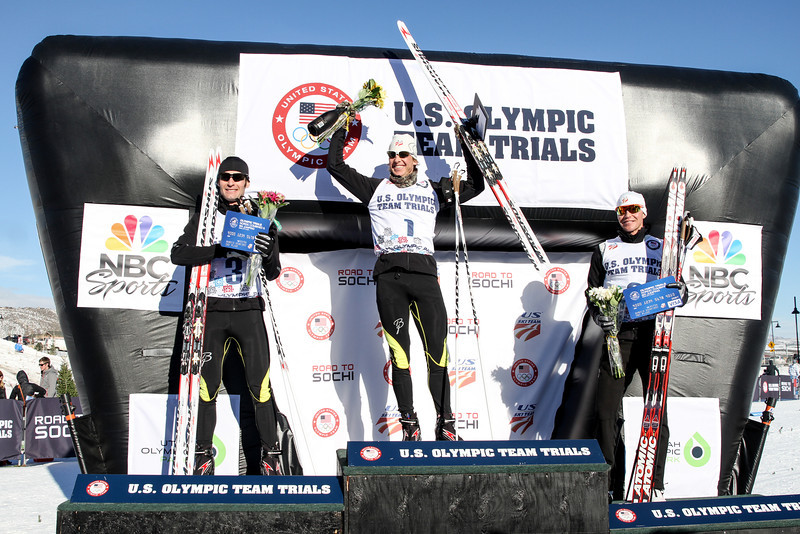
    (From left to right) The 2014 U.S. Nordic Combined Olympic Team Trials podium on Dec. 28 in Park City, Utah, with runner-up Bryan Fletcher, winner Todd Lodwick and Billy Demong in third. (Photo: Sarah Brunson/U.S. Ski Team)
    Todd Lodwick (c) tops the podium at the 2014 U.S. Nordic Combined Olympic Team Trials on Dec. 28 in Park City, Utah, with teammates Bryan Fletcher (l) in second, and Billy Demong in third. (Photo: Sarah Brunson/U.S. Ski Team)

    “I was kind of numb,” Lodwick said on the phone while icing his shoulder between training sessions on Tuesday. “Your mind goes in a million directions.”

    The medical attention he received was “brilliant,” Lodwick said. “[They] made sure I got the best care possible.”

    Understanding he wasn’t going to compete the next day and needed to get his shoulder fully evaluated, Lodwick flew out Saturday morning to the U.S. Ski Team’s headquarters in Park City, Utah. He received an MRI that night, which revealed he had strained tendons and muscles as well as dislocated his left shoulder.

    He was instructed to immobilize it for 2 1/2 weeks — four weeks before the 2014 Winter Olympics kick off in Sochi, Russia.

    “It’s bad timing, but I feel very much in good hands with the staff and friends and family and support here in Park City and at home,” Lodwick said.

    After hiking on the treadmill on Monday, he did intervals Tuesday morning and planned to train that afternoon.

    “I’m just excited for each day to come and for the training to commence,” he said of resuming his pre-Olympic regimen.

    While he was disappointed to miss out on this weekend’s World Cup in Seefeld, Austria, Lodwick said he was “taking it day by day” and listening his doctors’ recommendations. That will also dictate when he heads back overseas.

    Fortunately, he said he’s not on major pain medication and is able to sleep through the night. And he can have piece of mind, knowing he prequalified for his sixth Olympics — the most of any American Winter Olympian —  after winning the U.S. Nordic Combined Olympic Trials on Dec. 28 in Park City.

    He described the incident as “one of those fluky things that happens in ski jumping,” adding that it won’t affect his confidence on the hill.

    “I’m a veteran of the sport, and like I said, it’s the first time I’ve ever had an accident like this,” Lodwick said. “I know what it takes to get myself back in shape and hopefully back from this injury. … I’ve kind of got the reputation of the indestructible man.”

    Pointing to the strength of the U.S. team, Lodwick added, “I have every intention of being part of that team. It’s going to be a privilege to walk in the Opening Ceremony, should I have the chance.”

    “We have every intention of him competing in Sochi,” U.S. Head Coach Dave Jarrett wrote in an email.

    “I’m a firm believer that things happen in life for a reason,” Lodwick explained. “How the cookie crumbles, we’re going to move forward with every intention to go to the Olympic Games.”

  • Weekend Roundup: Sprintacular

    Weekend Roundup: Sprintacular

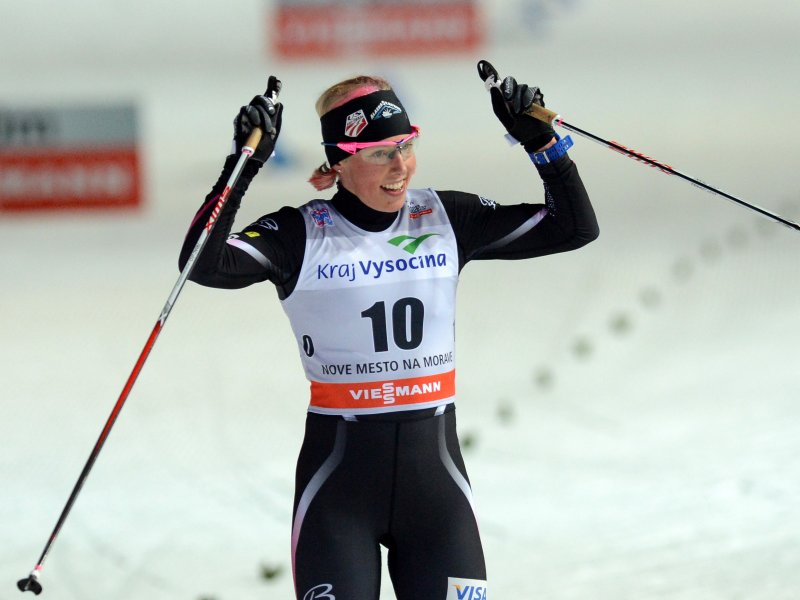
    Kikkan Randall (U.S. Ski Team) celebrates her victory in Nove Mesto, Czech Republic. The American superstar won yet another freestyle sprint in preparation for the Sochi Olympics in February. (Photo: Fischer/NordicFocus)
    Kikkan Randall (U.S. Ski Team) celebrates her victory in Nove Mesto, Czech Republic. The American superstar won yet another freestyle sprint in preparation for the Sochi Olympics in February. (Photo: Fischer/NordicFocus)

    It was a spectacular weekend for sprinting as the World Cup continued in Nove Mesto, Czech Republic, with both an individual and team sprint. FasterSkier was on site at the 2014 U.S. Cross Country Championships in Midway, Utah, as well as the biathlon World Cup in Ruhpolding, Germany. Action in the nordic ski world also took place at the Nordic Combined World Cup in Chaux-Neuve, France.

    Fresh off a training block and ready to go after skipping the Tour de Ski, Kikkan Randall was victorious in the Saturday’s World Cup freestyle sprint in Nove Mesto. The U.S. Skit Team member bested Lauren Van Der Graff of Switzerland and Ingvild Flugstad Østberg of Norway.

    Canadian Dasha Gaiazova just missed the semifinals for 13th overall. American Sophie Caldwell was the only other North American to make the rounds after qualifying in 25th and finishing 15th.

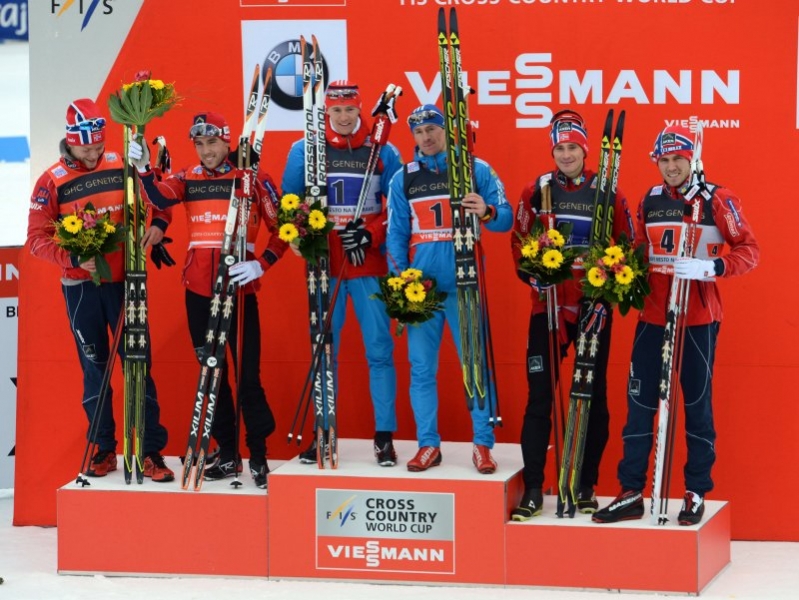
    The World Cup men's classic team sprint podium in Nove Mesto, Czech Republic: (from left to right) runner-up Norway I, winner Russia I, and Norway II in third. (Photo: Fischer/Nordic Focus)
    The World Cup men’s classic team sprint podium in Nove Mesto, Czech Republic: (from left to right) runner-up Norway I, winner Russia I, and Norway II in third. (Photo: Fischer/Nordic Focus)

    On the men’s side it was Sergey Ustiugov of Russia who came out on top in the freestyle sprint. He was followed by Italian Federico Pellegrino and Russia’s Alexey Petukhov, respectively.

    American Andy Newell qualified second to start off the day but was unable to capitalize on his previous speed in the finals and finished in 17th. Teammate Simi Hamilton, who also qualified for the finals, finished 20th overall.

    The Russians were once again triumphant in Sunday’s team sprint, with the team of Maxim Vylegzhanin and Nikita Kriukov winning the men’s competition over Norway I and Norway II. The win set the Russians up as the favorites going into the Olympics that will be hosted in their home country next month.

    Newell and Hamilton placed fifth overall for one of the best U.S. men’s team sprint results in recent memory.

    Norway had some redemption in women’s team sprint with Østberg and Maiken Caspersen Falla. They bested the Finnish and Russian teams, who placed second and third, respectively.

    With Randall and Sadie Bjornsen recovering this Sunday, Caldwell and Ida Sargent stepped up to that challenge and skied an impressive race. They went on to place sixth in the final.

    Canada’s team of Gaiazova and Perianne Jones finished 13th, just missing the qualification for the final.

    Reese Hanneman (APU) celebrates his win in the classic sprint at the 2014 U.S. Cross Country Championships in Midway, Ut. The win marks Hanneman's first national championship.
    Reese Hanneman (APU) celebrates his win in the classic sprint at the 2014 U.S. Cross Country Championships in Midway, Ut. The win marks Hanneman’s first national championship. (Photo: U.S. Ski Team – Tom Kelly)

    The 2014 U.S. Cross Country Championships wrapped up last Friday with classic sprints. In the women’s race, Russian Natalja Naryshkina of CXC won the sprint over Rosie Brennan (APU) and Nichole Bathe (UAF). Brennan was crowned national champion as she was the first American in the race.

    Reese Hanneman (APU), who won the qualification round and every one of his heats that followed, dominated the men’s race. He was followed by Erik Bjornsen (APU/U.S. Ski Team) and Dakota Blackhorse-von Jess (Bend Endurance Academy).  Hanneman made the podium in every race in which he competed, and is now the overall SuperTour leader.

    This weekend also marked the end of the Canadian Olympic Team Trials in Canmore, Alberta. Based on the results from the week’s results, Canada will name two men (one distance ski athlete and one sprint skier), and two women (one distance ski athlete and one sprint skier). The four athletes will be named at Cross Country Canada’s Olympic Team announcement on January 14 in Calgary, Alberta.

    As if the weekend wasn’t busy enough, the women’s 15 k individual took place in Ruhpolding, Germany, on Friday as part of the fifth week of the IBU World Cup in which Canadian Rosanna Crawford finished 26th and teammate Maggie Heinicke crossing the line in 30th. The top American finisher was Susan Dunklee who finished 41st.

    The men raced in their 20 k individual on Saturday in Ruhpolding. Lowell Bailey was the only North American to place in the top 30, finishing 25th. Scott Perras was the top Canadian in 36th.

    Todd Lodwick in the 2014 Olympic Team Trials for Nordic Combined at Utah Olympic Park, Park City Cross Country. Lodwick suffered an injury in France and is now going through rehab in Park City, Ut. (Photo: Sarah Brunson/U.S. Ski Team)
    Todd Lodwick in the 2014 Olympic Team Trials for Nordic Combined at Utah Olympic Park, Park City Cross Country. Lodwick suffered an injury in France and is now going through rehab in Park City, Utah. (Photo: Sarah Brunson/U.S. Ski Team)

    Dunklee was the top North American in Saturday’s 10 k pursuit, placing 33rd. In the men’s 12.5 k pursuit, Canadian Nathan Smith placed 16th with Bailey not far behind in 21st.

    In addition, US Biathlon announced its 2014 Olympic Team nominations on Sunday.

    In the world of nordic combined, American Todd Lodwick crashed in Friday’s provisional jump in Chaux-Neuve, France, sustaining an injury to his shoulder. He immediately flew to Park City, Utah, where he is currently receiving further evaluation and taking part in rehab before next month’s Olympics.

    The next day, the World Cup races continued. Billy Demong finished 18th in Saturday’s HS 10 k and Bryan Fletcher placed 28th. In Sunday’s team sprint, the two Americans teamed up for seventh.

    FIS Cross Country World Cup, Nove Mesto, Czech Republic

    Saturday’s freestyle sprint: women’s report | men’s report | North American Women’s report | American men’s report

    Sunday’s classic team sprint: women’s report | men’s report | Canadian women’s report

    2014 U.S. Cross Country Championships, Midway, Utah

    Friday’s classic sprint: women’s report | men’s report

    2014 Canadian Olympic Team Trials, Canmore Alberta

    Weekend report

    Saturday’s freestyle sprint: recap

    Sunday’s 15 k and 30 k skiathlon: press release

    IBU World Cup, Ruhpolding, Germany

    Friday’s 15 k: women’s report | American report

    Saturday’s 20 k: men’s report | American report

    Sunday’s 10 k and 12.5 k pursuit women’s report | men’s report | Canadian report 

    U.S. Biathlon Olympic nominations

    IBU Cup 5, Val Ridanna, Italy

    Saturday and Sunday: recap

    FIS Nordic Combined World Cup, Chaux-Neuve, France 

    Saturday’s LH 10 k: recap

    Sunday’s team sprint: recap

  • Lodwick Crashes in France, Returns to Park City for Further Evaluation and Rehab

    Lodwick Crashes in France, Returns to Park City for Further Evaluation and Rehab

    Todd Lodwick 2014 Olympic Team Trials for Nordic Combined at Utah Olympic Park, Park City Cross Country Photo: Sarah Brunson/U.S. Ski Team
    Todd Lodwick winning the 2014 Olympic Team Trials for Nordic Combined at Utah Olympic Park last month in Park City, Utah. In winning the trials, he became the first U.S. Nordic Combined skier to prequalify for the Sochi Olympics. (Photo: Sarah Brunson/U.S. Ski Team)

    During the provisional jump at the World Cup in Chaux Neuve, France, Todd Lodwick crashed and injured his shoulder on Friday.  Lodwick, who recently qualified for his sixth Olympic Winter Games next month in Sochi, Russia, is currently headed back to Park City, Utah, where he will get further evaluation and begin rehab on his shoulder with the goal of being ready to compete next month.

    According to Dave Jarrett, the U.S. Nordic Combined head coach, the weather conditions were not at play, saying “it was not windy, not snowy, pretty mild, just tame conditions.”

    “Basically, he got a little crooked and went over, not over the handlebars, but kind of over the side and landed on the back of his shoulder,” Jarrett explained on the phone.

    Lodwick tumbled and crashed on the outrun, which was extremely hard-packed due to overnight rain, but was immediately treated by both a doctor and physical therapist, who according to Jarrett, went with Lodwick to the hospital where he received further evaluation and an X-ray.

    Jarrett said that he and the other coaches have been reviewing the video footage to try to figure out just what happened, but at this point they have not come up with any conclusions.

    “It is one of those things that happens in jumping, it doesn’t happen that often, it is an extreme sport, but it is relatively safe,” he said.

    However, when you are going 90-plus kilometers per hour down a jump the slightest error can result in a large mistake.

    “It happens in training, it happens in comps and unfortunately, it happened today on that jump,” Jarrett said.

    According to Jarrett, Lodwick remains optimistic and wants to be in top form next month. “He told me that he is going to do everything in his power to make that happen,” Jarrett said.

    Lodwick will leave early tomorrow morning to fly back to Park City, Utah, to begin his rehab and continue preparing for Sochi.

  • For Lodwick, ‘Passion Still Burns’ for Sixth Olympics, Will Be First American to Do So in Sochi

    For Lodwick, ‘Passion Still Burns’ for Sixth Olympics, Will Be First American to Do So in Sochi

    Todd Lodwick (U.S. Nordic Combined) celebrates a clear-cut victory at 2014 U.S. Nordic Combined Olympic Team Trials at Utah Olympic Park on Dec. 28 in Park City, Utah. First in the jump, Lodwick beat teammate Bryan Fletcher by 17 seconds for the victory, which secured his bid for his sixth Olympics, the most of any American in the Winter Games. (Photo: Sarah Brunson/U.S. Ski Team)
    Todd Lodwick (U.S. Nordic Combined) celebrates a clear-cut victory at 2014 U.S. Nordic Combined Olympic Team Trials at Utah Olympic Park on Dec. 28 in Park City, Utah. First in the jump, Lodwick beat teammate Bryan Fletcher by 17 seconds for the victory, which secured his bid for his sixth Olympics, the most of any American in the Winter Games. (Photo: Sarah Brunson/U.S. Ski Team)

    Todd Lodwick hadn’t felt nerves like he experienced last Saturday in a long time.

    Seventeen years old at his first Olympics in 1994 in Lillehammer, Norway, Lodwick, now 37, was about to see if he could make his sixth Olympic team at the U.S. Nordic Combined 2014 trials on Dec. 28. If he came out on top of the individual 10-kilometer competition in Park City, he’d also make history as the first American to qualify for six Winter Olympics.

    “That’s always on the mind, to break the record books,” Lodwick said on the phone Dec. 30. He was on a personal business trip in the south and planned to return to Steamboat Springs, Colo., Jan. 2 before leaving for Europe on Jan. 6.

    Really, though, Lodwick wanted to prove again to himself and to everyone with an Olympic dream or any kind of lifelong aspirations, that it was possible.

    “For me, I think it was that I’m one of the top athletes in the world and that I’m out there to win,” Lodwick said. “And to solidify the hard work that I’ve been putting in and know that I am still capable of some great things. That passion still burns hot inside of me and it’s something that I wanted to do.

    “It’s not only my doing that got me here,” he said, crediting his sponsors, “teammates and coaches and family and friends that believe in me and believe in my whole journey.”

    With some 5,000 people at Utah Olympic Park (UOP) watching him and nine others compete in the coveted Gold Cup trial, Lodwick posted the best jump of 95.5 meters, giving him a 36-second headstart on teammate Billy Demong in the 10 k, also at UOP in Park City.

    Lodwick not only extended his gap on Demong, a four-time Olympian and 2010 Olympic gold medalist, on the four-lap course, but he held off teammate Bryan Fletcher — just as hungry for a guaranteed Olympic spot — by 17.3 seconds. Lodwick won the winner-takes-all competition in 25:27.6 to prequalify for the 2014 Games in Sochi, Russia. Fletcher placed second, and Demong was third, 56.1 seconds back.

    Eighth in the jump, Taylor Fletcher rose to fourth, 23.4 seconds behind Demong. Adam Loomis of the U.S. Nordic Combined B-team was fifth and his teammates Brett Denney, Nick Hendrickson and Michael Ward placed sixth through eighth, respectively. Ben Berend (Steamboat Springs Winter Sports) finished ninth and teammate Tyler Smith was 10th.

    “It feels pretty good,” Lodwick said two days after. “I put a lot of pressure on myself just like the rest of the athletes and knew that there was some big stuff on the line. … Going to these Games is something that’s always been on my mind since I started to pursue it. I knew it took a lot of hard work.”

    He said he was able to do so because of teammates “that push me as hard as they do and coaches that support me.”

    “If I touch one kid to help them achieve their dream, then I consider my career a success.” — Todd Lodwick, after winning U.S. Olympic trials to prequalify for 2014 Sochi Games

    Lodwick became the first of potentially five U.S. Nordic Combined athletes to qualify for the Olympics. The rest of the team will be decided based off world rankings through Jan. 19, with a complete team naming set for Jan. 22.

    Todd Lodwick and his 8-year-old daughter embrace after Lodwick won the Gold Cup U.S. Olympic trials on Dec. 28 in Park City, Utah, to qualify for his sixth Olympics -- unprecedented among U.S. Winter Olympians.  (Photo: Sarah Brunson/U.S. Ski Team)
    Todd Lodwick and his 8-year-old daughter embrace after Lodwick won the Gold Cup U.S. Olympic trials on Dec. 28 in Park City, Utah, to qualify for his sixth Olympics — unprecedented among U.S. Winter Olympians.
    (Photo: Sarah Brunson/U.S. Ski Team)

    As soon as he finished, Lodwick’s 8-year-old daughter ran up and gave him a huge hug.

    “She’s probably one of my biggest supporters,” he said. “I’m doing it for my kids. For me [it’s to] show them that dad still has it and can still kick butt. With my son, he’s five and he has some special needs and providing for him is something that I care deeply about. We have a bond that is very special.”

    His oldest understands what’s going on, and as she celebrated with him last Saturday, she enjoyed being in the limelight, just like her dad, Lodwick said.

    “This being my last competition ever in the states, I couldn’t have asked for anything more,” Lodwick said. “I was blown away by the volunteers and the setup crew, the people that dedicated so much time to putting on such an amazing event, and we all had a blast doing it. That was one of the best events that we’ve had in the states in a very, very long time.”

    For Lodwick, it was the start of a pre-Olympic sendoff he can enjoy in the next month leading up to the Olympics. It also confirmed that he’s once again in the best shape of his life.

    “Everyone [was] out there to compete at their best; a few of us had a victory in mind,” he said. “Bill, having it be his adopted home hill and home state, he was rested and training so I think he went into knowing he was the favorite.”

    Bryan Fletcher has led the team this season on the World Cup, notching three individual top 10-results and a program-best fourth with Lodwick in the team sprint Dec. 14 in Ramsau, Austria.

    The oldest guy on the team, Lodwick said this year will be his last, complete with two decades worth of Olympics and U.S. Ski Team experiences.

    “I’m 37 years old and do I feel like I’m capable of going to another Olympic Games when I’m 41? Sure,” he said. “But I think I’m ready to move on.”

    “I still believe in myself,” he said. “Dreams can come true if you work hard enough. … All this work isn’t for nothing and the time spent, sweating and wanting to throw up and legs cramping, looking back on that and knowing that I never gave up on my dream that lives in every single kid that watches on TV. If I touch one kid to help them achieve their dream, then I consider my career a success.”

    And it doesn’t have to be sports related, he said.

    “First step is to dream big and you have to do that to be successful,” Lodwick explained. “And you have to believe in yourself wholeheartedly.”

    He proved that at 2009 World Championships, winning two individual golds, and setting his sights on the 2010 Olympics in Vancouver, B.C. There, he won a silver medal in the 4 x 7.5 k team event. A year later at 2011 World Championships, he decided to commit to three more years and make a run for his sixth Olympics.

    (From left to right) The 2014 U.S. Nordic Combined Olympic Team Trials podium on Dec. 28 in Park City, Utah, with runner-up Bryan Fletcher, winner Todd Lodwick and Billy Demong in third. (Photo: Sarah Brunson/U.S. Ski Team)
    (From left to right) The 2014 U.S. Nordic Combined Olympic Team Trials podium on Dec. 28 in Park City, Utah, with runner-up Bryan Fletcher, winner Todd Lodwick and Billy Demong in third. (Photo: Sarah Brunson/U.S. Ski Team)

    One of the biggest difference-makers over the years has been the growth and success of the U.S. Nordic Combined team, he said. Last February at 2013 World Championships in Val di Fiemme, Italy, Lodwick, Demong, and the Fletcher brothers earned America’s first medal (bronze) in the team event.

    “I can’t thank Dave Jarrett enough,” Lodwick said. “He has made … sure that we are the best in the world. We started believing in ourselves and came together as a team. Going into these Games we’re going to feed off the inspiration that we had in 2010 and the success we had at World Championships. We rise to the occasion more often than not and surprise the heck out of people.”

    The U.S. Olympic quota is currently four, but they’re hoping to take five men to the Games if they can get five to rank in the World Cup top 50. Before the Olympic trials last month, Demong won two Continental Cup competitions in Park City to secure the team’s fifth World Cup quota spot, allowing them to bring another man over to Europe and try to score some World Cup points.

    “We rise to the occasion more often than not and surprise the heck out of people.” — Lodwick

    A couple U.S. Ski Team members are in Chaikovskiy, Russia, this weekend competing for those points, with Taylor Fletcher placing sixth and Denney finishing 32nd in Saturday’s normal hill/10 k.

    Starting next weekend, Lodwick and the rest of the U.S. A-team will get back to the World Cup in Chaux Neuve, France, then Seefeld, Austria, before heading back to Park City for a two-week training block at altitude for the rest of January. On Feb. 1, they’ll head back to Europe for a brief jumping camp in Oberstdorf, Germany, before heading to Sochi on the sixth.

    Trials results

  • U.S. Nordic Combined Just Warming Up, Primed for Olympic Trials and Beyond

    U.S. Nordic Combined Just Warming Up, Primed for Olympic Trials and Beyond

    On the final day of Continental Cup competition at Soldier Hollow in Midway, Utah, U.S. Nordic Combined's Billy Demong jumped to first and stayed ahead for the win, earning the U.S. an additional World Cup spot. (Photo: Riley Steinmetz/U.S. Ski Team)
    On the final day of the Continental Cup at Soldier Hollow in Midway, Utah, U.S. Nordic Combined’s Billy Demong jumped to first and stayed ahead for the win, earning the U.S. an additional World Cup spot. (Photo: Riley Steinmetz/U.S. Ski Team)

    Billy Demong’s doing just fine. The fact that he competed at this week’s Continental Cup in Utah while four of his teammates prepared for this weekend’s World Cup in Schonach, Germany, isn’t a cause for concern for the 2010 Olympic gold medalist.

    Demong, 33, needed to take care of business at home in Park City; there was a fifth World Cup spot on the line for U.S. Nordic Combined and someone needed to capture it.

    In a phone interview last month, head coach Dave Jarrett explained that Demong was in one of the best positions to qualify for the 2014 Olympics out of anyone on the World Cup team, based on his cumulative results from 2012 and 2013.

    The rest of the team, including Bryan and Taylor Fletcher, Todd Lodwick, and Brett Denney, would have to prove themselves worthy of the 2014 Sochi Games in the months leading up to it.

    That’s why those four are in Europe, and Demong was sent to take one for the team this week at Utah Olympic Park and Soldier Hollow.

    “It’s a little strategic plan to maximize quota spots for the Olympics and World Cup,” Jarrett explained.

    Demong did what he needed to, winning two out of three competitions from Tuesday to Thursday (and placing second in the other) to secure a fifth World Cup start for his team.

    “It opens up a spot for Brett Denney to be not sitting on his rear-end, not competing at all,” Jarrett said of the B-team member, who earned a trip to Europe with his summer performances.

    Denney, 23, joined the A-team in Europe earlier this month in Lillehammer, Norway. He ended up competing in Ramsau, Austria, last weekend, where he placed 15th in the 2 x 7.5-kilometer team sprint with Taylor Fletcher. The Americans’ first team, Bryan Fletcher and Lodwick, placed fourth – a first for U.S. NoCo in that event.

    Preceding their recent successes, the first competitions of the season weren’t so smooth. On the opening day in Kuusamo, Finland, none of the Americans made the top 50 in order to compete, and Demong was disqualified for an equipment violation; his suit was too loose around his thigh.

    From left to right: Todd Lodwick, Billy Demong, Bryan Fletcher and Taylor Fletcher with their bronze medals from Sunday's team event at the 2013 Nordic Combined World Championships in Val di Fiemme, Italy. (Photo: Fiemme2013)
    From left to right: Todd Lodwick, Billy Demong, Bryan Fletcher, and Taylor Fletcher display their team-event bronze medals at 2013 Nordic Combined World Championships in Val di Fiemme, Italy. (Photo: Fiemme2013)

    In the four-man team event the next day, the U.S. rose from 12th to seventh thanks to Taylor Fletcher, who skied the fastest anchor leg. The next weekend in Lillehammer, the U.S. notched 10th and 11th with Bryan Fletcher and Lodwick, respectively, and six days later, the two celebrated their unprecedented team-sprint result. On Sunday in Ramsau, Bryan rose to seventh in the individual competition and Demong placed ninth.

    Suddenly, it seems like things are back on track for four returners from the 2010 Olympic team, including Demong, who became the first American nordic skier to win gold (in the 10 k large hill competition), and Lodwick, who helped his team (with Demong, and the now-retired Brett Camerota and Johnny Spillane) notch silver in the relay.

    Bryan, 27, and his younger brother Taylor, 23, are back, too – this time as veterans. Last season, Taylor led the team in 16th in the World Cup rankings after achieving third for his first podium in Seefeld, Austria. Bryan was the second-leading American in 21st overall. Equally competitive on any given day, Taylor is best known for his superior racing skills, while Bryan has historically been stronger in jumping.

    While Bryan has stated he prefers to work on his strengths, Taylor would rather spend more time improving his weaknesses.

    “We’re such polar opposite guys, maybe that’s how it works for him, but I feel like I work on my jumping because I’m confident my cross country will be strong,” Taylor said on the phone in October. As a result, his summer training was generally 60-percent jumping, 40-percent skiing.

    “Luckily for me I have to focus on cross country, too,” Bryan said in November. “If I’m not jumping two-minutes ahead of those guys, then I have a race on my hands.”

    Before the World Cup season, team time trials were a big indicator – and Taylor was happy to win at least two of them. First in the jumps, he didn’t let anyone catch him in the races.

    “To do that and know that people behind me are Olympic champions and World Champion gold medalists, that kind of gives you a good feeling and a good focus … that I’m jumping well and I’m skiing well,” Taylor said.

    But with teammates like Demong and Lodwick, 37, Taylor’s still the young guy.

    “Bryan’s four years older than me so I definitely do get treated like a rookie, but it’s not that I don’t enjoy it,” Taylor said on the phone in October. “I might get frustrated because they’re not listening to me when I might have something worthy to say, but it doesn’t matter to me because Bill knows what he’s doing and everything he does is right. It’s easier to follow him and it should work come this winter.”

    Olympic Goals – and Golds

    In terms of 2013/2014 aspirations, the World Cup isn’t it. Like most, peaking at the Olympics will be U.S. NoCo’s top priority – and they’re not too concerned with what happens before or after that.

    Olympic Champion Billy Demong shares the podium with teammates Taylor and Bryan Fletcher after winning his ninth career U.S. title. (Photo: USST/ORDA-Jon Lundin)
    U.S. Nordic Combined’s Billy Demong (c) shares the podium with teammates Taylor and Bryan Fletcher after winning his ninth career U.S. title at nationals in October in Lake Placid, N.Y. (Photo: USST/ORDA-Jon Lundin)

    After the Schonach World Cup, the team will head back to the U.S. for Olympic Gold Cup Trials on Dec. 28 in Park City. The winner there will secure an Olympic spot, but it’s not like anybody can make it – racers have to be eligible to compete in the Olympics. According to Jarrett, that narrows the field to 10 or so.

    “Nobody is prequalified, everybody has got to earn it objectively,” Jarrett explained.  “There is coaches’ discretion for maybe one spot, but that is kind of a force majeure, if we have to use it. We would rather everybody qualifies via the objective criteria.”

    Those criteria are based off the top-ranked athletes on the overall World Cup list.

    “It’ll be hard to make the Olympic team if you haven’t scored any World Cup points,” Jarrett added. “We have enough competitions – two competitions every week – that if we want to have winners at the Olympics we gotta have guys that can win at the World Cup and at the very least score points.”

    On Dec. 28, several men will be gunning for the top spot to ensure their ticket to Sochi, but as Bryan pointed out, it probably won’t be dramatic.

    “It’s one of those situations where one of our best guys wins who would already be going to the Olympics, the way it should be, but it is a cool event,” Bryan said. “I remember in 2002 competing [at the] Gold Cup and getting sixth or 11th or something. You feel so close to making that Olympic team that’s such a cool opportunity for the junior kids to feel like, ‘I could rise to the occasion and jump well or ski fast and get myself an Olympic spot.’ It’s a full-on, real competition and all those A-team guys will be certainly trying to perform our best.”

     “Dave’s always been big on saying, ‘Compete at your average’ because if you try too hard, it can blow up in your face.’ ” — Taylor Fletcher

    Meanwhile, the World Cup will continue while the U.S. A-team races at home then rests up before returning to Europe on Jan. 7. Two weeks later, they’ll fly back to Park City for an pre-Olympic altitude camp, then to Europe again on Feb. 1 for a “mini-jumping camp” in Oberstdorf, Germany. Then, they’ll head to Sochi on Feb. 6.

    It might sound like a lot of travel, but Jarrett said it’s all part of their plan.

    “Our guys would rather do that then sit in a hotel somewhere in Europe spending all those days away,” he said. “People question strategies, but that is something we’ve been good at doing in the past, so we’ll continue to do that.”

    While the US Nordic Ski Team spends the entire winter in Europe, Jarrett said they’d rather go home when they have time between competitions, even if it’s only 10 days.

    “On a cost basis, it is somewhat of a wash on lodging,” he explained. “Some athletes don’t want to fly, some athletes would rather stay there, but for the most part all of our guys would rather come home for a little bit and relax.”

    Demong and Lodwick both have children at home, which adds to the draw of stateside training and recovery. Taylor said its helped them in the past, allowing for a “mental reset” during a hectic season.

    “It’s hard to answer those questions sometimes when the Europeans are like, ‘All you guys care about are the big events and why don’t you target the overall?’ ” Taylor said. “But our goals are the big events and a gold medal.

    “The French team, they’ll go home almost every single weekend stay in their own bed for two or three nights, regroup and come back,” he added. “I think that helps a lot to go home and not have the stress of being around your teammates every single weekend. There’s no other team as close as we are.”

    In terms of results, Taylor said the team’s been good about keeping them in perspective.

    “We’ve always just gotten better as the season goes on,” he said. “Bryan went from top 20 at the beginning of the [2011] season to winning a world cup in Oslo [in 2012].”

    Without much fanfare leading up to the 2013 World Championships, the Americans went out and captured their first World Championships team-event medal in third. Earlier in the season, they achieved their first World Cup relay podium in third, “and that was a pretty damn average day for everybody,” Taylor said.

    “To know that we’ll be in there on our average day makes the expectations quite a bit less … We know that we don’t have to try so hard to get things done and our performances will allow us to have those results,” he said. “Dave’s always been big on saying, ‘Compete at your average because if you try too hard it can blow up in your face.’ ”

    Plain and simple, that’s the team’s goal – to go out and win medals just like they did four years ago in Vancouver. Having never reached the Olympic podium before, the 2010 team captured four medals – at least one in every event – for 44 percent of the available medals. While Camerota retired in the spring of 2011 and Spillane called it a career last April, Lodwick’s embarking on his sixth Olympics and Demong is looking ahead to his fifth.

    “I think that we’re on par to be fighting for medals like we were in Vancouver,” Jarrett said. “A lot of teams are the same as they were and a lot of teams are different. It’s hard to say, but I think that we’re in a good spot and I feel good about it. We just have to go out and do it. That’s the main thing.”

  • Notes and Quotes: The Good and Bad from Davos, Ramsau and Annecy

    Notes and Quotes: The Good and Bad from Davos, Ramsau and Annecy

    The women's podium at Sunday's World Cup skate sprint in Davos, Switzerland: (from l to r) Kikkan Randall (USST) in second, Marit Bjørgen (NOR) in first, and Denise Herrmann (GER) in third. (Photo: Fischer/Nordic Focus)
    The women’s podium at Sunday’s World Cup skate sprint in Davos, Switzerland: (from l to r) Kikkan Randall (USST) in second, Marit Bjørgen (NOR) in first, and Denise Herrmann (GER) in third. (Photo: Fischer/Nordic Focus)

    From the cross-country World Cup in Davos, Switzerland, to U.S. Nordic Combined’s best team-sprint result in Ramsau, Austria, to five straight days of biathlon races in Annecy, France: here’s everything you didn’t get to read about over the weekend in simple thumbs-up-thumbs-down fashion. And if you missed the recaps, check out our digest.

    Likes:

    Skiing fast:

    “Skiing super fast [feels] awesome. This is definitely the strongest I’ve skied in a  little while and definitely very appreciative of it. It’s a great feeling to be able to move up through the ranks like that and just builds to your confidence.” – Bryan Fletcher (U.S. Nordic Combined), on placing fourth with Todd Lodwick in Saturday’s World Cup 2 x 7.5 k team sprint in Ramsau, Austria

    “The energy was good, and our skis were so fast. We were working hard on pushing over the top of the hills because if you just add one more skate, you’re flying down the hill.” – Jessie Diggins, 12th in Sunday’s World Cup skate sprint in Davos, Switzerland

    “I tried to go out really hard right from the start and just hold on. It worked out well for me and I ended up feeling better today than in any of my previous races this season.  I ended with the 3rd fastest ski time, so I am very happy with the direction my skiing is headed.” – Tim Burke (US Biathlon), 16th in Sunday’s IBU World Cup 12.5 k pursuit in Annecy, France

    Qualifying for the 2014 Sochi Olympics:

    In an email, Megan Heinicke explained that, in placing fourth with Canada’s relay at the IBU World Cup last Thursday, she completed her Olympic qualification (with teammates Megan Imrie, Rosanna Crawford and Zina Kocher):

    “I am incredibly relieved to have that finalized and just so happy to have Sochi in my plans. This girls on this relay team will be our Olympic team and I think this result gives us a lot of confidence and motivation, which is awesome!” – Heinicke (Biathlon Canada)

    Fourth place:

    “I knew it was likely to be painful so I was mentally prepared for a hard fight and as motivated as ever to give it my all.  The result altogether was amazing…I couldn’t stop smiling. We saw that we had this kind of potential in our relay last weekend and we all knew that a relay without penalty loops would be enough to fight for a top 6 finish. I am so proud of all of us!  I think the coolest thing for our relay is that this wasn’t a miracle race – it was just 4 good to normal races which means that this is a result we can realistically repeat and even improve on.” – Heinicke

    “I could have played my cards a little bit different to give us another chance to be up there on the podium, but nevertheless fourth place is awesome and we had the fastest time out there.” – Todd Lodwick (U.S. Nordic Combined), on Saturday’s team sprint

    Team sprints:

    “Nordic combined was actually the one who invented the team sprint. It actually began in 1993, and then it kind of went away from the program in the ’90s until it came back in 2011. I think they brought it back as a World Cup event after cross-country took it on and did it as an event and showed it’s a good spectator event.” – U.S. Nordic Combined Head Coach Dave Jarrett 

    “It’s a strength, and [it was] a medal event in the World Championships last year. It was the first time it was a medal event, but it won’t be a medal event in the Olympics. We tend to rally around each other when it comes to team events and certainly Todd and Bryan were clearly in a  good place and they did a good job.” – Jarrett

    Women’s 15 k races:

    The women’s 15 k individual race on Saturday in Davos, Switzerland, was only the second one on the World Cup in the last 10 years, with the other in Davos two years ago. What gives? Bring on the distance!

    Note: Bjørgen won that race, too, but Norway swept the 2011 edition’s top four. On Saturday, they took three of the top four, with Sweden’s Charlotte Kalla placing third.

    Davos

    “Davos is really nice and the cheering was great.  There were lots of fans out there with big bells which is fun.” – Ida Sargent (US Ski Team), 41st in Sunday’s Davos World Cup sprint

    Personal bests

    “[Sunday] was the second best qualifying result I have ever had in a WC sprint, classic or skate, in terms of both FIS points and total time back from the leaders but it was just super tight today.  There are just a lot of fast women out there.” – Sargent

    Note: The top 30 women were separated by 3.6 seconds in Sunday’s 1.5 k freestyle sprint qualifier. The men’s top 30 on the same course was separated by nearly six seconds.

    Teammates tearing it up:

    “It was awesome to watch the heats in the sun and see all of those girls ski so well. Kikkan is obviously so strong and Jess and Soph skied awesome quarterfinals.  It was fun to see.” – Sargent, on Sunday’s World Cup skate sprint

    “I was really hoping we’d actually see a couple of Americans in the final, and it was close. So it was really cool to see those girls just coming on and coming on, and it’s really fun to have a team component.  I think everyone should be pretty psyched.” – Kikkan Randall (US Ski Team), second in sprint

    Last Thursday, the U.S. women tied a team-best eighth in the IBU World Cup relay: 

    “Getting 8th again shows that our result last week wasn’t a fluke – 8th can be our new norm, and in the next relay we can do even better! I think that we had a really really good year of training this year, and the fact that we mostly had poor results in the first few races doesn’t mean anything.  We’re just starting to hit our stride, and I think that we will all continue on an upward trajectory into the second trimester of the season.” – Hannah Dreissigacker (US Biathlon)

    Feeling young:

    “I still feel like I am in my youth in the way I’m skiing and competing. I have so much fun doing it. It’s a blast. I love the sport and [Saturday’s team sprint] was just a  culmination of really, really good teamwork. ” – Lodwick, 37

    Fast skis:

    “The wax techs did an awesome job … providing us with really, really fast skis. They did a heck of a job and allowed us to ski our own race.” – Lodwick 

    Perfect conditions:

    “The range conditions were excellent. There was almost no wind. It was totally calm with stable light. I would say it was perfect.” – Heinicke, 50th in Saturday’s 7.5 k sprint 

    Annecy’s course:

    “The course here is really fun and it suits me well. Shooting has also been quite easy here.” – Annelies Cook (US Biathlon), after anchoring U.S. women’s relay to team-best eighth


    Dislikes:

    Missing a relay:

    With just three guys on the IBU World Cup, the Canadians had to sit out the men’s relay on Friday in Annecy, France:

    “Unfortunately we didn’t start enough WC’s last year and subsequently didn’t rank high enough in Nation Cup points to have 4 start spots this WC season. There are selection trials next week in Canmore, Dec 20-21 and they will be used to selected the final Men’s Olympic spot and the next IBU Cup tour which will see those athletes compete in Oberhof and then continue onto the IBU Cup.  Anyone who is not qualified is at home getting ready for those races.” – Scott Perras (Biathlon Canada)

    “Having not raced the relay is kind of bitter sweet. Sure it’s great to get a whole week to rest up (mentally) but I think things would have gone better had I raced [Friday]… I guess it is also a plus to have rested a week physically, but maybe not so great to maintain that race shape and speed.” – JP Le Guellec (Biathlon Canada), 49th in Saturday’s IBU World Cup 10 k sprint

    Davos sprint course

    “I don’t really like this course just because I’m not a huge fan of two lap courses. I’ve never figured out how to pace them and I don’t think I have ever qualified in a two lap skate sprint.” – Sargent

    Annecy’s course:

    “Flat courses with bumps like here or Antholz [Italy] give me grief with my back. I think it’s all the one skate followed by tucking and opening again for more one skate that takes its toll. So I could feel my back being pretty tight in standing, which definitely is an issue.” – Le Guellec, on Saturday’s sprint

    The unavoidable

    “… Little things like hitting a patch of ice on the final corner and almost going down and then skiing a horrible transition into the hill on one the laps really adds up.” — Sargent 

    DQs:

    “I’ve taken a very hard look at my suits and measured myself neck to ankles in 5 cm increments as well as spent a good deal of time sewing and trying to understand how it all comes together. As far as the bib fiasco part II well? Sh*t happens;)” – Billy Demong (U.S. Nordic Combined), ninth in Sunday’s individual competition, a week after being disqualified for forgetting his bib in Lillehammer, Norway

  • Weekend Roundup: High Expectations

    Weekend Roundup: High Expectations

    Kikkan Randall and Marit Bjørgen's photo finish (Photo: Fischer/Nordic Focus)
    Kikkan Randall and Marit Bjørgen’s photo finish in Sunday’s Sprint in Davos, Switzerland. Bjørgen won it by a hair. (Photo: Fischer/Nordic Focus)

    Extraordinary performances are becoming ordinary for the North American contingent this year as new stars emerge, historic results accumulate, and expectations continue to grow.

    FasterSkier was on site in Davos, Switzerland, where five USST members raced to the top 30 in Saturday’s distance races. Kikkan Randall placed 18th in the women’s 15 k, followed by Liz Stephen in 20th, Holly Brooks in 25th, and Jessie Diggins in 30th. Noah Hoffman was 25th in the men’s 30 k.

    Sunday’s Skate sprints brought even more excitement for the U.S. team with Randall skiing to a hard fought second place against powerhouse Marit Bjørgen. Sophie Caldwell, in a breakout performance, reached the World Cup semifinals and cracked the top ten with her ninth place finish. Diggins and Sadie Bjornsen, who both suffered falls, were 12th and 27th.

    On the men’s side Simi Hamilton and Andy Newel advanced to the quarterfinals and finished in 14th and 17th.

    The Canadian women jumping for joy after notching Biathlon Canada's best-ever finish in a relay. (Photo: Biathlon Canada/Matthias Ahrens)
    The Canadian women jumping for joy after notching Biathlon Canada’s best-ever relay result of fourth. (Photo: Biathlon Canada/Matthias Ahrens)

    North America shined in the IBU World Cup with the Canadian women’s relay team taking a historic fourth-place finish in the 4 x 6 k relay. The success continued throughout the weekend with four Canadian women qualifying for the pursuit, and Rosanna Crawford ultimately finishing 19th.

    On the men’s side Canadian Nathan Smith finished 16th in the 10 k sprint and was followed by Americans Tim Burke in 28th and Lowell Bailey in 35th.  In the 12.5 k pursuit Smith impressed again with an eighth-place finish. He was followed by Bailey and Burke in 15th and 16th.

    The action didn’t stop there with historic results from U.S. Nordic Combined. In Ramsau, Austria, Bryan Fletcher and Todd Lodwick skied the fastest combined time in the 2 x 7.5 k team sprint to place fourth, the best-ever result for the U.S. in the two-man event.

    In Sunday’s individual 10 k competition, Fletcher and Billy Demong cracked the top ten by placing seventh and ninth.

    With all the success happening across the pond it’s easy to forget that North America had some races of its own this weekend. Rossland, B.C. hosted the second set of NorAm races where Erik Bjornsen and Emily Nishikawa triumphed in the sprint, and Kate Fitzgerald and Kevin Sandau won Sunday’s 10 and 15 k.

    The IPC World Cup also took place in Canmore, Alberta, with several North American standouts. Canadian Brian McKeever won the 10 k on the opening day and churned out another winning performance in the 20 k classic race. American Oksana Masters placed third in the women’s sit-ski 5 k and fourth in the 0.75 k sprint.

    Norway’s Anders Gløersen celebrates his win as he crosses the finish line (Photo: Fischer/Nordic Focus)
    Norway’s Anders Gløersen celebrates his sprint win as he crosses the finish line in Davos. (Photo: Fischer/Nordic Focus)

    Cross-Country World Cup, Davos, Switzerland (Results)

    Saturday’s 15/30 k skate individual start: Women’s report | Men’s report | U.S. women’s report | Hoffman Happy with Performance

    Sunday’s 1.5 k skate sprint: Women’s report | Men’s report | Canadian report | One of USST’s ‘Best Days Ever’ | Randall’s Lesson for SochiUSSA CEO Shaw Spectates in Davos

    Nordic Combined World Cup, Ramsau, Austria (Results)

    Saturday’s 2 x 7.5 team sprint: Report

    Sunday’s NH/10 k: Recap

    IBU World Cup, Annecy, France (Results) 

    Thursday’s 4 x 6 k relay:  Women’s report

    Friday’s 4 x 7.5 k relay:  Men’s report

    Saturday’s 7.5/10 k sprint: Women’s report | Men’s report

    Sunday’s 10/12.5 k pursuit: Women’s report | Men’s report 

    Black Jack NorAm, Rossland, B.C. (Results)

    Saturday’s skate sprint: Report

    Sunday’s classic 10/15 k: Report

    IPC World Cup, Canmore, Alberta (Results)

  • Just Shy of Podium, Bryan Fletcher, Lodwick Combine for U.S. NoCo’s Best Team Sprint in Fourth

    Just Shy of Podium, Bryan Fletcher, Lodwick Combine for U.S. NoCo’s Best Team Sprint in Fourth

    Norwegians lead the pack in Saturday's Nordic Combined World Cup 2 x 7.5 k in Ramsau am Dachstein, Austria. Norway placed first and second, Italy was third, and the U.S. was just 1.2 seconds off the podium in fourth. (Credit: Tim Hug)
    Norwegians lead the pack in Saturday’s Nordic Combined World Cup 2 x 7.5 k in Ramsau am Dachstein, Austria. Norway placed first and second, Italy was third, and the U.S. was just 1.2 seconds off the podium in fourth. (Photo: Tim Hug)

    Americans Bryan Fletcher and Todd Lodwick narrowly missed the podium in the 2 x 7.5-kilometer sprint in Ramsau am Dachstein, Austria, finishing fourth for U.S. Nordic Combined’s best result in a team sprint.

    A little off in the jumping portion of Saturday’s competition, Fletcher and Lodwick ended up starting 14th of 20 teams, 44 seconds behind the Estonian leaders, Kristian Ilves and Karl-August Tiirmaa.

    While the Estonians clocked the second-slowest race time, getting passed by all but two teams to finish 18th, Fletcher and Lodwick rose to the challenge and notched the fastest-combined time to finish 10 seconds behind the winners, Norway’s Mikko Kokslein and Jørgen Graabak, who rose from 11th to first in 33:59.3. Norway’s Haavard Klemetsen and Magnus Krog took second (+8.2) after jumping to sixth, and Italy’s Samuel Costa and Alessandro Pittin captured third just 1.2 seconds ahead of the Americans.

    According to U.S. Head Coach Dave Jarrett, skiing fast was their plan all along.

    “It was a really tight jumping competition, so we knew after that result, they were in a position to fight for a podium,” he said in a phone interview. “That’s what we’ve been saying all along, that we need to just put ourselves in that position and then we should hopefully be able to take advantage of that.”

    Most teams wouldn’t consider starting 14th ideal, but it was time back that mattered to Fletcher and Lodwick. And fourth place was nothing to scoff about — it was the best U.S. finish in the relatively new event.

    “It’s definitely a solid day,” said Fletcher, who’s notched a World Cup top 10 five other times in the last three years. “We turned some tough jumping into a great cross-country race, so it was a positive performance all around.”

    “We’re really, really proud to put Norway in its place and to know that we are the fastest team out there, whether it’s by a second or ten seconds, it doesn’t matter. We are the fastest team and it shows on the results.” — Todd Lodwick

    According to Jarrett, there were 12 teams bunched together at one point, making the exchanges “pretty interesting.”

    “Some people had more luck than others in the exchange zone,” he said. “Todd and Bryan were smart and they did a good job tagging off and kind of pacing themselves and placing themselves among the lead group. When the last two laps came around, the Norwegians were in a good spot and they got a gap on the field.”

    While jumping hasn’t been a strong point for the Americans in the first World Cups of the season, Fletcher said Saturday was a confidence booster.

    It was a crowded and fast at the front of the pack in the men's Nordic Combined 2 x 7.5 k in Ramsau am Dachstein, Austria. credit Tim Hug
    It was a crowded and fast at the front of the pack in the Nordic Combined World Cup 2 x 7.5 k in Ramsau am Dachstein, Austria. (Photo: Tim Hug)

    “I haven’t had quite my best performances on the jump hill, but I’ve kind of nailed my problems and working to fix them and I thing that’s a positive take away from it,” he said. “Today I had a really good jump in the trial round and then the competition jump was close. It definitely wasn’t what I’m capable of, but it was in the hunt and that’s all we needed.”

    Lodwick added a solid jump to the mix, which Fletcher said brought them closer to the front of the pack. “Overall it wasn’t our best day on the jump hill, but we weren’t out either,” Fletcher said.

    “I didn’t jump horrible,” Lodwick said. “It’s just missing just a little bit and that’s going to come. The more we compete, the better off we get and we’re going to be in really, really top shape.”

    For the 37-year-old Lodwick, it wasn’t his best overall performance in nearly two decades on the World Cup, but he said it was up there with those he’s proud of. Last Sunday in Lillehammer, Norway, he placed 11th for his best result in nearly three years. In the same race, Fletcher placed 10th.

    “I know that we’re on the right track,” he said. “We’re on the verge of just making the season. It’s been a slow [start], but results like that give us a lot of confidence so we’re excited.”

    Last year, the U.S. broke through in a World Cup 4 x 5 k team event in Schonach, Germany, with their first third-place finish. Both Fletcher and Lodwick were on that team with Billy Demong and Taylor Fletcher, and those four went on to notch a historic bronze at 2013 World Championships in Val di Fiemme, Italy. Lodwick also has also helped the team to a few fourth-place results in previous relays.

    A tight-knit race at the Nordic Combined World Cup 2 x 7.5 k team sprint on Saturday in Ramsau, Austria. (Photo: Tim Hug)
    A tight-knit race at the Nordic Combined World Cup 2 x 7.5 k team sprint on Saturday in Ramsau, Austria. (Photo: Tim Hug)

    A World Cup competitor since 1995, Lodwick laughed and said, “I am the oldest guy on the circuit.”

    But his past experiences helped him post one of the fastest individual times in Saturday’s race.

    “I don’t feel [old] in my body or my heart and I went out there and knew that staying in the front pack and positioning and taking corners the right way and pushing people out and not letting people in,” he said. “That’s just what it takes to be aggressive and to be in that pack. Within this packed kind-of race, it definitely takes a little bit of skill and knowledge. I guess I relied on that.”

    Although the team sprint will not be a medal event at the Olympics in February, Lodwick said their cross-country times should come as a warning to the competition they’ll meet at the 2014 Games.

    “We train all summer and to have a result like [this] is humbling,” he said. “We’re really, really proud to put Norway in its place and to know that we are the fastest team out there, whether it’s by a second or ten seconds, it doesn’t matter. We are the fastest team and it shows on the results and we can chock that up for a win.”

    The second U.S. team, with Brett Denney and Taylor Fletcher, placed 15th, 1:36 back from the winners. Taylor clocked the fastest individual time of 16:50.7. Teammate Billy Demong is resting this weekend in anticipation of next week’s Continental Cup in Park City, Utah.

    Had Demong been on skis Saturday, Jarrett said it’s likely the U.S. could have had an even-stronger showing.

    “Bill would have been a really useful addition into one of the teams today and could have been more like the Norwegians or Japanese or Germans that have two teams fighting in that top 12 for sure,” he said.

    He added that there’s still plenty of jumping and racing left in the season before the team heads for Russia.

    “Our sights are set and we’re measured against our results in the [Vancouver] Olympics,” he said of their unprecedented medal haul at the 2010 Games. “USSA has made it no secret that [the 2014] Olympics are what they’re measuring everything against, and our plan is to do well in [Sochi].

    “It’s a tall order because the Olympics only come around once every four years and it’s only one day for that competition and there’s a lot of variables that can take place,” he explained. “But we’re going to continue to work in each competition and just live up to our potential.”

    He said his team is nowhere near its February peak. “It’s always good mentally to have good results every time you do a competition,” he said. “I think these guys are focused and ready to continue competing. We have another individual competition [Sunday], and then two more next weekends and then Olympic tryouts in Park City, and then three more weekends in January. There’s plenty more.”

    Bryan said he was looking forward to what’s to come, especially given the season’s slow start.

    “We know that this time of year can either go one of two ways,” he said. “You can either come into the World Cup season and start off doing great and sometimes you come in with a little bit of a rough start like we had this year.”

    Each week, it’s a matter of building on the previous week, he explained. “These last two weekends especially, we’ve really taken some positive steps forward to show we’re not out of the game. We are here to contend. We just narrowly missed the podium but given the circumstances, we’re pretty happy about the fourth place and I think these narrow misses just make us hungry for more.”

    — Alex Matthews contributed reporting

  • Demong Gets It Done in Placid with Ninth National Title; Van and Alexander Dominate Ski Jumping

    Demong Gets It Done in Placid with Ninth National Title; Van and Alexander Dominate Ski Jumping

    Olympic Champion Billy Demong shares the podium with teammates Taylor and Bryan Fletcher after winning his ninth career U.S. title. (Photo: USST/ORDA-Jon Lundin)
    U.S. Nordic Combined’s Billy Demong (c) shares the podium with teammates Taylor (l) and Bryan Fletcher after winning his ninth national at U.S. Nordic Combined Championships on Sunday in Lake Placid, N.Y. (Photo: USST/ORDA-Jon Lundin)

    Consistency is key when it comes to nordic combined. Third in the morning jump at the U.S. Nordic Combined Championships on Sunday in Lake Placid, N.Y., national-team staple Billy Demong went on to win the 10-kilometer rollerski with the third-fastest time at the Olympic Jumping Complex, holding off teammates Bryan and Taylor Fletcher by 11 seconds in 25:47.8.

    According to Steamboat Today, Demong started 16 seconds behind jump leader Todd Lodwick, another U.S. Nordic Combined veteran. Lodwick started four seconds ahead of Aleck Gantick and ultimately placed fifth after Demong, Bryan Fletcher, Taylor Fletcher and Brett Denney, respectively. Bryan and Taylor started nearly a minute behind in seventh and eighth, respectively.

    Taylor passed his brother and edged him for second by 0.3 seconds. Denney finished 31.1 seconds behind Demong in fourth and Lodwick was fifth (+1:14.5), reportedly slowed by asthma.

    It was Demong’s ninth national title in what may very well be his last U.S. championships. The 33-year-old Lake Placid-area native plans to retire after the 2014 Sochi Olympics.

    “No doubt, this was my best race of this summer,” Demong said in a U.S. Ski Team press release. “This was a solid start to where I want to be right now.”

    Most threatened by the idea of Lodwick sprinting to the finish or Taylor Fletcher catching him and skiing away, Demong said he tried to ski his own race.

    “I just wanted to ski an even split and stay just 10 to 15 seconds in front of [Taylor] so he didn’t have the opportunity to break away from me,” he explained. “It seemed like that worked out. He pulled within 10 seconds of the last lap, but I had enough energy to hold that gap to the finish line.”

    Best of all, Demong said the dryland results indicate that the team’s in good shape overall.

    “There were four to five guys who could have won so I think that our team is exceptionally strong, even stronger than four years ago,” he said. “That’s the most important thing to me.”

    The U.S. Nordic Combined squad is headed to Europe on Monday for its final overseas training camp before the World Cup season starts next month.

    “We had some good results,” head coach Dave Jarrett told Steamboat Today. “It was difficult conditions and this hill is hard. We didn’t do very well jumping, but we have jumped well here, so this was just one of those days.”

     2009 World Champion Lindsey Van celebrates her U.S. Ski Jumping title along with teammates Jessica Jerome and Alissa Johnson in Lake Placid. (ORDA-Jon Lundin)

    2009 World Champion Lindsey Van (c) celebrates her U.S. Ski Jumping title along with teammates Jessica Jerome and Alissa Johnson on Sunday in Lake Placid, N.Y. (Photo: USST/ORDA-Jon Lundin)

    Van, Alexander Take Jump Titles

    Also on Sunday in Lake Placid, 2009 world champion Lindsey Van (Women’s Ski Jumping USA) and Nick Alexander (USA Ski Jumping) notched national titles on the K90 Olympic normal hill at the U.S. Ski Jumping Championships. For Van, it was her 16th title and Alexander’s second.

    “This validates all of the hard work that I’ve been putting in all this summer,” Alexander said in a U.S. Ski Team press release. “Now I just have to appreciate today and work even harder heading into the wintertime.”

    “I had fun today and jumping is about fun,” Van said. “I started jumping well a couple of weeks ago. It’s nice as I was struggling a couple of years. It was nice to feel the rhythm of ski jumping again.”

    Earlier this summer, U.S. Women’s Ski Jumping world champion Sarah Hendrickson, who is recovering from knee surgery and did not compete on Saturday, and USA Ski Jumping’s Nick Fairall won the large hill competitions in Park City, Utah.

    Van tallied the two longest jumps of the weekend of 92.0 and 96.5 meters to top teammate Jessica Jerome, who was second, and Alissa Johnson in third. Alexander soared 99 meters on both rounds, the longest of any man, to beat teammates Fairall in second and Anders Johnson in third.

    Video from WPTZ News Channel 5

    Results

  • Demong on Peaking and Final Push Through Sochi

    Demong on Peaking and Final Push Through Sochi

    From left to right: Todd Lodwick, Billy Demong, Bryan Fletcher and Taylor Fletcher with their bronze medals from Sunday's team event at the 2013 Nordic Combined World Championships in Val di Fiemme, Italy. (Photo: Fiemme2013)
    Billy Demong (second from l) with U.S. Nordic Combined teammates Todd Lodwick (l), Bryan Fletcher and Taylor Fletcher (r) after taking bronze at 2013 Nordic Combined World Championships in Val di Fiemme, Italy. (Photo: Fiemme2013)

    Billy Demong’s in for a big weekend. A short detour to his old stomping grounds in Lake Placid, N.Y., for the US Ski Jumping and Nordic Combined Championships this weekend will be followed by a Monday morning flight to Europe for his team’s final overseas training camp in Austria and Germany.

    On Sunday, he’ll shoot for his first national title in Lake Placid (the championships alternate between there and Park City, Utah where Demong and most of the U.S. Nordic Combined Team are based now). Raised in Vermontville about 20 miles away from Lake Placid, the Olympic gold-and-silver medalist and eight-time national champion has some fond memories of Placid and a little unfinished business.

    But he’s not too stressed about it. For the better part of this fall, his life’s been much of a whirlwind. Late last month, a two-day trip to Chicago for one of his newest and biggest sponsors, USG, led him to Colorado Springs the next day to meet more members of the construction corporation. One day later, Demong was back home in Park City for an all-day U.S. Olympic Committee media summit and photo shoot, then hopped on a plane that night for Los Angeles. His 9:30 p.m. departure was delayed to 11, and Demong arrived in L.A. at 1 a.m.

    The next morning, he woke up at 6. He was supposed to do intervals before another jam-packed day of non-skiing business.

    “I said, ‘I’m not going to make it,’ ” Demong recalled in a recent phone interview.  So he skipped the workout.

    Some athletes would look at a schedule like that and think, what a pain, but not Demong. Just over a week ago, he had an interview with Men’s Health scheduled and NBC was coming to his house for five or six hours the same day.

    “They want the family here, too,” Demong said, which meant his wife, Katie, and 2 ½-year-old Liam. “They want breakfast with the Demongs.”

    They also planned to film while he trained.

    “It’s part of the job,” Demong, 33, said. “I feel like we owe it to nordic skiers in particular to take advantage of these opportunities. It’s all well and good to be a champion; you can win a race, but if you don’t appeal to the public, then it doesn’t help grow the sport outside of the normal beat.”

    The new flex tester helped Billy Demong win Gold at the Olympics.  The same tester and the same formulas are used to put fast skis on every consumer.
    Billy Demong became the first American to win gold in a nordic event at the 2010 Olympics. Without as much pressure for the 2014 Games in Sochi, Russia, he’s hoping to close his career on another high note.

    Ever since the 2010 Olympics in Vancouver, B.C., where Demong became the first American nordic skier to win gold and also captured silver in the team event, he’s noticed a trend. U.S. Nordic Combined’s success in Vancouver was unprecedented and with that came recognition. But over the years, memories fade.

    Four years later, Demong said most people don’t recognize him outside his community or out of context anymore. But some, like the man who recently picked him up at the airport, remembered Demong as “that skier.”

    “We’re not so famous that we get recognized by face, but people are starting to think about our success,” he said. “We have a lot more darts to throw at the board.”

    By darts, Demong meant talent across nordic sports: athletes like Kikkan Randall, the defending cross-country World Cup sprint champion who captured a historic gold with teammate Jessie Diggins at 2013 World Championships; and fellow Lake Placid-area native, Tim Burke, a U.S. biathlete who notched a career-best silver at World Championships last winter.

    “Over the last few years, we’ve gotten a lot more opportunities to be in the public eye outside of skiing,” Demong explained. “Now with the success that we can have in the Games, we can build our brand and nordic.”

    So with the pressure on, so to speak, how does Demong manage it with all those camera crews around and a family at home?

    “I feel pressure, but it doesn’t feel the same,” Demong said. “Going into Vancouver and for my entire career, I always felt like we were trying to break down barriers and really do something outside the box. This time around, we know we can do it. We’ve all been on the podium.”

    Every member of U.S. Nordic Combined’s premier squad – Demong, Todd Lodwick, Bryan Fletcher, and Taylor Fletcher – has stood on the podium at World Championships and individually on the World Cup. Last year, the team tallied its first-ever World Cup relay podium and went on to take bronze in the same four-man event at World Championships.

    “I’m not worried about not winning a medal,” Demong said. “The best part I feel is the potential to do what we did all over again. I’m not trying to top Vancouver. My personal pressure is more healthy.”

    That was in stark contrast to the sentiment surrounding the last Olympics. Looking at the relative age and potential of the team at the time, many of its athletes figured it was then or never.

    “I was like, ‘If we don’t get this done, we might never get a medal,’ ” Demong recalled.

    After the Games, he considered retiring. Two weeks after winning two medals and proposing to his wife, Demong asked head coach Dave Jarrett what he thought he should do. “Am I going to quit skiing? Because I’d be OK with it,” Demong remembered saying.

    Jarrett gave him the option of flexibility, so Demong built a house, got married and had a child. With a more-relaxed training plan, he made it to the 2011 World Championships in Oslo, Norway, where he placed sixth and seventh individually, and fourth with his team. Demong spent the following two seasons gradually gearing up for his fifth Olympics.

    He went about doing so systematically, knowing that things like playtime in the park with Liam would take up some valuable training time. Fortunately, he discovered that was helpful.

    “It’s a healthy distraction,” Demong said. “I have to be able to compartmentalize my time. I’ll get out the door and run for five or six hours if I have to. It makes you enjoy the sections of your day more.”

    On work outings, like his recent whirlwind trip from the Midwest, West Coast and back, he follows a similar strategy. He took advantage of sea-level training in Chicago with a 10-mile run along Lake Michigan. Before flying out of Colorado a day later, he woke up early to get another run in.

    “You just have to get more disciplined,” Demong said. “This is where I’ve come from, this is where I’m going, and this is what I have to do to get through the next week.”

    An attitude like that gives him confidence heading into the 2014 Sochi Games, an Olympics that will likely be his last.

    “I’m planning on retiring,” he said, adding, “I planned on retiring after Vancouver. … I look forward to the Birkebeiner and maybe go on vacation skiing. Anything’s possible, but I’m not betting my life that I’ll be done, but that’s my plan. There’s a lot of motivation for me to do well this year.”

    As it is, he plans to leave Sochi at the end of February and head straight home to Park City. If all goes according to plan, Demong figured he’ll have nothing left for the end of the season.

    “If you really attain a good physical peak you can really plan on quitting the season within a month after the peak,” he said. “It’s a goal of mine as much to get a medal is to peak at the same time.”

    “I look forward to the Birkebeiner and maybe go on vacation skiing. Anything’s possible, but I’m not betting my life that I’ll be done, but that’s my plan. There’s a lot of motivation for me to do well this year.”

    His method of achieving that maximum performance on cue has been tried and tested since his high-school running days. At the National Sports Academy in Lake Placid, Demong learned that athletes with a good coach and solid training plan were more likely to win big events. When his former teammate, Dave Jarrett became one of his coaches in 2002, the two started refining Demong’s long-term regimen.

    According to Demong, Jarrett’s fresh perspective paired with a degree in exercise physiology, something no other U.S. Nordic Combined coach had at the time, was key.

    “In 2007, which was my first World Championships medal I remember playing a lot on the treadmill and playing around with different [lengths of] rest periods,” Demong said. “Now it’s a recipe to follow because I had good success with it in 2007, 2008, 2009, 2010, 2011, 2013.”

    He said it feels weird to say, but he doesn’t worry at all about his training. In January, Demong and his team will return to the U.S. for some fine-tuning before the Olympics. They won’t compete in the weeks before, yet Demong knows he’ll be “a minute and a half faster” when he gets to the Olympics.

    That lack of complete trust in one’s plan limits a lot of endurance athletes from reaching their ultimate peak, he said.

    With one last Games on the horizon, Demong’s looking forward to seeing several members of his family in Russia: his mom and stepfather, his sister and her boyfriend, Katie and Liam, who will be 3 in January. He’s hoping Sochi could be one of Liam’s first memories, and it could very well be – the toddler remembered what he carved for a pumpkin last year: Elmo.

    Demong - Victory!
    Demong soaks up victory atop the podium at the 2010 Olympics in Vancouver, B.C.

    Looking back over the last four years, Demong said the 2010 Olympics feel like yesterday.

    “I think I did a good execution of my plan: ‘I’m going to keep skiing, but I’m going to be able to back off so that I’m charging in 2014,’ ” he said. “Certainly my concentration and focus has begun to draw a narrow point again. … I feel like I’m at a good stable platform and something that I can raise in preparation for the Games.”

    Earlier this month, Demong had one of his best jumping results of the summer in a team competition in Park City. He won the jump ahead of Bryan and Taylor Fletcher, respectively, then Taylor came back in the rollerski to beat Demong by about 15 seconds.

    “Yeah, it sucks to get beat, but for me, the jumping has been the struggling point the last year or two,” Demong said.

    At this point in his career, that’s where he needs to excel, he added.

    “Last year I didn’t have an exceptionally fast season overall, but I was able to have the fastest time in a couple World Championships races,” he said. “We’ve got probably the fastest guys in the sport and a couple guys that can be the best jumpers. I’m really satisfied with our progress this summer in jumping and overall.”

    He attributed the team’s improvements to new jumping coach Marc Nölke, an Olympic ski jumper who coached the German and Austrian national teams. Demong also recognized the contributions of former coach Chris Gilbertson.

    “Gilbo was a great coach and we had some awesome years,” he said. “It’s like a lot of different sports where you need a fresh perspective. … I’ve been in this for so long that it can be even cyclical; I had Chris Gilbertson in the late ’90s and he came back in my career in 2009. It’s not necessarily that anything’s broken.”

    In Demong’s case, tweaking his jumping equipment in the spring, going back to fundamentals and feeling safe on the hill helped him rebuild confidence and ultimately improve.

    “[With] ski jumping, you feel like you’re getting better, but there’s usually baby steps,” he said. “It’s easier to feel the change before you see it. Then there’s usually an epiphany; instead of going a couple meters farther, you go twenty meters farther.  You can’t be worrying about your in-run position on the way down … you have to be in the moment that you’re in.”

    Lucky for Demong, he’s there, and on Sunday, he’ll strive for another national title. After that, he’ll be recognized as Aquaman in Austria and Germany. In the second year of an ongoing bet between Demong and Taylor Fletcher, Demong lost the battle for the fastest accumulated time over the last World Cup season. Last year, Fletcher had to wear a Captain America suit at all times around Europe; this year, Demong’s going to be Aquaman based on the results of an NBC Facebook poll (the other choices were astronaut and cowboy).

    “I already bought the costume and shipped it,” Demong said before the results were in. But he won’t be sporting it in Lake Placid, like Fletcher suggested.

    “I might sport it for fun, but I thought that it was weird to be able to trade days [instead of wearing it the whole time in Europe,]” Demong said. “He’s already paid his price. … I’m pretty jealous with his costume.”

    ***

    2014 U.S. Nordic Combined Championships schedule

    Olympic Jumping Complex, Lake Placid, N.Y.

    Sunday, Oct. 13

    9:30 a.m. trial round

    11 a.m. U.S. Ski Jumping Championships (1st and 2nd round)

    3 p.m. U.S. Nordic Combined Championships 10 k rollerski

    4 p.m. Olympic sendoff, celebration and awards ceremony

  • Fletcher Flies at Holmenkollen with Fifth-Place Finish

    Fletcher Flies at Holmenkollen with Fifth-Place Finish

    Taylor Fletcher (USA) was fifth in the Oslo, Norway, World Cup on Friday to lead the U.S. nordic combined team in the second to last competition of the season.
    Taylor Fletcher (USA) was fifth in the Oslo, Norway, World Cup on Friday to lead the U.S. nordic combined team in the second to last competition of the season.

    When Taylor Fletcher flies just a bit farther on the jumping hill it will be a frightening day for nordic combined world. In the penultimate World Cup of the season on Friday in Oslo, Norway, the 22-year-old skied the fastest 10 k time of the day by 17 seconds to move from 23rd after the jumping competition to fifth at the end of the cross-country race. It’s not the first time he’s been the fastest skier in the field, and this time he shrunk a 1:31 starting handicap down to 25 seconds off of Eric Frenzel’s winning time.

    With Friday’s result, Fletcher has posted a fifth-place finish three times this season, demonstrating a consistency he hopes to maintain in Saturday’s final race and down the road.

    “I am very happy because I have been consistently racing well all year and to finish off the second to last race at the position is great, especially at Holmenkollen,” Fletcher said.

    His multiple top-fives and a third-place finish, all thresholds he only crossed for the first time this year, have given him confidence for every time he gets on the cross-country course.

    “In the cross country I am always confident I can move up, as if your not you probably won’t,” Fletcher said.

    His approach held true in the slow conditions that greeted competitors in Olso on Thursday. Fletcher started off quickly in his pursuit of the leaders and was soon passing the skiers in front of him.

    “I went out pretty quick from the stadium but stayed controlled on the hills for the first laps,” he said. “The new snow was pretty slow and you needed to be controlled. But these conditions are better for me.”

    Though pleased with his “solid jump” and a better 10 k than anyone else, Fletcher wants to move further up in Saturday’s competition.

    “I am very happy with my result but there were parts of the race I could do better,” he said. “I am looking forward to tomorrow as I have five extra kilometers to make up time and hopefully I can jump as well as I did today.”

    Fletcher led three teammates in Oslo on Friday, two of whom were in the top fifteen. His older brother, Bryan, was 11th (+59.6), Billy Demong finished 15th (+1:09.2) and Todd Lodwick was 37th (+3:08.0).

    Results.


  • Long Time Coming, U.S. NoCo Reaches World Championships Team Podium

    Long Time Coming, U.S. NoCo Reaches World Championships Team Podium

    From right to left: Taylor Fletcher, Billy Demong, Todd Lodwick and Bryan Fletcher sporting the "StacheTats" they wore to win bronze in Sunday's normal-hill/4x5 k team event at the 2013 Nordic World Ski Championships in Val di Fiemme, Italy. (Photo: Sarah Brunson/U.S. Ski Team)
    From right to left: Taylor Fletcher, Billy Demong, Todd Lodwick and Bryan Fletcher sporting the “StacheTats” they wore to win bronze in Sunday’s normal-hill/4×5 k team event at the 2013 Nordic World Ski Championships in Val di Fiemme, Italy. (Photo: Sarah Brunson/U.S. Ski Team)

    FasterSkier’s coverage of the 2013 FIS Nordic World Ski Championships in Val di Fiemme, Italy, is brought to you by the generous support of Fischer Sports.

    VAL DI FIEMME, Italy – Bryan Fletcher had a pretty bold preposition for his U.S. Nordic Combined team the night before the normal hill/4 x 5-kilometer team event at the 2013 Nordic World Ski Championships.

    The 26-year-old Steamboat Springs, Colo., native had brought these mustaches, temporary tattoos made by a former schoolmate.

    “When I was home I saw one of my classmates from high school started a company called StacheTats, and they had a whole bunch of American flag ones,” Fletcher recalled. “I was like, ‘Those would be awesome to wear to a team event so I brought a whole bunch over.’ ”

    While talking tactics among other things at the team meeting, the group decided: they were all going to wear them in competition, and if they won a medal, the coaches would have to shave their eyebrows.

    The stakes higher than ever, the Americans headed into Sunday’s team event with added motivation and lots of inquiries from media and spectators. The team’s most seasoned veteran, 36-year-old Todd Lodwick said it was a lot of fun and definitely enhanced his ninth World Championships.

    U.S. anchor Billy Demong (c) works to hold off Austria's Mario Stecher (l) and Yusuke Minato of Japan (second from l) while sprinting into the stadium behind eventual winner Jason Lamy Chappuis of France (second from r) and Norway's silver-medalist Magnus Moan. The Americans secured bronze for their first medal in a team event at World Championships. (Photo: Fiemme2013)
    U.S. anchor Billy Demong (c) works to hold off Austria’s Mario Stecher (l) and Yusuke Minato of Japan (second from l) while sprinting into the stadium behind eventual winner Jason Lamy Chappuis of France (second from r) and Norway’s silver-medalist Magnus Moan. The Americans secured bronze for their first medal in a team event at World Championships. (Photo: Fiemme2013)

    “It just brings team comradery and some laughs and we got some funny looks,” Lodwick said. “The crowd liked it and the TV ate it up.”

    Enjoying every moment, even the unforgiving 2.5-kilometer cross-country course at Lago di Tesero, the U.S. men reached the epitome of their day when anchor Billy Demong finished third, 4.2 seconds behind French winner Jason Lamy Chappuis and Norway’s Magnus Moan in second.

    Rising from fifth and more than a minute back in the Gundersen start, the Americans – with Taylor Fletcher, his older brother Bryan, Lodwick and Demong – had done it. For the first time at a World Championships, the U.S. medaled in a four-man team event, three years after winning silver in the relay at the Olympics.

    At the awards ceremony Sunday night in the center of Cavalese, U.S. head coach Dave Jarrett lifted his ballcap to reveal American-flag temporary tattoos in place of his eyebrows.

    “For sure, that was our goal,” Jarrett said before snapping photos of his four guys, with two veterans in Lodwick and Demong and two relative newcomers in the Fletchers, on the brightly lit outdoor stage.

    “We could’ve won as easily as gotten fifth, so to split the difference and get a medal is awesome,” he added.

    Fifth in the jumping portion, which was complicated by variable wind conditions, the Americans put themselves in fighting position for the relay. Jarrett said Taylor’s effort on the 106-meter hill specifically carried the team after he overcame adversity in the competition round.

    Because of the wind, officials moved the bar down about six gates for his jump.

    “He didn’t have that bad of a jump, but they just went short,” Jarrett explained. “They canceled that round and then he had to go back up and jump again and he did a great job and took every opportunity to get a do-over.”

    U.S. Nordic Combined member Taylor Fletcher works to close a one-minute starting deficit on the first leg of Sunday's 4  x 5 k relay. Following his lead, the Americans placed third for their first medal in a World Championships team event. (Photo: Fiemme2013)
    Taylor Fletcher (USA) works to close a one-minute starting deficit on the first leg of Sunday’s 4 x 5 k relay. Following his lead, U.S. NoCo placed third for their first medal in a World Championships team event. (Photo: Fiemme2013)

    Taylor, 22, ended up posting the team’s second-longest jump of the day (93 meters) after his brother’s mark of 95.5 meters. Two days earlier, Taylor went 85.5 meters on the same hill in the individual competition and Bryan led the team with an individual jump of 92.5 meters.

    Jarrett said entire team stepped up their game on Sunday, which made the difference. Starting 1:02 minutes behind Japan in first, the Americans strategized to close the gap as soon as possible. Taylor took that to heart, coming within nearly 30 seconds of the lead by the first kilometer.

    About halfway through the scramble leg, Austria’s Wilhelm Denifl started to break away. Taylor said he and Norwegian Jørgen Graabak tried to work together in fourth and fifth to catch Austria, France and Japan head of them.

    “You want to work when it’s like that so you can get up to the podium, but also you know that you have to get away from that other person and try to give yourself a better advantage,” Taylor explained. “There’s some small talk going on in the group, but it’s mostly just, ‘Hey, come on, get up to the front, help me out.’ ”

    Taylor tagged off to Bryan in fifth, 10.5 seconds behind the leader, but Austria’s Bernhard Gruber continued to pull away and gapped the field by more than 20 seconds on the second leg. Bryan fed off his brother’s performance and brought the U.S. to second just over a kilometer in.

    He held the position until shortly before the exchange, where Norway’s Haavard Klemetsen came through less than a second ahead of him, and Japan and France skied close behind in fourth and fifth.

    From there, Lodwick had what Jarrett called his best race of the year. He kept the team in contention with France, Norway and Japan, and worked with them to catch Austria’s Lukas Klapfer. Austria slipped to the back of the pack, and Lodwick tagged to Demong in fourth.

    Demong didn’t waste any time in taking the lead, pushing the pace to hold off Germany’s Fabian Riessele, who was trying to close a 40-second deficit on the group.

    Even with a headwind throughout much of his two-lap leg, Demong stayed in front, trying to get others to help carry the load. Without any takers, the 32-year-old pushed on.

    Meanwhile, the rest of the Americans watched anxiously from the stadium. On the final climb, France’s Lamy Chappuis and Moan attacked, but Demong didn’t quite have quite enough left to go with them. As they fought for gold, Demong crested the hill with a small gap to Japan’s Yusuka Minato and Mario Stecher of Austria, and accelerated down into the stadium to hang onto third.

    “Even sprinting into the finish, it was anyone’s game,” Bryan said. “It was a nail-biter right to the end.”

    Billy Demong exhausted after capturing third for the U.S. in Sunday's 4 x 5 k team event at the 2013 World Championships. (Photo: Fiemme2013)
    Billy Demong (c) after capturing third for the U.S. in Sunday’s 4 x 5 k team event at the 2013 World Championships. (Photo: Fiemme2013)

    When Demong crossed the line in third, 1.5 seconds ahead of Minato and 3.4 ahead of Austria, his teammates and staff rushed to his side. It was a long time coming – with two fourth-place team finishes in the last two World Championships – but the Americans had finally succeeded.

    “For us, this is a dream come true,” Bryan said of his and Taylor’s first World Championships medal. “I literally came into this World Championships being like, ‘If I could just do this once, it would be amazing.’ I’m ecstatic, I think Taylor’s ecstatic and everybody else is ecstatic to come away from this with a medal, especially when our team this season has been a little bit shaky, really up and down, and I think we’re starting to come into our own.”

    For Demong, it was his fourth World Championships medal since winning gold and bronze in 2009 in Liberec, Czech Republic, and a silver in 2007 in Sapporo, Japan. The team medal was a first for Lodwick, a two-time individual world champion in 2009, after having helped the team win silver in 2010. And it was an excellent finish for the U.S. exactly 10 years after one of its members, Johnny Spillane, won a World Championship gold at the same venue in Val di Fiemme.

    “We’ve had a pretty good season, especially with the Fletcher brothers,” Demong said of their recent breakout results. In January, the team notched its first podium in a World Cup relay, placing third in Schonach, Germany.

    “We knew we had to be having a really good day to fight for the medal,” Demong explained. “It would’ve been nice to win, but I think at this point, a bronze can feel like a gold a little bit.

    From left to right: Todd Lodwick, Billy Demong, Bryan Fletcher and Taylor Fletcher with their bronze medals from Sunday's team event at the 2013 Nordic Combined World Championships in Val di Fiemme, Italy. (Photo: Fiemme2013)
    From left to right: Todd Lodwick, Billy Demong, Bryan Fletcher and Taylor Fletcher with their bronze medals after Sunday’s team event at the 2013 Nordic Combined World Championships in Val di Fiemme, Italy. 

    “It was really, really amazing to watch these guys ski up so much time and catch the lead and then be in the hunt,” he added. “I think coming into the [stadium] the way that skis and to be able to pull off a medal felt like a big success.”

    Lodwick said he couldn’t be happier.

    “Bill and I have been here, but it’s nice to have the next generation of skiers come up and step into places that need to be filled,” he said. “For me personally, this is a bit of a monkey off the back in regards to being fourth at World Championships so many times in the team event and losing a bib and doing all these other things that have hindered us.

    “Today we came together,” Lodwick added. “I cant tell you how awesome it was to live in the moment and take it for what it was worth and not get too far ahead of ourselves and smile as much as I could today.”

    Especially pleased to see his jumping improve, Lodwick said it hasn’t been easy adjusting to new rules and equipment regulations.

    “My jumping throughout the season has been pretty horrible to say the least; I did not start off very well at the beginning of the season,” he said. “The feeling of ski jumping that I used to know is no longer and it’s a new sport. I’ve struggled with it quite a bit, but this is World Championships. You’ve got to bring your A-game and rely on past experiences.

    “Hopefully you have teammates that understand that and coaching staff,” he added. “I can’t be more happy than to have the teammates stand up there on the podium … and for it to all come together today, in a place where Johnny won his first medal, that’s pretty f*ing awesome.”

    Results

    — Audrey Mangan contributed reporting

  • Led by Fletcher in 14th, U.S. NoCo Shakes Off Cobwebs at World Champs

    Led by Fletcher in 14th, U.S. NoCo Shakes Off Cobwebs at World Champs

    Bryan Fletcher (USA) leads a pack in the third of four laps during the 10 k Gundersen start at the 2013 World Championships in Val di Fiemme. After placing 19th on the normal hill in Predazzo, Italy, Fletcher rose to 14th overall at the Lago di Tesero stadium in Val di Fiemme.
    Bryan Fletcher (USA) leads a pack in the third of four laps during the 10 k Gundersen start at the 2013 World Championships in Val di Fiemme. After placing 19th on the normal hill in Predazzo, Italy, Fletcher rose to 14th overall at the Lago di Tesero stadium in Val di Fiemme.

    FasterSkier’s coverage of the 2013 FIS Nordic World Ski Championships in Val di Fiemme, Italy, is brought to you by the generous support of Fischer Sports.

    VAL DI FIEMME, Italy – You could have been looking at pretty much any one of the US Ski Team guys scattered throughout the 10-kilometer Gundersen start on Friday, the afternoon segment of the nordic-combined opener at the 2013 Nordic World Ski Championships. They all had that same look in their eyes, in their disposition.

    All four of the Americans – Bryan Fletcher, Todd Lodwick, Billy Demong and Taylor Fletcher – had the same task ahead of them: catch as many people as possible and finish with some satisfaction.

    Bryan Fletcher after posting the 19th best jump on the normal hill Friday at the World Championships opener in Predazzo, Italy.
    Bryan Fletcher after posting the 19th best jump on the normal hill Friday at the World Championships opener in Predazzo, Italy.

    Bryan Fletcher led the group after the jumping portion on the 106-meter normal hill, about 10 kilometers away in Predazzo. Fletcher had posted a 92.5-meter jump, 11 meters short of Haarvard Klemetsen’s winning distance, which put Fletcher in 19th, 1:41 minutes back from the Norwegian.

    Lodwick had the next-best jump for the U.S. in 32nd, one of his top results on the hill this season. The younger of the Fletcher brothers, Taylor was 45th in the jump and Demong ranked 47th out of 55.

    Not ideal, most thought, as they formulated a plan to work their way back into contention. However, for Bryan Fletcher, 19th was enough to aim for a top 10 and by far his best individual result at World Championships.

    With three World Championships behind him, Bryan entered his fourth with some confidence, testing his competitors and leading one of several chase groups out of the start. With the pace fluctuating from fast to slow, he decided to take the reins and keep it steady, but mostly, high.

    “For me the strongest point of today’s race was being able to lead and still recover and keep going,” Bryan said after placing 14th, 1:01.2 behind winner Jason Lamy Chappuis of France. Beside his two fourth-place finishes in relay events at worlds, it eclipsed his previous individual best of 22nd.

    Now one of the top U.S. skiers on his five-man A-team, Bryan said he expected more of himself, especially with three more competitions to go. But this was a good start.

    “Obviously, I wasn’t in the optimum jumping position,” he said. “I was just really going out there to see how I felt and kind of open up World Champs with a good solid opening race and that’s exactly what it was. I felt strong and I think that if I continue to race this strong throughout the rest of the races, with a little better jumping, I’m in the fight.”

    Fletcher ran out of some steam at the end of the four-lap race, missing out on 13th by 0.2 seconds to Austria’s Bernhard Gruber, but clocked the 13th-fastest ski time. According to Jarrett, that one place didn’t make much difference.

    “When you come here to win medals, it doesn’t matter that much,” he said. Regardless, he was impressed by Bryan’s performance, which led his teammates’ by a significant margin.

    American Billy Demong leads Tim Hug (SUI) and the rest of a chase group on the second to last lap behind the leaders of Friday's 10 k Gundersen at World Championships in Val di Fiemme, Italy.
    American Billy Demong leads Tim Hug (SUI) and the rest of a chase group while working to close the gap on the second to last lap of Friday’s 10 k Gundersen at World Championships in Val di Fiemme, Italy.

    Demong got down to business from start to finish, making up nearly a minute and a half on the leaders to end up 23rd. While it wasn’t the second world title he was hoping for, or another medal to add to his collection, Demong was relatively pleased with the way he skied in a race that turned out to be a sort of personal test.

    “It’s tough when you know you don’t really have a chance after the jumping,” Demong said. “You try to make something happen just on the off-chance that you don’t blow up or you can make it. I guess today I tried to trial a good race and just pace myself well. It’s a tough course and I think it’s important to have the mentality that I’m going to jump better in one of these next races”

    Demong said he started “pretty controlled” and strove for negative splits on each ensuing lap. The strategy gave him more energy for the last couple rounds, where he made up the most time on the 46 men in front of him.

    “Unfortunately, it was a good training day,” the 32-year-old said of second-worst result at World Championships since placing 27th in 1999 in Ramsau, Austria. “But it gives me confidence for the next couple races.”

    For Demong, a 2009 World Champion and 2010 Olympic gold medalist, confidence has been what he’s been seeking all season after some equipment changes last summer. When Atomic stopped making jumping skis, he had to change companies and try new bindings and boots as well.

    “At one point, I switched some binding pieces around and had some pretty scary jumps,” he explained. “I don’t know if it’s my age or what, but it took me a while to get some confidence back to just go after it and feel safe. So the first month of the season was really just getting comfortable enough to try again.”

    Now, he’s going for it and feeling safe again, Demong said. Training jumps have been going well recently – within the top 30 – but Friday he felt he tried too hard.

    It’s not cross-country skiing where the harder you try, the faster you go,” Demong said. “It’s like a golf swing. You have to have finesse and trust. Today, I can honestly say when I tried too hard in the competition to make something special happen. Instead of going further … I ended up going shorter. It’s kind of rough honestly. Right now I have to be very patient on the jump hill, which is hard because you want to go for it in the competition.”

    While Demong chose restraint in Friday’s race, Taylor Fletcher decided to go hard from the start and rose from 45th to 25th with the ninth-fastest time. In his second World Championships, it topped his 26th from two years ago in Olso, Norway. But after tasting the podium with a career-best World Cup result of third earlier this year, it wasn’t what the 22-year-old was shooting for.

    “It’s encouraging for Bryan, Bill and Taylor to have pretty much a sub-par jumping performance and be kind of in there,” Jarrett said. “But we still need to improve on the jumping side to be fighting for the podium.

    “Taylor took a risk and opened really fast,” he added. “You can see Bill did the opposite, they basically came together at the end, and Bill beat him.”

    While Jarrett hadn’t spoken with Lodwick after the race, in which the two-time 2009 World Champion dropped three spots to 35th for his first non-top 30 at worlds, he speculated Lodwick might not have felt well. After the jump, Lodwick said he’d been fighting illness for the last “two or three months.”

    “I feel like I’ve kind of battled it and am as good as I can be,” Lodwick said. But in his ninth World Championships, he couldn’t get over the crowd at the ski-jumping stadium.

    “The hill’s in perfect shape, there’s a headwind, blue skies, I mean we are competing in such an awesome venue in the valley,” Lodwick said. “I’m just excited to be here. It’s been a blast.”

    Jarrett said conditions weren’t perfect in the jump after several wind delays affected his starters. With the normal hill, 4 x 5 k team event up next on Sunday, Jarrett said they had some tough decisions to make by Friday.

    “It’s basically between Todd and Johnny,” he said of Spillane, who did not make the team’s four-man quota on Friday. “I know Johnny’s really looking forward to the big hill more so than the small [normal] hill.”

    Ten years ago, Spillane won an individual world title on the large hill in Predazzo.

    “While he wants to be on the team he’s kind of focusing on [next] Thursday’s race as much as possible,” Jarrett said. “He’s got to still earn a spot on the team jumping-wise anyway.”

    Earlier in the year, the U.S. Nordic Combined Team stated they were seeking three medals. Jumping coach Chris Gilbertson restated that goal on Wednesday, but added that they’ll be happy with one. When it comes to the event they could have the best chance in, Jarrett said the relay is the focus.

    In the past two World Championships – in Oslo in 2011 and Liberec in 2009 – the Americans were fourth with Demong, Bryan Fletch, Spillane and Lodwick. They also placed sixth in a second relay at the 2011 worlds, but the schedule has since changed to include a two-man team sprint on March 2.

    “This season in Schonach, [Germany] that was the first time we’ve been on a podium in a World Cup in a four-man team event,” Jarrett said. “So it’s clearly possible. That wasn’t really anything out of this world on the jumping side. That’s gonna be the key, we need to be in there after jumping to do it.”

    Results