From the FasterSkier archive — posts syndicated from athletes’ and coaches’ own blogs between 2004 and 2012, kept online as published. Current coverage is at fasterskier.com.
Biathlon is a unique Olympic event that attracts athletes and fans alike for its integration of two opposing athletic elements. Fans can now gain greater insights into the sport and their favorite athletes with Heartbeat: The US Biathlon Podcast.
Heartbeat takes listeners inside the world of a sport that combines the heart-pumping aerobics of cross country skiing with the precision element of marksmanship. The US Biathlon podcast brings you close to the athletes, breaking down one of the most popular Olympic Winter Games sports.
There will be two episodes each month during the season, with one episode a month during the summer. Each episode will feature 35-45 minutes of original content.
Where to Subscribe:
To subscribe, go to your favorite podcast channel, including:
PYEONGCHANG, South Korea — At the Olympics in PyeongChang, FasterSkier sat down with U.S. Ski & Snowboard’s longtime Vice President of Communications Tom Kelly. After starting with the organization back in 1986, Kelly will be stepping down a few months after the Olympics. Kelly, 65, is the nerve center to U.S. Ski Team’s media and communications outreach. Shepherding athletes through the mixed zone or writing up a press release about Lindsey Vonn’s (make that Jessie Diggins’s and Kikkan Randall’s) latest win — yes Kelly oversees all the sports at U.S. Ski and Snowboard — are just some of his responsibilities.
Long after the fans are gone, U.S. Ski & Snowboard communications director Tom Kelly soaking it all up after the U.S. women’s team, with Kikkan Randall and Jessie Diggins, won gold in the freestyle team sprint at the 2018 Olympics in PyeongChang, South Korea. (Photo: FlyingPointRoad)
Kelly, who goes by “TK”, is a pro’s pro. (He also usually has a trademark hat on.) With to without the hat, TK has mastered the combination of respecting both the athletes’ needs and being an open communicator with the snow-sport community. In Part 1 of this two-part interview, Kelly discusses his early career and how the nature of his position with the U.S. Ski Team has evolved. For Part 2 on his contemporary experiences, click here.
PYEONGCHANG, South Korea — In this episode recorded at the Olympics, you’ll hear Part 2 of our conversation with one of the busiest people at the Games … Tom Kelly. Kelly is U.S. Ski & Snowboard’s longtime vice president of communications. After starting with the organization back in 1986, he will be stepping down a few months after the Olympics. Kelly, 65, is the nerve center to U.S. Ski Team’s media and communications outreach. Shepherding athletes through the mixed zone or writing up a press release about Jessie Diggins’s and Kikkan Randall’s latest win — yes Kelly oversees all the sports at U.S. Ski & Snowboard — are just some of his responsibilities.
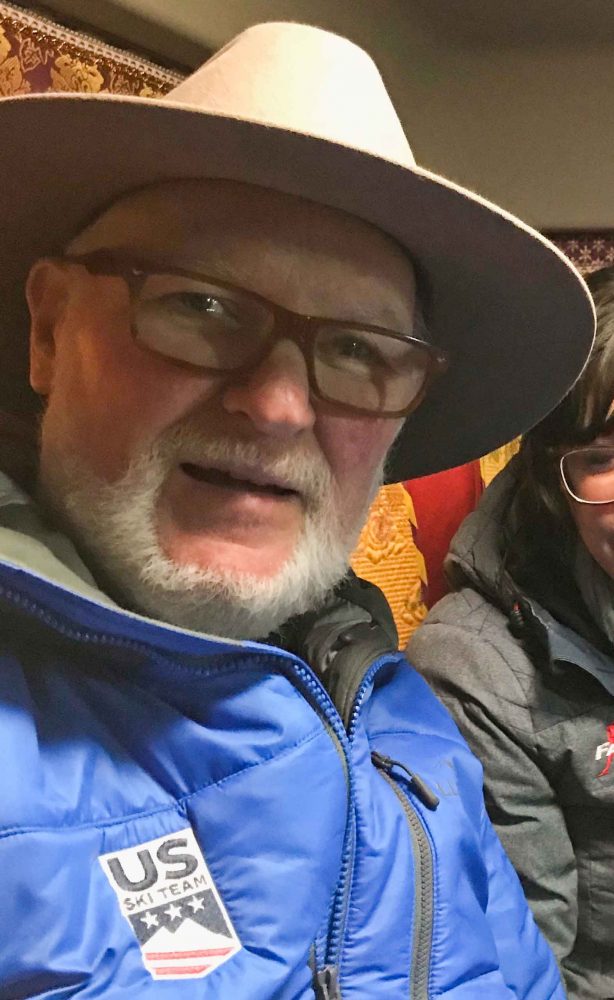
Tom Kelly of U.S. Ski & Snowboard literally in the back of a bus in PyeongChang, South Korea.
Kelly, who goes by “TK”, is a pro’s pro. He’s mastered the combination of respecting both the athletes’ needs and being an open communicator with the snow sport community. Again, this is a two-part interview. Part 1 explores the early years of Kelly’s career; Part 2 explores his more contemporary experiences including this nugget: how he came to be known as “TK” and where his hallmark hat came from. Kelly also discusses the good work of The Speedy Foundation.
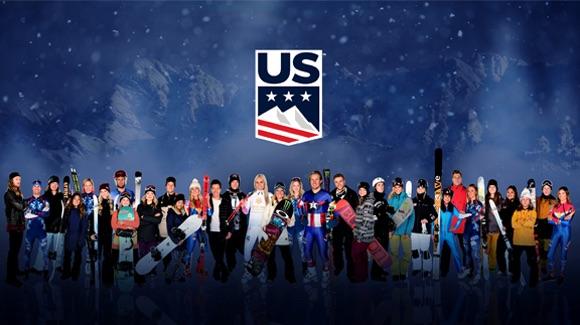
The newly rebranded U.S. Ski & Snowboard’s “one team” photo united under its “single, iconic mark”, according to CEO Tiger Shaw. (Photo: U.S. Ski & Snowboard press release)
Earlier this month, a group of leaders from World Taekwondo stood smiling before flashing cameras and their newly unveiled organization logo. Since 1973, the sport’s governing body was known as the World Taekwondo Federation, using the acronym WTF to represent its globally recognized organization and mission. But recent “negative connotations” associated with the abbreviation moved the group to change its logo and drop the word “federation”.
As with World Taekwondo’s case, there are a number of reasons a company or organization may choose to change brands. If the rebranding of World Taekwondo took away something unwanted, the U.S. Ski and Snowboard Association’s (USSA) recent decision to rebrand to U.S. Ski & Snowboard is somewhat the opposite.
Since the early 1990s, U.S. Ski & Snowboard had four different brands, that of USSA — which served as the organization’s parent brand — along with three national-team logos: U.S. Ski Team, U.S. Snowboarding, and U.S. Freeskiing.
The old U.S. Ski Team, U.S. Snowboarding and U.S. Free Skiing logos.
Now, after 112-years in the business, U.S. Ski & Snowboard has decided to unite all teams under one core image: a crest sporting the letters “US” and three white stars floating above two mountain peaks, as well as two diagonal red stripes at the shield’s bottom.
The single core image will be adapted for the following tiers: a master mark (just the U.S. crest),
Master mark
an organizational mark (the master mark accompanied by the words “Ski & Snowboard”),
Organizational mark
and the team mark (the master mark accompanied by the respective national team names).
Team mark
“Our brand was strong. It wasn’t that we needed to start over, it was just we needed to clean things up and get refocused,” Tom Kelly, U.S. Ski & Snowboard Vice President of Communications, said of the USSA brand during a phone interview last week. The rebrand launched on June 18.
(Article continues below)
The idea to change the logo emerged during a USSA strategic planning meeting Kelly attended back in June 2015. He and Luke Bodensteiner, USSA’s executive vice President of athletics, were fueling the winds of change.
“We wanted to provide more value to users of that USSA brand,” Kelly said.
“One of the initial pushes with the rebrand was to figure out how to get some of those more broad-based or grassroots skiing and snowboarding [groups] connected with the ski brand,” Bodensteiner told FasterSkier. “To that point, everything had been separate with USSA and USSA racing; that went all the way down to junior racing or recreational racing. The teams were all separate and they shouldn’t be. It’s all one effort and ideally one family.”
Seeking assistance from outside its own walls, USSA created a task force was created that included Nike Senior Strategic Advisor Jeanne Jackson, who had two children compete with the USSA system, and United States Olympic Committee (USOC) Chief Marketing Officer Lisa Baird, a chief engineer for the USOC’s redesigned brand for Team USA, among others.
“What Jeanne Jackson did when she started this, was she posed the question to us, and this is a very Nike-type thing, she said ‘Do you want to be a house of brands, or do you want to be a branded house?’” Kelly explained.
For U.S. Ski & Snowboard, the answer was the latter. To fashion the brand, eight different agencies pitched potential templates before one was chosen — all at no cost for U.S. Ski & Snowboard.
“That’s the beauty of it,” Kelly said of the rebrand. “Everything is pro-bono. So we feel really good about that, that we were essentially able to execute that with no costs.”
When the U.S. Ski Team (USST) underwent a brand and logo change nearly 20 years ago in 1999, the cost amounted to more than $50,000 dollars, according to Kelly. Thanks to the pro-bono work done by i.d.e.a, a San Diego-based consulting firm and U.S. Ski & Snowboard’s ultimate pick, all of the national teams in the organization (nordic, alpine, freeskiing, freestyle, snowboarding) are now under the same logo.
“The U.S. Ski Team had a strong brand and a high level of brand equity, but the philosophy is that by bringing all the sports under one image that that might help create greater equity in the brand,” Bodensteiner said.
The USST will remain an official entity under the new brand. All teams will now share a Facebook page dubbed U.S. Ski & Snowboard. USSA Nordic’s Twitter account (@USSA_Nordic) will no longer exist and has been integrated instead into an @usskiteam Twitter account. On Instagram, @usnordicskiteam has been integrated into @usskiteam. The idea in combining social media outlets is to reach a broader audience — nordic fans may be more likely now to be exposed to the news feeds of others sports and vice versa.
“It will be one U.S. Ski and Snowboarding [Facebook] page and it will be varied content throughout all sports all the time — a little bit of alpine, a little bit of nordic, a little bit of freeskiing,” Courtney Harkins, content media manager for U.S. Ski & Snowboard explained on the phone. “It’s going to be really good thing for the cross-country team as well because you have chance to make freeskier fans of Jessie Diggins.
“I think it’s a cool way to broaden and magnify the somewhat specialized fans of cross-country skiing,” Harkins continued. “For example, on the USSA nordic page we had 12,000 fans and now we have a 170,000.”
As of right now, U.S. Ski & Snowboard has made a conscious decision not to acronym its name. The word association was dropped because it was not seen as an “essential component” to the organization’s name.
“As a general rule, acronyming is a bad brand practice,” Kelly wrote in a follow-up email to FasterSkier. “It creates a collection of letters that is not easily recognizable to the majority of people who cross paths with the brand. We’ve been seeking to avoid acronyms for some years, but USSA was ubiquitous. We will always use U.S. Ski & Snowboard and not abbreviate it or create an acronym. And we appreciate users respecting that.”
Ultimately, beyond bringing all U.S. Ski & Snowboard teams under one roof, the rebrand also brings a much simpler connection for its partners both new and old. Toyota, which recently became the official vehicle for U.S. Ski & Snowboard, will now only have one mark to take into consideration for its sponsorship.
“The partners are uniformly thrilled about it because it makes it so much easier for them, than it was before,” Kelly said. “So if you’re a Visa, for example, previously there were three sometimes four different marks they were involved with … that had become a real issue. It was complex, it was expensive and now we’re down to one.”
U.S. Ski & Snowboard is currently in the process of changing its staff email addresses. The “usskiandsnowboard.org” website domain currently redirects readers to ussa.org as the new one has not yet been launched. The decision to do somewhat of a “soft opening” with the brand played into the decision to hold-off.
“You’ll see on our website, we have re-skinned it with the new mark,” Kelly said. “We have a new website developed and it’s in the the wings, but we just chose not to launch it. It was just one more thing to do this week that we felt let’s wait.”
“Once we launch [usskiandsnowboard.org], which will hopefully be this summer, could be later summer, but it’s not going to be in the next few weeks, as soon as we launch that, we will then point any old primary urls to the new site,” Kelly continued. “So you’ll still be able to go to ussa.org and get there, but it won’t be our polished domain.”
USSA President and CEO Tiger Shaw warms up for the Slumberland American Birkebeiner, skating on Hayward’s Main Street. (Photo: USSA/Tom Kelly)
When Caitlin Gregg was the first woman across the line in the 51 kilometer 2016 American Birkebeiner, she wasn’t wearing her U.S. Ski Team suit.
Most team members don’t when they are at domestic races in the U.S., and club loyalty is one of Gregg’s trademarks. She instead represented Loppet Nordic Racing.
But just 15 minutes after she finished, there was another guy who was wearing the U.S. Ski Team colors, and he was finally crossing the start line in Wave 9. It was not only his first Birkie, but also his first cross-country ski race.
“I guess I could have pulled rank and asked them to move me up, but I wanted to see what it was like in that group,” U.S. Ski and Snowboard Association (USSA) President and CEO Tiger Shaw said in an interview on Tuesday. “There were tons of people faster than me in that group. The only challenge is on some of the uphills, you have everybody who is falling back from earlier waves who you are catching, so it’s a bit of an escalator. But that dissipated. I was nicely surprised that after 10 or 15 k, everybody had fallen into their speed.”
Caitlin Gregg after winning her record fourth Slumberland American Birkebeiner from Cable to Hayward, Wisconsin. (USSA/Tom Kelly)
There was a veritable contingent of USSA folk at the Birkie this year, including Vice President Communications Tom Kelly and Nordic Domestic Programs Director Robert Lazzaroni, as well as star athlete Kikkan Randall, who didn’t race because she’s pregnant but was on hand to soak up the scene.
And what a scene it was. Shaw, a two-time Olympian and NCAA Champion alpine skier, has attended cross-country World Cup races in Europe, but the Birkie was an entirely different experience.
“It is both a world class event and a Gran Fondo,” Shaw marveled. “Meeting these people who have done the Birkie a double digit number of times, it’s a lot of people. That gives you an amazing perspective… I was able to be there for Thursday night through Sunday afternoon. I got a chance to take in the Barnebirkie and all the kids races and everything that happened on Main Street.”
And then there was the race itself. Although Shaw came to the finish hours after the first men and women, there were still die-hard fans out cheering for him and the others who started in the last wave.
“People had been there since ten o’clock cheering for the elites,” he said of crossing the lake into Hayward. “People are still standing around in their insulated boots, jumping up and down, drinking hot tea or coffee or jägermeister or whatever else, screaming and ringing bells for five hours. It was impressive. That’s cool, and it’s not easy when it’s drizzling in the 30’s, or other years when it’s below zero. I love that.”
USSA has recently partnered with the Birkie, which Kelly said resulted in “dramatic gains” in membership for the national organization this year.
Shaw was pleased to meet some of those new members. While he might be well-recognized at alpine events, this was not the case in Hayward, Wisconsin.
“I had a lot of really fun conversations,” he laughed. “Usually people didn’t recognize me, but if I was in a conversation and I introduced myself, they would kind of say, ‘oh! Well hello!’ Like, what are you doing here?”
And the CEO wasn’t just talking the talk, he was walking the walk – or skiing the ski.
USSA President and CEO Tiger Shaw cheers on kids in the Barnebirkie race of the American Birkebeiner. (Photo: USSA/Tom Kelly)
“It was especially fun when I was wearing my Craft and L.L. Bean gear, either about to race or in the race or after the race, and people realized I wasn’t just there watching,” he said. “I was there competing, if I guess you could call it that. That made a difference. It just drops everybody’s guard, if they have one up.”
After skiing with septuagenarians doing their 30th Birkie and feeling his own small moments of glory when he passed other competitors, Shaw was left marveling at the scale of the event.
“There are some season-ending races for all age groups in alpine,” he explained. “The Sugar Slalom in Stowe is an example, the Loveland Derby. But you’re talking about maybe 500 or 600 participants, not 10,000. There’s no way to do something like that in alpine. I’m not sure if there’s anything equivalent in snowboarding. Jumping, not so much from a participation level, but there are a lot of spectators at the Springer Tourney in summer.”
The Birkie is an entirely different animal.
“This dwarfs anything I’ve ever seen,” Shaw said. “Especially when you think of the cumulative group which is part of it. We just ran a Big Air event at Fenway Park in Boston, where we had 27,000 people watching over two days and a handful of participants because it was an elite event. But the Birkie, if you count support people and the families of people participating, that’s probably 27,000 people there. And that’s not in a metro area.”
Ski racing in America: still packed and enthusiastic, even when it’s 32 degrees and raining. (Photo: USSA/Tom Kelly)
Speaking of elite events, Shaw is still hopeful that USSA can find a way to host a top cross-country competition in a big city. But that would be totally different than the Birkie.
“This was about participating and being part of it, feeling it, whether you are a participant, elite or otherwise, or a volunteer, or you have a kid racing,” he said. “You can see that it’s really part of people’s lives.”
Shaw, who finished in 4:49:23, enjoyed it all, and appreciated how those not racing were if anything more enthusiastic than the racers themselves.
“They were having such a good time despite it being 32 degrees and raining, which it was on Friday during most of the kids’ events,” Shaw said. “It rained half the time when we were in the race too, and nobody cared. The volunteers at all the stops, the medical personnel, the crazy people playing in bands on the side of the trail and cheering for us, the shotski group, it’s hysterical. It was fun.”
The trip illustrated many aspects of why Shaw is eager to work with the nordic community.
“There’s a lot of fans,” he noted. “Cross-country has a bigger group of participants through all the age groups than any of our sports. In alpine we don’t have racers racing their whole life. In cross-country you do. It’s a unique opportunity for the sport to empower those people, and locally they support their clubs.”
Shaw hopes that they will support USSA and the national team as well, but knows that USSA has to offer something in return. He’s working on it.
USSA President and CEO Tiger Shaw is ready to race, posing on Main Street before the American Birkebeiner. (Photo: USSA/Tom Kelly)
“The goal there is to figure out how USSA can best become re-involved on a large scale,” he said. “USSA kind of dwindled in relevance in cross-country below the sanctioned race level and the elite team level. We are working with everybody to see how do we help out again with the efforts that are already happening.”
Shaw also met with Birkie directors, as well as higher-ups at CXC and Loppet Nordic Racing. Those are among the clubs USSA consider models in the cross-country world.
“There’s extremely good coaches, education, and knowledge in the CXC division, especially around Minneapolis,” Shaw said. “One thing that we can do is gather together the best practices from the divisions and clubs, and combine that with what [U.S. Ski Team coaches] Chris Grover and Matt Whitcomb believe are the best practices, and distribute that nationally. We want to standardize it to raise the whole tide of instruction and coaching, technique and preparation, how to keep parents involved and keep it fun. That’s a role that we can play.”
He hopes to see USSA playing a role far greater than it has in the last decade, when the national governing body’s involvement in nordic sport was mainly at the national competitive level and with the national team itself.
“We’d love to see every cross-country skier in the country be a follower of the U.S. Ski Team and to be a USSA member if it makes sense,” he said. “But it has to be an affordable, sensible membership with the right benefits. Maybe we can one day be like USA Swimming where there isn’t a kid in a club that isn’t a member – they are ubiquitous, and they provide a lot of services. That’s what we’re trying to provide.”
As USSA works toward that goal, Shaw seemed to genuinely relish the chance to try cross-country racing out for himself in the continent’s biggest and craziest competition.
“Even though I only raced as a citizen, it helps me appreciate watching the cross-country events at all levels now,” Shaw said. “I get it about stepping on somebody’s pole, and how to get around someone at my own level. If you’re feeling strong and blow by a bunch of people, you start thinking, wow, I’m pretty good. When in fact, you’re just a citizen. But it’s thrilling nonetheless!
“It’s a taste of what it must be like to be a Kikkan or all of those elite athletes,” he concluded. “It reminded me of when I was racing, that feeling of being a contender and being able to turn it on when you want to turn it on.”
This winter, NBCUniversal viewers will have the opportunity to watch skiers like U.S. Nordic Ski Team member Sophie Caldwell compete live, with the company’s recent acquisition of rights to FIS World Cup events. (Photo: Fischer/Nordic Focus)
Being able to watch cross-country or nordic-combined competitions live from the comfort of your own home in any Scandinavian country is, well, normal. What if the same could be said of the U.S.?
A long-standing dream for many American nordic fans is becoming a reality with NBCUniversal’s recent acquisition of rights to almost all of the International Ski Federation (FIS) World Cup events.
Before NBCUniversal acquired the rights to broadcast and stream World Cup events, a separate company, Universal Sports Network owned them.
“Universal Sports had those rights for years, but Universal [Sports] never really exercised them, other than carrying coverage each year of the Tour de Ski,” explained Tom Kelly, vice president of communications for the U.S. Ski and Snowboard Association (USSA) during a phone interview on Tuesday.
However, after NBCUniversal took over and ceased the operation of Universal Sports Networktwo days ago, NBCUniversal gained the company’s assets, including the right to broadcast World Cup events.
“The big news for cross-country is the fact that cross-country ski racing from the World Cup — the entire World Cup — will be available in America and it never has been before,” Kelly said.
“The big news for cross-country is the fact that cross-country ski racing from the World Cup — the entire World Cup — will be available in America and it never has been before.” — USSA Vice President of Communications Tom Kelly, on NBCUniversal’s upcoming live-stream schedule for the 2015/2016 race season
Along with cross-country, most every nordic-combined event is scheduled to be streamed live, except for those in Austria. “The Austrian events are in a different rights package, so those are missing right now from the nordic-combined schedule. Everything is included for the cross country World Cup Tour this year,” Kelly said.
Bryan Fletcher (U.S. Nordic Combined) at the Nordic Combined World Cup Triple last January in Seefeld, Austria. As it stands, the 2016 Seefeld Triple is the only Nordic Combined World Cup that NBCUniversal does not have rights to stream this season. (Photo: FBD)
So how might skiers and avid fans alike access the races? According to Kelly, NBCUniversal is “planning on carrying those events through live streaming on their streaming platform, which is called NBC Sports Live Extra. You can download the app from any of the app stores, whether you have an Android or an iPhone. Or you can simply access it on the web.”
Unfortunately for Canadians, which follow their own set of broadcast regulations, our northern friends won’t be able to access this.
In addition to streaming of all World Cup events online, NBCUniversal plans to show the Tour de Ski live on one of its television broadcasting channels, Universal HD.
“One is a streaming platform, one is a broadcast platform. If you want to watch [the Tour de Ski] in Universal HD, you’d have to call your cable or satellite provider and you’d have to find out: Do I get that channel, if I don’t get that channel how do I get it, what do I pay, and so forth,” Kelly said. “With the streaming — and everything will be streamed live — you can watch that content live, but you can also watch it on demand later.”
– If using a tablet or handheld device, download the NBC Sports Live Extra app via iTunes (free download, subscription fees may apply)
– Stay tuned for subscription details; you may need to subscribe to NBC’s primary sports channel, NBCSN. Many cable and satellite packages already include NBCSN or Universal HD. Check with your provider.
– Save this schedule. All of the FIS Cross Country World Cups and all but three competitions on the FIS Nordic Combined World Cup 2015/2016 schedule will be streamed. Canadian World Cups, while not included on the current schedule, will also be shown.
– Tune in: Universal HD plans to televise the Tour de Ski daily.
“You don’t have to get up at 4 in the morning to watch [races]; you can get up during the day to watch and just pick whatever time you want,” Kelly explained. “That’s the beauty of the digital platform.”
Though the news may seem ethereal, some major details are still being sorted out. “We anticipate that in order to watch the streaming, you will need to be an authenticated subscriber to NBC through a cable network or through a satellite provider,” Kelly said. “We don’t know yet how [NBCUniversal] will manage the authentication on this. What we suspect is that you will need to be a subscriber to NBCSN [a division of NBCUniversal], which is their primary sports channel.”
In other words, watching live streaming of World Cup events may come at a cost of upgrading or paying extra for the sports channel.
However, Kelly believes that this won’t be an issue for most Americans wanting to watch live World Cup events.
“If you’ve got a decent cable package or satellite package, you’re probably going to find that you already have [NBCSN and Universal HD],” he said.The price to subscribe to NBCSN or Universal HD, if not already included your package, depends largely on your cable/satellite provider.
“For us, the big thing here is two-fold,” he added. “Number one, it’s the fact that everything will be streamed live, and number two, the fact that the potential audience size for the broadcast events of the Tour de Ski, will be dramatically larger than it has been in the past.”
With Universal HD reaching close to 10 times the number of U.S. homes reached during the Universal Sports Network era, according to Kelly, the potential of spreading awareness about nordic skiing with just one race series is huge.
A long-standing dream for many American nordic fans may come true with NBCUniversal’s recent acquisition of rights to stream almost all FIS World Cup events.
Of course, that all depends on number of subscribers and viewership.
“One of our initiatives is to get people to be aware that [NBC Sports Live Extra and Universal HD] exists and get them to participate and watch it,” he said. “NBC will monitor how many people are actually watching these events [and] that will undoubtably influence their future decisions. Our objective is to get people to watch and get people engaged in cross-country ski racing in America.”
As for USSA’s role in all this, it’s not much different than the rest of us. “We’re an interested party … We’re essentially lobbying them and encouraging them and at the same time, also helping to spread the word on it,” Kelly said.
Beyond the issue of subscription, English commentary is also potentially in the works. “Keeping in mind that this is not our broadcast, we are certainly going to encourage them to have English-language commentary on this [and] we are giving them suggestions as to ways to accomplish that,” Kelly said. “But ultimately it will be NBC[Universal]’s decision.”
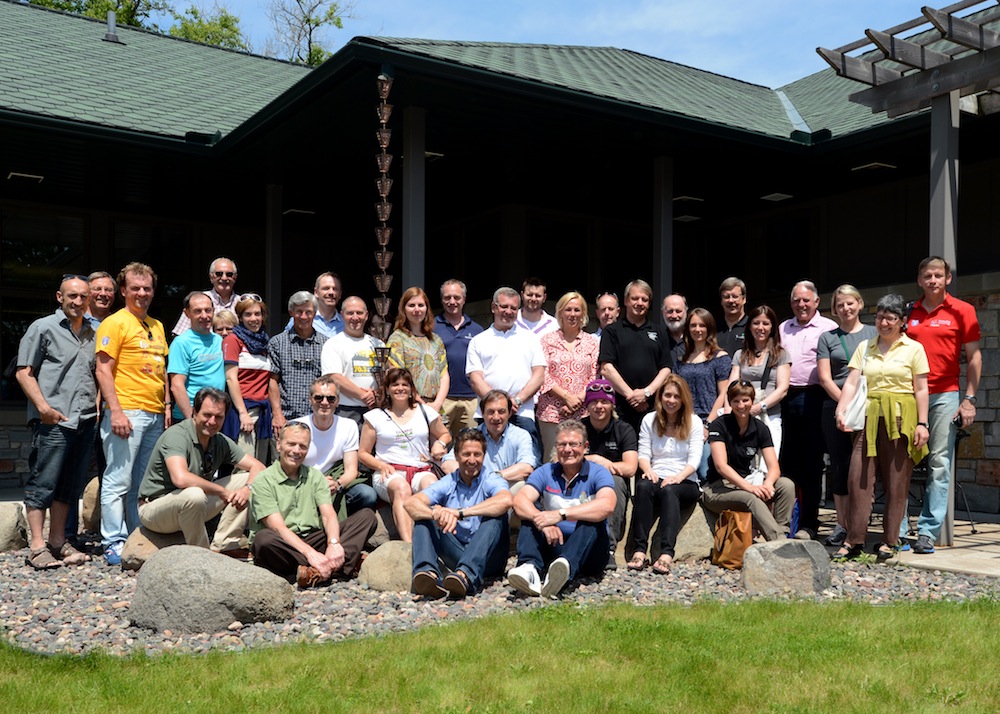
The 2013 Worldloppet Annual General Meeting met in Cable and Hayward, Wis., from June 13-16. (Photo: ABSF)
Thirty-five years ago, Tony Wise rounded up delegates from eight nations – including himself – and threw some mud at Telemark Lodge in northern Wisconsin.
Five years earlier in 1973, Wise founded the American Birkebeiner, a 48-kilometer cross-country ski race from Cable to Hayward, Wis. He dreamed up the creation to commemorate the Norwegian Birkebeiners, which skied little Prince Haakon to safety in 1206, and the race evolved into the largest ski marathon in North America.
Wise had no way of knowing what it would become, but he had big plans. It wasn’t long before he was thinking internationally and sharing his vision of a Worldloppet with different nations hosting marathons across the globe.
“His concept was to provide average citizen skiers the opportunity to achieve something on a truly global scale,” explained Wise’s former PR director, Tom Kelly, now the vice president of communications at the U.S. Ski and Snowboard Association. “Some 35 years later, it’s gratifying to see his dream still growing.”
In March of 1978, nine nations met in Uppsala, Sweden, to officially form the Worldloppet federation. The series drew slightly more than 50,000 participants that year with nine races. The Worldloppet has held an Annual General Meeting (AGM) every year since in each of its member nations, which grew to 16 last year with the addition of Russia and its Demino Ski Marathon.
Worldloppet Races:
1. Jizerská padesátka, Czech Republic 2. Dolomitenlauf, Austria
3. Marcialonga, Italy
4. König Ludwig Lauf, Germany
5. Tartu Maraton, Estonia
6. La Transjurassienne, France
7. Finlandia-hiihto, Finland
8. Vasaloppet, Sweden
9. Engadin Skimarathon, Switzerland
10. Birkebeinerrennet, Norway
11. Bieg Piastow, Poland
12. American Birkebeiner, U.S.A.
13. Gatineau Loppet, Canada
14. Sapporo International Ski Marathon, Japan
15. Demino Ski Marathon, Russia
16. Kangaroo Hoppet, Australia
17. Marcha Blanca & Ushaia Loppet, Argentina*
18. Merino Muster, New Zealand*
19. Vasaloppet China, China*
20. Fossavatn, Iceland*
*Associate members pending inspection and approval at 2014 AGM
In 2012/2013, the grand total for race participation in all 16 races exceeded 135,000 people. Last weekend, the AGM returned to Cable for the first time in 15 years, and approximately 45 delegates made one of the federation’s most historic decisions to date.
Four nations were tentatively named associate members: Argentina, China, Iceland, and New Zealand. The idea was to open the gate to more countries eager to host Worldloppet marathons and loosen some requirements, namely the participant minimum.
“It wasn’t too controversial,” said Worldloppet Executive Committee member Dennis Kruse, who represented the overseas nations (U.S., Canada, Japan, and Australia) at the AGM meeting from June 13-16.
The federation had been talking about adopting these races since last year’s meeting, when it welcomed Russia as a full member. According to the Worldloppet constitution, a marathon can become part of the circuit if it meets certain criteria (i.e. it’s the only Worldloppet race in that country, has existed for at least five years, has computer timing and has a minimum of 1,000 participants). The size standard was where nations like Argentina struggled.
“In the last few years we’ve kind of adopted a new theme or model,” Kruse said. “We think that Worldloppets should really be the voice of nordic skiing across the world.”
That meant letting Argentina host its race, the Marcha Blanca and Ushaia Loppet, as long as it passes inspection in the coming year. Next June, the AGM will meet again and vote to confirm the associate nations’ status – and if all goes well, those races will be on the 2013/2014 Worldloppet calendar.
Associate members will pay federation dues and attend meetings, but won’t have voting rights. Kruse said that isn’t a huge deal because nations can be promoted to full members if they expand to meet all criteria.
“China, we expect in a few years, will come back to us and say we would like to be a full member,” Kruse said.
Besides the anticipated economic boost to developing ski nations (the American Birkie brings in around $5 million to the area each year), the addition of four nations to the series makes a longer to-do list for Worldloppet Passport holders. Kruse said that’s a good thing.
Worldloppet Secretary General Angelo Corradini from Italy enjoys a dance with a local Ojibwa Chippewa dancer during an Indian Pow Wow at the 2013 Worldloppet Annual General Meeting last weekend at Lakewoods Lodge near Cable, Wis. (Tom Kelly)
One man – a Worldloppet Master – has filled his Passport book with the required 10 races 25 times, he said. One woman has achieved 20 Worldloppet Masters, which means she’s completed at least 200 marathons in various nations.
“They just keep doing this repeatedly on a gerbil track, just circling the globe doing world marathons,” he said. “This gives them another challenge.”
The federation hadn’t decided whether Global Skiers needed to complete the four associate races as well as the required 16. Either way, Kruse felt their addition would give avid Worldloppet racers a better shot at getting into capped races.
Some of the most popular marathons, like Sweden’s Vasaloppet, the Norwegian Birkebeinerrennet and Italy’s Marcialonga, have sold out in minutes. The Vasa is currently the largest race in terms of participants, limiting registration to 15,800 skiers for its 90 k classic race. The American Birkie recently set its cap at just under 10,000 for its 50 k skate, 54 k classic and 23 k Kortelopet events. For the first time in Birkie history, registration for its 2014 events can only be submitted online.
How quickly registration fills up is actually a problem for Worldloppet race organizers, and its something they’ve been trying to remedy as marathon popularity has grown, Kruse said. For certain races, like the Vasa, Marcialonga and Norwegian Birkie, people have been known to enter their information online ahead of time and press send as soon as registration opens. That can pose a problem for people living several time zones away.
“We’ve said we need to be user-friendly for our skiers coming from outside the country,” said Kruse, a former Birkie president who now serves as competition director. “There’s definitely an effort by every country, and we do the same.”
With races like the Birkie filling up faster every year, one might wonder how long marathons will be a hot item and whether their prime audience of masters is aging with them.
Kruse said the Birkie went through some stagnant years, but has recently seen a resurgence in participation and younger average age from what it used to be in the mid 40s and 50s.
“Our [average participant age] was creeping upward, that’s why I felt like we needed to invest in financial support for youth programs,” he said. “I said, ‘Look, it doesn’t take much to predict the future, and nobody skis the Birkie when we’re all dead.’ ”
More people in the 20- to 30-year-old bracket are doing the Birkie now, he said, but generally, it’s an older population that has the time and financial ability to travel the world and complete Worldloppets.
“Typically people are doing this when their kids are gone, when their career is not on the fast track for promotion any more, or they’re retired,” he said.
But a trip to Argentina might be appealing to anyone, and so might the chance to ski with some of the world’s best.
“There’s not many sporting events where a guy in his 60s gets to line up with Peter Northug, with top international skiers who are doing the same course at the same time,” Kruse said. “Obviously some skiers want to have really good results and some skiers want to have a tourist experience and come visit.”
Adaptive athlete Andy Soule racing at the 2010 Vancouver Paralympics.
A recent change in management should have minimal impact on the U.S. Adaptive Ski Team (USAST) in the upcoming season, with competition schedules remaining the same through the winter.
Late last week, the U.S. Olympic Committee (USOC) announced that it would take control of Paralympic alpine and cross-country skiing from the U.S. Ski and Snowboard Association (USSA).
One administrator lost her position as part of the change, but despite some initial uncertainty, coaches and athletes with the cross-country program said that their plans for the race season would not be disrupted—and that the transition could result in some long-term improvements.
“What I am hearing from a lot of people is that it shouldn’t affect us in a negative way,” said Sean Halsted, a member of the adaptive cross-country national team. “Hopefully, this can lead to good changes.”
The USAST currently consists of six disabled athletes, who compete domestically and internationally against others with similar handicaps.
In previous years, the USOC had delegated the management of the team to USSA, but in an interview, USOC Paralympics Chief Charlie Huebner said that his organization had decided to make a change as part of an “ongoing assessment” of its programs.
He said all the funding for the adaptive ski team would be transferred as part of the shift, and that athletes should feel “zero impact.”
“The seasonal schedule for competitions and travel is not scheduled to change,” Huebner said.
For the remainder of the year, the USAST’s competitive programs will actually be overseen by U.S. Biathlon, which Halsted said should make things easier on the athletes.
On the Paralympic World Cup, many disabled skiers compete in both biathlon and cross-country races, which are typically held at the same venue.
“It’s pretty much the same sport. It tends to be four or five races in a week, and if you’re just doing cross-country, you get a rest day while they’re shooting biathlon,” Halsted said. “If you do both, then you get to race every day, and that’s not uncommon.”
In the past, with the American adaptive biathlon and cross-country teams falling under separate management, Halsted said that there had occasionally been tensions between the two different coaching staffs—especially as the fledgling biathlon program sprung up over the past few years.
“They [were] not on the same sheet of music,” he said. “There would say something like there was no animosity, but you could tell there was fear in their voice that somebody was taking what they wanted. [The cross-country coaches] were defensive about biathlon guys coming in and taking their athletes.”
Jon Kreamelmeyer, a USAST staff member who has served as both a national team and development coach, denied that there had been any politics between the biathlon and cross-country staffs. But both he and Halsted agreed that the programs would be better off under one umbrella.
“In my mind, it should be one team, and I think that’s the direction it’s going,” Kreamelmeyer said.
While U.S. Biathlon will be in charge of overseeing the adaptive teams at competitions, the USAST staff, including Kreamelmeyer, will all continue with the program as contract labor at least until the end of the year, Huebner said.
Sandy Metzger, the USAST program director, lost her job as part of the transition. Reached by phone, she referred FasterSkier to Tom Kelly, a USSA spokesman, but neither he nor Huebner would comment on Metzger’s departure. However, Greg Rawlings, a member of the USAST’s coaching staff, said that Metzger’s position was dissolved because the USOC already had an employee of its own who could cover her responsibilities.
Huebner said that the USOC had had “multiple conversations” with “constituents, athletes, administrators, coaches” and supporting organizations about the changes, but Kreamelmeyer, Halsted, and Kelly Underkofler, another adaptive athlete, all said that they were not informed of the transition until after it had begun.
Initially, Kreamelmeyer said, it was implied to him that he was out of a job—only later did he find out that he would continue in his position through the end of the season. Both Underkofler and Halsted learned of the changes in an e-mail that Kreamelmeyer sent to his friends and athletes announcing his departure.
“It was very abrupt, actually, from my point of view,” said Underkofler, who is on both the national biathlon team and the cross-country development squad. “There was no forewarning, or anything like that.”
However, Underkofler said that she thinks that affiliating the adaptive program with U.S. Biathlon is ultimately “a better fit.”
Underkofler spent six years on the USAST earlier in the decade. During that time, she said, she felt USSA’s attitude towards adaptive sports was that “we weren’t worth as much time and attention.”
“We always…felt kind of like the ugly stepchild, and I just assumed that it was because we were a Paralympic sport, and didn’t get the same kind of attention that able-bodied sport gets in this country,” she said.
But when she joined the biathlon program, she said, “they loved us.”
“They’re so incredibly supportive. They’re very excited about adaptive,” she said. “I think it’s a better fit, just from my perspective.”
Halsted, on the other hand, said that he never had any problems with USSA’s management.
“I just went with the system in place. And the hoops that were provided for me to jump through, I jump through them, and whatever I get, I get,” he said.
Kelly, the USSA spokesman, refused to address Underkofler’s accusations. But he did say that his organization had struggled to manage its adaptive skiing program since 2004, when the International Paralympic Committee took over governance of the sport from the International Ski Federation.
“The fact is that we lost all of our governance capabilities, through no fault of ours,” he said. “It’s just the way the sport chose to manage itself…We had no ability to play any kind of a role in the direction of the sport internationally—cross-country or alpine.”
For his part, U.S. Biathlon CEO Max Cobb—himself a former guide for a visually impaired skier—said that his organization has “plenty of work to do,” after taking over management of the USAST.
“That’s where our focus has been,” he said, “to make sure that the athletes are really well-supported.”