From the FasterSkier archive — posts syndicated from athletes’ and coaches’ own blogs between 2004 and 2012, kept online as published. Current coverage is at fasterskier.com.
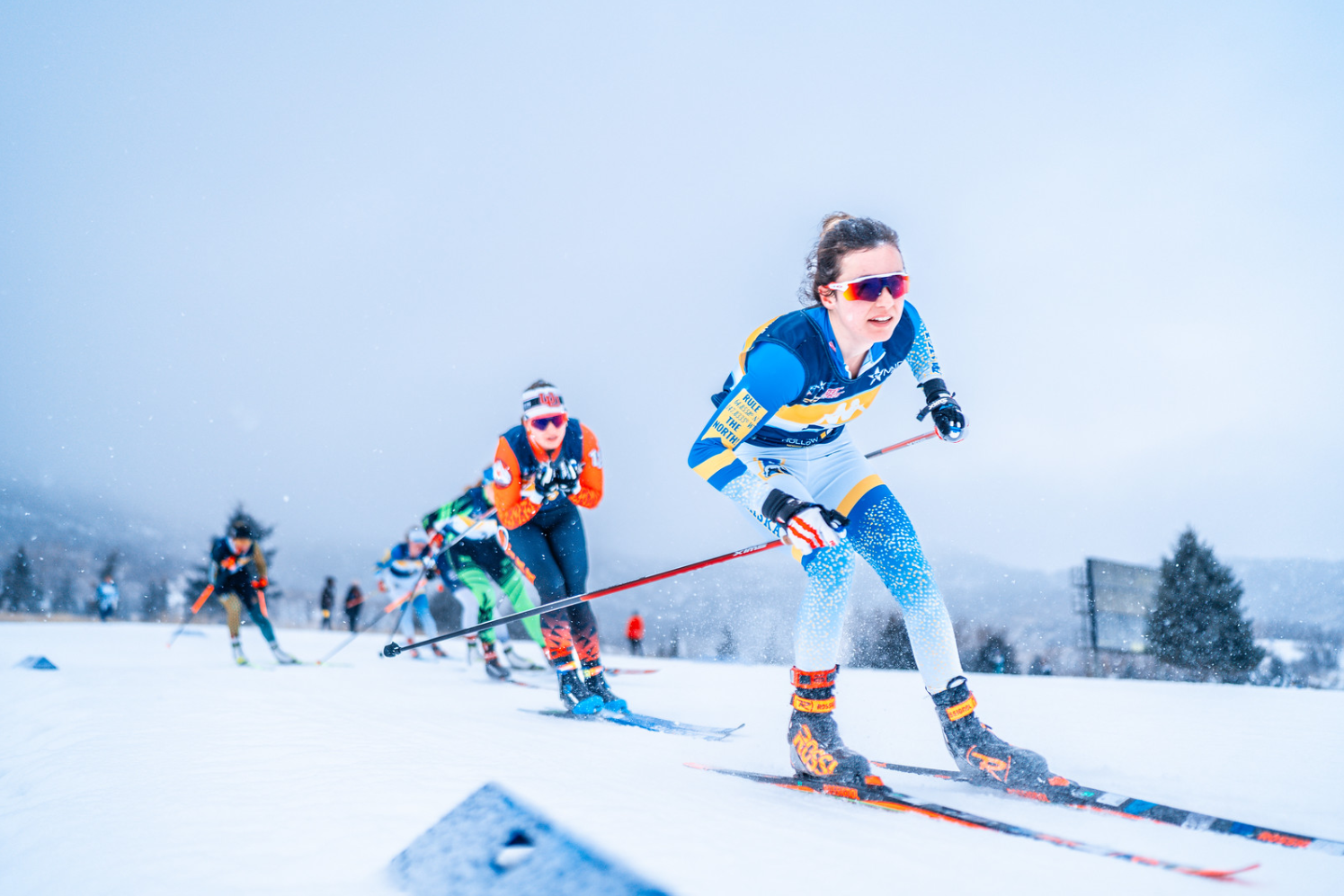
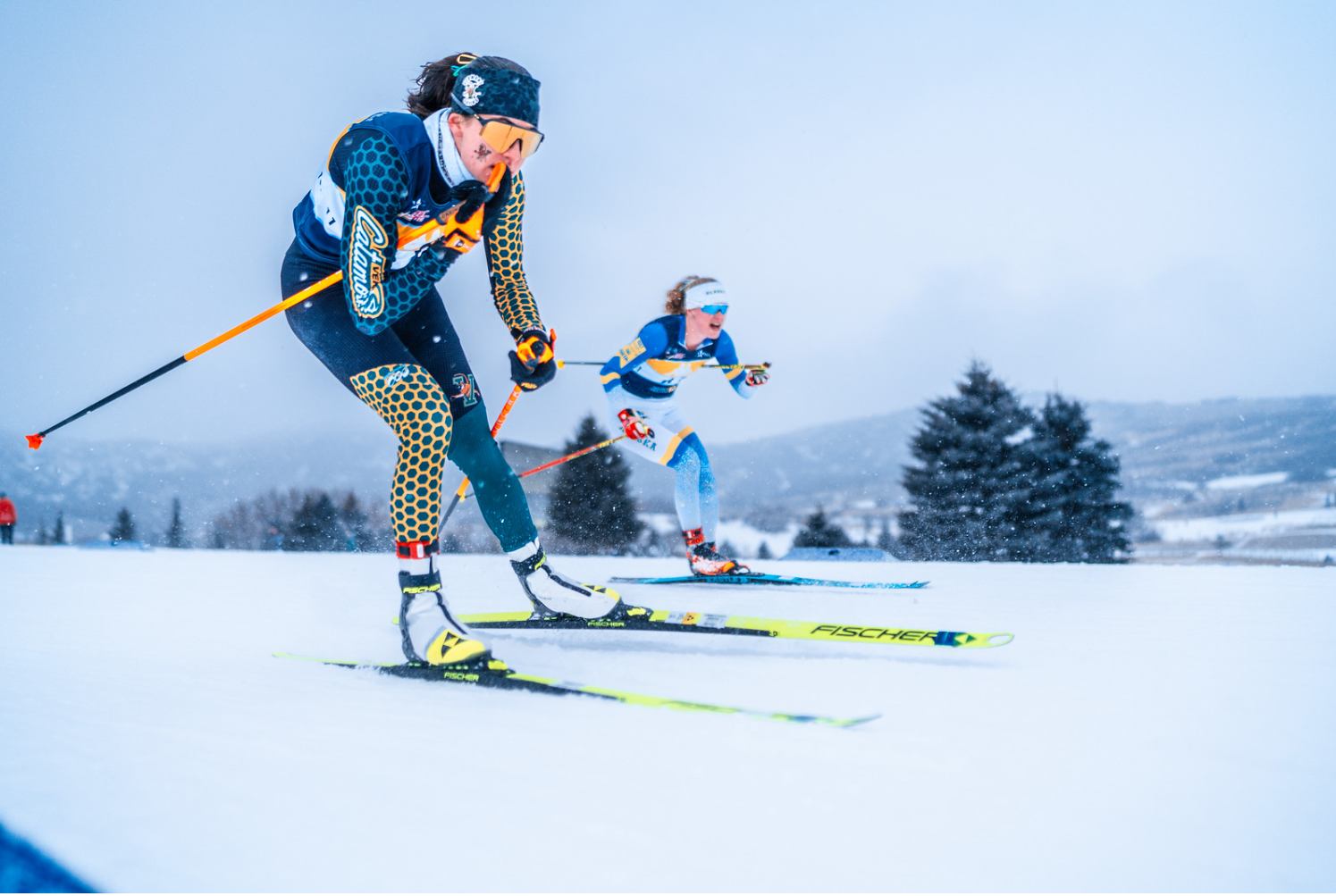
Kendall Kramer (University of Alaska-Fairbanks) leads the Women’s pack during Friday’s 20 k Skate Mass Start at US Nationals. (Photo: Tobias Albrigsten/@UntraceableG)
We all work better when we work together—that would seem to be the credo being employed by American skiers these days. At the conclusion of US Nationals at Utah’s Soldier Hollow, American skiing has rarely looked better, whether internationally or domestically.
The warm temps and blue skies of early week at the US Cross Country Ski National Championships gave way to, of all things, snow. Morning light came up on Soldier Hollow; snow drifted in rather than stormed, but flakes falling from the sky rather than blasting from trailside snow guns was a good late-week reminder for the ski community: despite all this season’s continental snow troubles (Alaskan excepted!), this is indeed a winter sport.
On that new snow—over six laps of a hill-heavy, rarely flat, 3.3 k course—skiers tackled the 20 k Skate Mass Start. A recurrent observation heard by coaches, ski administrators, and athletes was “You can’t quite believe how big this event has gotten.” Momentum was another word heard frequently throughout the week, as some of the biggest fields to ever race at US Nationals combined with daily reports of that day’s Tour de Ski, where American skiers enjoyed a banner day. Until Friday, though, the evidence was merely in the number of skiers on the start sheets, and the number of clubs from a greater number of places milling around Soldier Hollow’s makeshift race village. Seeing fields of 100 skiers wind up Soldier Hollow was a whole different type of confirmation of that momentum. Crowded fields of the fittest athletes in the country brought their own journeys in the sport, their numbered affiliations, and their collective abilities to ski together. The ground rumbled, shouts from the sidelines roared, and the field—at least in early stages of the races—seemed to become a singular thing. US skiing, moving together in concert, became something sublime that could be readily seen and felt.
Haley Brewster made a decisive move late in Friday’s 20 k race to claim her first career national championship. (Photo: Tobias Albrigsten/@UntraceableG)
Women’s 20 k Skate Mass Start
Of course, it was a ski race. After that roaring start up the hollow’s steady incline, the Women’s 20 k Mass Start field started to jockey for where and when to make a decisive move towards the National Championship.
When the race started at 10am, natural snow was falling, but hadn’t yet accumulated enough on the glazed deck of artificial snow. The course displayed one defining principle that dictated how the mass start would be raced: for every long climb on the Soldier Hollow course there was an equal or greater downhill that followed. If a skier was going to make a tactical move on an uphill, they had to be sure they could hold off their rivals on the subsequent downhill. For nearly six laps, a nine-skier lead pack waited for that move.
For much of the race, University of Alaska-Fairbanks’ Kendall Kramer was the leading presence at the front of the pack, hinting at the importance of pushing the transition between uphill and downhill in the fast snow by pushing over and well into each downhill. She was joined mid-race by Craftsbury Ski Club’s Margie Freed who—between apparent good skis and smart drafting—was able to join Kramer in the lowlands of the course and at times, push to form minor separation ahead of the field.
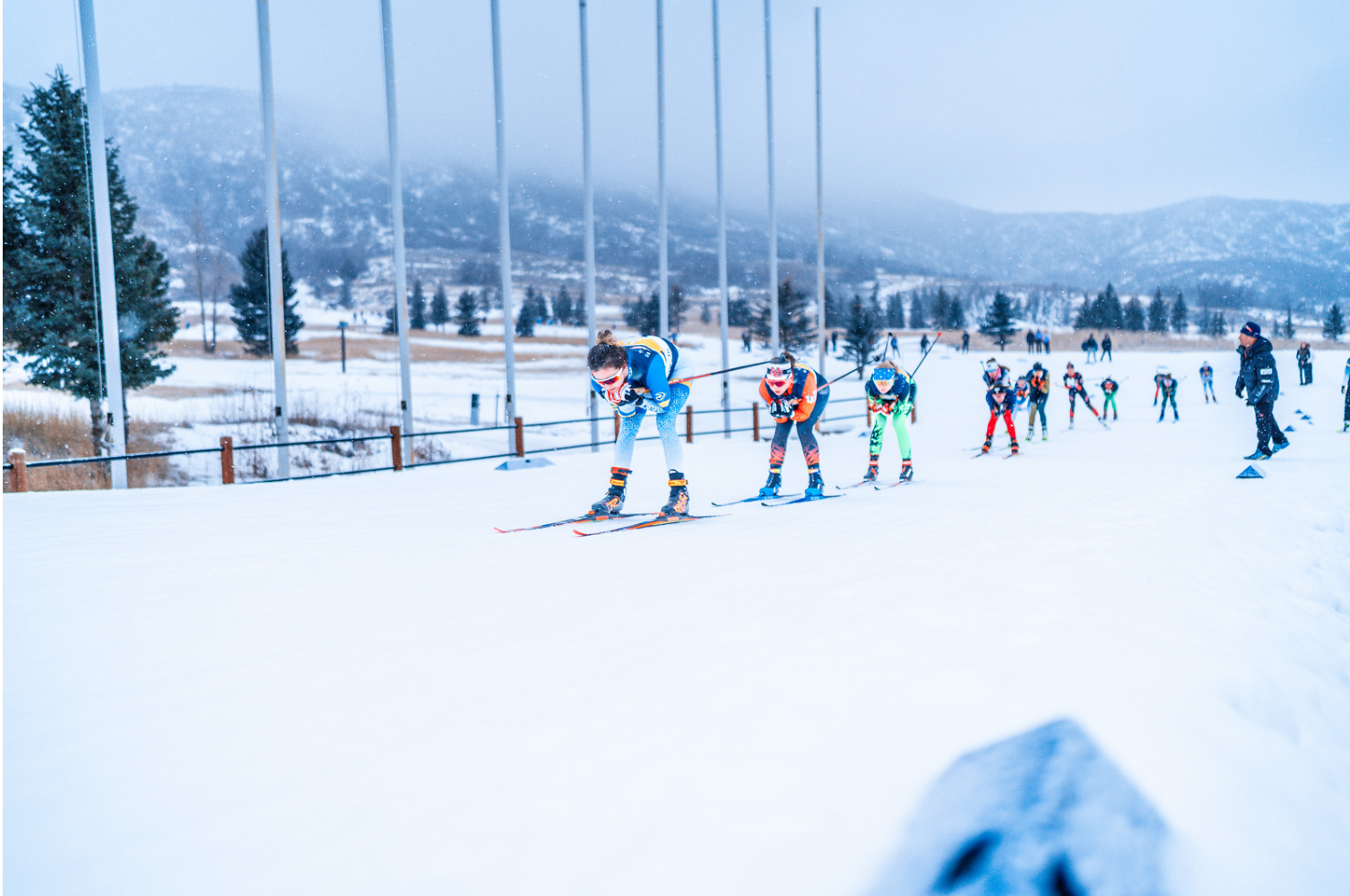
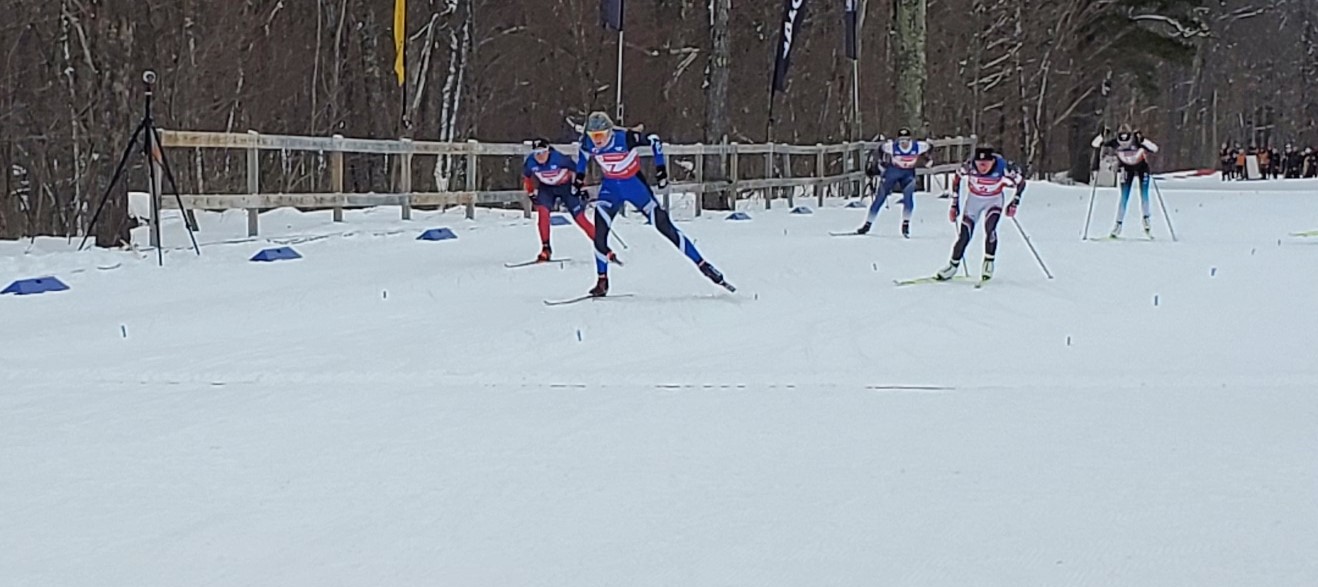
The lead pack in Friday’s 20 k Skate winds into Soldier Hollow stadium. (Photo: Tobias Albrigsten/@UntraceableG)
As Kramer and Freed headed into the final lap, they were joined by University of Vermont’s (UVM) Haley Brewster. Brewster and Kramer rounded the top with Freed in tow. In the final climb, Brewster made her decisive up-tick in pace, gaining separation over Kramer in an attempt to ward off a sprint finish after the final downhill. Likewise, Kramer gained separation over Freed, and Freed likewise from the rest of the field. The final stretch featured momentary celebrations, as each crossed with space between: Brewster in first, Kramer second, and Freed in third.
The win gave Brewster—a UVM Junior and former Ski and Snowboard Club Vail skier— her first national championship. The result also marked Kramer’s second national podium, after she finished third American in the skate sprint last year in Houghton, Michigan. It was also the first US Nationals podium for Freed. The Minnesota native is in the midst of her first season competing in Biathlon, having just completed her first stint on the IBU World Cup, making the 20 k skate result an auspicious one.
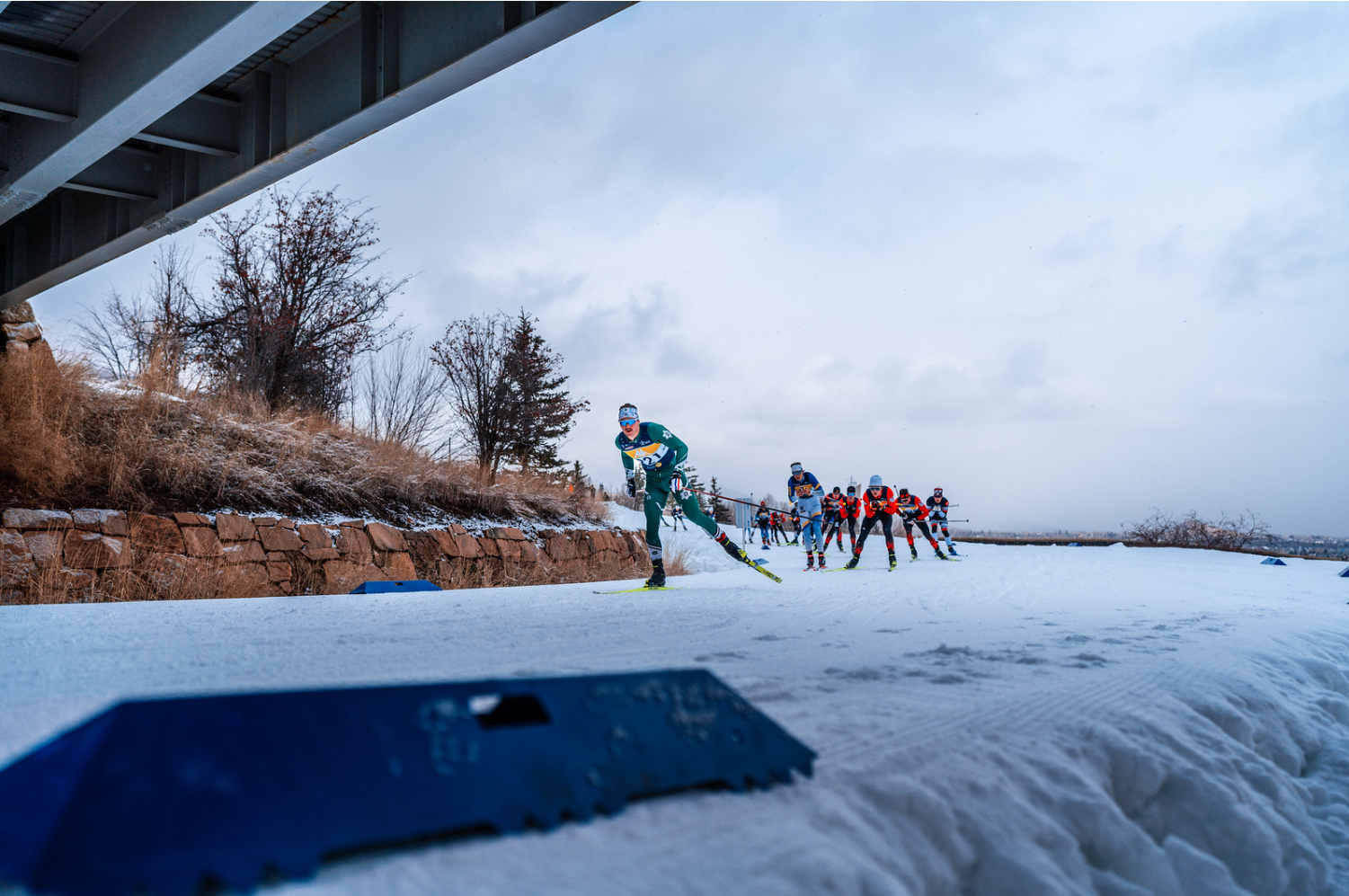
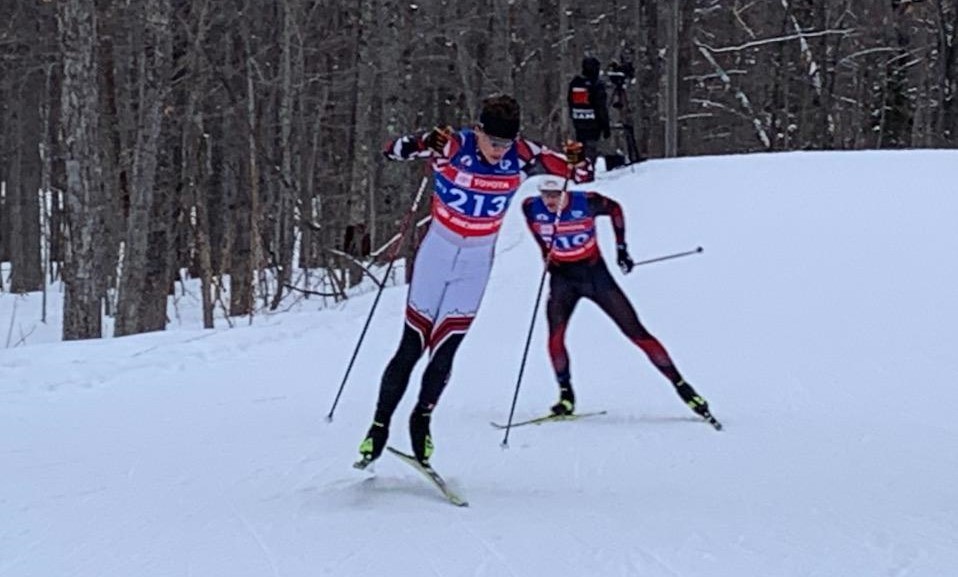
John Steel Hagenbuch (Dartmouth Ski Team) leads the Men’s pack during Friday’s 20 k Skate. Hagenbuch would make a decisive move to win his second career national championship. (Photo: Tobias Albrigsten/@UntraceableG)
Men’s 20 k Skate Mass Start
By the time the Men’s field started at 12:15pm, the fresh flakes of the morning had accumulated significantly on top of the course’s artificial snow. In the Women’s morning races, the course (and the new snow) had been worked in. In the Men’s race, a new layer of natural snow now clashed with the fast-running, transformed artificial snow underneath. Reports of skis “catching” when they hit a particularly heavy patch of natural snow were heard throughout the finishing pen after the race, which reiterated premonitions many observers had of how the Men’s field would race the course.
With ski speeds diminished on downhills, there was a little more to be gained by an earlier attack in the Men’s race than in the Women’s race. For the right skier—with the right strategy—a race that was likely to become a mass start slog could be broken apart by an aggressive attack.
That skier turned out to be Dartmouth’s John Steel Hagenbuch. Hagenbuch waited near the front of the fifteen-skier lead pack until the start of the fourth lap. Then, he accelerated over the top of the fifth lap’s initial climb and pressed on, alone, through the last five kilometers of the race. Hagenbuch’s move was followed by other skiers testing their own long-range attacks as University of Utah’s (UU) Frenchman, Tom Mancini, and UU teammate and British-Canadian skier, Joe Davies, were able to make subsequent breaks in the field. Hagenbuch’s final gap was a commanding 40 seconds on second place Mancini. Davies rounded out the podium in third place, 54 seconds off the lead. The pair of Peter Wolter (Sun Valley), and Elijah Weenig (University of Denver) came next in fourth and fifth to round out the American podium.
The win was the second national championship for Hagenbuch after his victory in the 10 k Individual Start Skate at US Nationals last year. Mancini scored his first podium at US Nationals with his runner-up finish. Davies finished a strong week in which he also podiumed in Tuesday’s 10 k classic. Davies will represent Great Britain at Junior World Ski Championships later this month in Planica, Slovenia.
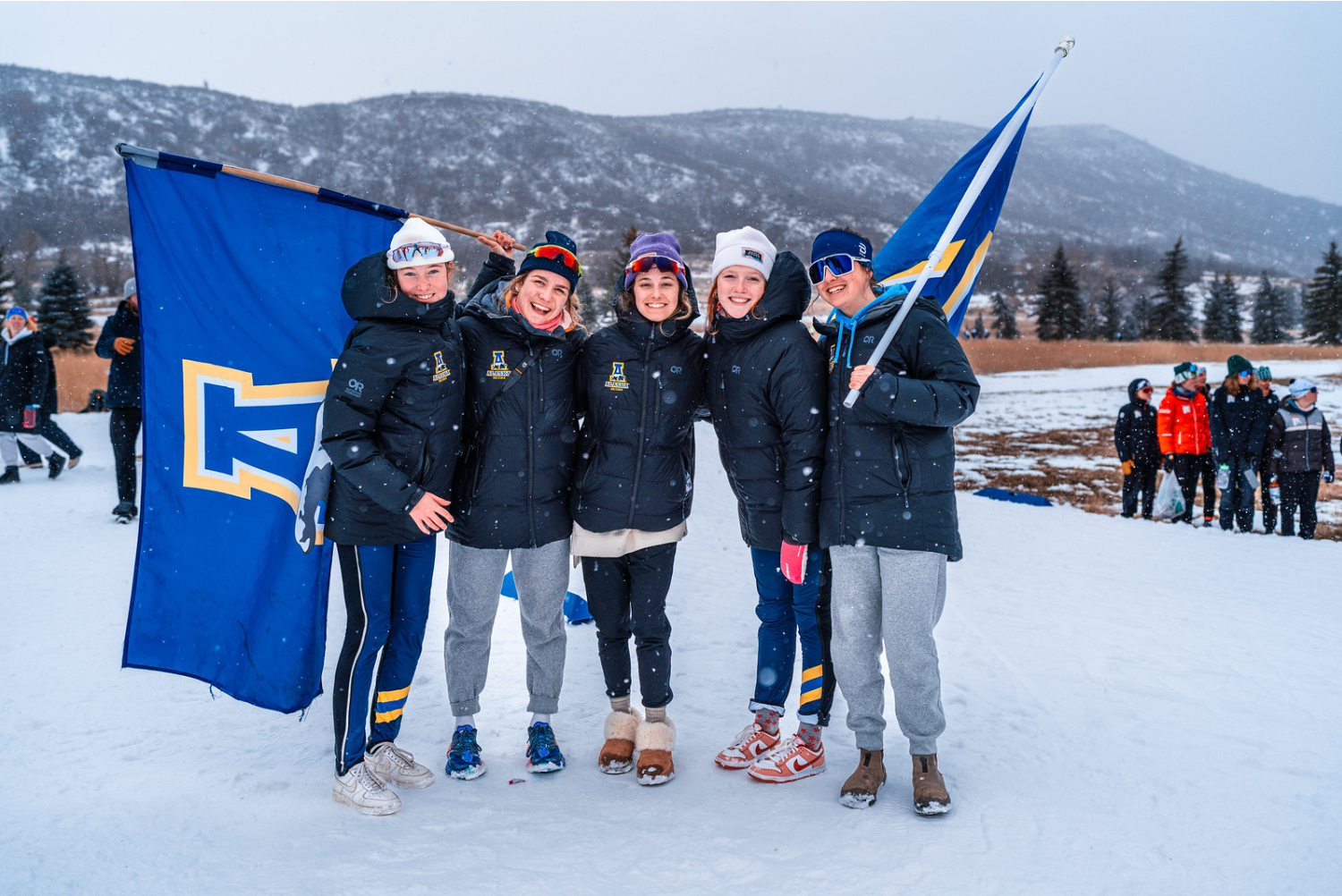
The University of Alaska-Fairbanks team out to cheer the Men’s race in Soldier Hollow, Utah Friday. (Photo: Tobias Albrigsten/@UntraceableG)
US Nationals Bids Farewell to Soldier Hollow
US Nationals concluded with Friday’s races. As they did, the snow started to gather again in the sky over Utah heralding the start of this ski season in earnest. Some Nationals competitors now know where they’ll be racing later this season: qualifying for trips, securing spots on national teams for World Junior/U23 Ski Championships, or possibly earning starts on the World Cup. For US Skiing, in general, the conclusion of Nationals revealed another world of possibilities as many in Soldier Hollow this week dared to dream bigger. The United States ski community now goes out into the world as one, demonstrating the credo that’s transformed the sport during this generation: we all work better when we work together.
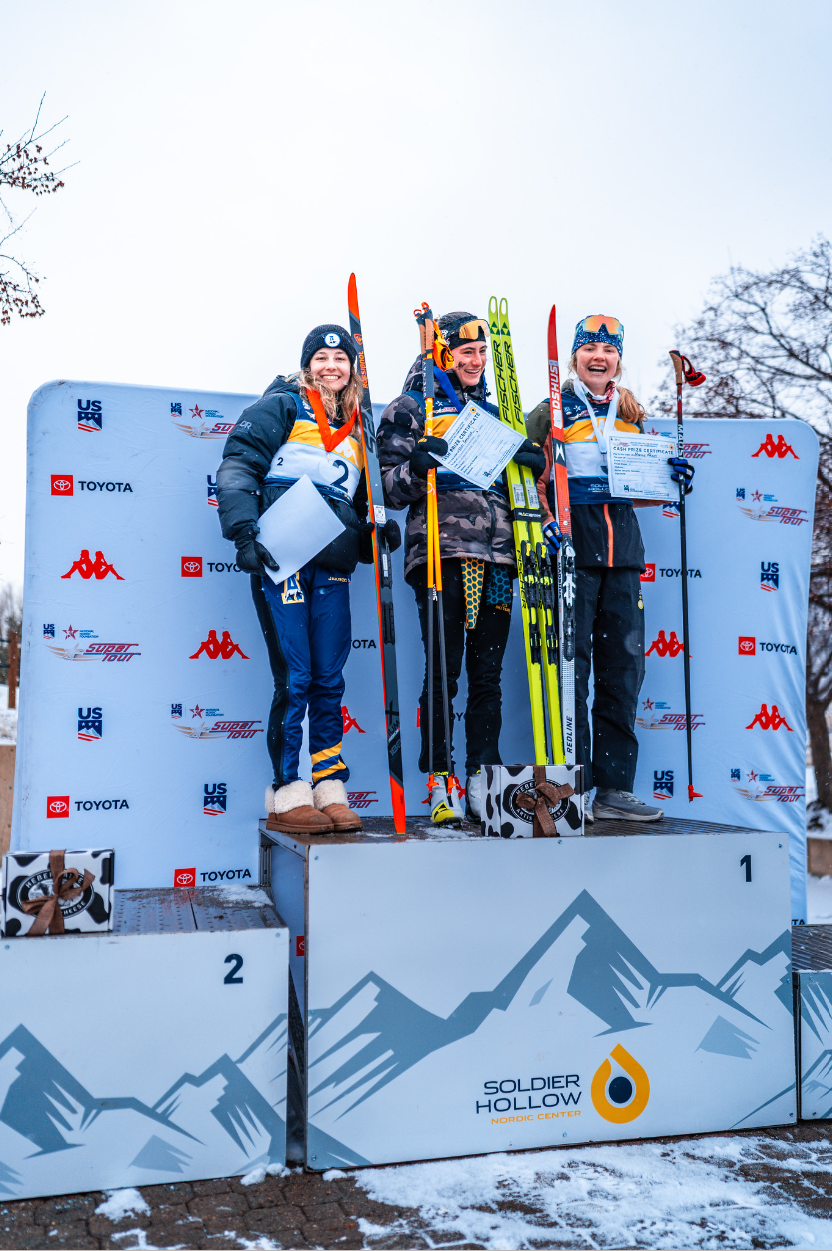
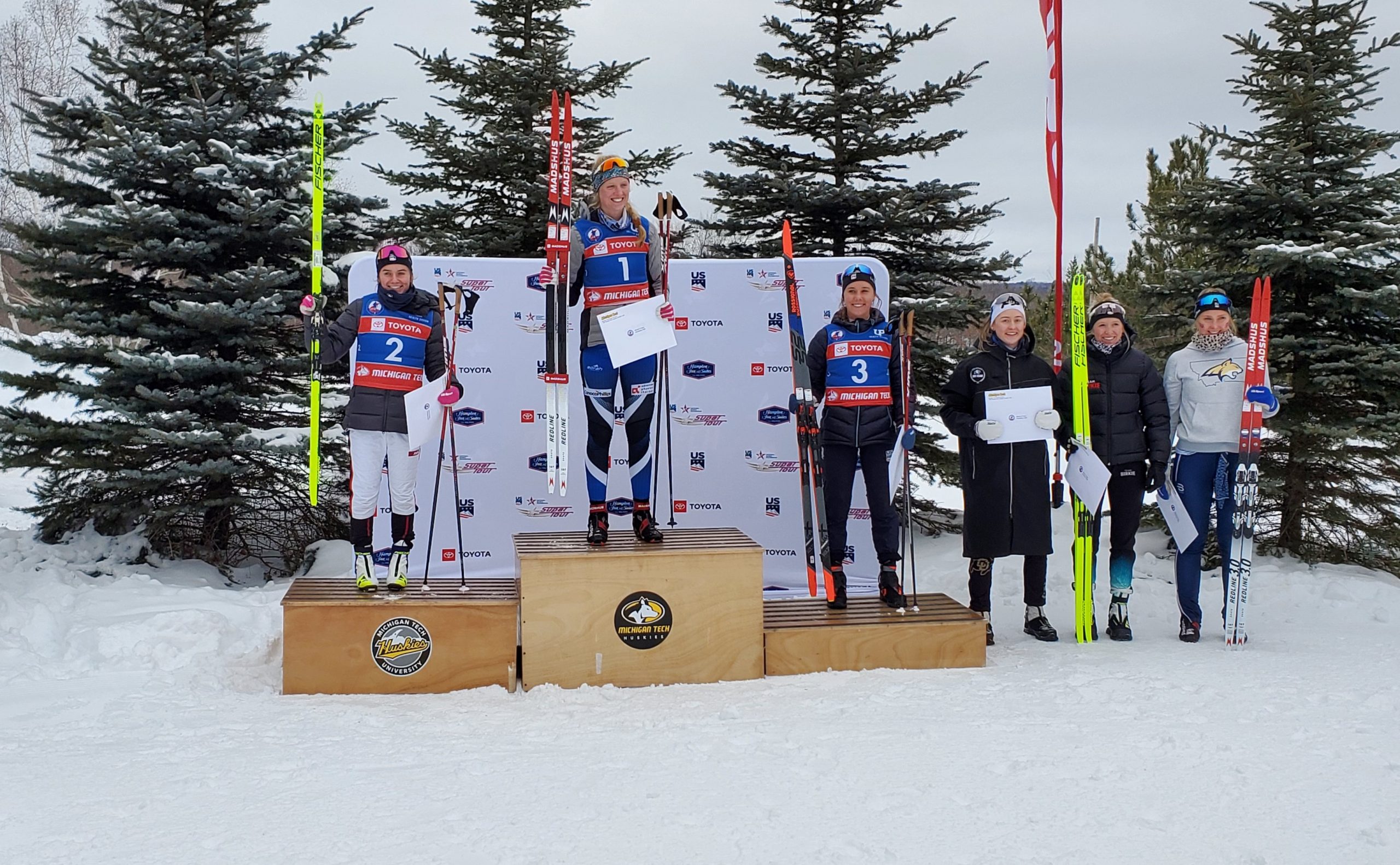
The Women’s podium in Friday’s 20 k Mass Start, Haley Brewster (UVM) first, Kendall Kramer (UAF) second, and Margie Freed (Craftsbury Ski Club) third.
Tobias Albrigsten contributed photos to this coverage of US Nationals. A full gallery from Friday’s Skate Race is available on his website here, and you can follow him on Instagram @UntraceableG.
HOUGHTON, MICHIGAN: Welcome to FasterSkier’s on-location coverage of the United States National Cross-Country Ski Championships from Houghton, Michigan.
This week, Houghton hosts the U.S. National Cross-Country Championships on the Michigan Technological University’s trails system. Today’s event was the freestyle sprint. Even though the race was held under the organizing umbrella of the national championships, today’s event was not a national championship race; as it is part of the US. SuperTour. U.S. Ski and Snowboard has decided to hold the freestyle sprint national championships at the spring finals in Craftsbury, Vermont, March 24th.
Many of the entrants who competed throughout the week were also at the top of the ranking lists for the U.S. SuperTour; so, even though the national title was not in the mix, a lot was on the line. Among those at top of the SuperTour leaderboard for the men were John Steel Hagenbuch, Zanden McMullen, Andreas Kirkeng, and David Norris; all of whom had already podiumed in Houghton.
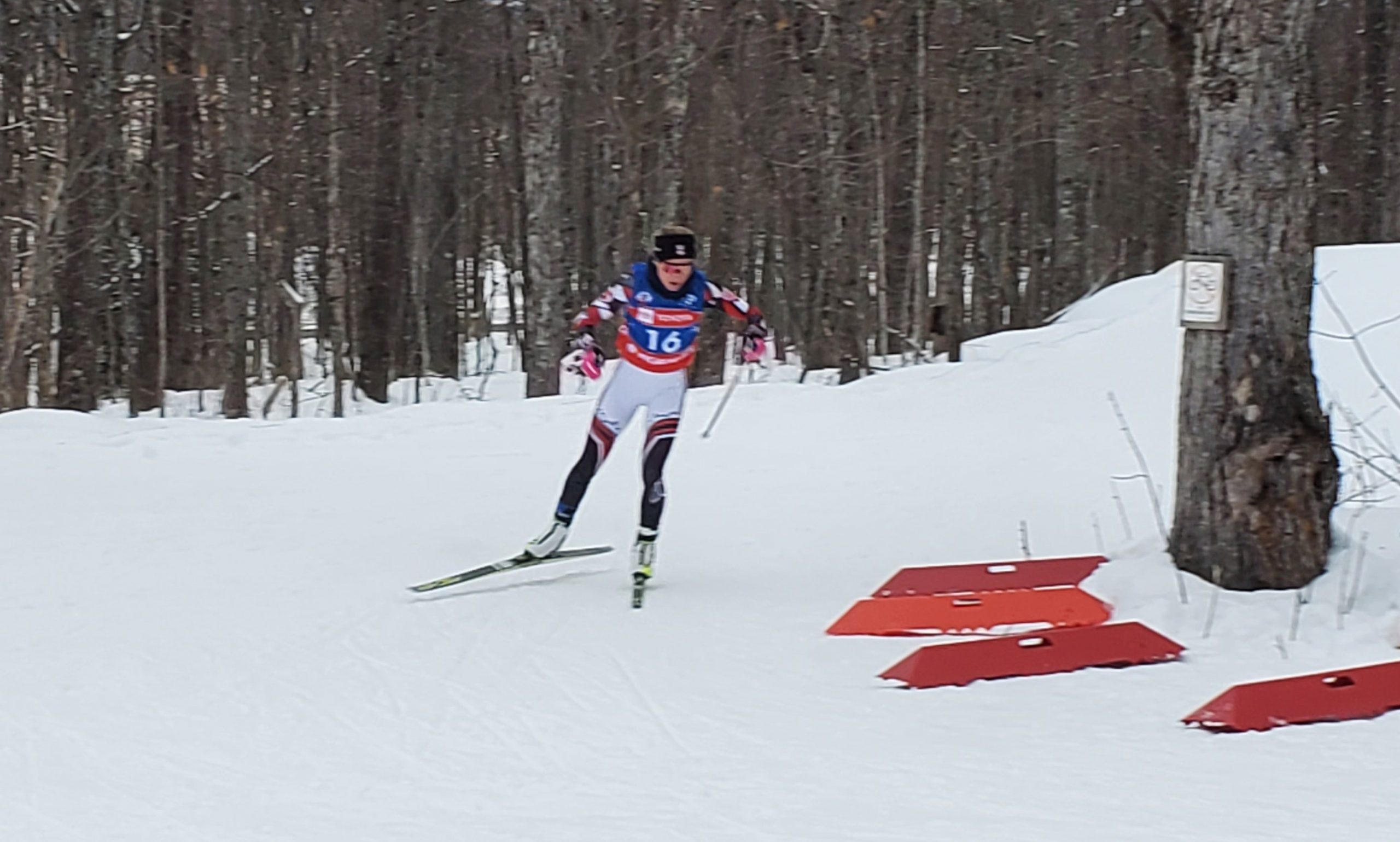
Hailey Swirbul powering through a corner in the qualifying round. (Photo: FasterSkier).
The women’s SuperTour leaderboard also included the names of Houghton podium finishers; with Hailey Swirbul, Sydney Palmer-Leger, and Novie McCabe being on the list.
Luke Jager generating enough power to get airborne in a high g-force corner in Houghton. (Photo: Dr. Amy Kostrzewa)
So, despite the lack of a national championship designation, the stakes were still very high. An explanation of the SuperTour designation was provided by U.S. Ski and Snowboard’s Brian Fish. Fish told FasterSkier that several years ago the decision was made to split the U.S. National championships. He said, “The decision was made to take the last competition here, being the second sprint, and be moved as a national championship to the spring. The intent is to have an equal distribution of national championships, and it allows some of our World Cup athletes to be able to do a sprint race as a national championship.” Fish added that, “The intent is to provide a good amount of distance and sprint racing throughout the year.” Fish explained the point system designation of national championship points and SuperTour points: “The U.S. national championship races are double points to the SuperTour, so all of our national championship races are also SuperTour points.” Fish also pointed out that normally this race would be held on a Sunday but was moved to Saturday to try and get more Juniors to race. The back-to-back race days turned out to be a significant factor with today’s sprints following yesterday’s 20 kilometer race.
Regardless of what the race was designated, the competition was stiff. On the women’s side, Hailey Swirbul (APU Nordic Ski Center) made it a clean sweep of Houghton winning the sprint by six-tenths of a second over Novie McCabe (University of Utah), who came in second. Lauren Jortberg (SMS T2) came in third.
The men’s race was won by Norwegian Kristoffer Alm Karsrud (Northern Michigan University). He beat out Luke Jager (University of Utah), by seven-tenths of a second. Tom Mancini of France (University of Utah) finished third.
Novie McCabe qualifying for the heats. She would ultimately finish second. (Photo: FasterSkier).
The Race
The week’s racing and back-to-back race days took its toll on racers. Energy reserves were low for everyone, and pacing during qualifiers and heats was critical. Women’s winner Swirbul finished seventh in the qualifiers and didn’t win any of her heats until it mattered most in the finals. She told FasterSkier that, “I was pretty tired today. I didn’t really have it in me to go as hard as I possibly could in every heat. I knew I wouldn’t have any in the end. I tried to move on using as little energy as I could instead of a fitness contest from the first get go. I’m learning a lot about how to conserve energy in the whole sprint day, something I don’t get to practice on the World Cup.” But Swirbul acknowledged that the strategy came with risk. She said,
“The semi-final was a stacked group. That cut it pretty close for me. I wasn’t planning on having a four-way lunge with everyone.” Hailey Swirbul
Hailey Swirbul’s first time crossing the finish line in the in the lead was in the finals. (Photo: FasterSkier)
Men’s podium finisher Jager also noted the strain of back-to-back racing. He told FasterSkier, “I was feeling some fatigue from yesterday. Especially since yesterday was a long one. I got better throughout the day. I knew that…today I needed to hold back everywhere I can and stay in the group as much as I can, just wait to the finish. I got a little more dialed every heat.”
In addition to fatigue, the women’s race faced some controversy. In the semifinals, Mariel Merlii Pulles (University of Alaska Fairbanks), who finished second in Wednesday’s classic sprints, was relegated (moved to last) in her heat due to interference. The infraction occurred in the final few yards of the race. Pulles was boxed out at the finish and tried to pass Karianne Dengerud (University of Utah). As Pulles pulled up to Dengerud their skis tangled and Dengerud tumbled to the ground. At the finish line it was Tilde Baangman first, followed by Pulles, with Dengerud sixth. However, the jury ruled that Pulles interfered with Dengerud and Pulles was penalized by relegation. Racing was held up for about five minutes while the jury deliberated. Race technical delegates told FasterSkier that there was some discussion about whether there could be any compensation awarded to Dengerud due to her position near the finish when the violation occurred, and ultimately, they determined that there was nothing within the rules that could be done to compensate her. With Pulles’ relegation, Dengerud’s day would end with her in fifth place in the heat.
As women’s racing continued into the finals, all eyes were expectantly focused on Swirbul to see if she could sweep the week’s events. Jortberg went out fast, and Swirbul latched on to the back of the pack. Going into the course’s steepest hill for the first time, Swirbul swung wide to pass several skiers and pulled into second. The second time around on the hill Swirbul asserted herself and pressed into the lead. Swirbul put the accelerator pedal all the way down into the stadium and ended up beating out McCabe and Jortberg.
The clean sweep for Swirbul was satisfying. She said that she had held out hope for the possibility of sweeping the week. Swirbul had taken inspiration from her teammate, Rosie Brennan, who had previously accomplished the same feat. She said, “Our coach had talked about that quite a lot, and I wanted to follow in her footsteps, and she’s been a huge inspiration for me.” She continued that, “What means more to me is that I get to be here at nationals. I’m so stoked that I chose to have that be part of my plan this year, instead of going to Europe at the start of the season. So, win, lose, or draw, that’s what I’m really excited for…I love this community.” Swirbul said that this felt like the high point of her career because,
“I am the most happy where I am right now, and I don’t feel like I’m wishing I was home or wishing I was somewhere else. I’m just happy to be where I’m at and happy to be racing well at the same time.” Hailey Swirbul
In the men’s final race, Thomas O’Harra (APU Nordic Ski Center) took the early lead. But most of the field passed O’Harra the second time up the course’s steep hill with Jager and Karsrud surging to the front. Jager had built a very slim lead at the top of the hill. Into the stadium it was Karsrud and Jager in the lead, with Jager holding a slight advantage. But Karsrud had a gear that no one could match and pulled away from the field. Jager acknowledged Karsrud’s finishing prowess:
“Karsrud in that final 100 meters is the stuff of nightmares. He’s just so strong.” Luke Jager
Jager said that he wanted to be in front coming into the stadium. He told FasterSkier that, “I really didn’t like my odds against him in a head-to-head because of how its been panning out for me every other time. He’s an absurdly strong finisher. I feel like the World Cup heats I’ve skied have had finishes that weren’t that fast.”
Men’s sprint podium (l-r Luke Jager, Kristoffer Alm Karsrud, Tom Mancini). (Photo: Dr. Amy Kostrzewa).
For Karsrud, who skis for NMU, the course at Houghton has a bit of a home field advantage feel for him. He said, “This is the third time for a skate sprint here this year, so I know the course really well.” The Wildcat junior said his strategy was, “To pretty much just take it easy in the start, stay far back, and then take it the last 100 meters.” The strategy panned out perfectly for Karsrud, who’s afterburners were unmatchable, and led to a perfectly executed race.
Men’s winner Kristoffer Alm Karsrud with a monster finish had time to celebrate. (Photo: FasterSkier).
The exciting racing was a fitting way to conclude the competition in Houghton. The venue was well organized, and the conditions were excellent. It was all one could hope for in a national championships.
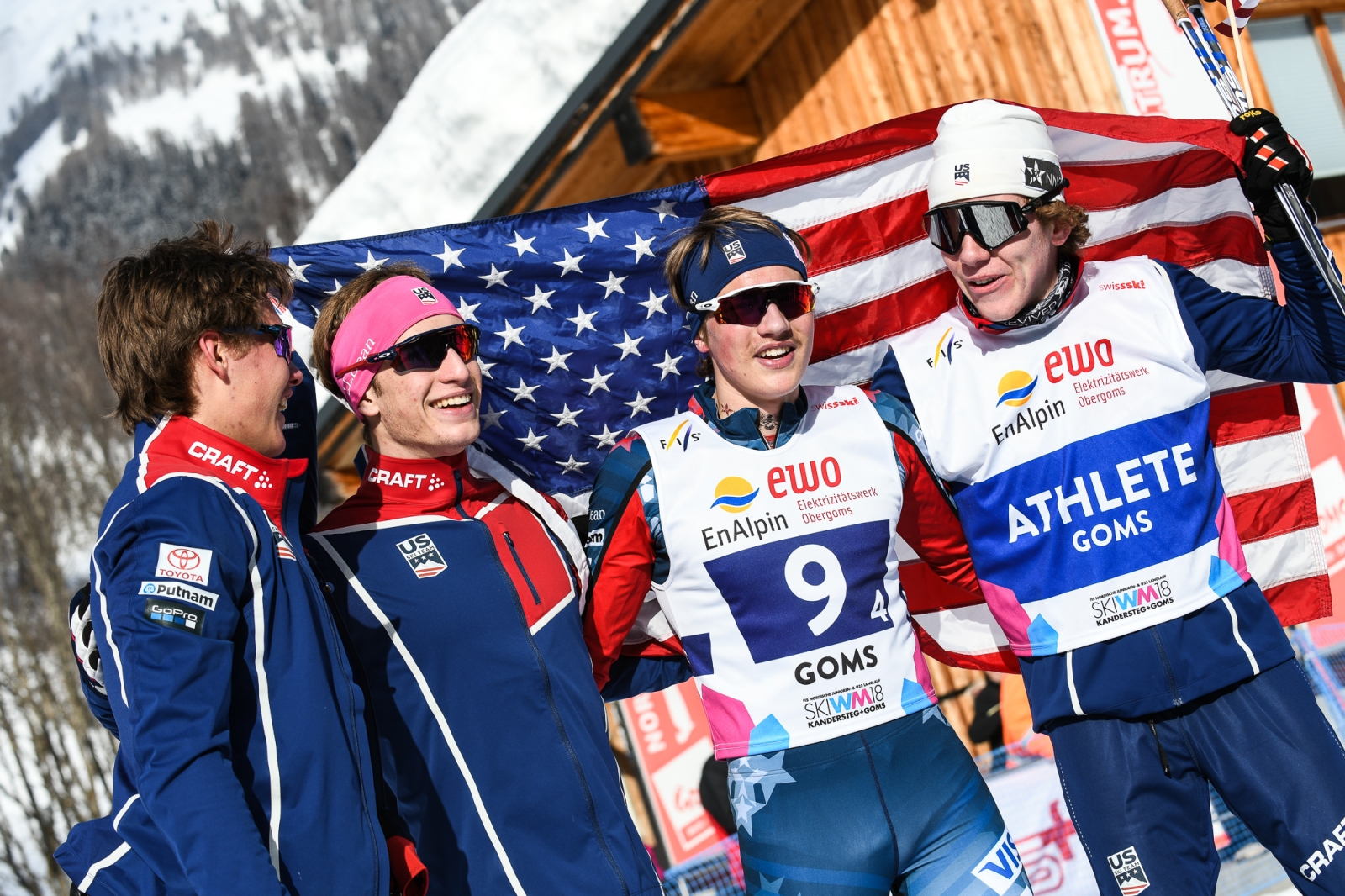
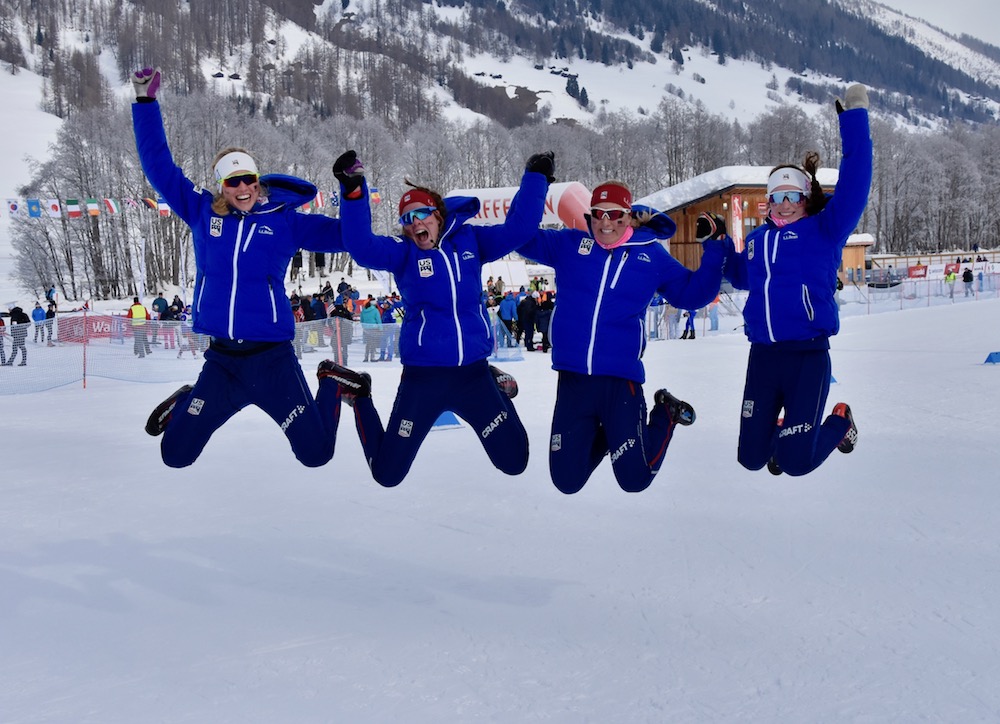
The U.S. men’s silver-medal relay at 2018 Junior World Championships in Goms, Switzerland, with (from left to right) Luke Jager, Hunter Wonders, Gus Schumacher, and Ben Ogden. (Photo: JWSC2018.ch)
(Note: This article has been updated to include comments from Americans Ben Loomis, Luke Jager and Gus Schumacher.)
Junior World Championships (Goms, Switzerland): Men’s and women’s relays
Two individual medals and a relay podium. That’s how the U.S. team fared this week at Junior World Championships in terms of a medal count, but the significance of its breakthroughs go way beyond the hardware.
Hailey Swirbul became the most successful American nordic skier at Junior World Championships with a silver and a bronze in the two women’s distance races. Then, on Saturday, the U.S. men took their turn in the spotlight, racing to second and almost first in the 4 x 5-kilometer relay for the best relay finish by an American team at Junior Worlds. Last year, the U.S. women placed third at 2017 Junior Worlds at Soldier Hollow in Midway, Utah.
Luke Jager started the team off on Saturday as the first classic leg, putting the U.S. men in sixth at the first exchange, 14 seconds behind Sweden in first.
While Sweden dropped to second on the next leg, the U.S. continued to move up, with Ben Ogden racing to fourth, 8.5 seconds out of first, behind Norway, Russia and France, respectively.
On the first freestyle leg, Hunter Wonders held the U.S. in fourth and tagged anchor Gus Schumacher in fourth, 31.3 seconds out of first. Norway continued to lead with France, and Russia skied about 5 seconds back in third with 5 k to go.
Schumacher then skied the fastest anchor leg to race up to second, passing France and finally Russia in the finishing straight, as he crossed the line 2.2 seconds behind Norway’s Jørgen Lippert — who eased up in the finish and secured the Norwegian gold with a total time of 50:04.2 minutes.
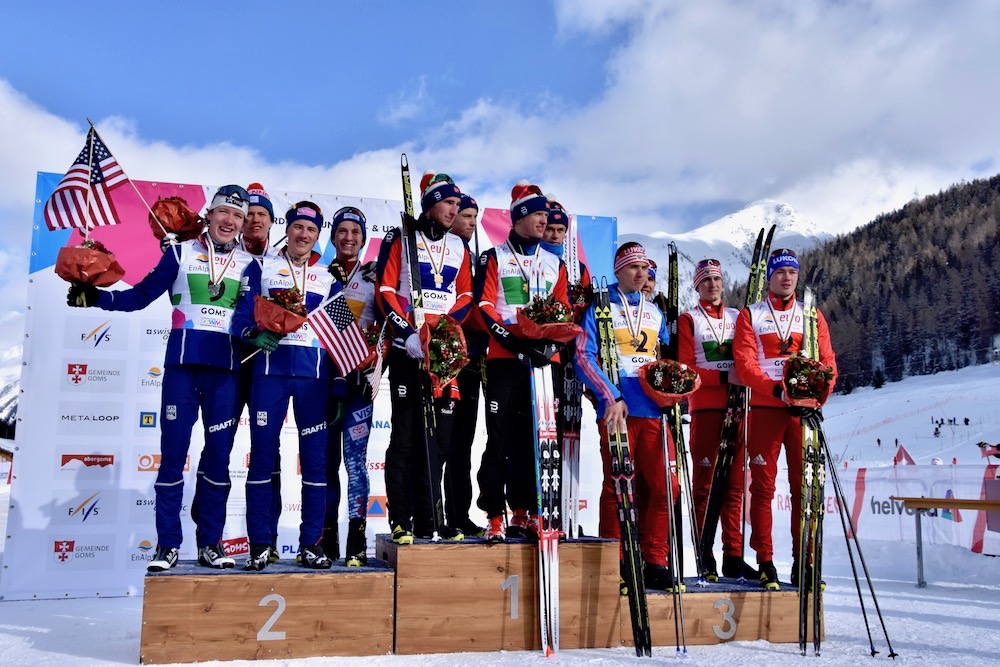
The men’s 4 x 5 k relay podium at 2018 Junior World Championships with Norway (c) in first, the U.S. (l) in second (Ben Ogden, Luke Jager, Gus Schumacher, Hunter Wonders), and Russia (r) in third. (Photo: Julia Kern)
The U.S. placed second, 3.3 seconds ahead of Russia in third (+5.5), and France finished fourth (+29.6).
Norway’s winning team included two men who won individual golds this week, Harald Østberg Amundsen (in the 20 k skiathlon) and Jon Rolf Skamo Hope (10 k classic), as well as Håvard Moseby and Lippert (who took bronze in two races).
Russia’s team was made up of Kirill Kilivnyuk, Sergey Ardashev, Yaroslav Rybochkin, and Alexander Terentev. Team France was Camille Laude, Hugo Lapels, Tom Mancini, and Pierre Tichit.
Canada placed 11th (+3:12.8) with Antoine Cyr, Ritchie Graham, Felix Longpre, and Etienne Hebert. Sixteen teams contested the men’s relay on the final day of Junior Worlds in Goms.
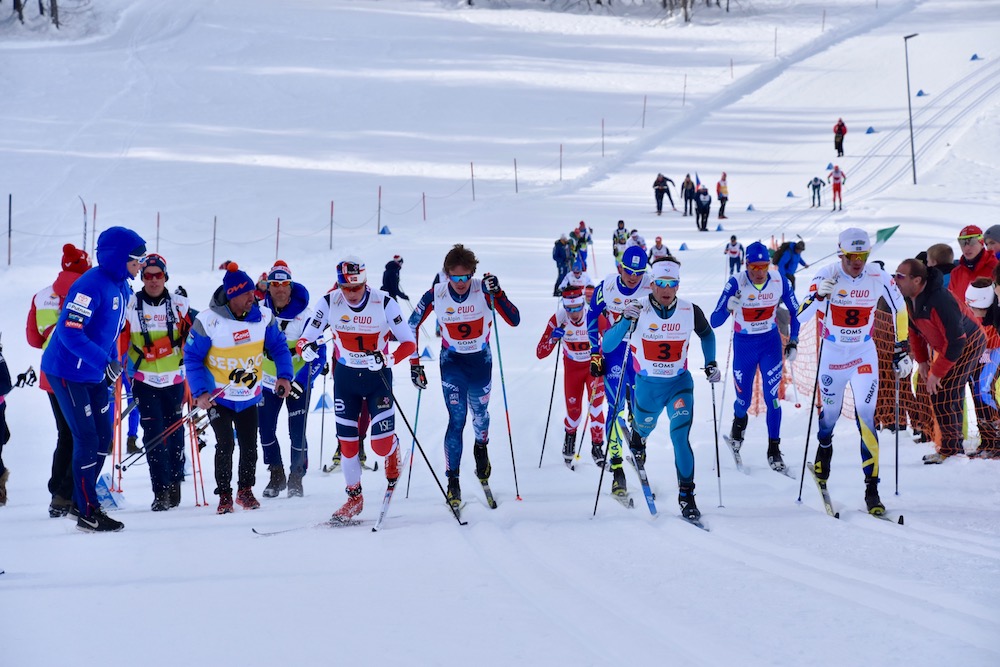
American Luke Jager (9) skiing with Norway’s Harald Østberg Amundsen (1), France’s Camille Laude (3), and Sweden’s Jacob Nystedt (8) during the first leg of the men’s 4 x 5 k relay on Saturday at 2018 Junior World Championships in Goms, Switzerland. (Photo: Julia Kern)
In an email, Jager, who turned 18 last month, explained that he was grateful for the opportunity to race at his first Junior Worlds.
“I barely qualified for this trip after a tough week in Anchorage so my options for starts were super limited,” Jager wrote. “I got the sprint start last week which was pretty horrendous and then a guaranteed spot on the relay team. So I had the whole week to prepare and rest. Watching the boys all week we realized that a medal could be possible and we started targeting that super closely.”
But over the last week, Jager hadn’t been feeling well.
“I was feeling really really bad in the days following the sprint and could barely get out and ski for 60 minutes each day,” he recalled. “I had actually told [U.S. Ski Team Development Coach Bryan] Fish that if I continued to feel as bad as I had been I was gonna sit out the relay. But I started feeling better and better throughout the week and was feeling really good this morning.”
He had previously asked Fish if he could ski the scramble leg.
“Bryan was stoked about it too so that decision was easy,” Jager explained. “This group of dudes is perfect for each leg of a relay so we barely even needed to discuss order. I am definitely a stronger classic skier so I was stoked to be able to get some redemption for my poor form in the last month.”
Schumacher, 17, explained he found out the relay order on Friday night and “really started to get excited about it,” he wrote in an email. “We had some foreign friends say that they thought we could do well so that really helped confidence.”
From the gun, Jager expected a fast pace and pushed to put himself in the lead group while trying to conserve energy and avoid any tangles He locked onto Norway’s Amundsen and by the last climb on the second lap, found that the group was beginning to string out.
“I was thankfully able to hold on just enough to maintain connection with the leaders and put Ben in a position where he could do his thing,” Jager wrote. “I would have liked to be a little further up in the group when I tagged off to Ben but the Swedes’ first skier had done so much damage in the last minutes that we were all in single file and pretty much in survival mode up the last climb.”
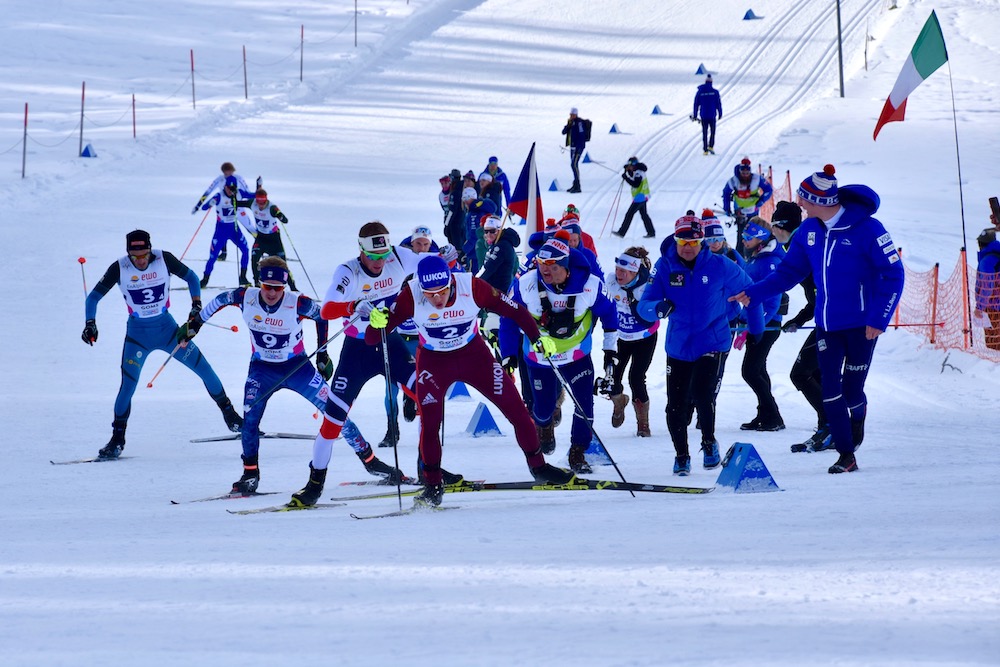
Russia’s Alexander Terentev leading Norway’s Jørgen Lippert, American Gus Schumacher (9), and France’s Pierre Tichit (3) up a climb in the final leg of the men’s 4 x 5 k relay at 2018 Junior World Championships in Goms, Switzerland. (Photo: Julia Kern)
Fast-forward to Schumacher getting tagged in fourth in the final exchange, 31.5 seconds behind Norway in first, 30.9 seconds behind France in second, and 26.2 seconds behind Russia in third. Despite the gap, he believed he could close it.
“I definitely thought those three were in reach, and I wanted to catch them, if for no other reason than to keep clear of 5th and 6th,” Schumacher wrote. “I focused on really holding steady for the first 2k, then starting to push more, and I was able to catch that lead pack and then recover with them for the last sprint, which did end up really hurting.”
While he had distanced himself from France and secured third by the final hill, he hadn’t anticipated catching Russia or Norway.
“By the time I got through the downhill corner, however, I was closing fast on the Russian and realized I was right there,” Schumacher wrote. “I popped around the last corner and was almost even with Russia, then after a few seconds of sprinting I pulled ahead and he slowed down and I knew I had it.”
While Jager explained he’s not one to get very nervous about racing, Saturday was completely different.
“… Watching the rest of the race progress was one of the most nerve wracking experiences of my life,” he wrote. “When Hunter tagged off to Gus I knew we were really really gonna be in the fight for a medal. I’ve been racing Gus for most of my life and I know when that kid is gonna throw down and produce a miracle and I could see it…
“This is something this group of guys has been dreaming of and training for for a really long time now,” he added. “To be able to watch that dream come into fruition today was indescribable. Probably the best day of my life since Cole Morgan added me on Snapchat. We came here this year to show the world that US skiing is the real deal and that we’re here to stay and I think we did that. To be able to be a piece of that history was an honor.”
“Experiencing the podium here has been so cool,” Schumacher wrote. “I thought it was possible, but actually getting it feels amazing. This whole trip has been really cool even without this success, it’s such an amazing place and the team is tight. I think individually I anticipated results maybe a little better, but this seems about right, and as a team I think we all surprised ourselves. Together we can make some big waves.”
Germany Wins Women’s Relay; U.S. 8th
In the women’s 4 x 3.3 k relay earlier on Saturday, Germany took the win by 8.6 seconds over Russia with a winning time of 39:17.4. Sweden finished third, 47.5 seconds out of first.
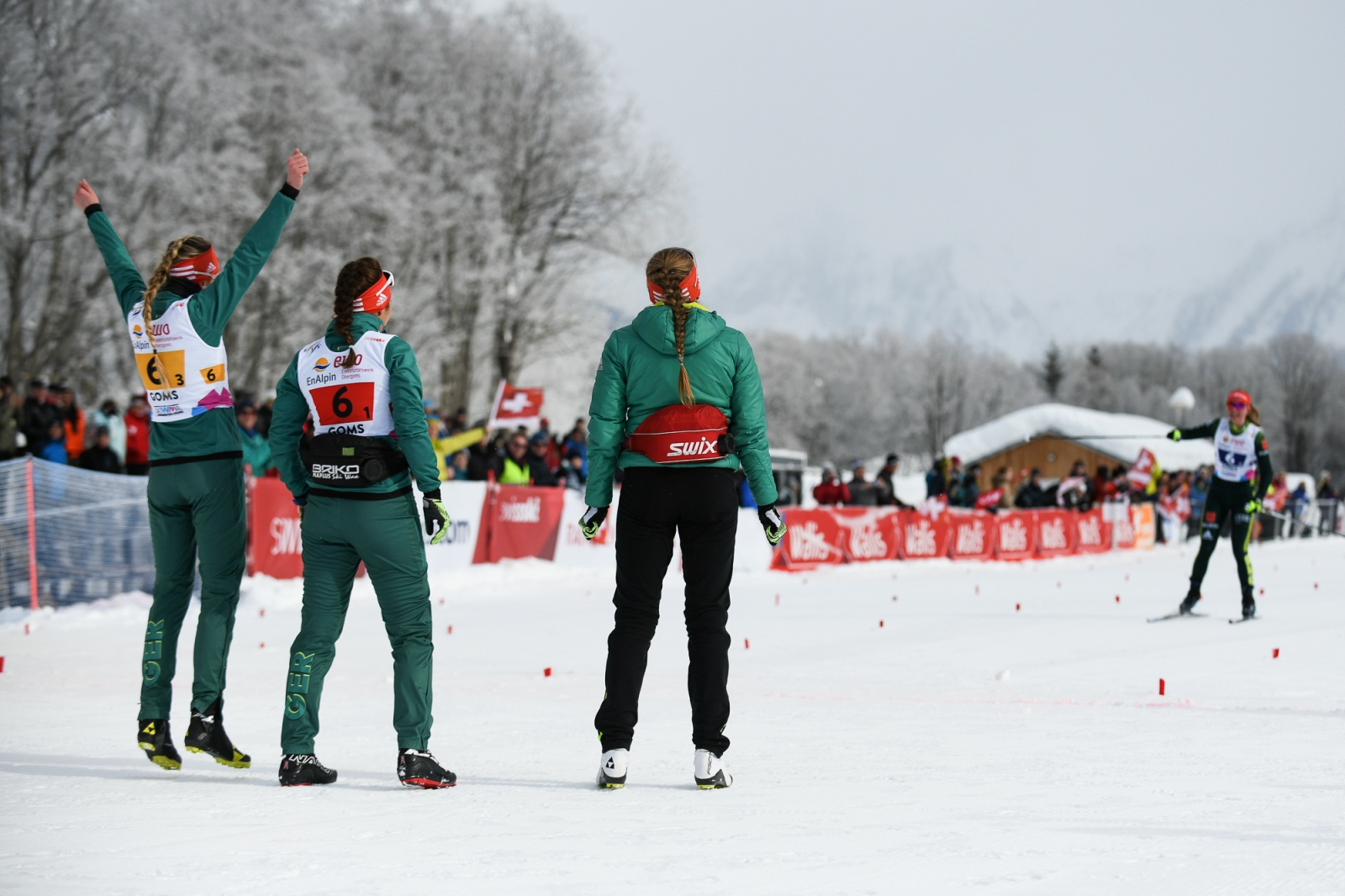
Germany’s Alexandra Danner, Celine Mayer and Lisa Lohmann await their teammate Anna-Maria Dietz at the finish of the women’s 4 x 3.3 k relay on Saturday at 2018 Junior World Championships in Goms, Switzerland. Germany placed first and Russia finished second, 8.6 seconds later. (Photo: JWSC2018.ch)
Germany (Alexandra Danner, Celine Mayer, Lisa Lohmann, Anna-Maria Dietz) improved from third on the first leg, to second on the second and third legs, and final first on Dietz’s anchor leg.
Russia (Polina Nekrasova, Hristina Matsokina, Nina Dubotolkina, Maya Yakunina) led the race from the first through the third and final exchange, before slipping to second at the finish.
Sweden (Tua Dahlgren, Frida Karlsson, Alicia Persson, Johanna Hagström) rebounded from 13th and more than a minute and a half back at the first exchange to tag in fourth and 28 seconds out of first thanks to Karlsson’s fastest second-leg time. By the final exchange, they were up to third and they held that position to the finish.
The U.S. women’s 4 x 3.3 k relay at 2018 Junior World Championships, with (from left to right) Hailey Swirbul, Kathleen O’Connell, Hannah Halvorsen, and Molly Gellert. They placed eighth on Saturday. (Photo: Julia Kern)
The U.S. placed eighth (+1:08.1) with Kathleen O’Connell, Swirbul, Molly Gellert, and Hannah Halvorsen. After O’Connell put them in eighth and about a minute back on the first leg, Swirbul skied them up to sixth with the second-fastest second leg, 30.1 seconds out of first. Gellert held onto that position on the first skate leg, but Halvorsen slipped two places on the anchor leg to finish eighth.
Canada finished 15th (+4:47.8) out of 16 teams with Hannah Mehain, Natalie Hynes, Annika Richardson, and Alexandra Racine.
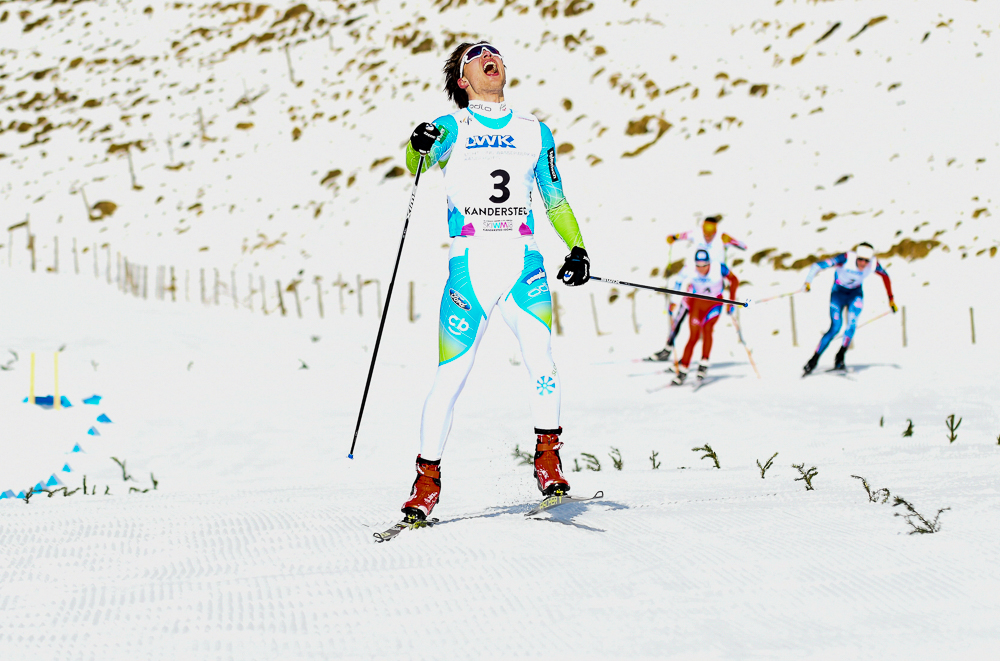
Slovenia’s Vid Vrhovnik (3) celebrates his win in the last nordic-combined competition of 2018 Junior World Championships, the individual normal hill/5 k, on Saturday in Kandersteg, Switzerland, while the Czech Republic’s Jan Vytrval, Austria’s Dominik Terzer and American Ben Loomis (r) battle for second. (Photo: JWSC2018.ch)
Nordic Combined Junior World Championships (Kandersteg, Switzerland): Normal hill/5 k Gundersen
In the final nordic-combined competition of Junior Worlds, American Ben Loomis nearly notched his second podium of the week, missing it by one-tenth of a second in fourth place.
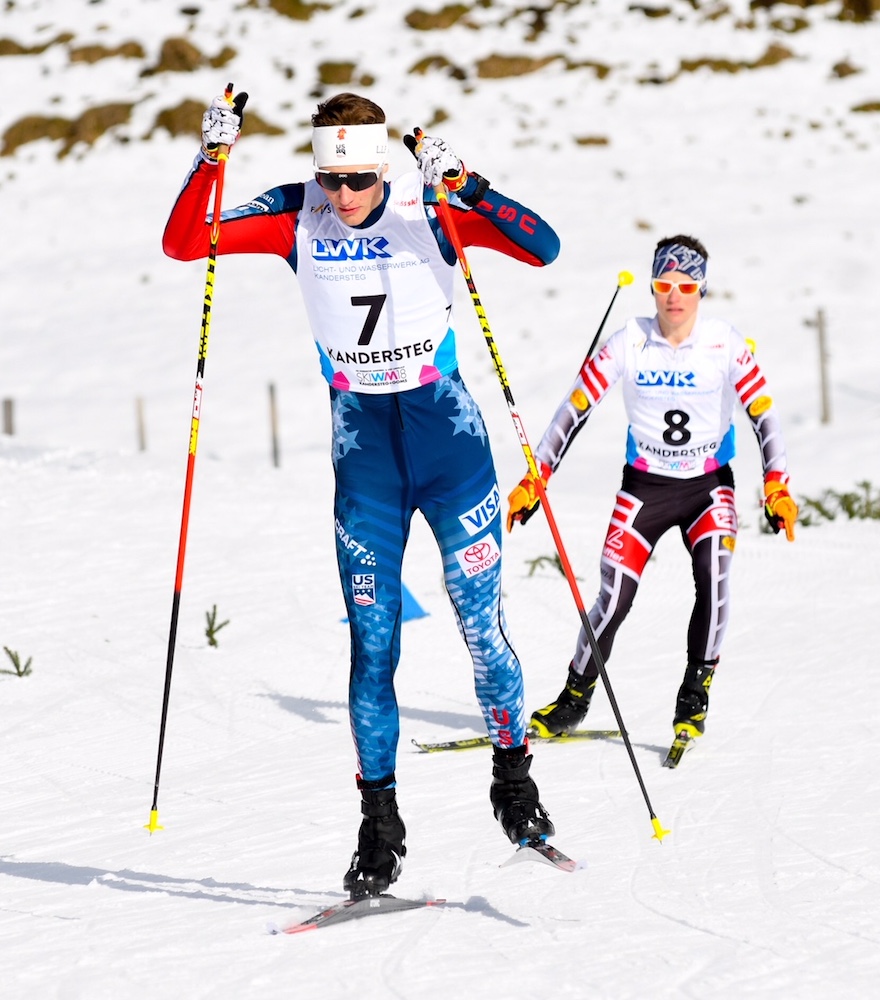
American Ben Loomis (7) leads Austria’s Johannes Lamparter during Saturday’s 5 k at 2018 Nordic Combined Junior World Championships in Kandersteg, Switzerland. Loomis went on to place fourth and Lamparter finished eighth. (Photo: Romina Eggert)
Slovenia’s 18-year-old Vid Vrhovnik won the individual normal hill/5 k Gundersen by 4.9 seconds over Austria’s Dominik Terzer. After posting the third-best jump on the 106-meter hill, Vrhovnik started the 5 k race 6 seconds behind Germany’s Luis Lehnert in first. Terzer jumped to second and started just 4 seconds behind, while the Czech Republic’s Jan Vytrval jumped to fourth and started 10 seconds back. Loomis jumped to seventh (just as he did on Tuesday before racing to third place) and started 27 seconds out of first.
“I was happy with my jump being closer in time to the front,” Loomis wrote in an email about his his jump, which put him about 10 seconds closer to the leaders than on Tuesday. “I didn’t feel quite as lucky with the wind. I was hoping to jump around the top 5, but 7th, only 27sec back was good, too.”
Over the two-lap 5 k, Vrhovnik battled with Terzer, while Lehnert slipped to seventh at the finish, 23.5 seconds behind. The Slovenian took the win by nearly five seconds over Terzer in 11:28.8, and Vytrval outlunged Loomis for third place (+5.4). Loomis placed fourth (+5.5), well ahead of Norway’s Einar Lurås Oftebro in fifth (+18.4).
Ben Loomis (USA Nordic) on the last day of 2018 Nordic Combined Junior World Championships in Kandersteg, Switzerland. He jumped to seventh and moved up to fourth in the 5 k. (Photo: Romina Eggert)
“I was able to catch places 3-6 on the first lap and ski with them through the beginning of the second lap,” Loomis wrote. “Towards the end of second lap I closed down on second place (Jan Vytral) with Dominik Terzer. On the last corner we packed up in positions 2-4.
“The finish started with a sharp downhill corner followed by a quick stretch less than 100 meters,” he continued. “I came into the finishing lanes in second but unfortunately took the wrong line and was passed by Dominik and never quite caught Jan in front of me.”
While he had been hoping for another podium, Loomis acknowledged that he was pleased to ski the fastest race time and “be battling at the front”.
“Overall I am leaving Switzerland with my goals accomplished and feeling satisfied,” he wrote. “It would have been nice to walk away with a double podium but I am still very happy with how to week went. This week has been a huge confidence booster going into the Olympics next week. I am very excited to represent my country and enjoy my time at the games. I am looking to have fun, take in experience and not overthink the results.”
Also for the U.S., Stephen Schumann placed 18th (+1:18.6), up one place from 19th in the jump, Jared Shumate finished 40th (+3:05.7), up from 48th in the jump, and Tucker Hoefler was 55th (+5:50.5), after jumping to 55th.
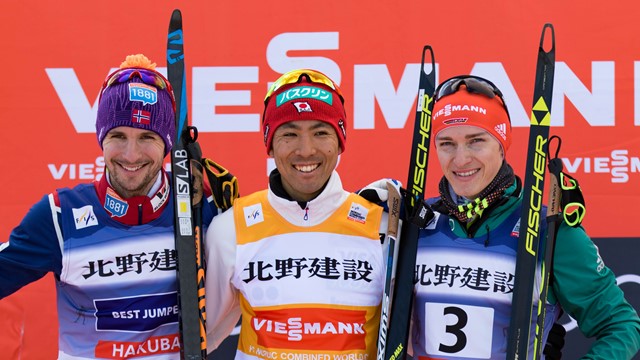
The podium at Saturday’s Nordic Combined World Cup in Hakuba, Japan, with Japan’s Akito Watabe (c) in first, Norway’s Jan Schmid (l) in second and Germany’s Manuel Faißt (r) in third. (Photo: FIS/Flawia Krawczyk)
Nordic Combined World Cup (Hakuba, Japan): Large hill/10 k Gundersen
Many of the winter-sports World Cups were off this weekend before the Olympics start in earnest a week from today in PyeongChang, South Korea, but not nordic combined, which had a World Cup stop in Hakuba, Japan.
There, local hero Akito Watabe took the win in 24:14.6 minutes, a whopping 1:12.6 minutes clear of Norway’s Jan Schmid in second. Germany’s Manuel Faißt placed third, 1:22 back, and Estonia’s Kristjan Ilves finished 52 seconds later in fourth (+2:14).
The lone American competing in Saturday’s 10 k Gundersen, Ben Berend achieved his first individual World Cup top 30, placing 23rd (+4:31.7) after jumping to 16th on Hakuba’s 134-meter large hill.
Watabe led from the beginning of the day after jumping to first, ahead ofIlves in second, Faißt in third, and Schmid in fourth. Watabe started the 10 k with a 16-second head start on Ilves, while Faisst started 52 seconds out of first and Schmid started 1:08 behind.
Berend started the 10 k with a 2:36 deficit to first, with five others within 10 seconds of him. His teammate Adam Loomis did not start the 10 k after jumping to 38th.
Another individual large hill/10 k Gundersen will be held on Sunday in Hakuba. The first nordic combined competition in PyeongChang, the individual normal hill/10 k, is set for Wednesday, Feb. 14.
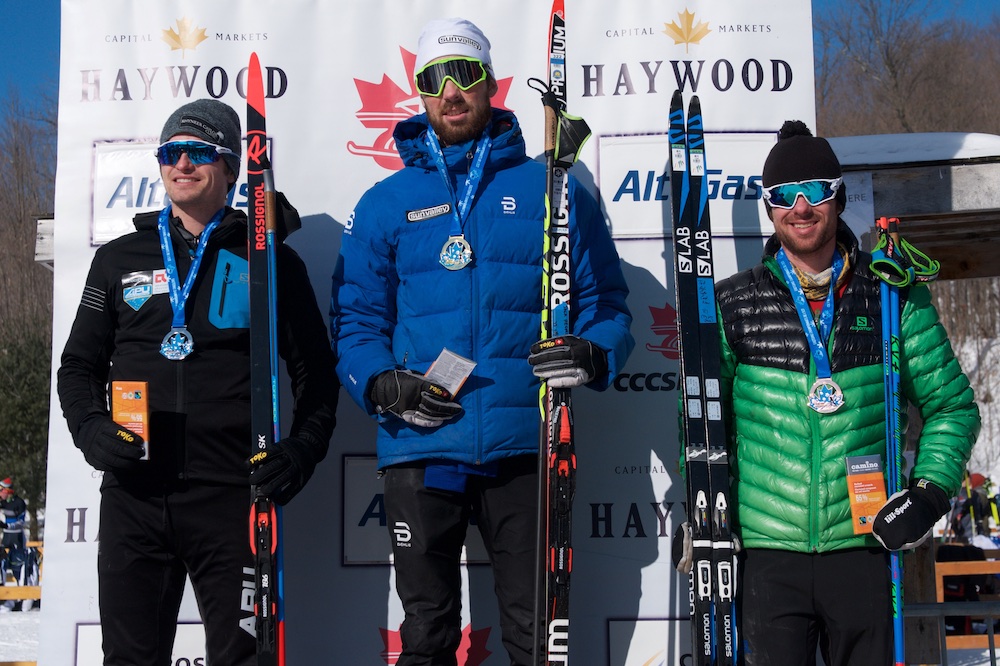
The men’s 15 k freestyle podium at 2018 Eastern Canadian Championships in Gatineau, Quebec, with Jack Hegman (c) in first, David Norris (l) in second and Tad Elliott (r) in third. (Photo: Rob Smith)
NorAm Eastern Canadian Championships (Gatineau, Quebec): 10/15 k freestyle
Americans swept the podium in both the men’s and women’s freestyle individual starts on Saturday at Eastern Canadian Championships in races that count toward both NorAm and SuperTour standings.
According to unofficial results, Jack Hegman, of the Sun Valley Ski Education Foundation (SVSEF), won the men’s 15 k by 9.1 seconds over David Norris, of Alaska Pacific University (APU), in 35:44.9. Tad Elliott (Ski Club Vail) placed third (+38.7) just ahead of the top Canadian, Jack Carlyle, of the Alberta World Cup Academy (AWCA), in fourth (+41.7).
The U.S. occupied eight of the top 10 in the men’s race, with Kevin Bolger (SVSEF) in fifth (+45.0), Ben Lustgarten, of the Craftsbury Green Racing Project (CGRP) in sixth (+52.3), Brian Gregg (Team Gregg/LNR/CXC) in seventh (+57.0), Rogan Brown (SVSEF) in eighth (+58.1), Canada’s Scott Hill (Barrie Cross Country) in ninth (+1:14.7), and Eric Packer (APU) in 10th (+1:18.6).
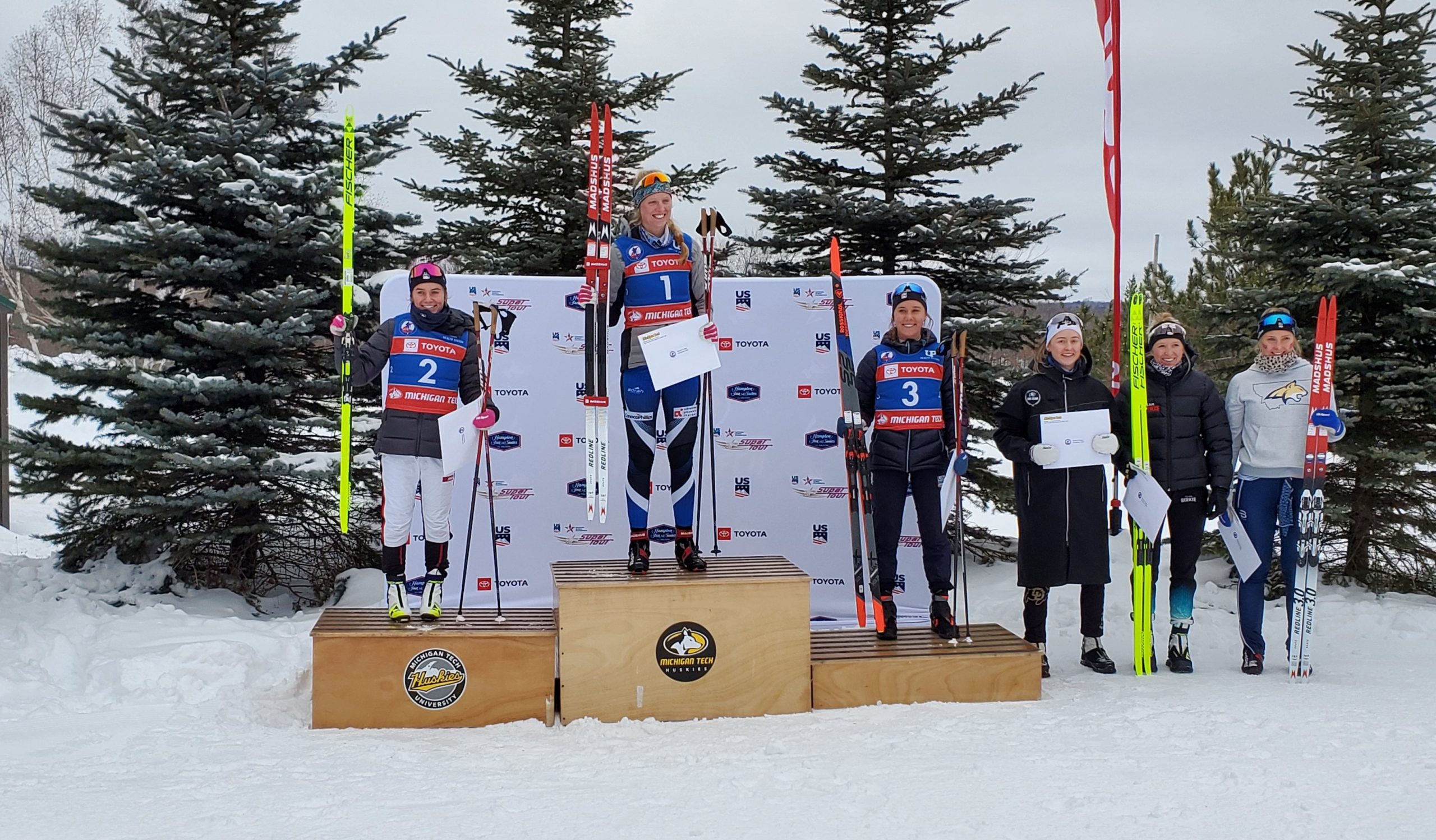
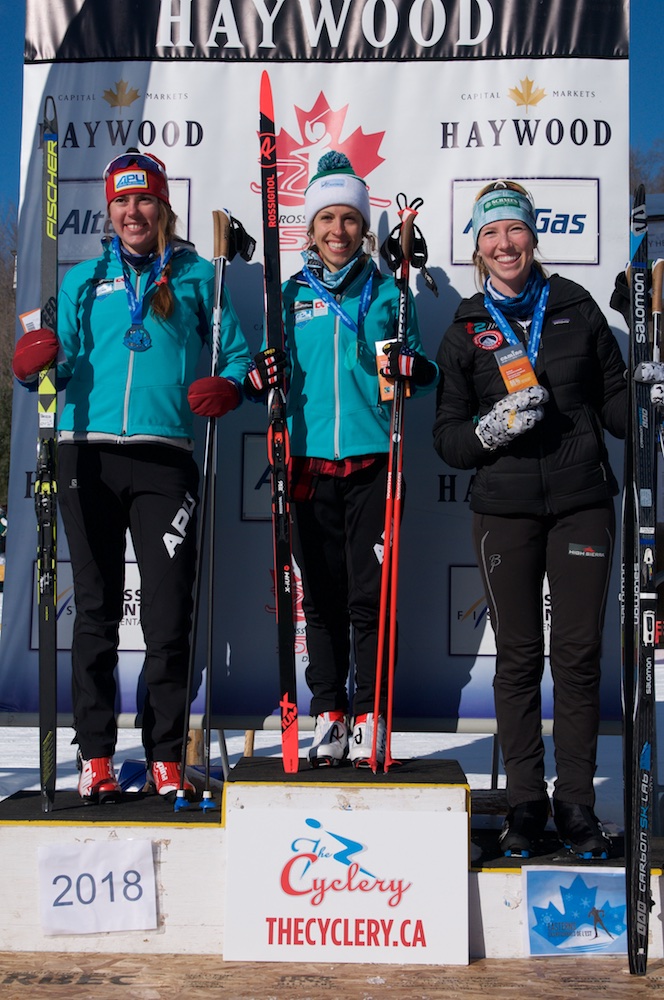
The women’s 10 k freestyle podium at 2018 Eastern Canadian Championships in Gatineau, Quebec, with Rosie Frankowski (c) in first, Becca Rorabaugh (l) in second and Erika Flowers (r) in third. (Photo: Rob Smith)
After placing second in a 10 k freestyle at last weekend’s SuperTour in Craftsbury, Vermont, Rosie Frankowski (APU) won the women’s 10 k freestyle on Saturday in Gatineau by more than 30 seconds in 27:07.3. Her teammate Becca Rorabaugh (who won the Craftsbury 10 k skate as well as Friday’s classic sprint in Gatineau) placed second (+37.1) on Saturday, and Erika Flowers placed third (+1:26.4) for the third-straight race.
Frédérique Vézina, of the Pierre-Harvey National Training Centre, led the Canadians in fourth (+1:46.2), while America Liz Guiney (CGRP) placed fifth (+1:52.2), and Olivia Bouffard-Nesbitt (Rocky Mountain Racers) finished sixth (+1:56.4).
Also in the top 10, Kaitlynn Miller (CGRP) placed seventh (+1:57.8), Felicia Geisor (CXC Team) was eighth (+2:18.5), Zoë Williams (Carleton University) ninth (+2:39.6) and Annika Hicks (AWCA) 10th (+2:43.4).
Eastern Canadian Championships conclude Sunday with 10/15 k classic pursuits at the Nakkertok Nordic Ski Centre.
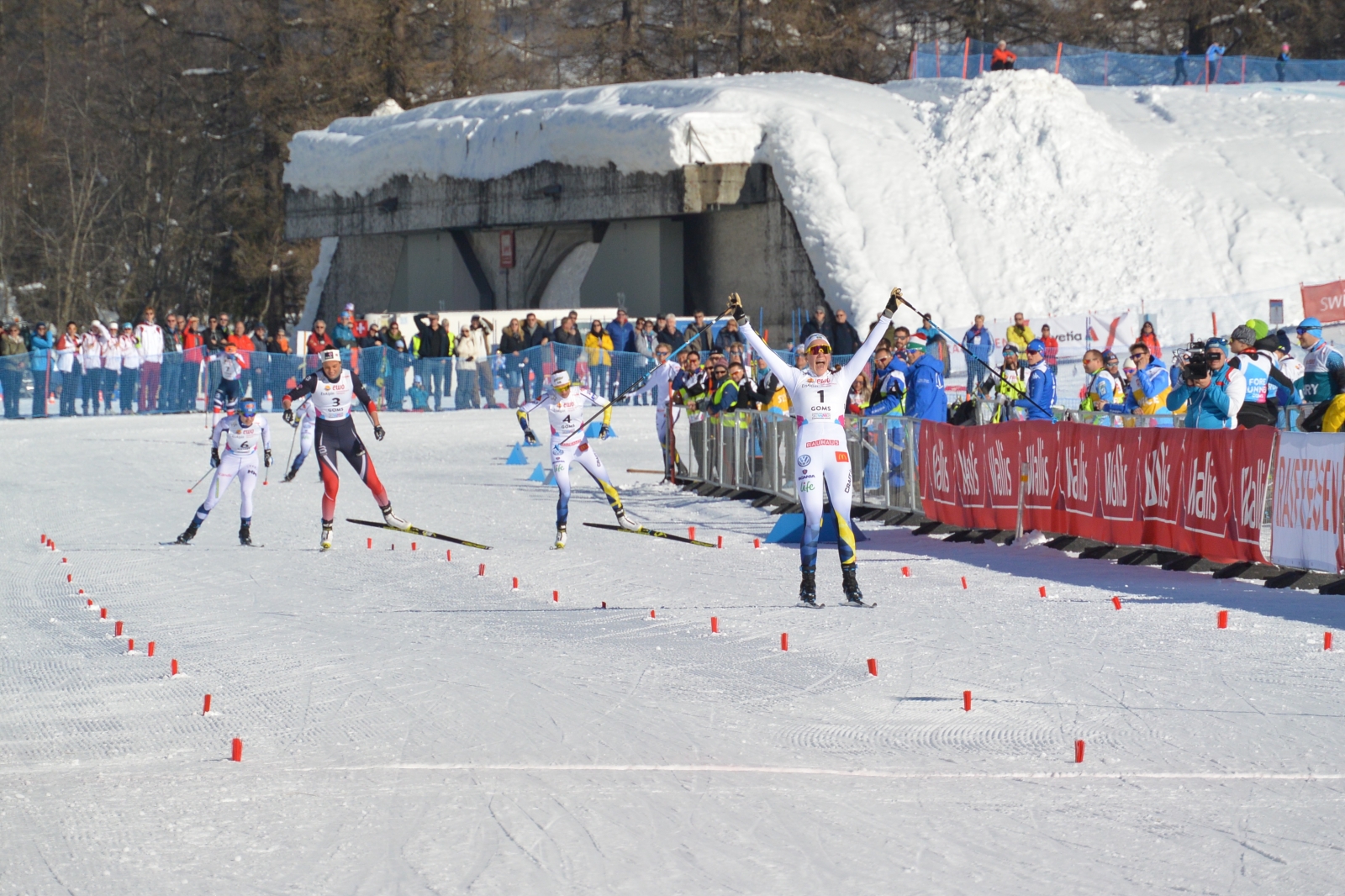
Moa Lundgren celebrates winning her first World Junior Championship after skating away from the field in the sprint in Ulrichen, Switzerland. (Photo: JWSC2018.ch)
(Note: This article has been updated to include comments from American Hannah Halvorsen.)
2018 World Junior Championships is off and running and two brand-new champions have been crowned. Moa Lundgren of Sweden took the women’s skate sprint title while the men’s final went to Tom Mancini of France.
On a perfect blue-sky day nestled deep in the Swiss Alps, the world’s best skiers under the age of 20 raced around a hilly sprint course with a few wicked corners. There were broken poles and pole-tosses; crashes; and a men’s final decided by just a tenth of a second.
“The competition was really high, and it was super cool to see so many high level skiers,” U.S. skier Gus Schumacher (Alaska Winter Stars) wrote in an email. “Nothing surprised me too much. I think it raced about as I expected, with even those crazy corners not being too unfair… my previous U18 trips and nationals races have exposed me to a big variety of tactics, so nothing was really new for me here.”
The narrow margin of the men’s final saw Mancini nip Norway’s Jørgen Lippert at the line.
“A very good race, I am very happy,” Mancini said in a TV interview after the race. “It’s a very good fight with the Norwegian and the Swiss. I am very happy. Sorry, I don’t speak English very good. I thank my family, my friends, and my coach. Voila.”
Third place went to Valerio Grond of Switzerland, who qualified in 21st position but skied aggressively to win his semifinal before landing on the final podium.
The results of the women’s final were somewhat delayed as Finland filed a protest, saying that third-place Frida Karlsson had obstructed Anita Korva, who ended up fourth. But the podium did not change. Lundgren had claimed a big win over Kristine Stavås Skistad of Norway.
Both the U.S. and Canada had a representative in the semifinals. For the U.S., Hannah Halvorsen (U.S. Ski Team/APU) qualified in fifth and then finished second in her quarterfinal, earning an automatic spot into the semis.
Once there, Halvorsen skied in third or fourth for much of the heat. Rounding the final corners she was still in fourth position and though she kept pushing, she couldn’t make up any ground on the women ahead of her. She ended the day in eighth, an improvement of a few places from her 11th-place result in the classic sprint at last year’s World Junior Championships in Utah.
“The skate sprint was my target race this year,” Halvorsen, 19, explained in an email. “My goal was to podium and I believed if everything went according to plan I was capable. I felt healthy and fit, my skis were fast, my mind was in the right place, but I didn’t make it happen. It is easy to mull over tactics and strategies and ‘what if’ situations, but I think the truth is that there are a lot of girls here that are just as fast, fit, prepared, and motivated as me, and I think some of them were sincerely better than me today. Even though I didn’t reach my goal, I feel proud to compete against the best girls my age and be right in the mix.”
She explained that she was excited about her strong qualifier. “It gives me a chance to see where I fall on an international stage,” Halvorsen wrote. “The top girls my age are starting to bridge the gap between world juniors and world cup, and I hope this qualifier gives me some idea of how much I need to improve to be fast enough to make world cup heats. Even though the top girls are faster than me, I can feel myself improving and getting closer.
“I had a lot of fun having the opportunity to race and feel good in the sprint,” she added. “One of the takeaways from this race was realizing how important it is to keep improving and to never settle. I am excited to build on this result and hopefully be stronger and faster next year. But right now, I mostly look forward to more racing this week and season.”
In the men’s field, Canada’s Graham Ritchie raced an impressive tactical quarterfinal. Qualifying in 25th, he was pushed to the back of his heat early thanks to taking the last choice of starting lanes.
“I’d say it was intentional that I stayed at the back,” Ritchie explained in an email. “I knew if I was going to have any chance, it would be to just hold onto the pack for as long as possible and then see where it would go in the end from there.”
Ritchie maneuvered his way towards the front and by the time the men hit the finishing stretch, he was speeding up and moved from fourth to second. A Russian athlete who had been among the leaders early in the heat crashed, leaving an extra opening.
“I was in fourth at the time when he fell and he was in front of me, so this had a pretty big impact on my result depending on how fast he would’ve been in the finishing stretch,” Ritchie wrote.
But regardless, Ritchie advanced to the semifinals, where he finished sixth in his heat for 12th overall.
“I was pretty shot for the second half of the [semifinal] and couldn’t hang on to the pack, but it was an amazing experience and lots of fun!” Ritchie wrote. “I was stoked to have made the semi’s and was happy with outcome! My main goal for today most importantly was to qualify. My stretch goal for the day was to make semis and get a top 12. Finishing in 12th place was a really incredible and eye-opening experience. I’m still trying processing it, the feeling of accomplishing this goal feels amazing and I am so thankful for this opportunity!”
“Great day for Graham today,” Ritchie’s coach at NTDC Thunder Bay, Timo Puiras, wrote in an email. “We were not expecting a top-12 result but it isn’t necessarily a surprise either… This result is definitely a big deal for Graham and the NTDC Thunder Bay program. The TBay program has had several athletes the past few years who I feel have the capacity for this kind of result so it feels great when it all comes together to happen. This result should serve as fuel for our other athletes to find the confidence to also have similar success.”
Schumacher of the United States was also in Ritchie’s quarterfinal, and ended up fourth in the heat and just over two-tenths of a second away from a lucky loser spot in the semifinals. But he did not advance and ended up 19th on the day.
“I was pretty confident in my speed,” Schumacher wrote in an email. “I knew that an eight second gap [in the qualifier] was small enough to be competitive in heats. My strategy was to just hang on up the first big hill and try to save my energy, then really punch it on the second hill. That strategy in my heat worked out pretty well. I thought I was a little too far back after the first hill, but I was able to come back and I had energy to really sprint up the end of the second hill.”
Canada’s Antoine Cyr, also qualified for the heats, and had a spectacular wipeout in his quarterfinal and ended up 30th after qualifying in 25th.
“I know that normally in the heats I am better [than in qualifying] and with the tight gap between all the juniors in the qualifier, it would give me a slight chance to go through,” Cyr wrote in an email. “On the top [of the first hill] I was in fourth place, right on their heels, but on the last uphill i got boxed in a little bit and could not accelerate fast enough. I found myself in fifth place. I went for it on the last corner knowing that I was taking a risk, and I crashed. I am bit bummed by the end of the day, but still really happy with a top 30. A first top-30 for me against the best in the world! I am not injured, just a couple of bruises – that snow was pretty hard packed, I can tell you!”
In the junior men’s sprint, Canada’s Reed Godfreyfinished a tough 31st, just 0.21 seconds out of making the quarterfinals. Etienne Hebertrounded out the Canadian finishers in 36th place (+11.81) in the qualifier.
“Our entire Junior Mens team definitely have the ability to qualify in the top-30 and after that it came down to good tactics and good finishing speed to move through the quarters,” Puiras wrote. “The Canadian team was super pumped with the results today and are in great spirits. It was a great way to start the championships. We are looking for more great results this coming week.”
Canyon Tobinwas 41st in qualification for the U.S. (+13.46), followed by Karl Schulzin 54th (+16.90) and Luke Jagerin 60th (+18.15).
In the junior women’s race, both Margaret Gellert and Sofia Shomento of the U.S. made the quarterfinals but failed to advance, finishing 18th and 23rd. Teammate Hannah Ruddfinished 35th in qualification, +18.15.
For Canada, Annika Richardsonfinished 52nd (+24.09), Catherine Reed-Metayer56th (+28.25), and Alexandra Racine69th (+37.27).