From the FasterSkier archive — posts syndicated from athletes’ and coaches’ own blogs between 2004 and 2012, kept online as published. Current coverage is at fasterskier.com.
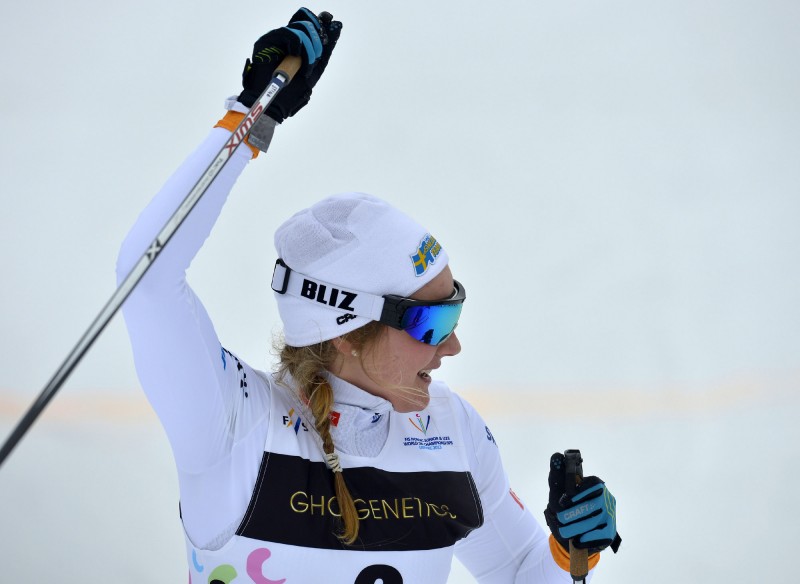
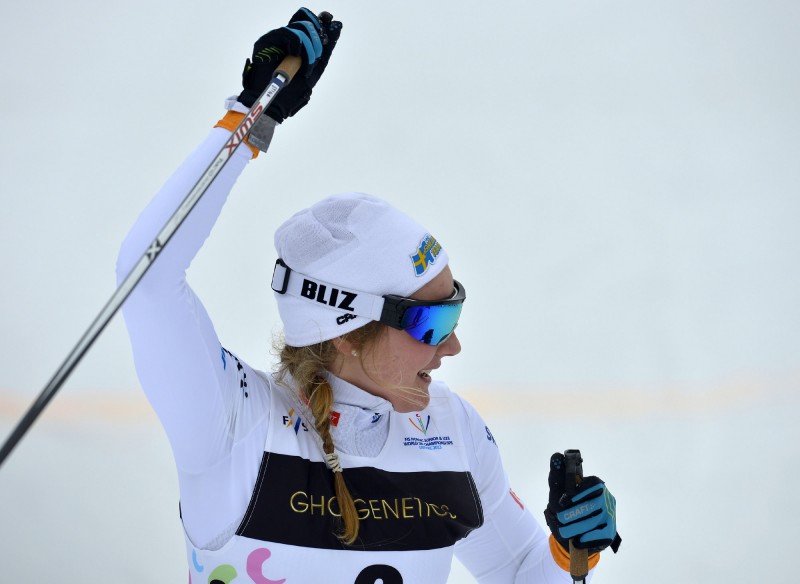
Stina Nilsson celebrates at 2013 Junior World Championships in Liberec, Czech Republic. The Swede won gold in both the individual freestyle sprint and team relay in Liberec. (Photo: Liberec2013)
Stina Nilsson sent a pretty clear message Sunday: Charlotte Kalla isn’t the only Swede to watch out for this season. The three-time silver medalist at 2015 World Championships (in the classic sprint, freestyle team sprint and team relay), Nilsson, 22, prevented Kalla’s weekend sweep of the International Ski Federation (FIS) races in Bruksvallarna, Sweden, winning Sunday’s freestyle sprint ahead of Kalla in second.
“It was a good race and my tactics worked. I’m really pleased,” Nilsson told Sydsvenskan.se, according to a translation. “The best thing was that I had to make four good races and get used to the high speed.”
“I have become more durable and can withstand longer distances,” she explained.
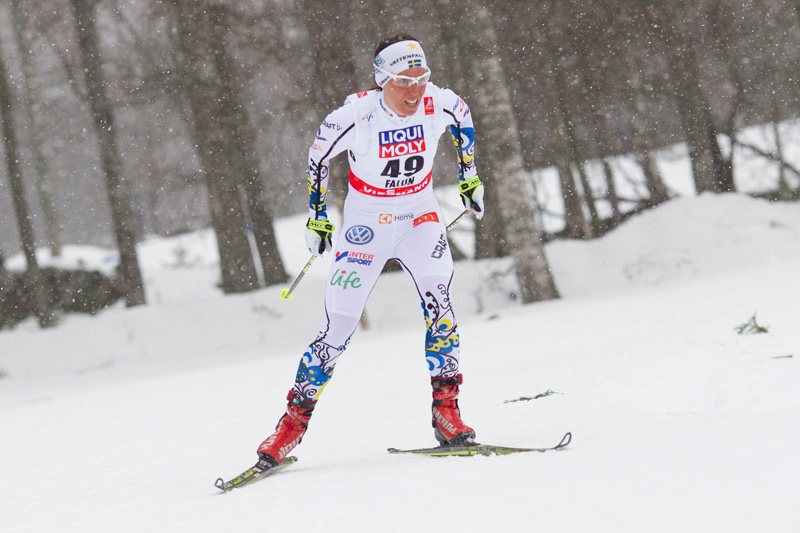
Sweden’s Charlotte Kalla racing to gold in the 10 k freestyle individual start at 2015 World Championships in Falun, Sweden. This past weekend, she won the first two FIS races of the season in Bruksvallarna, Sweden, and placed second in Sunday’s skate sprint. (Photo: Fischer/NordicFocus)
While nobody likes to lose, Kalla, a 28-year-old 2015 world champion in the 10 k skate, was gracious after the race. She reached the final as a lucky loser after finishing fourth in her semifinal. Ida Ingemarsdotter fell short in the semis and did not advance.
The favorite to win, Falk moved to the front of the final around a long outside corner, but found herself fourth coming toward the finish. Nilsson entered the stadium first to win easily, while Kalla held off Falk by one-hundredth of a second, according to VG.
“I have competed three consecutive days in Bruksvallarna and to [finish with] a sprint race was important,” Kalla told Sydsvenskan. “I am super happy with second place in the final with so many talented skiers … [but] the races here did not have the same [level of competition] as the World Cup. Then, the heat will be on from the quarterfinals.”
Forty three women raced in Bruksvallarna on Sunday, hailing from five different countries (Sweden, Slovenia, Norway, Latvia, and Great Britain).
After qualifying in second, 0.93 seconds behind Sweden’s qualifier winner Linn Sömskar, Falk reached the podium. Behind her in the all-Swedish final, Jonna Sundling placed fourth, Maja Dahlqvist was fifth and Sömskar finished sixth.
In the men’s race, 22-year-old Norwegian Havard Solås Taugbøl upset the Swedes on their home turf, beating Karl-Johan Westberg, of Sweden’s Boraas ski club, by millimeters.
According to VG, coming into the homestretch, it appeared Westberg had won it ahead of Swedish national-team member Teodor Peterson. But Taugbøl knew differently: “It was me! It was me!” he shouted across the finish. And it was: he edged Westberg by nine-hundredths of a second. Peterson was third, 0.23 seconds back.
“It’s nice to get a win so early in the season,” Taugbøl told VG. “I’m not used to beating people like [Sweden’s Emil] Jönsson and Peterson and stuff.”
The qualifying winner, Simon Persson of Sweden placed fourth (+0.47), Jönsson finished fifth (+1.12), and 20-year-old Even Northug of Norway placed sixth (+7.06). Northug lost contact with the leaders early and entered the stadium after them, yet sixth was a big jump from his 15 k freestyle finish on Saturday, when he was 76th.
“I thought he was the best in classical, but he is also good in skating,” Taugbøl said of Even, Petter Northug’s youngest brother.
Northug’s other younger brother, Tomas Northug, 25, led his semifinal into the stadium, but soon found himself in third behind Jönsson and Persson. He ended up fifth and did not advance to the final, while Taugbøl narrowly made it through as a lucky loser in third in that heat.
Nearly 100 men competed in the sprint from seven different nations (including Slovakia, Italy, Australia, and Iceland).
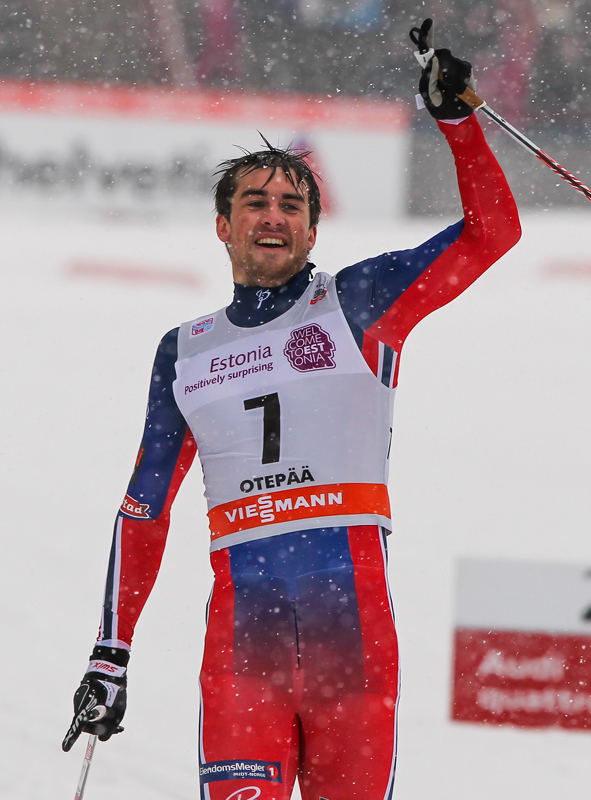
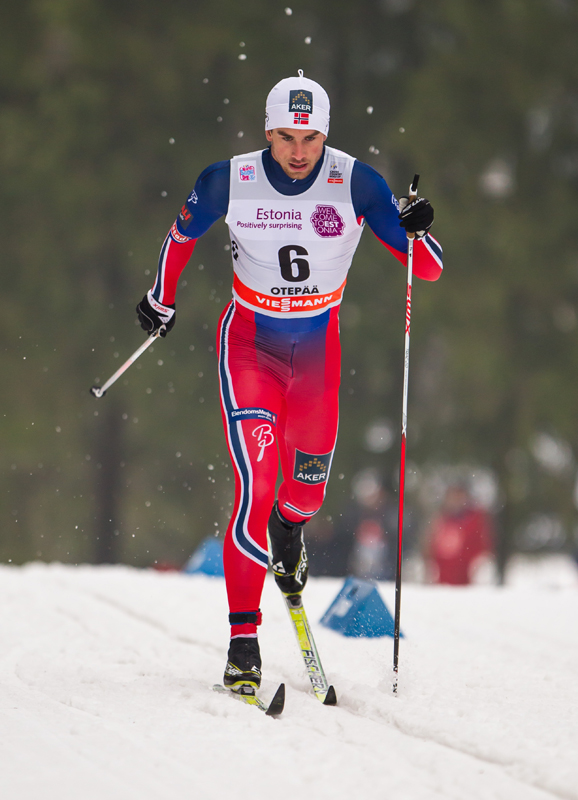
Norway’s Tomas Northug, 24, celebrates his first World Cup win on Saturday in the men’s 1.5 k classic-sprint final in Otepää, Estonia. (Photo: Fischer/NordicFocus)
If he hadn’t been a Northug, one might have wondered what that 24-year-old Norwegian was doing.
Tomas Northug had already ditched his hat during the men’s 1.5-kilometer classic sprint on a snowy, just-above-freezing afternoon in Otepää, Estonia. And not long after the start of the final, he made it clear that he was going to drop everyone else if he could, too.
Commentators remarked that his surge early on the first of two climbs on the 1,500-meter course had been very Northug-like, referring to the gutsy performances often churned out by his older brother Petter.
Norway’s Tomas Northug in Saturday’s 1.5 k classic-sprint qualifier, in which he advanced in seventh and went on to win the final for his first World Cup win in Otepää, Estonia. (Photo: Fischer/NordicFocus)
But Petter wasn’t racing on Saturday — Tomas was — and he made his presence known after advancing from the semifinal in fourth as a lucky loser (who was luckily not taken out by Russian Sergey Ustiugov’s late, self-inflicted crash).
Out of the start in the final, Northug positioned himself in second, sitting on the heels of Norwegian teammate Finn Hågen Krogh, the Sprint World Cup leader who opted to double pole on skate skis for the final, while staying ahead of the final’s other Norwegian double-poler, Pål Golberg, in third.
At the base of the first climb, it became apparent that double poling was not the way to go in the slow-and-chewed-up snow, and Northug stepped right to get around Krogh and move to first. The double-polers hopped in behind him by the midway point of the climb, and from there, they started to lose Northug. He strode away while the three others on classic skis (Finland’s Toni Ketelae, and Norway’s Ola Vigen Hattestad and Sondre Turvoll Fossli) lost contact in a one-track train behind Krogh and Golberg.
By the top, Northug heard he had a 50-meter gap from a Norwegian coach (arguably closer to 40 meters) and he took his word, refraining from looking back until several strides later as he began the tuck down the backside of the hill. Meanwhile, another up-and-comer seeing a World Cup breakthrough, Ketelae, 26, led the chase with Hattestad, both several seconds behind on the first descent.
“I feel there was room and I came up the uphill and I think about the race Bjørgen did many years ago,” Northug said in a post-race interview with FIS in broken English. “The coach [on] the uphill say I had fifty [meters] and say to go so I do it.”
In the second semifinal, Ketelae edged four Norwegians (Fossli, Eirik Brandsdal, Timo Andre Bakken, and Vegard Bjerkreim Nislen, respectively) and Russia’s Alexander Panzhinskiy for the win. With that confidence, he chased down Northug to the best of his ability in the final, but the young Norwegian was too far gone.
Northug ran with a narrow herringbone up the steepest of the two hills, getting more encouragement from Norwegian coaches, and Ketelae and Hattestad skied together some six seconds behind on the following downhill.
With 200 meters remaining, Northug double poled up and over the last rise, glanced back once more and realized the race was his. He nearly took himself out on the lefthand corner before the finishing straight, teetering for a moment on his inside ski in all his excitement, but picked the center lane and double poled like mad to the line. There, sealing the win in 3:50:59, he looked back, raised his arms to his chest and pumped them fiercely, gesturing that he, in fact, was the man.
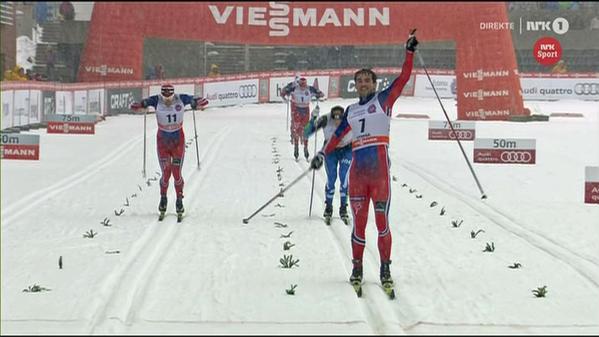
Norway’s Tomas Northug (7) celebrates his first World Cup victory and podium on Saturday in the men’s classic sprint in Otepää, Estonia, while teammate Ola Vigen Hattestad (l) challenges Finland’s Toni Ketelae (in blue behind Northug) for second.
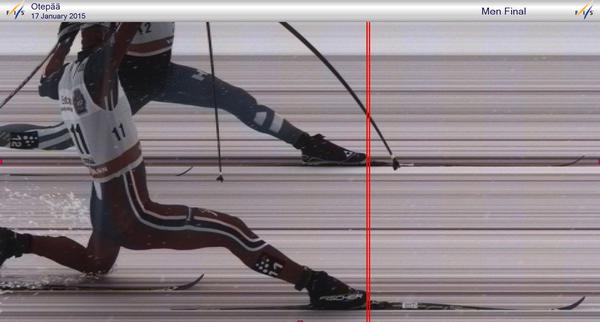
Trailing Ketelae into the stadium, Hattestad jumped to a left lane to challenge the Finn for second. Hattestad outlunged Ketelae in such a close photo finish, time couldn’t even determine it, but a finish-line camera could. The two finished 1.57 seconds after Northug, with Ketelae placing third for his first World Cup top 10 and podium.
After holding his own in fourth for much of the final, Golberg placed fourth, 6.28 behind Northug, and Krogh finished about a second ahead of Fossli, who struggled to keep pace early on and finished 9.23 seconds back.
“It was not really plan to [go ahead] like that, but I felt very strong,” Northug told NRK, according to a translation. “There are some feelings, it is clear there. I have put an enormous amount of work, but not quite achieved what I want. And then came here today.”
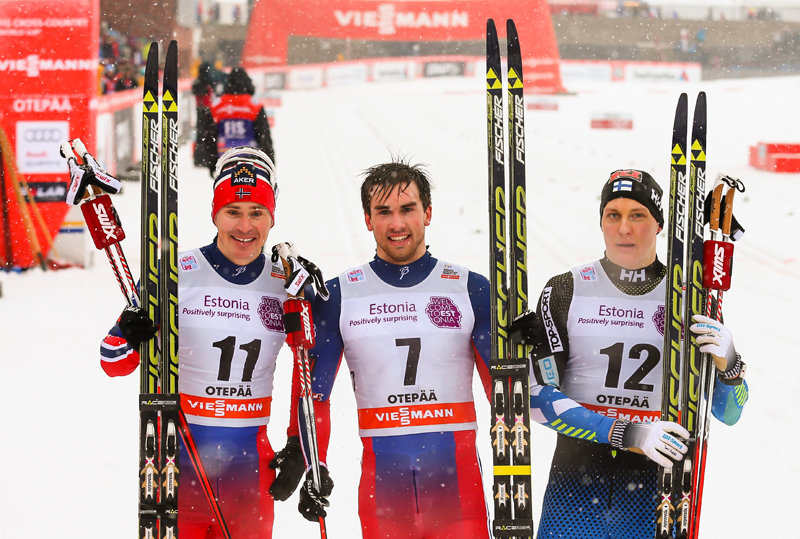
The men’s classic-sprint podium in Otepää, Estonia: with Norwegian winner Tomas Northug (c), Ola Vigen Hattestad (l) of Norway in second, and Finland’s Toni Ketelae (r) in third. (Photo: Fischer/NordicFocus)
Northug’s previous best was fifth in a classic-sprint final at 2013 World Cup Finals in Stockholm, Sweden. In the only other classic sprint before Saturday’s this season, he missed the final but placed eighth in Kuusamo, Finland, and was sixth in a freestyle sprint last month in Davos, Switzerland.
He qualified for the heats on Saturday in seventh, 4.4 seconds behind Golberg, who set the fastest qualifying time in 3:17.61. Times were notably slower as the day wore on, with the track breaking down amid wet-and-heavy snowfall and with each passing round of men’s and women’s heats. Fossli qualified second, 1.68 seconds back, and Brandsdal, in the hunt for the Sprint World Cup title, ranked third (+2.74).
The fourth-fastest qualifier, Sweden’s Emil Jönsson edged Northug in their quarterfinal by 0.06 seconds in 3:26.74, which ended up being the second-fastest men’s heat. The two advanced to the semifinals, where Northug got a boot out ahead of Jönsson, who was behind Ustiugov when the Russian poled between his legs and face planted in the finishing stretch. Ustiugov fell into Northug on his left, but Northug avoided escaped with a minor clip and strode a few steps toward the line with Jönsson charging on his right.
The photo-finish picture from the men’s sprint for second and third in the 1.5 k classic-sprint final in 1.5 k classic sprint in Otepää, Estonia, with Hattestad (bottom) edging Ketelae. (Photo: FIS Cross Country/Twitter)
Northug nipped him by 0.16 seconds for the final lucky loser spot, despite finishing fourth in his heat (Jönsson was fifth and Ustiugov finished 14 seconds later in sixth).
Ketelae qualified in 12th and went on to win his quarterfinal, half a second ahead of Fossli, and his semifinal as well, by six-hundredths of a second over Fossli and nine-hundredths of a second ahead of Brandsdal. Right then and there, the Finn had already achieved a career-best day.
“It is amazing to finish third today,” Ketelae told FIS. “It was my first World Cup final and my first World Cup podium result. I felt very good since the prologue.”
Hattestad noted that the final was a gamble when it came to selecting skis.
“I was testing three pairs of skis before the final,” he told FIS. “I think it was the most crazy final I have ever skied. I did not catch Tomas, [he went] away and then the gap was too big.”
Russia’s Sergey Ustiugov (second from r) poled between his legs and took himself (and nearly Norway’s Tomas Northug at right) out of contention in the second men’s semifinal of the 1.5 k classic sprint in Otepää, Estonia.
Russia’s Sergey Ustiugov poled between his legs and took himself (and nearly Norway’s Tomas Northug at right) out of contention in the second men’s semifinal of the 1.5 k classic sprint in Otepää, Estonia.
Russia’s Sergey Ustiugov poled between his legs and took himself (and nearly Norway’s Tomas Northug at right) out of contention in the second men’s semifinal of the 1.5 k classic sprint in Otepää, Estonia.
Russia’s Sergey Ustiugov poled between his legs and took himself (and nearly Norway’s Tomas Northug at right) out of contention in the second men’s semifinal of the 1.5 k classic sprint in Otepää, Estonia.
Russia’s Sergey Ustiugov poled between his legs and took himself (and nearly Norway’s Tomas Northug at right) out of contention in the second men’s semifinal of the 1.5 k classic sprint in Otepää, Estonia.
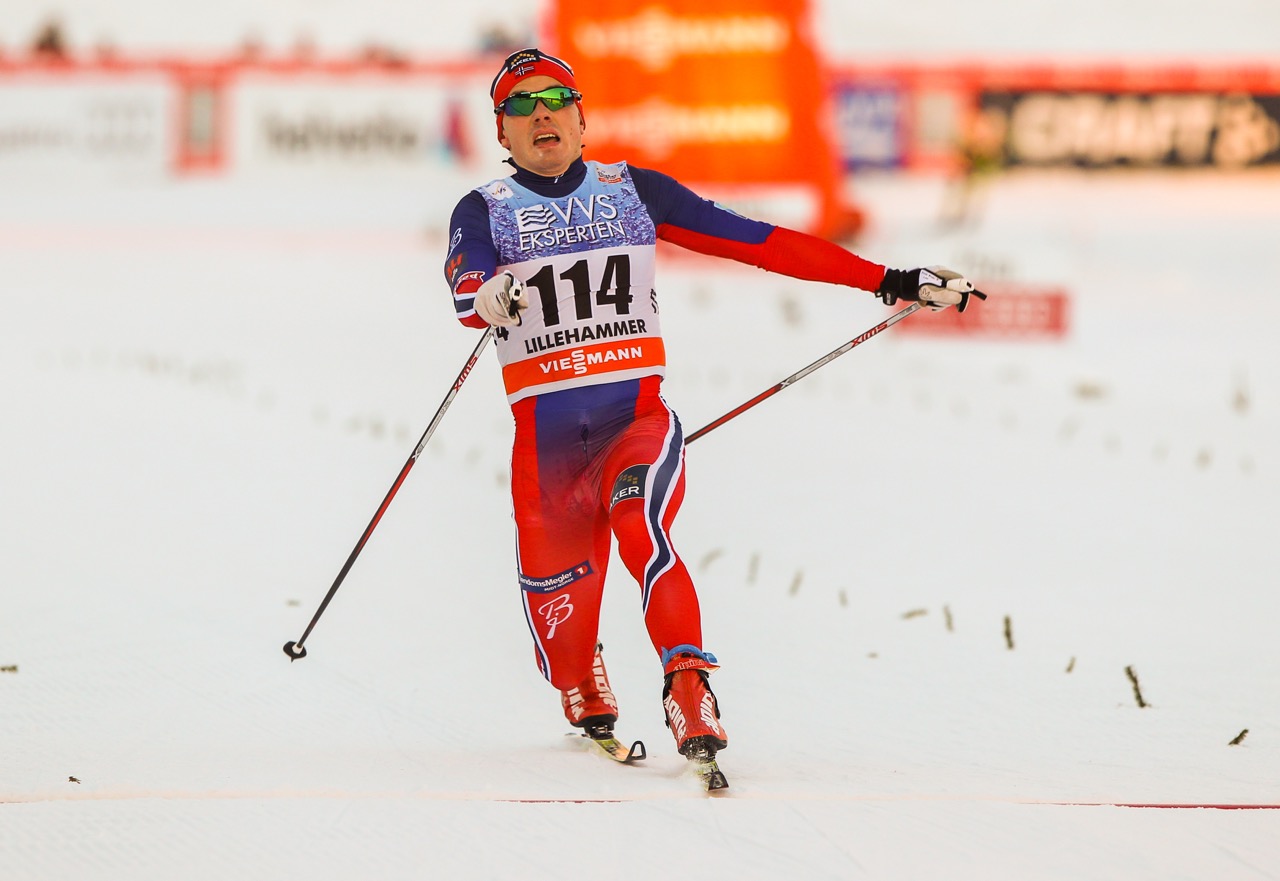
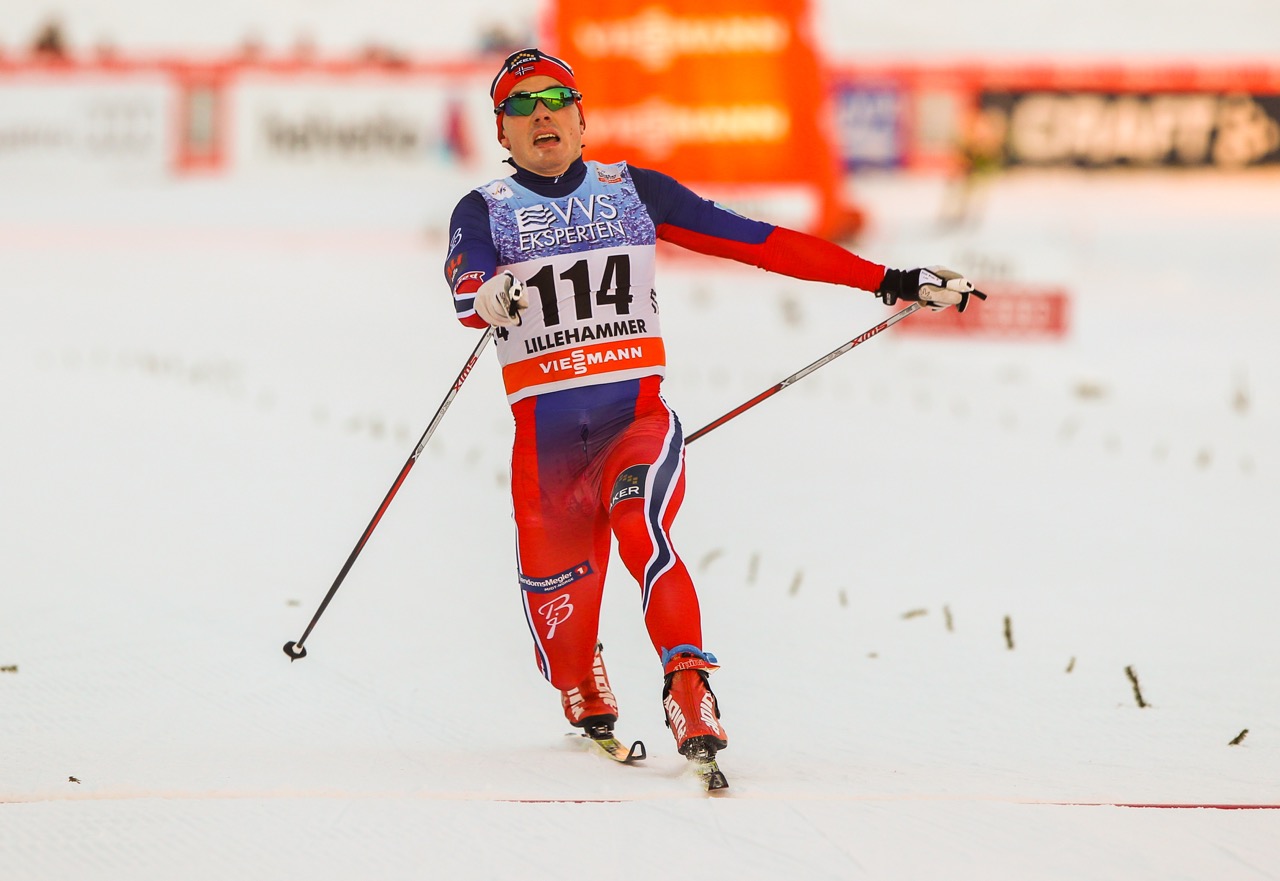
Finn Hågen Krogh lunging in last week’s 10 k freestyle individual start in Lillehammer. In Sunday’s freestyle sprint in Davos, Switzerland the 24-year-old earned his first true World Cup victory. (Photo: Fischer/NordicFocus)
Finn Hågen Krogh had what he called a perfect race Sunday in Davos, Switzerland.
After placing third in the qualification round of the 1.3 k freestyle sprint, the Norwegian rapidly progressed through his quarterfinal, semifinal, and ultimately the final to earn his first World Cup victory.
Krogh won the freestyle sprint in the Lillehammer mini tour earlier in Decemeber, but as the race was a Stage World Cup, he had yet to win a true World Cup until Sunday.
Speeding around a relatively short course on the high-altitude trials of Davos, Krogh sustained a pattern of starting hard off the front to lead the majority of each race. Many skiers would try to hold their own against the up-and-coming Norwegian, but they often paid the price.
In the final, Krogh fought to earn a spot at the front of six men despite a strong challenge from Calle Halfvarsson of Sweden. As the meters progressed Krogh and Halfvarsson left the remaining competitors behind, but by the time they entered the second lap of the sprint course, Halfvarsson’s energy was spent and the other men overtook him. With Halfvarsson out of the way the race was Krogh’s.
Although fellow Norwegians Anders Gløersen and Eirik Brandsdal gained on Krogh in the final meters, there were no challenges to his strength as he crossed the line with a time of 2:18.16. Gløerson and Brandsdal placed second and third, 0.62 and 1.07 seconds behind their teammate.
In a post race interview with FIS, Krogh said the key to his success was his fitness. “It was a perfect race. I am in a great shape. My tactic was to ski in the front and control the race. It is amazing to win a World Cup,” he said.
The race marked another Norwegian podium sweep – a regular occurrence so far in the 2015 season. After the Davos World Cup, Norway has won 12 of 14 races and earned 34 of 42 podium positions.
In a post-race interview Gløerson told FIS that he felt pressure heading into Sunday’s race because of the success his team has experienced in the prior weeks.
“So many of our guys have skied well this year. I felt under pressure to do a good result today. I think I was lucky. I found a good rhythm and I am very satisfied with today,” he said.
The final corner leading into the stadium proved troublesome for several skiers including Brandsdal. As he entered the turn, he tripped and almost fell. Brandsdal was forced to the outside of the corner as he attempted to stay on his feet, losing momentum into the stadium. While he was disappointed in his tactical error, Brandsdal said he was proud of his teammates and the Norwegian podium sweep.
“I was angry about myself about how I skied the last curve. I wanted the victory so much that I lost my head. I am proud of my teammates, they did a great job. I felt strong but the finish did not work as I hoped,” he said to FIS.
Federico Pelligrino of Italy also fell victim to the corner. Pelligrino skied a strong qualifier for the fastest time of the day, and, like Krogh, maneuvered his way to a win in his quarterfinal. In the semifinal however, Pelligrino made a wrong move on the corner and moved from second position to last.
The remaining men in the final were Alexey Petukov of Russia (+1.35), Halfvarsson (+2.06), and Norweigian Tomas Northug (+2.29). Northug, the younger brother of the famed Petter Northug, earned his second-best World Cup result after finishing sixth. His best result is a fifth place from a March 2013 Stage World Cup classic sprint in Stockholm, Sweden.
Petter Northug finished his day in 19th position after what some commentators called an obstruction by Brandsdal in his quarterfinal. Northug placed fourth in the quarterfinal.
Rounding out the top-ten, were Martii Jyhae of Finalnd, Baptiste Gross of France, Maciej Starega of Poland, Ola Vigen Hattestad of Norway, Pellegrino, and Joeri Kindschi of Switzerland.
The top North American finish of the day came from Lenny Valjas who qualified in 10th position and eventually placed 13th. It was the first time in roughly a year-and-a-half that Valjas qualified in a sprint, after earning several podium spots in 2012 and 2013 World Cups. Andy Newell was the only other North American in the finals and placed 15th.
After the weekend of World Cup racing, Martin Johnsrud Sundby of Norway is the overall World Cup points leader with 491 points. Sundby placed 31st position in the sprint, missing qualification by 0.06 seconds. Inching towards Sundby is Krogh, who currently sits in second place with 409 points. Halfvarsson is ranked third with 275 points.
The World Cup returns to Davos next weekend as scheduled races in Las Clusaz, France were cancelled due to poor snow conditions. With another freestyle sprint planned for Sunday, competitors will have a chance to either defend their results or improve.
Liza Goodwin competing at Bysprinten. Photo: Per Vikan, Helgeland Arbeiderblad.
The sixth annual Bysprinten took place over the weekend in the small town of Mosjøen, Norway. The town is home to less than 10,000 residents, yet the event manages to attract some of the biggest names in cross-country skiing every year from both Norway and elsewhere in Europe. This year, Petter Northug (NOR), Laurien Van der Graaff (SUI), Øystein Pettersen (NOR), Heidi Weng (NOR) and Ola Vigen Hattestad (NOR) were among the biggest draws of the weekend, in addition to a sizeable youth competition, live music, and the fact of a ski festival being held in the town streets at the end of April.
Keene Valley, New York native Liza Goodwin was among the small group of entrants. Goodwin has been living in Norway on and off since first spending a few post-graduate years with the Northern Norwegian Ski Gymnasium in Nordreisa. She came back and skied for Montana State University for the 2009-2010 season before deciding to go back to Norway. She currently lives in Tromsø, where she is studying physical therapy.
Skiing has recently taken the backseat to her studies, but Goodwin decided to enter the Bysprinten race for fun, much like the rest of her competitors. She ended up finishing 13th in the 1.5 k freestyle sprint. We sent her a few questions about what the experience was like.
FasterSkier: What was the scene like in Mosjøen? Is this event big deal there?
Liza Goodwin: The scene in Mosjøen was really awesome. The town has done an impressive job of making the event a big deal locally. They say that there were several thousand spectators there lining the entire course, which makes for a great atmosphere. Being a competitive skier is an identity that most Norwegians have a lot of respect for. The ski culture of Norway makes the best skiers huge celebrities, and people of all ages don’t want to miss out on the opportunity to see these famous people live.
There was also a kid’s race the evening before, and a youth race the morning of. Much of the event is to inspire kids to be skiers and the kids love being able to get autographs from all of the “big racers” (including myself!). The event might not be a big deal for Norway, because Mosjøen is a small town in Northern Norway, but it represents the passion Norwegians have for skiing and the role that elite racing has in Norwegian culture.
Tomas Northug (NOR) leading a train during the "brother's relay" that included the Northugs, Pasinis, and Rennemos. Photo: Bysprinten.
FS: Overall, how did you think the race went?
LG: I didn’t have big expectations going into the race. I have stopped competing at the national level here in Norway and haven’t been training very much. I’ve been missing my speed on skis for over a year now, and the Bysprint was no exception. I am just not as powerful as I used to be and feel pretty slow. The course was also pretty uneven and I struggled to find enough balance to get into a good rhythm. I made a graceful belly-flop in the “Losers Heat” that cost me one place. The racing as a whole was OK, but the main goal of the event for me personally, and for the other racers and organizers, was that the race was supposed to be fun!
A "graceful belly-flop." Photo: Per Vikan, Helgeland Arbeiderblad.
The 700 m prologue was one lap. There were then four to five people in each quarterfinal, semi and final. The heats used two laps, which included using the U-turn at the end of the course, also on the second lap. That meant that there was a 180-degree turn about 25 meters from the finish line!
Everyone who didn’t go to the finals was in a “Losers Heat”. This was just one lap and the winner got to join the others in the final.
During the prologue, the police used their radar gun to measure the speed of each racer during the first 100 meters. The top three men and women from the speed measurements then competed individually in a 100 meter timed race.
Petter Northug (NOR) leading the charge, followed by Fabio Pasini (ITA) and Kiristian Tettli Rennemo (NOR). Photo: Bysprinten.
FS: I know you were just having fun with it, but was lining up next to some big names intimidating?
LG: Of course it is intimidating lining up with Heidi Weng and other racers, but after racing in Norway for a few years, I’ve gotten used to that. I am used to competing against women who are the best in the world. My expectations are adjusted accordingly, but the actual racing isn’t that intimidating. I was more nervous about being in the whole group atmosphere and trying to consider myself as somewhat of an equal. The girls are really nice and it is pretty much the same atmosphere as being around any other skier girls at a race.
Heidi Weng (NOR) and Bettina Gruber (SUI). Photo: Bysprinten.
FS: Besides entering races with Norwegian national team members, what are you up to now?
LG: My first “PG years” were spent at the Northern Norwegian Ski Gymnasium in Nordreisa. After competing for Montana State for one year, I applied for the physical therapy program at the University in Tromsø. Last year I focused a lot more on skiing that school, but now that has changed. Skiing in now on the side of my studies. I am currently in the middle of a seven-week clinical period at the hospital in Mo I Rana. This is the reason I asked to be a part of the Bysprint, since Mosjøen is just a little over an hour away from here. Otherwise, I am living in Tromsø and enjoying life as best I can. The skiing and training (playing?) opportunities are endless.
Laurien Van der Graaf (SUI), shown here in the Milan, Italy World Cup, won both women's events at Bysprinten on Saturday.
No snow-speed records were broken at the sixth edition of Bysprinten, but the annual two-day ski festival on the streets of Mosjøen, Norway provided plenty of excitement for the 3,000 spectators who came out to see their favorite national team members ski as fast as possible. On Saturday, Eirik Brandsdal (NOR) prevailed in the men’s final sprint, and Laurien Van der Graaf (SUI) topped the women’s field.
“I am very fond of Bysprinten. I often do it well and it’s fun to go with so many people in the streets,” said Brandsdal.
Petter Northug, whose presence at the event was the most highly anticipated, provided a bit of drama in the semifinals when he tangled with Øystein Pettersen (NOR) and appeared to be out for the final. The jury ruled that Pettersen had blocked Northug, however, and sent him through. Northug ended up finishing fourth.
The Norwegian celebrity made no excuses — “I’ve relaxed on the couch for three months, so my ass is getting a little wide. I am not quite in top shape today,” he told the NRK.
In addition to the 1.5 k, the day’s program included a youth sprint, an elite 100 m individual sprint, and a “brothers relay” that set the Petter and Tomas Northug against Renato and Fabio Pasini (ITA) and Anders and Kristian Tettli Rennemo (NOR).
The Northugs lived up to their promise to “defend the family honor,” and defeated the Pasinis in second and the Rennemos in third.
In the 100 m dash, organizers had a radar gun on hand in anticipation of witnessing a new world record, but it was not to be — local newspapers reported that the direction of the straightaway was into the wind. Ola Vigen Hattestad (NOR) clocked in at 12.39 for the win over Petter Northug in second (12.60) and Anders Gløersen (NOR) in third (12.63).
“It was really fun to go today. I was not as good technically, but I did everything I could,” said Hattestad to the NRK.
Van der Graaf dominated the day from the get-go, taking the women’s 100 m in 13:48. Slovenia’s Katja Visnar took second (13.83) followed by Mari Eide (NOR) in third (13.96).
“It has been really fun and I enjoyed myself,” said Van der Graaf.
Paal Golberg (NOR) leads teammate Tomas Northug at the World Junior Championships in Hinterzarten, Germany
Different race, different Northug, same result. With a finishing kick eerily similar to the one his brother has made famous, Norway’s Tomas Northug won the championship in the World Junior Sprint today in dominating fashion.
The resemblance between the two brothers is striking, and beyond their facial features, Tomas also has the same blazing speed and Casco headwear made famous by Petter.
Their attitudes are similar, too. When asked if he had stepped out of his brother’s shadow today, Tomas said no.
“The shadow was back behind me,” Northug told FasterSkier after the race, clarifying that he would have dropped Petter had he been here.
Northug’s teammate Paal Golberg and Federico Pellegrino (ITA) finished second and third, but they were not within striking distance.
The U.S.’s Erik Bjornsen was the only North American male to qualify for the heats. He was sitting in third in his quarterfinal coming off the final hill, but was passed by two others in the last corner and ended in fifth.
“400 meters before the finish, there’s a sharp corner…and I kind of got blocked out,” Bjornsen said. “Those guys ski pretty nasty.”
The heat ended up being the fastest of any of the quarterfinals: the two skiers ahead of Bjornsen advanced as lucky losers.
Tyler Kornfield, who just over two weeks ago raised hopes by winning American championship in the classic sprint, came down with a fever since traveling to Germany and almost scratched today’s race. He still started and nearly qualified, finishing just two seconds out of the top 30.
Even closer, though, was Eric Packer, who finished in the dreaded 31st position, a tantalizing three hundredths of a second from the heats.
Over a 1.3 k sprint course, that tiny margin could be closed by a slightly more aerodynamic haircut. But Packer said that he wasn’t too bummed after the race—and he did remembered to stretch for the finish.
“It didn’t come down to the lunge. I was flat on my back at the finish line, trying to get my toe across,” he said. “That’s kind of what ends up happening when you’re skiing on the bubble. I feel like on a good day I could have been right in there.”
A thick fog blanketed the race trails all day, adding to the mystique of an already dark and shadowy venue. The conditions gave Northug’s win an eerie aura, as he went into the woods in second place, then materialized out of the fog 30 seconds later with such a big gap over Golberg that some spectators were laughing in disbelief.
The Norwegian said that he trains with his brother, and that Petter had already sent him a text message by the time of the press conference. Though Tomas wouldn’t divulge exactly what the contents were, he said that it began with a “ha ha ha.”