From the FasterSkier archive — posts syndicated from athletes’ and coaches’ own blogs between 2004 and 2012, kept online as published. Current coverage is at fasterskier.com.
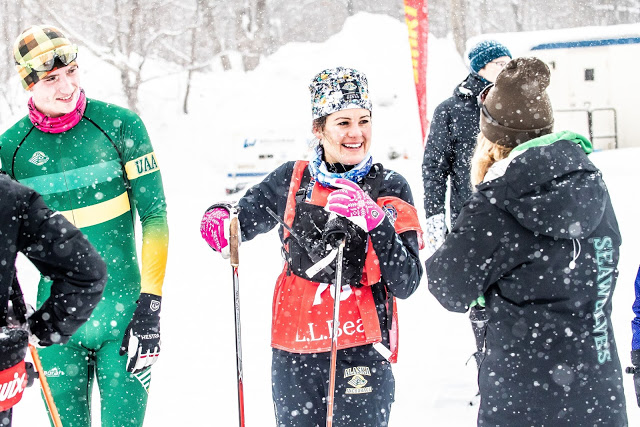
Marine Dusser-Bjornsen was named RMISA Nordic Coach of the Year in her first year leading the UAA Seawolves. (Photo: UAA Ski Team Blog http://uaanordic.blogspot.com/)
On April 1st, the University of Alaska Anchorage athletics department announced that interim head coach Marine Dusser-Bjornsen had been named Nordic Coach of the Year by the Rocky Mountain Intercollegiate Ski Association (RMISA) after her first year in the role. Despite stepping into the position last minute, Dusser-Bjornsen proved her readiness for the role and led the Seawolves to an outstanding season.
The men’s team finished the season in second place in the RMISA standings and the women finished third, combining to a third place overall finish. One of her athletes, JC Schoonmaker, also took 13th in the freestyle sprint at World Juniors and earned his first World Cup starts in Dresden.
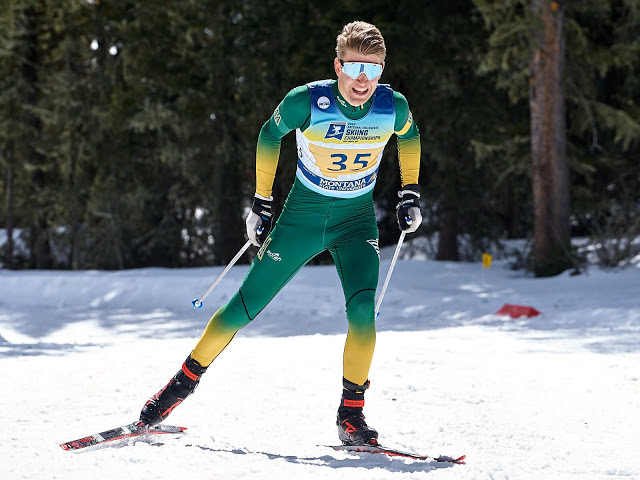
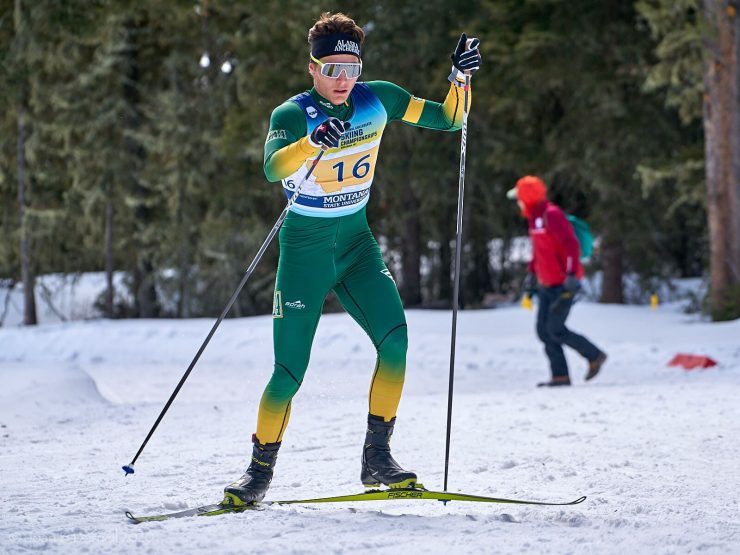
Though only one event — the 5/10-kilometer skate — took place before the event was cancelled, the Seawolves were off to a promising start at the NCAA championships. The top three UAA men finished 4th, 7th, and 10th, and the top female took 10th with the second women less than a second behind in 12th. The men’s team was ranked second overall behind the University of Vermont, and the women were not far behind in 4th.
Sigurd Roenning leads the Seawolves with a 4th place finish at NCAAs. (Photo: Joan Darnell / UAA Ski Team Blog)
JC Schoonmaker skis to 10th place in the 10-kilometer skate at the 2020 NCAA Championships. (Photo: Joan Darnell / UAA Ski Team Blog)
Before transitioning to coaching, Dusser-Bjornsen racked up an impressive resume in both biathlon and cross-country, which included winning the French National Junior Championships in biathlon six times and taking home three medals at World Junior Championships. During her two years as an athlete at UAA, Dusser-Bjornsen landed on the RMISA podium nearly every weekend, and earned two podium finishes at the NCAA championships in her first season. She again landed in the top 10 in her second year at NCAAs, earning a total of three All-American honors.
In the conversation below, Dusser-Bjornsen explains how her experience as an athlete has transferred into her coaching philosophy.
“In my biathlon career, I had a lot of struggle,” Dusser-Bjornsen recalled. “Biathlon is a sport where you have to struggle, because it’s very mental because of the shooting part of it. It’s not because you are the best at one race that the next race you are going to win. You can be first and then the next you can be last. So you have to start over everyday. It’s very difficult on your mind — you have to ask yourself a lot of questions. In that sense, biathlon really helped me — I am a better coach because to me that psychology aspect is very important.”
Dusser-Bjornsen has been the assistant coach for the Seawolves since 2017 and was slated to assist returning head coach Trond Flagstad this season, though complications prevented him from resuming the role last minute. After stepping into the position in his stead, Dusser-Bjornsen hired her former athlete Toomas Kollo as an assistant. Kollo graduated in 2020 and had begun graduate school. She also continued to utilize longtime volunteer assistant coach Adam Verrier, who has taken on a variety of roles with the UAA program over the last 20 years.
In an email, Verrier explained that in recent years, he has participated in the majority of practices and traveled to most races, including every NCAA Championship since 2009. Consequently, he has watched Dusser-Bjornsen transform gracefully from athlete to coach, and he vehemently expressed her talent in both capacities.
Head Coach Marine Dusser-Bjornsen and Assistant Coach Adam Verrier prepare fast skis for the UAA athletes. (Photo: Joan Darnell / UAA Ski Team Blog)
“Over the years, I’ve observed that she has an ability to see through the noise and static, to find the important thing that needs to be addressed,” wrote Verrier. “As an athlete, she came to us from a biathlon background, and needed a little technical help getting her classic skiing together. But she was able to quickly understand the heart of the technical requirements for fast classic skiing, and was on the podium by her third RMISA classic race. As a coach, she’s good at figuring out what may be impeding an athlete’s ability to realize their potential or to make a change in their training. She’s good at isolating a problem in order to fix it. For example, I remember a time this fall when one of our men said, ‘I’ve been trying to correct this technique problem for years because I’ve known I need to, but nobody’s really been able to help me fix it. But Marine told me to just think of it this way….. and I’d never thought of it like that before. And just like that, I’ve corrected it. She was really able to see it clearly!’”
Verrier explained that Dusser-Bjornsen maintains high standards for herself and holds clear expectations for those she works with, which he attributes to her success as a leader this season.
“I think our UAA teams have done better when the athletes know that the coach expects really good skiing, and doesn’t have much time or patience for mediocrity. Our athletes know that Marine expects fast skiing, and I think they feel they have a responsibility to bring their best preparation and performance to training and races. Marine’s not afraid to give her opinion and to say what she feels. If you show up at practice without your skis properly prepared, you’re going to hear about it!”
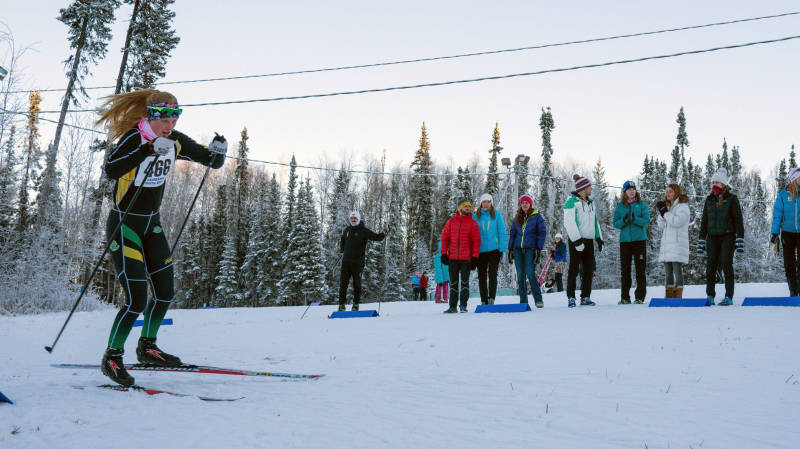
Marine Dusser-Bjornsen encourages her athletes during the opening race of the season, the Alaska Cup weekend in the Susitna Valley. (Photo: Adam Verrier)
Verrier concluded by emphasizing Dusser-Bjornsen’s grace in managing the abrupt and unexpected promotion to her role, and explaining how she was effectively able to delegate in order to focus on creating an optimal training plan and environment for her athletes.
“She was a little bit on her heels from the start. In this line of work, it’s very difficult to play catch-up during the season because things happen so fast, so it’s been a very stressful season for Marine with the unsettled nature of the assignment. And I think it’s natural and not unexpected that she would feel a lot of pressure to perform, given her situation coming into this season. She was fortunate, I think, to be able to recruit Toomas Kollo because he came in with a really impressive capacity for hard work throughout the entire racing season. Toom’s solid presence, his ability to relate to the athletes (he was one of them last year) and his willingness and capacity to do so much of the grunt work, week after week, gave Marine a little bit of breathing room, I think, to make the perceptive tactical decisions that contributed to her coaching success this season and to her being selected as RMISA coach of the year.”
In the conversation below, Dusser-Bjornsen provides further insight into her transition and philosophy in working with the UAA athletes. She also discusses being a minority as a female head coach in the NCAA and how the Women’s Ski Coaching Association (WSCA) has supported her transition, and her future with the UAA program. Thanks for listening.
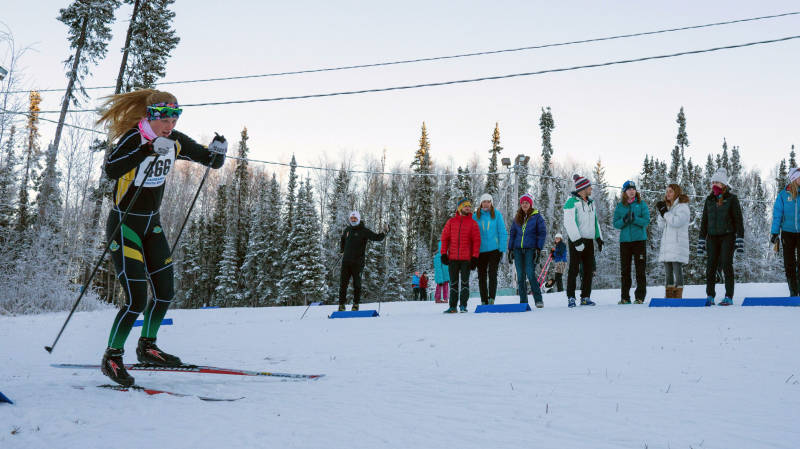
University of Alaska Anchorage freshman Hailey Swirbul races through the stadium at Birch Hill Ski Area in Fairbanks, Alaska, in the Alaska Nordic Cup on Nov 19. (Photo: Zachary Hall/UAA Athletics)
FAIRBANKS, Alaska – Scott Patterson is on a roll. The Alaska Pacific University (APU) skier has now won all of the ski races he entered this year – and over half the ski races held in this country in the 2016/2017 winter to date– after picking up wins on both days of racing in the Alaska Nordic Cup at Birch Hill Ski Area in Fairbanks, Alaska, this past weekend, Nov. 19-20.
APU’s Jessica Yeaton was also a double winner on the weekend. And in the collegiate ranks, the University of Alaska Fairbanks (UAF) maintained its hold on the Alaska Nordic Cup against the University of Alaska Anchorage (UAA).
Skiers from both universities competed with a new lease on athletic life, after learning earlier this month that the ski programs would not be cut at either UAA or UAF.
The Alaska Nordic Cup is an early season, relatively low-key (but nonetheless International Ski Federation (FIS) sanctioned) competition between Alaska’s only two NCAA nordic programs. Prior to this season, in which UAF switched its conference affiliation from the Central Collegiate Ski Association to the Rocky Mountain Intercollegiate Ski Association (RMISA), it marked the only time outside U.S. nationals that Alaska’s college skiers might compete head to head until, potentially, NCAA Skiing Championships in March.
The Nordic Cup is held each year in November, alternating between the Fairbanks and Anchorage areas. 2016 marked the 13th annual Nordic Cup competition. The UAF Nanooks enjoy a healthy historical advantage over their southern rivals, the UAA Seawolves, entering the weekend with an 8-3-1 all-time record (eight wins, three losses, and one tie) in the first 12 years of the dual meet. Scoring is typically based on an individual race on Saturday plus a relay on Sunday. Lowest combined time wins.
But despite a strong team showing from UAF that carried the Nanooks to victory, and some standout individual performances from UAA, it was APU that owned the top steps of the podium throughout the weekend.
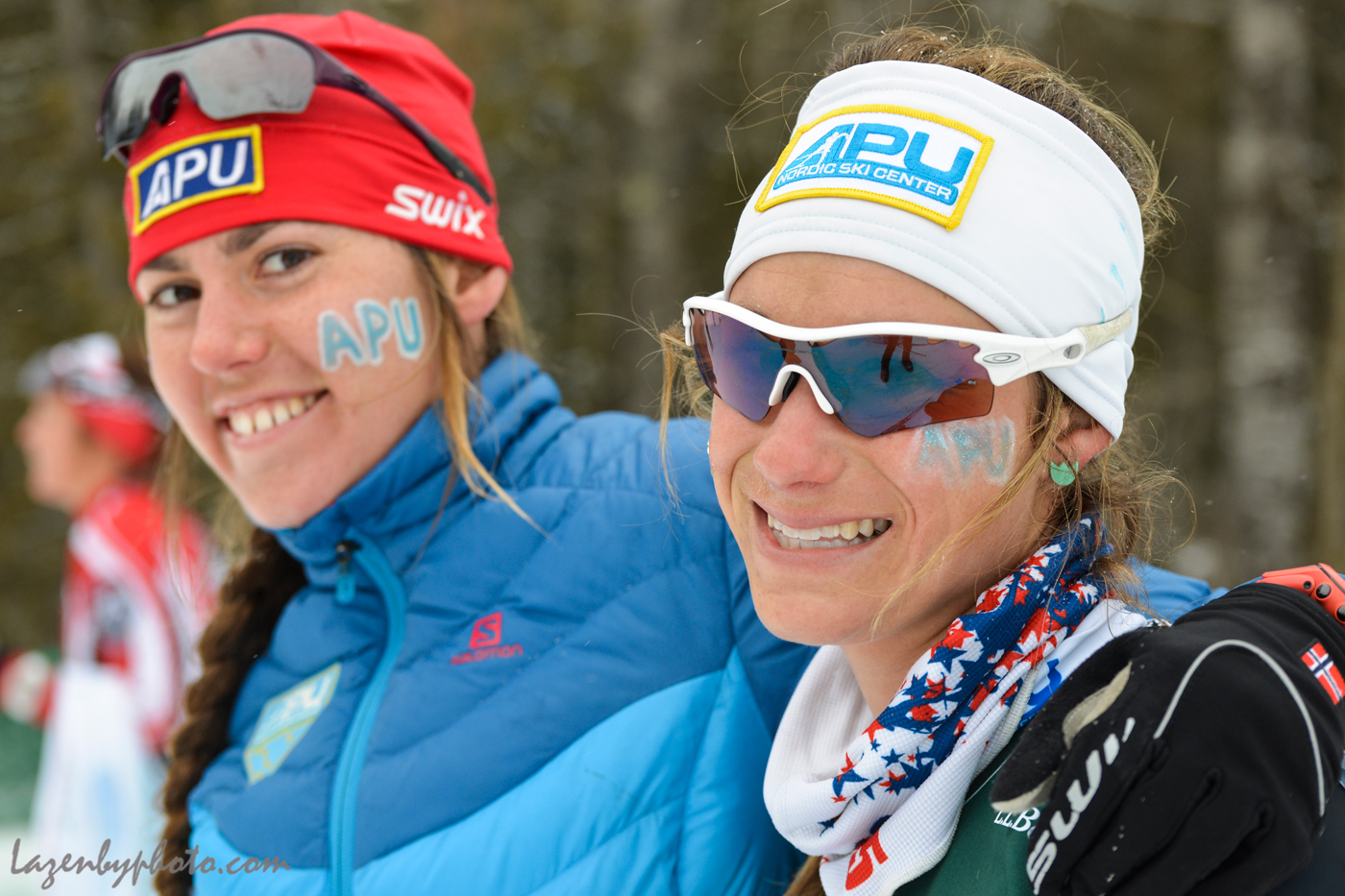
APU’s Becca Rorabaugh (l) and Jessica Yeaton (r) at U.S. SuperTour Spring Series in March 2016. (Photo: John Lazenby/Lazenbyphoto.com)
In the women’s race, Jessica Yeaton, an Australian national-team member who competes for Australia internationally but lives in Anchorage and trains with APU, finished Saturday’s 6 kilometer freestyle interval start in 16:52.1, skiing smoothly in relatively cold and slow conditions. APU’s other entrant, Fairbanks native Becca Rorabaugh, finished second, 34.1 seconds back. Third went to Hailey Swirbul, 1:27 back, in the UAA freshman’s college racing debut. UAF skiers swept the next four spots, led by senior Nichole Bathe, the day’s final starter, in fourth.
Yeaton appreciated the early season racing opportunity. “It was awesome to race up here on good snow,” she wrote to FasterSkier. Yeaton added, “The conditions were thin but still provided a really good opportunity for a race effort. We are lucky to have these early races to help prepare for the Supertour in a couple weeks – the [Nordic Ski Club of Fairbanks] did a great job making them happen despite the lack of snow!”
Swirbul, a Colorado native, echoed Yeaton’s praise for the venue and host club: “Thanks to Fairbanks for using their limited snow and delivering excellent (all things considered) courses and conditions for us to open our season this past weekend,” she wrote in a Sunday email to FasterSkier.
Swirbul added, reflecting on the sensation of putting on a race bib once more: “As usual, it’s an interesting feeling to return to an on-snow race scene after long summer months without one… nerves, waxing, morning jogs and stretching, race strategy, etc. I sure enjoyed being back at it this weekend! I was satisfied with my and my team’s skiing this weekend, considering it is only November, and think we have great things ahead of us. We are all revving our engines preparing for a long winter ahead, ready to establish a new name for our team with many young skiers, and meanwhile prove to the president of our university that we are more than worthy of being part of a long lasting ski team at UAA! I am very excited for what the season has to bring for UAA.”
Bathe, originally from Madison, Wis., was likewise pleased by the strong first-day showing of the UAF team. “I thought today went well especially for our whole women’s team,” she wrote in an email on Saturday. “To have four women right in there is always awesome and makes us excited for the season! It’s nice to see all the summer training pay off and start getting back into race mode again.”
On the men’s side, the top-seeded Patterson took advantage of his position as the final starter to ski to the victory over several of his APU teammates, including David Norris in second.
“Snow instead of ice made coming to Fairbanks [from Anchorage] for races an easy decision,” Patterson wrote. “Although I hadn’t raced here since high school, I have always enjoyed the Birch Hill trails. During the race, I had to remember how to race a little after getting some early splits that I was even with David and knowing his fitness through the summer and fall. Overall it was a great chance to chase out some early season rust and get ready for important races.”
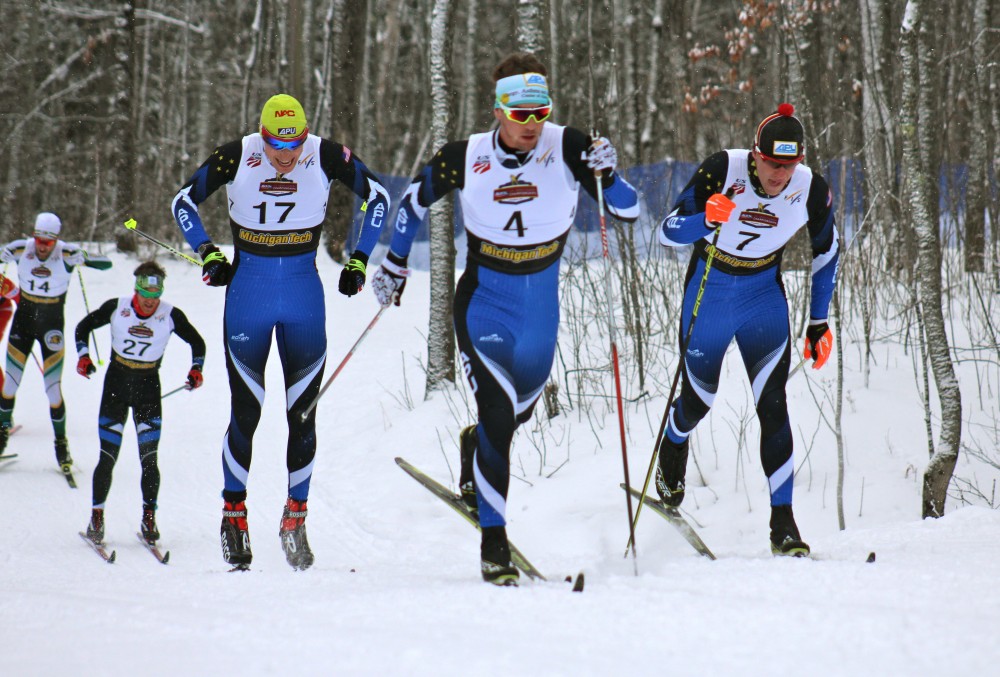
APU teammates and brothers Logan Hanneman (7) and Reese Hanneman (4) lead teammate Tyler Kornfield (17) during their quarterfinal of the men’s 1.5 k classic sprint at 2016 U.S. nationals in Houghton, Mich.
Patterson completed the 8.25 k skate race in 19:36.3. Norris finished 16.7 seconds behind him. Tyler Kornfield rounded out the APU podium, finishing 1:03 back of Patterson.
Patterson and Kornfield grew up in Anchorage. Norris is a Fairbanks native. Their good-natured geographic rivalry stretches back a decade or more, to when they were all competing in Alaska high school skiing. (“We hated the Anchorage guys,” Fairbanks skier Reese Hanneman told the Alaska Dispatch News “with more amusement than venom” in a summer profile. “We were like the rednecks from Fairbanks, out skiing in the woods, going up against the city boys.”)
APU skiers took the top five spots on the day, with Anchorage skier Thomas O’Harra in fourth and Fairbanks local Logan Hanneman in fifth.
The top college skier was UAF junior Max Donaldson, another Fairbanks product, in sixth, 1:37 back of Patterson. The top UAA skier was sophomore Toomas Kollo, from Estonia, 2:35 back in ninth.
At the end of the first day of racing, the combined times of the top three UAA women put them just 23.5 seconds behind the top three UAF skiers. On the men’s side, UAF created a larger gap of 2:14.2 over UAA’s combined times, giving UAF an advantage of roughly 2:38 heading into Sunday’s relays.
Sunday saw more of the same: APU took the easy win, Swirbul shined for UAA, and UAF used its depth and balanced performances to take the overall victory.
APU entered only one team in the relay, but it included the top two finishers from each of Saturday’s individual races. Unsurprisingly, the team of Patterson, Rorabaugh, Norris, and Yeaton posted the fastest time in all four legs of the 4 x 4 k skate relay, finishing in 46:57.4.
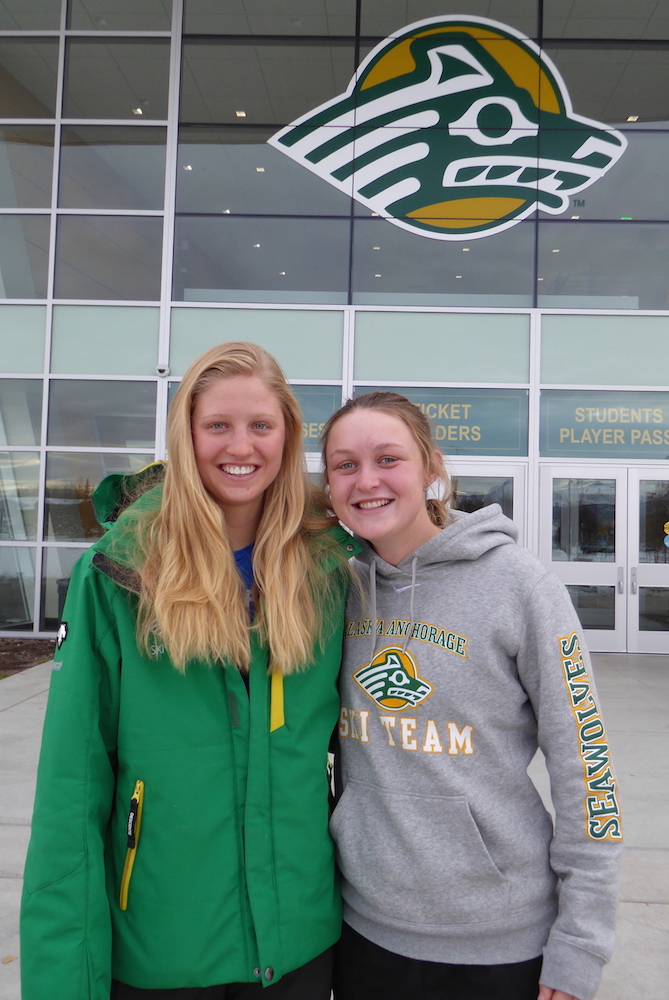
UAA skiers Hailey Swirbul (l) and Casey Wright (r), on the UAA campus in October 2016. (Photo: Gavin Kentch)
The top college team was Nanooks A (Donaldson, Sarissa Lammers, Michael Fehrenbach, and Bathe), finishing just over three minutes behind APU in 50:10.1. Donaldson and Fehrenbach posted the fastest male collegiate times of the day in their legs. Seawolves ‘A’ (Kollo, Swirbul, Marcus Deuling, and Casey Wright) was less than eight seconds behind the Nanooks in 50:18. Swirbul was again the fastest collegiate woman on the day, while Wright similarly recorded the day’s fastest anchor leg.
Nanooks ‘B’ was next, followed by Seawolves ‘B’. Ultimately, the time gaps from day one grew, and UAF finished with a 4:08 cumulative advantage over UAA, taking home its ninth Nordic Cup overall and second in a row.
UAF nordic coach Nick Crawford said in a Sunday press release, “The Seawolves had a good day today and it was very exciting to watch the race unfold. The margin between our two teams was much smaller today, so it made it that every skier had to race hard which isn’t always the case in relays. The victory was for sure a team effort today with both the men and the women putting together good races. We really enjoy the collaboration we have with our Anchorage rivals.”
UAF skier Anna Darnell expressed similar sentiments, telling the Fairbanks Daily News-Miner, in light of the recent political rollercoaster of threatened cuts to both schools’ ski programs, “We feel a lot closer to the UAA team after this.”
Meanwhile, at the top of the results sheet, Patterson’s brace of victories on the weekend, combined with his easy victory at the Race to the Outhouse #1 outside Palmer, Alaska, earlier this month, meant that the APU skier has now won every single race he has entered this winter, as well as 60 percent of all the ski races held in this country this year. (The Mat-Su Ski Club held a pair of 5 k skate and classic races at Hatcher Pass on Nov. 19 and 20.)
“I’ll have to get a time turner for the coming weekends,” Patterson wrote in an email as he reflected on his current track record, “so I can continue to win every single race in the U.S.”
This particular race was slightly more competitive than the Race to the Outhouse. FasterSkier unofficially calculates the USSA race penalty (a measure of the strength of the field) for Saturday’s men’s race as an impressive 29.03, well below the USSA minimum penalty of 35 for a College Event or Regional Scored Event. (The penalty for the women’s race was unofficially a higher, but still respectable, 60.52.)
Reflecting the cosmopolitan nature of NCAA skiing, competitors in the 45-racer FIS/USSA field hailed from at least eight foreign countries, including Canada, Norway, Germany, Australia, Sweden, the Czech Republic, Italy, and Estonia. They were joined by roughly 200 more skiers in the day’s other races, ranging from kindergartners in snowsuits who skied a 500 meter course without poles to the 60- and 70-year-old age brackets in the community 4 k race.
The strong community support, and college athletes who had finished their race but stayed to cheer on their teammates, combined to make the atmosphere as electric as can be found for American cross-country skiing. Dozens of spectators lined a late-race climb back up to the stadium, where racers were met by an even larger, frenzied crowd cheering them on.
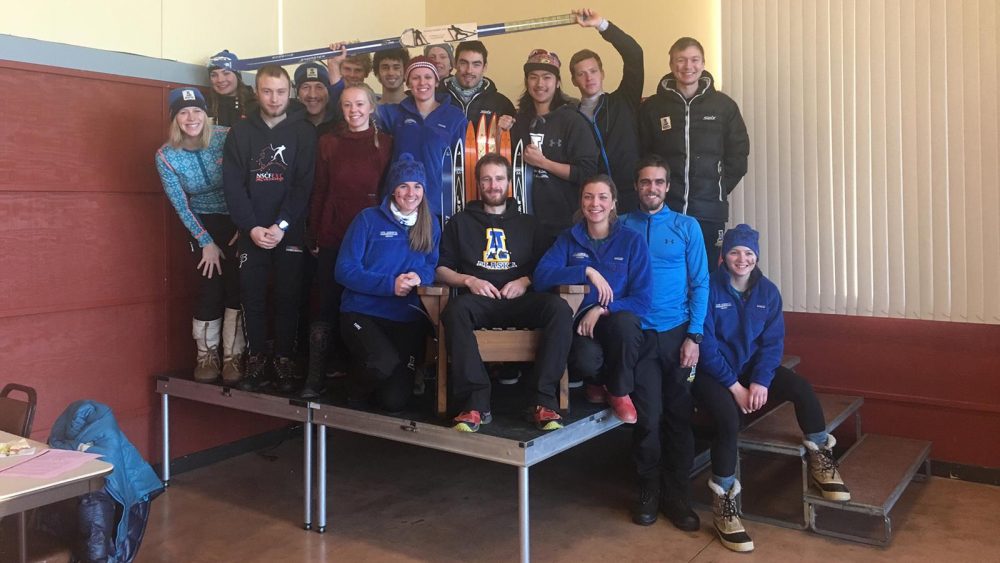
The University of Alaska Fairbanks ski team poses with the trophy for the Alaska Nordic Cup at Birch Hill Ski Area in Fairbanks, Alaska, on Nov. 20, 2016. (Photo: Nick Crawford/UAF Athletics)
Conditions were, as the athletes acknowledged, undeniably snow rather than ice (as on the Anchorage trails these days), but unfortunately not that much of it. Fairbanks has seen approximately five inches of total snowfall so far this winter. The impeccably maintained trails at Birch Hill meant that racers found a base of roughly two inches of compacted snow, with some leaves and sporadic dirt showing through, but no rocks. Most skiers in the FIS race competed on their prior-generation race skis.
Although the official high for the day at the Fairbanks airport was a barely FIS-legal 1° F (-17 degrees Celsius), temperatures at the relatively elevated Birch Hill were comparably temperate, hovering around 10° F (-12 C) throughout the afternoon.
At least in the sunlit stadium. Racing at Birch Hill on clear and cool winter days can be an oddly hellish experience. Not because it is unenjoyable – far from it; the trails are a delight to ski, and the snowy birch forest is sublimely beautiful– but because it evokes the sensation of voyaging into the underworld and back again. The stadium is in the sun, and elevated, and relatively warm; many trails drop down leaving the stadium, sending the skier into the realm of dark and cold. And so one goes from light to dark, sun to shade, warmth to cold, and back again with each new trail, the stadium become a modern-day Cumae (entrance to the underworld in classical mythology) and the skier Heracles or Odysseus, re-enacting the journey between worlds.
RMISA college racing resumes early next year with the Utah Invitational at Soldier Hollow on Jan. 7.
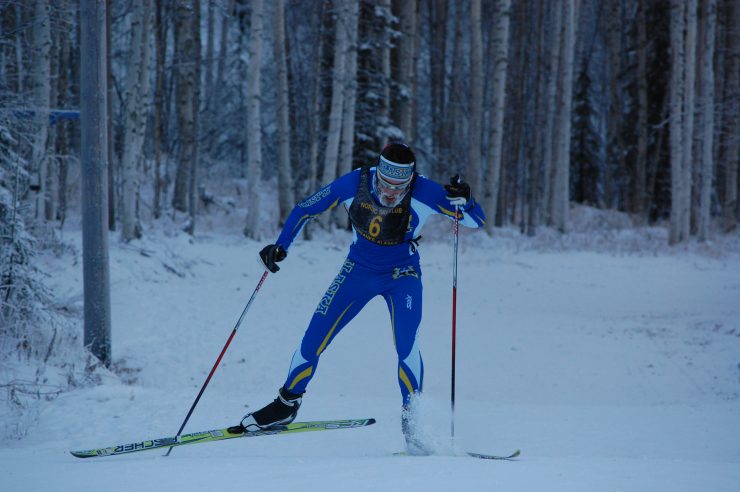
University of Alaska Anchorage skier Casey Wright skis in the Alaska Nordic Cup in Fairbanks, Alaska, on Nov. 20, 2016. (Photo: Max Kaufman)
Alaska Pacific University skier Jessica Yeaton skis the anchor leg of the winning relay team in the Alaska Nordic Cup in Fairbanks, Alaska, on Nov. 20, 2016. (Photo: Max Kaufman)
University of Alaska Fairbanks skier Alex Eckert skis in the Alaska Nordic Cup in Fairbanks, Alaska, on Nov. 20, 2016. (Photo: Max Kaufman)
University of Alaska Fairbanks skier Alex Eckert skis in the Alaska Nordic Cup in Fairbanks, Alaska, on Nov. 19, 2016. (Photo: Max Kaufman)
University of Alaska Fairbanks skiers Sarissa Lammers (464) and Hannah Rowland (462) ski in the Alaska Nordic Cup in Fairbanks, Alaska, on Nov. 19, 2016. (Photo: Max Kaufman)
Second-place finisher Alaska Pacific University skier Becca Rorabaugh approaches the finish line of the Alaska Nordic Cup in Fairbanks, Alaska, on Nov. 19, 2016. (Photo: Max Kaufman)
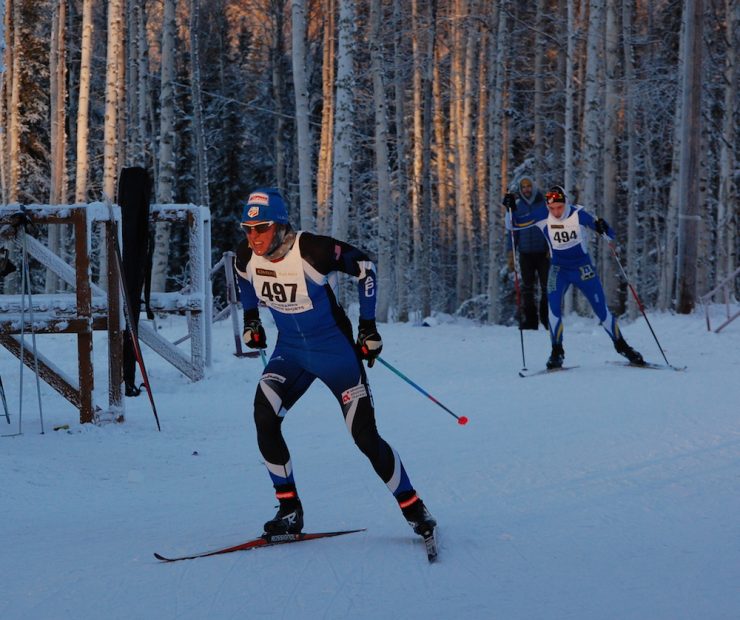
First-place finisher Alaska Pacific University skier Scott Patterson approaches the finish line of the Alaska Nordic Cup in Fairbanks, Alaska, on Nov. 19, 2016, ahead of UAF skier Max Donaldson (494). (Photo: Max Kaufman)
Alaska Pacific University skier David Norris skis the third leg of the winning relay team in the Alaska Nordic Cup in Fairbanks, Alaska, on Nov. 20, 2016. (Photo: Max Kaufman)