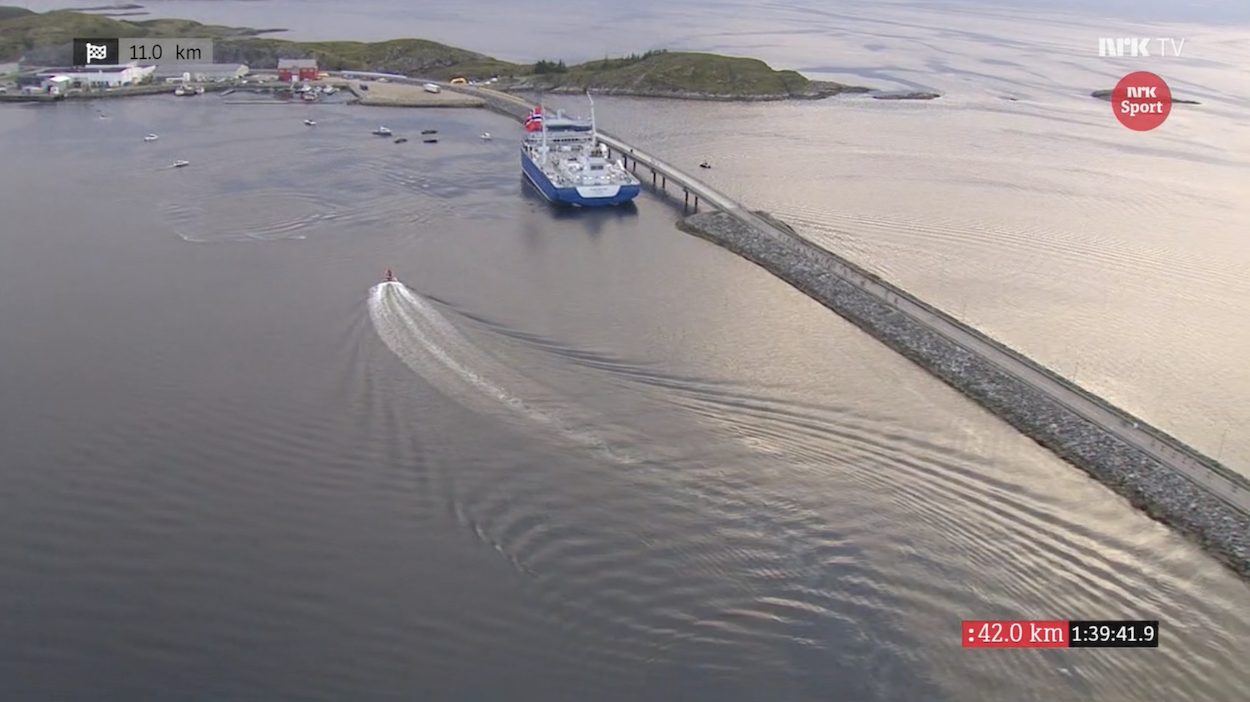
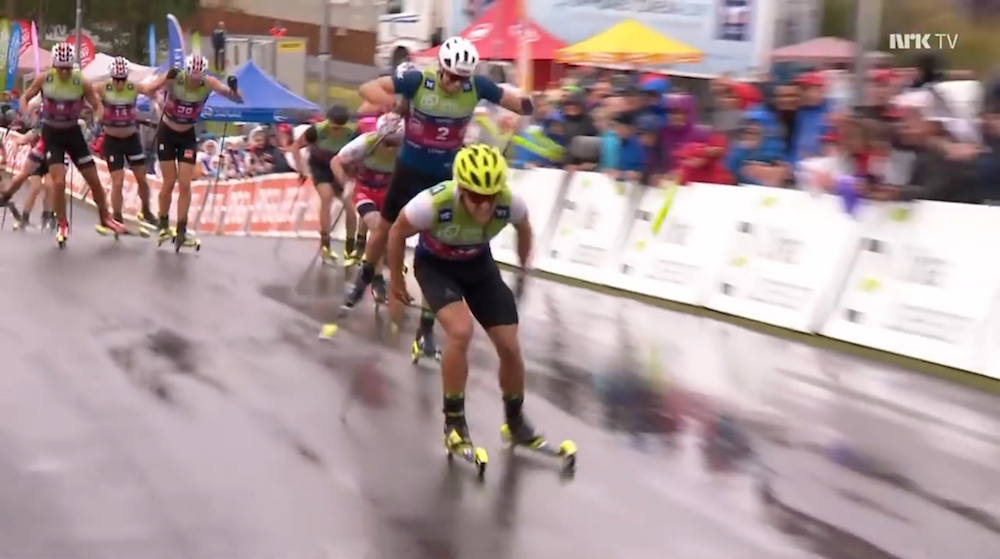
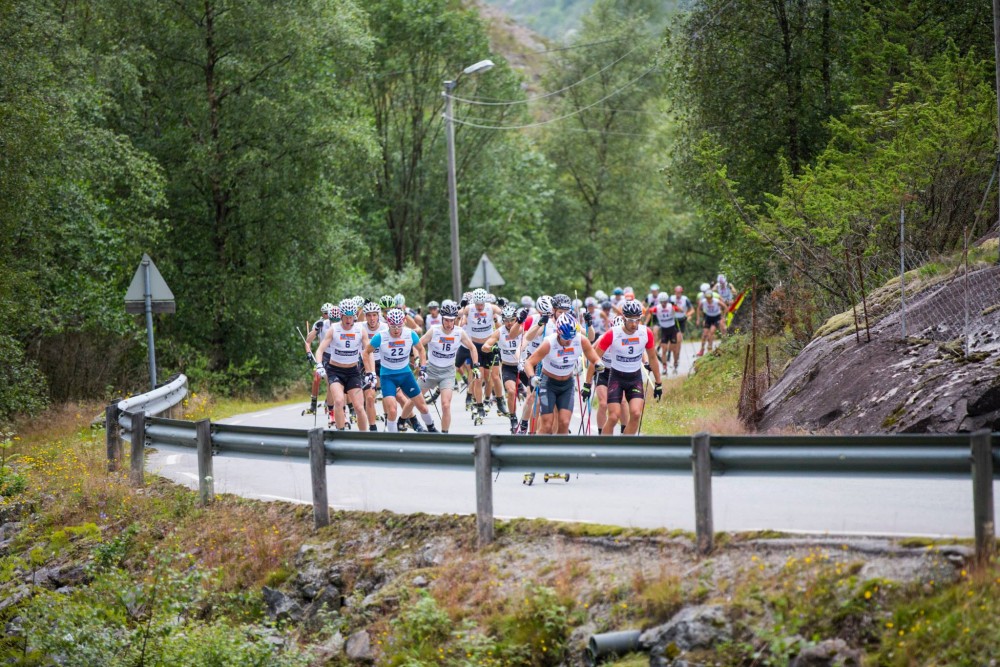
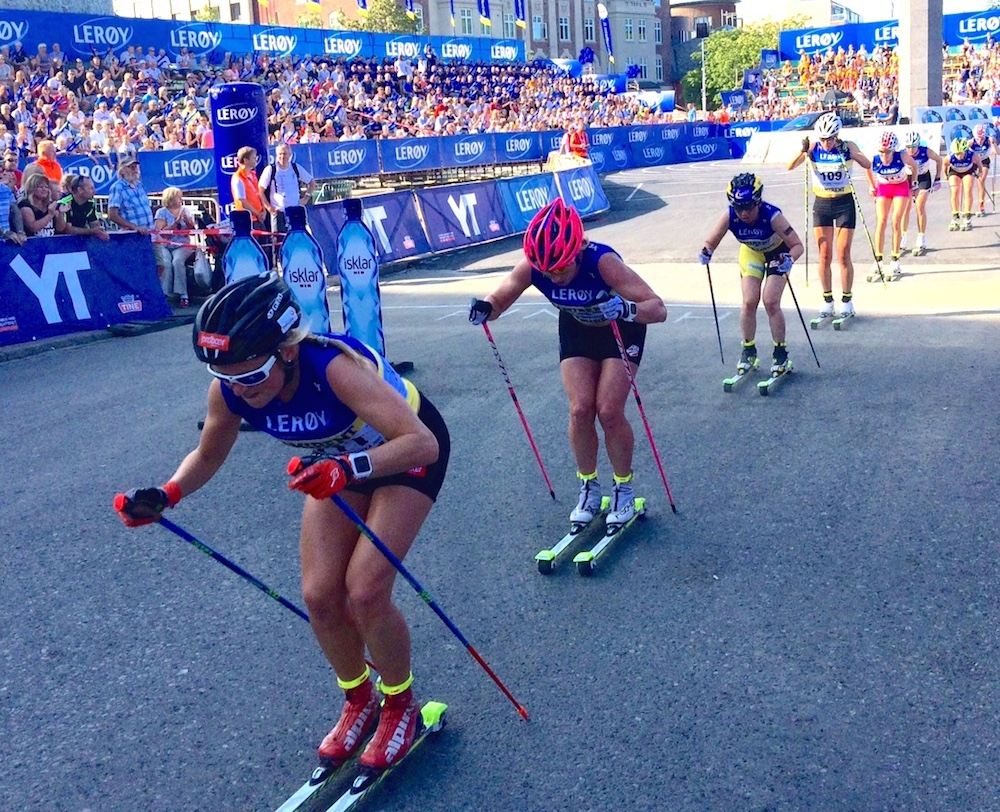
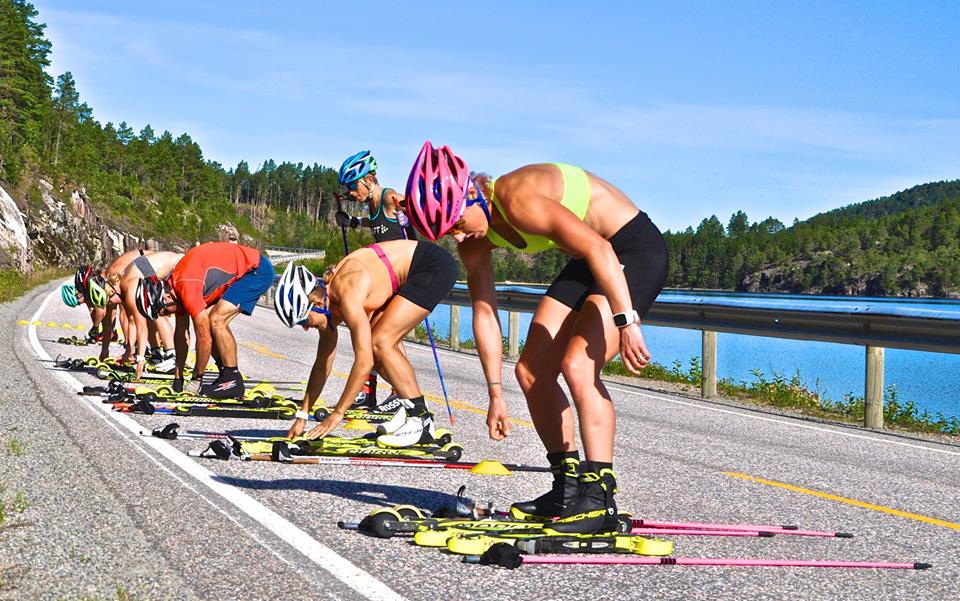
Athletes race across a causeway approaching Hitra in Toppidrettsveka 2022. (photo: screenshot from NRK broadcast)
After technique work on snow comes race effort on rollerskis. Racing Thursday evening in Hitra, Norway, Ben Ogden led four American men when he placed 18th in a field of nearly 100 in the 54-kilometer classic mass start, the opening race of the Toppidrettsveka race series in the Trondheim region of western Norway.
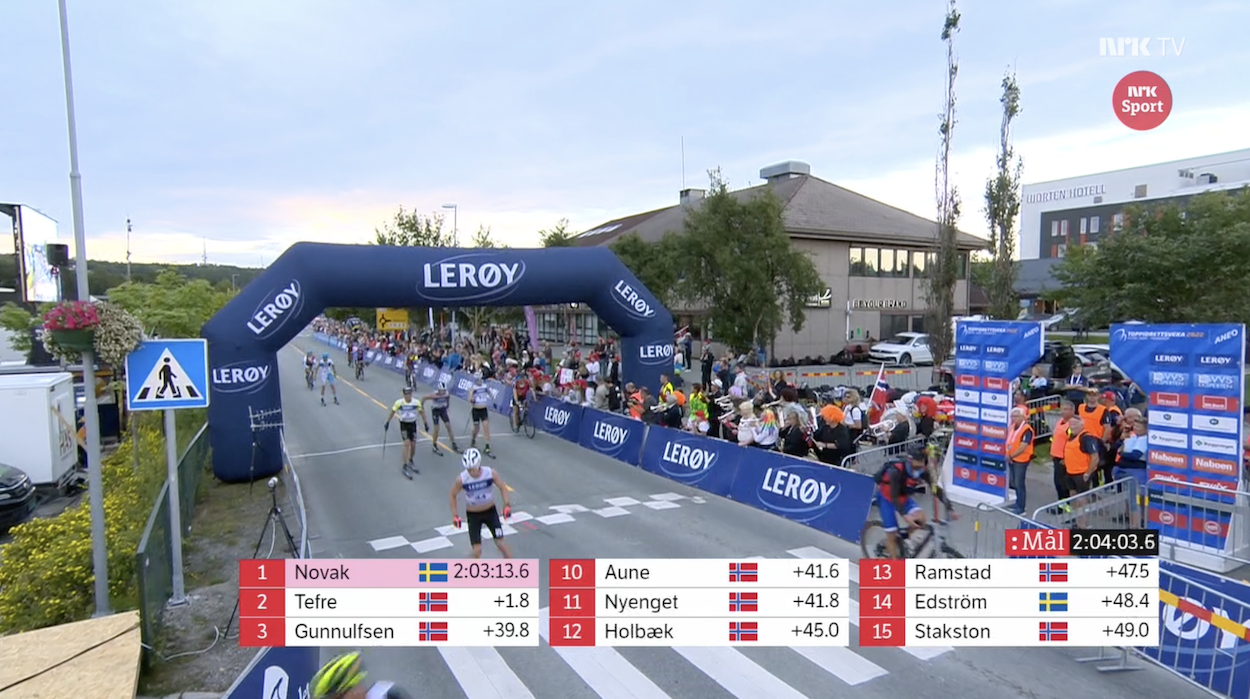
Ogden finished 50.2 seconds back of the winner, and 10.4 seconds off the podium. He was followed by fellow USST athletes Finn O’Connell in 47th (+3:57.4), Johnny Hagenbuch in 55th (+6:38.4), and JC Schoonmaker in 65th (+9:26.0). Kevin Bolger and Walker Hall are also on this trip, and may compete in upcoming races.
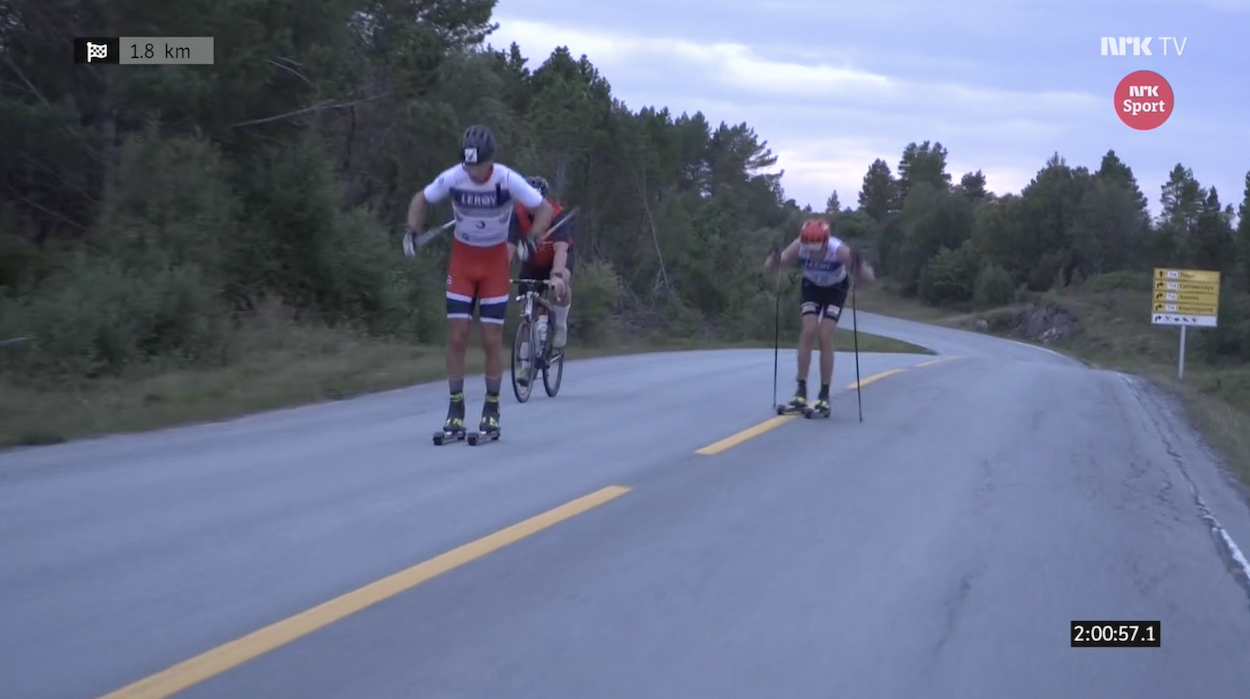
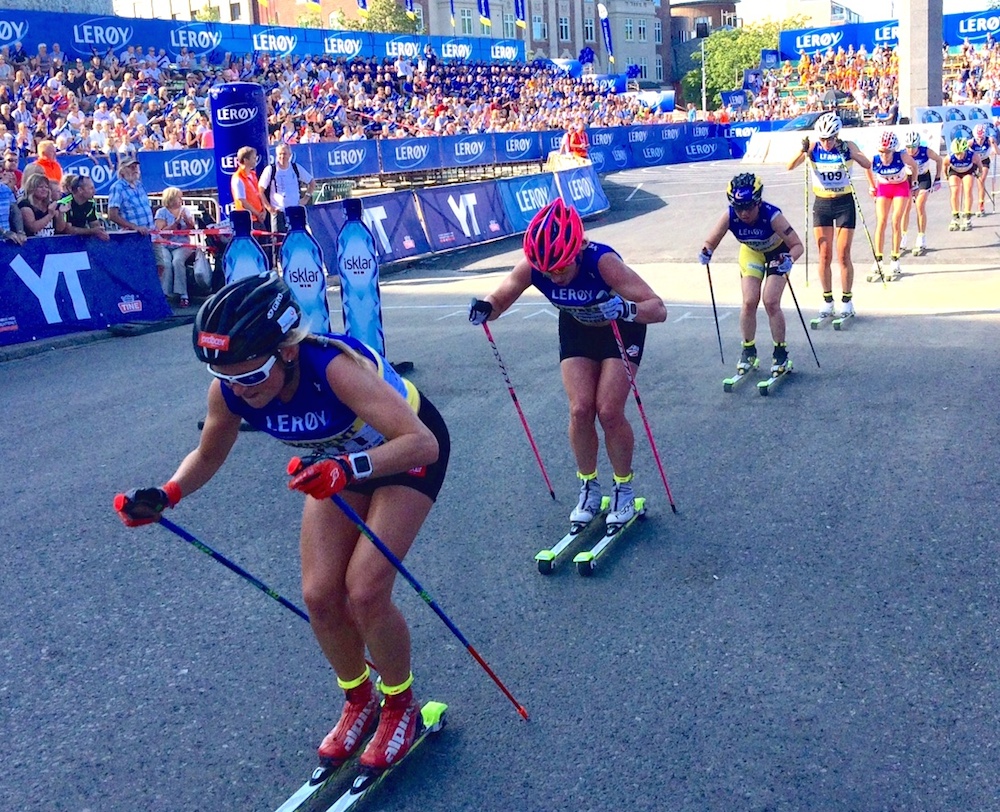
Max Novak makes the winning move, Toppidrettsveka 2022. (photo: screenshot from NRK broadcast)
The race was won by Max Novak of Sweden in 2:03:13.6, after he and Norwegian Gjøran Holstad Tefre distanced themselves from a 17-man chase pack within the final 10 kilometers. Novak used a powerful acceleration on a small uphill 1.8 kilometers out to open up a small gap on Tefre, which he held all the way to the finish. Tefre finished 1.8 seconds back of Novak. Mikael Gunnulfsen of Norway won a group sprint to finish third (+39.8).
Perhaps the best-known retired skier in the field, Petter Northug, 36, finished 38th (+2:53).
The women’s race, in which no Americans competed (there are no American women on this training trip), was won by Norwegian Astrid Øyre Slind, who covered 54 k in 2:10:40.5, a staggering 12+ minutes ahead of Lotta Udnes Weng in second. Friend of the program Frida Karlsson finished in 2:25:31.2 to place fifth in a field of twelve women.
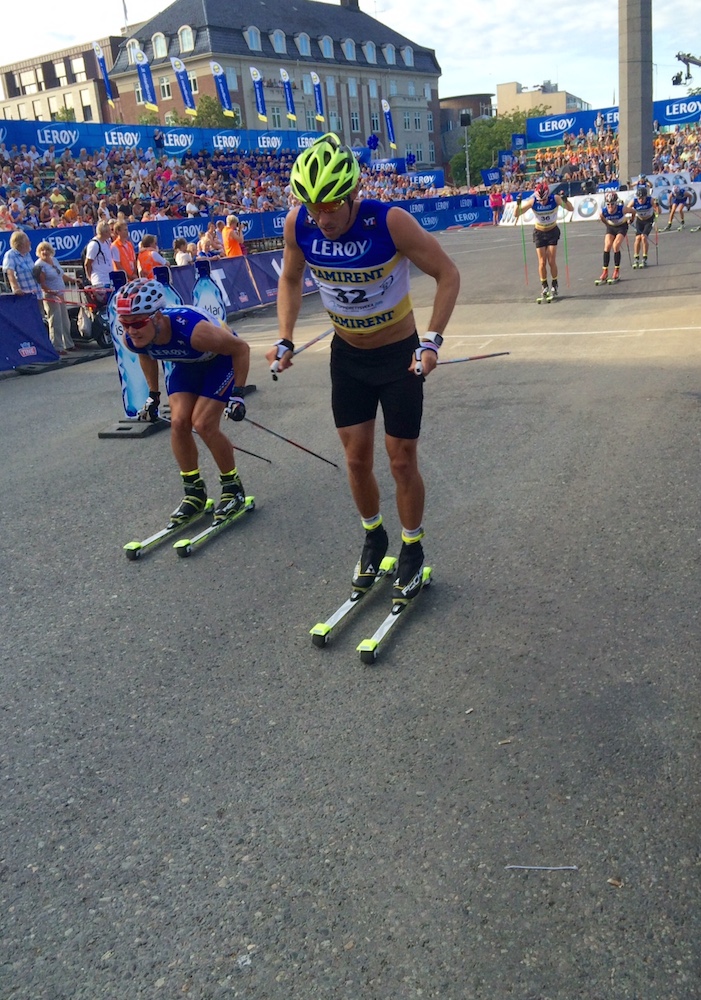
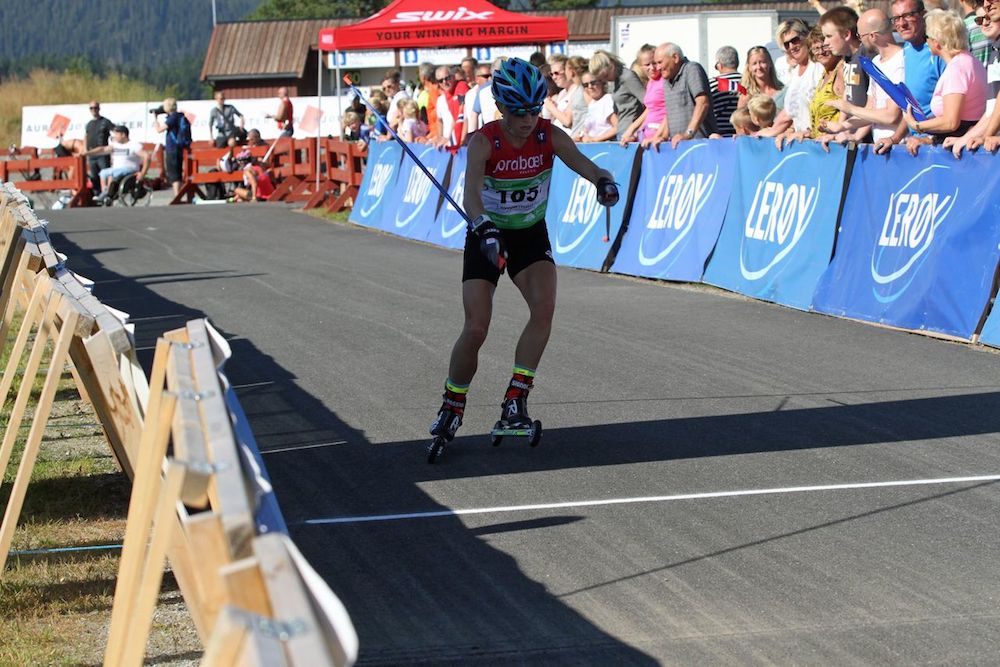
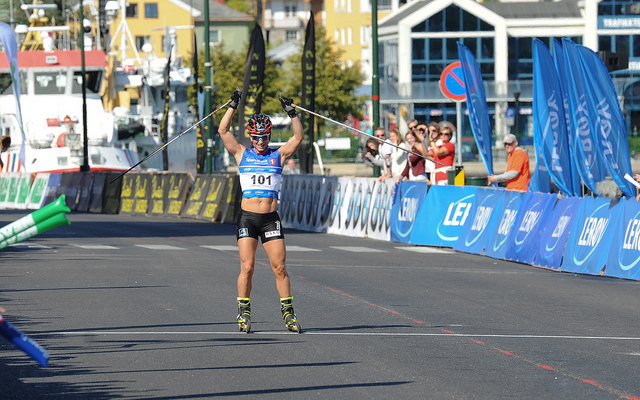
Ben Ogden crosses the finish line in 18th, back middle, to the right of the athlete in a yellow top. (photo: screenshot from NRK broadcast)
U.S. Ski Team Head Coach Matt Whitcomb was buoyant about the team’s fitness and recent training heading into the race.
“Everyone is healthy,” wrote Whitcomb in an email to multiple media outlets Thursday morning, “and we’ve all had one of the best training camps of my coaching career. The guys have had a blast together. We’ve trained hard, both on and off snow. While we’re training into these races, everyone feels ready to race. Training through the summer races is a common approach.”
Thursday’s races started at 6:20 p.m. in the evening local time, with the men’s winner finishing at 8:23 p.m. and the final American not finishing until after 8:30 p.m., suggesting a late night for all after cooldown, recovery, and coming down from the high of racing.
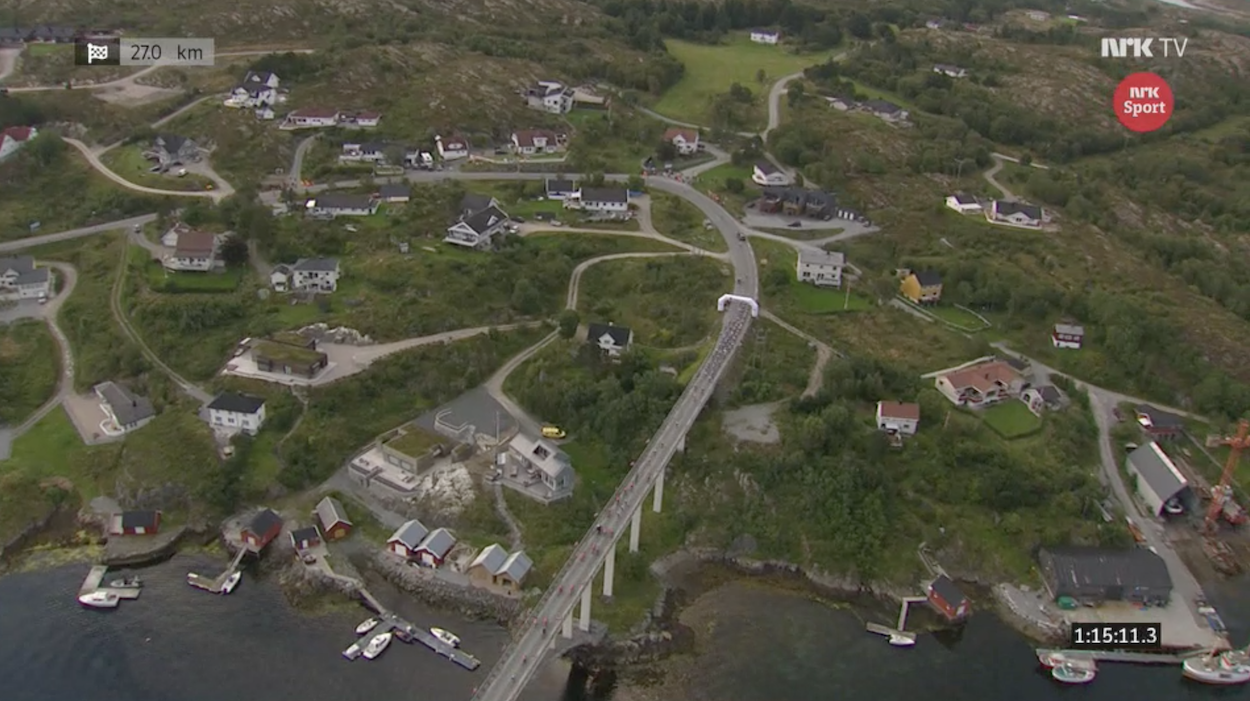
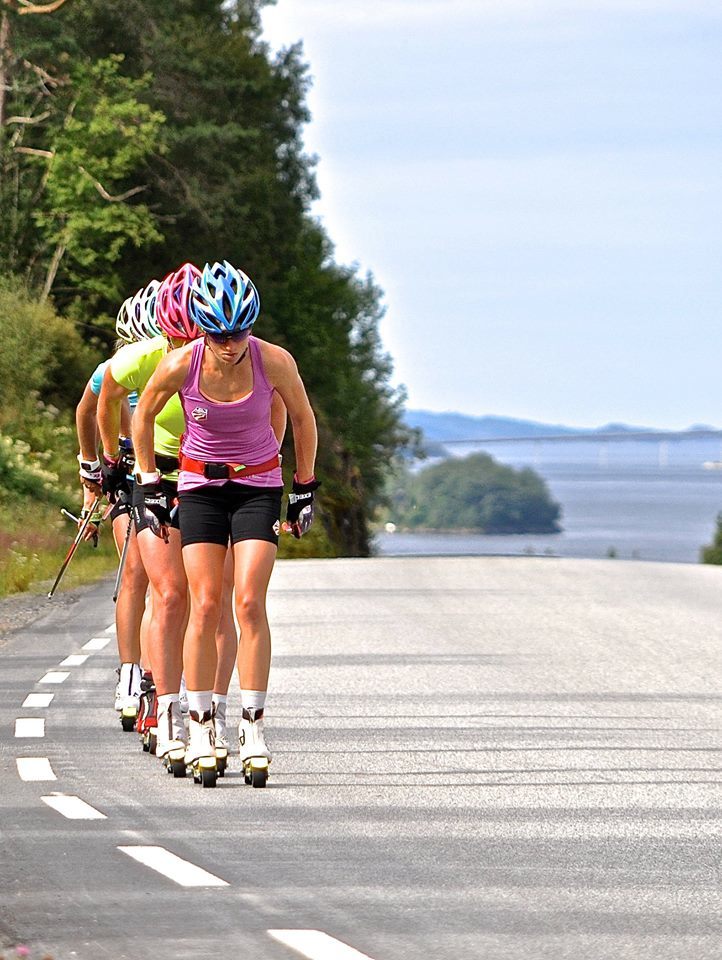
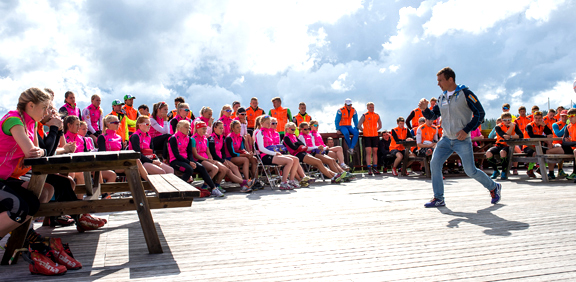
Scenery shot, Toppidrettsveka 2022. (photo: screenshot from NRK broadcast)
Competition continues in western Norway with a classic sprint on Friday, then a 10/15 k interval-start skate race on Saturday morning and a 5/10 k classic pursuit Saturday afternoon. FasterSkier will publish a more detailed article after the final race. The races will be shown on NRK, if you can manage to access the Norwegian broadcaster from where you live, and may be livestreamed on the event’s Facebook page.
Simi Hamilton on the new skate skis in Oberhof, Germany. (Photo: Matt Whitcomb)
By the time you read this piece, some skiers from the U.S. Ski Team (USST) will be settling in Trondheim, Norway for a two and a half week training camp. In total, five are making the journey from the U.S. The sixth skier, Kevin Bolger, no stranger to training in the region, has been in Trondheim for nearly a month. Bolger’s experience in Trondheim goes deep. He has trained there in the off season for many years.
It’s true, the Oberhof ski tunnel does resemble a commemorative ribbon. (Photo: https://www.oberhof-skisporthalle.de)
“In terms of having a guide upon arrival, we are pretty well plugged in.” U.S. coach Matt Whitcomb said in a call.
Bolger will be the local guide for Sadie and Erik Bjornsen, Simi Hamilton, Sophie Caldwell and Andy Newell (former USST member). The skiers will be joined by U.S. head coach Chris Grove, Whitcomb, and physiotherapist Zuzana Rodgers.
Hamilton and Whitcomb will hop a flight from Germany to Trondheim. The pair spent four days last week in the Oberhof ski tunnel. If you are imagining a simple oval where Hamilton becomes dizzy going round and round, the tunnel is a bit more complex. Whitcomb relayed that Hamilton describes the tunnel as “a loop with two out and backs, like a commemorative ribbon”.
The indoor-skiing provides Hamilton an opportunity for on-snow training and to become accustomed to his new ski fleet. After a career spent on Fischer skis, Hamilton has switched to Salomon skis and boots this season.
Simi Hamilton driving the new fleet of classic skis in the Oberhohf ski tunnel. (Photo: Matt Whitcomb)
“It was a good opportunity with Salomon this year because we have Jessie [Diggins] and Sophie [Caldwell] on them among the various brands in our truck,” Whitcomb said. “And we have an exceptional amount of service because they have few athletes on the World Cup. It was time for a change for Simi and this time around in Oberhof it is more about getting used to the product instead of actually testing the skis. We will do a little bit of testing but the main purpose is simply to get used to skiing on the new brand.”
The Oberhof ski tunnel was reserved by several elite groups twice each day for four days.
“Our goal is to not really push it too hard it is just to get in as much quality skiing as we can under the expected jet lag to go to Norway both well trained but also not buried,” said Whitcomb.
The camp in and around Trondheim will involve joint training sessions between the U.S. contingent and skiers from Italy’s National Team. Federico Pellegrino, Francesco De Fabiani, and Dietmar Nöckler are scheduled to attend. In addition to training with the Italians, the six U.S. skiers will race the Toppidrettsveka rollerski events from August 22-24.
“The number one goal is to get some race experience in the summer against some of our World Cup competitors and just get that summertime competitive vibe going that you cannot get in the U.S. without going to the best,” said Whitcomb. “That is the number one goal. And the secondary goal is to a little bit of training with some of the local Norwegians in Trondheim. Some that are showing up early for the races and also with the Italians who we have been talking with for the last four or five months about wanting to do something together
Hamilton was not alone in Oberhof. The Russians were there to join the ski tunnel fun. (Photo: Matt Whitcomb)
In years past, the U.S. team has flown to New Zealand for a major on-snow camp. This year with no World Championships and the Olympics three winters away, the coaches offered athletes the possibility of a new routine. Jessie Diggins, Julia Kern, and coach Jason Cork will return to New Zealand’s Snow Farm.
“The number one reason is just for some change,” said Whitcomb of the smaller contingent headed to New Zealand. “It wasn’t anything that we believe so firmly in that we were opposed when Julia and Jessie wanted to go, it was no big deal. It was more of a let’s bring this to the athletes and see what they want to do. As you might imagine, it is quite a big time commitment for some of us who don’t get to see a lot of summer, or one of the best parts of the summer, and it’s exchanging that for winter. You are giving up a bit there. It is something will miss as Simi and I were both just talking about because it is a reprieve from the heat of August. It is just for the purpose of changing things up a little bit and it is a non-championship year. Later on, we can perhaps assess whether or not it provides us with what we think it does.”
Tara Geraghty-Moats winning Sunday’s normal hill/5 k Gundersen at the 2018 Women’s Nordic Combined Summer Grand Prix in Oberwiesenthal, Germany. (Photo: Romina Eggert/FIS)
Two North Americans posted impressive results at nordic events in Germany and Norway over the last week, with Vermont native Tara Geraghty-Moats racing to first overall in the first-ever Women’s Nordic Combined Summer Grand Prix and Quebec’s Alex Harvey placing second, fifth and 10th in three races at the Toppidrettsveka rollerski series.
Geraghty-Moats 1st and 2nd at Inaugural Women’s NoCo Grand Prix
Brand new to nordic combined as well as the jump hill in Oberwiesenthal, Germany, Geraghty-Moats took the inaugural women’s Nordic Combined Summer Grand Prix by storm this past weekend, placing first and second in two competitions. That tied her for first place in the overall Grand Prix standings, alongside Russia’s Stefaniya Nadymova — the defending champion of last winter’s inaugural women’s Nordic Combined Continental Cup.
On Sunday, Geraghty-Moats, 25, of USA Nordic and the New York Ski Education Foundation (NYSEF), handily beat Nadymova and the rest of the 10-woman field after starting the 5-kilometer Gundersen rollerski race in second, four seconds behind Germany’s Jenny Nowak. While Nowak had posted the best jump of 96 meters on Oberwiesenthal’s 106-meter “normal” hill, Geraghty-Moats tied for the second-best-scoring jump (94.5 meters), with Austria’s Lisa Hirner (95 meters). From there, Geraghty-Moats dropped Hirner, Nadymova and Nowak on the first of three laps in the rollerski race and went on to finish in 11:04.8. Nowak ultimately placed third, 1:29.2 behind Geraghty-Moats.
“I was really satisfied by how my first weekend of being a nordic combined-er went, and I think the patience of waiting to be a nordic combined-er really paid off,” Geraghty-Moats told the International Ski Federation (FIS) after. “I struggled with the jump a little bit the first couple days. I had never jumped this hill before, and I sort of figured it out today so I got to ski a little bit easier than yesterday, but I was also happy that yesterday I was able to have a good fight and ski fast to my potential and end up on the podium.”
The women’s individual normal hill/5 k Gundersen podium on Saturday at the 2018 Women’s Nordic Combined Summer Grand Prix, with Russia’s Russia’s Stefaniya Nadymova (c) in first, American Tara Geraghty-Moats (r) in second, and Germany’s Jenny Nowak (l) in third in Oberwiesenthal, Germany. (Photo: FIS/Silke Tegethof)
“It was a dream come true to finally be able to compete in women’s Nordic Combined on an international level,” Geraghty-Moats told FIS on Saturday. “I’m using this weekend to learn the level I have to be at to have success in Nordic Combined. I made some mistakes today and learned a lot but I came away with a good result and having had a huge amount of fun competing with small but strong field.”
Eleven women competed in Saturday’s normal hill/5 k.
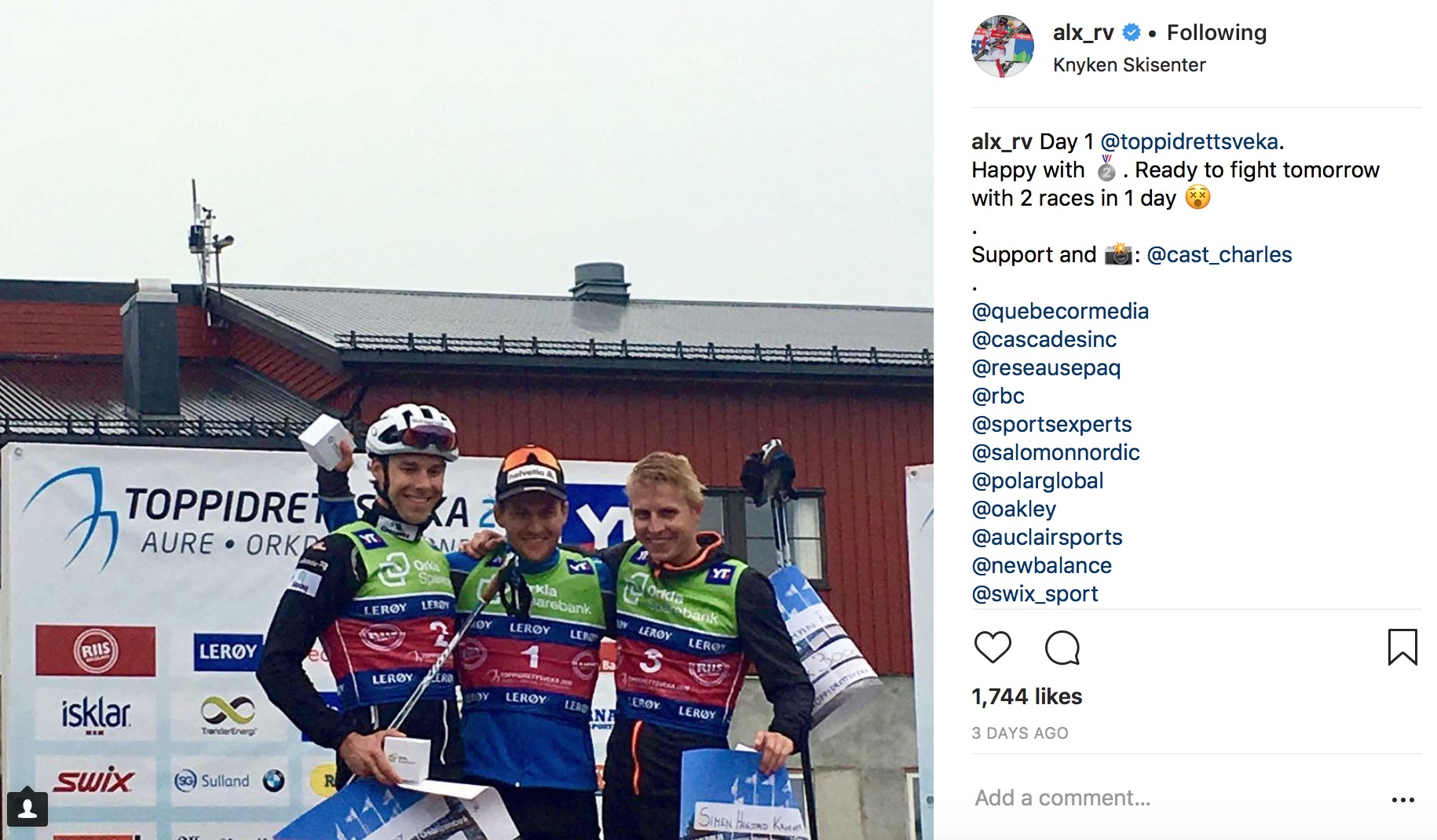
Alex Harvey (l) on the podium with Roman Furger (c) and Simen Hegstad Krüger (r) at the 2018 Toppidrettsveka rollerski festival in Norway last Thursday, Aug. 16. (Photo: Alex Harvey/Instagram)
At the Toppidrettsveka rollerski festival in Norway, Canada’s Alex Harvey raced to second in the 15 k skiathlon last Thursday in Orkdal, missing out on first by just 0.6 seconds to Switzerland’s Roman Furger, who won in 30:43.3. Norway’s Simen Hegstad Krüger, the reigning Olympic skiathlon champion, finished third, 1.5 seconds back. In a stacked international field of 125 men, Canada’s Evan Palmer-Charrette placed 75th in that race (+2:14.4), Bob Thompson was 84th (+2:32.7), and Scott Hill 89th (+2:52.5).
Canada’s Alex Harvey (2) gunning for first in the men’s 15 k skiathlon on Aug. 16 at the Toppidrettsveka rollerski festival in Orkdal, Norway. (Screenshot: NRK broadcast)
Heidi Weng beat her cousin Tiril Udnes Weng by 0.7 seconds in the women’s 10 k skiathlon that day, finishing in 22:52.1. Norway swept the top five of the women’s race, with Anne Kjersti Kalvå reaching the podium in third (+1.3), and national-team members Kathrine Harsem and Astrid Uhrenholdt Jacobsen placing fourth (+1.4) and fifth (+1.5), respectively, out of 43 women.
In the men’s 24 k classic mass start aroundAure/Brekka on Friday, Harvey finished fifth, 19 seconds after Krüger, who won in 59:57.5. Norway’s Hans Christer Holund placed second in that race (+2.6), Norway’s Magnus Stensås was third (+13.0), and Switzerland’s Dario Cologna fourth (+17.1). Also for Canada, Palmer-Charrette finished 61sth (+2:30.9), Hill 78th (+4:02.3), Thompson 86th (+5:40.3), and Maks Zechel 88th (+7:01.4) out of 125.
Heidi Weng repeated in first in the women’s 24 k mass start, finishing in 1:10:02.4 hours, while Tiril Udnes Weng again placed second, 25.4 seconds back, and Jacobsen reached the podium in third (+27.7).
Later on Friday in Aure, Norway’s Sondre Turvoll Fossli topped the men’s freestyle sprint final ahead of four other Norwegians, including Pål Trøan Aune in second and Jan Thomas Jenssen in third, and Switzerland’s Furger in fifth, while Harvey did not qualify for the heats and ended up 37th overall. Palmer-Charrette was once again 61st in qualification, Hill 107th and Thompson 109th out of 121.
In the women’s sprint, Norway’s Mathilde Myhrvold won the final in 2:56.54, 1.05 seconds ahead of Slovenia’s Katja Visnar in second. Heidi Weng placed third in the final (+1.97), ahead of Tiril Weng (+2.64) in fourth, another Norwegian Anna Svendsen in fifth (+2.76), and another Slovenian Alenka Cebasek in sixth (+3.73).
In the final race of the series, the classic pursuit on Saturday, Harvey started second, 10 seconds behind Furger in first. The Canadian went on to place 10th, 4.2 seconds out of first, in the 15 k race, while Stensås took the win in 37:45.5 after starting seventh. (Furger slipped to 55th and 1:55.5 behind at the finish.) Norway’s Mikael Gunnulfsen rose from eighth to second (+0.7) and France’s Jean-Marc Gaillard made it all the way up to third (+1.7) after starting 15th.
Palmer-Charrette finished the pursuit in 59th (+2:04.2), Thompson placed 80th (+2:55.2), Hill 87th (+3:41.5), and Zechel 93rd (+3:48.9) out of 105.
Jacobsen ended the weekend as the women’s 12 k mass start winner, after the entire women’s field (of 33) started at the same time. She crossed the line first in 34:20.8, 0.4 seconds ahead of Heidi Weng in second and 1.2 seconds ahead of Kalvaa in third.
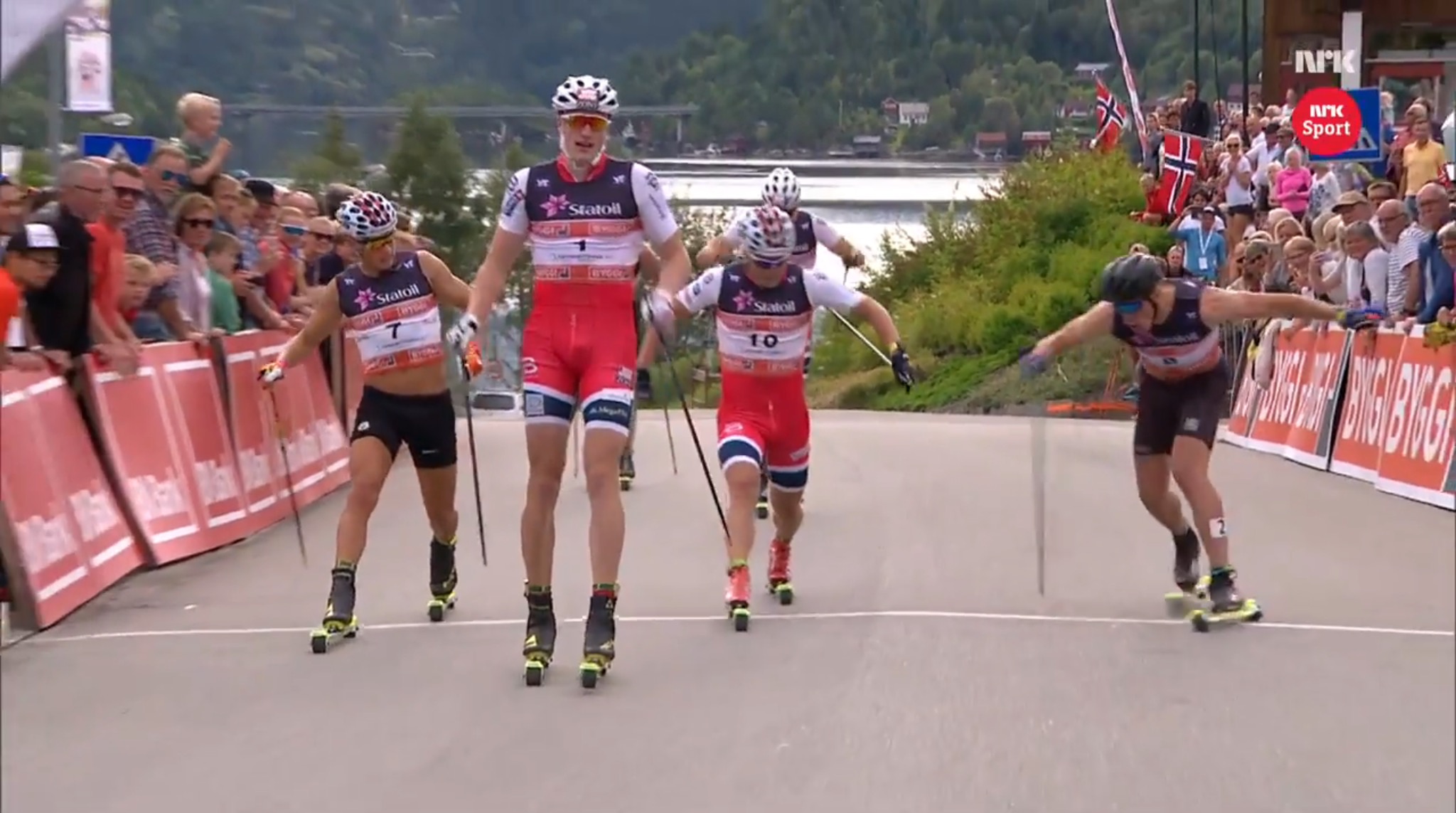
In the men’s classic sprint on Day 1 of the three-day 2017 Toppidrettsveka mini tour, Norway’s Aune Pål Trøan (1) crosses the line ahead of his countrymen Johannes Høsflot Klæbo (7) and Eirik Brandsdal (10) while Sweden’s Calle Halfvarsson (r) placed fourth. Halfvarsson went on to win the tour, ahead of Klaebo in second. (Screenshot: NRK broadcast)
This past weekend was once again the time of the year for the Toppidrettsveka ski festival, a three-day rollerski mini tour held annually since 2005 in the region of Trondheim, Norway. In addition to the individual stages, points for the top-30 finishers were awarded to compile an overall ranking similar to the Tour de Ski.
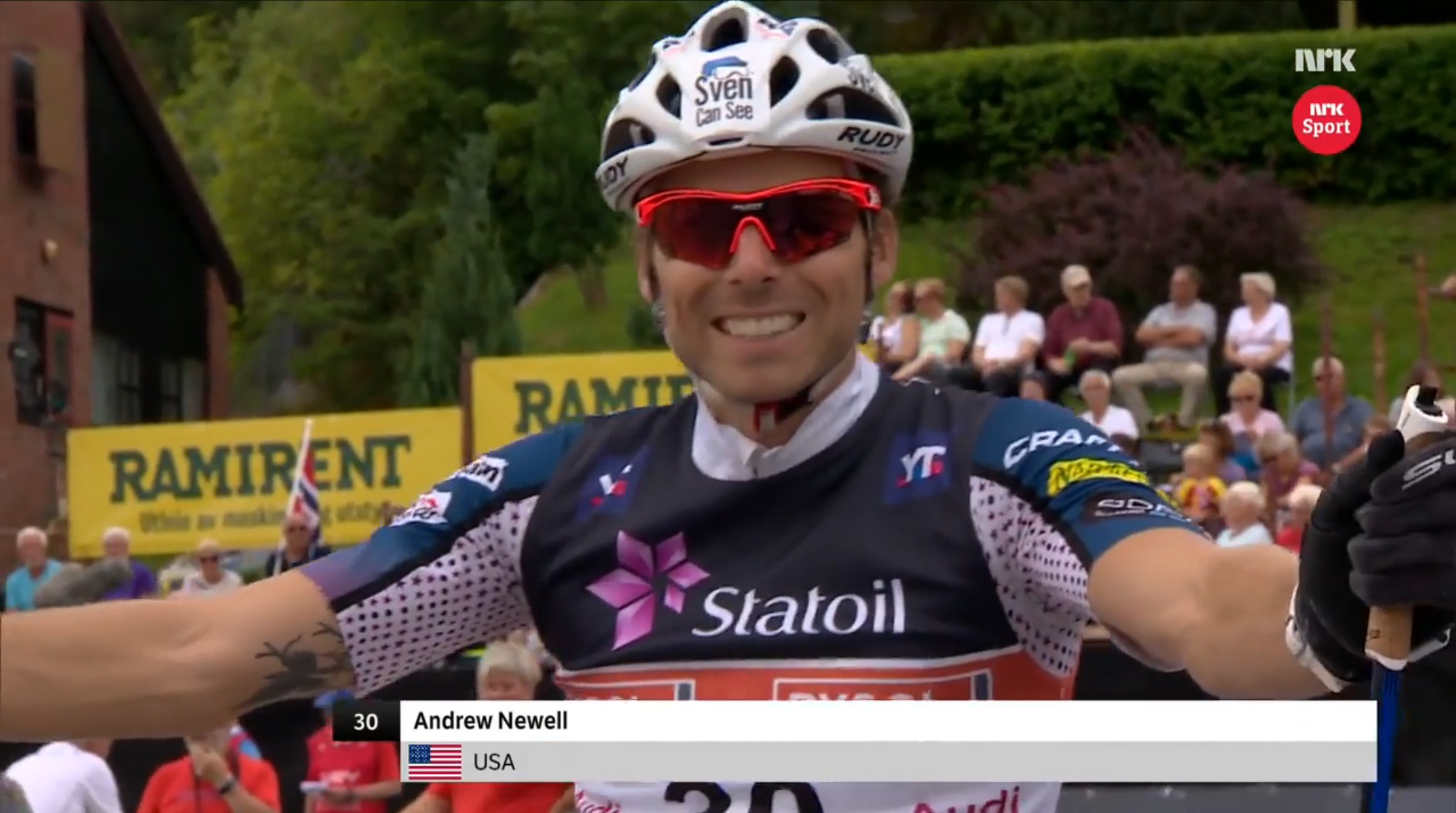
The elite field of athletes was mostly comprised of Norwegian and other Scandinavian skiers active on the International Ski Federation (FIS) World Cup and European Continental Cup level, as well as a handful of international starters, including two Americans: U.S. Ski Team member Andy Newell, who raced at last month’s Blink Ski Festival in Norway, and Kevin Bolger, who is coming off his senior season at the University of Utah.
Day 1: Aure Sprint
American Andy Newell (U.S. Ski Team) at the start of the men’s sprint in Aure, Norway, on Day 1 of the 2017 Toppidrettsveka rollerski mini tour. (Screenshot: NRK broadcast)
The festival started last Thursday with a classic sprint in the small town of Aure, on a fairly long course with a steep downhill and a roundabout at the bottom, after which the athletes had to ski up the same hill toward the finish.
In the men’s race, Norway’s Aune Pål Trøan took the win in the final with a time of 2:46.46, narrowly edging Norwegian World Cup skiers Johannes Høsflot Klæbo by 0.41 seconds and Eirik Brandsdal by 0.43 seconds. Just another tenth of a second back, Sweden’s Calle Halfvarsson placed fourth (+0.44).
Newell’s run ended in the quarterfinals, where he finished sixth in his heat, just half a second from advancing. His heat was a tight race that featured the eventual winner Trøan, who along with World Cup regular Emil Iversen, advanced as a lucky loser behind Brandsdal and his teammate Aleksander Ek. Bolger did not reach the quarterfinals.
In the women’s final, Sweden’s Linn Sömskar prevailed with a time of 3:03.94, edging out five Norwegians, including Kathrine Rolsted Harsem in second and 2016 Toppidrettsveka title-defender Heidi Weng in third. Earlier in the day, Sömskar also won her quarterfinal and semifinal heats decisively.
Two weeks ago, Sömskar won three races at the 2017 rollerski world championships in Solleftea, Sweden — the 18-kilometer freestyle, 16 k classic, and team sprint with Maja Dahlqvist.
Day 2: Brekka Mass Start and Trondheim Sprint
On Friday, athletes competed in two events: a mass start followed by a sprint later in the evening.
Switzerland’s Dario Cologna topped the men’s 24 k mass start, a point-to-point race from Aure to Brekka, finishing in 59:11.3 after breaking away on the long final climb. Halfvarsson claimed second (+10.8), followed by Finland’s Iivo Niskanen in third (+17.2) ahead of Norway’s Niklas Dyrhaug in fourth (+27.4).
“Great to win here,” Cologna told Norwegian broadcaster NRK in an interview in the finish. “Many good skiers, the best in the world, so it’s a good feeling. Good to see that everything is working well [in preparation] for this important season.”
Bolger finished 51st (+4:48.6) and Newell crossed 15 seconds later in 54th (+5:03.9) in the large field of 124 finishers.
In the women’s mass start over the same 24 k course, the race was even closer and came down to a finishing sprint. Weng took the win in 1:07.30.3, just 3.5 seconds ahead of her teammate Astrid Uhrenholdt Jacobsen, while Sweden’s Anna Haag finished 7.8 seconds back in third. Another Swede, Ebba Anderson placed fourth (+22.0), while the rest of the field crossed the line more than four minutes later. Haag and Anderson are just coming off a training camp in Sweden, where they were joined by U.S. Ski Team members Liz Stephen and Kikkan Randall.
For Stage 3 on the same day, athletes raced a 1 k sprint in the center of Trondheim, Norway’s third-largest city. There, Klæbo won the men’s final after a decisive attack on the finishing stretch in a time of 2:19.56 minutes, ahead of fellow Norwegian Ragnar-Kristoffer Braqvin Andresen in second (+0.23) and Even Northug in third (+2.85), the younger brother of 2016 Toppidrettsveka winner Petter Northug Jr. Halfvarsson finished fourth (+2.94), thereby taking the lead in the intermediate tour standings on Day 2, ahead of Klæbo, Cologna and Trøan.
Both Newell and Bolger missed qualifying for the sprint heats and did not score additional points.
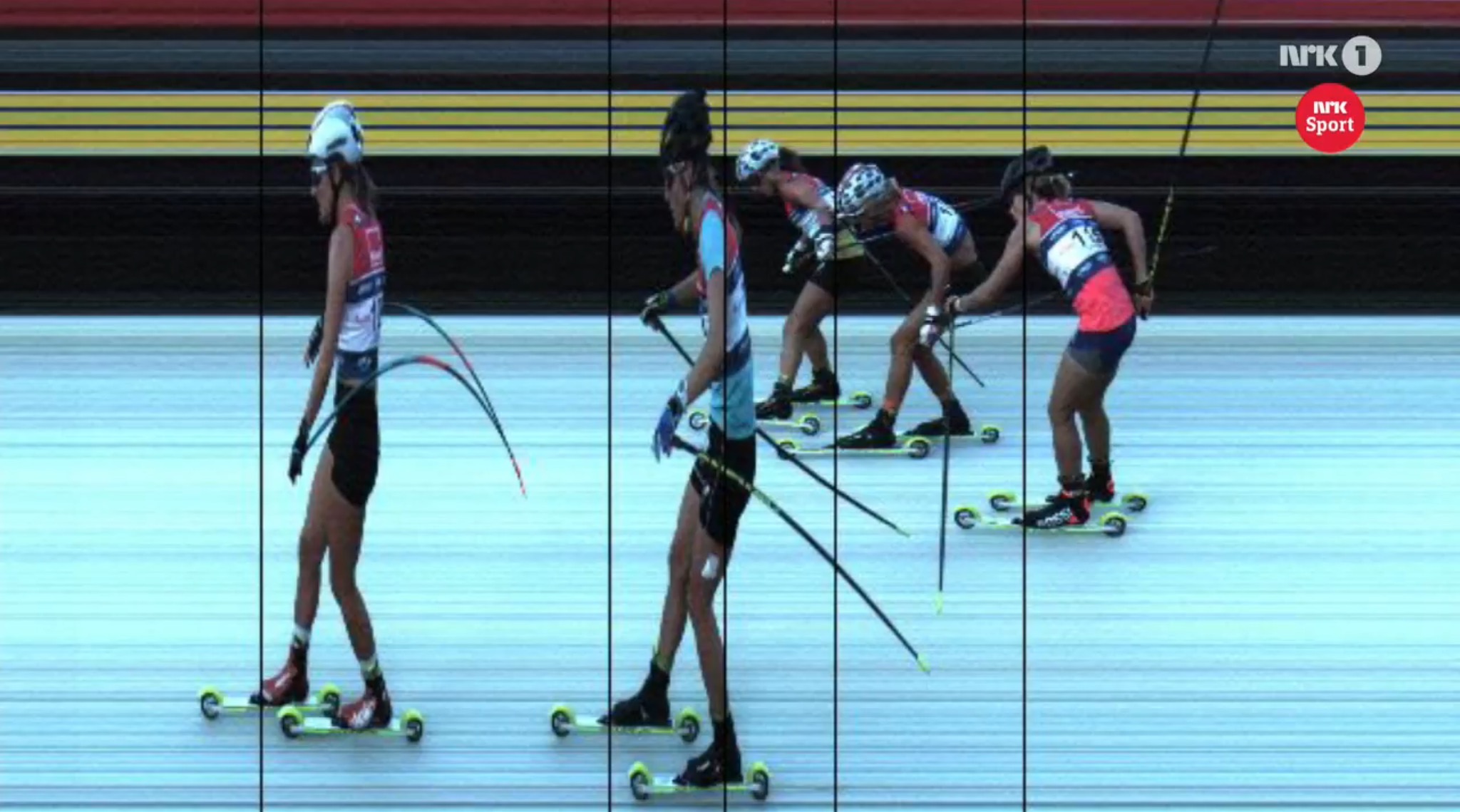
In a true photo finish (left to right) Norway’s Barbro Kvaale won the women’s sprint on Day 2 of the 2017 Toppidrettsveka rollerski mini tour in Trondheim, Norway, ahead of Sweden’s Linn Sömskar in second, Norway’s Heidi Weng in third, Norway’s Kathrine Rolsted Harsem in fourth, and Switzerland’s Laurien Van Der Graaff in fifth. (Screenshot: NRK broadcast)
The women’s sprint final went to Norway’s Barbro Kvåle in a time of 2:46.04, who placed sixth in the final the day before. She edged Sömskar by just 0.08 seconds and Weng was another hundredth of a second back in third (+0.09). Harsem placed fourth (+0.25), and Switzerland’s Laurien Van Der Graaff, who led until the final meters of the race, finished fifth (+0.37). In the overall standings, Weng spent the night in the lead, ahead of Sömskar, Jacobsen and Harsem.
Day 3: Trondheim Pursuit/Mass Start
The mini tour concluded Saturday with classic races in Trondheim. However, with a smaller field of 37 athletes for the last women’s race, the points collected in the prior three events were not converted into time gaps before the final stage. Instead, athletes started together for a 12-kilometer mass start and the overall results and time back from the winner were computed after the race.
In rainy weather (with many of the spectators sporting ponchos), the short-sleeved athletes persistently circled their laps around the city course. The top group got smaller and smaller, and after 7.5 k, only 10 women remained within three seconds of the lead. That group dwindled to six by the finishing stretch, where Haag outlunged Jacobsen by 0.2 seconds for the win and Sömskar crossed another 0.4 seconds back in third (+0.6). Three Norwegians followed, with Harsem in fourth (+1.2), Weng in fifth (+1.5) and Lovise Hemdal in sixth (+2.0). Fifteen seconds later, Kvåle in seventh (+16.7) led the next four finishers across the line.
After computing the overall Toppidrettsveka standings, Weng was deemed the winner for the second-straight year. Sömskar placed second, 34.1 seconds back (she only had one weaker stage in the long mass start where she finished 11th, almost six minutes behind Weng), and Jacobsen was just another 1.6 seconds back in third (+35.7). Harsem finished the tour in fourth (+46.7), and Haag placed fifth (+59.5).
“I was impressed with myself actually,” Weng told NRK in a finish-line interview, according to a translation. “That I managed to keep up so well despite some very stiff arms … I don’t know if I am on a better way than last year, but yes, I feel really quite good.”
On the conditions, which Jacobsen called “dangerous“, Weng was pleased everyone played it safe.
“We took it very easy, and it was good that we all kept it a bit safe, there were some very slippery spots, but it went well,” Weng said.
With more in the men’s field, the men raced a 15 k pursuit, with Halfvarsson starting first, 12 seconds ahead of Klæbo in second, and 50 seconds ahead of Cologna in third. Trøan left the gate 1 minute back and Brandsdal started 2 seconds later.
Despite the heavy rain, which had worsened since the women’s race, Halfvarsson increased his lead on Klæbo. By 5.1 k, the Swede was more than 40 seconds clear of Klæbo, and Cologna came through the checkpoint 1:13 back. Having to ski through puddles of standing water at times, Halfvarsson extended his lead on Klæbo to over a minute by 11.2 k. Another 30 seconds behind Klæbo, Northug led a large chase group of about 20 racers after the pack had caught Cologna.
Halfvarsson held his comfortable lead through the finish, completing the final stage in a time of 34:08.4 for the overall victory. Klæbo had to fight a lot harder to hold onto second place, crossing the line 1:14.7 back and only a few meters ahead of the chase group. Northug outlasted the pack in a finishing sprint for third place (+1:18.5), while Bransdal missed the podium by half a second in fourth (+1:19.0), as did Niskanen in fifth (+1:19.0) and Trøan in sixth (+1:20.0).
“Today, it was pretty easy,” Halfvarsson told NRK, according to a translation. “I had the goal to go out hard, and knew I was going to get it when Johannes had problems to follow.”
“[My] days are over, there is a new kid in town,” 13-time world champion Northug said in English in a finish-line interview with NRK, referencing Klæbo standing next to him.
“He is the one who is absolutely the fastest of all of us,” Halfvarsson agreed in his interview with NRK when asked about the upcoming season. “Petter will be strong if he can find the shape for the winter, but it’s Johannes who I fear the most.”
“He is just saying that,” Klæbo told NRK. “I think there are many Norwegians that are going to go fast this winter.”
The best time of the final stage was posted by Great Britain’s Andrew Musgrave in 33:33.8, while Halfvarsson’s time ranked 25th. Musgrave finished eighth overall (+1:20.4).
For the stage, Newell placed 53rd and Bolger 64th. Overall, Newell finished the tour in 56th (+2:28.7) and Bolger placed 67th (+3:01.2).
The 2015/2016 U.S. Nordic Ski and Nordic Combined teams during a team photo shoot in their new uniforms on Monday, Oct. 19, in Park City, Utah. (Photo: U.S. Ski Team)
Over the last two weeks, the U.S. Ski Team and many of the nation’s top skiers have been hitting the hardtop and trails around Park City, Utah, intent on getting in quality training sessions at altitude before heading off to on-snow camps. The area’s consistent fall weather and training opportunities, including the rollerski loop at Soldier Hollow, make this camp an annual team staple.
Many of the country’s most competitive nordic skiers outside the U.S. Ski Team (USST) are also in Park City, drawn there by the opportunity to train with the team before it heads to Europe for the start of the World Cup in late November.
USST Head Coach Chris Grover estimated there were slightly more than 30 athletes at the camp, with all 16 national-team members, plus skiers from the National Training Group, Alaska Pacific University (APU), the Sun Valley Ski Education Foundation (SVSEF) Gold Team, Stratton Mountain School (SMS) T2 Team, and the Craftsbury Green Racing Project. On the phone earlier this week, Grover expressed excitement about a, “nice mix of some younger guys and some veterans, and top club athletes and the national team.”
The U.S. Ski Team trains on the Olympic trails during its annual fall camp at Soldier Hollow in Midway, Utah. (Photo: U.S. Ski Team/Tom Kelly)
Although this is a national-team camp, guest athletes are invited to attend the high-intensity workouts as well as the long, over-distance sessions when the venue safely allows them to do so, Grover explained.
During the first week of camp the focus has been on threshold, some testing and speed workouts, and something called “The Double Pole Project.” Grover described this as a pre-workout video session meant to aid in transferring the athletes’ work in the weight room to lower abdominal engagement in their double-pole technique. Stemming from a plan shared at the World Cup coaches’ seminar in Trondheim, Norway, in late August, the team integrated this into their camp with hopes of seeing this strength technique come through this winter.
After the initial week of mellow, acclimatization-based workouts and technique focus, the second week of training included more intensity. On Tuesday, Grover highlighted that morning’s 6 x 4-minute ski bounding session as one that got both athletes and coaches excited. Whether it was the sun beaming down or the lower elevation training site in Salt Lake City, the first full-group, high-intensity workout of the camp went off without a hitch, he said. It also provided a preview of the intensity coming at the end of camp: a three-day rollerski mini tour starting on Sunday.
U.S Ski Team members Andy Newell and Ben Saxton training in mid-October on the Olympic trails at Soldier Hollow in Midway, Utah. (Photo: U.S. Ski Team/Tom Kelly)
In the past, the USST ended its Park City camps with rollerski time trials. This season, without a World Championships or Olympics, and with over half the the World Cup races being tour-stage events (19 to be exact), Grover and his staff decided to shift from race simulations to stage events.
“We’ve definitely put an emphasis on practicing not only how to manage energy from day to day, but how to recover optimally from each session,” Grover said.
The team saw some success at Norway’s Toppidrettsveka mini tour this summer, with Liz Stephen and Noah Hoffman placing third in the hill climb, but also encountered bad luck with broken poles and several crashes in the last stage of that tour, Grover said. These are the types of mishaps he’s hoping the tour simulations will minimize in races this winter.
The mini tour will start this Sunday, Oct. 25 with a freestyle sprint, followed by a shorter classic mass start on Monday, and ending with a longer freestyle pursuit on Tuesday.
The national team also unveiled its new uniforms this week. L.L. Bean and Craft signed as the team’s clothing sponsors this spring and revealed the new suits and warmups with the team on Monday in Park City. Grover explained the shift to L.L. Bean and Craft as one that’s been “excellent” because it provides a “…uniform that is totally unique to the USA.” He also believes the team will benefit from the wide range of pieces available through these larger companies.
U.S. women’s coach Matt Whitcomb works with Jessie Diggins during rollerski training at the U.S. Ski Team’s annual fall camp at Soldier Hollow in Midway, Utah. (Photo: U.S. Ski Team/Tom Kelly)
The first World Cup is a little more than a month away in Kuusamo, Finland, and aside from D-team rookie Julia Kern rebounding from a slight back injury, the team is healthy, Grover said. Erik Bjornsen has resumed training at full capacity after surgery on his hand and a knee injury earlier this summer.
Team veteran Kikkan Randall recently announced her pregnancy and will be missing this season as a result. Grover was fully supportive, acknowledging her pregnancy as one of Randall’s long-term goals. The timing also worked nicely without a World Championships or Olympics this season. While Randall has been training with the team in Park City, she has scaled back her intensity and shifted toward over-distance and technique training, Grover explained.
Without a major championship on the World Cup calendar this season and a North American tour — the Ski Tour Canada — in its place, domestic competition for the additional start spots is something many U.S. and Canadian athletes are looking forward to. Per the “national quota” regulations of the World Cup, the U.S. will be able to start five additional men and five additional women for the entire Ski Tour Canada, for a total of up to 24 racers.
While Grover said the upcoming mini tour in Park City would not decide those spots, he explained the coaches were using this week’s training sessions to note the fitness of non-national team athletes. However, on-snow results will ultimately determine who receives those Canadian World Cup starts. More on the 2015/2016 World Cup Team selection criteria here.
After wrapping up the mini tour on Tuesday, the USST will leave Utah on Wednesday. Several clubs will head directly to Canmore, Alberta, for an on-snow camp at Frozen Thunder, while others, like APU and its USST members, will head back to Alaska in hopes of getting on snow as well.
The USST will reconvene Nov. 13 to fly to Gällivare, Sweden, where they’ll hold a camp and compete in a couple FIS races before traveling to Kuusamo for the World Cup openers.
***
About the Author: New to the FasterSkier team, Jeremy has been involved in many facets of the ski community since he began ditching middle school to go skiing. When not daydreaming of the Birkie, he finds time to explore the fishing and trail-running opportunities of his new home, Seattle, Wash.
Jørgen Grav of the University of Vermont racing in an Eastern Intercollegiate Ski Association (EISA) race. (All photos courtesy of Grav)
The 2015 Blink Festival brought many of the world’s best cross-country skiers together for three days of rollerski racing in Sandnes, Norway. But the festival is much more than just a race for World Cup level athletes. There are open races for junior athletes ages 11 to 20, as well as opportunities for those with low enough International Ski Federation (FIS) points to race against the best seniors in the world.
Anyone can try to sign up for the high-caliber race series, but because it has grown to be so popular, the 150 athletes with the lowest FIS points get chosen for the senior races. This year, one of them was 23-year-old Jørgen Grav of the University of Vermont (UVM).
Grav was born and raised in Oslo and is training at home in Norway for the summer before his senior year at UVM. He lives just five minutes away from the Holmenkollen ski jump and works at a nearby boat-classification company that certifies and insures large ships. He has an agreement worked out with his employers where he gets a week off every three weeks or so in order to more effectively train for his senior year of college racing. His work schedule also gave Grav an opportunity to compete in this year’s Blink Festival.
He began the festival with a strong showing in the Lysebotn Opp. He finished 45th in the 7-kilometer uphill rollerski race, ahead of household names like Petter Northug and Finn Hågen Krogh. The UVM Catamount described the location of the race in Lysebotn, located at the end of a fjord, as one of the prettiest places in Norway.
The men begin the climb during the Lysebotn Opp.
“[The race] starts at sea level and it literally goes straight up for 640 meters and it has 27 switchback turns. It goes through 1.1k of tunnel, and the first k is completely flat. So it’s basically all that climbing in 6 k,” Grav said in a recent phone interview. “At least we do it on number 1 wheels, because it would be brutal on number 2 wheels.”
The fastest racers in the Lysebotn Opp, Finland’s Matti Heikkinen, Russia’s Alexander Legkov and France’s Maurice Magnificat, manage to V2 the entire climb, which has an average incline of 10 percent. Grav was able to V2 most of the race, but had to take a few breaks and switch to V1, he said. His effort was good enough to put him within five minutes of the leaders and shatter his personal record from three years earlier.
“I finished at least two minutes faster than what I did three years ago so I am super happy about that and anything less than five minutes behind those guys up a tough course like that you should be satisfied with,” Grav said.
Friday and Saturday brought two more days of rollerski racing and other events in downtown Sandnes. One such event was the shooting duel, a range-focused event for the biathletes where they run about 10 meters to the shooting mat, shoot five targets as quickly as possible, and then run 10 meters back to the finish. The event goes quickly, with the winning times for both the men and the women being under 20 seconds.
“Its really entertaining; it’s good TV I think,” Grav stated about the shootout format.
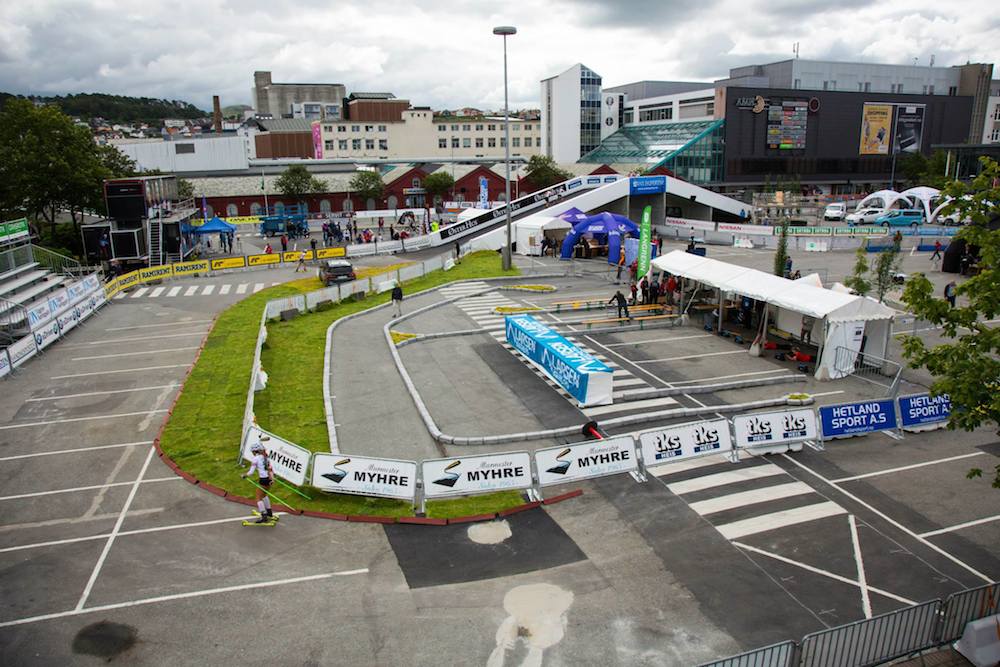
A part of the race course in Sandnes.
For those who attend Blink in person, like Grav, there are some added perks. The festival has a VIP tent with live music and bleachers set up all the way around the 900-meter course so spectators can enjoy the action. The organizers even temporarily pave part of a pedestrian-only street so the race goes right by the fans. They also add bridges and turns to keep it exciting for spectators.
Because of the tight course setup, Friday’s mass start could only accommodate 30 racers. World Cup skiers get a free pass to the final, but the rest of the participants have to qualify with a short, two-lap race to determine the remaining spots. There were only 12 available, and Grav finished 15th, missing the final by seconds.
“I wish [the World Cup skiers] all had to race the qualifier so we all had the same chance, but I think it’s good in a way because then in creates more exposure [for the sport] on TV,” Grav said.
He had strong races on Thursday and Friday, but met some trouble in Saturday’s sprint qualifier — and he wasn’t alone. Rain poured down all day, making an already technical course very slippery.
“I was way off. I couldn’t ski properly and I think a lot of people just didn’t want to race because it was not safe,” Grav said about the sprint. He finished 30th in the preliminary round, but much like the mass start, some spots in the heats were reserved for World Cup athletes who bypassed the qualifier. As a result, Grav’s 30th place was not enough to put him in the heats.
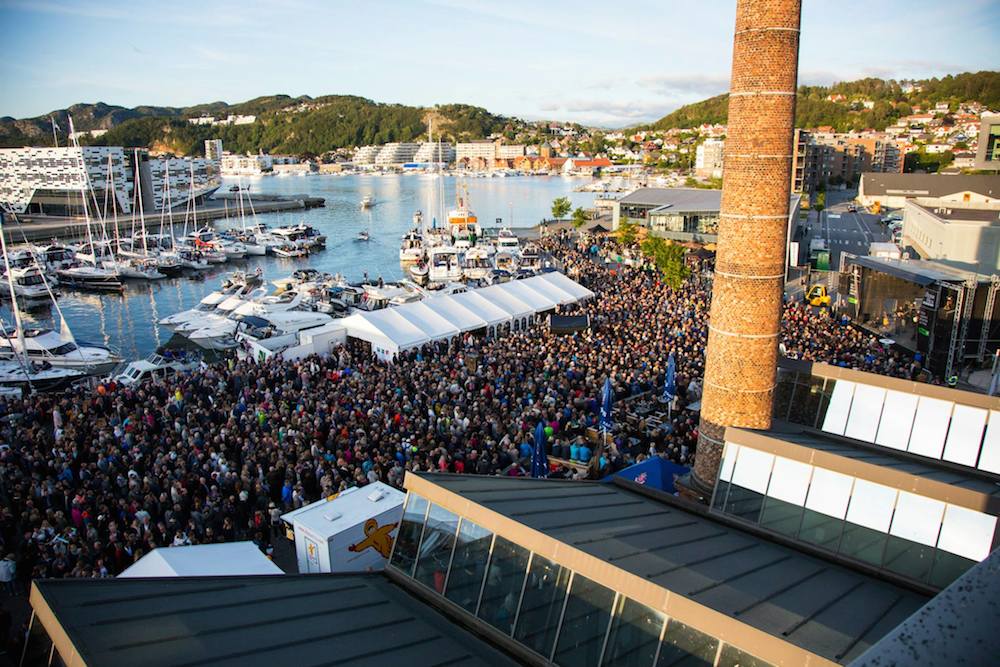
A look from above at a concert during the festival. (Photo: Jørgen Grav)
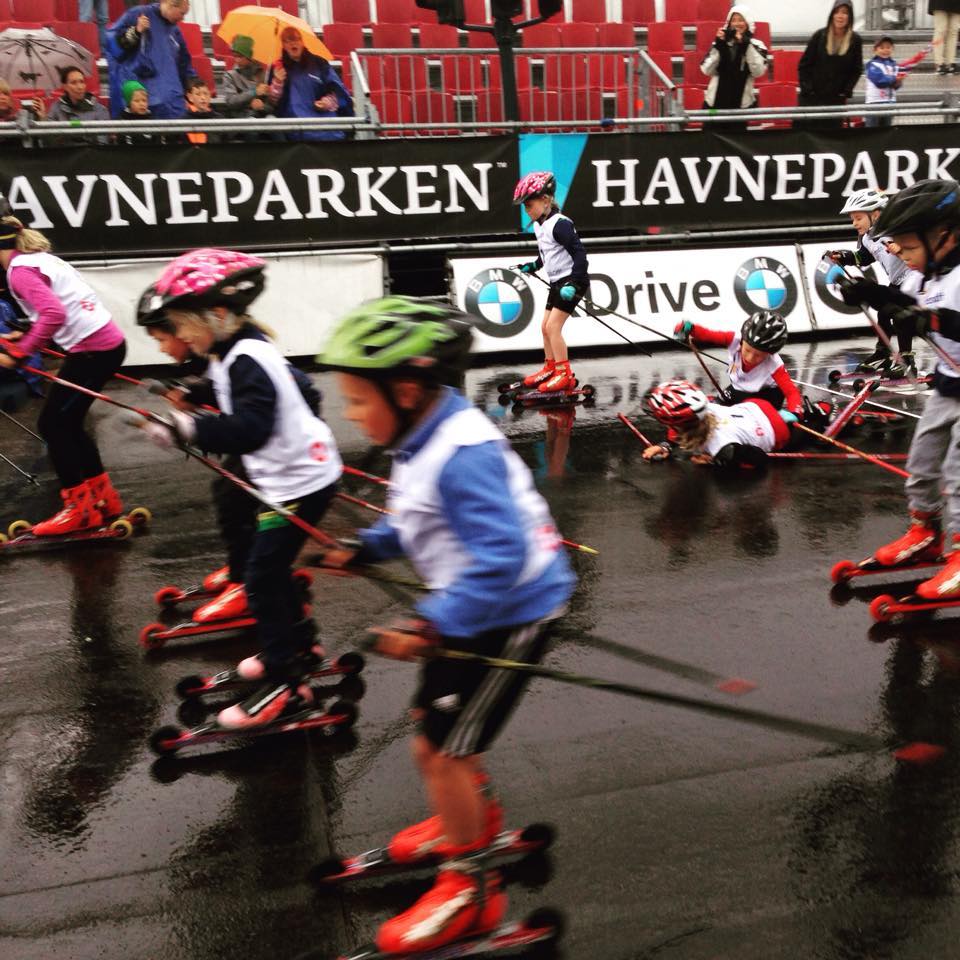
Though there are many things about Blink that Grav enjoyed, he said the kids in attendance were one of the highlights. They all get a chance to race, and then they stay to cheer on their idols and get autographs.
“They love standing around outside of the finishing area and are up in your face for getting you to sign their bib number or their autograph book and everything,” Grav said. “You feel like a real celebrity. It’s super cool.”
The energy from the spectators also impressed the incoming college senior, though at a rollerski festival in Norway, he didn’t expect much less.
“It feels like a festival with people that love skiing,” he explained.
Grav also attended last week’s Toppidrettsveka, where he finished 41st overall. He said feels he is in his best shape ever because he has been able to focus on his training and has a fast group of peers keeping him motivated and setting strong examples. Grav also feels he has made some promising technique changes this summer.
“I’ve been switching more over to increased double poling in my training which is the development of the sport right now, more upper body strength,” he said. “I think that is going to be a big thing this winter.”
Looking ahead to this winter, his main goal is to place in the top three at the 2016 NCAA Skiing Championships in Steamboat Springs, Colo. Last season, Grav finished ninth in the 20 k classic mass start.
Some kids racing at the 2015 Blink Festival.
As for after college, Grav plans to continue skiing. He will try and reach one of the recruit teams for the Norwegian National Team and then ultimately hope to get selected to the team. Grav knows it’s a tall order, but as long as he continues to love skiing, he sees no reason to end his career.
“It’s the toughest country in the world to get on the national team so its definitely a commitment to get all the way there, but as long as I have the motivation in the spring every year to start up a new year then I am probably going to keep going!” Grav said.
Kikkan Randall (pink helmet) double poling through the lap. (Photo: USSA)
The Toppidrettsveka race festival wrapped up yesterday with a 15 kilometer classic pursuit in downtown Trondheim. 30,000 to 40,000 people lined the 3.7 k lollipop-shaped course. The first and last kilometer were a flat 1 k long section that the race went out and back on, while the middle 1.7 k section featured a steep uphill that tapered out before the summit and a technical downhill that even involved jumping on and off of the sidewalk after a sharp corner. The course made for an excellent test of double pole proficiency and quick, efficient climbing ability.
According to Jessie Diggins, it also felt like a World Cup. “The course was lined with people, music, cheering and cameras everywhere so it was a real world cup atmosphere, that’s for sure!”
The U.S. Ski Team women again made an impression with some strong results to finish off the race series. Diggins had the most impressive day, making up 15 seconds and 10 places to finish in 10th overall.
“I felt much better than I expected after 3 races in two days, but sometimes I feel like I get stronger throughout the tour,” Diggins wrote in an email.
Diggins’ teammate Kikkan Randall also had a strong day, managing to finish only one spot behind her starting position in 11th, despite falling and breaking a pole at the top of the final climb. After a consistent week with an especially strong skiathlon, the decorated sprinter is feeling good about where she is with her form.
“I feel satisfied that I got what I came for and that was a good gauge of where my fitness stands against other top World Cup skiers. It was so great to go through the full race routine multiple times, something we should do more often in the summer I think,” Randall commented.
Norwegian Heidi Weng wrapped up a very successful week with another strong day, expanding on her 47 second lead and winning the Toppidrettsveka stage race by 1:14.2 over her teammate Therese Johaug.
“It has been three wonderful days here with three wins. I’m very pleased that I managed to stay away. The aim was to keep the throttle down all the way so that Therese would not take me in,” Weng told Langrenn, according to a translation.
Another Norwegian, Kathrine Harsem, rounded out the podium in third, 2:15.2 behind Weng.
The USST women do some classic rollerski training earlier in the week in Aure. (Photo: USSA)
Liz Stephen, Sophie Caldwell, and Caitlin Gregg also had strong days for the USST, finishing in 15th, 16th, and 24th overall. So all five United States women were in the top 25 for the festival. Caldwell was particularly pleased with her race, as her energy returned after a tough skiathlon.
“I felt significantly better than yesterday and was able to do almost the entire race with a big pack of girls,” she wrote.
If not for a fall at the beginning of the last uphill, Caldwell might have been even further up the results list.
For Stephen and Gregg, who tend to be stronger in the skate discipline, the final stage was a learning experience. Both are coming away from the week knowing that their fitness is in a good place, and also with a good idea of how they can improve their double pole and be even faster come winter.
Double pole strength and technique is something USST Head Coach Chris Grover had a feeling the team could use some work on coming into the week, and the race series showed that to be true.
“We knew double pole strength and technique was an issue for many of the USA skiers and indeed we saw the deficiencies up close the past 3 days,” Grover explained in an email. “The Norwegians have so many athletes with excellent double pole technique, power, and endurance. As a nation, we need to work harder to close the gap.”
Unlike the women’s pursuit that had large time differences at the start, the men’s pursuit went out with small gaps between many of the racers. Starters 9 and 39 had only 22 seconds separating their start times. This gave the North American men a chance to get into the top 10 during the pursuit, as throughout the race there was a large pack featuring positions 6 through 21.
American Andy Newell was the one North American who was able to stay with the large pack for most of the race. After ascending the final climb with the group, he was in a great position for the double pole into the finish. Unfortunately, he was bumped into the boards on the final downhill and broke both his poles in the crash. After limping to the finish line, Newell finished in 57th.
Still, Newell was very pleased with his effort.
“Overall I’m stoked because fitness feels good despite doing a ton of hard training this time of year,” Newell explained.
Andy Newell (yellow helmet) double poling in front of a crowd. (Photo: Andy Newell)
Off the front of the large pack for much of the race were Petter Northug and Calle Halfvarsson, who struggled to work together and ended up skiing on their own, and the lead pack of three Norwegians, Simen Østensen, Didrik Tønseth, and Eirik Brandsdal.
Østensen and Tønseth skied away from Brandsdal over the top of the steep section of the hill on the final lap and then finished in first and second, separated by only 0.6 seconds. Brandsdal held onto his third place position, finishing 38.8 seconds behind Østensen.
“It’s a very good feeling, especially with the atmosphere as amazing as it is here,” Østensen told Dagbladet about his victory, according to a translation. “I knew that I was good in a sprint [with Tønseth], so I’m not really surprised. But it is gratifying to see that I am in such good shape.”
USST member Simi Hamilton finished in a sprint with Canadian Devon Kershaw; the pair finished in 32nd and 33rd. Hamilton, like Newell, was able to catch and ski with the large pack, but broke a pole on the second lap right before the downhill and lost the group since he was unable to get a replacement pole for a few minutes. Regardless, Hamilton managed to maintain a good effort the rest of the way.
“As soon as I got one of my spares and calmed myself down a bit, I was able to put together a solid second half of the race and dig deep all the way across the line,” Hamilton wrote about his pursuit race.
The final North American racing was Noah Hoffman. Hoffman was the 11th starter off the line, but he was unable to stick with the pack and finished the Toppidrettsveka in 52nd.
“I was having a very hard time matching the pace of the other skiers, especially in the double pole sections,” Hoffman wrote. “Double pole has always been one of my biggest weaknesses, but yesterday in particular I felt like I was struggling even more than I have in the past… I feel like I have a lot of work to do before the season.”
Final Impressions
For the U.S. Ski Team, it seemed that regardless of how the pursuit went, every athlete had an exciting time. The atmosphere in Trondheim is what really made the final race special. Here are some written quotes about the last day from the athletes:
“Racing in Trondheim was incredible! There were so many people lining the entire length of the 4K course… Everyone was really nice and cheered for each athlete by name! It was reminiscent of the Hollmenkollen in Oslo!” – Caitlin Gregg
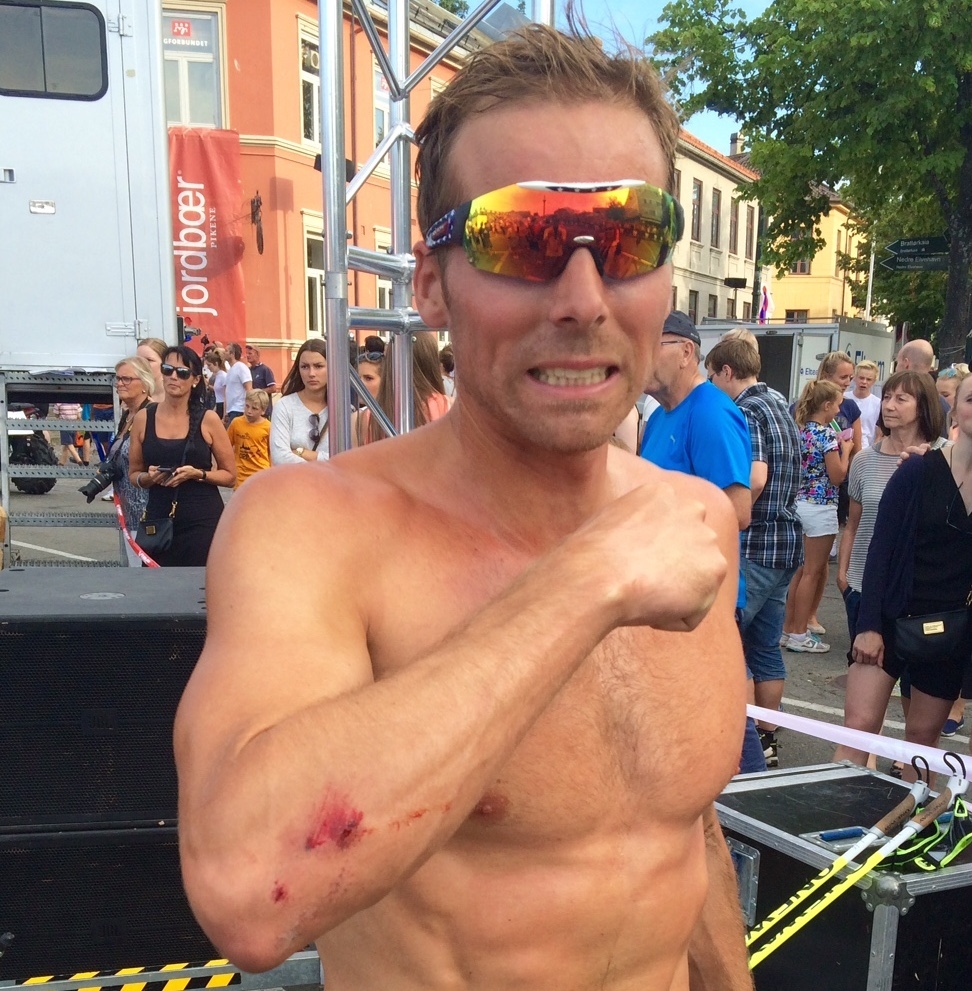
Andy Newell with some road rash after crashing on the final downhill in Trondheim. (Photo: USSA)
“Racing in downtown Trondheim was one if the more exciting ski experiences I’ve ever had. We are used to doing little time trials on roller skis during the summer to prepare but this felt almost like a real word cup with the course lined with spectators and something like 80 guys out there racing.” – Andy Newell
“The atmosphere for all of these races, but especially the last one in Trondheim, was frankly amazing. The fact that there is so much enthusiasm and interest in a roller ski race is mind blowing, even for someone who’s raced in Norway dozens of times.” – Noah Hoffman
As for takeaways from the camp, the USST as a whole is feeling good about their fitness, but definitely excited to improve their classic and double pole strength especially. A big reason the USST attended the Toppidrettsveka was to see how they were measuring up to the competition, something the team was definitely able to do.
“It was incredibly valuable being able to get back into the race mindset and gauge where we are in our training and speed against a field that consisted of a ton of high caliber world cup skiers,” Hamilton wrote about the camp.
Now the team parts ways again to soak up all the training from Norway and spend some time at home. However, they will not be home for long as many will attend the next USST camp at Lake Placid on September 13, where there will also be the National Elite Group, the National Training Group, and various domestic clubs and racers.
Liz Stephen on course in the 15 kilometer skiathlon. (Photo USSA)
After having two races on Thursday, competitors at the Toppidrettsveka festival got Friday morning off to recover before continuing in the afternoon with the third stage, a 15 kilometer skiathlon. Rather than relaxing and waiting for the afternoon, however, the athletes took advantage of the extra time to get in a morning training session. Since so many skiers from so many places are at the Toppidrettsveka festival, many also took the opportunity to train with friends from other countries. “Everyone is training in the mornings before the competitions, which helps keep the atmosphere not so focused on the racing, but rather on it being really good, hard training efforts to prepare us all for the winter,” wrote U.S. Ski Team veteran Liz Stephen. “[It’s] really fun to get the ‘ski family’ back together in the summer.”
When the afternoon came around, the “ski family” continued the competition at the Knyken ski center in Orkdal, Norway. The third stage featured six laps around a 2.5 k loop, making for some exciting racing. Once again Americans had some strong results with Stephen and fellow USST veteran Kikkan Randall both placing in the top 10, in sixth and seventh respectively.
“The start was just like a WC start: HARD from the get go,” Stephen wrote in an email.
The pace did not let up either. The women’s field strung out right from the start as Norwegian Therese Johaug went out strong. That was okay with Randall, who lost some positions early on, but managed to make them up throughout the race.
“I was able to bridge up to a pack in the classic and then one more again in the skate. My strength definitely built through the race,” she explained.
Randall, who had no results goals for the day, was just looking to get in a hard effort, something she definitely managed to do. “I was really satisfied with my effort today, it’s the most I’ve actually felt like a racer in a long time…It was just refreshing to feel like I could push harder today.”
Stephen had a similar race trajectory, as she skied with her teammate throughout most of the classic leg. Randall, who realized her energy was not quite as good as Stephen’s, gave her teammate a little boost in hopes that Stephen could catch next pack. “[Randall] gave me a good push on one of the downhills to try and get me gliding a bit better. Really sweet team moment, for sure,” Stephen wrote.
While she could not quite catch the women in front of her, Stephen did manage to pull away from Randall slightly during the skate portion. “I chased and fought and clawed my way through the classic portion and felt great once I got some skate skis on my feet,” Stephen explained.
The USST athletes practice their ski change in Aure, Norway, earlier this week. (Photo: USSA)
Norwegians Heidi Weng and Therese Johaug, who placed first in each of the previous day’s events, had strong performances, leading throughout the race and breaking away from the rest of the pack during the skate portion. Weng had a bit more energy at the end and managed to out sprint her teammate for the win by 0.6 seconds. Germany’s Denise Herrmann rounded out the podium in third, 40.4 seconds behind Weng.
“It’s great that I have begun to win some now, but that does not mean much. The winter is what matters,” Weng told Dagbladet, according to a translation.
American Caitlin Gregg also had a strong day, narrowly missing the top 10 with an 11th place finish, 1:51.2 back of the winner. The other two American girls at the festival, Jessie Diggins and Sophie Caldwell, took 16th and 28th respectively.
The efforts from Stephen and Randall were enough to keep the U.S Ski Team veterans in the top 10 overall for the race series, as they are in 7th and 10th respectively with 105 and 67 points. Caldwell and Gregg are currently in 13th and 14th overall, and Diggins is in 20th.
On the men’s side, Sweden’s Calle Halfvarsson managed to outsprint Norway’s Eirik Brandsdal for the win in a hotly contested race. Only 9.8 seconds separated Halfvarsson from the 16th place finisher.
Thursday’s Fonna Up winner Didrik Tønseth led the men out of the start and set the pace for much of the classic leg. After around twenty men came into the ski change in the lead pack, Halfvarsson took the lead and upped the pace, stretching the field to begin the skate portion. Still, many of the men were able to maintain the faster pace and stay in contention. Before the home stretch, Brandsdal managed to get by Halfvarsson, but the Swede had a strong finishing kick and edged out the Norwegian in a photo finish. Another Norwegian, Simen Østensen, finished in third, 0.7 seconds behind the winner.
“This was a really fun victory. I did not think I could be fighting for the win today, but right before the end I knew it was going to be between Eirik and me,” Halfvarsson told Langrenn, according to a translation.
USST veteran Andy Newell was the top North American finisher in 24th, 1:09.7 behind the winner. Newell’s teammate Simi Hamilton also finished in the top 30, placing 27th overall with a time 1:11.9 back of Halfvarsson. Slightly further down in 32 and 33 were Canadian Devin Kershaw and American Noah Hoffman, with times 1:24.3 and 1:24.7 behind the winner.
In the Toppidrettsveka overall standings, Hoffman sits in 11th thanks to 60 points from his strong third place in the Fonna Up. Sprinters Hamilton and Newell sit in 30th and 32nd, while Kershaw is in 38th.
The Toppidrettsveka festival wraps up today with a 15 k pursuit in Trondheim, Norway. The final stage takes place on a loop right in the city center, and according to USST Head Coach Chris Grover, around 35,000 spectators will surround the course. As if that was not exciting enough, the course also features fast, technical downhills and steep uphill climbs. It should make for a compelling end to what has already been an exciting week of racing.
U.S. Ski Team member Noah Hoffman (r) racing to third in the Fonna Opp, the hill climb footrace that opened the 2015 Toppidrettsveka in Aure, Norway, on Thursday. Norway’s Didrik Tønseth was first to the top in 28:53.5, and Sweden’s Martin Johansson placed second, 13 seconds back, while Hoffman was 1:02.5 back in third. (Photo: USSA)
The first day at the Toppidrettsveka race festival brought something rarely seen in cross-country ski racing: two events is one day. Thursday morning featured the Fonna Up — a 5.3-kilometer uphill running race that ascended 650 meters — in Aure, Norway, and two Americans were the third fastest to the summit.
Liz Stephen and Noah Hoffman, both of the U.S. Ski Team (USST), placed third in the women’s and men’s hill climb races, respectively, after starting together: the entire field left the start at once.
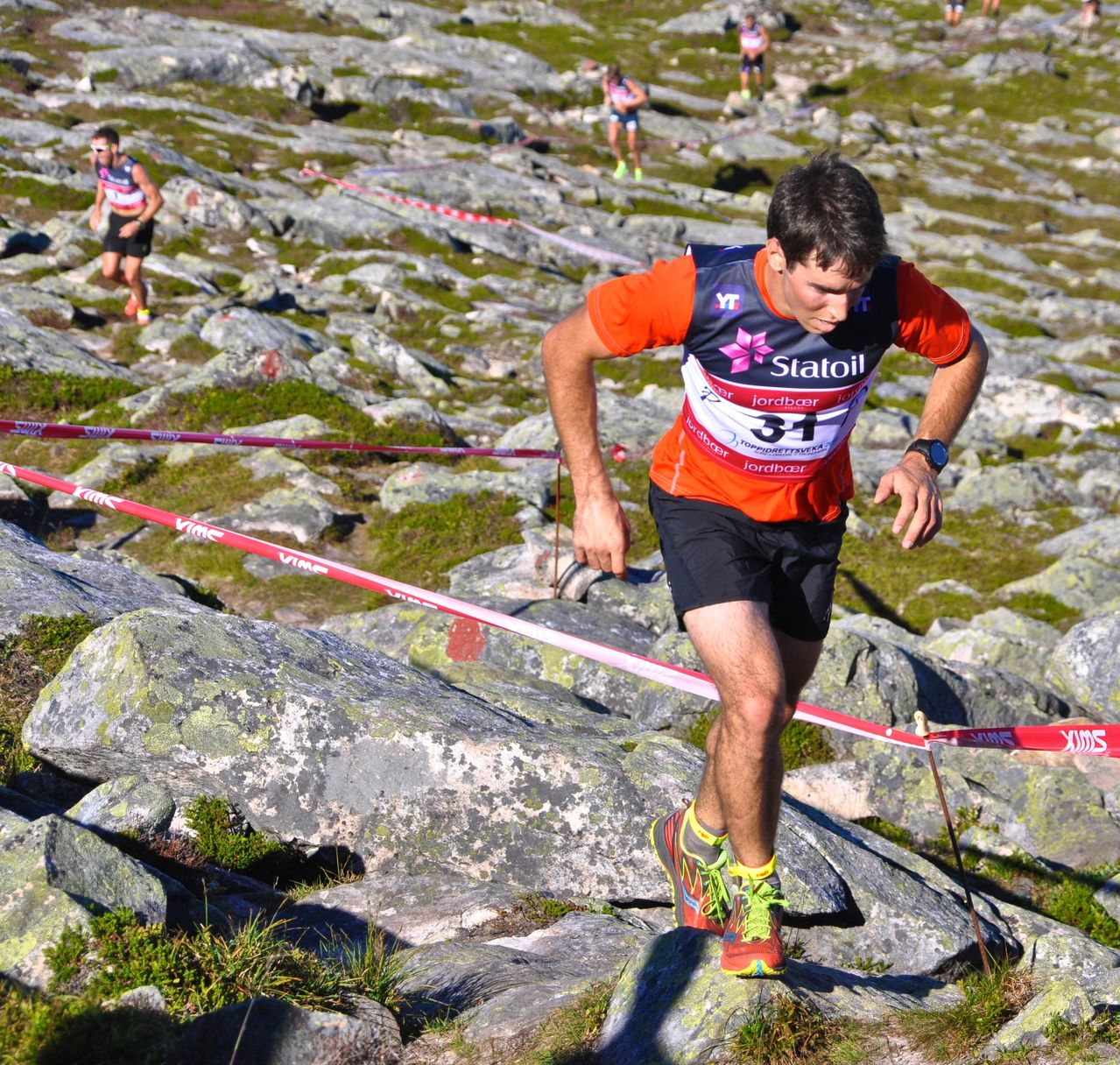
“The hill climb started on a fairly flat/gradual up road for 400 meters or so before taking a hard left hand turn and heading up a steeper pitched gravel road for the first 3k,” Stephen explained in an email. “Then the trail took a left onto a technical and rocky, steep trail for another 2.2k to the top of the mountain.”
Crossing the line first overall was Norwegian climbing specialist Didrik Tønseth with a time of 28:53.5. His effort was fast enough to break the course record by nearly a minute. Thirteen seconds after Tønseth was Martin Johansson, an orienteering competitor from Sweden. Johansson injured his collarbone earlier in the summer in a bike crash, but recovered enough to race to second overall.
Hoffman crested the top third, 1 minute and 2.5 seconds after Tønseth, and 34.1 seconds ahead of France’s Maurice Manificat in fourth. U.S. assistant coach Jason Cork posted a video of Hoffman racing to third; he also posted one of women’s winner Therese Johaug of Norway, who was 10th overall, reaching the Fonna Opp summit as well.
Johaug clocked in at 31:18.8, beating most of the men and finishing more than a minute and a half ahead of second-place finisher and fellow Norwegian Heidi Weng. Stephen was 2:42.3 back in third.
“It’s fun to be here and give the guys a little [run],” Johaug told NRK at the finish, according to a translation. “I’m made for uphills and have always been good at it.”
Johaug also put down a dominating performance in the Storsylen Up earlier this summer, but said she didn’t plan to switch to elite mountain running anytime soon as she remains committed to skiing.
Stephen explained that the race required finding the most efficient route through rocky sections.
“I pushed hard on the road, knowing I would not be as fast on the trail as others, but pushed the whole way, for sure,” she wrote. “I was so nervous before it, so I am happy to have it behind me now!”
The five USA women after the Fonna Opp hill climb (l-r Jessie Diggins, Kikkan Randall, Liz Stephen, Sophie Caldwell, Caitlin Gregg). (Photo: USSA)
After the morning competition, athletes had just enough time to return home, eat some lunch, take a quick nap, and then depart again for the classic rollerski sprints in Aure. All of the USST women competing — Stephen, Sophie Caldwell, Kikkan Randall, Jessie Diggins, and Caitlin Gregg — went on to qualify for the heats, as did U.S. men Andy Newell and Simi Hamilton. Caldwell went the farthest in the heats, all the way to the women’s A-final, where she finished fifth for the best American result.
“I had some trouble pushing through the tired feelings in my prologue,” Caldwell explained in an email. “I was still pretty exhausted from the uphill run and did not feel great, but I was happy to qualify.”
She qualified 21st and went on to edge Germany’s Denise Herrmann in the quarterfinals, advancing in second behind behind Norway’s Kathrin Harsem, the prologue winner. Caldwell was fourth in her semifinal, just ahead of Johaug, and earned a lucky loser spot in the finals.
“I felt significantly better in my quarter final most likely due to the added time to rest and the hard effort of the prologue to wake me back up,” Caldwell wrote. “I knew my strength was the final uphill into the finish, so my strategy was to try to maintain contact with the leaders while conserving as much energy through drafting on the double pole sections and downhills early on. This left me in a good position to attack at the end of each heat and it paid off.
“It was fun to be in a place where I was fighting for the podium,” she continued. “I was really happy with how the day ended up and am psyched to come away with it knowing what I need to improve on before the season starts.”
After winning her quarterfinal, semifinal and ultimately, the final, Weng led a Norwegian sweep of the women’s podium. Harsem placed second and Barbro Kvåle was third.
“It was really fun to win. It is not often that happens,” Weng told Dagbladet after her race.
In the men’s sprint, Norwegian Petter Northug made up for his 81st-place finish in the hill climb (out of 86 men) by finishing first ahead of teammate Eirik Brandsdal. In the morning, Brandsdal finished 50th, nearly 7 minutes behind the winner, while Northug was almost 12 minutes back. Six men comprised the sprint A-final and Simen Lanes rounded the podium in third. His Team Jobzone teammate, Timo Andre Bakken was fourth, national-team member Ola Vigen Hattestad rebounded from last in the hill climb to place fifth, and Simen Østensen (Team United Bakeries) was sixth.
Among the Americans, Randall finished 15th overall after qualifying 18th and placing third in her quarterfinal. The top U.S. female qualifier in 11th, Diggins placed fourth in Caldwell’s quarterfinal for 16th overall. Stephen and Gregg were sixth in their quarterfinals for 26th and 29th, respectively.
Newell placed 15th in the men’s sprint and Hamilton was 39th, after Hamilton finished 13th in the morning hill climb (where Newell was 40th). Canadian Devon Kershaw placed 16th in the climb and narrowly missed qualifying in 34th in the sprint.
“Today was a tiring day to say the least,” Newell told USSA. “I think this is one of the few times in my life when I’ve had to do two races in the same day. I tried to take the uphill running stage slightly easier in order to save some energy for the sprint in the afternoon. It was a tough race but I tried to do more hiking than running on the steep sections in order to save the body. A lot of guys were doing that.”
He also noted that this was the first time that most of the USST members had competed in an highly competitive, international rollerski race.
“It takes a little getting used to,” he said. “I was happy with my energy and my sprint fitness is as good as it ever was last season so I’m excited to keep building. I was close to moving on to the semi finals, but was just on the losing end of a lunge.”
The Toppidrettsveka continues Friday in Orkdal, Norway, with a 15 k skiathlon for both the men and the women, and finishes Saturday in Trondheim with 15 k pursuits.
Andy Newell previewing the uphill running course for this week’s Toppidrettsveka race series. (Courtesy photo)
On Aug. 9, eight U.S. Ski Team (USST) members traveled to Aure, Norway, for the second team camp of the summer. After a successful volume-and-technique-focused, on-snow camp in New Zealand in July, much of the team has switched gears for a dryland camp in Norway, where the emphasis is on the Toppidrettsveka, a three-day race series that a world-class field in attendance.
The event begins Thursday and features four races in three days. It starts off in Aure with an on-foot hill climb in the morning and a classic rollerski sprint in the afternoon. On Friday, the races continue in Orkdal, with a 15-kilometer skiathlon for both the men and the women, and on Saturday the series wraps up with a 15 k classic pursuit in Trondheim. While the Toppidrettsveka is the highlight of camp, it isn’t the only focus for the USST athletes who will have been in Norway for eight days when the races begin.
Andy Newell, Simi Hamilton, Noah Hoffman, Jessie Diggins, Caitlin Gregg, and Sophie Caldwell, as well as coaches Chris Grover, Jason Cork and Matt Whitcomb met up with Kikkan Randall and Liz Stephen in Aure to begin the camp about a week ago. Randall and Stephen had already been in Scandinavia for a few days, taking advantage of an invite to a Swedish national team camp in Vålådalen, Sweden.
“That camp was an intensive few days so I’ve spent most of my time here so far absorbing that load and resting up for the races this week,” Randall wrote in an email. “While we’re still carrying a training load through these races, I’ve been focusing on coming into this series with good energy so I can lay down some hard race efforts.”
The first couple days in Aure brought rain, which has been typical in the region so far this summer. On the second day there was a hailstorm so severe that the team had to take a 45-minute break to let the storm pass. However, since then, multiple athletes and head coach Grover commented on how fantastic the weather has been, helping to make the rollerskiing — which the area is well known for — even more pristine. The pavement is smooth and the roads, with minimal traffic, roll along the fjords making for great terrain in a beautiful environment. It is a good thing too, since the group has mostly rollerskied in order to take advantage of the area.
A couple of kids excited about meeting some USST members in Norway. (Photo: Andy Newell)
Another plus of rollerskiing in Aure: the locals generally respect athletes on the road. Grover and most of the USST members there mentioned that cars leave plenty of space and prioritize the safety of rollerskiers. Many drivers wave at the athletes, and some even take pictures. This is indicative of the skiing culture that persists throughout Norway, something the athletes are excited to get involved in again.
“I’m excited to race, but I’m also looking forward to experiencing the Norwegian cross country skiing culture,” Caldwell wrote in an email. “I think there will be a lot of fans out for the races and it always feels good to come to a place where our sport is so highly thought of.”
The positive culture that exists around nordic skiing in Norway is also something that helps to get some athletes fired up for the season. While elite cross-country skiers in this country often struggle for national recognition, their Norwegian counterparts are celebrities.
“Cross Country skiing is a real, legit job and way of life here, and there is something about the feeling of professionally in it that inspires me and makes it more fun to pursue my goals,” Stephen wrote.
Other national ski teams have been drawn to Norway for the culture and high-profile rollerski races as well, which the U.S. team has taken advantage of. The men did some training with the French men’s national team, and the women skied with some Italians in the area for Toppidrettsveka. For many of the USST athletes, having competitors from other nations also means getting together with friends from the World Cup and meeting new ones who might be there next year.
One night the French men played cards with the Americans, though they did not have much success; Diggins bested them all in a competitive game of spoons.
“Cross Country skiing is a real, legit job and way of life here, and there is something about the feeling of professionally in it that inspires me and makes it more fun to pursue my goals.” — Liz Stephen, U.S. Ski Team member
The strong international showing also means there will be some tough competition for the races, something the U.S. team is looking forward to as a measure of their mid-summer fitness against a World Cup field. That being said, there’s not a ton of pressure.
“It will be great to put a bib on again,” Hamilton wrote. “But I don’t think anyone is looking at these races more than just the simple fact that they are great opportunities for some quality efforts and reminding your body and mind what if feels like to get on the start line and put your body through the [wringer].”
Kikkan Randall showing off her haul during an off day. (Courtesy photo)
As for race preparation, the team isn’t too worried about peaking. While the Toppidrettsveka is highly competitive, the races take place in August and are on rollerskis, so training effectively remains paramount. The important races are still months away.
Regardless, the USST athletes scheduled in a couple easy days before the races to ensure good health and energy. Up until those two days, however, they had been training hard all week. According to Newell, this is normal.
“None of the athletes will be trying to taper or anything for these races,” he wrote. “For everyone it’s all about training this year and improving.”
Skiers like Randall, Hamilton and Newell are looking to ski with the pack while others like Caldwell, Stephen and Diggins are simply looking forward to getting four hard efforts in. That being said, the athletes all seem to share a common goal of getting some practice and rollerski-racing experience, something there is not much of in the U.S..
According to Grover, the USST will also be looking to gauge where their classic skiing is at. One of the team’s goals this year is to improve their classic performances, and the Toppidrettsveka is an ideal event to measure that progress, as all three rollerski races have a classic component. After the series, each athlete should come away with insight on how they can continue to improve throughout the fall, which is one of the reasons they’re racing there.
“It would be awesome to have some good races, but I think more importantly we will come away from this camp knowing where there is room for improvement and having an idea of what each one of us needs to focus on in these months leading up to the season,” Caldwell noted.
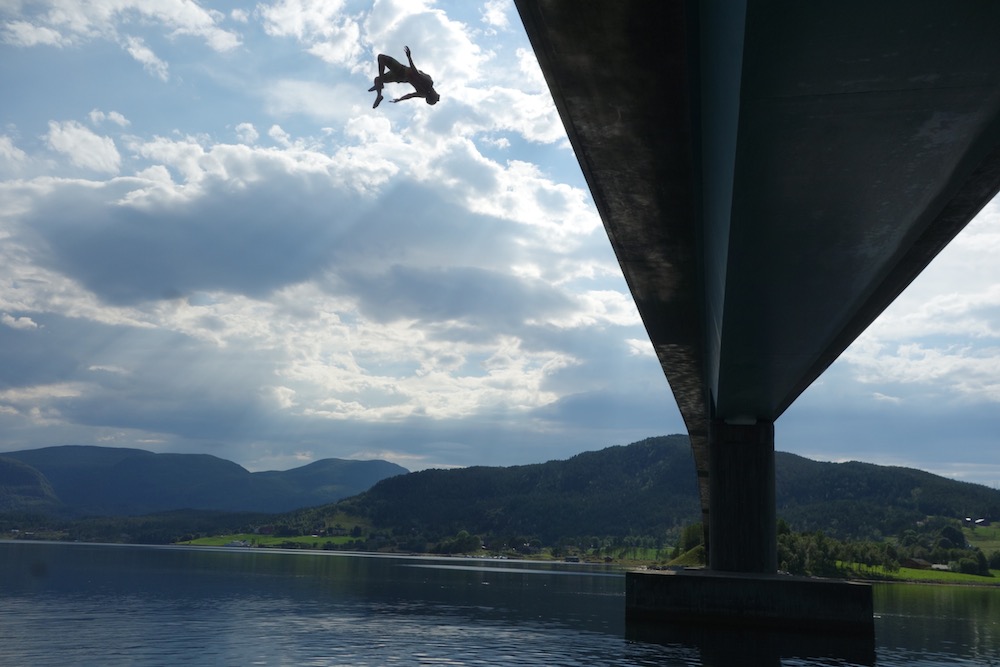
Andy Newell cools off with a backflip into a fjord. (Courtesy photo)
Of course, it wouldn’t be a USST camp if the group were not having a bit of fun as well. On an off day, the team went on a fishing trip that was arranged by the Toppidrettsveka organizers. Many of the athletes managed to wrangle in a catch and were then even given the opportunity to gut the fish.
Another fun highlight for Newell and Diggins in particular has been cooling off in the fjords.
“One of my favorite moments was when we jumped off the bridge into the fjords!” Diggins wrote. “I was pretty pumped on that. I realize that has nothing to do with the training, but sometimes you just gotta live a little!”
The USST women rollerski at Soldier Hollow in Midway, Utah as part of the 2015 U.S. Cross Country Ski Team Spring Camp (Photo: USSA/Sarah Brunson)
Fresh off their first training camp in Park City, Utah, the U.S. Ski Team is taking a new approach to summer camps in the 2015 season. Due to a need for more on-snow training, increased funding from outside sources, and the fact that the upcoming racing season does not feature a major championships, the Americans are trying out a new camp schedule that includes a lot of travel. Increasing their the number of training camps from four to five, the team’s most notable travels will include trips to New Zealand and Norway.
Return to New Zealand
The USST is no stranger to New Zealand training camps. With the exception of 2014 the team has taken part in some form of organized camp at the Snow Farm in Wanaka for many years. For several years prior to 2014, the American trip to New Zealand was solely a men’s camp, while the women’s camp was held at Eagle Glacier in Alaska. For the first time in 2014, both the men’s and women’s on-snow camps were at Eagle Glacier, with Noah Hoffman being the lone USST member to travel to the Southern Hemisphere.
Upcoming USST Camp Schedule:
New Zealand: July 7 – 24
Junior Camp in Norway: August 2 – 15
Norway: August 9 – 24
Lake Placid: September 13 – 20
Park City: October 12 – 28
While the 2014 Eagle Glacier camp was lauded as a success, the team had limited time at the venue and was forced to log many hours of skiing each day to make the camp worthwhile. Although New Zealand has challenges of its own, namely the many hours of travel it takes to get there, it allows for more on-snow time over the course of two weeks. Because the team missed its typical spring skiing in Bend, Ore. this year, coaches decided their skiers needed more midsummer snow time than usual.
“We really felt like that it was critical for us to get a little bit longer on-snow opportunity than we had in the past few years for a lot of these guys simply because we missed Bend and the on-snow time we would have logged at Mt. Bachelor,” USST Head Coach Chris Grover said of the choice to return to the Southern Hemisphere. “We chose to go to New Zealand instead to get a little more skiing over a longer period of time, which is more viable down there.”
Both the A- and B-teams will travel to New Zealand July 7 and remain until the 24. The Alaskan members of the team (Kikkan Randall, Rosie Brennan, Sadie Bjornsen, and Erik Bjornsen) will not partake in the camp will take advantage of skiing on Eagle Glacier two to three times throughout the summer.
Measuring Up in Norway
The biggest change to the USST summer schedule is the addition of a two-week camp in Norway taking place in mid-August. According to Grover, the camp is something coaches and athletes have talked about for many years. With no championship races in 2016, the USST decided to explore the benefits of a camp in Europe.
The team will have an acclimatization period in Aure for eight to nine days where they hope to train with several local skiers or other European national teams. According to Grover, the USST reached out the Norwegian National Team but due to schedule conflicts the two teams will have no official training sessions together. The U.S. skiers will attempt to train with several individuals on the National Team who live in the area, however.
After the acclimatization period, the USST will participate in the annual Toppidrettsveka rollerski races that take place between Aure, Kynken, and Trondheim from August 20 to 22. The set of three races, which are often attended by the best Norwegians including Marit Bjørgen, Therese Johaug, and Petter Northug, were a major motivation for the Americans to have a training camp in Europe. According to Grover, they will allow the attendees to measure up against the competition at a crucial time in the training season. Furthermore, all three days of racing will feature classic rollerskiing – a technique the U.S. is looking to improve upon in 2015/2016.
“We have a pretty big goal with a lot of the athletes to improve classic technique in particular, especially on the women’s side,” Grover said. “This is an opportunity for us to go and measure our classic technique against the best skiers in the world so people can measure where their double pole is right now, where there striding is, etcetera.”
Marit Bjørgen celebrates her win int he 2013 edition of Toppidrettsveka (Photo: Toppidrettsveka.no)
August 20 – Aure: Uphill running race and classic sprint
August 21 – Knyken: 15 k skiathlon
August 22 – Trondheim: 15 k classic pursuit
Given the American successes in recent years, organizers were eager to have the team compete in the series of races. According to Grover, the trip was made financially viable due to organizers providing lodging, food, and transportation for at least part of the camp.
The final list of participants for the camp is still being confirmed, but several athletes are excited at the prospect of training and racing in Norway. Kikkan Randall, three-time sprint World Cup winner, said she believes the camp is an excellent opportunity for the team.
“Getting in and being able to do some intervals and some racing with World Cup level field really helps me fine tune things and get a good picture of where I’m at,” Randall said. “It increases motivation after a long summer of prep… I think it will be a perfect fit because it’s in August and it will give us a couple months before we go into the race season.”
The remaining USST camps will take place in Lake Placid and Park City. The mid-September camp in Lake Placid will be reduced from two weeks to one week, while the Park City camp will remain at its usual placement in the middle two weeks of October. Both camps will be open to athletes receiving invitations based on National Training or Elite Group status, or other qualifications.
Eldar Rønning speaks to juniors at the 2014 edition of the International Junior Camp. (Photo: Olav Mellingsaeter/FIS)
International Junior Camp in Norway
A- and B-teamers are the only Americans headed to Norway this summer, as a squad of juniors will attend the 2015 International Junior Camp in Norway from August 6 to 14. The camp, which is organized by the Norwegian Ski Federation, will start in Oslo and eventually move to Sjusjøen. The U.S. juniors will arrive prior to the start of the camp to acclimatize and participate in tunnel skiing in Torsby, Sweden starting August 2.
With 120 spots available, the Norwegian Ski Federation invited nations to bring a maximum of 10 athletes and two coaches to the roughly week-long camp. Last year 90 athletes from Germany, Canada, Latvia, Estonia, Slovakia, Iceland, Czech Republic, Slovenia and Norway were in attendance. The 2015 event will mark the first time that American juniors have been selected by the national team to participate in an international training camp of this caliber and size.
The camp will include a high volume of running, rollerskiing, and strength in addition to an uphill running race in Olso and a rollerski sprint race in Sjusjøen.
According to trip-leader and USST Development Coach Bryan Fish the camp will serve several purposes, including the sharing of training philosophies and developments skills. “Most important, is the opportunity to for hands-on learning through physical training with one another,” Fish wrote in an email.
Through a detailed selection process (see below) the USST selected 10 athletes for the event. Nine accepted the nomination and include Katharine Ogden, Julia Kern, Hannah Halvorsen, Hailey Swirbul, Alayna Sonnesyn, Zak Ketterson, Max Donaldson, Lars Hannah, and Karsten Hokanson.
Prioritized International Junior Camp Selection Criteria:
One top 20 women’s / one top 30 men’s result at the 2015 Junior World Ski Championships
One top 15 women’s / one top 20 men’s result at an overall Scandinavian Cup or OPA Cup that has been scored to the USSA National Ranking List (NRL)
One top 10 women’s / one top 15 men’s result in the Junior division at a Scandinavian Cup or OPA Cup that has been scored to the USSA National Ranking List (NRL)
One top 10 women’s / one top 15 men’s result at the Under-18 Nation’s Cup competition (formerly known as J1 Scando Cup Trip)
Qualify for Junior World Ski Championships
Highest ranking on the USSA overall National Ranking List (athletes born on or between 1996, 1997 or 1998)
International Junior Camp Athletes Accepting Nomination:
Women:
Katharine Ogden
Julia Kern
Hannah Halvorsen
Hailey Swirbul
Alayna Sonnesyn
Men:
Zak Ketterson
Max Donaldson
Lars Hannah
Karsten Hokanson
The USST is attending its first International Junior Camp in 2015 because of unique circumstances that allowed for participation. According to Fish, one of the biggest reasons is funding. The National Nordic Foundation (NNF) will aid in the cost of the trip, so that athletes’ and coaches’ expenses are minimal.
A second reason is the increased desire to continue development for young U.S. athletes. Fish wrote that the U.S. will continue to support its domestic programs for up-and-coming athletes, but that more international exposure will aid in future development.
“It is cliché but true that cross country skiers are made in the summer, however there is no better way to learn what and how the best juniors from around the world are training than to join them in a place where the vast majority of the world’s best juniors are at,” he wrote.
“I believe every camp has information each athlete can take home,” Fish continued. “I hope we all come into this camp with open-minds, respective to new ideas. The goal is for each and every one of us to come home with at least a few ideas or strategy (big or small) that can augment and improve personal training and performance.”
AURE, NORWAY – Cross country skier Petter Northug (NOR) leaves Aure and the rest of the events at Toppidrettsveka. Northug completed two of four events.
Toppidrettsveka started out as an elite Norwegian week of competitions, camps and challenges that evolved into an international week of camps and competitions in the northwest part of Norway. The past two years it has featured World Cup roller ski events, and this summer acted as test events for the rollerski World Championships next year.
The reason for leaving is that Northig doesn’t want to take any chances with his training program in the important World Championship season, on home turf this time.
After talking to national team coach Morten Aa Djupvik, Northug concluded that two events at Toppidrettsveka was enough this time. “I think Petter has had enough hard workouts for a few days, and doesn’t want to risk anything. That’s why he skips the last two events this weekend. He will start preparing for the national team camp in Seiser Alm/Livigno at the end of August/early September,” says Djupvik.
Northug will do VO2max testing at the Olympic development center in Oslo (Toppidrettssenteret) as well as some presentations for the National Ski Association (Skiforbundet) the coming week.