From the FasterSkier archive — posts syndicated from athletes’ and coaches’ own blogs between 2004 and 2012, kept online as published. Current coverage is at fasterskier.com.
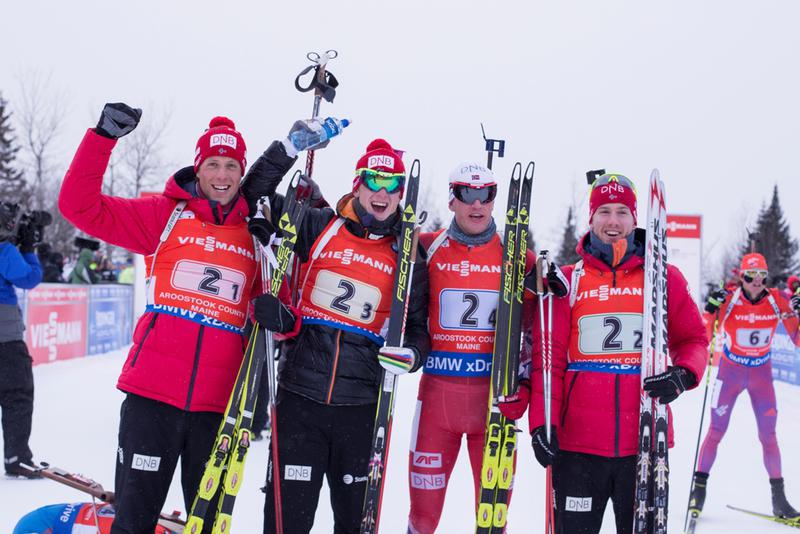
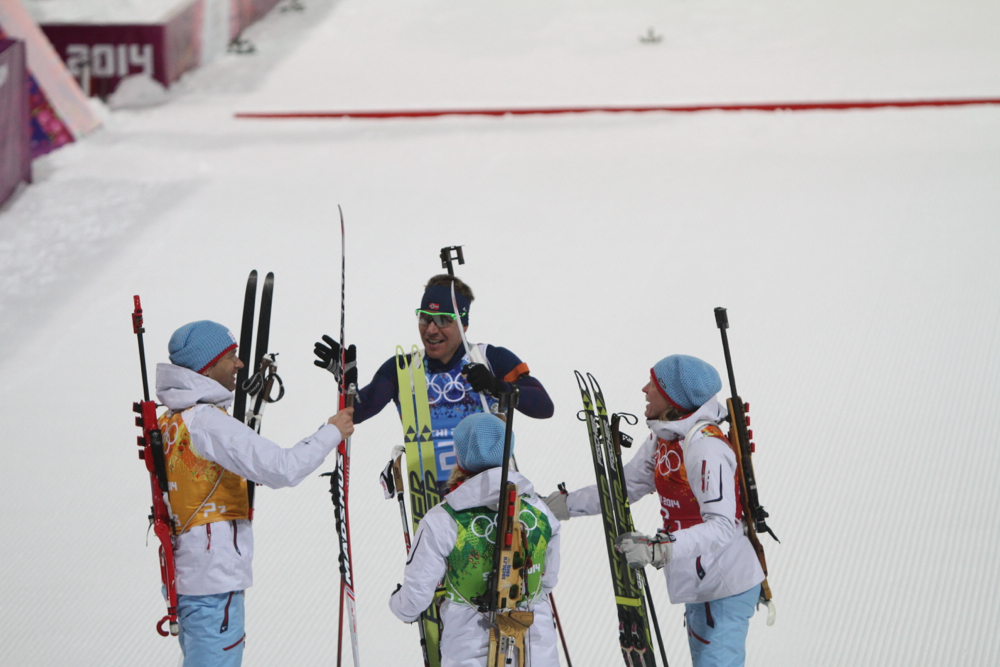
Norway won the men’s 4 x 7.5 k relay at the 2016 IBU World Cup in Presque Isle, Maine, with (from left to right) Lars Helge Birkeland, Johannes Thingnes Bø, Tarjei Bø, and Erlend Bjøntegaard. (Photo: IBU/NordicFocus)
The Norwegian biathlon team is coming off of a high note last season, when they hosted World Championships in Oslo and saw gold-medal performances from Tiril Eckhoff, Johannes Thingnes Bø and both its men’s and women’s relay teams. The legendary Ole Einar Bjørndalen also picked up an individual silver medal to add to his collection.
The team’s task now is about keeping up the intensity and building towards the 2018 Olympics in PyeongChang, South Korea. One target metric: to have both its men’s and women’s teams ranked in the top two at the end of the year.
Last season, the Norwegian men won the Nations Cup and its women ranked seventh.
“This will probably, to some degree, become a sort of ‘in-between’ season,” Norwegian Biathlon Association President Erlend Slokvik recently told FasterSkier on the phone. “But athletes that didn’t perform as well as they had wanted will probably be extra motivated to do well this season. There was also a bigger focus on peaking in the World Championship [last season], because being part of one in your home country is sort of like an Olympics.”
Erlend Slokvik, president of the Norwegian Biathlon Association (NSSF). (Photo: NSSF)
Slokvik was elected president in May after having served as first vice president for the last eight years. He coached the Norwegian biathlon teams from the spring of 2000 to the spring of 2002, during which time the Norwegians won eight medals at World Championships and six medals at the Olympic Games in Salt Lake City, Utah.
After his election, Slokvik emphasized that having the world’s best biathlon team was important in order to attract sponsors, continue good recruiting and development of top-level athletes. He wanted to focus especially on coaches’ education and the development of new biathlon arenas to help towards this goal.
While biathlon is already a very popular winter sport in Norway, the federation is also aiming to build from its grassroots and development levels after Oslo.
“We have noticed a greater interest to some degree, but biathlon has been a popular sport for a long time, one of the most popular in the country, so there is a limit to how much of an increase we can see,” Slokvik explained. “But there has definitely been an increase, which is something we see in, for example, ticket sales for World Cup events … There is good recruiting in many places and the World Championship definitely contributed to that. We did a recruiting tour in connection the championships, which Tora Berger among others were part of and this definitely had an effect on recruiting.”
While the usual suspects are expected to contribute to the national-team results this season, there are opportunities for newcomers, like Marte Olsbu, who had something of a breakthrough at the Oslo World Championships, finishing seventh in the mass start and turning in strong legs in the mixed and women’s relays.
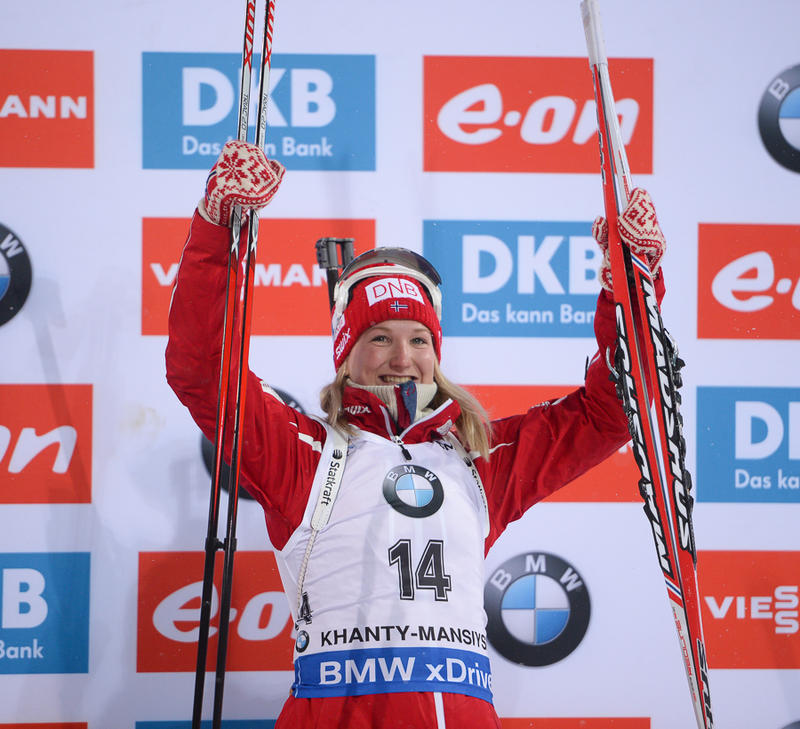
Norway’s Marte Olsbu celebrates her first IBU World Cup podium after placing third in the women’s sprint last March in Khanty-Mansiysk, Russia. (Photo: IBU/Evgeniy Tumashov)
“In the men’s team, we have the ‘big four’ (Emil Hegle Svendsen, Bjørndalen and Tarjei and Johannes Bø) whom we expect to do well, as for the rest of the team we’re hoping that more and more athletes will stabilize on such a high level,” Slokvik said. “In the women’s team we hope that Marte will stabilize on a level close to Tiril [Eckhoff]. She won the sprint and pursuit rollerski national championships, so she is in good shape.”
While the team did almost entirely dryland training through October, it is now transitioning to a new phase.
“A lot of it has been threshold training, and preparation for shooting with an elevated heart rate,” Slokvik said. “Because of that the athletes haven’t done as much high-altitude training and instead spent time in lower elevation. They are in Trysil [Eastern Norway] now training in good conditions. They’ve spent time in France, for example in October, normally they would have spent time [on the glacier] in Val Senales, where they ski in high altitudes, but not this year. This [lower altitude] has allowed for more specific biathlon training, such as skiing with higher heart rate and shooting.”
While the Norwegian biathlon has steered clear of the doping scandals that deeply impacted its cross-country counterparts this summer and fall, those events prompted the federation to review its policies towards medication for athletes.
“We’ve gone through our routines and been clear in our communication with athletes, who have become even more aware of what they should do and not do,” Slokvik said. “Basically we followed already established routines.”
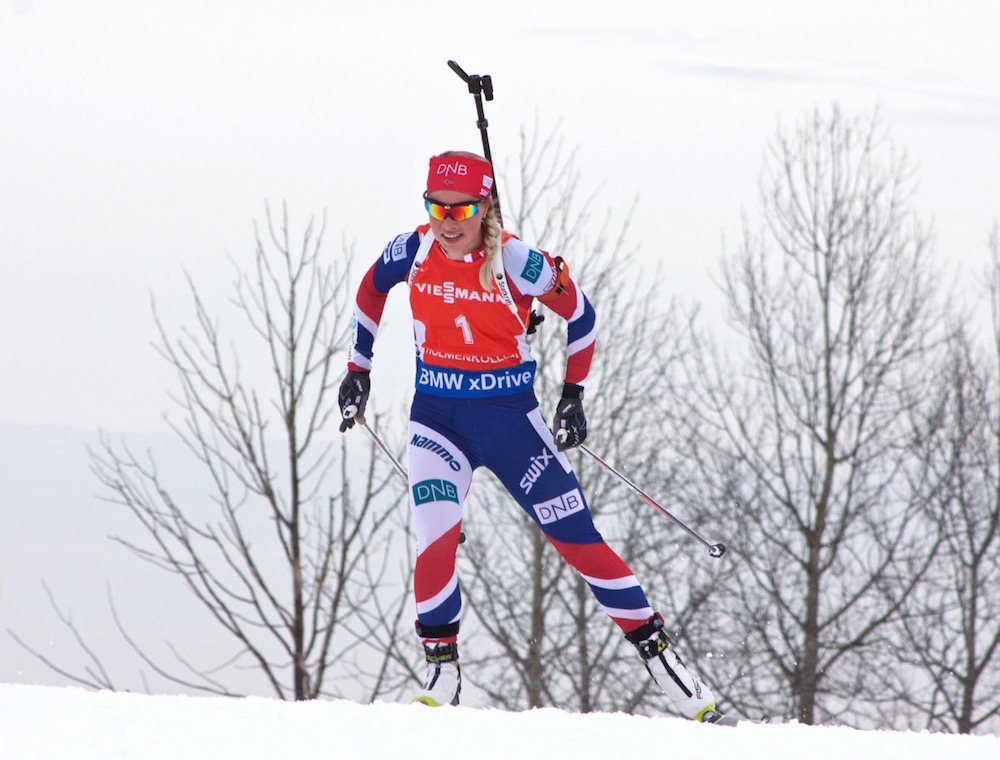
Norway’s Tiril Eckhoff racing to 25th in the mass start at 2016 IBU World Championships in Oslo, Norway. Eckhoff recently told Aftenposten that she stopped taking her asthma medication because she no longer needs it.(Photo: JoJo Baldus)
It has caused some stress and worry: Eckhoff said in an interview with Aftenposten that she has stopped taking her asthma medication. But it’s not because doing so was breaking any rules, Slokvik said.
“Since the news of [Martin Johnsrud] Sundby’s situation and the team’s use of asthma medication, athletes even with a diagnosis have been suspected and she didn’t want to contribute any more to that,” he explained. “Tiril has a diagnosis, but the severity of [her asthma] at the present time isn’t at a level where she wouldn’t be able to function without the medication. If it had, she wouldn’t have stopped taking it.”
The first competitions of the biathlon season are approaching on Saturday in Sjusjøen, Norway. Is the host team primed for improved performances over last year?
If those goals of being one of the top two teams in the world are any indication, it’s likely.
“We feel that this is a realistic goal, and it was set based on past performances,” Slokvik said.
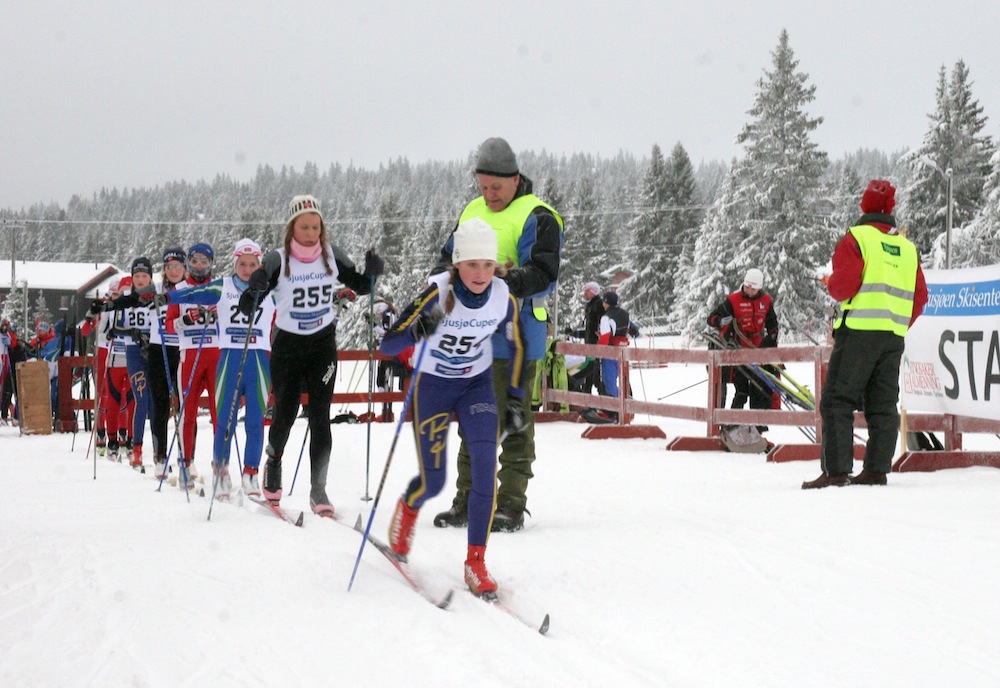
Junior skiers jet out of the start at the Sjusjøcupen, part of the Hedmark state race series in Norway. (Photo: Inge Scheve)
Frode Estil says it’s not how many hours you train. It’s how you train.
The two-time Olympic gold medalist and individual world champion from Norway says skiers are focusing too much on hours at the expense of training quality.
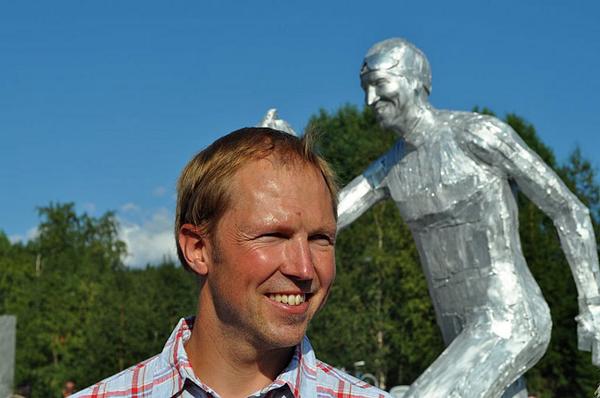
Frode Estil, an individual Olympic and World Champion from Norway, in July after being commemorated with a statue of himself in his hometown of Lierne. (Photo: FIS Cross Country/Twitter)
“I’m afraid focusing too much on logging hours can be counterproductive to the main goal: ski fast,” Estil, 42, told the Norwegian newspaper Namdalsavisa. “How fast you become depends on more than just how many hours you put in.”
Estil, who is currently coaching and teaching at the Meråker ski academy in Norway, blames the media and their excessive emphasis to how many hours the World Cup racers train in a year, as well as coaches and athletes for latching onto the elite skiers’ training programs without critical assessment. Other coaches support him.
Former elite skier Mona Hjellsand, now a coach and coaches’ instructor in the Meråker region north of Trondheim, agrees with Estil. She pointed out that too many training hours can have negative physical consequences.
“Overuse injuries can be hard to heal, and some can last for life,” Hjellsand told Namdalsavisa. “Biathlete Tora Berger has repeatedly harped that you should not train if you feel run down. You should always be in a good flow, she says, and she is definitely onto something.”
She added that focusing on completing shorter workouts with 100-percent attention to the task will increase the training quality.
“It’s important to not burn all your fuel at once,” Hjellsand said. “The younger the athletes, the more important quality is over quantity. The idea is to increase volume over time.”
“The younger the athletes, the more important quality is over quantity. The idea is to increase volume over time.” — Mona Hjellsand, a former Norwegian elite skier who has spent the last two decades coaching in the Meråker region
Hjellsand said that youth and junior coaches have to take their part of the blame for the current trend with extreme focus on logging hours.
“There are still a lot of old-school coaches out there who are focused on training hard and putting in lots of hours. Based on that, I’m really glad that credible resources such as Frode Estil initiate a debate on this topic. It’s an extremely important debate,” she said.
In her opinion, the biggest issue is curbing the drop off and keeping the skiers in the sport.
“When I ask the 16 and 17 year olds why they chose to drop out, the answer is almost always the same. There is just too many training hours, and they’re always tired,” she said. “When the air goes out of the balloon at such a young age, there is something wrong with the way we approach training.”
“When the air goes out of the balloon at such a young age, there is something wrong with the way we approach training.” — Hjellsand
The ski coach, who also travels to visit various clubs and teams and give presentations on training, is certain that the juniors are seeing what they do, and are comparing their own training programs to what the World Cup elite is reportedly doing.
“Skiers such as Marit Bjørgen and Therese Johaug bring the standard for annual volume to a whole new level,” she explained. “The big difference is that these athletes have a support system that takes care of them 24/7. You can’t compare yourself to the full-time elite.
“I’ve seen so many cases where the junior skiers as well as senior level racers lose the joy of training and their passion for skiing because there is such an emphasis on training hard and logging volume,” she added. “It shouldn’t be like that.”
Ultimately, she stressed a single priority: make sure training is fun. “The day it’s no longer fun, there is no reason to stick with it,” Hjellsand said.
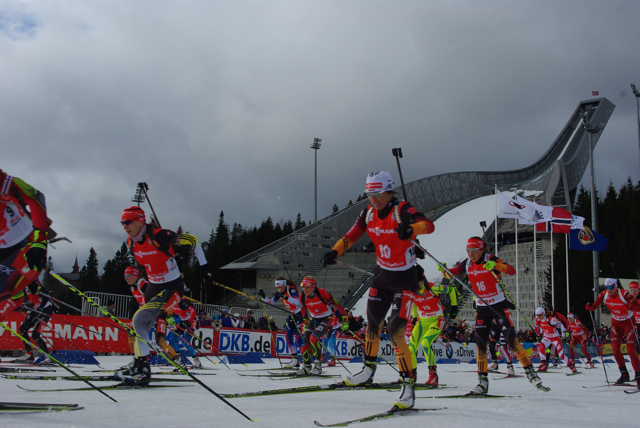
Anastasiya Kuzmina (bib 7) at the start of today’s 12.5 k mass start, where she took her second victory of the weekend.
OSLO, Norway– Anastasiya Kuzmina of Slovakia had already had a pretty good weekend here at Holmenkollen. Yesterday, she picked up her first World Cup win of the season in the 10 k pursuit.
But when she exited the shooting range for the last time in today’s 12.5 k mass start and looked up ahead of her, she knew that things were about to get even better. Incredibly, there was not a single woman in front of her heading out onto the final two and a half kilometer loop: Olga Zaitseva of Russia. And Laura Dahlmeier of Germany was exiting the penalty loop to join Kuzmina.
“Just amazing,” was how Kuzmina described the realization that she was more or less guaranteed a second podium.
How incredible was it? With three penalties over the first two stages, Kuzmina had been in the low 20’s at the race’s halfway point. There had been several leaders during the competition: Norwegians Tiril Eckhoff and Tora Berger on the first loop, Zaitseva on the second, Dahlmeier on the third and fourth. Kuzmina had never been in the mix.
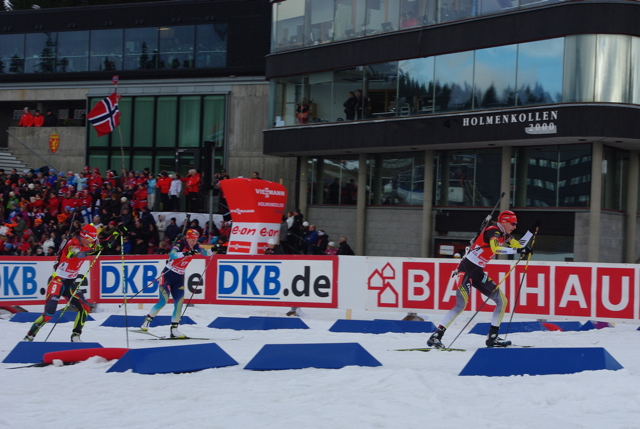
Kuzmina heading out of the stadium.
Seizing opportunity by the horns, the Slovakian double Olympic gold medalist set to work making her day better yet again. Skiing the second-fastest closing loop of the entire field, she passed Zaitseva and left Dahlmeier in the dust and took a 3.8-second win.
“Today I understand how important it is to make zero on the last shooting,” Kuzmina laughed in a post-race press conference.
Zaitseva and Dahlmeier could not keep their earlier speed and slipped further back in the field, finishing fifth and sixth. Instead it was Teje Gregorin of Slovenia who charged into second place, and Marie Dorin Habert of France who took third.
It was the first regular-season podium for Gregorin, who showed the same determination and finishin speed as she did in a bronze medal performance in the Olympic pursuit last month.
“I didn’t expect so good results this morning because I had a lot of problems with shooting this week,” she said. “Today was much better and I’m very happy to be in the top three.”
And it was also a comeback for Dorin Habert, who ruptured a ligament in her ankle jogging at the first World Cup in Östersund, Sweden, and did not compete again until the Olympics. Her next season won’t be much simpler: Dorin Habert, who came into this season as the top French woman, is pregnant and anticipated missing some to all of the 2014-2015 competition year.
“And now I have a baby on board now so it is a very strange season,” she said of this year. “For the next season, I think I can’t be there in December, and I hope to be there in January, February, March maybe if I can find my level. The priority will be the baby. To race, I will make more seasons after. But next season it will be more [relaxed].”
The World Cup overall title was also decided today. It was a fight between Berger and Kaisa Makarainen of Finland: if either won, they would take home the crystal globe. Otherwise it would depend on the spread between them.
Kaisa Makarainen (right) shooting her way to the World Cup overall title.
Once Berger lost the lead after the first shooting, her fortunes just kept taking downhill turns. After her first penalty, she was in 17th place but still leading Makarainen, whom she needed to beat my a margin of 10 World Cup points. With a clean second prone stage, Berger was up to seventh, still well ahead of Makarainen.
But then the Norwegian, whose fast and clean standing shooting has been one of the hallmarks of a long and storied career, missed three shots in a windy third stage. That dropped her far back. In the final stage, she missed another shot and could only climb from 19th up to 14th on the last loop. It wasn’t enough to beat Makarainen.
“With how I managed today, it was Kaisa who deserved to win the globe,” Berger told Norwegian broadcaster NRK after the competition. “I wanted a bit too much.”
It was the second overall title for Makarainen, who also won the Total Score in 2011. She had a rough start to the race, missing two shots and leaving the penalty loop in 27th. But the Finn said that she did not think it was nerves that had tripped her up.
“It was a really tough race today,” Makarainen said in a press conference. “A lot of pressure before and also during the race. I think I was not the only one with the pressure today.”
Makarainen cleaned the second stage, but then had a single penalty in each standing stage. Nevertheless she was able to climb up through the field, thanks to the fastest course time of the day – something she has made a habit of owning recently.
She said that she did not know how far ahead of Berger she was at almost any point during the race. In the final shooting, she knew Berger was somewhere behind her, but did not feel safe since Berger is capable of shooting so quickly.
Only in the very closing stages of the last loop, when she was up to seventh place, did she realize that it was enough to hold onto the Total Score.
“I had to fight my way back up,” Makarainen said in the press conference. “… Biathlon is really a tough sport, also the mental side. It’s not enough that you are in good physical shape and you can shoot well. In the races, for the top places the mental side is also very important. It’s not so easy to handle. But that’s why we train a lot in the summer time. And I have been in this circuit so many years that I think I have learned something, and I have been in a lot of situations.”
The day was also particularly significant as a number of top athletes are retiring. After competing in the last World Cup races of their careers, Berger and Ann Kristin Flatland – both individual World Cup winners and members of the World Champion relay team in 2013 – asked the Norwegian prime minister for jobs, joking that they could be secretaries of state, according to Aftenposten.
Flatland, who already has one child, finished one spot behind Berger in 15th. She actually let Berger pass her in hopes that the extra World Cup point would allow her to do better in the fight for the Total Score. The two were carried on the shoulders of their coaches as they made a farewell tour of the stadium.
Andrea Henkel, a German biathlete who first won Olympic gold in 2002 and has 22 career wins, is also retiring. After finishing 13th, Henkel and her three teammates in the mass start paused at the finish to savor flutes of champagne, while Henkel wore an improvised crown. Other former teammates such as Kati Wilhelm and Simone Hauswald, who joined her for many a relay in the 2000’s, showed up to help celebrate. German team staff wore short black wigs in Henkel’s signature hairstyle.
Russian star Olga Zaitseva, who led a portion of the mass start today but ended up fifth, had long planned to retire after this season. But she has since decided to keep competing through the 2018 Olympics and told Russian press that she feels like she is in the best shape of her life.
Rosanna Crawford and Zina Kocher finished eighth and 21st for Canada, and Susan Dunklee clocked in at 18th for the United States.
Anastasiya Kuzmina of Slovakia winning the 7.5 k sprint at the Olympics last month. Today, she won the 10 k pursuit in Oslo.
OSLO, Norway– For Darya Domracheva of Belarus, things could not have started out better in today’s 10 k pursuit. The winner of Thursday’s World Cup sprint here at Holmenkollen, Domracheva kicked things off by cleaning all ten of her prone stages and grew her lead to more than 45 seconds at one point.
But when she hit the first standing stage, Domracheva’s luck turned completely. She missed the last three targets of that stage, and came out of the penalty loop just before Anastasiya Kuzmina of Slovakia, who had a penalty of her own.
It was out of character for Domracheva, who now has seven top-five finishes in the last ten races.
“I was surprised when I saw Darya really close,” Kuzmina said in a press conference. “I was thinking how many mistakes she made.”
Then in the final standing stage, Domracheva incredibly repeated her earlier mistake, missing another three shots and dropping to sixth place.
Beginning to shoot on the mat next to her, Kuzmina put her head down and cleaned.
“On the last shooting, I was thinking, just, concentrate just on my targets,” Kuzmina said. “Just make what you can. And then I heard her three booms. I understand that she made a mistake, and I understand that I have a chance.”
By the time Domracheva finished her penalty loops, she was more than a minute behind Kuzmina. And four more racers had come in between them: Olga Vilukhina of Russia and Tora Berger of Norway, who had cleaned in the stage and returned to the podium positions they had held earlier in the race; Susan Dunklee of the United States, who had a penalty; and Andrea Henkel of Germany, who had started in 31st but cleaned every single one of her targets to move up to sixth.
For Kuzmina, a 48-second lead meant that she could treat the final two kilometers of skiing as a victory lap. By the time she came into the stadium, she was pumping her fists in the air, smiling at the crowd, and taking a bow as she skated towards the finish line.
It was the first victory of the World Cup season for Kuzmina, who won gold in the Olympic sprint in Sochi.
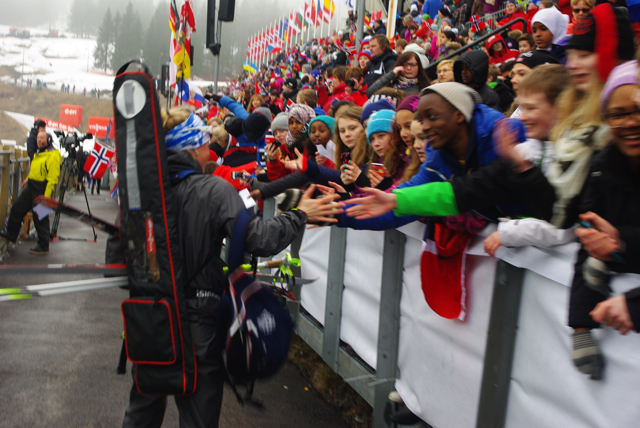
Tora Berger (NOR) hands out autograph cards to fans at the Holmenkollen stadium after finishing second in the 10 k pursuit.
“My form is looking like it’s coming back,” she said. “Maybe it’s the second peak in the season. I’m really happy because it’s just the second podium in the World Cup this season. I was a little bit sickness after Olympic Games, but maybe it was actually rest for me and now I am again here at the top and I am really happy.”
While Kuzmina’s huge win – still 41 seconds after all of her celebrating was complete – was a big story, arguably the most interesting races were happening behind her.
Berger had started in second place, before missing one shot in each prone and two in the first standing. But she cleaned her final standing stage and then hunted down Vilukhina on the trails to land back in second place.
“It was not so good shooting today,” she said in the press conference. “I am not satisfied. I was very satisfied about the shooting in the sprint. I don’t know, but I didn’t do what I should do, but on the last standing I was back in business. So I hope I will do it better tomorrow.”
Vilukhina, the Olympic silver medalist behind Kuzmina in the sprint, said that she was plenty satisfied with third place. In fact, it was a good birthday present: she turned 26 years old today.
“It’s cool, what happened on my birthday to win a place on the podium,” she told the Russian Biathlon Union’s news service, according to a translation. “I am not upset that it didn’t stay in second place today. I was given second place at the Olympics – so that today I am happy with bronze. I tried, I suffered … Now I want to open my phone and see how many congratulations I have. Today was a lot of missed calls.”
Dunklee left the penalty loop in fourth place, within sight of Berger and Vilukhina, but was unable to catch either one. She also got passed by Domracheva and Kaisa Makarainen of Finland, who had already moved from 23rd up to eighth after the final stage and continued to roll on the last loop. The trio passed Henkel along the way.
“That last loop, I wish I had a bit more fight,” said Dunklee, who ended up sixth. “I really believe that I can ski with Darya and Kaisa. I just didn’t have it today. I didn’t lose too much time to them, but it certainly wasn’t what I had hoped for.”
Makarainen had powerful motivation: she came into the weekend leading the overall World Cup score, having swept all three races in Kontiolahti, Finland, last week. But after 23rd place in the sprint, Berger was inching closer to taking the title away.
“I want to fight for the Total Score,” Berger said in today’s press conference. “That’s most important for me.”
But it’s important for Makarainen, too. So she desperately had to shoot her way to the top, to prevent Berger from taking too many more points in the pursuit race. Things didn’t start off well, when she crashed on the first loop.
“Luckily there was a safety net there so that I did not dive over [the edge], but I have yellow and blue knees and had terrible pain in the hands of the first two rounds today,” Makarainen told Norway’s NRK broadcaster.
But with the third-fastest ski time of the day and just two penalties, Makarainen was able to outsprint Domracheva for fourth place.
“She’s a climber and she’s extremely strong, but I don’t think it’s that much different than the Kaisa we’ve seen in other years when she has been strong,” Dunklee said of Makarainen’s recent dominance. “She’s just coming on strong at the end of the season. I didn’t see her the rest of the race, I just saw her on that last loop. And she was determined to get to the finish line before me, that’s for sure!”
Fourth place allowed Makarainen to retain the yellow bib, but by just ten points over Berger. The Total Score will come down to Sunday’s mass start. If either woman wins the race, they will win the Total Score; otherwise, it will depend on how close together they finish, and how high they place, as gaps between point allocations change from the top of the field to the bottom.
“It will be a hard fight,” Makarainen said. “Everyone is pretty tired at the end of the season and it is at times difficult conditions here. It is very exciting.”
OSLO, Norway– Usually, you want to end a racing season on a good note – preferably with sunshine and nice snow.
That was not in the cards at Holmenkollen today, when biathletes woke up to heavy fog for the last World Cup sprint of the season. The fog cleared somewhat for the women’s race and disappeared completely by the time the men hit the course, but it wasn’t a good omen.
The ski trails, too, were less than welcoming. Warm temperatures left them slushy and deep in some places, and icy in others. The corners going into and out of the shooting range, even, were dicey. A number of athletes fell on uphills and downhills alike, and at least one broke the stock of his rifle.
And then there was the range. While a few skiers were able to clean, there were a lot of penalties, including from several top competitors who shot abominably. Kaisa Makarainen of Finland, for example, is the overall World Cup leader. She picked up four penalties, as did Olympic bronze medalist Tiril Eckhoff of Norway, 2012 World Championships silver medalist Tim Burke of the U.S., and 2010 Olympic gold medalist Evgeniy Ustyugov of Russia.
“I think today we got all the things together, windy and foggy and really soft snow,” Darya Domracheva of Belarus said in a press conference. “It was a tough race. On the track, in some places a few girls fell down. It was difficult today. I think the IBU organizers made it especially for spectators today, to get more extreme biathlon.”
Domracheva prevailed in the women’s 7.5 k sprint, collecting a penalty but still taking the win by ten seconds over Tora Berger of Norway.
Berger has not had the season she was expecting – last year she ran away with the World Cup total score – and is retiring after this weekend of racing. She cleaned all ten targets, and said that finally, at the end of the season, her form seems to be coming around.
“It’s really good today, for me it was really good shooting,” she said. “The first time all season was last week in the sprint that I shot zero. Now I have one more. This was really fun to do such a good race today on such difficult conditions.”
Both women are trying to steal the Total Score from Makarainen. With two races remaining, it seems possible. Saturday is a pursuit based on the sprint results, and starting in positions one and two, they will have a huge advantage over the Finn, who will start in 23rd. But both said they were trying not to think about the crystal globe.
“I feel a little tired at the end of the season,” Domracheva admitted. “I try to have fun and not think about the points and the World Cup. I just want to enjoy these races and the end of the season.”
In the men’s 10 k sprint, World Cup leader Martin Fourcade didn’t falter as much as Makarainen, but he did pick up two penalties and finish 11th. Luckily for him, he already has the Total Score locked up.
Instead, it was Jakov Fak of Slovenia who made his return to the top for the first time since last season.
“I think the wind was the main problem, but I managed to shoot [almost] clean, and this was a big advantage for me,” Fak said.
An early starter, he held the lead for a long time until Evgeniy Garanichev of Russia started in bib 69. When Garanichev went clean through both shooting bouts, there began to be questions of whether he would take the win from Fak. But despite receiving splits and making a desperate lunge at the line, he finished just half a second from the win and Fak went home with the victory.
“I was giving an interview and was watching on the screen,” Fak said of when he realized he had won. “I saw on the last uphill that [Garanichev] was behind, so I was confident.”
Björn Ferry of Sweden, who has been on fire the last few weeks, placed third. A former Olympic champion like Berger, he will also retire at the end of the weekend.
“I don’t know,” he said of his recent string of results (which unfortunately began after the Olympics). “I’m surprised after every race but now I have five podiums after seven races. It cannot only be luck. I thought with the fog and deep snow this would not be my day. But zero-zero, I am here again, it is a great feeling.”
As for Fak, he, too, wished he could have won earlier in the season, but was still going home pleased.
“I’m very sad that it’s almost the end of the season,” he said. “It was not such a great season for me. Still today I beat Björn Ferry and I’m very happy.”
Racing continues on Saturday with pursuit competition, and then mass starts will finish off the season on Sunday.
American Susan Dunklee racing her way to seventh place in the World Cup pursuit in Kontiolahti, Finland. Photo: USBA/NordicFocus.
It’s not often in World Cup racing that the top five finishers are separated by two and a half minutes – especially not over just 10 kilometers – but once in a blue moon, that’s the effect the wind can have in biathlon.
Today’s gusty conditions in Kontiolahti, Finland, were just such a situation. In the women’s pursuit competition, Kaisa Mäkäräinen, racing on her home course, took a six-second lead from Saturday’s sprint and turned it into a one-minute blowout over Darya Domracheva of Belarus.
The listed wind speed of 2.7 meters per second at the start did not give an accurate picture of conditions, where large gusts could come from any direction and later die down.
“It was a bit luck of the draw if you would hit a calm note or not,” Canada’s Rosanna Crawford wrote in an e-mail.
“It shifted a lot from stage to stage how people moved up or down,” U.S. head coach Per Nilsson agreed. “In 20 seconds it shifted from okay conditions to really challenging ones. Many examples of this today.”
Mäkäräinen said in a press conference that she was “a little concerned about the wind” going into the race, but she managed to escape with just two penalties, better than most of the field.
In fact, the only one to outshoot her was Domracheva, who started in bib 20 but climbed all the way up to second place with a single penalty.
“I saw all of these girls on the penalty loop and knew there was a chance for the podium…I really tried to stay focused on the shooting range today,” Domracheva said in the press conference.
Olga Zaitseva of Russia moved from sixth place up to third with five penalties, 1:54 behind Mäkäräinen. Teja Gregorin of Slovenia was fourth, +2:25 with three penalties, and Tora Berger of Norway placed fifth, +2:38 with six penalties.
With the win, Mäkäräinen completed a sweep of all three competitions in Kontiolahti and extended her lead over Berger and Domracheva in the World Cup total score. Besides her strong shooting, she also had the fastest ski time of the day. Although she says that she has never performed her best in Oslo, where the World Cup is set to conclude next weekend, she seems set to continue her strong string of races.
The only woman who could come close to matching Mäkäräinen’s ski speed was American Susan Dunklee, whose split was just 0.3 seconds slower. Dunklee started the pursuit in eighth position, but moved up to seventh by the finish despite seven penalties.
“Extremely surprised,” was how she described her reaction to improving her position with so many missed shots. “I never would have guessed that I’d move up with seven misses. I would normally expect to be back in at least the 20’s. But because everyone else struggled so much in the shooting range, it worked out.”
The wind caused most of Dunklee’s misses, and she described the conditions as chaotic in a phone interview.
“My last standing stage for example, I came in and stood on the mat, and four or five girls in front of me were all standing on their mats and hadn’t taken a single shot yet,” Dunklee said. “They were just waiting for these gusts to calm down. Then I had to wait for a while. And then by the time I took that first shot, I was just so tense from overholding that I missed it, even though it had calmed down.”
Range times varied widely and were in general far longer than usual. Instead of shooting prone in 30 seconds, Dunklee took 40 and 43. That last standing stage was, instead of the usual 25 seconds, 49. And that took a toll.
“I’ve never had shaky legs before,” Dunklee said. “People talk about shaky legs in standing all the time, but I had never had that until today. You’re just standing there waiting to take the shot, and your body just gets tired.”
She ended up 3:01 behind Mäkäräinen, despite notching the best pursuit result of her career.
“Susan’s running is so good now,” Nilsson wrote in an e-mail. “And she is starting to get used to that! I think she will continue one more week with really solid results.”
Teammate Hannah Dreissigacker dropped from 41st to 49th with eight penalties, in her first appearance in a World Cup pursuit.
“The shooting was definitely rough for me,” Dreissigacker told FasterSkier. “It was pretty windy today, and I’m just not very good at shooting standing in the wind. I don’t think it was even super windy when I came in, so it was definitely also to some extent just me. But at least a lot of other people had rough shooting today, so I had company!”
Sara Studebaker, the third U.S. starter, placed 54th with four penalties.
For Canada, Rosanna Crawford started in 16th position and had an up-and-down race depending on the whims of the wind in each of her shooting staged. With a single penalty to start out, she moved up to 13th, before dropping into the mid-20’s and then climbing back to 14th. She finished the race out with three misses in the final standing stage, and placed 27th.
“I’m bummed with my last shooting, but the wind was howling!” Crawford wrote in an e-mail.
She also struggled with ski speed over the later stages of the race, although she did beat Franziska Hildebrand of Germany in a close finish.
“This is a tough course, and not one of my favourites,” Crawford wrote. “There’s one long climb that was made even harder today because you had to make a tight corner into it, that really fried my legs.”
After a long season with six of the best ten results of her career, Crawford hopes that she can keep up the good performances for one more weekend of racing.
“I am looking forward to Oslo and finishing the season strong,” she wrote. “Good shooting will be key in order to keep up these good results. Right now it’s mostly survival mode. Just 3 more races, then just 2 more then just one more then HOME! It’s been a long season and almost 3 months in Europe. I am glad we get to finish off in a great place like Oslo!”
Canadian teammates Zina Kocher and Megan Heinicke did not start the pursuit. Head coach Matthias Ahrens explained that both had sustained “minor injuries” in the sprint race and with bibs 54 and 60, it wasn’t worth starting the pursuit.
The Norwegian biathlon team celebrates gold in the first-ever Olympic mixed relay after Emil Hegle Svendsen showboated his way toward the finish line.
FasterSkier’s coverage is made possible through the generous support of Swix.
KRASNAYA POLYANA, Russia – Just 24 hours earlier, Emil Hegle Svendsen had nearly lost a gold medal in biathlon when he began celebrating his win in the 15 k mass start before crossing the finish line. The second-place racer, Martin Fourcade of France, lunged towards the line and only missed out by three hundredths of a second.
Today, Svendsen had a little more time to savor his victory. Entering the range with a more than 30-second lead, the Norwegian knocked down all five targets in quick succession and then raised his arms to the stands as he put his poles back on.
Svendsen waving to fans as he descended into the stadium the final time.
He still had 2.5 k to ski, but so what? He had plenty of time to keep celebrating. After a loop out on the course, where Svendsen took his sweet time, he waved to fans coming around the final downhill corner into the stadium. Then he played up the crowds as he coasted down the finishing stretch far ahead of the second-place team from the Czech Republic.
Svendsen later told NRK, a Norwegian television station, that he was looking for a Norwegian flag to carry across the line, but then became scared that such behavior was banned at the Olympics. (He may have been extra cautious because of the Norwegian ski team’s written reprimand from the International Olympic Committee for wearing black armbands.)
The man who had the most to celebrate, though, wasn’t so vocal.
Ole Einar Bjørndalen had raced the third leg for Norway, after Tora Berger and then Tiril Eckhoff combined to put the team in a dead heat for first place after the women’s legs were complete. Bjørndalen, who had earned his seventh Olympic gold medal in the Games’ opening sprint and had tied Norwegian skier Bjørn Dæhlie for the most medals in winter Olympic history with 12, skied the fastest course time of his leg and shot a perfect ten for ten.
He built a 43-second lead for Norway, which Svendsen got to simply savor as the anchor leg.
The gold medal for the team gave Bjørndalen a tie with Dæhlie for the most gold medals in winter Olympic history, and nudged his total medal haul up to 13, which nobody has ever matched. And he wasn’t just a tourist, at 40 years old, depending on the strength of his team – no, Bjørndalen made that gold medal.
And how does it feel to be the most decorated winter Olympian in history?
“It’s cool,” Bjørndalen shrugged in an in-venue TV interview, acting the typical reserved Scandinavian compared to Svendsen’s bravado. “Bjørn Dæhlie was a big hero to me.
Speaking to NRK after the race, Bjørndalen said that he still thinks Dæhlie is the better athlete.
Ole Einar Bjørndalen out on the trails, where he trounced the decades-younger competition.
“Clearly this record means a lot, and it’s a big achievement,” he said. “In his time, [Dæhlie ] had what I love about cross country skiing – the raw capacity. There is nobody in Norway who has had that capacity and the raw endurance talent that Dæhlie had.”
Meanwhile, his teammates were just thankful that Bjørndalen has remained a leader in their sport and their team.
“We’re all making history today,” Svendsen said in the press conference. “I think the whole team owes a big thanks to him. I think many of the things we think about in training is because of his extreme professionalism.”
“Ole’s amazing, what else can you say?” asked Eckhoff, who is 17 years younger than the legendary biathlete. “It’s amazing that we can be on the team with him today.”
Accolades aside, it was a remarkable race for Norway from start to finish, showing off what is possible in the mixed relay, a format which is new to the Olympics. With just two women and two men, a level of excellent performance is possible which is tougher to achieve with a full four-man or four-woman team.
Over the course of 40 targets, Norway used just two spare rounds to knock them all down. And in fact, both were used by Berger, the team’s scramble skier. Norway hit the next 30 targets in succession, a feat which has rarely been matched in relay racing.
“It was a fantastic achievement by everyone,” Berger, last year’s overall World Cup winner, told NRK. “It was really fun to go today.”
“It was really cool to be involved today,” agreed Eckhoff, the bronze medalist from the mass start who has never before been considered one of her country’s top two women and had only raced one mixed relay ever before.
The win was also a relief for Norway because, just as in cross country skiing, they had been having problems with ski preparation, which contributed to the team earning far fewer medals than had been projected.
And just like Marit Bjørgen and Ingvild Flugstad Østberg’s dominating win in the women’s team sprint today, the mixed relay gold brought an end to that disappointing drought.
“What has changed the most is that we have some better skis and our servicemen have found the problem with our material,” Svendsen said. “I think I can say a big thank you to our service team because it’s very important in skiing, as you can see in the last couple days. … This is the biggest race for that.”
The Czech Republic took silver to continue a remarkable Olympic campaign; it is their fifth medal of the Games in biathlon. Italy took bronze to earn their first Olympic medal since 1998.
—Nat Herz and Alex Matthews contributed reporting.
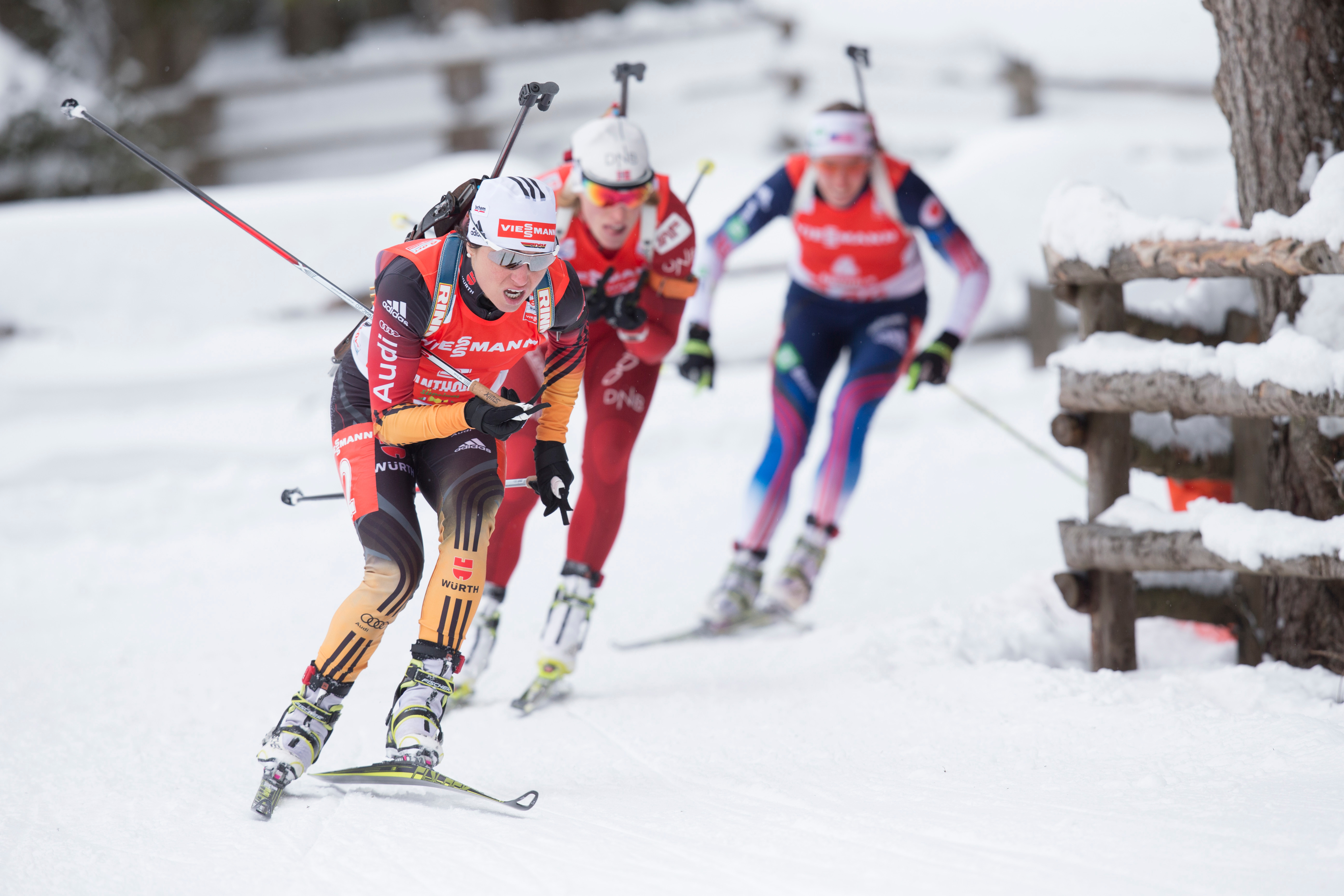
Andrea Henkel of Germany leads Norway’s Tora Berger and Susan Dunklee of the United States in today’s 10 k pursuit in Antholz, Italy. Photo: USBA/NordicFocus.com.
Looking at the finish pen of the women’s 10 k biathlon pursuit in Antholz, Italy, today, you could be forgiven for thinking that a battle might have occurred.
World Cup athletes staggered across the finish line, some nearly falling before their final time was clocked. Their ski technique, usually the best in the world, looked shortened and powerless; sprint finishes happened in slow motion. Exhausted athletes lay in the snow for minutes trying to recover some energy.
“Every loop was pretty hard, and not just the last one,” winner Andrea Henkel of Germany said in the post-race press conference.
At 2,000 meters of elevation – about 6.500 feet – Antholz is the first time most the World Cup field has encountered significant elevation in weeks. Coming in the third week of intensive racing in a row, that was particularly punishing.
“I think the elevation got to everyone, and it was harder than usual,” American biathlete Susan Dunklee said in a phone interview. “Coming into standing, everyone’s legs were shaking a little bit. It was tough.”
Henkel, a 15-year veteran of the German national team, did exactly what she needed to do to win after starting the pursuit in bib two, 6.7 seconds behind Anais Bescond of France.
Calm and collected, Henkel cleaned each of her four stages, always taking a few seconds longer than her closest competitors to ensure accuracy. Darya Domracheva of Belarus, who had a sizeable lead coming into the first standing stage, missed two shots in each of the last two stages.
“I took my time in shooting and I got lucky that the others did not hit as many targets as I did,” Henkel said. “It all just worked out for me.”
She was clean again and again, as the group of skiers around her gradually shrank down. By the time she left the last stage, she had a ten-second lead on Nadezhda Skardino, also of Belarus.
It was a nailbiter of a final two kilometers, with Skardino edging closer and closer to Henkel. The 36-year-old German grimaced in pain as she pushed with everything she had. With 900 meters to go, Skardino had closed the gap to five seconds.
“I knew Skardino might come closer,” Henkel said. “I thought if I still had the lead at the Huberalm, then I had a chance.”
Dunklee fighting through a painful ten kilometers at elevation. Photo: USBA/NordicFocus.com.
She did: Skardino made contact coming into the stadium, but was unable to do any more than shadow Henkel to the finish line. Completely exhausted, Henkel managed to raise her fists in victory as she crossed with a 1.6-second advantage.
“Of course I wanted to win, but Andrea was strong and I am happy to be second,” Skardino said in the press conference. “It was a hard competition today but my skis were good and I felt really good so this race was easier than some other times.”
Tiril Eckhoff of Norway seemed to be headed to the second podium of her career when she left the final stage in third place, with 11 seconds of time on Domracheva, who was in fourth. But Norwegian teammate Tora Berger had no mercy and charged after the leaders, passing Domracheva immediately and overtaking Eckhoff in a finishing lane sprint. In her push for the yellow overall leader’s bib, she was uninterested in allowing her younger teammate to have any part of the glory.
“I didn’t realize that it was Tiril that I was fighting against,” Berger told Norwegian broadcaster NRK. “I just did what I had to do, because I wanted the podium.”
But the NRK commentators were having no part of it, calling her “relentless” and saying she doesn’t treat her teammates well on the trails.
For her part, Eckhoff was gracious
“I heard that she was coming, so it was very painful to get the seconds taken away from my lead,” she told NRK. “I tried my hardest, but the older athletes are still the best…. it was close. One day I will get there.”
Domracheva finished fifth and Teja Gregorin of Slovenia sixth. The breakout performance of the day came from Chaoqing Song of China, who finished tenth; it was just the second top-ten of her career and her best result since 2010.
Dunklee, who started the pursuit in fourth position just behind Domracheva and Henkel, finished 23rd. She cleaned the first stage but collected one penalty in the second prone, three in the first standing, and one more in the final standing.
“One poor standing stage cost me a lot of places and suddenly felt very tired on the skis on loop four and lost a lot of places there,” she said.
Early on, Dunklee had been skiing with Henkel in a top-five position.
“It was comfortable, and things were going according to plan,” she said of her first-ever pursuit start in such a strong position.
And it was a comfort to be skiing with Henkel, the girlfriend of Dunklee’s teammate Tim Burke.
“Andrea comes and trains with us in the U.S. sometimes, so I know that my ski speed can be right up there with hers,” she said. “I consciously choose to catch a ride with her at the start of the race. We have very different ski styles but it is still relaxing to let someone else lead and I trusted she would choose a smart pace.”
Even if the pair separated after Dunklee’s shooting woes began – they were compounded by a broken pole and losing some ammunition clips, which she estimated cost her about eight seconds on the range when an official had to bring her replacements – Dunklee found the German veteran’s win very motivating.
“I know how hard she works, and for how long, so I was so happy to see her on top today,” Dunklee said. “And because I know I can ski her pace on a good day, that’s a good feeling too.”
Next time, Dunklee hopes to be more “calm and in control” throughout the whole race, just like she said Henkel was today.
“I have some of the parts, but the whole thing didn’t come together,” Dunklee said. “Each time you do this it gets easier, so I think when I’m in this position next time it will be even better.”
Megan Heinicke, the lone Canadian to qualify for the 60-woman pursuit, did not start the race. Sara Studebaker, the other American who made the cut, finished 48th with four penalties, one in each shooting bout.
Susan Dunklee of the US Biathlon skied her way to a career best fourth place in Thursday’s 7.5 k sprint in Antholz, Italy. (Photo: US Biathlon/Nordic focus)
It was a day of firsts in the women’s 7.5-kilometer sprint on the trails of Antholz, Italy.
For Anais Bescond of France, it was not only her first International Biathlon Union (IBU) World Cup victory of her career, but also her first podium.
For second place finisher Andrea Henkel of Germany, it was her first podium of the season.
For American Susan Dunklee who finished fourth, it was her career-best finish.
With near-perfect conditions in the Italian Dolomite mountains, the women skied three times around the 2.5 k loop, shooting prone at 2.5 k and standing at 5 k.
Norway’s 2013 World Champion and 2010 Olympic medalist, Tora Berger was an early front-runner. She started out conservatively, skiing the 22nd fastest time in the first lap, but after shooting clean in the prone and obtaining one penalty in the standing, Berger catapulted herself into the lead by skiing the fastest time in the third lap.
Anais Bescond of France (l) leads a train of competitors in a 2012 World Cup in Ruhpolding, Germany.
While she crossed the finish line in first, there were still 91 women left in the field of 105, and all of them were hungry for a spot on the podium.
Despite the strong field, Berger was able to hold her fist place position for a short time, as Franziska Preuss of Germany and Teja Gregorin of Slovenia were unable to topple the Norwegian biathlon queen.
Unfortunately for Berger, who eventually finished in sixth, American Susan Dunklee was on course. Coming off an less-than-satisfying week in Ruhpolding, Germany, Dunklee skied a strong first loop and cleaned prone, boosting her into second position. From there she continued improve her standing, shooting clean in the standing and garnering the fastest time in the race so far.
The 27-year-old and Vermont native crossed the finish line in first place to the cheers of the crowd, giving an exhausted, yet exuberant “yeah!” before collapsing to her knees. Topping Berger by 1.8 seconds, it was looking like an excellent day for Dunklee.
The crowd loved the American’s effort and cheered especially loud as she blew past them.
“At the finish, the crowd was cheering like crazy,” she wrote in an email. “I remember this from my 5th place at Ruhpolding a couple years ago too. They seem to get electrified when an underdog does well.”
Another crowd favorite, Bescond, was not far behind.
The Frenchwoman, whose previous best World Cup finish had been fourth in Oslo last year, held nothing back. She ripped out of the gate, clocking the fastest time for the first loop and cleaned prone.
She wasn’t quite as sharp in standing, obtaining one penalty.
Susan Dunklee (US Biathlon) is all smiles after her fourth place finish in Antholz, Italy. (Photo: US Biathlon/Nordic Focus)
“With one miss I thought it was not possible for the podium, but I gave my best,” Bescond said in an IBU press release.
It became apparent that her best was enough to top the rest of the field, and she crossed the line in first, 10.7 seconds ahead of Dunklee.
Looking at the leaderboard in disbelief, Bescond thought that the results were incorrect.
“I thought it was a mistake, but I was happy to see my name up there,” she said.
Starting just behind Bescond, was second place finisher Henkel. She skied a strong and efficient race as she pursued Bescond. With fast skis and a clean shooting record, Henkel was able to leave behind a lackluster season to finish second, 6.7 seconds behind Bescond.
A large part of Henkel’s success in the sprint was her ability to shoot cleanly.
“I know that it is important for me to hit all of the targets to be on the podium,” Henkel said in a press release. “Today it worked out and then all I was just fighting in the last loop.”
After Henkel there weren’t few were able to challenge for a position on the podium until Darya Domracheva of Belarus took the course.
Domracheva skied an incredibly fast race that was only hindered by the standing shooting, in which she received two penalties.
“I was very disappointed in my standing shooting; I think it was maybe too fast. But I am still happy to make the podium,” she told IBU.
Thursday’s results demonstrate that Dunklee is a force to contend with going into next month’s Olympics in Sochi, Russia. Her previous best World Cup finish was fifth, which she notched in an individual 15 k at the 2012 World Championships in Ruhpolding, Germany. While she had been unable to match the result earlier this season, her best-ever finish shows what she’s capable of and where she’s planning on going.
“At the finish, the crowd was cheering like crazy. … They seem to get electrified when an underdog does well.” — Susan Dunklee, fourth in Antholz World Cup sprint
Not only today was a personal best for Dunklee, it was also the best World Cup result for a U.S. female biathlete since 1994. According to US Biathlon, in March 1994, Joan Smith finished fourth a World Cup sprint in Canmore, Alberta, Anna Sonnerup was second in a World Cup in the early ’90s, and Kari Swenson placed in the top four in the ’80s.
“I went into today feeling very relaxed and very confident,” Dunklee wrote. “Shooting had been fantastic the last couple days in practice and the ski times were coming down in the last few races. I was ready for a good result without wanting it too much.”
Despite achieving her career best finish, Dunklee was slightly disappointed to not be standing on the podium. However, she plans on using the result to help her in the future, writing, “Nothing could be more motivating than being half a second off.”
Looking forward to the remaining World Cup races in Antholz, Dunklee is excited to for Saturday’s pursuit. “[It] is going to be a blast,” she wrote. “I will be in a tight pack off the start with Andrea and Darya.”
Canadian Megan Heinicke wrote in an email that she was “super happy” to see Dunklee on the podium. “I know all of us fellow North Americans were cheering and are stoked for her!” she wrote.
Susan Dunklee of the US Biathlon skied her way to a career-best fourth in Thursday’s 7.5 k sprint in Antholz, Italy. (Photo: US Biathlon/Nordic Focus)
The Canadian finished 46th in the sprint, qualifying for Saturday’s pursuit. She did her best to ski a clean focused race, but had trouble tapping into her explosive power.
“Overall I am still disappointed with the ski time,” Heinicke wrote. “I had expected to feel better today than I did, but there are some good things to take out of it.”
She cleaned her prone, then had two standing penalties.
“My main goal is to focus on the separate things that need to come together and to mentally ‘stay in the moment,’ ” the 25-year-old wrote about the next World Cup races and the upcoming Olympics. “I believe I have trained well and think being relaxed, confident and focused is the key to bringing everything together.”
American Sarah Studebaker was happy with placing 57th with two total penalties, one in each stage, coming off last weekend’s IBU Cup in Val Ridanna, Italy, which doubled as Olympic trials. She was officially named to her second Olympic team last Sunday.
“Not worrying about qualifying I was able to just race, which was nice,” Studebaker wrote. “I did not feel 100% today after trials, but it was exciting to make the pursuit and especially to ski better than before Christmas.”
“I truly believe we are the strongest and most professionally mannered biathlon team in US history. I am honored to be part of this group heading into Sochi.” — Susan Dunklee
The rest of the North American squad finished out of qualifying in the top 60, with Canadian Rosanna Crawford placing 68th, American Annelies Cook in 70th, and Canadians Megan Imrie and Zina Kocher finishing 73rd and 83rd, respectively.
The World Cup races in Antholz mark the last before the start of the Sochi Olympics. The fourth-place finish will give Dunklee confidence on the Russian course she finished seventh on last season.
“I truly believe we are the strongest and most professionally mannered biathlon team in US history,” Dunklee wrote. “I am honored to be part of this group heading into Sochi.”
Studebaker expressed similar sentiments about the American team.
“I am so excited to be a part of the Olympic team,” Studebaker wrote. “It’s great to be heading back to the Olympics and especially with such a great group of women. These races are really training for us and getting one more chance on Saturday is great. We definitely have work to do before Sochi, but things are going really well for our team and we’re all looking forward to seeing what we can do at the Olympics!”
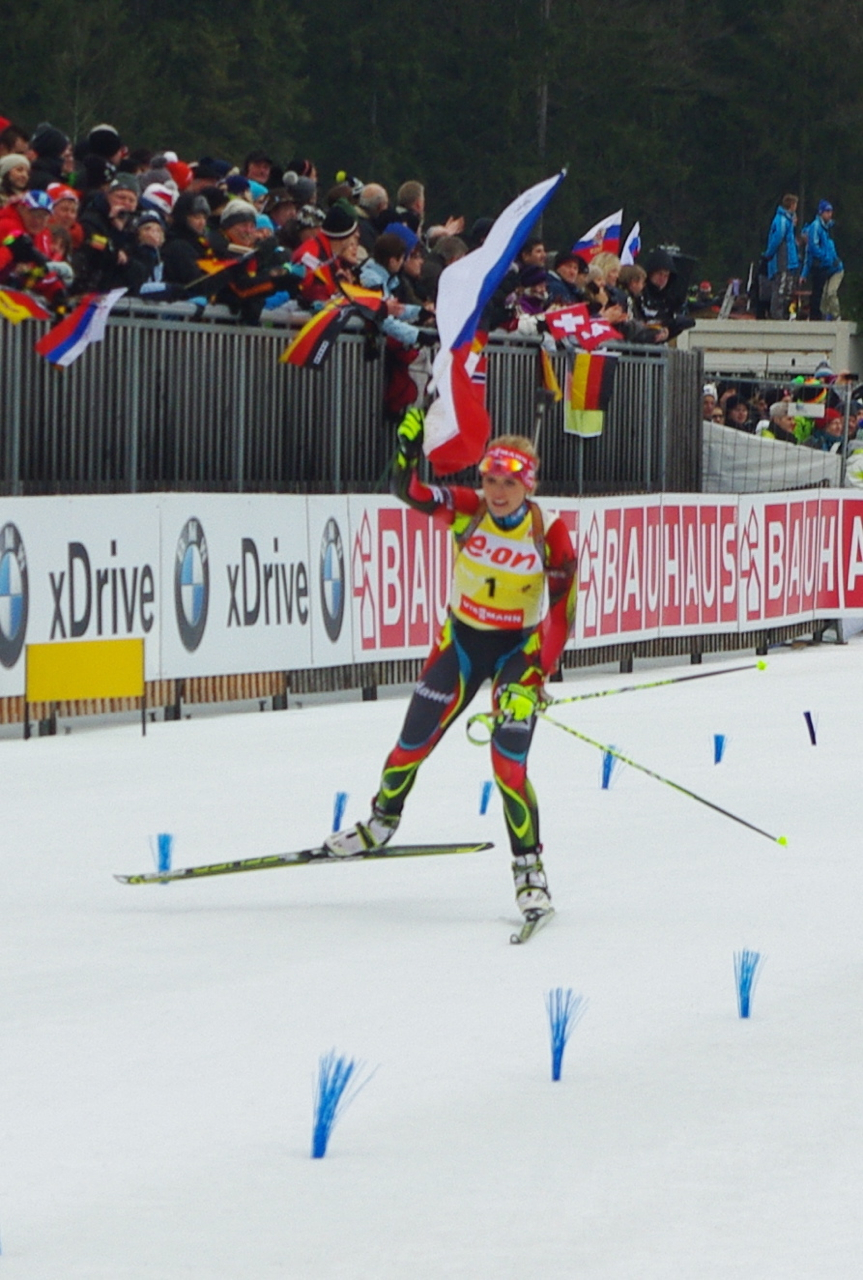
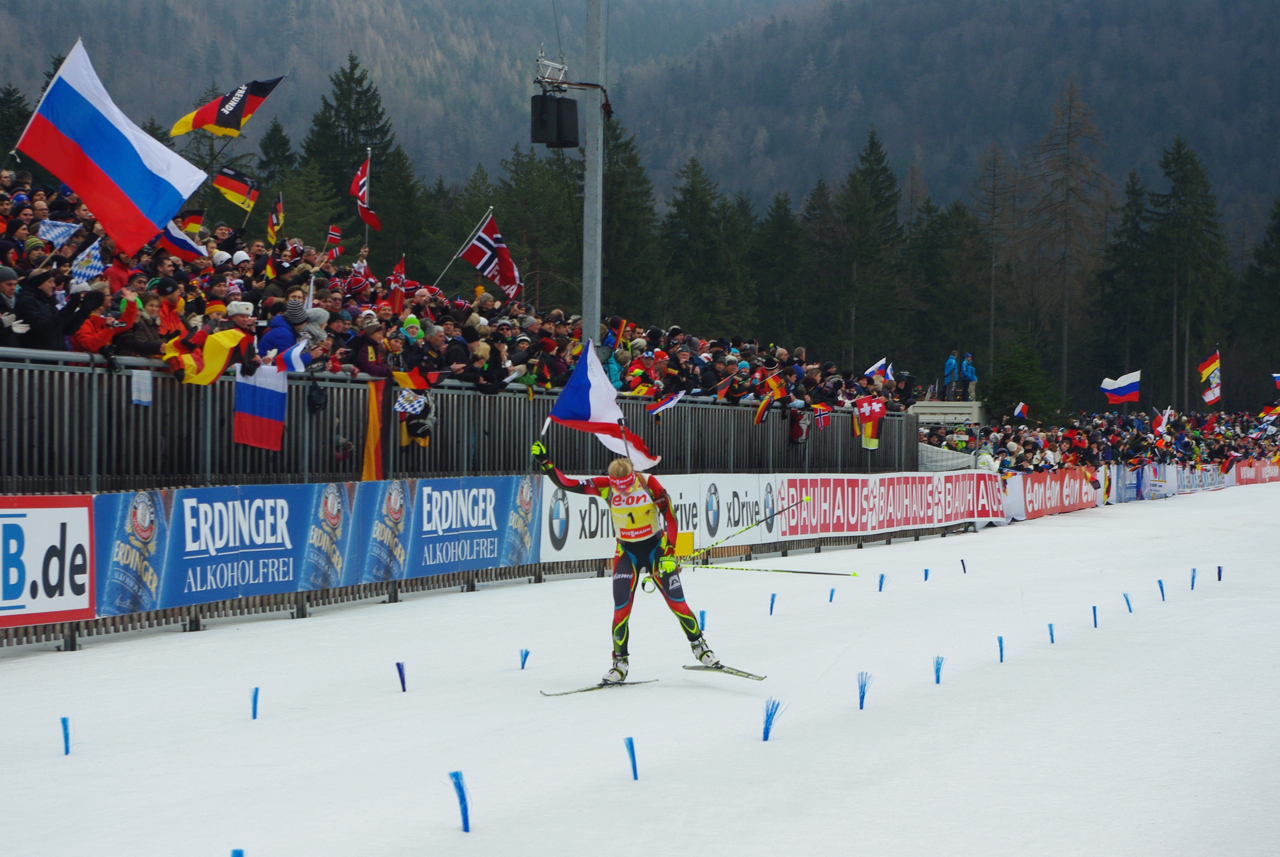
Gabriela Soukalova celebrates with the Czech flag as she wins the 10 k pursuit here in Ruhpolding today.
RUHPOLDING, Germany – In the press conference after winning Friday’s 15 k individual competition, Gabriela Soukalova of the Czech Republic said that every time she puts on the yellow World Cup leader’s bib, it’s a surprise. She just doesn’t picture herself as the best biathlete in the whole world.
“I didn’t expect anything before this race because I thought to be in the top five would be impossible for me, from the first position, because it was so stressful,” she said after today’s 10 k pursuit.
But if she didn’t know how to handle the pressure, that sure didn’t show today, when she took her win from the individual and turned it into a nine-second victory in the pursuit. Soukalova shot a perfect 20-for-20 in the four-stage race, an impressive show of nerve. As she entered the stadium with a lead even larger than that, she had time to stop and grab a Czech flag to carry across the finish line. Tora Berger of Norway was charging after her, but she didn’t care.
As easy as it looked, it sure didn’t feel easy, she said.
“After the third loop, I started to feel that I was very, very tired,” Soukalova explained. “I had just one chance, which was to have clean shooting. So I tried to do that, and it was great.”
Soukalova had some of the slowest range times of the entire field, losing more than ten seconds on the range in each of the last three stages. But that didn’t matter, because as she carefully cleaned each stage, she avoided the penalty loop, which would have doubled her amount of time lost.
“It was the only tactic,” she said.
She executed perfectly, which allowed her to win on the range and not on the trails. Unlike in the individual, when she had the third-fastest ski time of the day, today she was 14th – well over a minute behind third-place Kaisa Makarainen, who turned in the best course split to move up from tenth place, 38.9 seconds behind Soukalova.
Sandwiched in between them was Norwegian star Tora Berger, who won last season’s overall World Cup but has had a slow start to the season. She had a little advice for Soukalova about how to handle the yellow jersey.
“You can’t think about the yellow bib,” she said in the press conference. “You just have to do the same every time.”
Not that that’s a worry for Berger now – it’s her third podium of the season. Soukalova already has that many wins. Perhaps Berger is focusing on the Olympics, but she admitted that it’s difficult for her to get excited about every start these days.
“Yes, it’s harder every year,” she laughed. “I’m starting to get really old.”
But Berger’s struggles earlier this season were tied to disastrous shooting, which she has begun to improve. Today she had just one penalty, coming in the first stage, and shot flawlessly to move up through the ranks from her fifth-place start position.
“For me, there has been problems with the shooting before Christmas,” she said. “I was thinking too much when I was standing in the shooting. And now I’m starting to get back to the old way, so it’s getting better.”
Perhaps soon, she’ll be challenging Soukalova more consistently. By then, the Czech might be used to wearing it enough that a stronger Berger wouldn’t intimidate her.
“I’m trying to race with the yellow bib like it was the normal number now, not to think about it very much,” Soukalova said. “I think that’s easier.”
Darya Domracheva of Belarus, starting in second position after the individual, missed five shots and dropped to 12th place.
After a somewhat lackluster World Cup weekend that saw both relay teams get beaten at the end and no Germans on the podium in the 15 / 20 k individual races, Germany had its hopes pinned on two young athletes: Franziska Hildebrand and Franziska Preuss.
Hildebrand had a remarkable race in the individual, missing a single shot to place fourth, the best result of her career. Through three stages today, she was perfect again and had moved into second place, much to the delight of the German crowd. But she missed three shots in the final stage, and was unable to do any better than 13th place.
Preuss, meanwhile, started in 16th and immediately began to move up with clean shooting. She missed a shot in the final stage and left in fifth place. When she passed Julya Dzhyma of Ukraine on the trails, and then Veronika Vitkova of the Czech Republic, the crowd let out a deafening roar to see another young German in third place. But Makarainen charged past her onto the podium, dashing the crowd’s hopes.
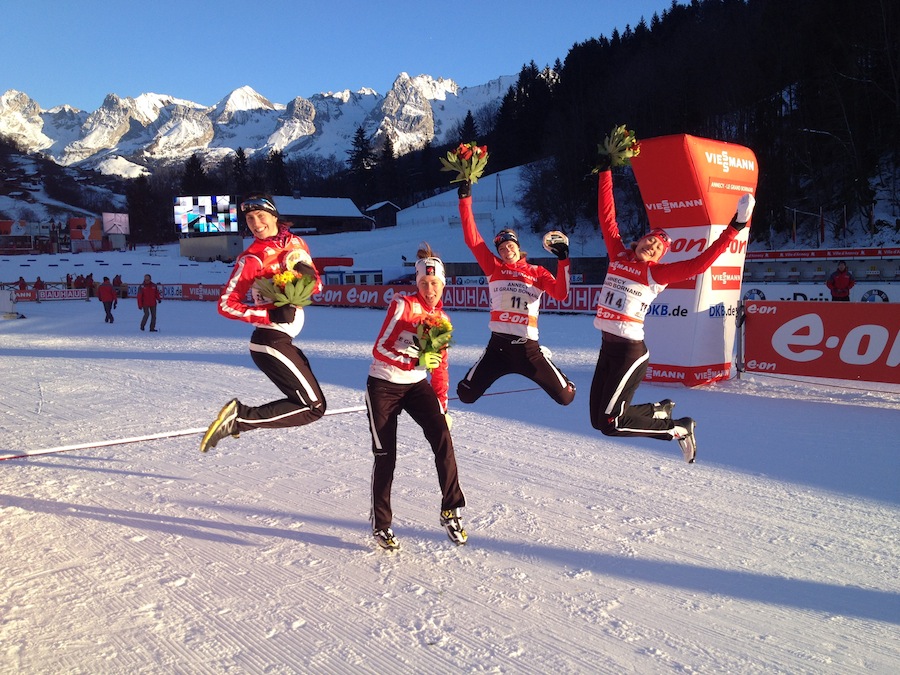
The Canadian women jumping for joy after notching Biathlon Canada’s best-ever finish in a relay. (Photo: Biathlon Canada/Matthias Ahrens)
Note: The following has been updated to include quotes from Megan Heinicke.
About halfway through the IBU World Cup women’s 4 x 6-kilometre relay on Thursday in Annency, France, it was pretty evident Germany had the race in the bag.
Anything can certainly happen, but Andrea Henkel had opened a 10.5-second lead for the Germans by the end of the second leg, and after teammate Franziska Hildebrand’s third leg, they were up by 35 seconds on Norway. Laura Dahlmeier essentially had to go through the paces, shoot as clean as possible and ski strong to hold off Norway and Ukraine, both contending for the podium with somewhat of a surprise charging from behind – the Canadians.
It wasn’t a surprise for Canada. Chris Lindsay, high-performance director for Biathlon Canada, has known for some time what his quartet of Rosanna Crawford, Megan Imrie, Megan Heinicke, and Zina Kocher were capable of. And on Thursday it was Canada’s best-ever relay result – in a female, male or mixed event. The nation’s previous best was sixth in a mixed relay in 2011 in Hochfilzen, Austria.
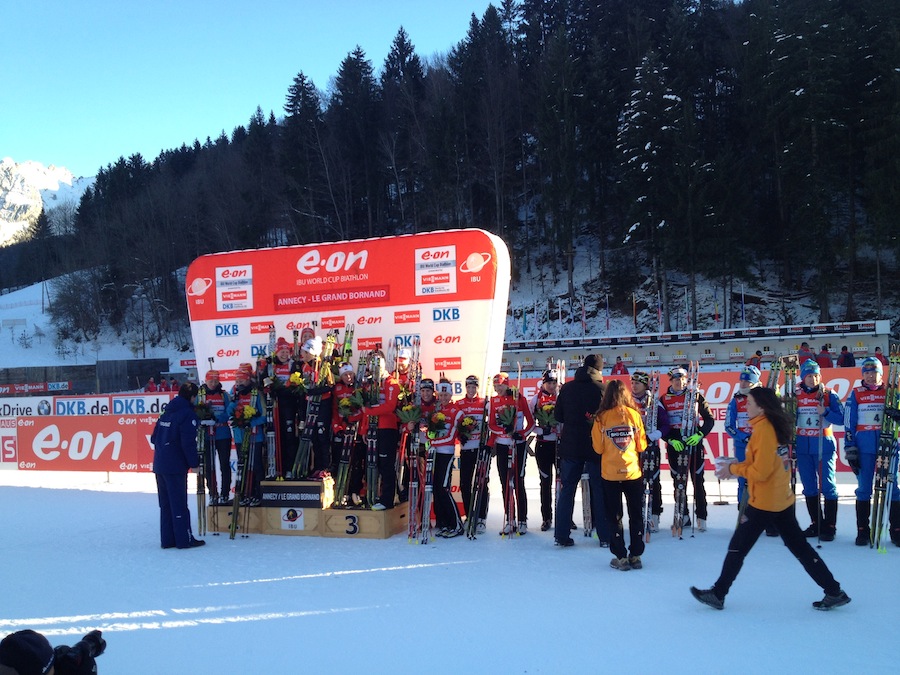
The top teams in the 4 x 6 k women’s relay gather around the podium Thursday at the IBU World Cup in Annency, France. Germany won, Ukraine was second, Norway placed third, and Canada notched a historic fourth. France placed fifth, Russia was sixth, Italy finished seventh, and the U.S. tied last week’s eighth place. (Photo: Biathlon Canada/Matthias Ahrens)
The Canadian women placed fourth on Thursday behind Germany, Ukraine and Norway, respectively, with Germans Franziska Preuss, Henkel, Hildebrand, and Dahlmeier winning in 1:06:27.8, and using just three spare rounds in the process.
Ukraine’s Juliya Dzhyma, Vita Semerenko, Valj Semerenko, and Olena Pidhrushna, placed second 23.3 seconds back with four spare rounds, edging Norway in third by 0.5 seconds with Tinril Eckhoff, Fanny Welle-Strand Horn, Synnøve Solemdal, and Tora Berger, who used a total of 10 spare rounds.
The Canadians were 1:35.8 back in fourth after using nine spares.
“Certainly holding the shooting together with the great skiing was the difference,” Lindsay wrote in an email. “Having a big result that is completely owned by the women helps to build an even stronger foundation upon which podiums will follow.”
Heading out first with 22 other teams, Crawford cleaned her prone and used one spare on her standing to bring the team to fourth by the exchange.
“I’ve learned from the past couple relays that being aggressive off the start and getting with the lead group will save you a lot of energy and make sure you don’t get tripped up most of the time!” Crawford wrote in an email. “I’ve got a strong double pole so I can usually be right behind the person in front of me and then it’s just a matter of [maneuvering] my way to the front group.”
A fan of the range at Le Grand Bornand, Crawford explained she took advantage of the calm conditions and focused on one shot at a time. She left her first stage in second behind Switzerland’s Selina Gasparin, who cleaned both stages to tag off in first – but Gasparin wasn’t always in front (and her sisters Elisa and Aita, and teammate Patricia Josh ultimately dropped the lead on the second, fourth and third legs, respectively, so that Switzerland finished 13th).
Italy’s scramble skier, Dorothea Wierer cleaned her prone and used one spare on her standing to put the team in third behind Germany’s Preuss, who used one spare on each stage to tag off in second.
“Selina Gaspirin really didn’t want to lead, so we were able to catch up to her and then I passed her right before the range,” Crawford explained. “Standing was good, my hands were pretty cold so I had some trouble with my spares, dropping two, before I got one in and hit the target.”
For the last loop, Crawford stuck with Preuss and Norway’s Eckhoff just behind the leaders, tagging off in fourth, 11.6 seconds after Gasparin in first and 3.2 behind Preuss in second. Italy tagged in third, Belarus was fifth, and Eckhoff came through in sixth for Norway, 15 seconds behind Gasparin and 3.4 behind Canada.
With Susan Dunklee scrambling for the second-straight relay, the Americans started the second leg in eighth, 33.3 seconds behind Germany.
From there, Imrie brought the Canadians to third with a clean prone and one spare in standing. Henkel took the lead for Germany with 10-for-10 shooting, and Imrie tagged just Heinicke 17.3 seconds behind Germany and 6.8 seconds behind Norway.
Heinicke used three spare rounds – one in prone and two in standing – for the eighth-fastest third leg, but she managed to hold tight in fourth, a minute behind Germany, but just 10 seconds behind Ukraine.
“I was disappointed about the prone miss because it really shouldn’t have happened, but in the moment I was just focused on doing my job which was loading that spare bullet calmly and efficiently,” Heinicke explained.
In the second bout, she didn’t realize that her first spare didn’t hit and was partly out of position. “That was too bad, but I didn’t let it get in my head, didn’t hesitate and my second spare hit,” she wrote.
As for her last lap: “I was feeling exhausted skiing and was just thinking to fight as hard as possible and not to give anything away,” Heinicke wrote. “I was already thinking about Zina and thinking that I just needed to keep that Ukranian within striking distance for her.”
When Kocher received the final handoff, she tried to relax, focusing on her key words for shooting and most importantly, breathing.
“I knew it was up to me to complete the task of the day and I felt that pressure,” Kocher wrote in an email. “I’ve been struggling with that a lot before today but I’ve been working all week on my shooting and staying with the process, not on the result and not on anyone else around me.”
After using three spares in prone, Kocher found her team’s chance at a historic best slipping. France’s Marie-Laure Brunet cleaned both rounds, shooting especially fast on the standing and putting Kocher under pressure.
“I was over cautious,” Kocher wrote of her first time in the range.
Fighting for every shot the second time around, Kocher ended up using one spare round in standing and raced away on her final lap to catch Brunet from 20 seconds behind. Kocher passed her and finished 8 seconds ahead in fourth.
Dahlmeier shot clean to hold off both Ukraine’s Pidhrushna, who also cleaned, and Berger, who used two spares on her standing but closed hard on the last lap to finish third, just a half second behind Pidhrushna.
Knowing she’s a strong closer, Kocher explained she gave everything she had, but wasn’t sure it would be enough.
“I did not know if I had enough to hold off the Russian or catch the French,” she wrote. “I just put my head down and focused on gliding.”
While “a podium would have been incredible,” Kocher explained the team was thrilled to break through in fourth.
“We are absolutely ecstatic and proud of each other that we all pulled it together what we knew was always possible,” she wrote. “I don’t think this is the last of us. Now we have this confidence and belief in ourselves and each other for the future.”
Two years ago in Hochfilzen, Imrie, Kocher, Le Guellec, and Green combined for Canada’s previous best of sixth in a mixed relay, according to Lindsay.
“We’ve known for a long time that we are capable of a top 6 in a relay,” Crawford wrote.
“The numbers have shown that we can be up playing with the best – but staying in the game is a skill in itself,” Lindsay explained. “Developing comfort at being in the ‘game’ takes some time.
“Last weekend the women were mix for most of the race,” he added. “This week they were in it the entire race. There might be weaker races in the future but I have no doubt that we will continue to rack up time in the game and this will lead to medals.”
U.S. Repeats Feat
The U.S. women placed eighth in the Hochfilzen relay with Lanny Barnes subbing for one of their core national-team members, Annelies Cook. For all four skiers, it was a career best.
On Thursday, they repeated the result with Dunklee, Sara Studebaker, Hannah Dreissigacker, and Cook, respectively. They placed eighth with six spare rounds, finishing 2:44.1 behind Germany.
“Last week when we finished 8th, we were jumping up and down at the finish,” wrote Dunklee, who used just one spare on the second stage. “This week was also very exciting but more contained. We know we can dream bigger now. It was inspiring to see the Canadians do so well – if they can do that, we can do it.”
In her first year on US Biathlon’s A-team, Dreissigacker was the highlight, cleaning both her stages in the third leg to bring the team from 12th to 10th.
Dunklee got them off to a strong start, jetting out toward the front early to avoid getting stuck behind the pack on the course with several corners and short, steep hills.
“In the past being so high up may have scared me, but today I felt relaxed and could still transition to the range with a calm focus,” she explained. “My last loop wasn’t great, no gas left in the tank, but I will be smarter pacing for the sprint.”
Tagged in eighth, Studebaker started alone, nearly 10 seconds ahead of Ukraine in ninth but 22 seconds behind France in seventh. She used one spare in prone, then three in standing.
“It was tough to ski that first loop mostly alone, and it definitely helped in the second loop to have people to ski with,” Studebaker wrote. “I had a little trouble in standing, missing one from the clip and then taking all three extras to get it. It was certainly nerve-wracking!”
Dreissigacker could see Sweden’s Asa Lif about 10 seconds ahead of her when she was tagged in 12th . She caught her and picked off one more place, bringing the team to 10th with fast-and-flawless shooting.
“Fast shooting is a strength of mine, and when you don’t have to load spare bullets that also makes it a lot easier to pass people there!” Dreissigacker wrote. “I’m hoping that I can continue to shoot well in non-relay races too … and that it’s just that my last two races have gone well and they’ve happened to be relays. … I think that I do well when I’m relaxed and having fun, and relays are good for that. And I like to shoot well for my teammates!”
Just two seconds behind Finland in ninth, Cook wasn’t sure where her team stood when Dreissigacker tagged her. After a close-call in the exchange, Cook was relieved to make it out unscathed, and didn’t see their place until she entered the range for the first time.
She cleaned the prone and used one spare standing, putting her in prime position for the final lap.
“I thought that maybe I could catch [Italy’s Karin Oberhofer] and bring us into 7th, but she skied well in her last lap and I couldn’t get her,” Cook wrote. “I didn’t do anything special, I just tried to ski well and be relaxed when I got into the range – and luckily I hit my targets and the girls around me struggled.”
Sensing Slovakia’s Anastasiya Kuzmina coming up from behind on that last lap, Cook focused on holding onto eighth.
“Once I got to the last uphill, I knew I would be fine,” she wrote.
“Sunday was our best relay in a while and we always try to beat our bib number,” Cook added, referring to their eighth seed. “It was fun to see Susan leading everyone and it’s really cool that Hannah cleaned. Sara also kept us right in the game and fought super hard. Everyone gave it. I was really glad that I could be part of a good result – because I only got to cheer last week!”
“My lower legs have been feeling better,” she wrote of her bothersome shins, which kept her from last weekend’s competition. “But they usually don’t bother me until I go hard so I was definitely a bit nervous about how they would feel and they were the best they have been so far.”
“We’re really in a good place right now and I think after two top-8s we’re getting hungry for more!” Studebaker explained. “It’s definitely an exciting place to be in this Olympic season.”
Selina Gasparin of Switzerland (left) on the way to victory in Hochfilzen, Austria, today. Photo: Ross Burton/Biathlon News International.
HOCHFILZEN, Austria – Selina Gasparin has been close to the World Cup podium before – heartbreakingly close. At last season’s opener in Östersund, Sweden, the 29-year-old Swiss biathlete was just eight seconds out of third place in the 15 k individual.
Today, she finally took the step, this time going all the way to the top. Gasparin won the 7.5 k sprint here by 1.2 seconds over Veronika Vitkova of the Czech Republic, and in the process became the very first Swiss biathlete to ever win a World Cup competition.
“I had been thinking for so long about getting on the podium, but I was never thinking about the win,” Gasparin said.
It took a huge effort for her to make it to the top. She had a strong start but then collected a penalty in standing, which knocked her back as she headed out on the final loop. At that point she was 13 seconds out of the lead, although since she was in bib 54 about half the field was still to come. Later racers would have even faster split times, and when all had finished the last shooting, Gasparin’s time was 22 seconds back, leaving her in fifth place.
Yet she pushed and pushed over the final 2.5 k loop and made up all that time. When she crossed the finish line, Gasparin sensed a victory: she raised both fists in the air before crumpling, exhausted. But it was just a victory over that missed shot.
“I was just happy to have had a good race,” she said. “With so many starters still to finish, I did not think at all that I could stay in the lead.”
But Gasparin has consistently skied fast over the last few seasons. She even competed for Switzerland in the 15 k freestyle at cross country skiing World Championships last season, placing 31st against the best skiers in the world. Today she had the seventh-fastest course time and the fourth-fastest final loop.
Fresh snow slowed down the course today, which might be why Gasparin didn’t feel like she had been going fast enough to win.
She later she said that it seemed “not possible” that she ended up with the win: “After all, I did have one mistake.” That’s how surprised Gasparin was to make history today.
“I was missing the last shot, so then I thought, well, one more time it’s the standing shooting where I miss the last shot,” she said, referring to previous frustrating races. “I wasn’t really in a good position. I just skied the last loop as fast as I could. There were a lot of athletes coming behind me so I didn’t think about the podium or win at all.”
Considering that the first Swiss biathlete didn’t even get a World Cup podium until December 2006 – that was Matthias Simmen – and a Swiss woman has never been on the podium, the win was especially huge for the team from a tiny country of eight million people.
“In Switzerland we had not so many podiums before and no victories,” Gasparin said. “I thought that it would be cool if a woman had the first victory since the men had some second and third place finishes before. So it is cool that women and men have now both been on the podium. For me it is a big honor to be the first winner. I think it is a big day for Switzerland today.”
The Swiss biathlon team hasn’t been able to capitalize much on the exploits of skier Dario Cologna, and remains a small squad, especially on the ladies’ side. There are just ten women listed in the national team roster, seven of which are on the “C” team. Three of those are juniors.
But this summer the Swiss created a new women’s team, which Gasparin is very optimistic about. Some of the younger athletes have podiums in international competitions like World Junior Championships and European Championships, which Gasparin pointed out was much better than she had done at a similar point in her own career.
“I think the hardest thing is for them to keep the motivation and keep doing the work,” she said of her country where women’s nordic sports are rarely celebrated. “But I will try to give them some of my knowledge and experience, and it’s also good for them to be able to train with me and see what kind of speed you have to have, to see how fast it is at this level on the World Cup.”
Teammate Irene Cadurisch, competing in just her third World Cup race ever (she finished 69th), was ecstatic about Gasparin’s result.
“It’s awesome!” she said. “It’s so exciting for her, because she’s trained a lot. And it’s really great for us, because we can train with her. Selina, she was great before, but I hope this will help us to have a win.”
* * *
It was a remarkable day across the board in Hochfilzen, in part because both of the other podium finishers also had career-best performances. Vitkova, whose win slipped away at the very last second, tied her second-place result from Oberhof, Germany last year. Irina Starykh, who only raced one weekend of World Cups last year, placed third, less than a second behind the Czech.
“Basically I had never ever had good results in Hochfilzen, so this was a very good birthday present,” Vitkova said through a translator. On Monday she will turn 26.
For her part, Starykh was identified by Russian coaches this fall as the athlete who had improved the most in the off season. In Östersund last week, she came out of the gate strong with a fifth-place finish.
“I am very happy about my third place today. In Östersund there was a lack of just a few seconds, and so maybe it gave me a little more reason to push hard today,” she said through a translator. “The most important thing for me was my trust in my coaches and by my coaches, and also after I had an injury in June that it would be okay and I would be ready for the season.”
Tora Berger of Norway, last year’s runaway World Cup champion, placed fourth, hampered by two penalties. She is yet to collect a win this season. Juliya Dhzyma of Ukraine finished fifth and Synnøve Solemdal of Norway rounded out the flower ceremony in sixth.
Susan Dunklee on her way to 16th place in the women’s 7.5km sprint in Ostersund. (Photo Credit: US Biathlon/Nordic Focus)
Conditions were excellent for racing this evening in Ostersund with mild temperatures and light winds. But perfect conditions demand perfection from those that wish to make the podium, and Noway’s Ann Kristin Flatland delivered, skiing and shooting her way to her second career victory in 21:41.2. In second place, Russian Olga Zaitseva also delivered perfect shooting to earn her a spot on the podium, finishing 15.9 seconds behind Flatland. Rounding out a good day for Norway, Tora Berger was able to chase down a podium spot after one missed shot in the prone stage, finishing 22 seconds behind the top spot. Yesterday’s winner in the 15km individual race, Czech Gabriela Soukalova delivered a solid performance to earn her sixth place with one penalty in the prone stage.
This victory is notable to Flatland as it is her first victory her pregnancy, giving birth midway through last season.
“It is of course very good for your self-esteem,” she said in an interview with the Norwegian newspaper NRK, “it shows that I have done a good job [of training] this summer.”
Flatland’s daughter and husband are with her Östersund, which makes it easier. She was so down at the end of last season that she considered retiring. A win boosts her confidence that continuing towards the Sochi Olympics was the right decision despite the huge changes in her family life.
“It’s been up and down in the fall, and there have been times when I’ve wondered if it was worth coming back,” she said. “… I showed that I can compete at the top with a perfect race. It has proven both to myself and those who may not have had faith in me, that I can do it.”
As for second-place Zaitseva, today’s result was an indication of more to come: “I am satisfied with my performance,” she said in an interview with Biathlon Russia. “I can say, ‘we are warming up.’ I always want to win, but I understand that the work is not done yet. Everything will be fine in pursuit.”
Ann Kristin Flatland (right) chases Olga Zaitseva in the 2013 World Championships pursuit, where both finished just off the podium. (Photo: Chelsea Little, FasterSkier)
Berger, last year’s runaway World Cup total score winner, said that she often has difficulty in the beginning of the season.
The top North American woman, Susan Dunklee, finished 16th with one penalty in the standing stage and a total time of 21:41.9, one minute behind first place.
“My shooting and skiing came together on the same day and that is a big confidence booster for me” Dunklee said of the day’s efforts, “popping a top 20 this early in the season is something I feel really good about.” Dunklee is optimistic about the coming days of racing, “later this weekend we have a pursuit based off of today’s results and there will be lots of great people to ski around – I’m excited!”
“Biathlon is very unpredictable sport,” Dunklee added in an email. “Every athlete on the World Cup is capable of ‘cleaning’ a race; we have all done it many times during practice. Even when we approach our races the same way every time, the shooting doesn’t always pan out due to any number of factors: wind, physical exertion, nerves, etc. It feels extra special when the pieces do come together on a race day.”
The top Canadian, and second North American woman, Megan Imrie, finished 22nd in 22:08.4, 1:27.2 behind Norway’s Flatland. This is Imrie’s third-best World Cup finish after two top-20 finishes in the 2011-2012 season, and a dramatic improvement over yesterday’s 85th place finish, where she had a disappointing nine penalties. Most importantly for Imrie, today’s result qualifies her for the 2014 Sochi Olympics.
“Biathlon Canada is not surprised that Megan was able to complete her Olympic qualification today,” Canada’s High Performance director, Christopher Lindsay, wrote in an email to FasterSkier regarding Imrie’s performance. “She has been training hard and her very strong performance in the WC1 Mixed Relay made it clear that she is ready to race at the top level. We are confident she will have more top 30 results this season.”
Rounding out today’s North American finishers were Canada’s Rosanna Crawford in 51st with three penalties, American Annelies Cook in 55th with two penalties, and Canadians Megan Heinicke in 56thalso with three penalties, and Zina Kocher in 64th with four penalties.
Crawford started strong, cleaning the prone stage, but had “a bit of a disaster” in the standing stage and missed three. Her total course time of 19:29 was 33rd in the field.
“I am glad that I still get to go to battle this Sunday in the pursuit!” she said of the day’s racing.
The final two North Americans were Sara Studebaker and Hannah Dreissigacker, both of the United States, in 71st and 93rd places, respectively. Both Studebaker and Dreissigacker were frustrated with their performances. Studebaker said that it usually takes her a few races get into race shape each season, adding that she was “pretty close to making the pursuit, so I hope to build on that and improve for next week.”
As for her race, Dreissigacker said that she was “sort of embarrassed, really. But at least everything was bad on the same day.”
Studebaker summed it up, “Overall, I think our team is in a good place and we’ll continue to improve as the season goes on. This is just the first week and the most important races are still a couple of months away.”
Let’s look forward to more exciting finishes like this one from last season in Ostersund, Sweden, where Martin Fourcade (FRA) played cat and mouse with Andreas Birnbacher (GER) in the last lap of biathlon’s 12.5 k pursuit before beating him to the line. Photo: Fischer/Nordic Focus.
The IBU World Cup biathlon season kicks off on Sunday with a mixed relay in Östersund, Sweden. With everybody gearing up to have their best performances at the Olympics, it’s set to be an exciting season – and there are other unusual aspects, too. For instance Annency, France, will make its World Cup debut as the third venue the circuit travels to.
What about the racers? Here’s our breakdown of what to expect from the top four teams, listed in order of their combined men’s and women’s World Cup scores from last season. Stay tuned in the next few days for the rest of the teams.
Norway
At last year’s World Championships in Nove Mesto, the Norwegians won the mixed relay by 20 seconds, and it was no great surprise. Tora Berger was in the overall leader’s jersey for almost the entire season and took the title by a landslide; Emil Hegle Svendsen was in the fight for the men’s title all the way down to the wire, wearing the leader’s bib at times and ultimately finishing second. Both appear to be in good form already this year. Svendsen won a test race in Sjusjøen this weekend over a stacked field, and Berger had some shooting trouble but is certain to straighten that out before the season gets too far underway. She’s plenty fast.
Tora Berger of Norway medaled – gold or silver – in every race of last year’s World Championships, and dominated the World Cup Total Score. Photo: Fischer/NordicFocus.
On the men’s side, Norway looks even better than last year. Tarjei Bø, the 2011 overall World Cup winner, is back in good shape and was setting the pace in Sjusjøen; he struggled last year after missing a large chunk of the training season with illness, but managed a World Championship gold all the same. Ole Einar Bjørndalen didn’t always impress last year, but he also looks to be in better form, having won one of the Sjusjøen races and placed second in the other. The question is whether the 39-year-old can keep it together for a whole season all the way to the Olympics, but if anyone can do it, he can.
This year the national team went with a decision to favor youth over experience. It seems to have paid off: Vetle Sjåstad Christiansen was second in this weekend’s mass start, while World Junior Champion Johannes Thingnes Bø was seventh in both races in his first year as a senior. The move came at the expense of Lars Berger and Alexander Os, veterans who were left off the team and had to train on their own. But they seem to have weathered the storm; the pair were invited to Font Romeu, France, this fall by the Fourcade brothers. Berger was third in the Sjusjøen mass start and Os sixth in the sprint. They will both likely see World Cup starts as well.
On the women’s side, Synnøve Solemdal had a breakout year, winning her first World Cup race. But she had an up-and-down season, which may be partly attributed to her asthma; she says that she has now worked a lot on breathing techniques which help. Ann Kristin Flatland, a former World Cup winner, made her return partway through the season after having a baby, and is in good form again. Fanny Welle-Strand Horn broke into the top 10 for the first time and Elise Ringen and Hilde Fenne also provided support.
Russia
The Russian men edged Norway in the Nation’s Cup score with a variety of athletes who could hit the podium at any time. Anton Shipulin and Dmitry Malyshko each won two races, while Evgeniy Garanichev and Evgeniy Ustyugov were each twice second. Nobody can beat that depth in the men’s field, and yet Russia struggled when it counted: World Championships.
Anton Shipulin was Russia’s best performer at 2013 World Championships.
This past season, Shipulin was second in the mass start and third in the pursuit. Hardly bad results, but Russia expects medals, preferably gold, and preferably a lot of them. The pressure on the team for the home Games will be unbelievable. RBU Vice President for Elite Sport Viktor Maigurov told biathlonworld.com, “The Olympic Games is the competition, where only athletes with the best psychological resistance to stress and pressure, win. It will be twice as difficult for our biathletes to cope with this pressure, as these will be our Home Games.”
The men’s team, like Norway, has a few tricks up its sleeve to make it better than last year. Ivan Tcherezov, seven-time World Cup winner and one of the senior leaders of the team, is finally back in shape after a horrendous accident that resulted in a broken leg. And Alexander Loginov, a World Junior Champion, is coming into the senior field. He had a successful World Cup debut last season, placing fifth in the sprint and third in the pursuit in Oslo.
On the women’s side, it’s a familiar set of faces expected to be at the top. The Russian women’s team has been slipping a bit in the last years, with Olga Vilukhina and Olga Zaitseva leading the team in the Total Score in 12th and 13th. But each is more than capable to magical races and ended up on the podium several times last season. Zaitseva was practically guaranteed a medal in the World Championships pursuit, but was knocked down when Ann Kristin Flatland fell on the final lap.
Germany
Andrea Henkel en route to a podium finish last season in Ostersund. Photo: Fischer/NordicFocus.
Germany used to be the powerhouse of biathlon, and they can be again. But the team does not display the depth it once did: after veteran Andrea Henkel, who landed third in the Total Score, the next German was Miriam Gössner in ninth; the women nevertheless finished second behind Norway in the Nations Cup. On the men’s side, Andreas Birnbacher led the team in fifth and Erik Lesser was 16th, for fourth place overall in the Nations Cup.
For the men, Birnbacher confirmed his status from the previous year as one of the most focused and dangerous men in the field, winning twice and collecting a few more podiums. Lesser picked up his first two podium finishes; can he build on that this year? The biggest disappointment of the team was probably Arnd Peiffer, who lost his mojo after several excellent seasons. He seemed to be off to a good start in Sjusjøen, however, so maybe things are coming back together. Florian Graf and Simon Schempp provide relay help.
Henkel already seems on track for another excellent season, sweeping the Sjusjøen test races; she told FasterSkier in an interview this fall that she’s ready for her fourth and final Olympics. Gössner, meanwhile, has a tough road ahead. After her breakout season where she won three races (and also narrowly missed out on a medal at cross-country World Championships), she crashed her bike in Norway this spring and cracked three lumbar vertebrae. Franziska Hildebrand will replace her in the opening mixed relay. Germany also has high hopes for skiing Olympic gold medalist Evi Sachenbacher-Stehle and World Junior Champion Laura Dahlmeier, both of whom made their World Cup debuts last season with top-ten results.
France
When you think of France, you of course think of Martin Fourcade, who won the overall World Cup title last year over Emil Hegle Svendsen. Fourcade had nary a misstep the whole year; he was always in the fight, even if he didn’t win. It began to be unthinkable that he would lose, but he was eventually deprived on the biggest stage: World Championships. Unlike in 2012, where he swept the individual events, Fourcade won only the individual. Norwegians won the other three races. Fourcade has also been off to a tough start this year, bombing out of the Sjusjøen races.
Marie Dorin Habert of France competing at 2013 World Championships in Nove Mesto, Czech Republic.
He seems certain to bounce back, and his supporting cast, while overshadowed, is impressive. After all, France was second in the men’s relay at World Championships. Martin’s brother Simon Fourcade and teammate Alexis Boeuf also had individual podiums, while Jean Guillaume Beatrix was six times in the top ten. Fourcade told biathlonworld.com that he thought Beatrix and Simon Desthieux had improved the most this year; Desthieux made the case for himself with third- and sixth-place finishes in Sjusjøen.
The French women don’t get a lot of press, but that’s not fair. Marie Dorin Habert, the sprint bronze medalist from the 2010 Olympics, had three podiums and was one of the most consistent performers throughout the season; though she never won, she was always in the mix and finished fourth in the total score. Anais Bescond landed 17th in the total score, and Sophie Boilley and Marine Bolliet also had some good results. Marie Laure Brunet, who was bronze in the pursuit in Vancouver and once led the team, had a tough year and stopped her season short due to overtraining. She wrote a gut-wrenching blog post about how hard the decision was and her struggles to come back to top speed; hopefully she’s there now.
Andrea Henkel (GER) at 2013 World Championships, where she took silver in the 15 k individual.
Today’s biathlon mass starts in Sjusjøen, Norway, were just a warm-up before the real season begins – but they had many trappings of a World Cup race.
Live television coverage? Check. High-profile coporate sponsors? Check. Throngs of fans lining the trails, eating their picnic lunches and shouting “Heja Tora” for World Champion Tora Berger? Check, check, check. Pine boughs were laid on top of snow that had been shaped into benches around the course, and smoke drifted away from campfires next to tents. No matter what time of year it is, in Norway it’s time to watch a ski race.
Teams even showed off their new uniforms, with Ukraine and Germany strutting redesigned Adidas duds and France a much-improved version of the OneWay suits. Austria, meanwhile, added some black to their traditional red-and-white getups. Let the games begin!
Women’s 12.5 k Mass Start
The races may have been lacking a few of the sport’s top competitors, but spectators were still treated to a classic showdown between two of biathlon’s greats: Berger, who won the World Cup total score last season, and Andrea Henkel, who was third last season and had previously won it in 2007.
The race started out looking more like a team time trial. After the first shooting stage, only Anais Bescond of France could break into the top seven – the rest were all Norwegians, surging in a pack around her. Berger and teammates Ann Kristin Flatland and Hilde Fenne were able to break away for a small lead by the time they hit the second shooting stage. There, only Berger was clean.
Meanwhile, Henkel had accrued a penalty in the first stage, and worked hard to battle her way back into the top ten. She cleaned in the second stage and was able to move into second place, albeit 27 seconds behind Berger. Over the course of the next two and a half kilometers, Norway’s Elise Ringen worked her way up to Henkel and the two entered the range together for standing.
Berger had put a little bit more time on the chasers, but her luck began to turn. On her second shot, she split her bullet – part went into the wood surrounding the target, and a shard hit the target itself. The mechanical arm tipped slowly back…. and then righted itself, the half of a bullet not enough to knock it down completely. Berger headed for the penalty loop.
Henkel cleaned and set off 13 seconds behind her. But honestly, she told Norwegian broadcaster NRK, she wasn’t expecting to ever regain the lead.
“I actually thought the race was over,” Henkel admitted. “Tora is usually such a strong standing shooter. I thought I would be alone for the rest of the race, but I really focused because I still didn’t want to be on the penalty loop.”
Berger put a few more seconds on her rival before they arrived at the final shooting. Then, the unexpected: Berger missed two shots.
“I was very surprised when she missed two,” Henkel said. “I was just trying to be very concentrated. I didn’t feel so good today, so I really didn’t want to go to the penalty loop.”
The focus paid off and Henkel sailed out onto the course while Berger was still stuck in the penalty loop. Valj Semerenko of Ukraine also cleaned, and hit the trails second, nine seconds behind the German. Berger left with a 26-second gap to close if she wanted the win – which she did, after a disastrous prone stage knocked her down to sixth in yesterday’s sprint.
Henkel used her remaining energy to push hard over the first half of the loop, extending her lead on Semerenko. Berger seemed to be closing, but never quite made it. An exhausted Henkel crossed the line in first, pumping her fist. She had given up the time she gained earlier in the lap and Semerenko was again nine seconds behind; Berger was this close to gaining a spot, coasting across the line two seconds behind the Ukrainian.
“It was too many penalties for me,” Berger told NRK. “I started out well, but I’m still getting used to racing again. I got upset at the penalties and didn’t do exactly as I should [after that]. I’m going to harp on the shooting from now on. Now I have something specific to work on for next week.”
It was the second win of the weekend for Henkel, who dominated Saturday’s sprint with a 27-second victory over Marie Dorin Habert of France, who was fourth today.
“I have trained for a few years to get into this kind of shape!” Henkel laughed when the NRK interviewer asked her how she was so fit early in the season. “But actually I didn’t feel as good today as I did yesterday… I hope I am feeling better for the Olympics, but if I still win there then it doesn’t matter!”
Extras: In the women’s “B” race, Megan Heinicke of Canada was fifth, 1:38 behind Olympic bronze medalist Marie Laure Brunet of France.
Men’s 15 k Mass Start
The men’s race was a bloodbath, if you weren’t Norwegian. Heck, even if you were. It was vicious from the start, with fast-moving pack skiing that claimed Germany’s Erik Lesser in an early crash. And last year’s World Cup winner and World Champion Martin Fourcade was having a bad race and dropped out in the fourth lap; television cameras followed him as he walked through the woods back to the stadium.
(“A bit disappointed about today’s feeling on the track!” he had tweeted after placing fifth in Saturday’s sprint. “Tomorrow race will give me more informations.” What did he learn?)
Many of the pre-race favorites accumulated a penalty in the first prone stage, but Norway’s Lars Helge Birkeland took the lead and kept is almost all the way through the next lap. He was eventually passed by teammates Tarjei Bø and Emil Hegle Svendsen, who skied onto the range together with Carl Johan Bergman, a Swede who lives just a five minute drive from Sjusjøen in nearby Mesnali. Despite a different suit, these trails are as much his home turf as anyone’s.
Bø seemed to take control of the race, as one of five men who cleaned the stage. He skied with Svendsen, two Austrians, and Arnd Peiffer of Germany for the entire next lap, then went out in front again after the first standing shooting. Again, there were many penalties. He skied the next lap with Andriy Deryzemlya of Ukraine and Julian Eberhard of Austria, while the chase pack moved within striking distance. Bø was frequently at the front of his groups, pushing the pace and setting the narrative.
But despite seeming so confident, Bø lost control at the last minute, missing two shots in the last stage. The first two racers to clean were veteran Norwegian Ole Einar Bjørndalen, who had gradually worked his way up after two prone penalties, and young teammate Vetle Sjåstad Christiansen. 39-year-old Bjørndalen took the lead, until Christiansen passed him on an uphill. The Norwegian coaching staff looked on, amused, at the jumbotron in the stadium. A kilometer later, Bjørndalen attacked and left Christiansen in the dust, skiing easily to the win.
Bjørndalen, who was second behind Svendsen in Saturday’s sprint, was glad to report that he felt stronger than just one day before. After this weekend, criticism that he’s too old for a heroic result at what will be his sixth Olympics seem moot.
“Today I had completely different energy,” he told NRK. “Because of my penalties I had to push very hard to take the lead. It was a long way, but on the trails here it is possible. So I could push hard the whole way and was able to respond to pressure.”
The battle for third place was even more exciting. Peiffer, Svendsen, and Bø’s younger brother Johannes Thingnes Bø had left the range together, but their group did not stay together long. Other racers dragging themselves towards the front, eager to prove their worth before the opening World Cup races next weekend.
It was Lars Berger, the Olympic veteran who was not nominated to the national team for this season, who came charging through the fastest. Despite four penalties to Svendsen’s three – Bjørndalen and Christiansen each had two – he pulled Svendsen with him as the pair left Peiffer behind. They made it within two seconds of Christiansen, but could not overtake him. The two Norwegians battled it out in the finishing stretch but Svendsen eventually conceded, and Berger took the mini-victory for third.
In all, Norway took nine of the top 12 spots. Peiffer was relegated to fifth, and Simon Desthieux was again the top Frenchman, snagging sixth after placing third in the sprint on Saturday.
Sprint winner Emil Hegle Svendsen (2nd from right) and Norwegian teammate Ole Einar Bjørndalen (2nd from left) are intereviewed by NRK commentators in Sjusjøen.
Season start? Season started.
The elite biathlon field hit the tracks in Sjusjøen, Norway, which hosted not only the Norwegian national team but the Germans, Austrians, Ukrainians, French, and others for the first international competitions of the season. The races were big: 103 men and 68 women toed the line in the sprint races, and half were from outside the host country. With the World Cup kicking off in Östersund, Sweden, next weekend, many of the teams will use these races to finalize team selections.
On the men’s side, the Norwegian team came out winners – hardly unexpected, given their dominance in the last few years. Emil Hegle Svendsen had one penalty and skied the fastest course time to take the win in the 10 k sprint over teammate Ole Einar Bjørndalen by seven seconds. The “king of biathlon” shot clean, but was unable to match Svendsen’s speed. Simon Desthieux of France took third place, also with clean shooting.
“I started out quite controlled, and it worked out fine,” Svendsen told NRK broadcasters. “It wasn’t top speed…. if I’d had a harder last round, I would have had more to go on. Instead it was an easy passage… especially the standing shooting was good. I’m happy.”
Bjørndalen was also pleased with his efforts.
“When Emil shoots clean, he is so fast that he beats me,” he told the interviewers. “Today I should have taken him, but he was fast and on a roll. I’ll try tomorrow…. I had expected to be skiing better today, but not to shoot clean. It was fun to go today and it meant a lot to me to shoot clean.”
Last season’s overall World Cup winner, Martin Fourcade of France, was fifth with one penalty, just one second behind a clean-shooting Andreas Birnbacher of Germany. Alexander Os and Johannes Thingnes Bø of Norway were just behind, more good news for the home team.
In the women’s 7.5 k race, Andrea Henkel of Germany opened with a bang: despite a penalty in standing, she sped to a huge 27-second win over Marie Dorin Habert of France. Norway’s Ann Kristin Flatland and Tiril Ekhoff were third and fourth, with the top four competitors all accumulating a penalty.
Tora Berger, the Norwegian favorite who was so dominant last season, placed sixth after missing three shots in her prone stage.
“Three penalties can happen to anyone,” Henkel told NRK. “Tora is just a human being.”
Canada’s Megan Heinicke competed – the only North American to do so, as the rest of the Canadians haven’t left for Europe yet and the Americans are already in Östersund – but was disqualified for violating shooting safety rules.
Racing continues in Sjusjøen tomorrow with mass starts.
Podium after the women’s 30 k classic: Bjørgen smiles after besting Justyna Kowalczyk and Therese Johaug.
Things got down to business in Val di Fiemme for the second week of World Championships, with only the classic races still on the schedule: interval start, relay, and marathon. Norway’s Therese Johaug and Petter Northug picked up titles in the 10 / 15 k freestyle races, while Ivan Babikov of Canada and Liz Stephen of the U.S. were fourth and fifth. Norway also swept the relays, unsurprisingly; the U.S. women had a history fourth-place finish. In the 30 k, Marit Bjorgen won yet another World Championship, but said this one was particularly meaningful (and Justyna Kowalczyk is probably particularly devastated to lose it). Finally, the Championships capped off with what has been called the greatest 50 k ever by Johan Olsson of Sweden, who broke away early and managed to ski alone for 35 k to the win.
Nordic combined racers were also still duking it out in Val di Fiemme, with a few unsurprising winners: Eric Frenzel continued his string of pre-Championships World Cup successes and won the individual large hill competition, while Jason Lamy Chappuis of France anchored the winning team sprint. For the U.S., there were no more fireworks like the bronze medal in the relay, but instead a collection of solid performances that left the team wanting just a little more. Billy Demong and Taylor Fletcher finished 15th and 17th in the large hill, then combined for sixth place in the team sprint, undone by a poor morning on the jumping hill.
IBU World Cup biathlon racing kicked off in Oslo with good omens for the Norwegian team: Tarjei Bø and Tora Berger won the opening sprints. While Berger continued her tear, sweeping th pursuit and mass start as well, two non-Norwegians got to meet King Harald V after their victories on Saturday and Sunday: World Cup leader Martin Fourcade of France after the pursuit and Czech Republic’s Ondrej Moravec, who got his first career win in the mass start. After a disappointing sprint for the entire American team, Tim Burke skied to fourth in the mass start.
In Nove Mesto, Czech Republic, a group of American skiers made it clear that they could cut it against the Europeans. Kate Fizgerald (APU) won on both tightly-contested days of racing, first tying with a Czech skier for the win in the 3.3 k prologue, then outsprinting Sophie Caldwell (SMST2) for victory in the 10 k classic pursuit. Rosie Brennan also hit the podium, placing third in the pursuit to give the Americans the sweep. American men were paced by Paddy Caldwell (SMS), fresh off a trip to Norwegian junior nationals, who placed fourth in the prologue and ninth in the pursuit; Stratton teammate Eric Packer finished tenth and twentieth.
While the World Championship marathon was technically held in Val di Fiemme on Sunday, another big-deal, long-distance race was taking place in Sweden: the Vasaloppet, one of the biggest marathons in the world and at 90 kilometers also one of the longest. In a battle of the titans Jorgen Aukland outdueled fellow former champions Daniel Tynell, Anders Aukland, and Jorgen Brink for the win; in the women’s race it was Norway’s Laila Kveli who skied to a large and surprising victory. While few Americans contested the race Canada had a strong presence, considering the distance from home, with Brian McKeever placing 45th and Andrea Dupont 11th.
Finally, on the home front, a couple more marathons were taking place. The 30 k Great Race from Tahoe to Truckee, a ripping mostly-downhill affair, was won by CXC’s Brian Gregg ahead of Far West Farm Team’s Spencer Eusden and Truckee’s Marcus Nash. Fellow Truckee resident Katerina Nash bested Farm Team’s Beth Taylor for the women’s win. In Maine, Harvard skier Akeo Maiseld-Carucci bested John Dixon of Colby over 50 kilometers while Robyn Anderson outsprinted VTXC teammate Lea Davison for the women’s win, nearly eight minutes ahead of the rest of the women’s field.
We also posted a video interview with newly-crowned World Champions Kikkan Randall and Jessie Diggins, and considered how to research interval training in the latest edition of our “This Month in Journals” series.
FIS Cross Country World Championships, Val di Fiemme, Italy | results
Tora Berger competing in Oslo last winter. Photo: NordicFocus/Fischer.
Over the course of a four-stage race, it’s not common for biathletes to hit all 20 targets.
That’s four trips to the range, four individual bouts where something could go wrong and the wind could come up.
Four times when the athlete hopes that their legs don’t get shaky, their arms aren’t tired, their brains aren’t too deprived of oxygen to shoot straight.
Four instances of mind of matter, when they have to block out the crowds and the other competitors.
Usually, a couple athletes do clean all their targets – maybe two, maybe three. In the top ten, racers might have one, two, or may three penalties, skiing an extra hundred and fifty meters for each missed shot.
But to have a winner with four penalties? It has happened, for sure, but not so often. And to have the top ten full of skiers with six, seven, or even nine penalties? Now that is something else.
In today’s 10 k World Cup pursuit in Oslo, the wind played tricks on the field and nobody cleaned. After just a single shooting stage, tenth place was already almost two minutes behind the leader, and much of the field had racked up in one go as many missed shots as they usually do in an entire race.
A few competitors, so exasperated after missing three or four shots in each of the first two stages, simply dropped out.
When asked about the race, third-place finisher Anastasiya Kuzmina of Slovakia was completely honest.
“I don’t know about fun,” she said. “I think it was very hard work for everybody.”
“It was like a party in the penalty lap,” American Annelies Cook told FasterSkier.
There seemed to be two strategies for dealing with the wind. One was to try to shoot quickly, get it over with, and do the penalty loops if necessary. That’s the route that Tora Berger of Norway took, and it payed off – she started with just a 12-second lead after winning the sprint, but extended it to 31 seconds by the finish despite her four penalties, and only gave up the lead once.
Marie Dorin Habert of France competing at World Championships in Nove Mesto, Czech Republic.
Berger has had perfect four-stage races earlier this season, but today was not destined to be one of them.
“There was a lot of wind today, and it was not so easy to shoot,” she said at the post-race press conference, understating things as usual. “I tried to do the best. On the first shooting it was not so much wind, but then on the last two it was really difficult.”
Berger had the fastest shooting time in the field, which, she admitted, cost her.
“On the last shots, I think it was too fast,” she said, before laughing: “I thought I had control, but I didn’t!”
The other strategy was to wait, patiently, for the wind to offer up a split-second of reprieve when it was possible to get a clean shot off. The reward might be fewer penalty loops; the risk was that even after waiting, sometimes the targets wouldn’t go down.
But for Marie Dorin Habert of France, they did. She collected just two penalties over the course of the race, and finished 31 seconds back from Berger to tie the best result of her career. She spent 35 more seconds on the range, more than her finishing deficit to Berger, but clearly didn’t regret it – she savored the moment as she crossed the finish line, waving big to the crowd for a full hundred meters and grinning as if she had won outright.
“I think I am a very, very, very lucky woman today, and I am very happy,” Dorin Habert said in the press conference. “I am always just around the podium so this is truly a good performance for me…. I am not a star, so it feels very nice to be here.”
Dorin Habert had at one point led Berger, leaving the range for the third time when she had accumulated just one penalty to Berger’s three. But the Norwegian didn’t waste time in catching her on the tracks.
Both had a single penalty in the final stage, and Dorin Habert embarked on her final loop just seven seconds behind the Norwegian. She was safe in second, but couldn’t touch first, bogging down and bleeding time to Berger.
Behind her, Kuzmina was making a steady comeback after dropping from third, her start position, to fourth after the first stage. She moved quickly back into third, but could never edge much closer to the leaders – until the end, when Dorin Habert slowed down.
“The snow was softer today, and also the wind was very strong,” Kuzmina said. “Sometimes it stopped me. I’m tall, and so it wasn’t easy to ski fast.”
Krystyna Palka of Poland tied Dorin Habert’s good shooting, and moved from 16th place after the sprint into fourth – over a minute and a half behind Berger. Another 45 seconds later, Darya Domracheva crossed the line in fifth. She had started in second position, but picked up nine penalties over the course of the race. That meant skiing 1350 meters in penalty loops, but she still had the fastest course time.
But the day clearly belonged to Berger, who took her tenth win of the season, the 26th of her career, and her 50th podium. In the past few weeks she has passed Norwegian great Liv Grete Poirée, now a commentator for NRK television, in the record books.
“There are almost no words to describe this girl,” Poirée said after today’s race.
* * *
North Americans struggled no less on the range than anyone else. Zina Kocher of Canada led the way, moving from 42nd up to 28th despite six penalties. Teammate Megan Heinicke had seven, and jumped from 51st to 42nd.
Cook, the lone American qualified from the sprint, racked up nine penalties, but still managed to climb from 46th to 38th.
“I was pretty surprised to make points with that many penalties, but I guess I caught just enough girls on the ski tracks to make it!” she wrote in an e-mail to FasterSkier.
The toughest thing about the wind, Cook said, was that it wasn’t consistent – it wasn’t even always coming from the same direction. That meant that making corrections quickly became a nightmare.
“In the first prone it was blowing really hard one way and I took clicks like we talked about in zeroing,” she explained. “Then the wind changed and I started to get confused about what to do, and I took clicks again and kept on missing… and what was worse, I had no idea where I was for the next prone because my shots had no pattern, so I just kind of had to make a guess and stick with it.”
The wind wasn’t only blowing her bullets around: Cook described her body “getting blown back and forth” in standing. On the broadcast, competitors’ hair, clothes, and bibs could be seen dancing in the wind, and the long-range cameras couldn’t hold steady on some of their shots.
With the field spreading out so much, Cook knew she was in danger of getting lapped, which would mean getting pulled from the race. She was especially worried because the sprint was, she said, her worst race of the year for skiing, and for most of her warm-up she still felt terrible. That wouldn’t have helped if she had needed to outsprint the leader.
“Turns out, I felt really good in the race, had awesome skis and had a really good ski day which was necessary because Tora Berger was coming up in my fourth lap and I knew I had to make it into the shooting range before she passed me!” Cook wrote. “I was skiing around the penalty loop and I could hear her shooting and the fans cheering when she hit her targets. It was like %($$)(% and then I heard she had a miss, so I thought it might be my chance to make it.”
The Norwegian women’s relay celebrates its second-ever World Championships title after winning the 4 x 6 k event on Saturday in Nove Mesto, Czech Republic. From left to right: Synnøve Solemdal, Tora Berger, Ann Kristin Flatland and Hilde Fenne.
What does it feel like to have Tora Berger breathing down your neck? Ask Andrea Henkel of Germany, Ukraine’s Olena Pidhrushna or Italian Karin Oberhofer, who started the final leg of Friday’s 4 x 6-kilometer relay less than 40 seconds ahead of her.
Norway’s 31-year-old anchor, Berger had already racked up three world titles in the last week at the International Biathlon Union (IBU) World Championships in Nové Město na Moravě, Czech Republic. She was flawless in Wednesday’s 15 k individual, defending her 2012 victory without a single miss, and seemed to be no reason she couldn’t do it again on Friday.
Fourth at the exchange thanks to teammate Synnøve Solemdal, who skied the fastest third leg to elevate the team from 13th, Berger left the stadium 38.6 seconds behind Henkel in first. One kilometer later, Pidhrushna was about seven seconds down on Henkel, and Oberhofer was another 23 seconds back.
And then there was Berger, who shot clean on the prone to move within 21 seconds of Pidhrushna in the lead. Henkel had to use one spare round, but remained close to the Ukrainian, trailing by 1.4 seconds while Oberhofer cleaned to leave the stadium in third, 10.7 seconds behind.
As Henkel pushed to the front, Berger did the same from the fourth position, overtaking Oberhofer by 3.5 k and moving to third. Barbora Tomesova of the Czech Repubic followed close behind, stepping on Berger’s pole and ripping it out of her hand. The Norwegian remained calm, took a few no-pole strides and received another near the top of the long incline. She didn’t lose any ground, and if anything, set herself up for a solid last stage.
Despite using one spare on the standing stage, Berger ended up clocking the seventh-fastest range time in the range and left the stadium in third, just 2.3 seconds behind Oberhofer, who had cleaned again. Pidhrushna was just 1.3 seconds back in second after using one spare, and Henkel, who used two spare rounds, fell to fourth nearly 16 seconds back.
Berger didn’t waste any time and took the lead with a fast-and-furious V1 up the gradual 2-kilometer grind. A Norwegian coach put his hand over his mouth as he watched from the stadium. Could Berger hold it?
Then it became apparent; her contenders couldn’t keep up. With 1 k remaining, Pidhrushna trailed by 3.5 seconds. The deficit grew to seven seconds with half a kilometer to go. Oberhofer was five seconds down, then 10 seconds behind Berger before the final push to the finish.
There, Berger skied uncontested to the win in 1:08.11. For Norway, which included Hilde Fenne and Ann Kristin Flatland, it was the second women’s relay victory ever and first since 2004. For Berger, it was her fourth gold at a single World Championships, which put her on par with Norway’s retired great, Liv Grete Skjelbreid Poirée. Back in 2004, Poirée also won four gold medals at Biathlon World Championships. And Berger has one more race remaining: Sunday’s 12.5 k mass start.
“I was just trying to do my best,” Berger said in a press conference about her simple-yet-effective game plan. “I never dreamed of this as I was driving to Nove Mesto. Whatever happens Sunday will only be a bonus.”
Seven seconds behind, Pidhrushna brought home silver for Ukraine (which included Juliya Dzhyma, Vita Semerenko and Valj Semerenko). Valj Semerenko put the team into contention on the third leg after cleaning her standing stage and boosting the team to first. She and Germany’s Laura Dahlmeier switched leads over the next two kilometers and were the first through the exchange with Italy’s Michela Ponza.
After bringing Italy (with Dorothea Wierer and Nicole Gonteier) from fourth to first earlier in the leg, Ponza helped her team notch bronze for its first World Championships relay medal. It was her first medal at worlds as well.
“I am the oldest one up here … it is a dream come true,” Ponza said at the press conference. “All of my colleagues made a great race. … I want to thank everyone who believed in us. This is a good moment for Italian biathlon.”
Overall, the Norwegians made fewer than 80 percent of their shots (compared to Ukraine’s 88.9 percent and Italy’s 90.9 percent), using nine spare rounds and skiing a penalty loop on the first leg. Ukraine had no penalties and used five spare rounds, and Italy used just four spares.
“I was sure today that the last shooting and the last loop would be important,” Pidhrushna said. “I had a spare round but the others did too, so I told myself that this was a chance. That last loop was quite crazy.”
Russia placed fourth (+29.0) after being an early contender. Three of their seven used spares came on the third leg with Ekaterina Shumilova after she cleaned the prone. Germany finished 30.9 seconds behind in fifth after using 11 spare rounds, three of which came from Henkel.
Tora Berger leading Olena Pidhrushna (UKR) and Norwegian teammate Ann Kristin Flatland (r) on the penultimate lap of Sunday’s 10 k pursuit at the IBU World Championships in Nove Mesto, Czech Republic. Berger won the race for her second gold of the week (after the mixed relay) and followed up with her third victory on Wednesday in the 15 k individual.
For 31-year-old Tora Berger, it just keeps getting better. Norway’s leading female biathlete took control at the International Biathlon Union (IBU) World Championships on Wednesday, cruising through the 15-kilometer individual race to not only defend her title, but do so without error in Nové Město na Moravě, Czech Republic.
Starting 62nd of 118 women, Berger attacked the five-lap course to catch contenders like Ukrainian sisters Valj and Vita Semerenko. And while the freshly fallen snow was slow and a strong crosswind in the range made shooting difficult, Berger remained calm and collected, shooting clean through three stages to take the lead by more than 40 seconds.
With one more stage and two laps to go, anything could potentially happen, even for Berger, the event’s defending world champion who already notched gold in Sunday’s pursuit and the opening mixed relay of this year’s World Championships.
Norwegian Tora Berger talking about her 15 k individual victory in a press conference on Wednesday at the 2013 IBU World Championships in Nove Mesto, Czech Republic.
“I knew that if I shot clean today I had a chance to be the winner,” Berger said in a post-race press conference.
She did so – for her first time in a World Championships 15 k individual race – knocking down all five targets on the final standing en route to her third victory of the week and seventh world title.
One of just three women to shoot to perfection on Wednesday, Berger didn’t let off the gas after last time in the range. With a lead of 1 minute and 25 seconds, she then clocked the second-fastest final lap and had the fifth-fastest course time of the day.
Only Germany’s Andrea Henkel in bib 71 came close, finishing second, 52.7 seconds behind Berger’s winning time of 44:52.5. Along with France’s Marie Laure Brunet, who ended up 19th, Henkel shot clean for her 12th World Championships medal and first individual podium since 2008.
“I knew how important the shooting range is,” said Henkel, 35. “I thought the individual race is the biggest chance for me to win another medal so I took this chance.”
Out of all her medals, she said each is special. “Behind each medal there’s a little story, and I think this is another nice one,” Henkel said.
Also on the World Championships podium for the first time since 2008, Valj Semerenko hung on after starting third and missing one shot on the first prone. She cleaned the next three stages and finished in the lead, but told her congratulators to wait; the best skiers were nearly 40 bibs back.
She was right. Poland’s Magdalena Gwizdon in bib 42 led through the first three stages, with one penalty on the first standing, but fell out of contention with two more misses and ultimately placed 18th. Vita Semerenko then moved to first with three clean stages, but missed one on the last standing to end up fifth (+2:25.9).
Slovakia’s Anastasiya Kuzmina cleaned the first two stages, but suffered a penalty on the second prone, losing 40 seconds to Berger. Kuzmina missed one more on the final stage to place fourth, just 12.5 seconds off the podium.
And while the time penalties were costly – as they always are in individual races – Valj Semerenko managed to keep her head in the game.
“The miss was quite a shock for me, but it was OK,” she said. “I told myself that every miss in this race puts you about 10 places behind so I [skied as hard] as I could and I hoped to lead the race.”
For Semerenko, who finished 1:42.5 back from Berger, the medal was her first since her 2008 women’s relay captured second. Perhaps most notably, was her third in a non-team event at the World Cup level.
“I told myself if I deserve a medal, I will win one, and I just tried my best,” Semerenko said.